Research on Contractor Selection for Grey Plaster Decoration Engineering of Cultural Relic Buildings Based on the BWM-TODIM Method

 , , ,
, , ,
Abstract
1. Introduction
2. Literature Review
2.1. Research on Contractor Selection Methods
2.2. Literature Related to the Research on Contractor Selection and Evaluation Criteria
3. Methods
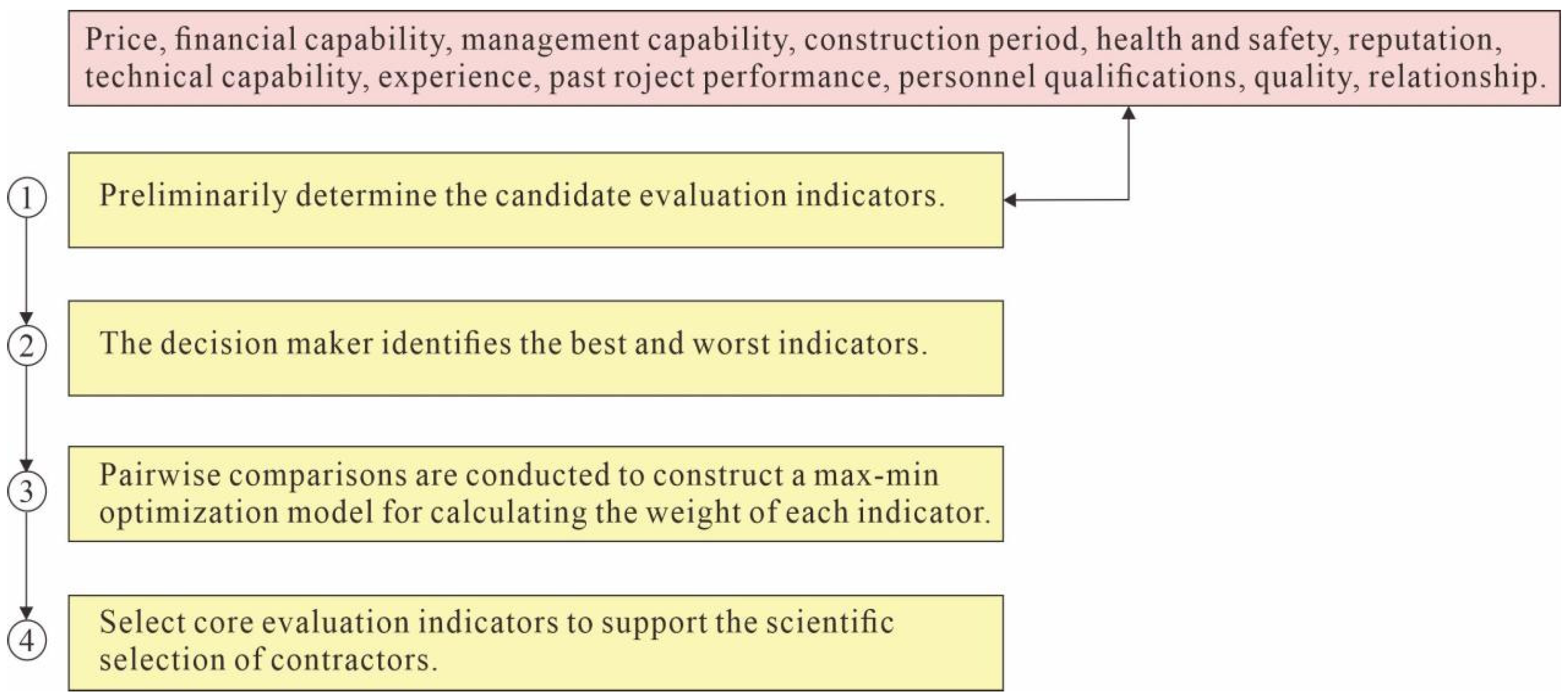
3.1. Research on Contractor Selection Evaluation Criteria
- (1)
- Criterion Set Construction: Define the core objectives of the decision problem and organize a candidate criterion set C = {C1, C2, ..., Cn} covering all key influencing factors, where n is the number of criteria.
- (2)
- Best/Worst Criterion Identification: The decision-maker (or expert team) directly selects the best criterion (the most critical and indispensable one for the decision outcome) and the worst criterion (the least influential and non-essential one) from the candidate set based on objective priorities.
- (3)
- Pairwise Comparison Judgments: Using CB (best) and CW (worst) as benchmarks, pairwise comparison relationships are established via the 1–9 scale method (1 = equally important, 3 = slightly more important, 5 = strongly more important, 7 = very strongly more important, and 9 = extremely more important; 2/4/6/8 represent intermediate values). The importance of each remaining criterion relative to CB(aBj) and relative to CW(ajW) is determined, respectively.
- (4)
- Weight Calculation and Consistency Check: A max–min optimization model is constructed to derive the objective weights of each criterion. Meanwhile, the logical rationality of the pairwise comparison judgments is verified using the consistency ratio (CR) to ensure reliable weight results.
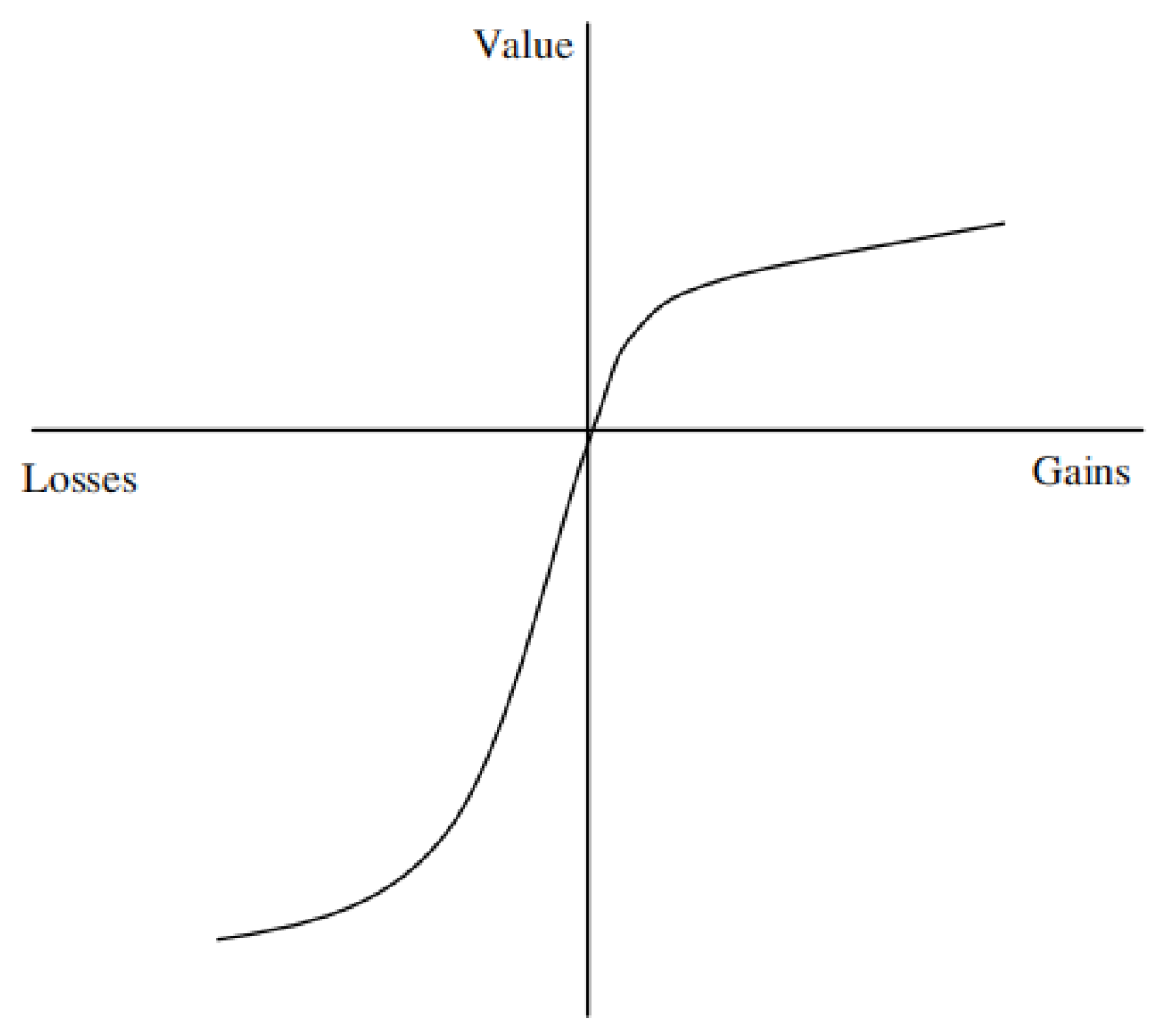
3.2. The TODIM Method

| Alternatives | Criteria | |||||
|---|---|---|---|---|---|---|
| C1 | C2 | ... | Cj | ... | Cm | |
| A1 | P11 | P12 | ... | P1j | ... | P1m |
| A2 | P21 | P22 | ... | P2j | ... | P2m |
| ... | ... | ... | ... | ... | ... | |
| Ai | Pi1 | Pi2 | ... | Pij | ... | Pim |
| ... | ... | ... | ... | ... | ... | |
| An | Pn1 | Pn2 | ... | Pnj | ... | Pnm |

4. Case Study
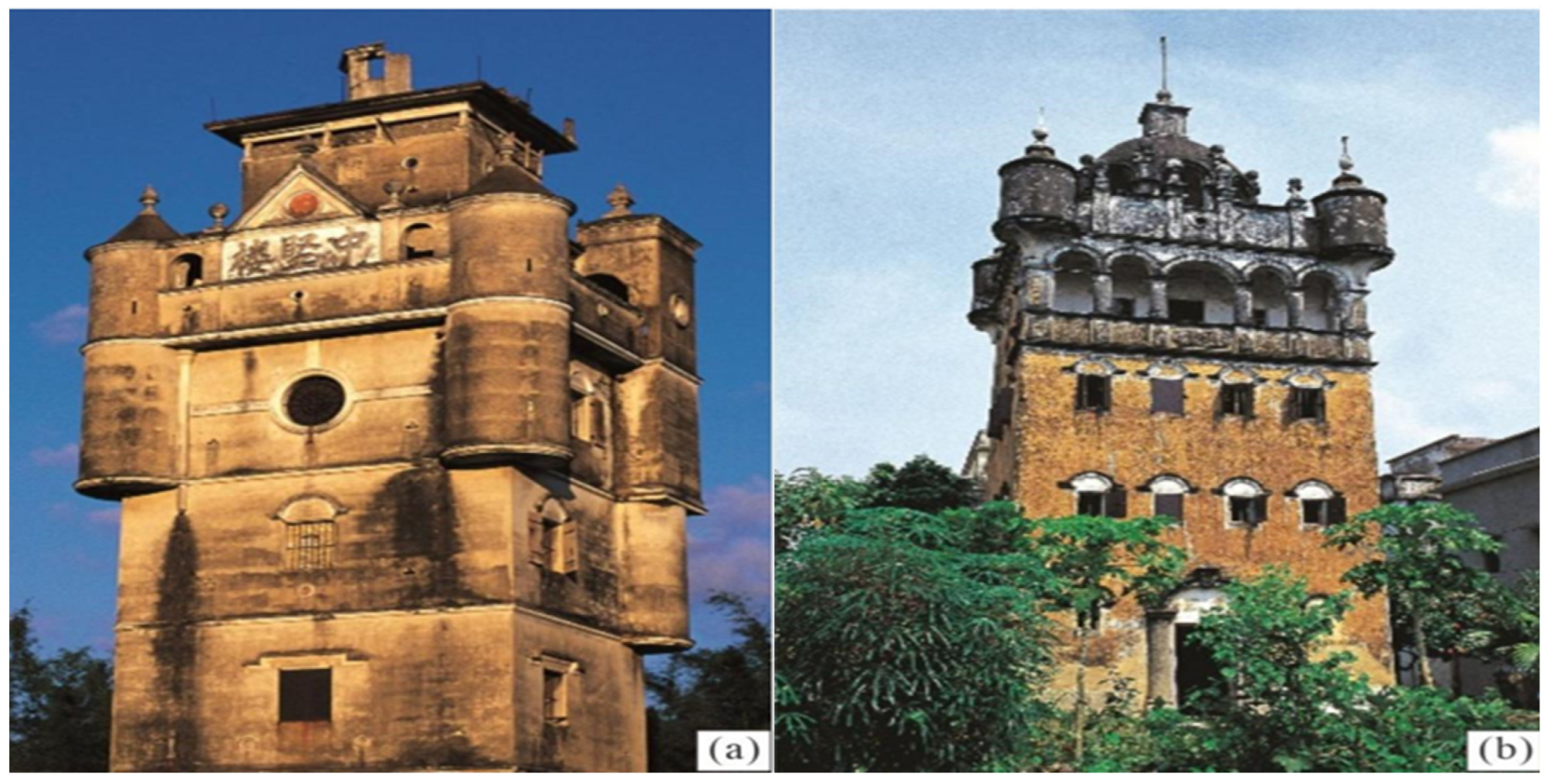
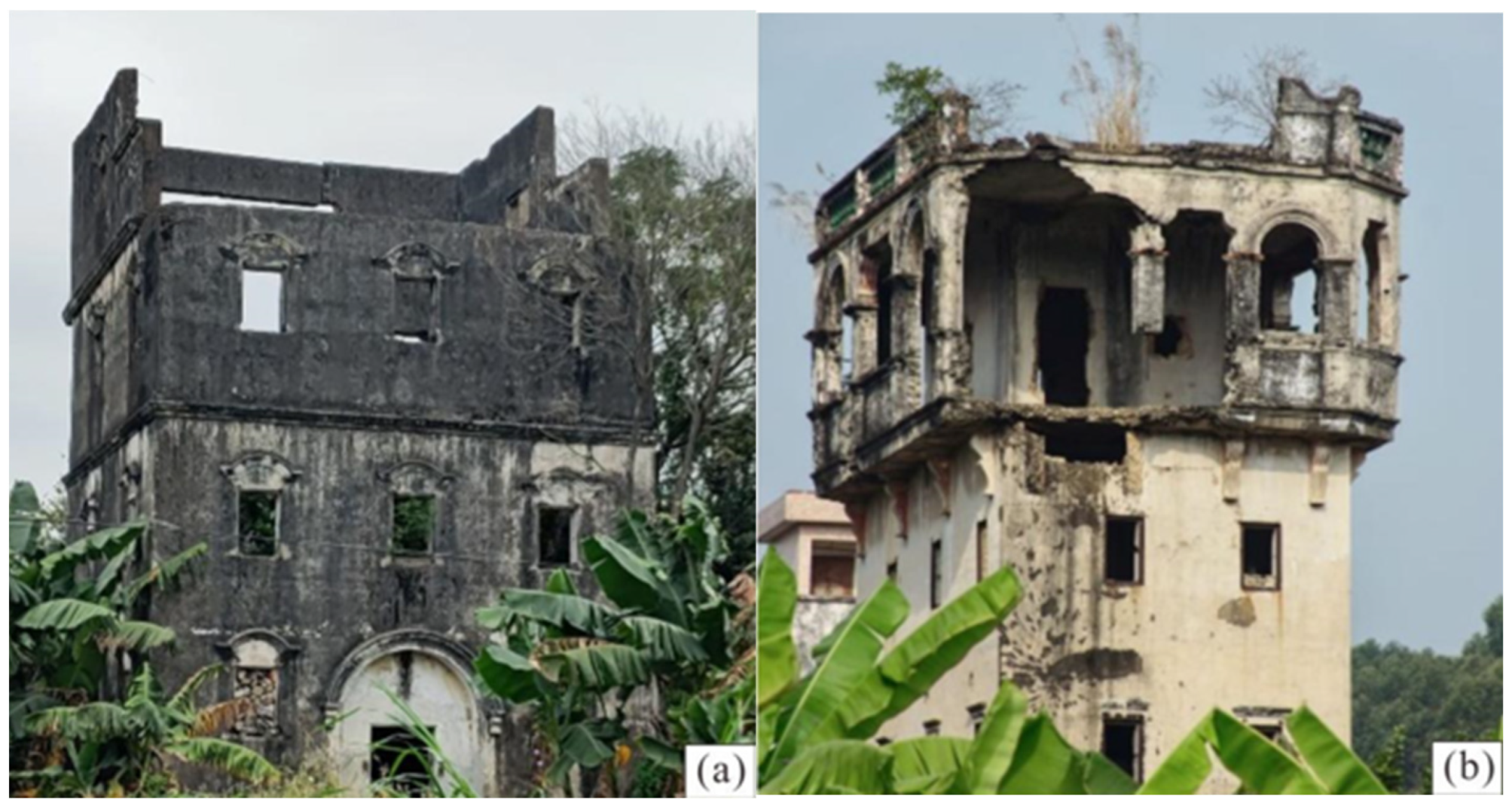
4.1. Case Study of Kaiping Diaolou and Villages
4.2. Definition of Decision Criteria
4.3. Determination of the Weights of Criteria
4.4. Sensitivity Analysis
4.5. Interpretation of Result
5. Conclusions
Author Contributions
Funding
Data Availability Statement
Acknowledgments
Conflicts of Interest
Abbreviations
| BWM | Best–Worst Method |
| TODIM | Tomada de Decisão Interativa e Multicritério |
| BWM-TODIM | Best–Worst Method–Tomada de Decisão Interativa e Multicritério |
| F-TODIM | Fuzzy-Tomada de Decisão Interativa e Multicritério |
| MCDM | Multiple-Criteria Decision-Making |
| BO | Best-to-Others |
| OW | Others-to-Worst |
| CB | Best Criterion |
| CW | Worst Criterion |
| CR | Consistency Ratio |
References
- Zheng, R.L. Artistic Characteristics and Cultural Connotation of Lingnan Traditional Gray Sculpture. Great Stage 2014, 4, 217–218. [Google Scholar] [CrossRef]
- Liu, Z.J. Guangzhou Gray Plastice, 1st ed.; Guangzhou Publishing House: Guangzhou, China, 2010; pp. 22–25. [Google Scholar]
- Chen, L.H. Artistic Characteristics and Cultural Implications of Grey Sculpture Decorations in Drum Towers in Southeastern Guizhou. Zhuangshi 2013, 1, 81–83. [Google Scholar] [CrossRef]
- Tan, H. Research on the Contemporary Value and Cultural Inheritance Path of Lingnan Grey Sculpture from the Perspective of Cultural Identity. Ind. Innov. Res. 2025, 17, 136–138. [Google Scholar]
- Mao, W.Q.; Le, Y. New media fusion of horizon, Lingnan gray mold design application. Guangdong Sea Wind 2022, 6, 78–85. [Google Scholar] [CrossRef]
- Egemen, M.; Mohamed, A.N. Clients’ needs, wants and expectations from contractors and approach to the concept of repetitive works in the Northern Cyprus construction market. Build. Environ. 2006, 41, 602–614. [Google Scholar] [CrossRef] [Scilit]
- Wang, S.B. Exploration and Practice of Improving Contractor Management. J. Jianghan Pet. Univ. Staff Work 2022, 35, 102–104. [Google Scholar]
- Rajaprasad, S.V.S. Selection of Contractors for a Housing development Project in India by using Integrated Model. Int. J. Sustain. Constr. Eng. Technol. 2018, 9, 58–68. [Google Scholar] [CrossRef] [Scilit]
- Plebankiewicz, E. A fuzzy sets based contractor prequalification procedure. Autom. Constr. 2012, 22, 433–443. [Google Scholar] [CrossRef] [Scilit]
- El-Abbasy, M.S.; Zayed, T.; Ahmed, M.; Alzraiee, H.; Abouhamad, M. Contractor selection model for highway projects using Integrated Simulation and Analytic Network Process. J. Constr. Eng. Manag. 2013, 139, 755–767. [Google Scholar] [CrossRef] [Scilit]
- Niento-Morote, A.; Ruz-Vila, F. A fuzzy multi-criteria decision-making model for construction contractor prequalification. Autom. Constr. 2012, 25, 8–19. [Google Scholar] [CrossRef] [Scilit]
- Merna, A.; Smith, N.J. Bid evaluation for the U.K. public sector construction contracts. Proc. Inst. Civ. Eng. 1990, 88, 91–105. [Google Scholar] [CrossRef] [Scilit]
- Decarolis, F. Awarding price, contract performance, and bids screening: Evidence from procurement auctions. Am. Econ. J. Appl. Econ. 2014, 6, 108–132. [Google Scholar] [CrossRef] [Scilit]
- El-Sayegh, S.M.; Rabie, M.M. Modified price plus time bi-parameter bidding model incorporating float loss impact. Int. J. Constr. Manag. 2016, 16, 267–280. [Google Scholar] [CrossRef] [Scilit]
- Nguyen, P.T. Determination of construction supplier evaluation criteria using word tags. Int. J. Adv. Appl. Sci. 2018, 5, 75–79. [Google Scholar] [CrossRef] [Scilit]
- Khan, R.A.; Gazder, U.; Qayoom, A. Comparison of delay factors and remedies’ rankings for building construction projects in developing countries. Int. J. Adv. Appl. Sci. 2017, 4, 33–42. [Google Scholar] [CrossRef] [Scilit]
- Keung, C.W.; Yiu, T.W. Potential for long-term sustainability A visit of bidding objectives and strategies from maintenance contractor’s perspective. Facilities 2015, 33, 177–195. [Google Scholar] [CrossRef] [Scilit]
- Zahedirad, M.; Khalili-Damghani, K.; Ghezavati, V.; Komijan, A.R. Solving an Integrated Project Portfolio Selection and Contractor Selection Problem: Fuzzy Goal Programming Based on Fuzzy Preference Relations. Fuzzy Inf. Eng. 2025, 17, 75–107. [Google Scholar] [CrossRef] [Scilit]
- Tafazzoli, M.; Namian, M.; Al-Bayati, A. Workers’ Fatigue in Construction Projects, Assessment, Detection, and Mitigation, A Review. In Proceedings of 59th Annual Associated Schools of Construction International Conference; EasyChair Publications: Stockport, UK, 2023; Volume 4, pp. 488–496. [Google Scholar]
- Gosling, J.; Purvis, L.; Naim, M.M. Supply chain flexibility as a determinant of supplier selection. Int. J. Prod. Econ. 2010, 128, 11–21. [Google Scholar] [CrossRef] [Scilit]
- Gao, G.X. Sustainable Winner Determination for Public-Private Partnership Infrastructure Projects in Multi-Attribute Reverse Auctions. Sustainability 2018, 10, 4129. [Google Scholar] [CrossRef] [Scilit]
- Zhang, J.L.; Qi, X.W.; Liang, C.Y. Tackling Complexity in Green Contractor Selection for Mega Infrastructure Projects: A Hesitant Fuzzy Linguistic MADM Approach with considering Group Attitudinal Character and Attributes’ Interdependency. Complexity 2018, 2018, 4903572. [Google Scholar] [CrossRef] [Scilit]
- Kog, F.; Yaman, H. A multi-agent systems-based contractor pre-qualification model. Eng. Constr. Archit. Manag. 2016, 23, 709–726. [Google Scholar] [CrossRef] [Scilit]
- Yang, J.B.; Wang, H.H.; Wang, W.C.; Ma, S.M. Using Data Envelopment analysis to support Best-Value contractor selection. J. Civ. Eng. Manag. 2016, 22, 199–209. [Google Scholar] [CrossRef] [Scilit]
- Palha, R.P.; Almeida, A.T.; Alencar, A.H. A Model for Sorting Activities to Be Outsourced in Civil Construction Based on ROR-UTADIS. Math. Probl. Eng. 2016, 2016, 9236414. [Google Scholar] [CrossRef] [Scilit]
- Khalili-Damghani, K.; Ghasemi, P. Uncertain centralized/decentralized production-distribution planning problem in multi-product supply chains: Fuzzy mathematical optimization approaches. Ind. Eng. Manag. Syst. 2016, 15, 156–172. [Google Scholar] [CrossRef] [Scilit]
- Shafipour-Omrani, B.; Khalili-Damghani, K.; Ghasemi, P. Solving a supply chain problem using two approaches of fuzzy goal programming based on TOPSIS and fuzzy preference relations. J. Ind. Syst. Eng. 2020, 13, 27–48. [Google Scholar] [CrossRef] [Scilit]
- Karami, S.; Mousavi, S.M.; Antucheviciene, J. Enhancing contractor selection process by a new interval-valued fuzzy decision-making model based on SWARA and CoCoSo methods. Axioms 2023, 12, 729. [Google Scholar] [CrossRef] [Scilit]
- Sun, S.; Zhou, S. Analysis of Construction Contractor Selection and Evaluation Based on AHP and GRA. In ICCREM 2013: Construction and Operation in the Context of Sustainability; American Society of Civil Engineers: Reston, VA, USA, 2013. [Google Scholar] [CrossRef] [Scilit]
- Putra, A.P.E.; Sardi, I.L.; Adityaji, R. Implementation of Hybrid BWM-TOPSIS Method in the Selection of Tour Guide (Case Study: Guidemu). In Proceedings of the International Conference on Software Engineering and Information Technology (ICoSEIT), Bandung, Indonesia, 22–23 November 2022. [Google Scholar] [CrossRef] [Scilit]
- Trivedi, P.; Shah, J.; Čep, R.; Abualigah, L.; Kalita, K. A Hybrid Best-Worst Method (BWM)—Technique for Order of Preference by Similarity to Ideal Solution (TOPSIS) Approach for Prioritizing Road Safety Improvements. IEEE Access 2024, 12, 30054–30065. [Google Scholar] [CrossRef] [Scilit]
- Yuan, R.; Dou, Y.; Xiang, N.; Zhao, Q.; Xu, X.; Wang, J. A Logistics Supplier Combination Decision Method Based on Hesitation Fuzzy BWM-TOPSIS. In Proceedings of the 2024 36th Chinese Control and Decision Conference (CCDC), Xi’an, China, 25–27 May 2024. [Google Scholar] [CrossRef] [Scilit]
- Afshar, M.R.; Alipouri, Y.; Sebt, M.H.; Chan, W.T. A type-2 fuzzy set model for contractor prequalification. Autom. Constr. 2017, 84, 356–366. [Google Scholar] [CrossRef] [Scilit]
- Ulubeyli, S.; Kazaz, A. Fuzzy Multi-criteria decision making model for subcontractor selection in international construction projects. Technol. Econ. Dev. Econ. 2016, 22, 210–234. [Google Scholar] [CrossRef] [Scilit]
- Xiao, F.; Chen, Z.Y.; Wang, X.; Hou, W.H.; Wang, J.Q. Managing minority opinions in risk evaluation by a delegation mechanism-based large-scale group decision-making with overlapping communities. J. Oper. Res. Soc. 2022, 73, 2338–2357. [Google Scholar] [CrossRef] [Scilit]
- Li, J.; Xiang, Y.Y.; Peng, H.G.; Wang, J.Q. An extended multi-criteria group decision-making method based on preference ranking under Z-number environments. Eng. Appl. Artif. Intell. 2025, 149, 110573. [Google Scholar] [CrossRef] [Scilit]
- Wang, X.; Wang, S.H.; Zhang, H.Y.; Wang, J.Q. The recommendation method for hotel selection under traveller preference characteristics: A cloud-based multi-criteria group decision support model. Group Decis. Negot. 2021, 30, 433–1469. [Google Scholar] [CrossRef] [Scilit]
- He, S.-S.; Wang, Y.T.; Peng, J.J.; Wang, J.Q. Risk ranking of wind turbine systems through an improved FMEA based on probabilistic linguistic information and the TODIM method. J. Oper. Res. Soc. 2022, 73, 467–480. [Google Scholar] [CrossRef] [Scilit]
- Nie, R.X.; Tian, Z.P.; Sang, C.K.; Wang, J.Q. Implementing healthcare service quality enhancement using a cloud-support QFD model integrated with TODIM method and linguistic distribution assessments. J. Oper. Res. Soc. 2022, 73, 207–229. [Google Scholar] [CrossRef] [Scilit]
- Wang, L.; Zhang, H.Y.; Wang, J.Q.; Wu, G.F. Picture fuzzy multi-criteria group decision-making method to hotel building energy efficiency retrofit project selection. Rairo-Oper. Res. 2019, 104, 104395. [Google Scholar] [CrossRef] [Scilit]
- Wu, Y.C.; Chen, M.R.; Shen, K.W.; Wang, J.Q. Z-number extension of TODIM-CPT method combined with K-means clustering for electric vehicle battery swapping station site selection. J. Energy Storage 2024, 85, 110900. [Google Scholar] [CrossRef] [Scilit]
- Liu, B.S.; Huo, T.F.; Liao, P.C.; Gong, J.; Xue, B. A Group Decision-Making Aggregation Model for Contractor Selection in Large Scale Construction Projects Based on Two-Stage Partial Least Squares (PLS) Path Modeling. Group Decis. Negotiat. 2015, 24, 855–883. [Google Scholar] [CrossRef] [Scilit]
- Nassar, K.; Hosny, O. Fuzzy clustering validity for contractor performance evaluation: Application to UAE contractors. Autom. Constr. 2013, 31, 158–168. [Google Scholar] [CrossRef] [Scilit]
- Attar, M.M.; Khanzadi, M.; Dabirian, M.; Kalhor, E. Forecasting contractor’s deviation from the client objectives in prequalification model using support vector regression. Int. J. Proj. Manag. 2013, 31, 924–936. [Google Scholar] [CrossRef] [Scilit]
- Assaf, S.; Hassanain, M.A.; Hadidi, L.; Amman, A. A Systematic Approach for the Selection of the Architect/Engineer professional in Construction Projects. Arch. Civ. Eng. Environ. 2017, 10, 5–14. [Google Scholar] [CrossRef] [Scilit]
- Ilies, G.; Safarov, B.; Hodor, N. Analysis of the Interior Microclimate in Art Nouveau Heritage Buildings for the Protection of Exhibits and Human Health. Int. J. Environ. Res. Public Health 2022, 19, 16599. [Google Scholar] [CrossRef] [Scilit]
- Brauers, W.K.M.; Zavadskas, E.K.; Turskis, Z.; Vilutienė, T. Multi-objective contractor’s ranking by applying MOORA method. J. Bus. Econ. Manag. 2008, 9, 245–255. [Google Scholar] [CrossRef] [Scilit]
- Zavadskas, E.K.; Kaklauskas, A.; Vilutiene, T. Multicriteria evaluation of apartment blocks maintenance contractors: Lithuanian case study. Int. J. Strateg. Prop. Manag. 2009, 13, 319–338. [Google Scholar] [CrossRef] [Scilit]
- Zavadskas, E.K.; Vilutienė, T. A multiple criteria evaluation of multi-family apartment block’s maintenance contractors: I-Model for maintenance contractor evaluation and the determination of its selection criteria. Build. Environ. 2006, 41, 621–632. [Google Scholar] [CrossRef] [Scilit]
- Juan, Y.K. A hybrid approach using data envelopment analysis and case-based reasoning for housing refurbishment contractors’ selection and performance improvement. Expert. Syst. Appl. 2009, 36, 5702–5710. [Google Scholar] [CrossRef] [Scilit]
- Hatush, Z.; Skitmore, M. Criteria for contractor selection. Constr. Manag. Econ. 1997, 15, 19–38. [Google Scholar] [CrossRef] [Scilit]
- El-Sawalhi, N.; Eaton, D.; Rustom, R. Contractor prequalification model: State-of-the-art. Int. J. Proj. Manag. 2007, 25, 465–474. [Google Scholar] [CrossRef] [Scilit]
- Morkunaite, Z.; Bausys, R.; Kazimieras Zavadskas, E. Contractor Selection for Sgraffito Decoration of Cultural Heritage Buildings Using the WASPAS-SVNS Method. Sustainability 2019, 11, 6444. [Google Scholar] [CrossRef] [Scilit]
- ICOMOS China. Principles for the Conservation of Heritage Sites in China (Illustrated with Case Studies); ICOMOS China: Beijing, China, 2015. [Google Scholar]
- Zhang, B. Principles for the Conservation of Heritage Sites in China and Urban Culture; National Cultural Heritage Administration: Beijing, China, 2008.
- Rezaei, J. Best-worst multi-criteria decision-making method. Omega 2015, 53, 49–57. [Google Scholar] [CrossRef] [Scilit]
- Norouzi, A.; Ghayur Namin, H. A Hybrid Fuzzy TOPSIS–Best Worst Method for Risk Prioritization in Megaprojects. Civil. Eng. J. 2019, 5, 1567–1578. [Google Scholar] [CrossRef] [Scilit]
- Mota, V.R.R.; Gomes, C.F.S.; Santos, M. Uso do Best-Worst Method (BWM) para escolha de um local para almoxarifado central dos hospitais do Rio de Janeiro. In IX Simpósio de Engenharia de Produção, Pernambuco; Universidade Federal de Campina Grande: Campina Grande, Brazil, 2021. [Google Scholar] [CrossRef] [Scilit]
- Rezaei, J. Best-worst multi-criteria decision-making method: Some properties and a linear model. Omega 2016, 64, 126–130. [Google Scholar] [CrossRef] [Scilit]
- Roux, D. Nobel en Économie, 2nd ed.; Economica: Paris, France, 2002. [Google Scholar]
- Gomes, L.F.A.M.; Lima, M.M.P.P. TODIM: Basics and application to multicriteria ranking of projects with environmental impacts. Found. Comput. Decis. Sci. 1992, 16, 113–127. [Google Scholar]
- Kahneman, D.; Tversky, A. Prospect theory: An analysis of decision under risk. Econometrica 1979, 47, 263–292. [Google Scholar] [CrossRef] [Scilit]
- Sang, X.Z.; Liu, X.W.; Zhang, N. An interval type-2 fuzzy sets-based TODIM method and its application to green supplier selection. J. Oper. Res. Soc. 2016, 67, 1133–1147. [Google Scholar] [CrossRef] [Scilit]
- Kaur, P.; Dutta, V.; Pradhan, B.L.; Haldar, S.; Chauhan, S. A Pythagorean Fuzzy Approach for Sustainable Supplier Selection Using TODIM. Math. Probl. Eng. 2021, 2021, 4254894. [Google Scholar] [CrossRef] [Scilit]
- Wang, X.; Zhang, H.; Wang, J. Extended TODIM-PROMETHEE II method with hesitant probabilistic information for solving potential risk evaluation problems of water resource carrying capacity. Expert Syst. 2021, 38, e12681. [Google Scholar] [CrossRef] [Scilit]
- Gomes, L.F.A.M.; Lima, M.M.P.P. From modeling individual preferences to multicriteria ranking of discrete alternatives: A look at prospect theory and the additive difference model. Found. Comput. Decis. Sci. 1992, 17, 171–184. [Google Scholar]
- Gomes, L.F.A.M.; Rangel, L.A.D.; Maranhão, F.J.C. Multicriteria analysis of natural gas destination in Brazil: An application of the TODIM method. Math. Comput. Model. 2009, 50, 92–100. [Google Scholar] [CrossRef] [Scilit]
- Qian, Y. A Concise History of Ancient Jiangmen; Jinan University Press: Guangzhou, China, 2023; p. 250. [Google Scholar]
- Jia, W.W.; Zhang, W. Kaiping Diaolou in Jiangmen; China National Human Geography: Beijing, China, 2019. [Google Scholar]
- Li, M.Y. The Integration of Cantonese Culture and Overseas Chinese Culture in Jiangmen; Guangzhou Daily: Guangzhou, China, 2017. [Google Scholar]
- Cheng, L.; Lin, X.Q. Research on the Conservation and Restoration of Gray Sculpture Decoration in Minnan Traditional Buildings. Jian Zhu Xue Bao 2024, S2, 40–45. [Google Scholar]
- Jiang, T.; Zhang, C.Z. Formation and Characteristics of the Three-Dimensional Relationship of Dispersed Property Rights of Architectural Heritage in Overseas Chinese Homelands: A Case Study of Kaiping Diaolou. Nanjing Shehui Kexue 2021, 2, 166–172. [Google Scholar] [CrossRef]
- Jiang, T.; Zhang, C.Z. Tourist Interpretation of the Sense of Place of Kaiping Diaolou and Villages. Shijie Dili Yanjiu 2019, 28, 194–201. [Google Scholar] [CrossRef]
- Fan, Z.P.; Chen, F.D.; Zhang, X. Multi-attribute Decision Making Method with Interval Numbers Considering Decision Makers’ Psychological Behavior. Dongbei Daxue Xuebao Northeast. Univ. 2011, 32, 136–139. [Google Scholar] [CrossRef]
- Krohling, R.A.; Souza, T. Combining prospect theory and fuzzy numbers to multi-criteria decision making. Expert Syst. Appl. 2012, 39, 11487–11493. [Google Scholar] [CrossRef] [Scilit]
- Fan, Z.P.; Zhang, X.; Chen, F.D. Extended TODIM method for hybrid multiple attribute decision making problem. Knowl.-Based Syst. 2013, 42, 40–48. [Google Scholar] [CrossRef] [Scilit]
- Gomes, L.F.A.M. An application of the TODIM method to the multicriteria rental evaluation of residential properties. Eur. J. Oper. Res. 2009, 193, 204–211. [Google Scholar] [CrossRef] [Scilit]



| Criterion | Author |
|---|---|
| Price | El-Abbasy M.S. et al. [10], Merna et al. [12], Decarolis et al. [13], El-Sayegh et al. [14], Nguyen et al. [15], Khan R.A. et al. [16], Keung et al. [17], Palha et al. [25], B. Shafipour-Omrani et al. [27], Karami et al. [28], Yuan, R. et al. [32], Li, J. et al. [36], Wang, X. et al. [37], Wang, L. et al. [40], Nassar et al. [43]. |
| Financial Ability | Niento-Morote and Ruz-Vila [11], Zhang et al. [22], Kog et al. [23], Shafipour-Omrani, B. et al. [27], Karami, S. et al. [28], Sun et al. [29], Yuan, R. et al. [32], Afshar et al. [33], Ulubeyli et al. [34], Xiao, F. et al. [35], Wang, X. et al. [37], Wang, L. et al. [40], Attar and Yiu et al. [44], Keung et al. [17]. |
| Management Ability | Zhang et al. [22], Yang et al. [24], Shafipour-Omrani, B. et al. [27], Trivedi, P. et al. [31], Afshar et al. [33], Wang, X. et al. [37], He, S.S. et al. [38], Nie, R.X. et al. [39], Wang, L. et al. [40], Attar et al. [44]. |
| Duration | Gao et al. [21], Trivedi, P. et al. [31], Yuan, R. et al. [32], Li, J. et al. [36] Wang, X. et al. [37], He, S.S. et al. [38], Nie, R.X. et al. [39], Wang, L. et al. [40]. |
| Health and Safety | Gao et al. [21], Kog et al. [23], Putra, A.P.E. [30], Trivedi, P. [31], Afshar [33], Li, J. et al. [36], Wang, X. et al. [37], He, S.S. et al. [38], Nie, R.X. et al. [39], Wu, Y.C. [41], Liu [42], Attar [44]. |
| Reputation | Kog et al. [23], Ulubeyli et al. [34], Li, J. et al. [36], Wang, X. et al. [37], Nie, R.X. [39], Keung, C.W. [17]. |
| Technical Capability | Zahedirad, M. et al. [18], Zhang et al. [22], Kog et al. [23], Yang et al. [24], Shafipour-Omrani, B. et al. [27], Karami, S. et al. [28], Sun et al. [29], Putra, A.P.E. et al. [30], Trivedi, P. et al. [31], Afshar et al. [33], Ulubeyli et al. [34], Wang, X. et al. [37], He, S.S. et al. [38], Nie, R.X. et al. [39], Wu, Y.C. [41], Liu et al. [42], Attar et al. [44]. |
| Experience | Nguyen, P.T. [15], Khan, R.A. [16], Yang et al. [24], Sun et al. [29], Putra, A.P.E. et al. [30], Trivedi, P. et al. [31], Ulubeyli et al. [34], Wang, X. et al. [37], He, S.S. et al. [38], Nie, R.X. et al. [39], Wu, Y.C. [41], Attar et al. [44]. |
| Past Project Performance | Keung, C.W and Yiu, T.W [17], Yang et al. [24], Ulubeyli et al. [34], Wang, X. et al. [37], He, S.S. et al. [38], Nie, R.X. et al. [39], Wu, Y.C. [41], Liu et al. [42], Attar et al. [44], Brauers et al. [17]. |
| Personnel | Gosling et al. [20], Afshar et al. [33], Xiao, F. et al. [35], Li, J. et al. [36], Nassar and Hosny [43]. |
| Quality | Nguyen et al. [15], Khan, R.A. et al. [16], Tafazzoli, M. et al. [19], Li, J. et al. [36], Wang, X. et al. [37], He, S.S. et al. [38], Nie, R.X. et al. [39], Wu, Y.C. et al. [41], Nassar and Hosny [43], Attar et al. [44]. |
| Relationship | Nguyen et al. [15], Gosling et al. [20], Khalili-Damghani and Ghasemi, P. [26], Putra, A.P.E. et al. [30], Ulubeyli et al. [34]. |
| Time | Decarolis et al. [13], El-Sayegh et al. [14], Palha et al. [25]. |
| aBw | 1 | 2 | 3 | 4 | 5 | 6 | 7 | 8 | 9 |
|---|---|---|---|---|---|---|---|---|---|
| Consistency Index (maxξ) | 0.00 | 0.44 | 1.00 | 1.63 | 2.30 | 3.00 | 3.73 | 4.47 | 5.23 |
| BO | Price | Financial Ability | Management Ability | Risk | Technical Capability | Experience | Contractors’ Value | Quality | Reputation |
|---|---|---|---|---|---|---|---|---|---|
| Best Criterion: Technical Capability | 1–9 | 1–9 | 1–9 | 1–9 | 1–9 | 1–9 | 1–9 | 1–9 | 1–9 |
| OW | Worst Criterion: Reputation | ||||||||
| Price | 1–9 | ||||||||
| Financial Ability | 1–9 | ||||||||
| Management Ability | 1–9 | ||||||||
| Risk | 1–9 | ||||||||
| Technical Capability | 1–9 | ||||||||
| Experience | 1–9 | ||||||||
| Contractors’ value | 1–9 | ||||||||
| Quality | 1–9 | ||||||||
| Reputation | 1–9 | ||||||||
| aBw | 1 | 2 | 3 | 4 | 5 | 6 | 7 | 8 | 9 |
|---|---|---|---|---|---|---|---|---|---|
| Consistency Index (maxξ) | 0.00 | 0.44 | 1.00 | 1.63 | 2.30 | 3.00 | 3.73 | 4.47 | 5.23 |
| 1 | 3 | 4 | 5 | 6 | 7 | 8 | 9 | 10 | 11 |
|---|---|---|---|---|---|---|---|---|---|
| 0.44 | 1.08 | 1.63 | 2.13 | 2.60 | 3.03 | 3.45 | 3.85 | 4.25 |
| BO | Price | Financial Ability | Management Ability | Risk | Technical Capability | Experience | Contractors’ Value | Quality | Reputation |
|---|---|---|---|---|---|---|---|---|---|
| Best Criterion: Technical Capability | 3 | 3 | 4 | 4 | 1 | 2 | 5 | 3 | 7 |
| OW | Worst Criterion: Reputation | ||||||||
| Price | 4 | ||||||||
| Financial Ability | 5 | ||||||||
| Management Ability | 3 | ||||||||
| Risk | 4 | ||||||||
| Technical Capability | 8 | ||||||||
| Experience | 6 | ||||||||
| Contractors’ value | 4 | ||||||||
| Quality | 5 | ||||||||
| Reputation | 1 | ||||||||
| BO | Price | Financial Ability | Management Ability | Risk | Technical Capability | Experience | Contractors’ Value | Quality | Reputation |
|---|---|---|---|---|---|---|---|---|---|
| Best Criterion: Technical Capability | 4 | 4 | 5 | 5 | 1 | 3 | 4 | 3 | 8 |
| OW | Worst Criterion: Reputation | ||||||||
| Price | 5 | ||||||||
| Financial Ability | 4 | ||||||||
| Management Ability | 4 | ||||||||
| Risk | 3 | ||||||||
| Technical Capability | 9 | ||||||||
| Experience | 6 | ||||||||
| Contractors’ value | 5 | ||||||||
| Quality | 4 | ||||||||
| Reputation | 1 | ||||||||
| BO | Price | Financial Ability | Management Ability | Risk | Technical Capability | Experience | Contractors’ Value | Quality | Reputation |
|---|---|---|---|---|---|---|---|---|---|
| Best Criterion: Technical Capability | 3 | 5 | 3 | 4 | 1 | 2 | 4 | 2 | 7 |
| OW | Worst Criterion: Reputation | ||||||||
| Price | 4 | ||||||||
| Financial Ability | 5 | ||||||||
| Management Ability | 4 | ||||||||
| Risk | 4 | ||||||||
| Technical Capability | 8 | ||||||||
| Experience | 7 | ||||||||
| Contractors’ value | 5 | ||||||||
| Quality | 5 | ||||||||
| Reputation | 1 | ||||||||
| BO | Price | Financial Ability | Management Ability | Risk | Technical Capability | Experience | Contractors’ Value | Quality | Reputation |
|---|---|---|---|---|---|---|---|---|---|
| Best Criterion: Technical Capability | 4 | 3 | 4 | 6 | 1 | 2 | 5 | 3 | 8 |
| OW | Worst Criterion: Reputation | ||||||||
| Price | 5 | ||||||||
| Financial Ability | 4 | ||||||||
| Management Ability | 5 | ||||||||
| Risk | 3 | ||||||||
| Technical Capability | 9 | ||||||||
| Experience | 6 | ||||||||
| Contractors’ value | 4 | ||||||||
| Quality | 4 | ||||||||
| Reputation | 1 | ||||||||
| BO | Price | Financial Ability | Management Ability | Risk | Technical Capability | Experience | Contractors’ Value | Quality | Reputation |
|---|---|---|---|---|---|---|---|---|---|
| Best Criterion: Technical Capability | 3 | 4 | 3 | 5 | 1 | 2 | 4 | 3 | 7 |
| OW | Worst Criterion: Reputation | ||||||||
| Price | 4 | ||||||||
| Financial Ability | 5 | ||||||||
| Management Ability | 4 | ||||||||
| Risk | 3 | ||||||||
| Technical Capability | 8 | ||||||||
| Experience | 6 | ||||||||
| Contractors’ value | 5 | ||||||||
| Quality | 5 | ||||||||
| Reputation | 1 | ||||||||
| Criteria | Price | Financial Ability | Management Ability | Risk | Technical Capability | Experience | Contractors’ Value | Quality | Reputation |
|---|---|---|---|---|---|---|---|---|---|
| Weight (wj) | 0.0987 | 0.0907 | 0.0897 | 0.0703 | 0.2713 | 0.1535 | 0.0762 | 0.1207 | 0.0285 |
| Criteria | The Assessment of Criteria, Min/Max | Alternatives | |||
|---|---|---|---|---|---|
| A1 | A2 | A3 | |||
| Price | X1 | Min | 10,500 | 11,200 | 100,000 |
| Financial Ability | X2 | Max | 9.2 | 9 | 8.2 |
| Management Ability | X3 | Max | 9 | 8.5 | 7.6 |
| Risk | X4 | Min | 8.6 | 8.8 | 7.8 |
| Technical Capability | X5 | Max | 9.1 | 7.5 | 8 |
| Experience | X6 | Max | 8.6 | 8.6 | 7.9 |
| Contractors’ value | X7 | Max | 7.5 | 9.2 | 7.2 |
| Quality | X8 | Max | 8.2 | 8.4 | 7.5 |
| Reputation | X9 | Max | 7.8 | 8 | 8.5 |
| Criteria | ɸc (A1,A2) | ɸc (A1,A3) | ɸc (A2,A3) |
|---|---|---|---|
| Price | 0.239982861 | −2.054341077 | −3.182571511 |
| Financial Ability | 0.134729053 | 0.301263321 | 0.269458106 |
| Management Ability | 0.179013503 | 0.299546884 | 0.240171817 |
| Risk | 0.118591652 | −3.372918684 | −3.77103773 |
| Technical Capability | 0.520954669 | 0.431952792 | −1.073062644 |
| Experience | 0 | 0.391814916 | 0.391814916 |
| Contractors’ value | −3.338529195 | 0.10695471 | 0.276155873 |
| Quality | −1.35646667 | 0.306487228 | 0.347523851 |
| Reputation | −3.165348367 | −5.92182455 | −5.004855214 |
| δ (A1,A2) | δ (A1,A3) | δ (A1,A3) | |
|---|---|---|---|
| δ | −6.667072493 | −9.511064459 | −11.50640254 |
| A1 | A2 | A3 | Ranking Consistency | |
|---|---|---|---|---|
| ξi | 1 | 0.412317007 | 0 | A1 > A2 > A3 |
| Criteria | ɸc (A1,A2) | ɸc (A1,A3) | ɸc (A2,A3) |
|---|---|---|---|
| Price | 0.239982861 | −1.027170538 | −1.591285756 |
| Financial Ability | 0.134729053 | 0.301263321 | 0.269458106 |
| Management Ability | 0.179013503 | 0.299546884 | 0.240171817 |
| Risk | 0.118591652 | −1.686459342 | −1.885518865 |
| Technical Capability | 0.520954669 | 0.431952792 | −0.536531322 |
| Experience | 0 | 0.391814916 | 0.391814916 |
| Contractors’ value | −1.669264597 | 0.10695471 | 0.276155873 |
| Quality | −0.678233335 | 0.306487228 | 0.347523851 |
| Reputation | −1.582674184 | −2.960912275 | −2.502427607 |
| Criteria | ɸc (A1,A2) | ɸc (A1,A3) | ɸc (A2,A3) |
|---|---|---|---|
| Price | 0.239982861 | −0.684780359 | −1.06085717 |
| Financial Ability | 0.134729053 | 0.301263321 | 0.269458106 |
| Management Ability | 0.179013503 | 0.299546884 | 0.240171817 |
| Risk | 0.118591652 | −1.124306228 | −1.257012577 |
| Technical Capability | 0.520954669 | 0.431952792 | −0.357687548 |
| Experience | 0 | 0.391814916 | 0.391814916 |
| Contractors’ value | −1.112843065 | 0.10695471 | 0.276155873 |
| Quality | −0.452155557 | 0.306487228 | 0.347523851 |
| Reputation | −1.055116122 | −1.973941517 | −1.668285071 |
| Criteria | ɸc (A1,A2) | ɸc (A1,A3) | ɸc (A2,A3) |
|---|---|---|---|
| Price | 0.239982861 | −0.513585269 | −0.795642878 |
| Financial Ability | 0.134729053 | 0.301263321 | 0.269458106 |
| Management Ability | 0.179013503 | 0.299546884 | 0.240171817 |
| Risk | 0.118591652 | −0.843229671 | −0.942759433 |
| Technical Capability | 0.520954669 | 0.431952792 | −0.268265661 |
| Experience | 0 | 0.391814916 | 0.391814916 |
| Contractors’ value | −0.834632299 | 0.10695471 | 0.276155873 |
| Quality | −0.339116667 | 0.306487228 | 0.347523851 |
| Reputation | −0.791337092 | −1.480456137 | −1.251213803 |
| Criteria | ɸc (A1,A2) | ɸc (A1,A3) | ɸc (A2,A3) |
|---|---|---|---|
| Price | 0.239982861 | −0.410868215 | −0.636514302 |
| Financial Ability | 0.134729053 | 0.301263321 | 0.269458106 |
| Management Ability | 0.179013503 | 0.299546884 | 0.240171817 |
| Risk | 0.118591652 | −0.674583737 | −0.754207546 |
| Technical Capability | 0.520954669 | 0.431952792 | −0.214612529 |
| Experience | 0 | 0.391814916 | 0.391814916 |
| Contractors’ value | −0.667705839 | 0.10695471 | 0.276155873 |
| Quality | −0.271293334 | 0.306487228 | 0.347523851 |
| Reputation | −0.633069673 | −1.18436491 | −1.000971043 |
| Value of θ | A1 vs. A2 | A1 vs. A3 | A2 vs. A3 |
|---|---|---|---|
| 1 | −6.667072493 | −9.511064459 | −11.50640254 |
| 2 | −2.736900378 | −3.836522303 | −4.990638986 |
| 3 | −1.426843006 | −1.945008251 | −2.818717803 |
| 4 | −0.77181432 | −0.999251226 | −1.732757211 |
| 5 | −0.378797108 | −0.43179701 | −1.081180856 |
| Value of θ | A1 | A2 | A3 | Ranking Consistency |
|---|---|---|---|---|
| 1 | 1 | 0.412317007 | 0 | A1 > A2 > A3 |
| 2 | 1 | 0.512089857 | 0 | A1 > A2 > A3 |
| 3 | 1 | 0.627721368 | 0 | A1 > A2 > A3 |
| 4 | 1 | 0.763319019 | 0 | A1 > A2 > A3 |
| 5 | 1 | 0.924542813 | 0 | A1 > A2 > A3 |
| Contractors | Criteria | ||||||||
|---|---|---|---|---|---|---|---|---|---|
| Price | Financial Ability | Management Ability | Risk | Technical Capability | Experience | Contractors’ Value | Quality | Reputation | |
| A1 | 0.583333 | 1 | 1 | 0.2 | 1 | 1 | 0.15 | 0.777778 | 0 |
| A2 | 0 | 0.8 | 0.642857 | 0 | 0 | 1 | 1 | 1 | 0.285714 |
| A3 | 1 | 0 | 0 | 1 | 0.3125 | 0 | 0 | 0 | 1 |
| Criteria | Price | Financial Ability | Management Ability | Risk | Technical Capability | Experience | Contractors’ Value | Quality | Reputation |
|---|---|---|---|---|---|---|---|---|---|
| Weight (wj) | 0.098729 | 0.090760 | 0.089728 | 0.070320 | 0.271394 | 0.153519 | 0.076262 | 0.120773 | 0.028516 |
| Criteria | Price | Financial Ability | Management Ability | Risk | Technical Capability | Experience | Contractors’ Value | Quality | Reputation |
|---|---|---|---|---|---|---|---|---|---|
| Relative Weights (wj’) | 0.363784 | 0.334420 | 0.330620 | 0.259107 | 1 | 0.565669 | 0.281002 | 0.445010 | 0.105072 |
Disclaimer/Publisher’s Note: The statements, opinions and data contained in all publications are solely those of the individual author(s) and contributor(s) and not of MDPI and/or the editor(s). MDPI and/or the editor(s) disclaim responsibility for any injury to people or property resulting from any ideas, methods, instructions or products referred to in the content. |
© 2026 by the authors. Licensee MDPI, Basel, Switzerland. This article is an open access article distributed under the terms and conditions of the Creative Commons Attribution (CC BY) license.
Share and Cite
Qiao, Y.; Gao, L.; Deng, X.; Huang, X.; Wang, J.; Yang, T.; Chen, H. Research on Contractor Selection for Grey Plaster Decoration Engineering of Cultural Relic Buildings Based on the BWM-TODIM Method. Buildings 2026, 16, 1241. https://doi.org/10.3390/buildings16061241
Qiao Y, Gao L, Deng X, Huang X, Wang J, Yang T, Chen H. Research on Contractor Selection for Grey Plaster Decoration Engineering of Cultural Relic Buildings Based on the BWM-TODIM Method. Buildings. 2026; 16(6):1241. https://doi.org/10.3390/buildings16061241
Chicago/Turabian StyleQiao, Yu, Le Gao, Xinwen Deng, Xiaoying Huang, Jianqiang Wang, Tian Yang, and Hengyi Chen. 2026. "Research on Contractor Selection for Grey Plaster Decoration Engineering of Cultural Relic Buildings Based on the BWM-TODIM Method" Buildings 16, no. 6: 1241. https://doi.org/10.3390/buildings16061241
APA StyleQiao, Y., Gao, L., Deng, X., Huang, X., Wang, J., Yang, T., & Chen, H. (2026). Research on Contractor Selection for Grey Plaster Decoration Engineering of Cultural Relic Buildings Based on the BWM-TODIM Method. Buildings, 16(6), 1241. https://doi.org/10.3390/buildings16061241