


Abstract
To address the shortage of natural sand and the unclear mechanism of lithology’s influence on the application of manufactured sand, this study explores the applicability of neutral rock manufactured sand in asphalt mixtures. Taking neutral diabase manufactured sand as the research object, a series of tests including the Marshall test, water stability test, high- and low-temperature stability test, and surface free energy (SFE) test were conducted to systematically analyze the effects of aggregate lithology on the volumetric indicators, road performance, and interface adhesion of asphalt mixtures. Additionally, the improvement effect of cement as an anti-stripping agent was verified. The results show that lithology of manufactured sand significantly regulates the performance of asphalt mixtures. In terms of volumetric indicators, the limestone manufactured sand mixture has the smallest void ratio (3.81%), while the diabase manufactured sand mixture has the largest (5.81%), requiring an appropriate increase in the mixing ratio of diabase manufactured sand to optimize the compaction effect. For water stability, the short-term performance ranks as diabase ≈ limestone > granite, and the long-term durability ranks as limestone > diabase > granite. A least-squares linear regression model demonstrated that the polar component of aggregate surface free energy exhibits a strong positive correlation with asphalt–aggregate adhesion work (R2 = 0.92), which quantitatively explains variations in the 48 h immersed Marshall residual stability ratio among different lithologies. Regarding high-temperature stability, the order is diabase > limestone > granite. Thanks to its low crushing value and strong angularity, the diabase manufactured sand mixture achieves a dynamic stability of 12,629 times/mm at 60 °C, showing the best rutting resistance. In terms of low-temperature performance, the diabase manufactured sand mixture exhibits the optimal initial crack resistance (maximum flexural strain of 2757 με) and long-term durability (strain attenuation rate of 11.7% after 30 cycles), while the granite manufactured sand mixture fails to meet the design requirements. Adding 1.5%~2.0% cement can significantly improve the adhesion between manufactured sand and asphalt, with more obvious enhancement effects on granite and diabase, thereby optimizing water stability and high-temperature stability. The research results provide theoretical support and technical reference for the scientific selection and engineering application of fine aggregates in asphalt pavements.
1. Introduction
With the acceleration of engineering construction, natural aggregates have become increasingly exhausted. The shortage of natural sand, mostly river sand, has caused a series of problems. Therefore, there is an urgent need for aggregates that can replace natural sand to prepare asphalt mixtures meeting the requirements of asphalt pavement construction. Due to its uniform particle size, rough and angular surface, good adhesion with asphalt, and excellent physical properties, the application of manufactured sand has significantly improved the road performance and service level of pavements [1]. The Guangdong Provincial Highway Construction Guidelines clearly stipulate that manufactured sand must be used for asphalt pavements. Many studies have found that the adoption of manufactured sand in asphalt pavements can improve the road performance of asphalt mixtures, enhance their stability, rutting resistance, and water stability [2,3].
Despite these advantages, the current application of manufactured sand in asphalt pavements faces several problems: (1) The quantitative relationships between aggregate lithology, surface free energy characteristics, and key performance indicators of asphalt mixtures—including interfacial adhesion strength, water stability, and low-temperature cracking resistance—remain insufficiently understood. (2) The particle gradation of manufactured sand has large variability, making it prone to vertical segregation during production. (3) There are certain blind spots between the gradation requirements of manufactured sand specified in asphalt pavement specifications and the actual pavement performance requirements [4]. In addition, the processing quality of manufactured sand from stone quarries is highly variable, especially regarding quality issues such as high powder content, large gradation fluctuations, and high content of needle-like and flaky particles [5].
Wang et al. conducted experimental research on the effects of fine aggregate types (natural sand, manufactured sand) on the high-temperature stability and volumetric indicators of asphalt mixtures. The results showed that replacing natural sand with manufactured sand in asphalt pavements can effectively improve the high-temperature stability of asphalt mixtures [6]. Li et al. studied the road performance of asphalt mixtures formed with different fine aggregate types (natural sand, manufactured sand) through experiments. It was found that replacing natural sand with manufactured sand in asphalt pavements significantly enhances the high-temperature stability, low-temperature crack resistance, and water stability of asphalt mixtures [7]. Shen et al. evaluated the performance of asphalt mixtures using five types of fine aggregates: basalt manufactured sand, limestone manufactured sand, and limestone manufactured sand mixed with different amounts of natural sand. The experimental research indicated that limestone manufactured sand has excellent prospects and performance in asphalt pavement applications [8]. Pilegis et al. conducted experimental studies on the physical properties such as angularity and surface roughness of three different fine aggregate types (manufactured sand, stone chips, natural sand), and then investigated the effects of different fine aggregates on the volumetric indicators of two asphalt mixtures, SMA-13 and AC-13. The results showed that manufactured sand SMA has better strength retention ability than natural sand and stone chips [9]. Mishra studied the influencing factors of fine aggregates on the high-temperature stability of asphalt mixtures and evaluated each influencing factor using grey relational analysis. The research showed that replacing natural sand with manufactured sand is more likely to exhibit reliable high-temperature stability [10]. Chaparro studied the effects of manufactured sand and natural sand on the road performance of asphalt mixtures through conventional asphalt mixture tests. It was found that replacing natural sand with manufactured sand in asphalt pavements has a significant impact on improving the high-temperature stability, low-temperature crack resistance, and water stability of asphalt mixtures [11]. Li et al. found that replacing natural sand with manufactured sand can significantly enhance the road performance and stability of asphalt mixtures, improve their rutting resistance and water stability, and reduce their sensitivity to asphalt [12]. Gao et al. studied the effect of fine aggregate angularity on the compaction and shear resistance of asphalt mixtures and found that fine aggregate angularity has a greater impact on mixture compaction during the construction stage and the initial period of road service, but less impact on long-term compaction during the operation period [13]. Zhang et al. found that under the same conditions of coarse aggregates, asphalt content, and mineral powder, the angularity of fine aggregates and the gradation type of mixtures have a significant impact on Marshall stability. The better the angularity of fine aggregates, the higher the Marshall stability, and the closer the mixture gradation is to the maximum density curve [14].
Rock mechanical properties are strongly dependent on lithology, mineral composition, microstructure, and environmental coupling effects such as temperature variation, moisture infiltration, and freeze–thaw cycling. In recent years, increasing attention has been devoted to understanding the quantitative relationships between microstructural damage evolution and macroscopic mechanical deterioration in rocks. In particular, cyclic thermal loading and cryogenic treatment (e.g., liquid nitrogen cooling) have been demonstrated to significantly alter the internal crack network of granite and other crystalline rocks. Li et al. reported that the cyclic thermal–liquid nitrogen impact induces progressive crack propagation and elastic modulus degradation, with compressive strength reductions exceeding 20% after multiple cycles [15]. Wang et al. further revealed that rapid cooling under liquid nitrogen generates high thermal stress concentrations due to mismatched thermal expansion coefficients among mineral constituents, leading to fracture toughness decay and nonlinear cumulative damage behavior. Acoustic emission (AE) monitoring confirmed that the fracture mechanism gradually shifts from tensile microcracking to shear-dominated macrofracture under repeated thermal shocks [16]. Experimental investigations on Mode I fracture behavior also demonstrated significant reductions in fracture energy and crack initiation toughness after cryogenic treatment [17].
Beyond cryogenic impacts, cyclic heating–cooling processes alone can induce substantial thermal damage accumulation. Yuan et al. quantified acoustic emission characteristics and crack density evolution in granite under repeated thermal cycling, showing that crack coalescence accelerates when temperature gradients exceed critical thresholds [18]. Recent advances in rock damage mechanics have proposed quantitative frameworks linking microstructural parameters with macroscopic mechanical properties. Chen et al. [7] integrated acoustic emission parameters into a damage evolution model for granite subjected to high-temperature heating and liquid nitrogen shock, demonstrating strong correlation between cumulative AE energy and residual strength [19]. Fracture energy-based approaches have also been employed to characterize toughness deterioration under thermal–mechanical coupling. These quantitative studies provide a theoretical basis for evaluating long-term durability of rock-derived construction materials [20].
Although significant progress has been achieved in understanding intact rock behavior, most existing research focuses on laboratory-scale rock specimens rather than composite engineering materials incorporating crushed rock aggregates. In pavement engineering, manufactured sand derived from parent rocks inherits intrinsic lithological characteristics such as hardness, mineral composition, fracture toughness, and surface free energy properties. These intrinsic properties directly influence aggregate crushing resistance, asphalt–aggregate interfacial bonding, and resistance to thermal–mechanical coupling damage. However, current research on manufactured sand in asphalt mixtures predominantly emphasizes geometric properties such as particle shape, angularity, and gradation, while the intrinsic mechanical and physicochemical characteristics of lithology are rarely quantified from a damage mechanics perspective.
Scholars at home and abroad generally agree that the road mechanical performance of asphalt pavements using manufactured sand is superior to that using natural sand, and limestone manufactured sand can be well applied in asphalt pavements [21]. However, research on the technical indicators of manufactured sand mainly focuses on geometric characteristics such as angularity, particle shape, and surface texture, and there are many studies on the impact of manufactured sand on the road performance of mixtures, but fewer on mechanical properties [22]. Research on asphalt mixtures in China has gradually moved from the macro to the micro field, but it mainly focuses on the physical and mechanical properties of aggregates, asphalt performance, and asphalt mixtures. There is insufficient comprehensive and systematic research on the impact of aggregate lithology on asphalt mixtures, especially the relationship between aggregate lithology and the road performance and mechanical properties of asphalt mixtures [23,24]. At present, most research remains at the level of aggregate indicators specified in current industry standards. Meanwhile, limestone is widely distributed with abundant reserves, but its strength varies greatly [25]. Limestone manufactured sand with low strength is prone to crushing during compaction and forming, resulting in asphalt mixtures prepared with manufactured sand according to specification requirements failing to meet the service performance requirements under the same or similar environments and the same gradation type. This indicates that there are still certain blind spots in the indicator requirements for manufactured sand in current specifications [26].
Furthermore, comparative studies among acidic (granite), alkaline (limestone), and neutral (diabase) lithologies remain limited, particularly regarding their influence on interfacial adhesion mechanisms and multi-scale mechanical performance evolution. Given that recent literature has demonstrated strong correlations between crack density, fracture energy, and macroscopic strength degradation in rocks, it is reasonable to hypothesize that similar lithology-controlled mechanisms may regulate the performance of asphalt mixtures incorporating manufactured sand. Establishing quantitative relationships between aggregate lithology, surface energy characteristics, and composite mechanical performance is therefore necessary to optimize material selection for high-grade pavements under complex environmental conditions.
In view of the above research gaps, this study systematically investigates the applicability and performance regulation mechanism of neutral rock (diabase) manufactured sand in asphalt mixtures through a combined macro–micro evaluation framework. Unlike previous studies that primarily focused on geometric characteristics or short-term performance, this work integrates volumetric analysis, high- and low-temperature mechanical tests, long-term water immersion, freeze–thaw evaluation, and low-temperature cyclic aging to characterize durability under realistic environmental coupling conditions. Furthermore, surface free energy (SFE) theory is introduced to quantify interfacial adhesion, and a least-squares regression model is established to correlate the polar component of aggregate surface energy with asphalt–aggregate adhesion work, thereby linking microscopic physicochemical characteristics with macroscopic performance indicators. Through systematic comparison among acidic (granite), alkaline (limestone), and neutral (diabase) lithologies, this study clarifies the lithology-controlled mechanisms governing compaction behavior, water stability, rutting resistance, and low-temperature crack resistance. The results provide new insight into the multi-scale performance regulation of manufactured sand asphalt mixtures and offer a quantitative basis for the engineering selection and application of neutral rock aggregates in high-grade pavements.
2. Raw Materials and Test Methods
2.1. Raw Materials
2.1.1. Coarse Aggregates
The coarse aggregates used in this study are diabase crushed stones produced by Guigang Shiniuling Stone Quarry in Guangxi, with specifications of 3~5 mm, 5~10 mm, and 10~18 mm. The technical indicators of the coarse aggregates are shown in Table 1.
Table 1.
Performance indicators of coarse aggregates.
2.1.2. Fine Aggregates
The fine aggregates used in this study are granite, limestone, and diabase manufactured sand. The technical indicators of the fine aggregates are shown in Table 2.
Table 2.
Performance indicators of fine aggregates.
2.1.3. Asphalt Binder
The asphalt binder used in this study is SBS (I-D) modified asphalt produced by Shell Xinyue (Foshan) Asphalt Co., Ltd., Foshan, China. The test indicators of the asphalt are shown in Table 3.
Table 3.
Performance indicators of asphalt.
2.1.4. Mineral Powder
The mineral powder used in this study is produced by China Resources Cement (Fengkai) Co., Ltd., China. The technical indicators of the mineral powder are shown in Table 4.
Table 4.
Performance indicators of mineral powder.
2.1.5. Cement
The cement used in this study is P.O.425 cement produced by Zhongcai Luoding Cement Co., Ltd., China, with an apparent relative density of 3.04. It is used as an anti-stripping agent. The technical indicators of the cement are shown in Table 5.
Table 5.
Performance indicators of cement.
2.2. Test Methods
2.2.1. Marshall Test
The Marshall test was carried out. Cylindrical specimens with a size of 101.6 × 63.5 mm were prepared by the standard compaction method, and each specimen was compacted 75 times on each side. The volumetric indicators such as void ratio (VV), mineral aggregate void ratio (VMA), asphalt saturation (VFA), and bulk density (ρf) of the specimens were measured [27]. The optimum asphalt content (OAC) was determined using the Marshall design method by evaluating stability, flow, bulk density, air voids (Va), VMA, and VFA, and selecting the asphalt content that simultaneously satisfied specification requirements and performance optimization criteria.
2.2.2. Water Stability Test
The water stability of asphalt mixtures was evaluated by the immersed Marshall test and freeze–thaw splitting test.
- (1)
- Immersed Marshall test:
Eight asphalt mixture specimens were prepared for each mineral aggregate gradation under the same asphalt–aggregate ratio. Four specimens in each group were subjected to the standard Marshall test and immersed Marshall test. When placing the specimens in the constant temperature water tank, the bottom of the specimens should be padded, and there should be a certain distance between the specimens. The standard stability and the stability after immersion for 48 h were measured in accordance with the test specifications, and the residual stability was calculated according to Formula (1):
where MS0—immersed residual stability of the specimen (%); MS1—stability of the specimen after immersion for 48 h (kN); MS—stability of the specimen (kN).
MS0 = (MS1/MS) × 100%
A multi-dimensional test system was designed, with 4 parallel specimens set in each group to ensure data reliability:
Immersed Marshall test: Measure the stability before and after 48 h immersion, calculate the residual stability ratio (MS0), and evaluate the short-term water damage resistance.
Freeze–thaw splitting test: Refer to the AASHTO T283 method: undergo the cycle of “vacuum saturation—freeze at −18 °C—constant temperature curing at 60 °C”, measure the splitting strength, calculate the residual strength ratio (TSR), and evaluate the water damage resistance under freeze–thaw alternation.
Long-term water immersion test: Simulate the long-term water immersion environment, measure the stability and splitting strength after immersion for 7 d, 14 d, and 28 d, and analyze the performance attenuation law.
Surface free energy (SFE) test: Use the sessile drop method to measure the surface free energy of aggregates and their dispersive and polar components, calculate the adhesion work between asphalt and aggregates, and reveal the adhesion mechanism from the perspective of micro-interfacial interactions.
- (2)
- Freeze–thaw splitting test:
Referring to the American AASHTO T283 water damage resistance test method, 8 specimens were prepared for each mineral aggregate gradation of asphalt mixture, with 4 specimens in each group. First, all specimens were placed in a constant temperature water tank at 25 °C for 2 h. One group of each gradation was selected to determine the splitting strength in accordance with the specifications; the other group of asphalt mixtures was vacuumed under water at 0.09 MPa for 15 min, then placed in a refrigerator at −18 °C for 16 h, then placed in a constant temperature water tank at 60 °C for 24 h, and finally tested for the splitting strength of the asphalt mixture after soaking in water at 25 °C for 2 h.
The freeze–thaw splitting test in China is proposed with reference to the American AASHTO T283 water damage resistance test method, which is a simplified Lottman test. Eight specimens were prepared for each mineral aggregate gradation of asphalt mixture, with four specimens in each group. First, all specimens were placed in a constant temperature water tank at 25 °C for 2 h. One group of each gradation was selected to determine the splitting strength in accordance with the specifications; the other group of asphalt mixtures was vacuumed under water at 0.09 MPa for 15 min, then placed in a refrigerator at −18 °C for 16 h, then placed in a constant temperature water tank at 60 °C for 24 h, and finally tested for the splitting strength of the asphalt mixture after soaking in water at 25 °C for 2 h.
2.2.3. High-Temperature Stability Test
Rutting plate specimens of 300 mm × 300 mm × 50 mm were prepared by the wheel rolling compaction method (compaction degree ≥ 98%) [28]. To simulate the extreme high-temperature environment in South China, two key temperature gradients of 60 °C and 70 °C were set in the test; the wheel load was 0.7 MPa, the rolling speed was 42 times per minute, and the test duration was extended from the original 60 min to 120 min to capture the long-term deformation characteristics of the mixture. The dynamic stability (DS, times/mm) and rutting depth (RD, mm) at 60 min and 120 min were recorded.
2.2.4. Low-Temperature Stability Test
- (1)
- Beam Bending Test
Beam specimens of 250 mm × 30 mm × 35 mm were prepared, with 3 parallel specimens in each group. The test temperature was controlled at −10 °C (simulating the extreme low temperature in winter in southern China), the loading rate was 50 mm/min, and the flexural tensile strength (RB), maximum flexural strain (εB), and bending stiffness modulus (SB) at failure were recorded.
- (2)
- Low-Temperature Shrinkage Coefficient Test
To quantify the low-temperature shrinkage characteristics of the mixture, a temperature stress testing machine was used to conduct shrinkage coefficient tests. The specimen size was 100 mm × 100 mm × 400 mm, cooled from 20 °C to −20 °C at a cooling rate of 2 °C/h. The linear shrinkage coefficient (α) in different temperature ranges was measured, and the total shrinkage from −20 °C to 20 °C was calculated. A smaller shrinkage coefficient indicates a lower risk of low-temperature shrinkage cracking of the mixture.
- (3)
- Fracture Energy Test
To more accurately evaluate the crack resistance of the mixture, the fracture energy (GF) was calculated based on the beam bending test data. Fracture energy is defined as the ratio of the total energy absorbed during the fracture process of the specimen to the area of the fracture surface, which can comprehensively reflect the toughness and crack resistance potential of the material. A larger value indicates better low-temperature crack resistance.
3. Results and Discussion
3.1. Influence of Manufactured Sand Lithology on Mixture Volumetric Indicators
3.1.1. Gradation Design
Guangdong Province is located in a high-temperature and rainy area. When designing the target mix ratio of the surface layer, the high-temperature resistance and water damage resistance of asphalt mixtures are mainly considered. Meanwhile, as the surface layer, its skid resistance is also a key road performance requirement. Therefore, in the design of mineral aggregate gradation, it is considered to increase the content of crushed stones above 4.75 mm to form a skeleton interlocking structure between coarse aggregates, thereby improving the high-temperature rutting resistance of the surface layer asphalt mixture. Additionally, the content of coarse aggregates above 9.5 mm is appropriately reduced to improve the construction uniformity of the mixture and reduce local water seepage caused by pavement construction segregation. At the same time, the content of aggregates in the 2.36~4.75 mm grade is reduced to reduce the interference effect on the coarse aggregate skeleton, and the content of fine aggregates below 1.18 mm is appropriately increased to fully fill the gaps between coarse aggregates, ensuring the water-tight performance of the surface layer mixture. Based on the existing experience in Guangdong Province, the design target void ratio is set at 4.0~6.0%. The mixture saturation is controlled between 65 and 75%, which not only forms a water-tight structure to avoid early water damage but also prevents excessive oil bleeding and rutting due to a too small residual void ratio after later compaction by traffic loads. The target mix ratio mineral aggregate gradation curve of GAC-16 type asphalt mixture was designed, and the mix ratio of GAC-16 asphalt mixture is shown in Table 6. The asphalt–aggregate ratio is 4.7%, and the mineral powder content is 4.0%.
Table 6.
Mineral aggregate gradation composition of GAC-16 asphalt mixture.
3.1.2. Determination of Volumetric Indicators
Under the same mineral aggregate gradation design (only varying manufactured sand lithology), the maximum theoretical density of asphalt mixtures followed the order: granite manufactured sand mixture < limestone manufactured sand mixture < diabase manufactured sand mixture, which was consistent with the apparent relative density of the manufactured sand itself (Table 2). For the compacted Marshall specimens, bulk density was ordered as granite manufactured sand mixture < diabase manufactured sand mixture < limestone manufactured sand mixture, with limestone mixtures exhibiting the highest bulk density (Table 7).
Table 7.
Volumetric indicators of mixtures with different types of manufactured sand.
Void ratio, a key volumetric indicator, showed statistically significant differences among the three mixtures (derived from mean value disparities and compaction mechanism analysis): limestone manufactured sand mixtures had the smallest average void ratio (3.81%), granite mixtures were intermediate (4.83%), and diabase manufactured sand mixtures had the largest (5.81%). The over-compaction of limestone mixtures (low void ratio) was attributed to the low crushing value of limestone aggregate, which is prone to particle breakage during compaction, and edge/corner polishing of coarser particles during dry mixing (increasing powder content and improving compactibility). In contrast, diabase manufactured sand—with high hardness, abundant angularity (flow time = 41.8 s, Table 2), and high apparent relative density (2.698 g/cm3, Table 2)—exhibited greater frictional resistance between particles during compaction, leading to insufficient gap filling between coarse aggregates and the highest void ratio. Granite manufactured sand mixtures had a void ratio close to the design target (4.0~6.0%), with no over-compaction or under-compaction effects.
For diabase manufactured sand applications, the high void ratio requires an appropriate increase in the manufactured sand mixing ratio (or filler addition to fill 1~2% of gaps) to optimize compaction and achieve a target void ratio of 4.0~6.0%.
3.2. Influence of Manufactured Sand Lithology on the Road Performance of Asphalt Mixtures
3.2.1. Influence on Water Stability
- (1)
- Immersed Marshall Test
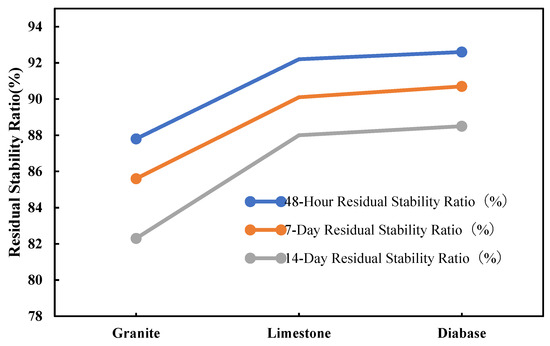
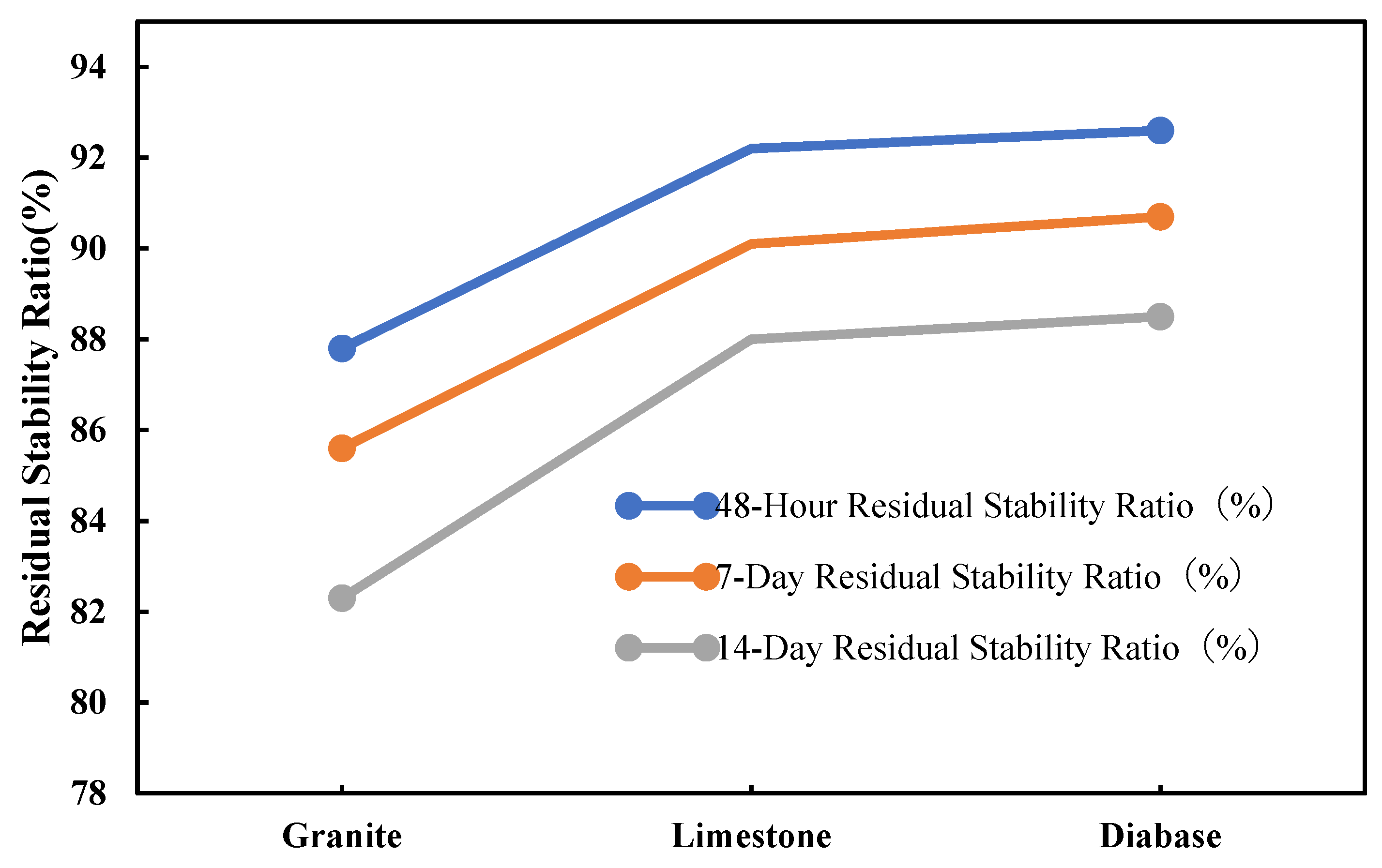
The results of the immersed Marshall test are shown in Table 8 and Figure 1. The three manufactured sand mixtures exhibited significant differences in short-term and long-term water stability based on the immersed Marshall test, with all groups showing extremely significant statistical differences (p < 0.01) for residual stability ratios at 48 h, 7 d, and 14 d immersion.
Table 8.
Results of immersed Marshall test.
Figure 1.
Residual stability ratio of mixture under different immersion durations.
The 48 h residual stability ratio (short-term water stability) was ordered as diabase (92.6%) ≈ limestone (92.2%) > granite (87.8%), with dry stability among the three groups also showing a statistically significant difference (p = 0.032, Table 8). Limestone mixtures had the highest dry stability (12.62 kN) and minimal strength attenuation after immersion, reflecting strong chemical adhesion between alkaline limestone and asphalt. Neutral diabase mixtures, despite lacking chemical bonding advantages, achieved a residual stability ratio equivalent to limestone due to rough particle surfaces and abundant angularity (physical interlocking with asphalt). Acidic granite mixtures had the lowest residual stability ratio and the largest coefficient of variation (4.8%), indicating weak asphalt–aggregate interface bonding and high variability in water stability.
For long-term water immersion (7 d, 14 d), residual stability ratios remained ordered as limestone > diabase > granite, with extremely significant group differences (p < 0.01, Table 8). Granite mixtures exhibited the most severe performance attenuation: the 14 d residual stability ratio (82.3%) was 5.5 percentage points lower than the 48 h value, while limestone and diabase mixtures maintained residual stability ratios above 88% at 14 d, showing gentle attenuation and excellent long-term water damage resistance.
- (2)
- Freeze–Thaw Splitting Test
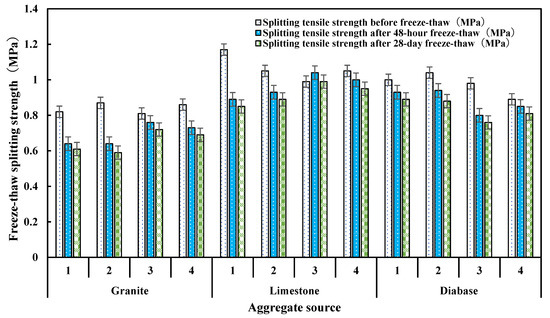
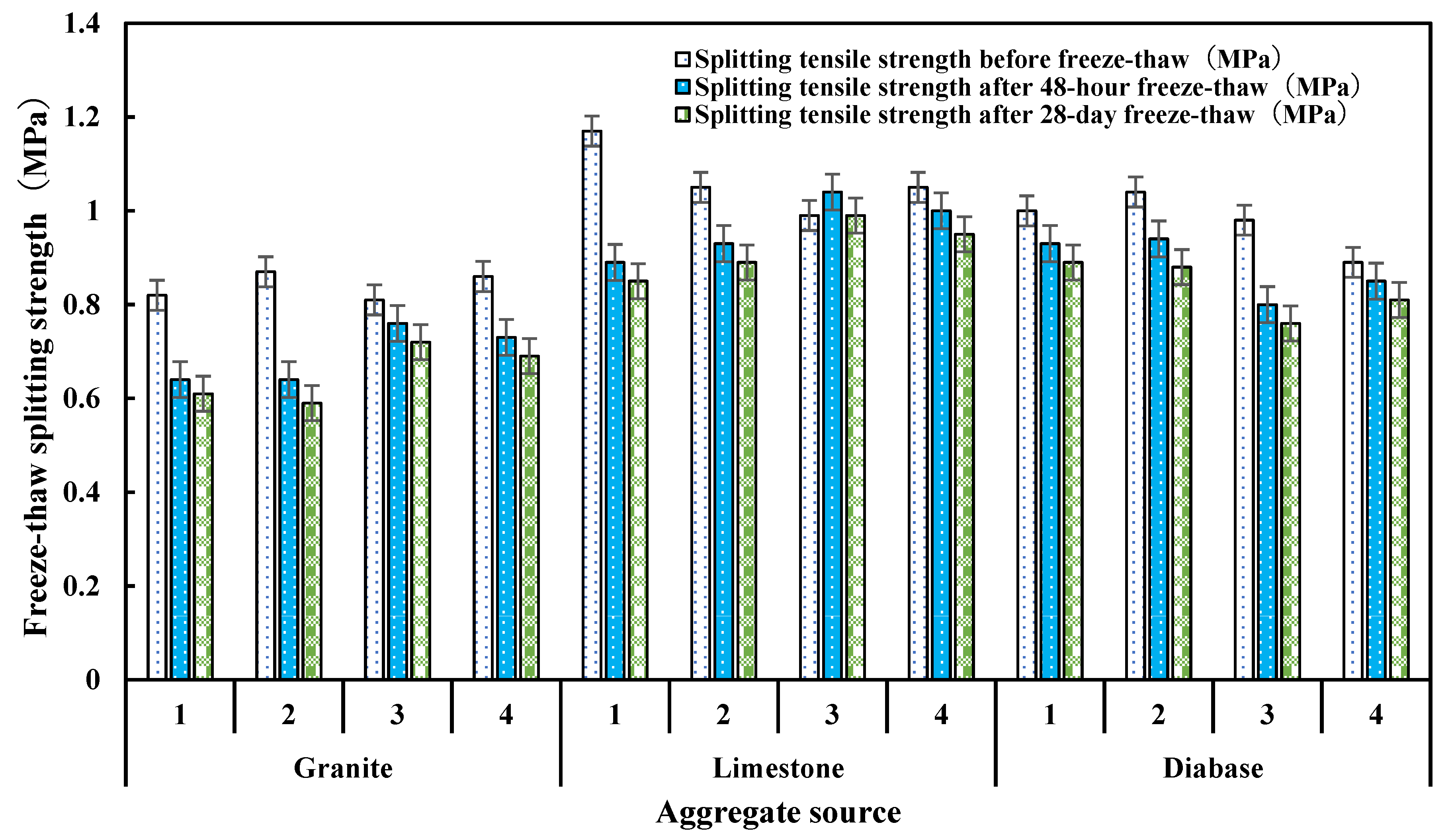
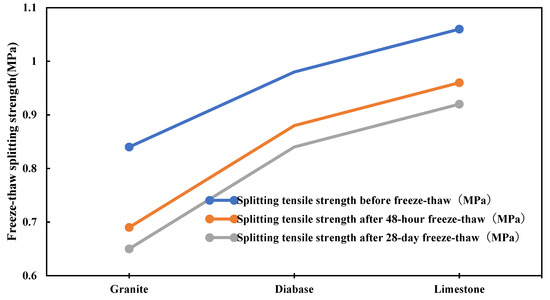
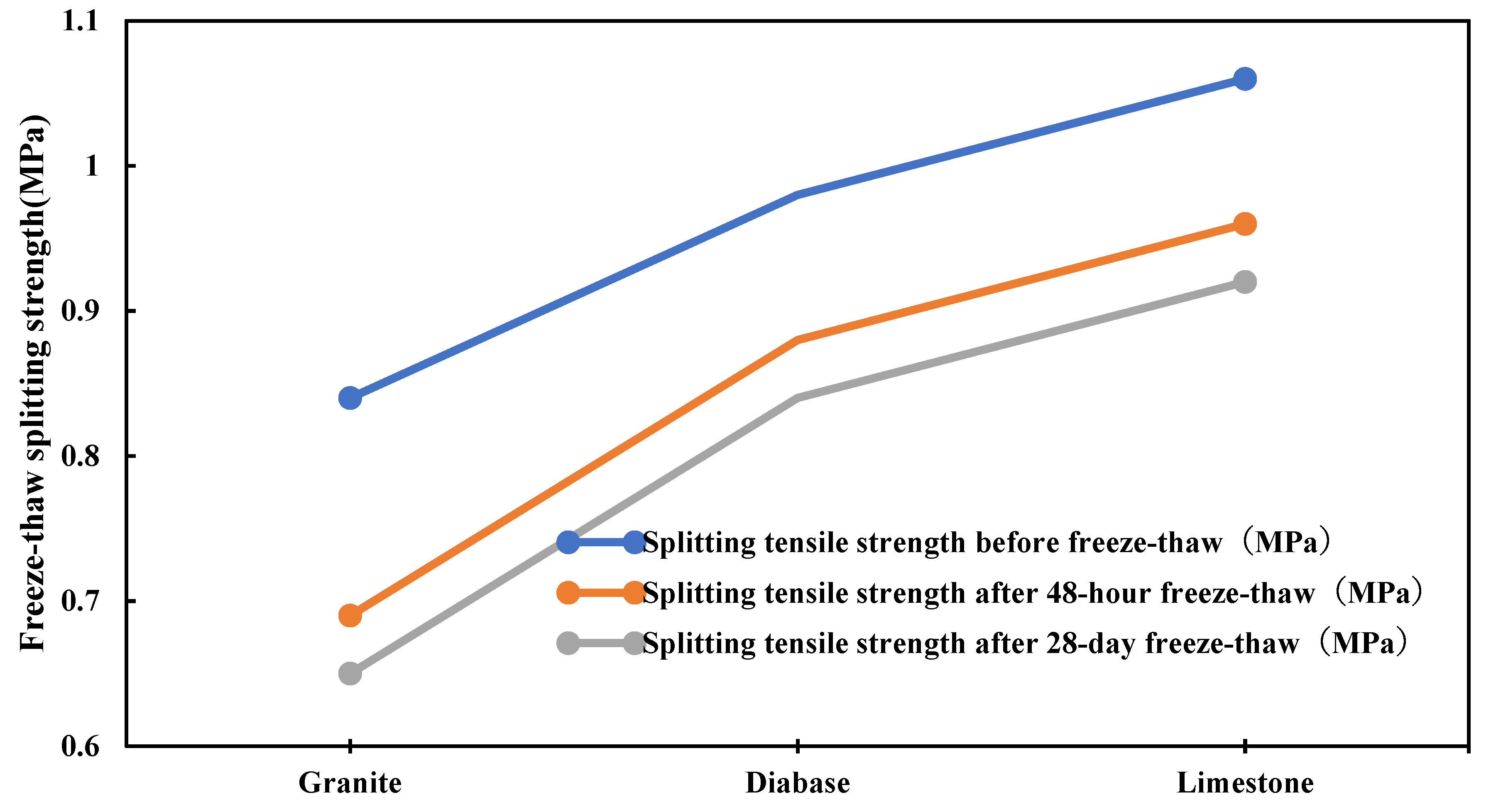
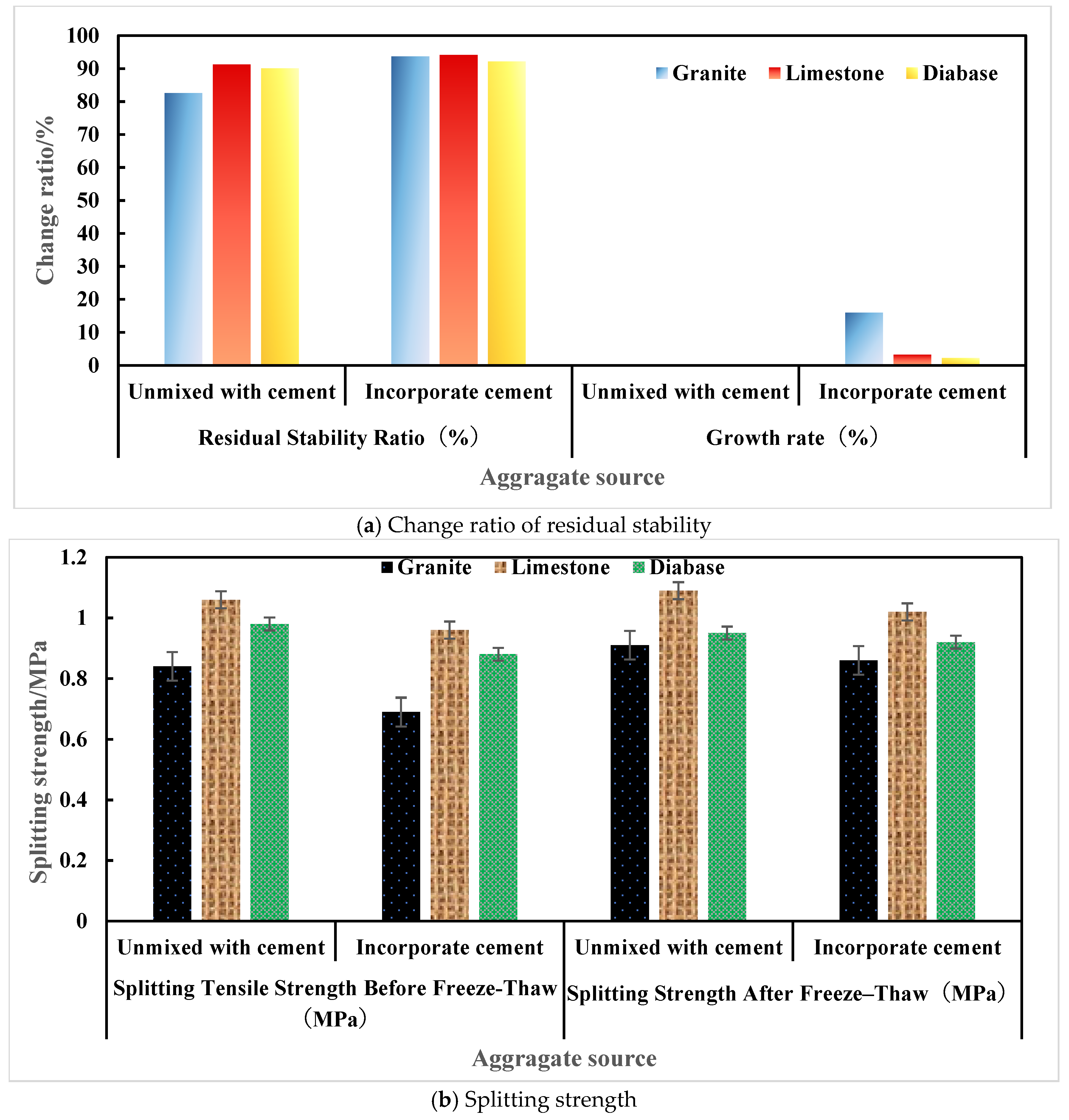
Freeze–thaw cycling caused more severe damage to asphalt mixtures, with the 48 h residual strength ratio showing significant statistical differences among groups (p = 0.015, Table 9) and the 28 d residual strength ratio also showing significant differences (p = 0.021, Table 9). The residual strength ratio was ordered as limestone (91.2%) > diabase (90.1%) > granite (82.6%), with granite mixtures differing significantly from limestone and diabase (p < 0.05, Table 9). Limestone mixtures had the highest average splitting strength after freeze–thaw (0.96 MPa), with only an 8.8% attenuation from the pre-freeze–thaw value, demonstrating the best freeze–thaw water damage resistance. Diabase mixtures relied on high hardness and strong particle interlocking to resist particle crushing and interface peeling during freeze–thaw, with a residual strength ratio close to limestone. Granite mixtures had a strength attenuation of 17.4% after freeze–thaw, with a large coefficient of variation (9.6%), due to weak interface adhesion as the core shortcoming.
Table 9.
Results of freeze–thaw splitting test.
As showed in Figure 2 and Figure 3, after 28 d of long-term freeze–thaw, the residual strength ratio of granite mixtures dropped to 77.8% (below the design requirement of ≥80%), while limestone (86.7%) and diabase (85.6%) mixtures remained above 85% (Table 9), showing outstanding long-term durability. Alkaline limestone forms stable calcium–asphalt complexes with asphalt (strong chemical adhesion), making the interface resistant to long-term water erosion; diabase relies on physical interlocking and weak chemical adsorption, with a slightly higher attenuation rate than limestone; granite has a low surface free energy polar component, and physical adsorption with asphalt is easily damaged by water, leading to continuous long-term performance deterioration.
Figure 2.
Test results of freeze–thaw splitting strength of asphalt mixtures with different rock types.
Figure 3.
Splitting strength and residual strength ratio of the mixture before and after freeze-thaw.
- (3)
- Micro-Mechanism of Surface Free Energy
The surface free energy test reveals the essence of the influence of lithology on adhesion from a micro perspective (Table 10): the order of the total surface free energy of aggregates is limestone (50.8 mJ/m2) > diabase (46.3 mJ/m2) > granite (40.3 mJ/m2), which is consistent with the order of water stability; the polar component is the key influencing factor. The polar component of limestone (8.3 mJ/m2) is significantly higher than that of the other two aggregates. The polar groups such as hydroxyl (-OH) and carbonate (-CO32−) form hydrogen bonds on their surface with the acidic groups in asphalt, greatly improving the adhesion work (68.4 mJ/m2); the order of the adhesion work ratio (adhesion work / cohesion work) is limestone (1.42) > diabase (1.28) > granite (1.09). A higher ratio indicates a stronger interface bonding between asphalt and aggregates, and better water damage resistance. The lithology of manufactured sand has a significant regulatory effect on the water stability of asphalt mixtures. The short-term water stability order is: neutral diabase ≈ alkaline limestone > acidic granite, and the long-term durability order is: limestone > diabase > granite. Relying on the high polar component (8.3 mJ/m2) to form stable chemical adhesion with asphalt, the limestone mixture has a short-term residual stability ratio of 92.2% and maintains 88.0% after 14 d of long-term immersion, showing the best water damage resistance, although neutral diabase manufactured sand does not have the chemical adhesion advantage of alkaline aggregates. The superior rutting resistance of the granite mixture can be attributed to its lower aggregate crushing value and higher fine aggregate angularity (see Table 2), which indicate greater hardness and stronger particle interlocking capacity [29,30]. The water stability is equivalent to that of limestone (48 h residual stability ratio 92.6%), making it an excellent alternative material for limestone. Due to the low surface polarity and weak adhesion with asphalt, the acidic granite mixture has the worst water stability (48 h residual stability ratio 87.8%, lower than the design requirement after long-term freeze–thaw), and anti-stripping agents need to be added to improve interface adhesion. A least-squares linear regression model was established using the measured polar component of aggregate surface free energy as the independent variable and the calculated asphalt–aggregate adhesion work as the dependent variable. Based on the dataset obtained from three lithologies (n = 9), the regression analysis yielded a strong positive correlation with R2 = 0.92. For high-grade highways in high-temperature, rainy, and frequent freeze–thaw areas, limestone or diabase manufactured sand is preferred; if granite manufactured sand is used, 1.5%~2.0% cement and other anti-stripping agents need to be added to improve interface adhesion and water stability.
Table 10.
Test results of aggregate surface free energy.
- (4)
- Analysis of Variance Results
Table 11 shows the results of analysis of variance of relevant experimental results. There are significant differences in the water stability of the three types of lithological manufactured sand mixtures, and lithology is a key factor affecting water stability. Limestone (alkaline) forms stable chemical bonds with asphalt due to its high polar component (8.3 mJ/m2), showing the best water stability; diabase (neutral) relies on physical interlocking and weak chemical adsorption, and its performance is close to that of limestone; granite (acidic) has low polarity and weak adhesion, resulting in the worst water stability. After long-term water immersion, the performance of granite attenuates the most significantly (the 14 d residual stability ratio decreases by 5.5 percentage points), while the attenuation of limestone is gentle, reflecting the long-term stability of chemical bonds.
Table 11.
Analysis of variance.
Lithology has a significant regulatory effect on water stability, and the comprehensive performance order is: limestone > diabase > granite. The strong correlation (R2 = 0.92) suggests that the polar component of aggregate surface free energy plays a dominant role in regulating asphalt–aggregate adhesion behavior, which can be used as a quantitative basis for manufactured sand selection. Void ratio, bulk density, and asphalt saturation are the core volumetric indicators affecting water stability, and the multiple regression model can accurately predict performance. Diabase manufactured sand can be used as an excellent alternative material for limestone, especially in areas lacking limestone resources. This finding is consistent with previous studies indicating that polar interactions significantly influence moisture resistance and stripping performance in asphalt mixtures [31,32].
For high-temperature, rainy, and frequent freeze–thaw areas, limestone or diabase manufactured sand is preferred, with VV = 4.5~5.5%, ρf ≥ 2.54 g/cm3, and VFA = 68~70%. When using granite manufactured sand, 1.5~2.0% cement anti-stripping agent needs to be added to increase the residual stability ratio to above 90%; during production, it is necessary to control the gradation uniformity of manufactured sand and reduce the coefficient of variation of diabase mixtures (CV ≤ 8%).
3.2.2. Influence on High-Temperature Stability
Existing studies have confirmed that manufactured sand is superior to natural sand in improving high-temperature stability, but systematic research on the influence of manufactured sand lithology (acidic, neutral, alkaline) on the high-temperature performance of mixtures is still insufficient. In this section, through rutting tests (60 °C and 70 °C dual temperature gradients) and statistical correlation analysis, the high-temperature stability of asphalt mixtures with three types of lithological manufactured sand (granite, limestone, diabase) was comprehensively evaluated, the internal mechanism of the influence of lithology on high-temperature stability was revealed, and a scientific basis was provided for the optimal selection of manufactured sand in high-temperature areas. The experimental results are shown in Table 12.
Table 12.
Test results of high-temperature stability.
- (1)
- Dynamic Stability (DS)
It can be seen from Table 12 that at 60 °C, the order of dynamic stability is diabase (12,629 times/mm) > limestone (12,022 times/mm) > granite (8278 times/mm). The dynamic stability of the diabase mixture is the highest, 52.6% higher than that of granite and 5.0% higher than that of limestone; at 70 °C, the order remains the same: diabase (4796 times/mm) > limestone (4335 times/mm) > granite (3868 times/mm) (p < 0.001, Table 12), and diabase is 24.0% higher than granite and 10.6% higher than limestone.
The excellent dynamic stability of the diabase mixture stems from two core factors. Firstly, the diabase manufactured sand has a low crushing value (10.7%) and strong angularity (flow time = 41.8 s), forming a rigid skeleton with coarse aggregates, which can effectively resist shear deformation at high temperatures. Due to the strong mechanical interlocking effect, the irregular particle shape of diabase results in large friction between aggregates, which can limit particle migration and rutting formation. Secondly, although the limestone mixture has good adhesion with asphalt, due to its low hardness (crushing value = 12.5%), particles are prone to micro-crushing under repeated wheel loads, weakening the skeleton structure, and the dynamic stability is slightly lower than that of diabase; the granite mixture has low dynamic stability due to poor adhesion with asphalt and medium angularity, resulting in insufficient aggregate interlocking.
- (2)
- Rutting Depth (RD)
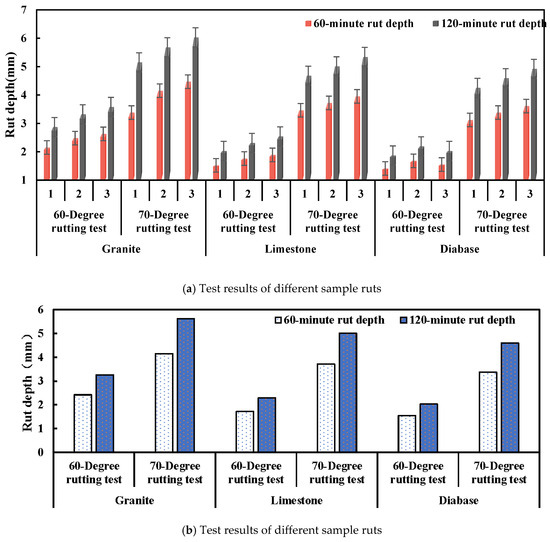
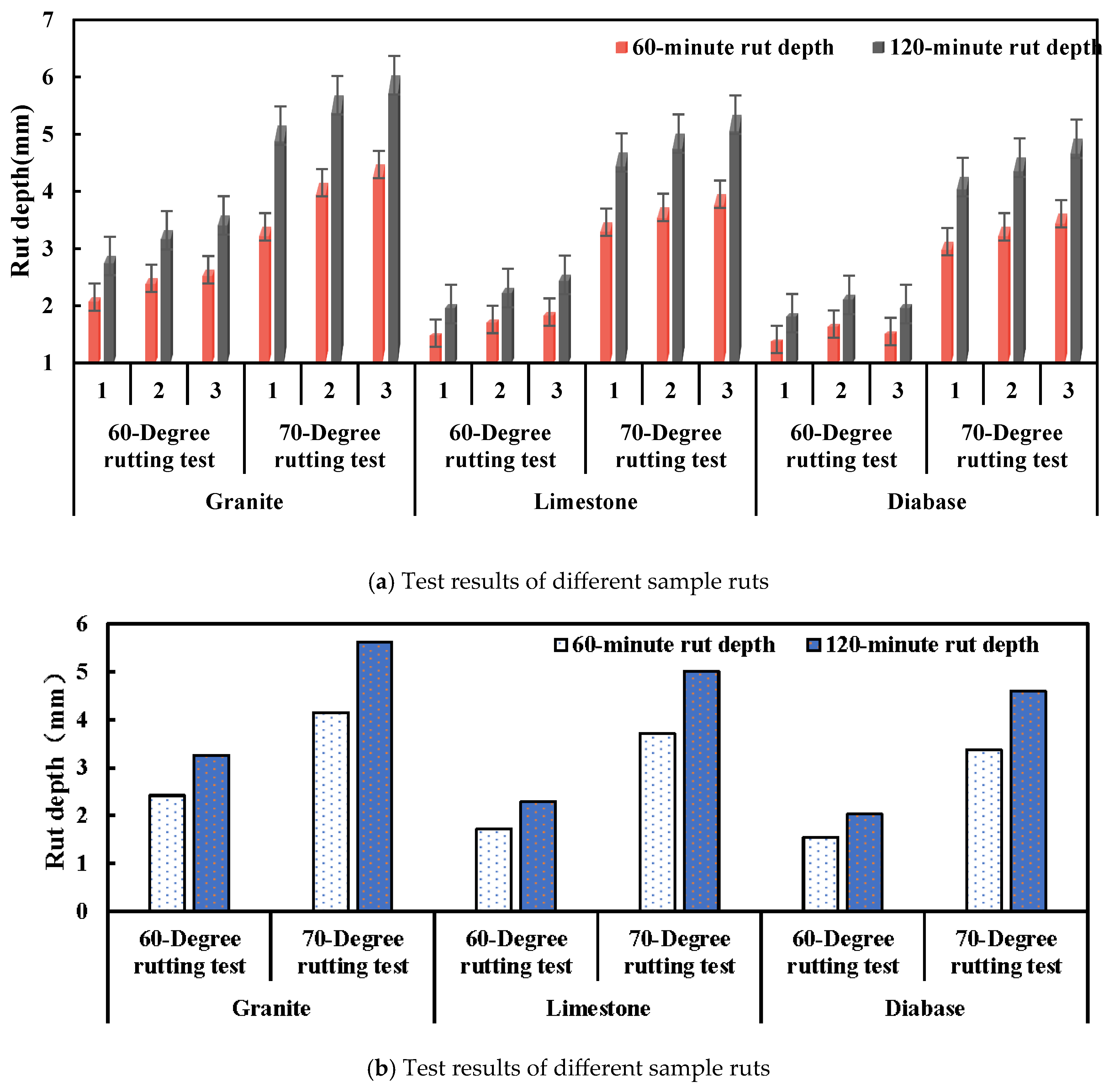
Rutting depth is an intuitive reflection of permanent deformation. As shown in Table 12 and Figure 4, at 60 °C for 120 min, the order of rutting depth is: granite (3.26 mm) > limestone (2.29 mm) > diabase (2.03 mm). The diabase mixture has the smallest rutting depth and excellent long-term deformation resistance; at 70 °C, the gap between groups further widens, and the 120 min rutting depth of granite (5.62 mm) is 1.23 times that of diabase (4.59 mm), highlighting the significant influence of lithology on high-temperature durability.
Figure 4.
Test results of rutting of asphalt mixtures with different rock types of aggregates.
3.2.3. Influence on Low-Temperature Stability
Aggregate lithology has a significant regulatory effect on low-temperature crack resistance by changing the asphalt–aggregate interface interaction and particle interlocking effect. Existing studies mainly focus on the influence of coarse aggregate lithology, and there is insufficient discussion on the mechanism of fine aggregate (manufactured sand) lithology. This study systematically investigates the influence of three types of lithological manufactured sand (granite (acidic), limestone (alkaline), diabase (neutral)) on the low-temperature performance of asphalt mixtures, providing scientific basis for the material selection of asphalt pavements in cold regions.
The low-temperature test results are shown in Table 13. The maximum flexural strain directly reflects the low-temperature deformation capacity of the mixture and is the core evaluation index for crack resistance. It can be seen from Table 13 that the order of the strain performance of the three types of manufactured sand mixtures is: diabase (2757 ± 38 με) > limestone (2718 ± 35 με) > granite (2385 ± 142 με). The maximum flexural tensile strain of asphalt mixtures for expressways should not be lower than 2500 με at −10 °C; therefore, diabase and limestone mixtures meet the specification requirement, while the granite mixture does not. And diabase is slightly better than limestone; the average value of granite mixtures is only 2385 με, which does not meet the design standard, indicating insufficient low-temperature crack resistance.
Table 13.
Test results of low-temperature stability.
The flexural tensile strength reflects the low-temperature bearing capacity of the mixture, and the order is: limestone (11.2 ± 0.3 MPa) > diabase (10.8 ± 0.2 MPa) > granite (9.5 ± 0.3 MPa) (Table 13). The limestone mixture has the highest strength, which is due to the stronger chemical bonding between alkaline aggregates and asphalt and higher interface strength. Relying on the high hardness and strong angularity of particles, diabase forms a stable skeleton structure, and the strength is second only to limestone; granite has the lowest strength due to weak interface bonding.
The stiffness modulus reflects the low-temperature rigidity of the mixture. A smaller value indicates better material flexibility and greater crack resistance potential. The order is: diabase (3.94 ± 0.14 GPa) < limestone (4.12 ± 0.10 GPa) < granite (4.00 ± 0.15 GPa). The diabase mixture has the lowest stiffness modulus, indicating the best low-temperature flexibility, which is consistent with the fracture energy test results. Although limestone has high strength, its stiffness is slightly higher than that of diabase, and its flexibility is slightly weaker; granite has no advantage in stiffness characteristics due to poor strength and strain.
The shrinkage coefficient directly reflects the low-temperature shrinkage sensitivity of the mixture, and the total shrinkage intuitively reflects the cracking risk in engineering applications. It can be seen from Table 13 that the order of the linear shrinkage coefficient is: diabase (9.8 × 10⁻⁶/°C) < limestone (10.3 × 10⁻⁶/°C) < granite (12.8 × 10⁻⁶/°C). The order of the total shrinkage is: diabase (0.393 mm/m) < limestone (0.411 mm/m) < granite (0.512 mm/m). The diabase mixture has the smallest shrinkage coefficient and total shrinkage, indicating the smallest low-temperature shrinkage deformation and lowest cracking risk. Limestone is second, and granite has the most significant shrinkage, which is closely related to its weak interface bonding—small gaps are generated between the asphalt film and aggregates at low temperatures, leading to unrestricted overall shrinkage and increased deformation.
Fracture energy is a key indicator for quantifying the crack resistance of the mixture, comprehensively reflecting the energy absorption capacity of the material from loading to fracture. It can be seen from Table 13 that the order of fracture energy is: diabase (1292 ± 17 J/m2) > limestone (1242 ± 22 J/m2) > granite (905 ± 38 J/m2). The diabase mixture has the highest fracture energy, indicating the strongest ability to resist crack initiation and propagation and the best low-temperature toughness; limestone is second; and the fracture energy of granite is only 70% of that of diabase, indicating that it is prone to brittle fracture at low temperatures and has poor crack resistance. This result further verifies the regulatory mechanism of lithology; the high angularity and rough surface of diabase manufactured sand form a dual effect of “physical locking + chemical adsorption” at the asphalt–aggregate interface. When cracks propagate, it is necessary to overcome stronger interface resistance and particle interlocking force, thus absorbing more energy. Limestone mainly relies on chemical bonding, and the interface toughness is slightly inferior to that of diabase. The interface interaction of granite is weak, and cracks are prone to propagate rapidly along the interface, resulting in a significant decrease in fracture energy.
To clarify the core influencing factors, Pearson correlation analysis was performed on each indicator (Table 14). The results show that the maximum flexural strain has a very strong positive correlation with fracture energy (r = 0.93, p < 0.001), confirming that the strain indicator can effectively reflect crack resistance toughness; the shrinkage coefficient has a very strong negative correlation with the maximum flexural strain (r = −0.91, p < 0.001), indicating that the smaller the shrinkage deformation, the better the strain capacity; and the flexural tensile strength has a medium positive correlation with fracture energy (r = 0.78, p < 0.01), indicating that strength is the basis of crack resistance, but not the only determining factor.
Table 14.
Correlation coefficient matrix of low-temperature performance indicators.
3.2.4. Long-Term Low-Temperature Cyclic Aging Test
To simulate the performance attenuation of pavements subjected to long-term “low-temperature—normal temperature” cyclic effects, a low-temperature cyclic aging system was designed:
Aging cycles: 0 times (unaged), 5 times, 10 times, 20 times, 30 times.
Cyclic regime: Constant temperature at −20 °C for 8 h (simulating night low temperature) → Constant temperature at 25 °C for 16 h (simulating daytime normal temperature), with a total duration of 24 h per cycle.
Test indicators: After every 5 cycles, the specimens were taken out for −10 °C beam bending test and fracture energy test to analyze the maximum flexural strain attenuation rate and fracture energy attenuation rate, and evaluate the long-term crack resistance durability.
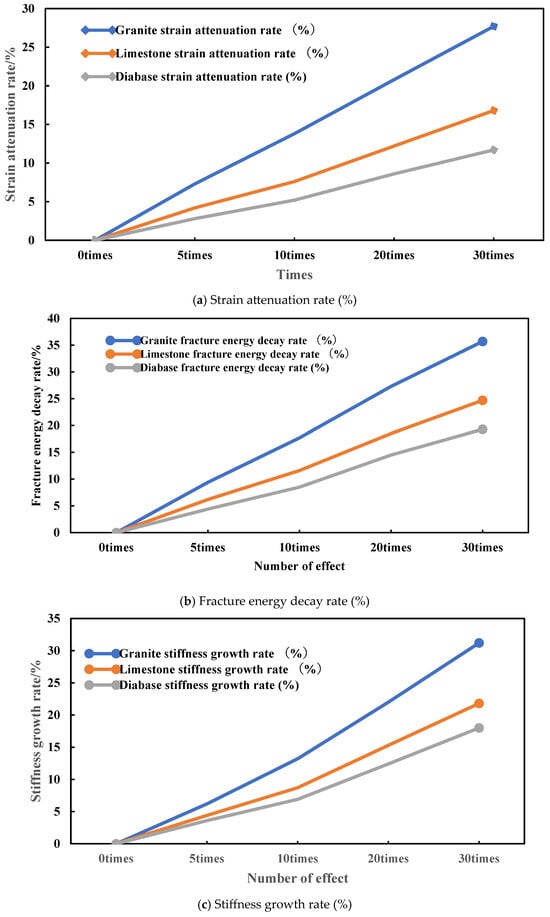
As showed in Figure 5 and Table 15, with the increase in the number of low-temperature cycles, the strain of all mixtures shows an attenuation trend, but the attenuation rate varies significantly (Table 15). After 30 cycles, the order of the strain attenuation rate is: granite (27.7%) > limestone (16.8%) > diabase (11.7%). Durability threshold: After 30 cycles, the strain of diabase (2435 με) and limestone (2260 με) is still close to the design requirement (≥2500 με), while that of granite (1725 με) is much lower than the threshold, losing crack resistance.
Figure 5.
Low-temperature index results of asphalt mixture under long-term aging.
Table 15.
Results of long-term low-temperature cyclic aging test.
The strong physical interlocking effect of diabase can delay interface peeling and reduce the impact of aging on deformation capacity. The chemical bonding of limestone is easily damaged by cyclic stress, resulting in a slightly higher attenuation rate. The initial interface of granite is weak, and cracks propagate rapidly under cyclic action, leading to the most severe strain attenuation. The attenuation law of fracture energy is consistent with that of strain. After 30 cycles, the order of the fracture energy attenuation rate is diabase (19.3%) < limestone (24.7%) < granite (35.7%), confirming that the diabase mixture has the best long-term crack resistance toughness. After 30 cycles, the stiffness growth rate of granite (31.2%) is the highest, and that of diabase (18.0%) is the lowest. Stiffness growth reflects the decrease in material flexibility. The slow stiffness growth of diabase indicates that it has the strongest ability to maintain long-term low-temperature flexibility.
Correlation analysis (Table 16) showed that initial fracture energy had a strong positive correlation (r = 0.95, p < 0.001) with the 30-cycle strain retention rate (initial crack resistance toughness is a key prerequisite for durability), and the linear shrinkage coefficient had a strong positive correlation (r = 0.92, p < 0.001) with the strain attenuation rate (greater shrinkage deformation leads to more significant long-term attenuation). A comprehensive low-temperature durability evaluation system (weighted scoring) confirmed statistically significant differences in comprehensive scores (p < 0.001): diabase (97.8, Excellent) > limestone (93.5, Good) > granite (70.3, Poor).
Table 16.
Low-Temperature durability evaluation system and results.
The lithology of manufactured sand significantly regulates the low-temperature performance of asphalt mixtures. The neutral diabase manufactured sand mixture has the best initial crack resistance (strain 2757 με, fracture energy 1292 J/m2, shrinkage coefficient 9.8 × 10⁻⁶/°C), followed by alkaline limestone, and acidic granite is the worst and fails to meet the design requirements. After long-term low-temperature cyclic aging, the diabase mixture shows outstanding durability advantages: the strain attenuation rate is only 11.7% after 30 cycles, and the fracture energy attenuation rate is 19.3%, still maintaining good crack resistance. Granite attenuates the most severely (strain attenuation 27.7%), losing service performance. Long-term “low-temperature—normal temperature” cycles lead to asphalt aging and interface fatigue damage. The strong physical interlocking effect of diabase can delay interface peeling, which is the core reason for its excellent durability. For high-grade highways in cold regions (needing to withstand long-term low-temperature cycles), diabase manufactured sand is preferred to balance initial crack resistance and durability. Limestone manufactured sand can be used in areas with less low-temperature impact, but it is necessary to match anti-aging asphalt to improve long-term performance. Granite manufactured sand should be avoided in low-temperature areas; if it must be used, anti-stripping agents (such as cement) need to be added to improve interface bonding, and the service life under cyclic low-temperature environments should be limited. Optimization of evaluation system: The evaluation of low-temperature performance needs to combine initial indicators (strain, fracture energy, shrinkage coefficient) and the long-term attenuation rate to fully reflect the performance of the mixture in the actual service environment.
3.3. Analysis of Adhesion Effect Between Neutral Rock Manufactured Sand and Asphalt
Cement (1.5% by mass replacing mineral powder) was used as an anti-stripping agent to improve asphalt–manufactured sand adhesion. Tests (immersed Marshall, freeze–thaw splitting, rutting, surface free energy) showed statistically significant improvements (p < 0.05 or p < 0.01) in all performance indicators for the three mixtures after cement addition, with the enhancement effect being more obvious for acidic granite and neutral diabase (alkaline limestone had a smaller improvement due to initially excellent adhesion).
- (1)
- Immersed Marshall Test
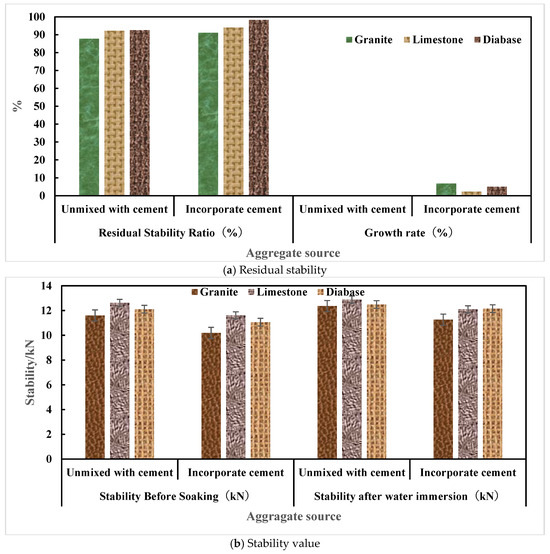
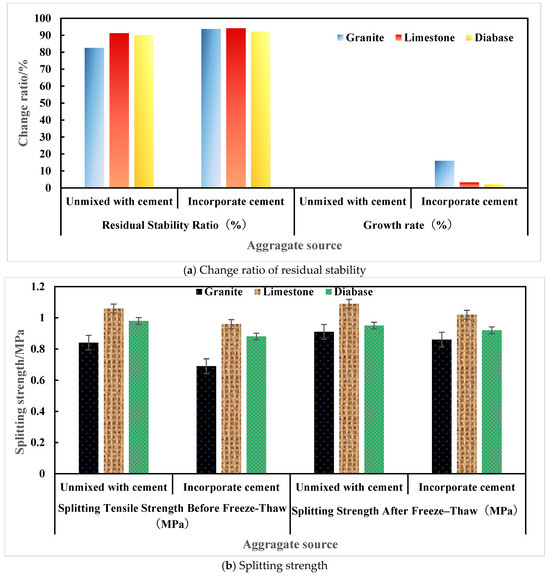
After cement addition, the residual stability ratio of all three mixtures increased significantly, with statistically significant differences (p < 0.05)** between the cement-added and non-added groups (Table 17), as showed in Figure 6. Granite mixtures had the highest growth rate (6.8%), with the residual stability ratio increasing from 87.8% to 91.1% (eliminating the low water stability defect); diabase mixtures had a growth rate of 5.0%, with the residual stability ratio reaching 98.3% (close to or exceeding limestone mixtures); and limestone mixtures had the lowest growth rate (2.3%) (p > 0.05 for the improvement margin, no significant difference), as the strong chemical adhesion between limestone and asphalt left limited room for cement enhancement.
Table 17.
Results of immersed Marshall test before and after adding cement.
Figure 6.
Marshall results of immersion before and after adding cement.
The core mechanism of this phenomenon is that the alkaline substances such as Ca(OH)2 produced by cement hydration can react with the acidic groups on the surface of granite and diabase, reduce the hydrophilicity of the aggregate surface, and at the same time, the hydration products fill the micro-pores on the aggregate surface, enhancing the physical adsorption between asphalt and aggregates.
- (2)
- Freeze–Thaw Splitting Test
Freeze–thaw cycles cause more significant damage to asphalt mixtures, and the improvement effect after adding cement is more prominent (Table 18), as showed in Figure 7. The residual strength ratio of the granite mixture increases significantly from 82.6% to 93.7%, with a growth rate of 16.0%, fully meeting the expressway design requirement (≥80%). The residual strength ratios of the diabase and limestone mixtures are increased to 92.1% and 94.1%, respectively, further enhancing the resistance to freeze–thaw damage. The introduction of cement not only improves the interface adhesion but also the rigid structure formed by cement hydration can inhibit the penetration of water and expansion stress during freeze–thaw, reducing the peeling of the asphalt film and the crushing of aggregates.
Table 18.
Results of freeze–thaw splitting test before and after adding cement.
Figure 7.
Results of freeze–thaw splitting test before and after adding cement.
The rutting test results show (Table 19) that the dynamic stability of the three mixtures increases significantly after adding cement, with a growth rate of more than 50%: The diabase mixture has the highest dynamic stability, reaching 19,880 times/mm, which is 57.4% higher than that without cement; the dynamic stability of the granite and limestone mixtures is increased to 12,850 times/mm and 18,250 times/mm, respectively, with growth rates of 55.2% and 51.8%. The improvement of high-temperature stability comes from the synergistic effect of two aspects: first, cement improves the bond strength of the aggregate–asphalt interface and inhibits particle migration at high temperatures; second, the network structure formed by cement hydration and hardening enhances the skeleton stiffness of the mixture and improves the resistance to shear deformation.
Table 19.
Rutting test and surface free energy test results before and after adding cement.
The surface free energy test results reveal the micro-mechanism of cement improving adhesion (Table 19). After adding cement, the polar component of granite aggregates increases from 2.1 mJ/m2 to 4.8 mJ/m2, the total surface free energy increases to 44.3 mJ/m2, and the asphalt–aggregate adhesion work increases from 52.6 mJ/m2 to 68.4 mJ/m2, with an increase of 30.0%. The polar component of diabase aggregates increases from 5.6 mJ/m2 to 7.9 mJ/m2, and the adhesion work increases by 21.7%. Due to the high initial polarity of limestone aggregates, the improvement range is relatively small (adhesion work increase of 6.1%). The increase in the polar component of aggregates is essentially that the hydration products of cement form an active layer rich in hydroxyl groups (-OH) on the aggregate surface, which enhances the chemical interaction (such as hydrogen bonding) with the acidic groups in asphalt, thereby significantly improving the interface adhesion strength. Cement as an anti-stripping agent has a significant effect on improving the adhesion between manufactured sand and asphalt, and has a more obvious enhancement effect on acidic granite and neutral diabase. Among them, the growth rates of the residual stability ratio and residual strength ratio of the granite mixture are 6.8% and 16.0%, respectively. After adding 1.5% cement, the water stability (residual stability ratio 98.3%, residual strength ratio 92.1%) and high-temperature stability (dynamic stability 19,880 times/mm) of the neutral diabase mixture are significantly improved, and the comprehensive performance is close to or even better than that of the limestone mixture. The improvement mechanism is reflected in both macro and micro levels: macroscopically, cement hydration and hardening enhance the skeleton stiffness of the mixture; microscopically, it increases the polar component and total surface free energy of the aggregate surface, and strengthens the chemical bonding and physical adsorption of the asphalt–aggregate interface. The polar component of surface free energy is a key indicator for evaluating the adhesion improvement effect, which has a strong positive correlation with the asphalt-aggregate adhesion work (R2 = 0.94) and can be used as a quantitative evaluation basis for adhesion optimization.
In practical engineering, for neutral rock manufactured sand asphalt mixtures, replacing mineral powder with 1.5%~2.0% cement by an equal mass can significantly improve the interface adhesion and long-term durability of the mixture without increasing the cost too much, and is especially suitable for harsh service environments such as those with high temperature, heavy rain, and freeze–thaw cycles.
4. Conclusions
This study takes neutral rock diabase as the research object. Through the Marshall test, water stability test, high- and low-temperature stability test, surface free energy test and other methods, the effects of manufactured sand lithology on the volumetric indicators, road performance and interface adhesion of the mixture are systematically analyzed, and the improvement effect of cement as an anti-stripping agent is verified. The relevant conclusions are as follows:
- (1)
- The lithology of manufactured sand significantly affects the volumetric indicators of the mixture. The limestone manufactured sand mixture has the smallest void ratio (3.81%), and the diabase has the largest (5.81%). The mixing ratio of diabase needs to be appropriately increased to optimize the compaction effect.
- (2)
- In terms of water stability, the order of short-term performance is diabase ≈ limestone > granite, and that of long-term durability is limestone > diabase > granite. The polar component of aggregate surface free energy is the key evaluation index (R2 = 0.92).
- (3)
- The order of high-temperature stability is diabase > limestone > granite. Thanks to its low crushing value and strong angularity, the diabase manufactured sand has a dynamic stability of 12,629 times/mm at 60 °C, showing the best rutting resistance.
- (4)
- In terms of low-temperature performance, the diabase mixture has the best initial crack resistance (maximum flexural strain of 2757 με) and long-term durability (strain attenuation rate of 11.7% after 30 cycles), while granite fails to meet the design requirements.
- (5)
- Adding 1.5%~2.0% cement can significantly improve the adhesion between manufactured sand and asphalt, with more obvious enhancement effects on granite and diabase, and can optimize water stability and high-temperature stability.
- (6)
- Based on the core indicators of aggregate lithology, surface free energy and mixture road performance, combined with the characteristics of asphalt pavement service environments in different regions of China, the quantitative indicator thresholds are formulated. For high-temperature and rainy areas, diabase/limestone manufactured sand with a polar component ≥4.0 mJ/m2 and dynamic stability at 60 °C ≥10,000 times/mm is prioritized; for cold regions, diabase manufactured sand with a maximum flexural strain ≥2500 με and strain attenuation rate ≤15% after 30 low-temperature cycles is prioritized; and for frequent freeze–thaw areas, limestone manufactured sand with a 28 d freeze–thaw residual strength ratio ≥85% and interface adhesion work ≥60 mJ/m2 is prioritized. For conventional areas, the requirements for indicator thresholds are relaxed, and limestone, diabase and granite are all applicable.
- (7)
- Establishment of a comprehensive performance evaluation function for manufactured sand: aggregate surface polar component, dynamic stability at 60 °C, maximum flexural strain at −10 °C, 28 d freeze–thaw residual strength ratio, and void ratio are selected as the core evaluation indicators.
- (8)
- It should be noted that the findings of this study are primarily based on controlled laboratory experiments. Although the results systematically reveal the influence of aggregate lithology on volumetric characteristics, water stability, high-temperature rutting resistance, and low-temperature crack resistance from both macroscopic performance and surface free energy perspectives, field-scale validation is still necessary before broad engineering implementation. Future research should incorporate full-scale test sections and long-term performance monitoring under actual traffic loading and environmental coupling conditions (e.g., rainfall, freeze–thaw cycles, and high-temperature exposure) to further verify the durability, structural adaptability, and economic feasibility of neutral rock manufactured sand in practical pavement systems.
Author Contributions
Conceptualization, W.H. and E.Z.; methodology, W.H.; software, E.Z.; validation, E.Z., X.W. and D.Y.; formal analysis, X.W. and T.W.; investigation, D.Y.; resources, G.Y.; data curation, X.W.; writing—original draft preparation, G.Y. and T.W.; writing—review and editing, G.Y. and T.W.; visualization, S.Z.; supervision, D.Y.; project administration, W.H. and H.Y.; funding acquisition, S.Z. and H.Y. All authors have read and agreed to the published version of the manuscript.
Funding
This research was funded by the Fundamental Research Funds for the Central Universities (Nos. 2025JBMC032) and Anhui Provincial Key Laboratory of Urban Rail Transit Safety and Emergency Management, Hefei University (Grant No. 2024GD0009).
Data Availability Statement
The original contributions presented in this study are included in the article. Further inquiries can be directed to the corresponding author.
Conflicts of Interest
Authors Wenyi Hao, Erjie Zhang, Xiaodong Wang, Dengcai Yan, Guo Yu and Shugen Zhang were employed by the company CCCC Second Highway Engineering Co., Ltd. The remaining authors declare that the research was conducted in the absence of any commercial or financial relationships that could be construed as a potential conflict of interest.
References
- Arulmoly, B.; Konthesingha, C.; Nanayakkara, A. Performance evaluation of cement mortar produced with manufactured sand and offshore sand as alternatives for river sand. Constr. Build. Mater. 2021, 297, 123784. [Google Scholar] [CrossRef] [Scilit]
- Zhang, L.; Song, Y.; Shi, T.; Zhao, Z.; Zhang, X.; Liu, Y.; Li, Q.; Wang, P.; Zhang, F.; Qian, X. A correlation study between the properties of manufactured sand and tunnel muck. Case Stud. Constr. Mater. 2024, 21, e03684. [Google Scholar] [CrossRef] [Scilit]
- Wang, H.; Wang, P.; Zhang, X.; Chen, W.-Q.; Tzachor, A.; Fishman, T.; Schandl, H.; Acuto, M.; Yang, Y.; Lu, Y. Substantial increase in China’s manufactured sand supply since 2010. Nat. Geosci. 2024, 17, 833–836. [Google Scholar] [CrossRef] [Scilit]
- Mu, J.; Li, Y.; Lin, H.; Liu, Y.; Luo, X. Research on the effect of lithological characteristics of manufactured sand on the strength of mortar. J. Build. Eng. 2023, 77, 107495. [Google Scholar] [CrossRef] [Scilit]
- Rathore, Y.; Raheem, J. The evolution, characteristics, and potential of manufactured sand in concrete: A short review. Natl. Acad. Sci. Lett. 2025, 1–7. [Google Scholar] [CrossRef] [Scilit]
- Wang, X.; Zhang, W.; Zhang, Y.; Qiao, H.; Xue, C.; Mundia, M.M.; An, B. Research on the green preparation of manufactured sand by tuff produced in Gansu China and its influence on the properties of concrete. Constr. Build. Mater. 2023, 409, 133794. [Google Scholar] [CrossRef] [Scilit]
- Li, B.; Ke, G.; Zhou, M. Influence of manufactured sand characteristics on strength and abrasion resistance of pavement cement concrete. Constr. Build. Mater. 2011, 25, 3849–3853. [Google Scholar] [CrossRef] [Scilit]
- Shen, W.; Wu, J.; Du, X.; Li, Z.; Wu, D.; Sun, J.; Wang, Z.; Huo, X.; Zhao, D. Cleaner production of high-quality manufactured sand and ecological utilization of recycled stone powder in concrete. J. Clean. Prod. 2022, 375, 134146. [Google Scholar] [CrossRef] [Scilit]
- Pilegis, M.; Gardner, D.; Lark, R. An investigation into the use of manufactured sand as a 100% replacement for fine aggregate in concrete. Materials 2016, 9, 440. [Google Scholar] [CrossRef] [Scilit]
- Mishra, A.; Das, S.K.; Reddy, K.R. Life cycle assessment of processing alternate sands for sustainable construction: Coal mine overburden sand versus manufactured sand. J. Build. Eng. 2023, 75, 107042. [Google Scholar] [CrossRef] [Scilit]
- Chaparro, M.A.; Gnanasaravanan, S.; Rajkumar, P. Trace and major minerals of (natural and manufactured) sand: The importance of manufactured sand for construction purposes and the preservation of rivers. Innov. Infrastruct. Solut. 2021, 6, 52. [Google Scholar] [CrossRef] [Scilit]
- Li, H.; Shu, B.; Du, C.; Zhuo, Y.; Chen, Z.; Zhang, W.; Yang, X.; Chen, Y.; Pan, M. Evaluation of Long-Term Skid Resistance in Granite Manufactured Sand Concrete. Lubricants 2025, 13, 375. [Google Scholar] [CrossRef] [Scilit]
- Gao, J.; Zhou, P.; Zhao, S.; Yang, Q.; Gu, K.; Song, Q.; Jiang, Z. Optimizing the Mixture Design of Manufactured Sand Concrete for Highway Guardrails in Mountainous Terrain. Buildings 2025, 15, 1436. [Google Scholar] [CrossRef] [Scilit]
- Zhang, P.; Su, J.; Gao, Z.; Zhang, T.; Zhang, P. Effect of sand–precursor ratio on mechanical properties and durability of geopolymer mortar with manufactured sand. Rev. Adv. Mater. Sci. 2024, 63, 20230170. [Google Scholar] [CrossRef] [Scilit]
- Li, X.; Zhu, L.; Liu, J.; Cao, Z.; Xue, Y.; Dang, F. Fracture evolution and mechanical deterioration of granite under cyclic thermal and liquid nitrogen cryogenic impact. Phys. Fluids 2025, 37, 086652. [Google Scholar] [CrossRef] [Scilit]
- Wang, L.; Xue, Y.; Zhu, L.; Cao, X.; Li, X.; Ranjith, P. Fracture evolution of granite under cyclic thermal shocks: Effects of liquid nitrogen cooling on strength, toughness, and acoustic emission characteristics. Therm. Sci. Eng. Prog. 2026, 70, 104507. [Google Scholar] [CrossRef] [Scilit]
- Wang, L.; Xue, Y.; Cao, Z.; Kong, H.; Han, J.; Zhang, Z. Experimental study on mode I fracture characteristics of granite after low temperature cooling with liquid nitrogen. Water 2023, 15, 3442. [Google Scholar] [CrossRef] [Scilit]
- Yuan, H.; Sun, Q.; Geng, J.; Tang, L.; Lv, C.; Zhang, Y. Thermal acoustic emission characteristics and damage evolution of granite under cyclic thermal shock. Environ. Earth Sci. 2023, 82, 388. [Google Scholar] [CrossRef] [Scilit]
- Chen, Z.; Sha, S.; Xu, L.; Quan, J.; Rong, G.; Jiang, M. Damage evaluation and statistic constitutive model of high-temperature granites subjected to liquid nitrogen cold shock. Rock Mech. Rock Eng. 2022, 55, 2299–2321. [Google Scholar] [CrossRef] [Scilit]
- Xu, J.; Zhang, Y.; Rutqvist, J.; Hu, M.; Wang, Z.; Tang, X. Thermally induced microcracks in granite and their effect on the macroscale mechanical behavior. J. Geophys. Res. Solid Earth 2023, 128, e2022JB024920. [Google Scholar] [CrossRef] [Scilit]
- Nanayakkara, A.; Premasiri, R.; Arulmoly, B.; Konthesingha, C. Metamorphic rocks for manufactured sand and coarse aggregate for concrete and mortar. Mag. Civ. Eng. 2022, 113, 11308. [Google Scholar]
- Ren, Q.; Tao, Y.; Jiang, Z.; De Schutter, G. Adhesive and rheological properties of fresh mortar with manufactured sand as replacement of river sand. Constr. Build. Mater. 2024, 411, 134303. [Google Scholar] [CrossRef] [Scilit]
- Prasanna, B.B.; Kumar, G.S.; Subramani, T.; Bellum, R.R. Utilization of charnockite rock as manufactured-aggregate for construction industry: A case study from Thiruvakkarai quarry and M-sand plant in Tamil Nadu, India. Environ. Geochem. Health 2025, 47, 243. [Google Scholar] [CrossRef] [Scilit]
- Bahadur, S.; Nayak, N. Manufactured sand as fine aggregate. In Handbook on Advanced Concrete Technology; Alpha Science International Ltd.: Oxford, UK, 2013; pp. 58–61. [Google Scholar]
- Pakkiyachandran, M.; Sathiparan, N. Comparative study on quarry waste, manufactured sand, quarry dust as river sand replacement in cement mortar: Mechanical characteristics, durability, and eco-benefit. Materialia 2025, 40, 102395. [Google Scholar] [CrossRef] [Scilit]
- Zhu, X.; Zhang, Y.; Liu, Z.; Qiao, H.; Ye, F.; Lei, Z. Research on carbon emission reduction of manufactured sand concrete based on compressive strength. Constr. Build. Mater. 2023, 403, 133101. [Google Scholar] [CrossRef] [Scilit]
- Javilla, B.; Fang, H.; Mo, L.; Shu, B.; Wu, S. Test evaluation of rutting performance indicators of asphalt mixtures. Constr. Build. Mater. 2017, 155, 1215–1223. [Google Scholar] [CrossRef] [Scilit]
- Chen, W.; Wei, K.; Wei, J.; Han, W.; Zhang, X.; Hu, G.; Wei, S.; Niu, L.; Chen, K.; Fu, Z. Research on the road performance of asphalt mixtures based on infrared thermography. Materials 2022, 15, 4309. [Google Scholar] [CrossRef] [Scilit] [PubMed]
- Castillo, D.; Caro, S.; Darabi, M.; Masad, E. Influence of aggregate morphology on the mechanical performance of asphalt mixtures. Road Mater. Pavement Des. 2018, 19, 972–991. [Google Scholar] [CrossRef] [Scilit]
- Mohammad, H.K.; Albayati, A.H.; Al-Kheetan, M.J. Influence of Coarse Aggregate Geometry and Mineral Composition on the Durability of Asphalt Concrete. Infrastructures 2025, 10, 263. [Google Scholar] [CrossRef] [Scilit]
- Bhasin, A.; Masad, E.; Little, D.; Lytton, R. Limits on adhesive bond energy for improved resistance of hot-mix asphalt to moisture damage. Transp. Res. Rec. 2006, 1970, 2–13. [Google Scholar] [CrossRef]
- Ji, J.; Yao, H.; Liu, L.; Suo, Z.; Zhai, P.; Yang, X.; You, Z. Adhesion evaluation of asphalt-aggregate interface using surface free energy method. Appl. Sci. 2017, 7, 156. [Google Scholar] [CrossRef] [Scilit]

Disclaimer/Publisher’s Note: The statements, opinions and data contained in all publications are solely those of the individual author(s) and contributor(s) and not of MDPI and/or the editor(s). MDPI and/or the editor(s) disclaim responsibility for any injury to people or property resulting from any ideas, methods, instructions or products referred to in the content. |
© 2026 by the authors. Licensee MDPI, Basel, Switzerland. This article is an open access article distributed under the terms and conditions of the Creative Commons Attribution (CC BY) license.