


Abstract
Under China’s dual-carbon goals, the construction industry, as a major source of carbon emissions, faces an urgent need to transition toward low-carbon and green construction. To address the lack of a systematic source-oriented carbon reduction mechanism and the limited availability of an integrated project-level quantitative evaluation of project-level carbon reduction performance, this study proposes a four-dimensional Supply–Process–End–Management (SPEM) carbon reduction mechanism for green construction based on the emission characteristics of the building construction phase. Using the Nanjing G74 project as a case study, theoretical carbon emissions calculated using an elementary-unit-based method were compared with actual emissions derived from field-collected activity data to quantify project-level carbon reduction performance. The results show that the proposed SPEM mechanism provides a closed-loop carbon reduction management framework that covers the construction process. Under the guidance of this mechanism, actual carbon emissions during the assessed construction stages of the G74 project were reduced by 20.95% relative to the theoretical value, indicating substantial carbon reduction potential. Material-related carbon emission reductions accounted for 68.87% of the total reduction, making material-related emissions the largest component of the estimated project-level carbon reduction. Among the quantitatively attributed SPEM dimensions, Process Substitution accounted for the largest share, whereas Management Coordination operated throughout the construction process and provided essential support for the effective implementation of the other dimensions. These findings can inform green construction incentive policies and provide a practical basis for optimizing construction schemes, evaluating construction-phase carbon reduction performance, and supporting project-level carbon balances accounting.
1. Introduction
1.1. Background and Limitations of the 4S1E Framework
Rising greenhouse gas emissions are intensifying global warming and climate-related risks worldwide. Accordingly, reducing greenhouse gas emissions and mitigating global warming have become central objectives of international climate action. Against this backdrop, China announced its carbon peaking and carbon neutrality (dual-carbon) goals in 2020. In September 2025, at the United Nations Climate Summit, China further announced its 2035 nationally determined contribution, committing to reducing economy-wide net greenhouse gas emissions by 7–10% below peak levels while striving to do better.
The construction industry is one of the largest sources of carbon emissions. Building operations account for 28% of global CO2 emissions, and this share rises to 38% when construction-related emissions are included [1]. According to the China Urban and Rural Construction Carbon Emissions Research Report (2024 Edition), the total carbon emissions associated with China’s building construction reached 4.15 billion tons in 2022, accounting for 39.2% of national energy-related carbon emissions [2]. Although shorter than the building operation phase, the construction phase of building projects relies heavily on carbon-intensive materials such as steel and concrete [3], resulting in concentrated carbon emissions and environmental impacts. In response to the dual-carbon goals, green construction technologies have emerged as a key pathway for the low-carbon transformation of the construction industry [4]. Accordingly, clarifying the carbon reduction mechanism of green construction and establishing a robust method for evaluating the construction-phase carbon reduction performance are important not only for optimizing construction schemes and formulating green construction incentive policies but also for advancing the construction industry toward its carbon mitigation targets.
Currently, construction-phase carbon emission control in China has been guided largely by the green construction concept of “Four Savings and One Environmental Protection” (4S1E), namely, energy saving, land saving, water saving, material saving, and environmental protection [5,6]. Green construction under this framework focuses on reducing resource inputs and energy consumption [7,8,9] and mitigating the environmental impacts associated with construction activities [10,11]. However, 4S1E is essentially a multi-objective resource and environmental management framework whose indicators are linked to carbon emissions mainly at the outcome level rather than through source-oriented carbon emission control. Specifically, electrifying construction machinery and equipment [12,13] and replacing fossil fuels with renewable energy [14,15] can reduce carbon emissions by lowering energy-related emission intensity without necessarily reducing total energy consumption. Consequently, these mitigation approaches cannot be fully represented by conventional energy-saving indicators. Similarly, low-carbon [16,17] and recycled materials [18,19] reduce carbon emissions by lowering the embodied carbon intensity of building materials even when total material consumption remains unchanged. Thus, these mitigation effects cannot be fully represented by conventional material-saving indicators. Moreover, carbon management activities, such as carbon emission monitoring, carbon footprint accounting, emissions trading, and carbon quota management are not systematically incorporated into the 4S1E framework. As a result, the existing 4S1E framework does not fully represent the principal carbon reduction pathways available during the construction phase and may provide incomplete guidance for the on-site application of green construction technologies.
1.2. Previous Quantitative Studies on Construction-Related Carbon Reduction
Existing research on the construction-phase carbon reduction performance of green construction technologies has primarily focused on individual technologies. For construction methods, studies of prefabricated [20] and modular [21] buildings, 3D-printed construction [22], and prefabricated components [23] have demonstrated carbon reduction potential relative to conventional construction. For example, Mo et al. [20] reported a reduction of 22 kg CO2e/m2 for a prefabricated office building relative to a simulated non-prefabricated alternative over the production and construction stages. In contrast, Vetrivelan et al. [22] reported a 19% reduction in material-related embodied carbon for 3D-printed concrete construction compared with conventional reinforced concrete construction under a cradle-to-gate assessment. For material substitution, life-cycle assessments of recycled aggregates [24], supplementary cementitious materials [25], and ultra-high-performance concrete [26] have demonstrated opportunities to reduce embodied emissions depending on material composition, structural performance requirements, and assessment boundaries. For process optimization, studies have examined emission reductions through lean construction practices [27], equipment allocation [28], and operational efficiency [29], while digital technologies have enhanced carbon emission monitoring and management [30]. Collectively, these studies provide quantitative evidence for the carbon reduction effects of individual technologies. However, differences in system boundaries, functional units, and baseline assumptions limit the comparability and direct aggregation of their findings to represent overall project-level carbon reduction performance.
At the project level, She et al. [31], Su et al. [32], and Kanafani et al. [33] quantified construction-related carbon emissions from actual building projects and construction sites, providing evidence on emission characteristics and major emission sources. These studies mainly contributed to emission accounting and source identification rather than the evaluation of reductions attributable to multiple mitigation measures. Liu et al. [34] evaluated 25 emerging construction technologies and reported an estimated 28.49% reduction in on-site construction emissions through the combined application of eight technologies in an actual project. Although this represents an important advance in integrated project-level assessment, the system boundary focuses on on-site construction emissions and does not comprehensively incorporate upstream material-related and transportation emissions.
1.3. Research Gaps and Objectives
Despite these advances, further research is needed to evaluate the overall project-level carbon reduction performance of multiple green construction measures within a consistent accounting boundary covering material production, transportation, and on-site construction activities. Moreover, a source-oriented mechanism is needed to systematically organize mitigation measures and complement the resource-oriented 4S1E framework. To address these gaps, this study develops a carbon reduction mechanism based on the characteristics of construction-phase emission sources in building projects. The G74 green construction demonstration project in Nanjing, China, is used as a case study to evaluate the carbon reduction performance of green construction technologies by comparing theoretical calculated emissions with actual emissions derived from field-collected activity data under a consistent accounting boundary. The study aims to provide a technical basis for identifying priority mitigation measures, informing green construction incentive policies, optimizing construction schemes, and supporting project-level carbon-balance accounting.
2. Materials and Methods
2.1. Carbon Reduction Mechanism of Green Construction
The Technical Guidelines for Green Construction (Trial), issued by the Ministry of Housing and Urban–Rural Development of the People’s Republic of China in 2021, defines green construction as an engineering practice guided by the principles of green development. It integrates scientific management and technological innovation to conserve resources, protect the environment, reduce emissions, improve efficiency, and ensure construction quality, thereby promoting a more harmonious coexistence between humans and nature. The Guidelines further emphasize the integration of green development principles throughout the construction process as a means of improving construction quality and supporting the high-quality development of the construction industry.
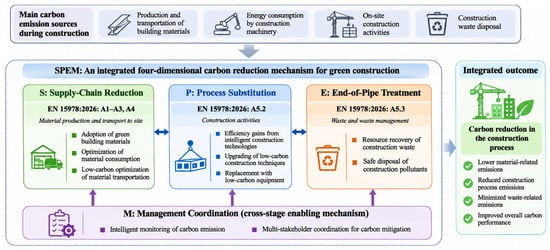
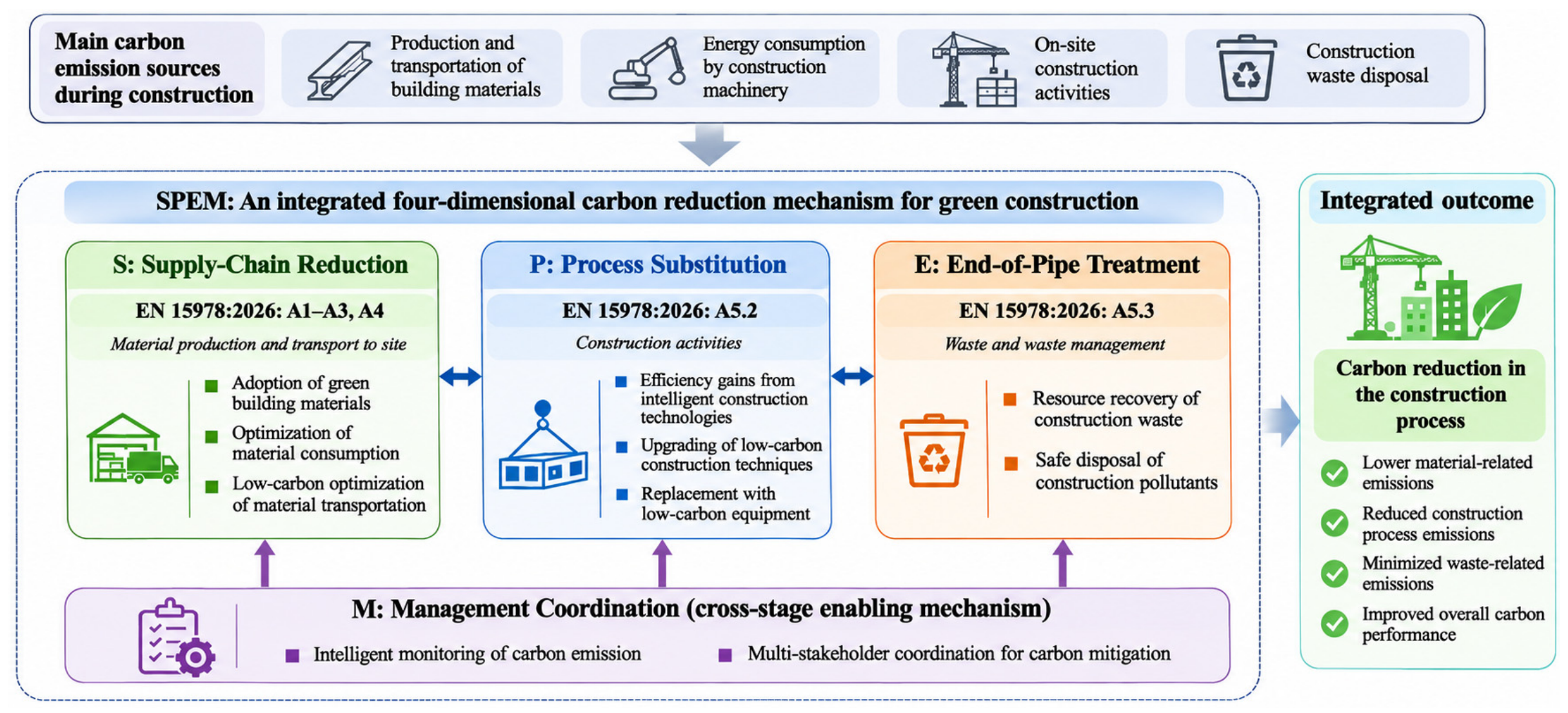
Carbon emission sources during the construction phase of building projects can be grouped into four major categories: the production and transportation of building materials, energy consumption by construction machinery, on-site construction activities, and construction waste disposal [1]. Accordingly, the carbon reduction mechanism of green construction is conceptualized as an integrated four-dimensional “Supply–Process–End–Management” (SPEM) model. These dimensions can be mapped to the construction-related life-cycle stages specified in EN 15978:2026 [35]: Supply-Chain Reduction addresses material production (A1–A3) and transport to site (A4); Process Substitution primarily targets on-site construction activities (A5.2); and End-of-Pipe Treatment addresses construction waste management (A5.3). Management Coordination operates across these stages as an enabling mechanism rather than a separate construction stage (Figure 1). Together, the four dimensions form an integrated framework covering the full construction process, in which dynamic feedback among them helps compensate for the limitations of any individual dimension.
Figure 1.
Framework of the SPEM carbon reduction mechanism.
Within the SPEM framework, carbon reduction measures can be further classified as direct or indirect based on their reduction pathways. Direct measures reduce carbon emissions by changing construction-related activity quantities or emission intensities, whereas indirect measures help avoid additional emissions through monitoring, coordination, and the prevention of quality defects, safety incidents, and rework. Some measures may involve both pathways.
2.1.1. Supply-Chain Reduction
Supply-Chain Reduction targets upstream emission sources and aims to reduce both the embodied carbon of building materials and the quantities of materials and transport activities contributing to construction-phase emissions. The primary measures include the adoption of green building materials, the optimization of material consumption, and the low-carbon optimization of material transportation.
Adoption of green building materials. The Assessment Guidelines for Green Building Materials (Trial) specifies that in the grading of green building materials, the “energy conservation” criterion covers energy consumption or carbon emissions per unit of product and energy consumption for material transportation, while the “emission reduction” criterion includes carbon footprint reports. The Assessment Standard for Green Building (GB/T 50378-2019, 2024 edition [36]) incorporates the proportion of green building materials into the green building rating system, thereby encouraging construction enterprises to adopt low-carbon building materials through scoring items. Replacing conventional carbon-intensive materials with certified green building materials and lower-carbon alternatives, including high-performance materials, recycled materials, and factory-manufactured products, can reduce emissions associated with material production.
Optimization of material consumption. A variety of technical measures can be implemented to reduce material input. BIM-based construction simulation can prevent material waste caused by spatial collisions and poorly coordinated on-site operations. Lightweight structural design and the application of high-performance materials can reduce material quantities while maintaining equivalent structural performance. Furthermore, modular prefabrication improves fabrication accuracy and reduces the amortized consumption of temporary construction materials.
Low-carbon optimization of material transportation. Carbon emissions associated with material transportation also constitute a relevant component of construction-phase emissions and can be reduced by optimizing transport distances, modes, and vehicle types. Local material sourcing is prioritized to shorten transport distances and reduce fuel consumption. Optimized route planning and centralized distribution can enhance transport efficiency and lower energy use. Low-emission vehicles, particularly battery-electric trucks and trucks powered by other low-carbon energy sources, can further reduce dependence on fossil fuels in material transport.
2.1.2. Process Substitution
Process Substitution focuses on controlling on-site carbon emissions by replacing traditional energy-intensive and high-emission construction practices with optimized techniques, upgraded equipment, and a lower-carbon energy mix. The main implementation pathways include efficiency gains from intelligent construction technologies, upgrading of low-carbon construction techniques and replacement with low-carbon equipment.
Efficiency gains from intelligent construction technologies. Building on advances in construction industrialization and digitalization, intelligent construction integrates the Internet of Things (IoT), artificial intelligence (AI), and other digital technologies to enhance automation and decision-making. Digital-twin technology enables schedule simulation, optimized resource allocation and improved coordination among construction activities. Monitoring systems can identify unnecessary on-site energy consumption in real time, while construction robots can enhance productivity while maintaining safety and quality requirements.
Upgrading of low-carbon construction techniques. Traditional carbon-intensive construction practices can be optimized to conserve energy, land, water, and materials. Prefabricated construction shifts selected activities, such as formwork erection and cast-in-place concrete operations, from the construction site to controlled factory environments, thereby reducing certain on-site wet processes and material losses. Dry construction methods reduce on-site mixing and associated wastewater generation. Stay-in-place formwork eliminates formwork stripping and can reduce material losses and solid-waste generation. Innovative formwork systems increase reuse rates and reduce bamboo and timber consumption. Temporary facilities can also be designed to serve certain functions of permanent structures, avoiding unnecessary demolition and reconstruction.
Replacement with low-carbon equipment. Fossil-fuel-powered construction machinery and equipment can be replaced, where feasible, by electric or other low-carbon alternatives to reduce on-site fossil fuel consumption. Distributed photovoltaic systems can be installed on construction sites and integrated with battery storage and charging infrastructure to form integrated solar–storage–charging energy supply units that supply clean electricity for site lighting and equipment operation. Mobile energy storage units can further increase the flexibility of electrical equipment deployment and support more efficient on-site energy management.
2.1.3. End-of-Pipe Treatment
End-of-Pipe Treatment focuses on construction waste management and aims to reduce carbon emissions from landfilling and incineration through resource recovery and environmentally sound treatment, while also promoting resource circularity and reducing demand for virgin materials and the associated energy consumption.
Resource recovery of construction waste. The reuse potential of construction waste is maximized, reducing both disposal-related carbon emissions and virgin resource consumption. Excavated soil and slurry are solidified and reused as foundation trench backfill. Concrete, timber, metals, and plastics recovered from demolished structures are processed into recycled construction materials. In addition, water from foundation-pit dewatering and site stormwater is treated by sedimentation and filtration before being reused for non-potable purposes such as vehicle washing and landscape irrigation.
Safe disposal of construction pollutants. Non-recoverable construction waste is treated by solidification, dewatering, and chemical stabilization to minimize contaminant leaching and reduce waste volume. Hazardous construction waste is transferred to licensed waste-management facilities to prevent secondary contamination and avoid additional carbon emissions associated with subsequent environmental remediation. Fugitive dust and construction slurry are controlled using on-site dust suppression, sedimentation basins, and impermeable barriers to prevent the migration of contaminants into soil and water bodies.
2.1.4. Management Coordination
Management Coordination uses digital and intelligent management platforms for dynamic carbon emission monitoring and control to integrate the three carbon mitigation dimensions: Supply-Chain Reduction, Process Substitution, and End-of-Pipe Treatment. By clarifying stakeholder responsibilities, streamlining collaborative workflows, and improving management efficiency, the SPEM framework supports multi-stakeholder coordination of carbon mitigation activities throughout the construction process.
Intelligent monitoring of carbon emissions. A monitoring system combines IoT sensors, big data technologies, and AI-based analytics to support real-time monitoring of construction-related carbon emissions. Data on material consumption, equipment energy consumption, and construction waste generation and treatment are collected to compile a dynamic carbon inventory using a standardized accounting framework. Data mining can identify emission hotspots and weaknesses in emission-control practices. Combined with real-time feedback on energy use, these insights support the optimization of material scheduling, construction workflows, and waste-disposal strategies. This integrated approach overcomes the limitations of isolated mitigation pathways and enables iterative closed-loop carbon management.
Multi-stakeholder coordination for carbon mitigation. To achieve construction-phase carbon reduction targets, carbon management responsibilities are clearly assigned to relevant stakeholders, including the client, designer, contractor, supervisor, and material suppliers, within an information-sharing and coordination framework. Standardized management procedures, including low-carbon technical briefings, carbon data submission and auditing, and verification of mitigation performance, together form a closed-loop carbon management system.
The SPEM mechanism encompasses the construction-phase carbon control cycle, spanning building material supply, the application of construction technologies, and construction waste treatment. The four dimensions are interdependent and mutually reinforcing. Supply-Chain Reduction provides lower-carbon material inputs for subsequent construction activities; Process Substitution reduces waste generation, thereby reducing the burden on End-of-Pipe Treatment; and End-of-Pipe Treatment recovers resources that can reduce material demand in the supply chain. Management Coordination operates across all stages and supports the effective implementation of the other three dimensions. The overall framework of the SPEM carbon reduction mechanism is shown in Figure 1.
The SPEM mechanism provides a source-oriented framework for identifying carbon reduction pathways and coordinating carbon mitigation measures throughout the construction process. However, the carbon reduction performance resulting from the implementation of such a mechanism requires further quantitative evaluation at the project level.
2.2. Methods for Calculating Construction-Phase Carbon Emissions
2.2.1. Theoretical Carbon Emission Calculation
For the theoretical calculation of construction-phase carbon emissions, the accounting scope and system boundary were defined in three aspects:
Temporal boundary. The assessment period extended from construction commencement to project acceptance and covered project-related construction activities during this period.
Spatial boundary. The spatial boundary comprised the area within the construction site and relevant off-site locations associated with project activities, including material transportation routes and construction waste disposal sites.
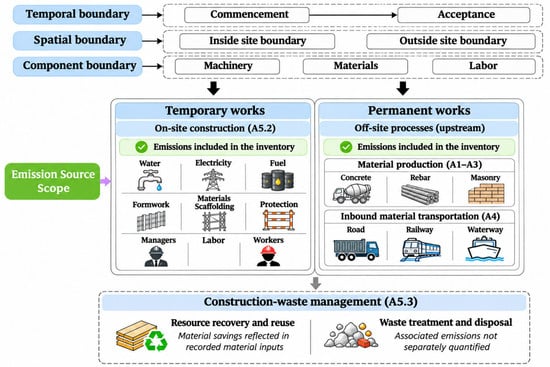
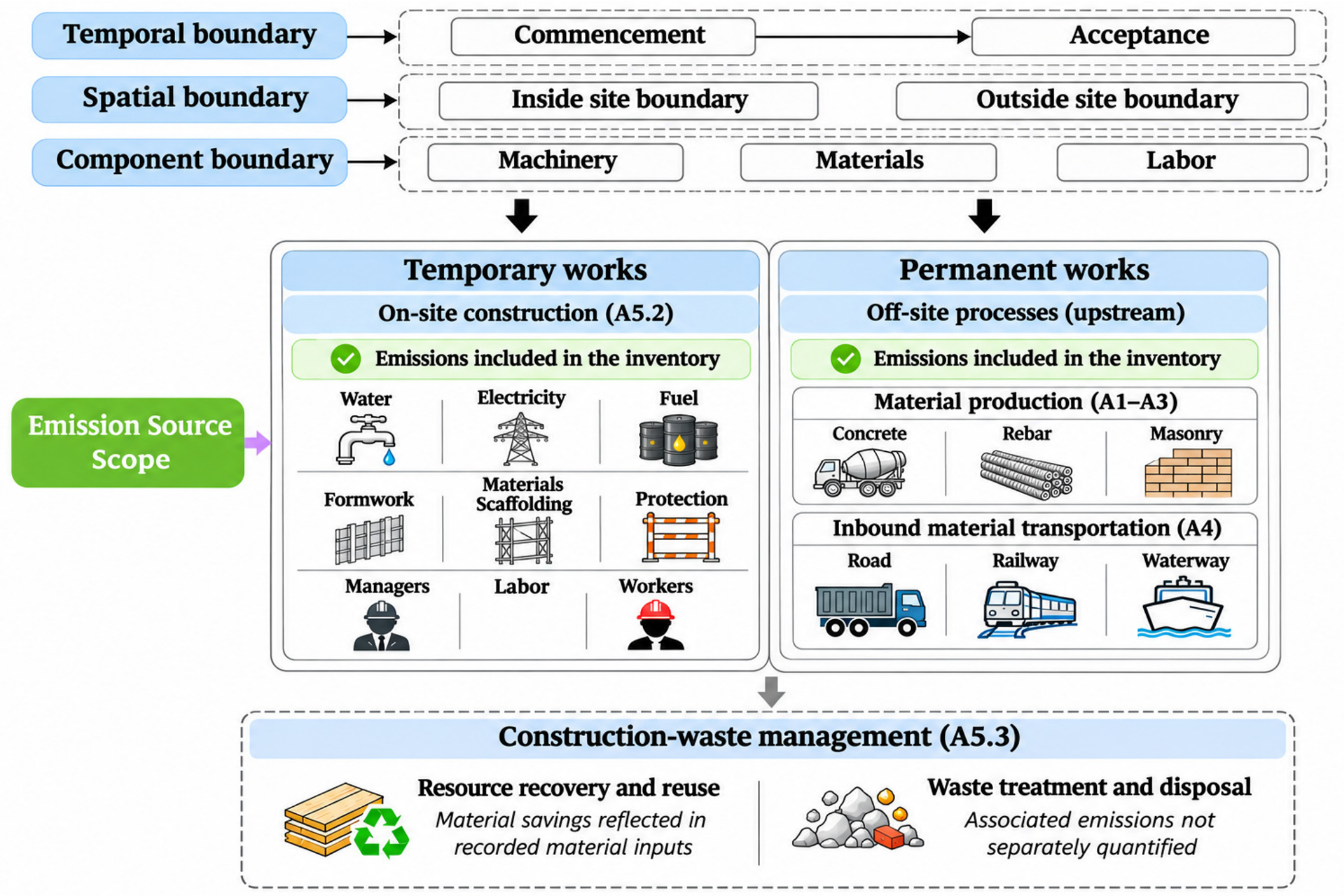
Emission source scope. Greenhouse gas emissions during building construction arise from materials, machinery, and labor [23]. Specifically, the accounting included the embodied carbon of construction materials, energy consumption by construction machinery and vehicles, and labor-related emissions. Biogenic carbon uptake, storage, and release were not separately quantified, and no additional avoided-burden or substitution credits were assigned to recovered or recycled materials. These boundaries are illustrated in Figure 2.
Figure 2.
Scope and system boundary of construction-phase carbon emission accounting.
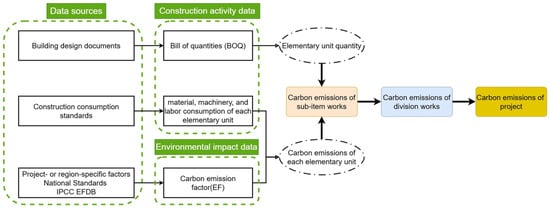
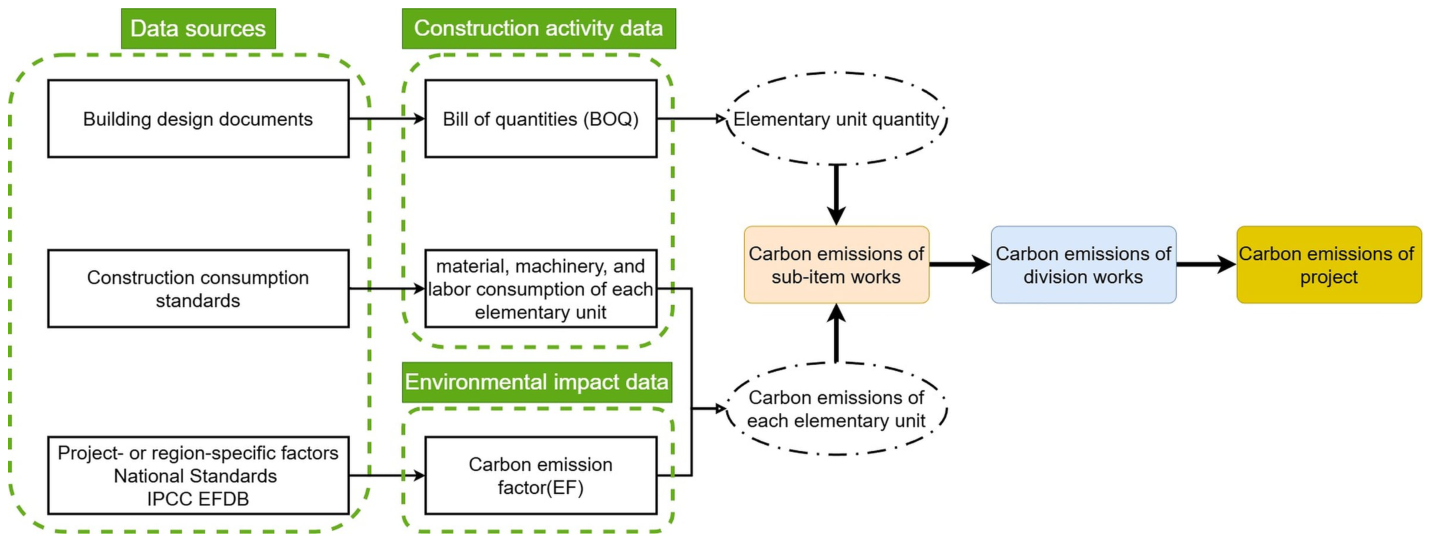
In this study, an elementary-unit-based method for calculating carbon emissions [37] was developed based on the inventory analysis approach. According to GB 50300—2013 [38], a building project is divided into division works and sub-item works. An elementary unit (EU) referred to one unit of a sub-item work. The total quantity of each sub-item work, obtained from the bill of quantities, was defined as the elementary unit quantity (EUQ), while the carbon emissions associated with one elementary unit were denoted as the elementary unit carbon emissions (EUCE).
The carbon emissions of a sub-item work were calculated as the product of its EUCE and EUQ. The carbon emissions of each division work were obtained by summing the emissions of all constituent sub-item works. The total project emissions were obtained by summing the carbon emissions from all division works. The elementary-unit-based calculation procedure is presented in Figure 3. Thus, the theoretical carbon emissions of the project during the construction phase can be calculated as follows:
where Cij is the carbon emissions of the j-th sub-item work in the i-th division work, kg CO2e, determined by
where Cm is carbon emissions of the m-th EU in the j-th sub-item work, i-th division work, kg CO2e; qm is the elementary unit quantity (EUQ).
Figure 3.
Elementary-unit-based calculation procedure for construction-phase carbon emissions.
Unit consumption values for labor, materials, and machinery shifts for each work item were determined from the applicable construction consumption standards. The calculation distinguished between temporary works (Equation (3a)) and permanent works (Equation (3b)). Temporary works included carbon emissions from temporary construction materials, labor, and energy consumption by on-site machinery and equipment, while permanent works included emissions from building materials and their transportation. The corresponding activity data were then multiplied by the relevant carbon emission factors to obtain the EUCE.
where, for the m-th EU,
and αms are the quantity and amortization index of the s-th temporary construction materials;
Lmt is the number of workdays for the t-th labor item, person-workday;
Tmk and Rk are the number of machinery shifts for the k-th type of construction machinery and its energy consumption per shift, respectively;
and are the quantity of the r-th permanent building material and the h-th transported material, respectively;
is the transportation distance of the h-th transported material, km;
are the carbon emission factors for the s-th temporary construction material, the r-th permanent building material, the t-th labor item, the k-th energy type, and transport mode used for the h-th material, respectively.
A carbon emission factor represents the amount of carbon dioxide equivalent (CO2e) emitted per unit of the corresponding material or activity. Emission factors were preferentially obtained from project-specific or regional sources. Where unavailable, relevant national standards (e.g., GB/T 51366-2019 [39]) or the IPCC Emission Factor Database (EFDB) [40] were used, provided that the units and accounting boundaries were consistent.
2.2.2. Actual Carbon Emission Monitoring
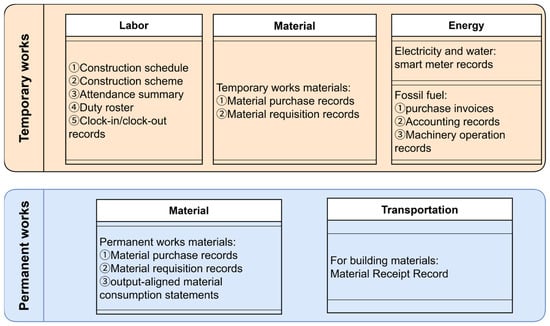
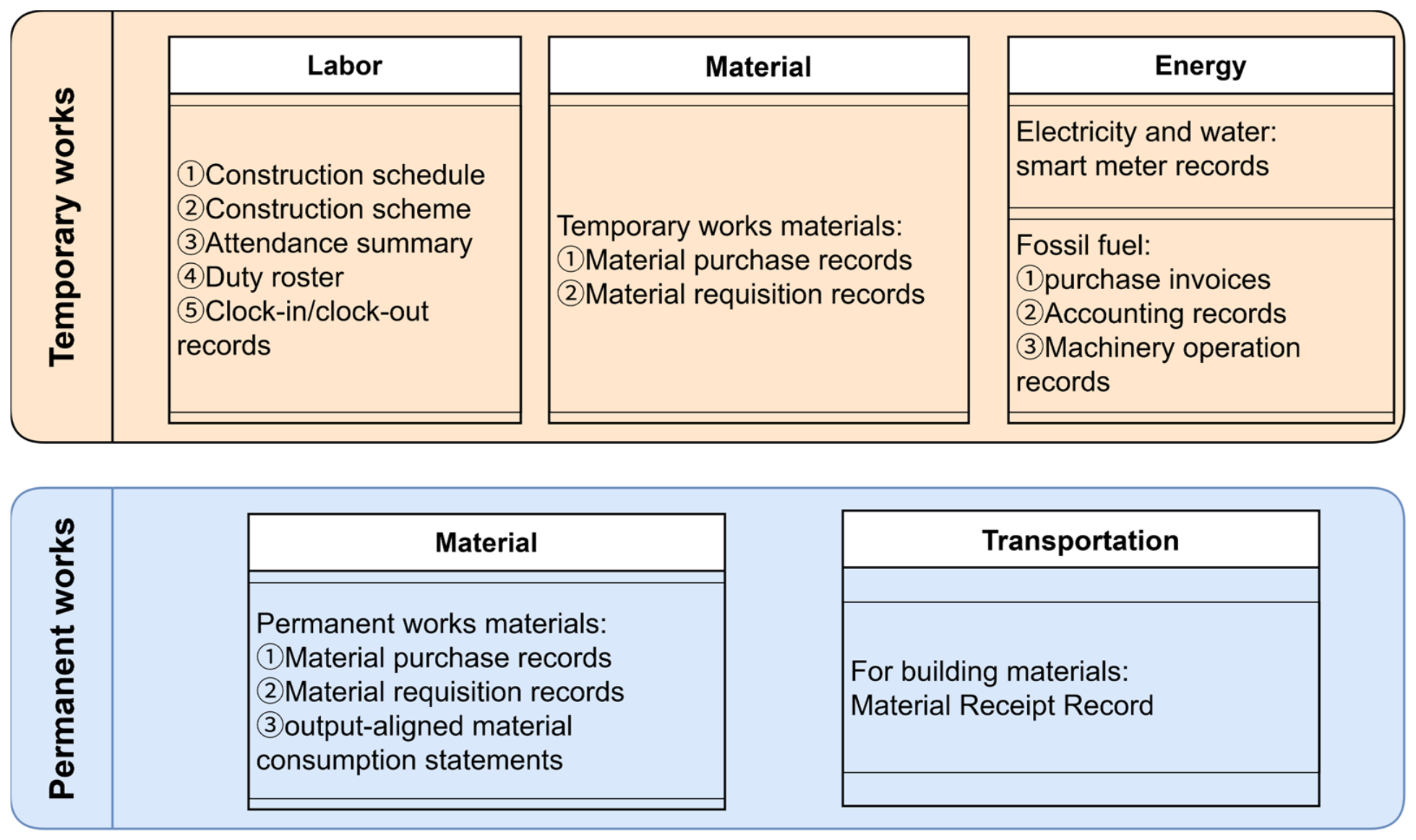
The accounting scope and system boundary for actual carbon emissions were consistent with those used for the theoretical calculation, but the data acquisition approaches differed. The monitoring protocol followed a hierarchical approach to acquiring activity data: instrument readings were prioritized where feasible, project records and field investigations were used when direct monitoring was unavailable, and analytical or analogy-based estimates were adopted only when the required data could not otherwise be obtained. The corresponding data collection scheme is shown in Figure 4.
Figure 4.
Data collection methods for actual carbon emissions.
Labor-related carbon emissions Crg can be calculated using the following formula:
where EFrg, N are the carbon emission factor and number of workdays for labor, respectively.
Carbon emissions from temporary construction materials Ccl can be written as
where are the carbon emission factor and consumption of the i-th consumable material, respectively. are the carbon emission factor, quantity, and amortization index of the p-th reusable material, respectively.
Carbon emissions from energy consumption Cny can be calculated using the following formula:
where EFny,i, Yi are the carbon emission factor and quantity of the i-th energy, respectively.
Embodied carbon emissions from permanent building materials Cjc are described as
where are the carbon emission factor and the quantity of the r-th building material, respectively.
Carbon emissions from building material transportation Cys are calculated as follows:
where EFys,i is the carbon emission factor for transportation, kg CO2e/(t·km); is the weight of the i-th building material, t; and is the transportation distance of the i-th building material, km.
The total actual carbon emissions from building construction were obtained by summing the emissions from the components above, as expressed in the following equation:
3. Application of the SPEM Mechanism to the Case Project
To evaluate the practical applicability of the SPEM mechanism, the green construction demonstration project at the Nanjing G74 site was selected as an empirical case. Carbon mitigation measures were implemented across the four SPEM dimensions: upstream Supply-Chain Reduction, Process Substitution during on-site construction, End-of-Pipe Treatment for resource recovery and safe disposal, and Management Coordination throughout construction.
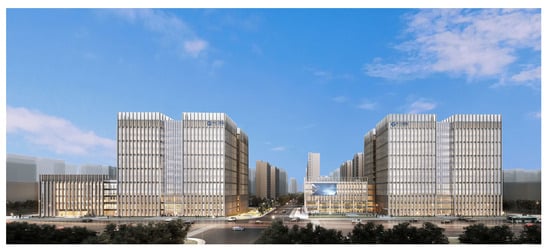
The Nanjing G74 Smart Industrial Park is an office building project with a site area of 28,236.79 m2 and a gross floor area of 148,733.77 m2. The project has two basement levels. The five-story podium has a frame structure, whereas the 14-story main building has a frame–shear wall structure and is divided into Zones A and B. An overall rendering of the project is shown in Figure 5.
Figure 5.
Architectural rendering of the G74 project.
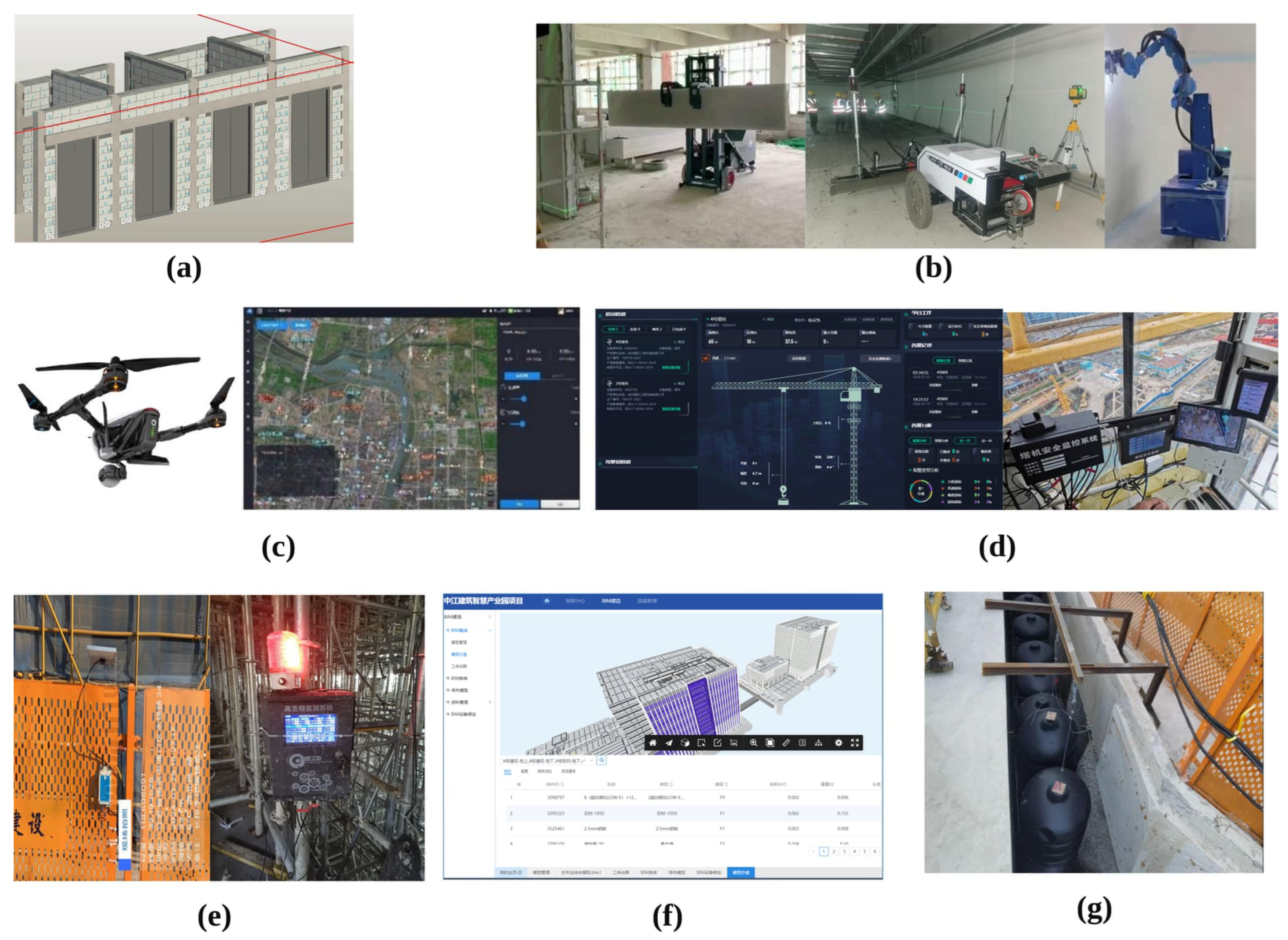
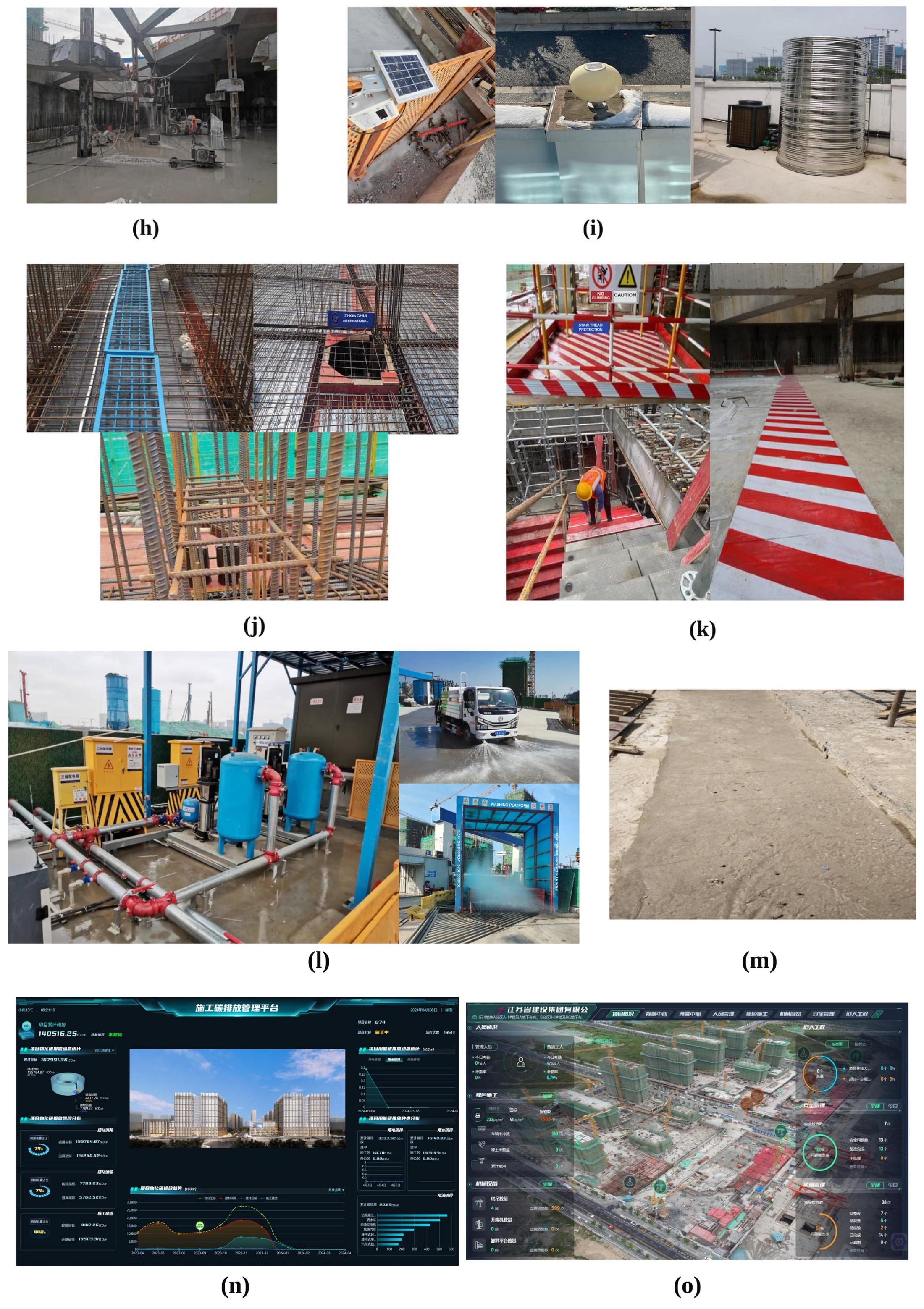
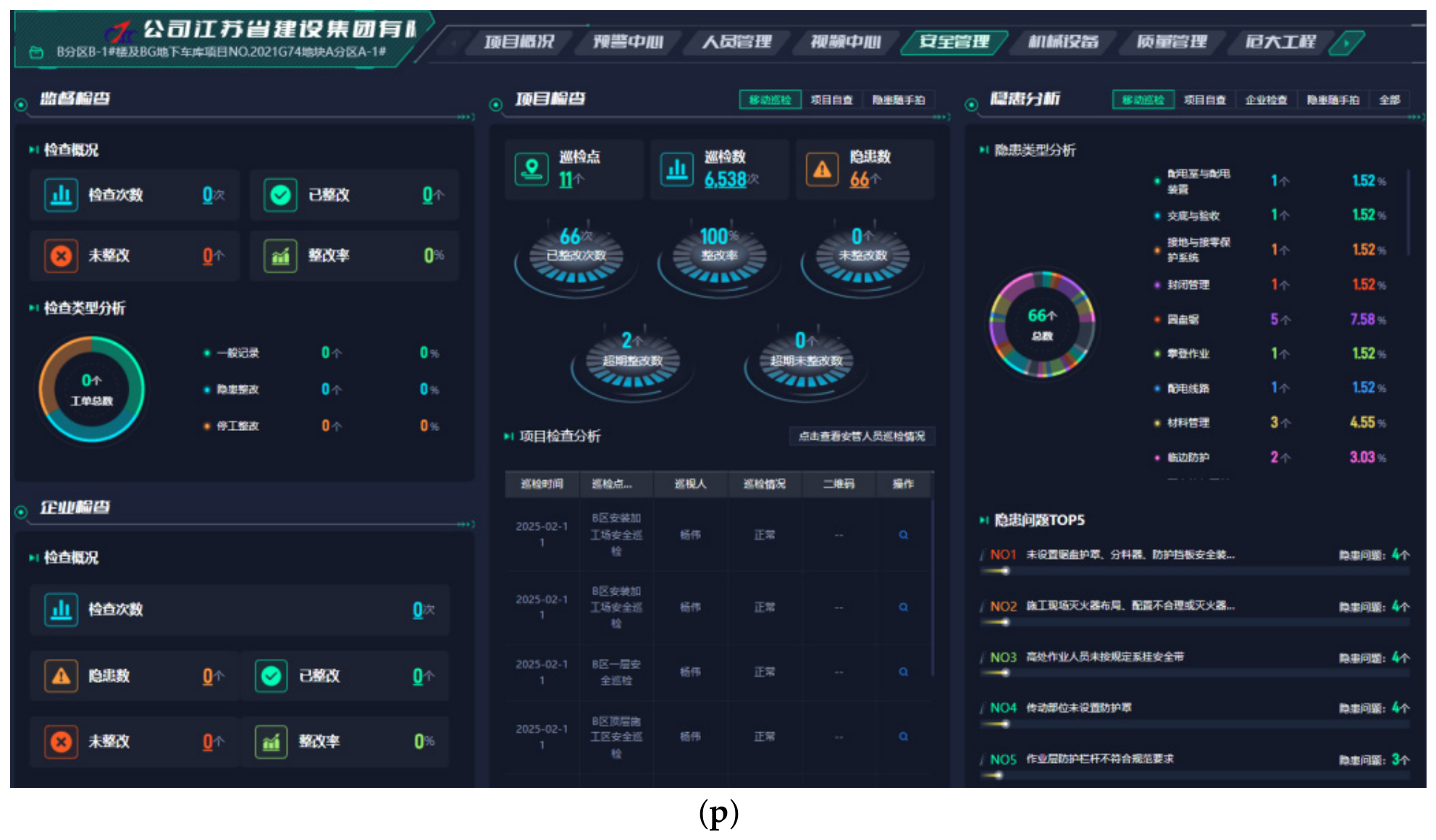
The project targeted recognition as a Jiangsu Provincial Green Construction Demonstration Project and achieved China’s three-star green building certification. Following the SPEM mechanism, green construction and carbon reduction measures were systematically implemented throughout the construction phase. The main green construction technologies applied in the project, together with their corresponding SPEM dimensions, emission components, and direct (D) or indirect (I) reduction pathways, are listed in Table 1.
Table 1.
Main green construction technologies applied in the G74 project and their carbon reduction categories.
Figure 6.
Green construction technologies implemented in the G74 project. (a) BIM-based block layout; (b) construction robots; (c) UAV-based site inspection; (d) tower-crane safety monitoring system; (e) sensor deployment for high-risk construction activities; (f) construction management platform; (g) embedded fillers in foundation pit backfill concrete; (h) automatic cutting of RC struts; (i) solar lighting and air-source heat-pump equipment; (j) reuse of rebar offcuts; (k) reuse of formwork offcuts; (l) reclaimed water recycling system; (m) fluidized solidified soil backfill in foundation trench; (n) Donghe Carbon Emission Analysis Platform; (o) green construction online management platform; (p) multi-stakeholder collaborative management platform. Note: The interfaces shown in subfigures (n)–(p) are in Chinese. They represent the Donghe Carbon Emission Analysis Platform used for monitoring and analyzing project carbon emissions, including carbon emission statistics and trends; the green construction online management platform used for monitoring construction activities and site management; and the multi-stakeholder collaborative management platform used for coordinating project inspections, identifying safety hazards, and facilitating collaborative management, respectively.
4. Results and Discussion
4.1. Comparison of Theoretical and Actual Carbon Emissions
To evaluate the carbon reduction performance of green construction technologies in practice, this study calculated theoretical carbon emissions using the elementary-unit-based calculation method and quantified actual carbon emissions from field-collected activity data. For the G74 case study, the comparison was confined to the period from construction commencement to acceptance of the main structures, covering five work divisions: piling, foundation-pit support, earthworks, underground structural works, and aboveground structural works. Actual emissions for these divisions were derived from field-collected activity data using Donghe Carbon Emission Analysis Software (Version 3.0), while the corresponding theoretical emissions were calculated from the bill of quantities using Equations (1), (2), (3a) and (3b). The unit consumption values were obtained from the 2014 editions of the Jiangsu Province Building and Decoration Engineering Pricing Quota and the Jiangsu Province Installation Engineering Pricing Quota. The carbon emission factors for materials, labor, and energy were selected primarily with reference to the Jiangsu Provincial Guidelines for Carbon Emission Calculation of Civil Buildings.
At the G74 site, 24 water and electricity meters (12 smart/remote and 12 conventional) were installed in the construction and living areas, and the operation of 13 types of fuel-powered construction machinery was tracked. Where direct fuel-consumption records were unavailable, fuel use was estimated using machinery operating shifts and the corresponding per-shift consumption. Building-material transportation emissions were estimated from transported material quantities, transport distances, and mode-specific emission factors using Equation (8). Monthly carbon emissions were compiled for permanent building materials, material transportation, temporary construction materials, energy consumption, and labor and allocated to the corresponding work divisions according to construction progress. To account for incomplete or potentially underestimated records, emissions from the recorded principal permanent building materials were divided by 0.90, and the recorded labor-related emissions were multiplied by 1.10, following the project manager’s empirical recommendations, before comparison with the theoretical values.
Theoretical and actual carbon emissions were then compared at the total and component levels, and the differences were used to evaluate project-level carbon reduction performance. Where prevention and coordination measures reduced resource use in practice, their realized effects may already be reflected in the recorded component totals; the aggregate difference alone cannot isolate the contribution of each such measure.
The actual and theoretical values of total carbon emissions are listed in Table 2. The actual total carbon emissions were lower than the theoretical value by 29,628.46 t CO2e, corresponding to a difference of 199.20 kg CO2e/m2 and an overall carbon emission reduction rate of 20.95%. Specifically, relative to the theoretical values, the carbon emissions per unit area of permanent and temporary works decreased by 136.31 kg CO2e/m2 (16.16%) and 62.90 kg CO2e/m2 (58.50%), respectively. These results indicate that the implemented green construction technologies were associated with lower emissions during the assessed construction stages, with emissions from temporary works decreasing by more than half.
Table 2.
Comparison of actual and theoretical construction-phase carbon emissions of the G74 project.
At the component level, all emission components were lower than their corresponding theoretical values, as detailed in Table 3. The reductions in carbon emission intensity for permanent building materials, building material transportation, temporary construction materials, and energy consumption were 132.07, 4.24, 0.88, and 21.92 kg CO2e/m2, respectively, with corresponding reduction rates of 16.07%, 19.81%, 6.67%, and 51.53%. The largest relative reduction was observed for labor-related emissions, which decreased by 77.46%. This difference was associated with the extensive use of mechanized and intelligent construction equipment, which reduced labor demand and rework while improving construction efficiency and safety.
Table 3.
Comparison of actual and theoretical construction-phase carbon emissions by component.
The unadjusted activity data inventory yielded total emissions of 101,396,977.80 kg CO2e, equivalent to a 28.31% reduction relative to the theoretical value of 141,446,373.34 kg CO2e. The material and labor adjustments increased estimated actual emissions to 111,817,909.10 kg CO2e, corresponding to the 20.95% reduction reported in Table 2. The difference between the unadjusted and adjusted reduction estimates was 7.37 percentage points.
A local sensitivity analysis was conducted to evaluate the influence of the empirical correction factors on the estimated carbon reduction rate. When the material correction divisor was varied from 0.90 to 0.89 and 0.91, the reduction rate changed from 20.95% to 20.13% and 21.74%, respectively. In contrast, varying the labor correction multiplier from 1.10 to 1.09 and 1.11 resulted in reduction rates of 20.96% and 20.94%, respectively. The results indicate that the estimated reduction rate was more sensitive to the correction of permanent building material emissions than to that of labor-related emissions.
Although regional emission factors were prioritized in the case study, standardized factors and quota-based consumption data may not fully reflect project-specific material production conditions and actual resource consumption. These discrepancies may lead to overestimation or underestimation of calculated carbon emissions and may also affect the estimated carbon reduction rate. The parameter variations represent assumed sensitivity scenarios rather than observed measurement-error bounds. The estimated carbon reduction rate remains subject to uncertainty associated with empirical data corrections and incomplete activity records.
4.2. Contributions of Carbon Reduction
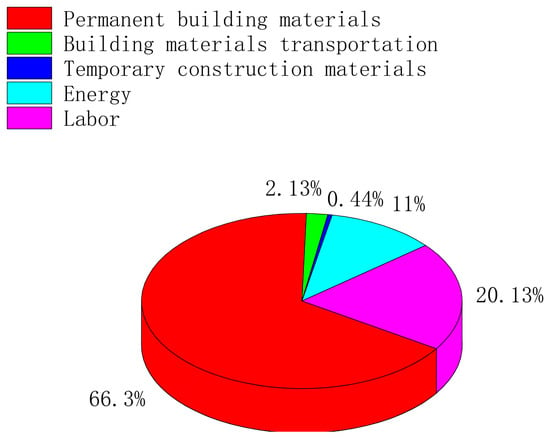
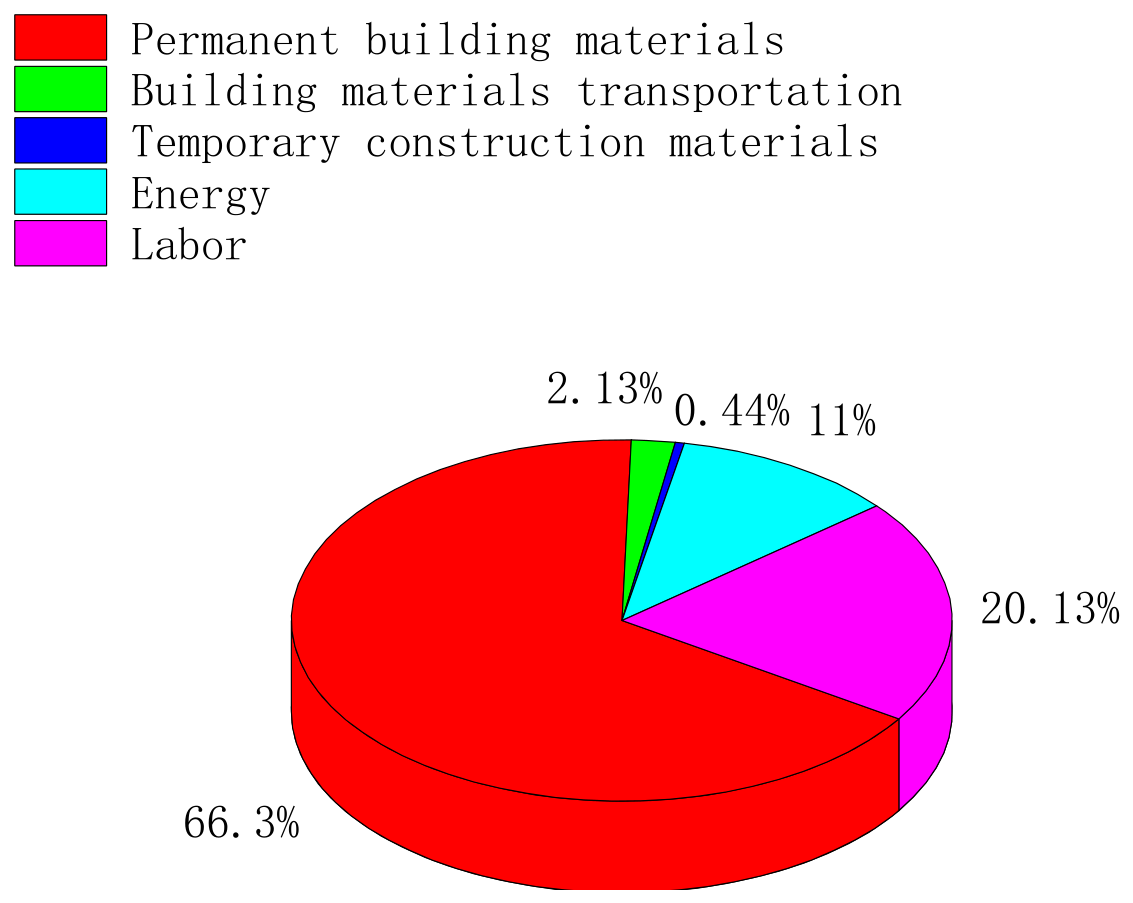
The project-level total carbon emission reduction comprised contributions from building material production and transportation, temporary construction materials, energy, and labor. Based on Table 3, the shares attributable to each emission components are shown in Figure 7. Material-related carbon emission reductions accounted for 68.87% of the total reduction, including 66.30% from permanent building materials, 2.13% from building material transportation, and 0.44% from temporary construction materials. This material-related reduction was associated with multiple SPEM pathways, including optimization of material consumption and transportation under Supply-Chain Reduction, efficiency gains from intelligent construction technologies and upgrading of low-carbon construction techniques under Process Substitution, resource recovery of construction waste under End-of-Pipe Treatment, and the overall support of Management Coordination. Labor-related emission reductions accounted for 20.13% of the total and were mainly associated with efficiency gains from intelligent construction technologies and upgrading of low-carbon construction techniques under Process Substitution that reduced labor demand. Energy-related emission reductions accounted for 11.00% and were mainly associated with reduced fossil fuel consumption under Process Substitution. Additionally, wider application of low-carbon construction machinery and vehicles on site could further reduce fossil fuel dependence and increase the contribution of energy-related emission reductions.
Figure 7.
Contributions of carbon-emission components to total carbon reduction.
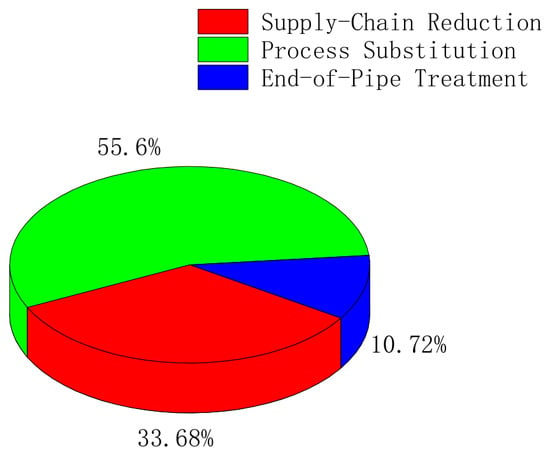
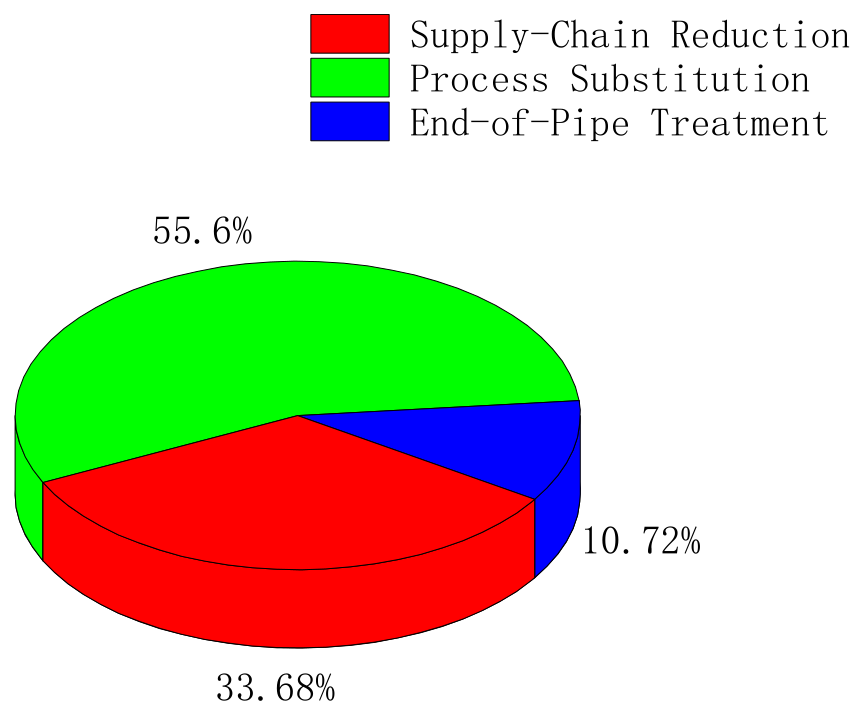
Figure 8 shows the estimated contribution shares of the three SPEM dimensions that were quantified separately. Process Substitution contributed the largest share, accounting for 55.60%. This is because, in this project, reductions in labor- and energy-related emissions were primarily associated with this dimension, while intelligent construction technologies and low-carbon construction techniques also help reduced permanent building material losses. Management Coordination was not assigned a separate quantitative share because its measures were implemented throughout the construction process and supported the efficient operation of the other three dimensions. Thus, its contribution could not be quantified separately.
Figure 8.
Contributions of SPEM dimensions to total carbon reduction. Note: Management Coordination is not presented as a separate sector because it operates across the other three SPEM dimensions and its contribution cannot be independently quantified.
The mapping in Table 1 identifies the emission components potentially affected by each measure, whereas Table 3 reports their aggregate project-level changes. Indirect measures, including UAV inspections, intelligent warning systems, and BIM-enabled coordination, may prevent construction defects, safety incidents, and subsequent rework, thereby avoiding additional resource consumption and associated emissions. To the extent that such measures reduce actual material consumption, transportation, energy use, or labor, their effects may already be reflected in the project-level emission comparison. However, this study did not quantitatively assess the individual carbon-reduction effects of indirect measures because the necessary measure-specific records of avoided events and rework activities were not available. Future research will investigate technology-specific quantification using comparable project cases, rework records, and corresponding resource-consumption data while avoiding double counting with the observed project emissions.
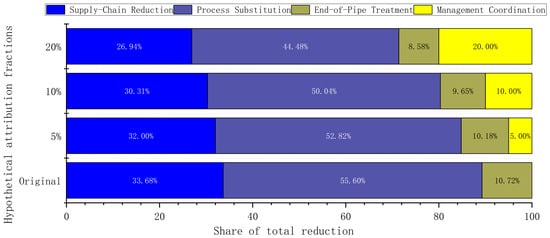
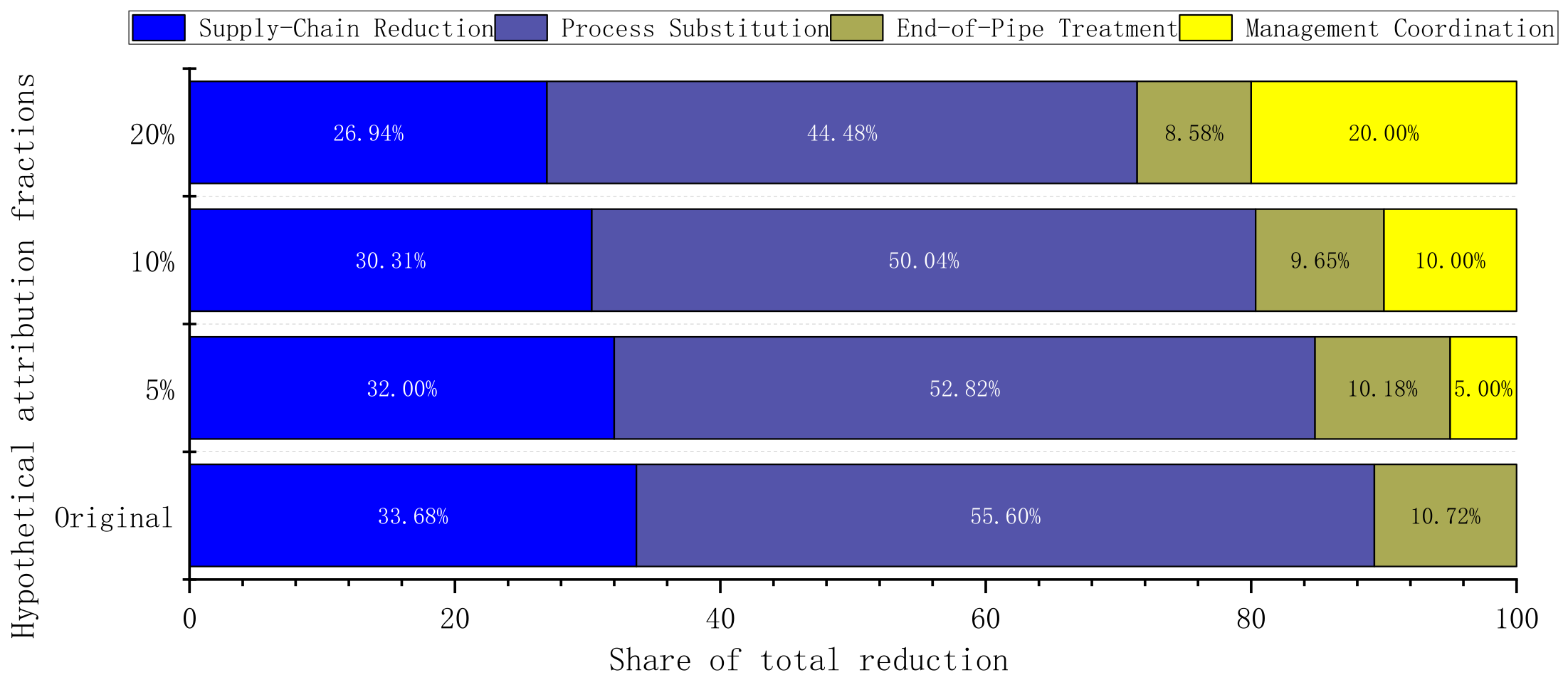
To examine how different assumptions regarding the enabling effect of Management Coordination might influence the reported contribution shares, a sensitivity analysis was conducted. Three hypothetical reallocation proportions of 5%, 10%, and 20% were considered. Under each scenario, the corresponding share of the reductions attributed to each of the other three dimensions was reassigned to Management Coordination. As shown in Figure 9, the contribution shares of Process Substitution, Supply-Chain Reduction, and End-of-Pipe Treatment decreased proportionally with increasing reallocation proportions. At the 20% level, their respective contributions decreased from 55.60%, 33.68%, and 10.72% to 44.48%, 26.94%, and 8.58%, while Management Coordination accounted for 20.00%. Process Substitution retained the largest contribution share under all three assumptions, whereas the share attributed to Management Coordination exceeded that of End-of-Pipe Treatment at the 10% and 20% levels. These results reflect hypothetical adjustments to contribution attribution rather than independently measured management effects. As the adjustments only redistributed the existing carbon reductions, the overall project-level carbon reduction rate remained unchanged at 20.95%.
Figure 9.
Contributions of SPEM dimensions to total carbon reduction under different attribution assumptions.
Although the SPEM framework was evaluated using a single office-building project in Nanjing, its four dimensions are organized around construction-phase emission sources rather than specific building functions and may therefore provide a basis for identifying carbon-reduction measures in other regions and building types. However, the quantitative results are specific to the G74 project and its regional conditions. In this study, construction resource consumption was estimated using Jiangsu provincial construction quota standards, while emission factors were selected primarily with reference to the Jiangsu Provincial Guidelines for Carbon Emission Calculation of Civil Buildings. In regions with different electricity-generation mixes, particularly different shares of coal-fired and renewable energy, the regional electricity emission factor may vary, thereby affecting emissions from on-site electricity consumption and the emission-reduction benefits of equipment electrification. Regional differences in material production processes, transportation distances and modes, and waste management practices may also affect the emission profile and the relative contributions of the SPEM dimensions. For different building types, such as industrial facilities, the relative importance of the four dimensions may vary depending on structural systems, material requirements, construction equipment, and specialized installation activities. Where equipment installation is included in the assessment, the accounting boundary, activity data, and corresponding emission factors should be adjusted accordingly, while emissions from industrial operations should remain outside the construction-phase boundary. Accordingly, the 20.95% overall carbon reduction rate, the 68.87% material-related reduction contribution, and the 55.60% contribution of Process Substitution reported for G74 should be regarded as project-specific results rather than general benchmarks. Application to other regions and building types requires locally appropriate emission factors and construction resource-consumption data, consistent accounting boundaries, and further validation using field-collected activity data.
5. Conclusions
Based on the characteristics of construction-phase carbon emission sources, this study proposed a carbon reduction mechanism for green construction in building projects and quantitatively evaluated project-level carbon reduction performance. The main conclusions are as follows:
- (1)
- The proposed four-dimensional SPEM carbon reduction mechanism establishes a closed-loop carbon management framework covering the entire building construction process. Its application to the G74 project demonstrates the feasibility of organizing and implementing carbon reduction measures across the four dimensions, providing a theoretical basis for identifying mitigation pathways and optimizing construction schemes.
- (2)
- Combining elementary-unit-based theoretical calculations with field-collected actual activity data enabled a quantitative evaluation of project-level carbon reduction performance. For the assessed construction stages of the G74 project, within the assessed construction stages, the construction-phase carbon emission intensity was 751.80 kg CO2e/m2, which was 20.95% lower than the theoretical value.
- (3)
- Material-related carbon emission reductions accounted for 68.87% of the total reduction and represented the largest component of the estimated project-level carbon reduction. Among the separately quantified SPEM dimensions, Process Substitution accounted for the largest share, while Management Coordination provided essential support for the efficient operation of the other dimensions throughout the construction process. These findings provide a project-based reference for formulating green construction incentive policies and carbon management strategies in building projects.
- (4)
- The carbon reduction performance analysis in this study focused mainly on direct carbon reduction technologies. However, the avoided emissions from indirect measures aimed at preventing accidents, quality defects, and rework were not separately quantified and warrant further investigation. Future research should establish standardized protocols for avoided-emission accounting, including clearly defined baseline emissions without these measures, records of rework and associated resource consumption, and safeguards against double counting with observed project emissions. In addition, the SPEM mechanism was applied and evaluated using a single office building project, but the applicability of the findings and methods to other building types requires further validation. Multi-project validation across different building types and construction conditions, using consistent accounting boundaries and methods, is needed to assess the robustness and transferability of the SPEM framework.
Author Contributions
Conceptualization, N.L. and D.L.; methodology, N.L.; validation, N.L., D.L., and Y.W. (Yang Wang); formal analysis, N.L.; investigation, Y.W. (Yang Wang); resources, Y.W. (Yi Wu); data curation, N.L. and Y.W. (Yang Wang); writing—original draft preparation, N.L.; writing—review and editing, N.L.; visualization, N.L.; supervision, D.L.; project administration, Y.W. (Yi Wu); funding acquisition, Y.W. (Yi Wu). All authors have read and agreed to the published version of the manuscript.
Funding
This research was funded by Jiangsu Provincial Department of Housing and Urban–Rural Development (grant no. 2024JH13) and the industry–academia cooperation project of Jiangsu Province (grant no. BY20250318).
Data Availability Statement
The main data supporting the findings of our study have already been presented in the tables in the manuscript. The raw data that support the findings of this study are available from the corresponding author upon reasonable request.
Conflicts of Interest
The authors declare no conflicts of interest.
References
- Hu, S.; Zhang, Y.; Yang, Z.Y.; Yan, D.; Jiang, Y. Challenges and opportunities for carbon neutrality in China’s building sector—Modelling and data. Build. Simul. 2022, 15, 1899–1921. [Google Scholar] [CrossRef] [Scilit]
- China Association of Building Energy Efficiency; Research Institute of Urban and Rural Construction and Development of Chongqing University. Research report on carbon emissions in China’s urban and rural construction field (2024). Constr. Archit. 2025, 2, 56–63. [Google Scholar]
- Zhang, F.; Wen, B.; Niu, D.T.; Li, A.B.; Guo, B.B.; Lv, Y. Life cycle carbon emissions of reinforced concrete buildings: Assessment and mitigation priorities. J. Build. Eng. 2025, 114, 114230. [Google Scholar] [CrossRef] [Scilit]
- Ye, H.W.; Su, Y.J. Strategic consideration on the development of building industrialization in China. China Civ. Eng. J. 2024, 57, 1–8. [Google Scholar] [CrossRef]
- Song, X.G.; Zhai, S.F.; Wang, Y.Y. Research on the countermeasures of low-carbon development in the whole life cycle of the architectural engineering under the goal of “carbon peak and carbon neutrality”. Constr. Econ. 2023, 44, 11–17. [Google Scholar] [CrossRef]
- Cao, Y.; Xu, C.; Kamaruzzaman, S.N.; Aziz, N.M. A systematic review of green building development in China: Advantages, challenges and future directions. Sustainability 2022, 14, 12293. [Google Scholar] [CrossRef] [Scilit]
- Bao, X.; Yuan, H.; Chen, X.; Chen, K.; Shen, J.; Cui, H. GHG emission analysis of an optimal arrangement of stiffened composite pile group based on bearing capacity: A case study. J. Clean. Prod. 2024, 440, 140860. [Google Scholar] [CrossRef] [Scilit]
- Sandanayake, M.; Zhang, G.; Setunge, S. Environmental emissions at foundation construction stage of buildings—Two case studies. Build. Environ. 2016, 95, 189–198. [Google Scholar] [CrossRef] [Scilit]
- Dong, X.; Liu, J.P. On fully promoting green buildings and achieving the “dual-carbon” goals. Build. Sci. 2025, 41, 1–5. [Google Scholar] [CrossRef]
- Yan, H.; Shen, Q.; Fan, L.C.H.; Wang, Y.; Zhang, L. Greenhouse gas emissions in building construction: A case study of One Peking in Hong Kong. Build. Environ. 2010, 45, 949–955. [Google Scholar] [CrossRef] [Scilit]
- Wu, Z.; Zhou, Y.; Wang, J.; Zhou, X.; Sun, X.; Kong, X.T.R.; Chen, X. Life cycle greenhouse gas assessment and reduction potential of metro excavated spoil: A BIM-integrated data-driven framework. Resour. Conserv. Recycl. 2026, 222, 108987. [Google Scholar] [CrossRef] [Scilit]
- Wang, Z.; Zhao, Y.; Liu, Z.; Gao, G.; Wang, J. Research on an intelligent analysis method for carbon emissions based on construction processes. Buildings 2026, 16, 2267. [Google Scholar] [CrossRef] [Scilit]
- Wang, Y.; Liang, X.; Hou, J.; Tian, J.; Cheng, Y.; Wan, Y. Decarbonizing construction machinery: Data-driven lifecycle assessment of a hydraulic excavator using electrified and alternative-fuel hybrid power systems. Appl. Energy 2026, 411, 127641. [Google Scholar] [CrossRef] [Scilit]
- Jiang, Y.; Wei, C.; Ding, Y.; Liu, K.; Lu, Q.; Zhou, Z. Life-cycle carbon emission calculation and economic analysis of zero-carbon buildings: A case study in China. Buildings 2026, 16, 2395. [Google Scholar] [CrossRef] [Scilit]
- Wesonga, R.; Tutesigensi, A.; Moodley, K. Advancing net zero carbon construction: A techno-economic and environmental analysis of onsite microgrids and prosumer energy adoption. Appl. Energy 2025, 398, 126453. [Google Scholar] [CrossRef] [Scilit]
- Xu, X.; Yu, S.; Lu, H.; Sun, Z.; Zheng, K.; Liang, Z.; Xu, Z. Research on carbon emission calculation and emission reduction strategies for buildings based on the whole life cycle. Buildings 2026, 16, 1487. [Google Scholar] [CrossRef] [Scilit]
- Cheng, M.; Huang, Z.; Zheng, Y. A review on life-cycle carbon emissions of reinforced concrete buildings: Calculation and reduction. J. Clean. Prod. 2025, 526, 146501. [Google Scholar] [CrossRef] [Scilit]
- Li, L.; Gao, L.; Zhang, X.; Xu, H.J.; Jiang, L. Research on building’s carbon emission calculation and reduction strategy based on life cycle assessment (LCA) and building information modeling (BIM): A case study in Beijing, China. Buildings 2025, 15, 1403. [Google Scholar] [CrossRef] [Scilit]
- Gao, H.; Wang, D.; Du, X.; Zhao, Z. An LCA-BIM integrated model for carbon-emission calculation of prefabricated buildings. Renew. Sustain. Energy Rev. 2024, 203, 114775. [Google Scholar] [CrossRef] [Scilit]
- Mo, Z.; Gao, T.; Qu, J.; Cai, G.; Cao, Z.; Jiang, W. An empirical study of carbon emission calculation in the production and construction phase of a prefabricated office building from Zhejiang, China. Buildings 2023, 13, 53. [Google Scholar] [CrossRef] [Scilit]
- Pervez, H.; Ali, Y.; Petrillo, A. A quantitative assessment of greenhouse gas (GHG) emissions from conventional and modular construction: A case of developing country. J. Clean. Prod. 2021, 294, 126210. [Google Scholar] [CrossRef] [Scilit]
- Vetrivelan, R.; Gettu, R.; Palaniappan, S.; Kumar, Y. Embodied Carbon, Time and Cost of Two Post-Office Buildings: Comparison of 3D Printed Concrete and Conventional Buildings. J. Build. Eng. 2026, 121, 115636. [Google Scholar] [CrossRef] [Scilit]
- Xu, A.; Zhu, Y.; Wang, Z. Carbon emission evaluation of eight different prefabricated components during the materialization stage. J. Build. Eng. 2024, 89, 109262. [Google Scholar] [CrossRef] [Scilit]
- Ma, X.; Hu, H.; Luo, Y.; Yao, W.; Wei, Y.; She, A. A carbon footprint assessment for usage of recycled aggregate and supplementary cementitious materials for sustainable concrete: A life-cycle perspective in China. J. Clean. Prod. 2025, 490, 144772. [Google Scholar] [CrossRef] [Scilit]
- Sabău, M.; Bompa, D.V.; Silva, L.F.O. Comparative Carbon Emission Assessments of Recycled and Natural Aggregate Concrete: Environmental Influence of Cement Content. Geosci. Front. 2021, 12, 101235. [Google Scholar] [CrossRef] [Scilit]
- Li, S.; Han, G.; Du, B.S.; Jiang, Z.S.; Sun, L.Q. Carbon emissions assessment of ultra-high performance concrete in construction industry: Calculation method and case study. Energy Build. 2025, 329, 115260. [Google Scholar] [CrossRef] [Scilit]
- Heravi, G.; Rostami, M.; Kebria, M.F. Energy consumption and carbon emissions assessment of integrated production and erection of buildings’ pre-fabricated steel frames using lean techniques. J. Clean. Prod. 2020, 253, 120045. [Google Scholar] [CrossRef] [Scilit]
- Mansouri, A.; Taghaddos, H.; Nekouvaght Tak, A.; Sadatnya, A.; Aghajamali, K. Simulation-based planning of earthmoving equipment for reducing greenhouse gas (GHG) emissions. Autom. Constr. 2024, 168, 105841. [Google Scholar] [CrossRef] [Scilit]
- Szamocki, N.; Kim, M.-K.; Ahn, C.R.; Brilakis, I. Reducing Greenhouse Gas Emission of Construction Equipment at Construction Sites: Field Study Approach. J. Constr. Eng. Manag. 2019, 145, 05019012. [Google Scholar] [CrossRef] [Scilit]
- Li, X.; Jiang, M.; Lin, C.; Chen, R.; Weng, M.; Jim, C.Y. Integrated BIM-IoT Platform for Carbon Emission Assessment and Tracking in Prefabricated Building Materialization. Resour. Conserv. Recycl. 2025, 215, 108122. [Google Scholar] [CrossRef] [Scilit]
- She, J.Q.; Qu, B.; Wei, W. Carbon emission calculation and distribution characteristics in residential building construction phase. J. Xi’an Univ. Archit. Technol. (Nat. Sci. Ed.) 2025, 57, 288–296. [Google Scholar] [CrossRef]
- Su, B.; Fan, L.J.; Fan, Y.; Huang, C.G.; Chen, K.; Ji, Y.X. Calculation and analysis of actual carbon emissions during building construction stage—An example of an ultra-high-rise office building in Guangzhou. Build. Sci. 2025, 41, 39–46. [Google Scholar] [CrossRef]
- Kanafani, K.; Magnes, J.; Lindhard, S.M.; Balouktsi, M. Carbon emissions during the building construction phase: A comprehensive case study of construction sites in Denmark. Sustainability 2023, 15, 10992. [Google Scholar] [CrossRef] [Scilit]
- Liu, Z.; Xia, Z.; Li, J.; Wang, Y.; Zhang, Y.; Li, X.; Yang, Q. Carbon reduction potential and selection strategies of emerging construction-phase technologies. Sci. Rep. 2026, 16, 7863. [Google Scholar] [CrossRef] [Scilit] [PubMed]
- EN 15978:2026; Sustainability of Construction Works—Assessment of Environmental Performance of Buildings—Requirements and Guidance. European Committee for Standardization: Brussels, Belgium, 2026.
- GB/T 50378-2019; Assessment Standard for Green Building (2024 Edition). China Architecture & Building Press: Beijing, China, 2024.
- Li, D.Z.; Wang, Y.; Li, C.Z.; Lv, J.J. Fundamental calculation of carbon emission primitives in construction phase of building projects. Civ. Eng. Green Build. 2023, S1, 109–114. [Google Scholar] [CrossRef]
- GB 50300-2013; Unified Standard for Constructional Quality Acceptance of Building Engineering. China Architecture & Building Press: Beijing, China, 2013.
- GB/T 51366-2019; Standard for Building Carbon Emission Calculation. China Architecture & Building Press: Beijing, China, 2019.
- Eggleston, H.; Buendia, L.; Miwa, K.; Ngara, T.; Tanabe, K. 2006 IPCC Guidelines for National Greenhouse Gas Inventories; Institute for Global Environmental Strategies: Kanagawa, Japan, 2006. [Google Scholar]


Disclaimer/Publisher’s Note: The statements, opinions and data contained in all publications are solely those of the individual author(s) and contributor(s) and not of MDPI and/or the editor(s). MDPI and/or the editor(s) disclaim responsibility for any injury to people or property resulting from any ideas, methods, instructions or products referred to in the content. |
© 2026 by the authors. Licensee MDPI, Basel, Switzerland. This article is an open access article distributed under the terms and conditions of the Creative Commons Attribution (CC BY) license.