


Abstract
Integrated Project Delivery (IPD) is difficult to communicate because its defining principles—early collaboration, shared risk and reward, open-book management, and aligned incentives—are relational and behavioural rather than purely technical. Serious games can make these concepts tangible by allowing participants to experience how rules, information, and incentives shape decisions in a risk-free environment. This study examines COBUILD, a tabletop serious game in which construction professionals experience comparable Design–Bid–Build (DBB) and IPD scenarios. Players assume the roles of owner, architect, contractor, and project manager, respond to risks, manage resources, and pursue project and individual objectives under contrasting governance arrangements. An exploratory feasibility and acceptability evaluation using a single-group pretest–posttest design (n = 101) was conducted in professional AEC and university and settings, combining self-reported learning measures, post-game evaluation, and qualitative feedback. Participation was associated with significant improvements in self-perceived understanding of DBB–IPD differences, early collaboration and the owner’s role, risk–reward and incentive structures, and confidence in explaining and recommending IPD. Participants also valued the facilitated, visual, and comparative nature of the experience. COBUILD shows promise as an experiential tool for translating the behavioural logic of IPD into shared professional learning.
1. Introduction
Construction project delivery systems do not merely allocate contractual responsibilities; they also shape the information, incentives and decision-making conditions under which project participants act. Fragmented responsibilities and misaligned commercial interests can make individually rational decisions detrimental to overall project performance. Under such conditions, project relationships may acquire a zero-sum logic in which protecting the interests of one organisation can conflict with the interests of other participants or with the performance of the project as a whole [1]. Previous research has consequently highlighted the influence of contractual and governance arrangements on the behaviour and relationships of project stakeholders [2].
Lean Integrated Project Delivery seeks to address these conditions through early stakeholder involvement, increased transparency, shared risk and reward, and stronger alignment between organisational and project-level objectives. In this study, Lean IPD refers to an integrated delivery environment in which IPD provides the governance and commercial structure, while Lean contributes selected management principles and practices focused on transparency, value generation, collaborative decision-making and continuous improvement. Accordingly, COBUILD represents IPD primarily through early stakeholder involvement, shared risk and reward, open-book management and incentive alignment, while Lean principles are reflected in practices such as collaboration, continuous improvement and Target Value Delivery, among others.
Traditional teaching methods can effectively communicate contractual definitions and project-delivery principles, but may be less suited to representing the relational and behavioural consequences of different governance arrangements. Serious games can complement these approaches by allowing participants to adopt roles, make decisions, observe consequences and reflect on the interaction between individual incentives and project outcomes. They provide a low-risk learning environment in which situations that would be costly, slow or difficult to reproduce in real projects can be explored through simulated decisions and interactions.
Existing construction serious games have addressed specific collaborative and Lean practices, including Target Value Design, while other exercises have been developed to illustrate selected IPD principles through simulated construction projects. However, limited attention has been given to comparative simulations in which participants experience a similar project scenario under contrasting governance, information and incentive structures. Consequently, the relationship between delivery-system rules, individual decision-making and collective project outcomes remains insufficiently represented in construction serious games.
COBUILD was developed to address this gap. The game combines two contrasting modes of play representing DBB and IPD. Both modes share a common project structure, including stakeholder roles, project objectives, uncertain events, risk responses, physical production and the monitoring of cost and progress. However, they differ in the visibility of information and individual objectives, the allocation of responsibility, the management of risk, the availability of response capabilities and the connection between individual rewards and overall project performance. This comparative structure allows participants to experience a more fragmented delivery environment, in which responsibilities, information and commercial objectives are managed separately, and an integrated environment based on transparency, shared responses and more closely aligned incentives.
The game does not assume that DBB participants are inherently adversarial or that collaboration emerges automatically under IPD. Instead, it represents how different organisational arrangements can make particular behaviours more or less rational. In the DBB mode, protecting individual resources or transferring responsibility may benefit one organisation while negatively affecting the project. In the IPD mode, the rules are intended to connect individual success more closely with collective performance. The comparison therefore illustrates that collaboration and conflict do not depend exclusively on individual attitudes, but are also shaped by the governance, information, risk-allocation and incentive structures within which project participants operate.
The purpose of this article is to present the design of COBUILD and provide an exploratory evaluation of its implementation in educational and professional AEC settings. Specifically, the study examines changes associated with the facilitated experience in participants’ self-perceived understanding of project-delivery mechanisms, their assessment of the simulation’s realism, clarity and professional usefulness, and the design limitations identified through participant feedback. The study thereby contributes a comparative game-design approach for translating selected Lean IPD principles into participant decisions and preliminary evidence concerning its perceived value among predominantly professional construction-sector participants.
2. Literature Review
2.1. Lean IPD and the Transformation of Project Delivery
The popularity of project delivery methods has evolved over time. From the Middle Ages until well into the twentieth century, construction work was commonly paid through reimbursable costs plus fees, in an arrangement resembling open-book Design–Build (DB) [3]. Design–Bid–Build (DBB) became popular from the second half of the nineteenth century with the emergence of major public investment programmes in the United States and was presented as a means of limiting corruption in public procurement [4]. In 1882, George Allon Fuller introduced the role of the general contractor. This helped DBB become the de facto standard because of its apparent ability to secure costs and schedules and transfer risk from the owner to the contractor [3,4].
Increasing project complexity, more demanding requirements and more aggressive objectives led this model to be questioned for its limited ability to deliver on time and within budget [5] and for its high level of conflict [6]. From the 1970s, methods such as Design–Build (DB) re-emerged [6]. From the 1980s, approaches such as Construction Management (CM) and CM-at-Risk became more widespread, prescribing the involvement of construction expertise during design [7]. In 2007, the American Institute of Architects published its first official guide to Integrated Project Delivery (IPD), establishing the foundations of a method intended to harness participants’ expertise to improve project outcomes, increase owner value, reduce waste and maximise efficiency throughout design, fabrication and construction [8].
2.2. Barriers to Lean IPD Adoption and Knowledge Transfer
Barriers to Lean IPD adoption are diverse and widely documented. They include cultural, legal and organisational barriers, as well as a lack of reference cases, among others [9,10,11,12,13,14,15,16,17,18].
According to Rogers [19], the diffusion rate of new ideas and practices depends on factors such as their perceived advantage over available alternatives, ease of implementation and scalability. Construction projects are unique, people-dependent and delivered in different locations, making it difficult to demonstrate statistically that one delivery method is consistently superior to another. Where comparative evidence exists [7,20,21], findings obtained in one context may still appear risky to a real estate investor operating under different conditions, even when they are scientifically transferable.
Construction projects are highly complex and strongly influenced by local conditions. Differences in culture, business practices, industrial structure and legal frameworks are only some of the factors that shape project delivery [22]. Construction is also slow compared with the delivery of many other goods and services. Documented success cases and pilot projects are among the most effective ways to encourage owners to adopt innovations [23]. However, considerable time may pass before early cases are completed and owners become willing to implement an innovation such as IPD. In the absence of established success cases, owners seeking to minimise risk may adopt less complete versions that remain closer to familiar delivery methods while attempting to increase collaboration and ease adoption. These partial forms, often described as IPD-ish [20], can introduce new team dynamics without necessarily providing all the mechanisms needed to support them.
Previous research with Spanish real estate professionals has also highlighted the strategic role of the owner in Lean IPD adoption, identifying relatively high acceptance of collaborative governance principles alongside greater reservations regarding some of its commercial mechanisms [24]. These findings reinforce the need to address not only the willingness to collaborate but also an understanding of the governance and incentive structures required to support collaboration.
2.3. Experiential Learning and Serious Games in Construction Education
A serious game is designed primarily for a purpose beyond entertainment, integrating learning, instruction or training objectives into its original design [25,26,27]. Clark Abt [28] introduced the concept distinguishing games designed for enjoyment from games designed for learning. Unlike gamification, which adds game elements to non-game contexts [26], or simulation, which aims to reproduce the real world as faithfully as possible, a serious game is a self-contained system with its own logic, mechanics and objectives, combining entertainment and learning. Its success depends on balancing the transfer of knowledge, skills and attitudes [29] with an engaging and enjoyable experience [30].
Serious games support knowledge transfer through active learning and interaction, which means learners construct meaning through experience [31]. Serious games have been reported to be more effective than conventional instruction for learning and retention, though the magnitude of benefit varies substantially across outcomes, disciplines, and game designs [32,33].
Serious games are particularly relevant in capital-intensive sectors such as architecture, engineering, construction and real estate because they can transfer knowledge, skills and attitudes while allowing process decisions to be tested and validated at low risk [34].
Bhatnagar et al. [25], Miron et al. [35] and Taleb et al. [36], among others, have documented dozens of games and simulations in construction. Their reviews describe these approaches as pedagogically valuable alternatives to passive teaching because they move professionals and students from observation to active participation. They also show that interest in serious games and simulations has grown substantially and that these tools can help bridge the gap between theoretical concepts and their application in practice.
Beyond these broader reviews, empirical studies have also examined the educational effects of simulation-based learning in Lean Construction. Hamzeh et al. [37], for example, reported positive student responses to hands-on simulation games and found evidence of improved understanding of Lean concepts and their practical application.
Numerous serious games address practices such as the Last Planner System, Takt Time, 5S and continuous improvement. Project delivery methods, however, are not exclusive to Lean Construction, and relatively few activities have been developed specifically to explain Integrated Project Delivery. Relevant precedents include works by Rybkowski et al. [38] and Russmann et al. [39]. The former uses a serious game to explore the aesthetic implications of Target Value Design, whereas the latter teaches IPD principles through the construction of a Tiny Wooden House.
2.4. Research Gap: Simulating the Behavioural Logic of Project Delivery
Although serious games have been widely used to teach Lean Construction techniques, comparatively little attention has been given to the behavioural and commercial logic of project delivery methods. Existing games often focus on specific production practices or collaborative techniques, but few allow participants to experience, under comparable conditions, how different delivery systems change incentive alignment, risk response, information sharing, decision-making and the relationship between individual and project outcomes.
COBUILD addresses this gap by allowing participants to experience the same project situation under two contrasting delivery configurations. Roles, risks and uncertainty remain broadly comparable, while the mechanisms governing incentives, collaboration and risk resolution change between DBB and IPD. This comparative design makes visible how apparently rational individual decisions can produce different collective outcomes depending on the commercial and governance structure in which they are made. COBUILD’s specific contribution can therefore be summarised in four points:
- Enables participants to experience two delivery methods under comparable conditions.
- Shows how incentives shape participants’ decisions.
- Represents the relationship between risk, reward and project outcomes.
- Supports understanding of IPD through direct experience rather than theoretical explanation alone.
3. COBUILD Game Design
3.1. Design Purpose
COBUILD was conceived to address two complementary needs: to explain clearly the differences between DBB and IPD and to let participants experience those differences in a controlled, risk-free environment. Contractual definitions describe how each system is organised but cannot fully convey the emotions, tensions and behaviours they generate. The need to protect one’s position, the frustration of disputes over responsibility, or conversely the trust that can emerge from sharing information and solving problems jointly are difficult to understand through theory alone.
The game mechanics therefore do more than represent construction activities; they translate governance principles into concrete decisions. Both modes share the same basic structure—roles, risks, responses, physical production, payments and progress control—but change the information available, incentives and distribution of responsibilities. The aim is not to prove that one delivery method is superior, but to show how system rules can make particular behaviours rational.
The building assembled on the board provides a visible, cumulative representation of performance. Pieces show physical progress, while coins make budget, payments, contingencies and liquidity tangible constraints. At the end of each turn, players receive information on cost, production and progress, allowing them to connect decisions with project effects. The experience ends with reflection on collective performance and the achievement of individual objectives.
3.2. Scope and Abstraction
COBUILD deliberately represents two contrasting governance configurations: a fragmented DBB environment and an integrated Lean IPD environment. This choice creates a clear contrast and makes it easier to identify the effects of contractual fragmentation versus early integration, transparency and incentive alignment.
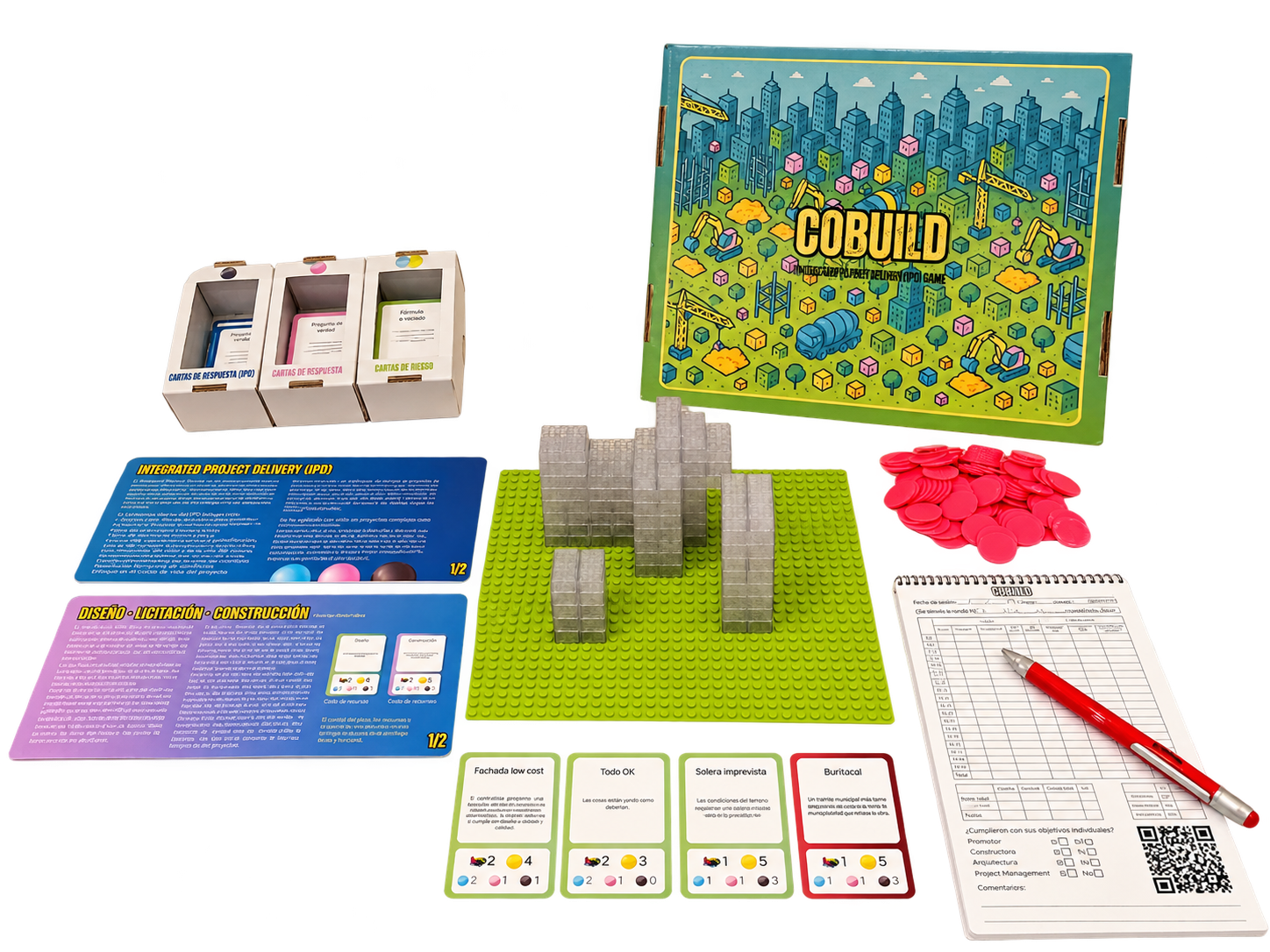
The game focuses on the construction phase to provide a bounded setting in which the consequences of risk allocation, liquidity, production and coordination decisions become observable, while acknowledging that several defining IPD mechanisms originate during design and preconstruction. COBUILD reduces the real-world universe of risks, responses and financial mechanisms to a manageable set of cards, coins and rules. Risks draw on professional experience and categories identified in the literature [40], but the game does not attempt to reproduce a real project exhaustively. Its fidelity is structural: it preserves the key tensions that shape stakeholder behaviour while avoiding complexity that would hinder learning [41]. See Figure 1.
Figure 1.
COBUILD overview.
3.3. Roles and Incentives
Players assume four asymmetric roles: Owner, Architect, Contractor and Project Manager. Each role combines responsibilities, resources, decision-making capacity and individual objectives, together with a short narrative background that helps participants interpret its main technical, economic and organisational pressures. Decisions are therefore made not only from abstract rules but also from each stakeholder’s internal logic.
All players share the objective of completing the building within the established time and budget. However, the Owner, Architect and Contractor also pursue individual goals linked to their interests, such as commercialising the asset, improving quality or functionality, or adopting more economical or buildable solutions. This structure reproduces the tension between overall project success and the success of each organisation.
The difference between the two modes is not the disappearance of individual interests, but how those interests become visible and connected to collective outcomes. In DBB, individual objectives remain hidden and capabilities are managed as proprietary resources. In IPD, objectives are shared and capabilities support joint decision-making. The same roles can therefore produce different behaviours when information and incentive systems change.
3.4. Risk and Response System
Risk management is the core of the game. Threats and opportunities arise throughout the project and affect production, cost or execution conditions. Players must assess their consequences and decide how to respond. Although both modes expose the team to similar uncertainty, they organise responsibility, information and response capacity differently.
In DBB, a risk can trigger debate over who should bear it, making defence of one’s own position a rational strategy. Attention may shift from solving the problem to allocating responsibility and protecting individual margin or resources. In IPD, response capabilities are visible and can be combined, encouraging the team to assess its resources jointly and develop a shared solution. The incentive shifts from winning a dispute to improving the project outcome.
The system also includes progress payments, liquidity constraints, contingencies and additional financing mechanisms. These elements show that performance depends on more than final cost. Poor risk or cash-flow management can interrupt production and threaten overall viability even when the project remains technically feasible.
3.5. Comparative Game Mode Mechanics
Although both modes retain the same basic project setting, stakeholder roles, uncertainty, physical production and progress controls, they differ in the governance mechanisms through which participants interpret information, manage risk and pursue objectives. Table 1 summarises these differences. The comparison focuses not on the technical activities performed by players, but on how responsibility, information, response capabilities and financial incentives are structured in each mode.
Table 1.
Key differences in governance, collaboration, and incentive structures between DBB and IPD in COBUILD.
The comparison does not imply that participants operating under DBB are inherently adversarial or that collaboration emerges automatically under IPD. Rather, COBUILD represents how different governance arrangements make particular courses of action more or less rational. Under DBB conditions, protecting organisational resources, rejecting responsibility or demonstrating that another participant should bear a risk may constitute reasonable responses from the perspective of an individual organisation. However, these decisions can also generate local optimisation, relational strain and poorer collective performance.
In IPD mode, individual interests do not disappear. Instead, greater transparency, shared response capabilities and closer alignment between risk, reward and overall project performance allow those interests to be addressed within collective decision-making. The central contrast is therefore not between selfish and collaborative participants but between two systems that structure information, responsibility and incentives differently. By maintaining comparable roles, risks and project conditions across both modes, COBUILD enables participants to observe how changes in governance alter the decisions available to them and the consequences of those decisions.
3.6. Feedback Loops and Learning
The turn-based structure creates short cycles of decision, consequence and reflection. Risk responses are translated into visible changes in production, cost, liquidity and progress, allowing participants to connect their decisions with both individual and project-level outcomes. Because the underlying project conditions remain broadly comparable while the governance mechanisms change, the contrast between modes functions as an instructional device. The subsequent debriefing enables participants to relate the behaviours observed during play to broader concepts such as information transparency, risk allocation, incentive alignment and collaborative decision-making.
3.7. Game Components
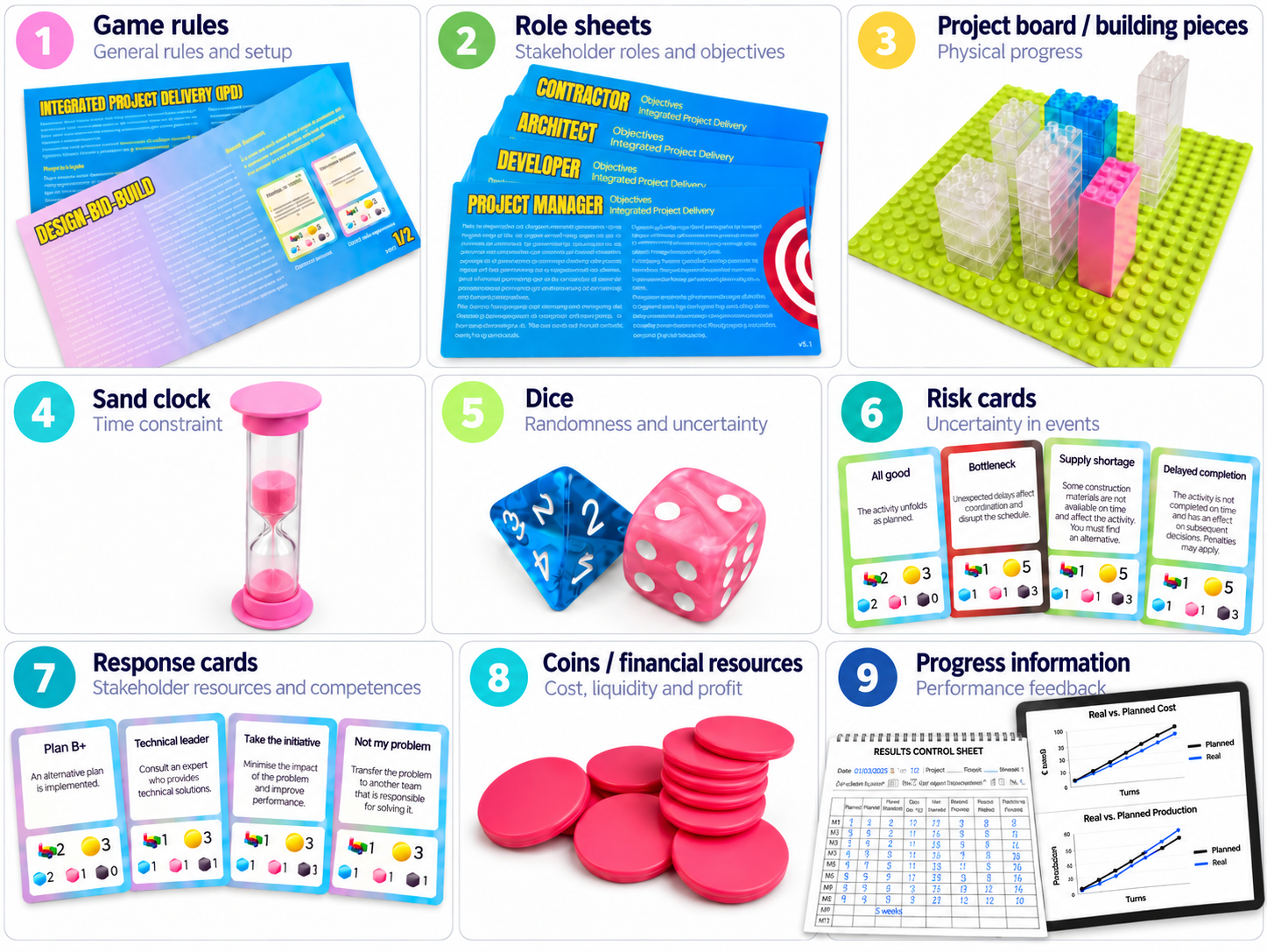
COBUILD incorporates a set of game components, each serving a specific function and contributing to the dynamics of the game. Both DBB and IPD modes use the same basic components, with some variations. While all physical elements remain unchanged between modes, differences exist in the rules, stakeholder roles, and response cards. See Table 2 and Figure 2.
Table 2.
COBUILD game elements, their functions, and the decision-making processes they support.
Figure 2.
COBUILD game components. Note: See Supplementary Material File S1 to know more about Risk and Response Cards. See Supplementary Material File S2 to learn more about data registry and the progress information processes.
3.8. Turn Structure
The turn structure follows a repetitive sequence within each game mode and is broadly similar in both, although one important difference distinguishes them.
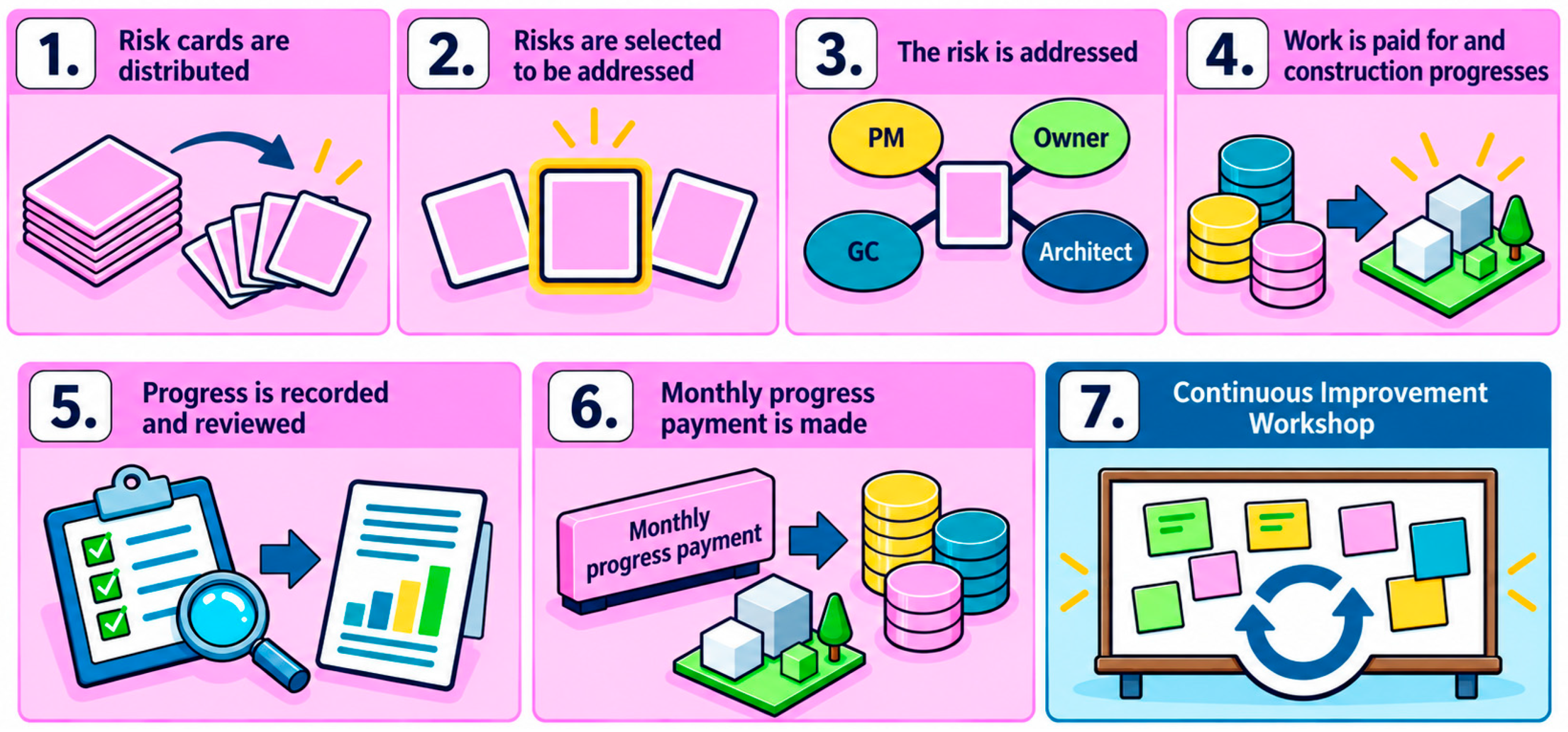
In the DBB mode, risk cards are first distributed and participants decide which risks they will address and which they will leave unresolved. Responsibility for each risk is then assigned through open discussion among the project participants. The contractor subsequently pays for the works to be carried out and advances construction by placing building pieces on the board. The Project Manager records project progress and reports the current project status, and the turn concludes with the owner paying the contractor the corresponding monthly progress payment.
The IPD turn structure differs primarily in the way responsibility for risks is addressed. In addition, after the monthly progress payment, participants undertake a Continuous Improvement Workshop, which may improve project performance in the following turn. See Figure 3.
Figure 3.
COBUILD turn structure. Note: Slides 1–6 represent the turn structure in DBB mode and Slides 1–7 represent IPD mode.
4. Research Methodology
4.1. Research Design and Questions
This study used an exploratory feasibility and acceptability evaluation incorporating a single-group pretest–posttest evaluation complemented by descriptive qualitative feedback. The evaluation examined whether COBUILD could be implemented across professional and educational AEC settings, how participants perceived the experience, and whether participation was associated with immediate changes in selected self-reported IPD-related outcomes. The study was not designed as an effectiveness trial and does not seek to estimate a causal effect attributable to the game.
The sessions served both as learning environments and as iterative evaluations of the prototype. Participants compared DBB and IPD through simulated decisions, risks and incentives, while the study examined changes in self-perceived Lean IPD understanding as well as rule clarity, mechanical balance, realism, duration and facilitation. The following research questions were addressed:
- What changes occur between pre and post-game measures of perceived understanding and self-confidence regarding IPD?
- How do participants assess COBUILD’s educational impact, design, facilitation, realism and simplification?
- How do participants assess the game overall, both as an experience and as a tool for increasing awareness of IPD?
- What strengths, limitations and opportunities for improvement emerge from the open-ended responses?
4.2. Participants and Implementation Contexts
Nine sessions were conducted. COBUILD underwent iterative development during the evaluation. Session 1 used prototype version 4.0, session 2 used version 5.0, and version 5.1 was introduced in session 3. Version 5.1 incorporated two substantial changes: response cards replaced in-game coin-based compensation, and role-specific special pieces were introduced to represent individual benefits. No further formally numbered versions were issued. Sessions 3–9 used version 5.1, with minor refinements introduced through oral instructions, including additions or removals of cards, adjustments to cost and schedule targets, event activation thresholds, progress payments, and contractor insolvency. The comparative DBB–IPD framework was retained, but participants did not experience identical gameplay conditions across sessions. The same questionnaire was administered throughout all twelve sessions.
The first session was delivered in a reduced format at the Lean IPD Congress 2025; three took place in master’s programmes at Spanish universities; and five were held in construction companies, engineering firms and project management companies.
Participants represented different levels of responsibility, professional experience and prior familiarity with collaborative contracts, IPD, the Last Planner System and Target Value Design.
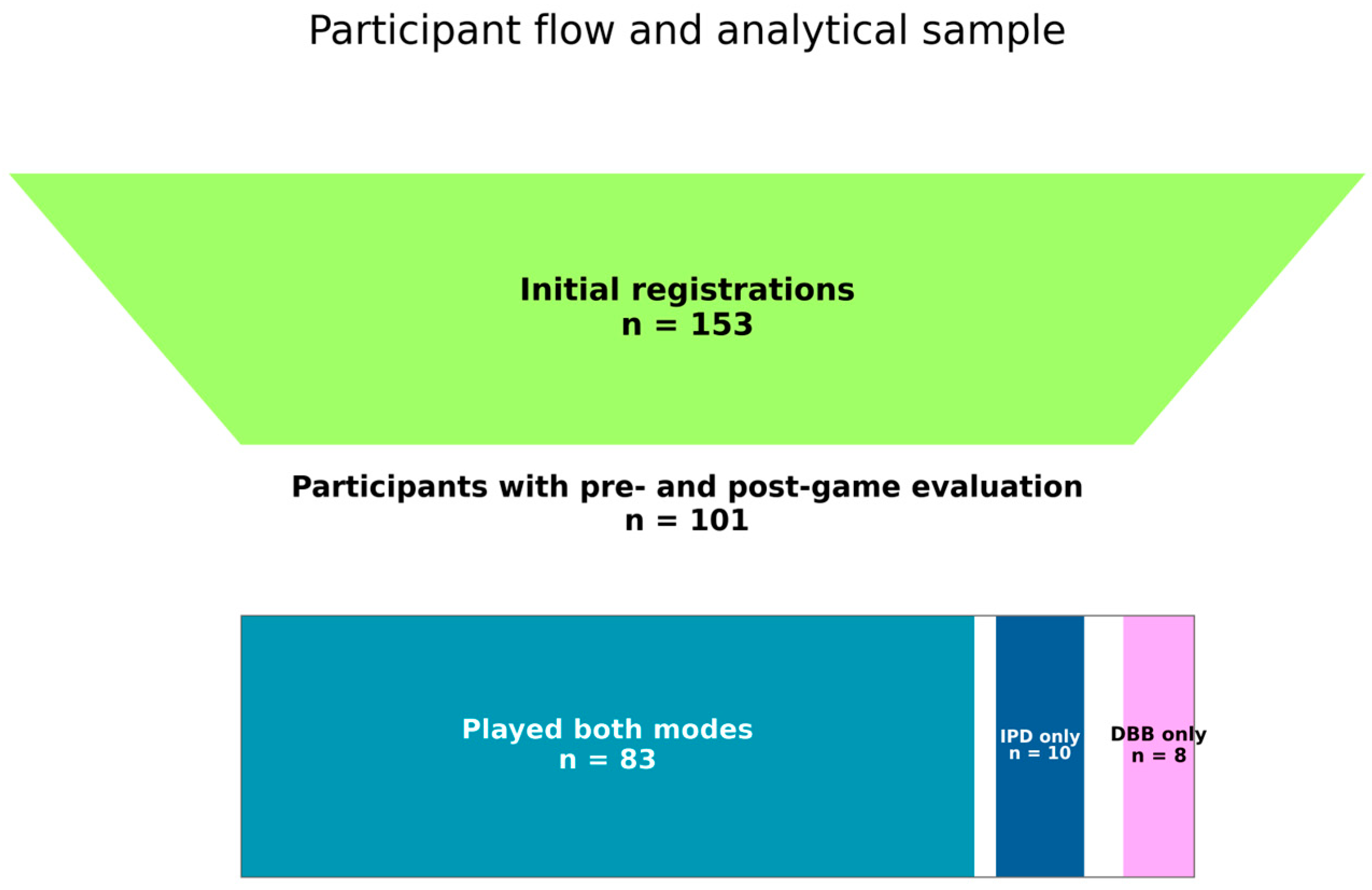
A total of 153 pre-game records were received. The main analysis included the 101 participants who completed both the pre and post-game evaluations; the remaining 52 either did not complete the game or did not complete the post-game questionnaire. Of the 101 paired respondents, 83 participated in both game modes, 10 only in IPD and 8 only in DBB. Item-level analyses used all available valid cases. Games were normally played in groups of four or five, distributed across the roles of Owner, Architect, Contractor and Project Manager. All gameplay sessions and pre- and post-test questionnaires were conducted in Spanish. English-language representations of selected game components in the manuscript and Supplementary Materials were created for explanatory purposes only. The cards used in the study were in Spanish.
4.3. Data Collection Instruments
Data were collected through pre and post-game questionnaires administered with Google Forms. Before completing them, participants were informed of the study purpose, the voluntary nature of participation, the confidential treatment and aggregate reporting of responses, and their right to withdraw at any time without consequence. An internal identifier was used solely to pair each participant’s pre and post-game responses and was accessible only to the research team after data integration. The pre-game questionnaire recorded professional profile, years of experience and prior exposure to collaborative contracts or IPD, the Last Planner System and Target Value Design. It also included five self-assessment items: understanding of differences between IPD and DBB; ability to identify IPD advantages; understanding of early collaboration and the owner’s role; understanding of risk, reward and incentive sharing; and ability to recommend IPD and justify its application.
The five pretest–posttest items were author-developed self-assessment items and were not adapted from a previously validated scale. They were analysed individually rather than treated as a single psychometric scale. Accordingly, the results are interpreted as exploratory self-reported outcomes rather than as objective measures of knowledge. Conceptually, the items addressed two complementary purposes of the exploratory evaluation. The first was to examine whether participants perceived improvement in their overall understanding of IPD and in their ability to communicate its potential application. This included understanding the differences between IPD and DBB, identifying potential advantages of IPD, and feeling able to recommend and justify its use. The second was to examine perceived understanding of selected principles explicitly represented through COBUILD’s mechanics: early collaboration and the owner’s role in configuring the project environment, and the sharing of risk, reward and incentives. Within the first group, the ability to recommend IPD was interpreted specifically as perceived application self-efficacy rather than conceptual knowledge.
In addition to these five pretest–posttest items, the post-game evaluation assessed COBUILD in four areas: educational impact; design and facilitation; realism and simplification; and overall assessment. Items covered training usefulness, identification of implementation barriers, clarity of mechanics, visual design, duration, facilitation, realism, potential oversimplification, enjoyment and overall value. Responses used five-point Likert scales. Two statements were negatively worded and retained in their original direction, so higher scores indicated a more critical assessment. The final questionnaire also included an open-ended question requesting suggestions for improvement.
4.4. Procedure
Systematic data collection was conducted during the final nine full sessions. All followed a common structure. First, participants were organised into groups of four or five, with approximately 30 people at most in each session. The facilitator then asked the participants to complete a pre-game questionnaire covering professional profile, industry experience, familiarity with Lean Construction, prior knowledge of collaborative models and initial perceptions of IPD. The same dimensions were revisited in the post-game questionnaire.
After the questionnaire was administered the facilitator briefly introduced common situations associated with traditional project delivery systems, particularly DBB, and presented basic concepts of IPD and collaborative contracting.
The first part of the activity used DBB mode. The facilitator explained the basic DBB rules with visual support, videos and game images. During play, questions were addressed group by group or collectively when they affected all participants. Facilitation helped ensure consistent understanding of the rules, maintain session pace and prevent the initial complexity of the mechanics from interfering with the learning objectives.
The DBB game lasted approximately 90 min. After a short break, the session continued in IPD mode. Participants reviewed their roles, and the facilitator explained the additional rules. At the end of the IPD game, team performance was reviewed in terms of cost, schedule and individual outcomes, including profit distribution where applicable under the game rules.
The session ended with a facilitated debriefing in which participants compared the two game experiences. Closing questions prompted reflection on DBB–IPD differences, behavioural incentives, risk management and possible paths towards more collaborative industry models. Participants then completed the post-game questionnaire, which gathered feedback and assessed possible changes in their knowledge or perceptions of IPD. Pre and post-game records were integrated into a common dataset and linked by participant. The main analysis retained cases with both evaluations, while omitted responses were treated as missing at item level. A full session usually lasted about three and a half hours, although the format could be adapted to each group’s needs.
Facilitation and Debriefing Approach
Facilitation followed a semi-structured rather than fully scripted approach. During play, the facilitator’s principal functions were to clarify rules, resolve procedural uncertainty, maintain the pace of the session and ensure that participants understood the consequences generated by the game mechanics. The facilitator did not prescribe decisions or identify a preferred strategic response to the situations presented. Discussions concerning stakeholder interests, responsibility or preferred responses were generally left to the participants unless clarification of a game rule was required.
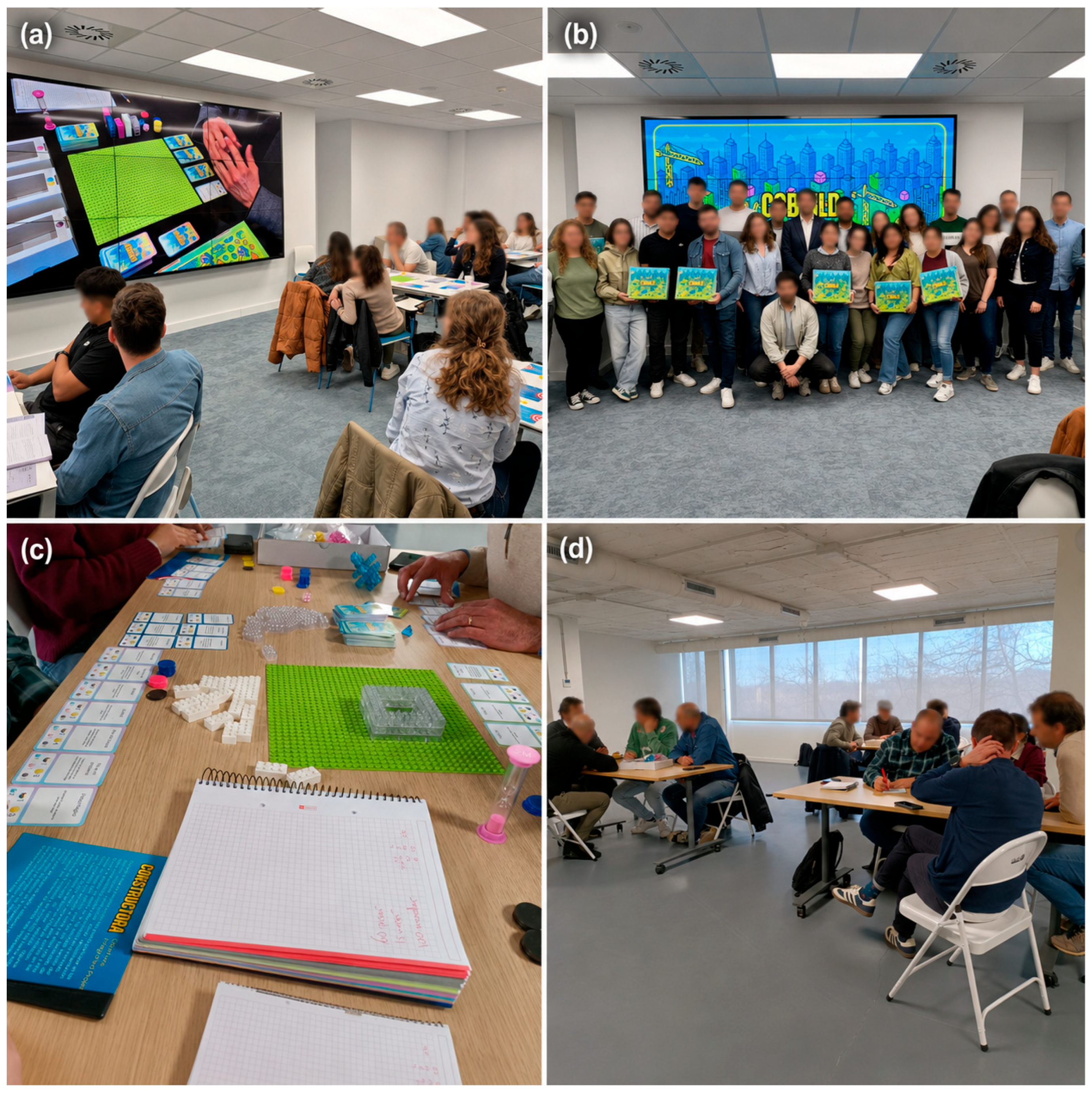
The final debriefing followed a recurring structure intended to connect the experience of play with the project-delivery concepts represented in COBUILD. Participants were invited to reflect on, firstly on their own and afterwards in public, the differences experienced between the two modes, the relationship between individual and collective objectives, the influence of information and incentives on decisions, risk allocation and response, and parallels with situations encountered in real projects. The sequence and depth of these topics were adaptive rather than scripted: participant questions, disagreements and situations that had emerged during the games were used as prompts for discussion. The facilitator therefore maintained a common conceptual structure across sessions while allowing the conversation to develop around the experience of each group. See a selection of session pictures in Figure 4 and in Supplementary Material File S3.
Figure 4.
COBUILD session: (a) Rule explanation tutorial. (b) Group picture. (c) Game components. (d) Collaborative group dynamic. See Supplementary Material File S3 for more pictures of the COBUILD sessions.
4.5. Data Analysis
The analysis combined descriptive statistics, non-parametric paired comparisons and descriptive qualitative analysis. The sample was characterised using frequencies and percentages for participant flow, professional profiles, experience ranges and prior exposure to Lean and IPD practices.
For the five repeated items, the mean and standard deviation at each measurement and the mean difference were calculated. Participants whose scores increased, remained unchanged or decreased were also counted. Because the scales were ordinal and observations were paired, Wilcoxon signed-rank tests were used. The z statistic, significance level and effect size r were reported, with r calculated as the absolute z value divided by the square root of the number of paired observations. Significance was set at 0.05. Values close to 0.10, 0.30 and 0.50 were interpreted as small, moderate and large effects.
Post-game evaluation items were described using the number of valid responses, mean, median, standard deviation and percentage distribution across the five Likert categories.
Open-ended responses were grouped thematically. Entries without substantive content were excluded, and mentions were counted for each emerging theme, including rule clarity, mechanics and balance, realism and simplification, educational value, enjoyment and visual quality. This analysis complemented the quantitative interpretation and helped prioritise improvements. Processing was conducted using IBM SPSS 29.0.2.0(20) Statistics and spreadsheet tools. No independent second coding or inter-coder reliability assessment was conducted. Generative artificial intelligence tools (ChatGPT-5.6, OpenAI) were used during manuscript preparation. All AI-assisted content was critically reviewed, verified where appropriate, and edited by the authors. AI-generated content was not used as empirical evidence. The authors retained full responsibility for the research methodology, data analysis, interpretation of results, and conclusions presented in this study.
5. Results
5.1. Participant Flow and Sample Characteristics
At the start of the sessions, 153 records were collected on professional profile, prior experience and understanding of Lean IPD. The main sample comprised the 101 participants who completed both pre- and post-game evaluations: 83 played both COBUILD modes, 10 only IPD and eight only DBB. See Figure 5. Analyses used this paired sample and, for each item, all available valid cases. The remaining 52 (34.0%) did not submit a post-test. This was not necessarily equivalent to abandoning the game: non-response arose for different reasons, including early departure, being unable to complete the second questionnaire, or omission of that step. Completers and non-completers had broadly similar professional-role and experience distributions (exploratory chi-square comparisons: χ2 = 1.19, p = 0.880, and χ2 = 3.30, p = 0.348, respectively).
Figure 5.
Participant flow and sample.
5.2. Professional Profile
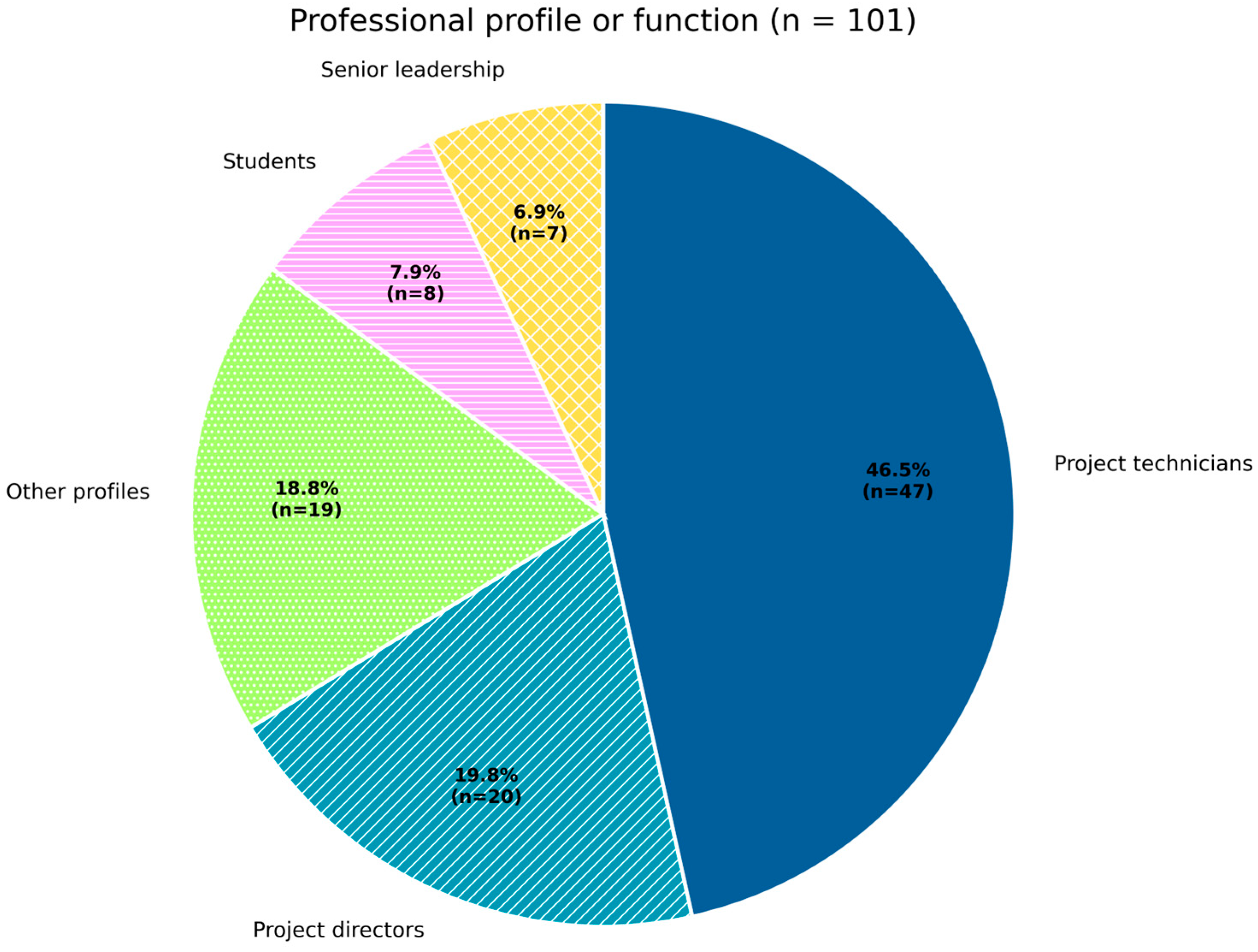
The sample consisted mainly of construction and project management professionals. Project technicians accounted for 46.5% of participants, project directors for 19.8%, other profiles for 18.8%, students for 7.9%, and senior leadership for 6.9%. Senior leadership combines the original questionnaire categories Director, President/Founder/Associate, and C-level. See Figure 6.
Figure 6.
Participants’ professional roles or functions.
5.3. Professional Experience
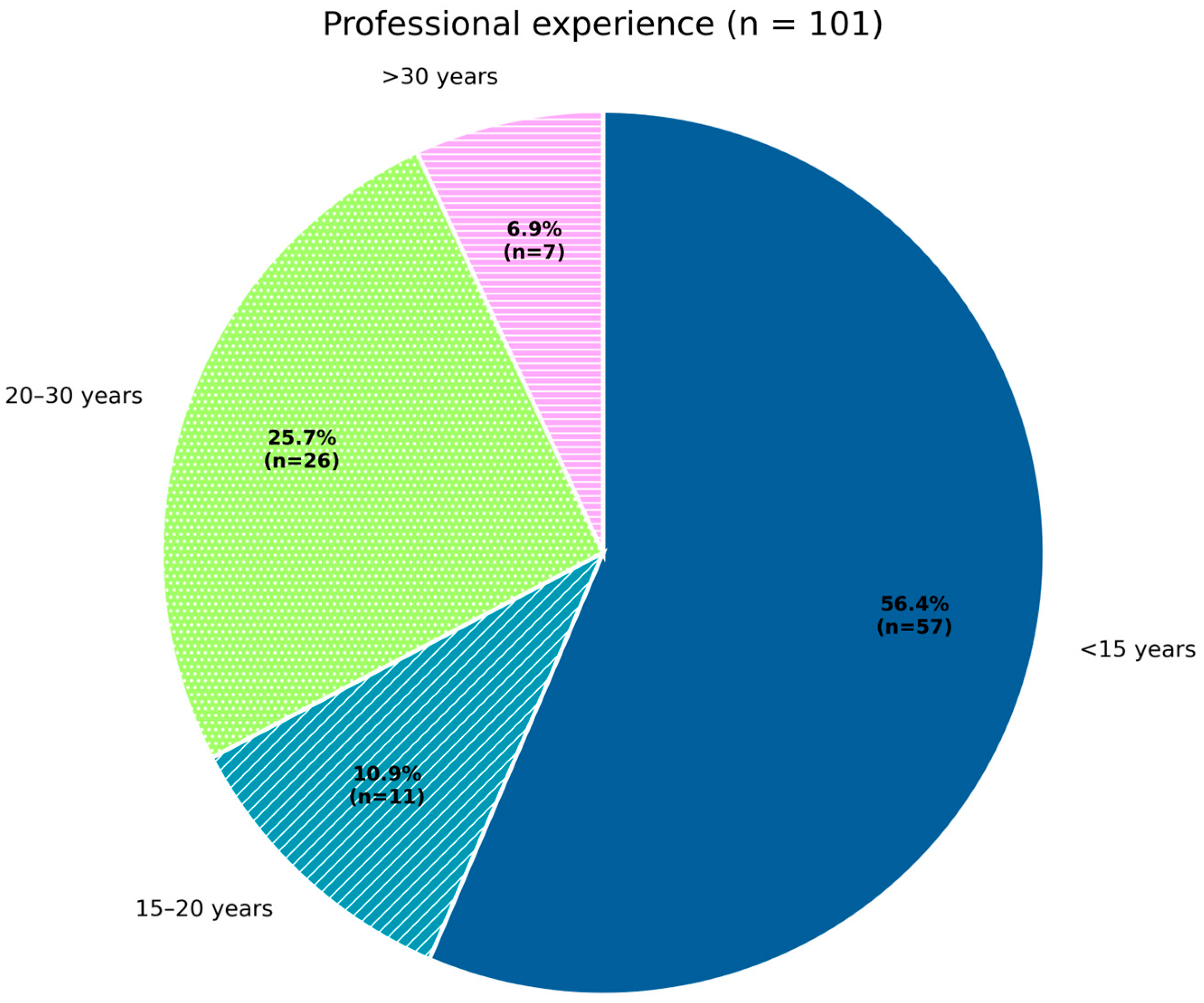
Participants had substantial industry experience: 43.6% had worked in the sector for at least 15 years and 32.7% for 20 years or more. This composition allowed the simulated situations to be assessed against common AEC practices and decisions. See Figure 7.
Figure 7.
Participants’ professional experience.
5.4. Prior Experience with Lean IPD and Related Practices
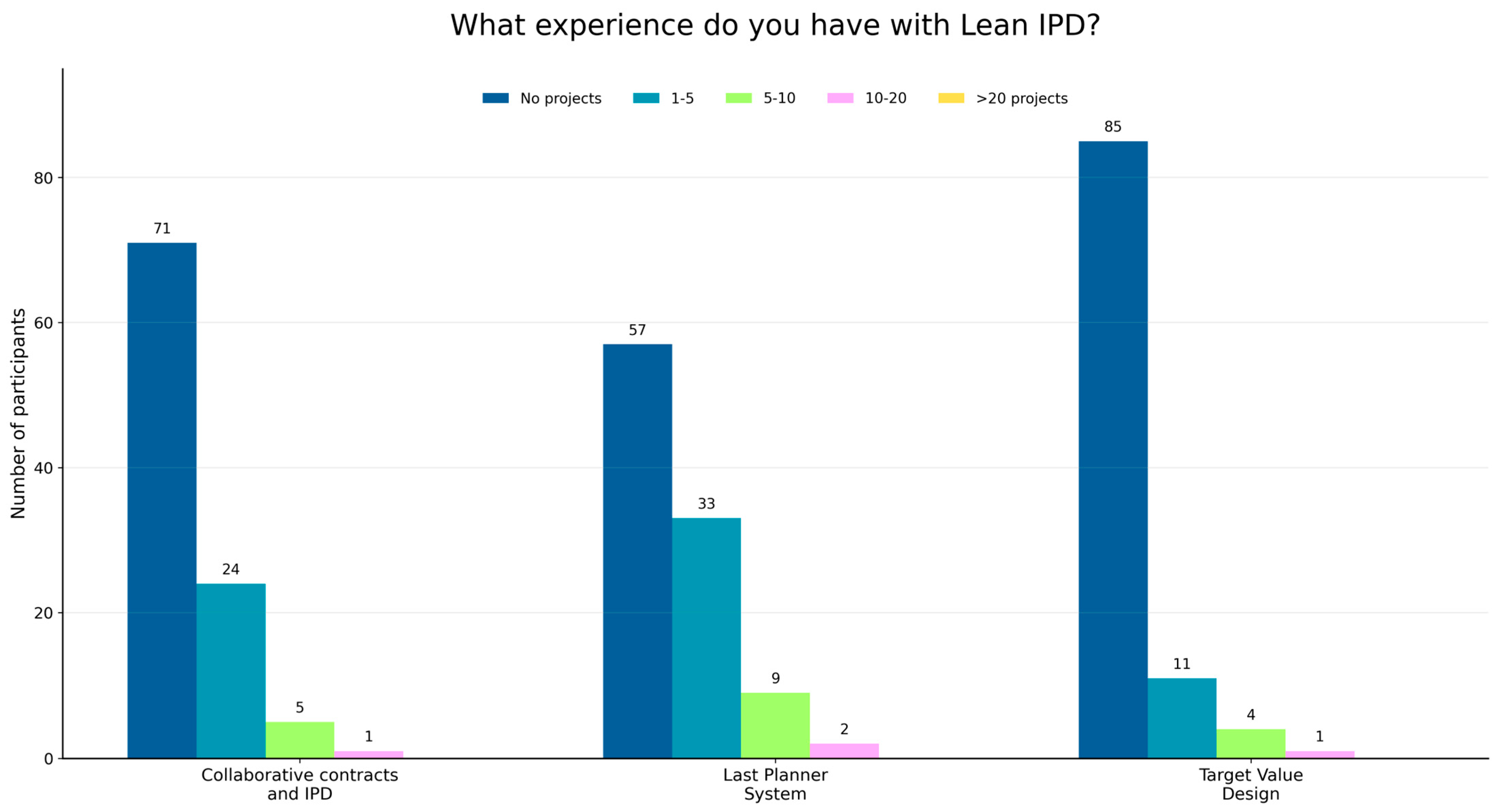
Substantial professional experience contrasted with limited exposure to collaborative delivery. Most participants had not worked with collaborative contracts or IPD, and familiarity with the Last Planner System and Target Value Design was also limited. See Figure 8. The sample was therefore experienced in construction but relatively unfamiliar with Lean IPD, making it suitable for evaluating COBUILD as an introductory tool.
Figure 8.
Participants’ experience with Lean IPD.
5.5. Changes in IPD Self-Perceived Understanding and Application Confidence
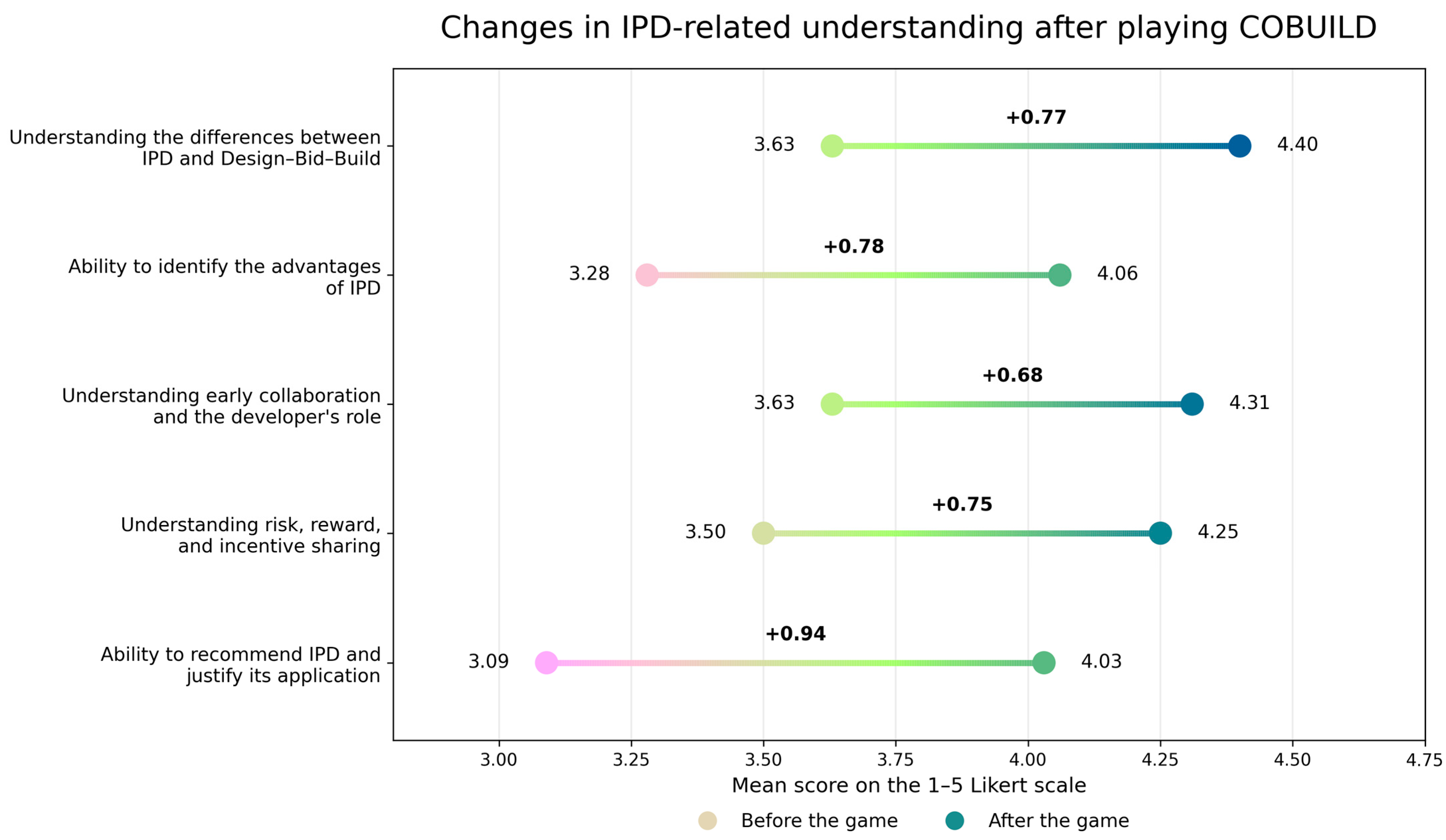
All five pre- and post-game dimensions increased significantly. Wilcoxon tests confirmed higher post-game scores in every case (p < 0.001), with large effect sizes for both conceptual understanding and confidence in explaining and recommending IPD. See Table 3 and Figure 9.
5.5.1. Understanding of the Differences Between IPD and DBB
The mean increased from 3.63 (SD = 1.29) to 4.40 (SD = 0.83), a difference of 0.77 points with r = 0.53. Scores increased for 42 participants, remained unchanged for 50 and decreased for nine. The high post-game mean suggests a possible ceiling effect.
5.5.2. Ability to Identify the Advantages of IPD
The mean increased from 3.28 (SD = 1.39) to 4.06 (SD = 0.98), a difference of 0.78 points with r = 0.58. This large effect indicates a substantial improvement in participants’ perceived ability to recognize the advantages associated with IPD after playing the game.
5.5.3. Understanding of Early Collaboration and the Owner’s Role
The mean increased from 3.63 (SD = 1.26) to 4.31 (SD = 0.77), a difference of 0.68 with r = 0.54. Scores increased for 43 participants, remained unchanged for 53 and decreased for five. Although this was the smallest mean increase, the effect was large and the final score was high.
5.5.4. Understanding of Risk, Reward and Incentive Sharing
Understanding of risk, reward and incentive sharing increased from 3.50 (SD = 1.32) to 4.25 (SD = 0.88), a difference of 0.75 with r = 0.56. Scores increased for 44 participants, remained unchanged for 54 and decreased for three; 93.6% of those whose scores changed improved.
5.5.5. Ability to Recommend IPD and Justify Its Application
This dimension showed the largest change: the mean rose from 3.09 (SD = 1.42) to 4.03 (SD = 0.94), an increase of 0.94 with r = 0.67. Scores increased for 59 participants, remained unchanged for 40 and decreased for two, indicating greater self-efficacy in arguing for IPD application.
Table 3.
Self-perceived changes in IPD-related understanding before and after playing COBUILD.
Figure 9.
Self-perceived changes in IPD-related understanding before and after playing COBUILD. Note. Changes in self-perceived IPD-related understanding before and after COBUILD. Mean scores are based on a five-point Likert-type scale (1 = very low; 5 = very high).
The robustness of this finding was examined through a sensitivity analysis restricted to the 83 participants who completed both DBB and IPD modes. The direction of all five pre–post changes remained unchanged, all comparisons remained statistically significant (p < 0.001), and effect sizes remained large (r = 0.59–0.70). Mean pre–post differences were slightly larger than those observed in the full paired sample.
5.6. Perceived Educational Value of COBUILD
5.6.1. Perceived Educational Impact (EI)
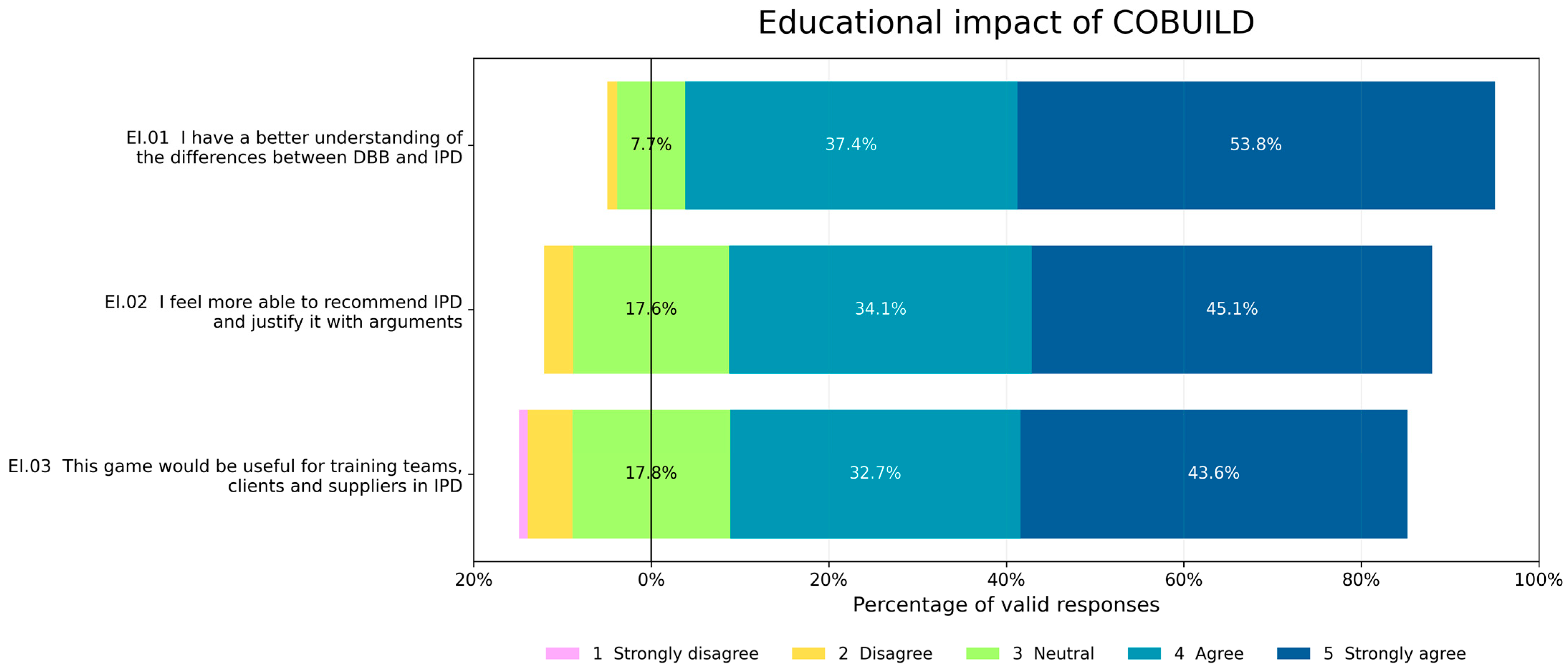
The perceived educational impact was positive. Better understanding of the DBB–IPD differences scored M = 4.44 (SD = 0.69; n = 91), with 91.2% positive responses. The ability to recommend IPD reached M = 4.21 (SD = 0.85; 79.2% positive), and usefulness for training teams, clients and suppliers reached M = 4.13 (SD = 0.95; n = 101; 76.3% positive). COBUILD was rated particularly highly as a means of explaining differences between delivery systems. EI.01 and EI.02 were answered by 91 participants because they were not included in the post-game questionnaire used in some earlier implementation sessions. EI.03 was included throughout the formal evaluation and was answered by the full paired sample (n = 101). See Table 4, Table 5 and Figure 10.
Table 4.
Perceived educational impact: statistical descriptors.
Table 5.
Perceived educational impact: Likert responses.
Figure 10.
Perceived educational impact of COBUILD.
5.6.2. Design and Facilitation (DF)
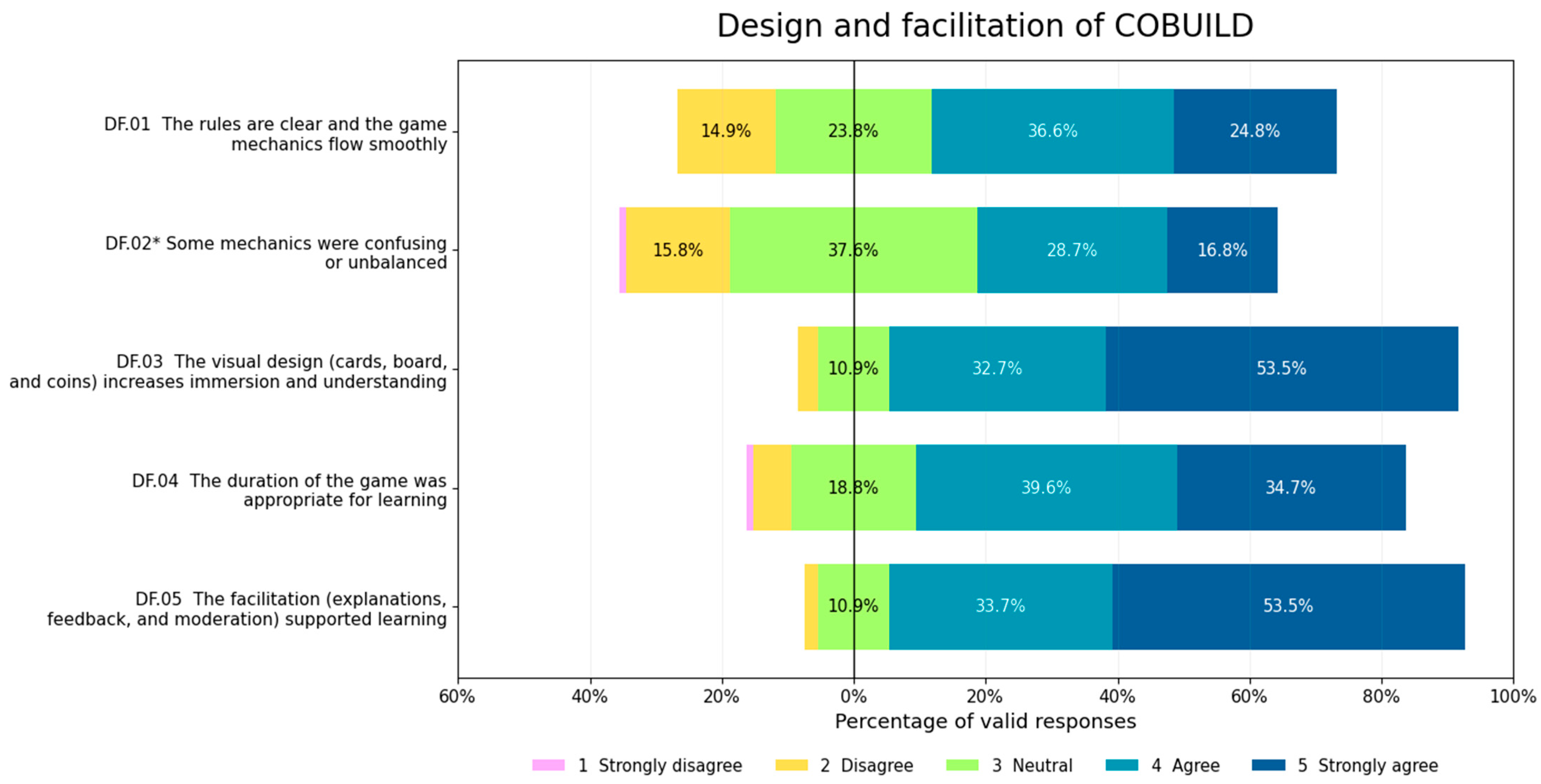
Facilitation was among the highest-rated aspects (M = 4.39; SD = 0.76; 87.2% positive responses), followed by visual design and its contribution to immersion (M = 4.37; SD = 0.80; 86.2%). Duration was considered appropriate (M = 4.01; SD = 0.93). Rule clarity and flow received a more moderate rating (M = 3.71; SD = 1.00; 61.4% positive), and 45.5% agreed with the negatively worded item on confusing or unbalanced mechanics. Facilitation and visual design were clear strengths, while the learning curve and balance require further improvement. See Table 6, Table 7 and Figure 11.
Table 6.
Design and facilitation: statistical descriptors.
Table 7.
Design and facilitation: Likert responses.
Figure 11.
Design and facilitation of COBUILD. Note. Items marked with an asterisk (*) are negatively worded. Responses are shown using their original coding (not reverse-coded). Higher scores on these items indicate a more critical or unfavourable assessment, whereas higher scores on positively worded items indicate a more favourable assessment.
5.7. Realism and Simplification
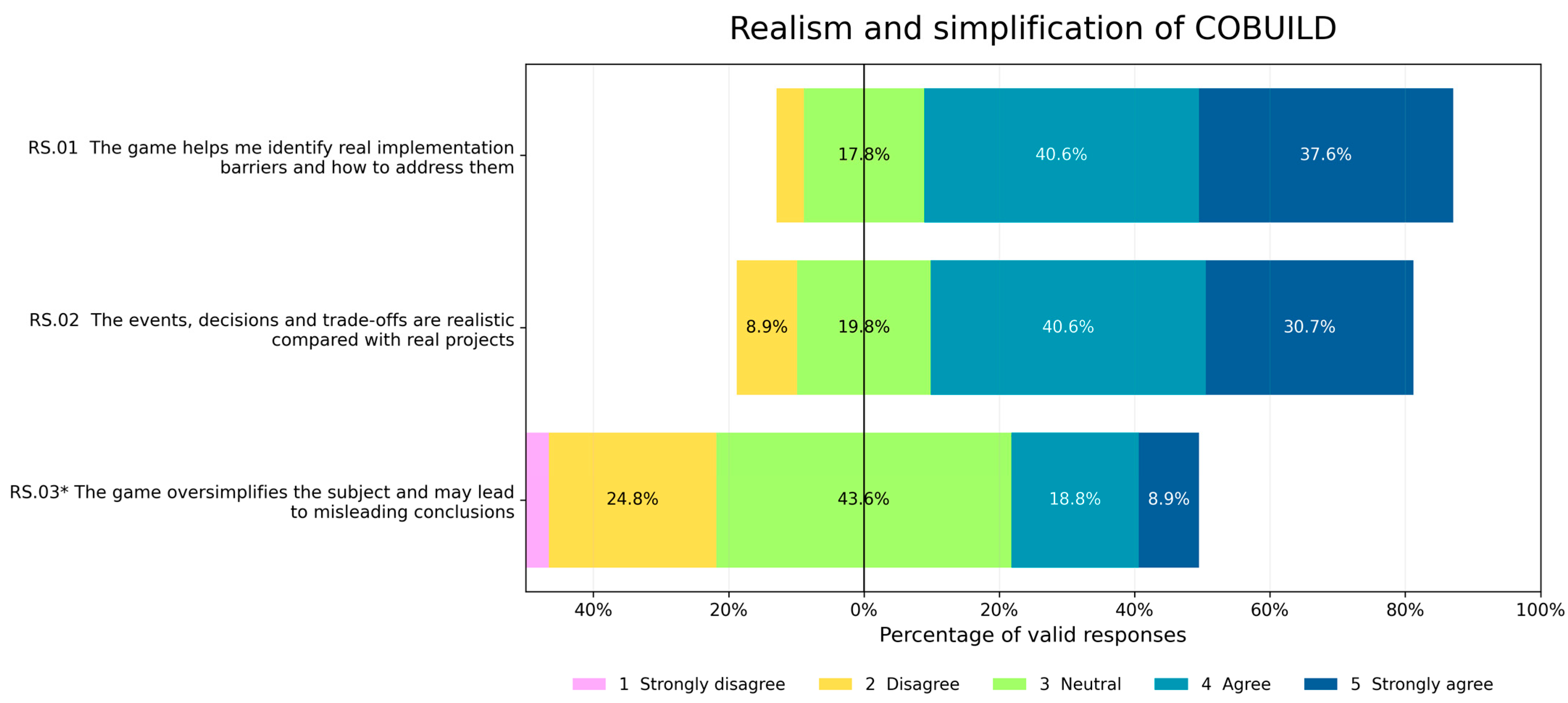
COBUILD was considered useful for identifying implementation barriers and how to address them (M = 4.12; SD = 0.84; 78.2% positive responses). The realism of events and decisions was also rated favourably (M = 3.93; SD = 0.93; 71.3%). Views on simplification were more divided: the negatively worded item scored M = 3.04 (SD = 0.98), with 43.6% neutral responses. Participants therefore recognised the game’s practical relevance, but there was no full consensus on how well it represented real-world complexity. See Table 8, Table 9 and Figure 12.
Table 8.
Realism and simplification: statistical descriptors.
Table 9.
Realism and simplification: Likert responses.
Figure 12.
Realism and simplification of COBUILD. Note. Items marked with an asterisk (*) are negatively worded. Responses are shown using their original coding (not reverse-coded). Higher scores on these items indicate a more critical or unfavourable assessment, whereas higher scores on positively worded items indicate a more favourable assessment.
5.8. Overall Assessment
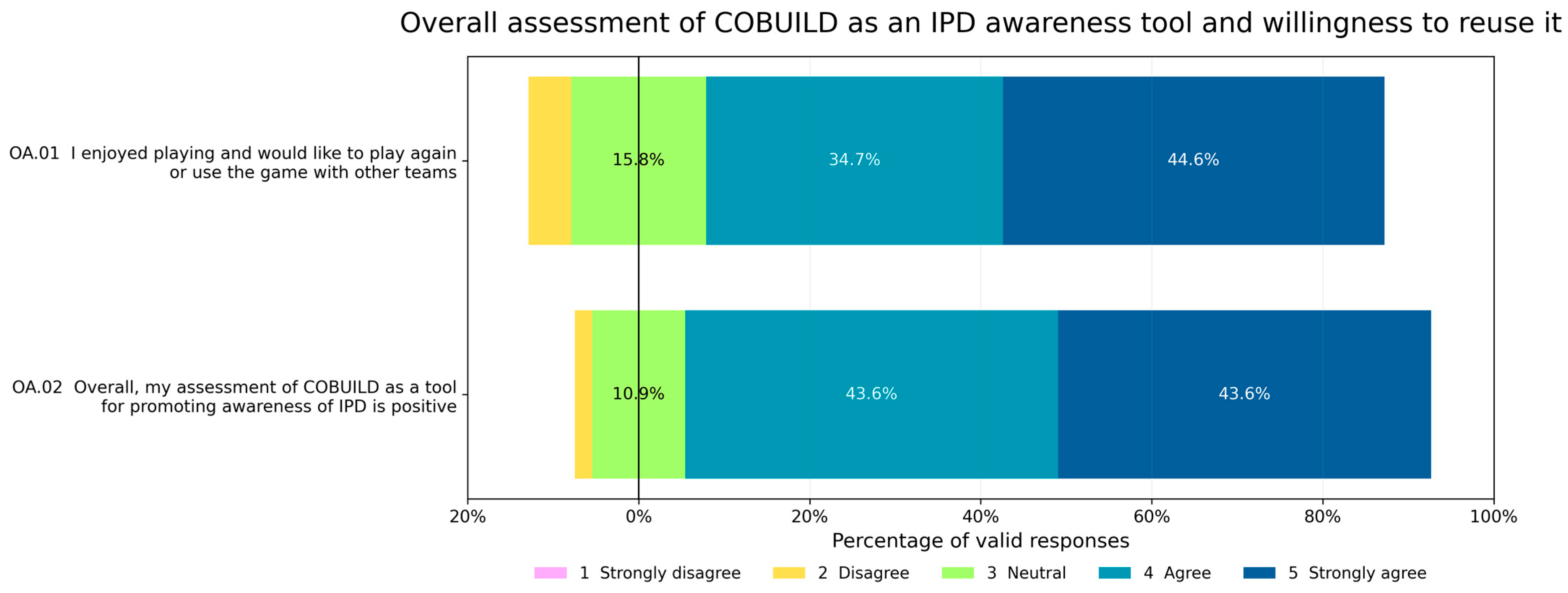
Enjoyment and willingness to play again or use COBUILD with other teams reached M = 4.19 (SD = 0.88), with 79.3% positive and 5.0% negative responses. The overall rating of COBUILD as a tool for promoting awareness of IPD was even higher (M = 4.29; SD = 0.74): 87.2% selected 4 or 5 and only 2.0% responded negatively. The lower dispersion indicates strong agreement on the game’s overall value. See Table 10, Table 11 and Figure 13.
Table 10.
Overall assessment: statistical descriptors.
Table 11.
Overall assessment: Likert responses.
Figure 13.
Overall assessment of COBUILD as an IPD awareness tool and willingness to reuse it.
5.9. Qualitative Feedback and Areas for Improvement
Of the 32 open-ended responses, 31 were analysable. The responses were manually coded by the first author into non-exclusive thematic categories. The most frequently identified theme concerned rule clarity and initial learning (12 comments), including requests for written instructions and demonstrations.
Eight responses addressed mechanics and balance, including greater cost and schedule pressure, additional negative events, and the balance between DBB and IPD. Seven concerned realism and simplification. One participant observed, “I think the game should be made more challenging, for example, by increasing the target number of building pieces and reducing the available budget. Individual objectives should also be aligned across both game modes.” Six comments highlighted educational value, enjoyment, or visual quality. As another participant put it, “It is fun and also helps to understand exactly what happens in real projects.
One participant observed an interesting difference between both game modes: “Interestingly, there was a greater tendency to cheat in the DBB mode, which could be interpreted as behaviour resembling corruption.” This statement brings a question for a future investigation: Is this actually happening within the game? Is this transferable to the real world? And, ultimately, is there a correlation between delivery methods and corruption?
Because the open-ended question invited suggestions for improvement, the predominance of critical observations should be interpreted as feedback for iterative development rather than as a negative overall assessment. All quotations were translated from Spanish into English for publication.
6. Discussion
The findings suggest that COBUILD can make otherwise abstract differences in project-delivery governance more explicit and contribute to the dissemination and understanding of Lean Integrated Project Delivery among experienced construction professionals.
Participants reported higher levels of self-perceived understanding after playing the game across all five dimensions evaluated. The greatest improvement was observed in participants’ perceived ability to recommend IPD, which is particularly relevant because COBUILD was designed not only to explain a project delivery system but also to support its wider diffusion within the construction industry.
The results indicate that the game may strengthen both conceptual understanding and participants’ confidence in discussing IPD. This distinction is important because understanding the technical characteristics of IPD may not be sufficient if professionals cannot explain how it changes roles, responsibilities, incentives and decision-making. From an innovation-diffusion perspective, this finding is also relevant because the adoption of new practices depends partly on how their potential advantages and applicability are perceived and communicated [19]. COBUILD does not demonstrate subsequent adoption of IPD, but the increase in participants’ perceived ability to recommend and justify its application suggests that experiential exposure could help professionals articulate the rationale for a delivery approach that is difficult to experience without implementing it in a real project.
The findings also support the interpretation of COBUILD as an experiential learning environment. Lean IPD involves organisational, contractual and behavioural relationships that can be difficult to communicate through lectures or written descriptions alone. Early stakeholder involvement, shared objectives, collective risk management and incentive alignment may remain abstract until participants observe how they influence decisions and outcomes. This interpretation is consistent with previous research describing serious games as a means of moving learners from passive observation to active participation and of connecting theoretical Lean concepts with practical decision-making [25,35,36]. Empirical work by Hamzeh et al. [37] provides more specific support, showing positive learning outcomes when hands-on simulations were used to teach Lean Construction concepts. COBUILD extends this educational logic from specific production practices to the behavioural and commercial dimensions of project delivery by providing a simulated decision-making environment in which participants can engage with otherwise abstract IPD concepts.
This experiential dimension may explain why improvements were observed across several related areas rather than in one isolated concept. COBUILD encourages participants to connect the structure of the delivery system with the behaviours it generates. Its contribution therefore differs from serious games focused primarily on individual Lean techniques or specific production processes: the object of learning is the relationship between governance arrangements and project behaviour.
The comparison between DBB and IPD appears to be central to this learning process. Previous construction games have been developed to illustrate particular IPD principles, including the exercise proposed by Russmann et al. [39], whereas COBUILD makes the comparison between delivery environments part of the learning mechanism itself. By experiencing both modes, participants can compare fragmented decision-making, individual optimisation and risk transfer with early collaboration, information sharing and aligned incentives. The observed changes in perceived understanding of DBB–IPD differences and risk–reward alignment suggest that this comparative structure may help participants connect governance arrangements with their behavioural consequences.
This interpretation is further supported by the sensitivity analysis restricted to the 83 participants who completed both DBB and IPD modes. The direction of all five pre–post changes remained unchanged, all comparisons remained statistically significant (p < 0.001), and effect sizes remained large (r = 0.59–0.70). This reduces concern that the main findings were driven by participants exposed to only one mode, although it does not isolate the specific contribution of the DBB–IPD comparison from other components of the facilitated experience.
The sequence in which both systems were experienced may also have reinforced this contrast. Playing DBB first exposed most participants to limited coordination, separated responsibilities and potentially conflicting objectives before introducing changes in roles, incentives and information flows under IPD. The contrast may therefore have functioned as an instructional mechanism within the experience. However, because the order was not systematically counterbalanced, the specific contribution of sequencing cannot be distinguished from familiarity with the game, accumulated learning or other order effects.
COBUILD represents complex project relationships through a limited set of roles, resources, events and decision rules. This abstraction is necessary to keep the game playable and focused on its learning objectives, but it also creates a tension between simplicity and realism. This reflects the broader trade-off between abstraction and realism identified in serious-game design [41]. Excessive complexity may shift attention towards understanding the rules, whereas excessive simplification may suggest that collaboration is automatically successful. COBUILD therefore prioritises structural rather than exhaustive fidelity: its aim is not to reproduce a construction project in full detail, but to preserve the uncertainty, conflict, interdependence and incentive structures needed to distinguish fragmented from integrated delivery systems. Participants’ more divided views on simplification highlight this design boundary and indicate an area for further refinement.
The findings concerning the owner’s role are particularly relevant. Participants reported greater understanding of the relationship between the owner and early collaboration, suggesting that COBUILD helps make visible the owner’s structural role in configuring the project environment. This finding is consistent with previous research on Lean IPD adoption among Spanish real estate professionals, which highlighted the strategic role of the owner in enabling integrated delivery and identified the need for greater knowledge and training to support its implementation [24]. IPD adoption does not depend solely on designers and contractors choosing to collaborate: the owner influences the delivery system, the timing of stakeholder involvement, the allocation of risk, contractual incentives and the degree of transparency expected from the project team.
COBUILD therefore represents collaboration not merely as an interpersonal attitude, but as a behaviour shaped by governance and incentive structures. This interpretation is consistent with research suggesting that contractual and governance arrangements influence stakeholder behaviour and that individually rational strategies can generate adverse collective outcomes under fragmented conditions [1,2]. By making individual objectives and collective outcomes visible simultaneously, COBUILD illustrates how participants may rationally optimise their own contractual position even when this undermines overall project performance, and how changes in risk-and-reward mechanisms can alter that logic. This connection between governance, incentive alignment and behaviour helps explain the observed improvement in participants’ self-reported understanding of risk and reward sharing, while highlighting how early decisions by the owner can influence interactions throughout the project.
Facilitation emerged as an important component of the learning experience. By resolving uncertainties, managing transitions and guiding the debriefing, the facilitator helped participants connect events experienced during play with broader principles such as transparency, early involvement and shared risk. COBUILD should therefore be understood as a facilitated learning experience rather than a fully self-explanatory board game.
At the same time, rule clarity and the flow of some mechanics received more moderate evaluations than the game’s overall educational value. Open-ended responses highlighted opportunities to improve written instructions, onboarding, turn sequencing and the explanation of payment and debt mechanisms. These findings suggest that reducing the initial learning burden could strengthen the experience without altering its core educational mechanics.
The overall assessment of COBUILD was positive. Participants valued the game as a tool for communicating IPD, supporting learning and identifying implementation barriers. The visual design and facilitation also received high evaluations, indicating that the educational experience depends on more than the formal rules of the simulation. The visual components appear to support immersion and make relationships between roles, resources and project events easier to follow.
7. Practical Implications/Guidelines
The findings of this exploratory study have several practical implications for Lean IPD education and dissemination. First, COBUILD should be understood as an experiential introduction to Lean IPD rather than as a substitute for formal theoretical or contractual training. The game allows participants to experience uncertainty, financial pressure, conflicting incentives and collaborative decision-making before these issues are discussed conceptually. In this sense, the game can create a shared vocabulary that facilitates subsequent explanations of open-book management, target value delivery, shared risk/reward mechanisms and early stakeholder involvement.
Second, facilitation is critical. The learning value of the game does not emerge only from playing, but from connecting specific events in the game to real project delivery situations. Facilitators should therefore pay attention to moments of conflict, negotiation, individual optimization or collaborative decision-making, and use them during the debriefing phase. This is particularly important when participants interpret the game mainly as a competition, since the educational objective is not only to win but to understand how different delivery systems shape behaviour.
Third, the role-based structure of COBUILD can help participants understand the constraints and incentives of other project agents. By playing as owner, architect, contractor or project manager, participants are exposed to different perspectives on risk, cost, design, production and decision-making. This is especially relevant for Lean IPD, where collaboration requires not only knowledge of tools and methods, but also a better understanding of the interests and fears of other stakeholders.
Fourth, COBUILD appears to be particularly useful when the contrast between traditional delivery and Lean IPD is made explicit. Experiencing both modes of play allows participants to compare fragmented decision-making, adversarial behaviours and individual risk protection with more integrated forms of collaboration. This contrast can support deeper reflection on why Lean IPD requires changes not only in tools, but also in governance, incentives and project culture.
Finally, the game can be adapted to different audiences. In university settings, it can introduce students to project delivery systems and collaborative project management. In professional training, it can support reflection on real barriers to Lean IPD adoption, including trust, transparency, contractual alignment and the role of the owner in configuring the delivery environment. Therefore, COBUILD may contribute not only as a teaching resource, but also as a practical dissemination tool for Lean IPD in the construction sector.
8. Limitations and Future Research
This study should be interpreted in light of several limitations. First, the single-group pretest–posttest design identified changes occurring after participation but did not include a concurrent comparison group. Participants served as their own baseline, yet repeated exposure to the questionnaire, facilitator explanations, group discussion and the final debriefing may also have contributed to the observed changes. The use of author-developed single-item measures also limits measurement precision and direct comparison with studies employing validated multi-item instruments. Future evaluations should complement these indicators with validated measures and objective knowledge assessments. The findings therefore support an association with the complete facilitated experience rather than a causal effect attributable exclusively to the game mechanics. The researcher’s position should also be considered because the facilitator was introduced as the author of COBUILD. This dual role may have encouraged responses influenced by expectations or social desirability, with some participants potentially inclined to support the tool’s development or evaluate the experience favourably. However, this possible bias was not assessed directly, and there is no evidence to determine whether it occurred or estimate its influence on the results.
Second, the sample was non-probabilistic and was recruited from university programmes and professional organisations willing to host COBUILD sessions. Although participants had substantial construction experience, their roles and organisational backgrounds were unevenly represented. The results cannot consequently be generalised statistically to the wider AEC sector or to specific stakeholder populations. In addition, the principal outcomes measured perceived understanding and self-efficacy rather than objective knowledge, retained learning, behavioural change, or subsequent IPD adoption.
Third, implementation conditions varied across sessions. Differences included group composition, time available, mode played, facilitation, and possibly the evolving version of the prototype. Most complete sessions presented DBB before IPD, so familiarity with the game, sequencing, fatigue, or contrast effects may have influenced perceptions of the second mode. Participants within each session also shared the same facilitator and group experience, meaning their observations may not have been fully independent. Finally, the open question explicitly requested improvement proposals, which likely increased the proportion of critical comments.
Future research should compare COBUILD with a lecture, written case, or alternative simulation using randomised or matched groups. Objective knowledge tests, delayed posttests, and measures of behavioural intention or workplace application would distinguish immediate confidence from durable learning. Mode order should be counterbalanced, facilitation standardised, and game versions documented. Larger stratified samples should include owners, architects, specialist trades, and senior decision-makers across different legal and cultural contexts. With a greater number of sessions, multilevel analysis could separate participant-level from session-level effects. Observation of negotiations, information sharing, risk responses, and decision patterns could also reveal how specific mechanics generate learning and guide further refinement of COBUILD and test its transfer to real projects.
9. Conclusions
This study examined COBUILD as a serious game for introducing and disseminating Lean Integrated Project Delivery among construction-sector participants. The game was designed to make the behavioural and commercial logic of project delivery visible by allowing players to experience two contrasting systems under comparable project conditions. Instead of explaining IPD only through definitions, COBUILD represents how governance, information, incentives, risk allocation, and individual objectives shape decisions and collective outcomes.
The results provide preliminary evidence of the feasibility and acceptability of this approach, together with consistent self-reported changes across the five IPD-related dimensions assessed. They indicated greater understanding of the differences between IPD and DBB, the advantages of IPD, early collaboration and the owner’s role, risk–reward and incentive alignment, and their ability to recommend IPD with supporting arguments. The largest change concerned this final dimension, suggesting that the experience may strengthen not only awareness but also participants’ confidence in communicating the rationale for collaborative delivery.
The findings also show that the value of COBUILD lies in the comparison between delivery environments. In DBB mode, hidden objectives, fragmented information, individual resources, and responsibility disputes encourage players to protect their own positions. In IPD mode, transparency, shared responses, collective risk management, and aligned rewards redirect attention towards joint problem-solving. The game therefore illustrates that collaboration is not simply a matter of goodwill or interpersonal attitude; it is influenced by the rules, incentives, and governance structures established for the project. This is especially relevant to the role of the owner, whose early decisions shape stakeholder involvement, transparency, risk distribution, and the conditions under which collaboration can emerge.
Participants’ overall assessment of COBUILD was favourable, and facilitation, visual design, enjoyment, and perceived educational value were particularly strong. At the same time, the more moderate ratings for rule clarity and the comments concerning balance and simplification confirm that educational effectiveness depends on careful onboarding, facilitation, and iterative refinement. These observations do not negate the value of the game; rather, they identify the design tensions inherent in translating complex project relationships into a playable format.
COBUILD should therefore be understood as an experiential and comparative representation of Lean IPD, not as a literal model of project performance or proof that IPD will outperform DBB in every context. Its contribution is to create a controlled environment in which participants can experience how different delivery systems alter rational behaviour, relationships, and outcomes. By making these mechanisms visible and discussable, COBUILD offers a promising bridge between theoretical knowledge of Lean IPD and the professional conversations required for its wider understanding and adoption in the construction sector. It also provides a structured basis for future validation, refinement, and comparison with other educational approaches in diverse AEC settings.
Supplementary Materials
The following supporting information can be downloaded at: https://www.mdpi.com/article/10.3390/buildings16224597/s1, File S1, Anatomy of risk and response cards; File S2, Results recording and tracking guide (including an illustrative turn and outcome assessment); and File S3, Additional game-component documentation, including original Spanish-language cards. File S4 shows the turn structure and a brief explanation of the different mechanisms that take place during a turn. All sessions and questionnaires were conducted in Spanish; English-language representations were prepared for explanatory purposes only.
Author Contributions
Conceptualization, J.J.G.S.; Methodology, J.J.G.S.; Validation, M.J.S.S.; Formal analysis, J.J.G.S.; Investigation, J.J.G.S.; Resources, J.J.G.S.; Data curation, J.J.G.S.; Writing—original draft preparation, J.J.G.S.; writing—review and editing, J.J.G.S.; Visualization, J.J.G.S.; Supervision, M.J.S.S.; Project administration, J.J.G.S.; Funding acquisition, J.J.G.S. All authors have read and agreed to the published version of the manuscript.
Funding
This research received no external funding.
Institutional Review Board Statement
Ethical review and approval were waived for this study. As explicitly confirmed by the Universidad Politécnica de Madrid (UPM) Ethics Committee for R&D&I Activities, its remit is limited to the ethical review of research projects and does not extend to doctoral theses, scientific articles, or educational innovation activities that do not constitute research projects. Accordingly, this study was not subject to formal ethical review under the University’s institutional procedures. This clarification was formally documented in a letter issued by the Department of Construction and Architectural Technology at UPM on 5 November 2026.
Informed Consent Statement
Informed consent was obtained from all subjects involved in the study.
Data Availability Statement
The data presented in this study are available upon reasonable request from the corresponding author.
Acknowledgments
The authors would like to thank the professionals who participated in the COBUILD sessions and contributed their time, experience, and feedback to the study. We are also grateful to the organisations and individuals who supported the organisation and facilitation of the sessions and helped create an appropriate environment for testing and refining the game. Their participation and constructive feedback were essential to the development and evaluation of COBUILD as an experiential learning tool for Integrated Project Delivery. During the preparation of this work, the authors used OpenAI ChatGPT-5.6 Thinking to support idea exploration, manuscript structuring and critical revision, language editing and translation, statistical and coding assistance, data visualisation, and the refinement of the presentation and discussion of the results. All AI-assisted outputs were critically reviewed, verified, and revised by the authors. The authors retained full control over the research design, data collection, methodological and analytical decisions, interpretation of the results, selection and verification of references, and formulation of the conclusions. No research data or results were synthetically generated by AI. The authors take full responsibility for the originality, accuracy, and integrity of the final content.
Conflicts of Interest
The authors declare no conflicts of interest.
References
- Khanzadi, M.; Turskis, Z.; Amiri, G.G.; Chalekaee, A. A model of discrete zero-sum two-person matrix games with grey numbers to solve dispute resolution problems in construction. J. Civ. Eng. Manag. 2017, 23, 824–846. [Google Scholar] [CrossRef] [Scilit]
- Yang, M.; Chen, H.; Xu, Y.; Wu, J. The Impact of Contract Functions on Contractors’ Performance Behaviors: A Mixed-Methods Approach. Buildings 2025, 15, 3438. [Google Scholar] [CrossRef] [Scilit]
- Francés, F. Cuando las Catedrales Eran Blancas las Obras Eran Transparentes [Universitat Politècnica de València]. 2024. Available online: https://riunet.upv.es/handle/10251/196000 (accessed on 10 October 2026).
- Miller, J.B. Principles of Public and Private Infrastructure Delivery; Springer: New York, NY, USA, 2000. [Google Scholar] [CrossRef] [Scilit]
- Hallowell, M.; Toole, T.M. Contemporary Design-Bid-Build Model. J. Constr. Eng. Manag. 2009, 135, 540–549. [Google Scholar] [CrossRef] [Scilit]
- Molenaar, K.R.; Songer, A.D.; Barash, M. Public-Sector Design/Build Evolution and Performance. J. Manag. Eng. 1999, 15, 54–62. [Google Scholar] [CrossRef] [Scilit]
- Konchar, M.; Sanvido, V. Comparison of U.S. Project Delivery Systems. J. Constr. Eng. Manag. 1998, 124, 435–444. [Google Scholar] [CrossRef] [Scilit]
- AIA California Council. Integrated Project Delivery: A Guide; AIA California Council: Sacramento, CA, USA, 2007. [Google Scholar]
- Azhar, N.; Kang, Y.; Ahmad, I.U. Factors Influencing Integrated Project Delivery in Publicly Owned Construction Projects: An Information Modelling Perspective. Procedia Eng. 2014, 77, 213–221. [Google Scholar] [CrossRef] [Scilit]
- Durdyev, S.; Hosseini, M.R.; Martek, I.; Ismail, S.; Arashpour, M. Barriers to the use of integrated project delivery (IPD): A quantified model for Malaysia. Eng. Constr. Archit. Manag. 2019, 27, 186–204. [Google Scholar] [CrossRef] [Scilit]
- Gil Sebastián, J.J.; Soler Severino, M.J. Percepción de las empresas de Dirección Integrada de Proyecto sobre la implantación de Lean IPD en España. ACE Arquit. Ciudad Entorno 2024, 18, 12385. [Google Scholar] [CrossRef] [Scilit]
- Hall, D.M.; Scott, W.R. Early Stages in the Institutionalization of Integrated Project Delivery. Proj. Manag. J. 2019, 50, 128–143. [Google Scholar] [CrossRef] [Scilit]
- Kent, D.C.; Becerik-Gerber, B. Understanding Construction Industry Experience and Attitudes toward Integrated Project Delivery. J. Constr. Eng. Manag. 2010, 136, 815–825. [Google Scholar] [CrossRef] [Scilit]
- Khanna, M.; Faris Elghaish, F.; McIlwaine, S.; Tara Brooks, T. Feasibility of implementing IPD approach for infrastructure projects in developing countries. J. Inf. Technol. Constr. 2021, 26, 902–921. [Google Scholar] [CrossRef] [Scilit]
- Lee, C.S. Implementation of Integrated Project Delivery on Department of Navy Military Construction Projects. Master’s Thesis, University of Nevada, Las Vegas, NV, USA, 2013. [Google Scholar] [CrossRef]
- Ma, Q.; Li, S.; Teo, P.X.; Ling, F.Y.Y. Barriers to adopting integrated project delivery practices. Eng. Constr. Archit. Manag. 2023, 30, 4171–4191. [Google Scholar] [CrossRef] [Scilit]
- Whang, S.-W.; Park, K.S.; Kim, S. Critical success factors for implementing integrated construction project delivery. Eng. Constr. Archit. Manag. 2019, 26, 2432–2446. [Google Scholar] [CrossRef] [Scilit]
- Xie, H.; Liu, H. Studying Contract Provisions of Shared Responsibilities for Integrated Project Delivery under National and International Standard Forms. J. Leg. Aff. Disput. Resolut. Eng. Constr. 2017, 9, 04517009. [Google Scholar] [CrossRef] [Scilit]
- Rogers, E.M. Diffusion of Innovations, 5th ed.; Free Press: New York, NY, USA, 2003. [Google Scholar]
- El Asmar, M.; Hanna, A.S.; Loh, W.-Y. Quantifying Performance for the Integrated Project Delivery System as Compared to Established Delivery Systems. J. Constr. Eng. Manag. 2013, 139, 04013012. [Google Scholar] [CrossRef] [Scilit]
- Molenaar, K.; Leicht, R.; Messner, J.; Franz, B.; Esmaeili, B. Examining the Role of Integration in the Success of Building Construction Projects; Construction Industry Institute (CII): Austin, TX, USA, 2015. [Google Scholar] [CrossRef]
- Chen, P.; Partington, D.; Qiang, M. Cross-Cultural Understanding of Construction Project Managers’ Conceptions of Their Work. J. Constr. Eng. Manag. 2009, 135, 477–487. [Google Scholar] [CrossRef] [Scilit]
- Blackburn, C.J.; Flowers, M.E.; Matisoff, D.C.; Moreno-Cruz, J. Do Pilot and Demonstration Projects Work? Evidence from a Green Building Program. J. Policy Anal. Manag. 2020, 39, 1100–1132. [Google Scholar] [CrossRef] [Scilit]
- Gil Sebastián, J.J.; Soler Severino, M.J. Real Estate Owners’ Early Thoughts on Lean IPD Implementation in Spain. Buildings 2025, 15, 626. [Google Scholar] [CrossRef] [Scilit]
- Bhatnagar, S.; Jacob, G.; Devkar, G.; Rybkowski, Z.K.; Arefazar, Y.; Obulam, R. A systematic review of lean simulation games in the construction industry. Archit. Eng. Des. Manag. 2023, 19, 701–719. [Google Scholar] [CrossRef] [Scilit]
- Prieto Andreu, J.M. Una revisión sistemática sobre gamificación, motivación y aprendizaje en universitarios. Teoría De La Educ. Rev. Interuniv. 2020, 32, 73–99. [Google Scholar] [CrossRef] [Scilit]
- Rybkowski, Z.K.; Forbes, L.H.; Tsao, C.C.Y. The Evolution of Lean Construction Education (Part 1 of 2): At US-Based Universities. In 26th Annual Conference of the International Group for Lean Construction; Curran Associates, Inc.: Red Hook, NY, USA, 2018; pp. 1013–1023. [Google Scholar] [CrossRef] [Scilit]
- Abt, C.C. Serious Games; Viking Press: New York, NY, USA, 1970. [Google Scholar]
- Larios Rosillo, V.M.; González Delgadillo, Ó.F.; Zavala Villa, M.E.; García García, C.A.; Martínez Vargas, M.P. Producción de Videojuegos Serios, 1st ed.; Universidad de Guadalajara: Guadalajara, Mexico, 2015. [Google Scholar] [CrossRef] [Scilit]
- Arnab, S.; Lim, T.; Carvalho, M.B.; Bellotti, F.; De Freitas, S.; Louchart, S.; Suttie, N.; Berta, R.; De Gloria, A. Mapping learning and game mechanics for serious games analysis. Br. J. Educ. Technol. 2015, 46, 391–411. [Google Scholar] [CrossRef] [Scilit]
- Dewey, J. Experience and Education, 60th Anniversary ed.; Kappa Delta Pi: Indianapolis, IN, USA, 1998. [Google Scholar]
- Lee, M.; Shin, S.; Lee, M.; Hong, E. Educational outcomes of digital serious games in nursing education: A systematic review and meta-analysis of randomized controlled trials. BMC Med. Educ. 2024, 24, 1458. [Google Scholar] [CrossRef] [Scilit] [PubMed]
- Wouters, P.; Van Nimwegen, C.; Van Oostendorp, H.; Van Der Spek, E.D. A meta-analysis of the cognitive and motivational effects of serious games. J. Educ. Psychol. 2013, 105, 249–265. [Google Scholar] [CrossRef] [Scilit]
- Rybkowski, Z.K.; Alves, T.D.C.L.; Liu, M. The Emergence and Growth of the On-Line Serious Games and Participatory Simulation Group “APLSO”. In 29th Annual Conference of the International Group for Lean Construction; Curran Associates, Inc.: Red Hook, NY, USA, 2021; pp. 269–278. [Google Scholar] [CrossRef] [Scilit]
- Miron, L.I.G.; Viana, D.D.; Brandalise, F.M.P. Serious games: Evolution of applications as a teaching technique for the Lean Construction community. Ambiente Construído 2024, 24, e131759. [Google Scholar] [CrossRef] [Scilit]
- Taleb, M.S.; Belayutham, S.; Ibrahim, C.K.I.C. Applications of serious games in construction: The current state, classifications and a proposed process framework. Int. J. Constr. Manag. 2023, 23, 1726–1736. [Google Scholar] [CrossRef] [Scilit]
- Hamzeh, F.; Theokaris, C.; Rouhana, C.; Abbas, Y. Application of hands-on simulation games to improve classroom experience. Eur. J. Eng. Educ. 2017, 42, 471–481. [Google Scholar] [CrossRef] [Scilit]
- Rybkowski, Z.K.; Munankami, M.B.; Shepley, M.M.; Fernández-Solis, J.L. Development and Testing of a Lean Simulation to Illustrate Key Principles of Target Value Design: A First Run Study. In 24th Annual Conference for the International Group for Lean Construction; Curran Associates, Inc.: Red Hook, NY, USA, 2016. [Google Scholar]
- Russmann, E.; Budau, M.R.-D.; Hickethier, G.; Haghsheno, S. Development of an Educational Game to Teach Integrated Project Delivery Principles. In 30th Annual Conference of the International Group for Lean Construction; Curran Associates, Inc.: Red Hook, NY, USA, 2022; pp. 72–83. [Google Scholar] [CrossRef] [Scilit] [PubMed]
- Nguyen, P.T.; Nguyen, P.C. Risk Management in Engineering and Construction: A Case Study in Design-Build Projects in Vietnam. Eng. Technol. Appl. Sci. Res. 2020, 10, 5237–5241. [Google Scholar] [CrossRef] [Scilit]
- Risley, K.; Buzady, Z.; Xu, L. The Spectrum of Abstraction and Realism in Serious Games for Learning. Eur. Conf. Games Based Learn. 2025, 19, 733–741. [Google Scholar] [CrossRef] [Scilit]

Disclaimer/Publisher’s Note: The statements, opinions and data contained in all publications are solely those of the individual author(s) and contributor(s) and not of MDPI and/or the editor(s). MDPI and/or the editor(s) disclaim responsibility for any injury to people or property resulting from any ideas, methods, instructions or products referred to in the content. |
© 2026 by the authors. Licensee MDPI, Basel, Switzerland. This article is an open access article distributed under the terms and conditions of the Creative Commons Attribution (CC BY) license.