


Abstract
Hydraulic imbalance in single-pipe heating systems remains a significant issue in older multi-apartment buildings, often resulting in uneven heat distribution, reduced occupant comfort, and increased energy consumption. This case study investigates the influence of different balancing and control strategies on the thermal and hydraulic performance of a renovated single-pipe heating system in a residential building in Ukmergė, Lithuania. Five system configurations were analyzed: (1) an unbalanced system without thermostats or balancing valves, (2) a system with thermostatic radiator valves only, (3) a system with balancing valves and thermostats, (4) a system with fully closed bypasses and without balancing valves, and (5) a system with balancing valves, thermostats, and return-temperature control. The analysis was performed using Danfoss SET 7.0 software (version 7.0; Danfoss A/S, Nordborg, Denmark) and Wilo Select software (version 5.0; WILO SE, Dortmund, Germany) tools to evaluate flow distribution, return-temperature behavior and circulation pump energy consumption, under different operating conditions. The investigated building consists of 30 apartments with a total heated area of 1758.42 m2. The calculations indicate a more uniform riser return-temperature distribution under the prescribed riser-specific return-temperature limits. Scenario 5, combining thermostatic radiator valves, automatic balancing and assumed return-temperature-based flow limitation, yielded an estimated annual pump electricity consumption of 344.05 kWh/year based on the supplied Wilo operating points. This is 37.7% lower than Scenario 3 (552 kWh/year), but approximately 1.5% higher than the uncontrolled Scenario 1 (339 kWh/year). The return-temperature results reflect imposed control limits rather than independently validated controller performance. Actual radiator heat delivery, indoor thermal comfort and operational savings were not verified. The findings illustrate the potential relevance of hydraulic balancing and return-temperature management when assessing retrofit options for existing single-pipe heating systems. They provide comparative engineering insights rather than experimentally validated estimates of building or district-heating-network energy savings.
1. Introduction
Single-pipe heating systems were widely implemented in multi-apartment residential buildings during the second half of the 20th century due to their simple design, low installation cost, and compatibility with centralized district heating networks. These systems remain common in many older residential buildings in Eastern and Central Europe, particularly in countries with extensive district heating infrastructure developed during the Soviet period. Although modern two-pipe systems are now preferred in new construction, a significant number of existing buildings still operate using single-pipe configurations and therefore require modernization to improve thermal comfort, controllability, and energy efficiency.
One of the major operational challenges of single-pipe heating systems is hydraulic imbalance. Due to the sequential flow of water through radiators and bypass sections, uneven flow distribution frequently occurs between risers and heating devices. Variations in pipe lengths, fittings, radiator characteristics, bypass configurations, and user interventions create unequal hydraulic resistance within the network, resulting in unstable hydraulic conditions and non-uniform heat distribution [1,2]. In practice, apartments located closer to the heat source may experience overheating, while more distant apartments or upper floors often suffer from insufficient heating and reduced thermal comfort.
The problem becomes more pronounced in renovated buildings where thermostatic radiator valves are installed without proper hydraulic balancing. Although thermostatic control improves indoor temperature regulation and reduces overheating, uncontrolled flow redistribution may increase return temperatures, circulation pump energy consumption, hydraulic noise, and system instability [3]. Previous studies have demonstrated that improper balancing is one of the major causes of discrepancies between calculated and actual energy savings after building renovation projects [4]. Furthermore, inadequate hydraulic conditions may force operators to increase supply temperatures to compensate for uneven heating, thereby reducing the overall efficiency of district heating systems and limiting the transition toward low-temperature district heating networks [5].
Hydraulic balancing has therefore become an increasingly important topic in both scientific research and practical engineering applications. Several studies have investigated the influence of balancing valves, thermostatic radiator valves, and differential pressure control on energy savings and hydraulic stability in existing buildings [6]. Research has shown that automatic balancing and proper valve pre-setting can significantly improve flow distribution, reduce overheating, and lower energy consumption [7]. Studies specifically focused on modernization strategies for existing single-pipe heating systems remain limited, particularly regarding the combined influence of hydraulic balancing, thermostatic control, and return-temperature limitation in district-heating-based residential buildings. The importance of integrating digital diagnostics, modeling, and virtual sensing techniques into hydronic heating systems enables continuous commissioning and real-time evaluation of hydraulic performance without extensive manual measurements [8]. The EN ISO 52120-1:2021 standard [9] defines the role of building automation and control systems (BACSs) in improving building energy performance. The recast Energy Performance of Buildings Directive (EPBD) further promotes the implementation of these technologies in existing and new buildings [10]. The transition toward low-temperature district heating and climate-neutral building operation requires not only building envelope improvements, but also optimization of hydronic distribution systems and return-temperature management.
In district heating systems, return temperature plays a critical role in overall network efficiency and heat production performance. Elevated return temperatures reduce the efficiency of heat exchangers, increase distribution losses, and limit the integration potential of renewable and low-temperature heat sources [11]. In many existing single-pipe heating systems, hydraulic imbalance and uncontrolled bypass flow contribute to insufficient temperature differentials between supply and return water. As a result, district heating operators are often forced to increase supply temperatures to maintain occupant comfort, leading to higher operating costs and reduced system efficiency [12]. Proper hydraulic balancing and flow stabilization, therefore, represent essential measures not only for improving indoor thermal comfort but also for enhancing the operational performance of district heating infrastructure and supporting the transition toward low-temperature energy systems.
The modernization of existing heating systems increasingly involves the integration of intelligent control strategies and building automation technologies. Demand-oriented control methods, predictive algorithms, and dynamic flow regulation are becoming important tools for optimizing heating system operation under varying load conditions [13,14]. Such approaches enable more precise adaptation of heat delivery to actual building demand, reduce unnecessary circulation flow, and improve energy efficiency. Combined with hydraulic balancing and thermostatic control, these technologies can significantly improve the performance of legacy single-pipe heating systems while minimizing renovation costs compared to full system replacement.
A major challenge in the renovation of older multi-apartment residential buildings is determining the most effective modernization strategy for existing single-pipe heating systems. In practice, engineers and building owners are often faced with two fundamentally different approaches: either retaining and hydraulically modernizing the existing single-pipe system or completely replacing it with a new two-pipe distribution network. Although two-pipe systems generally provide superior hydraulic stability, improved controllability, and better compatibility with low-temperature heating operation, their implementation in existing buildings often requires extensive reconstruction work, increased installation costs, and significant disruption to occupants [15]. As a result, modernization of the existing single-pipe concept remains an attractive alternative in many renovation projects, particularly in large residential building stocks connected to district heating networks. Proper hydraulic balancing, thermostatic control, differential pressure stabilization, and return-temperature management may substantially improve the operational performance of existing systems without requiring complete replacement of vertical risers and distribution piping [16]. However, the actual effectiveness of such modernization strategies remains insufficiently investigated, especially under varying partial-load operating conditions typical for renovated buildings. This question becomes increasingly important in the context of the transition toward low-temperature district heating systems and stricter energy efficiency requirements imposed by European legislation [17,18,19]. Poor hydraulic performance and elevated return temperatures in existing buildings can significantly reduce district heating efficiency and limit the integration of renewable energy sources. Consequently, understanding the technical limitations and modernization potential of existing single-pipe systems is essential for identifying economically and energetically optimal renovation strategies.
Furthermore, complete replacement of single-pipe systems with two-pipe configurations is often economically difficult to justify in existing residential buildings due to the high capital investment and complexity of reconstruction work inside occupied apartments. Therefore, the ability to improve hydraulic stability and thermal comfort while retaining the original single-pipe distribution concept could provide a more practical and financially viable pathway for large-scale building modernization. Despite the practical importance of this engineering problem, comparative studies evaluating different modernization scenarios for legacy single-pipe systems remain limited.
This paper presents a comparative case study of balancing strategies in a renovated single-pipe heating system. Five different system configurations were analyzed using hydraulic simulation tools to evaluate flow distribution, return-temperature behavior and circulation pump energy consumption. The investigated scenarios range from fully unbalanced operation to systems equipped with balancing valves, thermostatic radiator valves, and return-temperature control.
The objective of this study is to evaluate how different balancing and control strategies influence hydraulic stability, return-temperature behavior and circulation energy consumption in an existing single-pipe heating system connected to district heating. The study aims to provide practical engineering insights for the modernization of older residential heating systems and to assess the potential benefits of combining hydraulic balancing and return-temperature control strategies in renovation projects.
2. Methodology
2.1. Case Study Building
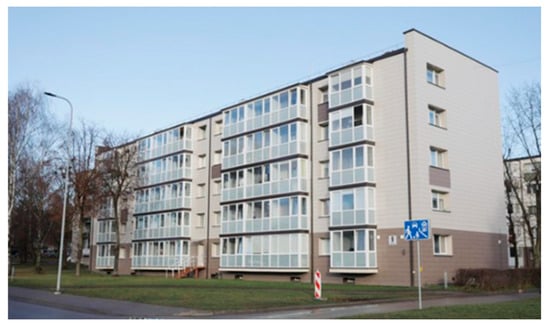
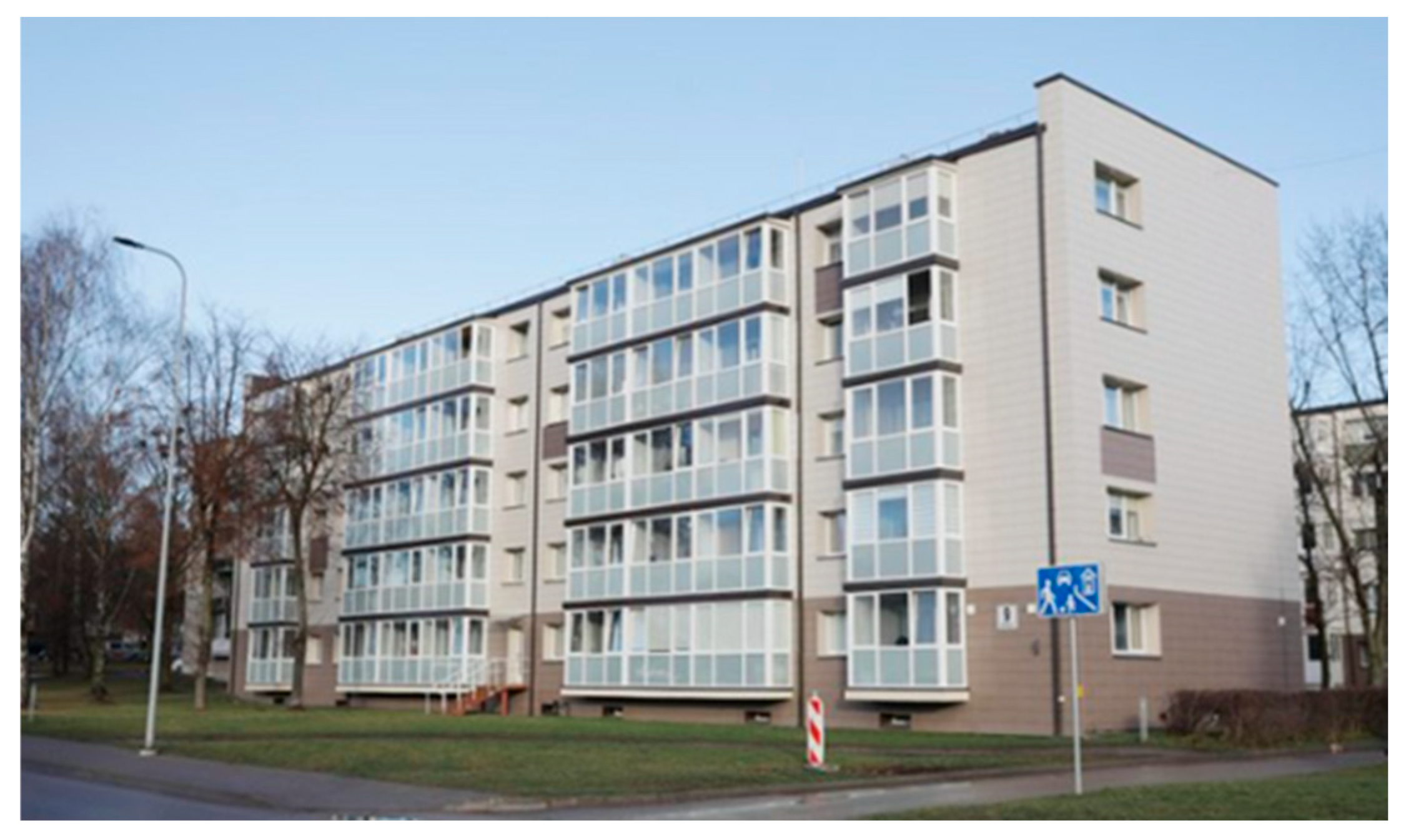
The study was based on a real renovation project of a multi-apartment residential building located in Ukmergė, Lithuania (Figure 1). The investigated building consists of five floors, 24 risers and 30 apartments with a total heated area of 1758.42 m2. The heating system includes 132 heating devices connected through a vertical single-pipe heating network supplied from a district heating substation. The primary district heating circuit and the secondary heating circuit of the multi-family building are hydraulically separated by a heat exchanger. During the renovation project, the design supply and return temperatures were reduced to 70/50 °C, thermostatic radiator valves and automatic balancing valves were introduced, while the existing vertical risers were retained. The hydraulic model used in this study was developed based on the actual renovation project documentation. The heating system consists of steel press-fit pipes with diameters ranging from DN15 to DN50. The main distribution headers are constructed using DN50 (54 × 1.5 mm) pipes, while branch connections to the heating risers utilize DN28 (28 × 1.5 mm) pipes. Radiator connections are constructed using DN15–DN22 steel press-fit pipes, with DN18 and DN22 being the predominant sizes. The hydraulic model incorporates approximately 306 m of main distribution piping, 92 m of riser connection piping, and 664 m of riser radiator connection piping. These geometric characteristics were adopted directly from the renovation design documentation and served as input parameters for the hydraulic simulations.
Figure 1.
Investigated multi-family residential building used for scenario modeling.
The building was selected because detailed renovation design documentation was available, including the actual pipe network, riser arrangement, and heating devices. This purposeful selection enables a controlled comparison of the investigated configurations within one engineering case; it does not establish statistical representativeness of Lithuanian or wider European residential building stocks.
The renovation project included modernization of the heating system using thermostatic radiator valves, balancing devices, and hydraulic optimization measures. After renovation, the design operating temperature regime of the heating system is 70/50 °C. The real hydraulic layout, riser arrangement, and heating device configuration from the renovation project were used as the basis for the simulation model and comparative analysis.
2.2. Simulation Tools and Modeling Assumptions
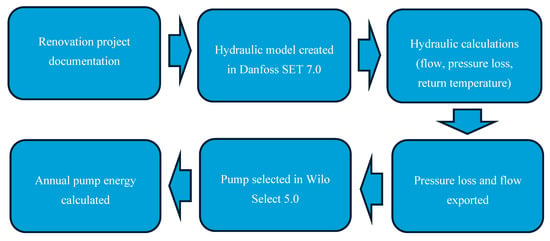
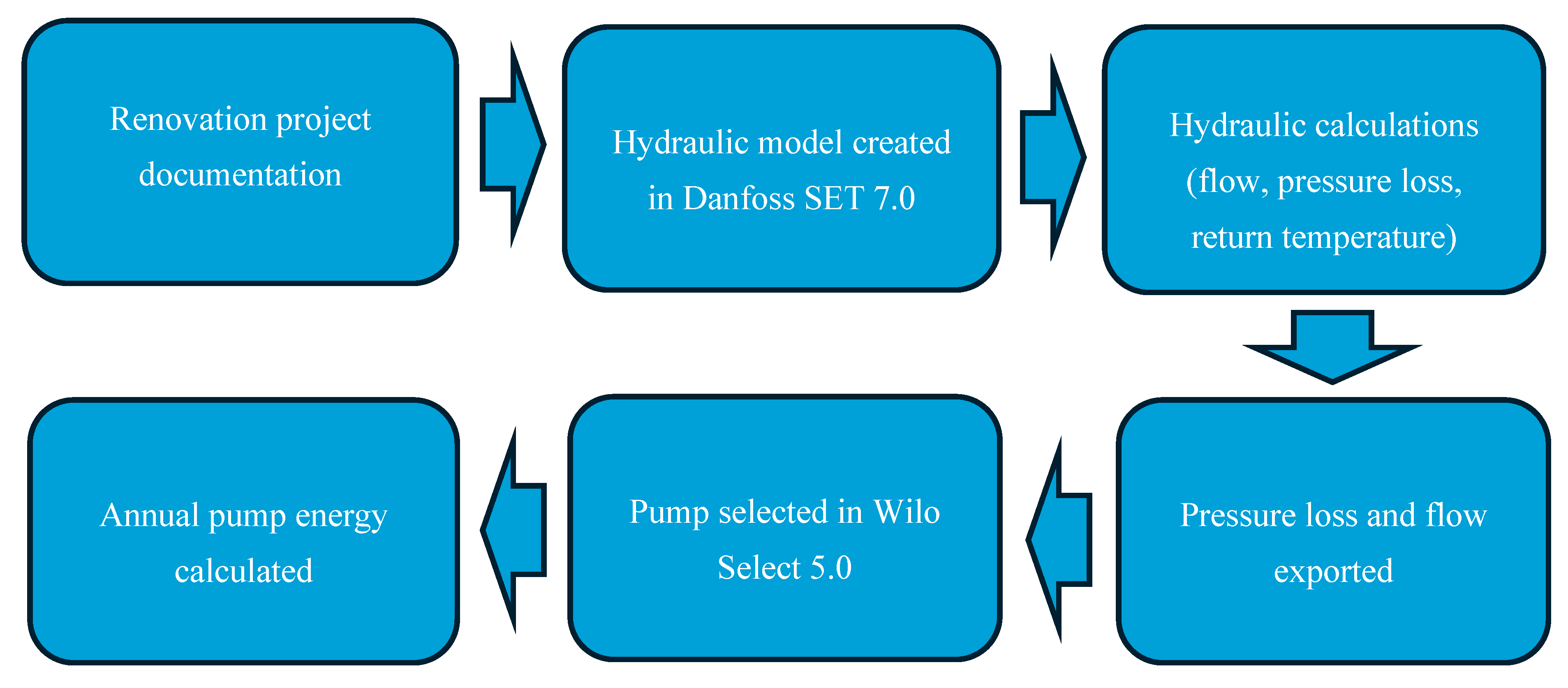
Hydraulic calculations and flow distribution analysis were performed using Danfoss SET 7.0 software, while circulation pump operating conditions and annual circulation energy consumption were evaluated using Wilo Select 5.0 software. Sangi et al. [20,21] demonstrated the application of dynamic modeling and simulation for the analysis of innovative hydronic heating systems. Yuan et al. [22] proposed a model predictive control method for eliminating hydraulic oscillation and dynamic hydraulic imbalance in complex chilled water systems. Ryu and Lee [23] investigated the feasibility of low-temperature district heating with decentralized substations, emphasizing return-temperature optimization and overall energy efficiency. To ensure consistent comparison between scenarios, the following assumptions were applied:
- identical building geometry and heating demand;
- identical radiator sizes and riser configuration;
- identical pipe network geometry;
- identical indoor comfort requirements;
- identical climatic conditions;
- identical heating season duration;
- identical design temperature regime of 70/50 °C.
The analysis focused on evaluating:
- hydraulic flow distribution;
- return-temperature behavior;
- circulation pump energy consumption.
This study evaluates the relative effects of different balancing and control strategies within a single building configuration. Consequently, the results are intended for comparative analysis rather than for deriving universally applicable performance values for all single-pipe heating systems. The overall modeling workflow is shown in Figure 2.
Figure 2.
Workflow of the hydraulic modeling and calculation procedure.
2.3. Investigated Scenarios
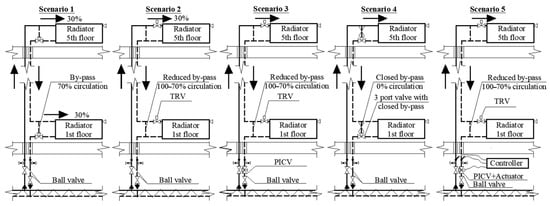
Five system configurations (Table 1, Figure 3) were selected to examine distinct hydraulic and control conditions within the same single-pipe network: (1) an uncontrolled reference case; (2) thermostatic radiator control alone; (3) thermostatic control combined with automatic riser balancing; (4) an adverse condition with fully closed radiator bypasses; and (5) balancing and thermostatic control supplemented by return-temperature-based riser flow regulation. The configurations were selected for an engineering comparison, not as an exhaustive set of possible retrofit solutions. In particular, Scenario 5 investigates the transition from constant-flow to variable-flow riser operation.
Table 1.
Overview of investigated single-pipe heating system control scenarios.
Figure 3.
Investigated single-pipe heating system scenarios: (1) system with 3 port valves as it was designed; (2) thermostatic control only; (3) balanced system with thermostatic control; (4) closed-bypass configuration as it happens after a long time on duty; (5) balanced system with thermostatic control and with return-temperature control.
Scenario 1 represents a traditional uncontrolled single-pipe heating system without thermostatic or balancing devices, only with a manual 3-port valve. Scenario 2 evaluates the effect of thermostatic radiator valves without hydraulic balancing. Scenario 3 represents a hydraulically balanced system with thermostatic radiator valves and pressure-independent balancing-control valves installed on risers. Scenario 4 simulates user intervention where bypasses are manually closed using existing three-port mechanical valves. Scenario 5 includes balancing valves, thermostatic control, and return-temperature limitation. Automatic balancing valves ensure stable hydraulic conditions and proper flow distribution between risers, while thermostatic valves regulate room temperature according to heat demand. In addition, return-temperature limitation controls the flow through radiators based on return water temperature, preventing excessive flow rates and reducing unnecessarily high return temperatures.
PICV: A pressure-independent control valve (PICV) is a hydronic balancing and control valve that automatically maintains a constant flow rate regardless of pressure fluctuations in the system. It combines flow limitation, differential pressure control, and control valve functions in a single device, ensuring stable operation, accurate temperature control, and improved energy efficiency in variable-flow heating and cooling systems.
TRV: A thermostatic radiator valve (TRV) is a self-regulating valve installed on a radiator to automatically control room temperature. The valve adjusts the flow of heating water through the radiator according to the surrounding air temperature, reducing flow when the room becomes warmer and increasing flow when additional heating is required. TRVs improve thermal comfort and reduce energy consumption by preventing overheating.
Controller: A return-temperature control function for a single-pipe riser. A suitable controller monitors supply and return water temperatures and modulates a regulating valve to limit riser flow according to a prescribed return-temperature setpoint. This control principle is not specific to one manufacturer. Its transient response and the resulting room temperatures were not modeled in this study.
2.4. Return-Temperature Control Strategy
In Scenario 5, return-temperature limitation was applied individually to each of the 24 heating risers, in combination with thermostatic radiator valves and automatic balancing valves. The design return-water temperature calculated for each riser using Danfoss SET was adopted as that riser’s individual controller limit. The hydraulic analysis assumed that the controller would restrict riser flow when the return temperature exceeded its prescribed limit. The controller dynamics and actual regulation accuracy were not simulated.
Selected radiator valves were closed to represent partial-load conditions. In a single-pipe system, this increases the bypass-flow proportion and can increase the riser return-water temperature. The Scenario 5 calculations assume that riser-specific return-temperature limitation reduces the circulation flow under these conditions. The weather-compensated supply/return temperature schedule describes the intended design strategy; it was not evaluated across outdoor temperatures. All investigated load cases used a fixed supply-water temperature of 70 °C.
The resulting near-uniform return-water temperatures are conditional on the prescribed riser-specific limits and should not be interpreted as independent evidence of the controllers’ dynamic performance or the maintenance of equivalent radiator heat output.
2.5. Load Profile and Circulation Energy Assessment
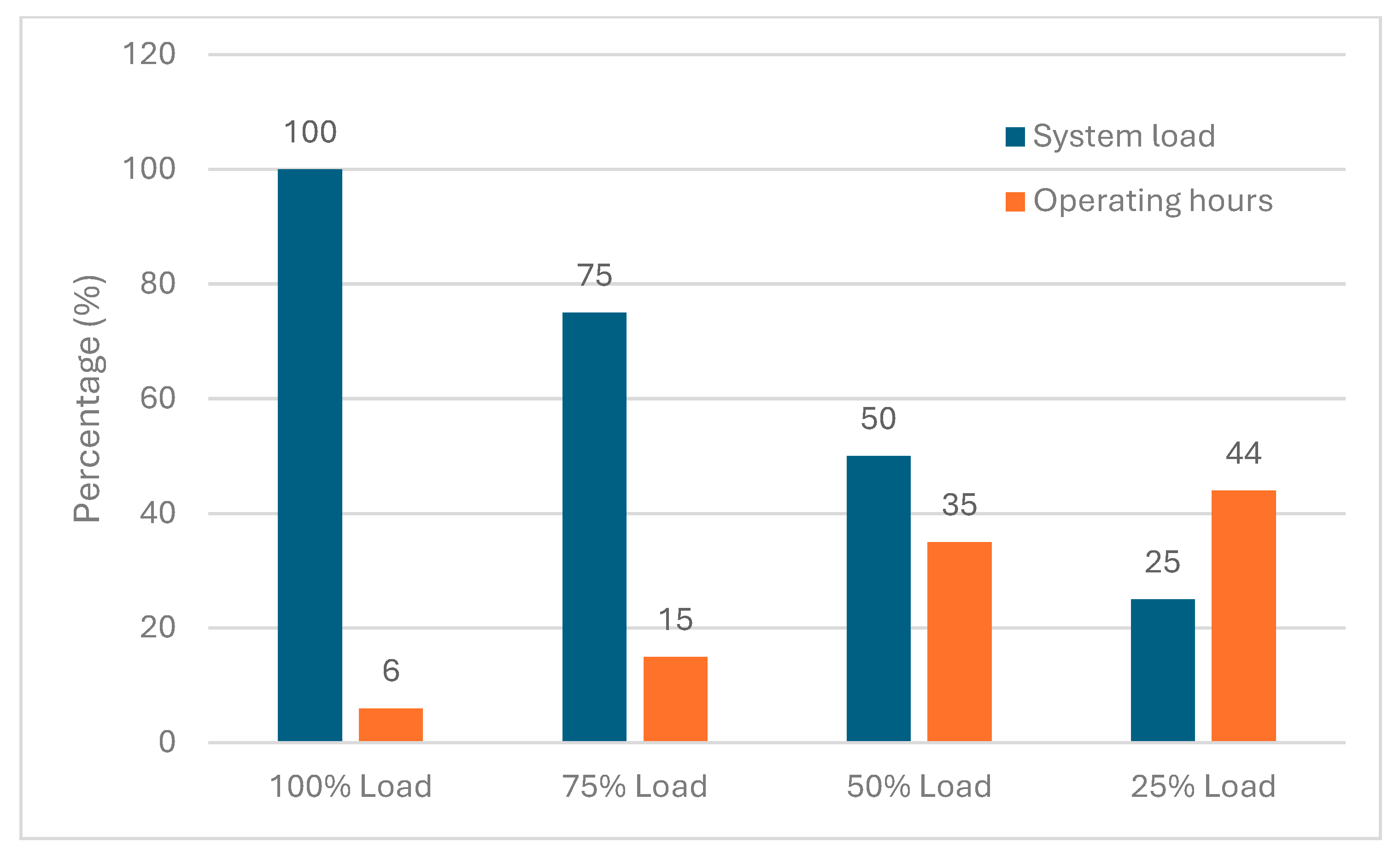
Annual circulation energy consumption was evaluated using a variable-load operating profile representing different heating demand conditions during the heating season. The following operating conditions were assumed: 100% heating load for 6% of the heating season, 75% load for 15%, 50% load for 35%, and 25% load for 44% (Figure 4).
Figure 4.
Assumed heating-load levels and their shares of the heating season.
A 200-day heating season (4800 operating hours) was assumed. The operating-time weights were 6%, 15%, 35%, and 44% for the nominal 100%, 75%, 50%, and 25% conditions, corresponding to 288, 720, 1680, and 2112 h/year. These fractions were adapted from the standardized circulator flow-time weighting profile used for EEI assessment (Commission Regulation (EC) No 641/2009, Annex II [24]). The original EEI profile refers to relative pump flow rates, not measured building heat loads. Applying its weights to the present nominal heating-load scenarios is therefore a simplified assumption rather than a measured building load–duration curve.
In Danfoss SET, partial-load conditions were represented by closing selected radiator valves rather than directly prescribing a proportional reduction in total system flow. The labels 75%, 50%, and 25% denote nominal operating scenarios; the corresponding fractions of the building’s actual heat demand were not independently verified from radiator capacities. For the Scenario 5 pump assessment, the supplied Wilo Select operating points were assigned relative flow rates of approximately 100%, 75%, 50%, and 25% of the 4.30 m3/h design flow. These Wilo flow points must not be confused with independently calculated total flows resulting from the SET radiator-closure cases.
The same circulation-pump assessment approach was used for comparing the five configurations. Scenarios 1–4 were treated as constant-flow cases because radiator closure predominantly redirects water through the bypasses. For Scenario 5, a variable-flow pump calculation was used in conjunction with the assumed riser return-temperature limitation. The Wilo Select chart specifies a proportional differential-pressure (Δp-v) pump characteristic. Because a coupled simulation linking individual riser-temperature controllers to the pump operating point was not available, the Scenario 5 flow points represent prescribed pump-assessment operating conditions, not independently verified controller outputs. This distinction limits the interpretation of the estimated electricity savings.
Annual circulation energy consumption was calculated using the circulation pump power demand corresponding to each load condition and its operating duration (Equation (1)):
where:
- is annual circulation energy consumption;
- is circulation pump power under a specific operating condition;
- is operating duration at the corresponding load condition.
The weighted energy estimate is E = Σ(P1,i × ti)/1000, where Pi is the pump electrical input power in watts and ti is the duration in hours. Using the Wilo Select chart values gives 344.05 kWh/year for Scenario 5. The corresponding flow and power values are the documented pump-assessment points; they do not establish that the riser controllers would independently produce these flow rates in operation.
This profile helps identify when energy consumption is at its peak load and when it is at its minimum load, and it supports the optimization of energy supply and equipment operation based on real user demand. The load profile is an important tool for planning and managing energy systems in order to ensure efficient energy use and avoid excessive load peaks. The evaluation of hydraulic imbalance in single-pipe heating networks significantly relies on the accuracy of flow distribution models. These models should accurately reflect the network’s hydraulic characteristics, including pressure drops, flow rates, and heat transfer rates. Simulation analysis indicates that despite the lower efficiency of small decentralized pumps compared to large central ones in passive two-pipe systems, active two-pipe systems can achieve lower overall pumping energy demands due to reduced energy dissipation in control valves [14]. A comprehensive approach involving balancing valves, thermostatic sensors, and optimized control strategies is essential to address hydraulic imbalances, improve thermal performance, and reduce energy consumption in single-pipe heating networks. After building renovations, heating systems often become oversized due to decreased heat losses, exacerbating overheating issues, particularly in systems with permanent flow in the risers [15,25]. Variable speed pumps can adapt to changing demand, saving substantial energy compared to constant speed pumps [26]. In systems that convert buildings from boiler-based heating to low-temperature district heating, variable speed pumps are significantly more energy-efficient, particularly under partial heat consumption conditions, and can reduce energy consumption by approximately 63% [27,28]. Moreover, employing variable frequency drives can adjust pump speed in real-time according to demand, but this only works efficiently in dynamic flow systems. Ultimately, by using variable speed pumps and optimizing system parameters, energy efficiency can be substantially improved.
The use of thermostatic radiator valves can reduce heat consumption by approximately 12.4% compared to situations where the valves are fully open [29,30]. The implementation of thermostatic radiator valves can ensure high temperature differences between supply and return water temperatures, which is a critical factor in the transition to low-temperature district heating.
2.6. Study Limitations
This single-building case study is based on engineering hydraulic calculations using renovation design documentation. No field measurements, independent validation, dynamic controller simulation, or coupled room-temperature/radiator-output calculations were performed. Partial-load cases were approximated by closing selected radiators; their nominal percentages were not independently validated as fractions of actual heating demand. The Wilo Select variable-flow operating points were assigned relative to the design flow rather than independently obtained from a coupled riser-controller model. The operating-time weights were adapted from a standardized circulator flow-time profile and do not represent measured building heating-load durations. Riser return-temperature uniformity was largely determined by prescribed riser-specific controller limits. Consequently, equal radiator heat delivery, indoor thermal comfort, and actual control accuracy cannot be inferred. The primary district-heating network, equipment investment, and payback were not assessed; no sensitivity or uncertainty analysis was performed. All electricity estimates are conditional, case-specific comparative calculations.
3. Results
The results are presented comparatively for the investigated hydraulic control scenarios under identical boundary conditions. The analysis focuses on return-temperature distribution, hydraulic stability, and circulation pump energy consumption in a renovated single-pipe heating system.
3.1. Scenario 1—System Without Balancing Valves and Thermostatic Control
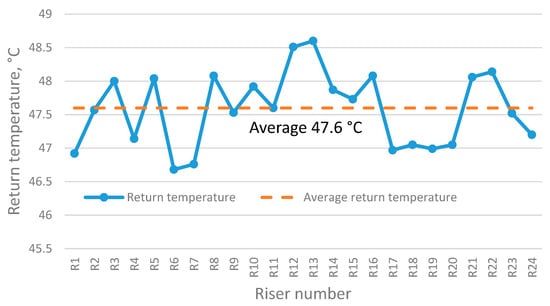
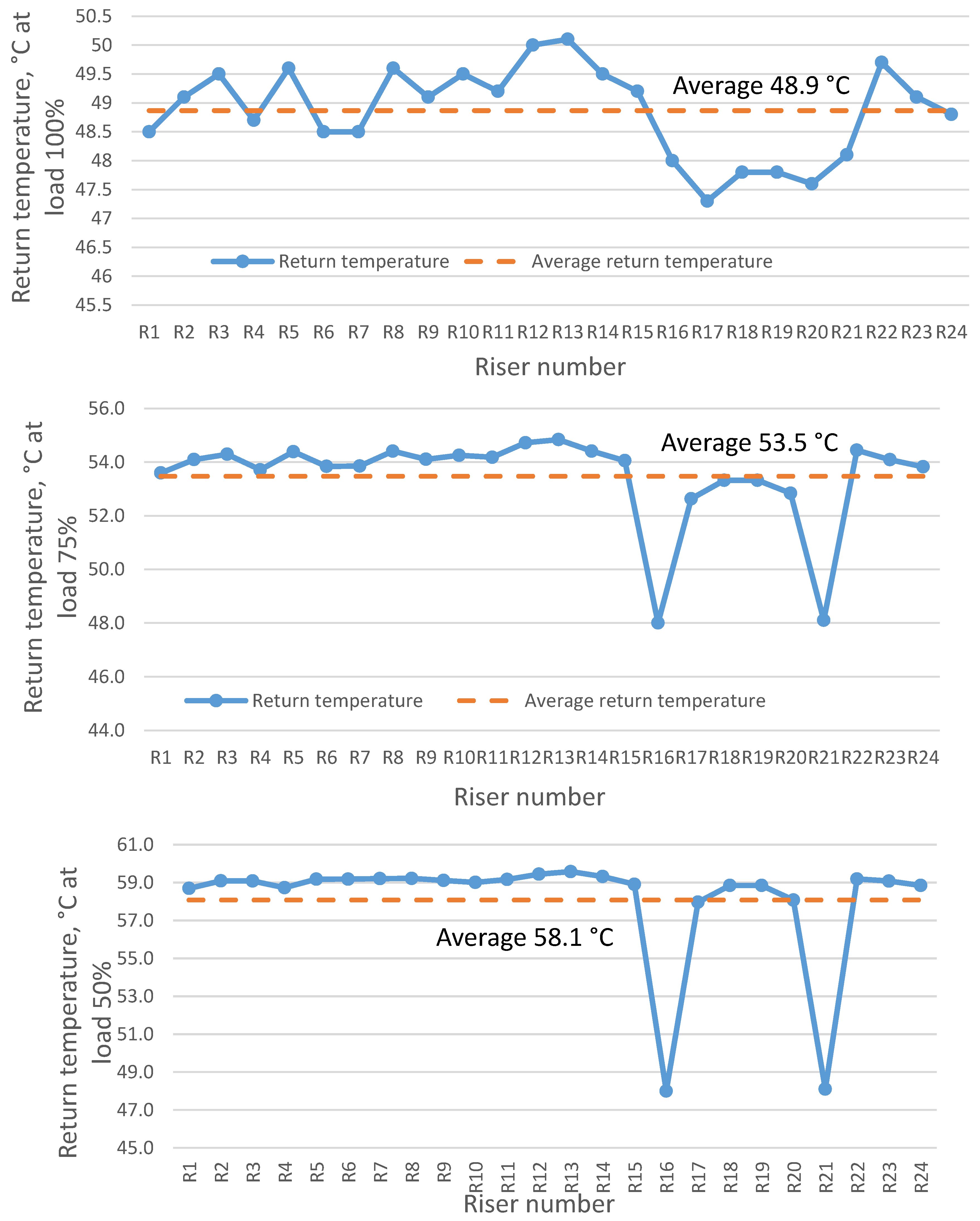
Figure 5 demonstrates uneven return-temperature distribution between risers, indicating hydraulic imbalance within the single-pipe heating system. Risers R12, R13 exhibit elevated return temperatures due to excessive flow rates, while risers R6, R7, R17–R20 show reduced return temperatures caused by insufficient circulation in hydraulically remote sections. The simulated circulation pump energy consumption was 339 kWh/year under theoretical minimum operating conditions at a system dynamic pressure resistance of 35.9 kPa. The results demonstrate that constant-flow operation without hydraulic balancing significantly limits the potential for circulation pump speed reduction, resulting in inefficient heating distribution and reduced overall system energy efficiency.
Figure 5.
Return-temperature distribution by riser in Scenario 1.
3.2. Scenario 2—System with Thermostatic Radiator Valves and Without Balancing Valves
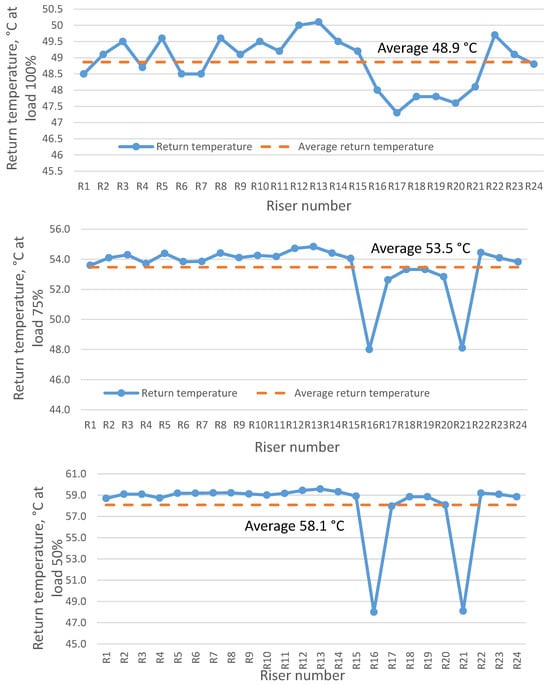
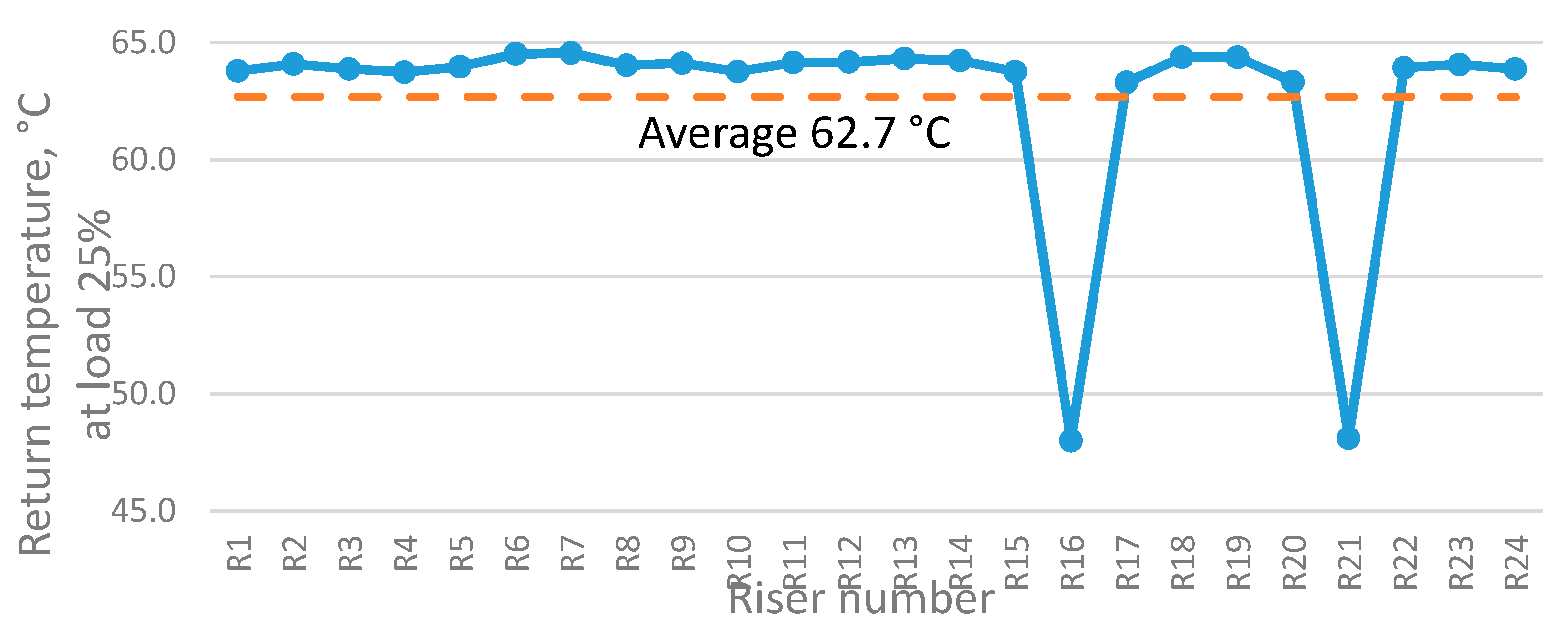
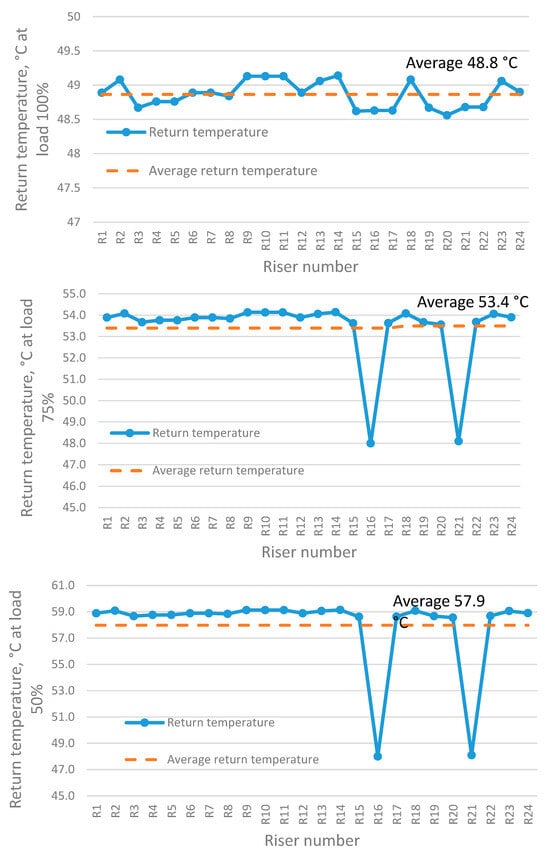
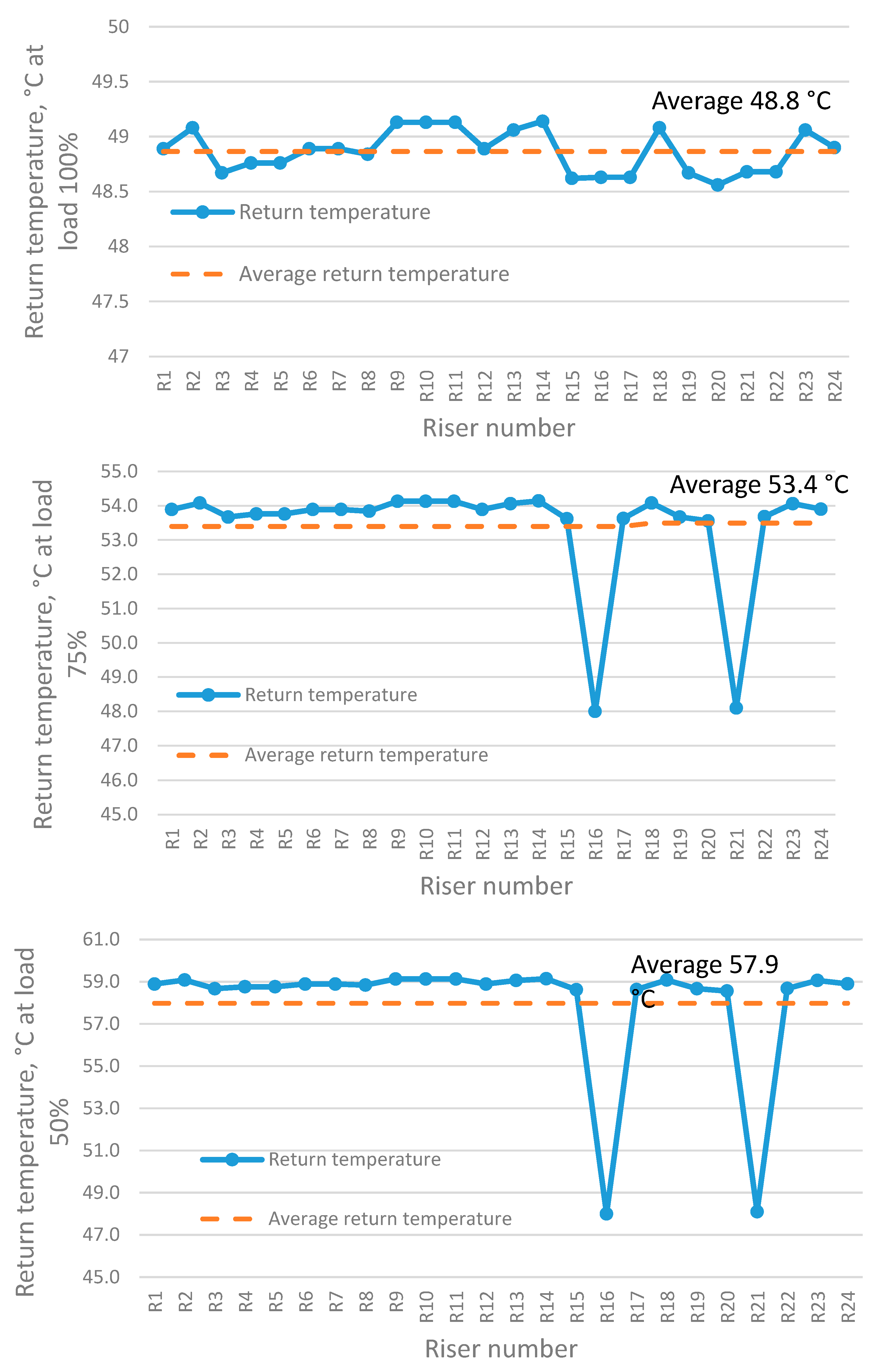
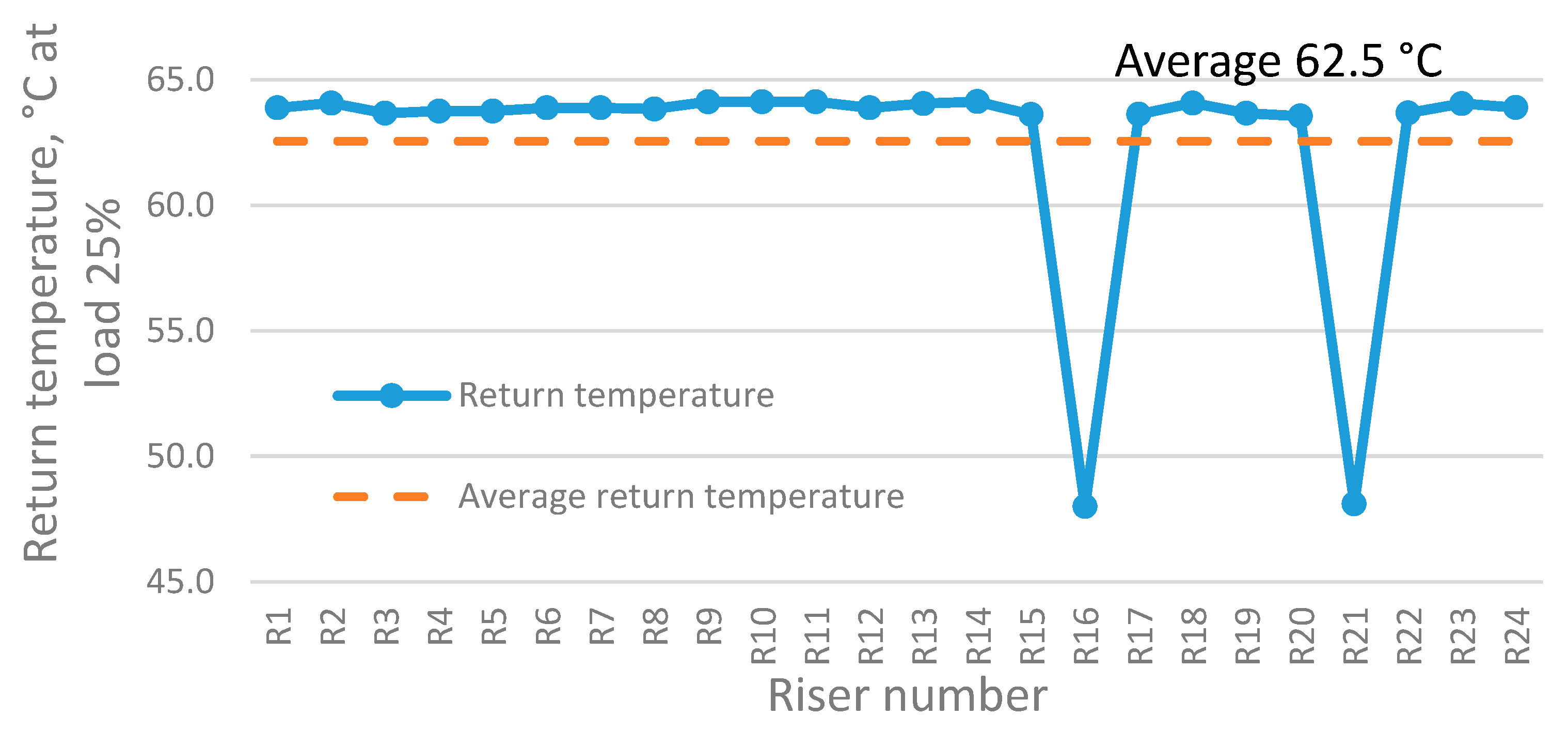
Figure 6 presents the return-temperature distribution between risers for Scenario 2. The results show that the installation of thermostatic radiator valves has no impact on the hydraulic balance between risers. Uneven flow distribution is still observed throughout the system, particularly under partial-load operating conditions. While the average system return temperature increased as the load decreased due to thermostatic radiator valves gradually throttling flow in apartment radiators, risers R16 and R21 maintained lower return temperatures compared to the other risers. This behavior indicates that the staircase radiators became hydraulically dominant local consumers under partial-load conditions.
Figure 6.
Return temperature (°C) by riser (R) at load 100%, 75%, 50% and 25%, Scenario 2.
The simulated circulation pump energy consumption was 397 kWh/year, under theoretical minimum operating conditions at 41.9 kPa system dynamic pressure resistance. Under these conditions, some risers receive insufficient circulation, resulting in reduced thermal performance.
The results additionally show that as more TRVs reduce radiator flow under partial-load conditions, the return temperature in the system increases. This effect becomes more pronounced at lower heating loads, where reduced heat extraction from radiators leads to higher return temperatures delivered back to the building heating system. The results indicate that thermostatic control alone is insufficient to ensure hydraulic stability and efficient system operation in single-pipe heating systems without balancing valves.
The higher the return temperature becomes, the more similar it is to the neighboring risers. The results show that as thermostatic radiator valves progressively reduce radiator flow under partial-load conditions, the return temperature in the system increases. Reduced heat extraction from the heating devices leads to higher return temperatures returning to the heat substation and subsequently to the district heating network. Risers R16 and R21 were excluded from partial-load condition modeling because they serve staircase heating zones equipped with a single radiator only. Risers R16 and R21 each contain only one radiator, whereas the other analyzed risers contain five radiators. Together, these two risers account for approximately 4% of the total system flow. They were excluded from the partial-load temperature-uniformity comparison because their configuration and load pattern differ from those of the main apartment risers. Due to their small contribution to the total flow, their exclusion has only a limited influence on the system-level results.
3.3. Scenario 3—System with Balancing Valves and Thermostatic Control
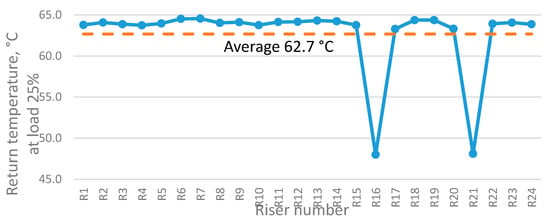
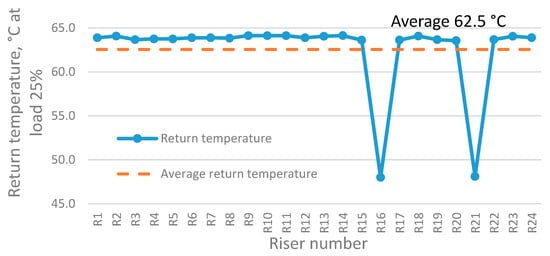
Figure 7 presents the return-temperature distribution between risers for Scenario 3. The results show that the installation of automatic balancing valves together with thermostatic radiator valves provides stable and uniform flow distribution throughout the system. Return-temperature differences between risers are significantly reduced compared to Scenarios 1 and 2, indicating improved hydraulic stability. The simulated circulation pump energy consumption was 552 kWh/year under constant-flow operating conditions at 57.1 kPa heating system dynamic pressure resistance. Since the system operates with fixed circulation flow throughout the heating season, the pump continues to operate at constant capacity even during partial-load conditions, when full flow demand is not required.
Figure 7.
Return temperature (°C) by riser (R) at load 100%, 75%, 50% and 25%, Scenario 3.
The installation of automatic balancing valves in combination with thermostatic radiator valves improves hydraulic stability and ensures a more uniform flow distribution between risers, resulting in more consistent thermal conditions throughout the building. At 100% load, the return temperatures between risers became substantially more equal compared to the system without balancing valves, indicating improved hydraulic distribution and reduced flow imbalance. However, the average return temperature at full-load conditions remained similar to the system without balancing, demonstrating that hydraulic balancing primarily improved temperature uniformity rather than reducing the overall return-temperature level. Despite the improved hydraulic performance, constant-flow operation maintains relatively high circulation pump energy consumption, increasing overall operating costs. Under partial-load conditions, Scenario 3 demonstrates similar return temperature increase trends as observed in Scenario 2. As thermostatic radiator valves gradually reduce flow in apartment radiators at lower loads, the average return temperature increased from 48.8 °C at 100% load to 62.5 °C at 25% load, indicating reduced system ΔT and lower heat extraction efficiency. Risers R16 and R21, serving staircase radiators with permanently active heating units, consistently exhibited lower return temperatures under partial-load conditions. These risers maintained continuous local heat extraction while most apartment radiators throttled down, resulting in localized return-temperature depression and increased thermal asymmetry across the system.
3.4. Scenario 4—System Without Balancing Valves and with Fully Closed Bypasses
The hydraulic imbalance in single-pipe heating systems becomes significantly more severe when bypasses are fully closed at Scenario 4. Redirecting the entire flow through the radiators increases hydraulic resistance and causes non-uniform flow distribution between risers. Under these conditions, some risers receive higher circulation flow rates, while other risers experience insufficient circulation and reduced heat delivery. To compensate for the increased hydraulic resistance caused by sequential flow through the radiators, the circulation pump was required to operate at significantly higher capacity under a system pressure loss of 101.1 kPa. This resulted in substantially increased electricity consumption and a higher risk of hydraulic noise within the heating system. The simulated annual circulation pump energy consumption reached 1104 kWh/year, representing the highest value among all investigated scenarios.
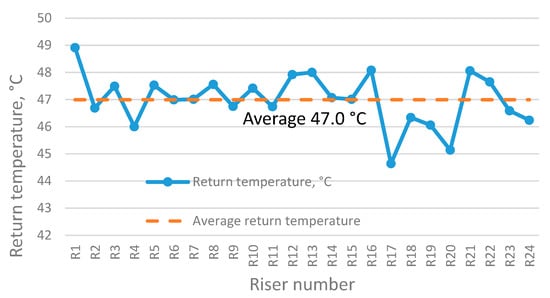
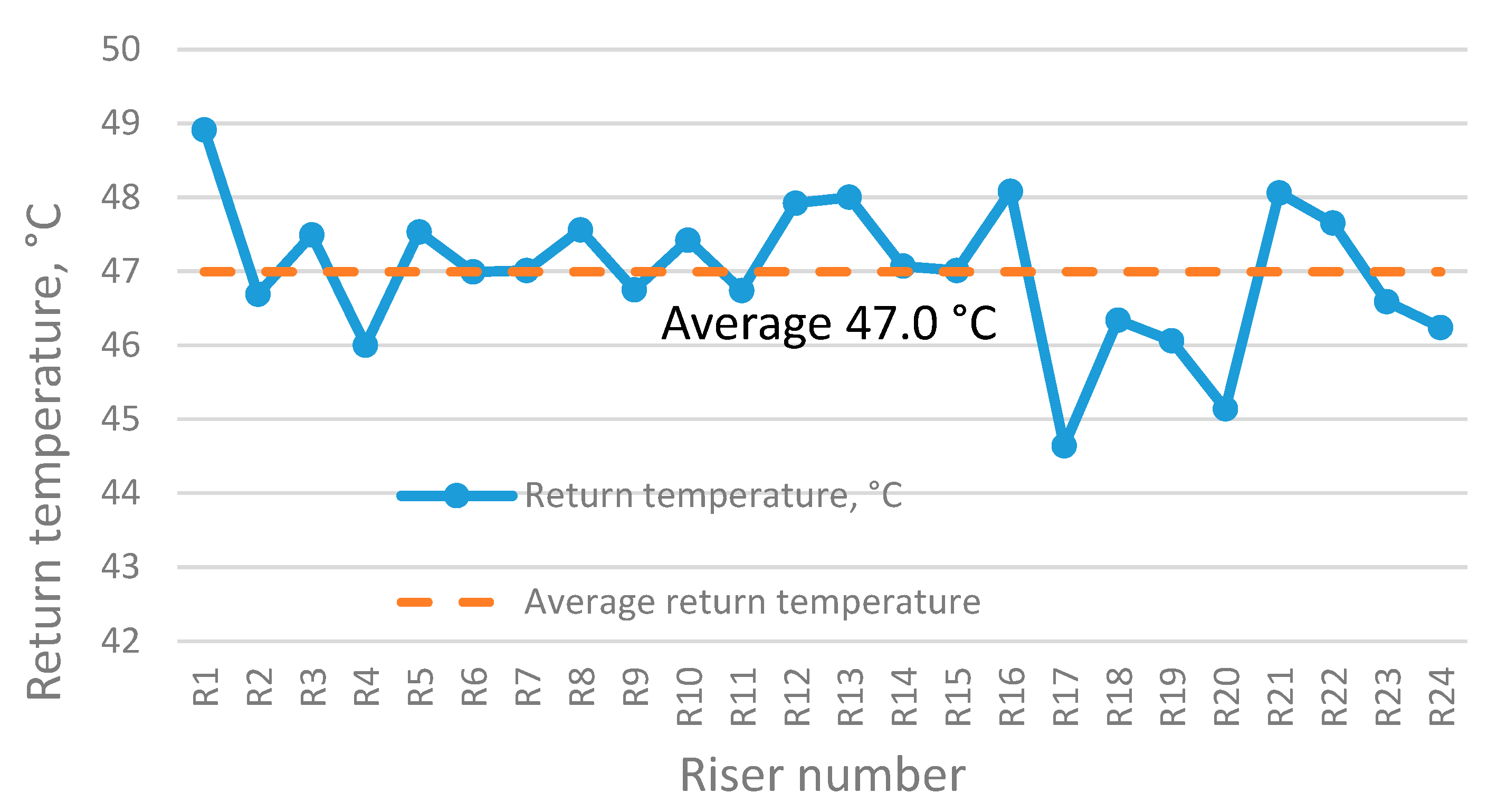
Figure 8 shows return-temperature variations between approximately 44.6 °C and 48.9 °C, with an average return temperature of 47.0 °C. The large temperature spread between risers indicates severe hydraulic imbalance and unstable system operation. Lower return temperatures observed in several risers suggest insufficient flow circulation and uneven heat distribution within the building.
Figure 8.
Return temperatures T °C by riser, Scenario 4.
The results indicate that manual bypass closure may temporarily improve local heat output; however, at the system level, it reduces hydraulic stability, increases pumping energy demand, and negatively affects the overall performance and energy efficiency of the heating system.
3.5. Scenario 5—System with Balancing Valves, Thermostatic Control, and Return Temperature Limitation
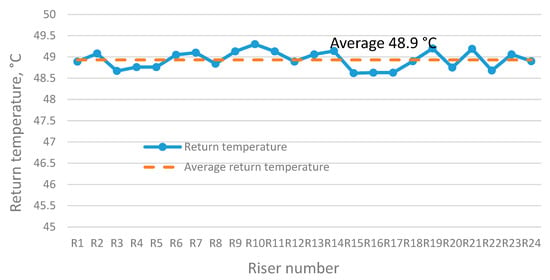
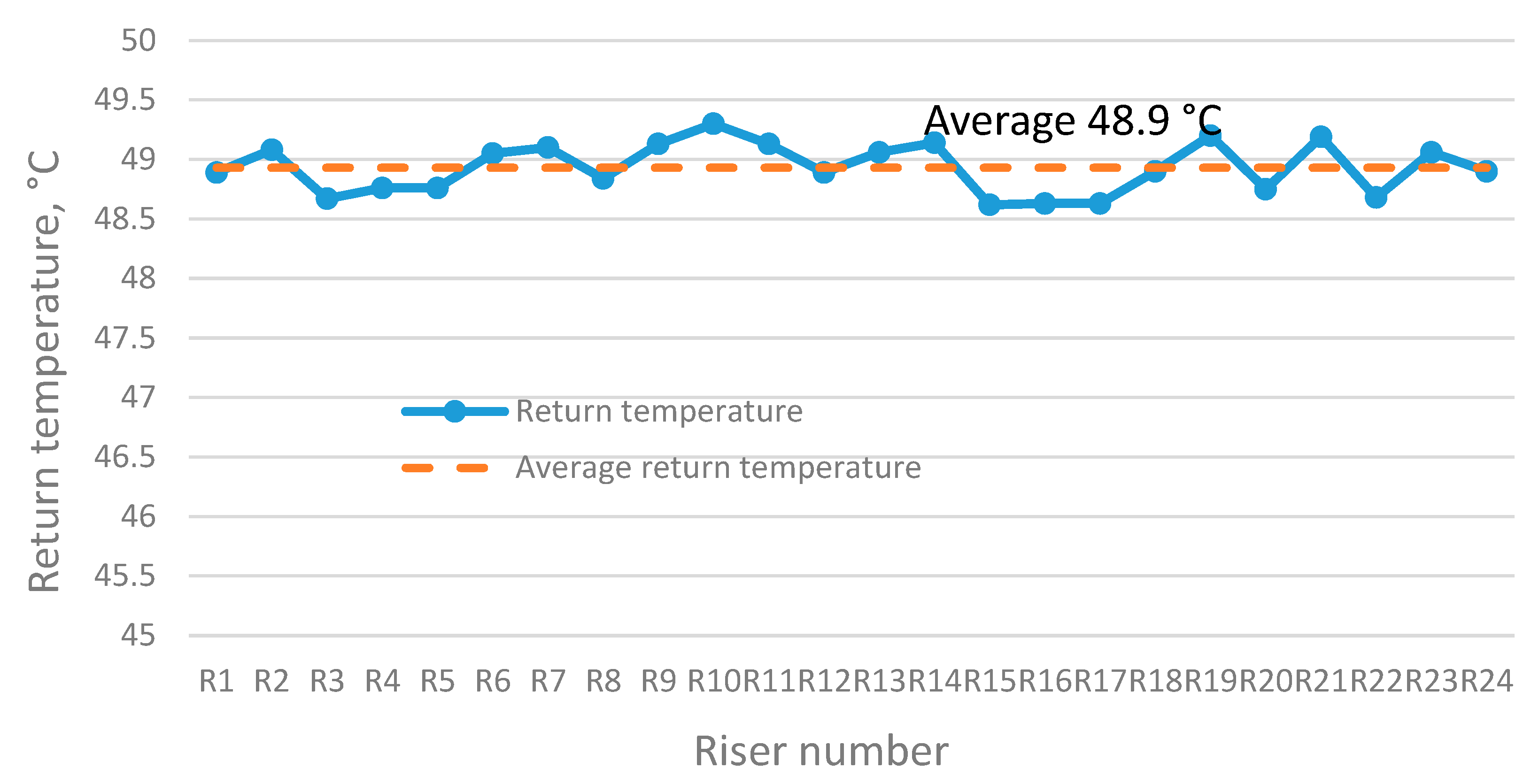
Figure 9 illustrates the calculated riser return-water temperatures for Scenario 5 under the assumption of individual return-temperature limitation at each riser. The temperature limits were taken from the design return temperatures calculated in Danfoss SET for the respective risers. The relatively uniform distribution reflects these prescribed conditions, not independent verification of controller regulation performance.
Figure 9.
Riser return-water temperatures for Scenario 5 under prescribed individual riser return-temperature limits at a fixed 70 °C supply temperature. Similar temperatures under nominal partial-load conditions reflect the assumed limitation strategy, not independently predicted controller performance.
Using the supplied Wilo Select pump operating points at the assumed 57.0 kPa design hydraulic resistance and the four-point operating-time weights, Scenario 5 has an estimated annual pump electricity consumption of 344.05 kWh/year. This is lower than Scenario 3 (552 kWh/year), but slightly higher than Scenario 1 (339 kWh/year). The detailed operating points and weighted energy contributions are given in Table 2.
Table 2.
Scenario 5 pump operating points and annual electricity estimate from the supplied Wilo Select charts.
For each riser, the return-temperature controller limit was set equal to that riser’s Danfoss SET design return-water temperature. The simulations assumed that the controller would restrict circulation when this limit was exceeded. All nominal load conditions were considered at a fixed 70 °C supply temperature; the full weather-compensated temperature schedule was not simulated. The near-constant return temperatures across nominal load conditions therefore arise primarily from the prescribed riser-specific limits rather than from an independently simulated dynamic control response.
Figure 9 indicates riser return temperatures of approximately 48.6–49.3 °C, with a reported mean of 48.9 °C. These values describe the steady-state hydraulic results subject to the imposed temperature limits. They do not demonstrate equivalent heat delivery by individual active radiators under reduced-flow operation.
Under the specified pump-assessment assumptions, Scenario 5 requires less annual circulation-pump electricity than the balanced constant-flow Scenario 3, but approximately 1.5% more than the original Scenario 1. The analysis does not establish an improvement in indoor comfort, actual radiator heat output, district-heating-network performance, or total building heating energy use.
3.6. Impact of Advanced Control Strategies on Single-Pipe Heating System Efficiency
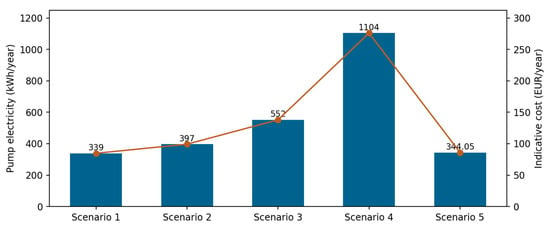
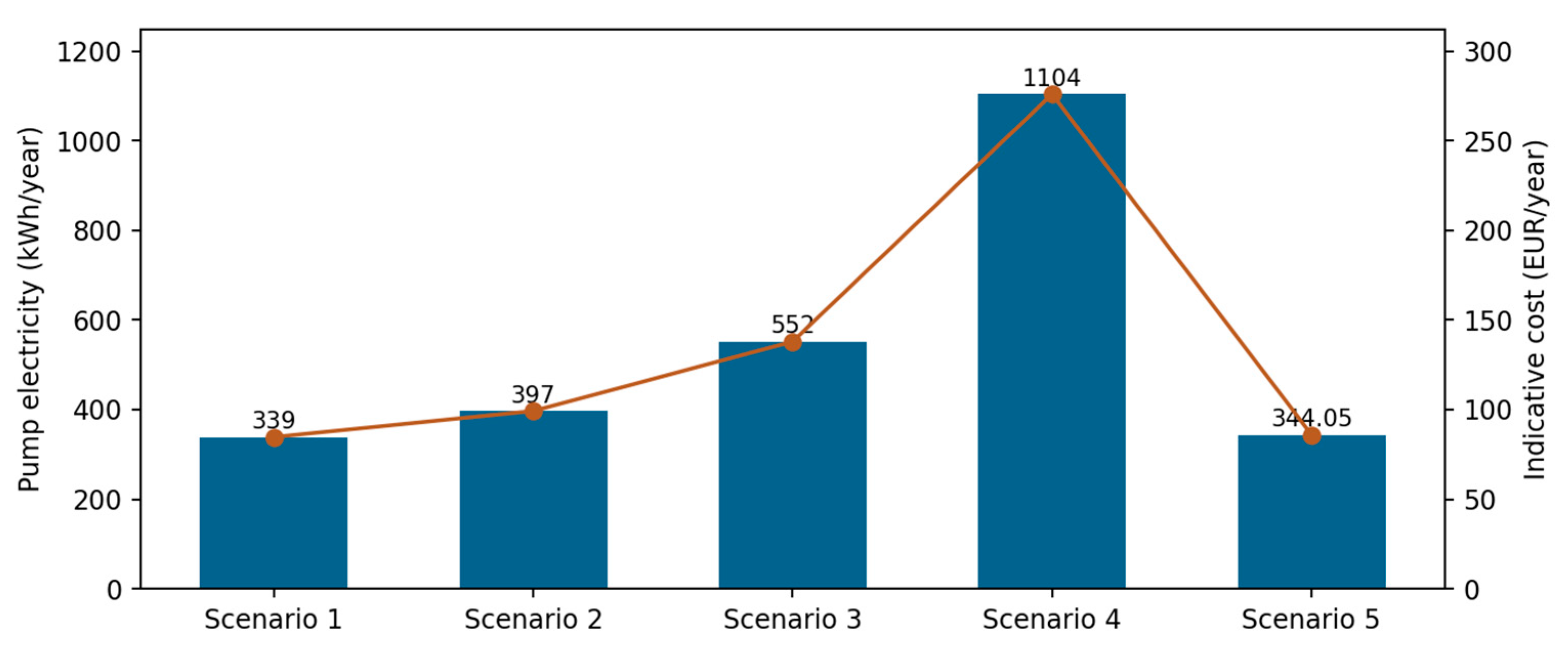
The investigated configurations illustrate a trade-off between hydraulic control functionality, system resistance, and circulation-pump electricity consumption. Automatic balancing improves the modeled distribution between risers, whereas return-temperature limitation introduces an assumed variable-flow operating strategy. The pumping-energy reduction is meaningful when comparing Scenario 5 with the balanced constant-flow Scenario 3, but not when comparing it with the original Scenario 1. Figure 10 presents the updated comparative electricity estimates and indicative costs.
Figure 10.
Calculated annual circulation pump electricity consumption and indicative electricity cost (assumed tariff: EUR 0.25/kWh; not a measured annual tariff).
The estimated annual circulation pump electricity consumption decreases from 552 kWh/year in Scenario 3 to 344.05 kWh/year in Scenario 5, a difference of 207.95 kWh/year (37.7%). At the assumed tariff of EUR 0.25/kWh, this is an indicative electricity-cost difference of EUR 51.99/year. Relative to Scenario 1 (339 kWh/year), Scenario 5 uses 5.05 kWh/year more (approximately 1.5%). These figures describe pump electricity only and exclude capital and maintenance costs, building heat consumption, and district-heating-network performance. The estimated saving depends on the assumed Wilo variable-flow duty points and load-duration weights.
4. Conclusions
This study investigated the influence of hydraulic imbalance, thermostatic control, hydraulic balancing, and return-temperature limitation on the operational performance of single-pipe heating systems connected to district heating networks. The comparative analysis demonstrated that hydraulic imbalance significantly affects flow distribution, return-temperature behavior and circulation energy consumption under both full-load and partial-load operating conditions.
- Scenario 1, the uncontrolled reference configuration, showed a non-uniform simulated riser return-temperature distribution and comparatively low calculated annual pump electricity consumption (339 kWh/year). The hydraulic results do not establish actual apartment temperatures or heat delivery.
- The introduction of thermostatic radiator valves without hydraulic balancing in Scenario 2 did not solve the balancing. Hydraulic instability between risers remained. Under partial-load operating conditions, return temperatures increased due to uncontrolled flow redistribution, while pump energy consumption increased moderately to 397 kWh/year. The results indicate that thermostatic control alone is insufficient to ensure stable operation in single-pipe systems.
- Scenario 3 demonstrated that the installation of balancing valves together with thermostatic radiator valves significantly improved hydraulic stability and achieved more uniform return-temperature distribution between risers. Nevertheless, the increased system pressure losses (57.1 kPa) resulted in higher circulation pump energy consumption (552 kWh/year). In addition, elevated return temperatures remained under partial-load conditions due to constant-flow operation.
- Scenario 4, representing operation with fully closed bypasses and without balancing valves, produced the poorest overall hydraulic performance. The system experienced the highest pressure losses (101.1 kPa) and the highest pump energy consumption (1104 kWh/year), while hydraulic stability remained very low. Large return-temperature variations between risers confirmed that bypass closure without proper balancing leads to unstable operating conditions and inefficient system performance.
- Scenario 5 combined thermostatic radiator valves, automatic riser balancing, and assumed riser-specific return-temperature limitation. Its prescribed controller limits were derived from each riser’s design return-water temperature in Danfoss SET. The supplied Wilo Select operating points give an estimated annual pump electricity consumption of 344.05 kWh/year, 37.7% below Scenario 3 (552 kWh/year), but 1.5% above Scenario 1 (339 kWh/year). Thus, the main engineering distinction is the addition of hydraulic balancing and individual control functions while maintaining pump electricity demand close to the original configuration. The return-temperature distribution reflects the imposed control limits; controller performance, equivalent radiator heat delivery, and room temperatures were not independently verified.
- Return-temperature control may be relevant to district-heating performance, but the primary district-heating circuit was not modeled. Therefore, no district-heating network efficiency improvement can be quantified from the present results. The study also does not establish that upgrading the existing single-pipe system is economically preferable to converting it to a two-pipe network. Scenario 5 requires additional riser control equipment, sensors, actuators, and installation work; investment and payback depend on project-specific costs and were not assessed. The results support a case-specific comparison of hydraulic and circulation energy characteristics, while broader thermal and economic conclusions require further investigation. 7. The investigated scenarios illustrate that constant-flow single-pipe operation can limit partial-load pumping energy reduction. Return-temperature-based flow regulation offers one potential variable-flow retrofit concept, subject to further assessment of radiator heat output, control performance, and installation feasibility.
Therefore, when renovating existing single-pipe heating systems, the feasibility of maintaining the original system concept should be carefully evaluated. If major renovation measures are already planned, such as radiator replacement or pipe network reconstruction, conversion to two-pipe heating systems may represent a more rational long-term solution compared to advanced modernization of existing single-pipe configurations.
Recommendations for Future Research
Future research should focus on the development of more advanced hydraulic and control models capable of adapting to varying thermal loads and optimizing system operation under both full-load and partial-load conditions. Particular attention should be given to the interaction between hydraulic balancing, thermostatic control, variable-flow operation, and return-temperature limitation in existing single-pipe heating systems connected to district heating networks. Further investigation is required to better understand the coupled mechanisms between flow distribution, return-temperature behavior, and circulation energy consumption in single-pipe heating systems. Future studies should aim to develop generalized control methodologies and operational principles that can be applied to a wider range of existing district-heated residential buildings. Since the present study is based on comparative simulation analysis, future work should include experimental validation, field measurements, and uncertainty analysis to verify the reliability of the proposed control strategies under real operating conditions. Long-term monitoring of renovated buildings would provide additional insight into hydraulic stability, occupant comfort, and seasonal system performance under dynamic weather and occupancy conditions. Future studies should also investigate predictive and data-driven control approaches for single-pipe heating systems. Artificial intelligence methods, including neural networks and machine learning algorithms, could be applied to predict hydraulic imbalances, optimize circulation flow, and improve return-temperature control based on real-time operational data and changing building conditions. Such approaches could contribute to the modernization of automatic control systems and further improve overall energy efficiency and thermal comfort. In addition, future research should evaluate the integration of renewable and low-temperature heat sources, such as solar thermal systems, geothermal energy, and low-temperature district heating networks, into renovated single-pipe heating systems. Lower return temperatures and improved variable-flow operation may become increasingly important for the efficient operation of future low-temperature district heating networks. Finally, further studies should assess the techno-economic feasibility of renovating existing single-pipe heating systems compared to complete conversion to two-pipe systems. The present study indicates that achieving modern energy efficiency requirements in single-pipe systems requires technically complex retrofit solutions involving hydraulic balancing, thermostatic control, and return-temperature limitation. Therefore, future research should determine under which technical and economic conditions renovation of existing single-pipe systems remains justified and when replacement with modern two-pipe heating systems becomes the more rational long-term solution.
Author Contributions
Conceptualization, A.T. and K.V.; methodology, A.T. and K.V.; software, A.T.; validation, A.T. and K.V.; formal analysis, A.T.; investigation, A.T.; resources, A.T.; data curation, A.T.; writing—original draft, A.T.; writing—review and editing, A.T. and K.V.; visualization, A.T.; supervision, A.T. and K.V.; project administration, A.T. and K.V.; funding acquisition, A.T. All authors have read and agreed to the published version of the manuscript.
Funding
This research received no external funding.
Data Availability Statement
The original contributions presented in this study are included in the article. Further inquiries can be directed to the corresponding author.
Conflicts of Interest
The first author is employed by Danfoss. The research and numerical calculations were conducted independently without financial support from Danfoss. The investigated configurations compare general hydraulic and control principles and do not constitute an endorsement of a specific manufacturer’s product. This professional affiliation is disclosed as a potential conflict of interest.
References
- Pedranzini, F.; Colombo, L.P.M.; Romano, F. Development and Application of a Novel Non-Iterative Balancing Method for Hydronic Systems. Appl. Sci. 2024, 14, 6232. [Google Scholar] [CrossRef] [Scilit]
- Zhang, L.; Xia, J.; Thorsen, J.E.; Guðmundsson, O.; Li, H.; Svendsen, S. Method for achieving hydraulic balance in typical Chinese building heating systems by managing differential pressure and flow. Build. Simul. 2016, 10, 51–63. [Google Scholar] [CrossRef] [Scilit]
- Cholewa, T.; Balen, I.; Siuta-Olcha, A. On the influence of local and zonal hydraulic balancing of heating system on energy savings in existing buildings—Long term experimental research. Energy Build. 2018, 179, 156–164. [Google Scholar] [CrossRef] [Scilit]
- Cholewa, T.; Balaras, C.A.; Nižetić, S.; Siuta-Olcha, A. On calculated and actual energy savings from thermal building renovations—Long term field evaluation of multifamily buildings. Energy Build. 2020, 223, 110145. [Google Scholar] [CrossRef] [Scilit]
- Chicherin, S. Hydraulic Balancing of District Heating Systems and Improving Thermal Comfort in Buildings. Energies 2025, 18, 1259. [Google Scholar] [CrossRef] [Scilit]
- Cho, H.; Cabrera, D.; Patel, M. Identification of criteria for the selection of buildings with elevated energy saving potentials from hydraulic balancing-methodology and case study. Adv. Build. Energy Res. 2021, 16, 427–444. [Google Scholar] [CrossRef] [Scilit]
- Cholewa, T.; Siuta-Olcha, A.; Balaras, C.A. Actual energy savings from the use of thermostatic radiator valves in residential buildings—Long term field evaluation. Energy Build. 2017, 151, 487–493. [Google Scholar] [CrossRef] [Scilit]
- Sarran, L.; Smith, K.M.; Hviid, C.A.; Rode, C. Grey-box modelling and virtual sensors enabling continuous commissioning of hydronic floor heating. Energy 2022, 261, 125282. [Google Scholar] [CrossRef] [Scilit]
- ISO 52120-1:2021; Energy Performance of Buildings—Contribution of Building Automation, Controls and Building Management—Part 1: General Framework and Procedures. International Organization for Standardization (ISO): Geneva, Switzerland, 2021.
- Directive (EU) 2024/1275 of the European Parliament and of the Council of 24 April 2024 on the Energy Performance of Buildings (Recast). Available online: https://eur-lex.europa.eu/eli/dir/2024/1275/oj/eng (accessed on 10 January 2026).
- Seri, F.; Arnesano, M.; Keane, M.; Revel, G.M. Temperature Sensing Optimization for Home Thermostat Retrofit. Sensors 2021, 21, 3685. [Google Scholar] [CrossRef] [Scilit] [PubMed]
- Ashfaq, A.; Ianakiev, A. Investigation of hydraulic imbalance for converting existing boiler based buildings to low temperature district heating. Energy 2018, 160, 200–212. [Google Scholar] [CrossRef] [Scilit]
- Dostál, J.; Bäumelt, T. Model predictive control for buildings with active one-pipe hydronic heating. E3S Web Conf. 2019, 111, 4050. [Google Scholar] [CrossRef] [Scilit]
- Zlevor, O.; Dostál, J. Demand-oriented hydronic heating system and the active one-pipe system design tool. E3S Web Conf. 2019, 111, 01091. [Google Scholar] [CrossRef] [Scilit]
- Thorsen, J.E.; Christensen, H.; Boysen, H. Trend for Heating System Renovation in Multi-Family Buildings; Danfoss A/S; Available online: https://assets.danfoss.com/documents/latest/90634/AC034686474546en-010201.pdf (accessed on 10 January 2026).
- Legg, R. Balancing Fluid Flow Systems. In Air Conditioning System Design; Elsevier BV: Amsterdam, The Netherlands, 2017; p. 319. [Google Scholar] [CrossRef] [Scilit]
- Stock, J.; Schmidt, T.; Xhonneux, A.; Müller, D. Optimisation of district heating transformation for the efficient integration of a low-temperature heat source. Energy 2024, 308, 132461. [Google Scholar] [CrossRef] [Scilit]
- Xu, B.; Fu, L.; Di, H. Dynamic simulation of space heating systems with radiators controlled by TRVs in buildings. Energy Build. 2008, 40, 1755–1764. [Google Scholar] [CrossRef] [Scilit]
- Benakopoulos, T.; Salenbien, R.; Vanhoudt, D.; Svendsen, S. Improved Control of Radiator Heating Systems with Thermostatic Radiator Valves without Pre-Setting Function. Energies 2019, 12, 3215. [Google Scholar] [CrossRef] [Scilit]
- Sangi, R.; Streblow, R.; Müller, D. Dynamic Modeling, Simulation and Exergy Analysis of an Innovative Hydronic Heating System. In Proceedings of the ASME 2013 International Mechanical Engineering Congress and Exposition, San Diego, CA, USA, 15–21 November 2013. [Google Scholar] [CrossRef] [Scilit]
- Zheng, J. Operation optimization of district heating systems considering dynamic thermal characteristics and passive heat storage. Energy 2026, 349, 140624. [Google Scholar] [CrossRef] [Scilit]
- Yuan, Y.; Zhu, N.; Zhou, H.; Wang, H. A New Model Predictive Control Method for Eliminating Hydraulic Oscillation and Dynamic Hydraulic Imbalance in a Complex Chilled Water System. Energies 2021, 14, 3608. [Google Scholar] [CrossRef] [Scilit]
- Ryu, S.W.; Lee, K.H. Feasibility of low-temperature district heating with decentralized substations in Korean apartment buildings: Analysis of heat loss, energy efficiency, and return temperature optimization. Appl. Therm. Eng. 2024, 263, 125363. [Google Scholar] [CrossRef] [Scilit]
- Commission Regulation (EC) No 641/2009 of 22 July 2009 implementing Directive 2005/32/EC with regard to ecodesign requirements for glandless standalone circulators and glandless circulators integrated in products, Annex II (as amended). Off. J. Eur. Union 2009, L 191, 35–41. Available online: https://eur-lex.europa.eu/legal-content/EN/TXT/?uri=CELEX%3A02009R0641-20191114 (accessed on 17 February 2026).
- Buonomano, A.; Forzano, C.; Mongibello, L.; Palombo, A.; Russo, G. Optimising low-temperature district heating networks: A simulation-based approach with experimental verification. Energy 2024, 304, 131954. [Google Scholar] [CrossRef] [Scilit]
- Jilani, A.; Razali, A. Variable Speed Pump Performance Characteristics for Domestic Application. MATEC Web Conf. 2018, 225, 2005. [Google Scholar] [CrossRef] [Scilit]
- Ostergaard, D.S.; Svendsen, S.; Smith, K.M.; Tunzi, M. Low-temperature operation of heating systems to enable low-temperature district heating in existing buildings—A review. Energy 2022, 248, 123529. [Google Scholar] [CrossRef] [Scilit]
- van der Zwan, S.; Pothof, I. Operational optimization of district heating systems with temperature limited sources. Res. Repos. 2020, 226, 110347. [Google Scholar] [CrossRef] [Scilit]
- Lauenburg, P. Temperature optimization in district heating systems. In Advanced District Heating and Cooling (DHC) Systems; Elsevier BV: Amsterdam, The Netherlands, 2015; pp. 223–240. [Google Scholar] [CrossRef] [Scilit]
- Tunzi, M.; Boukhanouf, R.; Li, H.; Svendsen, S.; Ianakiev, A. Improving thermal performance of an existing UK district heat network: A case for temperature optimization. Energy Build. 2017, 158, 1576–1585. [Google Scholar] [CrossRef] [Scilit]

Disclaimer/Publisher’s Note: The statements, opinions and data contained in all publications are solely those of the individual author(s) and contributor(s) and not of MDPI and/or the editor(s). MDPI and/or the editor(s) disclaim responsibility for any injury to people or property resulting from any ideas, methods, instructions or products referred to in the content. |
© 2026 by the authors. Licensee MDPI, Basel, Switzerland. This article is an open access article distributed under the terms and conditions of the Creative Commons Attribution (CC BY) license.