


Abstract
Selecting a construction method for permanent housing after an earthquake requires fast decisions that also consider long-term needs. This study proposes an expert-based, two-stage decision-support framework: alternatives are first screened against mandatory safety and habitability requirements, and the remaining options are ranked with the Simple Multi-Attribute Rating Technique (SMART). The ranking stage is illustrated with a workshop held after the February 2023 earthquakes in Türkiye, in which 17 technical experts weighted six objectives and fourteen criteria and rated three construction methods assumed to meet the screening requirements: tunnel-form, single-stage modular and flexible (incrementally expanded) modular construction. Under the panel’s weights and ratings, flexible modular construction ranked first (79.9 of 100), followed by single-stage modular (70.9) and tunnel-form construction (45.7). A sensitivity analysis showed that this ranking was robust to changes in the weights. The lead of flexible modular construction rested mainly on its rating for early occupancy of a smaller core unit; it would be lost if this rating fell from 90 to below 58.4, or under combined pessimistic assumptions about delivery time, expansion, later-stage costs and works next to occupied units. The results reflect expert preferences under stated assumptions, not actual construction performance or the preferences of affected households.
1. Introduction
The built environment is increasingly exposed to emerging risks, including climate-induced risks such as floods, overheating and wildfires, and cascading risks in which an initial event triggers other events and amplifies their impacts. This agenda of emerging and cascading risks poses a major challenge for the design and planning of the built environment in post-disaster recovery and reconstruction [1]. In the chaotic hours and days after an earthquake, for example, decision-makers must choose reconstruction and stabilization actions quickly, often with incomplete data, disrupted communication and intense public pressure. Yet the construction method selected early on can lock in major consequences for safety, cost and long-term resilience.
Determining appropriate post-disaster housing solutions is therefore not only a technical challenge but also a complex decision-making problem that requires balancing multiple, and often competing, criteria within a very limited timeframe. While decision-makers need to act rapidly to provide immediate shelter, they must simultaneously consider long-term recovery objectives such as adaptability, resilience, cost-effectiveness and construction quality [2,3,4]. This creates a need for decision-support approaches that are both systematic and practical under emergency conditions.
In post-disaster settings, decision-support methods must accommodate multiple evaluation criteria while remaining practical under severe time pressure, limited information and the need for collaborative decision-making among diverse stakeholders [4,5]. Under these conditions, methods requiring extensive pairwise comparisons, large datasets or complex computational procedures may be difficult to implement. Therefore, a method that is transparent, straightforward to apply, and capable of supporting rapid consensus-building is particularly valuable.
Although numerous multi-criteria decision-making (MCDM) methods have been proposed for construction and infrastructure planning, many require extensive data, complex calculations or expert modeling, which makes them difficult to apply during the immediate post-disaster response [6]. This article employs the Simple Multi-Attribute Rating Technique (SMART), whose simplicity, transparency and limited data requirements make it suitable for group decision-making under uncertainty, resource constraints and incomplete information [7]. More specifically, the paper shows how SMART can be embedded in an expert workshop in which participants identify evaluation criteria, weight them and rate feasible construction alternatives, so that both the resulting ranking and the judgments behind it remain explicit and open to scrutiny. The study is an illustrative application: it documents how one expert panel structured and ranked the alternatives, and it does not test whether the procedure leads to faster or better decisions than other approaches.
The applicability of the framework is illustrated through the reconstruction process following the February 2023 earthquakes in Türkiye, which created an urgent need to select mass housing solutions under severe time and resource constraints. Türkiye lies in a highly active seismic zone where devastating earthquakes occur frequently; between 1900 and 2023, 269 major earthquakes caused loss of life and great economic damage [8]. In February 2023, three consecutive earthquakes struck the southeastern provinces of Türkiye. On 6 February, the first earthquake struck Kahramanmaraş; nine hours later, a second earthquake hit the district of Elbistan in the same province. Two weeks later, on 20 February, a third earthquake hit the district of Yayladağı in the neighboring province of Hatay. According to the recovery and reconstruction assessment published by the Presidency of the Republic of Türkiye in March 2023 [9], the earthquakes affected 11 provinces with a total population of 14,013,496, or 16.4% of the national population; 48,448 people lost their lives, approximately 3.3 million people moved to other regions of the country, and nearly two million were accommodated in tent camps and container settlements immediately after the earthquakes.
The same assessment reported that 35,355 buildings had collapsed, 179,786 were severely damaged and 17,491 had to be demolished urgently [9]. For the reconstruction phase, approximately 400,000 housing units were planned at an estimated cost of 32 billion US dollars, together with 83,000 village houses with their barns and gardens at an estimated cost of 10.2 billion US dollars [9]. These are the planning estimates of March 2023; later estimates differ, for example, about 500,000 new housing units [10]. Given this scale, the Turkish government described the February 2023 earthquakes as the “disaster of the century” [11].
This study makes three contributions. First, it proposes an expert-based, two-stage decision-support framework for selecting post-disaster housing construction methods: alternatives are first screened against mandatory safety and habitability requirements, and only the alternatives that pass are ranked with SMART. The framework builds on the principles of SMART value management and on facilitated workshops in which stakeholders define and weight objectives on the basis of collectively agreed value propositions (Section 2.2). It adds an explicit screening stage, separates preference criteria from mandatory requirements, and reports a sensitivity and robustness analysis, which together show how far the result depends on the panel’s judgments. Second, it documents an application after the February 2023 earthquakes, in which a multidisciplinary expert panel evaluated tunnel-form, single-stage modular and flexible (incrementally expanded) modular construction against immediate recovery priorities, such as delivery time and cost, and longer-term objectives, such as adaptability, sustainability and quality. Third, it shows how the ranking depends on specific weights, ratings and feasibility assumptions, in particular the assumption that staged expansion is carried out as planned, and thereby identifies the information that decision-makers would need before adopting such a solution.
Accordingly, the study addresses three research questions. RQ1: Which objectives and criteria, and with what relative importance, does a multidisciplinary expert panel set for selecting a permanent housing construction method after disasters, particularly the February 2023 earthquakes? RQ2: How does the panel rate tunnel-form, single-stage modular and flexible modular construction against these criteria, and which alternative ranks first under the panel’s weights? RQ3: How robust is this ranking to changes in the weights, to uncertainty in the ratings, to overlaps between criteria and to the feasibility assumptions of staged expansion? RQ1 is answered with the objectives, criteria and weights elicited in the workshop (Section 4.1); RQ2 with the panel’s ratings and the additive SMART aggregation (Section 4.2); and RQ3 with one-at-a-time and probabilistic sensitivity analyses, alternative criteria structures and stress-test scenarios (Section 4.3).
2. Background and Methods
2.1. Construction Alternatives for Post-Disaster Housing
Earthquakes are among the natural disasters that create sudden and urgent housing demand at both the temporary and the permanent level. After an earthquake, displaced people stay in temporary shelters until permanent housing is ready, a complex, dynamic and unpredictable period [12]. The recovery and reconstruction period is also when the priorities and needs of the affected households are defined, and needs met at the emergency-shelter stage may change at the permanent-housing stage. Speed of construction nevertheless becomes a dominant concern, because the primary aim is to move people from emergency shelters to permanent housing as quickly as possible.
For this reason, modular construction is regarded as an alternative to conventional construction; a recent review reports that it can shorten construction time by up to 50% [13]. According to the Modular Building Institute, “Modular construction is a process in which a building is constructed off-site, under controlled plant conditions, using the same materials and designing to the same codes and standards as conventionally built facilities. Modular buildings are built with the same materials and with the same building codes and architectural specifications as traditional construction. Once assembled, they are virtually indistinguishable from their site-built counterparts” [14]. Modular construction has attracted increasing attention because of the advantages reported over conventional construction, such as faster and safer construction, less material waste and higher productivity, although the same review also reports challenges, notably high initial costs, limited design flexibility and transport logistics [13]. Oorschot and Asselbergs [15] describe how housing providers in the Netherlands are scaling up factory-produced modular housing concepts. After natural disasters, modular construction could support a holistic approach to providing permanent housing in the affected provinces [16]. It can be applied to a wide range of building types and heights in which repetitive units are preferred, including apartments, schools, hotels, student dormitories, military camps and hospitals [17,18].
Flexible (expandable) multi-story modular housing is a derivative of modular construction and a further option for post-disaster housing. Households first receive a core unit with the essential service spaces and a minimum number of rooms, and rooms are added in later stages as household needs grow. This requires architectural and engineering designs in which later additions can be made with relative ease and at low cost; in particular, the foundations and building services have to be completed in the first stage for the final capacity of the building.
In this model, part of the initial investment is deferred to later stages, so that the financing and the construction technology of post-disaster housing are considered together rather than separately, as has been usual in conventional mass housing practice. Deferring expenditure does not, however, reduce the total cost: later stages are exposed to price inflation and remobilization costs, and they depend on funding and delivery arrangements that must be secured in advance. These issues are examined in the sensitivity analysis (Section 4.3) and in the Discussion (Section 5).
2.2. Choice of the Decision-Making Method
The aim of the study is to show how SMART can support post-disaster decision-making, using the case of the 2023 earthquakes in Türkiye and three alternative housing construction methods. SMART was introduced by Edwards [19] as a simple form of multi-attribute value measurement: the alternatives are rated directly on each criterion on a common scale, the criteria are given importance weights, and the alternatives are ranked by their weighted sum [20]. SMART is used in the construction industry and in other fields such as economics, finance, defense and healthcare [21], mainly because of its simplicity, traceability and transparency, which help decision-makers understand how a result was reached [22,23].
Several other MCDM methods could have been used. The analytic hierarchy process (AHP) derives weights and scores from pairwise comparisons and checks their consistency [24]; the analytic network process (ANP) extends AHP to dependence and feedback among criteria [25]; the best–worst method (BWM) reduces the number of pairwise comparisons by comparing all criteria with the best and the worst criterion [26]; and DEMATEL maps cause–effect relationships among criteria and is used mainly to structure interdependencies rather than to rank alternatives [27]. Distance-based methods such as TOPSIS [28] and VIKOR [29] rank alternatives by their distance from an ideal solution (and, in TOPSIS, from an anti-ideal solution), and outranking methods such as ELECTRE compare alternatives pairwise through concordance and discordance indices with preference, indifference and veto thresholds [30]. TOPSIS, VIKOR and ELECTRE do not themselves elicit the weights, which usually come from another method, and their results depend on the normalization of the decision matrix (TOPSIS, VIKOR) or on the chosen thresholds (ELECTRE), which are difficult to set and explain in a short group session. The other methods offer features that SMART lacks, such as a consistency check in AHP and BWM and the explicit modeling of interdependence in ANP and DEMATEL. On the other hand, the reliability of SMART results can be strengthened by sensitivity and robustness testing, which shows how far the result depends on subjective ratings and weights.
Consequently, SMART was preferred over other methods for three reasons related to the workshop setting. First, direct ratings on a 0–100 scale and ratio weights can be elicited, displayed and revised by the group in real time, so that every number in the decision matrix remains open to discussion; pairwise-comparison methods derive weights and scores indirectly, through eigenvector or optimization calculations that are less transparent to a mixed group of participants. Second, the additive model makes it straightforward to trace the contribution of each criterion to the result and to test the sensitivity of the ranking (Section 4.3). Third, SMART underlies the value-management workshops developed for building projects [31,32], which provide a tested format for facilitated group decisions in construction. However, the price of this simplicity is that the additive model assumes that the criteria are preferentially independent and do not count the same benefit twice, and that the weights are meaningful only in relation to the ranges of the rating scales [33,34]. In this study, the main limitation, the subjectivity of the ratings, is addressed by the sensitivity and robustness analysis (Section 4.3), and the screening stage keeps mandatory requirements out of the compensatory ranking (Section 2.3).
2.3. Two-Stage Decision Framework
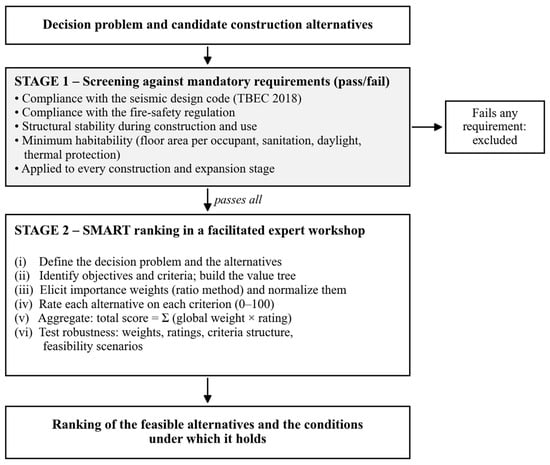
The framework consists of two stages (Figure 1). In Stage 1, each alternative is screened against mandatory requirements that are not open to trade-off: compliance with the seismic design code, in Türkiye the Turkish Building Earthquake Code (TBEC 2018) [35], and with the fire-safety regulation [36]; structural stability during construction and use; and minimum habitability standards, such as floor area per occupant, sanitation, daylight and thermal protection. For alternatives delivered in stages, the screening is applied to every stage, including the construction of later stages next to occupied units. Alternatives that fail any requirement are excluded. In Stage 2, the remaining alternatives are ranked with SMART in a facilitated expert workshop: the decision problem and the alternatives are defined; objectives and criteria are identified and arranged in a value tree; importance weights are elicited; each alternative is rated on each criterion on a 0–100 scale; the weighted ratings are aggregated; and the robustness of the ranking is tested by sensitivity analysis. Separating the two stages prevents the compensatory weighted sum from allowing good performance on, for example, delivery time to offset a failure to meet a safety requirement.
Figure 1.
Two-stage decision-support framework: screening against mandatory requirements (Stage 1) followed by SMART ranking in an expert workshop (Stage 2).
In this study, the ranking stage of the framework was applied in an expert workshop convened to explore priorities and to collect the weights and ratings needed for the SMART analysis; the three alternatives were assumed to meet the screening requirements, which were not formally checked in the workshop (Section 3.2). Because the participants were technical experts rather than affected households, local authorities or civil-society representatives, the workshop is an expert-led appraisal: its results show how one multidisciplinary panel of professionals weighed the alternatives, not which housing solution affected households would prefer or accept. Rather than proposing a universally applicable housing method, the study shows how the framework can identify context-appropriate solutions by evaluating alternatives systematically against locally defined priorities and criteria; the preferred solution may differ in other post-disaster contexts and with other stakeholder groups.
3. Application After the February 2023 Türkiye Earthquakes
3.1. Decision Context and Expert Panel
The workshop applied the ranking stage of the framework to a decision faced after the February 2023 earthquakes: the selection of a construction method for permanent multi-story mass housing in the affected provinces. The panel assessed this as a generic decision problem, without a specific site, from the perspective of a public housing agency as the decision-maker. The workshop was held on 14 November 2025 at Middle East Technical University in Ankara, as a one-day, in-person panel with two sessions. The workshop was moderated by the author, an architect with ten years of experience in construction. A panel of 17 professionals experienced in housing projects was assembled by purposive sampling to cover the areas of expertise relevant to post-disaster housing: structural and geotechnical engineering, architecture and planning, construction management, prefabrication and modular building, housing development, disaster and emergency management, and construction contracting (Table 1). Participants were selected on the basis of their experience in post-disaster reconstruction. Several of them also had specialist experience in housing reconstruction, disaster management or emergency accommodation (P11, P12, P16 and P17), and others worked for the public housing administration (P15) or for a construction company operating in the earthquake region (P14). The panel was intended to capture diverse perspectives of construction experts, in line with the exploratory nature of the study. The study did not include community perspectives or affected households, because its scope is limited to the selection of a construction technology, which requires construction expertise in post-disaster reconstruction. Local authorities and civil-society organizations were not invited for the same reason. However, in the later steps of the decision-making process, after the construction technology has been selected, a multidisciplinary team of experts representing multiple stakeholders should be involved in post-disaster reconstruction investment planning.
Table 1.
Composition of Experts.
3.2. Construction Alternatives
In the first session, the participants identified three construction methods for permanent post-disaster housing:
Alternative 1—Tunnel-form construction: cast-in-place reinforced-concrete buildings with a basement and three or four stories on raft foundations, built with a tunnel formwork system.
Alternative 2—Single-stage modular construction: multi-story buildings of factory-produced volumetric modules, installed in a single stage.
Alternative 3—Flexible modular construction: multi-story buildings of volumetric modules, installed incrementally in successive stages.
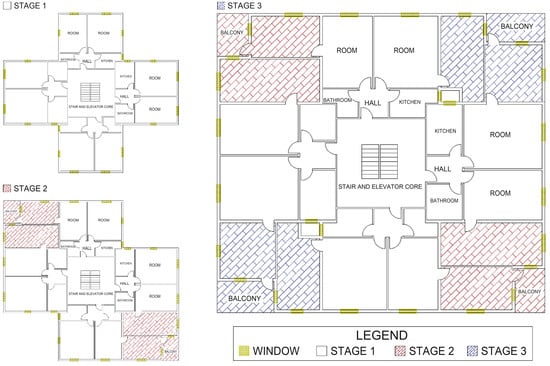
In Stage 1 of the flexible modular concept, a permanent core unit with the essential service spaces and a minimum number of rooms is delivered as soon as possible after the disaster (Figure 2, Stage 1). The living area at this stage is smaller than that of the completed dwelling; the aim is to move households from temporary shelters into permanent accommodation as early as possible. In the illustrative plan (Figure 2), the flats of a typical floor are arranged around a shared stair and elevator core, and later stages add rooms with balconies at the corners of the floor plate. Each flat has a floor area of 64 m2 in Stage 1; 21 m2 is added in Stage 2 and a further 21 m2 in Stage 3, so that the completed flat reaches 106 m2. The Stage 1 unit thus provides about 60% of the final floor area. In the workshop, the three alternatives were compared for flats of the same final size: Alternatives 1 and 2 deliver the 106 m2 flat in a single stage, whereas Alternative 3 delivers it in three stages.
Figure 2.
Typical floor plan of the flexible modular housing block in Stages 1–3 (illustrative). Floor area per flat: 64 m2 after Stage 1, 85 m2 after Stage 2 and 106 m2 after Stage 3.
In Stage 2, additional rooms and facilities are added to the core units according to a schedule agreed in advance (Figure 2, Stage 2), making use of the extendability of modular construction.
In Stage 3, at a predetermined later date, a further extension completes the dwellings (Figure 2, Stage 3). The number of extensions may vary with the architectural design and with the needs and priorities of the households. The foundations and building services are completed in Stage 1 for the final capacity of the building (Section 4.2); the construction of later stages next to occupied units nevertheless requires safety, logistics and weatherproofing measures, which are discussed in Section 5.
These alternatives reflect the workshop discussions and were considered reasonable options in this case; other experts could propose different solutions on the basis of their professional experience and of prevailing market and national conditions. In the workshop, the panel regarded resistance to earthquake damage as a prerequisite that was “not open to discussion” and considered all three alternatives able to meet it (Section 4.2); seismic safety was thus treated as a requirement rather than as a criterion to be traded off. A formal screening against the seismic code [35], the fire-safety regulation [36] and habitability standards was not carried out in the workshop; it is made explicit in the framework (Section 2.3) and, for Alternative 3, has to be applied to every expansion stage.
3.3. Workshop Procedure
As Green [31,32] emphasizes, a critical success factor of SMART applications is facilitated dialogue among all parties of the decision-making group. The workshop followed four steps:
Step 1—Briefing. The moderator explained the aim of the workshop: to develop a common understanding of the alternatives and to reach a group consensus on their comparative advantages. The briefing was given both orally by the moderator and in writing. Each participant was asked to form an initial view of the problem, and the discussion of alternatives and priorities continued until a consensus was reached.
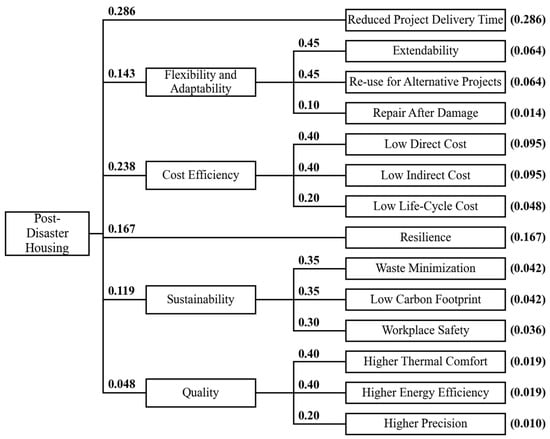
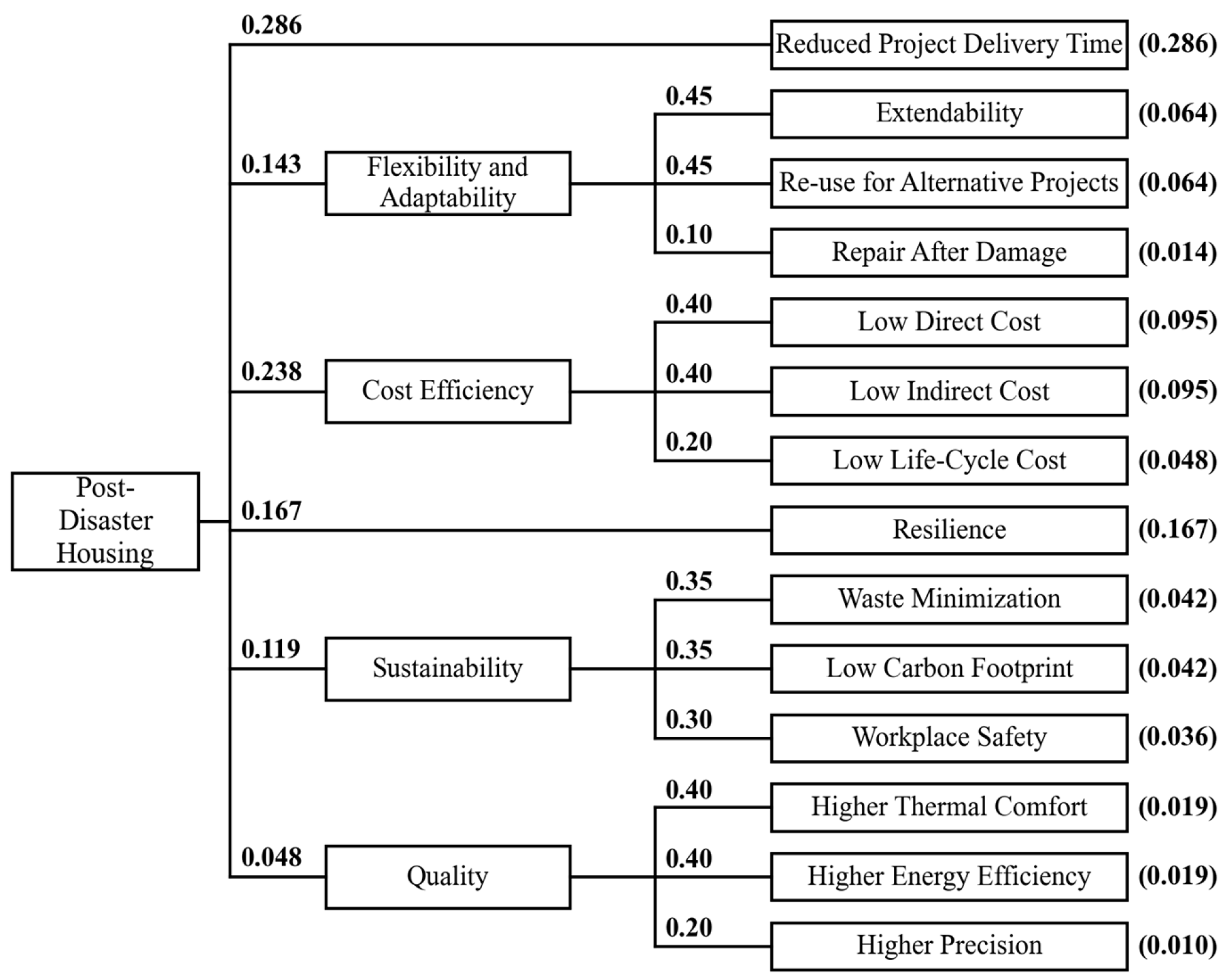
Step 2—Value tree and weights. The experts arranged the factors affecting their decision (objectives) in a hierarchy and assigned importance weights to them by the ratio method: the objective considered least important received a weight of 10, each other objective received a weight expressing how many times more important it was, and the weights were normalized to sum to 1 (Table 2). Local weights of the criteria within each objective were set in the same way and multiplied by the objective weights to obtain global weights (Figure 3). Objectives and weights were negotiated until every participant agreed, in a two-round process. In both rounds, the participants gave their judgments openly in the group discussion rather than individually and anonymously. Because the panel was interdisciplinary, the arguments raised by participants from other fields of expertise were discussed in both rounds and helped the panel to reach consensus. Because the judgments were given openly and negotiated face to face, the procedure is described as Delphi-inspired rather than as a classical Delphi process, which relies on anonymous iteration and a predefined consensus criterion [37]. The weights were elicited as direct importance ratios, not as swing weights; they were therefore not anchored to the ranges of the rating scales, a possible source of bias in additive models [34]; the effect of the weights on the ranking is examined in Section 4.3.
Table 2.
Importance weights of the objectives (ratio method; normalized weights rounded to three decimals).
Figure 3.
Value tree with local weights and, in parentheses, global weights (rounded to three decimals).
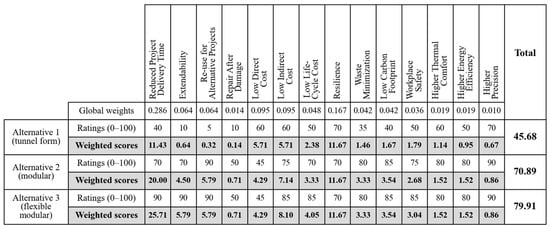
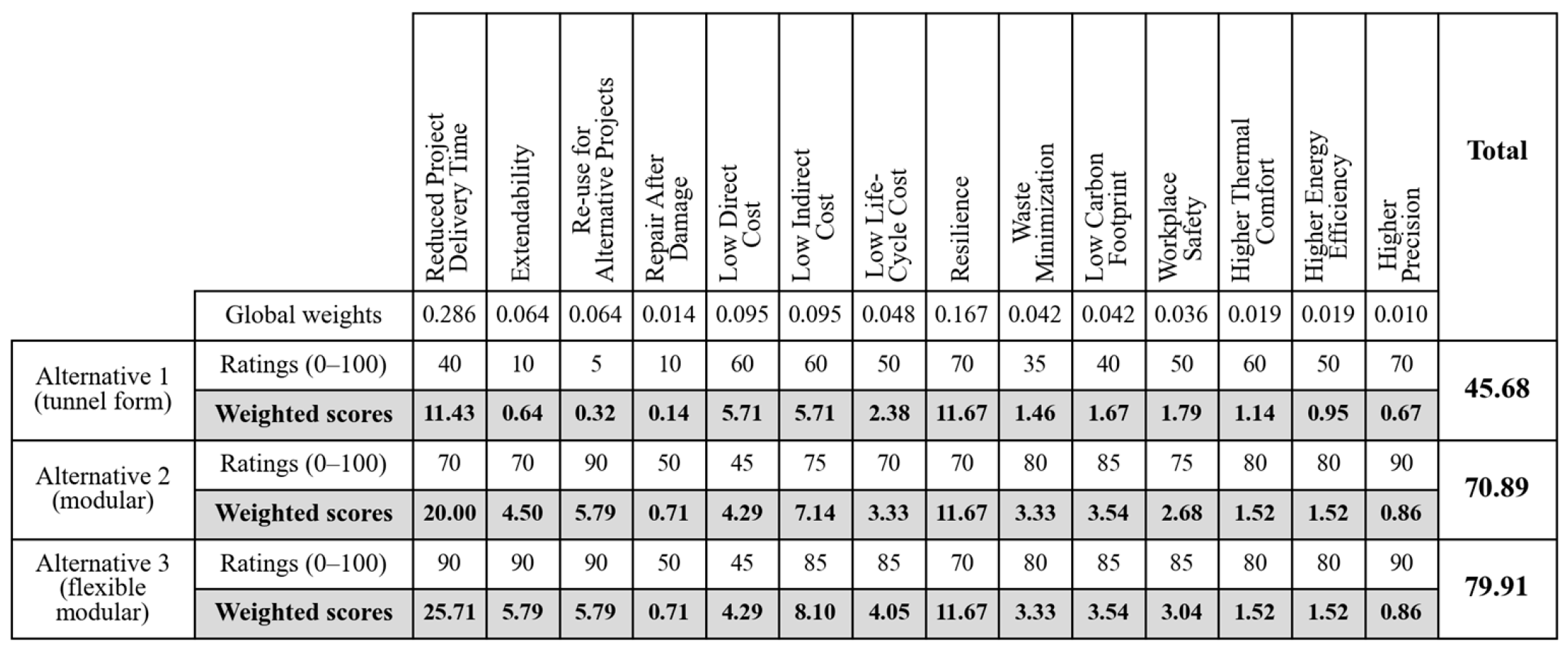
Step 3—Ratings. Each alternative was rated on each criterion on a 0–100 scale. The ratings were relative: they expressed how well each alternative performed on a criterion compared with the other two, and the end points of the scale were not defined independently of the three alternatives. The ratings are expert judgments informed by the participants’ experience and by the literature; no project-specific measurements of time, cost or energy performance were available, and no criterion-specific value functions were defined. The ratings were not averaged across individual participants: each rating in Figure 4 is the value on which the panel agreed by consensus after discussion. The arguments given for the ratings are summarized in Section 4.2.
Figure 4.
Decision matrix: ratings (0–100), weighted scores and total scores of the three alternatives, calculated with unrounded weights.
Step 4—Aggregation. For each alternative, the global weights were multiplied by the ratings and summed to obtain a total score on a 0–100 scale, which determines the ranking. For example, the global weight of extendability is (30/210) × 0.45 = 0.064; Alternative 3 was rated 90 on this criterion, which adds 0.0643 × 90 = 5.79 points to its total score. Summing these contributions over the fourteen criteria gives the total score of Alternative 3, 79.91 (Figure 4). All calculations use unrounded weights; values in tables and figures are rounded. The calculations are provided in Supplementary Spreadsheet S1.
Section 4 reports the weights (Section 4.1) and the ratings and ranking (Section 4.2) obtained in the workshop, followed by a sensitivity and robustness analysis carried out by the author after the workshop (Section 4.3).
4. Results
4.1. Objectives, Criteria and Weights
The panel identified six objectives and refined them until they reflected the priorities of reconstruction after the February 2023 earthquakes. Table 2 shows the weights agreed for the objectives. Reduced project delivery time received the highest weight (0.286), followed by cost efficiency (0.238), resilience (0.167), flexibility and adaptability (0.143), sustainability (0.119) and quality (0.048).
Two features of these weights need explanation (Table 2). First, quality received the lowest weight and delivery time a weight six times higher. In the value tree, “quality” is limited to thermal comfort, energy efficiency and dimensional precision (Figure 3); structural quality and safety are not part of this objective, because they are covered by the mandatory requirements of Stage 1. The ratio therefore expresses the panel’s view that, among code-compliant alternatives, the time needed to move households out of temporary shelters mattered far more than differences in comfort and precision. Second, resilience received a weight of 0.167, although the study follows a devastating earthquake. The panel regarded seismic safety as “not open to discussion” (Section 4.2); in the framework it is therefore treated as a screening requirement. The interpretation of the resilience weight as expressing only the preference for performance beyond the code minimum was added after the workshop and was not part of the criterion definition used by the panel. Because the panel rated all three alternatives equally on this criterion, its weight does not affect the ranking (Section 4.3).
The objectives were then broken down into fourteen criteria, which form the value tree in Figure 3. Table 3 defines each criterion as used in this study and the boundaries between criteria that could overlap. These definitions were written after the workshop, on the basis of the arguments recorded in it (Section 4.2), to make the meaning of each criterion explicit.
Table 3.
Evaluation criteria: definitions formulated after the workshop from the panel’s arguments, and boundaries between potentially overlapping criteria.
4.2. Ratings and Ranking
The panel then rated the three alternatives on each criterion. After iterative discussion, it agreed on the ratings and on the arguments behind them, which are summarized in Table 4. These arguments are the participants’ judgments; where an argument is also supported by the literature, the source is cited in the table.
Table 4.
Arguments given by the panel for the ratings.
The ratings agreed by the panel and the resulting weighted scores are shown in the decision matrix in Figure 4.
Flexible modular construction (Alternative 3) obtained the highest total score (79.91), followed by single-stage modular construction (Alternative 2, 70.89) and tunnel-form construction (Alternative 1, 45.68). The difference between the modular alternatives and tunnel-form construction comes mainly from reduced project delivery time, the highest-weighted objective (0.286), and from flexibility and adaptability, which has a moderate weight (0.143) but on which tunnel-form construction was rated very low: delivery time, re-use and extendability account for 17.89 of the 25.20-point difference between Alternatives 2 and 1. Cost efficiency, the second-highest-weighted objective (0.238), contributes only 0.95 points, because tunnel-form construction was rated higher on direct cost but lower on indirect and life-cycle cost. The difference between the two modular alternatives is analyzed in Section 4.3.
4.3. Sensitivity and Robustness Analysis
Because the weights and ratings are the judgments of one panel, the robustness of the ranking was examined after the workshop with five analyses [33,39]: (i) the contribution of each criterion to the differences in total score; (ii) one-at-a-time variation in each objective and criterion weight between 0 and 1, with the other weights rescaled proportionally, to identify the break-even points at which the ranking changes; (iii) probabilistic analyses with 20,000 random weight sets (objective weights drawn uniformly from all possible combinations, and objective weights varied by up to ±50%) and with random variations in all ratings by up to ±10 and ±20 points; (iv) alternative criteria structures in which overlapping criteria are merged or removed; and (v) stress-test scenarios for the assumptions on which the comparison of the two modular alternatives depends. In the probabilistic analyses, objective weights were drawn from a flat Dirichlet distribution or multiplied by independent factors drawn uniformly between 0.5 and 1.5 and then renormalized, and each rating was shifted by an independent, uniformly distributed amount and clipped to the 0–100 scale; weights and ratings were varied independently of each other and between alternatives. The analyses were run in Python version 3.9.6 (Python Software Foundation, Wilmington, DE, USA) with a fixed random seed, and the script is provided as Supplementary Code S1. The scenario values in (v) were set by the author to test these assumptions; they are not judgments of the panel. All results are reported in Table 5 and Table 6 and in Supplementary Spreadsheet S1.
Table 5.
Contribution of each criterion to the difference in total score between Alternative 3 (flexible modular) and Alternative 2 (single-stage modular).
Table 6.
Robustness of the ranking. W: weights; R: ratings; V: criteria structure; S: stress-test scenarios defined by the author (not judgments of the panel), expressed as changes in ratings. Ratings in the simulations are kept within 0–100. Break-even weights of direct cost (W2, W3) are shown rounded to three decimals (0.6624 and 0.7243 to four decimals); at each break-even weight the two alternatives concerned tie, and at a weight of 1, A1 > A2 = A3.
Table 5 decomposes the 9.02-point difference between Alternatives 3 and 2. Alternative 3 was rated at least as high as Alternative 2 on every criterion and higher on five of them. Delivery time alone accounts for 5.71 points (63%) of the difference, and extendability for a further 1.29 points (14%). The preference for Alternative 3 therefore follows mainly from the panel’s judgment that its core units can be occupied earlier, rather than from a balance of competing advantages. Because Alternative 3 dominates Alternative 2 in the ratings, no change in non-negative weights can reverse their order; the order can change only if the ratings themselves change.
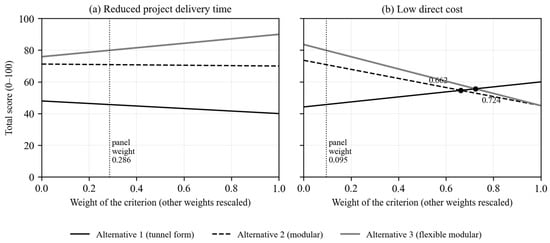
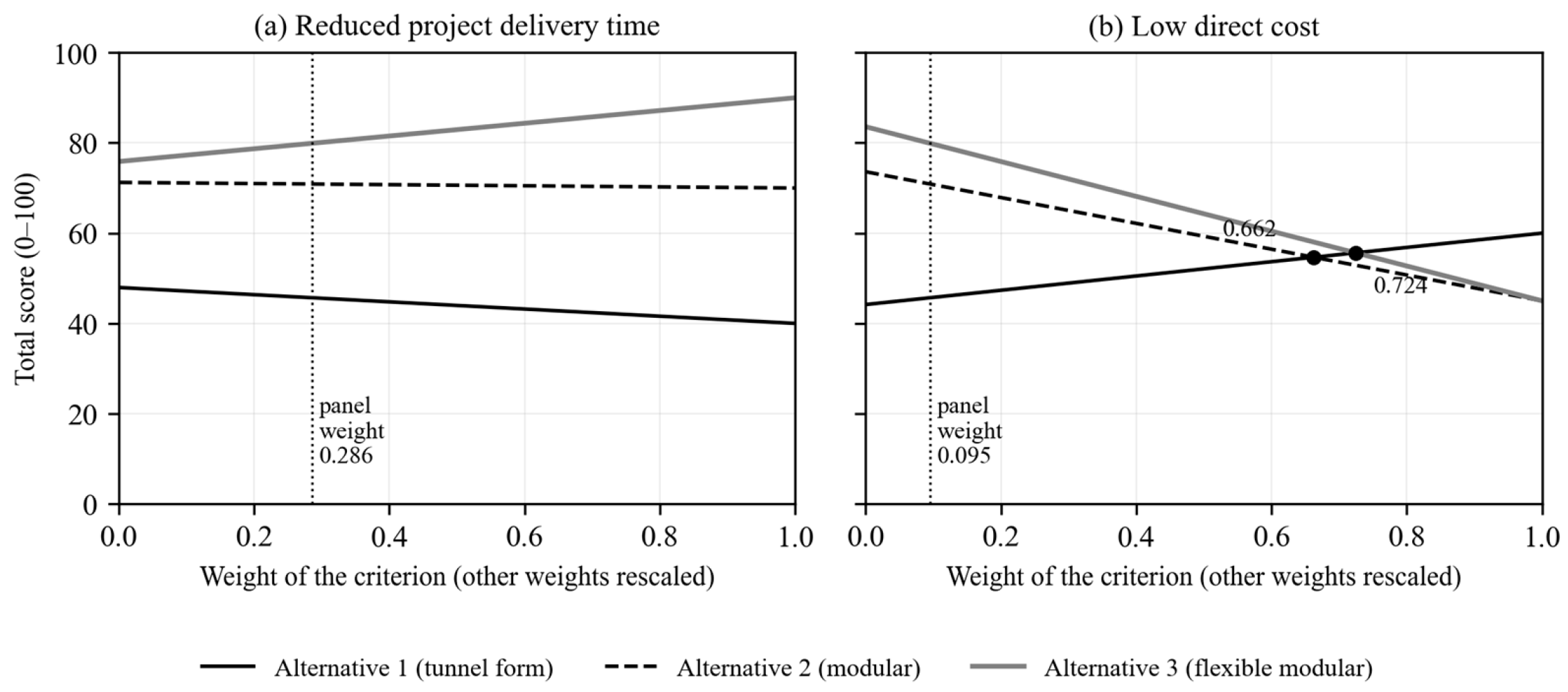
Changing the weights did not change the ranking except at extreme values (Figure 5; Table 6, W1–W6). The weight of delivery time could be varied over the full range from 0 to 1 without any change in the ranking. Tunnel-form construction overtook single-stage modular construction only when the weight of direct cost was raised from 0.095 to more than 0.662, and overtook flexible modular construction only above 0.724, that is, when direct cost alone carried about three quarters of the total weight. No change in any single objective weight between 0 and 1 reversed the ranking; at the limits, the alternatives tie (resilience) or Alternatives 2 and 3 tie (quality). Alternative 3 ranked first in all 20,000 random weight sets.
Figure 5.
Total scores of the three alternatives as a function of (a) the weight of reduced project delivery time and (b) the weight of low direct cost, with the other weights rescaled proportionally. Dotted lines mark the panel’s weights; dots mark the break-even points.
Random variations in all ratings changed the ranking more often than variations in the weights. With variations of up to ±10 points, Alternative 3 remained first in 99.9% of the simulations; with ±20 points, it remained first in 92.3%, and Alternative 2 ranked first in the remaining 7.7%. Combining ±20-point rating variations with ±50% weight variations gave 91.6% and 8.4%. Tunnel-form construction never ranked first. These percentages are conditional on the assumed ranges and distributions of the variations; they are not probabilities of real-world performance.
Merging or removing overlapping criteria did not change the ranking (Table 6, V1–V4). When thermal comfort, energy efficiency and life-cycle cost were merged into one criterion, and waste minimization and carbon footprint into another, each with the larger of the original weights, the totals changed by less than 0.6 points. Removing indirect cost, which partly follows from delivery time, changed them by at most 1.5 points. Removing resilience, on which all alternatives were rated equally and which the framework treats as a screening requirement, widened the gaps between the alternatives but did not change their order.
The stress tests (Table 6, S1–S7) examine the assumptions behind the comparison of the two modular alternatives. If delivery time is assessed on the completion of the final dwellings rather than on initial occupancy, so that Alternative 3 receives the same delivery-time rating as Alternative 2 (S1), its lead falls from 9.02 to 3.31 points; the two alternatives would be equal at a delivery-time rating of 58.4 for Alternative 3. If expansion is delayed or interrupted, so that Alternative 3 loses its advantages in extendability, indirect cost and life-cycle cost (S2), if direct cost is rated over all stages and inflation raises the cost of the later ones (S3), or if works next to occupied units reduce its ratings for workplace safety and resilience (S4), Alternative 3 still ranks first. When S1–S4 are combined (S6), however, Alternative 2 ranks first (70.89 against 67.32). A disruption of factory supply and transport, modeled as a 20-point reduction in the delivery-time ratings of both modular alternatives (S5), does not change the ranking, even when combined with a cost increase for tunnel-form construction due to demand surge in the affected region (S7). The preference for flexible modular construction is therefore robust to the weights and to moderate uncertainty in the ratings, but it depends on the assumption that staged expansion is delivered as planned and on the value the panel attached to early occupancy of a smaller core unit.
5. Discussion
Post-disaster housing has been studied from many perspectives [40,41,42]. The contribution of this study is methodological and illustrative. Green [31,32] developed SMART as a value-management tool in which stakeholders define and weight the objectives of building projects in a facilitated workshop; the present framework transfers this approach to post-disaster housing, separates mandatory safety and habitability requirements from preference criteria, and reports how sensitive the ranking is to the panel’s judgments. The workshop allowed the participants to consider the trade-offs between immediate needs and longer-term objectives, such as adaptability, sustainability, quality and resilience, rather than relying solely on construction speed or cost. All criteria, including time and cost, were rated by expert judgment, because project-specific measurements were not available. The ranking therefore reflects the collective prioritization of one expert panel under stated assumptions, not the demonstrated superiority of a construction method.
The panel rated tunnel-form construction low on delivery time, citing the sequential scheduling of site activities, exposure to adverse weather and shortages of skilled labor (Table 4). This result should be read against the reasons for the wide use of tunnel-form construction in Türkiye, where it is the main typology of mass housing [38]. Its use at scale is also likely to reflect existing domestic supply chains and the availability of a local construction workforce, although these factors were not assessed in this study. Tunnel-form buildings also performed well in the February 2023 earthquakes: according to TOKİ, 133,759 of its buildings in the affected provinces suffered no structural damage [10]. These conditions help to explain why the public housing administration has relied on tunnel-form construction for reconstruction at scale [10]. Conversely, the capacity of domestic factories to supply volumetric modules for several hundred thousand dwellings, a precondition for both modular alternatives, was not assessed in the workshop. Tunnel-form construction may therefore remain an appropriate choice where local labor and material capacity is available, reconstruction schedules are less constrained, or conventional building practices are preferred for economic or cultural reasons [43].
Single-stage modular construction was rated highly because off-site production and on-site installation can shorten delivery times considerably, which is of strategic value when rapid occupancy is the dominant priority. Off-site production may also reduce exposure to the local shortages of labor and materials that raise construction prices after large disasters (demand surge) [44], because much of the labor and part of the procurement take place outside the affected region. This advantage is conditional: factories and transport routes are also exposed to national demand and price increases, and where transport infrastructure is disrupted or factory capacity is limited, the time advantage may shrink (scenario S5 in Section 4.3).
Reviews report further advantages of modular construction, such as safer and faster production, less waste, fewer workers on site and better quality [13,17], lower embodied carbon emissions depending on the structural material and on the transport distance from the factory [45], and favorable life-cycle performance, for example in energy use [46]. Its shortcomings include high initial costs, limited design flexibility and complex transport logistics [13]. Modular construction therefore does not outperform conventional construction on every criterion: its strengths lie in speed, quality control and off-site efficiency, while it involves trade-offs in investment and logistics.
Flexible modular construction ranked first under the panel’s priorities. Its core units can be delivered quickly, allowing households to leave temporary shelters early, and rooms are added in later stages; deferring part of the investment may make the model attractive for low-income households. The sensitivity analysis shows, however, that this result rests mainly on the value attached to early occupancy of a smaller unit and on the assumption that the later stages are delivered as planned (Section 4.3). Three qualifications follow. First, the comparison with single-stage modular construction is fair only if the dwellings are comparable. The three alternatives were compared for flats of the same final size (106 m2), but a Stage 1 core unit offers only 64 m2 and, for a given household size, a lower occupancy standard than a completed dwelling, so the delivery-time advantage partly reflects the smaller amount of housing initially provided. Second, expanding multi-story blocks requires construction next to and above occupied units, with risks for occupant safety, crane logistics, and the weatherproofing and building-services connections between existing and new modules; these risks have to be checked in the screening stage for every expansion stage. Third, deferring expenditure does not lower the total cost: later stages are exposed to inflation and remobilization costs and depend on funding arrangements that were not specified in this study. Experience with incremental post-disaster housing shows that expansion follows diverse pathways that depend on household characteristics and needs, and that it can go beyond the parameters set by the designers [47]. Unless the funding and delivery of later stages are secured, for example by a public commitment that does not shift the inflation risk to households, the advantage of the flexible model over single-stage modular construction cannot be taken for granted.
An important implication of the workshop is that the preferred construction method should not be interpreted as universally applicable. The ranking reflects the priorities assigned by one expert panel to the selected criteria in a specific post-disaster context. Other stakeholder groups, above all the affected households, as well as other reconstruction objectives or resource constraints, may lead to different weights and thus to a different ordering of the alternatives. This is one of the strengths of SMART: it provides a transparent and structured framework for examining how stakeholder priorities influence decision outcomes, rather than prescribing a single best solution.
In this study, the choice of construction technology was framed as a technical decision, but the priorities of affected households could still affect it and should be examined in the next stage of the decision-making process. The composition of the panel is likely to have shaped the priorities reported here. Reviews of post-disaster housing show that outcomes for affected people depend not only on time but also on location, local resources, safety and quality [12], and that housing recipients can be dissatisfied with dwellings that do not fit their cultural and everyday needs [2]; community participation in reconstruction is therefore widely advocated [5]. Affected households might accordingly give more weight to floor area, dwelling layout, location and affordability, and judge criteria such as indirect cost, re-use and precision differently from construction professionals. The sensitivity analysis indicates how such differences could change the result: the ranking was insensitive to the weights but sensitive to how the alternatives are rated, in particular to whether delivery time is judged by the occupancy of a small core unit or by the completion of the final dwelling (scenario S1). Stakeholders who value a completed dwelling more than early occupancy would therefore narrow, or under less favorable assumptions reverse, the lead of flexible modular construction over single-stage modular construction. These expectations should be tested with a broader panel, which was beyond the scope of this study.
6. Conclusions
Providing shelter after an earthquake is a critical and sensitive task at both the temporary and the permanent housing stage. This article proposed an expert-based, two-stage decision-support framework that screens housing construction methods against mandatory safety and habitability requirements and ranks the remaining alternatives with SMART, and it illustrated the ranking stage with a workshop held after the February 2023 earthquakes in Türkiye, in which the three alternatives were assumed to meet the screening requirements. Under the weights and ratings of a 17-member expert panel, flexible modular construction ranked first, followed by single-stage modular construction and tunnel-form construction. Tunnel-form construction was rated low mainly on delivery time, re-use and extendability, and the two modular alternatives were preferred mainly because the panel expected them to move households into permanent housing sooner. The ranking was stable under wide variations in the weights and moderate variations in the ratings, but the lead of flexible modular construction depended on the value attached to early occupancy of a smaller core unit and on the assumption that the later stages are delivered as planned. These findings express the preferences of the participating experts under the stated assumptions; they do not show that any method delivers housing faster or at a lower cost in practice.
The study has several limitations. Most importantly, the panel consisted of seventeen technical experts and did not include affected households, local authorities or civil-society organizations; the results therefore cannot represent the priorities of the people to be housed, nor their acceptance of incremental housing. As the scope of this study was limited to the selection of the best construction technology based on technical expertise, a diversified panel and multiple stakeholder perspectives were not targeted. Second, the ratings are expert judgments without criterion-specific value functions or project-specific data on time, cost and energy performance, and the weights were elicited as importance ratios rather than as swing weights. Third, the screening stage was not formally carried out in the workshop, and the feasibility of staged expansion, including its structural, logistical and financial conditions, was assumed rather than verified. Fourth, the judgments were given openly and the workshop was moderated by the author, so an influence of dominant participants or of the moderator on the weights and ratings cannot be excluded. Fifth, the study evaluated the alternatives in a decision-making setting and did not assess their implementation under real-world constraints such as governance, funding, political and cultural factors. Future studies could apply the framework with larger and more diverse groups, including affected households, local authorities, NGOs and private-sector implementers, across several locations and disaster types; use swing weighting and explicit rating scales; and combine the workshop with follow-up interviews, pilot implementations and longitudinal evaluation to examine how SMART-based outputs translate into housing outcomes. Further research could compare alternative MCDM methods for the same decision and extend the framework from the choice of construction technology to reconstruction planning with a broader group of stakeholders.
7. Patents
The author declares that no patents have been filed or are planned to be filed in relation to the work reported in this manuscript.
Supplementary Materials
The following supporting information can be downloaded at: https://www.mdpi.com/article/10.3390/buildings16214467/s1, Spreadsheet S1: SMART calculations, sensitivity analysis and scenario tests; Code S1: Python script of the sensitivity analysis.
Funding
This research received no external funding.
Institutional Review Board Statement
Ethical approval was not sought for this study. The 17-member expert panel described in Section 3.1 participated in a non-interventional expert consultation in which adult professionals assessed construction alternatives in their professional capacity. The study did not involve clinical procedures or experimental interventions on participants. Personal information was limited to the identifying details contained in the signed consent forms and participants’ professional backgrounds, which are reported in de-identified form. The panel’s assessments are presented as collectively agreed weights and ratings without attribution to individual participants.
Informed Consent Statement
Written informed consent (wet-ink signature) was obtained from all 17 participants. In the consent form, the participants explicitly agreed to the sharing of their views and the findings and results of the workshop in academic publications. Participation was voluntary and could be ended at any time.
Data Availability Statement
The weights and ratings agreed in the workshop are reported in full in the article, the calculations are provided in Supplementary Spreadsheet S1, and the script of the sensitivity analysis in Supplementary Code S1. The signed informed consent forms are not publicly available because they contain identifying information.
Conflicts of Interest
The author declares no conflicts of interest.
References
- Moatty, A. Post-disaster recovery: Challenges and resources. In Territorial Crisis Management; Laganier, R., Veyret, Y., Eds.; ISTE: Arlington, VA, USA; Wiley: Hoboken, NJ, USA, 2022; pp. 109–129. [Google Scholar] [CrossRef] [Scilit]
- Rahmayati, Y. Reframing “building back better” for post-disaster housing design: A community perspective. Int. J. Disaster Resil. Built Environ. 2016, 7, 344–360. [Google Scholar] [CrossRef] [Scilit]
- Celentano, G.; Escamilla, E.Z.; Göswein, V.; Habert, G. A matter of speed: The impact of material choice in post-disaster reconstruction. Int. J. Disaster Risk Reduct. 2019, 34, 34–44. [Google Scholar] [CrossRef] [Scilit]
- Gunawardena, T.; Ngo, T.; Mendis, P.; Aye, L.; Crawford, R. Time-efficient post-disaster housing reconstruction with prefabricated modular structures. Open House Int. 2014, 39, 59–69. [Google Scholar] [CrossRef] [Scilit]
- Sadiqi, Z.; Trigunarsyah, B.; Coffey, V. A framework for community participation in post-disaster housing reconstruction projects: A case of Afghanistan. Int. J. Proj. Manag. 2017, 35, 900–912. [Google Scholar] [CrossRef] [Scilit]
- Mohammadnazari, Z.; Mousapour Mamoudan, M.; Alipour-Vaezi, M.; Aghsami, A.; Jolai, F.; Yazdani, M. Prioritizing post-disaster reconstruction projects using an integrated multi-criteria decision-making approach: A case study. Buildings 2022, 12, 136. [Google Scholar] [CrossRef] [Scilit]
- Alinezhad, A.; Khalili, J. SMART method. In New Methods and Applications in Multiple Attribute Decision Making (MADM); International Series in Operations Research & Management Science; Springer: Berlin/Heidelberg, Germany, 2019; Volume 277, pp. 1–7. [Google Scholar] [CrossRef] [Scilit]
- Kızılay Academy. 2023 Humanitarian Action Chronology in Türkiye; Kızılay Culture and Arts Publications: Istanbul, Turkey, 2024. [Google Scholar]
- Presidency of the Republic of Türkiye, Strategy and Budget Office. Türkiye Earthquakes Recovery and Reconstruction Assessment; Strategy and Budget Office: Ankara, Türkiye, 2023. [Google Scholar]
- Galasso, C.; Opabola, E.A. The 2023 Kahramanmaraş earthquake sequence: Finding a path to a more resilient, sustainable, and equitable society. Commun. Eng. 2024, 3, 24. [Google Scholar] [CrossRef] [Scilit]
- Presidency of the Republic of Türkiye, Directorate of Communications. Disaster of the Century: February 06, 2023 Kahramanmaraş Earthquakes; Directorate of Communications: Ankara, Türkiye, 2023. [Google Scholar]
- Gkoumas, I.; Mavridou, T.; Seymour, V.; Nanos, N. Post-disaster housing and social considerations. Int. J. Disaster Risk Reduct. 2025, 124, 105537. [Google Scholar] [CrossRef] [Scilit]
- Zohourian, M.; Pamidimukkala, A.; Kermanshachi, S.; Almaskati, D. Modular construction: A comprehensive review. Buildings 2025, 15, 2020. [Google Scholar] [CrossRef] [Scilit]
- Modular Building Institute. What Is Modular Construction? 2025. Available online: https://www.modular.org/what-is-modular-construction/ (accessed on 4 November 2026).
- Oorschot, L.; Asselbergs, T. New housing concepts: Modular, circular, biobased, reproducible, and affordable. Sustainability 2021, 13, 13772. [Google Scholar] [CrossRef] [Scilit]
- Ginigaddara, T.; Ekanayake, C.; Gunawardena, T.; Mendis, P. Resilience and performance of prefabricated modular buildings against natural disasters. Electron. J. Struct. Eng. 2023, 23, 85–92. [Google Scholar] [CrossRef] [Scilit]
- Ferdous, W.; Bai, Y.; Ngo, T.D.; Manalo, A.; Mendis, P. New advancements, challenges and opportunities of multi-storey modular buildings—A state-of-the-art review. Eng. Struct. 2019, 183, 883–893. [Google Scholar] [CrossRef] [Scilit]
- Lawson, R.M.; Ogden, R.G.; Bergin, R. Application of modular construction in high-rise buildings. J. Archit. Eng. 2012, 18, 148–154. [Google Scholar] [CrossRef] [Scilit]
- Edwards, W. How to use multiattribute utility measurement for social decisionmaking. IEEE Trans. Syst. Man Cybern. 1977, 7, 326–340. [Google Scholar] [CrossRef] [Scilit]
- Edwards, W.; Barron, F.H. SMARTS and SMARTER: Improved simple methods for multiattribute utility measurement. Organ. Behav. Hum. Decis. Process. 1994, 60, 306–325. [Google Scholar] [CrossRef] [Scilit]
- Taherdoost, H.; Madanchian, M. Multi-criteria decision making (MCDM) methods and concepts. Encyclopedia 2023, 3, 77–87. [Google Scholar] [CrossRef] [Scilit]
- Idmayanti, R.; Meidelfi, D.; Rahmayuni, I.; Sukma, F.; Ramadhani. The implementation of the simple multi attribute rating technique method for evaluating the guidance process for the final project of the applied software engineering technology students. Int. J. Adv. Sci. Comput. Eng. 2021, 3, 153–160. [Google Scholar] [CrossRef] [Scilit]
- Siregar, D.; Arisandi, D.; Usman, A.; Irwan, D.; Rahim, R. Research of simple multi-attribute rating technique for decision support. J. Phys. Conf. Ser. 2017, 930, 012015. [Google Scholar] [CrossRef] [Scilit]
- Saaty, T.L. How to make a decision: The analytic hierarchy process. Eur. J. Oper. Res. 1990, 48, 9–26. [Google Scholar] [CrossRef] [Scilit]
- Saaty, T.L. Fundamentals of the analytic network process—Dependence and feedback in decision-making with a single network. J. Syst. Sci. Syst. Eng. 2004, 13, 129–157. [Google Scholar] [CrossRef] [Scilit]
- Rezaei, J. Best-worst multi-criteria decision-making method. Omega 2015, 53, 49–57. [Google Scholar] [CrossRef] [Scilit]
- Si, S.-L.; You, X.-Y.; Liu, H.-C.; Zhang, P. DEMATEL technique: A systematic review of the state-of-the-art literature on methodologies and applications. Math. Probl. Eng. 2018, 2018, 3696457. [Google Scholar] [CrossRef] [Scilit]
- Hwang, C.-L.; Yoon, K. Multiple Attribute Decision Making: Methods and Applications. A State-of-the-Art Survey; Lecture Notes in Economics and Mathematical Systems; Springer: Berlin/Heidelberg, Germany, 1981; Volume 186. [Google Scholar] [CrossRef] [Scilit]
- Opricovic, S.; Tzeng, G.-H. Compromise solution by MCDM methods: A comparative analysis of VIKOR and TOPSIS. Eur. J. Oper. Res. 2004, 156, 445–455. [Google Scholar] [CrossRef] [Scilit]
- Figueira, J.; Mousseau, V.; Roy, B. ELECTRE methods. In Multiple Criteria Decision Analysis: State of the Art Surveys; Figueira, J., Greco, S., Ehrgott, M., Eds.; Springer: Berlin/Heidelberg, Germany, 2005; pp. 133–153. [Google Scholar] [CrossRef] [Scilit]
- Green, S.D. Beyond value engineering: SMART value management for building projects. Int. J. Proj. Manag. 1994, 12, 49–56. [Google Scholar] [CrossRef] [Scilit]
- Green, S.D. A SMART Methodology for Value Management; Occasional Paper No. 53; Chartered Institute of Building: Singapore, 1992. [Google Scholar]
- Belton, V.; Stewart, T.J. Multiple Criteria Decision Analysis: An Integrated Approach; Springer: Berlin/Heidelberg, Germany, 2002. [Google Scholar] [CrossRef] [Scilit]
- Fischer, G.W. Range sensitivity of attribute weights in multiattribute value models. Organ. Behav. Hum. Decis. Process. 1995, 62, 252–266. [Google Scholar] [CrossRef] [Scilit]
- Republic of Türkiye, Disaster and Emergency Management Authority (AFAD). Turkish Building Earthquake Code (Türkiye Bina Deprem Yönetmeliği); Official Gazette No. 30364; AFAD: Ankara, Türkiye, 2018. [Google Scholar]
- Republic of Türkiye. Regulation on the Fire Protection of Buildings (Binaların Yangından Korunması Hakkında Yönetmelik); Official Gazette No. 26735; Official Gazette: Ankara, Türkiye, 2007. [Google Scholar]
- Diamond, I.R.; Grant, R.C.; Feldman, B.M.; Pencharz, P.B.; Ling, S.C.; Moore, A.M.; Wales, P.W. Defining consensus: A systematic review recommends methodologic criteria for reporting of Delphi studies. J. Clin. Epidemiol. 2014, 67, 401–409. [Google Scholar] [CrossRef] [Scilit] [PubMed]
- Dede, Ş.; Rossetto, T.; Freddi, F.; Hancılar, U. Seismic fragility assessment of high-rise tunnel-form buildings using a bespoke damage scale. Bull. Earthq. Eng. 2025, 23, 6519–6550. [Google Scholar] [CrossRef] [Scilit]
- Triantaphyllou, E.; Sánchez, A. A sensitivity analysis approach for some deterministic multi-criteria decision-making methods. Decis. Sci. 1997, 28, 151–194. [Google Scholar] [CrossRef] [Scilit]
- Shahzad, W.M.; Rajakannu, G.; Kordestani Ghalenoei, N. Potential of modular offsite construction for emergency situations: A New Zealand study. Buildings 2022, 12, 1970. [Google Scholar] [CrossRef] [Scilit]
- Yakın, Ö.; Güncü, A. Post-disaster housing recovery models in Turkey: A case study of the 2020 İzmir Seferihisar earthquake. Int. J. Disaster Resil. Built Environ. 2026, 17, 239–257. [Google Scholar] [CrossRef] [Scilit]
- Kalak, M.; Zenter, Ö.; Özmen, E.F. Flexible model proposals for post-disaster temporary housing in architectural design. J. Des. Resil. Archit. Plan. 2024, 5, 496–509. [Google Scholar] [CrossRef] [Scilit]
- Wang, J.; Ng, Y.Y.E. Post-earthquake housing recovery with traditional construction: A preliminary review. Prog. Disaster Sci. 2023, 18, 100283. [Google Scholar] [CrossRef] [Scilit]
- Olsen, A.H.; Porter, K.A. What we know about demand surge: Brief summary. Nat. Hazards Rev. 2011, 12, 62–71. [Google Scholar] [CrossRef] [Scilit]
- Greer, F.; Horvath, A. Modular construction’s capacity to reduce embodied carbon emissions in California’s housing sector. Build. Environ. 2023, 240, 110432. [Google Scholar] [CrossRef] [Scilit]
- Kamali, M.; Hewage, K. Life cycle performance of modular buildings: A critical review. Renew. Sustain. Energy Rev. 2016, 62, 1171–1183. [Google Scholar] [CrossRef] [Scilit]
- Carrasco, S.; O’Brien, D. Incremental pathways of post-disaster housing self-recovery in Villa Verde, Chile. Architecture 2022, 2, 544–561. [Google Scholar] [CrossRef] [Scilit]

Disclaimer/Publisher’s Note: The statements, opinions and data contained in all publications are solely those of the individual author(s) and contributor(s) and not of MDPI and/or the editor(s). MDPI and/or the editor(s) disclaim responsibility for any injury to people or property resulting from any ideas, methods, instructions or products referred to in the content. |
© 2026 by the author. Licensee MDPI, Basel, Switzerland. This article is an open access article distributed under the terms and conditions of the Creative Commons Attribution (CC BY) license.