


Abstract
Urban outdoor lighting is encouraged to reduce energy use and mitigate artificial light at night, but light-emitting diode (LED) replacement and adaptive-control effects are often conflated, as are carbon reduction and light-pollution mitigation. This prioritised evidence map uses the Preferred Reporting Items for Systematic Reviews and Meta-Analyses extension for Scoping Reviews (PRISMA-ScR) to report selection and narrative synthesis. Web of Science and Scopus yielded 617 exports and 446 screened records. The original prioritised extraction produced 22 studies; a retrospective title/abstract audit and targeted author adjudication added seven, yielding 29 studies: 18 core and 11 background. Six system dimensions distinguish sensing, decision logic, networking, optics, supply, and service constraints. Energy outcomes remain baseline-dependent. Two core studies provide direct intervention-linked evidence of skyglow or ecological response, but neither establishes a complete joint energy, lighting-service, and ecological assessment. Adaptive lighting is therefore best understood as standard-constrained, demand-responsive control rather than simple dimming. The map remains limited by English-only extraction, non-independent screening, artificial intelligence-assisted triage, and non-exhaustive full-text selection. Future evaluations should separate LED and control effects and link energy performance to measured environmental outcomes rather than infer mitigation from reduced power alone.
1. Introduction
Outdoor lighting supports the use of public space after dark. It enables mobility and visual orientation, contributes to perceived safety, and supports night-time economic activity [1,2]. These services require energy and create environmental exposure over long nightly operating periods. Global assessments show that sky brightness and lit outdoor area have increased substantially in the satellite era [3,4], while ecological research increasingly treats artificial light at night (ALAN) as a pollutant rather than merely as an indicator of urbanisation [5,6]. Cities rely on outdoor lighting for access, wayfinding, perceived safety, and road-user visibility. When lighting is poorly specified or controlled, however, it can produce skyglow, glare, and light trespass, while excessive intensity or inappropriate spectra may increase ecological and circadian exposure [7,8,9].
The environmental concern depends on how closely light output matches actual night-time demand, both in its timing and in its spatial and spectral properties [10]. ALAN research links night lighting to changes in pollination and species behaviour, as well as human circadian and health risks [11,12,13]. Remote-sensing studies further show that the light visible from space and the light experienced on the ground do not always move in the same direction, especially during transitions from sodium lighting to broad-spectrum white light-emitting diodes (LEDs) [14,15]. A reduction in electricity demand does not automatically reduce upward light or sky brightness. Nor does it establish a reduction in short-wavelength emissions or biologically relevant exposure. Outdoor lighting consumes energy, supports the use and visual quality of public space, and produces environmental exposure beyond its intended area.
The transition to LED technology and networked control has intensified this tension. Compared with many legacy sources, LEDs can reduce electricity demand and support scheduled or sensor-linked dimming under remote control or a central management system (CMS) [1,16,17]. Adaptive systems use information about traffic and pedestrians together with ambient light or weather conditions to adjust output. Some also use schedules or predicted demand [18,19,20]. Wider smart-city literature places networked lighting within Internet of Things (IoT) infrastructures that coordinate urban services [21,22]. Field performance, however, depends on whether control commands and device feedback reach their destinations reliably. Dynamic street-lighting deployments and Long Range (LoRa)-based systems show why message loss, gateway design, and control latency matter [23,24]. Sensing and control decisions must work with the luminaires’ photometric characteristics, while maintenance and governance shape how the infrastructure operates over time.
However, the environmental meaning of this transition remains uncertain in the literature. Today, there is evidence that presents smart lighting as a route to both energy saving and light-pollution mitigation. Studies commonly quantify energy performance through power or electricity consumption and report associated cost or carbon estimates. Light-pollution benefits are often inferred from lower output or shorter operation without corresponding optical or ecological measurements [16,25,26]. LED replacement may reduce wattage while changing spectral composition. Adaptive dimming can reduce operating power without changing shielding or beam distribution; correlated colour temperature (CCT) and glare may also remain unchanged. Municipal LED-conversion and colour-sensitive remote-sensing studies illustrate the resulting uncertainty: an intervention can improve energy performance without resolving its effects on short-wavelength emissions, skyglow, or environmental exposure [14,15]. Evaluating sustainability therefore requires evidence that connects energy performance to lighting quality and environmental outcomes.
Safety adds a further constraint. Street lighting affects perceived reassurance and fear of crime, with implications for pedestrian route choice and acceptance of reduced lighting [2,27]. Large-scale evaluations of reduced street lighting and experimental evidence on added lighting show that safety and crime outcomes are context-dependent rather than reducible to a universal “more light is safer” rule [28,29]. Adaptive control must meet the applicable photometric requirements for the relevant lighting class while addressing visual comfort and transitions in brightness [30,31]. Studies that apply these requirements to traffic conditions or safety-critical locations illustrate how demand-responsive operation remains bounded by class-specific photometric requirements [16,17,19,20].
Walking comfort is also a service outcome, distinct from crime prevention. Burattini et al. [32] examined pedestrian ratings and scene luminance on five streets in Rome. Their findings connect comfort to the visible street environment and suggest considering surface reflectance rather than increasing lamp output alone. This observational study does not establish an adaptive-control saving percentage; it supports evaluating whether reduced output preserves a usable and comfortable walking environment.
These distinctions affect both evidence synthesis and municipal procurement: the benefit attributed to smart control depends on the comparison being made and on the outcomes actually assessed [2,17,28,33]. Studies differ in their settings and interventions, as well as in baseline choice and outcome measurement. Scoping-review reporting supports charting different evidence types and identifying knowledge gaps [34]. In this study, the map places each intervention beside its comparator, energy result, service constraints, and pollution indicators. Reading across these fields reveals which outcomes were reported together and which are absent. It is an organisational comparison, not a statistical estimate that energy savings caused an environmental benefit.
Preferred Reporting Items for Systematic Reviews and Meta-Analyses extension for Scoping Reviews (PRISMA-ScR) was selected to chart concepts, study designs, and outcome coverage across outdoor/public lighting rather than calculate one intervention effect [34]. The checklist guides reporting; it does not remove the limitations of non-independent screening or prioritised extraction. Four review questions (RQs) guide the review: (RQ1) which control strategies and enabling system components are used; (RQ2) how energy outcomes depend on their baselines; (RQ3) which lighting-quality and safety requirements constrain evaluation; and (RQ4) which pollution claims are supported by direct measurements rather than operational or quality proxies. Results map these questions to study-level evidence; Synthesis examines their relationships, and Discussion addresses procurement and research priorities.
2. Materials and Methods
This review used a PRISMA-ScR-informed prioritised evidence map with narrative synthesis. PRISMA-ScR provides a reporting framework for identifying, selecting, and charting evidence across different study designs [34]. Here, it informed transparent reporting rather than establishing exhaustive coverage: detailed full-text extraction was purposively prioritised within the post-screening candidate pool. No meta-analysis was conducted because contexts, interventions, comparators, and outcome metrics differed substantially. No prospective protocol was registered. Supplementary Tables S1–S6 document the charting, search provenance, screening decisions, and departures from exhaustive scoping-review practice. The PRISMA-ScR checklist is supplied separately as Supplementary Table S5. An additional PRISMA 2020 checklist [35] maps the applicable reporting items to manuscript locations and identifies items not performed or not applicable; it does not change the review design.
2.1. Information Sources and Search Strategy
Searches covered database inception to 15 May 2026 in Web of Science Core Collection and Scopus. These multidisciplinary databases supplied the formal, deduplicable identification set. Institute of Electrical and Electronics Engineers (IEEE) Xplore, ScienceDirect, and China National Knowledge Infrastructure (CNKI) were considered during protocol development and preliminary scoping but were not retained as formal retrieval sources. No records from these sources were added separately to the final identification set. This restricted source coverage may omit engineering conference literature and regional or non-English studies.
The two-layer strategy addressed a terminology problem: studies can evaluate adaptive outdoor lighting without describing their outcomes as light pollution. The precise query targeted records explicitly connecting outdoor lighting, smart control, energy, and pollution or photometric terms. The recall query used a broader vocabulary for control and outcomes, including safety, comfort, ecology, and spectral or photometric terms. Both layers contributed to one combined identification set; they were not analysed as separate evidence samples. Full queries and field tags are provided in Supplementary Table S2. The following short expression represents the precise query, rather than replacing the database-specific searches:
- (light pollution OR skyglow OR glare OR light trespass)
- AND (smart lighting OR adaptive lighting OR lighting control OR dimm*)
- AND (energy saving* OR energy efficien* OR energy consumption)
- AND (outdoor lighting OR public lighting OR street lighting OR road lighting)
2.2. Eligibility Criteria
Eligibility linked the outdoor-lighting context to the review’s control and outcome questions. Eligible sources were peer-reviewed journal articles and conference papers addressing outdoor or public lighting. Intervention-effect records in the core layer combined a substantive adaptive, smart, optical, computational, or control-oriented intervention with extractable energy, lighting-quality, safety, or light-pollution evidence. The charted core layer also contained enabling architecture and energy-autonomy records with extractable system-design or operating-performance information but no comparable adaptive-control effect estimate. These records informed the strategy taxonomy, not the estimation of control-specific energy savings. During revision, outcome eligibility was clarified to admit intervention-linked optical or ecological observations without an energy-saving percentage; this clarification and the resulting recovery of previously excluded studies are reported in Section 2.3. Ecological, policy, procurement, planning, and remote-sensing studies could enter the background layer when they contextualised these questions without contributing a control-effect estimate to the core comparisons. No formal publication-year limit was applied.
The extracted set was English-only; Chinese-language studies were not included. CNKI’s consideration in preliminary planning did not constitute a Chinese-language search in the final evidence map. The recorded query strings contain no language filter, but access to interpretable English-language full texts or sufficient publisher information constrained detailed extraction. This language restriction can introduce selection bias and limits geographic coverage. No translation-based or additional-language search was undertaken.
Exclusion covered indoor-only lighting, absence of substantive outdoor-lighting relevance, unrelated artificial intelligence (AI)/control methods, and duplicate records. Background evidence was distinguished from core intervention evidence rather than excluded solely for lacking an energy-saving estimate.
2.3. Screening, Prioritisation, and Evidence-Layer Assignment
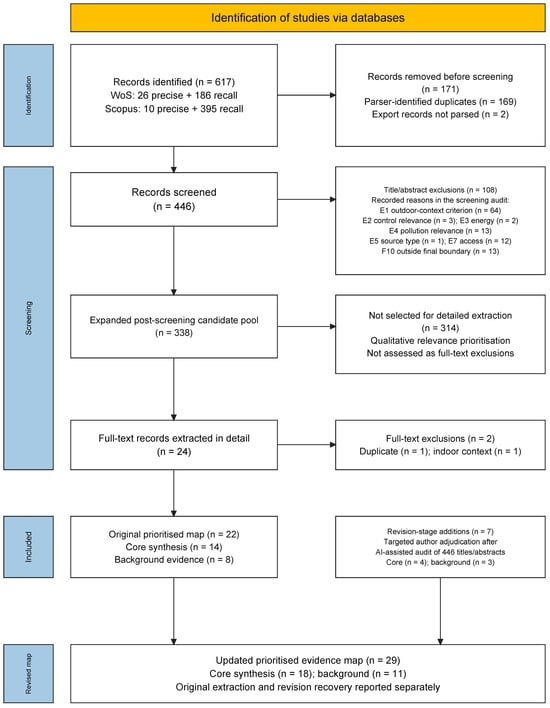
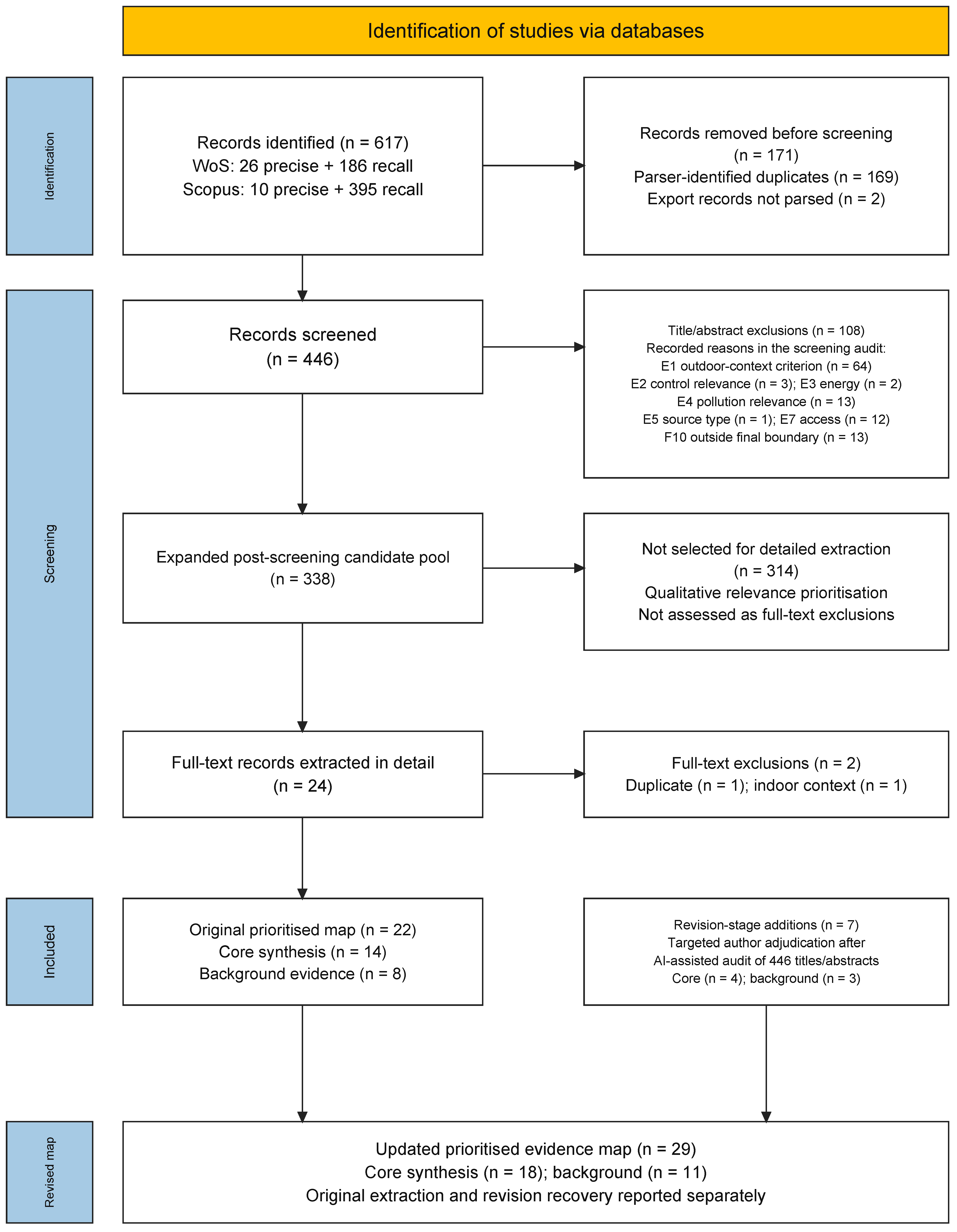
The precise queries returned 26 Web of Science and 10 Scopus records; the recall queries returned 186 and 395, respectively. The four Research Information Systems (RIS) exports contained 617 records. Zotero 9.0.6 and a local digital object identifier (DOI)/title-based workflow supported deduplication. The parser read 615 records and identified 169 duplicates; two export records were not parsed. Thus, 171 records were removed before screening, comprising 169 parser-identified duplicates and 2 unparsed records, leaving 446 records. Supplementary Table S2 preserves this distinction.
Initial screening was conducted by Zichen Liang using predefined criteria and a retained audit trail. Carlos C. Duarte reviewed the literature-selection results, and the two authors discussed the decisions jointly. This workflow did not involve independent duplicate screening. The first 100 records were screened manually; for the remaining 346 records, Codex (OpenAI; recorded session label GPT-5.5, 18 May 2026) generated a Python 3.13 keyword-rule classifier that supplied provisional tags. These were deterministic rule outputs, not individual large language model (LLM) screening judgments; assigned confidence values were rule-based priorities, not calibrated probabilities. Eighty-five uncertain records were manually reviewed, whereas 261 tags assigned high rule priorities were not individually re-screened. The original 24 detailed extractions were manually checked. The historical session label and rule-generation event were recovered during revision; an immutable backend model snapshot was not retained. These features remain methodological limitations. During revision, an AI-assisted retrospective title/abstract review covered all 446 records in four disjoint batches: 22 uncertain records, 49 records selected by pollution/receptor terms, 30 high-confidence checks, and 345 remaining records. The 30 checks comprised 28 randomly selected records and 2 targeted exclusions; this mixed batch is not an intra-rater reliability test. Targeted author adjudication, including full-text reading of priority records, determined the revision-stage additions and dispositions. The retrospective AI outputs were not treated as 446 new human decisions or as a full-text assessment of the entire candidate pool. Supplementary Tables S4 and S6 retain both stages separately.
Title/abstract screening yielded 316 include, 22 maybe, and 108 exclude tags. The first two groups formed the expanded post-screening candidate pool of 338 records. Selection for detailed extraction considered four dimensions: (1) outdoor/public-lighting context; (2) substantive control, optical, or computational intervention; (3) extractable energy or lighting-quality outcomes; and (4) relevance to direct or proxy light-pollution evidence. Prioritisation was qualitative, not a reproducible numerical ranking of all 338 candidates; the audit trail does not support reconstructing a score or a reason-specific exclusion count for each candidate.
Twenty-four records were originally selected for detailed extraction; 314 candidates were not fully assessed and were not full-text exclusions. Verification removed one duplicate and one indoor/building-context mismatch, producing the original 22-study map. The 108 historical title/abstract exclusion tags comprise E1 (64), E2 (3), E3 (2), E4 (13), E5 (1), E7 (12), and F10 (13). These historical labels and the original 617/171/446 identification sequence remain unchanged in the audit trail. Revision-stage adjudication added 4 core and 3 background studies, giving an updated map of 29 studies. Figure 1 distinguishes the original extraction pathway from these additions; the new studies are not retrospectively counted among the original 24 extractions.
Figure 1.
PRISMA-ScR flow diagram (adapted from PRISMA 2020 [35]). PRISMA, Preferred Reporting Items for Systematic Reviews and Meta-Analyses; PRISMA-ScR, PRISMA extension for Scoping Reviews; WoS, Web of Science; AI, artificial intelligence.
The revised core layer contains outdoor/public-lighting intervention studies with extractable energy, service-quality, optical, or ecological outcomes; a saving percentage is not required when an intervention-linked environmental outcome is measured. Two retained enabling architecture/energy-autonomy studies inform the taxonomy without contributing comparable control-effect estimates. The background layer contextualises ecological exposure, municipal planning, user experience, or prediction modelling. Layers indicate synthesis roles, not a ranking of study designs. The updated map contains 18 core and 11 background studies. The author retained two laboratory/prediction-only records outside the map: the artificial neural network (ANN) report evaluated prediction accuracy rather than a control-effect outcome, and the Arduino report was a laboratory-scale feasibility demonstration. Prototype/simulation status alone does not determine inclusion: comparative control/design outcomes differ from prediction accuracy alone, while the two architecture studies serve the taxonomy. These recorded author decisions do not establish consistent assessment of all other prototype, model or architecture candidates. Remaining priority candidates and potential duplicate groups require author adjudication; non-selection is not full-text exclusion. Selective prioritisation and its potential bias therefore limit coverage.
2.4. Data Charting, Appraisal, and Synthesis Approach
Data charting records each study’s context, intervention, comparator, energy outcome, environmental/service indicators, evidence role, and interpretation limits. Table 1 summarises the study groupings. The revised Supplementary Table S1 contains 29 records, with the seven revision-stage additions and their source locators identified separately. Author-confirmed inclusion and evidence-layer decisions are distinguished from source extraction performed with AI assistance; no independent second-reviewer verification or pilot validation of the extraction form is claimed.
Table 1.
Grouped summary of the revised 29-study evidence map. Groups are non-exclusive; full study-level charting is provided in Supplementary Table S1.
Second, each energy claim was assigned its comparator and evaluation mode: measured deployment, prototype test, simulation, design optimisation, secondary city-case reporting, or architecture without an effect estimate. LED replacement, adaptive control, and supply-side performance were kept distinct. Source-reported carbon estimates were charted separately; absent carbon values were not inferred from electricity savings or a generic emission factor.
Third, light-pollution claims were located along an emission–exposure–response chain. Emission describes light leaving the installation; exposure describes light received at a specified observer, window, habitat, or sky direction; response describes a measured biological, ecological, or human effect. A calibrated measurement of unwanted illuminance at a defined receiving location is direct evidence of that light-trespass component. It is not merely a proxy because it uses illuminance, and it does not by itself establish an ecological response.
For the corpus-level profile, the highest relevant evidence reported by each core study was assigned to one of five exclusive categories: (1) direct optical/ecological evidence, requiring an intervention-linked measurement of unwanted emission, environmental exposure, or a biological response; (2) near-direct photometric evidence, comprising optical modelling, design constraints, or source/road photometry from which an unwanted-light effect was inferred rather than measured at the affected receptor; (3) proxy-based evidence, using operating behaviour or lighting-quality indicators to infer a pollution benefit; (4) energy-only evidence, without a pollution-relevant photometric outcome; and (5) architecture/model-only evidence, without a comparable control-effect outcome. These categories classify the support for a pollution claim, not whether every individual instrument reading in a paper is direct. A study can therefore contain direct road-luminance measurements while its environmental claim remains near-direct.
Correlated colour temperature (CCT) is a colorimetric descriptor, not a measurement of short-wavelength radiation. Sources with equal CCT can have different spectral power distributions (SPDs). Spectral assessment requires the SPD at the relevant source or receptor, together with a stated spectral weighting when assessing a specific response. CCT, dimming profiles, activation accuracy, and maintained road uniformity do not substitute for these measurements. Optical measurements likewise do not establish biological outcomes without response data.
Fourth, a descriptive appraisal was applied consistently to all 18 core studies using five charted dimensions: (1) intervention specification; (2) energy comparator and metric; (3) environmental evidence and its position in the emission–exposure–response chain; (4) validation mode and applicability; and (5) reported trade-offs and interpretation limits. Supplementary Table S3 records these features without a numerical total or quality ranking. Missing electricity outcomes are distinguished from inadequate reporting when a study addresses an ecological or optical question. Historical 0–2 scores for the original 14 studies are retained separately for audit but are not used to weight the revised synthesis. This is a descriptive review of charted evidence, not a validated risk-of-bias assessment or a new independent full-text review of every original study. Interpretation is calibrated to the comparator, measurement scope and study design rather than an aggregate score.
Finally, narrative synthesis organised interventions through six non-exclusive system dimensions (Table 2), compared energy and carbon outcomes within their stated baselines, and examined quality/safety and pollution evidence separately. RQ1 maps to Section 3.2; RQ2 to Section 3.3; RQ3 and RQ4 to Section 3.4. Section 4 connects these findings to a proposed reporting framework, and Section 5 considers municipal application and the limits of the evidence. This charting-based approach follows the reporting intent of PRISMA-ScR [34]; it does not establish exhaustive coverage or a pooled causal effect.
Table 2.
Faceted taxonomy of smart outdoor lighting system dimensions.
3. Results
3.1. Screening Results and Included Evidence Map
The original identification and screening sequence was 617 exports, 171 pre-screening removals, and 446 screened records. Historical include/maybe tags yielded 338 candidates; 24 prioritised extractions produced 22 unique studies after 2 exclusions. Revision-stage audit and author adjudication added seven studies from the existing identification set; no new database search was conducted. The updated map contains 29 studies [1,5,7,8,9,10,16,17,18,19,20,25,26,33,36,37,38,39,40,41,42,43,44,45,46,47,48,49,50]: 18 core studies [1,16,17,18,19,20,25,26,36,37,38,39,40,41,44,45,46,47] and 11 background studies [5,7,8,9,10,33,42,43,48,49,50]. Two newly included direct-evidence studies had been excluded during the initial manually screened batch; their recovery demonstrates a limitation of the original selection, not solely an error attributable to AI triage.
Section 3.2 answers RQ1 through the system taxonomy and background context; Section 3.3 answers RQ2 through comparator-specific energy outcomes. Section 3.4 addresses RQ3 and RQ4 together while distinguishing service quality from unwanted-light effects. Table 1 groups studies thematically and non-exclusively; Table S1 lists studies alphabetically within evidence layers. Reference numbers identify sources and do not indicate evidence rank.
The core-synthesis layer supported comparison of control effects against their reported baselines, including energy outcomes and the quality or safety constraints under which they were obtained. The background-only layer contextualised the findings but was not treated as direct evidence of smart-control effects.
The 18 core studies cover outdoor public-space infrastructure from streets and bridges to parks and ports. Their comparators and evaluation modes differ (Section 3.3). Llido Escriva and Vadi [40,41] contribute architecture or autonomy evidence without a clean adaptive-control saving percentage. Bolliger and Barentine [44,45] add direct ecological and skyglow observations, respectively. Table 1 provides a non-exclusive summary; Supplementary Table S1 gives study-level charting.
3.2. Background Evidence and Control-Strategy Taxonomy
The 11 background studies explain why lighting should be evaluated beyond energy savings. They address bird and plant responses and circadian exposure [5,7,8,9]; planning and procurement studies document demand mismatch and municipal awareness [10,33]; remote sensing and transition analysis provide wider-scale context [42,43]. Pihlajaniemi et al. also report a one-day, sensor-data-driven energy simulation; this is not a metered annual field saving. Their assigned background role emphasises driver experience, not absence of all energy information. The revision adds drivers’ reported experiences of presence-sensitive lighting [48] and residents’ experiences of adaptive switching [49]. These are service and acceptability outcomes, not crash statistics or ecological measurements. Kundracik et al. [50] provide city-scale skyglow prediction modelling. The author classified this as background modelling rather than independent field-intervention evidence; it is not merged with Barentine’s 2020 intervention study [45].
Background studies do not contribute an adaptive-control energy-effect estimate in this synthesis. Some examine lighting interventions or user responses, but their assigned role is to contextualise environmental assessment and service acceptability. This distinction prevents subjective experience, prediction modelling, or broader ecological findings from being treated as interchangeable controller-performance measurements.
Because a single installation can combine sensing, prediction, communication, optical design, and energy management, the synthesis uses six multi-label system dimensions rather than mutually exclusive control families. Table 2 distinguishes demand inputs from decision logic and from the network that carries commands. Optics determines where the commanded light reaches; supply architecture determines how the load is powered; quality and safety constraints define permissible output. Daylight harvesting is an ambient-light input and control technique, not a renewable supply source.
Bachanek et al. [1] assemble smart-city cases and describe CMS/IoT coordination, but their secondary examples do not isolate one controller effect. Bollano et al. [39] link urban aesthetics and sensing to city upgrades: the reported Tirana reduction concerns LED replacement, whereas Kharkiv combines replacement and automatic control. Neither comparison identifies the marginal saving from control alone. Dwiyaniti et al. [18] demonstrate sensor-driven dimming and Raspberry Pi monitoring in a prototype; their contribution is hardware/control feasibility with a short power comparison, not city-scale optical validation. Poza-Lujan et al. [36] evaluate predictive activation through receiver operating characteristic (ROC) analysis. False activation and missed activation make the demand/comfort trade-off explicit but remain operational indicators rather than measurements of skyglow or trespass.
3.3. Energy Outcomes and Baseline Dependence
Energy outcomes were widely reported; interpretation depended on the comparator. Studies comparing legacy high-pressure sodium (HPS) or metal-halide lighting with LED-based smart systems reported total reductions, but those figures often combine LED replacement and adaptive control. Viswanathan et al. [17] provide a clear baseline separation: annual consumption decreased from 35,652 kWh under HPS lighting to 17,351 kWh under LED-only replacement, and then to 10,131 kWh when smart control was added. The additional smart-control contribution is therefore not equivalent to the total HPS-to-smart-system reduction.
Other studies used different baselines. Novak et al. [19] compared traffic-adaptive dimming with a 100% full-power use case and reported reductions from 21.5 Wh to 14.3–17.3 Wh over the observation window. Sifakis et al. [16] separated a first-stage replacement/layout intervention from full smart control, reporting 21.3% savings after stage 1 and 56.8% average annual savings after daylight harvesting and occupancy dimming were added. Shaheen et al. [20] compared model predictive control (MPC) with an existing scheduled dimming strategy and reported 31.94% annual savings per lamp, while Rocha et al. [38] compared algorithmic exterior-lighting design with professional manual design and reported a 37.5% reduction in its source-labelled consumption metric.
Table 3 compares the 18 core studies without merging measured, simulated, estimated, and secondary results. Sifakis et al. [16] calculate 42.72 t CO2-equivalent avoided emissions per year in their annual simulation; for Prasad [26], no numerical avoided-emission estimate was located. Missing carbon data were not inferred. Sifakis’s source-reported stage-1 percentage also does not reconcile with the rounded consumption pair and is not silently recalculated. Tsankov et al. [46] report an engineering-audit estimate for a combined retrofit/control project, not an isolated measured dimming effect. Their reported 1349 t/year carbon reduction uses a primary-energy conversion basis that includes a factor of three; it is not harmonised with a final-electricity emission estimate and is not directly compared with Sifakis’s carbon result. Spieringhs et al. [47] require 14% more luminous flux under the existing luminance criterion; their prospective saving depends on changing the evaluation constraint to visibility level (VL). More flux is not itself a measured increase in electrical consumption. Bolliger’s approximately 35% reduction concerns light levels, not electricity [44]. Barentine reports power in MW during a controlled dimming comparison, not annual energy in kWh [45].
Table 3.
Energy and carbon outcomes in the 18 core studies, interpreted against their comparators.
Table 4.
Joint reporting framework separating service, emission, exposure, and response outcomes.
These differences show why a pooled saving percentage would be misleading. The evidence supports the conclusion that smart outdoor lighting can produce additional energy savings, but the reported magnitude depends on whether the baseline is legacy lighting, LED-only replacement, static dimming, full-power operation, manual design, or another control configuration.
3.4. Light-Pollution and Lighting-Quality Evidence
The revised core corpus includes two direct intervention-linked environmental studies. Bolliger et al. [44] compare traffic-driven dimmed and undimmed weeks and measure insect abundance and bat activity. Responses vary by taxon and environmental conditions; fewer light-associated insects or bat passes are not automatically evidence of ecosystem recovery. Barentine et al. [45] measure skyglow during a municipal dimming intervention: reported declines are 5.4 ± 0.9% at Reid Park and 3.6 ± 0.9% at Tanque Verde. Concurrent telemetry-based system-power estimates are reported separately from those optical outcomes. These studies do not supply a complete energy–service–ecological outcome chain.
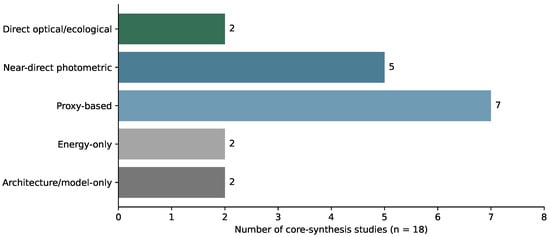
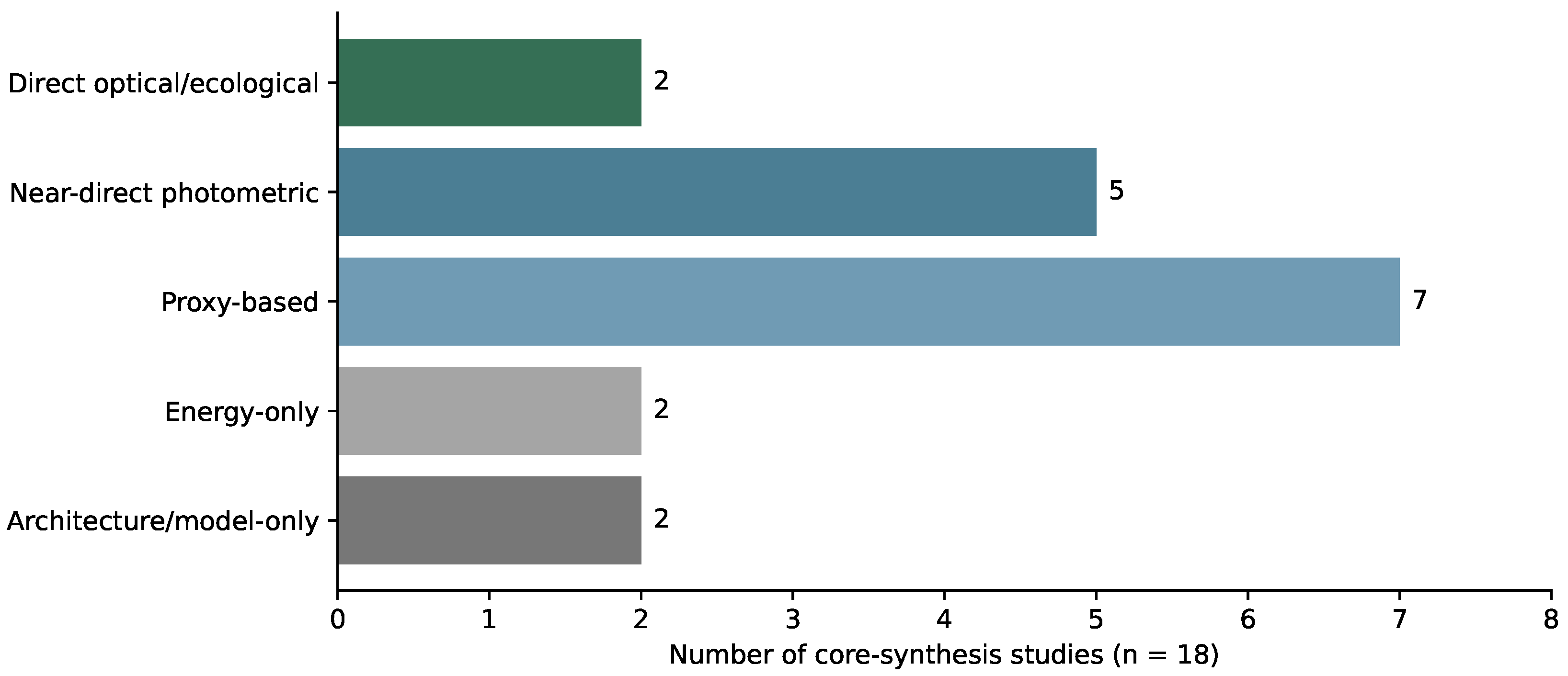
Figure 2 summarises the highest pollution-relevant category assigned to each of the 18 core studies: 2 direct optical/ecological, 5 near-direct photometric, 7 proxy-based, 2 energy-only, and 2 architecture/model-only. The categories are exclusive at the study level and describe this selected corpus, not literature-wide prevalence. Chen, Qin, and Rocha [25,37,38] provide source/road photometry or optical models rather than a measured intervention at an unwanted-light receptor. Spieringhs [47] adds modelled directional road-lighting evidence, with the altered-comparator limitation noted above. Tsankov’s simulated road compliance also supplies near-direct photometry, not receiving-site environmental measurements [46]. The study-level category assignments and source-based boundaries are recorded in Supplementary Table S1.
Figure 2.
Light-pollution evidence profile of the core-synthesis studies.
The other indicators describe dimming, activation, illuminance, uniformity, or glare compliance. These can directly describe lighting quality without directly measuring an environmental benefit. CCT adjustment is colorimetric information, not a measured reduction in short-wavelength radiation. Prasad [26] supplies deployment electricity comparisons and a carbon-footprint objective, but no direct optical-pollution measurement.
Quality constraints are nevertheless consequential. Novak et al. [19] link delay-based traffic control to road-lighting requirements; Qin et al. [37] specify a 5 lx design floor for their particular lawn-lighting context; Shaheen et al. [20] retain greater power at safety-critical microlocations. These are site-specific requirements, not a universal minimum for roads, parks, or ports. They address RQ3, while the distinction between environmental measurements and inferred benefits addresses RQ4.
4. Synthesis
4.1. Adaptive Lighting as Standard-Constrained Demand Response
Within the 18-study revised core corpus, adaptive outdoor lighting is better described as standard-constrained demand response than as simple dimming: output is reduced when demand and site conditions permit, but the response remains bounded by safety, visual-comfort, and lighting-quality requirements. The source of any reported energy benefit nevertheless needs to be identified. Hardware replacement and physical light-distribution design differ from adjustments to operating hours or output in response to users. Traffic adaptation and predictive optimisation are control mechanisms; renewable-energy management concerns supply. Only some of these mechanisms constitute adaptive lighting control in the strict sense.
Well-designed systems quantify how far output can be reduced while maintaining the required lighting class and photometric limits. They also account for visual comfort and safety margins during operation. This frames smart lighting as an infrastructure-control problem in which energy reduction is bounded by the applicable photometric requirements and visual stability.
4.2. Baseline Separation and Safety Constraints
LED replacement and adaptive controls must be evaluated as separate interventions, not as a single package. Several studies report energy reductions after street-lighting modernisation, but these reductions can combine lamp replacement, layout changes, operating schedules, and control algorithms. Treating all of these as “smart-control savings” would overstate the evidence for adaptive control.
Viswanathan et al. [17] provide a clear baseline separation. In their case-study model, the transition from HPS to LED-only lighting reduces annual electricity use, while adding smart control produces an additional reduction relative to the LED-only case [17]. This three-step comparison separates legacy-to-LED savings from the extra contribution of adaptive operation. Sifakis et al. [16] provide a related staged comparison: the first stage reduces consumption through equipment and layout changes, while the full smart-control scenario adds daylight harvesting and occupancy-based dimming. Shaheen et al. [20] compare MPC against an existing scheduled dimming baseline, which makes the reported saving closer to a control-specific effect than a lamp-replacement effect.
Bachanek et al. [1] and Bollano et al. [39] are useful city-scale sources, but their figures should be interpreted carefully. In Bollano et al. [39], Tirana’s reported reduction should be treated mainly as an LED replacement outcome, whereas Kharkiv is more relevant to the smart-control theme because it combines LED replacement with automatic lighting control. These examples support a central rule for this review: energy outcomes should be reported with their baseline attached. Without baseline stratification, a pooled headline saving percentage would be misleading.
Safety constraints define a separate limit on achievable savings. Adaptive lighting is bounded by standards and by the behaviour of users in public space. Well-designed systems meet the applicable photometric requirements and maintain transition behaviour needed for road users, pedestrians, and public-space occupants when activity is low. Novak et al. [19] show this in traffic-adaptive street lighting by linking dimming decisions to European Standard (EN) 13201 and International Commission on Illumination (CIE) 115 parameters [30,31]. Their delay parameter illustrates the trade-off: overly responsive switching may save more energy, but it can create visual instability, frequent switching events, or discomfort.
Sifakis et al. [16] similarly show that occupancy-based control can be constrained by a minimum dimming floor. Even when occupancy is low, the system does not reduce output to zero, because outdoor lighting infrastructure must preserve baseline safety and visual comfort. Viswanathan et al. [17] frame this issue through lighting-class selection and safety transition: sudden brightening may distract drivers, so luminaires should brighten before vehicles arrive within a safe distance. Shaheen et al. [20] extend the same logic through microlocation-aware MPC, in which critical locations such as intersections, crossings, and schools receive increased power. In that case, safety-critical areas partly explain why street-level savings are lower than single-lamp savings [20].
Qin et al. [37] add a smaller-scale example from park/lawn lighting. Their fuzzy-control and optical-design approach is linked to a minimum illuminance requirement and improved light-energy utilisation. This illustrates that safety constraints are not limited to roadways; public-space lighting also requires lower bounds, optical distribution, and visual-comfort considerations.
4.3. Over-Lighting, Under-Lighting, and Optical Evidence
Activation accuracy provides an operational evaluation: over-lighting and under-lighting can be treated as a measurable control trade-off. Poza-Lujan et al. [36] provide a useful vocabulary by applying ROC logic to street-lighting control. In their framing, a false positive occurs when the system predicts a user and raises lighting output although no user is present [36]. For this review, that condition can be interpreted as unnecessary activation, energy waste, and a proxy for avoidable over-lighting. A false negative occurs when the system fails to provide sufficient light when a user needs it; this corresponds to under-lighting and safety risk.
This framing avoids treating energy saving and safety as separate topics. Instead, it defines smart lighting as a predictive-control problem in which the system must reduce unnecessary output without missing real demand. The strongest adaptive system is not necessarily the one with the lowest energy use. It is the one that reaches an acceptable balance among reduced consumption, low false activation, low missed demand, and adequate pedestrian or driver comfort.
Environmental interpretation requires a different evidence test: energy or carbon metrics cannot be substituted for optical light-pollution evidence. Prasad [26] provides a useful boundary case. The study reports quantified electricity-saving evidence from a real smart-city street-lighting deployment [26], but does not directly measure optical pollution or ecological response. A lower carbon footprint is an energy-system outcome; it does not by itself demonstrate that light pollution has been reduced.
By contrast, Chen et al. [25] provide one of the near-direct photometric examples in the core set. Their low-mounting-height luminaire study reports surface luminance, stray-light reduction, flicker index, road luminance, uniformity, and glare-related indicators. Rocha et al. [38] connect energy efficiency with illumination quality and outside-area light-spill control through design-stage optimisation. Qin et al. [37] combine fuzzy control with secondary optical design, linking dimming with minimum illuminance, glare reduction, and improved light-energy utilisation.
These studies show why optical design should be treated as a distinct control layer. Algorithms and sensors determine when and how much light is emitted; optical design determines where that emitted light goes. Reduced electricity use alone does not establish that glare or spill light has been reduced. Spectral characteristics and ecological exposure also require assessment.
4.4. Evidence Gap and Joint Reporting Framework
The revised map no longer supports an absence claim about direct environmental evidence. Bolliger and Barentine [44,45] show that intervention-linked ecological and skyglow measurements are available. The remaining gap is joint reporting: many control studies quantify energy while inferring environmental benefit, whereas direct environmental studies do not necessarily assess annual energy, maintained service requirements, and ecological response together. A power reduction, a skyglow change, and a biological response therefore remain distinct findings.
The reporting framework in Table 4 separates service performance from environmental emission, exposure, and response. For obtrusive light, CIE 150 [51] provides the relevant assessment context, complementing EN 13201 and CIE 115 for road service. Its practical reporting implications include vertical illuminance at affected receiving planes, luminaire intensity in relevant directions, and upward-light or surface-luminance descriptors. The environmental zone and pre-/post-curfew condition must accompany the applicable criterion [52]. A reported compliance result should identify the receiving location, instrument or model, uncertainty, and contribution of background light. This framework does not propose a single numerical limit for every installation.
The pollution domains are separated into photometric, spectral, night-sky, temporal/operational, and biological/ecological evidence. SPD characterises the spectrum; any weighted exposure quantity requires a specified response function. An upward-light ratio (ULR) describes emission, not the resulting sky brightness. Skyglow also depends on angular and spectral distribution, directly emitted and reflected light, surface reflectance, and atmospheric conditions [15]. Consequently, emission estimates and observed sky brightness should be reported separately. Operating hours or dimming profiles are proxies unless receptor exposure is measured; exposure alone is not a measured biological response.
The reviewed studies suggest that adaptive outdoor lighting may reduce energy use while preserving lighting quality when control decisions account for demand and the applicable safety and photometric constraints. However, the evidence does not support a blanket claim that smart lighting automatically solves light pollution. Standard-constrained adaptive control offers a plausible and more explicitly controllable pathway for reducing unnecessary output, but direct comparative evidence against static LED replacement remains insufficient.
5. Discussion
5.1. Implications for Sustainable Built Environment and Smart Cities
Within the prioritised evidence map, smart outdoor lighting emerges as a problem of infrastructure governance rather than only a lamp-level technology problem. In sustainable built-environment research, lighting is often treated through hardware substitution, especially the transition from legacy luminaires to LED systems. The extracted evidence suggests that this is only the first layer. The next sustainability question is how urban lighting systems should be controlled after efficient hardware is installed: which spaces should be illuminated, when output should change, which class-specific safety and quality requirements should apply, and how optical spillover should be limited.
The system dimensions in Table 2 show how sensing and management can support responsive lighting. Their sustainability value depends on constraining control decisions to maintain lighting quality, including during transitions in output. Seeking maximum energy savings without such constraints can produce under-lighting or abrupt brightness changes, with consequences for visual comfort and perceived security.
For municipalities and procurement agencies, this means evaluating smart-lighting projects beyond electricity bills. Specifications should require a stated baseline and separate the contribution of LED replacement from adaptive control. They should also identify the applicable photometric requirements and the optical or spectral evidence used to assess over-lighting. Without this joint reporting, a project can appear sustainable in energy terms while leaving its optical and ecological effects largely unmeasured.
These implications connect directly to the Sustainable Development Goals (SDGs). SDG 7 (affordable and clean energy) motivates the energy-efficiency dimension of adaptive lighting, but energy efficiency alone does not capture the full sustainability picture. SDG 11 (sustainable cities and communities) requires urban infrastructure to support well-being and safety while maintaining environmental quality. SDG 13 (climate action) is relevant insofar as reduced electricity demand lowers emissions, but this benefit should not be conflated with optical or ecological light-pollution mitigation. The procurement requirements above address these different dimensions by linking reported savings to service quality and environmental evidence.
5.2. Evidence Gaps, Research Priorities, and Review Limitations
This review identifies five main evidence gaps across the prioritised literature, each pointing directly to a concrete research priority.
First, baselines are heterogeneous. Some studies compare adaptive systems with legacy HPS or metal-halide lighting; others compare them with static LED, full-power operation, manual design, or scheduled dimming. These baselines are not interchangeable: a legacy-lamp comparison can combine replacement and control effects, whose relative contributions cannot be established without an intermediate comparator. Future research should therefore establish a transparent baseline hierarchy, distinguishing legacy sources, LED-only retrofits, and scheduled dimming so that the marginal contribution of adaptive control can be evaluated as a distinct intervention.
Second, outcome evidence remains asymmetric. Energy performance is routinely quantified through power, kWh, or operating hours, whereas light-pollution mitigation is predominantly inferred from dimming depth, operating time, or CCT proxies. As outlined in the joint reporting framework (Table 4), operational proxies document control activity but, on their own, establish neither photometric compliance nor reduced environmental impact. Research priorities should therefore pair energy metrics with component-specific optical measurements and separately assessed biological responses, particularly where environmental claims are made.
Third, carbon metrics are sometimes conflated with optical mitigation. A reduction in electricity consumption can lower grid-related emissions, but it does not automatically reduce glare, spectral disturbance, or light spill into adjacent habitats. The review therefore treats carbon reduction and light-pollution mitigation as distinct evaluation axes. Future evaluations should report supply-side emission reductions alongside luminaire-level photometric and spectral distributions to prevent efficient lighting from being mischaracterised as environmentally benign.
Fourth, the spatial and temporal scales of evidence are mismatched. While engineering studies quantify energy savings over minutes, days, or annual simulations, ecological and circadian responses depend on cumulative, seasonal, or longitudinal exposure. Spatial assessment can benefit from combining ground-based photometry (capturing local illuminance, glare, and spectra) with satellite or aerial remote sensing (evaluating macro-scale brightness patterns and spatial inequities). These measurements do not replace longitudinal assessment of biological responses. Furthermore, control evaluations must incorporate safety-critical spatial logic: locations such as intersections, pedestrian crossings, and school zones present elevated risks and require explicit documentation of advance brightening distances, localised illuminance weighting, and baseline dimming floors.
Fifth, algorithmic reproducibility and geographic transferability remain limited. Many deployments describe promising architectures without sufficient detail or accessible data to reproduce the control logic or evaluate performance across differing traffic volumes, road geometries, and local standards. To improve transferability, future studies should report explicit control rules, sensor inputs, dimming schedules, prediction horizons, objective functions, and operational constraints, supported by open evaluation scripts and benchmark datasets wherever feasible.
This map remains constrained by two-database retrieval, English-only extraction, non-independent screening, and purposive full-text selection. Co-author review of selection results and joint discussion did not constitute independent duplicate screening. The revision-stage title/abstract audit used AI assistance across all 446 records, followed by targeted author adjudication rather than exhaustive manual re-screening or full-text assessment. Recovering two direct-evidence studies from the initial manually screened exclusions shows that the original selection was vulnerable to outcome-based exclusion and narrow prioritisation. The revised rule accepts intervention-linked optical or ecological outcomes without requiring an energy percentage, but it cannot establish that every relevant record has been recovered. Prototype and prediction-only boundary decisions remain selective. No prospective protocol was registered. All 18 core studies received the same descriptive appraisal; historical numerical scores were retained only for audit. The revised counts describe the charted set, not evidence prevalence in the full candidate pool.
6. Conclusions
This prioritised evidence map separates adaptive-control effects from LED replacement and energy supply. It comprises 29 studies (18 core and 11 background), with 7 revision-stage additions recorded separately from the original 617 database exports and 446 screened records. The six-dimensional taxonomy distinguishes control decisions from sensing, networks, optical design, energy supply, and service constraints.
Energy savings depend on the comparator. Viswanathan et al. [17] report modelled annual consumption of 35,652 kWh for HPS, 17,351 kWh for LED-only, and 10,131 kWh for smart control. The additional control contribution is approximately 42% against LED, compared with 71.6% for the combined intervention against HPS. Novak et al. [19] report 19.7–33.3% against a full-power use case. In the MPC assessment, the 31.94% single-lamp saving falls to 26.65% at street level because safety-critical locations retain more power [20]. These results support treating adaptive lighting as demand-responsive control subject to applicable photometric requirements, rather than arbitrary dimming.
In the core set, Bolliger et al. measured ecological responses and Barentine et al. measured skyglow changes during lighting interventions [44,45]. Bolliger’s reduction in light levels is not an electricity-saving estimate. Barentine’s telemetry-based power estimates describe a different outcome from the observed skyglow changes. These studies provide direct environmental evidence, but joint assessment of energy use, maintained lighting service, exposure, and biological response remains incomplete.
The map covers a selected corpus shaped by database and language coverage, non-independent AI-assisted screening, and prioritised extraction. Evaluations should separate LED replacement from adaptive-control effects and report the applicable lighting-class requirements alongside user experience. Claims of light-pollution mitigation should be supported by measurements of unwanted light or ecological response appropriate to the claimed effect.
Supplementary Materials
The following supporting information can be downloaded at https://www.mdpi.com/article/10.3390/buildings16214399/s1, Table S1: Study-level charting for all 29 studies in the prioritised evidence map. Table S2: Search strategy, export dates, record counts, and deduplication provenance. Table S3: Uniform descriptive appraisal of all 18 core studies; historical numerical scores retained separately for audit. Table S4: Original and retrospective AI-assisted triage, prompts, criteria, and verification scope. Table S5: PRISMA-ScR checklist with protocol deviations identified, also supplied as a standalone Portable Document Format (PDF) file. Table S6: Historical 446-record screening trail, with a separate dated revision-adjudication ledger. Additional file: PRISMA 2020 reporting checklist with manuscript locations and items not performed or not applicable identified. Tables S1–S6 are supplied as six separate editable spreadsheets and in the combined workbook Supplementary_Tables_S1-S6_editorial_20261009.xlsx. Table S6 preserves the historical 446-record screening values unchanged; a separately dated revision ledger records author adjudication. Table S1 contains the updated 29-study charting set, and Table S3 uses the same descriptive appraisal fields for all 18 core studies; historical scores are not used to rank them. Supplementary Table S4 describes the retrospective review without implying complete human verification. The standalone files are Table_S5_PRISMA_ScR_Checklist_20261009.pdf and PRISMA_2020_Checklist_20261009.pdf [34,35].
Author Contributions
Conceptualization, Z.L.; methodology, Z.L. and C.C.D.; data curation, Z.L.; writing—original draft preparation, Z.L.; writing—review and editing, Z.L., C.C.D. and N.D.C.; visualization, Z.L.; supervision, C.C.D. and N.D.C. All authors have read and agreed to the published version of the manuscript.
Funding
This research was funded in whole or in part by the Fundação para a Ciência e a Tecnologia, I.P. (FCT, https://ror.org/05qdjap63, accessed on 20 October 2026), under Grant of the Strategic Project with the references UID/04008/2025 and DOI https://doi.org/10.54499/UID/04008/2025 (accessed on 20 October 2026).
Institutional Review Board Statement
Not applicable.
Informed Consent Statement
Not applicable.
Data Availability Statement
The database queries, screening audit trail, study-level charting, appraisal rubric, and AI-triage disclosure are available in Supplementary Tables S1–S6, provided as separate editable spreadsheets and a combined workbook. Copyrighted full texts are not redistributed. No new experimental data were generated.
Acknowledgments
During manuscript preparation, Codex (OpenAI; recorded model labels GPT-5.5 in May 2026 and gpt-6.1-sol in September–October 2026) assisted coding, evidence charting, retrospective title/abstract triage, and language revision. Antigravity command-line interface (CLI) provided revision suggestions; its provider/model version was not independently verified. Codex assisted in writing the original rule-based screening script. The corresponding author reviewed and edited the AI-assisted manuscript text. Z.L. and C.C.D. discussed selection decisions jointly after C.C.D.’s review of the selection results. The authors take responsibility for the manuscript. Screening verification and model-provenance details are reported in Section 2.3 and Supplementary Table S4.
Conflicts of Interest
The authors declare no conflicts of interest.
References
- Bachanek, K.H.; Tundys, B.; Wiśniewski, T.; Puzio, E.; Maroušková, A. Intelligent Street Lighting in a Smart City Concepts-A Direction to Energy Saving in Cities: An Overview and Case Study. Energies 2021, 14, 3018. [Google Scholar] [CrossRef] [Scilit]
- Fotios, S.; Unwin, J.; Farrall, S. Road Lighting and Pedestrian Reassurance after Dark: A Review. Light. Res. Technol. 2015, 47, 449–469. [Google Scholar] [CrossRef] [Scilit]
- Falchi, F.; Cinzano, P.; Duriscoe, D.; Kyba, C.C.M.; Elvidge, C.D.; Baugh, K.; Portnov, B.A.; Rybnikova, N.A.; Furgoni, R. The New World Atlas of Artificial Night Sky Brightness. Sci. Adv. 2016, 2, e1600377. [Google Scholar] [CrossRef] [Scilit] [PubMed]
- Kyba, C.C.M.; Kuester, T.; Sanchez de Miguel, A.; Baugh, K.; Jechow, A.; Holker, F.; Bennie, J.; Elvidge, C.D.; Gaston, K.J.; Guanter, L. Artificially Lit Surface of Earth at Night Increasing in Radiance and Extent. Sci. Adv. 2017, 3, e1701528. [Google Scholar] [CrossRef] [Scilit] [PubMed]
- Gaston, K.J.; Davies, T.W.; Bennie, J.; Hopkins, J.; Fernandez-Juricic, E. Reducing the Ecological Consequences of Night-Time Light Pollution: Options and Developments. J. Appl. Ecol. 2012, 49, 1256–1266. [Google Scholar] [CrossRef] [Scilit] [PubMed]
- Davies, T.W.; Smyth, T. Why Artificial Light at Night Should Be a Focus for Global Change Research in the 21st Century. Glob. Chang. Biol. 2018, 24, 872–882. [Google Scholar] [CrossRef] [Scilit] [PubMed]
- Godet, L.; Challéat, S.; Barré, K. Part-Night Lighting Fails to Restore Natural Song Rhythms in Urban European Robins. Environ. Pollut. 2026, 396, 127837. [Google Scholar] [CrossRef] [Scilit] [PubMed]
- Lo Piccolo, E.; Torre, S.; Lauria, G.; De Quattro, C.; Sebastiani, F.; Guidi, L.; Remorini, D.; Massai, R.; Landi, M. LED Streetlamps Alter Tree Architecture, Downregulate the Photosynthetic Process and Alter the Sugar Metabolism of Populus alba L. Environ. Exp. Bot. 2024, 226, 105861. [Google Scholar] [CrossRef] [Scilit]
- Shu, F. Urban Lighting and Circadian Disruption: A Systematic Review and Policy Framework for Sustainable Nightscapes. BIO Web Conf. 2026, 214, 01014. [Google Scholar] [CrossRef] [Scilit]
- Zhang, L.; Huang, S.; Zhu, Y.; Hua, C.; Cheng, M.; Yao, S.; Li, Y. Supply and Demand for Planning and Construction of Nighttime Urban Lighting: A Comparative Case Study of Binjiang District, Hangzhou. Sustainability 2023, 15, 11288. [Google Scholar] [CrossRef] [Scilit]
- Cho, Y.; Ryu, S.H.; Lee, B.R.; Kim, K.H.; Lee, E.; Choi, J. Effects of Artificial Light at Night on Human Health: A Literature Review of Observational and Experimental Studies Applied to Exposure Assessment. Chronobiol. Int. 2015, 32, 1294–1310. [Google Scholar] [CrossRef] [Scilit] [PubMed]
- Svechkina, A.; Portnov, B.A.; Trop, T. The Impact of Artificial Light at Night on Human and Ecosystem Health: A Systematic Literature Review. Landsc. Ecol. 2020, 35, 1725–1742. [Google Scholar] [CrossRef] [Scilit]
- Knop, E.; Zoller, L.; Ryser, R.; Gerpe, C.; Horler, M.; Fontaine, C. Artificial Light at Night as a New Threat to Pollination. Nature 2017, 548, 206–209. [Google Scholar] [CrossRef] [Scilit] [PubMed]
- Sanchez de Miguel, A.; Bennie, J.; Rosenfeld, E.; Dzurjak, S.; Gaston, K.J. Environmental Risks from Artificial Nighttime Lighting Widespread and Increasing across Europe. Sci. Adv. 2022, 8, eabl6891. [Google Scholar] [CrossRef] [Scilit] [PubMed]
- Barentine, J.C.; Walker, C.E.; Kocifaj, M.; Kundracik, F.; Juan, A.; Kanemoto, J.; Monrad, C.K. Skyglow Changes over Tucson, Arizona, Resulting from a Municipal LED Street Lighting Conversion. J. Quant. Spectrosc. Radiat. Transf. 2018, 212, 10–23. [Google Scholar] [CrossRef] [Scilit]
- Sifakis, N.; Kalaitzakis, K.; Tsoutsos, T. Integrating a Novel Smart Control System for Outdoor Lighting Infrastructures in Ports. Energy Convers. Manag. 2021, 246, 114684. [Google Scholar] [CrossRef] [Scilit]
- Viswanathan, S.; Momand, S.; Fruten, M.; Alcantar, A. A Model for the Assessment of Energy-Efficient Smart Street Lighting-A Case Study. Energy Effic. 2021, 14, 52. [Google Scholar] [CrossRef] [Scilit]
- Dwiyaniti, M.; Nitisasmita, K.M.; Tohazen. Energy Efficiency on Smart Street Lighting Using Raspberry Pi Based on SCADA and Internet of Things (IoT). J. Phys. Conf. Ser. 2019, 1364, 012034. [Google Scholar] [CrossRef] [Scilit]
- Novak, T.; Pollhammer, K.; Zeilinger, H.; Schaat, S. Intelligent Streetlight Management in a Smart City. In Proceedings of the 2014 IEEE Emerging Technology and Factory Automation (ETFA), Barcelona, Spain, 16–19 September 2014; IEEE: Piscataway, NJ, USA, 2014; pp. 1–8. [Google Scholar] [CrossRef] [Scilit]
- Shaheen, H.I.; Yang, B.; Zuo, Y.; Vašak, M.; Lešić, V. Model Predictive Control for Adaptive Energy-Efficient Street Lighting: A Comprehensive Framework and Case Study. IEEE Trans. Ind. Electron. 2026, 73, 2960–2971. [Google Scholar] [CrossRef] [Scilit]
- Amarin, R.A.; Batarseh, I.; Rhoades, S. Efficient Energy Solutions: Enabling Smart City Deployment. In Proceedings of the 2016 Future Technologies Conference (FTC), San Francisco, CA, USA, 6–7 December 2016; IEEE: Piscataway, NJ, USA, 2017; pp. 791–795. [Google Scholar] [CrossRef] [Scilit]
- Agramelal, F.; Sadik, M.; Moubarak, Y.; Abouzahir, S. Smart Street Light Control: A Review on Methods, Innovations, and Extended Applications. Energies 2023, 16, 7415. [Google Scholar] [CrossRef] [Scilit]
- Lukkien, J.J.; Verhoeven, R. The Case of Dynamic Street Lighting: An Exploration of Long-Term Data Collection. In Proceedings of the 2015 IEEE 20th Conference on Emerging Technologies & Factory Automation (ETFA), Luxembourg, 8–11 September 2015; IEEE: Piscataway, NJ, USA, 2015; pp. 1–4. [Google Scholar] [CrossRef] [Scilit]
- Sanchez-Sutil, F.; Cano-Ortega, A. Smart Regulation and Efficiency Energy System for Street Lighting with LoRa LPWAN. Sustain. Cities Soc. 2021, 70, 102912. [Google Scholar] [CrossRef] [Scilit]
- Chen, S.; Zhang, B.; Zeng, X.; Lin, Y.; Zhao, H. Methods to Reduce Flicker and Light Pollution of Low-Mounting-Height Luminaires in Urban Road Lighting. Sustainability 2023, 15, 8185. [Google Scholar] [CrossRef] [Scilit]
- Prasad, R. Energy Efficient Smart Street Lighting System in Nagpur Smart City Using IoT-A Case Study. In Proceedings of the 2020 Fifth International Conference on Fog and Mobile Edge Computing (FMEC), Paris, France, 20–23 April 2020; IEEE: Piscataway, NJ, USA, 2020; pp. 100–103. [Google Scholar] [CrossRef] [Scilit]
- Green, J.; Perkins, C.; Steinbach, R.; Edwards, P. Reduced Street Lighting at Night and Health: A Rapid Appraisal of Public Views in England and Wales. Health Place 2015, 34, 171–180. [Google Scholar] [CrossRef] [Scilit] [PubMed]
- Steinbach, R.; Perkins, C.; Tompson, L.; Johnson, S.; Armstrong, B.; Green, J.; Grundy, C.; Wilkinson, P.; Edwards, P. The Effect of Reduced Street Lighting on Road Casualties and Crime in England and Wales: Controlled Interrupted Time Series Analysis. J. Epidemiol. Community Health 2015, 69, 1118–1124. [Google Scholar] [CrossRef] [Scilit] [PubMed]
- Chalfin, A.; Hansen, B.; Lerner, J.; Parker, L. Reducing Crime through Environmental Design: Evidence from a Randomized Experiment of Street Lighting in New York City. J. Quant. Criminol. 2022, 38, 127–157. [Google Scholar] [CrossRef] [Scilit]
- International Commission on Illumination. Lighting of Roads for Motor and Pedestrian Traffic, 2nd ed.; CIE 115:2010; CIE Central Bureau: Vienna, Austria, 2010; Available online: https://cie.co.at/publications/lighting-roads-motor-and-pedestrian-traffic-2nd-edition (accessed on 11 July 2026).
- European Committee for Standardization. EN 13201-2:2015; Road Lighting—Part 2: Performance Requirements. CEN: Brussels, Belgium, 2015.
- Burattini, C.; Bisegna, F.; De Santoli, L. Street Luminance and Night-Time Walking Comfort: A New Perspective for the Urban Lighting Design. J. Urban Des. 2025, 30, 52–70. [Google Scholar] [CrossRef] [Scilit]
- Korotko, T.; Rosin, A.; Varjas, T.; Ahmadiahangar, R. Awareness of BSR Municipalities about Sustainable Urban Lighting and Green Public Procurements. In Proceedings of the 2020 IEEE International Conference on Environment and Electrical Engineering and 2020 IEEE Industrial and Commercial Power Systems Europe (EEEIC/I&CPS Europe), Madrid, Spain, 9–12 June 2020; IEEE: Piscataway, NJ, USA, 2020; pp. 1–6. [Google Scholar] [CrossRef] [Scilit]
- Tricco, A.C.; Lillie, E.; Zarin, W.; O’Brien, K.K.; Colquhoun, H.; Levac, D.; Moher, D.; Peters, M.D.J.; Horsley, T.; Weeks, L.; et al. PRISMA Extension for Scoping Reviews (PRISMA-ScR): Checklist and Explanation. Ann. Intern. Med. 2018, 169, 467–473. [Google Scholar] [CrossRef] [Scilit] [PubMed]
- Page, M.J.; McKenzie, J.E.; Bossuyt, P.M.; Boutron, I.; Hoffmann, T.C.; Mulrow, C.D.; Shamseer, L.; Tetzlaff, J.M.; Akl, E.A.; Brennan, S.E.; et al. The PRISMA 2020 Statement: An Updated Guideline for Reporting Systematic Reviews. BMJ 2021, 372, n71. [Google Scholar] [CrossRef] [Scilit] [PubMed]
- Poza-Lujan, J.L.; Saenz-Penafiel, J.J.; Posadas-Yague, J.L.; Conejero, J.A.; Cano, J.C. Use of Receiver Operating Characteristic Curve to Evaluate a Street Lighting Control System. IEEE Access 2021, 9, 144660–144675. [Google Scholar] [CrossRef] [Scilit]
- Qin, X.; Wang, Z.; Zhang, M.; Feng, Y.; Li, K. Lawn Lamp Design Based on Fuzzy Control and Secondary Optical Optimization. Appl. Sci. 2023, 13, 1631. [Google Scholar] [CrossRef] [Scilit]
- Rocha, H.; Peretta, I.S.; Lima, G.F.M.; Marques, L.G.; Yamanaka, K. Exterior Lighting Computer-Automated Design Based on Multi-Criteria Parallel Evolutionary Algorithm: Optimized Designs for Illumination Quality and Energy Efficiency. Expert Syst. Appl. 2016, 45, 208–222. [Google Scholar] [CrossRef] [Scilit]
- Bollano, S.; Manehasa, K.; Melnyk, N. Intelligent System-Powered Street Lighting in Ensuring Efficiency and Aesthetics of Urban Space. AIS—Archit. Image Stud. 2025, 6, 188–203. [Google Scholar] [CrossRef]
- Llido Escriva, D.M.; Berlanga-Llavori, R.; Torres-Sospedra, J. Smart Outdoor Light Desktop Central Management System. IEEE Intell. Transp. Syst. Mag. 2018, 10, 58–68. [Google Scholar] [CrossRef] [Scilit]
- Vadi, S. Design and Implementation of an Off-Grid Smart Street Lighting System Using LoRaWAN and Hybrid Renewable Energy for Energy-Efficient Urban Infrastructure. Sensors 2025, 25, 5579. [Google Scholar] [CrossRef] [Scilit] [PubMed]
- Bódizs, D.; Zseni, A.; Schmeller, D. AI-Driven Adaptive Urban Lighting for Reducing Light Pollution and Energy Consumption in a Multi-Level Perspective. Energies 2026, 19, 1128. [Google Scholar] [CrossRef] [Scilit]
- Chen, F.; Wang, L.; Wang, N.; Guo, H.; Chen, C.; Ye, C.; Dong, Y.; Liu, T.; Yu, B. Evaluation of Road Network Power Conservation Based on SDGSAT-1 Glimmer Imagery. Remote Sens. Environ. 2024, 311, 114273. [Google Scholar] [CrossRef] [Scilit]
- Bolliger, J.; Hennet, T.; Wermelinger, B.; Bösch, R.; Pazur, R.; Blum, S.; Haller, J.; Obrist, M.K. Effects of traffic-regulated street lighting on nocturnal insect abundance and bat activity. Basic Appl. Ecol. 2020, 47, 44–56. [Google Scholar] [CrossRef] [Scilit]
- Barentine, J.C.; Kundracik, F.; Kocifaj, M.; Sanders, J.C.; Esquerdo, G.A.; Dalton, A.M.; Foott, B.; Grauer, A.; Tucker, S.; Kyba, C.C.M. Recovering the city street lighting fraction from skyglow measurements in a large-scale municipal dimming experiment. J. Quant. Spectrosc. Radiat. Transf. 2020, 253, 107120. [Google Scholar] [CrossRef] [Scilit]
- Tsankov, P.; Yovchev, M.; Ibrishimov, H. Energy-efficient light-emitting diode retrofit and advanced control in municipal street lighting: A case study from Bulgaria. Asian J. Water Environ. Pollut. 2025, 22, 180–197. [Google Scholar] [CrossRef] [Scilit]
- Spieringhs, R.M.; Smet, K.; Heynderickx, I.; Hanselaer, P. An asymmetric road lighting concept: Probeam. Light. Res. Technol. 2024, 56, 527–545. [Google Scholar] [CrossRef] [Scilit]
- Pihlajaniemi, H.; Luusua, A.; Juntunen, E. Drivers’ Experiences and Informed Opinions of Presence Sensitive Lighting Point towards the Feasibility of Introducing Adaptive Lighting in Roadway Contexts. Smart Cities 2023, 6, 1879–1900. [Google Scholar] [CrossRef] [Scilit]
- Haans, A. Effects of Smart Adaptive Street Lighting on Residents’ Behavior and Experiences: Results from a Field Test. In Proceedings of the 2024 IEEE Sustainable Smart Lighting World Conference & Expo (LS24), Eindhoven, The Netherlands, 12–14 November 2024; IEEE: New York, NY, USA, 2025; pp. 1–4. [Google Scholar] [CrossRef] [Scilit]
- Kundracik, F.; Kocifaj, M. SkyGlow Model Successfully Applied to the Evaluation of the Light Pollution over Tucson, U.S. In Proceedings of the 2018 VII. Lighting Conference of the Visegrad Countries (Lumen V4), Trebic, Czech Republic, 18–20 September 2018; IEEE: New York, NY, USA, 2018; pp. 1–5. [Google Scholar] [CrossRef] [Scilit]
- International Commission on Illumination. Guide on the Limitation of the Effects of Obtrusive Light from Outdoor Lighting Installations, 2nd ed.; CIE 150:2017; CIE Central Bureau: Vienna, Austria, 2017. [Google Scholar] [CrossRef] [Scilit]
- Institution of Lighting Professionals. The Reduction of Obtrusive Light; Guidance Note 01/21; ILP: Rugby, UK, 2021; Available online: https://theilp.org.uk/static/d008b204-4eec-4ec8-997b08f2becac6ee/GN01-ILPGuidanceNote1thereductionofobtrusivelight-2021v2-60iqak.pdf (accessed on 30 September 2026).

Disclaimer/Publisher’s Note: The statements, opinions and data contained in all publications are solely those of the individual author(s) and contributor(s) and not of MDPI and/or the editor(s). MDPI and/or the editor(s) disclaim responsibility for any injury to people or property resulting from any ideas, methods, instructions or products referred to in the content. |
© 2026 by the authors. Licensee MDPI, Basel, Switzerland. This article is an open access article distributed under the terms and conditions of the Creative Commons Attribution (CC BY) license.