


Abstract
The global construction industry today faces a major dual challenge: meeting the growing demand for building materials while reducing its environmental footprint. This work aims to study the feasibility of recycling granite floor tile waste (GFTW) and sidewalk floor tile waste (SFTW) instead of natural sand in self-compacting sand concrete (SCSC) manufacturing. For this purpose, thirteen SCSC mixes were produced in which 10% to 60% of the sand was replaced in volume by GFTW or SFTW. The rheological and physico-mechanical characteristics of different SCSC were examined and compared with the control SCSC (mini-slump flow diameter, V-funnel flow time, yield stress, plastic viscosity, air content, dry density, compressive and flexural strength, elastic modulus, ultrasonic pulse velocity, water absorption, porosity, and residual performance after elevated temperature exposure). The obtained results indicate that using up to 60% FTW as sand in SCSC reduces the workability of SCSC and increases its entrapped air content. However, the mechanical strengths, modulus of elasticity, and resistance to elevated temperatures were improved with the replacement of sand by FTW, with an optimum of 40% and 50% for GFTW and SFTW, respectively. Finally, reusing FTW as an alternative to natural sand in SCSC is highly recommended in construction for various structural components from an environmental and technological perspective.
1. Introduction
The complex architectural design of contemporary structural elements and their denser reinforcement have made fluid concrete manufacturing without large aggregates among the most important desires and challenges facing the construction industry, facilitating implementation and avoiding the need for compaction [1]. Furthermore, reducing the use of natural raw materials as part of an ecological trend has become a major concern for researchers in the construction field [2]. Moreover, waste storage has become a serious environmental problem, especially in cities with limited waste disposal sites [3]. To respond to these problems, the development of eco-construction materials is an absolute necessity. Hence, recycling and use of new materials from various industrial activities (waste) are becoming more popular, which presents considerable economic, energetic, and environmental benefits [4,5,6,7,8,9,10].
The construction sector is considered the major generator of waste due to rapid global urbanization and increasing infrastructure growth. It produces approximately 300 million tons of waste each year, primarily consisting of inert materials [11]. According to research estimates, the global quantity of construction waste is predicted to reach 27 billion tons by 2050 [12]. Additionally, all new works require enormous quantities of aggregate. The current trend is to use recycled aggregates that avoid waste accumulation and reduce the consumption of natural resources needed to produce aggregates while retaining the required properties of concrete [13]. Floor tile waste represents the highest fraction of these wastes due to damage occurring during manufacturing and non-compliance with the required specifications, transport, and building demolition [13]. It is estimated that the quantity of such nonstandard tiles can reach 7% of the factories’ production capacity [14]. Given that FTW are chemically inert, highly durable, and non-biodegradable, their ecological recycling has become a major challenge in sustainable civil engineering. It is therefore imperative to find ways to recover and reuse these wastes as an alternative to the depletion of aggregate resources.
Numerous studies have been carried out to establish the reuse of FTW in construction as aggregate, powder, and fillers for the preparation of cement mortars [15], concretes [14,16,17,18,19,20], sand concretes [21], self-compacting concretes [22], and high-performance concrete [23]. Many of them have shown that incorporating FTW reduces the concrete’s workability [14,18]. Singh et al. [24] partially replaced natural sand with various granite waste percentages (10%, 20%, 30%, and 50%) and observed that as the replacement percentage increased, concrete slump gradually decreased, indicating a loss of workability. Raghavendra et al. [25] found comparable workability to that of control concrete by substituting up to 25% of natural sand with granite waste. Adigun [26] observed opposite results. They found that at fixed water-to-cement ratios of 0.42 and 0.45, the slump value increased with increasing crushed granite powder content.
The effect of FTW on the physico-mechanical properties of cementitious materials has also been examined and evaluated through numerous studies [15,18,27]. Abadou et al. [15] found higher mechanical properties, reduced water absorption, and improved resistance to hydrochloric acid and sulfuric acid attack in concrete with different percentages of natural sand replacement with FTW (10%, 20%, 30%, 40%, and 50%). Pitarch et al. [16] investigated the viability of replacing 14–30% of natural limestone aggregates in structural concrete with sanitary ware tiles. They found compressive strength similar to that of reference concrete, with a strength loss of 5.77% for a replacement rate of 30%. Tabak et al. [20] found an increase of about 13.53%, 16.70%, 2.91%, and 23.21%, 0.1%, and 19.47% in compressive and flexural strength at 2, 7, and 28 days, respectively, for concrete containing FTW aggregate. However, the 28-day water absorption was decreased by 0.168%, compared to reference concrete. Gadri and Guettala [21] studied the effect of different doses of tiles’ polishing waste as a filler on the physical and mechanical characteristics of sand concrete. They found that the 28-day compression strength is greater than 25 MPa for an optimum dosage of 145 kg/m3 of tile polishing waste. Moreover, Raghavendra et al. [25] showed an enhancement in the strength properties of concrete by replacing river sand with granite powder. Khuram et al. [28] discovered that using ceramic waste in place of 30% of the aggregate content in traditional concrete results in the maximum compressive strength and less environmental impact and is chosen as sustainable concrete. Elçi H. [14] found an increase in the water absorption of cement concrete with a total replacement of natural sand by FTW compared to conventional concrete. When up to 50% of aggregates are substituted with sanitary ware, Lucas et al. [29] observed a decrease in shrinkage and water under pressure permeability with comparable capillarity coefficients to those of standard mortar. Keshavarz and Mostofinejad [30] found an increase of about 41% and 29% in concrete compressive strength by replacing coarse aggregates with porcelain and red ceramic waste, respectively. However, the water absorption was increased by about 54% and 91%, respectively. The impact of fine aggregate substitution with granite wastes on the compressive strength of sand concrete blocks was also assessed by Olaniyan et al. [31]. They found that the maximum compressive strength was exhibited by the concrete with an optimum replacement percentage of 15%. Garas et al. [32] investigated the impact of using marble and granite in place of fine aggregate while producing green concrete. They found good workability and equivalent compressive strength of concrete mixtures with 30% recycled red granite aggregates. Bhandari and Munnur [33] also show that adding granite fines as a partial replacement of natural sand improves concrete’s mechanical properties and durability. It was found that the optimum percentage of granite particles replacing sand was 15%. Cordeiro et al. [34] found that for up to 50% content of crushed granite (CGA) as fine aggregate, there was no discernible change in Young’s modulus or negative effects on compressive strength. Moreover, the water absorption was decreased in concretes with 30 and 50% CGA.
Sand concrete is a family of cement concretes defined in the NF P 18-500 standard [35] and the Sablocrete project [36]. It is characterized by the absence of large aggregates and represents a promising alternative that can be used to overcome the economic problems encountered when using coarse aggregates, particularly in regions rich in sand where coarse aggregates are limited, such as Algeria [37,38,39]. It offers undeniable advantages in terms of lightness and is recommended for various applications, such as compacted sand concrete used in roadways [40], self-compacting sand concrete [41], sprayed sand concrete [42], and lightweight sand concrete [43]. When it is formulated to be self-compacting or fluid (self-compacting sand concrete), it also allows simplified implementation, reducing the arduousness of construction sites and optimizing pouring times without requiring vibration. Self-compacting sand concrete (SCSC) constitutes a part of new building materials that have gained wider acceptance recently for targeted structural applications [44,45,46,47]. It is described as a concrete that exhibits a combination of sand concrete properties with sufficient fluidity to work well with the current state of civil engineering construction [48]. The high fluidity of SCSC facilitates its pumpability and placement in areas that are difficult to access for complex and heavily reinforced parts under its dead weight without recourse to any compaction effort, allowing for a high level of surface finish and durability of structures [49]. Unlike conventional concrete, SCSC entirely excludes coarse aggregates, meaning its macro-performance is entirely governed by the physical properties, morphology, and particle packing of its fine aggregate phase. It usually contains a superplasticizer to achieve flowability and a large amount of fine additives to maintain adequate viscosity, thereby reducing bleeding and segregation [50,51].
Globally, the construction industry consumes over 50 billion metric tons of natural aggregate annually, with fine sand suffering severe depletion. Simultaneously, the floor tile industry produces massive waste streams; floor manufacturing losses account for approximately 3% to 7% of total production, while construction and demolition waste (C&DW) generates tens of millions of tons of floor tile waste globally each year, most of which ends up in landfills. These FTW residues have properties of hardness, durability, and, in certain cases, latent pozzolanic activity, which can positively influence the cement matrix. Although numerous studies have explored recycled floor tile waste in conventional concrete, a notable research gap exists regarding its targeted application as a fine aggregate in self-compacting sand concrete (SCSC). Furthermore, comparative assessments evaluating distinct waste streams—specifically dense granite floor tile waste (GFTW) versus porous sidewalk floor tile waste (SFTW)—under both ambient and severe thermal exposure (800 °C) remain limited. To address these gaps, the novelty of this work is to investigate the influence of GFTW or SFTW across a broad replacement range (10% to 60%) on fresh rheology, mechanical strength optimization, microstructural ITZ densification, and elevated-temperature residual stability of SCSC. By incorporating up to 60% GFTW or SFTW as partial natural sand replacements in SCSC, approximately 700 to 850 kg of floor tile waste per cubic meter of concrete can be diverted from disposal areas. On a larger scale, adopting this methodology in local self-compacting sand concrete (SCSC) applications offers a concrete pathway toward diverting substantial industrial waste volumes, preserving natural river sand reserves, and reducing landfill reliance.
2. Materials and Methods
2.1. Materials
2.1.1. Cement and Fillers
The cement used is a CEM II/A 42.5 Portland cement from the Algerian MASCARA manufacturer in Mascara, Algeria, with a Blaine fineness of 3420 cm2/g and a specific density of 3.1 g/cm3. To finish the grading curve of sand in its finest section and produce more compact concrete, the addition of fillers is essential in the composition of self-compacting sand concrete [35]. Additionally, it helps to reduce the cement content and ultimately the cost of concrete. Marble powder (MP), produced by crushing and grinding waste products of white marble tiles from marble stone sawing and polishing factories in Medea, Algeria, was employed as a filler in this study, with a fineness of 2200 cm2/g and a specific density of 2.73 kg/m3, was. Table 1 describes the chemical composition of the cement and MP.
Table 1.
Chemical composition of cement and fillers.
2.1.2. Natural and Recycled Aggregates
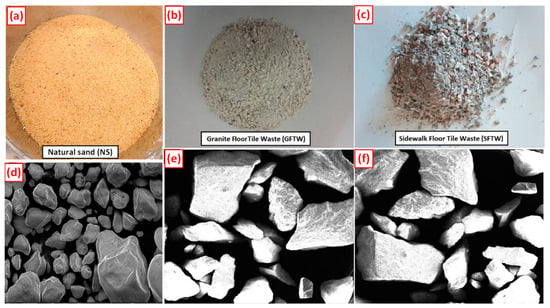
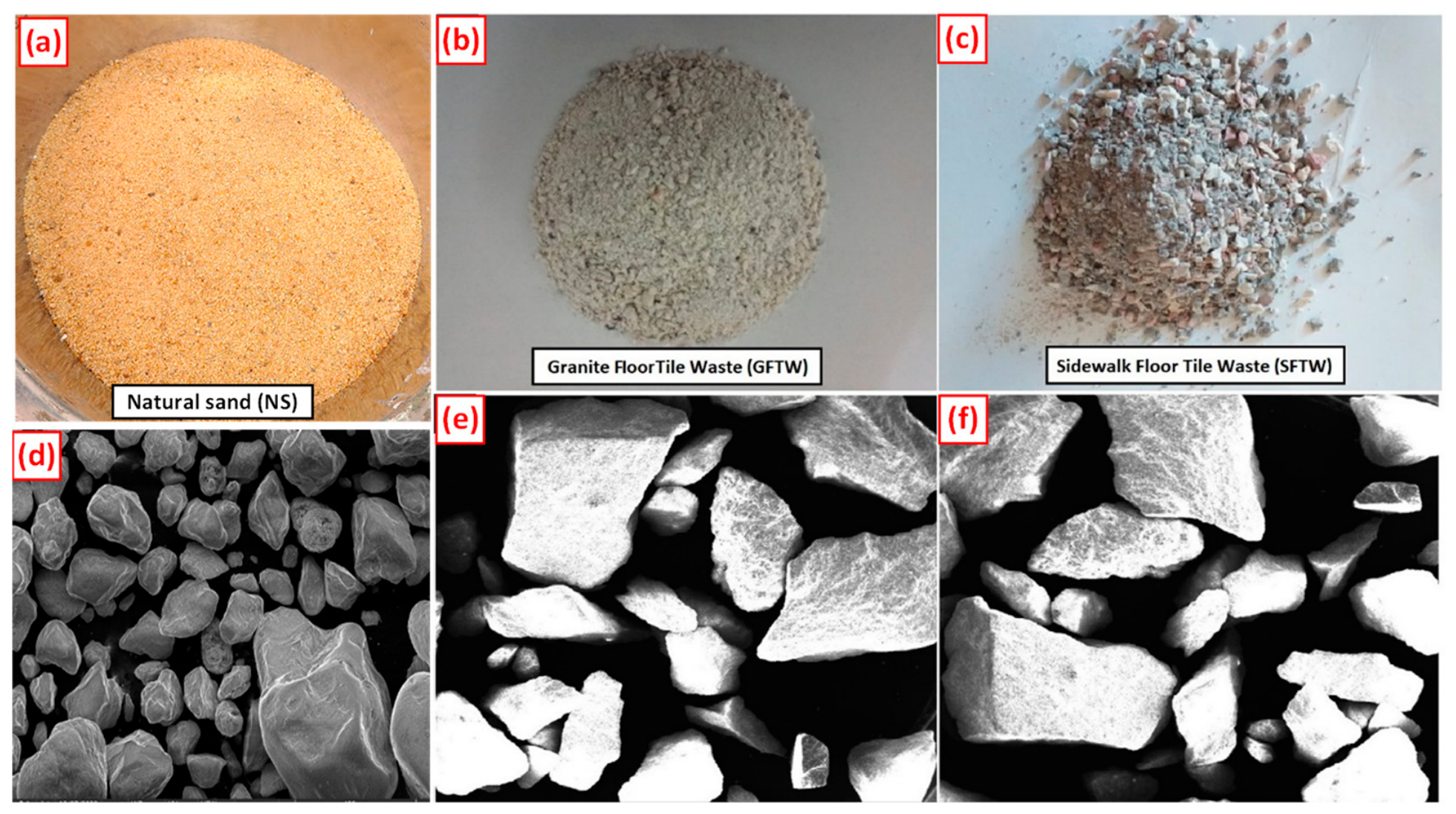
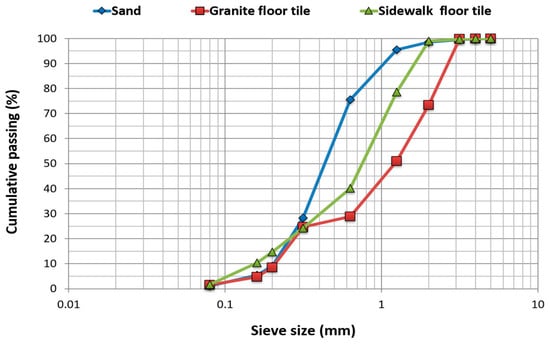
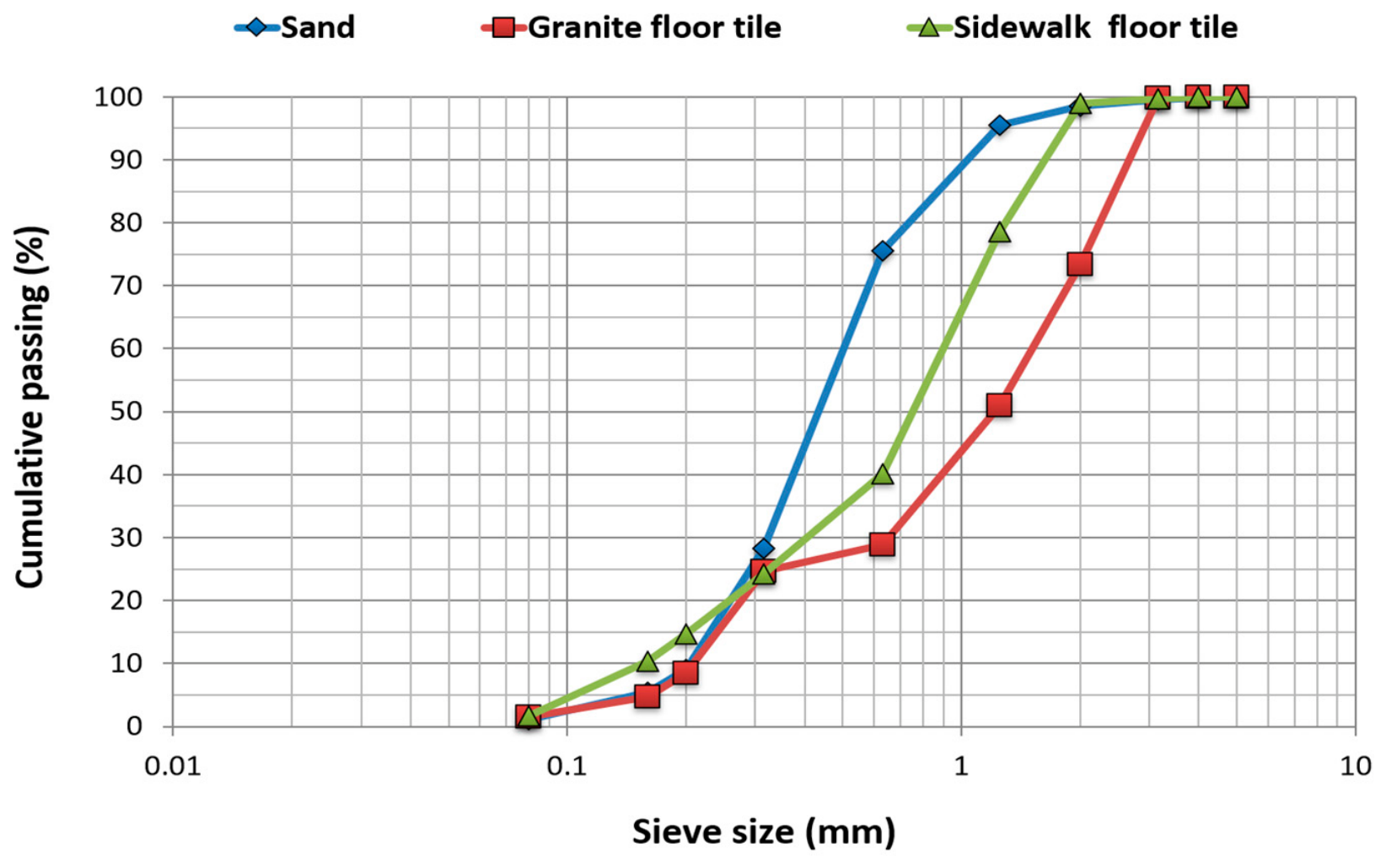
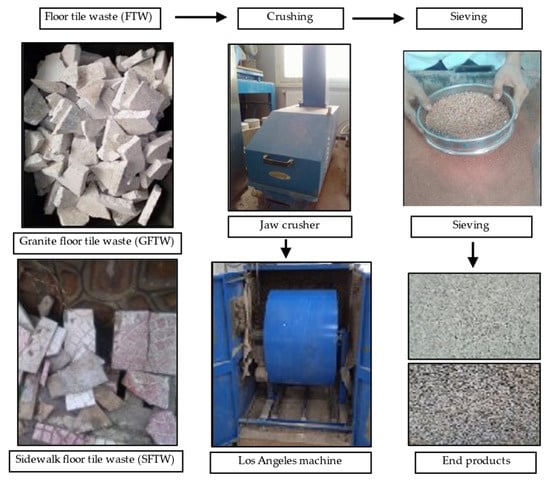
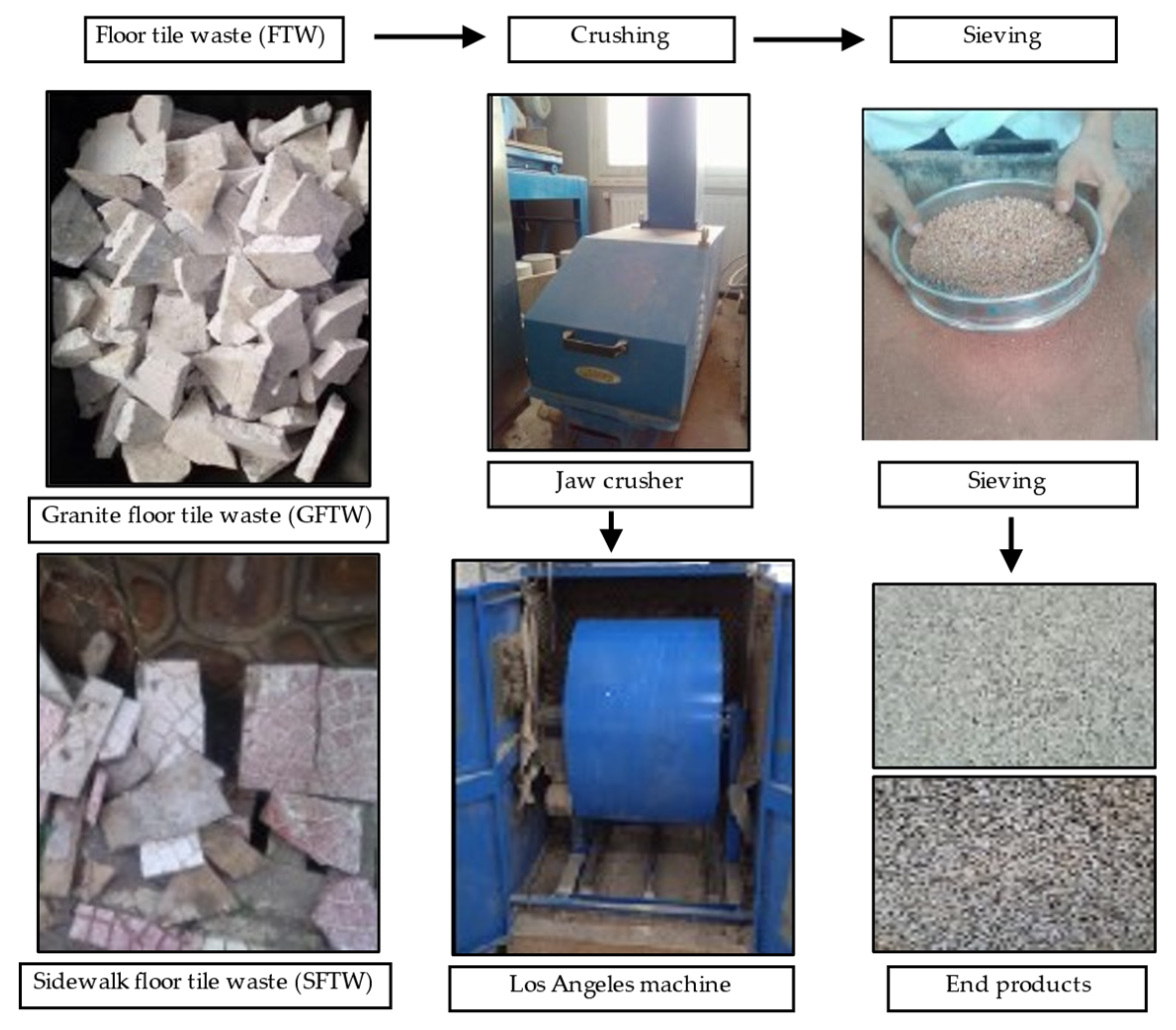
The used natural aggregate is siliceous sand (Figure 1a), extracted from the Oued Souf quarry (south of Algeria), having continuous particle sizes between 0.08 and 4 mm (Figure 2). The SEM analysis of this sand shows its rounded grains (Figure 1d). The recycled aggregates used are floor tile waste (granite floor tile and sidewalk floor tile) sourced from the factory disposal area of a single production batch (Medea, Algeria). After their collection, they were first manually sorted to remove foreign impurities, washed with water to eliminate dust, and oven-dried at 105 °C for 24 h. They were then crushed into grains to obtain sand with a granular class of 0.08/4 (Figure 1b, c) using a laboratory jaw crusher followed by a Los Angeles machine (Figure 3). The production process of recycled raw aggregates (GFTW and SFTW) is presented in Figure 3. The SEM analysis shows the angular shape of the floor waste grains (Figure 1e,f). The maximum particle size (Dmax) and particle size distribution of natural and recycled sand are presented in Figure 2, where their physical properties are presented in Table 2.
Figure 1.
General aspect and SEM micrograph of natural sand (a,d), GFTW (b,e), and SFTW (c,f).
Figure 2.
Particle size distribution of natural sand and floor tile wastes.
Figure 3.
Production process of recycled FTW aggregates.
Table 2.
Physical properties of sand and floor tile waste.
2.1.3. Water and Admixture
In this work, a polyether–polycarboxylate-based superplasticizer called ‘MEDAFLOW30’ and manufactured by GRANITEX Company (Algiers, Algeria) was utilized as an admixture with a 30% dry extract, a pH of 6.25, a 1.08 g/cm3 specific density, and less than 1 g/L of chloride content. Drinking water that conforms to the NF EN 1008 standard [56] was used as mixing water for the different SCSC mixes and for conserving the samples.
2.2. Mix Design
Proportioning such concrete is a very complicated task, due to the various requirements necessary to ensure excellent flow characteristics, satisfactory stability, and adequate mechanical properties [57]. To obtain these characteristics, the fresh SCSC must simultaneously show high fluidity and sufficient viscosity [58]. To reach these contradictory properties, all components of SCSC must be carefully selected and proportioned. The formulation of all SCSC mixtures was calculated using the approach of the Sablocrete project [36], with 400 kg/m3 and 200 kg/m3 constant dosages for cement and filler, respectively. The sand-to-powder ratios (S/P) and the water-to-powder ratios (W/P) were kept at 2.33 and 0.4, respectively. The superplasticizer was used to maintain adequate fluidity and homogeneity without increasing the mixing water content, thereby avoiding the introduction of an additional variable that could affect the concrete mechanical properties [5]. Its dosage was determined based on preliminary trial mixes to achieve a constant workability (target slump flow diameter of about 270 ± 10 mm) for all SCSC mixtures and varied according to the FTW type and dosage. Their dosages were 1% for the reference mixture (CSCSC), 1.45 to 2.0% for SCSC with GFTW, and 1.35 to 2.0% for SCSC with SFTW. The mass of the superplasticizer is determined, as a percentage, relative to the mass of the binder.
To study the effect of FTW on the SCSC’s characteristics, a control mix (CSCSC) with 100% natural sand and twelve other mixes were produced by replacing, in volume, 10%, 20%, 30%, 40%, 50%, or 60% of natural sand with floor tile waste (granite floor tile or sidewalk floor tile). To ensure an accurate and constant effective water-to-powder ratio (W/Peff) across all 13 mixtures, both natural and recycled aggregates used in this study were oven-dried at 105 °C until constant mass prior to batching. To ensure that the dry aggregates did not absorb water intended for paste rheology and binder hydration, the 24 h water absorption of the aggregates was pre-determined (Table 1) and incorporated into the mixing liquid. Consequently, the total mixing water was adjusted accordingly to maintain the target effective water-to- powder ratio (W/P) constant across all replacement levels. This approach ensured that the absorption process of the recycled aggregates did not consume the free water intended for binder hydration and fresh-state workability. Thus, the mixing water consisted of two components:
- Effective mixing water Weff: calculated based on a constant target effective water-to-powder ratio (W/Peff = 0.4).
- Absorption compensation water (Wabs): calculated based on the measured 24 h absorption rate of aggregates.
The mix proportions for each 1 m3 of SCSC mixture (by mass) are provided in Table 3. The mixtures have been identified in such a way that the type of FTW used is specified with its percentage, as shown in this table and explained below.
Table 3.
Mix proportions of different SCSC mixes.
- CSCSC: Control self-compacting sand concrete (without floor tile waste).
- SCSC GFTW: self-compacting sand concrete with granite floor tile waste.
- SCSC SFTW: self-compacting sand concrete with sidewalk floor tile waste.
2.3. Manufacturing and Tests
A rotating standard mixer for mortar was used to manufacture SCSC mixes. All mixture components were batched by weight. The superplasticizer was diluted in 30% of the mixing water, and the mixing process was longer than that for ordinary concrete in order to enable optimal mixture homogeneity and a better distribution of the small quantity of superplasticizer throughout the mass of SCSC [59]. To produce the different SCSC mixes, the mixing procedure was followed in three parts. For the first half-minute, the cement and aggregate were mixed together. Then, 70% of the mixing water was added, and the mixing continued for 1 min. After that, the superplasticizer mixed with the remaining 30% of the water was added and mixed for 1 min. The mixing was paused for 3 min to rest. Finally, before discharging the product, the SCSC was mixed again for 1 min to ensure the homogeneity of the SCSC mix [60].
Before casting, the mini-slump flow diameter and V-funnel flow time tests were measured immediately after the completion of mixing and at a strictly controlled time for all mixtures according to EFNARC recommendations [61] to eliminate the influence of slump loss over time for assessing the fluidity of fresh SCSCs and finding the ideal superplasticizer dosage that produces a satisfactory SCSC without bleeding or segregation. According to the NF EN 12350-7 standard [62], the air content of fresh SCSC was determined thereafter.
In order to control the pumpability of SCSC mixes, the rheological characteristics of fresh SCSC mixtures (yield stress and plastic viscosity) were determined using an ICAR coaxial vane rheometer. To prevent sliding effects, a 4-blade vane geometry was utilized. Immediately after mixing, fresh concrete was placed into the testing container. The loading protocol comprised:
- -
- A pre-shearing for 30 s to eliminate thixotropic memory and achieve a reference state.
- -
- A stepwise descending speed profile consisting of 8 discrete rotational steps ranging from 0.50 to 0.05 rev/s, with each step held for 5 s to measure steady-state torque.
The flow curves were analyzed using the Bingham plastic model (Equation (1)):
where τ is shear stress (Pa), τ0 is yield stress (Pa), μ is plastic viscosity (Pa·s), and is shear rate (s−1). Yield stress (τ0) and plastic viscosity (μ) were calculated by applying linear regression to the descending portion of the shear stress vs. shear rate curve.
To analyze the physical–mechanical properties of the various SCSC mixes, a set of specimens was cast without compaction or vibration in lubricated molds. They were taken out of the molds after 24 h and stored in water at 20 °C until the testing day. The compressive and flexural strengths were measured at 7, 28, and 90 days on three 40 × 40 × 160 mm hardened samples according to the NF EN 196-1 standard [63]. To provide information about the homogeneity and porosity of the different SCSC mixes, ultrasonic pulse velocity (UPV) measurement was conducted as a nondestructive test on specimens of 100 mm cubes that were cured for 28 days in compliance with the ASTM C597-16 standard [64]. Cylinders of 200 mm diameter and 100 mm height were prepared for elastic modulus tests according to the NF EN 1352 standard [65]. The dry density, porosity, and water absorption were tested at 28 days on 40 × 40 × 160 mm samples in accordance with the ASTM C642-21 standard [66]. Finally, a VEGA3-TES CAN SEM with an accelerating voltage of 25 kV and a working distance of 10 mm was used to understand the microstructure in the ITZ between GFTW and SFTW and the cement paste on samples measuring 10 × 10 × 10 mm taken from some SCSC mixes cured for 90 days. Prior to observation, hydration was stopped using an isopropanol exchange, and representative fragments were oven-dried at 40 °C for 24 h. The specimens were then sputter-coated with a thin layer of carbon to ensure surface conductivity. To ensure statistical reliability, all physical and mechanical tests were carried out on three identical specimens per mixture, and the mean values were taken as experimental results.
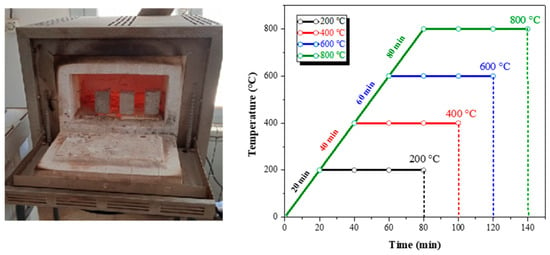
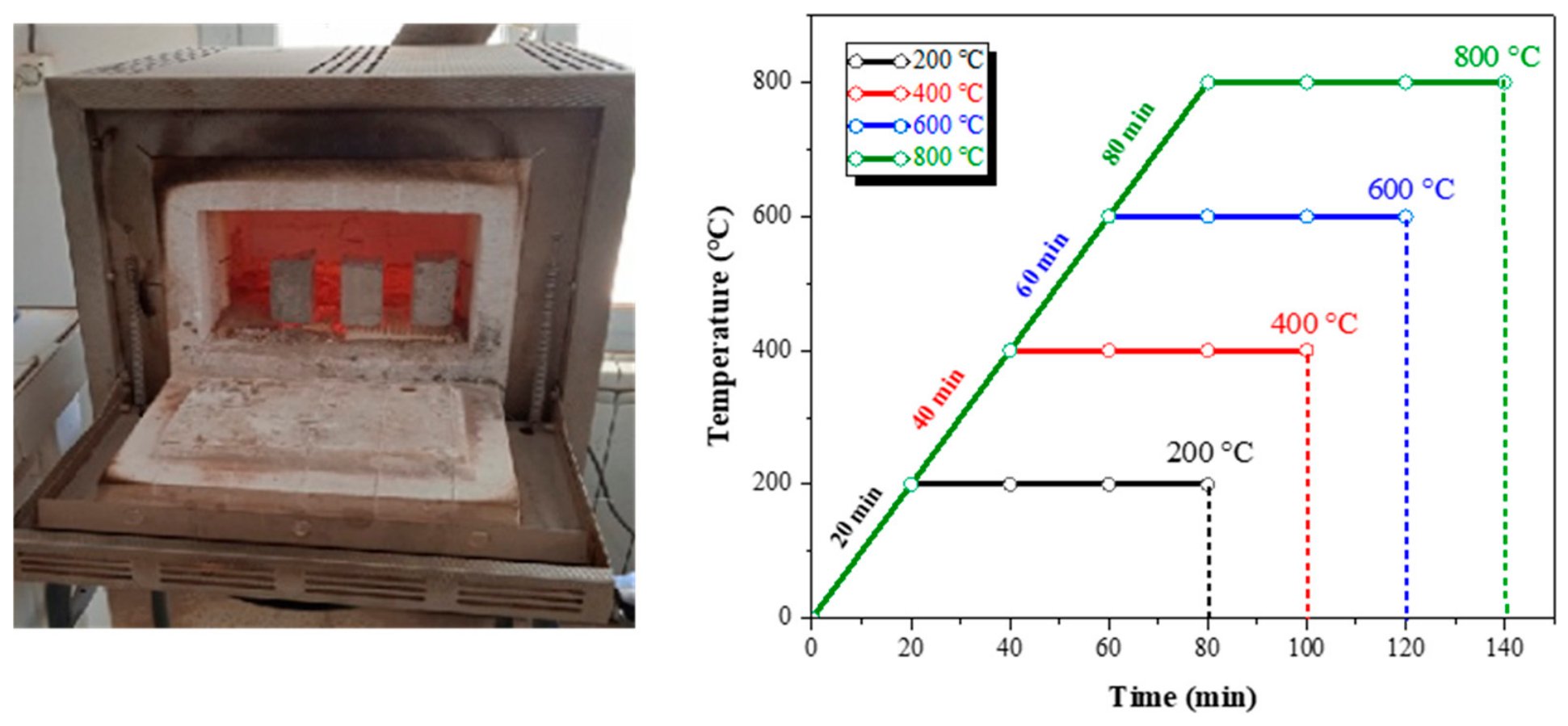
To evaluate the resistance to elevated temperature exposure of the studied SCSC mixes, 28-day-old specimens were transported to an electrical furnace and heated at a steady rate of 10 °C/min to four distinct temperature cycles: 200 °C, 400 °C, 600 °C, and 800 °C (Figure 4). As per the ISO 834 standard [67], the rest period at the maximum temperature lasted for one hour (Figure 4). When the heating time is complete, the furnace stays sealed for 24 h in order to cool the specimens down to the ambient temperature [68]. To assess the presence of cracks and porosity after heating, a visual inspection of the cooling samples’ surface is carried out using a digital camera. The loss of mass and compressive strength measurements were performed as well on the heated samples in order to determine their physical and mechanical deterioration. For each age and type of SCSC, three specimens were tested, and the average findings are shown.
Figure 4.
Time–temperature curve of the electrically controlled furnace.
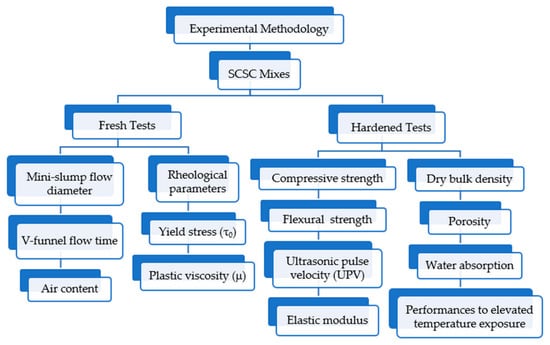
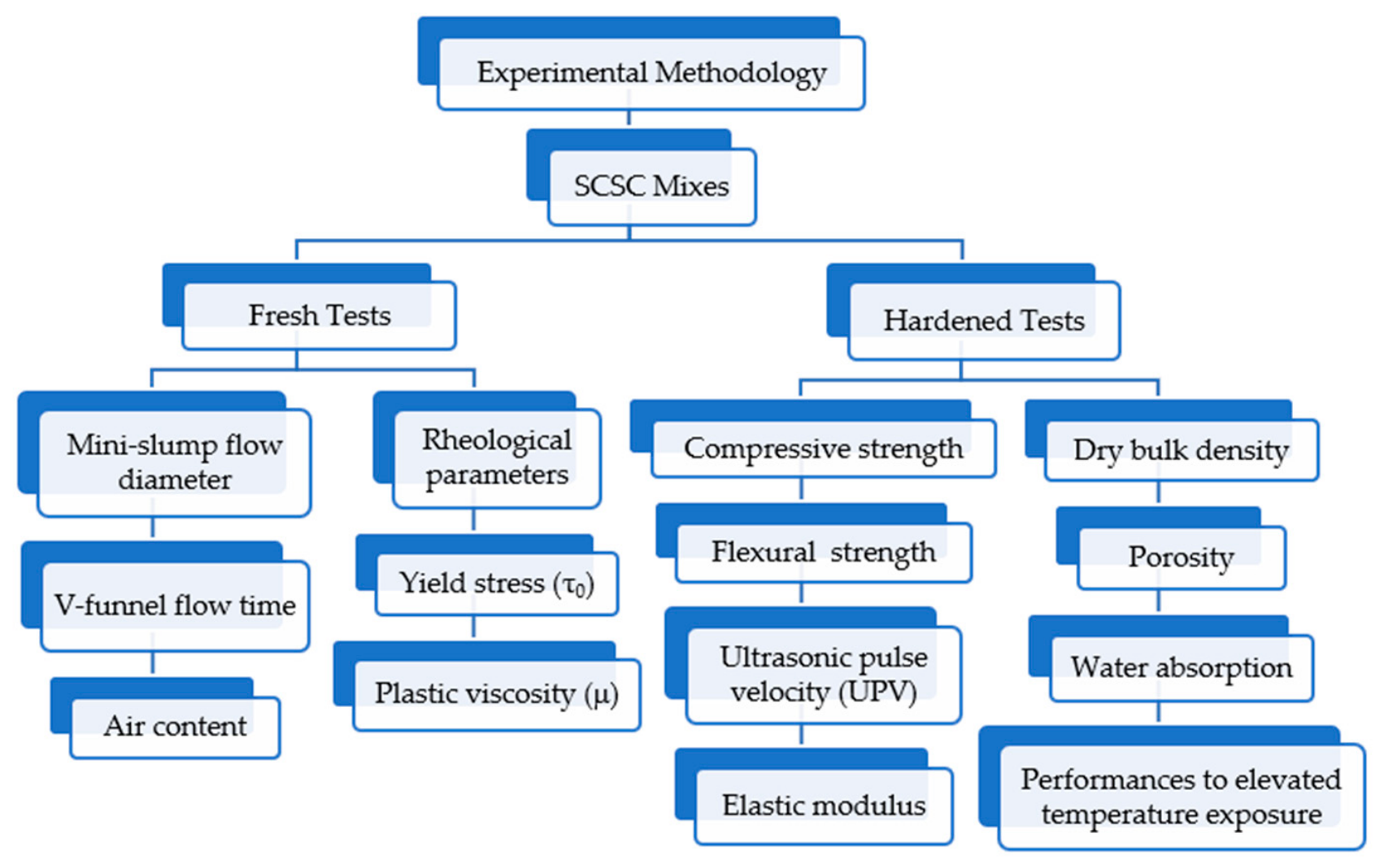
The overall experimental framework of this study is schematically illustrated in Figure 5. The research program was conducted in four main phases: (i) collection, processing, and physical–chemical characterization of raw materials (natural sand, granite floor tile waste (GFTW), and sidewalk floor tile waste (SFTW); (ii) mix design and preparation of 13 SCSC mixtures across replacement levels ranging from 10% to 60%; (iii) fresh-state characterization (slump flow, V-funnel, and rheological parameters) and hardened-state characterization (dry density, UPV, porosity, water absorption, compressive and flexural strengths, elastic modulus, and SEM/ITZ microstructural evaluation); and (iv) high-temperature exposure up to 800 °C to evaluate residual mechanical performance and thermal mass loss.
Figure 5.
Experimental tests carried out on the SCSC mixtures in the fresh and hardened state.
3. Results and Discussion
3.1. Slump Flow Diameter and V-Funnel Flow Time
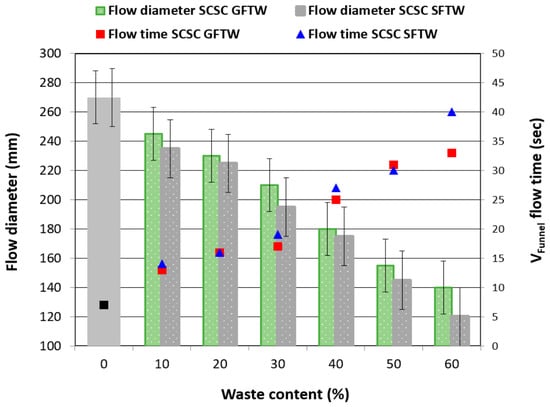
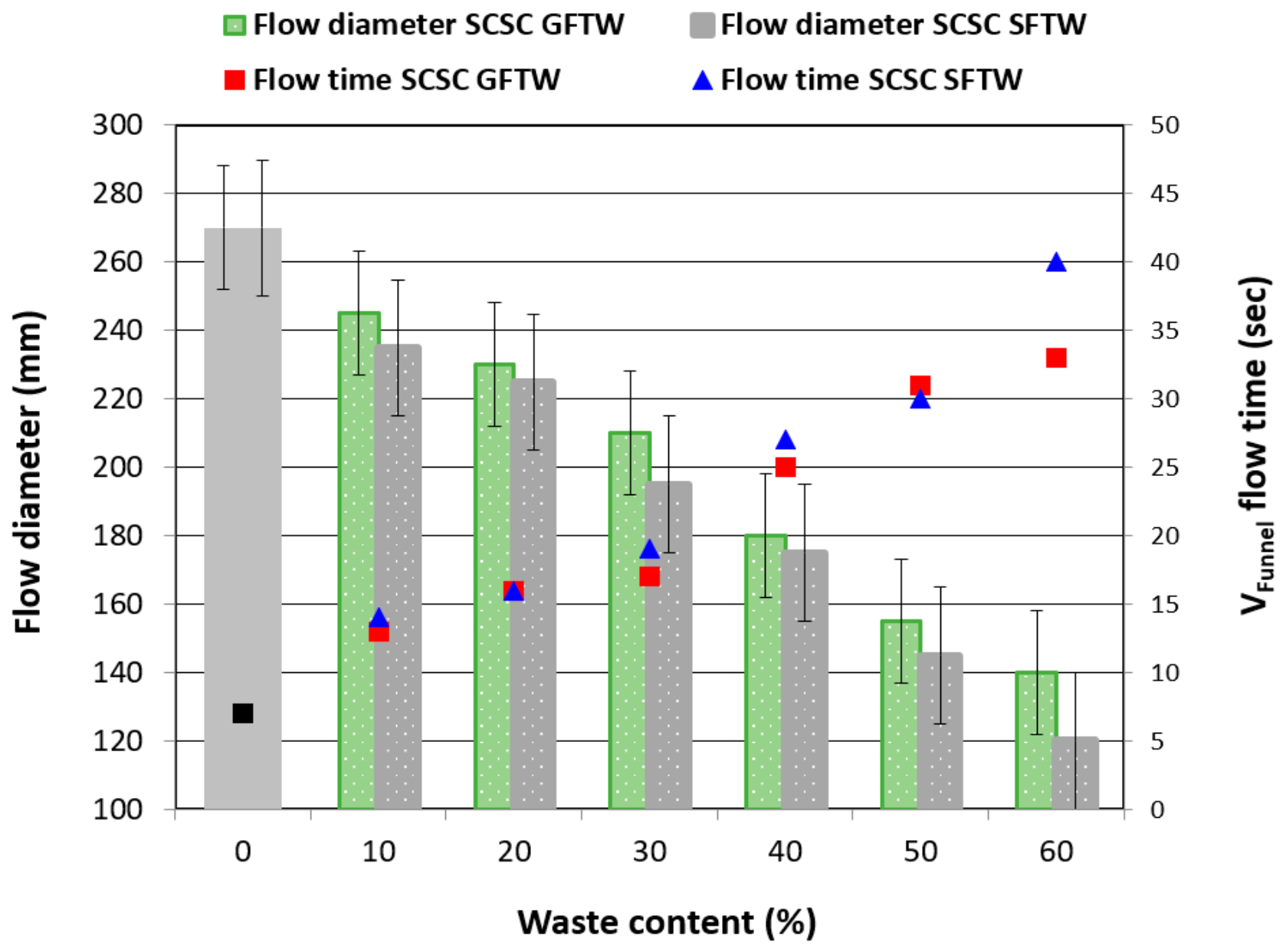
Figure 6 presents the effect of floor tile waste (FTW) on the slump flow diameter and V-funnel flow time of self-compacting sand concrete (SCSC) mixes. Increasing the FTW content was found to reduce the fluidity of SCSC, resulting in a decrease in the slump flow diameter and an increase in the V-funnel flow time. This is mostly explained by the FTW grains’ increased water absorption, as well as their rough surface and angular shape compared to smooth, rounded natural sand. This reduction in slump flow with increasing FTW content aligns with previously reported trends by other researchers [16,17,69], who attributed similar loss of workability to the high angularity and surface roughness of crushed ceramic fine aggregates, which increases inter-particle friction compared to smooth spherical river sand grains. Elçi H. [14] also found that concrete made with FTW exhibited lower workability than the concrete made with limestone aggregates.
Figure 6.
Effect of FTW aggregate on slump flow diameter and V-funnel flow time for SCSC mixes.
To limit the number of compositions and to be able to compare them in the hardened state on a common basis, a constant slump flow diameter of about 27 ± 1 mm and a fixed w/b ratio of 0.4 were used to maintain workability. The desired workability was attained by adjusting the superplasticizer quantity for the mixtures containing FTW (Table 3). As shown in this table, the demand for superplasticizer in SCSC mixtures has increased as a result of the rise in FTW content. The increase in SP dosage from 1.0% to 2.0% was experimentally required as FTW replacement levels increased from 0% to 60% to provide the necessary steric repulsion to maintain target self-compacting criteria and adhere to EFNARC guidelines (slump-flow and V-funnel times) without altering the water-to-binder (W/B) ratio. Crushed FTW particles possess a higher angularity, surface roughness, and water absorption capacity compared to smooth, spherical natural sand grains. Increasing SP dosage counteracted the increased inter-particle friction and liquid absorption, ensuring proper deflocculation of cement grains and matrix flowability without changing the effective W/C ratio. Thus, the higher SP demand is a direct operational consequence of incorporating FTW.
3.2. Rheological Parameters (Yield Stress and Plastic Viscosity)
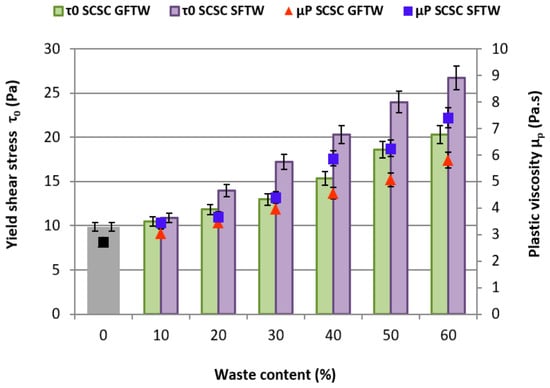
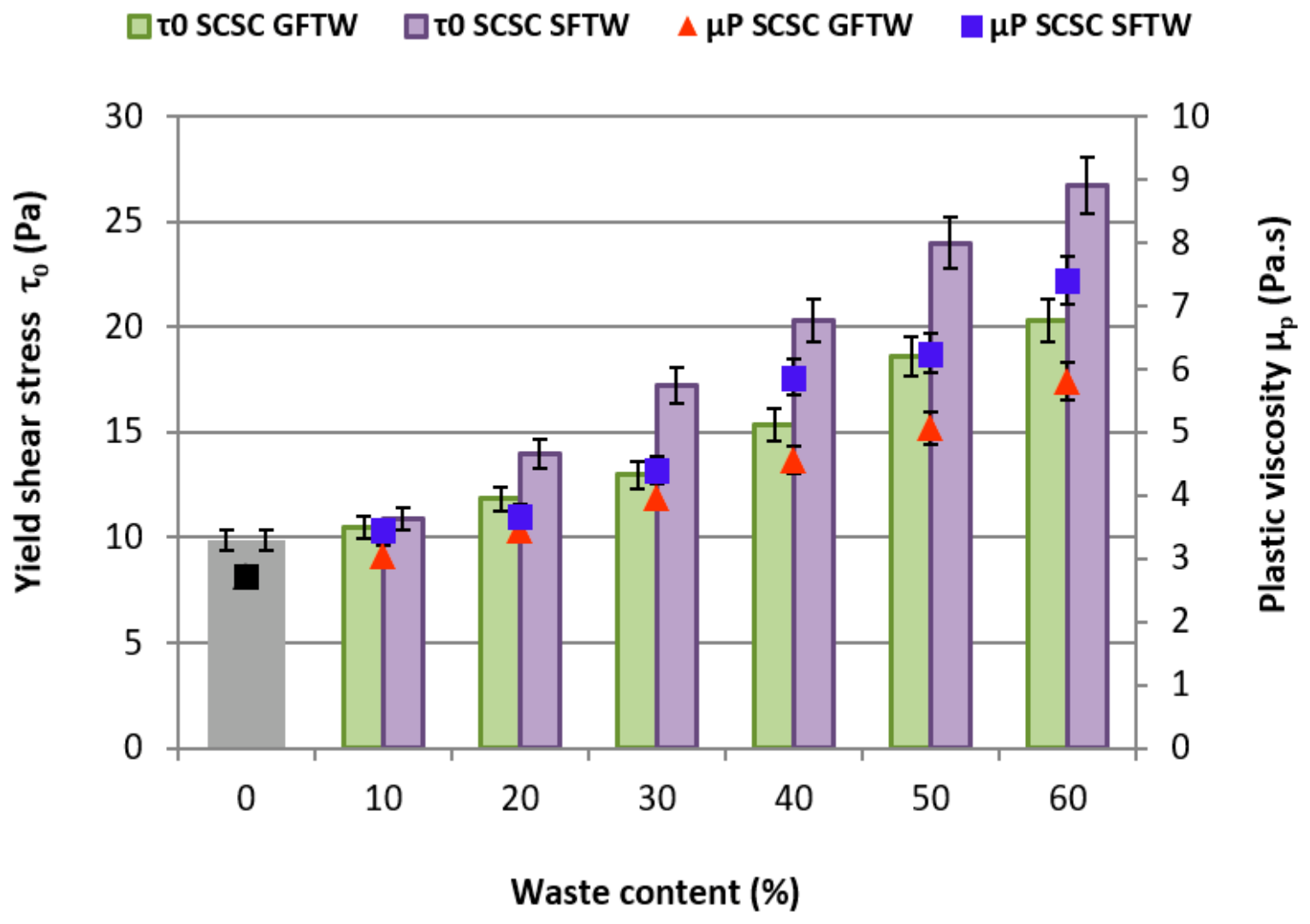
Figure 7 illustrates the effect of FTW aggregate on the plastic viscosity and yield stress of fresh SCSC mixes. The results of this figure indicate that incorporating FTW as a fine aggregate replacement significantly modifies the fresh rheological behavior of SCSC mixes. It is shown that increasing the content of FTW increases both the plastic viscosity (µp) and the yield stress (τ0) of SCSC mixes, thereby reducing workability and fluid spread. FTW aggregates are highly angular, irregular, and flaky compared to natural river sand, which increases internal particle friction and interlocking mechanisms within the sand skeleton, demanding higher initial shear stress (τ0) to trigger movement [70]. In addition, recycled FTW aggregates are inherently porous. They absorb a fraction of the mixing water rapidly during the initial stages of mixing fresh concrete. This sudden drop in water-to-binder ratio increases the thickness and concentration of the solid suspended phase and therefore increases the plastic viscosity (µp) of SCSC mixes [71].
Figure 7.
Effect of FTW aggregate on rheological parameters (τ0 et µp) of SCSC mixes.
The superplasticizer (SP) dosage was incrementally adjusted from 1.0% to 2.0% as FTW content increased from 0% to 60%. This adjustment was essential to overcome the heightened yield stress and viscosity caused by the angular morphology, rough surface texture, and absorption characteristics of FTW grains. The increased SP dosage facilitated electrostatic repulsion and steric hindrance among cementitious particles, effectively preserving matrix fluidity without inducing segregation.
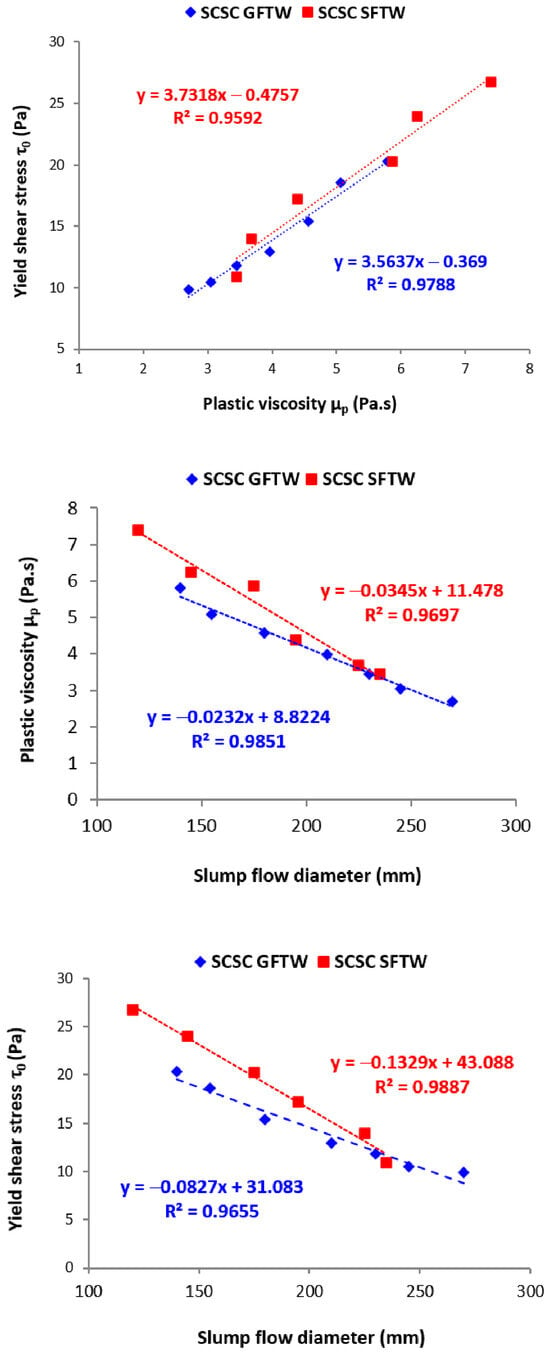
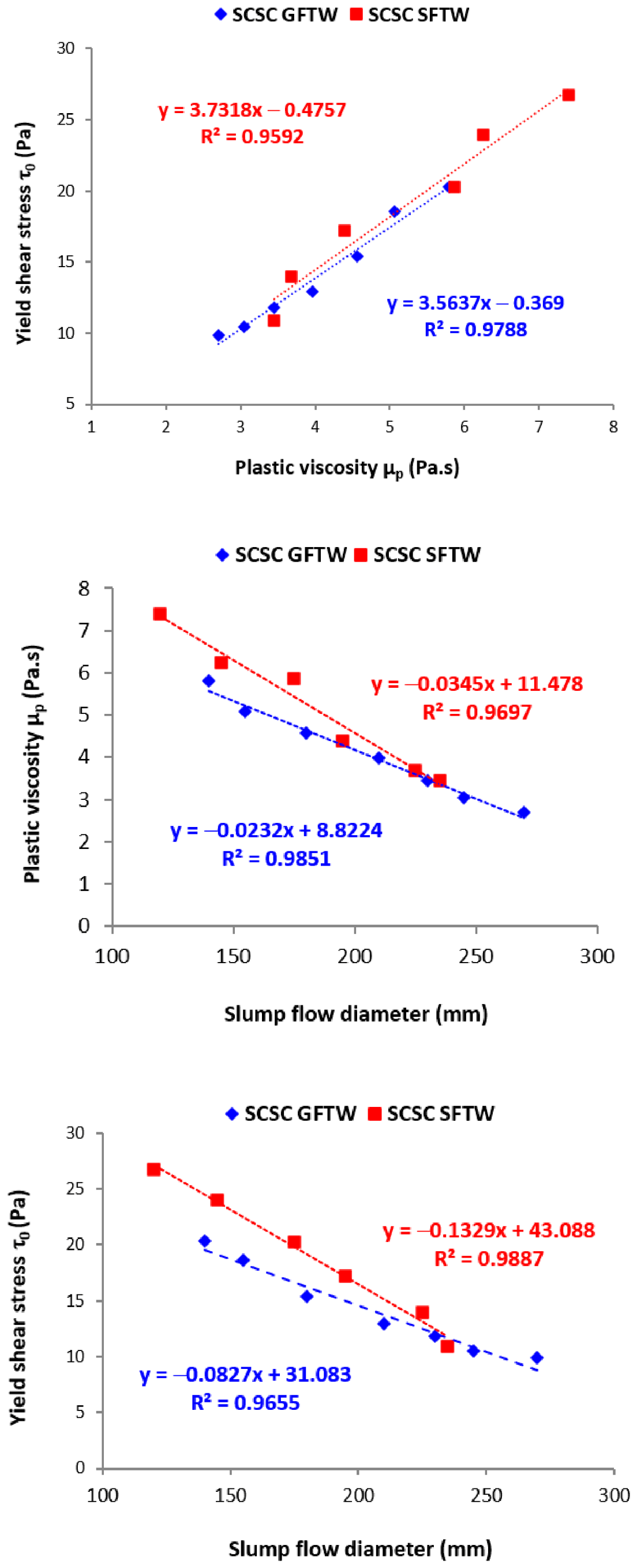
Figure 8 presents the relationships between the different rheological characteristics of SCSC containing FTW aggregate, indicating a good correlation between them with high correlation coefficients (R2 > 0.90).
Figure 8.
Relationships between the different rheological properties of SCSC containing FTW aggregate.
3.3. Air Content
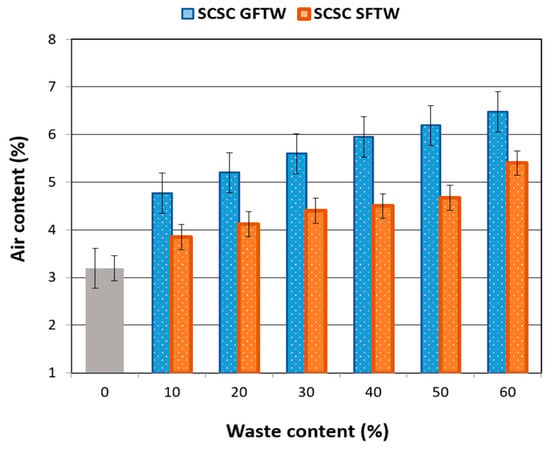
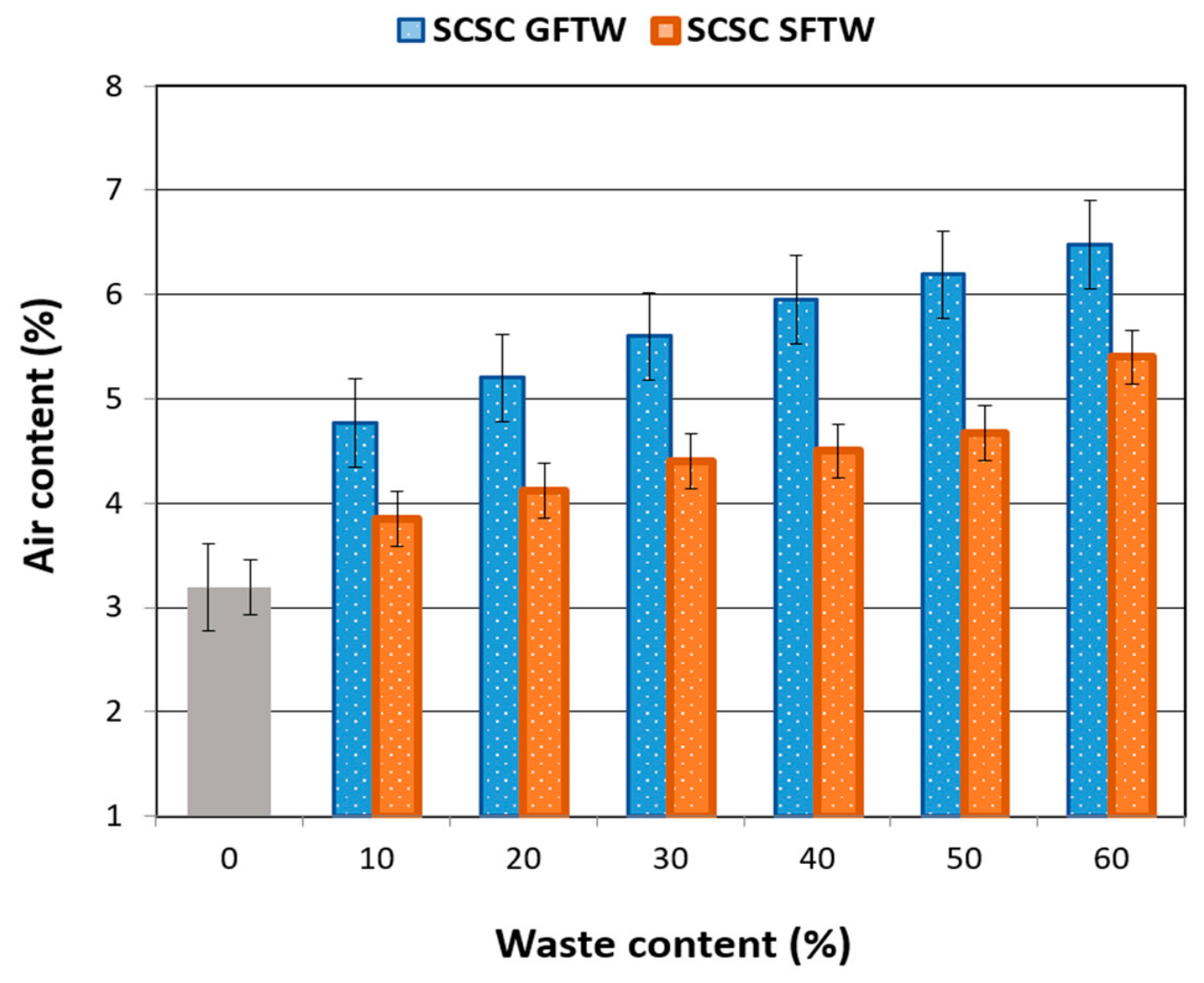
The air content values of the various fresh SCSC mixtures are shown in Figure 9. It is clearly shown that, regardless of the type of FTW used (GFTW or SFTW), the air content values rise slightly with increasing sand substitution levels, which is most likely caused by the increase in voids and micropores induced by the angular form of FTW grains. Elçi H. [14] also found higher air content values for concrete with crushed floor and wall tile waste as aggregates compared to the mixtures with natural aggregates. According to them, the presence of flat and elongated particles with high porosity in crushed FTW is responsible for this increase in the concrete’s air content.
Figure 9.
Effect of FTW aggregate on air content of SCSC mixes.
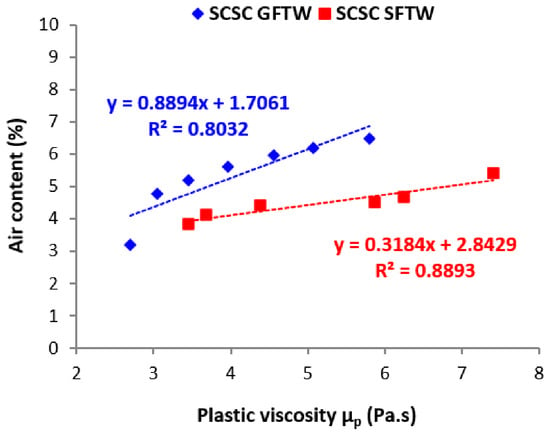
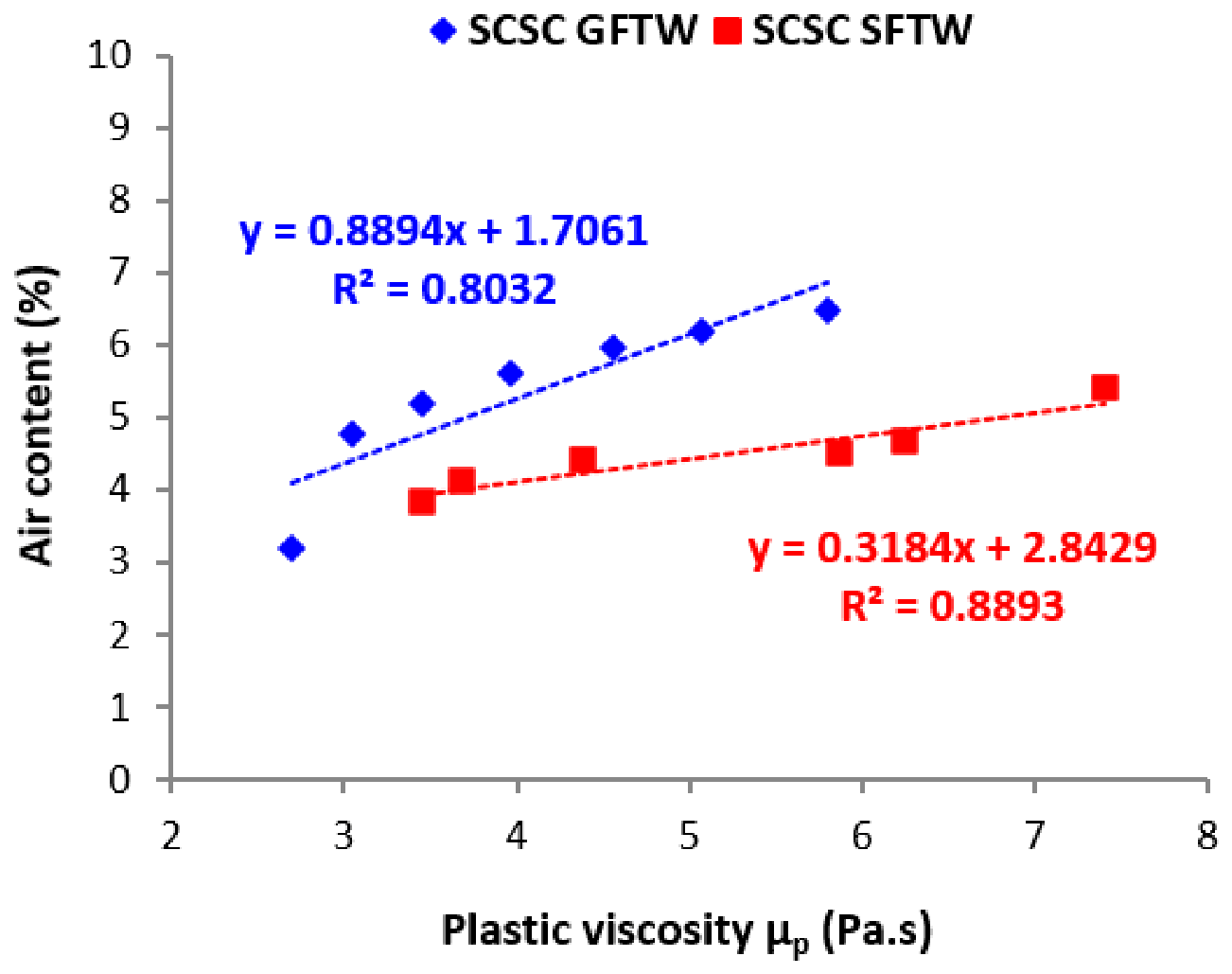
The air content of fresh SCSC depends strongly on its rheological properties [72]. The relationship between the entrapped air content and the plastic viscosity presented in Figure 10 shows that increasing plastic viscosity leads to an increase in the air content of fresh concrete. Thereby, we can predict the rheological properties (plastic viscosity and yield stress limit) based on the air content values in fresh SCSC with statistical models as presented in Figure 10.
Figure 10.
Relationships between the plastic viscosity and air content of different SCSC mixes.
3.4. Dry Bulk Density and Ultrasonic Pulse Velocity
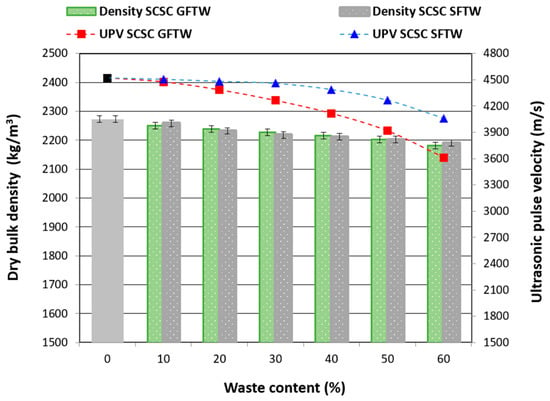
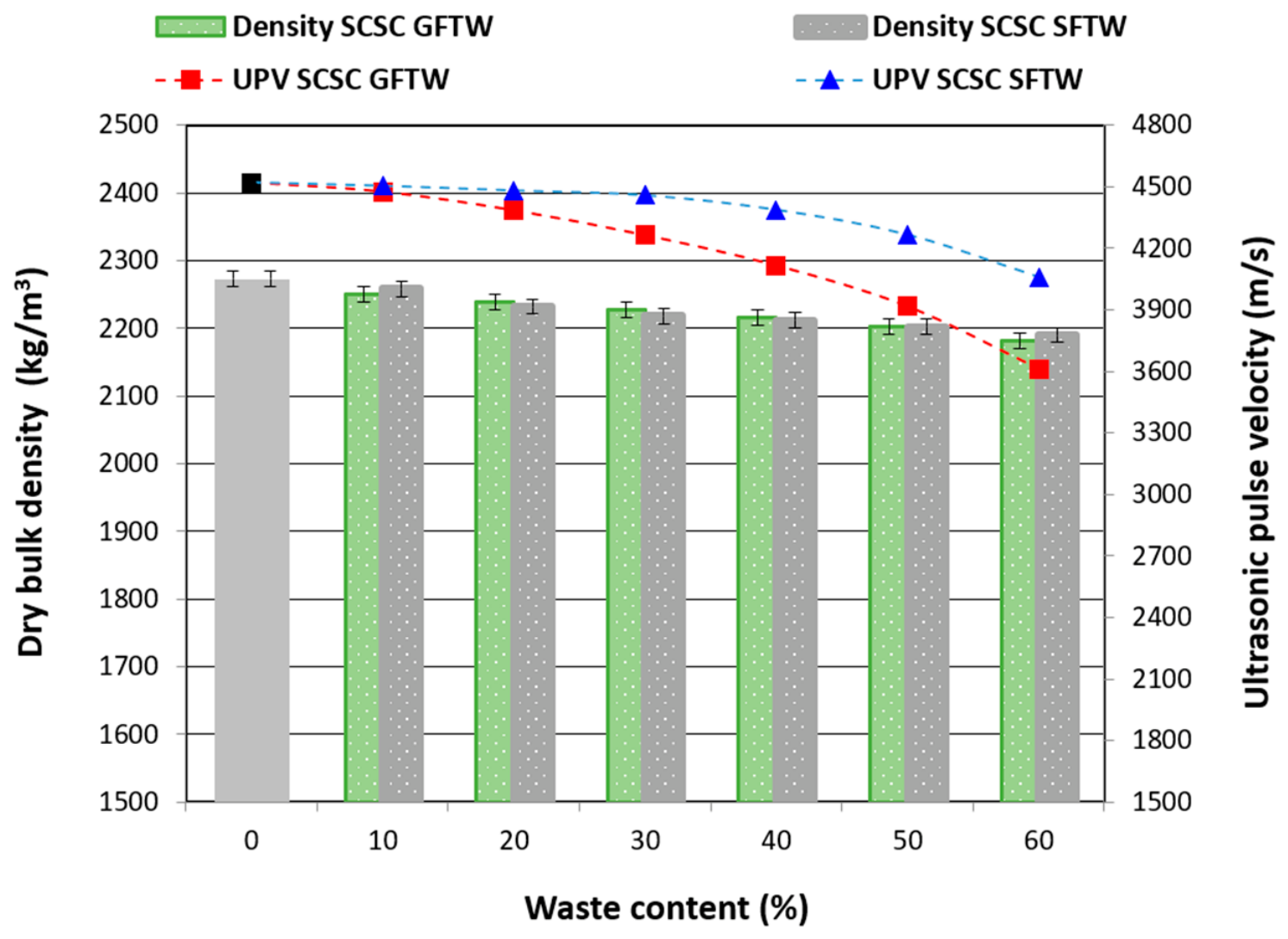
The impact of FTW content on the dry bulk density and ultrasonic pulse velocity (UPV) of SCSC mixes aged 28 days is depicted in Figure 11. The substitution of sand by FTW causes a slight decrease in bulk density and UPV of mixes. However, for both types of FTW, a linear decline in mixture density was noted with increasing natural sand substitution rate. When comparing SCSC mixes with 60% GFTW and 60% SFTW to the control mixture, the UPV values dropped by 20% and 10%, respectively. This decrease in density and UPV is surely caused by the FTW aggregate granules’ reduced density when compared to natural sand (Table 2). Furthermore, it might be due to the angular shape of FTW grains, which increases the porosity of concrete [73]. The reduction in density of concrete with crushed FTW aggregate was also proved by many authors [15,16,19]. It is noted that all developed SCSC mixtures exhibited UPV values exceeding 3500 m/s. According to ASTM C597-16 standard [64] and Malhotra and Carino [74], concrete with a UPV between 3500 m/s and 4500 m/s is classified as ‘Good Quality’ structural concrete, while values above 4500 m/s represent ‘Excellent Quality’. Coupled with bulk density values above 2200 kg/m3, these results confirm that the incorporation of FTW maintains satisfactory structural integrity and matrix density [75]. Elçi, H. [14] also found that the ultrasonic pulse velocity of FTW-based concrete showed a significantly lower value than that of limestone aggregate-based concrete due to the higher porosity ratio.
Figure 11.
Effect of FTW aggregate on dry bulk density and ultrasonic pulse velocity of SCSC mixes.
3.5. Compressive and Flexural Strength
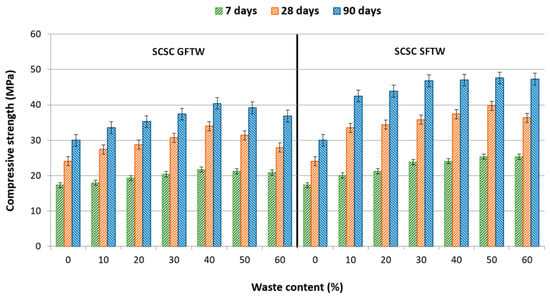
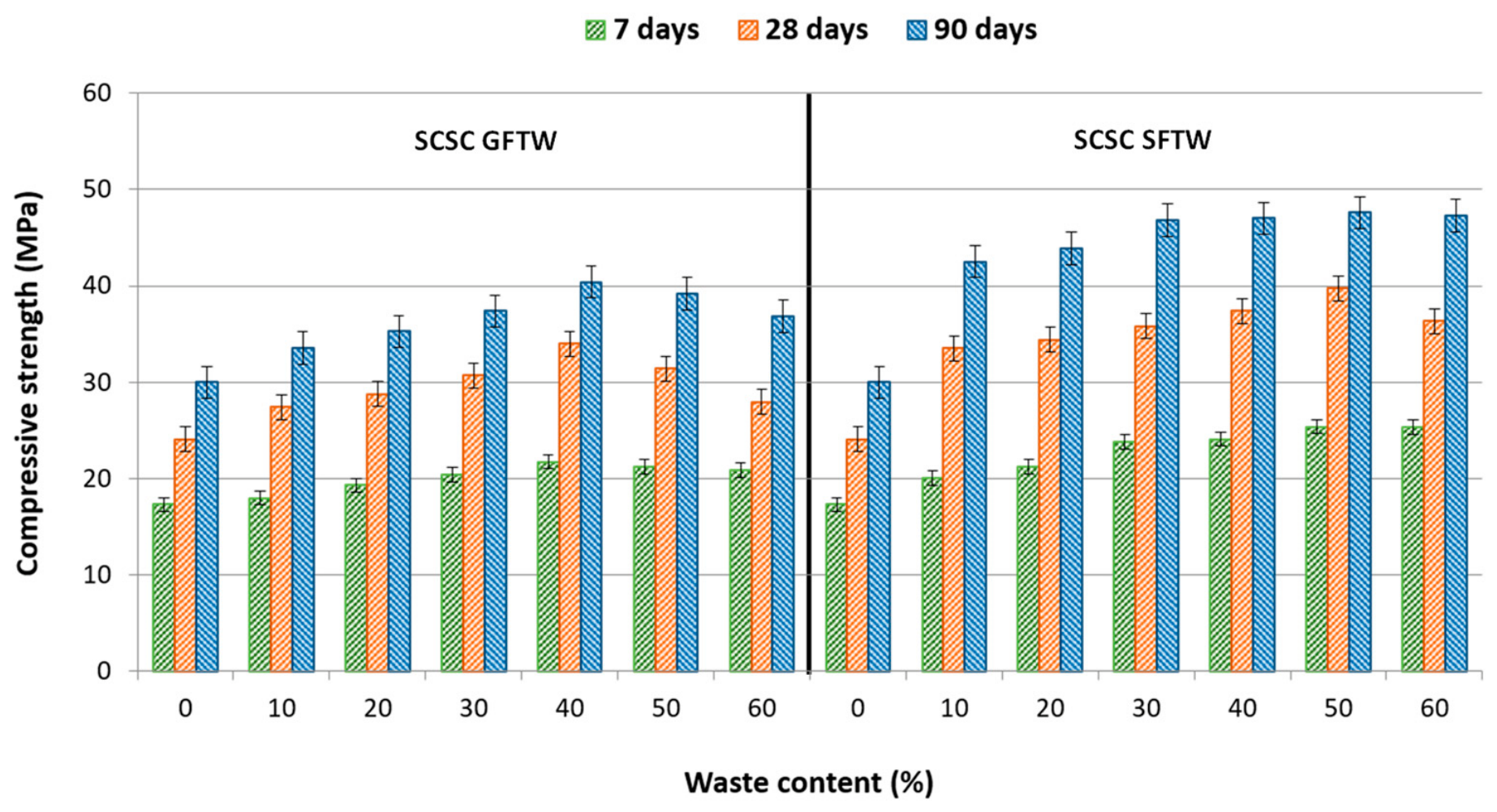
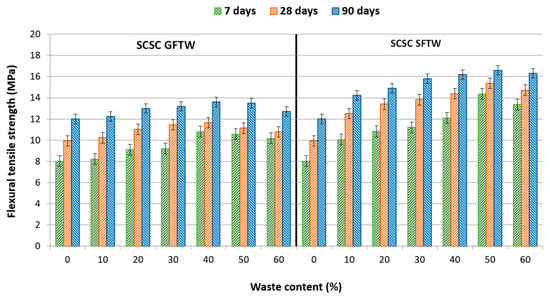
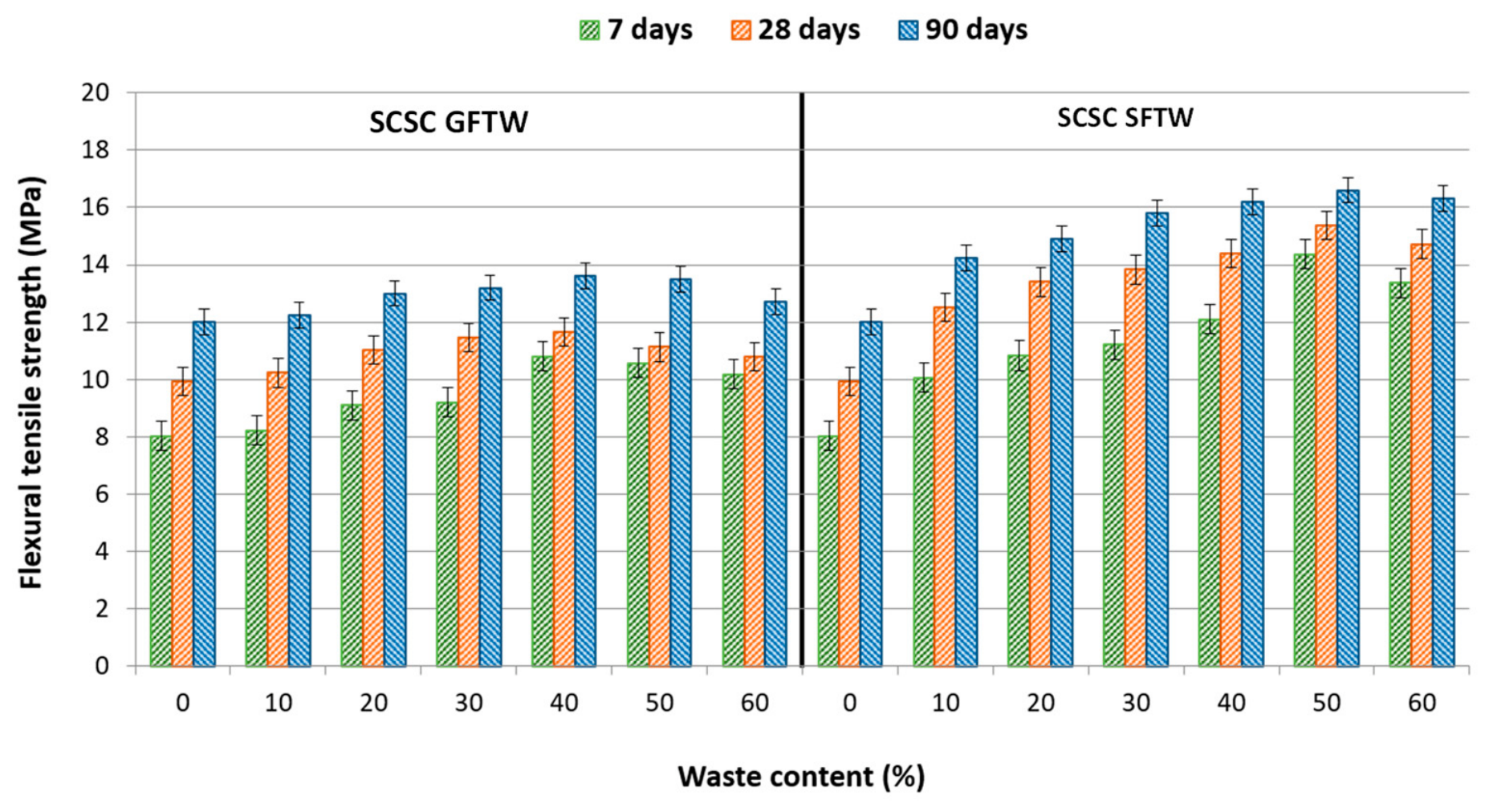
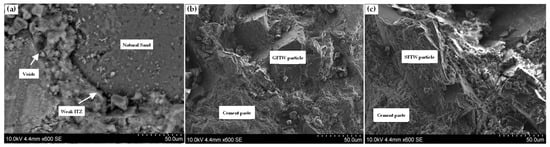
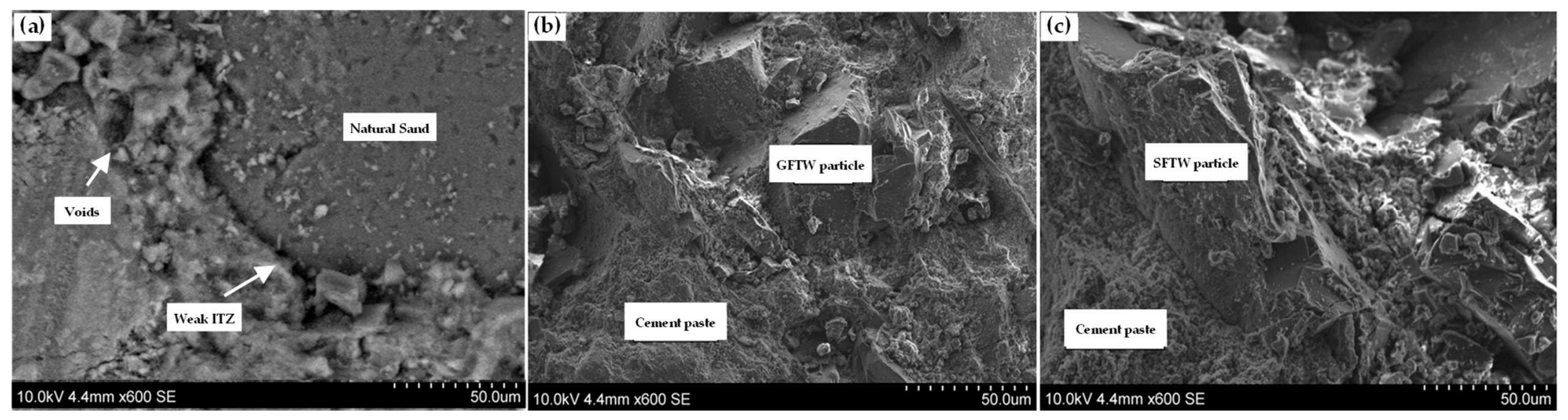
Figure 12 and Figure 13 show the compressive and flexural strength results for all SCSC mixtures at 7, 28, and 90 days of age, respectively. The incorporation of FTW in SCSC significantly improves mechanical strengths for all ages. The best 28-day strengths were observed for mixtures containing 40% GFTW and 50% SFTW, with improvements of 41% and 65% in compressive strength and 17% and 45% in flexural strength, respectively, compared to the control mix. It must be mentioned that all SCSC mixes with FTW have higher compressive and flexural strength values than those of CSCSC and are within the recommended range for structural concrete, which are 25 MPa and 3 MPa, respectively. This rise in mechanical strength can be caused by the hardness of GFTW and SFTW grains coupled with their rough surface and angular shape compared to those of natural sand (Figure 1), which leads to a stronger adhesion between FTW aggregate and the cement paste (ITZ), as shown in Figure 14. Furthermore, the particle size distribution of FTW grains (Figure 2) caused a greater filling effect in the SCSC mix, minimizing interconnected voids and ultimately increasing the compressive and flexural strength [1,24,49,76].
Figure 12.
Effect of FTW aggregate on compressive strength of SCSC mixes.
Figure 13.
Effect of FTW aggregate on flexural strength of SCSC mixes.
Figure 14.
Comparative SEM micrographs of the Interfacial Transition Zone (ITZ) of: (a) Control SCSC with natural sand, (b) GFTW-based SCSC, and (c) SFTW-based SCSC.
In addition, the higher dosage of superplasticizer (SP) in high-FTW mixtures helped maintain proper consolidation and workability, thereby preventing the formation of honeycombing or entrapped macro-voids that would otherwise significantly reduce compressive strength. Although the SP may slightly delay setting times at higher dosages (2%), no segregation, bleeding, or negative impact on mechanical strength at 28 days was observed. This allowed the micro-filler effect and the densification of the interfacial transition zone (ITZ) provided by the FTW to drive the ultimate strength enhancement, confirming that the dosage remained within the optimal saturation plateau for the binder.
Additionally, Figure 14 showed that compared to natural aggregates, the microstructure at the interfacial transition zone (ITZ) between recycled FTW aggregates and paste was more compact. A similar trend of this strength gain has also been observed by other researchers for dune sand mortar containing 40% and 50% FTW [15,77,78,79]. Daniyal and Shakeel [17] also found about a 5.43% increase in concrete compressive strength with the incorporation of 30% crushed ceramic waste. Elçi H. [14] reported higher mechanical properties than those of traditional limestone concrete when using FTW as recycled aggregates. According to Tennich et al. [22], self-compacting concrete incorporating FTW has a higher compressive strength than concrete with natural aggregate. Raghavendra et al. [25] found that replacing up to 15% of fine aggregates in high-performance concrete with granite fine waste results in the highest compressive strength at all curing ages.
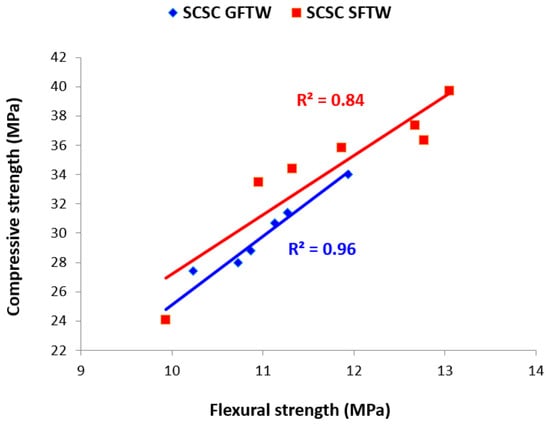
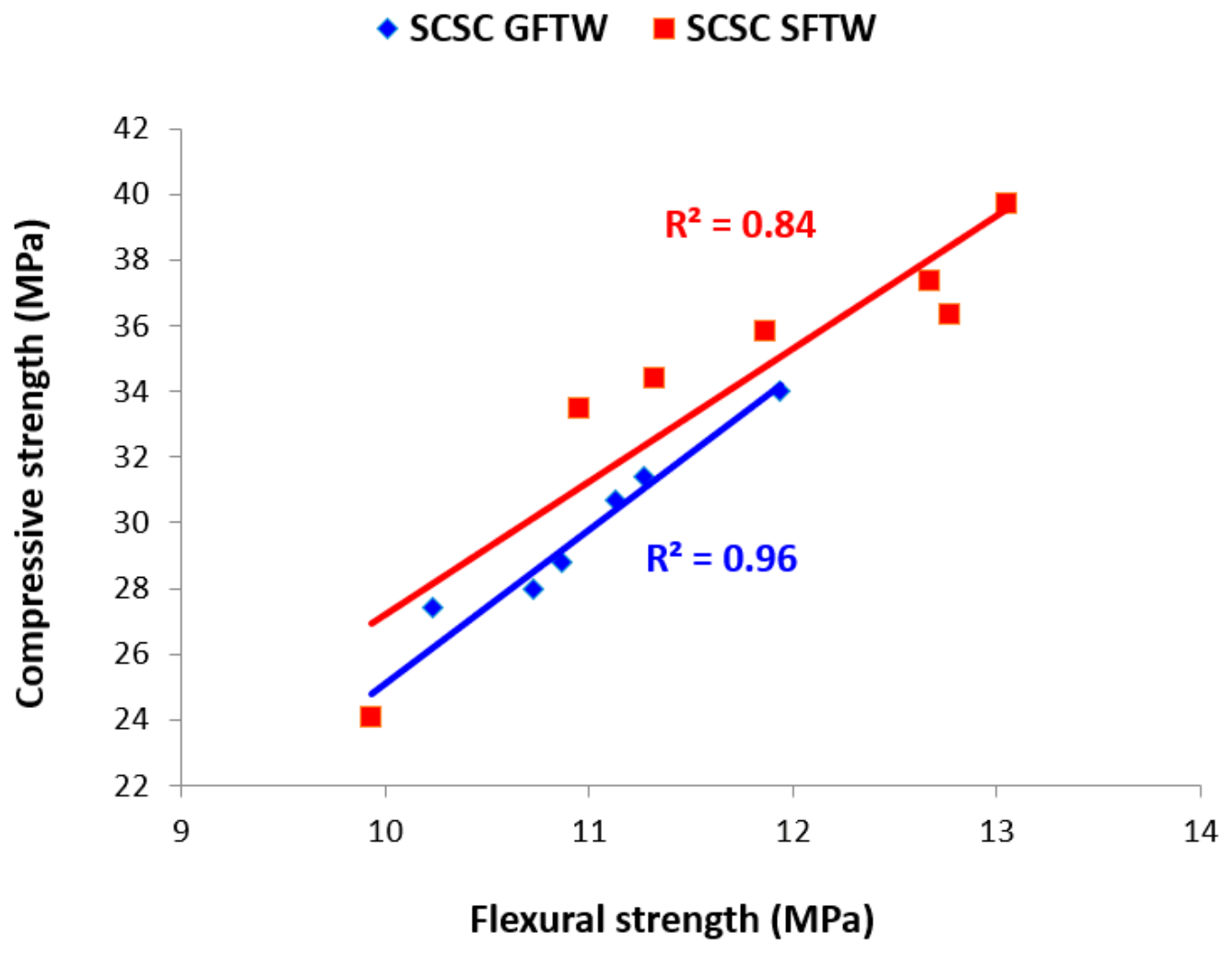
The relationship between the 28-day flexural strength and compressive strength for all SCSC mixtures is shown in Figure 15. It was shown that the increase in the flexural strength is closely correlated with the increase in the compressive strength, with high correlation coefficients (R2 > 0.885).
Figure 15.
Relationships between compressive strength and flexural strength of SCSC containing FTW aggregate.
3.6. Modulus of Elasticity
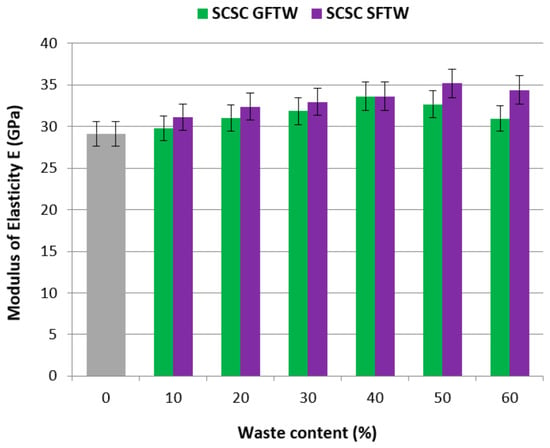
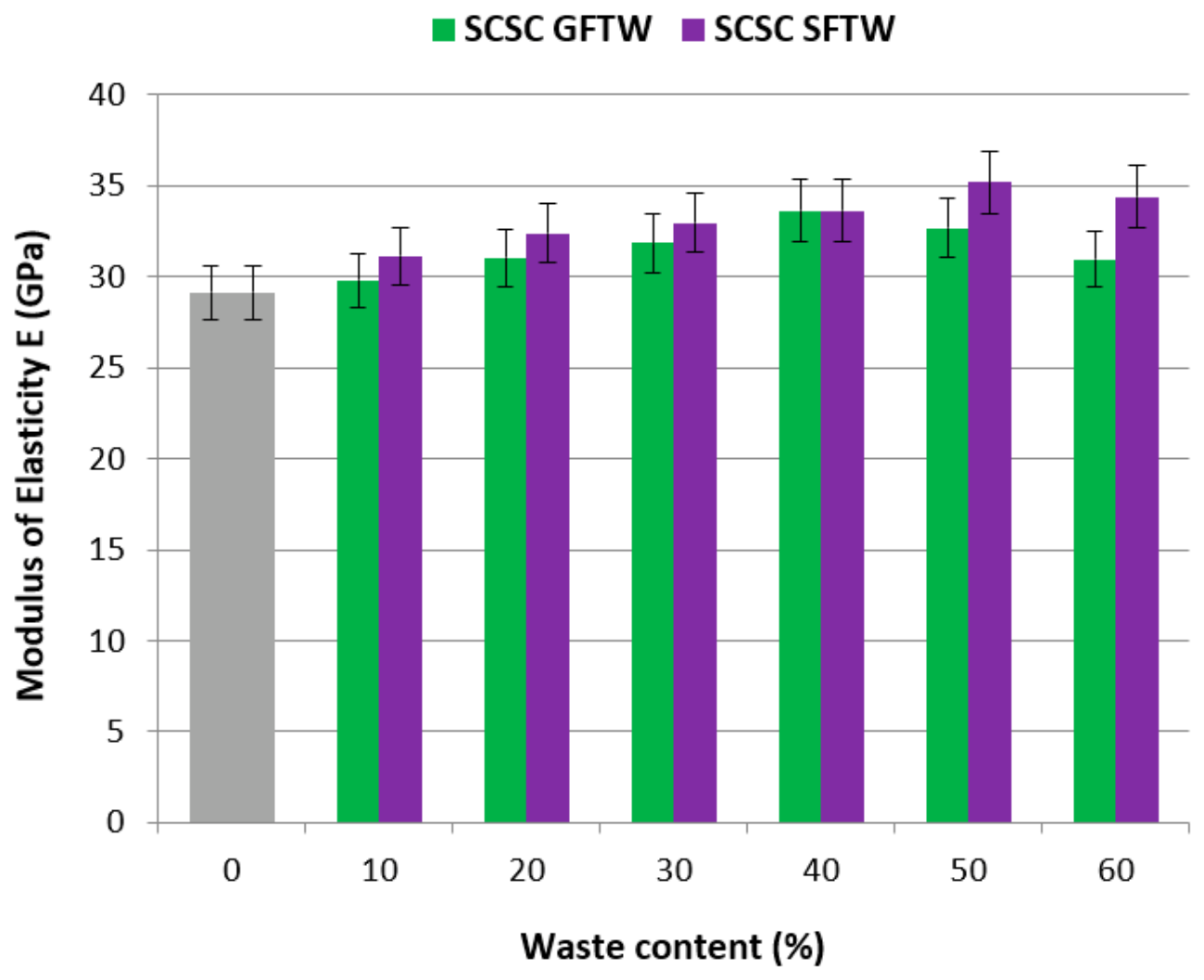
The 28-day modulus of elasticity (ME) results carried out on the different SCSC as a function of FTW content are summarized in Figure 16. The ME of SCSC mixes increases as the content of FTW aggregate increases. Its value varies between 24.10 GPa for control SCSC and 34 GPa and 39.72 GPa for mixtures containing 40% GFTW and 50% SFTW, respectively, with a gain of about 41% and 65% compared to SCSC without FTW. This increase in ME is caused by the hardness of FTW grains as well as their angular shape, which enhances the sand granules’ adhesion to the cement mix by filling up the spaces between them.
Figure 16.
Effect of FTW aggregate on the elastic modulus of different SCSC mixes.
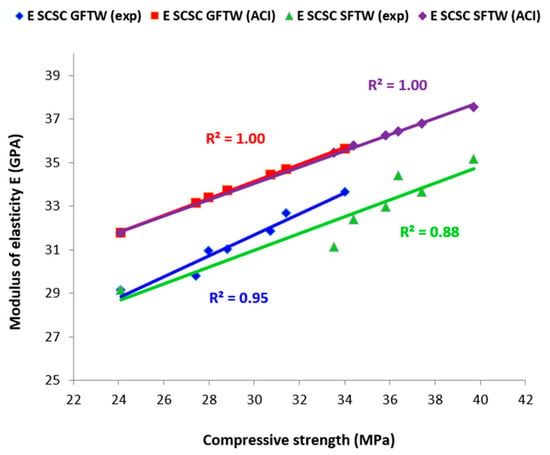
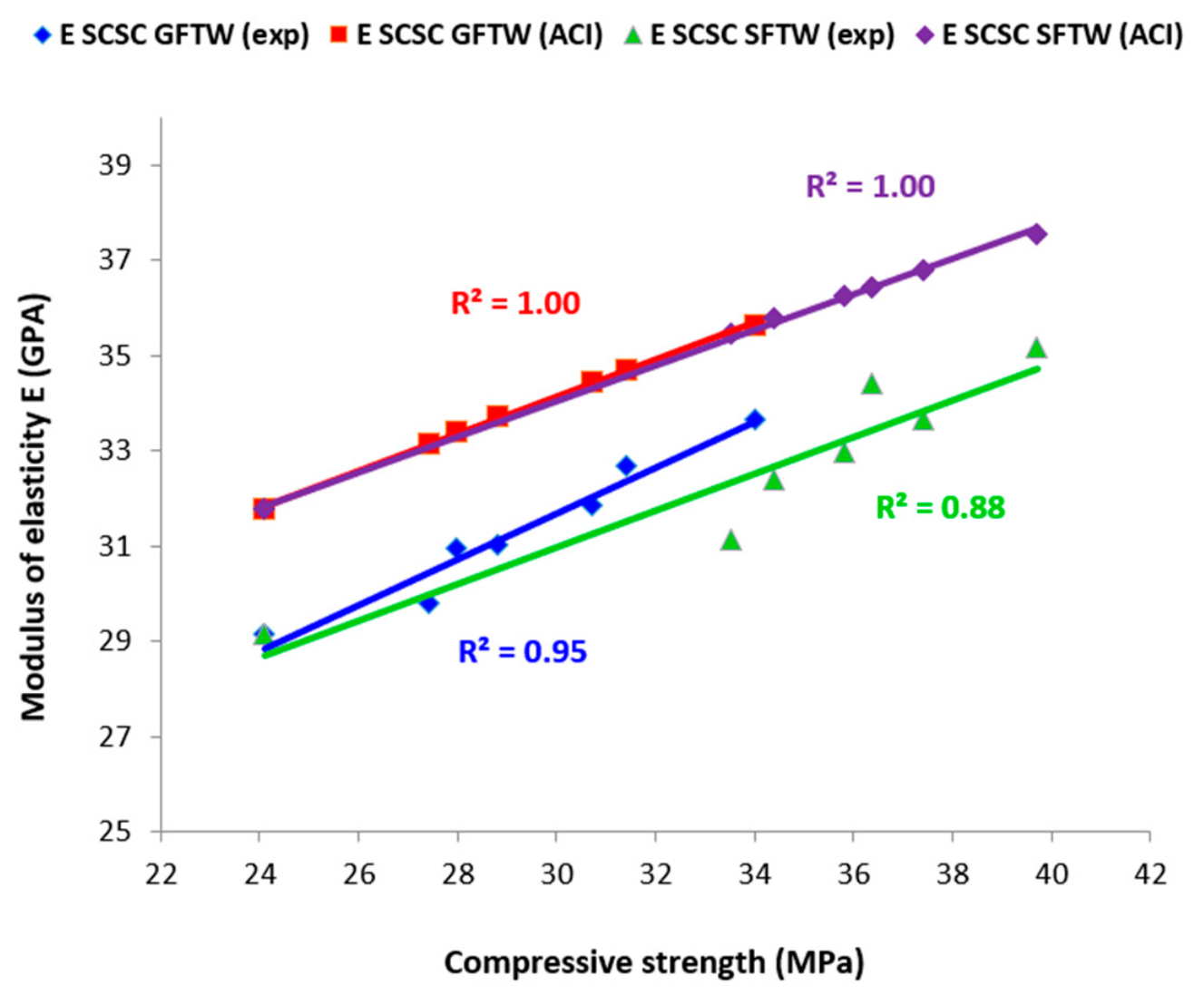
Compressive strength and modulus of elasticity may be closely related; in fact, Figure 17 illustrates the correlation between the 28-day compressive strength and the ME of SCSC mixes based on FTW content. It is obviously observable that there is a linear regression with a good correlation coefficient (R2 ≈ 0.90), which agrees with those proposed by the ACI. The findings are consistent with those of Tennich et al. [22], who discovered a 27% increase in ME for self-compacting concrete when 100% of the sand was replaced with FTW. Abadou et al. [15] similarly showed that the mortar containing FTW had a higher ME than ordinary mortar. In contrast, Elçi H. [14] discovered that the elastic modulus of concrete prepared using FTW was 36% lower than that of reference concrete.
Figure 17.
Relationships between modulus of elasticity and compressive strength of SCSC containing FTW aggregate.
3.7. Porosity and Water Absorption
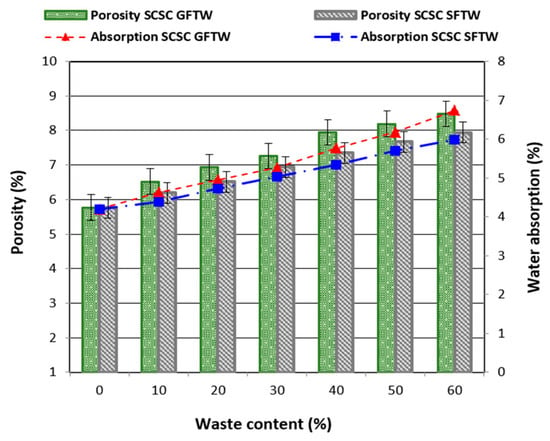
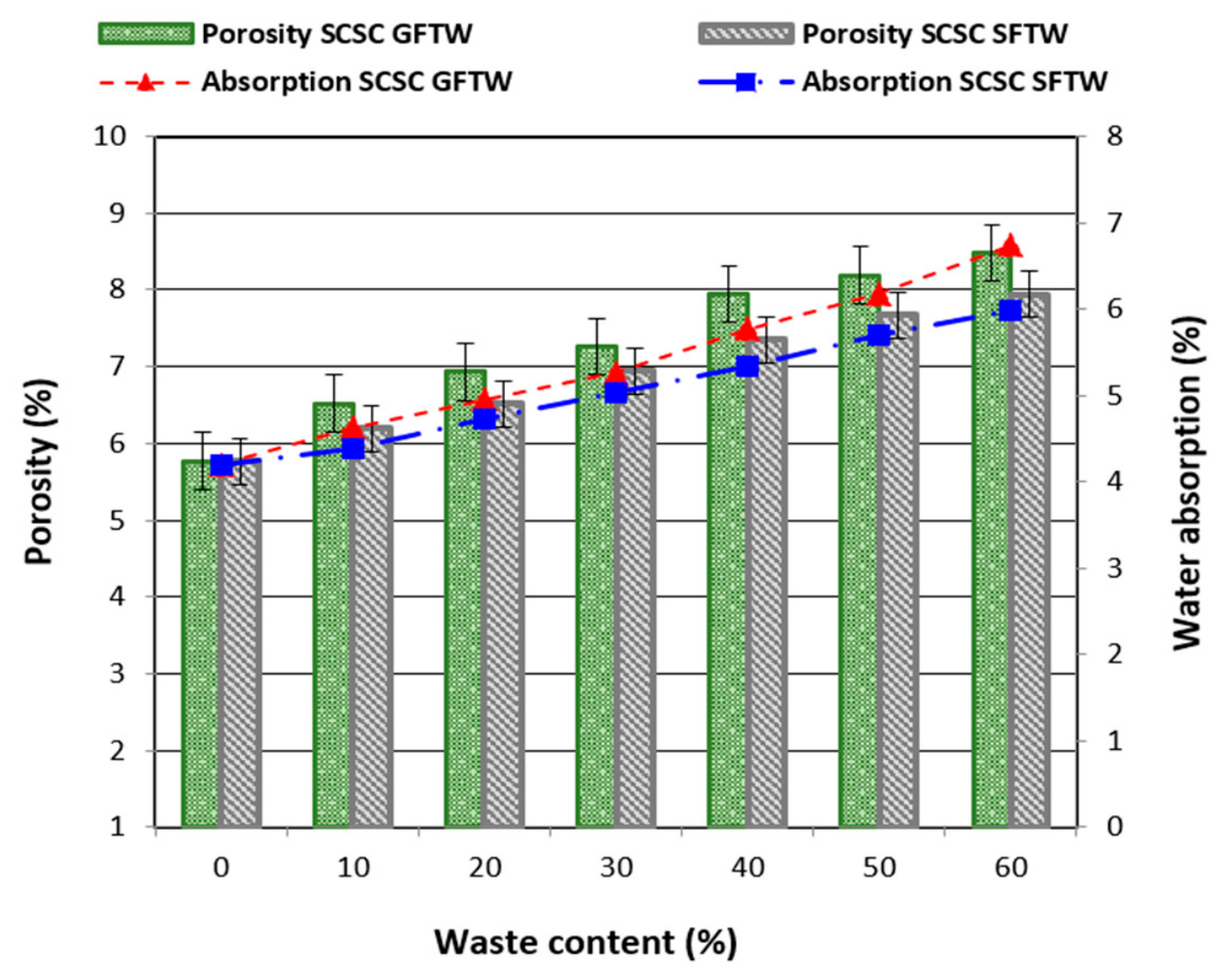
Concrete absorption is highly dependent on its porosity, which favors its interaction with aggressive chemicals and, ultimately, its long-term durability [75]. The water absorption results and porosity obtained for 28-day-old SCSC mixes, with and without FTW, are illustrated in Figure 18. Elevated water absorption and porosity values are seen for SCSC containing FTW compared to the CSCSC mixture. This is surely caused by the high absorption of FTW in comparison to natural sand and the continuous porosity of the various composites examined (Table 2). However, all SCSC mixtures have water absorption and porosity values less than 10%. According to ASTM C642-21 standard [66] and established concrete technology literature [75,80], hardened concrete exhibiting water absorption and accessible porosity values below 10% is classified as having low permeability and high matrix density, which is generally indicative of good to excellent overall quality for standard structural applications.
Figure 18.
Porosity and water absorption of SCSC mixes as a function of FTW aggregate content.
Similar results were obtained by Elçi H. [14], who found a rise in the coefficient of water absorption with the incorporation of FTW as aggregates. Keshavarz and Mostofinejad [30] discovered that concretes with porcelain and red ceramic waste have water absorption approximately 54% and 91% higher, respectively, than that of reference concrete. Bhandari and Munnur [33] found comparable water absorption and porosity values with conventional concrete when replacing between 5 and 20% of fine aggregate with granite waste. Contrarily, Tennich et al. [22] and Singh et al. [81] observed a decrease in water absorption of self-compacting concrete made with FTWA as compared to that based on natural aggregate.
It is important to address the mechanism behind the simultaneous increase in water absorption/porosity and reduction in bulk density and UPV values, with a notable increase of up to 65% in compressive strength at optimum FTW contents. This apparent contradiction can be attributed to the inherent intra-particle porosity and high surface absorption of the crushed floor tile aggregates compared to dense natural sand and the presence of entrapped macro-air voids caused by the higher angularity and SP demand of FTW particles. However, the micro-filler action of fine FTW fractions exhibited latent pozzolanic activity, consuming calcium hydroxide (Ca(OH)2) to form additional strength-bearing calcium silicate hydrate (C-S-H) gels [82]. This densifies the local paste matrix around the aggregate grains, offsetting the negative impact of macro-porosity on compressive strength. In addition, the rough surface morphology of FTW grains promotes enhanced paste-aggregate adhesion and mechanical interlocking within the Interfacial Transition Zone (ITZ). Consequently, up to the optimum replacement threshold (40% GFTW and 50% SFTW), the structural benefits of ITZ densification and stress-transfer efficiency outweigh particle-level porosity, resulting in net strength gains.
3.8. Statistical Analysis
Table 4 summarizes all the experimental results and a comprehensive statistical analysis of these results for FTW-based SCSC mixes in terms of max and min values, mean values, sample standard deviations, and coefficients of variation (COV) for all hardened properties. Although absolute dispersion is measured using standard deviation values, the COV is the main focus of the discussion because it offers a consistent way to measure data variability and makes it possible to compare properties with different units and quantities, such as the physical properties and mechanical strengths, in a meaningful way. For all ages, the values of COV for compressive and flexural strengths were observed from 6.15% to 10.93% for GFTW-SCSC and from 8.29% to 14.51% for SFTW-SCSC. Despite this variability, all COV values were below 20%, indicating satisfactory reproducibility and acceptance. A low COV was observed for the results of density, E, and UPV, with values of 1.37% and 1.35% for density, 5.02% and 6.26% for the elastic modulus, and 7.85% and 3.80% for UPV, for GFTW-SCSC and SFTW-SCSC, respectively, suggesting excellent mixture repeatability as well. Looking at the durability indices expressed by porosity and water absorption, a medium COV was determined, with values of 13.35% and 16.59, respectively, for GFTW-SCSC, and 11.52% and 12.73, respectively, for SFTW-SCSC. This confirms that the enhancement in mechanical performance is systematically related to the low matrix porosity. In general, the statistical indicators in Table 4 demonstrate the reliability of the experimental program and support the analytical interpretation of the trends observed in the physical and mechanical properties of hardened SCSC.
Table 4.
Summary of experimental results and statistical analyses.
3.9. Residual Performance After Elevated Temperature Exposure
3.9.1. Mass Loss
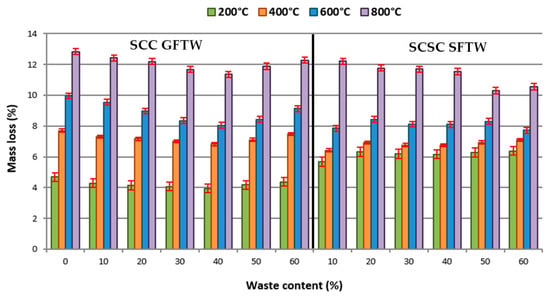
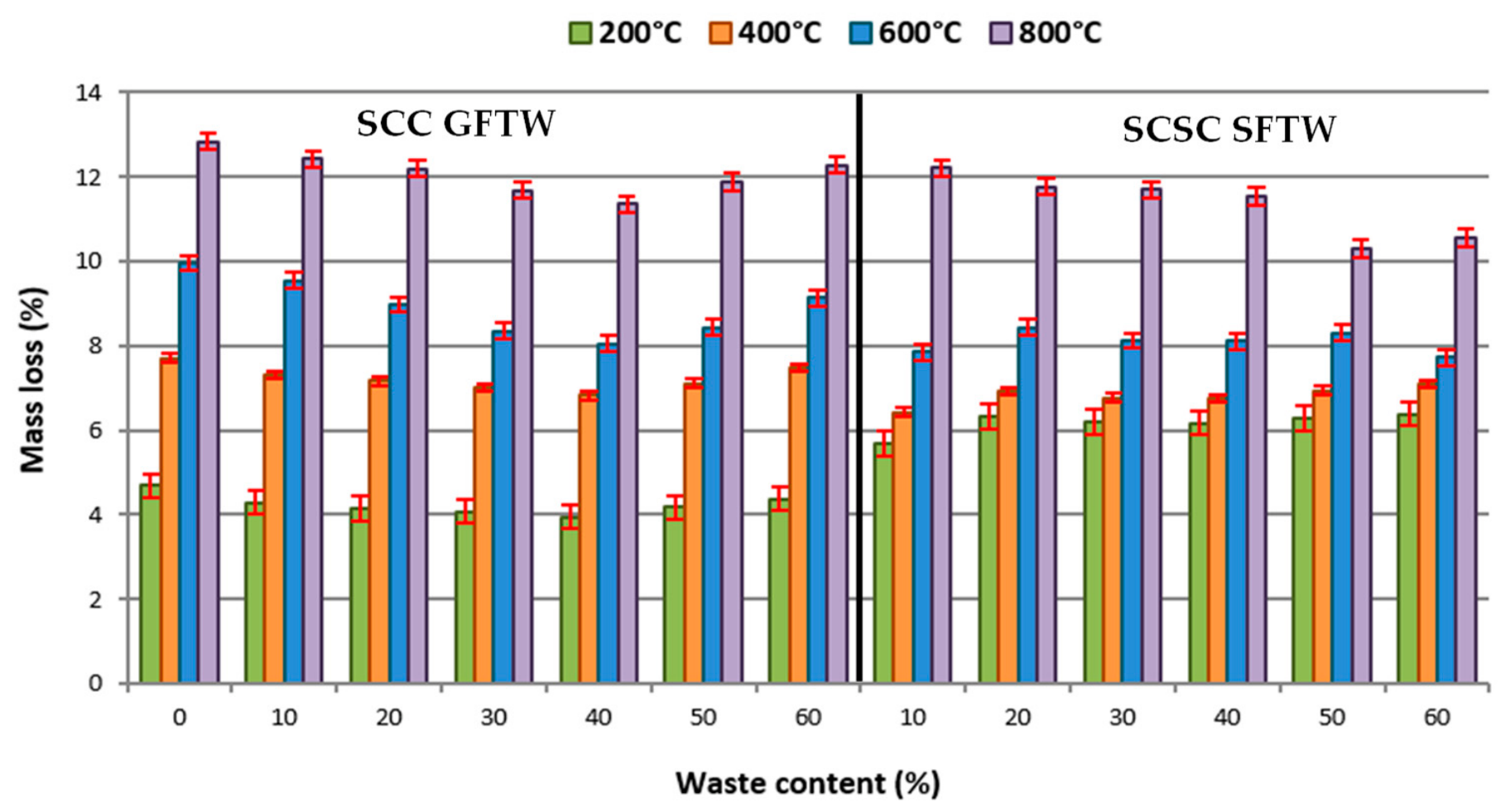
The mass loss results of the different SCSCs exposed to elevated temperature are summarized in Figure 19. All SCSCs decreased in mass with increasing temperature. This loss in mass derives from the capillary water evaporation at 200 °C, portlandite (Ca(OH)2) decomposition at temperatures between 400 °C and 600 °C [83], and dissipation of crystal water and decomposition of CaCO3 and the C-S-H gel at temperatures between 600 °C and 800 °C [84]. The rate of mass loss is approximately 13%, 12%, and 10.5%, respectively, for CSCSC, SCSC with 60% GFTW, and SCSC with 60% SFTW at 800 °C. It is noted that all SCSC made with FTW have the lowest weight loss under high temperatures compared to control concrete, and the lower values were found for SCSC with 40% GFTW and 50% SFTW. Other studies have also found mass loss of FTW-based concrete subjected to high temperatures [49,85,86].
Figure 19.
Mass loss of SCSC mixes as a function of FTW aggregate content after exposure to elevated temperature.
The lower mass loss observed in FTW-containing mixtures compared to the control mix can be attributed to the pre-calcined nature of floor tile waste, which exhibits thermal inertia up to 800 °C. Furthermore, the incorporation of fine FTW particles reduces the relative amount of portlandite (Ca(OH)2) via pozzolanic consumption [87], thereby decreasing the mass loss associated with Ca(OH)2 dihydroxylation between 400 °C and 500 °C. The minimum mass loss specifically recorded at 40% GFTW and 50% SFTW corresponds to the optimum particle packing threshold of the matrix. At these replacement levels, maximum matrix density and reduced capillary porosity minimize moisture movement and structural thermal degradation.
3.9.2. Residual Compressive Strength
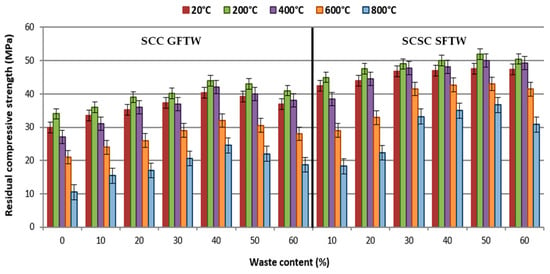
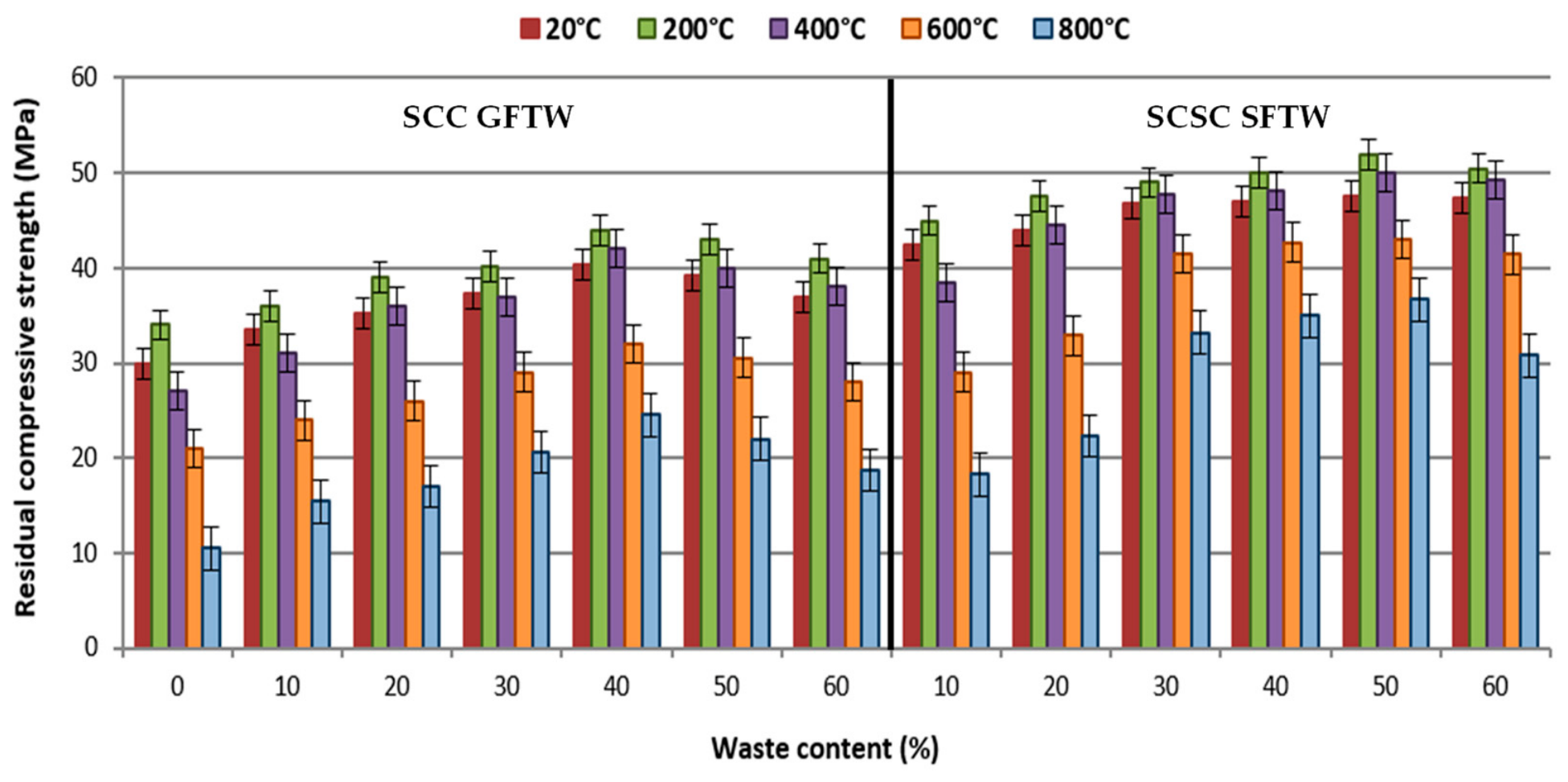
Figure 20 illustrates how high temperatures affect the relative compressive strength values of SCSC based on FTW aggregates. Initially, when the temperature reaches 200 °C, all SCSC compressive strength values increase and exhibit a peak at this temperature. However, the compressive strength values rise from 30 MPa at 20 °C to 34 MPa at 200 °C for control SCSC; from 37 MPa to 41 MPa for SCSC containing 60% GFTW; and from 47 MPa to 50 MPa for SCSC with 60% SFTW. Beyond 200 °C, the ratio of temperature/strength decreases quasi-linearly until the lowest values are obtained at 800 °C. We note that non-evaporated water (especially chemically dependent water in hydrates) participates in creating internal pressures that play the role of prestress, thus increasing the compressive strength at temperatures close to 200 °C [88]. Further, the removal of free and capillary water reduces pore pressure and draws C-S-H gel layers closer together, strengthening physical van der Waals forces and densifying the solid skeleton [89,90]. In addition, under mild thermal exposure (100–200 °C), internal moisture generates steam curing conditions that accelerate the hydration of unhydrated clinker phases and trigger secondary reactions between calcium hydroxide (CH) and reactive silica present in fine FTW particles [91].
Figure 20.
Relative compressive strength of SCSC mixes as a function of FTW aggregate content after exposure to elevated temperature.
The drop in compressive strength values over 200 °C (400–800 °C) can be hypothetically caused by the loss of crystalline water, which lowers the Ca(OH)2 concentration and increases porosity, resulting in the formation of cracks and surface spalling. Arioz O. [92] and Lin et al. [93] also demonstrate significant deterioration in concrete specimens at 800 °C and relate this to the breakdown of C-S-H in the cement matrix. It was observed, in addition, that SCSCs made with FTW have greater relative compressive strength when subjected to high temperatures than the reference concrete. Due to their high rigidity, we can say that FTW aggregates are more advantageous than natural sand for sand concrete when exposed to elevated temperatures. For high-strength concrete, Qadir S. [94] also observes that self-compacting concrete containing crushed tile aggregates exposed to temperatures between 200 and 400 °C has a lower compressive strength.
3.9.3. Visual Inspection of SCSC Samples After Exposure to Elevated Temperatures
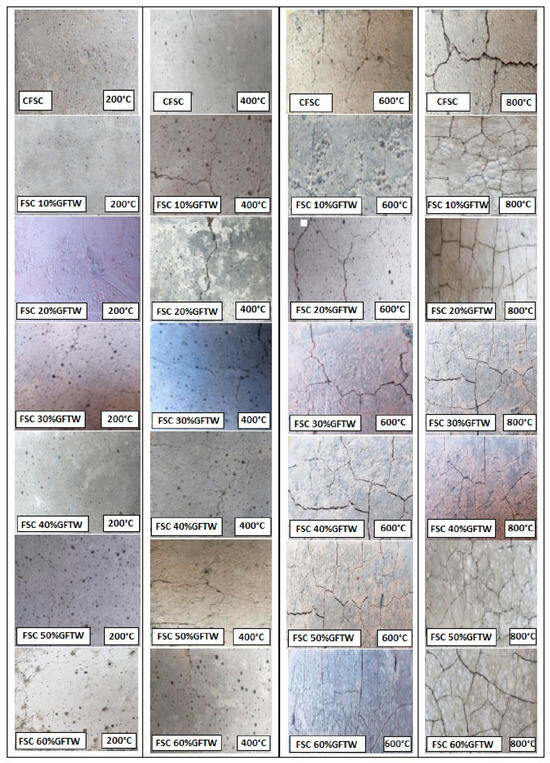
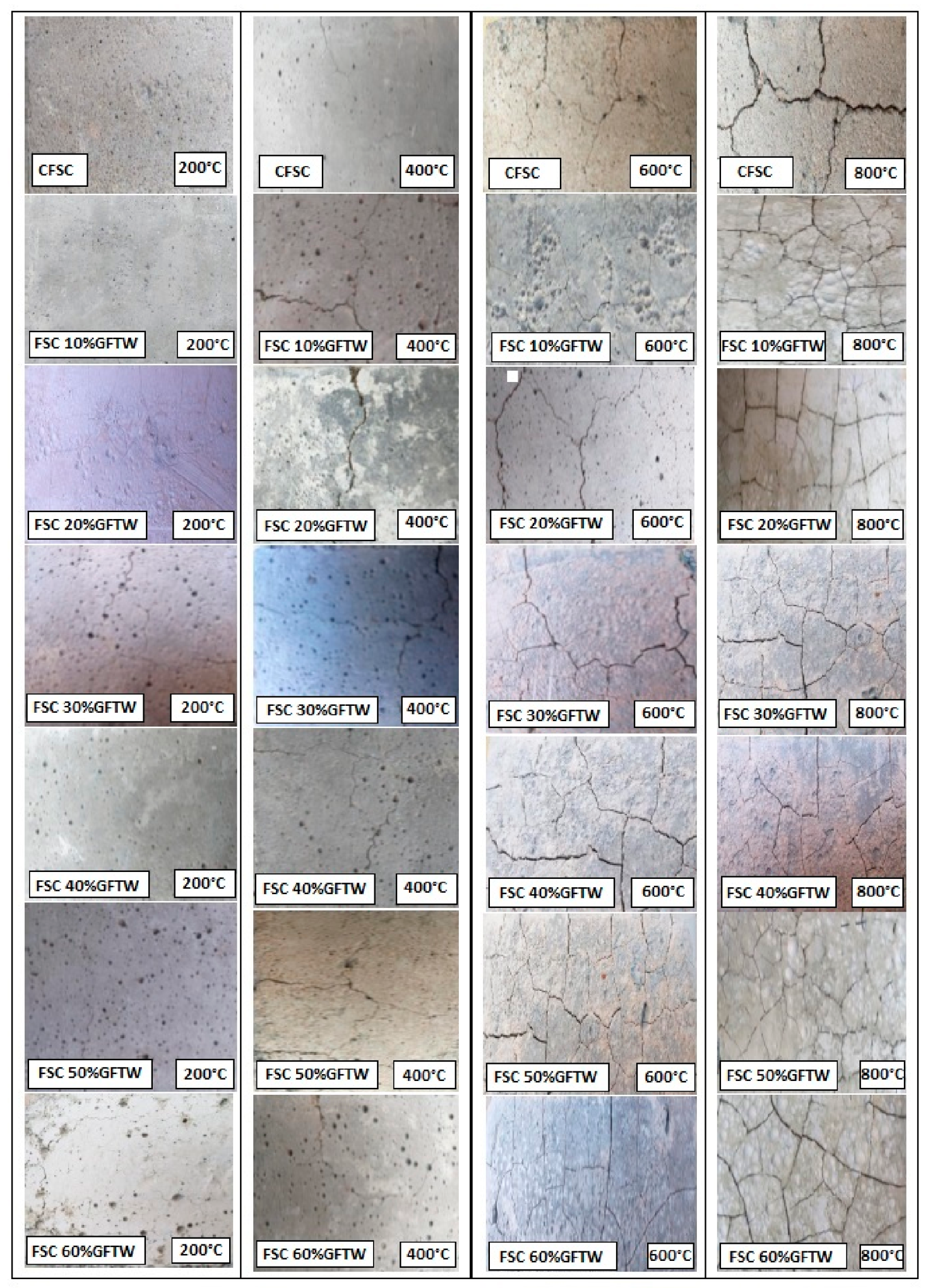
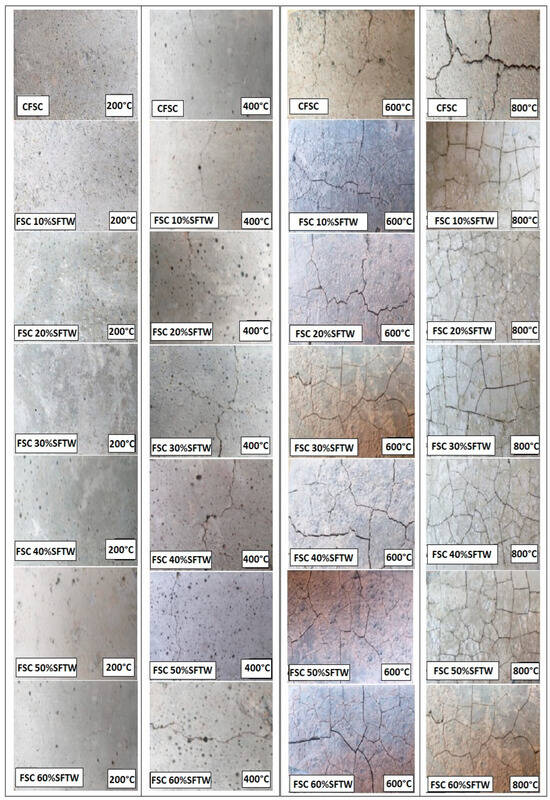
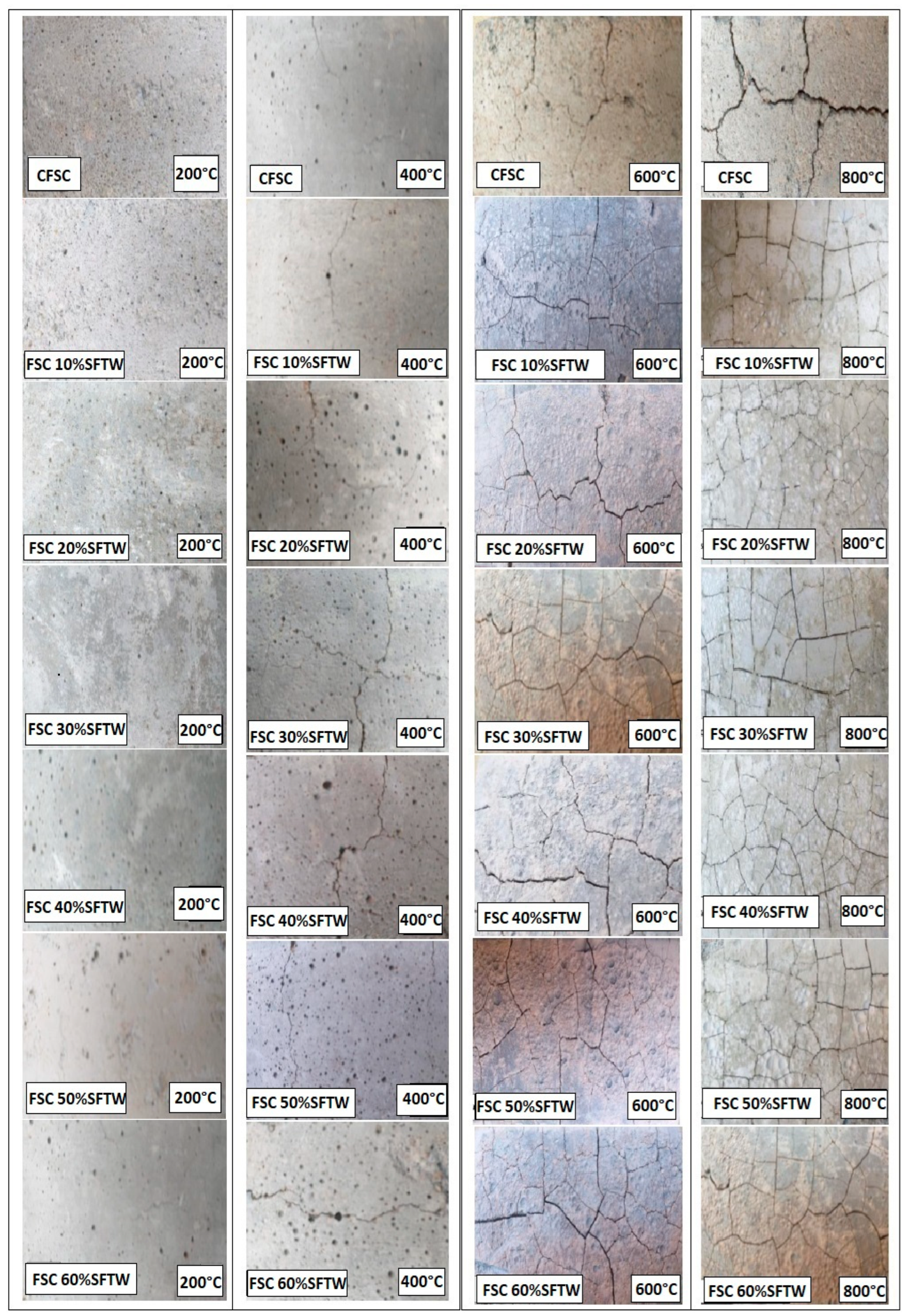
The observation of the concrete specimen’s surface can identify the degradation of the SCSC mixes after being exposed to elevated temperatures. The observations of the samples’ surfaces and SCSC damage after exposure to elevated temperatures are shown in Figure 21 and Figure 22, which include checking for color change, cracks, and surface spalling. At 20–200 °C, no noticeable effect can be identified on SCSC’s surface. The cracks appeared on the concrete surface at 400 °C and 600 °C. The color of the specimens changed, and the cracks increased at 800 °C. These cracks led to the material breaking, allowing the concrete to be completely shattered with a light hammer blow. These results agree with those in [84,93,94,95].
Figure 21.
Surface texture of SCSC specimens containing GFTW after exposure to heat treatment.
Figure 22.
Surface texture of SCSC specimens containing SFTW after exposure to heat treatment.
4. Conclusions
The goal of this work is to recycle two different kinds of floor tile waste (granite and sidewalk) as fine aggregates in self-compacting sand concrete. Due to their morphological differences (very high angular grain geometry, rough surface textures, and variable water absorption profiles compared to smooth and rounded natural sand), substituting natural sand with these wastes could modify the fundamental physico-mechanical characteristics of SCSC mixtures. The obtained results allow us to draw the following conclusions:
- The rheological characteristics of fresh SCSC mixes, such as yield stress, plastic viscosity, and overall workability, decreased with the addition of FTW aggregates. The air content, however, has doubled. The integration of SFTW induces a less marked reduction in workability than that observed with GFTW.
- In the hardened state, the rough surfaces of FTW boost interlocking and interparticle friction within the cement matrix at the ITZ, resulting in significant improvements in the early and later mechanical strength of the SCSC. Mixes with 40% GFTW and 50% SFTW showed the optimal mechanical properties, with gains of 41% and 65% in compressive strength, 17% and 45% in flexural strength, and 41% and 65% in elastic modulus at 28 days, respectively, in comparison with the control mixture.
- All FTW-based SCSCs have compressive and flexural strengths greater than 25 MPa and 3 MPa, respectively, recommended for structural concretes.
- The bulk dry density and UPV of SCSC decreased slightly with the substitution of sand by both types of FTW. However, all SCSC mixtures are classified as high-quality concretes since their density and UPV are above 2000 kg/m3 and 3500 m/s, respectively.
- SCSC’s porosity and water absorption both increase with the addition of recycled FTW aggregate. However, all SCSC mixtures have water absorption and porosity values less than 10%, indicating excellent concrete quality for various structural concrete applications.
- All SCSCs showed a considerable decline in their density and compressive strength with increasing exposure temperature. This decrease is brought on by the mixture’s porosity and water evaporation. SCSCs incorporating FTW exhibited greater residual compressive strength and were less damaged by elevated temperatures compared to reference concrete.
In conclusion, the use of FTW in self-compacting sand concrete demonstrates promising technical feasibility as a partial replacement for natural sand, potentially contributing to natural resource conservation and industrial waste reduction in line with circular economy objectives. Future studies incorporating quantitative LCA and cost modeling are recommended to fully evaluate the industrial sustainability and market viability of these mixtures.
Author Contributions
Conceptualization, H.B. and M.G.; methodology, H.B. and D.B.; formal analysis, H.B., D.B., and M.G.; investigation, D.B., and M.G.; resources, M.G. and D.B.; data curation, D.B. and M.G.; writing—original draft preparation, M.G. and D.B.; writing—review and editing, M.G. and D.B.; visualization, M.G.; supervision, M.G. All authors have read and agreed to the published version of the manuscript.
Funding
This research received no external funding.
Data Availability Statement
The original contributions presented in this study are included in the article. Further inquiries can be directed to the corresponding author.
Acknowledgments
The authors would like to express their gratitude to the engineers of University of Medea’s civil engineering laboratory for providing technical assistance in making this study a reality.
Conflicts of Interest
The authors declare no conflicts of interest.
References
- Blaifi, H.; Guendouz, M.; Belhadj, A.E.; Boukhelkhal, D.; Hadjadj, M. Sustainable use of recycled plastic and ceramic industrial wastes in eco-freindly construction materials. Environ. Eng. Manag. J. (EEMJ) 2023, 22, 1471. [Google Scholar] [CrossRef] [Scilit]
- Tiwari, A.; Singh, S.; Nagar, R. Feasibility assessment for partial replacement of fine aggregate to attain cleaner production perspective in concrete: A review. J. Clean. Prod. 2016, 135, 490–507. [Google Scholar] [CrossRef] [Scilit]
- Guendouz, M.; Boukhelkhal, D. Physical and mechanical properties of cement mortar made with brick waste. MATEC Web Conf. 2018, 149, 01077. [Google Scholar] [CrossRef]
- Zhao, Z.; Courard, L.; Michel, F.; Remond, S.; Damidot, D. Influence of granular fraction and origin of recycled concrete aggregates on their properties. Eur. J. Environ. Civ. Eng. 2017, 22, 1457–1467. [Google Scholar] [CrossRef] [Scilit]
- Beladzar, Z.; Boukhelkhal, D.; Guendouz, M.; Hadjadj, M. Contribution to the reinforcement of cement composites using aggregates from industrial windshield waste. Bud. I Archit.—Civ. Archit. Eng. 2026, 25, 26013. [Google Scholar] [CrossRef] [Scilit]
- Guermiti, L.; Guendouz, M.; Boukhelkhal, D.; Abid, S.; Hadjadj, M. Potential of producing lightweight cork-based mortars reinforced with polyethylene fibers for building applications. Building 2026, 16, 102. [Google Scholar] [CrossRef] [Scilit]
- Roque, S.; Pederneiras, C.M.; Farinha, C.B.; Brito, J.; Veiga, R. Concrete-Based and Mixed Waste Aggregates in Rendering Mortars. Materials 2020, 13, 1976. [Google Scholar] [CrossRef] [Scilit] [PubMed]
- Hamraoui, S.; Boukhelkhal, D.; Guendouz, M. Utilisation of bio-based acorn cupule aggregates in producing lightweight concrete: Influence of thermal treatment on performance characteristics. Bud. Archit./Civ. Archit. Eng. 2026, 25, 26031. [Google Scholar] [CrossRef] [Scilit]
- Yu, X.; Zhang, C.; Li, J.; Bai, X.; Yang, L.; Han, J.; Zhou, G. Reuse of Retired Wind Turbine Blades in Civil Engineering. Buildings 2025, 15, 2414. [Google Scholar] [CrossRef] [Scilit]
- Alsharari, F. Utilization of industrial, agricultural, and construction waste in cementitious composites: A comprehensive review of their impact on concrete properties and sustainable construction practices. Mater. Today Sustain. 2025, 29, 101080. [Google Scholar] [CrossRef] [Scilit]
- Lee, S.; Chang, H.E.; Lee, J. Construction and Demolition Waste Management and its Impacts on the Environment and Human Health: Moving Forward Sustainability Enhancement. Sustain. Cities Soc. 2024, 115, 105855. [Google Scholar] [CrossRef] [Scilit]
- Patil, Y.R.; Dakwale, V.A.; Ralegaonkar, R.V. Recycling Construction and Demolition Waste in the Sector of Construction. Adv. Civ. Eng. 2024, 6234010, 13. [Google Scholar] [CrossRef] [Scilit]
- Huseien, G.F.; Joudah, Z.H.; Baghban, M.H.; Khalid, N.H.A.; Faridmehr, I.; Dong, K.; Li, Y.; Gu, X. Sustainability of Recycling Waste Ceramic Tiles in the Green Concrete Industry: A Comprehensive Review. Buildings 2025, 15, 2406. [Google Scholar] [CrossRef] [Scilit]
- Elçi, H. Utilisation of crushed floor and wall tile wastes as aggregate in concrete production. J. Clean. Prod. 2016, 112, 742–752. [Google Scholar] [CrossRef] [Scilit]
- Abadou, Y.; Mitiche-Kettab, R.; Ghrieb, A. Ceramic waste influence on dune sand mortar performance. Constr. Build. Mater. 2016, 125, 703–713. [Google Scholar] [CrossRef] [Scilit]
- Pitarch, A.M.; Reig, L.; Tomás, A.E. Effect of Tiles, Bricks and Ceramic Sanitary-Ware Recycled Aggregates on Structural Concrete Properties. Waste Biomass Valorization 2019, 10, 1779–1793. [Google Scholar] [CrossRef] [Scilit]
- Daniyal, M.; Ahmad, S. Application of Waste Ceramic Tile Aggregates in Concrete. Int. J. Innov. Res. Sci. Eng. Technol. 2015, 4, 12808–12815. [Google Scholar] [CrossRef]
- Awoyera, P.O.; Ndambuki, J.M.; Akinmusuru, J.O.; Omole, D.O. Characterization of ceramic waste aggregate concrete. HBRC J. 2018, 14, 282–287. [Google Scholar] [CrossRef] [Scilit]
- Anderson, D.J.; Smith, S.T.; Au, F.T.K. Mechanical properties of concrete utilising waste ceramic as coarse aggregate. Constr. Build. Mater. 2016, 117, 20–28. [Google Scholar] [CrossRef] [Scilit]
- Tabak, Y.; Kara, M.; Günay, E.; Yildirim, S.T.; Yilmaz, S. Ceramic tile waste as a waste management solution for concrete. In Proceedings of the 3rd International Conference on Industrial and Hazardous Waste Management (CRETE 2012), Chania, Greece, 12–14 September 2012. [Google Scholar]
- Gadri, K.; Guettala, A. Etude du comportement physico-mécanique des bétons de sable à base de déchets de polissage de carrelage. In Proceedings of the Conférence Matériaux—Colloque ECOMATERIAU, Montpellier, France, 24–28 November 2014. [Google Scholar]
- Tennich, M.; Kallel, A.; Ben Ouezdou, M. Incorporation of fillers from marble and tile wastes in the composition of self-compacting concretes. Constr. Build. Mater. 2015, 91, 65–70. [Google Scholar] [CrossRef] [Scilit]
- Kanmalai Williams, C.; Partheeban, P.; Felix Kala, T. Mechanical properties of high performance concrete incorporating granite powder as fine aggregate. India Int. J. Des. Manuf. Technol. 2008, 2, 67–73. [Google Scholar] [CrossRef] [Scilit]
- Singh, S.; Nagar, R.; Agrawal, V.; Rana, A.; Tiwari, A. Sustainable utilization of granite cutting waste in high strength concrete. J. Clean. Prod. 2016, 116, 223–235. [Google Scholar] [CrossRef] [Scilit]
- Raghavendra, R.; Sharada, S.A.; Ravindra, G.M.V. Compressive strength of high-performance concrete using granite powder as fine aggregate. Int. J. Res. Eng. Technol. 2015, 4, 47–49. [Google Scholar] [CrossRef] [Scilit]
- Adigun, E.M.A. Cost effectiveness of replacing sand with crushed granite fine (CGF) in the mixed design of concrete. IOSR J. Mech. Civ. Eng. 2013, 10, 01–06. [Google Scholar] [CrossRef] [Scilit]
- Guendouz, M.; Boukhelkhal, D.; Bourdot, A. Recycling of floor tile waste as fine aggregate in flowable sand concrete. In Advances in Green Energies and Materials Technology: Selected Articles from the Algerian Symposium on Renewable Energy and Materials; Springer: Singapore, 2021; pp. 223–229. [Google Scholar] [CrossRef] [Scilit]
- Khuram, R.; Afia, R.; Madiha, A.; Tabasam, R.; Tariq, S. Experimental and analytical selection of sustainable recycled concrete with ceramic waste aggregate. Constr. Build. Mater. 2017, 154, 829–840. [Google Scholar] [CrossRef] [Scilit]
- Lucas, J.; De Brito, J.; Veiga, R.; Farinha, C. The effect of using sanitary ware as aggregates on rendering mortars’ performance. Mater. Des. 2016, 91, 155–159. [Google Scholar] [CrossRef] [Scilit]
- Keshavarz, Z.; Mostofinejad, D. Porcelain and red ceramic wastes used as replacements for coarse aggregate in concrete. Constr. Build. Mater. 2019, 195, 218–230. [Google Scholar] [CrossRef] [Scilit]
- Olaniyan, O.S.; Afolabi, O.M.; Okeyinka, O.M. Granite fines as a partial replacement for sand in sand concrete block production. Int. J. Eng. Technol. 2012, 2, 1392–1394. [Google Scholar]
- Garas, G.L.; Allam, M.E.; Bakhoum, E.S. Studies undertaken to incorporate marble and granite wastes in green concrete production. ARPN J. Eng. Appl. Sci. 2014, 9, 1559–1564. [Google Scholar]
- Bhandari, J.J.; Munnur, S. Strength and durability aspects of partial replacement of sand by granite fines. Int. J. Res. Eng. Technol. 2015, 4, 194–200. [Google Scholar] [CrossRef] [Scilit]
- Cordeiro, G.C.; Crespo de Alvarenga, L.M.S.; Rocha, C.A.A. Rheological and mechanical properties of concrete containing crushed granite fine aggregate. Constr. Build. Mater. 2016, 111, 766–773. [Google Scholar] [CrossRef] [Scilit]
- NF P 18-500; Concrete—Sand Concrete. AFNOR: Saint-Denis, France, 1995.
- Sablocrete. Concrete—Sand Concrete: Characteristics and Use Practices; Presses de l’École Nationale des Ponts et Chaussées: Paris, France, 1994. [Google Scholar]
- Kolovos, K.G.; Asteris, P.G.; Tsivilis, S. Properties of sand concrete mixtures modified with metakaolin. Eur. J. Environ. Civ. Eng. 2016, 20, s18–s37. [Google Scholar] [CrossRef] [Scilit]
- Guendouz, M.; Boukhelkhal, D. Properties of dune sand concrete containing coffee waste. MATEC Web Conf. 2018, 149, 01039. [Google Scholar] [CrossRef]
- Damene, Z.; Goual, M.S.; Houessou, J.; Dheilly, R.M.; Goullieux, A.; Quéneudec, M. The use of southern Algeria dune sand in cellular lightweight concrete manufacturing: Effect of lime and aluminium content on porosity, compressive strength and thermal conductivity of elaborated materials. Eur. J. Environ. Civ. Eng. 2016, 22, 1273–1289. [Google Scholar] [CrossRef] [Scilit]
- Khay, S.E.E.; Neji, J.; Loulizi, A. Shrinkage properties of compacted sand concrete used in pavements. Constr. Build. Mater. 2010, 24, 1790–1795. [Google Scholar] [CrossRef] [Scilit]
- Bouziani, T.; Benmounah, A.; Bederina, M.; Lamara, M. Effect of marble powder on the properties of self-compacting sand concrete. Open Constr. Build. Technol. J. 2011, 5, 25–29. [Google Scholar] [CrossRef] [Scilit]
- Benaissa, I.; Nasser, B.; Aggoun, S.; Malab, S. Properties of fibred sand concrete sprayed by wet-mix process. Arab. J. Sci. Eng. 2015, 40, 2289–2299. [Google Scholar] [CrossRef] [Scilit]
- Belhadj, B.; Bederina, M.; Makhloufi, M.; Dheilly, R.M.; Montrelay, N.; Quéneudéc, N. Contribution to the development of a sand concrete lightened by the addition of barley straws. Constr. Build. Mater. 2016, 113, 513–522. [Google Scholar] [CrossRef] [Scilit]
- Beladzar, Z.; Boukhelkhal, D.; Guendouz, M.; Nouri, S.M.; Biblioteca, I.; Valente, M. Durability Assessment of Self-Compacting Sand Concrete Incorporating Windshield Glass Aggregate Under Extreme Environmental Conditions: High Temperature and Freeze–Thaw Cycling. Ceramics 2026, 9, 59. [Google Scholar] [CrossRef] [Scilit]
- Belmokretar, K.; Kada, A.; Kerdal, D.E.; Leklou, N. New Repair Material for Ordinary Concrete Substrates: Investigating Self-Compacting Sand Concrete and Its Interaction with Roughness of the Substrate Surface. J. Mater. Civ. Eng. 2023, 35, 13. [Google Scholar] [CrossRef] [Scilit]
- Hadjadj, M.; Guendouz, M.; Boukhelkhal, D. Enhancing the mechanical and durability properties of bio self-compacting sand concrete containing granite industrial waste as a fine aggregate: An experimental study. Bud. I Archit. 2025, 24, 79–99. [Google Scholar] [CrossRef] [Scilit]
- Abidelah, A.; Bouchair, A.; Kerdal, D.E.; Kada, A. Characterization of a self-compacting sand concrete using the quarry waste. Can. J. Civ. Eng. 2009, 36, 1773–1782. [Google Scholar] [CrossRef] [Scilit]
- Hadjadj, M.; Guendouz, M.; Boukhelkhal, D. The effect of using seashells as cementitious bio-material and granite industrial waste as fine aggregate on mechanical and durability properties of green flowable sand concrete. J. Build. Eng. 2024, 87, 108968. [Google Scholar] [CrossRef] [Scilit]
- Guendouz, M.; Boukhelkhal, D. Properties of flowable sand concrete containing ceramic wastes. J. Adhes. Sci. Technol. 2019, 33, 2661–2683. [Google Scholar] [CrossRef] [Scilit]
- Bouziani, T.; Benmounah, A.; Makhloufi, Z. Properties of flowable sand concretes, reinforced by polypropylenefibers. J. Adhes. Sci. Technol. 2014, 28, 1823–1834. [Google Scholar] [CrossRef] [Scilit]
- Jiang, C.; Guo, W.; Chen, H.; Zhu, Y.; Jin, C. Effect of filler type and content on mechanical properties and microstructure of sand concrete made with superfine waste sand. Constr. Build. Mater. 2018, 192, 442–449. [Google Scholar] [CrossRef] [Scilit]
- NF EN 1097-3; Tests for Determining the Mechanical and Physical Characteristics of Aggregates—Part 3: Method for Determining Bulk Density and Intergranular Porosity. AFNOR: Saint-Denis, France, 1998.
- NF EN 1097-6; Tests for Determining the Mechanical and Physical Characteristics of Aggregates—Part 6: Determination of Actual Density and Water Absorption Coefficient. AFNOR: Saint-Denis, France, 2001.
- NF EN 933-8; Tests to Determine the Geometric Characteristics of Aggregates—Part 8: Evaluation of Fines—Sand Equivalent. AFNOR: Saint-Denis, France, 2012.
- NF EN 933-1; Tests to Determine the Geometric Characteristics of Aggregates—Part 1: Determination of Granularity—Particle Size Analysis by Sieving. AFNOR: Saint-Denis, France, 2012.
- NF EN 1008; Mixing Water for Concrete—Specifications for Sampling, Testing and Evaluation of Suitability for Use, Including Process Waters from the Concrete Industry, such as Concrete Mixing Water. AFNOR: Saint-Denis, France, 2003.
- Zuo, S.; Liu, B. Optimization design of concrete mix proportion based on support vector machine regression and enhanced genetic algorithm. Discov. Appl. Sci. 2025, 7, 200. [Google Scholar] [CrossRef] [Scilit]
- Hadjadj, M.; Guendouz, M.; Boukhelkhal, D. Durability assessment of bio-based self-compacting sand concrete with recycled granite aggregate waste against chloride and sulphate attacks. Bud. I Archit. 2025, 24, 075–094. [Google Scholar] [CrossRef] [Scilit]
- Bouabdallah, A.; Benaissa, A.; Bouabdallah, M.A.; Malab, S.; Khatir, A. Development and performance evaluation of self-leveling sand concrete: Enhanced fluidity, mechanical strength, durability, and non-destructive analysis. Constr. Build. Mater. 2025, 468, 140463. [Google Scholar] [CrossRef] [Scilit]
- Boukhelkhal, D.; Guendouz, M.; Bourdot, A.; Cheriet, H.; Messaoudi, K. Elaboration of bio-based building materials made from recycled olive core. MRS Energy Sustain. 2021, 8, 98–109. [Google Scholar] [CrossRef] [Scilit]
- Self-Compacting Concrete European Project Group. The European Guidelines for Self-Compacting Concrete: Specification, Production and Use; EFNARC: Farnham, UK, 2005; p. 63. [Google Scholar]
- NF EN 12350-7; Tests for Fresh Concrete—Part 7: Air Content—Compressibility Method. AFNOR: Saint-Denis, France, 2019.
- NF EN 196-1; Methods of Testing Cement—Part 1: Determination of Strength. AFNOR: Saint-Denis, France, 2016.
- ASTM. ASTM C597-16 Standard Test Method for Pulse Velocity Through Concrete; ASTM International: West Conshohocken, PA, USA, 2016. [Google Scholar]
- NF EN 1352; Test Methods for Hardened Concrete, Determination of the Static Compressive Modulus of Autoclaved Aerated Concrete and Open-Structure Lightweight Aggregate Concrete. AFNOR: Saint-Denis, Saint-Denis, France, 1996.
- ASTM C642-21; Standard Test Method for Density, Absorption, and Voids in Hardened Concrete. ASTM International: West Conshohocken, PA, USA, 2022.
- ISO 834; Fire Resistance Test for Concrete Structure. ISO: Geneva, Switzerland, 2014.
- Anagnostopoulos, N.; Sideris, K.K.; Georgiadis, A. Mechanical characteristics of self-compacting concretes with different filler materials, exposed to elevated temperatures. Mater. Struct. 2009, 42, 1393–1405. [Google Scholar] [CrossRef] [Scilit]
- Siddique, S.; Shrivastava, S.; Chaudhary, S. Influence of ceramic waste on the fresh properties and compressive strength of concrete. Eur. J. Environ. Civ. Eng. 2017, 23, 212–225. [Google Scholar] [CrossRef] [Scilit]
- Daghistani, F.; Abuel-Naga, H. Evaluating the Influence of Sand Particle Morphology on Shear Strength: A Comparison of Experimental and Machine Learning Approaches. Appl. Sci. 2023, 13, 8160. [Google Scholar] [CrossRef] [Scilit]
- Hadjadj, M.; Guendouz, M.; Boukhelkhal, D. Developing High-strength, Flowable Sand Concrete by Adding Combined Industrial Ceramic and Granite Waste with Seashell Bio-waste as Fine Aggregates. Period. Polytech. Chem. Eng. 2026, 70, 101–112. [Google Scholar] [CrossRef] [Scilit]
- Kostrzanowska-Siedlarz, A.; Golaszewski, J. Rheological properties and the air content in fresh concrete for self-compacting high-performance concrete. Constr. Build. Mater. 2015, 94, 555–564. [Google Scholar] [CrossRef] [Scilit]
- Boukhelkhal, j.; Guendouz, M. The use of non-destructive tests to estimate self-compacting concrete compressive strength. MATEC Web Conf. 2018, 149, 01036. [Google Scholar] [CrossRef]
- Malhotra, V.M.; Carino, N.J. Handbook on Nondestructive Testing of Concrete, 2nd ed.; CRC press: New York, NY, USA, 2004; p. 384. [Google Scholar] [CrossRef] [Scilit]
- Neville, A.M. Properties of Concrete; Pearson Education Limited: Harlow, Essex, UK, 2011. [Google Scholar]
- Ganaw, A.; Bn Othman, M.A.; Abosnena, M.H. Influence of Waste Floor Tiles as coarse aggregate on Concrete Properties. In Proceedings of the 2nd Conference for Engineering Sciences and Technology—CEST2, Sabratha, Libya, 29–31 October 2019. [Google Scholar]
- Torkittikul, P.; Chaipanich, A. Utilization of ceramic waste as fine aggregate within Portland cement and fly ash concretes. Cem. Concr. Compos. 2010, 32, 440–449. [Google Scholar] [CrossRef] [Scilit]
- Medina, C.; Frías, M.; Sánchez de Rojas, M. Microstructure and properties of recycled concretes using sanitary ware industry waste as coarse aggregate. Constr. Build. Mater. 2012, 31, 112–118. [Google Scholar] [CrossRef] [Scilit]
- Hadjadj, M.; Guendouz, M.; Boukhelkhal, D. Combined effects of ceramic and granite industrial wastes on engineering properties of self-compacting sand concrete. Environ. Eng. Manag. J. 2025, 24, 2585–2600. [Google Scholar] [CrossRef] [Scilit]
- Li, K.; Chen, Z.; Lian, H. Concepts and requirements of durability design for concrete structures: An extensive review of CCES01. Mater. Struct. 2007, 41, 717–731. [Google Scholar] [CrossRef] [Scilit]
- Singh, S.; Tiwari, A.; Nagar, R.; Agrawal, V. Feasibility as a potential substitute for natural sand: A comparative study between granite cutting waste and marble slurry. In Proceedings of the 5th IconSWM-2015; Bengaluru, India, 24–27 November 2015; pp. 543–552. [Google Scholar]
- Bouabdallah, A.; Khatir, A.; Bouabdallah, M.-A.; Bouchama, A. Microstructural characterization of an optimized self-leveling sand concrete: Correlating SEM, EDS and XRD observations with mechanical performance. Constr. Build. Mater. 2026, 543, 148145. [Google Scholar] [CrossRef] [Scilit]
- Zhang, P.; Zhang, P.; Wu, J.; Guo, Z.; Zhang, Y.; Zheng, Y. Mechanical Properties and Durability of Sustainable Concrete Manufactured Using Ceramic Waste: A Review. J. Renew. Mater. 2022, 11, 937–974. [Google Scholar] [CrossRef] [Scilit]
- Zhang, Z.; Du, J.; Shi, M. Quantitative Analysis of the Calcium Hydroxide Content of EVA-Modified Cement Paste Based on TG-DSC in a Dual Atmosphere. Materials 2022, 15, 2660. [Google Scholar] [CrossRef] [Scilit] [PubMed]
- Hadjadj, M.; Guendouz, M.; Boukhelkhal, D. Effect of high temperature on the microstructure and residual strength of green flowable sand concrete produced with granite waste and seashell powder. Stud. Eng. Exact Sci. 2024, 5, 01–19. [Google Scholar] [CrossRef] [Scilit]
- Baradaran-Nasiri, A.; Nematzadeh, M. The effect of elevated temperatures on the mechanical properties of concrete with fine recycled refractory brick aggregate and aluminate cement. Constr. Build. Mater. 2017, 147, 865–875. [Google Scholar] [CrossRef] [Scilit]
- Baylavlı, H.; Gödek, E. Use of Ceramic Tile Wastes as Raw Substitution Material in the Production of Blended Cement. Buildings 2024, 14, 2942. [Google Scholar] [CrossRef] [Scilit]
- Mindess, S.; Young, J.F.; Darwin, D. Concrete; Prentice Hall: Upper Saddle River, NJ, USA, 2003. [Google Scholar]
- Taylor, H.F.W. Cement Chemistry, 2nd ed.; Thomas Telford: London, UK, 1997. [Google Scholar]
- Jennings, H.M. A model for the microstructure of calcium silicate hydrate in cement paste. Cem. Concr. Res. 2000, 30, 417–432. [Google Scholar] [CrossRef] [Scilit]
- Siddique, R. Waste Materials and By-Products in Concrete; Spri: Cambridge, UK, 2008. [Google Scholar]
- Arioz, O. Effects of elevated temperatures on properties of concrete. Fire Saf. J. 2007, 42, 516–522. [Google Scholar] [CrossRef] [Scilit]
- Lin, W.M.; Lin, T.; Powers-Couche, L.J. Microstructures of fire-damaged concrete. Mater. J. 1996, 93, 199–205. [Google Scholar] [CrossRef] [Scilit] [PubMed]
- Qadir, S.S. Strength and Behavior of Self Compacting Concrete with Crushed Ceramic Tiles as Partial Replacement for Coarse Aggregate and Subjected to Elevated Temperature. Int. J. Eng. Technol. Manag. Appl. Sci. 2015, 3, 278–286. [Google Scholar]
- Xing, Z.; Beaucour, A.L.; Hebert, R.; Noumowe, A.; Ledesert, B. Influence of the nature of aggregates on the behaviour of concrete subjected to elevated temperature. Cem. Concr. Res. 2011, 41, 392–402. [Google Scholar] [CrossRef] [Scilit]

Disclaimer/Publisher’s Note: The statements, opinions and data contained in all publications are solely those of the individual author(s) and contributor(s) and not of MDPI and/or the editor(s). MDPI and/or the editor(s) disclaim responsibility for any injury to people or property resulting from any ideas, methods, instructions or products referred to in the content. |
© 2026 by the authors. Licensee MDPI, Basel, Switzerland. This article is an open access article distributed under the terms and conditions of the Creative Commons Attribution (CC BY) license.