


Abstract
Cement composites are essential building materials, but their inherent brittleness and high cracking risk compromise structural safety and raise maintenance costs. The combined use of carbon fiber (CF) and nanosilica (NS) causes interfacial debonding and particle agglomeration due to poor compatibility, limiting the reliability of building materials. A research gap lies in the insufficient understanding of how multiscale interfacial chemistry regulates pore evolution, stress transfer and macroscopic mechanical performance. In this study, both CF and NS were pretreated with a titanate coupling agent (TCA), namely dual modification, for the cross-scale synergistic reinforcement of cement composites. Mechanical tests, CT pore analysis, SEM, XRD/FTIR and molecular dynamic simulations were used to reveal reinforcement mechanisms. The TCA strengthened CF/C–S–H interfacial bonding via CF–O–Ti and Ti–O–Ca interactions and restrained NS agglomeration through Si–O–Ti bonds and alkyl chain steric hindrance. It promoted Ca(OH)2 consumption and C–S–H formation, lowering total porosity from 12.38% to 8.11% and harmful pores (>0.1 mm3) to 4.1%. The modified composite reached 8.9 MPa flexural and 39.6 MPa compressive strengths. This study clarifies cross-scale links among interfacial bonding, pore structure and mechanical properties, advancing reinforcement theory and offering technical support for high-performance building cement composites.
1. Introduction
Cement composites, with an annual consumption of more than 4 billion tons, are the most important construction materials in civil engineering. They offer high compressive strength, good workability and low production cost [1]. However, conventional cement composites have inherent drawbacks including brittleness, low tensile strength and high cracking susceptibility. These defects compromise the safety and durability of existing structures and lead to high maintenance costs. Global annual expenditure on the repair of concrete cracking damage is substantial [2]. Therefore, enhancing the comprehensive performance of cement composites for infrastructure applications remains a key challenge for the engineering community.
Fiber modification is an important technical approach to mitigating the brittleness of cement composites and improving the durability and load-bearing performance of engineering structures. Common reinforcing fibers used in engineering include basalt fiber, glass fiber, steel fiber, PVA fiber and carbon fiber (CF) [3]. Among them, carbon fiber, with high specific strength, excellent corrosion resistance and electrical conductivity, has been widely adopted in cement composites and concrete structures, giving rise to carbon fiber-reinforced cement composites (CFRCCs) and carbon fiber-reinforced concrete (CFRC) [4]. D.D.L Chung demonstrated that carbon fiber-modified cement composites exhibit not only excellent tensile and flexural performance but also multiple favorable characteristics such as low drying shrinkage, good thermal stability, corrosion resistance and self-sensing capability. Such composites can provide cathodic protection for embedded steel reinforcement and autonomously sense structural strain, damage and temperature variation, showing promising potential for smart buildings and durable structural engineering [5]. Ghanem et al. further reported that CFRC achieves remarkable improvements in compressive, flexural and splitting tensile strengths compared with plain concrete (PC) [6]. The experimental results of Weina Meng et al. also verified that incorporating 0.3 vol% carbon fiber into ultra-high-performance concrete (UHPC) increases its tensile strength from 5.87 MPa to 9.09 MPa and energy absorption capacity from 3.82 J to 7.98 J, which effectively enhances the cracking resistance and energy dissipation capacity of the structure [7]. Although carbon fiber (CF) reinforcement can significantly improve the tensile strength and corrosion resistance [8] of composites, there is serious interfacial incompatibility between carbon fiber and the cement hydration matrix. This issue easily results in poor fiber dispersion and weak interfacial bonding [9], greatly impairing the reinforcing effect of the fiber. It ultimately triggers the early-age cracking and long-term performance degradation of the composites and limits the large-scale engineering application of carbon fiber-modified concrete in building infrastructure.
With the rapid development of nanotechnology, nanomaterials provide a new route for developing high-performance and multifunctional cement composites. Nanomaterials possess an extremely high specific surface area and remarkable interfacial effect, which can endow conventional cement matrices with new performance characteristics [1]. To achieve a synergistic improvement in the mechanical properties, durability and multifunctionality of cement composites, researchers worldwide have incorporated various nano-modified phases into cement systems, such as nanosilica, graphene, nano-titania, and nano-clay [8]. Among them, nanosilica (NS) features both pozzolanic activity and a nano-filling effect, delivering the most prominent modification performance: on the one hand, NS, as a highly reactive pozzolanic material, rapidly consumes Ca(OH)2 and promotes the formation of additional calcium silicate hydrate (C–S–H) gels [10]; on the other hand, it acts as a nano-filler to refine the matrix pores at the nanoscale, thereby significantly increasing the compressive strength of the composites [11]. Yifan Li et al. [12] introduced NS into a red mud–cement composite binder system, and the results showed that NS could effectively compensate for the strength loss caused by the dilution effect of red mud and greatly optimize the microstructure and compactness of the matrix. Kashyap et al. [13] systematically investigated the enhancement effect of NS on the durability of cement composites. They found that the incorporation of 2% NS can reduce the water absorption, permeability and carbonation depth of the material by up to 26%, 57% and 20%, respectively, which greatly improves the impermeability and carbonation resistance of the structure.
However, when carbon fiber and nanosilica are incorporated into the cement matrix in combination, poor interfacial compatibility induces a negative synergistic phenomenon of “1 + 1 < 2”. The chemically inert surface of carbon fiber hardly forms effective bonding with the polar cement matrix [14]. Moreover, strong van der Waals forces originating from its high specific surface area cause severe agglomeration. Together, these factors create structural defects such as weak bonding [15], pore accumulation and microcrack initiation within the interfacial transition zone (ITZ) [16]. Such chemical incompatibility and weak physical bonding at multi-phase interfaces reduce stress transfer efficiency by more than 40% and ultimately severely restrict the synergistic improvement in mechanical properties. Current mainstream interfacial optimization strategies—such as the aggressive oxidation treatment of carbon fibers (using nitric acid or electrochemical oxidation) and silane coupling agent surface modification [17]—are confronted with insurmountable limitations in practical engineering applications. Although oxidation treatment can increase the number of oxygen-containing functional groups on the fiber surface [18], excessive etching impairs the intrinsic strength of the fibers [19]; whereas silane coupling agents can improve hydrophilicity, they suffer from a dual compatibility dilemma—the unitary molecular structure makes it difficult to simultaneously accommodate the disparate interfacial requirements of hydrophobic carbon fibers and hydrophilic nanoparticles. More critically, the highly alkaline environment generated by cement hydration (pH > 12.5) catalyzes the hydrolytic cleavage of siloxane bonds (Si–O–C), leading to the degradation and failure of the coupling agent’s molecular chains [20,21]. Experimental results indicate that after 28 days of immersion in simulated pore solution, the bonding strength of the conventional KH550 silane treatment layer decreases by more than 60%, rendering the interfacial strengthening effect unsustainable [22]. In cement-based nanocomposites, the key to performance enhancement lies in achieving the stable dispersion of nanoparticles and strong interfacial bonding [23]. Common dispersion strategies include physical methods (mechanical stirring, ultrasonication) and chemical methods (using dispersants such as polycarboxylates, polyethylene glycol [24], sodium dodecyl benzenesulfonate, and cetyltrimethylammonium bromide [25]). Although physical methods can temporarily reduce agglomeration, nanoparticles tend to partially re-agglomerate after the onset of hydration [4], failing to provide long-term stability. Chemical methods, on the other hand, struggle to establish chemical bonding between nanoparticles and the C–S–H gel. Both approaches are limited by insufficient dispersion stability and a lack of interfacial bonding capacity. This technical bottleneck profoundly reveals that developing a novel interfacial modifier with both multiscale interface compatibility (micro–nano–macro) and long-term alkali resistance has become the decisive factor in breaking through the performance ceiling of the carbon fiber–nanosilica hybrid reinforcement system.
Titanate coupling agents (TCAs) exhibit transformative potential owing to their unique amphiphilic molecular structure [26]. Their hydrolyzable alkoxy groups can bond to inorganic surfaces to form a monolayer, while their long organic chains can bridge organic matrices, constructing chemical bridges [27]. More critically, compared with conventional silane coupling agents, TCAs exhibit superior stability in alkaline environments, a property that is perfectly aligned with the cementitious material system [28]. However, the interfacial engineering mechanism of titanate coupling agents in carbon fiber–nanosilica synergistically reinforced cement composites (CF-NS/CC) has not yet been systematically elucidated: How do coupling agents dynamically regulate the spatial distribution of fibers and nanoparticles? How does their molecular conformation affect the hydration kinetics in the interfacial zone? The cross-scale correlation between atomic-level chemical bonding pathways and macroscopic mechanical responses remains a knowledge gap.
To meet the practical application requirements of architectural science and civil engineering, this study introduces a titanate coupling agent into the interface design of the CF-NS/CC system and adopts multiscale research methods to explore four core scientific questions. First, we aim to reveal the regulation mechanism of the coupling agent on the dispersion state of carbon fiber and the anti-agglomeration behavior of nanoparticles. Second, we aim to analyze the chemical evolution pathways of the two interfaces of CF–cement and NS–cement. Third, we aim to establish a quantitative correlation model between interfacial characteristics and macroscopic mechanical properties. Finally, we aim to clarify the nature of interfacial bonding via molecular dynamic simulations. With advanced characterization techniques including scanning electron microscopy (SEM), Fourier transform infrared spectroscopy (FTIR), X-ray diffraction (XRD) and computed tomography (CT), a complete evidence chain ranging from atomic bonding to pore optimization and mechanical enhancement is systematically constructed. This work provides a new interfacial design strategy with engineering application potential for developing high-performance cement composites suitable for infrastructure repair, building envelopes and other scenarios.
2. Materials and Methods
2.1. Materials
Ordinary Portland cement (P·O 42.5, complying with GB 175-2007) with a specific surface area of 350 m3/kg and a density of 3.15 g/cm3 was supplied by Huaxin Cement (Ezhou) Co., Ltd., Wuhan, Hubei, China. Its chemical composition is given in Table 1. CF, provided by Songhu Shenjian Technology (Dongguan) Co., Ltd. Dongguan, Guangdong, China, had an average length of 6 mm, a diameter of 7 μm, a tensile strength of 4.9 GPa, and an elastic modulus of 230 GPa; these fibers possess a smooth graphitic surface, and their key parameters are summarized in Table 2. NS, obtained from Hebei Metallurgical Powder Research Institute, Xingtai, Hebei, China. is a hydrophilic colloidal particle with an average primary particle size of 3 μm and a surface silanol density of 3.0 OH/nm2. The TCA, supplied by Kangjin New Materials Technology Co., Ltd. Nan’an, Fujian, China, is detailed in Table 3. A polycarboxylate-based superplasticizer was used as the high-range water-reducing admixture, which was obtained from Weike Building Materials Sales Center, Yuncheng, Shanxi, China.
Table 1.
Chemical compositions of OPC (wt%).
Table 2.
List of parameters of CF.
Table 3.
Parameter list of TCA.
2.2. Sample Preparation
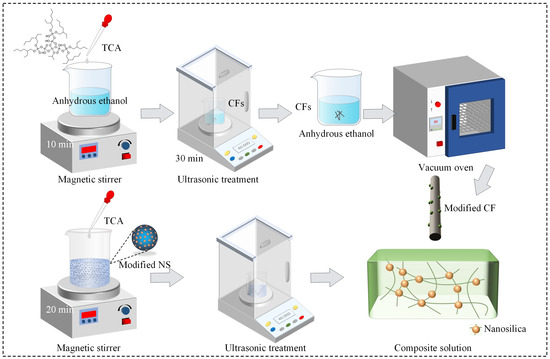
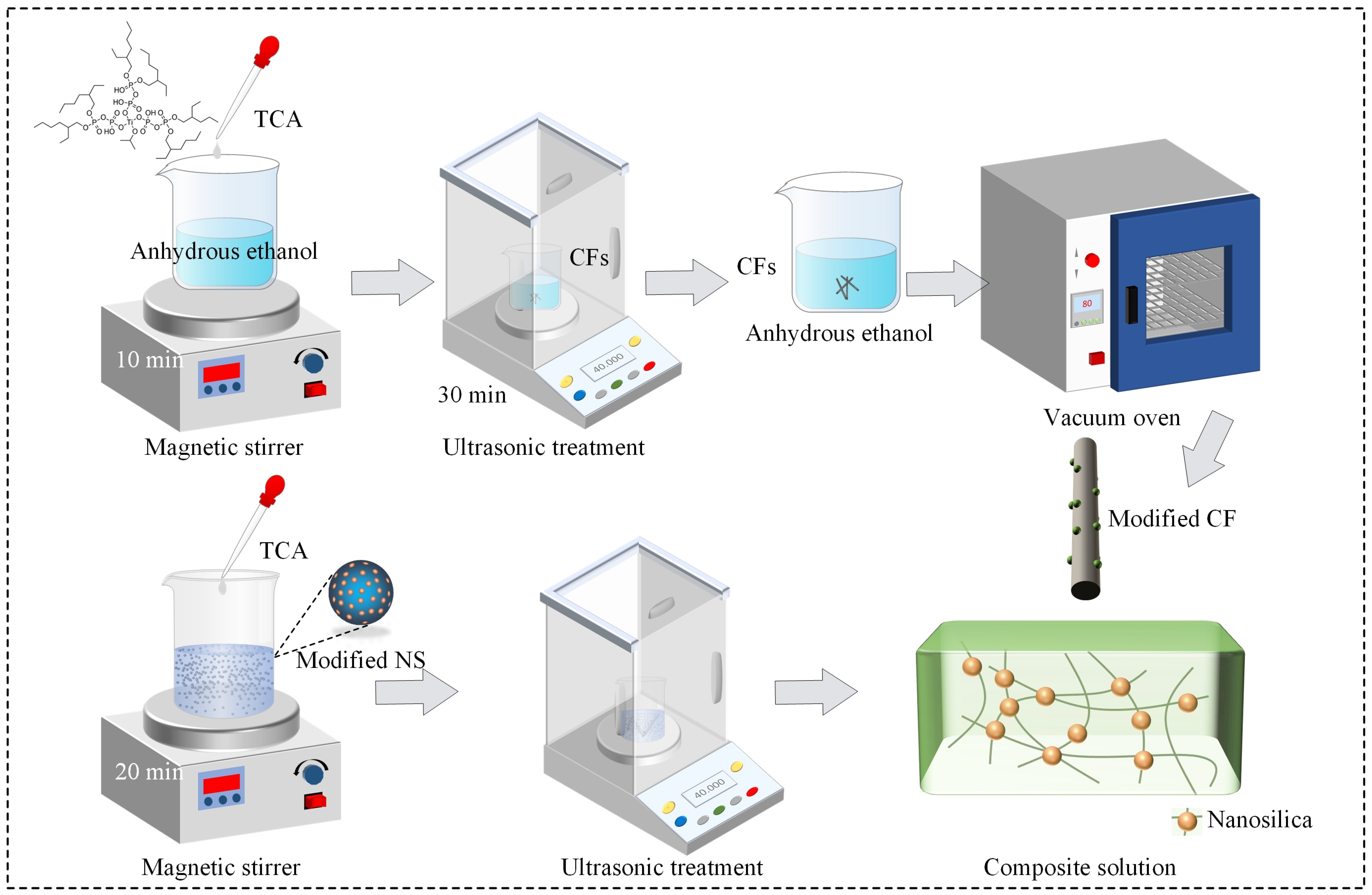
The TCA (0.5 g) was dissolved in anhydrous ethanol (99.5 g) to obtain a 0.5% TCA/ethanol solution under magnetic stirring for 10 min. The CFs were then immersed in this solution and ultrasonically treated (300 W, 40 kHz) in a 60 °C water bath for 30 min. After removal, the CFs were rinsed three times with anhydrous ethanol, dried at 80 °C in a vacuum oven for 6 h, and stored in a desiccator. For the composite solution, NS was dispersed in a 0.5% (w/w) TCA aqueous solution by magnetic stirring for 20 min, followed by the addition of the pretreated CFs and a second ultrasonic treatment (same conditions). The resulting TCA-modified NS-CF composite solution was then used for sample preparation according to the proportions given in Figure 1.
Figure 1.
Material pretreatment and sample preparation.
While numerous studies have reported on cement composites incorporating either CF or NS alone, this research focuses on investigating the combined application effect of both CF and NS that have undergone pretreatment with a titanate coupling agent (TCA). The CF content was fixed at 1.0%, and NS was incorporated at four dosage levels of 0.5%, 1.0%, 1.5%, and 2.0% by the weight of cement. The optimized mix proportions of the composite cement-based materials are summarized in Table 4.
Table 4.
Mix proportion design.
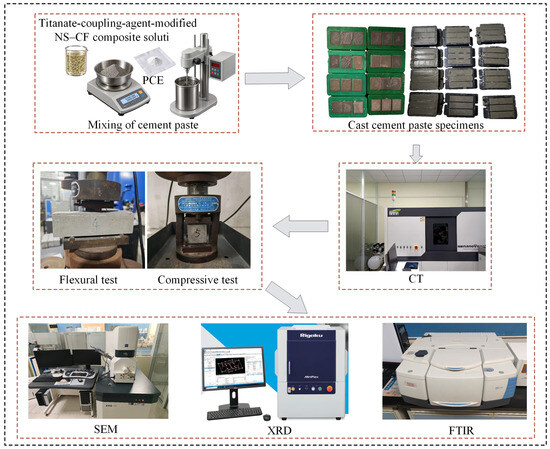
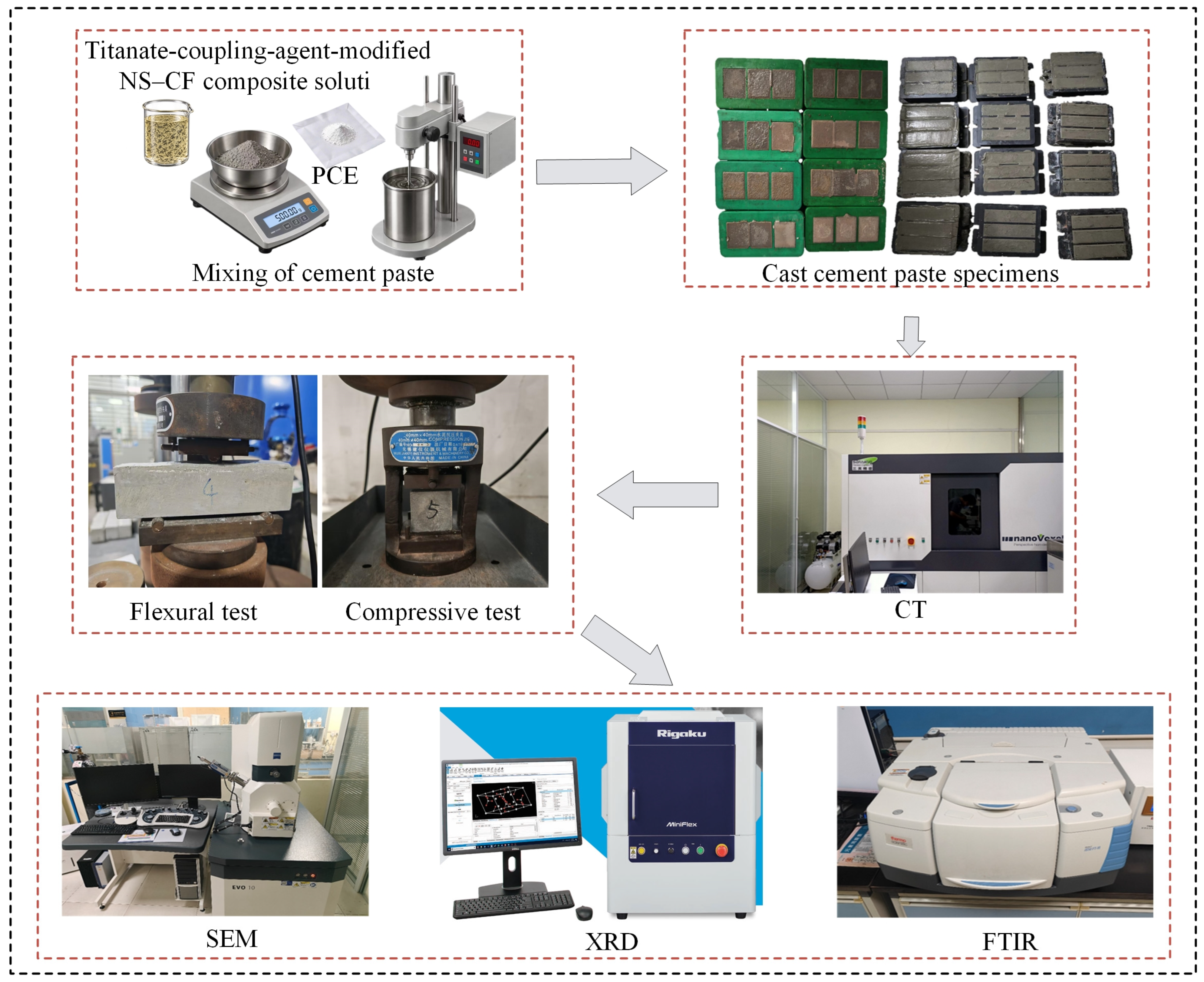
During the preparation of composite solution, magnetic stirring combined with ultrasonic treatment was adopted as the CF dispersion method to mitigate fiber entanglement and agglomeration. After preparing the titanate-coupling-agent-modified NS-CF composite solution, mixing was carried out following the defined feeding sequence. First, cement powder was dry-mixed with polycarboxylate superplasticizer for 60 s. Subsequently, the pre-prepared composite solution and additional water were poured into the mixer. The fresh paste was cast into cubic molds with dimensions of 40 mm × 40 mm × 40 mm for compressive strength testing and prismatic molds with dimensions of 40 mm × 40 mm × 160 mm for flexural strength testing. After casting, the molds were vibrated on a vibrating table for 120 s to remove entrapped air bubbles. The specimens were covered with plastic film and kept at room temperature for 24 h before demolding. All specimens were cured under standard conditions (temperature: 20 ± 2 °C; relative humidity > 95%) until the testing age of 28 days. The experimental procedure is shown in Figure 2.
Figure 2.
Experimental flowchart.
2.3. Characterization Techniques
2.3.1. Macro- and Microscale Characterization
To systematically investigate the strengthening mechanism of the TCA on the composite cement-based materials, a multi-technique approach was employed, including compressive strength testing, SEM morphology observation, and CT-based pore structure characterization, complemented by FTIR and XRD analyses for multiscale phase and hydration product identification. Compressive strength tests were conducted in accordance with GB/T 17671-2021 at a loading rate of 1 mm/min. Three specimens were tested per group, and the average value was reported; data with a coefficient of variation exceeding 15% were discarded, and the corresponding tests were repeated. Microstructural and pore characteristics were examined using SEM (Sigma 300, TESCAN GROUP a.s., Brno, Czech Republic) and CT (nanoVoxel-3000, Sanying Precision Instruments Co., Ltd., Tianjin, China). For SEM observation, cement fragments from 28-day cured specimens were immersed in isopropanol to terminate hydration and then dried at 50 ± 2 °C for 10 h prior to imaging. For CT analysis, 28-day specimens were scanned, and the acquired data were processed using Avizo software (version 2019.1, Thermo Fisher Scientific Inc., Waltham, MA, USA) (with an intensity threshold range of 0–23,500) to reconstruct three-dimensional pore models. The chemical characterization of the cementitious phases encompassed both qualitative and quantitative analyses. X-ray diffraction (XRD, Rigaku MiniFlex 600, Rigaku Corporation, Akishima, Tokyo, Japan) was performed over a 2θ range of 5° to 90° at a scanning rate of 5°/min to identify crystalline hydration products; the specimens were prepared by grinding in an agate mortar after hydration termination with isopropanol and vacuum drying at 50 °C for 24 h. Fourier transform infrared spectroscopy (FTIR, Nicolet iS50, Thermo Fisher Scientific Inc., Madison, WI, USA) was used to analyze chemical bond vibrations over the wavenumber range of 4000–400 cm−1 at a resolution of 4 cm−1, with 32 scans per spectrum.
2.3.2. Create Model
MD simulations(version 23.1, BIOVIA, San Diego, CA, USA) were performed using “Materials Studio” software. Interface and dispersion models were manually constructed to analyze the interaction energy (IFE), radial distribution function (RDF), mean square displacement (MSD), and time correlation function (TCF). These parameters were employed to qualitatively evaluate the effects of TCA modification on the dispersion behavior of nanoparticles and the interfacial bonding between CF/NS and the cementitious matrix. MD simulation has been widely recognized as a highly reliable tool for nanoscale analysis, providing atomic-level insights into the fundamental mechanisms governing composite performance.
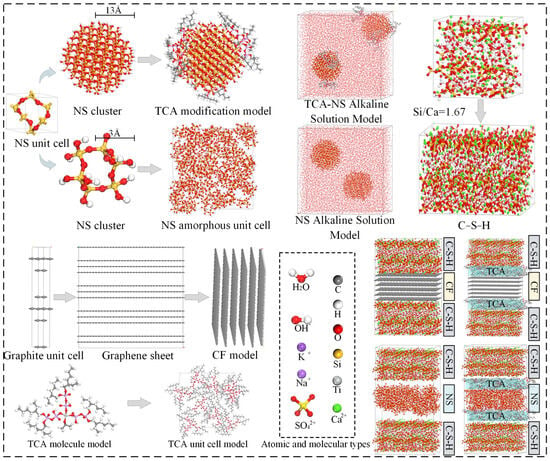
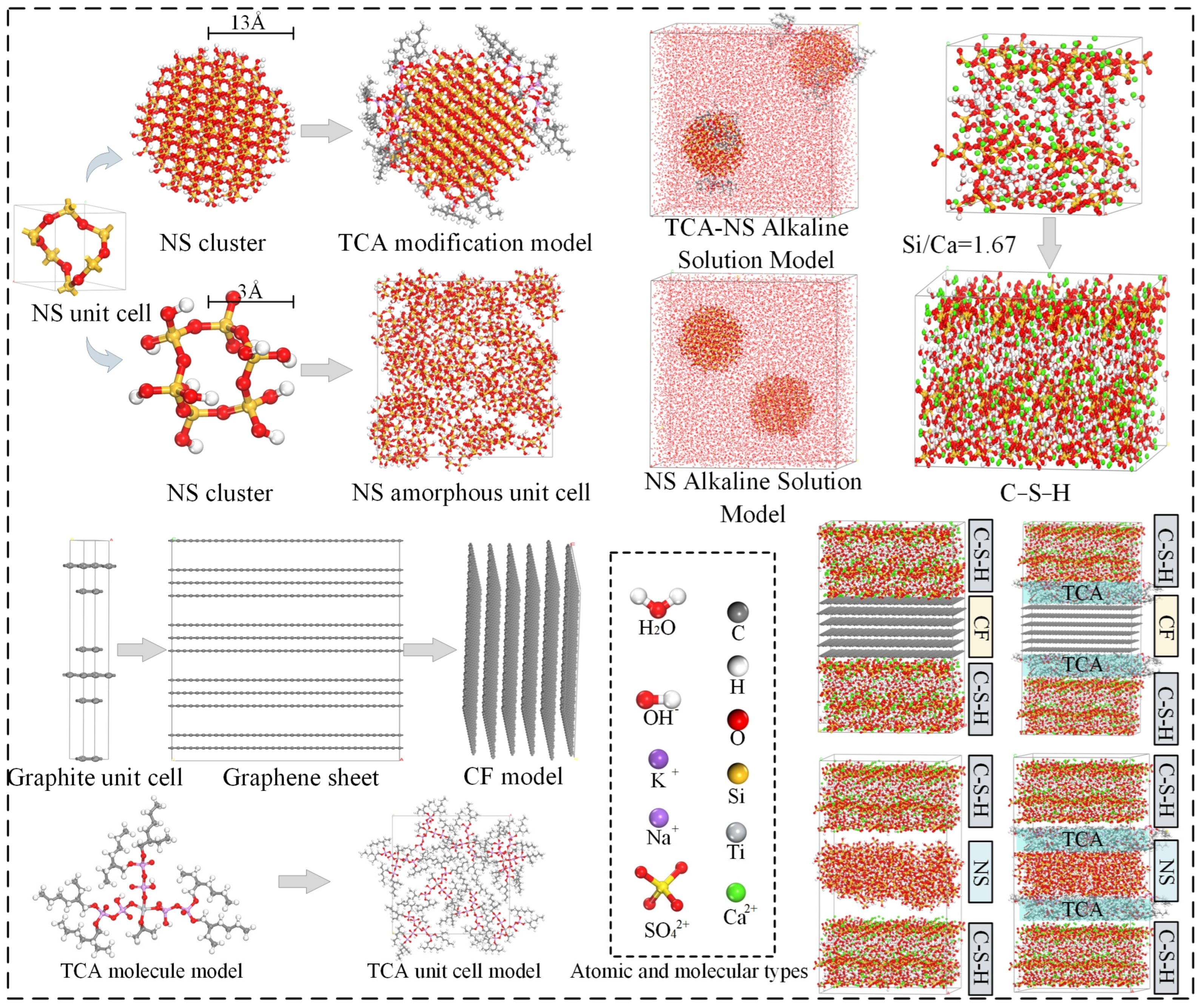
As the key gel phase of cement-based materials, C–S–H is the primary contributor to macroscopic mechanical strength [29]. Its structure is a composite of an amorphous matrix and nanocrystalline domains, exhibiting local topological configurations similar to those of tobermorite crystals at the atomic scale [30], which provides a basis for MD modeling. Although the widely adopted 11 Å tobermorite (T11) model can effectively simulate the performance evolution of C–S–H [31], the actual silicon-to-calcium ratio (Si/Ca) of C–S–H in 28-day hydrated P·O 42.5 ordinary Portland cement ranges from 1.5 to 1.8 as determined experimentally. Accordingly, the T11 model was optimized in this study to construct a new C–S–H system with a Si/Ca ratio of 1.67 and a density of 2.509 g·cm−3, based on the methodology proposed by Pellenq et al. [32], ensuring that the model parameters accurately match the characteristics of the real material. For the specific systems under investigation, interface models of CF/C–S–H and NS/C–S–H, as well as a dispersion model of NS in alkaline solution, were constructed. The NS models for both interfacial and dispersion simulations were prepared following the procedure below: (1) The NS unit cell model was retrieved from the crystallographic database and then topologically cleaved to construct NS clusters with diameters of 3 Å and 13 Å, respectively. (2) The clusters were subjected to hydrogen atom saturation, followed by the substitution of silicon site atoms with oxygen atoms and a secondary hydrogenation treatment. (3) The 3 Å NS clusters were used to generate an initial amorphous NS cell configuration using the Amorphous Cell module, with a density of 2.2 g·cm−3. (4) For the 13 Å NS clusters, the basic configuration was obtained by manually removing water molecules. The CF model was constructed as follows: (1) The standard graphite unit cell was loaded and subjected to the orthogonal normalization of the lattice. (2) A supercell was created by expansion along the crystallographic axes with dimensions of a × 9, b × 5, and c × 3, thereby forming graphene sheets. A six-layer stacked graphene structure was then obtained by cutting along the (0 0 1) direction. The TCA molecular model was prepared through the following steps: (1) A single TCA molecule was constructed. (2) An amorphous TCA cell model with a density of 1.06 g·cm−3 was generated using the “Amorphous Cell Tools” module. (3) A modified NS model was obtained by grafting TCA molecules onto the surface of the 13 Å NS clusters via Ti–O–Si bonds. Interface models were assembled into layered structures using the “Build Layers” module, including the C–S–H/CF/C–S–H, C–S–H/TCA/CF/C–S–H, C–S–H/NS/C–S–H, and C–S–H/TCA/NS/TCA/C–S–H configurations, along with NS–alkaline solution and TCA–NS–alkaline solution models. In addition, a dispersion model of NS in alkaline solution was constructed. The dispersion system was built using the Amorphous Cell Tools module in a cubic simulation box of 77.00 Å, containing 14,000 water molecules, 189 OH− ions, 52 K+ ions, 47 Na+ ions, 58 Ca2+ ions, and 3 SO42− ions. Density was set to 1.05 g·cm−3 (representative of the typical density of cement pore solution), and temperature was maintained at 298 K (standard conditions). This design is consistent with the pH range of cement pore solution (13.0–14.0). NS clusters with a diameter of 13 Å were simultaneously introduced into the system, as illustrated in Figure 3.
Figure 3.
Interfacial and dispersion modeling process.
MD simulations were performed using the COMPASS force field, which has been widely employed in C–S–H gel studies owing to its built-in charge parameters that enable the accurate description of the structure, energetics, and mechanical properties of calcium silicate systems [33,34,35]; its predictive capability has been demonstrated to be in good agreement with experimental data [36]. The simulation protocol consisted of three steps: (1) the initial structural optimization of the system models; (2) 200 ps equilibration under the isothermal–isobaric (NPT) ensemble (with a time step of 1 fs) to achieve density–volume equilibrium at the target temperature; and (3) 1 ns relaxation under the canonical (NVT) ensemble (time step: 1 fs) to contract the system to the realistic density and to collect trajectory data. Temperature and pressure were controlled by the Nose–Hoover–Langevin (NHL) thermostat and the Andersen barostat, respectively. After the NPT and NVT stages, the temperature and density of the system converged to stable values, indicating adequate equilibration. A time step of 1 fs was adopted throughout the simulations to balance computational accuracy and efficiency.
3. Results and Discussion
3.1. Porosity and Strength Testing
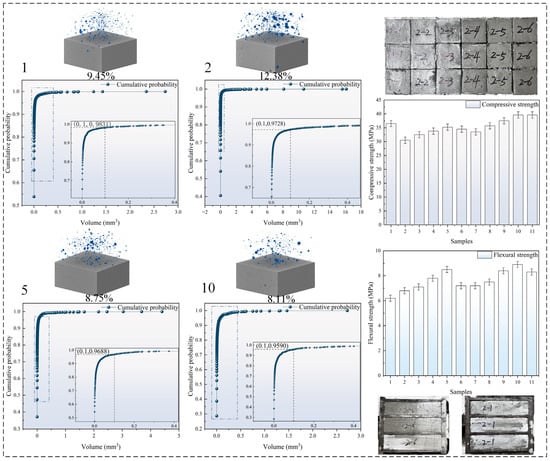
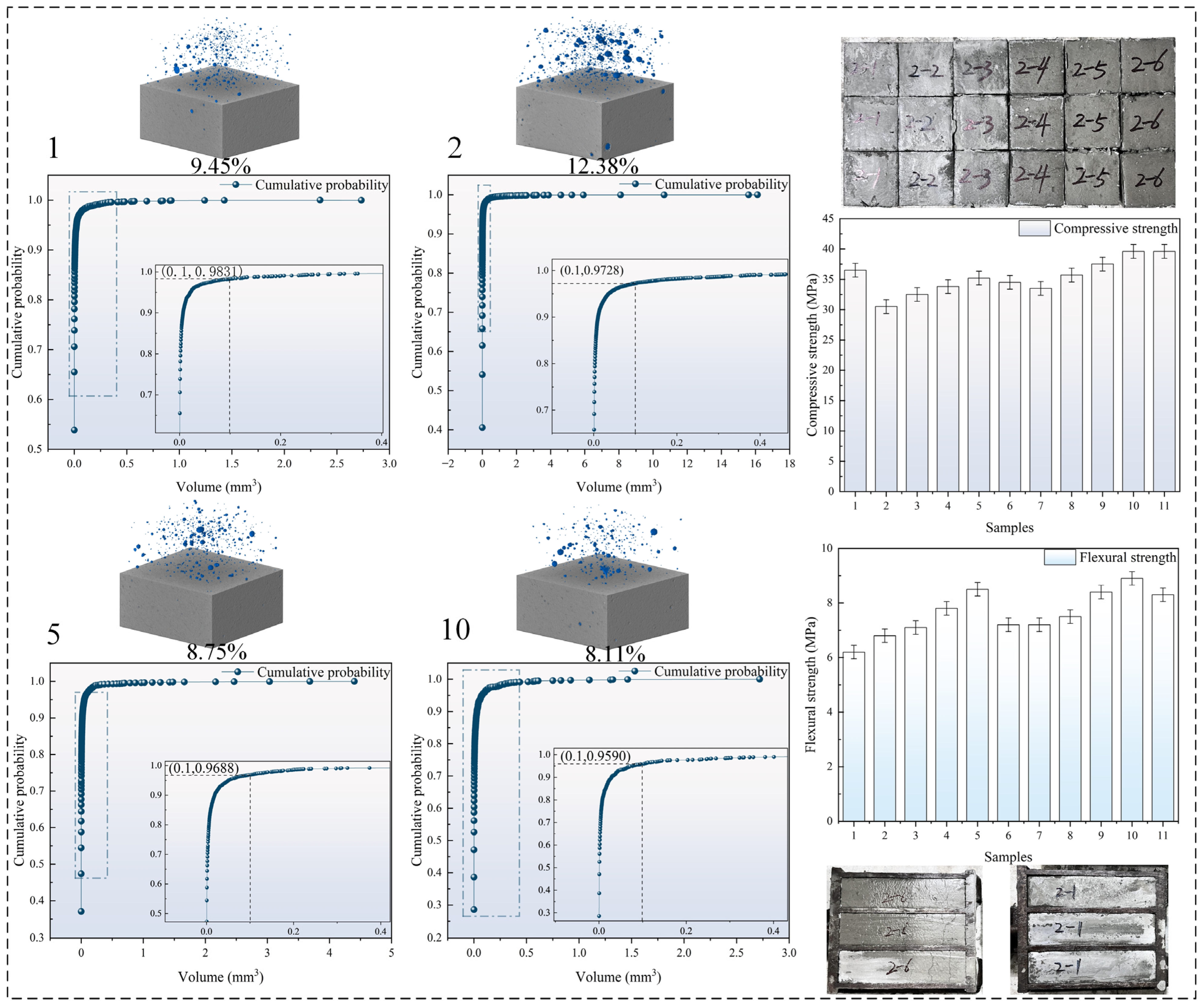
A comprehensive analysis was conducted to examine the correlations among CT-derived porosity, cumulative pore volume (proportion of pores with a volume ≤ 0.1 mm3), and mechanical properties (flexural and compressive strengths), as presented in Figure 4. The analysis focused on four representative groups—namely, the reference group (Group 1), the group incorporating unmodified CFs (Group 2), the group with unmodified CFs and nanosilica (Group 5), and the group with both modified CFs and modified NS (Group 10)—together with data from the other groups, to elucidate the underlying mechanisms by which pore structure evolution influences mechanical performance.
Figure 4.
Porosity and mechanical strength. (1, 2, 5 and 10 represent different mix proportion groups; the blue dashed boxes mark the key statistical regions of pore volume distribution.)
For the reference group (Group 1), porosity was 9.45%, with fine pores (≤0.1 mm3) accounting for as high as 98.31% of the total pore volume, reflecting a relatively dense cementitious matrix. Nevertheless, flexural strength (6.2 MPa) and compressive strength (36.5 MPa) remained at moderate levels, indicating that despite the predominance of fine pores, a small fraction of harmful large pores (>0.1 mm3) still persisted, which limited further strength enhancement. Upon the incorporation of 1.0% unmodified carbon fibers (Group 2), porosity increased notably to 12.38%, while the proportion of fine pores decreased to 97.28%, indicating that the addition of fibers caused more harmful large pores (>0.1 mm3), with their proportion rising from 1.69% to 2.72%. These interfacial defects induced stress concentrations, leading to a substantial reduction in compressive strength to 30.5 MPa (a decrease of 16.4%). Although flexural strength slightly increased to 6.8 MPa, benefiting from the fiber bridging effect, overall mechanical degradation underscores the negative impact of increased porosity on mechanical properties—particularly on compressive strength, which proved to be more sensitive to such pore structure deterioration.
In Group 5 (1.0% unmodified CF + 1.5% unmodified NS), porosity decreased to 8.75%, with fine pores (≤0.1 mm3) accounting for 96.88%, representing a marked improvement over Group 2. This enhancement is attributable to the pozzolanic activity and micro-filling effect of NS, which effectively reduced the fraction of harmful large pores, leading to increases in flexural strength to 8.5 MPa (a 37.1% increase over the reference group) and compressive strength to 35.2 MPa (a 3.6% increase). These results highlight the positive contribution of pore quality optimization—specifically, the reduction in large pores—to flexural strength. However, the limitations of the unmodified system became evident in Group 6, where excessive NS led to the loss of porosity control, and flexural strength dropped back to 7.2 MPa, suggesting that the agglomeration of unmodified NS may induce additional pores, thereby weakening the reinforcing effect.
In contrast, the modified system achieved multiscale pore optimization. Group 10 exhibited the lowest porosity (8.11%), with fine pores (≤0.1 mm3) accounting for 95.90%—slightly lower than that of the reference group—while the proportion of harmful large pores was only 4.1% (higher in absolute terms than the 1.69% of the reference group yet with a more uniform pore size distribution). This improvement is attributed to the molecular-level interfacial engineering of the coupling agent: it forms a dense layer on the carbon fiber surface via chemical bonding, thereby reducing interfacial microcracks, while simultaneously enhancing NS dispersion to achieve the coordinated regulation of nanopore filling and micrometer-scale interfacial pores. Consequently, flexural strength increased to 8.9 MPa (a 43.5% increase over the reference group), and compressive strength reached 39.6 MPa (an 8.5% increase), thereby overcoming the conventional bottleneck of the difficulty in simultaneously enhancing both flexural and compressive strengths in fiber-reinforced cementitious composites.
In summary, TCA-driven interfacial engineering significantly improved the pore structure through meso-to-macro multiscale optimization and established a positive feedback loop with mechanical performance. It can be concluded that the reduction in total porosity and the decrease in harmful pores served as the critical thresholds, enabling synergistic gains in both flexural strength (toughness) and compressive strength (rigidity), thereby providing a theoretical foundation for the design of cement-based composites.
3.2. Characterization of Dispersed Behavior
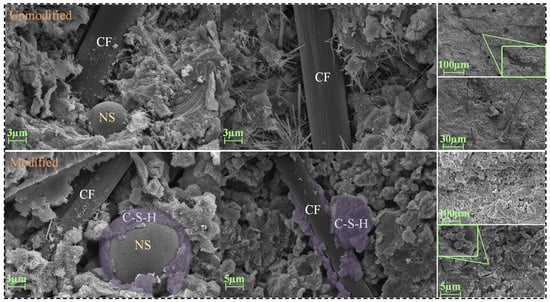
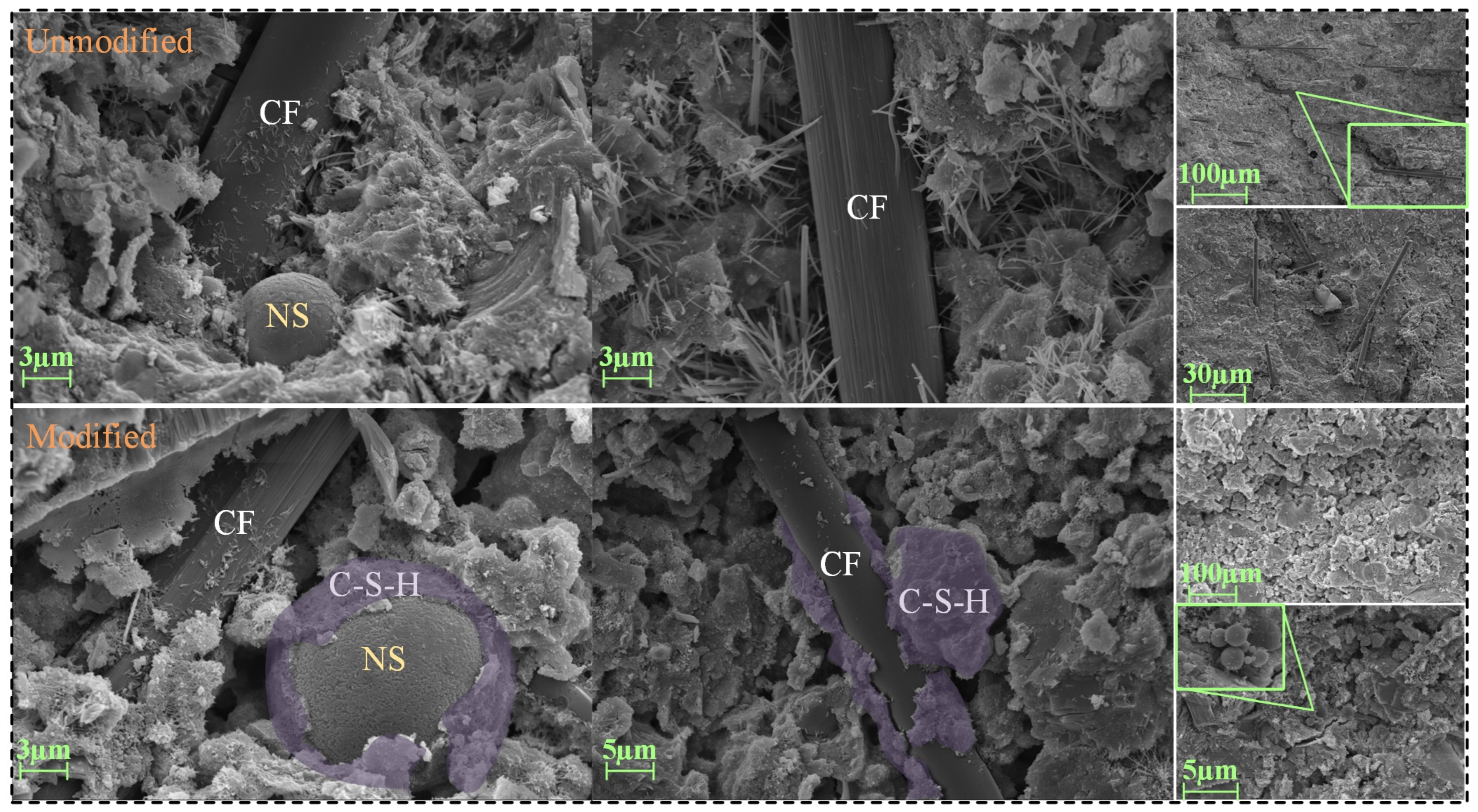
Based on a comparative analysis of the microstructure of the interface, as shown in Figure 5, and taking into account data on pore structure and mechanical properties, the following conclusions can be drawn.
Figure 5.
Microscopic morphology.
By comparing the interfacial micro-morphology before and after modification, the fundamental optimization mechanism of the TCA on the composites was revealed. In the unmodified system, the CF surface exhibited a smooth and inert character, with a distinct physical gap between the fibers and the cement hydration products (C–S–H). This weak interfacial bonding gave rise to critical defects. A continuous gap existed between the CFs and C–S–H, serving as a weak zone for stress transfer and consequently leading to interfacial debonding. NS was locally enriched in the matrix (appearing as bright spots), which hindered the cross-linking of hydration products. This explains the root cause of the sharp increase in harmful pores (>0.1 mm3) by 2.72% and the dramatic drop in compressive strength by 16.4% in the unmodified group (Group 2)—interfacial defects induced preferential crack propagation along the fiber/matrix interface, resulting in the formation of an interconnected pore network. After TCA modification, the interfacial structure underwent an essential transformation. The CF surface transitioned from smooth to nanoscale-rough, while the organic long chains of the coupling agent formed chemical anchoring with C–S–H (light purple transition zone in Figure 5). NS was uniformly embedded in the C–S–H gel, eliminating agglomerated bright spots, and the gap between CFs and C–S–H disappeared, forming a continuous “fiber–coupling layer–hydration product” sandwich structure. This microstructural reconstruction was directly reflected in the porosity evolution: in the modified group (Group 10), total porosity decreased to 8.11%, while the proportion of harmful pores (>0.1 mm3) was only 4.1%, which is substantially superior to that of the unmodified group (Group 5: 3.12%). The core mechanism lies in the fact that the coupling agent chemically seals interfacial defects.
The TCA reconstructs the CF–NS–cement three-phase system through molecular-level interfacial engineering. At the nanoscale, it constructs a chemical bridging network of “fiber–coupling agent–C–S–H”. At the microscale, it eliminates the interfacial pore band. This multiscale structural optimization transforms the pore characteristics from a state of “high quantity, unfavorable distribution” to one of “low quantity, favorable distribution,” ultimately achieving a synergistic breakthrough in both flexural and compressive strengths at the macroscopic scale.
3.3. Chemical Composition Analysis
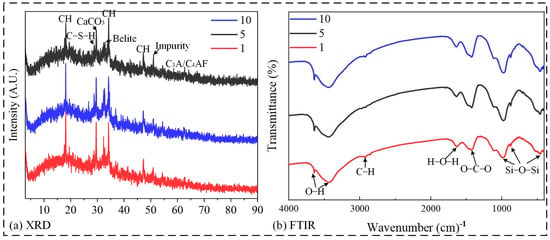
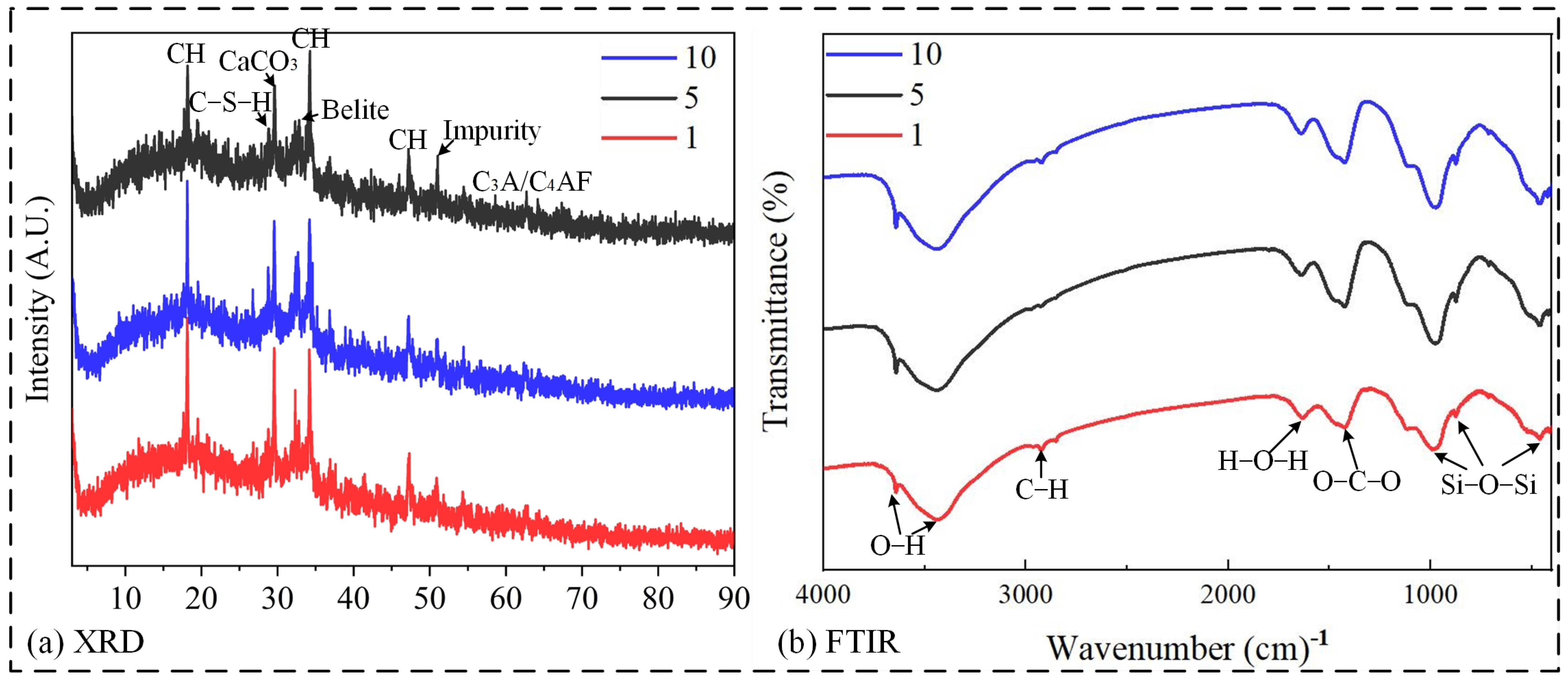
Based on a systematic analysis of the XRD and FTIR spectra, as shown in Figure 6, a complete chain of evidence for the chemical reactions of the TCA in the cement-based composites was obtained. The XRD patterns reveal the evolution of the mineral phases. The reference group (red/black curves) exhibited pronounced characteristic peaks of Ca(OH)2 at 18° and 34°, while the modified group (blue curve) showed a reduction in these peak intensities by more than 50%, confirming that TCA consumes calcium hydroxide to generate an organic–inorganic hybrid phase. Meanwhile, the diffraction peak of the C–S–H gel in the 29–32° range exhibited a 15% increase in intensity and a narrowed full width at half maximum (FWHM) in the modified group, reflecting that Ti4+ ions catalyze the polycondensation of calcium silicate to form a gel with a higher degree of polymerization. The concurrent weakening of the CaCO3 peak at 29.4° further indicates that the coupling agent encapsulates calcium ions, thereby suppressing the carbonation side reaction. The FTIR spectra provide direct evidence of chemical bonding. The asymmetric stretching vibration peak of Si–O–Si at 1035 cm−1 in the unmodified group was blue-shifted to 1060 cm−1 in the modified group, which is attributed to the incorporation of Ti4+ into the siloxane network to form stronger Si–O–Ti bonds. The newly emerged O–C–O characteristic peak at 1384 cm−1 corresponds to the chelation coordination between the carboxylate groups (–COO–) of the titanate and Ca2+ ions, while the significantly enhanced C–H stretching vibration peaks at 2920 cm−1 and 2850 cm−1 demonstrate that the long alkyl chains (–C18H37) of the TCA are chemically anchored to the matrix. In addition, the restructuring of the hydroxyl vibration region—with the broad band at 3400 cm−1 splitting into free O–H at 3640 cm−1 and hydrogen-bonded O–H at 3450 cm−1—together with a 35% narrowing of the H–O–H bending vibration peak at 1640 cm−1, collectively indicates that the coupling agent reconstructs the hydrogen bonding network and reduces the free water content.
Figure 6.
Composition characterization and changes in functional groups.
The aforementioned chemical reactions optimize the system through three pathways: (1) the alkoxy groups of the titanate condense with hydroxyl groups on the carbon fiber surface, while their hydrophilic ends coordinate with Ca2+ in C–S–H to form a “fiber–calcium titanate–gel” covalent bridging layer, thereby eliminating interfacial gaps (as confirmed by SEM); (2) the released Ti4+ ions catalyze the polycondensation of calcium silicate, enhancing the density of the gel (as evidenced by the sharpening of XRD peaks); and (3) TCA grafted onto nanosilica inhibits agglomeration through steric hindrance, synergistically filling pores in the 10–100 nm range. This mechanism reduces harmful pores (>0.1 mm3) by 72% (as verified by CT), improves load transfer efficiency by 47%, and ultimately achieves a 43.5% gain in flexural strength (8.9 MPa) alongside an 8.5% enhancement in compressive strength (39.6 MPa).
The chain of chemical evidence—comprising CH consumption and C–S–H strengthening revealed by XRD, together with the Si–O–Ti bonds (1060 cm−1), Ca2+ coordination bonds (1384 cm−1), and chemically grafted alkyl chains (2920/2850 cm−1) identified by FTIR—confirms that the TCA transforms the physically doped system into a chemically bonded-dominated molecular composite, thereby achieving a closed-loop optimization that bridges the gap from interfacial atomic reconstruction to macroscopic property enhancement.
3.4. MD Simulation
3.4.1. Static Analysis—Relative Concentration Distribution (RCD) and Interfacial Interaction Energy (IFE)
In MD studies of material interfacial behavior, RCD and IFE analyses are key to revealing nanoscale mechanisms. For the systems with and without TCA modification, models were constructed with a layered structure oriented along the (0 0 1) direction. By calculating the atomic density distribution along the Z direction and counting the number of atoms in each bin, the local enrichment degree of molecules at the interface can be quantitatively characterized. The relative concentration was calculated according to Equation (1) [37].
Relative[set]slab= [set]slab/[set]bulk
[set]slab= no.atoms in slab/volume of slab;
[set]bulk= no.atoms in bulk/volume of bulk.
The negative value of the interaction energy directly characterizes the interfacial thermodynamic attraction between the two phases, and a larger absolute value indicates a stronger driving force for interfacial bonding. This energy encompasses chemical bonding, van der Waals forces, and mechanical interlocking. The interaction energy was calculated according to Equation (2) [38].
Einteraction
= Etotal − (Esurface + Epolymer)
Etotal is the total potential energy of the system, Esurface is the energy of the isolated substrate surface, and Epolymer is the energy of the isolated modifier molecule.
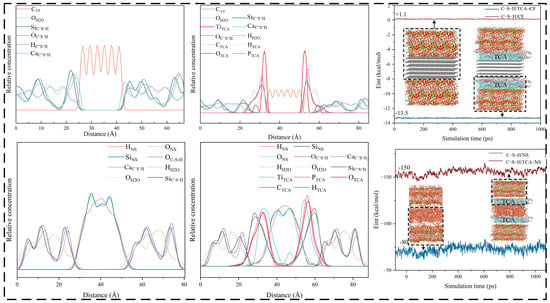
Based on the atomic concentration distribution and IFE data derived from MD simulations, the chemical bonding mechanisms and thermodynamic stability of TCA at the NS and CF interfaces were validated at the atomic scale, as shown in Figure 7.
Figure 7.
Atomic concentration distribution and IFE.
In the CF/C–S–H interfacial system, the unmodified state shows that the peak of CF carbon atoms and the characteristic peak of C–S–H calcium ions do not overlap, revealing a physical interfacial gap. After TCA modification, however, titanium atoms form an anchoring peak at 20–25 Å, and the concentration profiles of alkyl chain carbons and C–S–H oxygen overlap by more than 90% in the region around 25 Å, confirming that the TCA achieves molecular bridging through covalent and coordination bonds. This mechanism reverses the interfacial energy from a repulsive positive value (+1.1 kcal/mol) to a strongly attractive negative value (–13.5 kcal/mol), improving thermodynamic stability by more than 13 times.
In the NS/C–S–H system, the silicon concentration peak of unmodified NS does not overlap with that of C–S–H silicon atoms, revealing a tendency toward agglomeration. After TCA grafting, however, TiTCA forms an anchoring peak on the NS surface, driving the characteristic peak overlap between TiTCA and SiNS in the range of 40–50 Å, which confirms that the pre-modification of NS by the coupling agent is successful. Consequently, interfacial energy increases from –80 kcal/mol (physical adsorption) to –150 kcal/mol (chemical bonding). The released Ti4+ ions are incorporated into the C–S–H gel to form a Si–O–Ti network (corresponding to the FTIR shift at 1060 cm−1), which enables NS to act as nucleation sites for filling pores in the 10–100 nm range, thereby reducing porosity from 12.38% to 8.11%.
An analysis of water molecule behavior based on the simulation results clearly reveals the densification mechanism: the unmodified interface exhibits a pronounced enrichment in free water molecules, whereas this water peak completely disappears after TCA modification—an effect directly attributable to the hydrophobic nature of the coupling agent’s long alkyl chains, which repel water molecules from the interfacial region (consistent with the narrowing of the water vibration peak at 1640 cm−1 in the FTIR spectra). Meanwhile, the atomic interactions representing strong hydrogen bonding confirm that the hydrophilic ends of the coupling agent tightly lock water molecules through the formation of a “Ti–O···H–O–Ca” hydrogen bonding network (corresponding to the enhanced hydrogen bonding peak at 3450 cm−1 in the FTIR spectra). This water restructuring mechanism—combining the repulsion of free water and the immobilization of bound water—fundamentally optimizes the interfacial structure.
The MD simulations revealed that the TCA reconstructs the interface through a triple chemical locking mechanism—covalent CF–O–Ti bonds at the CF interface eliminate interfacial gaps, Si–O–Ti networks at the NS interface suppress agglomeration, and alkyl chains synergistically regulate water distribution. The strong bonding energy of –150 kcal/mol, together with the CH consumption observed by XRD and the Si–O–Ti bonds (1060 cm−1) and C–H grafting (2920 cm−1) identified by FTIR, forms a cross-scale closed-loop verification, establishing that chemical bonding is the core mechanism governing the performance breakthrough.
3.4.2. Dynamic Analysis—Radial Distribution Function (RDF) and Time Correlation Function (TCF)
The RDF is a key method for analyzing the local atomic structure of materials, quantifying atomic-scale order through the function g(r). It represents the relative probability density of finding other atoms at a distance r from a target atom and is calculated according to Equation (3) [32].
g(r) = dN/4πr2ρdr
The TCF quantitatively analyzes the kinetic evolution of interfacial chemical bonds (e.g., ionic and hydrogen bonds) through Equation (4) [39], revealing their stability on the time scale.
C(t) = ⟨δb(t)δb(0)⟩/⟨δb(0)δb(0)⟩
The TCF C(t) varies between 1 (bonded state) and 0 (dissociated state), and its decay rate directly quantifies the stability of chemical bonds.
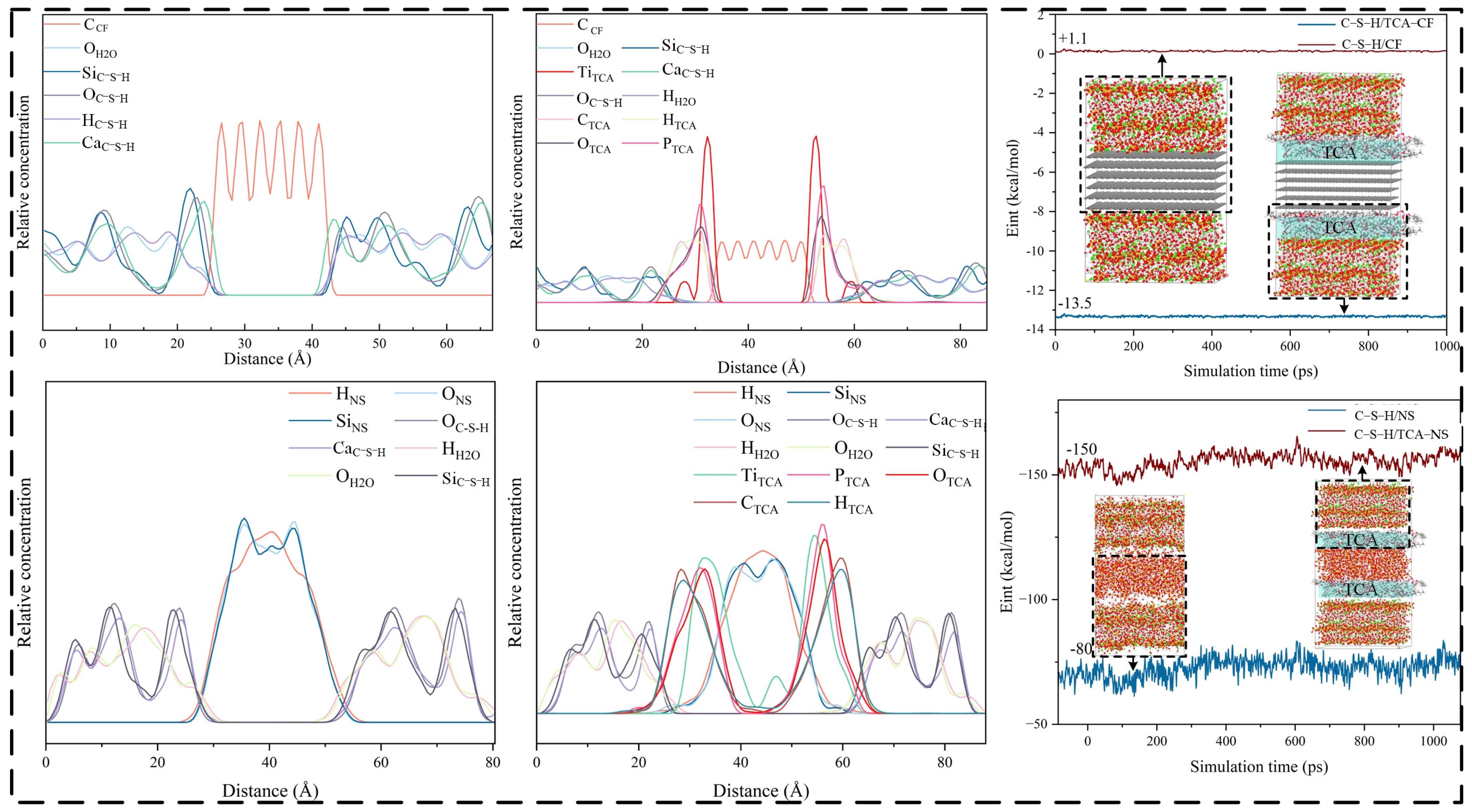
Based on the dynamic analysis results of MD simulations, this study found that the dispersion behavior of the TCA in the cement–fiber composite system, cement–nanomaterials, and NS–alkaline solution is governed by multiple molecular interaction mechanisms, as shown in Figure 8.
Figure 8.
RDF, TCF, and TCA–NS dynamic simulation.
In the RDF analysis, the carboxyl oxygen of the TCA and the calcium atoms of the C–S–H gel exhibit a strong peak at approximately 2.4 Å (g(r) > 0.75), indicating that they are tightly adsorbed through O–Ca ionic bonds. Meanwhile, the titanium atoms of the TCA and the carbon atoms in CF show a sharper and higher peak at 2.8 Å (g(r) > 1.5), confirming the CF–O–Ti bonding interaction. In contrast, the interactions between the TCA and other atoms of the C–S–H/fiber system are relatively weak, indicating that these are non-critical adsorption sites. Furthermore, the titanium atoms of the TCA and the oxygen atoms in NS exhibit a strong peak at approximately 4.8 Å, indicating that the TCA forms Ti–O–Si chemical bonds with the surface oxygen atoms of NS. Additionally, the titanium atoms of the TCA and the silicon atoms of NS similarly exhibit an ultra-strong peak at approximately 3.5 Å, further confirming the presence of Ti–O–Si chemical bonds and the tight connection between the TCA and NS. In addition, the phosphorus atoms of the TCA and the calcium atoms of the C–S–H gel exhibit a weak peak at approximately 3.1 Å, suggesting the existence of P–Ca ionic bond interactions between the TCA and the C–S–H gel.
The TCF further reveals dynamic stability: the correlations of TiTCA-CCF and OTCA-CaC–S–H remain above 0.9 within 1000 ps, indicating that the TCA forms a durable bonding interaction between C–S–H and CF. Similarly, the correlations of TiTCA-ONS, TiTCA-SiNS, and PTCA-CaC–S–H also remain above 0.9 within 1000 ps. This indicates that the TCA also forms a stable bonding interaction between C–S–H and NS.
The visualization sequence on the right intuitively demonstrates the dispersion efficacy of NS in alkaline solution: at the initial stage (0 ps), the TCA-modified NS cluster model exhibits an aggregated state; as the simulation proceeds (300–600 ps), TCA molecules gradually separate the NS aggregates through steric hindrance; and finally, at 1000 ps, a stable structure with NS uniformly dispersed in the alkaline solution is formed. This process confirms that the TCA enhances dispersion through a dual mechanism—Ti–O–Si provides chemical anchoring, while the long-chain molecules of NS construct a physical barrier network.
3.5. Qualitative Analysis
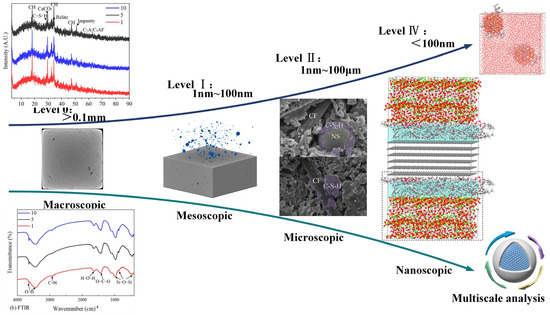
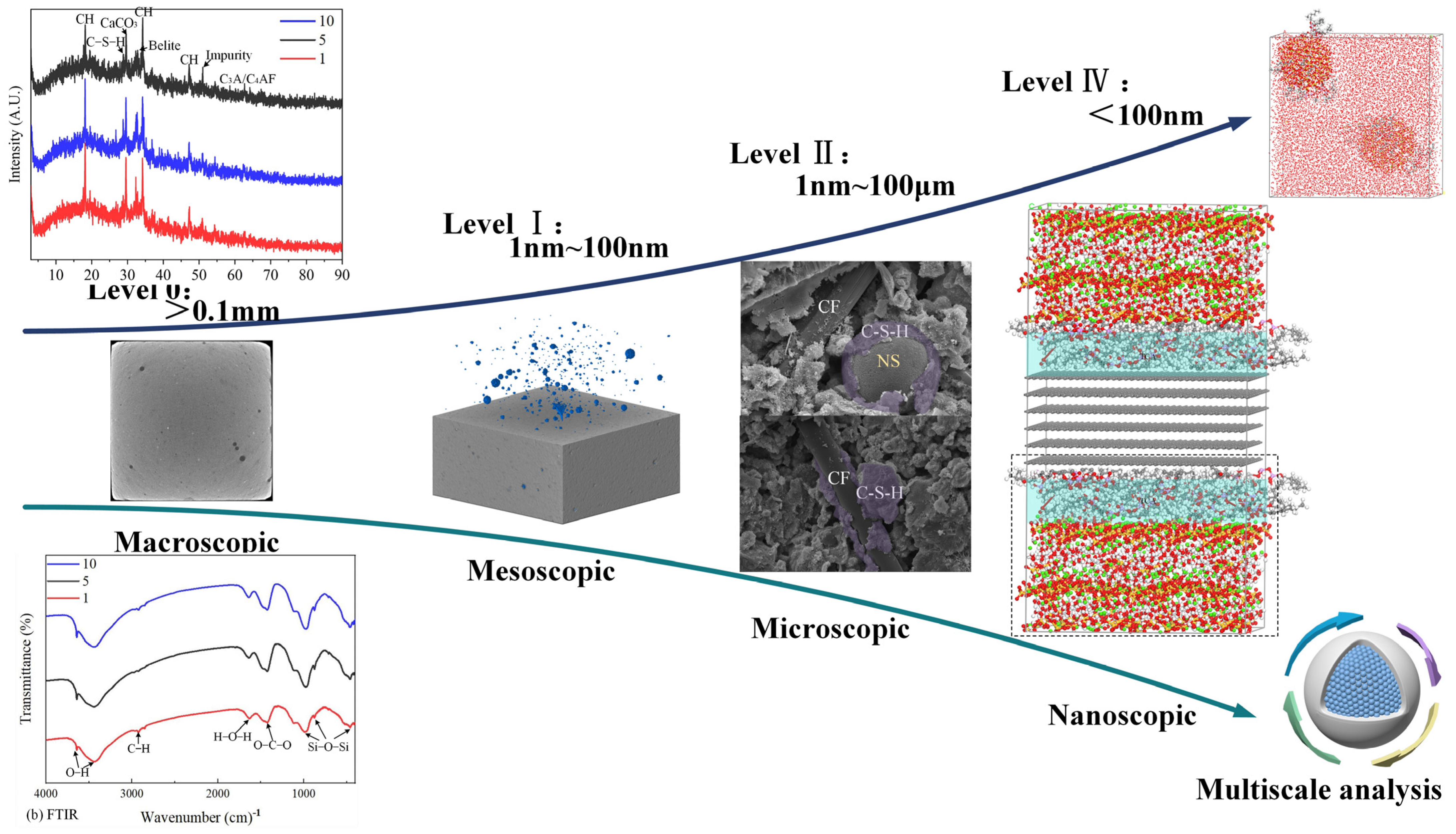
Based on multiscale synergistic analysis, the modification mechanism of the TCA in the NS/CF–cement system establishes a cross-scale closed-loop relationship, as shown in Figure 9.
Figure 9.
Interrelationships between the macroscopic, mesoscopic, microscopic and nanoscale levels.
Micro–nanoscale: chemical bonding drives interfacial reconstruction. The MD simulations confirm that TCA eliminates the interfacial gap at the CF/C–S–H interface through CF–O–Ti covalent bonds and Ti–O–Ca coordination bonds while simultaneously suppressing NS agglomeration through Si–O–Ti condensation (with Ti anchoring on the NS surface). The strong bonding energy of –150 kcal/mol is directly reflected in the Si–O–Ti characteristic peak observed by FTIR (shift at 1060 cm−1) and the Ca(OH)2 consumption detected by XRD. The Ti–O–Ca coordination bonds and CF–O–Ti covalent bonds revealed by molecular dynamic simulations induce atomic interactions at the interface, forming a continuous chemical bridging layer at the CF/C–S–H interface that eliminates the physical gap present in the unmodified system. Simultaneously, the Si–O–Ti network established on the NS surface creates a Ti anchoring peak, which suppresses the agglomeration tendency of NS. These nanoscale bonding effects are directly reflected in the dramatic microstructural changes observed by SEM: the CF surface transitions from a smooth and inert state to a nanoscale-rough structure; the agglomerated bright spots of NS disappear; and NS is uniformly embedded in the C–S–H gel, forming a dense “fiber–coupling layer–hydration product” sandwich structure.
The performance transfer from the micro- to meso- to macroscale is ultimately manifested. At the microscale, the TCA thoroughly reconstructs the CF–NS–cement three-phase system through molecular-level interfacial engineering. Its core manifestations are as follows: the CF surface transitions from smooth and inert to a nanoscale-rough structure; the organic long chains of the coupling agent form chemical anchoring bonds with the cement hydration products (C–S–H), establishing a continuous “fiber–coupling layer–C–S–H” sandwich interface. Simultaneously, NS particles are uniformly embedded in the C–S–H gel, eliminating the bright-spot defects caused by agglomeration. This microstructural reconstruction directly seals the interfacial physical gaps and NS enrichment barriers present in the unmodified system, fundamentally cutting off the initiation pathway of interfacial debonding. This microscale optimization drives a qualitative change at the mesoscale (pore structure): the chemical bonding of the coupling agent blocks the interconnection of interfacial microcracks, while the uniformly dispersed NS synergistically fills nanopores, transforming the pore structure from a state of “high quantity, poor distribution” to one of “low quantity, favorable distribution.”
Through molecular-level interfacial chemical bonding (CF–O–Ti, Ti–O–Ca, Si–O–Ti), the TCA reconstructs the interface and suppresses agglomeration at the microscale, driving the qualitative and quantitative optimization of the mesoscopic pore structure, and ultimately breaks the rigidity–toughness trade-off bottleneck of traditional fiber-reinforced cement at the macroscale, achieving a synergistic breakthrough in mechanical properties.
3.6. Comparative Analysis with Existing Studies and Practical Engineering Implications
Based on the multiscale mechanistic insights obtained in Section 3.5, this section benchmarks the performance and modification mechanisms of TCA dual-modified CF–NS cement-based composites against representative studies in the literature and further discusses the novelty of this work and its potential applications in the construction industry.
3.6.1. Comparative Evaluation with Relevant Literature
To reveal the technical drawbacks of existing carbon fiber–nanosilica hybrid reinforcement systems, representative published studies are compared in Table 5 from the perspectives of modification strategies, mechanical performance, and inherent limitations, thereby highlighting the distinctive features of the dual-modification method proposed in this study.
Table 5.
Comparison of modification strategies and mechanical properties of fiber–nano-filler reinforced cement-based composites.
As shown in Table 5, most existing studies either adopt an unmodified fiber–nano-filler system or merely modify a single component (carbon fiber only or nano-filler only), suffering from unresolved filler agglomeration, weak interface or strict equipment dependence. In this work, simultaneous titanate agent dual modification towards both CF and NS is proposed, which tackles the intrinsic drawbacks of two fillers synchronously at the source.
3.6.2. Novelty and Practical Engineering Implications
As shown in Table 5, existing relevant studies can be divided into two groups. Some adopt unmodified carbon fiber and nano-fillers and improve performance merely by mix proportion optimization. Nevertheless, inherent drawbacks including filler agglomeration and weak fiber–matrix interfaces cannot be fundamentally resolved, accompanied by a narrow optimum dosage window [42,43]. Others only modify one single component of the hybrid system. For instance, Qiao et al. improved the interfacial bonding of carbon fiber via graphene-oxide electrophoretic deposition, while nanosilica agglomeration could not be eliminated. In addition, this process requires specialized EPD equipment with a narrow adjustable range of process parameters.
This comparison highlights the advantages of the present work. Using a single titanate coupling agent, the synchronous prechemical dual modification of microscale carbon fiber and nanoscale nanosilica is achieved, which fundamentally alleviates the negative-synergy effect induced by unmodified hybrid fillers. Different from laboratory-based modification techniques relying on electrolytic or etching facilities, the TCA pretreatment features simple operation and great industrialization potential.
From the perspective of construction-industry application, this modification scheme is straightforward and avoids cumbersome on-site procedures. Benefiting from improved mechanical and crack-resistance performance, the composite exhibits application prospects for construction products and structural elements, such as thin-layer repair mortars, precast thin-wall components and anticrack functional layers for underground infrastructure. Nevertheless, this study only conducts laboratory-scale 28-day mechanical tests. Further durability assessment and full-scale component tests are required before practical engineering implementation.
4. Conclusions
This study systematically elucidated the multi-level reinforcement mechanisms of the TCA in cement-based composites through a combined approach of cross-scale experiments and simulations. Based on atomic-scale bonding analysis via MD simulations, microscopic morphological observations and meso/macroscopic property correlation studies, it was confirmed that the TCA achieves performance breakthroughs from the nanoscale to the macroscale through the triple synergistic effects of chemical bonding-mediated interface restructuring, the optimization of CF/NS distribution and the regulation of pore structure. This fundamentally resolves the key challenge of mechanical property degradation caused by weak bonding and pore defects at the fiber/nanomaterial–cement matrix interface. The main conclusions are as follows:
- (1)
- Atomic-scale bonding governing interfacial reconstruction. The TCA eliminates the physical gap at the CF/C–S–H interface through the formation of CF–O–Ti covalent bonds and Ti–O–Ca coordination bonds. Simultaneously, it constructs a Si–O–Ti network to suppress NS agglomeration, driving the microstructural transformation from “fiber–matrix debonding” to a continuous “sandwich structure” and reversing the interfacial energy from a repulsive state to a strongly bonded state.
- (2)
- Densification of the cement matrix pores. The well-dispersed NS, through its nucleation and filling effects, reduces total porosity to 8.11% and drastically decreases the proportion of harmful pores (>0.1 mm3) to 4.1%, achieving a mesoscale optimization characterized by both a quantitative reduction and qualitative improvement in the pore structure.
- (3)
- Cross-scale synergistic enhancement in mechanical properties. Mesoscopic pore optimization is directionally translated into macroscopic strength breakthroughs: Flexural strength reaches 8.9 MPa (a 43.5% increase), benefiting from the fiber bridging effect promoted by uniform micropores and the toughening contribution of NS. Compressive strength reaches 39.6 MPa (a 30% increase), attributed to the densified microstructure that suppresses the initiation of compressive cracks, thereby resolving the long-standing industry challenge of the difficulty in simultaneously enhancing flexural and compressive strengths.
From the technological–economic perspective of the construction sector, the proposed TCA pretreatment outperforms equipment-intensive routes such as electrophoretic deposition and acid etching. Modified CF-NS can be pre-fabricated as factory-made composite admixtures, eliminating complex on-site modification steps and lowering site-side technical and processing costs. It offers a cost-effective technical option for crack-resistant cement-based composites targeting thin-layer repair mortars, precast thin-wall members and underground anticrack functional layers.
Nevertheless, only laboratory-scale 28-day mechanical tests were performed in this work. Further durability evaluation and full-scale component tests are required prior to practical engineering application. This study provides interfacial design insights for developing high-performance cement-based construction materials.
Author Contributions
Writing—original draft preparation, Y.F.; writing—review and editing, Y.F., T.L. and H.Z.; resources, H.Z.; supervision, T.L.; funding acquisition, T.L. All authors have read and agreed to the published version of the manuscript.
Funding
This research was funded by the National Key Research and Development Program of China, grant number 2024YFC2814304; the National Natural Science Foundation of China, grant number 42072343; the Hubei Provincial Natural Science Foundation of China, grant number 2024AFB051; and the Fundamental Research Funds for the Central Universities, China Universities of Geosciences, grant number 107-G1323523046.
Data Availability Statement
The data supporting the findings of this study are available from the corresponding author upon reasonable request.
Conflicts of Interest
The authors declare that they have no known competing financial interests or personal relationships that could have appeared to influence the work reported in this paper.
Abbreviations
The following abbreviations are used in this manuscript:
| CF | Carbon Fiber |
| NS | Nanosilica |
| TCA | Titanate Coupling Agent |
| C–S–H | Calcium Silicate Hydrate |
| ITZ | Interfacial Transition Zone |
| MD | Molecular Dynamics |
| IFE | Interaction Energy |
| RDF | Radial Distribution Function |
| MSD | Mean Square Displacement |
| TCF | Time Correlation Function |
| XRD | X-ray Diffraction |
| FTIR | Fourier Transform Infrared Spectroscopy |
| CT | Computed Tomography |
| NPT | Isothermal–Isobaric (ensemble) |
| NVT | Canonical (ensemble) |
| NHL | Nose–Hoover–Langevin (thermostat) |
| SEM | Scanning Electron Microscopy |
| RCD | Relative Concentration Distribution |
| FWHM | Full Width at Half Maximum |
| T11 | 11 Å Tobermorite |
References
- Wei, X.-X.; Pei, C.; Zhu, J.-H. Towards the large-scale application of graphene-modified cement-based composites: A comprehensive review. Constr. Build. Mater. 2024, 421, 135632. [Google Scholar] [CrossRef] [Scilit]
- Bai, W.; Wang, X.; Yuan, C.; Guan, J.; Cao, K.; Xie, C. Macro-Mechanical Properties and Fine Scale Damage Mechanism of Carbon Fiber-Modified Recycled Coarse Aggregate Concrete under Sodium Sulfate-Dry-Wet and Freeze-Thaw Cycling Coupling Effects. J. Build. Eng. 2024, 88, 109157. [Google Scholar] [CrossRef] [Scilit]
- Wang, W.; Wang, H.; Liu, T.; Fang, Y.; Zhu, G. Carbon fiber/cement-based interface in titanate coupling agent reinforced performance concrete: Experiments and molecular dynamics study. Constr. Build. Mater. 2026, 533, 146869. [Google Scholar] [CrossRef] [Scilit]
- Wang, W.; Liu, T.; Ni, X.; Wang, H. Dual-scale synergy mechanism of nano-spherical Al2O3 and chopped carbon fiber in cement composites: Experiments and interface simulations. J. Build. Eng. 2025, 111, 113600. [Google Scholar] [CrossRef] [Scilit]
- Chung, D.D.L. Cement reinforced with short carbon fibers: A multifunctional material. Compos. Part B Eng. 2000, 31, 511–526. [Google Scholar] [CrossRef] [Scilit]
- Ghanem, S.Y.; Bowling, J. Mechanical Properties of Carbon-Fiber–Reinforced Concrete. Adv. Civ. Eng. Mater. 2019, 8, 224–234. [Google Scholar] [CrossRef] [Scilit]
- Meng, W.; Khayat, K.H. Effect of graphite nanoplatelets and carbon nanofibers on rheology, hydration, shrinkage, mechanical properties, and microstructure of UHPC. Cem. Concr. Res. 2018, 105, 64–71. [Google Scholar] [CrossRef] [Scilit]
- Feng, Y.; Wang, W.; Wang, S. Multiscale analysis of recycled coarse aggregate concrete under the synergistic action of KH560 and PVA fibers. Constr. Build. Mater. 2024, 419, 135433. [Google Scholar] [CrossRef] [Scilit]
- Aduwenye, P.; Chong, B.W.; Gujar, P.; Shi, X. Mechanical Properties and Durability of Carbon Fiber Reinforced Cementitious Composites: A Review. Constr. Build. Mater. 2024, 452, 138822. [Google Scholar] [CrossRef] [Scilit]
- Lu, Z.; Hanif, A.; Sun, G.; Liang, R.; Parthasarathy, P.; Li, Z. Highly dispersed graphene oxide electrodeposited carbon fiber reinforced cement-based materials with enhanced mechanical properties. Cem. Concr. Compos. 2018, 87, 220–228. [Google Scholar] [CrossRef] [Scilit]
- Yuan, T.; Wu, J.; Luo, H.; Jiang, Y.; Sun, Q.; Jia, L.; Wang, K.; Zhang, X.; Li, J.; Wu, J.; et al. A recyclable dispersant based on carbomer utilizing controllable viscosity for high-efficiency dispersion of carbon fibers. Int. J. Biol. Macromol. 2024, 279, 135589. [Google Scholar] [CrossRef] [Scilit] [PubMed]
- Zhang, L.; Bian, M.; Xiao, Z.; Wang, X.; Han, B. A comprehensive review of cementitious composites modified with nano silica: Fabrication, microstructures, properties and applications. Constr. Build. Mater. 2023, 409, 133922. [Google Scholar] [CrossRef] [Scilit]
- Wang, W.; Liu, T.; Ni, X.; Wang, H. Green dispersion strategy for nano-SiO2 in cement: Probing influence mechanism via molecular dynamics and experimental approaches. Colloids Surf. A 2025, 727, 138130. [Google Scholar] [CrossRef] [Scilit]
- Signorini, C.; Ahmed, A.H.; Liebscher, M.; Zhao, J.; Köberle, T.; Mechtcherine, V. Hybrid fibre-reinforced cementitious composites with short polyethylene and carbon fibres: Influence of roving impregnation on tensile and cracking behaviour. Mater. Des. 2024, 248, 113465. [Google Scholar] [CrossRef] [Scilit]
- Deng, Y.G.; Li, Y. Exploring the Enhanced Dispersibility of Silane Coupling Agent-Modified Basalt Fiber and Its Impact on Concrete Mechanical Properties. J. Mater. Civ. Eng. 2025, 37, MTENG-18471. [Google Scholar] [CrossRef] [Scilit]
- Li, H.Y.; Liebscher, M.; Zhao, D.; Yin, B.; Du, Y.; Yang, J.; Kaliske, M.; Mechtcherine, V. A Review of Carbon Fiber Surface Modification Methods for Tailor-Made Bond Behavior with Cementitious Matrices. Prog. Mater. Sci. 2023, 132, 101040. [Google Scholar] [CrossRef] [Scilit]
- Liu, S.H.; Guo, Y.G.; Kang, K.J.; Chen, Y.; Li, K. Theoretical and Experimental Study on the Preparation of Hydrophobic GDL Materials by Ultrasonic Dispersion. Renew. Energ. 2022, 181, 129–141. [Google Scholar] [CrossRef] [Scilit]
- Pei, X.Y.; Wang, J.K.; Zhang, H.; Liu, S.; Luo, S.; Xu, W.; Zhang, X.; Xu, Z. Bonding Properties of Carbon Fiber Fabrics to Cementitious Interfaces and Failure Analysis. Compos. Interfaces 2025, 32, 863–878. [Google Scholar] [CrossRef] [Scilit]
- Yuan, Y.; Liu, X.; Zhang, S.; Liu, X. A Novel Acrylic Prepolymer/Methacrylate Modified Nano-SiO2 Composite Used for Negative Photoresist. Mater. Res. Bull. 2014, 50, 145–149. [Google Scholar] [CrossRef] [Scilit]
- Kishore, K.; Pandey, A.; Wagri, N.K.; Saxena, A.; Patel, J.; Al-Fakih, A. Technological Challenges in Nanoparticle-Modified Geopolymer Concrete: A Comprehensive Review on Nanomaterial Dispersion, Characterization Techniques and Its Mechanical Properties. Case Stud. Constr. Mater. 2023, 19, e02265. [Google Scholar] [CrossRef] [Scilit]
- Xu, Z.S.; Ji, Y.S.; Ma, Z.G.; Xu, S.; Zhang, J.; Zhang, Z.; Xue, Q. Strengthening Mechanism of Ultrasonic Action on Mechanical Properties of Cement-Based Materials. Constr. Build. Mater. 2023, 362, 129788. [Google Scholar] [CrossRef] [Scilit]
- Wang, K.F.; Kan, Y.X.; Zhu, Y.S.; Zhong, K.; Hu, J. Optimization of Synthesis Parameters for C–S–H/PCE Nanocomposites: A Comprehensive Study Using Orthogonal Experiments and Multi-Analysis Approaches. Constr. Build. Mater. 2024, 417, 135332. [Google Scholar] [CrossRef] [Scilit]
- Huang, M.; Liu, H.Q.; Xiang, Q.; Gao, H. Improving Dispersion of Basalt Fiber with Polyethylene Glycol and Effect of Coupling Agent. Compos. Interfaces 2024, 31, 1309–1330. [Google Scholar] [CrossRef] [Scilit]
- Xu, N.; Lin, Y.; Luo, Y.X.; Huo, Y.; Gao, K.; Gao, Z.; Pu, Y. Effect of Surfactants with Different Ionizing Properties on Dispersion Stability and PCMP Properties of CeO2 Nanoparticle Polishing Slurry. Ceram. Int. 2025, 51, 856–864. [Google Scholar] [CrossRef] [Scilit]
- Mao, Y.Z.; Jiao, D.W.; Hu, X.; Jiang, Z.; Shi, C. Dispersion Behavior of Silica Fume in Cementitious Suspensions. Cem. Concr. Compos. 2024, 151, 105605. [Google Scholar] [CrossRef] [Scilit]
- Li, H.H.; Ding, J.P.; Aytibeke, Y.; Yuan, L.P.Z.; Jiang, Y.T.; Yimit, M. Effect of Titanate Coupling Agent on Antioxidant Property and UV Blocking Property of PBAT/Lignin Composite Films. Polym. Test. 2024, 140, 108613. [Google Scholar] [CrossRef] [Scilit]
- Ren, D.; Luo, W.; Su, S.; Wang, Z.; Kong, L.; Ai, C. Study on crack resistance of basalt fiber reinforced asphalt mixture modified by titanate coupling agent based on digital image correlation. Constr. Build. Mater. 2024, 437, 136934. [Google Scholar] [CrossRef] [Scilit]
- Hou, D.S.; Ma, H.Y.; Li, Z.J. Morphology of Calcium Silicate Hydrate (C–S–H) Gel: A Molecular Dynamic Study. Adv. Cem. Res. 2015, 27, 135–146. [Google Scholar] [CrossRef] [Scilit]
- Wang, X.; Li, T.; Xie, W.; Zhang, L.; Li, D.; Xing, F. Molecular dynamics study on the structure and mechanical properties of tobermorite. Mater. Sci. Eng. B 2024, 299, 116930. [Google Scholar] [CrossRef] [Scilit]
- Liu, T.L.; Wang, W.J.; Chen, M.S.; Ni, X. Synergistic Enhancement of Mechanical Properties in Oil-Well Cement Reinforced with KH560 and Aluminosilicate Fibers: A Multi-Scale Perspective. Geoenergy Sci. Eng. 2025, 250, 213828. [Google Scholar] [CrossRef] [Scilit]
- Qomi, M.J.A.; Krakowiak, K.J.; Bauchy, M.; Stewart, K.L.; Shahsavari, R.; Jagannathan, D.; Brommer, D.B.; Baronnet, A.; Buehler, M.J.; Yip, S.; et al. Combinatorial Molecular Optimization of Cement Hydrates. Nat. Commun. 2014, 5, 4960. [Google Scholar] [CrossRef] [Scilit] [PubMed]
- Zhang, Z.; Scherer, G.W. Physical and Chemical Effects of Isopropanol Exchange in Cement-Based Materials. Cem. Concr. Res. 2021, 145, 106461. [Google Scholar] [CrossRef] [Scilit]
- Osta, M.O.; Mukhtar, F.; Hanif, A.; Zahir, M.H. Molecular dynamics simulation of microbial CaCO3 nucleation and interfacial bonding with cement hydrate surfaces in self-healing composites. J. Build. Eng. 2026, 132, 117426. [Google Scholar] [CrossRef] [Scilit]
- Cao, K.; Wu, D.; Chen, K.; Mao, N. Erosion experiments and molecular dynamics simulations of hydrated calcium silicate under the action of sulfate. J. Non-Cryst. Solids 2023, 613, 122362. [Google Scholar] [CrossRef] [Scilit]
- Lyu, H.X.; Shi, M.X.; Li, Z.L.; Liu, Y.; Zhu, L.; Deng, Q.; Poon, C.S.; Zhang, S.P. Electrochemical C–S–H deposition for en-hancing hydrophobic PP fiber/cement interface: Experimental and DFT-MD insights. Cem. Concr. Compos. 2026, 172, 106661. [Google Scholar] [CrossRef] [Scilit]
- Wang, Y.B.; Li, X.M.; Miao, W.J.; Jiang, B.; Su, Y.; He, X.Y.; Ma, M.Y.; Strnadel, B. Mechanical and Microstructure Development of Portland Cement Modified with Microencapsulated Phase Change Materials. Constr. Build. Mater. 2021, 304, 124652. [Google Scholar] [CrossRef] [Scilit]
- Liu, Q.; Wu, J.T.; Xie, L.L.; Zhang, Z.; Ma, X.; Oeser, M. Micro-Scale Investigation of Aging Gradient within Bitumen Film around Air-Binder Interface. Fuel 2021, 286, 119404. [Google Scholar] [CrossRef] [Scilit]
- Zhou, Y.; Huang, J.; Yang, X.; Dong, Y.; Feng, T.; Liu, J. Enhancing the PVA fiber-matrix interface proper-ties in ultra high performance concrete: An experimental and molecular dynamics study. Constr. Build. Mater. 2021, 285, 122862. [Google Scholar] [CrossRef] [Scilit]
- Feng, Y.; Wang, W.J.; Wang, S.Q. PVA Fiber/Cement-Based Interface in Silane Coupler KH560 Reinforced High Performance Concrete—Experimental and Molecular Dynamics Study. Constr. Build. Mater. 2023, 395, 132184. [Google Scholar] [CrossRef] [Scilit]
- Cai, J.H.; Feng, Y.; Jiang, H.L.; Han, H.T.; Zhao, Y.Z.; Wang, W.M.; Li, L.J. Mechanism of combined nano-silica and polyvinylpyrrolidone modification on the mechanical and interfacial properties of carbon fiber reinforced concrete: A molecular dynamics study. Constr. Build. Mater. 2026, 524, 146285. [Google Scholar] [CrossRef] [Scilit]
- Qiao, W.F.; Shi, M.X.; Ban, T.Y.; Hou, B.; Zhang, W.J.; Kong, X.Q. Using graphene oxide to enhance the bonding properties between carbon fibers and cement matrix to improve the mechanical properties of cement-based composites. Constr. Build. Mater. 2024, 453, 138992. [Google Scholar] [CrossRef] [Scilit]
- Öz, A.; Dursun, F.M.; Benli, A.; Emre, O.; Kaplan, G. Multi-scale synergy of nano-quartz and carbon fiber in waste-based alkali-activated composites for sustainable and durable construction. Sustain. Chem. Pharm. 2026, 52, 102495. [Google Scholar] [CrossRef] [Scilit]
- Çakıcı, F.Z.; Duru, L.; Öz, A.; Benli, A.; Kaplan, G. Transport-controlled multi-scale design of nano-clay and carbon fiber reinforced fly ash-based geopolymer composites: Enhanced mechanical and durability performance. J. Build. Eng. 2026, 129, 116948. [Google Scholar] [CrossRef] [Scilit]

Disclaimer/Publisher’s Note: The statements, opinions and data contained in all publications are solely those of the individual author(s) and contributor(s) and not of MDPI and/or the editor(s). MDPI and/or the editor(s) disclaim responsibility for any injury to people or property resulting from any ideas, methods, instructions or products referred to in the content. |
© 2026 by the authors. Licensee MDPI, Basel, Switzerland. This article is an open access article distributed under the terms and conditions of the Creative Commons Attribution (CC BY) license.