


Abstract
Scaffolding is a common temporary facility in construction projects, yet accidents such as workers falling from heights, falling objects injuring people, or scaffold collapse continue to occur. These incidents are linked to different underlying causes, including factors related to personnel, work activities, and the environment. Although existing studies have identified numerous risk factors from past scaffolding accidents, their relative importance remains unclear, making it difficult to allocate limited management resources to the higher-priority potential hazards. This study first confirmed widely recognized and common scaffold-related potential risk factors from existing literature, regulations, and accident casualty reports, then invited experts to review and revise the candidate factors, and finally used the Analytic Hierarchy Process (AHP) to rank the ultimately selected key factors. The results indicate that, among the importance rankings of the five major dimensions, management factors and personnel factors are the top two dimensions with nearly identical weights. They are followed, in order, by work-method factors, equipment factors, and environmental factors, which received relatively smaller weights. Methodologically, the study provides an integrated scaffold-specific framework that consolidates heterogeneous personnel, management, work-method, equipment, and environmental risks into a common structure for quantitative prioritization. Practically, the resulting global weights can support risk-based allocation of limited safety resources by guiding the relative emphasis placed on scaffold inspection, worker training, cross-trade coordination, and routine safety management.
1. Introduction
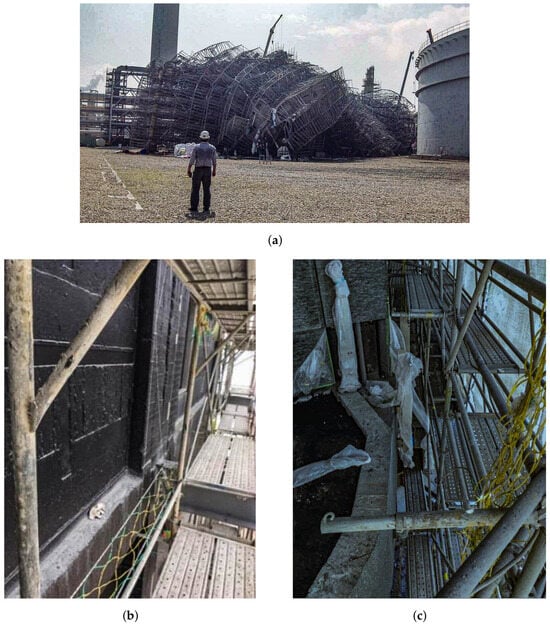
As one of the most common types of temporary works in construction projects, scaffolding is widely used for high-altitude operations such as new building construction, exterior façade renovation, and maintenance and repair works. It features temporary erection, modular components that facilitate frequent assembly and disassembly, and recyclability for reuse, and it continues to change as project progress advances. Workers often need to move, carry materials, and perform tasks within limited working space while remaining continuously exposed to the risks inherent in working at height. The safety of scaffolding operations mainly depends on two key aspects: (1) the load-bearing capacity and stability of the scaffold structure itself; and (2) the operational behaviors of workers, including whether they follow safe work rules, whether they correctly use personal protective equipment (PPE) [1], whether they adhere to erection and dismantling procedures [2], and whether the scaffold is assembled in accordance with standards to ensure that it achieves the designed structural performance, among others. If the links of the working environment and on-site management are not properly controlled, scaffold-related accidents may occur, including workers falling from height, falling objects injuring people, and even partial or total scaffold collapse, as shown in Figure 1a.
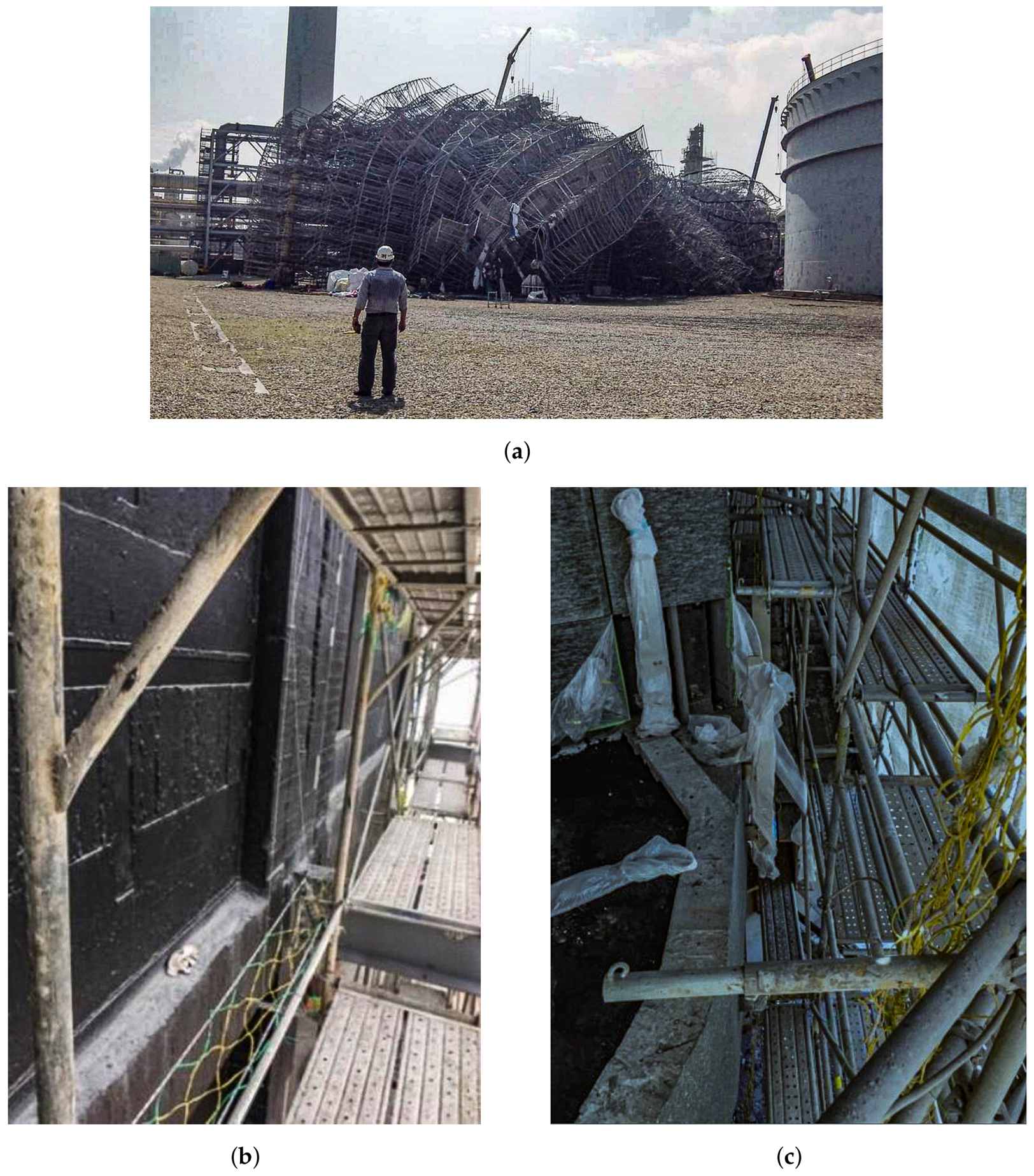
Figure 1.
Examples of hazardous scaffold conditions and accident consequences observed in actual construction environments: (a) the aftermath of a scaffold collapse; (b) removal of cross braces and lower rails (reproduced with permission from [3]); and (c) an unprotected scaffold opening associated with a fall accident (reproduced with permission from [3]).
By reviewing real scaffold accident cases [3,4], fatality cases that align with the different dimensions discussed above can be also identified. From a facilities standpoint, workers may temporarily remove scaffold parts to make tasks easier (as shown in Figure 1b)—especially since cross braces often obstruct exterior wall finishing—yet their role in maintaining structural integrity should not be underestimated [5]. In addition, scaffolds may be improperly erected from the beginning in ways that deviate from design drawings and specifications, leading to incomplete component connections and reduced structural performance [6]. From a personnel standpoint, weak safety awareness and insufficient education or training can prompt unsafe practices; in addition, unfavorable physical or psychological states—such as fatigue, night-shift work to meet deadlines, or even alcohol consumption [7]—may contribute to falls. From a management standpoint, inadequate on-site safety oversight, or the sidelining of safety requirements for convenience and speed during rushed work, also plays a role in scaffold accidents.
Risk factors related to scaffolding accidents can be summarized from existing research [1,8,9,10], accident investigation reports [2,3,4], and safety regulations [11,12,13,14,15]. These risk factors are spread across different dimensions, and their mechanisms of occurrence and the severity of their consequences also vary. Simply compiling a list of risk factors still makes it difficult, from a safety management perspective, to determine which issues should be addressed first when manpower and resources are limited. After all, it is not feasible for safety management measures to allocate the same level of resources to all potential risk factors. The frequency of accidents and the severity of harm associated with these risk factors are not the same. Some engineering issues that receive considerable attention in laws or technical standards are not necessarily the most common causes of hazardous situations on actual construction sites. Conversely, certain seemingly secondary issues in routine management, worker operating behavior, or safety awareness may, due to their repeated occurrence, result in a greater overall impact.
Because scaffolding must accommodate repeated erection and modification, its safety depends not only on the initial design and the strength of its components, but is also influenced by the interplay of factors such as erection quality, manner of use, construction environment, and on-site management. Consequently, scaffolding accidents are often not attributable to a single cause. Existing studies indicate that scaffolding accidents arise from interactions among personnel, equipment, construction methods, environmental conditions, and management factors. To fully understand the mechanisms by which scaffolding accidents occur, it is necessary to consider both structural and non-structural sources of risk. For example, Nowobilski and Hoła [16] examined 200 scaffolding-related accidents in Poland since 2011 and classified them into technical, organizational/process, and human-factor categories. Accordingly, this study examines the underlying hazardous factors associated with scaffolding from two dimensions: “aspects related to the scaffolding itself” and “aspects related to personnel, environment, and management.”
1.1. Scaffold-Related Accidents and Risk Factors
Existing studies have discussed the safety issues of scaffolding from different perspectives. Some research focuses on the structural behavior of the scaffolds themselves, including member strength, wall tie arrangement [17], foundation conditions [18], bearing capacity [18,19,20], and external loads [21,22,23], examining accidents caused by scaffold collapse [24,25,26]. On the other hand, some studies explore the safety behaviors that workers should adopt when operating on scaffolds, including fall protection measures, the use of safety lanyards, the prevention of unsafe practices (such as using guardrails or cross braces as footholds), and the correct procedures for scaffold assembly. In recent years, various information technologies have also been introduced, such as using Building Information Modeling (BIM) [27,28,29], image recognition [30], and sensors with deep learning applications for scaffold planning, monitoring, and safety inspections [31,32,33,34]. In addition to the scaffolding structure itself, information technology has also been used to monitor workers’ unsafe behaviors, including computer vision [35] and artificial intelligence–based methods [36].
In addition, the performance of the scaffolding is also affected by human factors. Even scaffolding whose structural performance has been designed to meet requirements may still contain hidden risks due to improper assembly that does not comply with regulations, failure to construct according to the drawings, overloading caused by stacking materials, or the unauthorized removal of components such as cross braces or wall ties [3] for the sake of convenience during operations.
1.2. Human, Technical, Environmental, and Management Factors
Among scaffold-related accidents, falls from height are one of the most closely scrutinized types. Because scaffolds are often erected specifically for work at elevation, and because—compared with permanent structures—they tend to have more openings that can lead to fall incidents, the likelihood of falls may be increased. Moreover, during scaffold erection, workers must operate in hazardous areas before handrails and guardrails are installed; therefore, if personal protective equipment such as safety lanyards, or fall-prevention systems such as safety nets, are not fully in place, the probability of a fall accident may rise. In addition, when handling or moving materials, improper load-bearing posture can lead to an unstable center of gravity, which may also cause falls. Beyond whether safety protection is properly implemented, workers’ mental condition and safety awareness are likewise potential contributing factors to fall incidents. For example, in Taiwan, due to regional, weather, and cultural factors, there exists a habit among construction workers of consuming alcoholic beverages on site [37,38,39,40]. Continuing to work despite poor alertness or fatigue because of schedule pressure, as well as night-shift works [7], also increases the risk of accidents. Fatigue-related work itself has been confirmed as an important factor affecting construction safety [41,42,43]. Management measures and methods are also effective means of improving scaffolding safety. Existing research has pointed out that management and supervision make important contributions and have a significant impact on reducing errors in the scaffolding field [44].
Environmental and equipment factors are also causes of scaffolding accidents, as they may indirectly contribute to structural problems that lead to scaffold collapse. Horizontal external forces—such as seismic or wind loads—often combine with the failure of wall ties and anchors (due to improper installation or accidental removal) to cause scaffold collapse. External impacts from construction vehicles or heavy machinery also occasionally occur, typically on scaffolds at the lowest level. In addition, the natural deterioration, corrosion, and loss of performance of scaffold components are factors that must not be overlooked. Although scaffold components can be recovered and reused, they should essentially be regarded as consumables with a depreciation life, and overly old components should be regularly retired to ensure they can deliver their design performance. Relevant industry organizations in many countries have established principles for inspecting and retiring scaffold components [14,45,46]; however, in practice, many scaffolding suppliers frequently mix new and old components, and degraded or performance-compromised scaffold components may also lead to scaffolding accidents.
1.3. Risk Assessment and Prioritization of Scaffold Safety Factors
Although existing safety-related studies on scaffolding have identified numerous potential risk factors through methods such as accident case analysis, field investigations, and safety inspections—thereby making important contributions to understanding specific accident mechanisms and establishing safety regulations—it remains difficult to compare the relative importance of these factors within a unified framework, because different types of studies often focus on particular accident types or specific technical issues.
Some existing studies use risk matrices and multi-criteria decision-making methods to quantify the assessment and prioritization of construction safety risks. For example, they use Analytic Hierarchy Process (AHP) to establish a prioritization framework for construction safety risks [47,48], or further integrate fuzzy theory [49,50], TOPSIS [51], or other quantitative evaluation methods to handle the uncertainty in expert judgments and support risk management decisions when safety resources are limited. However, compared with safety risks in general types of construction projects, the system-level frameworks established for the causes of scaffolding accidents remain limited. Such a knowledge gap has therefore motivated this study.
Importantly, the applicability of a multi-criteria prioritization method depends not only on the analytical technique employed, but also on whether the underlying criteria appropriately represent the specific decision context. Thus, criteria developed for broader construction-safety problems cannot necessarily be transferred directly to scaffold-specific or region-specific safety management. As a result, Existing scaffold-risk classifications offer a useful conceptual base, and some broad categories can transfer across construction contexts. However, the specific factors within each category and their management priorities may not transfer because scaffold-safety risks depend on local regulations, practices, climate, workforce characteristics, and safety culture. Therefore, instead of replacing existing classifications, a context-adapted framework should combine established risk knowledge with local evidence and expert judgment.
1.4. Research Problems and Objectives
Although a number of scaffold-related hazard factors can be identified from existing studies, their relative importance has not yet been sufficiently examined and compared within an integrated framework. As a result, when manpower and safety resources are limited, it remains difficult to determine which hazard factors should be prioritized for focused management. This constitutes a knowledge gap in the current literature and has therefore motivated the present study. Accordingly, this study aims to investigate how to systematically organize and quantify the priority levels of various scaffold-related risk factors, so as to provide a basis for supporting practical safety management.
To address this issue, this study develops a systematic framework for prioritizing scaffolding safety risk factors. Under this objective, three specific tasks are included: (1) identify and integrate scaffolding-related risk factors from relevant literature, regulations, occupational accident cases, and expert knowledge; (2) establish a risk-factor framework with dimensions and hierarchical levels, and—based on expert judgment—apply the AHP to quantify the relative importance of each risk factor; and (3) determine the weights of the risk factors as the basis for ranking, and translate the ranking results into safety guidance for scaffolding operations. To achieve these objectives, this study first compiles an initial set of hazard factors, which are then reviewed and consolidated by an expert panel. Items with similar meanings are merged into a hierarchical framework comprising five dimensions: personnel, management, equipment, work methods, and environment. Finally, domain experts with practical experience in scaffolding engineering are invited to conduct the AHP evaluation, from which the relative weights and overall rankings of each dimension and individual hazard factor are derived. Unlike previous studies that primarily examine individual scaffold hazards or apply risk-prioritization methods to general construction safety, this study integrates heterogeneous scaffold-specific risks into a unified hierarchical framework and quantifies their relative management priorities.
2. Materials and Methods
This study uses the classical AHP to perform a ranking analysis of the key factors behind scaffolding accidents. The AHP method, first proposed by Professor Saaty [52], is mainly applied to decision-making problems under uncertainty and those involving multiple evaluation criteria. In practical management applications, it is often used to identify the key influencing factors within a system, so as to determine how limited managerial resources should be allocated to problems with numerous and complex causes. In the context of this study, there are many potential causes of scaffolding accidents; the resulting priorities acquired by AHP can provide a decision-support basis for allocating limited safety-management resources to factors perceived by experts as requiring greater attention.
2.1. Study Context and Evidence Base
This study is grounded in Taiwan’s practices for scaffold erection and safety management. Taiwan was selected as the study area because the risk factors associated with scaffolding—and their relative importance—may be influenced by local regulations, construction practices, climatic conditions, workforce characteristics, and jobsite safety culture. Moreover, the literature evidence, expert judgments, and the expert questionnaires used in the final-stage AHP in this study are primarily drawn from Taiwan’s construction industry. Therefore, the final prioritization of hazard factors reflects Taiwan’s real-world context. Nevertheless, this framework still provides an analytical structure and foundation for scaffolding safety issues; in other regions, it can be re-applied using relevant cases, regulations, and expert opinions to produce corresponding results.
The evidence used to establish the initial repository of risk factors was drawn from four complementary sources: existing academic research, occupational accident reports, scaffolding-related safety regulations, and practical experience obtained through expert discussions. These sources provide different yet mutually reinforcing forms of evidence. Prior studies describe established accident mechanisms and risk classifications from a theoretical perspective; casualty and incident reports document hazards that have occurred in practice; safety regulations and technical guidelines distill experience and knowledge accumulated over time, defining recognized safety requirements and hazardous scenarios; and expert experience reflects and supplements on-site practices and management issues that may not yet be fully documented in the existing literature.
The selection of candidate risk factors was not based solely on their frequency of occurrence in real-world settings. Any candidate factor that had been identified through accident records, regulatory requirements, prior literature, or expert experience was retained for further consideration. This inclusive approach was adopted because some scaffold-related incidents, although infrequent, may result in major casualties. Therefore, the selection criteria for candidate factors at the initial stage were intended to cover both common risk factors and those that occur less frequently but have severe potential consequences. Subsequently, these factors were reviewed, supplemented, and consolidated by experts, and only then evaluated using the AHP.
2.2. Identification and Validation of Risk Factors
Based on the evidence sources in Section 2.1, this study first collected a total of 22 candidate scaffolding hazard factors from prior studies, occupational safety accident casualty reports, scaffolding-related safety regulations, and technical guidelines, and classified them into five fundamental dimensions: personnel, management, work methods, environment, and equipment. Next, six experts with extensive practical experience in scaffolding engineering or safety in Taiwan were invited to participate in a brainstorming meeting to review, revise, and supplement the initial list of hazard factors. After incorporating expert opinions, the preliminary list identified 43 risk factors, as shown in Table 1.
Table 1.
Preliminary scaffold risk factors and their mapping to the consolidated AHP factors.
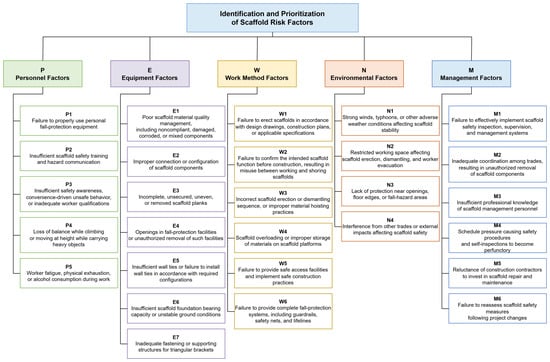
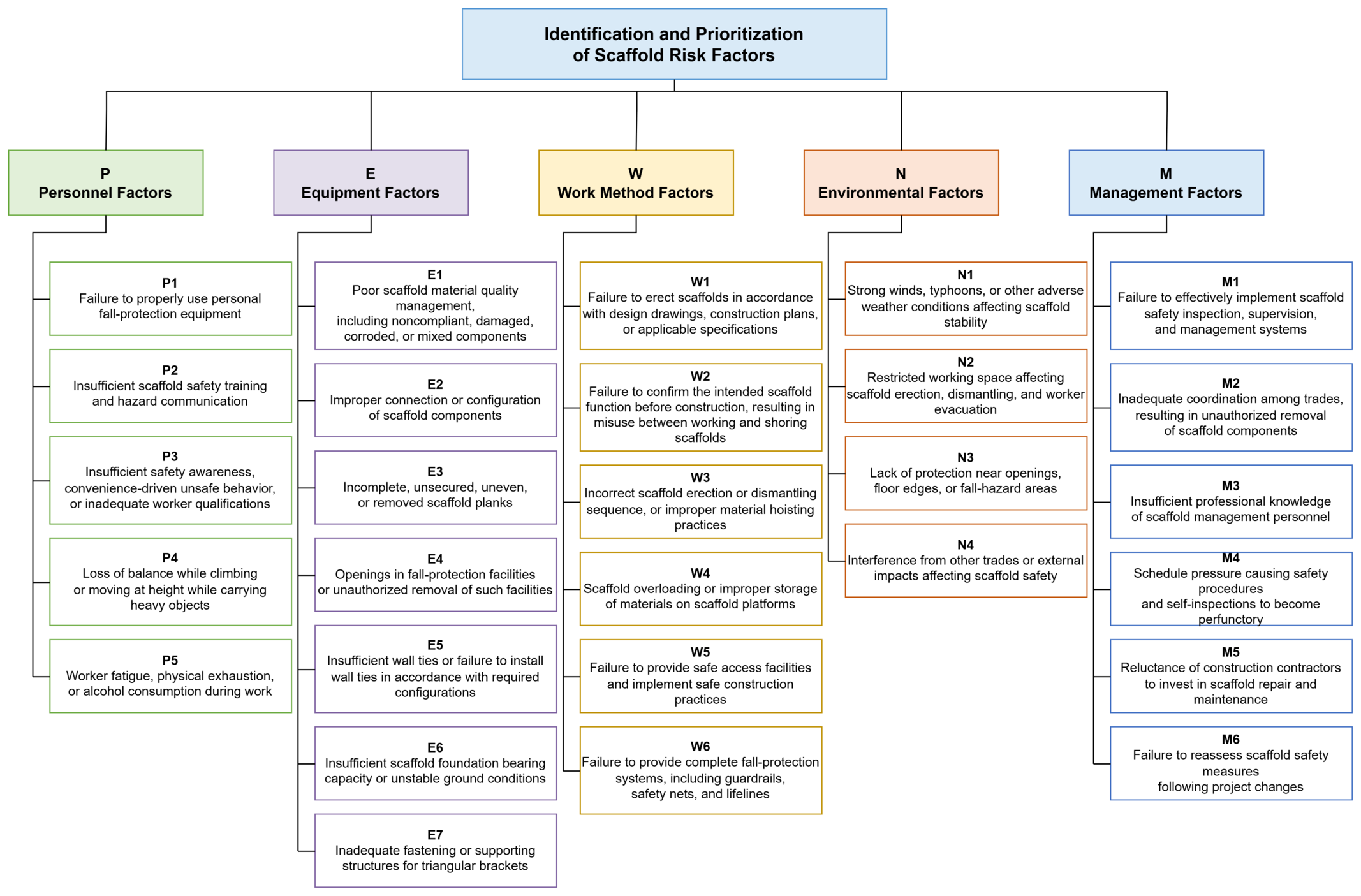
The preliminary list of risk factors presented in Table 1 comprises 43 factors distributed across five dimensions. As stated in Section 2.1, to ensure broad coverage of potential risk factors, this study adopted a collective brainstorming approach when inviting experts, encouraging them to propose as many ideas as possible and recording them faithfully. Under this approach, different experts may in fact propose overlapping or highly similar risk factors. To reduce conceptual redundancy while preserving the scope of identified risks, this study further consolidated these factors based on semantic overlap, similarity in underlying accident mechanisms, and relevance to the same safety management measures, i.e., performing “consolidation” rather than “screening.” None of the initial factors was excluded merely because it was considered infrequent or of low importance; instead, the study merged only those factors that were closely related and could be meaningfully clustered (for example, deficiencies in different equipment may lead to the same scaffolding accident). In addition, certain risk factors were reassigned to dimensions that more accurately reflect their root causes. Some risk factors may relate to two dimensions simultaneously; classifying them under the most relevant one was the adjustment principle adopted in this study. The initial assignment of risk factors to dimensions was preliminarily determined by synthesizing prior research; however, after the expert brainstorming sessions, the study developed a deeper understanding of the nature of the risk factors and concluded that adjustments to their assigned dimensions were necessary. Ultimately, only three risk factors underwent dimensional reassignment. As indicated by the mapping codes in Table 1, the eight personnel factors were consolidated into five factors; equipment factors were consolidated into seven factors; work method factors were consolidated into six factors; environmental factors were consolidated into four factors; and management factors were consolidated into six factors. Therefore, the final hierarchical structure comprises five dimensions and 28 factors, as shown in Figure 2.
Figure 2.
The Hierarchy and Important Factors.
2.3. AHP Questionnaire and Pairwise Comparison
In the second stage, a total of 17 experts were invited to participate in completing the AHP questionnaire, including the six experts who developed the preliminary factors in the first stage. These experts were selected based on their professional qualifications and practical experience in the scaffolding field. The experts’ backgrounds and years of experience are detailed in Table 2.
Table 2.
Professional profiles of the experts participating in the AHP assessment.
All 17 experts had practical experience in scaffolding engineering, including scaffolding construction, inspection, and safety management. Their relevant years of experience ranged from 1.5 to 35 years, with most having more than 15 years of experience. These 17 experts were not sampled to be statistically representative of “all scaffolding practitioners in Taiwan”; rather, they were deliberately selected for their relevant expertise and experience, with coverage of different professional roles. In addition, the pairwise comparison matrices completed by each expert in the AHP questionnaire independently passed the consistency test, yielding a result of . That is, no expert was excluded due to inconsistent responses, and all expert responses were retained for subsequent aggregation.
2.4. Weight Calculation and Consistency Assessment
In the calculation process of AHP, experts use pairwise comparisons to evaluate the relative importance of factors within the same dimension. The same procedure is also used to assess the importance of each dimension with respect to the overall decision goal. Suppose that for the k-th expert, the relative importance judgment value obtained from comparing factor i with factor j is . Then the judgments of multiple experts can be aggregated using the geometric mean method to form a group judgment value, as shown in Equation (1):
where denotes the pairwise comparison judgment between factors i and j provided by expert k, K is the total number of experts, and represents the aggregated group judgment obtained using the geometric mean. In this way, the elements in the upper triangular part of the pairwise comparison matrix can be obtained. Since pairwise comparisons in AHP have the reciprocal property, it can be identified that .
Accordingly, the corresponding elements in the lower triangular part of the matrix can be obtained. In addition, when any factor is compared with itself, its relative importance is 1, that is, . Therefore, the complete pairwise comparisonmatrix can be constructed, as shown in Equation (2):
After that, the maximum eigenvalue and its corresponding eigenvector w are obtained for this comparison matrix, as shown in Equation (3). The weights of each factor can then be further derived from the eigenvector.
Due to the complexity of the hierarchical structure and evaluation factors, experts’ judgments may not remain perfectly consistent when performing multiple pairwise comparisons. Therefore, after constructing the pairwise comparison matrix, a consistency test must be conducted to verify the logical consistency of the experts’ judgments. The AHP first uses the Consistency Index () to measure how far the comparison matrix deviates from a state of perfect consistency, and then compares the with the Random Index () corresponding to a matrix of the same order to calculate the Consistency Ratio (). In general, when , the pairwise comparison matrix is considered to have an acceptable level of consistency. The formulas for calculating CI and CR are shown in Equations (4) and (5).
where is the maximum eigenvalue of the pairwise comparison matrix, and n is the number of elements being pairwise compared in that matrix, i.e., the order of the comparison matrix. At the dimension level, n is the number of dimensions; at the factor level within each dimension, n is the number of factors contained in that dimension.
2.5. Use of Generative Artificial Intelligence
During the preparation and revision of this manuscript, the authors used ChatGPT (OpenAI; GPT-5.6 and GPT-6) and Writefull for Overleaf (Digital Science; version not specified) as supporting tools for manuscript organization, language refinement, preparation of visualization code, and assistance in reviewing, organizing, and interpreting the results obtained from the authors’ original AHP analysis. It was also used to provide initial suggestions and draft text for selected supporting sections of the manuscript. The core methodological development, AHP calculations, and reporting of the research results were undertaken by the authors, and all AI-assisted textual outputs were subsequently reviewed by the authors and, where appropriate, revised and further developed. Generative AI tools were not used to generate expert responses, questionnaire data, AHP judgments, or primary research data, nor were they used to independently determine the study results. All AHP calculations, quantitative results, and final interpretations were verified by the authors based on the original expert data. The authors take full responsibility for the content of the publication.
3. Results
3.1. Consistency of the AHP Judgments
In Section 2.3, this study has already conducted consistency tests on each expert’s individual pairwise comparison matrix and confirmed that the results from all 17 experts can be included in the aggregated pairwise comparison matrices. This section again adopts the and values to perform consistency tests for all dimensions of the aggregated pairwise comparison matrices. The results are shown in Table 3. It can be observed that both the first-level comparisons, i.e., comparisons among dimensions (denoted as “Main criteria” in Table 3), and the second-level comparisons, i.e., comparisons among different factors under each dimension, passed the consistency test, meaning that the values are below the commonly accepted threshold of 0.10. Therefore, all dimensions and factors can be retained for the subsequent stages of weight calculation and ranking.
Table 3.
Consistency test results of the AHP comparison matrices.
3.2. Priorities of the Risk Dimensions
Table 4 first lists the rankings of the weights of each dimension. Among the five dimensions, they are, in order, management factors (M), personnel factors (P), work method factors (W), equipment factors (E), and environmental factors (N). Among them, the management factor (0.2981) and personnel factor (0.2972) were assigned higher weights by the AHP results, followed by the work method (0.2037). These results indicate that the interviewed experts assigned relatively high importance to both human factors and management factors.
Table 4.
Priorities and rankings of scaffold risk dimensions.
3.3. Local and Global Priorities of the Risk Factors
3.3.1. Personnel Factors
For each dimension, the corresponding weights of its risk factors are listed in Table 5, Table 6, Table 7, Table 8 and Table 9, including the within-dimension weights and the overall weights. The global weights were obtained by multiplying each local weight by the corresponding dimension weight.
Table 5.
Local and global priorities of personnel-related scaffold risk factors.
Table 6.
Local and global priorities of management-related scaffold risk factors.
Table 7.
Local and global priorities of work method-related scaffold risk factors.
Table 8.
Local and global priorities of equipment-related scaffold risk factors.
Table 9.
Local and global priorities of environmental-related scaffold risk factors.
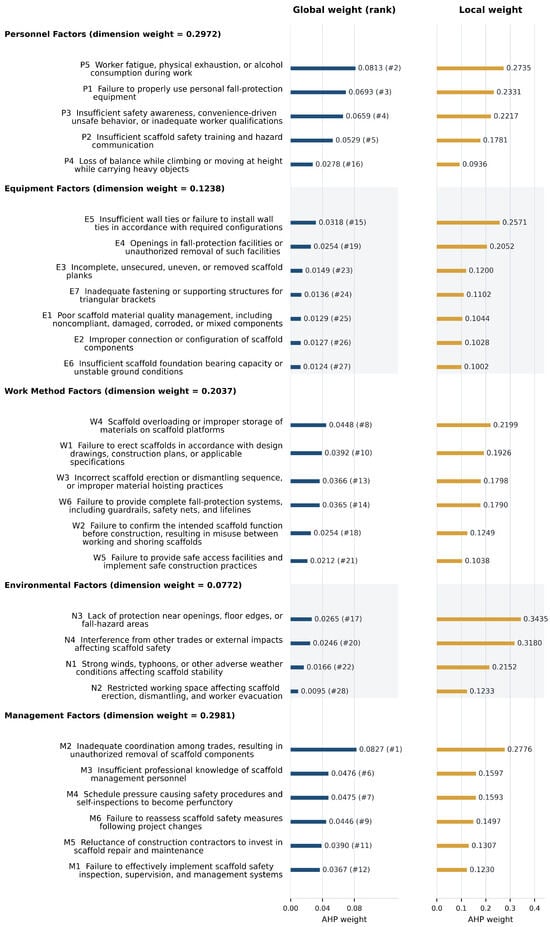
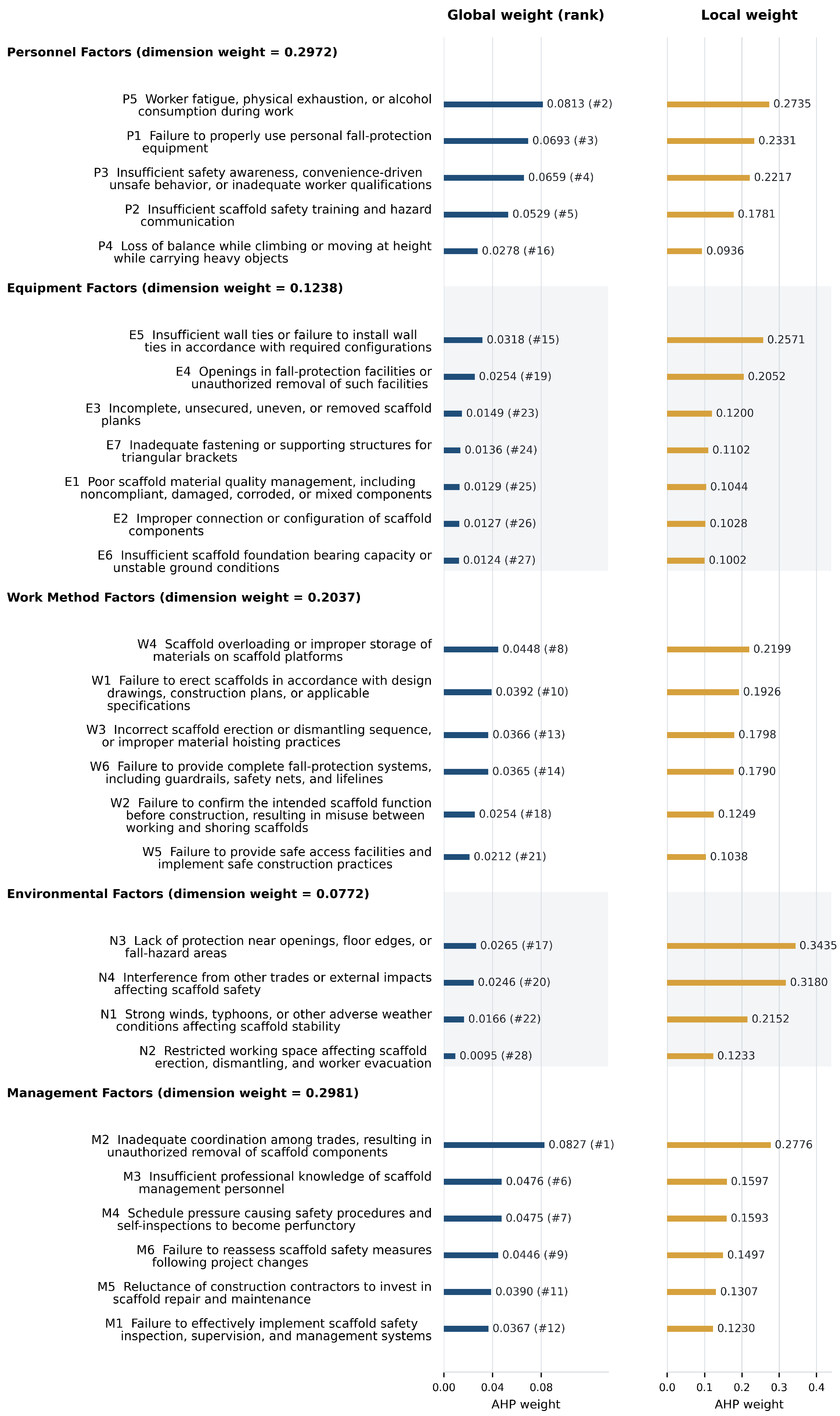
As shown in Table 5, P5 has the highest local weight within the personnel dimension (0.2735). In addition, P5, P1, and P3 rank 2nd, 3rd, and 4th, respectively, in the overall ranking across the 28 factors, indicating a clear concentration of personnel-related factors toward the top of the overall weight ranking. By contrast, P4 has a relatively low local weight (0.0936) and ranks 16th overall, showing a notable gap compared with the higher-ranked P5, P1, and P3.
3.3.2. Management Factors
As shown in Table 6, within the ranking of management factors, M2 has a local weight of 0.2776, which is substantially higher than the other management factors. M2 also ranks first in overall weight among all 28 risk factors. In contrast, M3, M4, and M6 form a relatively close middle group, with local weights ranging from 0.1497 to 0.1597, and their overall rankings are sixth, seventh, and ninth, respectively.
3.3.3. Work Method Factors
Within the work-method dimension, W4 has the highest local weight (0.2199) and ranks eighth overall, as shown in Table 7. The global weights of W1, W3, and W6 are similar, ranging from 0.0365 to 0.0392; in contrast, W5 has the lowest local weight in this dimension and ranks 21st overall.
3.3.4. Equipment Factors
E5 is the highest-ranked risk factor within the equipment dimension, with a local weight of 0.2571, placing 15th in the overall ranking, as shown in Table 8. Although the equipment dimension contains the largest number of risk factors, the overall rankings of the seven equipment-related factors fall toward the latter half, ranging from 15th to 27th. Within this dimension, the local weights of E1, E2, and E6 are close to one another and relatively low, ranging from 0.1002 to 0.1044.
3.3.5. Environmental Factors
Table 9 shows that the local weights of the environmental factors are mainly concentrated on N3 (0.3435) and N4 (0.3180). Although they have relatively high priority within the environmental dimension, the overall dimension weight is only 0.0772, placing them only 17th and 20th, respectively, in the overall ranking. N2 has the lowest local weight in this dimension and ranks 28th overall.
3.4. Overall Ranking and Priority Risk Factors
This study first lists the local weights and overall weights of all 28 factors in Figure 3. To facilitate the presentation of the ranking of the dimension weights, Figure 3 still groups the 28 factors into five dimensions, and within each dimension they are ranked according to their local weights. The ranking of the weights of the various factors within each dimension has been discussed in detail in Section 3.3.
Figure 3.
The Global Weights and Local Weights for Important Factors.
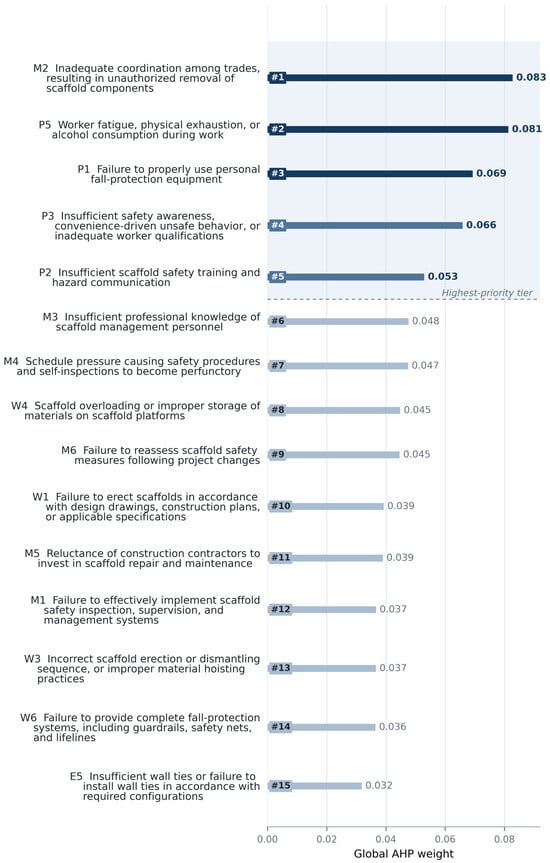
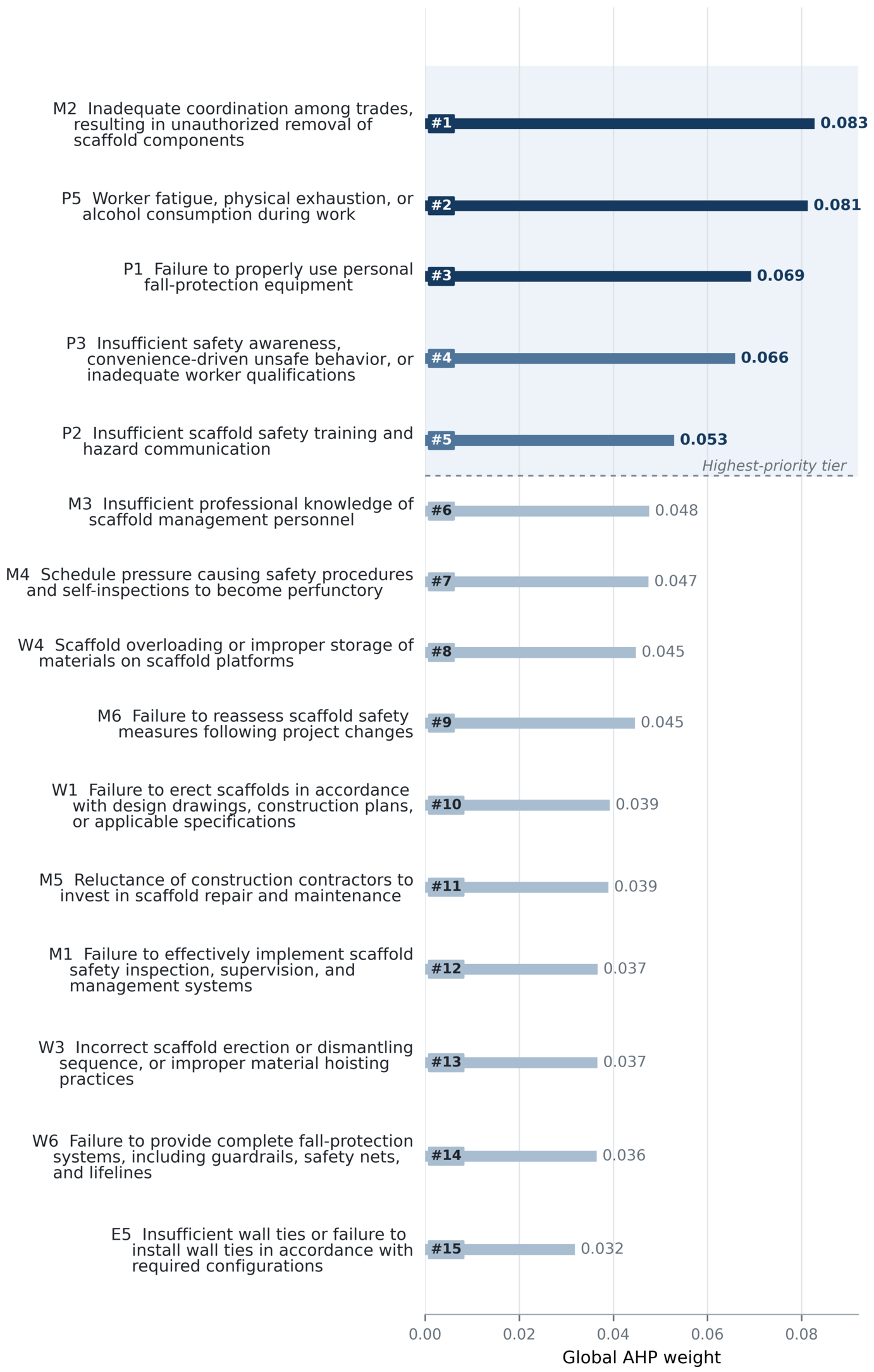
To further understand the ranking and importance of various key factors across dimensions, this study further presents the top 15 key factors in the overall weight ranking in Figure 4.
Figure 4.
The Top-15 Global Weights for Important Factors.
4. Discussion
4.1. Dominance and Near-Equivalence of Management and Personnel Factors
In Section 3.2, this study first compared the dimension weights of the five dimensions. The results show that among the five dimensions, management dimension (0.2981) and personnel dimension (0.2972) have the highest and very similar weights, followed by work-method dimension (0.2037). In contrast, equipment dimension (0.1238) and environmental dimension (0.0772) have relatively lower weights. This indicates that although scaffold collapse and failure are generally recognized as serious types of scaffold accidents, scaffold safety cannot be understood solely in terms of the structural performance of the scaffold itself. The behavior of personnel, safety supervision, and construction methods used in actual operations can all lead to scaffold-related accidents. In other words, whether a scaffold is safe does not depend only on how it is designed and erected, but also on how it is used, modified, supervised, and managed during the construction process.
The AHP weights should be interpreted as the relative priorities perceived by the participating experts rather than as statistical estimates of accident frequency, causal contribution, or effect size. Accordingly, a higher weight indicates that a factor was considered more important for scaffold safety management within the decision context of this study, but does not demonstrate that the factor causes a greater proportion of scaffold accidents. Although the Management dimension ranked first, its difference from the Personnel dimension was only 0.0009; therefore, it should not be simply interpreted as management factors being the most important. Rather, this indicates that scaffolding-related risks are concentrated in management control and frontline personnel behaviors. The third-ranked dimension, immediately following the top two, was Work Methods, which together with the top two forms the main risk cluster of “management–personnel–operations.” Although the Equipment and Environment dimensions had relatively lower priority weights, this does not mean that the associated risks are unimportant or that they occur less frequently. Rather, the results indicate that the participating experts assigned them comparatively lower management priority within the present AHP framework. Moreover, their consequences can still be severe—for example, extreme weather or seismic events may contribute to overall scaffold collapse, as discussed in Section 2.2. Moreover, in terms of risk identification, the Equipment risk dimension contains the largest number of hazard factors, indicating diverse latent hazards; it should therefore still be taken into account in management measures.
4.2. Practice-Driven Risks Among the Highest-Ranked Factors
In Section 3.4, this study presents the overall ranking of weights for all hazard factors, as shown in Figure 4. Focusing on the five items with the highest overall weights, the top-ranked factor, M2, refers to the unauthorized removal of scaffold components. Because construction projects involve different trades working at the same time and in the same space, their shared work area also includes the space on and around scaffolds. When scaffold components such as cross braces or wall ties obstruct the task being carried out by a particular trade, workers may temporarily remove them (M2) for convenience [3], but then fail to restore them after the work is completed. Extensive removal of essential components may compromise the scaffold’s load-bearing capacity; unlike a single incident of a worker falling from a scaffold, scaffold collapse often results in much more severe disasters. The second-ranked factor, P5, reflects workers’ health and physical/mental condition. It is also the highest-weighted hazard factor within the “personnel factors” dimension, indicating that Taiwan’s distinctive on-site drinking culture [37,38,39,40], as well as fatigue from overtime and night work to meet deadlines [7], exerts a non-negligible impact on workers’ physical and psychological states. The third-ranked factor, P1, highlights the issue of failing to properly wear personal protective equipment (PPE). Globally, not wearing PPE—especially fall-arrest equipment—is a common contributing cause of major casualties in occupational accidents; however, in Southeast Asian countries, hot climate conditions further reduce workers’ willingness to wear PPE correctly, making this an issue that cannot be ignored.
P3, which ranks fourth in overall weighting, reflects workers’ insufficient safety awareness and their tendency to prioritize convenience. This often manifests in unsafe operating behaviors, such as climbing cross braces or using guardrails as footholds. P2, ranked fifth, addresses issues related to education and training and hazard communication. A lack of safety awareness and safety education may also lead to latent risks in scaffolding operations. For example, amid the widespread labor shortage in Taiwan’s construction industry, foreign workers are often brought in to address manpower shortfalls; however, language and cultural barriers may indirectly prevent effective implementation of safety education on worksites and result in uneven levels of safety awareness among workers.
4.3. Comparison with Previous Studies
To further clarify the relationship between the results of this study and existing research on scaffold safety, this study summarizes in Table 10 the key consistencies between prior literature and this study, differences in emphasis, and extensions under specific contexts, so as to provide an analytical synthesis.
Table 10.
Comparison of the present findings with previous scaffold safety studies.
As can be seen from the contents of Table 10, the findings of this study do not negate the importance—already established by prior research—of investigating the structural and environmental hazards of scaffolding. Rather, the two highlight differences in analytical emphasis. Most existing studies focus on the mechanisms and consequences of specific hazard issues, whereas this study emphasizes comparing heterogeneous risk factors across different dimensions within a shared safety management framework. Accordingly, the weights obtained through AHP should be interpreted as relative management priorities, rather than as indicators of accident frequency or hazard severity.
4.4. Practical Implications for Scaffold Safety Management
Section 4.2 describes the five scaffolding-related hazard factors with the highest cross-dimensional weights. If these are regarded as critical hazard factors, it becomes important to adopt corresponding management measures to reduce the likelihood of accidents and disasters. For M2 (inadequate coordination among trades resulting in unauthorized removal of scaffold components), because construction processes across different trades are complex, temporarily removing scaffolding components for constructability does not need to be completely prohibited, since there are currently no clear analytical results proving that small-scale, temporary removal of scaffolding components endangers the structural safety of the overall scaffold. In more cases, the concern with removing scaffolding components is that it creates openings and thus increases the possibility of accidental falls. Therefore, it is necessary to establish mechanisms for restoration and re-inspection after components are temporarily removed. Regular site inspections focusing on scaffold integrity can help ensure that temporarily removed components are restored.
As for the issues related to workers’ physical and mental condition shown in P5 (fatigue, physical exhaustion, or alcohol consumption), in addition to enforcing controls on alcoholic beverages at the site, verifying workers’ physical and mental condition before starting work also helps implement safety management. Certain information-technology aids can also be used to assess workers’ physical, mental, and psychological state. For example, introducing artificial intelligence in conjunction with on-site CCTV surveillance systems may, through image-detection methods such as gait analysis, or with wearable devices capable of capturing physiological signals, help determine whether workers are in a condition fit for duty. At the same time, AI and image-detection technologies can also help confirm whether workers are wearing personal protective equipment (PPE) as required, thereby addressing the issue reflected in P1 (improper use of personal fall-protection equipment).
For P3 (insufficient safety awareness, convenience-driven unsafe behavior, or inadequate worker qualifications) and P2 (insufficient scaffold safety training and hazard communication), which involve safety training and hazard communication, in addition to leveraging the effectiveness of on-site supervision, safety training for foreign workers facing language barriers can be implemented through multilingual or pictorial teaching materials or signage—approaches that can already be seen at construction sites in Taiwan. Moreover, with the rise of large language models, machine translation can also be effective for pre-work briefings and for communicating safe operating procedures.
From a resource-allocation perspective, the global weights may further support a tiered management strategy. Because these weights represent relative priorities rather than absolute measures of accident probability or consequence severity, the tiers are intended to differentiate the intensity of management attention rather than to define fixed high-, medium-, and low-risk thresholds. High-priority factors should receive targeted preventive actions, more frequent inspection, and explicit supervisory attention. Medium-priority factors should remain subject to routine monitoring through periodic scaffold inspections, toolbox meetings, and regular site-safety checks, so that emerging deficiencies can be identified before they develop into critical conditions. Lower-ranked factors should not be interpreted as negligible risks; rather, they should continue to satisfy baseline regulatory, inspection, and maintenance requirements, while comparatively greater management resources are directed toward higher-priority issues. Such a tiered approach allows the AHP results to guide the intensity of management attention without treating lower-ranked hazards as unimportant.
5. Conclusions
This study identifies scaffolding risk factors and uses the AHP to rank their importance and prioritize safety measures. Risk factors were compiled from literature, accident cases, and expert input, then merged into a hierarchy of 28 factors across five dimensions: personnel, equipment, work methods, environment, and management. 17 scaffolding experts completed the AHP comparisons, and all matrices met consistency requirements. Scientifically, this study’s main contribution is an integrated prioritization framework that evaluates scaffold-related risks across personnel, management, work methods, equipment, and environmental dimensions within one structure. By converting expert judgments into quantifiable priorities, it shows that scaffold safety depends not only on structural performance but also on interactions among worker behavior, construction activities, management systems, and scaffold conditions. Thus, beyond ensuring component stability, scaffolding safety management should target workers’ safe behavior and awareness, construction procedures, and site management. In practice, the results support risk-based decisions by directing limited safety resources to the most critical, controllable issues—especially unauthorized component removal, worker fatigue or workplace drinking culture, and improper fall-protection use. The high-weight factors can inform focused inspection checklists, training programs, cross-trade coordination procedures, and on-site supervision strategies.
Several limitations of this study should be acknowledged. First, AHP depends on subjective pairwise judgments; despite consistency checks, the weights reflect experts’ experience and should be read as relative management priorities, not direct accident causes. Second, the 17 experts were Taiwan-based, so different regulations, practices, workforce characteristics, and safety culture may yield different priorities elsewhere. Third, using conventional AHP alone provides transparency and consistency verification but does not model uncertainty, and the rankings were not cross-validated with other methods. Future work could use fuzzy AHP or other uncertainty-aware methods to test robustness, compare rankings with accident databases to link perceived priorities to observed patterns, apply dynamic risk analysis using time-varying site data to update priorities, and conduct cross-regional studies with independent panels to assess transferability.
Author Contributions
N.-W.C.: Conceptualization, Writing—Original Draft, Methodology, Writing—Review & Editing, Validation, Visualization. Y.-R.C.: Writing—Review & Editing, Methodology, Data Curation, Investigation, Resources. H.-L.C.: Writing—Review & Editing, Validation, Data Curation, Investigation, Formal Analysis. H.-P.T.: Conceptualization, Writing—Review & Editing, Supervision. All authors have read and agreed to the published version of the manuscript.
Funding
This research received no external funding.
Institutional Review Board Statement
This study involved professional expert elicitation concerning scaffolding safety risk factors rather than an investigation of participants’ personal physiological, psychological, or medical characteristics. Under Articles 4 and 5 of Taiwan’s Human Subjects Research Act [53], mandatory prospective ethics review applies to research falling within the statutory definition of human subjects research. Furthermore, official research ethics guidance issued by Taiwanese universities [54,55] distinguishes statutory human subjects research from broader categories of human-related research, for which prospective ethics review is not universally mandated by national legislation, although additional institutional, funding-related, or publication requirements may apply. Based on the nature of this study and the authors’ understanding of the applicable regulatory framework, prospective ethics review was not sought. No formal IRB/REC approval or exemption determination was obtained. As data collection had already been completed, retrospective approval could not be obtained through the ordinary review process. These circumstances have been transparently disclosed to the Editorial Office.
Data Availability Statement
The aggregated data supporting the findings of this study are presented within the article. The individual-level expert judgment data are not publicly available because they contain responses provided by participating experts under conditions of confidentiality and were not collected with consent for public dissemination.
Acknowledgments
The authors would like to express their sincere gratitude to the 17 experts who participated in the AHP assessment for generously sharing their professional expertise, practical experience, and valuable insights. Their contributions were essential to the development and completion of this study. The authors also gratefully acknowledge the Institute of Labor, Occupational Safety and Health (ILOSH), Ministry of Labor, Taiwan, for granting written permission to use, adapt, extend, and publish materials derived from the research report ILOSH109-S304 [3], including photographic materials previously published in the report. During the preparation and revision of this manuscript, the authors used ChatGPT (OpenAI; GPT-5.6 and GPT-6) and Writefull for Overleaf (Digital Science; version not specified) as supporting tools for manuscript organization, language refinement, preparation of visualization code, and assistance in reviewing and interpreting the results obtained from the authors’ original AHP analysis. All AI-assisted outputs were critically reviewed, verified, and revised by the authors, who retain full responsibility for the accuracy, integrity, and conclusions of the manuscript.
Conflicts of Interest
The authors declare no conflict of interest.
References
- Ku, C.Y. A Study on the Causes of Occupational Accidents Related to Construction Scaffolding and the Prevention of Work Safety Hazards. Master’s Thesis, Department of Civil Engineering, National Kaohsiung University of Science and Technology, Kaohsiung, Taiwan, 2025. (In Chinese) [Google Scholar]
- Tu, K.S. Operation Safety Analysis of Scaffold and Improvement Measures. Master’s Thesis, Department of Civil Engineering, National Kaohsiung University of Science and Technology, Kaohsiung, Taiwan, 2020. (In Chinese) [Google Scholar]
- Chang, C.C.; Chen, Y.R. Research of Safety Guide Promotion and Accident Prevention Strengthening Program of Scaffold; Technical Report ILOSH109-S304; Institute of Labor, Occupational Safety and Health, Ministry of Labor: New Taipei City, Taiwan, 2021. (In Chinese) [Google Scholar]
- Occupational Safety and Health Administration, Ministry of Labor, Taiwan. Occupational Accident Case Downloads. Online Database. Available online: https://www.osha.gov.tw/48110/48461/48517/48553/lpsimplelist (accessed on 13 June 2026). (In Chinese)
- Peng, J.L.; Ho, C.M.; Chan, S.L.; Chen, W.F. Stability study on structural systems assembled by system scaffolds. J. Constr. Steel Res. 2017, 137, 135–151. [Google Scholar] [CrossRef] [Scilit]
- Cho, F.C. A Research and Investigation on Impacting Labor Safety for Assembling Scaffold and Supporting Scaffold. Master’s Thesis, Department of Civil Engineering, Chung Hua University, Hsinchu, Taiwan, 2017. English title supplied as a translation because the official English metadata was unavailable. (In Chinese) [Google Scholar]
- Dzeng, R.J.; Wang, S.H.; Fang, Y.C. Quantitative evaluation of the impact of night shifts and alcohol consumption on construction tiling quality. Appl. Ergon. 2015, 50, 226–236. [Google Scholar] [CrossRef] [Scilit] [PubMed]
- Yen, T.C.; Pan, N.H. Occupational Hazard Analysis of Construction Frame Assembly (Removal) Operation. J. Labor Occup. Saf. Health 2023, 31, 18–33. [Google Scholar]
- Wu, C.H. Study on the Safety of Up and Down Equipment of Single Tube Scaffolding and the Current Regulatory System of Laws. Master’s Thesis, Department of Safety, Health and Environmental Engineering, National Kaohsiung University of Science and Technology, Kaohsiung, Taiwan, 2022. (In Chinese) [Google Scholar]
- Chen, J.H. Effective Scaffolding Management to Reduce Occupational Hazards During Constructions. Master’s Thesis, Department of Civil Engineering, National Kaohsiung University of Science and Technology, Kaohsiung, Taiwan, 2019. (In Chinese) [Google Scholar]
- Health and Safety Executive. Scaffolds. 2026. Available online: https://www.hse.gov.uk/construction/safetytopics/scaffoldinginfo.htm (accessed on 13 June 2026).
- Safe Work Australia. Guide to Scaffold Inspection and Maintenance. Technical Report; Safe Work Australia: Canberra, Australia, 2014. Available online: https://www.safeworkaustralia.gov.au/system/files/documents/1703/guide-scaffold-inspection-maintenance.pdf (accessed on 13 June 2026).
- Occupational Safety and Health Administration. A Guide to Scaffold Use in the Construction Industry; Revised Edition; Technical Report OSHA 3150; U.S. Department of Labor: Washington, DC, USA, 2002.
- Occupational Safety and Health Administration. 29 CFR 1926.451—General Requirements for Scaffolds. 2026. Available online: https://www.osha.gov/laws-regs/regulations/standardnumber/1926/1926.451 (accessed on 13 June 2026).
- Occupational Safety and Health Administration, Ministry of Labor. Inspection Checklist and Safety Guidelines for Scaffold Operations; Ministry of Labor: Taipei City, Taiwan, 2020. (In Chinese)
- Nowobilski, T.; Hoła, B. Methodology based on causes of accidents for forcasting the effects of falls from scaffoldings using the construction industry in poland as an example. Saf. Sci. 2023, 157, 105945. [Google Scholar] [CrossRef] [Scilit]
- Sevim, B.; Bekiroglu, S.; Arslan, G. Experimental Evaluation of Tie Bar Effects on Structural Behavior of Suspended Scaffolding Systems. Adv. Steel Constr. 2017, 13, 62–77. [Google Scholar] [CrossRef] [Scilit]
- Błazik-Borowa, E.; Geryło, R.; Wielgos, P. The probability of a scaffolding failure on a construction site. Eng. Fail. Anal. 2022, 131, 105864. [Google Scholar] [CrossRef] [Scilit]
- Jia, L.; Liu, H.; Chen, Z.; Liu, Y.; Wu, Y. Experimental Study on Bearing Capacity of Reinforced Steel Tubular Scaffold under Uniform Loads. Adv. Civ. Eng. 2019, 2019, 4324528. [Google Scholar] [CrossRef] [Scilit]
- Chen, D.; Wang, Y.; He, X. Fastener Scaffold Stability Analysis and Experimental Research Under Non-Uniform Distributed Load. Open Civ. Eng. J. 2017, 11, 873–886. [Google Scholar] [CrossRef] [Scilit]
- Wang, F.; Tamura, Y.; Yoshida, A. Wind loads on clad scaffolding with different geometries and building opening ratios. J. Wind. Eng. Ind. Aerodyn. 2013, 120, 37–50. [Google Scholar] [CrossRef] [Scilit]
- Wang, F.; Tamura, Y.; Yoshida, A. Interference effects of a neighboring building on wind loads on scaffolding. J. Wind. Eng. Ind. Aerodyn. 2014, 125, 1–12. [Google Scholar] [CrossRef] [Scilit]
- Lipecki, T.; Jamińska-Gadomska, P.; Błazik-Borowa, E. Wind load on façade scaffolding without protective cover—Eurocode and in-situ measurement approaches. J. Build. Eng. 2021, 42, 102516. [Google Scholar] [CrossRef] [Scilit]
- Beale, R.G. Scaffold research—A review. J. Constr. Steel Res. 2014, 98, 188–200. [Google Scholar] [CrossRef] [Scilit]
- Peng, J.L.; Wu, C.W.; Chan, S.L.; Huang, C.H. Experimental and numerical studies of practical system scaffolds. J. Constr. Steel Res. 2013, 91, 64–75. [Google Scholar] [CrossRef] [Scilit]
- Peng, J.L.; Chen, K.H.; Chan, S.L.; Chen, W.T. Experimental and analytical studies on steel scaffolds under eccentric loads. J. Constr. Steel Res. 2009, 65, 422–435. [Google Scholar] [CrossRef] [Scilit]
- Feng, C.W.; Lu, S.W. Using BIM to Automate Scaffolding Planning for Risk Analysis at Construction Sites. In Proceedings of the 34th International Symposium on Automation and Robotics in Construction (ISARC), Taipei, Taiwan, 28 June–1 July 2017; Tribun EU, s.r.o.: Brno, Czech Republic, 2017; ISARC2017. [Google Scholar] [CrossRef] [Scilit] [PubMed]
- Kim, K.; Cho, Y.; Kim, K. BIM-Driven Automated Decision Support System for Safety Planning of Temporary Structures. J. Constr. Eng. Manag. 2018, 144, 04018072. [Google Scholar] [CrossRef] [Scilit]
- Kim, K.; Cho, Y.K.; Kwak, Y.H. BIM-Based Optimization of Scaffolding Plans for Safety. In Proceedings of the Construction Research Congress 2016, San Juan, Puerto Rico, 31 May–2 June 2016; pp. 2709–2718. [Google Scholar] [CrossRef] [Scilit]
- Abbas, M.S.; Hussain, R.; Zaidi, S.F.A.; Lee, D.; Park, C. Computer Vision-Based Safety Monitoring of Mobile Scaffolding Integrating Depth Sensors. Buildings 2025, 15, 2147. [Google Scholar] [CrossRef] [Scilit]
- Chuang, K.Y.; Tserng, H.P. A study of automated intelligent monitoring of scaffolding safety for construction projects. J. Chin. Inst. Eng. 2024, 47, 626–642. [Google Scholar] [CrossRef] [Scilit]
- Kim, J.; Kim, J.; Koo, N.; Kim, H. Automating scaffold safety inspections using semantic analysis of 3D point clouds. Autom. Constr. 2024, 166, 105603. [Google Scholar] [CrossRef] [Scilit]
- Chuang, K.Y.; Tserng, H.P. Scaffolding structures of artificial intelligence construction-safety monitoring and lean construction management information system. J. Chin. Inst. Civ. Hydraul. Eng. 2024, 36, 439–449. [Google Scholar] [CrossRef]
- Sakhakarmi, S.; Park, J.; Cho, C. Enhanced Machine Learning Classification Accuracy for Scaffolding Safety Using Increased Features. J. Constr. Eng. Manag. 2019, 145, 04018133. [Google Scholar] [CrossRef] [Scilit]
- Khan, M.; Khalid, R.; Anjum, S.; Tran, S.V.T.; Park, C. Fall Prevention from Scaffolding Using Computer Vision and IoT-Based Monitoring. J. Constr. Eng. Manag. 2022, 148, 04022051. [Google Scholar] [CrossRef] [Scilit]
- Hong, S.; Yoon, J.; Ham, Y.; Lee, B.; Kim, H. Monitoring safety behaviors of scaffolding workers using Gramian angular field convolution neural network based on IMU sensing data. Autom. Constr. 2023, 148, 104748. [Google Scholar] [CrossRef] [Scilit]
- Cheng, W.J.; Cheng, Y. Alcohol drinking behaviors and alcohol management policies under outsourcing work conditions: A qualitative study of construction workers in Taiwan. Int. J. Drug Policy 2016, 28, 43–47. [Google Scholar] [CrossRef] [Scilit] [PubMed]
- Cheng, W.J.; Huang, M.C.; Cheng, Y.; Chen, C.H.; Chen, C.J. Consumption of Alcoholic Energy Drinks Is Associated with Work-related Injury or Disease Among Manual Workers in Taiwan. Alcohol Alcohol. 2015, 50, 458–462, Correction in Alcohol Alcohol. 2018, 53, 325–325. https://doi.org/10.1093/alcalc/agv022. [Google Scholar] [CrossRef] [Scilit] [PubMed]
- Cheng, W.J.; Cheng, Y.; Huang, M.C.; Chen, C.J. Alcohol Dependence, Consumption of Alcoholic Energy Drinks and Associated Work Characteristics in the Taiwan Working Population. Alcohol Alcohol. 2012, 47, 372–379. [Google Scholar] [CrossRef] [Scilit] [PubMed]
- Lin, R.T.; Chan, C.C. Effects of heat on workers’ health and productivity in Taiwan. Glob. Health Action 2009, 2, 2024. [Google Scholar] [CrossRef] [Scilit] [PubMed]
- Zong, H.; Yi, W.; Antwi-Afari, M.F.; Yu, Y. Fatigue in construction workers: A systematic review of causes, evaluation methods, and interventions. Saf. Sci. 2024, 176, 106529. [Google Scholar] [CrossRef] [Scilit]
- Zhang, Z.; Xiang, T.; Guo, H.; Ma, L.; Guan, Z.; Fang, Y. Impact of physical and mental fatigue on construction workers’ unsafe behavior based on physiological measurement. J. Saf. Res. 2023, 85, 457–468. [Google Scholar] [CrossRef] [Scilit] [PubMed]
- Mohd Yusoff, H.; Heng, P.P.; Hj Illias, M.R.; Karrupayah, S.; Fadhli, M.A.; Hod, R. A qualitative exploration and a Fuzzy Delphi validation of high-risk scaffolding tasks and fatigue-related safety behavioural deviation among scaffolders. Heliyon 2024, 10, e34599. [Google Scholar] [CrossRef] [Scilit] [PubMed]
- Li, X.; Guo, Y.; Ge, F.L.; Yang, F.Q. Human reliability assessment on building construction work at height: The case of scaffolding work. Saf. Sci. 2023, 159, 106021. [Google Scholar] [CrossRef] [Scilit]
- Health and Safety Authority. Safety Alert for Scaffolding Components. 2016. Available online: https://www.hsa.ie/eng/safety_alerts/2016/scaffolding_components/ (accessed on 25 August 2026).
- Scaffold and Shoring Manufacturers Institute. Recommended Procedures for Visual Inspection of System Scaffold Components & Accessories. Recommended Procedure, Scaffold and Shoring Manufacturers Institute (SSFI). 2005. Available online: https://www.saiaonline.org/files/SSFI%20Rec%20Procs_Procedures%20for%20Visual%20Inspection%20of%20System%20Scaffold%20Components%20%26%20Accessories.pdf (accessed on 25 August 2026).
- Aminbakhsh, S.; Gunduz, M.; Sonmez, R. Safety risk assessment using analytic hierarchy process (AHP) during planning and budgeting of construction projects. J. Saf. Res. 2013, 46, 99–105. [Google Scholar] [CrossRef] [Scilit] [PubMed]
- Koulinas, G.; Marhavilas, P.; Demesouka, O.; Vavatsikos, A.; Koulouriotis, D. Risk analysis and assessment in the worksites using the fuzzy-analytical hierarchy process and a quantitative technique—A case study for the Greek construction sector. Saf. Sci. 2019, 112, 96–104. [Google Scholar] [CrossRef] [Scilit]
- Mahdinia, M.; Yarandi, M.S.; Jafarinia, E.; Soltanzadeh, A. Development of a New Technique for Safety Risk Assessment in Construction Projects Based on Fuzzy Analytic Hierarchy Process. ASCE-ASME J. Risk Uncertain. Eng. Syst. Part A Civ. Eng. 2021, 7, 04021037. [Google Scholar] [CrossRef] [Scilit]
- Soltanzadeh, A.; Mahdinia, M.; Jafarinia, E.; Golmohammadpour, H.; Sadeghi-Yarandi, M. Occupational safety risk analysis in construction sites based on fuzzy analytic hierarchy process: A case study in a large construction project. Work 2023, 76, 771–782. [Google Scholar] [CrossRef] [Scilit] [PubMed]
- Taylan, O.; Bafail, A.O.; Abdulaal, R.M.; Kabli, M.R. Construction projects selection and risk assessment by fuzzy AHP and fuzzy TOPSIS methodologies. Appl. Soft Comput. 2014, 17, 105–116. [Google Scholar] [CrossRef] [Scilit]
- Saaty, T.L. The Analytic Hierarchy Process: Planning, Priority Setting, Resource Allocation; McGraw-Hill: New York, NY, USA, 1980. [Google Scholar]
- Ministry of Health and Welfare. Human Subjects Research Act; Laws & Regulations Database of the Republic of China (Taiwan): Taipei, Taiwan, 2019. Articles 4–5; Amended on 2 January 2019. Available online: https://law.moj.gov.tw/LawClass/LawAll.aspx?pcode=L0020176 (accessed on 17 October 2026). (In Chinese)
- National Taiwan University. Research Ethics Review: Questions and Answers. Office of Research and Development, National Taiwan University. Available online: https://ord.ntu.edu.tw/w/ordntu/info_20082319271076440 (accessed on 17 October 2026). (In Chinese)
- National Cheng Kung University. Does My Research Project Require Ethics Review? Human Research Ethics Center, National Cheng Kung University. Available online: https://rec.chass.ncku.edu.tw/faq/506 (accessed on 17 October 2026). (In Chinese)

Disclaimer/Publisher’s Note: The statements, opinions and data contained in all publications are solely those of the individual author(s) and contributor(s) and not of MDPI and/or the editor(s). MDPI and/or the editor(s) disclaim responsibility for any injury to people or property resulting from any ideas, methods, instructions or products referred to in the content. |
© 2026 by the authors. Licensee MDPI, Basel, Switzerland. This article is an open access article distributed under the terms and conditions of the Creative Commons Attribution (CC BY) license.