


Abstract
Green building projects in Least Developed Countries (LDCs) are exposed to significant socio-economic sustainability risks during the construction stage. This study develops an integrated risk assessment framework and applies it to green building projects in Nepal, which was classified as an LDC during the study period. Following a structured literature search, 30 respondents participated in risk-factor screening, which resulted in the retention of 20 construction-stage socio-economic sustainability risk factors for assessment. Eleven domain experts conducted pairwise comparison assessments using the fuzzy analytic hierarchy process (FAHP), while 30 construction practitioners evaluated the likelihood and impact of the identified risks for further analysis through the Technique for Order Preference by Similarity to Ideal Solution (TOPSIS). An integrated risk score (IRS) is subsequently calculated to produce the final prioritisation ranking. This involves employing FAHP to assess structural importance and TOPSIS to evaluate contextual severity. Results indicate that economic risk factors dominate, particularly cost premiums, import-dependent material price escalation, inaccurate cost forecasting, and cash flow instability, with skilled labour shortages emerging as the key social risk factor. Sensitivity analyses confirm ranking stability, while literature alignment and case-based assessment support the contextual plausibility of the findings in the Nepal-referenced setting. The framework provides a structured decision-support tool for prioritising socio-economic sustainability risk factors in green building projects. Although the empirical rankings are context-specific, the proposed hybrid MCDM framework can be adapted and tested in other resource-constrained construction contexts.
1. Introduction
Green building plays a pivotal role in reducing the environmental impacts associated with the built environment while improving resource efficiency, occupant health and long-term asset performance [1]. This importance is underscored by the scale of the buildings and construction sector, which remains a major contributor to global energy demand, carbon emissions and material consumption [2]. Construction activities significantly influence environmental degradation and resource depletion, reinforcing the need for low-carbon and resource-efficient development pathways such as green buildings [3]. However, the adoption of green building practices introduces additional implementation complexity arising from the incorporation of advanced building technologies, certification requirements, and multi-stakeholder coordination processes [4,5].
Recent evidence suggests that green building projects are exposed to a broader and more complex range of risks than conventional construction projects, particularly during the construction stage, when design objectives must be translated into actual project delivery [6,7]. These risks include financial uncertainty, supply chain disruption, regulatory constraints, and workforce capability limitations, which collectively affect project performance and sustainability outcomes [8,9,10]. Among these, socio-economic sustainability risk factors remain less systematically analysed despite their strong influence on implementation success [11].
Existing literature shows that socio-economic sustainability risks in construction span financial, institutional, and workforce-related dimensions, while cost escalation and financing constraints remain particularly influential in green construction projects [12,13]. However, these risks are frequently assessed separately, limiting an integrated understanding of their relative importance and severity.
These challenges can be intensified in Least Developed Countries (LDCs), where financing constraints, infrastructure and skills gaps, and institutional limitations can weaken implementation capacity [14,15]. These constraints can make it more difficult to translate sustainability policy objectives into effective project-level implementation.
Nepal provides a relevant case for examining these challenges because it was classified as an LDC during the study period and has pursued green building adoption under resource-constrained conditions [16]. Studies from Nepal indicate persistent barriers including high initial costs, limited technical expertise, weak institutional enforcement, and inadequate stakeholder coordination in green construction projects [17]. These conditions reflect broader patterns observed across similar developing and LDC contexts, reinforcing the need for structured risk prioritisation approaches [18].
Multi-criteria decision-making (MCDM) methods are widely used in construction management because they provide structured approaches for evaluating complex problems involving multiple criteria and expert judgments [19,20]. Among these methods, FAHP accommodates uncertainty in linguistic judgments through fuzzy set theory [21], while TOPSIS ranks alternatives according to their relative proximity to ideal and anti-ideal solutions [22]. FAHP, TOPSIS, and related MCDM methods are well established across construction and sustainability-related decision problems [23,24].
Despite the growing application of hybrid MCDM methods in construction risk assessment, important application-oriented gaps remain. First, construction-stage socio-economic sustainability risks in green building projects have received comparatively limited attention as an integrated analytical domain. Second, although FAHP–TOPSIS combinations are established in the literature, their application to distinguish the structural importance and contextual severity of socio-economic sustainability risks remains limited in green building risk assessment. Third, empirical evidence from resource-constrained LDC settings, particularly Nepal, remains underrepresented in this research area.
To address these gaps, this study develops an integrated FAHP–TOPSIS framework for assessing construction-stage socio-economic sustainability risk factors in green building projects in Nepal, while situating the analysis within the wider challenges faced by resource-constrained LDC settings. The framework distinguishes between structural importance derived from FAHP and contextual severity derived from TOPSIS and integrates both dimensions through an integrated risk score (IRS) to generate final prioritisation results. This allows a more transparent and decision-oriented interpretation of socio-economic sustainability risk exposure in the Nepal-referenced construction context.
The main objective of this study is to identify, structure, and prioritise construction-stage socio-economic sustainability risk factors in green building projects in Nepal using a hybrid FAHP–TOPSIS–IRS approach. Rather than proposing a new MCDM technique, the study makes an applied contribution by (i) examining socio-economic sustainability risks specifically at the construction stage, (ii) providing context-specific evidence on their relative importance and severity in Nepal, and (iii) integrating these two dimensions into a transparent prioritisation framework that supports risk-management decision-making and can subsequently be tested in other resource-constrained construction contexts.
2. Materials and Methods
This study employs a multi-stage expert-survey MCDM design to assess construction-stage socio-economic sustainability risk factors in green building projects in Nepal, with Nepal serving as the LDC reference setting during the study period. The staged expert-judgment MCDM approach is suitable for complex construction decision problems involving uncertainty, subjectivity, and multiple evaluation criteria [25].
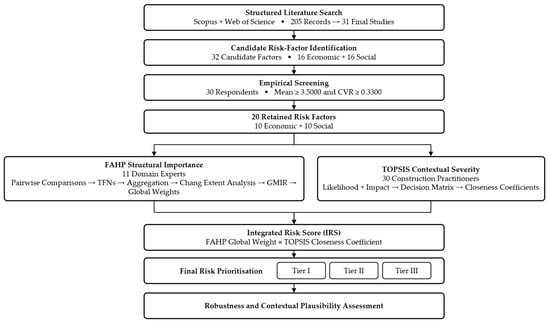
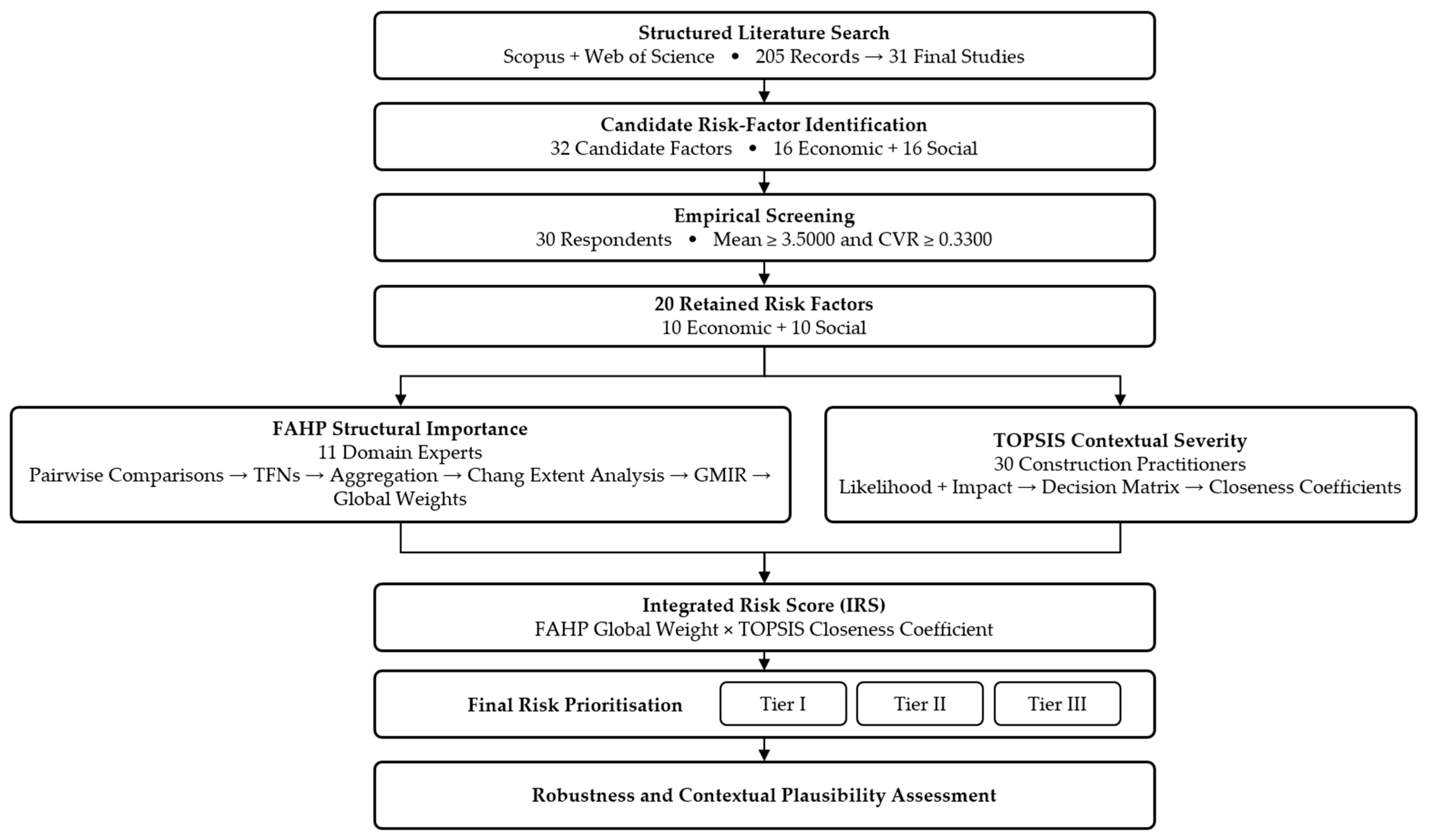
The research design is structured into three stages: (i) identification and screening of risk factors, (ii) prioritisation using a hybrid FAHP–TOPSIS model, and (iii) robustness and contextual plausibility assessment. This staged structure separates the analytical tasks and improves transparency in the expert-judgment process [26]. Figure 1 presents the analytical workflow implemented in the study. All numerical analyses, including FAHP weighting, TOPSIS severity assessment, integrated risk score (IRS) computation, intraclass correlation coefficient (ICC) reliability analysis, sensitivity analyses, and VIKOR benchmarking, were performed using Microsoft Excel for Microsoft 365 (Version 2609, Build 16.0.20430.20032, 64-bit; Microsoft Corporation, Redmond, WA, USA).
Figure 1.
Analytical workflow of the integrated FAHP–TOPSIS–IRS risk assessment framework.
Primary data were obtained through a structured questionnaire aligned with the study’s three analytical stages. Accordingly, the questionnaire comprised three aligned sections: (i) risk-factor relevance screening using a five-point scale, (ii) FAHP pairwise comparisons based on linguistic judgments, and (iii) TOPSIS evaluation of likelihood and impact using a five-point scale. Structured survey instruments are widely used in construction risk studies to systematically convert expert judgment into quantitative decision matrices [27]. Three independent respondent groups were engaged across the stages to ensure methodological separation between risk screening, structural importance weighting, and contextual severity evaluation. Separate respondent groups were used as a procedural measure to reduce potential common-rater effects and cross-stage dependence in the expert-judgment process [28]. Using separate respondent groups improves the clarity with which the final integrated risk scores (IRS) can be interpreted. Overall, the framework ensures systematic identification, hierarchical structuring, FAHP-based weighting, TOPSIS-based evaluation, and integrated prioritisation of socio-economic sustainability risk factors in the Nepal-referenced green building context. Given the expert-based nature and relatively limited sample sizes used across the three analytical stages, the empirical findings are interpreted as context-specific.
The respondent groups were selected to provide informed professional judgment for the respective MCDM stages, and the resulting rankings should therefore be interpreted within the Nepal-referenced study context. Because respondents were recruited purposively according to predefined criteria, some selection bias may remain; therefore, the panels are interpreted as expert-judgment samples rather than as statistically representative samples. Respondents based outside Nepal possessed relevant professional knowledge or experience concerning both their respective national contexts and the Nepalese green-building or construction environment; their inclusion was intended to broaden professional judgment rather than to support cross-country statistical inference. Aggregated respondent profiles, recruitment procedures, geographic composition, and panel-independence information for the three analytical stages are provided in Supplementary Table S1.
2.1. Identification and Screening of Socio-Economic Sustainability Risk Factors
The identification of socio-economic sustainability risk factors followed a two-stage process comprising literature-based extraction and empirical screening. The objective was to ensure that only construction-stage risk factors relevant to the Nepal-referenced green building context were retained for multi-criteria decision-making analysis.
Relevant studies were identified through searches of the Scopus and Web of Science databases conducted on 8 September 2026 [29]. The database searches were based on combinations of the following concepts and search terms: “green building risks,” “construction-stage risks,” “socio-economic sustainability,” “sustainable construction,” and “developing or least developed countries.” The exact database-specific Boolean syntax used during the original searches was not retained; therefore, the search strategy is reported at the concept and keyword level rather than as an exact reproducible query. Studies were included if they addressed green or sustainable building/construction and reported economic, social, institutional, financial, supply-chain, workforce, or stakeholder-related risks relevant to the construction stage. Duplicate records, studies unrelated to green or sustainable construction, and studies without extractable socio-economic risk factors were excluded. Studies published between 2016 and 2026 formed the principal evidence base, while earlier sources were retained where they provided directly relevant evidence or established methodological foundations. The records identified, screened, excluded, and retained during the literature review are reported in Table 1.
Table 1.
Literature-search and screening process for candidate risk-factor identification.
The final set of 31 studies yielded an initial pool of 32 candidate socio-economic sustainability risk factors, comprising 16 economic and 16 social risk factors.
In the second stage, empirical screening was conducted using a structured questionnaire administered to 30 respondents with professional or academic experience in green building or construction management in Nepal and comparable LDC contexts. Respondents evaluated each candidate risk factor using a five-point relevance scale, where 1 indicated “not relevant” and 5 indicated “highly relevant” [30].
Two statistical criteria were applied for retention: (i) a mean relevance score of at least 3.5000 and (ii) a Content Validity Ratio (CVR) of at least 0.3300 for the 30-respondent panel, following Lawshe’s method [31]. The CVR was computed as:
where ne is the number of respondents rating the item as “relevant” or “highly relevant” (scores of 4 or 5), and N is the total number of respondents. For a panel of 30 respondents, a minimum CVR threshold of 0.3300 was adopted [31,32]. Risk factors were advanced to the subsequent analysis only when they met both retention criteria. Application of these criteria retained 20 of the initial 32 candidate risk factors (10 economic and 10 social), while 12 risk factors were excluded from subsequent analysis.
2.2. FAHP-Based Importance Weighting
Structural importance within the socio-economic sustainability risk hierarchy was quantified using the fuzzy analytic hierarchy process (FAHP). FAHP was selected due to its ability to incorporate uncertainty and vagueness in expert judgments using fuzzy set theory, making it suitable for construction risk assessment where linguistic evaluations are commonly applied [21,33].
The FAHP hierarchy was structured into three levels: (i) dimension level comparing Economic Sustainability Risks (ESR) and Social Sustainability Risks (SSR), (ii) category level within each dimension, and (iii) individual risk factor level. Pairwise comparisons were obtained from 11 domain experts selected using predefined eligibility criteria, including experience in green building projects, sustainable construction management, construction risk assessment, policy development, or MCDM applications in Nepal and comparable LDC contexts. A focused expert panel approach is widely recommended in MCDM studies where decision quality depends on expertise rather than sample size [34].
Expert pairwise judgments were expressed on the predefined linguistic scale shown in Table 2 and subsequently mapped to triangular fuzzy numbers (TFNs) to construct the fuzzy comparison matrices [35]. Let represent the triangular fuzzy judgment comparing element i with element j, where lij, mij, and uij denote its lower, modal, and upper components, respectively.
Table 2.
Linguistic judgment scale and corresponding TFN representation for FAHP.
For each pairwise comparison, the lower, modal, and upper TFN components provided by the 11 experts were aggregated separately using the component-wise geometric mean, producing a single group fuzzy comparison matrix. Reciprocal matrix elements were subsequently generated using to ensure consistency in pairwise comparisons [23,36].
The aggregated fuzzy matrix was evaluated separately for each decision element using Chang’s extent-analysis procedure to obtain its synthetic extent Si [35]. These fuzzy values were then converted to crisp scores using the Graded Mean Integration Representation (GMIR), after which the resulting scores were normalised to obtain local priority weights. This method remains one of the most widely applied FAHP approaches in construction risk and sustainability assessment due to its computational efficiency and suitability for hierarchical structures [33,37].
The group fuzzy judgment for each comparison was obtained by taking the geometric mean of the corresponding lower, modal, and upper values across the 11 experts:
where K denotes the total number of experts, while , , and represent the lower, modal, and upper bounds, respectively, of the triangular fuzzy judgment provided by expert k for the comparison between elements i and j.
The fuzzy values were transformed into crisp scores using the Graded Mean Integration Representation (GMIR) method [38]:
Local priorities were obtained by rescaling the defuzzified scores so that they formed a normalised weight vector. Global weights were computed through hierarchical aggregation across dimensions, categories, and risk factors [39]:
where Wd is the dimension weight, Wc is the category weight, and wi is the local weight of the retained risk factor. This multiplicative aggregation structure is consistent with hierarchical decision theory and AHP-based weighting logic, where global priorities are derived through layered decomposition of complex decision problems [23,40].
Wi = Wd × Wc × wi
Consistency was assessed at the aggregated group-matrix level after geometric aggregation of the 11 expert judgments. Consistency checking was performed on a crisp reciprocal matrix constructed from the modal entries of the aggregated triangular fuzzy judgments. From this matrix, the maximum eigenvalue (λmax), consistency index (CI), and consistency ratio (CR) were evaluated in accordance with Saaty’s consistency procedure [39]. Consistency was therefore evaluated for the aggregated matrices rather than separately for each individual expert prior to aggregation. For matrices containing three or more elements, CR values ranged from 0.0000 to 0.0354, all below the 0.1000 acceptance criterion, while two-element matrices were inherently consistent. The resulting matrix-level consistency statistics are listed in Supplementary Table S2.
The resulting FAHP weights represent the structural importance of each risk factor within the socio-economic sustainability risk hierarchy and form the importance component of the integrated risk score (IRS) framework.
2.3. TOPSIS-Based Severity Evaluation
Contextual severity was quantified using the Technique for Order Preference by Similarity to Ideal Solution (TOPSIS) for each retained socio-economic sustainability risk. The procedure differentiates the risk factors by examining their positions relative to high- and low-severity reference conditions, making it suitable for multi-criteria construction-risk evaluation under uncertainty [25,41,42]. In the present severity-oriented application, the positive ideal represents the highest-severity combination of likelihood and impact, whereas the negative ideal represents the lowest-severity combination. In this study, TOPSIS was used exclusively to assess contextual severity.
The likelihood and impact assessments were combined within the TOPSIS procedure to produce a single severity index reflecting each risk factor’s location relative to the two reference extremes. This provides a continuous severity measure that can subsequently be integrated with the independently derived FAHP structural weights. To examine whether the use of TOPSIS materially affects prioritisation, the resulting severity ranking was also compared with a conventional likelihood × impact ranking in the robustness analysis.
The TOPSIS decision matrix was constructed using data collected from 30 construction practitioners with experience in green building and sustainable construction in Nepal and comparable LDC contexts. Practitioners scored every retained risk factor for occurrence likelihood and consequence severity on a five-point scale, where 1 represented very low and 5 represented very high. For each retained risk factor, the 30 practitioner ratings were aggregated separately for likelihood and impact using the arithmetic mean. The resulting mean scores were assembled into a 20 × 2 TOPSIS decision matrix prior to normalisation. The sample standard deviation of the 30 ratings was also calculated for each risk-factor–criterion combination to describe dispersion in practitioner judgments. The complete pre-normalisation decision matrix, together with the corresponding standard deviations, is provided in the Supplementary Materials. Likert-scale evaluation is widely used in construction risk studies to convert subjective expert judgment into structured quantitative inputs [27]. Likelihood and impact were assigned equal baseline weights of 0.5000 and 0.5000 because no empirical or theoretical basis supported prioritising one criterion over the other. To assess the robustness of this assumption, additional TOPSIS scenarios were evaluated by varying the likelihood–impact weights to 0.4000/0.6000, 0.6000/0.4000, 0.3000/0.7000, and 0.7000/0.3000. Rank agreement between each alternative IRS scenario and the baseline was assessed using Spearman’s rank correlation coefficient, with the results reported in Section 3.5.
Let xij represent the score of risk factor i under criterion j. Vector normalisation is widely adopted in TOPSIS applications to eliminate scale effects and ensure comparability across heterogeneous criteria [22,25,41]. To place the two evaluation criteria on a common numerical basis, the decision matrix was rescaled using vector normalisation:
The specified likelihood and impact weights were incorporated into the rescaled matrix through:
where wj represents the weight of criterion j. This weighting structure reflects the relative contribution of each evaluation criterion to the final decision matrix [43].
vij = wj ⋅ rij
The positive (A+) and negative (A−) ideal solutions were specified as:
The Euclidean distance formulation is a core component of TOPSIS and is widely validated in multi-criteria decision-making literature [22,41,43]. The distance of each risk factor from the high-severity and low-severity reference points was then measured using the Euclidean metric [44]:
These two distance measures were combined to obtain the TOPSIS severity coefficient [45]:
where Ci represents the contextual severity of risk factor i. A higher Ci value indicates greater proximity to the positive ideal solution and therefore higher severity under construction-stage conditions [45].
The resulting closeness coefficients form the severity component of the integrated risk score (IRS) framework, which is later combined with FAHP-derived structural importance weights for final risk prioritisation. Reliability of the practitioner ratings was assessed with an absolute-agreement ICC based on a two-way random-effects model [46]. For likelihood, the ICC was 0.6861 at the single-rating level and 0.9850 for the averaged ratings; for impact, the respective ICC estimates were 0.6915 and 0.9853. These results indicate moderate agreement for individual ratings but very high reliability once practitioner judgments are aggregated, supporting the use of the mean ratings in the TOPSIS decision matrix [46].
2.4. Integrated Risk Score Computation
The multiplicative formulation was adopted because structural importance and contextual severity are treated as jointly necessary contributors to final risk priority. Accordingly, a risk factor receives a high IRS only when it exhibits both substantial structural importance and high contextual severity. Compared with simple additive aggregation, multiplication limits the extent to which a very high value in one component can fully compensate for a low value in the other. To examine whether the final ranking depends on this integration rule, an alternative additive aggregation model was also evaluated in the robustness analysis.
For benchmarking, an equal-weight additive model was defined using separately normalised FAHP importance and TOPSIS severity values as:
where AIRSi denotes the alternative additive integrated risk score. The ordering generated by the additive formulation was compared with that from the multiplicative IRS by correlating the two rank vectors with Spearman’s ρ.
The IRS framework addresses a common limitation in multi-criteria decision-making applications, where weighting (importance) and performance (severity) are analysed separately, leading to fragmented interpretation of final rankings. By integrating both dimensions, the model ensures that risk prioritisation reflects both the inherent significance of a risk factor within the decision hierarchy and its observed severity under construction-stage conditions [25,42,47].
For each risk factor i, the integrated risk score is computed as:
where Wi represents the FAHP-derived global weight (structural importance) and Ci represents the TOPSIS-derived closeness coefficient (contextual severity).
IRSi = Wi × Ci
The normalisation approach is widely adopted in decision-support systems to ensure scale independence and comparability across heterogeneous risk indicators, particularly in hybrid MCDM frameworks [43,47]. To enable proportional comparison across all retained risk factors, the raw IRS values were normalised as:
where NIRSi denotes the normalised integrated risk score for risk factor i, IRSi represents its corresponding raw integrated risk score, and n represents the number of retained risk factors considered in the ranking. This normalisation ensures that the sum of all scores equals 1, allowing direct comparison of each risk factor’s relative contribution to the overall socio-economic sustainability risk profile [43].
The final NIRSi values are used for ranking risk factors in descending order of priority, forming the basis for decision-making, risk mitigation planning, and policy interpretation within the proposed integrated FAHP–TOPSIS framework.
2.5. Robustness and Contextual Plausibility Assessment
The robustness of the integrated FAHP–TOPSIS framework was assessed using complementary sensitivity and benchmarking procedures, whereas external relevance was examined through contextual plausibility assessment. These procedures were intended to evaluate ranking stability and contextual reasonableness under alternative model assumptions rather than to claim independent empirical validation [25,42,48].
Sensitivity analysis was conducted by systematically varying FAHP-derived dimension-level weights while maintaining category and risk factor-level weights constant. This approach was used to assess the stability of the integrated risk rankings under different structural importance scenarios [49,50]. For each weighting scenario, stability was judged by comparing its rank ordering with the baseline through Spearman’s ρ [48,51]. The robustness of the initial screening decision was also examined by applying progressively stricter CVR thresholds while retaining the mean-relevance criterion of 3.5000. Beyond the baseline CVR threshold of 0.3300, stricter cut-offs of 0.4667 and 0.6000, corresponding to agreement from 22 and 24 of the 30 screening respondents, respectively, were examined to assess the sensitivity of the retained risk-factor set to the screening threshold. When no tied positions occurred, rank association was obtained from the standard Spearman formulation [51]:
where di denotes the rank difference for risk factor i between two scenarios, and n represents the number of risk factors considered. Values of ρ approaching 1 reflect stronger agreement between the compared rankings and, consequently, greater ranking stability. Where ties occurred, tied observations were given their mean rank, and Spearman’s ρ was evaluated as the Pearson correlation between the resulting rank sequences.
In addition to sensitivity analysis, contextual plausibility was assessed through literature alignment and case-based plausibility checking. Literature alignment was used to compare the IRS ranking results with established findings on socio-economic sustainability risks in green building and construction projects in developing and LDC contexts. This step was intended to assess whether the prioritised risks were consistent with previously reported patterns rather than to provide independent statistical validation [11,42].
To provide an additional methodological benchmark, the TOPSIS severity ranking was compared with the VIKOR method [52] using the same 20 × 2 likelihood–impact decision matrix and the same baseline criterion weights of 0.5000/0.5000. With v = 0.5000, group utility and individual regret contributed equally to the VIKOR compromise solution. The ordering produced by VIKOR was then compared with the TOPSIS ordering using Spearman’s ρ.
Contextual plausibility was further illustrated using the Kathmandu Marriott Hotel, a Nepal-based green building reference [53]. Consistent with case-study guidance, the example is used only for contextual interpretation and not as independent empirical validation [54,55]. No project-level financial, procurement, or risk-event records from the hotel were used in the analysis. For example, the high ranking of import-dependent material cost escalation is contextually plausible for a certified hospitality project requiring specialised materials, building systems, and technical inputs [56,57]. This connection does not imply that the risk was empirically observed in the Kathmandu Marriott project.
3. Results
3.1. Screening and Final Risk Structure
The screening process resulted in the retention of 20 socio-economic sustainability risk factors from an initial pool of 32 candidate risk factors. As shown in Table 3, all retained factors satisfied both screening criteria, comprising a mean relevance score of at least 3.5000 and a CVR of at least 0.3300. In contrast, excluded risk factors failed to satisfy one or both retention criteria. CVR values of −1.0000 indicate that none of the 30 respondents rated the corresponding factor as relevant or highly relevant (scores of 4 or 5). These values therefore arise directly from the CVR formula when ne = 0 and do not represent calculation errors. These factors also exhibited mean relevance scores below the retention threshold, indicating consistent respondent agreement on their limited relevance rather than anomalous or erroneous responses.
Table 3.
Screening of candidate construction-stage socio-economic sustainability risk factors.
The final retained set of risk factors was structured into a hierarchical MCDM framework to support FAHP–TOPSIS analysis. As shown in Table 4, the framework consists of two risk dimensions (economic and social), six risk categories, and twenty individual risk factors. This hierarchical structure ensures logical consistency and supports subsequent multi-criteria evaluation.
Table 4.
Hierarchical organisation and coding scheme for the retained risk factors.
3.2. FAHP Importance Weights
The FAHP analysis generated structural importance weights for the retained socio-economic sustainability risk factors. Every aggregated pairwise matrix satisfied the adopted consistency threshold. For matrices containing three or more elements, the CR values ranged from 0.0000 to 0.0354, remaining well below the acceptance threshold of 0.1000, while two-element matrices were inherently consistent. The consistency-ratio results for the aggregated matrices are listed in Supplementary Table S2. The FAHP results presented in Table 5 indicate that economic risk factors constitute the dominant structural influence, particularly those associated with cost escalation, financial uncertainty, and supply chain dependency. However, social risk factors remain important, particularly stakeholder participation and labour capability. This indicates that green building construction in the Nepal-referenced study context is shaped by both financial exposure and implementation capacity. These weights form the structural importance component used in the integrated risk score (IRS) framework.
Table 5.
FAHP-derived weights of retained socio-economic sustainability risk factors.
3.3. TOPSIS Severity
The TOPSIS analysis produced closeness coefficients representing the contextual severity of each retained socio-economic sustainability risk factor under construction-stage conditions. The coefficients ranged from 0.0191 to 1.0000, indicating variation in the relative severity of risk factors across the evaluated criteria of likelihood and impact. ESR-F01 attained a closeness coefficient of 1.0000 because it recorded the highest aggregated likelihood and impact scores, placing it exactly at the positive ideal point and resulting in zero separation from that reference solution. The TOPSIS results presented in Table 6 indicate that cost-related, supply chain-related, cash-flow-related, and labour-related risk factors exhibit higher contextual severity during construction-stage green building implementation in the Nepal-referenced study context. These severity values form the contextual severity component of the integrated risk score (IRS) framework.
Table 6.
TOPSIS-derived severity coefficients of retained socio-economic sustainability risk factors.
3.4. Integrated Risk Ranking
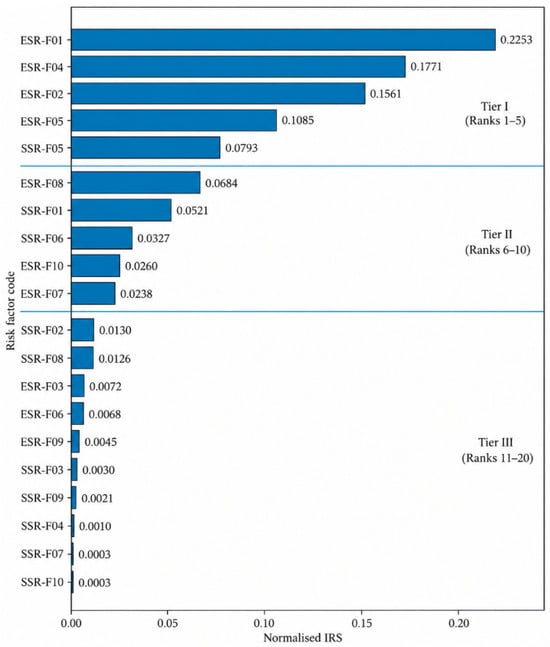
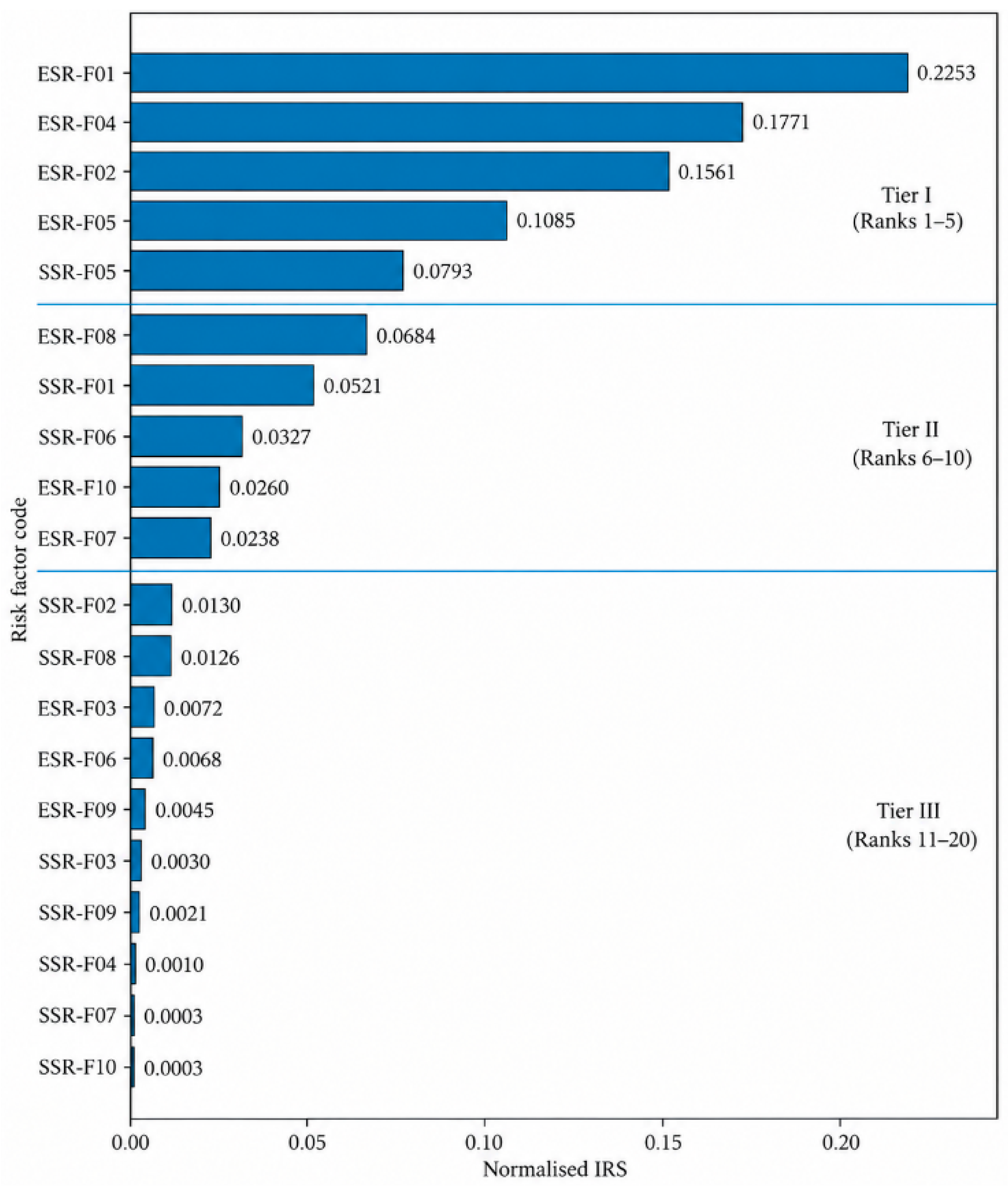
The Integrated Risk Score (IRS) was calculated by combining the FAHP-derived structural importance weights with the TOPSIS-derived contextual severity coefficients. The raw IRS values were subsequently normalised by their sum to enable proportional comparison across the retained risk factors. Based on the IRS ranking, the 20 socio-economic sustainability risk factors were classified into three priority tiers: Tier I (ranks 1–5), Tier II (ranks 6–10), and Tier III (ranks 11–20), representing high, moderate, and lower priority risks, respectively. These rank-based tiers were adopted as operational prioritisation bands rather than statistically derived thresholds. Tier I represents the highest-ranked 25% of the retained risks requiring primary management attention, Tier II represents the next 25% requiring secondary attention, and Tier III contains the remaining 50% for routine monitoring and context-specific management. The results presented in Table 7 indicate that financial pressure and workforce-related constraints constitute the high-priority socio-economic sustainability risks in the Nepal-referenced study context, reflecting their combined structural importance and contextual severity. The normalised IRS values provide the basis for systematic risk prioritisation and subsequent management decision-making.
Table 7.
Priority ordering of the retained socio-economic sustainability risks based on IRS values.
For ease of comparison and visual interpretation, the normalised IRS-based prioritisation of the 20 retained risk factors is presented in Figure 2.
Figure 2.
Normalised integrated risk score (IRS) ranking of the retained socio-economic sustainability risk factors.
3.5. Robustness and Contextual Plausibility Checks
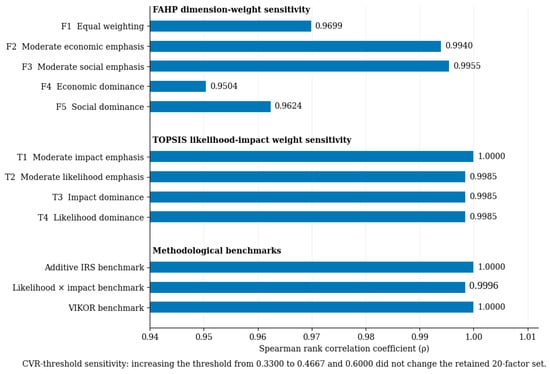
Robustness and contextual plausibility were assessed through sensitivity analysis, methodological benchmarking, literature alignment, and case-based plausibility checking. Sensitivity analysis was conducted to examine whether the final IRS-based ranking remained stable under alternative FAHP-derived dimension-weight scenarios. Values of Spearman’s ρ near unity signify a high level of concordance between the compared rank orders; in this study, values exceeding 0.9000 were interpreted as evidence of high rank stability [51]. As shown in Table 8, all Spearman correlation coefficients exceeded 0.9500, indicating a very high degree of ranking stability across the tested scenarios. These results confirm that the IRS-based prioritisation is robust under reasonable variations in dimension-level weights.
Table 8.
IRS ranking sensitivity under alternative FAHP weighting scenarios.
A second sensitivity analysis examined the effect of varying the TOPSIS likelihood–impact weights from the baseline 0.5000/0.5000 allocation. As reported in Table 9, every alternative scenario yielded a Spearman correlation of at least 0.9985 relative to the baseline IRS ranking, and the same five risks continued to occupy the highest-priority positions. This indicates that the final prioritisation is not materially sensitive to the equal-weight assumption used in the baseline TOPSIS model. Robustness to the IRS integration rule was further assessed using an alternative equal-weight additive formulation based on separately normalised FAHP importance and TOPSIS severity values. The additive formulation produced the same ordering of the 20 risk factors as the baseline multiplicative IRS (ρ = 1.0000), including an unchanged Tier I composition. This indicates that the substantive prioritisation is not dependent on the selected multiplicative integration rule.
Table 9.
Sensitivity of the IRS ranking to alternative TOPSIS likelihood–impact weights.
The stability of the initial screening decision was also examined by applying progressively stricter CVR thresholds while retaining the mean-relevance criterion of 3.5000. Alongside the baseline threshold of 0.3300 for the 30-member panel, higher CVR thresholds of 0.4667 and 0.6000 were tested, which correspond to 22 and 24 respondents meeting the relevance condition, respectively. Neither stricter threshold altered the retained set of 20 risk factors, because all retained factors had CVR values of at least 0.6000. As an additional benchmark, the TOPSIS severity ranking was compared with a conventional likelihood × impact ranking. The two approaches showed very high agreement (ρ = 0.9996), indicating that TOPSIS preserves the substantive ordering obtained from the conventional risk score while providing a normalised relative-severity measure based on distances from the ideal and anti-ideal solutions. Literature alignment showed that the high-priority IRS results are consistent with previously reported socio-economic risks in green building and construction projects in developing and LDC contexts, particularly cost escalation, supply chain disruption, cash-flow instability, and skilled labour shortages [11,58,65,79]. The consistency of these findings with prior evidence reinforces the framework’s contextual applicability.
As an additional cross-method robustness check, the severity ranking obtained using TOPSIS was benchmarked against VIKOR using the same likelihood–impact decision matrix and equal criterion weights. The VIKOR analysis produced the same ordering of all 20 risk factors as TOPSIS analysis, resulting in Spearman’s rank correlation of ρ = 1.0000. The same five risk factors remained at the top of the severity ranking. This complete rank agreement indicates that the severity prioritisation is not dependent on the use of TOPSIS alone and provides additional support for the robustness of the MCDM results. Figure 3 provides a visual overview of the sensitivity-analysis and methodological-benchmarking results.
Figure 3.
Summary of ranking robustness under alternative weighting scenarios and methodological benchmarks.
A case-based plausibility check was also conducted using the Kathmandu Marriott Hotel [53] as an illustrative green building project in Nepal. The case was used as a contextual reference rather than as a source of direct empirical validation. The high-priority risks identified by the model, including import-dependent cost escalation, financial pressure, and reliance on specialised technical expertise, are consistent with typical constraints faced in Nepalese and comparable LDC green building contexts. Therefore, the case-based assessment supports the contextual plausibility of the IRS ranking rather than providing independent empirical validation. The principal evidence of analytical robustness is provided by the sensitivity analyses and methodological benchmarking.
Overall, the sensitivity analyses and methodological benchmarks support the robustness of the integrated FAHP–TOPSIS–IRS ranking, while the literature alignment and case-based plausibility check support the contextual interpretation of the results within the Nepal-referenced green building context.
4. Discussion
The findings of this study provide important insights into the structure and dynamics of construction-stage socio-economic sustainability risk factors in green building projects in the Nepal-referenced context. The integrated FAHP–TOPSIS results demonstrate a clear dominance of economic risk factors over social risk factors in determining sustainability risk exposure within the study sample. This indicates that financial and market-related constraints represent the primary barriers to effective green building implementation in the evaluated context, where limited institutional capacity and resource constraints can intensify project-level uncertainty [14,56].
The predominance of cost-related risk factors, including green construction cost premiums, inaccurate cost forecasting, and supply chain-related cost escalation, reflects the vulnerability of the Nepal-referenced construction context to imported materials, external technologies, and unstable market conditions. These conditions increase exposure to price volatility, exchange rate fluctuations, procurement delays, and logistical disruptions, thereby amplifying financial uncertainty during construction-stage delivery. Comparable evidence in the green-building and construction-sustainability literature has likewise identified cost premiums, cost overruns, and economic uncertainty as recurring obstacles to green building implementation [58,60,61]. The high ranking of import-dependent supply-chain cost escalation is consistent with previous evidence that green construction projects in developing economies can be particularly sensitive to material availability, supplier limitations, and supply-chain disruption [57,63].
The high ranking of cash flow instability also highlights the importance of liquidity management in green building projects, where upfront costs are often higher than in conventional construction. Delayed disbursement, payment disputes, and mismatches between financing schedules and construction-stage requirements can intensify financial risk exposure and reduce implementation capacity. This finding aligns with studies identifying persistent green-finance gaps and institutional or financial barriers to sustainable investment in emerging and resource-constrained markets, including Nepal [64,65,81]. Therefore, financial planning for green building projects in the Nepal-referenced context should not only consider total project cost, but also the timing and stability of construction-phase cash flows.
Among social sustainability risk factors, skilled labour shortages emerged as the highest-priority risk, while insufficient stakeholder participation and inadequate training also ranked relatively highly. The prominence of workforce capability constraints reflects the limited availability of specialised competencies required for green construction technologies, certification procedures, sustainable material handling, and performance-oriented project delivery. The result is consistent with studies identifying labour capability, technical expertise, and workforce readiness as critical challenges in green construction implementation, particularly in developing-country contexts [17,67,74]. Other social risks, including communication, organisational culture, and leadership-related risks, ranked below the leading economic and workforce-related risks but remain important because they influence coordination quality, knowledge transfer, and the practical execution of sustainability requirements during construction [70,71,75].
From an applied perspective, this study extends established hybrid MCDM practice to construction-stage socio-economic sustainability risk assessment in the Nepal-referenced context. FAHP was used to represent structural importance, while TOPSIS evaluated contextual severity based on likelihood and impact. The contribution therefore lies primarily in the context-specific application and integrated interpretation of these established methods rather than in proposing a new MCDM technique. More specifically, the study contributes a Nepal-referenced construction-stage prioritisation in which structural importance and contextual severity are evaluated separately before integration, allowing the relative position of otherwise well-established risks such as cost pressure and labour shortages to be interpreted within the present empirical context. The integration of these two dimensions through the IRS framework provides a more balanced and interpretable prioritisation mechanism, consistent with established hybrid MCDM applications in construction risk assessment and sustainability evaluation [25,42,82].
The robustness analyses indicate that the IRS-based prioritisation remains stable across alternative FAHP dimension weights, likelihood–impact criterion weights, screening thresholds, and integration rules. Cross-method benchmarking also showed complete rank agreement between TOPSIS and VIKOR, while the conventional likelihood × impact comparison produced very high agreement. Together, these results indicate that the substantive prioritisation is not highly sensitive to reasonable changes in the main modelling assumptions. Literature alignment and the Kathmandu Marriott illustration provide contextual support for interpreting the findings, but they are not treated as independent empirical validation [25,47].
Practically, the results suggest that effective risk management in the Nepal-referenced green building context should prioritise financial planning, supply chain resilience, and workforce capacity development. Project stakeholders should focus on improving cost forecasting accuracy, stabilising cash flow arrangements, reducing exposure to imported material price volatility, and strengthening technical skills required for green construction delivery. Policymakers should also support predictable incentive mechanisms, stronger institutional enforcement, and improved access to green finance to reduce implementation barriers in resource-constrained environments [18,56,57].
Overall, the findings indicate that socio-economic sustainability risks in the evaluated Nepal-referenced green building context are strongly shaped by financial vulnerability, material supply dependence, and workforce capability constraints. The integrated FAHP–TOPSIS–IRS framework provides a structured and transparent decision-support approach for identifying and prioritising these risks and can be adapted for testing in other resource-constrained construction contexts [11,42,82].
5. Management Implications
The IRS-based prioritisation provides a structured basis for translating the analytical results into targeted management strategies for green building projects in the Nepal-referenced context. As the integrated risk score combines FAHP-derived structural importance with TOPSIS-derived contextual severity, the resulting ranking offers a practical decision-support basis for identifying which socio-economic sustainability risks require immediate managerial attention. The implications are therefore derived from the present study context and are organised according to their relevance at project, organisational, industry, and policy levels. The empirical contribution of this section is the relative prioritisation of the identified risks; the management actions proposed below are interpretive recommendations derived from those rankings and supported by the relevant literature, rather than directly observed interventions or universally applicable prescriptions.
At the project level, the Tier I risks indicate that immediate management attention should focus on financial planning, supply-chain resilience, cost forecasting, cash-flow stability, and workforce capability. Project managers should therefore account explicitly for green technology cost premiums, foreign-exchange exposure, imported-material dependency, certification-related requirements, and specialist technical inputs when preparing budgets and contingencies. Procurement strategies should also reduce exposure to international market volatility and delivery uncertainty through early supplier engagement, supplier prequalification, alternative sourcing, lead-time allowances, and closer monitoring of import-dependent components. These recommendations are derived from the relative priority of the identified risks in the Nepal-referenced study context.
At the organisational level, contractors, consultants, and developers should prioritise stronger internal systems for cost estimation, risk monitoring, and workforce capability development. The high IRS ranking of inaccurate cost forecasting indicates the need for more reliable cost databases for green materials, technologies, certification requirements, commissioning activities, and specialist services. Organisations involved in green building delivery should also invest in knowledge management systems that capture lessons from previous projects and improve forecasting accuracy in future projects. This is particularly important in the present study context, where market information for green materials and technologies may be limited or fragmented.
The prioritisation of skilled labour shortages and inadequate training highlights the need for targeted organisational capacity building. Contractors and project developers should adopt competency-based workforce planning to ensure that site teams, subcontractors, and supervisors understand green building requirements before construction begins. Training should extend beyond technical installation competencies to include green material handling, quality control, documentation, certification compliance, and coordination between design and site execution. Organisational investment in workforce development is therefore essential for reducing implementation delays, rework, and performance gaps in green building projects.
At the industry level, the IRS results suggest the need for coordinated improvements in financing access, technical capacity, and supply chain readiness. Industry associations, professional bodies, and training institutions should support the development of green construction skill certification programmes, supplier databases, and standardised cost information for green materials and technologies. These mechanisms can reduce uncertainty for contractors and improve the overall readiness of the construction sector to deliver green building projects under resource-constrained conditions.
At the policy level, the ranking of policy and incentive-related risks indicates the importance of stable and predictable institutional support. Policymakers should focus on strengthening green building incentive frameworks, improving regulatory enforcement capacity, and aligning incentive disbursement schedules with construction-stage cash flow needs. Since financial pressure and weak institutional capacity can reinforce each other in the Nepal-referenced context, policy mechanisms should be designed to reduce uncertainty for project stakeholders during implementation. Dedicated green financing instruments, risk-sharing mechanisms, and clearer certification support systems can help reduce the financial burden associated with green building delivery.
Overall, the IRS-based prioritisation indicates that effective risk mitigation in the Nepal-referenced green building context requires coordinated interventions across financial, operational, organisational, and policy levels. The high-priority risks are interconnected: cost premiums increase financing pressure, import dependency increases cost volatility, inaccurate forecasting weakens budget control, cash flow instability disrupts construction delivery, and labour shortages reduce implementation capability. Effective mitigation therefore requires these interrelated risks to be addressed collectively rather than through separate stand-alone measures. The IRS ranking can therefore be used as a decision-support tool to sequence mitigation actions, allocate resources, and strengthen the feasibility, scalability, and sustainability of green building adoption within the Nepal-referenced context. Application of these recommendations in other resource-constrained settings should be preceded by context-specific validation.
6. Conclusions
This study provides a Nepal-referenced assessment of construction-stage socio-economic sustainability risks in green building projects. The resulting risk rankings are context-specific and are not intended to represent green building projects across all LDCs. The study’s contribution is therefore applied rather than methodological: it uses established FAHP and TOPSIS procedures to distinguish structural importance from contextual severity and integrates these dimensions into a transparent risk-prioritisation framework.
The analysis identifies green construction cost premiums, import-dependent supply-chain cost escalation, inaccurate cost forecasting, cash flow instability, and skilled labour shortages as the principal priorities within the evaluated Nepal-referenced context. For practice, these results indicate that management attention should concentrate on cost forecasting, cash-flow planning, supply-chain resilience, and workforce capability. These priorities should be interpreted as decision-support guidance derived from the present empirical context rather than as universally applicable prescriptions.
The study is based on expert-driven assessments with relatively limited respondent groups and does not include an independent second-country or project-level dataset for external empirical validation. In addition, gender was not collected as an analytical demographic variable, which limits the demographic characterisation of the respondent panels but does not affect the expert-selection criteria or the FAHP–TOPSIS calculations. The absence of external empirical validation reflects the study’s deliberate Nepal-referenced empirical scope rather than a multi-country validation design. The Kathmandu Marriott Hotel is therefore used only as a contextual illustration, while the principal evidence of analytical robustness comes from sensitivity analysis and methodological benchmarking. Future research should test the framework using larger and more diverse respondent samples, independent project datasets, and multiple national contexts before broader generalisation is attempted.
Supplementary Materials
The following supporting information can be downloaded at: https://www.mdpi.com/article/10.3390/buildings16204012/s1. The Supplementary Materials accompanying this article include Table S1: Aggregated respondent profiles and recruitment characteristics for the three analytical stages; Table S2: Consistency results for the aggregated FAHP comparison matrices; and the supplementary calculation workbook. The workbook provides anonymised respondent-level screening ratings, FAHP expert pairwise-comparison inputs, TOPSIS practitioner likelihood and impact ratings, aggregated decision matrices, intermediate calculations, consistency and reliability analyses, and robustness tests. To preserve participant confidentiality, direct personal identifiers were excluded, while anonymised respondent codes were retained only where required for analytical traceability.
Author Contributions
Conceptualization, B.K. and F.G.; methodology, B.K. and W.P.; software, B.K.; validation, B.K., F.G. and W.P.; formal analysis, B.K.; investigation, B.K.; resources, B.K.; data curation, B.K.; writing—original draft preparation, B.K.; writing—review and editing, B.K., F.G. and W.P.; visualization, B.K.; supervision, F.G. and W.P.; project administration, B.K. All authors have read and agreed to the published version of the manuscript.
Funding
This research received no external funding.
Institutional Review Board Statement
Under the institutional requirements of Central South University, formal ethics review was not required because the study relied on anonymised professional-judgment surveys, did not require the collection of sensitive personal data and exposed participants to only minimal research-related risk. Accordingly, no ethics approval number was issued.
Informed Consent Statement
Participation proceeded only after each respondent had given informed consent. Participation was voluntary, and responses were collected anonymously.
Data Availability Statement
The anonymised respondent-level and aggregated data, together with the calculation details supporting the findings of this study, are provided in the main manuscript and Supplementary Materials. The available materials comprise the aggregated FAHP comparison matrices, intermediate FAHP calculations, matrix-level consistency results, the TOPSIS decision matrix prior to normalisation with its associated dispersion measures, and the calculation workbook supporting reproduction of the reported FAHP–TOPSIS–IRS results. Further anonymised data may be requested from the corresponding author, subject to the relevant participant-consent and confidentiality constraints.
Conflicts of Interest
The authors declare no conflicts of interest.
References
- Olabi, A.G.; Shehata, N.; Issa, U.H.; Mohamed, O.; Mahmoud, M.; Abdelkareem, M.A.; Abdelzaher, M. The role of green buildings in achieving the sustainable development goals. Int. J. Thermofluids 2025, 25, 101002. [Google Scholar] [CrossRef] [Scilit]
- Yannakou, K.; Robinson, D.; Boskovic, L. Strategic Global Solutions for Sustainable and Resilient Construction: Addressing Industry Challenges Through Integrated Best Practices. Sustainability 2026, 18, 6454. [Google Scholar] [CrossRef] [Scilit]
- Chen, L.; Huang, L.; Hua, J.; Chen, Z.; Wei, L.; Osman, A.I.; Fawzy, S.; Rooney, D.W.; Dong, L.; Yap, P.-S. Green construction for low-carbon cities: A review. Environ. Chem. Lett. 2023, 21, 1627–1657. [Google Scholar] [CrossRef] [Scilit]
- Li, Y.; Li, M.; Sang, P.; Chen, P.-H.; Li, C. Stakeholder studies of green buildings: A literature review. J. Build. Eng. 2022, 54, 104667. [Google Scholar] [CrossRef] [Scilit]
- Ahmad, T. Green Building success factors: An exploratory inquiry. J. Build. Eng. 2023, 76, 107136. [Google Scholar] [CrossRef] [Scilit]
- Wang, L.; Chan, D.W.M.; Darko, A.; Oluleye, B.I. A-state-of-the-art review of risk management process of green building projects. J. Build. Eng. 2024, 86, 108738. [Google Scholar] [CrossRef] [Scilit]
- Raouf, A.M.; Al-Ghamdi, S.G. Framework to Evaluate Quality Performance of Green Building Delivery: Project Brief and Design Stage. Buildings 2021, 11, 473. [Google Scholar] [CrossRef] [Scilit]
- Naimi, S.; Al-Sudani, A.A.J.; Saif, Y. A comprehensive risk evaluation method for sustainable building construction. Acta Logist. 2025, 12, 491–501. [Google Scholar] [CrossRef] [Scilit]
- Mohandes, S.R.; Taiwo, R.; Yussif, A.-M.; Han, T.; Elghaish, F.; Arashpour, M.; Singh, A.K.; Christo, M.S. Risk Assessment and Mitigation Strategies in Green Building Construction Projects: A Global Empirical Study. Buildings 2025, 15, 3485. [Google Scholar] [CrossRef] [Scilit]
- Yussif, A.-M.; Taiwo, R.; Shakor, P.; Han, T.; Mohandes, S.R.; Antwi-Afari, M.F.; Qazi, K.; Singh, A.K.; Christo, M.S.; Shah, M.A. A Comprehensive Literature Review on Risk Identification and Assessment in Green Building Construction Projects. Clean. Eng. Technol. 2025, 29, 101089. [Google Scholar] [CrossRef] [Scilit]
- AbdelHaffez, A.G.; Kaloop, M.R.; Eldessouki, M.; Issa, U.H. Identification and Assessment of Risk Factors in Green Building Projects: A Multi-Dimensional Approach for Sustainable Infrastructure. Sustainability 2025, 17, 10178. [Google Scholar] [CrossRef] [Scilit]
- Lu, Y.; Liu, J.; Yu, W. Social risk analysis for mega construction projects based on structural equation model and Bayesian network: A risk evolution perspective. Eng. Constr. Archit. Manag. 2024, 31, 2604–2629. [Google Scholar] [CrossRef] [Scilit]
- Fregonara, E.; Ferrando, D.G.; Pattono, S. Economic–Environmental Sustainability in Building Projects: Introducing Risk and Uncertainty in LCCE and LCCA. Sustainability 2018, 10, 1901. [Google Scholar] [CrossRef] [Scilit]
- United Nations Conference on Trade and Development (UNCTAD). The Least Developed Countries Report 2023: Crisis-Resilient Development Finance; UNCTAD/LDC/2023; United Nations: Geneva, Switzerland, 2023. [Google Scholar]
- United Nations Conference on Trade and Development (UNCTAD). The Least Developed Countries Report 2025: Are Services the New Path to Structural Transformation? UNCTAD/LDC/2025; United Nations: Geneva, Switzerland, 2026. [Google Scholar]
- Bhattarai, B.; Bhattarai, B.S. Green Building Approach Towards Achieving Sustainability in Nepal. Am. J. Mod. Energy 2023, 9, 27–35. [Google Scholar] [CrossRef] [Scilit]
- Sharma, I.; Bajracharya, S.B.; Pokharel, A. The Challenges and Opportunities in Adaptation of Green Building Rating System in Nepal. Int. J. Res.—GRANTHAALAYAH 2023, 11, 66–82. [Google Scholar] [CrossRef] [Scilit]
- Chan, A.P.C.; Darko, A.; Olanipekun, A.O.; Ameyaw, E.E. Critical Barriers to Green Building Technologies Adoption in Developing Countries: The Case of Ghana. J. Clean. Prod. 2018, 172, 1067–1079. [Google Scholar] [CrossRef] [Scilit]
- Villalba, P.; Sánchez-Garrido, A.J.; Yepes, V. A review of multi-criteria decision-making methods for building assessment, selection, and retrofit. J. Civ. Eng. Manag. 2024, 30, 465–480. [Google Scholar] [CrossRef] [Scilit]
- Kabir, G.; Sadiq, R.; Tesfamariam, S. A Review of Multi-Criteria Decision-Making Methods for Infrastructure Management. Struct. Infrastruct. Eng. 2014, 10, 1176–1210. [Google Scholar] [CrossRef] [Scilit]
- Buckley, J.J. Fuzzy hierarchical analysis. Fuzzy Sets Syst. 1985, 17, 233–247. [Google Scholar] [CrossRef] [Scilit]
- Behzadian, M.; Otaghsara, S.K.; Yazdani, M.; Ignatius, J. A state-of-the-art survey of TOPSIS applications. Expert Syst. Appl. 2012, 39, 13051–13069. [Google Scholar] [CrossRef] [Scilit]
- Demircan, B.G.; Yetilmezsoy, K. A Hybrid Fuzzy AHP-TOPSIS Approach for Implementation of Smart Sustainable Waste Management Strategies. Sustainability 2023, 15, 6526. [Google Scholar] [CrossRef] [Scilit]
- Štilić, A.; Puška, A. Integrating Multi-Criteria Decision-Making Methods with Sustainable Engineering: A Comprehensive Review of Current Practices. Eng 2023, 4, 1536–1549. [Google Scholar] [CrossRef] [Scilit]
- Demir, G. Fuzzy Multi-Criteria Decision-Making Based Security Management: Risk Assessment and Countermeasure Selection in Smart Cities. Knowl. Decis. Syst. Appl. 2025, 1, 70–91. [Google Scholar] [CrossRef] [Scilit]
- Lopez Alvarez de Neyra, P.; Celoza, A. Identifying Influential Factors in End-of-Life Decision-Making for Buildings Using the Delphi Method. J. Constr. Eng. Manag. 2026, 152, 04026015. [Google Scholar] [CrossRef] [Scilit]
- Yildiz, A.E.; Dikmen, I.; Birgonul, M.T. Using Expert Opinion for Risk Assessment: A Case Study of a Construction Project Utilizing a Risk Mapping Tool. Procedia—Soc. Behav. Sci. 2014, 119, 519–528. [Google Scholar] [CrossRef] [Scilit]
- Zhang, W.; Yuan, G.; Xue, R.; Han, Y.; Taylor, J.E. Mitigating Common Method Bias in Construction Engineering and Management Research. J. Constr. Eng. Manag. 2022, 148, 04022089. [Google Scholar] [CrossRef] [Scilit]
- Rocco, T.S.; Plakhotnik, M.S.; McGill, C.M.; Huyler, D.; Collins, J.C. Conducting and Writing a Structured Literature Review in Human Resource Development. Hum. Resour. Dev. Rev. 2023, 22, 104–125. [Google Scholar] [CrossRef] [Scilit]
- Drinkwater, B.L. A comparison of the direction-of-perception technique with the Likert method in the measurement of attitudes. J. Soc. Psychol. 1965, 67, 189–196. [Google Scholar] [CrossRef] [Scilit]
- Lawshe, C.H. A Quantitative Approach to Content Validity. Pers. Psychol. 1975, 28, 563–575. [Google Scholar] [CrossRef] [Scilit]
- Ayre, C.; Scally, A.J. Critical Values for Lawshe’s Content Validity Ratio: Revisiting the Original Methods of Calculation. Meas. Eval. Couns. Dev. 2014, 47, 79–86. [Google Scholar] [CrossRef] [Scilit]
- Lyu, H.-M.; Sun, W.-J.; Shen, S.-L.; Zhou, A.-N. Risk Assessment Using a New Consulting Process in Fuzzy AHP. J. Constr. Eng. Manag. 2020, 146, 04019112. [Google Scholar] [CrossRef] [Scilit]
- Saaty, T.L.; Özdemir, M.S. How Many Judges Should There Be in a Group? Ann. Data Sci. 2014, 1, 359–368. [Google Scholar] [CrossRef] [Scilit]
- Chang, D.-Y. Applications of the extent analysis method on fuzzy AHP. Eur. J. Oper. Res. 1996, 95, 649–655. [Google Scholar] [CrossRef] [Scilit]
- Theilig, K.; Vollmer, M.; Lang, W.; Albus, J. Multi-Criteria Decision-Making for Energy Building Renovation: Comparing Exterior Wall Structures with the AHP, ANP, Utility Analysis, and TOPSIS. Build. Environ. 2025, 280, 113075. [Google Scholar] [CrossRef] [Scilit]
- Aczél, J.; Saaty, T.L. Procedures for synthesizing ratio judgements. J. Math. Psychol. 1983, 27, 93–102. [Google Scholar] [CrossRef] [Scilit]
- Işık, Ö.; Shabir, M.; Demir, G.; Puška, A.; Pamučar, D. A hybrid framework for assessing Pakistani commercial bank performance using multi-criteria decision-making. Financ. Innov. 2025, 11, 38. [Google Scholar] [CrossRef] [Scilit]
- Saaty, T.L. Fundamentals of Decision Making and Priority Theory with the Analytic Hierarchy Process; RWS Publications: Pittsburgh, PA, USA, 1994. [Google Scholar]
- Bonakdari, H.; Noori, A.; Morovati, K. Multicriteria Decision-Making Analysis for Civil Engineering Applications; Elsevier/Woodhead Publishing: Amsterdam, The Netherlands, 2025. [Google Scholar] [CrossRef] [Scilit]
- Pandey, V.; Komal; Dincer, H. A Review on TOPSIS Method and Its Extensions for Different Applications with Recent Development. Soft Comput. 2023, 27, 18011–18039. [Google Scholar] [CrossRef] [Scilit]
- Alqahtani, F.M.; Abas, M.; Alkahtani, M.; Hayat, M.; Farrukh, A. Enhancing Sustainable Safety Practices in Construction: Insights from Cultural and Socio-Economic Analysis. Sustainability 2024, 16, 5103. [Google Scholar] [CrossRef] [Scilit]
- Hwang, C.-L.; Yoon, K. Multiple Attribute Decision Making: Methods and Applications—A State-of-the-Art Survey; Lecture Notes in Economics and Mathematical Systems; Springer: Berlin/Heidelberg, Germany, 1981; Volume 186. [Google Scholar] [CrossRef] [Scilit]
- Roszkowska, E.; Filipowicz-Chomko, M. A Multi-Criteria Method Integrating Distances to Ideal and Anti-Ideal Points. Symmetry 2024, 16, 1025. [Google Scholar] [CrossRef] [Scilit]
- Papathanasiou, J.; Ploskas, N. TOPSIS. In Multiple Criteria Decision Aid: Methods, Examples and Python Implementations; Springer: Cham, Switzerland, 2018; pp. 1–30. [Google Scholar] [CrossRef] [Scilit]
- Koo, T.K.; Li, M.Y. A Guideline of Selecting and Reporting Intraclass Correlation Coefficients for Reliability Research. J. Chiropr. Med. 2016, 15, 155–163. [Google Scholar] [CrossRef] [Scilit]
- Gul, M. A review of occupational health and safety risk assessment approaches based on multi-criteria decision-making methods and their fuzzy versions. Hum. Ecol. Risk Assess. Int. J. 2018, 24, 1723–1760. [Google Scholar] [CrossRef] [Scilit]
- Mukaka, M.M. Statistics corner: A guide to appropriate use of correlation coefficient in medical research. Malawi Med. J. 2012, 24, 69–71. [Google Scholar]
- Yagmahan, B.; Yılmaz, H. An integrated ranking approach based on group multi-criteria decision making and sensitivity analysis to evaluate charging stations under sustainability. Environ. Dev. Sustain. 2023, 25, 96–121. [Google Scholar] [CrossRef] [Scilit]
- Sarkar, D.; Sampat, R. Life-cycle–based strategic evaluation and prioritization of construction dispute drivers in metro rail projects through fuzzy multi-criteria decision making and sensitivity analysis approach. Int. J. Constr. Manag. 2026, 1–23. [Google Scholar] [CrossRef] [Scilit]
- Ali Abd Al-Hameed, K. Spearman’s correlation coefficient in statistical analysis. Int. J. Nonlinear Anal. Appl. 2022, 13, 3249–3255. [Google Scholar] [CrossRef]
- Opricovic, S.; Tzeng, G.-H. Compromise solution by MCDM methods: A comparative analysis of VIKOR and TOPSIS. Eur. J. Oper. Res. 2004, 156, 445–455. [Google Scholar] [CrossRef] [Scilit]
- U.S. Green Building Council. Marriott Hotel. Available online: https://www.usgbc.org/projects/marriott-hotel (accessed on 4 July 2026).
- Schoch, K. Case Study Research. In Research Design and Methods: An Applied Guide for the Scholar-Practitioner; Burkholder, G.J., Cox, K.A., Crawford, L.M., Hitchcock, J.H., Eds.; SAGE Publications: Thousand Oaks, CA, USA, 2019; pp. 245–258. [Google Scholar]
- Sanda, Y.N.; Anigbogu, N.A.; Izam, Y.D.; Nuhu, L.Y. Designing Case Study Research in Construction Management. J. Surv. Constr. Prop. 2021, 12, 27–35. [Google Scholar] [CrossRef] [Scilit]
- International Finance Corporation (IFC). Building Green: Sustainable Construction in Emerging Markets; International Finance Corporation: Washington, DC, USA, 2023. [Google Scholar] [CrossRef] [Scilit]
- Nguyen, H.D.; Macchion, L. Exploring critical risk factors for Green Building projects in developing countries: The case of Vietnam. J. Clean. Prod. 2022, 381, 135138. [Google Scholar] [CrossRef] [Scilit]
- Dwaikat, L.N.; Ali, K.N. Green buildings cost premium: A review of empirical evidence. Energy Build. 2016, 110, 396–403. [Google Scholar] [CrossRef] [Scilit]
- Li, S.; Lu, Y.; Kua, H.W.; Chang, R. The economics of green buildings: A life cycle cost analysis of non-residential buildings in tropic climates. J. Clean. Prod. 2020, 252, 119771. [Google Scholar] [CrossRef] [Scilit]
- Hu, M.; Skibniewski, M. Green Building Construction Cost Surcharge: An Overview. J. Archit. Eng. 2021, 27, 04021034. [Google Scholar] [CrossRef] [Scilit]
- Xie, W.; Deng, B.; Yin, Y.; Lv, X.; Deng, Z. Critical Factors Influencing Cost Overrun in Construction Projects: A Fuzzy Synthetic Evaluation. Buildings 2022, 12, 2028. [Google Scholar] [CrossRef] [Scilit]
- Uğur, L.O.; Leblebici, N. An examination of the LEED green building certification system in terms of construction costs. Renew. Sustain. Energy Rev. 2018, 81, 1476–1483. [Google Scholar] [CrossRef] [Scilit]
- Komurlu, R.; Kalkan Ceceloglu, D.; Arditi, D. Exploring the Barriers to Managing Green Building Construction Projects and Proposed Solutions. Sustainability 2024, 16, 5374. [Google Scholar] [CrossRef] [Scilit]
- Akomea-Frimpong, I.; Kukah, A.S.; Jin, X.; Osei-Kyei, R.; Pariafsai, F. Green finance for green buildings: A systematic review and conceptual foundation. J. Clean. Prod. 2022, 356, 131869. [Google Scholar] [CrossRef] [Scilit]
- Debrah, C.; Chan, A.P.C.; Darko, A. Green finance gap in green buildings: A scoping review and future research needs. Build. Environ. 2022, 207, 108443. [Google Scholar] [CrossRef] [Scilit]
- Alawneh, R.; Jannoud, I.; Rabayah, H.; Asaad, S.; Almasaeid, H.; Imam, R.; Ghazali, F.E.M. Development of a New Method for Assessing Project Risks in Sustainable Building Construction Projects in Developing Countries: The Case of Jordan. Buildings 2024, 14, 1573. [Google Scholar] [CrossRef] [Scilit]
- Hwang, B.-G.; Tan, J.S. Green building project management: Obstacles and solutions for sustainable development. Sustain. Dev. 2012, 20, 335–349. [Google Scholar] [CrossRef] [Scilit]
- Xiao, L.; Bie, L.; Bai, X. Controlling the schedule risk in green building projects: Buffer management framework with activity dependence. J. Clean. Prod. 2021, 278, 123852. [Google Scholar] [CrossRef] [Scilit]
- Sutikno, S.; Hardjomuljadi, S.; Wiyanto, H. Cost-effective model of building construction based on GREENSHIP rating assessment using value engineering and lifecycle cost analysis methods. Discov. Sustain. 2025, 6, 658. [Google Scholar] [CrossRef] [Scilit]
- Raouf, A.M.; Al-Ghamdi, S.G. Framework to evaluate quality performance of green building delivery: Construction and operational stage. Int. J. Constr. Manag. 2023, 23, 253–267. [Google Scholar] [CrossRef] [Scilit]
- Wen, S.; Qiang, G. Managing Stakeholder Concerns in Green Building Projects With a View Towards Achieving Social Sustainability: A Bayesian-Network Model. Front. Environ. Sci. 2022, 10, 874367. [Google Scholar] [CrossRef] [Scilit]
- Darko, A.; Chan, A.P.C.; Ameyaw, E.E.; He, B.-J.; Olanipekun, A.O. Examining issues influencing green building technologies adoption: The United States green building experts’ perspectives. Energy Build. 2017, 144, 320–332. [Google Scholar] [CrossRef] [Scilit]
- Akhtar, J.; Khan, K.I.A.; Tahir, M.B.; Ullah, F.; Waheed, A. Decoding Social Sustainability in Construction Projects: Analysis of Project Dynamics and Impact. Buildings 2024, 14, 682. [Google Scholar] [CrossRef] [Scilit]
- Clarke, L.; Sahin-Dikmen, M.; Werna, E. Climate change, inequality and work in the construction industry. In Research Handbook on Inequalities and Work; Forson, C., Healy, G., Öztürk, M.B., Tatli, A., Eds.; Edward Elgar Publishing: Cheltenham, UK, 2024; pp. 507–522. [Google Scholar] [CrossRef] [Scilit]
- Kordi, N.E.; Belayutham, S.; Ibrahim, C.K.I.C. Social sustainability in construction projects: Perception versus reality and the gap-filling strategies. Front. Built Environ. 2022, 8, 1053144. [Google Scholar] [CrossRef] [Scilit]
- Akinlolu, M.; Haupt, T.C.; Edwards, D.J.; Simpeh, F. A bibliometric review of the status and emerging research trends in construction safety management technologies. Int. J. Constr. Manag. 2022, 22, 2699–2711. [Google Scholar] [CrossRef] [Scilit]
- Gurmu, A.; Shooshtarian, S.; Mahmood, M.N.; Hosseini, M.R.; Shreshta, A.; Martek, I. The state of play regarding the social sustainability of the construction industry: A systematic review. J. Hous. Built Environ. 2022, 37, 595–624. [Google Scholar] [CrossRef] [Scilit]
- Williams, J.; Adinyira, E.; Agyekum, K.; Simpeh, F.; Fugar, F.D.K. Examining Critical Corporate Social Responsibility Challenges in the Construction Industry in Ghana. J. Sci. Technol. 2025, 43, 150–170. [Google Scholar] [CrossRef] [Scilit]
- Passos Neto, G.d.M.; Alencar, L.H.; Valdes-Vasquez, R. Multiple-Criteria Methods for Assessing Social Sustainability in the Built Environment: A Systematic Review. Sustainability 2023, 15, 16231. [Google Scholar] [CrossRef] [Scilit]
- Bashir, H.; Musa, R.; Al Zarooni, H.A.; Ojiako, U.; Haridy, S.; Shamsuzzaman, M. Social sustainability in action: An explorative study of practices in construction project management. Proj. Leadersh. Soc. 2024, 5, 100148. [Google Scholar] [CrossRef] [Scilit]
- Bhandari, M.; Tiwari, G.; Dhakal, M.; G.C., S.B. Green Finance Practices by Nepalese Commercial Banks: Fostering Sustainable Development in Nepal. Int. J. Sustain. Dev. Plan. 2024, 19, 1989–1997. [Google Scholar] [CrossRef] [Scilit]
- Nguyen, H.X.; Nguyen, A.T.; Ngo, A.T.; Phan, V.T.; Nguyen, T.D.; Do, V.T.; Dao, D.C.; Dang, D.T.; Nguyen, A.T.; Nguyen, T.K.; et al. A Hybrid Approach Using GIS-Based Fuzzy AHP–TOPSIS Assessing Flood Hazards along the South-Central Coast of Vietnam. Appl. Sci. 2020, 10, 7142. [Google Scholar] [CrossRef] [Scilit]

Disclaimer/Publisher’s Note: The statements, opinions and data contained in all publications are solely those of the individual author(s) and contributor(s) and not of MDPI and/or the editor(s). MDPI and/or the editor(s) disclaim responsibility for any injury to people or property resulting from any ideas, methods, instructions or products referred to in the content. |
© 2026 by the authors. Licensee MDPI, Basel, Switzerland. This article is an open access article distributed under the terms and conditions of the Creative Commons Attribution (CC BY) license.