


Abstract
As a pillar industry of the national economy for many countries, the construction sector has long faced challenges in workplace safety. Unsafe behaviors among construction workers are the core cause of safety incidents, and controlling these behaviors is key to enhancing safety management. Numerous studies confirm that unsafe behaviors are closely linked to cognitive biases and decision-making errors. However, existing research still has theoretical gaps in analyzing the multi-factor interaction mechanisms from a cognitive perspective. This study constructs a three-stage theoretical model to reveal the formation mechanism of unsafe behaviors, which is validated by structural equation modeling based on the data collected by a questionnaire from ongoing construction projects in Jiangxi Province, China. It is found that (1) Organizational environment (safety atmosphere, safety culture, and safety management) exerts a negative influence on unsafe behavior; (2) While safety atmosphere has no direct impact on safety motivation, the overall organizational environment positively affects individual cognition; (3) Individual cognitive factors exert a negative influence on unsafe behavior, with the following hierarchical order: safety motivation > safety competence > safety values. (4) While safety motivation does not mediate the relationship between safety atmosphere and unsafe behavior, individual cognitive factors overall mediate the relationship between organizational environment and unsafe behavior. This study theoretically enriches the knowledge system of safety behavior and provides a theoretical foundation for optimizing enterprise unsafe behavior management and formulating differentiated management policies.
1. Introduction
As a fundamental sector of the national economy for many countries, the construction industry plays a critical role in promoting economic growth and providing large-scale employment. It has consistently contributed to overall economic performance and possesses substantial strategic importance in maintaining macroeconomic stability [1,2]. Despite its rapid expansion, the construction industry continues to be confronted with serious safety risks. Such challenges not only endanger workers’ lives and property but also negatively affect the sustainable development of the industry and broader social stability.
A substantial body of international research has consistently shown that human behavior constitutes a primary contributing factor to construction accidents. Haslam et al. (2005) [3] reported that nearly 70% of the 100 cases analyzed were associated with workers or work teams, with unsafe human behavior being especially prevalent. Yang et al. (2021) [4] further identified unsafe driver behavior on construction sites as a major cause of the majority of accidents. Through an examination of construction accident data from China and the United States, Han and Lee (2013) [5] found that human behavior was implicated in approximately 80–90% of reported incidents. Similarly, Choi and Lee (2018) [6] observed that more than 80% of on-site accidents were directly attributable to unsafe behaviors among construction workers. Marin et al. (2015) [7] conducted an interviewer-assisted survey and established a safety climate model based on the survey results, revealing that Hispanic construction workers face poorer safety conditions. Mohamed et al. (2009) [8] found in a questionnaire survey of construction workers in Pakistan that the enforcement of safety regulations in Pakistan is not widespread. Indeed, some relevant regulations are both outdated and irrelevant to daily construction operations. Ahmad et al. (2025) [9] conducted a study among construction workers in Bangladesh using a checklist and interview guidelines, finding that formal safety training was virtually nonexistent. Contractors typically provided low-quality personal protective equipment, which heightened the risk of unsafe behaviors among workers. These findings collectively highlight the significant challenges construction companies face in safety management. The construction industry, both in China and globally, confronts severe safety challenges, particularly those stemming from unsafe worker behavior. This poses adverse effects on the sustainable development of the construction sector and the social stability of the nation.
A growing body of research has investigated the formation mechanisms of unsafe behaviors from both individual and organizational perspectives. At the individual level, Yang et al. (2023) and Zhao et al. (2021) [10,11] demonstrated that personal attributes, including emotions and safety attitudes, exert significant influences on unsafe behaviors among construction workers. From an organizational standpoint, Wang et al. (2024) [12] examined how the work environment affects workers’ unsafe behaviors. Zhang et al. (2023) [13] further analyzed the effects of organizational safety management on construction workers’ unsafe behaviors and identified the mediating role of safety motivation. Meng et al. (2021) [14] approached construction workers’ safety awareness and safety behaviors by jointly considering individual and organizational dimensions. In addition, Xie and Yang (2022) [15] explored the occurrence mechanisms of unsafe behaviors through the perspective of work–family conflict. Despite these contributions, existing studies tend to focus on isolated individual or organizational factors, resulting in fragmented explanatory models. Systematic research that integrates multiple influencing factors into a comprehensive and unified mechanism framework remains insufficient.
Existing research has enhanced our understanding of unsafe behaviors among construction workers, yet certain limitations persist. Most studies focus on single-dimensional or parallel multi-dimensional variables, with few adopting a cognitive science perspective to construct a causal chain linking “organizational environment—individual cognition—behavior.”
To address these shortcomings, this study analyzes construction workers’ cognitive processes based on the SOR (Stimulus–Organism–Response) theoretical model and cognitive theory models. It identifies the cognitive failures underlying unsafe behaviors among construction workers and focuses on revealing the formation mechanisms of such behaviors within their cognitive processes. This research provides multidimensional theoretical support for developing safety management strategies, thereby reducing the frequency of safety incidents in the construction sector.
2. Hypothesis Development
Unsafe behaviors are typically defined from perspectives such as human error, rule violations, and behavioral norms. Current research on the mechanisms of unsafe behaviors primarily draws on cognitive science, explaining construction workers’ unsafe behaviors through cognitive elements, cognitive failure phenomena, and cognitive processes. Jiang et al. (2015) [16] analyzed the impact of three key process drivers—individual characteristics, organizational management, and external environment—on unsafe behaviors through safety cognition. Shakerian et al. (2019) [17] screened 51 studies using the CASP method and identified work stress and alertness as core cognitive factors through ISM analysis. Hu et al. (2023) [18] systematically reviewed 93 studies, emphasizing the influence of individual-level risk perception and societal-level safety attitudes on cognitive processes, while noting insufficient analysis of demographic and psychological individual factors. Brossoit et al. (2019) [19] investigated the impact of physiological factors on cognitive failure, finding that workers experiencing insomnia or sleep deprivation in hazardous environments were more prone to cognitive failures. Ye et al. (2020) [20] proposed that unsafe behaviors stem from cognitive process failures, introducing a four-stage simulation model encompassing individual, peer, time, and managerial levels to summarize failure causes at each stage.
However, existing research primarily establishes theoretical models from single or composite dimensions, such as the individual or organizational level, to explore the formation mechanisms of unsafe behavior. To further elucidate the operational mechanisms of unsafe behavior among construction workers and address the shortcomings in this area of research, this research focuses on uncovering the generative mechanisms of unsafe behaviors caused by the interaction of multiple factors, adopting a cognitive perspective of the unsafe actor.
Neal and Griffin (2006) [21] categorized influencing factors into intrinsic and extrinsic types. Although studies vary in variable hierarchy and observational dimensions, they can generally be grouped into two major categories: intrinsic factors and extrinsic factors. This paper adopts a cognitive perspective and integrates the SOR behavioral model analysis to identify two core influencing factors: individual cognitive factors and organizational environmental factors. It systematically reviews their underlying mechanisms in shaping construction workers’ unsafe behaviors.
Individual cognitive factors refer to workers’ physiological states, psychological characteristics, and cognitive abilities. Yang et al. (2023) [10] analyzed the direct and indirect effects of psychological and physiological factors on individual variables, demonstrating that individual competence exerts the greatest influence on unsafe behaviors. Gu and Guo (2022) [22] proved that individual fatigue, safety values, and other factors are significantly correlated with accident risks. Outcome expectancy and risk perception predict risk-taking tendencies, while conformity and negative psychological states interact to affect work safety [23]. This study analyzes individual cognitive factors from three dimensions: safety competence, safety motivation, and safety values.
Beyond individual factors, human behavior is also influenced to varying degrees by external environments. Wang et al. (2024) [12] revealed the influence mechanisms of work environments and safety cultures on workers’ unsafe behaviors. Meng et al. (2021) [14] examined construction workers’ safety awareness and safety behaviors from both individual and organizational perspectives. Zhang et al. (2023) [13] examined the influence of safety management on construction workers’ unsafe behaviors, analyzing the mediating role of safety motivation. Building upon these studies, this paper analyzes organizational environmental factors across three dimensions: safety atmosphere, safety culture, and safety management. Based on this framework, it dissects the interplay between construction workers’ individual cognition and organizational environment in shaping unsafe behaviors, proposing corresponding hypothesized relationships.
2.1. Individual Cognitive Factors
2.1.1. Safety Competence
Li et al. (2020) [24] demonstrated that workers’ safety competence levels exhibit a significant positive correlation with their safety behaviors. As a multidimensional composite concept encompassing safety knowledge, professional skills, and risk management experience, enhancing safety competence can effectively reduce accident rates. Liu et al. (2024) [25] employed structural equation modeling to conclude that construction workers’ safety competence indirectly influences safety behaviors. Chan et al. (2013) [26] demonstrated through field observations combined with standardized questionnaires that individuals’ optimistic tendencies and coping abilities significantly and positively promote their safety participation levels. Chu and Cheng (2025) [27] analyzed questionnaire data using structural equation modeling, revealing that workers’ autonomous safety motivation partially mediates the relationship between personal psychological state and proactive safety behaviors. In light of these findings, the following hypotheses are formulated:
H1-1.
Safety competence exerts a significant negative influence on unsafe behaviors.
H1-2.
Safety competence exerts a significant positive influence on safety motivation.
2.1.2. Safety Motivation
Neal and Griffin (2004) [28] define safety motivation as the behavioral tendency individuals exhibit to achieve work safety. Fu et al. (2018) [29], based on a systematic analysis of the accident causation model, demonstrated that the sophistication of an individual’s safety cognitive system directly influences risk judgment competence, which in turn affects workers’ behavioral tendencies. Guo et al. (2016) [30] demonstrated a significant positive correlation between individual-level safety knowledge, safety values, and safety participation behaviors. As a crucial factor at the cognitive level for construction workers, safety motivation is key to analyzing the root causes of unsafe behaviors. Based on this, we propose the following:
H2-1.
Safety motivation exerts a significant negative influence on unsafe behaviors.
2.1.3. Safety Values
Safety values encompass individual safety awareness, attitudes, risk perception, and other aspects, reflecting the alignment between individuals and organizations in safety philosophy and social responsibility. Mohajeri et al. (2022) [31] established a diagnostic intervention model, confirming that enhancing construction workers’ subjective norms, safety awareness, and attitudes significantly positively influences their safety behaviors. Xu et al. (2023) [32] used a group model to demonstrate that positive attitudes mitigate stress from tight schedules, enhance workers’ risk perception, and thereby prevent unsafe behaviors. Deng et al. (2023) [33] constructed a cognitive process model proving that better individual attitudes among workers correlate with lower tendencies toward unsafe behaviors. Based on this, we propose the following:
H3-1.
Safety values exert a significant negative influence on unsafe behaviors.
H3-2.
Safety values exert a significant positive influence on safety motivation.
2.2. Organizational Environmental Factors
2.2.1. Safety Atmosphere
Neal and Griffin (2004) define safety atmosphere as an individual’s perception of the safety culture and philosophy within the work environment [28]. Research by Mohammadfam et al. (2022) and Peretz et al. (2021) [34,35] indicates that a safe atmosphere is an effective factor directly or indirectly influencing various dimensions of safety behavior. A positive safety atmosphere can suppress unsafe behaviors and positively promote the development of cognitive elements. Wu et al. (2022) [36] discovered through an evolutionary game model that fostering a positive safety atmosphere is an effective measure to enhance safety behavior. Wang et al. (2018) [37] established a hierarchical linear model demonstrating that organizational safety atmosphere influences individual safety competence and safety motivation. Singh and Misra (2021) [38] indicated that providing workers with necessary safety training and a positive safety atmosphere helps foster sound values and positively impacts safety behaviors. Based on these studies, the following hypotheses are proposed the following:
H4-1.
Safety atmosphere exerts a significant negative influence on unsafe behaviors.
H4-2.
Safety atmosphere exerts a significant positive influence on safety competence.
H4-3.
Safety atmosphere exerts a significant positive influence on safety motivation.
H4-4.
Safety atmosphere exerts a significant positive influence on safety values.
2.2.2. Safety Culture
Safety culture originates from the collective consensus among organizational members regarding safety values, attitudes, and competence. Methods such as strengthening institutional norms and value concepts can correct workers’ cognitive biases and behavioral inertia. A positive safety culture reduces unsafe behaviors and enhances individual cognitive factors [39]. Fang et al. (2020) [40] developed the LCB theoretical framework, revealing that safety culture development reduces behavioral deviations and accident risks while positively influencing worker safety motivation. Ni et al. (2023) [41] employed a combined approach of confirmatory factor analysis and exploratory factor analysis to examine the mediating role of resilient safety culture on unsafe behaviors. Chan et al. (2023) [42] emphasized the critical role of safety culture in enhancing workers’ safety values. Based on this, we propose the following:
H5-1.
Safety culture exerts a significant negative influence on unsafe behaviors.
H5-2.
Safety culture exerts a significant positive influence on safety competence.
H5-3.
Safety culture exerts a significant positive influence on safety motivation.
H5-4.
Safety culture exerts a significant positive influence on safety values.
2.2.3. Safety Management
The absence of safety management is one of the most critical causal links in the accident chain. Construction safety management mitigates risks by controlling accident precursors, with its core focus being dynamic oversight throughout the entire construction process. Langford et al. (2000) [43] found through empirical analysis that safety management is a significant factor influencing safety attitudes. Vinodkumar and Bhasi (2010) [44] identified direct and indirect relationships between safety management and safety participation behaviors, with worker safety knowledge and safety motivation serving as key mediating factors explaining these relationships. Leu et al. (2025) [45] used structural equation modeling (SEM) to demonstrate that safety management, when enhanced by improving worker safety competencies, exerts a greater overall impact on reducing unsafe behaviors compared to safety management alone. Zhang et al. (2024) [46] emphasized that in safety management practices, goal setting and evaluation, safety organization, and hazard and emergency management deserve attention due to their sustained influence on workers’ safety values, further revealing the mechanisms through which safety management measures impact worker safety behaviors. Consequently, it is proposed that
H6-1.
Safety management exerts a significant negative influence on unsafe behaviors.
H6-2.
Safety management exerts a significant positive influence on safety competence.
H6-3.
Safety management exerts a significant positive influence on safety motivation.
H6-4.
Safety management exerts a significant positive influence on safety values.
2.3. Theoretical Model Construction
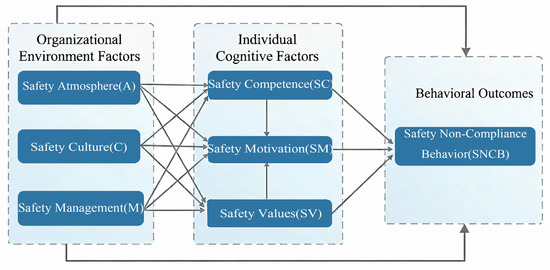
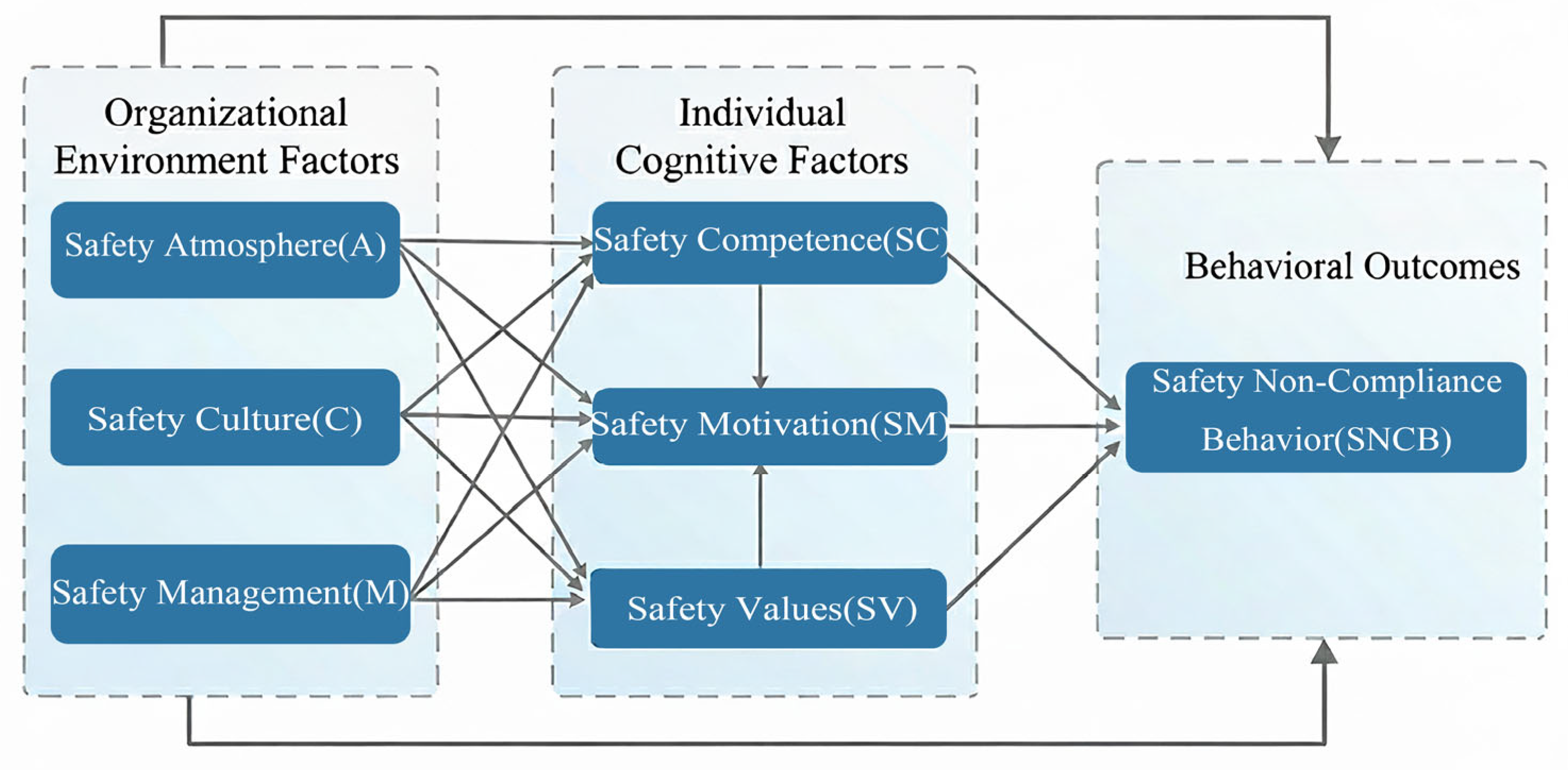
According to the SOR behavioral model, construction workers develop poor safety motivation due to the influence of individual and environmental variables, which subsequently leads to unsafe behaviors. This study adopts an individual cognitive perspective, building upon the triadic interaction model of individuals, environment, and behavior from social cognitive theory. It constructs a three-stage theoretical framework linking “organizational environment–individual cognition–behavior,” incorporating the influence of safety competence and safety values on safety motivation. Based on the hypotheses proposed above, a theoretical model inducing unsafe behavior is developed, as illustrated in Figure 1.
Figure 1.
A Theoretical Model of the Formation Mechanism of Unsafe Behaviors Among Construction Workers from an Individual Cognitive Perspective.
3. Research Methods and Data Collection
3.1. Questionnaire Design
This study empirically tested the formation mechanism model of unsafe behaviors among construction workers through a questionnaire survey, divided into a pilot study and a formal survey. First, data were collected through self-administered questionnaires and interviews. Subsequently, the measurement structure was optimized by balancing the content and number of questionnaire dimensions. A 5-point Likert scale (“1—Strongly Disagree” to “5—Strongly Agree”) was employed, as prior research has demonstrated its effectiveness in enhancing data reliability [47].
This study encompasses seven constructs and a total of 28 measurement items, in addition to the basic characteristics of the construction worker population structure. To ensure the stability and fit of the structural model, the measurement scales for individual cognitive variables drew upon Re and Macchi’s (2010) [48] scale for measuring construction workers’ safety competence. For example, “My work skills enable me to complete tasks proficiently.” Twelve items were designed across three dimensions: safety competence (SC), safety motivation (SM), and safety values (SV). For the organizational environment measurement scale, safety atmosphere (A) adopted Zhou et al.’s (2011) [49] measurement scale, safety culture (C) referenced Yang et al.’s (2022) [50] items on the safety philosophy dimension, and safety management (M) integrated Li et al.’s (2015) [51] items on the safety supervision dimension. Ten items were designed across these three constructs. The behavioral measurement variables were based on established scales from Neal (2004) and Ni et al. (2020) [28,52], covering Safety Non-Compliance Behavior (SNCB) with 6 items. For the detailed questionnaire, refer to Appendix A at the end of this document.
3.2. Data Collection
The pilot study was conducted at construction sites in Nanchang City, involving in-depth interviews with project managers and frontline workers alongside questionnaire distribution. A total of 148 questionnaires were collected. Considering factors such as response consistency and patterned answers, 18 invalid questionnaires were excluded, leaving 130 valid responses. The response rate for this study was 87.8% (130/148). This is significantly higher than the average response rate of 52.7% for studies utilizing data from individuals, as established in the benchmark analysis by Baruch and Holtom (2008) [53], ensuring the representativeness of the sample. Subsequently, Cronbach’s α coefficients and the modified Correlated Item–Total Correlation (CITC) are calculated. Items were tested under the following criteria: (1) If Cronbach’s α increased after item deletion compared to the overall α, the item was removed; (2) Items with CITC values below 0.3 were removed. Based on these criteria, the final questionnaire was adjusted. The revised Cronbach’s α values for all scales exceeded 0.7, indicating good reliability for each scale and confirming that all items could be retained.
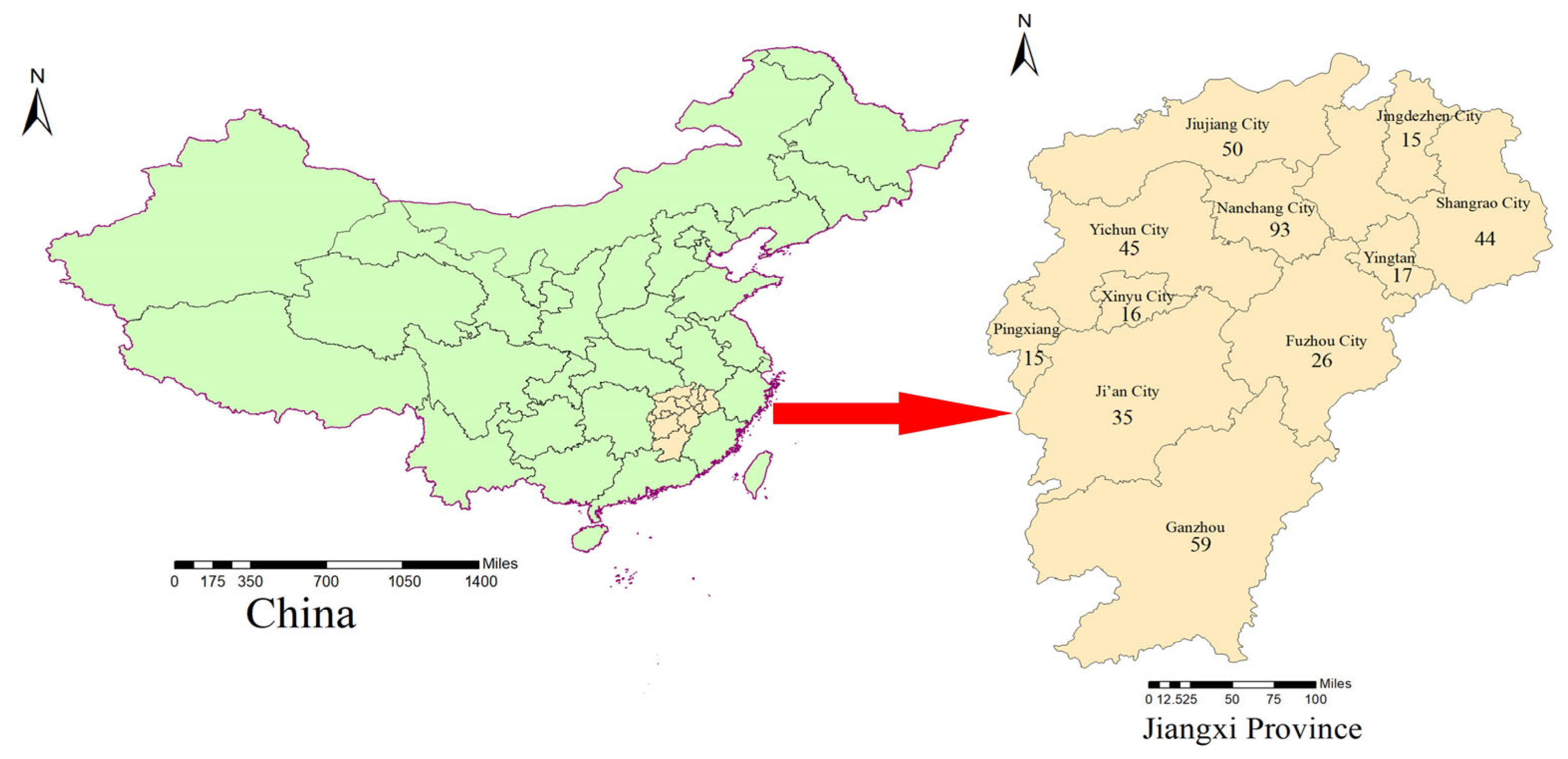
The formal field research was conducted in Jiangxi Province, China, from October to November 2024 (Figure 2). Questionnaires were collected proportionally based on each city’s GDP share within Jiangxi Province. The numbers in the figure represent the number of questionnaires collected in each city. A total of 415 questionnaires were returned. After excluding 8 invalid questionnaires, 407 valid samples were obtained. The formal research adopted Murtagh et al.’s (2012) [54] perspective on sample size selection, maintaining an observation-to-sample ratio between 1:10 and 1:15, with an optimal sample size ranging from 200 to 400. Considering both the number of variables and the requirement for structural stability, a sample size between 310 and 510 is deemed appropriate for this study. The survey characterized workers through demographic and occupational information, with specific characteristics detailed in Table 1. The distribution of gender, educational background, age, and marriage status in the sample is consistent with the industry-specific distributions. Thus, overall, the sample obtained from the survey is robust.
Figure 2.
Survey Area.
Table 1.
Structural Characteristics of the Construction Worker Population.
3.3. Data Analysis Methods
Following the reliability and validity test of sample data, the structural equation modeling (SEM) was utilized to test and validate these hypothesized relationships in the theoretical model. The SEM is considered one of the most powerful statistical techniques, capable of analyzing complex relationships among variables in construction management [55,56,57]. There are two types of structural equation modeling, namely, covariance-based SEM (CB-SEM) and partial least squares SEM (PLS-SEM). While both types are popular in academic studies, this paper adopts the CB-SEM model, as this study required a large sample size. Beyond sample size considerations, CB-SEM is particularly chosen for its superiority in confirmatory research, allowing for the rigorous evaluation of overall model fit. In accordance with the standard CB-SEM analytical procedure, model validation was conducted in two sequential stages: measurement model validation followed by structural model validation. First, Confirmatory Factor Analysis (CFA) was applied to evaluate construct validity, convergent validity, to validate the measurement model, and discriminant validity, thereby confirming that the observed variables adequately represent their corresponding latent variables. Upon establishing a sound measurement foundation, the structural model was analyzed to examine the hypothesized causal relationships. Addressing the multidimensional and complex influences on construction workers’ unsafe behaviors, core elements that cannot be directly measured were treated as latent variables, while questionnaire-measured indicators served as observed variables. The main effects and mediating effects were examined by AMOS 28.0, with a focus on verifying the mediating role of individual cognitive factors. Concurrently, direct effects, indirect effects, and total effects among observed variables, latent variables, and error variables were investigated.
4. Data Analysis
4.1. Measurement Model Validation
This study employed confirmatory factor analysis (CFA) to examine the structural validity of the revised scale. Following Xiao et al. (2019) [58], empirical testing of theoretical relationships between variables was achieved by calculating standardized factor loadings of observed variables on latent dimensions and assessing their statistical significance levels. CFA is commonly employed as a statistical tool to examine a scale’s construct validity, method effects, and measurement invariance. Accordingly, this study utilized CFA to evaluate the appropriateness of questionnaire items and the scale’s reliability and validity.
Reliability testing evaluates scale consistency by examining the internal consistency coefficient (Cronbach’s α) and composite reliability (CR). The Cronbach’s α of 28 measurement variables is more than 0.756, exceeding the critical threshold of 0.7. Additionally, standardized loadings (Estimate) exceeded 0.5 across all variables, indicating strong internal consistency for each latent variable and demonstrating excellent reliability. Building upon these results, the Covariance-Based Structural Equation Modeling (CB-SEM) approach was employed to further validate the theoretical framework. CB-SEM was selected as the analytical technique because it is specifically designed for confirmatory research and provides the most accurate estimation for goodness-of-fit when testing established theoretical models [57]. Furthermore, this method is particularly suitable for construction management research, as it effectively accounts for measurement errors when analyzing complex interactions among latent constructs [59]. CFA was employed to assess the validity of survey data. Exploratory factor analysis revealed cumulative variance explained ratios exceeding 0.6, indicating effective aggregation of corresponding measurement indicators. Standardized factor loadings for each latent variable ranged from 0.642 to 0.807, with AVE values consistently above 0.5, demonstrating good convergent validity between items and latent variables [60]. The correlation coefficients between latent variables for discriminant validity were all <0.7, confirming good discriminant validity among latent variables. In summary, the content validity, construct validity, convergent validity, and discriminant validity of the scale data all meet standards, providing a measurement foundation for subsequent research.
4.2. Structural Model Validation
4.2.1. Variable Correlation Analysis
To ensure the soundness of causal inference in structural equation modeling, it is necessary to preliminarily examine the strength of linear relationships among variables. The results of the latent variable correlation analysis indicate that all observed variables exhibit significant correlations: safety motivation demonstrated the strongest association with unsafe behavior, yielding a coefficient of 0.54; additionally, safety competence and unsafe behavior also exhibited a strong correlation, with a coefficient of 0.52. In contrast, the correlation between safety culture and safety management was the weakest, with a coefficient of only 0.09. Although correlation analysis cannot reveal the magnitude or direction of influence between variables, it indicates the existence of interdependent and associated relationships among different variables, thereby providing a prerequisite for subsequent structural equation model fitting and path analysis.
4.2.2. Model Fit Analysis
Model fit is a crucial criterion for evaluating the alignment between structural equations and actual data. This study constructs a theoretical framework integrating social cognition and accident causation theory to examine organizational environment, individual cognition, and behavior. A structural equation model linking six research variables to unsafe behavior variables was constructed. Model fit tests revealed that while the Normed Fit Index (NFI) value approached the recommended threshold of 0.9, the Comparative Fit Index (CFI) and Incremental Fit Index (IFI) measurements fell within recommended ranges, indicating overall good model fit.
4.2.3. Main Effect Test
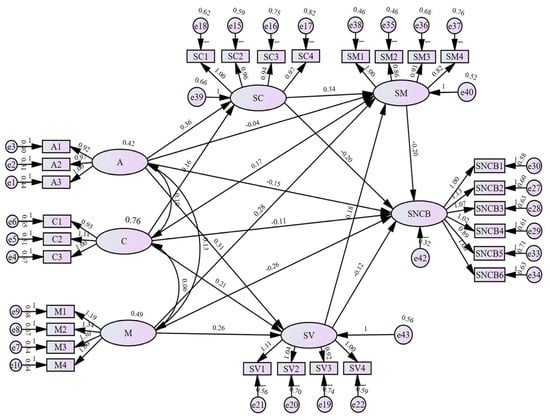
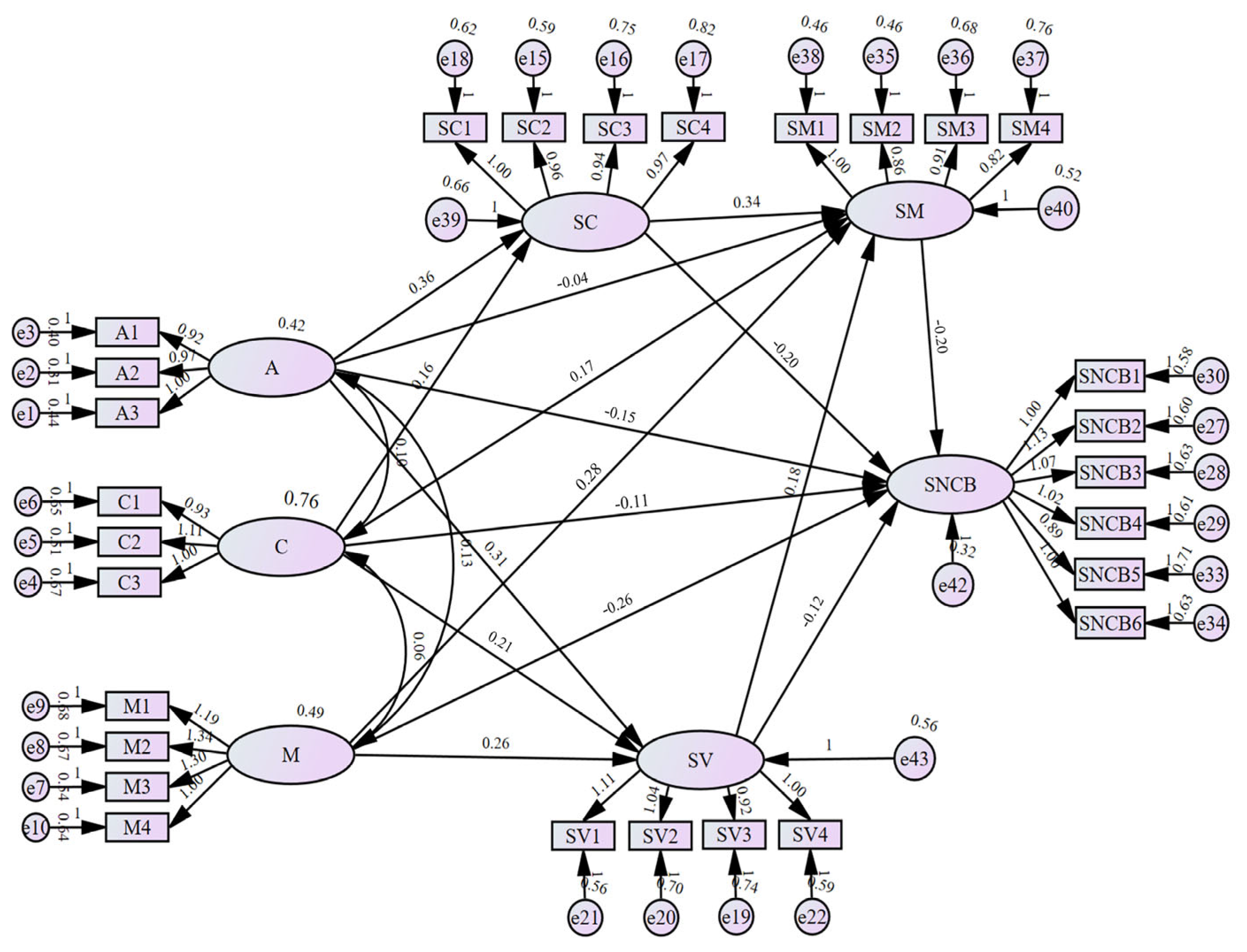
This study reveals the strength of relationships among variables by calculating standardized path coefficients. The validity of the hypothesis is determined based on the p-value and critical ratio (CR value) in the analysis results, distinguishing whether the effect of the pathway is significant. The results are presented in Table 2. The final model is presented in Figure 3.
Table 2.
Summary of Main Effect Research Hypothesis Results.
Figure 3.
Validated Structural Equation Model.
- (1)
- The influence of organizational environment on individual cognition and behavior. Safety atmosphere significantly and positively influenced construction workers’ safety values and safety competence (β = 0.23, p < 0.001; β = 0.173, p < 0.01). Safety atmosphere had no effect on safety motivation (β = −0.02, p > 0.05), thus rejecting hypothesis H4-3. Safety atmosphere negatively influenced unsafe behaviors (β = −0.13, p < 0.05). Safety culture positively and significantly influenced safety competence, safety values, and safety motivation (β = 0.149, p < 0.05; β = 0.22, p < 0.001; β = 0.171, p < 0.01); safety culture negatively and significantly influenced unsafe behaviors (β = −0.122, p < 0.05). Safety management positively and significantly influenced safety competence, safety values, and safety motivation (β = 0.304, p < 0.001; β = 0.239, p < 0.001; β = 0.202, p < 0.01); safety management negatively and significantly influenced unsafe behaviors (β = −0.228, p < 0.001).
- (2)
- The influence of individual cognitive factors and behavioral outcome factors. Safety competence positively and significantly influenced construction workers’ safety motivation (β = 0.327, p < 0.001); safety competence negatively and significantly influenced construction workers’ unsafe behaviors (β = −0.221, p < 0.001). Safety values positively and significantly influenced construction workers’ safety motivation (β = 0.17, p < 0.01); safety values negatively and significantly influenced construction workers’ unsafe behaviors (β = −0.131, p < 0.05). Safety motivation negatively and significantly influenced construction workers’ unsafe behaviors (β = −0.231, p < 0.001).
4.2.4. Mediation Effect Test
The mediation paths examined in this study constitute a three-factor chain mediation model. This includes the concurrent and sequential mediating effects of safety competence, safety motivation, and safety values on the relationship between unsafe behavior and the variables of safety atmosphere, safety culture, and safety management. In total, 15 mediation paths are analyzed. Using Bootstrap sampling, the model was tested under conditions of 5000 repeated samples at a 95% confidence level. Bias-corrected confidence intervals were employed to assess total effects, direct effects, and indirect effects. If the confidence interval did not include zero, the effect was considered significant; conversely, if it included zero, the effect was deemed insignificant. The results are presented in Table 3.
Table 3.
Total, Direct, and Indirect Effects.
The mediation effect test for “safety atmosphere → unsafe behavior” revealed that both the total effect and direct effect confidence intervals of safety atmosphere on unsafe behavior did not cross zero, confirming their statistical significance. At the indirect effect level, all mediating pathways were established except for the non-significant path where safety atmosphere influenced unsafe behavior through safety motivation. Specifically, variables such as safety competence, safety motivation, and safety values formed chained mediations between safety atmosphere and unsafe behavior (i.e., A → SC → SM → SNCB, A → SV → SM → SNCB). Safety competence exhibited the strongest mediating effect in the influence pathways: the indirect effect of safety atmosphere on unsafe behavior via safety competence was the largest.
The test data for the path from “safety culture → unsafe behavior” indicates that the confidence intervals for the total effect, direct effect, and indirect effect of safety culture on unsafe behavior do not include 0, confirming that all three effects are significant. Partial mediation exists in the influence of safety culture on unsafe behavior. Concurrently, safety competence and safety motivation exhibit significant chain mediation in the relationship between safety culture and unsafe behavior (i.e., C → SC → SM → SNCB). Safety values and safety motivation also demonstrate significant chain mediation in influencing unsafe behavior (i.e., C → SV → SM → SNCB). The most influential indirect pathway is safety culture → safety competence → unsafe behavior.
The results of testing the mediating effect of “Safety Management → Unsafe Behavior” indicate that the confidence intervals for the total, direct, and indirect effects of safety management on unsafe behavior do not all include 0, confirming that all three effects are significant. Safety management exerts a partial mediating effect on unsafe behavior. Furthermore, safety competence and safety motivation exert significant chain mediating effects in the relationship between safety management and unsafe behavior (i.e., M → SC → SM → SNCB). Similarly, safety values and motivation exert significant chain mediating effects in the relationship between safety management and unsafe behavior (i.e., M → SV → SM → SNCB). The primary transmission pathway is “Safety Management → Safety Competence → Unsafe Behavior.”
4.3. Summary of Hypothesis Test Results
The summary of the main effect research hypotheses is presented in Table 2. Except for H4-3, which was not supported, hypotheses H1-1 through H6-4 were all confirmed.
5. Discussion
5.1. Discussion of Individual Cognitive Factors on the Outcomes of Unsafe Behaviors
Empirical results indicate that safety competence exerts a significant negative effect on construction workers’ unsafe behaviors (β = −0.221, p < 0.001), suggesting that enhancing workers’ safety competence can directly reduce unsafe behaviors. This finding aligns with Guo et al.’s (2018) [30] exploration of the mechanisms underlying construction workers’ unsafe behaviors. On one hand, the accumulation of skills and safety knowledge reduces cognitive resource consumption during task execution, allowing workers to allocate more attention to risk monitoring while performing tasks. On the other hand, long-term operational practice builds experience, gradually enhancing risk judgment competence and thereby reducing the likelihood of accidents caused by operational unfamiliarity or information processing biases.
Safety motivation exerts a negative influence on unsafe behaviors (β = −0.231, p < 0.001). This aligns with Fang et al.’s (2020) [40] conclusion that enhancing workers’ safety motivation directly reduces unsafe behaviors among construction workers. Theoretically, this finding validates the critical role of safety motivation within construction worker safety management systems. Practically, it provides clear direction for enhancing safety management in the construction industry: if the work environment or organizational atmosphere fails to meet workers’ needs, safety motivation may diminish, leading to increased tendencies toward non-compliance.
Safety values exhibit a significant negative association with unsafe behaviors (β = −0.176, p < 0.01). This aligns with the findings of Deng et al. (2023) [33], indicating that as construction workers’ safety values strengthen, their unsafe behaviors in the workplace are effectively curbed. Supported by a positive organizational atmosphere and a robust safety culture system, construction workers can establish sound safety values and reduce unsafe behaviors. In terms of preventing unsafe behaviors, the influence hierarchy is safety motivation > safety competence > safety values. That is, safety competence and safety motivation are core elements in preventing unsafe behaviors. The former plays a key role by enhancing workers’ risk-coping efficacy, while the latter forms an internal constraint mechanism by strengthening behavioral drivers. Safety values serve as an important supplementary factor.
5.2. Discussion on the Effects of Organizational Environmental Factors on Individual Cognitive Factors and Unsafe Behaviors
Empirical results indicate that safety atmosphere has a direct and significant positive effect on construction workers’ safety competence (β = 0.173, p < 0.01) and safety values (β = 0.23, p < 0.001). This suggests that a favorable organizational safety atmosphere enhances workers’ safety competence and strengthens their safety values, thereby supporting the conclusions of Mohammadfam et al. (2022) and Peretz et al. (2021) [34,35]. A positive safety atmosphere can generate favorable emotional states among workers, alleviate feelings of insecurity during work, and help reduce tension and anxiety in high-intensity and high-risk working environments, enabling workers to face safety challenges with a more stable and proactive mindset. In contrast, a safe atmosphere does not exhibit a direct effect on safety motivation, which may be attributable to the influence of individual intrinsic factors or the presence of mediating variables.
Safety culture exerts a direct and significant positive effect on safety competence (β = 0.149, p < 0.05), safety motivation (β = 0.171, p < 0.01), and safety values (β = 0.22, p < 0.001), theoretically demonstrating its central role in safety management. Consistent with Chan et al.’s (2023) [42] findings, a robust safety culture fosters workers’ proactive engagement in safety management, thereby synergistically enhancing safety motivation and competence. Construction enterprises can embed safety principles deeply into workers’ daily operational mindset through systematic training and improved warning signage. This approach heightens workers’ awareness of the importance of production safety, cultivating intrinsic alignment with safety values.
Safety management exerts a direct and significant positive influence on safety competence (β = 0.304, p < 0.001), safety motivation (β = 0.202, p < 0.01), and safety values (β = 0.239, p < 0.001). This aligns with findings by Vinodkumar et al. (2010) [44], indicating that robust safety management systems can standardize worker conduct, foster sound safety values, and transform safety behavior from passive compliance to proactive pursuit. By conducting regular safety training and continuously refining on-site safety protocols, enterprises not only enhance workers’ technical expertise and operational skills but also cultivate their ability to identify risks and respond to emergencies.
In suppressing unsafe behaviors, safety atmosphere (β = −0.13, p < 0.05), safety culture (β = −0.122, p < 0.05), and safety management (β = −0.228, p < 0.001) exerted significant negative effects, consistent with the findings of Fang et al. (2020) [40]. This occurs because a positive safety atmosphere within an organization encourages workers to participate in safety activities, thereby reducing unsafe behaviors. A well-established safety culture leads workers to prioritize safety regulations and proactively minimize violations. Concurrently, robust safety management measures—such as clear safety protocols, rigorous supervision, and incentive/disciplinary mechanisms—standardize worker conduct, enhance safety awareness, and improve compliance, effectively curbing unsafe behaviors. Path coefficient analysis indicates that safety management interventions exert the most significant influence, while safety culture has a relatively weaker impact. To effectively reduce unsafe behaviors, construction enterprises should prioritize improving their safety management systems while simultaneously fostering a positive safety atmosphere and advancing the development of a robust safety culture.
5.3. Discussion on the Effects of Safety Competence and Safety Values on Safety Motivation
Analysis of research data reveals that construction workers’ safety competence exerts a significant positive driving effect on their safety motivation (β = 0.327, p < 0.001). From the perspective of behavioral decision mechanisms, the volume of accumulated safety knowledge serves as a key variable influencing operational behavior selection. Systematic accumulation of safety knowledge significantly reduces the probability of unsafe behavior occurrence. As construction workers continuously accumulate professional experience, not only do their specialized operational skills improve, but their risk identification competence and safety decision-making levels also enhance simultaneously. This dynamic development process facilitates the establishment of a scientific safety behavior selection mechanism. The findings further reveal that safety values exhibit a significant predictive effect on motivation formation (β = 0.17, p < 0.01). By influencing workers’ value judgment systems, safety values directly impact their risk preferences in behavioral decision-making. Strengthening the cultivation of safety values and the construction of responsibility awareness can effectively regulate construction workers’ motivational orientation, thereby achieving a fundamental solution for unsafe behavior intervention. It is important to emphasize that the unique working environment of the construction industry drives workers to continuously optimize their safety cognition systems in practice. This experience-driven cognitive iteration process contributes to the formation of stable safety behavior patterns.
5.4. Discussion on the Mediating Role of Individual Cognitive Factors
Empirical analysis indicates that safety competence and safety values partially mediate the influence of safety atmosphere on unsafe behaviors. This suggests that a positive safety atmosphere enables workers to acquire greater safety knowledge and skills, enhancing their ability to manage risks and thereby reducing the likelihood of unsafe behaviors. In other words, a safe atmosphere indirectly influences unsafe behaviors by improving construction workers’ safety competence and values.
Under the influence of safety culture and safety management, safety competence, safety motivation, and safety values exert partial mediating effects on unsafe behaviors, consistent with the findings of Larsson et al. (2008) [61] through structural equation modeling analysis. Safety culture and safety management influence unsafe behavior through dual pathways—indirect and direct. The indirect pathway emphasizes behavioral improvement by enhancing workers’ intrinsic qualities (competence, motivation, and values), while the direct pathway emphasizes behavioral regulation through cultural atmosphere, institutional constraints, and external oversight.
Safety competence and safety motivation, as well as safety values and safety motivation, form a significant chain of mediating effects on unsafe behaviors. This indicates that a better safety atmosphere, safety culture, and safety management often enhance construction workers’ safety competence, help them establish sound safety values, and stimulate positive safety motivation, thereby reducing the occurrence of unsafe behaviors. This chained mediation effect demonstrates that safety atmosphere, safety culture, and safety management influence unsafe behaviors not only through single dimensions but also through multi-level interactions that generate comprehensive effects. This provides a more holistic mechanism for supporting improvements in construction workers’ safety behaviors.
5.5. Guidelines for Practitioners
Empirical findings indicate that individual cognitive factors significantly influence unsafe behaviors and serve as a key predictor for corrective action. Furthermore, these factors are deeply shaped by the organizational environment. The proposed countermeasures address both the individual and organizational levels. At the individual level, cultivating safety competence is central. Training should bridge theory and practice—integrating on-site experience sharing and emergency drills—to mitigate risks at the source. Additionally, safety motivation and values play a crucial role; managers can reinforce awareness through accident case studies and psychological guidance to foster stable, positive behavior patterns. At the organizational level, robust safety management systems remain vital. Companies must combine strict oversight with a positive safety culture, as the synergy between individual and organizational efforts is essential for reducing unsafe behaviors.
6. Conclusions
This study analyzes the cognitive process of unsafe behavior among construction workers based on the SOR theory model and the cognitive theory model, thereby constructing a theoretical framework for the cognitive mechanism of unsafe behavior. Through an on-site questionnaire survey of construction workers in Jiangxi Province, 407 valid questionnaires were collected. Empirical research employing structural equation modeling yielded the following primary conclusions:
- (1)
- Direct effect analysis revealed that individual cognitive factors exert a greater direct influence on unsafe behaviors than organizational environmental factors. Organizational environmental factors exert a significant negative influence on unsafe behaviors, with safety management factors having the strongest negative impact. Safety atmosphere positively influences safety values and safety competence (β = 0.23, p < 0.001; β = 0.173, p < 0.01) but has no direct effect on safety motivation (β = 0.02, p > 0.05). The positive impact of safety culture and safety management on individual cognitive factors has the following order: safety management > safety atmosphere > safety culture. The influence of individual cognitive factors on unsafe behavior is ranked as safety motivation > safety competence > safety values. Additionally, safety competence and safety values exert a significant positive influence on safety motivation, with coefficients of 0.327 and 0.17, respectively.
- (2)
- Mediation analysis revealed that individual cognitive factors play a significant mediating role between organizational environment and unsafe behavior. Safety competence, safety motivation, and safety values each partially mediate the relationship between organizational environmental factors and unsafe behavior; however, safety motivation does not mediate the relationship between safety atmosphere and unsafe behavior. Safety competence and safety motivation, as well as safety motivation and safety values, exert significant chain mediating effects between organizational environmental factors and unsafe behavior. Among these, the most influential indirect pathways range from safety atmosphere, safety culture, and safety management to unsafe behavior, all of which run through safety competence.
This study reveals the formation mechanism of unsafe behavior in the construction industry from the cognitive perspective, which enriches the body of knowledge of safety management. Meanwhile, the findings of this study give construction companies recommendations to take measures to improve their safety management. Future research is recommended to incorporate neurophysiological measurement techniques such as ERP technology and eye-tracking to further optimize data collection methods. Enhancing research reliability through multimodal data fusion will provide more accurate theoretical support.
This study has several limitations. First, the reliance on self-reported questionnaire data may introduce subjectivity and social desirability bias, potentially affecting the robustness of the findings. In addition, the data were collected exclusively from construction sites within a single province, which may limit the generalizability of the results. Future studies should consider broader geographic coverage. Moreover, the theoretical framework incorporates a relatively narrow set of explanatory variables, focusing on three organizational and three individual cognitive factors. Future research could enrich this model by integrating additional dimensions, such as physical environmental conditions and social support factors, to develop a more comprehensive explanation of unsafe behavior.
Author Contributions
Software, Z.X.; Formal analysis, Z.X.; Investigation, G.L. and Y.Z.; Data curation, G.L.; Writing—original draft, Y.C.; Writing—review and editing, G.L., Z.X., I.M. and Y.Z.; Supervision, G.L. and I.M. All authors have read and agreed to the published version of the manuscript.
Funding
This study is supported by the National Natural Science Foundation of China (No. 72271246), the Center of Beautiful City Construction of Harmonious Coexistence between Man and Nature (MLCS2025YB09), and the Center of Scientific and Technological Innovation and New Economy Institute of Chengdu-Chongqing Economic Zone (CYCX2025YB07). The APC was funded by Chengdu University of Technology.
Institutional Review Board Statement
All subjects gave their informed consent for inclusion before they participated in the study. The study was conducted in accordance with the Declaration of Helsinki, with due regard for ethical standards, and the protocol was approved by the Ethics Committee of Construction Management Department of Chengdu University of Technology (CDUTEC20240809) on 18 August 2024.
Informed Consent Statement
Informed consent was obtained from all subjects involved in the study.
Data Availability Statement
The original contributions presented in the study are included in the article; further inquiries can be directed to the corresponding author.
Conflicts of Interest
The authors declare no conflicts of interest.
Appendix A
Questionnaire Survey on the Formation Mechanism of Unsafe Behaviors Among Construction Workers from an Individual Cognitive Perspective.
Part I: Basic Information (Completely Anonymous, for Academic Research Only).
Please check the boxes corresponding to your actual circumstances.
Table A1.
Basic Information.
Part II: Survey Questions
Please check the box that best describes your situation.
Table A2.
Individual cognitive factors.
Table A3.
Organizational Environmental Factors.
Table A4.
Consequential Factors of Behavior.
References
- Ye, J.; Ahmed, S.; Du, J. Evolution of the Construction Industry in China from the Perspectives of the Driving and Driven Ability. Sustainability 2019, 11, 1772. [Google Scholar] [CrossRef] [Scilit]
- Wang, N. The Role of the Construction Industry in China’s Sustainable Urban Development. Habitat Int. 2014, 44, 442–450. [Google Scholar] [CrossRef] [Scilit]
- Haslam, R.A.; Hide, S.A.; Gibb, A.G.F.; Gyi, D.E.; Pavitt, T.; Atkinson, S.; Duff, A.R. Contributing Factors in Construction Accidents. Appl. Ergon. 2005, 36, 401–415. [Google Scholar] [CrossRef] [Scilit] [PubMed]
- Yang, J.; Ye, G.; Xiang, Q.; Kim, M.; Liu, Q.; Yue, H. Insights into the Mechanism of Construction Workers’ Unsafe Behaviors from an Individual Perspective. Saf. Sci. 2021, 133, 105004. [Google Scholar] [CrossRef] [Scilit]
- Han, S.U.; Lee, S.H. A Vision-Based Motion Capture and Recognition Framework for Behavior-Based Safety Management. Autom. Constr. 2013, 35, 131–141. [Google Scholar] [CrossRef] [Scilit]
- Choi, B.; Lee, S.H. An Empirically Based Agent-Based Model of the Sociocognitive Process of Construction Workers’ Safety Behavior. J. Constr. Eng. Manag. 2018, 144, 04017102. [Google Scholar] [CrossRef] [Scilit]
- Marin, L.S.; Cifuentes, M.; Roelofs, C. Results of a Community-Based Survey of Construction Safety Climate for Hispanic Workers. Int. J. Occup. Environ. Health 2015, 21, 223–231. [Google Scholar] [CrossRef] [Scilit]
- Mohamed, S.; Ali, T.H.; Tam, W.Y.V. National culture and safe work behavior of construction workers in Pakistan. Saf. Sci. 2009, 47, 29–35. [Google Scholar] [CrossRef] [Scilit]
- Ahmad, I.; Pervin, A.; Hossain, M.I. Occupational health risks, safety essentials, and safety beliefs among construction workers in Bangladesh. Sci. Rep. 2025, 15, 33064. [Google Scholar] [CrossRef] [Scilit]
- Yang, J.; Ye, G.; Zhang, Z.; Liu, X.; Liu, Y. Linking Construction Noise to Worker Safety Behavior: The Role of Negative Emotion and Regulatory Focus. Saf. Sci. 2023, 162, 106093. [Google Scholar] [CrossRef] [Scilit]
- Zhao, Y.; Zhang, M.; Liu, T.; Mebarki, A. Impact of Safety Attitude, Safety Knowledge, and Safety Leadership on Chemical Industry Workers’ Risk Perception Based on Structural Equation Modelling and System Dynamics. J. Loss Prev. Process Ind. 2021, 72, 104542. [Google Scholar] [CrossRef] [Scilit]
- Wang, L.; Chai, W.; Sun, N.; Tong, R. Unlocking the Mechanism of Work Environment on Miners’ Unsafe Behaviors: A Meta-Analysis and System Dynamics. Resour. Policy 2024, 96, 105217. [Google Scholar] [CrossRef] [Scilit]
- Zhang, Z.; Guo, H.; Gao, P.; Wang, Y.; Fang, Y. Impact of Owners’ Safety Management Behavior on Construction Workers’ Unsafe Behavior. Saf. Sci. 2023, 158, 105944. [Google Scholar] [CrossRef] [Scilit]
- Meng, X.; Chan, A.H.S.; Lui, L.K.H.; Fang, Y. Effects of Individual and Organizational Factors on Safety Consciousness and Safety Citizenship Behavior of Construction Workers: A Comparative Study between Hong Kong and Mainland China. Saf. Sci. 2021, 135, 105116. [Google Scholar] [CrossRef] [Scilit]
- Xie, Q.; Xia, N.; Yang, G. Do Family Affairs Matter? Work–Family Conflict and Safety Behavior of Construction Workers. J. Manag. Eng. 2022, 38, 04021074. [Google Scholar] [CrossRef] [Scilit]
- Jiang, Z.; Fang, D.; Zhang, M. Understanding the Causation of Construction Workers’ Unsafe Behaviors Based on System Dynamics Modeling. J. Manag. Eng. 2015, 31, 04014099. [Google Scholar] [CrossRef] [Scilit]
- Shakerian, M.; Jahangiri, M.; Alimohammadlou, M.; Nami, M.; Choobineh, A. Individual Cognitive Factors Affecting Unsafe Acts among Iranian Industrial Workers: An Integrative Meta-Synthesis Interpretive Structural Modeling Approach. Saf. Sci. 2019, 120, 89–98. [Google Scholar] [CrossRef] [Scilit]
- Hu, Z.; Chan, W.T.; Hu, H.; Xu, F. Cognitive Factors Underlying Unsafe Behaviors of Construction Workers as a Tool in Safety Management: A Review. J. Constr. Eng. Manag. 2023, 149, 03123001. [Google Scholar] [CrossRef] [Scilit]
- Brossoit, R.M.; Crain, T.L.; Leslie, J.J.; Hammer, L.B.; Truxillo, D.M.; Bodner, T.E. The Effects of Sleep on Workplace Cognitive Failure and Safety. J. Occup. Health Psychol. 2019, 24, 411–422. [Google Scholar] [CrossRef] [Scilit]
- Ye, G.; Yue, H.; Yang, J.; Li, H.; Xiang, Q.; Fu, Y.; Cui, C. Understanding the Sociocognitive Process of Construction Workers’ Unsafe Behaviors: An Agent-Based Modeling Approach. Int. J. Environ. Res. Public Health 2020, 17, 1588. [Google Scholar] [CrossRef] [Scilit]
- Neal, A.; Griffin, M.A. A Study of the Lagged Relationships among Safety Climate, Safety Motivation, Safety Behavior, and Accidents at the Individual and Group Levels. J. Appl. Psychol. 2006, 91, 946–953. [Google Scholar] [CrossRef] [Scilit] [PubMed]
- Gu, J.; Guo, F. How Fatigue Affects the Safety Behavior Intentions of Construction Workers: An Empirical Study in Hunan, China. Saf. Sci. 2022, 149, 105684. [Google Scholar] [CrossRef] [Scilit]
- Man, S.S.; Chan, A.H.S.; Alabdulkarim, S.; Zhang, T. The Effect of Personal and Organizational Factors on the Risk-Taking Behavior of Hong Kong Construction Workers. Saf. Sci. 2021, 136, 105155. [Google Scholar] [CrossRef] [Scilit]
- Li, S.; Wu, X.; Wang, X.; Hu, S. Relationship between Social Capital, Safety Competency, and Safety Behaviors of Construction Workers. J. Constr. Eng. Manag. 2020, 146, 04020059. [Google Scholar] [CrossRef] [Scilit]
- Liu, K.L.; Luo, X.; Feng, J.; Li, H.; Liu, B.; Jian, Y. Research on the Impact of Managers’ Safety Perception on Construction Workers’ Safety Behaviors. Buildings 2024, 14, 3467. [Google Scholar] [CrossRef] [Scilit]
- Chan, A.P.C.; Yang, Y.; Wong, F.K.W.; Yam, M.C.H. Dressing Behavior of Construction Workers in Hot and Humid Weather. Occup. Ergon. 2013, 11, 177–186. [Google Scholar] [CrossRef] [Scilit]
- Chu, Z.W.; Cheng, M. How Does Psychological Capital Affect Construction Workers’ Proactive Safety Behavior? The Roles of Autonomous Safety Motivation and Perceived Organizational Support. Work 2025, 82, 824–829. [Google Scholar] [CrossRef] [Scilit]
- Neal, A.; Griffin, M.A. Safety Climate and Safety at Work. J. Occup. Health Psychol. 2004, 9, 215–228. [Google Scholar]
- Fu, G.; Zhou, L.; Wang, J.; Shi, M. Analysis of an Explosion Accident at Dangyang Power Plant in Hubei, China: Causes and Lessons Learned. Saf. Sci. 2018, 102, 134–143. [Google Scholar] [CrossRef] [Scilit]
- Guo, B.H.W.; Yiu, T.W.; González, V.A. Predicting Safety Behavior in the Construction Industry: Development and Test of an Integrative Model. Saf. Sci. 2016, 84, 1–11. [Google Scholar] [CrossRef] [Scilit]
- Mohajeri, M.; Ardeshir, A.; Malekitabar, H. Diagnostic Intervention Program Based on Construction Workers’ Internal Factors for Persistent Reduction of Unsafe Behavior. Eng. Constr. Archit. Manag. 2023, 30, 478–495. [Google Scholar] [CrossRef] [Scilit]
- Xu, S.; Zhang, M.G.; Xia, B.; Liu, J. Exploring Construction Workers’ Attitudinal Ambivalence: A System Dynamics Approach. Eng. Constr. Archit. Manag. 2023, 30, 671–696. [Google Scholar] [CrossRef] [Scilit]
- Deng, S.W.; Cai, Y.L.; Xie, L.P.; Pan, Y.G. Group Management Model for Construction Workers’ Unsafe Behavior Based on Cognitive Process Model. Eng. Constr. Archit. Manag. 2023, 30, 2928–2946. [Google Scholar] [CrossRef] [Scilit]
- Mohammadfam, I.; Mahdinia, M.; Aliabadi, M.M.; Soltanian, A.R. Effect of Safety Climate on Safety Behavior and Occupational Injuries: A Systematic Review Study. Saf. Sci. 2022, 156, 105917. [Google Scholar] [CrossRef] [Scilit]
- Peretz, R.A.; Luria, G.; Kalish, Y.; Zohar, D. Safety Climate Strength: The Negative Effects of Cliques and Negative Relationships in Teams. Saf. Sci. 2021, 138, 105224. [Google Scholar] [CrossRef] [Scilit]
- Wu, F.; Xu, H.Y.; Sun, K.S.; Hsu, W.L. Analysis of Behavioral Strategies of Construction Safety Subjects Based on the Evolutionary Game Theory. Buildings 2022, 12, 313. [Google Scholar] [CrossRef] [Scilit]
- Wang, M.D.; Sun, J.; Du, H.; Wang, C. Relations between Safety Climate, Awareness, and Behavior in the Chinese Construction Industry: A Hierarchical Linear Investigation. Adv. Civ. Eng. 2018, 2018, 3894782. [Google Scholar] [CrossRef] [Scilit]
- Singh, A.; Misra, S.C. Safety Performance and Evaluation Framework in Indian Construction Industry. Saf. Sci. 2021, 134, 105039. [Google Scholar] [CrossRef] [Scilit]
- Malakoutikhah, M.; Jahangiri, M.; Alimohammadlou, M.; Faghihi, S.A.; Kamalinia, M. The Factors Affecting Unsafe Behaviors of Iranian Workers: A Qualitative Study Based on Grounded Theory. Saf. Health Work 2021, 12, 339–345. [Google Scholar] [CrossRef] [Scilit]
- Fang, D.; Huang, Y.; Guo, H.; Lim, H.W. LCB Approach for Construction Safety. Saf. Sci. 2020, 128, 104761. [Google Scholar] [CrossRef] [Scilit]
- Ni, G.D.; Zhang, Q.; Fang, Y.Q.; Zhang, Z.; Qiao, Y.; Wang, W.; Deng, Y. How Resilient Safety Culture Corrects Unsafe Behavior of New-Generation Construction Workers: The Mediating Effects of Job Crafting and Perceived Work Meaningfulness. Eng. Constr. Archit. Manag. 2023, 30, 4821–4845. [Google Scholar] [CrossRef] [Scilit]
- Chan, A.P.C.; Guan, J.F.; Choi, T.N.Y.; Yang, Y. Moderating Effects of Individual Learning Ability and Resilient Safety Culture on the Relationship between Educational Level and Safety Performance of Construction Workers. Buildings 2023, 13, 3026. [Google Scholar] [CrossRef] [Scilit]
- Langford, D.; Rowlinson, S.; Sawacha, E. Safety Behavior and Safety Management: Its Influence on the Attitudes of Workers in the UK Construction Industry. Eng. Constr. Archit. Manag. 2000, 7, 133–140. [Google Scholar] [CrossRef] [Scilit]
- Vinodkumar, M.N.; Bhasi, M. Safety Management Practices and Safety Behavior: Assessing the Mediating Role of Safety Knowledge and Motivation. Accid. Anal. Prev. 2010, 42, 2082–2093. [Google Scholar] [CrossRef] [Scilit] [PubMed]
- Leu, S.S.; Trang, T.T.T.; Tung, C.L.; Wu, P.L. Synergistic Effects Enhancing Safety Awareness and Management in Construction: A Structural Equation Modeling Analysis on Accident Reduction Practices in Taiwan. Int. J. Occup. Saf. Ergon. 2025, 1–11. [Google Scholar] [CrossRef] [Scilit]
- Zhang, Z.T.; Li, H.; Guo, H.L.; Wu, Y.E.; Luo, Z. Causal Inference of Construction Safety Management Measures towards Workers’ Safety Behaviors: A Multidimensional Perspective. Saf. Sci. 2024, 172, 106432. [Google Scholar] [CrossRef] [Scilit]
- Brust, O.A.; Häder, S.; Häder, M. Is the Short Version of the Big Five Inventory Applicable for Use in Telephone Surveys? J. Off. Stat. 2016, 32, 601–618. [Google Scholar] [CrossRef] [Scilit]
- Re, A.; Macchi, L. From Cognitive Reliability to Competence? An Evolving Approach to Human Factors and Safety. Cogn. Technol. Work 2010, 12, 79–85. [Google Scholar] [CrossRef] [Scilit]
- Zhou, Q.; Fang, D.; Mohamed, S. Safety Climate Improvement: Case Study in a Chinese Construction Company. J. Constr. Eng. Manag. 2011, 137, 86–95. [Google Scholar] [CrossRef] [Scilit]
- Yang, X.; Zhao, X.; Wang, Y.; Tong, R. Development of Occupational Health Culture Scale: A Study Based on Miners and Construction Workers. Front. Public Health 2022, 10, 992515. [Google Scholar] [CrossRef] [Scilit]
- Li, H.; Lu, M.; Hsu, S.C.; Gray, M.; Huang, T. Proactive Behavior-Based Safety Management for Construction Safety Improvement. Saf. Sci. 2015, 75, 107–117. [Google Scholar] [CrossRef] [Scilit]
- Ni, G.; Zhu, Y.; Zhang, Z.; Qiao, Y.; Li, H.; Xu, N.; Deng, Y.; Yuan, Z.; Wang, W. Influencing Mechanism of Job Satisfaction on Safety Behavior of New Generation of Construction Workers Based on Chinese Context: The Mediating Roles of Work Engagement and Safety Knowledge Sharing. Int. J. Environ. Res. Public Health 2020, 17, 8361. [Google Scholar] [CrossRef] [Scilit]
- Baruch, Y.; Holtom, B.C. Survey Response Rate Levels and Trends in Organizational Research. Hum. Relat. 2008, 61, 1139–1160. [Google Scholar] [CrossRef] [Scilit]
- Murtagh, F.; Heck, A. Multivariate Data Analysis; Springer Science & Business Media: Dordrecht, The Netherlands, 2012. [Google Scholar]
- Madushika, U.G.D.; Lu, W. Review of Structural Equation Modelling (SEM) Application in Construction Management. Eng. Constr. Archit. Manag. 2025; Epub ahead of printing. [CrossRef] [Scilit]
- Fu, C.; Wang, J.; Qu, Z.; Skitmore, M.; Yi, J.; Sun, Z.; Chen, J. Structural Equation Modeling in Technology Adoption and Use in the Construction Industry: A Scientometric Analysis and Qualitative Review. Sustainability 2024, 16, 3824. [Google Scholar] [CrossRef] [Scilit]
- Dash, G.; Paul, J. CB-SEM vs PLS-SEM Methods for Research in Social Sciences and Technology Forecasting. Technol. Forecast. Soc. Change 2021, 173, 121092. [Google Scholar] [CrossRef] [Scilit]
- Xiao, Y.; Liu, H.; Hau, K.T. A Comparison of CFA, ESEM, and BSEM in Test Structure Analysis. Struct. Equ. Model. 2019, 26, 665–677. [Google Scholar] [CrossRef] [Scilit]
- Molenaar, K.R.; Washington, S.; Diekmann, J.E. Structural Equation Model of Construction Contract Dispute Potential. J. Constr. Eng. Manag. 2000, 126, 268–277. [Google Scholar] [CrossRef] [Scilit]
- Adams, M.J. The Principles of Multivariate Data Analysis. In Analytical Methods of Food Authentication; Ashurst, P.R., Dennis, M.J., Eds.; Chapman & Hall: London, UK, 1998; pp. 308–328. [Google Scholar]
- Larsson, S.; Pousette, A.; Törner, M. Psychological Climate and Safety in the Construction Industry: Mediated Influence on Safety Behavior. Saf. Sci. 2008, 46, 405–412. [Google Scholar] [CrossRef] [Scilit]

Disclaimer/Publisher’s Note: The statements, opinions and data contained in all publications are solely those of the individual author(s) and contributor(s) and not of MDPI and/or the editor(s). MDPI and/or the editor(s) disclaim responsibility for any injury to people or property resulting from any ideas, methods, instructions or products referred to in the content. |
© 2026 by the authors. Licensee MDPI, Basel, Switzerland. This article is an open access article distributed under the terms and conditions of the Creative Commons Attribution (CC BY) license.