Effects of User Experience on Satisfaction and Behavioral Intentions in Metaverse Model Houses


Abstract
1. Introduction
2. Research Background and Hypothesis Development
2.1. Metaverse and Real Estate Industry
2.1.1. Metaverse Concept
2.1.2. The Emergence of the Metaverse in the Real Estate Industry
2.2. User Experience (UX) in the Metaverse
2.3. Satisfaction and Behavioral Intention in the Metaverse
3. Research Methods
3.1. Questionnaire Design
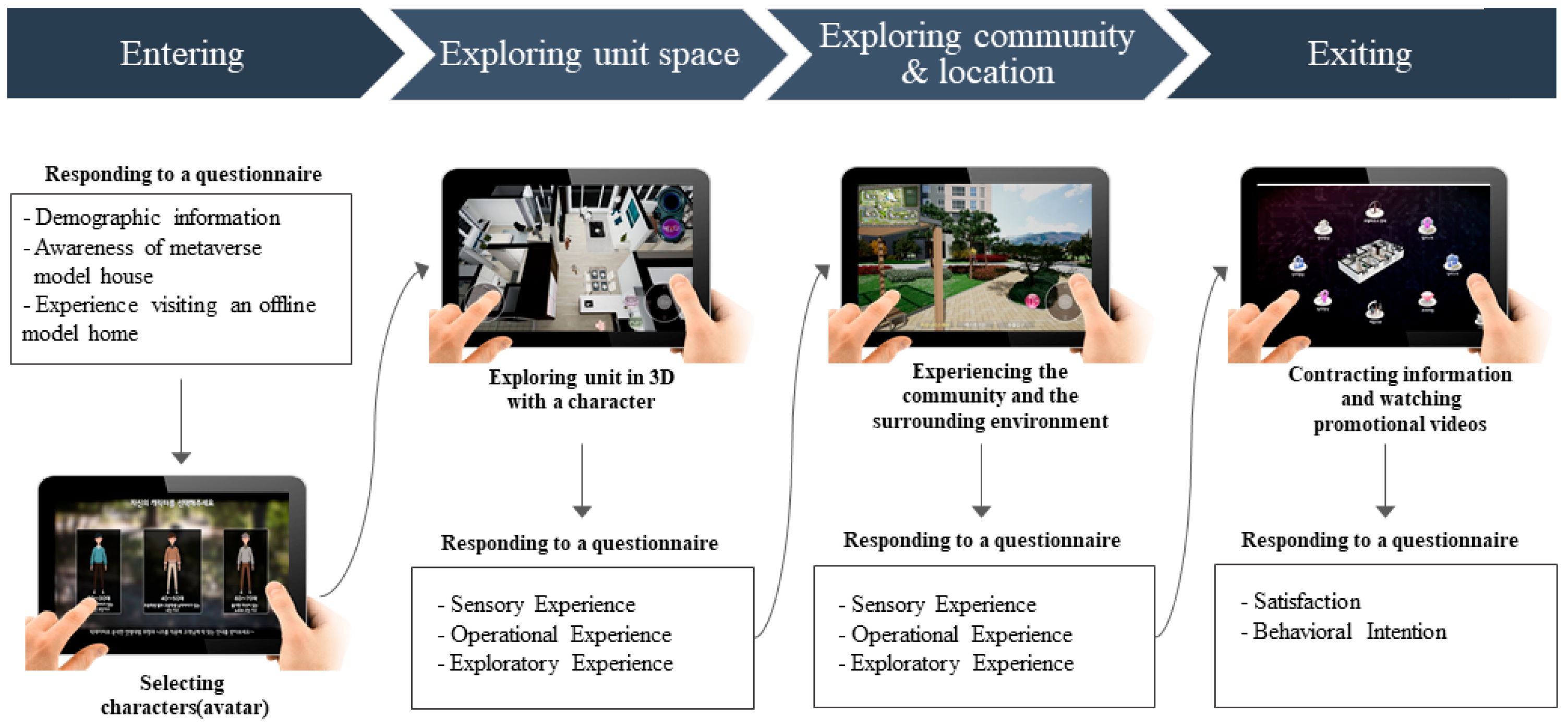
3.2. Experimental Design
3.3. Variables and Analytical Model
4. Results
4.1. Preliminary Analysis
4.1.1. Sample
4.1.2. Reliability and Validity
4.2. Hypothesis Testing
5. Discussion
6. Conclusions
Author Contributions
Funding
Institutional Review Board Statement
Informed Consent Statement
Data Availability Statement
Conflicts of Interest
References
- Kye, B.; Han, N.; Kim, E.; Park, Y.; Jo, S. Educational applications of metaverse: Possibilities and limitations. J. Educ. Eval. Health Prof. 2021, 18, 1149230. [Google Scholar] [CrossRef] [Scilit]
- Nalbant, K.G.; Uyanık, Ş. Computer Vision in the Metaverse. J. Metaverse 2021, 1, 9–12. [Google Scholar]
- Araiqat, D.M.; Al-Sartawi, A. The introduction of interior design and architecture into the metaverse and their interrelation to the reality-enhancing technologies. In Artificial Intelligence, Internet of Things, and Society 5.0; Springer: Berlin/Heidelberg, Germany, 2023; pp. 107–117. [Google Scholar]
- Hadavi, A.; Alizadehsalehi, S. Metaverse for AEC: A SWOT Analysis. In Computing in Civil Engineering 2023; American Society of Civil Engineers: Washington, DC, USA, 2023; pp. 10–18. [Google Scholar]
- HLB. The Impact of the Metaverse on the Real Estate Industry. Available online: https://www.hlb.global/the-impact-of-the-metaverse-on-the-real-estate-industry/ (accessed on 31 October 2025).
- Hwang, B.Y.; Lee, T.H. A study on the application flow of virtual reality in the apartment model house. J. Korea Acad. Ind. Coop. Soc. 2019, 20, 585–590. [Google Scholar]
- Greene, B. A Physicist Explains Why Parallel Universes May Exist. Available online: https://www.npr.org/2011/01/24/132932268/a-physicist-explains-why-parallel-universes-may-exist (accessed on 31 October 2025).
- Park, J.; Kim, N. Examining self-congruence between user and avatar in purchasing behavior from the metaverse to the real world. J. Glob. Fash. Mark. 2024, 15, 23–38. [Google Scholar] [CrossRef] [Scilit]
- Papagiannidis, S.; Bourlakis, M.; Li, F. Making real money in virtual worlds: MMORPGs and emerging business opportunities, challenges and ethical implications in metaverses. Technol. Forecast. Soc. Change 2008, 75, 610–622. [Google Scholar] [CrossRef] [Scilit]
- Díaz, J.; Saldaña, C.; Avila, C. Virtual world as a resource for hybrid education. Int. J. Emerg. Technol. Learn. (IJET) 2020, 15, 94–109. [Google Scholar] [CrossRef] [Scilit]
- Golf-Papez, M.; Heller, J.; Hilken, T.; Chylinski, M.; de Ruyter, K.; Keeling, D.I.; Mahr, D. Embracing falsity through the metaverse: The case of synthetic customer experiences. Bus. Horiz. 2022, 65, 739–749. [Google Scholar] [CrossRef] [Scilit]
- Samarnggoon, K.; Grudpan, S.; Wongta, N.; Klaynak, K. Developing a Virtual World for an Open-House Event: A Metaverse Approach. Future Internet 2023, 15, 124. [Google Scholar] [CrossRef] [Scilit]
- McKinsey. Innovative and Practical Applications of the Metaverse. Available online: https://www.mckinsey.com/capabilities/mckinsey-digital/our-insights/innovative-and-practical-applications-of-the-metaverse (accessed on 5 November 2025).
- Prieto, J.d.l.F.; Lacasa, P.; Martínez-Borda, R. Approaching metaverses: Mixed reality interfaces in youth media platforms. New Techno Humanit. 2022, 2, 136–145. [Google Scholar] [CrossRef] [Scilit]
- Mutlu Avinç, G.; Yıldız, A. A bibliometric and systematic review of scientific publications on metaverse research in architecture: Web of science (WoS). Int. J. Technol. Des. Educ. 2025, 35, 825–849. [Google Scholar] [CrossRef] [Scilit]
- Rosário, A.T.; Lopes, P.R.; Rosário, F.S. Metaverse in Marketing: Challenges and Opportunities. In Handbook of Research on AI-Based Technologies and Applications in the Era of the Metaverse; Khang, A., Shah, V., Rani, S., Eds.; IGI Global Scientific Publishing: Hershey, PA, USA, 2023; pp. 204–227. [Google Scholar]
- Slater, M.; Sanchez-Vives, M.V. Enhancing our lives with immersive virtual reality. Front. Robot. AI 2016, 3, 74. [Google Scholar] [CrossRef] [Scilit]
- Mastrolembo Ventura, S.; Castronovo, F.; Ciribini, A.L.C. A design review session protocol for the implementation of immersive virtual reality in usability-focused analysis. J. Inf. Technol. Constr. 2020, 25, 233–253. [Google Scholar] [CrossRef] [Scilit]
- Agirachman, F.A.; Shinozaki, M.; Koerniawan, M.D.; Indraprastha, A. Implementing affordance-based design review method using virtual reality in architectural design studio. Buildings 2022, 12, 1296. [Google Scholar] [CrossRef] [Scilit]
- Fernandes, F.; Werner, C. A systematic literature review of the metaverse for software engineering education: Overview, challenges and opportunities. PRESENCE 2022. [Google Scholar] [CrossRef] [Scilit]
- Lee, H.J.; Gu, H.H. Empirical research on the metaverse user experience of digital natives. Sustainability 2022, 14, 14747. [Google Scholar] [CrossRef] [Scilit]
- Joo, S.; Chung, H.; Nah, K. A study on the user experience in Metaverse: Focused on technology trends and literature research. In Proceedings of the 2021 KSDS Fall International Conference, Seoul, Republic of Korea, 13 November 2021; pp. 122–127. [Google Scholar]
- Lee, J.-H.; Rhee, B.-A. A Study on User Experience on Metaverse: Focusing on the ZEPETO platform. J. Digit. Contents Soc. 2022, 23, 995–1011. [Google Scholar] [CrossRef] [Scilit]
- Aziz, N.S.; Kamaludin, A.; Sulaiman, N. Assessing web site usability measurement. IJRET Int. J. Res. Eng. Technol. 2013, 2, 386–392. [Google Scholar]
- Gao, J.; Jia, W.; Yin, J. Exploring Smartphone User Interface Experience-Sharing Behavior: Design Perception and Motivation-Driven Mechanisms through the SOR Model. Sustainability 2024, 16, 6670. [Google Scholar] [CrossRef] [Scilit]
- Papagiannidis, S.; Pantano, E.; See-To, E.W.K.; Bourlakis, M. Modelling the determinants of a simulated experience in a virtual retail store and users’ product purchasing intentions. J. Mark. Manag. 2013, 29, 1462–1492. [Google Scholar] [CrossRef] [Scilit]
- Ha, J.-M.; Park, S.-B. A study on the user’s evaluation for the visual types of virtual model house. Korean Inst. Inter. Des. J. 2011, 20, 160–169. [Google Scholar]
- Mauri, M.; Rancati, G.; Riva, G.; Gaggioli, A. Comparing the effects of immersive and non-immersive real estate experience on behavioral intentions. Comput. Hum. Behav. 2024, 150, 107996. [Google Scholar] [CrossRef] [Scilit]
- Hwang, J.-H.; Han, Y.; Lim, H. Research trend analysis on metaverse applications in South Korea: A keyword network analysis and topic modeling approach. J. Archit. Inst. Korea 2023, 39, 55–65. [Google Scholar]
- Shehadeh, A.; Alshboul, O. Enhancing engineering and architectural design through virtual reality and machine learning integration. Buildings 2025, 15, 328. [Google Scholar] [CrossRef] [Scilit]
- Sami Ur Rehman, M.; Abouelkhier, N.; Shafiq, M.T. Exploring the effectiveness of immersive virtual reality for project scheduling in construction education. Buildings 2023, 13, 1123. [Google Scholar] [CrossRef] [Scilit]
- Zhou, Q.; Wang, S.; Wang, J. Exploring user experience in virtual industrial heritage platforms: Impact of cultural identity, functional clarity, scene interactivity, and narrative quality. Buildings 2025, 15, 253. [Google Scholar] [CrossRef] [Scilit]
- Liu, Y.; Konduri, S.; Park, C. A Study on the Factors Influencing Willingness to Use Virtual Reality Systems for External Evaluation of Buildings. Buildings 2024, 14, 3714. [Google Scholar] [CrossRef] [Scilit]
- Rodrigo, G.-A.; Mariela, G.-R.; Pedro, S.-R.; Hernán, B.-C.; Mauricio, L.; Patricia, L. A Virtual Reality-Based Exploration of Chilean Apartment Models with Features from the Surrealist Illustrations of Roberto Matta. Buildings 2025, 15, 3380. [Google Scholar] [CrossRef] [Scilit]
- Benedikt, M.L. Cityspace, cyberspace, and the spatiology of information. J. Virtual Worlds Res. 2008, 1–22. [Google Scholar] [CrossRef] [Scilit]
- Ball, M. Framework for the Metaverse. Available online: https://www.matthewball.vc/all/forwardtothemetaverseprimer (accessed on 31 October 2025).
- Lin, Z.; Duan, H.; Li, J.; Sun, X.; Cai, W. MetaCast: A self-driven metaverse announcer architecture based on quality of experience evaluation model. In Proceedings of the 31st ACM International Conference on Multimedia, Ottawa, ON, Canada, 29 October–3 November 2023; pp. 6756–6764. [Google Scholar]
- Hudson, J. Virtual immersive shopping experiences in metaverse environments: Predictive customer analytics, data visualization algorithms, and smart retailing technologies. Linguist. Philos. Investig. 2022, 21, 236–251. [Google Scholar]
- Jenkins, T. Immersive virtual shopping experiences in the retail metaverse: Consumer-driven E-commerce, blockchain-based digital assets, and data visualization tools. Linguist. Philos. Investig. 2022, 21, 154–169. [Google Scholar]
- Kliestik, T.; Novak, A.; Lăzăroiu, G. Live shopping in the metaverse: Visual and spatial analytics, cognitive artificial intelligence techniques and algorithms, and immersive digital simulations. Linguist. Philos. Investig. 2022, 21, 187–202. [Google Scholar]
- Park, S.-M.; Kim, Y.-G. A metaverse: Taxonomy, components, applications, and open challenges. IEEE Access 2022, 10, 4209–4251. [Google Scholar] [CrossRef] [Scilit]
- Oh, H.J.; Kim, J.; Chang, J.J.C.; Park, N.; Lee, S. Social benefits of living in the metaverse: The relationships among social presence, supportive interaction, social self-efficacy, and feelings of loneliness. Comput. Hum. Behav. 2023, 139, 107498. [Google Scholar] [CrossRef] [Scilit]
- Wongkitrungrueng, A.; Suprawan, L. Metaverse Meets Branding: Examining Consumer Responses to Immersive Brand Experiences. Int. J. Hum. Comput. Interact. 2024, 40, 2905–2924. [Google Scholar] [CrossRef] [Scilit]
- Xi, N.; Chen, J.; Gama, F.; Riar, M.; Hamari, J. The challenges of entering the metaverse: An experiment on the effect of extended reality on workload. Inf. Syst. Front. 2023, 25, 659–680. [Google Scholar] [CrossRef] [Scilit]
- Wallack, C. Dream home: Remodeling American expectations with model houses. J. Am. Cult. 2009, 32, 332. [Google Scholar] [CrossRef] [Scilit]
- Juan, Y.-K.; Chen, H.-H.; Chi, H.-Y. Developing and evaluating a virtual reality-based navigation system for pre-sale housing sales. Appl. Sci. 2018, 8, 952. [Google Scholar] [CrossRef] [Scilit]
- Lee, S.; Lee, W.-C.; Lee, J.-S.; Park, E. A study of the realistic media of smart glass in the public relations hall of a small model house less than three pyeong. J. Korean Soc. Imaging 2022, 20, 75–87. [Google Scholar]
- Choi, M.B.; Kim, Y.M.; Jin, B.; Ku, S.; Kim, K.; Kim, G.-W.; Yun, M.H. Application possibility of web based model house to real model house. In Proceedings of the HCI Korea, Seoul, Republic of Korea, 27–29 January 2016; pp. 240–244. [Google Scholar]
- Olimplanet. Expanding Experiences, Creating a New World. Available online: https://www.olimplanet.com/ (accessed on 5 November 2025).
- Vrapoint. Where Imagination Meets Immersion. Available online: https://vrapoint.com/ (accessed on 31 October 2025).
- Matterport. New Study Shows Property Buyers and Sellers Overwhelmingly Prefer Listings with 3D Tours. Available online: https://matterport.com/ko/news/new-study-shows-property-buyers-and-sellers-overwhelmingly-prefer-listings-3d-tours (accessed on 1 October 2025).
- Xiong, C.; Cheung, K.S.; Levy, D.S.; Allen, M. The effect of virtual reality on the marketing of residential property. Hous. Stud. 2024, 39, 671–694. [Google Scholar] [CrossRef] [Scilit]
- Deep, S.; Vishnoi, S.; Malhotra, R.; Mathur, S.; Yawale, H.; Kumar, A.; Singla, A. Influence of augmented reality and virtual reality on real estate investment decisions: Understand consumer perspective in Indian AEC industry. Eng. Constr. Archit. Manag. 2025, 32, 1122–1140. [Google Scholar] [CrossRef] [Scilit]
- Weinberger, M. What Is Metaverse?—A Definition Based on Qualitative Meta-Synthesis. Future Internet 2022, 14, 310. [Google Scholar] [CrossRef] [Scilit]
- Duan, H.; Li, J.; Fan, S.; Lin, Z.; Wu, X.; Cai, W. Metaverse for social good: A university campus prototype. In Proceedings of the 29th ACM International Conference on Multimedia, Chengdu, China, 20–24 October 2021; pp. 153–161. [Google Scholar]
- Kim, J. Advertising in the metaverse: Research agenda. J. Interact. Advert. 2021, 21, 141–144. [Google Scholar] [CrossRef] [Scilit]
- Alben, L. Quality of experience: Defining the criteria for effective interaction design. Interactions 1996, 3, 11–15. [Google Scholar] [CrossRef] [Scilit]
- Desmet, P.; Hekkert, P. Framework of product experience. Int. J. Des. 2007, 1, 57–66. [Google Scholar]
- Shedroff, N. 11 Information Interaction Design: A Unified Field Theory of Design. In Information Design; MIT Press: Cambridge, MA, USA, 2000; p. 267. [Google Scholar]
- Jun, H.; Kim, S.-Y. Digital Restoration research using GPS-based mobile augmented reality—Focusing on Seosomun Park. J. Digit. Contents Soc. 2021, 22, 1755–1763. [Google Scholar] [CrossRef] [Scilit]
- Hartson, R. Cognitive, physical, sensory, and functional affordances in interaction design. Behav. Inf. Technol. 2003, 22, 315–338. [Google Scholar] [CrossRef] [Scilit]
- Deliyannis, I.; Panagopoulos, I.; Panagiotakopoulos, D.; Marentakis, G.; Metzitakos, R. The sensory enrichment and interactivity of immersive user experiences in the public sector: The Ionian film office metaverse. In Augmented and Virtual Reality in the Metaverse; Springer: Berlin/Heidelberg, Germany, 2024; pp. 149–177. [Google Scholar]
- Ramalho, J.; Chambel, T. Sensing immersive 360 mobile interactive video. In Proceedings of the 2014 International Conference on Computer Graphics Theory and Applications (GRAPP), Lisbon, Portugal, 5–8 January 2014; pp. 1–10. [Google Scholar]
- Waller, D.; Hodgson, E. Sensory Contributions to Spatial Knowledge of Real and Virtual Environments. In Human Walking in Virtual Environments: Perception, Technology, and Applications; Steinicke, F., Visell, Y., Campos, J., Lécuyer, A., Eds.; Springer: New York, NY, USA, 2013; pp. 3–26. [Google Scholar]
- Hepola, J.; Karjaluoto, H.; Hintikka, A. The effect of sensory brand experience and involvement on brand equity directly and indirectly through consumer brand engagement. J. Prod. Brand Manag. 2017, 26, 282–293. [Google Scholar] [CrossRef] [Scilit]
- Marques, A.B.; Barbosa, S.D.J.; Conte, T.U. Defining a notation for usability-oriented interaction and navigation modeling for interactive systems. J. Interact. Syst. 2017, 8, 35–49. [Google Scholar] [CrossRef] [Scilit]
- O’Brien, H.L.; Toms, E.G. What is user engagement? A conceptual framework for defining user engagement with technology. J. Am. Soc. Inf. Sci. Technol. 2008, 59, 938–955. [Google Scholar] [CrossRef] [Scilit]
- Beauregard, R.; Corriveau, P. User experience quality: A conceptual framework for goal setting and measurement. In Proceedings of the International Conference on Digital Human Modeling, Beijing, China, 22–27 July 2007; pp. 325–332. [Google Scholar]
- Lyu, K.; Brambilla, A.; Globa, A.; de Dear, R. An immersive multisensory virtual reality approach to the study of human-built environment interactions. Autom. Constr. 2023, 150, 104836. [Google Scholar] [CrossRef] [Scilit]
- Lee, K.C.; Chung, N. Empirical analysis of consumer reaction to the virtual reality shopping mall. Comput. Hum. Behav. 2008, 24, 88–104. [Google Scholar] [CrossRef] [Scilit]
- Xu, J.; Liu, S.; Yang, W.; Fang, M.; Pan, Y. Beyond Reality: Exploring User Experiences in the Metaverse Art Exhibition Platform from an Integrated Perspective. Electronics 2024, 13, 1023. [Google Scholar] [CrossRef] [Scilit]
- Efthimiadis, E.N. Interactive query expansion: A user-based evaluation in a relevance feedback environment. J. Am. Soc. Inf. Sci. 2000, 51, 989–1003. [Google Scholar] [CrossRef] [Scilit]
- Laugwitz, B.; Held, T.; Schrepp, M. Construction and evaluation of a user experience questionnaire. In Proceedings of the Symposium of the Austrian HCI and Usability Engineering Group, Graz, Austria, 20–21 November 2008; pp. 63–76. [Google Scholar]
- Darin, T.; Andrade, R.; Sánchez, J. Usability evaluation of multimodal interactive virtual environments for learners who are blind: An empirical investigation. Int. J. Hum. Comput. Stud. 2022, 158, 102732. [Google Scholar] [CrossRef] [Scilit]
- Ajzen, I. The theory of planned behaviour: Reactions and reflections. Psychol. Health 2011, 26, 1113–1127. [Google Scholar] [CrossRef] [Scilit]
- Lin, J.-H.; Lee, T.-R.; Jen, W. Assessing asymmetric response effect of behavioral intention to service quality in an integrated psychological decision-making process model of intercity bus passengers: A case of Taiwan. Transportation 2008, 35, 129–144. [Google Scholar] [CrossRef] [Scilit]
- Foxall, G.R. The behavioral perspective model of purchase and consumption: From consumer theory to marketing practice. J. Acad. Mark. Sci. 1992, 20, 189–198. [Google Scholar] [CrossRef]
- Kang, H.J.; Shin, J.-H.; Ponto, K. How 3D virtual reality stores can shape consumer purchase decisions: The roles of informativeness and playfulness. J. Interact. Mark. 2020, 49, 70–85. [Google Scholar] [CrossRef] [Scilit]
- Skard, S.; Knudsen, E.S.; Sjåstad, H.; Thorbjørnsen, H. How virtual reality influences travel intentions: The role of mental imagery and happiness forecasting. Tour. Manag. 2021, 87, 104360. [Google Scholar] [CrossRef] [Scilit]
- Yung, R.; Khoo-Lattimore, C.; Prayag, G.; Surovaya, E. Around the world in less than a day: Virtual reality, destination image and perceived destination choice risk in family tourism. Tour. Recreat. Res. 2021, 46, 3–18. [Google Scholar] [CrossRef] [Scilit]
- Sujud, H.; Hachem, B. Effect of the quality of the accounting information system outputs on customer satisfaction in Lebanese commercial banks. Int. Res. J. Financ. Econ. 2019, 176, 26–40. [Google Scholar]
- Cabrera-Sánchez, J.-P.; Villarejo-Ramos, Á.F.; Liébana-Cabanillas, F.; Shaikh, A.A. Identifying relevant segments of AI applications adopters–Expanding the UTAUT2’s variables. Telemat. Inform. 2021, 58, 101529. [Google Scholar] [CrossRef] [Scilit]
- Alshurafat, H.; Arabiat, O.; Shehadeh, M. The intention to adopt metaverse in Islamic banks: An integrated theoretical framework of TAM and religiosity intention model. J. Islam. Mark. 2024. [Google Scholar] [CrossRef] [Scilit]
- George, D.; Mallery, P. SPSS for Windows Step by Step: A Simple Guide and Reference; Allyn & Bacon: Boston, MA, USA, 2003. [Google Scholar]
- Nunnally, J.C. An Overview of Psychological Measurement. In Clinical Diagnosis of Mental Disorders: A Handbook; Wolman, B.B., Ed.; Springer: Boston, MA, USA, 1978; pp. 97–146. [Google Scholar]
- Beavers, A.S.; Lounsbury, J.W.; Richards, J.K.; Huck, S.W.; Skolits, G.J.; Esquivel, S.L. Practical considerations for using exploratory factor analysis in educational research. Pract. Assess. Res. Eval. 2013, 18, n6. [Google Scholar]
- Xie, B.; Liu, H.; Alghofaili, R.; Zhang, Y.; Jiang, Y.; Lobo, F.D.; Li, C.; Li, W.; Huang, H.; Akdere, M. A review on virtual reality skill training applications. Front. Virtual Real. 2021, 2, 645153. [Google Scholar] [CrossRef] [Scilit]
- König, S.U.; Keshava, A.; Clay, V.; Rittershofer, K.; Kuske, N.; König, P. Embodied spatial knowledge acquisition in immersive virtual reality: Comparison to map exploration. Front. Virtual Real. 2021, 2, 625548. [Google Scholar] [CrossRef] [Scilit]
- Jo, H.; Park, D.-H. Affordance, usefulness, enjoyment, and aesthetics in sustaining virtual reality engagement. Sci. Rep. 2023, 13, 15097. [Google Scholar] [CrossRef] [Scilit]
- Avila-Garzon, C.; Bacca-Acosta, J.; Chaves-Rodríguez, J. Predictors of Engagement in Virtual Reality Storytelling Environments about Migration. Appl. Sci. 2023, 13, 10915. [Google Scholar] [CrossRef] [Scilit]
- Bhowmik, A.K. Virtual and augmented reality: Human sensory-perceptual requirements and trends for immersive spatial computing experiences. J. Soc. Inf. Disp. 2024, 32, 605–646. [Google Scholar] [CrossRef] [Scilit]
- Cho, H. A study on the analysis of affordance design elements in the metaverse environments. J. Korean Soc. Des. Cult. 2021, 27, 441–453. [Google Scholar] [CrossRef] [Scilit]


| Attributes | Article |
|---|---|
| Sensory Experience | |
| Sensory enrichment (visual, auditory, haptic, scent sensory) | [59,62,63,64] |
| Sense of presence (familiarity) | |
| Enjoyment | [67,70,71] |
| Operational Experience | |
| Functionality | [21,66] |
| Navigability | [21] |
| Relevance | [66] |
| Efficiency | [24,72] |
| Learnability (controllability) | [21,66,67,73] |
| Effectiveness | [24,74] |
| Exploratory Experience | |
| User control | [67] |
| Endurability (persistence) | [67] |
| Affordance | [21] |
| Attribute | Detail | Questionnaire | |
|---|---|---|---|
| Sensory experience (SE) | Sense of presence | Is it similar to the real environment (e.g., views, finishing materials, lighting)? | SE 1–4 |
| Enjoyment | Is controlling your character (avatar) fun? | SE 5–7 | |
| Operational experience (OE) | Functionality | Is the system running smoothly (e.g., space movement, screen transition)? | OE 2, 5 |
| Navigability | Is it possible to use method intuitively to navigate? | OE 7–11 | |
| Learnability | Can users learn how to operate the service naturally and perform tasks? | OE 1, 3, 4, 6 | |
| Exploratory experience (EE) | Informative | Are users able to find sufficient information they want (e.g., interior options, exhibits, finishes, area of space, detailed structure, and features)? | EE 1–6 |
| Persistence | Does it provide continuous information (e.g., live Q&A)? | EE 7 | |
| Affordance | Does its functionality allow users to do what they want (e.g., open and close furniture doors, view 360° space, change the interior, adjust sound volume)? | EE 8–12 |
| Category | Item | Frequency | Percentage |
|---|---|---|---|
| Sex | Male | 37 | 44.6% |
| Female | 46 | 55.4% | |
| Age (years) | 20s | 26 | 31.3% |
| 30s | 20 | 24.1% | |
| 40s | 20 | 24.1% | |
| 50s | 17 | 20.5% | |
| Current residence type | Apartment | 58 | 69.9% |
| Detached house (including multi-unit) | 13 | 15.7% | |
| Villas/townhouses | 9 | 10.8% | |
| Mixed-use apartment building | 2 | 2.4% | |
| Semi-residential house | 1 | 1.2% | |
| Current residence size | Below 33 m2 | 5 | 6% |
| 33–66 m2 | 8 | 9.6% | |
| 66–99 m2 | 17 | 20.5% | |
| 99–132 m2 | 36 | 43.4% | |
| Larger than 132 m2 | 17 | 20.5% | |
| Family members | 1 person | 7 | 8.4% |
| 2 people | 16 | 19.3% | |
| 3 people | 19 | 22.9% | |
| 4 people | 26 | 31.3% | |
| 5 or more people | 15 | 18% | |
| Being aware of metaverse model houses | Yes | 35 | 42.2% |
| No | 48 | 57.8% | |
| Having experience of metaverse model houses | Yes | 3 | 3.6% |
| No | 80 | 96.4% | |
| Number of visits to offline model houses | 1 | 9 | 14.3% |
| 2–3 | 25 | 39.7% | |
| 4–5 | 16 | 25.4% | |
| ≥6 | 13 | 20.6% | |
| Important factors when visiting a model house | Gathering housing information | 8 | 9.6% |
| Housing subscription and contract | 1 | 1.2% | |
| Just looking around | 15 | 18.1% | |
| Inspecting actual space and options | 47 | 56.6% | |
| Participating in events and other | 3 | 3.6% | |
| Future house purchase plans | Yes | 48 | 57.8% |
| No | 35 | 42.2% |
| Dimension | Cronbach’s Alpha | KMO | No. of Items |
|---|---|---|---|
| SE | 0.849 | 0.750 | 7 |
| OE | 0.916 | 0.865 | 11 |
| EE | 0.846 | 0.804 | 12 |
| B | SE | Beta | t-Value | R2 (Adj. R2) | F-Value | |
|---|---|---|---|---|---|---|
| (Constant) | −0.309 | 0.507 | −0.610 | 0.498 (0.479) | 26.141 *** | |
| OE | 0.240 | 0.183 | 0.165 | 1.314 | ||
| SE | 0.362 | 0.188 | 0.282 | 1.921 | ||
| EE | 0.549 | 0.162 | 0.360 | 3.392 ** |
| Dependent Variable | Independent Variable | t-Value | R2 (Adj. R2) | F-Value |
|---|---|---|---|---|
| Substitutability of Offline with Online Model Houses | (Constant) | −0.131 | 0.370 (0.346) | 15.449 *** |
| OE | −1.635 | |||
| SE | 3.976 *** | |||
| EE | 1.288 | |||
| Intention to Revisit | (Constant) | 1.511 | 0.449 (0.428) | 21.471 *** |
| OE | 1.850 | |||
| SE | 3.312 ** | |||
| EE | −0.677 | |||
| Intention to Recommend | (Constant) | 1.143 | 0.454 (0.433) | 21.877 *** |
| OE | 0.598 | |||
| SE | 3.838 *** | |||
| EE | 0.312 | |||
| Intention to Reside | (Constant) | 0.544 | 0.478 (0.458) | 24.100 *** |
| OE | −1.816 | |||
| SE | 4.868 *** | |||
| EE | 1.573 | |||
| Intention to Purchase | (Constant) | −0.237 | 0.489 (0.469) | 25.172 *** |
| OE | −1.079 | |||
| SE | 4.783 *** | |||
| EE | 1.182 |
Disclaimer/Publisher’s Note: The statements, opinions and data contained in all publications are solely those of the individual author(s) and contributor(s) and not of MDPI and/or the editor(s). MDPI and/or the editor(s) disclaim responsibility for any injury to people or property resulting from any ideas, methods, instructions or products referred to in the content. |
© 2026 by the authors. Licensee MDPI, Basel, Switzerland. This article is an open access article distributed under the terms and conditions of the Creative Commons Attribution (CC BY) license.
Share and Cite
Lim, H.; Han, Y.; Lee, D.; Hwang, J.-H. Effects of User Experience on Satisfaction and Behavioral Intentions in Metaverse Model Houses. Buildings 2026, 16, 268. https://doi.org/10.3390/buildings16020268
Lim H, Han Y, Lee D, Hwang J-H. Effects of User Experience on Satisfaction and Behavioral Intentions in Metaverse Model Houses. Buildings. 2026; 16(2):268. https://doi.org/10.3390/buildings16020268
Chicago/Turabian StyleLim, Haewon, Yoojin Han, Dowon Lee, and Ji-Hyoun Hwang. 2026. "Effects of User Experience on Satisfaction and Behavioral Intentions in Metaverse Model Houses" Buildings 16, no. 2: 268. https://doi.org/10.3390/buildings16020268
APA StyleLim, H., Han, Y., Lee, D., & Hwang, J.-H. (2026). Effects of User Experience on Satisfaction and Behavioral Intentions in Metaverse Model Houses. Buildings, 16(2), 268. https://doi.org/10.3390/buildings16020268