


Abstract
Building assessment asks what an environment offers its occupants. It rarely asks what the environment requires from them. Yet perceiving, interpreting, navigating and adapting to a space consumes attention, working memory and self-regulatory effort that the occupant’s primary activity also needs. We propose Cognitive Environmental Load (CEL) as the combined perceptual, attentional, spatial–orientational, mnemonic, decisional and social-regulatory demand a setting imposes during use, and Cognitive Environmental Load Design (CELD) as the design position that follows: calibrating that demand against task requirements, available resources, perceived control and opportunities for recovery. CEL is relational rather than a fixed property of space—it emerges from environment, task, person and time together—and CELD is therefore not an argument for minimum stimulation. Complexity that carries information, supports orientation or invites engagement is not a cost. We set out a provisional six-domain taxonomy, candidate design principles, and a measurement agenda that deliberately postpones any composite index until content, construct and discriminant validity have been established. We state what would falsify the construct. CELD is offered as a hypothesis-generating framework requiring empirical validation, not as a metric, rating or design standard.
1. Introduction: What Does a Building Require of the Person Inside It?
Healthy-building research has been organised, productively, around a single question: what does an environment provide? Clean air, thermal comfort, daylight, acoustic protection, nature contact, opportunities for movement and social encounter—all are framed as goods a building supplies to its occupants, and assessment frameworks are built to verify their supply [1].
This Perspective is concerned with the inverse question, which is asked far less often. Every occupied environment also requires something. Someone entering an unfamiliar hospital must work out where to go. Someone in an open-plan office must continuously suppress conversations that are not theirs. Someone operating an unlabelled thermostat must remember what the sequence of presses did last time. Someone in a room too warm to think clearly must expend effort simply to stay on task. None of these demands appear in an indoor environmental quality report, yet each consumes the same finite processing resources that the occupant’s actual activity—learning, caregiving, clinical judgement, recovery from illness—is drawing on at that moment.
That resources of this kind are finite, and that competing demands degrade performance when they exceed capacity, is among the better-established findings in educational and cognitive psychology. Cognitive Load Theory formalised it for instructional materials [2] and has since been extended, contested and refined across four decades of work [3,4]. Environmental psychology reached a parallel conclusion from the opposite direction: Milgram’s account of urban life described the city as an environment whose stimulus demands exceed the individual’s capacity to process them, producing systematic adaptations that are themselves costly [5]. Attention Restoration Theory then proposed that environments differ not only in how much directed attention they consume but in how effectively they let it recover [6,7], a proposition that has accumulated experimental support in both laboratory and field settings [8,9] and a measurement tradition of its own [10]. Stress Recovery Theory made the complementary physiological argument [11].
What has not happened is the integration of these strands into a design-facing account of the cumulative cognitive demand that a built environment imposes across a whole occupancy. Wayfinding research has examined orientation demand in depth [12,13,14,15]. Cognitive ergonomics has developed instruments for mental workload in operational settings [16]. Recent empirical work has begun to use the term environmental cognitive load explicitly in navigation research [17], and reviews of neuroscience-informed architectural research report attention among the most frequently assessed outcomes of human–space interaction while noting that the evidence remains fragmented across methods and settings, with few studies validated in real-world contexts [18]. Work on environmental cognitive performance in care facilities has shown that spatial, semantic and interface characteristics can be evaluated together against wayfinding, orientation, memory and attention [19], and a recent Perspective in science education used environmental load to describe the task-irrelevant demand created by classroom lighting, noise, visual density and technology [20]. Each of these addresses a slice. None offers a construct that spans the slices, and none supplies a design position.
This Perspective proposes one. We define Cognitive Environmental Load (CEL) as the combined perceptual, attentional, spatial–orientational, mnemonic, decisional and social-regulatory demand that an environment imposes on an occupant during use, and Cognitive Environmental Load Design (CELD) as the design approach concerned with calibrating that demand relative to the task at hand, the occupant’s available resources, their perceived control and their opportunities for recovery.
Two disclaimers belong at the front rather than the end. First, CELD is a hypothesis-generating framework, not a validated construct, index or certification criterion; Section 7 sets out what would have to be true for it to earn that status, Section 6 states what it is not, and Section 5 offers two illustrative reinterpretations of existing evidence. Second, the constituent ideas are not new. Cognitive load, environmental overload, restorative environments, legibility, perceived control and universal design are all long-established fields with their own studies. The proposed contribution lies in integrating them around the explicit construct of environmental cognitive demand and its deliberate calibration—and in stating that integration precisely enough that it can be tested and found wanting. CELD is therefore not presented as the discovery of a previously unmeasured phenomenon: most of its components are already measured, separately, by research on mental workload, cognitive load, environmental stress, spatial cognition and legibility, restorativeness and indoor environmental quality. What is proposed as new is their integration within a single demand-side account, together with the hypothesis, to be tested rather than assumed, that demands addressed separately accumulate across domains and across an occupancy.
Approach to the Literature
This is a purposive, non-systematic synthesis, and its claims about the state of the literature should be read accordingly. By purposive we mean that sources were selected for their conceptual relevance to building and testing the construct, rather than retrieved exhaustively and screened against a pre-registered protocol; no PRISMA procedure, formal quality appraisal or quantitative synthesis was undertaken. Searches of Scopus, Web of Science and PubMed were conducted between January and August 2026; they were limited to English-language sources but not restricted by publication date, so that foundational work from the 1960s onward could be included. Queries combined terms for the built environment (building, indoor environment, architecture, wayfinding, workplace, classroom, care facility) with terms for cognitive demand and restoration (cognitive load, mental workload, attention, attentional fatigue, restorative environment, spatial cognition, legibility). Sources were retained if they met at least one of three criteria: (i) they are a foundational theoretical statement of one of the antecedent traditions reviewed in Section 2; (ii) they are a systematic review, or a controlled or field study in humans, linking a characteristic of the built environment to a cognitive, attentional, navigational, affective or restorative outcome; or (iii) they address the translation of such evidence into design or assessment. Studies of task or interface demands without an environmental component were included only as foundational sources under criterion (i). Reference lists of retained sources were then searched, and work on visual complexity, geometry and architecturally mediated stress was added during peer review. Because selection was purposive, this Perspective can identify a gap and illustrate it, but it cannot establish that no comparable framework exists; the novelty claim should be treated as provisional and open to correction.
2. Five Antecedent Studies, and What None of Them Does
2.1. Cognitive Load Theory
Cognitive Load Theory established that working memory is severely limited, that instructional material imposing demands unrelated to the learning goal degrades performance, and that the design of information can therefore be evaluated by the load it imposes [2]. Four decades of subsequent work refined the categories of load, challenged the original tripartite division and connected the theory to evolutionary accounts of knowledge acquisition [3]. Crucially for present purposes, the field also developed a measurement tradition—subjective effort ratings, dual-task paradigms, physiological indices—and an explicit methodological literature on their relative validity [4].
Cognitive Load Theory, however, was built for instructional artefacts: a diagram, a worked example, a multimedia sequence. Its unit of analysis is a task and its materials. The room in which the task happens is not modelled.
2.2. Environmental Load and Attentional Restoration
Environmental psychology approached the same limitation from the environment’s side. Milgram argued that urban environments overload the individual’s capacity to attend, and that the resulting adaptations—filtering, disregarding low-priority inputs, shortening interactions—are themselves consequential [5]. Cohen then formalised the argument that gives the present construct its name: environments impose a load, attention is allocated under that load according to the perceived importance of each input, and the cost of sustained allocation surfaces after the exposure has ended, in reduced tolerance for frustration and degraded performance on subsequent tasks [21]. That the demand side of the person–environment relation is measurable, cumulative and consequential is therefore not a new claim. It is nearly fifty years old, and this Perspective builds on it rather than around it. Attention Restoration Theory reframed the problem as one of depletion and recovery: directed attention fatigues, and certain environments restore it through fascination, being-away, extent and compatibility [6,7]. Experimental work has since shown attentional recovery following exposure to natural settings [8,9], and the Perceived Restorativeness Scale gave the construct a measurement instrument [10]. Recent work continues to link the physical characteristics of settings—building density, vegetation structure, multi-sensory stimulation—to psychophysiological recovery in urban contexts [22].
Two limitations follow, and they are different for the two strands. The environmental-load tradition established the demand side but did not decompose it: load is treated as a scalar quantity of stimulation rather than as several distinct requirements placed on different cognitive systems, and its design implications were left largely implicit. The restoration tradition that grew alongside it is oriented almost entirely toward recovery, treating the non-restorative environment as an undifferentiated background against which restorative qualities are measured. In neither case is it asked what exactly a setting requires, and of which cognitive system.
2.3. Spatial Cognition and Wayfinding
Wayfinding research decomposes one demand very well. Lynch’s account of urban legibility introduced the vocabulary—paths, edges, districts, nodes, landmarks—through which a setting becomes mentally representable [12]. Weisman formalised architectural legibility as an evaluable property and connected it to wayfinding performance [13], and experimental work then isolated the design parameters that drive orientation demand, showing that signage and floor-plan configuration jointly determine wayfinding accuracy [23]. Later work produced task taxonomies distinguishing the kinds of knowledge different wayfinding problems require [14], and applied research established the consequences of orientation demand for populations with reduced cognitive reserve, particularly people living with dementia [15]. Recent navigation studies use Environmental Cognitive Load directly, showing that higher environmental load worsens complex spatial problem solving and that spatial anxiety can mediate the relationship [17].
Wayfinding research is the most mature antecedent, and CELD borrows heavily from it. But orientation is one demand among several. A perfectly legible building can still be exhausting through sensory density, social exposure or the effort of operating its systems.
2.4. Mental Workload and Cognitive Ergonomics
Human factors research has measured task-imposed cognitive demand in operational settings for decades, with instruments such as the NASA Task Load Index becoming standard [16]. This literature is methodologically the most sophisticated of the five, and CELD should adopt its instruments rather than invent new ones.
Its limitation is scope: mental workload is modelled as arising from the task and the interface, in settings—cockpits, control rooms—where the environment is engineered around the task. The ordinary building, where many uncoordinated demands accumulate over an eight-hour occupancy, is not the object of study.
2.5. Neuroarchitecture and Environmental Cognitive Performance
The newest strand measures cognitive and affective responses to architectural settings directly. A 2026 systematic review of 32 primary studies found that attention, comfort and welfare are the dimensions most frequently assessed in neuroscience-informed architectural research, that memory and spatial orientation are less frequently reported, and that few studies have been validated outside controlled conditions [18]. Experimental work has related the formal properties of architectural interiors—contour, ceiling height, enclosure—to psychological and neural responses [24]. Evaluation models for environmental cognitive performance have been developed for the indoor visual environments of care facilities [19], and the vocabulary has begun to appear in education research [20].
A related line of work has examined the geometry of visual information directly. Images of urban and architectural scenes whose spatial-frequency structure departs from the statistics of natural scenes are judged uncomfortable and elicit a larger haemodynamic response in the visual cortex, consistent with a higher metabolic cost of processing [25,26]; naturalistic and fractal patterns, by contrast, are processed fluently and preferred [27,28]. Eye-tracking-based visual-attention models suggest that façades with ordered, hierarchically organised detail engage pre-attentive processing in ways that plain or disordered façades do not [29,30], an approach that has been extended into a proposed objective scale of architectural beauty [31]. Valentine and colleagues have connected these observations to stress physiology, proposing that repeated exposure to stress-inducing architectural features may contribute to allostatic overload [32], systematically reviewing physiological stress responses to architectural form [33], and developing computational analyses that predict visual stress from façade and interior imagery [34,35].
A parallel line of work addresses the translation problem head-on. Architectural Cognition in Practice proposes a three-stream framework—fundamental research on person–environment interactions, reflective research on how designers currently conceptualise their end-users, and translational research to equip design teams with applicable knowledge and tools—as the route by which findings from spatial cognition, neuroarchitecture and environmental psychology reach real design processes [36]. Historical accounts of the field make a complementary point about its trajectory, tracing brain-informed design from its roots in 1970s environmental psychology to a contemporary formulation shaped by neurodiversity, and arguing for its move from niche pursuit to general approach [37].
This is the closest antecedent, and the most fragmented. Methods, outcome measures and settings vary so widely that findings cannot yet be pooled, and the field has no shared construct around which to organise them. The translational framework names the gap between evidence and practice precisely, but a framework for moving knowledge is not the same as a construct to move: what would be carried across remains to be specified.
2.6. What Is Missing
Placed side by side, these studies leave a specific gap. Cognitive Load Theory has the mechanism but not the building. Restoration research has the building but is oriented to recovery rather than demand. Wayfinding has one demand in depth. Ergonomics has the instruments but a narrower setting. Neuroarchitecture has the measurements but no organising construct, and the translational programmes that would carry cognitive evidence into design have named the gap without specifying what fills it.
What is absent is a construct that (i) spans the several kinds of cognitive demand a building imposes, (ii) treats them as accumulating across an occupancy rather than as momentary states, (iii) is defined relationally, so that the same room can be cheap for one occupant and expensive for another, and (iv) is specified precisely enough to be measured and disconfirmed. That is what we attempt below.
The relation to the environmental-load tradition deserves stating plainly, since it is the closest precedent. Cohen’s formulation already supplies (ii)—cumulative cost with after-effects—and much of (iv). What it does not supply is (i) and (iii): load is treated as a scalar quantity rather than as a set of distinct demands on distinct cognitive systems, and the person, the task and elapsed time enter as context rather than as constitutive of the load itself. Nor was it addressed to designers. Cognitive environmental load is therefore best read as a decomposition and a design translation of Cohen’s construct, not as a replacement for it.
3. Defining Cognitive Environmental Load
3.1. Definition
We define Cognitive Environmental Load (CEL) as the combined perceptual, attentional, spatial–orientational, mnemonic, decisional and social-regulatory demand that a built environment imposes on an occupant during use, over and above the demands of the occupant’s primary activity.
Three features of this wording are deliberate. The load is defined on the demand side, in terms of what the environment requires, not in terms of the occupant’s performance or fatigue; performance and fatigue are the outcomes against which CEL is to be validated, and folding them into the definition would make the central prediction true by construction. The phrase over and above the primary activity locates CEL as task-irrelevant or task-competing demand, following the logic of extraneous load in Cognitive Load Theory [2,3] and the usage recently adopted in education research [20]. And the phrase during use signals that CEL is a property of an occupancy episode, not of a floor plan.
3.2. A Provisional Taxonomy
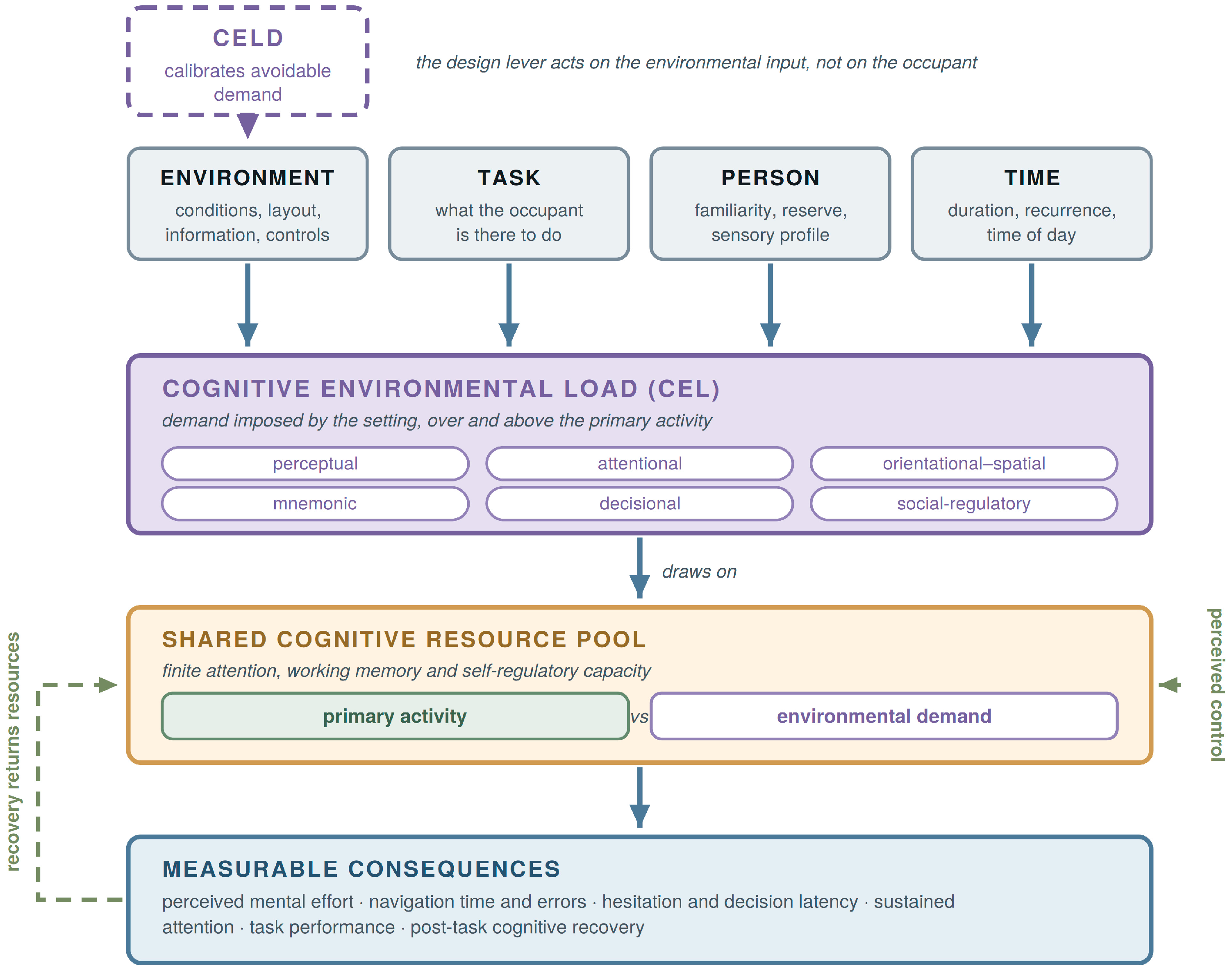
For hypothesis generation, environmental cognitive demand can be decomposed into six partially overlapping domains (Table 1). We propose these as an initial taxonomy for empirical testing, explicitly not as a validated factor structure; establishing whether they are separable, and whether they form a higher-order construct, is the first task of the research agenda in Section 7. Self-regulation is not treated as a seventh domain. The effortful control an occupant exerts to stay on task, such as inhibiting distraction, tolerating discomfort and regulating arousal, is the shared executive resource on which all six domains draw, and it therefore sits on the resource side of the framework (Figure 1); its interpersonal component, managing privacy, proximity and interruption, is captured by social-regulatory load. Perceived control and recovery are not domains either: control moderates the cost of a given demand (Section 3.4), and recovery restores the resource on which the domains draw.
Table 1.
A provisional taxonomy of cognitive environmental load domains. D, demand-side indicator describing the setting, measurable or modelled without reference to occupant performance; O, outcome indicator used to validate that demand, not to define it.
Figure 1.
Cognitive environmental load (CEL) as a relational construct. CEL is not a fixed attribute of a space: it emerges from the interaction of environmental conditions, task demands, occupant characteristics and the temporal structure of the occupancy. It is expressed across six partially overlapping demand domains, which draw on the same finite pool of resources as the occupant’s primary activity, and which produce measurable consequences for effort, performance and recovery. Cognitive Environmental Load Design (CELD) intervenes on the environmental inputs, calibrating avoidable demand rather than minimising stimulation. Recovery opportunities return resources to the pool; perceived control moderates the cost of any given demand.
The domains are motivated by the antecedent literature rather than derived from data: perceptual and attentional load from environmental overload and restoration research and from work on visual discomfort and image statistics [5,6,7,25,26,34]; orientational load from wayfinding [12,13,14,15,17]; mnemonic and decisional load from cognitive ergonomics and interface research [4,16]; and social-regulatory load from work on privacy and interruption in open-plan settings [38,39].
Table 1 keeps the two kinds of indicators apart. Demand-side indicators (D) describe the setting and can be measured or modelled from drawings, images or acoustic simulation before anyone occupies it; outcome indicators (O), such as performance, errors, latency and effort ratings, are the criteria against which those demands are validated. Only the former enter the definition of CEL; using the latter to define it would make validation circular (Section 3.1).
3.3. CEL Is Relational, Not a Property of Space
The single most important claim in this framework is also the one that most complicates its measurement: CEL is not a fixed attribute of a room. It emerges from the interaction of environmental conditions, task demands, exposure duration and frequency, familiarity, perceived control, individual characteristics, and the cognitive resources the occupant happens to have available (Figure 1).
The same corridor is nearly free for a nurse who has walked it for six years and expensive for a visitor arriving in distress. The same acoustic environment is tolerable during routine work and costly during a task requiring sustained concentration. The same building is manageable at nine in the morning and depleting at four in the afternoon. Duration matters in its own right: an environment that is trivially manageable for ten minutes can become burdensome across an eight-hour occupancy, which is precisely the exposure pattern that ordinary buildings impose and that most experimental studies do not reproduce.
This relational character is not a weakness to be engineered away by better instrumentation. It is the substantive claim. A framework that assigned a fixed cognitive cost to a floor plan would be making a different, and we think false, assertion.
3.4. Loss-of-Control Burden
A further candidate mechanism deserves separate statement, because it does not reduce to information quantity. The same sensory exposure is experienced differently when an occupant can modify it, leave it, or choose an alternative setting than when the condition is effectively uncontrollable.
The demand–control tradition in occupational research established that controllability moderates the strain produced by a given level of demand [40], and appraisal theory supplies the mechanism: the same objective condition is evaluated against the coping options the person believes they have [41]. Adaptive thermal comfort research reached a convergent conclusion from building science, showing that occupants with the means to act on their environment tolerate a wider range of conditions [42], and environmental psychology has long identified control and predictability among the principal determinants of the health effects of architecture [38].
CEL may therefore increase not only because more information must be processed, but because the occupant must continuously monitor, tolerate or compensate for conditions they cannot change. This reinforces the temporal character of the construct: cognitive demand should be interpreted relative to exposure duration, recurrence and the availability of recovery, rather than as an instantaneous property. Within the framework, perceived control is therefore a moderator of the cost of any given demand, and loss of control a cross-domain mechanism that adds monitoring and compensatory demand; neither is a domain. Recovery has a parallel but distinct status: it is a resource restoration mechanism that returns capacity to the shared pool (Figure 1), and access to it is a contextual property of the setting.
4. From CEL to CELD: The Design Position
4.1. Calibrated Demand, Not Minimum Stimulation
The most likely misreading of this framework is that it recommends quiet, plain, low-stimulation environments. It does not, and the distinction matters enough to state plainly.
Complexity can be informative, engaging, meaningful and restorative. Environments that support fascination and extent are restorative precisely because they offer something to attend to [6,7]. Formal richness in architectural interiors produces measurable positive psychological and neural responses [24]. Work on visual geometry points the same way: the cost of visual information depends less on its quantity than on its organisation, with ordered, nature-like complexity processed fluently and preferred, and disordered or repetitive high-contrast patterning associated with discomfort and higher neural cost [26,27,28], while environments stripped of organised complexity have been argued to offer insufficient stimulation, particularly to children [43]. Vegetation structure and multi-sensory variety are associated with better psychophysiological recovery, not worse [22]. A framework that treated all environmental information as cost would recommend the corridor over the courtyard, which is the opposite of what the evidence supports.
The design objective is therefore calibrated cognitive demand: reducing processing that serves no purpose, while preserving the forms of complexity that support orientation, engagement, learning, social contact and recovery.
4.2. Functional and Non-Functional Complexity
The operative distinction is not how much information a setting contains, but whether that information does work for the occupant. Richness, novelty and stimulation are not intrinsically burdensome when they communicate something useful, support engagement, or match the activity being performed. Cognitive cost becomes relevant when complexity is ambiguous (it could mean several things), redundant (it repeats what is already known), conflicting (it points in incompatible directions), or irrelevant (it bears no relation to what the occupant is trying to do).
A wall of varied natural materials and a wall of competing signage may carry similar visual complexity by any information-theoretic measure and impose very different costs. Distinguishing the two empirically—rather than assuming it—is one of the more tractable early tests of this framework.
To avoid circularity, the classification must be made before, and independently of, the outcome it is meant to predict. Two routes are available. The first is task-referenced coding: for a specified occupant group and activity, each information-bearing element, whether a sign, display, pattern or sound source, is coded as functional if task analysis shows it is needed for the activity, for orientation or for safety, and as non-functional otherwise, by raters blind to outcome data and with inter-rater agreement reported. The second is structure-referenced: the visual-complexity literature supplies stimulus-side measures that distinguish organised from disorganised complexity without reference to performance, including deviation of the spatial-frequency spectrum from natural-scene statistics, fractal dimension, and the hierarchical and symmetric ordering of detail across scales [25,27,31,34]. Both classifications can be pre-registered, so that a study tests whether the categories predict demand rather than defining them by it.
4.3. The Cognitive Load Budget
A useful working metaphor is a budget. Primary activities—learning, clinical decision-making, working, caregiving, navigating, recovering from illness—already consume cognitive resources. Environmental demands draw on the same finite capacity. A cognitively supportive building is therefore one that does not spend a disproportionate share of the occupant’s resources on the effort of understanding, tolerating or adapting to the setting itself.
The metaphor should not be over-extended. We do not claim a single scalar quantity that can be measured and allocated, and Section 7.1 explains why building such an index prematurely would be a mistake. The budget is a way of framing the design question, not a proposed unit of account.
4.4. Candidate Design Principles
Table 2 sets out candidate principles, each linked to the load domain it primarily addresses and to parameters through which it could be specified and checked. They are offered as hypotheses about what should reduce avoidable demand, not as validated guidance, and several overlap substantially with established practice in environmental psychology, cognitive ergonomics and universal design. The proposed contribution is the organising logic, not the individual items. The parameters in the fourth column are candidates rather than recommendations: they are quantities a design team can already measure or model, offered so that the principles can be argued about in the terms in which buildings are actually specified. None has a validated threshold, and establishing whether any of them predicts measured demand is part of the agenda in Section 7.
Table 2.
Candidate CELD principles and the load domains or mechanisms they target.
4.5. Environmental Usability
CELD extends the idea of usability from interfaces to inhabited space. A building can be fully accessible in the regulatory sense—dimensionally compliant, barrier-free—and still be cognitively expensive if its organisation, controls, routes, social expectations or sensory hierarchy must be inferred rather than read.
This is not a marginal case. It is the ordinary condition of large hospitals, transport interchanges, universities and civic buildings, and it falls hardest on the occupants with the least cognitive reserve to spare: people who are unwell, unfamiliar, distressed, elderly, or living with cognitive impairment [15].
5. Illustrative Reinterpretations of Existing Evidence
We have no primary data of our own, and the two examples below are illustrative reinterpretations of published studies that were not designed to test cognitive environmental load; they are not empirical demonstrations of the framework. Their purpose is limited: to show what the taxonomy does to evidence that already exists, and to demonstrate that demand-side environmental characteristics are consequential at magnitudes worth designing for.
5.1. A Classroom, Where the Evidence Already Shows Calibration Rather than Minimisation
A multi-level analysis of 153 classrooms in 27 schools, covering 3766 pupils, found that seven design parameters together explain 16% of the variation in pupils’ academic progress over a year [44]. The result that matters most here is not the headline share but its shape. The relationship between the room’s overall level of stimulation—display density, colour, visual diversity—and learning was curvilinear: only at an intermediate level of stimulation did the room have a positive effect, with both under-stimulation and over-stimulation associated with worse outcomes [44]. A controlled classroom study points the same way: when the walls of a kindergarten classroom were heavily decorated, children were more distracted by the visual environment, spent more time off task and showed smaller learning gains than when the decorations were removed [45].
Reading through the taxonomy, that result decomposes. Perceptual load is set by display density and colour diversity, which determine how much sensory information competes for selection. Attentional load follows from it: wall displays that are irrelevant to the current lesson must be actively suppressed by pupils whose inhibitory control is still developing. The remaining domains are comparatively quiet in a single familiar room—orientational and mnemonic demand fall away once the space is known, decisional load is carried largely by the teacher, and social-regulatory demand is governed by seating and sightlines rather than by the envelope.
What CELD adds is not a new finding but an interpretation with a design consequence. A curvilinear result is awkward to state in the vocabulary of environmental quality, which is built around thresholds and monotonic better-or-worse. It is, however, exactly what a calibration account predicts. Displays carrying information the current task needs are functional complexity and should not be counted as load; the same displays after the topic has moved on are non-functional, and an ordinary classroom has no mechanism for retiring them. The design response that follows is not less colour but a means of varying what is displayed at the tempo at which its relevance changes.
5.2. A Hospital, Where the Load Is Not Absorbed by the Building
A survey of 301 staff across US hospitals, predominantly nursing personnel (71.4% registered nurses and a further 10.0% licenced practical, vocational or advanced-practice nurses) with smaller shares of support and administrative staff, patient-care technicians, physicians and others, found that each spent a mean of 31.8 min per week—median 15—helping other people find their way. Applying this figure to the US nursing workforce only, the authors extrapolate to approximately 98 million nursing hours annually, equivalent to some 51,000 full-time positions, or 25,500 using the median, and describe the estimate as conservative because non-nursing staff who also assist visitors are not counted [46].
Two things follow. The first is that orientational demand in a large, unfamiliar, multi-level building is high enough that a substantial share of occupants cannot meet it unaided. The second is more useful for design: when the building does not carry that demand, the demand does not disappear. It is transferred—to staff, whose time is among the most expensive resources in the building, and whose own primary activity is clinical.
That transfer is the clearest available illustration of why cognitive demand belongs in building performance rather than only in occupant experience. It has a unit, it has a magnitude, and it lands on an operating budget. The parameters that bear on it are partly known: signage and floor-plan configuration jointly determine wayfinding accuracy [23], and the wayfinding literature supplies the decision point vocabulary in which both are specified (see Table 3) [12,13,14].
Table 3.
Illustrative reinterpretation: the six domains read across two documented settings, with the design parameters that bear on each.
The other domains compound the problem for the same occupant. A patient arriving for an outpatient appointment is typically unwell, anxious and unfamiliar with the building—three conditions that each reduce available resources—while perceptual load at the entrance is high, mnemonic load is imposed by a route that must be reversed on the way out, and social-regulatory load is the effort of judging whom it is acceptable to ask.
5.3. What These Illustrative Reinterpretations Do and Do Not Establish
Neither study measured cognitive environmental load, and neither was designed to. Their value here is confined to three points: demand-side environmental characteristics predict outcomes at magnitudes worth designing for; the relationship can be non-monotonic, which a threshold-based account of environmental quality cannot represent; and the demand the building fails to absorb is displaced onto other occupants at a cost that can be counted. A test of the construct itself requires the studies set out in Section 7, in which the environment is manipulated and the demand measured directly rather than inferred.
6. Boundary Conditions: What CELD Is Not
Framework papers accumulate credibility by stating what their construct excludes. Five exclusions are as follows:
CELD is not a rating system or a credit. No score is proposed, and Section 7.1 argues against constructing one until validation has been done.
CELD is not a claim that less stimulation is better. See Section 4.1. A setting can fail by being under-stimulating, illegible in its blankness, or offering nothing to restore attention.
CELD is not a relabelling of indoor environmental quality. IEQ concerns exposures—pollutants, temperature, illuminance, sound level—measured at the environment. CEL concerns demand on the occupant, and is not derivable from exposure measurements alone. The two interact: thermal discomfort, poor air quality, noise and poorly timed light may reduce the resources available for the primary task [38,47,48,49,50], which is a reason to study them together rather than to merge them.
CELD is not a substitute for the physiological account. Cognitive demand is one pathway among several through which built environments affect health, and it operates alongside neuroendocrine, autonomic and circadian mechanisms [50,51,52,53]. We take up that relationship in Section 9.
CELD is not established. Nothing in this Perspective should be cited as evidence that cognitive environmental load has been measured, validated, or shown to predict anything.
7. A Measurement and Validation Agenda
7.1. Sequencing: No Composite Index Yet
The strongest temptation this framework creates is to build a CEL index. It should be resisted until the groundwork is done, for the same reason that composite indices in adjacent fields have proved difficult to interpret: a score computed from dimensions that have not been shown to be separable, additive, or related to any outcome tells the user nothing they can act on, while conferring an unearned appearance of measurement.
The sequence we propose is: establish content validity of the six domains; test whether they are empirically separable; establish discriminant validity from neighbouring constructs; demonstrate incremental predictive value over existing measures; and only then examine whether a stable higher-order construct—and hence an index, or the mapping and zoning tools it would enable—is justified.
A prior question bears on that last step: whether the six domains are expected to behave as reflective indicators of a higher-order latent construct or as formative components that jointly constitute it. Our working expectation is formative. The domains have different environmental causes, since a building can be highly legible yet acoustically demanding, and there is no reason for them to covary across settings; high internal consistency is therefore neither expected nor required, and dropping a domain would change the meaning of the construct [54]. Under this specification, validation should rest on content coverage, collinearity diagnostics and relations with external criteria, for example through multiple-indicator multiple-cause models, rather than on reflective factor-analytic fit. A reflective account remains plausible at the level of the occupant, if the domains draw on a common pool of executive resources; the two specifications make different predictions and should be compared directly rather than assumed.
7.2. Construct and Discriminant Validity
CEL must be shown to differ from constructs that already exist. Table 4 names the principal candidates and the test that would distinguish CEL from each. Failing several of these tests would be strong evidence that CEL is a new name for old findings. The candidates are the constructs with which CEL overlaps most, because the contribution claimed is integrative: CEL is expected to add explanatory value only to the extent that demands currently measured separately combine, across domains and over an occupancy, in ways that none of these constructs captures alone. Extraneous cognitive load in the instructional sense [2,3,4] is closest to the mental workload row, but it is defined on the materials of a task, whereas CEL is defined on the setting in which the task takes place.
Table 4.
Discriminant validity: what CEL must add beyond neighbouring constructs.
7.3. Candidate Measures
Measurement should combine subjective, behavioural and physiological channels, and should not privilege the physiological simply because it is harder to obtain. Candidate subjective measures include perceived mental effort, perceived control and adapted workload instruments [16]. Candidate behavioural measures include navigation time and errors, hesitation events, decision latency, choice reversals, recall accuracy, sustained-attention performance and interruption counts. Candidate physiological measures include eye tracking and pupillometry, electroencephalography, heart-rate variability and electrodermal activity, used where exposure-specific evidence supports their interpretation rather than as a default battery. Recent work demonstrates both the feasibility of such multimodal approaches in architectural settings and the continuing need for real-world validation [18,19,24].
Two design requirements follow from Section 3.3. Studies must manipulate or measure task alongside environment, since CEL is defined relationally; and they must extend over realistic durations, since an effect that appears only after several hours of occupancy will not be detected in a twenty-minute laboratory session.
The relational definition also indicates how environmentally imposed demand can be separated from task workload and from individual capacity. Because CEL is defined as demand over and above the primary activity, the primary estimate is a contrast: the same task, performed by the same occupants, in settings that differ on specified demand-side characteristics. Within-participant designs that cross task difficulty with environmental condition allow task workload (the main effect of task), environmental load (the main effect of setting) and their interaction to be estimated separately, while individual capacity, including working-memory span, familiarity, sensory sensitivity and prior fatigue, is measured at baseline and entered as a covariate or moderator rather than left to confound the environmental effect. CEL is then evidenced by the setting effect and its interactions with task and person, not by overall effort or performance.
7.4. Directional Hypotheses to Test First
A first validation programme could test the following without presupposing an index:
- Non-functional environmental complexity increases mental effort and error rates, while functional complexity of equivalent magnitude does not.
- Greater perceived control attenuates the effect of otherwise identical environmental demands.
- Higher spatial legibility reduces navigation time and errors, with familiarity held constant.
- Simultaneous low-level demands produce greater cognitive cost when they compete with a demanding primary task than when the primary task is undemanding.
- Individual characteristics and familiarity moderate all of the above.
- Access to lower-demand or restorative settings accelerates post-task cognitive recovery.
7.5. What Would Falsify CELD
The framework should be abandoned, or substantially rebuilt, if: the six domains prove empirically inseparable and collapse to a single dimension already captured by mental workload; CEL measured on the demand side fails to predict effort, error or recovery beyond IEQ, restorativeness and workload measures; the functional/non-functional complexity distinction cannot be operationalised or shows no differential effect; or person-by-task-by-environment interactions prove negligible, which would mean the relational claim in Section 3.3 is wrong and a simpler fixed-property account is adequate.
8. Distributional Questions
Nominally identical environments may require substantially different cognitive effort from different occupants to reach the same level of functioning. This is not a footnote to the framework; it is one of the main reasons to develop it.
Familiarity, age, sensory acuity, cognitive reserve, language, cultural expectations about spatial and social conventions, and neurodivergence all shift the cost of a given setting. Design guidance developed for autistic occupants, for example, has argued that sensory-calibrated environments improve functioning in ways that conventional accessibility standards do not address [55], visual-stress analysis of family and domestic violence refuges has identified high-contrast linear elements as common potential stressors for trauma-exposed occupants [35], and wayfinding research on dementia shows how sharply orientational demand falls on those least able to absorb it [15]. An environment that is unremarkable for a rested, familiar, neurotypical adult may be effectively unusable for someone else—while passing every applicable standard.
CELD therefore implies a distributional research question alongside the average one: not only how much demand a setting creates, but for whom, and with what consequences for their ability to work, learn, receive care or recover. Reporting only mean effects across convenience samples would miss the point of the construct.
9. Relation to Stress Regulation and to Assessment Frameworks
CEL is one demand pathway among several through which built environments influence health and functional capacity. Environmental conditions can converge on conserved neuroendocrine, autonomic and circadian systems, and repeated activation or incomplete recovery contributes to cumulative physiological cost [51,52]; recent conceptual work has connected architectural stressors to these pathways explicitly [32,53], including possible epigenetic consequences of chronic exposure [56], and pilot neurophysiological work has begun to test them for biophilic design [57]. Cognitive demand interacts with this: thermal discomfort, poor air quality and noise reduce the resources available for the primary task [47,48,49], while uncontrollable noise produces stress-related after-effects even where immediate task performance is preserved [39].
In a companion Perspective we propose stress-regulating capacity (SRC) as a system-level property of the person–built-ecosystem relationship, within which cognitive environmental load appears as one demand pathway at the person–environment interaction level [58]. The two constructs are logically independent: CELD could prove useful even if SRC does not, and SRC could be validated without CELD. Readers interested in the broader physiological framing will find it there; the present paper is concerned with the cognitive pathway in its own right.
The relation to building assessment frameworks is complementary rather than competitive. Existing systems certify what a building provides, across increasingly comprehensive domains [1], and there is no proposal here to add a credit or a score. What CELD offers, if it survives validation, is a different question to ask of a design at the point when it can still be changed: not only whether the environment supplies what its occupants need, but whether it spends more of their attention than the activity it houses can afford. That is precisely the class of question the translational strand of architectural-cognition research has argued design teams currently lack the constructs and tools to pose [36].
10. Conclusions
Buildings are usually assessed by what they give. This Perspective has argued that they should also be assessed by what they take: the perceptual, attentional, orientational, mnemonic, decisional and social-regulatory work that occupants must do simply to inhabit a setting effectively, and that competes with the work they are actually there to do.
Stated plainly, the claim is this. Every building asks its occupants to do some mental work simply to use it: to notice and filter what they see and hear, to work out where they are and where to go, to remember how things work, to make small choices, and to manage being seen and heard by others. Some of that work is unavoidable and some of it is useful. The share that is neither, imposed by an illegible plan, by information that is ambiguous, redundant, conflicting or irrelevant, by visual patterns the eye processes inefficiently, or by conditions occupants cannot control, is what we call avoidable cognitive environmental load. It is produced by design decisions, it competes with the activity the building exists to house, and it falls hardest on those with the least capacity to spare. That geometry and visual information carry such a cost is not a new suggestion: it is supported by work on visual discomfort and its neural cost [25,26,34], on classroom decoration and children’s attention [45], and on architecturally mediated stress [32,33,59].
We have defined cognitive environmental load on the demand side, deliberately separating it from the outcomes it is meant to predict; proposed a six-domain taxonomy as a testable starting point rather than a validated structure; argued that the construct is relational, emerging from environment, task, person and time together; set out design principles that follow from calibration rather than minimisation; and specified a validation sequence that postpones any composite index until the prior questions have been answered. We have also stated what would falsify the framework.
Whether CELD earns a place in building research depends on questions that this paper cannot settle. If cognitive environmental load turns out to be inseparable from mental workload, or to add nothing to what indoor environmental quality and restorativeness measures already predict, the construct should be dropped. If it does add explanatory value—and particularly if it explains why nominally equivalent environments cost different occupants such different amounts—then it would bring together, in a single design-facing account, demands that existing assessment frameworks currently address separately or only in part.
For an architect commissioned to design a school, the framework reduces to five questions that can be asked at each design review with drawings and images already available: (i) can a new pupil or visitor go from the entrance to any classroom and back with few decision points, visible destinations and distinct landmarks; (ii) does classroom wall space carry what the current lesson needs, with free wall area and an easy way to change or remove displays as topics move on, rather than permanent dense decoration [44,45]; (iii) are surface patterns, finishes and façades ordered and nature-like rather than repetitive high-contrast stripes or random clutter [26,34]; (iv) are noisy and quiet activities zoned apart, with a quiet or outdoor space a short walk from every classroom; and (v) can teachers adjust light, temperature, ventilation and sound locally and see the effect immediately. None of these questions is new taken alone. What CELD adds is the instruction to ask them together, for the pupils and teachers who will actually use the building, and over a whole school day rather than a single visit.
Author Contributions
Conceptualisation, F.L., A.M. and E.G.; methodology, F.L., A.M. and E.G.; investigation, F.C., F.L., M.M., D.M., R.W., D.G., A.M. and E.G.; resources, F.C., F.L., M.M., D.M., R.W. and D.G.; writing—original draft preparation, A.M. and E.G.; writing—review and editing, F.C., F.L., M.M., D.M., R.W., D.G., A.M. and E.G.; visualisation, E.G.; supervision, A.M. and E.G.; project administration, A.M. and E.G. All authors have read and agreed to the published version of the manuscript.
Funding
This research received no external funding.
Institutional Review Board Statement
Not applicable. This Perspective did not involve human subjects or animals.
Informed Consent Statement
Not applicable.
Data Availability Statement
No new data were created or analysed in this study. Data sharing is not applicable to this article. All sources supporting the arguments presented are cited in the reference list.
Acknowledgments
During the preparation of this manuscript, the authors used ChatGPT 6.1 Sol (OpenAI) and Claude Opus 5.5 (Anthropic) for the purposes of prose editing and structural feedback. The authors have reviewed and edited the output and take full responsibility for the content of this publication. All scientific content, interpretive arguments, and analytical judgments are the authors’ own.
Conflicts of Interest
F.C., A.M. and M.M. are affiliated with Green Building Council Italia, an organisation that develops and administers building certification protocols. D.G., A.M., R.W. and E.G. are affiliated with the Italian Academy of Biophilia, which promotes the application of biophilic principles in the built environment. F.L., D.G., A.M., D.M., R.W. and E.G. are affiliated with the Italian Society of Environmental Medicine, and D.M. with Healthy Habits Academy. Because this Perspective argues that the cognitive demands a building imposes on its occupants should become an explicit object of design and, in due course, of assessment, the authors declare these institutional affiliations as potential non-financial competing interests. No author receives income or other remuneration contingent on the adoption of cognitive environmental load, of biophilic criteria, or of any related construct in any building assessment or certification scheme. Consistent with this, the manuscript explicitly declines to propose a composite index, rating or certification criterion, and states the conditions under which the construct would have to be abandoned. The organisations listed had no role in the construction of the argument, in the selection or interpretation of the cited literature, in the writing of the manuscript, or in the decision to publish. A companion Perspective by the same authors, setting out the stress-regulation framework within which the present construct is positioned, will be submitted; the two manuscripts share authorship and conceptual framing but report no shared data.
References
- Wei, W.; Wargocki, P.; Zirngibl, J.; Bendžalová, J.; Mandin, C. Review of parameters used to assess the quality of the indoor environment in Green Building certification schemes for offices and hotels. Energy Build. 2020, 209, 109683. [Google Scholar] [CrossRef] [Scilit]
- Sweller, J. Cognitive load during problem solving: Effects on learning. Cogn. Sci. 1988, 12, 257–285. [Google Scholar] [CrossRef]
- Sweller, J.; van Merriënboer, J.J.G.; Paas, F. Cognitive architecture and instructional design: 20 years later. Educ. Psychol. Rev. 2019, 31, 261–292. [Google Scholar] [CrossRef] [Scilit]
- Paas, F.; Tuovinen, J.E.; Tabbers, H.; Van Gerven, P.W.M. Cognitive load measurement as a means to advance cognitive load theory. Educ. Psychol. 2003, 38, 63–71. [Google Scholar] [CrossRef] [Scilit]
- Milgram, S. The experience of living in cities. Science 1970, 167, 1461–1468. [Google Scholar] [CrossRef] [Scilit]
- Kaplan, S. The restorative benefits of nature: Toward an integrative framework. J. Environ. Psychol. 1995, 15, 169–182. [Google Scholar] [CrossRef] [Scilit]
- Kaplan, R.; Kaplan, S. The Experience of Nature: A Psychological Perspective; Cambridge University Press: Cambridge, UK, 1989. [Google Scholar]
- Berto, R. Exposure to restorative environments helps restore attentional capacity. J. Environ. Psychol. 2005, 25, 249–259. [Google Scholar] [CrossRef] [Scilit]
- Berman, M.G.; Jonides, J.; Kaplan, S. The cognitive benefits of interacting with nature. Psychol. Sci. 2008, 19, 1207–1212. [Google Scholar] [CrossRef] [Scilit]
- Hartig, T.; Korpela, K.; Evans, G.W.; Gärling, T. A measure of restorative quality in environments. Scand. Hous. Plan. Res. 1997, 14, 175–194. [Google Scholar] [CrossRef] [Scilit]
- Ulrich, R.S.; Simons, R.F.; Losito, B.D.; Fiorito, E.; Miles, M.A.; Zelson, M. Stress recovery during exposure to natural and urban environments. J. Environ. Psychol. 1991, 11, 201–230. [Google Scholar] [CrossRef] [Scilit]
- Lynch, K. The Image of the City; MIT Press: Cambridge, MA, USA, 1960. [Google Scholar]
- Weisman, J. Evaluating architectural legibility: Way-finding in the built environment. Environ. Behav. 1981, 13, 189–204. [Google Scholar] [CrossRef] [Scilit]
- Wiener, J.M.; Büchner, S.J.; Hölscher, C. Taxonomy of human wayfinding tasks: A knowledge-based approach. Spat. Cogn. Comput. 2009, 9, 152–165. [Google Scholar] [CrossRef] [Scilit]
- Marquardt, G. Wayfinding for people with dementia: A review of the role of architectural design. HERD 2011, 4, 75–90. [Google Scholar] [CrossRef] [Scilit]
- Hart, S.G.; Staveland, L.E. Development of NASA-TLX (Task Load Index): Results of empirical and theoretical research. Adv. Psychol. 1988, 52, 139–183. [Google Scholar] [CrossRef] [Scilit]
- Nori, R.; Zucchelli, M.M.; Palmiero, M.; Piccardi, L. Environmental cognitive load and spatial anxiety: What matters in navigation? J. Environ. Psychol. 2023, 88, 102032. [Google Scholar] [CrossRef] [Scilit]
- Núñez Ávila, A.G.; Quizhpi Campoverde, L.M.; Macas Aguilar, K.Y.; Maza Parapi, A.J.; Rodriguez Zúñiga, A.P.; Cedillo, P. Neuroscience-informed approaches in architectural design: A systematic review of cognitive measures and interactive technologies from an HCI perspective. Front. Comput. Sci. 2026, 8, 1819538. [Google Scholar] [CrossRef] [Scilit]
- Luo, K.; Wei, D.; Kang, J.; Fei, Y. Evaluation models of environmental cognitive performance in the indoor visual environments of care facilities for older adults. Build. Environ. 2026, 294, 114380. [Google Scholar] [CrossRef] [Scilit]
- Morales, C. Environmental load in biology classrooms: Attention, technology, and cognitive access in science education. J. Microbiol. Biol. Educ. 2026, 27, e00137-26. [Google Scholar] [CrossRef] [Scilit]
- Cohen, S. Environmental load and the allocation of attention. In Advances in Environmental Psychology, Volume 1: The Urban Environment; Baum, A., Singer, J.E., Valins, S., Eds.; Lawrence Erlbaum Associates: Hillsdale, NJ, USA, 1978. [Google Scholar]
- Fan, X.; Hu, D.; Fan, Y.; Yang, J.; Liang, H.; Gao, T.; Qiu, L. Urban restorative environments: The critical role of building density, vegetation structure, and multi-sensory stimulation in psychophysiological recovery. Build. Environ. 2025, 281, 113190. [Google Scholar] [CrossRef] [Scilit]
- O’Neill, M.J. Effects of signage and floor plan configuration on wayfinding accuracy. Environ. Behav. 1991, 23, 553–574. [Google Scholar] [CrossRef] [Scilit]
- Coburn, A.; Vartanian, O.; Kenett, Y.N.; Nadal, M.; Hartung, F.; Hayn-Leichsenring, G.U.; Navarrete, G.; González-Mora, J.L.; Chatterjee, A. Psychological and neural responses to architectural interiors. Cortex 2020, 126, 217–241. [Google Scholar] [CrossRef] [Scilit]
- Penacchio, O.; Wilkins, A.J. Visual discomfort and the spatial distribution of Fourier energy. Vis. Res. 2015, 108, 1–7. [Google Scholar] [CrossRef] [Scilit]
- Le, A.T.D.; Payne, J.; Clarke, C.; Kelly, M.A.; Prudenziati, F.; Armsby, E.; Penacchio, O.; Wilkins, A.J. Discomfort from urban scenes: Metabolic consequences. Landsc. Urban Plan. 2017, 160, 61–68. [Google Scholar] [CrossRef] [Scilit]
- Taylor, R.P.; Spehar, B. Fractal fluency: An intimate relationship between the brain and processing of fractal stimuli. In The Fractal Geometry of the Brain; Di Ieva, A., Ed.; Springer: New York, NY, USA, 2016; pp. 485–496. [Google Scholar] [CrossRef] [Scilit]
- Coburn, A.; Kardan, O.; Kotabe, H.; Steinberg, J.; Hout, M.C.; Robbins, A.; MacDonald, J.; Hayn-Leichsenring, G.; Berman, M.G. Psychological responses to natural patterns in architecture. J. Environ. Psychol. 2019, 62, 133–145. [Google Scholar] [CrossRef] [Scilit]
- Salingaros, N.A.; Sussman, A. Biometric pilot-studies reveal the arrangement and shape of windows on a traditional façade to be implicitly “engaging”, whereas contemporary façades are not. Urban Sci. 2020, 4, 26. [Google Scholar] [CrossRef] [Scilit]
- Lavdas, A.A.; Salingaros, N.A.; Sussman, A. Visual attention software: A new tool for understanding the “subliminal” experience of the built environment. Appl. Sci. 2021, 11, 6197. [Google Scholar] [CrossRef] [Scilit]
- Lavdas, A.A.; Salingaros, N.A. Architectural beauty: Developing a measurable and objective scale. Challenges 2022, 13, 56. [Google Scholar] [CrossRef] [Scilit]
- Valentine, C. Architectural allostatic overloading: Exploring a connection between architectural form and allostatic overloading. Int. J. Environ. Res. Public Health 2023, 20, 5637. [Google Scholar] [CrossRef] [Scilit]
- Valentine, C. The impact of architectural form on physiological stress: A systematic review. Front. Comput. Sci. 2024, 5, 1237531. [Google Scholar] [CrossRef] [Scilit]
- Valentine, C.; Wilkins, A.J.; Mitcheltree, H.; Penacchio, O.; Beckles, B.; Hosking, I. Visual discomfort in the built environment: Leveraging generative AI and computational analysis to evaluate predicted visual stress in architectural façades. Buildings 2025, 15, 2208. [Google Scholar] [CrossRef] [Scilit]
- Mitcheltree, H.; Valentine, C.; Hosking, I.; Wilkins, A.; Sunikka-Blank, M.; Steemers, K. Investigating visual stress within family and domestic violence refuges in Australia. Front. Archit. Res. 2026, 15, 54–69. [Google Scholar] [CrossRef] [Scilit]
- Hölscher, C.; Gregorians, L.; Aguilar, L.; Anklesaria, F.; Baur, R.; Jamaluddin, A.; Zhong, Y.; Mavros, P.; Trivic, Z. Architectural cognition in practice: A framework for integrating user cognition evidence into architectural design. Int. J. Smart Sustain. Cities 2025, 2, 2571001. [Google Scholar] [CrossRef] [Scilit]
- O’Neill, M. From computational cognition to neuroarchitecture: Tracing the past and future potential of brain-informed design. Buildings 2026, 16, 478. [Google Scholar] [CrossRef] [Scilit]
- Evans, G.W.; McCoy, J.M. When buildings don’t work: The role of architecture in human health. J. Environ. Psychol. 1998, 18, 85–94. [Google Scholar] [CrossRef] [Scilit]
- Evans, G.W.; Johnson, D. Stress and open-office noise. J. Appl. Psychol. 2000, 85, 779–783. [Google Scholar] [CrossRef] [Scilit]
- Karasek, R.A. Job demands, job decision latitude, and mental strain: Implications for job redesign. Adm. Sci. Q. 1979, 24, 285–308. [Google Scholar] [CrossRef] [Scilit]
- Lazarus, R.S.; Folkman, S. Stress, Appraisal, and Coping; Springer: New York, NY, USA, 1984. [Google Scholar]
- de Dear, R.; Brager, G.S. Developing an adaptive model of thermal comfort and preference. ASHRAE Trans. 1998, 104, 145–167. [Google Scholar]
- Lavdas, A.A.; Salingaros, N.A. Can suboptimal visual environments negatively affect children’s cognitive development? Challenges 2021, 12, 28. [Google Scholar] [CrossRef] [Scilit]
- Barrett, P.; Davies, F.; Zhang, Y.; Barrett, L. The impact of classroom design on pupils’ learning: Final results of a holistic, multi-level analysis. Build. Environ. 2015, 89, 118–133. [Google Scholar] [CrossRef] [Scilit]
- Fisher, A.V.; Godwin, K.E.; Seltman, H. Visual environment, attention allocation, and learning in young children: When too much of a good thing may be bad. Psychol. Sci. 2014, 25, 1362–1370. [Google Scholar] [CrossRef] [Scilit]
- Jamshidi, S.; Hashemi, S.; Tran, D.-M.T. Costs and effects of ineffective wayfinding in US hospitals: A survey of hospital staff. HERD 2025, 18, 259–275. [Google Scholar] [CrossRef] [Scilit]
- Allen, J.G.; MacNaughton, P.; Satish, U.; Santanam, S.; Vallarino, J.; Spengler, J.D. Associations of cognitive function scores with carbon dioxide, ventilation, and volatile organic compound exposures in office workers: A controlled exposure study of green and conventional office environments. Environ. Health Perspect. 2016, 124, 805–812. [Google Scholar] [CrossRef] [Scilit]
- MacNaughton, P.; Satish, U.; Cedeno Laurent, J.G.; Flanigan, S.; Vallarino, J.; Coull, B.; Spengler, J.D.; Allen, J.G. The impact of working in a green certified building on cognitive function and health. Build. Environ. 2017, 114, 178–186. [Google Scholar] [CrossRef] [Scilit]
- Basner, M.; Babisch, W.; Davis, A.; Brink, M.; Clark, C.; Janssen, S.; Stansfeld, S. Auditory and non-auditory effects of noise on health. Lancet 2014, 383, 1325–1332. [Google Scholar] [CrossRef] [Scilit]
- Robertson-Dixon, I.; Murphy, M.J.; Crewther, S.G.; Riddell, N. The influence of light wavelength on human HPA axis rhythms: A systematic review. Life 2023, 13, 1968. [Google Scholar] [CrossRef] [Scilit]
- McEwen, B.S. Protective and damaging effects of stress mediators. N. Engl. J. Med. 1998, 338, 171–179. [Google Scholar] [CrossRef] [Scilit]
- Guidi, J.; Lucente, M.; Sonino, N.; Fava, G.A. Allostatic load and its impact on health: A systematic review. Psychother. Psychosom. 2021, 90, 11–27. [Google Scholar] [CrossRef] [Scilit]
- Valentine, C.; Mitcheltree, H.; Sjövall, I.A.K.; Khalil, M.H. Architecturally mediated allostasis and neurosustainability: A proposed theoretical framework for the impact of the built environment on neurocognitive health. Brain Sci. 2025, 15, 201. [Google Scholar] [CrossRef] [Scilit]
- Jarvis, C.B.; MacKenzie, S.B.; Podsakoff, P.M. A critical review of construct indicators and measurement model misspecification in marketing and consumer research. J. Consum. Res. 2003, 30, 199–218. [Google Scholar] [CrossRef] [Scilit]
- Mostafa, M. Architecture for autism: Autism ASPECTSS™ in school design. Archnet-IJAR 2014, 8, 143–158. [Google Scholar] [CrossRef] [Scilit]
- Valentine, C.; Mitcheltree, H.; Sjövall, I.; Khalil, M.H. Built environment-modulated epigenetics: The epigenetic consequences of architecturally mediated allostatic overload in the built environment. Int. J. Environ. Res. Public Health 2026, 23, 688. [Google Scholar] [CrossRef] [Scilit]
- Valentine, C.; Steffert, T.; Mitcheltree, H.; Steemers, K. Architectural neuroimmunology: A pilot study examining the impact of biophilic architectural design on neuroinflammation. Buildings 2024, 14, 1292. [Google Scholar] [CrossRef] [Scilit]
- Lippi, F.; Capaccioli, F.; Guglielmino, D.; Miani, A.; Mandarini, M.; Mariani, D.; White, R.; Greco, E. Stress-regulating capacity of built ecosystems: Integrating environmental medicine, building science and environmental psychology. Stresses, 2026; submitted.
- Valentine, C. Architecture and public health: From harmful designs to healthy built environments. BMJ 2024, 387, q2773. [Google Scholar] [CrossRef] [Scilit]

Disclaimer/Publisher’s Note: The statements, opinions and data contained in all publications are solely those of the individual author(s) and contributor(s) and not of MDPI and/or the editor(s). MDPI and/or the editor(s) disclaim responsibility for any injury to people or property resulting from any ideas, methods, instructions or products referred to in the content. |
© 2026 by the authors. Licensee MDPI, Basel, Switzerland. This article is an open access article distributed under the terms and conditions of the Creative Commons Attribution (CC BY) license.