


Abstract
Construction on very soft peaty clay remains a major geotechnical challenge due to its high compressibility and low-bearing capacity. The deep mixing method (DMM) is widely adopted for in situ stabilization using cement; however, environmental concerns associated with cement production have driven the search for sustainable alternatives such as geopolymers using low-carbon materials. Existing studies predominantly rely on dried peat, processed precursors such as fly ash or calcined ground rice husk ash (RHA), and high concentrations of alkali activators such as sodium silicate (Na2SiO3) and sodium hydroxide (NaOH), which increase both environmental and economic burdens. This study develops a novel waste-based geopolymer incorporating untreated brick kiln-derived RHA, activated solely with low-concentration NaOH, while completely eliminating Na2SiO3. The avoidance of precursor pre-treatment and Na2SiO3 significantly reduces processing energy, cost, and associated environmental emissions. A systematic investigation was conducted to determine the optimum mixing time for maximizing strength under field-relevant conditions. Mechanical performance was evaluated using unconfined compressive strength tests considering variations in binder content, curing duration (7, 28 days), alkali concentration (6, 3 M), and alkali-to-binder ratio (0.3, 0.5, 0.7). Failure characteristics were examined, and an integrated framework combining cost analysis, life cycle assessment, and grey relation analysis was employed to optimize mix design. The optimized geopolymer achieved 2.2 times higher strength than cement-treated soil, with 25% cost reduction and more than 85% reduction in environmental impact. These findings demonstrate a scalable and sustainable solution for stabilizing highly organic soils, while promoting the valorization of supplementary cementitious materials without energy-intensive preprocessing.
1. Introduction
Increase in population urbanization has enforced geotechnical engineers to utilize problematic soil for civil engineering projects. Among such problematic soils, peaty clay is a very soft soil which characterizes high moisture content, compressibility, organic content and poor strength, which leads to many challenges during engineering applications. Nearly 3% (400 million hectares) of the Earth’s surface is filled with peaty clay [1,2,3]. The prevalence of peaty clay has made it more difficult to neglect such lands in recent years due to scarcity of land. The conventional method to overcome this drawback was to install piles. However, driving piles for moderately loaded structures is not economical. Hence, a ground improvement technique is implemented to improve peaty clay. Ground improvement techniques employed in the field include removal and replacement methods, preloading with soil filling, and installing granular columns. Excavation of peat to replace with new soil is not an eco-friendly method [1,2]. Additionally, preloading the soil fill requires a longer duration [1]. On the other hand, installing granular compaction piles requires additional material and is not possible to implement in highly congested areas due to its vibration. Considering the shortcomings of the aforementioned ground improvement techniques, deep mixing method (DMM) has evolved into an effective approach for stabilizing soft soil-like peaty clay. DMM improves soil directly on-site by mixing with stabilizing agents with minimal vibration and noise. Hence, DMM can be successfully implemented even in metropolitan areas [1,2,3,4].
Numerous research findings have focused on improving soft clay soil using DMM [5,6,7]. However, a detailed study on improving peaty clay using DMM has not been conducted yet. Existing studies mainly aimed at utilizing different binders to improve peaty clay at different curing times [8,9,10,11,12]. Among those, the most widely used binder type to improve peaty clay is cement [1,13,14]. However, incorporation of conventional binders such as cement is not eco-friendly, as it emits nearly 8% to 10% of CO2 during cement production [15]. To minimize CO2 emissions, sustainable binders have become more imperative. Recent studies mainly focus on binders like geopolymer to stabilize soft soil. Geopolymer is a product formed through alkali activation of aluminosilicate-rich industrial byproducts using alkali activators such as sodium hydroxide (NaOH) and sodium silicate (Na2SiO3) [13]. The most widely utilized aluminosilicate materials in soft soil stabilization are ground granulated blast furnace slag (GGBFS) and fly ash [16,17]. Fly ash is no longer regarded as a waste material in many developed countries owing to its extensive utilization across diverse industrial sectors, including cement and concrete production, fertilizer manufacturing, road construction, and soil stabilization [13,18]. In several regions, particularly Europe and Japan, fly ash reutilization rates have reached nearly 100% [18]. Similarly, substantial utilization rates have been reported in China (70.1%), the United States (60.1%), and India (67%) [18]. These high levels of reuse indicate that fly ash has increasingly transitioned from a waste by-product to a valuable secondary resource.
Most geopolymer studies have relied on a combination of sodium silicate (Na2SiO3) and highly concentrated sodium hydroxide (NaOH) as alkaline activators to promote the dissolution of aluminosilicate precursors and enhance geo-polymerization reactions [13,19]. However, growing evidence indicates that alkaline activators constitute the primary contributors to both the economic and environmental burdens of geopolymer systems [20]. For instance, fly ash-based geopolymer-stabilized soils may cost approximately 9–16 times more per unit volume than soils treated with conventional binders, while geopolymer mortars are 13.9–104.9% more expensive than their conventional counterparts [13,20]. Na2SiO3 alone accounts for 39.24–47.95% of the total material cost. Furthermore, Na2SiO3 is responsible for approximately 76% of the total emissions [13,20].
To obtain an optimum outcome with the aforementioned binders, mixing time plays a pivotal role [21]. Mixing time, which governs the degree of homogenization between soil and stabilizing agents, directly influences soil strength. Either insufficient or extended mixing may result in incomplete binder distribution, leading to heterogeneous treatment zones and suboptimal strength enhancement [21]. Conversely, adequate mixing promotes uniform binder–soil interaction and enhances the efficiency of pozzolanic reactions. Despite its practical significance, the influence of mixing time on the performance of DMM remains largely unexplored. Very limited studies explore the effect of mixing time in soft clay [22]. Moreover, previous studies [16,17,23,24] have predominantly focused on the stabilization of dried peat under air-curing conditions, which do not adequately represent in situ field conditions.
In contrast, the present study addresses these limitations by identifying the optimal mix proportion for stabilizing fully saturated peaty clay under water-curing conditions that more closely simulate field-relevant environments. Furthermore, in light of these economic and environmental drawbacks, Na2SiO3 was deliberately excluded from the present study and substituted with waste-derived silica-rich material as an alternative silicate source, thereby enhancing the sustainability and cost-effectiveness of the geopolymer system. Accordingly, rice husk ash (RHA) was employed in this study as an alternative silica source. Waste RHA obtained from steam boilers (rice mills) and power plants (biomass and thermal) has been widely investigated as a supplementary cementitious material in mortar production and for the stabilization of expansive soils [20,25]. However, the potential of waste RHA generated from brick kilns remains largely unexplored in soil stabilization applications [25]. Furthermore, most previous studies have relied on laboratory pre-treatment processes, such as calcination, grinding, and sieving, to enhance the reactivity of RHA prior to its incorporation into soil stabilization systems [20]. These additional processing requirements increase both the economic and environmental costs of RHA utilization. Therefore, the direct use of untreated brick kiln-derived RHA represents a promising yet underexplored approach for developing more sustainable and cost-effective geopolymer-based soil stabilization technologies [13]. Hence, this study aims to determine the effect of mixing time on stabilizing peaty clay using RHA-based geopolymer-stabilized peaty clay.
Moreover, the compressive strength and failure behavior of the optimally mixed geopolymer-stabilized peaty clay was systematically investigated by varying binder content, curing durations (7 and 28 days), alkali concentration (3 M and 6 M), and alkali-to-binder (A/B) ratio (0.3, 0.5, and 0.7). In addition to mechanical performance, the environmental and economic implications of geopolymer-stabilized peaty clay remain largely unexplored in the existing literature [16,17,23,24]. No previous study has undertaken an integrated assessment of strength performance, life cycle environmental impacts, and economic feasibility for geopolymer-stabilized peaty clay. Therefore, this study proposes, for the first time, a comprehensive optimization framework combining life cycle assessment (LCA), cost analysis, and Grey Relational Analysis (GRA) to identify the most sustainable and cost-effective geopolymer mix design for peaty clay stabilization.
2. Materials and Methods
2.1. Materials
2.1.1. Peaty Clay
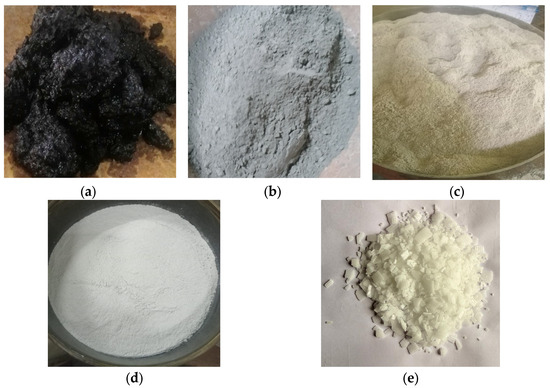
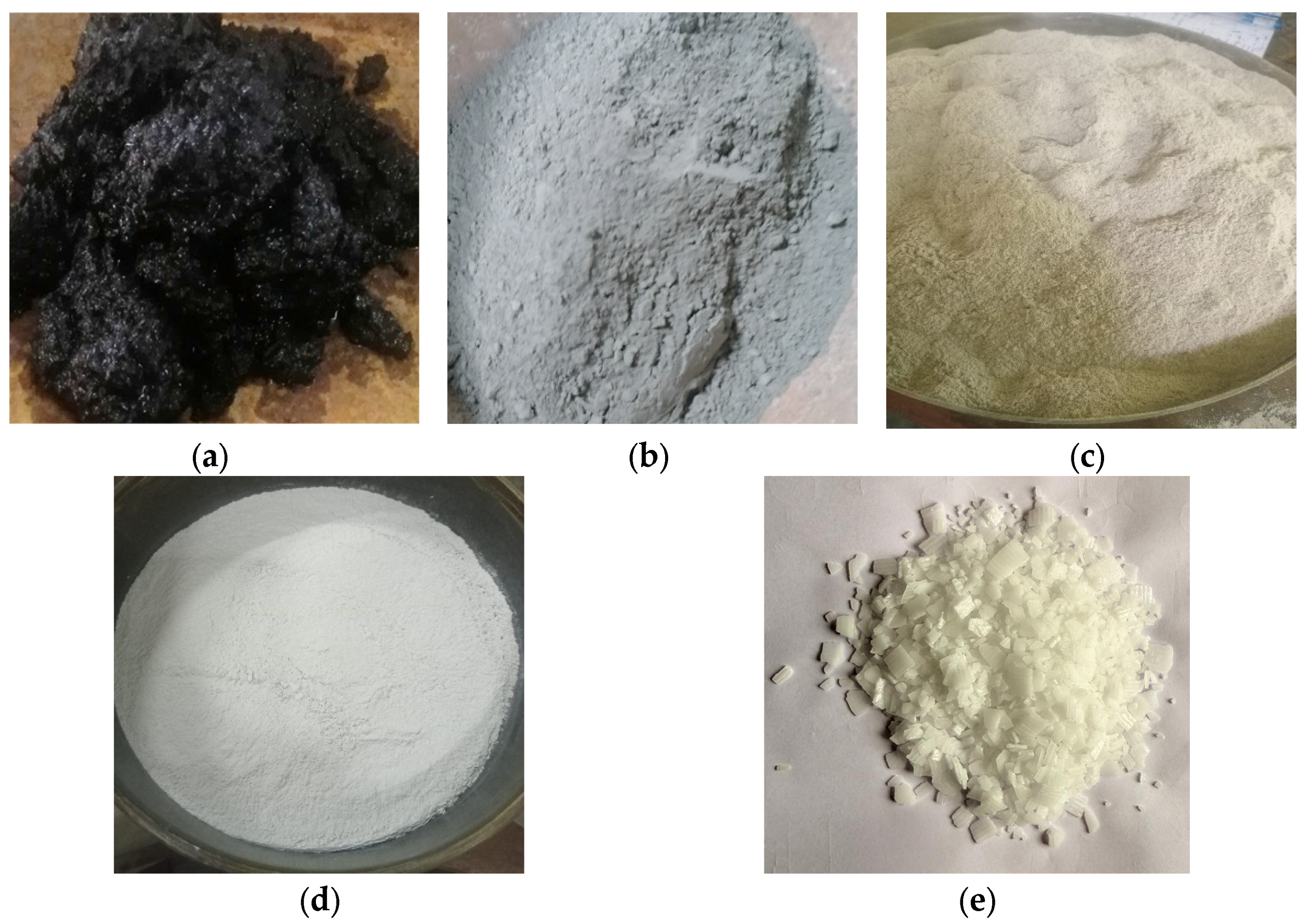
Disturbed soil samples were obtained from a depth of 1.0 m within the Gin River floodplain in Sri Lanka [1,13,14]. To maintain the natural moisture condition of the material, the samples were immediately sealed in airtight containers following extraction. The visual characteristics of the sampled soil are shown in Figure 1a [1]. Comprehensive characterization of the soil conducted following ASTM and BS standards is summarized in Table 1 [1]. According to ASTM D4427 [26], soils containing less than 33% fiber content are classified as sapric peat. As reported by Khandy et al. [16,17], peat typically contains less than 25% ash, which differentiates it from other organic soils. However, the measured ash content of 74.5% substantially exceeds the range commonly reported for peat soils in the literature [16,17]. This indicates that the soil exhibits characteristics intermediate between organic clay and organic silt. Accordingly, the tested soil is designated as peaty clay in this study.
Figure 1.
Raw materials (adopted from [1,13,14]): (a) peaty clay; (b) OPC; (c) RHA; (d) GGBFS; (e) NaOH.
Table 1.
Properties of peaty clay [1].
2.1.2. Ordinary Portland Cement
Ordinary Portland Cement (OPC) was employed as the conventional binder and control stabilizing agent in this study. The cement used in this study was obtained from a local supplier, and its chemical composition is presented in Table 2. According to the manufacturer’s specifications [1], OPC possess a bulk density and specific gravity of 1440 kg/m3 and 3.15, respectively [1]. Figure 1b depicts the OPC utilized in this study.
Table 2.
Oxides of binders [1,13].
2.1.3. Rice Husk Ash
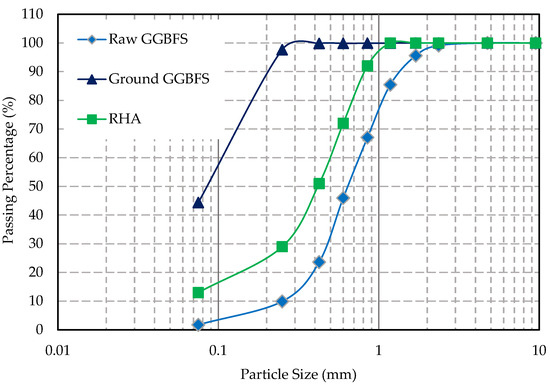
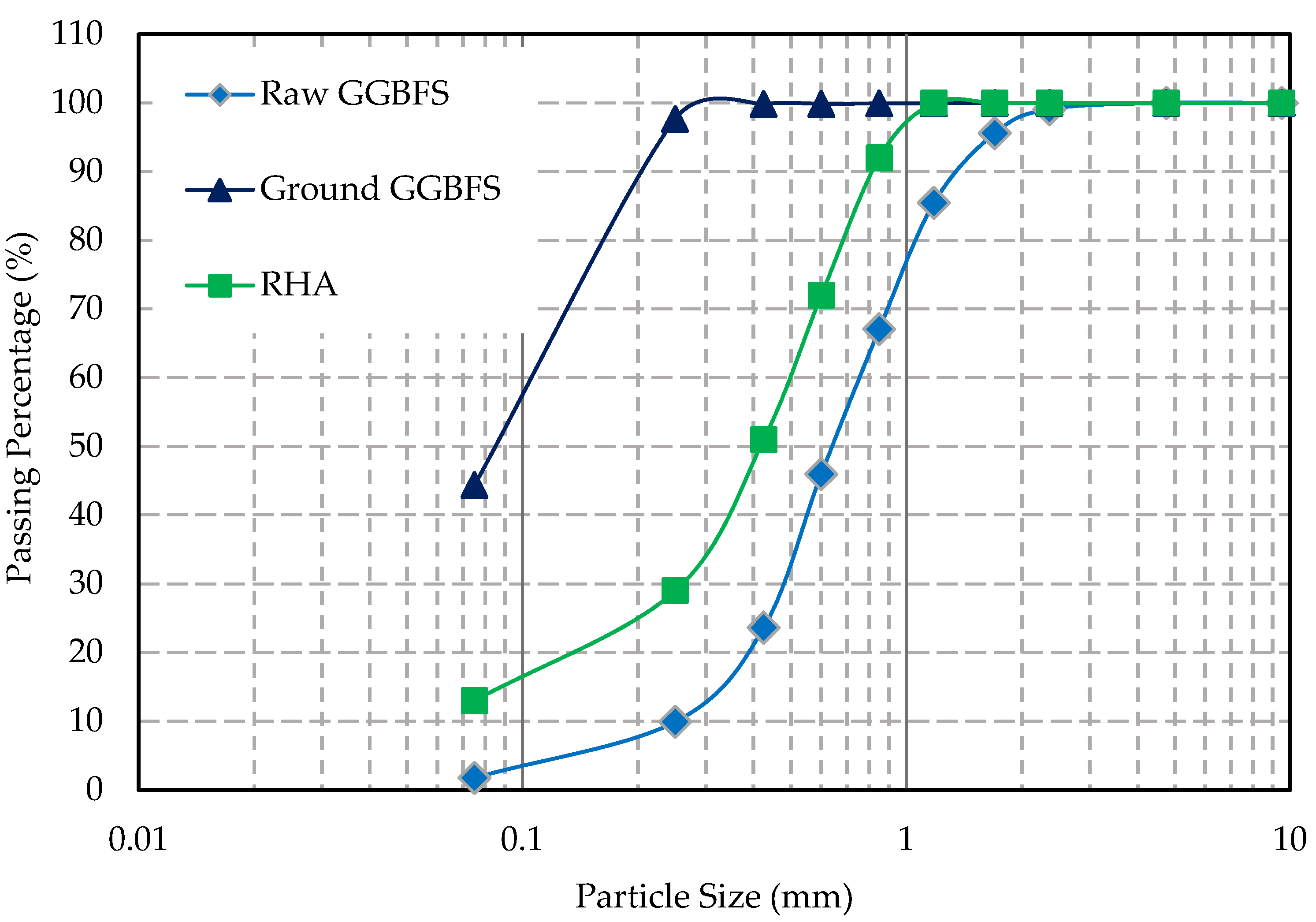
Untreated RHA was sourced from brick kilns in Polonnaruwa, Sri Lanka [13]. Figure 1c depicts the RHA employed in this study. White coloration of RHA indicates that it is a carbon-free ash [35]. To enhance the practical applicability and sustainability of the stabilization process, the collected RHA was utilized in its as-received condition without any additional pre-treatment, such as grinding or calcination. The oxide composition and particle size distribution of untreated RHA are illustrated in Table 2 and Figure 2, respectively. The RHA possesses more than 90% silica, which is greater than the silica content noted in conventional RHA (>70%), which is attributed to the controlled combustion in brick kilns, which enhances silica content to more than 90% [36,37]. Based on ASTM C618 [38], RHA can be classified as a class N pozzolan as the combined content of SiO2, Al2O3 and Fe2O3 exceeds 70%. Particle size analysis revealed that 13% of the material passed the 75 µm sieve, while approximately 87% consisted of sand-sized particles (Figure 2). This gradation provides a substantial reactive surface area for alkali activation and subsequent geo-polymerization reactions. Overall, the oxide composition and properties of RHA summarized in Table 2 and Table 3, respectively, are consistent with values reported in the existing literature [25,36,37,39].
Figure 2.
Particle size distribution of precursors [adopted from [13]].
Table 3.
Properties of binders utilized in geopolymer [13].
2.1.4. Aluminum Oxide Powder
Based on findings reported in previous studies [13,16,40], aluminum oxide (Al2O3) was incorporated during the initial phase (to determine optimum mixing time) of the experimental program to facilitate the stabilization of very soft peaty clay. Prior to the introduction of ground granulated blast furnace slag (GGBFS), aluminum oxide powder procured from a local supplier in Sri Lanka was used to regulate the Si/Al molar ratio within the binder system for enhancing strength.
2.1.5. Ground Granulated Blast Furnace Slag (GGBFS)
GGBFS sourced from the INSEE Cement manufacturing plant in Sri Lanka was employed as a calcium-rich supplementary precursor to improve the early-age mechanical performance of the stabilized peaty clay [13]. To enhance its fineness and reactivity, the material was subjected to mechanical activation using a laboratory-scale ball mill for 3 h [13]. Following grinding, the processed slag was sieved, and only particles finer than 75 µm were selected for subsequent use [13]. The oxide composition, properties and particle size distribution, are presented in Table 2, Table 3, and Figure 2, respectively. The particle size distribution of GGBFS is consistent with those reported in previous studies [41]. Particle size analysis revealed the absence of gravel-sized particles, while approximately 44% of the material passed the 75 µm sieve, indicating a substantial proportion of fine particles available for hydration and alkali-activation reactions. The measured specific gravity and bulk density of the GGBFS were comparable to those of OPC, suggesting its suitability as a cement replacement material.
2.1.6. Sodium Hydroxide (NaOH)
Commercially available NaOH white pellets with a purity of 99% were utilized in this study as the alkali activator.
2.2. Sample Preparation
Prior to binder incorporation, impurities such as timber debris, root hairs, and stone were removed, and large soil clusters were shattered in order to produce a homogeneous soil sample. All constituents were proportioned on a weight basis relative to the weight of the saturated peaty clay [1]. The influence of mixing duration was subsequently evaluated for RHA-based geopolymer-stabilized peaty clay. The binder dosage was selected based on recommendations from previous studies [16,40], wherein an optimum content of 20% (RHA + Al2O3) was adopted. The proportion of Al2O3 was incorporated to achieve a Si/Al molar ratio of 3, which is considered favorable for geopolymer network formation and strength development [16,40]. Consistent with prior work by Khanday et al. [16,40], a 6 M NaOH solution was used as the alkaline activator at an A/B ratio of 0.7. To ensure the consistency of the alkaline activator, the nominal 6 M NaOH solution was prepared a day prior to the stabilizing process [13]. This preconditioning period allowed complete dissolution of the NaOH pellets and dissipation of the heat generated during the exothermic dissolution process [13]. Subsequently, the required amount of NaOH solution was integrated with precursors (RHA + Al2O3) and then mixed with peaty clay for durations ranging from 10 to 30 min at 5 min interval [1]. For each mixing time, 3 replicate specimens were cast and cured at room temperature in accordance with the procedure outlined by Khanday et al. [16].
Following the determination of the optimum mixing duration, the UCS of the stabilized specimens was analyzed under different curing environments, including air, wet cloth, water, and acid. An acidic curing regime was adopted to simulate the natural field environment of peat deposits. The curing medium was maintained at a pH of 3–4, representative of the acidic conditions commonly encountered in peat soils, by including HCl [13]. Preliminary tests revealed that specimens stabilized with the RHA-Al2O3 geopolymer system exhibited inadequate resistance under water and acidic curing conditions, primarily due to the absence of sufficient calcium for the formation of stable calcium-bearing reaction products. As a result, significant strength deterioration was observed, as discussed in Section 3 and Section 4. Hence, to enhance acid resistance and promote early strength development, GGBFS was incorporated as a calcium-rich precursor (10, 20, 30%—Table 4). Simultaneously, the A/B ratio varied between 0.3, 0.5, and 0.7 while maintaining a constant NaOH concentration of 6 M to identify the optimum binder composition [13]. Subsequently, after determining the optimum GGBFS content based on the maximum unconfined compressive strength (UCS), the NaOH concentration was reduced from 6 M to 3 M to evaluate the influence of activator concentration on stabilization performance and to improve the economic feasibility of the binder system.
Table 4.
Mix proportion of RHA-GGBFS-based geopolymer-stabilized peaty clay.
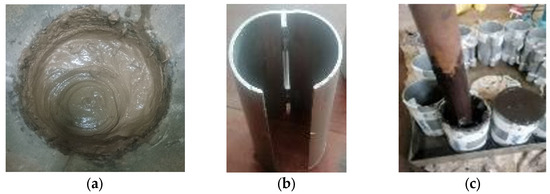
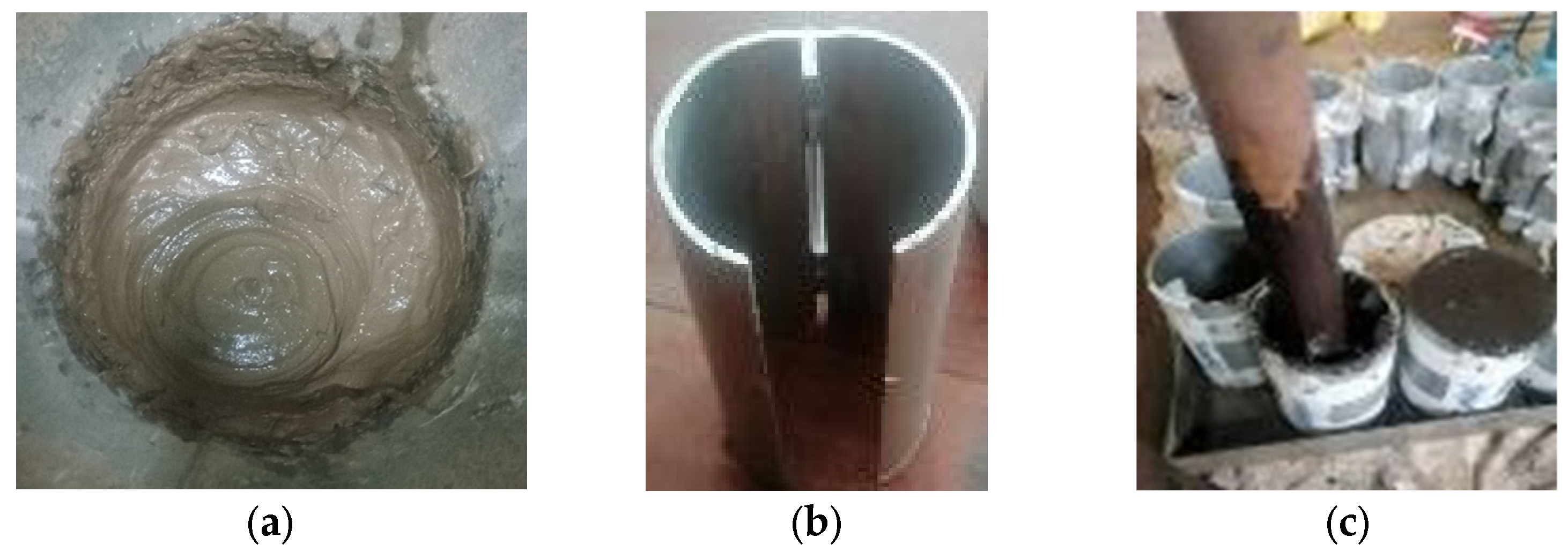
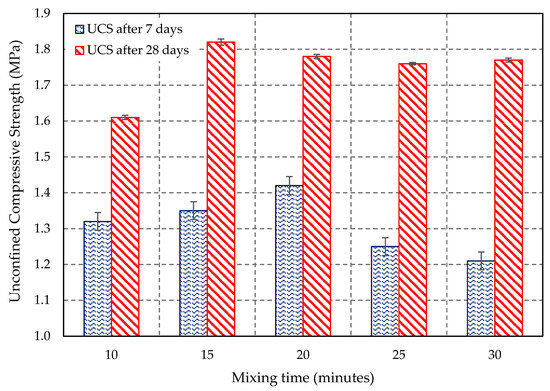
To provide a benchmark for evaluating the performance of the RHA-based geopolymer-stabilized peaty clay, OPC-treated specimens were prepared as control samples. A cement dosage of 25% by weight of saturated peaty clay was selected following the methodology proposed by Yoganathan et al. [14], reflecting typical field applications of deep soil mixing in highly organic soils. The measured OPC was first mixed with water at a water-to-cement ratio of 0.5 to form a homogeneous slurry [1]. The slurry was then incorporated into the peaty clay and mixed using the optimum mixing duration established from the preliminary investigations. All the constituents of stabilized peaty clay were mixed using an electric putty mixer at a constant speed of 180 rpm [1,13,14]. The mixing rate was selected to simulate field mixing conditions, where mixing equipment typically operates within the range of 150–180 rpm [1,13,14], while ensuring consistency throughout the experimental program. Subsequently, cylindrical specimens with a diameter of 50 mm and a height of 100 mm were fabricated using split molds, as shown in Figure 3. The soil–binder mixture was placed in three layers, with each layer compacted manually by applying 25 blows using a tamping rod to minimize entrapped air [1].
Figure 3.
Sample preparation [adopted from [1]]: (a) After soil–binder mixture was prepared. (b) Split cylindrical mold. (c) Casting.
2.3. Unconfined Compressive Strength (UCS)
Low-calcium-based geopolymer-stabilized soil (RHA-Al2O3) specimens were demolded after 48 h of curing. Due to the limited calcium content within the binder system, early-age strength development was comparatively slow. Attempts to demold specimens at 24 h were unsuccessful, as adequate stiffness had not yet been achieved. Therefore, demolding was carried out only after sufficient initial hardening was observed, with the timing adjusted based on binder-dependent setting behavior (Section 3 and Section 4). Subsequently, UCS tests were conducted after curing periods of 7 and 28 days in accordance with ASTM D1633-17 [42] using a standard UCS testing apparatus.
2.4. Life Cycle Assessment (LCA)
2.4.1. Goal and Scope Definition
A detailed cradle-to-gate LCA was conducted to evaluate the environmental performance of the proposed RHA-GGBFS-based geopolymer-stabilized peaty clay. The objectives of the assessment were: (i) to quantify the environmental impacts associated with the production of the novel geopolymer-stabilized peaty clay, and (ii) to compare its environmental performance with that of conventional OPC-stabilized peaty clay.
2.4.2. Functional Unit and System Boundary
Consistent with the methodology proposed by Li et al. (2025) [43], the functional unit was defined based on the required binder quantity to stabilize one ton of peaty clay. The system boundary encompassed emissions associated with raw material production and transportation to the project site in Colombo, Sri Lanka. Emissions arising from the mixing and curing stages were assumed to be negligible and were therefore excluded from the assessment, consistent with the assumptions adopted by Li et al. (2025) [43].
2.4.3. Life Cycle Inventory (LCI)
LCA was conducted using SimaPro v9.5.0. LCI-incorporated processing of all precursor materials. Transportation impacts were estimated based on the use of small trucks with a load capacity of less than 10 tons, considering the travel distance from the material collection point to the project site in Colombo, Sri Lanka. Transportation distances were estimated based on representative supplier locations within Sri Lanka. Details of transportation distances, modes, and pre-treatment energy requirements are listed in Table 5. Emission data were sourced from Ecoinvent database integrated within SimaPro.
Table 5.
Inventory data [44].
2.4.4. Life Cycle Impact Assessment (LCIA)
LCIA was performed using the midpoint approach, which represents a process-based perspective [45] and an endpoint approach. The characterization was carried out using the ReCiPe 2016-H method in compliance with ISO 14044:2006 standards [46]. The assessment considered 18 midpoint impact categories, including global warming, stratospheric ozone depletion, ionizing radiation, ozone formation (human health), fine particulate matter formation, ozone formation (terrestrial ecosystems), terrestrial acidification, freshwater eutrophication, marine eutrophication, terrestrial ecotoxicity, freshwater ecotoxicity, marine ecotoxicity, human carcinogenic toxicity, human non-carcinogenic toxicity, land use, mineral resource scarcity, fossil resource scarcity, and water consumption [44]. The endpoint approach analyses the total impact under 3 categories, namely human health, resources and ecosystems, to enhance interpretability [44].
2.5. Cost Analysis
The economic assessment was conducted within a cradle-to-gate framework, encompassing the extraction of raw materials, processing, and transportation of materials to the construction site. Cost estimates were based on prevailing market prices obtained from local suppliers in Sri Lanka [46].
2.6. Optimization
Grey Relational Analysis (GRA) was employed to optimize the binder composition, considering three response variables: UCS, cost, and environmental impact. As the relative importance of these parameters varies according to decision-making objectives [47], three weighting scenarios—general, business, and sustainability were adopted following Salim et al. (2025) [19] (Table 6). Following Salim et al. (2025) [19], equal weights were assigned to UCS and cost across all optimization perspectives. The general perspective assigned equal weights to compressive strength, cost, and environmental impact, providing a balanced assessment without favoring any single criteria, resulting in balanced consideration. The business perspective assigned greater importance to compressive strength and cost, reflecting the priorities of contractors and developers, where structural performance and economic feasibility typically outweigh environmental considerations. Conversely, the sustainability perspective prioritized environmental performance by allocating the highest weight to environmental impact while maintaining adequate engineering performance and acceptable costs [19]. This framework enabled the identification of optimal mix proportions under different technical, economic, and environmental priorities.
Table 6.
Weights for different perspectives.
3. Results
3.1. Effect of Mixing Time
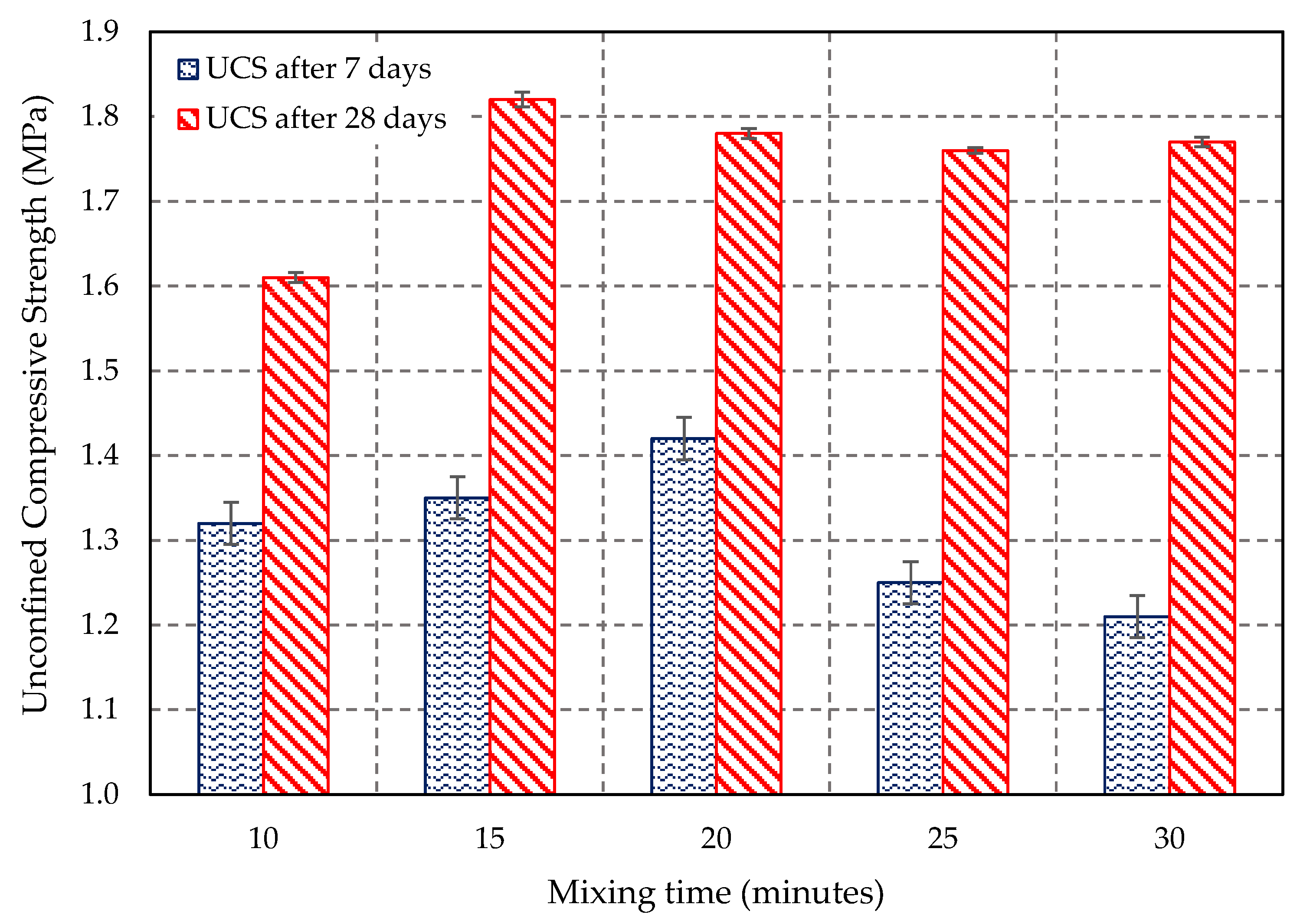
Figure 4 illustrates the variation in the UCS of RHA-based geopolymer-stabilized peaty clay with mixing time after 7 and 28 days of curing. For specimens cured for 7 days, the UCS increased progressively as the mixing time increased from 10 to 20 min, beyond which a decline in strength was observed. A similar trend was evident after 28 days of curing. Although the specimen mixed for 15 min exhibited a marginally higher UCS than that mixed for 20 min, the difference was negligible; therefore, 20 min was selected as the optimum mixing time owing to its ability to achieve high early-age strength development.
Figure 4.
Variation in UCS with mixing time.
The influence of mixing time on strength development is primarily associated with its effect on the uniformity of binder distribution and reaction efficiency. At lower mixing durations (conventional mixing time of 10 min [1]) particle agglomeration and inadequate dispersion of the binder restrict the accessibility of reactive surfaces, thereby limiting the extent of geo-polymerization and pozzolanic reactions. In contrast, with the increase in mixing time, the soil–binder system becomes progressively more homogeneous, facilitating enhanced distribution of binder particles throughout the soil matrix [1]. The resulting improvement in interparticle bonding and matrix densification contributes to the increase in UCS.
Conversely, extending the mixing time beyond 20 min resulted in a marked reduction in UCS for specimens cured for 7 days. Prolonged mixing disrupts the homogeneity and stability of the soil–binder matrix, leading to particle deformation and deterioration of the interparticle bonding network [1]. Furthermore, excessive mixing promotes particle segregation and bleeding, increasing the fluidity of the system and hindering the development of a dense and interconnected matrix, thereby reducing strength. In contrast, the reduction in UCS observed beyond 20 min became negligible after 28 days of curing. This behavior suggests that the continued progression of geo-polymerization reactions compensates for the adverse effects of overmixing, resulting in gradual matrix densification and strength development over time.
3.2. Effect of Curing Method
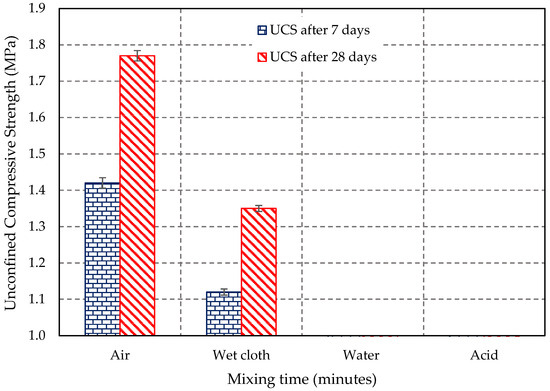
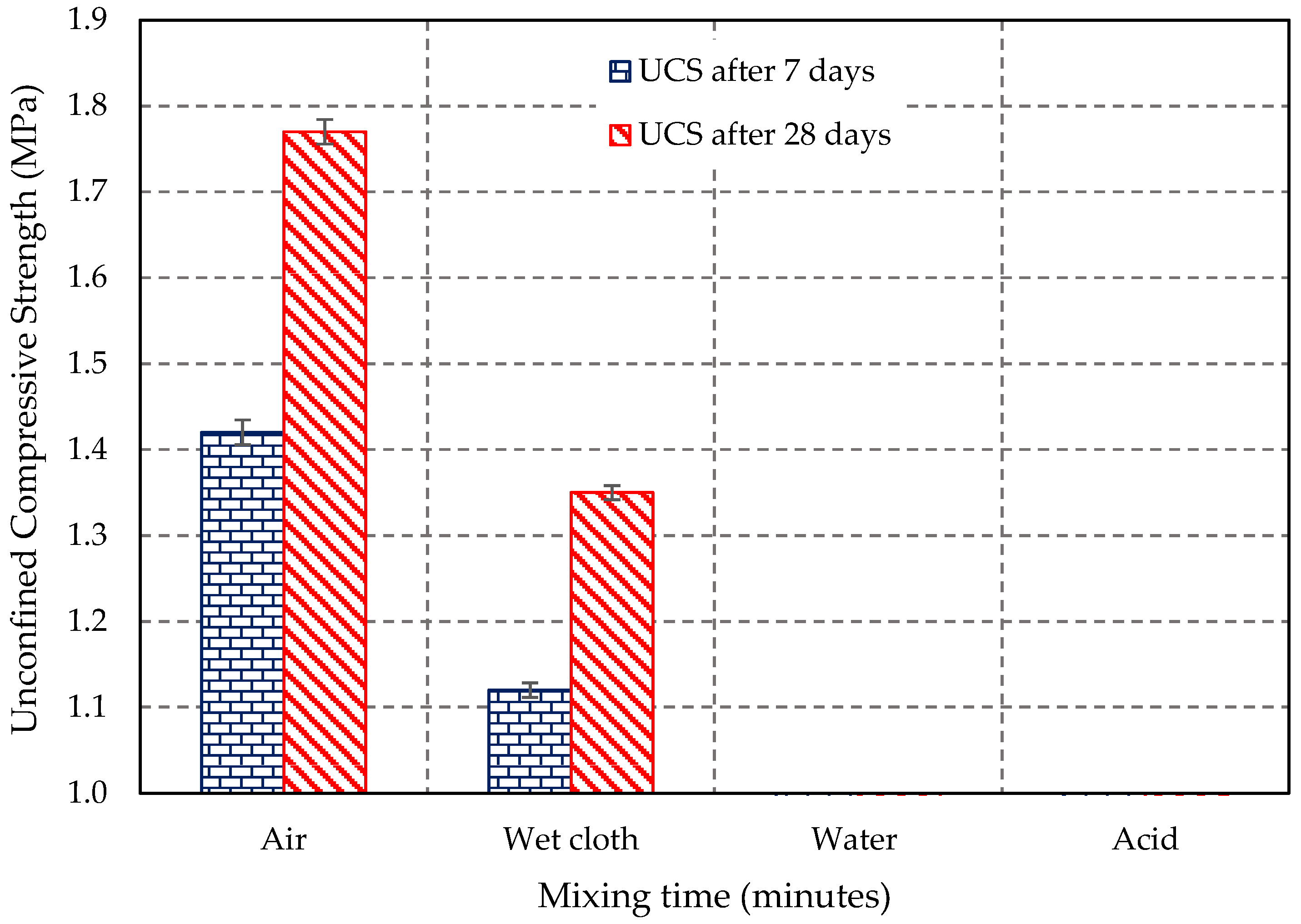
Figure 5 depicts the variation in UCS of RHA-Al2O3 based geopolymer-stabilized peaty clay at the optimum mixing duration across different curing environments. Conventional air-cured specimens exhibited the highest compressive strength among all curing conditions. However, an increase in exposure to water resulted in a progressive reduction in strength. Under wet cloth curing, moisture absorption from the saturated cloth led to a reduction in UCS compared with air-cured specimens. In contrast, specimens subjected to water and acid curing failed. This behavior can be attributed to the limited calcium content in the RHA-Al2O3-based geopolymer-stabilized peaty clay, which restricts the generation of stable calcium-aluminosilicate hydrate (C-A-S-H) phases.
Figure 5.
Variation in UCS with curing method.
At ambient conditions, silica surfaces readily interact with atmospheric moisture, leading to the formation of silanol (Si-OH) groups and associated water layers (hydrophilic [48]), which impacts the reactivity. In the absence of sufficient calcium ions, hydroxyl groups are restricted, leading to slower silica dissolution and delayed formation of strength-contributing hydration products. Furthermore, the highly acidic nature of peaty clay, enriched with humic substances and other organic constituents, significantly inhibits geo-polymerization and hydration reactions, particularly in water. Moreover, the formation of water-soluble complexes such as sodium humate, together with the presence of fulvic acids in peaty clay, contributes to matrix softening and structural instability [49], ultimately leading to failure upon exposure to water.
3.3. Effect of Binder Content
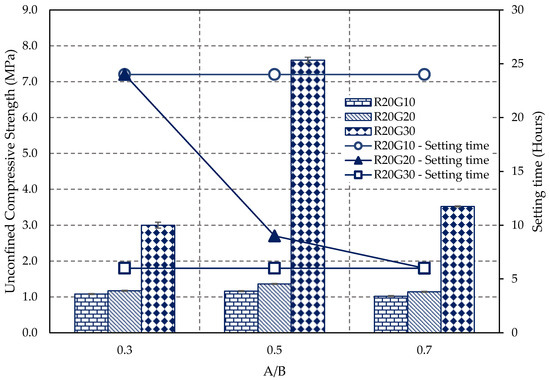
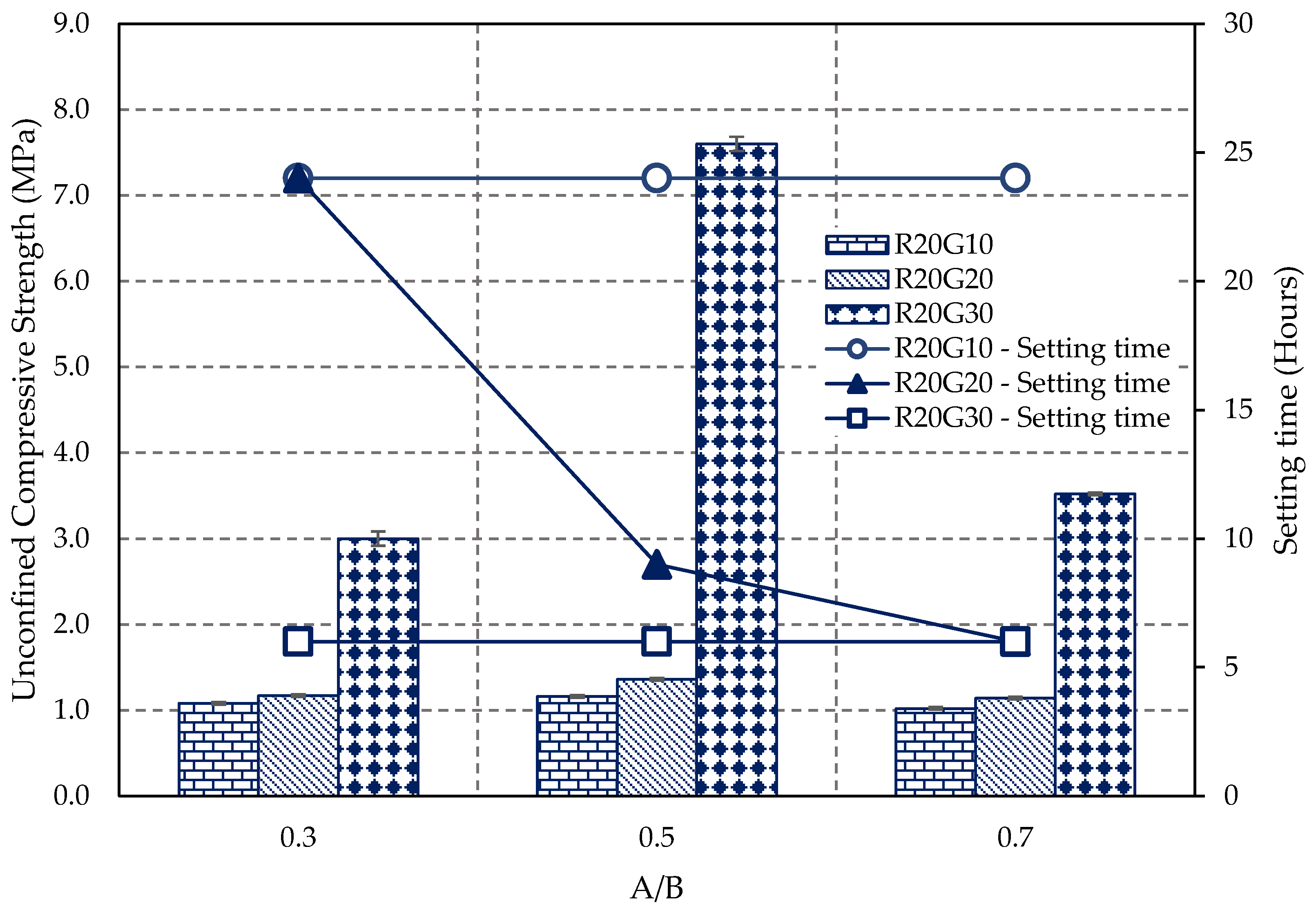
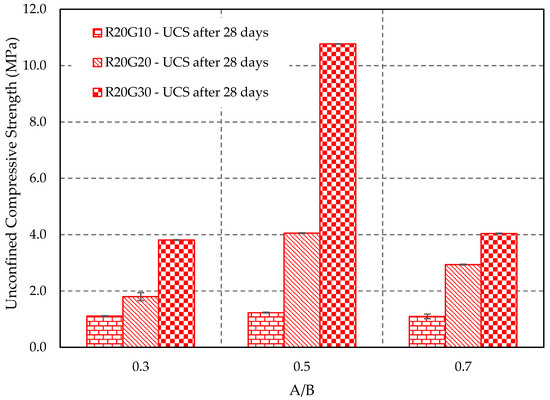
In the RHA-Al2O3 geopolymer-stabilized peaty clay, the absence of calcium resulted in delayed setting behavior, requiring approximately two days for sufficient hardening to allow demolding. Moreover, the specimens exhibited failure under acid curing conditions, which were intended to simulate in situ environmental exposure. To address this limitation, GGBFS was incorporated as a calcium source alongside RHA to enhance early-age strength development and improve the overall durability of the stabilized matrix under acid curing. While keeping the optimum mixing time (20 min), NaOH concentration (6 M), and RHA content (20%) constant, GGBFS was incorporated at different A/B ratios. Figure 6 and Figure 7 illustrate the variation in UCS and setting time with increasing GGBFS content and A/B ratio after 7 and 28 curing days, respectively (R20G10 represents 20% RHA and 10% GGBFS).
Figure 6.
Variation in UCS (after 7 curing days) and setting time with A/B ratio.
Figure 7.
Variation in UCS with A/B ratio after 28 curing days.
For all mix proportions and curing periods, the UCS increased as the A/B ratio increased from 0.3 to 0.5, followed by a significant decline at an A/B ratio of 0.7, indicating that the optimum A/B ratio was 0.5. This behavior can be attributed to the influence of alkali content on the geo-polymerization process [16]. At a low A/B ratio of 0.3, the alkalinity is insufficient to effectively dissolve reactive silica and alumina from the precursors. Consequently, the extent of geo-polymerization is limited, resulting in reduced formation of binding gels and a weaker geopolymer matrix. This impairs strength development and delays hardening, thereby reducing the UCS and extending the setting time to approximately 24 h. In contrast, increasing the A/B ratio to 0.5 enhances the dissolution of aluminosilicate and promotes polycondensation reactions. Consequently, strength development was significantly improved, while the setting time decreased from 24 h to 9 h due to the accelerated formation of well-developed geopolymer gel and matrix hardening. However, at an A/B ratio of 0.7, despite the rapid setting time of approximately 6 h, the excessive concentration of hydroxyl ions accelerates reaction kinetics and may induce premature precipitation and crystallization of reaction products before polycondensation [16]. This disrupts the development of a continuous and homogeneous geopolymer matrix, leading to structural defects and a consequent reduction in UCS. Therefore, an A/B ratio of 0.5 was identified as the optimum condition, providing a balanced alkaline environment that maximized geopolymer gel formation and strength development.
The different response of setting time at 20% GGBFS compared with 10% and 30% GGBFS can be attributed to the intermediate calcium availability and reaction balance within the binder system. A total of 20% GGBFS is the chemical tipping point where it balances between A/B ratio and GGBFS content. At 10% GGBFS, the amount of reactive calcium released is insufficient to significantly promote the formation of C-A-S-H gel; therefore, increasing the A/B ratio has a limited influence on early reaction kinetics, resulting in a constant setting time. Conversely, at 30% GGBFS, the high availability of Ca2+ promotes rapid precipitation of C-A-S-H gel, and the reaction becomes primarily calcium-controlled, making the influence of the A/B ratio less significant.
However, at 20% GGBFS, the binder contains sufficient calcium to form C-A-S-H gel but remains dependent on the dissolution of aluminosilicate from precursors. Therefore, the setting behavior becomes extremely sensitive to alkali concentration. A lower A/B ratio (0.3) provides insufficient OH− concentration to effectively dissolve Si and Al, delaying gel formation and resulting in a longer setting time (24 h). Increasing the A/B ratio enhances OH− availability, accelerating dissolution of aluminosilicate for reaction with Ca2+. This promotes faster C-A-S-H gel development, reducing the setting time to 9 h and 6 h for A/B ratios of 0.5 and 0.7, respectively.
Similarly, increasing the GGBFS content significantly enhanced the UCS of the stabilized peaty clay. After 7 days of curing, specimens containing 10% and 20% GGBFS exhibited only marginal differences in UCS. However, the beneficial effect of these GGBFS contents became more pronounced with prolonged curing, resulting in further strength development after 28 days. In contrast, increasing the GGBFS content to 30% led to a substantial increase in UCS at both 7 and 28 days of curing. This behavior can be attributed to the increased availability of calcium supplied by GGBFS.
According to Figure 7, the UCS of specimens containing 10% GGBFS (R20G10) after 7 days of curing reached approximately 92–97% of the corresponding 28-day UCS. Despite the rapid attainment of strength, the overall UCS remained relatively low, indicating limited continued strength development with curing time. This behavior suggests that the calcium content provided by 10% GGBFS was insufficient to sustain further geo-polymerization and the formation of additional strength-contributing reaction products. In contrast, specimens containing 20% GGBFS exhibited a more pronounced strength gain with curing, with the 7-day UCS corresponding to only 33–65% of the 28-day UCS. The increased calcium availability promoted continued geo-polymerization and C–A–S–H gel formation, resulting in progressive strength development over time.
A further increase in GGBFS content to 30% substantially enhanced early-age performance, with the 7-day UCS reaching 70–87% of the corresponding 28-day UCS. The higher calcium content accelerated reaction and generated a well-developed binding matrix at early curing ages. Consequently, the strength development pattern of the R20G30 specimens closely resembled that of conventional cement-stabilized peaty clay [1], where a significant proportion of the ultimate strength is attained within the first week of curing.
3.4. Effect of NaOH Concentration
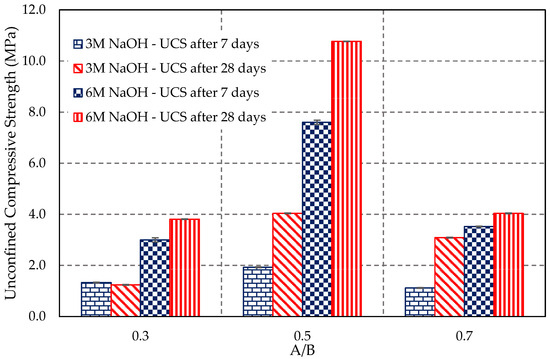
Considering both UCS and setting time, the maximum UCS was achieved by the R20G30 binder at an A/B ratio of 0.5. All specimens in the preceding analysis were prepared using a NaOH concentration of 6 M. Although all mix proportions exceeded the minimum UCS requirement of 1 MPa specified in the Federal Highway Administration (FHWA) design guidelines for deep mixing methods (DMMs) [50], the use of a 6 M NaOH solution may not be economically viable for large-scale field applications. Therefore, to evaluate a more cost-effective alternative, the influence of a lower NaOH concentration (3 M) was investigated for the binder composition (R20G30). Figure 8 presents the variation in UCS with NaOH concentration for the R20G30 binder system at different A/B ratios and curing periods.
Figure 8.
UCS variation with molarity for different A/B ratios at 7 and 28 days.
Similar to the behavior observed for specimens stabilized with 6 M NaOH, the highest UCS at 3 M NaOH was obtained at an A/B ratio of 0.5. At an A/B ratio of 0.7, the 28-day UCS values achieved with 3 M and 6 M NaOH were comparable, indicating that the influence of NaOH concentration became less significant under highly alkaline conditions. This can be attributed to the excess hydroxyl ions provided by the high A/B ratio, which were sufficient to sustain the dissolution of elements in precursors. In contrast, substantial differences in strength were observed at A/B ratios of 0.3 and 0.5, where specimens activated with 6 M NaOH exhibited UCS values approximately 2–4 times higher than those prepared with 3 M NaOH. The lower NaOH concentration provided insufficient alkalinity to effectively dissolve aluminosilicate and calcium from the binder, thereby restricting geo-polymerization and limiting the formation of strength-contributing reaction products [16]. Conversely, the higher alkalinity of the 6 M NaOH solution enhanced the dissolution, accelerated geo-polymerization reactions, and promoted the development of a stronger and more interconnected binding matrix, resulting in significantly higher UCS values.
3.5. Failure Mode
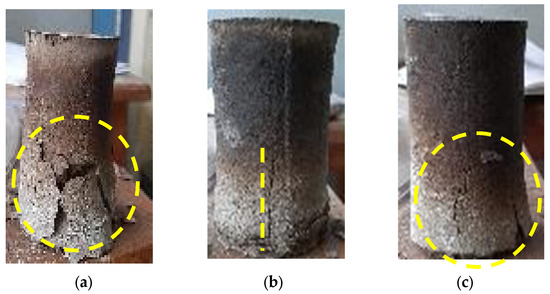
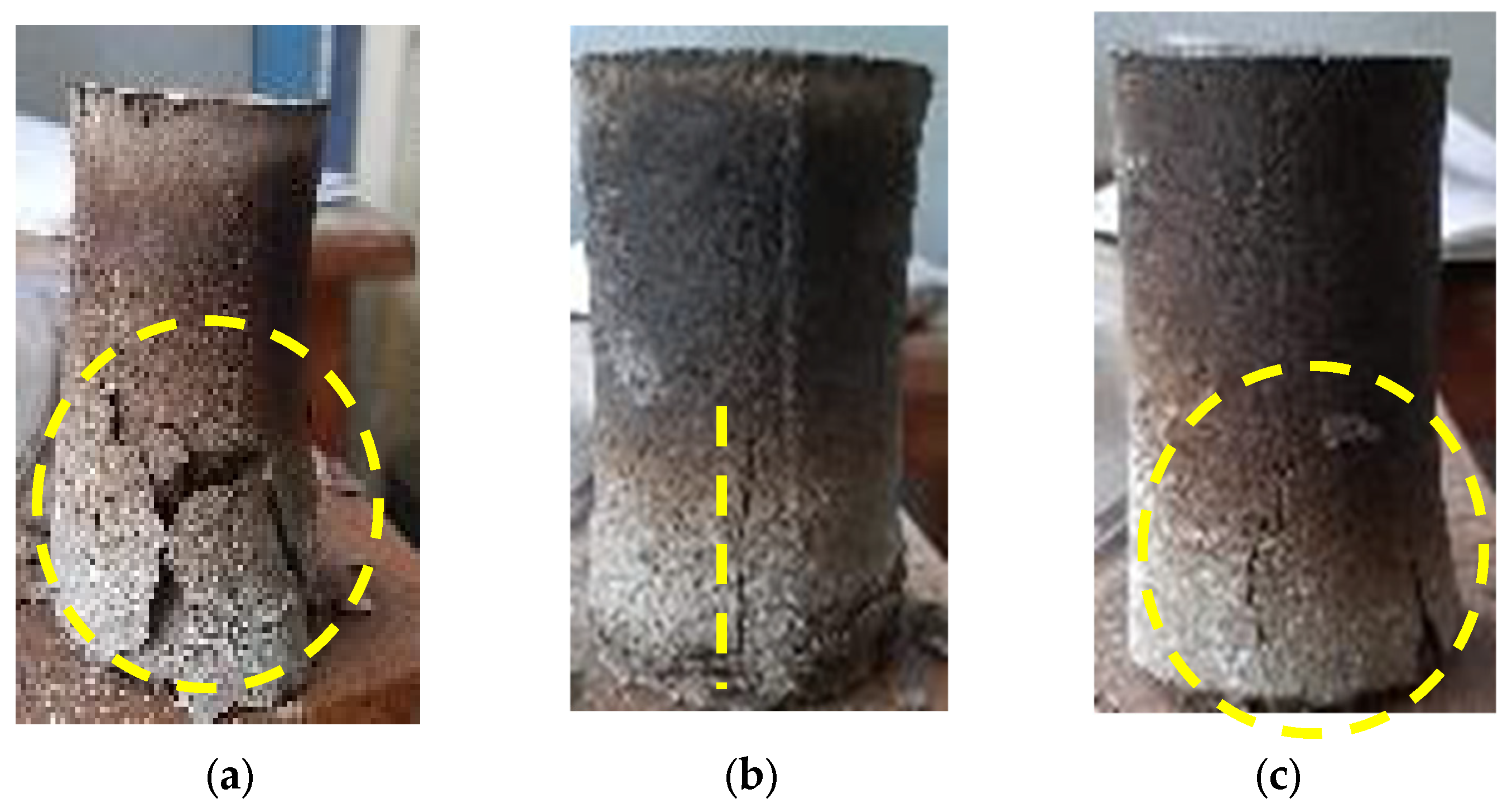
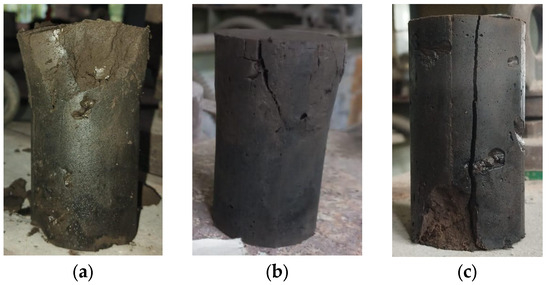
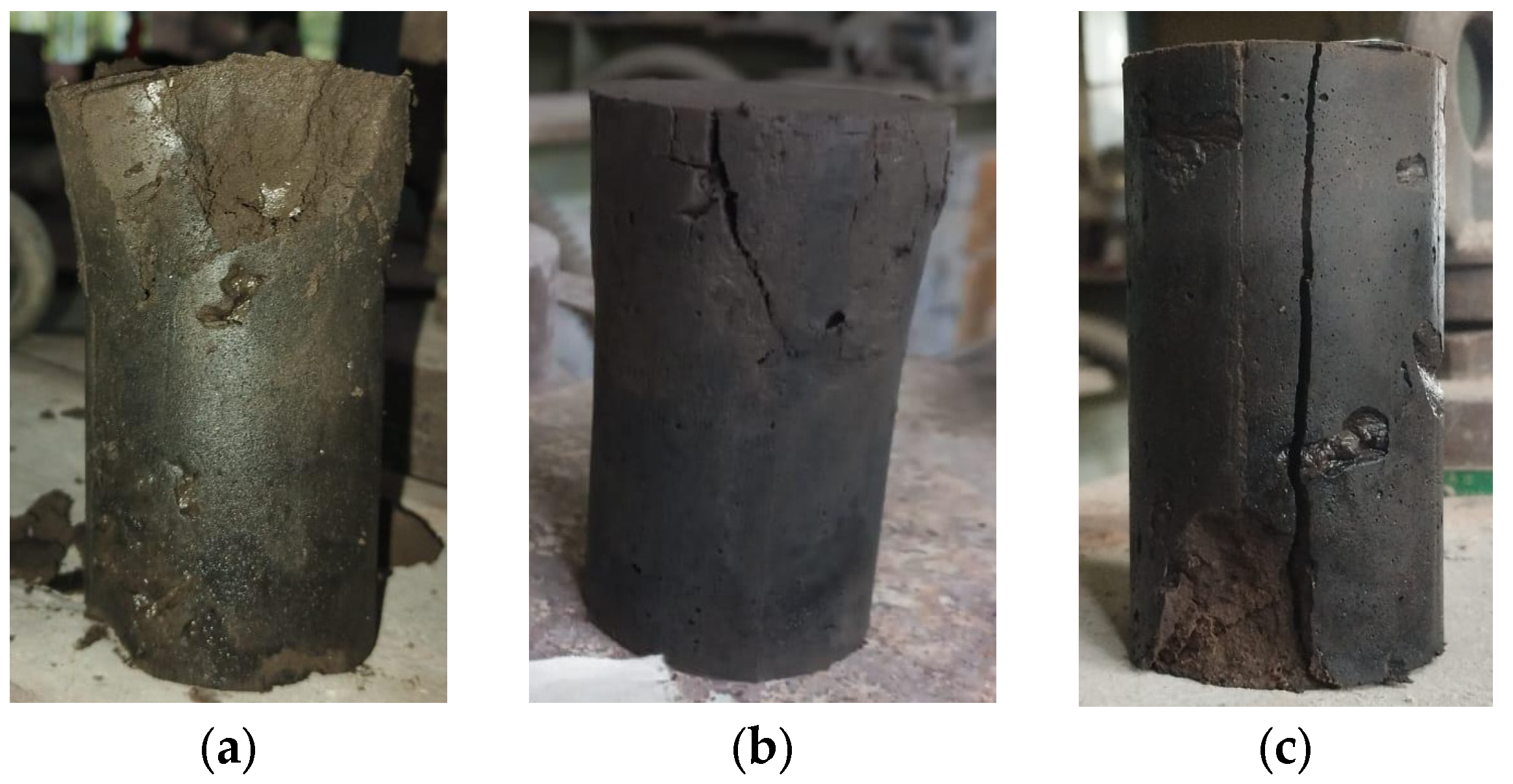
Failure patterns of RHA-Al2O3-based geopolymer-stabilized peaty clay at different mixing times, and RHA-GGBFS-based geopolymer (6 M NaOH, A/B = 0.5) stabilized peaty clay are illustrated in Figure 9 and Figure 10, respectively. When the mixing duration was either shorter or longer than the optimum mixing time (20 min), the specimens predominantly exhibited a combination of shear and bulging failure modes, particularly near the base of the column. Similar failure characteristics have been reported for carbon fiber-stabilized soft clay by Jaber et al. (2023) [51], where shear failure was observed. In contrast, specimens prepared at the optimum mixing time exhibited a split-type failure mode (brittle columnar failure), resembling the failure behavior typically associated with stiff concrete [1]. This transition in failure mechanism indicates that increasing specimen stiffness alters the mode of failure from ductile deformation to brittle. The occurrence of split failure at the optimum mixing time suggests the development of a stronger and more rigid soil–binder matrix, capable of sustaining higher stresses before failure.
Figure 9.
Failure pattern at different mixing times: (a) 10 min; (b) 20 min; (c) 30 min.
Figure 10.
Failure pattern at different binder content: (a) R20G10; (b) R20G20; (c) R20G30.
Moreover, for the calcium-absent RHA-Al2O3-based geopolymer-stabilized peaty clay (Figure 9), prolonged air curing facilitated moisture accumulation and alkali migration toward the specimen surface, resulting in the formation of white alkali salt deposits due to efflorescence. This phenomenon is associated with the high mobility of excess alkalis and the porous nature of the stabilized matrix. A similar observation was reported by Kalita and Elangbam (2024) [52] for peat stabilized using a kaolin-based geopolymer and coir fiber. In contrast, efflorescence was not detected in GGBFS-incorporated specimens (Figure 10). Furthermore, the binder composition significantly influenced the failure behavior of the stabilized soil. With increasing GGBFS content, the failure mode progressively transformed from bulging to shear and ultimately to brittle splitting. This transition was consistent with the corresponding increase in UCS, indicating a gradual shift from soil-like behavior to concrete-like behavior as calcium content increased.
3.6. Life Cycle Impact Analysis
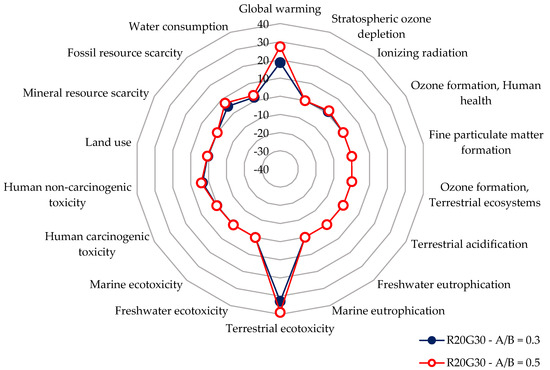
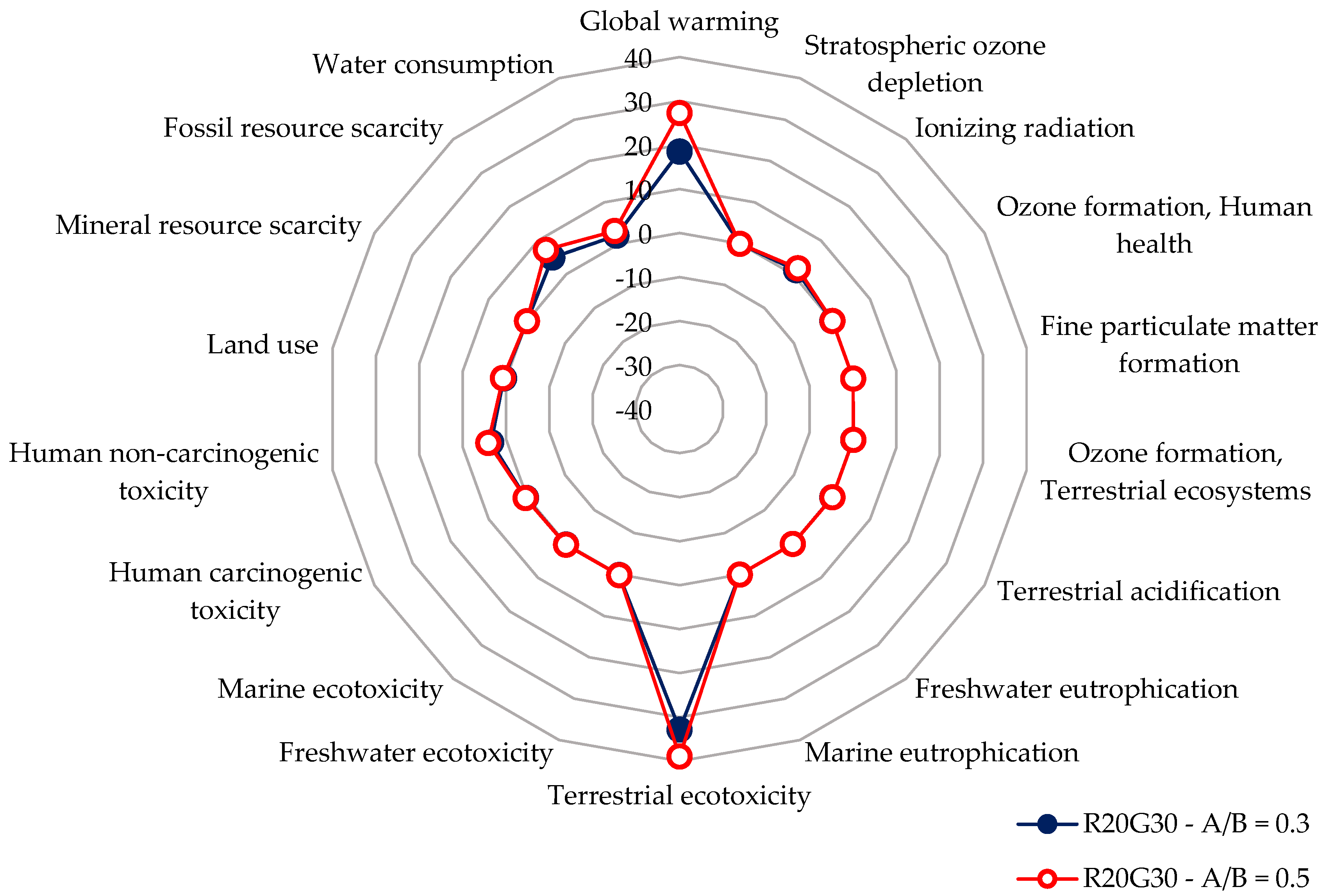
To balance engineering performance with economic feasibility, specimens achieving UCS values above the minimum design requirement of 1 MPa [50] while utilizing the least amount of NaOH were selected for environmental impact assessment. Based on these criteria, the R20G30 mix proportion activated with 3 M NaOH at A/B ratios of 0.3 and 0.5 was selected for further assessment. The midpoint environmental impact results for RHA-GGBFS-based geopolymer-stabilized peaty clay (R20G30 at A/B = 0.3, 0.5 for 3 M) are presented in Figure 11.
Figure 11.
Midpoint environmental impact of RHA-GGBFS-based geopolymer-stabilized peaty clay.
The results indicate that alkali content has a significant influence on the environmental performance of the geopolymer-stabilized peaty clay. For both scenarios, the most significant midpoint impact categories were global warming potential (GWP) and terrestrial ecotoxicity (TE). A slight increase in both impact categories was observed with increasing A/B ratio, highlighting the influence of alkali activator consumption on the overall environmental burden. This behavior is primarily attributed to the energy-intensive NaOH chlor-alkali process, which consumes nearly 2500–3500 kWh of electricity to generate 1.1 tons of NaOH and 1 ton of chlorine [19]. Furthermore, the herbicidal and pesticidal characteristics associated with NaOH contribute to increasing TE [53].
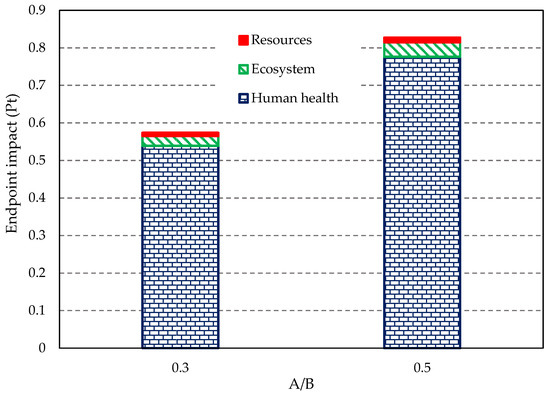
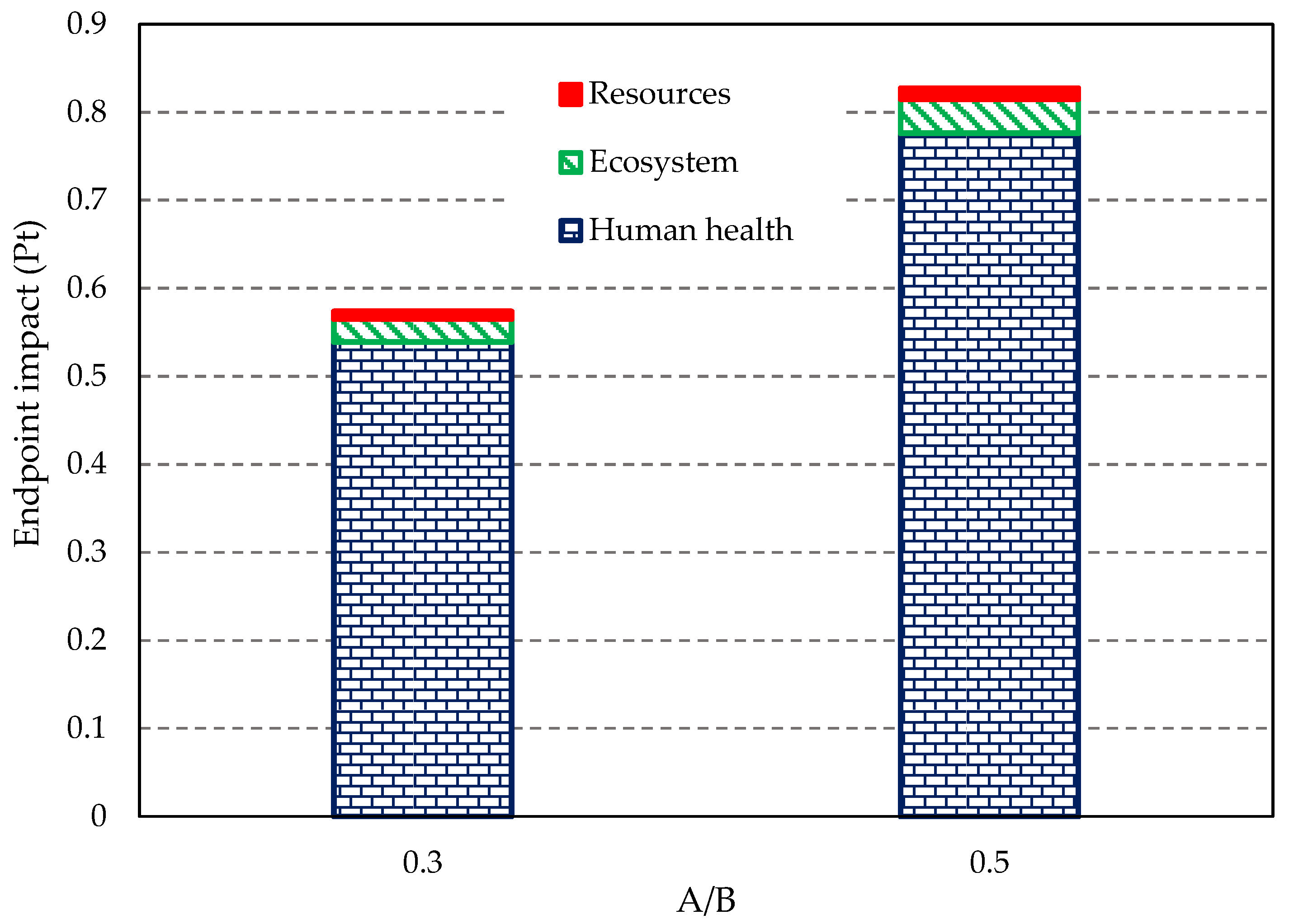
Although midpoint indicators provide a comprehensive understanding of specific environmental impact pathways, the interpretation of multiple impact categories can be challenging. To enhance result interpretability and support decision-making, the impacts were further aggregated into endpoint categories. Figure 12 illustrates the endpoint impacts in terms of ecosystem quality, human health, and resources. Across all stabilization systems evaluated, human health impacts dominated the endpoint assessment, followed by ecosystem impacts, whereas resource depletion contributed minimally. The total endpoint impact decreased by 31% when the A/B ratio was reduced from 0.5 to 0.3, underscoring the importance of optimizing alkali content to balance engineering performance with environmental sustainability.
Figure 12.
Endpoint environmental impact of RHA-GGBFS-based geopolymer-stabilized peaty clay.
3.7. Cost Analysis
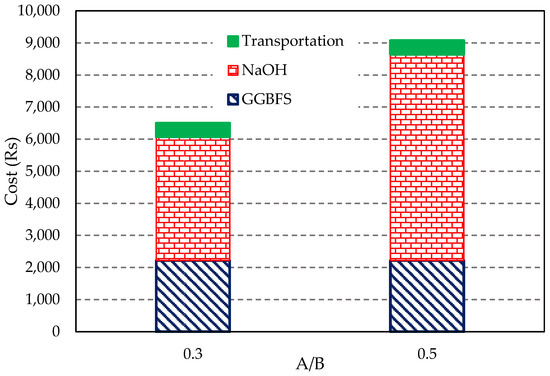
Similar to the environmental impact assessment, the R20G30 mixtures activated with 3 M NaOH at A/B ratios of 0.3 and 0.5 were selected for the cradle-to-gate cost analysis. The corresponding cost contributions of the constituent materials are presented in Figure 13. A reduction in the A/B ratio from 0.5 to 0.3 decreased the total cradle-to-gate cost by 28%, demonstrating the strong influence of alkali activator consumption on overall cost. In both mixtures, NaOH was the primary cost contributor, accounting for approximately 59% and 71% of the total cost at A/B ratios of 0.3 and 0.5, respectively.
Figure 13.
Cost analysis of RHA-GGBFS-based geopolymer-stabilized peaty clay.
4. Discussion
The results reveal that 20 min is the optimum mixing time, whereas both insufficient mixing (<20 min) and prolonged mixing (>20 min) lead to a reduction in UCS. The adverse effects of prolonged mixing on strength development have also been noted in concrete [54], cement-fly ash mortar [55] and cement-stabilized clay soil [56]. Furthermore, the optimum mixing time of 20 min is consistent with that reported for cement-stabilized peaty clay [1]. This suggests that the mixing duration required to achieve adequate homogenization and effective soil–binder interaction may be governed primarily by the characteristics of the peaty clay and the mixing process rather than the binder type.
Despite being prepared at the optimum mixing time, the RHA-Al2O3 geopolymer-stabilized peaty clay became unstable and failed under acid-curing conditions, which simulated the acidic field environment. This behavior is attributed to the low calcium content of the binder system. Similar findings were reported by Zhu et al. (2024) [57] for marine clay stabilized with silica fume and calcium carbide residue. In low-calcium geopolymers, the binding matrix is predominantly composed of sodium–aluminosilicate–hydrate (N–A–S–H) gel. Exposure to acidic conditions can inhibit geo-polymerization and destabilize the N–A–S–H structure, thereby reducing water resistance and mechanical integrity. Compared with calcium–aluminosilicate–hydrate (C–A–S–H) gel formed in calcium-rich systems, N–A–S–H gel generally exhibits lower durability, slower hardening, and reduced early-age strength, making the stabilized matrix more vulnerable to acidic environments. Therefore, the incorporation of GGBFS as a calcium source was necessary to improve the performance of the geopolymer-stabilized peaty clay.
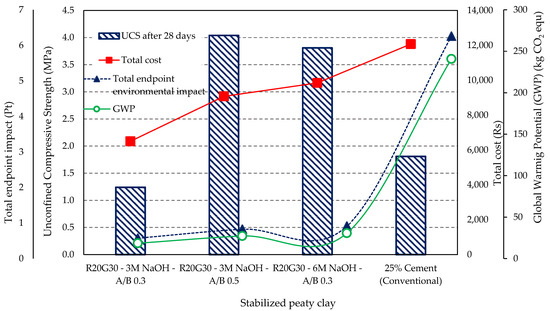
The addition of GGBFS substantially improved UCS even under acid curing and reduced setting time. Nevertheless, increasing the A/B ratio beyond 0.5 adversely affected strength development despite the presence of GGBFS. Excess alkalis promote premature crystallization of reaction products prior to polycondensation, thereby hindering the formation of a continuous geopolymer gel network. Comparable behavior has been reported in bottom ash-based geopolymer-stabilized sand [58], GGBFS-based geopolymer-stabilized peat [17], and in geopolymer concrete [59]. To benchmark the performance of the optimized geopolymer-stabilized peaty clay against conventional stabilization, specimens treated with 25% cement were evaluated. Figure 14 compares the 28-day UCS, total environmental impact, GWP, and cradle-to-gate cost of cement-stabilized peaty clay (conventional binder) with those of geopolymer-stabilized peaty clay activated using 3 M NaOH (A/B 0.3, 0.5) and 6 M NaOH (optimized binder content—R20G30 at low A/B = 0.3).
Figure 14.
Comparison of UCS, cost and environmental impact with conventional binder.
Considering the mechanical, environmental, and economic performance of the investigated mixtures, RHA-GGBFS (R20G30)-based geopolymer-stabilized peaty clay activated with 3 M NaOH at A/B ratios of 0.3 and 0.5, 6 M NaOH at A/B 0.3 and 25% cement (conventional binder) was selected for optimization. Following normalization of the performance indicators to a scale ranging from 0 to 1 (Normalization was performed using two criteria: UCS was treated as a higher-the-better performance indicator, whereas cost and environmental impact were considered lower-the-better indicators (Table 7)), the Grey Relational Coefficient (GRC) and Grey Relational Grade (GRG) were calculated based on three key performance criteria: UCS, cost, and environmental impact. Table 7 presents the GRC values obtained for each mix proportion under the three performance criteria. where values closer to 1 indicate better performance. Compared with conventional binders, the GRC values, along with rankings, were subsequently calculated using weighting factors defined under the general, business, and sustainability perspectives, and the results are summarized in Table 8. Across all perspectives, the mixture activated with 3 M NaOH at an A/B ratio of 0.5 achieved the highest overall ranking. This outcome highlights its ability to satisfy multiple performance objectives simultaneously, providing an effective balance between UCS development, cost reduction, and environmental impact mitigation.
Table 7.
GRC for RHA-GGBFS (R20G30) based geopolymer-stabilized peaty clay activated with 3 M NaOH at different A/B ratios.
Table 8.
GRG and ranking for optimized mix proportion and conventional binders under different perspectives.
Considering all perspectives, R20G30 activated with 3 M NaOH at A/B 0.5 is considered the optimum mix proportion. Compared with the conventional cement-stabilized peaty clay, optimized geopolymer mixture exhibited approximately 2.2 times higher UCS after 28 days of curing. From an environmental perspective, both the 3 M and 6 M NaOH-activated geopolymer systems exhibited substantially lower impacts than the cement-stabilized peaty clay. Specifically, reductions exceeding 85% in total endpoint impact and GWP were achieved, highlighting the significant environmental advantages of the RHA-GGBFS-based geopolymer binder. Economic analysis further demonstrated the benefits of geopolymer stabilization. The optimized geopolymer mixture, ranked 1st and 2nd, reduced costs by approximately 25% and 46%, respectively, compared with cement stabilization. Overall, the results demonstrate that all the considered RHA-GGBFS-based geopolymer stabilization mix proportions (R20G30-3 M NaOH, A/B 0.3, 0.5; R20G30-6 M NaOH, A/B 0.3) provide a substantially more sustainable and economical alternative compared to conventional cement stabilization under all perspectives, offering significant reductions in environmental impacts and overall costs while maintaining competitive mechanical performance.
5. Conclusions
Although geopolymer-based soil stabilization has been widely investigated, studies focusing on very soft peaty clay under realistic saturated field conditions remain limited. Existing research has predominantly utilized dried peat, air-curing conditions, and sodium silicate-based activators, thereby restricting the practical applicability, economic feasibility, and environmental sustainability. In contrast, this study demonstrates, for the first time, the effective stabilization of fully saturated peaty clay using untreated brick kiln-derived RHA-based geopolymer activated exclusively with low-molarity NaOH under saturated curing conditions, completely eliminating the need for conventional sodium silicate. The key conclusions derived from the experimental results, environmental evaluation, economic assessment, and optimization analysis are summarized as follows:
- An optimum mixing time of 20 min was identified for geopolymer stabilization of peaty clay.
- This study demonstrates the effectiveness of incorporating GGBFS within an RHA-based geopolymer binder for peaty clay stabilization, where the calcium-rich phases contributed to enhanced UCS development, accelerated early-age strength gain, reduced setting time, and improved resistance under acid-curing conditions.
- An optimum alkali-to-binder (A/B) ratio of 0.5 was identified for achieving maximum UCS. Lower A/B ratios provided insufficient alkalinity for effective dissolution of aluminosilicate precursors, whereas excessive alkali content (A/B = 0.7) promoted premature crystallization, hindering polycondensation and reducing strength.
- The failure pattern closely mirrored the strength development characteristics. With increasing calcium content, the failure mode evolved from bulging to shear failure and ultimately to brittle splitting at 30% GGBFS, indicating a transition resembling that of soil-like behavior to stiff concrete.
- Multi-criteria optimization considering mechanical performance, environmental impact, and cost identified the R20G30 mixture activated with 3 M NaOH at an A/B ratio of 0.5 as the optimum proportion under all three perspectives (general, business and sustainable).
- Compared with conventional cement stabilization, the optimized geopolymer mixture achieved approximately 25% lower cost and more than 85% lower environmental impact, demonstrating its potential as a cost-effective and environmentally sustainable alternative for peaty clay stabilization.
This study demonstrates, for the first time, the successful use of untreated brick kiln-derived RHA in combination with GGBFS for the stabilization of highly organic, water-saturated peaty clay. By eliminating the need for energy-intensive pre-treatment processes, the proposed binder reduces both material costs and the environmental burdens associated with binder production. The effective performance of the RHA-GGBFS-based geopolymer binder under saturated and acidic curing conditions demonstrates its potential for application across a wide range of geotechnical conditions. In addition to providing satisfactory mechanical performance, the proposed geopolymer system offers substantial economic and environmental benefits, making it promising for large-scale field implementation. Nevertheless, further studies are required to comprehensively evaluate the long-term field performance and durability of the proposed stabilization system, particularly under successive wetting–drying cycles, varying environmental exposure conditions, and prolonged curing periods beyond 28 days. Furthermore, future studies should incorporate comprehensive microstructural characterization to validate the proposed reaction mechanism and further elucidate the binder–soil interaction.
Author Contributions
Conceptualization, A.Y., N.H.P., Y.Y. and D.R.; methodology, A.Y.; formal analysis, A.Y.; data curation, A.Y.; writing—original draft preparation, A.Y.; writing—review and editing, N.H.P., Y.Y., J.S.P., S.C. and D.R.; visualization, A.Y.; supervision, N.H.P., Y.Y., J.S.P., S.C. and D.R.; funding acquisition, D.R. All authors have read and agreed to the published version of the manuscript.
Funding
Authors would like to acknowledge the support given by RMIT University, Australia and the University of Ruhuna, Sri Lanka. This research was conducted by the Australian Research Council Industrial Transformation Research Hub; Transformation of Reclaimed Waste Resources to Engineered Materials and Solutions for a Circular Economy (TREMS) (IH200100010) in collaboration with the Centre for Future Construction (CFC), School of Engineering, RMIT University, Melbourne, VIC3001.
Data Availability Statement
The data that support the findings of this study are available from the corresponding author, (Dilan Robert), upon reasonable request.
Conflicts of Interest
The authors declare no conflict of interest.
Abbreviations
The following abbreviations are used in this manuscript:
| DMM | Deep mixing method |
| Void ratio | e0 |
| Swelling index | Cs |
| Compression index | Cc |
| Modified compression index | C’c |
| Coefficient of consolidation | Cv |
| Coefficient of volume compressibility | mv |
| RHA | Rice husk ash |
| GGBFS | Ground granulated blast furnace slag |
| OPC | Ordinary Portland Cement |
| A/B | Alkali/Binder |
| M | Molarity |
| UCS | Unconfined Compressive Strength |
| LCA | Life cycle assessment |
| LCI | Life cycle inventory |
| LCIA | Life cycle impact assessment |
| R20G10 | RHA 20% + GGBFS 10% |
| R20G20 | RHA 20% + GGBFS 20% |
| R20G30 | RHA 20% + GGBFS 30% |
| Si-OH | Silanol |
| C-A-S-H | Calcium–aluminosilicate–hydrate |
| N-A-S-H | Sodium–aluminosilicate–hydrate |
| GWP | global warming potential |
| TE | Terrestrial ecotoxicity |
| GRA | Grey Relational Analysis |
| GRC | Grey Relational Coefficient |
| GRG | Grey Relational Grade |
References
- Yoganathan, A.; Priyankara, N.H.; Costa, S.; Pooni, J.S.; Robert, D. Effect of mixing time on deep cement mixing in very soft peaty clay. Geomech. Energy Environ. 2025, 44, 100775. [Google Scholar] [CrossRef] [Scilit]
- Yoganathan, A.; Priyankara, N.H.; Costa, S.; Mahmoodian, M.; Robert, D. Micro-tunnelling technique and its applicability for soft soils: A review. Struct. Infrastruct. Eng. 2025, 1–20. [Google Scholar] [CrossRef] [Scilit]
- Yoganathan, A.; Priyankara, N.H.; Appuhamy, J.M.R.S. Methods Adopted while Microtunnelling in Difficult Ground Conditions—A Review. In Proceedings of the 22nd Academic Session of University of Ruhuna, Matara, Sri Lanka, 4 June 2025; Available online: https://www.researchgate.net/publication/413674041_ASUoR-2025-Proceedings (accessed on 4 April 2025).
- Larsson, S. Mixing Processes for Ground Improvement by Deep Mixing. Ph.D. Thesis, Royal Institute of Technology—Division of Soil and Rock Mechanics Stockholm, Stockholm, Sweden, 2003. [Google Scholar]
- Yusop, N.H.M.; Prasetijo, J.; Ali, R.A.M. The Study of Deep Soil Mixing for Ground Treatment in Section 1 For East Coast Rail Link (ECRL) Project During Construction Phase. Prog. Eng. Appl. Technol. 2023, 4, 1252–1260. [Google Scholar]
- Kitazume, M.; Terashi, M. The Deep Mixing Method; Taylor & Francis Group: Abingdon, UK, 2012; pp. 1–434. [Google Scholar]
- Namikawa, T.; Hiyama, S.; Ando, Y.; Shibata, T. Failure behavior of cement-treated soil under triaxial tension conditions. Soils Found. 2017, 57, 815–827. [Google Scholar] [CrossRef] [Scilit]
- Dehghanbanadaki, A.; Ahmad, K.; Ali, N. Experimental investigations on ultimate bearing capacity of peat stabilized by a group of soil–cement column: A comparative study. Acta Geotech. 2016, 11, 295–307. [Google Scholar] [CrossRef] [Scilit]
- Duggan, A.R.; McCabe, B.A.; Goggins, J.; Clifford, E. Stabilisation for peat improvement: Extent of carbonation and environmental implications. J. Clean. Prod. 2020, 271, 122540. [Google Scholar] [CrossRef] [Scilit]
- Huat, B.; Maail, S.; Mohammad, T. Effect of Chemical Admixtures on the Engineering Properties of Tropical Peat Soils. Am. J. Appl. Sci. 2005, 2, 1113–1120. [Google Scholar] [CrossRef] [Scilit]
- Kalantari, B.; Prasad, A.; Huat, B.B.K. Stabilising peat soil with cement and silica fume. Proc. Instituion Civ. Eng. 2011, 164, 33–39. [Google Scholar] [CrossRef] [Scilit]
- Zambri, N.M.; Ghazaly, Z.M. Peat Soil Stabilization using Lime and Cement. In Proceedings of the E3S Web of Conferences; EDP Sciences: Les Ulis, France, 2018; Volume 34, pp. 1–7. [Google Scholar] [CrossRef] [Scilit]
- Yoganathan, A.; Priyankara, N.H.; Nawanjana Maheepala, M.M.A.L.; Pooni, J.S.; Costa, S.; Robert, D. Development of a novel waste-based geopolymer binder for stabilization of very soft peaty clay under saturated conditions. Int. J. Geo-Eng. 2026; submitted—Unpublished.
- Yoganathan, A.; Priyankara, N.; Pooni, J.; Costa, S.; Robert, D. Utilization of cement and silica fume to stabilize soft peaty clay. J. Rock Mech. Geotech. Eng. 2026; submitted—Unpublished.
- Gupta, S.; Kumar, S.; Pradeep, N.M.; Nishant, M. Behavior of an Embankment on Soft Ground Improved with Soil–Geopolymer Deep Mix Columns under Static and Cyclic Loadings. Int. J. Geomech. 2025, 25, 04024340. [Google Scholar] [CrossRef] [Scilit]
- Khanday, S.A.; Hussain, M.; Das, A.K. Rice Husk Ash–Based Geopolymer Stabilization of Indian Peat: Experimental Investigation. J. Mater. Civ. Eng. 2021, 33, 04021347. [Google Scholar] [CrossRef] [Scilit]
- Khanday, S.A.; Hussain, M.; Das, A. Stabilization of Indian peat using alkali-activated ground granulated blast furnace slag. Bull. Eng. Geol. Environ. 2021, 80, 5539–5551. [Google Scholar] [CrossRef] [Scilit]
- Lu, X.; Liu, B.; Zhang, Q.; Wen, Q.; Wang, S.; Xiao, K.; Zhang, S. Recycling of Coal Fly Ash in Building Materials: A Review. Minerals 2023, 13, 25. [Google Scholar] [CrossRef] [Scilit]
- Salim, M.U.; Danish, A.; Torres, A.S.; Moro, C. Environmental assessment of cenosphere and GGBFS-based geopolymers: A path to greener construction materials. Environ. Impact Assess. Rev. 2025, 110, 107711. [Google Scholar] [CrossRef] [Scilit]
- Maheepala, N.; Nasvi, M.; Robert, D.J.; Gunasekara, C.; Kurukulasuriya, C. Mix optimization for expansive soil stabilized with a novel waste material-based geopolymerization approach. Can. Geotech. J. 2024, 61, 2180–2205. [Google Scholar] [CrossRef] [Scilit]
- Onur, M.İ.; Bıçakcı, M.; Kardoğan, P.S.Ö.; Erdağ, A.; Aghlmand, M. Laboratory model design for deep soil mixing method. Adv. Civ. Archit. Eng. 2022, 13, 59–69. [Google Scholar] [CrossRef] [Scilit]
- Guimond-Barrett, A. Influence of Mixing and Curing Conditions on the Characteristics and Durability of Soils Stabilised by Deep Mixing. Ph.D. Thesis, Université du Havre, Le Havre, France, 2013. Available online: https://hal.science/tel-02497429 (accessed on 4 September 2024).
- Wibisono, G.; Erwin; Kamaldi, A.; Olivia, M. Peat soil mass stabilization using geopolymeric hybrid material in early age. MATEC Web Conf. 2019, 276, 05003. [Google Scholar] [CrossRef] [Scilit]
- Yalcin, H.; Erol, A.; Kaya, Z.; Çadır, C.C.; Uncuoğlu, E.; Akin, M.K. Sustainable Stabilization of Peat Soil with Hybrid Geopolymer Jet Grout Columns. Int. J. Geosynth. Ground Eng. 2025, 11, 59. [Google Scholar] [CrossRef] [Scilit]
- Subashi, D.S.G.H.M.J.; Vishvalingam, S.; Etampawala, T. Effect of waste rice husk ash from rice husk fuelled brick kilns on strength, durability and thermal performances of mortar. Constr. Build. Mater. 2021, 268, 121794. [Google Scholar] [CrossRef] [Scilit]
- ASTM D4427-92 (Reapproved 1997); Standard Classification of Peat Samples by Laboratory Testing. ASTM: Washington, DC, USA, 1997.
- ASTM D7263-21; Standard Test Methods for Laboratory Determination of Density and Unit Weight of Soil Specimens. ASTM: Washington, DC, USA, 2021.
- BS 1377-2:1990; Methods of Test for Soils for Civil Engineering Purposes Part 2: Classification Tests. B. Standard. BSI: London, UK, 1990.
- FAO. Standard Operating Procedure for Soil Moisture Content by Gravimetric Method; GLOSOLAN; FAO: Rome, Italy, 2023. [Google Scholar]
- ASTM D5715-00; Standard Test Method for Estimating the Degree of Humification of Peat and OtherOrganic Soils (Visual/Manual Method). ASTM: Washington, DC, USA, 2000.
- BS 1377: Part 3: 1990; British Standard Methods of Test for Soil for Civil Engineering Purposes Part 3: Chemical and Electro-Chemical Tests. B. Standard. BSI: London, UK, 1990.
- ASTM D2974-14; Standard Test Methods for Moisture, Ash, and Organic Matter of Peat and Other Organic Soils. ASTM: Washington, DC, USA, 2014.
- ASTM D 1997-91 (Reapproved 1996); Standard Test Method forLaboratory Determination of the Fiber Content of Peat Samples by Dry Mass. ASTM: Washington, DC, USA, 1996.
- ASTM D 2435-04; Standard Test Methods for One-Dimensional Consolidation Properties of Soils Using Incremental Loading. ASTM: Washington, DC, USA, 2004.
- Behak, L. Soil Stabilization with Rice Husk Ash. In Rice—Technology and Production; Amanullah, D., Fahad, S., Eds.; IntechOpen: London, UK, 2017. [Google Scholar]
- Chen, R.; Cai, G.; Dong, X.; Pu, S.; Dai, X.; Duan, W. Green utilization of modified biomass by-product rice husk ash: A novel eco-friendly binder for stabilizing waste clay as road material. J. Clean. Prod. 2022, 376, 134303. [Google Scholar] [CrossRef] [Scilit]
- Atef, A.; Owino, A.; Islam, M.Y.; Hossain, Z. Shear strength of soil by using rice husk ash waste for sustainable ground improvement. Discov. Sustain. 2024, 5, 64. [Google Scholar] [CrossRef] [Scilit]
- ASTM C618–19; Standard Specification for Coal Fly Ash and Raw or Calcined Natural Pozzolan for Use in Concrete. ASTM: Washington, DC, USA, 2019.
- Hamada, H.M.; Al-Attar, A.; Beddu, S.; Askar, M.K.; Yousif, S.T.; Majdi, A. Impact of rice husk ash on geopolymer concrete: A literature review and future directions. Case Stud. Constr. Mater. 2025, 22, e04476. [Google Scholar] [CrossRef] [Scilit]
- Khanday, S.A.; Hussain, M.; Das, A. Durability of peat stabilized by RHA based geopolymer formed by adding pure alumina and bauxite powder. Eur. J. Environ. Civ. Eng. 2023, 27, 3812–3833. [Google Scholar] [CrossRef] [Scilit]
- Ansari, G.A.; Kumar, S.S. Geopolymerization of fly ash and GGBS for sustainable industrial waste utilization. Sci. Rep. 2025, 15, 34318. [Google Scholar] [CrossRef] [Scilit]
- ASTM D1633-17; Standard test methods for compressive strength of molded soil-cement cylinders. ASTM: Washington, DC, USA, 2017.
- Li, S.; Zhou, Z.; Hu, G.; Yao, C.; Niu, F.; Wu, J. Using One-Part Geopolymer in Stabilizing High-Water-Content Soft Clay: Towards an Eco-Friendly and Cost-Effective Solution. Buildings 2025, 15, 477. [Google Scholar] [CrossRef] [Scilit]
- Yoganathan, A.; Pooni, J.S.; Nawanjana Maheepala, M.M.A.L.; Priyankara, N.H.; Costa, S.; Robert, D. Life Cycle Assessment and Cost Analysis of Novel Waste-based Geopolymer Stabilized Peaty Clay. Sustain. Mater. Technol. 2026; submitted—Under review.
- Busola, D.O.; Oludolapo, A.O. Life Cycle Assessment of Ordinary Portland Cement (OPC) Using both Problem Oriented (Midpoint) Approach and Damage Oriented Approach (Endpoint). In Product Life Cycle; Antonella, P., Fabio De, F., Eds.; IntechOpen: Rijeka, Croatia, 2021; Chapter 3; pp. 1–22. [Google Scholar]
- Fernando, S.; Gunasekara, C.; Law, D.W.; Nasvi, M.C.M.; Setunge, S.; Dissanayake, R. Life cycle assessment and cost analysis of fly ash–rice husk ash blended alkali-activated concrete. J. Environ. Manag. 2021, 295, 113140. [Google Scholar] [CrossRef] [Scilit]
- Jiang, H.; Lin, J.-Y.; Jiang, P. Using Grey Relational Analysis with Entropy to Predict the International Financial Center of China. J. Syst. Sci. Inf. 2017, 5, 88–96. [Google Scholar] [CrossRef] [Scilit]
- Yang, J.; Wang, E.G. Reaction of water on silica surfaces. Curr. Opin. Solid State Mater. Sci. 2006, 10, 33–39. [Google Scholar] [CrossRef] [Scilit]
- Ataman. Sodium Humate. Ataman Chemicals. Available online: https://www.atamanchemicals.com/sodium-humate_u25894/#:~:text=Sodium%20Humate%20or%20sodium%20humic,organic%20compounds%20known%20as%20benzanilides (accessed on 17 July 2024).
- Bruce, M.E.C.; Berg, R.R.; Collin, J.G.; Filz, G.M.; Terashi, M.; Yang, D.S. Federal Highway Administration Design Manual: Deep Mixing for Embankment and Foundation Support; 20590 FHWA-HRT-13-046; Office of Transportation Management Federal Highway Administration: Washington, DC, USA, 2013; p. 244. Available online: https://www.fhwa.dot.gov/publications/research/infrastructure/structures/bridge/13046/001.cfm (accessed on 5 July 2025).
- Mohammed Jaber, E.H.; Kenawi, M.A.; Abu Zeid, M.M. Mechanical Properties of Soft Clay Soil Reinforced by Carbon Fibers. Int. J. Eng. Sci. Appl. 2023, 4, 180–186. [Google Scholar] [CrossRef] [Scilit]
- Kalita, A.; Elangbam, T. Assessment on Effectiveness of Geopolymer Stabilization of Arunachal Pradesh’s Peat Soil Reinforced with Coir Fiber: An Experimental Study. Indian Geotech. J. 2024, 55, 3027–3041. [Google Scholar] [CrossRef] [Scilit]
- Maheepala, M.M.A.L.N.; Nasvi, M.C.M.; Robert, D.; Kurukulasuriya, L.C.; Gunasekara, C. Life-cycle assessment of novel geopolymer stabilization method in applications with expansive subgrades. Transp. Res. Part D Transp. Environ. 2025, 146, 104840. [Google Scholar] [CrossRef] [Scilit]
- Varma, M.B. Effect of Change in Mixing Time of Mixer on Wet Density, Dry Density, Workability and Compressive Strength of M-20 Grade Concrete. Int. J. Eng. Res. Technol. (IJERT) 2016, 5, 71–78. [Google Scholar] [CrossRef] [Scilit]
- Sereewatthanawut, I.; Panwisawas, C.; Ngamkhanong, C.; Prasittisopin, L. Effects of extended mixing processes on fresh, hardened and durable properties of cement systems incorporating fly ash. Sci. Rep. 2023, 13, 6091. [Google Scholar] [CrossRef] [Scilit]
- Baker, C.N. Strength of Soil-Cement as a Function of Degree of Mixing. Transp. Res. Board Natl. Acad. Sci. 1955, 33–52. Available online: https://onlinepubs.trb.org/Onlinepubs/HRBbulletin/98/98-003.pdf (accessed on 17 May 2025).
- Zhu, J.F.; Zheng, Q.Q.; Tao, Y.L.; Ju, L.Y.; Yang, H.; Gong, X.N.; Pan, B.J.; Wang, Z.Q. The curing mechanism and empirical model for the marine organic soft clay stabilized with calcium carbide residue and silica fume under the optimal ratio. Acta Geotech. 2024, 20, 683–706. [Google Scholar] [CrossRef] [Scilit]
- Kim, Y.-s.; Dang, M.Q.; Do, T.M. Studies on compressive strength of sand stabilized by alkali-activated ground bottom ash and cured at the ambient conditions. Int. J. Geo-Eng. 2016, 7, 15. [Google Scholar] [CrossRef] [Scilit]
- Yang, L.; Zhu, Z.; Sun, H.; Huo, W.; Wan, Y.; Zhang, C. Development and Performance Evaluation of Waste Concrete Powder-Based Geopolymer Recycled Concrete. Arab. J. Sci. Eng. 2025, 50, 8601–8620. [Google Scholar] [CrossRef] [Scilit]

Disclaimer/Publisher’s Note: The statements, opinions and data contained in all publications are solely those of the individual author(s) and contributor(s) and not of MDPI and/or the editor(s). MDPI and/or the editor(s) disclaim responsibility for any injury to people or property resulting from any ideas, methods, instructions or products referred to in the content. |
© 2026 by the authors. Licensee MDPI, Basel, Switzerland. This article is an open access article distributed under the terms and conditions of the Creative Commons Attribution (CC BY) license.