


Abstract
Industrial heritage tourism depends on more than the preservation of visible structures; it also requires visitors to perceive historical and cultural meaning. This study examines public perceptions of eight representative industrial heritage tourism sites in Wuhan. Drawing on Scene Theory, we developed a three-dimensional framework encompassing physical, social, and cultural scenes. We collected user-generated content (UGC) from Dianping.com and evaluated 12 perception elements using semantic network analysis and a modified Importance–Performance Analysis based on topic salience and satisfaction. Public perceptions were dominated by visual aesthetics and social-media engagement. Ecological atmosphere received favourable evaluations despite its lower salience, whereas homogeneous commercial offerings weakened the visitor experience. Era memory and industrial heritage combined relatively high salience with low satisfaction, revealing a gap between visible physical remains and the communication of industrial history and collective memory. A hierarchical analysis further showed that only 8.40% of culture-related reviews contained deep industrial narratives. We therefore propose strategies that improve spatial interpretation, embed site-specific industrial identity in commercial and social experiences, and connect heritage objects with historical processes and workers’ memories. These findings provide an evidence-based framework for strengthening cultural interpretation in the revitalization of Wuhan’s industrial heritage.
1. Introduction
Industrial heritage records technological development, social production, and collective memory. The Nizhny Tagil Charter defines it as both physical remains and the practices, knowledge, and meanings associated with industrial activity [1]. Recent research likewise treats industrial heritage as a multidimensional cultural resource shaped by material structures, historical narratives, and social memory [2,3]. Global industrial restructuring has converted many production sites into exhibition, recreation, and urban-regeneration spaces. Adaptive reuse seeks to introduce new social functions and cultural meanings while preserving historical value [4,5].
However, contemporary industrial heritage revitalization still faces a tension between material preservation and cultural transmission. On the one hand, old factories, railways, and bridges, with their distinctive visual characteristics and spatial atmospheres, have become important carriers of urban cultural consumption, tourism development, and social interaction [6]. On the other hand, the production processes, technological values, workers’ memories, and social histories embedded within these sites are not always effectively interpreted or communicated to the public. Previous studies have emphasized that industrial heritage conservation should extend beyond the preservation of physical structures and functional transformation, focusing instead on the continuity of collective memory, historical narratives, and cultural identity [7,8]. Therefore, investigating the relationship between the material visibility of industrial heritage and its cultural perception from the perspective of the public has become an important research topic in contemporary industrial heritage studies.
Current research on industrial heritage has primarily focused on value assessment, conservation approaches, regeneration strategies, and spatial use, providing an important theoretical foundation for heritage conservation and adaptive reuse. However, several limitations remain. First, existing studies largely rely on expert knowledge and planning evaluations, emphasising the intrinsic value of heritage while paying insufficient attention to how the public constructs cultural understanding through everyday visits, consumption, and online interactions. As a historically and culturally significant form of heritage, the value of industrial heritage depends not only on the preservation of physical remains but also on whether the public can recognize and interpret the historical narratives embedded within them [9]. Second, existing studies on public perception mainly employ questionnaires and interviews. Although these methods provide valuable insights into subjective evaluations, they are often constrained by limited sample sizes and predefined research contexts. In recent years, user-generated content (UGC) has emerged as an alternative data source for exploring public perceptions, capturing spontaneous expressions of heritage experiences and value interpretations in real-world contexts [10,11]. Third, insufficient attention has been paid to the depth of public understanding of industrial heritage meanings, particularly whether public recognition extends beyond superficial visual identification toward deeper awareness of industrial history, collective memory, and heritage values.
Scene Theory provides a new theoretical perspective for understanding public perceptions of industrial heritage. Proposed by Clark and colleagues, the theory argues that the attractiveness of urban spaces does not originate solely from physical environments but emerges from integrated experiential scenes shaped by amenities, theatricality, and legitimacy/authenticity [12,13]. Compared with traditional approaches that emphasise spatial materiality, Scene Theory highlights cultural meanings, social practices, and experiential processes, providing a useful framework for explaining the transformation of industrial heritage from production-oriented spaces to cultural and recreational spaces. However, existing applications of Scene Theory have mainly focused on urban vitality, cultural consumption, and place-making [14]. For industrial heritage, which contains strong historical attributes and collective memories, further exploration is needed regarding how authenticity, historical narratives, and cultural meanings are perceived and interpreted by the public.
Therefore, this study does not directly apply Scene Theory but adaptively extends it according to the specific characteristics of industrial heritage. Public perception of industrial heritage involves not only visible material features but also meanings constructed through social interactions and cultural interpretation. Accordingly, this study develops a three-dimensional “physical–social–cultural” perception framework. The physical dimension focuses on industrial remnants, spatial environments, and visual characteristics; the social dimension examines recreational activities, commercial consumption, and social communication; and the cultural dimension emphasises historical memory, industrial values, cultural exhibitions, and perceptions of renewal. This framework aims to reveal the relationship between “visible heritage remains” and “perceived cultural meanings” during industrial heritage revitalization.
Against this background, we examined eight industrial heritage tourism sites in Wuhan using Dianping UGC. The analysis combined natural language processing, semantic network analysis, modified IPA, and hierarchical cultural-narrative classification. We addressed three questions. RQ1: What physical-social-cultural structure characterizes UGC-expressed perceptions of these sites? RQ2: How do topic salience and satisfaction differ across perception elements? RQ3: How do these gaps vary across physical, social, and cultural scenes, and what do they reveal about industrial cultural narratives?
This study makes three contributions. First, it adapts Scene Theory to analyse public perceptions of industrial heritage. Second, it modifies conventional IPA for UGC by replacing survey-based importance with topic salience. Third, it moves beyond keyword identification by classifying the depth of cultural narratives using explicit rules.
2. Study Area, Data, and Analytical Framework
2.1. Study Area and Site Selection
Industrial heritage documents China’s modern industrial development and carries historical, technological, social, artistic, and economic value [15]. Wuhan was an important centre of modern Chinese industry and retains a diverse industrial heritage. We selected eight representative sites across the city (Table 1). All occupy accessible urban locations and represent established forms of adaptive reuse [16].
Table 1.
Overview of the study sites.
The eight sites were selected based on previous research on Wuhan’s industrial heritage under the framework of the Yangtze River National Cultural Park [16]. They are among the city’s most publicly visible industrial heritage destinations and cover diverse industrial functions, major renewal types, and the characteristic waterfront context of Wuhan. Their representativeness therefore lies in their public visibility, typological diversity, and spatial relevance, rather than statistical representativeness.
2.2. Data Source
This study used Dianping, a Chinese local review platform, as the source of UGC. Using Python (v3.14.2), we collected 6466 reviews posted between 1 January 2024 and 1 January 2026. We then applied Jieba tokenisation, synonym consolidation and stop-word removal to reduce textual noise and construct the analytical corpus. The 50 most frequent terms were extracted for subsequent analysis. Because Dianping users constitute a self-selected platform population, the results characterize perceptions expressed by Dianping users toward Wuhan’s industrial heritage rather than the perceptions of the general public.
To improve the accuracy and reliability of the text analysis, the original review data were cleaned and preprocessed through several steps. First, duplicate reviews were removed based on review ID, username, publication time, and review content. Empty reviews, emoji-only comments, promotional advertisements, and texts unrelated to the study sites were also excluded. Second, the review texts were standardised by removing URLs, special symbols, emojis, and meaningless punctuation, while text encoding and character formats were unified. Third, Chinese word segmentation was conducted using Jieba, and a customised dictionary was constructed to include proper nouns such as “Wuhan Yangtze River Bridge,” “Hanyangzao,” and “Pinghe Packing Factory,” thereby preventing the incorrect segmentation of key terms. Finally, domain-specific stop words were added to a general stop-word list, and synonymous or similar expressions were merged. For example, “coffee shop” and “café” were unified as “coffee.” After preprocessing, 4617 valid review entries were retained for analysis.
The selection of research samples was primarily based on the number of reviews, while information on site area, former use, year of construction, geographical location, and renewal type was also collected. The results show that the current revitalization of industrial heritage in Wuhan mainly falls into three categories: cultural and creative industry parks (1722 entries), industrial heritage parks (2354 entries), and museum-based exhibition spaces (541 entries).
2.3. Analysis Framework
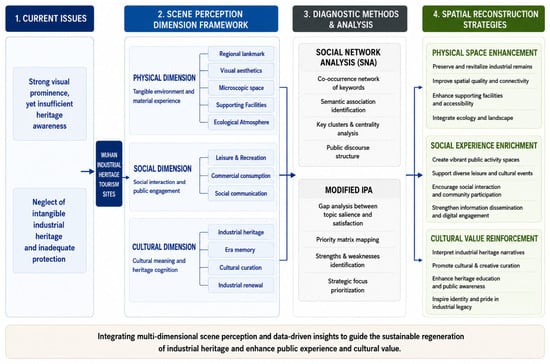
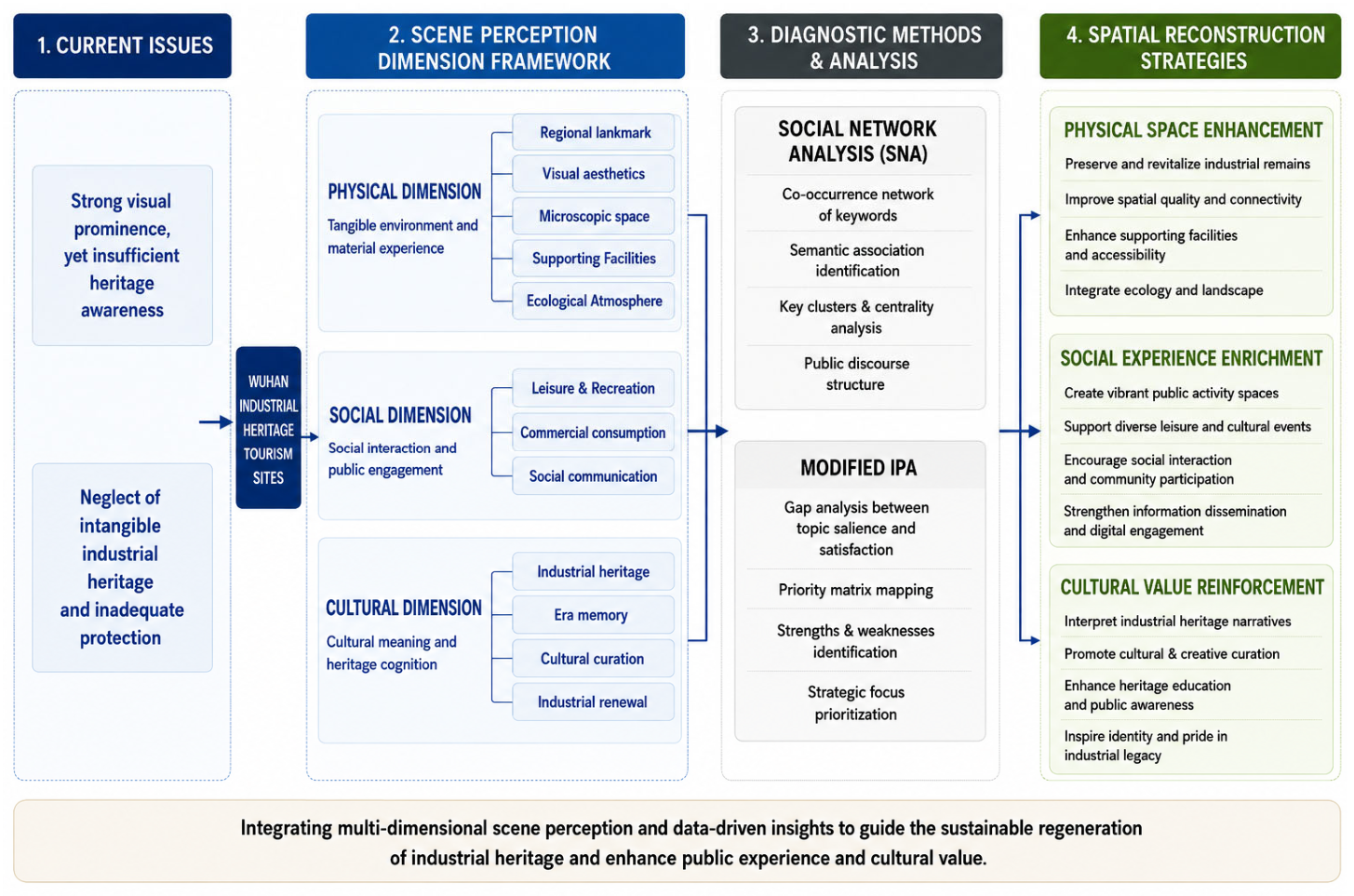
This study follows four analytical steps: theoretical construction, element identification, perception diagnosis and strategic response (Figure 1). Scene Theory is first used to organize perceptions expressed by Dianping users into physical, social and cultural dimensions, from which 12 perception elements are identified from UGC. Semantic network analysis then maps the structural relationships among these elements.
Figure 1.
Conceptual framework.
Conventional IPA derives importance from respondents’ subjective ratings in structured surveys. UGC, by contrast, records unsolicited attention rather than responses elicited by predefined questions. We therefore replace survey-rated importance with topic salience, measured by the relative frequency with which each perception element is mentioned in free-text reviews, while retaining sentiment-based satisfaction as the second dimension. This adaptation uses the capacity of UGC to capture spontaneous attention, but topic salience should be interpreted as attention-based or discursive salience rather than objective or psychological importance. Baseline amenities, such as transport or supporting facilities, may consequently be underrepresented because users often mention them only when they fail or cause inconvenience. The modified IPA is therefore used as a diagnostic of salience and expressed satisfaction, not as a direct ranking of planning priority. Spatial optimisation strategies are subsequently developed from the diagnosed perceptual gaps.
2.4. Theoretical Foundation
Four related gaps motivate the present study. First, a research-perspective gap remains in industrial heritage research. Recent studies continue to examine industrial heritage primarily through value assessment, adaptive reuse, conservation and post-renewal spatial performance [17,18,19]. Although public-oriented research is increasing, community and visitor perceptions remain less systematically incorporated into heritage assessment and management; recent evidence further demonstrates that expert and community assessments of industrial heritage values can diverge substantially.
Second, a methodological gap concerns how such perceptions are elicited. Recent studies of industrial heritage visitors have relied extensively on structured questionnaires, Likert-scale constructs and interviews to examine motivations, satisfaction, place attachment and conservation attitudes [20,21]. These methods provide controlled and theoretically interpretable measures, but their analytical categories are largely specified before data collection. They are therefore less suited to identifying relationships and concerns that emerge spontaneously from unsolicited visitor expression. UGC offers a complementary source for examining such naturally occurring perceptions.
Third, a theoretical gap remains in the application of Scene Theory. Recent applications have focused predominantly on urban public space, cultural consumption, spatial governance and scene-making, including cultural scenes associated with metropolitan transport and other urban settings [22,23]. Applications to industrial heritage have begun to emerge, but their use for systematically explaining multidimensional visitor perceptions of industrial heritage remains comparatively limited.
Finally, a perception-framework gap persists between normative heritage evaluation and experienced heritage meaning. Physical and post-occupancy approaches provide detailed evidence on spatial quality, environmental performance and facilities, whereas expert-led assessments systematically identify historical, technological and cultural values. However, recent comparative evidence shows that expert priorities do not necessarily correspond to those of industrial communities [24]. This suggests a need for an analytical framework that connects physical settings with social practices and cultural interpretation from the perspective of users themselves.
Together, these gaps motivate a UGC-based framework that integrates physical settings, social practices and cultural meanings, while allowing perception structures to emerge from users’ unsolicited expressions rather than being entirely predefined by the researcher.
2.4.1. Spatial Perception and the Production of Space
Lefebvre’s theory of the production of space further provides an important conceptual basis for understanding the relationship between space and perception. Rather than treating space as a passive physical container, Lefebvre conceptualises social space through the interconnected triad of spatial practice (perceived space), representations of space (conceived space), and representational spaces (lived space) [25]. Lefebvre’s spatial triad offers a broader theoretical foundation for understanding multidimensional spatial perception in industrial heritage contexts. The perceived space corresponds to the physical encounters with industrial remains and spatial layouts; the conceived space relates to planning and conservation expertise that defines heritage value; and the lived space captures the everyday meanings, memories, and emotional attachments that visitors construct through their use of these sites. This study primarily operationalizes the perceived and lived dimensions through UGC analysis, while acknowledging that the conceived dimension is better addressed through expert-led evaluation methods.
2.4.2. Scene Theory and Its Adaptive Extension to Industrial Heritage
While Lefebvre provides a broad explanation of how space is socially produced and experienced, Scene Theory offers a more operational perspective for examining how place-based amenities, social practices, and cultural meanings jointly shape public perceptions of specific urban settings.
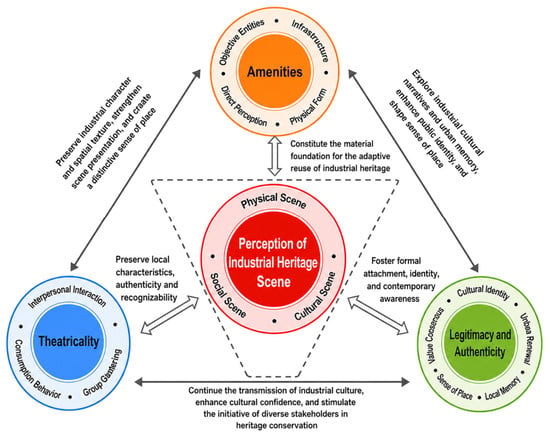
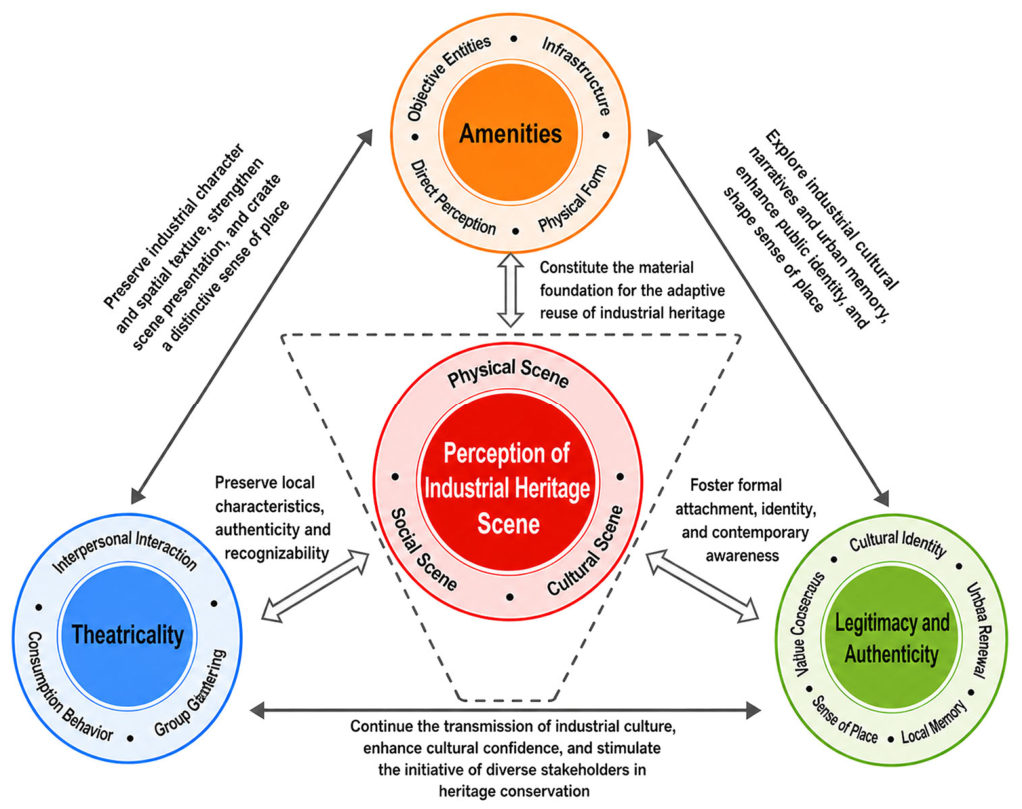
Scene Theory emerged from research on changing post-industrial urban structures. Clark, Silver, and colleagues developed it to explain how amenities and shared cultural meanings form distinctive urban scenes [12,14,26]. The theory attributes urban vitality to interactions among material environments, social activities, and cultural meanings. It describes spatial attractiveness through three dimensions: amenities, theatricality, and legitimacy/authenticity (Figure 2) [13,27].
Figure 2.
Relationship among Amenities, Theatricality, and Legitimacy and Authenticity in Industrial Heritage Scenes.
Amenities refer to perceivable and usable environmental conditions within a space, including buildings, landscapes, facilities, and public services. Theatricality emphasises behavioural performance, self-presentation, social interaction and consumption practices. Visual display, photography, check-ins and social-media sharing are therefore not peripheral behaviours but constitutive expressions of theatricality, through which heritage spaces become stages for interaction, experiential expression and self-presentation. These practices can strengthen scene vitality by increasing participation and the symbolic visibility of place. Legitimacy and authenticity, by contrast, concern the historical context, local memories, value recognition and perceived cultural authenticity embedded within places. By moving beyond purely physical interpretations of space, Scene Theory incorporates social practices and cultural meanings into explanations of spatial attractiveness, providing an important theoretical foundation for understanding the transformation of industrial heritage from production spaces into recreational, consumption-oriented, and cultural spaces.
Within the adapted framework, Amenities correspond primarily to environmental resources and spatial conditions in the physical scene. Theatricality encompasses leisure and recreation, commercial consumption, social communication, and visual aesthetics. Legitimacy/Authenticity is represented by era memory, industrial heritage, cultural curation, and perceptions of industrial renewal. This mapping is not a strict substitution for the original dimensions. It reorganizes them operationally while preserving their conceptual relationships.
However, the scene approach has been critiqued for its ambiguous scope—some scholars argue that its explanatory power is strongest at the neighborhood scale but weakens when applied to city-level or heritage-typology comparisons. Others question whether the three original dimensions (amenities, theatricality, authenticity) can adequately capture the historical depth and temporal layering of industrial heritage, which differs fundamentally from the consumption-oriented urban spaces for which Scene Theory was originally developed. Accordingly, this study does not treat Scene Theory as a universal explanation of the production and transformation of industrial heritage space. Instead, it adopts the theory as a meso-level framework for organizing place-based experience and cultural perception, while using UGC-based empirical analysis to identify the specific content of public perception.
This study introduces Scene Theory, adaptively interpreted according to the specific characteristics of industrial heritage. While conventional industrial heritage conservation studies often emphasize physical remains and spatial forms, this study incorporates public leisure activities, social interactions, commercial consumption, and cultural memories into the analytical framework. Based on a physical–social–cultural structure, this study develops a public perception framework. The physical dimension focuses on industrial remnants, spatial environments, and visual characteristics; the social dimension examines recreational activities, commercial consumption, and social communication; and the cultural dimension emphasizes historical memory, industrial values, cultural interpretation, and renewal cognition. Furthermore, perception elements are adjusted according to semantic meanings identified from UGC texts, with particular attention paid to cultural narratives and public awareness of heritage conservation.
Therefore, Scene Theory provides an effective framework for explaining the multidimensional experiential structure of industrial heritage. However, when applied to industrial heritage revitalization evaluation, it requires further consideration of heritage authenticity, historical interpretation, and public conservation awareness. Through theoretical adaptation and empirical analysis, this study aims to reveal the relationship between “visible heritage remains” and “perceived cultural meanings” during industrial heritage revitalization.
3. Analytical Methods
3.1. User-Generated Content Analysis
UGC content analysis extracts relevant information from spontaneous and unstructured online texts. It not only reflects the general preferences of the public [28] but also captures deficiencies in micro-level services, thereby providing high-quality empirical data for constructing a bottom-up evaluation framework.
3.2. Modified Importance–Performance Analysis
Martilla and James introduced Importance–Performance Analysis (IPA) in 1977. Conventional IPA maps importance on the horizontal axis and performance or satisfaction on the vertical axis [29]. We adapted this model because UGC does not contain survey-based ratings of psychological importance. Instead, the relative mention frequency of each perception element measures topic salience, or its discursive visibility within the corpus. Satisfaction captures the evaluative sentiment associated with each element. We estimated sentiment using SnowNLP (0.12.3) for Chinese text and converted the resulting scores into satisfaction indicators.
3.3. Social Network Analysis
Social network analysis (SNA) was employed to examine the co-occurrence relationships among high-frequency terms in the UGC corpus. Following Wasserman and Faust [30]. Emirbayer and Goodwin subsequently cautioned that exclusively structural interpretations may overlook cultural meaning and agency, highlighting the need to interpret network patterns within their substantive context [31]. The present study does not examine interpersonal relations; instead, it constructs a one-mode, undirected, weighted semantic co-occurrence network. Perception-related keywords constitute the nodes, while an edge represents the co-occurrence of two keywords within the same review, and edge weight corresponds to their co-occurrence frequency. We constructed a term co-occurrence network in which nodes represent top-50 high-frequency words (after stop-word removal), and edges represent the number of documents in which two terms co-appear. The network was visualized and analyzed using Gephi (v0.10.1) with the Fruchterman-Reingold layout algorithm [32]. Degree centrality was calculated to identify the core semantic nodes within each perception dimension. The semantic network therefore captures structural associations among concepts expressed in UGC. We assessed node prominence using degree centrality and weighted degree. Degree centrality measures the number of distinct concepts directly connected to a keyword, whereas weighted degree additionally incorporates the frequency of those co-occurrences. Keywords with higher centrality values were interpreted as having greater structural prominence within the semantic network. This allows the analysis to identify not only which concepts occur frequently, but also which concepts occupy structurally important positions in the wider network of perception.
4. Results
4.1. High-Frequency Word Statistics and Analysis
We identified the 50 most frequent perception-related terms in the cleaned corpus (Table 2).
Table 2.
Top 50 High-Frequency Perception-Related Terms.
The top 50 high-frequency words reveal three main themes: visual and performative engagement, industrial–historical cognition, and spatial–recreational experience. “Taking photos” and “check-in” rank among the most frequent terms, indicating that photography and social media sharing are important forms of public engagement. From the perspective of Scene Theory, these practices reflect theatricality, including self-presentation, social interaction, and performative vitality, rather than a deficiency in themselves. Meanwhile, terms such as “history”, “industry”, “architecture”, “culture”, and “train” demonstrate clear public attention to industrial and historical attributes, although more specific references to production processes, workers’ memories, and technological development remain relatively limited. The frequent occurrence of “however” is retained because it often introduces contrasting evaluations within reviews, reflecting the coexistence of positive experiences and perceived deficiencies. Terms related to gardens, parks, environment, transportation, and riverfront areas further indicate strong attention to recreational and spatial experiences. Overall, visual engagement is highly salient, while the depth of industrial cultural interpretation remains comparatively uneven.
4.2. Semantic Network Analysis
Based on the above theoretical framework and the semantic characteristics identified from the UGC corpus, 12 core perception elements of Wuhan’s industrial heritage were first established (Table 3). A modified IPA framework based on topic salience and satisfaction was then applied to diagnose the perceptual performance and discrepancies among these elements.
Table 3.
Summary of Scene Perception Dimension Elements.
Existing research has developed a “physical–social–cultural” perception framework. Previous research on Third Front industrial heritage used Scene Theory to identify three dimensions and nine perception elements [33]. Its physical dimension comprises architectural landscape, supporting services and historical culture; the social dimension includes leisure and entertainment, management and organization, and social interaction; and the cultural dimension includes patriotic education, nostalgic emotion and aesthetic experience.
This framework provides a useful structural precedent because several of its perception mechanisms are transferable beyond the specific historical context of Third Front construction. Architectural landscape and supporting services inform the physical experience of place; leisure and social interaction capture its social and performative functions; and nostalgic emotion and aesthetic experience reflect the cultural and symbolic interpretation of heritage. These relationships support the broader physical–social–cultural logic adopted in the present study.
However, the empirical content of the Third Front framework is strongly shaped by red memory, patriotic education, nostalgia and unit-based life. These categories do not fully correspond to the spatial attributes and historical meanings of Wuhan’s waterfront industrial heritage. We therefore retain the transferable three-dimensional logic rather than directly reproducing its perception elements. Context-specific categories are replaced by elements derived from Wuhan UGC, allowing the framework to reflect Wuhan’s industrial transport systems, waterfront setting and contemporary visitor experience. This selective adaptation preserves the explanatory structure of the earlier framework while avoiding the direct transfer of historically specific categories.
We therefore reconstructed the nine-element framework for Wuhan’s waterfront industrial heritage. The city’s sites combine urban landmarks, waterfront landscapes, factories, railways, bridges, and other industrial remains. Their renewal has also introduced creative consumption, leisure, recreation, and social-media check-ins. We organized public perceptions into three dimensions and 12 elements. The physical scene comprises regional landmarks, visual aesthetics, microscopic space, supporting facilities, and ecological atmosphere. The social scene comprises leisure and recreation, commercial consumption, and social communication. The cultural scene comprises era memory, industrial heritage, cultural curation, and industrial renewal. This framework reflects Wuhan’s modern industrial development, urban memory, and current patterns of adaptive reuse.
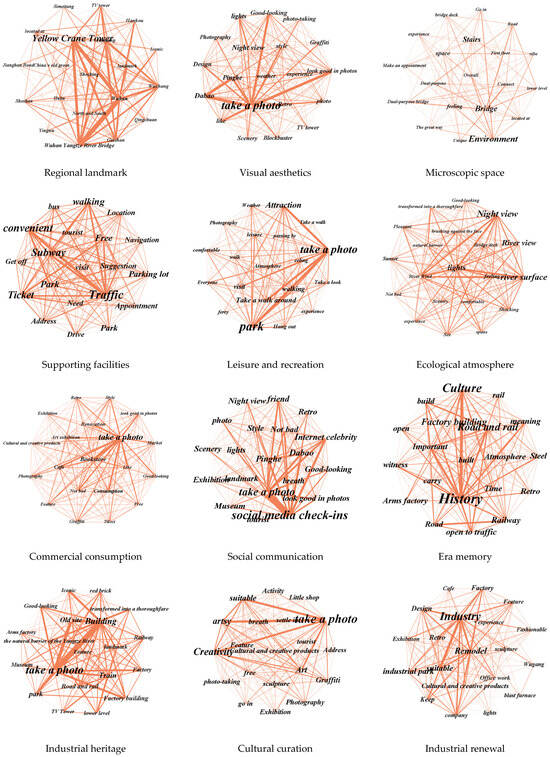
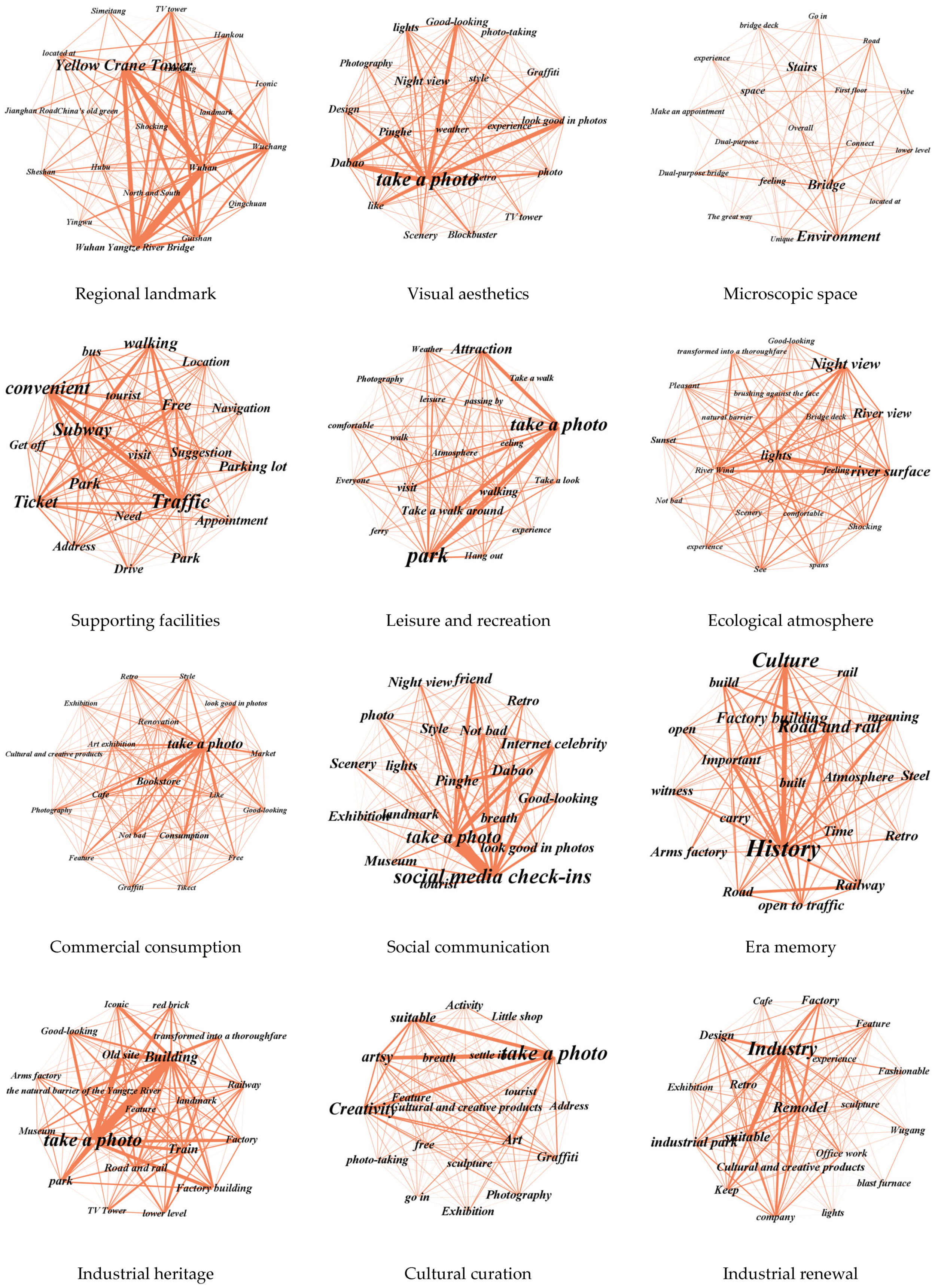
This study conducted a social network analysis of the 12 perception elements (Figure 3). In the visualization, node size represents the TF–IDF weight of each keyword; the larger the node, the more strongly the word represents the semantic characteristics of the corresponding perception element. Edge thickness and color indicate the co-occurrence frequency between words. Specifically, thicker and darker edges suggest stronger semantic associations between paired keywords.
Figure 3.
Semantic networks of the 12 scene-perception elements.
4.2.1. Physical Scene
The regional-landmark network centered on the Yellow Crane Tower and Wuhan Yangtze River Bridge. It also included riverfront references such as Wuchang and Hankou. Visitors therefore situated individual heritage sites within Wuhan’s wider waterfront geography and established urban imagery.
With regard to visual aesthetics, high-frequency terms such as “photography,” “style,” and “photogenic” occupy central positions in the network. This finding suggests that the distinctive visual tension of industrial heritage, particularly its ruin aesthetics and historical textures, has effectively responded to the image-oriented logic of contemporary tourism. As a result, industrial heritage has increasingly been reconstructed as an interactive aesthetic space mediated by social media photography.
In contrast, regarding the microscopic space element, terms such as “environment” and “space” appear as core nodes, but their semantic connections are relatively sparse. This suggests that public attention to the internal spatial organization and detailed environmental experience of industrial heritage sites remains limited.
Regarding the supporting facilities element, the network is centered on terms such as “transportation,” “subway,” and “parking,” revealing strong public demand for last-mile accessibility. Meanwhile, the frequent co-occurrence of “ticket” and “free admission” reflects tourists’ sensitivity to consumption costs. It also indirectly indicates that many industrial heritage tourism destinations in Wuhan currently operate through a low-threshold, open-access model, which constitutes an important physical condition supporting high visitor flows.
Regarding ecological atmosphere, terms such as “river surface,” “river scenery,” and “river breeze” are closely connected with “night view,” “lighting,” and “sunset,” forming a core perceptual vocabulary. This highlights the distinctive waterfront characteristics and emotional value of Wuhan’s industrial heritage sites, while further confirming their spatial distribution along the Yangtze River.
4.2.2. Social Scene
Among leisure and recreation elements, “park” and “photography” occupy central positions in the semantic network. This indicates that the conservation and reuse of Wuhan’s industrial heritage are largely realized through site parks and cultural and creative parks, which have been successfully integrated into the city’s everyday public life. Weather conditions and environmental comfort constitute the basic foundation of recreational experience, while photography serves as an important indicator of recreational satisfaction. In this sense, industrial heritage sites have become low-threshold “healing spaces” for urban residents, supported by waterfront microclimates and slow-paced leisure activities.
In the commercial-consumption network, photography remained the central node, while bookstores and coffee shops were the main settings for on-site spending. Visitors engaged not only with products and services but also with interiors, graffiti, retro design, and cultural creativity as photographic settings. Commercial consumption was therefore closely tied to the production and circulation of visual experiences.
Regarding social communication, online expression is dominated by “check-ins” and “photography.” Industrial heritage sites have thus evolved into stages for public self-presentation and social performance, with their popularity and spatial vitality increasingly dependent on image sharing through social media.
4.2.3. Cultural Scene
In terms of era memory, “history” and “culture” occupy the central positions in the semantic network, indicating that public perception of industrial heritage is primarily organized around macro-level historical and cultural values. At the same time, terms such as “railway,” “factory,” “opening to traffic,” “arsenal,” and “steel” also appear as core nodes, suggesting that certain industrial symbols and historical events have been recognized by the public.
Regarding industrial heritage, the network is centered on terms such as “building,” “train,” “old site,” and “factory.” Their frequent co-occurrence with landmark-related terms indicates that authentic industrial relics and spatial symbols have become important triggers for photography and social-media check-ins.
The cultural-curation network linked art, literature, graffiti, and exhibitions with photography and filming. These associations suggest that cultural programs softened the perceived austerity of industrial remains. They also introduced youth-oriented subcultures and contemporary artistic expression.
The industrial-renewal network centered on industry and transformation. These terms were closely connected with preservation, retro design, factories, cultural creativity, and industrial parks. Public perceptions of revitalization therefore emphasized the visible coexistence of old and new elements.
4.3. Modified IPA Based on Topic Salience and Satisfaction
Based on Scene Theory, this study constructs a multidimensional scene-perception framework comprising 12 perception elements (Table 4). In the modified IPA framework, the horizontal axis no longer represents psychological importance but instead represents topic salience, while the vertical axis represents satisfaction derived from sentiment analysis. Topic salience is calculated from the relative mention frequency of each perception element in the UGC corpus and reflects its visibility and intensity of discussion in online reviews. The mean values of topic salience and satisfaction across the 12 perception elements are then used as the quadrant thresholds. Through this IPA-based evaluation, the study identifies key elements requiring improvement and provides a basis for subsequent optimisation strategies [34,35].
Table 4.
Topic Salience and Satisfaction Scores of Scene Perception Elements.
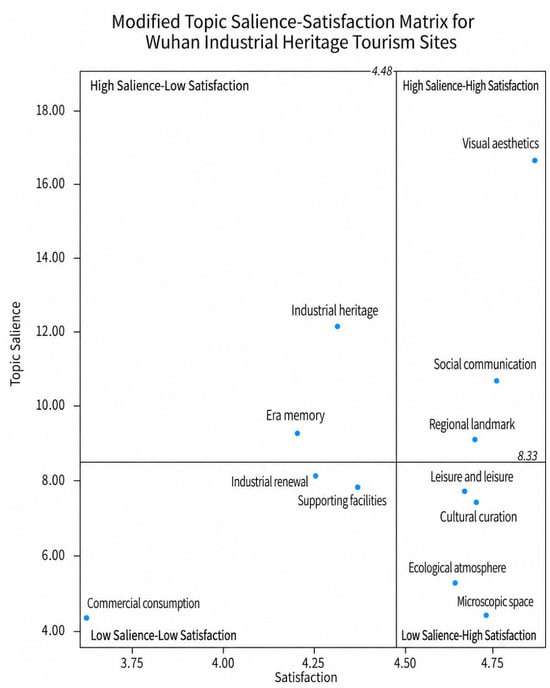
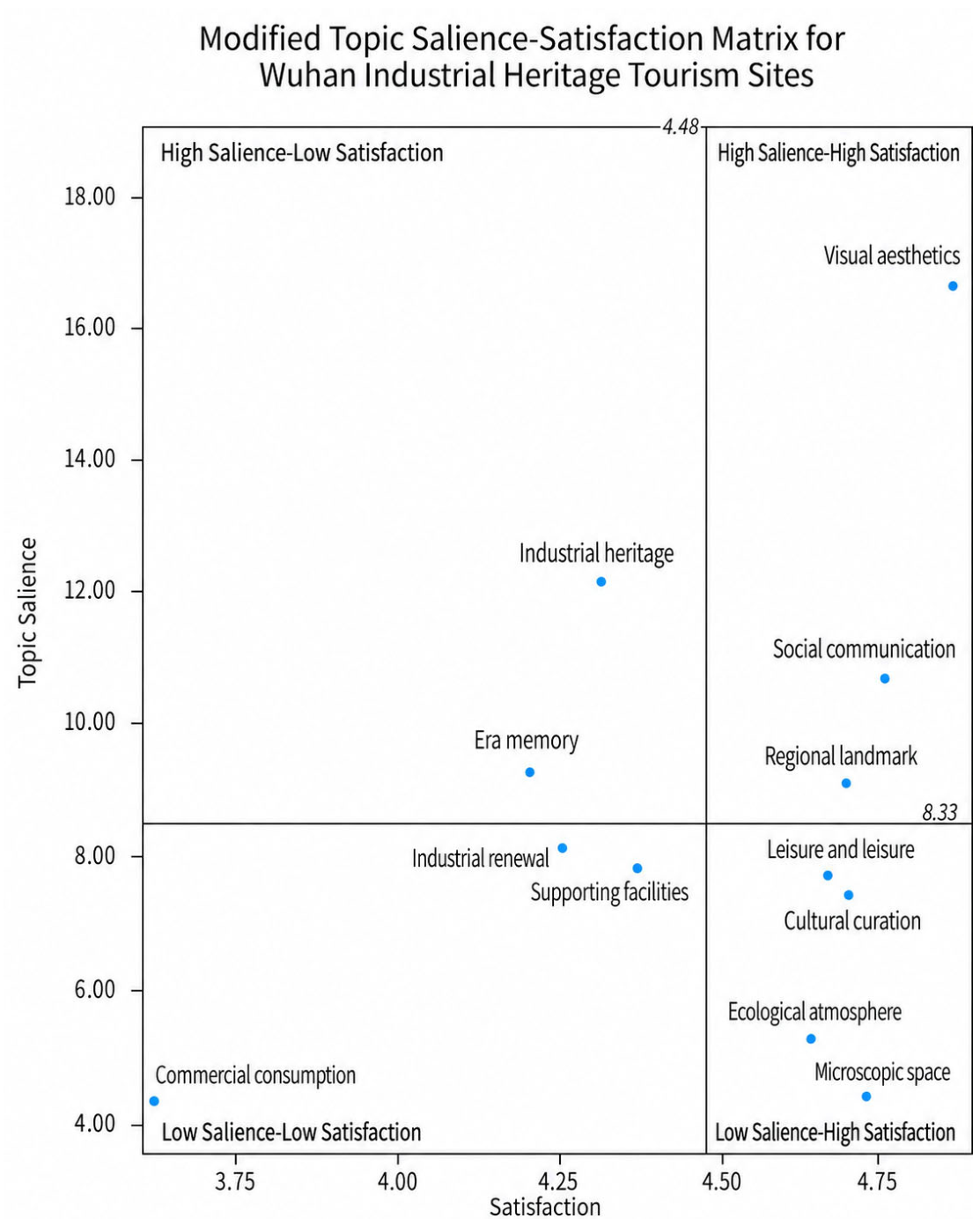
Using the 12 perception elements as the statistical units, the mean topic salience and satisfaction scores were calculated as 8.33 and 4.48, respectively. Both values represent the arithmetic means of the corresponding scores across the 12 elements and were used as the horizontal and vertical thresholds for dividing the modified IPA matrix into four quadrants (Figure 4).
Figure 4.
Modified topic-salience–satisfaction matrix for Wuhan Industrial Heritage Tourism Sites.
4.4. Content Analysis and Qualitative Interpretation of Industrial Heritage Narratives
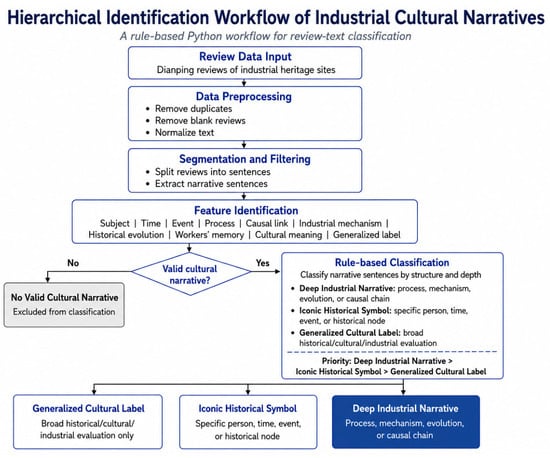
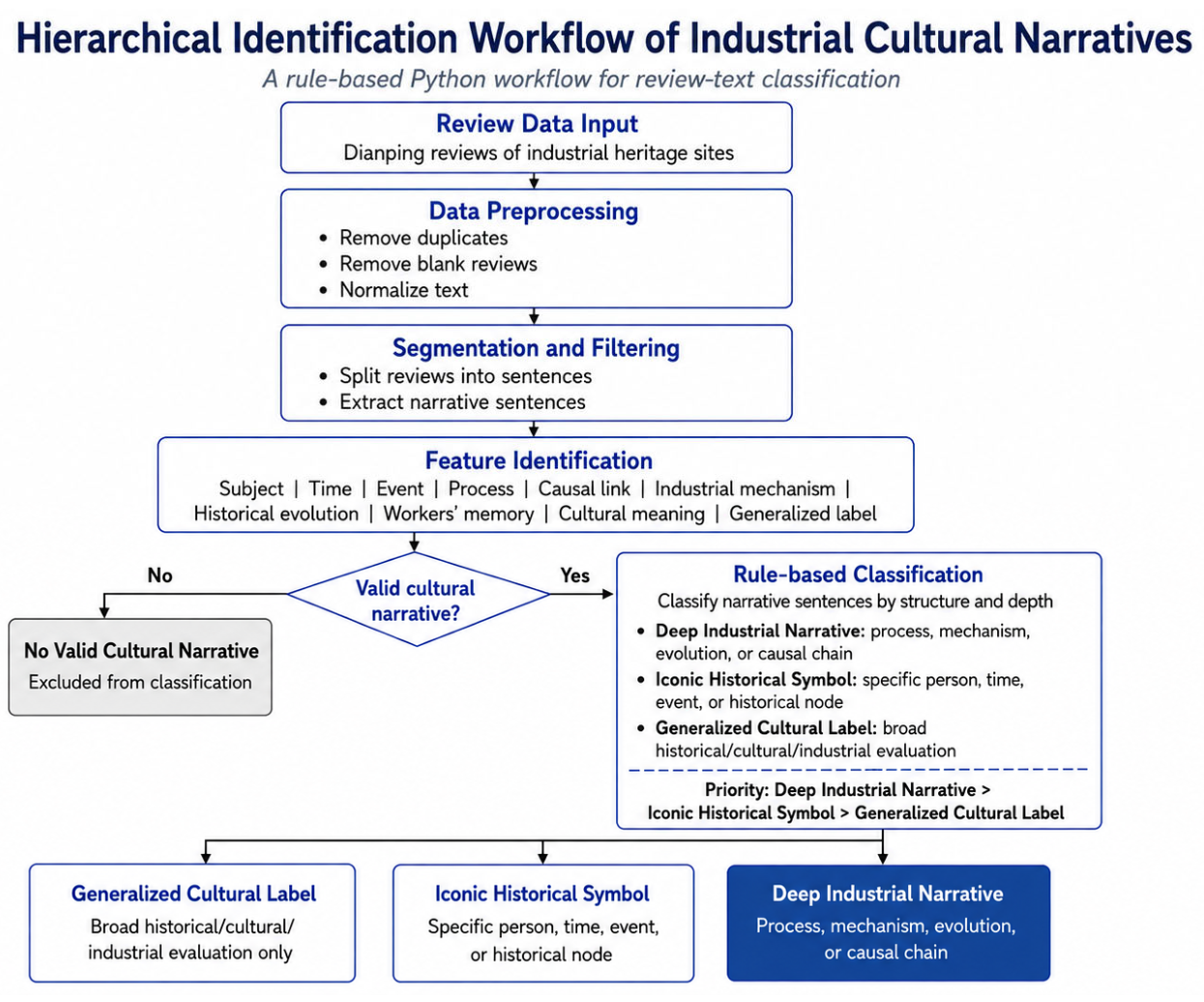
To further examine the depth of public understanding of industrial heritage culture, this study applied a Python-based rule-oriented approach to the culture-related reviews retained after secondary filtering. Review texts were first segmented into sentences, after which narrative features including subjects, time, events, processes, causal relationships, industrial mechanisms, historical evolution, workers’ memories, and cultural meanings were identified. Based on these features, reviews were classified into three levels: Generalized Cultural Labels, Iconic Historical Symbols, and Deep Industrial Narratives. Deep Industrial Narratives required structural evidence of production processes, technical mechanisms, causal relationships, or historical transformation; isolated industrial keywords alone were therefore insufficient for classification. The identification procedure is illustrated in Figure 5. Although narrative features were identified at the sentence level, the complete review remained the final classification unit. When multiple narrative levels occurred within the same review, the highest level supported by its narrative structure was assigned.
Figure 5.
Hierarchical Identification Workflow of Industrial Cultural Narratives from Review Texts.
Table 5 illustrates the classification rules using three representative reviews. R02 refers only to a ’strong cultural atmosphere’ and contains no specific actors, events, or industrial processes. It was therefore classified as a Generalized Cultural Label. R03 identifies the former Wuhan Shipyard, an iron tower, the factory gatehouse, and site transformation. Because it does not explain production mechanisms or industrial development, it was classified as an Iconic Historical Symbol. R01 contains explicit temporal references, historical events, and actors. It also links railway construction, ferry transport, and completion of the Wuhan Yangtze River Bridge as a process. R01 was therefore classified as a Deep Industrial Narrative.
Table 5.
Representative Review Excerpts and Rule-Based Classification of Narrative Levels.
The three-level classification included 1727 culture-related reviews. Of these, 843 (48.81%) were classified as Iconic Historical Symbols and 739 (42.79%) as Generalized Cultural Labels. Only 145 reviews (8.40%) contained Deep Industrial Narratives (Table 6). Cultural expression therefore centered on broad cultural recognition and identifiable historical symbols. The principal limitation was not an absence of cultural references, but the limited depth and structural completeness of industrial narratives.
Table 6.
Distribution of the Three Levels of Industrial Cultural Narratives.
5. Discussion
5.1. Interpretation of the Modified IPA Matrix
Based on the modified IPA framework, the 12 perception elements are positioned according to their topic salience and satisfaction scores. Because topic salience reflects the visibility of an element in UGC rather than its psychological importance, the conventional priority-oriented quadrant labels are not used in the interpretation. Instead, the four quadrants are described as High Salience–High Satisfaction, Low Salience–High Satisfaction, Low Salience–Low Satisfaction, and High Salience–Low Satisfaction.
The High Salience–High Satisfaction quadrant includes visual aesthetics, social communication, and regional landmarks. These elements are both frequently discussed in UGC and positively evaluated, indicating that visual appeal, digital communication, and urban landmark recognition represent established perceptual strengths of Wuhan’s industrial heritage tourism sites. In particular, visual aesthetics records the highest topic salience, highlighting the prominent role of industrial heritage settings in image-based expression and social-media communication.
The Low Salience–High Satisfaction quadrant includes leisure and recreation, microscopic space, cultural curation, and ecological atmosphere. Although these elements are discussed less frequently in UGC, they receive relatively positive evaluations when mentioned, suggesting that waterfront environments, cultural curation, and the distinctive spatial qualities of industrial architecture provide valuable complementary experiences.
The Low Salience–Low Satisfaction quadrant includes industrial renewal, supporting facilities, and commercial consumption. Commercial consumption records the lowest satisfaction score, identifying it as a notable weakness in the current visitor experience. Supporting facilities are discussed less frequently but receive relatively unfavorable evaluations when mentioned. Importantly, low topic salience should not be interpreted as low planning priority. Industrial renewal also falls within this quadrant, indicating that approaches to heritage conservation, adaptation, and reuse receive relatively limited discussion and modest evaluations in UGC.
The High Salience–Low Satisfaction quadrant includes era memory and industrial heritage. Both elements show relatively high topic salience but comparatively low satisfaction, revealing a clear gap between discursive visibility and evaluated experience. The result suggests that although industrial heritage retains strong visual recognizability, production history, collective memory, and industrial culture have not been translated equally effectively into perceptible and interpretable cultural experiences. The principal issue reflected by this quadrant is therefore not a lack of public attention, but an imbalance between the visibility of industrial heritage and the translation of its cultural meanings.
5.2. Cultural Perception Displacement: Weakening of Historical Narrative Under High-Frequency Attention
Based on the IPA, “era memory” and “industrial heritage” fall into Quadrant IV, characterized by high topic salience but low satisfaction. This result indicates that the public is not indifferent to industrial culture. Rather, the semantic network analysis shows that terms such as “history,” “culture,” “old site,” and “factory” are frequently mentioned, suggesting a relatively high level of public attention to industrial culture. However, these expressions largely remain at the level of Generalized cultural labels or macro-level historical references, while specific historical events, production processes, and industrial memories are mentioned less frequently. As a result, public perception of the cultural dimension remains relatively shallow.
Although many physical remains have been preserved, their original functions, production processes, and technological values are not always clearly interpreted. Factories, railways, red-brick structures, and bridges also provide settings for photography, check-ins, self-presentation, and social interaction. In Scene Theory, these visual and performative practices express theatricality and contribute to the vitality of revitalized heritage scenes. They should not be treated as deficiencies in themselves. The central problem is that strong visual engagement is not consistently matched by historical interpretation or understanding of industrial culture. UGC frequently mentions industrial heritage, confirming its visual recognizability and communicative potential. Detailed references to production functions, technologies, workers’ memories, and industrial development remain comparatively scarce. The resulting tension lies between highly developed visual engagement and the insufficient communication of industrial cultural narratives.
Notably, “industrial renewal” falls into Quadrant III, showing low topic salience and low satisfaction. This further indicates that public attention to and evaluation of industrial heritage conservation, renewal, and reuse remain limited. Most comments do not engage deeply with questions such as why industrial heritage should be preserved, how it should be renewed, or how it should be reused. This indirectly reflects the public’s weak perception of the concepts and logic underlying industrial heritage conservation and renewal.
Some industrial heritage projects prioritize visual landscaping and commercial functions while giving less attention to intangible industrial culture. Previous research argues that conservation should extend beyond built form and functional reuse to sustain urban memory, industrial identity, and local culture. Our findings support this position. Studies of Third Front industrial heritage likewise advocate an integrated physical, social, and cultural approach [36]. Research on Hechai 1972 shows how online dissemination can reframe industrial heritage as visual consumption and social-media check-ins [37]. Work on the Hanyang Iron Works area similarly emphasises the continuity of urban memory, historical narratives, and cultural identity [38].
5.3. Spatial Optimization Strategies
The proposed strategies are not derived from generic principles of industrial heritage regeneration, but from the specific perceptual gaps identified in Wuhan. The selected sites are characterized by a strong waterfront setting, prominent bridge–railway–factory heritage systems, and highly developed visual and social-media engagement. The UGC results nevertheless reveal weaknesses in the perceived experience of industrial heritage, era memory, and commercial consumption. Accordingly, the following strategies specifically address three problems: visible heritage with insufficient interpretability of industrial processes, strong social visibility but weak integration between commerce and heritage identity, and recognizable historical symbols but limited depth of industrial narratives.
5.3.1. Reconstructing the Interpretability of Wuhan’s Industrial Heritage System
Visual aesthetics records the highest topic salience (16.57) and high satisfaction (4.864), whereas industrial heritage shows relatively high salience (11.86) but considerably lower satisfaction (4.322). The principal physical problem is therefore not the invisibility of heritage, but the limited interpretability of its industrial logic. Rather than introducing further image-oriented beautification, intervention should reconstruct the historical relationships among Wuhan’s characteristic bridge, railway, factory, and waterfront transport systems. At the Wuhan Yangtze River Bridge, for example, interpretation could connect the Jinghan and Yuehan railways, cross-river ferry transportation, and bridge construction into a coherent industrial-transport narrative. At former production sites such as Wuchangwan 1956 Park, surviving structures should be explicitly reconnected to their original functions and historical transformations. Wayfinding should likewise be integrated with these narrative nodes, allowing visually recognizable remains to be understood as components of a connected industrial system.
5.3.2. Embedding Site-Specific Industrial Identity into Social and Commercial Experience
Social communication combines relatively high topic salience (9.92) with high satisfaction (4.740), whereas commercial consumption records the lowest satisfaction score (3.625). Photography, check-ins, and social sharing therefore already constitute important sources of scene vitality; the greater weakness lies in the limited connection between commercial content and industrial identity. Commercial and cultural programs should consequently be differentiated according to the former industrial functions of individual sites. Hanyangzao can foreground its modern arsenal history, Pinghe Packing Factory can draw upon its historical warehousing and packaging identity, while heritage associated with Wuhan Iron and Steel and the former Wuhan Shipyard can emphasise their respective steelmaking and shipbuilding histories. Existing practices of photography and digital sharing can then function as vehicles through which these site-specific industrial meanings enter everyday consumption and social communication.
5.3.3. From Historical Symbols to Process-Oriented Industrial Narratives
Era memory had relatively high topic salience (8.48) but low satisfaction (4.194). Deep Industrial Narratives accounted for only 8.40% of culture-related reviews. Cultural intervention should therefore move beyond broad labels such as history, culture, and former site. Instead, interpretation should connect heritage objects, historical events, industrial processes, and human memory. At the Wuhan Yangtze River Bridge, narratives could link the landmark to railway connections, ferry transport, and the wider transport system. Factory and shipbuilding sites should likewise explain production processes, technological change, and workers’ experiences. Guided routes, exhibitions, and digital media can embed these process-oriented narratives and deepen public understanding [39].
6. Conclusions
Using 4617 cleaned Dianping reviews, this study shows that perceptions expressed by Dianping users toward Wuhan’s industrial heritage are structured across physical, social and cultural scenes. Visual aesthetics showed the highest topic salience (16.57), and social communication emerged as another established strength. By contrast, Industrial heritage (topic salience = 11.86; satisfaction = 4.322) and Era memory (8.48; 4.194) combined relatively high visibility with lower satisfaction, while Commercial consumption recorded the lowest satisfaction score (3.625). Hierarchical narrative classification further showed that only 8.40% of culture-related reviews contained Deep Industrial Narratives. The principal gap is therefore not an absence of cultural references, but the limited translation of visible industrial heritage into connected and interpretable narratives of production, technology, workers and historical change.
Theoretically, this study adaptively extends Scene Theory to the perception of industrial heritage. By operationalising Amenities, Theatricality and Legitimacy/Authenticity through a physical–social–cultural framework, the analysis shows that strong visual and performative vitality can coexist with weak cultural interpretability. This distinction refines the application of Scene Theory in heritage contexts: photography, check-ins and social sharing constitute sources of Theatricality and scene vitality, but their prominence does not necessarily imply a corresponding depth of industrial-historical understanding. Industrial heritage perception therefore depends not only on whether heritage is visible and socially activated, but also on whether its historical and cultural meanings become interpretable.
Methodologically, the study integrates UGC, natural language processing, semantic network analysis, a modified IPA framework and hierarchical narrative classification. Replacing survey-rated importance with Topic Salience allows the IPA logic to incorporate spontaneous attention captured in unsolicited reviews. At the same time, the study explicitly treats Topic Salience as discursive visibility rather than objective importance, psychological importance or planning priority. Semantic-network centrality further reveals the structural position of perception concepts, while hierarchical narrative classification extends the analysis beyond keyword frequency to the depth and organisation of cultural interpretation. Together, these methods provide a replicable route for converting large-scale UGC into multidimensional diagnostic evidence for heritage perception.
Practically, the findings provide a more targeted basis for the revitalisation of Wuhan’s industrial heritage. Rather than further intensifying image-oriented beautification, intervention should improve the interpretability of Wuhan’s bridge–railway–factory–waterfront industrial systems, embed site-specific industrial identities within commercial and social experiences, and connect visible heritage objects with production processes, technological change and workers’ memories. These interventions seek to deepen cultural interpretation without suppressing photography, check-ins and social sharing, which already constitute important sources of scene vitality.
Several limitations define the scope of these conclusions. First, the corpus represents active Dianping users rather than the general public. Second, mention-based Topic Salience may underrepresent baseline amenities that attract attention mainly when they fail. Third, SnowNLP-based satisfaction scores depend on the performance of automated sentiment classification. Fourth, the aggregated design cannot isolate differences among individual sites or renewal models, and Scene Theory remains primarily a meso-level framework for interpreting place-based experience [40].
Future research should therefore move in three directions. Cross-city comparisons could test whether the perception structure identified in Wuhan also occurs in industrial cities with different historical trajectories and regeneration models. Multi-source designs could combine Dianping with other digital platforms, questionnaires, interviews and field observations to compare platform-specific and demographic differences. Finally, longitudinal research could track changes in UGC before and after specific spatial or interpretive interventions, providing stronger evidence for how heritage regeneration affects perception over time. Larger samples within each renewal type and manual validation of sentiment and narrative classification would further test the robustness and transferability of the proposed framework.
Author Contributions
Conceptualization, H.X. and S.C.; methodology, H.X. and S.C.; software, S.C.; validation, Y.X. and W.Z.; formal analysis, H.X. and S.C.; investigation, H.X. and S.C.; resources, Y.X. and W.Z.; data curation, S.C.; writing—original draft preparation, H.X. and S.C.; writing—review and editing, Y.X. and W.Z.; visualization, H.X. and S.C.; supervision, Y.X. and W.Z.; project administration, Y.X.; funding acquisition. All authors have read and agreed to the published version of the manuscript.
Funding
“The Phoenix Rebirth of Industrial Shorelines—Creating Industrial Heritage Corridors and Waterfront Landscape Regeneration in the Middle Yangtze River.” Project Code: HBSKJJ20250245, Key Project of Hubei Provincial Social Science Fund.
Data Availability Statement
Data are contained within the article.
Conflicts of Interest
The authors declare no conflicts of interest.
Abbreviations
| UGC | User-Generated Content |
| IPA | Importance–Performance Analysis |
| SNA | Social Network Analysis |
| NLP | Natural Language Processing |
References
- The International Committee for the Conservation of the Industrial Heritage (TICCIH). The Nizhny Tagil Charter for the Industrial Heritage; TICCIH: Moscow, Russia, 2003. [Google Scholar]
- Douet, J. Industrial Heritage Re-Tooled: The TICCIH Guide to Industrial Heritage Conservation; Carnegie Publishing: Lancaster, UK, 2012. [Google Scholar]
- Oevermann, H.; Mieg, H.A. (Eds.) Industrial Heritage Sites in Transformation: Clash of Discourses; Routledge: New York, NY, USA, 2014. [Google Scholar] [CrossRef] [Scilit]
- Plevoets, B.; Van Cleempoel, K. Adaptive Reuse of the Built Heritage: Concepts and Cases of an Emerging Discipline; Routledge: London, UK, 2019. [Google Scholar] [CrossRef] [Scilit]
- Bullen, P.A.; Love, P.E.D. The rhetoric of adaptive reuse or reality of demolition: Views from the field. Cities 2010, 27, 215–224. [Google Scholar] [CrossRef] [Scilit]
- Xie, P.F. Developing industrial heritage tourism: A case study of the proposed Jeep Museum in Toledo, Ohio. Tour. Manag. 2006, 27, 1321–1330. [Google Scholar] [CrossRef] [Scilit]
- Zhong, D.; Huang, P.; Xiong, G.; Li, H. Renewal strategies of industrial heritage based on placeness theory: The case of Guangzhou, China. Cities 2024, 155, 105407. [Google Scholar] [CrossRef] [Scilit]
- Dehghan Pour Farashah, M.; Ghaderi, Z.; Kaya, E. Identity construction and collective memory: A critical heritage study of Łódź’s post-industrial legacy. Cities 2026, 170, 106743. [Google Scholar] [CrossRef] [Scilit]
- Harrison, R. Heritage: Critical Approaches; Routledge: London, UK, 2013. [Google Scholar]
- Marine-Roig, E.; Anton Clavé, S. Tourism analytics with massive user-generated content: A case study of Barcelona. J. Destin. Mark. Manag. 2015, 4, 162–172. [Google Scholar] [CrossRef] [Scilit]
- Liang, X.; Lu, Y.; Martin, J. A review of the role of social media for cultural heritage sustainability. Sustainability 2021, 13, 1055. [Google Scholar] [CrossRef] [Scilit]
- Clark, T.N. (Ed.) The City as an Entertainment Machine; Elsevier/JAI: Amsterdam, The Netherlands; Boston, MA, USA, 2004. [Google Scholar]
- Clark, T.N.; Lloyd, R.; Wong, K.K.; Jain, P. Amenities drive urban growth. J. Urban Aff. 2002, 24, 493–515. [Google Scholar] [CrossRef] [Scilit]
- Silver, D.; Clark, T.N. Scenescapes: How Qualities of Place Shape Social Life; University of Chicago Press: Chicago, IL, USA, 2016. [Google Scholar]
- Zhang, Y.; Yu, R. Protection and utilization of modern urban cultural heritage under the framework of the Yangtze River National Cultural Park: A case study of Wuhan. J. Hubei Polytech. Univ. (Humanit. Soc. Sci.) 2025, 42, 64–74. [Google Scholar] [CrossRef]
- Wang, F.; Tang, J.; Zhou, Z. Innovative paths for culture–tourism integration in the context of the Yangtze River National Cultural Park: A case study of Wuhan. Chin. Overseas Archit. 2025, 7, 43–48. [Google Scholar] [CrossRef]
- Zhao, Q.; Liu, F.; Qiao, W. Evaluating industrial heritage value using cloud theory and Dempster–Shafer theory. J. Cult. Herit. 2024, 68, 364–374. [Google Scholar] [CrossRef] [Scilit]
- Nocca, F.; Bosone, M.; Orabona, M. Multicriteria evaluation framework for industrial heritage adaptive reuse: The role of the intrinsic value. Land 2024, 13, 1266. [Google Scholar] [CrossRef] [Scilit]
- Chen, S.; Huang, Y.; Li, S. Post-occupancy evaluation of industrial heritage parks based on user perception: A comparative study of three parks in Changsha, China. Buildings 2026, 16, 2694. [Google Scholar] [CrossRef] [Scilit]
- Zhang, Y.; Shi, P.; Wang, L. A study of the affective motives of city industrial heritage tourists: A case study from Tianjin, China. J. Tour. Cult. Change 2023, 21, 237–252. [Google Scholar] [CrossRef] [Scilit]
- Fu, Y.; Dong, W. How perceived value, environmental awareness, and social identity shape public support for industrial heritage: The mediating role of place attachment. Front. Psychol. 2025, 16, 1645646. [Google Scholar] [CrossRef] [Scilit]
- Mukherjee, A.; Banerji, H. Disparities in expert and community perceptions of industrial heritage and implications for urban well-being in West Bengal, India. Herit. Sci. 2025, 13, 44. [Google Scholar] [CrossRef] [Scilit]
- Wang, Y.; Zhou, Y. Metro cultural scene: A new community scale in urban scene research. Environ. Plan. B Urban Anal. City Sci. 2024, 51, 1931–1947. [Google Scholar] [CrossRef] [Scilit]
- Hu, D.; Guo, Y.; Huang, J.; Shu, B. A bibliometric analysis of public space research from the perspective of Scene Theory: Evolutionary context and implications for China. Trop. Geogr. 2026, 46, 586–602. [Google Scholar] [CrossRef]
- Lefebvre, H. The Production of Space; Nicholson-Smith, D., Translator; Blackwell: Oxford, UK; Cambridge, MA, USA, 1991. [Google Scholar]
- Silver, D.; Clark, T.N.; Navarro Yáñez, C.J. Scenes: Social context in an age of contingency. Soc. Forces 2010, 88, 2293–2324. [Google Scholar] [CrossRef] [Scilit]
- Silver, D.; Clark, T.N. The power of scenes: Quantities of amenities and qualities of places. Cult. Stud. 2015, 29, 425–449. [Google Scholar] [CrossRef] [Scilit]
- Lu, N.; Feng, J. “City tick-off”: A study on urban imagery space under the UGC model—A case analysis of Xiaohongshu note data in Tianjin. Urban Dev. Stud. 2025, 32, 5–14. [Google Scholar]
- Martilla, J.A.; James, J.C. Importance-performance analysis. J. Mark. 1977, 41, 77–79. [Google Scholar] [CrossRef] [Scilit]
- Wasserman, S.; Faust, K. Social Network Analysis: Methods and Applications; Cambridge University Press: Cambridge, UK, 1994. [Google Scholar]
- Emirbayer, M.; Goodwin, J. Network analysis, culture, and the problem of agency. Am. J. Sociol. 1994, 99, 1411–1454. [Google Scholar] [CrossRef] [Scilit]
- Bastian, M.; Heymann, S.; Jacomy, M. Gephi: An open source software for exploring and manipulating networks. Proc. Int. AAAI Conf. Web Soc. Media 2009, 3, 361–362. [Google Scholar] [CrossRef] [Scilit]
- He, Q. Scene Perception Dimensions and Renovation Strategies for Third Front Industrial Heritage Based on the LDA Topic Model: Four Cases in Central and Western China. Master’s Thesis, Shandong Jianzhu University, Jinan, China, 2024. [Google Scholar]
- Tang, L.; Liu, P.; Zhang, J.; Zhang, J. Construction of a tourist perception structure and satisfaction evaluation for urban destinations: A case study of Nanjing. Mod. Urban Res. 2022, 2, 60–66. [Google Scholar] [CrossRef]
- Zhu, W.; Meng, J.; Fang, Z.; Zhang, Y.; Zheng, W. Tourism image perception and optimization paths for typical traditional villages in the Li River Basin based on UGC data and the IPA model. Landsc. Archit. 2025, 42, 62–69. [Google Scholar] [CrossRef]
- Zhang, R.; He, Q.; Liu, J.; Xu, Y.; Liu, K. Framework construction and promotion strategies for the scene perception dimension of China’s Third Front industrial heritage. Planners 2024, 40, 32–40. [Google Scholar] [CrossRef]
- Ni, R.; Wu, M. Image of industrial heritage tourism destinations from a UGC perspective: A case study of Hefei Hechai 1972 Cultural and Creative Park. J. Beijing Univ. Civ. Eng. Archit. 2023, 39, 35–44. [Google Scholar] [CrossRef]
- Huang, Z.; Huang, L.; Shen, Y. Planning paths for industrial heritage renewal oriented toward urban memory inheritance: A case study of the Hanyang Iron Works area in Wuhan. Tour. Forum 2024, 17, 47–57. [Google Scholar] [CrossRef]
- Bian, X.; Brown, A. Establishing the potential for the application of digital storytelling to support Chinese industrial heritage. Acta Hortic. Regiotect. 2023, 26, 147–156. [Google Scholar] [CrossRef] [Scilit]
- Wu, C.; Wilkes, R.; Silver, D.; Clark, T.N. Current debates in urban theory from a scale perspective: Introducing a scenes approach. Urban Stud. 2019, 56, 1487–1497. [Google Scholar] [CrossRef] [Scilit]

Disclaimer/Publisher’s Note: The statements, opinions and data contained in all publications are solely those of the individual author(s) and contributor(s) and not of MDPI and/or the editor(s). MDPI and/or the editor(s) disclaim responsibility for any injury to people or property resulting from any ideas, methods, instructions or products referred to in the content. |
© 2026 by the authors. Licensee MDPI, Basel, Switzerland. This article is an open access article distributed under the terms and conditions of the Creative Commons Attribution (CC BY) license.