


Abstract
This study presents a calibration-oriented multi-phase micromechanical homogenization framework for estimating the elastic modulus of sustainable concrete containing fly ash and recycled gypsum. In the absence of direct experimental measurements, a computational framework was developed to simulate the interactions among coarse aggregate, mortar, and the interfacial transition zone (ITZ). A two-phase homogenization model was first calibrated against the ACI 318-19 elastic modulus relationship through a sensitivity analysis, achieving relative errors below 3% with respect to the ACI-based empirical reference. Subsequently, a three-phase model incorporating a ITZ was developed to explicitly account for the influence of the interfacial transition zone on the effective elastic modulus within the adopted modelling assumptions. While the inclusion of the ITZ slightly increased the prediction error for the control mix, it consistently improved agreement with the ACI-based reference for all fly ash–gypsum blends. In addition, comparison with experimentally reported elastic modulus values for similar SCM-modified concretes demonstrated that the predicted values were physically reasonable and generally consistent with published data. Overall, the proposed framework reproduced stiffness trends predicted by the ACI empirical relationship and provides a physically informed computational baseline for future experimental validation and parametric investigations of sustainable concrete systems.
1. Introduction
According to the 2025 global status report from the United Nations Environment Programme and the Global Alliance for Buildings and Construction [1], the construction industry accounted for 34% of global CO2 emissions in 2023. This data suggests that the sector is currently off-track regarding the Paris Agreement goal to reduce emissions by 28% by 2030 to reach 2050 net-zero and climate resilience targets. To mitigate this, the use of supplementary cementitious materials (SCMs) has emerged as a key innovative solution.
The growing demand for sustainable construction materials has encouraged the incorporation of industrial by-products into cementitious systems. By partially replacing Ordinary Portland Cement (OPC), SCMs not only reduce the carbon footprint of production but also enhance the mechanical and physical properties of the resulting concrete, as well as improving the environmental sustainability of concrete production [2,3]. Recent studies [4,5] highlighted that incorporating SCMs and/or recycled materials can significantly influence the elastic properties of concrete due to changes in microstructure and phase interactions within the composite material.
In a previous study [6], ternary concrete mixtures incorporating fly ash and gypsum from ceramic mold wastes as partial cement replacements were experimentally investigated to evaluate the effects of varying fiber dosages and binder compositions on the mechanical properties of fiber-reinforced concrete. The results identified an optimal binder composition of 60% cement, 37.5% fly ash, and 2.5% recycled gypsum, which exhibited improved compressive and tensile strength at extended curing periods. However, while the earlier research established the strength characteristics of the developed ternary mixtures, direct measurements of the static elastic modulus were not performed. Consequently, the elastic stiffness of these mixtures remains unavailable from experimental evaluation.
The elastic modulus of concrete, , is a critical parameter for predicting the structural stiffness and serviceability behavior of concrete structures [7,8]. Empirical equations, such as those provided by the American Concrete Institute (ACI), are commonly used to estimate the modulus of elasticity based on the compressive strength [9].
However, recent studies emphasize that empirical relationships used in predicting the elastic modulus of concrete may not fully capture its mechanical behavior, particularly for modified mixtures. This limitation arises because concrete is a heterogeneous composite consisting of aggregates, cement paste, and an interfacial transition zone (ITZ) whose interactions govern the overall stiffness and deformation response. For instance, ref. [4] developed a predictive model for estimating the elastic modulus of leached fly ash concrete. While this model demonstrates improved accuracy for mixtures incorporating leached fly ash, its applicability remains limited when multiple supplementary cementitious materials (SCMs) are incorporated simultaneously, where interactions among components may significantly influence the overall mechanical response. Due to the concrete having a heterogeneous structure, its mechanical properties depend on several interacting factors such as aggregate stiffness and volume fraction, water-cement ratio, porosity, and ITZ property [10].
Recent advances in computational modelling have enabled the application of micromechanical and multiscale approaches to predict the elastic properties of composite materials such as concrete. [11] described the interfacial transition zone (ITZ) as the relatively weak region of hydrated cement paste surrounding the aggregate particles in concrete. In their study, the researchers investigated the influence of the ITZ on the elastic properties of concrete using the finite element (FE) method. Similarly, ref. [10] examined the multiscale modelling of the ITZ and its influence on the elastic properties of concrete by incorporating various concrete parameters into their framework. Furthermore, ref. [12] demonstrated that the use of different numerical and multiscale modelling techniques can significantly affect the predicted elastic properties of fly ash recycled aggregate concrete. These approaches allow researchers to estimate effective mechanical properties when experimental measurements are unavailable. Recent computational investigations have also explored the elastic properties of cementitious materials at the nanoscale using first-principles methods [13,14]. Studies on alkali charge-balanced calcium aluminosilicate hydrate (C-A-S-H) nanocomposites demonstrated that variations in chemical composition and interfacial interactions significantly influence the intrinsic elastic properties of hydration products [13,14]. Earlier work by Constantinides and Ulm [15] further demonstrated, through nanoindentation and micromechanical modelling, that the elastic behavior of cement-based materials is governed by the mechanical properties of their constituent phases. These findings highlight the importance of constituent-scale mechanical properties in governing the overall mechanical response of cementitious materials and further motivate the development of multiscale modelling approaches, such as the micromechanical homogenization framework adopted in the present study.
Despite these advances, relatively few studies have explored calibration-oriented micromechanical homogenization frameworks for SCM-modified concrete in situations where direct elastic modulus measurements are unavailable. Moreover, independent assessment of computational predictions using experimentally reported elastic modulus values for similar SCM-modified concrete systems remains limited. Addressing this gap can help establish the physical plausibility of computational predictions while providing a practical baseline for future experimental validation.
Building upon the experimental findings reported in [6], the present study develops a multi-phase micromechanical homogenization framework to estimate the effective elastic modulus of fly ash–gypsum ternary concrete using experimentally reported compressive strength data together with literature-informed constituent material properties. The framework is implemented in Digimat-MF and explicitly incorporates the mortar matrix, coarse aggregates, and the interfacial transition zone (ITZ) through a three-phase homogenization approach. The mortar elastic modulus is first estimated using the semi-empirical Hirsch model [16], which combines the Voigt (parallel) and Reuss (series) models through an adjustable parameter, x, ranging from 0 to 1 [17].
Unlike previous studies that primarily focused on empirical relationships or isolated micromechanical analyses, the novelty of the present work lies in integrating inverse Hirsch modelling, Mori–Tanaka homogenization implemented in Digimat-MF, and explicit ITZ representation within a unified calibration-oriented computational workflow for fly ash–gypsum ternary concrete. Although demonstrated using this specific ternary blend, the proposed workflow is not inherently limited to this material system and may be adapted to other supplementary cementitious material (SCM) systems through appropriate recalibration using mixture-specific constituent properties and experimentally characterized microstructural parameters.
Because independent experimental elastic modulus measurements were unavailable, the ACI 318-19 empirical relationship was adopted as a widely accepted engineering reference for calibrating the computational framework rather than for experimental validation. Accordingly, the objective of this study is to establish a calibration-oriented multi-phase micromechanical homogenization framework for estimating the elastic modulus of fly ash–gypsum ternary concrete using previously reported experimental data. The proposed framework is intended to provide a computational baseline for future validation through direct elastic modulus testing, such as ASTM C469, and nanoindentation-based characterization of the interfacial transition zone (ITZ).
2. Materials and Methods
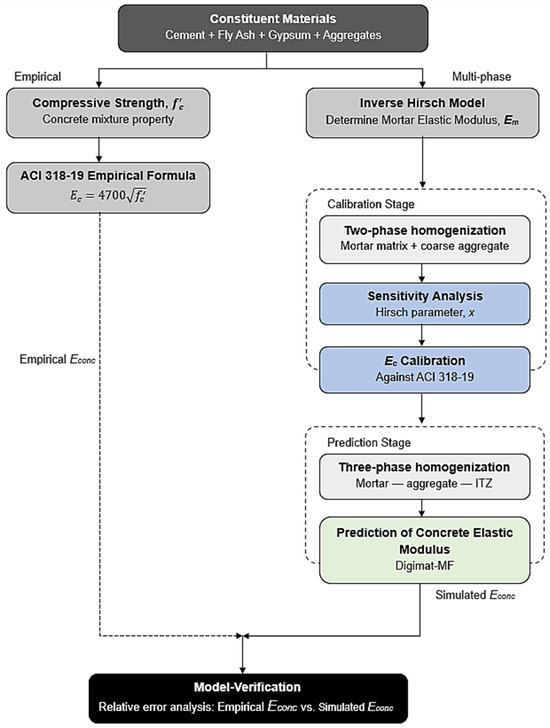
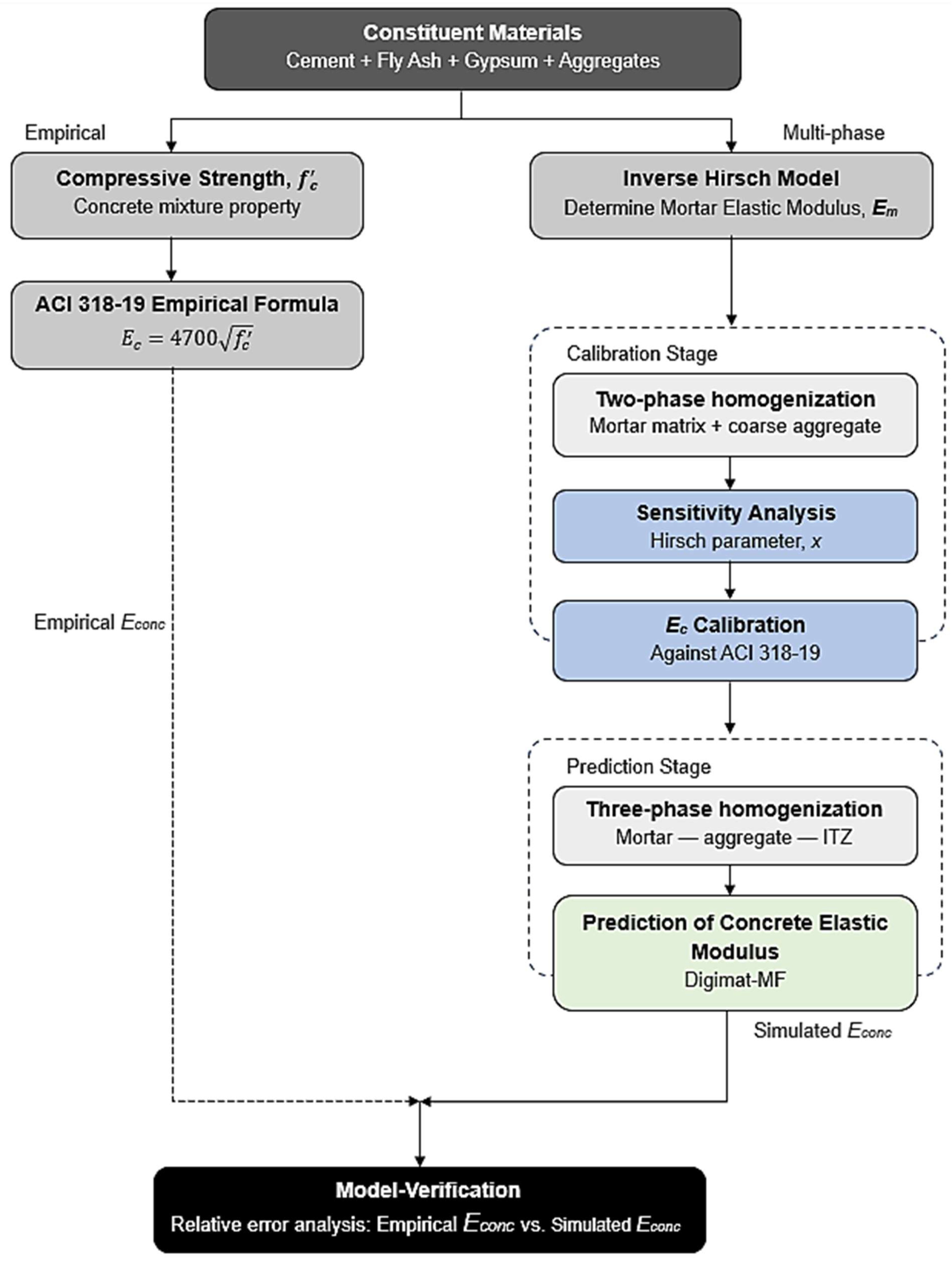
This study used a staged micromechanical homogenization framework to predict the elastic modulus of fly ash–gypsum ternary concrete. The methodology includes: (i) empirical estimation using the ACI 318-19 equation, (ii) semi-empirical inverse modelling using the Hirsch equation to determine the mortar elastic modulus, and (iii) mean-field homogenization via Mori–Tanaka approach implemented in the Digimat-MF 2023.1 software. The computational workflow shown in Figure 1 was designed to progressively evaluate the influence of mortar stiffness and interfacial transition (ITZ) characteristics on the effective elastic modulus of concrete.
Figure 1.
Multi-phase homogenization framework integrating ACI-based calibration, inverse Hirsch modelling, and Mori–Tanaka homogenization for elastic modulus prediction. The constituent materials and compressive strength data were obtained from ref. [6], while the inverse Hirsch calibration and multi-phase homogenization methodology were developed in the present study.
The proposed workflow follows a calibration-oriented modelling strategy commonly adopted in computational materials engineering. Prior to conducting detailed microstructural characterization, the model is first benchmarked against the ACI 318-19 empirical relationship and literature-reported ITZ properties. This approach enables systematic assessment of parameter sensitivity and provides a rational basis for selecting experimental variables for future validation studies.
2.1. Constituent Phase Definition and Material Parameters
2.1.1. Mortar Matrix
The mortar matrix properties were derived from the experimental ternary concrete mixtures reported in [6]. These mixtures incorporated fly ash and recycled gypsum as partial cement replacements and served as the basis for defining the effective matrix phase in the homogenization framework. Although the previous experimental study [6] also investigated polypropylene fiber-reinforced ternary concrete, the present study utilizes only the plain concrete mixtures (without fiber reinforcement) as the basis for the micromechanical homogenization framework. Accordingly, the constituent phases considered in the present model consist only of the mortar matrix, coarse aggregate, and interfacial transition zone (ITZ). Since no fiber-reinforced mixtures were included in the modelling dataset, discrete fibers were not represented as an additional homogenization phase. The binder compositions adopted in this study are summarized in Table 1.
Table 1.
Ternary binder composition.
The compressive strength values used in the present study were adopted directly from the experimental investigation reported in [6] and served as input parameters for the calibration-oriented computational framework. Accordingly, the accuracy of the predicted elastic modulus is inherently dependent on the reliability of the reported experimental compressive strengths.
2.1.2. Coarse Aggregate
The coarse aggregate used in the original experimental study consisted of commercially available natural gravel (⌀19.05 mm nominal size) obtained from a local construction materials supplier. Since the aggregate lithology was not characterized experimentally, a representative elastic modulus of 70 GPa was adopted based on values commonly reported for natural mineral aggregates used in concrete [12,18,19,20]. Previous studies have reported that the elastic modulus of natural aggregates generally has a range of approximately 40–60 GPa for limestone aggregates and 60–90 GPa for granite or other siliceous aggregates. Therefore, the adopted value represents a reasonable intermediate estimate for the micromechanical simulations conducted in this study. Coarse aggregates were idealized as spherical inclusions to satisfy the assumptions of the Mori–Tanaka mean-field homogenization scheme and to simplify the analytical representation of the inclusion–matrix interaction.
2.1.3. Interfacial Transition Zone
The Interfacial Transition Zone (ITZ) was explicitly modelled as a third phase surrounding the coarse aggregate inclusions. In concrete, this zone is widely regarded as the “weakest link” between aggregates and the mortar matrix, significantly influencing the overall elastic modulus [4]. Physically, the ITZ represents the porous region between the aggregate surface and the bulk mortar matrix, where localized microstructural heterogeneity results in reduced stiffness relative to the surrounding paste [21].
Within Mori–Tanaka-based micromechanical frameworks, each inclusion phase is assumed to be embedded within an effective surrounding matrix [10]. Nanoindentation studies on supplementary cementitious material (SCM)-modified concrete have reported that the elastic modulus of the interfacial transition zone (ITZ) typically ranges from approximately 70% to 85% of the surrounding mortar, depending on the degree of hydration, porosity, and SCM content [22]. Additional studies have also reported a broader range of approximately 60% to 90% depending on the material system and experimental conditions [10,11]. In the absence of direct nanoindentation measurements for the investigated mixtures, an ITZ elastic modulus of 0.8Em was adopted as a representative literature-based value within the range reported by Mondal et al. [22], rather than as a mixture-specific calibrated material property. In the present study, this assumption refers specifically to the elastic stiffness assigned to the ITZ within the homogenization model. It does not imply changes in ITZ thickness, which was fixed at , nor does it represent experimentally measured reductions in porosity or other microstructural characteristics. Rather, the adopted stiffness is a literature-informed estimate representative of SCM-modified concrete. Accordingly, the adopted ITZ modulus should be regarded as a literature-informed modelling assumption rather than an experimentally validated material property. The ITZ thickness was fixed at based on the micromechanical observations reported by Sharma and Bishnoi [10], who demonstrated that typical ITZ thicknesses for conventional cementitious systems range from 30 to 50 . A value of was therefore adopted as a representative literature-based estimate for the ternary blends considered in this study.
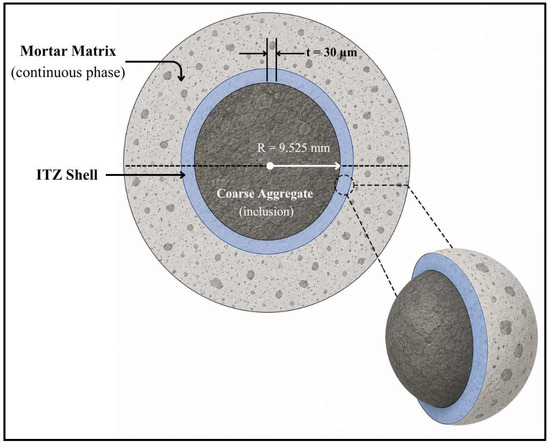
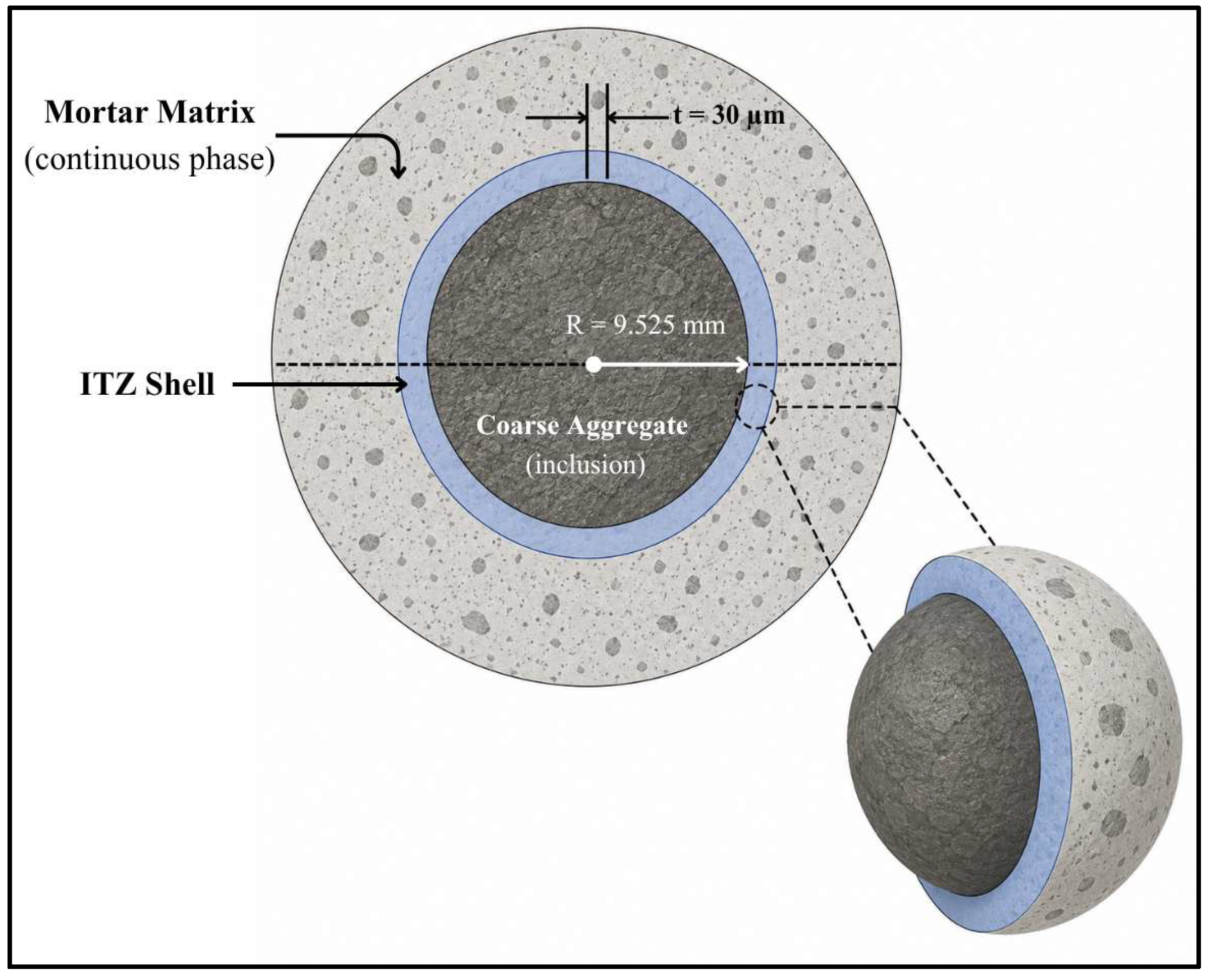
The adopted ITZ stiffness ratio and thickness represent literature-based assumptions and should not be interpreted as experimentally validated properties of the investigated concrete. Within the homogenization framework, the ITZ was represented as a concentric spherical shell surrounding each aggregate inclusion, as illustrated in Figure 2.
Figure 2.
Conceptual representation of the three-phase homogenization model consisting of mortar matrix, coarse aggregate inclusion, and surrounding interfacial transition zone (ITZ). Image generated using Open AI, ChatGPT (Version 5.5) with author supervision, editing and verification.
2.2. Volume Fraction of Materials
The following parameters stated in Table 2 and Table 3 are extracted from the study of [6] and used as reference inputs for estimating the baseline elastic modulus through the ACI empirical relationship.
Table 2.
Experimental properties of plain ternary concrete mixtures used as model inputs and calibration references.
Table 3.
Computed volume fractions of the coarse aggregate, interfacial transition zone (ITZ), and adjusted mortar phases used in the three-phase homogenization model. The adjusted mortar volume fraction excludes the ITZ volume such that the phase fractions sum to unity.
A constant Poisson’s ratio of 0.20 was assigned to all constituent phases (mortar, coarse aggregate, and ITZ), representing a typical value reported for cementitious composites and normal-weight aggregates. To evaluate the influence of this modelling assumption, a brief sensitivity analysis was performed using the representative ternary mixture (C60-F37.5-G2.5) by varying the Poisson’s ratio from 0.15 to 0.25 while maintaining all other material properties constant. The water-to-binder ratio was experimentally determined during mix design and reflects the proportions used in the original experimental study [6]. To ensure comparable fresh-state behavior, all concrete mixtures were proportioned to achieve a target slump of approximately 1–3 inches, as measured in accordance with ASTM C143/C143M, consistent with the experimental procedures reported in [6]. Maintaining a consistent slump minimized variations in workability that could influence compaction, aggregate dispersion, and interfacial transition zone (ITZ) formation, thereby providing a more consistent basis for the subsequent micromechanical modelling.
In Table 3, the volume fractions of the coarse aggregate (), and the mortar () were computed by determining the proportion of each component relative to the total volume, , of each concrete mixture. The volume of the coarse aggregate, , was obtained based on the amount of gravel used in each mix, while the volume of mortar was determined from the remaining portion of the concrete composed of cement paste and fine aggregates. The adjusted mortar volume fraction was obtained by subtracting the computed ITZ volume fraction from the mortar phase, ensuring that the aggregate, ITZ, and mortar phase fractions sum to unity without double counting before implementation in the three-phase homogenization model.
Meanwhile, for the volume fraction of the ITZ (), it was modelled as a thin differential shell surrounding a spherical inclusion, a technique common in multi-phase homogenization [15,22]. The first-order thin-shell approximation is valid when the shell thickness is much smaller than the inclusion radius (). In the present study, the adopted ITZ thickness was and the coarse aggregate radius was (9525 ), resulting in . Since this ratio is much smaller than unity (), the neglected higher-order terms in the exact spherical shell expression are insignificant, confirming that the first-order thin-shell approximation provides an accurate estimate of the ITZ volume fraction for the present study. The ITZ volume is therefore approximated using the first-order shell expansion, leading to Equation (1).
Equation (1) shows that the ITZ volume fraction increases proportionally with the shell thickness and inversely with the aggregate radius. The adopted ITZ thickness of 30 μm represents the lower bound of the range reported in the literature [10]. Since the ITZ volume fraction is directly proportional to shell thickness (Equation (1)), variations in the assumed ITZ thickness would influence the predicted elastic modulus.
2.3. Empirical Estimation of Elastic Modulus
2.3.1. Concrete
To establish a reference value for the elastic modulus of concrete, this parameter is estimated using the empirical formula suggested by the American Concrete Institute expressed in Equation (2). This equation will serve as the baseline for evaluating the consistency of the micromechanical model.
= modulus of elasticity of concrete
= compressive strength of concrete
2.3.2. Mortar Phase
Since the mortar elastic modulus was not experimentally measured in the previous study, the Hirsch model was solved inversely to back-calculate the effective mortar stiffness required to reproduce the ACI-predicted concrete modulus. The Hirsch model in Equation (3) is a semi-empirical equation that combines the boundary conditions of the Voigt and Reuss models to estimate the effective elastic modulus of composite materials. The Voigt model assumes that all constituent phases experience the same strain, resulting in an upper-bound estimate of composite stiffness, whereas the Reuss model provides a lower-bound estimate that assumes all phases to experience the same stress [16]. The Hirsch parameter, x, acts as a weighting factor that determines the relative contribution of these two idealized loading conditions, thereby representing the degree of strain compatibility and load-transfer efficiency between the constituent phases. In this study, the equation is rearranged to determine the elastic modulus of mortar, .
The present study adopts the direct form of the Hirsch model, in which the effective elastic modulus is expressed as a weighted linear combination of the Voigt and Reuss bounds. According to Equation (3), the Hirsch parameter, x, was determined through a sensitivity analysis based on reported values from previous studies [19,23]. Although x is an empirical parameter, it also has physical significance because it reflects the extent to which the composite behaves closer to the Voigt (iso-strain) or Reuss (iso-stress) assumptions. Lower values of x indicate greater stress redistribution and heterogeneous deformation, whereas higher values indicate more uniform strain compatibility among the constituent phases. The elastic modulus of mortar was predicted using x values of 0.1, 0.2, and 0.3 to identify the most accurate representation for the ternary concrete mixes. Through this sensitivity analysis, the Hirsch parameter that provided the closest agreement with the ACI-based reference was determined by minimizing the relative error between the numerical output and the baseline, .
2.3.3. ITZ Phase
In this study, the ITZ elastic modulus of each mix design was calculated assuming the stiffness ratio shown in Equation (4).
This assumption was selected to represent a relatively dense interfacial region consistent with SCM-modified cementitious systems. The final ITZ elastic modulus values adopted in the three-phase homogenization were calculated using the calibrated mortar elastic modulus obtained from the Hirsch parameter selected in Section 3.3.1 and are summarized in Table 4.
Table 4.
Estimated ITZ elastic modulus values based on the adopted mortar-to-ITZ stiffness relationship.
2.4. Computational Modelling Approach
The numerical investigation was conducted using a staged homogenization procedure in Digimat-MF as illustrated in Figure 1. Digimat-MF applies the Mori–Tanaka mean-field homogenization method [24] to represent the heterogeneous concrete composite by predicting its effective elastic properties based on the mechanical properties and volume fractions of its constituent phases [15,25]. Compared with finite element (FE)-based approaches, Digimat-MF provides a computationally efficient framework for predicting the effective elastic properties of heterogeneous materials [26].
The Mori–Tanaka method [24] was selected because it provides an efficient mean-field solution for composites containing dispersed inclusions at moderate volume fractions while maintaining relatively low computational cost. Unlike self-consistent methods, which iteratively estimate the effective medium, the Mori–Tanaka approach explicitly accounts for the interaction between dispersed inclusions and a continuous matrix, making it well suited for conventional concrete in which coarse aggregates are embedded within mortar. Although generalized self-consistent methods and finite-element representative volume element (RVE) simulations can provide higher accuracy, they require more complex formulations, greater computational resources, and more detailed microstructural characterization. Since the objective of this study is to establish a computationally efficient predictive framework prior to experimental validation, the Mori–Tanaka method provides an appropriate balance between computational efficiency and physical representation. Accordingly, coarse aggregates were idealized as randomly distributed, isotropic spherical inclusions with no preferred orientation, consistent with the assumptions of the Mori–Tanaka mean-field homogenization framework.
In the first stage, a two-phase homogenization model consisting of the mortar matrix and coarse aggregate was developed. The objective of this stage was to calibrate the Hirsch parameter, x, by comparing the simulated elastic modulus of concrete, , against the empirical ACI reference modulus, . Sensitivity analysis was performed for x = 0.1, 0.2, and 0.3, and the Hirsch parameter yielding the minimum relative error was selected.
In the second stage, the calibrated mortar modulus, , corresponding to the best Hirsch parameter was incorporated into a three-phase homogenization model consisting of mortar, coarse aggregate, and ITZ phases. The ITZ was modelled as a concentric shell surrounding each spherical aggregate inclusion using the coated inclusion formulation available in Digimat-MF.
Within the Mori–Tanaka framework, the coated aggregate–ITZ inclusion is treated as a composite inclusion embedded in the effective mortar matrix, thereby incorporating the influence of the ITZ shell into the homogenized elastic response. Perfect interfacial bonding was assumed between adjacent phases, implying displacement compatibility across the mortar–ITZ–aggregate interfaces. Accordingly, the ITZ was represented as a distinct phase with reduced elastic stiffness, thereby accounting for its weaker mechanical response without modelling interfacial slip or debonding. The resulting effective elastic modulus, , was subsequently compared with the baseline to evaluate the consistency of the proposed framework.
Presently, the effects of fly ash and recycled gypsum on the effective stiffness of concrete are represented through the calibrated mortar matrix and the literature-based representation of the interfacial transition zone (ITZ). Furthermore, the three-phase homogenization approach provides a framework for representing the influence of the assumed ITZ thickness and stiffness on the predicted elastic modulus as the gypsum content varies among the investigated ternary blends.
3. Results
3.1. Empirical Elastic Modulus of Concrete,
The elastic modulus of concrete was first estimated using the ACI empirical relationship expressed in Equation (2) for normal-weight concrete, which provides a macroscopic correlation between the compressive strength and stiffness. Table 5 presents the ACI 318-19 empirical estimates used as the calibration reference for subsequent model evaluation.
Table 5.
ACI 318-19 estimates of concrete elastic modulus used as the baseline reference for model evaluation.
This approach assumes homogenized material without explicit consideration of microstructural phases such as the aggregate distribution and the interfacial transition zones.
3.2. Elastic Modulus of Mortar,
To evaluate the influence of phase interaction assumptions on the inferred mortar properties, the Hirsch model was employed in an inverse manner to estimate the elastic modulus of mortar. For this purpose, the Hirsch equation was rearranged and solved iteratively using an Excel Goal Seek algorithm. The elastic modulus of coarse aggregates and the phase volume fractions were treated as known inputs, while the Hirsch empirical parameter x, which governs the balance between parallel (Voigt) and series (Reuss) load-sharing mechanisms, was varied systematically.
A sensitivity analysis was conducted by assigning x values of 0.1, 0.2 and 0.3. For each value of x, the corresponding was back-calculated. Table 6 showed a consistent dependence of the inferred mortar stiffness on the selected Hirsch parameter.
Table 6.
Back-calculated mortar elastic modulus obtained from inverse Hirsch modelling at different parameter values.
Specifically looking at the optimal mix design C60-F37.5-G2.5, from x = 0.1 to 0.3, its reached 17.27 GPa then decreased to 16.08 GPa and 14.77 GPa, respectively. The findings indicate that is model-dependent back-calculated parameters obtained through the inverse Hirsch calibration procedure and should not be interpreted as directly measured material properties. This sensitivity analysis highlights the critical role of x in micromechanical modelling and supports its consideration in subsequent analyses incorporating the interfacial transition zone.
Prior to the homogenization analysis, a brief sensitivity analysis was conducted to evaluate the influence of the assumed Poisson’s ratio on the predicted elastic modulus. The Poisson’s ratio assigned to all constituent phases was varied from 0.15 to 0.25 while maintaining all other model parameters constant. The predicted elastic modulus exhibited a maximum variation of only 0.18% relative to the reference case (ν = 0.20), indicating that the homogenization results are relatively insensitive to reasonable variations in this parameter. Accordingly, a constant Poisson’s ratio of 0.20 was retained for the subsequent two-phase and three-phase homogenization analyses.
3.3. Simulated Elastic Modulus of Concrete,
3.3.1. Two-Phase Homogenization
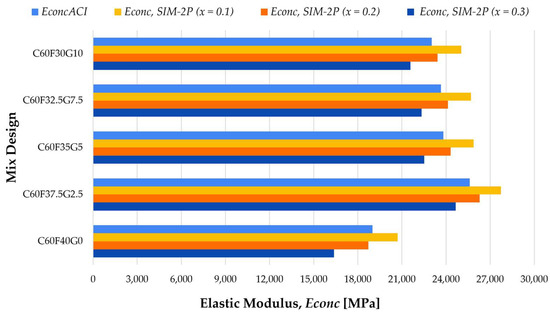
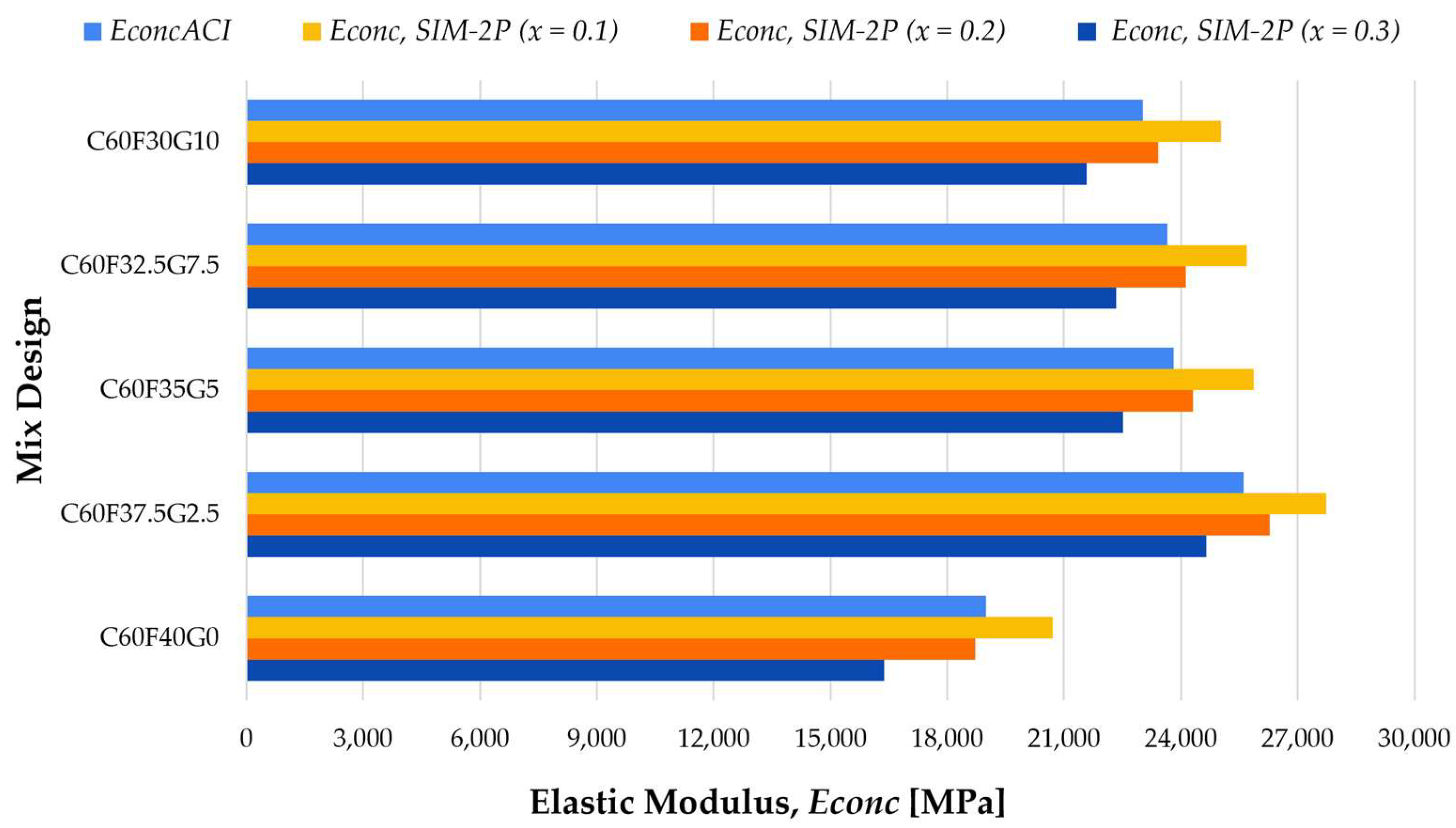
In the first stage of the framework, Digimat-MF was used to simulate the elastic modulus of concrete without the ITZ to calibrate the Hirsch parameter and determine the corresponding mortar elastic modulus . Through the sensitivity analysis presented in Table 7, the Hirsch parameter, x = 0.2, providing the closest agreement with the ACI-based reference indicates that the elastic response of the investigated ternary concrete is governed more strongly by series-type load transfer mechanisms than by idealized parallel load sharing [13,14]. This is consistent with the heterogeneous nature of concrete, where stress redistribution occurs across aggregates, mortar, and interfacial regions. In contrast, the simulations using and produced consistently larger relative errors than those obtained for , indicating poorer agreement with the ACI-based empirical reference for the investigated mixtures. Thus, was selected for the subsequent three-phase homogenization analyses, as shown in Figure 3.
Table 7.
Two-phase homogenization results and relative errors with respect to the ACI-based empirical reference used for Hirsch parameter calibration.
Figure 3.
Comparison between the ACI-based empirical reference elastic modulus and the corresponding two-phase homogenization predictions for Hirsch parameter values , 0.2, and 0.3 across the investigated ternary concrete mixtures.
The relative errors reported in Table 7 quantify the agreement between the two-phase homogenization model and the ACI-based empirical reference used for calibration and should therefore be interpreted as calibration metrics rather than independent experimental validation. In addition, increasing the Hirsch parameter increases the contribution of the Voigt component within the Hirsch formulation. A lower mortar modulus is required to reproduce the same target concrete modulus, resulting in the observed decrease in back-calculated values. Therefore, the values corresponding to x = 0.2 were finalized and adopted as the foundational mortar matrix properties for the three-phase homogenization study. These calibrated mortar elastic modulus values were subsequently used to determine the corresponding ITZ elastic moduli according to Equation (4), as summarized in Table 4.
3.3.2. Three-Phase Homogenization
The second stage simulated the with the presence of ITZ. Table 8 details the simulated three-phase model results along with its corresponding relative error against the baseline modulus reference.
Table 8.
Three-phase homogenization predictions incorporating the interfacial transition zone (ITZ).
The transition from the two-phase to the three-phase homogenization model highlights the importance of explicitly accounting for the interfacial transition zone in SCM-modified concrete. While the two-phase model already provided reasonable agreement with empirical reference, the introduction of the ITZ generally reduced prediction errors for gypsum-bearing mixtures. This trend suggests that explicitly representing the aggregate-paste interface through an ITZ phase improves the agreement between the simulated and ACI-based elastic modulus values for gypsum-bearing mixtures. The observed improvement indicates that incorporating an ITZ phase may better capture stiffness contributions associated with the heterogenous microstructure of SCM-modified concrete within the adopted modelling assumptions. Table 9 presents a comparison between the predicted elastic modulus values obtained in this study and published experimental elastic modulus values for concrete containing supplementary cementitious materials (SCMs), including fly ash, slag, and other blended cement systems. This comparison demonstrates that the predicted values fall within the range of experimentally reported data for similar SCM-modified concretes.
Table 9.
Comparison of the values with published experimental results for SCM-modified concrete.
To provide an independent assessment of the proposed computational framework beyond the ACI-based calibration, the predicted elastic modulus values were compared with experimentally reported values for similar SCM-modified concretes from the literature. The predicted elastic modulus of the present study generally falls within or is close to the reported experimental ranges, with direct overlap observed for fly ash concrete reported by Zhao et al. [4]. Higher elastic modulus values reported in other studies are attributed to differences in compressive strength, curing duration, and SCM composition, all of which influence concrete stiffness. Although this comparison does not constitute direct experimental validation of the investigated mixtures, it demonstrates that the predicted elastic modulus values are physically reasonable and consistent with published experimental data for comparable SCM-modified concrete systems.
Furthermore, the predictive performance of the proposed homogenization framework was evaluated by calculating the mean absolute error (MAE) and the root-mean-square error (RMSE) using the ACI-based elastic modulus as the reference. The two-phase model using the Hirsch parameter, , yielded an MAE of 464.85 MPa and an RMSE of 483.48 MPa, whereas the corresponding values for the three-phase model were reduced to 403.24 MPa and 414.59 MPa, respectively. The lower MAE and RMSE obtained for the three-phase model further confirm that explicitly incorporating the ITZ improves the agreement with the ACI-based reference within the adopted modelling assumptions.
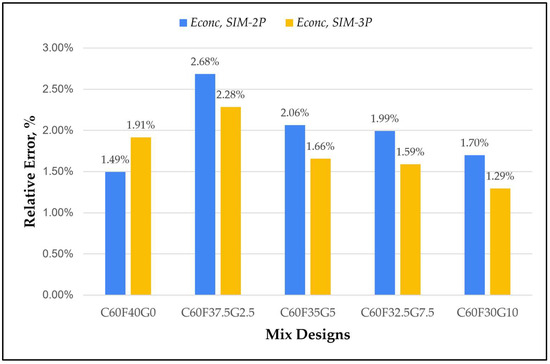
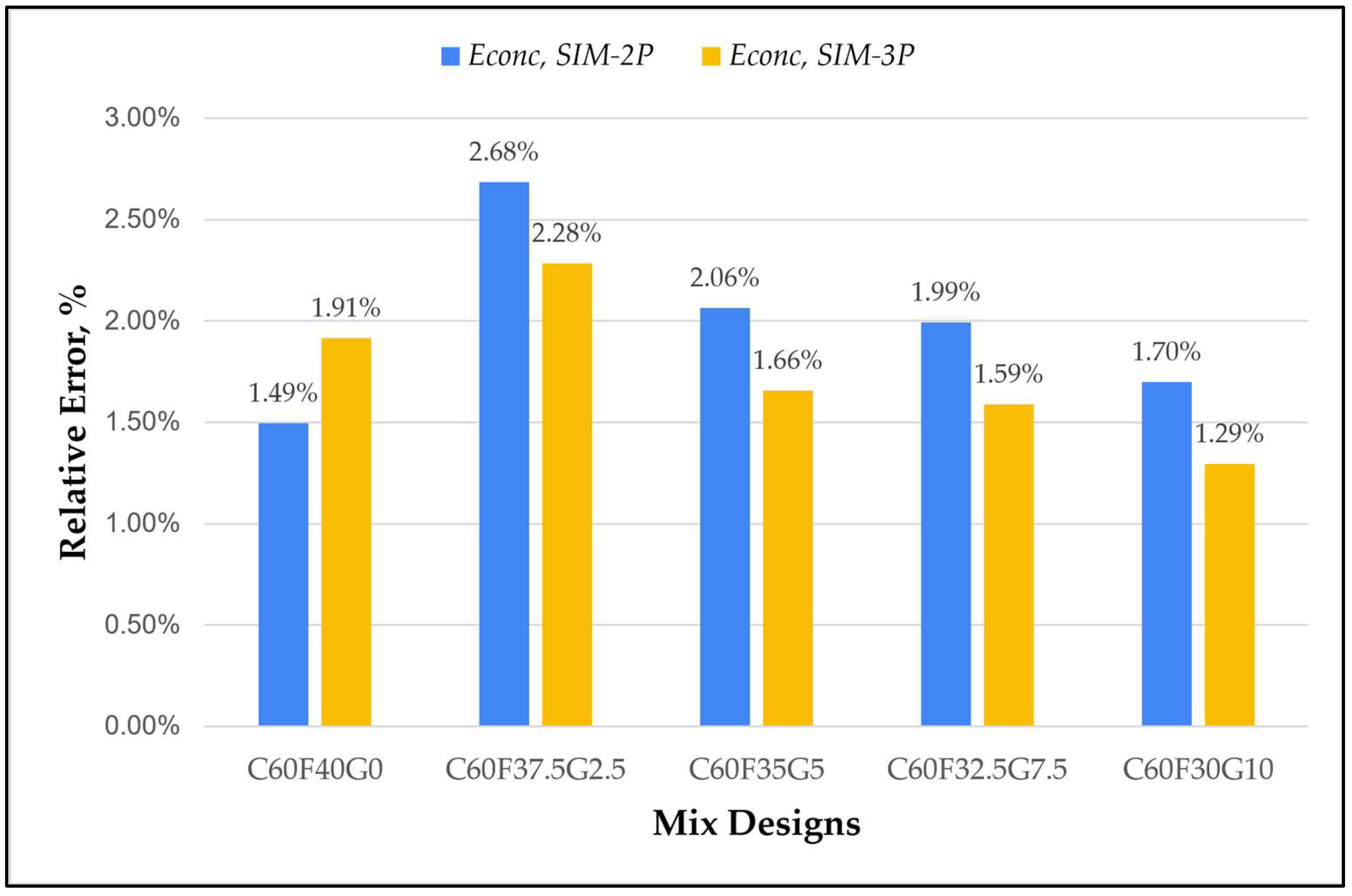
Notably, for the control mix (C60F40G0), which contained no recycled gypsum, the three-phase simulation resulted in a slight increase in relative error (1.91%) compared to the two-phase baseline (1.49%). This behavior suggests that the assumed ITZ stiffness ratio of , selected from literature for SCM-modified concrete is less applicable to the control mixture. Since mixture-specific ITZ properties were not experimentally characterized, this interpretation should be regarded as a modelling-based observation rather than direct experimental evidence.
However, for all subsequent ternary blends containing gypsum, the three-phase model consistently reduced the relative error. The improvement observed in the three-phase simulation suggests that explicitly incorporating an ITZ phase provides a more representative description of the heterogeneous concrete microstructure within the adopted homogenization framework.
The corresponding prediction errors summarized in Table 7 and Table 8 are graphically compared in Figure 4 to facilitate visualization of the improvement obtained using the three-phase homogenization model. Although the reduction in error for the optimum ternary mixture (C60-F37.5-G2.5) was modest (2.68% to 2.28%), a consistent decrease was observed across all gypsum-bearing mixtures. While this improvement is relatively small in magnitude, it suggests that explicitly incorporating the ITZ enables the model to better capture the mechanical contribution of the aggregate–paste interface within the adopted modelling assumptions.
Figure 4.
Relative error of elastic modulus predictions obtained from two-phase (SIM-2P) and three-phase (SIM-3P) homogenization models with respect to the ACI 318-19 reference values. The inclusion of an interfacial transition zone (ITZ) generally decreased the prediction error for fly ash—gypsum-containing ternary concrete mixtures, demonstrating the influence of interfacial effects on the effective stiffness predicted by the homogenization framework.
Therefore, the transition from a two-phase to a three-phase model may reflect the influence of the assumed ITZ representation on the simulated response associated with the incorporation of fly ash and recycled gypsum. Although the prediction error did not decrease proportionally with increasing recycled gypsum content, this trend should not be interpreted as indicating an optimum gypsum content for elastic modulus prediction. The optimum binder composition containing 2.5% recycled gypsum (C60-F37.5-G2.5) was established experimentally in the authors’ previous study [6] based on compressive and tensile strength. The slightly lower prediction error obtained for the C60-F35-G5 mixture is more likely attributable to the adopted modelling assumptions, particularly the constant ITZ stiffness ratio, rather than superior mechanical performance. Hence, the explicit incorporation of the ITZ enables the model to account for the mechanical influence of the aggregate–paste interface while highlighting the need for future experimental characterization of mixture-specific ITZ properties.
3.4. Applicability and Limitations of the Proposed Framework
The proposed framework was developed as a calibration-oriented computational approach using the ACI 318-19 empirical relationship as the reference baseline because direct experimental measurements of the static elastic modulus (e.g., ASTM C469) were unavailable from the previous experimental study [6]. Consequently, the present work establishes a calibrated micromechanical framework rather than an experimentally validated predictive model. Future studies incorporating direct elastic modulus measurements are recommended to validate and further refine the proposed methodology.
To enable efficient implementation of the Mori–Tanaka mean-field homogenization approach, the framework adopts several literature-based modelling assumptions, including linear elastic and isotropic constituent behavior, idealized spherical aggregate geometry, a representative aggregate elastic modulus (70 GPa), and constant ITZ properties (30 μm thickness and . While these assumptions provide a practical representation of SCM-modified concrete, they may not fully capture the variability of in aggregate shape, aggregate size distribution, and local ITZ characteristics present in actual concrete microstructures. Accordingly, the reported relative errors should be interpreted within the context of the adopted modelling assumptions, as uncertainties associated with the constituent material properties and assumed ITZ parameters were not explicitly quantified in the present study. Further refinement of the proposed framework would benefit from experimentally measured constituent properties, nanoindentation-based ITZ characterization, and systematic parametric sensitivity analyses of key modelling parameters, including aggregate elastic modulus, aggregate size distribution, ITZ stiffness ratio, and ITZ thickness.
For the investigated fly ash–gypsum ternary concrete mixtures, a Hirsch parameter of x = 0.2 provided the best agreement with the ACI-based reference and is therefore recommended for similar calibration-oriented applications within the investigated material system. However, this value should not be regarded as universally applicable and should be recalibrated when different constituent materials or mixture proportions are considered.
The objective of this study was to establish a computational methodology for estimating the elastic modulus of fly ash–gypsum ternary concrete using previously reported experimental data. Although the present framework was developed for fly ash–recycled gypsum ternary concrete, the proposed homogenization methodology may be extended to other supplementary cementitious material systems, provided that appropriate constituent material properties and calibration parameters are established. Accordingly, more advanced investigations, such as time-dependent modelling to account for curing-age effects, nonlinear constitutive modelling, finite element representative volume element (RVE) simulations, environmental loading effects (e.g., temperature and moisture), and application to other supplementary cementitious material systems, were beyond the scope of the present work and are identified as opportunities for future research.
Despite these limitations, the proposed framework establishes a calibration-oriented computational methodology that integrates inverse Hirsch modelling and Mori–Tanaka homogenization for estimating the elastic modulus of fly ash–gypsum ternary concrete. By explicitly incorporating the mortar matrix, coarse aggregates, and the interfacial transition zone, the framework provides a computational basis for future experimental validation and further refinement as additional material characterization data become available.
4. Conclusions
In the absence of direct experimental measurements, this study developed and evaluated a calibration-oriented multi-phase micromechanical homogenization framework for estimating the elastic modulus of ternary concrete containing fly ash and recycled gypsum from ceramic molds adapted from the initial study of [6]. Using a staged modelling approach consisting of ACI-based empirical estimation, inverse Hirsch modelling, and Mori–Tanaka homogenization, the elastic behavior of sustainable concrete mixtures was evaluated from their constituent phases. The summary of findings for this study is as follows:
- The sensitivity analysis in the two-phase homogenization identified x = 0.2 as the Hirsch parameter yielding the minimum relative error with respect to the ACI-based empirical reference to be used in determining the elastic modulus of mortar, . The corresponding two-phase homogenization model yielded relative errors below 3% across all mix designs. The resulting mortar elastic moduli represent model-dependent back-calculated parameters obtained through inverse Hirsch modelling rather than experimentally measured material properties.
- Incorporating an interfacial transition zone (ITZ) with an assumed thickness of improved the agreement between simulated and ACI-based elastic modulus values for all gypsum-bearing ternary blends.
- Although the reduction in prediction error was modest, the three-phase homogenization model explicitly represented the interfacial transition zone (ITZ), resulting in improved agreement with the ACI-based empirical reference within the adopted modelling assumptions.
- Comparison with experimentally reported elastic modulus values for similar SCM-modified concretes demonstrated that the predicted elastic modulus values are physically reasonable and generally consistent with published experimental data, providing an independent assessment beyond the ACI-based calibration.
- For the ternary blends (C60-F37.5-G2.5 to C60-F30-G10), a consistent reduction in relative error was observed from the two-phase to the three-phase homogenization model. This indicates that explicitly representing the interfacial transition zone within the adopted modelling framework provides slightly closer agreement with the ACI-based empirical reference for the investigated mixtures.
A key limitation of the present study is the absence of experimentally measured concrete, mortar, and ITZ elastic properties, as well as microstructural characterization for validating the adopted modelling assumptions. Moreover, the proposed framework should be regarded as a calibration-oriented computational methodology rather than an experimentally validated predictive model. However, the present framework relies on literature-based assumptions regarding the ITZ thickness and stiffness ratio, which were not experimentally measured for the investigated mixtures. In addition, model evaluation was performed using ACI 318-19 elastic modulus predictions as an empirical reference because direct experimental measurements of elastic modulus were unavailable. Thus, the findings demonstrate that the proposed framework can be calibrated to reproduce stiffness trends predicted by the ACI empirical relationship and provides a physically informed calibration framework for future experimental validation through elastic modulus testing and nanoindentation-based characterization of the ITZ.
Overall, the results demonstrate the potential of micromechanical homogenization as a calibration-oriented computational methodology for estimating the elastic modulus of sustainable concrete mixtures, pending independent experimental validation.
Future research should focus on expanding the applicability of the proposed framework by experimentally characterizing aggregate properties and gradation, ITZ thickness and mechanical properties, and conducting comprehensive parametric investigations. Such studies would improve the robustness, reliability, and generalizability of the proposed computational framework. Such studies would further improve the robustness and applicability of the proposed framework.
Author Contributions
Conceptualization, methodology, software, formal analysis, investigation, writing—original draft preparation, K.Y.P.A.; Methodology, validation, writing—review and editing, C.J.C.O.; Formal analysis, investigation, data curation, visualization, M.A.O.; Resources, supervision, M.T.M. All authors have read and agreed to the published version of the manuscript.
Funding
This research was funded by the Department of Science and Technology under the Philippine Council for Industry, Energy, and Emerging Technology Research and Development, grant number RDA-MSD-2023-06.
Data Availability Statement
Data will be available upon request.
Acknowledgments
During the preparation of this manuscript/study, the authors used Open AI ChatGPT, Version 5.5 for the purposes of generating a conceptual schematic diagram of the three-phase homogenization model. The authors have reviewed and edited the output and take full responsibility for the content of this publication.
Conflicts of Interest
The authors declare no conflicts of interest.
References
- United Nations Environment Programme; Global Alliance for Buildings and Construction. Not Just Another Brick in the Wall: The Solutions Exist—Scaling Them Will Build on Progress and Cut Emissions Fast. Global Status Report for Buildings and Construction 2024/2025; United Nations Environment Programme: Nairobi, Kenya, 2025; Available online: https://wedocs.unep.org/20.500.11822/47214 (accessed on 20 April 2026).
- Gerges, N.N.; Issa, C.A.; Khalil, N.J.; Aintrazi, S. Effects of recycled waste on the modulus of elasticity of structural concrete. Sci. Rep. 2024, 14, 16189. [Google Scholar] [CrossRef] [Scilit] [PubMed]
- Moolchandani, K.; Sharma, A. Evaluating the elastic constants of concrete modified with fly ash and marble waste and their effects on high-rise buildings using ETABS software. Sustainability 2023, 15, 14743. [Google Scholar] [CrossRef] [Scilit]
- Zhao, X.; Zhan, M.; Chen, Z.; Zhang, J.; Li, Q.; Song, W. Prediction of elastic modulus of leached fly ash concrete based on non-uniform ITZ model. Materials 2025, 18, 3779. [Google Scholar] [CrossRef] [Scilit] [PubMed]
- Liu, X.; Zhang, X.; Yan, P. Prediction model for elastic modulus of recycled concrete based on properties of recycled coarse aggregate and cementitious materials. Case Stud. Constr. Mater. 2024, 21, e04058. [Google Scholar] [CrossRef] [Scilit]
- Almeria, K.Y.P.; Escutin, C.M.L.; Margarito, M.T. Effect of varying fiber, fly ash, and recycled gypsum contents on the mechanical properties of fiber-reinforced ternary concrete. Key Eng. Mater. 2026, 1044, 121–129. [Google Scholar] [CrossRef] [Scilit]
- Zhang, C.; Liu, P.; Song, T.; He, B.; Li, W.; Peng, Y. Elastic modulus prediction of ultra-high-performance concrete with different machine learning models. Buildings 2024, 14, 3184. [Google Scholar] [CrossRef] [Scilit]
- Sun, Q.; Gupta, R.; Zhu, Z.; Sharma, A.; Qiang, S. A new mathematical model for elastic modulus prediction in mortar and concrete. J. Build. Eng. 2024, 100, 111761. [Google Scholar] [CrossRef] [Scilit]
- ACI Committee 318. Building Code Requirements for Structural Concrete (ACI 318-19) and Commentary; American Concrete Institute: Farmington Hills, MI, USA, 2019. [Google Scholar]
- Sharma, M.; Bishnoi, S. Influence of properties of interfacial transition zone on elastic modulus of concrete: Evidence from micromechanical modelling. Constr. Build. Mater. 2020, 246, 118381. [Google Scholar] [CrossRef] [Scilit]
- Song, G.; Zou, N.; Wei, Y.; Aili, A.; Liang, S. Numerical investigation into the influence of interfacial transition zone on elastic modulus, creep, shrinkage of concrete. Constr. Build. Mater. 2024, 447, 138112. [Google Scholar] [CrossRef] [Scilit]
- Hosseinzadeh, M.; Dehestani, M.; Hosseinzadeh, A. Exploring elastic properties of fly ash recycled aggregate concrete: Insights from multiscale modeling and machine learning. Structures 2023, 59, 105720. [Google Scholar] [CrossRef] [Scilit]
- Izadifar, M.; Thissen, P.; Mohamed, O.A.; Ukrainczyk, N.; Boroumandi, M.; Omar, M.; Omar, A.; Koenders, E. Magnesium-Calcium Exchange-Driven Elastic Properties of Alkali Charge-Balanced Aluminosilicate-Graphene Nanocomposites. Nanomaterials 2026, 16, 2078. [Google Scholar] [CrossRef] [Scilit] [PubMed]
- Schönfeld, K.; Izadifar, M.; Ukrainczyk, N.; Koenders, E. Elastic and Electronic Properties of Alkali Charge-Balanced Calcium Aluminosilicate Hydrate Nanocomposites: A First-Principles Study. ACS Omega 2026, 11, 36639–36651. [Google Scholar] [CrossRef] [Scilit] [PubMed]
- Constantinides, G.; Ulm, F.-J. The Effect of Two Types of C-S-H on the Elasticity of Cement-Based Materials: Results from Nanoindentation and Micromechanical Modeling. Cem. Concr. Res. 2004, 34, 67–80. [Google Scholar] [CrossRef] [Scilit]
- Hirsch, T.J. Modulus of elasticity of concrete affected by elastic moduli of cement paste matrix and aggregate. ACI J. Proc. 1962, 59, 427–451. [Google Scholar] [CrossRef] [Scilit] [PubMed]
- Chichane, A.; Boujmal, R.; Barkany, A.E. A comparative study of analytical and numerical models of mechanical properties of composites and hybrid composites reinforced with natural reinforcements. Polym. Polym. Compos. 2023, 31, 09673911231172491. [Google Scholar] [CrossRef] [Scilit]
- Zhou, J.; Lin, H.; Qiu, K.; Ou, K.; Nie, F. Prediction of modulus of elasticity of concrete using different homogenization methods. Materials 2025, 18, 2674. [Google Scholar] [CrossRef] [Scilit] [PubMed]
- Thilakarathna, P.; Baduge, K.K.; Mendis, P.; Lee, H.; Chandrathilaka, E.; Vimonsatit, V. Multiscale modelling framework for elasticity of ultra-high-strength concrete using nano/microscale characterization and finite element representative volume element analysis. Constr. Build. Mater. 2022, 327, 126968. [Google Scholar] [CrossRef] [Scilit]
- Sun, X.; Gao, Z.; Cao, P.; Zhou, C. Mechanical properties tests and multiscale numerical simulations for basalt fiber reinforced concrete. Constr. Build. Mater. 2019, 202, 58–72. [Google Scholar] [CrossRef] [Scilit]
- Ghebrab, T.T.; Soroushian, P. Mechanical properties of cement mortar: Development of structure-property relationships. Int. J. Concr. Struct. Mater. 2011, 5, 3–10. [Google Scholar] [CrossRef] [Scilit]
- Mondal, P.; Shah, S.P.; Marks, L.D. Nanomechanical properties of interfacial transition zone in concrete. In Nanotechnology in Construction 3; Bittnar, Z., Bartos, P.J.M., Němeček, J., Šmilauer, V., Zeman, J., Eds.; Springer: Berlin/Heidelberg, Germany, 2009; pp. 315–320. [Google Scholar] [CrossRef] [Scilit]
- de Miranda Saleme Gidrão, G.; Carrazedo, R.; Bosse, R.M.; Silvestro, L.; Ribeiro, R.; de Souza, C.F.P. Numerical modeling of the dynamic elastic modulus of concrete. Materials 2023, 16, 3955. [Google Scholar] [CrossRef] [Scilit] [PubMed]
- Mori, T.; Tanaka, K. Average Stress in Matrix and Average Elastic Energy of Materials with Misfitting Inclusions. Acta Metall. 1973, 21, 571–574. [Google Scholar] [CrossRef] [Scilit]
- Hessman, P.A.; Welschinger, F.; Hornberger, K.; Böhlke, T. On mean field homogenization schemes for short fiber reinforced composites: Unified formulation, application and benchmark. Int. J. Solids Struct. 2021, 230–231, 111141. [Google Scholar] [CrossRef] [Scilit]
- Cadence Design Systems. Digimat—The Material Modeling Platform. Available online: https://www.cadence.com/en_US/home/tools/msc-software/digimat.html (accessed on 25 April 2026).
- Chen, Z.; Liu, M.; Zhang, Y.; Jia, S. Prediction of the Time-Dependent Elastic Modulus of Fly-Ash Concrete Under Sustained Loads. Materials 2026, 19, 559. [Google Scholar] [CrossRef] [Scilit] [PubMed]
- Younes, M.; Suryanto, B. Recycled Aggregate Concrete: Effect of Supplementary Cementitious Materials and Potential for Supporting Sustainable Construction. Materials 2025, 18, 5183. [Google Scholar] [CrossRef] [Scilit] [PubMed]
- Qu, Z.; Liu, Z.; Si, R.; Zhang, Y. Effect of Various Fly Ash and Ground Granulated Blast Furnace Slag Content on Concrete Properties: Experiments and Modelling. Materials 2022, 15, 3016. [Google Scholar] [CrossRef] [Scilit] [PubMed]
- Kim, J.-E.; Park, W.-S.; Jang, Y.-I.; Kim, S.-W.; Kim, S.-W.; Nam, Y.-H.; Kim, D.-G.; Rokugo, K. Mechanical Properties of Energy Efficient Concretes Made with Binary, Ternary, and Quaternary Cementitious Blends of Fly Ash, Blast Furnace Slag, and Silica Fume. Int. J. Concr. Struct. Mater. 2016, 10, S97–S108. [Google Scholar] [CrossRef] [Scilit]

Disclaimer/Publisher’s Note: The statements, opinions and data contained in all publications are solely those of the individual author(s) and contributor(s) and not of MDPI and/or the editor(s). MDPI and/or the editor(s) disclaim responsibility for any injury to people or property resulting from any ideas, methods, instructions or products referred to in the content. |
© 2026 by the authors. Licensee MDPI, Basel, Switzerland. This article is an open access article distributed under the terms and conditions of the Creative Commons Attribution (CC BY) license.