


Abstract
In recent years, the city of Naples has seen increasing attention focused on the mural dedicated to Diego Armando Maradona, located in the Spanish Quarter. Originally a spontaneous expression of street art and initially perceived by the local community as a simple artwork, the mural has gradually transformed into a powerful symbol of identity, becoming a true cultural icon of the city. This process has generated effects that transcend the artistic value of the artwork, contributing to the enhancement of the entire surrounding urban context and altering the social and economic dynamics of the quarter. By considering the Maradona Mural as the epicentre of a range of territorial and socio-economic effects, this paper aims to explore the issue of measuring the influence exerted by its presence on the market values of residential properties located in the Spanish Quarter of Naples. From this perspective, street art can be interpreted as a positive externality capable not only of fostering processes of urban regeneration and the redevelopment of formerly marginalised or degraded areas but also of influencing the dynamics of the local real estate market. Property values reflect not only the intrinsic characteristics of the properties but also the environmental and territorial attributes that contribute to the formation of market prices. From this perspective, properties can be considered as beneficiaries of externalities, whose economic value can be estimated through variations in house prices attributable to changes in environmental and territorial conditions.
1. Introduction
Street art, intended as a specific element of urban creativity [1] or, more generally, of urban art [2], is a heterogeneous practice characterised by a multitude of intentions and expressive, social, and cultural modes. Its spread in urban contexts has produced varying effects depending on the territorial, economic, and institutional conditions in which it has evolved, sometimes generating tensions and contradictions that challenge policymakers, property owners, communities, and those involved in its creation [3]. Especially in those contexts aimed at regeneration [4] through “culture led” initiatives [5,6], several street art-related phenomena have demonstrated its meaningful role: First, there is its potential contribution to creative place-making [7]—a field of practice “that involves the active participation of communities in the development and enhancement of their public spaces” [8,9]. Further, as recently highlighted by the OECD [10], street art is a form of “grassroots cultural infrastructure,” which is increasingly used as a means of generating vibrancy in a city and engaging local communities. Street art has been shown to be an important tool in the regeneration process, having positive effects when involving active cooperation between the public and private sectors [11]; it has also proven to be one of the best ways to foster a sense of identity, especially for young people [9,10,11,12]. Worldwide, several cases testify to a correlation between the practice of street art and socio-economic and urban dynamics [13,14]. Among the most significant examples, in the USA, Mural Arts Philadelphia, the nation’s largest public art programme, over a period of more than 40 years, has activated over 150 public and private organisation partners each year, with $2.7 million injected into Philadelphia’s creative economy every year [15,16]. Many other American cities (New York, the pioneer city of street art, along with Miami, Atlanta, Cincinnati, etc.), South American cities (Buenos Aires, San Paulo, Rio, Bogotá, etc.), and Canadian, Australian, and Asian cities have seen street art practices that have become relevant and recognisable components of the contemporary landscape, frequently functioning as powerful local economic development engines [17,18,19,20,21]. In Europe, according to the European Street Art City Index 2025 [22], street art has evolved into a major cultural and tourism force; with international visitors up by 4.9% in early 2025 and Google searches for “street art tour” tripling since 2021, cities like Berlin, Paris, and Lisbon have become iconic. The “graffiti capital” of Germany, Berlin, from every corner tells a story through colours and graffiti (from the famous East Side Gallery—a section of the Berlin Wall decorated with iconic murals—to the neighbourhoods of Kreuzberg and Friedrichshain), while in Lisbon, local and international artists have transformed the city’s walls into visual masterpieces, with neighbourhoods like Bairro Alto and Alfama becoming must-see destinations [23]. In the UK, according to Ross [24], London is perhaps the second most renowned epicentre in the world for graffiti and street art, being one of the main canvases of the street artist known pseudonymously as Banksy [25], whose influence has spread throughout the world [26]. Moreover, in Italy, street art—with over 500 attractions, 58 destinations, and 17 regions—is officially an integral part of the travel itineraries and stories of many cities [14,17,27], covering historic centres, urban suburbs, and inland areas. Considering these and many other examples of street art, it is evident that street art can have various different kinds of effects on public spaces. Kolçak and Kaya [28] have effectively classified these into four forms: enhancing a public place (positive impact); transforming an unsuccessful public space into a successful public place (positive impact); transforming a lost space into a public place (positive impact); failure of a public space (negative impact). Moreover, street art can generate positive economic effects (whether direct, indirect, or inducted), driving tourism, boosting local business revenue, and increasing real estate values (see the section entitled “The Maradona Mural as a Cultural Externality: Urban Regeneration and Property Value Effects” below). Despite the widespread popularity of street art, only in recent years have we seen an increase in studies that attempt to quantify its various effects, accounting for their temporal dimension [14,28]. Strictly connected with this phenomenon is the urban process of gentrification, with its pros and cons [29,30]. Sometimes, at the heart of a gentrification process, we find not a one-of-a-kind event but simply the effects tourism. In Naples’ Spanish Quarter, this seems to be exactly what is happening: due to the exponential increase in tourism, the capital of Campania is seeing the area stretching from Via Toledo to the Vomero hill undergo a transformation. This has led to an increase in demand for rental homes, which are often managed by the Neapolitans themselves who, at least for now, remain the owners. This is an ongoing change that is not yet fully complete, but one that could soon completely alter the character of the Spanish Quarter [31]. Within this context, this paper proposes an initial exploration of the property market dynamics associated with the presence of the Maradona Mural in the Spanish Quarter of Naples. In particular, the analysis aims to assess the mural’s potential impact on the market value of the properties located in the surrounding area.
The article is structured as follows: The section entitled “The Maradona Mural as a Cultural Externality: Urban Regeneration and Property Value Effects” examines the Maradona Mural as a cultural icon, exploring its implications for urban regeneration processes and housing values. Section 2 contextualises the Maradona phenomenon within the socio-territorial framework of the Spanish Quarter of Naples, highlighting the role of the mural in enhancing the image and attractiveness of the district. The section entitled “Tourism Dynamics and Visitor Flows Associated with the Maradona Mural and Its Impact on the Dynamics of the Real Estate Market in the Spanish Quarter” focuses on the tourism dynamics and visitor flows associated with the mural, examining the mural’s potential influence on local economic activities and real estate market dynamics. Section 3, “Materials and Methods,” describes the methodology adopted in the empirical analysis and is organised into the following subsections: data specification (Section 3.1); estimation system (Section 3.2); and presentation of results (Section 3.3). Section 4 discusses our main findings in the context of the broader debate surrounding street art, urban regeneration, and property values, while Section 5 presents our conclusions.
The Maradona Mural as a Cultural Externality: Urban Regeneration and Property Value Effects
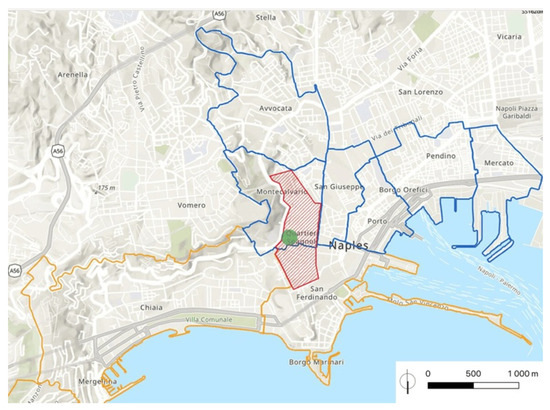
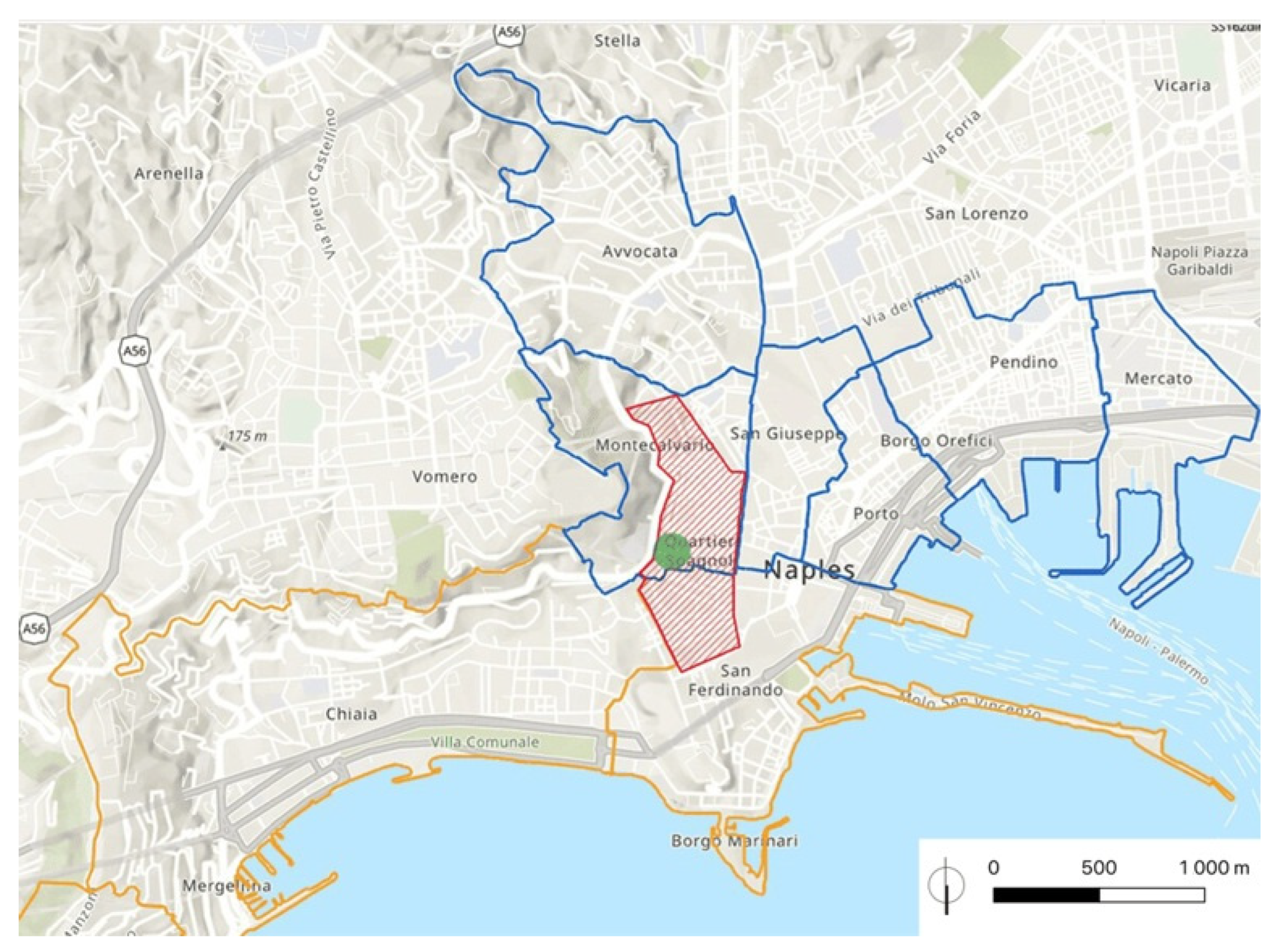
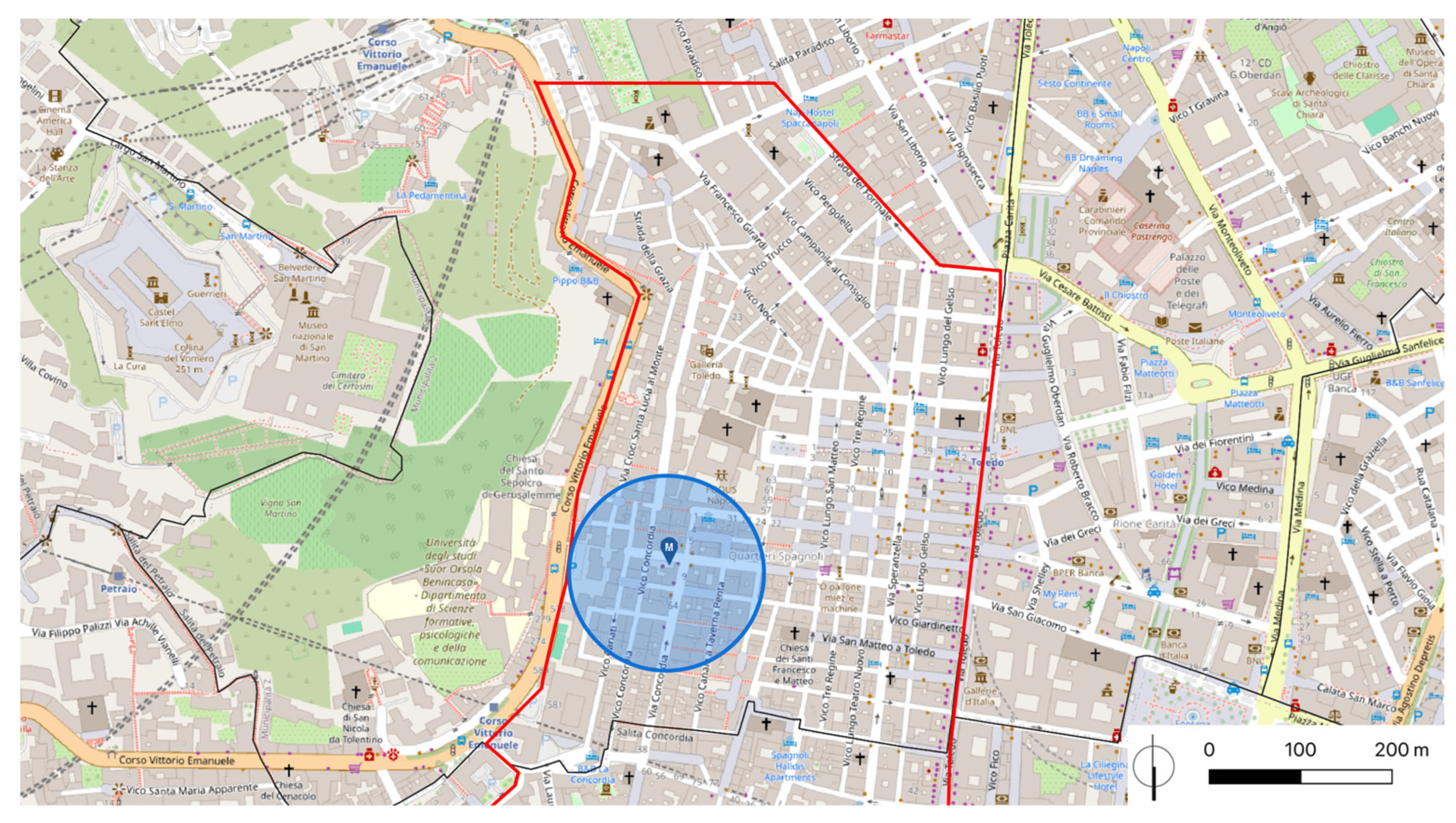
The mural in honour of Diego Armando Maradona, situated in Via Emanuele de Deo in the Spanish Quarter of Naples’ historic city centre (Figure 1 and Figure 2), is a significant example of the dynamics in question. It was created in 1990 by Mario Filardi to celebrate SSC Napoli’s second League title, won mainly thanks to the contribution of the Argentine footballer. Over the years, the mural has been restored on several occasions and has gradually become one of the city’s most recognisable urban landmarks, playing a central role in attracting tourists and in the economic activities that have developed in the surrounding area. Following Maradona’s death, the site has further consolidated its symbolic and cultural significance, becoming a popular destination for fans and tourists from all over the world, described as “a veritable place of pilgrimage” [32].
Figure 1.
Location of the Maradona Mural (the green circle) within the perimeter of the Spanish Quarter (marked by the red line), divided between Municipality 1, Chiaia–Posillipo–San Ferdinando (the yellow perimeter), and Municipality 2, Montecalvario (the blue perimeter). Source: author’s elaboration based on the municipal boundaries of the city of Naples, mapped using ArcGIS (version Pro 3.x).
Figure 2.
Location of the Maradona Mural (in the blue circle) within the labyrinth of the Spanish Quarter. Source: author’s elaboration based on the municipal boundaries of the city of Naples, mapped using ArcGIS.
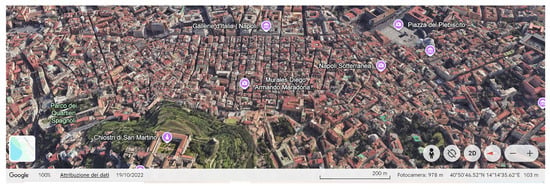
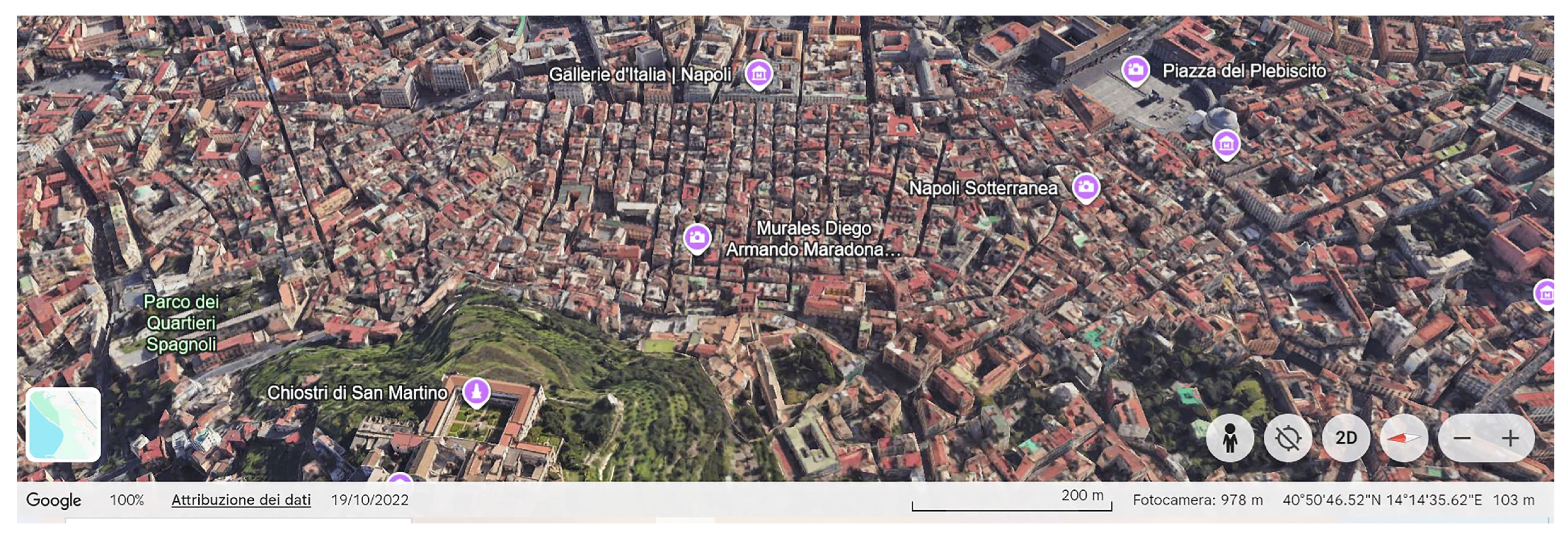
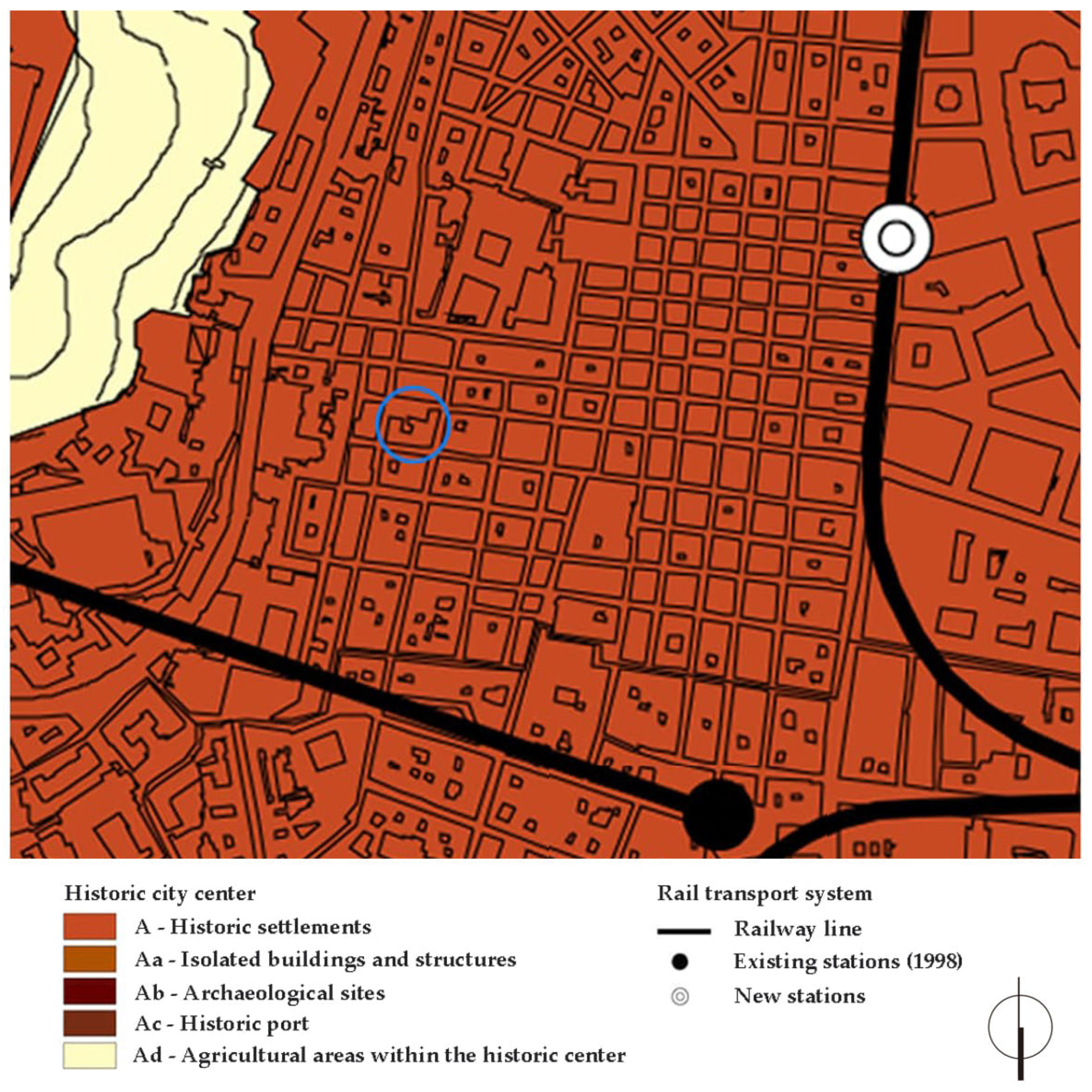
The story of the Maradona Mural highlights how urban creativity projects can have effects that go beyond the strictly artistic dimension, impacting tourist routes, local economic activities, and urban governance processes [33,34,35]. Although there is insufficient systematic data to precisely quantify these phenomena, the growing attractiveness of the site and the business opportunities generated by the mural—particularly those linked to informal merchandising—have helped to fuel a passionate public debate in recent years. In response to these dynamics, the municipal administration has promoted a strategic process of engagement with local economic operators, aimed at regularising economic activities in the area, which culminated in the recent approval of a spatial regeneration project for the square. The labyrinthine streets of the Spanish Quarter, home to the mural (Figure 3 and Figure 4), also lie within the UNESCO perimeter of Naples’ historic city centre (Figure 5), and therefore feature in the ongoing revision of the management plan, not least in light of growing pressure arising from overtourism and its effects on the local urban and social fabric [36,37].
Figure 3.
Aerial view of the labyrinthine streets of the Spanish Quarter, showing the location of the Maradona Mural within the district. Source: Google Earth view.
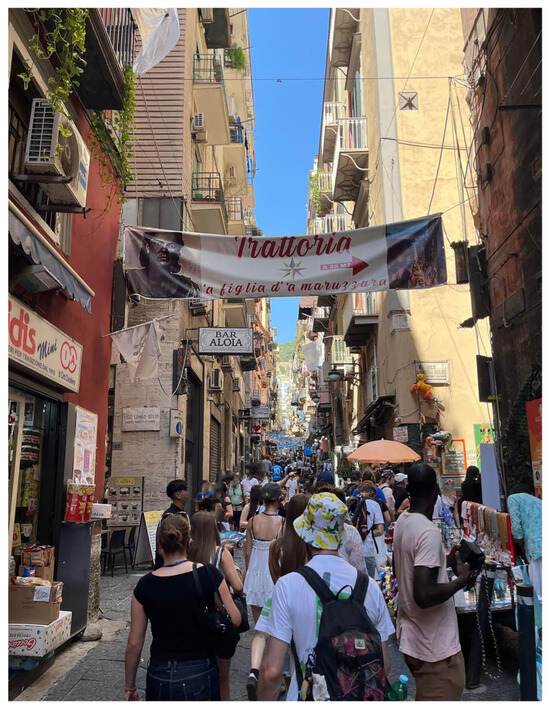
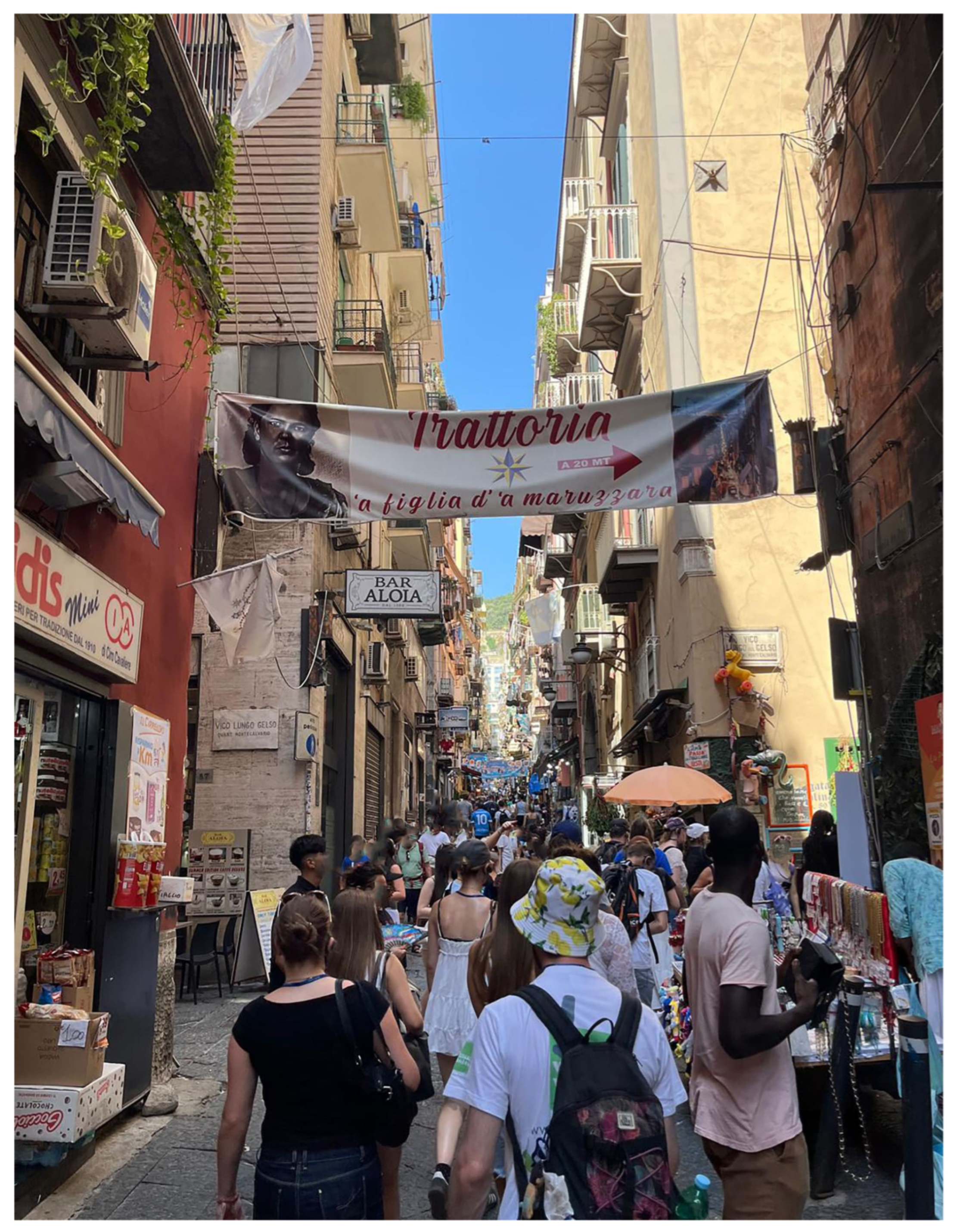
Figure 4.
View of Via Emanuele de Deo on a weekday. July 2026. Source: author’s photo.
Figure 5.
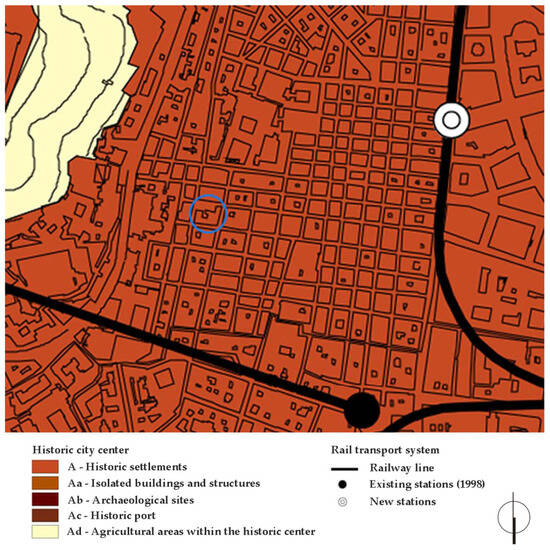
Excerpt from Table 5 (Zoning) of the General Regulatory Plan of the Municipality of Naples (city council resolution no. 35, 19 February 2001). The legend in the lower left indicates the colours shown in the excerpt, which focuses on the area surrounding the Maradona Mural (marked by the blue circle). It is located within an area designated as “Historical Interest.” Source: author’s elaboration based on the file available at the following link: https://www.comune.napoli.it/articolo_tematico/urbana-urbanistica-napoli/il-prg/cartografia/ (accessed on 31 July 2026).
The gradual institutional recognition of the Maradona Mural confirms a trend observable in numerous international contexts, where street art practices have been progressively integrated into urban and cultural policies. In several cases, these practices have been included in local area enhancement programmes strategies for managing tourist flows, and urban regeneration initiatives, contributing to the strengthening of social cohesion and the promotion of local economic development. Although the international literature documents numerous cases in which the phenomenon of urban creativity has driven processes of revitalisation and regeneration in areas typically characterised by marginalisation and decay [11,15,38,39,40], studies aimed at empirically and quantitatively assessing the effects generated remain limited.
In addition to its symbolic and identity-related dimensions, the literature highlights a particularly interesting alternative perspective that emphasises the role of street art in the economic revitalisation of local areas and its potential impacts on the property market. In this sense, street art can be interpreted as a positive externality, capable of contributing to the perceptual and functional regeneration of run-down urban areas and, consequently, influencing property values [14,41,42]. Empirical evidence from Europe and North America shows a correlation between the presence of urban creative projects, an increase in tourist numbers, and, in some cases, a rise in local real estate values and economic activity [7,43]. As highlighted by Forte and De Paola [14], the concept of externalities refers to the effects—whether positive or negative—generated by an economic activity on individuals who do not participate directly in its implementation.
In the context of property markets, the monetary estimation of environmental externalities is generally based on an econometric analysis of market prices, assuming that these reflect—in addition to the intrinsic characteristics of the properties—the quality of the urban and environmental context in which they are situated. Properties can therefore be considered to be receptors of environmental externalities that, much like locational returns, are reflected in market values. This allows the value of externalities to be estimated through the variation in property prices associated with changes in environmental conditions [44].
Within this theoretical framework, this paper forms part of broader research into the impacts of street art and offers an initial exploration of the property market dynamics associated with the presence of the Maradona Mural in the Spanish Quarter of Naples. In particular, this analysis aims to assess the mural’s potential impact on the market value of properties located in the surrounding area.
2. Contextualisation of the Maradona Phenomenon Within the Socio-Territorial Context of the Spanish Quarter of Naples
Street art is a complex phenomenon that is difficult to reduce to a universally valid and unambiguous definition. As highlighted by Danysz and Dana [45], it is in a constant state of flux, and any attempt at categorisation is intrinsically problematic, while Bengtsen [46] emphasises its negotiated and constantly redefined nature. In practical terms, Blanchè [2] describes it as the collection of self-authorised interventions in urban space, created through images, symbols, and forms, with the deliberate aim of communicating with a wide audience. Beyond definitional distinctions, the literature recognises street art’s growing capacity to trigger processes of territorial regeneration and urban revitalisation, influencing the cultural identity of places and their social and economic vitality [47].
In this context, the city of Naples represents a particularly significant case, characterised by a high symbolic density of urban space and a strong and deep-rooted relationship between territorial identity and community belonging [48]. The city hosts numerous street art works [49,50,51], including those by internationally renowned artists such as Banksy, OBEY, and Bosoletti, contributing to the creation of a stratified and culturally recognisable urban landscape. Among the various themes, symbols, and characters represented, the most recurring is the figure of Diego Armando Maradona.
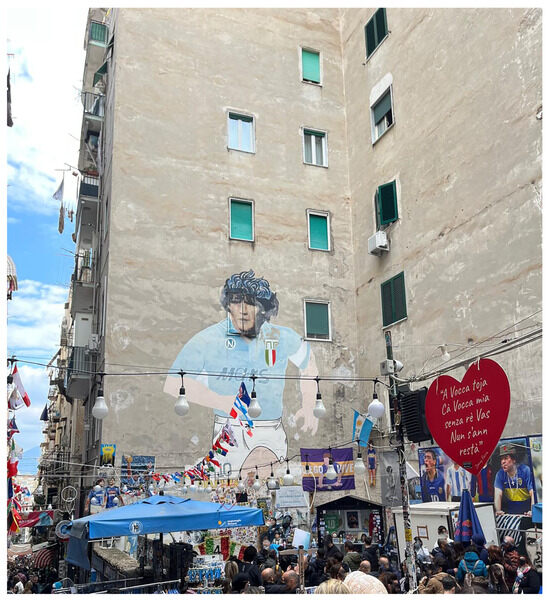
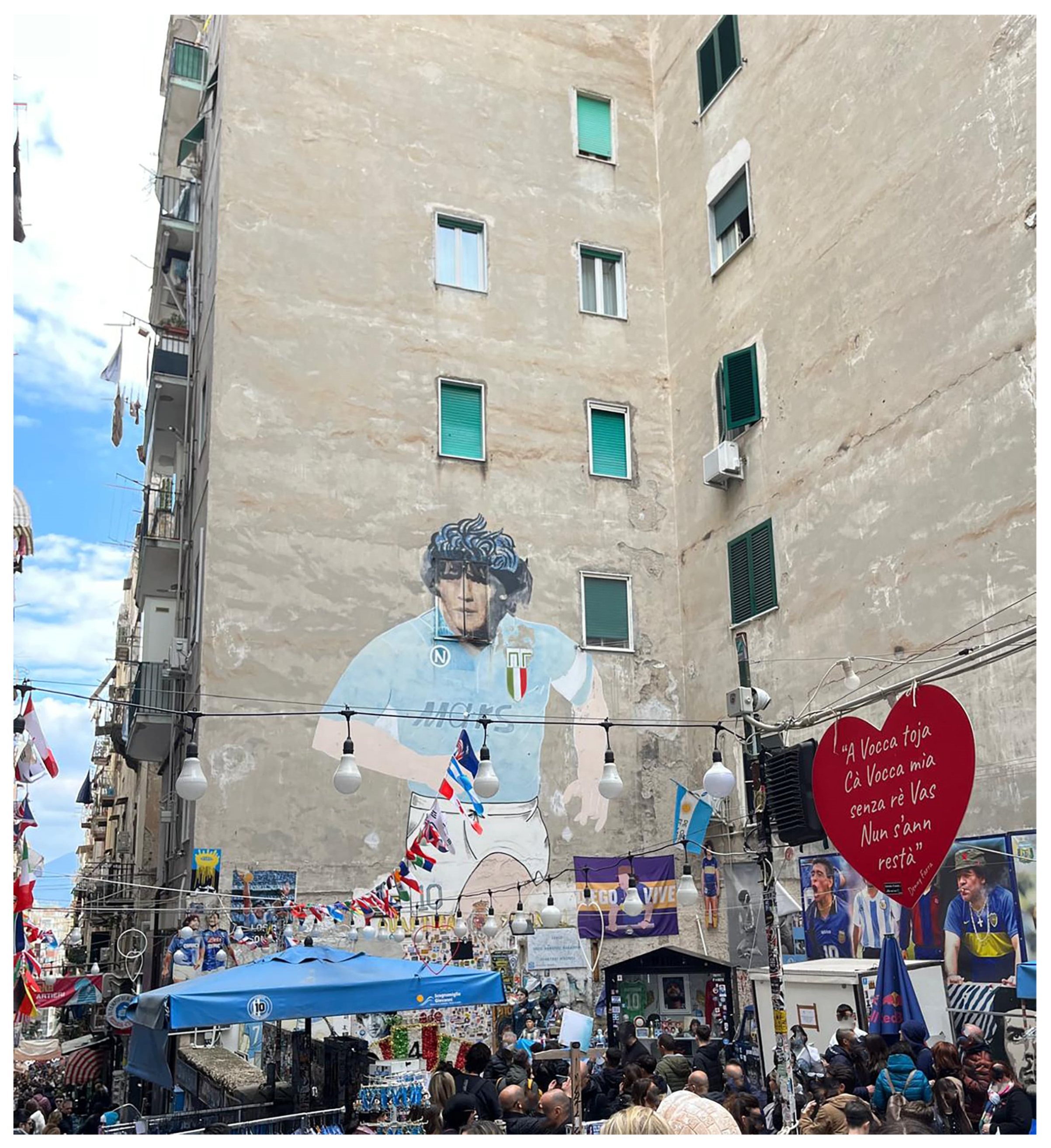
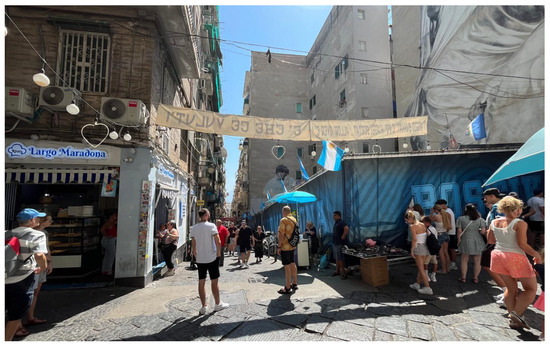
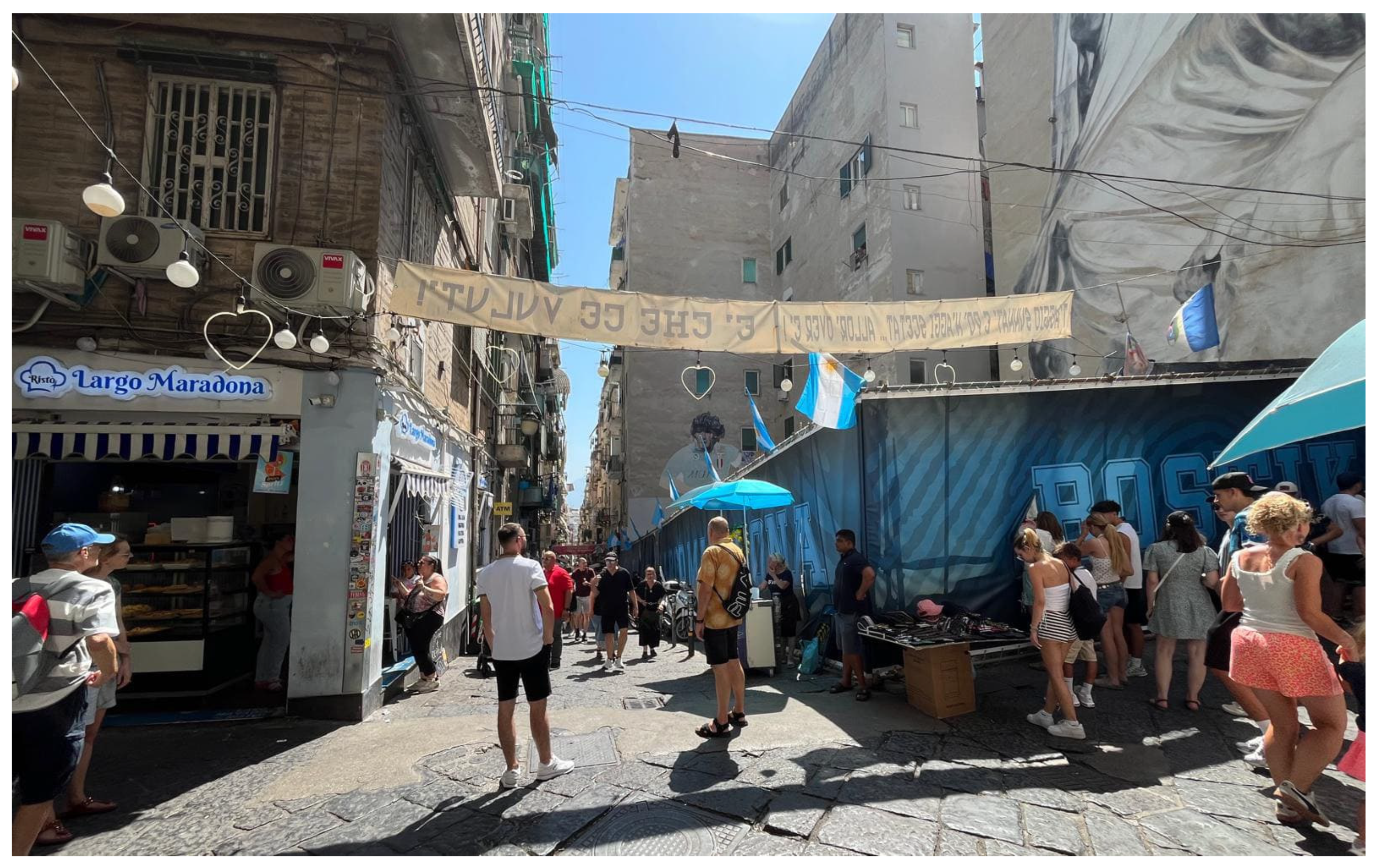
In general, sporting figures tend to acquire symbolic significance to the extent that they transcend the merely performance-related dimension, becoming targets of collective admiration and, in some cases, of social devotion [52]. In the case of Diego Armando Maradona, this process has contributed to the creation of a symbol of identity for the Neapolitan community, acting as a catalyst for social cohesion and a shared sense of belonging [53]. According to Fiorentino [54], cultural icons are entities—personalities, places, or objects—that acquire a permanent presence in the collective imagination, becoming part of a shared symbolic heritage. The mural created to homage the “Pibe de Oro” by the spontaneous initiative of the local community (Figure 6) subsequently established a strong sense of identity for the quarter, becoming a cultural icon, and today plays a central representative role in the urban imagination of Naples [55].
Figure 6.
View of the Mural in “Largo Diego Armando Maradona” crowded with residents and tourists. March 2026. Source: author’s photo.
Its location—in Via Emanuele de Deo—in an urban void created by the bombings of the Second World War [56,57,58], has facilitated its transformation into a space for social gathering and collective identity, helping to change its intended use over time [59,60,61]. Subsequent events, such as Maradona’s death in 2020 and the club’s third scudetto victory in 2023, have further reinforced its symbolic significance and international profile, turning it into an attractive tourist destination. The attention generated and channelled towards the mural has helped to drive a more widespread process of profound urban regeneration in the Spanish Quarter, which began in the 1990s. European programmes and resources, infrastructure projects, such as the world-famous “Stazioni dell’Arte” project [62], cultural policies [63], and regeneration initiatives [64,65] have transformed the image of the district—historically characterised by social marginalisation and informal economies, and excluded from traditional tourist itineraries—into a central attraction for contemporary urban flows.
In this setting, the Maradona Mural represents an emblematic example of the interaction between spontaneous artistic intervention and the redevelopment of urban space, helping to shape both the perception and the experience of the urban area in which it is located. Beyond the mural’s symbolic component, which demonstrates its intangible value, it also expresses a tangible dimension, measurable through the increase in local economic activity, particularly in the restaurant and hospitality sectors [55], suggesting the presence of positive externalities associated with the Maradona phenomenon capable of influencing the dynamics of the property market in the Spanish Quarter.
Tourism Dynamics and Visitor Flows Associated with the Maradona Mural and Its Impact on the Dynamics of the Real Estate Market in the Spanish Quarter
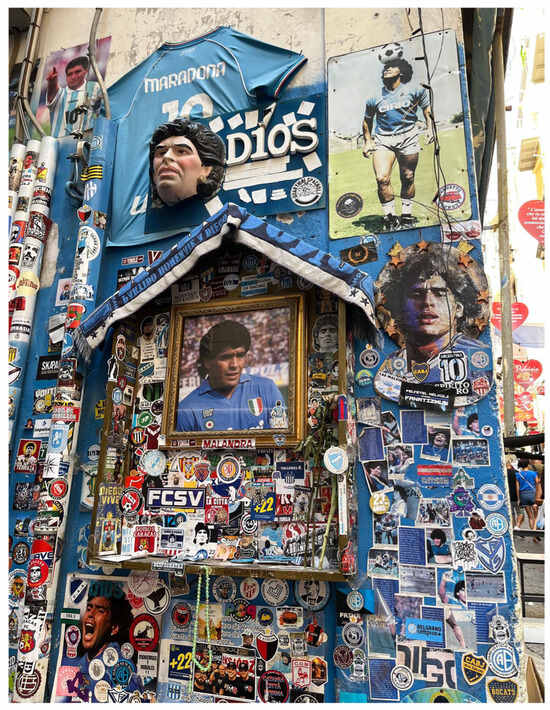
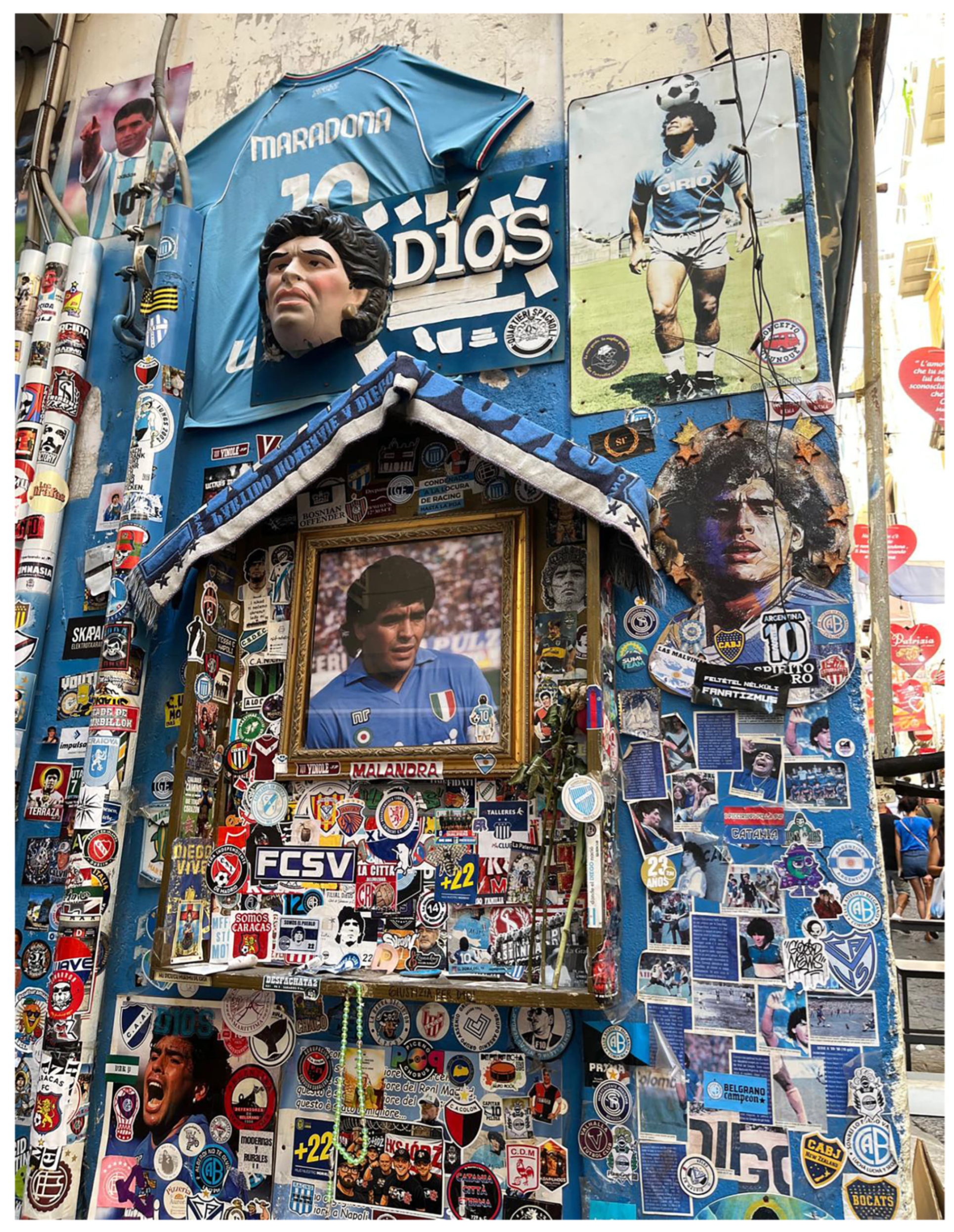
The extraordinary significance of the Maradona Mural must be understood in the particular historical, social, and cultural context that characterises the complex society and economy of the Spanish Quarter. The combination of the symbolic value attributed to the figure of Maradona, the gradual evolution of the mural into a site of collective memory, and the tourist appeal of the quarter has, in fact, generated a phenomenon that is difficult to compare with other cases of street art documented in the literature. The mural has become an urban landmark, contributing to the redefinition of the quarter’s image and its inclusion in international tourist circuits. This transformation accelerated after Maradona’s death in November 2020, when the mural quickly became the symbolic epicentre of collective mourning. Thousands of supporters gathered around the artwork, spontaneously creating a memorial through flowers, soccer jerseys, scarves, candles, and personal messages [66,67]. From that moment onwards, the site progressively acquired the characteristics of an urban pilgrimage destination, where visits are motivated not only by tourism but also by collective memory, emotional attachment, and the construction of identity. Such dynamics closely correspond to the concept of “football pilgrimage,” whereby places associated with football transcend their original function to become destinations of symbolic and ritual significance for both supporters and visitors (Figure 7). Recent studies have shown that football-related sites, including stadiums, memorials, and monuments, can be interpreted as contemporary pilgrimage destinations where collective memory, material culture, and ritual practices converge [68,69]. The Maradona Mural represents a particularly significant example of this process because its attractiveness is not the result of institutional tourism planning but from a bottom-up process of social recognition, media exposure, and collective participation. The figure of Maradona himself has gradually transcended the sporting dimension to become a world cultural icon [70]. Within the Neapolitan context, recent studies have further interpreted the widespread commemorative practices surrounding his memory as expressions of a form of secular sainthood, characterised by rituals, symbolic offerings, and devotional behaviours that blur the boundaries between sport, religion, and cultural heritage [71]. Consequently, visits to the mural can be interpreted not only as recreational tourism but also as symbolic experiences through which visitors reaffirm a shared cultural identity and participate in collective acts of remembrance.
Figure 7.
Votive shrine dedicated to Diego Armando Maradona in Via Emanuele de Deo. July 2026. Source: author’s photo.
The victory of SSC Napoli in the 2022–2023 Serie A championship further amplified the site’s international visibility. During the celebrations, the renamed Largo Diego Armando Maradona emerged as Naples’ main tourist attraction, with an estimated six million visitors, surpassing the Pompeii archaeological site in terms of visitor numbers [72].
Images of the square circulated around the world through traditional media and social media, consolidating the mural as one of Naples’ main tourist destinations. Furthermore, the concentration of visitors became so intense that the Municipality of Naples introduced temporary one-way circulation systems and other crowd-management measures to regulate access to the area during periods of peak attendance, recognising the mural as a new urban centrality capable of influencing the organisation and management of public space [73,74].
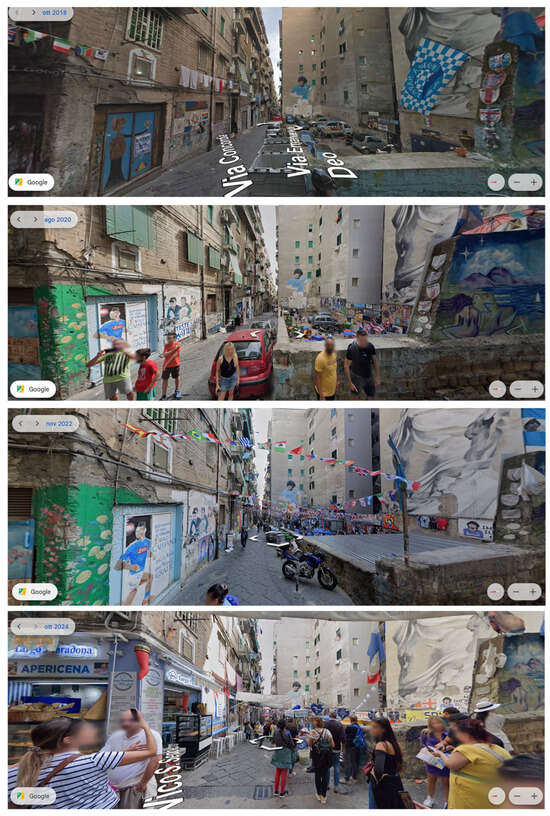
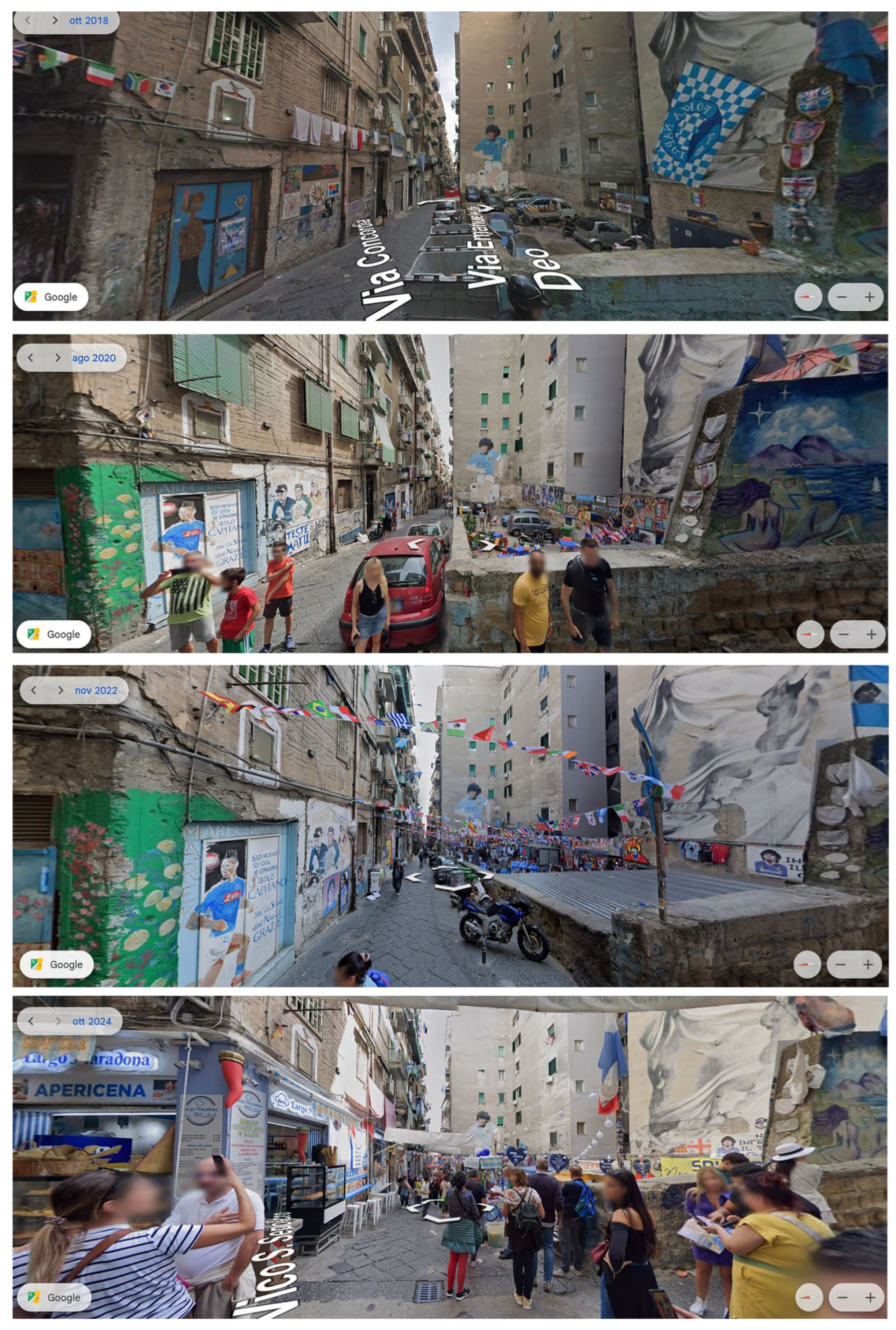
A new centre of attraction has developed around the creation of this footballing legend, fostering the growth of a flourishing system of business activities linked to tourism services, retail, catering, and hospitality, which has now become one of the main economic resources of the Spanish Quarter. Within just a few years, the economic and social fortunes of this urban area have been profoundly transformed (Figure 8 and Figure 9).
Figure 8.
Evolution of the “Largo Diego Armando Maradona” recorded by Google Earth images in October 2018, August 2020, November 2022, and October 2024. Source: Google Earth image author collage.
Figure 9.
View of “Largo Maradona” from the same viewpoint, showing ongoing renovation works. July 2026. Source: author’s photo.
However, consequently, the increasing pressure exerted by tourist flows has led to a rise in demand for short-term rental accommodation, resulting in the conversion of numerous residential properties into short-stay accommodation such as holiday homes, guesthouses and bed and breakfasts. This trend is part of a wider process affecting the entire historic city centre of Naples, where the exponential increase in the tourism economy is having a significant impact on the property market and on access to housing [8]. As observed in numerous urban contexts characterised by strong tourist appeal, these phenomena can be interpreted as manifestations of processes of “touristification” and, in the longer term, gentrification, with potential consequences for the social composition and cultural identity of these areas [75,76].
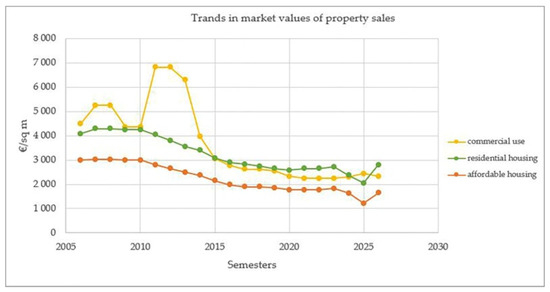
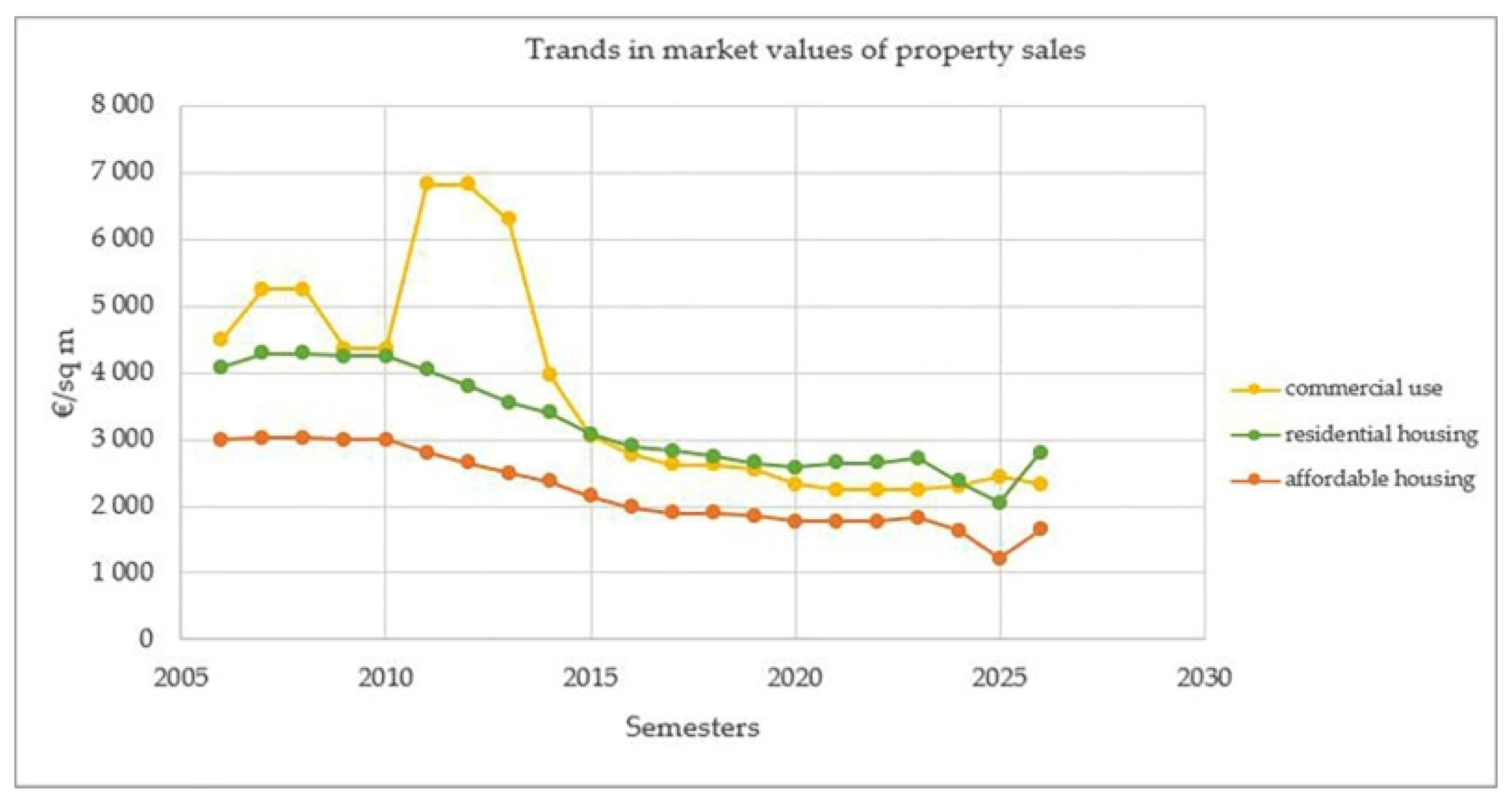
From the perspective of property market analysis, the intensification of tourism dynamics does not yet appear to have translated into a corresponding rise in property values in the Spanish Quarter area. Looking at the data provided by the Property Market Observatory (Osservatorio del Mercato Immobiliare, OMI) [77] for the first half of each year from 2006 to 2026, there is no significant increase in the market value of properties across the main categories of use. Indeed, values have been falling since 2014 but are rising compared with last year, as summarised in Figure 10.
Figure 10.
Analysis of data provided by the Property Market Observatory (2006–2026). Trends in market values for sales of commercial, residential, and affordable residential properties. Arithmetic mean is given, taking into account the minimum and maximum values. June 2026. Source: author’s analysis. Source: author’s elaboration.
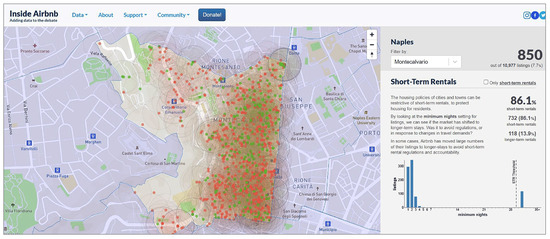
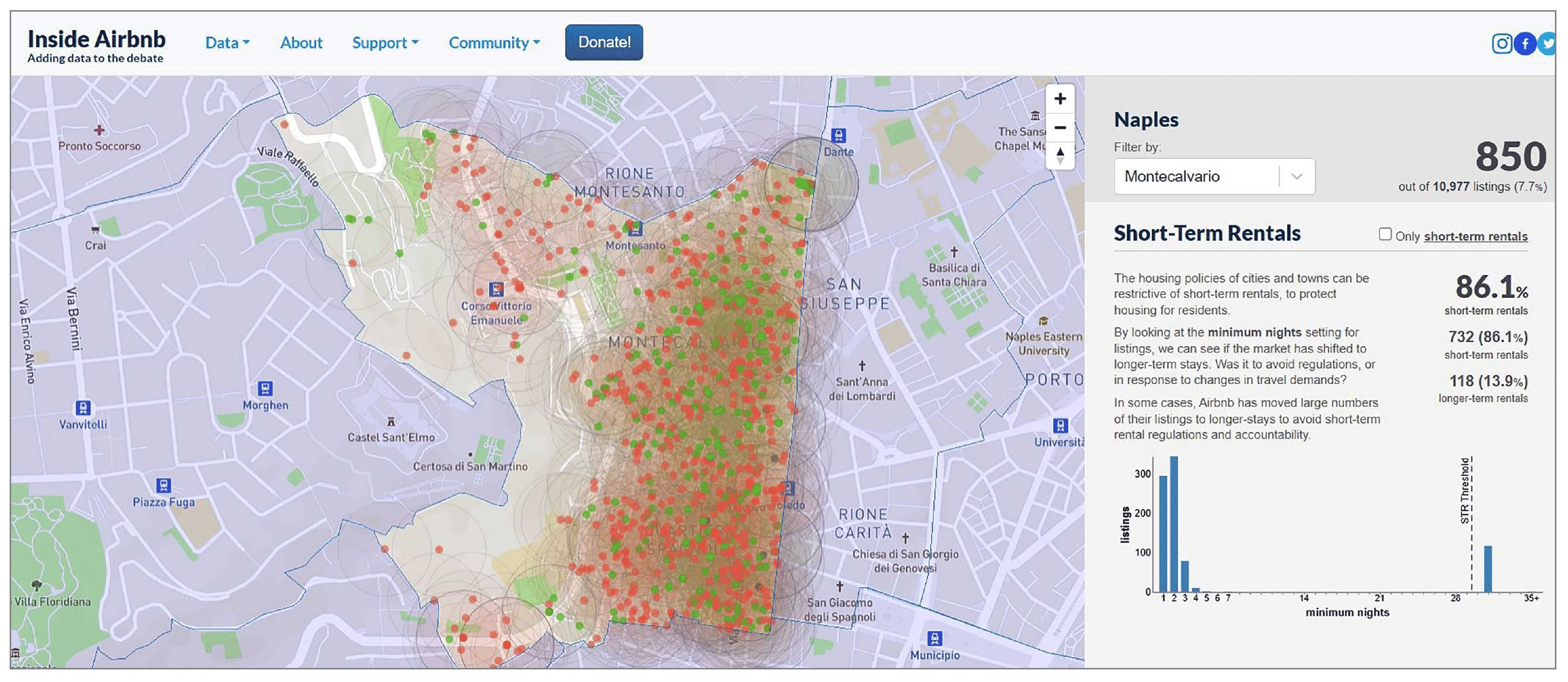
Conversely, the effects are more evident in the rental market and in the use of the existing building stock. Data from Inside Airbnb [78] show the ongoing conversion of residential properties into accommodation facilities, 86.1% of which are intended for short-term rentals (Figure 11).
Figure 11.
On the left: a map showing the properties listed in Airbnb’s database for short- and long-term rentals in the Montecalvario area. On the right: the percentage of short-term rentals out of the total number of properties listed. Source: https://insideairbnb.com/naples/ (accessed on 31 July 2026) [78].
From this perspective, the Maradona Mural cannot be interpreted merely as a cultural icon or a symbol of identity within its urban context but also as one of the factors that have helped to reinforce the processes of socio-economic transformation currently underway in the Spanish Quarter. Despite being located in a specific point of the urban landscape, it generates effects that extend far beyond its immediate physical surroundings, influencing perceptions of the quarter and the activities that occur there.
3. Materials and Methods
Among the methods used for the monetary valuation of environmental externalities, land price analysis occupies a particularly prominent position. It is based on the principle that the market value of properties is influenced not only by their intrinsic characteristics but also by environmental, cultural, and territorial attributes relating to the context in which they are situated. This theoretical framework regards properties as “receptors” of environmental externalities which, much like locational rents, are incorporated into market prices [44]. From this perspective, the economic value of an externality can be estimated through the variation in property prices attributable to a change in environmental conditions. Starting from this theoretical premise, this study adopts the valuation method known as the “valuation system” [79,80], aimed at quantifying in monetary terms the contribution that the Maradona Mural makes to the formation of the market price of residential properties located within its territorial sphere of influence.
The proposed methodological model therefore provides a means of quantifying the component of value attributable to the positive externality generated by the street artwork and to the associated process of urban regeneration.
It is structured in a sequence of closely interrelated stages, aimed at quantifying the economic impact generated by the Maradona Mural on the residential property market in the Spanish Quarter:
- Delineation of the geographical area of influence of the Maradona Mural, defined as the area in which the artwork is likely to have a significant effect on property values;
- Analysis of the local property market aimed at identifying recent sales of comparable residential properties within the study area;
- Identification and selection of property characteristics relevant to the determination of market value;
- Application of the valuation system to determine the marginal prices of property characteristics and to isolate the economic contribution attributable to the presence of the Maradona Mural;
- Inventory of residential property units falling within the identified area of influence;
- Estimation of the overall economic impact generated by the Maradona Mural by aggregating the financial benefits attributed to individual residential property units.
3.1. Data Specification
With a population of around 962,000, Naples is the third-largest municipality in Italy in terms of number of residents, preceded only by Rome and Milan; this number rises to around 3 million considering the entire metropolitan area [81]. The Spanish Quarter of Naples is one of the city’s most densely populated and socially complex urban areas. With a population of around 14,000 concentrated within just 0.8 km2, the population density reaches approximately 17,500 inhabitants per km2, among the highest in Europe for a historic centre. From a socio-economic perspective, the quarter is characterised by income levels lower than the national average and a significant proportion of people in precarious, informal, or low-skilled employment. The population mainly consists of long-established households, alongside a growing number of foreign residents [82].
Historically, the area has faced challenges linked to early school leaving, educational deprivation and social vulnerability—issues that have been combated in recent years thanks to the actions of numerous third-sector organisations and significant urban regeneration programmes. At the same time, the district has experienced deep transformation linked to the increase in tourism, with a considerable rise in accommodation facilities, restaurants, and entertainment facilities. This process has helped to improve the urban environment and the perception of public safety, but it has also created risks of gentrification, with a gradual rise in property values and the potential displacement of long-standing, low-income residents by tourism-related businesses and new residents from higher socio-economic groups.
This case study employs a dataset relating to a section of the Spanish Quarter in the city of Naples, selected on the basis of the “sphere of influence” of the Maradona Mural within the perimeter of the Spanish Quarter, excluding hypothetical independent influences unrelated to the mural, such as Via Toledo, Corso Vittorio Emanuele, and Naples’ Metro stations. To avoid such influences, the half-distance between the mural and the roads and/or infrastructure and/or attractiveness to tourists and/or business significance was selected. Within this restricted area (sphere of influence), comparable properties were selected and placed on the map; all were located within the Spanish Quarter, designated for residential use, and situated in multistorey buildings, that is, of the “flat” type, relating to the property sales market.
A market segment defined in this way ensures the homogeneity of the urban area in terms of the quality and distribution of key services, as well as the homogeneity of the sample collected. The data were collected through direct surveys of estate agents, focusing on 18 residential properties sold between the second half of 2025 and the first half of 2026 within the aforementioned area of influence.
For each property unit included in the sample, the following characteristics—deemed to influence the formation of the market price—were recorded:
- PRC: sale price of the property unit, expressed in euros;
- AREA: the property’s gross floor area, expressed in square metres, calculated as the sum of the main floor area and any ancillary areas (balconies, terraces, appurtenances, etc.), appropriately weighted using adjustment coefficients commonly adopted in the local property market;
- FLOOR: the floor on which the property unit is located within the building;
- MAIN: a dichotomous categorical variable representing the state of maintenance and condition of the property, categorised as “good/habitable” (value 1) and “in need of renovation” (value 0);
- DIST: a continuous quantitative variable expressing the actual metric distance between the property unit and the Maradona Mural, measured along the shortest actually walkable route and expressed in linear metres;
- TIME: a continuous quantitative variable representing the average walking time required to reach the Maradona Mural from the property unit in question, expressed in minutes.
Further property characteristics were not included in the dataset as they were essentially homogeneous within the sample observed and, therefore, lacked sufficient statistical variability (in particular, the presence of a lift, a garage or parking space, and the view characteristics). Their inclusion would not have contributed significantly to explaining the price differences observed between the property units analysed. In addition to the above characteristics, the geographical coordinates—namely, the latitude and longitude—of the sampled property units were also recorded; these were used for the georeferencing of the properties and for calculating the distance and journey time variables.
The variables collected and employed in the estimation and statistical analyses are reported in Table 1 and Table 2.
Table 1.
Real estate dataset.
Table 2.
Statistical description of real estate dataset.
3.2. Estimation System
The estimation system is a procedure that provides a quantitative measure of the value and marginal prices of property characteristics using mathematical modelling; it is particularly suitable in situations where the number of comparable properties on the market is so limited that statistical inference techniques cannot be applied [83,84].
The potential applications of this methodology extend beyond the mere determination of a property’s value and its marginal prices, even when the property possesses features of historical or architectural significance. On the contrary, the valuation system is also suitable for assessing property income and the marginal returns on certain characteristics, as well as for analysing construction costs and the costs of specific regeneration works.
A distinctive and particularly valuable aspect of this approach lies in its ability to investigate and quantify the marginal prices of characteristics that cannot otherwise be directly estimated, namely, qualitative variables such as architectural and environmental quality, panoramic views, the orientation of the views, and other intangible elements. The estimation system represents the precise mathematical formalisation of the market comparison approach, and can therefore be applied in combination with the market comparison approach in certain specific cases where both quantitative and qualitative variables influence the formation of the market price.
For the purposes of estimating the market value of a property, the process consists of the following stages [79,83,84]:
- Analysis of the market segment, considering the characteristics of the property being valued, simultaneously identifying the parameters necessary for the valuation;
- Identification of recent transactions involving properties belonging to the same market segment as the property to be valued;
- Collection of comprehensive property data relating to properties similar to the one being valued which have recently been sold;
- Selection of property characteristics, taking into account the characteristics of the property in question, the characteristics typically considered by market participants within the specific market segment, and the characteristics in respect of which the identified comparable properties and the property to be valued differ in value;
- Compilation of a data table, summarising all available information regarding the values of the property characteristics;
- Preparation of the difference matrix and the vector of known market prices, prior to carrying out the calculations;
- Solving the system using algorithms typically applied to problems relating to linear systems, generally with the aid of automated calculation tools.
Through comparison, the functional relationships between the differences in the property characteristics and the corresponding differences in prices are highlighted; consequently, the comparison function between two properties of known prices k and j takes the following general form [54,58,59]:
where the terms ∆pi (con i = 1, …, n) denote the marginal prices of the property characteristics, ∆Pkj is the difference between the known prices Pk e Pj d of the comparable properties k and j, and the terms (xki − xji) represent the differences in the values of the property characteristics xi possessed by the two comparable properties. In accordance with Jevons’ law of indifference, if properties k and j were identical in terms of their various property characteristics, the two properties would necessarily have the same market price.
Extending the comparison to n properties, we can define a system of m linear equations (each corresponding to a comparison function for each property in the valuation sample) with n + 1 variables, the latter being represented by the estimated value (S) and the marginal prices of the property characteristics (∆pi). The estimation system then takes the following form:
where the terms ∆pi (con i = 1, …, n) denote the marginal prices of the property characteristics, Pi (con i = 1, …, m) are the market prices of the comparable properties making up the sample, x0i (con i = 1, …, n) identify the categories characterising the attributes of the property to be valued, the terms (x1, …, xm) indicate the categories relating to the attributes of the properties making up the sample, and S is the value of the property to be valued.
In matrix form, the system of equations as shown above becomes
where D is the difference matrix consisting of the elements (xji − x0i), P is the vector of known prices, and S is the estimation vector consisting of (n + 1) unknown elements.
The system (2) admits a unique solution when the matrix of differences (D) is non-singular (i.e., its determinant is not equal to 0), in which case its inverse matrix exists:
In actual property markets, it is often the case that the number of transaction records may be limited to the extent that it is lower than the number of characteristics exhibited by properties, which, by their very nature, are complex and non-standard assets. The estimation system may therefore be underdetermined in terms of the number of constituent equations (m < n + 1), meaning that the solution to the system can be obtained using a specific technique known as the Moore–Penrose generalised inverse [83,84]:
Instead, if the system is overdetermined in terms of the number of component equations (m > n + 1), the solution to the system can be obtained using the criterion of least squares:
Equation (5) is equivalent to representing a multiple linear regression model with a constant term, constructed on the differences (xji − x0i) rather than on the original data, although this particular feature has no statistical implications for the estimation system. For practical purposes, the fundamental difference between the two models (multiple linear regression and the estimation system) therefore lies solely in the different mechanism for solving the estimation problem (single-equation or multi-equation) [84].
A specific variation of the valuation system, known as the “difference system,” can be applied to determine, exclusively, the marginal prices of property characteristics relating to a specific valuation sample by defining the general comparison function as follows:
where Pk (con k = 1, …, m) represents the price of the k-th comparable property (per unit or total), xki indicates the value of the i-th property characteristic, ∆pi is the marginal price of the i-th property characteristic, represents the average price of the estimation sample data set or the price (per unit or total) of a specific unit in the sample taken as a reference, and is the mean value of the i-th property characteristic or indicates the mode of the i-th characteristic for the specific unit taken as a reference.
As it consists of a set of m comparison functions, each relating to a property unit in the estimation sample, the solution to system (6) can be determined in a similar way to Equations (3)–(5), where solution (5) applied to comparison function (6) is equivalent to a multiple linear regression model passing through the origin [60].
3.3. Results
In the current case, the property dataset shown in Table 1 constitutes an overdetermined system, as the number of available equations exceeds the number of unknowns to be estimated. Under these conditions, the solution to system (6) was obtained by applying the criterion of least squares, described in Equation (5), which enables the identification of the vector of marginal prices capable of minimising the sum of the squares of the deviations between the observed prices and the prices estimated by the model.
The application of this procedure provided the following results:
- €1301.40/sqm as the marginal price of the AREA variable, which is positive, indicating the value increase associated with a unit increase in the property’s commercial floor area. This parameter is broadly consistent with the unit value levels recorded for the relevant residential market segment by the Property Market Observatory (OMI) of the Italian Revenue Agency, thereby confirming the economic plausibility and the appropriate estimation of the result obtained using the adopted analytical model [53].
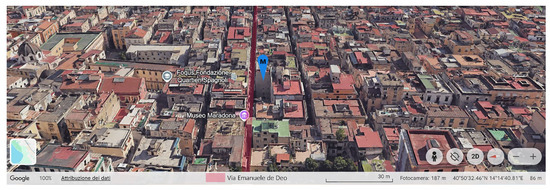
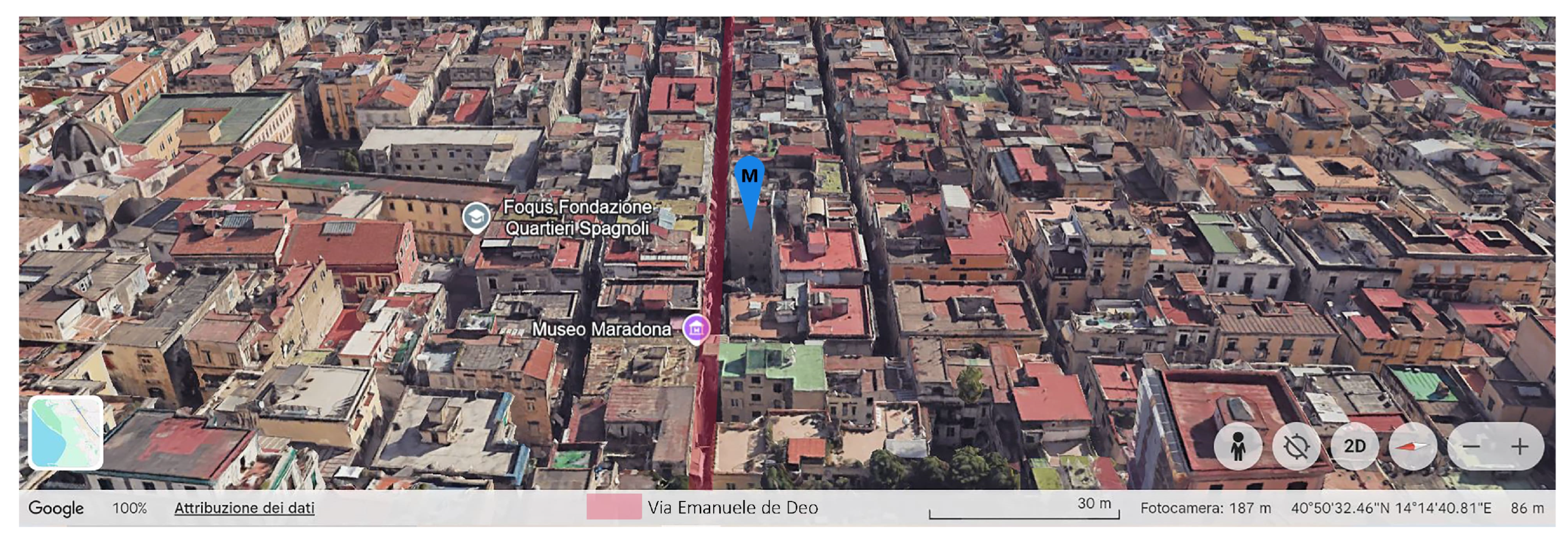
- €22,671.96/point as the marginal price of the FLOOR variable, which is positive, reflecting the generally favourable contribution made by the higher-floor units to the formation of the market value. When this amount is compared with the average price of the sampled property units, it corresponds to an increase of approximately 9.70% in the average price of the properties under consideration. This rate is slightly higher than the percentage differentials generally observed in the dynamics of the Italian residential property market, where the premium associated with floor level is frequently in the range of 3–4% per floor. However, the higher premium observed in this study can reasonably be attributed to the specific morphological and architectural characteristics of the Spanish Quarter, which is characterised by high population density and buildings situated very closely together. In this context, the upper floors benefit from significantly better conditions in terms of natural light, orientation, ventilation, and reduced exposure to road noise; these factors tend to be valued more significantly by the market than in urban contexts characterised by lower building density (Figure 12).
- €50,031.68/point as the marginal price of the MAIN variable, which is positive, associated with an improvement in the maintenance and conservation state of the property unit. When this parameter is applied to the average size of the sampled property units, the economic benefits attributable to the transition from the “in need of renovation” condition to the “good/habitable” condition amount to approximately €579.88/sqm. This value appears to be substantially consistent with the standard costs of building refurbishment and renovation carried out in-house, which are commonly observed in affordable and social housing contexts. The result obtained therefore confirms the economic plausibility of the estimated parameter, highlighting how the local property market tends to recognise a value differential for properties in better states of repair that is largely in line with the costs required for their functional and qualitative restoration.
- €206.67/linear metre as the marginal price of the DIST variable, which is negative, indicating a decrease in property value as the actual distance between the sampled property and the Maradona Mural increases.
- €917.73/minute as the marginal price of the TIME variable, which is also negative, indicating a reduction in value associated with an increase in the journey time required to reach the Maradona Mural.
Figure 12.
Close-up aerial view of the Spanish Quarter, showing the narrow, labyrinthine street tissue and the dense arrangement of residential buildings. Via Emanuele de Deo, where the mural is located, is highlighted in red. Source: author’s elaboration based on Google Earth view.
The results generally show that location-related variables linked to proximity to the Maradona Mural have a significant influence on the observed market values. In particular, the negative signs of the coefficients associated with the DIST and TIME variables suggest the existence of an inverse relationship between property value and distance from the cultural asset, indicating that properties closest to the mural tend to benefit from an increase in value attributable to its appeal in terms of culture, identity, and tourism. The interpretation of the results relating to these two variables will be discussed in greater detail in the following section.
For the area of influence of the Maradona Mural within the Spanish Quarter, as previously defined, a specific survey was conducted at the relevant local land registry offices, aimed at quantifying the property stock potentially affected by the value-enhancing effects associated with the presence of the artwork. The survey identified a total of 64 buildings (cadastral parcels) falling within the previously identified perimeter [85].
From the analysis of the land registry data, it has emerged that each building comprises, on average, 13 residential units, giving a total of approximately 46.66 cadastral rooms. This results in an average of 3.58 rooms per residential unit, corresponding to an indicative market value of approximately 65 square metres, assuming an average conversion factor of 18 square metres per room (local data).
This information made it possible to extend the results obtained using the valuation system to the entire property stock within the mural’s area of influence. In particular, once the marginal prices of the location-related variables associated with proximity to the artwork had been determined, the estimated property value benefits for the individual residential units were aggregated in order to quantify the overall economic impact generated by the Maradona Mural on the surrounding urban context, in accordance with the land price analysis approach.
By applying the value differentials derived from the estimation system to the surveyed property units, the total economic benefit attributable to the presence of the Maradona Mural amounts to €29,412,221.28. Of this amount, €27,264,733.08 is attributable to the value-enhancing effect associated with the DIST variable (actual distance from the Mural), whilst the remaining €2,147,488.20 derives from the effect of the TIME variable (walking time).
4. Discussion
The land price analysis results reveal that the Maradona Mural has had a tangible and economically significant impact on the residential property market in the Spanish Quarter. As regards the interpretation of the results, it is appropriate to focus primarily on the relationship between the variables DIST (actual walking distance) and TIME (average journey time) since, at first glance, one might assume that both describe, at least in part, the same economic phenomenon—that is, the degree of accessibility of the Maradona Mural from the residential properties under consideration. This observation appears to be supported by the correlation matrix (Table 3), which reveals a particularly high correlation coefficient (0.95). However, it should be pointed out that a high level of statistical correlation does not necessarily imply a perfect overlap of information between the variables, nor, even less so, a direct causal relationship. The correlation coefficient, in fact, measures only the strength of the linear relationship between two variables, without providing any indication of the underlying economic mechanisms or the actual coincidence of the represented phenomena.
Table 3.
Correlation matrix.
From an economic standpoint, variables that appear similar may capture different aspects of urban reality. In this specific case, the DIST variable measures the actual spatial distance between the property and the mural along the shortest pedestrian route, whilst the TIME variable expresses the time cost associated with the journey. Although both can be traced back to the general concept of accessibility, they describe different dimensions of the same phenomenon: the first is predominantly spatial in nature, the second functional and behavioural.
In the Spanish Quarter context, the relationship between distance walked and time spent is in fact influenced by numerous factors that tend to significantly alter walking speed and, consequently, the relationship between the two variables. In particular, the following factors are significant:
- The presence of physical obstacles and discontinuities along the path, such as restrictions in the pedestrian area, changes in altitude, crossings, high footfall, and irregularities in the road surface, which affect journey time without altering the actual distance;
- The area’s strong tourist focus, which leads to frequent slowdowns caused by visitors stopping at shops, craft stores, places of historical interest, and tourist attractions, thereby altering the relationship between the distance travelled and the time needed to cover it;
- The morphological characteristics of the urban fabric, characterised by wide streets, moderate gradients, and historic stone paving made of lava blocks, which can significantly influence the average walking speed;
- The occurrence of pedestrian congestion, which is particularly intense during weekends, during public holidays, and during high tourist seasons, when even short journeys can take considerably longer than under normal conditions.
In light of these considerations, distance and journey time cannot be regarded as perfectly substitutable variables within the geographical context under analysis. Although they present a close statistical correlation, they capture different aspects of urban accessibility and, therefore, contribute independently to explaining the dynamics underlying the formation of property values.
It consequently follows that the high correlation coefficient observed must be interpreted in accordance with the specific characteristics of the urban context under examination. Statistical analysis, in fact, cannot be separated from an economic and territorial interpretation of the phenomenon in question, since only the integration of quantitative evidence with an understanding of the context can lead to coherent and scientifically sound interpretations. From this perspective, the DIST and TIME variables represent two different ways of measuring accessibility to the Maradona Mural and contribute, each with its own specific interpretative dimension, to quantifying the economic impact generated by the artwork on the local property market.
The presence of negative marginal prices associated with the DIST variable (– €206.67/linear metre) and the TIME variable (– €917.73/minute) indicates that the market value of properties tends to decrease as the distance and the time required to reach the mural increase. It thus follows that the properties closest to the artwork benefit from a positive value differential compared with those located in the more peripheral areas of the perimeter of influence.
This result is particularly interesting as it concerns an asset which, at least from a strictly economic point of view, generates no direct income nor constitutes a form of urban infrastructure traditionally associated with property development, such as a metro station, an urban park, or a new transport hub. The Maradona Mural, on the other hand, represents an emblematic example of an informal cultural asset, which emerged spontaneously within the urban fabric and subsequently became a tourist attraction, a symbol, and a marker of local identity.
The analysis suggests that the local property market has gradually incorporated the benefits deriving from proximity to the mural into sale prices. These benefits can be attributed to various economic factors. First, the artwork has helped to raise the profile of the Spanish Quarter both nationally and internationally, increasing the quarter’s visibility and altering its perceived image. Second, the constant influx of visitors has fostered the growth of retail, accommodation, and restaurant businesses, leading to an overall improvement in the area’s appeal. Finally, the mural has taken on a strong identity-defining significance, becoming a recognisable urban feature capable of strengthening the local community’s sense of belonging.
From a purely estimative perspective, the observed phenomenon can be interpreted as a form of property capitalisation of the positive externalities generated by the street art project. In other words, the cultural, tourist, and symbolic benefits produced by the mural are progressively incorporated into the market values of the surrounding properties, thereby becoming a financial advantage for property owners. The value estimated through land price analysis therefore represents a monetary measure of the increase in private wealth generated by an intervention which, at least initially, was not conceived as a tool for economic development.
From an urban planning perspective, the results also confirm the role that street art can play in urban regeneration processes. Different from traditional public projects, which are often characterised by high construction costs, the Maradona Mural has produced significant economic effects through predominantly intangible mechanisms, linked to the creation of symbolic meanings and the transformation of the district’s reputation. In this sense, the case of the Spanish Quarter is a particularly significant example of how cultural capital can be transformed into economic capital.
The outcomes are also part of the wider international debate on the economic impact of cultural heritage and the creative industries on property values. Numerous studies have shown that the presence of museums, monuments, historic sites, cultural parks, and permanent artistic installations can generate price premiums in the property market. The case of the Maradona Mural is particularly interesting because it demonstrates how similar effects can also be produced by a work of urban creativity located in a district historically characterised by fragile socio-economic conditions and urban marginalisation.
It should be noted, however, that the positive effects noted are not without potential drawbacks. The rise in property values and the area’s growing appeal to tourists may, in the long term, contribute to property price pressures and progressive social displacement, similar to the gentrification processes observed in numerous international urban contexts. Rising house prices and rents could reduce housing affordability for the population groups that have historically lived in the quarter, shifting some of the economic benefits towards outsiders with greater financial means.
5. Conclusions
Using the land price analysis approach, this research has allowed us to quantify the economic impact associated with the presence of the Maradona Mural on the residential property market in the Spanish Quarter of Naples. The results obtained highlight the existence of an economically significant relationship between proximity to the mural and property market values, confirming that the benefits derived from a cultural asset can be progressively incorporated into the prices of properties located within its sphere of influence.
From a methodological perspective, this study provides a realistic simulation of how certain valuation tools traditionally used for the analysis of infrastructure, local amenities, and urban externalities can also be effectively applied to the economic evaluation of street art projects and contemporary cultural phenomena. In this sense, this research helps to broaden the application scope of property analysis methodologies, offering a potential operational framework for measuring the economic effects generated by local cultural attractions.
From a factual point of view, this case study highlights how an artistic intervention that originated spontaneously and had no direct economic purpose can have tangible effects on urban regeneration processes, influencing operators’ location preferences and contributing to the development of property values. The Maradona Mural therefore stands not only as an element of identity and symbolism for the local community but also as a component of territorial capital capable of generating widespread economic benefits.
These findings also suggest that the impact of street art on urban and real estate dynamics may operate through different, although interconnected, mechanisms. On the one hand, an aesthetic mechanism can increase the attractiveness of a place through the artistic quality and visual appeal of the artistic intervention itself; on the other hand, a symbolic mechanism can generate value because the artwork embodies meanings, memories, and identities that resonate with both residents and visitors. In the case of the Maradona Mural, evidence suggests that the symbolic dimension plays a predominant role. The mural has gradually become an icon of the Spanish Quarter and Naples itself, strengthening local identity and collective memory while attracting cultural tourism. This symbolic value seems to precede and foster the subsequent economic improvement of the area, ultimately increasing its attractiveness to residents, visitors, and market operators.
Additionally, it would be worthwhile to explore further the relationship between intangible cultural heritage, urban attractiveness, and the property market, extending the analysis to other national and international contexts characterised by the presence of street art or similar cultural attractions. From this perspective, the case of the Spanish Quarter provides an interesting empirical laboratory for future research aimed at understanding how cultural regeneration processes can result in the economic enhancement of a given territory.
Author Contributions
Conceptualization, P.D.P. and F.F.; methodology, P.D.P. and F.F.; formal analysis, P.D.P., Y.R. and H.C.N.; investigation, Y.R.; data curation, Y.R. and H.C.N.; writing—original draft preparation, P.D.P., F.F., Y.R. and H.C.N.; writing—review and editing, P.D.P., F.F., Y.R. and H.C.N. All authors have read and agreed to the published version of the manuscript.
Funding
This research received no external funding.
Data Availability Statement
The data processed in the study are present within it, i.e., freely accessible in public institutions.
Conflicts of Interest
The authors declare no conflicts of interest.
References
- Borriello, L.; Ruggiero, C. Inopinatum. The Unexpected Impertinence of Urban Creativity; Arti Grafiche Boccia: Rome, Italy, 2013; Available online: https://iris.unito.it/bitstream/2318/1645095/1/09_STANO_Inopinatum.pdf (accessed on 1 June 2026).
- Blanché, U. Street Art and related terms. Str. Art Urban Creat. 2015, 1, 32–39. [Google Scholar] [CrossRef] [Scilit]
- Mendelson-Shwartz, E.; Mualam, N. Challenges in the creation of murals: A theoretical framework. J. Urban Aff. 2022, 44, 683–707. [Google Scholar] [CrossRef] [Scilit]
- Roberts, P.; Sykes, H. Urban Regeneration; SAGE Publication: London, UK, 2000. [Google Scholar]
- Evans, G. Measure for Measure: Evaluating the Evidence of Culture’s Contribution to Regeneration. Urban Stud. 2005, 42, 959–983. [Google Scholar] [CrossRef] [Scilit]
- Cerreta, M.; Daldanise, G.; Sposito, S. Culture-led regeneration for urban spaces: Monitoring complex values networks in action. Urbani Izziv 2018, 29, 9–28. [Google Scholar] [CrossRef] [Scilit]
- Markusen, A.; Gadwa, A. Creative Placemaking, Markusen Economic Research Services and Metris Arts Consulting; National Endowment for the Arts: Washington, DC, USA, 2010. [Google Scholar]
- Bieou, A.; Faniadis, C. The Role of Outdoor Arts in Creative Placemaking: A Step-by-Step Guide to Transforming Communities and Spaces; Circostrada: Paris, France, 2024. [Google Scholar]
- McClinchey, K.A. Street art and creative place-making: Urban tourism regeneration in Toronto, Canada. Int. J. Tour. Cities 2024, 10, 129–145. [Google Scholar] [CrossRef] [Scilit]
- OECD. The Role of Culture-Led Regeneration in Place Transformation; OECD Local Economic and Employment Development (LEED) Papers; No. 2025/06; OECD Publishing: Paris, France, 2025. [Google Scholar] [CrossRef] [Scilit]
- Cercleux, A.L. Street Art Participation in Increasing Investments in the City Center of Bucharest, a Paradox or Not? Sustainability 2021, 13, 13697. [Google Scholar] [CrossRef] [Scilit]
- de Miguel Molina, M.; de Miguel Molina, B.; Santamarina Campos, V. Visiting African American murals: A content analysis of Los Angeles, California. J. Tour. Cult. Change 2020, 18, 201–217. [Google Scholar] [CrossRef] [Scilit]
- Kang, M. Street Art for Urban Regeneration: Cultivating Community Identity, Social Cohesion & Economic Growth. J. Stud. Res. 2025, 14. [Google Scholar] [CrossRef] [Scilit]
- Forte, F.; De Paola, P. How can street art have economic value? Sustainability 2019, 11, 580. [Google Scholar] [CrossRef] [Scilit]
- Mural Art Philadelphia. About Mural Arts. Available online: https://muralarts.org/about/ (accessed on 30 July 2026).
- Gonzalez, V.E.; Li, S.; Cardillo, E.R.; Chatterjee, A. Murals and neighborhoods: The impact of public art in Philadelphia. Cities 2026, 174, 107023. [Google Scholar] [CrossRef] [Scilit]
- Borriello, L.; Forte, F.; Russo, Y.; Scardapane, S. Suburban Landscape and Public Housing: The Post-Occupancy Evaluation as a Tool for Built Environment Regeneration: A Case Study in the City of Naples, Italy. Land 2025, 14, 211. [Google Scholar] [CrossRef] [Scilit]
- Jeong, H.; Hu, Y. The role of public murals in street vitality. Cities 2025, 165, 106085. [Google Scholar] [CrossRef] [Scilit]
- Matthews, T.; Gadaloff, S. Public art for placemaking and urban renewal: Insights from three regional Australian cities. Cities 2022, 127, 103747. [Google Scholar] [CrossRef] [Scilit]
- Zhu, M.; Khairani, M.Z. Socio-Cultural Dynamics of Contemporary Mural Art in China and Malaysia. Environ.-Behav. Proc. J. 2025, 10, 43–51. [Google Scholar] [CrossRef] [Scilit]
- Trovato, M.R.; Minioto, C.; Giuffrida, S.; Nasca, L. Rural Landscapes Under Real Estate Pressure: The Overflowing City. Real Estate 2026, 3, 5. [Google Scholar] [CrossRef] [Scilit]
- ACCOR. European Street-Art City Index 2025: Where Murals Meet City Breaks. Available online: https://all.accor.com/a/en/limitless/thematics/art-culture/street-art-cities-europe-2025.html (accessed on 11 June 2026).
- Evans, G.L. Graffiti, Street Art and Ambivalence. Humanities 2025, 14, 90. [Google Scholar] [CrossRef] [Scilit]
- Ross, J.I. London calling: Contemporary graffiti and street art in the UK’s capital. In Routledge Handbook of Graffiti and Street Art; Ross, J.I., Ed.; Routdledge: New York, NY, USA; London, UK, 2016; pp. 312–327. [Google Scholar]
- Seresinhe, C.L.; Preis, T.; Moat, H.S. Quantifying the link between art and property prices in urban neighborhoods. R. Soc. Open Sci. 2016, 3, 160146. [Google Scholar] [CrossRef] [Scilit] [PubMed]
- De Turk, S. The “Banksy Effect” and Street Art in the Middle East. Str. Art Urban Creat. 2015, 1, 22–30. [Google Scholar] [CrossRef] [Scilit]
- Fornaciari, A.; Fontanesi, A. Street Art in Italia. Viaggio Fra Luoghi e Persone; Polaris Editore: Faenza, Italy, 2022. [Google Scholar]
- Kolçak, E.; Kaya Erol, N. Creating spaces for art: Long term impacts of street art in the urban context. ITU J. Fac. Archit. 2022, 19, 459–470. [Google Scholar]
- Grodach, C.; Foster, N.; Murdoch, J. Gentrification and the Artistic Dividend: The Role of the Arts in Neighborhood Change. J. Am. Plan. Assoc. 2014, 80, 21–35. [Google Scholar] [CrossRef] [Scilit]
- Redaelli, L. Cos’è la Gentrificazione? Il Significato e Gli Esempi per Comprendere il Fenomeno. Corriere Della Sera, Dove, 5 January 2021. Available online: https://viaggi.corriere.it/itinerari-e-luoghi/cards/gentrificazione-significato-esempi/?img=16 (accessed on 11 June 2026).
- Semi, G. Gentrification. Tutte le Città Come Disneyland? Il Mulino: Bologna, Italy, 2015. [Google Scholar]
- The Naples Murals: Urban Art and Cultural Identity. Available online: https://www.napolisotterranea.org/en/bozza-automatica-23/ (accessed on 11 June 2026).
- Forte, F.; Russo, Y. Evaluation of User Satisfaction in Public Residential Housing—A Case Study in the Outskirts of Naples, Italy. IOP Conf. Ser. Mater. Sci. Eng. 2017, 245, 052063. [Google Scholar] [CrossRef] [Scilit]
- Russo, Y. La valorizzazione del Castello Angioino di Civitacampomarano, Molise. In Proceedings of the International Conference on Fortifications of the Mediterranean Coast; UPV: Valencia, Spain, 2025; Volume 21, p. 1409. [Google Scholar] [CrossRef] [Scilit]
- Cerreta, M.; Mura, F.D.; Poli, G. Assessing the Interstitial Rent: The Effects of Touristification on the Historic Center of Naples (Italy). In Computational Science and Its Applications–ICCSA 2020: 20th International Conference, Cagliari, Italy, 1–4 July 2020, Proceedings, Part III 20; Gervasi, O., Murgante, B., Misra, S., Garau, C., Blečić, I., Taniar, D., Apduhan, B.O., Rocha, A.M.A.C., Tarantino, E., Torre, C.M., et al., Eds.; Springer International Publishing: Cham, Switzerland, 2020; pp. 952–967. [Google Scholar] [CrossRef] [Scilit]
- Esposito, A. Tourism-driven displacement in Naples, Italy. Land Use Policy 2023, 134, 106919. [Google Scholar] [CrossRef] [Scilit]
- Mural Arts Philadelphia. Annual Report. 2024. Available online: https://muralarts.org/join-the-action/annual-report/ (accessed on 11 June 2026).
- Boffi, M.; Rainisio, N.; Inghilleri, P. Nurturing Cultural Heritages and Place Attachment through Street Art—A Longitudinal Psycho-Social Analysis of a Neighborhood Renewal Process. Sustainability 2023, 15, 10437. [Google Scholar] [CrossRef] [Scilit]
- Locurcio, M.; Di Liddo, F.; Morano, P.; Tajani, F.; Tatulli, L. A Methodological Proposal for Determining Environmental Risk Within Territorial Transformation Processes. Real Estate 2025, 2, 5. [Google Scholar] [CrossRef] [Scilit]
- Cheng, C.T.; Ling, G.H.T.; Chin, H.C.; Leng, P.C. Effects of Multifaceted Street Art on Price Premium of Pre-War Commercial Buildings: The Case of Georgetown UNESCO World Heritage Site. Land 2023, 12, 626. [Google Scholar] [CrossRef] [Scilit]
- Stern, M.J.; Seifert, S.C. An Assessment of Community impact of the Philadelphia, Department of Recreation Mural Arts Program. In Social Impacts of the Art Projects; School of Social Work, University of Pennsylvania, Penn Libraries: Philadelphia, PA, USA, 2003. [Google Scholar]
- Floch, Y. Street Artists in Europe; Study Paper; European Parliament, Policy Department, Structural and Cohesion Policy: Brussels, Belgium, 2007. [Google Scholar]
- Jazdzewska, I. Murals as tourist attraction in a post-industrial city: A case study of Lodz, Poland. Tourism 2017, 27, 45–56. [Google Scholar] [CrossRef] [Scilit]
- Del Giudice, V.; De Paola, P.; Manganelli, B.; Forte, F. The monetary valuation of environmental externalities through the analysis of real estate prices. Sustainability 2017, 9, 229. [Google Scholar] [CrossRef] [Scilit]
- Danysz, M.; Dana, M.N. From Style Writing to Art: A Street Art Anthology; Drago: Rome, Italy, 2010. [Google Scholar]
- Bengtsen, P. The Street Art World; Almendros de Granada Press: Lund, Sweden, 2014. [Google Scholar]
- Buszta, J.; Kik, I.; Maciuk, K. The Impact of Non-Market Attributes on the Property Value. Real Estate 2025, 2, 2. [Google Scholar] [CrossRef] [Scilit]
- Camorrino, A. Vedi Napoli e poi muori. La Street Art dal punto di vista della sociologia della cultura. In Società, Economia e Spazio a Napoli; Punziano, G., Ed.; Working Paper No. 28; GSSI Social Sciences: Naples, Italy, 2016. [Google Scholar]
- Iovino, G. Is the Street Art a Driver for Tourist Valorisation of Marginal Urban Contexts? The Experience of Naples. Geoprogress J. 2019, 6, 79–122. [Google Scholar]
- Salomone, C. Le street art à Naples. Entre pratiques informelles et instrumentalisation de l’art urbain: Discours et stratégies d’acteurs. EchoGéo 2018, 44. [Google Scholar] [CrossRef] [Scilit]
- Zerlenga, O.; Forte, F.; Lauda, L. Street Art in Naples in the territory of the 8th Municipality. In Graphic Imprints, Proceedings of the International Congress of Graphic Design in Architecture, EGA 2018; Carlos, L.M., Ed.; Springer International Publishing: Heidelberg, Germany, 2018. [Google Scholar] [CrossRef] [Scilit]
- Bifulco, L. Essenza e routinizzazione di un eroe. Maradona per due generazioni di tifosi napoletani. In Maradona. Sociologia di un Mito Globale; Bifulco, L., Dini, V., Eds.; Ipermedium Libri: Santa Maria Capua Vetere, Italy, 2014. [Google Scholar]
- Bifulco, L. Tra eroismo calcistico, identità e comunità. Maradona, Napoli e il tifo partenopeo. Bibliomanie. Lett. Storiografie Semiot. 2021, 52. [Google Scholar] [CrossRef]
- Fiorentino, F. Icone Culturali d’Europa; Quodlibet: Macerata, Italy, 2010. [Google Scholar]
- Bruno, E.; Fotina, C. Napoli, Così il Murale di Maradona fa Rinascere i Quartieri Spagnoli. 2024. Available online: https://www.ilsole24ore.com/art/napoli-murale-maradona-fa-rinascere-quartieri-spagnoli-boom-imprese-AG28TaRB (accessed on 11 June 2026).
- Ghirelli, A. Storia di Napoli; ET Saggi di Einaudi Editore: Torni, Italy, 2015. [Google Scholar]
- Lepore, D. Il Centro Storico di Napoli. Vecchi Propositi e Nuovi Progetti. Meridiana 1989, 5, 129–142. [Google Scholar]
- Laino, G. Il cantiere dei quartieri spagnoli di Napoli’. Territorio 2001, 19, 25–31. [Google Scholar]
- Ferraro, I. Napoli, Atlante Della Città Storica. Quartieri Spagnoli e Rione Carità; Edizioni OIKOS: Naples, Italy, 2019. [Google Scholar]
- Luigi, A. I Quartieri Spagnoli Dal XVI al XVIII Secolo. Ph.D. Thesis, Università Degli Studi di Napoli Federico II, Naples, Italy, 2008. [Google Scholar]
- Trifuoggi, M. Leggere Bourdieu a Napoli: Capitale culturale e po-tere simbolico nel “campo della strada” dei Quartieri Spagnoli. In Quaderni del Laboratorio Interdisciplinare di Ricerca su Corpi, Diritti, Conflitti; Rinaldi, C., Ed.; PM Edizioni: Varazze, Italy, 2021. [Google Scholar]
- Cascetta, E.; Cartenì, A.; Henke, I. Stations quality, aesthetics and attractiveness of rail transport: Empirical evidence and mathematical models. Ing. Ferrov. 2014, 69, 307–324. [Google Scholar]
- Nanetti, R.Y. Adding Value to City Planning: The European Union’s Urban Programmes in Naples’. South Eur. Soc. Politics 2001, 6, 33–57. [Google Scholar] [CrossRef] [Scilit]
- Vinci, I. Culture and urban regeneration: The role of the European Union regional policy. In Proceedings of the 48th Congress of the European Regional Science Association (ERSA) Culture, Cohesion and Competitiveness: Regional Perspectives, Liverpool, UK, 27–31 August 2008. [Google Scholar]
- De Vidovich, L. Social Perspectives of Urban Regeneration on Neighbourhood-Scale: The Case of Spanish Quarters in Naples; AESOP Annual Congress; “Space of Dialog for Places of Dignity”; AESOP: Lisbon, Portugal, 2017; pp. 561–573. [Google Scholar]
- Rai News TG Campania. Quartieri Spagnoli, il Santuario di Maradona. 20 August 2022. Available online: https://www.rainews.it/tgr/campania/video/2022/08/quartieri-spagnoli-il-tempio-di-maradona-f306e09b-69b0-4a7e-81ac-93698fac8af1.html (accessed on 14 July 2026).
- FIFA. Due Anni Senza Maradona: La Storia del Suo Murale Più Famoso a Napoli. 25 November 2022. Available online: https://www.fifa.com/it/articles/due-anni-senza-maradona-la-storia-del-suo-murale-piu-famoso-a-napoli (accessed on 14 July 2026).
- Eade, J. Football Disasters and Pilgrimage: Commemoration through Religious and Non-Religious Ritual and Materiality. Religions 2024, 15, 518. [Google Scholar] [CrossRef] [Scilit]
- Zeng, Y.; Liu, X.; Zhao, J.; Li, Z. The Football Pilgrimage Ritual of the Village Super League. J. Travel Res. 2025. [Google Scholar] [CrossRef] [Scilit]
- Brescia, P.; Paz, M. Diego Maradona: A Socio-Cultural Study; Taylor and Francis; Routledge: London, UK, 2022. [Google Scholar] [CrossRef] [Scilit]
- Asavei, M.A. Flawed Sainthood in Popular Culture: Maradona’s Culture of Commemoration in Naples. Religions 2024, 15, 981. [Google Scholar] [CrossRef] [Scilit]
- Corriere Della Sera Napoli. “Maradona Batte Pompei: Il Murale dei Quartieri Spagnoli è Più Visitato Degli Scavi”. 3 September 2024. Available online: https://napoli.corriere.it/notizie/cronaca/24_settembre_03/maradona-batte-pompei-il-murale-ai-quartieri-spagnoli-e-piu-visitato-degli-scavi-e153a71c-213b-4769-9bce-87d6f4df8xlk.shtml (accessed on 15 June 2026).
- Il Mattino. Largo Maradona, Ai Quartieri Spagnoli Arrivano i Sensi Unici Pedonali. 20 April 2023. Available online: https://www.ilmattino.it/napoli/citta/largo_maradona_quartieri_spagnoli_napoli_ultime_notizie_oggi_sensi_unici_pedonali-7354370.html (accessed on 14 July 2026).
- La Repubblica Napoli. Napoli, Folla Oceanica al Largo Mardona. 10 April 2023. Available online: https://napoli.repubblica.it/cronaca/2023/04/10/news/napoli_folla_oceanica_al_largo_maradona-395639818/ (accessed on 14 July 2026).
- Di Liddo, F.; Amoruso, P.; Morano, P.; Tajani, F.; Locurcio, M. A Data Analysis of the Relationship Between Life Quality Indicators and the Real Estate Market in Italian Provincial Capitals. Real Estate 2025, 2, 4. [Google Scholar] [CrossRef] [Scilit]
- Glass, R. London: Aspects of Change; MacGibbon & Kee: London, UK, 1964. [Google Scholar]
- Italian Revenue Agency (Agenzia Delle Entrate). Real Estate Market Observatory (OMI): Property Quotation Database. Available online: https://www.agenziaentrate.gov.it/portale/schede/fabbricatiterreni/omi/banche-dati/quotazioni-immobiliari (accessed on 11 June 2026).
- Inside Airbnb. Montecalvario, Naples Data and Reports on Short-Term Rentals. Available online: https://insideairbnb.com/naples/ (accessed on 11 June 2026).
- Bambagioni, G. Codice Delle Valutazioni Immobiliari—Italian Property Valuation Standard 2025; Tecnoborsa: Rome, Italy, 2025. [Google Scholar]
- The European Group of Valuers’ Associations. European Valuation Standards: EVS 2025, 10th ed.; TEGoVA: Brussels, Belgium, 2025. [Google Scholar]
- Comune di Napoli. Available online: https://www.comune.napoli.it (accessed on 1 April 2026).
- DIAC Diario—Infrastrutture e Ambiente Costruito. Available online: https://diariodiac.it (accessed on 1 April 2026).
- Simonotti, M. La Stima Immobiliare; UTET Libreria: Turin, Italy, 1997. [Google Scholar]
- De Paola, P. Elementi di Estimo Urbano e Industriale; EGEA: Milan, Italy, 2025. [Google Scholar]
- Agenzia Delle Entrate, Geoportale Cartografico Catastale. Available online: https://agenziaentrate.gov.it (accessed on 1 March 2026).

Disclaimer/Publisher’s Note: The statements, opinions and data contained in all publications are solely those of the individual author(s) and contributor(s) and not of MDPI and/or the editor(s). MDPI and/or the editor(s) disclaim responsibility for any injury to people or property resulting from any ideas, methods, instructions or products referred to in the content. |
© 2026 by the authors. Licensee MDPI, Basel, Switzerland. This article is an open access article distributed under the terms and conditions of the Creative Commons Attribution (CC BY) license.