1. Introduction
The buildings and construction sector remains one of the most resource-intensive and carbon-intensive sectors globally, accounting for a substantial share of material extraction and greenhouse gas emissions associated with energy use and material production [
1,
2,
3]. Recent global assessments confirm that embodied emissions from construction materials, such as cement and steel, account for a significant share of lifecycle emissions in the built environment [
4,
5]. Construction and demolition activities also generate high volumes of waste, with global trends indicating continued growth as urbanisation and infrastructure expansion accelerate [
3,
6]. Natural hazard events further intensify this material throughput by transforming large quantities of building stock into debris within compressed timeframes, thereby placing acute pressure on recovery systems [
6,
7]. Disaster debris management practices frequently prioritise rapid clearance and safety, often leading to large-scale disposal rather than structured material recovery [
7,
8]. Consequently, materials that may retain structural integrity and residual service life are prematurely discarded, increasing reliance on virgin construction materials and reintroducing embodied carbon and resource-extraction pressures into reconstruction activities [
2,
5,
9,
10]. Improving material retention during both routine demolition and post-disaster reconstruction has therefore emerged as an important priority within global sustainability and resilience agendas [
3,
11].
Circular economy frameworks have gained prominence as a strategic response to the environmental impacts of linear construction systems based on extraction, production, use, and disposal [
12,
13]. Within these frameworks, material reuse is regarded as a high-value resource retention strategy because it preserves functional building components while avoiding the additional energy demands associated with reprocessing and remanufacturing [
5,
14]. Life cycle assessment studies consistently demonstrate that direct reuse of structural materials can substantially reduce embodied carbon emissions compared with recycling or replacing them with new materials [
10,
11]. International policy guidance likewise emphasises extending the material life and reducing demand for virgin resources as essential climate-mitigation strategies within the built environment [
3].
Despite these recognised benefits, the implementation of material reuse remains uneven across jurisdictions and project types [
8,
9]. Regulatory ambiguity, the absence of standardised testing protocols, liability concerns, and underdeveloped secondary markets for material continue to constrain wider adoption [
10,
11]. These challenges indicate that reuse viability depends not only on environmental performance but also on material characteristics, regulatory compliance, technical assessment procedures, and institutional readiness [
8,
13]. Identifying the construction material categories that have been most frequently investigated for reuse is therefore essential for understanding the maturity and direction of current research.
Construction materials recovered from disaster-affected buildings comprise a diverse range of structural and non-structural components whose reuse potential varies according to material characteristics, disaster type, extent of damage, and recovery conditions [
6,
7,
10]. Structural materials such as timber, steel members, reinforced concrete elements, masonry units, bamboo, and prefabricated building components have frequently been identified as suitable candidates for recovery because they may retain sufficient residual performance to support reconstruction activities [
9,
11,
14]. Likewise, non-structural materials, including roofing sheets, doors, windows, cladding panels, floor finishes, partitions, and architectural fittings, can often be recovered where damage remains limited and appropriate assessment procedures are undertaken [
8,
10].
The composition of recoverable materials varies considerably between disaster scenarios. Earthquakes commonly generate large quantities of concrete, masonry, steel, and timber debris through partial or complete structural collapse, whereas floods primarily affect timber products, insulation materials, interior finishes, and service components through prolonged moisture exposure [
6,
7]. Cyclones and hurricanes frequently produce recoverable timber framing, roofing materials, and steel components, while tsunami events generate more heterogeneous debris streams comprising construction materials, sediments, vegetation, and household waste [
7,
8]. These differences influence both the quantity and quality of materials available for recovery and determine the most appropriate reuse pathways within housing reconstruction [
9,
11,
14].
Although these opportunities are increasingly recognised, existing research remains unevenly distributed across material categories and disaster contexts [
6,
10]. This imbalance creates uncertainty regarding which materials have demonstrated the greatest reuse potential and where important evidence gaps remain. Establishing a clearer understanding of these material categories is therefore essential for supporting more sustainable and resilient post-disaster housing reconstruction practices [
1,
3].
Post-disaster housing reconstruction introduces additional complexity into material reuse decisions because recovery activities are often undertaken under conditions of urgency, safety concerns, and fragmented governance arrangements [
6,
7]. Reconstruction programmes typically prioritise the rapid restoration of housing, reducing opportunities for systematic deconstruction, component testing, and material recovery [
7,
8]. Contamination risks, uncertainty regarding structural integrity, and logistical constraints further complicate the assessment of salvageable materials [
6,
10]. At the same time, governments face increasing pressure to integrate circular economy principles into disaster recovery in response to climate mitigation commitments and waste reduction policies [
3,
11]. Balancing reconstruction speed with environmental performance, therefore, remains a significant challenge.
Although research on circular construction has expanded rapidly since 2020, the existing literature remains fragmented across technical performance studies, life cycle assessments, economic analyses, policy evaluations, and waste management research [
8,
11]. Many studies focus primarily on recycling rather than direct material reuse, while disaster-related research often emphasises debris management instead of evaluating the reuse potential of specific construction materials [
6,
7,
9,
10]. Consequently, there remains a limited synthesis of which construction materials have demonstrated the greatest potential for reuse across different disaster contexts. A systematic review is therefore required to consolidate current evidence and provide a stronger foundation for future research, policy development, and post-disaster reconstruction practice.
The significance of material recovery and reuse extends beyond resource efficiency and waste reduction and aligns closely with the United Nations Sustainable Development Goals (SDGs), particularly SDGs 11 (Sustainable Cities and Communities), 12 (Responsible Consumption and Production), and 13 (Climate Action). Recovering and reusing construction materials can reduce landfill disposal, conserve natural resources, lower embodied carbon emissions, and support more resilient housing recovery following disasters [
1,
3]. By identifying construction materials with demonstrated reuse potential across diverse disaster scenarios, this study contributes to the development of more sustainable, circular, and resilient approaches to post-disaster housing reconstruction.
This study aims to identify construction materials generated across different disaster scenarios globally that have demonstrated potential for reuse in post-disaster housing reconstruction and to synthesise evidence on how disaster characteristics influence their recovery opportunities, reuse potential, recovery pathways, applications, and performance considerations.
To achieve this aim, the study addresses the following research questions:
What are the structural and non-structural construction materials generated across different disaster scenarios that have demonstrated potential for reuse in post-disaster housing reconstruction?
How do disaster characteristics influence material recovery opportunities and reuse potential in post-disaster housing reconstruction?
What are the recovery pathways, reuse applications, and performance considerations associated with recovered construction materials across different disaster contexts?
3. Materials and Methods
This study was conducted as a systematic review following the PRISMA 2020 reporting guidelines to ensure transparency, replicability, and methodological rigour in the identification and synthesis of relevant literature [
16]. This review adopts a structured evidence-mapping approach rather than a quantitative meta-analytical design because the study seeks to identify construction materials generated across different disaster scenarios that have demonstrated potential for reuse in post-disaster housing reconstruction. Evidence mapping is particularly appropriate where substantial heterogeneity exists in study design, disaster context, material type, and reuse application, limiting opportunities for statistical aggregation while enabling systematic categorisation of evidence and research trends [
17,
18]. The review focuses on peer-reviewed journal literature examining material recovery and reuse within the built environment, with particular emphasis on post-disaster housing reconstruction contexts. This structured approach aligns with contemporary expectations for systematic reviews within construction and sustainability research [
16].
3.1. Eligibility Criteria
Eligibility criteria were defined prior to the screening process to ensure consistent screening and alignment with the research aim of identifying construction materials generated from different disaster scenarios that have demonstrated potential for reuse in post-disaster housing reconstruction. Inclusion and exclusion parameters were developed to isolate studies that explicitly examined direct reuse of construction materials or building components within the built environment. Restricting the review to peer-reviewed journal articles ensures methodological quality and comparability across studies [
19]. The publication window beginning in 2015 was selected to capture contemporary circular economy discourse while maintaining sufficient depth to observe research evolution in reuse focused studies. Studies were included if they assessed direct reuse of construction materials within the built environment and were excluded if they focused solely on recycling. The full eligibility criteria are presented in
Table 1.
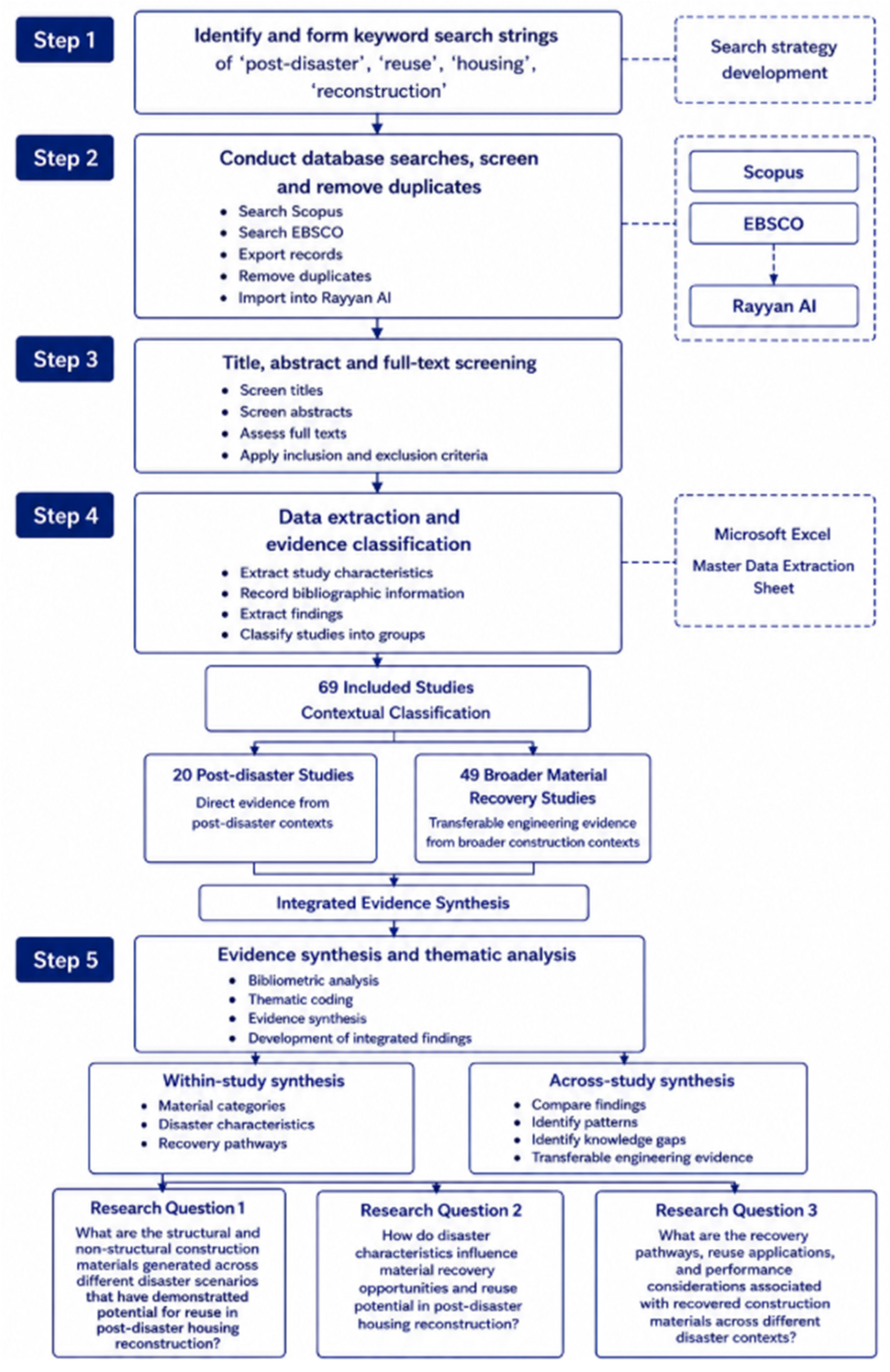
Figure 1 illustrates the methodological workflow adopted in this systematic literature review. The process commenced with the development of keyword search strings for post-disaster, reuse, housing, and reconstruction, followed by systematic searches of the Scopus and EBSCO databases. Retrieved records were screened using Rayyan AI, in which duplicate records were removed, and title, abstract, and full-text screening were conducted in accordance with predefined inclusion and exclusion criteria. Eligible studies were subsequently extracted and coded using a structured Microsoft Excel 2606 master data extraction sheet. Following the eligibility assessment, the included studies were contextually classified into post-disaster studies and broader construction material recovery studies to support a two-tier evidence synthesis approach. The review then employed bibliometric analysis, thematic coding, and evidence synthesis to address three research questions: reusable construction materials; the influence of disaster characteristics on material recovery; and recovery pathways, reuse applications, and performance considerations for post-disaster housing reconstruction.
3.2. Information Sources and Search Strategy
The literature search was conducted using Scopus and EBSCO, selected for their broad indexing of engineering, environmental science, and built environment journals and their established use in systematic reviews across sustainability research domains [
19,
20]. Employing more than one database reduces the risk of publication selection bias and increases retrieval comprehensiveness [
21]. The final search was conducted in February 2026, and results were restricted to publications between 2015 and 2026. A comprehensive search strategy was developed to identify relevant studies on material reuse within the built environment, with consideration of post-disaster housing contexts. The search was conducted using structured Boolean operators combining keywords related to material reuse, construction, and post-disaster recovery. The primary search string used across the selected databases (Scopus and EBSCO) was as follows:
Although post-disaster housing reconstruction constitutes the primary application context of this review, the available disaster-specific evidence remains comparatively limited and fragmented across hazard types, geographical regions, and construction material categories. Restricting the review exclusively to disaster-focused studies would therefore have provided an incomplete understanding of the engineering knowledge underpinning construction material recovery and reuse. To address this limitation, this review adopted a two-tier evidence synthesis approach. The first evidence tier comprised studies conducted within post-disaster contexts that explicitly examined debris generation, material recovery, reuse practices, and housing reconstruction following disaster events. These studies formed the primary analytical dataset because they directly addressed the review question. The second evidence tier comprised studies undertaken within broader construction, demolition, deconstruction, and circular construction contexts that investigated material recovery technologies, structural performance assessment, durability evaluation, selective deconstruction, and reuse strategies. Although these studies did not directly examine post-disaster reconstruction, they were synthesised as transferable engineering evidence to inform technical decision-making where disaster-specific empirical evidence was limited. This layered evidence synthesis enabled the review to answer its research question while drawing on the broader engineering knowledge base to strengthen the interpretation of the findings and identify opportunities to adapt established material recovery practices to post-disaster housing reconstruction.
This distinction recognises that post-disaster housing reconstruction is an extension of construction engineering undertaken under conditions of damaged infrastructure, disrupted supply chains, compressed reconstruction timelines, and heightened regulatory and safety constraints. Consequently, engineering principles governing material inspection, structural integrity assessment, contamination management, durability evaluation, and reuse feasibility remain applicable across both conventional and disaster contexts, while their implementation must be adapted to disaster-specific operational conditions. The integrated synthesis of disaster-specific and conventional engineering evidence therefore provides a more comprehensive and theoretically robust understanding of construction material reuse than either evidence stream could provide independently.
3.3. Transferability of Evidence Across Construction Contexts
Because direct empirical studies on material reuse in post-disaster housing reconstruction remain relatively scarce, this review collects and distinguishes between evidence generated within disaster recovery settings and evidence derived from conventional construction and demolition environments. Rather than treating these evidence streams as equivalent, the review synthesises them according to their respective contributions to engineering knowledge. Disaster-specific studies provide empirical evidence on the operational realities of debris management, emergency reconstruction, and hazard-related material degradation, whereas non-disaster construction studies contribute established knowledge on material recovery technologies, structural assessment methods, reuse applications, and performance evaluation. The integration of these complementary evidence streams enables a more comprehensive understanding of material reuse while recognising that implementation pathways remain dependent on local hazard characteristics, regulatory environments, infrastructure capacity, and reconstruction priorities. This approach is consistent with evidence-mapping methodologies, where heterogeneous bodies of literature are synthesised to identify transferable knowledge, evidence gaps, and future research priorities.
3.4. Selection Process
All records retrieved from Scopus and EBSCO were exported into Rayyan AI to facilitate reference management, duplicate detection, and structured screening. Rayyan AI was used solely as a screening support tool and not as a data extraction or evidence synthesis platform. Specifically, the software was used to organise retrieved records and identify potential duplicate references for manual verification. All inclusion and exclusion decisions were made manually by the authors using the predefined eligibility criteria. Where uncertainty existed regarding the relevance of a study, the full text was retrieved and independently assessed before a final decision was reached. Rayyan AI was not used to extract study data, generate themes, code findings, interpret evidence, or synthesise the results. All data extraction, coding, thematic development, evidence synthesis, and interpretation were undertaken manually by the authors using a predefined data extraction framework to ensure consistency, transparency, and methodological rigour. Rayyan AI therefore served only as a screening management tool, while all scientific judgement remained the authors’ responsibility throughout the review process [
22]. Following automatic duplicate detection and manual verification, the remaining records underwent sequential title and abstract screening against the predefined eligibility criteria. During this stage, studies were excluded where they focused exclusively on material recycling without direct reuse, municipal solid waste unrelated to construction materials, non-built-environment applications, conference papers, editorials, or other publication types falling outside the scope of this review [
16,
19].
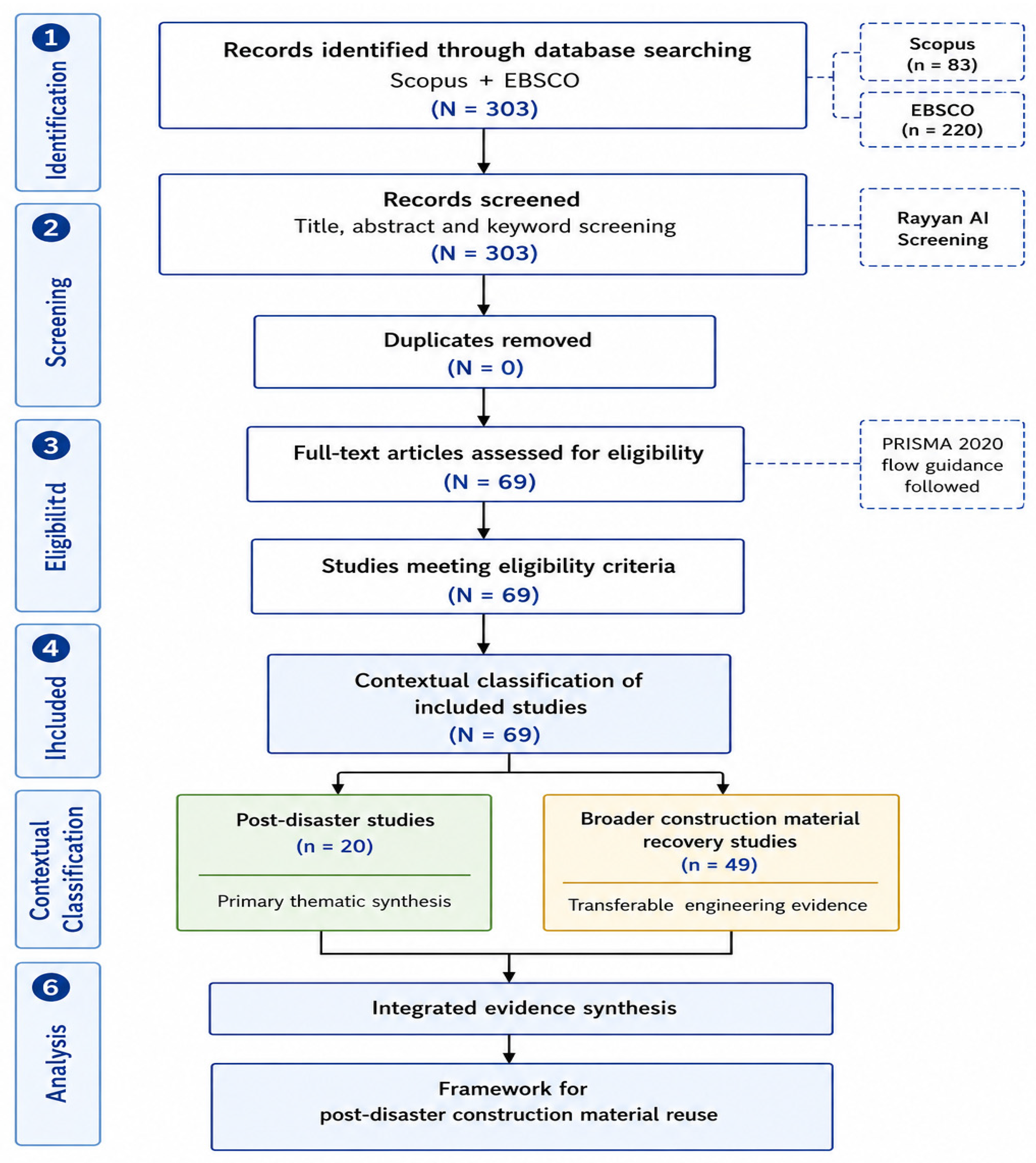
The overall study selection process is illustrated in
Figure 2, following the PRISMA 2020 reporting framework to ensure transparency, reproducibility, and methodological rigour in documenting the identification, screening, eligibility assessment, and inclusion of studies [
16].
The diagram demonstrates a substantial reduction from the initial 303 records to 69 included studies, primarily due to exclusion of studies focusing on recycling rather than direct reuse and those lacking material-specific analysis. This highlights the relative scarcity of research explicitly addressing reuse viability within the built environment.
3.5. Data Collection Process
A structured data extraction framework was developed in Microsoft Excel before data extraction commenced to ensure consistency across all included studies. Data were extracted manually from the full-text articles using predefined fields that captured bibliographic information, country or region, disaster context, construction material category, recovery pathway, reuse application, engineering findings, performance considerations, and implementation factors relevant to post-disaster housing reconstruction [
19]. To preserve traceability, each extracted finding was linked to its corresponding page number within the source article. The extracted findings were subsequently coded and synthesised into standardised findings and broader thematic categories through an iterative manual review process. All extracted information was cross-checked against the original publications to minimise transcription errors and ensure the accuracy and reliability of the final evidence base.
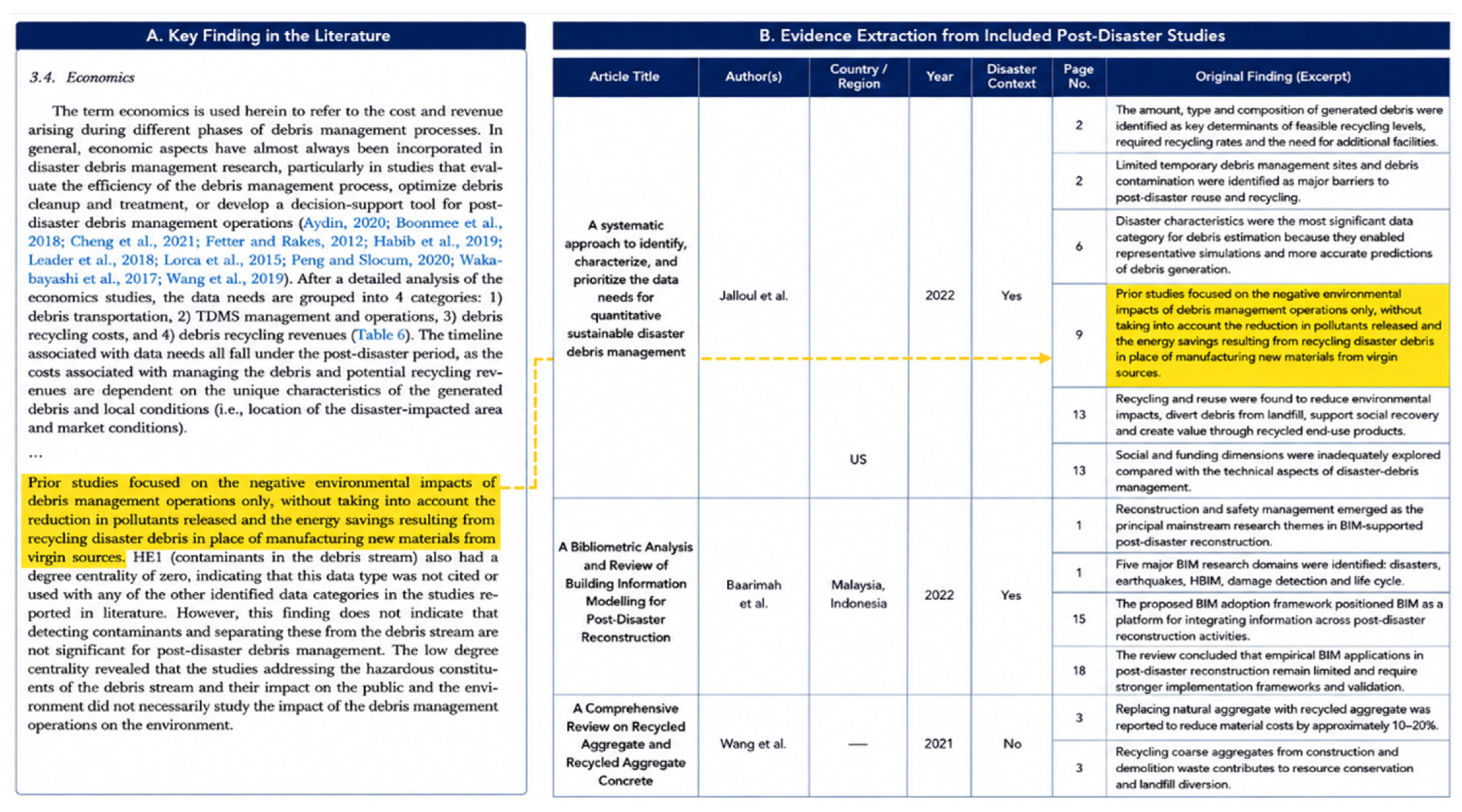
Figure 3 Linking evidence extraction to source literature. (A) Example of an original finding extracted from an included post-disaster study, illustrating the reported environmental benefits of recycling disaster-generated construction materials. (B) Corresponding evidence extraction from the master data extraction sheet, showing how the original finding was systematically recorded, coded, and linked to its source article, publication details, page number, and disaster context.
3.6. Data Items
The primary data items extracted from the included studies comprised construction material categories, disaster context, reuse application, and material recovery characteristics. Material categories were classified into structural and non-structural groups and further coded according to specific material types, including timber, steel, concrete, masonry, prefabricated systems, and multi-material recovery streams. Where applicable, disaster contexts such as earthquakes, floods, cyclones, hurricanes, tsunamis, and multi-hazard events were recorded to facilitate comparison across recovery environments. Additional variables included geographic location, methodological approach, reuse application, and dimensions of reuse assessment reported within each study. In addition to the predefined data items, each included study was classified according to its study context to distinguish between research explicitly conducted within disaster settings and research undertaken in broader construction material recovery contexts, such as demolition, deconstruction, renovation, and general construction waste management. This classification was undertaken because the review sought to identify construction materials generated from different disaster scenarios with demonstrated potential for reuse in post-disaster housing reconstruction. Of the 69 studies included in the final synthesis, 20 studies explicitly investigated construction materials generated following disaster events and therefore constituted the primary evidence base for disaster-specific analyses. The remaining 49 studies did not examine a specific disaster context but were retained because they provided complementary evidence on material recovery techniques, engineering assessment methods, recovery pathways, performance considerations, and regulatory practices that are directly relevant to the recovery and reuse of construction materials in post-disaster housing reconstruction. This distinction enabled a layered synthesis in which disaster-context studies addressed the review questions directly, while the broader evidence base strengthened the engineering interpretation and contextual understanding of the findings.
3.7. Risk of Bias and Quality Considerations
Formal risk-of-bias scoring tools were not applied because this review did not synthesise comparative intervention outcomes. In mapping reviews, methodological quality appraisal is commonly integrated descriptively rather than through numerical scoring when effect estimation is not undertaken [
17]. Studies lacking methodological transparency or clear material-specific evaluation were excluded during full-text screening. The literature search, screening, and study selection were conducted using predefined eligibility criteria developed collaboratively by the authors. Throughout the review process, the search strategy, screening protocol, eligibility criteria, and study selection decisions were reviewed and discussed among the authors to ensure methodological consistency and adherence to the review questions. Where uncertainties arose regarding study eligibility or methodological decisions, these were resolved through discussion and consensus among the authors before final inclusion. Confidence in the review findings derives from comprehensive database coverage, predefined eligibility criteria, collaborative methodological oversight, transparent documentation of the screening process, and full reporting of the included studies, consistent with PRISMA recommendations [
16].
3.8. Synthesis Method
A descriptive and qualitative thematic synthesis approach was employed to identify patterns relating to material recovery and reuse across different disaster contexts. Included studies were grouped according to construction material category, structural and non-structural classification, disaster type, and reported reuse applications. Comparative analysis was undertaken to examine how material recovery and reuse opportunities differed across disaster scenarios and to identify material categories that demonstrated the greatest potential for integration into post-disaster housing reconstruction. Given the considerable heterogeneity in study designs, disaster contexts, material categories, assessment methods, and reported outcomes, quantitative meta-analysis and statistical aggregation were not considered appropriate. Findings were therefore synthesised through thematic narratives, summary tables, and visual representations to identify recurring patterns and relationships between disaster contexts, material categories, recovery pathways, and reuse opportunities.
A descriptive and thematic synthesis approach was employed to identify patterns relating to material recovery and reuse across different disaster contexts. Included studies were grouped according to construction material category, structural and non-structural classification, disaster type, and reported reuse applications. Comparative analysis was undertaken to examine how material recovery and reuse opportunities differed across disaster scenarios and to identify material categories that demonstrated the greatest potential for integration into post-disaster housing reconstruction. Given the heterogeneity of study designs, material types, and outcome measures, statistical aggregation was not appropriate. Findings are therefore presented through thematic narratives, summary tables, and visual representations to illustrate relationships between disaster contexts, material categories, and reuse opportunities.
4. Results
This section presents the findings of the systematic literature review, focusing primarily on the 20 studies that explicitly addressed post-disaster housing reconstruction, disaster debris management, emergency housing, or disaster-related material recovery. These studies constitute the core evidence base for answering the review question and are summarised in
Table 2. The remaining 49 studies provided complementary evidence on construction material performance, recovery technologies, waste management strategies, digital decision-support tools, and policy frameworks, which informed the broader thematic synthesis where relevant. The section begins with a bibliometric overview of the reviewed literature, providing insights into the geographic and contextual distribution of the included studies. The findings are then presented in accordance with the research questions, examining the construction materials identified across different disaster contexts, their recovery pathways and reuse applications, and the technical, environmental, economic, and institutional factors influencing their reuse in post-disaster housing reconstruction.
Table 2 provides an overview of the studies that directly investigated post-disaster housing reconstruction and material recovery. The studies span diverse disaster contexts, including earthquakes, hurricanes, post-conflict reconstruction, and multi-hazard events, and represent evidence from both developed and developing countries. Collectively, they investigate a wide range of topics, including disaster debris management, temporary housing, building information modelling (BIM), reuse of recovered construction materials, life-cycle performance, community resilience, and sustainability assessment. The distribution of these studies demonstrates that research on post-disaster material recovery remains concentrated in earthquake-prone regions such as Japan, Iran, Italy, Nepal, and China, with comparatively fewer studies addressing hurricanes, conflicts, or other disaster contexts. This limited body of directly relevant literature highlights the importance of drawing on complementary evidence from broader construction material recovery research to develop a comprehensive understanding of material reuse for post-disaster housing reconstruction.
4.1. Bibliometric Analysis
A bibliometric analysis was conducted to give an overview of the studies included in this systematic review. The analysis summarises publication trends, geographical and development contexts, study and disaster contexts, and the focus on construction materials. These characteristics build the evidence-based profile and provide context for the following synthesis of construction materials, disaster characteristics, recovery pathways, reuse applications, and performance considerations. The findings, based on structured coding of the 69 studies from the final review, are presented using descriptive statistics, tables, and figures.
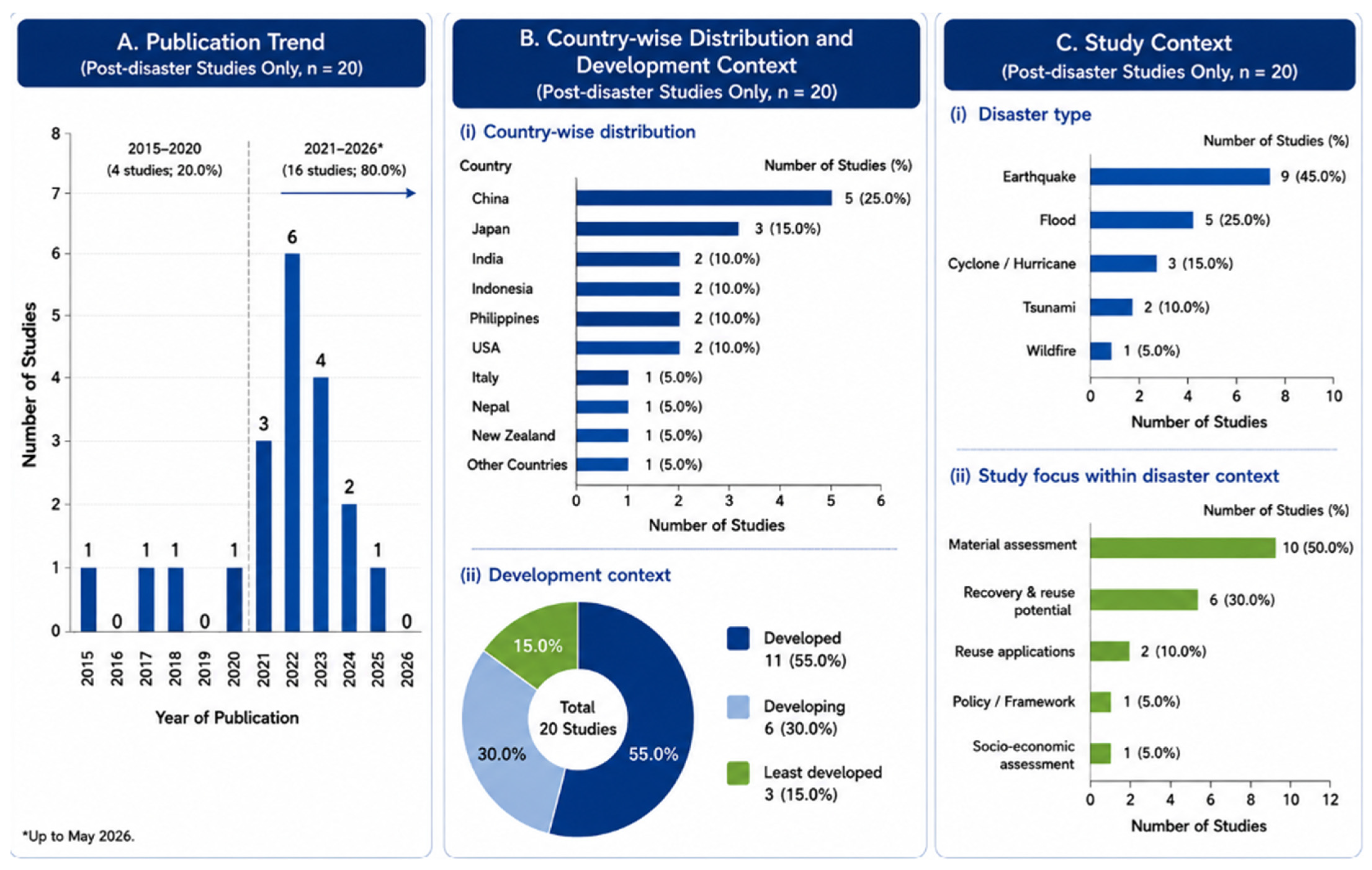
Figure 4 summarises the bibliometric characteristics of the 69 studies included in this review. Publication output remained relatively low between 2015 and 2020 before increasing substantially from 2021 onwards, indicating growing scholarly interest in construction material recovery and reuse. The reviewed literature demonstrated broad geographical representation, with China contributing the highest number of country-specific studies alongside a considerable proportion of global and multi-country investigations. Most studies were undertaken across mixed development contexts, while comparatively fewer focused exclusively on developed or developing regions. Material assessment constituted the predominant study context, followed by post-disaster reconstruction and waste management. Furthermore, the evidence base was dominated by studies conducted in non-disaster settings, whereas comparatively fewer investigations explicitly examined post-disaster reconstruction. Collectively, these findings indicate that research on construction material recovery and reuse has expanded rapidly in recent years but remains largely concentrated within conventional construction environments. A summary of the bibliometric characteristics of the reviewed studies is presented in
Table 3.
4.2. Structural and Non-Structural Construction Materials Generated Across Different Disaster Scenarios
This section synthesises the structural and non-structural construction materials that have demonstrated potential for reuse in post-disaster housing reconstruction, with primary emphasis on evidence derived from the 20 disaster-context studies identified in this review. Although the broader dataset comprises 69 studies, the disaster-context studies provide the most direct evidence for addressing research question 1 by documenting materials recovered following earthquakes, floods, cyclones, wildfires, tsunamis, conflicts, and other hazard events. Evidence from the remaining studies is incorporated where appropriate to strengthen the engineering interpretation of material recovery, assessment, and reuse practices. The synthesis distinguishes between structural and non-structural materials, examines their occurrence across different disaster scenarios, and identifies their principal reuse applications and engineering considerations, thereby establishing the foundation for the subsequent analysis of disaster characteristics, recovery pathways, and performance considerations.
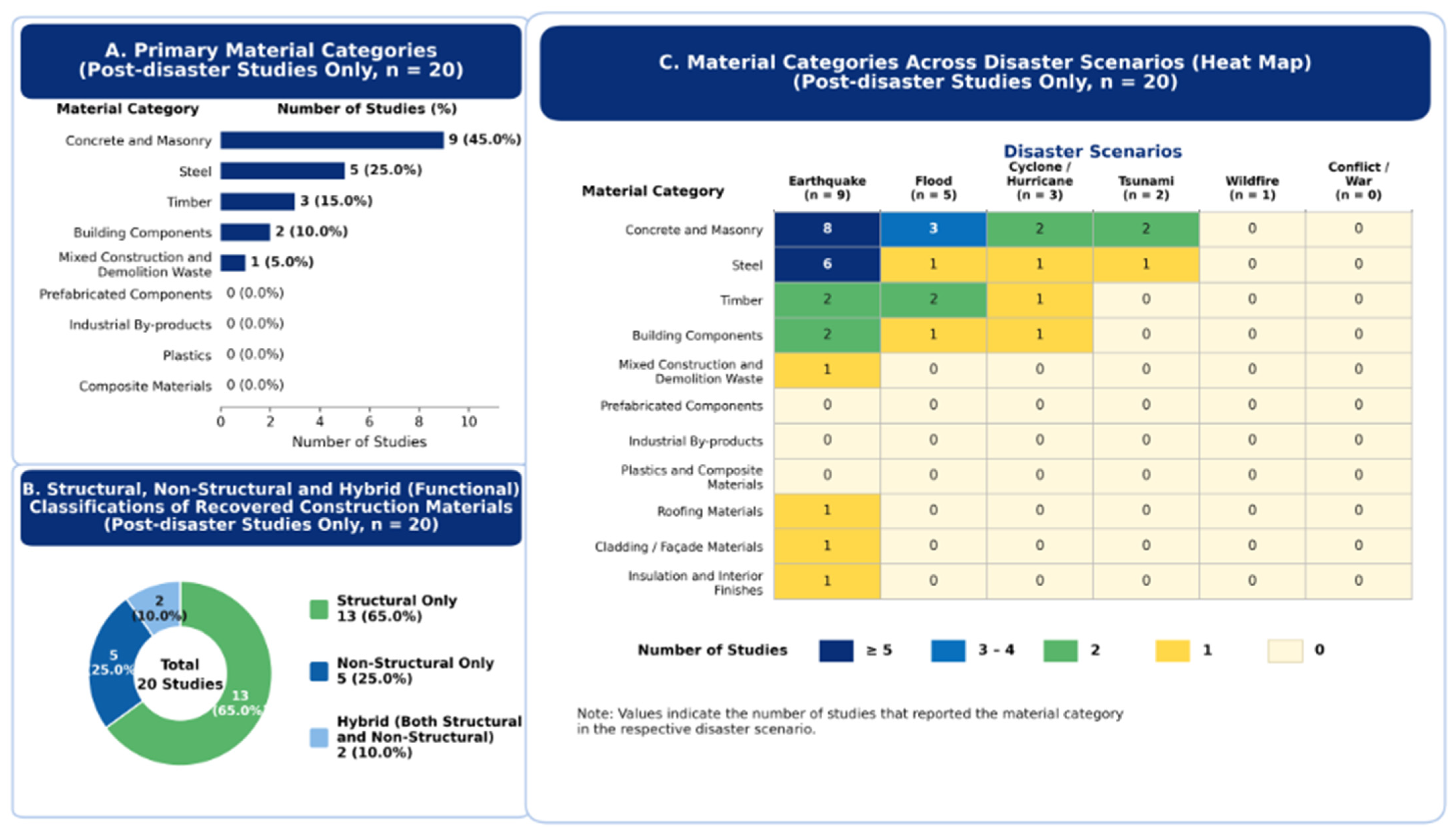
Across the disaster-context studies, reinforced concrete emerged as one of the most frequently reported structural materials requiring recovery following earthquakes and tsunami events. Although large quantities of concrete debris were generated, direct reuse was generally limited to elements that retained adequate structural integrity after engineering inspection. Where direct reuse was not feasible, recovered concrete was commonly repurposed as recycled aggregates, precast products, or road-base materials. The findings demonstrate that the reuse potential of reinforced concrete depends primarily on residual structural performance, damage severity, and the feasibility of component separation. The distribution of the primary construction material categories and their structural classification are presented in
Figure 5.
Disaster-context studies indicate that both structural and non-structural construction materials exhibit differing levels of reuse potential after hazard events. The suitability of these materials for recovery is determined by the interplay of disaster characteristics, material condition, engineering performance, contamination, and intended reuse application, rather than by material type alone. The reviewed evidence shows that structural materials typically require comprehensive engineering assessment prior to reuse due to their direct impact on the safety and integrity of reconstructed buildings. Conversely, non-structural materials are more often deemed suitable for direct recovery when physical damage and contamination are minimal [
43,
44,
45,
46,
47,
48,
49,
50,
51,
52].
Structural materials identified across the disaster-context studies primarily comprised reinforced concrete, structural steel, timber, masonry, prefabricated building components, and, in some cases, bamboo. These materials were commonly recovered following earthquakes, floods, cyclones, wildfires, tsunamis, and conflict-related disasters, although the quantity and condition of recoverable materials varied according to the disaster mechanism and severity. Earthquake events generated substantial volumes of reinforced concrete, masonry, and steel debris through structural collapse, whereas flood events more frequently affected timber elements and other moisture-sensitive materials. Cyclones and hurricanes commonly produced recoverable timber framing, roofing structures, and steel members, while tsunami and conflict-related disasters generated heterogeneous debris streams containing both structural and non-structural components. Collectively, these findings indicate that disaster type strongly influences the composition of recoverable material streams available for reuse [
47,
48,
49,
53,
54,
55,
56,
57].
The reviewed evidence further demonstrates that non-structural materials represent an important but comparatively underexplored opportunity for post-disaster housing reconstruction. Frequently recovered non-structural materials included roofing systems, doors, windows, cladding panels, ceiling systems, flooring materials, insulation, plumbing fixtures, electrical components, and interior finishes. Unlike structural materials, these components generally required less complex engineering assessment prior to reuse, although contamination, moisture exposure, thermal damage, and physical deterioration frequently influenced their suitability. Their recovery nevertheless provides significant opportunities to reduce construction waste, conserve resources, and accelerate housing reconstruction by retaining functional building components that would otherwise be discarded [
58,
59,
60,
61,
62,
63,
64,
65,
66,
67,
68,
69,
70].
Overall, the synthesis indicates that the recovery and reuse of construction materials should not be viewed solely as a material-specific process but as a condition-based engineering decision informed by disaster characteristics, residual material performance, regulatory compliance, and intended reuse applications. This evidence-based classification of structural and non-structural materials establishes the conceptual foundation for the subsequent examination of how disaster characteristics influence opportunities for material recovery and reuse.
A detailed summary of the principal structural and non-structural construction material categories identified across the reviewed studies is presented in
Table 4.
Across the reviewed disaster-context studies, structural materials generally required comprehensive engineering assessment before reuse because they directly influence structural safety and regulatory compliance. By contrast, non-structural materials were more frequently suitable for direct reuse where contamination, moisture damage, and physical deterioration remained limited. Collectively, these findings indicate that reuse decisions are governed not solely by material type but by the interaction between disaster characteristics, residual condition, engineering performance, and intended reuse application. This synthesis provides the foundation for examining how disaster characteristics influence material recovery opportunities in the following section.
4.3. Influence of Disaster Characteristics on Material Recovery Opportunities and Reuse Potential
The findings presented in
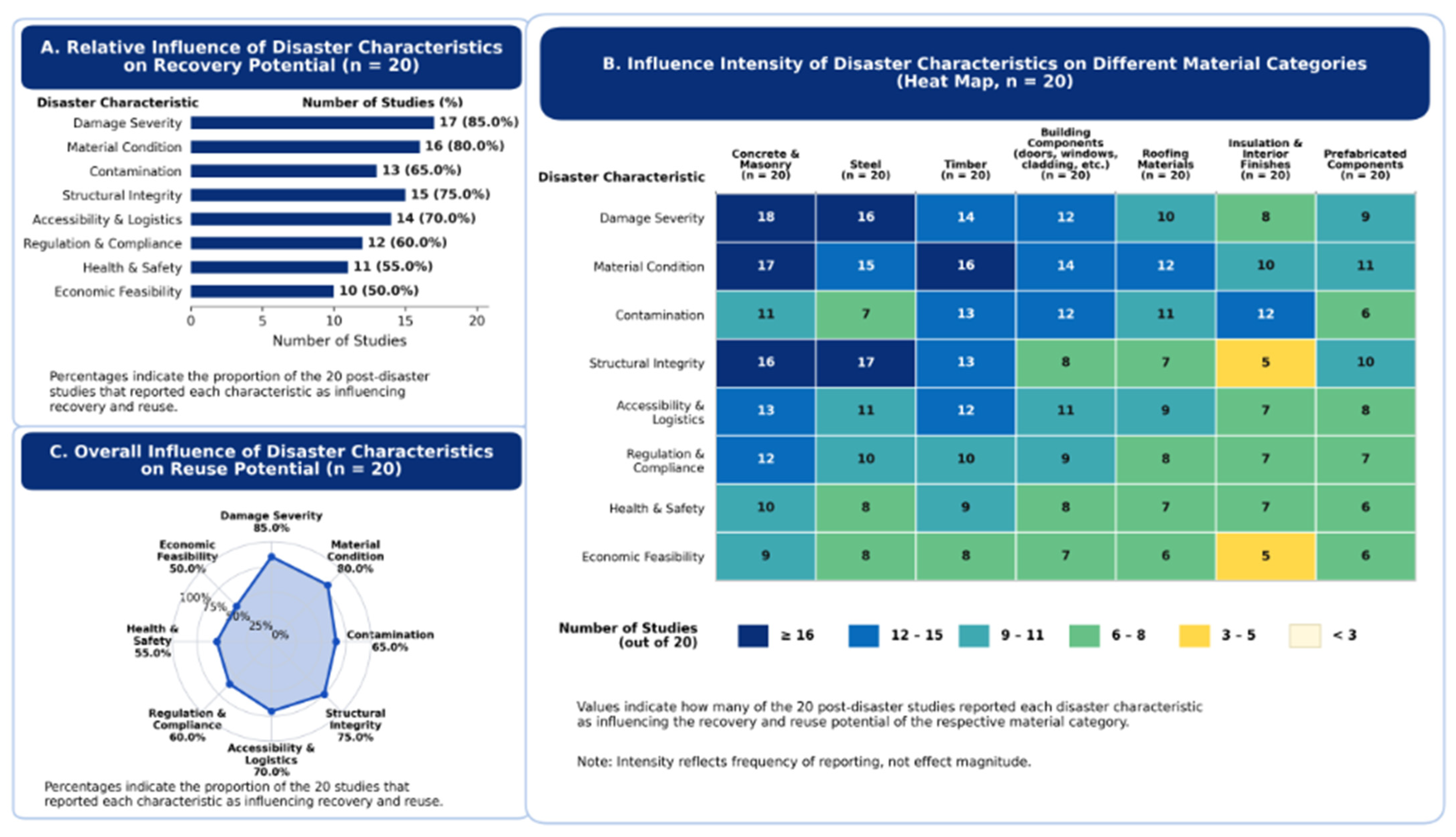
Section 4.2 demonstrate that the reuse potential of construction materials cannot be explained by material type alone. Instead, the reviewed evidence indicates that disaster characteristics fundamentally shape the quantity, condition, and recoverability of structural and non-structural materials available for post-disaster housing reconstruction. Hazard mechanisms, damage severity, contamination, accessibility, structural integrity, and regulatory requirements collectively influence whether recovered materials can be safely reintegrated into reconstruction projects. This section therefore synthesises the principal disaster-related factors that determine material recovery opportunities and reuse potential across the reviewed studies. The relationships between these disaster characteristics and material recovery outcomes are illustrated in
Figure 6.
Damage severity emerged as one of the most influential determinants of construction material recovery and reuse across the reviewed studies. Although high-intensity disasters frequently generate larger volumes of recoverable debris, they also increase fragmentation, structural cracking, deformation, and component failure, thereby reducing the proportion of materials suitable for direct reuse. Consequently, the quantity of debris produced does not necessarily correspond to greater recovery opportunities. Rather, the extent of physical damage determines whether materials can be directly reused, require refurbishment or remanufacturing, or must be diverted to recycling or disposal following engineering assessment. This finding highlights the importance of evaluating disaster impacts in terms of material condition rather than debris volume alone [
23,
27,
31,
46,
61,
65,
71,
72].
Material condition consistently emerged as one of the most important technical determinants of reuse feasibility across the reviewed studies. Construction materials that retained their physical integrity, mechanical properties, and functional performance following disaster events were significantly more likely to be recovered through direct reuse pathways. Conversely, materials affected by cracking, excessive deformation, corrosion, biological deterioration, thermal degradation, or prolonged moisture exposure generally required refurbishment, remanufacturing, recycling, or disposal depending on the extent of damage. The reviewed evidence therefore indicates that material condition provides the practical link between disaster-induced damage and engineering assessment, guiding decisions on whether recovered materials can safely satisfy the performance requirements of post-disaster housing reconstruction. This reinforces the condition-based engineering perspective identified throughout this review, whereby reuse decisions depend primarily on residual material performance rather than the original material category alone [
37,
51,
54,
63].
Contamination represented one of the principal barriers to construction material recovery, particularly following floods, tsunamis, wildfires, and conflict-related disasters. Unlike structural damage, which primarily affects engineering performance, contamination introduces biological, chemical, and environmental hazards that may compromise both material safety and long-term durability. Floodwater frequently resulted in moisture ingress, sediment deposition, microbial growth, and chemical contamination, while wildfire events introduced smoke residues, ash deposits, and thermally induced contaminants. Consequently, recovered materials often required cleaning, decontamination, laboratory testing, and certification before they could be considered suitable for reuse. The reviewed studies consistently demonstrate that effective contamination management is essential not only for protecting occupant health but also for maintaining confidence in recovered construction materials and ensuring compliance with regulatory requirements [
38,
47,
56,
57,
62,
73].
The reviewed studies demonstrate that accessibility and logistical capacity substantially influence the efficiency of construction material recovery following disaster events. Damaged transport infrastructure, restricted site access, limited recovery equipment, inadequate storage facilities, and fragmented debris management systems frequently delayed recovery operations and increased the likelihood of secondary material deterioration. Conversely, early debris management planning, systematic material sorting, and selective deconstruction were consistently associated with higher recovery rates by enabling reusable materials to be identified, separated, and protected before further damage occurred. These findings indicate that successful material recovery depends not only on the condition of recovered materials but also on the operational capacity to recover, transport, store, and redistribute them efficiently within post-disaster reconstruction programmes [
28,
30,
35,
52,
74,
75].
Regulatory compliance and health and safety requirements consistently emerged as fundamental prerequisites for the successful reuse of recovered construction materials. Across the reviewed studies, engineering inspection protocols, structural certification procedures, building regulations, occupational health requirements, and contamination management standards collectively determined whether recovered materials could be safely approved for reintegration into reconstruction projects. The findings further demonstrate that technical feasibility alone is insufficient to support widespread material reuse where regulatory frameworks, quality assurance systems, and certification procedures remain unclear or inconsistent. Strengthening governance mechanisms and establishing standardised engineering assessment protocols therefore represent essential steps towards increasing confidence in recovered materials and facilitating their broader adoption within post-disaster housing reconstruction [
36,
41,
45,
64,
67,
69,
76]. The disaster-related factors discussed above rarely operate independently during post-disaster recovery. Instead, they interact to influence material condition, engineering assessment requirements, recovery efficiency, and ultimately the suitability of construction materials for reuse. To consolidate these relationships,
Table 5 summarises the principal disaster characteristics identified across the reviewed studies, together with their influence on material recovery, the material categories most affected, implications for reuse, and representative supporting studies.
Although
Table 5 summarises the individual disaster characteristics influencing construction material recovery, the reviewed evidence indicates that reuse decisions result from the interaction of these characteristics rather than from any single factor in isolation. Across the reviewed studies, identical material categories frequently required different engineering assessment procedures and recovery strategies depending on disaster type, damage mechanisms, contamination levels, and intended reuse applications. Consequently, successful material recovery requires an integrated evaluation of residual material condition, structural performance, durability, contamination, regulatory compliance, and recovery objectives. To illustrate these interrelationships,
Table 6 presents a cross-synthesis linking disaster contexts with material categories, engineering assessment requirements, recovery pathways, and typical reuse applications.
The cross-synthesis presented in
Table 6 reinforces the central finding of this review that construction material reuse is fundamentally a condition-based engineering decision rather than a material-specific process. Across all disaster contexts, residual structural performance, contamination, durability, accessibility, and regulatory compliance consistently emerged as the principal determinants of reuse suitability, although their relative importance varied according to hazard characteristics. Earthquake recovery prioritised structural integrity assessment, flood recovery focused on contamination and moisture-related deterioration, wildfire recovery emphasised thermal damage evaluation, while cyclone- and tsunami-related recovery required greater consideration of mixed debris management and material segregation. Collectively, these findings demonstrate that effective post-disaster material recovery depends upon disaster-specific engineering assessment pathways that systematically evaluate material condition before selecting appropriate recovery and reuse strategies. This synthesis provides the analytical bridge to the following section, which examines how recovered materials progress through different recovery pathways, reuse applications, and performance requirements.
4.4. Recovery Pathways, Reuse Applications and Performance Considerations
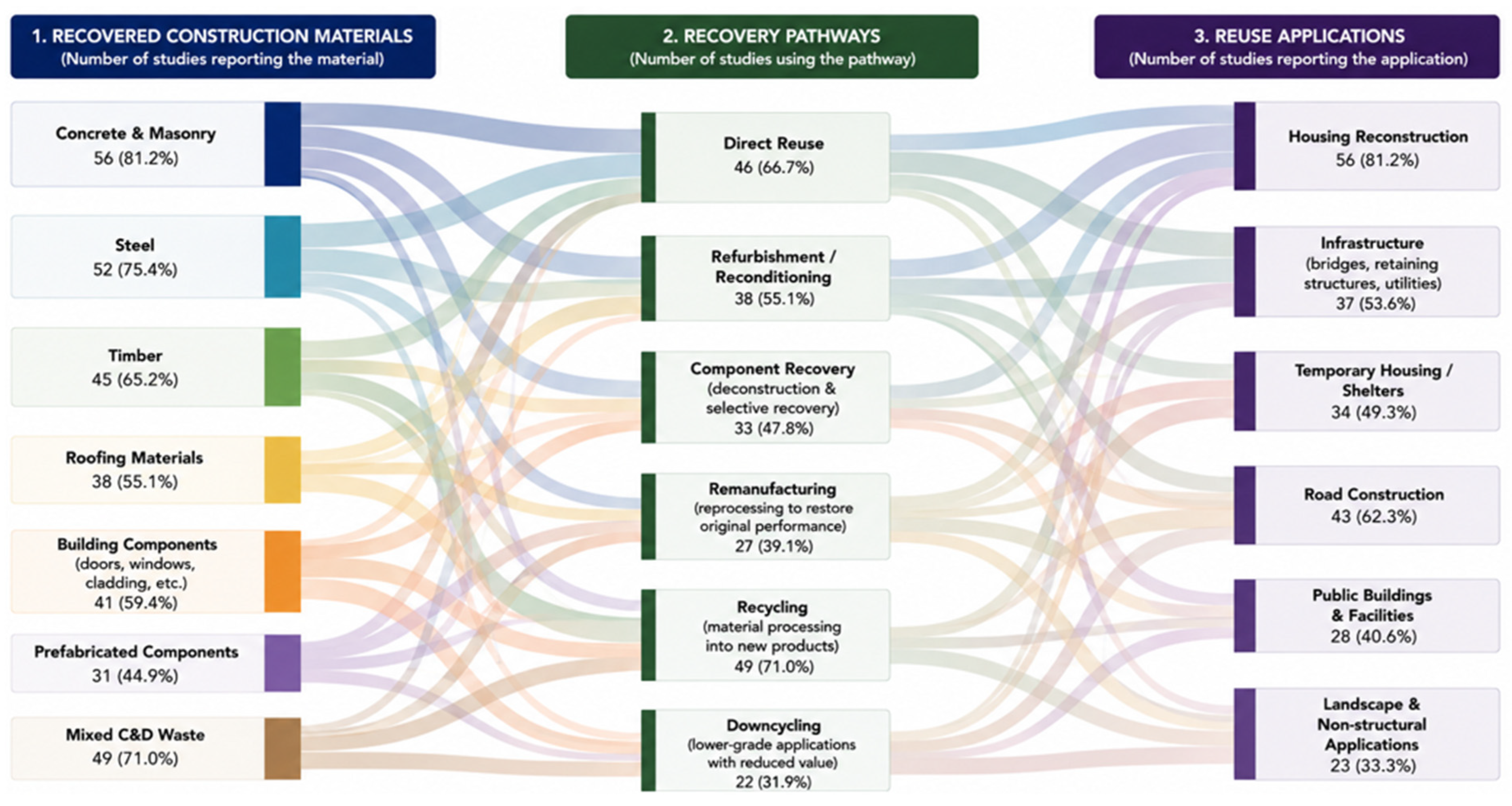
Following the engineering assessment of recovered construction materials, the next critical decision concerns the selection of an appropriate recovery pathway that maintains material value while ensuring structural safety and regulatory compliance. The reviewed studies indicate that recovery pathways are determined primarily by residual material condition, engineering performance, contamination, intended reuse application, and applicable regulatory requirements rather than by material category alone. Consequently, recovered construction materials may follow different pathways ranging from direct reuse and refurbishment to component recovery, remanufacturing, recycling, downcycling, or disposal, depending on their residual performance after disaster exposure. This section synthesises the principal recovery pathways identified across the reviewed studies, together with their associated reuse applications and the engineering performance considerations influencing pathway selection.
Figure 7 summarises the relationships between these recovery pathways, reuse applications, and performance requirements [
27,
38,
41,
44,
47,
50,
51,
56,
61,
63,
65,
68,
71,
73].
Figure 7 illustrates the progression of recovered construction materials through different recovery pathways according to their residual condition and engineering suitability. Direct reuse emerged as the preferred pathway because it retains the highest proportion of embodied material value while requiring minimal additional processing. Structural steel, timber framing, prefabricated components, and selected building elements were frequently reported as suitable for direct reuse following satisfactory engineering assessment. Where direct reuse was not feasible, refurbishment and component recovery enabled damaged materials to regain functional performance before their reintegration into reconstruction projects. Remanufacturing provided an additional recovery option for selected structural components requiring repair or reconditioning, whereas recycling and downcycling were generally reserved for materials whose structural performance or contamination levels prevented higher-value recovery options. These findings demonstrate that recovery pathways represent a hierarchy of engineering decisions intended to maximise resource retention while maintaining safety and regulatory compliance [
46,
50,
52,
65,
71,
82,
83].
The reviewed studies demonstrate that recovered construction materials supported a wide range of reuse applications extending beyond permanent residential reconstruction. Frequently reported applications included temporary housing, public buildings, community infrastructure, road construction, retaining structures, and landscape works. Several studies also highlighted the increasing adoption of modular and prefabricated construction systems designed to facilitate future component recovery and repeated reuse throughout the building lifecycle. These findings indicate that successful material recovery contributes not only to rebuilding damaged housing but also to strengthening broader disaster recovery efforts through more efficient utilisation of available construction resources [
47,
49,
51,
59,
84,
85,
86].
Performance considerations consistently governed the selection of appropriate recovery pathways and subsequent reuse applications across the reviewed studies. Technical performance remained the primary criterion, with engineering assessments focusing on structural capacity, residual strength, durability, serviceability, and long-term reliability of recovered materials. Environmental performance centred on reducing embodied carbon emissions, conserving natural resources, and diverting construction waste from landfill, while economic performance considered the financial viability of recovery operations relative to the procurement of new materials. In addition, regulatory compliance, occupational health and safety requirements, and stakeholder acceptance were identified as essential enabling factors influencing the practical implementation of recovered materials. Collectively, these findings demonstrate that successful material recovery requires a balanced evaluation of technical, environmental, economic, and institutional performance rather than reliance on structural performance alone [
36,
40,
41,
44,
48,
54,
76,
87]. The recovery pathways discussed above illustrate that recovered construction materials can follow multiple routes depending on their residual engineering performance and intended reuse application. To consolidate these findings,
Table 6 summarises the principal recovery pathways identified across the reviewed studies together with the typical materials recovered, their common reuse applications, the principal performance considerations influencing pathway selection, and representative supporting studies.
The synthesis presented in
Figure 5 and
Table 7 demonstrates that recovery pathways should be understood as a progressive hierarchy of engineering decisions rather than as isolated recovery options. Across the reviewed studies, materials exhibiting minimal structural damage, limited contamination, and satisfactory engineering performance were consistently directed towards direct reuse or minor refurbishment, thereby retaining the highest proportion of their embodied value. As material condition deteriorated, recovery strategies progressively shifted towards component recovery, remanufacturing, recycling, or downcycling, reflecting the increasing level of intervention required to restore functionality while maintaining structural safety and regulatory compliance. These findings reinforce the condition-based engineering perspective developed throughout this review by demonstrating that recovery pathway selection is governed primarily by residual material performance rather than disaster type or material classification. Consequently, maximising resource efficiency in post-disaster housing reconstruction depends upon systematically matching recovered materials to the highest-value recovery pathway compatible with their verified engineering performance.
4.5. Synthesis of Factors Influencing Material Recovery Decisions
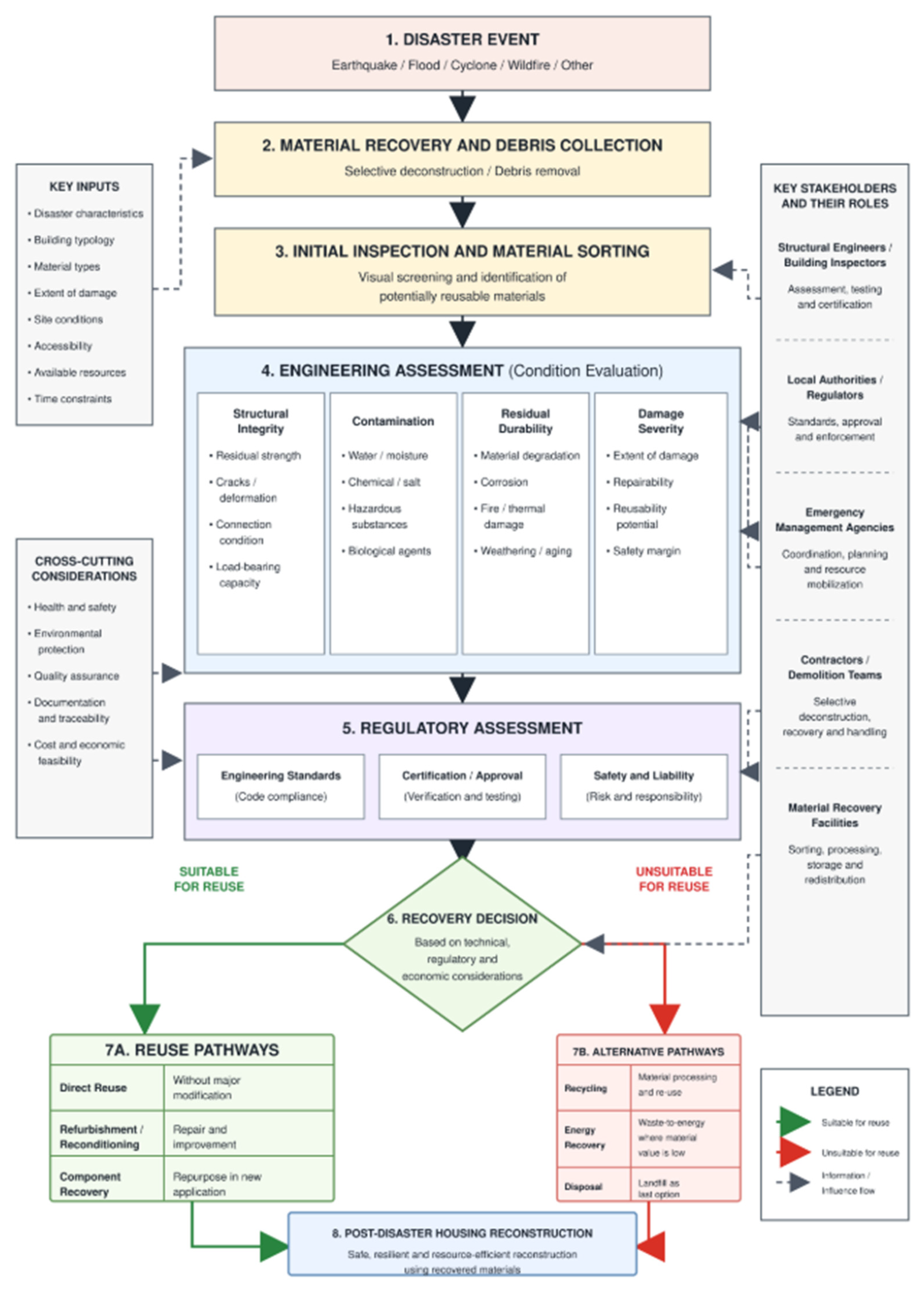
Across the reviewed studies, construction material recovery emerged as a multidimensional engineering decision-making process rather than a simple material selection exercise. The evidence consistently demonstrated that successful material recovery depended on the interaction of disaster characteristics, residual material condition, engineering assessment, recovery pathways, institutional capacity, and intended reuse applications. Although individual studies often focused on specific technical, environmental, or operational aspects of material recovery, their collective findings indicate that these factors operate as an integrated system in which decisions made at one stage influence opportunities available at subsequent stages. Consequently, effective post-disaster material recovery requires coordinated decision-making throughout the recovery process rather than isolated evaluations of individual materials or recovery techniques [
27,
38,
41,
44,
47,
50,
51,
56,
61,
63,
71,
73].
The reviewed evidence further demonstrates that engineering assessment alone is insufficient to ensure successful material reuse unless supported by appropriate economic, institutional, and regulatory conditions. Recovery operations were consistently influenced by the availability of skilled personnel, inspection and certification procedures, recovery infrastructure, market demand for recovered materials, stakeholder collaboration, and supportive governance frameworks. These interacting factors determine whether technically recoverable materials can ultimately be reintegrated into reconstruction projects. Consequently, improving post-disaster material recovery requires simultaneous investment in engineering capability, institutional preparedness, regulatory clarity, and market development to enable recovered materials to move efficiently through appropriate recovery pathways [
28,
30,
45,
49,
53,
61,
65,
68,
74,
75,
87].
Collectively, the findings of this review support a condition-based engineering framework for construction material recovery in post-disaster housing reconstruction. Rather than viewing recovery decisions as material-specific or disaster-specific, the reviewed evidence demonstrates that successful reuse depends on systematically evaluating the relationships between disaster characteristics, material condition, engineering performance, recovery pathways, regulatory requirements, and intended reuse applications. This integrated perspective advances current understanding by positioning construction material recovery as a structured engineering decision-making process that seeks to maximise resource retention while ensuring structural safety, regulatory compliance, and long-term resilience. The conceptual relationships identified through this synthesis provide the foundation for the Discussion, where their theoretical, practical, and policy implications are examined in greater detail.
5. Discussion
This discussion interprets the findings of the systematic review in relation to the study aim of identifying construction materials generated across different disaster scenarios that have demonstrated potential for reuse in post-disaster housing reconstruction. Rather than reiterating the descriptive findings presented in the Results, this section examines the broader implications of the identified material streams, disaster characteristics, recovery pathways, and reuse applications for circular construction and resilient housing recovery. The discussion also situates the findings within the wider body of literature, highlighting areas of agreement, emerging trends, and persistent knowledge gaps. Particular attention is given to the practical implications for engineers, policymakers, and disaster recovery practitioners, as well as the relevance of the findings to the New Zealand context, where increasing disaster frequency and commitments to low-carbon construction necessitate more sustainable approaches to material recovery and reuse.
5.1. Disaster Conditions Shape Material Reuse More than Material Type
One of the most significant findings from this review is that the reuse potential of construction materials is more strongly influenced by post-disaster conditions than by the material type itself. While concrete, steel, timber, masonry, and building components consistently appeared as the dominant material streams across the reviewed studies, their suitability for recovery and reuse was rarely determined solely by their intrinsic physical properties. Instead, reuse decisions were influenced by the combined effects of damage severity, contamination, residual material condition, structural integrity, accessibility, regulatory compliance, and recovery logistics, all of which varied considerably across disaster scenarios [
24,
27,
29,
31,
32,
47,
49,
61,
62,
69,
88]. This finding represents an important shift from the conventional material-centred perspective that characterises much of the existing literature on circular construction. Rather than asking whether a particular material can be reused, the reviewed evidence suggests that a more appropriate question is whether the post-disaster conditions allow that material to be recovered safely, economically, and in compliance with engineering and regulatory requirements. Consequently, identical material categories frequently exhibited markedly different reuse outcomes depending on the disaster mechanism, exposure conditions, and recovery environment [
25,
28,
35,
40,
41,
44,
45,
63,
65,
85].
The influence of disaster conditions was particularly evident when comparing different hazard types. Earthquake-related studies primarily reported structural damage characterised by cracking, fragmentation, reinforcement exposure, and partial or complete building collapse, thereby increasing the complexity of structural assessment before reuse [
27,
39,
46,
61,
67]. Conversely, flood events were more commonly associated with moisture ingress, biological deterioration, mould development, sediment deposition, and chemical contamination, particularly affecting timber products, insulation materials, and interior building components [
26,
29,
51,
63,
78,
83]. Wildfires introduced thermal degradation and smoke contamination, while cyclones frequently generated mixed debris streams containing roofing materials, structural timber, steel members, and cladding systems with varying levels of physical damage [
38,
52,
64,
77,
89]. These contrasting damage mechanisms demonstrate that disaster type influences material recovery primarily through its effects on material condition rather than through the material category itself. Another important observation concerns the relationship between structural integrity and decision-making about reuse. Across the reviewed studies, engineering assessment consistently emerged as one of the most influential stages within the recovery process. Structural materials such as reinforced concrete, structural steel, masonry, and timber framing frequently required detailed inspection, mechanical testing, and certification before approval for reuse, whereas many non-structural components could often be recovered following visual inspection, cleaning, or minor refurbishment [
37,
50,
52,
53,
54,
83,
84]. This distinction highlights that successful material recovery depends not only on the availability of reusable materials but also on the capacity to accurately evaluate their residual performance following disaster exposure.
Collectively, these findings demonstrate that post-disaster material recovery should be understood as a condition-based rather than material-based decision-making process. Material categories undoubtedly influence recovery options; however, the reviewed evidence indicates that post-disaster conditions ultimately determine whether recovered materials can be retained at their highest possible value through direct reuse, refurbishment, remanufacturing, or recycling. Recognising this distinction provides a more comprehensive basis for developing material recovery strategies that support circular construction and resilient post-disaster housing reconstruction [
34,
36,
48,
66,
73,
86,
90].
5.2. Structural and Non-Structural Materials Should Be Viewed as Complementary Resource Streams
A second important insight emerging from this review is that structural and non-structural construction materials should not be considered independent resource streams, but rather complementary components within an integrated post-disaster recovery system. Although structural materials such as reinforced concrete, steel, timber framing, and masonry have traditionally received greater research attention because of their engineering significance and embodied carbon content, the findings of this review demonstrate that non-structural materials also represent an important and often overlooked source of recoverable resources [
38,
43,
46,
51,
58,
62,
69,
77]. The predominance of structural materials within the reviewed literature is unsurprising given their direct influence on building safety, structural stability, and regulatory compliance. Consequently, most reuse studies have prioritised structural integrity assessments, residual mechanical performance, and engineering certification before materials can be reintroduced into new construction projects [
50,
52,
53,
54,
66,
82,
88,
90]. However, this emphasis has inadvertently led to comparatively less attention being paid to non-structural components, despite their substantial contribution to disaster-generated debris. Roofing systems, cladding materials, doors, windows, ceiling systems, insulation products, and interior fixtures were consistently identified across the reviewed studies as materials with considerable reuse potential, particularly where physical damage and contamination remained limited [
48,
55,
56,
57,
62,
68,
86].
This imbalance suggests that current material recovery practices remain largely influenced by traditional engineering priorities rather than by whole-building resource recovery principles. While structural elements undoubtedly represent high-value materials from both economic and environmental perspectives, non-structural components often require less intensive inspection, simpler refurbishment processes, and lower recovery costs before reuse. As a result, they may provide immediate opportunities for resource recovery, particularly during the early stages of post-disaster reconstruction when rapid housing delivery is required [
35,
44,
45,
63,
77,
78,
89]. The findings further indicate that integrated recovery strategies capable of simultaneously evaluating structural and non-structural materials are likely to maximise resource efficiency and reduce unnecessary waste generation. Rather than assessing materials individually, several studies advocated for systematic building-level recovery approaches in which reusable structural components, building envelopes, interior fittings, and prefabricated assemblies are identified through coordinated inspection and selective deconstruction procedures [
25,
30,
34,
42,
52,
66,
90]. Such approaches are consistent with circular construction principles, which seek to retain materials at their highest possible value while minimising landfill disposal and reducing demand for virgin construction resources.
Collectively, these findings suggest that future post-disaster housing reconstruction should move beyond material-specific recovery practices towards integrated resource management systems that recognise the complementary value of structural and non-structural materials. Achieving this transition will require greater collaboration among structural engineers, architects, demolition specialists, waste management practitioners, and policymakers to ensure that recovery decisions are informed by both engineering performance and broader resource-efficiency objectives. Such an approach has the potential to substantially improve material recovery rates while supporting more resilient, circular reconstruction systems following future disasters.
5.3. Direct Reuse Represents the Highest-Value Recovery Pathway but Requires Robust Assessment Systems
The findings of this review indicate that direct reuse is the most desirable recovery pathway for construction materials in post-disaster housing reconstruction, as it retains materials at their highest functional and economic value while minimising additional processing requirements. Across the reviewed studies, direct reuse was consistently identified for structural steel, timber framing, prefabricated components, and selected building elements that retained adequate structural integrity following disaster events [
27,
46,
52,
54,
82,
88,
90]. Compared with recycling and downcycling, direct reuse preserves the embodied energy, labour, and material value already invested in construction products, thereby offering greater environmental and resource efficiency benefits.
Despite these advantages, the review demonstrates that direct reuse remains one of the most technically demanding recovery pathways. Unlike recycling, which often accepts heavily damaged materials for secondary processing, direct reuse requires confidence that recovered materials continue to satisfy structural, functional, and safety requirements. Consequently, successful implementation depends on comprehensive inspection, engineering assessment, contamination testing, and regulatory approval before materials can be reintroduced into reconstruction projects [
29,
35,
44,
54,
55,
60,
84,
86]. These additional requirements frequently explain why potentially reusable materials continue to be diverted towards recycling or disposal despite retaining significant residual value.
The review also highlights the importance of adopting a hierarchy of recovery pathways rather than treating all forms of material recovery as equally desirable. Where direct reuse is not feasible, refurbishment and component recovery provide effective alternatives by restoring material functionality while retaining a substantial proportion of the original resource value. Remanufacturing offers further opportunities for selected structural components through repair and reconditioning processes, whereas recycling should primarily be considered for materials that have experienced irreversible physical deterioration or contamination [
31,
32,
51,
65,
66,
70,
71]. This hierarchy aligns closely with circular construction principles, which prioritise retaining materials in their highest-value applications for as long as possible before considering lower-value recovery options. Another important finding concerns the relationship between recovery pathways and future building design. Several reviewed studies suggested that many of the challenges associated with post-disaster material recovery originate during the initial design and construction stages rather than during recovery itself [
23,
34,
52,
64,
65,
73,
85]. Buildings designed using modular construction, prefabricated assemblies, mechanical connections, and design-for-disassembly principles were consistently associated with improved component recovery, reduced material damage during dismantling, and greater opportunities for repeated reuse throughout the building lifecycle. These observations suggest that improving future material recovery requires a transition from reactive disaster debris management towards proactive design strategies that anticipate future recovery and reuse.
Overall, the evidence indicates that achieving higher levels of construction material reuse requires more than identifying recoverable materials following disaster events. It requires integrated assessment systems capable of matching recovered materials to the most appropriate recovery pathway while simultaneously considering technical performance, environmental benefits, economic feasibility, regulatory compliance, and long-term resilience objectives. Such an approach provides a practical foundation for embedding circular economy principles within post-disaster housing reconstruction and supports the transition from waste management towards resource stewardship.
5.4. Implications for Post-Disaster Housing Reconstruction
The findings of this review have important implications for the planning and implementation of post-disaster housing reconstruction. First, they demonstrate that material recovery should be integrated into disaster recovery planning from the earliest stages rather than being considered only after debris has been generated. Early assessment of recoverable materials, supported by systematic inspection, selective deconstruction, and coordinated debris management, has the potential to increase recovery rates, reduce landfill disposal, and accelerate housing reconstruction [
28,
29,
35,
52,
64,
90].
Secondly, the review highlights the need for multidisciplinary collaboration throughout the recovery process. Successful material reuse requires coordinated input from structural engineers, architects, demolition contractors, waste management specialists, environmental practitioners, policymakers, and regulatory authorities. Such collaboration is essential for balancing engineering safety requirements with environmental objectives, economic feasibility, and community recovery priorities [
27,
42,
44,
55,
66,
77].
Thirdly, the findings suggest that policy and regulatory frameworks should evolve to better support material recovery and reuse following disaster events. Although many studies identified technically recoverable materials, uncertainties relating to certification procedures, liability, quality assurance, and regulatory approval frequently limited their practical implementation [
39,
45,
63,
73,
78,
89]. Developing clear technical guidelines, standardised assessment protocols, and supportive regulatory mechanisms would therefore improve confidence among industry practitioners and facilitate wider adoption of recovered construction materials.
Finally, the review demonstrates that post-disaster housing reconstruction provides a unique opportunity to embed circular economy principles within recovery programmes. Rather than viewing disaster debris as waste to be disposed of, recovery systems should recognise damaged buildings as temporary repositories of valuable construction resources that can support resilient, low-carbon, and resource-efficient reconstruction. This transition represents a fundamental shift from conventional debris management towards integrated circular resource management and has the potential to improve both environmental performance and long-term disaster resilience.
5.5. Economic Considerations Influencing Material Recovery and Reuse
Economic feasibility emerged as a recurring determinant of construction material recovery and reuse across the reviewed studies. While the environmental benefits of material reuse were consistently recognised, the decision to recover and reuse construction materials was frequently influenced by the balance between recovery costs and the economic value of salvaged materials. Several studies reported that inspection, sorting, transportation, storage, cleaning, and performance verification can substantially increase recovery costs, particularly where materials have experienced extensive damage or contamination following disaster events [
44,
47,
51,
56,
63,
68,
71]. Consequently, the economic viability of reuse is often determined not only by the residual condition of recovered materials but also by whether recovery operations remain financially competitive with the procurement of new construction materials [
45,
53,
61,
89].
The reviewed studies further indicate that economic feasibility varies considerably across material categories and disaster contexts. Structural steel and timber were generally identified as economically attractive candidates for direct reuse because their relatively high residual value frequently justifies the costs associated with inspection and certification [
50,
51,
63,
84]. In contrast, reinforced concrete and masonry often require more intensive processing, separation, and structural verification, reducing their financial attractiveness unless supported by favourable market conditions or waste reduction policies [
44,
53,
90]. Similarly, flood-affected materials frequently require additional cleaning, drying, and contamination assessment, while wildfire-affected materials may require specialised fire damage evaluation before reuse can be considered, thereby increasing overall recovery costs [
56,
62,
71,
73].
Beyond direct recovery costs, numerous studies highlighted broader economic benefits associated with material reuse. Diverting construction materials from landfills reduces disposal costs, lowers demand for virgin materials, decreases transportation requirements, and supports more resource-efficient reconstruction practices [
28,
43,
45,
49,
68,
87]. These benefits become particularly important following large-scale disasters, when demand for construction materials often exceeds local supply and reconstruction costs increase due to disrupted supply chains and resource scarcity [
46,
61,
65,
71]. Under such circumstances, the recovery of reusable construction materials may provide both economic and logistical advantages while supporting more resilient reconstruction systems.
Collectively, the reviewed evidence suggests that economic feasibility should not be considered independently of engineering performance. Instead, financially sustainable material recovery depends upon the interaction between residual material condition, assessment costs, regulatory requirements, market demand, and the availability of recovery infrastructure. Consequently, future post-disaster reconstruction strategies should integrate engineering assessment with economic evaluation to ensure that reuse decisions achieve both structural safety and long-term resource efficiency.
5.6. Contribution Beyond Previous Studies
Existing systematic reviews have substantially advanced knowledge on construction material recovery by examining circular economy principles, construction and demolition waste management, material recycling, and reuse practices within the broader built environment [
8,
10,
11,
12,
13]. These reviews have demonstrated the environmental benefits of extending material life cycles, reducing landfill disposal, and improving resource efficiency through circular construction strategies [
5,
10,
11,
14]. However, much of the existing evidence has been generated within conventional construction and demolition contexts, with comparatively limited attention given to the engineering challenges associated with post-disaster housing reconstruction, where material recovery decisions are influenced by disaster-induced damage, contamination, urgency of reconstruction, and regulatory constraints [
6,
7,
8,
9,
10]. Consequently, previous reviews have largely focused on identifying reusable material categories or evaluating the environmental performance of reuse strategies, while providing comparatively limited synthesis of how disaster characteristics influence engineering assessment, material recovery pathways, and reuse decision-making [
8,
10,
11,
13].
The present review extends this body of knowledge in several important respects. First, it integrates evidence from both disaster-specific and conventional construction contexts through a transparent evidence synthesis approach, recognising that engineering principles governing material recovery, structural assessment, and reuse feasibility are transferable across construction environments while their implementation remains dependent on disaster-specific conditions. Second, rather than treating reuse potential as an inherent characteristic of individual materials, the synthesis of the reviewed studies demonstrates that reuse suitability is governed primarily by the condition of recovered materials rather than by material type alone. Across multiple disaster contexts, structural integrity, contamination, damage severity, durability, and regulatory compliance consistently emerged as the principal determinants of reuse feasibility, irrespective of whether the recovered materials comprised reinforced concrete, steel, timber, masonry, or non-structural building components [
27,
38,
41,
43,
47,
51,
56,
61,
63,
65,
68,
71,
73,
89]. Third, the review synthesises the interactions between disaster characteristics, engineering assessment requirements, recovery pathways, and reuse applications, thereby providing a more comprehensive understanding of the technical decision-making processes underpinning material recovery in post-disaster housing reconstruction.
Collectively, these contributions shift the focus from a predominantly material-centred perspective towards a condition-based engineering perspective, in which disaster-induced material performance determines appropriate recovery pathways. By integrating engineering, environmental, regulatory, and governance considerations within a single systematic synthesis, this review advances theoretical understanding of construction material reuse while providing an evidence-informed foundation for engineers, policymakers, emergency management agencies, and construction practitioners seeking to incorporate reusable construction materials into resilient post-disaster housing reconstruction (
Table 8).
Table 8 further demonstrates that, although previous reviews have made important contributions to circular construction and material recovery research, the present review uniquely integrates disaster characteristics, engineering assessment requirements, recovery pathways, and reuse applications within a single evidence synthesis. This integrated perspective provides a stronger scientific foundation for condition-based material recovery and supports more informed decision-making during post-disaster housing reconstruction.
5.7. Engineering and Institutional Implementation of Condition-Based Material Recovery
The findings of this review indicate that successful implementation of construction material reuse in post-disaster housing reconstruction requires coordinated engineering assessment, regulatory oversight, and institutional collaboration rather than decisions based solely on material availability. Across the reviewed studies, condition-based assessment consistently emerged as the principal mechanism for evaluating recovered materials before reuse. This process typically involved sequential inspection of structural integrity, contamination, durability, and compliance with applicable engineering standards to determine whether recovered materials could safely be reintegrated into reconstruction projects [
27,
38,
47,
51,
56,
61,
63,
65,
71,
73].
Structural engineers play a central role within this assessment process by determining the residual performance of recovered construction materials and identifying components that satisfy structural and serviceability requirements. The reviewed studies consistently emphasised that engineering inspection should extend beyond visual assessment to include material-specific evaluation procedures, such as residual-strength assessment, damage characterisation, contamination screening, and durability verification, where appropriate [
27,
44,
50,
51,
63,
84]. Such evaluations reduce uncertainty regarding the structural reliability of recovered materials while improving confidence in reuse decisions, particularly for load-bearing construction components.
Local authorities and regulatory agencies were also identified as critical stakeholders in facilitating safe material recovery and reuse. Several studies reported that inconsistent regulatory requirements, limited certification procedures, and uncertainty surrounding liability frequently constrain the large-scale adoption of recovered construction materials despite their demonstrated technical feasibility [
36,
41,
45,
64,
67,
69,
76]. The establishment of standardised inspection protocols, certification systems, and quality assurance procedures would therefore provide greater consistency in engineering decision-making while reducing institutional barriers to the reuse of materials during post-disaster reconstruction.
The reviewed evidence further suggests that effective implementation extends beyond engineering assessment alone and requires integration across the broader reconstruction supply chain. Emergency management agencies, demolition contractors, material recovery facilities, and reconstruction practitioners each contribute to the recovery process through debris management, selective deconstruction, material sorting, storage, transportation, and redistribution of reusable construction materials [
28,
30,
46,
52,
74,
75]. Early coordination among these stakeholders enables reusable materials to be identified and separated before secondary damage or contamination occurs, thereby increasing recovery efficiency and reducing unnecessary disposal.
Collectively, these findings demonstrate that condition-based material recovery should be implemented as an integrated engineering and governance process rather than as an isolated waste management activity. Successful post-disaster material reuse depends upon coordinated technical assessment, institutional support, regulatory certainty, and effective collaboration across the reconstruction supply chain. Strengthening these interconnected processes provides a practical pathway to incorporate reusable construction materials into resilient, resource-efficient post-disaster housing reconstruction.
5.8. Evidence-Derived Condition-Based Material Recovery Decision Framework
The synthesis of the reviewed studies demonstrates that successful material recovery in post-disaster housing reconstruction is governed by a sequence of engineering and regulatory decisions rather than by material type alone. Across the disaster contexts examined, recovered construction materials were consistently subjected to multiple stages of technical evaluation before reuse decisions were made, including inspection of structural integrity, contamination assessment, durability evaluation, engineering performance verification, and regulatory compliance [
27,
38,
41,
44,
47,
50,
51,
56,
61,
63,
65,
67,
71,
73]. These recurring assessment processes indicate that post-disaster material reuse should be regarded as a condition-based engineering process in which recovery decisions are determined by the residual performance of recovered materials rather than by their original material classification.
Drawing upon these common findings, this review proposes an evidence-derived conceptual framework for condition-based material recovery in post-disaster housing reconstruction (
Figure 8). The framework does not prescribe a new engineering methodology but instead synthesises the principal assessment stages consistently reported across the reviewed studies. It illustrates how recovered construction materials progress through successive stages of inspection, technical evaluation, regulatory verification, and selection of a recovery pathway before being considered suitable for reuse.
The framework begins with material recovery following a disaster event, after which recovered materials undergo preliminary inspection and sorting to identify potentially reusable components. Materials considered suitable for further evaluation are subsequently assessed for structural integrity, contamination, residual durability, and compliance with applicable engineering and regulatory requirements. Where recovered materials satisfy these assessment criteria, they may proceed to direct reuse, refurbishment, or component recovery depending on their residual condition and intended application. Conversely, materials failing to satisfy technical or regulatory requirements are redirected towards recycling, energy recovery, or final disposal, thereby maintaining structural safety while maximising resource recovery opportunities [
27,
28,
38,
45,
51,
56,
61,
63,
65,
68,
71,
73].
Importantly, the framework highlights that reuse decisions are not governed by a single engineering criterion but emerge from the interaction between disaster characteristics, material condition, technical performance, regulatory compliance, and institutional decision-making. This integrated perspective extends previous discussions of construction material reuse by demonstrating that engineering assessment and governance processes are equally important determinants of successful post-disaster material recovery. Consequently, the framework provides a practical evidence-informed reference that may assist engineers, emergency management agencies, local authorities, and reconstruction practitioners when evaluating recovered construction materials for reuse within resilient post-disaster housing reconstruction systems.
5.9. Research Gaps and Future Research Directions
The findings of this review reveal several important knowledge gaps that continue to limit the advancement of material reuse within post-disaster housing reconstruction. Although research on construction material recovery has expanded considerably over the past decade, the evidence remains unevenly distributed across material categories, disaster contexts, recovery pathways, and performance dimensions. Addressing these limitations will be essential to advancing both the scientific understanding and the practical implementation of circular construction in disaster recovery.
One of the most significant gaps identified in this review is the continued dominance of structural materials within reuse research. Reinforced concrete, steel, masonry, and timber accounted for the majority of the investigated material streams, whereas comparatively little attention was given to non-structural materials such as insulation products, cladding systems, interior finishes, plastics, and composite materials despite their substantial contribution to disaster-generated debris [
43,
46,
55,
57,
62,
68,
69]. Future studies should therefore broaden the scope of material recovery research to include these underrepresented material categories and evaluate their technical, environmental, and economic reuse potential under different post-disaster conditions.
A second gap concerns the limited number of studies undertaken within actual post-disaster reconstruction environments. As demonstrated by bibliometric analysis, much of the existing evidence has been generated under conventional construction and demolition conditions rather than within disaster-affected communities where damaged infrastructure, time constraints, contamination, and logistical challenges significantly influence material recovery decisions. Additional empirical investigations conducted during real recovery operations would therefore provide a more realistic understanding of the barriers and opportunities associated with implementing material reuse following disaster events [
28,
48,
61,
65,
83,
86].
The review also identified an imbalance in the dimensions used to evaluate reuse viability. Technical performance and environmental benefits were consistently emphasised across the reviewed studies, whereas economic feasibility, regulatory implementation, social acceptance, occupational health and safety, and long-term monitoring received comparatively less attention [
27,
35,
40,
44,
66,
70,
77]. Future investigations should also evaluate the applicability of the proposed evidence-derived condition-based material recovery decision framework through empirical case studies undertaken across different hazard types and regulatory environments to determine its practical effectiveness in supporting post-disaster reconstruction decision-making.
Finally, the review highlights the need for greater integration of emerging digital technologies within material recovery systems. Few studies explored the potential contribution of digital material passports, Building Information Modelling (BIM), digital twins, artificial intelligence, remote sensing, or automated material identification technologies to improve material assessment, traceability, and recovery planning [
25,
34,
45,
64,
89,
91]. These technologies offer considerable opportunities to enhance the efficiency, transparency, and reliability of post-disaster material recovery and represent an important direction for future interdisciplinary research. Addressing these knowledge gaps will strengthen the evidence base required to support more resilient, resource-efficient, and circular approaches to post-disaster housing reconstruction.
5.10. Research Limitations
Although this review provides a comprehensive synthesis of construction material reuse within post-disaster housing reconstruction, several limitations should be acknowledged. First, the review was limited to peer-reviewed journal articles published in English between 2015 and 2026, which may have excluded relevant studies published in other languages or within grey literature, including technical reports, government publications, and industry guidance documents. Second, the findings are based on published evidence drawn from diverse geographical and disaster contexts, resulting in variations in construction practices, regulatory frameworks, and recovery systems that may limit the direct transferability of some findings across different regions.
Furthermore, the review employed qualitative thematic synthesis rather than a quantitative meta-analysis because of the considerable heterogeneity in study objectives, research methods, material categories, and reported outcomes. Consequently, the findings should be interpreted as evidence-based thematic patterns rather than statistically pooled estimates of material reuse performance. Despite these limitations, the systematic review methodology, structured coding process, and comprehensive thematic synthesis provide a robust foundation for understanding current research trends and identifying future research priorities.
6. Conclusions
This systematic literature review examined the reuse potential of construction materials generated across different disaster scenarios for post-disaster housing reconstruction. Drawing on 69 peer-reviewed studies, comprising 20 studies directly situated within post-disaster contexts and 49 broader construction material recovery studies providing transferable engineering evidence, the review synthesised evidence on construction material categories, disaster characteristics, recovery pathways, reuse applications, and performance considerations. The findings demonstrate growing research attention to construction material recovery and reuse, reflecting increasing recognition of its potential to reduce construction and demolition waste, conserve natural resources, lower embodied carbon emissions, and support more sustainable post-disaster housing reconstruction.
The review further demonstrates that the viability of construction material reuse is determined not only by the type of material recovered, but, more importantly, by the conditions under which it is recovered following disaster events. Within the post-disaster evidence tier, damage severity, material condition, contamination, structural integrity, accessibility and logistics, regulatory requirements, health and safety considerations, and economic feasibility were recurrently reported as factors influencing recovery and reuse potential. While structural materials dominated the existing evidence base, significant opportunities also exist to recover and reuse non-structural materials that remain comparatively underrepresented within current research. These findings reinforce the importance of adopting integrated, condition-based assessment frameworks that support informed material recovery decisions throughout post-disaster reconstruction.
Overall, this review provides an integrated evidence-based synthesis of construction material recovery and reuse relevant to post-disaster housing reconstruction. Beyond identifying reusable material categories, the review integrates disaster characteristics, engineering assessment requirements, recovery pathways, economic considerations, and institutional implementation into a coherent understanding of condition-based material recovery. The analytical synthesis presented through the integrated evidence assessment, cross-synthesis of recovery pathways, and the proposed evidence-derived Condition-Based Material Recovery Decision Framework extends existing knowledge by providing a more structured basis for engineering decision-making and policy development. Consequently, the findings offer practical guidance for engineers, emergency management agencies, local authorities, policymakers, and construction practitioners seeking to incorporate reusable construction materials into resilient and resource-efficient post-disaster housing reconstruction.
Theoretical and Practical Implications
This review contributes to the literature by proposing a condition-based engineering perspective for construction material recovery in post-disaster housing reconstruction. Unlike previous studies that have primarily examined material reuse from environmental, waste management, or circular economy perspectives, the present synthesis demonstrates that recovery decisions emerge through the interaction of disaster characteristics, engineering assessment, recovery pathways, institutional capacity, and regulatory requirements. This integrated perspective provides a conceptual basis for future decision-support frameworks and engineering assessment models.
The review also advances theoretical discourse by integrating evidence relating to structural and non-structural construction materials, disaster recovery, and circular economy principles within a single analytical framework. This broader perspective demonstrates that effective material recovery cannot be explained solely through engineering performance but requires consideration of environmental, regulatory, logistical, and governance dimensions. Consequently, the findings provide a stronger conceptual foundation for future studies seeking to develop holistic frameworks for circular post-disaster housing reconstruction.
The findings of this review provide important practical insights for engineers, architects, demolition contractors, waste management practitioners, emergency management agencies, and policymakers involved in post-disaster housing reconstruction. Integrating material recovery into disaster debris management planning, adopting systematic inspection and certification procedures, and prioritising condition-based assessment can substantially improve the recovery and reuse of construction materials while reducing landfill disposal and dependence on virgin resources. These measures have the potential to strengthen both the environmental sustainability and economic efficiency of post-disaster reconstruction programmes.
From a policy perspective, the review highlights the need for clearer regulatory guidance, standardised quality assurance procedures, and stronger collaboration between the organisations responsible for disaster recovery, construction, and resource management. The findings also support greater investment in design-for-disassembly, modular construction, digital material tracking, and other circular construction strategies that improve the recoverability of building materials throughout their lifecycle. Collectively, these recommendations provide practical pathways for advancing more resilient, resource-efficient, and sustainable post-disaster housing reconstruction in New Zealand and other disaster-prone regions.



 ,
,