


Abstract
Ancient timber structures are important carriers of valuable cultural heritage, and their structural safety directly determines whether historic buildings can remain in safe service over time. Cracks represent one of the most widespread and important forms of damage in ancient timber structures. They can directly lead to cross-sectional weakening of structural members, degradation of load-bearing capacity, and the gradual development of overall structural safety risks. To address the limitations of existing crack assessment methods, such as strong subjectivity in weight determination, insufficient accuracy in grade boundary discrimination, and inadequate coupling with mechanical performance, this study proposes a crack safety assessment method for ancient timber structures based on an improved entropy–fuzzy matter-element model. A multi-dimensional evaluation index system is established, incorporating crack geometric characteristics, structural load-bearing capacity, and service time effects. A mechanically driven load-carrying capacity degradation index is introduced to quantitatively characterize the influence mechanism of crack propagation on structural performance deterioration. The entropy weight method is employed to objectively determine the weights of each indicator, and an asymmetric closeness degree is introduced to improve the traditional fuzzy matter-element model, thereby enhancing the stability and accuracy of safety grade classification. A case study of the Bawang Academy, Shenyang Jianzhu University, is conducted. Crack parameters are obtained using image recognition and three-dimensional laser scanning techniques, and a comprehensive structural safety assessment is performed. The results indicate that the proposed method can accurately reflect the actual damage distribution and deterioration level of the structure, providing a reliable theoretical basis and technical support for crack safety evaluation and preventive conservation of ancient timber structures.
1. Introduction
In the existing ancient building system in China, timber structures play a dominant role and are widely distributed in important cultural heritage buildings such as palaces, altars, temples, and monasteries, possessing significant historical, artistic, and scientific research value [1]. As of 2024, China has 57 World Cultural Heritage Sites, among which 18 include timber structure heritage buildings. Relevant statistics indicate that timber structures account for approximately 70% of the total existing ancient buildings in China. Due to the inherent anisotropy of wood, wet–dry cycling, long-term loading, and environmental degradation, ancient timber components are highly susceptible to various types of damage, including cracking, insect infestation, and decay. Field investigations show that cracks represent the most frequent and widely distributed form of deterioration in ancient timber structures, accounting for more than 50% of all damage cases [2], posing a significant threat to long-term structural safety. Cracks not only affect the appearance and functional performance of buildings but also directly reduce the effective cross-sectional area of structural members and degrade their mechanical performance. Under sustained loading, environmental effects, and inadequate maintenance, crack propagation may lead to severe consequences such as timber member fracture and structural deformation. In extreme cases, it may even result in the collapse of the entire historic building. Therefore, it is of great engineering significance and academic value to develop safety assessment methods for ancient timber structures considering crack-induced damage.
Arı Akman et al. proposed a multi-criteria decision-making framework based on the MABAC-AHP method to quantify authenticity loss in the adaptive reuse of buildings. Nevertheless, the study mainly emphasizes heritage value and sustainability dimensions and pays limited attention to structural damage evolution and mechanical performance degradation, which restricts its ability to comprehensively assess structural safety risks [3]. Huan et al. combined the Analytic Hierarchy Process (AHP), grey fuzzy theory, and a cloud model to establish a structural safety state assessment framework for ancient timber structures [4,5,6]. Such multi-criteria evaluation methods demonstrate good applicability in engineering practice; nevertheless, they are often constrained by experience-dependent weight assignment and inherent subjectivity. To address uncertainty issues, fuzzy theory and matter-element theory have been gradually incorporated into structural assessment frameworks. For instance, Gao et al. proposed a fuzzy matter-element model based on asymmetric closeness and combined it with finite element-derived load-bearing capacity indicators for the safety evaluation of ancient timber structures. However, the influence of cracks on mechanical performance is still predominantly captured through indirect representations, which limits the physical interpretability of the evaluation results [7]. Wang integrated the Analytic Hierarchy Process (AHP) with a correlation function to develop a matter-element extension model for evaluating the structural safety of brick–timber ancient buildings [8]. Zhai et al. employed a matter-element model to evaluate the post-earthquake safety condition of timber structures [9]. Although these studies offer useful ideas for multi-indicator assessment of complex structural systems, dedicated evaluation frameworks for crack-induced localized damage remain relatively limited.
In terms of structural performance assessment under extreme loading conditions, existing research has mainly focused on two representative scenarios, namely earthquakes and fire events. In seismic engineering, particular attention has been given to structural seismic performance and damage evolution mechanisms [10,11]. In fire-related studies, considerable attention has been devoted to the degradation laws of the mechanical properties of wood under high-temperature exposure [12,13]. Lei et al. proposed a fire risk assessment framework for historic timber structures by combining the entropy weight–TOPSIS method with an XGBoost model, achieving quantitative prediction of fire risk levels. Nevertheless, the model mainly emphasizes external hazard factors and pays limited attention to the progressive performance degradation caused by internal localized damage, such as cracks [14]. Louiza et al. reviewed the principles of seismic assessment for historic buildings and further demonstrated their application in engineering practice [15]. Standoli et al. combined machine learning and nondestructive testing techniques for the health assessment of historic masonry tower structures [16]. Overall, existing research has mainly concentrated on the global structural response under extreme loading conditions, whereas the progressive degradation behavior of crack-dominated local damage under normal service conditions has received relatively limited attention.
In the field of structural mechanics, numerical simulation and experimental investigations have provided important approaches for evaluating the mechanical performance of ancient buildings [17]. Deng et al. developed a refined finite element model of the Yingxian Wooden Pagoda and performed a seismic safety evaluation [18]. Chen et al. integrated finite element analysis and full-scale experimental testing to develop a quantitative relationship between structural response parameters and seismic performance, enabling the safety evaluation of historic timber structures [19]. Wu et al. combined three-dimensional (3D) laser scanning point cloud data with finite element analysis to enable structural health monitoring and safety evaluation of historic buildings [20]. Although these mechanical analysis methods can effectively capture structural force mechanisms and damage evolution, their results are typically expressed in terms of physical quantities such as stress, deformation, and load-bearing capacity, which cannot be directly translated into comprehensive safety level evaluations for practical engineering applications.
Based on the above literature, existing studies have achieved significant progress in the comprehensive assessment and mechanical performance analysis of ancient timber structures. Nevertheless, important limitations remain in the assessment of crack-induced local damage. First, most existing comprehensive evaluation models focus on global structural behavior, while dedicated quantitative assessment frameworks for cracks are still lacking. Second, disaster-based studies primarily consider extreme loading scenarios, which limits their ability to represent the progressive deterioration of structural performance under service conditions. Third, effective integration between mechanical analysis outputs and multi-indicator safety evaluation models is still insufficient. Collectively, these limitations significantly hinder the accurate and efficient safety assessment of ancient timber structures under crack-dominated damage conditions.
To address the challenges in safety assessment of crack-induced damage in ancient timber structures, this study focuses on developing a multi-dimensional evaluation framework that integrates crack geometric characteristics, component load-bearing capacity, and service time effects. A crack-specific safety assessment method based on the entropy weight method and an improved fuzzy matter-element model is proposed. The main innovations and contributions of this study are summarized as follows:
- (1)
- A crack-centered specialized evaluation index system is established, enabling the coupling of crack geometric features with structural load-bearing types, and allowing differentiation of damage characteristics between load-bearing timber columns and beams;
- (2)
- A mechanically driven load-carrying capacity degradation index is introduced to quantitatively describe the influence mechanism of crack propagation on structural performance deterioration;
- (3)
- The entropy weight method is employed to objectively determine indicator weights, effectively reducing the influence of subjective judgment and expert bias;
- (4)
- An asymmetric closeness degree is adopted to improve the traditional fuzzy matter-element model, significantly enhancing the classification accuracy and stability of safety grading in boundary regions.
2. Evaluation Index System
2.1. Construction of the Evaluation Index System
The safety risk of ancient timber structures primarily arises from the progressive deterioration of mechanical performance induced by crack damage. Considering the significant differences in stress mechanisms and crack-induced degradation behaviors between timber columns and timber beams, this study defines these two components as the fundamental evaluation units and constructs a hierarchical and multi-dimensional crack-based safety assessment index system.
The selection of indicators focuses on the controlling effect of cracks on structural load-bearing capacity and overall safety. Three aspects are considered, including crack geometric characteristics, structural load-bearing performance, and service time effects [21]. Ultimately, six representative indicators are selected: crack length ratio, maximum crack width, crack inclination, crack depth ratio, load-bearing capacity, and service time, which comprehensively describe crack development characteristics and their influence on long-term structural performance. The crack-based comprehensive evaluation index system for ancient timber structures is presented in Table 1.
Table 1.
Crack-based multi-dimensional hierarchical evaluation index system for ancient timber structures.
2.1.1. Crack Geometric Characteristics
Crack geometric characteristics directly reflect the damage level of structural components and serve as the fundamental input parameters for comprehensive assessment. In this study, four key geometric indicators—crack length ratio, crack width, crack inclination, and crack depth ratio—are selected to enable a complete quantitative description of crack morphology.
(1) Crack length ratio
The crack length ratio is used to characterize the extent of crack propagation within a structural member and eliminates the influence of component size differences on the evaluation results. It is defined as the ratio of crack length to the total length of the component:
where l denotes the crack length and L represents the total length of the structural member. This parameter removes the influence of geometric size differences among components, ensuring comparability of the evaluation results.
(2) Maximum crack width
The maximum crack width is used to measure the degree of crack opening and directly reflects the local reduction in the cross-sectional capacity of structural components. It is obtained as the maximum crack aperture extracted from the surface of the component using image recognition techniques.
(3) Crack inclination
The crack inclination is used to describe the relationship between the crack orientation and the grain direction of the wood. It can be used to distinguish different crack types and potential failure modes. It is defined as the sine value of the angle between the crack direction and the longitudinal grain direction of the wood:
where θ denotes the angle between the crack direction and the wood grain direction. This indicator is used to distinguish different crack types and their potential failure modes.
(4) Crack depth ratio
The crack depth ratio is used to quantify the reduction in the effective cross-section of a structural member caused by crack penetration, and it serves as a critical geometric parameter governing the degradation of load-bearing capacity. It is defined differently for timber columns and beams as follows:
Timber Column:
Timber Beam:
where d1 and d2 denote the crack depths, D represents the diameter of the timber column, and b is the cross-sectional width of the timber beam.
2.1.2. Load-Bearing Capacity of Structural Members
Crack development causes a reduction in the effective cross-sectional area and alters the stress distribution within structural members, leading to a degradation in load-bearing capacity. To capture the mechanical influence of cracks, the compressive resistance of timber columns and the flexural resistance of timber beams are introduced as separate evaluation indicators. The load-bearing performance is uniformly quantified using the ratio of structural resistance to load effect, expressed as:
where η denotes the resistance-to-effect ratio; R represents the resistance of timber members; γ0 is the structural importance factor, which is generally taken as 1.2; and S denotes the action effect of timber members under the ultimate limit state of bearing capacity.
(1) Compressive capacity of timber columns
The effect of cracks on the axial compression behavior of timber columns is reflected in reduced stability, deterioration of the effective cross-sectional area, and amplification of initial eccentricity. To integrate these factors, a comprehensive damage index is introduced as follows [22,23,24]:
where Dϕ, DA and De denote the damage degrees of the stability coefficient, cross-sectional area, and initial eccentricity, respectively.
The degradation coefficient ξc is further introduced: the load-carrying capacity degradation index used in this study is developed based on structural mechanics principles and the damage evolution characteristics of timber members. It is not derived from laboratory calibration or experimental curve fitting, but is constructed to represent the reduction in effective load-bearing capacity induced by crack development and material deterioration. The formulation is grounded in mechanical considerations and reflects the degradation process of structural performance in timber components under progressive damage.
where denotes the degradation coefficient of load-carrying capacity, which reflects the reduction in structural resistance caused by crack development and material deterioration.
The remaining compressive load-bearing capacity of the cracked timber column is expressed as:
(2) Flexural capacity of timber beams
For timber beams, crack development may lead to a shift in the governing failure mechanism from flexural control to shear control [25,26], and the load-bearing capacity can be expressed as [27,28]:
The beam capacity model is consistent with classical timber beam theory, where the load-bearing behavior is governed by material properties, cross-sectional geometry, and bending stress distribution. The proposed formulation extends this classical framework by incorporating a damage-based degradation factor to represent progressive deterioration of structural capacity due to cracking and material degradation.
Where h denotes the cross-sectional height of the timber beam; Lb denotes the length of the timber beam; ρy denotes the crack development index; fm and fv denote the bending strength parallel to the grain and the shear strength parallel to the grain, respectively; denotes the distance from the crack to the neutral axis, and the reduction coefficient ξ is introduced to quantify the weakening effect of cracks on the load-bearing capacity. The value of ξ is related to the crack condition and is given in Equation (10):
In summary, the resistances of load-bearing timber columns and beams (R1 and R2) are first calculated. These values are then substituted into Equation (5) to obtain the resistance-to-load-effect ratios of individual components, which provide a quantitative basis for the subsequent comprehensive structural assessment.
2.1.3. Service Time
Service time refers to the construction age of a timber structure or the year of its last major renovation. This indicator serves as a key comprehensive parameter reflecting the time-dependent deterioration of timber material performance during long-term service. A longer service time indicates a greater duration of sustained loading, resulting in more pronounced creep effects. Meanwhile, it also implies prolonged exposure to environmental actions such as dry–wet cycles, freeze–thaw cycles, and biological degradation, which may lead to progressive reductions in intrinsic mechanical properties such as strength and elastic modulus. Therefore, under the same crack conditions, older timber structures generally exhibit lower safety levels. This indicator provides an important historical correction factor for the evaluation system and is defined as:
where Tc denotes the evaluation year, and T0 denotes the construction year or the year of the most recent major repair.
2.2. Quantification of Evaluation Indicators
Considering the proposed crack-based evaluation index system for ancient timber structures, and in accordance with relevant national standards as well as experimental observations, structural safety is classified into four levels: safe (I), relatively safe (II), relatively dangerous (III), and dangerous (IV). To ensure consistency with previous studies [4,6,7,29,30,31,32], the threshold ranges of each crack-related evaluation indicator under different safety levels are further defined, thereby establishing a quantitative classification criterion system (Table 2). The corresponding normalized transformation results are presented in Table 3.
Table 2.
Crack-based quantitative threshold ranges of evaluation indicators under different structural safety levels for ancient timber structures.
Table 3.
Normalized transformation of crack-related evaluation indicators across different structural safety levels (I–IV).
The classification thresholds presented in Table 2 and Table 3 are determined based on structural performance interpretation, existing studies on timber structure deterioration, and engineering practice. These threshold ranges are intended to reflect different levels of crack-induced damage and corresponding structural safety conditions, rather than being obtained through statistical optimization.
3. Evaluation Method
3.1. Fuzzy Matter-Element Model
3.1.1. Composite Fuzzy Matter-Element
The fuzzy matter-element model is an effective approach for dealing with fuzziness and uncertainty in evaluation systems. Assume that the evaluation system consists of n indicators, denoted as C1, C2, C3, …, Cn, with corresponding fuzzy quantities x1, x2, …, xn. Then R can be defined as an n-dimensional fuzzy matter-element, expressed as:
where M denotes the evaluation object, C represents the set of evaluation indicators, and X denotes the fuzzy values corresponding to each evaluation indicator.
When the evaluation object consists of m timber members, a composite fuzzy matter-element matrix of dimension m × n can be established by integrating the crack-based evaluation indicators of each member under damaged conditions. This matrix is denoted as the composite fuzzy matter-element Rmn:
where Mi denotes the evaluation object, with i = 1, 2, …, m; Ck denotes the comprehensive crack evaluation indicator, with k = 1, 2, …, n; and xik represents the fuzzy value corresponding to the k-th indicator for the i-th object.
3.1.2. Membership Matter-Element
The construction of the membership function is the key component of the fuzzy matter-element evaluation model. In order to quantify the membership degree of each evaluation indicator under different safety risk levels, membership calculations are carried out for the composite fuzzy matter-element. As the indicator values are discrete and exhibit a discrete distribution pattern, it is assumed that the membership degrees of homogeneous data follow a normal distribution, i.e.,
where t is a positive parameter (t > 0), k0 represents the mean value of the corresponding interval of the evaluation grade, and x denotes the fuzzy variable of the indicator. Since the classification intervals of evaluation indicators are generally defined in interval form, their boundary positions inherently involve uncertainty, and values located near the boundaries may simultaneously belong to adjacent grades. According to the membership function, μ(x) reaches its maximum value of 1 when x = k0. At the boundary between two adjacent grades, the membership degrees of the two grades are assumed to be equal, i.e., both are 0.5. Hence, the following relationship holds:
Thus, it follows that:
where xa and xb denote the upper and lower boundary values of the corresponding evaluation grade interval, respectively.
Accordingly, the normalized composite fuzzy matter-element of membership degree, denoted as , is constructed as follows:
3.2. Entropy Weight Method for Weight Determination
The entropy weight method is a representative objective weighting technique that assigns weights to indicators according to the degree of variation in their data. This approach effectively reduces the influence of human subjectivity on the evaluation results. Indicators with greater dispersion contain more information and therefore receive higher weights in the comprehensive assessment. The detailed calculation procedure is described as follows:
(1) Data normalization:
where denotes the normalized value of the i-th indicator for the j-th sample.
If there are timber members and evaluation indicators, the normalized original decision matrix is defined as .
(2) The proportion Pij of the indicator value for the i-th timber member under the j-th indicator is calculated as:
(3) The entropy value of the -th comprehensive evaluation indicator is calculated and is denoted as :
where . When Pij, the term Pij∙ln Pij is defined as 0.
(4) The entropy weight Wj of the j-th evaluation indicator is calculated as:
where Wj = 1, and Equation (23) indicates that a larger entropy value corresponds to a smaller entropy weight and a lower contribution to the evaluation result, whereas a smaller entropy value corresponds to a larger entropy weight and a greater contribution to the evaluation result.
The entropy weight does not represent direct mechanical causality, but rather quantifies the degree of information dispersion and variability of each mechanically defined indicator across different structural states. All evaluation indicators are strictly constructed based on structural mechanics principles prior to the weighting procedure, ensuring physical interpretability at the variable level. The entropy-based weighting scheme is subsequently introduced as an objective aggregation mechanism to reduce subjective bias in multi-indicator fusion, thereby improving the robustness and consistency of the comprehensive evaluation results without compromising the underlying mechanical meaning of the assessment framework.
3.3. Improved Fuzzy Matter-Element Model Based on Asymmetric Closeness Degree
Traditional matter-element evaluation models typically adopt the maximum membership principle for grade determination. This approach assigns the evaluation result based on the maximum membership degree of indicators within a single grade interval. However, when indicators fall within boundary regions between grades, the results may be inconsistent with their actual state, thereby affecting the accuracy of the evaluation. To address this issue, an asymmetric closeness degree is introduced to improve the model. By calculating the degree of closeness between the evaluated object and each grade, information from multiple indicators can be fully utilized, reducing the uncertainty in boundary classification [33]. Consequently, the stability and applicability of the evaluation results are improved. The specific calculation procedure is as follows:
(1) The membership degree vector of the i-th evaluation indicator is constructed as:
where is determined from Equations (14)–(16).
(2) Normalized membership vector Bi:
First, bij is arranged in the first position. If , where j1, j2 ϵ Jm and j1, j2 ≠ j (Jm = 1, 2, …, m), then bij1 is placed before bij2. After normalization, it is denoted as .
(3) Fuzzy subset of structural characteristics Dj:
where di denotes the membership relationship corresponding to the j-th feature with respect to the i-th feature. When j = i, di = 1; otherwise, di = 0 i = 1, 2, ⋯, m).
(4) The asymmetric closeness is calculated as:
The asymmetric closeness between vectors A and B, denoted as N(A,B), is defined as follows:
where P is a regulating factor, and P = 1 is adopted to guide the evaluation results toward a more favorable state.
Then, the asymmetric closeness between the membership degree Bij and the fuzzy subset of object characteristics can be obtained as N(Bij,Dj):
(5) Assessment results:
4. Case Study
4.1. Engineering Overview
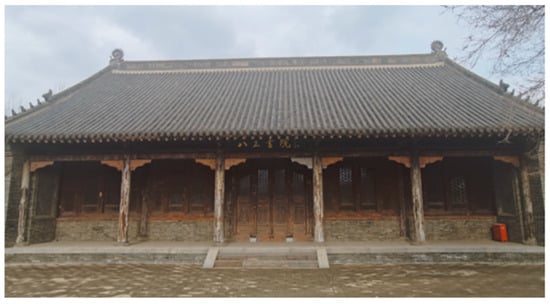
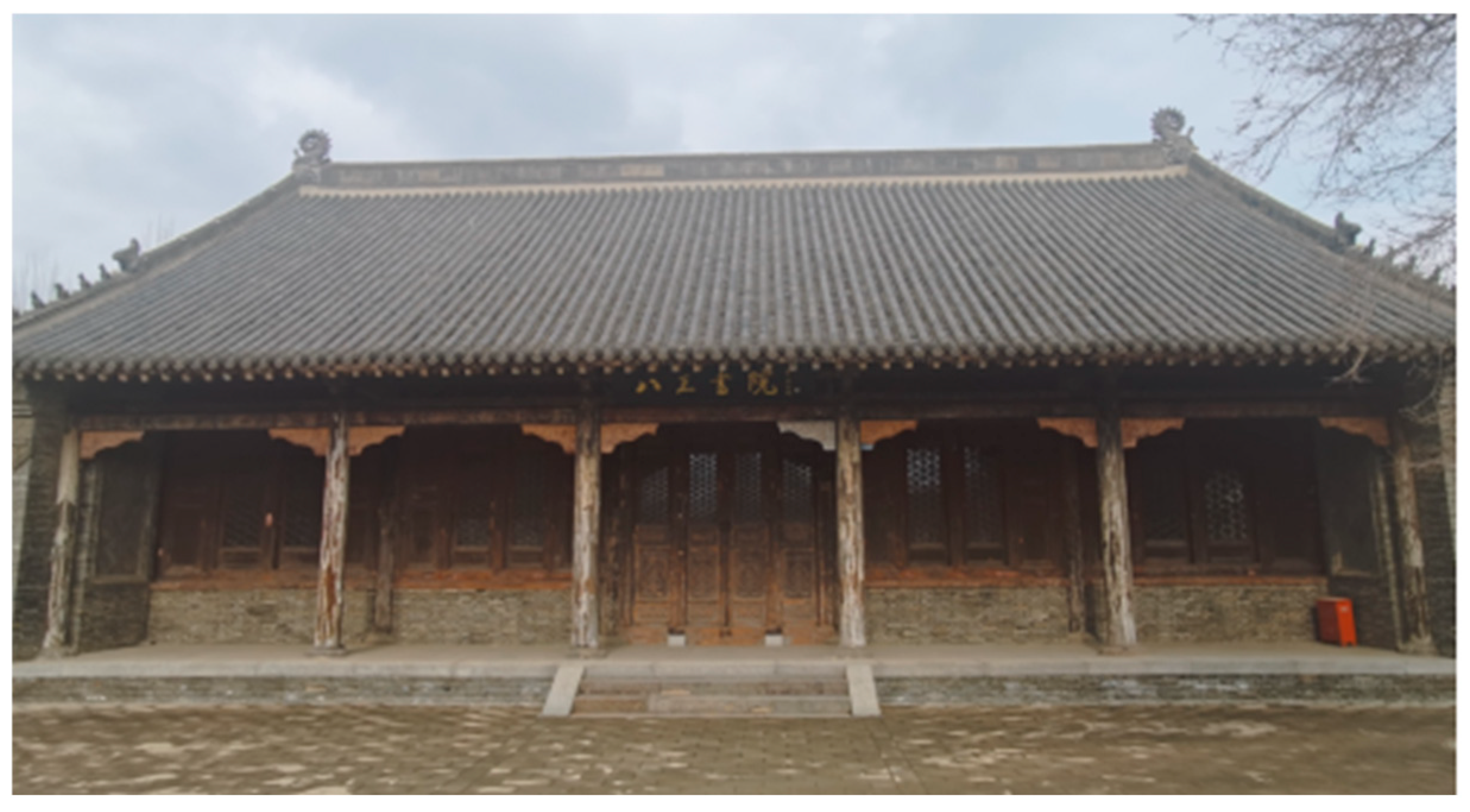
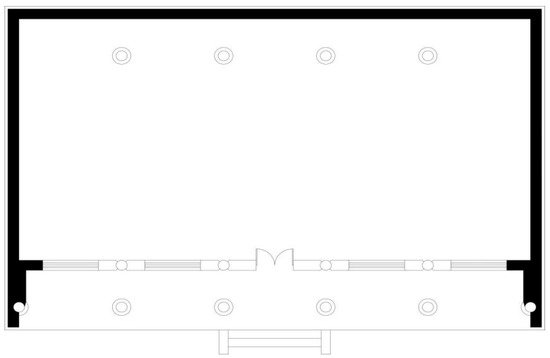
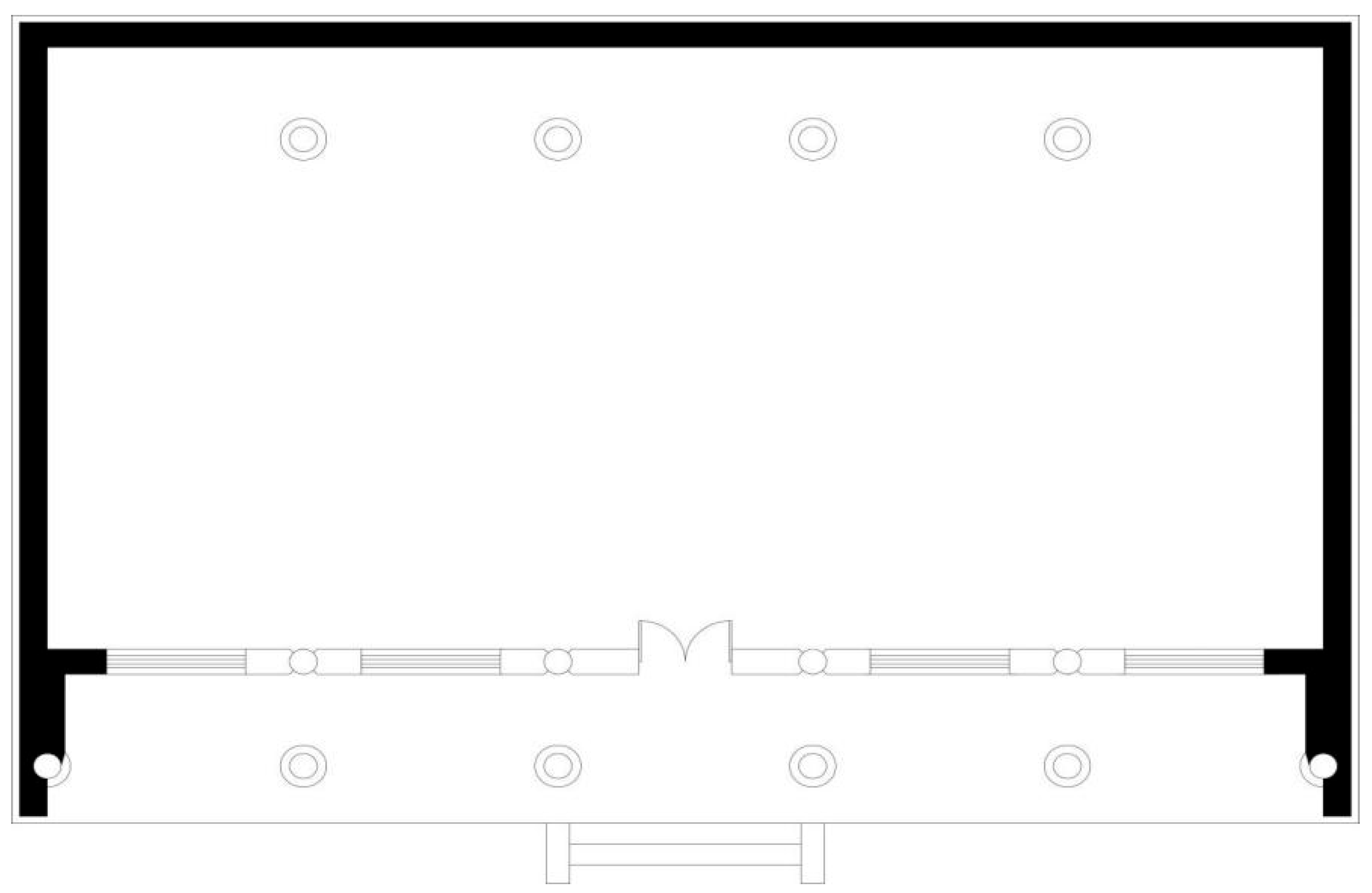
The Ba Wang Academy was originally the main building of the Eight Kings Temple in Shenyang. It was first constructed in the 13th year of the Yongle reign of the Ming Dynasty (1415 AD) and was relocated to Shenyang Jianzhu University in 2008. The building is a single-eave hipped-roof timber structure, with five bays in width and one bay in depth. It has a total length of 18.0 m, a width of 9 m, and a height of 9 m. The main load-bearing components include eight timber columns and four timber beams. The actual view and plan layout of the building are shown in Figure 1 and Figure 2.
Figure 1.
Three-dimensional view of Bawang Academy.
Figure 2.
Plan view of Bawang Academy.
4.2. Data Acquisition and Analysis
4.2.1. Data Acquisition
To accurately capture the crack geometric features and structural parameters of the Ba Wang Academy, a multi-source non-contact sensing approach integrating high-resolution image acquisition and 3D laser scanning technology was adopted. The YOLOv8-based crack detection model was adopted due to its demonstrated effectiveness in previous studies on ancient timber crack detection, where it has shown high precision and recall in comparison with other representative detection models [2,34]. YOLOv8 model was employed to automatically identify and extract cracks from the collected images, from which two-dimensional geometric parameters, including crack length and width, were derived [13,34]. In addition, three-dimensional laser scanning point cloud data were used to determine crack depth and the geometric information of timber members. In our previous studies [35,36], it has been demonstrated that 3D laser scanning is effective for crack depth measurement in ancient timber structures. The root mean square error (RMSE) of crack depth measurement was found to be 0.6 mm for curved surface cracks and 0.4 mm for planar cracks, indicating good performance.
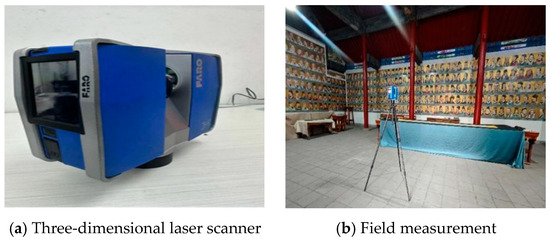
Multi-station terrestrial laser scanning of the Ba Wang Academy was performed using a Faro Focus 3D X330 system. A complete 3D geometric model was reconstructed through point cloud registration and stitching. The scanning equipment and on-site layout are presented in Figure 3.
Figure 3.
Scanner and measurement site.
4.2.2. Determination of Structural Parameters
Based on the processing results of the 3D point cloud data, the geometric parameters of the main load-bearing components of the Ba Wang Academy are determined as follows: the timber columns have a diameter of 0.25 m and a height of 4.9 m; the timber beams have a length of 7.75 m and a cross-sectional size of 0.38 m × 0.43 m. The structural material is Northeast Chinese pine. In combination with relevant design codes and previous studies [37], the mechanical property parameters of the timber and related calculation coefficients are determined, as listed in Table 4.
Table 4.
Relevant parameters of timber members in Bawang Academy.
4.2.3. Calculation of Evaluation Indicators
Based on the extracted crack geometric characteristics and structural member properties and following the established crack-based evaluation index system, all evaluation indicators are quantitatively calculated for the Ba Wang Academy (Table 5), reflecting the degree of crack development and its influence on structural performance. Subsequently, a normalization process is performed to eliminate dimensional inconsistency among indicators and to ensure comparability, and the normalized results are presented in Table 6.
Table 5.
Quantitative values of crack-based evaluation indicators for Ba Wang Academy.
Table 6.
Calculated values of crack-related evaluation indicators for the structural assessment of Ba Wang Academy.
4.3. Evaluation Model Calculation
4.3.1. Membership Fuzzy Matter-Element
The parameters k0 and t are determined based on Equation (16) and Table 4. The membership degrees μij of the crack-based structural condition of the BaWang Academy are then calculated using Equation (14). Accordingly, the membership fuzzy matter-element matrix describing the crack condition of the Ba Wang Academy is presented in Table 7.
Table 7.
Membership degree fuzzy matter-element matrix of crack-based structural conditions for different safety grades.
4.3.2. Calculation of Indicator Weights
The normalized values μij are substituted into Equations (21)–(23) to compute the entropy-based weights Wj for each indicator. The results are reported with three decimal places, as presented in Table 8.
Table 8.
Entropy Weight Values of Each Indicator Wj.
4.3.3. Membership Degree and Asymmetric Closeness Degree Calculation
According to Equations (24) and (26) and the data in Table 8, the membership degrees of the structural condition assessment of the Ba Wang Academy under crack states are calculated. The membership matrix B is then normalized to obtain . Subsequently, the asymmetric closeness degree is calculated, and the results are presented in Table 9.
Table 9.
Normalized Bi and Non-Closeness .
The effectiveness of the proposed asymmetric closeness approach is evaluated through consistency analysis between the computed evaluation results and the actual observed structural conditions of the load-bearing timber members in the Bawang Academy case study. The final evaluation results exhibit good agreement with the identified damage characteristics of key structural components, indicating that the proposed method can effectively reflect the actual structural condition.
A separate numerical comparison between the traditional symmetric closeness formulation and the proposed asymmetric closeness method is not explicitly conducted in this study. Instead, the improvement is demonstrated through the overall consistency between the final evaluation outcomes and the engineering observations of timber member conditions.
4.4. Evaluation Results and Analysis
From Equation (29), it can be obtained that which indicates that the fuzzy matter-element evaluation result of Bawang Academy based on the entropy weight method is classified as Grade III (relatively dangerous). This result suggests that the damage indicators of some key structural components have exceeded the safety threshold, and structural performance degradation has occurred. If no appropriate intervention measures are taken, the damage in certain components may further develop under environmental influences or loading conditions, potentially leading to an increase in the overall risk level.
4.4.1. Safety State Analysis of Load-Bearing Timber Columns
According to the evaluation results, the overall safety state of the load-bearing timber columns is classified as Level I (safe), with no evidence of buckling instability or compressive failure. The service time indicator remains within the safe range, suggesting that material aging has a limited impact on the current structural performance, which is consistent with the post-repair condition in 2008.
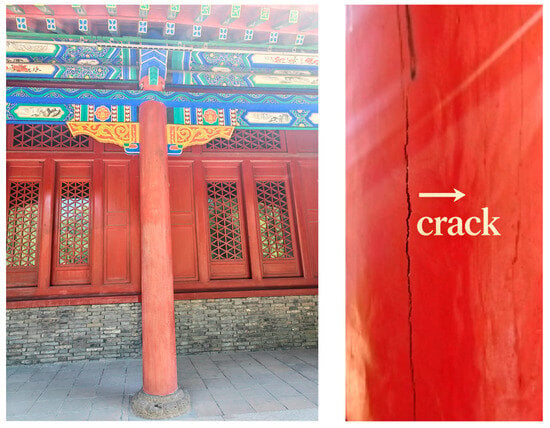
In terms of geometric and load-bearing indicators, the compressive capacity of the timber columns is within the safe threshold. Nevertheless, crack propagation has been observed, and the crack length ratio of several columns has reached Level III. Field investigations further indicate the presence of through-cracks propagating along the longitudinal direction of individual columns, resulting in a reduction in effective cross-sectional area and moment of inertia, as illustrated in Figure 4.
Figure 4.
Current condition of load-bearing timber columns in the Bawang Academy Ancient Timber Structures.
A comprehensive analysis shows that the timber columns have not undergone buckling instability, and their load-bearing capacity remains sufficient for current service demands. Nevertheless, localized cracking has introduced potential risks to structural safety. Continued crack propagation may further degrade the overall stability performance. For timber columns with through or propagating cracks, enhanced monitoring is recommended, and appropriate strengthening measures should be implemented depending on the actual condition.
4.4.2. Safety State Analysis of Load-Bearing Timber Beams
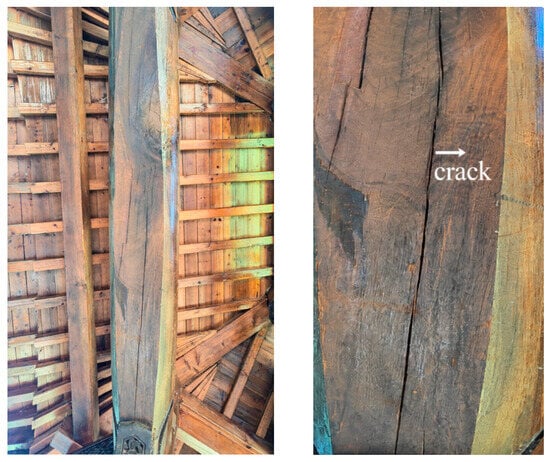
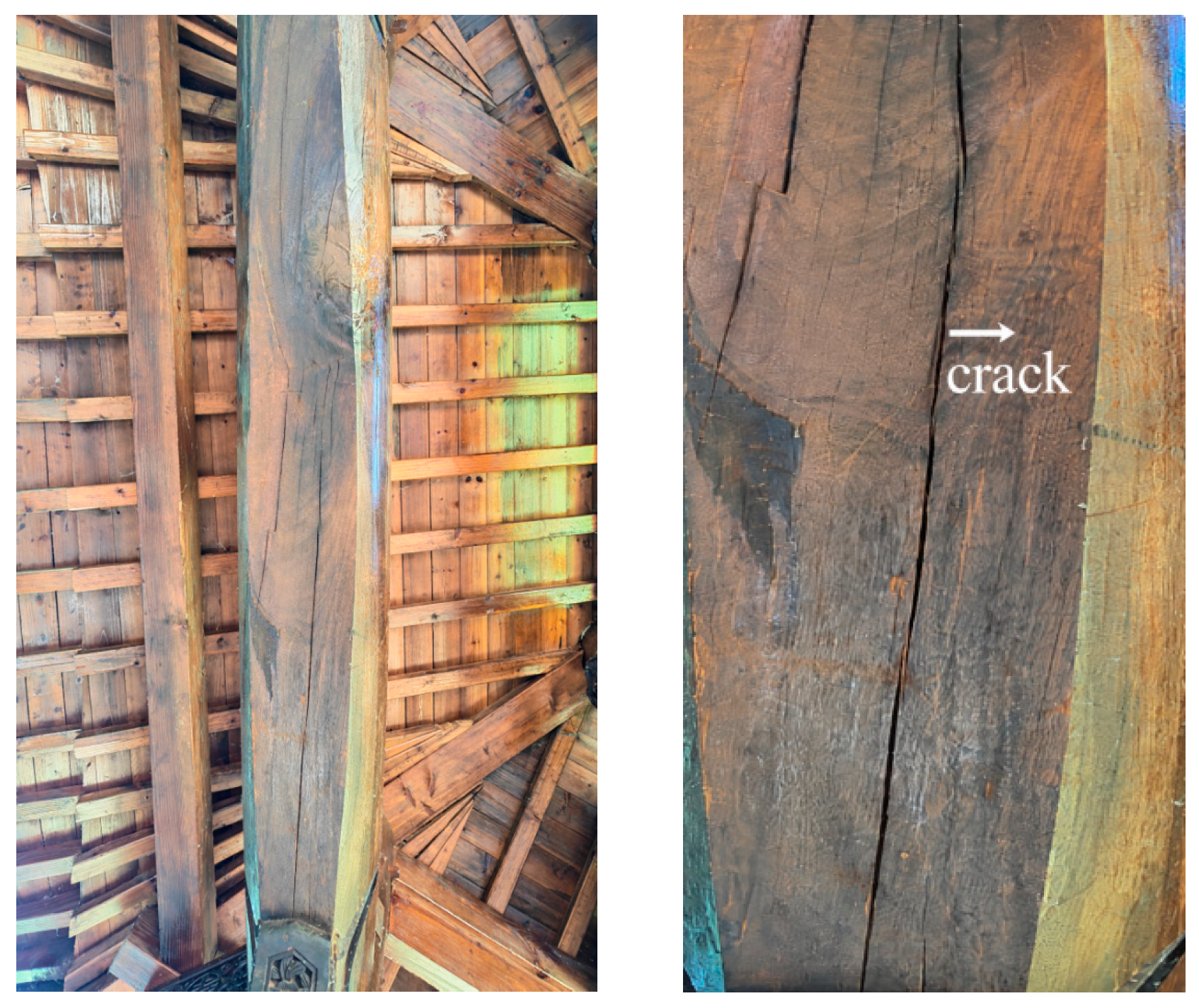
The evaluation results indicate that the overall condition of the load-bearing timber beams is relatively dangerous and plays a controlling role in structural safety. In particular, the service life of the timber beams falls within Level IV (dangerous), indicating significant material deterioration.
From the perspective of geometric characteristics and load-bearing capacity indicators, although the flexural capacity of the timber beams remains within a relatively safe range, a clear degradation trend has been observed. The crack-related indicators exhibit unfavorable characteristics, where both the crack length ratio and the maximum crack width have reached Level III, indicating a pronounced degree of crack development. The crack inclination angle is 0.058, which is lower than the threshold value of 0.1 specified in relevant codes for flexural members requiring immediate intervention. This suggests that the crack morphology has not yet become the dominant factor affecting the stress behavior. However, the crack depth exceeds one-quarter of the beam diameter and is classified as Level III, indicating that the crack has propagated into the interior of the cross-section and has caused a reduction in the effective load-bearing area, necessitating timely countermeasures. The cracks in the beam are shown in Figure 5.
Figure 5.
Current condition of load-bearing timber beams in the Bawang Academy ancient timber structures.
A comprehensive analysis indicates that the load-bearing timber beams have not experienced global failure; however, crack development has already exerted a substantial influence on their load-bearing capacity. Under sustained loading and environmental effects, further degradation of structural performance may occur. It is recommended that priority monitoring be conducted on timber beams with pronounced crack development and that targeted strengthening measures be implemented based on the actual stress conditions to prevent further deterioration of the damage.
5. Conclusions
This study proposes a comprehensive crack assessment model for ancient timber structures based on an entropy-weighted improved fuzzy matter-element method and validates its effectiveness through an engineering case. The following conclusions are drawn:
- (1)
- A multi-level evaluation index system centered on crack damage and applicable to timber columns and beams in ancient buildings was established. By coupling crack geometric characteristics with structural load-bearing behavior, the method enables a quantitative representation of the influence of crack damage on structural performance degradation.
- (2)
- The entropy weight method was incorporated into the evaluation model to achieve objective determination of indicator weights, effectively reducing the subjectivity associated with traditional expert-based weighting and improving the stability and reliability of the evaluation results.
- (3)
- The traditional fuzzy matter-element model was improved by introducing an asymmetric closeness degree, which addresses the limitations of the maximum membership principle near class boundaries, such as misclassification and poor robustness. This significantly enhances the accuracy and reliability of grade identification.
- (4)
- The engineering case study demonstrates that the proposed method is highly consistent with the actual structural damage conditions. It can accurately identify the differentiated safety levels of timber columns and beams, providing a practical tool and theoretical basis for crack-based safety assessment and preventive conservation of ancient timber structures.
In summary, the proposed method demonstrates strong engineering applicability and decision-support capability in the comprehensive assessment of cracks in ancient timber structures. It can provide a technical basis for structural condition evaluation and the formulation of conservation strategies. It should be noted that the proposed method still has certain limitations. First, the validation is currently conducted based on a single representative case study of Bawang Academy, and further verification on additional heritage timber structures is required to enhance the generality of the method. Second, the determination of some classification thresholds and model parameters relies on engineering interpretation, which may introduce a certain degree of subjectivity. Third, a systematic comparison with other established structural safety assessment methods has not been fully explored in this study. Future research will focus on addressing these limitations by expanding case studies, improving parameter robustness, and conducting comprehensive comparative analyses with existing methods under different structural conditions.
Author Contributions
Conceptualization, J.M. and X.G.; Methodology, J.M. and X.G.; Software, S.N.; Validation, X.G. and Z.W.; Formal analysis, X.G. and J.M.; Investigation, J.M., W.Y. and S.N.; Data acquisition (field survey, image processing and crack extraction), J.M. and W.Y.; Data curation, J.M. and W.Y.; Writing—Original Draft Preparation, J.M.; Writing—Review & Editing, J.M., W.Y. and X.G.; Visualization, X.G. and Z.W.; Supervision, J.M. and W.Y.; Project Administration, J.M. All authors have read and agreed to the published version of the manuscript.
Funding
This research was funded by the Basic Scientific Research Project (General Program) of Higher Education Institutions of the Liaoning Provincial Department of Education, grant number LJ212510153048.
Data Availability Statement
The data presented in this study include crack geometric measurements, structural parameters, image datasets, and 3D point cloud data of the Ba Wang Academy. The image data used for crack identification and geometric feature extraction were obtained through on-site inspections and are available from the corresponding author upon reasonable request.
Conflicts of Interest
The authors declare no conflicts of interest.
References
- Genc, A.F.; Ergün, M.; Günaydin, M.; Altunişik, A.C.; Ateş, Ş.; Okur, F.Y.; Mosallam, A.S. Dynamic analyses of experimentally-updated FE model of historical masonry clock towers using site-specific seismic characteristics and scaling parameters according to the 2018 Turkey building earthquake code. Eng. Fail. Anal. 2019, 105, 402–426. [Google Scholar]
- Ma, J.; Guo, X.; Yan, W.; Liu, G.; Xu, J. WPSW-YOLOv8: An intelligent crack detection framework for ancient timber structures. J. Build. Eng. 2025, 112, 113890. [Google Scholar]
- Arı Akman, N.G.; Çelebi Karakök, M.E. A fuzzy–AHP model for quantifying authenticity loss in adaptive reuse: A sustainable heritage approach based on traditional houses in Alanya. Sustainability 2025, 17, 10519. [Google Scholar] [CrossRef] [Scilit]
- Huan, J.; Ma, D.; Wang, W.; Guo, X.; Wang, Z.; Wu, L. Safety-state evaluation model based on structural entropy weight–matter element extension method for ancient timber architecture. Adv. Struct. Eng. 2020, 23, 1087–1097. [Google Scholar]
- Huang, Z.; Zhao, W.; Zhang, Y.; Yao, X.; Jia, Q.; Wang, H.; Gao, Y. Comprehensive safety evaluation of emergency training for building ruins scenario based on analytic hierarchy process-grey fuzzy evaluation. IEEE Access 2020, 8, 147776–147789. [Google Scholar] [CrossRef] [Scilit]
- Guo, M.; Zhao, J.; Pan, D.; Sun, M.; Zhou, Y.; Yan, B. Normal cloud model theory-based comprehensive fuzzy assessment of wooden pagoda safety. J. Cult. Herit. 2022, 55, 1–10. [Google Scholar] [CrossRef] [Scilit]
- Gao, Z.; Ma, D.; Wang, W.; Guo, X.; Ge, Q. Development and application of ancient timber buildings structural condition assessment model based on a fuzzy matter-element model that includes asymmetric proximity. Math. Probl. Eng. 2018, 2018, 7426915. [Google Scholar] [CrossRef] [Scilit]
- Wang, S.Y. Safety Evaluation Methods for Ancient Buildings with Brick–Timber Structures. Master’s Thesis, Lanzhou University of Technology, Lanzhou, China, 2020. [Google Scholar]
- Zhai, C.Z.; Guo, X.D.; Wang, W. Seismic risk assessment of ancient timber structures based on an improved matter-element extension model. J. Taiyuan Univ. Technol. 2023, 54, 125–133. [Google Scholar]
- Chen, Y.; Xie, S.; Zhang, J. Structural performance evaluation via digital-physical twin and multi-parameter identification. Autom. Constr. 2025, 170, 105907. [Google Scholar] [CrossRef] [Scilit]
- Wang, Z.; Meng, X.; Zhang, C.; Li, T.; Shi, X.; Yu, P. Experimental and numerical investigation on seismic performance enhancement of ancient timber structure with friction energy dissipation brace. J. Build. Eng. 2025, 111, 113591. [Google Scholar] [CrossRef] [Scilit]
- Qiao, Y.; Lam, C.C.; Zhong, H.; Pan, M.; Zhang, T.; Wong, M.O. BIM and GIS-integrated multi-stakeholder fire risk assessment model for heritage buildings. Int. J. Disaster Risk Reduct. 2025, 132, 105983. [Google Scholar]
- Liao, D.; Zhuo, X.; Tao, J. A dynamic fire risk assessment method for compact historic villages based on the improved FRAME. Int. J. Disaster Risk Reduct. 2024, 114, 104935. [Google Scholar] [CrossRef] [Scilit]
- Lei, Y.; Shen, Z.; Tian, F.; Yang, X.; Wang, F.; Pan, R.; Kou, W. Fire risk level prediction of timber heritage buildings based on entropy and XGBoost. J. Cult. Herit. 2023, 63, 11–22. [Google Scholar] [CrossRef] [Scilit]
- Louiza, M.; Abdessemed, A.F.; Cheikh, M.Z. Assessment of the seismic behaviour of heritage masonry buildings using numerical modelling: A study of Fernand Pouillon’s Totem Tower in Algiers, Algeria. J. Build. Eng. 2021, 38, 102183. [Google Scholar] [CrossRef] [Scilit]
- Standoli, G.; Di Giosaffatte, M.; Schiavoni, M.; Roscini, F.; Clementi, F. Sustainable structural health assessment of heritage masonry towers using artificial intelligence and data-driven monitoring: Insights from the civic tower of Matelica. Eng. Appl. Artif. Intell. 2026, 163, 113097. [Google Scholar] [CrossRef] [Scilit]
- Yu, J.; Jiang, X.; Wu, G.; Xu, F.; Zhang, J.; Ma, W. Static safety evaluation of the main timber frame in ancient residential mindong buildings based on a BMMS. Eng. Res. Express 2026, 8, 045105. [Google Scholar] [CrossRef] [Scilit]
- Deng, Y.; Li, Y.; Li, A. Seismic safety assessments of historical timber buildings using updated finite element models: Case study of Yingxian wooden pagoda, China. J. Build. Eng. 2023, 63, 105454. [Google Scholar] [CrossRef] [Scilit]
- Chen, J.; Li, T.; Yang, Q.; Niu, Q.; Shi, X.; Meng, X.; Zhao, Y. Comparative analysis of the seismic performance of a full-scale historical timber structure by numerical simulation and mechanical test. Int. J. Archit. Herit. 2024, 18, 740–749. [Google Scholar]
- Wu, G.; Yu, J.; Liu, X.; Jiang, X.; Ma, W.; Wang, S.; Liu, Y. Structural health detection and wind resistance safety assessment of ancient dwellings based on laser point cloud. J. Build. Eng. 2024, 97, 110816. [Google Scholar] [CrossRef] [Scilit]
- Qin, S.; Yang, N. Strength degradation and service life prediction of timber in ancient Tibetan building. Eur. J. Wood Wood Prod. 2018, 76, 731–747. [Google Scholar]
- Li, S.; Xie, Q.; Zhang, B.; Wang, X.; Zhang, L. Compressive behavior of damaged timber columns: Experimental tests, degradation model, and repair method. Eng. Struct. 2023, 293, 116579. [Google Scholar] [CrossRef] [Scilit]
- Xie, Q.F.; Zhang, B.Z.; Zhang, L.P.; Miao, Z. Study on mechanical performance test and degradation model of naturally cracked timber columns. J. Build. Struct. 2022, 43, 210–222. [Google Scholar]
- Chu, Y.; Shi, B.; Gong, Y. Experimental study on compressive behavior of intermediate slender timber columns with local damage and the retrofitting techniques for the damaged columns. Structures 2022, 46, 1709–1725. [Google Scholar] [CrossRef] [Scilit]
- Zhang, B.; Xie, Q.; Xue, J. Study on the flexural behavior evolution of timber beams with natural shrinkage cracks in historic timber structure. Structures 2025, 73, 108429. [Google Scholar] [CrossRef] [Scilit]
- Zhou, L.; Hu, X.; Liu, D.; Li, S.; Liu, H.; Hou, X. Influence of cracks at the middle-height layer position on the load-bearing capacity of timber beams: A study based on small-sized specimens and a large sample size. Buildings 2026, 16, 650. [Google Scholar] [CrossRef] [Scilit]
- Hu, X.; Wu, J.; He, X.; Li, L.; Guo, W.; Yang, J. Shrinkage crack patterns of rectangular timber beams and their influence on load-bearing capacity. Materials 2026, 19, 942. [Google Scholar] [CrossRef] [Scilit] [PubMed]
- Zhao, Y.; Qiu, H.X.; Tian, P.P.; Gu, J.Y. The relationship between bearing capacity degradation and dry shrinkage crack depth index of rectangular timber components. J. Lanzhou Univ. Nat. Sci. 2022, 58, 528–533. [Google Scholar]
- GB/T 39056-2020; Technical Code for Repair and Strengthening of Ancient Timber Structures. Architecture & Building Press: Beijing, China, 2020.
- ICCI-CODE IPMC-2018; Property Maintenance Code. International Code Council: Washington, DC, USA, 2018.
- JGJ 125-2016; Standard for Appraisal of Dangerous Buildings. Architecture & Building Press: Beijing, China, 2016.
- GB 50005-2017; Standard for Design of Timber Structures. Architecture & Building Press: Beijing, China, 2017.
- Zhang, X.P. The definition of product about fuzzy comprehensive evaluation methods based on closeness. J. Shandong Univ. 2004, 39, 25–29. [Google Scholar]
- Ma, J.; Meng, Y.; Yan, W.D.; Liu, G.Q. Crack Identification in Ancient Wooden Structures Based on Improved YOLOv8 Algorithm. J. Shenyang Jianzhu Univ. Nat. Sci. 2025, 41, 495–504. [Google Scholar] [CrossRef] [Scilit]
- Ma, J.; Liu, D.C.; Yan, W.D.; Wang, J.L.; Liu, G.Q. Detection of Cracks in Ancient Wooden Buildings Based on RPA Oblique Photography Measurement and TLS. J. Field Robot. 2025, 42, 742–759. [Google Scholar]
- Ma, J.; Liu, D.C.; Yan, W.D.; Liu, G.Q.; Guo, X.Y. Crack detection and analysis method for timber structures of ancient buildings based on laser point cloud data. Meas. Sci. Technol. 2025, 36, 076010. [Google Scholar] [CrossRef] [Scilit]
- Yue, C.H. Structural Characteristics and Seismic Performance of Chongzheng Hall and Wensu Pavilion in the Shenyang Imperial Palace. Master’s Thesis, Tianjin University, Tianjin, China, 2021. [Google Scholar]

Disclaimer/Publisher’s Note: The statements, opinions and data contained in all publications are solely those of the individual author(s) and contributor(s) and not of MDPI and/or the editor(s). MDPI and/or the editor(s) disclaim responsibility for any injury to people or property resulting from any ideas, methods, instructions or products referred to in the content. |
© 2026 by the authors. Licensee MDPI, Basel, Switzerland. This article is an open access article distributed under the terms and conditions of the Creative Commons Attribution (CC BY) license.