1. Introduction
Construction progressively incorporates digital technologies due to increased efficiency, sustainability, and speed of delivery. With such technological developments, the construction industry is evolving, with BIM at the forefront. It replaces document-based fragmented workflows with integrated, data-centric workflows. Project managers use BIM to create collaborative digital spaces for all stakeholders involved in a project. This enables sharing, managing, and updating project information throughout its lifecycle, enhancing project coordination with transparency and improved decision-making [
1,
2].
In this context, for the last decade, the construction industry has been resorting to BIM mainly to enhance the planning and the control of the construction processes. This advice seems to be the result of the advantages attributed to the method in the field of cost reduction, in the gain of efficiency in the time aspect, and in the possibility of organizing in a more predictable way the management of the work. In this initial use, BIM appears less as a deep transformation of work practices and more as a tool for making the process more legible, with greater tracking capacity and reinforced discipline in making decisions. Herein can be found, substantially, the practical reason for its initial expansion [
3,
4]. BIM has thus been evidenced to improve communication among stakeholders, resource management, and project rework [
5,
6].
At the same time, the continued use of BIM has been stimulated and, to some extent, imposed by governments and other entities as part of their digital transformation strategies in the construction sector. On the European level, this orientation was sustained by policy frameworks and public procurement models which started to acknowledge BIM as a strategic tool to modernize the public sector and foster innovation in construction after the publication of Directive 2014/24/UE on public procurement and other related regulatory measures on BIM in the European space [
7,
8,
9]. We should not confuse this regulatory acceleration with homogeneous adoption. The translation of requirements into daily practices tends to be slower and less, even because it depends on internal capacity, contractual alignment and the maturity of the interveners. Even so, the political direction has worked as a catalyst, moving BIM from the field of choice to the field of requirement, at least in certain segments.
In particular, the transition in Europe at the National Level, in Portugal, recently received a greater visibility with the No.10/2024 Decree-Law. This measure reinforces the streamlining of the digitization of the construction sector and underlines, with particular insistence, the institutional importance of practices related to information management in the BIM context [
10,
11,
12]. Nevertheless, the effectiveness of this intention depends, in practical terms, on how the requirements are translated, on one hand, into internal procedures and, on the other hand, into operational requirements imposed on the intervening entities.
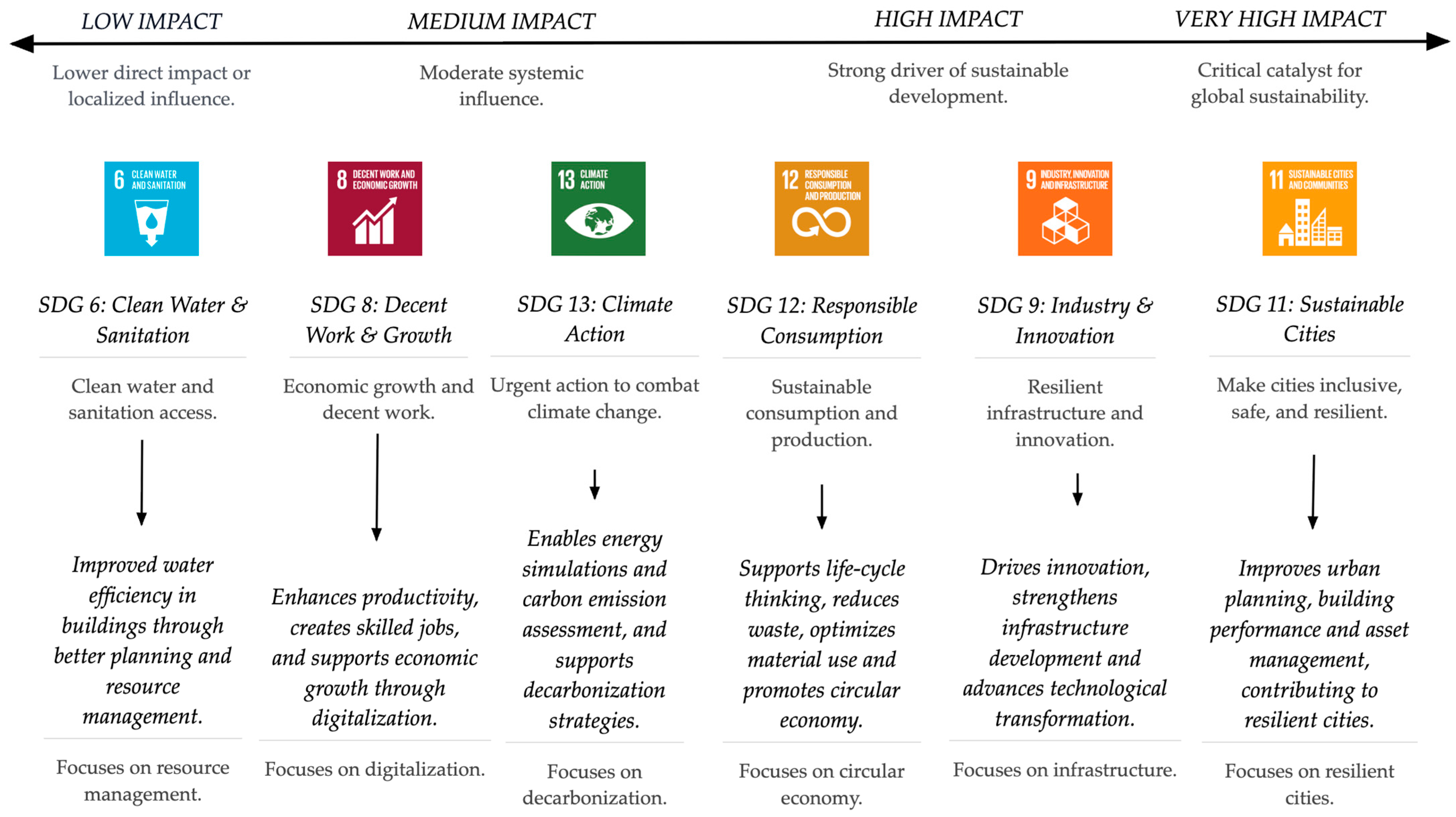
Beyond regulatory developments, globally, it can be recognized that BIM methodology contributes to the United Nations Sustainable Development Goals, particularly the 9th and 11th. The reading to derive from this fact is not only instrumental, but it also suggests a different way to organize information and, through that, make the sector more responsible for the decisions it takes [
13].
According to SDG 9, Industry, Innovation and Infrastructure is associated with the promotion of technological innovation and modernization of the building sector. Within SDG 11, Cities and Sustainable Communities, BIM is recognized as it improves urban design, which, combined with the facilitation of the design of more efficient buildings, will create greater viability for the maintenance and management over the life cycle of real estate. Consequently, it tends to support safer, more resilient, and more inclusive cities, especially when public procurement uses BIM to improve the quality of the built environment and the management of public heritage.
In addition, with relevant contributions to the SDGs 12 and 13, BIM can also be understood to guide decisions beyond the initial cost. In SDG 12, Responsible Production and Consumption, in line with Directive 2014/24/EU, the idea of “life-cycle cost” is introduced more clearly as a criterion for assessment of proposals. As a result, the choices now consider not only the initial investment, but also the economic and environmental impacts on the life cycle. In this connection, reducing waste, optimizing use of materials and embracing principles adopted by the circular economy are gaining traction, although the force of effect will, of course, depend on the quality of implementation. In parallel, through SDG 13, Climate Action, the application of BIM allows for energy simulations, carbon emissions evaluation and decision-making support focused on decarbonization. The Directive supports the integration of climate and environmental criteria in public contracts, a measure which contributes indirectly but consistently to climate action.
Figure 1 gives a perspective of the impact of BIM on the implementation of the SDGs.
Despite these developments, the adoption of BIM is uneven across geographies and types of companies. The construction industry’s nature is highly fragmented, because of independent players, decentralized decision-making, and non-integrated workflows, among other reasons. Such industry fragmentation is often considered an obstacle to integrating digital technologies, with information flow gaps and weak collaboration [
14,
15]. In other words, issues like these often require BIM adoption to involve more than a simple technological adjustment.
SMEs, frequently referred to as the construction industry’s backbone, tend to be placed among the actors most affected by this set of difficulties. SMEs participate in practically all works as contractors, sub-contractors, or specialist suppliers, and this gives them a structural weight that in practice is rarely replaceable. Nonetheless, the reality of SMEs imposes conditions that severely limit their responsiveness. Financial and technical constraints overlap, but there are also structural and organizational frameworks that are still not very mature and sometimes poorly defined. Against this backdrop, the swift adoption of BIM tends to be in a tighter position than larger companies, which generally manage to absorb the costs, complexity and obstacles associated with digital transformation with greater flexibility. It seems, therefore, that the issue has less to do with technology than with the degree of maneuver the company can maintain while it learns, adjusts and keeps to the change [
16,
17].
This picture is further reinforced by recent studies that identify structural barriers and associated difficulties with internal capabilities for the SMEs. According to Silva et al. [
18], Carvalho et al. [
19], Vidalakis et al. [
20], and Holl and Rama [
21], when digital readiness is low, there are few organized training alternatives, and the supporting ecosystem is fragile, the response to digital innovation is, almost by definition, limited in capacity. In other words, innovation won’t “arrive” just because you have a tool on hand. It relies on conditions that are outside and inside the organization, and when these conditions fail, BIM is at risk of becoming a distant requirement, difficult to translate into productive routines.
More importantly, these difficulties transcend the technical and financial barriers faced by SMEs, and they themselves do not exhaust the complexity of the problem. When reading authors of older works, one realizes that the adoption of BIM ultimately inscribes itself in a set of systemic conditions where individual choices are entangled with market structures, institutional habits and organizational constraints. The previous literature suggests, with some insistence, that such barriers are dispersed in larger categories. Some examples include the extensive and difficult-to-integrate organizational inertia, and economic and contractual systems, systemic factors which exceed the company and, of course, technological barriers [
15]. Thus, this is not just a software or investment problem; there also seems to be a problem of adapting work to the world in which the work takes place.
For this reason, the implementation of BIM should be viewed not only as a simple technological change; rather, it is a set of complex changes in organizational processes. In practical terms, the company needs to be capable of changing, possess the technology needed and, most importantly, demonstrate willingness to cooperate, that is, to adjust routines, responsibilities, and modes of coordination.
Even so, the current models proposed for BIM implementation sometimes seem to ignore the reality of SMEs, which operate in highly structured but fragmented environments with clear resource limitations.
Despite the growth and complexity of BIM adoption research, some weaknesses remain. Most papers on implementation focus on large organizations or well-organized and strongly structured project contexts, conditions which generally favor adoption [
3,
4]. For this reason, the findings from these analyses might not be entirely applicable to SMEs, as their difficulties are not just isolated. These stem from operational and structural constraints that alter the way change is absorbed and sustained in everyday life, and it is precisely there that the transposition tends to fail.
On the other hand, previous literature tends to address the barriers and drivers of BIM adoption in isolation from each other. On some occasions, this division even resorted to limiting them to technical, economic, or organizational dimensions, as if these layers were in sealed drawers. This methodological option tends to simplify the very notion of adoption, and can particularly conceal complex interdependencies between elements that, in practice, mutually influence each other [
17,
22]. That is why more recent studies indicate a socio-technical and systemic reading of the adoption of BIM. Technological change is not unrelated to changes in organizational behavior, institutional support, information governance, and digital transformation capacity of the company [
23,
24,
25]. As a consequence, what seems to be missing in the literature are truly integrated models that explain how these dimensions articulate to encourage adoption in concrete contexts or, on the contrary, to hinder it.
In addition, another relevant dimension is fragmentation. Even if it is largely recognized as a distinctive feature of the construction industry, little is known about how it operates in the phenomenon under analysis. In particular, the literature has paid little attention to the simultaneous effect that fragmentation can exert on information flows, on the coordination mechanisms and on the organizational capability itself [
14,
26]. The question is trickier than it seems because these levels tend to interact, sometimes without warning, and a change in one can amplify weaknesses in the others.
This point acquires special sharpness in SMEs. It is plausible that these organizations are more exposed to the negative effects of “discontinuous” design environments, where each intervenor optimizes its slice and where the continuity of the whole depends on agreements that are not always achievable. In Portugal, moreover, this discussion seems particularly opportune, given that an uneven uptake of BIM may reflect, among other factors, inherited practices, incomplete institutional alignments and fragmented implementation routines along the value chain [
12,
27]. In a certain sense, fragmentation does not only appear as a backdrop. It appears to interfere with the very way adoption is organized, sustained, and sometimes stopped.
Further research is still needed at the intersection of the three main lines of interest: (i) SME-specific constraints; (ii) the complex nature of barriers and enablers of BIM adoption; and (iii) fragmentation and its structural, constitutive, and dynamic role in the adoption of BIM.
This paper therefore attempts to address those gaps by looking into the adoption dynamics of BIM in construction SMEs using exploratory and systemic reading, with particular reflections on the Portuguese context. The purpose is to identify and assess the most important barriers and facilitators, with particular attention to how they influence each other within fragmented systems.
In this context, the investigation attempts to shift the fragmentation from a merely descriptive role to an active structural role. The issue is no longer just “the sector is fragmented, and it becomes, which is more exacting, one suspects, how it is that certain structural properties create obstacles and simultaneously enable implementation strategy. There is a clear intention to treat fragmentation as a condition that shapes trajectories and not as noise of the system.
In this way, it contributes to the existing literature on various levels. On the one hand, it seeks to connect research currents that, until now, have often emerged dispersed, and to analyze interactions between technical, financial, organizational and behavioral dimensions. On the other hand, it is intended to offer additional contributions to better understand the dynamics of BIM adoption, while conceptualizing the central role of fragmentation in the digital transformation of the sector. The emphasis placed on the articulation between factors seems necessary, because the accumulated evidence does not always explain well how the conditions combine in context.
The paper is organized, therefore, around an integrated and exploratory literature review, which allows us to frame future empirical lines on the use of BIM and SMEs. In addition, it responds to recent calls in Europe for implementation strategies to be context-sensitive, flexible, and able to respond to late national realities in adoption, SME-specific barriers and information management cycles that change over time, with particular relevance to the Portuguese context. The bet is on the compatibility between theory and reality on the ground, even while knowing that this compatibility is rarely simple [
8,
28].
This need for context-sensitive approaches becomes particularly evident in the construction sector, whose structural characteristics make it fundamentally different from more integrated industries.
Unlike more integrated industries, the construction sector is characterized by temporary project-based organizations, fragmented supply chains, decentralized decision-making, and discontinuous information flows. Under such conditions, BIM adoption cannot be adequately explained solely at the firm level, since implementation outcomes depend heavily on interactions among multiple stakeholders, organizational interfaces, and coordination mechanisms that extend beyond the boundaries of individual companies. Consequently, the distinctive characteristics of the construction industry make fragmentation a particularly critical condition, requiring an analytical perspective capable of capturing interorganizational relationships and broader systemic influences.
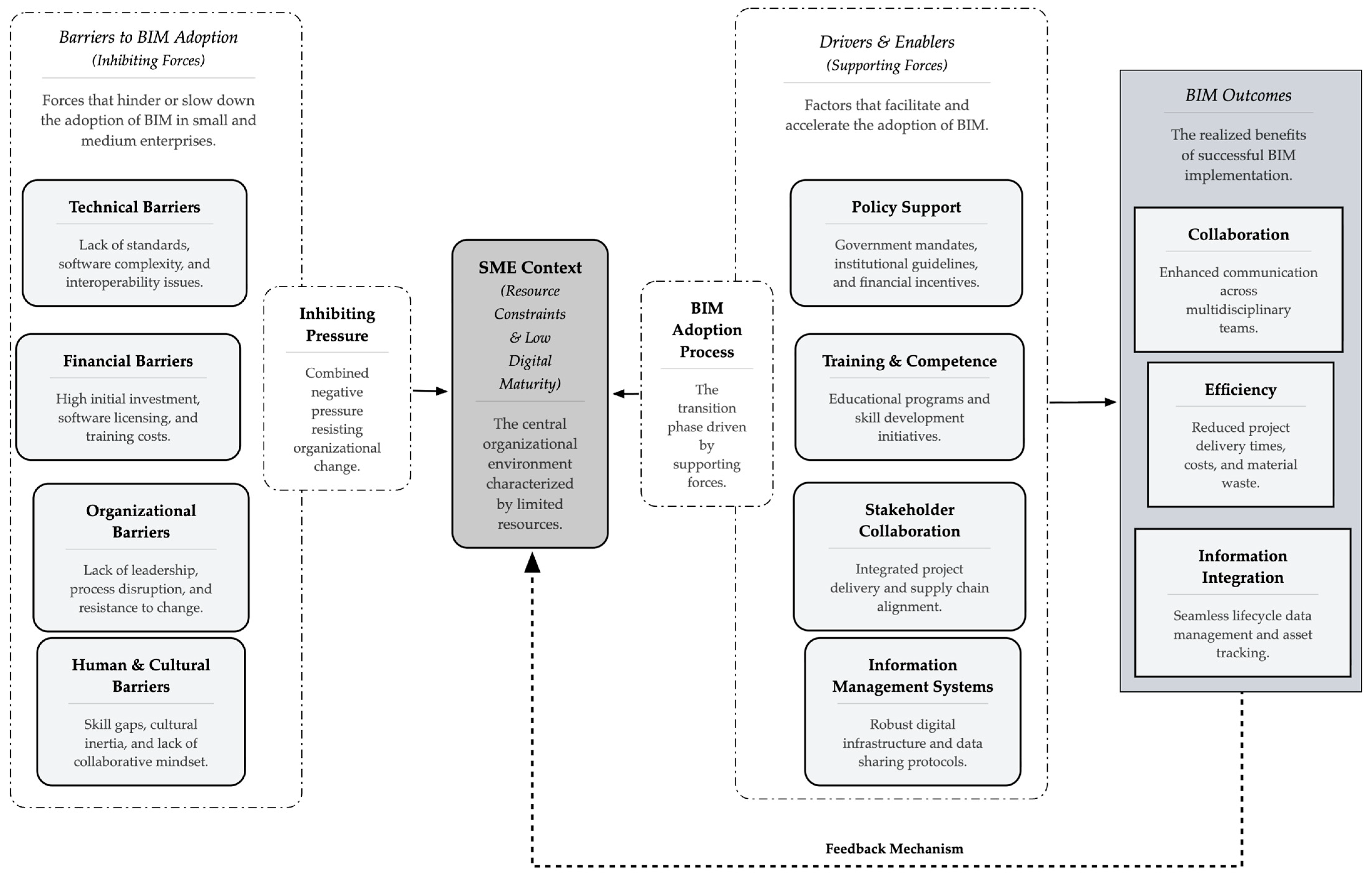
Figure 2 presents the dynamic conceptual framework developed in this study, illustrating the interactions between barriers, enablers, fragmentation, and BIM adoption within fragmented SME-based construction environments. The framework conceptualizes fragmentation as an active mediating and amplifying mechanism and highlights the feedback relationships between BIM outcomes, project performance, and SME context. It is intended to provide a general analytical perspective, while also supporting reflections on the Portuguese context.
2. Theoretical Framework
BIM adoption in the construction sector has been approached in the literature through multiple perspectives, often emphasizing different dimensions of the phenomenon. Some contributions focus on the technological capabilities associated with BIM, while others underline organizational transformation, financial constraints, or the role of human and cultural factors. At the same time, these dimensions rarely operate in isolation, as adoption tends to emerge from the interaction between internal capacities and wider sectoral conditions. In this sense, understanding BIM adoption requires a reading that brings together these interconnected elements, particularly when considering SMEs operating within fragmented environments, where constraints and enabling conditions are combined in ways that shape both the pace and the stability of implementation trajectories.
2.1. BIM Adoption in the Construction Sector
BIM can be framed within a wider range of digital transformation initiatives which, directly or indirectly, end up changing the work practices in the construction industry. The relationship of technology with organizational change is, however, not linear, and does not always allow itself to be read in a single causal direction. Nonetheless, at the outset, BIM appears to have been primarily understood as a new disruptive technology capable of producing and maintaining three-dimensional digital models, sufficiently detailed to represent physical and functional characteristics of a building project [
1]. At this stage, the promise was that of precision imagery, as if the whole building could be captured, permanently, in manipulable data which could sustain decisions throughout the life cycle. However, this reading, today more nuanced, may have underestimated the distance between what the model intends to capture and the way the teams, in practice, will use it.
By contrast, in more traditional processes, the relationship to the built object is often established through separate, fixed representations, which therefore are difficult to piece together in a continuous vision of the whole, often mediated by supports on paper. Each board tends to function as a disciplinary cut—useful, yes, but without completeness, because it does not accompany either in time or in consistency the set of decisions being made.
BIM, by contrast, enables work from a single information source of the building. In view of this centralization, collaboration between the agents that participate in the design, construction and operation phases appears to be easier, because the changes, when properly treated, cease to be considered as isolated events and become variations in the same reference frame. In other words, the articulation between specialties ceases to depend on the mere successive interpretation of different documents, and gains support in the coherence of the model.
Furthermore, BIM diffusion has also been associated, in the literature, with framework possibilities opened by technological development, but also with economic thrust, sometimes supported by government leadership and public policies. Although there are different views about what the extent of that intention may really be, it seems to indicate that, by improving design coordination, reducing errors in design phases and allowing a stricter control of parameters such as cost and deadline, BIM has produced observable effects. Because of this, several papers have emerged addressing this problem, albeit not always with the same emphasis and, in some cases, presenting results dependent on the type of organization and context of implementation [
3,
4].
As a result, BIM has been increasingly incorporated into regulations and incentive policies of various governments, including in Portugal [
10]. At the same time, public projects tend to be mobilized as an instrument of normalization, that is, to make BIM a normal rule, especially when it is expected that the demonstration effect will do the rest.
At the European level, in most cases, this trajectory has been associated with the dynamics of public procurement models, the circulation of policies through diffusion mechanisms, and the existence of national plans for the implementation of BIM, which, over the last ten years, have been positioning BIM as a privileged means for promoting coordination between actors, increasing transparency in the flow of information, and supporting management throughout the life cycle of construction information. Effective implementation sometimes depends on local capacities, contractual maturity, and how the requirements are translated into operational practices [
7,
8,
9].
At the national level, in the Portuguese context, this trajectory has been taking shape slower than in other European contexts. The 2024 law [
10] reinforced the institutional digitalization in the construction sector and the information management practices associated with BIM [
10]. In parallel, the gradual incorporation of BIM-related requirements into the Public Contracts Code has been positioning public procurement as one of the main vehicles for the diffusion of the methodology, even if its translation into contractual practice does not always occur in a uniform way [
11]. Even so, recent studies suggest that Portugal is still considered a late-adopting country, where barriers of a structural-, organizational- and capacity-related nature persist [
12], and where legacy practices coexist with the new digital requirements [
27]. The sectoral context, marked by the structural characteristics described in sectoral reports [
29], may help to explain why regulatory advances do not translate, in the short term, into a homogeneous adoption across the value chain.
Similar patterns have also been reported in other European construction markets characterized by fragmented industry structures and heterogeneous levels of digital maturity. Charef et al. [
8] highlighted the fact that BIM adoption trajectories vary considerably across European Union countries, depending on institutional frameworks and implementation capacities. Likewise, Mitera-Kiełbasa and Zima [
9] showed that BIM policy development remains uneven across Europe, particularly in late-adopting contexts. More recently, Wang et al. [
25] emphasized that fragmented organizational structures and limited digital capabilities continue to hinder Construction 4.0 implementation across several construction markets. Furthermore, Oesterreich and Teuteberg [
30] demonstrated that BIM adoption barriers should be interpreted through a socio-technical perspective, in which technological challenges are closely intertwined with organizational and managerial dimensions. Similarly, Olanipekun and Sutrisna [
24] highlighted the fact that digital transformation in construction depends not only on technological readiness, but also on the ability of organizations to adapt their processes and coordinate stakeholders effectively. These findings suggest that the Portuguese case should not be interpreted as an isolated phenomenon, but rather as part of a broader group of construction industries facing similar structural and organizational challenges. Regardless of the benefits attributed to BIM, on the one hand there is a relatively broad consensus on the advantages associated with it. On the other hand, this consensus is not found, in a similar way, in many countries, especially when moving beyond the public sector and entering the market, which is the more uncertain territory. In fact, some studies reveal an interesting preference in the explanation of the phenomenon. On a macro level, BIM adoption seems to depend less on organizational digital maturity and stakeholder configuration, or certain structural characteristics, than on the way in which adoption varies between concrete organizations with their own rhythms and priorities.
In addition, more recent works have located the adoption of BIM within the wider framework of “Construction 4.0”. In this framework, beyond cloud technology and automation, technological and management changes are also considered, stimulated by information-exchange protocols and life-cycle management systems. In this way, BIM is read not just as a tool for modelling, but as a set of practices, rules and interfaces that are put in place where the coordination must happen for real.
Recent scientometric evidence further reinforces this perspective. Based on an analysis of 140 journal articles addressing technology adoption in the construction industry, Fu et al. [
31] identified BIM as one of the dominant research themes. Their findings suggest that technology adoption should be understood as a complex phenomenon shaped by multiple technological, organizational, and environmental dimensions. This broader perspective supports the view that BIM extends beyond a mere digital modelling tool and constitutes an important component of the ongoing digital transformation of the construction sector.
Similarly, Ejdys et al. [
32], through a bibliometric analysis and state-of-the-art review of BIM adoption in SMEs, emphasized that BIM implementation should be interpreted as a multidimensional socio-technical process influenced by managerial capabilities, collaboration, interoperability, and organizational factors. Their study further highlighted the importance of context-sensitive approaches and capacity-building initiatives to support BIM diffusion in resource-constrained environments.
One aspect of this application emerges exactly at the intersection of technologies, agents and companies. Therefore, as BIM moves towards more advanced methodologies, attention cannot be limited to within the borders of each organization only. It seems to require, rather, that the phenomenon be analyzed on the interorganizational and technical levels, where what enters, what stays, and how the information circulates, is continually negotiated [
33].
According to Succar [
2], the implementation of BIM processes requires considerable organizational and human resources, because it requires reorganizing practices at the company level, modes of collaboration and forms of decision-making, as if the technical change brings with it a change in posture. To this extent, it is understandable that the interest in moving forward with implementation has tended to fall short of the initial enthusiasm, often more visible in documents of intent than in day-to-day work.
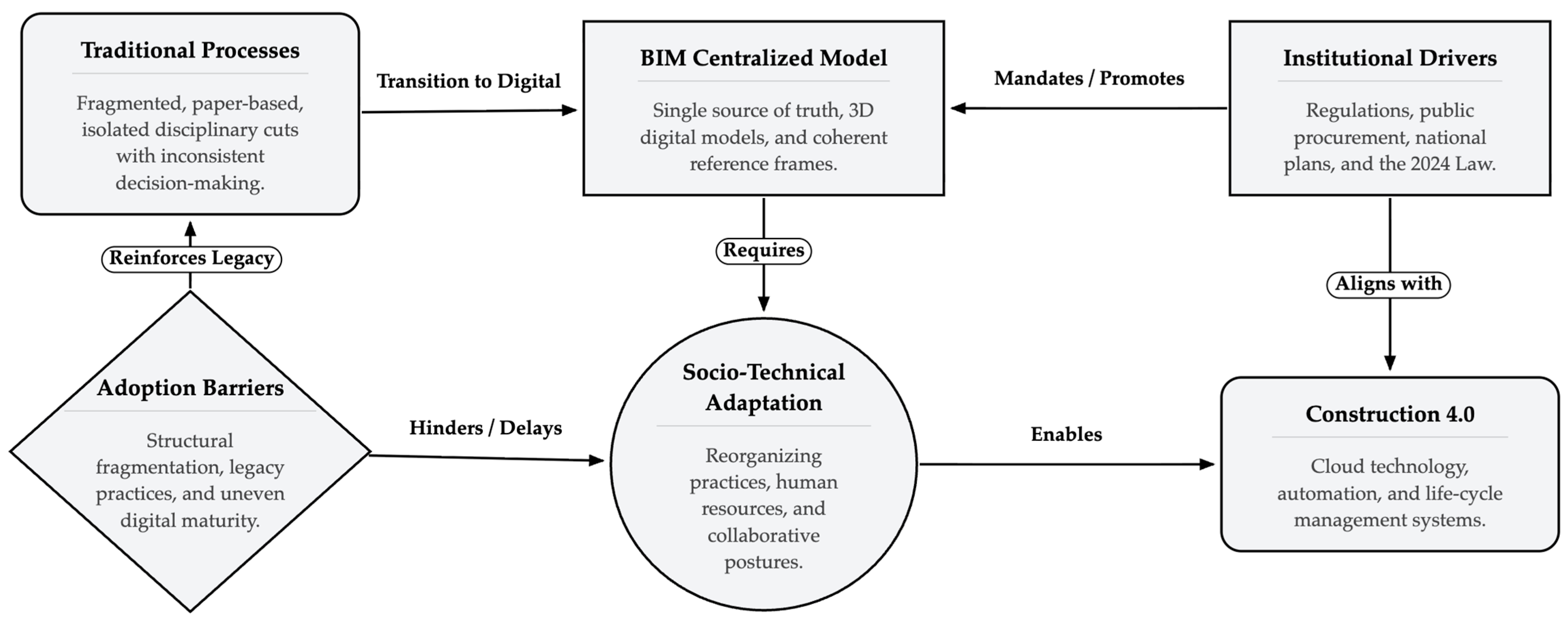
The adoption of BIM cannot therefore be regarded as a single uniform, smooth sequence, something which is the same for all. Seemingly, it is rather a phenomenon of irregular outlines, born of a mixture of technical, organizational and institutional factors. From that point on, the very difficult nature of adoption suggests that analytical infrastructures are invoked to follow trajectories of events and the various interactions between dimensions, within organizational contexts in which structures are distributed, and in which resources agglomerate and redistribute, not so much in a linear flow, but in successive decisions taken in the network, as illustrated in
Figure 3. This figure shows a conceptual mapping of BIM adoption dynamics, illustrating the transition from fragmented traditional processes to a centralized Construction 4.0 paradigm, mediated by socio-technical adaptations, institutional drivers, and structural barriers.
2.2. BIM Adoption in SMEs
According to the European Commission Recommendation 2003/361/EC [
34], Small and Medium-sized Enterprises (SMEs) comprise micro-enterprises employing fewer than 10 persons, small enterprises employing fewer than 50 persons, and medium-sized enterprises employing fewer than 250 persons, subject to turnover and balance-sheet criteria. Although grouped under the common designation of SMEs, these categories do not constitute a homogeneous group, and may differ considerably in terms of financial resources, staff capacity, project characteristics, organizational maturity, and digital readiness. Such differences are particularly relevant in the context of BIM adoption, as they influence firms’ ability to invest in technology, develop internal competencies, and sustain organizational change.
Consequently, understanding the specific characteristics and constraints associated with SMEs is essential for interpreting the challenges and opportunities related to BIM adoption in the construction sector.
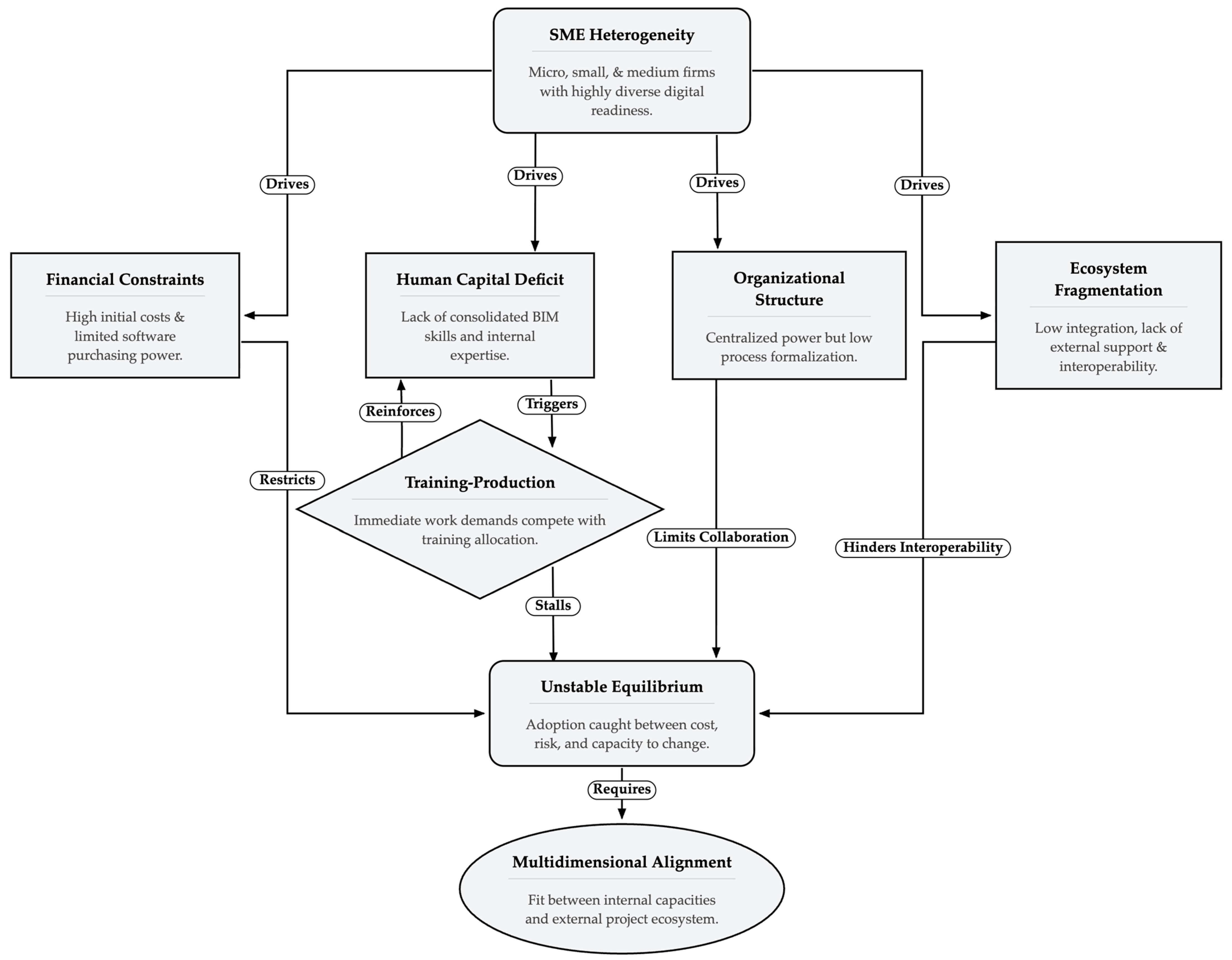
BIM presents SMEs with challenges that largely differ from those faced by larger companies. The construction sector is, by nature, a universe where small and medium firms predominate; owing to their small size, coupled with a very day-to-day operation, this tends not to facilitate the movement of these organizations to more demanding digital technologies, beyond structural and organizational barriers. In certain contexts, the adoption is thus caught in an unstable equilibrium between cost, risk and real capacity to absorb change.
Beyond scale-related limitations, the literature describes some structural problems that seem to weigh on the digital readiness of SMEs. For example, there are no instruments to measure this readiness, there is low integration with the ecosystem in which the company operates, and there is an even deeper gap of external support for the implementation of innovations. Combined, these dimensions suggest that the trajectory of BIM, when passing through SMEs, tends to depend less on intentions and more on concrete conditions of support, interoperability and organizational learning [
19,
21].
In this context, the ability to ensure effective communication among systems and project participants becomes particularly important. Interoperability refers to the ability of different software systems and stakeholders to exchange, interpret, and use information consistently, without loss of meaning or functionality. By supporting the continuity and reliability of information flows, interoperability contributes to coordination and collaborative processes across the project lifecycle [
1].
Financial challenges do not affect large companies only; SMEs are also feeling it, often in a more acute way, either because the purchase capacity of software and digital systems is limited, or because the training related to BIM requires time and resources that, in practice, compete with current production. Consequently, it is possible to see how economic restrictions influence the trajectory of these organizations, pushing them for entry into BIM or, alternatively, acting as a brake on their adoption and development of internal processes. Here we have an often-used starting point that seems to persist in a lot of organizations. The initial perception tends to associate BIM with very high costs, and several companies do not know, or look with skepticism on, the economic benefits that the investment could generate in the long term. The doubt is not only accounting, it is cultural, because it forces people to estimate gains that do not always appear at the moment in the work, but that may emerge in coordination, the reduction of backlogs, and in the discipline of the flow of information [
15].
A further dimension relates to human capital, especially in terms of competences. Many SMEs do not have in their services workers with sufficiently consolidated BIM knowledge and skills. When this happens, the organization becomes especially vulnerable to a lack of training and to how the company internally sets priorities. In practice, training ends up competing with immediate demands for production and work, and this competition discourages the allocation of necessary resources to organize training events. In other words, the problem is not only one of a lack of qualified people, but that this lack tends to feed back: without training, one does not create internal capacity, and without internal capacity it becomes even harder to justify training, in a spiral that can become difficult to break [
16].
The lack of training opportunities strengthens the continuity of previous, conventional practices that are, therefore, more trustworthy and less risky. When learning does not materialize in accessible offers, with content adjusted to what the industry really needs, the most immediate path is to remain where one already masters the work, even if it limits future gains. Moreover, this effect seems to be enhanced when there is, in practice, a mismatch between BIM, which is well described in the literature, and sectoral needs. This misalignment tends to become particularly noticeable in situations where there are no career development paths for the employee that seem credible, but, above all, when the functional changes linked to the digital transformation become unclear or even contradictory. So, the uncertainty about the “before and after” of the function weighs as much as the lack of aptitude, and pushes organizations to postpone change [
19,
35].
At the organizational level, the internal structure of SMEs usually presents two very particular features: a lower formalization of processes and a more centralized distribution of power, with top management having the greatest power of decision. On one hand, these elements can increase the ability to adapt rapidly to new technologies, because layers are reduced and decision pathways shortened. In certain cases, this even helps the company “move” fast. However, the lack of prior workflow development tends to act as a brake. Without routines designed, tested, and made compatible, it becomes difficult to build integrated collaborative flows, those that BIM requires to make coordination not depend only on individual efforts or informal contacts. In addition, when SME acts in a networked system and with multiple agents, where the choices and behaviors of every party condition the final outcome, internal centrism may be insufficient. The decentralization among actors and differences in levels of digital maturity tend to restrict the realization of gains, as each organization seeks to look after only itself.
What is intended as a common advantage, coordination and consistency may not materialize, and the risks of failure in implementation increase, especially when the interfaces and agreements for exchanging information are not stabilized [
36].
In the Portuguese context, this configuration tends to acquire relevance, given that the construction sector is largely composed of SMEs operating in fragmented value chains, where coordination among intervenors rarely stabilizes beyond the duration of each project [
29]. In such conditions, the difficulties described above do not appear as isolated organizational traits; rather, they seem to reflect structural features of the national sector, which may help to explain why BIM adoption among Portuguese SMEs has been progressing more slowly than the regulatory framework would suggest [
12,
27].
Therefore, one should not assume an “automatic” position of BIM within the SMEs from internal traits only. The availability, the rhythm, and the meaning of the adoption appear to depend, at the same time, on internal dimensions of organizational constraint and on the position of the company in the ecosystem, in the external dimension. The two readings, when separated, tend to miss the essential. Consequently, this means that adoption requires a more multidimensional lens, capable of integrating analyses into organizational levels and structural levels. It is not enough to ask if the company is “prepared”. It is important to understand how change is supported, how resources are organized, and what kind of fit exists between internal capacities and the conditions imposed by the project externally. More precisely, recent research on SMEs tends to consider the adoption and implementation of BIM as gradual processes, accompanied by management. In that context, so that the initiative does not suffer a failure of alignment, there needs to be an effective commitment on the part of the hierarchy; an adequacy of implementation paths regarding the way the company operates; and a finer adjustment between internal competences and the external ecosystem of the project. In practical terms, it is in this fitting geometry that the persistence of change often plays out, as well as its survival when confronted with the work [
20,
37].
A similar interpretation has been reported in other fragmented construction markets, where SMEs face comparable difficulties related to limited resources, uneven digital maturity, and the need to align internal capabilities with external project ecosystems. In particular, Ejdys et al. [
32] emphasized that BIM adoption in SMEs should be understood as a multidimensional and context-dependent process, while Olanipekun and Sutrisna [
24] highlighted the fact that digital transformation in construction requires adaptive and context-sensitive implementation approaches. Likewise, Wang et al. [
25] argued that the transition towards Construction 4.0 continues to be constrained by structural and organizational barriers in many fragmented construction industries. Comparable challenges have also been identified by Vidalakis et al. [
20], who stressed that SMEs often experience difficulties associated with limited resources, lack of expertise and the need to adapt implementation strategies to their specific organizational conditions. In addition, Karampour et al. [
38] reported that institutional, organizational and project-related factors continue to influence BIM diffusion patterns within the Italian construction industry, highlighting challenges that are also characteristic of fragmented construction markets. These observations reinforce the view that the difficulties encountered by Portuguese SMEs are not unique, but reflect broader dynamics shared by several fragmented construction markets. These findings suggest that the challenges experienced by Portuguese SMEs are not unique, but rather reflect broader patterns observed in several construction markets undergoing digital transformation.
Figure 4 illustrates the Multidimensional Framework of BIM Adoption in SMEs, consisting of a schematic mapping of the internal constraints, external ecosystem barriers, and the feedback loops that govern BIM adoption dynamics in Small and Medium-sized Enterprises.
2.3. Barriers to BIM Adoption
The adoption of BIM is often hindered by barriers of various natures within organizations. They are not so easily reduced to a single kind of problem, but rather have overlapping effects that interact with each other and change at different levels and which are of different dimensions. In general, these obstacles interact with various technological, financial, organizational and people-related categories. When failure occurs, it is seldom explained by a single cause. It seems, before everything else, to result from how the material conditions, the internal decisions, the available competences and the way the actors understand the change combine in the daily life of each organization [
17,
39,
40]. This scenario tends to become even more intense within SMEs, where internal and external limitations cross in a very tight way. Due to lack of skills, little formalization of procedures, lack of resources, and sometimes precarious support from the outside, things touch each other and reinforce each other to such an extent that they almost leave little room for quiet adaptation. Nevertheless, overall, the totality of the limitations can quickly lead to adverse results, or at least a “ranking”, which is not verified upon the first attempt [
41].
In this sense, this framework is further supported by the increasingly widespread conviction that BIM works as a socio-technical phenomenon and at company level. From this perspective, technological barriers are no longer seen merely as needs for software, format, or interoperability. They seem to work more like problems of governance, information management, organizational maturity, and strategic alignment, within the organization itself.
In this context, information governance refers to the set of policies, responsibilities, procedures, and decision-making mechanisms established to ensure the quality, consistency, security, and effective management of information throughout a project. Effective information governance is intended to support coordination among stakeholders and to provide a reliable basis for collaborative decision-making [
42].
In other words, when the adoption fails, this can be because the decision criteria are unclear, or because the information processing has not been stabilized, or because the business strategy is not translated into operational priorities that are BIM-compatible. In this case, it is the technology that becomes the point of rupture, and not its only cause [
25,
28,
30].
In general, these difficulties can be grouped into technical, financial, and organizational barriers, and barriers related to people and culture. Each category reveals a different facet of the same issue. Technological systems concern the elements allowed and not permitted, because of incompatibilities, between the implementers of integrated systems (preparation) and multiple users (interoperability). Financial dynamics impact the pace of choices and the breathing of implementation. Organizational norms impact the way the company operates, defines roles, and organizes collaboration. Finally, organizational barriers related to people and culture shape the willingness to change, the confidence in the new, and the ability to learn from mistakes, so that change does not dissolve in ephemeral attempts.
2.3.1. Technical Barriers
The most frequently encountered technical hurdle for BIM adoption is related to the readiness of technological systems and the complexity of the equipment involved. As a consequence, it requires a certain level of expertise, especially to solve problems of interoperability between software (problems that are usually not resolved by goodwill only). When the exchange fails, the model ceases to be “one”, and becomes a set of parts that do not fit well into one another, and this mismatch costs time and energy. The technological barriers tend to worsen in the case of SMEs. Getting their tech systems ready for BIM adoption may not work, due to lack of infrastructures or difficulties in managing complex integrations. Moreover, many actors do not appear to have the necessary capacity to manage that much data, from its storage to its organization and provision, nor to allow those processes to continue. It is not just a matter of “having the software”, but of being able to sustain, with methodology, the scaling and informational flow that BIM summons [
17].
The incompatibility between the software systems used by the different stakeholders in a project tends to produce effects in chain. Information is lost, data inconsistencies emerge, and the collaboration flows become inefficient, giving rise to rework and diverging interpretations, which replace the original intention of coordination. Consequently, the technical deficiencies in the development of BIM can delay and hinder the incorporation of technologies in the construction industry. The way of working does not merely become “slower”; the process becomes fragile. There are interfaces that deliver and which, when they do not deliver, turn the promise of integration into a series of adjustments made to the pace of the construction site [
3,
41].
Other studies identify technical barriers that go beyond the performance of software. The problem appears to lie, in the first instance, with a lack of clear interoperability standards, together with incoherent information-exchange structures, and errors in the common data structure that should support a coherent digital workflow among the stakeholders. When these common bases are not defined, every organization tries to solve coordination with its own arrangements, and these seldom “converge” well with each other. The outcome tends to be a fragmented digital collaboration process, in which model consistency and work continuity rely less on shared rules and more on, often time-consuming, local negotiations [
43,
44,
45]. This issue appears particularly relevant in fragmented environments such as Portugal, where SMEs frequently coexist with intervenors operating at different levels of digital maturity and where coordination across the value chain remains highly dependent on project-specific arrangements. These broader structural characteristics provide a useful background for understanding how such technical challenges manifest themselves in the Portuguese construction sector.
In fragmented contexts such as Portugal, these technical constraints tend to acquire contours of their own. The gradual incorporation of BIM-related requirements into the national regulatory framework [
10,
11] has not been accompanied, in equal measure, by a stabilization of interoperability practices along the value chain, where SMEs commonly coexist with participants exhibiting diverse levels of digital maturity [
12,
27]. In such conditions, the absence of shared exchange protocols tends to be felt less as an isolated software limitation and more as a recurring friction point in inter-organizational coordination.
In this regard, effective digital collaboration increasingly depends on the existence of structured environments capable of supporting the management and exchange of project information among stakeholders. A Common Data Environment (CDE) refers to a shared digital platform used to collect, manage, exchange, and distribute project information, ensuring that participants work with consistent and up-to-date information throughout the project lifecycle [
1].
When such environments are not clearly established and agreed upon, coordination tends to rely on fragmented and project-specific arrangements, in particular when the common data environment is not contractually defined from the outset.
2.3.2. Financial Barriers
Among SMEs, finance emerges as the most cited barrier to BIM adoption. This issue appears particularly significant in fragmented construction environments, where firms often operate with limited financial resources and where investment decisions are strongly influenced by short-term project conditions. Such characteristics are especially evident in countries such as Portugal, whose construction sector is largely composed of SMEs and micro-enterprises, frequently operating with narrow margins and project-based arrangements [
12,
46] When, however, it is not evident when the benefits materialize, or how they accumulate, particularly in the short term, the cost associated with the software, the hardware, the training, and the creation of a new infrastructure gains weight as a decisive barrier to adoption. It is uncertain, not only regarding the amount of investment. It also focuses on the ability to transform that cost into operating gains that are felt early enough to justify the decision, in a context in which the Treasury rarely tolerates long bets. Therefore, the hesitation becomes rational, although the technological promise may be quite tempting, in theory [
3,
40].
As there is not often a model for return which can easily be quantified from an economic point of view, BIM tends to be perceived as a high-risk investment, and one in which entry by the SMEs becomes improbable. Hesitation seems to come less from a technological refusal and more from the difficulty of translating into immediate financial terms what BIM could return in the form of measurable gains. Considering this absence of clear indicators, companies tend to prefer areas of investment where returns are likely to emerge in the short run, with more visible evidence for management. Accordingly, investing in a technological leap with a lengthy maturation, such as BIM, becomes less appealing, even though it can create real possibilities in the long term. The central issue, therefore, is not just the money. It is the ability to estimate the near future and render it defensible [
17,
41].
This displacement is reinforced by another aspect, almost methodological. Many current papers about the economic value of BIM investment use generic approaches instead of implementing specific methodologies for each organization. Although the literature has been building up evidence on collision detection, whole-life cost efficiency and design-coordination improvement, quantifying the value of BIM-related investment, remains an open problem. In some respects, the difficulty can be read as a consequence of the very contextual character of return. If the earnings depend on the work methods, on the level of digital maturity, and on the agreements between the interveners, then a too-universal metric tends to be inappropriate. As a result, quantifying the value remains a challenging bet, which requires well-defined assumptions and measurements that are not easily transferable from company to company [
47,
48].
In this context, Portugal particularly appears to reinforce this reading. In a sector predominantly composed of SMEs, often operating with narrow margins and on a project-by-project basis [
29], the difficulty in projecting returns over the medium and long term tends to weigh particularly heavily on the investment decision. Even when the regulatory framework signals a clear direction [
10,
11], the absence of mechanisms that mitigate the initial cost or distribute risk across the value chain seems to keep many companies in a position of waiting, in which BIM is recognized as relevant but is postponed in favor of more immediate priorities [
12].
2.3.3. Organizational Barriers
This factor relates to how the internal space of the organization is equipped and to the distribution of labor inside the entities. Accordingly, it implies the introduction of relevant substitutions in previously stabilized and represented workflows, as well as in formerly taken-for-granted definitions of roles [
2,
6]. Besides that, the change has an effect on coordinating participants, because mechanisms of collaboration that were previously based on separate documents and expert routines now depend on more demanding, frequent, and model-informed articulations. Therefore, the reorganization does not just affect tools. It adjusts what is meant by responsibility, who decides what, and how the work synchronizes along the process.
More centralized decision-making structures may still compound these barriers, as they hinder the incorporation of BIM into the core organic structure and daily operations. In this situation, innovation and informal processes that sometimes sustain change, ultimately do not find their own channels. BIM is, thus, limited to a more peripheral level, being linked to isolated initiatives and not to a continuous way of operating [
40]. The lack of explicit strategies for digital transformation also interferes with the way the organizations embrace BIM-based methodologies. When no guidance is assumed, whether in terms of priorities or resource allocation, teams tend to fill the void with known practices. Thus, the adoption begins to depend on the individual’s dedication and their improvisation skills, and not on a pre-planned course. Such a situation is related to the agency emerging within the organization, to the governance of information at the level of the company, and to the internal capacity for alignment. In this context, structured information management frameworks have become increasingly important for supporting coordination and organizational consistency in BIM environments. Among these frameworks, ISO 19650 has emerged as an important international reference for information management practices.
ISO 19650 is an international standard for information management using BIM, establishing principles and requirements for the creation, exchange, organization, and governance of information throughout the life cycle of built assets. It provides a common framework intended to support collaboration and consistency among project participants [
42].
More specifically, it is associated with the management and governance issues of information in accordance with ISO 19650, from which it is expected that the standard requirements will be translated into verifiable routines [
28,
29,
49]. Despite this, it seems to be inferred from the reported difficulties that many firms continue to struggle to implement these requirements in their organizational context. That is to say, the problem is not just that it is known. On the contrary, we must manage to make it operational, that is, define responsibilities, modes of working, and control mechanisms, in order not to let BIM be left to the suspense of a generic intention. Such organizational challenges appear to be particularly pronounced in fragmented construction environments, where the coexistence of different levels of digital maturity and the persistence of established work routines tend to hinder the institutionalization of information management practices. These conditions are especially evident in countries such as Portugal, where many SMEs continue to rely on legacy practices and where the transition from regulatory requirements to structured organizational procedures remains uneven [
12,
27] These broader characteristics provide an important background for understanding how organizational barriers are manifested in the Portuguese construction sector.
In Portugal, these organizational difficulties seem to be compounded by the coexistence of legacy practices with the new digital requirements [
27]. In many SMEs, the formalization of information management processes in line with ISO 19650 is still incipient, and the translation of regulatory requirements into verifiable internal routines tends to depend more on individual initiatives than on consolidated strategies [
12]. The result is that, even where the intention to adopt BIM exists, governance of information often remains a fragile dimension, vulnerable to the rotation of teams and to the variable demands of each project.
2.3.4. Human and Cultural Barriers
Various human and cultural challenges associated with BIM seem to be linked to conservatism and an unclear understanding of what BIM actually offers. Sometimes it is not an open rejection, but an incomplete reading, which is the case when what a digital promise offers is not integrated into the way teams work and decide things [
16,
17,
41]. In addition to this, there is a lack of skills in the resources that make up the organization, as well as a low availability of resources aimed at innovations and changes within the organizations. When technical knowledge does not exist, or only exists in residual form, the change tends to become demanding to the point of no longer being sustained, and the organizational culture, instead of learning from the new, tends to look for security in the known.
In fact, when a culture is institutionalized, it creates a contradiction between the individual and the organizational value and belief systems. It is not just a matter of attitude, but also of incentives and habits that became ingrained over the years. The most compelling evidence of these barriers tends to emerge in contexts where BIM education is poorly articulated, and where the links between education and industry are weak. In those places, professionals rarely have a clearly mapped-out development path, whether it be to acquire skills for understanding function changes, or for learning how to intervene in collaborative digital practices, with shared rules and common expectations [
19,
35].
Such conditions appear to be particularly significant in fragmented construction environments, where the transfer of knowledge from academia to practice is uneven and where established working habits tend to shape attitudes toward digital change. These characteristics are especially evident in countries such as Portugal, where SMEs frequently face difficulties in accommodating learning curves and where traditional practices continue to influence day-to-day operations [
12,
27]. These broader conditions provide an important background for understanding how human and cultural barriers are manifested in the Portuguese construction sector.
In the Portuguese context, these human and cultural barriers appear to gain particular expression in the articulation between training offer and sectoral practice. Although BIM has been progressively incorporated into academic curricula [
31], the transition to the professional environment does not always occur in a continuous way, especially in SMEs, where there is rarely room to absorb learning curves without compromising current production [
12]. To this is added a sectoral culture still strongly anchored in established working methods [
27], in which the change in routines tends to be perceived less as an opportunity and more as an additional risk, particularly when the expected gains are not immediately visible in the day-to-day work of the construction site.
The studies published so far on the challenges of adopting BIM followed various and, to some extent, complementary approaches, looking at the problem from different angles.
Table 1 shows a structured summary of the existing literature on barriers to BIM adoption, capturing the most frequent issues, their likely effects, and the references that support them.
Many of the publications are aligned with the idea that BIM adoption barriers are multifaceted and deeply conditioned by the context. The literature tends to highlight the need for a methodologically structured and integrative approach capable of organizing dimensions that, in practice, happen to intertwine through the process and do not work as separate chapters. In addition to those already briefly mentioned, recent works suggest that SMEs do not only face obstacles related to digital readiness, information governance, interoperability standards, and internal transformational capacity of the firm, when they make use of BIM. It can be inferred from this that the problem is not only to “enter” the BIM, nor only to “operationalize” the method, once started. Some impediments emerge prior to the implementation, while others extend well beyond, as they tend to affect the coordination of work, the circulation of information, and the translation of organizational expectations into day-to-day decisions [
18,
25,
28,
43].
3. Methodology
This study focuses on BIM adoption by construction SMEs, with specific reflection on the Portuguese context, where the fragmented structure of the construction sector constitutes a relevant contextual condition for understanding the pace, scope, and unevenness of digital transformation. Given the multidimensional nature of BIM implementation, the study adopts a literature-based analytical approach to explore, synthesize, and articulate the main patterns identified in previous research.
The choice of this methodological approach does not imply that BIM adoption by SMEs can be fully explained at a conceptual level. Rather, it reflects the exploratory stage of the investigation and the need to organize the factors already identified in the literature before proceeding to empirical validation. The purpose is therefore to clarify the main dimensions of the phenomenon, examine their possible interdependencies, and establish a more coherent basis for subsequent empirical work, supported by better-defined analytical criteria.
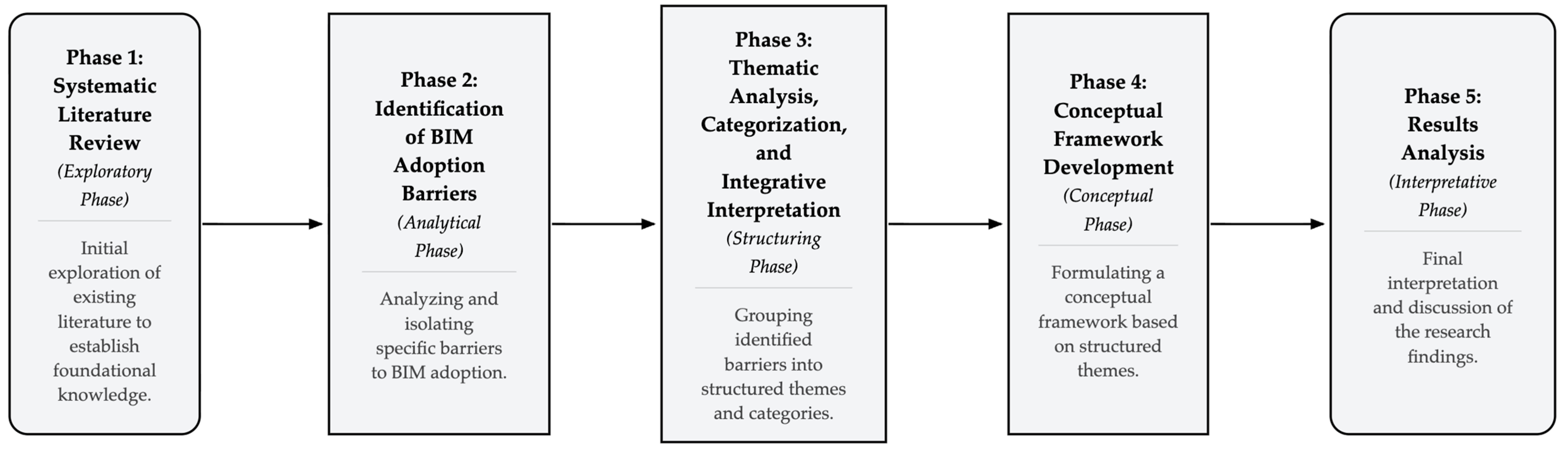
The methodological structure adopted in this study is presented below.
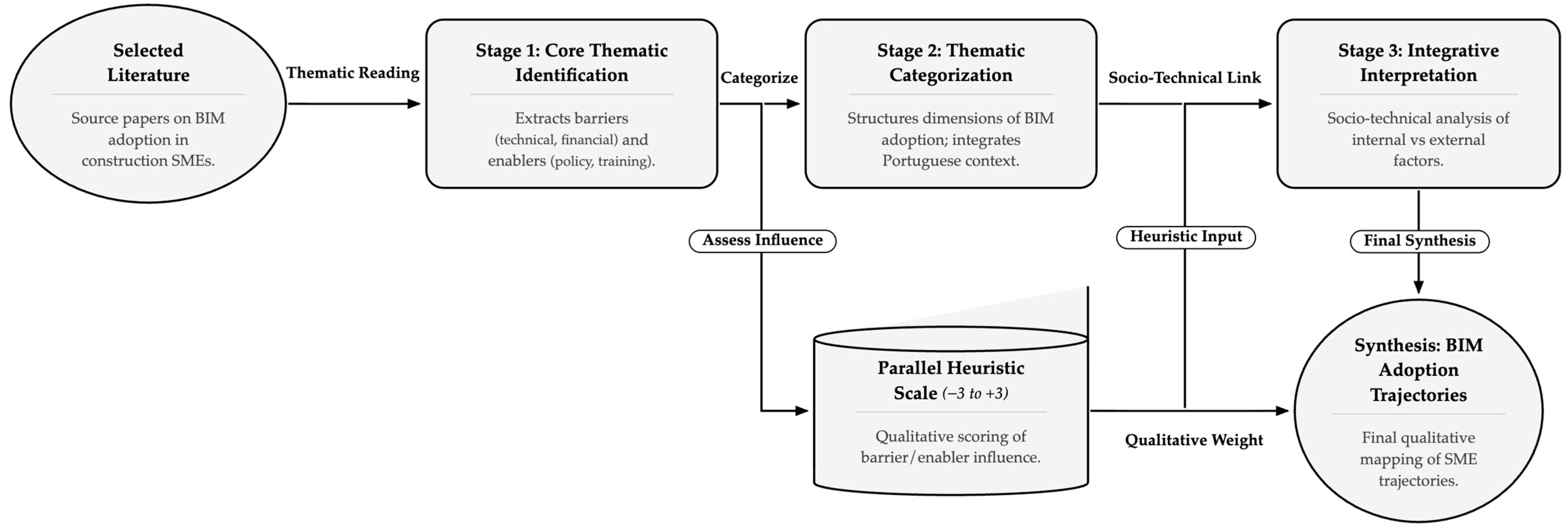
Figure 5 illustrates the multi-stage developed methodology, from a literature review through thematic analysis and conceptual development to findings interpretation.
3.1. Research Design
The study adopts a qualitative, exploratory, and conceptual research design. This design is appropriate because BIM adoption by SMEs in fragmented construction environments involves technical, financial, organizational, human, and contextual dimensions that cannot be adequately understood through a single analytical category. In this context, BIM implementation is interpreted as a socio-technical process, shaped by the interaction between technological capability, organizational readiness, financial constraints, professional competencies, information management practices, and sector-level conditions.
At this stage of the research, a purely quantitative design would be insufficient, since the relations between these dimensions cannot yet be assumed to be stable, measurable, or independent. The study therefore does not seek to measure adoption levels, estimate causal weights, or produce statistically representative conclusions. Instead, it seeks to identify the main conceptual relationships that emerge from the literature and to organize them into an analytical framework that can support future empirical inquiry.
Exploratory research is particularly useful when a phenomenon remains theoretically dispersed, context-dependent, or insufficiently consolidated. It allows the researcher to clarify concepts, identify recurring patterns, compare explanatory dimensions, and develop a framework capable of guiding subsequent empirical work [
50,
51].
This orientation is also consistent with previous studies on BIM and digital innovation in construction, which have interpreted adoption as a process conditioned by organizational capacity, project delivery arrangements, procurement models, supply-chain relations, and wider institutional environments [
52,
53].
The evidence used in this study is therefore drawn from the literature in order to support conceptual synthesis, rather than statistical generalization. The reviewed sources are used to identify recurrent barriers, enabling conditions, and relational patterns associated with BIM adoption by SMEs. Particular attention is given to the interdependence among technical, financial, organizational, human, and contextual factors, since the effectiveness of BIM implementation depends on the combined influence of these dimensions, rather than on isolated technological readiness.
The paper does not claim to present a definitive empirical map of BIM use in Portugal, nor does it attempt to represent the entire SME construction sector. Its contribution lies in developing a theoretically grounded framework that may guide future empirical research, including surveys, interviews, case studies, maturity assessments, and comparative studies in fragmented construction contexts. In this sense, the research design functions as a preparatory analytical stage: it organizes the existing literature, clarifies the main dimensions of analysis, and proposes a structured basis for subsequent empirical testing and refinement.
3.2. Data Collection and Sources
In accordance with the exploratory research design outlined above, data collection was based on a structured review of academic and institutional sources addressing BIM adoption, construction SMEs, digital transformation, information management, and fragmentation in the construction industry.
The review was designed to support the development of an exploratory conceptual framework, rather than to produce a statistically generalizable synthesis of empirical findings. Accordingly, the selection of sources was guided by thematic relevance, conceptual contribution, and contextual adequacy regarding the research problem.
The academic literature was identified through reference databases commonly used in construction management and built-environment research, including Scopus, Web of Science, and ScienceDirect. The search strategy combined keywords associated with the central dimensions of the study, namely, “Building Information Modeling” or “BIM”, “SMEs” or “Small and Medium-sized Enterprises”, “BIM adoption”, “barriers”, “enablers”, “digital transformation”, “information management”, “interoperability”, and “industry fragmentation”. These terms were used individually and in Boolean combinations, mainly through the operator AND, in order to refine the results and identify publications directly related to BIM adoption in organizationally constrained and fragmented construction environments. Examples of search strings included “BIM AND SMEs”, “BIM adoption AND barriers”, “BIM AND enablers”, “construction AND fragmentation”, “BIM AND interoperability”, and combinations including “Portugal” or “Portuguese construction sector” where national contextualization was relevant.
The review included peer-reviewed journal articles, conference papers, books, book chapters, institutional reports, policy documents, and regulatory sources. Priority was given to publications written in English and published between 2009 and 2026, since this period covers the consolidation of BIM as a recognized field of research and its subsequent expansion into debates on digital transformation, standardization, interoperability, and organizational adoption. Earlier or foundational sources were retained when their conceptual contribution remained necessary for framing BIM implementation, maturity, and industry coordination. In this regard, works such as Succar’s BIM framework and the BIM Handbook were included because they continue to provide essential conceptual foundations for understanding BIM as an information-centered process involving multiple stakeholders, organizational capabilities, and delivery practices.
The selected literature was organized into five main groups. The first group comprised foundational BIM literature, used to define BIM, clarify its expected benefits, and situate it within broader debates on coordination, productivity, and information management. The second group included studies on BIM adoption, barriers, drivers, maturity, and implementation models, with particular attention to the technical, financial, organizational, and human factors affecting adoption. The third group focused on SMEs and digital readiness, in order to account for the specific constraints faced by smaller firms, including limited financial capacity, training needs, reduced access to specialized expertise, and uncertainty regarding return on investment. The fourth group addressed fragmentation in the construction industry, including literature on loosely coupled systems, interorganizational coordination, temporary coalitions, and organizational divisions in BIM-enabled construction. The fifth group incorporated sources on interoperability, OpenBIM, ISO 19650, information management, and stakeholder communication, since BIM adoption depends on the capacity to structure, exchange, validate, and govern information across dispersed actors.
In addition to academic publications, policy documents and institutional reports were analyzed to understand the broader regulatory and strategic environment in which BIM adoption takes place in Europe and Portugal [
44,
52]. This contextualization is particularly relevant because BIM implementation has increasingly been shaped by public procurement, standardization, administrative reform, and sector-level digitalization policies. At the European level, the inclusion of Directive 2014/24/EU and public-sector BIM guidance allows the study to relate BIM adoption to procurement requirements and institutional leadership [
7,
52]. At the Portuguese level, regulatory developments and recent studies on BIM implementation in public procurement and late-adopting EU contexts were included to connect the international literature with the specific conditions affecting the Portuguese construction sector [
10,
11,
12].
The selection process therefore combined recency with conceptual relevance. Recent publications were prioritized whenever available, especially for topics such as SME digitalization, BIM policy trends, interoperability, ISO 19650, and Construction 4.0. Foundational works were retained only when they provided concepts that remained necessary for the theoretical framing of the study. This approach made it possible to connect long-standing discussions on BIM maturity and industry coordination with current debates on digital readiness, organizational transformation, information standards, and fragmented delivery environments.
Rather than following a formal systematic review protocol, the study adopted a structured exploratory review procedure. This choice is consistent with the objective of identifying, comparing, and interpreting recurrent barriers and enabling factors across heterogeneous sources, instead of measuring effect sizes or testing causal relationships. The reviewed sources were therefore examined through an interpretive scoring framework, which classified the evidence according to the main analytical dimensions of the study: technical, financial, organizational, human, and contextual factors. This procedure allowed the literature to be used as a basis for conceptual synthesis, while preserving the exploratory character of the research.
The references were organized and managed using Mendeley Reference Manager. The sources incorporated into the paper correspond to those considered most relevant for supporting the thematic analysis, the interpretive scoring process, and the conceptual framework developed in the study. By bringing together foundational BIM theory, SME-oriented adoption research, literature on construction fragmentation, information management studies, and European and Portuguese institutional sources, the review provides a coherent basis for understanding BIM adoption by construction SMEs as a socio-technical process shaped by interdependent constraints and enabling conditions.
To make the selection logic explicit, the reviewed sources were grouped according to their methodological function within the exploratory review, as shown in
Table 2.
This organization of sources allowed the review to connect BIM theory, SME-specific constraints, construction industry fragmentation, information management, policy frameworks, and the Portuguese context, within a single interpretive structure. The resulting classification provided the basis for identifying recurrent barriers and enabling factors, and for organizing them according to the technical, financial, organizational, human, and contextual dimensions adopted in the analytical framework.
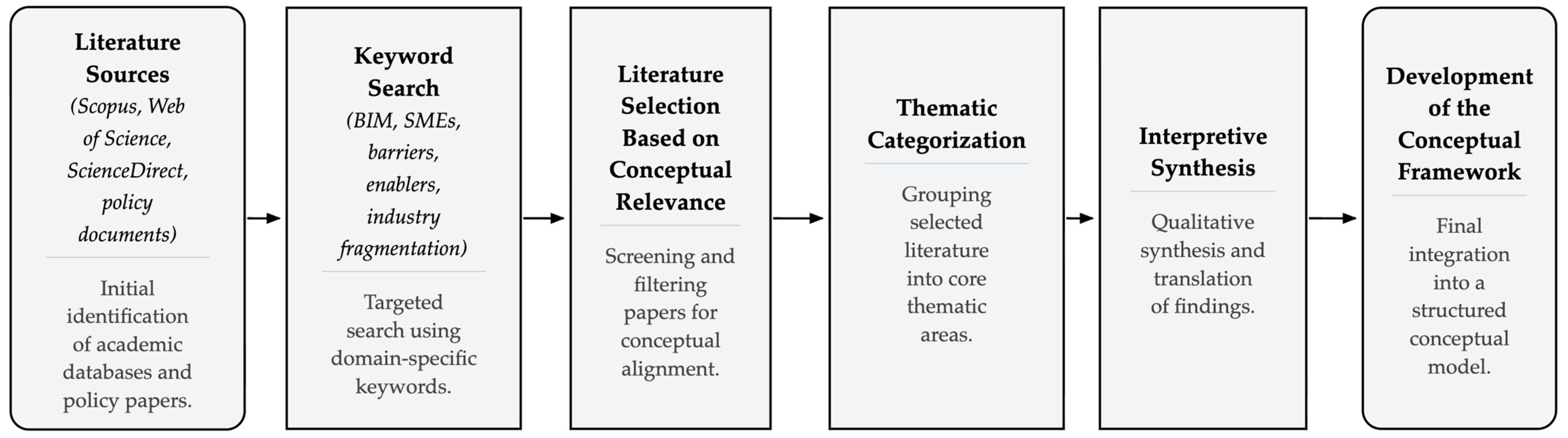
The methodological approach adopted in the present study is summarized in
Figure 4.
Figure 6 illustrates the methodological approach adopted in the present study, showing the progression from literature sources to thematic categorization, interpretive synthesis, and development of the conceptual framework.
3.3. Data Analysis Method
The analysis was conducted through a thematic and integrative reading of the selected literature. The purpose was to identify, classify, and synthesize the main themes emerging from the reviewed sources, in order to understand BIM adoption by construction SMEs in a clear and comparable manner.
The analytical procedure was developed in three stages. The first stage consisted of core thematic identification. Concepts directly related to BIM adoption were extracted from the reviewed literature and grouped into broad categories of technical, financial, organizational, and human barriers. Enabling factors associated with policy support, training, collaboration, information management, interoperability, and technological conditions were also identified. At this stage, particular attention was given to the conditions affecting SMEs and to the role of fragmentation within the construction industry.
The second stage consisted of thematic categorization and analytical structuring. The identified themes were organized into dimensions with distinct analytical meanings, allowing the review to cover the different ways in which BIM adoption is conditioned across construction SMEs. This stage provided the basis for the structure of the literature review and for the subsequent interpretation of barriers and enabling factors. Throughout the process, the Portuguese context was considered as a contextual layer, rather than as an isolated empirical case, since the paper does not claim to provide a representative empirical mapping of BIM adoption in Portugal.
The third stage consisted of integrative interpretation. Instead of treating barriers and enablers as independent variables, the analysis interpreted BIM adoption as an interdependent socio-technical process. In this reading, internal organizational conditions, such as skills, resources, leadership, and digital readiness interact with external structural conditions, including procurement practices, market fragmentation, regulatory requirements, information standards, and supply-chain relations. The analysis therefore sought to clarify the way in which different factors combine, reinforce, or weaken one another in the adoption trajectories of construction SMEs.
This interpretive orientation is consistent with studies in construction management that have used structured interpretive models to analyze BIM adoption barriers and implementation risks [
55,
56]. It is also aligned with recent BIM studies that place information management, process modelling, communication structures, and stakeholder coordination at the center of implementation analysis [
28,
29].
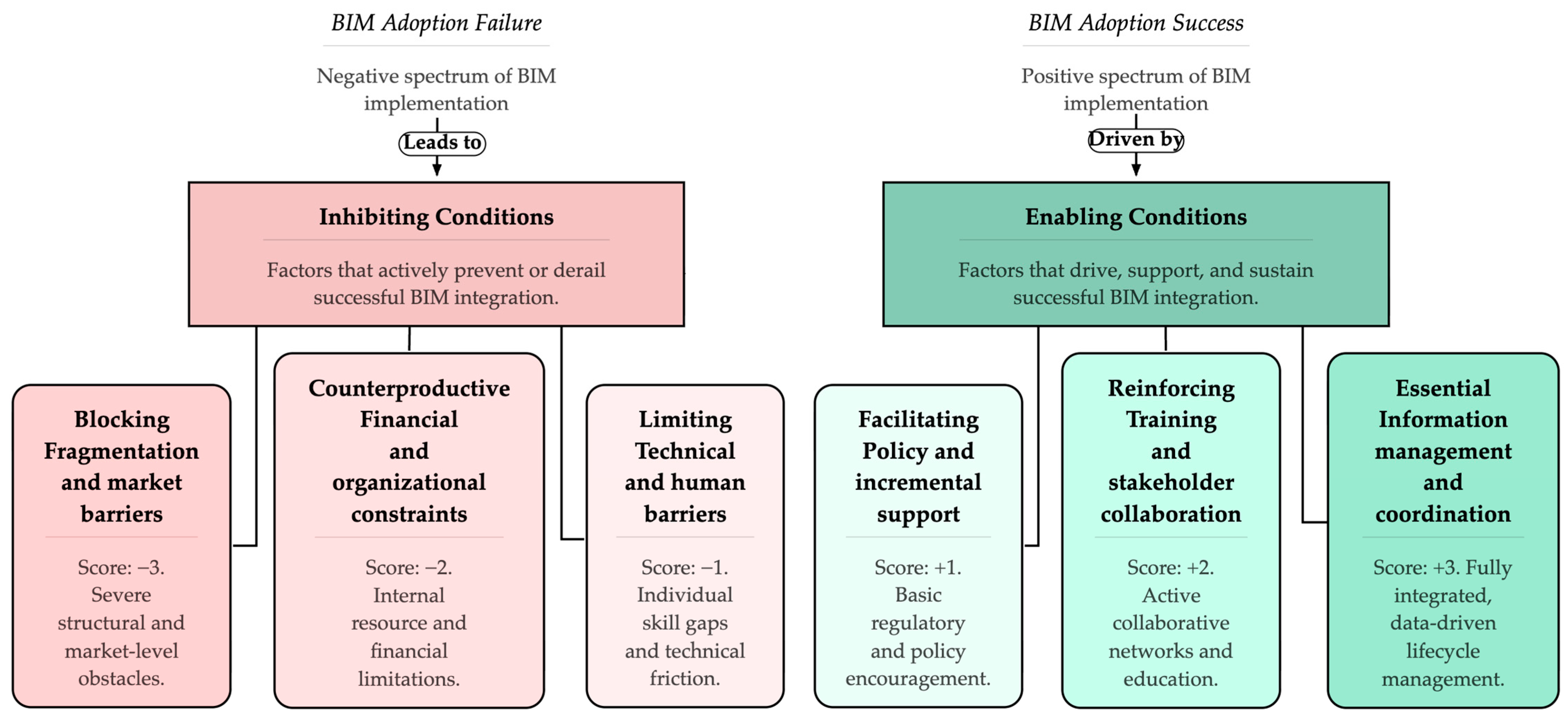
In parallel with the thematic and integrative analysis, a preliminary seven-point interpretive scale was used to assess the relative influence of the identified barriers and enablers on BIM adoption. The scale ranges from −3, understood as a strong structural barrier, to +3, understood as a strong structural enabler. Negative values indicate factors that constrain BIM adoption at different levels of intensity, while positive values indicate factors that facilitate, strengthen, or support the adoption process.
This scale was not used as a quantitative measurement instrument. Rather, it functioned as a qualitative heuristic device intended to support a comparative interpretation of the literature and to clarify the relative influence attributed to barriers and enabling conditions in construction environments shaped by fragmentation and by the presence of SMEs. Scores were assigned through interpretive synthesis, considering the frequency, consistency, and direction of the evidence reported in the reviewed sources. Factors repeatedly described as strongly constraining BIM adoption across different studies were assigned negative values, whereas factors consistently described as enabling BIM implementation were assigned positive values. Intermediate values were used when the influence of a factor appeared conditional, context-dependent, or ambivalent.
Figure 7 illustrates the Three-Stage Socio-Technical Framework for BIM Adoption in Construction SMEs, showing a systematic methodology combining thematic identification, categorization, and integrative socio-technical interpretation, supported by a qualitative heuristic scale to evaluate barriers and enablers.
Although this procedure does not eliminate interpretive judgement, it makes the classification criteria explicit and therefore increases analytical transparency. The scores should consequently be understood as provisional analytical categories, used to organize the discussion and prepare future empirical testing, rather than as definitive empirical scores. The interpretive scale used in this study is presented in
Table 3.
This scale provides a structured analytical framework for interpreting the relative influence of barriers and facilitators identified in the literature, and supports the integrative analysis developed in the following section.
Although
Table 3 presents the categorical definition of the interpretive scale,
Figure 8 illustrates the conceptual continuum through which the scale can be understood. The figure positions BIM adoption between strongly inhibiting conditions and structurally enabling conditions, showing that implementation in SMEs is not a binary outcome, but a gradual process shaped by the interaction of barriers, enablers, and fragmentation within the construction environment.
Figure 8 highlights the continuum between inhibiting and enabling conditions of BIM adoption. It emphasizes that BIM implementation in SMEs is not a binary outcome, but a dynamic process shaped by the interaction of barriers, enablers, and fragmentation within the construction environment.
4. Conceptual Findings and Discussion
The existing literature suggests that the adoption of BIM by SMEs in the construction sector should not be interpreted as an effect of a determining factor or simply the sum of independent variables. It is effectively a multidimensional process shaped through technical, financial, organizational, and human conditions in a fragmented sector where the impact of each factor may transcend firms, project stages, and supply-chain relationships.
More importantly, this study, therefore, does not treat barriers to adoption, enabling factors and fragmentation as independent dimensions. They are not seen as disconnected elements that contribute to the individual functioning of each one, but rather as interrelated components of a socio-technical system. In certain instances, a particular constraint may reinforce a different barrier or inhibit an enabling factor. This reading would suggest that the understanding of BIM adoption at this exploratory stage would require a focus on combinations, interactions, and contextual conditions, rather than merely counting the frequency with which they are mentioned.
This section’s interpretations come from commonalities and correlations detected in the literature selected. Consequently, they should be interpreted as analytical propositions, rather than as closed empirical generalizations. BIM adoption is sensitive to context, firm size, organizational maturity, procurement arrangements, and the conditions under which each company operates.
4.1. Interpretive Scoring of BIM Adoption Factors
Following the analytical interpretive scale presented in
Section 3.3, this section now presents an assessment of interpretive scores for the main barriers and facilitating conditions as they emerge from the literature review. The aim is primarily to provide a relative perception of how some factors may influence BIM adoption in fragmented construction environments, with a predominance of SMEs.
We should clarify a methodological question. The scoring methodology does not take fragmentation as a component. It is viewed as part of the context within which barriers and facilitators tend to interact, influencing the boundary conditions within which their effect operates and accumulates. The scoring is hence based on how the literature represents each factor as a constraint or as a support to BIM adoption, without putting a direct value on fragmentation itself, in the scale.
The scores presented in
Table 4 reflect the relative influence attributed to each dimension according to the consistency and intensity of the evidence identified in the literature (scores derived from interpretive synthesis of literature, not empirical measurement). Factors frequently reported as necessary conditions for sustainable BIM implementation were assigned stronger positive scores, whereas factors repeatedly identified as important but context-dependent facilitators received moderate positive values. Likewise, barriers described as significantly constraining adoption across different studies received stronger negative scores, while dimensions whose effects could be mitigated through organizational actions were associated with lower negative values.
The table provides a structured overview of the relative influence of key barriers and enabling conditions identified in the literature.
More specifically, policy support was interpreted as a facilitating condition (+1), since institutional signals encourage BIM adoption but are not sufficient on their own to ensure implementation. By contrast, training and stakeholder collaboration were considered reinforcing conditions (+2), whereas structured information and process frameworks were interpreted as indispensable (+3), due to their fundamental role in ensuring sustainable BIM implementation. Similarly, technical and human barriers received lower negative scores (−1), as their effects may be mitigated through organizational actions, while financial and organizational barriers were assigned stronger negative values (−2) because of their more persistent influence on SMEs’ adoption capacity.
Overall, the results suggest that financial barriers and, especially, organizational barriers, tend to exert a relatively stronger constraining influence on BIM adoption. In many cases, they act as adverse conditions, as they run counter to implementation requirements and make it more difficult to stabilize the necessary routines.
Conversely, enabling conditions related to training, stakeholder collaboration, and the existence of structured information-management frameworks seem to play a reinforcing role. In the face of the existence of these dimensions, adoption achieves continuity and does not rely on technical effort.
These results suggest that BIM adoption cannot be understood through isolated variables alone. Instead, the phenomenon can be interpreted as a dynamic balance between inhibiting and enabling conditions within a fragmented construction context, where cumulative effects emerge and where change depends on the compatibility between technical, organizational, financial, and human dimensions.
4.2. Synthesis of BIM Adoption Barriers
This paper supports the widely disseminated thesis that barriers to BIM adoption can, in broad terms, be organized into four main families: technical, financial, organizational, and human–cultural. Still, this taxonomy, while useful for classifying the discussion, remains insufficient when the aim is to explain the phenomenon as it occurs in practice. The identified barriers do not form watertight compartments. On the contrary, they tend to be closely correlated, meaning that their separation is more analytical than real.
An example of a technical barrier that software-tool incompatibility presents is collection and/or mismatching requirements like bandwidth constraint, institutional and other resources’ availability, and collection and/or mismatch of data, owing to a low detection rate of sophisticated types. Often, financial dimensions are not viewed in isolation. The impact of policies is generally related to the difficulty of estimating return on investment, but also to management capacity to project benefits over the medium and long term, beyond the immediate budgetary horizon.
Further, human and cultural barriers, for instance, resistance to change, and skills gaps, tend to reinforce these features. As SMEs frequently utilize limited resources and rely on more informal procedures, it is likely that these barriers will interact and reinforce each other. As highlighted in earlier studies, adoption of BIM might suffer from accumulative negative effects [
17,
40,
41].
In the Portuguese context, these barrier categories do not appear as qualitatively different, but rather as unevenly stabilized across organizational and inter-organizational practices. Technical constraints tend to be reinforced by heterogeneous levels of digital maturity and by the absence of consistently defined information-exchange environments along the value chain. Financial limitations are amplified by project-based operational logics and restricted capacity to anticipate medium-term returns. At the organizational level, the coexistence of legacy practices with emerging digital requirements often results in partial or discontinuous adoption trajectories, frequently dependent on individual initiative, rather than consolidated strategies. Finally, human and cultural dimensions reflect a certain misalignment between training and practice, combined with a sectoral preference for established routines, which tends to frame BIM less as an operational support and more as an additional source of uncertainty.
These observations are consistent with the interpretative meanings presented in
Table 3, where financial and organizational barriers stand out as the most constraining factors, suggesting a central role in limiting BIM adoption among SMEs. The interpretation of barriers, therefore, becomes clearer when the analysis moves beyond the mere enumeration of obstacles and considers the way they operate together.
This dynamic also helps to explain why certain barriers in specific SME environments may not be visible and are therefore difficult to capture through simple instruments. A socio-technical perspective is preferable in many cases. Another risk is that the phenomenon becomes a checklist of isolated difficulties, especially with limited digital readiness and weak integration of BIM in the organization’s practices. Recent literature has laid emphasis on this point [
18,
30,
44].
4.3. Identification of BIM Adoption Enablers
In parallel, the paper also identifies several key enablers which may assist in BIM adoption. These comprise agreements outsourcing institutional support, training, and skills development, cooperation between stakeholders, and access to digital tools.
Even so, these facilitators rarely work in isolation. In general, their impact seems to depend on their fit with organizational and contextual conditions. Public policies and mandates may strongly encourage adoption. However, their reach can be limited when SMEs do not have the internal capabilities required to use BIM competently, with stable routines and disciplined coordination.
In the same way, training can enhance the requisite skills. Yet, without simultaneous organizational and cultural change, as well as strong collaborative working practices, its effectiveness is undermined. These are precisely the conditions where BIM implementation will tend to become stable. Simply knowing how to use the software is not enough. It is also essential to know how to work together and be encouraged to do so.
The interpretative scoring reinforces this reading. Training, stakeholder cooperation, and structured frameworks for information management are a reinforcing (+2) or strong structural (+3) condition for adoption. None of the enablers, therefore, should be understood to be independent of each other, as if making one available is enough for the change to take place. Components work best when the majority of the system is in operation. Activation of an individual component within a system will generally require others to be active, in order to produce reliable results [
2,
53,
58].
In the Portuguese context, the activation of these enabling conditions appears to be particularly dependent on their articulation with existing organizational and sectoral constraints. Policy signals and regulatory developments have contributed to increasing the visibility of BIM, yet their practical effect tends to vary according to the internal readiness of SMEs and the degree of alignment across project stakeholders. Training and competence development, while progressively available, do not always translate into sustained organizational change, especially where the capacity to absorb learning remains limited. Similarly, collaborative practices are often constrained by discontinuous coordination structures along fragmented value chains, which reduces the cumulative effect of otherwise reinforcing conditions. As such, enabling factors tend to operate less as autonomous drivers of adoption and more as context-dependent mechanisms whose effectiveness relies on broader systemic alignment.
In addition, recent studies suggest that the effectiveness of facilitators, including information design, leadership design, and process design, is increasingly determined by how they are conceptualized and operationalized within a policy framework. In certain contexts, these design dimensions may operate as intermediaries between strategic intention and organizational routine. It is at this point that an enabling condition may become a sustained practice [
28,
29,
49].
4.4. The Role of Fragmentation as a Structuring Factor
Perhaps the most relevant finding of this work is that fragmentation appears to operate as a structuring condition for the dynamics identified above in relation to BIM adoption. Far from being merely an element of sectoral contextualization, fragmentation tends to influence how barriers and facilitators become interconnected in practice.
The construction sector is fragmented in terms of decentralized decision-making, project-based temporary organizations, and limited coordination in the wider industry. Its likely effect is the production of discontinuous information flows and limited collaboration of the various actors and stakeholder concerned. In such conditions, even the thoughtful BIM strategies will not take place in full without an alignment of interfaces and this alignment must occur across the chain, rather than at the individual level.
In the Portuguese context, this structuring role of fragmentation tends to be particularly visible. The prevalence of SME-based operations, combined with discontinuous coordination practices across project teams, limits the stabilization of shared routines and information flows. As a result, fragmentation does not merely describe the sectoral configuration, but directly conditions how BIM-related practices are organized, sustained, and, in some cases, interrupted, across projects.
In this context, fragmentation seems to function as a transversal structural condition. It may aggravate the negative impacts of barriers while restricting the efficacy of enabling conditions, which indirectly appears in the interpretative scoring framework. In addition to mainly tech-related issues, in particular interoperability, fragmentation may strengthen organizational ineffectiveness and lower the efficiency of policy measures in the field, as well as constrain the SME contribution to collective digital practices.
Since BIM adoption depends, to a considerable extent, on the readiness of other actors within the supply chain, fragmentation makes the problem more difficult to address. Previous studies support this reading [
14,
26,
57]. It is also consistent with results concerning Portugal and Europe, where late-adopting contexts are often characterized by partial policy implementation, the persistence of established working methods, and the limited incorporation of BIM requirements into aligned organizational practices [
9,
12,
27].
4.5. Interaction Between Barriers, Enablers, and Fragmentation
The contribution of this article suggests, among other aspects, that BIM adoption should be conceived as a system of iterative interactions, rather than as a linear process progressing clearly from point A to point B [
30].
In this sense, the study suggests that barriers are interdependent, rather than separate, so that they might reinforce one another. The effect of the products of a facilitator may be conditional on context. We can then think of fragmentation as a potential intermediary dimension whose presence serves to regulate both barriers and facilitators [
17].
The interpretative scale is consistent with this reading. It suggests that BIM adoption emerges from a dynamic balance between inhibiting forces and enabling forces, rather than from isolated interventions.
A simple example is the allocation of financial resources for BIM technology. One isolated decision does not usually bring about the desired change, unless organizational structures, work routines and modes of coordination have been redesigned. On the other hand, when projects create incentives for collaborative practices, training will tend to be more effective than one would expect in an environment where work remains disciplinary and fragmented.
This systemic interpretation therefore contrasts with earlier approaches that treated BIM adoption primarily as a technical problem. The technical dimension is undoubtedly present, but change appears to depend on how technology becomes connected with organizational conditions and with the context in which companies operate.
4.6. Implications for SMEs in Fragmented Contexts
Thus, these results appear particularly relevant from the perspective of SMEs. By definition, unlike larger companies, SMEs tend to operate with more limited resources. This scarcity makes them more dependent on other actors within project environments characterized by fragmentation, where each intervention matters and coordination is rarely resolved internally or immediately.
The study indicates that it is essential to support continuous and flexible adoption trajectories, relying on tools capable of strengthening collaboration among those involved. The idea of “reaching” BIM once and for all, as though it were a static destination, is misguided; rather, it is about sustaining change by gradually modifying practices, agreements, and routines, over time.
The literature and the interpretative scoring results indicate a clear priority. Emphasis should be placed on reinforcing conditions such as training, collaboration between actors, and structured information management systems, rather than concentrating the strategy solely on technological investments.
Proximity policies and the institutional framework for the design of programs are in line with the available resources of SMEs. BIM adoption can be considered a business development, as opposed to a mere implementation of technology in this sense. As a result, development models must have the flexibility to accommodate varying organizational readiness and unequal digital capacities.
Consequently, assistance to the SMEs should not be limited to only software acquiring and standalone training course. Rather, it should incorporate wider capacity-building initiatives at ecosystem level, enhancing digital readiness and stimulating improved correspondence between information requirements imposed by the public sector and those coming from the supply chain [
7,
10,
18,
19].
In the Portuguese context, the recent Decreto-Lei No. 10/2024 may provide an important opportunity to support more gradual BIM implementation strategies among SMEs. Rather than imposing uniform requirements, phased procurement approaches and progressive information-management obligations could facilitate adaptation according to different levels of digital maturity. In parallel, targeted training programs and financial support mechanisms directed at SMEs and subcontractors may contribute to reducing capability gaps and strengthening BIM diffusion throughout fragmented supply chains. Such measures could help translate regulatory intentions into practical implementation conditions and promote a more balanced digital transition across the construction sector.
Finally, the interpretive framework developed in this study provides a lens through which BIM adoption can be examined beyond immediate implementation outcomes. By emphasizing the interaction between organizational constraints, enabling conditions, and industry fragmentation, it highlights the importance of assessing digital transformation processes in relation to wider objectives of coordination, information management, and resource efficiency. From this perspective, BIM adoption may be understood not only as a technological transition, but also as part of broader efforts to improve the long-term performance and adaptability of the construction sector.
4.7. Theoretical Contribution
From a methodological perspective, the current research paper examines a wider range of BIM adoption, which adds to the academic debate on BIM implementation in SMEs concerning the elements that influence adoption. This paper does not see barriers and facilitators in isolation. Perceived within a wider rationale, fragmentation can be seen as a structural condition that helps to organize the links and effects produced.
Also, it posits an interpretative scoring system that permits the structured and comparative assessment of obstacles and enablers in psychometric construction situations that display fragmentation. This device does not replace empirical measurement. In fact, it aims to provide direction for the reader in relation to the existing literature, making explicit the relative weight given to certain constraints and favorable conditions by previous works.
Finally, this paper aims to clarify the relationship between influencing factors, by situating BIM adoption within fragmentation, and by supporting a conceptualization nearer to the actual conditions of adoption of BIM by SMEs. The goal is to better align the abstract models of adoption with the actual implementation of BIM in organizational and industrial contexts.
5. Conclusions
This paper examined the influence of industry fragmentation on the adoption of an emerging technology, Building Information Modeling (BIM), by Small and Medium-sized enterprises (SMEs) in the construction sector. More specifically, it sought to understand the relationship between barriers and enablers in a complex, interactive, and fragmented context, drawing on a structured exploratory review of previous studies.
More broadly, from a sociotechnical perspective, the system within which the technology is chosen, implemented and used is itself complex and multi-dimensional. In this framework, the adoption of BIM by the construction SMEs can be understood as a functioning socioeconomic technical system. Different factors interact concurrently and on different planes, and not only at the level of software or data format.
In addition, the SMEs occupy a special position. Their specificity is due, on the one hand, to their own characteristics, and, on the other hand, to additional constraints, including limited resources, relatively informal organizational structures, and a greater reliance on other actors for producing and delivering their results.
All of this reinforces the need to analyze the adoption of BIM beyond purely technological perspectives. Through the joint analysis of organizational and systemic dimensions, the reasons for the sustainability of a change, or for its failure, become clearer and more visible.
This study identifies as its central contribution the conceptualization of the fragmentation of the construction industry as a structuring and mediating variable in the adoption of BIM, within the framework of a literature-based exploratory analysis. When comparing other industries, construction can be seen as one of the most fragmented ones. It is characterized by distributed decisions, temporary structures anchored in projects, and little cross-project collaboration.
As events are often fragmented, many assume that technological accommodation will also be fragmented. However, this assumption is actually not quite right. Fragmentation, understood in this way, shapes not only how barriers are generated, but also how facilitators operate when trying to incorporate new technology. In this context, fragmentation tends to amplify difficulties and reduce the effectiveness of adoption and implementation efforts whenever collaborative, integrative, or systemic conditions are lacking.
Beyond being a background embarrassment, fragmentation can be understood as a structuring force that participates in a process of adoption dynamics. This idea has relevant practical implications. BIM can, for example, be introduced through scaled investments and the progressive development of capabilities supported by external institutional frameworks. Policies for the sector and stakeholders should then reflect, when it comes to the design of digital transformation strategies, on the structural realities of the industry, in particular its high degree of fragmentation. The strategy must “double” reality, rather than ignore it, very strictly.
The analysis demonstrates the multidimensional nature of the barriers to BIM adoption. The analysis now presented suggests that the effective implementation requires coordinated changes along diverse dimensions, such as public policies, workforce training, stakeholder collaboration, availability of digital tools, and the construction of frameworks that can accommodate the BIM in context-sensitive strategies. Isolated interventions without alignment between distinct plans hardly ever generate sustainable results.
It follows that the institutional dimension becomes a determining factor for framing future policies, namely the need to promote coordination between policies and training, to ensure consistency. Similarly, it is important to encourage the development of digital tools and collaborative structures. Even so, such action must always be set in the context of a coherent development strategy, which is geared to the particularities of the context in question. In practical terms, it is not enough to “offer” instruments. It is necessary to develop a joint action between instruments, routines, and incentives.
It is relevant to underline the systematic and holistic character of the adopted approach. The emerging dynamics of the forces in favor and the forces against BIM adoption interact, in a pragmatic sense, permitting a more realistic and more complete understanding of the challenges faced by SMEs, as they manifest themselves in their contextual and relational environments. Hence, the complexity of the adoption processes calls for a more interpretive and integrative analysis, a line defended by this study.
More fundamentally, this study argues that industry fragmentation should not be regarded merely as a passive contextual characteristic surrounding BIM adoption. Rather, fragmentation emerges as an active structuring mechanism that shapes the way barriers and enablers interact and influences the conditions under which digital transformation unfolds. By elevating fragmentation from a background variable to a central explanatory dimension, this paper contributes to extending current socio-technical interpretations of BIM adoption and provides a more realistic understanding of the dynamics affecting construction SMEs.
Ultimately, an interpretive analytical framework as proposed here can also be mobilized for future work to deepen BIM uptake in fragmented environments, focusing on SMEs and the relationships that actually sustain, or impede, change.
This study was essentially theoretical, and based on the literature. Thus, it continues to require a strong empirical validation, without which the interpretations tend to be confined to the conceptual plane. Future investigations should prioritize empirical studies, including case studies, surveys and interviews, to test the proposed framework and enrich it with evidence about the concrete processes of BIM adoption in Portuguese construction SMEs.
Furthermore, new and future BIM implementation strategies must be based on al-ready mature regulatory regimes and public procurement, focused on the operational limitations of SMEs and on the fact that the fragmentation of the Portuguese sector continues to produce effects on coordination and on the flow of information.
Finally, the proposed interpretive framework also suggests that improving BIM adoption in fragmented SME environments may contribute to broader sustainable development objectives. By supporting digital transformation, resource efficiency and collaborative information management, the findings are particularly aligned with SDG 9 (Industry, Innovation and Infrastructure), SDG 11 (Sustainable Cities and Communities), and SDG 12 (Responsible Consumption and Production). In this sense, the benefits of BIM extend beyond organizational performance and may contribute to more sustainable and resilient construction practices.
In summary, this paper reaffirms the relevant complexity that is involved in framing BIM adoption in SMEs that are autonomous, as an isolated technological investment. The most demanding proposal is to see it as part of a systemic organizational transformation that requires alignment between technical capabilities, processes that are incorporated into the daily routine, and institutional support mechanisms. Ultimately, understanding how barriers, facilitators and fragmentation mutually condition each other is a necessary condition for designing strategies capable of sustaining the digital transformation in construction.