


Abstract
The growing demand for sustainable construction materials has spurred the use of recycled aggregates in cementitious composites to reduce the consumption of natural resources and the generation of construction waste. This study investigates the combined effects of recycled glass (RG), recycled brick (RB), and recycled concrete (RC) aggregates used as partial replacements for natural aggregate (NA) on the fresh properties of mortar. A multi-factor experimental design was employed, with RG, RB, and RC replacing NA at levels of 5–25%, 15–45%, and 10–30% of the total aggregate content, respectively. The fresh properties evaluated included the final water-to-cement ratio (w/c), fresh density, and air content. The results indicated that increasing the proportion of recycled aggregates, especially RB and RC, increased water demand and air content, which is likely attributed to their higher porosity and water absorption. Consequently, the final w/c ratio increased, while the fresh density decreased by up to 12%. In contrast, mixtures with higher NA and RG contents exhibited improved compactness and higher fresh density. Furthermore, the Response Surface Methodology (RSM) and sensitivity analysis framework established in this study provide a robust quantitative tool (R2 up to 0.95) for optimizing the proportioning of multi-source recycled aggregate mortar. The findings confirm the feasibility of using multi-source recycled aggregates to develop optimized and sustainable mortar mixtures with predictable fresh-state performance.
1. Introduction
The rapid expansion of the global construction industry has significantly increased the demand for natural aggregates (NA) in mortar and concrete production [1,2]. Excessive extraction of NA has raised concerns regarding resource depletion, environmental degradation, and ecological imbalance. Consequently, sustainable and circular alternatives have become a major research priority, with recycled aggregates emerging as a promising solution for reducing environmental pressure while promoting resource efficiency [3].
The growing volume of construction and demolition (C&D) waste has further intensified the need for recycling strategies within the framework of the circular economy. Since 2015, research on recycled construction materials has increased substantially due to their potential to reduce landfill disposal, minimize environmental impacts, and decrease the demand for virgin resources [4]. Various waste materials, including glass, brick, ceramic, marble, and recycled concrete, have been investigated as fine aggregates in cementitious systems [5,6]. While many studies have focused on the mechanical and durability performance of such materials in the hardened state, comparatively limited attention has been given to their influence on fresh-state properties, particularly when multiple recycled aggregates are used simultaneously.
Recycled glass (RG) has attracted attention because of its chemical stability, recyclability, and very low water absorption [7]. Previous studies indicate that incorporating RG as a fine aggregate can improve workability due to its smooth surface texture, although strength reductions may occur depending on particle size and replacement level [8,9]. In some cases, optimized RG contents have also been associated with improved durability indicators, such as resistance to chloride penetration [10]. In mixtures combining different recycled aggregates, small proportions of RG have been reported to enhance packing density and overall mixture performance [11].
Recycled ceramic and brick (RB) wastes represent some of the most abundant fractions of C&D debris [12]. These materials have been studied as fine aggregates or supplementary cementitious components in cement-based systems [13,14]. Their high porosity, rough texture, and elevated water absorption substantially affect mortar microstructure, especially the interfacial transition zone (ITZ) [15]. Although higher replacement levels typically decrease mechanical performance, appropriate curing conditions can enhance ITZ quality and bonding efficiency [16]. At moderate replacement levels (30%), acceptable performance may still be achieved through cement paste penetration into pores and the potential pozzolanic activity of adhered particles, whereas higher levels generally lead to increased overall porosity and reduced density [17,18].
Recycled concrete (RC) and mortar fines form another significant portion of C&D waste. Due to the presence of adhered old mortar, these recycled fines exhibit higher porosity and water absorption than natural aggregates, which may influence both fresh and hardened properties of mortar [19]. Their incorporation is feasible but requires a mix of adjustments and careful water management to compensate for high porosity [20,21]. Advances in aggregate processing and refinement of the water-to-cement ratio (w/c) have been shown to help preserve workability and cohesion across a range of replacement levels [22,23]. Although reductions in mechanical properties may occur, they can be partially mitigated through optimized mix design or the introduction of reinforcing additives [24].
Current standards do not define fixed replacement limits because of the variability in recycled materials, and reported experimental replacement levels vary widely from 5% to 100% [25,26]. Favorable performance has often been achieved with cement-to-aggregate ratios in the range of 1:3 to 1:4 [27]. Most existing studies have focused on single or binary combinations of recycled aggregates [28,29,30]. In contrast, to the best of our knowledge, this study is the first to systematically investigate the synergistic effects of three distinct multi-source recycled fine aggregates (RG, RB, and RC) on the fresh properties of mortar. Studies examining combinations of recycled concrete, ceramic, and brick fines commonly report reductions in workability, density, and strength, primarily due to the high porosity and water absorption associated with these materials [31,32,33]. Notably, the conclusions from these studies largely pertain to hardened-state performance, leaving the fresh-state characteristics of multi-material systems inadequately addressed.
Fresh-state properties such as workability, density, and air content play a crucial role in determining the final microstructure and ITZ development of cementitious composites. Strategies such as pre-saturation of aggregates, superplasticizer use, and particle-size optimization can mitigate some adverse effects associated with recycled materials [34,35,36]. Nevertheless, increasing recycled aggregate content often leads to higher air content and lower fresh density [37,38], primarily due to changes in ITZ characteristics and the increased porosity resulting from adhered old mortar [39], although these microstructural effects were not directly verified in the present study.
In recent years, Design of Experiments (DOE) and Response Surface Methodology (RSM) have been widely used to model nonlinear behaviors and optimize mixture proportions in cement-based materials [40]. These approaches facilitate efficient evaluation of variable interactions while reducing experimental workload, and their effectiveness in predicting the performance of recycled aggregate mortars has been confirmed in several studies [41,42,43]. Furthermore, sensitivity analysis offers valuable insights into the relative influence of mixture variables, helping improve model reliability and interpretability [44,45,46].
Construction and demolition waste (CDW) streams commonly contain mixed fractions of concrete, ceramic, and glass materials. In practice, complete separation of these components is often technically difficult and economically unattractive. Therefore, this study considers the simultaneous use of recycled concrete (RC), ceramic (RB), and glass (RG) aggregates to represent realistic recycling conditions [47,48].
Despite the growing interest in recycled aggregates, limited research has explored the fresh-state behavior of mortars incorporating multiple types of recycled fine aggregates. In particular, the combined influence and interaction effects of RG, brick, and concrete fines on key fresh-state properties such as workability, density, and air content remain largely unexplored. Therefore, this study investigates the fresh-state performance of mortars incorporating different proportions of these three recycled fine aggregates as partial replacements for NA. Experimental testing is supported by RSM-based modeling to describe the relationships between aggregate composition and fresh-state responses. Sensitivity and correlation analyses are further conducted to determine the relative influence of each recycled material. The main novelty of this research lies in the simultaneous evaluation of three recycled fine aggregates. Specifically, this study aims to address the following scientific questions: (1) Are there significant interaction effects between RG, RB, and RC that influence fresh mortar properties, including the final w/c ratio, fresh density, and air content? (2) How can the relative impact weight of each recycled component on these key fresh parameters be quantified? (3) Can reliable predictive models be established to estimate the fresh performance of mortar for any given combination of these recycled aggregates within the investigated replacement ranges?
2. Materials and Methods
This section describes the materials used in the study, the mix proportions and mixing procedure, and the experimental methods adopted to evaluate the properties of fresh mortar. In addition, the predictive modeling approach and sensitivity analysis used to interpret the relationships between mixture variables and response parameters are presented.
2.1. Materials and Mix Properties
This section describes the materials used in the preparation of the mortar mixtures and their main physical properties. Natural and recycled fine aggregates were characterized in terms of particle size distribution, density, and water absorption to evaluate their suitability for mortar production. In addition, the mix proportions and the mixing procedure adopted for the preparation of the mortar specimens are presented to ensure the reproducibility of the experimental program.
2.1.1. Materials
Portland cement type II (strength class of 42.5) was used as the primary binder in this study. The specific gravity of the cement was 3.15 g/cm3, in accordance with typical values reported in ASTM [49] standards. NA was used as the reference fine aggregate with a fineness modulus of 2.9. In addition, three types of recycled fine aggregates were incorporated in the mixtures, including crushed waste glass, crushed brick (ceramic masonry waste), and RC derived from construction and demolition debris. The fineness modulus of the recycled aggregates (3.36–3.41) was slightly higher than that of NA (2.9) and marginally outside the ASTM C33 [50] recommended range (2.3–3.1), indicating a relatively coarser grading that may influence packing density and water demand in the mortar mixtures. Similar gradation characteristics for recycled aggregates have also been reported in previous studies [51,52].
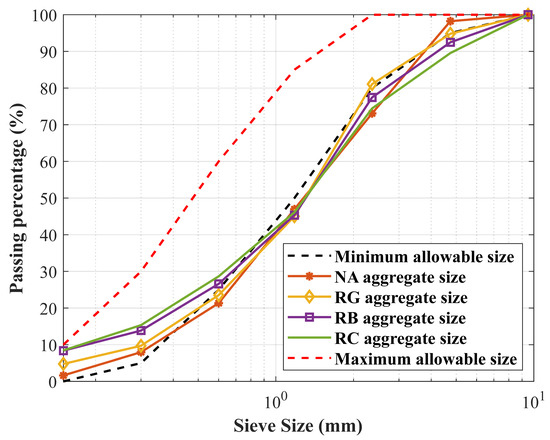

The recycled materials were collected from construction waste and subsequently processed through crushing and sieving operations. For the preparation of recycled sand materials, a crushing machine (Model VLG 1500 350, Hoseinzadeh Co., Rasht, Iran) was used. The manufacturer was requested to calibrate and adjust the crushing equipment to ensure the production of recycled aggregates with a maximum particle size of 4.5 mm. The crushed material was subsequently sieved to obtain the required fine aggregate fraction for mortar production. The particle size distribution of the recycled fine aggregates was adjusted within the range of 0–4.75 mm in order to achieve a grading comparable to that of NA. No specific measures were taken to mitigate the alkali–silica reaction (ASR). The gradation curves of the fine aggregates are presented in Figure 1, while the physical properties of the aggregates are summarized in Table 1. The particle size distribution was evaluated based on ASTM C144 [53] recommendations. According to the gradation curves, NA and RG aggregates generally fall within the recommended grading limits. However, the RB and RC aggregates slightly deviate from the lower boundary of the grading envelope, particularly in the particle size range of approximately 0.1–1 mm.
Figure 1.
Particle size distribution of fine aggregates.
Table 1.
Physical Properties of Aggregates.
Considering the heterogeneous nature of recycled construction materials and the practical limitations in controlling all physical properties during processing, minor deviations from standard grading limits are generally considered acceptable and have been reported in previous studies [54]. Moreover, the overall gradation adjustment of recycled aggregates indicates that their incorporation does not significantly alter the general grading characteristics of the aggregate system compared with NA. Appropriate grading control also contributes to satisfying standard graduation requirements and facilitates a more reliable evaluation of the behavior of the mortar mixtures.
Finally, the physical properties of the aggregates, including oven-dry density, saturated surface-dry (SSD) density, and water absorption, were determined in accordance with ASTM C128 [55] (using the vacuum method) and ASTM C136 [56]. A significant difference between natural and recycled aggregates was observed in terms of water absorption capacity. The natural fine aggregate exhibited a relatively low water absorption of approximately 2% in the oven-dry state. In contrast, RB and RC aggregates showed considerably higher absorption values of 17.65% and 9.07%, respectively, mainly due to their porous microstructure and the presence of adhered mortar [57,58,59]. The reported values were measured on oven-dried aggregates before moistening to the SSD condition. Conversely, RG aggregate exhibited very low water absorption (0.13%) due to its dense, nonporous structure. The low porosity of RG (0.31%) explains its negligible water absorption due to its dense structure. In comparison, NA showed moderate porosity (5.43%), resulting in water absorption higher than RG but lower than RB and RC. The porosity of RB (48.88%) was nearly twice that of RC (24.14%), consistent with their higher water absorption capacities. Consequently, the high porosity of RB and RC increased water absorption and adversely affected mortar consistency.
2.1.2. Mix Proportion and Mixing Procedure
An initial w/c of 0.562, consistent with ASTM C109/C109M [60] proportions, was adopted as the reference value. Minor adjustments to the mixing water were made to achieve a target flow of 110 ± 5% in the flow table test. Consequently, the w/c ratio used throughout the optimization and modeling in this study represents the total mixing water content. Accordingly, the 10 min rest is defined as controlled pre-wetting rather than SSD saturation, and the calculation of “Absorbed water” in Table 2 has been clarified to ensure transparent interpretation of the final w/c ratio and absorption adjustment. The binder content was kept constant at 6.31 kg for all mixtures [61]. Recycled fine aggregates were used as partial replacements for NA at different levels depending on the aggregate type. RG, RB, and RC replaced NA at levels of 5–25% [62,63], 15–45% [64,65], and 10–30% [66,67] by mass, respectively. The comprehensive mix proportions are summarized in Table 2.
Table 2.
Mortar mix proportions (kg).
Before mixing, all aggregates were oven-dried at to achieve the oven-dry (OD) condition. The drying process was continued until a constant mass was reached, defined as a mass change of less than 0.1% between two consecutive weighings performed at a two-hour interval. The mixing procedure was carried out using a laboratory mixer (Model CO 302, Azmoonsaz Mabna, Tehran, Iran) in two stages to control the moisture condition of the aggregates and achieve a controlled pre-wetted state (near SSD condition). The theoretical water absorption compensation reported in Table 2 represents the calculated mass of water required to bring each aggregate fraction from an oven-dry to a saturated surface-dry (SSD) state based on the 24 h absorption capacities reported in Table 1. This calculated water was introduced during the pre-wetting stage to minimize water withdrawal from the active cement paste during mixing, while the final total mixing water was adjusted to maintain the target flow value of 110 ± 5%. As noted previously, the 10 min rest serves as a kinetic mitigation step for initial suction, not as a claim of full microstructural saturation within that timeframe. Accordingly, the total water reported in Table 2 represents the sum of the initial mixing water, the water required to compensate for aggregate absorption, and the additional water introduced to achieve the target consistency. The final w/c ratio reported in this study was calculated based on this total water content.
Initially, all aggregates were dry-mixed for 1.5 min. Approximately half of the mixing water was then added, followed by 2 min of mixing. The mixture was subsequently allowed to rest for 10 min to facilitate partial water absorption and achieve a near-SSD condition. This resting stage served as a short-term pre-wetting step, supported by previous research indicating that recycled fine aggregates absorb water rapidly within the first few minutes [68,69]. Studies by García-González et al. [70] and Mora-Ortiz et al. [71] also showed that short conditioning periods are sufficient to influence the moisture state and stabilize the fresh properties of recycled aggregate mortars. Therefore, a 10 min rest was deemed adequate to mitigate the high initial water absorption kinetics (suction effect) of porous fractions like RB while avoiding the prolonged soaking associated with full 24 h SSD preparation [72,73,74]. After this period, cement was added and mixed for 1.5 min, followed by the remaining water and an additional 3 min of mixing. Fresh mortar tests were conducted immediately after mixing.
Recycled aggregates produced through mechanical crushing generally exhibit irregular particle shapes and angular geometries. Previous studies have reported that RC typically possesses rough and angular surfaces due to the presence of adhered mortar, while crushed RB tends to be highly angular and porous. In contrast, crushed RG is generally angular with relatively smoother surfaces compared with other recycled aggregates. The visual inspection of the aggregates used in this study showed morphological characteristics consistent with those commonly reported in the literature for similar recycled materials [75,76,77,78].
Aggregate replacement in this study was performed on a mass basis, in line with common mortar mixture design practices. Owing to the lower density of recycled aggregates compared with NA, this approach may alter the aggregate volume fraction and packing density. Consequently, part of the observed performance variations may be associated with volumetric and packing effects in addition to the intrinsic characteristics of the recycled materials.
2.2. Methods
This section describes the experimental methods used to determine fresh mortar properties, followed by sensitivity analyses performed on the experimental data. The sensitivity analysis evaluates the influence of each input parameter and the corresponding replacement levels on the responses derived from experimental observations.
2.2.1. Water Estimation for Fresh Mortar
A constant flowability of 110 ± 5% was maintained for all mixtures as per ASTM C109/C109M [60]. This consistency was the governing criterion for determining the total water demand of the mixtures. Initially, a trial batch of approximately two liters was prepared, and several adjustments were made experimentally to reach the target flow. The optimum water content obtained from these preliminary trials was then adopted for the main batches to ensure uniform consistency among all samples.
2.2.2. Consistency of Fresh Mortar
The consistency of fresh mortar was controlled using the flow table test conducted in accordance with ASTM C1437 [79], using a flow table apparatus (Tak Azma, Tehran, Iran). In this study, maintaining a constant flow value was considered a key input parameter to ensure comparable workability among all mixtures. The mortar flow was adjusted to 110 ± 5%, corresponding to a spread diameter of approximately 210 ± 5 mm on the flow table.
The spread diameter was measured in two perpendicular directions, and the average value was used as the representative flow. If the measured flow deviated from the required range, the mixing water was gradually adjusted until the target flow was achieved. Maintaining this constant flow level ensured uniform workability conditions, allowing a reliable comparison of other fresh mortar properties among the different mixtures.
2.2.3. Density of Fresh Mortar
The bulk density was determined following ASTM C138 [80]. A standard container (Azmoonsaz Mabna, Tehran, Iran) was filled in three layers, each compacted with 20 tamping strokes to eliminate voids. The density was calculated using Equation (1):
where ρ is the bulk density (g/cm3), m is the mass (g), and V is the volume (cm3). To minimize weighing errors, the mass of each sample was measured using a precision electronic balance (Electronic Balance JA600I, A&D Company, Shenzhen, China, maximum capacity: 6000 g, readability: 0.1 g).
2.2.4. Air Content of Fresh Mortar
The air content of fresh mortar was determined using both an experimental and a computational approach to improve the reliability of the measurements and to better understand the influence of aggregate properties. The experimental determination was performed using the pressure method in accordance with ASTM C231 [81], in which the air content is directly measured using a calibrated air entrainment meter. The device measures the volume of air content in a known volume of fresh mortar by applying pressure and recording the response through a calibrated manometer. The fresh mortar air content was measured using an air content testing device (Azmoonsaz Mabna, Tehran, Iran) complying with Type B of ASTM C231. To validate the experimental measurements, a complementary computational approach based on ASTM C185-99 [82] was also applied. In this method, the air content is estimated by comparing the experimentally measured bulk density of the fresh mortar with the theoretical density calculated from the mixture composition.
The bulk density (g/cm3) of the fresh mortar was obtained experimentally, as described in the density test. The theoretical density represents the density of the mixture, assuming that no air voids are present, and is calculated based on the mix proportions and the specific gravity of each constituent material. The theoretical density is determined by considering the mass contribution and density of all mixture components:
where , , , , , and are the masses of cement, water, NA, RG, RB, and RC, respectively, and , , , , , and are their corresponding volumes, respectively. The difference between the theoretical density and the experimentally measured density reflects the volume of air content within the fresh mortar.
This comparison is particularly important when recycled aggregates are incorporated into mortar mixtures. Recycled materials such as crushed brick and RC aggregates typically exhibit lower density and higher water absorption than NA due to their higher porosity and irregular internal structure. These characteristics may influence the packing density of particles, the distribution of water within the mixture, and consequently the formation and stability of air bubbles, although these effects were not directly quantified in terms of particle morphology or pore structure.
Therefore, an important aspect of this study is to investigate whether the air content is sensitive to variations in the density and water absorption characteristics of recycled aggregates and whether the magnitude of this sensitivity depends on the physical properties of the constituent materials. Understanding this relationship is essential for interpreting the behavior of fresh mortar mixtures containing recycled aggregates and for identifying the parameters that most strongly influence the air content of the system. To quantify these effects, a sensitivity analysis was subsequently performed based on the predictive models developed for the fresh mortar properties.
2.2.5. Predictive Modeling and Sensitivity Analysis
RSM was implemented in Design-Expert software (Version 12, Stat Ease Inc., Minneapolis, MN, USA) to model the following responses: final w/c ratio, density (g/cm3), and air content (%). The independent variables considered in the modeling process were the quantities of mixture aggregates, including NA (kg), RG (kg), RB (kg), and RC (kg). These parameters were selected due to their significant influence on the physical characteristics of the mixture and their combined effects on the fresh mortar properties.
Quadratic and two-factor interaction (2FI) models were validated via ANOVA, and coefficients were employed to verify the statistical significance of the developed models, whereas the model-experiment agreement was evaluated through the linear correlation coefficient.
After validating the predictive models, a sensitivity analysis was performed to quantify the influence of each input variable (NA, RG, RB, and RC) on the predicted responses (Air Content, Density, and Final w/c ratio) within the design domain. For this purpose, a local sensitivity analysis based on the perturbation method was applied.
Because the predictive models express each response variable as a function of the input variables , the sensitivity of each input parameter was evaluated at a selected reference point . In this method, small perturbations are applied to each input parameter while keeping the remaining variables fixed at their reference values. The sensitivity index was calculated using the following equation [83]:
where and represent the perturbed input vectors in which all variables remain constant except , which is increased and decreased by and , respectively, relative to the reference point. Here, denotes the perturbation magnitude applied to the input variable , and represents the predicted value of the response variable at the reference point . This procedure provides a quantitative measure of the relative influence of each input parameter on the predicted responses and helps identify the most influential variables affecting the fresh mortar properties.
3. Results and Discussion
3.1. Effect of Recycled Aggregates on the Final Water-to-Cement Ratio
The final w/c ratio increased consistently as the replacement level of recycled aggregates increased. As shown in Table 3, mixtures containing RB and RC required noticeably more water to achieve the target flowability of 110%, whereas RG led to only a moderate increase in water demand. For instance, in mixtures incorporating 5% RG and 15% RB, the final w/c ratio rose from 0.82 to 0.92 when the RC content increased from 10% to 30%. This corresponds to increases of 28%, 34%, and 44% in w/c compared with the control mixture at RC contents of 10%, 20%, and 30%, respectively.
Table 3.
Results of the fresh-state properties of mortar.
The observed increase in water demand is primarily associated with the higher water absorption capacity of recycled aggregates, particularly RB and RC, as measured in this study (Table 1). In addition to the high porosity and water absorption of RB and RC, the grading deviation shown in Figure 1 (the relative deficit of particles in the 0.1–1 mm range) may further contribute to the increased water demand. This gap in particle size distribution reduces packing density, thereby requiring more cement paste to fill the intergranular voids and indirectly increasing the effective water demand to maintain the target flow. RB contains numerous capillary pores formed during the firing of clay bricks, while RC aggregates typically include remnants of old mortar and microcracks. These features may allow the particles to absorb part of the mixing water, which reduces the amount of free water available for lubrication between particles and could ultimately increase the effective water demand of the mixture. Similar observations have been reported in previous studies on recycled aggregate mortars and concretes [84,85]. In the present study, the increase in w/c appears slightly more pronounced, likely due to the simultaneous use of multiple recycled aggregates, especially RB and RC, which together intensify the overall water absorption of the system. By contrast, RG aggregates have a relatively smooth and impermeable surface with negligible water absorption; therefore, their influence on the final w/c ratio is considerably smaller than that of RB and RC.
3.2. Effect of Recycled Aggregates on Fresh Mortar Density
The variation in fresh mortar density for different mixtures is presented in Table 3. A clear reduction in density was observed as the proportion of recycled aggregates increased. Even at relatively low RB and RC contents of 15% and 10%, increasing the RG replacement from 5% to 25% resulted in density reductions of about 4.5%, 5.4%, and 6.8%, respectively, compared with the control mixture. When the contents of both RB and RC were increased simultaneously, the density reduction became more pronounced. For example, in mixtures containing 45% RB, the density decreased by approximately 10.5–12.5% as RC increased from 10% to 30%. Similar reductions in fresh density with increasing recycled aggregate content have been widely reported in the literature [84,86].
This reduction is primarily attributable to the inherently lower particle density and higher internal porosity of recycled aggregates compared with NA, as measured in this study (Table 1). In addition to the low specific gravity of RB and RC, the grading deviation shown in Figure 1 reduces particle-packing efficiency. This results in a looser aggregate skeleton and higher initial void content, further contributing to the reduction in fresh density. Similar density reductions in mortars containing recycled aggregates have been reported by Silva et al. [85] and Rosado et al. [51]. However, the present study shows a more pronounced decrease, which can be attributed to the combined use of multiple recycled materials, leading to the formation of a more porous aggregate skeleton and reduced packing efficiency.
Among the recycled materials used in this study, RB exhibited the lowest specific gravity due to its porous ceramic microstructure, consistent with the findings of Debieb and Kenai [87]. In the case of RC, the presence of adhered mortar increases porosity and reduces particle density [81]. From a microstructural perspective, recycled aggregates introduce a more porous internal framework into the mortar matrix. The adhered mortar layers in RC and the interconnected pores in RB increase the total void volume of the mixture. Furthermore, the ITZ surrounding recycled aggregates is generally more heterogeneous and porous than that around NA particles, which may reduce particle packing efficiency and ultimately lower the density of fresh mortar. Similar observations regarding the weak and porous ITZ associated with recycled aggregates have been reported in previous studies [88,89]. However, since no direct microstructural characterization (e.g., SEM) was performed in this study, this interpretation remains speculative and should be verified in future work.
3.3. Air Content
The air contents obtained for the different mixtures are presented in Table 3. The incorporation of recycled aggregates led to a noticeable increase in air content relative to the control mixture, a trend commonly reported in recycled aggregate mortars [37,90]. The increase was more pronounced in mixtures containing higher proportions of RB and RC. For instance, in mixtures with 45% RB, the air content increased by up to approximately 70% compared with the control mixture.
This behavior may be partly attributed to the irregular particle shape, rough surface texture, and high internal porosity of the recycled aggregates. These physical characteristics may disrupt particle packing efficiency and promote the formation of micro-voids during mixing [88]. Previous studies [37,38] have similarly linked recycled aggregates to elevated air content, citing their heterogeneous microstructure as a key factor in air entrapment. Specifically, the porous ceramic structure of RB and the residual mortar adhered to RC particles increase the total void volume within the mortar matrix [90]. Furthermore, the microstructural nature of the ITZ plays a critical role. The ITZ surrounding RB and RC particles is generally more complex and porous than that of NA, facilitating the formation and stabilization of microscopic air pockets [39,88,89]. Nevertheless, this explanation should be interpreted with caution, as no direct microstructural characterization was carried out in the present study.
Finally, a comparison between calculation-based (ASTM C185) and instrument-based (ASTM C231) measurements showed strong agreement across all mixtures. Due to the idealized assumptions in the ASTM C185 procedure, which relies on the maximum density of constituent materials, the air-content values from the instrument-based method were consistently slightly higher. This discrepancy highlights a known limitation of indirect calculation methods when applied to highly porous recycled aggregates; internal porosity and variations in water absorption can distort the theoretical specific gravity values used in ASTM C185, potentially introducing errors if aggregate properties fluctuate. Nevertheless, in this study, the average relative error between the two methods was approximately 3%, confirming that the rigorous pre-characterization of aggregate densities mitigated these limitations, thereby confirming the reliability and validity of the instrument-based approach for evaluating the air content of these specialized mortar mixtures.
3.4. RSM Modeling and Model Performance
To further analyze the relationships between mixture composition and fresh mortar properties, RSM was applied to develop predictive models, followed by statistical evaluation and cross-validation to assess their reliability.
3.4.1. RSM Model Development
RSM was employed to develop predictive models describing the relationship between mixture composition and the fresh properties of mortar containing recycled aggregates. The independent variables included NA, RG, RB, and RC, while the responses considered were the final w/c ratio, fresh mortar density, and air content. In mortar mixture studies, some parameters (e.g., mixture consistency) are typically controlled to allow a reliable estimation of water demand and the final w/c ratio. Therefore, the total aggregate content was maintained within a narrow range, and the experimental program focused on the progressive replacement of NA with recycled aggregates (RG, RB, and RC). Within this framework, RSM was applied as a statistical tool to analyze the influence and interaction of the aggregate types on the fresh properties of mortar.
The regression models were formulated using the actual quantities of aggregates in the mixtures (kg) rather than coded variables, enabling direct physical interpretation of the coefficients. During model calibration, two formulations were evaluated, i.e., models including an intercept and models constrained to pass through the origin. The inclusion of an intercept led to unstable statistical behavior and reduced the significance of several regression coefficients, while also complicating the physical interpretation of the mixture variables expressed as actual material quantities. From a physical standpoint, the independent variables represent the actual mass of aggregates in the mixture (kg). When the quantities of all aggregate constituents approach zero, the mortar mixture itself becomes undefined; therefore, constraining the regression through the origin provides a physically consistent boundary condition for the modeled system. Under this boundary condition, the regression equations naturally approach zero as the quantities of the mixture variables decrease towards zero. Therefore, constraining the regression models to pass through the origin provides a physically consistent formulation and avoids introducing a non-physical offset in the predictive equations. Considering both the statistical behavior of the regression coefficients and the physical boundary condition of the system, the intercept-free formulation was retained for the final models.
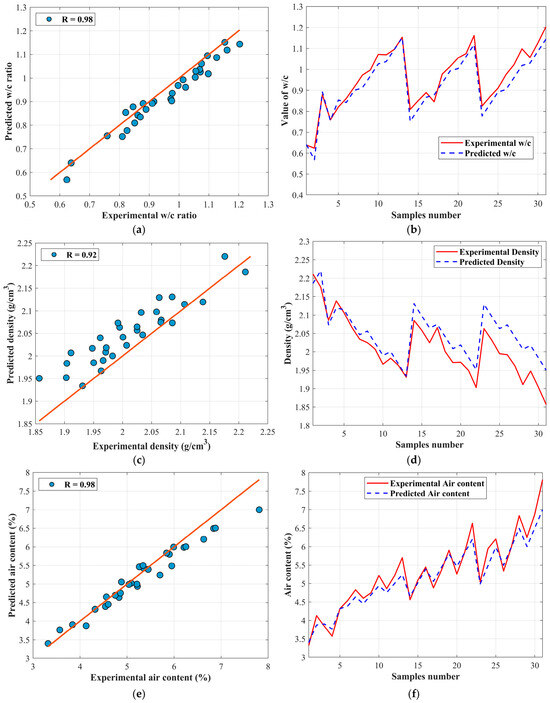
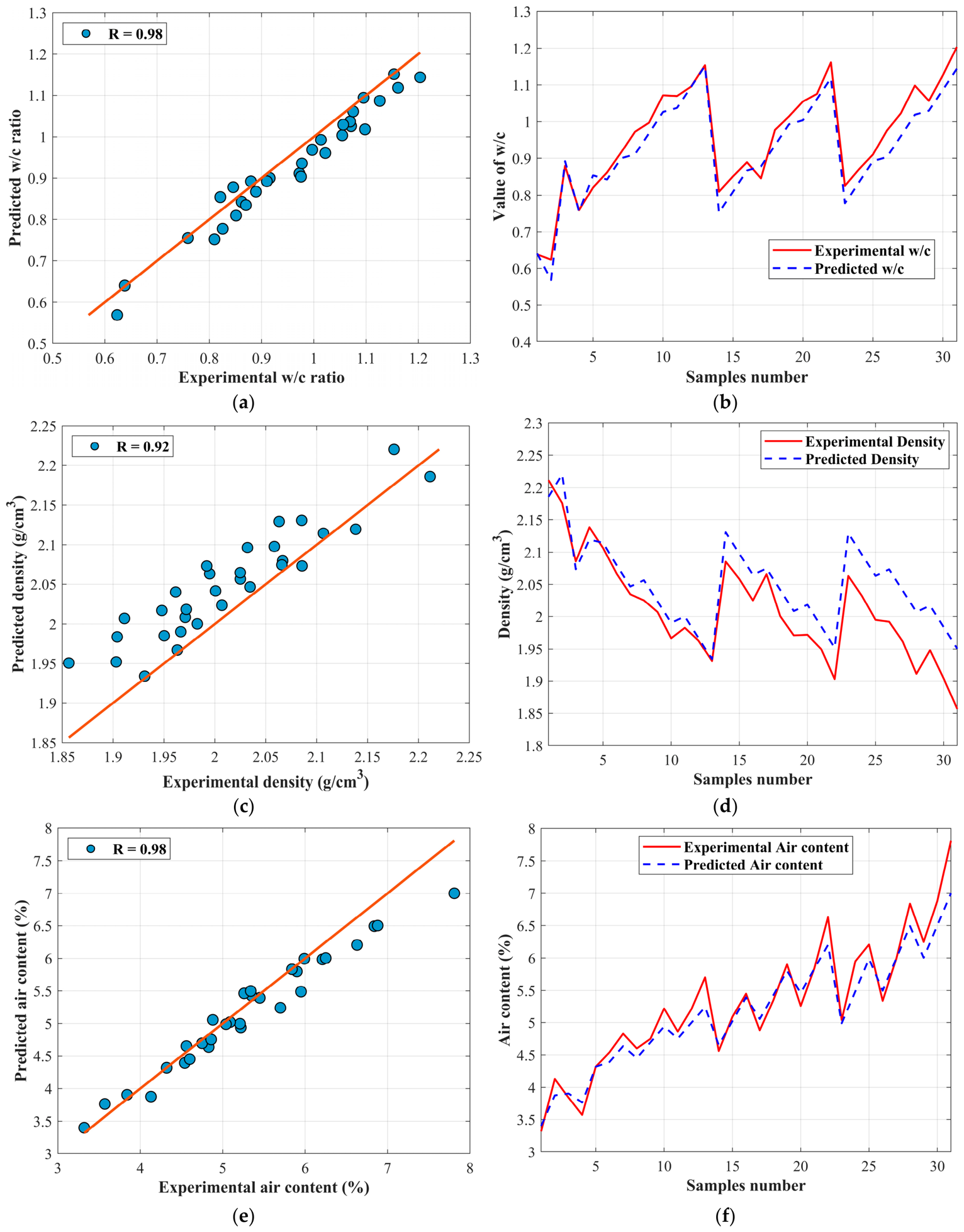
A detailed comparison between the predicted and experimental values (Figure 2) demonstrates strong agreement between the model predictions and the experimental measurements within the investigated domain. In the parity plots, the majority of data points are located very close to the line of equality, indicating a high level of agreement between the predicted and measured values and suggesting that the models adequately reproduce the observed trends within the studied mixtures.
Figure 2.
Performance evaluation of the developed RSM models: (a) predicted vs. experimental w/c ratio; (b) prediction error for w/c; (c) predicted vs. experimental density; (d) prediction error for density; (e) predicted vs. experimental air content; (f) prediction error for air content.
For the w/c ratio and air content, the very high correlation coefficients (R = 0.98) indicate a strong correlation between predicted and experimental values with minimal deviation between the predicted and experimental results. As shown in Figure 2b,d, the data points are tightly clustered around the equality line, demonstrating that the developed models effectively capture both the magnitude and the variation trends of these parameters across the investigated mixtures. In the case of density, although the correlation coefficient is slightly lower (R = 0.92), the overall trend of variation remains well represented by the model. As illustrated in Figure 2f, some data points exhibit moderate deviations from the equality line; however, the general pattern of the experimental results is still accurately reproduced, indicating that the model reasonably describes the relationships governing density within the investigated mixtures. Furthermore, the residual (error) plots show small and randomly distributed deviations without any noticeable systematic pattern, suggesting that the developed models are statistically reliable and free from significant bias. These results confirm that the proposed RSM models successfully capture the primary factors influencing the fresh properties of mortars incorporating recycled aggregates.
The statistical significance of the models was evaluated using analysis of variance (ANOVA) (Table 4). The overall models are highly significant with p-values < 0.05, and the relatively high F-values further confirm the reliability of the regression equations. The ANOVA results reveal that all primary variables (NA, RG, RB, and RC) significantly affect the studied responses. In addition, the interaction terms NA × RG, RG × RB, and RG × RC are statistically significant, indicating that the combined presence of recycled aggregates influences water demand, packing density, and air entrainment behavior. In particular, the nonlinear contribution of RG, reflected by the RG2 term in some models, suggests that increasing glass content alters particle packing and mixture consistency in a nonlinear manner. Similar interaction effects have been reported in previous studies on recycled aggregate systems [91,92,93,94], although the underlying microstructural mechanisms were not directly investigated in the present study.
Table 4.
ANOVA results for developed RSM models.
The developed regression models demonstrated good agreement between predicted and experimental values for all responses. For the final w/c ratio, the model yielded and adjusted , with an adequate precision value of 12.775, indicating a satisfactory signal-to-noise ratio for navigating the design space. The model for fresh density exhibited a very strong fit, with and adjusted , accompanied by a very low coefficient of variation (0.75%), reflecting high model precision; its adequate precision value of 42.119, far exceeding the minimum desirable value of 4, further confirms the strong signal of the model. Similarly, the model developed for air content showed high accuracy, with and adjusted , a coefficient of variation of 9.08% and an adequate precision value of 14.990, indicating a strong signal-to-noise ratio and confirming the reliability of the model. The high coefficient of determination for density is consistent with the relatively low experimental variability of fresh density measurements and the strong linear dependence of this property on the weighted average of component densities within the investigated mixture space. It should be noted that the RSM models developed in this study are intended to provide predictive insights within the investigated experimental domain while enabling the analysis of response trends and sensitivity to mixture parameters. In particular, the models are used to quantify the influence of different recycled aggregate types and their replacement levels on the fresh properties of mortar. Accordingly, the predictive capability of the models should be interpreted primarily within the studied design space. Extrapolation beyond the investigated parameter range should therefore be approached with caution, and further validation using independent datasets and broader mixture compositions is recommended in future studies.
The regression models were formulated using the actual values of the mixture variables (kg) to allow direct interpretation of the coefficients in terms of material quantities:
3.4.2. Model Validation: k-Fold Cross-Validation
To evaluate the predictive robustness of the developed RSM models and reduce the risk of overfitting, a 5-fold cross-validation procedure was performed [95,96]. The experimental dataset (n = 31) was randomly divided into five approximately equal subsets. In each iteration, four subsets were used for model training, and the remaining subset was used for validation. This process was repeated five times so that each subset served once as validation data. Model performance was evaluated using the root mean square error (RMSE), mean absolute error (MAE), and the cross-validated coefficient of determination (R2).
The validation results are summarized in Table 5. The models developed for the final w/c ratio and air content show good predictive performance within the investigated experimental domain, with cross-validated R2 values of 0.92 and 0.93, respectively. In contrast, the fresh mortar density model shows moderate predictive performance (R2 = 0.62), despite its very high calibration R2 obtained during model fitting.
Table 5.
Cross-validation results of the developed RSM models.
This behavior may be attributed to the strong dependence of fresh density on the intrinsic densities of the constituent aggregates, together with the relatively limited dataset available for polynomial modeling. Therefore, the developed RSM models should be interpreted primarily as analytical tools for evaluating response trends and parameter sensitivity within the investigated design space. Additional datasets and broader mixture compositions may further improve model robustness in future studies.
3.5. Sensitivity Analysis of Model Parameters
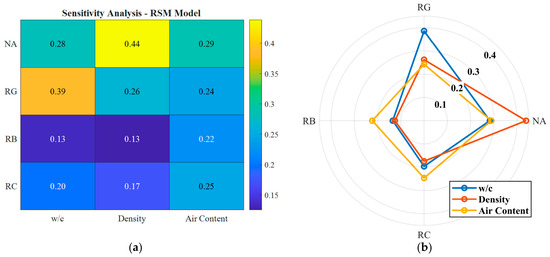
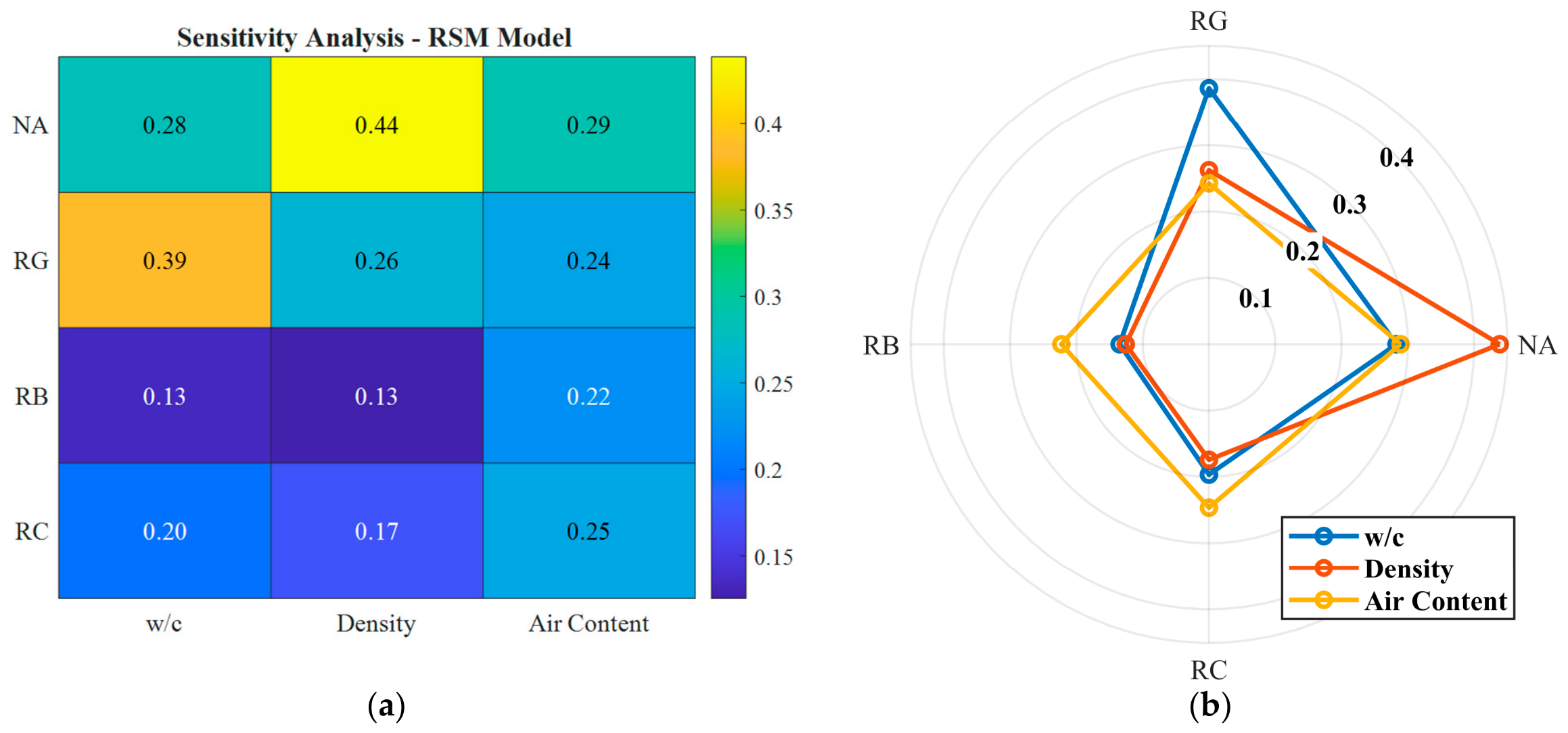
To evaluate the influence of aggregate composition on the fresh properties of mortar, a sensitivity analysis was performed using the RSM predictive models in MATLAB (Version 2024, The MathWorks Inc., Natick, MA, USA). The results, shown in Figure 3, present the normalized importance of each input parameter in predicting the final w/c ratio, fresh mortar density, and air content.
Figure 3.
Sensitivity Analysis of RSM Model: (a) Relative importance of each input variable; (b) The radar diagram.
As illustrated in Figure 3a, the w/c ratio is mainly influenced by the proportions of NA and RG. Increasing NA content decreases the final w/c ratio, whereas increasing RG content causes a slight increase in w/c. In contrast, RB and RC exhibit higher water absorption, leading to a more pronounced increase in w/c when their contents rise. This behavior is associated with the relatively low water absorption capacity of NA and RG compared with RB and RC. Since NA and RG absorb limited mixing water, variations in their proportions directly affect the balance between free and absorbed water in the mixture. In contrast, RB and RC generally exhibit higher water absorption due to their porous structure and the presence of adhered mortar, which increases the overall water demand of cementitious mixtures [85].
For fresh mortar density, NA shows the strongest influence, followed by RG. This result is consistent with the higher specific gravity and compact structure of NA and the relatively dense nature of glass particles. Conversely, RB and RC aggregates possess higher internal porosity and lower particle density due to ceramic pores and adhered mortar, which leads to a reduction in the overall density of the mortar mixture as their content increases [86,87]. According to the validation results presented in Section 3.4.2, the sensitivity analysis for fresh mortar density should be interpreted primarily within the investigated mixture design space, where the developed RSM model demonstrates moderate but acceptable predictive consistency.
Regarding air content, all aggregate types contribute to the predicted variations, although NA exhibits the strongest influence. Changes in NA proportion modify the packing density of the aggregate skeleton, which directly affects the formation and stability of air voids during mixing. In addition, the porous structure and rough surface texture of recycled aggregates such as RB and RC may promote the retention of air pockets within the mortar matrix [88,90]. Nevertheless, the role of these physical characteristics in air retention was not explicitly characterized in this work.
The radar diagram in Figure 3b visually summarizes the relative influence of the mixture parameters and facilitates comparison of their contributions to the predicted responses.
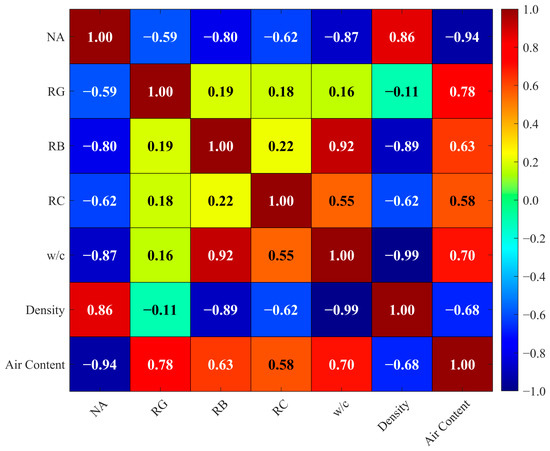
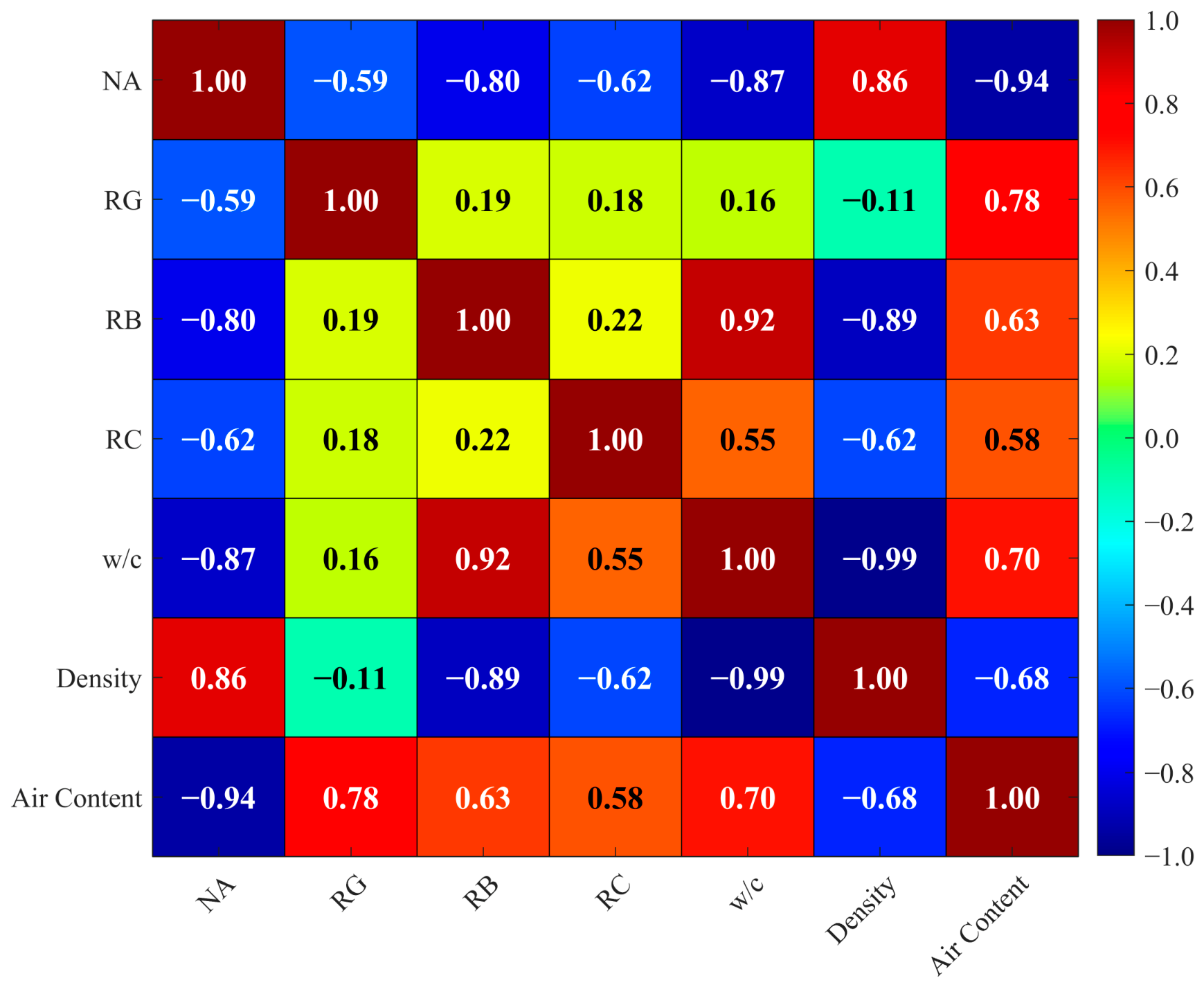
To further investigate the relationships between mixture variables and mortar properties, a Pearson correlation analysis was performed, as shown in Figure 4. For the final w/c ratio, a strong negative correlation is observed with NA (r = −0.87), indicating that increasing NA content reduces the effective water demand of the mixture. In contrast, RB aggregate shows a very strong positive correlation with w/c (r = 0.92), reflecting its high porosity and water absorption capacity. RC aggregate also exhibits a positive correlation with w/c (r = 0.55), which is attributed to the presence of adhered mortar and internal micro voids [85].
Figure 4.
Correlation Between Mixture Variables and Mortar Properties Predicted by RSM.
For fresh mortar density, NA and RG show positive correlations due to their higher particle density, whereas RB and RC present negative correlations as a result of their lower density and higher porosity. Consequently, increasing the proportion of recycled aggregates generally reduces the density of the mortar mixture.
Air content tends to increase with higher proportions of recycled aggregates, while mixtures with higher NA content exhibit lower air levels. This behavior is related to differences in particle morphology and surface characteristics, where irregular and porous recycled aggregates facilitate air entrapment, whereas NA improves particle packing and reduces air void stability [88,90].
Finally, the correlation results are consistent with the sensitivity analysis and suggest that aggregate physical characteristics, such as porosity, particle density, and surface morphology, may play a key role in controlling the fresh behavior of mortar mixtures containing recycled materials. However, since these characteristics were not directly measured, this interpretation remains speculative. These findings further support the reliability of the developed RSM models for mixture design and optimization.
4. Conclusions
This study investigated the combined effects of substitution of three types of recycled fine aggregates, including recycled glass (RG), recycled brick (RB), and recycled concrete (RC), together with natural aggregate (NA), on the fresh properties of mortar. The main findings can be summarized as follows:
- The incorporation of RB and RC significantly increased the mixing water required to maintain constant flowability. Conversely, dense and non-porous RG showed a negligible effect on water demand, confirming that the porous ceramic and concrete fractions govern the initial water kinetics.
- A progressive reduction in fresh density (up to 12%) and an increase in air content were observed with higher levels of RB and RC. This may be associated with their lower specific gravity and more irregular particle morphology. However, the synergistic use of high-density NA and RG successfully mitigated these losses.
- The instruments and methodologies utilized (ASTM C185 and ASTM C231) produced highly comparable results with a remarkably low average relative error (~3%), confirming the experimental reliability of standard testing methods for multi-source recycled aggregate mortars.
- RSM yielded quadratic and 2FI predictive models with outstanding accuracy ( ranging from 0.952 to 0.999). Sensitivity analysis proved that NA and RG predominantly control w/c and density variations, while the air content is influenced by the interactive effects of all aggregate types.
- The controlled synergistic use of multi-source recycled aggregates is a viable strategy for the circular economy in construction. While RB and RC provide sustainability benefits, they necessitate mix-design adjustments (such as the 10 min pre-wetting validated herein) to offset water demand. The findings and predictive models presented in this study are applicable within the grading characteristics reported in Figure 1. Mixtures with significantly different particle size distributions (e.g., well-graded recycled aggregates) may require separate calibration and validation.
Despite the strong predictive capability of the proposed models, the findings remain limited to the specific materials and replacement ranges investigated and primarily reflect fresh-state behavior. Therefore, the optimized mixtures should be considered preliminary formulations and require further validation through comprehensive hardened-state mechanical and durability testing, as well as studies involving broader aggregate sources and particle characteristics. In addition, as no microstructural investigation was conducted in this study, the proposed interpretations remain speculative and should be verified in future work.
Author Contributions
Conceptualization, J.M.G.-S.; methodology, J.M.G.-S. and K.F.; software, K.F.; validation, C.V.-U.; formal analysis, K.F.; investigation, J.M.G.-S.; resources, J.M.G.-S. and K.F.; data curation, K.F.; writing—original draft preparation, K.F. and J.M.G.-S.; writing—review and editing, J.M.G.-S.; visualization, K.F. and J.M.G.-S.; supervision, J.M.G.-S. and C.V.-U. All authors have read and agreed to the published version of the manuscript.
Funding
This research received no external funding.
Data Availability Statement
Data supporting this research article are available from the corresponding author upon request.
Conflicts of Interest
The authors declare no conflict of interest.
References
- Torres, A.; Brandt, J.; Lear, K.; Liu, J. A looming tragedy of the sand commons. Science 2017, 357, 970–971. [Google Scholar] [CrossRef] [PubMed]
- Rodríguez-Robles, D.; García-González, J.; Juan-Valdés, A.; Morán-del Pozo, J.M.; Guerra-Romero, M.I. Overview regarding construction and demolition waste in Spain. Environ. Technol. 2015, 36, 3060–3070. [Google Scholar] [CrossRef] [PubMed]
- Evangelista, L.; de Brito, J. Concrete with fine recycled aggregates: A review. Eur. J. Environ. Civ. Eng. 2014, 18, 129–172. [Google Scholar] [CrossRef]
- Wang, B.; Yan, L.; Fu, Q.; Kasal, B. A comprehensive review on recycled aggregate and recycled aggregate concrete. Resour. Conserv. Recycl. 2021, 171, 105565. [Google Scholar] [CrossRef]
- Vardhan, K.; Siddique, R.; Goyal, S. Influence of marble waste as partial replacement of fine aggregates on strength and drying shrinkage of concrete. Constr. Build. Mater. 2019, 228, 116730. [Google Scholar] [CrossRef]
- Balasbaneh, A.T.; Sher, W.; Li, J.; Ashour, A. Systematic review of construction waste management scenarios: Informing life cycle sustainability analysis. Circ. Econ. Sustain. 2025, 5, 529–553. [Google Scholar] [CrossRef]
- Liu, G.; Florea, M.V.A.; Brouwers, H.J.H. Performance evaluation of sustainable high strength mortars incorporating high volume waste glass as binder. Constr. Build. Mater. 2019, 202, 574–588. [Google Scholar] [CrossRef]
- Choi, S.Y.; Choi, Y.S.; Yang, E.I. Effects of heavy weight waste glass recycled as fine aggregate on the mechanical properties of mortar specimens. Ann. Nucl. Energy 2017, 99, 372–382. [Google Scholar] [CrossRef]
- Letelier, V.; Henríquez-Jara, B.I.; Manosalva, M.; Moriconi, G. Combined use of waste concrete and glass as a replacement for mortar raw materials. Waste Manag. 2019, 94, 107–119. [Google Scholar] [CrossRef] [PubMed]
- Ez-zaki, H.; El Gharbi, B.; Diouri, A. Development of eco-friendly mortars incorporating glass and shell powders. Constr. Build. Mater. 2018, 159, 198–204. [Google Scholar] [CrossRef]
- Harbi, R.; Derabla, R.; Nafa, Z. Improvement of the properties of a mortar with 5% of kaolin fillers in sand combined with metakaolin, brick waste and glass powder in cement. Constr. Build. Mater. 2017, 152, 632–641. [Google Scholar] [CrossRef]
- Zhu, L.; Zhu, Z. Reuse of clay brick waste in mortar and concrete. Adv. Mater. Sci. Eng. 2020, 2020, 6326178. [Google Scholar] [CrossRef]
- Dang, J.; Zhao, J.; Hu, W.; Du, Z.; Gao, D. Properties of mortar with waste clay bricks as fine aggregate. Constr. Build. Mater. 2018, 166, 898–907. [Google Scholar] [CrossRef]
- Ma, Z.; Tang, Q.; Wu, H.; Xu, J.; Liang, C. Mechanical properties and water absorption of cement composites with various fineness and contents of waste brick powder from C&D waste. Cem. Concr. Compos. 2020, 114, 103758. [Google Scholar] [CrossRef]
- Roknuzzaman, M.; Kamrujjaman Serker, N.; Mahabub Rahman, M. Old residual mortar as a quality indicator of recycled brick aggregate. Sustain. Struct. 2024, 4, 000061. [Google Scholar] [CrossRef]
- Huang, Q.; Zhu, X.; Xiong, G.; Wang, C.; Liu, D.; Zhao, L. Recycling of crushed waste clay brick as aggregates in cement mortars: An approach from macro- and micro-scale investigation. Constr. Build. Mater. 2021, 274, 122068. [Google Scholar] [CrossRef]
- Xu, Z.; Zhu, Z.; Zhao, Y.; Guo, Z.; Chen, G.; Liu, C.; Gao, J.; Chen, X. Production of sustainable plastering mortar containing waste clay brick aggregates. Case Stud. Constr. Mater. 2022, 16, e01120. [Google Scholar] [CrossRef]
- Lam, M.N.T.; Nguyen, D.T.; Nguyen, D.L. Potential use of clay brick waste powder and ceramic waste aggregate in mortar. Constr. Build. Mater. 2021, 313, 125516. [Google Scholar] [CrossRef]
- Singh, R.; Nayak, D.; Pandey, A.; Kumar, R.; Kumar, V. Effects of recycled fine aggregates on properties of concrete containing natural or recycled coarse aggregates: A comparative study. J. Build. Eng. 2022, 45, 103442. [Google Scholar] [CrossRef]
- Braga, M.; de Brito, J.; Veiga, R. Incorporation of fine concrete aggregates in mortars. Constr. Build. Mater. 2012, 36, 960–968. [Google Scholar] [CrossRef]
- de Juan, M.S.; Gutiérrez, P.A. Study on the influence of attached mortar content on the properties of recycled concrete aggregate. Constr. Build. Mater. 2009, 23, 872–877. [Google Scholar] [CrossRef]
- Gonçalves, T.; Silva, R.V.; de Brito, J.; Fernández, J.M.; Esquinas, A.R. Mechanical and durability performance of mortars with fine recycled concrete aggregates and reactive magnesium oxide as partial cement replacement. Cem. Concr. Compos. 2020, 105, 103420. [Google Scholar] [CrossRef]
- Martínez-García, R.; Rojas, M.I.S.; Pozo, J.M.M.; Fraile-Fernández, F.J.; Juan-Valdés, A. Evaluation of mechanical characteristics of cement mortar with fine recycled concrete aggregates (FRCA). Sustainability 2021, 13, 414. [Google Scholar] [CrossRef]
- Morón, A.; Ferrández, D.; Saiz, P.; Morón, C. Experimental study with cement mortars made with recycled concrete aggregate and reinforced with aramid fibers. Appl. Sci. 2021, 11, 7791. [Google Scholar] [CrossRef]
- Wan, X.; Jia, Z.; Li, N.; Luo, H. Impact of recycled fine aggregate on physical and mechanical properties of green mortar. Materials 2025, 18, 696. [Google Scholar] [CrossRef] [PubMed]
- Lu, L. Optimal replacement ratio of recycled concrete aggregate balancing mechanical performance with sustainability: A review. Buildings 2024, 14, 2204. [Google Scholar] [CrossRef]
- Jesus, S.; Pederneiras, C.M.; Brazão Farinha, C.; de Brito, J.; Veiga, R. Reduction of the cement content by incorporation of fine recycled aggregates from construction and demolition waste in rendering mortars. Infrastructures 2021, 6, 11. [Google Scholar] [CrossRef]
- Zhang, L.; Ding, D.; Zhao, J.; Zhou, G.; Wang, Z. Mixture design and mechanical properties of recycled mortar and fully recycled aggregate concrete incorporated with fly ash. Materials 2022, 15, 8143. [Google Scholar] [CrossRef] [PubMed]
- Kou, S.-C.; Poon, C.-S. Properties of self-compacting concrete prepared with recycled glass aggregate. Cem. Concr. Compos. 2009, 31, 107–113. [Google Scholar] [CrossRef]
- El-Hassan, H.; Kianmehr, P.; Tavakoli, D.; El-Mir, A.; Dehkordi, R.S. Synergic effect of recycled aggregates, waste glass, and slag on the properties of pervious concrete. Dev. Built Environ. 2023, 15, 100189. [Google Scholar] [CrossRef]
- Mora-Ortiz, R.S.; Díaz, S.A.; Del Angel-Meraz, E.; Magaña-Hernández, F. Recycled fine aggregates from mortar debris and red clay brick to fabricate masonry mortars: Mechanical analysis. Materials 2022, 15, 7707. [Google Scholar] [CrossRef] [PubMed]
- Abed, J.M.; Al-Uzbaky, H.A.A.K.; Abbu, M. Impact of using recycled fine aggregate from demolition waste on mechanical properties of cement mortar. Arch. Civ. Eng. 2025, 71, 375. [Google Scholar] [CrossRef]
- Martínez, I.; Etxeberria, M.; Pavón, E.; Díaz, N. Influence of demolition waste fine particles on the properties of recycled aggregate masonry mortar. Int. J. Civ. Eng. 2018, 16, 1213–1226. [Google Scholar] [CrossRef]
- Li, L.; Zhan, B.J.; Lu, J.; Poon, C.S. Systematic evaluation of the effect of replacing river sand by different particle size ranges of fine recycled concrete aggregates (FRCA) in cement mortars. Constr. Build. Mater. 2019, 209, 147–155. [Google Scholar] [CrossRef]
- Cartuxo, F.; de Brito, J.; Evangelista, L.; Jiménez, J.R.; Ledesma, E.F. Rheological behaviour of concrete made with fine recycled concrete aggregates: Influence of the superplasticizer. Constr. Build. Mater. 2015, 89, 36–47. [Google Scholar] [CrossRef]
- Rueda, J.; Alaejos, P. Quantitative effect on water demand of absorption and fine particles content of recycled concrete sands. J. Mater. Civ. Eng. 2019, 31, 04019110. [Google Scholar] [CrossRef]
- Gómez-Soberón, J.M.; Cabrera-Covarrubias, F.G.; Almaral-Sánchez, J.L.; Gómez-Soberón, M.C. Fresh-state properties of mortars with recycled glass aggregates: Global unification of behavior. Adv. Mater. Sci. Eng. 2018, 2018, 1386946. [Google Scholar] [CrossRef]
- Ledesma, E.F.; Jiménez, J.R.; Fernández, J.M.; Galvín, A.P.; Agrela, F.; Barbudo, A. Properties of masonry mortars manufactured with fine recycled concrete aggregates. Constr. Build. Mater. 2014, 71, 289–298. [Google Scholar] [CrossRef]
- Boudali, S.; Soliman, A.; Abdulsalam, B.; Kada, A.; Kerdal, D.; Poncet, S. Microstructural properties of the interfacial transition zone and strength development of concrete incorporating recycled concrete aggregate. Int. J. Civ. Environ. Struct. Constr. Archit. Eng. 2017, 11, 966–970. [Google Scholar]
- Patil, S.; Ramesh, B.; Sathish, T.; Saravanan, A. RSM-based modelling for predicting and optimizing the rheological and mechanical properties of fibre-reinforced laterized self-compacting concrete. Heliyon 2024, 10, e25973. [Google Scholar] [CrossRef] [PubMed]
- Khelifi, A.; Boumaaza, M.; Belaadi, A.; Bourchak, M.; Djedid, T.; Alshaikh, I.M.H.; Ghernaout, D. RSM approach-based analysis of the physical behavior of dune sand reinforced with Washingtonia waste contributing to mortar cleaner production. Case Stud. Constr. Mater. 2025, 22, e04335. [Google Scholar] [CrossRef]
- Salah, H.A.; Mutalib, A.A.; Algaifi, H.A.; Yahya, I.B.; Yusof, M.A.I.; Sakib, N.; Elsayed, M. Assessment of the mechanical properties of high strength mortar incorporating silica fume and graphene nanoplatelets: Experimental and mathematical modeling. Sustainability 2023, 15, 8054. [Google Scholar] [CrossRef]
- Al-Kahtani, M.S.M.; Zhu, H.; Ibrahim, Y.E.; Haruna, S.I.; Al-Qahtani, S.S.M. Study on the mechanical properties of polyurethane-cement mortar containing nanosilica: RSM and machine learning approach. Appl. Sci. 2023, 13, 13348. [Google Scholar] [CrossRef]
- Chyliński, F.; Kupisz, P.; Więch, P.; Brunarski, L. Determination of composition of masonry mortars for conservation of historical constructions using artificial neural networks. Materials 2025, 18, 3851. [Google Scholar] [CrossRef] [PubMed]
- Krishnya, S.; Elakneswaran, Y.; Yoda, Y. Proposing a three-phase model for predicting the mechanical properties of mortar and concrete. Mater. Today Commun. 2021, 29, 102858. [Google Scholar] [CrossRef]
- Yang, S.; Zhong, J.; Gan, B.; Sun, Y.; Bu, C.; Zhang, M.; Li, J.; Yu, Y. Prediction and sensitivity analysis of foam concrete compressive strength based on machine learning techniques with hyperparameter optimization. Comput. Model. Eng. Sci. 2025, 144, 2943–2967. [Google Scholar] [CrossRef]
- Blasenbauer, D.; Fellner, J.; Skutan, S.; Lederer, J. Dry-wet mechanical treatment to produce high-quality recycling aggregate and cement raw material from mixed construction and demolition waste—A material flow analysis case study from Austria. Clean. Waste Syst. 2026, 13, 100473. [Google Scholar] [CrossRef]
- Sai Trivedi, S.; Snehal, K.; Das, B.B.; Barbhuiya, S. A comprehensive review towards sustainable approaches on the processing and treatment of construction and demolition waste. Constr. Build. Mater. 2023, 393, 132125. [Google Scholar] [CrossRef]
- ASTM C150/C150M-24; Standard Specification for Portland Cement. ASTM International: West Conshohocken, PA, USA, 2024.
- ASTM C33/C33M-18; Standard Specification for Concrete Aggregates. ASTM International: West Conshohocken, PA, USA, 2018.
- Rosado, S.; Costafreda, J.; Martín, D.; Presa, L.; Gullón, L. Recycled aggregates from ceramic and concrete in mortar mixes: A study of their mechanical properties. Materials 2022, 15, 8933. [Google Scholar] [CrossRef] [PubMed]
- Kou, S.-C.; Poon, C.-S. Properties of concrete prepared with crushed fine stone, furnace bottom ash and fine recycled aggregate as fine aggregates. Constr. Build. Mater. 2009, 23, 2877–2886. [Google Scholar] [CrossRef]
- ASTM C144-99; Standard Specification for Aggregate for Masonry Mortar. ASTM International: West Conshohocken, PA, USA, 1999.
- de Brito, J.; Saikia, N. Recycled Aggregate in Concrete; Springer: London, UK, 2013. [Google Scholar] [CrossRef]
- ASTM C128-04a; Standard Test Method for Density, Relative Density (Specific Gravity), and Absorption. ASTM International: West Conshohocken, PA, USA, 2004.
- ASTM C136-06; Standard Test Method for Sieve Analysis of Fine and Coarse Aggregates. ASTM International: West Conshohocken, PA, USA, 2006.
- Zhao, Z.; Xiao, J.; Duan, Z.; Hubert, J.; Grigoletto, S.; Courard, L. Performance and durability of self-compacting mortar with recycled sand from crushed brick. J. Build. Eng. 2022, 57, 104867. [Google Scholar] [CrossRef]
- Mazhoud, B.; Sedran, T.; Cazacliu, B.; Cothenet, A.; Torrenti, J.-M. Influence of residual mortar volume on the properties of recycled concrete aggregates. J. Build. Eng. 2022, 57, 104945. [Google Scholar] [CrossRef]
- Muhammad, F.; Harun, M.; Ahmed, A.; Kabir, N.; Khalid, H.R.; Hanif, A. Influence of bonded mortar on recycled aggregate concrete properties: A review. Constr. Build. Mater. 2024, 432, 136564. [Google Scholar] [CrossRef]
- ASTM C109/C109M-05; Standard Test Method for Compressive Strength of Hydraulic Cement Mortars. ASTM International: West Conshohocken, PA, USA, 2005.
- ASTM C305-06; Mechanical Mixing of Hydraulic Cement Pastes and Mortars of Plastic Consistency. ASTM International: West Conshohocken, PA, USA, 2006.
- Małek, M.; Łasica, W.; Jackowski, M.; Kadela, M. Effect of waste glass addition as a replacement for fine aggregate on properties of mortar. Materials 2020, 13, 3189. [Google Scholar] [CrossRef] [PubMed]
- Alducin-Ochoa, J.M.; Martín-del-Río, J.J.; Torres-González, M.; Flores-Alés, V.; Hernández-Cruz, D. Performance of mortars based on recycled glass as aggregate by accelerated decay tests (ADT). Constr. Build. Mater. 2021, 300, 124057. [Google Scholar] [CrossRef]
- Lliso-Ferrando, J.R.; Arenós-Barrachina, A.; Monzón-Bello, P.; Valcuende, M. Durability of mortars with partial cement replacement by recycled brick powder. Appl. Sci. 2025, 15, 4133. [Google Scholar] [CrossRef]
- Sun, Y.; Hou, D.; Shi, Y.; Sun, Y.; Xv, C.; Wang, Y. Mechanical properties of recycled concrete containing brick–concrete waste aggregates with basalt fiber-reinforced polymer (BFRP) fibers. Buildings 2025, 15, 2047. [Google Scholar] [CrossRef]
- Liu, Q.; Li, B.; Xiao, J.; Singh, A. Utilization potential of aerated concrete block powder and clay brick powder from C&D waste. Constr. Build. Mater. 2020, 238, 117721. [Google Scholar] [CrossRef]
- Evangelista, L.; de Brito, J. Mechanical behaviour of concrete made with fine recycled concrete aggregates. Cem. Concr. Compos. 2007, 29, 397–401. [Google Scholar] [CrossRef]
- Poon, C.S.; Chan, D. The use of recycled aggregate in concrete in Hong Kong. Resour. Conserv. Recycl. 2007, 50, 293–305. [Google Scholar] [CrossRef]
- Tam, V.W.Y.; Gao, X.F.; Tam, C.M. Microstructural analysis of recycled aggregate concrete produced from two-stage mixing approach. Cem. Concr. Res. 2005, 35, 1195–1203. [Google Scholar] [CrossRef]
- García-González, J.; Rodríguez-Robles, D.; Juan-Valdés, A.; Morán-del Pozo, J.; Guerra-Romero, M. Pre-saturation technique of the recycled aggregates: Solution to the water absorption drawback in the recycled concrete manufacture. Materials 2014, 7, 6224–6236. [Google Scholar] [CrossRef] [PubMed]
- Mora-Ortiz, R.S.; Del Angel-Meraz, E.; Díaz, S.A.; Magaña-Hernández, F.; Munguía-Balvanera, E.; Pantoja Castro, M.A.; Alavez-Ramírez, J.; Alejandro Quiroga, L. Effect of Pre-Wetting Recycled Mortar Aggregate on the Mechanical Properties of Masonry Mortar. Materials 2021, 14, 1547. [Google Scholar] [CrossRef] [PubMed]
- Mefteh, H.; Kebaïli, O.; Oucief, H.; Berredjem, L.; Arabi, N. Influence of moisture conditioning of recycled aggregates on the properties of fresh and hardened concrete. J. Clean. Prod. 2013, 54, 282–288. [Google Scholar] [CrossRef]
- Zhang, H.; Xu, X.; Liu, W.; Zhao, B.; Wang, Q. Influence of the moisture states of aggregate recycled from waste concrete on the performance of the prepared recycled aggregate concrete (RAC)—A review. Constr. Build. Mater. 2022, 326, 126891. [Google Scholar] [CrossRef]
- Sun, D.; Li, Y.; Wang, Z.; Zhang, Y.; Li, H.; Zhao, Y. Effect of the Moisture Content of Recycled Aggregate on the Mechanical Performance and Durability of Concrete. Materials 2022, 15, 6299. [Google Scholar] [CrossRef] [PubMed]
- Evangelista, L.; Guedes, M.; de Brito, J.; Ferro, A.C.; Pereira, M.F. Physical, chemical and mineralogical properties of fine recycled aggregates made from concrete waste. Constr. Build. Mater. 2015, 86, 178–188. [Google Scholar] [CrossRef]
- Ma, J.; Wang, Y.; Zhang, L.; Zeng, L.; Wang, X.; Dang, J. Influence of geometric shape, pore structure and surface modification of recycled fine aggregate on the rheology behaviour and strength development of mortar. J. Build. Eng. 2024, 91, 109604. [Google Scholar] [CrossRef]
- Liu, Y. Testing of recycled fine aggregate concrete’s mechanical properties using recycled fine aggregate concrete and research on technology for highway construction. Nonlinear Eng. 2025, 14, e20250109. [Google Scholar] [CrossRef]
- Grigorjev, V.; Laveglia, A.; Madrid, D.E.V.; Cnudde, V.; Azenha, M.; De Belie, N. Fine fractions of recycled aggregates: Integrated characterisation of physical and chemical properties, life cycle impacts and performance in cementitious mixtures. Constr. Build. Mater. 2026, 518, 145829. [Google Scholar] [CrossRef]
- ASTM C1437-99; Standard Test Method for Flow of Hydraulic Cement Mortar. ASTM International: West Conshohocken, PA, USA, 1999.
- ASTM C138-14; Standard Test Method for Density (Unit Weight), Yield, and Air Content of Concrete. ASTM International: West Conshohocken, PA, USA, 2014.
- ASTM C231-08b; Standard Test Method for Air Content of Freshly Mixed Concrete by the Pressure Method. ASTM International: West Conshohocken, PA, USA, 2008.
- ASTM C185-99; Standard Test Method for Air Content of Hydraulic Cement Mortar. ASTM International: West Conshohocken, PA, USA, 2001.
- Saltelli, A.; Tarantola, S.; Campolongo, F.; Ratto, M. Sensitivity Analysis in Practice: A Guide to Assessing Scientific Models; Wiley: Chichester, UK, 2002. [Google Scholar] [CrossRef]
- Kilumile, M.; Barra, M.; Mohamed, F.; Aponte, D. Use of recycled aggregates in lime mortars for conservation of historical buildings. Constr. Mater. 2025, 5, 28. [Google Scholar] [CrossRef]
- Silva, R.V.; de Brito, J.; Dhir, R.K. Properties and composition of recycled aggregates from construction and demolition waste suitable for concrete production. Constr. Build. Mater. 2014, 65, 201–217. [Google Scholar] [CrossRef]
- Pizoń, J. Fresh, mechanical, and thermal properties of cement composites containing recycled foam concrete as partial replacement of cement and fine aggregate. Materials 2023, 16, 7169. [Google Scholar] [CrossRef] [PubMed]
- Debieb, F.; Kenai, S. The use of coarse and fine crushed bricks as aggregate in concrete. Constr. Build. Mater. 2008, 22, 886–893. [Google Scholar] [CrossRef]
- Al-Bayati, H.K.A.; Jadaa, W.; Tighe, S.L. Effect of recycled concrete aggregate addition on the asphalt mixtures performance: ITZ area, microstructure, and chemical analysis perspectives. Recycling 2024, 9, 41. [Google Scholar] [CrossRef]
- Otsuki, N.; Miyazato, S.; Yodsudjai, W. Influence of recycled aggregate on interfacial transition zone, strength, chloride penetration and carbonation of concrete. J. Mater. Civ. Eng. 2003, 15, 443–451. [Google Scholar] [CrossRef]
- Tam, V.W.Y.; Soomro, M.; Evangelista, A.C.J. A review of recycled aggregate in concrete applications (2000–2017). Constr. Build. Mater. 2018, 172, 272–292. [Google Scholar] [CrossRef]
- Fennis-Huijben, S.; Walraven, J.C. Using particle packing technology for sustainable concrete mixture design. Heron 2012, 57, 73–101. [Google Scholar]
- Xiao, J.; Li, W.; Fan, Y.; Huang, X. An overview of study on recycled aggregate concrete in China (1996–2011). Constr. Build. Mater. 2012, 31, 364–383. [Google Scholar] [CrossRef]
- Shishodiya, A.; Babu, V.S.; Murthy, Y.I. Use of treated recycled aggregates in high-strength concrete: A response surface approach. Proc. Inst. Civ. Eng.—Eng. Sustain. 2026, 179, 87–103. [Google Scholar] [CrossRef]
- Khan, M.I.; Abbas, Y.M.; Abellan-Garcia, J.; Castro-Cabeza, A. Eco-efficient ultra-high-performance concrete formulation utilizing electric arc furnace slag and recycled glass powder—Advanced analytics and lifecycle perspectives. J. Mater. Res. Technol. 2024, 32, 362–377. [Google Scholar] [CrossRef]
- Dahish, H.A.; Alkharisi, M.K. Predicting the Properties of Polypropylene Fiber Recycled Aggregate Concrete Using Response Surface Methodology and Machine Learning. Buildings 2025, 15, 3709. [Google Scholar] [CrossRef]
- Hastie, T.; Tibshirani, R.; Friedman, J. The Elements of Statistical Learning: Data Mining, Inference, and Prediction; Springer: New York, NY, USA, 2009. [Google Scholar] [CrossRef]

Disclaimer/Publisher’s Note: The statements, opinions and data contained in all publications are solely those of the individual author(s) and contributor(s) and not of MDPI and/or the editor(s). MDPI and/or the editor(s) disclaim responsibility for any injury to people or property resulting from any ideas, methods, instructions or products referred to in the content. |
© 2026 by the authors. Licensee MDPI, Basel, Switzerland. This article is an open access article distributed under the terms and conditions of the Creative Commons Attribution (CC BY) license.