Synergistic Effects of Multi-Component Recycled Aggregate on the Fresh Properties of Mortar: Predictive Modeling and Sensitivity Analysis



Abstract
1. Introduction
2. Materials and Methods
2.1. Materials and Mix Properties
2.1.1. Materials
2.1.2. Mix Proportion and Mixing Procedure
2.2. Methods
2.2.1. Water Estimation for Fresh Mortar
2.2.2. Consistency of Fresh Mortar
2.2.3. Density of Fresh Mortar
2.2.4. Air Content of Fresh Mortar
2.2.5. Predictive Modeling and Sensitivity Analysis
3. Results and Discussion
3.1. Effect of Recycled Aggregates on the Final Water-to-Cement Ratio
3.2. Effect of Recycled Aggregates on Fresh Mortar Density
3.3. Air Content
3.4. RSM Modeling and Model Performance
3.4.1. RSM Model Development
3.4.2. Model Validation: k-Fold Cross-Validation
3.5. Sensitivity Analysis of Model Parameters
4. Conclusions
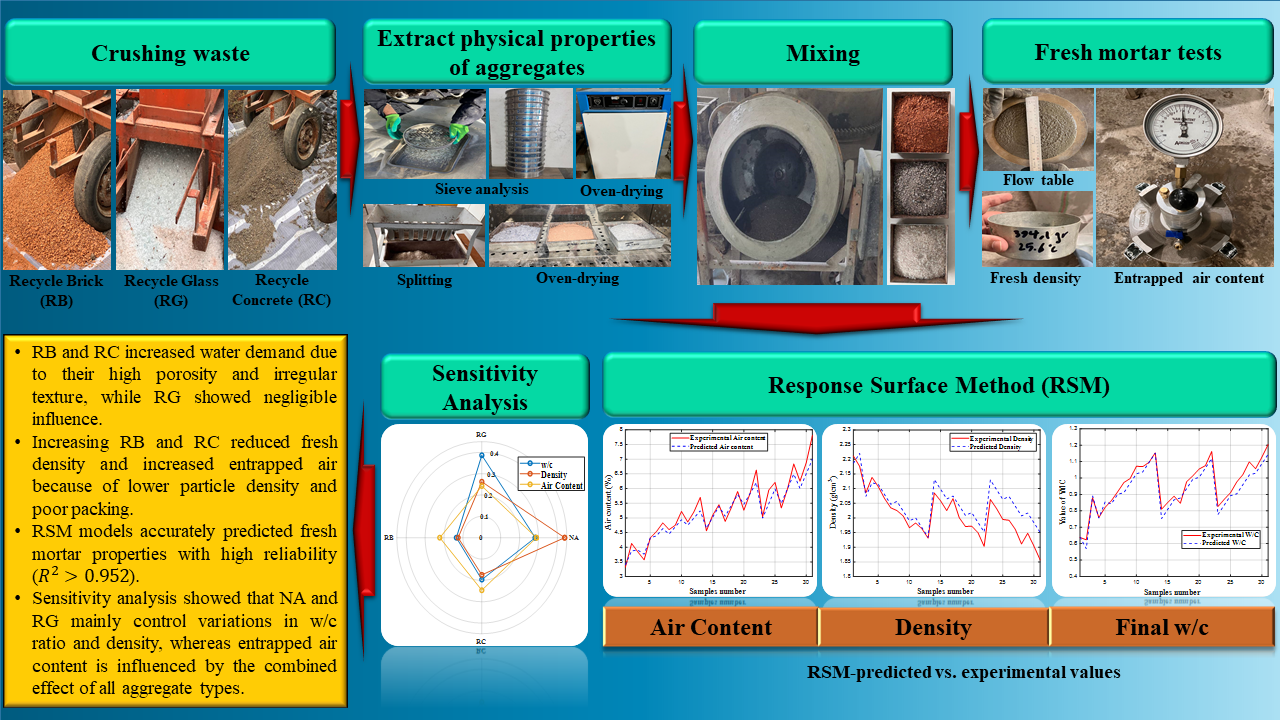
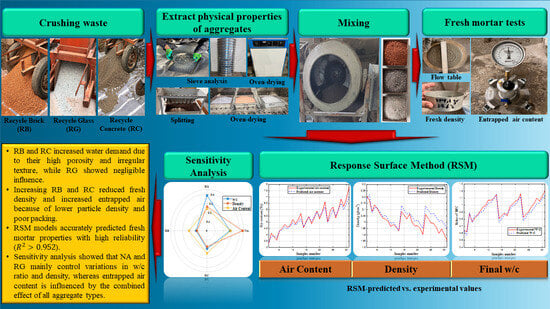
- The incorporation of RB and RC significantly increased the mixing water required to maintain constant flowability. Conversely, dense and non-porous RG showed a negligible effect on water demand, confirming that the porous ceramic and concrete fractions govern the initial water kinetics.
- A progressive reduction in fresh density (up to 12%) and an increase in air content were observed with higher levels of RB and RC. This may be associated with their lower specific gravity and more irregular particle morphology. However, the synergistic use of high-density NA and RG successfully mitigated these losses.
- The instruments and methodologies utilized (ASTM C185 and ASTM C231) produced highly comparable results with a remarkably low average relative error (~3%), confirming the experimental reliability of standard testing methods for multi-source recycled aggregate mortars.
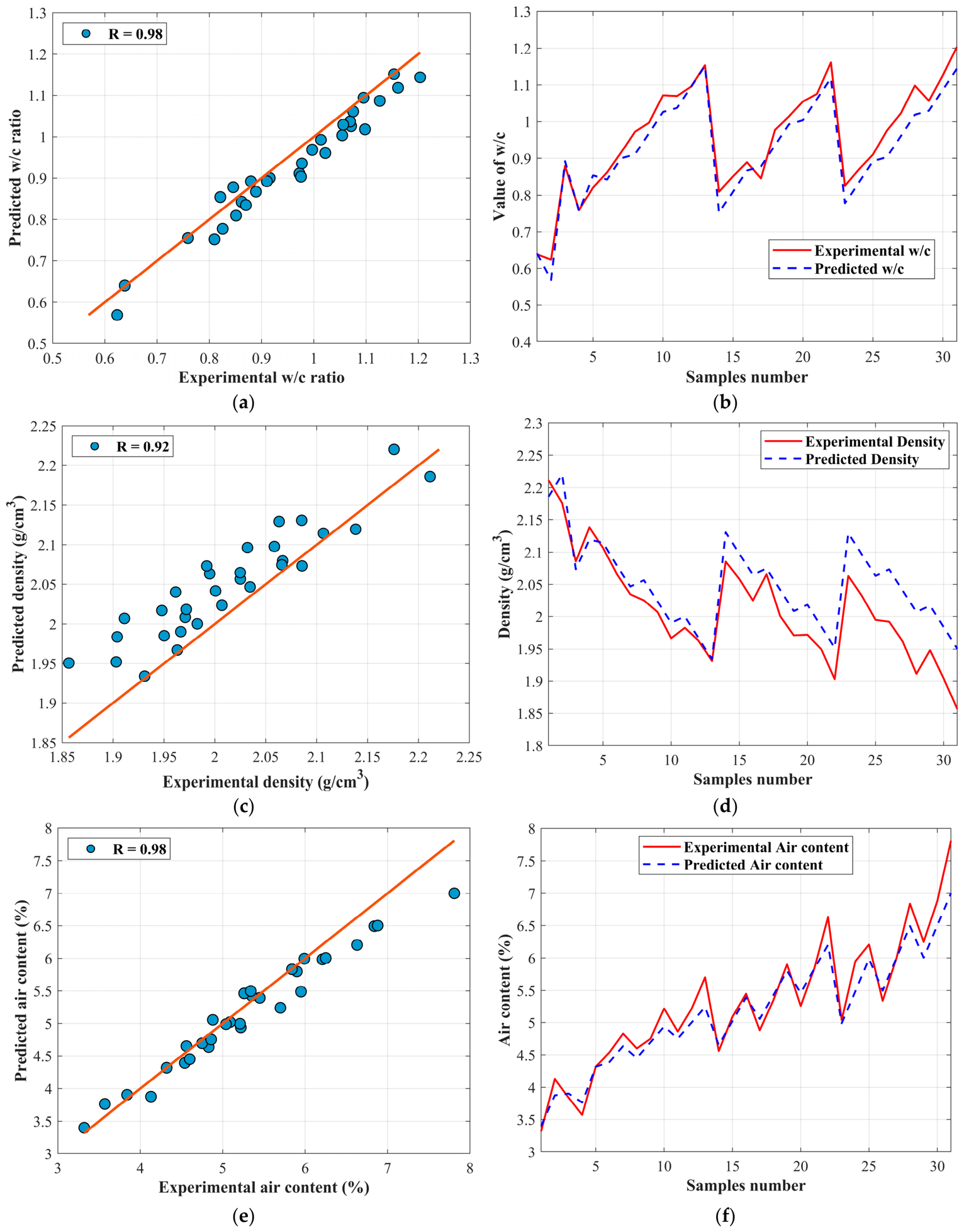
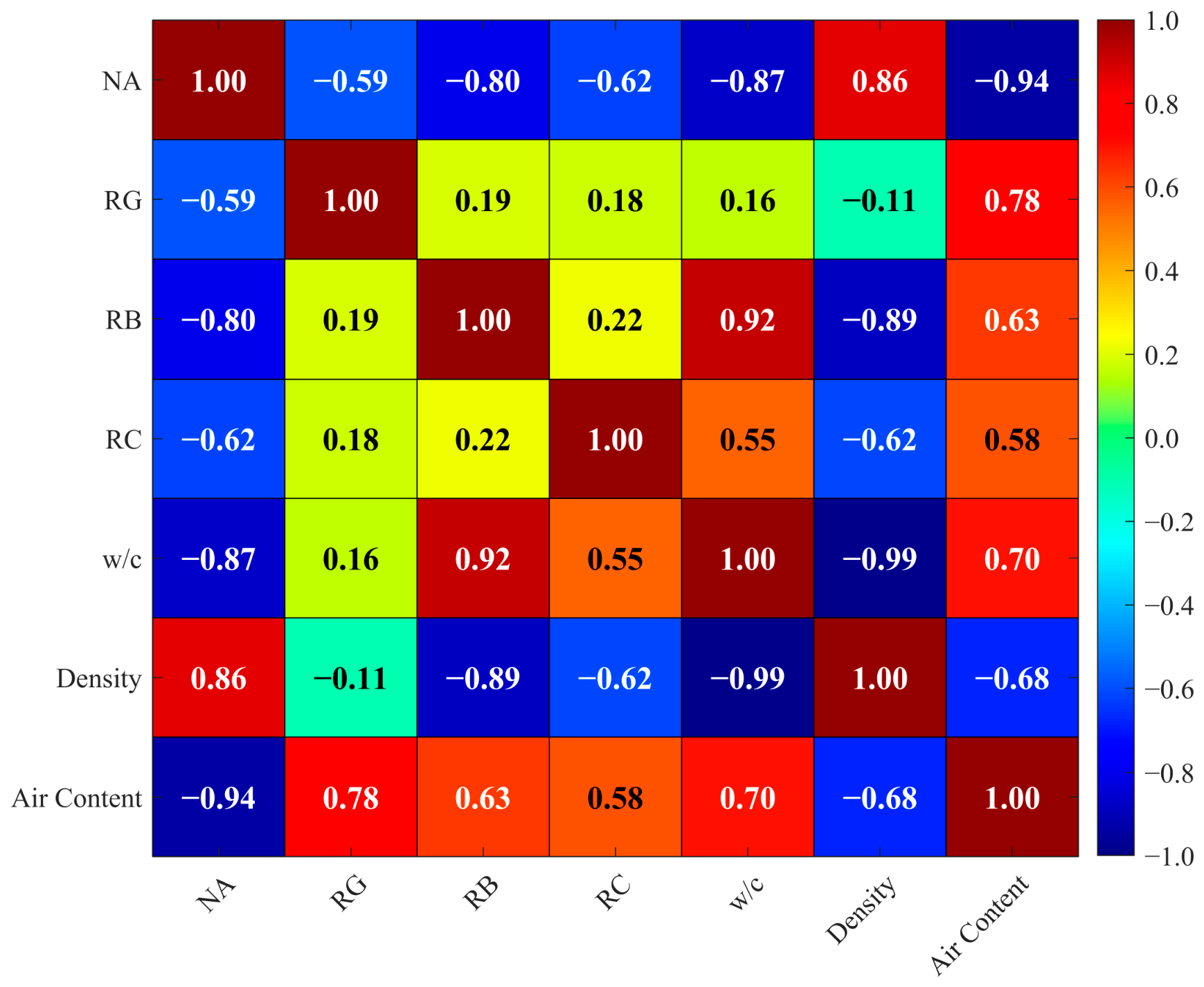
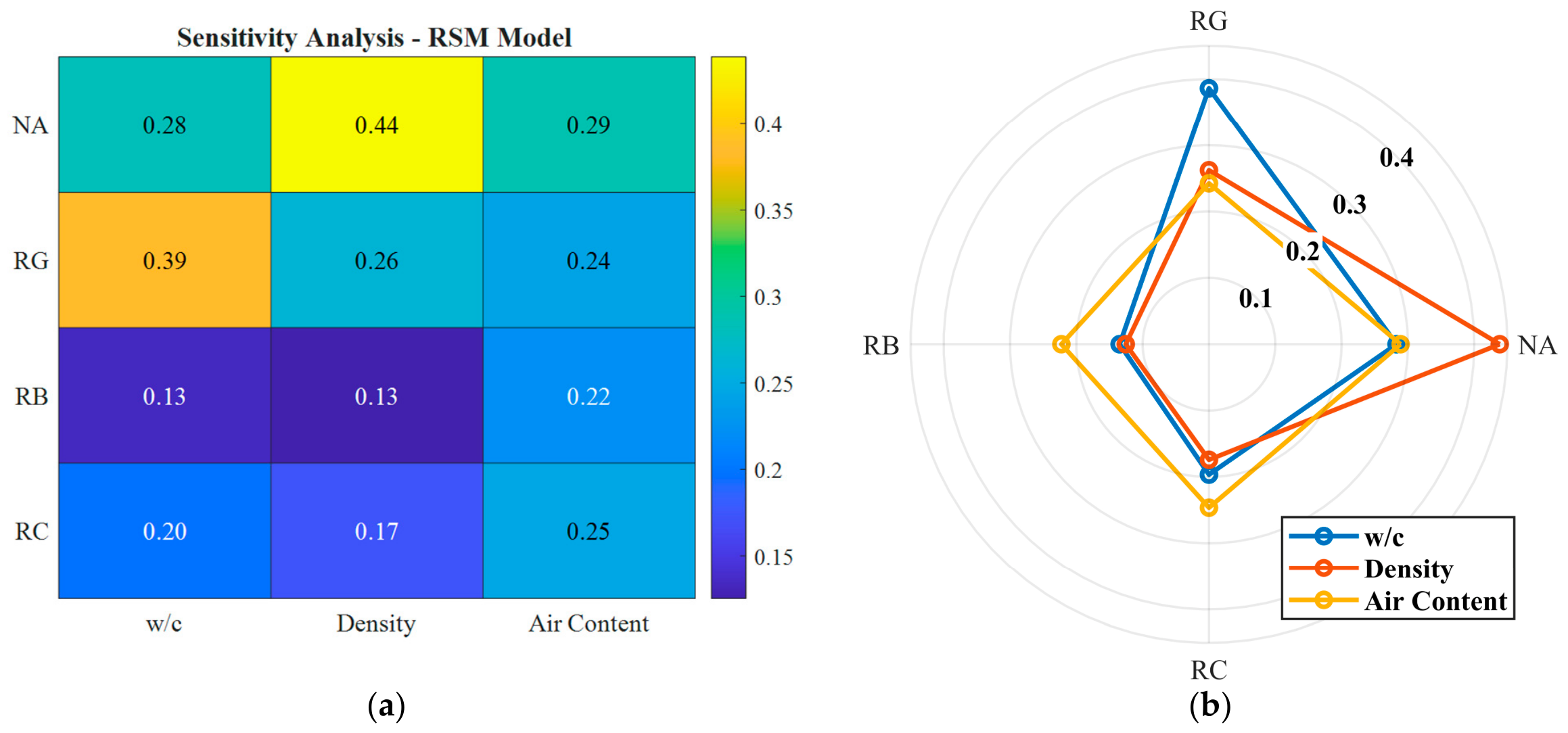
- RSM yielded quadratic and 2FI predictive models with outstanding accuracy ( ranging from 0.952 to 0.999). Sensitivity analysis proved that NA and RG predominantly control w/c and density variations, while the air content is influenced by the interactive effects of all aggregate types.

- The controlled synergistic use of multi-source recycled aggregates is a viable strategy for the circular economy in construction. While RB and RC provide sustainability benefits, they necessitate mix-design adjustments (such as the 10 min pre-wetting validated herein) to offset water demand. The findings and predictive models presented in this study are applicable within the grading characteristics reported in Figure 1. Mixtures with significantly different particle size distributions (e.g., well-graded recycled aggregates) may require separate calibration and validation.
Author Contributions
Funding
Data Availability Statement
Conflicts of Interest
References
- Torres, A.; Brandt, J.; Lear, K.; Liu, J. A looming tragedy of the sand commons. Science 2017, 357, 970–971. [Google Scholar] [CrossRef] [PubMed]
- Rodríguez-Robles, D.; García-González, J.; Juan-Valdés, A.; Morán-del Pozo, J.M.; Guerra-Romero, M.I. Overview regarding construction and demolition waste in Spain. Environ. Technol. 2015, 36, 3060–3070. [Google Scholar] [CrossRef] [PubMed]
- Evangelista, L.; de Brito, J. Concrete with fine recycled aggregates: A review. Eur. J. Environ. Civ. Eng. 2014, 18, 129–172. [Google Scholar] [CrossRef]
- Wang, B.; Yan, L.; Fu, Q.; Kasal, B. A comprehensive review on recycled aggregate and recycled aggregate concrete. Resour. Conserv. Recycl. 2021, 171, 105565. [Google Scholar] [CrossRef]
- Vardhan, K.; Siddique, R.; Goyal, S. Influence of marble waste as partial replacement of fine aggregates on strength and drying shrinkage of concrete. Constr. Build. Mater. 2019, 228, 116730. [Google Scholar] [CrossRef]
- Balasbaneh, A.T.; Sher, W.; Li, J.; Ashour, A. Systematic review of construction waste management scenarios: Informing life cycle sustainability analysis. Circ. Econ. Sustain. 2025, 5, 529–553. [Google Scholar] [CrossRef]
- Liu, G.; Florea, M.V.A.; Brouwers, H.J.H. Performance evaluation of sustainable high strength mortars incorporating high volume waste glass as binder. Constr. Build. Mater. 2019, 202, 574–588. [Google Scholar] [CrossRef]
- Choi, S.Y.; Choi, Y.S.; Yang, E.I. Effects of heavy weight waste glass recycled as fine aggregate on the mechanical properties of mortar specimens. Ann. Nucl. Energy 2017, 99, 372–382. [Google Scholar] [CrossRef]
- Letelier, V.; Henríquez-Jara, B.I.; Manosalva, M.; Moriconi, G. Combined use of waste concrete and glass as a replacement for mortar raw materials. Waste Manag. 2019, 94, 107–119. [Google Scholar] [CrossRef] [PubMed]
- Ez-zaki, H.; El Gharbi, B.; Diouri, A. Development of eco-friendly mortars incorporating glass and shell powders. Constr. Build. Mater. 2018, 159, 198–204. [Google Scholar] [CrossRef]
- Harbi, R.; Derabla, R.; Nafa, Z. Improvement of the properties of a mortar with 5% of kaolin fillers in sand combined with metakaolin, brick waste and glass powder in cement. Constr. Build. Mater. 2017, 152, 632–641. [Google Scholar] [CrossRef]
- Zhu, L.; Zhu, Z. Reuse of clay brick waste in mortar and concrete. Adv. Mater. Sci. Eng. 2020, 2020, 6326178. [Google Scholar] [CrossRef]
- Dang, J.; Zhao, J.; Hu, W.; Du, Z.; Gao, D. Properties of mortar with waste clay bricks as fine aggregate. Constr. Build. Mater. 2018, 166, 898–907. [Google Scholar] [CrossRef]
- Ma, Z.; Tang, Q.; Wu, H.; Xu, J.; Liang, C. Mechanical properties and water absorption of cement composites with various fineness and contents of waste brick powder from C&D waste. Cem. Concr. Compos. 2020, 114, 103758. [Google Scholar] [CrossRef]
- Roknuzzaman, M.; Kamrujjaman Serker, N.; Mahabub Rahman, M. Old residual mortar as a quality indicator of recycled brick aggregate. Sustain. Struct. 2024, 4, 000061. [Google Scholar] [CrossRef]
- Huang, Q.; Zhu, X.; Xiong, G.; Wang, C.; Liu, D.; Zhao, L. Recycling of crushed waste clay brick as aggregates in cement mortars: An approach from macro- and micro-scale investigation. Constr. Build. Mater. 2021, 274, 122068. [Google Scholar] [CrossRef]
- Xu, Z.; Zhu, Z.; Zhao, Y.; Guo, Z.; Chen, G.; Liu, C.; Gao, J.; Chen, X. Production of sustainable plastering mortar containing waste clay brick aggregates. Case Stud. Constr. Mater. 2022, 16, e01120. [Google Scholar] [CrossRef]
- Lam, M.N.T.; Nguyen, D.T.; Nguyen, D.L. Potential use of clay brick waste powder and ceramic waste aggregate in mortar. Constr. Build. Mater. 2021, 313, 125516. [Google Scholar] [CrossRef]
- Singh, R.; Nayak, D.; Pandey, A.; Kumar, R.; Kumar, V. Effects of recycled fine aggregates on properties of concrete containing natural or recycled coarse aggregates: A comparative study. J. Build. Eng. 2022, 45, 103442. [Google Scholar] [CrossRef]
- Braga, M.; de Brito, J.; Veiga, R. Incorporation of fine concrete aggregates in mortars. Constr. Build. Mater. 2012, 36, 960–968. [Google Scholar] [CrossRef]
- de Juan, M.S.; Gutiérrez, P.A. Study on the influence of attached mortar content on the properties of recycled concrete aggregate. Constr. Build. Mater. 2009, 23, 872–877. [Google Scholar] [CrossRef]
- Gonçalves, T.; Silva, R.V.; de Brito, J.; Fernández, J.M.; Esquinas, A.R. Mechanical and durability performance of mortars with fine recycled concrete aggregates and reactive magnesium oxide as partial cement replacement. Cem. Concr. Compos. 2020, 105, 103420. [Google Scholar] [CrossRef]
- Martínez-García, R.; Rojas, M.I.S.; Pozo, J.M.M.; Fraile-Fernández, F.J.; Juan-Valdés, A. Evaluation of mechanical characteristics of cement mortar with fine recycled concrete aggregates (FRCA). Sustainability 2021, 13, 414. [Google Scholar] [CrossRef]
- Morón, A.; Ferrández, D.; Saiz, P.; Morón, C. Experimental study with cement mortars made with recycled concrete aggregate and reinforced with aramid fibers. Appl. Sci. 2021, 11, 7791. [Google Scholar] [CrossRef]
- Wan, X.; Jia, Z.; Li, N.; Luo, H. Impact of recycled fine aggregate on physical and mechanical properties of green mortar. Materials 2025, 18, 696. [Google Scholar] [CrossRef] [PubMed]
- Lu, L. Optimal replacement ratio of recycled concrete aggregate balancing mechanical performance with sustainability: A review. Buildings 2024, 14, 2204. [Google Scholar] [CrossRef]
- Jesus, S.; Pederneiras, C.M.; Brazão Farinha, C.; de Brito, J.; Veiga, R. Reduction of the cement content by incorporation of fine recycled aggregates from construction and demolition waste in rendering mortars. Infrastructures 2021, 6, 11. [Google Scholar] [CrossRef]
- Zhang, L.; Ding, D.; Zhao, J.; Zhou, G.; Wang, Z. Mixture design and mechanical properties of recycled mortar and fully recycled aggregate concrete incorporated with fly ash. Materials 2022, 15, 8143. [Google Scholar] [CrossRef] [PubMed]
- Kou, S.-C.; Poon, C.-S. Properties of self-compacting concrete prepared with recycled glass aggregate. Cem. Concr. Compos. 2009, 31, 107–113. [Google Scholar] [CrossRef]
- El-Hassan, H.; Kianmehr, P.; Tavakoli, D.; El-Mir, A.; Dehkordi, R.S. Synergic effect of recycled aggregates, waste glass, and slag on the properties of pervious concrete. Dev. Built Environ. 2023, 15, 100189. [Google Scholar] [CrossRef]
- Mora-Ortiz, R.S.; Díaz, S.A.; Del Angel-Meraz, E.; Magaña-Hernández, F. Recycled fine aggregates from mortar debris and red clay brick to fabricate masonry mortars: Mechanical analysis. Materials 2022, 15, 7707. [Google Scholar] [CrossRef] [PubMed]
- Abed, J.M.; Al-Uzbaky, H.A.A.K.; Abbu, M. Impact of using recycled fine aggregate from demolition waste on mechanical properties of cement mortar. Arch. Civ. Eng. 2025, 71, 375. [Google Scholar] [CrossRef]
- Martínez, I.; Etxeberria, M.; Pavón, E.; Díaz, N. Influence of demolition waste fine particles on the properties of recycled aggregate masonry mortar. Int. J. Civ. Eng. 2018, 16, 1213–1226. [Google Scholar] [CrossRef]
- Li, L.; Zhan, B.J.; Lu, J.; Poon, C.S. Systematic evaluation of the effect of replacing river sand by different particle size ranges of fine recycled concrete aggregates (FRCA) in cement mortars. Constr. Build. Mater. 2019, 209, 147–155. [Google Scholar] [CrossRef]
- Cartuxo, F.; de Brito, J.; Evangelista, L.; Jiménez, J.R.; Ledesma, E.F. Rheological behaviour of concrete made with fine recycled concrete aggregates: Influence of the superplasticizer. Constr. Build. Mater. 2015, 89, 36–47. [Google Scholar] [CrossRef]
- Rueda, J.; Alaejos, P. Quantitative effect on water demand of absorption and fine particles content of recycled concrete sands. J. Mater. Civ. Eng. 2019, 31, 04019110. [Google Scholar] [CrossRef]
- Gómez-Soberón, J.M.; Cabrera-Covarrubias, F.G.; Almaral-Sánchez, J.L.; Gómez-Soberón, M.C. Fresh-state properties of mortars with recycled glass aggregates: Global unification of behavior. Adv. Mater. Sci. Eng. 2018, 2018, 1386946. [Google Scholar] [CrossRef]
- Ledesma, E.F.; Jiménez, J.R.; Fernández, J.M.; Galvín, A.P.; Agrela, F.; Barbudo, A. Properties of masonry mortars manufactured with fine recycled concrete aggregates. Constr. Build. Mater. 2014, 71, 289–298. [Google Scholar] [CrossRef]
- Boudali, S.; Soliman, A.; Abdulsalam, B.; Kada, A.; Kerdal, D.; Poncet, S. Microstructural properties of the interfacial transition zone and strength development of concrete incorporating recycled concrete aggregate. Int. J. Civ. Environ. Struct. Constr. Archit. Eng. 2017, 11, 966–970. [Google Scholar]
- Patil, S.; Ramesh, B.; Sathish, T.; Saravanan, A. RSM-based modelling for predicting and optimizing the rheological and mechanical properties of fibre-reinforced laterized self-compacting concrete. Heliyon 2024, 10, e25973. [Google Scholar] [CrossRef] [PubMed]
- Khelifi, A.; Boumaaza, M.; Belaadi, A.; Bourchak, M.; Djedid, T.; Alshaikh, I.M.H.; Ghernaout, D. RSM approach-based analysis of the physical behavior of dune sand reinforced with Washingtonia waste contributing to mortar cleaner production. Case Stud. Constr. Mater. 2025, 22, e04335. [Google Scholar] [CrossRef]
- Salah, H.A.; Mutalib, A.A.; Algaifi, H.A.; Yahya, I.B.; Yusof, M.A.I.; Sakib, N.; Elsayed, M. Assessment of the mechanical properties of high strength mortar incorporating silica fume and graphene nanoplatelets: Experimental and mathematical modeling. Sustainability 2023, 15, 8054. [Google Scholar] [CrossRef]
- Al-Kahtani, M.S.M.; Zhu, H.; Ibrahim, Y.E.; Haruna, S.I.; Al-Qahtani, S.S.M. Study on the mechanical properties of polyurethane-cement mortar containing nanosilica: RSM and machine learning approach. Appl. Sci. 2023, 13, 13348. [Google Scholar] [CrossRef]
- Chyliński, F.; Kupisz, P.; Więch, P.; Brunarski, L. Determination of composition of masonry mortars for conservation of historical constructions using artificial neural networks. Materials 2025, 18, 3851. [Google Scholar] [CrossRef] [PubMed]
- Krishnya, S.; Elakneswaran, Y.; Yoda, Y. Proposing a three-phase model for predicting the mechanical properties of mortar and concrete. Mater. Today Commun. 2021, 29, 102858. [Google Scholar] [CrossRef]
- Yang, S.; Zhong, J.; Gan, B.; Sun, Y.; Bu, C.; Zhang, M.; Li, J.; Yu, Y. Prediction and sensitivity analysis of foam concrete compressive strength based on machine learning techniques with hyperparameter optimization. Comput. Model. Eng. Sci. 2025, 144, 2943–2967. [Google Scholar] [CrossRef]
- Blasenbauer, D.; Fellner, J.; Skutan, S.; Lederer, J. Dry-wet mechanical treatment to produce high-quality recycling aggregate and cement raw material from mixed construction and demolition waste—A material flow analysis case study from Austria. Clean. Waste Syst. 2026, 13, 100473. [Google Scholar] [CrossRef]
- Sai Trivedi, S.; Snehal, K.; Das, B.B.; Barbhuiya, S. A comprehensive review towards sustainable approaches on the processing and treatment of construction and demolition waste. Constr. Build. Mater. 2023, 393, 132125. [Google Scholar] [CrossRef]
- ASTM C150/C150M-24; Standard Specification for Portland Cement. ASTM International: West Conshohocken, PA, USA, 2024.
- ASTM C33/C33M-18; Standard Specification for Concrete Aggregates. ASTM International: West Conshohocken, PA, USA, 2018.
- Rosado, S.; Costafreda, J.; Martín, D.; Presa, L.; Gullón, L. Recycled aggregates from ceramic and concrete in mortar mixes: A study of their mechanical properties. Materials 2022, 15, 8933. [Google Scholar] [CrossRef] [PubMed]
- Kou, S.-C.; Poon, C.-S. Properties of concrete prepared with crushed fine stone, furnace bottom ash and fine recycled aggregate as fine aggregates. Constr. Build. Mater. 2009, 23, 2877–2886. [Google Scholar] [CrossRef]
- ASTM C144-99; Standard Specification for Aggregate for Masonry Mortar. ASTM International: West Conshohocken, PA, USA, 1999.
- de Brito, J.; Saikia, N. Recycled Aggregate in Concrete; Springer: London, UK, 2013. [Google Scholar] [CrossRef]
- ASTM C128-04a; Standard Test Method for Density, Relative Density (Specific Gravity), and Absorption. ASTM International: West Conshohocken, PA, USA, 2004.
- ASTM C136-06; Standard Test Method for Sieve Analysis of Fine and Coarse Aggregates. ASTM International: West Conshohocken, PA, USA, 2006.
- Zhao, Z.; Xiao, J.; Duan, Z.; Hubert, J.; Grigoletto, S.; Courard, L. Performance and durability of self-compacting mortar with recycled sand from crushed brick. J. Build. Eng. 2022, 57, 104867. [Google Scholar] [CrossRef]
- Mazhoud, B.; Sedran, T.; Cazacliu, B.; Cothenet, A.; Torrenti, J.-M. Influence of residual mortar volume on the properties of recycled concrete aggregates. J. Build. Eng. 2022, 57, 104945. [Google Scholar] [CrossRef]
- Muhammad, F.; Harun, M.; Ahmed, A.; Kabir, N.; Khalid, H.R.; Hanif, A. Influence of bonded mortar on recycled aggregate concrete properties: A review. Constr. Build. Mater. 2024, 432, 136564. [Google Scholar] [CrossRef]
- ASTM C109/C109M-05; Standard Test Method for Compressive Strength of Hydraulic Cement Mortars. ASTM International: West Conshohocken, PA, USA, 2005.
- ASTM C305-06; Mechanical Mixing of Hydraulic Cement Pastes and Mortars of Plastic Consistency. ASTM International: West Conshohocken, PA, USA, 2006.
- Małek, M.; Łasica, W.; Jackowski, M.; Kadela, M. Effect of waste glass addition as a replacement for fine aggregate on properties of mortar. Materials 2020, 13, 3189. [Google Scholar] [CrossRef] [PubMed]
- Alducin-Ochoa, J.M.; Martín-del-Río, J.J.; Torres-González, M.; Flores-Alés, V.; Hernández-Cruz, D. Performance of mortars based on recycled glass as aggregate by accelerated decay tests (ADT). Constr. Build. Mater. 2021, 300, 124057. [Google Scholar] [CrossRef]
- Lliso-Ferrando, J.R.; Arenós-Barrachina, A.; Monzón-Bello, P.; Valcuende, M. Durability of mortars with partial cement replacement by recycled brick powder. Appl. Sci. 2025, 15, 4133. [Google Scholar] [CrossRef]
- Sun, Y.; Hou, D.; Shi, Y.; Sun, Y.; Xv, C.; Wang, Y. Mechanical properties of recycled concrete containing brick–concrete waste aggregates with basalt fiber-reinforced polymer (BFRP) fibers. Buildings 2025, 15, 2047. [Google Scholar] [CrossRef]
- Liu, Q.; Li, B.; Xiao, J.; Singh, A. Utilization potential of aerated concrete block powder and clay brick powder from C&D waste. Constr. Build. Mater. 2020, 238, 117721. [Google Scholar] [CrossRef]
- Evangelista, L.; de Brito, J. Mechanical behaviour of concrete made with fine recycled concrete aggregates. Cem. Concr. Compos. 2007, 29, 397–401. [Google Scholar] [CrossRef]
- Poon, C.S.; Chan, D. The use of recycled aggregate in concrete in Hong Kong. Resour. Conserv. Recycl. 2007, 50, 293–305. [Google Scholar] [CrossRef]
- Tam, V.W.Y.; Gao, X.F.; Tam, C.M. Microstructural analysis of recycled aggregate concrete produced from two-stage mixing approach. Cem. Concr. Res. 2005, 35, 1195–1203. [Google Scholar] [CrossRef]
- García-González, J.; Rodríguez-Robles, D.; Juan-Valdés, A.; Morán-del Pozo, J.; Guerra-Romero, M. Pre-saturation technique of the recycled aggregates: Solution to the water absorption drawback in the recycled concrete manufacture. Materials 2014, 7, 6224–6236. [Google Scholar] [CrossRef] [PubMed]
- Mora-Ortiz, R.S.; Del Angel-Meraz, E.; Díaz, S.A.; Magaña-Hernández, F.; Munguía-Balvanera, E.; Pantoja Castro, M.A.; Alavez-Ramírez, J.; Alejandro Quiroga, L. Effect of Pre-Wetting Recycled Mortar Aggregate on the Mechanical Properties of Masonry Mortar. Materials 2021, 14, 1547. [Google Scholar] [CrossRef] [PubMed]
- Mefteh, H.; Kebaïli, O.; Oucief, H.; Berredjem, L.; Arabi, N. Influence of moisture conditioning of recycled aggregates on the properties of fresh and hardened concrete. J. Clean. Prod. 2013, 54, 282–288. [Google Scholar] [CrossRef]
- Zhang, H.; Xu, X.; Liu, W.; Zhao, B.; Wang, Q. Influence of the moisture states of aggregate recycled from waste concrete on the performance of the prepared recycled aggregate concrete (RAC)—A review. Constr. Build. Mater. 2022, 326, 126891. [Google Scholar] [CrossRef]
- Sun, D.; Li, Y.; Wang, Z.; Zhang, Y.; Li, H.; Zhao, Y. Effect of the Moisture Content of Recycled Aggregate on the Mechanical Performance and Durability of Concrete. Materials 2022, 15, 6299. [Google Scholar] [CrossRef] [PubMed]
- Evangelista, L.; Guedes, M.; de Brito, J.; Ferro, A.C.; Pereira, M.F. Physical, chemical and mineralogical properties of fine recycled aggregates made from concrete waste. Constr. Build. Mater. 2015, 86, 178–188. [Google Scholar] [CrossRef]
- Ma, J.; Wang, Y.; Zhang, L.; Zeng, L.; Wang, X.; Dang, J. Influence of geometric shape, pore structure and surface modification of recycled fine aggregate on the rheology behaviour and strength development of mortar. J. Build. Eng. 2024, 91, 109604. [Google Scholar] [CrossRef]
- Liu, Y. Testing of recycled fine aggregate concrete’s mechanical properties using recycled fine aggregate concrete and research on technology for highway construction. Nonlinear Eng. 2025, 14, e20250109. [Google Scholar] [CrossRef]
- Grigorjev, V.; Laveglia, A.; Madrid, D.E.V.; Cnudde, V.; Azenha, M.; De Belie, N. Fine fractions of recycled aggregates: Integrated characterisation of physical and chemical properties, life cycle impacts and performance in cementitious mixtures. Constr. Build. Mater. 2026, 518, 145829. [Google Scholar] [CrossRef]
- ASTM C1437-99; Standard Test Method for Flow of Hydraulic Cement Mortar. ASTM International: West Conshohocken, PA, USA, 1999.
- ASTM C138-14; Standard Test Method for Density (Unit Weight), Yield, and Air Content of Concrete. ASTM International: West Conshohocken, PA, USA, 2014.
- ASTM C231-08b; Standard Test Method for Air Content of Freshly Mixed Concrete by the Pressure Method. ASTM International: West Conshohocken, PA, USA, 2008.
- ASTM C185-99; Standard Test Method for Air Content of Hydraulic Cement Mortar. ASTM International: West Conshohocken, PA, USA, 2001.
- Saltelli, A.; Tarantola, S.; Campolongo, F.; Ratto, M. Sensitivity Analysis in Practice: A Guide to Assessing Scientific Models; Wiley: Chichester, UK, 2002. [Google Scholar] [CrossRef]
- Kilumile, M.; Barra, M.; Mohamed, F.; Aponte, D. Use of recycled aggregates in lime mortars for conservation of historical buildings. Constr. Mater. 2025, 5, 28. [Google Scholar] [CrossRef]
- Silva, R.V.; de Brito, J.; Dhir, R.K. Properties and composition of recycled aggregates from construction and demolition waste suitable for concrete production. Constr. Build. Mater. 2014, 65, 201–217. [Google Scholar] [CrossRef]
- Pizoń, J. Fresh, mechanical, and thermal properties of cement composites containing recycled foam concrete as partial replacement of cement and fine aggregate. Materials 2023, 16, 7169. [Google Scholar] [CrossRef] [PubMed]
- Debieb, F.; Kenai, S. The use of coarse and fine crushed bricks as aggregate in concrete. Constr. Build. Mater. 2008, 22, 886–893. [Google Scholar] [CrossRef]
- Al-Bayati, H.K.A.; Jadaa, W.; Tighe, S.L. Effect of recycled concrete aggregate addition on the asphalt mixtures performance: ITZ area, microstructure, and chemical analysis perspectives. Recycling 2024, 9, 41. [Google Scholar] [CrossRef]
- Otsuki, N.; Miyazato, S.; Yodsudjai, W. Influence of recycled aggregate on interfacial transition zone, strength, chloride penetration and carbonation of concrete. J. Mater. Civ. Eng. 2003, 15, 443–451. [Google Scholar] [CrossRef]
- Tam, V.W.Y.; Soomro, M.; Evangelista, A.C.J. A review of recycled aggregate in concrete applications (2000–2017). Constr. Build. Mater. 2018, 172, 272–292. [Google Scholar] [CrossRef]
- Fennis-Huijben, S.; Walraven, J.C. Using particle packing technology for sustainable concrete mixture design. Heron 2012, 57, 73–101. [Google Scholar]
- Xiao, J.; Li, W.; Fan, Y.; Huang, X. An overview of study on recycled aggregate concrete in China (1996–2011). Constr. Build. Mater. 2012, 31, 364–383. [Google Scholar] [CrossRef]
- Shishodiya, A.; Babu, V.S.; Murthy, Y.I. Use of treated recycled aggregates in high-strength concrete: A response surface approach. Proc. Inst. Civ. Eng.—Eng. Sustain. 2026, 179, 87–103. [Google Scholar] [CrossRef]
- Khan, M.I.; Abbas, Y.M.; Abellan-Garcia, J.; Castro-Cabeza, A. Eco-efficient ultra-high-performance concrete formulation utilizing electric arc furnace slag and recycled glass powder—Advanced analytics and lifecycle perspectives. J. Mater. Res. Technol. 2024, 32, 362–377. [Google Scholar] [CrossRef]
- Dahish, H.A.; Alkharisi, M.K. Predicting the Properties of Polypropylene Fiber Recycled Aggregate Concrete Using Response Surface Methodology and Machine Learning. Buildings 2025, 15, 3709. [Google Scholar] [CrossRef]
- Hastie, T.; Tibshirani, R.; Friedman, J. The Elements of Statistical Learning: Data Mining, Inference, and Prediction; Springer: New York, NY, USA, 2009. [Google Scholar] [CrossRef]




| Aggregate Type | SSD Density (kg/m3) | OD Density (kg/m3) | Water Absorption (%) | FM 1 | Porosity (%) |
|---|---|---|---|---|---|
| NA | 2622.5 | 2571.0 | 2.00 | 2.90 | 5.43 |
| RG | 2504.9 | 2501.7 | 0.13 | 3.41 | 0.31 |
| RB | 2186.4 | 1858.3 | 17.65 | 3.36 | 48.88 |
| RC | 2337.4 | 2143.0 | 9.07 | 3.37 | 24.14 |
| Mix No. | Mix ID | NA | RG | RB | RC | Absorbed Water | Extra Water for Consistency | Total Water |
|---|---|---|---|---|---|---|---|---|
| 1 | Ctrl | 22.08 | 0.00 | 0.00 | 0.00 | 0.44 | 0.04 | 4.03 |
| 2 | G15 | 18.77 | 3.31 | 0.00 | 0.00 | 0.38 | 0.13 | 4.06 |
| 3 | B30 | 15.46 | 0.00 | 6.62 | 0.00 | 1.48 | 0.53 | 5.55 |
| 4 | C20 | 17.66 | 0.00 | 0.00 | 4.42 | 0.75 | 0.49 | 4.79 |
| 5 | G5 B15 C10 | 15.46 | 1.10 | 3.31 | 3.63 | 1.22 | 0.41 | 5.18 |
| 6 | G5 B15 C20 | 13.25 | 3.31 | 4.42 | 1.25 | 0.64 | 5.44 | |
| 7 | G5 B15 C30 | 11.04 | 3.31 | 6.62 | 1.41 | 0.82 | 5.78 | |
| 8 | G5 B30 C10 | 12.14 | 6.62 | 2.21 | 1.61 | 0.98 | 6.13 | |
| 9 | G5 B30 C20 | 9.94 | 6.62 | 4.42 | 1.77 | 0.97 | 6.29 | |
| 10 | G5 B30 C30 | 7.73 | 6.62 | 6.62 | 1.93 | 1.29 | 6.76 | |
| 11 | G5 B45 C10 | 8.83 | 9.94 | 2.21 | 2.13 | 1.07 | 6.75 | |
| 12 | G5 B45 C20 | 6.62 | 9.94 | 4.42 | 2.29 | 1.08 | 6.91 | |
| 13 | G5 B45 C30 | 4.42 | 9.94 | 6.62 | 2.44 | 1.29 | 7.28 | |
| 14 | G15 B15 C10 | 13.25 | 3.31 | 3.31 | 2.21 | 1.05 | 0.51 | 5.11 |
| 15 | G15 B15 C20 | 11.04 | 3.31 | 4.42 | 1.21 | 0.61 | 5.37 | |
| 16 | G15 B15 C30 | 8.83 | 3.31 | 6.62 | 1.37 | 0.70 | 5.61 | |
| 17 | G15 B30 C10 | 9.94 | 6.62 | 2.21 | 1.57 | 0.22 | 5.34 | |
| 18 | G15 B30 C20 | 7.73 | 6.62 | 4.42 | 1.73 | 0.89 | 6.16 | |
| 19 | G15 B30 C30 | 5.52 | 6.62 | 6.62 | 1.88 | 0.96 | 6.39 | |
| 20 | G15 B45 C10 | 6.62 | 9.94 | 2.21 | 2.09 | 1.02 | 6.65 | |
| 21 | G15 B45 C20 | 4.42 | 9.94 | 4.42 | 2.25 | 0.99 | 6.78 | |
| 22 | G15 B45 C30 | 2.21 | 9.94 | 6.62 | 2.40 | 1.38 | 7.33 | |
| 23 | G25 B15 C10 | 11.04 | 5.52 | 3.31 | 2.21 | 1.01 | 0.65 | 5.21 |
| 24 | G25 B15 C20 | 8.83 | 3.31 | 4.42 | 1.17 | 0.77 | 5.49 | |
| 25 | G25 B15 C30 | 6.62 | 3.31 | 6.62 | 1.33 | 0.87 | 5.74 | |
| 26 | G25 B30 C10 | 7.73 | 6.62 | 2.21 | 1.53 | 1.08 | 6.15 | |
| 27 | G25 B30 C20 | 5.52 | 6.62 | 4.42 | 1.69 | 1.21 | 6.45 | |
| 28 | G25 B30 C30 | 3.31 | 6.62 | 6.62 | 1.84 | 1.54 | 6.93 | |
| 29 | G25 B45 C10 | 4.42 | 9.94 | 2.21 | 2.05 | 1.07 | 6.66 | |
| 30 | G25 B45 C20 | 2.21 | 9.94 | 4.42 | 2.21 | 1.35 | 7.11 | |
| 31 | G25 B45 C30 | 0.00 | 9.94 | 6.62 | 2.36 | 1.69 | 7.59 |
| Mix No. | Mix ID | Recycle Percent (%) | Fresh Density (g/cm3) | Final w/c Ratio | Air Content ASTM C185 (%) | Air Content ASTM C231 (%) |
|---|---|---|---|---|---|---|
| 1 | Ctrl | 0 | 2.21 | 0.64 | 3.25 | 3.32 |
| 2 | G15 | 15 | 2.15 | 0.62 | 4.02 | 4.13 |
| 3 | B30 | 30 | 2.09 | 0.88 | 3.78 | 3.84 |
| 4 | C20 | 20 | 2.14 | 0.76 | 3.48 | 3.57 |
| 5 | G5 B15 C10 | 30 | 2.11 | 0.82 | 4.31 | 4.32 |
| 6 | G5 B15 C20 | 40 | 2.07 | 0.86 | 4.49 | 4.54 |
| 7 | G5 B15 C30 | 50 | 2.03 | 0.92 | 4.79 | 4.83 |
| 8 | G5 B30 C10 | 45 | 2.03 | 0.97 | 4.44 | 4.60 |
| 9 | G5 B30 C20 | 55 | 2.01 | 1.00 | 4.73 | 4.75 |
| 10 | G5 B30 C30 | 65 | 1.97 | 1.07 | 5.18 | 5.22 |
| 11 | G5 B45 C10 | 60 | 1.98 | 1.07 | 4.75 | 4.86 |
| 12 | G5 B45 C20 | 70 | 1.96 | 1.10 | 5.13 | 5.21 |
| 13 | G5 B45 C30 | 80 | 1.93 | 1.15 | 5.57 | 5.70 |
| 14 | G15 B15 C10 | 40 | 2.09 | 0.81 | 4.42 | 4.56 |
| 15 | G15 B15 C20 | 50 | 2.06 | 0.85 | 4.69 | 5.09 |
| 16 | G15 B15 C30 | 60 | 2.02 | 0.89 | 5.38 | 5.45 |
| 17 | G15 B30 C10 | 55 | 2.07 | 0.85 | 4.71 | 4.88 |
| 18 | G15 B30 C20 | 65 | 2.00 | 0.98 | 5.03 | 5.35 |
| 19 | G15 B30 C30 | 75 | 1.97 | 1.01 | 5.67 | 5.90 |
| 20 | G15 B45 C10 | 70 | 1.97 | 1.05 | 5.18 | 5.26 |
| 21 | G15 B45 C20 | 80 | 1.95 | 1.08 | 5.76 | 5.84 |
| 22 | G15 B45 C30 | 90 | 1.90 | 1.16 | 6.46 | 6.63 |
| 23 | G25 B15C10 | 50 | 2.06 | 0.83 | 4.70 | 5.04 |
| 24 | G25 B15 C20 | 60 | 2.03 | 0.87 | 5.14 | 5.95 |
| 25 | G25 B15 C30 | 70 | 1.99 | 0.91 | 5.99 | 6.21 |
| 26 | G25 B30 C10 | 65 | 1.99 | 0.98 | 5.19 | 5.34 |
| 27 | G25 B30 C20 | 75 | 1.96 | 1.02 | 5.68 | 5.99 |
| 28 | G25 B30 C30 | 85 | 1.91 | 1.10 | 6.67 | 6.84 |
| 29 | G25 B45 C10 | 80 | 1.95 | 1.06 | 5.94 | 6.25 |
| 30 | G25 B45 C20 | 90 | 1.90 | 1.13 | 6.75 | 6.88 |
| 31 | G25 B45 C30 | 100 | 1.86 | 1.20 | 7.70 | 7.81 |
| Final w/c Ratio | Fresh Mortar Density | Air Content | ||||
|---|---|---|---|---|---|---|
| f-Value | p-Value | f-Value | p-Value | f-Value | p-Value | |
| Model | 70.25 | <0.0001 | 68,616.22 | <0.0001 | 482.21 | <0.0001 |
| NA | 111.76 | <0.0001 | 1.763 × 10⁵ | <0.0001 | 1095.37 | <0.0001 |
| RG | 144.73 | <0.0001 | 1.431 × 10⁵ | <0.0001 | 825.95 | <0.0001 |
| RB | 89.21 | <0.0001 | 1.609 × 10⁵ | <0.0001 | 940.99 | <0.0001 |
| RC | 87.01 | <0.0001 | 1.535 × 10⁵ | <0.0001 | 886.34 | <0.0001 |
| NA × RG | 8.02 | 0.0092 | 37,490.78 | <0.0001 | 230.34 | <0.0001 |
| RG × RB | 5.35 | 0.0296 | 37,151.44 | <0.0001 | 226.04 | <0.0001 |
| RG × RC | 5.59 | 0.0266 | 37,710.62 | <0.0001 | 227.50 | <0.0001 |
| RG2 | - | - | 33,113.69 | <0.0001 | 205.23 | <0.0001 |
| Model | RMSE | MAE | Cross − Validated R2 |
|---|---|---|---|
| Final w/c ratio | 0.0406 | 0.0347 | 0.92 |
| Fresh mortar density (g/cm3) | 0.0491 | 0.0409 | 0.62 |
| Air content (%) | 0.2602 | 0.1962 | 0.93 |
Disclaimer/Publisher’s Note: The statements, opinions and data contained in all publications are solely those of the individual author(s) and contributor(s) and not of MDPI and/or the editor(s). MDPI and/or the editor(s) disclaim responsibility for any injury to people or property resulting from any ideas, methods, instructions or products referred to in the content. |
© 2026 by the authors. Licensee MDPI, Basel, Switzerland. This article is an open access article distributed under the terms and conditions of the Creative Commons Attribution (CC BY) license.
Share and Cite
Faghihi, K.; Gómez-Soberón, J.M.; Valderrama-Ulloa, C. Synergistic Effects of Multi-Component Recycled Aggregate on the Fresh Properties of Mortar: Predictive Modeling and Sensitivity Analysis. Buildings 2026, 16, 2635. https://doi.org/10.3390/buildings16132635
Faghihi K, Gómez-Soberón JM, Valderrama-Ulloa C. Synergistic Effects of Multi-Component Recycled Aggregate on the Fresh Properties of Mortar: Predictive Modeling and Sensitivity Analysis. Buildings. 2026; 16(13):2635. https://doi.org/10.3390/buildings16132635
Chicago/Turabian StyleFaghihi, Kamyar, José Manuel Gómez-Soberón, and Claudia Valderrama-Ulloa. 2026. "Synergistic Effects of Multi-Component Recycled Aggregate on the Fresh Properties of Mortar: Predictive Modeling and Sensitivity Analysis" Buildings 16, no. 13: 2635. https://doi.org/10.3390/buildings16132635
APA StyleFaghihi, K., Gómez-Soberón, J. M., & Valderrama-Ulloa, C. (2026). Synergistic Effects of Multi-Component Recycled Aggregate on the Fresh Properties of Mortar: Predictive Modeling and Sensitivity Analysis. Buildings, 16(13), 2635. https://doi.org/10.3390/buildings16132635