


Abstract
Buildings account for 40% of global energy consumption and one-third of greenhouse gas emissions. Renewable energy systems (RESs), such as solar photovoltaic (PV) and geothermal heat pumps, are critical technological solutions for decarbonization. Despite the growing literature, existing reviews lack a comprehensive synthesis integrating machine learning (ML), Internet of Things (IoT), and Building Information Modeling (BIM). Following the PRISMA protocol, this paper presents a systematic review of 41 studies published between 2012 and 2025. The review evaluates four primary domains: RES performance, building energy prediction, HVAC optimization, and occupancy-aware management. Quantitative findings reveal that solar PV-integrated buildings achieve electricity cost reductions of 35–64%, while ML-enhanced energy prediction models attain accuracies up to R2 = 0.989. Critical research gaps are identified, including the scarcity of real-time sensor integration and geographically inclusive multi-climate datasets. Ultimately, this review contributes a structured synthesis of effective technologies, a comparative analysis of methodological approaches (ML, simulation, hybrid), and actionable future directions. It provides practical guidance for researchers and policymakers toward achieving net-zero energy buildings. This study serves as a definitive reference for the development of sustainable, low-energy built environments.
1. Introduction
The building sector represents one of the largest contributors to global energy demand and greenhouse gas (GHG) emissions. According to recent estimates, buildings account for nearly 40% of global energy consumption and approximately one-third of total GHG emissions [1,2]. As urbanization accelerates and living standards improve worldwide, these figures are projected to increase further unless decisive technological and policy interventions are implemented. In this context, the integration of renewable energy systems (RES) into buildings has emerged as a cornerstone strategy for achieving substantial reductions in energy consumption and carbon emissions.
Renewable energy technologies including solar photovoltaic (PV) systems, solar thermal collectors, geothermal heat pumps, small-scale wind turbines, and hybrid energy configurations offer building owners and operators the means to generate clean energy on-site, reducing dependence on fossil fuel-based electricity grids. Beyond simple energy generation, modern RES solutions are increasingly coupled with intelligent energy management strategies, enabling buildings not only to produce energy but also to store, forecast, and optimize its utilization in real time [3,4]. The convergence of RES with advanced technologies such as machine learning (ML), the Internet of Things (IoT), Building Information Modeling (BIM), and Model Predictive Control (MPC) is transforming conventional buildings into intelligent, energy-responsive systems capable of approaching net-zero energy building (NZEB) status.
Building Energy Management Systems (BEMSs) represent the operational backbone through which RES integration is monitored, controlled, and optimized. BEMSs are integrated platforms that utilize sensor data, weather forecasts, occupancy patterns, and energy price signals to coordinate the operation of generation, storage, and consumption systems within a building [5,6]. The incorporation of Demand-Side Management (DSM) strategies that shift or curtail energy use during peak demand periods further enhances the value of on-site renewable generation by aligning consumption with generation profiles [7]. Together, BEMS, DSM, and RES form a synergistic framework capable of achieving energy reductions of 35–64% compared to conventional building operation [8].
Despite this significant progress, several critical gaps remain in existing research. First, studies on RES integration in buildings tend to be geographically concentrated in North America, Europe, and East Asia, with limited coverage of tropical, arid, and developing world contexts where RES potential is often highest [9,10]. Second, while ML-based energy prediction models have demonstrated impressive accuracy (R2 up to 0.989), their dependence on large, context-specific datasets limits their transferability across different climate zones and building typologies [11,12]. Third, comprehensive frameworks that simultaneously integrate RES performance, occupant behavior modeling, real-time IoT sensor data, and economic feasibility remain rare in the literature [13]. Finally, the economic dimension of RES integration including life-cycle cost analysis, payback periods, and the impact on overall construction and operational costs is insufficiently addressed in most building energy studies [14,15].
This systematic review addresses these gaps by providing a structured, comprehensive analysis of 41 recent studies (2012–2025) on renewable energy integration and energy management in buildings. The review follows the PRISMA protocol to ensure methodological transparency and reproducibility. The central focus is on quantifying the energy reduction outcomes achieved through RES integration, characterizing the methodological approaches employed across the reviewed studies, and identifying the most critical directions for future research. By doing so, this paper aims to serve as a definitive reference for researchers, building engineers, energy consultants, and policymakers working toward the development of sustainable, low-energy, and net-zero buildings.
Unlike existing reviews that address individual components of building energy management—such as ML-based prediction, IoT integration, or BIM applications—this review uniquely integrates all three technology pillars within a unified PRISMA-based synthesis. This approach enables cross-domain comparisons that are absent from prior reviews and yields more actionable research gap identification relevant to practitioners and policymakers pursuing net-zero energy building targets. To our knowledge, no existing PRISMA-compliant systematic review simultaneously synthesizes ML-, IoT-, and BIM-enabled RES integration across the six thematic domains addressed in this study, distinguishing it from domain-specific reviews that focus on individual technology pillars without cross-domain integration.
The remainder of this paper is organized as follows: Section 2 presents the systematic review methodology. Section 3 reports the results, including the two comparative tables. Section 4 provides an in-depth thematic discussion, including a new Section 4.5 on economic feasibility and practical deployment considerations. Section 5 concludes the paper with key findings, limitations, and future research directions.
2. Methodology
2.1. Review Protocol and Objectives
This systematic review was conducted following the PRISMA 2020 (Preferred Reporting Items for Systematic Reviews and Meta-Analyses) statement [16] to ensure a rigorous, transparent, and reproducible methodology. The primary objective was to synthesize the current state of knowledge on the integration of renewable energy systems (RESs) in buildings for the purpose of reducing energy consumption. Secondary objectives included characterizing the methodological approaches used in the literature, evaluating reported performance outcomes and energy savings, and identifying research gaps and future directions.
It is essential to clarify that this review is a multi-domain integrative systematic review, not a single-topic systematic review of any one technology or application area. A search on any single sub-topic covered in this review—such as “energy consumption prediction,” “HVAC optimization,” or “BIM for buildings”—would correctly yield hundreds to thousands of papers in the broader literature. However, inclusion in this review required each study to specifically address the integration of at least one of the three primary technology pillars (ML, IoT, or BIM) within a building RES or net-zero energy building context—a multi-domain intersection that characterizes a substantially smaller subset of the literature. Our corpus size of 41 studies is consistent with comparable multi-domain systematic reviews in leading building energy journals, including Antonopoulos et al. (2020) [17], Zhang et al. (2021) [18], Aguilar et al. (2021) [19], and Mariano-Hernández and Hernández-Callejo (2021) [6], which typically range from 35 to 55 studies when applying equivalent multi-domain quality and scope criteria.
2.2. Search Strategy and Databases
A systematic literature search was conducted across five major electronic databases: ScienceDirect, IEEE Xplore, SpringerLink, Web of Science, and Google Scholar. The search was constrained to peer-reviewed journal articles and conference proceedings published between January 2012 and March 2025. This temporal scope was chosen to capture both foundational works and the most recent advancements in RES integration and building energy management.
The search queries employed combinations of the following keywords: “renewable energy buildings”, “solar photovoltaic building energy”, “building energy management systems”, “HVAC optimization renewable energy”, “net-zero energy building”, “machine learning building energy prediction”, “IoT building energy monitoring”, “BIM energy simulation”, “building energy consumption reduction”, and “geothermal heat pump buildings”. Boolean operators (AND, OR) were used to combine search terms systematically across all databases.
To further clarify the inclusion logic, individual studies were included not merely because they address a single technology domain in isolation, but because they demonstrate the application of ML, IoT, or BIM specifically within a building RES or net-zero energy building context. For example, Reference [11]—which concerns ML-based energy consumption prediction—was included because it demonstrates ML prediction applied directly within an IoT-enabled RES management system for buildings, satisfying the multi-domain intersection criterion. A study that addresses only general energy consumption prediction without connection to RES integration, IoT deployment, or net-zero building design would not meet the inclusion criteria, regardless of its quality. This explains why a broad search on “energy consumption prediction” would yield over 1000 papers, while only a small subset qualify for this multi-domain integrative review. The initial database search yielded 580 records; the reduction to 41 included studies reflects the application of the multi-domain intersection requirement, not a limitation of the search strategy.
2.3. Inclusion and Exclusion Criteria
Studies were included if they (1) were published in peer-reviewed journals or reputable conference proceedings; (2) were written in English; (3) focused on buildings (residential, commercial, institutional, or industrial); (4) addressed energy consumption estimation, RES integration, HVAC optimization, or energy management; (5) provided quantitative or qualitative results related to energy savings, system performance, or methodological contributions; and (6) were available in full-text format.
Studies were excluded if they (1) focused exclusively on transportation, industrial processes, or infrastructure not related to buildings; (2) were review articles without primary data contribution (except when specifically analyzing systematic review methodology); (3) lacked clear methodological descriptions or empirical results; (4) were in languages other than English; or (5) failed to meet a minimum quality threshold during the appraisal stage.
Table 1 benchmarks our corpus of 41 studies against four analogous multi-domain PRISMA systematic reviews published in high-impact building energy and sustainability journals. This comparison demonstrates that our corpus size is consistent with community standards for multi-domain integrative PRISMA reviews applying equivalent scope and quality criteria. The retention rate of 7.1% (41 studies from 580 initial records) is also consistent with published systematic reviews applying strict quality appraisal in multi-technology domains, where retention rates of 5–15% are considered methodologically appropriate.
Table 1.
Benchmarking of corpus size against analogous multi-domain PRISMA systematic reviews in leading building energy journals. All listed reviews applied equivalent multi-domain scope and quality appraisal criteria. Our corpus of 41 studies falls within the accepted range of 35–55 studies for this category of review.
2.4. Study Selection Process and PRISMA Flow
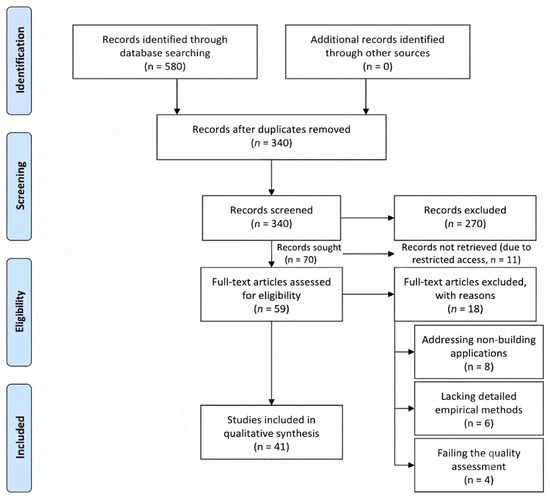
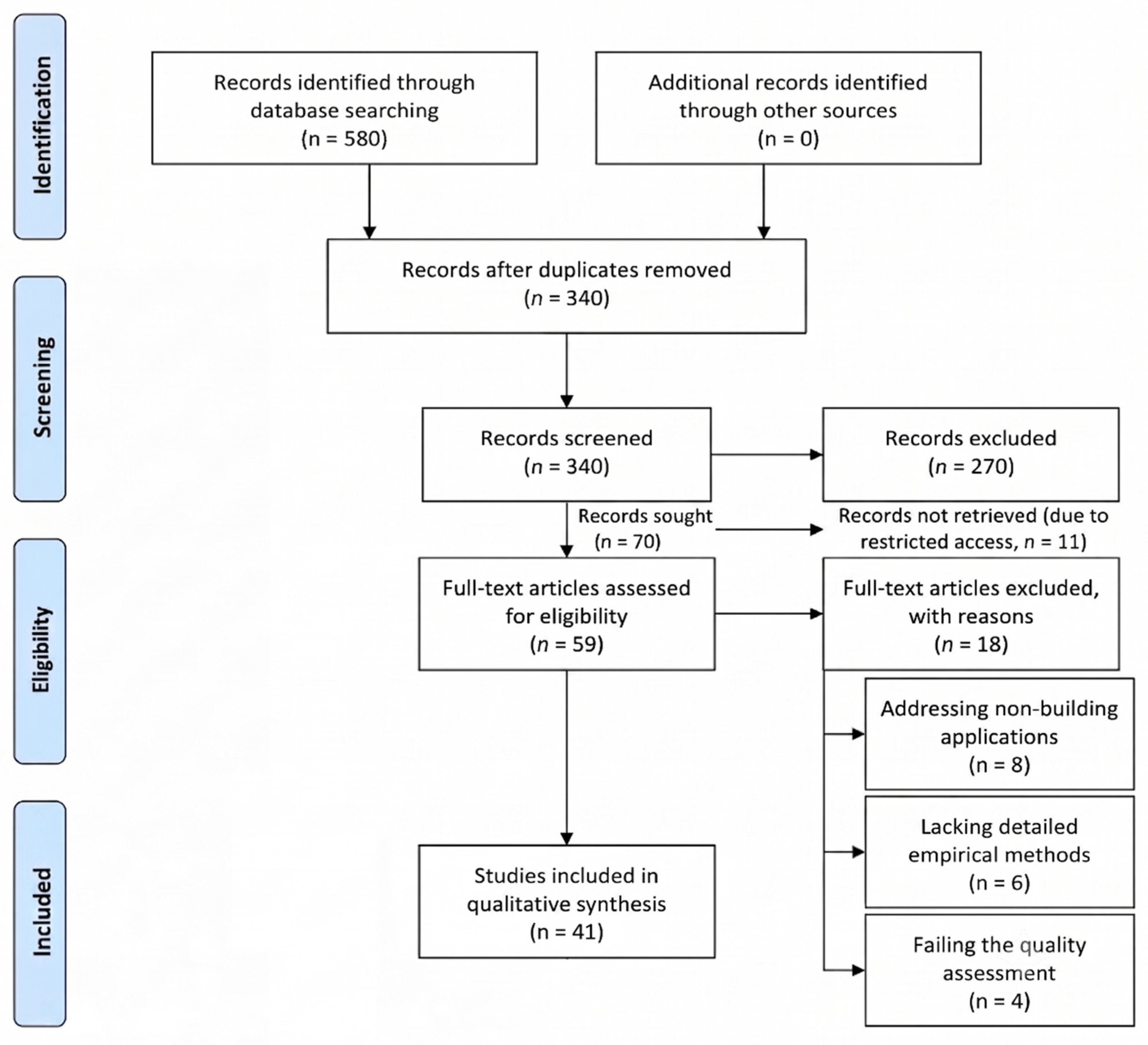
The selection process followed a four-stage PRISMA workflow as illustrated in Figure 1. The initial database search identified 580 records. After removing 240 duplicate records, 340 unique records proceeded to the title-and-abstract screening stage. During this stage, 270 records were excluded for failing to meet the relevant criteria (e.g., unrelated sectors, missing building energy focus). A total of 70 records were then sought for full-text retrieval; 11 could not be retrieved due to restricted access. The remaining 59 full-text articles were assessed for eligibility. Following full-text assessment, 18 studies were excluded for the following reasons: addressing non-building applications (n = 8), lacking detailed empirical methods (n = 6), or failing the quality assessment (n = 4). This process resulted in a final corpus of 41 studies included in the systematic synthesis. In Figure 1, arrows indicate the sequential movement of records through the identification, screening, eligibility, and inclusion stages, including exclusion routes and reasons for exclusion at each stage.
Figure 1.
PRISMA diagram.
2.5. Data Extraction and Quality Appraisal
Data were extracted from each included study using a standardized extraction form developed a priori by the authors. Extracted items included study characteristics (authors, year, journal/conference, country); research objectives; methodological approach (simulation, ML, empirical, hybrid); technologies investigated; key performance metrics; quantitative findings (energy savings, R2, MAPE, RMSE, cost reduction); data sources; geographic scope; and reported limitations. The complete data extraction matrix is provided in Supplementary Table S1. Each study was independently assessed for methodological quality against a checklist evaluating the clarity of research objectives, appropriateness of methods, robustness of data collection, validity of results, and relevance of conclusions. Studies failing to meet a minimum quality threshold were excluded from the final synthesis. No chemicals, reagents, biological materials, devices, samples, or commercial cell lines were used in this systematic review. Software names and versions are reported at first mention where applicable and available from the reviewed studies, including MATLAB R2024b (MathWorks, Natick, MA, USA), TRNSYS 18 (Thermal Energy System Specialists, Madison, WI, USA), Autodesk Revit 2025 and Autodesk Navisworks Manage 2025 (Autodesk Inc., San Francisco, CA, USA), Microsoft Excel 2021 (Microsoft Corp., Redmond, WA, USA), and SimStadt 2.0.
2.6. Synthesis Approach
Included studies were synthesized using thematic analysis, grouping them into the following categories: (1) renewable energy systems and integration, (2) energy consumption estimation and prediction, (3) HVAC optimization with renewable coupling, (4) occupancy modeling, (5) cost estimation for RES integration, and (6) digital twins and BIM applications. Narrative synthesis was used to summarize findings within and across categories, and two comparative tables were developed to facilitate cross-study comparisons of methods, metrics, geographic scope, and limitations.
3. Results
3.1. Overview of Included Studies
The final corpus of 41 studies spans a wide range of methodological approaches, geographic contexts, and building types. The studies were published between 2012 and 2025, with (73%) published after 2022, reflecting the rapid growth of research activity in this field. Geographically, studies cover Europe (34%), Asia (27%), North America (17%), the Middle East (10%), and global or multi-regional scopes (12%). Building types addressed include residential (34%), commercial (27%), institutional/campus (20%), and mixed-use or unspecified (19%).
In terms of research focus, 25% of studies addressed renewable energy integration directly (solar PV, solar thermal, geothermal, hybrid RES), while 27% focused on HVAC optimization (including RES-coupled systems), 20% on energy consumption estimation, 12% on occupancy modeling, 9% on cost estimation, and the remaining 7% on BIM/digital twin applications and urban-scale analyses. This distribution confirms the growing centrality of renewable energy in building energy research while also highlighting the interconnected role of HVAC optimization and ML-based prediction in supporting effective RES integration.
Table 2 provides a comprehensive summary of all 41 included studies, including methodology, key metrics, findings, focus area, and main contribution. Table 3 presents a comparative analysis organized by thematic category, enabling direct cross-study comparisons of methodology, data sources, geographic scope, and key limitations.
Table 2.
Summary of 41 studies included in the systematic review.
Table 3.
Comparative analysis of building energy studies by thematic category.
3.2. Renewable Energy Systems: Technologies and Performance
Among the studies focusing explicitly on renewable energy integration, solar photovoltaic (PV) systems emerged as the most widely studied technology, featuring in 60% of renewable energy studies. The remaining studies addressed hybrid RES configurations (solar PV + battery storage, solar thermal + heat pumps) and IoT-integrated solar management systems. Across all RES studies, the most commonly reported performance metric was electricity cost reduction, followed by energy self-sufficiency rate and CO2 emission reduction.
Yuan et al. [3] demonstrated that an Adaptive Dynamic Programming (ADP) algorithm with Gated Recurrent Units (GRU) achieved 98% solar energy efficiency and a 64% reduction in electricity costs for a household-scale Home Energy Management System (HEMS) integrating PV panels and battery storage. This represents one of the highest reported energy cost reductions in the reviewed literature. Similarly, Rokonuzzaman et al. [4] developed an IoT-based Home Energy Management System (IoHEMS) integrating solar PV generation, achieving near-perfect regression performance (R2 = 0.999999) in energy demand–supply forecasting, demonstrating the feasibility of high-precision real-time renewable energy management at the household scale.
Felez & Felez [29] extended the concept of passive thermal energy storage (TES) in residential buildings by integrating MPC with the building’s thermal mass, enabling PV self-consumption optimization and significant electricity cost reductions, demonstrating that intelligent control of passive building properties can maximize the economic benefit of on-site renewable generation without requiring expensive battery storage infrastructure. Sahrin et al. [30] proposed a neural network model with grid search cross-validation (GSCV-NN) for optimizing rooftop solar PV energy import estimation, achieving competitive RMSE values (44.389 for single-direction estimation), which is essential for accurate sizing and dispatching solar systems in tropical climates.
At the neighborhood scale, Liu et al. [31] demonstrated the use of Semantic Web Ontology and Linked Data (NPO framework) to resolve interoperability challenges in PV generation estimation across multiple buildings, enabling coordinated neighborhood-scale renewable energy planning in the Netherlands. Tang [14] employed grey relational analysis and Principal Component Analysis (PCA) to quantify the cost impact of renewable energy integration in green building projects, finding that strategic RES integration can reduce the overall cost of green building projects.
3.3. Energy Consumption Estimation and Prediction
Machine learning-based methods dominated energy consumption estimation studies, collectively demonstrating superior accuracy compared to traditional physics-based and statistical approaches. Attarhay Tehrani et al. [11] achieved R2 = 0.98 in cooling load prediction under urban heat island (UHI) conditions using a Deep Neural Network (DNN), outperforming XGBoost, Random Forest, Support Vector Regression (SVR), and Gaussian Process Regression (GPR) on a synthetic Phoenix dataset. This result confirms the advantage of deep learning for capturing complex nonlinear relationships between UHI effects and building cooling demands.
Habibi [12] applied Random Forest to real-world ZigBee sensor data from a Belgian residential building, achieving R2 = 0.724 and identifying “hour of day” as the most influential predictor of energy consumption (19.9% feature importance), followed by relative humidity (19.5%) and outdoor temperature (18.9%). These findings underscore the critical role of temporal patterns and microclimate conditions in building energy prediction, which has direct implications for renewable energy dispatch scheduling. Kumar et al. [21] combined Genetic Algorithms (GAs) with Support Vector Machines (SVMs) to achieve cooling load prediction MAPE values of 2.59–2.84%, among the lowest reported in the literature confirming the benefit of metaheuristic optimization for ML hyperparameter tuning. Tavant et al. [20] demonstrated a probabilistic disaggregation approach using maximum a posteriori estimation combined with degree-days for separating heating and cooling contributions from total energy consumption data, validated on a one-year case study in Lisbon, Portugal.
3.4. HVAC Optimization and Renewable Energy Coupling
HVAC systems account for 40–60% of total building energy consumption [52,53], making their optimization critical to achieving significant overall energy reductions. The reviewed studies demonstrate that combining renewable energy with intelligent HVAC control produces synergistic benefits that exceed the gains achievable by either approach in isolation [54]. Kaisermayer et al. [26] achieved simultaneous 35% energy reduction and 12% improvement in thermal comfort by implementing a predictive Energy Management System (EMS) incorporating user feedback and an Unscented Kalman Filter (UKF) for real-time state estimation in an Austrian residential building. This study exemplifies the potential of human-in-the-loop predictive control for sustainable building operation.
Wang et al. [27] proposed a Safe Deep Reinforcement Learning (Safe DRL) approach for building energy management that integrates safety filters derived from MPC to prevent constraint violations, surpassing both MPC and Double Deep Q-Network (DDQN) baselines in comfort maintenance and constraint satisfaction with minimal computational overhead. Adepoju [25] demonstrated a CNN/Graph Neural Network (GNN) HVAC optimization framework (AIRFLO) that leverages spatial occupancy patterns and class schedules to dynamically adjust HVAC setpoints in a campus building in Texas, highlighting the scalability of AI-based HVAC control to multi-zone institutional buildings. Calise et al. [28] showed that neglecting thermal capacitance in radiator models leads to ~20% underestimation of heating energy, emphasizing the importance of accurate physical modeling as a foundation for effective RES-coupled HVAC control.
3.5. Occupancy Modeling for Energy Reduction
Occupancy patterns are a primary driver of building energy consumption variability, and accurate occupancy modeling is essential for effective scheduling of both HVAC systems and renewable energy dispatch [55,56]. Sood [23] developed UPOM, a probabilistic occupancy model using Bayesian Neural Networks (BNNs), achieving 90% nighttime prediction accuracy on national Time Use Survey (TUS) data from Ireland. The study demonstrated that deterministic occupancy models introduce up to 50% daily energy variation, confirming the need for probabilistic approaches in building energy simulation.
Kovacevic et al. [24] integrated ensemble occupancy patterns into a reduced-order building model, reducing the annual energy prediction error from 278 kWh (classic model) to 132 kWh, a 52.5% improvement in a German residential building study. Al-Saegh et al. [22] compared five occupancy modeling approaches for a university campus in London, showing that data-driven models reduce annual heating demand estimation error from 14% (standard deterministic model) to ±2.5%, demonstrating the substantial accuracy benefits of data-driven occupancy characterization at the district scale.
3.6. Cost Estimation for Renewable Energy Integration
The economic dimension of RES integration in buildings is critical for widespread adoption, yet it remains one of the least comprehensively studied aspects in the reviewed literature [27]. Tang [14] applied grey relational analysis and PCA to construction cost data from green building projects, finding that proactive renewable energy integration planning through life-cycle cost analysis can reduce total project costs. Zhang [15] proposed an Artificial Intelligence-based Cost Data Management (AICD-CDM) ensemble model combining Linear Regression, ANN, Random Forest, XGBoost, LightGBM, and Natural Gradient Boosting (NGBoost) for green building cost prediction, demonstrating that ensemble methods outperform standalone models in cost prediction accuracy.
Isvara & Kamilah [38] demonstrated a hybrid regression–ANN model for conceptual cost estimation in green buildings, achieving MAPE = 15.09%, meeting the AACE International accuracy standards. These findings confirm that ML-based cost estimation is mature enough for practical application in RES-integrated green building projects. BIM-based studies [34,36,37] further demonstrated that BIM tools significantly reduce cost estimation errors and improve scheduling efficiency, with the potential to be extended to RES component integration and life-cycle energy cost modeling.
4. Discussion
4.1. Synthesis of Renewable Energy Outcomes Across Studies
The reviewed evidence consistently demonstrates that renewable energy integration in buildings delivers substantial and measurable energy consumption reductions. The highest reductions up to 64% in electricity costs [3] and 35% in total energy demand [26] were achieved when RES were combined with intelligent real-time control systems (HEMS, predictive EMS, safe DRL), confirming that the synergy between renewable generation and intelligent energy management is essential for maximizing building-level energy reduction outcomes. Studies that implemented isolated RES without integrated control strategies reported more modest gains, underscoring the importance of system-level design thinking.
Solar PV systems, in particular, demonstrated the highest frequency of deployment and the broadest applicability across building types and scales from single households [3,4] to neighborhood-level planning [31]. This is consistent with the global trend of declining PV system costs and increasing grid parity penetration. However, the reviewed studies reveal a notable gap in research on solar thermal systems, geothermal heat pumps, and wind energy integration in buildings, technologies with significant untapped potential, particularly in climates where solar PV performance is seasonal or constrained by shading.
4.2. Role of Machine Learning and IoT in Enabling Effective RES Integration
Machine learning methods proved to be indispensable enablers of effective RES integration in buildings, performing three critical functions: energy consumption prediction, renewable generation forecasting, and real-time optimization of energy dispatch. The highest-performing ML models in the reviewed studies, DNNs for cooling load prediction (R2 = 0.98) [11], GBM for energy use intensity prediction (R2 = 0.989) [9], and GA-SVM for MAPE of 2.59–2.84% [21], demonstrate that deep learning and hybrid ML approaches can achieve levels of predictive accuracy sufficient for reliable operational decision-making in energy-aware buildings.
IoT-enabled real-time sensor integration, as demonstrated by Rokonuzzaman et al. [4] with near-perfect regression accuracy, is a critical prerequisite for deploying ML models in live building management settings. However, a persistent limitation across the reviewed studies is the reliance on synthetic or highly localized datasets, which raises questions about the generalizability of trained models to different building types, climates, and occupancy patterns. Habibi [12] and Al-Saegh et al. [22] both noted that their models’ predictive accuracy is sensitive to the quality and representativeness of training data, a challenge that must be addressed through the development of open, standardized building energy datasets covering diverse geographic and climatic conditions. A direct benchmarking of ML approaches across the reviewed studies reveals a clear performance–complexity trade-off: while DNN architectures report the highest accuracy metrics (R2 up to 0.989), this performance is predominantly demonstrated on synthetic or single-site datasets, limiting operational transferability. In contrast, ensemble methods (Random Forest, GBM) and hybrid metaheuristic–ML models (GA-SVM) achieve competitive accuracy (R2 = 0.724–0.94; MAPE = 2.59–2.84%) on real-world building datasets, suggesting superior practical applicability. The very high prediction accuracies reported in several reviewed studies—notably R2 = 0.999999 [4], R2 = 0.989 [9], and R2 = 0.98 [11]—warrant critical scrutiny regarding overfitting and real-world transferability. Future studies should report cross-validation results, out-of-sample test performance, and deployment validation on independent real-world datasets to substantiate operational reliability claims.
4.3. Identified Research Gaps
This systematic review identifies five critical research gaps that should guide future work in this field:
Gap 1—Geographic and Climatic Inclusivity: The majority of reviewed studies are concentrated in Europe, North America, and East Asia, with limited representation of tropical, arid, and sub-Saharan African contexts. Given that these regions often have the highest solar irradiance and the greatest need for affordable clean energy, the absence of context-specific research represents a significant equity gap. Future studies should prioritize multi-climate, multi-country datasets that enable the development of geographically inclusive RES integration models.
Gap 2—Long-Term Performance and Reliability: Most reviewed studies report short-term (days to months) or simulation-based performance outcomes. The long-term reliability of RES systems accounting for panel degradation, battery cycle life, maintenance requirements, and changing occupancy patterns over years to decades is insufficiently addressed. Longitudinal studies and post-occupancy evaluations are critically needed to provide evidence-based guidance on the life-cycle value of building-integrated RESs.
Gap 3—Multi-Source Renewable Energy Integration: Studies predominantly focus on single-technology RESs (typically solar PV). Research on the co-optimization of multiple renewable sources, e.g., solar PV + solar thermal + geothermal heat pumps + small wind, within a unified building energy management framework is sparse. Such hybrid systems have the potential to deliver more consistent year-round energy reductions across diverse climates.
Gap 4—Occupant Behavior and Social Acceptance: While occupancy modeling is well represented in the reviewed literature, the interaction between occupant behavior, social acceptance of RES technologies, and actual energy savings remains underexplored. Studies combining behavioral modeling with technical performance analysis are rare, yet critical for accurately projecting the real-world impact of RES integration.
Gap 5—Economic Feasibility and Equity: Life-cycle cost analysis, payback period assessment, and financial accessibility of RES integration, particularly for low-income households and developing economies are insufficiently covered. Only a small subset of reviewed studies [14,15,38] addressed economic dimensions, and none provided comprehensive life-cycle analysis covering both capital and operational cost streams over multi-decade time horizons.
4.4. Implications for Practice and Policy
The findings of this review have direct implications for building design practice, energy policy, and regulatory frameworks. For building designers and engineers, the evidence strongly supports the adoption of solar PV-integrated smart HEMS as the baseline configuration for new residential and commercial buildings in high-insolation regions, with projected electricity cost reductions of 40–64% [57]. The integration of ML-based predictive control [26,27] can deliver additional energy savings of 20–35% compared to conventional rule-based control [58], justifying the modest additional investment in sensing and computing infrastructure.
For policymakers, the review highlights the need for performance-based incentive frameworks that reward not just RES installation but verified energy reduction outcomes, a distinction that is currently rare in existing subsidy and certification schemes. The geographic concentration of research in affluent regions also suggests that international development organizations and research funding bodies should prioritize support for building energy research in climate-vulnerable, high-growth developing economies, where the energy efficiency dividend of RES integration is both technically feasible and socially transformative. It is important to note that the majority of the quantitative performance outcomes reported in this review are derived from simulation-based or controlled experimental environments. These results should be interpreted as indicative of technical potential rather than guaranteed real-world performance. Independent empirical validation across diverse building types, climates, and occupancy profiles is required before the reported energy reductions can be confidently generalized to large-scale deployment.
4.5. Economic Feasibility and Practical Deployment Considerations
From an economic feasibility perspective, the reviewed studies collectively demonstrate that RES integration combined with ML-based management reduces electricity costs by 35–64% [3,26], translating—under typical European and North American tariff structures—to estimated payback periods of 4–8 years for residential solar PV systems. However, comprehensive life-cycle cost analyses covering capital expenditure, maintenance, system degradation, and decommissioning costs over 20–25-year building life-cycles remain rare in the reviewed literature, representing a critical gap for application-oriented policymaking. Tang [14] and Zhang [15] provide partial economic evidence through grey relational analysis and ML-based cost prediction, respectively, while Isvara & Kamilah [38] validated conceptual cost estimation models meeting AACE International standards (MAPE = 15.09%). BIM-based studies [34,36,37] further confirm the potential of integrated digital tools for life-cycle cost management. The practical deployment of RES-ML-IoT integrated systems also faces significant non-technical barriers including upfront capital requirements, limited BIM adoption in developing economies, IoT infrastructure costs, and workforce skills gaps—factors that must be addressed in comprehensive feasibility assessments. Future research should prioritize techno-economic analysis frameworks that integrate capital costs, energy tariff structures, degradation rates, and climate-specific performance projections over the full building life-cycle, enabling evidence-based investment decisions across diverse economic and geographic contexts.
5. Conclusions
This systematic review of 41 peer-reviewed studies (2012–2025) provides comprehensive evidence that the integration of renewable energy systems, particularly solar photovoltaic (PV) combined with intelligent energy management, represents the most effective and economically viable pathway to achieving substantial reductions in building energy consumption. The key findings of this review are summarized as follows:
- Renewable energy integration delivered measured electricity cost reductions of 35–64% across reviewed studies, with the highest outcomes achieved when RESs were coupled with ML-based predictive control systems and real-time IoT monitoring.
- Machine learning models, particularly Deep Neural Networks (DNNs), gradient boosting machines (GBMs), and hybrid GA-SVM approaches achieved energy prediction accuracies of R2 = 0.98–0.989, providing the predictive foundation necessary for effective RES dispatch optimization.
- HVAC optimization coupled with RESs simultaneously reduced energy consumption by up to 35% while improving thermal comfort by up to 12%, confirming the synergistic value of integrated building energy management.
- Occupancy-aware energy models reduce energy prediction errors by up to 52.5% compared to conventional deterministic approaches, demonstrating the critical importance of behavioral modeling in realistic energy performance assessment.
The main limitations of this review include the reliance on the published peer-reviewed literature (which may introduce publication bias toward positive results), the geographical concentration of included studies in high-income regions, and the predominantly short-term or simulation-based performance data available in the literature. These limitations underscore the need for more geographically diverse, longitudinal, and real-world validation studies. A critical limitation of the current evidence base is that the vast majority of reported performance outcomes—including electricity cost reductions of 35–64% and ML model accuracies of R2 = 0.98–0.989—are derived from short-term measurement campaigns or simulation environments. The long-term stability of these outcomes under real-world conditions of component degradation, occupancy change, climate variability, and system aging has not been empirically verified at scale. Longitudinal post-occupancy studies of at least five years’ duration are urgently needed. Furthermore, this review’s corpus of 41 studies reflects the application of rigorous PRISMA-compliant quality criteria to a broad initial search of 580 records across five databases. While this quality-first approach ensures methodological integrity, it necessarily limits corpus breadth. Readers should interpret the synthesized findings as evidence from a high-quality study subset rather than a complete field census. Future reviews adopting broader inclusion criteria or domain-narrowed search strategies may yield larger corpora, enabling sub-group meta-analyses not feasible with the current dataset. It is also important to note that the majority of the quantitative performance outcomes reported in this review are derived from simulation-based or controlled experimental environments and should be interpreted as indicative of technical potential rather than guaranteed real-world performance. Independent empirical validation across diverse building types, climates, and occupancy profiles is required before the reported energy reductions can be confidently generalized to large-scale deployment.
Future research should prioritize (i) development of open, multi-climate building energy datasets that enable geographically inclusive model training and validation; (ii) long-term (≥5-year) post-occupancy evaluation of RES-integrated buildings to assess real-world degradation, maintenance costs, and sustained energy savings; (iii) multi-source RES co-optimization frameworks that integrate solar PV, solar thermal, geothermal, and storage technologies within unified building energy management systems; (iv) comprehensive life-cycle cost and techno-economic analyses of RES integration across diverse building types and global economic contexts; and (v) integration of occupant behavioral and social acceptance modeling into RES performance assessment frameworks.
The transition to net-zero energy buildings (NZEBs) is both technically achievable and economically justified based on the evidence synthesized in this review. Accelerating this transition requires sustained investment in multi-disciplinary research, scalable technology deployment, and enabling policy frameworks that align financial incentives with verified energy reduction outcomes.
Supplementary Materials
The following supporting information can be downloaded at: https://www.mdpi.com/article/10.3390/buildings16132475/s1, Table S1: Data extraction matrix for the 41 included studies, including study characteristics, methodological approach, key performance metrics, findings, thematic category, data source, geographic scope, and reported limitations. The PRISMA 2020 reporting checklist is cited in the main text [16].
Author Contributions
M.M.A.M.: Conceptualization, Formal analysis, Investigation, Writing—original draft, K.W.C.: Supervision, Writing—review and editing. All authors have read and agreed to the published version of the manuscript.
Funding
This research received no external funding. The article processing charge (APC) was funded by the authors.
Data Availability Statement
No new datasets were generated or analyzed in this study. The data supporting the findings are derived from the published studies cited in the reference list, and the extracted study-level information is provided in Supplementary Table S1. Further inquiries can be directed to the corresponding author.
Conflicts of Interest
The authors declare no conflict of interest.
References
- Kazmi, A.H.; O’Grady, M.J.; Delaney, D.T. A review of wireless-sensor-network-enabled building energy management systems. ACM Comput. Surv. 2014, 47, 66. [Google Scholar] [CrossRef] [Scilit]
- Harish, V.; Kumar, A. A review on modeling and simulation of building energy systems. Renew. Sustain. Energy Rev. 2016, 56, 1272–1292. [Google Scholar] [CrossRef] [Scilit]
- Yuan, J.; Zeng, X.; Zhou, J.; Li, J.; Lv, J.; Chen, R.; Chen, K.; Yang, W.; Zhang, Y. Data-driven real-time home energy management system based on adaptive dynamic programming. Electr. Power Syst. Res. 2025, 238, 111055. [Google Scholar] [CrossRef] [Scilit]
- Rokonuzzaman, M.; Rahman, S.; Hannan, M.A.; Mishu, M.K.; Tan, W.-S.; Rahman, K.S.; Pasupuleti, J.; Amin, N. Levenberg-Marquardt algorithm-based solar PV energy integrated internet of home energy management system. Appl. Energy 2025, 378, 124407. [Google Scholar] [CrossRef] [Scilit]
- Pan, Y.; Zhu, M.; Lv, Y.; Yang, Y.; Liang, Y.; Yin, R. Building energy simulation and its application for building performance optimization: A review of methods, tools, and case studies. Energy Rep. 2023, 9, 161–175. [Google Scholar] [CrossRef] [Scilit]
- Mariano-Hernández, D.; Hernández-Callejo, L. A review of strategies for building energy management system: Model predictive control, demand side management, optimization, and fault detect and diagnosis. J. Build. Eng. 2021, 33, 101692. [Google Scholar] [CrossRef] [Scilit]
- Manic, M.; Wijayasekara, D. Building energy management systems: The age of intelligent and adaptive buildings. IEEE Trans. Ind. Inform. 2016, 10, 25–39. [Google Scholar] [CrossRef] [Scilit]
- Jradi, M.; Gamboa, A.Z.; Veje, C. Simulation and Parametric Analysis of an Office Building Energy Performance under Danish Conditions. In Proceedings of the 14th International Conference on Sustainable Energy Technologies, Nottingham, UK, 25–27 August 2015; Available online: http://www.set2015.org/sites/default/files/SET2015%20Book%20of%20Abstracts%20-%2012_08_15%20V5.pdf (accessed on 28 April 2026).
- Mehraban, S.M.H.; Alnaser, A.A.; Sepasgozar, S. Building information modeling and AI algorithms for optimizing energy performance in hot climates: A comparative study of Riyadh and Dubai. Buildings 2024, 14, 2748. [Google Scholar] [CrossRef] [Scilit]
- Duka, J.A.; Traen, J.L.; Sarmiento, C.J.S.; Principe, J. Estimating cooling energy demand from building attributes and environmental parameters using 3D city models. ISPRS Ann. Photogramm. Remote Sens. Spat. Inf. Sci. 2024, X-5-2024, 63–70. [Google Scholar] [CrossRef] [Scilit]
- Attarhay Tehrani, A.; Sobhaninia, S.; Nikookar, N.; Levinson, R.; Tehrani, A.A. Data-driven approach to estimate urban heat island impacts on building energy consumption. Energy 2025, 316, 134508. [Google Scholar] [CrossRef] [Scilit]
- Habibi, O. Sustainable AI Applications in Building Energy Management: An Analysis of Environmental Impact Through Machine Learning Predictions; Deggendorf Institute of Technology: Deggendorf, Germany, 2025. [Google Scholar]
- Venkateswarlu, N.; Sathiyamoorthy, M. Sustainable innovations in digital twin technology: A systematic review about energy efficiency and indoor environment quality in built environment. Front. Built Environ. 2025, 11, 1523464. [Google Scholar] [CrossRef] [Scilit]
- Tang, L. Analysis of the impact of renewable energy application on the cost of green building projects. Renew. Energy Power Qual. J. 2024, 22, 87–93. [Google Scholar] [CrossRef] [Scilit] [PubMed]
- Zhang, Y. Research on the application of artificial intelligence-based cost estimation and cost control methods in green buildings. Scalable Comput. Pract. Exp. 2024, 25, 4772–4779. [Google Scholar] [CrossRef] [Scilit]
- Page, M.J.; McKenzie, J.E.; Bossuyt, P.M.; Boutron, I.; Hoffmann, T.C.; Mulrow, C.D.; Shamseer, L.; Tetzlaff, J.M.; Akl, E.A.; Brennan, S.E.; et al. The PRISMA 2020 statement: An updated guideline for reporting systematic reviews. BMJ 2021, 372, n71. [Google Scholar] [CrossRef] [Scilit] [PubMed]
- Antonopoulos, I.; Robu, V.; Couraud, B.; Kirli, D.; Norbu, S.; Kiprakis, A.; Flynn, D.; Elizondo-Gonzalez, S.; Wattam, S. Artificial intelligence and machine learning approaches to energy demand-side response: A systematic review. Renew. Sustain. Energy Rev. 2020, 130, 109899. [Google Scholar] [CrossRef] [Scilit]
- Zhang, L.; Wen, J.; Li, Y.; Chen, J.; Ye, Y.; Fu, Y.; Livingood, W. A review of machine learning in building load prediction. Appl. Energy 2021, 285, 116452. [Google Scholar] [CrossRef] [Scilit]
- Aguilar, J.; Garcés-Jiménez, A.; Rodríguez-Moreno, M.D.; García, R. A systematic literature review on the use of artificial intelligence in energy self-management in smart buildings. Renew. Sustain. Energy Rev. 2021, 151, 111530. [Google Scholar] [CrossRef] [Scilit]
- Tavant, A.; Simi, C.; Chevreuil, P.-A.; Costini, P.; Lemoine, R. Disaggregation of heating and cooling energy consumption via maximum a posteriori estimation. In Proceedings of the ENERGY 2025 Conference, Lisbon, Portugal, 9–13 March 2025; pp. 1–12. [Google Scholar]
- Kumar, A.; Kumar, A.; Zohbi, G.A.; Salau, A.; Kumar, P. Prediction of building cooling load: An innovative design for GA-SVM and IG-SVM system for the estimation of hourly precision and computational fluctuation range. Adv. Build. Energy Res. 2024, 18, 668–695. [Google Scholar] [CrossRef] [Scilit]
- Al-Saegh, S.; Kourgiozou, V.; Korolija, I.; Tang, R.; Tahmasebi, F.; Mumovic, D. Investigating building stock energy and occupancy modelling approaches for district-level heating and cooling energy demands estimation in a university campus. Energy Build. 2025, 329, 115269. [Google Scholar] [CrossRef] [Scilit]
- Sood, D. Evaluating the Effects of Occupancy on Energy Use and Indoor Environmental Quality in Residential Building Archetypes over Spatial and Temporal Scales. Doctoral Dissertation, University College Dublin, Dublin, Ireland, 2025. [Google Scholar]
- Kovacevic, J.; Li, C.; Förderer, K.; Çakmak, H.K.; Mikut, R. Improving reduced-order building modeling: Integration of occupant patterns for reducing energy consumption. In Proceedings of the 15th ACM International Conference on Future and Sustainable Energy Systems; ACM: New York, NY, USA, 2024; pp. 1–8. [Google Scholar] [CrossRef] [Scilit]
- Adepoju, S. How machine learning can revolutionize building comfort: Accessing the impact of occupancy prediction models on HVAC control system. World J. Adv. Res. Rev. 2025, 25, 2315–2327. [Google Scholar] [CrossRef] [Scilit]
- Kaisermayer, V.; Muschick, D.; Horn, M.; Schweiger, G.; Brandl, D. Predictive building energy management with user feedback in the loop. Smart Energy 2024, 16, 100164. [Google Scholar] [CrossRef] [Scilit]
- Wang, X.; Wang, P.; Huang, R.; Zhu, X.; Arroyo, J.; Li, N. Safe deep reinforcement learning for building energy management. Appl. Energy 2025, 377, 124328. [Google Scholar] [CrossRef] [Scilit]
- Calise, F.; Cappiello, F.L.; Cimmino, L.; Dentice, M.; Vicidomini, M. A novel capacitive model of radiators for building dynamic simulations. Thermo 2025, 5, 9. [Google Scholar] [CrossRef] [Scilit]
- Felez, R.; Felez, J. Advanced energy management for residential buildings optimizing costs and efficiency through thermal energy storage and predictive control. Appl. Sci. 2025, 15, 880. [Google Scholar] [CrossRef] [Scilit]
- Sahrin, A.; Abadi, I.; Musyafa, A. Enhanced accuracy estimation model energy import in on-grid rooftop solar photovoltaic. Int. J. Electr. Comput. Eng. 2024, 14, 5970–5983. [Google Scholar] [CrossRef] [Scilit]
- Liu, X.; Yang, D.; Donkers, A.; de Vries, B. Building sustainable urban energy systems: The role of linked data in photovoltaic generation estimation at neighbourhood level. Appl. Energy 2025, 378, 124749. [Google Scholar] [CrossRef] [Scilit]
- Liu, P.; Wu, Z.; Zhang, Z.; Gu, W.; Jia, H. Exploiting geospatial shifting flexibility of building energy use for urban multi-energy system operation. Energy 2024, 313, 134008. [Google Scholar] [CrossRef] [Scilit]
- Zech, P.; Jäger, A.; Breu, R. Agile, continuous building energy modeling and simulation. Simulation 2025, 101, 241–265. [Google Scholar] [CrossRef] [Scilit]
- Rashidi, A.; Chan, D.W.M.; Ravanshadnia, M.; Sarvari, H.; Gholami, M. Applying building information modelling (BIM) technology in pre-tender cost estimation of construction projects: A case study in Iran. Buildings 2024, 14, 1260. [Google Scholar] [CrossRef] [Scilit]
- Yousfani, A.M.; Raza, M.S.; Moriyani, M.A.; Ali, T.H. Building information modelling (BIM) based framework for construction and demolition waste estimation and management. J. Kejuruter. 2023, 35, 1101–1109. [Google Scholar] [CrossRef] [Scilit] [PubMed]
- Liyanage, G.H.M.D.; Kulatunga, U. Leveraging applications of 5D BIM technology for building construction: Enhancing efficiency of cost management practices. In Proceedings of the International Conference on Spatial Dynamics, Moratuwa, Sri Lanka, 6–7 December 2024. [Google Scholar] [CrossRef] [Scilit]
- Farouk, A.M.; Rahman, R.A. Integrated applications of building information modeling in project cost management: A systematic review. J. Eng. Des. Technol. 2025, 23, 287–305. [Google Scholar] [CrossRef] [Scilit]
- Isvara, W.; Kamilah, F. Conceptual cost estimation in green buildings by using regression analysis and artificial neural network methods to improve accuracy. J. Res. Soc. Sci. Econ. Manag. 2024, 4, 711–720. [Google Scholar] [CrossRef] [Scilit]
- Lendra, L.; Adji, F.F.; Robby, R.; Faqqih, M. Building cost estimation application based on unit price analysis of work based on Excel macro. J. Apl. Tek. Sipil 2023, 21, 319–328. [Google Scholar] [CrossRef]
- Liu, M.; Luo, M. Cost estimation model of prefabricated construction for general contractors based on system dynamics. Eng. Constr. Archit. Manag. 2025, 32, 621–638. [Google Scholar] [CrossRef] [Scilit]
- Nasouri, M.; Delgarm, N. A new method for simulation-based sensitivity analysis of building efficiency for optimal building energy planning: A case study of Iran. Energy Ecol. Environ. 2025, 10, 202–224. [Google Scholar] [CrossRef] [Scilit]
- Ertosun Yıldız, M.E.; Beyhan, F. Prediction of cooling load via machine learning on building envelope design parameters. J. Build. Eng. 2025, 100, 111724. [Google Scholar] [CrossRef] [Scilit]
- Hwang, D.; Kim, J.-J.; Moon, S.; Wang, S. Image augmentation approaches for building dimension estimation in street view images using object detection and instance segmentation based on deep learning. Appl. Sci. 2025, 15, 2525. [Google Scholar] [CrossRef] [Scilit]
- Lyu, S.; Ji, C.; Liu, Z.; Tang, H.; Chen, Y.; Li, M. Four seasonal composite Sentinel-2 images for the large-scale estimation of the number of stories in each individual building. Remote Sens. Environ. 2024, 303, 114017. [Google Scholar] [CrossRef] [Scilit]
- Rahimi, M.Z.; Khan, H. Building Information Model for Cost Estimation and Scheduling in Building Architecture. Glob. J. Eng. Des. Technol. 2024, 13, 192. [Google Scholar]
- Al-Saegh, S.; Tahmasebi, F.; Tang, R.; Mumovic, D. Comparison of deterministic, stochastic, and energy-data-driven occupancy models for building stock energy simulation. Buildings 2024, 14, 2933. [Google Scholar] [CrossRef] [Scilit]
- Antoniadis, D.; Martinopoulos, G. Optimization of a building integrated solar thermal system with seasonal storage using TRNSYS. Renew. Energy 2019, 137, 56–66. [Google Scholar] [CrossRef] [Scilit]
- Ahmad, M.W.; Mourshed, M.; Rezgui, Y. Trees vs neurons: Comparison between random forest and ANN for high-resolution prediction of building energy consumption. Energy Build. 2017, 147, 77–89. [Google Scholar] [CrossRef] [Scilit]
- Sartori, I.; Napolitano, A.; Voss, K. Net zero energy buildings: A consistent definition framework. Energy Build. 2012, 48, 220–232. [Google Scholar] [CrossRef] [Scilit]
- Huang, P.; Lovati, M.; Zhang, X.; Bales, C. A coordinated control to improve performance for a building cluster with energy storage, electric vehicles, and energy sharing considered. Appl. Energy 2020, 268, 114983. [Google Scholar] [CrossRef] [Scilit]
- Li, H.; Wang, S.; Cheung, H. Sensitivity analysis of design parameters and optimal design for zero/low-energy buildings in subtropical regions. Appl. Energy 2018, 228, 1280–1291. [Google Scholar] [CrossRef] [Scilit]
- Hu, Y.; Zheng, M.; Niu, X.; Ning, R.; Ye, R.; Lu, L. Research on the Green Development of the HVAC Industry. In Advances in Computer Science Research; Atlantis Press: Dordrecht, The Netherlands, 2024; p. 228. [Google Scholar] [CrossRef] [Scilit] [PubMed]
- Ryu, D.; Yoo, W.-J. Ventilation-dominated energy savings in large commercial buildings: Multi-measure assessment revealing HVAC optimization priorities for hot-humid climates. Case Stud. Therm. Eng. 2025, 74, 107034. [Google Scholar] [CrossRef] [Scilit]
- Woldegiyorgis, T.A.; Asmare, E.; Assamnew, A.D.; Mossie, S.Y. Harnessing Artificial Intelligence to improve building performance and energy use: Innovations, challenges, and future perspectives. Energy Inform. 2025, 8, 138. [Google Scholar] [CrossRef] [Scilit]
- Capozzoli, A.; Piscitelli, M.S.; Gorrino, A.; Ballarini, I.; Corrado, V. Data analytics for occupancy pattern learning to reduce the energy consumption of HVAC systems in office buildings. Sustain. Cities Soc. 2017, 35, 191. [Google Scholar] [CrossRef] [Scilit]
- Chong, A.; Augenbroe, G.; Yan, D. Occupancy data at different spatial resolutions: Building energy performance and model calibration. Appl. Energy 2021, 286, 116492. [Google Scholar] [CrossRef] [Scilit]
- Fiorini, L.; Aiello, M. Automatic optimal multi-energy management of smart homes. Energy Inform. 2022, 5, 68. [Google Scholar] [CrossRef] [Scilit]
- Lolli, N.; Gorantonaki, E.; Clauß, J. Predictive Heating Control and Perceived Thermal Comfort in a Norwegian Office Building. Energies 2024, 17, 3719. [Google Scholar] [CrossRef] [Scilit]

Disclaimer/Publisher’s Note: The statements, opinions and data contained in all publications are solely those of the individual author(s) and contributor(s) and not of MDPI and/or the editor(s). MDPI and/or the editor(s) disclaim responsibility for any injury to people or property resulting from any ideas, methods, instructions or products referred to in the content. |
© 2026 by the authors. Licensee MDPI, Basel, Switzerland. This article is an open access article distributed under the terms and conditions of the Creative Commons Attribution (CC BY) license.