


Abstract
Decarbonising the built environment has increased the importance of prefabricated construction, yet its cost and resource efficiency are still constrained by fragmented supply chain collaboration. This study examines how lifecycle supply chain collaboration affects cost control performance in prefabricated construction. Based on supply chain management theory and expert consultation, a conceptual model was developed and tested through structural equation modelling using 517 valid responses from stakeholders in China’s prefabricated construction supply chain. The results show that management factors across all four project phases (decision and design, component production, transportation, and construction and installation) significantly improve cost control performance, with design standardisation, production scheduling, transport logistics, quality assurance, and workforce proficiency as key drivers. Process coordination exerts a significant mediating effect, while environmental factors significantly moderate the relationships. In practical terms, the findings indicate that stakeholders should prioritise design standardisation at the early stage, strengthen coordination across production, transport, and installation activities, and enhance quality control and workforce training to reduce avoidable cost overruns and resource waste. Beyond their theoretical contribution to research on supply chain collaboration in prefabricated construction, these results offer concrete direction for practitioners seeking to improve cost efficiency and make better use of resources within industrialised building systems.
1. Introduction
Prefabricated construction has come to be seen as one of the key directions in which the global construction sector is evolving. Much of this recognition stems from the gains it delivers relative to traditional cast-in-place approaches—higher productivity, less waste, more consistent quality, and stronger environmental performance [1]. Studies to date have documented how prefabrication shortens project timelines, raises component quality through factory-controlled production, and cuts down on both material waste and on-site rework during assembly [2]. Yet the picture is not entirely positive. More recent work, including research appearing in 2026, points to persistent managerial and economic barriers that continue to limit how widely the approach spreads—chief among them the heavy upfront capital it demands, the often weak coordination across organisations, and the instability of its cost performance [3]. So while the technical strengths and environmental benefits of prefabrication have been examined at length, keeping costs under control across the full project lifecycle remains a stubborn obstacle to wider adoption, an issue that becomes especially acute in developing-market settings [4].
Existing research has identified a number of factors that influence cost performance in prefabricated construction. At the design stage, standardisation and early design coordination are regarded as essential for reducing later modifications and improving constructability. In the production stage, manufacturing planning, component quality management, and production scheduling have been found to affect both direct and indirect project costs. In the transportation and on-site assembly stages, logistics planning, delivery reliability, installation sequencing, and labour skills have also been reported as critical determinants of project efficiency and cost outcomes [5]. International practice offers further evidence on this point: when supply chain actors are more tightly integrated, when digital information flows in a timely manner between parties, and when inter-organisational collaboration is sustained rather than episodic, the prefabrication process tends to run more efficiently and avoidable losses are reduced [6]. Work published in 2026 reinforces this observation, showing that coordination mechanisms underpinned by digital tools, together with more cohesive supply chain arrangements, materially strengthen the performance of industrialised construction systems [7].
These contributions notwithstanding, the existing body of work still leaves important gaps. For one, much of the earlier research approaches cost from a rather piecemeal angle, zeroing in on specific factors or single project stages—design optimisation here, manufacturing efficiency there, transportation management elsewhere—instead of treating cost control as something that spans the whole project lifecycle. A second gap concerns mechanisms: collaboration is routinely cited as important, yet how management-related factors at different stages actually interact, and how that interaction shapes cost outcomes through process coordination, has received far less scrutiny. There is also the question of boundary conditions. The circumstances under which these relationships might shift remain underexplored, especially the moderating role of external environmental factors such as market dynamics, policy support, and contextual uncertainty [8]. Taken together, these gaps mean that the literature has yet to provide a systematic account of how lifecycle supply chain collaboration bears on cost control performance in prefabricated construction.
This discussion brings the study’s research problem into sharp focus. The central question is twofold: first, how do management factors spanning the decision and design phase, component production, transportation, and construction and installation shape cost control performance in prefabricated construction; and second, what part do process coordination and environmental factors play within those relationships? Answering this matters on more than one front. It speaks directly to the economic viability of prefabricated construction, but it also bears on the broader goal of using materials, labour, and energy more efficiently across the entire project lifecycle.
To tackle this problem and address the gap identified above, the study develops an integrated analytical framework grounded in supply chain management theory. The framework examines three layers of influence: the direct effects that lifecycle management factors exert on cost control performance, the mediating pathway through process coordination, and the moderating role played by environmental factors. Empirically, the analysis draws on survey data gathered from a range of stakeholders active in China’s prefabricated construction sector; structural equation modelling is used to identify the principal drivers of cost control and to trace the mechanisms through which they operate within the prefabrication supply chain.
The study contributes to the existing literature in three distinct ways. It moves past the fragmented, stage-by-stage lens that characterises much earlier work, proposing instead a framework that tracks cost control across the full project lifecycle. It unpacks the internal mechanism linking management factors at different project phases to cost control outcomes, showing how process coordination serves as the connective pathway. And it reveals that these relationships are not fixed—environmental factors alter both their strength and direction under different conditions.
2. Literature Review and Hypothesis Development
2.1. Decision and Design Phase Management
The decision and design phase is broadly acknowledged as the point at which most of a construction project’s lifetime costs are effectively locked in [9,10]. Managing it well means carrying out rigorous feasibility assessments, optimising the design systematically, and applying value engineering principles to strip out unnecessary expenditure before any physical work begins [11]. Research from a range of international settings, covering developed economies and Small Island Developing States alike, has consistently found that cost overruns are a pervasive problem. Design deficiencies, estimation errors, and planning shortcomings surface again and again as triggers for rework, variation orders, and budget escalation once execution is under way [12,13]. When cost considerations are woven into early architectural and structural decisions, such as component standardisation or BIM-enabled clash detection, project teams can substantially reduce the uncertainty they face further down the line [14,15]. That said, much of the existing research treats design management as a self-contained activity, paying insufficient attention to the financial consequences it generates downstream in industrialised construction settings [16]. A lifecycle supply chain perspective tells a different story. In prefabricated construction, choices made early on about standardisation, modular coordination, and technical interfaces ripple forward through production, transportation, and installation. Cost control, in other words, depends not just on getting each individual phase right but on effective collaboration across phases that are inherently interconnected. To be clear about the terms used here, management factors refer to the specific managerial practices deployed across the project lifecycle, including design optimisation, value engineering, and the early integration of cost considerations, while cost control performance denotes the ability to hold total project expenditure in check, reduce rework, and avoid budget overruns throughout delivery. Viewed in this light, the study argues that rigorous control and systematic optimisation during the decision and design stage form a fundamental basis for achieving sound overall economic performance.
H1:
Management factors in the decision and design phase have a significant positive effect on cost control performance.
2.2. Execution Phase Management: Production, Transportation, and Installation
Beyond the design phase, the physical realisation of construction projects, encompassing component production, transportation, and on-site installation, is where the bulk of direct cost expenditure arises [17,18]. In prefabricated or industrialised construction, the supply chain stretches further and grows more complex than in conventional building [19]. At the production end, management centres on factory-level efficiency, material utilisation, and quality control aimed at preventing defective outputs [20]. Transportation management then turns to securing the timely delivery of prefabricated components while holding down logistics costs and damage rates through careful route planning and appropriate protective arrangements [21,22]. At the final stage, on-site construction and installation management is principally concerned with the effective coordination of labour, equipment, and assembly operations [23,24]. Existing studies have demonstrated that inefficiencies at any of these execution stages, whether manufacturing delays, transport disruptions, or installation defects, can directly undermine cost performance. Within these phases, management factors refer mainly to the practices adopted to improve production, logistics, and on-site assembly processes, while cost control performance reflects the extent to which such practices contribute to budget compliance and the containment of cost overruns. Accordingly, systematic and well-coordinated management across the three execution stages is indispensable for sustaining budgetary control.
H2:
Management factors in the component production phase have a significant positive effect on cost control performance.
H3:
Management factors in the component transportation phase have a significant positive effect on cost control performance.
H4:
Management factors in the construction and installation phase have a significant positive effect on cost control performance.
2.3. The Mediating Role of Process Coordination
While effective management within individual project phases is certainly necessary, construction projects are inherently fragmented. They typically involve multiple stakeholders and are characterised by strong interdependencies among tasks and processes [25,26]. In this context, process coordination refers to the alignment and integration of tasks, resources, and information throughout the project lifecycle to ensure smooth interfaces between different stages [27]. Without effective coordination, operational silos are likely to emerge. When this happens, an optimisation achieved in one phase, such as design, might create inconsistencies or conflicts in a later phase, like installation, ultimately driving up transaction costs [28,29].
Viewed through the lens of the Information Processing View, process coordination acts as an integrating mechanism that links otherwise dispersed management efforts and promotes the efficient flow of technical information and critical resources across project stages [30,31]. This study therefore posits that management efforts in the decision, production, transportation, and installation phases do not influence cost performance solely through direct means. Instead, their impact is transmitted through the degree of coordination achieved throughout the project. Higher levels of coordination reduce interface friction and information asymmetry, amplifying the cost reduction benefits generated by careful management at each specific stage.
H5:
Process coordination level mediates the relationship between management factors in each phase (decision and design, production, transportation, construction and installation) and cost control performance.
H5a:
The level of process coordination has a mediating effect between decision design factors and cost control performance.
H5b:
The level of process coordination has a mediating effect between component production factors and cost control performance.
H5c:
The level of process coordination has a mediating effect between component transportation factors and cost control performance.
H5d:
The level of process coordination has a mediating effect between construction installation factors and cost control performance.
2.4. The Moderating Role of Environmental Factors
Construction projects operate as open systems susceptible to external variability, meaning that internal management practices do not function in a vacuum [32]. Environmental factors encompass this broader context, which includes regulatory policies, market volatility, site conditions, and industry maturity [33,34]. This external landscape is also closely tied to the sustainability performance of prefabricated construction. Although prefabrication is frequently associated with reduced material waste, improved resource efficiency, and lower site disturbance, these potential benefits can be easily undermined when external conditions constrain coordination, technology adoption, or stable supply chain operations. In this sense, environmental factors affect not only the immediate project delivery conditions but also the extent to which prefabricated construction can actually achieve its intended economic and sustainability advantages. According to contingency theory, the efficacy of internal management strategies and coordination mechanisms depends heavily upon these external boundary conditions [35]. For instance, a supportive policy environment or stable market prices might enhance the effectiveness of cost control measures, whereas a turbulent environment might dampen the positive impact of management efforts or demand higher levels of adaptability [36,37]. Accordingly, this study proposes that environmental factors play a moderating role by shaping the strength of the relationships among lifecycle management factors, process coordination, and ultimate cost outcomes [38,39]. This implies that the capacity of management inputs to improve cost performance ultimately depends on the degree to which the external environment is supportive and stable.
H6:
Environmental factors moderate the effects of phase management factors and process coordination on cost control performance.
H6a:
Environmental factors moderate the effect of decision design factors on cost control performance.
H6b:
Environmental factors moderate the effect of component production factors on cost control performance.
H6c:
Environmental factors moderate the effect of component transportation factors on cost control performance.
H6d:
Environmental factors moderate the effect of construction installation factors on cost control performance.
H6e:
Environmental factors moderate the effect of process coordination level factors on cost control performance.
Process coordination functions as the critical integrative mechanism that transforms isolated management efforts into synergistic cost control outcomes. Although it shares surface similarities with management practices within individual phases, its validated measurement items focus strictly on cross stage alignment and relational integration. By empirically establishing its partial mediating role between specific management factors and overall cost performance, this study provides a distinct theoretical contribution. It demonstrates that effective lifecycle supply chain collaboration generates financial value far exceeding the sum of isolated optimizations.
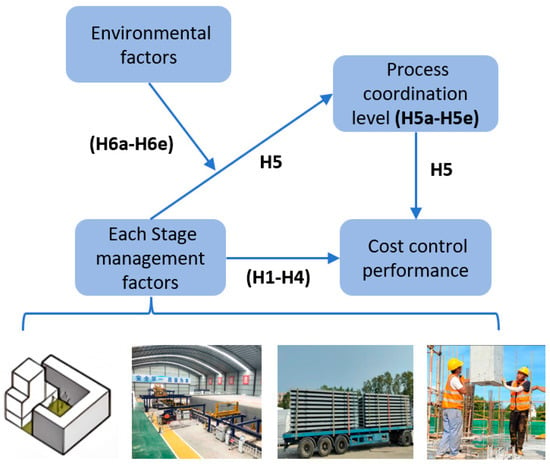
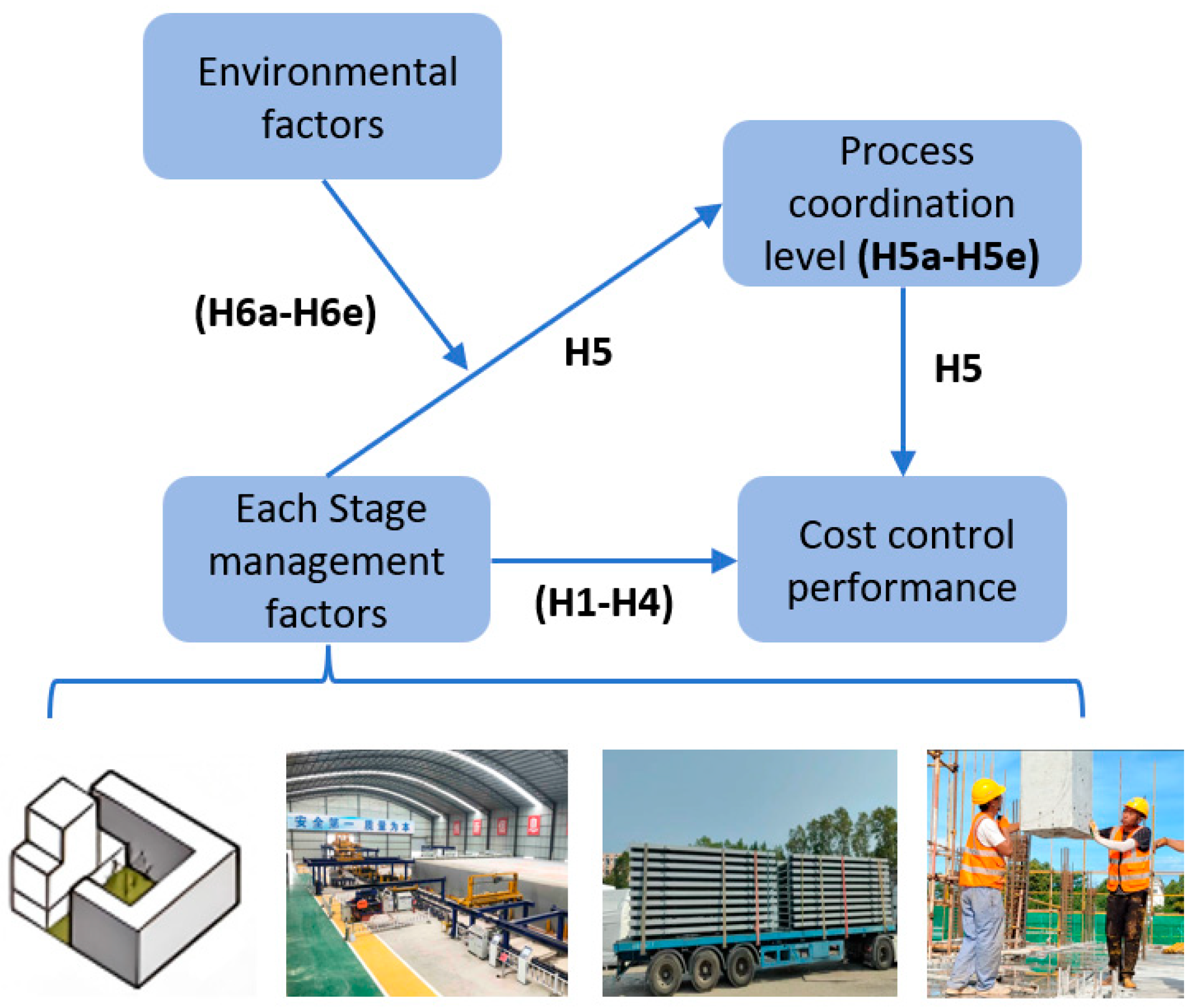
Based on the above analysis, the theoretical framework is established as shown in Figure 1.
Figure 1.
Theoretical model.
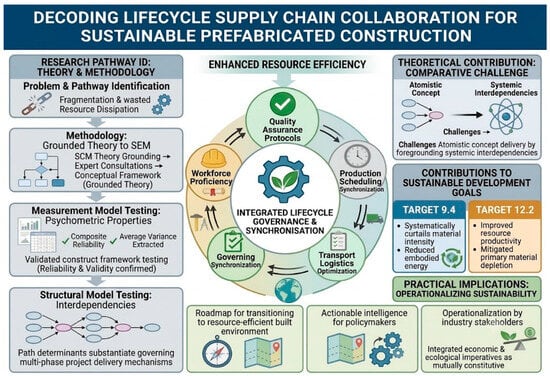
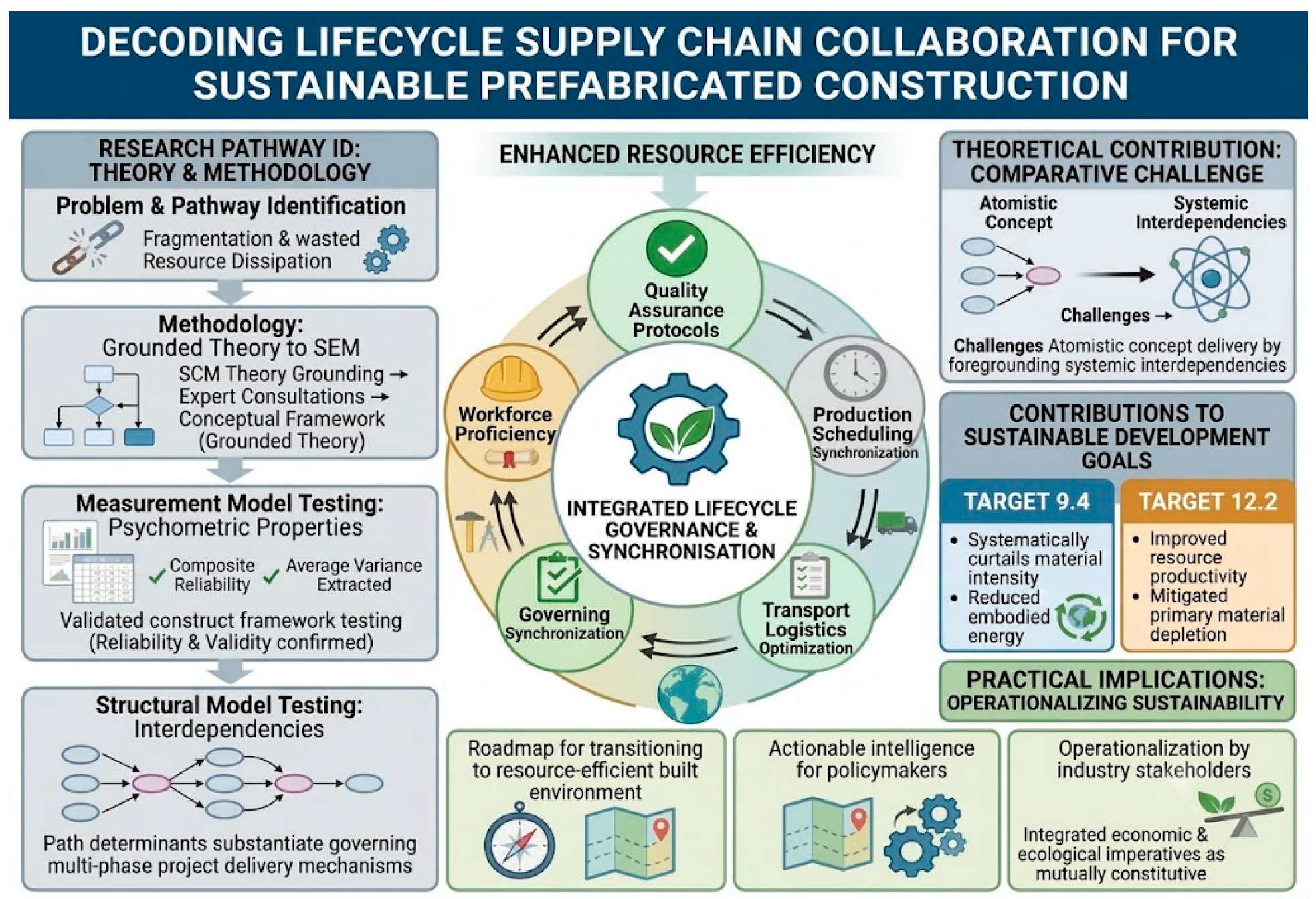
The proposed conceptual framework is presented in Figure 2.
Figure 2.
Mechanism framework.
Figure 1 illustrates the integrated lifecycle supply chain collaboration framework for sustainable prefabricated construction. At its core is Integrated Lifecycle Governance and Synchronisation, which connects key management factors across the entire project lifecycle, including Quality Assurance Protocols, Production Scheduling Synchronisation, Transport Logistics Optimisation, Workforce Proficiency, and Governing Synchronisation. The framework begins with problem and pathway identification, highlighting fragmentation and resource dissipation as critical challenges. It then proceeds to a methodological stage grounded in supply chain management theory and informed by expert consultation, through which the conceptual framework is developed. Measurement model testing subsequently confirms the reliability and validity of the latent constructs, while structural model testing reveals the interrelationships among the management factors and their effects on cost control performance. The framework further connects these mechanisms explicitly to the Sustainable Development Goals, particularly Target 9.4, which emphasises the reduction in material intensity and embodied energy, and Target 12.2, which focuses on improving resource productivity and reducing the depletion of primary materials. In addition, it offers practical guidance for policymakers and industry stakeholders seeking to operationalise sustainability in prefabricated construction. Overall, Figure 1 illustrates the progression from a theoretical foundation and empirical validation to actionable insights that support sustainable and resource efficient project delivery.
3. Questionnaire Design
This study adopted a quantitative, cross-sectional survey design because the research objective was to test hypothesised relationships among predefined latent constructs related to lifecycle cost control in prefabricated construction. Quantitative survey research is appropriate when a study seeks to collect standardised responses from a relatively large sample and to subject these responses to statistical testing [40]. Accordingly, a closed-ended questionnaire was employed to ensure comparability of responses across participants and to facilitate the subsequent multivariate analysis of the proposed conceptual model.
The questionnaire was carefully developed to capture the key latent variables associated with lifecycle cost control in prefabricated construction. As presented in Table 1, the survey instrument encompasses seven core constructs: Decision and Design Factors (DDF), Component Production Factors (CPF), Component Transportation Factors (CTF), Construction and Installation Factors (CIF), Process Coordination Level (PCL), Cost Control Performance (CCP), and Environmental Factors (EF). Each construct was measured through multiple items designed to reflect respondents’ professional perceptions and practical experience. All measurement items were adapted from established scales in the existing literature and further refined through expert consultation to ensure both conceptual validity and contextual suitability for the prefabricated construction industry.
The questionnaire development followed a structured process. First, measurement items were identified from established studies on construction management, supply chain collaboration, and project cost control. Second, these items were adapted to the context of prefabricated construction and reorganised according to the lifecycle stages and the theoretical constructs proposed in this study. Third, the draft instrument was reviewed by industry experts to assess content clarity, terminology accuracy, and contextual suitability, after which minor wording revisions were made before formal distribution. The survey itself comprised several sections, systematically aligned with the project lifecycle.
- (1)
- The Decision and Design section assessed the professional competency of design teams, standardisation levels, and the application of digital technologies like BIM.
- (2)
- The Production and Transportation sections focused on factory-scale management, quality systems, logistics optimisation, and cost control during transit.
- (3)
- The Installation section captured on-site management capabilities, including layout rationality, personnel skills, and process standardisation.
- (4)
- Crucially, the Process Coordination items evaluated the efficiency of information flow, stakeholder collaboration, and schedule alignment across these distinct phases.
- (5)
- Finally, Cost Control Performance was measured by evaluating both the process efficacy (e.g., timely issue resolution) and the final outcome (e.g., satisfaction with budget adherence).
- (6)
- Environmental Factors were included to assess external conditions such as market stability and policy support.
All items were measured using a five-point Likert scale, ranging from “1 = Strongly Disagree” to “5 = Strongly Agree,” allowing respondents to indicate their level of agreement with each statement in relation to their specific project experiences. A five-point rather than a seven-point format was adopted because it provides sufficient response discrimination while reducing respondents’ cognitive burden. Prior methodological research has shown that, for agree–disagree survey items, five response categories often produce data quality that is at least comparable to, and in some cases better than, scales with a larger number of categories [41].
To enhance the reliability and validity of the instrument, the initial draft was reviewed by a panel of industry experts, including project managers and senior engineers. Based on their feedback, minor adjustments were made to clarify technical terminology and ensure that the questions accurately reflected current industry practices in prefabricated construction.
Table 1.
Construct Measurement Items.
4. Data Analysis and Results
This study integrated PCA and SEM because the two methods fulfil distinct yet mutually reinforcing roles. At the initial stage, PCA functioned as a data reduction and item-screening tool, revealing how the questionnaire items clustered empirically and flagging any indicators with weak or ambiguous loadings. SEM then took over as the main confirmatory technique, a choice driven by the presence of several latent constructs and the hypothesised direct, mediating, and moderating links among them. Relative to traditional regression-based methods, SEM offers a clear advantage: it evaluates measurement quality and tests structural pathways at the same time, all while correcting for measurement error [57].
4.1. Data Collection and Sample Characteristics
4.1.1. Sample Descriptive Statistics
Survey data were gathered through the online platform “Wenjuanxing” over roughly a three-month window, running from late April to late July 2025. In total, 530 questionnaires reached construction industry professionals. Following careful screening to eliminate invalid responses, 517 usable questionnaires remained, yielding an effective response rate of 100% against the retrieved samples and an overall retrieval rate of 94%.
Before taking part, respondents learned about the study’s purpose, the voluntary basis of participation, the anonymous handling of their answers, and their freedom to withdraw at any point prior to submission. The survey gathered no personally identifiable information, and all data served academic research purposes alone. Under the regulations of the host institution, this anonymous questionnaire study did not require formal ethical approval; even so, it adhered to the standard ethical principles of informed consent, anonymity, confidentiality, and voluntary participation.
Table 2 sets out the demographic profile of the respondents. Gender was fairly evenly split, at 54.35% male and 45.65% female. By age, most participants fell into the young-to-middle-aged bracket, with 42.17% between 30 and 40 and a further 32.3% under 30. Such an age composition points to a workforce that blends fresh innovative energy with growing hands-on experience, forming the core of the prefabricated construction labour pool.
Table 2.
Demographic Profile of Respondents.
The sample was also well qualified in terms of education and tenure. More than 62% held a bachelor’s degree or above (46.42% bachelor’s, 16.25% master’s or PhD), signalling a cohort equipped to grasp complex management ideas. Work experience spanned a range of tenures: 42.75% reported fewer than five years, 31.72% between five and ten years, and 16.83% between ten and fifteen years. This spread allows the data to capture both newer viewpoints and more seasoned judgement.
Professionally, respondents occupied varied roles along the supply chain, including construction (34.82%), design (21.47%), cost management (16.63%), and project management (14.31%). Professional titles formed a pyramid, dominated by junior engineers (65.18%), with intermediate (19.15%) and senior engineers (7.35%) above them. The associated projects differed considerably in scale and category as well: 43.33% carried a value between 5 and 20 million CNY, while project types ranged across commercial (30.95%), residential (26.89%), and industrial buildings. Taken together, this variety supports the representativeness of the sample and the generalisability of the findings throughout the prefabricated construction sector.
The pyramid pattern of professional titles, with junior engineers making up the majority at 65.18%, mirrors the actual workforce structure in China’s fast-growing prefabricated construction industry, where junior staff carry out much of the frontline work. This may tilt the data toward execution-level perceptions, yet because these respondents are immersed in day-to-day project operations, their input offers genuine insight into practical management across the supply chain.
The SEM analysis proceeded in two stages. The first checked whether the dataset suited factor analysis and gave a preliminary read on the measurement structure. The second applied confirmatory factor analysis to evaluate the measurement model ahead of estimating the structural model. Validation drew on several criteria: internal consistency through Cronbach’s alpha and composite reliability; convergent validity through standardised factor loadings and average variance extracted (AVE); and discriminant validity through the Fornell–Larcker criterion, supplemented by HTMT examination where warranted. Overall fit rested on multiple indices, namely χ2/df, CFI, TLI, RMSEA, and SRMR. Once the measurement model demonstrated acceptable validity and fit, the structural model was estimated to test the hypothesised direct, mediating, and moderating relationships [58,59].
4.1.2. Descriptive Statistics of Variables
Table 3 reports the descriptive statistics for the latent variables, covering the mean, standard deviation, skewness, and kurtosis. Across all variables, means fall between 3.35 and 3.62 on the five-point Likert scale, suggesting that respondents broadly regard these factors as moderately to highly important and well implemented within their projects. “Technology Application Level” (mean = 3.62) and “Process Coordination Level” (mean = 3.61) drew the strongest ratings, a pattern that underscores how much the industry leans on technical solutions and coordination.
Table 3.
Descriptive Statistics of Latent Variables.
Data normality was checked through skewness and kurtosis. Every skewness value sits below 1 in absolute terms, and all kurtosis values stay under 1.5. These figures meet the thresholds for univariate normality and confirm that the distribution is well suited to the subsequent Structural Equation Modelling (SEM) analysis. Standard deviations span 1.09 to 1.23, pointing to a reasonable degree of dispersion and to genuinely varied respondent perspectives.
4.2. Measurement Model Evaluation
To ensure the scientific rigour of the study, we conducted comprehensive reliability and validity tests using SPSS 29.0 and AMOS 29.0. Unlike conventional cost-estimation methods recommended by AACEI (such as FEL-stage deterministic estimating), this study adopts structural equation modelling to examine causal pathways and boundary conditions rather than to generate project-specific cost forecasts.
4.2.1. Reliability Analysis
Reliability was gauged with Cronbach’s alpha, treating 0.7 as the minimum acceptable value. The Corrected Item-Total Correlation (CITC) was also computed, with 0.5 set as the retention benchmark.
Table 4 shows that Cronbach’s alpha for every sub-dimension surpasses the 0.80 mark, spanning from 0.806 (Transportation Conditions) to 0.890 (Process Coordination Level), which points to strong internal consistency throughout the questionnaire. CITC values for all measurement items lie between 0.650 and 0.781, comfortably clearing the 0.50 floor. In each case the “Cronbach’s Alpha if Item Deleted” figure falls below the overall alpha for the parent construct, ruling out any redundant items. Collectively, these outcomes confirm that the instrument performs with a high degree of reliability and stability.
Table 4.
Reliability Analysis Results.
4.2.2. Validity Analysis
Validity was evaluated through Exploratory Factor Analysis (EFA) alongside Confirmatory Factor Analysis (CFA).
To begin, the data’s fitness for factor analysis was verified using the Kaiser-Meyer-Olkin (KMO) measure together with Bartlett’s Test of Sphericity. As Table 5 indicates, the KMO value reaches 0.914, comfortably exceeding the 0.90 cut-off that marks “excellent” suitability. Bartlett’s test returned a significant outcome (approx. chi-square = 10,320.734, df = 630, p < 0.001), rejecting the null hypothesis that the correlation matrix is an identity matrix. Together, these results confirm that the dataset lends itself well to factor extraction.
Table 5.
KMO and Bartlett’s Test.
Principal Component Analysis (PCA) with Varimax rotation was employed to extract factors. The analysis extracted 12 components with eigenvalues greater than (or close to) 1, which cumulatively explain 77.371% of the total variance (Table 6). This high cumulative variance indicates that the extracted factors effectively capture the information contained in the original variables.
Table 6.
Total Variance Explained (Extraction Phase).
CFA was conducted using AMOS 29 to further validate the measurement model. The overall model fit indices are presented in Table 7. The Ratio of Chi-square to degrees of freedom (χ2/df) is 1.091, well below the threshold of 3. The goodness-of-fit indices (GFI = 0.943, AGFI = 0.928) and comparative fit indices (CFI = 0.995, TLI = 0.994, IFI = 0.995) all exceed the recommended value of 0.9. The RMSEA is 0.013, far below the 0.05 limit. Collectively, these indices indicate an excellent model fit.
Table 7.
Model Fit Indices (Measurement Model).
As shown in Table 8, the standardised factor loadings for all items range from 0.766 to 0.837, all statistically significant (p < 0.001) and greater than 0.7. The Average Variance Extracted (AVE) for all constructs ranges from 0.604 to 0.676, exceeding the 0.50 threshold. Composite Reliability (CR) values range from 0.806 to 0.891, exceeding the 0.70 threshold. These results confirm strong convergent validity.
Table 8.
Convergent Validity Test Results.
4.3. Structural Model Analysis and Hypothesis Testing
4.3.1. Correlation Analysis
Pearson correlation analysis (Table 9) uncovered significant positive associations between every key supply chain element and Cost Control Performance. Process Coordination Level held the strongest link with Cost Control Performance (r = 0.604, p < 0.01), trailed by Construction and Installation Factors (r = 0.497). These findings lend preliminary backing to the hypothesised relationships.
Table 9.
Pearson Correlation Matrix.
A Principal Component Analysis (PCA) was carried out first to gauge the construct validity of the measurement model. The analysis pointed clearly to a four-factor solution that aligned with the proposed theoretical structure, with items loading firmly onto their intended components and showing only minimal cross-loadings, a sign of adequate discriminant validity. Confirmatory Factor Analysis (CFA) followed to validate the measurement model more rigorously. Table 5 shows that the model achieved a satisfactory overall fit: χ2 = 246.609, df = 99, χ2/df = 2.491, GFI = 0.925, AGFI = 0.894, CFI = 0.906, and RMSEA = 0.071. Each of these indices meets or surpasses the conventionally accepted thresholds, indicating a reasonably sound model fit [30].
As reported in Table 6, standardised factor loadings for all items exceeded 0.56 and reached statistical significance (p < 0.001), evidence of robust item reliability. Composite reliability (CR) for every latent construct cleared the 0.70 benchmark, ranging from 0.774 to 0.880, while average variance extracted (AVE) values mostly stayed above the 0.50 mark, reinforcing convergent validity. Taken together, these results confirm that the measurement model combines strong reliability with sound construct validity, laying a solid groundwork for the structural equation modelling that follows.
4.3.2. Structural Model Analysis
The structural model was tested using AMOS 29. The model fit indices (Table 10) indicate an excellent fit: χ2/df = 1.267, CFI = 0.995, TLI = 0.992, and RMSEA = 0.023. These values meet all stringent criteria, suggesting the theoretical model aligns well with the empirical data.
Table 10.
Structural Model Fit Indices.
Table 11 confirms the convergent validity of the structural model components, with all factor loadings > 0.6, AVE > 0.5, and CR > 0.67, ensuring the latent constructs in the structural model are robust.
Table 11.
Structural Model Convergent Validity.
Table 12 further confirms discriminant validity for the structural model constructs, where the square roots of AVE exceed inter-construct correlations.
Table 12.
Structural Model Discriminant Validity.
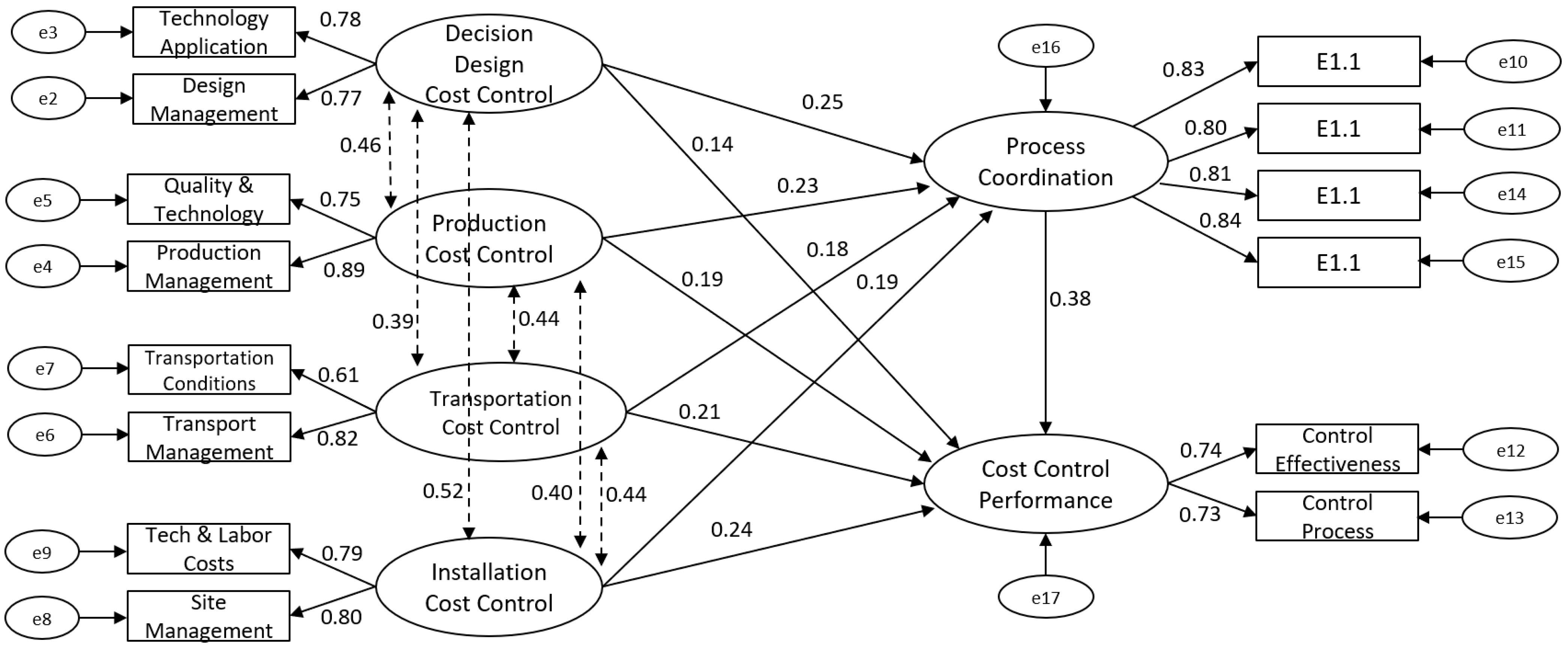
The path analysis results (Table 13 and Figure 3) provide full support for hypotheses H1 through H5d.
Table 13.
Path Coefficient Test Results.
Figure 3.
SEM Structural Model Results.
Direct effects on performance: all four lifecycle management factors exert a significant positive influence on Cost Control Performance. The Construction and Installation phase carries the strongest effect (β = 0.243, p < 0.001), followed by Transportation (β = 0.213), Production (β = 0.189), and Decision and Design (β = 0.145). These findings validate H1, H2, H3, and H4.
Impact of coordination: Process Coordination Level shows the largest direct effect on Cost Control Performance (β = 0.377, p < 0.001), confirming H5.
Antecedents of coordination: all four lifecycle factors significantly strengthen Process Coordination Level. Decision and Design factors weigh most heavily on coordination (β = 0.249, p < 0.001), which underscores the value of early-stage integration. This supports H5a, H5b, H5c, and H5d.
Discriminant validity was examined with the Fornell–Larcker criterion, which sets the square root of each construct’s average variance extracted (AVE) against its correlations with the other constructs. As Table 7 shows, the square-root AVE values (bolded along the diagonal) range from 0.778 to 0.816 and exceed every corresponding inter-construct correlation in the lower triangle. The square root of AVE for Knowledge Management Capability (0.816), for instance, outstrips its correlations with Digital Transformation (0.721), Organisational Agility (0.684), and Project Management Optimisation (0.702). These results signal satisfactory discriminant validity, indicating that each construct stands empirically apart from the others in the model.
4.4. Mediation and Moderation Analysis
4.4.1. Mediation Effect of Process Coordination Level
A bootstrap procedure drawing on 5000 resamples was run to probe whether Process Coordination Level acts as a mediator. Table 14 reports that the 95% confidence intervals for both the direct and indirect pathways exclude zero, which points to partial mediation. Process Coordination Level carries a statistically significant mediating effect between each lifecycle management factor and Cost Control Performance. By way of illustration, the indirect route from Decision and Design to Performance through Coordination yields an effect of 0.094 (CI: 0.043–0.169). Across the four pathways, indirect effects account for between 24.5% and 39.3% of the respective total effects, highlighting that a considerable share of the cost advantages stemming from lifecycle management materialises through stronger process coordination.
Table 14.
Bootstrap Mediation Effect Test.
4.4.2. Moderation Effect of Environmental Factors
To verify the moderating effect of Environmental Factors (EFs), this study employed hierarchical regression analysis. The findings in Table 15 reveal that the interaction terms linking Environmental Factors to each independent variable all reach significance (p < 0.001), thereby lending support to H6 and its corresponding sub-hypotheses (H6a–H6e).
Table 15.
Moderation Effect Test (Hierarchical Regression).
Every interaction coefficient is positive, falling within the 0.174 to 0.233 range, which suggests that favourable external conditions further strengthen the contribution of lifecycle management and process coordination to cost control performance. More precisely, the interplay between Design and Decision factors and the environment proves significant (β = 0.233, t = 6.313), implying that design optimisation delivers greater returns under supportive conditions. The interaction between Process Coordination and the environment likewise holds (β = 0.140, t = 4.077). Across Models 1 through 5, the shifts in F-values and R2 remain statistically meaningful, confirming that introducing the interaction terms meaningfully boosts the model’s explanatory capacity.
The findings concerning the moderating role of Environmental Factors (Hypothesis H6 and sub-hypotheses H6a–H6e) can be distilled as follows.
To begin with, the evidence for H6a–H6c demonstrates that supportive external environmental conditions markedly amplify the favourable influence of management factors at various lifecycle stages on cost control performance. Put differently, a conducive external setting heightens the capacity of management practices to deliver better cost outcomes. Where environmental conditions turn unfavourable, however, the role these factors play in cost control tends to weaken or face constraints.
Turning to H6e, the results reveal that a favourable external environment likewise bolsters the positive bearing of process coordination level on cost control performance. The gains from coordination grow more visible when the surrounding conditions are supportive, whereas a harsher environment may curb how effective coordination efforts ultimately prove.
On the whole, the empirical analysis lends weight to the proposed theoretical model. The structural equation modelling outcomes establish that management factors spanning all four lifecycle stages—decision and design, production, transportation, and installation—carry significant direct positive effects on cost control performance, with installation management wielding the greatest influence. Process coordination level, meanwhile, serves as a key partial mediator, channelling the positive effects of phase-specific management practices through to overall project results. Lastly, environmental factors act as a significant positive moderator that sharpens the effectiveness of both management practices and coordination work. Considered as a whole, these results furnish a robust statistical underpinning for the discussion and practical implications that follow.
5. Improvement Measures for Cost Control
5.1. Measures for the Decision and Design Phase
The empirical outcomes confirm that Design Management Capability (0.774) and Technology Application Level (0.777)—with notably strong loadings on Standardisation of Design Scheme (0.832) and Rationality of Material Selection (0.806)—exert a meaningful positive influence on cost control performance. These results sit comfortably alongside earlier work [21] pointing to early-stage standardisation and BIM-driven collaboration as pivotal mechanisms for curbing downstream rework and strengthening constructability in prefabricated projects. They also corroborate the hypothesised direct effects of decision-and-design management factors together with the mediating pathway through process coordination identified in the structural model. That said, several caveats apply. The analysis draws on perceptual data gathered from stakeholders within China’s prefabricated construction sector, and self-reported measures may inflate the perceived gains from standardisation. Moreover, reliance on a single-country sample narrows the extent to which these findings can be transferred to settings characterised by different regulatory maturity, market conditions, or digital readiness. Comparative or longitudinal research designs would therefore help sharpen causal claims and broaden external validity.
Cost control during the decision and design phase rests chiefly on three pillars: standardisation, design optimisation, and early-stage cost pre-control. On the first count, standardisation should be advanced by building a modular design system. Deploying BIM for collaborative design keeps the range of prefabricated component types within practical bounds—roughly 80 types is advisable—so that standardisation yields its fullest economic return (loading: 0.832). On the second count, design optimisation warrants closer attention to ensure that materials are chosen judiciously (loading: 0.806). A technical scheme comparison mechanism, coupled with Value Engineering principles, can surface more cost-efficient design alternatives. On the third count, a cost pre-control mechanism embedded at the design stage should anticipate the downstream realities of production, transportation, and installation. Taken together, these steps curtail design changes, raise design quality, and in doing so anchor cost control at its source.
5.2. Measures for Component Production Cost Control
The pronounced effect of Production Management Level (0.889) and Quality and Technical Level (0.751)—particularly Coordination of Production Plans (0.815) and Quality Control System (0.820)—accords with prior work [15] on off-site manufacturing, which casts scheduling precision and quality assurance as the chief levers of production cost efficiency. These findings reinforce the positive direct effects of production-phase management factors as well as the mediating mechanism of process coordination embedded in the model. A notable limitation, however, is that the conclusions rest on cross-sectional survey data drawn from a fast-evolving Chinese setting; production routines and supply-chain maturity may diverge considerably across other regions, which could narrow the wider applicability of the results. Incorporating objective cost metrics and validating across multiple countries would go some way toward easing this concern.
Cost control during the component production phase ought to centre on three priorities: plan optimisation, smart manufacturing, and quality-oriented resource management. First, a dynamic production planning system merits development to allow real-time data synchronisation and seamless coordination between design and production activities (path coefficient: 0.464). This kind of alignment lessens scheduling conflicts, sharpens production responsiveness, and lifts overall efficiency.
Second, the uptake of smart manufacturing practices deserves encouragement through automated equipment and advanced quality inspection systems. Such measures heighten production accuracy, raise operational efficiency, and trim defects across the manufacturing process.
Third, resource efficiency and quality management warrant closer attention. Setting up a mould-sharing platform, for instance, can bring tooling costs down appreciably. In parallel, standardised operating procedures coupled with a rigorous quality control system curb rework and material waste, lending further support to production efficiency and cost performance.
5.3. Measures for Component Transportation Cost Control
The empirical evidence pinpoints Transportation Management Level (0.816) as a key factor, with Route Optimisation (0.830) and Transportation Cost Control Ability (0.831) registering the highest loadings. This chimes with the international literature on logistics within prefabricated supply chains [18], which has steadily tied intelligent routing and delivery dependability to reduced transportation costs, and it lends weight to the lifecycle management effects posited in our framework. At the same time, it bears noting that these outcomes may mirror infrastructural and regulatory conditions peculiar to China, introducing a degree of sample bias that could temper global inference (a point raised among the study limitations). The dependence on perceptual rather than actual cost figures is a further reason to read the effect sizes with care.
Cost control during the transportation phase should hinge on intelligent scheduling, loss prevention, and process optimisation. First, smart logistics systems underpinned by algorithm-based route optimisation warrant development to lift transport efficiency (loading: 0.830). Systems of this kind help shorten transport distances, bring down empty-load rates, and in turn lower overall logistics costs.
Second, protective measures during transit deserve closer attention. Adopting standardised packaging schemes alongside purpose-built transportation racks can meaningfully reduce the risk of component damage, thereby keeping loss-related costs in check.
Third, regulatory efficiency stands to be improved as well. Setting up a dedicated “green channel” for approving the transport of oversized components can streamline administrative procedures and ease delays across the logistics chain.
Taken together, these steps reinforce transportation cost control by maximising delivery efficiency while minimising loss rates throughout the transport process.
5.4. Measures for Construction and Installation Cost Control
The analysis indicates that Site Management Level (0.799) and Technology and Personnel Level (0.788)—with Standardisation of Construction Processes (0.833) and Technical Level of Personnel (0.806) standing out in particular—exert a significant bearing on cost control performance. These results sit well with earlier studies [28] that foreground on-site coordination and a skilled workforce as decisive for installation efficiency in prefabricated projects, and they lend further support to the mediating role process coordination plays across every lifecycle phase. It is worth conceding, however, that the China-centred sample may place undue weight on certain site-management factors when set against more mature markets where labour dynamics or automation levels differ. This self-critique points to the value of international replication in shoring up the robustness of the phase-specific findings.
Cost control during the installation phase should pivot on three areas: site management, process standardisation, and workforce capability building. First, virtual construction technologies merit adoption for simulation, planning, and training. Paired with smart construction site management systems, such technologies help fine-tune component delivery schedules and site layout, thereby sharpening installation accuracy and efficiency (loading: 0.833).
Second, personnel development deserves greater emphasis. Putting in place a systematic training and certification framework for industrial workers can markedly raise workforce professionalism and technical competence (loading: 0.806)—a prerequisite for keeping installation quality consistent and cutting down operational errors on site.
Third, refined management practices should be carried through via standardised construction procedures and tighter on-site control. Measures of this sort effectively reduce rework, curb idle labour time, and improve the utilisation of machinery and equipment, thereby contributing to firmer control over both labour and equipment-related costs.
6. Implications
6.1. Theoretical Implications
Starting from the basic proposition that fragmented supply chains erode both cost performance and sustainability goals in prefabricated construction, this study pushes theoretical understanding forward by empirically validating a comprehensive coordination model—one that captures the systemic interdependencies running across the whole project lifecycle. Rather than rest on the phase-specific viewpoints that have long held sway in the literature, the study builds a holistic framework knitting together factors tied to design, production, transportation, and installation, thereby speaking directly to the theoretical gap previously identified around cross-stage coordination mechanisms.
The findings stretch existing theory further by spelling out the mediating role of process coordination. To be precise, effective phase-level management not only delivers direct gains in cost control performance but also generates substantial indirect effects via stronger inter-organisational information exchange along the supply chain. This mediating pathway sheds light on how integrated governance can be converted into tangible project outcomes aligned with SDG Target 9.4 and Target 12.2. What is more, by treating environmental factors as moderators, the study enriches contingency theory in construction management, showing that the payoff from coordination efforts hinges in part on external conditions such as market stability and policy support. This boundary condition carries particular weight in developing economies, where fragmented supply chains and still-maturing regulatory frameworks frequently rein in the efficiency gains coordination is meant to produce.
Taken together, these results suggest that cost control in prefabricated construction is better read as a lifecycle transmission process—one in which upstream decisions set off cost consequences that surface fully only downstream in transportation and installation—rather than as a set of isolated phase effects. This reading broadly squares with recent studies indicating that prefabricated building supply chain performance rests on whole-process resilience and on the coordinated management of off-site production, delivery, and on-site assembly under uncertainty [60,61]. Yet our results take this body of work a step further by showing that process coordination is not simply a contextual condition but an empirically grounded mediating mechanism through which phase-level management is carried over into cost control performance.
The dual-path mechanism—encompassing both direct and mediated effects—offers a more textured account of how cost advantages take shape within complex prefabrication supply chains. In doing so, it unsettles atomistic conceptions of project delivery and advances a relational perspective in which economic and ecological imperatives converge through coordinated inter-organisational practice.
6.2. Managerial Implications
For senior management and policymakers, these findings drive home the point that cost control in prefabricated construction ought to be treated as a systemic supply chain strategy, not a patchwork of disconnected cost-cutting measures.
On the managerial front, the results caution against local optimisation at any single stage: paring cost in one link may simply push delay, inventory build-up, or rework pressure onto neighbouring stages. This observation dovetails with recent research showing that prefabricated projects call for dynamic coordination of off-site production, component delivery, and on-site assembly if time, cost, and carbon objectives are to be balanced under uncertainty [61]. It follows that “early involvement” and cross-stage planning should be valued not only as efficiency instruments but equally as risk-prevention mechanisms that head off downstream cost amplification.
Three practical implications merit emphasis. First, managers need to accept that process coordination is a make-or-break determinant of project performance. Achieving this means dismantling the traditional silos separating design institutes, manufacturers, logistics providers, and construction units, and nurturing a more integrated, collaborative working culture in their place.
Second, although the installation phase displays the strongest direct bearing on cost control, the notable influence the decision and design phase wields over coordination points to the merits of an early involvement strategy. Channelling adequate resources into the initial design stage—so that standardisation, constructability, and feasibility are locked in from the outset—can yield considerable downstream dividends in both coordination efficiency and cost reduction.
Third, the confirmed moderating role of environmental factors implies that management strategies must stay dynamic and adaptable. When market conditions turn volatile or the policy landscape shifts, project leaders should pivot to more flexible management approaches that buffer external risks while extracting the fullest benefit from effective internal coordination.
6.3. Practical Implications
The practical value of this study lies in guiding project managers and engineers toward more effective cost control throughout a project’s lifespan.
At the decision and design stage, a disciplined approach to standardisation is essential. Leveraging digital platforms BIM in particular can sharpen design logic and curb the late-stage revisions that typically drive budgets off course.
When it comes to manufacturing and delivery, keeping costs in check hinges on how well information flows between teams. Factory schedules need to stay in step with field progress to avoid stockpiling expenses, and transportation routes should be actively optimised rather than left to convention.
The on-site construction and installation stage carries the heaviest weight in determining final cost outcomes. Workforce skill development and procedural discipline deserve priority attention here. Deploying virtual construction simulations and enforcing worker certification requirements can meaningfully cut down on rework and wasted materials—two of the most stubborn cost drivers.
Beyond individual phases, cross-team coordination proves just as consequential. A shared information platform allows stakeholders to act on the same real-time data, which tightens the link between material movement and resource planning. This kind of integration helps teams hold their cost targets even when external conditions shift unexpectedly.
Taken together, the evidence points away from treating design, production, logistics, and site management as separate domains. Gains in one area are easily eroded without corresponding improvements elsewhere. This view echoes recent scholarship suggesting that the cost and sustainability benefits commonly attributed to prefabrication do not materialise automatically—they depend on coordinated lifecycle management, external enabling conditions, and ongoing performance tracking [62]. Project teams are therefore advised to look beyond phase-level savings and ask whether their coordination structures are strong enough to stop inefficiencies from compounding downstream.
7. Conclusions and Limitation
The empirical evidence confirms that management factors in all four project phases produce statistically significant positive direct effects on cost control performance in prefabricated construction. Ranked by magnitude, the standardised path coefficients are 0.243 for construction and installation, 0.213 for component transportation, 0.189 for component production, and 0.145 for decision and design. Among the factors carrying the most weight are design standardisation, synchronised production scheduling, quality assurance protocols, transport logistics optimisation, and workforce proficiency (all p < 0.001). On this basis, H1 through H4 all held, verifying that management practices in the decision and design, component production, component transportation, and construction and installation phases each contribute positively and significantly to cost control performance.
Turning to the coordination hypotheses, H5 received support, as did its four sub-hypotheses H5a–H5d, indicating that process coordination significantly mediates the link between phase-level management factors and cost control performance in every stage. Process coordination registers a strong positive direct effect (β = 0.377) and operates as a transmission channel that carries the influence of phase-specific management practices through to performance—a result corroborated by bootstrap analysis. H6 was likewise supported, together with its sub-hypotheses H6a–H6e, establishing that environmental factors significantly moderate how phase-specific management and process coordination shape cost control outcomes. These moderating effects on the lifecycle-management–performance relationship were significant (p < 0.001), with the interaction terms enhancing overall model fit.
By assembling an integrated empirical framework that accommodates direct effects, mediation, and moderation across the entire project lifecycle, this study contributes to both supply chain and construction management theory while equipping practitioners with phase-specific guidance for cost control. The work is not without constraints, however. Its cross-sectional design limits the ability to track how these relationships evolve over time, a gap that longitudinal research could usefully address.
Survey responses were gathered through Wenjuanxing, a platform widely used across China. While this locally rooted sample drawn from China’s prefabricated construction supply chain yields valuable context-specific insight, replication in other regions would help establish how far the findings travel. It should also be noted that, although the model captured several key environmental moderators—market, policy, and industry technology environments—other potentially relevant contextual variables, such as project urgency and complexity, fell outside its scope.
Several avenues remain open for future inquiry. Longitudinal designs could illuminate the temporal dynamics underlying these relationships; the incorporation of objective cost performance data would strengthen the present survey-based measures; and cross-country comparative studies would further probe the generalisability and boundary conditions of the proposed model under differing environmental settings.
Author Contributions
Conceptualization, T.-Y.H.; writing—original draft, T.-Y.H. and Y.-M.Y.; funding acquisition, T.-Y.H.; writing—review and editing, H.-W.T.; supervision, H.-W.T.; project administration, H.-W.T.; data curation, H.-D.W.; methodology, H.-D.W.; formal analysis, K.-T.C.; data curation, K.-T.C. All authors have read and agreed to the published version of the manuscript.
Funding
This research received no external funding.
Data Availability Statement
The original contributions presented in this study are included in the article. Further inquiries can be directed to the corresponding author(s).
Conflicts of Interest
The authors declare no conflicts of interest.
References
- Luo, T.; Xue, X.; Tan, Y.; Wang, Y.; Zhang, Y. Exploring a Body of Knowledge for Promoting the Sustainable Transition to Prefabricated Construction. Eng. Constr. Archit. Manag. 2021, 28, 2637–2666. [Google Scholar] [CrossRef] [Scilit]
- Navaratnam, S.; Satheeskumar, A.; Zhang, G.; Nguyen, K.; Venkatesan, S.; Poologanathan, K. The Challenges Confronting the Growth of Sustainable Prefabricated Building Construction in Australia: Construction Industry Views. J. Build. Eng. 2022, 48, 103935. [Google Scholar] [CrossRef] [Scilit]
- Fang, Y.; Ni, G.; Song, C.; Zhou, Q.; Mei, Y.; Zhang, W.; Wang, W. Evaluation of Organizational Resilience in the Construction Phase of Prefabricated Building Project Based on a Combined Weighted Cloud Model. Eng. Constr. Archit. Manag. 2026, 36, 1–38. [Google Scholar] [CrossRef] [Scilit]
- Jeong, J.; Jeong, J. Sustainability in Prefabricated Construction: Enhancing Multicriteria Analysis and Prediction Using Machine Learning. J. Constr. Eng. Manag. 2024, 150, 04024081. [Google Scholar] [CrossRef] [Scilit]
- Shen, Y.; Xu, M.; Lin, Y.; Cui, C.; Shi, X.; Liu, Y. Safety Risk Management of Prefabricated Building Construction Based on Ontology Technology in the BIM Environment. Buildings 2022, 12, 765. [Google Scholar] [CrossRef] [Scilit]
- Chai, Y.; Liang, X.; Liu, Y. Construction Quality of Prefabricated Buildings Using Structural Equation Modeling. Appl. Sci. 2023, 13, 9629. [Google Scholar] [CrossRef] [Scilit]
- Hassan, H.; Xu, L.; Kwasi Sampene, A.; Wang, B. Prioritizing Barriers and Pathways for Prefabricated Buildings: Insights from AHP–ISM–MICMAC Analysis. J. Hous. Built Environ. 2026, 26, 45–67. [Google Scholar] [CrossRef] [Scilit]
- Du, J.; Li, X.; Sugumaran, V.; Hu, Y.; Xue, Y. Dynamic Model Averaging-Based Procurement Optimization of Prefabricated Components. Neural Comput. Appl. 2023, 35, 25157–25173. [Google Scholar] [CrossRef] [Scilit]
- Ay, İ.; Gümüşburun Ayalp, G. Prefabrike Yapıların Tasarım, Üretim, Depolama, Nakliye Ve Yapım Süreçlerini Etkileyen Kriterler. Tek. Dergi 2021, 32, 3. [Google Scholar] [CrossRef] [Scilit]
- Shen, Y.; Wang, J.; Jin, G.-H. Integrating PC Splitting Design and Construction Organization through Multi-Agent Simulation for Prefabricated Buildings. Buildings 2025, 15, 3773. [Google Scholar] [CrossRef] [Scilit]
- Nguyen, D.-C.; Jeon, C.-H.; Roh, G.; Shim, C.-S. BIM-Based Preassembly Analysis for Design for Manufacturing and Assembly of Prefabricated Bridges. Autom. Constr. 2024, 160, 105338. [Google Scholar] [CrossRef] [Scilit]
- Abdelalim, A.M.; Salem, M.; Salem, M.; Al-Adwani, M.; Tantawy, M. An Analysis of Factors Contributing to Cost Overruns in the Global Construction Industry. Buildings 2024, 15, 18. [Google Scholar] [CrossRef] [Scilit]
- Chadee, A.; Martin, H.; Gallage, S.; Rathnayake, U. Reducing Cost Overrun in Public Housing Projects: A Simplified Reference Class Forecast for Small Island Developing States. Buildings 2023, 13, 998. [Google Scholar] [CrossRef] [Scilit]
- Helaly, H.; El-Rayes, K.; Ignacio, E.-J. Predictive Models to Estimate Construction and Life-Cycle Cost of Conventional and Prefabricated Bridges during Early Design Phases. Can. J. Civ. Eng. 2025, 52, 1109–1124. [Google Scholar] [CrossRef] [Scilit]
- Zhai, Y.; Sun, Y.; Li, Y.; Tang, S. Design for Assembly (DFA) Evaluation Method for Prefabricated Buildings. Buildings 2023, 13, 2692. [Google Scholar] [CrossRef] [Scilit]
- Kumi, L.; Jeong, J. Optimization Model for Selecting Optimal Prefabricated Column Design Considering Environmental Impacts and Costs Using Genetic Algorithm. J. Clean. Prod. 2023, 417, 137995. [Google Scholar] [CrossRef] [Scilit]
- Yang, M. Risk Management of Prefabricated Building Construction Based on Fuzzy Neural Network. Sci. Program. 2022, 2022, 2420936. [Google Scholar] [CrossRef] [Scilit]
- Zhu, T.; Liu, G. A Novel Hybrid Methodology to Study the Risk Management of Prefabricated Building Supply Chains: An Outlook for Sustainability. Sustainability 2022, 15, 361. [Google Scholar] [CrossRef] [Scilit]
- Zhao, Y.; Cao, C.; Liu, Z. A Framework for Prefabricated Component Hoisting Management Systems Based on Digital Twin Technology. Buildings 2022, 12, 276. [Google Scholar] [CrossRef] [Scilit]
- Xu, G. The Construction Site Management of Concrete Prefabricated Buildings by ISM-ANP Network Structure Model and BIM under Big Data Text Mining. Int. J. Interact. Multimed. Artif. Intell. 2020, 6, 138–145. [Google Scholar] [CrossRef] [Scilit]
- An, H.; Jiang, L.; Chen, X.; Gao, Y.; Wang, Q. Cloud Model-Based Intelligent Construction Management Level Assessment of Prefabricated Building Projects. Buildings 2024, 14, 3242. [Google Scholar] [CrossRef] [Scilit]
- Song, Y.; Wang, J.; Liu, D.; Huangfu, Y.; Guo, F.; Liu, Y. The Influence of Government’s Economic Management Strategies on the Prefabricated Buildings Promoting Policies: Analysis of Quadripartite Evolutionary Game. Buildings 2021, 11, 444. [Google Scholar] [CrossRef] [Scilit]
- Yang, B.; Dong, M.; Wang, C.; Liu, B.; Wang, Z.; Zhang, B. IFC-Based 4D Construction Management Information Model of Prefabricated Buildings and Its Application in Graph Database. Appl. Sci. 2021, 11, 7270. [Google Scholar] [CrossRef] [Scilit]
- Wu, X. Wireless Management System of Prefabricated Construction Materials Based on BIM Technology. EURASIP J. Wirel. Commun. Netw. 2021, 2021, 116. [Google Scholar] [CrossRef] [Scilit]
- Yan, X.; Zhang, H. Computer Vision–Based Disruption Management for Prefabricated Building Construction Schedule. J. Comput. Civ. Eng. 2021, 35, 04021027. [Google Scholar] [CrossRef] [Scilit]
- Luo, L.; Jin, X.; Shen, G.Q.; Wang, Y.; Liang, X.; Li, X.; Li, C.Z. Supply Chain Management for Prefabricated Building Projects in Hong Kong. J. Manag. Eng. 2020, 36, 05020001. [Google Scholar] [CrossRef] [Scilit]
- Yu, Z.; Sun, J. Green Cooperation Strategy of Prefabricated Building Supply Chain Based on Smart Construction Management Platform. Sustainability 2023, 15, 15882. [Google Scholar] [CrossRef] [Scilit]
- Luo, L.; Ding, Z.; Niu, J.; Zhang, L.; Liao, L. A Digital Project Management Framework for Transnational Prefabricated Housing Projects. Buildings 2024, 14, 2915. [Google Scholar] [CrossRef] [Scilit]
- Liu, W.; Feng, Z.; Luo, X. Measurement of Synergy Management Performance in Prefabricated Building Project Supply Chain. Sustainability 2024, 16, 11025. [Google Scholar] [CrossRef] [Scilit]
- Zhang, S.; Li, Z.; Ma, S.; Li, L.; Yuan, M. Critical Factors Influencing Interface Management of Prefabricated Building Projects: Evidence from China. Sustainability 2022, 14, 5418. [Google Scholar] [CrossRef] [Scilit]
- Wang, J.; Song, Y.; Yuan, C.; Guo, F.; Huangfu, Y.; Liu, Y. Research on the Training and Management of Industrializing Workers in Prefabricated Building with Machine Vision and Human Behaviour Modelling Based on Industry 4.0 Era. Comput. Intell. Neurosci. 2022, 2022, 9230412. [Google Scholar] [CrossRef] [Scilit] [PubMed]
- Yin, S.; Dong, T.; Li, B.; Gao, S. Developing a Conceptual Partner Selection Framework: Digital Green Innovation Management of Prefabricated Construction Enterprises for Sustainable Urban Development. Buildings 2022, 12, 721. [Google Scholar] [CrossRef] [Scilit]
- Feng, J.; Xu, S. Concrete Construction Engineering Management in the Context of the Internet of Things. Mob. Inf. Syst. 2022, 2022, 7111953. [Google Scholar] [CrossRef] [Scilit]
- Chen, G.; Xiahou, X.; Li, J.; Chen, L.; Zou, Y.; Zhou, S. Knowledge Graph-Driven Question Answering for Prefabricated Building Quality Management through Natural Language Processing and Transfer Learning. Eng. Constr. Archit. Manag. 2025, 5, 24–41. [Google Scholar] [CrossRef] [Scilit]
- Gao, M.; Guo, Y.; Hou, H.; Wang, P.; Wang, S. Assembly Process Based on Supply Chain Management of Prefabricated Houses Using BIM. Proc. Inst. Civ. Eng. Struct. Build. 2024, 177, 385–396. [Google Scholar] [CrossRef] [Scilit]
- Liu, G.; Huang, R.; Li, K.; Shrestha, A.; Fu, X. Greenhouse Gas Emissions Management in Prefabrication and Modular Construction Based on Earned Value Management. J. Constr. Eng. Manag. 2022, 148, 04022034. [Google Scholar] [CrossRef] [Scilit]
- Zhang, W.; Kang, K.; Zhong, R.Y. A Cost Evaluation Model for IoT-Enabled Prefabricated Construction Supply Chain Management. Ind. Manag. Data Syst. 2021, 121, 2738–2759. [Google Scholar] [CrossRef] [Scilit]
- Zhang, R.; Feng, X.; Mou, Z.; Zhang, Y. Green Optimization for Precast Production Rescheduling Based on Disruption Management. J. Clean. Prod. 2023, 420, 138406. [Google Scholar] [CrossRef] [Scilit]
- Liu, X.; Zhao, J.; Sun, G.; Zhou, G.; Han, X. Supply Chain Management for Modular Construction Using Building Information Modeling. PCI J. 2023, 68, 57–71. [Google Scholar] [CrossRef] [Scilit]
- Creswell, J.W. Research Design: Qualitative, Quantitative, and Mixed Methods Approaches, 4th ed.; SAGE Publications: Thousand Oaks, CA, USA, 2014; ISBN 9781452274607. [Google Scholar]
- Boateng, G.O.; Neilands, T.B.; Frongillo, E.A.; Melgar-Quiñonez, H.R.; Young, S.L. Best Practices for Developing and Validating Scales for Health, Social, and Behavioral Research: A Primer. Front. Public Health 2018, 6, 149. [Google Scholar] [CrossRef] [Scilit] [PubMed]
- Sun, J.; Yi Man Li, R.; Deeprasert, J. The Impact of BIM Technology on the Lifecycle Cost Control of Prefabricated Buildings: Evidence from China. Buildings 2024, 14, 3709. [Google Scholar] [CrossRef] [Scilit]
- Analysis on Supply Chain Risk Factors of Prefabricated Buildings Using AHP-DEMATEL-ISM Model. Teh. Vjesn. 2023, 30, 1379–1386. [CrossRef] [Scilit]
- Gao, J.; Zhao, W.-H.; Liu, W.-H. Evaluation of Influencing Factors on the Supply Chain of Prefabricated Buildings under Engineering Procurement Construction Model: A Case Study in China. Buildings 2024, 14, 1680. [Google Scholar] [CrossRef] [Scilit]
- Yang, S.; Hou, Z.; Chen, H. Network Model Analysis of Quality Control Factors of Prefabricated Buildings Based on the Complex Network Theory. Buildings 2022, 12, 1874. [Google Scholar] [CrossRef] [Scilit]
- Jin, J.; Xu, Y.; Huang, Q.; Liu, W. Research on Carbon Footprint Calculation for the Materialisation Phase of Prefabricated Housing. Buildings 2025, 15, 3588. [Google Scholar] [CrossRef] [Scilit]
- Wang, H.; Zhang, H.; Hou, K.; Yao, G. Carbon Emissions Factor Evaluation for Assembled Building during Prefabricated Component Transportation Phase. Energy Explor. Exploit. 2021, 39, 385–408. [Google Scholar] [CrossRef] [Scilit]
- Wang, H.; Zhao, L.; Zhang, H.; Qian, Y.; Xiang, Y.; Luo, Z.; Wang, Z. Carbon Emission Analysis of Precast Concrete Building Construction: A Study on Component Transportation Phase Using Artificial Neural Network. Energy Build. 2023, 301, 113708. [Google Scholar] [CrossRef] [Scilit]
- Liu, L.; Tai, H.-W.; Wang, T.; Qiao, L.; Cheng, K.-T. Analyzing Cost Impacts across the Entire Process of Prefabricated Building Components from Design to Application. Sci. Rep. 2025, 15, 9300. [Google Scholar] [CrossRef] [Scilit] [PubMed]
- Yuan, Z.; Wang, H.; Yang, Y.; Yi, C.; Huang, D.; Yu, D. Improving the Construction Accuracy of Precast Components in Prefabricated Buildings by Analyzing Relevant Factors from the Perspective of Supply Chain: A System Dynamics Model. Arch. Eng. Des. Manag. 2024, 20, 230–248. [Google Scholar] [CrossRef] [Scilit]
- Yang, Y.; Li, M.; Yu, C.; Zhong, R.Y. Digital Twin-Enabled Visibility and Traceability for Building Materials in on-Site Fit-out Construction. Autom. Constr. 2024, 166, 105640. [Google Scholar] [CrossRef] [Scilit]
- Liu, L.; Liu, Y.; Xu, X. Coordination Mechanisms in Digital Building Permitting: Unravelling the Dynamic Tension between Collaboration and Complexity. Build. Res. Inf. 2025, 15, 1–22. [Google Scholar] [CrossRef] [Scilit]
- Lou, N.; Guo, J. Study on Key Cost Drivers of Prefabricated Buildings Based on System Dynamics. Adv. Civ. Eng. 2020, 2020, 8896435. [Google Scholar] [CrossRef] [Scilit]
- Wang, L.; Zhang, M.; Liu, J. Analysis of the Influencing Factors of the Cost of Village Prefabricated Housing in Rural Revitalization: A Southern Shaanxi Case Study. Eng. Constr. Archit. Manag. 2025, 32, 6353–6372. [Google Scholar] [CrossRef] [Scilit]
- Wang, S.; Sinha, R. Life Cycle Assessment of Different Prefabricated Rates for Building Construction. Buildings 2021, 11, 552. [Google Scholar] [CrossRef] [Scilit]
- Wu, G.; Yang, R.; Li, L.; Bi, X.; Liu, B.; Li, S.; Zhou, S. Factors Influencing the Application of Prefabricated Construction in China: From Perspectives of Technology Promotion and Cleaner Production. J. Clean. Prod. 2019, 219, 753–762. [Google Scholar] [CrossRef] [Scilit]
- Kline, R.B. Principles and Practice of Structural Equation Modeling, 5th ed.; Guilford Press: London, UK, 2023; ISBN 9781462551910. [Google Scholar]
- Fornell, C.; Larcker, D.F. Evaluating Structural Equation Models with Unobservable Variables and Measurement Error. J. Mark. Res. 1981, 18, 39–50. [Google Scholar] [CrossRef] [Scilit]
- Hu, L.-T.; Bentler, P.M. Cutoff Criteria for Fit Indexes in Covariance Structure Analysis: Conventional Criteria versus New Alternatives. Struct. Equ. Model. 1999, 6, 1–55. [Google Scholar] [CrossRef] [Scilit]
- Lin, M.; Ren, Y.; Feng, C.; Li, X. Analyzing Resilience Influencing Factors in the Prefabricated Building Supply Chain Based on SEM-SD Methodology. Sci. Rep. 2024, 14, 17393. [Google Scholar] [CrossRef] [Scilit] [PubMed]
- Zhang, X.; Zhang, X. Automated Component Delivery Management under Uncertainty for Prefabricated Buildings to Minimize Cost and Harmful Emissions. Autom. Constr. 2024, 162, 105388. [Google Scholar] [CrossRef] [Scilit]
- Jayawardana, J.; Sandanayake, M.; Jayasinghe, J.A.S.C.; Kulatunga, A.K.; Zhang, G.K. Life Cycle Economic and Social Sustainability Aspects of Prefabricated Construction—A Systematic Review towards the Holistic Sustainability. Constr. Innov. 2025, 25, 98–138. [Google Scholar] [CrossRef] [Scilit]

Disclaimer/Publisher’s Note: The statements, opinions and data contained in all publications are solely those of the individual author(s) and contributor(s) and not of MDPI and/or the editor(s). MDPI and/or the editor(s) disclaim responsibility for any injury to people or property resulting from any ideas, methods, instructions or products referred to in the content. |
© 2026 by the authors. Licensee MDPI, Basel, Switzerland. This article is an open access article distributed under the terms and conditions of the Creative Commons Attribution (CC BY) license.