


Abstract
In structural engineering, the iterative optimisation of complex timber wall components is fundamentally limited by the prohibitive computational costs of non-linear Finite Element Analysis (FEA). To overcome this bottleneck, this study introduces a highly efficient machine learning-based surrogate model utilising a convolutional encoder–decoder architecture to predict the global buckling load factor (BLF) directly from structural topology. We evaluate three distinct modeling strategies: a Direct prediction model, a Sequential model, and a multitask Dual-Loss model designed to simultaneously predict the BLF and reconstruct spatial tensile stress fields. Experimental results demonstrate that both the Direct and Dual-Loss approaches achieve near-perfect predictive accuracy on in-distribution data, yielding a coefficient of determination (R2) of approximately 0.996. Crucially, these surrogates accelerate inference times by a factor of roughly 12,800 compared to traditional iterative solvers, reducing evaluation times from hours to mere seconds. Furthermore, the models exhibit exceptional robustness and extrapolative capability under rigorous out-of-distribution testing. The models maintain high predictive fidelity when subjected to cross-dataset distributional shifts (R2 ) and when evaluating intentionally low-performing, highly vulnerable configurations (R2). Extensive validation on structurally disjoint, hold-out wall geometries confirms the models’ ability to generalise to entirely unseen topologies without introducing systematic bias (R2). By successfully internalising the underlying physical principles of load redistribution, this surrogate framework provides a reliable, computationally inexpensive foundation for enabling real-time, autonomous generative design and structural optimisation.
1. Introduction
Timber construction represents an increasingly vital and relevant field in contemporary architectural design and civil engineering. Its significance stems from the environmental imperative to utilise renewable building materials, offering a path toward more sustainable and lower-carbon construction practices compared to traditional methods. Timber frame solutions, particularly for exterior walls, offer numerous advantages in terms of material efficiency, speed of assembly, and thermal performance [1].
Many engineering design processes, especially those targeting structural performance and constructability, are inherently iterative: candidate configurations are generated, evaluated, and then refined in repeated planning and optimisation loops. In practice, each evaluation step often relies on nonlinear, high-fidelity numerical simulation, frequently based on Finite Element Analysis (FEA) [2,3,4]. While such simulations provide the necessary physical accuracy, their computational cost constitutes a major limiting factor for optimisation-based design: the number of design iterations that can be executed within realistic time and resource constraints is severely restricted. As a consequence, otherwise promising optimisation schemes (e.g., evolutionary algorithms or reinforcement-learning-based planners) become difficult to apply in large design spaces, because they require thousands of evaluation steps.
A natural way to resolve this conflict is to replace the expensive FEA evaluation by a computationally efficient surrogate that preserves the relevant structural response with sufficient fidelity [5,6]. If the simulation step can be approximated accurately and at low cost, the number of evaluations can be increased by orders of magnitude, enabling scalable exploration of planning configurations and facilitating the training of data-driven optimisation agents [7].
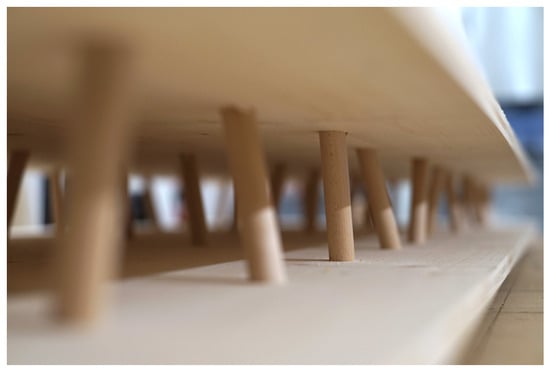
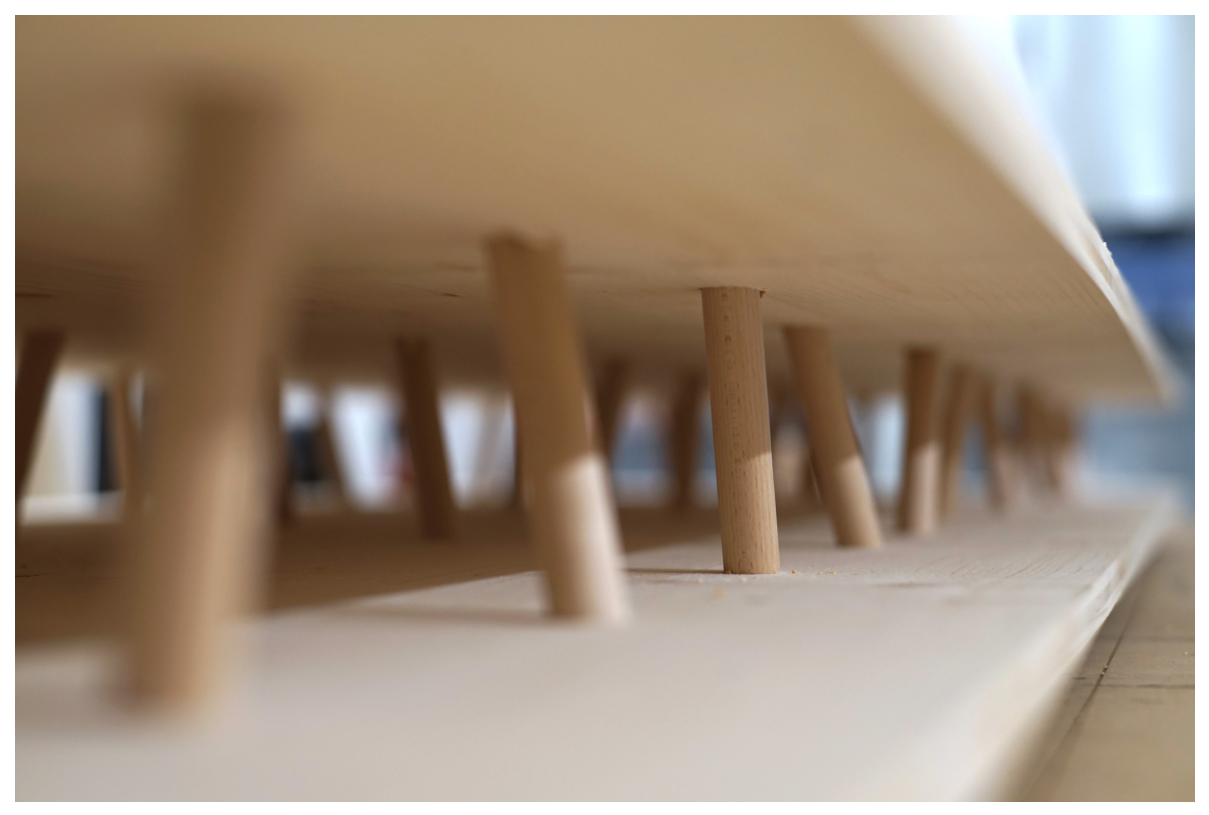
A concrete instance of this general challenge is the optimisation of connector layouts in timber wall elements. Our work builds on the Interlocking Dowel System (IDS), a novel approach designed to create robust wall assemblies (Figure 1) [8]. The IDS permits free-form placement and orientation of a large number of dowels, yielding a vast combinatorial design space. Small changes in dowel position or orientation can substantially modify load paths and buckling modes, which limits the effectiveness of manual design rules or simple heuristics. Systematic optimisation is therefore essential to exploit the material efficiency of the IDS while meeting structural requirements.
Figure 1.
Interior structure of a hollow IDS-wall sample.
To fully exploit the structural and logistical benefits of the IDS, each wall design must be optimised. This optimisation involves balancing the use of the dowels (both their total number and specific orientation) with the load requirements mandated by regulatory guidelines. Given the structural importance of exterior walls, we concentrate our current efforts on optimising the buckling load of a given wall design, acknowledging that practical implementation will necessitate other critical structural analyses.
To overcome this computational challenge, surrogate modelling has proven to be an effective strategy for replacing high-fidelity FEA simulations [5]. A single feed-forward network can significantly reduce the computing time required for structural assessment compared to running the full simulation.
Beyond predicting the scalar BLF alone, our approach leverages additional simulation outputs: the FEA yields spatially resolved tensile fields that encode information about the structural response.
Previous research has demonstrated that similar field-based data can be effectively learned by a Convolutional Neural Network (CNN) architecture [9]. We therefore propose to use the full tensile field as a target during training to establish a comprehensive feature space. The final BLF can then be accurately predicted by regressing from this learned feature space using a specialised network head. In this way, using IDS as a representative system, the present work demonstrates how the expensive nonlinear simulation step can be approximated by a scalable surrogate, providing a foundation for future reinforcement-learning-based planning agents trained on the surrogate instead of the full FEM solver.
2. Related Works
The integration of Machine Learning (ML) as either an accessory or a surrogate for Finite Element Analysis (FEA) has emerged as a transformative paradigm. This shift aims to enhance modelling capacity and accuracy while mitigating the high computational costs traditionally associated with high-fidelity simulations [10,11,12]. Prior research indicates that ML-based approaches significantly outperform empirical formulas and traditional surrogate techniques in both speed and predictive power [12,13,14].
Current research in this domain can be broadly categorized into three primary objectives:
- Data-driven Surrogates for FEA
Recent literature demonstrates significant potential in training ML models directly on FE results to bypass the solver phase during inference. Vurtur Badarinath et al. [15] and Hashemi et al. [16] utilized artificial neural networks (ANNs) and tree-based regressors on reduced input spaces, while incorporating load and geometry descriptors, to predict stress and displacement fields. Once the offline training phase is completed, these models enable near real-time prediction of structural responses. Convolutional Neural Networks (CNNs) have proven particularly adept at learning field-based data. For instance, Nie et al. [9] developed a CNN to predict the tensile stress fields of 2D linear elastic cantilevered structures, achieving a negligible mean error of approximately 2% compared to ground-truth FE calculations. In high-dimensional settings, the predictive accuracy and efficiency of such surrogates can be further improved through dimensionality-reduction and feature-fusion techniques that yield more compact and informative latent representations [17,18,19].
- Physics-Informed Neural Networks (PINNs)
PINNs offer an alternative by enforcing partial differential equations (PDEs), boundary conditions, and underlying physical laws directly via the loss function [20]. Santos [21] successfully predicted stresses and strains in plates by embedding governing equations within the model architecture, resulting in superior generalization compared to purely data-driven ANNs. However, while PINNs are highly effective for inverse problems, they often remain computationally less efficient than classical FEM for standard forward simulations due to the significant optimization overhead required for convergence.
- Generative Models and GAN-based Design
Generative models, specifically Generative Adversarial Networks (GANs), are primarily utilized for rapid structural synthesis governed by PDEs. Liao et al. [22] employed this formulation to generate shear wall designs for residential buildings, achieving a significant speed-up while maintaining expert-level design quality. Lu et al. [23] further introduced physics-enhanced GANs, which augment adversarial training with a physics-based loss. This approach improved design quality by up to 44% over purely data-driven methods while operating approximately 90 times faster than traditional manual design workflows.
From Iterative Solvers to Multi-Task Surrogates
A significant frontier in this field involves using ML to address the bottleneck of iterative FE calculations. Research has focused on two pathways: (a) replacing expensive inner non-linear solvers [24,25] or (b) providing non-iterative surrogates for non-linear objectives [26,27]. While PINNs and Reduced Order Models (ROMs) show promise in solving non-linear PDEs, they have yet to be established as superior replacements for large-scale industrial non-linear FEA [28,29]. Consequently, classical Newton-Raphson or arc-length frameworks are generally upheld in practice, as ML rarely replaces the entirety of the non-linear iteration for complex instabilities.
Recent studies, however, suggest that single forward-pass neural networks can act as effective surrogates for these non-linear outcomes [9,16]. Our contribution follows this trajectory: we develop a surrogate CNN model to directly predict both the buckling load factor and the underlying tensile stress fields.
By moving away from PINN architectures, we prioritize inference runtime to examine the fundamental learning capacity of standard-architecture neural networks in structural mechanics. Furthermore, this study investigates a multitask learning approach. We hypothesize that simultaneously supervising scalar buckling loads and high-dimensional spatial stress fields introduces a beneficial inductive bias. This shared representation forces the model to learn the physical consistency between internal stress distributions and global stability limits, thereby improving overall accuracy and robustness compared to isolated task training.
3. Methodology
In this section, we provide an overview of the Interlocking Dowel System technology, the timber construction method for which we aim to develop a surrogate model to replace traditional FEM calculations. We then describe the synthetic data generation process and the resulting datasets used for training and testing. Finally, we detail the surrogate model’s architecture and the specifics of the training procedure.
3.1. Interlocking Dowel System
This research builds on a novel, material-efficient timber wall design, the Interlocking Dowel System, which is manufactured rapidly using serial-kinematic robotic equipment [8]. The IDS can be regarded as an evolution of non-solid timber walls, such as timber-frame constructions, in which both the constraints and opportunities of robotic manufacturing are explicitly taken into account [30].
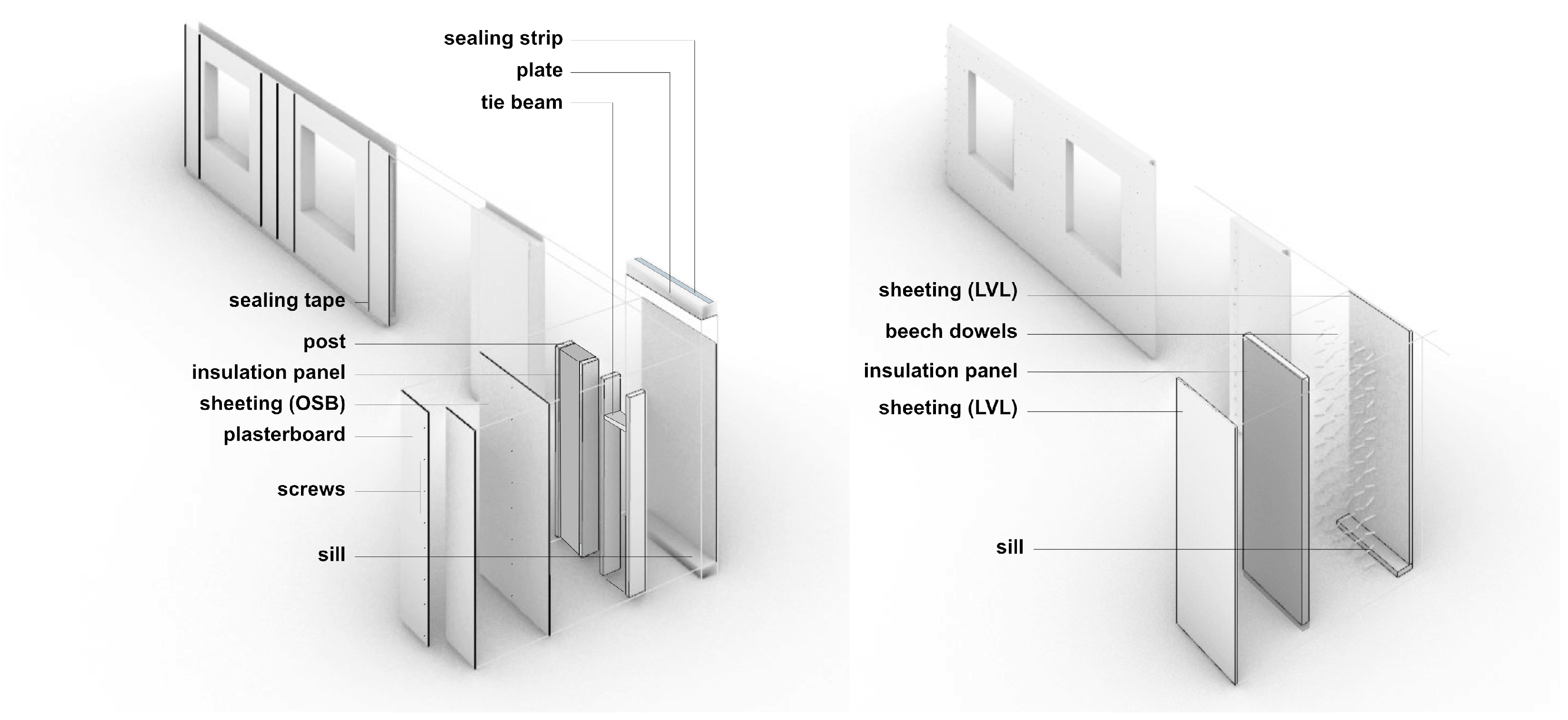
The concept employs cross-angled, tight-fitting dowels that connect the two shells of the wall in a single manufacturing operation, as shown in Figure 1 and Figure 2. The interlocking dowel arrangement enhances the load-redistribution efficiency and buckling resistance of the shell material (laminated veneer lumber (LVL)), while substantially reducing the number of mechanical connectors and, consequently, the required manufacturing operations compared with conventional timber walls, such as timber-frame and mass-timber constructions [8].
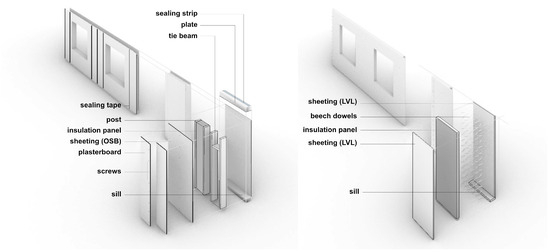
Figure 2.
Deconstructed view of a timber frame wall (left) and an IDS-wall (right).
To reach its full potential in terms of material, time, and cost savings, the IDS requires thorough optimisation of dowel number, position, and inclination. Currently, for each individual wall configuration, FEA is conducted to quantify structural performance, and expert judgement and heuristic rules are applied until a design is deemed satisfactory. As is common in lightweight construction, buckling analysis is used as one of the primary optimisation criteria for the wall design [31].
3.2. Artificial Training Data
We construct an artificial training dataset from finite element analyses based on IDS models implemented in Karamba3D (Version 3.1.50414.0 within Grasshopper 1.0.0008), with the aim of supporting data-driven modelling of wall behaviour. The dataset is built upon 10 wall geometries chosen to represent realistic and diverse configurations (shown in Figure 3). All walls share identical outer dimensions of m by m. Potential dowel positions are defined on a regular grid with a spacing of m, resulting in a placement grid of size . Openings within the walls are encoded as None values at the corresponding grid positions.
Figure 3.
Visualisation of the 10 wall geometries, ordered from left to right and top to bottom; wall type 0 is shown in the top left and wall type 9 in the bottom right.
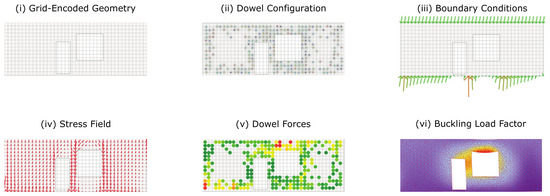
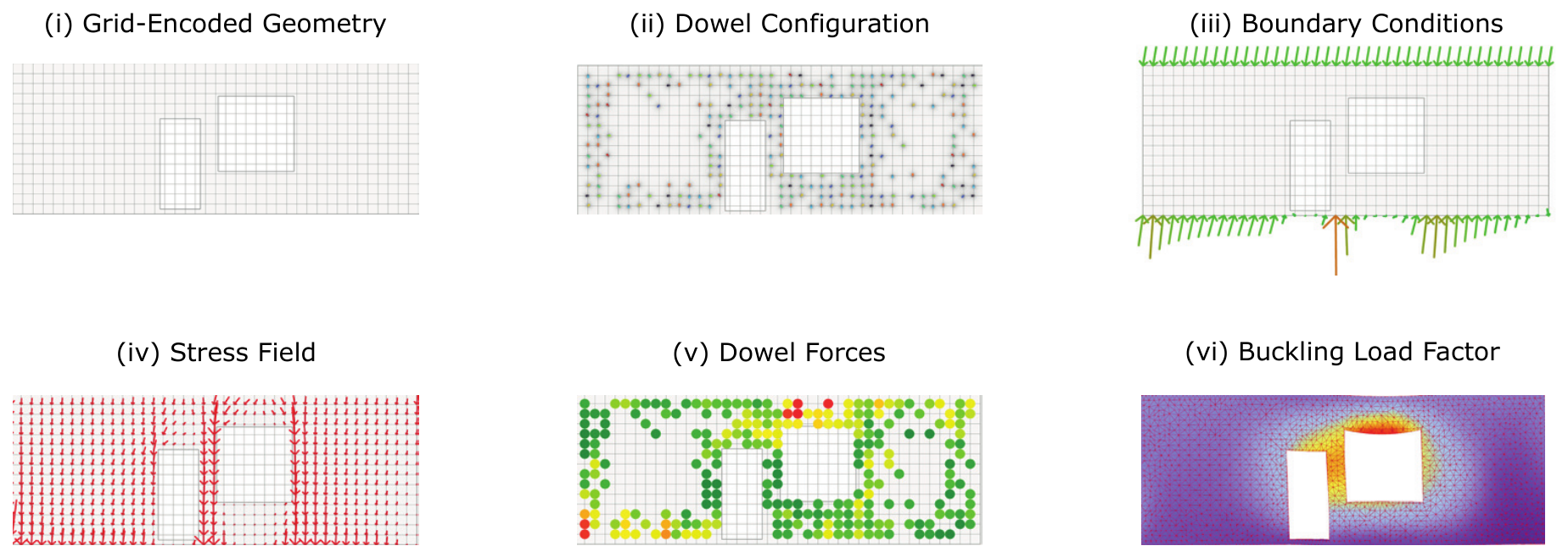
Each sample in the dataset comprises one of these wall geometries, a specific arrangement of dowels, a boundary condition describing the externally applied load, and the associated FEA result serving as ground truth (Figure 4).
Figure 4.
Visualisation of one sample from the artificial training dataset. From top left to bottom right: (i) grid-encoded base wall geometry, (ii) positions of placed dowels, (iii) boundary condition vectors indicating direction and magnitude of the applied load, (iv) tensile stress field vectors, (v) FEM-calculated dowel forces (vi) buckling behaviour inferred from the FEM-calculated deformation.
The model is designed to capture both buckling behaviour and the stiffening effect induced by the interaction of the two wall plates. Only the outer shell is connected to the supports and directly loaded, whereas the inner shell is coupled via dowel-representing elements and spring joints, therefore acting solely as a stiffening component. A uniformly distributed load is applied along the top edge. The supports are fixed at the bottom edge of the loaded shell, while the top edge is constrained only in the out-of-plane direction. This setup ensures that the effect of dowel placement on buckling behaviour is accurately reflected in the simulation results.
During the development of the IDS, experimental validation and verification of an FEA model were carried out as the basis for the structural verification of IDS walls [8]. Key findings from these evaluations were used to inform the parametric FEA model implemented in Karamba3D.
The finite element model is implemented in Karamba3D [32] using triangular shell elements based on the TRIC formulation [33]. A target mesh size of m is used, providing an evenly distributed discretisation of the aforementioned grid.
Material properties are listed in Table 1. The orientation of the orthotropic material model follows the local coordinate system of the shell elements. Accordingly, the modulus of elasticity () is assigned to the local x-direction, while () is assigned to the local y-direction. In the present model, the local x-axis is aligned with the global Z-direction, while the local y-axis is aligned with the global Y-direction. The Poisson Ratio is simplified to , as there is no reliable data available for laminated veneer lumber, and a sensitivity analysis showed a <2% deviation in BLFs for ranging from 0 to 0.5.
Table 1.
Material and cross-sectional properties assigned in the finite element model. E denotes the elastic modulus and G the shear modulus along the material’s principal axes. Note: All moduli values are in kN/cm2.
3.2.1. Dowel Configurations and Datasets
To obtain a heterogeneous training corpus, we generate dowel placements and orientations using three strategies: (i) a stochastic baseline (Random), (ii) a structurally optimised variant emphasising edge proximity (Dist), and (iii) a set intentionally designed to exhibit worse than random performance (Low-perf).
The non-random strategies are motivated by exploratory expert-guided simulations indicating that concentrating dowels near boundaries and openings tends to improve buckling resistance. Accordingly, the Dist dataset follows a distance-to-edge placement strategy intended to promote structural stability, whereas the Low-perf dataset applies inverted or mode-informed heuristics to generate mechanically unfavourable configurations.
In the Random dataset, dowel positions are assigned across the predefined grid using a pseudo-random number generator, calibrated to yield an expected density of 230 dowels per wall.
Once placed, each dowel’s orientation is determined using one of two methods: stochastic sampling from a set of eight discrete angles at 45° increments (0°, 45°, 90°, 135°, 180°, 225°, 270°, and 315°), or a structured truss pattern featuring alternating upward- and downward-pointing dowels. To ensure the dataset is fully reproducible, both the placement and orientation processes are governed by fixed random seeds.
The Dist dataset is generated using a parametric placement algorithm implemented within the Grasshopper environment. Initial dowel positions are distributed on a grid and prioritized according to their Euclidean distance to a boundary curve as determined by the Curve Closest Point component. For target populations where , the algorithm performs a culling operation where positions with the greatest distance values are removed until the specific count is reached. To reduce the geometric regularity of the grid, the remaining points undergo a jittered reordering process. This procedure shuffles the point indices using a weight to define the degree of randomization. In this framework, maintains a deterministic ordering based on distance while results in a completely randomized sequence. The mean of w was set to 0.5.
The Low-perf dataset is generated using three strategies designed to produce low buckling load factors. First, an inverted distance-to-edge algorithm prioritises central wall regions while leaving critical boundaries weakly reinforced. Second, a subset is derived from the first buckling mode of the unreinforced wall, with dowels intentionally omitted in regions of maximum modal displacement. Third, localised clustering is used to concentrate dowels into dense groups while leaving large wall regions unreinforced. These variants provide informative contrast between structurally favourable and unfavourable configurations.
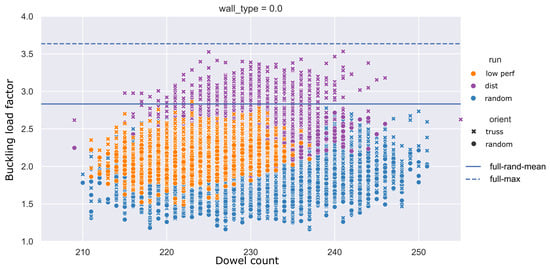
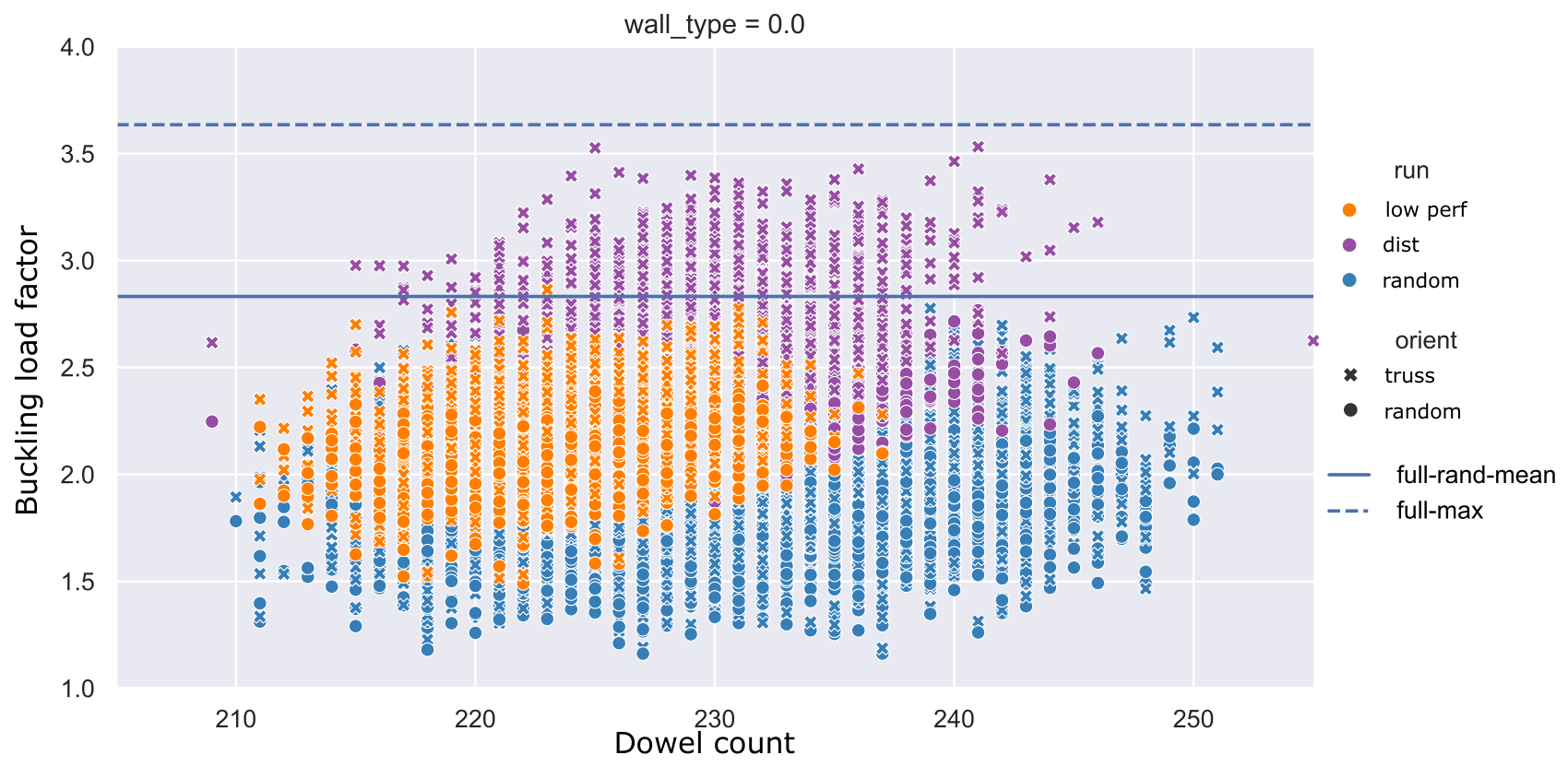
The characteristics of each of the datasets are visualized in Figure 5 as well as summarized by their Mean BLF and the numbers of samples in Table 2.
Figure 5.
Distribution of FEM-calculated buckling load factors relative to dowel density for wall type 0. Structural performance, expressed by the buckling load factor, is shown over varying dowel counts and grouped by generation strategy (Low-perf, Dist, and Random) and orientation logic (truss versus random).
Table 2.
Summary statistics of the three generated datasets.
3.2.2. FEA Results
For each configuration, the exported FEA outputs comprise the boundary conditions, the buckling response, the stress distribution in the loaded wall plate, and the normal forces in the dowels as depicted in Figure 4. These quantities are assumed to provide a meaningful description of the load-bearing behaviour of each wall configuration.
Boundary conditions contain the applied loads together with the corresponding reaction forces, represented as three-dimensional vectors. Buckling behaviour is reduced to the buckling load factor, a scalar quantity computed iteratively using second-order theory. The stress state of the loaded plate is described by the magnitude of the principal stresses and their in-plane orientation. Dowel forces are reduced to their normal force component and represented as scalar values.
3.2.3. Data Encoding
The generated data are encoded in a form compatible with the machine learning models used in this study. The design parameters of the finite element model are represented by a three-dimensional tensor with dimensions , corresponding to a wall of size m × m.
The first dimension comprises eight feature channels, namely the dowel state (encoding material state, wood panel or opening, as well as dowel presence and orientation), the dowel force (axial force in ), the boundary-condition components , , (applied loads and support reactions in the global coordinate system, in ), and the principal in-plane stresses , together with their orientation angle .
A second tensor, denoted and defined on the same spatial grid, stores the secondary FEA outputs, namely the tensile field represented as a three-dimensional vector at each spatial location. The scalar buckling load factor, , serves as the primary structural response variable. Accordingly, each dataset sample is represented as .
3.3. Surrogate Model
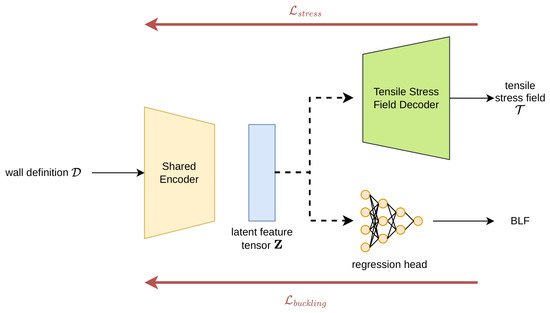
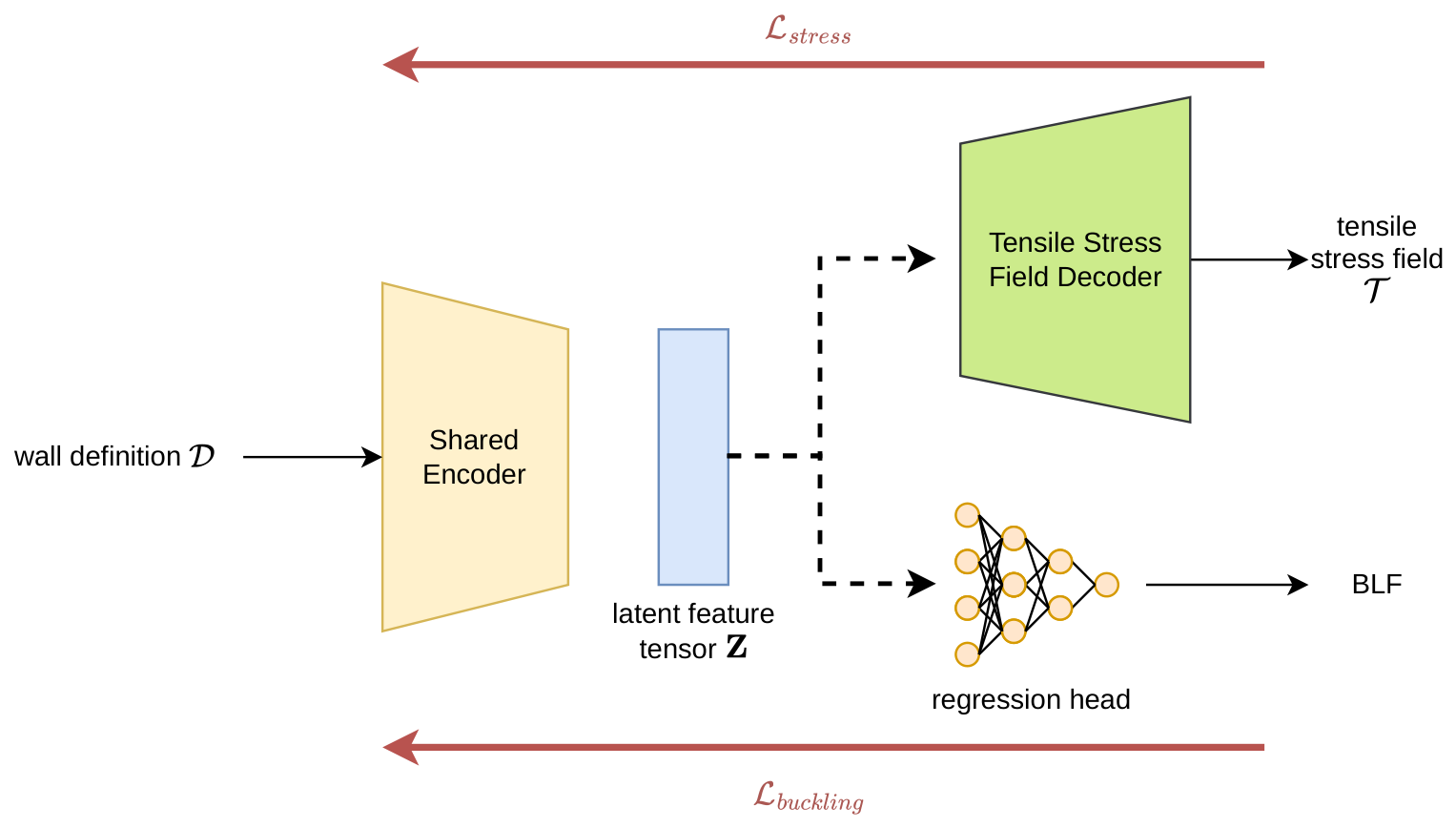
To predict the buckling load factors obtained from the Finite Element analysis, we employ a surrogate model based on a convolutional encoder–decoder architecture. The model is designed to investigate whether tensile stress fields, introduced as an auxiliary prediction target, can improve the learned latent representation and thereby enhance the accuracy of the global scalar BLF prediction. An overview of the proposed architecture is shown in Figure 6.
Figure 6.
Overview of the proposed surrogate model. A shared encoder processes the input tensor into a latent representation that is used for both tensile stress field reconstruction and buckling load factor prediction. The three evaluated variants comprise direct BLF regression, joint multitask training, and sequential training with a pretrained encoder.
3.3.1. Network Architecture
The surrogate model is derived from the U-Net architecture [34] and adapted for the joint prediction of high-dimensional field quantities and a global scalar response, implemented using PyTorch 2.6.0. [35] with CUDA 11.8 and Python 3.12.3. Deep convolutional networks are frequently prone to over-parameterization, which exacerbates the risk of overfitting when training data is limited [36,37]. To mitigate this and force efficient feature abstraction, we deliberately restrict model complexity by utilizing a shallow configuration with a depth of and 16 base filters. This lightweight encoder–decoder approach aligns with recent findings in physics-constrained surrogate modeling, where smaller architectures have demonstrated superior training stability and robustness against unstable predictions [38].
The input tensor is processed by a shared encoder consisting of a contracting path with two resolution levels. At each level, feature extraction is performed by a double convolution block comprising two consecutive convolutions with a stride of 1 and padding 1, each followed by batch normalization and a ReLU activation. The number of feature channels doubles at each subsequent stage, following a progression of 16-32-64. Spatial downsampling is introduced by max-pooling operations. This results in a latent bottleneck representation .
From this shared latent representation, two prediction branches are derived. The first branch is a decoder that reconstructs the tensile stress field. Upsampling is performed using transposed convolutions with a stride of 2, as in [34]. Skip connections from the encoder are concatenated at the corresponding resolution levels in order to preserve local structural information. A final convolution maps the decoder features to a three-channel output tensor representing the tensile stress field.
The second branch is a regression head for BLF prediction. It operates directly on the bottleneck tensor Z by first applying global average pooling (GAP) over the spatial dimensions. The resulting feature vector is then processed by a two-layer multi-layer perceptron consisting of a linear projection from 64 to 32 dimensions, a ReLU activation, and a final linear layer mapping from 32 to 1.
3.3.2. Methodological Variations
To examine the influence of auxiliary supervision and staged representation learning, three model variants are considered.
The first variant serves as a direct prediction baseline. In this setting, the model is trained exclusively for BLF regression. The encoder structure and regression head remain unchanged, whereas the decoder branch is omitted. Consequently, optimisation is driven solely by the regression loss associated with the scalar BLF target.
The second variant follows a multitask learning formulation in which the model predicts both the tensile stress field and the BLF simultaneously. The total loss is defined as a weighted sum of the root mean squared errors (RMSEs) of the two tasks:
The weighting factors are set to and , which were chosen empirically to compensate for the different scales of the spatial and scalar prediction targets.
The third variant employs a sequential two-stage training strategy. In the first stage, the encoder–decoder model is optimised solely for tensile stress field reconstruction. In the second stage, the encoder weights are frozen, and only the regression head is trained to predict the BLF from the latent features learned during the reconstruction task. This setup is intended to assess whether physically meaningful intermediate supervision can yield a feature representation that is beneficial for the downstream scalar prediction task.
4. Experiments
4.1. Evaluation Strategy
We designed four distinct experimental settings to evaluate model performance. (i) For benchmarking in-distribution performance, the models were trained on 80% of the combined Dist and Random (Rand) datasets and evaluated on the remaining 20%. This tests the model’s ability to interpolate within the training data distribution. (ii) Cross-Dataset Generalisation: To test generalisation across different design strategies, models were trained exclusively on one dataset (e.g., Rand) and evaluated on the entirety of the other (e.g., Dist). This measures the model’s ability to adapt to a change in the data distribution. (iii) Out-of-distribution Generalisation: To assess the model’s capability to generalise to unseen geometries, we partitioned the data by wall type, leaving one wall type as hold-out data, while validating on two wall types that are not in the training dataset. To ensure structural disjointness from the training set geometries, 0 and 9 were designated for the validation phase, while geometry 5 served as the final hold-out set to evaluate extrapolative performance on previously unseen structural topologies (compare Figure 3).
(iv) Generalisation to low-performing wall geometries: To test the models for a potential bias towards well-performing designs, the models trained in section (i) were evaluated on the separate low-performing dataset. Across all experiments, the models were trained for 50 epochs using the Adam optimizer with an experimentally determined learning rate of . For the sequential model specifically, the training was split into two stages: the stress field prediction was initially trained for 50 epochs to ensure convergence, before training the BLF prediction for another 50 epochs. To ensure statistical robustness, each experiment was repeated in 10 isolated runs using different random seeds for data shuffling and model initialisation. We report the mean and standard deviation of all performance metrics across these runs.
4.2. Evaluation Metrics
To quantify the predictive accuracy of the surrogate models against the ground truth values derived from the FEA, we employ three widely used regression metrics. All metrics are calculated based on the scalar BLF. Foremost, we utilise the Coefficient of Determination R2: This metric represents the proportion of the variance in the target (BLF) that is accounted for by the variations in the wall topology parameters through the model. An R2 score of 1.0 indicates perfect model representation, while a score of 0.0 indicates a model that fails to capture any variation beyond the mean of the observed data. Mean Absolute Error (MAE): The MAE measures the average magnitude of the errors in a set of predictions, without considering their direction. It is the average over the test sample of the absolute differences between prediction and actual observation, where all individual differences have equal weight. Root Mean Square Error: The RMSE is a quadratic scoring rule that also measures the average magnitude of the error. However, because the errors are squared before they are averaged, the RMSE gives an increased weight to large errors. This makes it particularly useful for identifying if the model produces significant outliers in its stability predictions.
5. Results
This section presents the results from the four experimental evaluations designed to test the surrogate models on predictive accuracy and generalisation. The performance of the Direct, Dual-Loss, and Sequential models was assessed across in-distribution, cross-dataset, low-performing, and unseen geometry scenarios.
5.1. In Distribution Performance
When evaluated on in-distribution data comprising randomly sampled 80 % of the combined Dist and Random datasets, the Direct and Dual-Loss models exhibited almost identical and near-perfect predictive performance (See Table 3). Both achieved a coefficient of determination R2 = 0.996, a mean absolute error of approximately 0.03, and a root-mean-square error of 0.04, with the Dual-Loss Model generally having a very slightly lower standard deviation. These results demonstrate that both approaches can accurately approximate the nonlinear finite-element-based buckling load factor across a broad range of training configurations. In contrast, the Sequential model performed substantially worse, achieving only R2 = 0.797 ± 0.028, MAE = 0.241 ± 0.018, and RMSE = 0.309 ± 0.021. This indicates that the two-stage training process fails to preserve sufficient latent representations for reliable BLF prediction when trained independently of the stress-field regression.
Table 3.
In-distribution performance. Models were trained on 80% of both datasets and evaluated on the remaining 20%. Values are reported as mean ± standard deviation across 10 runs. The best performance for each metric within an evaluation set is in bold.
5.2. Cross-Dataset Generalisation
The cross-dataset evaluation assessed model robustness against distributional shifts by training on one dataset and testing on the other (Table 4). When trained on Rand and tested on Dist, the Direct model achieved the best generalisation performance with R2 = 0.947 ± 0.011, MAE = 0.102 ± 0.013, and RMSE = 0.135 ± 0.014. The Dual-Loss model followed closely with R2 = 0.945 ± 0.012.
Table 4.
Cross-Dataset Generalisation Performance. Models were trained on one dataset and evaluated on the other. Values are reported as mean ± standard deviation across 10 runs. The best performance for each metric within an evaluation set is in bold.
When trained on Dist and evaluated on Rand, the Dual-Loss model marginally outperformed the Direct variant, achieving R2 = 0.936 ± 0.014, MAE = 0.135 ± 0.015, and RMSE = 0.179 ± 0.020. The Sequential approach showed poor transferability, with R2 values dropping below 0.62 and errors MAE and RMSE exceeding 0.3 and 0.4, respectively. Overall, both the Direct and Dual-Loss models maintained strong cross-domain performance, confirming that the learned representations generalise across different algorithmic dowel-placement regimes.
5.3. Generalisation to Low-Performing Wall Geometries
Testing the models trained on the combined dataset, which comprises Rand and Dist on the Low-Perf dataset, that contains configurations with reduced buckling capacity, further confirmed the robustness of the proposed surrogates, as shown in Table 5. The Dual-Loss model marginally edged out the Direct model with R2 = 0.967 ± 0.005, MAE = 0.074 ± 0.005, and RMSE = 0.104 ± 0.009.
Table 5.
Performance comparison on low-performance wall geometries. Values are reported as mean ± standard deviation across 10 runs. The best performance for each metric is in bold.
In contrast, the Sequential model deteriorated substantially, with R2 = 0.348 ± 0.081, indicating a loss of predictive reliability for atypical, low-stiffness configurations. These findings demonstrate that both end-to-end models successfully capture the structural behaviour even outside the high-performance design space.
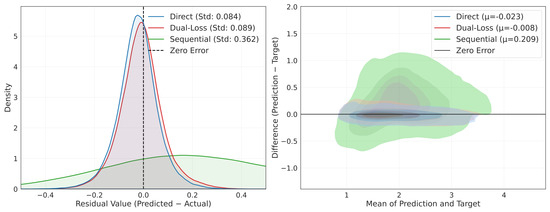
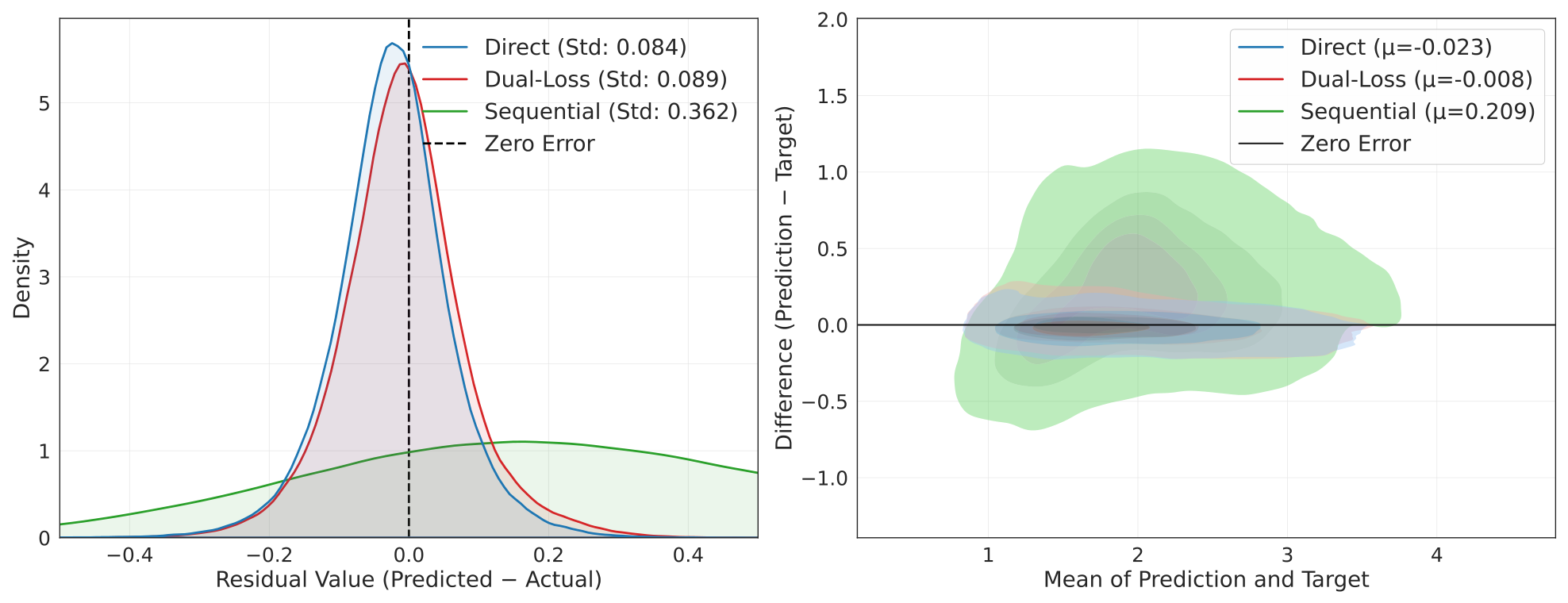
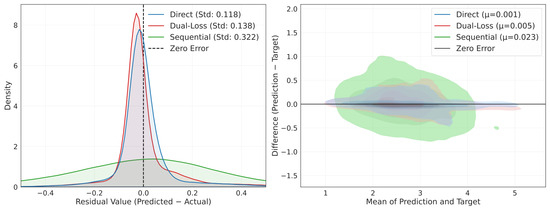
Beyond the quantitative metrics in Table 5, the model’s robustness on suboptimal configurations is visualised through residual and Bland–Altman analysis in Figure 7. Residual Analysis: The residual plot shows that both the Direct (green) and Dual-Loss (blue) models produce error distributions that are sharply peaked and centred at zero. This indicates a high level of precision and a lack of significant bias even when predicting for structural configurations intentionally designed to be vulnerable. The Bland–Altman plot illustrates stable agreement between the surrogate predictions and the FEA ground truth across the entire range of buckling load factors for these low-performing geometries. In contrast, the Sequential model (orange) displays a much wider, more dispersed distribution in both plots, confirming its inability to reliably capture these atypical structural behaviours.
Figure 7.
Comparative error analysis on the Low-Perf dataset: (left): Residual density distributions illustrating model precision and frequency of error magnitudes; (right): Bland–Altman plot illustrating the limits of agreement between surrogate predictions and FEA ground truth across the BLF spectrum.
5.4. Wall-Type Holdout
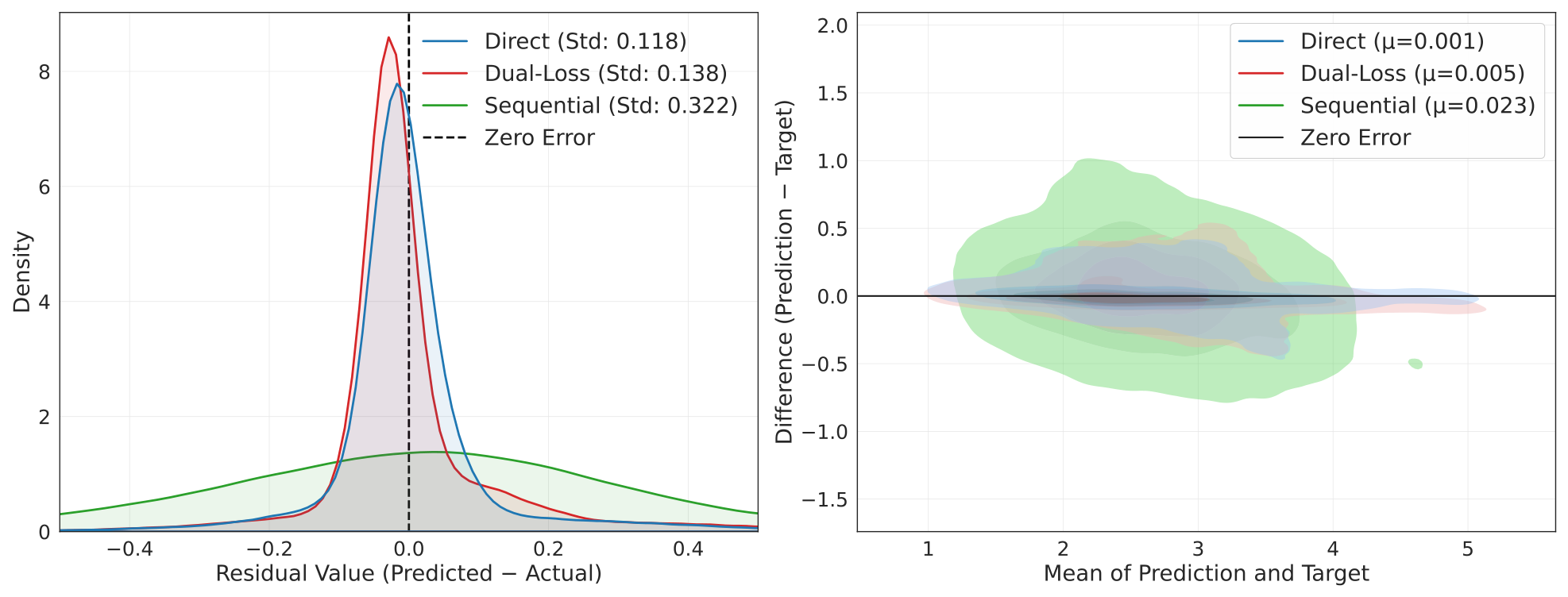
To assess generalisation to unseen geometrical topologies, a wall-type holdout test was conducted. For a representative unseen wall type, the Direct and Dual-Loss models again delivered comparable results (Table 6), with R2 = 0.959 ± 0.009 and 0.954 ± 0.004, MAE values around 0.074, and RMSE near 0.14. The Sequential model achieved R2 = 0.621 ± 0.141 with notably higher errors with a MAE of around 0.33 and a RMSE of 0.42, reaffirming its limited generalisation capability, and a high standard deviation across the 10 training runs. These results indicate that while predictive accuracy naturally decreases for geometries unseen during training, both the Direct and Dual-Loss models retain sufficient extrapolative ability for practical surrogate deployment. The extrapolative capability of the models on entirely unseen structural topologies is further detailed in Figure 8, which focuses on holdout wall type 5. Similar to the low-performance tests, the residual density for the Direct and Dual-Loss models remains narrow and centred on the zero-error line. The Bland–Altman plot shows that for the holdout geometry, the vast majority of predictions from the top-performing models fall within a tight corridor of agreement. While there is a slight increase in dispersion compared to in-distribution data, the models do not show a systematic tendency to over- or under-predict the BLF based on the wall’s mean capacity. The Sequential model again shows significant variance and a high standard deviation, reinforcing its unsuitability for practical deployment on novel designs.
Table 6.
Final performance comparison for holdout wall type 5. Models were trained on all other wall types and evaluated on the holdout type. Values are reported as mean ± standard deviation across 10 runs. The best performance for each metric is in bold.
Figure 8.
Comparative error analysis on the Holdout dataset: (left): Residual density distributions illustrating model precision and frequency of error magnitudes; (right): Bland–Altman plot illustrating the limits of agreement between surrogate predictions and FEA ground truth across the BLF spectrum.
6. Discussion
The experimental results demonstrate that machine learning surrogate models can effectively and accurately predict the non-linear buckling behaviour of the timber plate structural elements. Notably, both the Direct prediction model and the Dual-Loss model showed exceptionally strong and nearly identical performance on in-distribution data, achieving a near-perfect coefficient of determination R2 of 0.996.
A key finding is the robustness of these two models when faced with various generalisation challenges. In cross-dataset evaluations, which test for distributional shifts, both models maintained high predictive accuracy, maintaining R2 scores ranging from 0.935 to 0.947. This was further confirmed when tested on a dataset of relatively low-performing designs, where the models successfully predicted buckling capacity in a domain outside the primary training distribution. Even when generalising to entirely unseen wall geometries (the wall-type holdout test), both the Direct and Dual-Loss models retained a high degree of predictive ability with R2 scores of 0.959 and 0.954, respectively, proving their potential in predicting the buckling load factor based on the presence of orientation of the wooden dowels.
The inclusion of residual and Bland–Altman analyses (Figure 7 and Figure 8) provides further evidence of the reliability and predictive consistency of the surrogate models. The sharp, zero-centred peaks in the residual plots indicate that the models predict with low bias and high precision across the full dataset, rather than regressing toward the mean of the training data. Furthermore, the stable agreement across the full range of buckling load factors, as evidenced by the Bland–Altman plots, confirms that the models are free from significant systematic bias even when evaluating edge cases such as high-vulnerability configurations or novel wall layouts. This statistical consistency provides a useful sanity check on predictive behaviour, complementing the aggregate accuracy metrics and supporting engineering confidence in the surrogate’s outputs. Beyond predictive accuracy, the decisive advantage of the proposed surrogate model lies in its computational efficiency. While a single iterative non-linear buckling analysis in Karamba3D requires approximately 600 ms, the neural network processes a batch of 32 potential wall geometries in 1.5 ms. This translates to an inference time of roughly 47 μs (4.69 × 10⁻⁵ s) per sample, representing a speedup factor of approximately 12,800. In the context of the IDS planning workflow, this acceleration is transformative. Optimisation algorithms such as Genetic Algorithms or Reinforcement Learning often require hundreds of thousands of function evaluations to converge on an optimal solution. Performing 100,000 evaluations via FEA would require over 16 h of continuous computation; the surrogate model completes this task in under 5 s. This efficiency enables the real-time optimisation of dowel placements within the architectural design loop.
In contrast, the Sequential model consistently underperformed across all experimental setups, indicating that its two-stage training process fails to create a latent representation sufficient for reliable prediction of the buckling load factor. It appears that the stress field reconstruction does not inherently encode global stability metrics in the bottleneck. Overall, both the Direct and Dual-Loss approaches are viable.
Besides the quantitative metrics, the utility of a surrogate model in structural engineering relies heavily on user trust and explainability. While the Direct prediction model is architecturally more efficient, it effectively operates as a black box, outputting a single scalar capacity without physical context. In contrast, the Dual-Loss architecture provides a significant advantage in interpretability by reconstructing the tensile stress field, as well as predicting the BLF. This allows engineers to inspect whether the reconstructed stress field is consistent with expected load paths and stress concentrations, providing a qualitative plausibility check on the model’s output. Although the stress field is not strictly necessary for the optimisation loop itself, this additional output helps build engineering trust in the surrogate, potentially making the Dual-Loss model more acceptable for practical deployment.
Despite these promising computational and predictive metrics, a significant limitation of the current study must be acknowledged: the surrogate models rely entirely on synthetic data generated via FEA. While training on idealized simulated data is a necessary approach for an early-stage proof-of-concept, the absence of validation against experimental results or real-world measurements inherently limits the immediate practical applicability of the proposed method for final structural certification. Real-world timber structures are subject to natural material imperfections, moisture-induced variations, and manufacturing tolerances that are difficult to capture perfectly in simulated environments. Consequently, while the surrogate models accurately emulate the underlying Karamba3D FEA solver, their predictions remain strictly bounded by the assumptions of the simulation itself. Until extensive physical testing can be conducted to calibrate these models against real-world buckling behaviours, this surrogate approach is best utilized as a rapid exploration tool during the early generative phases of design, rather than a replacement for physical validation or final compliance checks.
Ultimately, the choice between the Direct and Dual-Loss architectures presents a trade-off between informational richness and architectural efficiency. While both models demonstrate sufficient accuracy to serve as surrogate evaluators, the Dual-Loss model offers the added benefit of generating interpretable stress fields for human verification. Conversely, the Direct model’s streamlined architecture minimises computational overhead, making it the ideal candidate for high-frequency queries within automated loops. By successfully compressing the computational cost of non-linear buckling analysis from hours to seconds, this approach removes the primary bottleneck in iterative design. This capability shifts the paradigm from verifying a single manual design to exploring vast amounts of search spaces, paving the way for fully autonomous structural optimisation.
7. Conclusions
The proposed Encoder–Decoder surrogate model successfully approximates non-linear FEA for timber plate buckling, achieving nearly identical predictive accuracy (R2 ) while reducing inference time by four orders of magnitude. This speedup effectively enables real-time structural feedback within generative design loops, a feat previously impractical with standard solvers. To transition this system from simulation to production, future research will need to focus on two key objectives: (i) Beyond initial full-scale validation tests on IDS wall configurations, the system ultimately requires verification concepts for structural safety and serviceability that are compliant with Eurocode 5, allowing its performance to be demonstrated without case-by-case physical testing. (ii) We aim to integrate this differentiable surrogate model as a reward function within an autonomous wall optimisation framework. This framework will be trained to automatically generate dowel configurations that maximise buckling load factors while minimising material usage, generalising across complex wall topologies and boundary conditions.
Author Contributions
Conceptualization, J.S., J.Z., C.D., F.S.-K. and M.F.; methodology, J.S. and J.Z.; software, J.S. and C.D.; validation, J.S. and J.Z.; formal analysis, J.S. and J.Z.; investigation, J.S. and J.Z.; resources, M.F. and A.S.; data curation, C.D.; writing—original draft preparation, J.S., J.Z., C.D. and F.S.-K.; writing—review and editing, J.S. and J.Z.; visualization, J.S., J.Z., C.D. and F.S.-K.; supervision, M.F.; project administration, A.S. and M.F.; funding acquisition, A.S. and M.F. All authors have read and agreed to the published version of the manuscript.
Funding
This work was supported by the Federal Ministry for Economic Affairs and Energy of Germany (BMWE) under the grant number 49VF220052. J.S. and J.Z. gratefully acknowledge the doctoral scholarships provided by the Leipzig University of Applied Sciences (HTWK Leipzig).
Data Availability Statement
Data supporting reported results provided upon request.
Conflicts of Interest
The authors declare no conflicts of interest.
References
- Švajlenka, J.; Pošiváková, T. Innovation potential of wood constructions in the context of sustainability and efficiency of the construction industry. J. Clean. Prod. 2023, 411, 137209. [Google Scholar] [CrossRef] [Scilit]
- Long, Y.Q.; Cen, S.; Long, Z.F. Advanced Finite Element Method in Structural Engineering; Springer: Berlin/Heidelberg, Gemany, 2009. [Google Scholar] [CrossRef] [Scilit]
- Hong, J.P.; Barrett, D. Three-Dimensional Finite-Element Modeling of Nailed Connections in Wood. J. Struct. Eng. 2010, 136, 715–722. [Google Scholar] [CrossRef] [Scilit]
- Tankut, N.; Tankut, A.N.; Zor, M. Finite Element Analysis of Wood Materials. Drv. Ind. 2014, 65, 159–171. [Google Scholar] [CrossRef] [Scilit]
- Palmeri, F.; Laurenzi, S. Neural Network-Based Surrogate Modeling for Buckling Performance Optimization of Lightweight-Composite Collapsible Tubular Masts. Biomimetics 2024, 9, 494. [Google Scholar] [CrossRef] [Scilit] [PubMed]
- Simwanda, L.; Gatheeshgar, P.; Sykora, M.; Sejkot, P.; David, A.; Olalusi, O. Local buckling strength prediction of slotted cold-formed steel beams using ensemble learning. J. Constr. Steel Res. 2026, 236, 110024. [Google Scholar] [CrossRef] [Scilit]
- David, A.B.; Olalusi, O.B.; Awoyera, P.O.; Simwanda, L. Suitability of Mechanics-Based and Optimized Machine Learning-Based Models in the Shear Strength Prediction of Slender Beams Without Stirrups. Buildings 2024, 14, 3946. [Google Scholar] [CrossRef] [Scilit]
- Schmidt-Kleespies, F.; Robeller, C.; Stahr, A. THE INTERLOCKING DOWEL SYSTEM—ECOBALANCE AND SCOPE OF APPLICATION. In Proceedings of the World Conference on Timber Engineering 2025, Brisbane, Australia, 22–26 June 2025; pp. 5320–5327. [Google Scholar] [CrossRef] [Scilit]
- Nie, Z.; Jiang, H.; Kara, L.B. Stress Field Prediction in Cantilevered Structures Using Convolutional Neural Networks. J. Comput. Inf. Sci. Eng. 2020, 20, 011002. [Google Scholar] [CrossRef] [Scilit]
- Thai, H.T. Machine learning for structural engineering: A state-of-the-art review. Structures 2022, 38, 448–491. [Google Scholar] [CrossRef] [Scilit]
- Etim, B.; Al-Ghosoun, A.; Renno, J.; Seaid, M.; Mohamed, M.S. Machine Learning-Based Modeling for Structural Engineering: A Comprehensive Survey and Applications Overview. Buildings 2024, 14, 3515. [Google Scholar] [CrossRef] [Scilit]
- Nath, D.; Ankit; Neog, D.R.; Gautam, S.S. Application of Machine Learning and Deep Learning in Finite Element Analysis: A Comprehensive Review. Arch. Comput. Methods Eng. 2024, 31, 2945–2984. [Google Scholar] [CrossRef] [Scilit]
- Simwanda, L.; Gatheeshgar, P.; Ilunga, F.; Ikotun, B.; Mojtabaei, S.; Onyari, E. Explainable machine learning models for predicting the ultimate bending capacity of slotted perforated cold-formed steel beams under distortional buckling. Thin-Walled Struct. 2024, 205, 112587. [Google Scholar] [CrossRef] [Scilit]
- Iyappan, G.; Sangeetha, P. Machine Learning Methods for Predicting the Performance of Cold-Formed Steel Sections: A State-of-the-Art Review. Struct. Des. Tall Spec. Build. 2025, 34, e70079. [Google Scholar] [CrossRef] [Scilit]
- Vurtur Badarinath, P.; Chierichetti, M.; Davoudi Kakhki, F. A Machine Learning Approach as a Surrogate for a Finite Element Analysis: Status of Research and Application to One Dimensional Systems. Sensors 2021, 21, 1654. [Google Scholar] [CrossRef] [Scilit] [PubMed]
- Hashemi, A.; Jang, J.; Beheshti, J. A Machine Learning-Based Surrogate Finite Element Model for Estimating Dynamic Response of Mechanical Systems. IEEE Access 2023, 11, 54509–54525. [Google Scholar] [CrossRef] [Scilit]
- Yu, L.; Liu, P.; Jiang, L.; Zhao, Z. Tensor dispersion-based multi-view feature embedding for dimension reduction. J. Electron. Imaging 2021, 30, 033019. [Google Scholar] [CrossRef] [Scilit]
- Kapusuzoglu, B.; Guo, Y.; Mahadevan, S.; Matsumoto, S.; Yoshitomo, M.; Taba, S.; Watanabe, D. Dimension Reduction for Efficient Surrogate Modeling in High-Dimensional Applications. In Proceedings of the AIAA SCITECH 2022 Forum, San Diego, CA, USA & Virtual, 3–7 January 2022. [Google Scholar] [CrossRef] [Scilit]
- Hou, C.K.J.; Behdinan, K. Dimensionality Reduction in Surrogate Modeling: A Review of Combined Methods. Data Sci. Eng. 2022, 7, 402–427. [Google Scholar] [CrossRef] [Scilit] [PubMed]
- Cuomo, S.; Di Cola, V.S.; Giampaolo, F.; Rozza, G.; Raissi, M.; Piccialli, F. Scientific Machine Learning Through Physics–Informed Neural Networks: Where we are and What’s Next. J. Sci. Comput. 2022, 92, 88. [Google Scholar] [CrossRef] [Scilit]
- Santos, L. Deep and Physics-Informed Neural Networks as a Substitute for Finite Element Analysis. In Proceedings of the 2024 9th International Conference on Machine Learning Technologies (ICMLT), Oslo, Norway, 24–26 May 2024; pp. 84–90. [Google Scholar] [CrossRef] [Scilit]
- Liao, W.; Lu, X.; Huang, Y.; Zheng, Z.; Lin, Y. Automated structural design of shear wall residential buildings using generative adversarial networks. Autom. Constr. 2021, 132, 103931. [Google Scholar] [CrossRef] [Scilit]
- Lu, X.; Liao, W.; Zhang, Y.; Huang, Y. Intelligent structural design of shear wall residence using physics-enhanced generative adversarial networks. Earthq. Eng. Struct. Dyn. 2022, 51, 1657–1676. [Google Scholar] [CrossRef] [Scilit]
- Chaouch, S.; Yvonnet, J. An unsupervised machine learning approach to reduce nonlinear FE 2 multiscale calculations using macro clustering. Finite Elem. Anal. Des. 2024, 229, 104069. [Google Scholar] [CrossRef] [Scilit]
- Yan, S.; Zou, X.; Ilkhani, M.; Jones, A. An efficient multiscale surrogate modelling framework for composite materials considering progressive damage based on artificial neural networks. Compos. Part B Eng. 2020, 194, 108014. [Google Scholar] [CrossRef] [Scilit]
- Liu, Y.; Park, C.; Lu, Y.; Mojumder, S.; Liu, W.K.; Qian, D. HiDeNN-FEM: A seamless machine learning approach to nonlinear finite element analysis. Comput. Mech. 2023, 72, 173–194. [Google Scholar] [CrossRef] [Scilit] [PubMed]
- Nikolopoulos, S.; Kalogeris, I.; Papadopoulos, V. Machine learning accelerated transient analysis of stochastic nonlinear structures. Eng. Struct. 2022, 257, 114020. [Google Scholar] [CrossRef] [Scilit]
- Grossmann, T.G.; Komorowska, U.J.; Latz, J.; Schönlieb, C.B. Can physics-informed neural networks beat the finite element method? IMA J. Appl. Math. 2024, 89, 143–174. [Google Scholar] [CrossRef] [Scilit] [PubMed]
- De Ryck, T.; Mishra, S. Numerical analysis of physics-informed neural networks and related models in physics-informed machine learning. Acta Numer. 2024, 33, 633–713. [Google Scholar] [CrossRef] [Scilit]
- Schmidt-Kleespies, F.; Clasen, N.; Dijoux, C.; Stahr, A.; Robeller, C. Robotic Joining of Oblique Dowels—Precision Analysis and Calibration. In Proceedings of IASS Annual Symposia; International Association for Shell and Spatial Structures: Madrid, Spain, 2024. [Google Scholar]
- Lund, E. Buckling topology optimization of laminated multi-material composite shell structures. Compos. Struct. 2009, 91, 158–167. [Google Scholar] [CrossRef] [Scilit]
- Preisinger, C. Linking Structure and Parametric Geometry. Archit. Des. 2013, 83, 110–113. [Google Scholar] [CrossRef] [Scilit]
- Argyris, J.H.; Papadrakakis, M.; Apostolopoulou, C.; Koutsourelakis, S. The TRIC shell element: Theoretical and numerical investigation. Comput. Methods Appl. Mech. Eng. 2000, 182, 217–245. [Google Scholar] [CrossRef] [Scilit]
- Ronneberger, O.; Fischer, P.; Brox, T. U-Net: Convolutional Networks for Biomedical Image Segmentation. In Medical Image Computing and Computer-Assisted Intervention—MICCAI 2015; Navab, N., Hornegger, J., Wells, W.M., Frangi, A.F., Eds.; Lecture Notes in Computer Science; Springer International Publishing: Cham, Switzerland, 2015; Volume 9351, pp. 234–241. [Google Scholar] [CrossRef] [Scilit]
- Paszke, A.; Gross, S.; Massa, F.; Lerer, A.; Bradbury, J.; Chanan, G.; Killeen, T.; Lin, Z.; Gimelshein, N.; Antiga, L.; et al. PyTorch: An Imperative Style, High-Performance Deep Learning Library [Version Number: 1]. arXiv 2019, arXiv:1912.01703. [Google Scholar] [CrossRef] [Scilit]
- Anwar, S.; Hwang, K.; Sung, W. Structured Pruning of Deep Convolutional Neural Networks. ACM J. Emerg. Technol. Comput. Syst. 2017, 13, 32. [Google Scholar] [CrossRef] [Scilit]
- Gowdra, N.; Sinha, R.; MacDonell, S.; Yan, W.Q. Mitigating severe over-parameterization in deep convolutional neural networks through forced feature abstraction and compression with an entropy-based heuristic. Pattern Recognit. 2021, 119, 108057. [Google Scholar] [CrossRef] [Scilit]
- Geneva, N.; Zabaras, N. Modeling the dynamics of PDE systems with physics-constrained deep auto-regressive networks. J. Comput. Phys. 2020, 403, 109056. [Google Scholar] [CrossRef] [Scilit]



Disclaimer/Publisher’s Note: The statements, opinions and data contained in all publications are solely those of the individual author(s) and contributor(s) and not of MDPI and/or the editor(s). MDPI and/or the editor(s) disclaim responsibility for any injury to people or property resulting from any ideas, methods, instructions or products referred to in the content. |
© 2026 by the authors. Licensee MDPI, Basel, Switzerland. This article is an open access article distributed under the terms and conditions of the Creative Commons Attribution (CC BY) license.