


Abstract
Driven by advances in artificial intelligence, immersive technologies, and related digital innovations, public cultural spaces are undergoing significant mediatization. Although architectural research has addressed this transformation through media architecture, responsive architecture, digital architecture, and intelligent architecture, it has largely focused on urban-scale interfaces or treated media as an external addition to space. To address this gap, this study examines mediated space at the interior scale of public cultural spaces and proposes a holistic analytical framework that understands media as an intrinsic condition of spatial operation. Through literature review, case analysis, and theoretical modeling, mediated space is classified into four types: physical, digital, interactive, and intelligent. The concept of the Spatial Organism is then introduced and structured into three interrelated entities: the media functional entity, the information exchange entity, and the symbolic representation entity. Building on this framework, the study develops a space–user perceptual interaction model and identifies four interaction stages and three interaction modes. The study argues that media intervention is reshaping spatial organization, meaning production, and evaluation, with interactivity, adaptability, and operational capacity as key evaluative dimensions. It thus offers a mechanism-oriented framework for understanding the mediatization of contemporary public cultural spaces.
1. Introduction
Driven by digital technologies such as artificial intelligence (AI), immersive technologies, the Internet of Things, and cloud computing, public cultural spaces such as museums, art galleries, and cultural centers are gradually exhibiting a mediatized trend characterized by digital display, multimodal interaction, and immersive experience [1]. Existing architectural research has examined the relationship between media and space along several paths. Research on media architecture has mainly focused on architectural skins and external public interfaces, discussing media elements, user experience, and their relationship with the urban environment [2]. Research on responsive architecture emphasizes the use of information and communication technologies (ICT) to enable buildings to sense and respond to users’ needs, thereby guiding and adapting to human behavior [3]. Research on digital architecture addresses the role of digital technologies in architecture and cities, including digital twins and machine learning, with regard to energy, environment, performance, and design optimization [4,5]. Research on intelligent buildings, building upon digital architecture, is more concerned with building operation and management, especially intelligent regulation and system optimization through building management systems (BMS) and related technologies [6]. Taken together, these studies reveal from different angles how media technologies intervene in architectural space and provide an important foundation for understanding the mediatized transformation of contemporary space.
However, existing studies have largely concentrated on external scenarios such as the urban scale or building skins, while lacking systematic modeling of micro-scale interior environments. Moreover, many of these discussions still treat media as an “external attachment” or a “functional platform” for space, and have yet to fully explain the holistic restructuring that occurs when media intervene in spatial organization, operational mechanisms, and the generation of experience. To some extent, this has constrained the further integration and development of related spatial theory and practice. Exploring the holistic mechanisms of mediated space at the interior scale is therefore an urgent issue for contemporary spatial design research in the context of digital transformation.
Existing research on “media space” has been concentrated largely in communication studies, where it is defined as a “symbolically integrated form of communication” or as an “environment of information transmission and reception elements and practices” [7]. Within the architectural context, related studies have suggested that mediated space is constituted through the juxtaposition of real and virtual space, in which video, projection, display screens, and other media technologies, as new “building materials,” extend architectural space [8,9]. However, media technologies themselves are evolving rapidly. If mediated space is defined only in terms of currently available technologies, analysis easily remains at the level of technical appearance and struggles to grasp its underlying mechanisms and developmental direction.
Accordingly, this paper understands “media” in a broader sense. The term is not limited to digital media such as video, projection, and display screens, but also includes earlier physical media as well as various media forms shaped through the intervention of interactive and intelligent technologies. The “mediated space” discussed here is grounded in physical space and focuses on an integrated spatial system in which media technologies participate in spatial constitution, place experience, and contextual service. It is worth noting that not every space equipped with digital devices or interactive installations qualifies as mediated space. The key question is whether media have become an indispensable internal condition of spatial operation. This provides a basis for identifying the object of study.
Against this background, the paper takes public cultural space as its research context and seeks to discuss mediated space from the perspective of holistic spatial mechanisms rather than from that of technological application alone. It focuses on the following three research questions:
- (1)
- Under conditions of rapid technological iteration, how should mediated space be defined at the architectural level, and how should its typological evolution be delineated?
- (2)
- Once media technologies are deeply embedded in space, how should the overall structure of mediated space and its internal elements be understood?
- (3)
- Within mediated space, what kinds of interaction mechanisms and relational structures emerge among media technology, space, and users?
To address these questions, the paper systematically examines the typological evolution, morphological structure, and interaction mechanisms of mediated space through literature review, case analysis, and theoretical modeling, and seeks to provide an analytical framework and methodological support for the future digital transformation and contextual service of public cultural spaces.
2. The Evolution of Spatial Forms Under Media Intervention
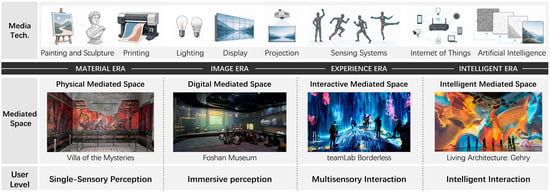
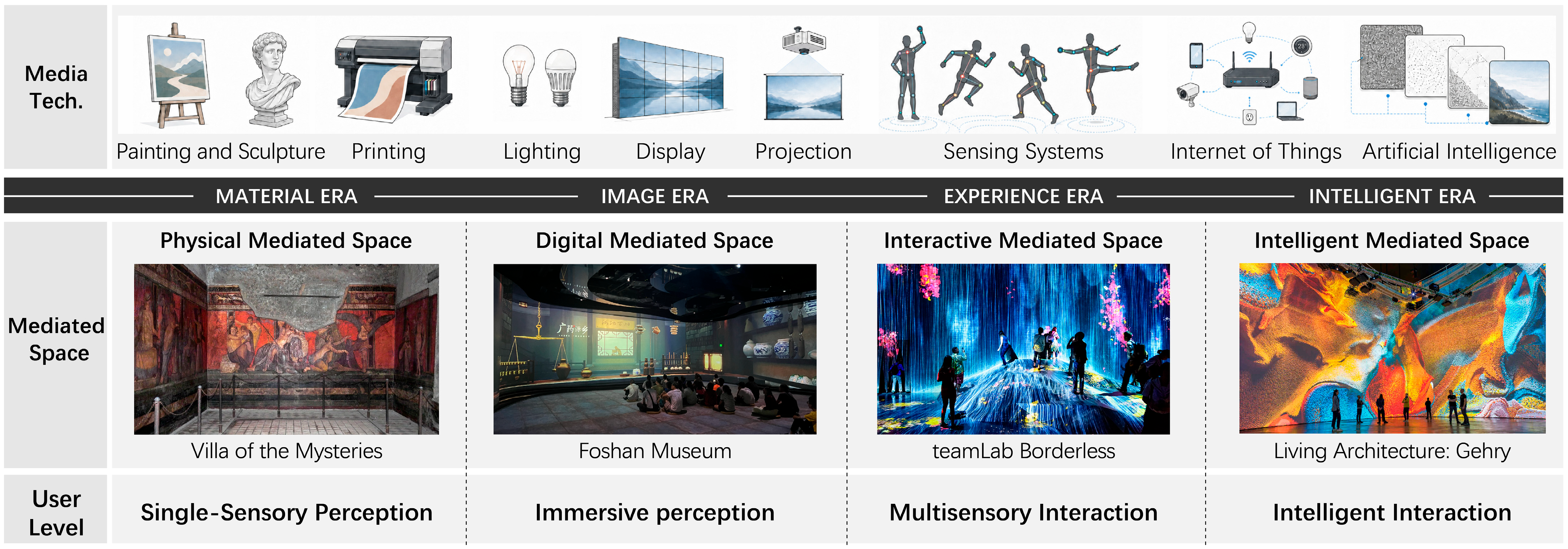
Technological paradigms in particular periods shape, to a certain extent, the way mediated space is constructed, and they also change how users participate in space. Based on studies of media architecture, responsive architecture, digital architecture, and intelligent buildings, media intervention in space can be described along two dimensions: “modes of spatial presentation” and “spatial feedback capacity.” The former concerns how media exist in space, whether as the physical modality of material decoration or as the digital modality of electronic interfaces and numerically controlled devices. The latter concerns the logic by which space responds to subjective intentions and contextual demands, namely whether it remains at the level of information presentation or moves into real-time interaction and intelligent adaptation. Taking the development of media technology as the main thread and distinguishing boundaries within these two dimensions, this paper classifies mediated space into four types: physical mediated space, digital mediated space, interactive mediated space, and intelligent mediated space, as shown in Figure 1. These four types exhibit a certain evolutionary logic, but they do not replace one another in a simple linear manner. Rather, they coexist, intersect, and become mutually embedded within public cultural spaces.
Figure 1.
The typological evolution and perceptual hierarchy of mediated space. Note: Tech. = technology. Source: Compiled by the authors. The media-technology illustrations in the upper row were generated with the assistance of generative AI. Villa of the Mysteries image: gisleh, CC BY-SA 2.0 <https://creativecommons.org/licenses/by-sa/2.0>, accessed on 4 May 2026, via Wikimedia Commons; Foshan Museum image: photographed by the authors; teamLab Borderless image: Domenico Convertini from Zurich, Schweiz, CC BY-SA 2.0 <https://creativecommons.org/licenses/by-sa/2.0>, accessed on 4 May 2026, via Wikimedia Commons; Living Architecture: Gehry image: Installation view of Living Architecture: Gehry at the Guggenheim Museum Bilbao © Refik Anadol, Bilbao 2025.
2.1. Physical Mediated Space
In many historical architectural environments, such as most churches, images and ornaments constituted important spatial media. In the material era, architectural space and the decorated interfaces it carried formed the principal source of human spatial experience. On the one hand, architecture functions as a medium that provides individuals with feeling, identity, and spatial orientation, creating a sense of place that strengthens attachment and belonging [10]. On the other hand, space was rendered into a scenographic and realistic place through material simulacra such as visual decoration and spatial components. The Villa of the Mysteries in Pompeii, dating to around 60 BCE, for example, employed twenty-nine highly realistic, life-size murals. Through isomorphic scale and perspectival guidance, these murals dissolved the “picture–frame” boundary between viewer and wall and induced an all-encompassing visual experience, as shown in Figure 1. This representational method reached its peak in the nineteenth-century panorama [11] (pp. 24–72). Unlike ordinary display spaces in which paintings are simply placed within a room, the defining feature of physical mediated space lies in the fact that media, physical interfaces, and the order of viewing form a unified whole that substantively shapes spatial experience.
The morphology of physical mediated space is dominated by architectural structure and physical media such as murals and sculpture. The role of physical media is to strengthen the information presentation, visual expression, or functional orientation of space. Such experiences arise from the prior design of viewing position, viewing direction, and visual boundary, and their primary function is to guide viewers toward “physical immersion” in visible and tangible environments.
2.2. Digital Mediated Space
With the development of digital display and multimedia audiovisual technologies such as lighting, screens, and projection, digital mediated space gradually formed a new spatial condition. Mediated space moved beyond the static attributes centered on physical decoration and came to present a composite spatial form in which the virtual and the real are deeply interwoven. Within this paradigm, media inject digital and dynamic qualities into space through the use of audiovisual symbols. The coordinated organization of audiovisual elements, or multimodal synergy, is a key variable in producing environmental immersion [12]. Taking the immersive digital exhibition hall of the Foshan Museum as an example, wrap-around projections on walls and floors realize an integrated display in which spatial interfaces and dynamic artistic imagery are fused, as shown in Figure 1. Through the coordinated output of audiovisual signals, the exhibition hall achieves a multimodal enclosure of the users’ sensory system.
Within this expressive paradigm, physical walls no longer serve as the endpoint of vision. Instead, they are transformed into interfaces that carry information, constructing a “narrative field” that exceeds material boundaries and shifts toward flexible and open virtual boundaries. Media thereby cease to function merely as tools that reinforce spatial appearance and instead become deeply involved in spatial display, prompting viewers to move from the role of traditional “spectators” to that of “immersive experiencers.”
2.3. Interactive Mediated Space
When interactive technologies are systematically introduced into space, media begin to establish an ongoing bidirectional relation between space and users. Users’ positions, behaviors, and concrete operations are incorporated into the operational logic of spatial interaction and become key variables that trigger spatial change. The resulting spatial manifestations therefore become interactive and indeterminate. Taking teamLab Borderless as an example, when users touch the walls or move through the space, sensor-based real-time capture causes visual elements in the environment, such as flowing flowers or streams of water, to split, wither, or change direction, as shown in Figure 1. Mediated space is thus no longer merely an object to be viewed, but an interactive system capable of producing real-time feedback in response to users’ behavior.
In interactive mediated space, the role of the user shifts from a “perceiving subject” of space to a “participating subject” involved in the process of spatial generation. Through natural interaction, users can actively intervene in the experiential and co-creative processes of spatial content [13]. Under this interaction mechanism, the form, atmosphere, and information presentation of space are no longer entirely preset unilaterally by the designer, but are continually updated and generated through ongoing feedback and response between the media system and user behavior.
2.4. Intelligent Mediated Space
Unlike interactive mediated space, which primarily responds to users’ behavior on the basis of preset rules, intelligent mediated space places greater emphasis on the generation of content and the provision of adaptive services under AI algorithms. Generative AI technologies such as diffusion models and large language models offer an important technical basis for this development. Yet this future-oriented form of intelligent mediated space has not been fully realized in public cultural space design and implementation, and is currently manifested more often in conceptual explorations in the form of installations or artworks created by artists. One example is Refik Anadol’s Living Architecture: Gehry, exhibited at the Guggenheim Museum Bilbao, which transforms the physical interface into a continuously evolving, AI-driven, generative “digital skin” and constructs an intelligent field endowed with a perception-response loop, as shown in Figure 1.
In addition, generative AI enhances the autonomy of the monitoring, analyzing, planning, and execution modules of self-adaptive systems, thereby optimizing human–machine interaction under human-on-the-loop settings [14]. This enables spatial systems to perceive environmental conditions and user states and to adaptively adjust spatial information and services according to internal algorithmic logic. The combination of self-adaptive systems with technologies such as digital twins and the Internet of Things has already shown application potential in partial scenarios such as building operation and management, energy-efficiency improvement, and indoor temperature control, although such applications remain overall at an exploratory stage [15,16].
This points to the evolutionary direction of mediated space toward greater intelligence and organicity. Driven by generative AI, textual, visual, acoustic, and service content in intelligent mediated space can be generated in real time and fed back into space through the joint action of users’ intentions and generative algorithms. The interaction between intelligent mediated space and its users thus evolves from procedural response into the generative construction of spatial content and modes of expression. Within this paradigm, users become deeply involved in the making of space as dialogic subjects, while the spatial system itself is endowed with greater openness and contextual adaptability.
3. Toward a “Spatial Organism” View of Mediated Space
For a long time, researchers’ understanding of space has centered on objectivity and materiality. Under the dominance of a material conception of space, space has been regarded as a purely natural thing, an objective existence independent of human will [17]. Aristotle, for example, understood space as an “immovable container,” while Descartes interpreted space as the three-dimensional extension of length, width, and height occupied by an object. In traditional architecture, space has primarily been understood as a three-dimensional field bounded by horizontal and vertical formal elements [18] (pp. 93–182). The generation of architectural space has therefore depended mainly on material structure and formal logic, and its mode of perception has been grounded largely in relatively stable visual and scalar experience.
With technological development, however, mediated space has gradually acquired greater expressive power, interactivity, and intelligence. This prompts a systematic reconsideration of spatial concepts and spatial ontology. Le Corbusier’s proposition that the house is a machine for living and Frank Lloyd Wright’s emphasis on organic architecture modeled on natural life reflect two different conceptions of architectural space: one in which architecture seeks to become an operating machine, and another in which it seeks to become an active organism [19] (pp. 55–59). Norbert Wiener’s work on “control and communication in the animal and the machine” gave rise to cybernetics. A key insight of this research is that both organic organisms and inorganic machines are fundamentally constituted by flows of information and both involve processes of information collection, processing, and feedback [20]. Cedric Price’s Fun Palace was among the earliest design practices to introduce cybernetics into architecture. As a form of socially interactive architecture, its internal computational system could reconfigure movable walls and walkways, enabling the form and layout of the Fun Palace to adapt to changing patterns of use and allowing space to respond interactively to people and environment [21].
These theoretical and practical explorations provide the basis for regarding mediated space as a Spatial Organism. Maurice Merleau-Ponty used the concept of flesh to describe the intertwining in which the subject both perceives and is perceived by the world [22]. From this perspective, perception is a reversible relation between subject and environment. Meng Jianmin’s proposition that “human is architecture, and architecture is human” resonates with this view. He points to the dual developmental tendencies of the increasing technologization of human beings and the increasing personification of artifacts, arguing that observation, understanding, and action should no longer be regarded as capacities exclusive to humans [19] (pp. 122–125). Once media technologies are embedded, space can respond to human behavior through sensing, computation, and display systems, thereby exhibiting capacities at the functional level analogous to human perception, decision-making, and action. In this state, human beings become connected with space, making contact with tangible interfaces, such as buttons and touch screens, or intangible ones, such as position recognition and motion sensing, within space as an integrated whole, and then receiving feedback in the form of images, sound, or other spatial changes generated through spatial computation.
The evolution from physical to digital, interactive, and intelligent media is also a process in which spatial perception, decision-making, and action are progressively deepened, manifesting an organic evolution from outside to inside. The perspective of the Spatial Organism is therefore not merely a biological metaphor that attributes human-like capacities to space. It is also a comprehensive analytical framework for explaining the internal mechanisms of mediated space and for revealing the systematic relations among spatial constitution, information processing, and behavioral feedback. Studies of media architecture, responsive architecture, digital architecture, and intelligent buildings usually discuss media elements, interactive capacity, or system operation separately. By contrast, the Spatial Organism emphasizes understanding media technology and physical space as an integrated whole. In this sense, it offers a new perspective for reconsidering both past and future spatial practices.
4. The Structure of the “Spatial Organism”: A Spatial Mapping of Body, Cognition, and Behavior
Within the context of public cultural space, the Spatial Organism and the user constitute two interacting entities. In the course of interaction, the structure of space and the structure of the human body exhibit a certain isomorphic relation.
Human interaction with the spatial environment is the outcome of the joint action of sensation and cognition on the environment. E. Bruce Goldstein describes human perceptual processing as comprising four parts: proximal and distal stimuli, receptor processing, neural processing, and behavioral response [23] (pp. 5–9). On this basis, the interactive relation between the human subject and environmental stimuli can be summarized as a structure of body, cognition, and behavior. The body receives external stimuli through sensory systems such as vision, hearing, and touch, thereby providing perceptual input for cognition. Cognition then undertakes understanding, judgment, and decision-making on this basis and drives behavior. Behavior, as an active response to the environment, in turn feeds back into one’s own perceptual and cognitive system, thereby forming a continuously regulated cyclical structure.
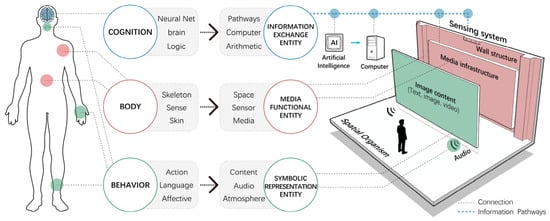
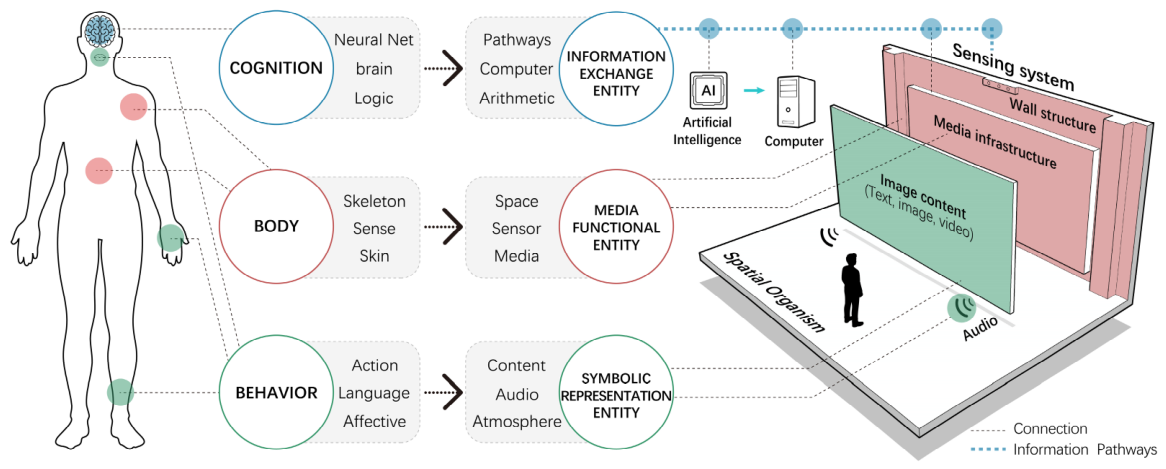
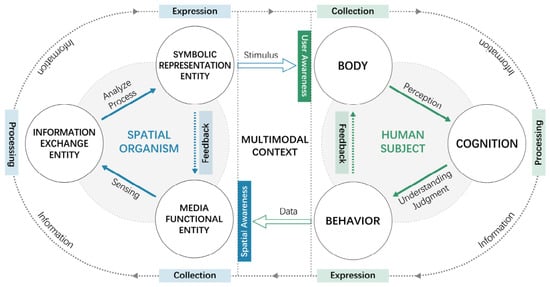
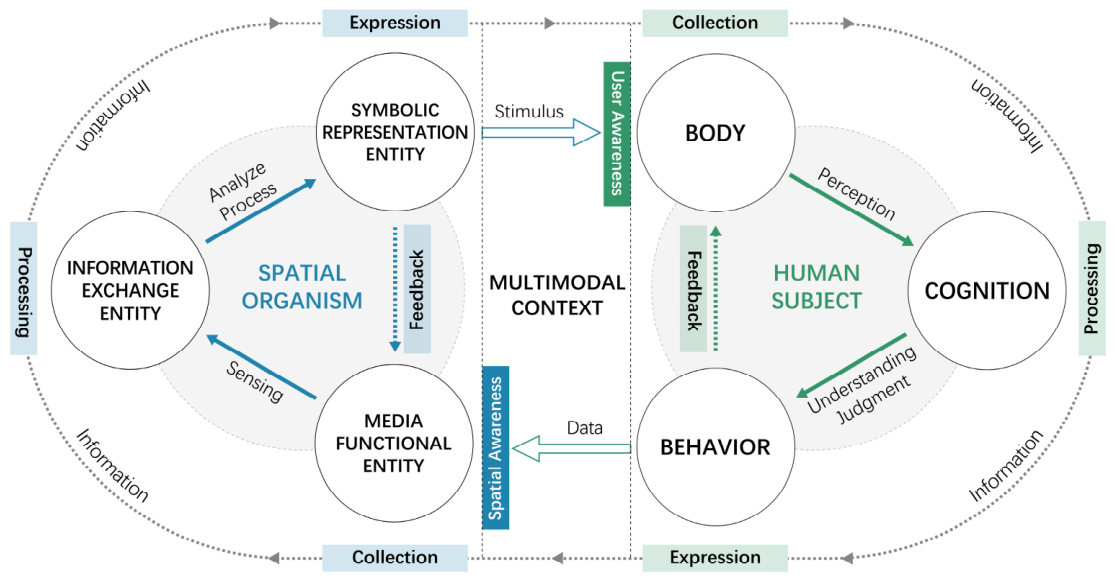
The logic of body, cognition, and behavior offers a profound account of the internal structure of mediated space as a Spatial Organism. On this basis, the structure of the Spatial Organism can be divided into three interrelated levels: the media functional entity, the information exchange entity, and the symbolic representation entity, as shown in Figure 2. These correspond respectively to the body, cognition, and behavior of the human being. Through media technologies externalized within spatial structure, they shape the operational mode of the spatial system and endow space with the capacities for perception, cognition, and feedback.
Figure 2.
Structural mapping of body, cognition, and behavior in the Spatial Organism.
4.1. Body Level: The Media Functional Entity
The media functional entity constitutes the bodily level of the Spatial Organism and provides the infrastructure through which it exists and operates. As McLuhan famously stated, the medium is the extension of man [24]. Its core significance lies in expanding human perceptual and action capacities through technological means. In the context of space, this extension is manifested as the structural coupling of media technology and physical space. More specifically, the media functional entity encompasses spatial physical structure, display media, and sensing systems.
- The body’s skeleton: spatial physical structure. The physical structure of space can be likened to the skeleton of the body. As the basic framework and supporting system of space, it provides the necessary support and organization for functional realization and media extension. Just as the skeleton determines the body’s basic form and possibilities for movement, physical structure shapes the geometric logic, functional zoning, and circulation paths of space by defining spatial boundaries and layout, thereby laying the foundation for the overall expression of space. Through the construction of walls, beams, and columns, it determines the basic scale, proportion, structure, and layout of space, defines horizontal and vertical functional areas, and provides a clear spatial basis for human activity. Different structural layouts also allow space to present functional characteristics suited to different needs.
- The body’s skin: display media. Upon the skeletal structure of physical space, the media functional entity endows space with a textured skin through media elements such as lighting, screens, and projection. These media textures work in concert with the morphology of physical space and, through the combination of static and dynamic elements, jointly constitute the overall form of mediated space. Different kinds of media textures differ markedly in their spatial expression and provide users with rich and distinctive spatial experiences. On the one hand, lighting media strengthen the physical texture of space by enhancing spatial form and constructional detail, enabling an originally relatively singular structure to acquire richer layers and qualities. On the other hand, digital display media such as screens and projection introduce dynamic imagery and real-time information, thereby injecting continuously changing content into space and forming dynamic textures characterized by temporality, fluidity, and informational orientation.
- The body’s senses: sensing systems. Receptor processing is the starting point of perception and the window through which the human body receives external information. Different receptors respond, through specific physiological mechanisms, to changes in environmental energy or chemical signals: visual receptors respond to light energy, auditory receptors respond to changes in air pressure, tactile receptors respond to pressure applied to the skin, while olfactory and gustatory receptors respond to chemical substances entering the nose and mouth [23] (p. 7). One reason space was not previously regarded as a complete organism is that it lacked sensory-like structures capable of perceiving environmental information. This perceptual capacity is precisely what technology makes possible. In the context of spatial design, multiple kinds of sensors constitute the sensory system of space. Devices such as visual sensors, sound sensors, pressure sensors, and capacitive sensors collect environmental signals including sound, light, temperature, and human behavior, thereby endowing space with sensory functions analogous to human eyes, ears, and skin. Integrated with the logic and functional system of space, these sensors together form the sensory system of the Spatial Organism.
On this basis, the media functional entity exhibits two core characteristics. First, in the process of serving spatial functions, different media forms possess a certain interchangeability, that is, multiple media technologies can achieve the same or similar functions, although an optimal match must be realized under specific conditions of spatial structure and use. Second, the composite overlay of media technologies greatly enhances spatial flexibility, allowing space to shift and adjust dynamically among the multiple functions of public cultural space, including exhibition and performance, education, and leisure.
4.2. Cognition Level: The Information Exchange Entity
The information exchange entity constitutes the cognitive level of the Spatial Organism. It is the processing system through which space integrates, understands, and judges the information it perceives. The logic of information exchange determines how space understands environmental conditions and its interaction with users. It should be noted that the information exchange entity does not necessarily exist in the form of explicit interactive response. In physical mediated space and digital mediated space, only display media may be present in space, and operation depends mainly on preset content and functions, lacking the ability to recognize and regulate user states. In such cases, information exchange takes the form of one-way or weak-feedback operation. Its capacities for judgment and regulation do not directly act upon spatial appearance, but rather serve spatial design logics such as content organization, environmental control, or operational management. Once interactive media technologies are embedded, information regarding the environment and users becomes identifiable, translatable, and interactive within space. Although these two spatial conditions differ in terms of operational level and mode of operation, they remain consistent at the processual level of information exchange. More specifically, the information exchange entity encompasses information pathways and computational systems.
- Neural communication network: information pathways. The information pathways of the information exchange entity can be compared to the human neural communication network, which transmits, associates, and transforms stimulus signals from different senses. In mediated space, information collected by sensing systems from different media devices, spatial nodes, and interactive interfaces is connected through embedded information pathways. These data are multimodal in character. They include physical-state data collected by environmental sensors, such as continuous numerical information on illuminance, temperature, and sound level, as well as user data obtained through behavior capture and interaction devices, such as positional change, movement trajectory, and triggered events. Because these data differ in source and modality, the information exchange entity translates them through information-processing procedures into compatible data structures. They are then mapped, as control signals at the operational level of space, onto feedback in spatial state and spatial expression, such as adjustments in lighting brightness and color, updates of interface content, or dynamic changes in spatial atmosphere.
- The brain: computational system. Supported by the information pathways, the core function of the computational system, as the brain of the Spatial Organism, lies in the processing of multi-source information. Through the correlational analysis of environmental parameters, user behavioral characteristics, and interactive feedback, the computational system transforms heterogeneous data into state descriptions endowed with spatial meaning, thereby forming a situational judgment of what operational state the current space is in. The integrative character of computation enables the Spatial Organism not only to make immediate responses at the local level, but also to regulate its overall operational state, as in the application of building information modeling (BIM) systems [25]. Within this process, the programmatic and algorithmic logic embedded in the system determines the interaction mechanisms of spatial function. In interactive mediated space, computer technology enables space to perform programmed execution through the triggering of commands. With the introduction of AI and related technologies, intelligent mediated space becomes able to carry out context-adaptive intelligent adjustment. In this way, the Spatial Organism gradually moves toward a more complete organic condition.
The information exchange entity embodies a bidirectional mechanism between matter and information. On the one hand, the informatization of matter enables environmental states and human activities to be continuously perceived, quantified, and analyzed, thereby forming a dynamic information network composed of multisource perceptual data. On the other hand, the materialization of information turns abstract data, through intelligent control, digital fabrication, and immersive media technologies, into physical or digital spatial elements that users can perceive. In the form of an interface, the information exchange entity embeds technology between spatial structure and human interaction, allowing the system as a whole and local terminals to continuously reconstruct spatial situations in the course of dynamic interaction.
4.3. Behavior Level: The Symbolic Representation Entity
The symbolic representation entity constitutes the behavioral level of the Spatial Organism and is responsible for transforming the system’s internal informational states into interface content perceptible to the subject. From the perspective of media and symbols, John Hartley once compared media space to a symbolic space full of signifying operations and symbolic practices [26] (p. 218). In Saussure’s model of the signifier and the signified and Peirce’s triadic framework of signs, symbols are understood as tools for human communication and information transmission. Through the material properties of media and technological means, abstract information and cultural content can be translated into perceptible and experienceable symbolic language, allowing mediated space to become a dynamic field endowed with narrative and symbolism. More specifically, the symbolic representation entity includes behavioral language and emotional expression.
- Behavioral language: information presentation. Relying on digital media, the symbolic representation entity deconstructs and recombines spatial information into a directional behavioral language. As the core carrier of spatial information expression, behavioral language is analogous to human natural language or bodily movement. Through the coordinated use of images, text, audio, video, and mediated symbols, it presents semantic information that can be perceived, thereby enabling space to be read and understood. Through the informational content and modes of presentation of media symbols, it drives users to construct corresponding spatial perceptions and behavioral patterns. The role of behavioral language is not limited to the transmission of isolated pieces of information. Rather, by building a multidimensional network of media symbols and organizing them through sequence, hierarchy, and logical structure, it improves both the efficiency of information transmission and the overall expressive effect. Within the framework of the symbolic representation entity, users’ perception of space is guided by the logic of symbolic design, while at the same time varying dynamically with individual experience and contextual difference, thereby taking shape as concrete spatial experience in the course of interaction between user and space.
- Emotional expression: atmosphere construction. Unlike the explicit semantics of behavioral language, the emotional expression of space belongs to an implicit experiential domain. Its core logic lies in guiding users’ emotional states through the systematic regulation of overall environmental parameters. In this process, the symbolic representation entity establishes a particular emotional tone for spatial experience by constructing a specific atmospheric field. The level of arousal and affective orientation evoked by spatial emotional expression are jointly shaped by multiple perceptual factors, including light, color, sound, and moving image. Emotional symbols emphasize overall feeling and continuous experience, and are realized through the control of perceptual intensity, rhythm, and relations of contrast. By orchestrating these perceptual parameters, space can guide users into different emotional states such as immersion, concentration, relaxation, or solemnity, thereby shaping different experiential fields.
The symbolic representation entity allows mediated space not only to be understood and operated, but also to be felt and inhabited immersively. Its operation is clearly dynamic and context-dependent, being continuously generated and adjusted through the joint action of spatial situation, media rhythm, and user behavior. Users are not only receivers of symbols; their behavioral and emotional feedback in turn influences the ways in which symbols are presented in space, thereby forming an evolving interactive relation. In this way, the symbolic representation entity endows mediated space with spatial functions such as the communication of information, the guidance of behavior, and the regulation of emotion.
5. The Interaction Mechanism of Mediated Space: The “Space–User” Perceptual Interaction Model
In public cultural spaces, different functional types of mediated space should be matched with corresponding media technologies and interaction modes. At the core of this matching lies the need to respond to users’ needs, behavioral characteristics, and contextual differences, that is, to follow a user-centered principle. As Henri Lefebvre pointed out, space as a product is not some particular product, but a relation [27] (p. 73). Research on mediated space should therefore move further toward the interactional relation between user and space.
5.1. Constructing the “Space–User” Perceptual Interaction Model
Interaction can be understood as a process of control and communication in the animal and the machine, in which information serves as the core medium enabling the connection and action of both sides. Information transmission can in turn be understood as the process by which different kinds of internally carried data are transmitted from one organism to another [28] (p. 24).
Within the Spatial Organism, the brain is the computational system. According to the von Neumann architecture, a computer system consists of five components: central control, central arithmetic, memory, input, and output [29] (pp. 1–4). In mediated space, this structure is spatialized. The sensing system within the media functional entity assumes the role of information input, transmitting collected environmental and user data to the information exchange entity. The information exchange entity then relies on computational capacity to integrate, analyze, and process information. The results are subsequently transformed into symbolic representations such as interface content, images, sound, light and shadow, or behavioral instructions, and are output to users through the display media of the media functional entity. In this way, mediated space forms a continuous operational chain of perceptual input, information processing, symbolic generation, and interface output.
The human body may likewise be regarded as a complex biological information system that continually interacts with space through body, cognition, and behavior. Newell and Simon summarize the human information-processing system in terms of four parts: receptors, effectors, processor, and memory [30] (p. 20). In their account, humans and computers can be understood within a unified framework, one that is highly consistent with and corresponding to the von Neumann architecture, with the processor equivalent to the combination of central control and central arithmetic.
As two organisms in the transmission of information, the Spatial Organism and the user display a highly coupled Input–Processing–Output (IPO) pattern at the level of information processing. On this basis, this paper constructs a space–user perceptual interaction model that corresponds both to the structure of the Spatial Organism and to that of the human body, and thereby presents their fundamental interaction mechanism, as shown in Figure 3.
Figure 3.
The “space–user” perceptual interaction model.
Building upon the general IPO pattern and incorporating the feedback mechanism of cybernetics, the interactional process between the Spatial Organism and the user is further refined into four stages: information collection, information processing, information expression, and feedback regulation. These four stages unfold bidirectionally on both the side of the Spatial Organism and that of the user. In brief, the Spatial Organism releases environmental stimuli to the user through media interfaces. On the basis of perception, understanding, and judgment, the user produces behavioral feedback. This feedback is then continuously sensed by the spatial system, collected and transformed into data, and fed into the next round of information processing, thereby influencing subsequent modes of spatial representation and response, as shown in Table 1.
Table 1.
Stages of “space–user” perceptual interaction.
This model achieves coordinated operation through ongoing information exchange and provides an analytical tool for understanding dynamic experience in mediated space. The model presents the operational mechanism of mediated space under a complete interaction process, yet in actual spaces the capacities for perception, response, and feedback differ across media levels. In physical mediated space or early digital mediated space, for example, the absence of real-time recognition of user state and dynamic regulation means that the feedback stage often appears in the form of one-way, weak, or implicit feedback. Even so, such spaces can still be incorporated into the analytical framework of the model, differing mainly in operational intensity, level of interaction, and degree of feedback manifestation.
5.2. Spatial Interaction Modes Based on Information Communication Models
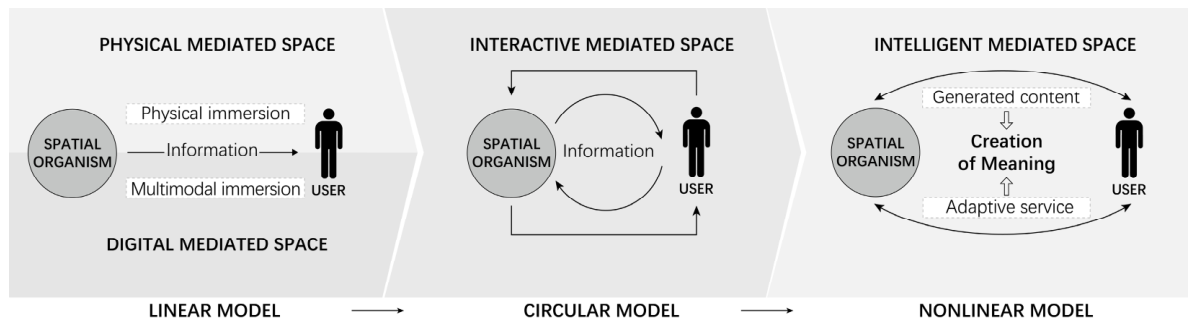
From the perspective of the Spatial Organism, the way users and space communicate can be compared to the communicative structure between people. In communication theory, information communication models are generally divided into linear, circular, and nonlinear models [31] (pp. 175–176). The linear model, also called the action model, treats communication as an objectified process of information transmission and emphasizes the one-way movement of a message from sender to receiver through a channel. The circular model, also called the interaction model, introduces feedback and understands communication as an ongoing process of encoding, decoding, and response. Communication thus ceases to be a one-time act and becomes dialogue and exchange unfolding in specific bodily and psychological contexts. The nonlinear model, also called the transaction model, further moves beyond an instrumental view centered on information exchange and understands communication as an ongoing social process of meaning making, one that not only explains the world but also continuously constructs and reshapes social relations and structures of meaning in communicative practice.
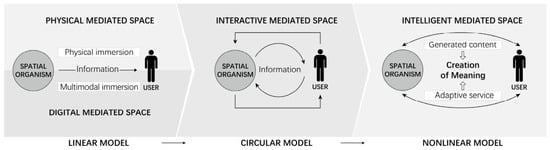
Information communication models may be regarded as abstract models of user-space interaction modes under different forms of mediated space. At the level of communicative structure, different types of mediated space correspond structurally to the linear, circular, and nonlinear models in communication theory, as shown in Figure 4.
Figure 4.
Mediated-space interaction modes based on information communication models.
Physical mediated space and digital mediated space correspond more closely to linear communication models, in which information flow is primarily dominated by the spatial designer or the communicative subject behind the design. Interactive mediated space corresponds to the interactive communication model and emphasizes the relation of feedback and response between the user and the spatial system. Intelligent mediated space tends toward the transactional communication model, in which the spatial subject, under given rules, acquires capacities for perception, judgment, and generation and can co-construct meaning through continuous interaction. In actual public cultural space, different functional zones, media levels, and contexts of use often coexist and interweave, and multiple communicative modes operate simultaneously. Information display, interactive feedback, and situational generation thereby form a hierarchical and composite communicative system of mediated space.
6. Discussion
Based on the foregoing typology, framework construction, and model analysis, this section discusses several possible tendencies of media intervention in public cultural space from the standpoint of extending existing research on mediated space. The discussion focuses mainly on shifts in the role of media within spatial design, the interactive generation of spatial meaning, and the transformation of criteria for judging spatial value.
6.1. Reconstructing the Logic of Spatial Organization Under Media Intervention
The continued development of media technology is driving the spatial form of public cultural space from physical mediated space and digital mediated space toward interactive mediated space and further toward intelligent mediated space, and in doing so has highlighted the growing importance of media in spatial design. Media no longer exist merely as technical tools serving a pre-existing space. They increasingly intervene in modes of spatial organization, orders of perception, and operational logics, and have, to a certain extent, become important conditions shaping spatial generation. For example, teamLab Borderless adopts numerous filleted corners and seamless flooring in order to produce the borderless quality of media experience and weaken the perceptual presence of wall junctions and horizontal interfaces. By contrast, The Sphere in Las Vegas dispenses with interior supporting columns and adopts a large-span exoskeletal spherical structure so that the architectural space itself directly serves the media-expressive demands of the surrounding light-emitting diode (LED) screen. These cases suggest that in highly mediatized spaces, structure, interface, and circulation are no longer neutral material backgrounds; rather, they begin proactively to adapt to the representational modes and operational requirements of media.
As research on media architecture, responsive architecture, and intelligent space has advanced, notions such as immersion, interaction, and intelligence have gradually entered the core vocabulary of spatial design. Against this backdrop, the Spatial Organism framework helps coordinate spatial structure, media interfaces, and interaction mechanisms from the perspective of holistic operation, thereby strengthening the interactivity, adaptability, and operational capacity of mediated space design. Correspondingly, bringing media design into the early stages of spatial design, and even taking it as an important basis for spatial form generation and organizational construction, is becoming a noteworthy direction in the design of public cultural spaces. At the same time, however, substantial differences remain among public cultural spaces in terms of task objectives, media levels, and modes of use. The degree to which media design affects spatial organization is therefore not uniform and still requires further differentiation and discussion in relation to specific spatial tasks and contexts of use.
6.2. The Interactive Generation of Spatial Meaning
The Spatial Organism does not imply that space can generate meaning spontaneously by itself. The meaning of mediated space is better understood as a relational outcome generated in concrete situations. Through pausing, moving, gazing, triggering, choosing paths, and switching interfaces, users can actively intervene in the operational process of space and participate differentially in the depth of information reception, the rhythm of experience, and the outcome of feedback. It is precisely in this process that spatial meaning is gradually generated through the ongoing coupling of spatial expression with users’ perception, cognition, and action. Related studies have shown that multisensory interaction and immersive technologies can influence users’ modes of information perception, emotional experience, cognitive process, and learning engagement by activating multiple perceptual channels, including vision, hearing, touch, and emotion- and comfort-related experience. In so doing, they enhance cultural experience, promote creative participation, and further strengthen the interactive relation between people and the built environment, while also improving operational efficiency, cost-effectiveness, and sustainability [32,33,34].
The space–user perceptual interaction model is precisely a mechanistic summary of this process of interaction. Research on mediated space may therefore need to shift further from attention to spatial form and technological configuration toward an examination of how space organizes interaction, how users participate in the construction of meaning, and how the two continue to negotiate spatial meaning in concrete situations.
6.3. Process-Oriented Spatial Evaluation
Research on the evaluation of architectural space has gradually formed a relatively systematic methodological framework, and the focus of evaluation has expanded from the examination of physical performance alone to a comprehensive assessment of the interactions among environmental, individual, and collective domains [35,36]. Within digitally and immersively enhanced experiences grounded in physical space, existing studies have likewise begun to establish evaluative approaches around dimensions such as presence, engagement, user experience, and end-user design feedback [37,38]. Media intervention turns space into a processual existence that continually unfolds, adjusts, and evolves in time. This processuality is manifested in two principal respects: first, in dynamic displays of sound, light, electricity, and moving image; and second, in interactive feedback produced under adaptive adjustment. In other words, the value of mediated space lies not only in what it is designed to be, but also in how it presents, how it responds, and how it serves.
On this basis, judgments of the value of mediated space need to move from a single standard oriented toward completed form to a comprehensive assessment oriented toward dynamic process. First, attention should be paid to the morphological coupling between spatial structure and media elements. Second, attention should be paid to the interactive experience between space and user. Third, attention should be paid to the contextual expression of spatial content in relation to functional communication and emotional experience. Ultimately, all three dimensions of value judgment need to be manifested and verified through users’ contextual perception.
Such a shift in evaluative judgment calls for the construction of an evaluation system suited to the characteristics of mediated space, one that incorporates spatial form, states of interaction, content expression, and users’ experience, cognition, and behavior within a unified evaluative field. Only in this way can the dynamic value of mediated space be grasped more accurately. The Spatial Organism framework and perceptual interaction model proposed in this paper can provide an elemental basis for the construction of relevant evaluation indicators, methodological pathways, and practical standards, with a view to advancing more in-depth theoretical and empirical research within specific types of public cultural space and particular contexts of use.
7. Conclusions
Focusing on the transformation of public cultural space under the development of media technology, this paper has, on the basis of a typological review of mediated space, discussed how media intervention affects spatial boundaries, operational logic, and service capacity. It then proposed the analytical perspective and framework of the Spatial Organism and constructed a space–user perceptual interaction model to explain the relation among media structure, spatial organization, and the generation of experience. In this way, the paper seeks, at the levels of conceptual clarification and mechanism modeling, to provide an interpretive framework for understanding the mediatized transformation of public cultural space. The perspectives developed here may also offer new analytical ideas for research on specific spatial types, task contexts, and media levels within public cultural spaces. For future spatial design, interactivity, adaptability, and operational capacity may serve as key dimensions in the evaluation of mediatized environments. Future research may build on this framework in relation to the functional characteristics and usage contexts of different public cultural spaces, further refine the evaluation system for the elements of mediated space, examine the mechanisms linking mediated-space elements and users’ spatial evaluation under different task conditions, and on this basis, propose more targeted strategies for mediatized design and renewal. In addition, to some extent, the analytical framework developed here may also be extended to other kinds of space characterized by contextual production and media intervention, thereby providing a reference for the theoretical analysis and design research of related spatial types.
Author Contributions
Conceptualization, K.W., X.C. and J.Z.; methodology, K.W. and X.C.; investigation, K.W.; resources, X.C. and J.Z.; writing—original draft preparation, K.W.; writing—review and editing, K.W.; visualization, K.W.; supervision, X.C. and J.Z.; project administration, X.C.; funding acquisition, J.Z. All authors have read and agreed to the published version of the manuscript.
Funding
This research was funded by the National Social Science Fund of China—Art Project, grant number 22BG133. The APC was funded by the Key Laboratory of Lighting Interactive Service and Technology, Ministry of Culture and Tourism.
Data Availability Statement
The original contributions presented in this study are included in the article. Further inquiries can be directed to the corresponding author.
Acknowledgments
The authors acknowledge the academic support, research facilities, and technical resources provided by the Key Laboratory of Lighting Interactive Service and Technology, Ministry of Culture and Tourism, and the Hubei Engineering Research Center for Tech of Digital Lighting. During the preparation of this manuscript, the authors used OpenAI ChatGPT Images 2.0 for the purpose of generating the schematic media-technology illustrations in the upper row of Figure 1. The authors have reviewed and edited the output and take full responsibility for the content of this publication.
Conflicts of Interest
The authors declare no conflicts of interest.
Abbreviations
The following abbreviations are used in this manuscript:
| AI | Artificial Intelligence |
| ICT | Information and Communication Technologies |
| BMS | Building Management System |
| BIM | Building Information Modeling |
| IPO | Input-Processing-Output |
| LED | Light-Emitting Diode |
References
- Li, J.; Zheng, X.; Watanabe, I.; Ochiai, Y. A Systematic Review of Digital Transformation Technologies in Museum Exhibition. Comput. Hum. Behav. 2024, 161, 108407. [Google Scholar] [CrossRef] [Scilit]
- Huang, T.; Fredericks, J.; Maalsen, S. Interior Media Architecture: Using Social Media as a Tool for Data Informed Design Solutions. In Proceedings of the 6th Media Architecture Biennale Conference, Toronto, ON, Canada, 14 June 2023; ACM: New York, NY, USA, 2023; pp. 28–37. [Google Scholar]
- Schaumann, D. Human Behavior Adaptability in Responsive Buildings: An Exploratory Study in Workplace Settings. Buildings 2024, 14, 1830. [Google Scholar] [CrossRef] [Scilit]
- Tuhaise, V.V.; Tah, J.H.M.; Abanda, F.H. Technologies for Digital Twin Applications in Construction. Autom. Constr. 2023, 152, 104931. [Google Scholar] [CrossRef] [Scilit]
- Abu-Shaikha, M.F. Comprehensive Literature Review: Advancing Sustainable Urban Environments through Machine Learning Usage in Digital Architecture. Archit. Eng. Des. Manag. 2025, 1–18. [Google Scholar] [CrossRef] [Scilit]
- Taboada-Orozco, A.; Yetongnon, K.; Nicolle, C. Smart Buildings: A Comprehensive Systematic Literature Review on Data-Driven Building Management Systems. Sensors 2024, 24, 4405. [Google Scholar] [CrossRef] [Scilit]
- Guo, Y. The Perception System and Architecture of Information Dissemination in Media Space—Also Discussing the Characteristics of Media Transmission and Reception with Spatial Bias. Editor Friend 2024, 84–91. [Google Scholar] [CrossRef]
- Manovich, L. The Poetics of Augmented Space. Vis. Commun. 2006, 5, 219–240. [Google Scholar] [CrossRef] [Scilit]
- Gullström, C. Presence Design: Mediated Spaces Extending Architecture. Ph.D. Thesis, Royal Institute of Technology (KTH), Stockholm, Sweden, 2010. [Google Scholar]
- Bloomer, K.C.; Moore, C.W.; Yudell, R.J. Body, Memory, and Architecture; Yale University Press: New Haven, CT, USA, 1978; ISBN 978-0-300-02142-4. [Google Scholar]
- Grau, O. Virtual Art: From Illusion to Immersion; Leonardo; MIT Press: Cambridge, MA, USA, 2003; ISBN 978-0-262-07241-0. [Google Scholar]
- Zheng, K.; Xia, Z.; Zhao, G.; Liu, S. Experimental Study on Audio-Visual Integrated Perception in Immersive Virtual Reality. Chin. J. Liq. Cryst. Disp. 2025, 40, 1810–1818. [Google Scholar] [CrossRef] [Scilit]
- Kyriakou, P.; Hermon, S. Can I Touch This? Using Natural Interaction in a Museum Augmented Reality System. Digit. Appl. Archaeol. Cult. Herit. 2019, 12, e00088. [Google Scholar] [CrossRef] [Scilit]
- Li, J.; Zhang, M.; Li, N.; Weyns, D.; Jin, Z.; Tei, K. Generative AI for Self-Adaptive Systems: State of the Art and Research Roadmap. ACM Trans. Auton. Adapt. Syst. 2024, 19, 1–60. [Google Scholar] [CrossRef] [Scilit]
- Silvestri, A.; Coraci, D.; Brandi, S.; Capozzoli, A.; Borkowski, E.; Köhler, J.; Wu, D.; Zeilinger, M.N.; Schlueter, A. Real Building Implementation of a Deep Reinforcement Learning Controller to Enhance Energy Efficiency and Indoor Temperature Control. Appl. Energy 2024, 368, 123447. [Google Scholar] [CrossRef] [Scilit]
- Ma, T.; Xiao, F.; Zhang, C.; Zhang, J.; Zhang, H.; Xu, K.; Luo, X. Digital Twin for 3D Interactive Building Operations: Integrating BIM, IoT-Enabled Building Automation Systems, AI, and Mixed Reality. Autom. Constr. 2025, 176, 106277. [Google Scholar] [CrossRef] [Scilit]
- Dou, H. The Spatial Turn and Exploring the History of Educational Space: The Temple of Confucius and School Space in the Song Dynasty as an Example. J. East China Norm. Univ. 2025, 43, 107–116. [Google Scholar] [CrossRef]
- Ching, F.D.K. Architecture: Form, Space, & Order, 3rd ed.; Wiley: Hoboken, NJ, USA, 2007; ISBN 978-0-471-75216-5. [Google Scholar]
- Meng, J.; Liu, Y.; Li, X. The Alienation of Human and Architecture; China Architecture & Building Press: Beijing, China, 2023; ISBN 978-7-112-27834-3. [Google Scholar]
- Hou, Y. Can Architecture Be Cybernetic Machine: From Cedric Price’s Fun Palace to the Pompidou Centre. In Proceedings of the 28th CAADRIA, Ahmedabad, India, 18 March 2023; pp. 501–510. [Google Scholar]
- Mathews, S. The Fun Palace as Virtual Architecture: Cedric Price and the Practices of Indeterminacy. J. Archit. Educ. 2006, 59, 39–48. [Google Scholar] [CrossRef] [Scilit]
- Spiegelberg, E. The Phenomenological Movement: A Historical Introduction; Springer Science & Business Media: Dordrecht, The Netherlands, 2012; ISBN 978-94-009-7491-3. [Google Scholar]
- Goldstein, E.B.; Brockmole, J.R. Sensation and Perception, 10th ed.; Cengage Learning: Boston, MA, USA, 2017; ISBN 978-1-305-58029-9. [Google Scholar]
- McLuhan, M. Understanding Media: The Extensions of Man; MIT Press: Cambridge, MA, USA, 1994; ISBN 0-262-63159-8. [Google Scholar]
- Baghdadi, A. A Comprehensive Review of Digital Twin Implementation in Construction: Current Trends and Future Directions. J. Asian Archit. Build. Eng. 2025, 1–15. [Google Scholar] [CrossRef] [Scilit]
- Hartley, J. Uses of Television; Routledge: London, UK, 1999; ISBN 978-0-415-08509-0. [Google Scholar]
- Lefebvre, H. The Production of Space; Wiley-Blackwell: Oxford, UK, 1991; ISBN 978-0-631-18177-4. [Google Scholar]
- Zhong, M. Research on the Exhibition Design: An Approach of Information Ground and Information Communication. Ph.D. Thesis, Hunan University, Changsha, China, 2022. [Google Scholar]
- von Neumann, J. First Draft of a Report on the EDVAC. IEEE Ann. Hist. Comput. 1993, 15, 27–75. [Google Scholar] [CrossRef] [Scilit] [PubMed]
- Newell, A.; Simon, H.A. Human Problem Solving; Echo Point Books & Media: Brattleboro, VT, USA, 2019; ISBN 978-1-63561-792-4. [Google Scholar]
- Littlejohn, S.W.; Foss, K.A. Encyclopedia of Communication Theory; SAGE Publications: Thousand Oaks, CA, USA, 2009; ISBN 978-1-4129-5937-7. [Google Scholar]
- Zhang, W.; Du, N. Multisensory Digital Heritage Spaces as Smart Environments in Sustainable Architectural Design. Buildings 2025, 15, 2181. [Google Scholar] [CrossRef] [Scilit]
- Suh, A.; Prophet, J. The State of Immersive Technology Research: A Literature Analysis. Comput. Hum. Behav. 2018, 86, 77–90. [Google Scholar] [CrossRef] [Scilit]
- Taherkhani, R.; Aziminezhad, M. Human-Building Interaction: A Bibliometric Review. Build. Environ. 2023, 242, 110493. [Google Scholar] [CrossRef] [Scilit]
- Makaremi, N.; Morgan, G.T.; Yildirim, S.; Alstan Jakubiec, J.; Robinson, J.; Touchie, M.F. A Framework for Evaluating the Impact of Buildings on Inhabitant Well-Being. Build. Environ. 2025, 280, 113117. [Google Scholar] [CrossRef] [Scilit]
- Sleiman, S.; Ouf, M.; Luo, W.; Kramer, R.; Zeiler, W.; Borkowski, E.; Hong, T.; Nagy, Z.; Chen, Z. Overview of Occupant-Centric KPIs for Building Performance and Their Value to Various Building Stakeholders. Energy Build. 2024, 322, 114704. [Google Scholar] [CrossRef] [Scilit]
- Ma, J.; Erdogmus, E.; Yang, E. A User-Centered Building Design Approach Using Immersive Virtual Reality and Discrete Choice Modeling. Build. Environ. 2025, 284, 113400. [Google Scholar] [CrossRef] [Scilit]
- Yildirim, M.; Globa, A.; Gocer, O.; Brambilla, A. Multisensory Virtual Reality Environments in Architecture: The Impact of Smell on Presence, Engagement, and User Experience. Virtual Real. Intell. Hardw. 2025, 7, 577–617. [Google Scholar] [CrossRef] [Scilit]

Disclaimer/Publisher’s Note: The statements, opinions and data contained in all publications are solely those of the individual author(s) and contributor(s) and not of MDPI and/or the editor(s). MDPI and/or the editor(s) disclaim responsibility for any injury to people or property resulting from any ideas, methods, instructions or products referred to in the content. |
© 2026 by the authors. Licensee MDPI, Basel, Switzerland. This article is an open access article distributed under the terms and conditions of the Creative Commons Attribution (CC BY) license.