


Abstract
Non-fungible tokens (NFTs) are transforming the commercialisation of digital art by establishing unique blockchain identifiers that ensure authenticity and certify subsequent transactions. However, the transfer of control over an NFT does not automatically include the transfer of the associated copyrights, thereby creating legal uncertainty as to what rights are actually acquired. This interdisciplinary project between engineering and law proposes the design of a smart contract, based on the ERC-721 standard, to manage the transfer of property rights linked to digital artworks represented as NFTs. The accompanying legal contract incorporates essential clauses covering the identification of the parties, a description of the artwork and its link to the token, pricing, royalties, and the terms of rights transfer. The proposal seeks to integrate blockchain technology with existing legal frameworks, offering an innovative solution that strengthens legal certainty in the transfer of copyright within digital environments.
Keywords:
blockchain; legal regulation; NFT; digital asset; metadata; smart contract; token; copyrights 1. Introduction
Non-fungible tokens (NFTs) are reshaping the digital art market by addressing technical and legal gaps that have historically restricted the free commercialisation of intangible works. Powered by blockchain technology, NFTs make it possible to prove ownership of the rights associated with a digital work—either because the token’s creator is also the author of the work, or because those rights have been transferred through a contract. This technology enables the clear identification, at any time, of who holds the economic rights and ownership of a digital work.
NFTs may also function as certificates of authenticity or digital deeds linked to a work of art, thereby not only facilitating its commercialisation (when reference is made to commercialisation, it refers to the sale of the NFT, in which the copyright may or may not be assigned or licensed) but also providing greater security for purchasers. However, this will depend on whether the party creating the NFT holds the economic rights in the underlying work, either because they are the author and retain the rights associated with the digital work, or because the party minting the token has acquired such rights. In this regard, for the NFT to serve as a reliable guarantee of the work’s authenticity, strict oversight by marketplaces and minting service providers will be required.
In addition, NFTs enable direct transactions between creators or current owners and buyers, reducing intermediation costs and supporting mechanisms such as resale royalties.
Despite these advantages, many NFT owners and traders are unaware that artworks—whether physical or digital—are protected by copyright law. This legal framework grants creators the exclusive right to exploit their works, including the option to transfer economic rights. However, such a transfer does not occur automatically when control of an NFT changes hands; it requires an explicit agreement specifying the rights to be conveyed. In the absence of such an agreement, the new owner is limited to personal use of the work, without the ability to exploit it commercially. This problem is compounded by the ease of copying digital works without authorisation and by the potential anonymity of both the creator and the current owner.
The proliferation of digital works and the growing use of NFTs have therefore raised significant technical and legal challenges, particularly concerning the protection and transfer of copyright. This article addresses these challenges from an interdisciplinary perspective, combining engineering tools and methods with legal analysis to provide a comprehensive understanding of the phenomenon.
The main objective of this work is to develop a smart contract that not only facilitates the creation and transfer of NFTs and the linked digital artwork, but also leverages the information stored on the blockchain to automatically generate a legal contract that formalises the transfer of economic rights between the owner and the new acquirer. The smart contract is based on the ERC-721 standard—widely used in the Ethereum ecosystem for managing non-fungible tokens—and is deployed on the Base network. For its implementation, tools such as MetaMask (for account management) and Brownie (as a development and testing environment) were used.
While the ERC-721 standard enables the creation and transfer of NFTs, it does not provide mechanisms to formalise the transfer of copyright over the represented work. To address this gap, the project incorporates additional functionalities that allow the automatic generation of a legal contract at the moment the NFT is transferred.
The technical process followed includes three key components: token minting, ownership transfer, and the automatic generation of a PDF-based legal contract that records the transfer of copyright. This was complemented by a legal analysis covering the rights associated with digital works, copyright protection, and the formal requirements for valid rights transfers.
Ultimately, this proposal seeks to integrate existing legal frameworks with blockchain-based solutions, offering an innovative approach that strengthens legal certainty in the transfer of copyright within digital environments.
2. Methods
To achieve the proposed objective, a structured methodology was adopted, integrating two complementary approaches: technical and legal. On the technical side, a smart contract with predefined functionalities was developed and implemented on the Base blockchain, incorporating extensions to the ERC-721 standard that enable the automatic generation of a legal contract for the transfer of economic rights during the NFT transfer. On the legal side, a qualitative approach was applied, using a dogmatic methodology and documentary analysis. This analysis examined the rules governing copyright and the formalities required for its valid transfer, with the aim of ensuring the legal certainty of the process. This legal study was conducted primarily on the basis of Colombian law, in particular the statutory provisions governing copyright. However, reference was also made to instruments of European Union law—namely Regulations and Directives—as well as to the legislation of other jurisdictions, in order to elucidate key aspects of the analysis developed in this article.
3. Technical Process
To fulfil the technical objective of the project, the following process was carried out: (1) configuring the development environment, including the tools, programming language, and blockchain to be used; (2) creating the smart contract with the proposed transfer functionality; and (3) minting and transferring the NFT together with the associated rights to the underlying work.
3.1. Configuration of the Development Environment
The Base blockchain was selected for this project. As a Layer-2 solution, it is fully compatible with the Ethereum Virtual Machine (EVM)1 and publicly accessible2. Developed by Coinbase, one of the world’s largest cryptocurrency exchanges, Base has gained recognition for its significantly lower transaction fees compared with the Ethereum mainnet.
Solidity3 was used as the programming language to build the smart contract, defining the logic for NFT generation and implementing the methods needed to record information for the rights transfer contract.
The connection to the Base network was managed through MetaMask4, a browser extension that functions as a crypto-asset wallet. MetaMask stores private keys for account management, signs transactions and messages, and provides a user interface to interact with decentralised applications (DApps) across Ethereum and compatible networks.
For compiling, deploying, and testing the smart contract, Brownie5 was used, a Python-based development and testing framework designed for Ethereum-compatible smart contracts.
To keep track of changes and versions of the contract and other project code elements, GitHub6 was used, a code hosting platform for version control and collaboration. In the project repository, the general folder structure can be seen, where the contract and the scripts allowing interaction with it are located (see: https://github.com/UTadeo-Blockchain/NFT, accessed on 8 January 2026).
The starting point for the smart contract was the ERC-721 standard as implemented and audited in the open-source OpenZeppelin libraries. This standard can be deployed on any EVM-compatible blockchain. Like any standard, ERC-721 provides a template of functions that can be modified and customised to meet the specific needs of a business or project.
These functions define the logic for minting, or creating, a record with a unique identifier—commonly known as a non-fungible token (NFT). They also enable essential operations such as transferring tokens, recording information in the storage structures provided by smart contracts, verifying their existence on the network, and confirming ownership. For instance, a token can be programmed to be non-transferable, similar to a certificate, or to have an expiration date, like a concert ticket.
This flexibility allows ERC-721–based smart contracts to be adapted to a wide range of applications and use cases, including the present project. Building on this foundation, the proposed improvements were implemented in the smart contract.
3.2. Creation of the Smart Contract for the Transfer of Copyrights
For this project, a smart contract was designed to be executed in two clearly defined stages according to Figure 1.
Figure 1.
Contract deployment process, NFT minting, generation of the legal and token transfer.
The first stage configures the functions for minting an NFT, while the second stage adds the functions needed to generate a legal contract for the transfer of Creation of the Smart Contract for the Transfer of copyrights whenever the NFT is transferred to a new owner, holder, or possessor. When the NFT is transferred, two actions occur simultaneously: one on-chain and one off-chain. On-chain, the change in token ownership is recorded. Off-chain, the smart contract uses key blockchain data—such as the NFT details, associated metadata, and the accounts of the parties involved—to populate the fields of a predefined template that generates the legal contract. Once the transaction is completed, this legal contract is produced as a PDF document. To protect the privacy of the information, the PDF is not stored on-chain.
3.2.1. Parameterization of Smart Contract Functions
In this smart contract, only the developer who deploys the contract on the blockchain is authorised to mint NFTs. This restriction prevents third parties from creating new NFTs through the contract. The premise is that the NFT creator—i.e., the developer—acts on behalf of the author of the underlying work and, as such, holds the economic rights to it. This restriction is enforced using the onlyOwner modifier, which limits access to certain functions exclusively to the contract owner (see Figure 2).
Figure 2.
Smart contract code for NFT minting with restricted creator.
This contract can be consulted in the repository: https://github.com/UTadeo-Blockchain/NFT/blob/main/contracts/art.sol, accessed on 8 January 2026.
The NFT minting process begins when the safeMint function is executed in the smart contract. This function assigns a unique identifier to the work and links it to the collection of NFTs created under the same contract.
3.2.2. Configuration of Metadata Linking the Artwork to the NFT
Before minting an NFT, the metadata file that describes the digital artwork and links it to the token must be prepared in advance. For this process, a .JSON file is created in accordance with the metadata structure defined by the ERC-721 standard (see Figure 3). In this project, the metadata included the artwork’s name, description, and the URL where the image is stored. Both the image and the metadata file were uploaded to the IPFS network.
Figure 3.
Basic structure of NFT metadata.
The metadata file can be adapted to associate the work with a collection of objects sharing similar characteristics, and additional attributes can be included to further describe the artwork referenced by the NFT. One of the main advantages of using this standard is that the artwork can be displayed seamlessly across any NFT marketplace.
3.2.3. Legal Contract Template
It was also considered essential to generate a template for the legal contract. For this purpose, a Python script was developed to create a PDF document from a predefined template, automatically filling specific fields with information entered by the user through the terminal. At the same time, the process records information on the blockchain using the createContract function.
The template is a legal contract that includes the identification of the parties involved, a description of the artwork subject to the transaction, and eight essential clauses governing the transfer of copyrights. Based on the data provided in the template, a PDF contract is generated, thereby ensuring legal certainty for the transaction. The sections of this template are detailed in Table 1.
Table 1.
Contract clauses. The legal contract template can be consulted in the repository: https://github.com/UTadeo-Blockchain/NFT/blob/main/scripts/texto.py, accessed on 8 January 2026.
In this version of the rights transfer contract template, certain elements were set as constants—namely, the price, the royalty percentage (8%), the duration of the transfer (10 years), and the type of transfer (comprehensive and without limitation: reproduction, public communication, distribution of copies, transformation, and making available). In future versions, these fields could be converted into variables, allowing the parties to define them by mutual agreement or select them from predefined options in the user interface.
The template also includes variables that retrieve blockchain data associated with the NFT. This information is used to identify both the parties involved and the artwork, as detailed in Table 2.
Table 2.
Legal contract variables that retrieve data from the blockchain.
In the legal contract, the parties are identified by their public blockchain addresses along with their personal data (first name, last name, and ID) entered to complete the template. The artwork is identified through two elements: (1) the link to the image or multimedia file representing it, hosted in decentralized storage (IPFS), and (2) the NFT, serving as its unique identifier registered on the blockchain (see first article: Technical and Legal Linking of an NFT).
3.2.4. Deployment
After configuring the project in Brownie and finalising the smart contract in Solidity, a Python script was used to deploy it. The script connected to the Base mainnet and set up the corresponding account to pay transaction fees, enabling token transfers by using the private key stored in the environment variables file. Once deployed—that is, once recorded in a blockchain block—the contract becomes immutable and can no longer be modified. The following link provides the address of the smart contract deployed on the Base network, which can be verified directly on the blockchain: https://basescan.org/address/0x5a409ca2cfd26aa3469510fe52e797577b636206 (accessed on 15 December 2025).
3.3. Transfer of the NFT and Assignment of Rights
For the NFT transfer to occur, the createContract function—defined in the smart contract structure—must be executed. In this case, however, as noted earlier, the function is executed within the Python code that generates the legal contract template
Link to the created NFT: https://basescan.org/nft/0x5a409ca2cfd26aa3469510fe52e797577b636206/0 (accessed on 16 December 2025).
Link to transaction: https://basescan.org/tx/0x7e4f313a1cebc62f78488751bd1e8c6afcbda119eb72f48c7adedade81f0ba11 (accessed on 16 December 2025).
4. Legal Aspects of the Transfer of an NFT Linked to a Digital Artwork
The central objective of this article is to create a smart contract that enables the transfer of the token and its linked artwork while guaranteeing the rights of the parties involved. It is important to emphasise that this project is premised upon an NFT linked to a digitally created work of art, rather than to a physical artwork or to a digital reproduction of a tangible work, since each of these configurations gives rise to distinct legal considerations and specific regulatory implications.
For this transfer to meet all legal requirements—not only regarding strictly contractual aspects but, above all, those concerning copyrights—it is proposed to incorporate a legal template that records the legally relevant data, thereby providing legal certainty to the transaction. With this data, previously agreed upon by the parties, the smart contract also generates a written contract in PDF format by transforming the data into legal clauses that constitute the legal framework of each transaction. In this way, proof of the agreement is ensured while also complying with the legal requirement that the assignment or licence of patrimonial rights over a work must be made in writing.
Accordingly, after presenting the technical stages followed in this project for the creation and transfer of the NFT, it is necessary to undertake a more in-depth legal analysis of the issues that gave rise to the central proposal of this study. To this end, the analysis will begin by examining the legal nexus between the NFT and the underlying asset, including the transfer of its ownership and the other rights associated with it. Subsequently, the contractual arrangements governing the transfer of the NFT and its copyright will be analysed, together with certain aspects of private international law—particularly those relating to the applicable law. The study will then address several contractual issues that fall outside the scope of copyright law, as well as the specific protection afforded to assets protected by copyright. Finally, it will consider the agreements and declarations that should be incorporated into the proposed legal model.
4.1. The Technical and Legal Linkage Between the NFT and the Artwork
An NFT (non-fungible token) is a unique electronic record on the blockchain that represents rights over the assets linked to it (whether physical or digital), thereby enabling various transactions with them. As NFTs are unique records, this technology introduces the concept of scarcity in the digital sector, making possible the ownership and trade of digital assets that previously lacked characteristics of exclusivity or rivalry (Valeonti et al. 2021). The uniqueness of the NFT is achieved through a unique identifier obtained by means of its associated smart contract (Putnings 2022), creating “a uniqueness that can be demonstrated and verified through the blockchain” (Gámez and Corredor 2023). For this reason, NFTs are used to support or prove rights over the linked asset or service (Wang et al. 2021; Guidi and Michienzi 2023). NFTs are currently being used to tokenise a wide range of assets, such as shares, funds, debt, real estate, intellectual property (Bamakan et al. 2022), artworks, music, photographs, and concert tickets, among others.
It should be emphasised that not all crypto-assets are technically and legally linked to a good or service. Cryptocurrencies, for example, constitute assets in themselves and derive value from what they represent. However, other crypto-assets, such as NFTs, acquire value exclusively from the relationship established with another asset: digital artworks or tangible goods in the real world (such as immovable property), or service (for example, tickets for concerts or sporting events). In the case of digital artworks, it has been shown that, when associated with a token, they become more reliable in terms of originality, offer traceability of transfers, and enable the automation of both the initial payment and royalties for future sales, among other benefits.
This linkage requires a technical procedure but, above all, legal recognition that allows the commercialisation of the NFT to entail the commercialisation of the linked asset. From a technical standpoint, the linkage is established in the metadata file. Indeed, the token incorporates metadata fields to specify the name and description of the associated asset, as well as the URL where the digital work is hosted. However, from a legal perspective, this is not sufficient, since legal recognition—or the principle of party autonomy—is required to establish an indissoluble link between the token and the underlying asset, so that the transfer of the former also implies the transfer of the latter (Martínez Luna et al. 2024).
With regard to legal recognition, there are already domestic legal norms regulating the linkage of an NFT to its attached asset, as in the case of Liechtenstein with its Liechtenstein Token and Trusted Technology Service Provider Act (TVTG), 2019. The principal effect established by the Liechtenstein Act is the direct linkage between the token and the related asset, such that any legal transaction carried out with the NFT has immediate effect on the linked asset. This is explicitly provided for in Article 7.1: “Disposal over the Token results in the disposal over the right represented by the Token.”
Conversely, if the law governing the transfer of the NFT does not contain a specific provision on the linkage between the token and the underlying file, it is necessary for the seller or transferor to make a declaration to that effect, so that there is no doubt that the transfer of the NFT also entails the change of ownership of the linked artwork. As will be shown, this is one of the clauses included in the legal template proposed in this article. Such a clause is fully valid and constitutes strong protection for the purchaser of the NFT.
Accordingly, by carrying out both the technical linkage and the legal recognition (whether by law or by party autonomy) of such linkage, a series of legal safeguards is obtained that will allow the large-scale creation and transfer of artworks through NFTs. The two most significant safeguards are: first, enabling the token holder to alter the rights that a person has in relation to the linked asset; and second, ensuring that the transfer of the token (NFT) has the effect of transferring the rights of the linked asset.
In short, since an NFT derives its market value from the asset to which it is linked, the commercialisation of the token will only make economic sense if its transfer also entails the transfer of the underlying asset. However, this does not necessarily mean that the value derives from the transfer of copyright, since in many cases the mere fact of being the owner of the NFT may itself lead to an increase in its value.
In any event, the link between the token and the associated asset must be properly reflected in the metadata file, and such a connection must also be recognised either by a rule of law or by virtue of the principle of party autonomy within the legal model proposed.
4.2. Transfer of the NFT: Change of Control
In many cases, the owner of the NFT seeks to transfer it to a new holder. From a technical perspective, the transfer of the NFT is effected through its change of control, which implies that possession is recognised via the public key associated with the token on the blockchain network. However, the legal aspects of this change of control must be examined in greater depth in order to determine whether it truly entails a genuine transfer of rights over the asset. For this reason, the following issues will be analysed: who holds control of a digital asset, what the change of control entails, and, finally, which rights are transferred between the contracting parties.
A person holds control of the digital asset when the blockchain system (public and private key) allows them to prevent others from benefitting from the NFT; when they can in fact benefit from the asset (both technically and legally); when the system enables them to transfer it; and when it permits them to identify themselves as the holder of rights over it (UNIDROIT 2023). In this sense, control may be regarded as a factual aspect of holding or possessing the asset rather than an essentially legal aspect (UNIDROIT 2023, p. 52). Usually, the person who holds control of the asset is also the holder of the rights over it and, therefore, the only one who may transfer it. It must be borne in mind that the transferor can only transfer the rights they hold over the asset, if any, and cannot legally transfer any other type of rights. This is expressly provided in UNIDROIT Principle 9. However, there are other scenarios where control may be transferred from one person to another without necessarily implying a change in the rights held over the asset—for example, when a third-party custodian intervenes, as established in UNIDROIT Principle 10.1.
From a technical standpoint, the transfer of an NFT is effected through the change of control. Changing control of the asset “means a transfer of the abilities in sub-paragraph (1)(a) to another person, and includes the replacement, modification, destruction, cancellation, or elimination of a digital asset, and the resulting and corresponding derivative creation of a new digital asset (a ‘resulting digital asset’) which is subject to the control of another person”, as expressed in Principle 6.2 (UNIDROIT 2023).
Legally, this change of control generally entails a modification in the ownership of the rights linked to the asset represented by the NFT. In this regard, technology functions as a vehicle to formalise a contractual agreement between the parties, whether for the sale, assignment, lease, or exchange of the digital asset associated with the token. For example, if the parties enter into a contract of sale concerning an NFT linked to a digital artwork, the seller will fulfil their obligation to transfer ownership by means of the transfer of control of the asset, executed through their private keys.
This implies that the change of control of the NFT will have the legal effect assigned to it by the parties in their contractual agreement. Therefore, a clear expression of the parties’ intentions in a contract is required, specifying the rights held and those to be transferred between the current controller and the recipient. For this reason, this project proposes that the legal template should include a section in which the holder of the right over the NFT declares the rights they possess over the asset (ownership, possession, holding, patrimonial exploitation rights, etc.) and those that will be transferred under the present contract. Only in this way can a change of control of the token also signify a change in the rights over the transferred asset.
In sum, the only person entitled to transfer the NFT is the one who holds its control, and by transferring such control, the rights established by the parties in their agreement are transferred—whether ownership, mere holding of the token, or the linked artwork—provided that the transferor is indeed the holder of those rights, since rights not held over the work cannot be assigned or transferred.
It is now appropriate to ask: which rights over the linked asset may be transferred? The first clarification is that not all rights can be transferred directly with the change of control of the token. For instance, a change of control of the NFT does not transfer the moral rights of the author of the work associated with the token, since such rights can never be altered with respect to their ownership.
At this point, it is necessary to highlight that any transfer of a digital asset, regardless of the type of contract, must comply with the applicable copyrights. Indeed, if the information included in the digital asset is subject to protection under copyrights, the rights of the right-holder would be preserved despite the inclusion of the information in the electronic record or the transfer of the digital asset to a third party.
To the extent permitted by the applicable intellectual property law, the assignee of the digital asset could be entitled to use and enjoy the information, reproduce it, and even exploit the asset economically. This must be assessed in accordance with the applicable legal framework, as otherwise patrimonial rights of the right-holder, or even the rights of attribution of the work, could be infringed.
In conclusion, all types of rights may be transferred insofar as the parties have so agreed in their contract, and provided that the law does not prohibit such transfer.
The present project proceeds on the basis that such change of control is undertaken in order to transfer ownership by means of a contract of sale, within which the parties additionally determine whether to effect a transfer of the economic rights subsisting in the linked artwork. Such transfer, where agreed, is implemented through either an assignment or a licence of rights. These aspects will be examined in greater depth below.
4.3. Typology of Contracts Relating to NFTs
Right holders in works linked to NFTs—who, in many instances, are the authors themselves—are entitled to enter into contractual arrangements concerning such works. These agreements pursue a dual objective: first, the transfer of a proprietary right in the digital work (ownership); and/or secondly, the transfer or restriction of the associated economic rights (assignment or licence of economic rights). This structure mirrors the acquisition of a tangible work of art: the purchaser becomes the owner of the physical object, yet the author remains the copyright holder unless the parties have expressly agreed otherwise.
Accordingly, “whether the buyer of an NFT acquires any rights to use the work represented by the NFT depends on what was agreed upon” (Garbers-von Boehm et al. 2022).
It must be clarified that the analysis advanced in this article is premised upon the transfer of rights (ownership, assignment, licence) in the NFT and the artwork to which it is linked, but does not encompass the specific legal issues arising where a consumer is involved. This limitation is justified by the existence of a special protective regime applicable whenever one of the contracting parties qualifies as a consumer. Indeed, whilst it is common for the transfer agreement relating to an NFT to be concluded either between two corporate entities or between two natural persons acting outside the scope of trade, it is equally possible that a consumer may participate in such an arrangement.
Under Colombian law, a consumer is defined as: “Any natural or legal person who, as the final recipient, acquires, enjoys or uses a given product, irrespective of its nature, for the satisfaction of a personal, private, family or domestic need, and for business purposes where such purpose is not intrinsically linked to his or her economic activity” (Law 1480 of 2011, Colombia).
Similarly, pursuant to Article 2(1) of the Directive 2011/83/EU on Consumer Rights of the European Parliament and of the Council of 25 October 2011, a consumer is “any natural person who, in contracts covered by this Directive, is acting for purposes which are outside his trade, business, craft or profession.”
Accordingly, the applicable regulatory framework establishes a heightened level of consumer protection. By way of illustration, it imposes mandatory pre-contractual information requirements, which must be provided in a “clear and comprehensible manner”, concerning, inter alia, the main characteristics of the contract, the identity of the trader, the total price, payment arrangements, the time for performance, the functionality of digital content, and the right of withdrawal (Article 5 of the aforementioned Directive).
Moreover, “and establishes certain formalities for the valid conclusion of the relevant agreements by electronic means at a distance” (Tzoulia 2023). In particular, Article 8(3) provides that commercial websites must clearly and legibly indicate, at the latest at the beginning of the ordering process, whether any delivery restrictions apply and which means of payment are accepted.
In addition, the consumer protection regime confers a distinct and reinforced safeguard in the form of the right of withdrawal, which operates as a substantive corrective mechanism within the law of distance and electronic contracting.
That clarification having been made, a distinction will now be drawn between the transfer of ownership of the NFT as a digital token and the copyright subsisting in the linked artwork.
As a general rule, the acquisition of the “medium” in which a work is embodied confers only those powers inherent in ordinary ownership of the object, without encompassing the rights of exploitation protected by copyrights (De Nova Labián 2025).
In the absence of a specific agreement, the purchaser of an NFT does not acquire any exclusive exploitation rights. At most, they may benefit from the limitations provided under Article 5(1) of Directive 2001/29/EC, namely temporary acts of reproduction which are transient or incidental, form an integral and essential part of a technological process, enable a lawful use of the work or other subject-matter, and have no independent economic significance.
It is the author’s copyright which confers the “exclusive authority to authorise or prohibit” (Delgado Peña 2017) reproduction, communication to the public, adaptation and distribution of protected works. Under Colombian law, such rights subsist for the life of the author and, following his or her death, for a term of eighty years in favour of those who have lawfully acquired them. Where the holder of the economic rights is a legal person, however, protection is limited to seventy years pursuant to Article 4 of Law 1915 of 2018 (Colombia).
It follows that the acquisition of an NFT does not, in and of itself, entail the acquisition of copyrights (Murray 2023a). Such transfer requires an express agreement between the parties and, in many jurisdictions, compliance with statutory formalities.
It is therefore necessary to examine the principal contractual mechanisms employed to transfer the work and its associated economic rights.
4.3.1. Contract of Sale
Following the minting of the token, it is typically offered for sale. The contract most frequently used for the commercialisation of NFTs is the contract of sale, often implemented either through an auction conducted on the platform which facilitated the minting process or by means of a fixed-price listing.
Under a contract of sale, the seller transfers ownership of the NFT to another account or wallet in accordance with the terms encoded in the smart contract. From a technical standpoint, once payment by the purchaser has been verified, a function embedded in the smart contract executes the change of “ownership” by linking the NFT to the purchaser’s blockchain address (i.e., wallet identifier). This transaction is permanently recorded on the blockchain and remains publicly verifiable (Garbers-von Boehm et al. 2022).
From a legal perspective, the central issue in an NFT sale is whether the purchaser thereby acquires the underlying asset (Moringiello and Christopher 2022). In the case of digital artworks, however, acquisition of the underlying digital file does not equate to the acquisition of copyright. For this reason, the parties must expressly stipulate whether the seller transfers all, some, or none of the associated economic rights by way of assignment or licence. A distinction must therefore be drawn between NFT sales which exclude the transfer of economic rights and those which include them.
In the former scenario, the seller retains the copyright in the work, such that the purchaser—despite becoming the new holder of the NFT—acquires no proprietary rights in the artwork itself (Moringiello and Christopher 2022). This position is reflected, for example, in the terms of service of the Foundation marketplace7. Similarly, MakersPlace provides that collectors may display and share the crypto-assets, but acquire no legal ownership, right or title in any copyright, trademarks or other intellectual property rights subsisting in the digital assets. In such cases, “the only right granted to the NFT holder is the right to display the artwork” (Moringiello and Christopher 2022). This is analogous to the situation arising upon the acquisition of a physical painting or sculpture.
Although many NFT transactions do not encompass the transfer of copyright in the underlying asset, “there are a few instances in which the seller offers to turn the token into an actual transfer of copyright ownership in the original” (Guadamuz 2021). For example, the platform Mintable enables the transfer of copyright through a specific contractual option embedded within the smart contract architecture. A similar approach is adopted by Hup Life (Guadamuz 2021). In such circumstances, beyond the sale of the NFT itself, the parties must conclude a licence or assignment agreement in respect of the economic rights. Such an agreement may either be incorporated directly into the smart contract or included within the general terms and conditions of the relevant marketplace, provided that the author validly assented to those terms (Garbers-von Boehm et al. 2022).
A brief analysis of licence and assignment agreements is therefore required.
4.3.2. Licence Agreement
A licence agreement in respect of economic rights in copyright is an arrangement whereby the licensor—who may be the author or a third party right holder—authorises a natural or legal person (the licensee) to use the work, with or without exclusivity, without transferring full ownership of the underlying rights.
The parties must define contractually the permitted modes of exploitation, as well as the temporal and territorial scope of the licence, including remuneration and whether exclusivity is granted (art.183 Law 1955 of 2019 Colombia).
An illustrative example is provided by the NFT project undertaken by the Belvedere Museum in relation to The Kiss by Gustav Klimt. In that instance, the seller granted an exclusive, territorially unrestricted, perpetual, irrevocable, non-sublicensable and transferable licence, enabling the NFT holder to store the work in a digital wallet, display it in virtual galleries within the metaverse, and download and print it (Garbers-von Boehm et al. 2022).
In 2001, Lawrence Lessig introduced the “Creative Commons” licensing framework, designed to afford greater flexibility in the exercise and dissemination of copyright. Such licences may also be applied to works associated with NFTs in order to delineate the scope of rights granted to purchasers.
From a contractual standpoint, any type of agreement may, in principle, be encoded within a smart contract. If a licence is understood as a legal instrument authorising conduct otherwise restricted by copyright, it may likewise be operationalised through NFT-based mechanisms (Guadamuz 2021). Nevertheless, in several jurisdictions, licence agreements must comply with specific formal requirements. Under Colombian law, for instance, such agreements must be concluded in writing and registered with the National Copyright Directorate pursuant to Article 183 of Law 1955 of 2019 (Colombia).
4.3.3. Assignment Agreement
By means of an assignment agreement, the holder of the economic rights divests himself or herself of those rights in favour of another person. From that moment, the assignee becomes entitled to authorise the exploitation of the rights associated with the work.
This contract is likewise subject to formal requirements. Article 183 of Law 1955 of 2019 (Colombia) provides that acts or contracts by which economic copyright or related rights are transferred, whether in whole or in part, must be evidenced in writing as a condition of validity and must be registered with the National Copyright Directorate.
In conclusion, whether the transaction is confined to the sale of the NFT and its linked work, or incorporates an assignment or licence of economic rights, the parties must clearly delimit this issue within the “Transfer of Rights” section of the proposed legal template. However, the parties must bear in mind that, where the transaction consists solely of the sale of the NFT without any transfer of economic rights, the purchaser’s use of the artwork is restricted to that agreed between the parties and to the limits imposed by law, typically confining such use to personal and non-commercial purposes.
Conversely, where a total or partial transfer of economic rights is agreed, the written agreement incorporated within the metadata file satisfies the formal requirement that the contract be evidenced in writing. Nevertheless, it must additionally be stipulated that the purchaser is required to register the transfer of rights before the competent administrative authority, which, in the case of Colombia, is the National Copyright Directorate. Only upon compliance with these formalities will the transfer of rights produce binding legal effect.
Finally, a purchaser to whom economic rights have been transferred must exploit the digital artwork associated with the NFT strictly in accordance with the rights conferred under the agreement and within the statutory limits established by the applicable legal framework.
4.4. Aspects of Private International Law
A contract is regarded as international where it contains at least one foreign element, in accordance with the classical doctrine of the pure foreign element (Carrascosa González 2009; Ubertazzi 2008). Such an element may consist, inter alia, of the habitual residence of one of the parties, the place of performance of the contract, or any other factor introducing a transnational dimension.
A significant proportion of contracts relating to NFTs incorporate at least one such foreign element and must therefore be characterised as international contracts, thereby necessitating recourse to private international law. The central question is whether existing conflict-of-laws rules are capable of identifying the applicable law in respect of delocalised and ostensibly ubiquitous contracts—such as those concluded through blockchain technology—or whether novel connecting factors tailored to these contractual relationships are required. The issue is far from theoretical: it determines, for instance, which copyright law governs an international dispute concerning the infringement of economic rights in a digital artwork linked to an NFT. The following analysis therefore concentrates on the law applicable to such contracts.
4.4.1. Applicable Law to an NFT Contract
Where the contract by which an NFT is commercialised is international in nature, the applicable law must be determined by reference to the relevant conflict-of-laws rule, given the absence of any uniform substantive instrument currently governing blockchain-based contractual relationships. That conflict rule must regulate party autonomy in the choice of law (conflictual autonomy) and, failing such choice, establish the objective criteria for designating the governing law.
Party Autonomy
Party autonomy may be defined as the legally conferred power of the parties to an international contract to designate, by mutual agreement, the law governing their legal relationship. The exercise of such autonomy has the consequence of displacing the law that would otherwise have been designated by the forum’s conflict rule (Monroy Cabra 1999). However, the permissibility and limits of such choice depend upon the private international law rules of the court seised.
The recognition of party autonomy yields particular advantages in the context of technologically mediated contracts, especially those concluded on blockchain infrastructures. Given their delocalised and global character, the objective connecting factors employed in default conflict rules—such as habitual residence or place of performance—may prove difficult to ascertain. An express choice of law enhances certainty and foreseeability from the moment of designation, enabling the parties to conform their conduct to a clearly identified legal framework.
Moreover, party autonomy permits the selection of a legal system specifically adapted to the technological and economic realities of NFT transactions, thereby fostering preventive legal certainty. The parties may, for example, opt for a legal order which expressly recognises the commercialisation of tokens and the juridical linkage between the token and the associated digital asset, such as the legislative framework enacted in Liechtenstein.
The choice of law further enables the parties to calculate the legal and economic expectations of their agreement, thereby facilitating the attainment of their material interests (Boggiano 1990). They may seek a law which permits resale of the NFT, recognises the possibility of royalty percentages upon secondary transfers, or acknowledges that a change of control of the token entails the transfer of associated rights.
Ultimately, however, it is the private international law of the court hearing the dispute that determines both the scope and the limits of such party autonomy.
Within the European Union, the Regulation (EC) No 593/2008 (Rome I Regulation) lays down uniform rules governing the law applicable to contractual obligations. Article 3 confers broad discretion upon the parties to choose the applicable law.
First, it permits the designation of a law governing the contract in its entirety or only a part thereof. The parties could, for instance, provide that the formation of the contract is governed by Spanish law, while the execution of the NFT sale is subject to French law. Secondly, the Regulation allows the selection of a law unconnected with the contract by objective criteria; the chosen law need not bear any substantive link to the transaction.
Article 3 further authorises the parties to choose the applicable law at any time, even after the conclusion of the contract, provided that such choice is made before judgment is delivered. They may likewise modify or revoke a previous choice-of-law agreement. Additionally, the Regulation recognises the possibility of a so-called negative choice, whereby the parties exclude the application of one or more national laws which might otherwise have been designated in the absence of a choice (Martiny 2004).
The Rome I framework thus affords considerable latitude in the designation of the governing law and constitutes the most effective mechanism for resolving conflicts of laws in blockchain-based contractual relationships. For this reason, it is proposed that parties to NFT contracts expressly select the applicable law governing their international legal relationship.
Law Applicable in the Absence of Choice
Notwithstanding the acknowledged difficulties in localising a smart contract for conflict-of-laws purposes, many scholars (Rühl 2019, 2020) maintain that existing connecting factors—particularly habitual residence—continue to function adequately within a globalised and digitalised society (López Rodríguez 2021).
The Regulation (EC) No 593/2008 (Rome I Regulation) establishes a general regime for determining the applicable law in the absence of party autonomy (Lagarde 2009). Article 4 designates, in a relatively rigid manner, the applicable law for eight categories of contract. In most instances, the connecting factor is the habitual residence of one of the parties, such that the law of that country governs the contractual dispute relating to the NFT.
Where the contract does not fall within one of those eight categories, the Regulation relies upon the doctrine of the characteristic performance, designating as applicable the law of the country where the party effecting that performance has its habitual residence. As a final corrective mechanism, the Regulation incorporates an escape clause based upon the principle of the manifestly closer connection (Martínez Luna 2012).
In the case of an international contract of sale of an NFT, Article 4(1)(a) provides that the contract for the sale of goods shall be governed by the law of the country where the seller has his habitual residence. This rigid connecting factor enhances predictability and contractual certainty, since the parties may ascertain ex ante which legal system will regulate disputes concerning the NFT.
Nevertheless, practical difficulties may arise in determining habitual residence in blockchain-based transactions, given their delocalised character.
Specific Conflict of Law Rules
Although general conflict-of-laws rules may presently be applied to contracts mediated by blockchain technology, there is a compelling argument for the development of connecting factors better suited to digital contracting environments (Ortega Giménez 2019). Contracts associated with NFTs, by virtue of their creation and execution on decentralised ledgers, exhibit an ostensibly ubiquitous character: there is no single physical place where the contract is concluded, stored, or even performed. The data is distributed across network nodes located worldwide.
Furthermore, identifying the location of the contracting parties is often problematic, as blockchain ecosystems frequently operate under conditions of pseudonymity, with parties identified only by wallet addresses.
This universality renders traditional territorial connecting factors conceptually strained and underscores the indispensable role of private international law in structuring such relationships.
Accordingly, more modern connecting factors—less dependent upon the geographical location of the parties or the place of performance—appear desirable. An illustrative example is provided by the legislative framework of Liechtenstein concerning tokens and VT service providers, which applies where:
- (a)
- Tokens are generated or issued by a VT service provider established or resident in Liechtenstein; or
- (b)
- The parties to a legal transaction relating to tokens expressly declare its provisions applicable.
This model preserves party autonomy while designating, in the absence of choice, the seat or residence of the technology service provider as the connecting factor. Although closer to the technological infrastructure of the transaction, it does not entirely eliminate localisation difficulties.
Alternative proposals include reliance upon the lex fori as the solution offering the greatest legal certainty and foreseeability (López Rodríguez 2021), or the application of the law of the domicile of the person or company owning the token, as suggested in the decision of the High Court of Justice in Science Ltd v Persons Unknown and others (Garbers-von Boehm et al. 2022).
These developments illustrate the ongoing doctrinal effort to reconcile the territorial logic of private international law with the inherently transnational architecture of blockchain-based contractual relationships.
4.5. Contract Law in the Commercialisation of NFTs
The sale of an NFT, whether or not accompanied by the assignment or licensing of economic copyright, must satisfy a series of legal requirements in order to obtain juridical recognition. The commercialisation of NFTs on blockchain infrastructures gives rise to numerous legal challenges. The following observations address, in summary form, certain fundamental contractual aspects that must be considered when a work of art linked to an NFT is marketed.
As explained in the technical section, the creation, custody and sale of an NFT necessarily rely upon the deployment of a smart contract operating on blockchain technology. It is within this smart contract that the defining characteristics of the NFT are encoded, transactional functions are automated—such as the automatic payment to the seller or the distribution of resale royalties—and the operative rules of the transaction are established (Tönnissen et al. 2020). These may include the rights associated with the work, the duration of any assignment of rights, territorial limitations, and even mechanisms for dispute resolution (Fairfield 2022).
Moreover, the smart contract that generates the NFT determines whether the token is unique or part of a multiple issuance, the protocols governing its commercialisation, the technical capacity of the acquirer, the functions enabling subsequent transfers, and the linkage between the NFT and the underlying asset—whether digital or physical, stored on chain or off chain.
A smart contract (or smart legal contract) may be defined as a legally binding agreement expressed in computer code, capable of self-execution without the intervention of the parties or third parties, and operating through distributed ledger technologies, most notably blockchain.
This technological innovation offers considerable advantages, including security, automatic performance and resistance to tampering. The automated execution of contractual obligations—for example, the payment of royalties upon resale of an NFT—substantially reduces the risk of non-performance, thereby avoiding the economic costs associated with breach, litigation, intermediary intervention, and even the transactional costs generated by mistrust between contracting parties (such as due diligence or credit assessment). Such contracts operate independently of personal trust and without reliance upon the economic solvency of the counterparty (Comelles 2020).
For this reason, the smart contract not only facilitates performance but renders it practically inescapable, since once the agreement has been concluded—both legally and digitally—the parties relinquish control over its execution (Prenafeta Rodríguez 2016). While this feature enhances certainty and efficiency, it may equally generate adverse consequences in circumstances where error, illegality, or unforeseen contingencies arise.
Notwithstanding these advantages, concluding an agreement through a smart contract—such as the sale of an NFT—entails significant uncertainties that participants must evaluate prior to formalisation. A primary concern is the precise identification of the contracting parties. Many blockchain networks are public and permissionless, rendering it difficult to ascertain the identity, location and even the conduct of the parties involved. This limitation has direct implications for the attribution of responsibility, the verification of valid consent, the determination of jurisdiction, and the designation of the applicable law (Lyons et al. 2019).
Closely connected to this issue is the verification of the legal capacity of each party, whether natural or legal. In purely domestic contracts, the law governing capacity may be readily ascertainable. However, in international transactions—frequently the case in NFT markets—divergent national rules concerning legal capacity may generate conflicts. In such instances, recourse must be had to the relevant rules of private international law.
Accordingly, determining the localisation of the parties—habitual residence, domicile or place of establishment—becomes essential from a legal perspective, yet often constitutes a considerable technical challenge in decentralised environments.
With respect to consent, contemporary legal systems provide various mechanisms for validating contractual assent in electronic environments, including digital signatures and click-wrap acceptance. Generally speaking, the external manifestation of contractual intent does not present insurmountable difficulties—although its systematic implementation within blockchain ecosystems remains uneven. The more complex issue concerns the assurance that consent has been given freely and voluntarily, that is, without vitiating factors such as error, fraud or duress.
Another relevant aspect relates to the determination of the parties’ conduct, particularly for the purpose of establishing contractual or pre-contractual liability.
The interpretation of contractual clauses likewise warrants careful consideration. A preliminary distinction must be drawn between contracts articulated both in natural language text and in executable code, and those expressed exclusively in code. In the former scenario, coherence between the textual and coded versions is indispensable. In the event of discrepancy, the question arises as to which formulation reflects the true intention of the parties. Although the coded version governs automated performance, orthodox principles of contractual interpretation may favour the primacy of the text embodying the parties’ expressed will. In the latter scenario—where the agreement is expressed solely in code—the parties must possess sufficient understanding of its operative logic, particularly in transactions involving consumers, since insufficient mutual comprehension may preclude the formation of a valid contract (Fenwick and Erik 2019).
Finally, given that many smart contracts incorporate international elements, they must frequently be characterised as international contracts, thereby raising questions of jurisdiction and applicable law. It becomes necessary to resort to the relevant rules of private international law. In this context, the express exercise of party autonomy—both in the choice of governing law and in the designation of the competent court or arbitral tribunal—is strongly advisable.
In conclusion, the formation of contractual relationships through blockchain-based smart contracts requires careful consideration of both technical architecture and fundamental principles of contract law. The interaction between automated execution and traditional legal doctrine demands a nuanced and systematically coherent approach in order to ensure the enforceability and legitimacy of NFT transactions.
4.6. Protection of Copyrights
The central purpose of copyright law is to grant creators legal protection so that they may exploit their works exclusively, through reproduction, transfer, rental, or assignment of rights, among other modalities of economic benefit (Quiñones Vilá 2023).
At present, works of art—particularly digital art—are experiencing rapid growth due to technological innovations that enable both their creation and subsequent commercialisation. Nevertheless, considerable uncertainties persist, given that “the internet has accelerated access to art, but at the same time has flooded the market with copies” (Garbers-von Boehm et al. 2022). For this reason, copyright protection has proved complex, owing to the ease with which a pre-existing work may be reproduced without authorisation and the anonymity of both the creator and the current owner (Steiner 2021).
However, the inherent characteristics of blockchain provide a decentralised platform for the inclusion and maintenance of records of works protected by copyright (Fairfield 2022, p. 1290). This contributes to safeguarding the creator’s rights, since “the digitalisation of works through the minting of NFTs provides certain advantages to the art market, the fundamental one being that it confers on the artistic work singularity or uniqueness, and therefore the value of exclusivity strictu sensu” (Lacruz Mantecón 2023).
However, although it is true that in many cases authors link a digital work of art to a single NFT, thereby generating complete exclusivity in respect of that work, it is equally true that in other cases the same digital artwork may be subject to double or multiple minting. In such circumstances, the guarantee of exclusivity in the work—and in the exploitation of its rights—may be called into question. Accordingly, the creator of the NFT should clearly disclose the existence of multiple minting and, moreover, establish licensing agreements with each purchaser of the NFTs so that they may hold equivalent rights of use.
What can indeed be guaranteed is the singularity of the registration of each NFT. Each NFT created constitutes a unique and verifiable digital record on the network, even where the artist or a third party carries out a “double minting” or produces multiple editions of the same work. The uniqueness of an NFT is therefore an intrinsic technical property that is independent of the exclusivity of the underlying work to which it is linked. In conclusion, it is necessary to distinguish between the exclusivity in the exploitation of the digital work and the complete singularity guaranteed by its registration on the blockchain.
Furthermore, based on the records of such tokenised elements, smart contracts may automate and standardise a myriad of transactions related to digital artworks, such as authorisation for the use and exploitation of a work, automatic payment following the transfer of the token, and payment of resale royalties, among others (Balazs et al. 2018, p. 312).
Despite the significant advantages of tokenising works protected by copyright, many uncertainties remain that prevent their widespread adoption. Indeed, as a person may create an NFT with any image, photo, or video, and given the absence of prior control over the ownership of rights in such works, it is not uncommon for individuals to attempt to commercialise digital assets without holding the rights thereto. Thus, it may occur that a third party passes off a work as their own, or that an NFT is sold without any transfer of patrimonial rights, yet the purchaser distributes it without the author’s authorisation, or even that a work is distributed by someone with no rights over it whatsoever. This was the case with Amazon, which remotely deleted two books by George Orwell (Animal Farm and 1984) from Kindle e-readers without users’ authorisation. This occurred because the two works had been published by a company lacking copyrights for their commercialisation.
For this reason, although the commercialisation of artworks via NFTs presents significant advantages, it is equally true that there are substantial challenges to be resolved, particularly concerning the ownership of rights by the person creating the NFT.
This may occur because, in certain cases, the creator of the NFT is not the author of the digital artwork (Lacruz Mantecón 2023, p. 37), but nonetheless creates the token because they have acquired the rights in the work, or even creates it without holding any rights whatsoever, thereby clearly infringing the author’s moral and economic rights. Consequently, strict oversight by marketplaces and minting service providers is required.
With regard to works protected by copyright, cryptographic tokens may represent songs, novels, digital art, or video games, but it must be emphasised that copyright does not protect the token itself (the unique identifier), because “it is not a work in itself” (Dirección Nacional de Derechos de Autor de Colombia 2021, p. 6). Rather, it is merely a tool for the commercialisation, via blockchain, of the goods linked to it (Okonkwo 2021). Hence, what copyright protects is not the NFT per se, but the work linked to it, due to the distinction between safeguarding the rights in the work and those in the medium that contains it, as is the case with physical books that embody a novel.
Moreover, the transfer of an NFT does not per se convey the rights associated with the work, and this must be made clear, particularly to the purchaser, who may intend to exploit the NFT commercially. The same occurs when a physical work of art is acquired, since the purchaser does not automatically acquire the copyright in the work.
4.6.1. Differences Between a Physical Work of Art and an NFT
It is important to highlight the differences between the sale of a physical work of art carried out outside the blockchain and the sale of a digital work of art on the blockchain. When a physical work of art—which constitutes a movable good—is purchased, the contract arises through the autonomy of the parties’ will when they agree on the price and the specific work. In most jurisdictions, this contract is consensual, as it does not require any particular formality for its formation. Once the agreement has been reached, the seller must fulfil the obligation to deliver the work physically, and with such delivery the right of ownership is transferred (in some jurisdictions, ownership is transferred at the very moment the contract is concluded). The buyer, for their part, must pay the price in the manner and within the time agreed upon by the parties. As previously noted, the purchase of a physical work of art (such as a painting or sculpture) does not automatically transfer the economic rights in the work, since this requires an additional agreement which, in many jurisdictions, must be executed in writing and formally registered.
The key distinction lies in the fact that the purchaser obtains physical possession of the work and that the transfer of ownership occurs through material delivery.
By contrast, when an NFT and its associated work are purchased, “What you purchase with an NFT is sole access to and control of the smart contract of the NFT stored on the blockchain which has created a record that you are now the registered owner of the NFT and the artwork it is linked to” (Murray 2023b).
The purchaser receives a private key, which constitutes a cryptographic access tool that enables the holder to exercise control over the smart contract. Consequently, when the purchaser decides to resell the NFT, that private key will be transferred to the new buyer (Murray 2023b). Accordingly, there is no material possession (since the asset is intangible), and the change in ownership occurs when control of the NFT is transferred through the private key.
Notwithstanding the foregoing, the purchase of both a physical and a digital work of art shares certain similarities. In both cases, the purchaser has the right to display the work, to derive reputational benefits from it, and to resell it. However, if the parties wish to transfer copyright, this must be done through a separate agreement for the assignment or licensing of rights, complying with the formal requirements imposed by the law applicable to the contract.
4.6.2. Copyright and NFT
As has already been concluded, the sale of a digital work of art linked to an NFT does not directly transfer the copyright. Indeed, the author of the artwork retains their exclusive rights to reproduce, control adaptations, publish, exhibit, and publicly perform the work, unless such rights are transferred or licensed (Ekinci 2023, p. 5; Lerner and Judith 2013).
This is also established in Article 185 of Law 23 of 1982 of Colombia: “Unless otherwise stipulated, the alienation of a pictorial, sculptural, or figurative work in general does not confer upon the acquirer the right of reproduction, which shall remain with the author or their successors in title.”
Accordingly, the purchase or transfer of an NFT does not necessarily grant the buyer all the rights associated with the underlying artwork (Ekinci 2023, p. 5; Sullivan 2021), since some rights are non-transferable (moral rights), while others require an agreement between the parties (patrimonial rights). For this reason, any acquirer of an NFT must be highly cautious in drafting the contract to ensure that the rights associated with the work are indeed transferred, and even “one must be very careful about any past licences or transfers of other rights of an artwork” (Ekinci 2023, p. 5).
This issue is fundamental, since when an NFT is transferred, “its code will record a change in the ownership or title of the NFT; this does not imply the transfer of rights over the work associated with the NFT” (Dirección Nacional de Derechos de Autor de Colombia 2021, p. 21). As reiterated, such transfer requires a specific agreement, which this project proposes to include in the legal template.
In addition, in most countries, the transfer of copyright requires the execution of a solemn contract, which must be in writing, as provided by Article 45 of the Spanish Intellectual Property Law: “Any assignment must be formalised in writing. If, after a duly substantiated request, the assignee fails to comply with this requirement, the author may opt for the termination of the contract.”
This raises the question “whether the terms and conditions present in a website or the metadata of the NFT itself meet the written and signed contract requirement, although electronic signatures have begun to satisfy some courts and governmental agencies to legally bind the copyright owner” (Ekinci 2023, p. 5).
In sum, in order for the rights associated with a digital artwork linked to an NFT to be transferred, a written agreement is required, stipulating that the rights of reproduction, public communication, distribution, transformation, and making available shall be assigned under such agreement. The solemnity requiring the contract to be in writing may even be satisfied through code language, although it will always be advisable that metadata include the terms in human-readable language, or that a written contract be generated as proposed herein.
This does not mean that the act of assignment must transfer all patrimonial rights in the work, since such transfer may be partial, given the interdependence of rights, “being limited to the modes of exploitation provided for.” Ultimately, it all depends on the agreement of the parties.
Following the conclusion of a contract of sale and assignment of patrimonial rights in an NFT, many jurisdictions further require the registration of such transfer of rights before the competent authority, precisely in order to publicise the agreement. At present, this cannot be effected automatically through the use of smart contracts, so one of the parties must assume this obligation, failing which the legal transaction will not be enforceable. This is another agreement that must be included in the proposed legal template.
At this juncture, the following question arises: if no agreement has been made regarding the assignment of rights in the work linked to the NFT, what rights are held in relation thereto?
In principle, and save for provisions conferring implicit additional rights, a purchaser of an NFT without an assignment of rights may only use the underlying work for personal purposes, such as displaying it on an electronic device, using it as wallpaper on a tablet, placing it on a Facebook profile, or even “you can peacock your Cryptopunk on your Apple Watch’s face, loan it to a museum, or hang it in your metaverse” (Steiner 2021). Yet in many cases, “owning an NFT can mean as little as only having that NFT in a crypto wallet” (Ekinci 2023, p. 6).
Some authors go further, contending that if no licence or assignment of rights exists in respect of the work associated with the NFT, such digital assets have no value. As Aseeva observes: “However, NFTs have no value without the rights associated with the content: that is, without a licensing agreement, assignment of IP and/or image rights, and, specifically in the case of NFTs, a contract for the transfer of rights. In a nutshell, NFTs’ essential features are indivisibility, irreplaceability, and uniqueness” (Aseeva 2024, p. 14).
4.7. Agreements to Be Included in the Legal Template
As emphasized throughout this study, the mere creation of a non-fungible token does not in itself entail the transfer of rights over the linked asset, particularly when it involves an artistic work protected by copyright. For this reason, the central proposal of this article is the incorporation of a legal template into the smart contract, so as to record the parties’ agreements in a manner that affords legal certainty to the transaction.
This template would compile all legally relevant data and transform them into contractual clauses that guarantee proof of consent. In doing so, it satisfies the requirement under copyright law that the assignment of patrimonial rights in a work must be made in writing. The clauses would be automatically generated in PDF format, based on the data input by the parties.
The clauses to be included in this legal template are the following:
Identification of the parties. Names, identification numbers, and domiciles of each party, whether natural or legal persons.
Description of the NFT and the linked asset. The NFT’s name, blockchain identifier, description of the work, author, and URL where the digital file is hosted.
Ownership of the rights. The transferor must expressly declare that they hold the rights to be assigned, that such rights are free from liens or encumbrances, or—if limited—that this is expressly stated.
Assignment of rights. Specification of the rights being transferred (ownership, possession, exploitation rights, or others). Patrimonial rights of exploitation must be listed individually (reproduction, distribution, public communication, transformation, etc.), indicating whether the transfer is total or partial, as well as its territorial and temporal scope.
Guarantees. The transferor must guarantee that the rights assigned do not infringe third-party rights and must hold the acquirer harmless against any claims.
Price and payment method. The consideration agreed by the parties, including payment form (cryptocurrency, fiat currency, or other) and procedure for royalty transfers in future transactions.
Change of control. An express statement that the transfer of the NFT entails a change of control of the digital asset, in line with UNIDROIT Principles, and that such change is equivalent to the assignment of the rights established in the agreement.
Registration of rights. Where required by law, an agreement on which party shall assume the obligation of registering the assignment before the competent authority.
Dispute resolution. A clause providing for arbitration or mediation, given the international nature of blockchain transactions.
Applicable law. The legal system chosen to govern the agreement.
The implementation of this template in the smart contract would allow, on the one hand, for the automation of the transaction, and on the other, for the generation of a written document containing the legal clauses that reflect the parties’ consent. This provides the legal certainty required for the widespread adoption of NFTs in the commercialization of digital artworks.
5. Conclusions/Proposal for Improvements
This research project develops a structured approach to the tokenization of digital artworks by designing a smart contract that facilitates the transfer of ownership of rights through the conveyance of the identifying NFT. The improvements proposed render the contract more adaptable, secure, and efficient, while enhancing its functionality and utility for both artists and NFT purchasers.
These innovations not only foster transparency and security in NFT transactions but also provide an automated legal framework that protects the rights of creators and buyers, thereby strengthening the reliability of the ecosystem for managing digital assets.
The project demonstrates the technical feasibility of integrating smart contracts with traditional legal frameworks, while underscoring the importance of safeguarding copyright in the digital environment. In this way, it seeks to provide a practical legal solution applied to blockchain technology that benefits creators, purchasers, and holders of patrimonial rights, while also encouraging adoption within the creative sector.
The project’s most significant contribution lies in ensuring that the transfer of an NFT occurs with full technical and legal guarantees. In this framework, the change of ownership of the token is accompanied by a recognition of the rights associated not only with the token itself but also with the linked artwork. This is achieved through contractual clauses that specify the ownership or patrimonial rights assigned. Moreover, blockchain ensures the traceability of changes in possession or ownership of the NFT and allows consultation of publicly accessible identification data of the work.
The most notable advances of this project may be summarized as follows:
Automation of contract creation. The smart contract generates a legal agreement from a predefined template that regulates the basic aspects of the transfer and specifies the patrimonial rights assigned.
Acknowledgment of linkage. The template includes a clause where the seller expressly acknowledges that the transfer of the token entails the transfer of the linked artwork. This is fundamental, since current legal norms do not universally recognize such linkage. By establishing this acknowledgment, the NFT acquires characteristics akin to a title of ownership of the work—something the ERC-721 standard does not provide.
Facilitated transfer of patrimonial rights. The system simplifies the process of transferring exploitation rights together with the NFT.
Interoperability. Metadata standards were used, ensuring compatibility with different NFT art marketplaces.
Looking ahead, future development may focus on converting more template fields—initially established as constants—into adjustable variables. This would enable greater contractual customization, allowing the parties to define elements such as the duration of the assignment, royalty percentages, and modes of exploitation of the work. Such flexibility could be achieved through the programming of additional variables within the smart contract, adaptable to the needs of each creator or project.
Author Contributions
Conceptualization, W.F.M.L. and A.M.M.B.; methodology, W.F.M.L.; software, A.M.M.B.; validation, E.J.R.D., A.M.M.B. and W.F.M.L.; formal analysis, A.M.M.B.; investigation, W.F.M.L.; resources, E.J.R.D.; data curation, A.M.M.B.; writing—original draft preparation, W.F.M.L.; writing—review and editing, A.M.M.B.; visualization, E.J.R.D.; supervision, A.M.M.B.; project administration, E.J.R.D.; funding acquisition, W.F.M.L. All authors have read and agreed to the published version of the manuscript.
Funding
This research was funded by Jorge Tadeo Lozano University.
Institutional Review Board Statement
Not applicable.
Informed Consent Statement
Not applicable.
Data Availability Statement
Data are contained within the article and the references.
Conflicts of Interest
The authors declare no conflicts of interest.
References
- Aseeva, Anna. 2024. Liable and sustainable by design: A toolbox for a regulatory compliant and sustainable tech. Sustainability 16: 228. [Google Scholar] [CrossRef] [Scilit]
- Balazs, Bodó, Gervais Daniel, and Quintais Joao Pedro. 2018. Blockchain and smart contracts: The missing link in copyright licensing? International Journal of Law and Information Technology 26: 311–36. [Google Scholar] [CrossRef] [Scilit]
- Bamakan, Seyed, Nasim Nezhadsistani, Omid Bodaghi, and Qiang Qu. 2022. Patents and intellectual property assets as non-fungible tokens; Key technologies and challenges. Scientific Reports 12: 2178. [Google Scholar] [CrossRef] [Scilit]
- Boggiano, Antonio. 1990. Contratos Internacionales. Buenos Aires: Depalma. [Google Scholar]
- Carrascosa González, Javier. 2009. La Ley Aplicable a Los Contratos Internacionales: El Reglamento Roma I. Madrid: Colex. [Google Scholar]
- Comelles, Cristina. 2020. Smart contracts o code is law: Soluciones legales para la robotización contractual. InDret 2020. [Google Scholar] [CrossRef] [Scilit]
- Delgado Peña, Pablo. 2017. Derechos de autor en Colombia: Especial referencia a su transferencia y disposición jurídica en el ámbito universitario. Revista CES Derecho 8: 2. [Google Scholar] [CrossRef] [Scilit]
- De Nova Labián, Alberto. 2025. NFT, criptoarte y derechos de autor: Principales riesgos y perspectiva de futuro. Revista Jurídica de Castilla y León 64: 7–40. [Google Scholar] [CrossRef]
- Dirección Nacional de Derechos de Autor de Colombia. 2021. Radicado 2-2021-85458; Bogotá: Government of Colombia.
- Ekinci, Zeynep. 2023. Non-fungible tokens and select art law considerations. Arts 12: 192. [Google Scholar] [CrossRef] [Scilit]
- Fairfield, Joshua. 2022. Tokenized: The Law of Non-Fungible Tokens and Unique Digital Property. Indiana Law Journal 97: 1283. [Google Scholar]
- Fenwick, Mark, and Vermeulen Erik. 2019. A Primer on Blockchain, Smart Contracts & Crypto-Assets. SSRN. Available online: https://papers.ssrn.com/sol3/papers.cfm?abstract_id=3379443 (accessed on 18 December 2025).
- Garbers-von Boehm, Katharina, Haag Helena, and Gruber Katharina. 2022. Intellectual Property Rights and Distributed Ledger Technology with a Focus on art NFTs and Tokenized Art. European Parliament Think Tank. Available online: https://www.europarl.europa.eu/thinktank/en/document/IPOL_STU(2022)737709 (accessed on 18 December 2025).
- Gámez, Maria, and Jorge Corredor. 2023. NFT (token no fungibles) y sus implicaciones en el mercado de valores. Derecho PUCP 90: 529. [Google Scholar] [CrossRef]
- Guadamuz, Andres. 2021. The treachery of images: Non-fungible tokens and copyright. Journal of Intellectual Property Law & Practice 16: 1367–85. [Google Scholar]
- Guidi, Barbara, and Andrea Michienzi. 2023. From NFT 1.0 to NFT 2.0: A Review of the Evolution of Non-Fungible Tokens. Future Internet 15: 189. [Google Scholar] [CrossRef] [Scilit]
- Lacruz Mantecón, Miguel. 2023. Metaverse and NFTs of artistic or copyrighted works. Revista de Estudios Jurídicos y Criminológicos 8: 15–44. [Google Scholar] [CrossRef] [Scilit]
- Lagarde, Paul. 2009. Introduction: Considérations de méthode. In La nuova disciplina comunitaria della legge applicabile ai contratti (Roma I). Edited by Nerina Boschiero. Torino: Giappichelli, pp. 3–12. [Google Scholar]
- Lerner, Ralph, and Bresler Judith. 2013. Art Law. New York: Practising Law Institute. [Google Scholar]
- López Rodríguez, Ana. 2021. Ley aplicable a los smart contracts y lex cryptographia. Cuadernos de Derecho Transnacional 13: 441–59. [Google Scholar] [CrossRef] [Scilit]
- Lyons, Tom, Courcelas Ludovic, and Timsit Ken. 2019. Legal and Regulatory Framework of Blockchains and Smart Contracts. Brussels: European Union Blockchain Observatory and Forum. [Google Scholar]
- Martiny, Dieter. 2004. Bestimmung des Vertragsstatus. In Internationales Vertragsrecht. Edited by Christoph Reithmann and Dieter Martiny. Köln: Verlag, pp. 1–190. [Google Scholar]
- Martínez Luna, William. 2012. El artículo 4.3 del Reglamento Roma I: Una verdadera cláusula de excepción. Revista Electrónica de Estudios Internacionales 24: 1–31. [Google Scholar]
- Martínez Luna, William, Moreno Ballesteros Ana, and Ruiz Dorantes Edgar. 2024. Linking a digital asset to an NFT—Technical and legal analysis. Laws 13: 59. [Google Scholar] [CrossRef] [Scilit]
- Monroy Cabra, Marco. 1999. Tratado de Derecho Internacional Privado. Bogotá: Editorial Temis. [Google Scholar]
- Moringiello, Juliet, and Odinet Christopher. 2022. The property law of tokens. Florida Law Review 74: 607–58. [Google Scholar] [CrossRef] [Scilit]
- Murray, Michael. 2023a. Transfers and licensing of copyrights to NFT purchasers. Stanford Journal of Blockchain Law & Policy 6: 119. [Google Scholar]
- Murray, Michael. 2023b. NFT ownership and copyrights. Indiana Law Review 56: 367–91. [Google Scholar] [CrossRef] [Scilit]
- Okonkwo, Ifeanyi. 2021. NFT, copyright, and intellectual property commercialization. International Journal of Law and Information Technology 29: 296–304. [Google Scholar] [CrossRef] [Scilit]
- Ortega Giménez, Alfonso. 2019. Smart Contracts y Derecho Internacional Privado. Cizur Menor: Thomson Reuters Aranzadi. [Google Scholar]
- Prenafeta Rodríguez, Javier. 2016. Smart contracts: Aproximación al concepto y problemática legal básica. Diario La Ley 8824: 3. [Google Scholar]
- Putnings, Markus. 2022. Non-fungible tokens in the academic and open access publishing environment: Considerations towards science-friendly scenarios. The Journal of Electronic Publishing 25: 1–21. [Google Scholar] [CrossRef] [Scilit]
- Quiñones Vilá, Claudia. 2023. A brave new world: Maneuvering the post-digital art market. Arts 12: 240. [Google Scholar] [CrossRef] [Scilit]
- Rühl, Giesela. 2019. Smart contracts—Welches Recht gilt? In Smart Contracts. Edited by Tom Braegelmann and Kaulartz Markus. Munich: C.H. Beck. [Google Scholar]
- Rühl, Giesela. 2020. Smart (legal) contracts, or: Which (contract) law for smart contracts? In Blockchain, Law and Governance. Edited by Benedetta Cappiello and Carullo Gherardo. Berlin/Heidelberg: Springer. [Google Scholar]
- Steiner, Alfred. 2021. The Paper It’s Printed on: NFTs, Ownership and Conceptual Art. SSRN. Available online: https://papers.ssrn.com/sol3/papers.cfm?abstract_id=3997352 (accessed on 8 January 2026).
- Sullivan, Sean. 2021. What You Don’t Know About NFTs Could Hurt You: Non-Fungible Tokens and the Truth About Digital Asset Ownership. JD Supra. Available online: https://www.jdsupra.com/legalnews/what-you-don-t-know-about-nfts-could-1190770 (accessed on 8 January 2026).
- Tönnissen, Stefan, Jan Beinke, and Frank Teuteberg. 2020. Understanding token-based ecosystems—A taxonomy of blockchain-based business models of start-ups. Electronic Markets 30: 307–23. [Google Scholar] [CrossRef] [Scilit]
- Tzoulia, Eleni. 2023. The US “MetaBirkins” case in the light of EU IP and consumer protection law. International Journal of Law in Changing World 2: 118–40. [Google Scholar] [CrossRef] [Scilit]
- Ubertazzi, Benedetta. 2008. Il Regolamento Roma I Sulla Legge Applicabile Alle Obbligazioni Contrattuali. Milan: Giuffrè. [Google Scholar]
- UNIDROIT. 2023. Principles on Digital Assets and Private Law. Governing Council. p. 26. Available online: https://www.unidroit.org/wp-content/uploads/2024/01/Principles-on-Digital-Assets-and-Private-Law-linked-1.pdf (accessed on 8 January 2026).
- Valeonti, Foteini, Antonis Bikakis, Melissa Terras, Chris Speed, Andrew Hudson-Smith, and Konstantinos Chalkias. 2021. Crypto collectibles, museum funding and openglam: Challenges, opportunities and the potential of non-fungible tokens (NFTs). Applied Sciences 11: 9931. [Google Scholar] [CrossRef] [Scilit]
- Wang, Qin, Rujia Li, Qi Wang, and Shiping Chen. 2021. Non-Fungible Token (NFT): Overview, Evaluation, Opportunities and Challenges. arXiv arXiv:2105.07447. [Google Scholar] [CrossRef] [Scilit]
| 1 | The EVM is the protocol layer that executes smart contract code in the Ethereum protocol. |
| 2 | Coinbase is among the world’s leading exchanges. https://www.coinbase.com/es-la (accessed on 8 May 2025). |
| 3 | https://soliditylang.org/ (accessed on 10 May 2025). |
| 4 | https://metamask.io/ (accessed on 22 June 2025). |
| 5 | https://eth-brownie.readthedocs.io/en/stable/ (accessed on 5 May 2025). |
| 6 | https://github.com/ (accessed on 17 June 2025). |
| 7 | https://foundation.app/ (accessed on 10 May 2025). |
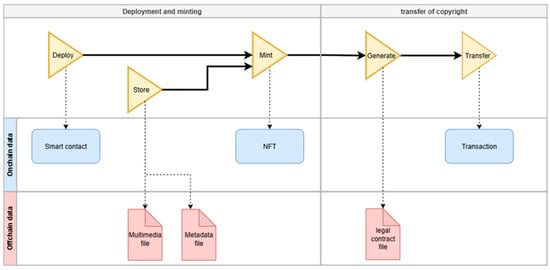
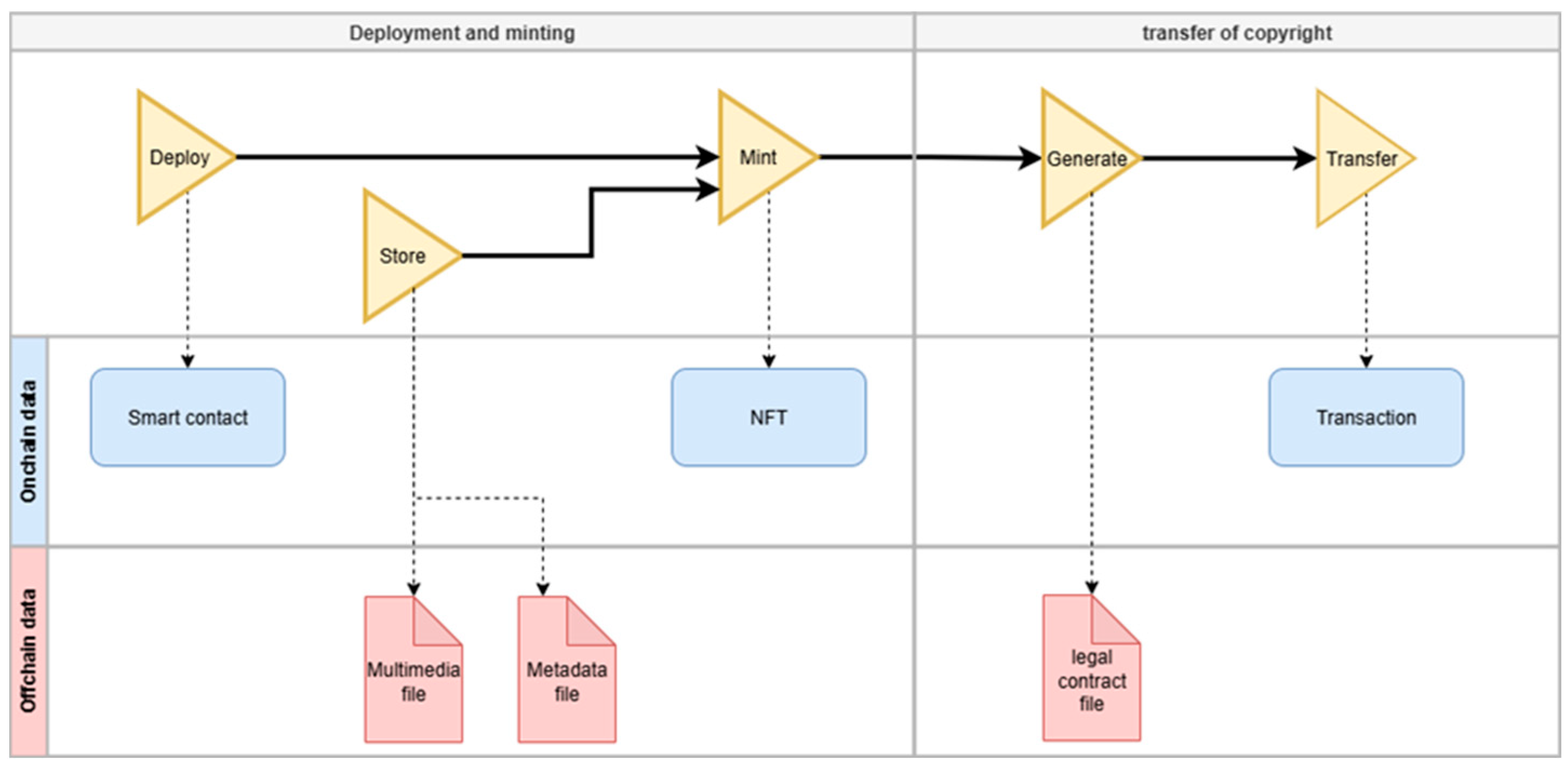
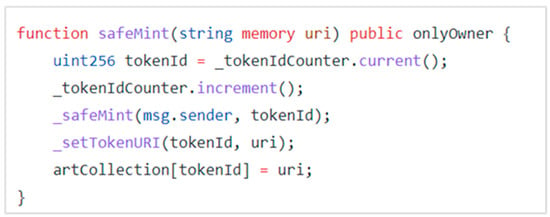
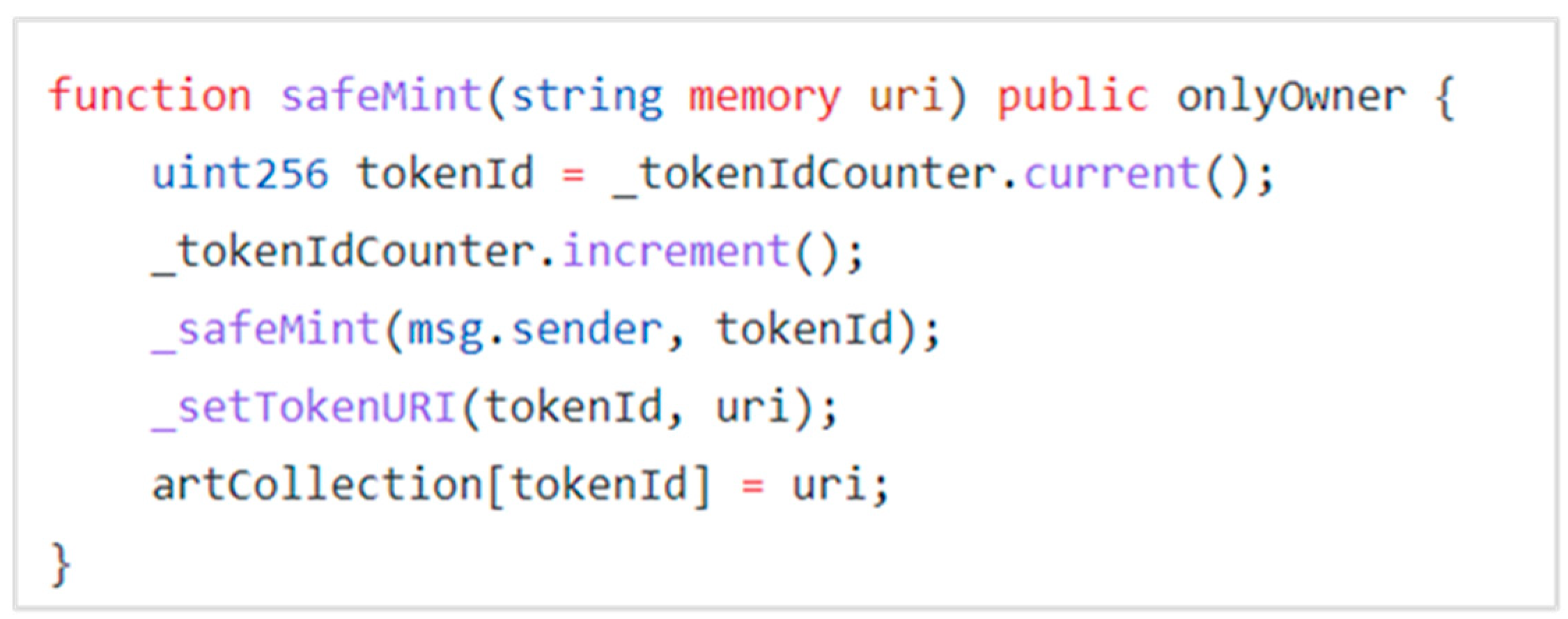
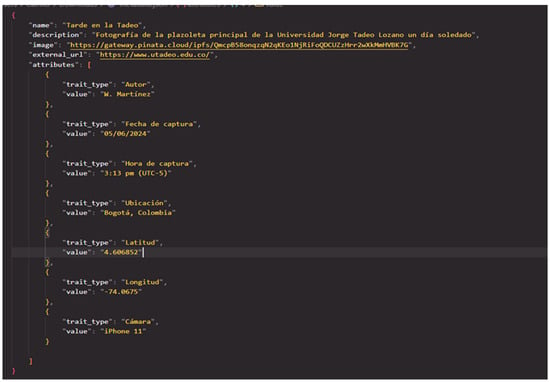
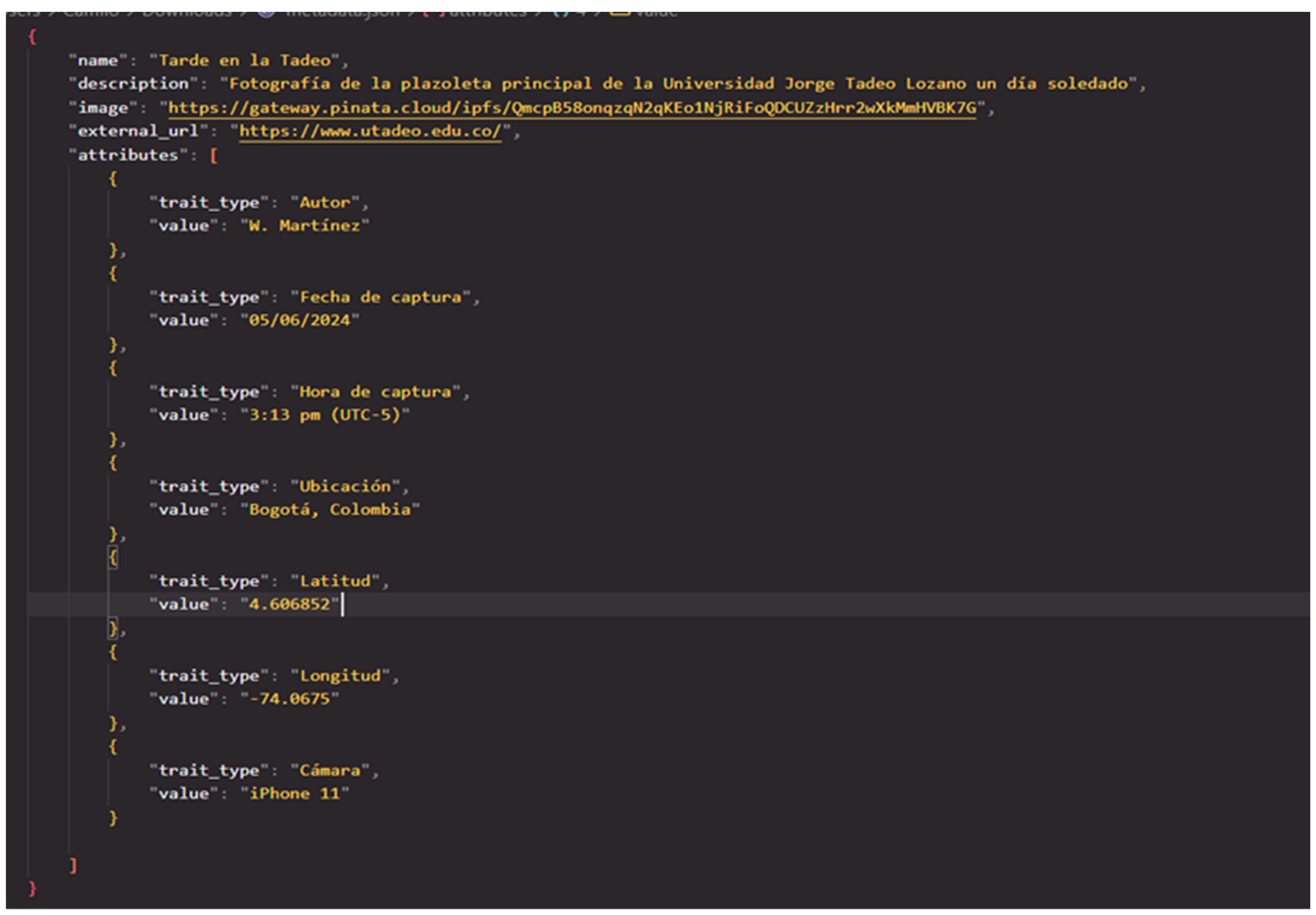

Disclaimer/Publisher’s Note: The statements, opinions and data contained in all publications are solely those of the individual author(s) and contributor(s) and not of MDPI and/or the editor(s). MDPI and/or the editor(s) disclaim responsibility for any injury to people or property resulting from any ideas, methods, instructions or products referred to in the content. |
© 2026 by the authors. Licensee MDPI, Basel, Switzerland. This article is an open access article distributed under the terms and conditions of the Creative Commons Attribution (CC BY) license.