


Abstract
As manufacturers seek to improve cutting process sustainability, alternative metalworking fluid (MWF) strategies are increasingly being explored. For the first time, this study characterises tool wear when shoulder milling both Grade 5 titanium (Ti-6Al-4V) and Grade 2 commercially pure titanium (CP-Ti) with a novel through-spindle Aurion Machining Technologies ionised air (IA) MWF setup. Preliminary results show that during CP-Ti milling trials, the IA strategy led to a tool life of between 85% and 91% of that which was achieved with soluble oil emulsion MWF, whilst during Ti-6Al-4V milling the observed tool life with IA was between 158% and 278% greater than with emulsion coolant at analogous cutting conditions (2.58 and 3.78 times respectively). In addition, IA generated a 26.2% reduction in surface roughness after Ti-6Al-4V milling, potentially indicating a change in tool–surface interaction behaviour. These benefits are compounded as IA returns to its original condition rapidly after utilisation, meaning low environmental and health impact with no waste MWF liquids/gases/mist, clean metal cuttings and low delivery power. Beyond these promising results, cooled and dried but non-ionised air was also shown to perform strongly (regarding tool wear in Ti-6Al-4V milling), relative to emulsion MWF, such that at 190 m/min cutting speed it generated 90% of the tool life which was achieved by the IA strategy. Whilst these preliminary findings require confirmation through repeat testing, IA remains of clear interest for further experimental investigation across a range of subtractive processes. Moreover, this work highlights the potential benefits, niches and configurations for air-based MWFs in general, with further mechanistic and tribological exploration warranted.
1. Introduction and Literature Review
As a result of their excellent specific properties, low thermal conductivity and capacity for osseointegration [1], the global titanium alloy market is set to grow to $9 billion by 2033 [2]. Despite the clear usage incentives, machinability remains a persistent problem for the manufacturing sector, such that improper process control frequently leads to an abbreviated tool life. In response to these concerns, the robust application of metalworking fluid (MWF), e.g., in the form of flood or high-pressure (HP) soluble oil coolant (emulsion), proves to be an operational necessity for the majority of subtractive processes. However, the use of such fluids brings with it its own challenges, not least of which are the problems of recycling and disposal [3], adverse health outcomes for machine operators [4,5], and the post-process burden associated with coolant residue contamination [6].
To address these limitations, recent studies have proposed a number of dry and near-dry alternative metalworking fluid strategies, with liquid nitrogen (LN2), supercritical carbon dioxide (scCO2), and scCO2 plus minimum quantity lubrication (MQL) all becoming increasingly prevalent in the literature [7,8,9,10]. Whilst these approaches have been shown to support marked improvements in both tool life and productivity across a number of contexts, they remain imperfect solutions due to their need for both costly machine tool retrofit and bespoke tooling strategies, in addition to their reliance on consumable fluids. In response to these challenges, ionised air (IA) and ozone-based cutting fluid strategies are currently being explored as a low-cost, consumable-free alternative to the current best practice approaches.
In this context, IA refers to air whose molecules are electrically charged through the acquisition or relinquishment of electrons. Although this phenomenon occurs in nature [11], in industrial settings it is induced through devices which use electrostatically charged plates to produce positively (such as N2+) or negatively (such as O2−) charged air ions. Such devices find application in air purifiers to remove pollutants (dust, pollen, smoke, bacteria, and viruses) through agglomeration and removal [12]. IA is related to, but distinct from, ozone (O3, a triatomic oxygen molecule which reacts with and degrades/destroys pollutants but can be toxic to humans in concentrations high enough to be effective in pollutant removal), which is a common byproduct of air-ionising devices.
Within the machining landscape, work in this area is closely related to the comparatively more commonplace application of non-ionised air as an alternative thermodynamic fluid medium to conventional water-/oil-based MWF. Rubio et al. [13] presented a review of the application of cold compressed air to machining processes. The working principle of these strategies is to exploit the air’s thermal (for cooling) and physical (to remove swarf) properties. Methods typically involve taking compressed air, refrigerating it and applying it to the cutting zone, with the possibility of enhancement and/or efficiency improvements through application of a vortex tube as a refrigeration stage. These air-based approaches have been shown to reduce cutting zone friction and temperature, reduce cutting forces, increase tool life, facilitate chip breaking and evacuation, and reduce cost across a range of processes, including the milling of tool steel [14], Inconel 718 machining [14], turning of cast iron [15], aluminium machining [16] and titanium machining [17].
In more directly relevant work, Vasilko and Matija [18] investigated alternative (gaseous) machining environments during the turning of C45 steel. The authors considered the physical and chemical characteristics and applications of ozone as an oxidation agent, in addition to the phenomena of surface oxidation in metals and the resulting positive effect on machining. This prompted an investigation of the application of ozone to machining processes, as an addition to/an enhancement of non-ionised air. The authors observed tool life and surface finish results, which were comparable to conventional (emulsion) coolant methods at low surface speed and were superior at elevated speeds.
Related research was presented by Zhang et al. [19], who proposed oxide film generation as a means of mitigating elevated wear rates in diamond tooling during the machining of high carbon-affinity metals (e.g., steels). The authors investigated the application of ultraviolet ozone (UV-O3) to the cutting zone during the turning of stainless steel and tungsten, in order to promote a passive oxide layer on the workpiece substrate materials and reduce chemical tool wear mechanisms. In their work, this MWF strategy was combined with an ultrasonic vibration-assisted cutting method; results were compared to equivalent data generated using air, oxygen and O3 in isolation. In doing so, the authors found that UV-O3 promoted the highest oxide growth rate and the longest tool life across both tungsten and stainless steel workpiece materials.
Additional work exploring the use of IA-based strategies for stainless steel machining (of equivalent composition to ISO 15510:2014 [20]) was presented by Kirillov et al. [21], who undertook turning trials using multilayer (TiCN+Al2O3+TiN)-coated tungsten carbide inserts. Throughout cutting trials, tool life was observed to increase by up to 50% compared with dry and conventional emulsion coolant methods when the IA-based strategy was employed. The authors attributed this performance increase to the gas achieving greater penetration into the cutting zone than the alternative strategies, in conjunction with the accompanying reduction in friction which was achieved via the formation of thin tribofilms such as AlN and Al2O3 on both tool and workpiece surfaces. The authors suggested that this strategy may be particularly useful when applied to other hard-to-machine, heat-resistant materials (such as nickel-based superalloys, titanium alloys, etc.).
Aside from gaseous ionised media, Goindi et al. [22] reported the use of ionic liquids based on 1-methyl-3-butylimidazolium as additives to vegetable oil MQL during the milling of AISI 1045 steel. The authors observed that both cutting forces and surface roughness were improved with even very low (1 wt%) additions of the ionic media when compared to dry, conventional (emulsion) and “standard” MQL approaches (i.e., MQL with no ionic addition). Collectively, these findings make a compelling case for additional exploration of ionic liquid cooling and lubrication media; however, further investigation is necessary to understand the mechanisms underpinning these findings.
Despite this promising early research, IA MWFs remain very much in their infancy, such that titanium alloy machining applications are largely unexplored, and the physical and tribological mechanisms underpinning their performance (e.g., protective tribofilm formation, surface modification, etc.) remain poorly understood. In response to this observation, the present study undertakes an initial experimental investigation into the influence of a novel IA-based strategy on tool life, wear behaviour and surface integrity during the resource-efficient single-insert shoulder milling of both ASTM Grade 5 Ti-6Al-4V and ASTM Grade 2 commercially pure titanium (CP-Ti). Whilst this work is therefore limited to the specific machining process employed, it presents the first comparison between IA and an industry-standard flood emulsion coolant approach for two materially distinct titanium alloys and tooling strategies. In doing so, the study makes the scientific contribution of developing preliminary insight into the underlying physical and tribological mechanisms which govern IA-assisted machining processes, and more broadly, the technological contribution of highlighting the practical potential of IA as a low-resource, consumable-free MWF strategy for potential use in aerospace and biomedical manufacturing.
2. Methodology
2.1. Metalworking Fluid Delivery and Installation
With the goal of facilitating close proximity between the delivered ionised fluid medium and the cutting insert, Aurion Machining Technologies IA was supplied via through tool MWF delivery. To realise this goal, the machine tool’s existing compressed air supply into the rotary union was modified via a relatively non-invasive retrofit supported by both the machine tool manufacturer and an IA applications engineer. The installation process referenced a machine-specific spindle schematic obtained directly from the manufacturer and took approximately one hour to complete, with recommissioning (the machine’s return to original state) being significantly quicker.
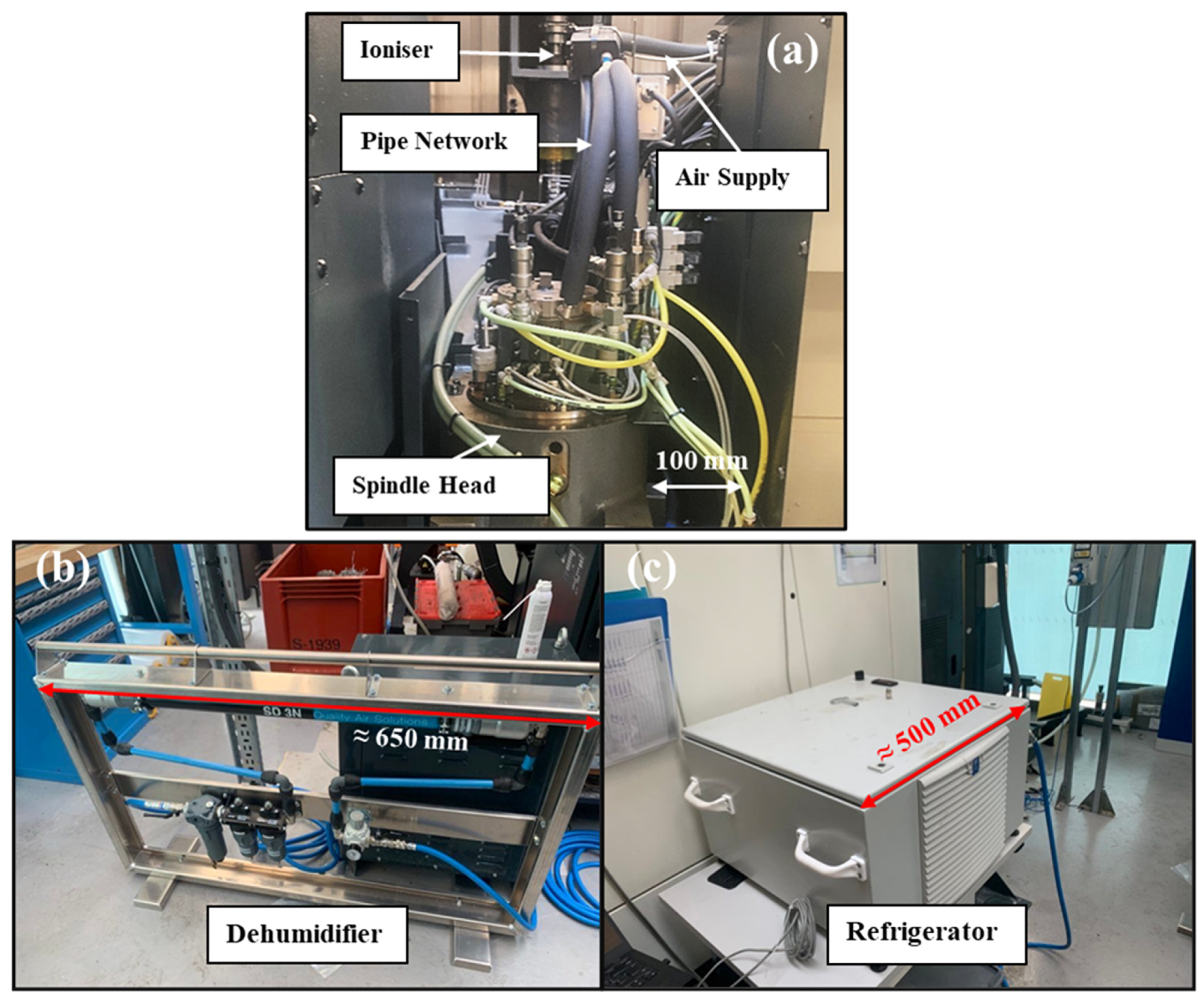
Figure 1a shows the ionisation unit situated adjacent to the spindle head. Prior to reaching this unit, the IA system’s input air was first pre-dried via an external dehumidifier unit shown in Figure 1b and then chilled to approximately 0 °C using the refrigerator shown in Figure 1c. This chilled dried air is transported to the ionisation unit via an insulated pipe network and thereafter transported from the said unit to the machine tool rotary union via further insulated pipes. Whilst the refrigerator unit employed during cutting trials was capable of lower temperature delivery, this temperature was selected to retain compliance with the machine tool manufacturer’s recommendation to maintain air supply temperatures in excess of (warmer than) −10 °C. Throughout the duration of cutting trials, air was supplied at a nominal pressure of 0.35 MPa, as indicated by the integrated pressure readout on the machine shop air compressor supplying the dehumidifier.
Figure 1.
(a) Ionisation unit and associated compressed air, (b) dehumidifier and (c) refrigerator.
Although public disclosure of the specific ionisation process employed via the Aurion ionisation unit (Aurion Machining Technologies, Helsinki, Finland) is limited, the unit was operated using the manufacturer-defined configuration supplied for the investigated titanium alloys and associated tooling combinations. A relevant Aurion patent filing makes reference to an “electric field chamber for producing and outputting ionized gaseous flux”, in which a potential of between 7 and 12 kV may be applied across a needle and cylinder electrode arrangement to generate a corona discharge [23]. This patent also refers to a control system used to adjust “flow rate, polarity and/or ionization level” dynamically “based on input sensing data”, with positive, negative or bipolar operation possible and the operating parameters selected, based upon the specific machining process, and tool-workpiece pairing employed. Because the trial-specific ionisation parameters were proprietary and unavailable to the authors, the IA condition cannot be independently reproduced from the information reported here. The results therefore apply specifically to the manufacturer-defined configuration tested in this exploratory study.
The performance of this IA system was compared against an industrially relevant baseline of flood and through tool soluble oil emulsion coolant. For this role, Vasco 7000 (Blaser Swisslube, Hasle-Rüegsau, Switzerland), a high-performance vegetable ester-based MWF, was utilised at a 10% concentration and approximately 69 L/min flow rate.
2.2. Trial Setup and Parameters
The cutting trials employed within this study were identical in design to those described in prior work comparing scCO2 + MQL and emulsion cooling [24], building upon the single point milling (SPM) methodology outlined by Richetti and colleagues [25] and adapted by others [26]. As shown in Figure 2, shoulder milling (down milling) was conducted on an NVX 5080 vertical 3-axis machining centre (DMG Mori Co., Ltd., Tokyo, Japan) making use of the following two distinct titanium alloys:
- ASTM-F67 Grade 2 commercially pure titanium (CP-Ti) [27]—HB 214 (±4.61);
- ASTM Grade 5 Ti-6Al-4V (Ti-64) [28] solution treated and overaged (STOA)–HB 340 (±1.98).
Figure 2.
(a) Machining trial setup and (b) tool path schematic.
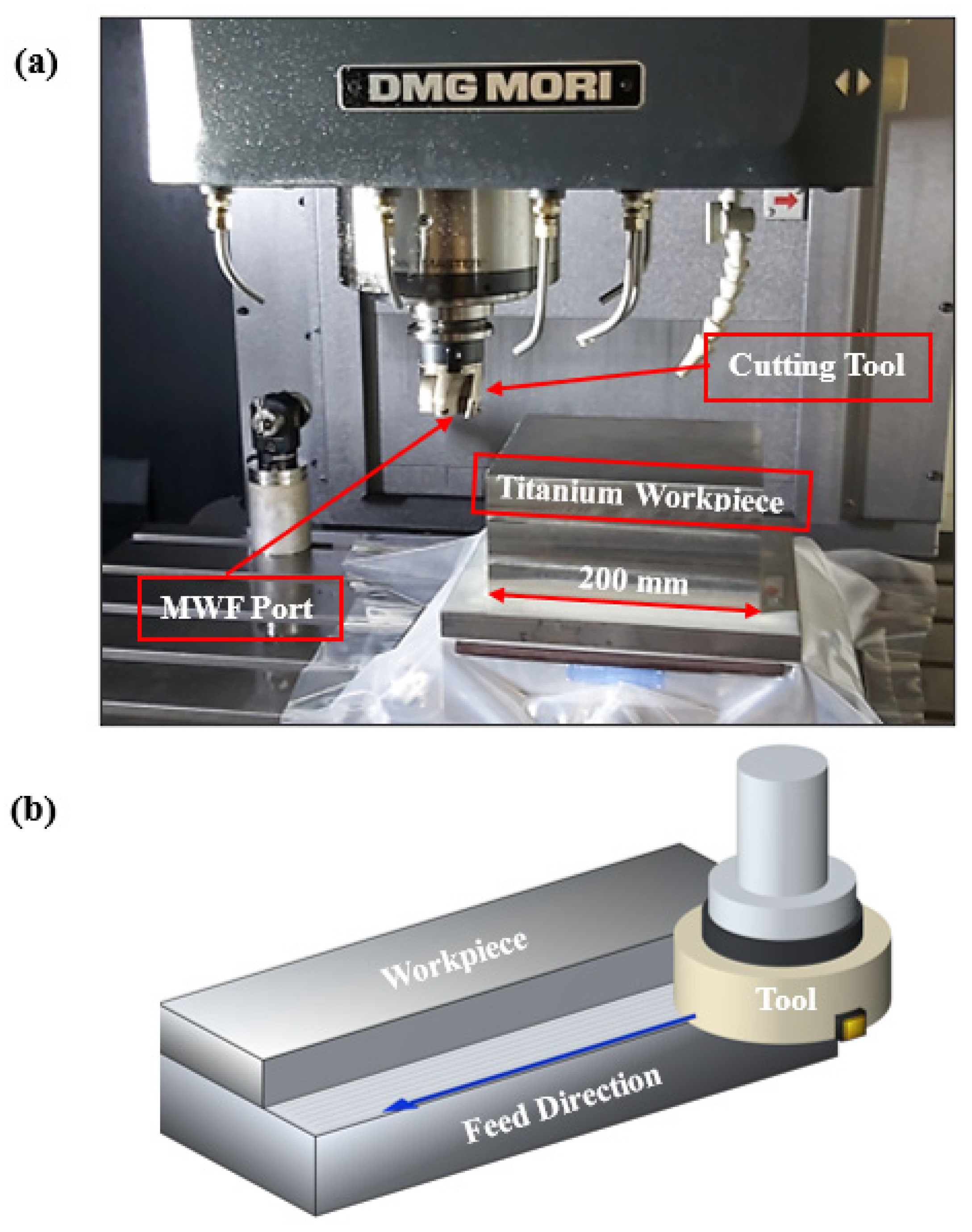
During tool life trials, successive linear cuts were conducted on a cuboidal workpiece, employing a 90° clockwise arc into the cut of 26 mm radius, improving chip formation on entry and replicating industrial best practice. A total of 16 unique tool life trials were conducted throughout experimentation (with one further repeat), employing cutting speeds of between 280 and 330 m/min during CP-Ti machining and between 140 and 190 m/min during Ti-64 trials (in order to vary rates of tool wear to allow for Taylor curve fitting). Due to equipment availability constraints, with the exception of the repeated 150 m/min emulsion coolant trial, each tool life condition was tested once. As such, the focused comparison between IA and non-ionised cooled dried air was conducted at the highest speed for which an IA tool life result was available (190 m/min), minimising test duration whilst enabling a directly comparable baseline.
Aside from cutting speed, other parameters (e.g., feed rate, depth of cut, etc.) were selected based upon both prior experimentation and tooling supplier recommendations. These were held constant throughout all tool life trials (Table 1).
Table 1.
Nominal cutting parameters employed in the current study, as previously used in [24]. Data from Ref. [24].
Primary machining activity utilised an E341455252245 BT40 back end, 50 mm diameter R220.69-0050-12-5AN tool holder (with a single MWF exit hole focused on the relevant insert seat) and XOEX120408R-M07 MS2050 TiAlN, NbN physical vapour deposition (PVD)-coated milling inserts. These tools were selected as the best practice recommendation for the milling of Ti-6Al-4V with emulsion coolant. In order to establish whether these recommendations should persist for future IA-based MWF research, a single additional cutting trial was conducted with a R220.96-0050-08-5A tool holder and a XNEX080608R-M08 H25 (uncoated) insert (all cutting tool components were manufactured by Seco Tools AB, Fagersta, Sweden).
2.3. Data Acquisition and Processing
Throughout the cutting trials flank wear was measured via the use of a Stemi 508 stereoscopic microscope (Carl Zeiss Microscopy GmbH, Jena, Germany), with image capture and analysis processed through the ZEN 3.3 Blue image acquisition and processing software package. As cutting tools typically follow an “S curve” style wear progression—with rapid initial wear-in, a prolonged steady state wear period and rapid wear-out—the flank wear measurement frequency was intentionally increased around the periods of initial use and tool failure. In order to remain consistent with both prior research [24] and common industrial practice, an average and maximum flank wear limit of 250 µm and 500 µm, respectively, were employed. In accordance with ISO 8688 [29], flank wear was measured based on five or more dot-line measurements taken at evenly spaced locations across the flank wear scar.
In addition to tool life data, a dedicated Ti-6Al-4V surface was generated with the IA strategy and compared with four equivalent emulsion-cooled surfaces produced during a preceding machining trial (using the same machine, cutting tool and parameters). A cutting speed of 170 m/min was therefore selected for sample generation, both because it falls within the 140–190 m/min cutting speed range investigated during Ti-6Al-4V trials and to enable this direct comparison with the existing surfaces.
Surfaces were generated with an 8 mm axial depth of cut and a 1 mm radial depth of cut. The axial depth of cut was selected to provide sufficient measurable surface length and to allow the necessary clearance for the profilometer stylus. Across each sample, a total of 10 equidistant surface roughness measurements were taken perpendicular to the feed direction. Each surface was generated with a fresh insert on a newly machined coupon to ensure consistent starting conditions and depth of cut. Roughness was measured via a Surftest SJ-410 (Mitutoyo Corporation, Kawasaki, Japan) contact profilometer, making use of a cut-off length of 0.8 mm in addition to a minimum evaluation length of 4 mm (in accordance with ISO Standard 4288 [30]).
An AlphaLab portable ion counter (AlphaLab, Inc., South Salt Lake, UT 84115, USA) was used to sample the air around the outer perimeter of the machine chamber, where the machine operator would stand, to see if any ionisation effect was detectable there during the trials.
3. Results and Discussion
3.1. Tool Flank Wear: CP-Ti
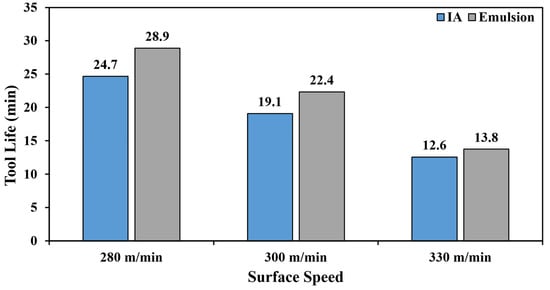
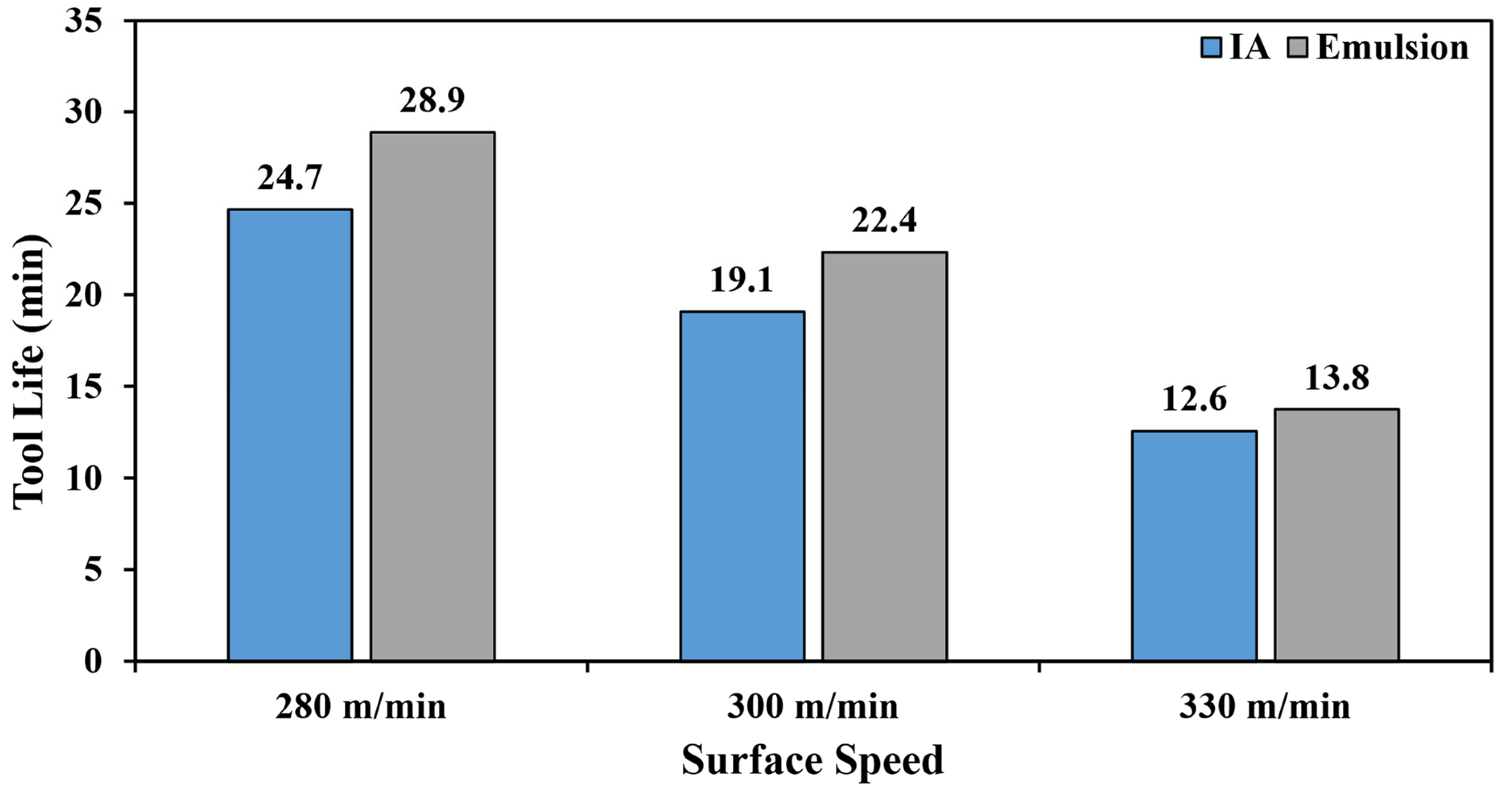
Figure 3 shows that, across the three cutting speeds trialled, the tool life outcomes generated by the IA delivery system were lower but comparable to emulsion coolant. At 280 m/min the IA strategy generated 85% of the tool life of emulsion coolant, whilst at 330 m/min it generated 91% of the equivalent emulsion tool life. In agreement with the work of Vasilko and Matija [19], this indicates that the performance of IA and emulsion coolant converge at higher cutting speeds, and conversely that at lower speeds (higher tool life), the reduced tooling consumption associated with the emulsion coolant approach is more profound.
Figure 3.
Tool life comparison during indexable shoulder milling of CP-Ti.
Examining the data from a productivity perspective, fitted Taylor tool life relationships of for emulsion coolant and for IA indicate that a tool life of 20 min would be achieved at cutting speeds of approximately 305 m/min and 295 m/min respectively. Given the constant feed per tooth and depths of cut employed during experimentation, IA usage would therefore correspond to a 3.1% reduction in material removal rate (MRR) relative to emulsion coolant. Consequently, although this highlights a reduction in productivity, the difference is likely modest relative to the operational, health and safety and cleanliness benefits which are associated with avoiding liquid oil MWFs.
3.2. Tool Flank Wear: Ti-6Al-4V
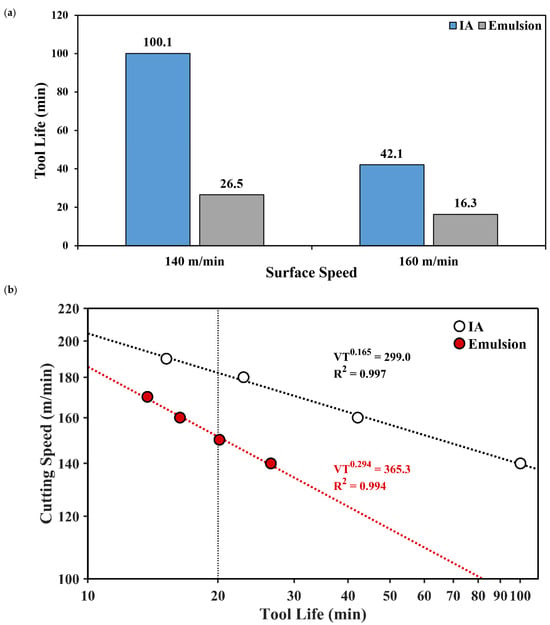
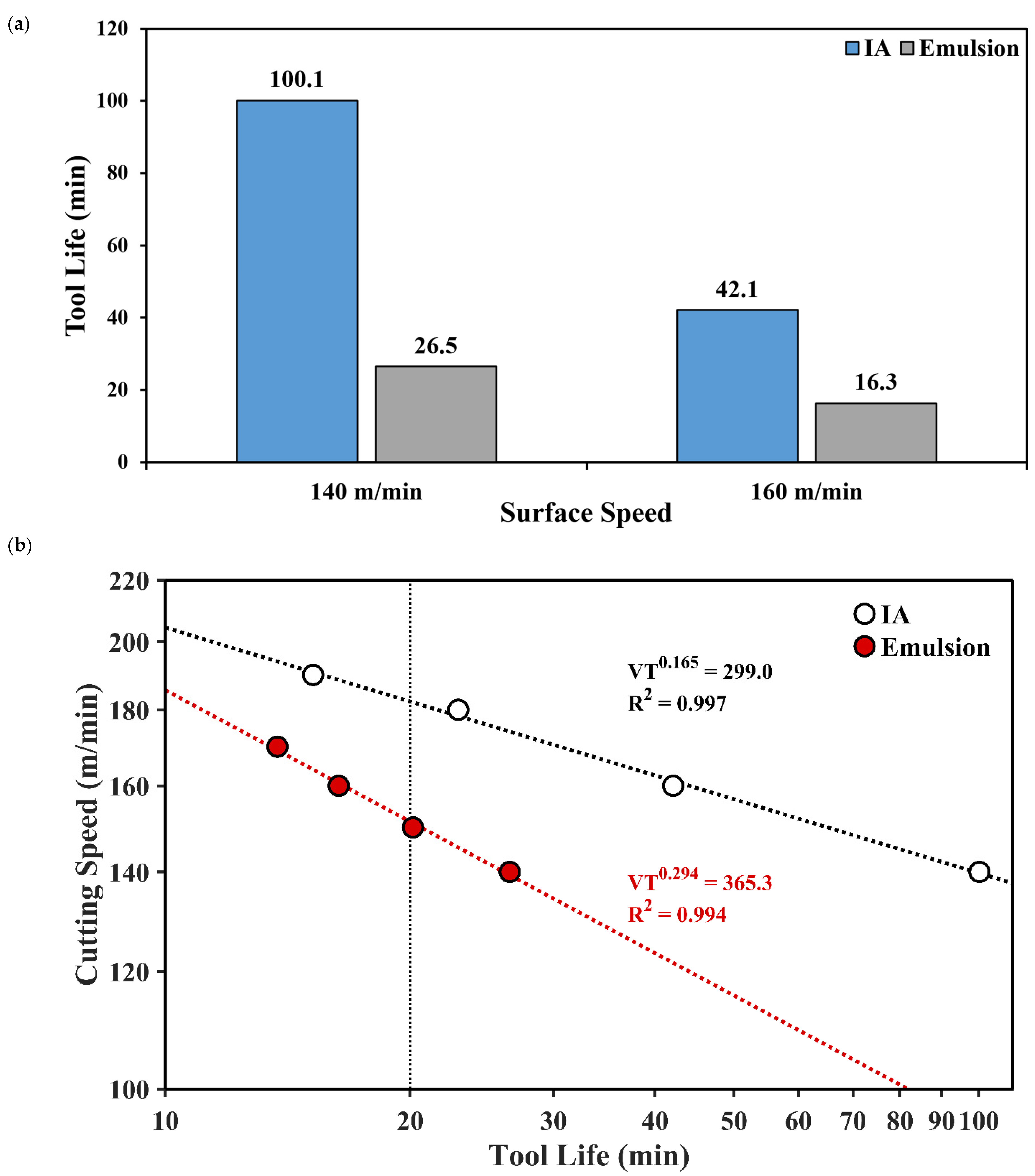
In addition to the testing which was undertaken on CP-Ti, Figure 4 compares IA to emulsion coolant during Ti-6Al-4V milling. Figure 4a presents the results at the two common cutting speeds, whilst Figure 4b presents all the trialled cutting speeds for each MWF strategy. At the two common speeds, IA produced substantially longer tool life than emulsion coolant. At 140 m/min, the observed tool life with IA was 278% greater than with emulsion coolant, whilst at 160 m/min a 158% increase was realised (i.e., 3.78 and 2.58 times longer tool life respectively). Critically, although the magnitude of tool life improvement was markedly greater in the present work, this observed benefit of IA relative to emulsion coolant aligns with the earlier findings of Kirillov et al. [21].
Figure 4.
Tool life comparison during indexable shoulder milling of Ti-6Al-4V at (a) like cutting speeds and (b) at all conditions (log axes), where is cutting speed, is tool life, and is the coefficient of determination for the Taylor power-law fit.
When the tool life tests are plotted on logarithmic axes, it becomes clear that wear development is markedly slower at all trialled conditions when the IA strategy is employed. Based upon the fitted trendlines, 20 min of tool life would be achieved at a cutting speed of 151 m/min with emulsion coolant and 182 m/min for IA. In this regard, preferential usage of IA would lead to a 20.5% increase in MRR at a nominal tool life criterion.
For the Ti-6Al-4V data, the close agreement of the experimental results with the fitted Taylor tool life relationships (R2 = 0.994 and 0.997 for emulsion and IA, respectively) demonstrates strong internal consistency across the tested cutting conditions. This is supplemented by the fact that when the 150 m/min emulsion trial was repeated, it yielded a tool-life outcome similar to the original trial; however, it is important to note that the single replicate does not permit statistical inference regarding repeatability.
3.3. Flank Wear: Coating Grade Comparison
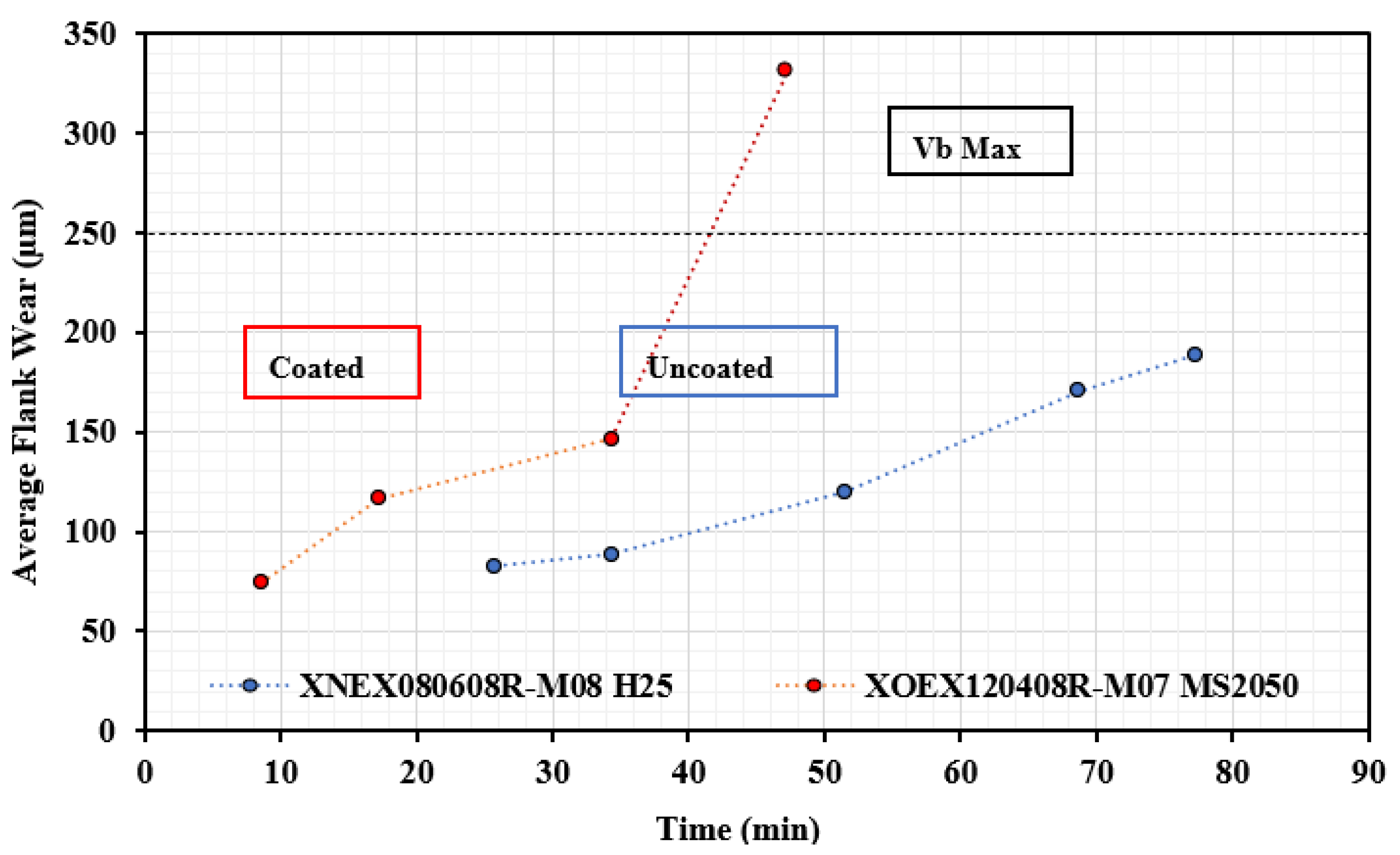
Given that IA MWF strategies are proposed to affect machinability outcomes via tribochemical modification across the chip-tool contact (Section 3.7), interest exists in understanding how these effects are altered by the chemistry of the cutting tool surface. To explore this, a preliminary comparative wear assessment was conducted with an analogous uncoated insert. In this regard, although insert geometry differed somewhat between the coated and uncoated cutting tools (reflecting limited off-the-shelf grade availability), initial screening experiments indicated similar performance when coating species was controlled, making them suitable for comparative assessment.
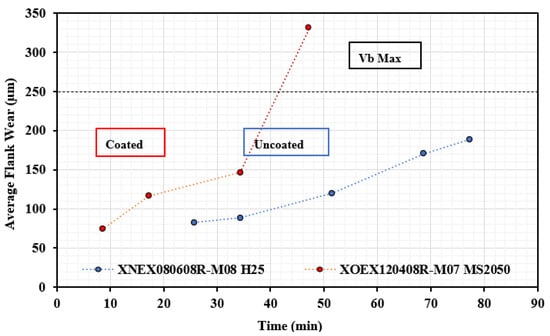
Although it became uneconomical to continue testing the H25 grade uncoated insert to tool failure, Figure 5 shows flank wear development to be markedly more stable than was observed in the MS2050 coated counterpart. Throughout testing, the flank wear present on the uncoated insert gradually increased in a pseudo linear fashion consistent with steady-state progression (stage 2), failing to reach the catastrophic accelerated wear regime (stage 3) within the available 77 min of cutting time. This directly contrasts with the coated insert, which despite exhibiting a comparable steady state wear rate, progressed into the catastrophic wear regime/stage after approximately 35 to 40 min of use.
Figure 5.
Flank wear progression over time during IA-assisted indexable shoulder milling of Ti-6Al-4V (160 m/min) with two distinct insert grades.
While testing of the uncoated insert was discontinued prior to tool failure, the available data show that (under the present IA conditions) the uncoated cutting tool exhibited a more gradual and sustained flank wear progression than the coated grade tested. This is noteworthy as the uncoated insert utilised during experimentation is generally recommended for aluminium alloys, whilst the coated tools serve the heat-resistant superalloy market and are specifically recommended for titanium alloys such as Ti-6Al-4V. The implication of this is that tooling recommendations which are made based upon emulsion coolant conditions do not necessarily persist for alternative MWF environments, where both the thermal and tribochemical conditions in the cutting zone are materially changed; however, repeat trials are necessary to validate this claim.
3.4. Flank Wear: IA Versus Cooled Dried Air
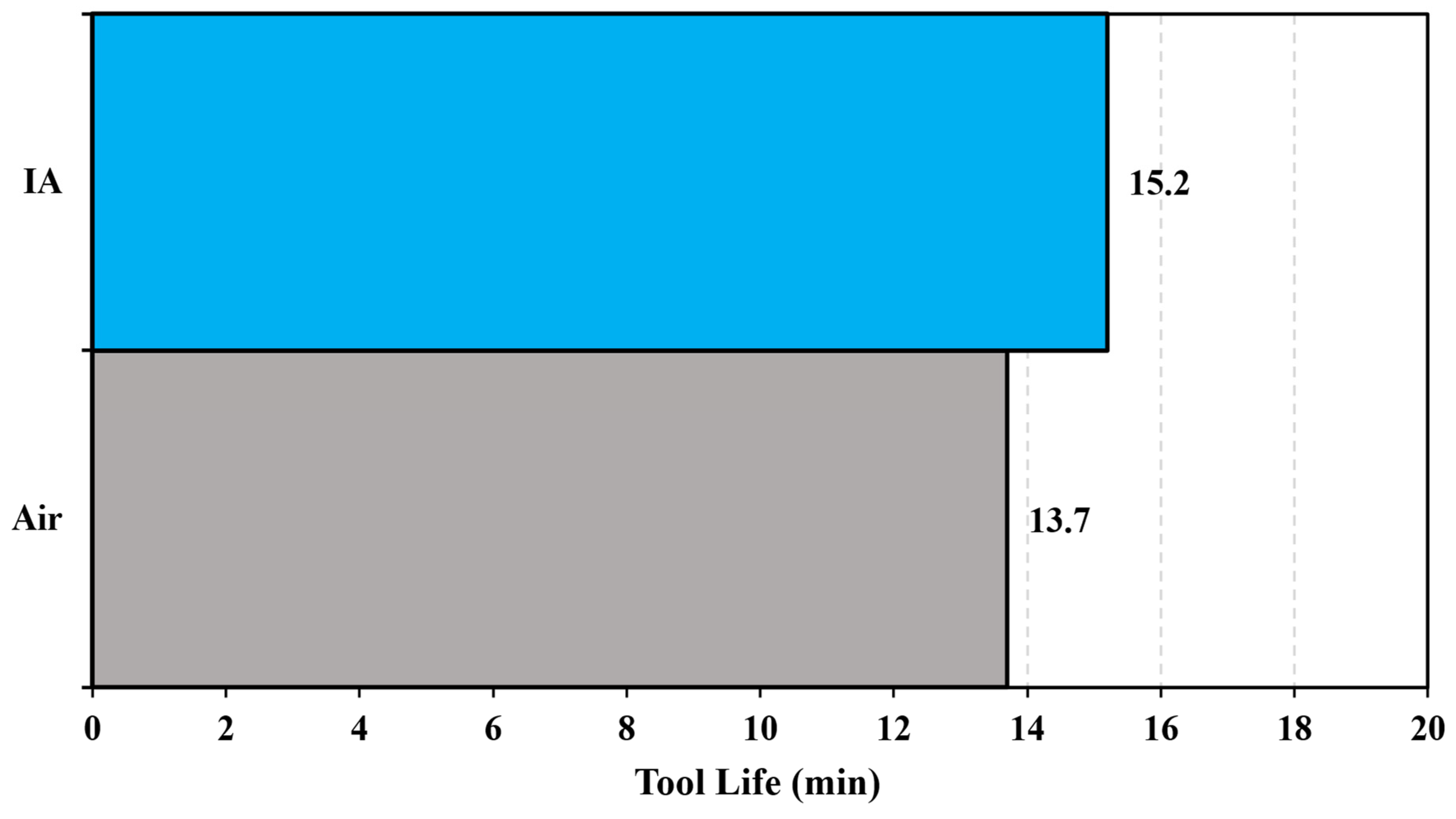
Given the perceived tool life benefit of the IA strategy, a further cutting trial was conducted to establish what portion of the improved tool life outcomes could be attributed to the ionisation effects of the MWF medium. In order to achieve this goal, Figure 6 compares the IA strategy with non-ionised, cooled dried air supplied at identical temperatures and pressures.
Figure 6.
Tool life comparison between IA and dried, cooled compressed air during Ti-6Al-4V milling at 190 m/min.
In doing so, it was observed that at a cutting speed of 190 m/min, ionisation led to an 11% increase in tool life outcomes relative to the equivalent non-ionised strategy. In this regard, whilst an analogous emulsion coolant equivalent trial was not conducted, at 170 m/min, emulsion corresponded to a tool life of 13.7 min. As this figure is equivalent or lower than that which was attained at the greater cutting speed employed during both air-based machining trials, it can be reasonably stated that both IA and non-ionised air would be expected to outperform emulsion coolant in this context. In this regard, whilst the strong performance of cooled, dried air aligns with prior research on titanium alloy machining [14,18], the present exploratory comparison comprised only two single trials with and without ionisation. As such, repeat testing would be required to determine if the performance difference is statistically significant.
It should also be noted that in prior cutting trials (Section 3.2), performance was seen to converge between MWF strategies at greater cutting speeds. As such, it is possible that the benefit of ionisation (over regular, cooled dried air) could be heightened at reduced cutting speeds; however, further experimentation is necessary in order to establish this.
3.5. Wear Micrographs: Ti-6Al-4V
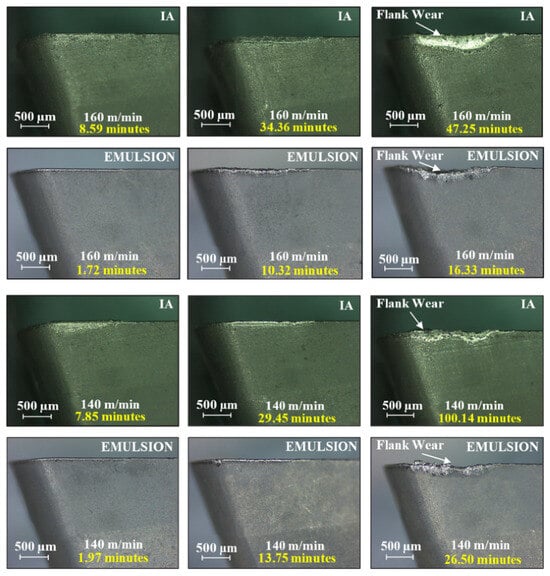
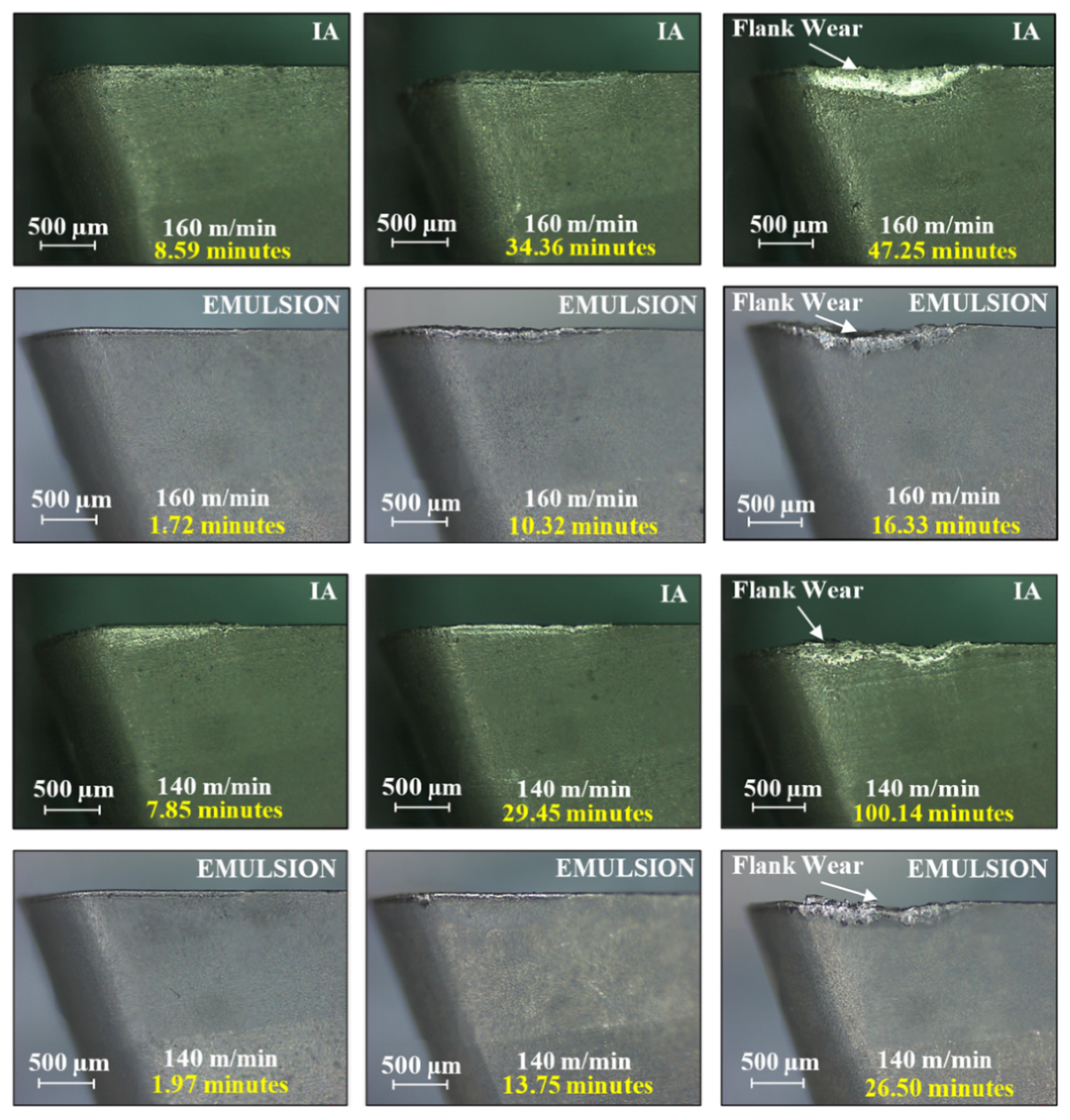
To ascertain differences in wear mechanisms between the IA strategy and the emulsion coolant baseline, it is worthwhile to examine analogous wear micrographs shown in Figure 7. In doing so, it can be seen that adhered material (generally a bright, shiny agglomeration) accumulates on the flank face of both the emulsion coolant- and IA-exposed cutting tools at both of the cutting speeds employed.
Figure 7.
Tool flank wear micrographs during the indexable shoulder milling of Ti-6Al-4V at two distinct cutting speeds. “IA” is ionised air.
At tool failure, the flank wear scars appeared to be more superficial during IA trials than during emulsion coolant trials, which featured deeper wear scars with greater volumetric material loss. This observation was particularly heightened at the elevated cutting speed where observed flank wear in the IA trial appeared to be reminiscent of coating removal, adhesive agglomeration or potentially built-up-edge (BUE), as opposed to true material loss. This may indicate that ionisation plays a role in retaining a stable adhered layer, or conversely that emulsion coolant extinguishes such a layer; however, this is explored further in Section 3.7.
3.6. Surface Roughness, Ion Count and Chip Evacuation
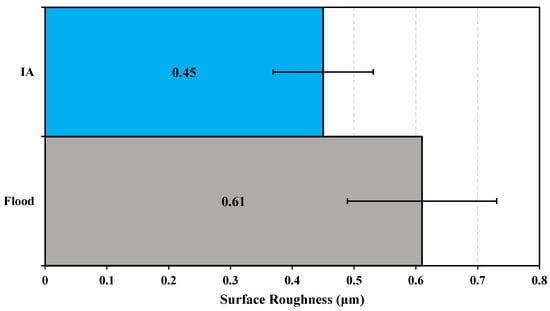
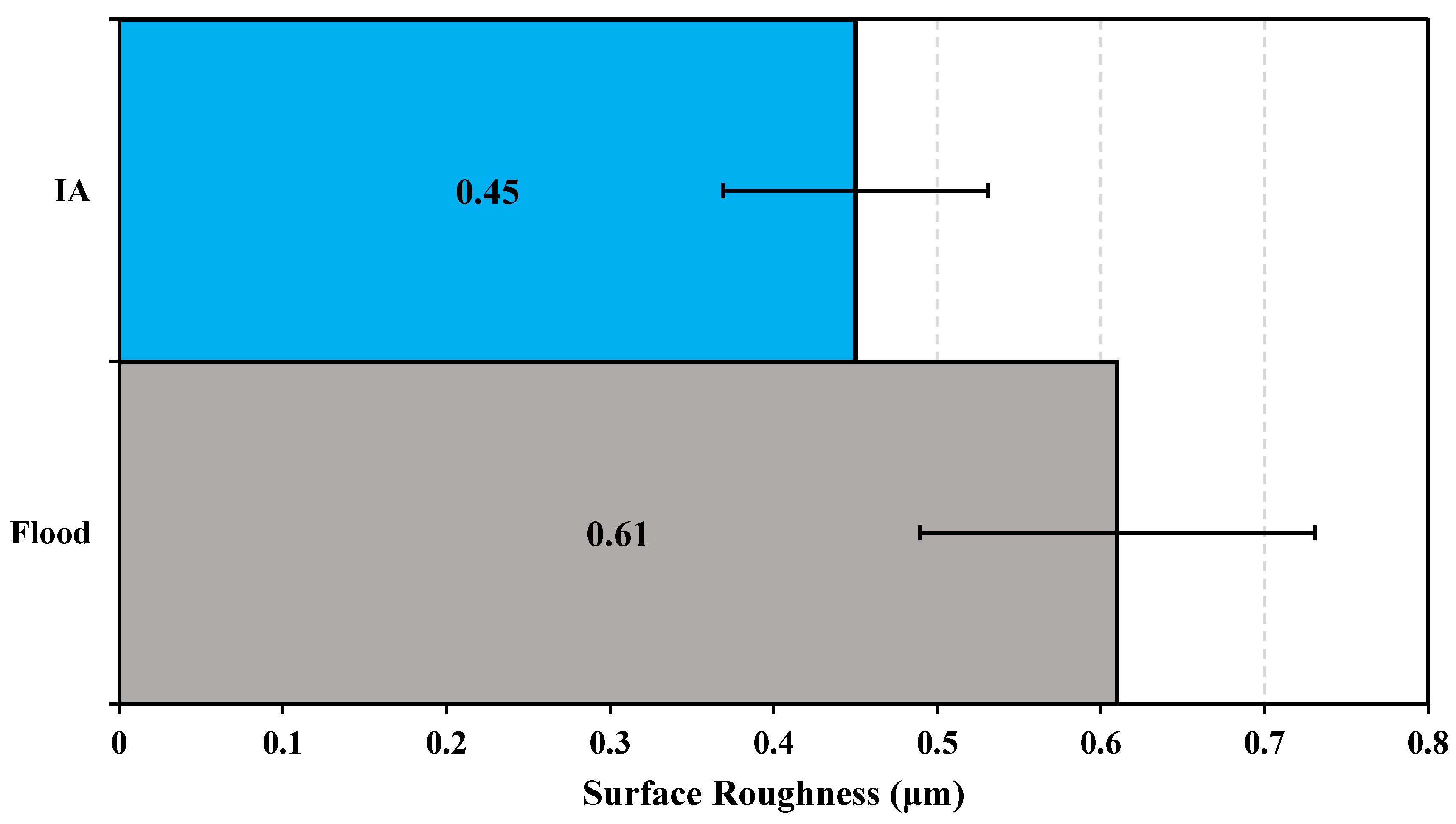
To supplement the tool life assessment, Figure 8 compares the surface roughness measurements obtained at a cutting speed of 170 m/min for both the IA and emulsion MWF strategies. In doing so, the mean surface roughness measured across the single IA machined surface was 26.2% lower than the corresponding mean obtained from the four emulsion coolant surfaces. Whilst further measurements across independently machined repeat IA surfaces are required to determine if this difference is statistically significant, this result indicates a potentially meaningful change in machined topography. Although it is difficult to isolate why this difference occurred, potential rationales could be related to improved chip formation stability, surface interaction with the tool’s BUE, or other tribochemical factors. Further work is therefore necessary both to isolate the relative contributions of these mechanisms and to establish how surface roughness evolves throughout the flank wear progression for each MWF strategy.
Figure 8.
Milled surface roughness comparison between IA and emulsion MWFs (Ti-6Al-4V, 170 m/min, radial depth 1 mm, axial depth 8 mm).
When the air around the outer perimeter of the machine chamber was sampled for its ion count, levels were identical to the air tested elsewhere within a large machining laboratory. An increase in the registered count was only observable by sampling air inside the machine chamber, in the first minute after machining had ceased. This aligns with the understood nature of this IA technology, wherein the ionisation phenomenon is both temporary and localised such that any atmospheric effects dissipate within seconds after delivery. When this is considered in conjunction with the lack of MWF waste requiring disposal, the anticipated good recyclability of any generated swarf (due to lack of MWF contamination), the minimal pumping power requirement of the low viscosity medium and the lack of respirable emulsion coolant mist—the environmental and occupational health impact of IA strategies can be seen to be much reduced relative to conventional soluble oil approaches.
In addition to these favourable topographical and health and safety findings, the cutting trials provide useful qualitative observations regarding chip handling. Although formal chip morphology analysis was beyond the scope of this work, no cases of chip nesting, recutting or otherwise problematic accumulation were observed for either strategy. In this regard, although the low-pressure IA strategy effectively evacuated chips from the cutting zone, IA occasionally led to a small number of loose chips being left on the machine bed, which would have otherwise been washed away completely by the emulsion coolant strategy. Whilst these chips presented no operational challenges to the machine tool operator and engineering staff during the machining process, it is possible that during higher material removal rate part manufacturing, this could become a challenge. One potential means of addressing this (whilst retaining a coolant residue free machining environment) would be to employ a periodic high-pressure air blast between machining operations; however, as this loose material could likewise easily be manually brushed away, the need for such an intervention should be considered on a process-by-process basis.
3.7. Proposed Mechanism of Action
The observation that IA led to comparable or superior tool life outcomes relative to emulsion coolant is contrary to initial expectations. In MWF terms, air is only a modest coolant and is not considered an effective lubricant. In this regard, whilst the compressed air carrier medium of the IA strategy is chilled, its low-density, low-pressure delivery does not offer anything close to the cooling capacity of an abundant, through tool, liquid emulsion coolant supply [31]. This low-pressure delivery also means that chip breakability is unlikely to be materially affected and is in any case unlikely to be comparable to high-pressure soluble oil approaches. Nonetheless, several plausible, though as yet unverified, mechanisms may explain the marked performance improvements observed during IA application.
Primarily, ozone, which is produced during high-voltage discharge-based ionisation processes (e.g., corona-type systems [32]), is an extremely potent oxidiser [33]. As such, the IA medium may act as a tribochemical precursor capable of oxidising the cutting tool, chips and feedstock material. In this regard, consistent with the surface modification mechanisms proposed within the literature [22,23], it is possible that the ionisation process promotes protective tribofilm formation on the tool or workpiece during machining which inhibits tool wear development (presumably in this case the uncoated tool would be more susceptible to this film formation). The film may function as a lubricious low shear interface between chip and tool [34], reducing cutting forces, abrasion and heat generation. Similarly, it may be harder or more chemically inert than the cutting tool substrate material and may therefore function in a similar manner to a PVD hard coating or to a CVD diffusion-barrier coating (respectively) [35,36].
If a chemically inert tribofilm is indeed generated during the cutting process, it would follow that diffusion-dominated wear mechanisms such as crater wear and built-up edge (BUE) would be minimised during machining. However, the inverse may also be true, i.e., the ionisation process could promote the formation of a stable BUE and in turn that could protect the cutting tool. This interpretation aligns with the observed surface roughness data and the wear scar morphology; moreover, it is supported by aspects of the early cryogenic machining literature wherein Uehara and Kumagai [37,38] noted that in some contexts (i.e., stainless steel) specific MWF conditions could extinguish BUE formation to the detriment of tool life.
Of the proposed mechanisms, the hypothesis that IA promotes the formation or stabilisation of a protective BUE currently has the strongest morphological support, given the more prominent apparent adhered layer present in the IA tool wear micrographs. Nonetheless, as stated, this evidence remains morphological rather than chemical. Further characterisation of the worn tools using both scanning electron microscopy (SEM), energy dispersive X-ray spectroscopy (EDS) and X-ray photoelectron spectroscopy (XPS) would be necessary to establish the nature and composition of the adhered material and the presence or lack thereof of protective oxides or other tribochemical films. Until such analysis is conducted, the relative contributions of these mechanisms cannot be reliably determined.
In addition, because cooled dried air achieved approximately 90% of the tool life of the IA strategy, performance improvement cannot be attributed solely to ionisation effects. The data may indicate that the use of emulsion coolant has an adverse effect on BUE formation, rather than IA specifically supporting favourable BUE conditions. Separately, air-based machining conditions (at least in this context) likely lead to a reduction in thermal cycling relative to emulsion coolant, making factors such as thermal fatigue and coating degradation less severe. It is also possible that the single insert methodology employed during cutting trials favours air-based MWFs. Further work would be required to isolate the relative contributions of methodological, ionisation, and airflow factors more definitively.
4. Conclusions
This study presents an independent single insert shoulder milling assessment of a novel, through-spindle, Aurion Machining Technologies Ionised Air (IA) based metalworking fluid (MWF) delivery system. The work compares tool life and surface roughness performance against both soluble oil emulsion coolant and chilled, dried air for two industrially relevant titanium alloys (Grade 2 commercially pure CP-Ti and Grade 5 Ti-6Al-4V). In doing so it was found that IA led to either comparable or improved performance outcomes across each of the cutting conditions employed. The key findings of the study are as follows:
- At 140 m/min and 160 m/min, the observed tool life with IA was 278% and 158% (3.78 and 2.58 times respectively) greater than emulsion coolant during the low-depth of cut, indexable shoulder milling of Ti-6Al-4V;
- During Ti-6Al-4V trials, IA was interpolated to generate a target tool life of 20 min at a cutting speed of 182 m/min, as opposed to 151 m/min with emulsion coolant, supporting an approximately 20% increase in productivity;
- During CP-Ti trials, the tool life outcomes generated by IA were similar to that of emulsion coolant: 85% tool life at both 280 m/min and 300 m/min in comparison to 91% at 330 m/min;
- Relative to emulsion coolant, IA produced shallower flank wear scars on the cutting insert with lower volumetric material loss, as well as a large stable adhered layer;
- IA was shown to generate an 11% increase in tool life relative to dried and cooled non-ionised atmospheric air, whilst both strategies were inferred to outperform emulsion coolant;
- During Ti-6Al-4V milling, IA usage was shown to correspond to a 26.2% reduction in surface roughness relative to emulsion coolant;
- IA was shown to return to its original condition rapidly after utilisation, meaning low environmental and health impact, with no waste MWF liquids/gases/mists to be dealt with;
- Through spindle installation of the IA delivery system, in addition to the post-trial recommission of the emulsion system, took less than two hours of total time to enact;
- No incidents of tool sparking or swarf combustion occurred during four days of small-scale machining trials, a prerequisite for moving to larger-scale titanium machining.
Collectively, these findings present IA MWF strategies as a promising alternative to both the soluble oil-based approaches which are ubiquitous in industry, and the CO2/LN2 strategies which are currently being explored throughout the scientific literature. In practical terms, this study highlights that tool wear is best managed on a case-by-case basis by selecting a MWF strategy, which is tailored to the specific alloy/tooling combination in question and the machining process employed. The work also highlights that cutting speed should be determined using fitted Taylor relationships to strike a balance between productivity and tool life, which reflects both cost and sustainability objectives. Whilst the present research is therefore limited to the investigated machining conditions, the results highlight the considerable potential of IA as a process medium for titanium alloy machining and provide further insight into the fundamentally different thermal and tribological conditions underlying these performance improvements.
Despite this clear promise, further research is warranted both to experimentally validate the mechanisms proposed in this work and to begin to develop analytical models which explore the influence of ionisation on machining performance (building upon approaches demonstrated for other assisted machining processes [39,40]). In addition, given that most cutting conditions were assessed using a single tool life trial, repeat testing is necessary to quantify experimental variability and confirm the preliminary trends reported in the present work. Future work should therefore employ replicated factorial design of experiment (DOE) methodologies (supported by analysis of variance [ANOVA]) to establish the statistical significance of the main and interaction effects of IA and various machining parameters, ultimately supporting robust process optimisation.
Author Contributions
Conceptualisation, L.P. and C.M.T.; methodology, L.P. and C.M.T.; investigation, L.P., I.C. and C.M.T.; writing—original draft preparation, L.P., I.C. and C.M.T.; writing—review and editing, L.P., I.C., P.C. and C.M.T.; visualisation, L.P.; supervision, C.M.T. and P.C.; funding acquisition, C.M.T., P.C. All authors have read and agreed to the published version of the manuscript.
Funding
This research was part funded by Aurion Machining Technologies, and part funded by EPSRC “Manufacturing the Future” grant EP/W002175/1.
Data Availability Statement
The original contributions presented in this study are included in the article. Further inquiries can be directed to the corresponding author.
Acknowledgments
Our sincere thanks to DMG Mori’s Atsushi Saino and Aurion’s Jori Oravasaari for their help in retrofitting the machine tool.
Conflicts of Interest
The authors declare that this study received funding from Aurion Machining Technologies. The funder was not involved in the study design, collection, analysis, interpretation of data, the writing of this article or the decision to submit it for publication.
References
- Bosshardt, D.D.; Chappuis, V.; Buser, D. Osseointegration of Titanium, Titanium Alloy and Zirconia Dental Implants: Current Knowledge and Open Questions. Periodontol. 2000 2017, 73, 22–40. [Google Scholar] [CrossRef] [Scilit]
- Market Reports World. Titanium Alloy Market Size, Share, Growth, and Industry Analysis, by Type (Plate, Bar, Tube, Others), by Application (Aero & Aviation, Industrial, Medical, Others), Regional Insights and Forecast to 2033. Available online: https://www.marketreportsworld.com/market-reports/titanium-alloy-market-14716579 (accessed on 10 December 2025).
- Grossi, M.; Riccò, B. Metalworking Fluid Degradation Assessment by Measurements of the Electrical Parameters at Different Temperatures. Procedia Environ. Sci. Eng. Manag. 2017, 4, 59–68. [Google Scholar]
- Proud, L.; Tapoglou, N.; Slatter, T. A Review of CO2 Coolants for Sustainable Machining. Metals 2022, 12, 283. [Google Scholar] [CrossRef] [Scilit]
- Kumar, P.; Jafri, S.A.H.; Bharti, P.K.; Siddiqui, A. Study of Hazards Related To Cutting Fluids and Their Remedies. Int. J. Eng. Res. Technol. 2014, 3, 1225–1229. [Google Scholar]
- ISO 19227:2018; Implants for Surgery—Cleanliness of Orthopedic Implants—General Requirements. International Organization for Standardization: Geneva, Switzerland, 2018.
- Demirbaş, A.; Köklü, U.; Morkavuk, S.; Giasin, K.; Kocaman, E.; Sarıkaya, M. Machining-Induced Damage and Corrosion Behavior of Monel-400 Alloy Under Cryogenic Cooling Conditions: A Sustainable Initiative. Int. J. Precis. Eng. Manuf.-Green Technol. 2025, 12, 493–508. [Google Scholar] [CrossRef] [Scilit]
- Sen, B.; Bhowmik, A.; Rachchh, N.; Patil, N.; Khatibi, A.; Kumar, R. Exploring Cryo-MQL Medium for Hard Machining of Hastelloy C276: A Multi-Objective Optimization Approach. Int. J. Interact. Des. Manuf. (IJIDeM) 2025, 19, 4773–4786. [Google Scholar] [CrossRef] [Scilit]
- Zuo, C.; Zhang, H.; Zhang, J.; Gao, Z.; Wang, K. Research on Machinability of 50% SiCp/Al with High-Speed Milling under Supercritical Carbon Dioxide (scCO2)-Based Cooling Conditions. J. Manuf. Process. 2025, 152, 1150–1165. [Google Scholar] [CrossRef] [Scilit]
- Proud, L.; Tapoglou, N.; Wika, K.K.; Taylor, C.M.; Slatter, T. Role of CO2 Cooling Strategies in Managing Tool Wear during the Shoulder Milling of Grade 2 Commercially Pure Titanium. Wear 2023, 524–525, 204798. [Google Scholar] [CrossRef] [Scilit]
- Harrison, R.G. The Global Atmospheric Electrical Circuit and Climate. Surv. Geophys. 2004, 25, 441–484. [Google Scholar] [CrossRef] [Scilit]
- Čereška, A.; Tetsmann, I.; Bareikis, R.; Jasevičius, R. Research of Air Purification Using Ion Energy Effect on Particulate Matter Agglomeration. Atmosphere 2024, 15, 915. [Google Scholar] [CrossRef] [Scilit]
- Rubio, E.M.; Agustina, B.; Marín, M.; Bericua, A. Cooling Systems Based on Cold Compressed Air: A Review of the Applications in Machining Processes. Procedia Eng. 2015, 132, 413–418. [Google Scholar] [CrossRef] [Scilit]
- Su, Y.; He, N.; Li, L.; Iqbal, A.; Xiao, M.H.; Xu, S.; Qiu, B.G. Refrigerated Cooling Air Cutting of Difficult-to-Cut Materials. Int. J. Mach. Tools Manuf. 2007, 47, 927–933. [Google Scholar] [CrossRef] [Scilit]
- Sarma, D.K.; Dixit, U.S. A Comparison of Dry and Air-Cooled Turning of Grey Cast Iron with Mixed Oxide Ceramic Tool. J. Mater. Process. Technol. 2007, 190, 160–172. [Google Scholar] [CrossRef] [Scilit]
- Liu, J.; Kevin Chou, Y. On Temperatures and Tool Wear in Machining Hypereutectic Al–Si Alloys with Vortex-Tube Cooling. Int. J. Mach. Tools Manuf. 2007, 47, 635–645. [Google Scholar] [CrossRef] [Scilit]
- Sun, S.; Brandt, M.; Dargusch, M.S. Machining Ti–6Al–4V Alloy with Cryogenic Compressed Air Cooling. Int. J. Mach. Tools Manuf. 2010, 50, 933–942. [Google Scholar] [CrossRef] [Scilit]
- Vasilko, K.; Matija, R. Ionized Air as a Process Medium for Machining. Manuf. Technol. 2019, 19, 150–155. [Google Scholar] [CrossRef] [Scilit]
- Zhang, X.; Meng, Y.; Yang, Z.; Zhang, Z.; Ren, M.; Zhu, L. Ultraviolet-Ozone Assisted Ultrasonic Vibration Cutting for Extending Diamond Tool Life. J. Mater. Process. Technol. 2022, 304, 117560. [Google Scholar] [CrossRef] [Scilit]
- ISO 15510:2014; Stainless Steels—Chemical Composition. International Organization for Standardization: Geneva, Switzerland, 2014.
- Kirillov, A.; Kliuev, M.; Mosijchuk, M. Hybrid Method of Stainless Steel Machining by Ti-Al-N Coated Tool in Electrical Discharge Ionised Gas. Procedia CIRP 2022, 113, 513–518. [Google Scholar] [CrossRef] [Scilit]
- Goindi, G.S.; Chavan, S.N.; Mandal, D.; Sarkar, P.; Jayal, A.D. Investigation of Ionic Liquids as Novel Metalworking Fluids during Minimum Quantity Lubrication Machining of a Plain Carbon Steel. Procedia CIRP 2015, 26, 341–345. [Google Scholar] [CrossRef] [Scilit]
- Rinko, K.; Hatjasalo, L. Dynamic Control System for Providing Optimal Gaseous Flux in Machining of Workpiece Material and Related Control Method. WIPO Patent Application WO/2024/126900, 20 June 2024. [Google Scholar]
- Proud, L.; Roberts, P.; Xu, N.; Wika, K.K.; Morina, A.; Taylor, C.M. The Tool Wear and Productivity Impact of CO2 and Emulsion-Based Cooling When Milling Diverse Titanium Alloys. Wear 2025, 570, 206031. [Google Scholar] [CrossRef] [Scilit]
- Richetti, A.; Machado, Á.R.; Da Silva, M.B.; Ezugwu, E.O.; Bonney, J. Influence of the Number of Inserts for Tool Life Evaluation in Face Milling of Steels. Int. J. Mach. Tools Manuf. 2004, 44, 695–700. [Google Scholar] [CrossRef] [Scilit]
- Khan, T.; Broderick, M.; Sajid, S.A.; Secker, J.; Taylor, C.M. Development of an Enhanced Single Point Milling Procedure to Screen Metalworking Cutting Fluid Performance in Terms of Tool Wear When Machining Aerospace Alloys. Proc. Inst. Mech. Eng. B J. Eng. Manuf. 2021, 235, 1644–1654. [Google Scholar] [CrossRef] [Scilit]
- ASTM F67-24; Standard Specification for Unalloyed Titanium, for Surgical Implant Applications (UNS R50250, UNS R50400, UNS R50550, UNS R50700). ASTM International: West Conshohocken, PA, USA, 2024.
- ASTM B348/B348M-25; Standard Specification for Titanium and Titanium Alloy Bars and Billets. ASTM International: West Conshohocken, PA, USA, 2025.
- ISO 8688-1:1989; Tool Life Testing in Milling—Part 1: Face Milling. International Organization for Standardization: Geneva, Switzerland, 1989.
- ISO 4288:1996; Geometrical Product Specifications (GPS)—Surface Texture: Profile Method—Rules and Procedures for the Assessment of Surface Texture. International Organization for Standardization: Geneva, Switzerland, 1996.
- An, Q.; Fu, Y.; Xu, J. A New Technology on Enhancing Heat Transfer during Grinding of Titanium Alloy. Ind. Lubr. Tribol. 2010, 62, 168–173. [Google Scholar] [CrossRef] [Scilit]
- Hyun, J.; Lee, S.-G.; Hwang, J. Application of Corona Discharge-Generated Air Ions for Filtration of Aerosolized Virus and Inactivation of Filtered Virus. J. Aerosol Sci. 2017, 107, 31–40. [Google Scholar] [CrossRef] [Scilit]
- Meher, P.; Deshmukh, N.; Mashalkar, A.; Kumar, D. Ozone (O3) Generation and Its Applications: A Review. AIP Conf. Proc. 2023, 2764, 070011. [Google Scholar] [CrossRef] [Scilit]
- Yuan, J.; Boyd, J.; Covelli, D.; Arif, T.; Fox-Rabinovich, G.; Veldhuis, S. Influence of Workpiece Material on Tool Wear Performance and Tribofilm Formation in Machining Hardened Steel. Lubricants 2016, 4, 10. [Google Scholar] [CrossRef] [Scilit]
- Sousa, V.F.C.; Da Silva, F.J.G.; Pinto, G.F.; Baptista, A.; Alexandre, R. Characteristics and Wear Mechanisms of TiAlN-Based Coatings for Machining Applications: A Comprehensive Review. Metals 2021, 11, 260. [Google Scholar] [CrossRef] [Scilit]
- Zhu, M.; Achache, S.; Motta, M.P.; Delblouwe, A.; Pelaingre, C.; García-Wong, A.C.; Pierson, J.-F.; Sanchette, F. Characteristics and Cutting Performance of CVD Al2O3 Multilayer Coatings Deposited on Tungsten Carbide Cutting Inserts in Turning of 24CrMoV5-1 Steel. Coatings 2023, 13, 883. [Google Scholar] [CrossRef] [Scilit]
- Uehara, K.; Kumagai, S. Chip Formation, Surface Roughness and Cutting Force in Cryogenic Machining. CIRP Ann. 1968, 17, 409–416. [Google Scholar]
- Uehara, K.; Kumagai, S. Characteristics of Tool Wear in Cryogenic Machining. CIRP Ann. 1969, 18, 273–277. [Google Scholar]
- Feng, Y.; Hung, T.-P.; Lu, Y.-T.; Lin, Y.-F.; Hsu, F.-C.; Lin, C.-F.; Lu, Y.-C.; Liang, S.Y. Flank Tool Wear Prediction of Laser-Assisted Milling. J. Manuf. Process. 2019, 43, 292–299. [Google Scholar] [CrossRef] [Scilit]
- Feng, Y.; Hsu, F.-C.; Lu, Y.-T.; Lin, Y.-F.; Lin, C.-T.; Lin, C.-F.; Lu, Y.-C.; Lu, X.; Liang, S.Y. Surface Roughness Prediction in Ultrasonic Vibration-Assisted Milling. J. Adv. Mech. Des. Syst. Manuf. 2020, 14, JAMDSM0063. [Google Scholar] [CrossRef] [Scilit]

Disclaimer/Publisher’s Note: The statements, opinions and data contained in all publications are solely those of the individual author(s) and contributor(s) and not of MDPI and/or the editor(s). MDPI and/or the editor(s) disclaim responsibility for any injury to people or property resulting from any ideas, methods, instructions or products referred to in the content. |
© 2026 by the authors. Licensee MDPI, Basel, Switzerland. This article is an open access article distributed under the terms and conditions of the Creative Commons Attribution (CC BY) license.