


Abstract
Continuous laser cladding of Ni-based composite coatings commonly suffers from coarse microstructures, high residual stress, severe cracking susceptibility, and limited wear performance. Although substrate preheating is an effective strategy for crack suppression, it inevitably induces microstructural coarsening and deteriorates mechanical and tribological properties, while the independent and coupled effects of pulsed laser modulation and preheating on (Ti, V)C/Ni coating performance remain insufficiently quantified and clarified. To address these technical gaps, this work fabricates (Ti, V)C/Ni composite coatings on Cr12MoV die steel via pulsed laser cladding. An L16 orthogonal experiment is employed to systematically investigate the influences of average power, duty cycle, and pulse frequency on coating hardness, and the optimal pulsed laser parameters are determined as 1750 W average power, 65% duty cycle, and 10 Hz pulse frequency. Under optimized parameters, the pulsed-laser-clad coating achieves a maximum hardness of 898.6 HV0.2, exhibiting 10.2% higher hardness and 41.4% better wear resistance than its continuous laser-clad counterpart, owing to the refined microstructure and enhanced grain-strengthening effect induced by rapid pulsed thermal cycling. Further comparative experiments demonstrate that substrate preheating combined with pulsed laser cladding effectively eliminates coating cracks and reduces residual stress by alleviating concentrated thermal strain. Nevertheless, preheating-induced microstructure coarsening slightly reduces the hardness and wear resistance of the composite coating compared with the purely pulsed laser-processed coating. In summary, pure pulsed laser processing dominates the improvement in wear resistance, whereas preheating mainly contributes to defect suppression and stress relief, enabling reliable engineering application of laser-clad coatings.
1. Introduction
Cr12MoV cold-work tool steel is widely used in mold manufacturing in the automotive, railway, aerospace, and mechanical engineering sectors because of its excellent overall properties [1,2]. However, in practical applications, Cr12MoV is frequently subjected to substantial impact, compression, and friction, making it susceptible to failure through wear and fatigue [3,4]. Laser cladding can be used to deposit metal-matrix composite coatings on the Cr12MoV surface, thereby enhancing its surface hardness and wear resistance. This approach extends mold service life while substantially reducing material waste and production costs [5]. Nevertheless, laser-clad coatings remain prone to compositional nonuniformity, poor surface formability, and macroscopic cracking. These problems severely limit the large-scale industrial application of laser-clad coatings and constitute a critical technical bottleneck that must be addressed [6,7,8,9].
Considerable effort has therefore been devoted to laser cladding of hard-phase-strengthened coatings on die steels. Wei et al. [10] deposited Inconel625-Ni/WC composite coatings on Cr12MoV and showed that laser remelting homogenized the WC distribution and simultaneously improved wear and impact resistance, whereas Gao et al. [11] reported that the dilution ratio and interfacial bonding quality of Ni-based composite coatings on Cr12MoV are governed primarily by the specific laser energy. Among the available strengthening routes, in situ synthesis of carbide reinforcements is particularly attractive, because the reinforcements nucleate directly from the melt and therefore form clean, thermodynamically stable interfaces with the matrix. Chen et al. [12] and Liu et al. [13] prepared in situ TiC/Ni functionally graded coatings and TiC-reinforced Ni-based coatings, respectively, and attributed the hardness increase to finely dispersed carbide particles. Liu et al. [14] obtained in situ NbC-reinforced Ni45 coatings whose wear resistance increased with NbC content, and Zhan et al. [15] compared Ni60/TiC and Ni60/NbC coatings and demonstrated that the carbide type controls the balance between wear resistance and corrosion resistance. Complex carbides provide a further degree of freedom: Yu et al. [16] showed that (Ti, Nb)C reinforcements in a 316L matrix combine the high hardness of TiC with the better wettability of NbC, and Wang et al. [17] found that Nb additions to In625/SiC coatings refine the reinforcing phase and raise wear resistance. These results indicate that mutually soluble carbides such as (Ti, V)C are promising reinforcements, since their continuous substitutional solid solution allows both the lattice parameter and the interfacial coherency with the γ-Ni matrix to be tuned.
Cracking nevertheless remains the principal obstacle to the industrial use of carbide-reinforced laser-clad coatings, because the large thermal-expansion mismatch between the ceramic reinforcement and the metallic matrix superimposes localized misfit stresses on the already steep thermal gradient of the molten pool. Substrate preheating is the most widely adopted countermeasure. Bi et al. [18] combined preheating with a graded transition layer and eliminated cracking in Ni60B coatings by lowering the temperature gradient and relaxing the constraint at the coating-substrate interface, while Yang et al. [19] showed that hot cracking in a Co-based coating originates from liquid films retained between terminal dendrites, so that any measure shortening the terminal solidification interval suppresses cracking. Preheating is, however, inherently a compromise, because the reduced cooling rate that relieves the residual stress simultaneously coarsens the solidification microstructure and lowers hardness. External-field assistance offers an alternative route: ultrasonic vibration fragments growing dendrites and forces the melt to circulate, and has been shown to refine in situ ceramic particles in Fe-based coatings [20], to homogenize WC in IN718 coatings [21], and to promote polymorphic NbC precipitation in Ni-NbC coatings [22]. Such approaches nevertheless require additional equipment to be coupled to the cladding head, which limits their transfer to production.
Modulating the laser output itself is a lower-cost alternative that requires no change to the optical train. Conventional continuous-wave (CW) laser cladding delivers a steady heat input and sustains a high molten-pool temperature, but it also enlarges the heat-affected zone, coarsens grains, and accumulates thermal stress, thereby raising the risk of crack formation [23,24,25]. Pulsed-wave (PW) cladding instead delivers the same time-averaged energy as a train of short, high-peak-power pulses, so that melting is brief and localized and each pulse is followed by rapid quenching. This significantly reduces the burn-off of alloying elements caused by excessive heat input, limits interfacial reactions and the formation of brittle phases, and enhances coating toughness [23,24]; it also promotes a more uniform distribution of reinforcing particles, thereby improving coating properties [25]. The thermal consequences of pulse modulation have themselves been characterized in some detail. Using two-color pyrometry together with molten-pool imaging of Inconel 718, Li et al. [26] measured a much larger temperature fluctuation rate and a shorter melt lifetime under PW than under CW irradiation at matched average power, and correlated the resulting steeper thermal cycling with a finer dendritic morphology. Pinkerton and Li [27] showed experimentally that pulse frequency governs the remelting depth and surface finish of multilayer stainless-steel clads. Complementary numerical work reaches the same conclusion: Ma et al. [28] and Yan et al. [29] employed experimentally validated thermo-mechanical finite-element models to show that PW deposition produces a more uniform temperature field and lower residual stress than CW deposition, and Javid and Ghoreishi [30] resolved the pulse-by-pulse thermal cycling during PW cladding of WC on Inconel 718. Ci et al. [31] further demonstrated that the dendrite arm spacing of pulsed-laser surface-melted material can be used to back-calculate the local cooling rate, providing a microstructural route to estimate the thermal history. In recent years, researchers have therefore extensively investigated the pulsed laser cladding of ceramic-reinforced composite coatings, focusing primarily on refining coating microstructures, stabilizing ceramic reinforcing phases, strengthening interfacial bonding, and improving mechanical properties.
Yang et al. [32] investigated the microstructure and wear resistance of WC7Co ceramic-particle-reinforced Ti6Al4V composite coatings produced by pulsed laser cladding and examined the effects of laser parameters on microstructural evolution. The results showed that pulsed laser processing effectively minimized the burn-off of WC7Co particles and enhanced coating hardness and wear resistance. Owing to the rapid cooling associated with pulsed laser processing, the tungsten carbide particles were distributed more uniformly within the matrix, reducing hard-phase agglomeration and improving wear resistance. Pou et al. [33] used pulsed laser deposition to deposit SiC/Si composite coatings on Si-SiC ceramic substrates and investigated its effect on coating-substrate interfacial bonding. Their results indicated that pulsed laser processing effectively reduced thermal stresses at the Si-SiC interface, thereby increasing bond strength. Pou et al. also used finite-element simulations to analyze the effects of pulsed laser parameters on coating cooling rates and found that high-frequency pulses helped improve coating density and reduce porosity.
Li et al. [34] investigated the use of pulsed laser cladding in dual-ceramic-phase-reinforced high-entropy-alloy coatings, focusing on the distribution of Al2O3 and TiC ceramic phases within an AlCoCrFeNiTiZr-based alloy and their effects on performance. The results showed that the high energy density of the pulsed laser promoted the uniform dispersion of the ceramic phases, thereby suppressing grain coarsening. This produced an approximately 30% increase in coating hardness and a 40% improvement in corrosion resistance. Compared with conventional laser cladding, pulsed laser processing optimized molten-pool dynamics, strengthened the interfacial bonding between the ceramic phases and the substrate, and reduced microcracks and porosity.
Zhang et al. [35] investigated the microstructure and wear behavior of TiC-particle-reinforced Fe-based composite coatings produced by low-energy pulsed laser cladding. The results showed that the brief, high-energy input of the pulsed laser promoted a uniform distribution of TiC particles within the molten pool, reduced particle agglomeration at the coating base, and significantly enhanced both Vickers hardness and wear resistance. Compared with conventional cladding methods, the pulsed-laser-clad Fe-TiC coatings exhibited a lower coefficient of friction and a lower wear rate, with wear resistance improving by approximately 35%. Furthermore, many researchers have worked to optimize laser cladding process parameters and procedures while exploring the integration of auxiliary thermal, magnetic, and ultrasonic fields with pulsed laser cladding. These efforts aim to produce defect-free coatings with uniform compositions and superior mechanical properties.
Taken together, the available literature establishes that pulse modulation refines the solidification microstructure and that preheating suppresses cracking, but it leaves three specific questions unresolved. First, pulsed-laser synthesis of Ti–V carbides has so far been demonstrated only in Fe-based systems, where Zhang et al. [23,25] showed that pulse parameters control the size of in situ Ti–V carbides; the behavior of (Ti, V)C in a Ni-based molten pool has not been examined, even though the competition for free carbon there is qualitatively different, because the Ni45 matrix supplies a large amount of chromium that forms Cr3C2 and Cr7C3 in direct competition with (Ti, V)C. Second, pulse frequency, duty cycle and average power are usually varied one at a time, so their relative weighting, and hence the optimum processing window for a Ni-based composite coating, remain unknown. Third, and most importantly, pulse modulation and substrate preheating have so far been treated as independent strategies, although they act on the same thermal history in opposite directions: preheating relieves stress at the expense of microstructural refinement, whereas pulsing refines the microstructure while relieving the accumulated stress only partially. Whether the two can be combined so that cracks are eliminated without forfeiting the hardness and wear resistance gained from pulsing has not been quantified.
The present work addresses these gaps. In this study, a Ni-based composite coating with a designed (Ti, V)C content of 10 wt.% was prepared using FeTi70, FeV80, and Cr3C2. An orthogonal experimental design was used to investigate the effects of pulse frequency, duty cycle, and average power on the mechanical properties of the coatings. The mechanism by which pulsed laser processing suppresses particle precipitation in Ni-based coatings and improves wear, impact, and corrosion resistance was analyzed, and the optimal pulse process parameters were determined. In addition, building on previous research, a process combining pulsed laser cladding with substrate preheating was explored, and its effects on phase composition, microstructure, and properties were analyzed.
2. Materials and Methods
2.1. Sample Preparation
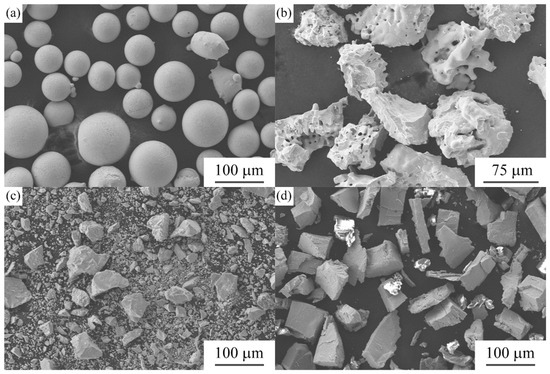
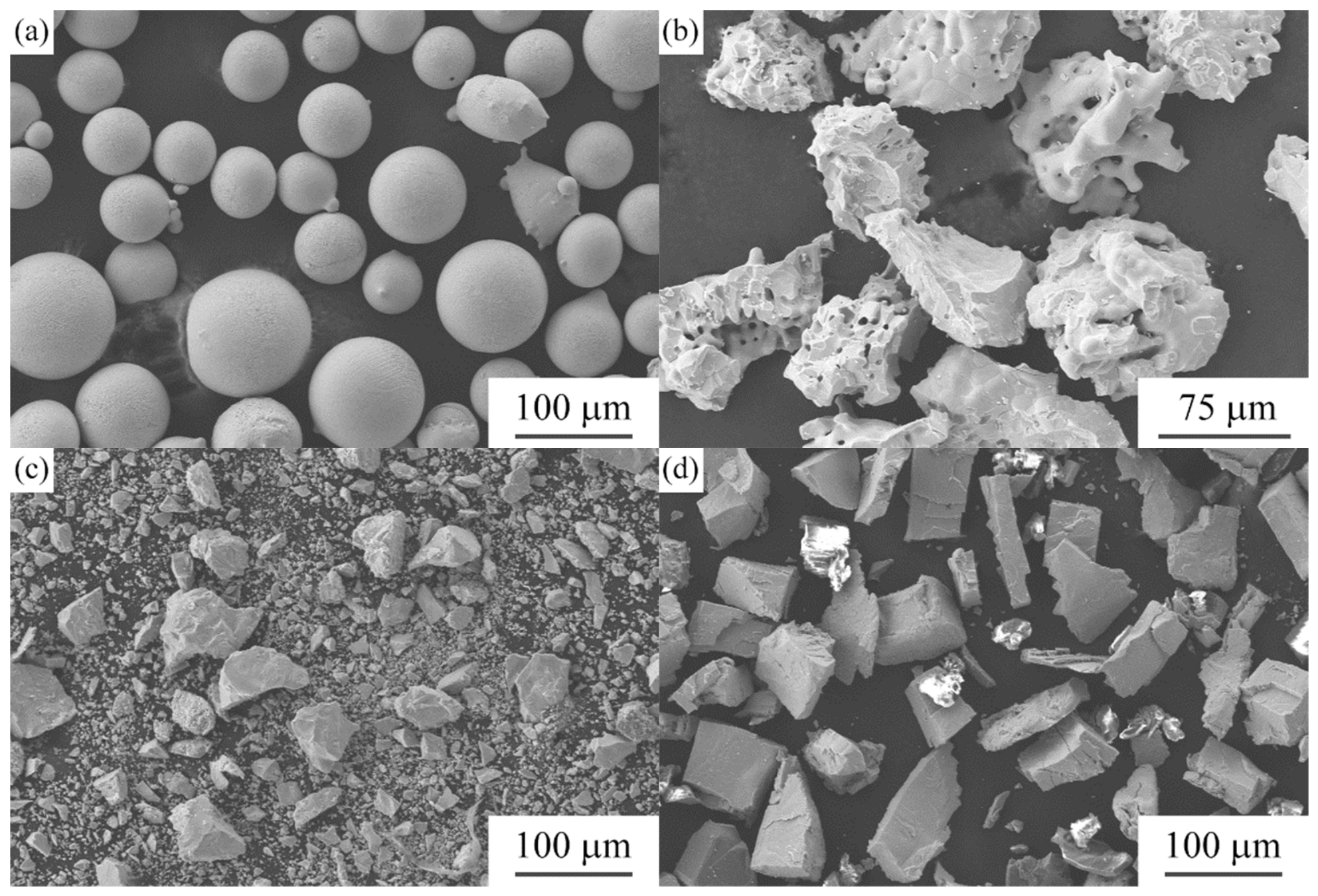
The substrate adopted for laser cladding was Cr12MoV cold-work die steel (supplied by Baosteel Special Materials Co., Ltd., Shanghai, China) with dimensions of 12 mm × 60 mm × 100 mm, and its chemical composition is listed in Table 1. Prior to the cladding experiment, the steel substrate surface was polished smoothly using an angle grinder and ultrasonically cleaned with alcohol to remove surface contaminants. The cladding powder materials, including spherical Ni45 alloy powder, chromium carbide (Cr3C2), ferrotitanium (FeTi70), and ferrovanadium (FeV80), were all purchased from Beijing Xingrongyuan Technology Co., Ltd., China. Microscopic morphological images of all powders are shown in Figure 1. All powders possessed a particle size range of 45–105 μm, and their detailed chemical compositions are presented in Table 1. To achieve homogeneous powder mixing, the raw powders were fully blended in a planetary ball mill using ethanol as the liquid milling medium under an argon protective atmosphere. After ball milling, the mixed powder was dried in a constant-temperature oven at 60 °C for 4 h to completely remove residual ethanol. Laser cladding was carried out using an IPG YLS-6000-S2 fiber laser (IPG Photonics Corporation, Oxford, MA, USA) with a wavelength of 1070 nm, a maximum output power of 6 kW, and a 5 mm square laser spot. A coaxial powder-feeding system driven by argon shielding gas was employed to realize stable and continuous powder delivery. A three-factor and four-level orthogonal experimental design was performed to systematically explore the influence of pulsed laser parameters on the microhardness of composite coatings. In TTL modulation mode of IPG YLS-6000-S2 laser, the target average power was achieved by synergistically adjusting peak power and dutycycle. Average power, duty cycle and pulse frequency were treated as three independent process factors.
Table 1.
Chemical compositions of Ni45, Cr3C2, FeV80, FeTi70, and Cr12MoV (wt.%).
Figure 1.
Powder morphology: (a) Ni45 powder; (b) Cr3C2 powder; (c) FeTi70 powder; (d) FeV80 powder.
Interactions among the factors were not considered in the present orthogonal design, for three reasons. First, the variation range of each parameter was kept moderate, and extreme combinations of high pulse frequency and high duty cycle, which would cause severe heat accumulation, were excluded from the design, so that the magnitude of any thermally induced interaction is limited. Second, the objective of this orthogonal test was to identify the main effect of each parameter on the coating microstructure and hardness, which is a feasible preliminary strategy under a limited experimental workload. Third, incorporating all two-factor interactions would require a substantially larger number of experimental runs. It should nevertheless be noted that this simplification is a limitation of the present optimization: once interaction terms are introduced, the parameter combination assembled from the separate single-factor optima may no longer be optimal, because a high pulse frequency paired with a large duty cycle aggravates heat accumulation and accelerates the decomposition of Cr3C2, thereby narrowing the feasible processing window. Supplementary experiments addressing the interaction of the dominant factors will be carried out in future work. The selected process parameters were pulse frequency, duty cycle, and average laser power; the corresponding factor levels are shown in Table 2. An L16(43) orthogonal experimental design was used. At a powder feed rate of 15 g/min and a shielding gas flow rate of 15 L/min, three-layer cladding samples approximately 5 mm thick were produced by laser cladding. These samples were used to investigate the effects of pulsed laser process parameters on composite-coating hardness.
Table 2.
Levels of the experimental factors.
After the optimal process parameters had been identified, additional coatings were prepared using a composite process that combined substrate preheating with pulsed laser cladding. The substrate was preheated on a heating plate (Thermo Fisher Scientific, Waltham, MA, USA), as in a previous study [36], and its temperature was monitored in real time using thermocouples. The macroscopic morphology, microstructure, and mechanical properties of the coatings produced by the different processes were then analyzed; the specific parameters for each process are shown in Table 3. In addition, multi-pass, three-layer coatings were fabricated for wear-resistance characterization. Surface cracks in the composite coatings were detected by dye-penetrant testing using DPT-05 penetrant supplied by Shanghai Xinmeida Testing Equipment Co., Ltd.
Table 3.
Process parameters used for the different processes.
2.2. Microstructural Characterization
Longitudinal sections were cut from the single-track, multilayer claddings using an electrical-discharge wire-cutting machine (Suzhou Baoma CNC Equipment Co., Ltd., Suzhou, China) to produce 10 mm × 10 mm × 10 mm specimens, which were subsequently ground with emery paper. The surfaces were polished with a diamond compound with a particle size of 1.5 μm (Buehler, Lake Bluff, IL, USA) and then ultrasonically cleaned in acetone and anhydrous ethanol. After etching for 10 s in aqua regia (concentrated HNO3:concentrated HCl = 1:3), the macroscopic morphology and microstructure of the coatings were examined using an optical microscope (OM; OLYMPUS BX51, Olympus Corporation, Tokyo, Japan) and a scanning electron microscope (SEM; GeminiSEM 300, ZEISS, Oberkochen, Germany). An energy-dispersive spectrometer was used to determine elemental distributions and phase compositions. Phase analysis was performed using an X-ray diffractometer (XRD; Bruker D8 Advance, Bruker, Billerica, MA, USA) with a Cu-Kα target, an accelerating voltage of 40 kV, and a current of 40 mA. A continuous scan from 20° to 90° was performed at a scanning speed of 8°/min and a step size of 0.02°.
2.3. Mechanical Properties and Wear Resistance
A MICRO-MET-5103 digital Vickers hardness tester (Buehler, Lake Bluff, IL, USA) was used to measure coating hardness from the surface to the substrate under a load of 0.2 kg and an indentation time of 15 s. Before testing, the instrument was calibrated using a standard specimen. To ensure measurement reliability, seven hardness measurements were obtained at different positions at the same depth. The maximum and minimum values were discarded, and the mean hardness was calculated from the remaining five values.
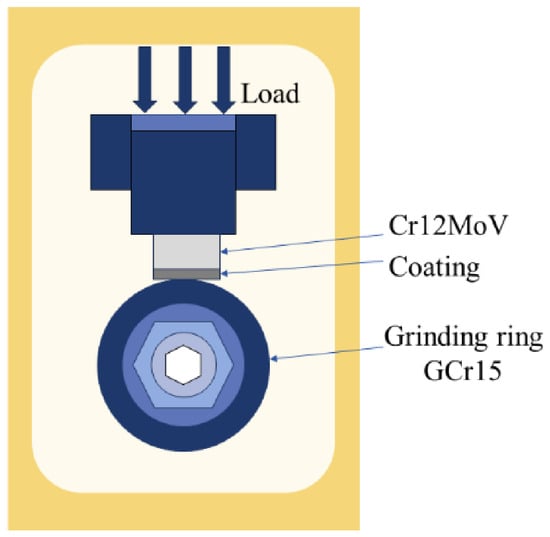
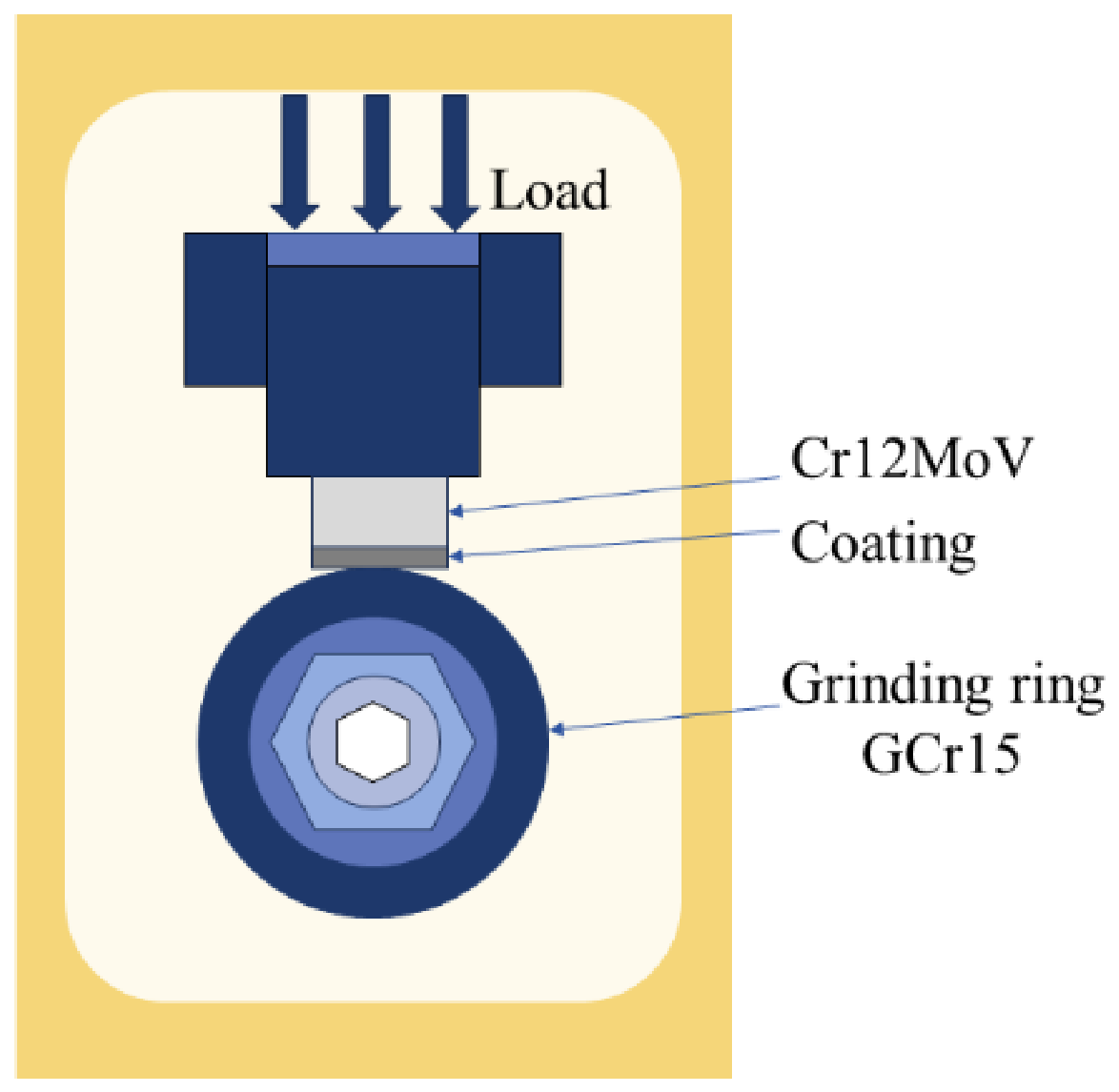
The wear resistance of the coatings was evaluated using an M-200 wear tester (MRH-3W, Jinan Yihua Tribology Testing Technology Co., Ltd., Jinan, China), as illustrated in Figure 2. The tests were conducted in accordance with GB/T 12444-2006 [37] using GCr15 rings with a hardness of 735 HV as the counterface (hereafter referred to as the wear ring); the ring was replaced after each sliding test. The multilayer-coated samples were cut into 19 mm × 12 mm × 12 mm blocks for wear testing. The test parameters were a rotational speed of 200 r/min, a load of 196 N, and a duration of 2 h. To guarantee the accuracy and repeatability of the experimental data, each group of wear tests was repeated three times independently, and the average value was adopted as the final experimental result. Before and after testing, the samples were ultrasonically cleaned in alcohol and weighed using a high-precision electronic balance. Wear resistance was characterized as the inverse of mass loss. Scanning electron microscopy was used to examine the worn-surface morphology and analyze the wear mechanism.
Figure 2.
Schematic diagram of the wear-testing system.
2.4. Residual Stress
Residual stresses in the coatings were measured using a surface-analysis X-ray diffractometer (Bruker D8 Discover, Karlsruhe, Germany) [38]. Before testing, each sample surface was ground with 3000-grit sandpaper, and the surface layer was removed by stress-free ion polishing. The measurements were performed using a cobalt target (Co-Kα, λ = 0.1790 nm) at an operating voltage of 35 kV and a current of 40 mA; the (220) crystal plane was selected for 2θ scanning. The reference interplanar spacing in the stress-free state was d0 = 1.26515 Å, corresponding to a stress-free Bragg angle of 2θ0 = 89.986°. The scanning range was 87.8–92.4°, with a step size of 0.1° and a scanning speed of 1°/min. Measurements were taken at φ angles of 0°, 45°, 90°, 135°, 180°, 225°, 270°, and 315° and ψ angles (sample tilt angles) of 0°, 15°, 30°, and 45° to cover different crystal-plane orientations. Each set of measurements was repeated three times, and the mean was calculated. The peaks were fitted using the Pseudo-Voigt II function, and the final stress at each position was reported as the mean of the three measurements.
3. Results and Discussion
3.1. Effects of Pulsed Laser Process Parameters on Coating Hardness
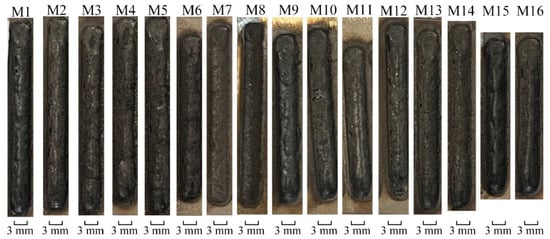
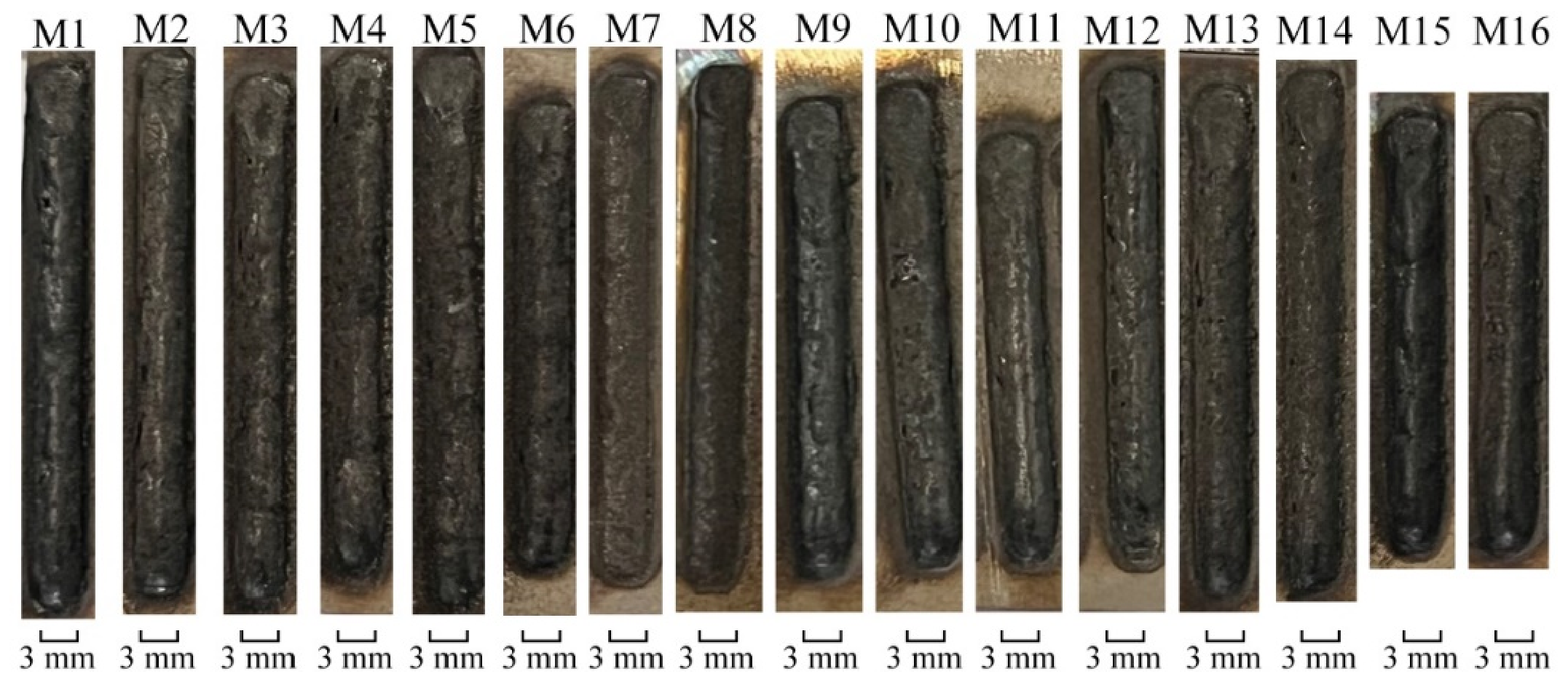
Figure 3 shows the surface morphologies of the 16 samples prepared using a three-factor, four-level orthogonal experimental design. Vickers hardness was measured, and the results are summarized in Table 4. Notably, coatings M1, M6, M7, and M9 had significantly higher hardness values than the Z0 coating prepared by continuous laser processing. Among them, the M6 coating exhibited the highest hardness, reaching 898.6 HV0.2.
Figure 3.
Surface morphologies of samples from the pulsed-laser orthogonal experiments.
Table 4.
Coating hardness at different process parameter settings.
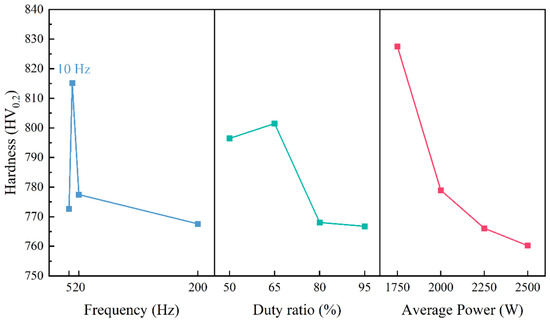
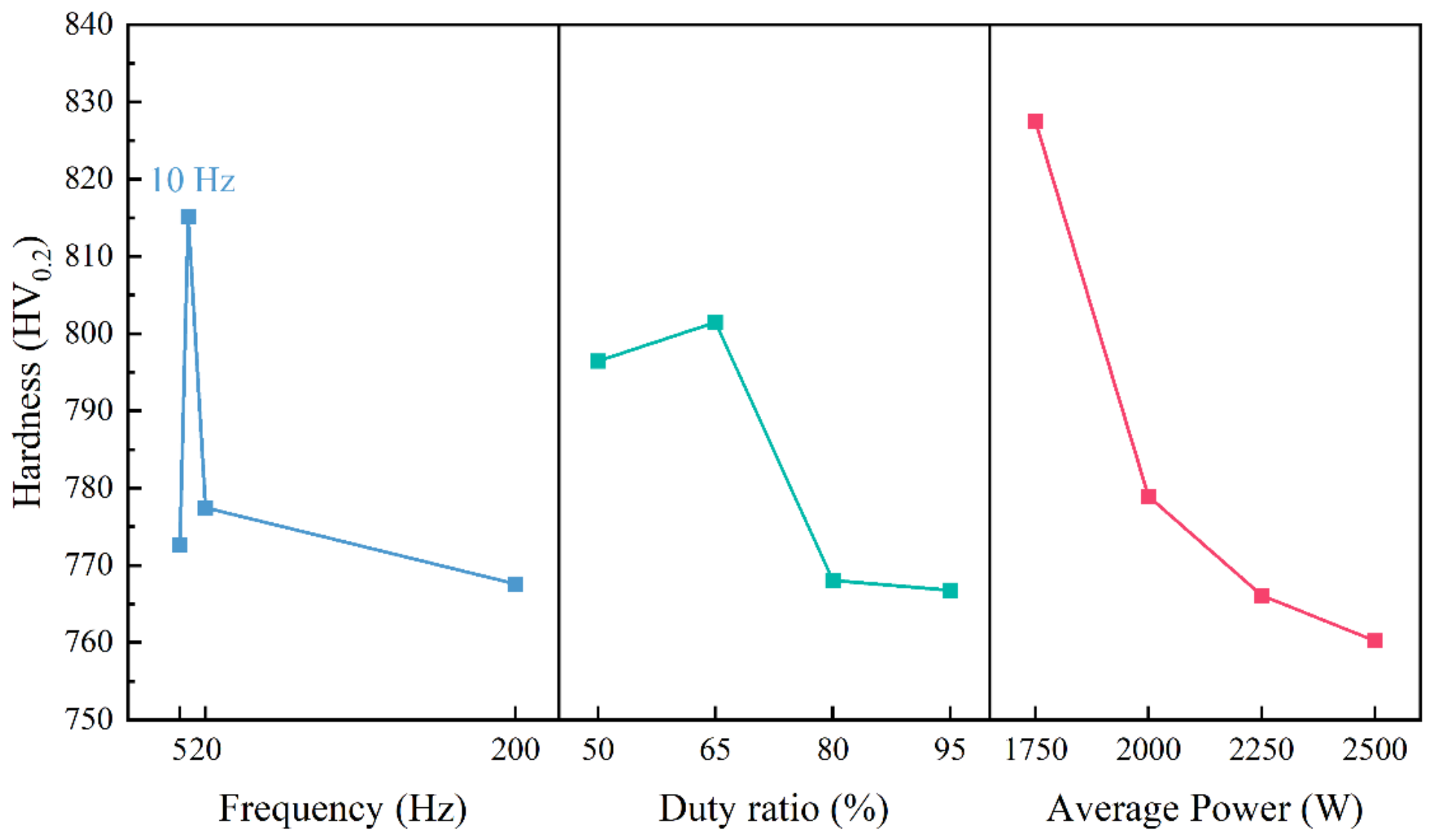
To analyze the effects of the individual factors on the optimization response, the means and ranges for all factors in the orthogonal experiment were examined. The mean response k was calculated by averaging the results obtained at the same level of each factor, whereas the range R was the difference between the maximum and minimum of the four k values for that factor. The magnitude of R reflects the extent to which each factor affects the response. The range-analysis results are presented in Table 5. The process parameters influenced hardness in the following descending order: average power, pulse frequency, and duty cycle.
Table 5.
Range-analysis results for the orthogonal experiments.
Since the ring-on-block friction configuration was adopted in this study, the relationship between hardness and wear resistance can be described by the classic Archard wear law Equation (1). In the formula, Q is the volume wear loss per unit sliding distance, W is the normal load, H is the coating hardness, and K is the dimensionless wear coefficient. All sixteen orthogonal specimens were prepared from the same powder blend, so the wear coefficient K is expected to vary only moderately among them, and hardness therefore provides a reasonable first-order ranking of their resistance to plastic deformation and abrasive cutting. Hardness was adopted as the response variable of the orthogonal design for this reason, and also because it can be measured rapidly and reproducibly on all sixteen specimens, whereas block-on-ring wear testing consumes a multi-pass three-layer specimen per run and is not practicable for the full orthogonal matrix. It should be emphasized, however, that K is not strictly constant: as shown in Section 3.2 and Section 3.4, the carbide constitution and the solidification scale do differ among the coatings, and the wear mechanism of the preheated coating shifts partly towards adhesive wear. The wear resistance was therefore verified experimentally for the three representative processes Z0, Z1 and Z2 rather than inferred from hardness alone, and the parameter combination identified here is the one giving the highest hardness, which is not claimed to give the highest wear resistance over the entire parameter space. As shown in Figure 4, the optimal pulsed laser process parameters were an average power of 1750 W, a duty cycle of 65%, and a pulse frequency of 10 Hz.
Figure 4.
Effects of process parameters on coating microhardness.
3.2. Effects of the Composite Process on Coating Macrostructure and Microstructure
To obtain crack-free coatings with high wear resistance, a composite process combining substrate preheating with pulsed laser cladding was used. For the composite-process samples, the substrate was preheated to 700 °C. The pulsed laser parameters were those identified by the orthogonal experiment: a frequency of 10 Hz, a duty cycle of 65%, and an average power of 1750 W. The Z0 composite coating, prepared using a 1750 W continuous laser at room temperature, served as the control.
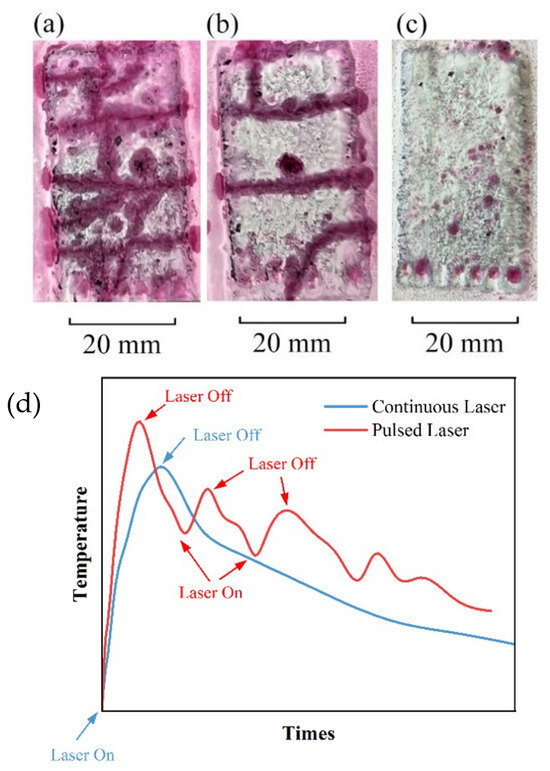
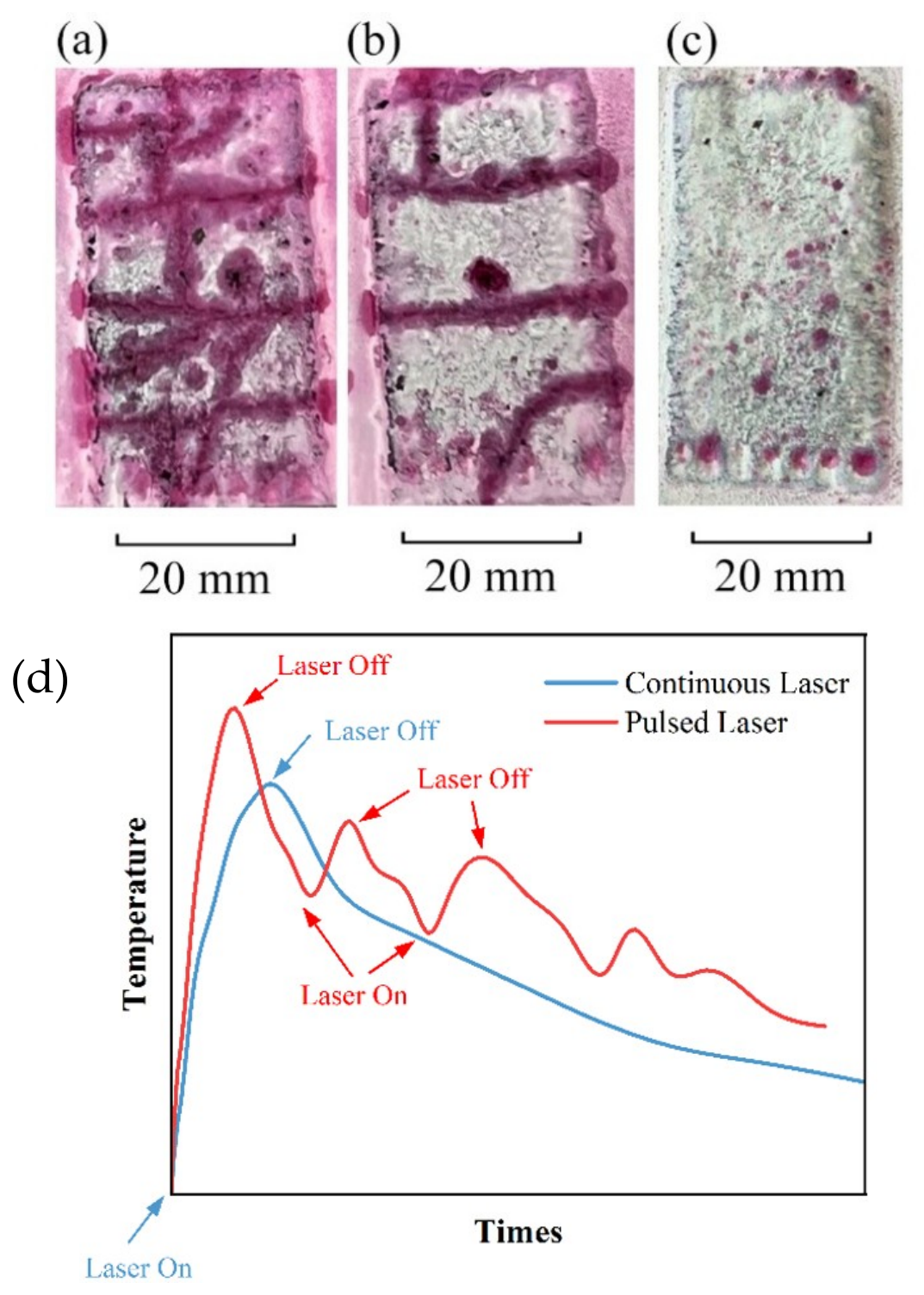
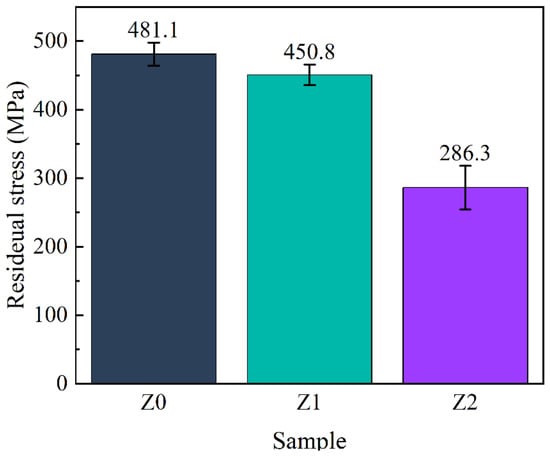
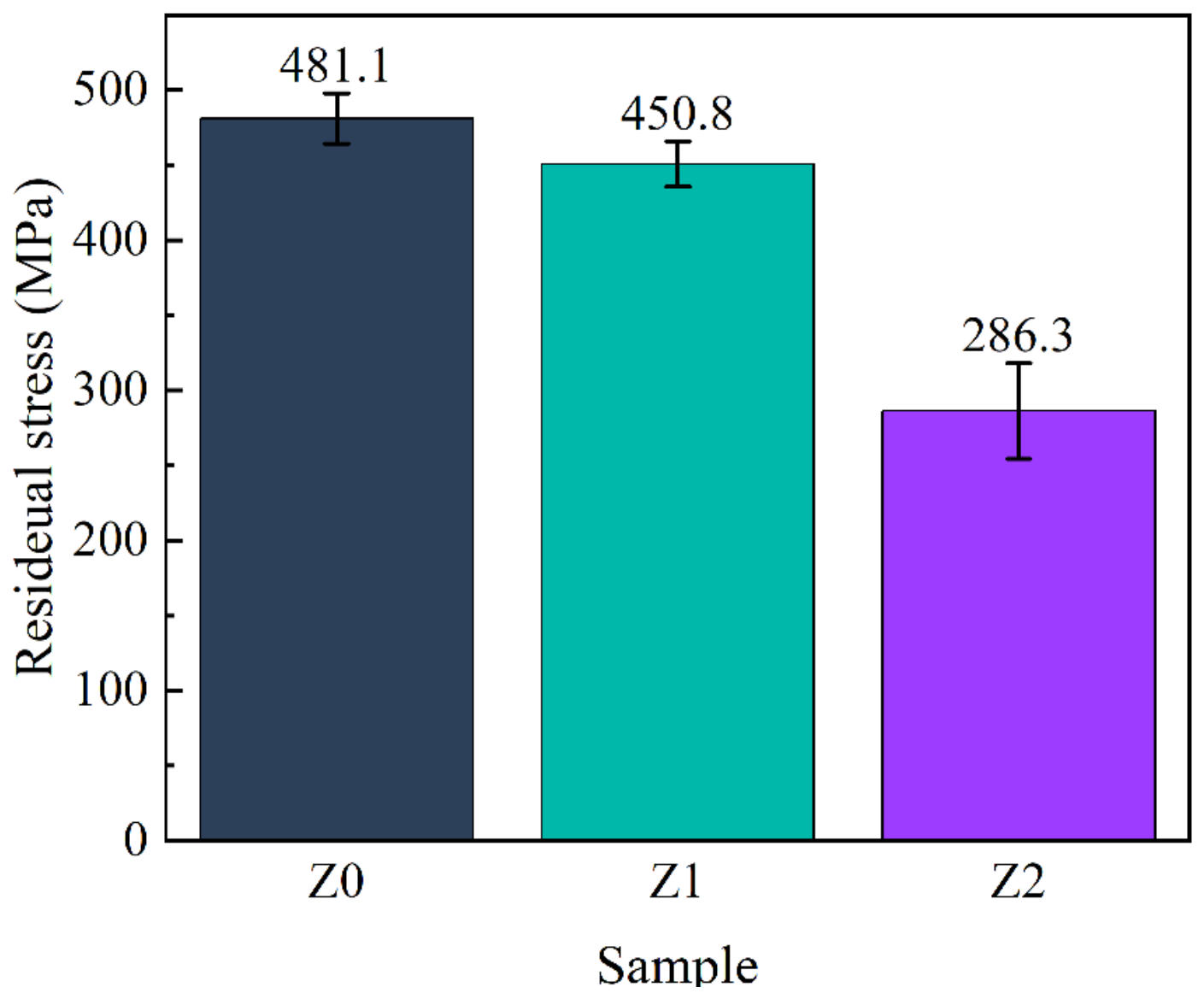
Figure 5 shows the dye-penetrant inspection results for coatings produced by the different processes, with crack rates quantified using ImageJ software (version 1.53k, National Institutes of Health, Bethesda, MD, USA). The Z1 sample showed a substantial reduction in surface cracking, with the crack rate decreasing from 11.0% to 7.1%. This result demonstrates that pulsed laser processing effectively suppresses the tendency of the coating surface to crack. The Z2 coating produced by the composite process exhibited no surface cracks. The residual stresses in samples Z0, Z1, and Z2 were further measured by X-ray diffraction, as shown in Figure 6. Z1 exhibited a moderately lower residual stress than Z0, indicating that pulsed laser processing partially relieves the thermal stress generated during cladding and thereby reduces the coating crack rate. The reduction is, however, insufficient to eliminate cracking altogether, since cracks were still detected in the Z1 coating; substrate preheating remains the principal means of stress relief in the present work. The residual stress in the Z2 coating decreased to 286.3 MPa, which was lower than that in the Y4 coating prepared by continuous laser processing combined with substrate preheating in our previous work [36]. Consequently, no macroscopic cracks formed in the Z2 coating.
Figure 5.
Dye-penetrant inspection results for the composite coatings: (a) Z0; (b) Z1; (c) Z2; (d) crack-rate statistics.
Figure 6.
Residual stresses in coatings fabricated by different processes.
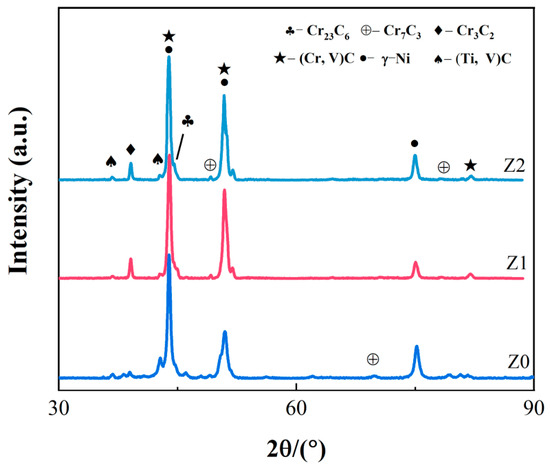
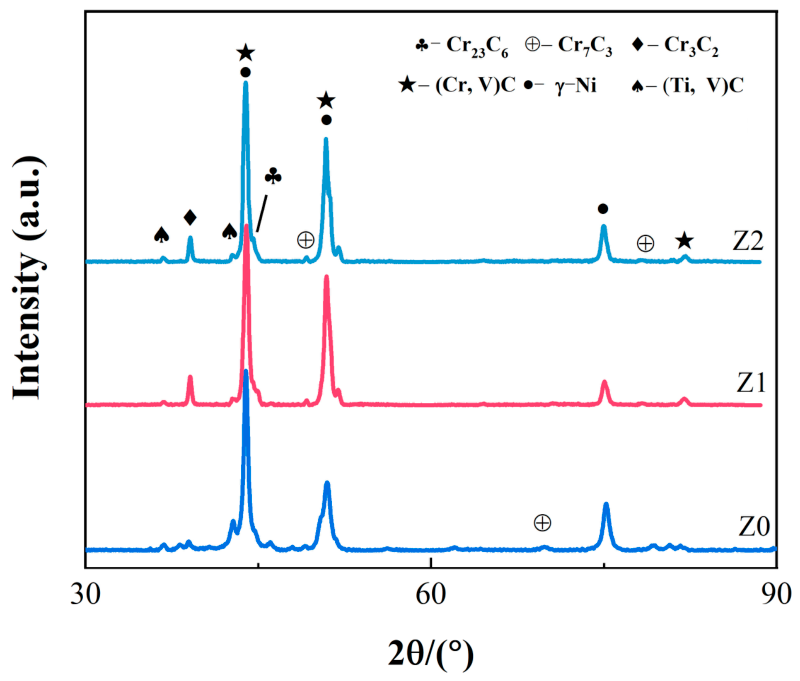
To further investigate the effect of pulsed laser processing on the coating phases, XRD analysis was conducted, and the results are shown in Figure 7. The diffraction peaks of samples Z0, Z1, and Z2 showed no substantial differences, indicating that pulsed laser irradiation did not alter the basic phase composition of the coatings. The coatings consisted primarily of γ-Ni(Fe), Cr7C3, (Ti, V)C, and a small amount of residual Cr3C2. Notably, compared with the Z0 sample prepared via continuous laser, the pulsed-laser-processed Z1 and Z2 coatings exhibited significantly higher Cr3C2 content and lower Cr7C3 content, while the diffraction intensity of in situ synthesized (Ti, V)C remained stable without obvious attenuation. During laser cladding, the FeTi70 and FeV80 alloy powders, together with partial Cr12MoV substrate material, melt and integrate into the molten pool, and the dissolved Fe element participates in matrix formation and promotes the generation of the γ-Ni(Fe) solid solution. Since TiC and VC can form infinite substitutional solid solutions, Ti and V released from FeTi70 and FeV80 preferentially react with free carbon in the molten pool to form stable (Ti, V)C composite carbides. The weak individual diffraction peaks of TiC and VC further verify that Ti and V elements mainly exist in the form of homogeneous (Ti, V)C solid solution in the coating. A continuous laser provides prolonged high-temperature dwell time, which aggravates the thermal decomposition of original Cr3C2 and reduces carbon activity in the molten pool. Meanwhile, the strong carbon affinity of Ti and V further consumes free carbon and suppresses the thermodynamic stability of high-carbon-ratio Cr3C2, thereby promoting the formation of low-carbon-ratio Cr7C3. In contrast, the pulsed laser features ultra-short high-temperature duration and rapid solidification, which significantly inhibits the thermal decomposition of raw Cr3C2. The molten pool maintains relatively higher carbon activity that matches the stoichiometric requirement of Cr3C2, thus retaining more residual Cr3C2 and reducing the generation of Cr7C3. Based on the actual composition and carbon activity level of the Ni-based molten pool, the retention of Cr3C2 is thus favored kinetically under the non-equilibrium solidification conditions of pulsed laser cladding.
Figure 7.
XRD patterns of the composite coatings.
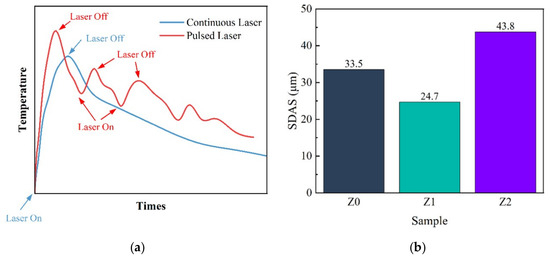
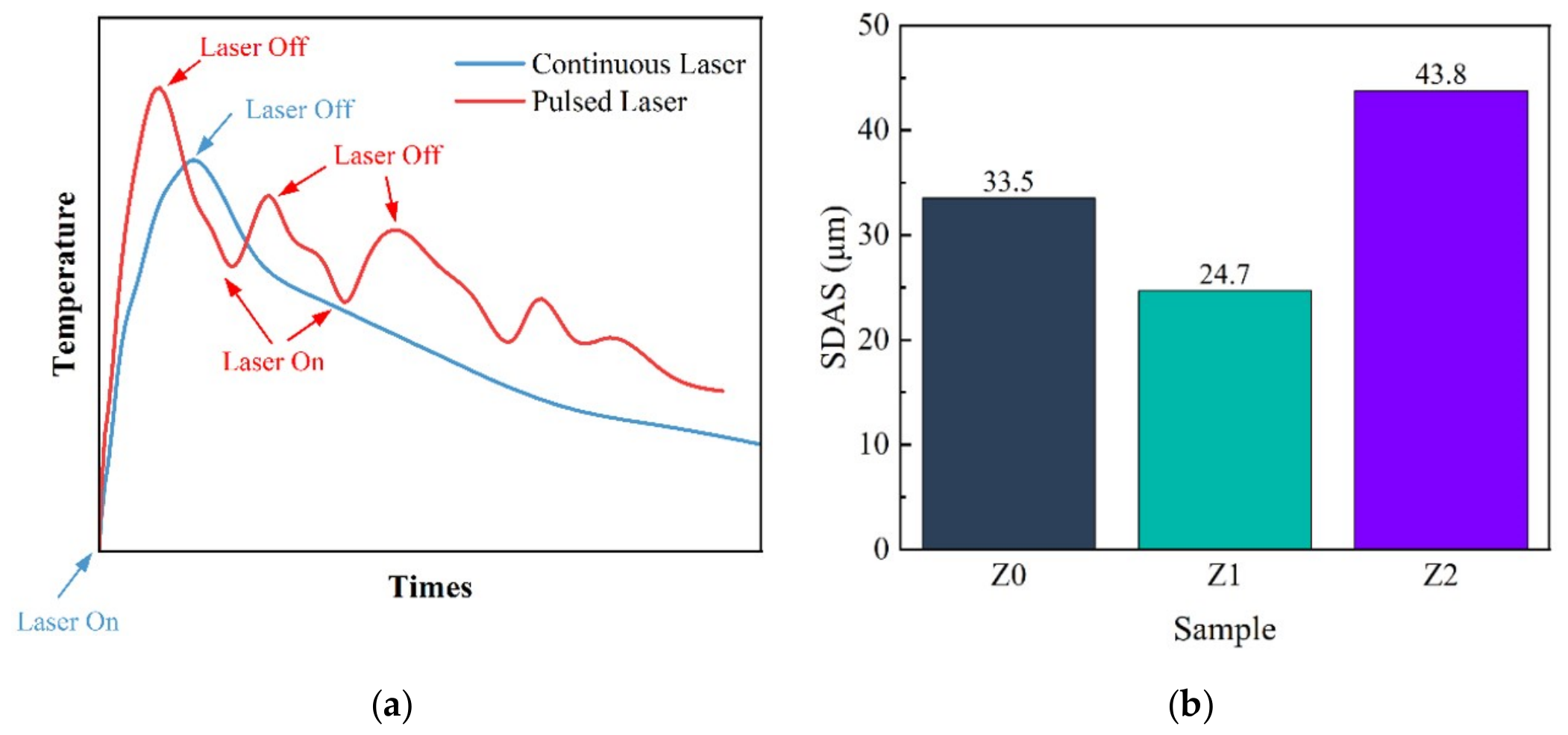
It should be noted that the temperature curve in Figure 8a shows a qualitative changing trend of molten-pool temperature. Direct in situ temperature measurement of the molten pool was not performed, and the thermal behavior conclusions are supported by microstructure characterization and published research results. With the average power fixed at 1750 W, the time-averaged heat input to the molten pool is nominally identical for the two energy-input modes, but its temporal distribution differs fundamentally. Because the pulsed beam concentrates the same average energy into short bursts of high peak power, each pulse drives a steep temperature excursion whose instantaneous maximum may exceed that of the continuous beam, as indicated by the first peak of the pulsed curve in Figure 8a [27]. Between successive pulses, however, the pool loses heat to the substrate without further energy input, so the temperature falls sharply and the interval spent above the liquid within each cycle is much shorter than under continuous irradiation. The distinguishing feature of the pulsed process is therefore not a lower instantaneous maximum but a steeper thermal cycling and a shorter cumulative melt lifetime, which is precisely the behavior measured by two-color pyrometry for Inconel 718 by Li et al. [26] and reproduced by the finite-element analyses of Ma et al. [28], Yan et al. [29] and Javid and Ghoreishi [30]. Figure 8b presents the secondary dendrite arm spacing (SDAS) measured at the coating base. Since SDAS decreases monotonically with increasing cooling rate, it can be used to rank the local cooling rates of differently processed coatings [31]; it should be stressed, however, that SDAS is an indirect indicator of the local cooling rate during the terminal stage of solidification, and cannot by itself establish absolute values of the peak temperature, the liquid-phase duration or the molten-pool lifetime. The SDAS at the base of the Z1 coating was markedly smaller than that of the Z0 coating, suggesting that the liquid-phase duration during Z1 preparation was shorter and did not allow sufficient dendrite growth at the coating base. It is worth noting that the secondary dendrite arm spacing of the Z2 coating was larger than those of Z0 and Z1, which is consistent with pre-heating prolonging the liquid-phase duration during solidification and altering the solidification behavior of the coating. Although pulsed laser irradiation inherently possesses a faster intrinsic cooling capacity compared with the continuous laser, the cumulative thermal effect induced by repeated pulse energy input in the Z2 group produces obvious substrate preheating. The elevated substrate temperature reduces the temperature gradient between the molten pool and the substrate, slows down the overall cooling rate, and eventually leads to dendrite coarsening and an increased SDAS value. In essence, a pulsed laser can restrain microstructure coarsening under identical substrate-temperature conditions; nevertheless, excessive heat accumulation and severe preheating will offset this advantage and trigger dendrite coarsening mainly at the molten-pool bottom near the substrate. The Gibbs free energies of the molten-pool reactions given in Equations (2)–(6) indicate only the temperature dependence of each individual reaction; because the reactions differ in stoichiometry and because the activities of Cr and C in the Ni-based melt are not known independently, these values cannot be used to rank the relative stability of the chromium carbides quantitatively. The higher Cr3C2 content of the pulsed coatings is therefore attributed to kinetic rather than to equilibrium thermodynamic factors: the short high-temperature residence time and the rapid, non-equilibrium solidification of the pulsed process leave part of the starting Cr3C2 powder undissolved and suppress its thermal decomposition, while the correspondingly higher retained carbon activity in the melt favors the high-carbon carbide over Cr7C3. Consistent with this interpretation, the XRD patterns of both the Z1 and Z2 coatings contained distinct, intense Cr3C2 diffraction peaks.
Figure 8.
Comparison of different cladding processes: (a) schematic temperature curves during cladding; (b) secondary dendrite arm spacing at the coating base.
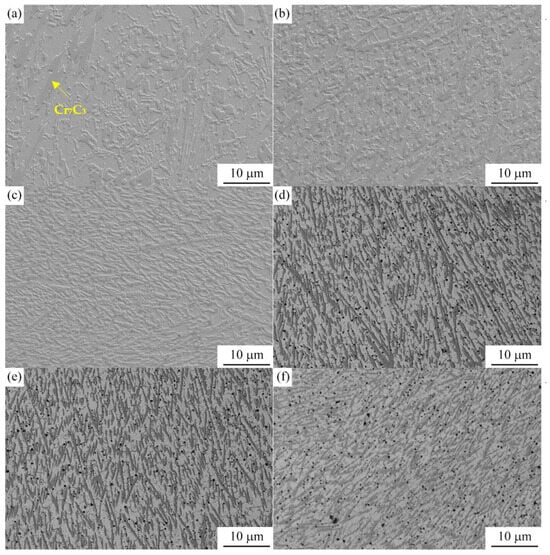
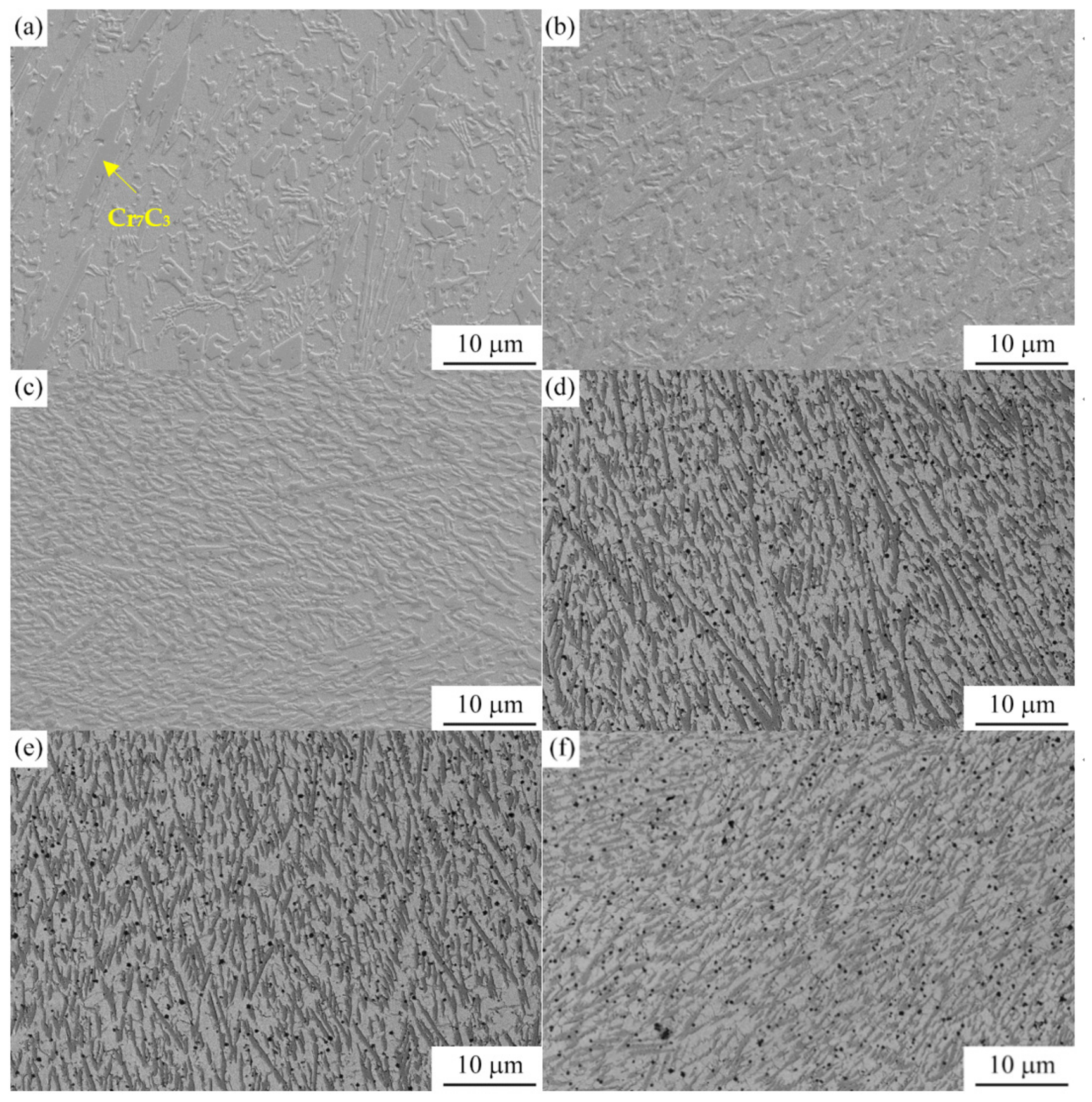
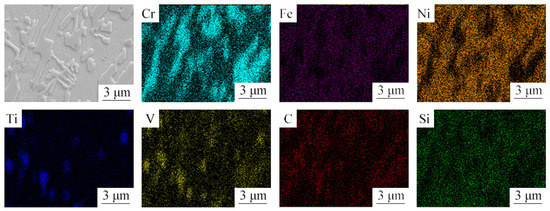
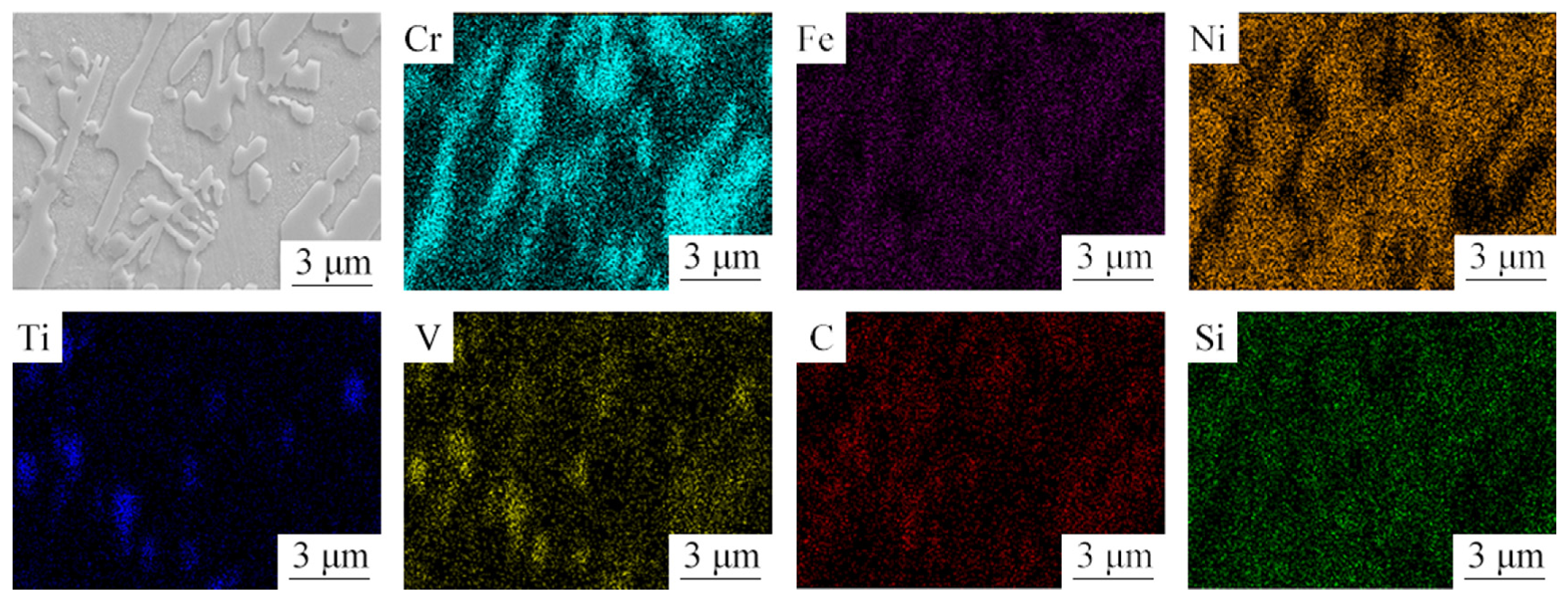
The microstructures of the samples prepared by the different processes were examined by SEM (JEOL Ltd., Tokyo, Japan). Figure 9a–c show secondary-electron images of samples prepared using the different processes. The microstructures of samples Z1 and Z2 were significantly refined, with a notable reduction in the amount of coarse, blocky Cr7C3. Figure 9d–f show backscattered-electron images of the central region of each coating, providing a clearer view of the distribution of strengthening phases. In these images, the white regions represent the γ-Ni matrix, the gray phases are chromium carbides, and the uniformly distributed fine black polygonal structures are (Ti, V)C. Both the (Ti, V)C structures and the columnar Cr7C3 structures were diffusely distributed throughout coatings Z0, Z1, and Z2, demonstrating that pulsed laser processing had a negligible effect on the distribution of strengthening phases. Figure 10 shows the SEM image and EDS mapping results for the Z2 coating. In the central region of the Z2 coating, the reinforcing phases remained finely dispersed, and no obvious agglomeration or growth of the (Ti, V)C particles was observed. The coarsening caused by preheating is thus not uniform through the coating thickness: it is confined mainly to the molten-pool bottom adjacent to the substrate, where the reduced temperature gradient prolongs the local liquid-phase duration and increases the SDAS, as shown in Figure 8b, whereas the distribution of the reinforcing phases in the central region is essentially preserved. Accordingly, the ability of pulsed laser processing to restrain microstructural coarsening should be understood as applying at a given substrate temperature, that is, relative to continuous laser cladding combined with the same preheating treatment [36], rather than relative to the coatings deposited without preheating.
Figure 9.
Microstructures of the composite coatings: (a) Z0; (b) Z1; (c) Z2; (d) BSE image of Z0; (e) BSE image of Z1; (f) BSE image of Z2.
Figure 10.
Elemental distribution in the Z2 coating.
3.3. Effect of the Composite Process on Coating Vickers Hardness
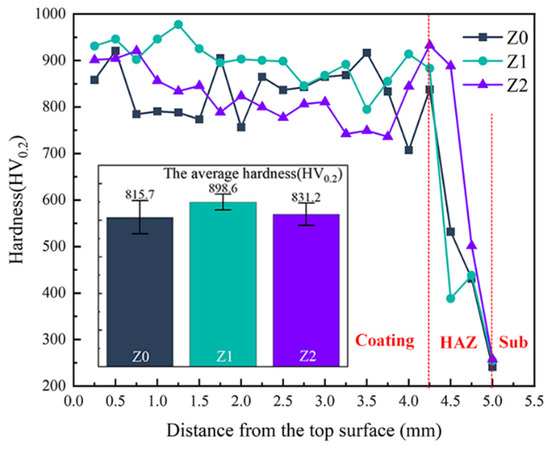
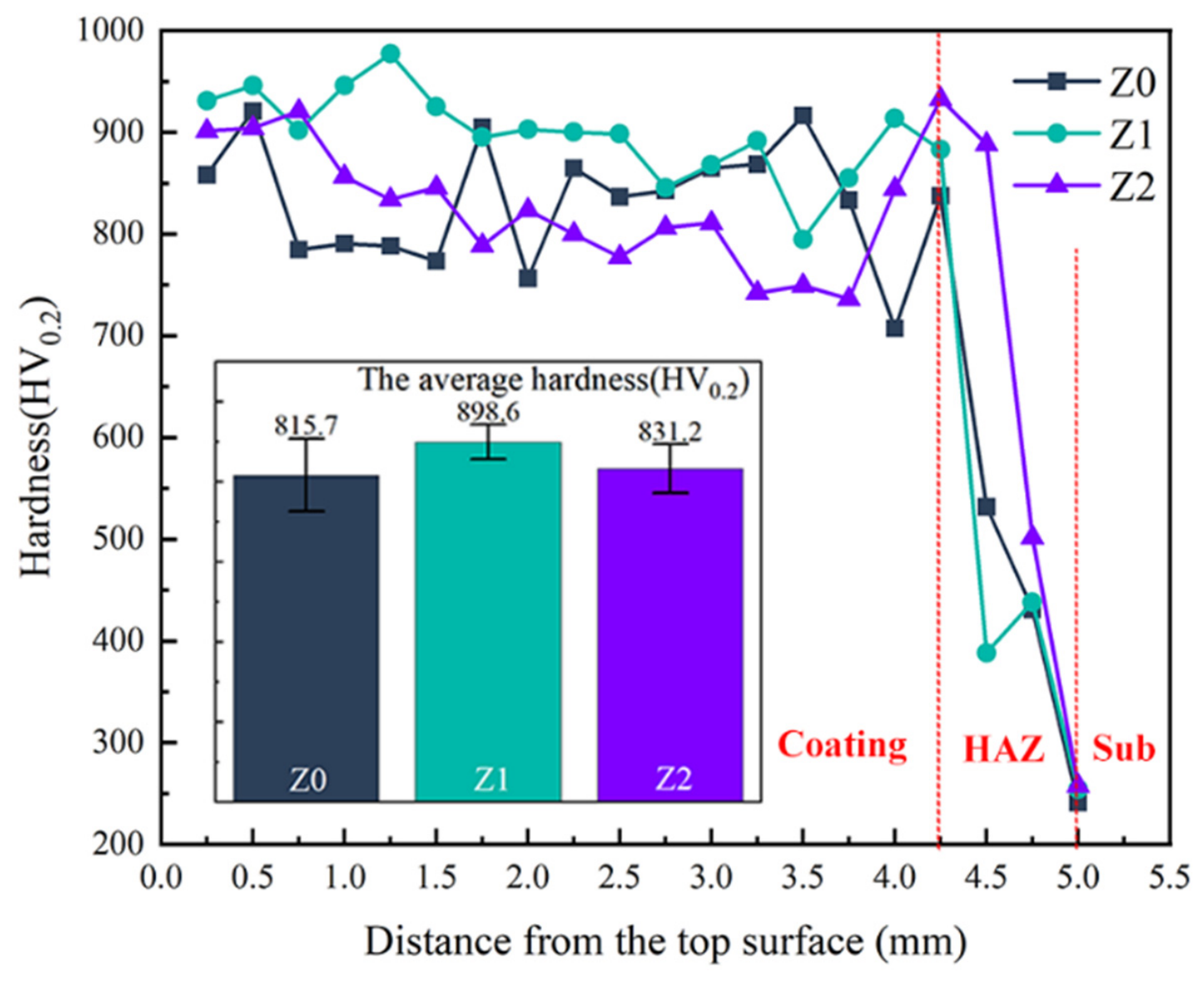
Figure 11 shows the variation in Vickers hardness through the thickness of coatings prepared by the different processes. The hardness values of samples Z0, Z1, and Z2 fluctuated within the thickness range of 0.25–4.00 mm, but the overall differences were small. The average hardness of the Z1 coating reached 898.6 HV0.2, which was 10.2% higher than that of the Z0 coating prepared using a continuous laser. In addition, compared with the coating prepared using continuous laser processing combined with substrate preheating (684.4 HV0.2), the average hardness of the Z1 coating was approximately 31.3% higher. This result is attributed to the rapid heating and cooling characteristics of pulsed lasers, which refine the microstructure and intensify grain-refinement strengthening, thereby substantially increasing coating hardness. The Z2 coating also had approximately 2% higher hardness than the Z0 coating. These results demonstrate that pulsed laser technology can effectively address the low coating hardness associated with substrate preheating.
Figure 11.
Microhardness of coatings produced by different processes.
3.4. Effect of the Composite Process on Coating Wear Resistance
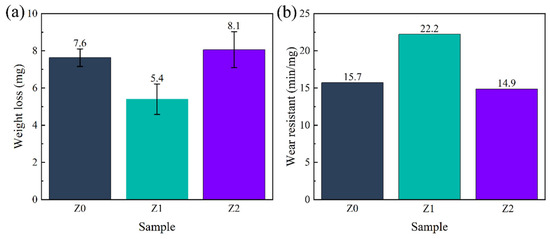
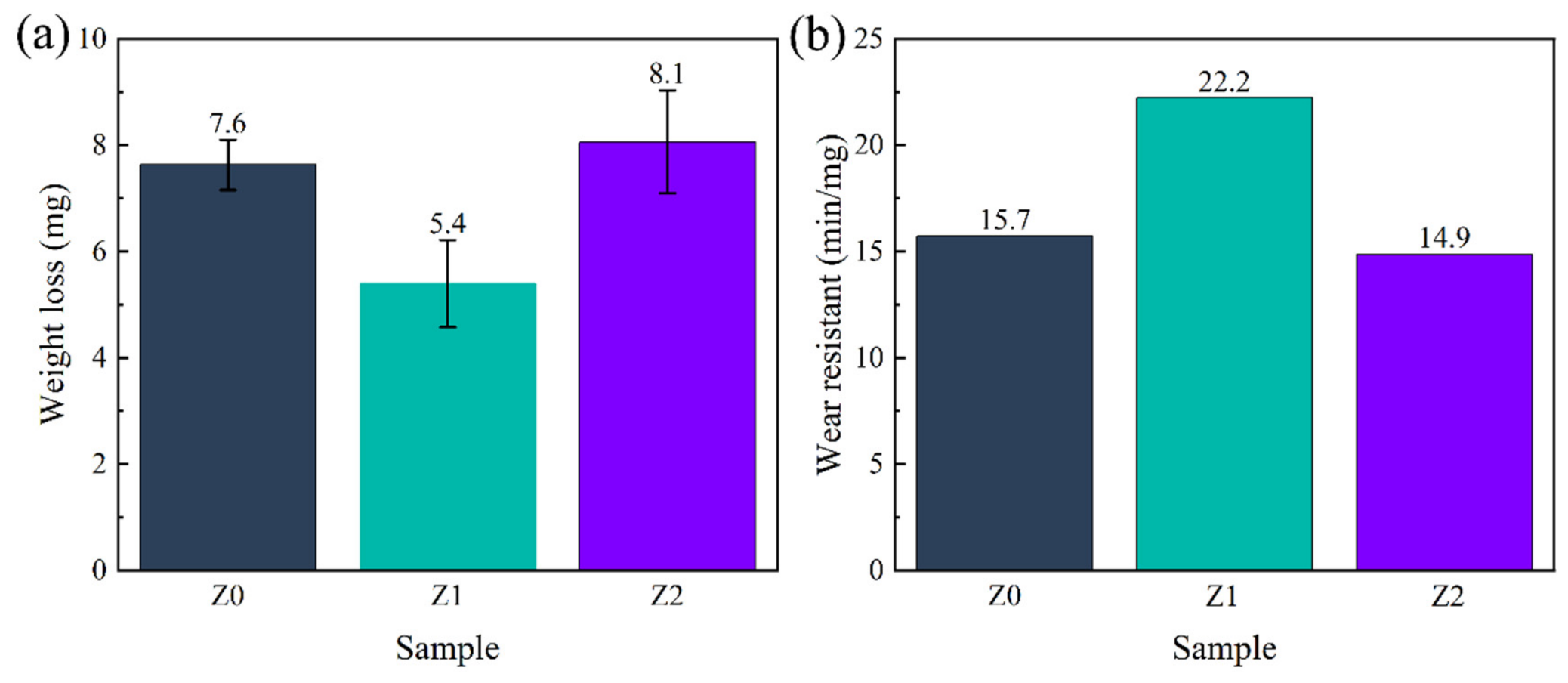
The wear performance of the coating samples was evaluated using a block-on-ring friction and wear tester. Figure 12 shows the mass loss and wear resistance of coatings prepared by the different processes after 2 h of testing. The Z0 coating prepared using a continuous laser had a wear resistance of 15.7 min/mg. For the Z1 coating prepared using a pulsed laser, the wear resistance increased to 22.2 min/mg. The Z2 coating prepared using substrate preheating combined with a pulsed laser had a wear resistance of 14.9 min/mg. Compared with the Z0 coating, the wear resistance of the Z1 coating increased by 41.4%. These results indicate that, without additional cost, pulsed laser processing can substantially enhance wear resistance solely through adjustments to the duty cycle, pulse frequency, and average power. Notably, the crack-free coating prepared in our previous work by continuous laser cladding combined with substrate preheating exhibited a wear resistance of only 4.7 min/mg, representing a substantial reduction [36]. By contrast, the crack-free Z2 coating prepared by pulsed laser cladding combined with substrate preheating reached 14.9 min/mg, indicating that pulsed laser processing can markedly improve the wear resistance of preheated coatings while keeping them free of cracks.
Figure 12.
Effects of the composite process on coating mass loss (a) and wear resistance (b).
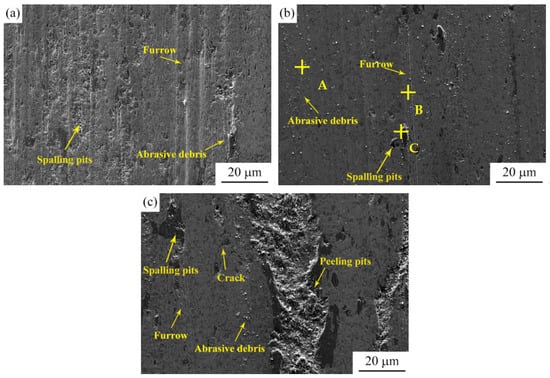
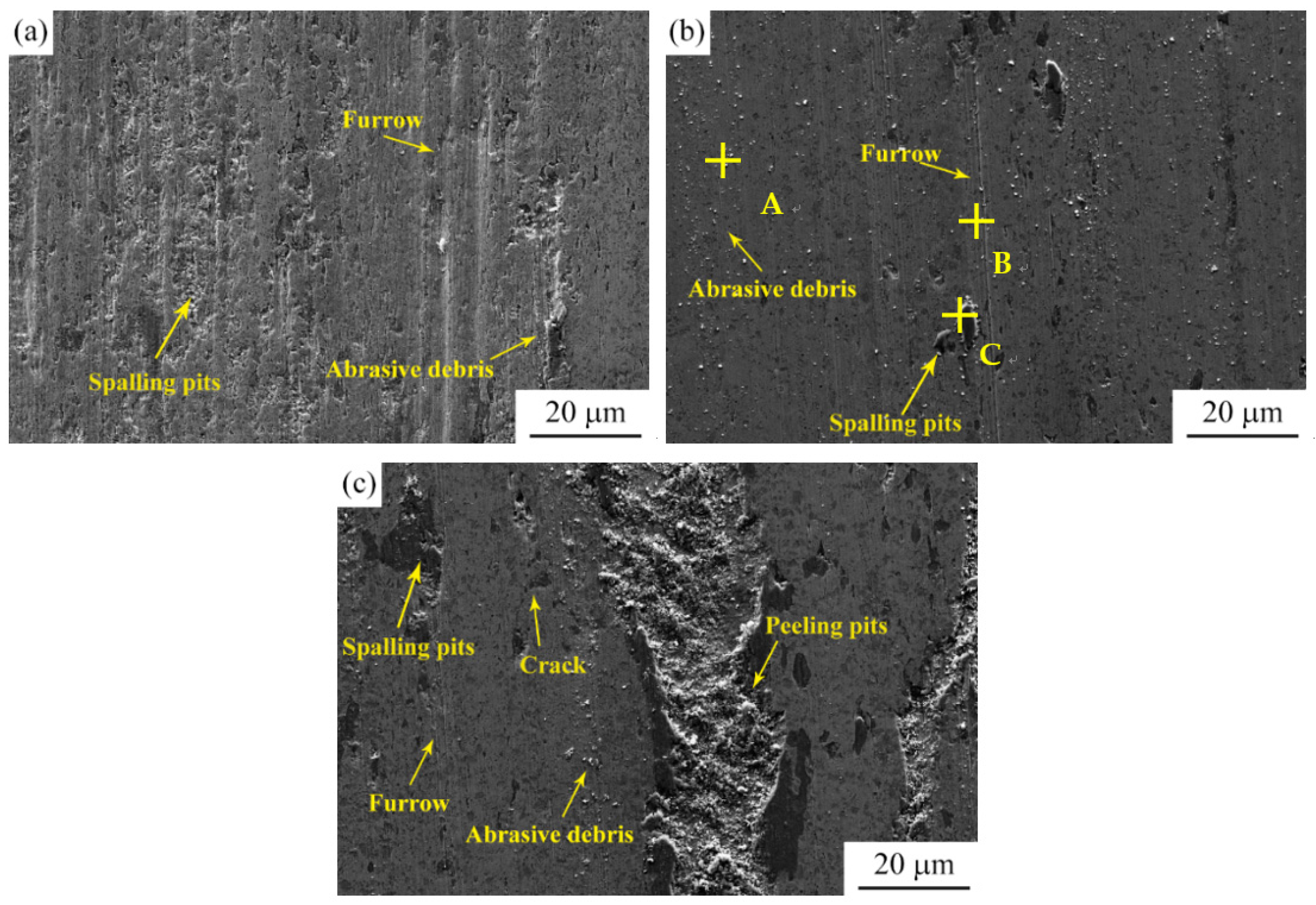
Figure 13 shows the worn-surface morphologies of the coatings. As shown in Figure 13a, the worn surface of coating Z0 exhibited relatively deep plowing grooves and some wear debris, indicating abrasive wear accompanied by minor adhesive wear during the test. In contrast, the worn surfaces of Z1 and Z2 coatings presented significantly less wear debris, with only shallow plowing grooves and sporadic spalling pits observed, suggesting that their wear mechanisms were primarily mild abrasive wear. Notably, the Z2 coating exhibited the most obvious adhesive characteristics and extensive shallow pitting defects. Generally, the wear resistance of composite coatings is strongly dependent on their microstructure and reinforcing phase characteristics. Combined with the EDS point scanning results (Table 6), the wear debris on the coating surface mainly originated from the GCr15 friction ring material, further confirming the occurrence of adhesive wear. During friction, direct metal-to-metal contact between the GCr15 ring and the coating forms micro-junction points [39]. Under continuous shear action during relative sliding, these metallic junctions fracture, generating large sheet-like wear debris and leaving numerous large-area but shallow pits on the coating surface. This distinctive adhesive wear behavior is most prominent for the Z2 coating. In particular, the relatively low hardness of the Z2 coating substrate, which is close to that of the GCr15 friction pair, further promotes interfacial bonding and shear fracture. Consequently, the Z2 coating exhibits inferior wear resistance compared with the Z1 coating.
Figure 13.
Worn-surface morphologies of coatings produced by different processes: (a) Z0; (b) Z1; (c) Z2.
Table 6.
Results of EDS analysis for each point in Figure 13.
4. Conclusions
This study reports the preparation of (Ti, V)C/Ni coatings by pulsed laser cladding. The effects of pulsed laser process parameters on coating hardness were systematically investigated, and the effects of combining pulsed laser cladding with substrate preheating on coating phase composition, microstructure, hardness, and wear resistance were further examined. Experimental analysis revealed the mechanism by which pulsed laser processing strengthens the coatings. The main conclusions are as follows:
(1) Pulsed laser process parameters significantly affect the hardness of laser-clad Ni-based composite coatings, in the following descending order: average power > pulse frequency > duty cycle. The optimal combination of pulsed laser process parameters was an average power of 1750 W, a duty cycle of 65%, and a pulse frequency of 10 Hz.
(2) The coating prepared by pulsed laser cladding consisted primarily of γ-Ni(Fe), Cr7C3, and (Ti, V)C, with a small amount of Cr3C2. The thermal cycling characteristics of pulsed laser cladding significantly refined the coating microstructure, suppressed the formation of coarse carbides, and produced a more pronounced grain-refinement strengthening effect.
(3) The pulsed-laser-clad coating exhibited substantially greater hardness and wear resistance than the continuous-laser-clad coating. Under the optimal process parameters, the average coating hardness reached 898.6 HV0.2, an increase of 10.2% compared with the coating prepared using a continuous laser.
(4) The pure pulsed laser-clad coating achieves 41.4% higher wear resistance than the continuous laser counterpart and possesses better tribological properties, but it still contains cracking defects. By contrast, the composite process of pulsed laser cladding combined with substrate preheating can effectively eliminate coating cracks and reduce residual stress. Although substrate preheating slightly coarsens the microstructure and lowers the hardness and wear resistance compared with the pure pulsed laser coating, the comprehensive mechanical and tribological properties remain comparable to those of continuous laser coatings. This study enables high-performance wear-resistant Ni-based composite coatings to meet the requirements of practical engineering applications.
Author Contributions
Conceptualization, B.Z. and H.F.; methodology, B.Z.; software, B.Z. and Y.Z.; validation, Y.Z.; formal analysis, B.Z.; investigation, B.Z. and W.L.; resources, K.W. and H.F.; data curation, Z.S.; writing—original draft preparation, B.Z.; writing—review and editing, Z.S., W.L., and H.F.; visualization, Z.S. and W.L.; supervision, K.W. and H.F.; project administration, H.F.; funding acquisition, H.F. All authors have read and agreed to the published version of the manuscript.
Funding
This research was funded by the Science and Technology Innovation Program of Hunan Province, grant number 2025RC4004, and the Hebei Provincial Science and Technology Plan Project (Innovation Consortium Special), grant number 26331002D.
Data Availability Statement
The raw data supporting the conclusions of this article will be made available by the authors upon request.
Acknowledgments
The authors would like to thank the anonymous reviewers for their valuable comments and suggestions to improve the quality of the paper.
Conflicts of Interest
Author Ze Sun is employed by GRIKIN Advanced Materials Co., Ltd. Author Yulong Zheng is employed by Goldpro New Materials Co., Ltd. The remaining authors declare that the research was conducted in the absence of any commercial or financial relationships that could be construed as a potential conflict of interest.
References
- Chen, G.; Hou, S.; Han, S.; Wang, C. Optimization of Machining Parameters and Electrochemical Corrosion Behavior of hardened Cr12MoV Mold Steel. Int. J. Electrochem. Sci. 2020, 15, 3646–3659. [Google Scholar] [CrossRef] [Scilit]
- Gong, L.; Pan, Y.; Peng, C.; Fu, X.; Jiang, Z.; Jiang, S. Effect of ultrasonic surface rolling processing on wear properties of Cr12MoV steel. Mater. Today Commun. 2022, 33, 104762. [Google Scholar] [CrossRef] [Scilit]
- Feng, A.; Zhao, J.; Lin, J.; Pan, X.; Feng, H.; Wang, C.; Lu, Z. Effect of Laser Quenching-Shock Peening Strengthening on the Microstructure and Mechanical Properties of Cr12MoV Steel. Materials 2022, 15, 6693. [Google Scholar] [CrossRef] [Scilit] [PubMed]
- Zhou, Z.; Jin, W.; Chen, W.; Wang, S.; Zhang, X. Experimental Investigation on Axial Ultrasonic Vibration Assisted Milling of Cr12MoV. Eng. Innov. 2023, 7, 19–28. [Google Scholar] [CrossRef] [Scilit]
- Peng, Z.; Zhang, J.; Zhang, M.; Wang, K.; Peng, P. Laser in-situ preparation and mechanical properties of VC reinforced Fe-based wear-resistant composite cladding. Ceram. Int. 2022, 48, 28240–28249. [Google Scholar] [CrossRef] [Scilit]
- Wang, K.; Liu, W.; Hong, Y.; Sohan, H.; Tong, Y.; Hu, Y.; Zhang, M.; Zhang, J.; Xiang, D.; Fu, H.; et al. An Overview of Technological Parameter Optimization in the Case of Laser Cladding. Coatings 2023, 13, 496. [Google Scholar] [CrossRef] [Scilit]
- Liu, Y.; Jin, H.; Xu, T.; Xu, Z.; Du, F.; Yu, M.; Gao, Y.; Zhang, D. Effect of a Substrate’s Preheating Temperature on the Microstructure and Properties of Ni-Based Alloy Coatings. Lubricants 2024, 12, 21. [Google Scholar] [CrossRef] [Scilit]
- Han, T.; Zhou, K.; Chen, Z.; Gao, Y. Research Progress on Laser Cladding Alloying and Composite Processing of Steel Materials. Metals 2022, 12, 2055. [Google Scholar] [CrossRef] [Scilit]
- Wang, K.; Liu, W.; Li, X.; Tong, Y.; Hu, Y.; Hu, H.; Chang, B.; Ju, J. Effect of hot isostatic pressing on microstructure and properties of high chromium K648 superalloy manufacturing by extreme high-speed laser metal deposition. J. Mater. Res. Technol. 2024, 28, 3951–3959. [Google Scholar] [CrossRef] [Scilit]
- Wei, Y.; Feng, A.; Chen, C.; Shang, D.; Pan, X.; Xue, J. Effects of Laser Remelting on Microstructure, Wear Resistance, and Impact Resistance of Laser-Clad Inconel625-Ni/WC Composite Coating on Cr12MoV Steel. Coatings 2023, 13, 1039. [Google Scholar] [CrossRef] [Scilit]
- Gao, Y.; Tong, Y.; Li, G.; Lu, P.; Zhang, D. Microstructure and Mechanical Properties of Ni-Based Alloy Composite Coating on Cr12MoV by Laser Cladding. Coatings 2022, 12, 1632. [Google Scholar] [CrossRef] [Scilit]
- Chen, L.; Chen, Y.; Chen, X.; Yu, T.; Wang, Z. Microstructure and properties of in situ TiC/Ni functionally gradient coatings by powder-fed laser cladding. Ceram. Int. 2022, 48, 36789–36801. [Google Scholar] [CrossRef] [Scilit]
- Liu, Y.H.; Li, J.; Xuan, F.Z. Fabrication of TiC reinforced Ni based coating by laser cladding. Surf. Eng. 2012, 28, 560–563. [Google Scholar] [CrossRef] [Scilit]
- Liu, Y.; Wang, K.; Fu, H.; Zong, B.; Zhang, J. Wear Resistance of In Situ NbC-Reinforced Laser Cladding Ni45 Coatings. Lubricants 2023, 11, 316. [Google Scholar] [CrossRef] [Scilit]
- Zhan, Q.; Luo, F.; Huang, J.; Wang, Z.; Ma, B.; Liu, C. Corrosion Resistance and Wear Behavior of Ni60/TiC and NbC Composite Coatings Prepared by Laser Cladding. Materials 2025, 18, 2459. [Google Scholar] [CrossRef] [Scilit] [PubMed]
- Yu, J.; Ho, H. Microstructure and Mechanical Properties of (Ti, Nb)C Ceramic-Reinforced 316L Stainless Steel Coating by Laser Cladding. Appl. Sci. 2022, 12, 6684. [Google Scholar] [CrossRef] [Scilit]
- Wang, H.; Wu, M.; Miao, X.; Jin, X.; Cui, C.; Ma, C.; Wang, Q. Effect of Nb on the microstructure and wear resistance of In625/(Nbx+SiC0.5) composite coatings by laser cladding. Ceram. Int. 2023, 49, 38420–38431. [Google Scholar] [CrossRef] [Scilit]
- Bi, W.; Sun, Q.; Yao, S.; Zhu, W.; Ma, W.; Hu, B.; Bao, C.; Zhang, Y.; Niu, F. Crack suppression and microstructural evolution of laser cladding Ni60B coating under preheating–gradient transition hybrid regulation method. Surf. Coat. Technol. 2025, 513, 132540. [Google Scholar] [CrossRef] [Scilit]
- Yang, P.; Lu, N.; Liang, J.; Guo, Y.; Zhang, G.; Song, X.; Zhou, Y.; Sun, X.; Li, J. Hot Crack Formation Mechanism and Inhibition of a Novel Cobalt-Based Alloy Coating during Laser Cladding. Materials 2024, 17, 3914. [Google Scholar] [CrossRef] [Scilit] [PubMed]
- Zhang, M.; Zhao, G.L.; Wang, X.H.; Liu, S.S.; Ying, W.L. Microstructure evolution and properties of in-situ ceramic particles reinforced Fe-based composite coating produced by ultrasonic vibration assisted laser cladding processing. Surf. Coat. Technol. 2020, 403, 126445. [Google Scholar] [CrossRef] [Scilit]
- Lv, J.; Zhou, J.; Zhang, T.; Meng, X.; Li, P.; Huang, S. Microstructure and Wear Properties of IN718/WC Composite Coating Fabricated by Ultrasonic Vibration-Assisted Laser Cladding. Coatings 2022, 12, 412. [Google Scholar] [CrossRef] [Scilit]
- Hao, J.; Zheng, X.; Liu, H.; Yang, L.; Liu, H.; Yang, H. Grain refinement and polymorphic precipitation of Ni–NbC coatings via ultrasonic vibration assisted laser cladding. J. Mater. Res. Technol. 2025, 37, 5547–5563. [Google Scholar] [CrossRef] [Scilit]
- Zhang, H.; Zou, Y.; Zou, Z.; Zhao, W. Comparative study on continuous and pulsed wave fiber laser cladding in-situ titanium–vanadium carbides reinforced Fe-based composite layer. Mater. Lett. 2015, 139, 255–257. [Google Scholar] [CrossRef] [Scilit]
- Hong, S.; Ma, Q.; Liu, G.; Yang, H.; Hu, L.; Meng, W.; Xie, H.; Yin, X. In-situ reinforced phase evolution and wear resistance of nickel-based composite coatings fabricated by wide-band laser cladding with Nb addition. Opt. Laser Technol. 2023, 157, 108678. [Google Scholar] [CrossRef] [Scilit]
- Zhang, H.; Chong, K.; Zhao, W.; Sun, Z. Effects of pulse parameters on in-situ Ti-V carbides size and properties of Fe-based laser cladding layers. Surf. Coat. Technol. 2018, 344, 163–169. [Google Scholar] [CrossRef] [Scilit]
- Li, S.; Xiao, H.; Liu, K.; Xiao, W.; Li, Y.; Han, X.; Mazumder, J.; Song, L. Melt-pool motion, temperature variation and dendritic morphology of Inconel 718 during pulsed- and continuous-wave laser additive manufacturing: A comparative study. Mater. Des. 2017, 119, 351–360. [Google Scholar] [CrossRef] [Scilit]
- Pinkerton, A.J.; Li, L. An investigation of the effect of pulse frequency in laser multiple-layer cladding of stainless steel. Appl. Surf. Sci. 2003, 208–209, 405–410. [Google Scholar] [CrossRef] [Scilit]
- Ma, L.; Kong, X.; Liang, J.; Li, J.; Sun, C.; Jin, Z.; Jiao, Z. Thermal and Mechanical Variation Analysis on Multi-Layer Thin Wall during Continuous Laser Deposition, Continuous Pulsed Laser Deposition, and Interval Pulsed Laser Deposition. Materials 2022, 15, 5157. [Google Scholar] [CrossRef] [Scilit] [PubMed]
- Yan, Z.; Song, L.; Liu, W.; Zou, X.; Zhou, Z. Numerical analysis of thermal stress evolution of pulsed-wave laser direct energy deposition. Int. J. Adv. Manuf. Technol. 2021, 115, 1399–1410. [Google Scholar] [CrossRef] [Scilit]
- Javid, Y.; Ghoreishi, M. Thermo-mechanical analysis in pulsed laser cladding of WC powder on Inconel 718. Int. J. Adv. Manuf. Technol. 2017, 92, 69–79. [Google Scholar] [CrossRef] [Scilit]
- Ci, S.; Liang, J.; Li, J.; Wang, H.; Zhou, Y.; Sun, X.; Zhang, H.; Ding, Y.; Zhou, X. Prediction of Primary Dendrite Arm Spacing in Pulsed Laser Surface Melted Single Crystal Superalloy. Acta Metall. Sin. (Engl. Lett.) 2021, 34, 485–494. [Google Scholar] [CrossRef] [Scilit]
- Yang, L.; Wang, S.; Wang, P.; Li, H.; Yang, H.; Ye, Y. Microstructural evolution and abrasive resistance of WC7Co ceramic particle-reinforced Ti6Al4V composite coating prepared by pulse laser cladding. J. Iron Steel Res. Int. 2020, 27, 228–237. [Google Scholar] [CrossRef] [Scilit]
- Lusquiños, F.; Pou, J.; Quintero, F.; Riveiro, A.; Comesaña, R.; Boutinguiza, M.; Pérez-Amor, M. Laser cladding of SiC/Si composite coating on Si–SiC ceramic substrates. Surf. Coat. Technol. 2008, 202, 1588–1593. [Google Scholar] [CrossRef] [Scilit]
- Li, Z.; Dong, J.; Yang, Y.; Ma, Q.; Luo, Z. Structural and property regulation of double ceramic phase–reinforced AlCoCrFeNiTiZr–based high entropy alloy coatings by pulsed–wave lasers. Ceram. Int. 2024, 50, 21193–21202. [Google Scholar] [CrossRef] [Scilit]
- Zhang, Z.; Wang, X.; Zhang, Q.; Liang, Y.; Ren, L.; Li, X. Fabrication of Fe-based composite coatings reinforced by TiC particles and its microstructure and wear resistance of 40Cr gear steel by low energy pulsed laser cladding. Opt. Laser Technol. 2019, 119, 105622. [Google Scholar] [CrossRef] [Scilit]
- Sun, Z.; Fu, H.; Zhang, J.; Lin, J. The Influence of Preheating Temperature on the Microstructure and Properties of Laser-Clad Ni-Based Composite Coatings Containing (Ti, V)C. Surf. Rev. Lett. 2024, 32, 2550068. [Google Scholar] [CrossRef] [Scilit]
- GB/T 12444-2006; Metallic Materials—Wear Test Method—Block-on-Ring Sliding Wear Test. Standards Press of China: Beijing, China, 2006.
- Cheng, M.; Zou, X.; Chang, T.; Cao, Q.; Ju, H.; Luo, G.; Zou, Z.; Wu, Z. Residual Stresses of 316L Stainless Steel Laser Direct Metal During Pulsed-Wave and Continuous-Wave Laser Additive Manufacturing: A Comparative Study. Coatings 2024, 14, 1598. [Google Scholar] [CrossRef] [Scilit]
- Li, Y.; Wang, K.; Fu, H.; Guo, X.; Lin, J. Microstructure and wear resistance of in-situ TiC reinforced AlCoCrFeNi-based coatings by laser cladding. Appl. Surf. Sci. 2022, 585, 152703. [Google Scholar] [CrossRef] [Scilit]

Disclaimer/Publisher’s Note: The statements, opinions and data contained in all publications are solely those of the individual author(s) and contributor(s) and not of MDPI and/or the editor(s). MDPI and/or the editor(s) disclaim responsibility for any injury to people or property resulting from any ideas, methods, instructions or products referred to in the content. |
© 2026 by the authors. Licensee MDPI, Basel, Switzerland. This article is an open access article distributed under the terms and conditions of the Creative Commons Attribution (CC BY) license.