


Abstract
This study examines the corrosion behavior of nitinol (NiTi) across its transformation range (10–60 °C) using a multimodal approach combining electrochemical testing with advanced surface and compositional characterization. The results reveal a distinct phase-dependent corrosion response. At 10 °C, fully martensitic NiTi exhibited the lowest corrosion current density and the most stable passive film, confirmed by electrochemical impedance analysis showing high film ideality and low pseudo-capacitance. At 20 °C, a mixed martensite–austenite structure led to degraded corrosion performance, reflected by increased current density and reduced passive film stability. Despite this, at 10 °C, the fully martensitic surface exhibited no measurable pit damage (0% surface coverage), while the mixed structure at 20 °C maintained minimal damage at 0.14% surface coverage. Corrosion susceptibility increased at 40 °C due to the higher phase mismatch combined with enhanced chloride activity, resulting in reduced electrochemical performance and substantial pit damage, increasing the surface coverage to 15%. At 60 °C, the fully austenitic structure partially restored corrosion resistance and reduced pitting severity. These results establish a direct link between NiTi’s thermo-mechanical phase state and its corrosion behavior, highlighting the critical role of phase coexistence and microstructural heterogeneity. The findings provide guidance for designing corrosion-resistant NiTi components for harsh environments such as marine and energy applications.
1. Introduction
Shape memory alloys (SMAs) represent a class of innovative materials renowned for their ability to recover seemingly irreversible deformations through temperature changes (shape memory effect) or applied stress (superelasticity) [1]. This unique behavior arises from a reversible crystallographic transformation between a high-temperature austenite phase (cubic lattice) and a low-temperature martensite phase (monoclinic lattice) [2].
Recent studies on Ti-containing multi-principal element alloys (MPEAs) have shown that surface passivity is very sensitive to thermal history, phase stability, and microstructural heterogeneity [3]. This emphasizes how microstructural features fundamentally affect corrosion resistance. Building on this knowledge, the present research investigates how phase transformations drive corrosion processes in nitinol shape memory alloys throughout their temperature-induced structural changes. The investigation employs multiple analytical approaches, encompassing electrochemical analysis, surface profiling, scanning electron microscopy with energy-dispersive spectroscopy, and chemical etching for microstructural characterization. The goal is to establish a mechanistic link between phase constitution, passive film stability, and localized corrosion initiation in temperature-variable environments, specifically for nitinol shape memory alloys with near-equiatomic compositions such as 50.8 at. % Ni. The unique ability to remember shapes and exhibit superelasticity makes NiTi extensively used in marine environments, biomedical devices, and energy technologies [4]. This characteristic enables NiTi elements to automatically return to their predetermined shape following mechanical distortion. This is a significant benefit for actuators, implants, and adaptive structures that operate under varying temperatures or cyclic stress [5]. However, the long-term performance of NiTi alloys in harsh environments, mainly those high in chlorides (e.g., seawater, physiological fluids), relies on the strength of their passive oxide films. NiTi spontaneously forms a thin, protective titanium dioxide (TiO2)-rich layer in aqueous environments. Pound [6] confirmed that this passive film exhibits greater oxide thickness and lower resistivity compared with that of CoNiCrMo alloys in simulated physiological environments. Despite its protective nature, this layer remains prone to site-specific corrosion phenomena, such as localized pitting and crevice-related damage, in certain environments [7,8]. The semiconducting nature of this TiO2 layer, which behaves as a highly doped n-type semiconductor, fundamentally governs the electrochemical stability and breakdown resistance of NiTi [9]. The passive film on nitinol exhibits a donor density of approximately 1.6–2.0 × 1020 cm−3, characteristic of highly doped n-type semiconductors, where oxygen vacancies act as donor states that influence charge transfer kinetics and determine the critical breakdown potential [10]. However, in chloride-rich environments such as seawater and physiological fluids, the passive film remains vulnerable to localized breakdown, particularly when exposed to potentials exceeding 0.8–1.2 V versus the standard hydrogen electrode [11]. Recent investigations using grazing incidence X-ray diffraction and atomic force microscopy have shown that passive film thickness ranges from 3 to 8 nm, with thinner films being more susceptible to chloride penetration and pit initiation [11,12].
The corrosion behavior of NiTi is uniquely complicated by its temperature-sensitive phase transformation. As the SMA cycles thermally, it transitions between two stable phases: martensite (monoclinic lattice) at low temperatures and austenite (cubic lattice) at high temperatures [2,13]. Each distinct phase exhibits unique crystallographic, mechanical, and potentially electrochemical properties. Findings from studies such as Zhang et al. [14] indicate that the ability of the alloy to repassivate after the passive layer breaks down at higher temperatures can be reduced. This effect is especially noticeable at temperatures above 60 °C. However, these studies often treat temperature as an environmental factor rather than a substitute for phase composition. Austenite and martensite phases differ not only in structure but also in dislocation density, surface energy, and internal strain fields, all of which can influence oxide formation and stability [15,16]. This suggests that the observed corrosion behavior may not be a simple function of temperature but instead of the phase state of the alloy and its underlying microstructural configuration. However, the direct correlation between thermal phase state, microstructural features, and localized corrosion behavior remains poorly understood.
Despite progress in understanding corrosion mechanisms in NiTi and other Ti-containing alloys in biomedical and coating applications [17], several key gaps remain. Most studies treat temperature or surface finish as isolated variables, without accounting for the interplay between phase transformation and corrosion response [18,19]. Furthermore, although microstructural features such as grain boundaries, twin bands, and phase interfaces have been identified as preferential sites for pit initiation in NiTi alloys [20,21], the mechanistic relationship between these crystallographic features and localized corrosion remains poorly understood. Recent investigations using advanced characterization techniques, including grazing incidence X-ray diffraction and atomic force microscopy, reveal that chloride ions penetrate the passive film at structural defects, leading to localized film rupture and subsequent pit nucleation [22,23,24]. The role of grain size is particularly significant in governing corrosion susceptibility. Smaller grain sizes increase grain boundary area, providing more pathways for corrosion propagation and deteriorating the overall corrosion [25,26]. Conversely, larger grains with fewer triple junctions may offer improved resistance, as triple junctions in shape memory alloys have been shown to create more severe stress concentrations than conventional grain boundaries during martensitic transformation [25]. Fine-grained microstructures exhibit inferior pitting resistance due to their greater random high-angle boundary surface area, which serves as preferential sites for chloride penetration and pit nucleation [26,27]. Furthermore, manufacturing-induced defects such as pores and microcracks in additively manufactured NiTi alloys have been shown to severely compromise corrosion resistance by creating sites for crevice corrosion and chloride accumulation. In biomedical applications, where NiTi implants are exposed to synthetic body fluids containing aggressive chloride ions, the stability of the TiO2 passive layer becomes critical for preventing toxic nickel ion release and ensuring long-term biocompatibility [24,28,29,30,31,32].
Thermal aging has been shown to significantly influence corrosion behavior in advanced alloys through its effect on precipitation, texture evolution, and microstructural stability. Studies on complex concentrated alloys containing titanium demonstrate that thermal history alters surface passivation mechanisms by modifying phase composition and grain boundary chemistry [33]. These observations extend to NiTi shape memory alloys, where aging treatments at elevated temperatures can precipitate secondary phases such as Ni4Ti3, Ni3Ti, and NiTi2. The formation of these precipitates affects both the mechanical properties and corrosion resistance by creating localized galvanic couples and altering the composition of the protective TiO2 passive film [5,34].
Electrochemical impedance spectroscopy (EIS) has become a standard tool for characterizing the passive film stability of NiTi in chloride-containing environments. However, the physical interpretation of the dominant resistance term in EIS spectra requires careful consideration. In the passive region, the measured impedance reflects primarily the barrier properties of the TiO2-rich oxide film rather than classical charge transfer resistance (Rct) associated with active dissolution [24,32]. Several studies have cautioned against mislabeling passive film resistance as Rct without supporting analytical evidence, emphasizing that the fitted resistance in passive conditions represents film/barrier resistance governed by oxide thickness and resistivity [33,34]. For NiTi in physiological and chloride media, impedance magnitudes in the passive state are typically very high, in the range of 105–106 Ω·cm2. Yaghoubi et al. [35] reported impedance values of 6.85 × 10⁵ Ω·cm2 in artificial saliva and 8.35 × 10⁵ Ω·cm2 in phosphate-buffered saline (PBS) at 37 °C, while Guo et al. [36] observed similar magnitudes in simulated physiological solutions. These high impedance values are characteristic of robust passive films and stand in contrast to the much lower resistances (on the order of 102–103 Ω·cm2) typically observed under active dissolution conditions [37,38].
Temperature plays a critical role not only in driving the martensitic–austenitic phase transformation but also in modulating the electrochemical stability of the passive film. Studies on shape memory alloys and related systems have shown that repassivation potential (Erp)—the potential below which a pit will cease to grow and repassivate—shifts to more active (more negative) values with increasing temperature [36,39]. Da Silva et al. [40] demonstrated that for Ni-Fe-Ga-Ti magnetic shape memory alloys in 0.1 M NaCl, both pitting and repassivation potentials moved negatively as temperature increased from 25 °C to 55 °C, indicating reduced repassivation ability at elevated temperatures. This temperature-driven degradation of repassivation capacity is consistent with enhanced chloride activity, increased ionic mobility, and thermally accelerated film dissolution at higher temperatures [41,42]. For NiTi specifically, the interplay between temperature-induced phase transformation and electrochemical behavior adds further complexity: the martensitic and austenitic phases exhibit distinct surface energies, dislocation densities, and oxide formation kinetics, all of which influence passive film stability and breakdown resistance across the transformation range [15,16,40]. Understanding how temperature and phase state jointly govern repassivation behavior is therefore essential for predicting the long-term corrosion performance of NiTi components operating across wide temperature ranges, such as in marine actuators, geothermal energy systems, and biomedical implants subjected to thermal cycling.
This study addresses a significant knowledge gap in linking phase transformation, microstructure, and corrosion behavior in NiTi shape memory alloys. To isolate how phase state affects corrosion susceptibility, the alloy was examined across its transformation range (10–60 °C) to investigate fully martensitic, mixed-phase, and fully austenitic regimes. Corrosion kinetics and passive film breakdown were evaluated using cyclic potentiodynamic polarization (CPP) and electrochemical impedance spectroscopy. Post-corrosion surface damage and chemistry were examined by 3D profilometry and scanning electron microscopy with energy-dispersive spectroscopy (SEM-EDS), with electrolytic etching of uncorroded samples used to relate pit nucleation to underlying microstructural features.
Unlike prior work that treats temperature mainly as an environmental variable, this study uses DSC-determined transformation temperatures (TA Instruments, New Castle, DE, USA, and software TRIOS V2.0) to isolate phase fractions and directly compare corrosion responses of martensite, mixed, and austenite regimes under well-defined thermal conditions. The findings provide mechanistic insights for material selection and surface engineering of NiTi components in offshore structures, marine connectors, and biomedical implants exposed to combined thermal cycling and chloride exposure. The integration of advanced electrochemical techniques with post-corrosion microscopy parallels methodologies successfully applied to evaluate interfacial stability in energy storage systems [36], where constant phase element behavior and charge transfer resistance provide insights into material degradation mechanisms.
2. Materials and Methods
2.1. Sample Preparation
A near-equiatomic superelastic NiTi shape memory alloy sheet with a nominal composition of 55.8 wt% Ni and 44.2 wt% Ti provided by ATI Inc. (Pittsburg, PA, USA) was used in this study. No thermal treatment was done after lamination to produce the sheet. Rectangular specimens (40 × 40 × 2 mm3) were mechanically sectioned from the alloy sheet. While this process may introduce minor plastic deformation at the edges [36], all specimens underwent a standardized grinding and polishing protocol to ensure consistent surface quality and minimize the effects of surface strain on electrochemical measurements.
Specimens were sequentially ground using silicon carbide abrasive papers up to 1200 grit. Following polishing, thorough rinsing with deionized water and ultrasonication in methanol (10 min) were performed to remove residual debris and contaminants. The specimens were then air-dried in a clean environment.
2.2. Differential Scanning Calorimetry
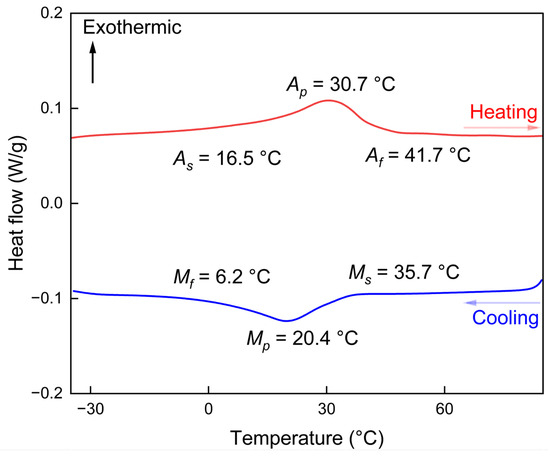
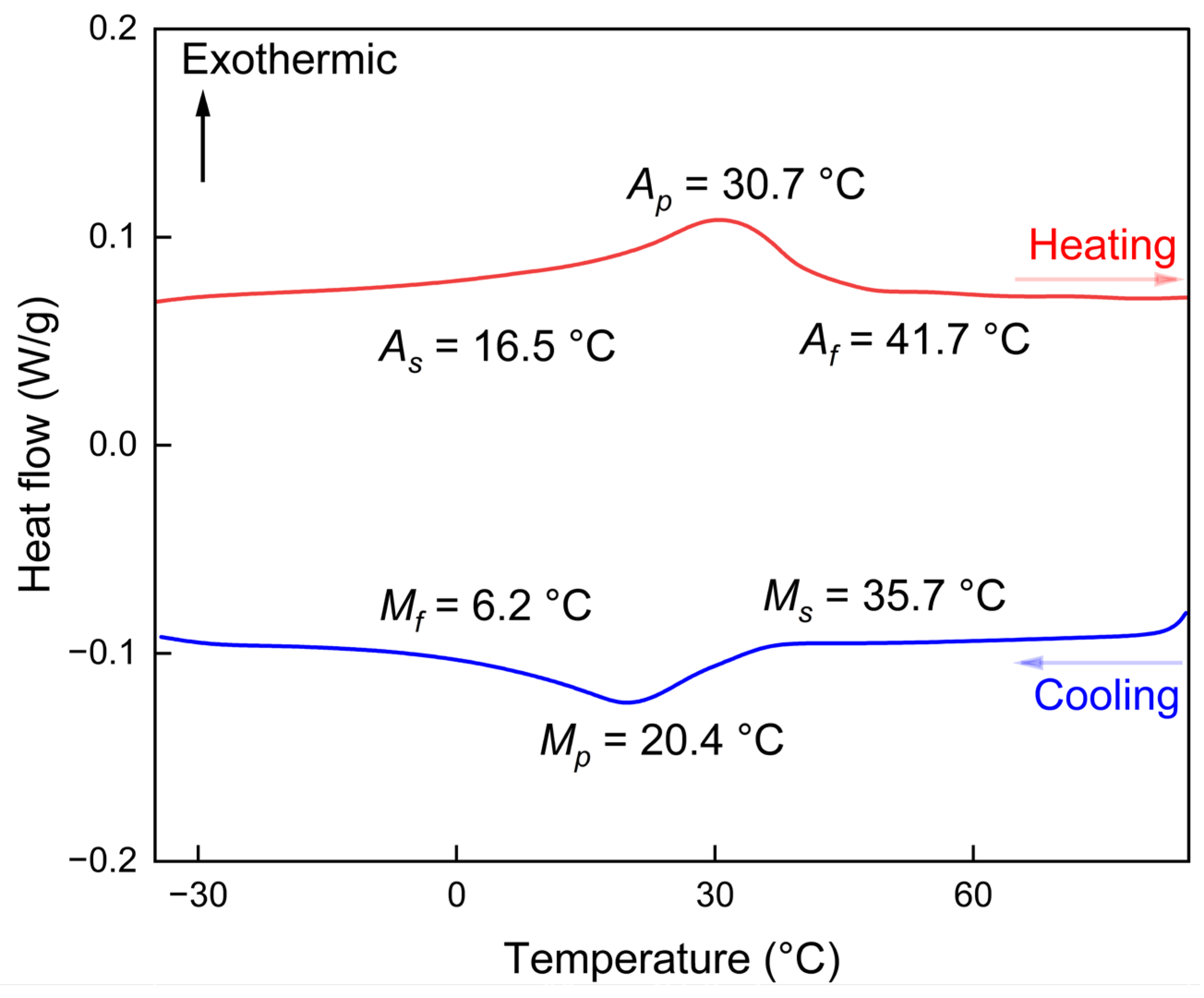
The phase transformation behavior of the NiTi alloy was characterized using differential scanning calorimetry in the temperature range of –40 °C to 90 °C at a heating/cooling rate of 10 °C min−1. The DSC thermogram (Figure 1) shows a single-step reversible martensitic transformation. The forward (cooling) transformation begins at Ms = 35.7 °C and ends at Mf = 6.2 °C, while the reverse (heating) transformation starts at As = 16.5 °C and finishes at Af = 41.7 °C. The corresponding peak temperatures are Ap = 30.7 °C and Mp = 20.4 °C.
Figure 1.
Differential scanning calorimetry (DSC) heating and cooling curves of Ni-rich NiTi shape memory alloy (55.8 wt% Ni).
Based on these results, the corrosion tests were conducted at representative temperatures of 10 °C (fully martensitic), 20–40 °C (mixed-phase transition), and 60 °C (fully austenitic) to capture the electrochemical response of each phase state.
2.3. Microstructure
For microstructural characterization, an uncorroded specimen was metallographically prepared and etched according to ASTM E407 [38] to reveal grain morphology and defect structures potentially relevant to localized corrosion initiation. The electrolytic etchant was a mixture of 5 mL of acetic acid, 10 mL of nitric acid, and 85 mL of distilled water. The sample was etched electrolytically at 1.5 V for 60 s with platinum wires as electrodes. The surface was rinsed with deionized water and air-dried before imaging.
2.4. Electrochemical Testing
Electrochemical corrosion characterization of the NiTi alloy was performed using a conventional three-electrode configuration coupled with a Gamry Reference 600 + potentiostat/galvanostat/ZRA (Gamry Instruments, Warminster, PA, USA). The electrochemical cell employed a NiTi specimen as the working electrode, a saturated calomel electrode (SCE) as the reference electrode, and a high-purity graphite rod as the counter electrode. The exposed surface area of the working electrode was defined as 4 cm2 using a chemically resistant red lacquer mask. All experiments were conducted in a 3.5 wt% NaCl solution, prepared with deionized water. The 3.5 wt% NaCl solution was selected as the reference electrolyte to provide a standardized, reproducible, and widely established chloride-containing environment for comparative evaluation of the corrosion behavior. This concentration is extensively used in corrosion research and facilitates direct comparison with previously reported corrosion data, as seen by ASTM G44 studies [39]. The testing was conducted in a double-layer, temperature-controlled three electrode electrochemical cell, enabling precise thermal regulation of both the sample and the electrolyte. Temperature was controlled using a recirculating thermostatic bath system (with ±0.5 °C stability). The electrochemical testing sequence was open circuit potential (OCP), EIS and CPP.
2.4.1. Electrochemical Impedance Spectroscopy
Prior to any electrochemical testing, an OCP of 1 h was conducted to reach steady state. Potentiostatic Electrochemical Impedance Spectroscopy was employed to characterize the electrochemical interface and evaluate the stability of the passive film on the NiTi alloy across its distinct thermal phase regimes in a 3.5 wt% NaCl solution. EIS measurements were performed at OCP with sinusoidal AC perturbation amplitude of 10 mV RMS over a frequency range from 10 mHz to 100 kHz. For each frequency decade 10 points were registered. For each temperature, at least two EIS spectra were collected under identical conditions.
2.4.2. Cyclic Potentiodynamic Polarization
Cyclic potentiodynamic polarization tests were conducted to measure the passivation behavior, corrosion kinetics, and localized corrosion susceptibility of the NiTi alloy for each temperature (10, 20, 40, 60 °C). The potential scan range was set from −0.3 V to +1.0 V vs. OCP. After that, a reverse scan returned to −0.3 V, at a scan rate of 1 mV/s. A current density limit of 50 mA/cm2 was set during the scan to prevent excessive material damage or uncontrolled transpassive dissolution, which can obscure the pitting and repassivation phenomena of interest. The exposed working electrode area was consistently maintained at 4.0 cm2. To ensure the reliability and statistical significance of the results, at least two replicate measurements for each temperature condition were performed. For Table 1, Table 2 and Table 3, the reported values correspond to representative measurements obtained from these replicates and all have a deviation below 10%.
Table 1.
CPP parameters for NiTi SMA at different temperatures in 3.5% NaCl.
Table 2.
Selected EIS parameters at 10–60 °C.
Table 3.
Pit metrics derived from 3D profilometry (5000× magnification).
2.5. Surface and Pit Morphology Characterization
The surface structure and elemental composition of the NiTi samples were analyzed before and after each electrochemical testing. This assessment used a combination of 3D optical profilometry and scanning electron microscopy with energy-dispersive X-ray spectroscopy (Jeol, Tokyo, Japan). These techniques measured the level of pitting damage, showed the breakdown of the passive film, and linked localized corrosion features to changes in composition under different thermal conditions.
2.5.1. 3D Optical Profilometry
Quantitative surface topography measurements were performed using a VR-6000 Keyence 3D optical profilometer (Keyence, Osaka, Japan), operating in high-resolution mode at 5000× magnification. After CPP testing, each specimen was gently rinsed with deionized water and air-dried without further cleaning to preserve corrosion features.
For each temperature condition, multiple fields of view were analyzed to ensure statistical relevance. The extracted parameters included total corroded volume (mm3), total affected area (mm2), average and maximum pit depth (mm), average pit perimeter (mm), and average pit circularity (dimensionless). Surface segmentation and volume calculations were done using Keyence Analyzer software (VR-6000 Series software).
2.5.2. Scanning Electron Microscopy and Energy-Dispersive Spectroscopy
Characterization was conducted using a JEOL JCM-6000 PLUS scanning electron microscope (Jeol, Tokyo, Japan), equipped with an Oxford EDS detector. Imaging was performed at an accelerating voltage of 15 kV and a working distance of 10 mm.
EDS analysis focused exclusively on pit regions—the localized corrosion sites identified from profilometric and SEM imaging. Point measurements were taken from the inside of corrosion pits to determine the elemental composition of areas most severely affected by electrochemical attacks. The target elements were nickel (Ni), titanium (Ti), oxygen (O), sodium (Na), and chlorine (Cl). Quantitative results were obtained using ZAF correction protocols via Oxford INCA software (INCA 18d SP5).
2.5.3. X-Ray Photoelectron Spectroscopy (XPS)
Surface analysis by XPS was performed after the CPP for each temperature. XPS spectra were recorded on a PHI 5000 VersaProbe II X-ray photoelectron spectrometer (Physical Electronics, Chanhassen, MN, USA)with an Al Kα source (hv = 1486.6 eV), a working residual pressure below 10−8 torr, a high-voltage excitation of 15 kV, a power of 25 W and a take-off angle of 45° with respect to the sample surface. The high-resolution XPS used a CLAM2 hemispherical electron analyzer with a non-monochromatic Mg Kα X-ray source operated at 300 W, with a pass energy of 23.5 eV and at energy step size of 0.2 eV/step. he depth profile sputtering was performed using an EX05 Ar + ion gun operating at 1 kV and 1 µA [38]. The intensities were calculated by the integration of each peak, with prior subtraction of the S-shaped background, and fitting the curves to a Gaussian–Lorentzian line. The adventitious C1 s peak at 285.0 eV was used to adjust the specimen charging to determine the binding energies (BEs).
3. Results
3.1. Microstructure
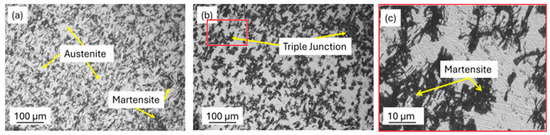
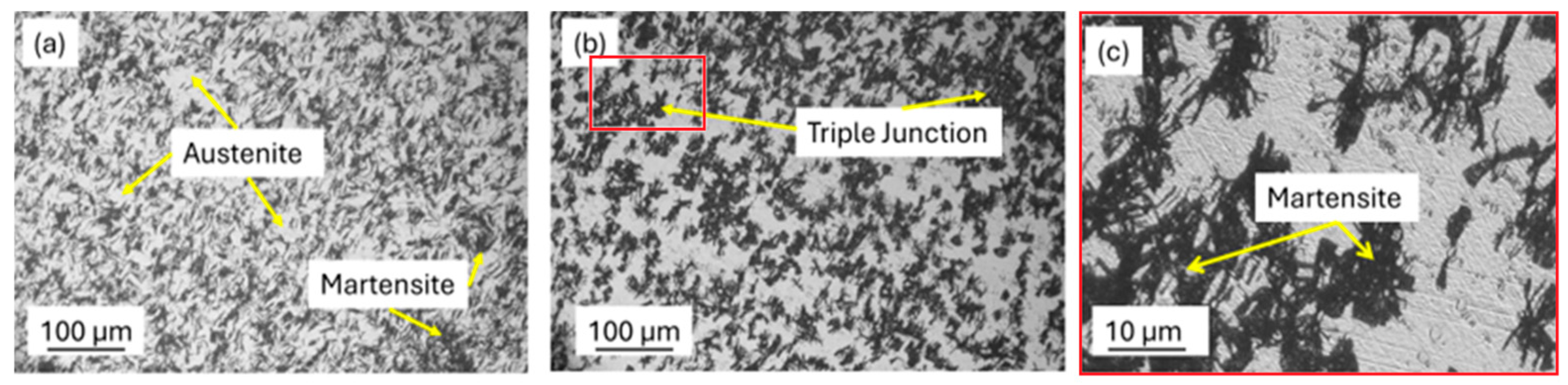
The resulting microstructure exhibited a fine distribution of twin bands and grain boundaries, characteristic of the martensitic phase at room temperature [38,40]. No significant inclusions or second-phase precipitates were found (Figure 2). This confirms that the matrix is compositionally uniform. Nevertheless, examination revealed several triple junctions and high-angle grain boundaries, features well-known in the literature to act as local sites of electrochemical heterogeneity due to their associated crystallographic misorientations and localized strain concentrations [41,43].
Figure 2.
NiTi alloy microstructures: (a) surface after standard electrolytic etching; (b) same alloy etched for a longer duration, revealing deeper martensitic features and plate boundaries; (c) 10× magnified region. All images are from uncorroded, as-received material.
The electrolytic etch revealed variant plates and twin bands typical of martensite at room temperature [44]. Throughout this work the dark lamellar regions are referred to as martensite variants and the brighter matrix as austenitic background/parent regions when present at elevated temperatures. At room temperature both contrasts are within the martensitic microstructure (variant plates versus plate boundaries).
3.2. Cyclic Potentiodynamic Polarization
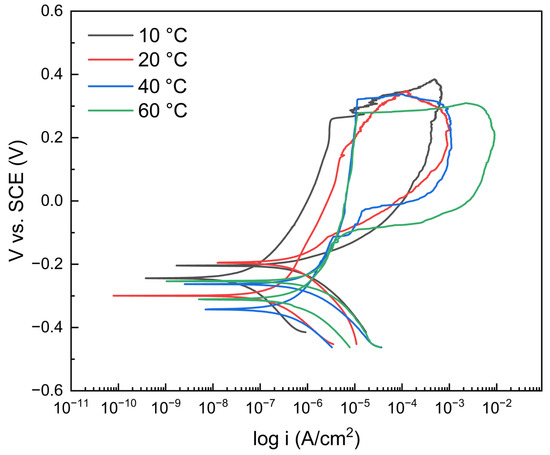
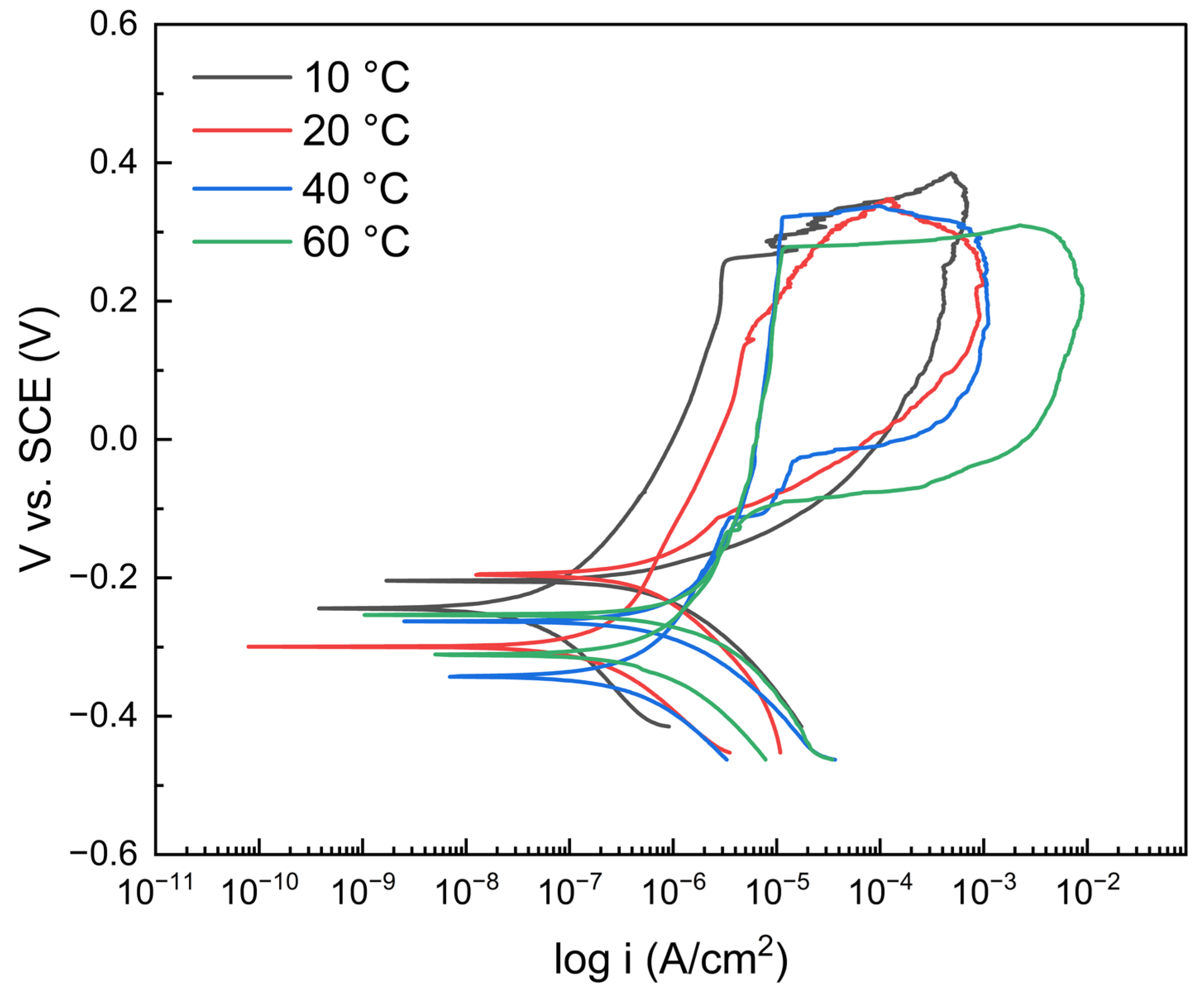
The temperature-dependent corrosion kinetics, passivity breakdown, and localized corrosion susceptibility of the NiTi alloy were evaluated via cyclic potentiodynamic polarization in a 3.5 wt% NaCl solution. Figure 3 illustrates the experimental polarization curves obtained at 10 °C, 20 °C, 40 °C, and 60 °C. Quantitative analysis of these CPP curves yielded critical electrochemical parameters summarized in Table 1.
Figure 3.
Cyclic potentiodynamic polarization curves of NiTi alloy at 10 °C, 20 °C, 40 °C, and 60 °C in 3.5 wt% NaCl.
At 10 °C, where the alloy is in a fully martensitic state, the material exhibits a low corrosion current density (Icorr = 82.1 nA/cm2), reflecting an inherently protective surface state. As the potential is scanned anodically, the passive current density remains well-controlled until localized film breakdown occurs at an Epit of 262.0 mV vs. SCE. The reverse scan forms a distinct, moderate hysteresis loop that closes at a relatively noble repassivation potential Erp = −201.7 mV vs. SCE. This phase assignment (martensite at 10 °C, mixed regime at 20–40 °C, and austenite at 60 °C) is consistent with DSC measurements and transformation ranges summarized by Frenzel et al. [45].
A notable change in electrochemical behavior is observed in the mixed-phase regime at 20 °C and 40 °C. At 20 °C, the corrosion potential shifts to the most active status to −300.0 mV vs. SCE, accompanied by a massive spike in Icorr to 611.0 nA/cm2. Notably, the passive film undergoes breakdown at a substantially lower potential (Epit = 134.0 mV vs. SCE), indicating a severe compromise in film stability during initial anodic polarization. This change results from increased defects and internal strain fields associated with the mixed-phase microstructure, which comprises coexisting austenite grains and martensite variants.
The coexistence of austenite and martensite phases generates internal galvanic couples due to differences in their localized galvanic potentials, an effect previously documented in laser powder bed fused (L-PBF) NiTi alloys [46]. These galvanic interactions destabilize the passive film and promote localized corrosion, explaining the dramatic increase in Icorr observed at 20 °C. Furthermore, the 20 °C CPP curve demonstrates a highly active breakdown threshold, rendering the alloy highly vulnerable to pitting initiation at low overpotentials.
The microstructural susceptibility intensifies markedly at 40 °C. Although the Ecorr at this temperature (−263.0 mV vs. SCE) is less active than the 20 °C peak (−300.0 mV vs. SCE), this condition sustains the highest Icorr across all tested temperatures (1810.0 nA/cm2), driven by the severe microstructural heterogeneity and phase boundary mismatches inherent to the mixed-phase regime. While the forward scan displays a delayed breakdown threshold at Epit = 318.9 mV vs. SCE, the reverse scan traces back at lower current densities relative to the forward scan at equivalent potentials, closing at a noble repassivation potential of Erp = −112.1 mV vs. SCE. This behavior indicates strong local acidification and a rapid autocatalytic propagation mechanism within the pits. The combination of the highest dissolution current density and persistently poor repassivation drives the maximum pit depths and highest corroded volumes confirmed later by 3D profilometry.
Upon heating to 60 °C, where the alloy transitions into a fully austenitic structure, the baseline thermodynamic stability partially recovers, as shown by the nobler shift in Ecorr to −253 mV vs. SCE. The uniform single-phase austenite delays the initiation of localized breakdown to an Epit of 273.4 mV vs. SCE. However, the anodic scan exhibits significantly higher current densities, and the reverse scan forms a remarkably wide, open hysteresis loop that extends to current densities near 10−2 A/cm2 before closing at −130.6 mV vs. SCE.
The progressive decrease in both βa and βc at 60 °C indicates more facilitated anodic and cathodic kinetics, consistent with an increasingly active electrochemical interface at higher temperatures. Although the austenitic phase shows partial recovery in baseline uniformity, the lower Tafel slopes suggest that the passive layer provides weaker kinetic resistance compared to the low-temperature martensite. This broad loop signifies that while single-phase austenite resists initial breakdown at elevated temperatures, the combination of thermally accelerated dissolution and enhanced chloride activity severely hinders the material’s ability to repassivate once stable pits propagate. This polarization behavior matches the shallow, broad, and widespread pitting morphology resolved in post-test surface analysis.
At higher temperatures (40 °C and 60 °C), the alloy is expected to be in a predominantly austenitic state. This assignment is consistent with published transformation temperature ranges for near-equiatomic NiTi [45,46,47]; Icorr decreased slightly but remained significantly higher than at 10 °C. This suggests that although the passive film may be more stable in the fully austenitic phase than in the mixed-phase condition at 20 °C, its protective ability is still not as strong as in the martensitic phase. The progressive decrease in both βa and βc with rising temperature indicates more facilitated anodic and cathodic kinetics, consistent with an increasingly active electrochemical interface. Although the austenitic phase (60 °C) shows partial recovery in uniformity, the lower slopes suggest that the passive layer provides weaker kinetic resistance compared to martensite. The hysteresis observed in the CPP curves at these temperatures suggests difficulties in repassivating the surface after localized corrosion, as the reverse current density decreases more slowly compared to the forward current at the same potential [48]. Further, the anodic-to-cathodic transition potential of all cases are less noble than their corresponding forward current alternatives, indicating that passivity will persist and will be more stable at Ecorr. Hence, more research into how the passive film deteriorates and re-establishes at these temperatures is needed. To further study the passivity and the trans-passivation point of the alloys with the temperature, the pitting susceptibility factor (PSF) was calculated following Klapper’s criterion [49,50,51] to quantify repassivation capacity during cyclic scans as (1):
where Epit is the forward scan pitting potential, Erp the reverse scan repassivation potential where current density returns to the passive level, and Ecorr the corrosion potential from Tafel fits. PSF values closer to 1 indicate higher susceptibility to stable pit growth and poor repassivation, whereas values closer to 0 indicate greater repassivation tendency and unstable pit propagation [51].
It is important to clarify that the Erp values reported in Table 1 are expressed in millivolts versus the standard calomel electrode (mV vs. SCE) reference. The Erp at 10 °C (−201.7 mV vs. SCE) is notably more negative than at 60 °C (−130.6 mV vs. SCE), with a difference of approximately 71 mV, indicating that the martensitic film repassivates at a less noble potential compared to the austenitic film. The key electrochemical distinction, however, lies in the Epit − Erp hysteresis window, which is captured by the pitting susceptibility factor and reflects the overall repassivation capacity of the alloy. Notably, the Epit values at 10 °C (262.0 mV vs. SCE) and 60 °C (273.4 mV) are comparable, differing by only ~11 mV, indicating that both the martensitic and austenitic phases require a similar applied potential to initiate pitting. Despite this near-identical breakdown threshold, the repassivation behavior diverges substantially: the martensitic phase at 10 °C exhibits a wider hysteresis window (Epit − Erp = 463.7 mV, PSF = 0.916) and a more negative Erp. In contrast, the austenitic phase at 60 °C repassivates at a comparatively less negative Erp (−130.6 mV), yielding a narrower hysteresis window (Epit − Erp = 404.0 mV) and a PSF of 0.768.
3.3. Electrochemical Impedance Spectroscopy
Electrochemical impedance spectroscopy was used to further study the stability of the passive film of the NiTi alloy and the interfacial processes governing corrosion across different thermal regimes. Before the EIS data were analyzed and fitted to an electric equivalent circuit (EEC), the Kramers–Kronig transforms were calculated to demonstrate the stability of the data, linearity, and causality constraints of the Linear Systems Theory (LST). The good agreement between the transformed and experimental data demonstrated that the experimental impedance data were robust.
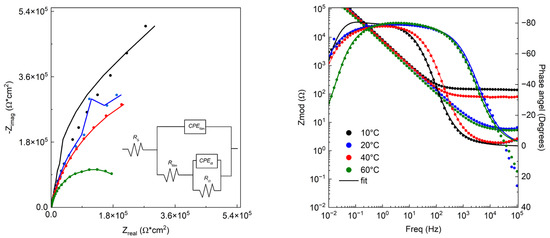
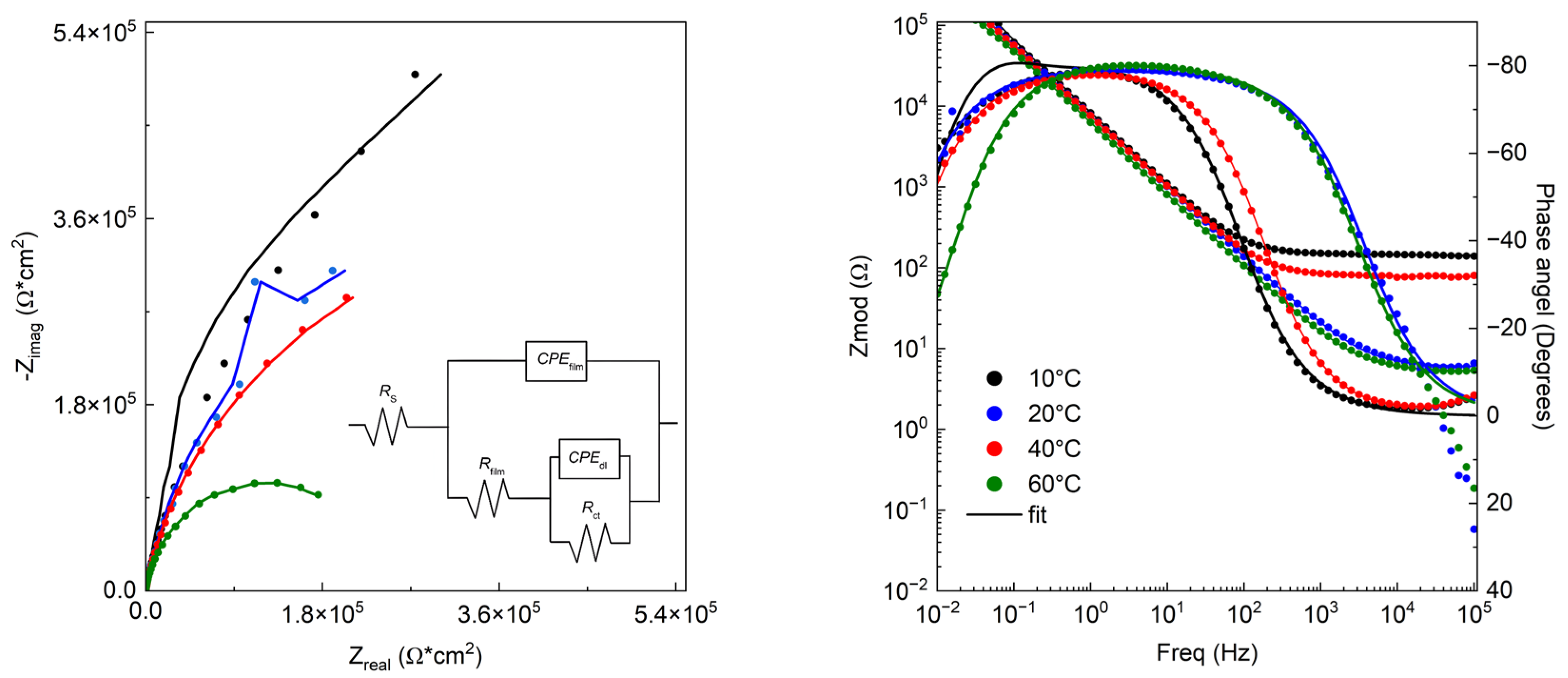
The chosen equivalent electric circuit consists of two distinct time constants in parallel, representing electrochemical processes at different scales (inset in Figure 4 (left panel)). At high frequencies, the passive film is modeled by a resistance (Rfilm) in parallel with a constant phase element (CPEfilm), capturing both the resistive and capacitive nature of the oxide layer. At lower frequencies, the double-layer capacitance (CPEdl) and the charge transfer resistance (Rct) describe interfacial reactions associated with metal dissolution. This hierarchical arrangement reflects the transition from passive film stability to electrochemical activity after breakdown [52,53,54,55].
Figure 4.
Nyquist (left) and Bode (right) plots of NiTi alloy at different temperatures with equivalent circuit fitting. Phase angle and impedance trends reveal reduced passive film stability and increased interfacial activity in the transformation temperature range.
The acquired data was presented in both Nyquist and Bode formats. The experimental EIS data were fitted using a custom multi-time-constant equivalent circuit model as included in Figure 4 and graphically represented in Figure 4. All fitting values are gathered in Table 2, where the relative error of each element of the equivalent electric circuit was below 10% and the goodness of fit (χ2) on the order of 10−4, demonstrating excellent agreement between the model and the experimental EIS spectra.
The Rfilm shows that all temperatures kept the same order of magnitude (100 kΩ·cm2), being slightly higher for the lower temperatures, softly decreasing with the increasing temperatures. This shows that, regardless of the temperature, the passive film remains protective at OCP; similarly, the Y0,film remains on the 10−5 S.sn.cm−2, and its corresponding afilm also remains close to the unity, proving the high ideality, almost like a pure capacitor. It is on the Rct-CPEdl that some differences can be seen, mainly attributed to the change in microstructure. The Rct softly fluctuates in the 10−4 S.sn.cm−2, denoting a less protective film, as the pseudo capacitor moves away from the common ranges of the ideal capacitors 1–10 S.sn.cm−2 orders of magnitude. Even more, as seen with other electrical components trend, it increases with temperature. Its adl also decreases, getting in the 0.7–0.8 range, proving that the double layer, due to the mix in microstructure, acts as a doper capacitor, acting as a mix between a resistor and a capacitor. Overall, at 10 degrees, the corrosion performance shows the best values, both from the R and CPE components, decreasing with temperatures ranging from 20 to 40 degrees; however a minor improvement at 60 is seen, possibly due to most of the microstructure being a single phase again.
The impedance spectra reflect the evolving phase constitution with temperature. At 10 °C (fully martensitic), the Nyquist semicircle is largest, and the Bode phase angle reaches ~−62°, approaching the response of an ideal capacitor. This indicates a stable passive film supported by the martensitic microstructure, consistent with the lowest Icorr and most noble Ecorr observed in CPP. In the mixed-phase regime (20–40 °C), the semicircle radius decreases and the phase angle dome narrows, reflecting diminished capacitive behavior and increased interfacial heterogeneity. These features correlate with the highest Icorr and most negative Ecorr, along with shallow Epit and PSF ≈ 1, indicating poor repassivation. At 60 °C (fully austenitic), impedance partially recovers: although the phase angle is less negative (≈−50°), the broader dome width suggests a more uniform but chemically thinner passive film. This agrees with CPP evidence of moderate Icorr and higher Epit, alongside PSF near unity but with shallower pits. Overall, the changes in Zmodulus and phase angle dome width track the microstructural transition: martensite and austenite offer better overall passivity than the galvanically coupled mixed-phase state.
The observed decrease in Rct between 20 °C and 40 °C correlates with the mixed-phase regime, where overlapping martensitic variants and austenitic grains form numerous interfaces. These interfaces act as internal galvanic couples, lowering Ecorr and raising Icorr as confirmed in CPP (Table 1). Similarly, the partial recovery of impedance at 60 °C corresponds to the return to a single-phase austenitic microstructure, consistent with reduced pit depth observed in profilometry.
It is important to clarify the physical interpretation of the resistance terms in the equivalent circuit model. The Rfilm values (9.31 × 10⁵ Ω·cm2 at 10 °C, decreasing to 2.12 × 10⁵ Ω·cm2 at 60 °C) represent passive film or barrier resistance, not classical charge transfer resistance. These values are consistent with the literature range of 105–106 Ω·cm2 reported for NiTi in the passive state in chloride media [36,56]. The high Rfilm at 10 °C (931 kΩ·cm2) is consistent with the robust passivity of the martensitic phase, as evidenced by the lowest corrosion current density and most stable passive film observed in CPP. The Rct term in the equivalent circuit model captures interfacial processes at lower frequencies and should be interpreted as a film-defect or grain boundary pathway resistance rather than bulk charge transfer in the classical sense. In the passive region, the dominant resistance arises from the oxide barrier (Rfilm), while Rct reflects localized pathways for ionic transport through defects, grain boundaries, or phase interfaces. This distinction is particularly relevant in the mixed-phase regime (20–40 °C), where the coexistence of martensite and austenite introduces microstructural heterogeneity that manifests as increased CPEdl admittance and reduced adl exponent, indicating a more defective and less ideal capacitive response at the interface.
3.4. Profilometry Analysis
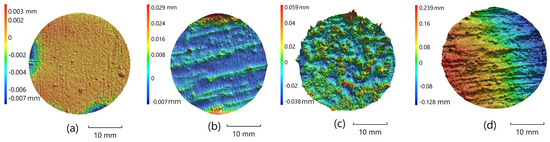
Three-dimensional surface profilometry was performed to assess corrosion damage after each polarization experiment to understand localized corrosion behavior at various temperatures. Table 3 summarizes the derived pit metrics, while Figure 5 represents the surface topography after polarization.
Figure 5.
3D profilometry of NiTi surfaces (5000× magnification) after polarization at (a) 10 °C, (b) 20 °C, (c) 40 °C, and (d) 60 °C. Pit severity peaks at 40 °C, with high-aspect-ratio damage also evident at 60 °C.
At 10 °C, where the NiTi alloy is in the martensitic state, the profilometry analysis revealed negligible corrosion, with a total corroded volume of 0 mm3. This confirms the superior corrosion resistance observed in both the lower icorr from the CPP and the higher impedance from the EIS.
A noticeable change in surface [1morphology was observed at 20 °C, corresponding to the mixed-phase condition. Despite the relatively low total corroded volume (0.058 mm3), small but deep pits with a maximum depth of 0.802 mm were detected. This suggests the early onset of localized corrosion, likely due to the increased presence of defects and potential differences between the coexisting martensite and austenite phases, creating vulnerable sites for the breakdown of the passive film. Figure 5b shows these developing pits. The low average circularity (0.405) indicates irregularly shaped pits, characteristic of early-stage localized attack, where pit growth may be influenced by microstructural features.
The corrosion damage significantly intensified at 40 °C. A drastic increase was observed in both the total corroded volume (11.365 mm3) and the maximum pit depth (7.317 mm). This drastic increase is consistent with the maximal electrochemical activity and severe oxide breakdown noted during the phase instability range, as identified by CPP. The significantly larger affected area (60.434 mm2) and average pit perimeter (4.270 mm) at 40 °C further validate the extensive localized corrosion occurring at this temperature. Figure 5c illustrates the severe and widespread pitting corrosion at 40 °C.
At 60 °C, in the fully austenitic phase, a clear trend appeared. The affected area stayed high at 61.067 mm2, but the total corroded volume dropped to 3.701 mm3. The maximum pit depth remained at a similar value as 40 °C with 6.652 mm. This shows a less aggressive and possibly smoother surface attack. The rise in average circularity to 0.575 suggests that the pits are becoming rounder and less irregular. This could mean a move toward more stable pitting or a lower impact of certain microstructural features on the growth of the pits. However, the still high pit depth and area coverage, as seen in Figure 5d, signify that significant corrosion damage persists in the austenitic phase with potentially altered mechanisms compared to the mixed-phase region.
The degradation trends can be explained by the progressive change in phase constitution with temperature. Differential scanning calorimetry studies of near-equiatomic NiTi confirm that the alloy transitions from fully martensitic at 10 °C to a mixed austenite–martensite state between 20 and 40 °C and to fully austenitic at ~60 °C [57]. Although no in situ EBSD/XRD was performed, these transformation ranges have been repeatedly reported and are consistent with the observed electrochemical signatures. The particularly poor corrosion performance in the 20–40 °C window is attributed to the coexistence of martensite and austenite, which creates internal galvanic couples at phase interfaces [58,59]. Martensite and austenite differ measurably in open circuit potential, with the literature reporting potential offsets on the order of 100–200 mV between the phases when tested separately [56,60,61]. Such offsets provide a driving force for localized current exchange at interfaces that accelerates passive film rupture. This mechanism explains why profilometry shows the deepest and most irregular pits at 40 °C despite PSF suggesting partial repassivation and why EIS indicates reduced Rct in the same regime. In contrast, the return to a single-phase microstructure at 60 °C eliminates these galvanic interfaces, allowing more uniform yet chemically weaker passivation.
The profilometry analysis provides visual and numerical evidence of the phase-dependent corrosion behavior of the NiTi alloy. The results show a high risk of pitting corrosion in the mixed-phase and phase instability areas, especially between 20 °C and 40 °C. This illustrates key details about the shape of corrosion damage at various temperatures. These findings strongly support and complement the electrochemical data collected from CPP and EIS measurements.
3.5. SEM-EDS Surface Chemistry
High-magnification images were acquired at the pit mouth for correlation with etched features; EDS points were placed across the pit rim to compare chemistry at boundaries versus laminas. Because SEM-EDS is inherently semi-quantitative and averages over a micrometer-scale interaction volume, the resulting compositions are interpreted as relative indicators of enrichment rather than exact passive film stoichiometry.
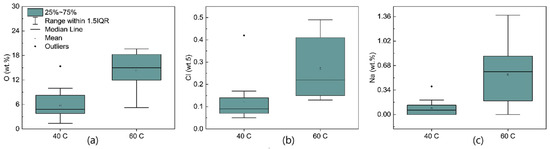
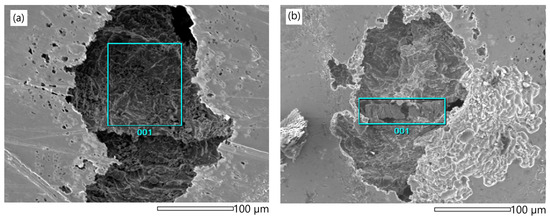
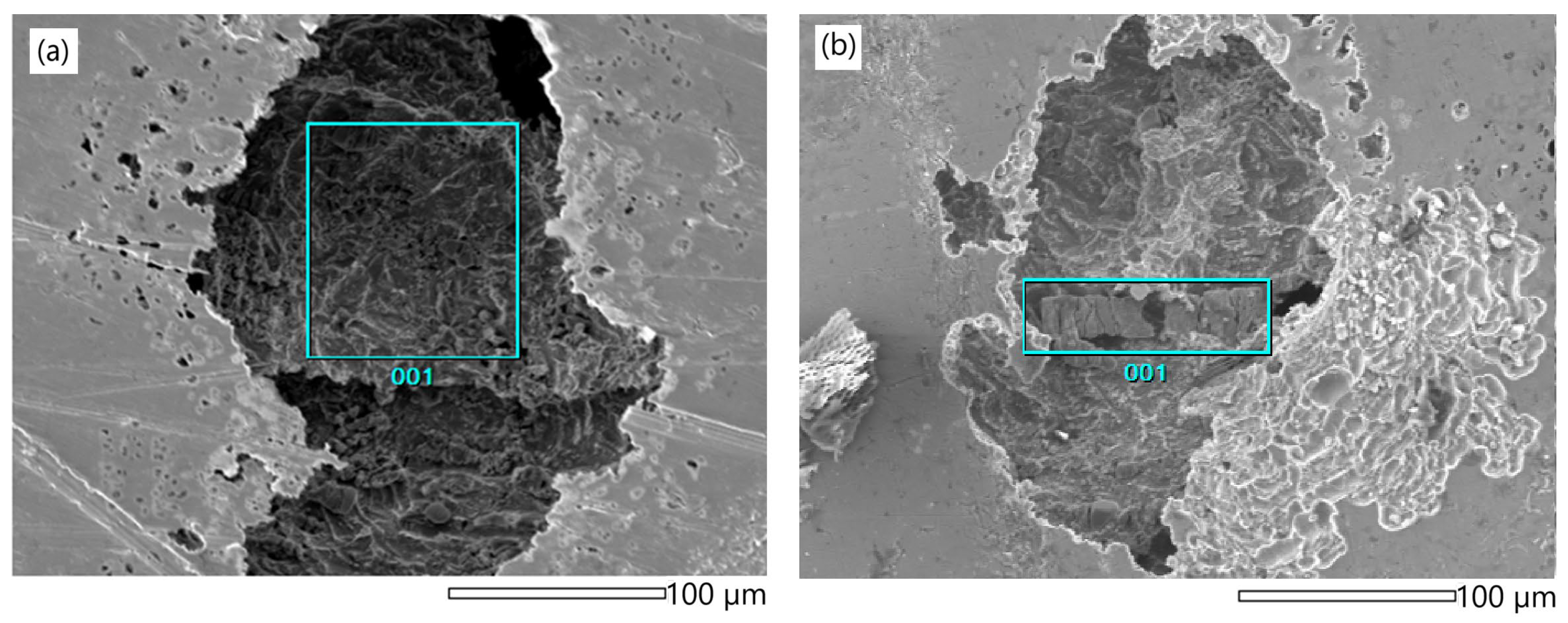
SEM-EDS elemental analysis showed apparent differences in surface chemistry between the 40 °C and 60 °C specimens. This reflects how the phase state affects passive film characteristics. At 40 °C, the oxygen content varied from 3.4 to 9.9 wt%, suggesting the formation of relatively thick but uneven oxide layers. The median oxygen concentration was around 5 wt% at 40 °C. At 60 °C, this concentration rose to about 14 wt%, indicating significant thickening of the passive film in the austenitic regime. Trace amounts of chloride were consistently detected at pit rims and along lamellar features.
In contrast, the surface at 60 °C showed much higher oxygen levels, often going above 13 wt% and peaking at 19.6 wt%. This suggests a more continuous and widespread passive oxide layer. However, chloride concentrations were also high, reaching up to 0.49 wt%. Meanwhile, sodium levels stayed significant at corrosion sites or at the openings of pits.
Despite this, the spatial distribution of corrosive elements appeared more uniform compared to the 40 °C sample, where elemental hotspots were prominent. These observations reinforce the hypothesis that the mixed-phase regime (20–40 °C) is most susceptible to passive film breakdown and localized attack, while both the martensitic (10 °C) and austenitic (60 °C) states favor relatively more stable surface chemistry. Notably, the austenitic phase appears to support a more homogeneous but thinner passive film, which may be more permeable to aggressive ions. These chemical shifts indicate that austenite favors more uniform passivation, whereas the mixed-phase range (20–40 °C) promotes interfacial instability and pit propagation through chloride-assisted oxide rupture. As visualized in Figure 6, these elemental trends provide quantitative evidence of phase-dependent surface chemistry, which is consistent with the morphological patterns shown in Figure 7.
Figure 6.
Boxplot comparison of elemental surface concentrations (wt%) of (a) oxygen, (b) chlorine, and (c) sodium measured by SEM-EDS on NiTi samples after corrosion at 40 °C and 60 °C in 3.5 wt% NaCl. The condition at 60 °C has a much higher oxygen content, which suggests a thicker passive film formation. It also has increased Na and Cl levels, indicating salt entrapment and disruption of the passive film. The boxplots illustrate the 25–75% interquartile range, median, mean (represented by open squares), and outliers.
Figure 7.
Representative SEM images of corroded NiTi surfaces after testing at (a) 40 °C and (b) 60 °C, showing typical pit morphology and EDS analysis zones (indicated by the rectangles labeled 001). The 40 °C sample exhibits sharper, deeper pits with irregular edges, whereas the 60 °C sample reveals broader, but more uniformly distributed, corrosion features.
3.6. XPS Analysis
After the CPP was performed at each of the different temperatures, the samples were analyzed through XPS to determine the oxide formed on the surface. The survey XPS spectra (not included) exhibit signals from the alloy constituents, C 1s and O 1s, and the components from the mortar (Ca, Si and Cl). Table 4 reports the at.% of all peaks for different elements used in this study. As can be seen, the Ni content was very small, always below 1 at.%, while the Ti fluctuated, showing the highest concentration at 20 °C with 13.27 at.%. Similarly, the oxygen content varied, going from 10, 28, to 6 and 6 at.% approximately at 10, 20, 40, and 60 °C respectively. In addition, Table 5 reports the peak parameters of chemical species for different elements used in this study.
Table 4.
Atomic percentages of NiTi after CPP in 3.5 wt% NaCl.
Table 5.
Peak parameters of chemical species for Ni and Ti.
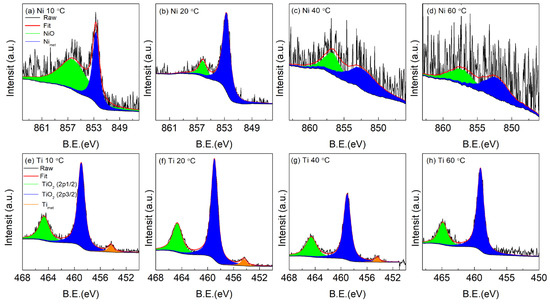
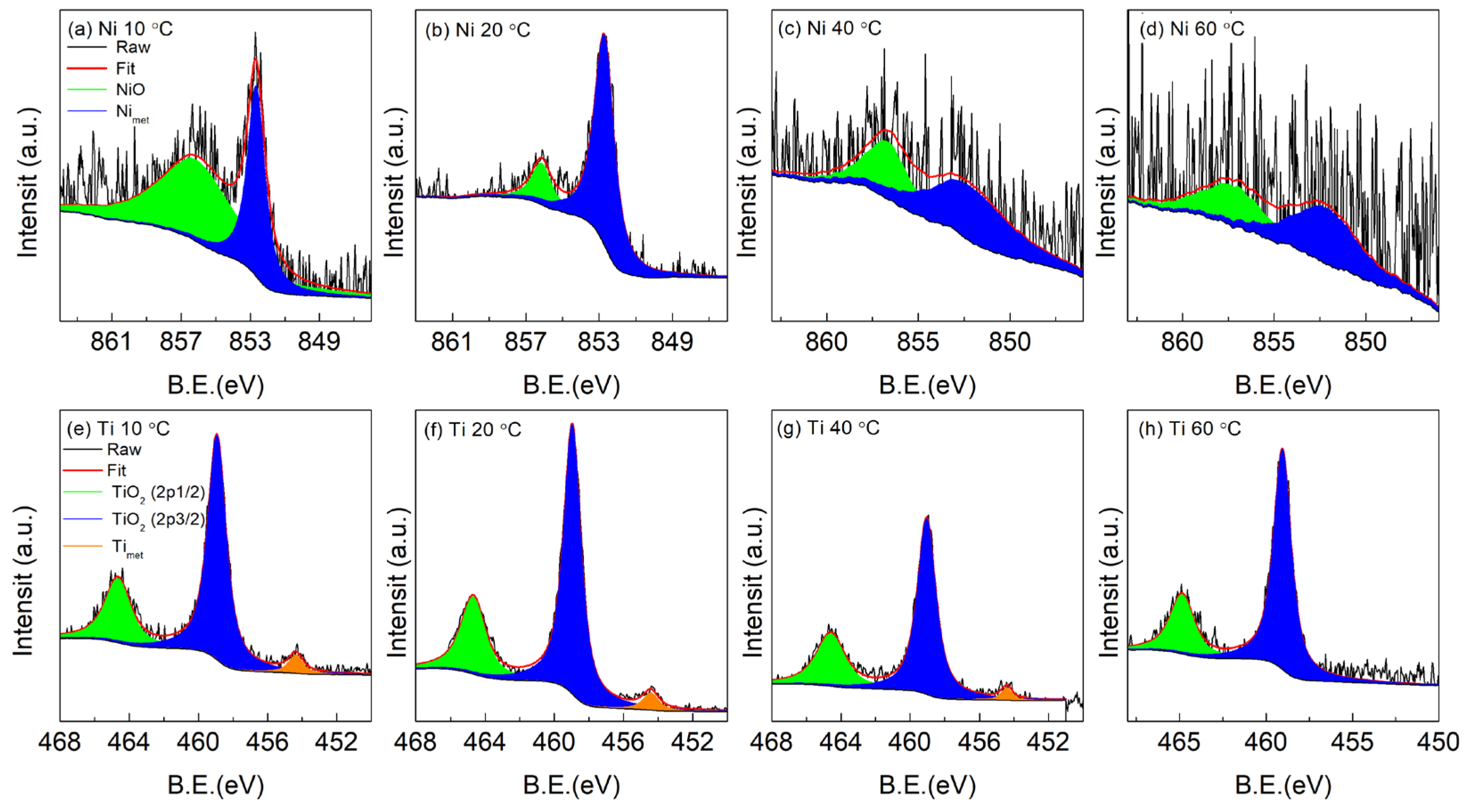
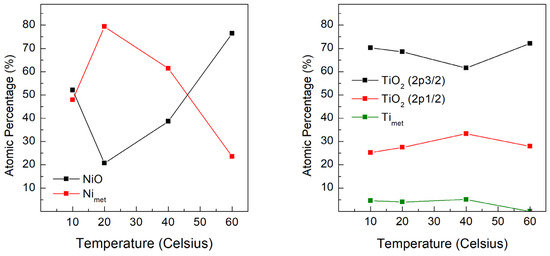
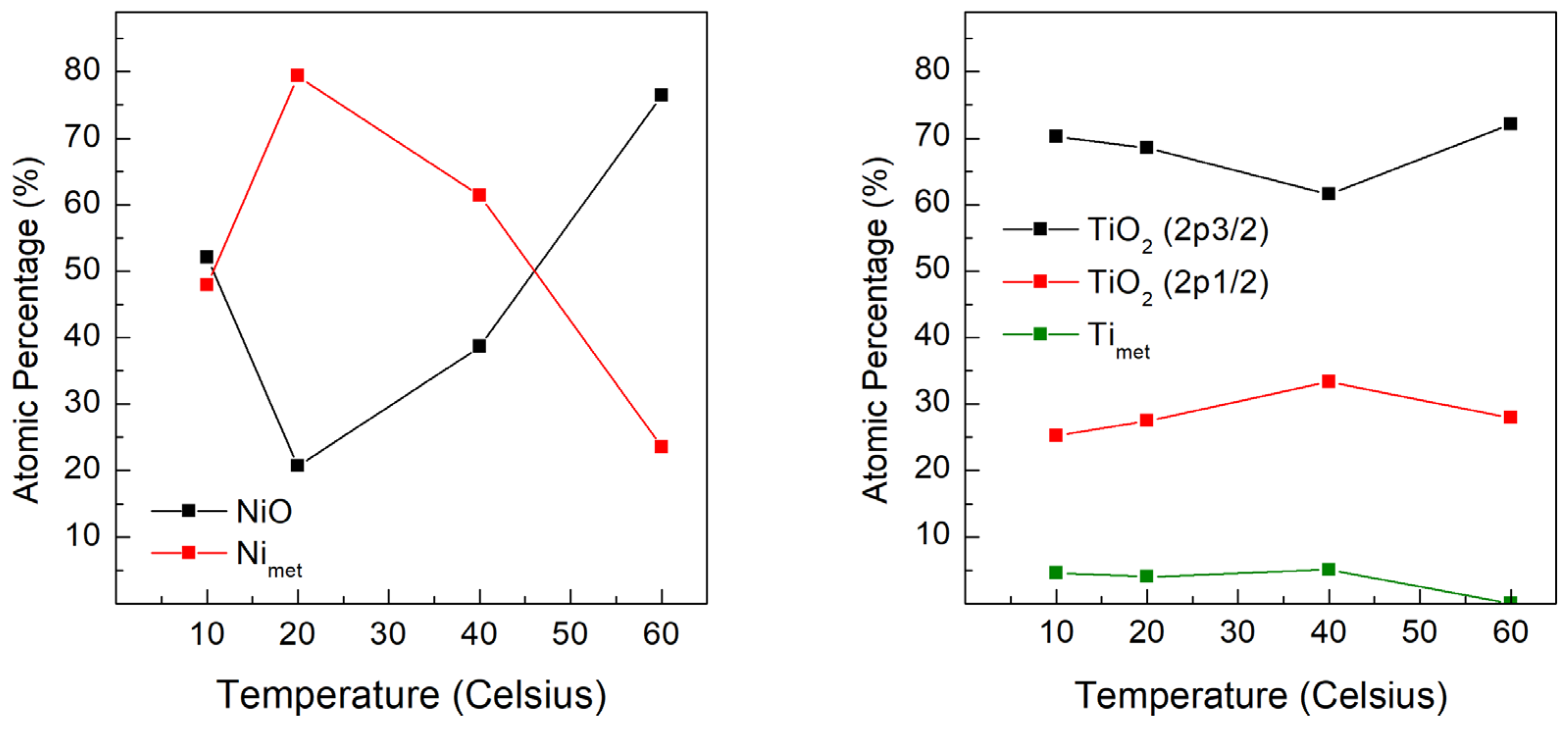
The high-resolution XPS scans of the Ni and Ti peaks can be seen for each temperature in Figure 8, where the raw data, the sum of the fit, and each fitted specie is colored. As seen from Table 4, the Ni content was low, thus showing more noise for the raw data. Conversely, the Ti peaks could be easily identified given its higher surface content. Based on the peak position from Table 5, the deconvolution was done, and by peak integration, the actual at.% of each specie was calculated and plotted in Figure 9.
Figure 8.
High-resolution XPS spectra for: Ni 2p3/2 (a) 10 °C, (b) 20 °C, (c) 40 °C, and (d) 60 °C; and Ti 2p3/2 for (e) 10 °C, (f) 20 °C, (g) 40 °C, and (h) 60 °C.
Figure 9.
Atomic percentage of Ni and Ti species.
First, it could be noticed that the Nimet peak decreased from 20 to 60 °C, while the opposing trend happened to the NiO peak. However, given the low at.% of the Ni peak, the majority of the O would be for the Ti species. In the case of Timet, it remained fairly low and constant, being close to 0 at.% in the case of 60 °C. The majority of the Ti species were TiO2, where TiO2 2p3/2 was the most concentrated.
4. Discussion
The present results demonstrate that corrosion behavior in NiTi is not merely a function of temperature, but rather a direct consequence of the evolving phase constitution of the alloy and the microstructural heterogeneities that accompany phase transformation. By examining NiTi across its martensitic, mixed, and austenitic regimes, clear phase-dependent signatures of corrosion resistance and passive film stability were identified. The integration of electrochemical and surface characterization methods establishes a mechanistic framework linking microstructural transitions to localized corrosion processes.
At 10 °C, corresponding to the fully martensitic state, NiTi displayed the most robust passivity. The low corrosion current density, high charge transfer resistance, and absence of measurable pits together indicate that the martensitic phase provides a homogenous electrochemical surface with minimal defect-driven activity. The stability of the passive film in this regime is consistent with uniform crystallographic topology, which minimizes local breakdown pathways. From the CPP it was seen that the fully martensitic microstructure was able to repassivate despite the positive hysteresis, even after showing a PSF = 0.916, the highest value in the dataset. While the PSF close to the unit represents a high chance of pit formation, the low Icorr (82.1 nA/cm2) limited the material dissolution, corroborated by the near indistinguishable pit development from the profilometric detection threshold. The EIS results supported the CPP-derived corrosion metrics, exhibiting the highest Zmodulus, with a phase angle near −62° that approaches ideal capacitive behavior, underscoring robust passivity. The fitted passive film resistance (Rfilm) of 931 kΩ·cm2 at 10 °C aligns with previous impedance values from the literature, as seen from the work of Zeng et al. [55], where they measured impedances of 6.85 × 10⁵ Ω·cm2 in artificial saliva, 8.35 × 10⁵ Ω·cm2 in PBS, and 3.82 × 10⁶ Ω·cm2 in Hank’s solution at 37 °C, while Frenzel et al. [57] reported similar high magnitudes for NiTi in simulated physiological solutions. These literature values are consistent with the ≈106 Ω·cm2 observed at 10 °C in the present study, confirming that the martensitic phase supports a highly protective passive film [62], while lower resistances on the order of 102–103 Ω·cm2 are characteristic of active dissolution conditions where true charge transfer kinetics dominate [58,60].
In contrast, the mixed-phase window between 20 °C and 40 °C proved most detrimental to corrosion resistance. CPP revealed a nearly fourfold increase in corrosion current at 20 °C relative to the martensitic condition, while profilometry showed that pit depth and corroded volume peaked at 40 °C. These findings can be rationalized by the coexistence of martensite and austenite, which introduces sharp internal galvanic couples and interfacial strain at phase boundaries. EIS spectra reinforced this interpretation, exhibiting the smallest Zmodulus and narrowest phase angle dome, a sign of a loss of film uniformity and increased charge transfer through defective passive layers.
Microstructural etching confirmed that pits nucleated at or near grain boundary intersections (triple junctions), establishing a spatial correlation between crystallographic complexity and localized corrosion. SEM-EDS analysis provided complementary evidence, with pit regions showing significant oxygen and chloride enrichment, consistent with passive film rupture and chloride-assisted attack in the mixed-phase condition.
At 60 °C, where the alloy transitioned to a fully austenitic structure, a partial recovery of corrosion resistance was observed. Although EIS revealed lower charge transfer resistance relative to martensite, it maintained a relatively broad dome width and decreased its maximum phase angle (θ ≈ −50°), which was aligned with the pit morphology becoming more uniform, shallower, and with higher circularity values. These features suggest that the austenitic phase supports the formation of a more continuous, though chemically thinner and more permeable, passive film. SEM-EDS confirmed elevated oxygen concentrations indicative of oxide thickening, accompanied by chloride incorporation that explains the persistence of localized but less severe attack. This duality highlights that the austenitic regime offers more spatially uniform passivation but still facilitates ionic transport that undermines long-term film stability [62,63,64].
Another explanation and factor playing a role in the corrosion properties of NiTi is the electrolyte temperature, which, as it increases, accelerates the electrochemical corrosion kinetics, in addition to the effect of the martensitic/austenitic phase transformation [65]. Similarly, though not in 3.5 wt% of NaCl solution, Trépanier et al. studied electropolished nitinol from 10 to 80 °C in chloride-containing Hank’s solution, finding that polarization curves shifted with increasing temperature and decreased the repassivation potential at high temperature [66]. This can explain why the fully austenite microstructure, while improving its corrosion performance compared to the mixed-phase, still showed signs of pit development.
To further untangle the temperature/microstructure/corrosion performance relationship, it could be inferred that the Erp values obtained from cyclic potentiodynamic polarization provided a deeper insight into the phase-dependent corrosion behavior of NiTi. At 10 °C (martensitic), Erp was measured at −201.7 mV vs. SCE, whereas at 60 °C (austenitic), Erp shifted to 0.5 V, representing a −130.6 mV vs. SCE _ a 71 mV vs. SCE difference toward more noble potentials. Contrary to a simple temperature-driven degradation, the austenitic phase exhibits a more noble Erp, indicating that repassivation is thermodynamically favorable over a broader potential range in austenite under these conditions. This substantial difference is consistent with well-established trends in the literature showing that repassivation potential shifts negatively with increasing temperature [57,61]. Tan et al. [59] demonstrated that for Ni-Fe-Ga-Ti magnetic shape memory alloys in 0.1 M of NaCl, both pitting and repassivation potentials shifted in a phase-dependent manner, reflecting distinct repassivation abilities linked to crystal structure and surface chemistry rather than temperature alone. The martensitic and austenitic phases exhibit distinct crystallographic structures, surface energies, dislocation densities, and oxide formation kinetics [15,16,60], all of which contribute to the observed phase-specific Erp values. This phase-dependent Erp behavior has important implications for the design and operation of NiTi components in temperature-variable environments, as it underscores that both phase identity and temperature must be considered when assessing the alloy’s resistance to sustained pitting attack [60].
In addition to the electrochemical testing, where the corrosion performance and the implications of the microstructure could be seen, the XPS results showed that the oxide film formed on NiTi, regardless of temperature, was richer in Ti than Ni oxides, having the most Ti oxides at 20 °C, coinciding with the lowest PSF. The Ti oxide species concentration did not substantially change with temperature; however the Ni oxides did. Nevertheless, its concentration never reached above 1 at.%; thus their influence on the corrosion protection was minimal. While the present study focuses on temperature-driven phase changes in laminated sheets, the role of TiO2 uniformity is strongly mirrored in powder metallurgy-processed NiTi alloys. Riaz et al. [67] demonstrated that thermal aging at 500 °C promotes progressive, homogeneous TiO2 layer growth. This oxide layer development suppressed galvanic degradation and reduced corrosion rates from 0.880 mpy to 0.162 mpy. This comparative trend reinforces that enhancing oxide continuity is crucial for optimizing passivity across all manufacturing routes.
These multimodal findings of the present study establish that corrosion susceptibility of NiTi is governed by phase transformation dynamics. Martensite promotes stable passivation; phase coexistence destabilizes the oxide film through galvanic interactions and structural inhomogeneity; and austenite supports a continuous but chemically weaker oxide layer. This mechanistic interpretation was only possible through the combined use of CPP and EIS to capture electrochemical kinetics, profilometry to quantify pit geometry, and SEM-EDS to resolve chemical fingerprints of film breakdown. Coherence across these methods demonstrates the value of an integrated experimental approach for uncovering the links between microstructure and corrosion in phase-transforming materials.
5. Conclusions
This study establishes a direct mechanistic link between thermal phase transformations of nitinol (martensitic to austenitic) and its corrosion susceptibility, supported by complementary electrochemical and microstructural evidence. Specifically, NiTi in the fully martensitic phase (≈10 °C) exhibited superior corrosion resistance—with a significantly lower corrosion current density and a stable passive film yielding negligible pitting. In contrast, the intermediate mixed-phase regime (≈20–40 °C) was the most vulnerable, consistent with the formation of internal galvanic couples between austenite and martensite that promote oxide rupture and sustained pit growth. This shows a pronounced increase in corrosion current and the development of deep, irregular pits enriched in oxygen and chloride, indicative of severe passive film breakdown during phase coexistence. Upon reversion to a fully austenitic state at 60 °C, the baseline single-phase uniformity eliminated the internal micro-galvanic couples, preventing deep localized pit propagation; however, the overall kinetic passive resistance remained heavily degraded compared to the 10 °C martensitic state due to thermally accelerated ionic transport. These phase-dependent corrosion patterns correlated with the microstructure of NiTi, as the etched samples at 40 °C revealed that the pit initiation sites coincided with regions of dense martensitic variants and other microstructural discontinuities. This finding underscores that microstructural heterogeneity introduced by phase transformation plays a critical role in driving localized corrosion attack.
Methodologically, the effectiveness of a combined experimental approach was demonstrated in unraveling these phase-dependent corrosion mechanisms. The integration of cyclic potentiodynamic polarization and EIS provided quantitative insight into corrosion kinetics and passive film stability, while 3D profilometry and SEM-EDS captured the resulting damage morphology and composition. This multimodal approach yielded a comprehensive understanding of how phase state of NiTi governs corrosion behavior, revealing the interplay between crystallographic structure, interfacial stresses, and passive film integrity. Overall, the findings advance fundamental knowledge in corrosion science by linking thermo-induced phase transitions to corrosion susceptibility. They also offer practical guidance for designing more durable SMA components—for instance, by stabilizing single-phase microstructures or enhancing passive film robustness—to mitigate corrosion in applications ranging from marine systems to biomedical implants.
Author Contributions
Conceptualization, H.C. and U.M.; methodology, U.M.; formal analysis, F.A., U.M., R.C. and M.H.M.; investigation, F.A., R.C. and M.H.M.; software, O.E.; data curation, F.A., O.E. and U.M.; writing—original draft, F.A.; writing—review and editing, F.A., M.P. and U.M.; visualization, F.A.; supervision, U.M. and M.P.; project administration, M.P. and H.C.; funding acquisition, M.P. and H.C. All authors have read and agreed to the published version of the manuscript.
Funding
This research received no external funding.
Data Availability Statement
The original contributions presented in this study are included in the article. Further inquiries can be directed to the corresponding author.
Acknowledgments
This work was supported by the National Corrosion and Materials Reliability Laboratory and the Department of Ocean Engineering at Texas A&M University.
Conflicts of Interest
The authors declare no conflicts of interest.
Abbreviations
The following abbreviations are used in this manuscript:
| NiTi | Nitinol |
| SMA | Shape memory alloy |
| CPP | Cyclic potentiodynamic polarization |
| EIS | Electrochemical impedance spectroscopy |
| SEM | Scanning electron microscopy |
| EDS | Energy-dispersive X-ray spectroscopy |
| MPEA | Multi-principal element alloy |
| DSC | Differential scanning calorimetry |
| OCP | Open circuit potential |
| Epit | Pitting potential |
| Erp | Repassivation potential |
| Icorr | Corrosion current density |
| Ecorr | Corrosion potential |
| Rs | Solution resistance |
| Rct | Charge transfer resistance |
| CPE | Constant phase element |
| PSF | Pitting susceptibility factor |
| EEC | Electric equivalent circuit |
| LST | Linear Systems Theory |
References
- Samal, S.; Tomáštík, J.; Václavek, L.; Chandra, M.; Kopeček, J.; Stachiv, I.; Šittner, P. Recovery of Deformation Surface of Superelastic and Shape Memory NiTi Alloy. Appl. Surf. Sci. Adv. 2025, 25, 100684. [Google Scholar] [CrossRef] [Scilit]
- Fu, C.H.; Sealy, M.P.; Guo, Y.B.; Wei, X.T. Austenite–Martensite Phase Transformation of Biomedical Nitinol by Ball Burnishing. J. Mater. Process. Technol. 2014, 214, 3122–3130. [Google Scholar] [CrossRef] [Scilit]
- Asadi, F.; Bond, B.; Mahata, C.; Martin, U.; Paredes, M.; Pradeep, K.G.; Xue, L.; Ding, Y.; Case, R.; Castaneda, H. Surface Passivation on Precipitated Ti-Containing Multi-Principal Element Alloy Subject to Metal Aging. Results Surf. Interfaces 2025, 18, 100405. [Google Scholar] [CrossRef] [Scilit]
- Asadi, F.; Paredes, M. Corrosion Sensors Used for Structural Health Monitoring of Offshore Vessels and Tanks. In Proceedings of the SNAME Offshore Symposium; SNAME: Houston, TX, USA, 2024; p. D011S003R001. [Google Scholar]
- Loukil, N.; Ben Fraj, B. Corrosion Behavior of Aged NiTi Shape Memory Alloys. Intermetallics 2025, 179, 108679. [Google Scholar] [CrossRef] [Scilit]
- Pound, B.G. Comparison of the Passive Behavior of NiTi and CoNiCrMo in Simulated Physiological Solutions. Corros. Mater. Degrad. 2025, 6, 4. [Google Scholar] [CrossRef] [Scilit]
- Chakraborty, R.; Datta, S.; Raza, M.S.; Saha, P. A Comparative Study of Surface Characterization and Corrosion Performance Properties of Laser Surface Modified Biomedical Grade Nitinol. Appl. Surf. Sci. 2019, 469, 753–763. [Google Scholar] [CrossRef] [Scilit]
- Shabalovskaya, S.; Anderegg, J.; Van Humbeeck, J. Critical Overview of Nitinol Surfaces and Their Modifications for Medical Applications. Acta Biomater. 2008, 4, 447–467. [Google Scholar] [CrossRef] [Scilit] [PubMed]
- Zhang, Y.-F.; Chen, L.-Y.; Liu, Y.; Yang, H.-Y.; Peng, J.-H.; Zheng, C.; Zhang, L.; Zhang, L.-C. Corrosion Behavior of NiTi Alloys Fabricated by Laser Powder Bed Fusion in Relation to the Formed Passive Films in Hank’s Solution. J. Mater. Res. Technol. 2025, 34, 1933–1946. [Google Scholar] [CrossRef] [Scilit]
- Venugopalan, R.; Trépanier, C. Assessing the Corrosion Behaviour of Nitinol for Minimally-Invasive Device Design. Minim. Invasive Ther. Allied Technol. 2000, 9, 67–73. [Google Scholar] [CrossRef] [Scilit]
- Ahmed, A.; Pranto, S.I.; Faruq, M.H.A.; Kasfia, M.T.T.; Bin Rashid, A. A Comprehensive Overview of Shape Memory Alloys: Advances in Fabrications, Properties, and Applications for next-Generation Smart Systems. Next Mater. 2026, 10, 101441. [Google Scholar] [CrossRef] [Scilit]
- Kati, J.; Metiko, M. Correlation Between Electronic and Corrosion Properties of the Passive Oxide Film on Nitinol. Acta Chim. Slov. 2014, 61, 350. [Google Scholar]
- Otsuka, K.; Ren, X. Recent Developments in the Research of Shape Memory Alloys. Intermetallics 1999, 7, 511–528. [Google Scholar] [CrossRef] [Scilit]
- Zhang, B.; Zhu, M.; Yin, S.M.; Yuan, Y.F.; Guo, S.Y. Effect of Temperature on the Corrosion Behavior of CoCrNi Medium-Entropy Alloy in NH4Cl Solution. J. Mater. Eng. Perform. 2024, 33, 3050–3064. [Google Scholar] [CrossRef] [Scilit]
- Che, Z.; Xue, H.; Liu, J.; Zhou, X.; Liu, W.; Yang, S.; Du, Y.; Cheng, X.; Li, X.; Liu, C. A Novel Understanding of Dislocation Density Effect on the Corrosion Resistance of 316L Stainless Steel with Passive Film Nucleation Growth Kinetic Calculation. Corros. Sci. 2025, 248, 112810. [Google Scholar] [CrossRef] [Scilit]
- Liu, M.; Zhu, J.-N.; Popovich, V.A.; Borisov, E.; Mol, J.M.C.; Gonzalez-Garcia, Y. Passive Film Formation and Corrosion Resistance of Laser-Powder Bed Fusion Fabricated NiTi Shape Memory Alloys. J. Mater. Res. Technol. 2023, 23, 2991–3006. [Google Scholar] [CrossRef] [Scilit]
- Jensen, R.; Farhat, Z.; Aminul Islam, M.; Jarjoura, G. Erosion–Corrosion of Novel Electroless Ni-P-NiTi Composite Coating. Corros. Mater. Degrad. 2023, 4, 120–141. [Google Scholar] [CrossRef] [Scilit]
- Milošev, I.; Kapun, B. The Corrosion Resistance of Nitinol Alloy in Simulated Physiological Solutions. Mater. Sci. Eng. C 2012, 32, 1087–1096. [Google Scholar] [CrossRef] [Scilit]
- Saedi, S.; Korra, A.; Raji, H.; Ibrahim, H. Effect of Heat Treatment on Microstructure and Aqueous Corrosion Properties of AlCoCrNiFe High Entropy Alloy. Corros. Mater. Degrad. 2024, 5, 561–572. [Google Scholar] [CrossRef] [Scilit]
- Nagaraja, S.; Sena, G.; Stafford, P.; Braeuner, C.; Hempel, P.; Pelton, A.R.; Ravi, V. Effects of Nitinol Microstructural Purity on Localized and Uniform Corrosion Susceptibility. Shap. Mem. Superelasticity 2022, 8, 118–128. [Google Scholar] [CrossRef] [Scilit]
- Ismail Hossain, M.; Rabbi, M.S.; Ali, M.T. Shape Memory Alloys in Modern Engineering: Progress, Problems, and Prospects. RSC Adv. 2025, 15, 33046–33100. [Google Scholar] [CrossRef] [Scilit] [PubMed]
- Zhang, B.; Wang, J.; Wu, B.; Guo, X.W.; Wang, Y.J.; Chen, D.; Zhang, Y.C.; Du, K.; Oguzie, E.E.; Ma, X.L. Unmasking Chloride Attack on the Passive Film of Metals. Nat. Commun. 2018, 9, 2559. [Google Scholar] [CrossRef] [Scilit] [PubMed]
- Chen, H.; Qin, Z.; He, M.; Liu, Y.; Wu, Z. Application of Electrochemical Atomic Force Microscopy (EC-AFM) in the Corrosion Study of Metallic Materials. Materials 2020, 13, 668. [Google Scholar] [CrossRef] [Scilit]
- Vashishtha, H.; Jain, J. Unraveling the Passive Film Formation and Degradation Mechanism of NiTi Shape Memory Alloy: An Experimental Investigation. Mater. Today Commun. 2022, 33, 104734. [Google Scholar] [CrossRef] [Scilit]
- Ueland, S.M.; Schuh, C.A. Grain Boundary and Triple Junction Constraints during Martensitic Transformation in Shape Memory Alloys. J. Appl. Phys. 2013, 114, 053503. [Google Scholar] [CrossRef] [Scilit]
- Pradhan, S.K.; Bhuyan, P.; Mandal, S. Influence of the Individual Microstructural Features on Pitting Corrosion in Type 304 Austenitic Stainless Steel. Corros. Sci. 2019, 158, 108091. [Google Scholar] [CrossRef] [Scilit]
- Kulkarni, R.; Krishnan, A.; Bhardwaj, A.; Gupta, A.K. Microstructural Behaviour and Electrochemical Characterization of Nitinol Alloy Subjected to Constrained Groove Pressing and Heat Treatment. Mater. Today Commun. 2021, 26, 102143. [Google Scholar] [CrossRef] [Scilit]
- Soltan, A.A.M.; Esen, İ.; Kara, S.A.; Ahlatçı, H. Examination of the Corrosion Behavior of Shape Memory NiTi Material for Biomedical Applications. Materials 2023, 16, 3951. [Google Scholar] [CrossRef] [Scilit] [PubMed]
- Kulkarni, P.V.; Oza, M.J.; Igual-Munoz, A.; Sallese, J.-M.; Shahverdi, M.; Leinenbach, C.; Mischler, S. Corrosion Behavior of Heat-Treated Fe-Based Shape Memory Alloys. Mater. Corros. 2025, 76, 10–19. [Google Scholar] [CrossRef] [Scilit]
- Haider, W.; Munroe, N. Assessment of Corrosion Resistance and Metal Ion Leaching of Nitinol Alloys. J. Mater. Eng. Perform. 2011, 20, 812–815. [Google Scholar] [CrossRef] [Scilit] [PubMed]
- Santosh, S.; Harris, W.B.J.; Srivatsan, T.S. Environment-Induced Degradation of Shape Memory Alloys: Role of Alloying and Nature of Environment. Materials 2023, 16, 5660. [Google Scholar] [CrossRef] [Scilit] [PubMed]
- Zhang, L.; Ren, D.; Ji, H.; Ma, A.; Daniel, E.F.; Li, S.; Jin, W.; Zheng, Y. Study on the Corrosion Behavior of NiTi Shape Memory Alloys Fabricated by Electron Beam Melting. npj Mater. Degrad. 2022, 6, 79. [Google Scholar] [CrossRef] [Scilit]
- Asadi, F.; Masoumi, M.; Paredes, M. Influence of Thermal Aging on Precipitation, Texture Evolution, and Mechanical Properties in Al2Fe53Ni35Cu5Ti5 Complex Concentrated Alloy. J. Mater. Sci. 2025, 60, 24508–24526. [Google Scholar] [CrossRef] [Scilit]
- Wang, H.; Wang, B.; Liu, Z.; Li, Z.; Zhao, J. Research on Corrosion Behavior and Biocompatibility of NiTi Alloy Processed with Combined Dealloying and Annealing Treatment. Surf. Coat. Technol. 2024, 494, 131410. [Google Scholar] [CrossRef] [Scilit]
- Yaghoubi, S.; Talebbeigi, F.A.; Molaei, A.; Ziarani, G.M.; Dalvand, S. Electrochemical Performance of a Graphitic Carbon Nitride/Glycine/κ-Carrageenan Composite: A Novel and Sustainable Electrode for High-Performance Supercapacitors. Diam. Relat. Mater. 2026, 161, 113170. [Google Scholar] [CrossRef] [Scilit]
- Guo, Y.; Klink, A.; Fu, C.; Snyder, J. Machinability and Surface Integrity of Nitinol Shape Memory Alloy. CIRP Ann. 2013, 62, 83–86. [Google Scholar] [CrossRef] [Scilit]
- ASTM E407-07; Standard Practice for Microetching Metals and Alloys. ASTM International: West Conshohocken, PA, USA, 2015. [CrossRef] [Scilit]
- Demchenko, I.N.; Melikhov, Y.; Syryanyy, Y.; Zaytseva, I.; Konstantynov, P.; Chernyshova, M. Effect of Argon Sputtering on XPS Depth-Profiling Results of Si/Nb/Si. J. Electron. Spectrosc. Relat. Phenom. 2018, 224, 17–22. [Google Scholar] [CrossRef] [Scilit]
- ASTM G44-99; Standard Practice for Exposure of Metals and Alloys by Alternate Immersion in Neutral 3.5% Sodium Chloride Solution. ASTM International: West Conshohocken, PA, USA, 2005.
- da Silva, T.C.; Sallica-Leva, E.; Rayón, E.; Santos, C.T.; Filho, J.C.A.D.; Volpato, N.; Lima, D.D.; Dornelas, P.H.G.; Tavares, S.S.M.; Santos, T.G. Microstructure, Thermal, and Mechanical Behavior of NiTi Shape Memory Alloy Obtained by Micro Wire and Arc Direct Energy Deposition. Corros. Mater. Degrad. 2025, 9, 57. [Google Scholar] [CrossRef] [Scilit]
- Xie, Z.; Liu, Y.; Van Humbeeck, J. Microstructure of NiTi Shape Memory Alloy Due to Tension–Compression Cyclic Deformation. Acta Mater. 1998, 46, 1989–2000. [Google Scholar] [CrossRef] [Scilit]
- Hu, L.; Jiang, S.; Liu, S.; Zhang, Y.; Zhao, Y.; Zhao, C. Transformation Twinning and Deformation Twinning of NiTi Shape Memory Alloy. Mater. Sci. Eng. A 2016, 660, 1–10. [Google Scholar] [CrossRef] [Scilit]
- La Rosa, L.; Maresca, F. Atomistic Simulations of Structure and Motion of Twin Interfaces Reveal the Origin of Twinning in NiTi Shape Memory Alloys. Commun. Mater. 2024, 5, 142. [Google Scholar] [CrossRef] [Scilit]
- Lu, H.Z.; Zhou, Z.J.; Yang, Y.; Wang, R.C.; Ma, H.W.; Cai, W.S.; Zhu, D.Z.; Yang, C. Effect of Heat Treatment on the Microstructure and Superelasticity of NiTi Alloy via Selective Laser Melting. J. Mater. Res. Technol. 2024, 30, 1044–1055. [Google Scholar] [CrossRef] [Scilit]
- Frenzel, J.; George, E.P.; Dlouhy, A.; Somsen, C.; Wagner, M.F.-X.; Eggeler, G. Influence of Ni on Martensitic Phase Transformations in NiTi Shape Memory Alloys. Acta Mater. 2010, 58, 3444–3458. [Google Scholar] [CrossRef] [Scilit]
- Zhao, X.; Liu, Y.; Jia, C.; Chang, H.; Zhang, W.; Bai, Y.; Li, S.; Zhang, L.-C.; Yuan, W. Corrosion Behavior of Laser Powder Bed Fusion Additive Manufacturing Produced TiNi Alloy by Micro-Arc Oxidation. npj Mater. Degrad. 2024, 8, 13. [Google Scholar] [CrossRef] [Scilit]
- Xue, D.; Xue, D.; Yuan, R.; Zhou, Y.; Balachandran, P.V.; Ding, X.; Sun, J.; Lookman, T. An Informatics Approach to Transformation Temperatures of NiTi-Based Shape Memory Alloys. Acta Mater. 2017, 125, 532–541. [Google Scholar] [CrossRef] [Scilit]
- Esmailzadeh, S.; Aliofkhazraei, M.; Sarlak, H. Interpretation of Cyclic Potentiodynamic Polarization Test Results for Study of Corrosion Behavior of Metals: A Review. Prot. Met. Phys. Chem. Surf. 2018, 54, 976–989. [Google Scholar] [CrossRef] [Scilit]
- Klapper, H.S.; Rebak, R.B. Assessing the Pitting Corrosion Resistance of Oilfield Nickel Alloys at Elevated Temperatures by Electrochemical Methods. Corrosion 2017, 73, 666–673. [Google Scholar] [CrossRef] [Scilit] [PubMed]
- Klapper, H.S.; Stevens, J. Influence of Alloying Elements on the Pitting Corrosion Resistance of CrMn-Stainless Steels in Simulated Drilling Environments; Association for Materials Protection and Performance: Houston, TX, USA, 2015; pp. 1–9. [Google Scholar]
- Martin, U.; Birbilis, N.; Macdonald, D.D.; Bastidas, D.M. Pit-to-Crack Mechanisms of 316LN Stainless Steel Reinforcement in Alkaline Solution Influenced by Strain Induced Martensite. npj Mater. Degrad. 2023, 7, 88. [Google Scholar] [CrossRef] [Scilit]
- Martin, U.; Ress, J.; Pérez, P.; Adeva, P.; Bastidas, D.M. Corrosion Behavior of Al10Cr30Fe25Mn30Ti5 High-Entropy Alloy: Microstructural, Electrochemical, and Surface Analysis. Metals 2022, 12, 1736. [Google Scholar] [CrossRef] [Scilit]
- Bertolini, L. Steel Corrosion and Service Life of Reinforced Concrete Structures. Struct. Infrastruct. Eng. 2008, 4, 123–137. [Google Scholar] [CrossRef] [Scilit]
- Bautista, A.; Alvarez, S.M.; Paredes, E.C.; Velasco, F.; Guzman, S. Corrugated Stainless Steels Embedded in Carbonated Mortars with and without Chlorides: 9-Year Corrosion Results. Constr. Build. Mater. 2015, 95, 186–196. [Google Scholar] [CrossRef] [Scilit]
- Zeng, Y.; Kang, L.; Wu, Y.; Wan, S.; Liao, B.; Li, N.; Guo, X. Melamine Modified Carbon Dots as High Effective Corrosion Inhibitor for Q235 Carbon Steel in Neutral 3.5 Wt% NaCl Solution. J. Mol. Liq. 2022, 349, 118108. [Google Scholar] [CrossRef] [Scilit]
- Wang, Z.; Zhang, X.; Gong, L.; Peng, J.; Cheng, L.; Liu, J.; Wu, K. Effects of Retained Austenite Stability on the Electrochemical Activity and Stress Corrosion Cracking of Ultrafine Bainite Steel in a Marine Environment. Corros. Sci. 2024, 232, 112033. [Google Scholar] [CrossRef] [Scilit]
- Frenzel, J.; Wieczorek, A.; Opahle, I.; Maaß, B.; Drautz, R.; Eggeler, G. On the Effect of Alloy Composition on Martensite Start Temperatures and Latent Heats in Ni–Ti-Based Shape Memory Alloys. Acta Mater. 2015, 90, 213–231. [Google Scholar] [CrossRef] [Scilit]
- Chen, H.; Lv, Z.; Lu, L.; Huang, Y.; Li, X. Correlation of Micro-Galvanic Corrosion Behavior with Corrosion Rate in the Initial Corrosion Process of Dual Phase Steel. J. Mater. Res. Technol. 2021, 15, 3310–3320. [Google Scholar] [CrossRef] [Scilit]
- Tan, L. Corrosion and Wear-Corrosion Behavior of NiTi Modified by Plasma Source Ion Implantation. Biomaterials 2003, 24, 3931–3939. [Google Scholar] [CrossRef] [Scilit] [PubMed]
- Liang, Y.; Hu, J.; Lou, C.; Zhang, T. Electrochemical Corrosion Behavior of Martensitic Stainless Steel in an Oilfield Environment. Int. J. Electrochem. Sci. 2024, 19, 100854. [Google Scholar] [CrossRef] [Scilit]
- Es-Souni, M.; Es-Souni, M.; Fischer-Brandies, H. On the Properties of Two Binary NiTi Shape Memory Alloys. Effects of Surface Finish on the Corrosion Behaviour and in Vitro Biocompatibility. Biomaterials 2002, 23, 2887–2894. [Google Scholar] [CrossRef] [Scilit] [PubMed]
- Li, H.; Feng, X.; Wang, X.; Yang, X.; Tang, J.; Gong, J. Impact of Temperature on Corrosion Behavior of Austenitic Stainless Steels in Solar Salt for CSP Application: An Electrochemical Study. Sol. Energy Mater. Sol. Cells 2022, 239, 111661. [Google Scholar] [CrossRef] [Scilit]
- Carvalho, R.N.; Rincon Troconis, B.C.; Pioszak, G.; Ynciarte, V.; Scully, J.R. Effect of Microstructure on the Pitting Susceptibility of a Martensitic-Ferritic Stainless Steel: A Corrosion-Metallurgical Study. Corros. Sci. 2022, 202, 110277. [Google Scholar] [CrossRef] [Scilit]
- Blasco-Tamarit, E.; Igual-Muñoz, A.; Antón, J.G.; García-García, D. Comparison between Open Circuit and Imposed Potential Measurements to Evaluate the Effect of Temperature on Galvanic Corrosion of the Pair Alloy 31–Welded Alloy 31 in LiBr Solutions. Corros. Sci. 2008, 50, 3590–3598. [Google Scholar] [CrossRef] [Scilit]
- Mohajeri, M.; Castaneda, H.; Lagoudas, D.C. Evolution of Passive Film Behavior on Mechanically Polished NiTi Shape Memory Alloy during Forward Martensitic Transformation. arXiv 2018, arXiv:1802.09606. [Google Scholar]
- Trépanier, C.; Pelton, A.R. Effect of Temperature and pH on the Corrosion Resistance of Passivated Nitinol and Stainless Steel; ASTM International: West Conshohocken, PA, USA, 2006. [Google Scholar]
- Riaz, F.; Ahmad, T.; Kamran, M.; Manzoor, M.U.; Hussain, F.; Ammar, M.; Hassan, M.H.; Mansoor, A.; Ishtiaq, M. Aging-Driven TiO2 Oxide Formation and Its Impact on the Corrosion Resistance of NiTi Alloy Developed by Powder Metallurgy. Anti-Corros. Methods Mater. 2025, 1–9. [Google Scholar] [CrossRef] [Scilit]

Disclaimer/Publisher’s Note: The statements, opinions and data contained in all publications are solely those of the individual author(s) and contributor(s) and not of MDPI and/or the editor(s). MDPI and/or the editor(s) disclaim responsibility for any injury to people or property resulting from any ideas, methods, instructions or products referred to in the content. |
© 2026 by the authors. Licensee MDPI, Basel, Switzerland. This article is an open access article distributed under the terms and conditions of the Creative Commons Attribution (CC BY) license.