


Abstract
Ti-Fe alloys with improved strength-plasticity trade-off are promising low-cost engineering materials. In this work, we report the attainment of an A2 + B2-type superalloy microstructure featuring a low-angle twist boundary in an aged Ti78Fe22 alloy. The alloy delivered a high yield strength of 1590 ± 5 MPa and an exceedingly large plastic strain of 40 ± 2% at room temperature. Upon deformation, the low-angle twist boundary acted as the dislocation source for continued dislocation emission and regulated cross-slip. The massive production of dense parallel slips accommodates the large plastic strain under a high external stress.
1. Introduction
During the past two decades, Ti-Fe alloys have been intensively investigated owing to their remarkable mechanical properties and cost-effectiveness, since the discovery of high strength (yield strength σy ~ 1800 MPa) combined with considerable compressive plasticity (fracture strain εf ~ 7%) by Louzguine et al. [1]. These alloys consist of β-Ti (BCC solid solution, A2 structure) and TiFe (CsCl-type intermetallic, B2 structure) phases, and their microstructures are characterized by an ultrafine eutectic. Much of the continued studies have been devoted to tailoring the lamellar architecture for enhanced plasticity by multi-component alloying [2,3,4,5,6,7,8,9,10,11,12], annealing [13], and advanced processing including laser additive manufacturing [14,15].
In two-phase Ti alloys, globularization generally delivers a better strength-plasticity trade-off than lamellar microstructures [16]. Jones et al. [17] and O’Kelly et al. [18] reported the attainment of an A2 + B2 superalloy microstructure from metastable β-Ti alloys retained by a sufficient amount of Fe, and demonstrated formation of petal-shaped and/or globular B2-TiFe precipitates in the β-Ti matrix subjected to homogenization and subsequent aging within 650–900 °C. In analogy with Ni superalloys, lattice coherency of β-Ti/B2-TiFe is critical to the mechanical performance of the superalloy microstructure. In the case of semi-lattice coherency, low-angle dislocation boundaries of β-Ti/B2-TiFe can be expected to govern dislocation multiplication and regulate the slip behavior. In this letter, we report that under suitable processing conditions, ultrafine globular B2-TiFe precipitates form low-angle twist boundaries with the β-matrix, which mediate exceedingly large room-temperature plasticity under a high external stress.
2. Materials and Methods
Ti78Fe22 (nominal composition) alloy plates of a weight of 0.1 kg were prepared by vacuum arc-melting the mixture of titanium (99.9 wt.%) and iron (99.95 wt.%) metals on a water-cooled copper hearth, followed by copper mold casting in an Ar atmosphere. The as-cast alloy plates were wrapped in titanium foil and sealed in a quartz ampoule for isothermal aging at 800 °C for different times. Phase identification for the as-cast and aged alloys was performed on a Bruker D8 Focus X-ray diffractometer(Bruker AXS GmbH, Karlsruhe, Germany). The microstructure of the alloys was characterized in a JSM-IT800 FEG scanning electron microscope (SEM; JEOL Ltd., Tokyo, Japan). Cylindrical specimens of 3 mm diameter and 6 mm height were used for uniaxial compression at a strain rate of 5 × 10⁻⁴/s on an Instron 5982 machine(Instron, Norwood, MA, USA). For each of the aging conditions, three specimens were used to conduct the compression test. For the observation of surface slip trace, plate-form specimens with dimensions of 4 × 4 × 8 mm3 were chemo-mechanically polished with a solution of a 25 vol.% H2O2 + 75 vol.% SiO2 suspension, and the stress versus strain curves were interrupted at selected strains. The specimens for transmission electron microscopy (TEM) study were prepared by standard twin-jet electrolyte thinning in a 6 vol.% HClO4 + 34 vol.% CH3(CH2)3OH + 60 vol.% CH3OH solution, and microstructure observation was carried out on a Talos F200X transmission electron microscope (FEI, now part of Thermo Fisher Scientific, Hillsboro, OR, USA).
3. Results and Discussion
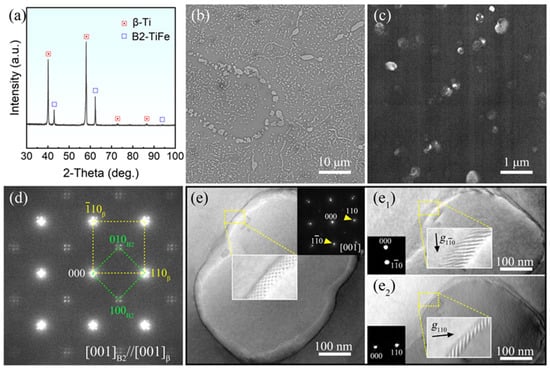
The as-cast alloy is composed of coarse-grained β-Ti and a tiny amount of B2-TiFe (Figure S1). After aging at 800 °C, B2-TiFe precipitated from the β-Ti matrix (Figure 1a and Figure S2), and the lattice constants of the β-Ti and B2-TiFe phases in the 800 °C–10 h aged alloy were determined to be aβ = 0.3176 nm and aB2 = 0.2987 nm. Examination of particle distribution in the β matrix found that a dispersed distribution of globular particles was obtained in the 800 °C–10 h aging condition (Figure 1b and Figure S3). Some discontinuous networks comprising coarser particles of a few μm in size also formed in the β matrix (Figure 1b).
Figure 1.
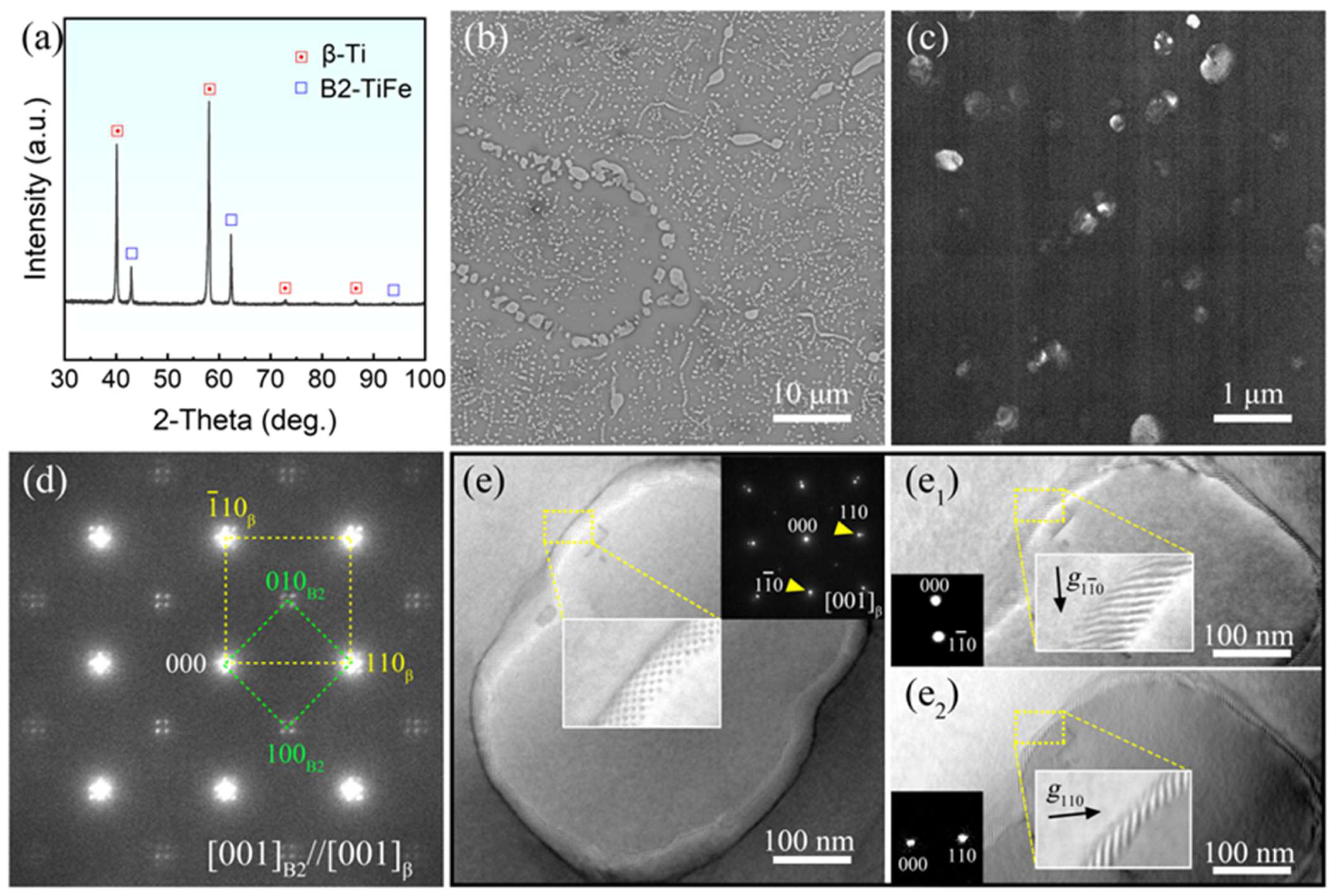
Component phases and microstructure of the 800 °C–10 h aged alloy: (a) XRD pattern of the β-Ti + B2-TiFe two-phase alloy; (b) SEM image (back-scattered electron mode) showing the dispersive distribution of globular B2-TiFe particles and the discontinuous network formed by the coarser particles in β-Ti matrix; (c) dark-field TEM image showing the non-uniform distribution of ultrafine B2-TiFe particles; (d) exact [001]-zone axis SAED pattern revealing the cube–cube orientation relationship between β-Ti and B2-TiFe; diffraction contrast imaging for a low-angle twist boundary under conditions of (e) exact [001]-zone axis, (e1) and (e2) operation reflections.
TEM imaging of the aged microstructures (Figure 1c) corroborated that grain interior B2-TiFe particles had an ultrafine size (~100–500 nm) and their distribution was not uniform. The [001]-zone axis selected area electron diffraction (SAED) pattern confirmed the cube–cube orientation relationship between β-Ti and B2-TiFe: and (Figure 1d). In particular, their phase boundary displays square grid diffraction contrast (Figure 1e and Figure S6), characteristic of the low-angle twist boundaries parallel to the (001) plane. The misfit dislocation structure consists of pure screw dislocations with Burgers vectors , where a is the β-Ti lattice constant and , as identified by and operation reflections (Figure 1e1,e2 and S6 and Table S2). The misorientation angle was determined to be θ ~ 5° from the mean grid spacing obtained from the individual β-Ti/B2-TiFe interfaces, , with the relation . The dense screw dislocation network surrounding a globular particle constitutes a work-hardening layer.
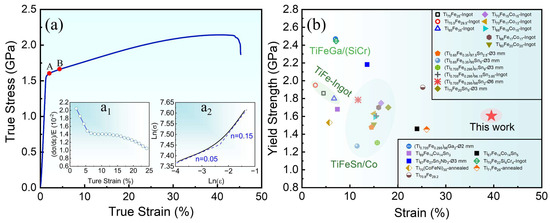
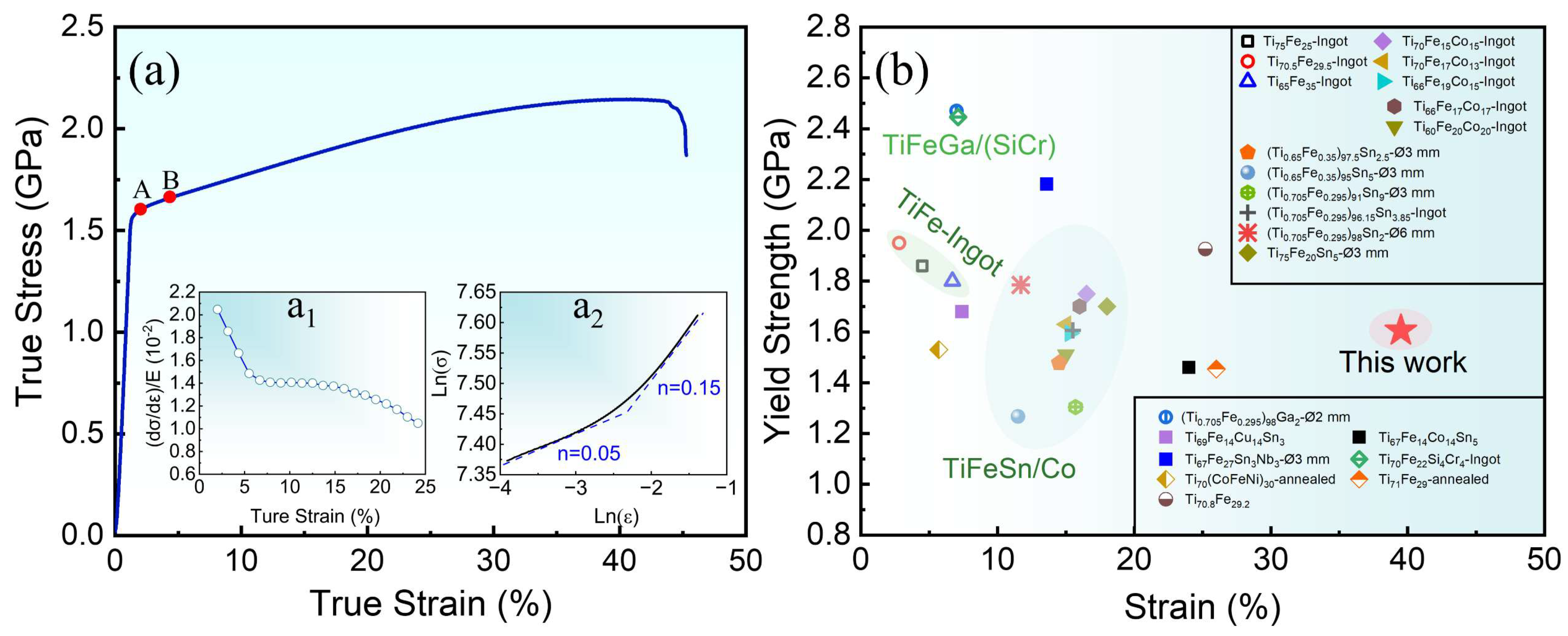
The room-temperature compression data of the specimens aged at 800 °C for different time durations are included in Figure S4. As shown by the true stress–strain curve in Figure 2a, an outstanding strength and plasticity combination was reached after 10 h aging. The 800 °C–10 h aged alloy exhibited a 0.2% offset yield strength σy = 1590 ± 5 MPa and a fracture strain of 40 ± 2% (Figure 2a and Figure S4). The room-temperature plastic strain far exceeds that previously reached in two-phase Ti-Fe alloys (Figure 2b and Table S1). From the true stress–true strain curve, the strain-hardening rate and components were evaluated to be about and , in the range of 2–25% strain, being comparable to those of lamellar-structured Ti-Fe alloys [6,7].
Figure 2.
Room-temperature mechanical performance of the 800 °C–10 h aged alloy: (a) True stress–strain curve. The inset figures (a1) ( plot) and (a2) ( plot) are for the strain-hardening rate and strain-hardening components, respectively. (b) Comparison of the room-temperature yield strength and plastic strain of various Ti-Fe base alloys. The light cyan-blue region represents the compositional range of the TiFeSn/Co alloy series, whereas the pale green region denotes the binary TiFe alloy series [1,2,4,5,6,7,8,9,10,11,12,13,14].
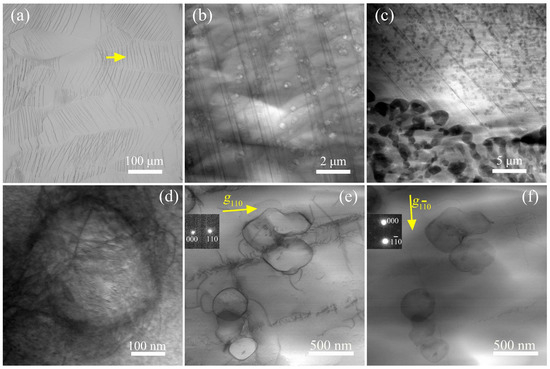
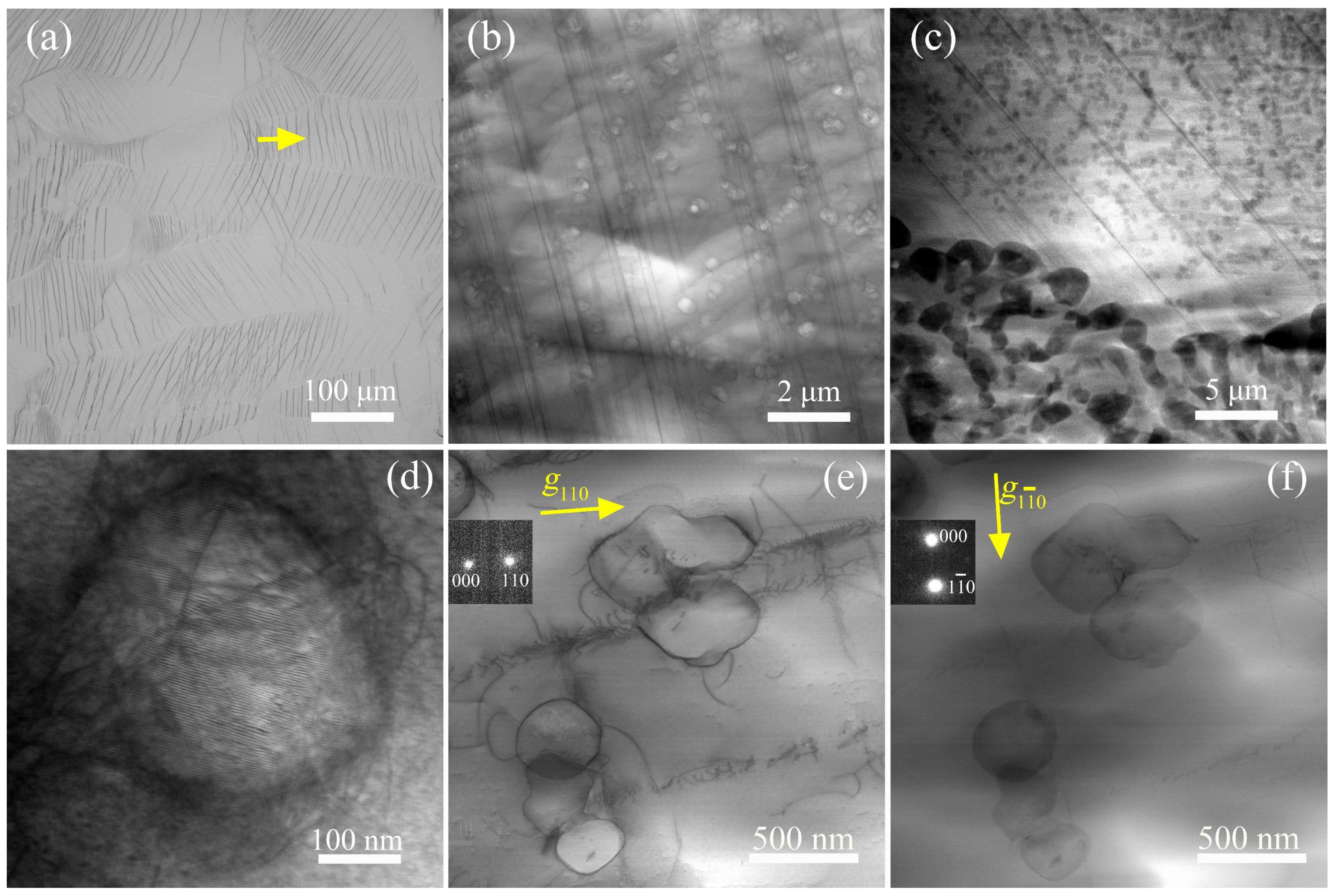
Most high-strength bulk metallic materials exhibit limited plasticity and weak strain-hardening due to their highly localized deformation mechanisms. In the BCC superalloy, slip localization was avoided and massive proliferation of slips took place. In the yield stage, a nearly parallel array of coarse slip lines emerges in the β-Ti grains, in which deflection of some slip lines signals the occurrence of cross-slip (Figure S5). At 3% strain, secondary slip has been substantially activated and the cross-slip feature becomes more obvious (Figure 3a). A close inspection by TEM imaging revealed that the coarse slip lines actually comprise numerous parallel slip lines, passing through the region of dispersed globular particles (Figure 3b). It was also found that the propagation of slip was blocked in the region where micrometer-sized B2-TiFe particles are aggregated (Figure 3c).
Figure 3.
Slip and dislocation behaviors of the 800 °C–10 h aged alloy under compression: (a) Optical image showing the formation of coarse slip lines in a parallel array in the specimens unloaded at 3% plastic strain. The arrowhead points to a cross-slipped line. (b) STEM images showing the dense parallel slip lines formed by collective motion of dislocations. (c) Block of slips in the vicinity of aggregates of coarse particles. (d) STEM images showing bowing-out of the low-angle twist boundary dislocation network in the yield sample. (e) Aligned dislocation pile-ups around globular B2-TiFe particles in the 3-strained sample, visible under reflection. (f) Dislocation pile-ups being out-of-contrast under .
At the yield point, bowing out of the low-angle twist dislocation network occurred (Figure 3d and Figure S7b). At 3% strain, continued dislocation emission was ubiquitously seen around the globular particles, forming parallel dislocation pile-ups (Figure 3e). Inspection of residual dislocation substructure in the β matrix after 800 °C–10 h aging finds little change in the population of lattice dislocations (Figure S7). The stress required to break up the work-hardened layer is therefore rationalized to constitute the major part of the high yield strength of the alloy. The Burgers vectors of the pile-up dislocations were clarified to have the same or opposite signs, according to the invisibility criterion of the diffraction contrast (Figure 3e,f). The continued dislocation emission and collective motion of pile-up dislocations produced a parallel array of straight slip lines. The corridors in between the pile-ups are dislocation-poor, where only the residual dislocations left behind by aging are seen. The activation of double cross-slip can be a possible mechanism accounting for the production of the parallel array of dense slip lines and weak strain-hardening behavior. In particular, when the pile-ups arrive at a neighboring B2-TiFe particle, which is impenetrable to the gliding dislocations, the leading dislocations, having halted in the primary glide plane, cross-slip on an intersecting plane over part of their length, and then the screw segments move into a plane parallel to the original glide plane. The double-ended screw segments act as a Frank–Read source for continued dislocation multiplication. The two successive dislocation mechanisms would result in massive production of dense parallel slips to accommodate the extensive plastic deformation.
4. Conclusions
A2 + B2 BCC superalloy microstructure was achieved in an aged Ti78Fe22 alloy, in which ultrafine globular B2-TiFe particles formed low-angle twist boundaries with the β-Ti matrix. Under a high external stress, the low-angle twist boundaries conducted dislocation emission to form aligned dislocation pile-ups. Slip localization is avoided in the high-strength alloy, and proliferation of dense parallel slip bands accommodates the large room-temperature plasticity.
Supplementary Materials
The following supporting information can be downloaded at: https://www.mdpi.com/article/10.3390/met16091012/s1.
Author Contributions
Conceptualization, Y.-M.W.; methodology, Z.-D.Z., X.-G.W., S.-B.M., J.-B.Q. and Y.-M.W.; software, Z.-D.Z., X.-G.W. and H.-C.W.; validation, X.-G.W., H.-C.W., Z.-Z.X., S.-B.M. and J.-B.Q.; formal analysis, Z.-D.Z., X.-G.W., H.-C.W., Z.-Z.X., L.L., S.-B.M., J.-B.Q. and Y.-M.W.; investigation, Z.-D.Z., X.-G.W., H.-C.W., L.L., S.-B.M., J.-B.Q. and Y.-M.W.; resources, Z.-D.Z., S.-B.M. and J.-B.Q.; data curation, X.-G.W., H.-C.W. and Z.-Z.X.; writing—original draft preparation, Y.-M.W.; writing—review and editing, Z.-D.Z., X.-G.W., S.-B.M. and J.-B.Q.; supervision, Y.-M.W.; project administration, Z.-D.Z. and Y.-M.W.; funding acquisition, Z.-D.Z. All authors have read and agreed to the published version of the manuscript.
Funding
This work was supported by the National Key Laboratory of Nuclear Reactor Technology (Grant/Award No. 2024-CXPT-GF-JJ-001), Nuclear Power Institute of China.
Data Availability Statement
The original contributions presented in this study are included in the article. Further inquiries can be directed to the corresponding author.
Conflicts of Interest
The authors declare no conflicts of interest.
References
- Louzguine, D.V.; Kato, H.; Louzguina, L.V.; Inoue, A. High-strength binary Ti–Fe bulk alloys with enhanced ductility. J. Mater. Res. 2004, 19, 3600–3606. [Google Scholar] [CrossRef] [Scilit]
- Louzguine-Luzgin, D.V.; Louzguina-Luzgina, L.V.; Kato, H.; Inoue, A. Investigation of Ti–Fe–Co bulk alloys with high strength and enhanced ductility. Acta Mater. 2005, 53, 2009–2017. [Google Scholar] [CrossRef] [Scilit]
- Das, J.; Eckert, J.; Theissmann, R. Structural short-range order of the β-Ti phase in bulk Ti–Fe–(Sn) nanoeutectic composites. Appl. Phys. Lett. 2006, 89, 261917. [Google Scholar] [CrossRef] [Scilit]
- Zhang, L.; Das, J.; Lu, H.; Duhamel, C.; Calin, M.; Eckert, J. High strength Ti–Fe–Sn ultrafine composites with large plasticity. Scr. Mater. 2007, 57, 101–104. [Google Scholar] [CrossRef] [Scilit]
- Han, J.H.; Kim, K.B.; Yi, S.; Park, J.M.; Sohn, S.W.; Kim, T.E.; Kim, D.H.; Das, J.; Eckert, J. Formation of a bimodal eutectic structure in Ti–Fe–Sn alloys with enhanced plasticity. Appl. Phys. Lett. 2008, 93, 141901. [Google Scholar] [CrossRef] [Scilit]
- Das, J.; Theissmann, R.; Löser, W.; Eckert, J. Effect of Sn on microstructure and mechanical properties of Ti-Fe-(Sn) ultrafine eutectic composites. J. Mater. Res. 2010, 25, 943–956. [Google Scholar] [CrossRef] [Scilit]
- Li, P.; Zhang, H.; Tong, T.; He, Z. The rapidly solidified β-type Ti–Fe–Sn alloys with high specific strength and low elastic modulus. J. Alloys Compd. 2019, 786, 986–994. [Google Scholar] [CrossRef] [Scilit]
- Misra, D.K.; Rakshit, R.K.; Singh, M.; Shukla, P.; Chaturvedi, K.; Sivaiah, B.; Gahtori, B.; Dhar, A.; Sohn, S.; Kim, W.; et al. High yield strength bulk Ti based bimodal ultrafine eutectic composites with enhanced plasticity. Mater. Des. 2014, 58, 551–556. [Google Scholar] [CrossRef] [Scilit]
- Louzguine, D.V. High-strength Ti-based alloys containing Fe as one of the main alloying elements. Mater. Trans. 2018, 59, 1537–1544. [Google Scholar] [CrossRef] [Scilit]
- Zhao, G.-H.; Ketov, S.V.; Mao, H.; Borgenstam, A.; Louzguine-Luzgin, D.V. Ti-Fe-Sn-Nb hypoeutectic alloys with superb yield strength and significant strain-hardening. Scr. Mater. 2017, 135, 59–62. [Google Scholar] [CrossRef] [Scilit]
- Sengupta, B.; Shekhar, S.; Kulkarni, K.N. A novel ultra-high strength and low-cost as-cast titanium alloy. Mater. Sci. Eng. A 2017, 696, 478–481. [Google Scholar] [CrossRef] [Scilit]
- Abbas, M.A.; Hong, S.H.; Yusupov, D.; Kang, G.C.; Choi, J.-W.; Jumaev, E.; Park, H.J.; Kim, K.B. Evolution of microstructure and mechanical properties of a Ti80(CoFeNi)20 ultrafine eutectic composite during thermal processing. Intermetallics 2023, 154, 107786. [Google Scholar] [CrossRef] [Scilit]
- Campo, K.N.; Rodrigues, J.F.Q.; Moon, S.-C.; Dippenaar, R.; Caram, R. Solidification and microstructure investigation on as-cast and annealed hypoeutectic Ti–Fe alloys. Mater. Chem. Phys. 2024, 322, 129613. [Google Scholar] [CrossRef] [Scilit]
- Contieri, R.J.; Lopes, E.S.N.; de La Cruz, M.T.; Costa, A.; Afonso, C.; Caram, R. Microstructure of directionally solidified Ti–Fe eutectic alloy with low interstitial and high mechanical strength. J. Cryst. Growth 2011, 333, 40–47. [Google Scholar] [CrossRef] [Scilit]
- Gussone, J.; Bugelnig, K.; Barriobero-Vila, P.; da Silva, J.C.; Hecht, U.; Dresbach, C.; Sket, F.; Cloetens, P.; Stark, A.; Schell, N.; et al. Ultrafine eutectic Ti-Fe-based alloys processed by additive manufacturing–A new candidate for high temperature applications. Appl. Mater. Today 2020, 20, 100767. [Google Scholar] [CrossRef] [Scilit]
- Semiatin, S.L.; Seetharaman, V.; Weiss, I. The thermomechanical processing of alpha/beta titanium alloys. J. Miner. Met. Mater. Soc. 1997, 49, 33–39. [Google Scholar] [CrossRef] [Scilit]
- Jones, R.D.; Knowles, A.J.; Clegg, W.J. A binary beta titanium superalloy containing ordered-beta TiFe, alpha and omega. Scr. Mater. 2021, 200, 113905. [Google Scholar] [CrossRef] [Scilit]
- O’Kelly, P.; Watson, A.; Schmidt, G.; Galetz, M.; Knowles, A.J. Ti-Fe Phase Evolution and Equilibria Toward b-Ti Superalloys. J. Phase Equilibria Diffus. 2023, 44, 738–750. [Google Scholar] [CrossRef] [Scilit]
Disclaimer/Publisher’s Note: The statements, opinions and data contained in all publications are solely those of the individual author(s) and contributor(s) and not of MDPI and/or the editor(s). MDPI and/or the editor(s) disclaim responsibility for any injury to people or property resulting from any ideas, methods, instructions or products referred to in the content. |
© 2026 by the authors. Licensee MDPI, Basel, Switzerland. This article is an open access article distributed under the terms and conditions of the Creative Commons Attribution (CC BY) license.