


Abstract
During underwater laser welding, the coupling among water cooling, gas–liquid interface disturbances, and metal-vapor recoil pressure means that the relationships among plasma evolution, the thermal state of the keyhole, and spatter behavior remain insufficiently understood. In this study, 304NG stainless steel was welded in air and under local dry underwater conditions using a 10 kW continuous-wave fiber laser with a wavelength of 1070 nm to investigate the effects of laser power on the energy state and process stability of underwater welding. The underwater experiments were conducted in deionized water, with the workpiece positioned approximately 100 mm below the free water surface and without additional pressurization. High-speed imaging, infrared thermography, and spectroscopy were employed to characterize the transient evolution of the plasma and spatter, the apparent thermal state near the keyhole opening, and the spectral characteristics of the underwater plasma, respectively, while the plasma excitation temperature was calculated using the Boltzmann multi-line fitting method. The results showed that as the laser power increased from 2000 to 4000 W, the plasma size and temporal persistence increased significantly in both air and underwater environments; the transverse width of the underwater plasma at T0 + 0.8 ms increased from approximately 2.7 to 5.8 mm, while the average maximum apparent temperature near the keyhole opening increased from approximately 2477 to 3071 °C. Meanwhile, the intensities of the characteristic Fe I lines increased overall, and the plasma excitation temperature increased from 5977 to 6510 K, consistent with the expansion of the plasma-emitting region, the enhanced persistence of the high-temperature core, and the increase in the apparent temperature near the keyhole opening. This study aims to provide a new systematic understanding and technical insights into plasma evolution during underwater laser welding.
1. Introduction
With the extended service life of marine engineering equipment, offshore energy facilities, and nuclear power equipment, underwater metallic structures are susceptible to cracks, wear, and localized damage under the combined effects of corrosion, fatigue loading, and complex environmental conditions. When damaged components are difficult to dismantle or transfer to a dry environment, in situ underwater welding repair is of considerable engineering significance [1,2]. At present, conventional underwater welding methods mainly rely on arc welding; however, these methods suffer from problems such as complicated operation and low efficiency [3]. In recent years, with the development of laser technology, underwater laser welding has gradually emerged as a new solution. This method features high energy density, concentrated heat input, easy control of the interaction position, and suitability for remote and automated operation, and is considered an important technological direction for the high-quality welding repair of underwater metallic structures.
In practical underwater repair, filler-wire welding or laser cladding is often employed to restore material loss, fill grooves, or deposit corrosion-resistant material. Previous studies have demonstrated the feasibility of local dry underwater laser welding with filler wire for stainless steels [4,5,6,7,8]. However, the introduction of filler metal also adds additional variables, including wire melting and transfer, filler–laser interaction, and compositional mixing. Therefore, autogenous deep-penetration laser welding provides a simplified configuration for isolating the fundamental interactions among laser energy input, keyhole behavior, metal-vapor evolution, and the surrounding underwater environment. The present work does not directly reproduce a complete filler-wire repair procedure; rather, it provides process-level understanding that can serve as a basis for the subsequent development of underwater laser repair processes involving filler material.
However, underwater welding is accompanied by considerable challenges and difficulties. First, the water environment significantly alters the interaction between the laser and the material. When the laser passes directly through the water layer, the laser–water interaction may induce water vapor and plasma, which can produce a pronounced shielding effect on the incident laser and thereby reduce the effective energy reaching the workpiece surface. Meanwhile, the enhanced cooling effect of water, fluctuations at the gas–liquid interface, and ambient pressure further affect keyhole formation, molten pool flow, and weld solidification behavior [1,9]. To reduce interference from the surrounding water, a local dry method is commonly employed, in which gas is used to displace the water and form a local gas cavity and a laser transmission channel. However, this gas cavity cannot completely eliminate the cooling effect of the surrounding water or disturbances at the gas–liquid boundary, and the welding process still exhibits thermo-fluid-dynamic characteristics that differ markedly from those in air [10].
For local dry underwater laser welding, existing studies have mainly focused on drainage devices, gas-cavity stability, process parameters, and the microstructure and properties of welded joints. Zhang et al. [2,9] investigated the relationship between the local gas-cavity state and weld quality using infrared and ultraviolet optical signals, demonstrating that the stability of the optical signals could reflect the local drainage conditions and the state of the welding process. Guo et al. [11] designed a double-layer gas-curtain drainage nozzle and analyzed the effects of gas flow rate and heat input on weld formation, porosity, and mechanical properties of 304 stainless steel. Song et al. [12] compared the microstructure and corrosion resistance of 304 stainless steel welded in air and under local dry underwater conditions at different laser powers, and indicated that water cooling altered the solidification microstructure and grain-boundary characteristics of the weld. Sun et al. [3] further compared the weld microstructure and mechanical properties of 304NG stainless steel in air and local dry underwater environments, verifying the feasibility of this method for the underwater joining and repair of 304NG stainless steel. 304NG stainless steel was selected in the present study because it is a nuclear-grade austenitic stainless steel with important applications in nuclear engineering. Recent studies have continued to focus on 304NG for nuclear applications and in situ underwater repair because of its combination of mechanical performance and corrosion resistance [13,14]. Therefore, understanding its laser–material interaction and process behavior under local dry underwater conditions is relevant to the development of underwater maintenance and repair technologies for nuclear components. These studies have provided an important foundation; however, they have focused more on post-weld formation, microstructure, and properties, while the intrinsic relationships among the plasma, the thermal state of the keyhole, and spatter behavior during welding remain to be further understood.
In fact, during deep-penetration laser welding, the recoil pressure generated by metal evaporation from the keyhole wall is an important driving force for maintaining the keyhole. At the same time, it can also induce keyhole fluctuations, molten-pool flow, and periodic variations in the metal-vapor plume outside the keyhole. Keyhole instability and intense molten-pool flow may cause liquid metal to escape and form spatter, thereby affecting energy coupling and welding stability [15]. In conventional laser welding studies, high-speed imaging can directly record the transient evolution of the plasma and spatter, infrared thermography can characterize the apparent thermal state near the keyhole opening, and spectroscopy can identify the main emitting particles in the plasma and reflect their energy states. Estimating the excitation temperature of the metal-vapor plume during laser welding can provide quantitative information for investigating laser–material interactions and process monitoring [16,17]. Recent studies have further demonstrated that optical process signals can be correlated with welding state, penetration behavior, and weld quality. In particular, plume morphology obtained by high-speed imaging and spectral features obtained by optical emission spectroscopy have shown potential for in situ process monitoring and quality prediction in laser welding [18,19,20].
Based on the above, 304NG stainless steel was selected as the research material, and laser welding experiments were conducted in air and under local dry underwater conditions at different laser powers. High-speed imaging was employed to observe the transient evolution of the laser-induced plasma and spatter, infrared thermography was used to analyze the maximum apparent temperature near the keyhole opening and the changes in the high-temperature region, and emission spectroscopy was applied to identify the main characteristic spectral lines in the underwater plasma. Under the local thermodynamic equilibrium (LTE) approximation, the excitation temperature of the Fe I-emitting region in the underwater metal-vapor/plasma plume was further estimated using the Boltzmann multi-line fitting method. By comparing the plasma morphology, keyhole thermal state, spectral characteristics, and spatter behavior under different environments and laser powers, the effects of laser power on the energy state and process stability of local dry underwater laser welding were investigated. In addition to clarifying the underlying process behavior, these observables provide candidate indicators for identifying changes in keyhole stability and energy coupling. Establishing their responses to laser power can therefore provide a physical basis for process-window selection and for the future development of in situ monitoring and process-control strategies for local dry underwater laser welding [18,21].
2. Materials and Methods
2.1. Materials
In this research, 304NG stainless steel plates with dimensions of 100 mm × 50 mm × 5 mm were used as the base material (BM) for butt-welding experiments. The chemical composition of the BM is listed in Table 1. Prior to welding, the plate surfaces were ground using an angle grinder and subsequently cleaned with analytical-grade acetone (purity ≥ 99.5%) and absolute ethanol (purity ≥ 99.7%) to remove surface contaminants, including grease and oxides.
Table 1.
Chemical composition of the 304NG stainless steel (wt%).
2.2. Experimental Procedure
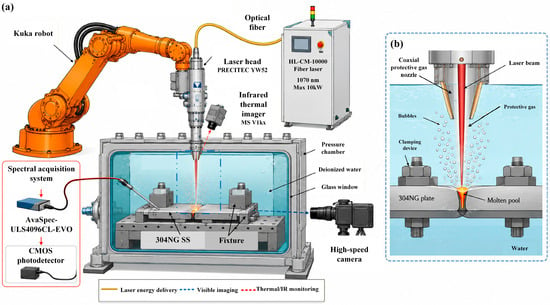
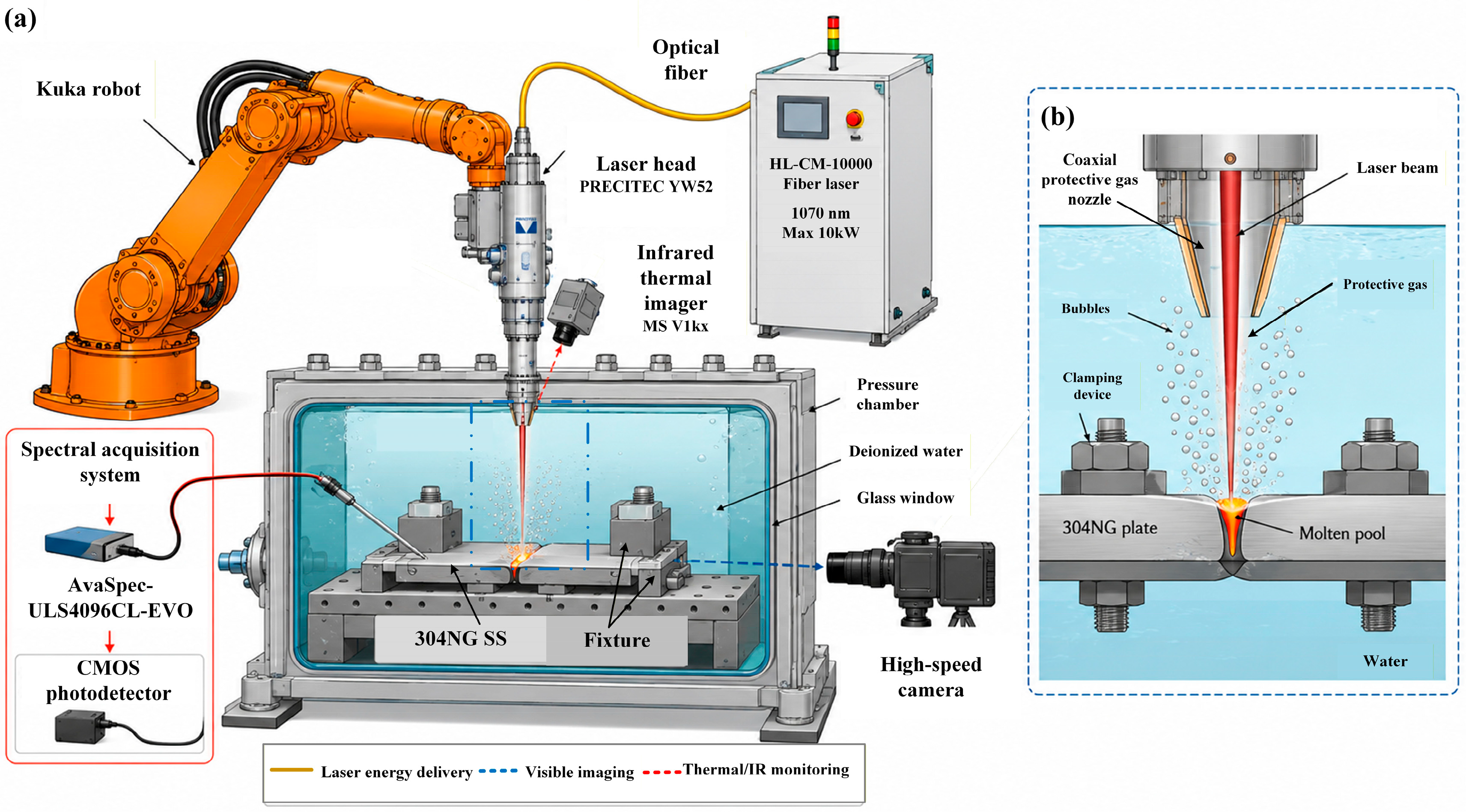
The principal equipment used for underwater laser welding is shown in Figure 1a and comprises four main subsystems: the laser welding system, spectroscopic acquisition system, in situ imaging system, and underwater-environment simulation system. The laser welding system employed an HL–CM–10000 continuous-wave fiber laser (Han’s Laser, Shenzhen, China) with a wavelength of 1070 nm and a maximum output power of 10 kW. A PRECITEC YW52 (Gaggenau, Germany) welding head with a focal length of 300 mm and an adjustable spot diameter of 0.2–2.0 mm was used, equipped with a coaxial shielding-gas nozzle (Figure 1b). Welding motion was controlled by a KUKA KR 60 HA industrial robot (KUKA, Augsburg, Germany), enabling precise trajectory control with a repeatability of ±0.05 mm. It should be noted that the same welding head, optical configuration, and 0 mm defocus amount were adopted for all atmospheric–air and underwater tests in this study. The spot diameter at the focal point was 0.3 mm, and the focusing condition was kept unchanged under different laser powers to ensure comparability among different working conditions.
Figure 1.
(a) Overall underwater laser welding acquisition system; (b) local underwater weld zone enlargement.
The spectroscopic acquisition system mainly consisted of an AvaSpec-ULS4096CL-EVO spectrometer (Avantes B.V., Apeldoorn, The Netherlands) and a CMOS photodetector. The spectrometer covered a wavelength range of 200–1100 nm, provided an average spectral resolution of 0.5–0.7 nm, and was equipped with a 10 μm entrance slit. The photodetector had a pixel size of 1.0–3.75 μm, a quantum efficiency exceeding 95%, and a maximum acquisition rate of 100 frames per second. The in situ imaging system consisted of an Acuteye high-speed imaging system (Hunan Kotianjian Optoelectronics Technology Co., Ltd., Changsha, China) and an MS V1kx (Telops Inc., Québec City, QC, Canada) long-wave multispectral infrared thermal imager. The high-speed imaging system was operated at 2500 fps, corresponding to an interframe interval of 0.4 ms, and was used to record the transient evolution of the metal-vapor/plasma plume and spatter during welding. The high-speed imaging system was fixed outside the underwater chamber and the welding region was observed through a transparent glass observation window. The camera optical axis was approximately perpendicular to the welding direction, providing a side view of the welding process. The infrared thermal imager was mounted on the KUKA robot and moved synchronously with the welding head to record the thermal radiation characteristics of the keyhole-opening region and its surroundings, with a maximum acquisition frequency of 100 Hz.
The underwater-environment simulation system consisted of a specially designed pressure chamber fitted with glass observation windows. No additional pressure was applied during the underwater welding experiments in the present study, and all experiments were conducted under atmospheric conditions. During underwater welding, the workpiece surface was positioned approximately 100 mm below the free water surface. To ensure stable water conditions, deionized water with a resistivity of at least 18.2 MΩ·cm was used, and appropriate amounts of water-quality stabilizer and corrosion inhibitor were added to maintain its physicochemical properties. During welding, high-purity argon was supplied as the shielding gas. Based on previous research [22], the shielding-gas flow rate, welding speed, and defocus distance were set to 30 L/min, 8 mm/s, and 0 mm, respectively. For underwater welding, the air flow rate used for local water displacement was set to 80 L/min. Laser powers of 2000, 3000, and 4000 W were used under both air and underwater conditions. Except for the welding environment and laser power, the welding and optical configurations were maintained unchanged. Each experimental condition was independently repeated three times to assess the reproducibility of the welding process and the major observed characteristics. The main experimental parameters are summarized in Table 2.
Table 2.
Specific process parameters during the welding process.
2.3. Analysis Methods
During welding, high-speed imaging and infrared thermography were employed to acquire welding images under different environmental conditions. High-speed imaging was mainly used to analyze the spatial morphology, transient expansion and contraction, and spatter behavior of the plasma plume, while the transverse plume dimensions were compared using the scale bars in the images. Because the optical transmission characteristics of the transparent observation window were not independently calibrated, the high-speed images were primarily used for relative morphological and dimensional comparisons rather than for quantitative measurements of absolute radiation intensity among different conditions. Infrared thermography was used to analyze the maximum apparent temperature near the keyhole opening and the dynamic evolution of the high-temperature region. Optical signals were collected using a quartz optical fiber with a core diameter of 400 μm and a numerical aperture of 0.22. A collimator and a focusing lens with focal lengths of 35 and 75 mm, respectively, were used to achieve the accurate acquisition of the plasma emission spectra. The optical path was optimized by taking full advantage of the optical characteristics of the fiber and lenses to meet the requirements for the precise measurement of plasma radiation. The sampling frequency and integration time were set to 10 Hz and 10 ms, respectively, and the spectral measurement range was 200–1100 nm. Notably, the imaging and spectroscopic acquisition systems were synchronously triggered. For each laser power and welding environment, the same equipment configuration and acquisition conditions were maintained, and three independent welding trials were performed.
3. Results and Discussion
3.1. Analysis of Plasma Morphology
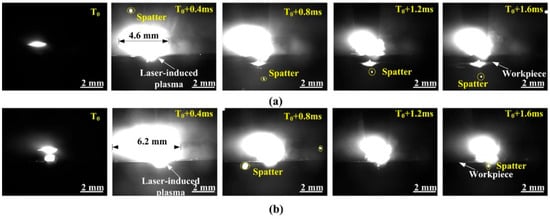
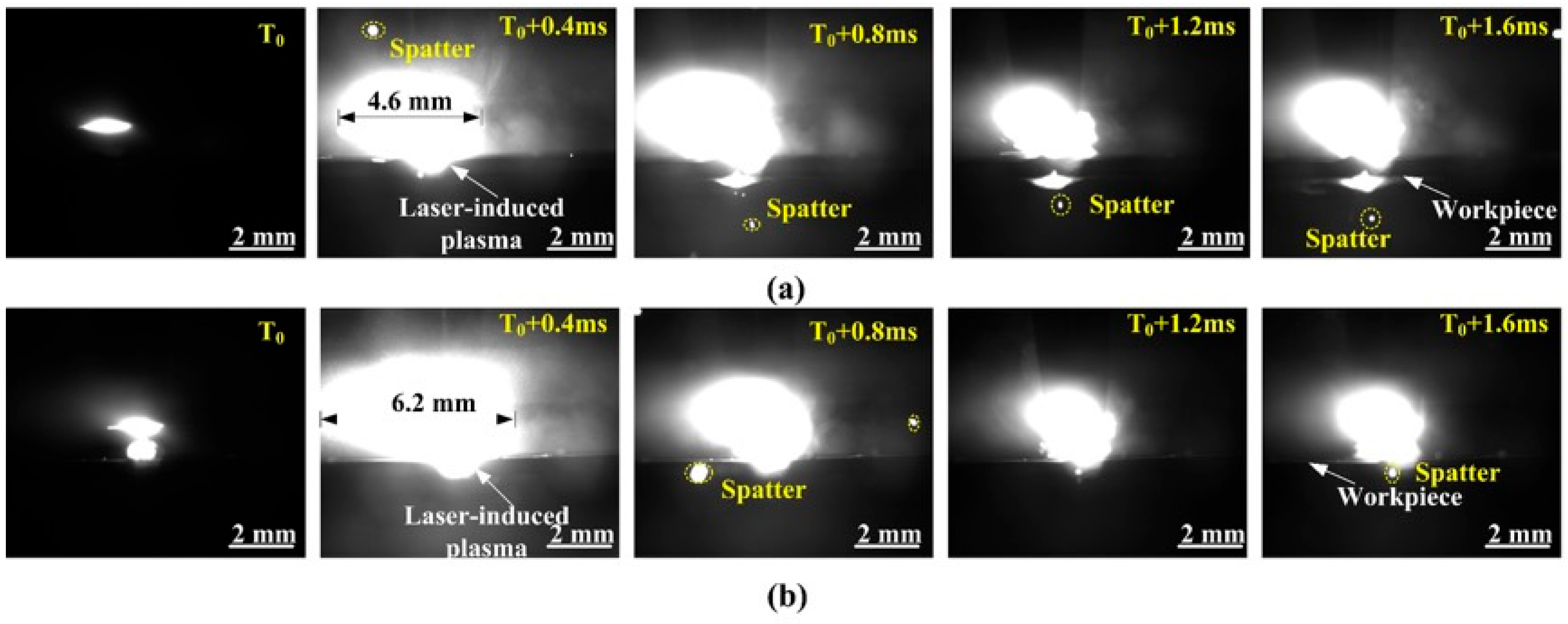
Figure 2 presents the transient evolution of laser-induced plasma morphology during the welding process of 304NG stainless steel in an air atmosphere under different laser powers. The interval between adjacent images was set to 0.4 ms. At a laser power of 2000 W, only a small and flattened luminous region was generated above the workpiece surface at T0. With the enhancement of laser–material interaction, the plasma rapidly expanded upward and laterally at T0 + 0.4 ms, forming an approximately hemispherical structure with a lateral width of approximately 4.6 mm. Subsequently, the plasma boundary underwent continuous contraction, expansion, and local displacement, accompanied by the generation of discrete metal spatter droplets ejected from the molten pool, indicating pronounced transient fluctuations in both the metal evaporation process and molten pool surface behavior. When the laser power increased to 4000 W, the plasma exhibited more intense expansion during the initial stage. The lateral width of the plasma reached approximately 6.2 mm at T0 + 0.4 ms, representing an increase of approximately 34.8% compared with that at 2000 W. This result indicates that higher laser power promotes intensified instantaneous material evaporation and the outward ejection of metal vapor. However, during the subsequent evolution, the plasma generated at 4000 W rapidly contracted from the initial large-scale expansion state into a relatively concentrated luminous region, exhibiting more pronounced transient expansion–contraction behavior. Therefore, increasing the laser power not only enlarges the instantaneous spatial scale of the luminous plume, but also affects its short-term morphological evolution. It should be emphasized that the image sequences shown in Figure 2 represent short-duration transient observations and were not used to determine a characteristic oscillation frequency or to establish periodic behavior.
Figure 2.
In situ observation of plasma morphology under different laser powers in an air atmosphere: (a) 2000 W; (b) 4000 W.
The asymmetric deformation of plasma and the spatter formation are mainly associated with vapor recoil pressure, keyhole fluctuations, and molten pool surface instability [23,24]. With increasing laser power, the metal evaporation rate and vapor pressure inside the keyhole are enhanced. The increased recoil pressure promotes rapid plasma expansion while intensifying the dynamic fluctuations of the keyhole wall and molten pool surface. When the local vapor recoil pressure exceeds the restraining effects of surface tension and gravity on the liquid metal, a portion of the molten metal is expelled from the molten pool, resulting in spatter formation. Therefore, the plasma size, morphological fluctuations, and spatter behavior under an air atmosphere can serve as effective indicators for evaluating variations in laser energy coupling efficiency and keyhole stability.
The above results indicate that under an air atmosphere, the laser-induced plasma can freely expand above the molten pool, and its morphology is mainly governed by the combined effects of laser energy input, metal evaporation, and keyhole fluctuations. In contrast, the cooling effect of water, hydrostatic pressure, local drainage gas cavity, and gas–liquid interface in an underwater environment impose additional constraints on plume expansion and modify the interactions among the plasma, vapor cavity, and molten pool. Therefore, subsequent analysis will focus on comparing the plume dimensions, dynamic stability, and spatter behavior between air and underwater environments under identical laser power conditions.
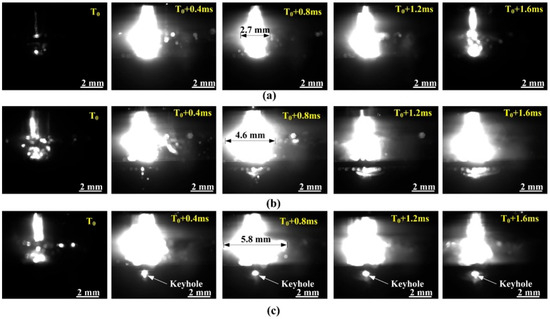
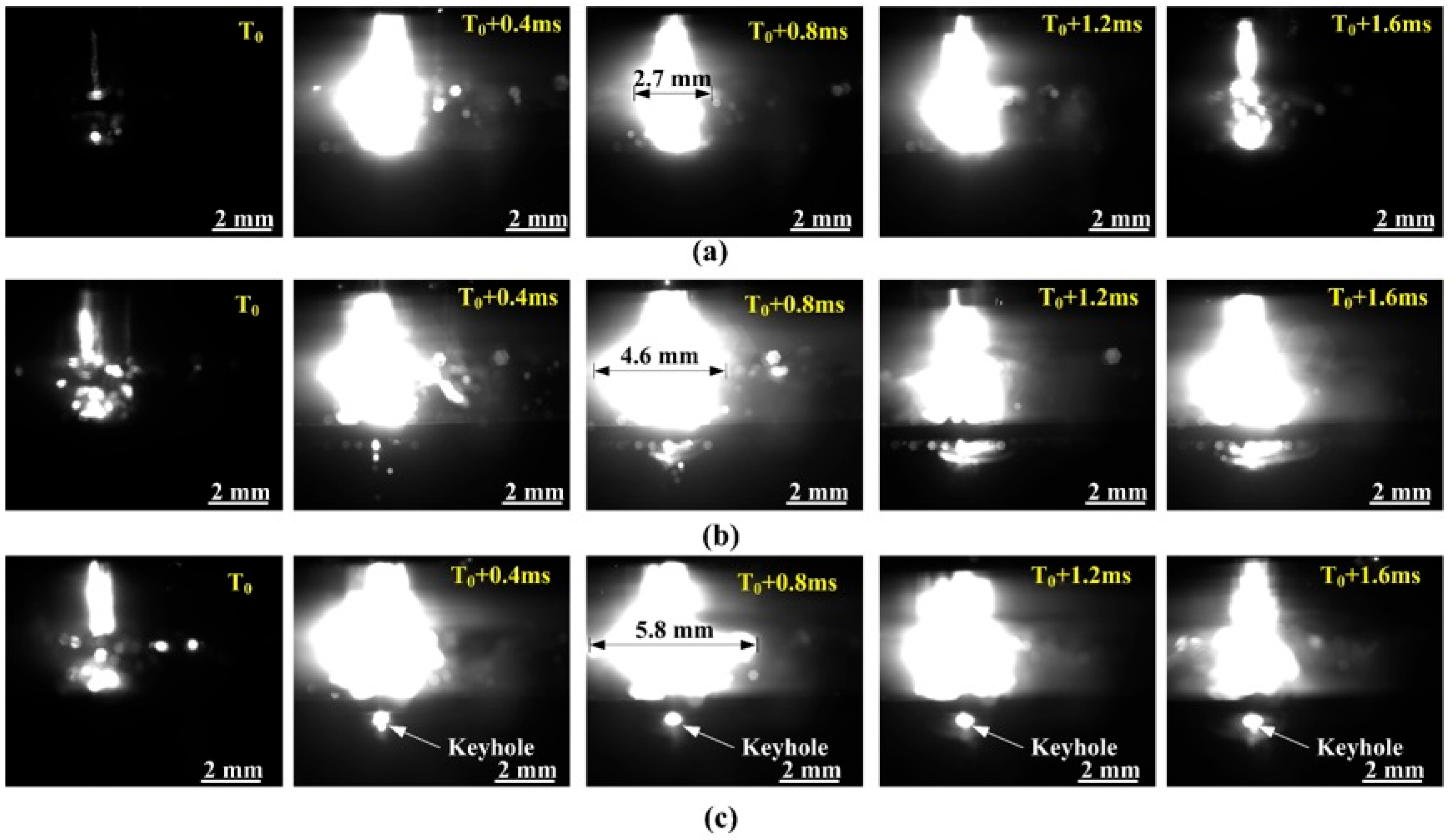
Figure 3 presents the transient evolution of laser-induced plasma during underwater welding under different laser powers. The time interval between adjacent images was set to 0.4 ms. Overall, both the spatial dimension and temporal persistence of the plasma increased significantly with increasing laser power from 2000 W to 4000 W. At T0 + 0.8 ms, the apparent lateral widths of the plasma under 2000, 3000, and 4000 W were approximately 2.7, 4.6, and 5.8 mm, respectively, indicating that higher laser power significantly promotes metal vapor generation and its lateral expansion. At 2000 W, the plasma rapidly evolved from a slender column-like structure at T0 into a larger bulb-shaped luminous region, followed by obvious contraction and fragmentation into several localized luminous clusters at T0 + 1.6 ms. This phenomenon suggests that under low-power conditions, metal evaporation and vapor ejection exhibit pronounced intermittency, making it difficult to continuously maintain a stable keyhole or molten pool depression. With increasing laser power to 3000 W, the lateral dimension of the plasma increased significantly, and a relatively large conical luminous region was maintained throughout the observation period, indicating enhanced continuity of metal vapor ejection. When the laser power further increased to 4000 W, the plasma width was enlarged to 5.8 mm, and a persistent luminous region near the keyhole opening remained visible throughout the period from T0 + 0.4 to T0 + 1.6 ms. The sustained presence of the keyhole opening indicates that higher laser power enhances metal evaporation from the keyhole wall and increases vapor recoil pressure, thereby maintaining a relatively continuous deep-penetration welding state. Therefore, increasing laser power not only enlarges the instantaneous spatial scale of the plasma, but also prolongs the lifetime of both the plasma and keyhole opening during underwater laser welding. These results demonstrate that laser energy input plays a critical role in regulating the balance between metal vapor generation, vapor recoil pressure, and keyhole stability under the constrained underwater environment.
Figure 3.
In situ observation of plasma morphology under different laser powers in an underwater atmosphere: (a) 2000 W; (b) 3000 W; (c) 4000 W.
Under underwater local dry conditions, the plasma morphology is simultaneously influenced by metal vapor jets, drainage gas flow, and the gas–liquid interface. At low laser power, the plasma is easily constrained by the surrounding water and the boundary of the gas cavity, resulting in rapid contraction. With increasing laser power, the enhanced momentum of the metal vapor ejection enables the plasma to overcome the restriction imposed by the gas–liquid interface and expand into the surrounding region.
3.2. Analysis of Keyhole Morphology and Temperature
Figure 4 presents the evolution of infrared thermographic images of the keyhole-opening region during laser welding in an air atmosphere under different laser powers. It should be noted that the infrared camera detects the radiative signals contributed by the visible keyhole opening, molten pool surface, adjacent metal vapor, and plasma within the line of sight [25]. Therefore, the maximum apparent temperature near the keyhole opening shown in the infrared images does not represent the actual absolute temperature of the internal keyhole wall. Both the apparent temperature near the keyhole opening and the extent of the high-temperature region increased with increasing laser power. At a laser power of 2000 W, only a small high-temperature core was observed near the keyhole opening at T0, with a maximum apparent temperature of 885 °C. After 0.4 ms, the maximum apparent temperature rapidly increased to 2651 °C, followed by further increases to 2717, 2977, and 2952 °C at subsequent moments. At T0 + 0.8 ms, a distinct laser-induced plasma appeared above the high-temperature core, while the keyhole opening maintained a relatively compact and nearly circular morphology. The temperature gradually stabilized after T0 + 1.2 ms, indicating a transition from the initial heating stage to a relatively stable deep-penetration welding state under the 2000 W condition. A similar evolution trend was observed at 3000 W. Compared with the 2000 W condition, the high-temperature region was significantly enlarged, and the temperature distribution around the keyhole opening became more irregular. Meanwhile, discrete spatters were observed near T0 + 0.4 and T0 + 1.6 ms, indicating enhanced molten pool instability and intensified metal vaporization. When the laser power was further increased to 4000 W, the maximum apparent temperature continuously increased from 2100 °C at T0 to 2987, 3096, 3383, and 3450 °C at subsequent moments. The high-temperature core gradually evolved from an initially localized spot-like region into a larger elliptical region, accompanied by a significant expansion of the laser-induced plasma. Meanwhile, multiple spatter events were observed during the process. This phenomenon suggests that the increased power density intensifies metal evaporation from the keyhole wall and enhances vapor recoil pressure. In addition, multiple reflections of the laser beam inside the keyhole further improve laser energy absorption, enabling the keyhole-opening region to maintain a higher thermal state. The keyhole, molten pool, and metal vapor plume exhibit strong dynamic coupling during deep-penetration laser welding. Variations in plume morphology and radiation intensity can therefore provide valuable information regarding the evolution of keyhole stability [26].
Figure 4.
Infrared thermographic characterization of keyholes under different laser powers in an air atmosphere: (a) 2000 W; (b) 3000 W; (c) 4000 W.
In summary, increasing the laser power in an air atmosphere not only increases the maximum apparent temperature near the keyhole opening, but also enlarges the high-temperature region and enhances plasma radiation. As the laser power increases from 2000 W to 4000 W, the keyhole gradually evolves from a small-scale structure with significant temperature fluctuations into a deep-penetration welding state characterized by a continuously sustained high-temperature core. However, the frequent occurrence of spatters under the 3000 and 4000 W conditions indicates that the continuous presence of a keyhole does not necessarily correspond to a completely stable welding process. Excessive vapor recoil pressure and intensified molten pool flow can still induce the ejection of liquid metal from the edge of the keyhole.
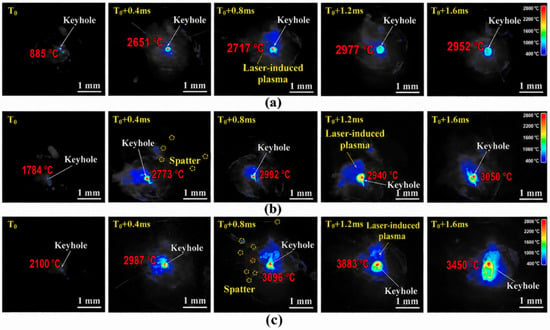
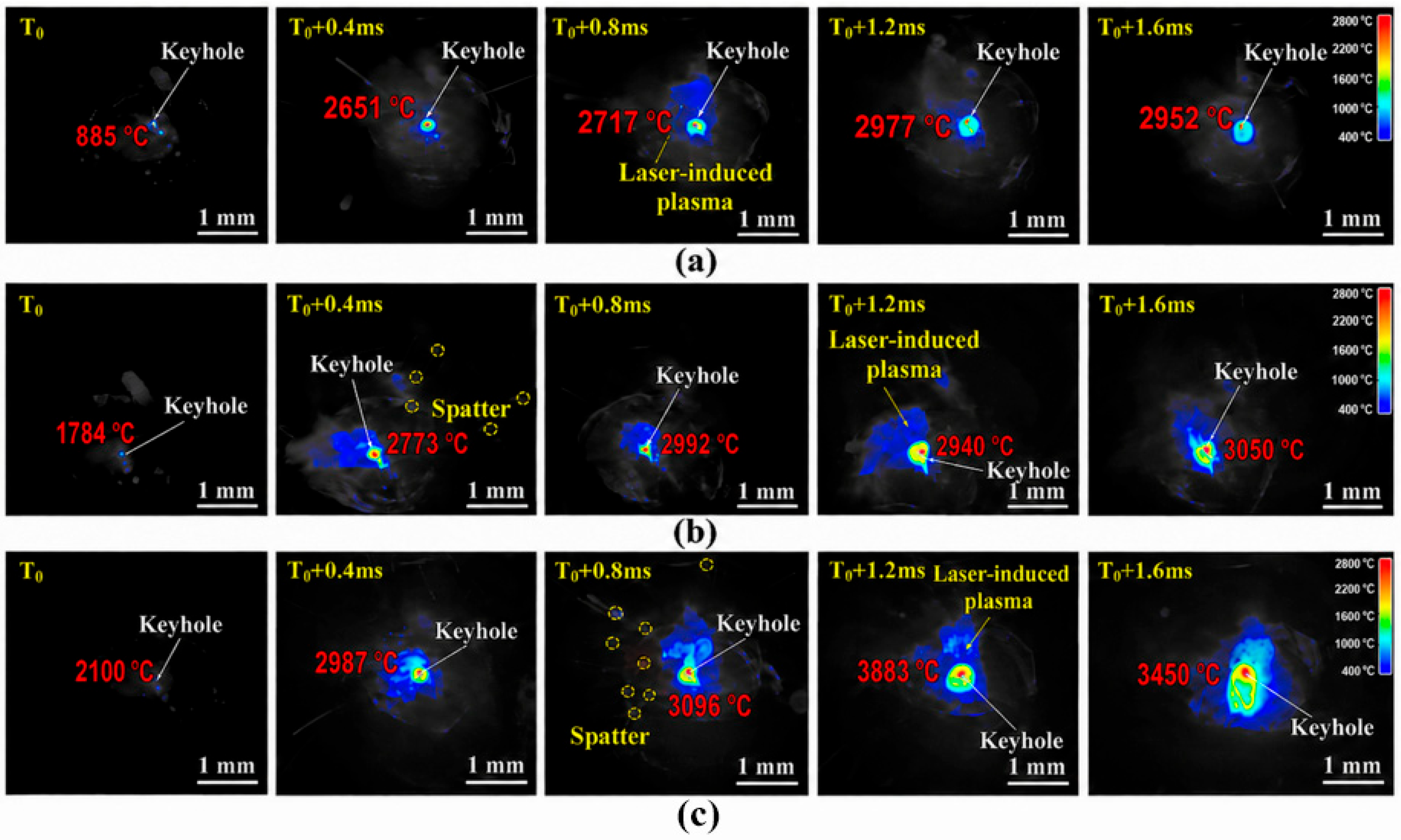
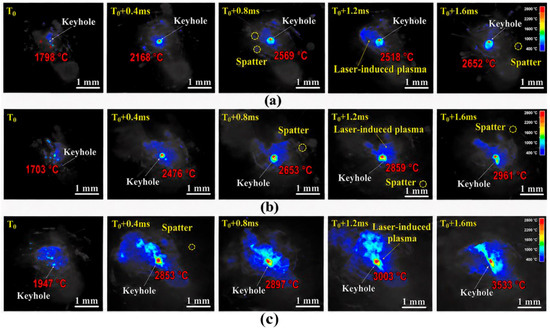
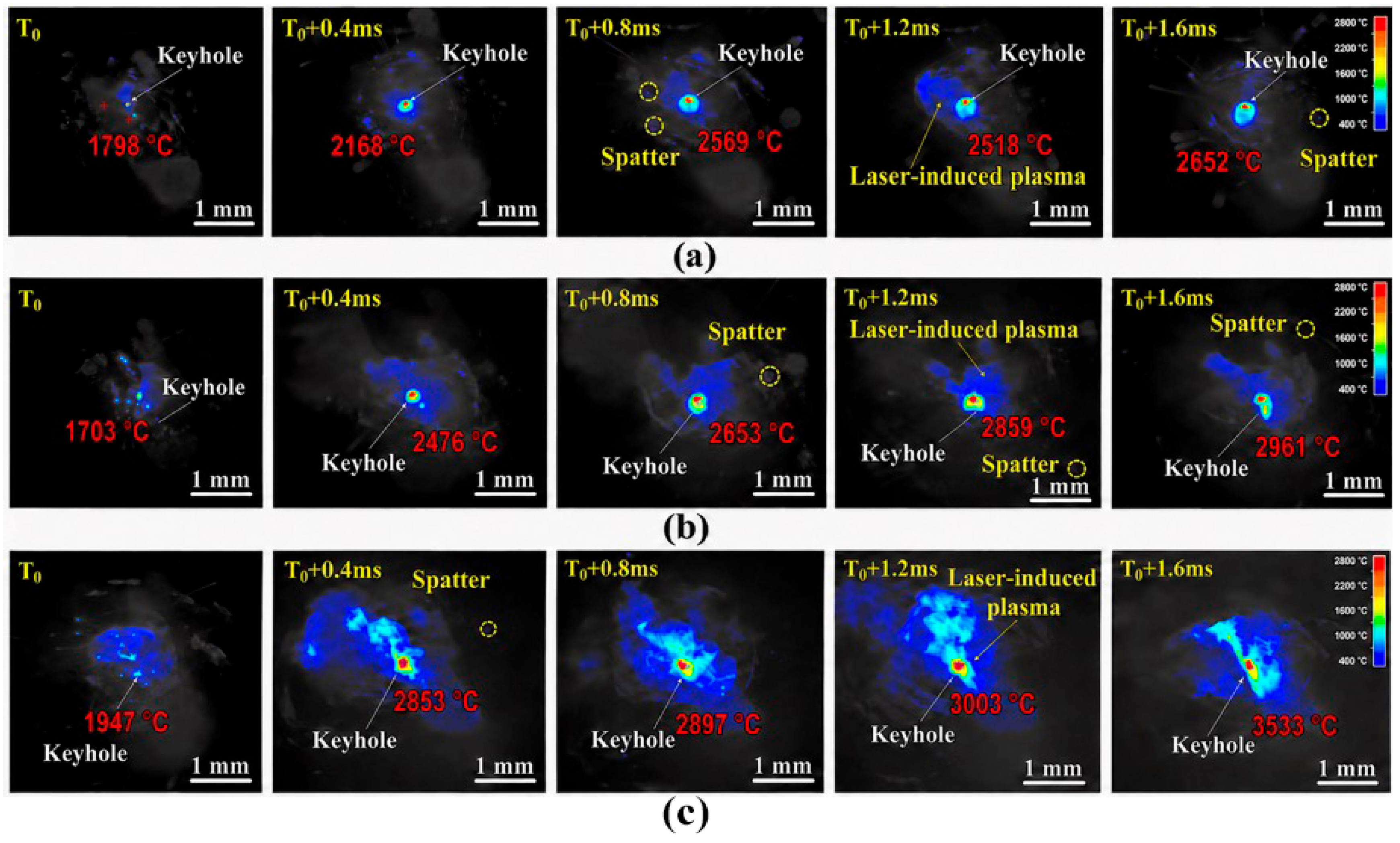
As shown in Figure 5, an increase in laser power also resulted in enhanced keyhole high-temperature cores and laser-induced plasma in the underwater environment. However, the morphology of the high-temperature region and its thermal evolution exhibited significant differences compared with those observed in the air atmosphere. During underwater welding, the coaxial drainage gas forms a localized gas cavity around the laser–material interaction zone, enabling laser energy to be delivered to the workpiece through the gaseous pathway. Meanwhile, the region surrounding the gas cavity remains affected by the enhanced cooling effect of water and fluctuations at the gas–liquid interface. The stability of the local dry region is therefore a critical factor determining laser energy transmission, keyhole maintenance, and weld quality during underwater laser welding [27]. At a laser power of 2000 W, the maximum apparent temperature increased from 1798 °C at T0 to 2168 and 2569 °C, followed by a slight decrease to 2518 °C at T0 + 1.2 ms and a subsequent recovery to 2652 °C at T0 + 1.6 ms. The overall size of the keyhole high-temperature core remained relatively small, while the surrounding high-temperature region exhibited alternating expansion and contraction accompanied by a small amount of spatter. The non-monotonic temperature evolution indicates that under low-power conditions, a stable balance among metal vapor recoil pressure, the local drainage gas cavity, and water-induced cooling had not yet been established, resulting in transient fluctuations of the keyhole opening. When the laser power was increased to 3000 W, the persistence of the high-temperature core was significantly enhanced. A larger blue-to-green high-temperature region developed around the keyhole opening, and plasma emission and spatter formation were observed at multiple time instants. This indicates that the increased laser power intensifies material evaporation and vapor recoil pressure, facilitating the maintenance of a deep-penetration welding state within the local gas cavity. However, the enhanced interaction between the vapor jet and gas–liquid interface also increases the displacement and morphological fluctuation of the high-temperature region.
Figure 5.
Infrared thermographic characterization of keyholes under different laser powers in an underwater atmosphere: (a) 2000 W; (b) 3000 W; (c) 4000 W.
A similar trend was observed at 4000 W. Compared with the lower-power conditions, both the keyhole opening and plasma high-temperature regions were significantly enlarged. Particularly, a continuous high-temperature region with longitudinal extension was formed during the later stage of observation. The stronger metal vapor jet generated under high-power conditions enhances the stability of the local gas cavity and reduces the probability of direct water intrusion into the laser–material interaction zone, allowing the thermal state of the keyhole center to gradually approach that under air welding. Nevertheless, the enlarged plasma region and frequent spatter events indicate that strong transient disturbances still exist during high-power underwater welding. This can be attributed to the fact that even when a localized dry cavity is established in underwater laser welding, the surrounding water still restricts the molten pool dimensions and increases the cooling rate of the molten pool. This phenomenon is consistent with previous reports [28].
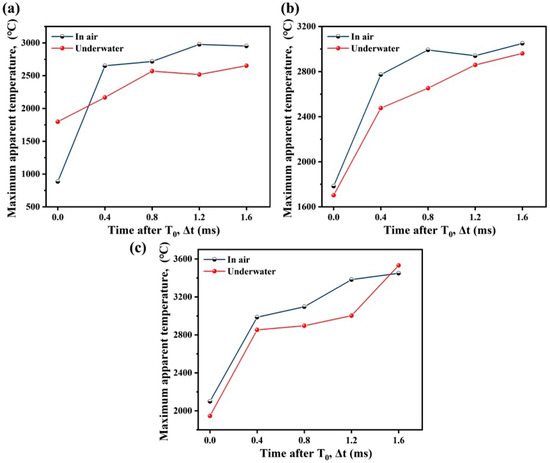
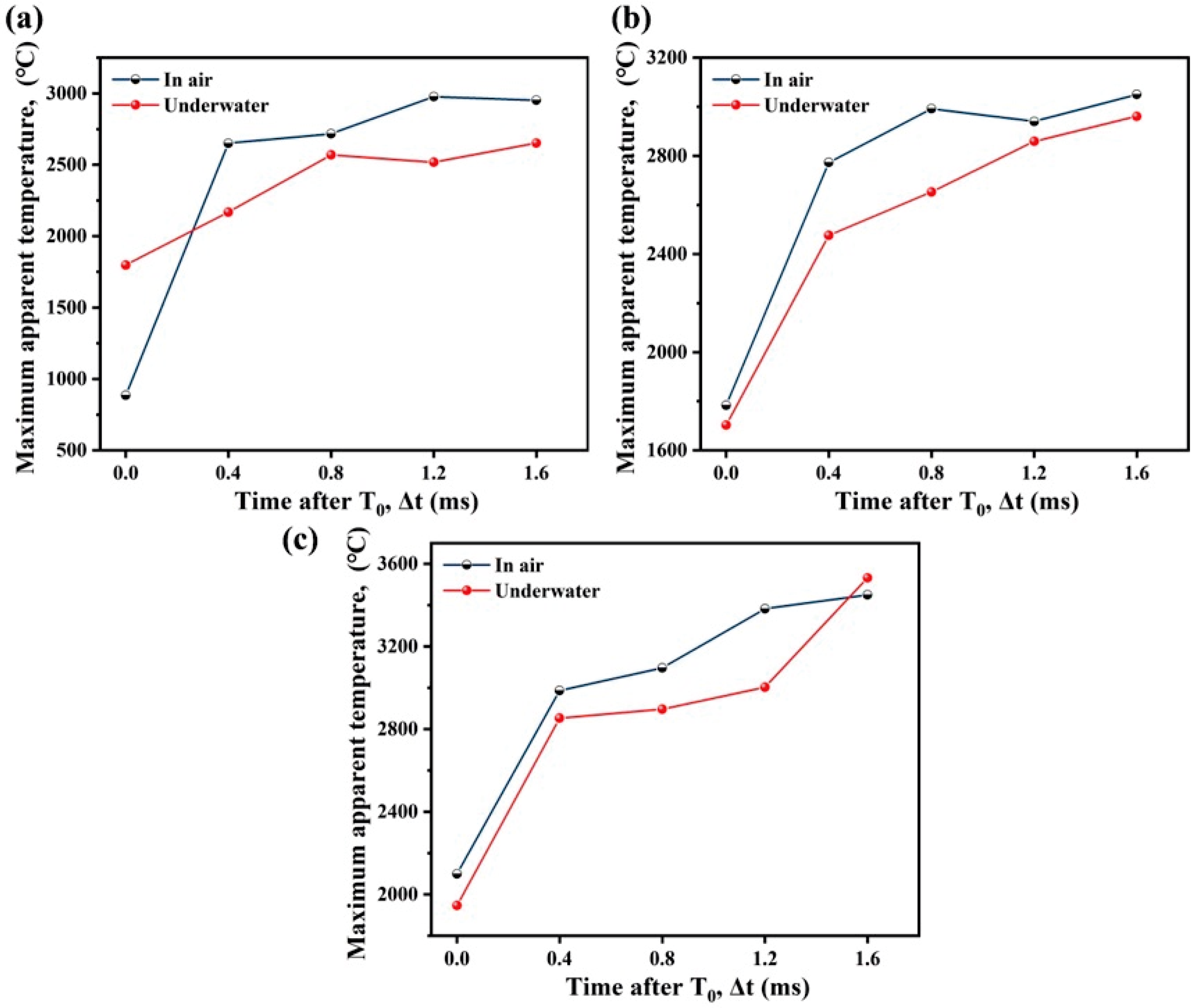
Figure 6 compares the evolution of the maximum apparent temperature near the keyhole opening during laser welding in air and underwater environments under different laser powers. In most cases, the maximum apparent temperature in the air atmosphere was higher than that in the underwater environment. This indicates that under identical laser power conditions, enhanced heat dissipation caused by the surrounding water and the edge of the gas cavity remains the dominant factor responsible for reducing the apparent temperature of the keyhole-opening region during underwater welding.
Figure 6.
Comparison of temperatures at the laser keyhole in air and underwater environments under different laser powers: (a) 2000 W; (b) 3000 W; (c) 4000 W.
It should be noted that at 4000 W, the underwater maximum apparent temperature slightly exceeded that measured in air at the last two sampled instants. This transient crossover does not indicate that the overall thermal state during underwater welding became higher than that in air. The infrared measurement represents the maximum apparent radiation temperature within the instantaneous field of view rather than a spatially averaged temperature of the entire weld pool. Under the high-power condition, enhanced metal-vapor recoil and a more persistent local gas cavity reduce direct contact between liquid water and the keyhole center. Meanwhile, transient variations in the keyhole-opening geometry, metal-vapor plume, and molten-pool surface alter the radiative contribution received by the infrared camera. Consequently, individual time points may exhibit a temporarily higher maximum apparent temperature under underwater conditions. Nevertheless, when the four time points from T0 + 0.4 to T0 + 1.6 ms are averaged, the corresponding values at 4000 W are approximately 3229 °C in air and 3071 °C underwater. Therefore, the crossover observed at the last two instants is interpreted as a transient fluctuation of the local apparent thermal state rather than a sustained reversal of the overall air–underwater temperature relationship.
Since the initial thermal states at T0 varied significantly among different welding conditions, the average temperature over the four time points from T0 + 0.4 to T0 + 1.6 ms was calculated to better represent the thermal state after keyhole formation. At 2000 W, the average maximum apparent temperatures in air and underwater environments were approximately 2824 and 2477 °C, respectively, with the air atmosphere exhibiting a temperature increase of about 348 °C. At 3000 W, the corresponding values were 2939 and 2738 °C, resulting in a temperature difference of approximately 201 °C. At 4000 W, the average maximum apparent temperatures reached approximately 3229 and 3071 °C, respectively, and the temperature difference further decreased to about 158 °C. Compared with the underwater environment, the average temperature in the air atmosphere was approximately 14.0%, 7.3%, and 5.1% higher at 2000, 3000, and 4000 W, respectively. These results demonstrate that the difference in apparent temperature near the keyhole opening between air and underwater welding gradually decreases with increasing laser power.
The above variations can be attributed to the combined effects of laser power on the local gas cavity and keyhole behavior. At relatively low laser powers, the local gas cavity is small and easily disturbed by fluctuations at the gas–liquid interface. Consequently, the cooling effect of water and the influence of water vapor on laser propagation become more pronounced, resulting in significant suppression of both the temperature and size of the high-temperature core in the underwater environment. With increasing laser power, the material evaporation rate and vapor recoil pressure are enhanced, leading to the expansion of the local gaseous region. Meanwhile, the direct contact between the keyhole center and liquid water is reduced, allowing the thermal state of the central high-temperature region to gradually approach that observed under air conditions. However, the cooling effect of water on the peripheral region of the molten pool, the rear part of the weld pool, and the solidification zone still remains. Therefore, the similarity in keyhole center temperature does not indicate that the overall temperature field during underwater welding is identical to that in air welding [27]. Relevant numerical studies [29] have demonstrated that with increasing ambient water pressure, the keyhole surface temperature required to sustain metal evaporation may increase.
These results also reveal that the luminous region of the laser-induced plasma expands and the frequency of spatter formation increases with increasing laser power. This phenomenon can be attributed to the fact that the elevated temperature of the keyhole wall intensifies metal evaporation and increases the vapor pressure inside the keyhole. When the local vapor recoil pressure and molten metal momentum exceed the constraint imposed by surface tension on the liquid metal, molten metal may be expelled from the keyhole edge or molten pool surface, resulting in spatter formation. In addition, the expansion, contraction, and partial collapse of the keyhole opening can alter the vapor escape pathways, causing pronounced transient characteristics in both spatter behavior and plasma radiation intensity [30]. Compared with the air atmosphere, the plasma region under underwater conditions exhibited more pronounced irregular expansion and displacement. On the one hand, the drainage gas flow can influence the trajectory of metal vapor ejection. On the other hand, the local gas cavity boundary and surrounding water impose constraints on the free expansion of plasma while introducing additional pressure fluctuations and flow disturbances. These combined effects lead to more complex plasma dynamics and enhanced instability of the vapor–plasma–molten pool interaction during underwater laser welding.
3.3. Optical Emission Characteristics and Excitation Temperature of the Plasma Plume
The Boltzmann multi-line fitting method was used to estimate the excitation temperature of the Fe I-emitting species. Under the local thermodynamic equilibrium (LTE) approximation [31,32], according to the Boltzmann distribution [33], the radiation intensity Iji generated by an electron transition from energy level j to energy level i can be expressed as Equation (1):
where is the Planck constant; is the speed of light; is the total number of ground-state atoms per unit volume; is the statistical weight of energy level ; is the transition probability from energy level to energy level ; is the wavelength of the radiation emitted during the transition from energy level to energy level ; is the partition function; is the excitation energy of energy level ; is the Boltzmann constant; and is the excitation temperature. Taking the logarithm of both sides of Equation (1) yields:
The data points were fitted using least-squares regression, and the reciprocal of the slope of the fitted line gives the excitation temperature . To obtain an accurate value of the excitation temperature, the following principles were considered when selecting the spectral lines used for the Boltzmann analysis: (1) the selected spectral lines should belong to the same ionization stage of the same element; (2) the energy-level difference of the selected spectral lines should be as large as possible and satisfy ; and (3) spectral lines with obvious overlap, saturation, or potential strong self-absorption should be avoided as far as possible.
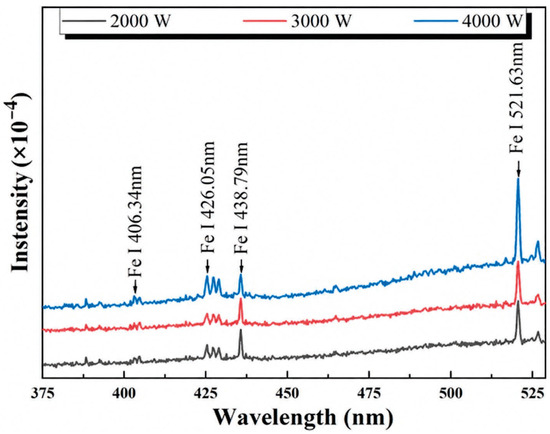
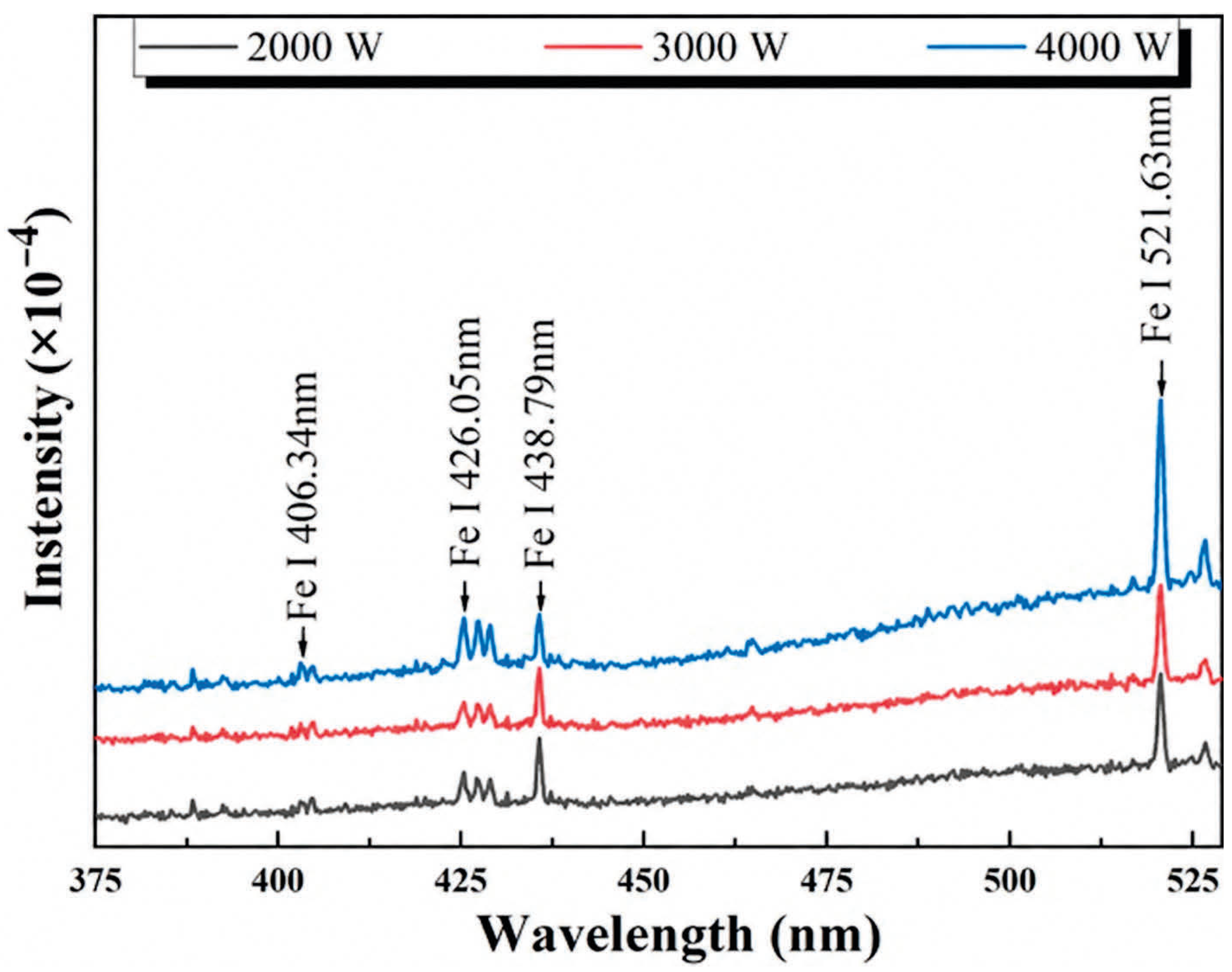
As shown in Figure 7, the emission spectra obtained during underwater laser welding at different laser powers exhibited similar overall profiles, and the positions of the main characteristic lines remained essentially unchanged. Based on the measured wavelengths and the elemental composition of 304NG stainless steel, distinct Fe I emission lines were identified near 406.34, 426.05, 438.79, and 521.63 nm. Among them, the Fe I line near 521.63 nm exhibited a relatively high signal-to-noise ratio, and its emission intensity increased with laser power. Under the present spectral resolution and signal-to-noise conditions, no Fe II (I and II denote neutral and singly ionized species, respectively), Cr II, Mn II, or other ionic emission lines could be unambiguously resolved and reliably identified. Therefore, the subsequent Boltzmann analysis was based on the available Fe I neutral atomic lines. Because 304NG stainless steel contains substantial Cr and a smaller amount of Mn, these alloying elements may also enter the vapor phase and participate in excitation and ionization processes. However, because no corresponding ionic lines were reliably resolved and the electron density was not independently determined, their individual contributions to the electron population cannot be quantified from the present measurements.
Figure 7.
Plasma emission spectra during underwater laser welding at different laser powers.
As the laser power increased from 2000 W to 4000 W, both the continuous spectral background and the intensities of the characteristic Fe I lines increased overall. In particular, at 4000 W, the peak intensity of the 521.63 nm line was significantly higher than those under the lower-power conditions. This indicates enhanced metal evaporation and the excitation of Fe atoms with increasing laser energy input. However, spectral-line intensity is also affected by the number density of emitting species, excited-state population, spectral collection conditions, and instrumental response. Therefore, the plasma temperature cannot be determined directly from the intensity of a single spectral line, and multiple Fe I lines were used to construct the Boltzmann plots.
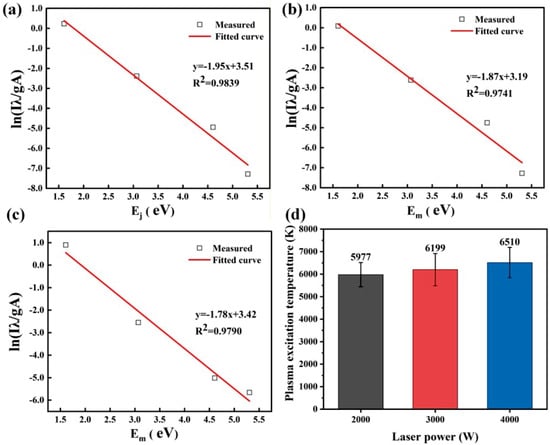
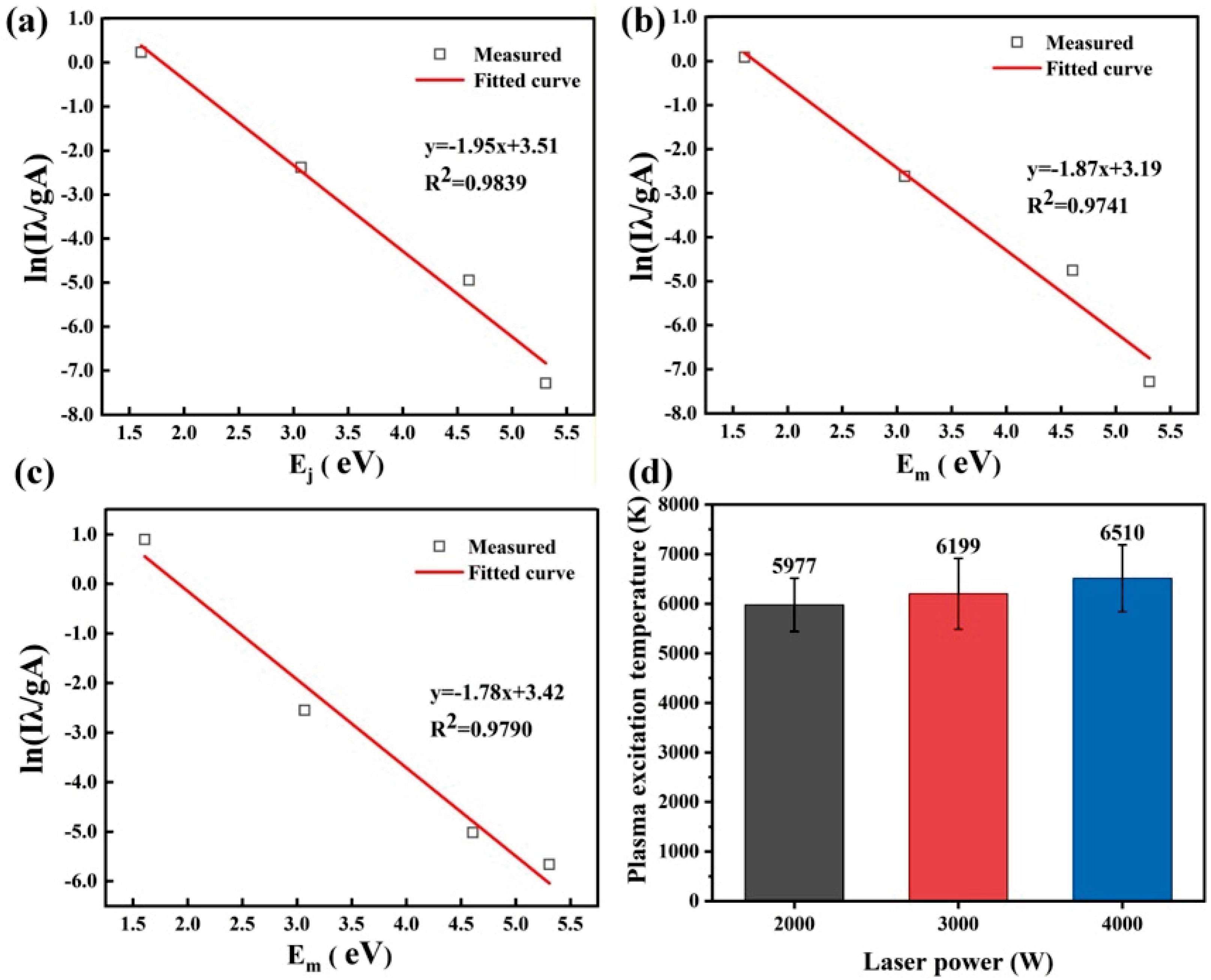
The parameters of the Fe I spectral lines used for temperature calculation are listed in Table 3. The upper-level energies of the selected spectral lines ranged from 4.608 to 6.0713 eV, providing a certain energy-level span for Boltzmann linear fitting. After continuous-background subtraction and spectral-peak intensity extraction for each characteristic line, linear fitting was performed using as the horizontal coordinate and as the vertical coordinate, as shown in Figure 8a–c. The coefficients of determination, , of the fitted lines at 2000, 3000, and 4000 W were 0.9839, 0.9741, and 0.9790, respectively, indicating good linear relationships for the selected Fe I lines.
Table 3.
Spectral information of Fe I line.
Figure 8.
Boltzmann plots constructed using the selected Fe I emission lines during underwater laser welding at (a) 2000 W, (b) 3000 W, and (c) 4000 W, and (d) variation in plasma excitation temperature with laser power.
It should nevertheless be recognized that only four suitable Fe I lines were available within the present spectra. Although their upper-level energies provide a relatively wide range and all Boltzmann fits yielded (R2 > 0.97), the limited number of lines introduces uncertainty into the absolute excitation-temperature determination. Moreover, the spectral resolution of the present system (0.5–0.7 nm) was insufficient to quantitatively assess self-absorption from the measured line profiles or to reliably determine the electron density from Stark broadening. Therefore, residual self-absorption, particularly for the relatively intense Fe I 521.63 nm line, cannot be completely excluded. Electron density and ionization degree were consequently not quantified in the present study. For these reasons, greater emphasis was placed on the relative variation in excitation temperature with laser power than on its absolute value. Accordingly, the term “plasma” used in this study should not be interpreted as implying a quantitatively established ionization degree or a strongly ionized state. The observed luminous region is therefore referred to more conservatively as a plasma plume where its ionization state cannot be independently determined.
The applicability of the LTE approximation also requires caution because the welding plume is highly transient and spatially non-uniform [34,35]. The high-speed images showed pronounced plume evolution on a sub-millisecond timescale, with an interframe interval of 0.4 ms, whereas the integration time of the spectrometer was 10 ms. Therefore, each recorded spectrum represents a temporally integrated and line-of-sight-averaged response over multiple transient plume states rather than an instantaneous local thermodynamic state. In principle, rigorous verification of LTE requires the collisional relaxation time of the excited-state population to be substantially shorter than the residence time of the emitting species in the corresponding plume region. However, the electron density and local plume velocity required for such a quantitative comparison were not independently measured in the present experiments. Consequently, strict LTE cannot be experimentally verified, and partial non-equilibrium or “frozen-in” effects in the excited-state population cannot be completely excluded. The Boltzmann-derived Te should therefore be interpreted as an effective, temporally, and line-of-sight-integrated Fe I excitation temperature obtained under the LTE approximation, rather than as a strictly local and instantaneous thermodynamic-equilibrium temperature.
As shown in Figure 8d, the plasma excitation temperature exhibited an overall increasing trend with increasing laser power. At 2000, 3000, and 4000 W, the excitation temperatures were 5977, 6199, and 6510 K, respectively. When the laser power increased from 2000 to 4000 W, the excitation temperature increased by approximately 533 K, corresponding to an increase of approximately 8.9%. However, the error ranges of the three temperature values overlapped to some extent. Therefore, these results are more suitable for demonstrating an increasing trend in the excitation temperature with increasing laser power, rather than for establishing statistically significant temperature differences among the different power conditions based solely on the present data. The increase in excitation temperature was mainly associated with the enhanced metal evaporation and energy input under higher-power conditions.
The excitation temperatures obtained in the present study were lower than some values reported for the hotter plasma region above a laser-welding keyhole, particularly those derived from ionic emission lines. This difference is related to the emitting species and the region sampled by the optical system. The present values were derived exclusively from neutral Fe I lines and therefore represent the excitation-state population of the Fe I-emitting region rather than the absolute temperature of the hottest plasma core. Kawahito et al. [36] reported that the emission spectrum during 10 kW fiber laser welding of Type 304 stainless steel was dominated by neutral Fe, Cr, and Mn lines, whereas corresponding ionic lines were not clearly detected, and a plume temperature of approximately 6000 K was obtained. The present values of 5977–6510 K are therefore within a comparable range for a laser-induced plume dominated by neutral atomic emission. Under the current experimental conditions, the absence of unambiguously identifiable ionic lines and the limited spectral resolution preclude a direct determination of the core electron temperature or ionization degree. Accordingly, Te in this study is used primarily as a comparative parameter to characterize changes in the energy state of the Fe I-emitting region with laser power.
The increase in excitation temperature was mainly associated with enhanced metal evaporation and energy input at higher laser powers. As the laser power increased, more laser energy was absorbed by the keyhole wall, resulting in higher wall temperatures and metal evaporation rates. Consequently, more Fe atoms entered the vapor plume above the keyhole and acquired higher excitation energies through collisions with electrons and other particles. Meanwhile, the enhanced vapor recoil pressure was beneficial for maintaining the keyhole opening and the local gas-phase channel, allowing the high-temperature metal vapor to be continuously ejected from inside the keyhole and thereby increasing the excitation degree and emission spectral intensity of the plasma outside the keyhole.
The above results are in good agreement with the preceding high-speed imaging and infrared thermography results. Under underwater conditions, when the laser power increased from 2000 to 4000 W, the transverse dimension of the plasma at T0 + 0.8 ms increased from approximately 2.7 to 5.8 mm, indicating a significant enhancement in the spatial expansion of the metal vapor and plasma outside the keyhole. Meanwhile, the average maximum apparent temperature near the keyhole opening increased from approximately 2477 to 3071 °C, accompanied by pronounced increases in both the persistence and spatial extent of the high-temperature core. The simultaneous increases in the Fe I spectral-line intensity and excitation temperature further demonstrate that increasing the laser power not only enhances the thermal radiation in the keyhole-opening region, but also increases the excitation state of Fe I-emitting species in the metal-vapor plume outside the keyhole. It should be noted that the maximum apparent temperature obtained by infrared thermography and the plasma excitation temperature calculated using spectroscopy have different physical meanings. Infrared thermography reflects the apparent radiation temperature jointly contributed by the keyhole opening, molten pool surface, and adjacent vapor and plasma within the line of sight, whereas the excitation temperature obtained from the Boltzmann plot represents the characteristic temperature corresponding to the excited-state energy-level population of Fe atoms in the plasma outside the keyhole. Therefore, the absolute values of the two types of temperature cannot be compared directly; however, their simultaneous increasing trends with increasing laser power provide mutual confirmation.
In summary, as the laser power increased from 2000 to 4000 W, the intensities of the characteristic Fe I lines in the underwater laser-induced plasma increased overall, while the excitation temperature increased from approximately 5977 to 6510 K. These results indicate that increasing the laser power enhanced metal evaporation from the keyhole wall and the collisional excitation of Fe I-emitting species in the plume, consistent with the previously observed expansion of the plasma-emitting region, increase in the apparent temperature near the keyhole opening, and enhanced persistence of the high-temperature core. Meanwhile, the frequent occurrence of spatter and fluctuations in plasma morphology at high laser power indicate that the relationship between increased energy input and welding-process stability is not simply linear.
From a process-monitoring perspective, the present results suggest that the plume dimension and persistence, the apparent thermal state near the keyhole opening, and the Fe I spectral response contain complementary information on changes in laser energy input and welding-process state. High-speed imaging provides direct information on plume expansion and spatter, infrared thermography reflects variations in the local apparent thermal state, while emission spectroscopy provides an independent indicator of the excitation state of the metal vapor. Their combined use may therefore be more informative than any single signal for identifying deviations from a desired welding state. In practical process development, the trends established here can be used as baseline information for selecting laser-power windows and constructing monitoring criteria. However, quantitative thresholds for weld-quality prediction cannot yet be established from the present data and will require further correlation with weld defects, penetration, and joint properties under a wider range of processing conditions.
4. Conclusions and Future Work
This study systematically compared and analyzed the laser-induced plasma, thermal state of the keyhole opening, and spatter behavior in air and underwater environments under different laser powers. The excitation temperature of the Fe I-emitting region in the underwater metal-vapor/plasma plume was further estimated using the Boltzmann multi-line fitting method under the LTE approximation. The specific conclusions are as follows:
- (1)
- As the laser power increased from 2000 to 4000 W, the spatial extent and temporal persistence of the laser-induced plume increased markedly in both air and underwater environments, while the high-temperature region near the keyhole opening gradually changed from intermittent appearance to sustained existence. Under underwater conditions, at ms, the transverse width of the plasma increased from approximately 2.7 mm at 2000 W to 4.6 and 5.8 mm at 3000 and 4000 W, respectively. Higher laser power enhanced metal evaporation from the keyhole wall and the vapor recoil pressure, which facilitated the maintenance of the keyhole opening and local gas cavity. However, excessively high power generated excessive recoil pressure, keyhole fluctuations, and molten-pool flow, resulting in the ejection of liquid metal and the formation of spatter.
- (2)
- The maximum apparent temperature near the keyhole opening was generally higher in air than in the underwater environment, while the difference between the two environments gradually decreased with increasing laser power. At low laser power, the effects of water cooling, disturbances at the gas-cavity boundary, and water vapor on laser propagation were relatively pronounced. As the laser power increased, the metal-vapor jet and local gas-phase region were enhanced, reducing the direct contact between the keyhole center and liquid water and causing the thermal state at the underwater keyhole center to gradually approach that in air.
- (3)
- The intensities of the characteristic Fe I lines in the underwater plasma emission spectra increased overall with increasing laser power, indicating enhanced metal evaporation from the keyhole wall and an increased excitation state of the Fe I-emitting species in the plume. The Boltzmann plots constructed using four Fe I lines showed that the excitation temperature exhibited an overall increasing trend with increasing laser power, consistent with the expansion of the plasma-emitting region, the increase in the apparent temperature near the keyhole opening, and the enhanced persistence of the high-temperature core.
- (4)
- Deionized water was used in the present study to minimize additional variations in the optical diagnostics and welding process caused by changes in water quality, thereby ensuring comparability among different laser-power conditions. However, natural freshwater and seawater in practical underwater environments differ in salinity, electrical conductivity, turbidity, and suspended-particle content, which may further affect laser transmission, local gas-cavity stability, and metal-vapor/plasma plume behavior. Therefore, the present results mainly describe the process evolution under controlled deionized-water conditions. Future work will extend the investigation to natural freshwater and seawater environments and examine the relationships among water quality, process stability, spectroscopic response, and weld quality.
Author Contributions
Conceptualization, Z.L. and C.M.; data curation, Y.Y. and Q.G.; formal analysis; J.S.; funding acquisition, Z.L.; investigation, M.W.; methodology, J.S. and Y.Y.; project administration, C.M. and Q.Z.; resources, M.W.; software, J.S.; supervision, C.M., M.W. and Z.L.; validation, M.W.; visualization, Q.G. and Q.Z.; writing—original draft, C.M.; writing—review & editing, J.S. All authors have read and agreed to the published version of the manuscript.
Funding
This research was supported by the National Natural Science Foundation of China (Grant No. 2025ZD1605801).
Data Availability Statement
The original contributions presented in this study are included in the article. Further inquiries can be directed to the corresponding authors.
Conflicts of Interest
Author Chengyong Ma was employed by the Central Iron and Steel Research Institute. The remaining authors declare that the research was conducted in the absence of any commercial or financial relationships that could be construed as a potential conflict of interest.
References
- Sun, G.; Wang, Z.; Lu, Y.; Chen, M.; Yang, K.; Ni, Z. Underwater Laser Welding/Cladding for High-performance Repair of Marine Metal Materials: A Review. Chin. J. Mech. Eng. 2022, 35, 5. [Google Scholar] [CrossRef] [Scilit]
- Zhang, X.; Chen, W.; Ashida, E.; Fukuhisa, M. Relationship between weld quality and optical emissions in underwater Nd: YAG laser welding. Opt. Lasers Eng. 2004, 41, 717–730. [Google Scholar] [CrossRef] [Scilit]
- Sun, J.; Yang, Y.; Wang, K.; Yin, S.; Li, Z.; Luo, Z. A Comparative Study on the Performance and Microstructure of 304NG Stainless Steel in Underwater and Air Laser Welding. Materials 2024, 17, 3854. [Google Scholar] [CrossRef] [Scilit]
- Zhang, X.; Cheng, F.; Feng, Y.; Liu, J.; Li, Z.; Wu, Y.; Han, K.; Yin, Q. Investigation on the Microstructure and Mechanical Properties of 304 Stainless Steel Joints by Underwater Local Dry Laser Welding. Materials 2026, 19, 1723. [Google Scholar] [CrossRef] [Scilit]
- Zhao, C.; Zhu, J.; Guo, F.; Li, G.; Li, C.; Huang, Y. Study on Repairing Defects in S32101 Duplex Stainless Steel Clad Plates for Spent Fuel Storage Pools in Nuclear Power Plants Using Underwater Local Dry Laser Fillet Welding With Filler Wire. J. Nucl. Eng. Radiat. Sci. 2025, 11, 021605. [Google Scholar] [CrossRef] [Scilit]
- Wu, E.; Chen, M.; Zhao, K.; Wang, Z.; Sun, G. Corrosion behavior of underwater laser deposition remanufactured nuclear steel 316LN stainless steel at a pressure of 0.3 MPa. Opt. Laser Technol. 2025, 182, 112135. [Google Scholar] [CrossRef] [Scilit]
- Cheng, Q.; Zhang, H.; Li, T.; Wang, Y. Underwater local dry wire-feed laser deposition of 10CrNi3MoV high-strength low-alloy steel. J. Laser Appl. 2025, 37, 032015. [Google Scholar] [CrossRef] [Scilit]
- Zhao, Y.; Zhang, Q.; Tian, Y.; Chen, Y.; Sun, Q.; Liu, Y.; Li, X. Research on the Structure and Performance of Local Dry Underwater Laser Welding of 304 Stainless Steel. J. Mech. Eng. 2025, 61, 72–80. [Google Scholar] [CrossRef] [Scilit]
- Zhang, X.; Chen, W.; Ashida, E.; Fukuhisa, M. Laser–material interaction and process sensing in underwater Nd:Yttrium–aluminum–garnet laser welding. J. Laser Appl. 2003, 15, 279–284. [Google Scholar] [CrossRef] [Scilit]
- Huang, Z.Y.; Luo, Z.; Ao, S.; Cai, Y. Underwater laser weld bowing distortion behavior and mechanism of thin 304 stainless steel plates. Opt. Laser Technol. 2018, 106, 123–135. [Google Scholar] [CrossRef] [Scilit]
- Guo, N.; Fu, Y.; Xing, X.; Liu, Y.; Zhao, S.; Feng, J. Underwater local dry cavity laser welding of 304 stainless steel. J. Mater. Process. Technol. 2018, 260, 146–155. [Google Scholar] [CrossRef] [Scilit]
- Song, D.; Choi, J.; Shin, D.; Lee, S. Relationship between microstructure and corrodibility of local dry underwater laser welded 304 stainless steel. Metals 2022, 12, 1904. [Google Scholar] [CrossRef] [Scilit]
- Li, Z.; Sun, J.; Zhang, H.; Mao, P.; Li, Y.; Luo, Z. Microstructure and property modulation of underwater laser-welded 304NG stainless steel joints via magnetic field direction adjustment. J. Nucl. Mater. 2025, 616, 156041. [Google Scholar] [CrossRef] [Scilit]
- Zhang, S.; Dong, Y.B.; Sun, Y.T.; Liu, Y.; Sun, L.T.; Zhao, H.W.; Gao, N.; Wang, Z.B. Improved radiation resistance in metals via adaptive martensitic transformation. Nat. Commun. 2025, 16, 10995. [Google Scholar] [CrossRef] [Scilit]
- Heider, A.; Sollinger, J.; Abt, F.; Boley, M.; Weber, R.; Graf, T. High-speed X-ray analysis of spatter formation in laser welding of copper. Phys. Procedia 2013, 41, 112–118. [Google Scholar] [CrossRef] [Scilit]
- Sibillano, T.; Ancona, A.; Berardi, V.; Lugarà, P. A real-time spectroscopic sensor for monitoring laser welding processes. Sensors 2009, 9, 3376–3385. [Google Scholar] [CrossRef] [Scilit]
- Xiao, X.; Song, L.; Xiao, W.; Liu, X. Space-dependent characterization of laser-induced plasma plume during fiber laser welding. J. Phys. D Appl. Phys. 2016, 49, 485203. [Google Scholar] [CrossRef] [Scilit]
- Huang, Y.-W.; Gao, X.-D.; Gao, P.P.; Ma, B.; Zhang, Y.-X. Laser welding monitoring techniques based on optical diagnosis and artificial intelligence: A review. Adv. Manuf. 2025, 13, 337–361. [Google Scholar] [CrossRef] [Scilit]
- Norouzian, M.; Khakpour, M.; Orošnjak, M.; Kumar, A.A.; Kedziora, S. Prediction of weld quality in laser welding of hardmetal and steel using high-speed imaging and machine learning methods. J. Adv. Join. Process. 2025, 11, 100318. [Google Scholar] [CrossRef] [Scilit]
- Kang, S.; Shin, J. In situ monitoring of Al/Cu dissimilar laser welding process using optical emission spectroscopy (OES). Opt. Laser Technol. 2024, 176, 110893. [Google Scholar] [CrossRef] [Scilit]
- Kang, S.; Kang, M.; Jang, Y.H.; Kim, C. Spectrometer as a quantitative sensor for predicting the weld depth in laser welding. Opt. Laser Technol. 2024, 175, 110855. [Google Scholar] [CrossRef] [Scilit]
- Luo, S.; Yang, Y.; Dong, J.; Yang, Y.; Luo, Z. Effects of Shielding and Drainage Gas Flow Rates on Weld Quality, Microstructure and Mechanical Properties of 304NG Stainless Steel in Local Dry Underwater Laser Welding. Metals 2026, 16, 423. [Google Scholar] [CrossRef] [Scilit]
- Mu, Z.; Chen, X.; Zheng, Z.; Huang, A.; Pang, S. Laser cooling arc plasma effect in laser-arc hybrid welding of 316L stainless steel. Int. J. Heat Mass Transf. 2019, 132, 861–870. [Google Scholar] [CrossRef] [Scilit]
- Bai, D.; Yang, L.; Liu, F.; Liu, J.; Zhang, H.; Huang, G. The research on weld pool morphology and passive film characteristic of high-nitrogen stainless laser-arc hybrid weld joint. Opt. Laser Technol. 2023, 166, 109586. [Google Scholar] [CrossRef] [Scilit]
- Gumenyuk, A.; Bakir, N.; Rethmeier, M. Two-colour thermography for measurement of temperature distribution in laser beam welding. Procedia CIRP 2024, 124, 468–471. [Google Scholar] [CrossRef] [Scilit]
- Zhang, M.; Chen, G.; Zhou, Y.; Li, S. Direct observation of keyhole characteristics in deep penetration laser welding with a 10 kW fiber laser. Opt. Express 2013, 21, 19997–20004. [Google Scholar] [CrossRef] [Scilit]
- Guo, N.; Xing, X.; Zhao, H.; Tan, C.; Feng, J.; Deng, Z. Effect of water depth on weld quality and welding process in underwater fiber laser welding. Mater. Des. 2017, 115, 112–120. [Google Scholar] [CrossRef] [Scilit]
- Fu, Y.; Guo, N.; Cheng, Q.; Zhang, D.; Feng, J. Underwater laser welding for 304 stainless steel with filler wire. J. Mater. Res. Technol. 2020, 9, 15648–15661. [Google Scholar] [CrossRef] [Scilit]
- Luo, M.; Hu, R.; Li, Q.; Huang, A.; Pang, S. Physical understanding of keyhole and weld pool dynamics in laser welding under different water pressures. Int. J. Heat Mass Transf. 2019, 137, 328–336. [Google Scholar] [CrossRef] [Scilit]
- Christian, D.; Leander, S.; Klaus, S.; Marc, S.; Felix, Z.; Christian, H.; Christoph, S.; Marc, H.; Alexander, O.; Felix, B.; et al. Visualization and quantification of melt flow dynamics for laser welding with superimposed intensity distributions analyzed by synchrotron radiation imaging. Lasers Manuf. Mater. Process. 2026, 13, 831–855. [Google Scholar] [CrossRef] [Scilit]
- Liu, L.; Chen, M. Interactions between laser and arc plasma during laser–arc hybrid welding of magnesium alloy. Opt. Lasers Eng. 2011, 49, 1224–1231. [Google Scholar] [CrossRef] [Scilit]
- Yang, H.; Tao, X.; Ba, X.; Cheng, Z.; Liu, L. Study on coupling characteristics of different welding modes in laser-double TIG hybrid welding. Opt. Laser Technol. 2023, 167, 109621. [Google Scholar] [CrossRef] [Scilit]
- Chen, G.; Zhang, M.; Zhao, Z.; Zhang, Y.; Li, S. Measurements of laser-induced plasma temperature field in deep penetration laser welding. Opt. Laser Technol. 2013, 45, 551–557. [Google Scholar] [CrossRef] [Scilit]
- Tian, Y.; Li, C.; Xie, Y.; Yang, L.; Huang, Y. In situ monitoring of plasma dynamics during laser welding penetration state transition: A synergetic spectroscopic diagnostics and electrical detection method. J. Manuf. Process. 2025, 155, 572–588. [Google Scholar] [CrossRef] [Scilit]
- Teng, B.; Wu, P.; Wen, J.; Yang, H.; Bin, S.; Yang, S.; Xu, K.; Fan, C.; Yu, N.; Liu, J.; et al. Investigation of the plume mechanism in high-power laser-arc hybrid welding using spatio-temporal resolved spectroscopy. Chem. Phys. Lett. 2024, 860, 141767. [Google Scholar] [CrossRef] [Scilit]
- Kawahito, Y.; Matsumoto, N.; Mizutani, M.; Katayama, S. Characterisation of plasma induced during high power fibre laser welding of stainless steel. Sci. Technol. Weld. Join. 2008, 13, 744–748. [Google Scholar] [CrossRef] [Scilit]

Disclaimer/Publisher’s Note: The statements, opinions and data contained in all publications are solely those of the individual author(s) and contributor(s) and not of MDPI and/or the editor(s). MDPI and/or the editor(s) disclaim responsibility for any injury to people or property resulting from any ideas, methods, instructions or products referred to in the content. |
© 2026 by the authors. Licensee MDPI, Basel, Switzerland. This article is an open access article distributed under the terms and conditions of the Creative Commons Attribution (CC BY) license.