


Abstract
In this work, the microstructural evolution and comprehensive performances (mechanical, wear, and corrosion resistance) of LDED-fabricated 2205 DSS subjected to heat treatment at 1000 °C for different holding durations (5 min, 10 min, 30 min, and 60 min) were systematically investigated. The results indicate that the austenite content gradually increases with the extension of heat treatment time, reaching a peak value of 51% at 30 min. Meanwhile, the austenite morphology transforms from dendritic grains to equiaxed grains, accompanied by the massive precipitation of intragranular austenite (IGA) and obvious elemental enrichment behavior. In terms of mechanical and functional performances, the microhardness decreases slightly with prolonged heat treatment, with a total reduction of only 7%. The elongation increases continuously, while the yield strength and tensile strength remain relatively stable. Additionally, the wear coefficient and wear rate present a trend of first decreasing and then increasing. The minimum wear rate of 48.32 × 10⁻⁶ mm3/(N·m) is obtained at the heat treatment duration of 30 min, which is 83.4% lower than that of the untreated sample. Moreover, the optimal corrosion resistance is achieved after 30 min of heat treatment, with the corrosion current density decreasing by 45.8% relative to the as-built specimen. These results demonstrate that heat treatment at 1000 °C for 30 min is an optimal processing parameter to significantly optimize the microstructure and comprehensive performances of LDED-2205 DSS.
1. Introduction
With the global energy structure accelerating its transition toward clean and intelligent development, power grid systems are facing unprecedented technical challenges [1]. The large-scale integration of renewable energy sources, the deployment of flexible high-voltage direct-current transmission, and the widespread application of intelligent substations and other novel power equipment have imposed more stringent requirements on the service performance of critical metallic components. Particularly in coastal and high-humidity corrosive environments, power transmission fittings such as line hardware are subject to the coupled effects of aeolian vibration-induced alternating loads, electrochemical corrosion, and wear [2]. Under such conditions, conventional manufacturing processes have proven inadequate in meeting the comprehensive demands for complex geometries, high corrosion resistance, and extended service life [3,4,5,6].
2205 duplex stainless steel (2205 DSS), a typical ferrite–austenite dual-phase alloy, exhibits promising application prospects in corrosion protection for power grid equipment owing to its excellent pitting corrosion resistance, high strength, and superior resistance to stress corrosion cracking [7,8,9,10,11]. Its corrosion performance primarily depends on the precise control of the dual-phase ratio and the homogeneous distribution of alloying elements such as Cr, Mo, and N [12]. However, traditional casting and forging processes suffer from inherent limitations, including low material utilization efficiency, prolonged production cycles, and insufficient customization capability, rendering them poorly suited to the rapid iteration and personalized operation and maintenance requirements of modern grid equipment [13,14,15].
The emergence of additive manufacturing (AM) over recent decades has introduced numerous potential benefits for steel fabrication, including substantial reductions in production time, material consumption, and energy expenditure, while simultaneously enabling the fabrication of more complex geometries [16,17,18,19,20]. Common AM techniques for producing DSS components include laser powder bed fusion (LPBF) and directed energy deposition (DED) [21,22]. Among these, laser-directed energy deposition (LDED) is particularly well-suited for high-volume DSS component manufacturing due to its high efficiency, precision, and extensive processing range [23,24,25,26]. Typically, during the AM process, the molten region within DSS consists almost entirely of ferrite, with austenite subsequently forming during cooling. However, the rapid cooling characteristic of LDED often results in insufficient austenite formation, leading to severe phase inhomogeneity [27,28,29,30]. Extensive research has demonstrated that DSS with such microstructural characteristics exhibits inferior corrosion resistance, toughness, and ductility [31]. To address this issue, numerous studies have indicated that appropriate heat treatment can effectively promote the ferrite-to-austenite transformation, thereby achieving a more uniform dual-phase distribution [32]. Conversely, Improper heat treatment can readily induce the precipitation of detrimental intermetallic phases, such as σ-phase and Cr2N, within DSS. Additionally, excessive thermal exposure may result in abnormal grain coarsening and even cracking, all of which severely compromise the corrosion resistance of the material [33,34,35,36]. Consequently, the heat treatment temperature and duration exert critical influences on the microstructure and properties of the final DSS components.
Several researchers have investigated the effects of different heat treatment temperatures on the microstructure and properties of additively manufactured DSS. For instance, Zhang et al. [34] conducted solution treatment at 1050 °C, 1100 °C, and 1150 °C for 5 min and observed a significant increase in austenite content from 9.3% to over 60% following heat treatment. With increasing heat treatment temperature, the more uniform diffusion of K elements promoted ferrite formation, resulting in a slight reduction in austenite content. The average grain size also increased (1050 °C → 1100 °C → 1150 °C: 5.9 μm → 8.2 μm → 8.9 μm). Nanoscale CrN precipitates were detected in the 1050 °C and 1100 °C specimens, whereas these precipitates were absent in the 1150 °C specimen. Additionally, Karunanithi et al. [37] investigated the microstructural evolution of wire-arc additively manufactured duplex stainless steel subjected to heat treatment at 1250 °C, 1263 °C, and 1275 °C. Their results revealed that the 1250 °C heat-treated specimen exhibited a dual-phase ratio approaching 1:1, with corrosion resistance superior to that of both the as-built and other heat-treated samples. These findings indicate that the influence of heat treatment parameters on DSS is rather complex and does not follow a monotonic trend. In contrast, research concerning the effect of heat treatment duration on DSS remains scarce.
Therefore, systematic investigation into the influence of heat treatment duration on the microstructure and properties of additively manufactured DSS holds significant scientific importance for elucidating the underlying mechanisms of microstructural evolution and performance optimization via heat treatment, while also providing theoretical guidance and process parameters for the fabrication of high-reliability, high-performance additively manufactured DSS components. In this study, 2205 DSS was fabricated using LDED technology. The microstructural evolution, mechanical properties, and corrosion behavior of the material under different heat treatment durations were systematically investigated. The regulatory mechanisms of heat treatment duration on microstructural characteristics and performance indices were thoroughly elucidated. On this basis, the optimal heat treatment process parameters were determined, thereby establishing a theoretical and technical foundation for the engineering application of 2205 DSS in critical corrosion-resistant components for power grid infrastructure.
2. Experimental Equipment and Methods
2.1. Materials and Methods
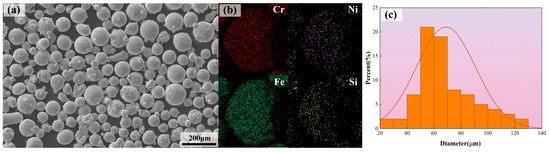
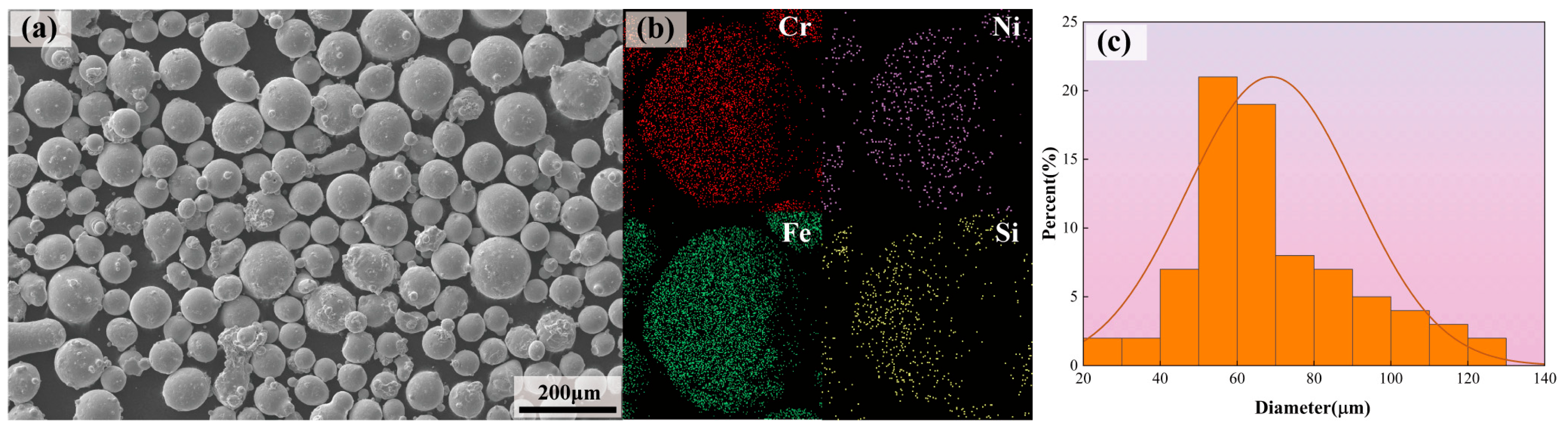
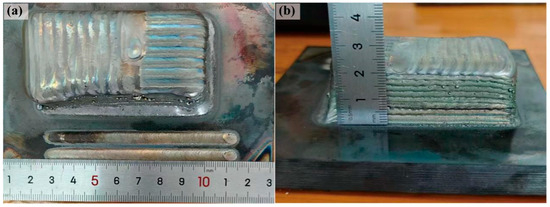
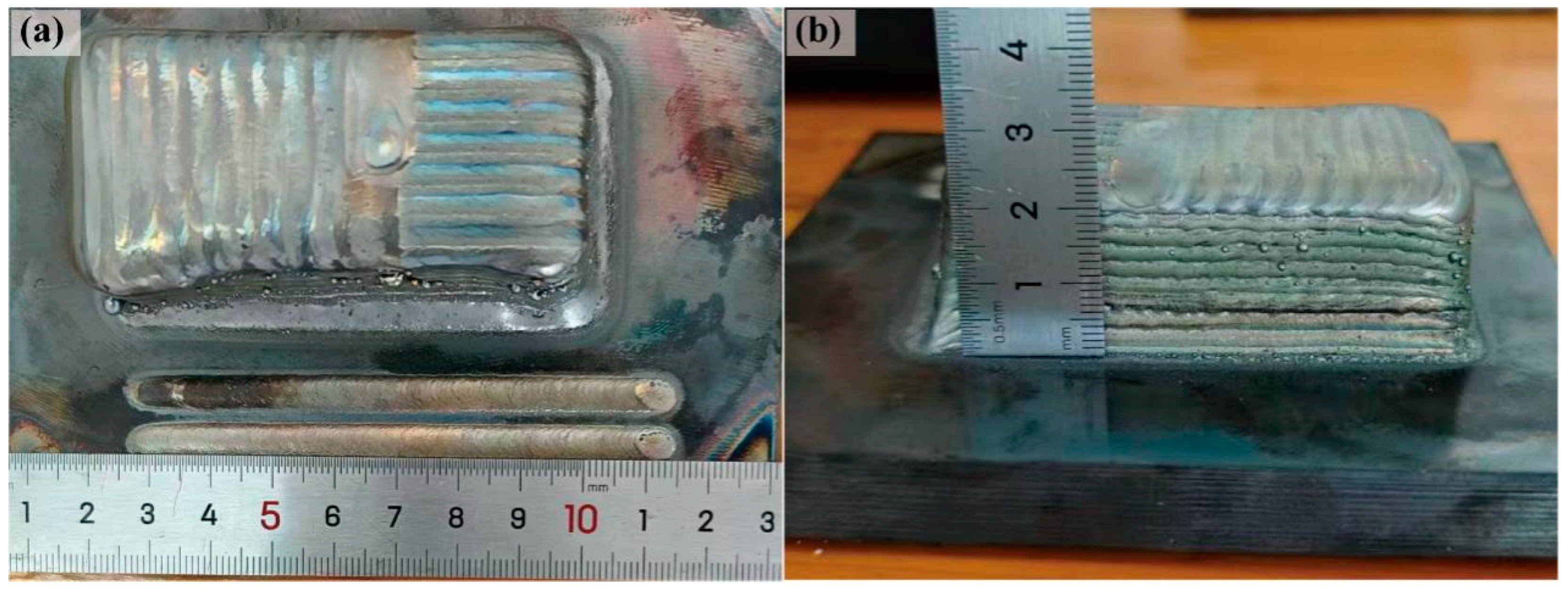
The spherical 2205 DSS metallic powder (Liaoning Guanda, Anshan, China) was selected as the cladding material in this study, with its micro-morphology, particle size distribution, and elemental composition presented in Figure 1 and Table 1, respectively. The substrate material was Q550 steel plate with dimensions of 70 mm × 100 mm × 10 mm. Prior to deposition, the substrate surface was ground with abrasive paper to remove rust and contaminants, followed by ultrasonic cleaning with ethanol to prevent adverse effects on the final deposited microstructure. LDED of 2205 DSS powder was conducted on a Metal-80rE-600 laser-directed energy deposition system (Nanjing Huirui, Nanjing, China). The fabrication process was carried out in a fully enclosed chamber under a protective atmosphere of 99.99% pure argon. The detailed process parameters are summarized in Table 2. A cross-hatching deposition strategy was adopted during the additive manufacturing process to minimize anisotropy in the as-built components. The process parameters were periodically monitored throughout the experiments to ensure compliance with the preset values. The final as-built specimen is illustrated in Figure 2.
Figure 1.
(a) Micro-morphology, (b) elemental distribution, and (c) particle size distribution of the 2205 DSS spherical metallic powder.
Table 1.
Chemical composition of the 2205 DSS spherical metallic powder (at.%).
Table 2.
The process parameters of LDED.
Figure 2.
Photograph of the as-built 2205 DSS component fabricated by LDED technology. (a) Top view; (b) Side view.
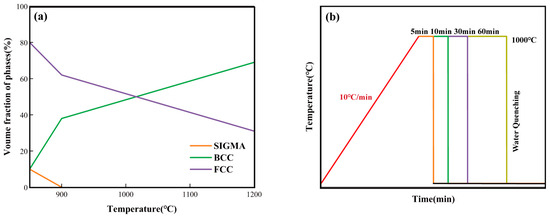
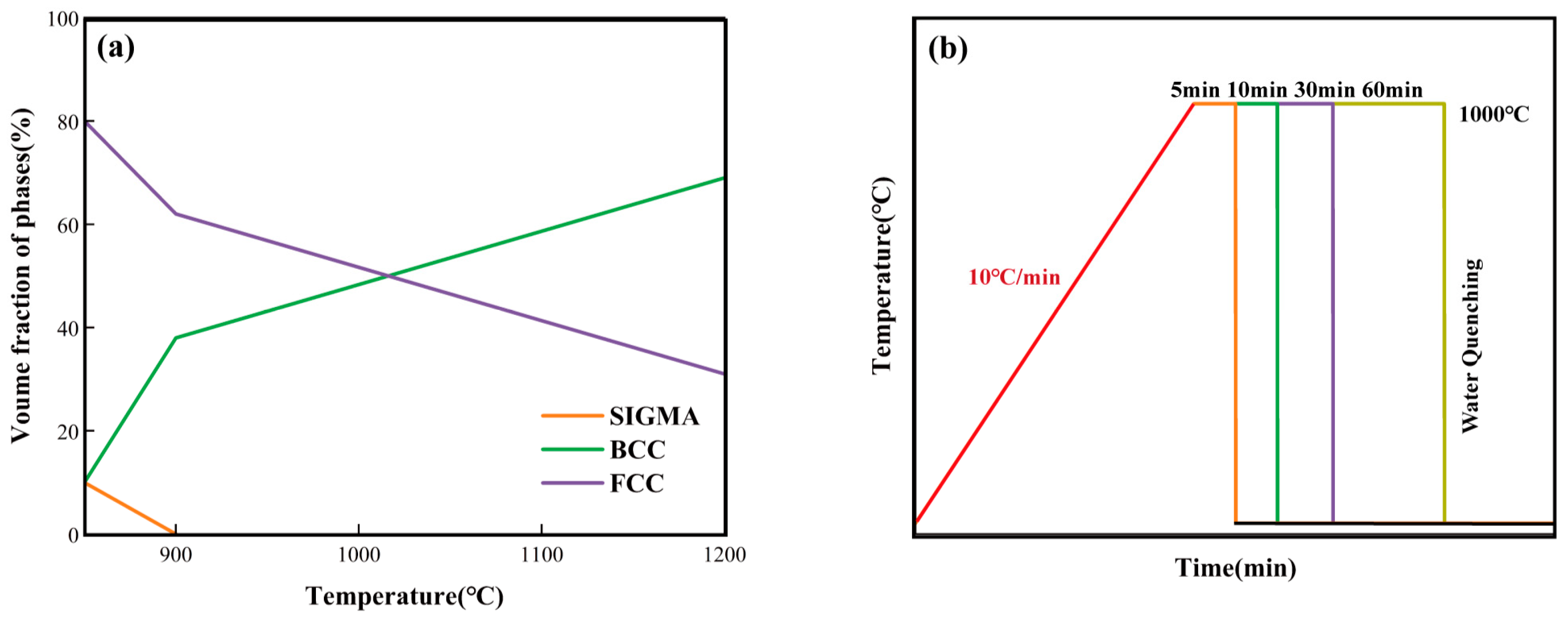
The phase transformation behavior of 2205 duplex stainless steel at elevated temperatures was obtained through calculation, and the results are shown in Figure 3a. It was observed that the phase fraction ratio of FCC to BCC approached approximately 1:1 near 1000 °C. The heat treatment protocol employed in this study was established based on preliminary parametric screening and critical assessment of the relevant literature concerning DSS heat treatment kinetics [38,39]. The finalized processing parameters are presented in Table 3, with the thermal profile depicted in Figure 3b. For clarity, the heat-treated specimens are labeled according to their isothermal holding times at the solution temperature: 5 min, 10 min, 30 min, and 60 min. The as-deposited sample without subsequent heat treatment is designated as 0 min to serve as the reference condition.
Figure 3.
(a) Simulated phase fraction curves of 2205 DSS at different stages of heat treatment and (b) schematic illustration of the heat treatment process.
Table 3.
Heat treatment parameters.
2.2. Microstructural Characterization Test Method
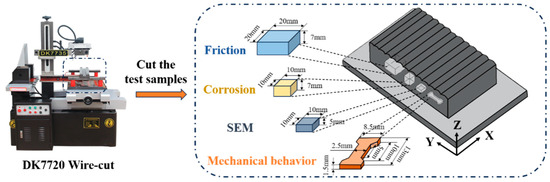
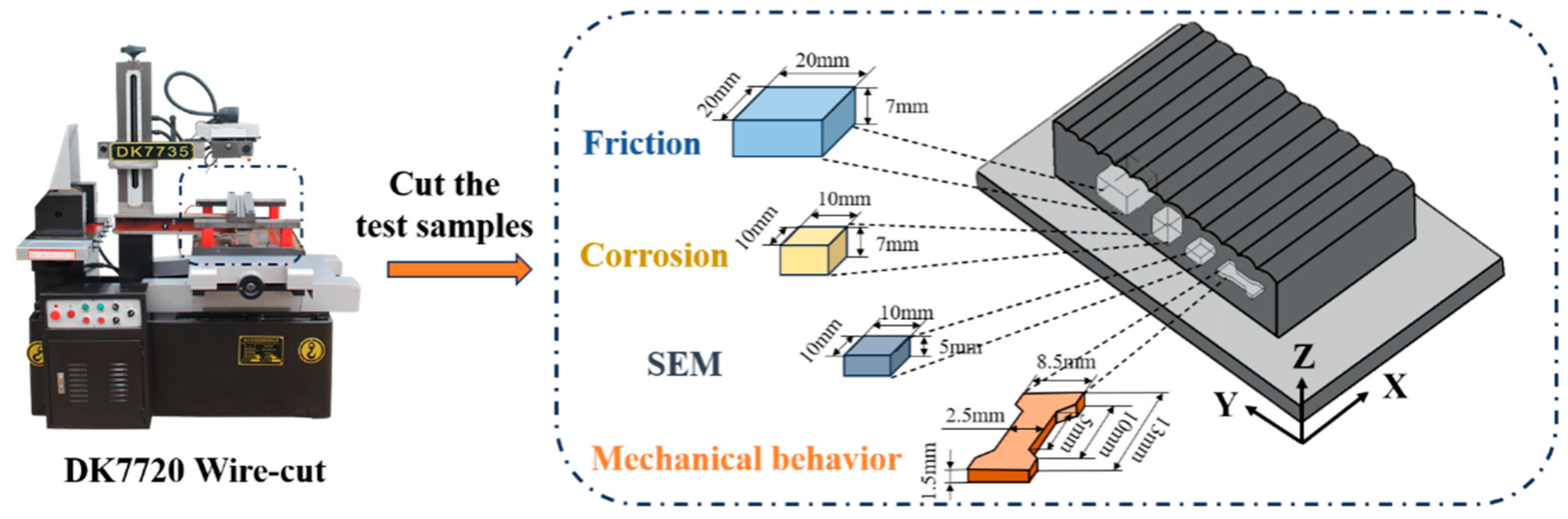
Specimens with specific dimensions were sectioned using a wire electrical discharge machining (WEDM) apparatus (Taizhou Sihai CNC Machine Co., Ltd., Taizhou, China), with the geometries and dimensions of various samples illustrated in Figure 4. The grinding procedure was sequentially conducted using SiC abrasive papers of 180, 320, 600, 800, 1000, 1200, 1500, and 2000 grits. Subsequently, the cross-sections of the single-track specimens were polished to a mirror finish using diamond polishing paste. Phase identification was performed using a Bruker D8 ADVANCE X-ray diffractometer (XRD) (Bruker Corporation, Karlsruhe, Germany), and quantitative phase analysis was conducted based on diffraction intensity. The scanning range was set from 2θ = 30° to 2θ = 100° with a scanning speed of 5°/min. Microstructural observation was carried out using a Zeiss Sigma 500 field-emission scanning electron microscope (FE-SEM) (Carl Zeiss Microscopy Ltd., Oberkochen, Germany). Prior to examination, the specimens were subjected to electrolytic etching. The specific etching procedure involved immersion in Beraha’s reagent (0.2 g K2S2O5 + 3 mL HCl + 20 mL H2O) at room temperature for approximately 20 s.
Figure 4.
Schematic illustration of specimen preparation and geometries with corresponding dimensions.
2.3. Mechanical Property Testing
The cross-sectional microhardness of the clad layers was measured using an HVS-T-1000Z semi-automatic Vickers hardness tester (Laizhou Lailuote Test Instrument Co., Ltd., Laizhou, China). A load of 5 N was applied with a dwell time of 10 s. A total of 20 indentations were made for each measurement, with an inter-spacing of 150 μm between adjacent points. The measurement procedure was repeated three times, and the average value from the three replicate measurements was adopted to determine the microhardness distribution across the clad layer cross-section.
Tensile properties were evaluated using a CMT5105GL universal testing machine (Shenzhen Sansi, Shenzhen, China). Uniaxial tensile tests were conducted at room temperature with a constant crosshead speed of 0.5 mm/min. Based on the recorded force–displacement data, the yield strength at 0.2% offset (0.2% YS), ultimate tensile strength (UTS), and total elongation to failure were calculated for each specimen.
Wear resistance was assessed using a CF-I multifunctional reciprocating friction and wear tester(Lanzhou ZhongKe KaiHua Sci. and Technol. Co., Ltd., Lanzhou, China). To isolate the tribological response arising from microstructural variations (phase balance, residual stress, and passive film characteristics) induced by different heat treatment durations, while maintaining controlled interfacial temperature rise and stable wear track conditions, the tribological tests were conducted under the following parameters: an applied load of 15 N, a reciprocating stroke length of 5 mm, a sliding velocity of 50 mm/s, and a total test duration of 30 min. A Si3N4 ceramic ball with a diameter of 4 mm was employed as the counterbody. These parameters were selected to ensure adequate test repeatability and to facilitate subsequent wear mechanism analysis. The experiment was repeated three times for each group of samples. Following the wear tests, the three-dimensional (3D) morphology, cross-sectional wear depth and width, and wear volume of the wear tracks were characterized using a NANOVEA-ST400 3D optical surface profilometer (NANOVEA, Turin, Italy). The wear rate (W) was calculated according to the following equation:
where V (mm3) denotes the wear volume, F (N) represents the normal load, and L (m) is the total sliding distance. The worn surfaces were subsequently examined, and elemental analysis was performed using the energy-dispersive X-ray spectroscopy (EDS) system integrated within the instrument.
Electrochemical measurements were conducted using a CS310M three-electrode electrochemical workstation (Wuhan Corrtest Instruments Corp., Ltd., Wuhan, China). A standard three-electrode configuration was employed, comprising a saturated Ag/AgCl reference electrode, a platinum sheet auxiliary electrode, and the specimen as the working electrode. The electrolyte was a 3.5 wt.% NaCl aqueous solution. Prior to testing, the specimens were immersed in the electrolyte for 30 min to remove surface oxide layers and contaminants, and the measurements were initiated after the open-circuit potential (OCP) had stabilized. Potentiodynamic polarization curves were recorded over a potential range from −1.5 V to 2 V (vs. Ag/AgCl) at a scan rate of 1 mV/s, with an AC perturbation amplitude of 10 mV. Electrochemical impedance spectroscopy (EIS) measurements were performed over a frequency range from 0.01 Hz to 100,000 Hz with an AC perturbation amplitude of ±0.01 V. The equivalent circuit modeling and curve fitting were accomplished using the CS Analysis software (Software version: 6.6.1202.6).
3. Result and Discussion
3.1. Microstructural Characterization
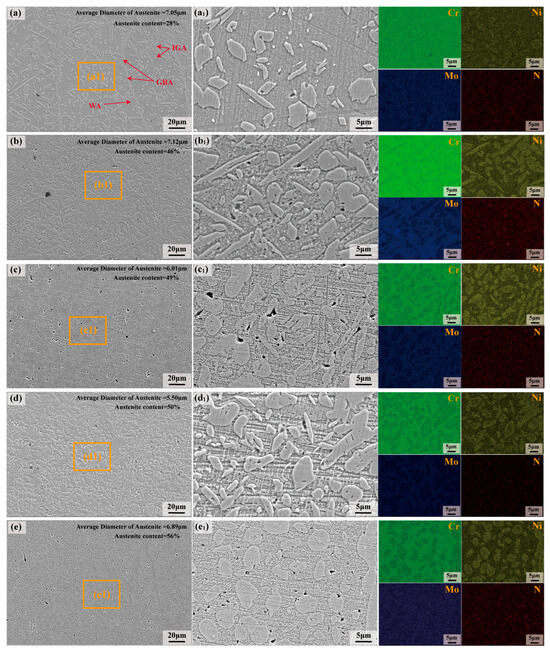
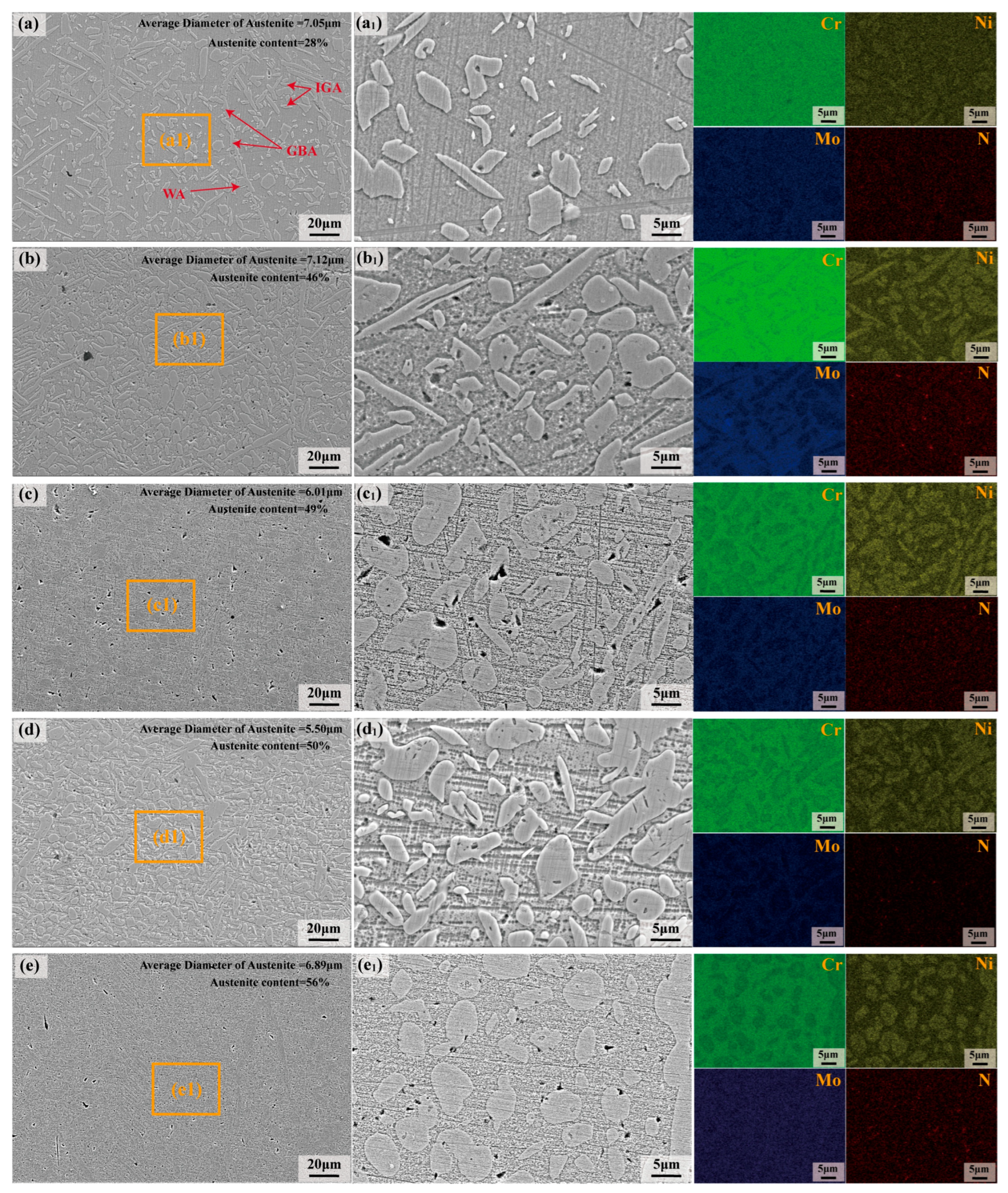
To analyze the dual-phase morphology and elemental distribution, SEM and EDS analyses were conducted, as presented in Figure 5. In the micrographs, the white regions correspond to the austenite phase, whereas the dark regions represent the ferrite phase. In the as-built specimen, the austenite phase exhibited three distinct morphologies: intragranular austenite (IGA)—appearing as fine, equiaxed particles distributed within the ferrite matrix; grain boundary austenite (GBA)—characterized by elongated, needle-like morphology formed along the ferrite grain boundaries; and Widmanstätten austenite (WA)—extending outward from the austenite grains in a dendritic or branching configuration. It was observed that due to the layer-by-layer deposition characteristic of LDED, the microstructure underwent repeated remelting during the additive manufacturing process, which promoted the growth of GBA along the building direction, resulting in coarse and elongated grains [40].
Figure 5.
Microstructural morphologies and elemental distributions of LDED-2205 DSS under different heat treatment durations: (a,a1) 0 min; (b,b1) 5 min; (c,c1) 10 min; (d,d1) 30 min; and (e,e1) 60 min.
For the heat-treated specimens, as shown in Figure 5a–e, a significant dissolution and refinement of GBA grains was evident, with the directional alignment becoming progressively less pronounced with increasing heat treatment duration. Additionally, numerous fine IGA particles were observed within the ferrite matrix. This phenomenon can be attributed to the redistribution of alloying elements during heat treatment, which effectively facilitated the nucleation and growth of austenite [41]. Additionally, the average austenite grain size exhibits a non-monotonic dependence on heat treatment duration, initially decreasing and subsequently increasing, with a minimum of 5.50 μm attained at 30 min. The austenite volume fractions were determined by quantitative metallographic analysis based on area fraction measurements. The results reveal a monotonic increase in austenite content with holding time, from 28% in the as-built (0 min) condition to 56% at 60 min, with intermediate values of 46%, 49%, and 50% at 5 min, 10 min, and 30 min, respectively. Conventionally, ferrite is enriched in Cr and Mo, whereas austenite is enriched in Ni and N. However, examination of the as-built specimen revealed that only Ni exhibited partial enrichment within the austenite phase, while the distribution of other elements remained relatively homogeneous. This is largely attributable to the extremely rapid solidification during LDED, which suppressed elemental partitioning and prevented the formation of significant compositional segregation between the two phases [42]. Following heat treatment, elemental diffusion proceeded, and pronounced partitioning of the four alloying elements was observed: Cr and Mo were enriched in the ferrite phase, while Ni and N were enriched in the austenite phase. Extensive research has demonstrated that such elemental enrichment enhances the stability of both austenite and ferrite, thereby improving the overall performance of DSS [43].
The elemental compositions of all specimens are summarized in Table 4. A distinct nitrogen deficit is evident across all fabricated samples, with the nitrogen content ranging from 0.29 to 0.42 at% (0.29, 0.35, 0.33, 0.42, and 0.38 wt% for the 0 min, 15 min, 30 min, 45 min, and 60 min samples, respectively). This reduction in nitrogen content stems from the preferential vaporization of nitrogen under the high-energy-density laser irradiation during the additive manufacturing process. The elevated local temperatures generated by the laser beam exceed the vaporization point of nitrogen, leading to its selective loss from the melt pool and, consequently, a diminished nitrogen concentration in the final solidified products compared with the initial powder.
Table 4.
The elemental contents of LDED-2205 DSS under different heat treatment durations (at.%).
3.2. XRD
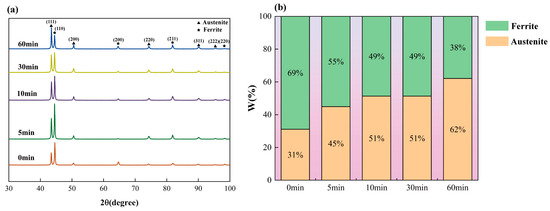
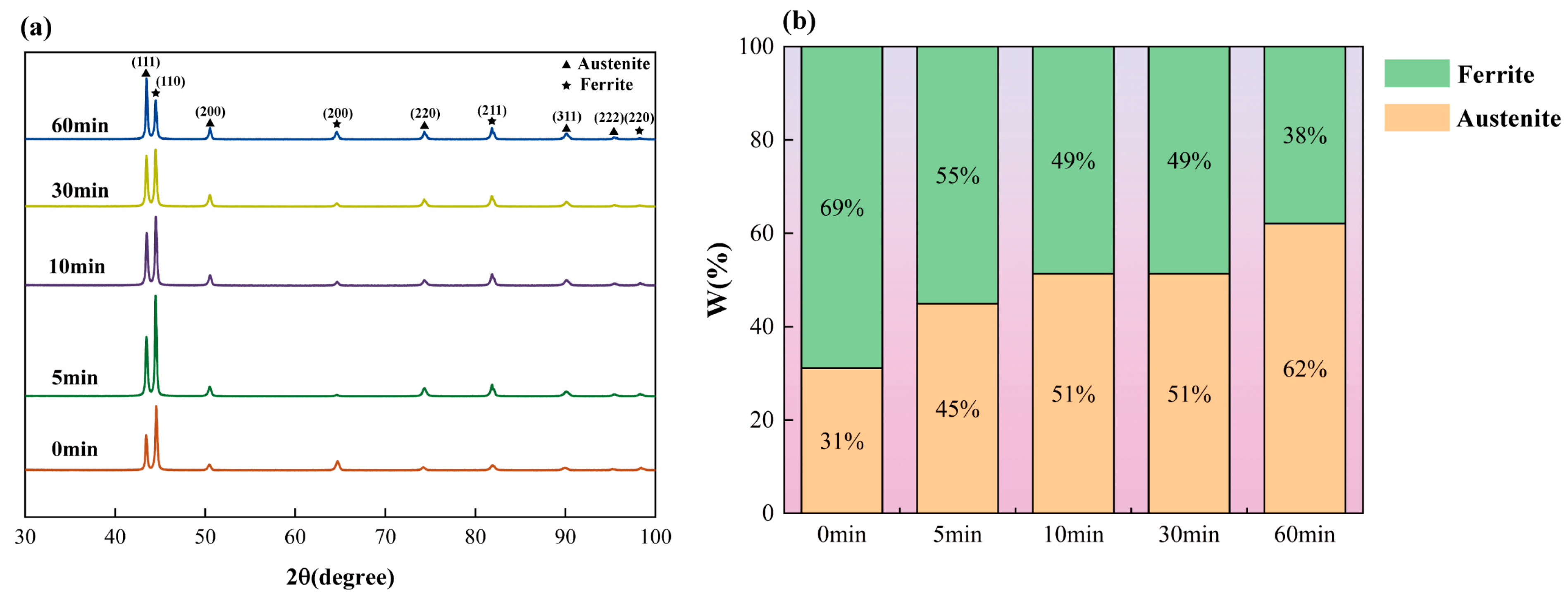
The XRD patterns of the as-built and heat-treated specimens are presented in Figure 6. The results indicate that the deposited layers were composed exclusively of austenite and ferrite phases, with no detectable intermetallic compounds or nitrides. The austenite phase exhibited a strong diffraction peak corresponding to the (111) crystallographic plane, whereas relatively weak diffraction peaks were observed for the (200), (220), (311), and (222) planes. The ferrite phase demonstrated a strong diffraction peak at the (110) plane, with weaker peaks at the (200), (211), and (220) planes. It was observed that with increasing heat treatment duration, the peak intensities of austenite progressively exceeded those of ferrite.
Figure 6.
(a) XRD patterns and (b) dual-phase content of LDED-2205 DSS under different heat treatment durations.
The K-value method in the software Jade9 was used to analyze and calculate the XRD spectra, thereby obtaining the approximate contents of the two phases in the DSS sediment, as shown in Figure 6b. However, it should be noted that this method cannot precisely calculate the contents of the two phases and there are minor errors. It can be observed that the calculated content of austenite is slightly different from that mentioned earlier, but the general trend is consistent. Post-deposition heat treatment induces a significant enrichment of the austenitic phase, exhibiting a monotonic dependence on holding time: the austenite content increases progressively from the as-built condition to 62% at 60 min. This time-dependent austenitization behavior originates from the interplay of thermodynamic and kinetic factors. On the one hand, the enhanced nitrogen retention in the heat-treated samples (Table 2) elevates the austenite stability, given the strong austenite-stabilizing effect of interstitial nitrogen [44]. On the other hand, the thermal activation at elevated temperatures accelerates the diffusional transport of substitutional (Ni) and interstitial (N) solutes from the ferrite phase toward pre-existing or newly formed austenite nuclei. The prolonged isothermal holding progressively drives this partitioning process toward equilibrium, accounting for the incremental rise in austenite volume fraction with increasing heat treatment duration [45].
3.3. Mechanical Properties
3.3.1. Microhardness
The average microhardness values of the LDED-2205 DSS specimens under different heat treatment conditions are presented in Table 5. It can be observed that the hardness of all heat-treated specimens decreased compared with that of the as-built specimen; however, the magnitude of reduction was relatively modest. This phenomenon can be primarily attributed to the partial transformation of ferrite into austenite during heat treatment. Ferrite is a hard phase with a hardness of approximately 250–300 HV0.5, whereas austenite is a relatively soft phase with a hardness of approximately 180–220 HV0.5. The decrease in ferrite content coupled with the increase in austenite content resulted in a reduction in overall hardness [46]. Additionally, the heat treatment process alleviated internal residual stresses and reduced dislocation density, which further contributed to the hardness decrease [47].
Table 5.
Average microhardness of LDED-2205 DSS under different heat treatment durations.
With increasing heat treatment duration, the hardness exhibited a gradual downward trend, albeit with a limited magnitude of reduction. This behavior can be ascribed to two synergistic factors. On the one hand, the prolonged heat treatment duration facilitated further ferrite-to-austenite transformation, thereby reducing the overall hardness. On the other hand, the progressive grain coarsening with extended heat treatment duration diminished the resistance to plastic deformation, leading to an additional hardness reduction [48].
3.3.2. Tensile Properties
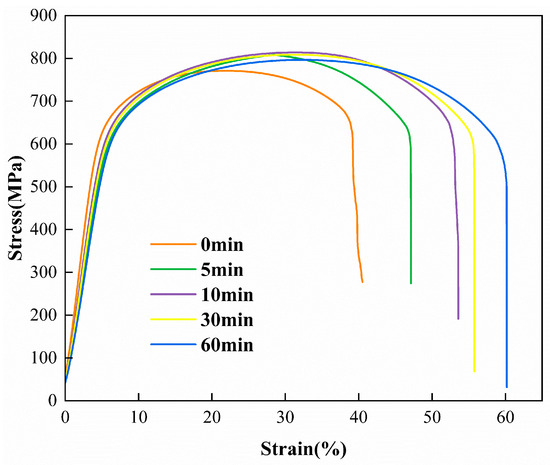
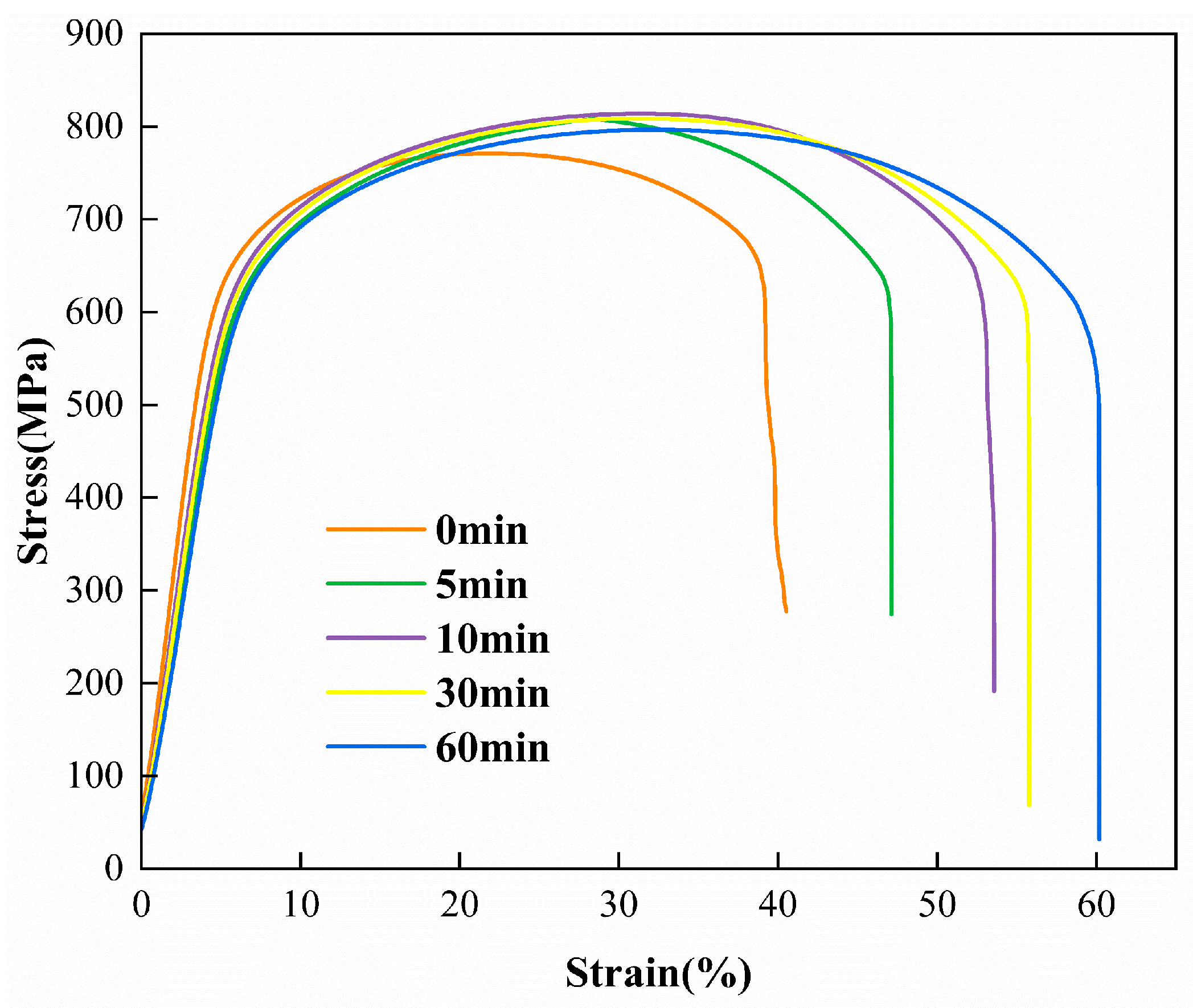
The tensile curves of the different specimens are presented in Figure 7. No distinct yield phenomenon or pronounced plastic deformation stage was observed during tensile testing. The deformation process primarily exhibited elastic behavior, ultimately culminating in sudden fracture without significant plastic flow.
Figure 7.
Tensile curve of LDED-2205 DSS under different heat treatment durations.
The tensile properties of the LDED-2205 DSS subjected to various heat treatment durations are summarized in Table 6. It was found that the as-built LDED-2205 DSS exhibited an ultimate tensile strength (UTS) of 789.94 MPa, which did not differ significantly from that of the heat-treated specimens. However, a marked decrease in yield strength was observed (0 min → 5 min → 10 min → 30 min → 60 min: 595.40 MPa → 531.31 MPa → 535.49 MPa → 522.93 MPa → 544.99 MPa), accompanied by a substantial improvement in elongation (0 min → 5 min → 10 min → 30 min → 60 min: 38.15% → 46.45% → 52.26% → 54.91% → 59.06%). These variations can be attributed to the following mechanisms.
Table 6.
Tensile properties of LDED-2205 DSS under different heat treatment durations.
First, with increasing heat treatment duration, the content of the soft austenite phase gradually increased, while the content of the hard ferrite phase progressively decreased, resulting in reduced hardness. This phase redistribution led to a gradual decrease in the yield strength of LDED-2205 DSS. Conversely, the ductile austenite phase significantly enhanced the toughness of LDED-2205 DSS, thereby contributing to the increased elongation. Second, as previously discussed, heat treatment promoted the formation of numerous fine IGA particles within the ferrite matrix. On the one hand, this phenomenon facilitated a more uniform distribution of the dual-phase microstructure; on the other hand, it contributed to grain refinement, with this effect becoming more pronounced with prolonged heat treatment duration. The refined grain structure enabled more homogeneous deformation and effective stress dispersion, preventing localized stress concentration and premature fracture, thereby enhancing the toughness of LDED-2205 DSS [49].
3.4. Wear Resistance
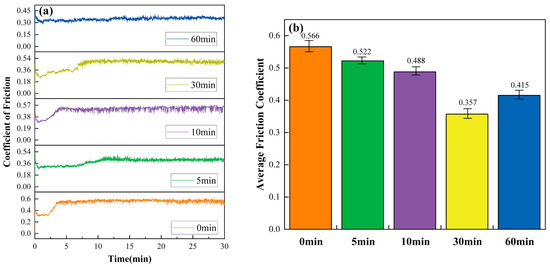
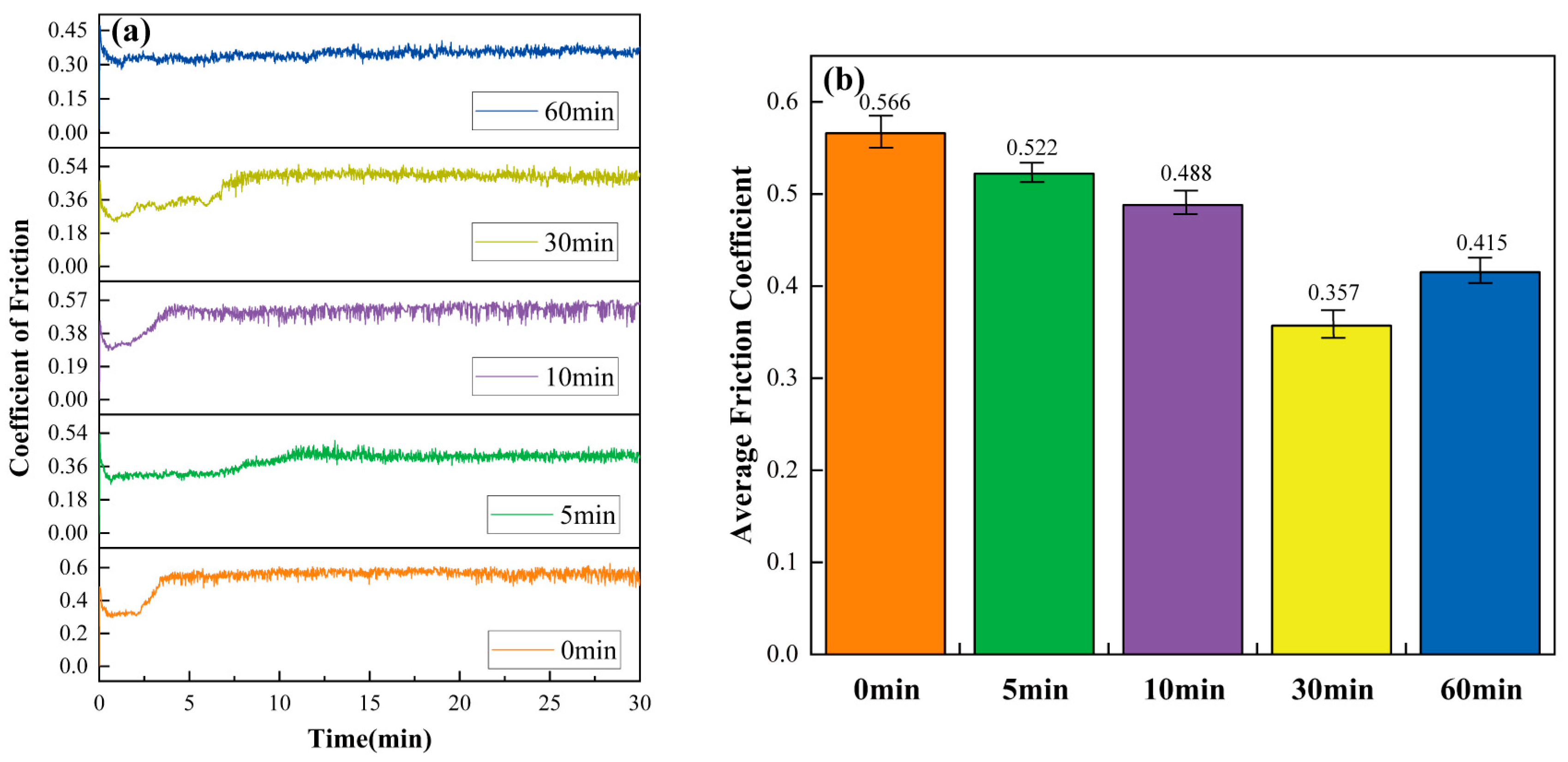
The friction coefficient versus time curves and the average friction coefficients of the LDED-2205 DSS specimens under different heat treatment conditions during room-temperature wear testing are presented in Figure 8. As illustrated in Figure 8a, both the as-built and heat-treated specimens exhibited relatively prolonged running-in periods, with an average duration of approximately 5 min. This phenomenon can be attributed to two primary mechanisms. On the one hand, the inherent disparity in mechanical properties between ferrite and austenite phases resulted in preferential plastic deformation and micro-spalling of the softer austenite phase during the initial wear stage, leaving the relatively harder ferrite phase exposed as protrusions on the worn surface, thereby extending the running-in duration. On the other hand, a hard and brittle passive film formed on the specimen surface contributed to the prolonged running-in period. During the initial wear stage, asperity contact between the friction pair rapidly disrupted the passive film, exposing the fresh substrate, which subsequently underwent rapid re-passivation upon exposure to the ambient atmosphere or medium. This cyclic process of “destruction–regeneration–destruction” persisted until a stable oxidative or abrasive wear mechanism was established at the contact interface [50]. Consequently, significant fluctuations in friction coefficient and wear rate were observed during this period, prolonging the running-in cycle. Following the running-in stage, the friction coefficient stabilized with no discernible fluctuations.
Figure 8.
Friction and wear test results of LDED-2205 DSS under different heat treatment durations: (a) friction coefficient versus time curves and (b) average friction coefficient.
As shown in Figure 8b, the average friction coefficient of the heat-treated LDED-2205 DSS specimens was substantially lower than that of the as-built specimen, indicating that heat treatment significantly enhanced the wear resistance of LDED-2205 DSS. With increasing heat treatment duration, the average friction coefficient exhibited an initial decreasing trend followed by an increase, reaching a minimum value of 0.357 at 30 min.
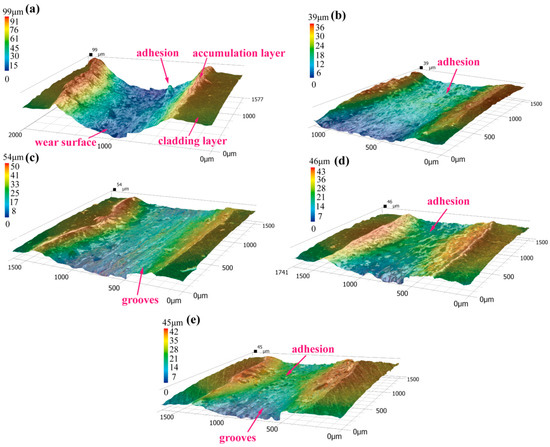
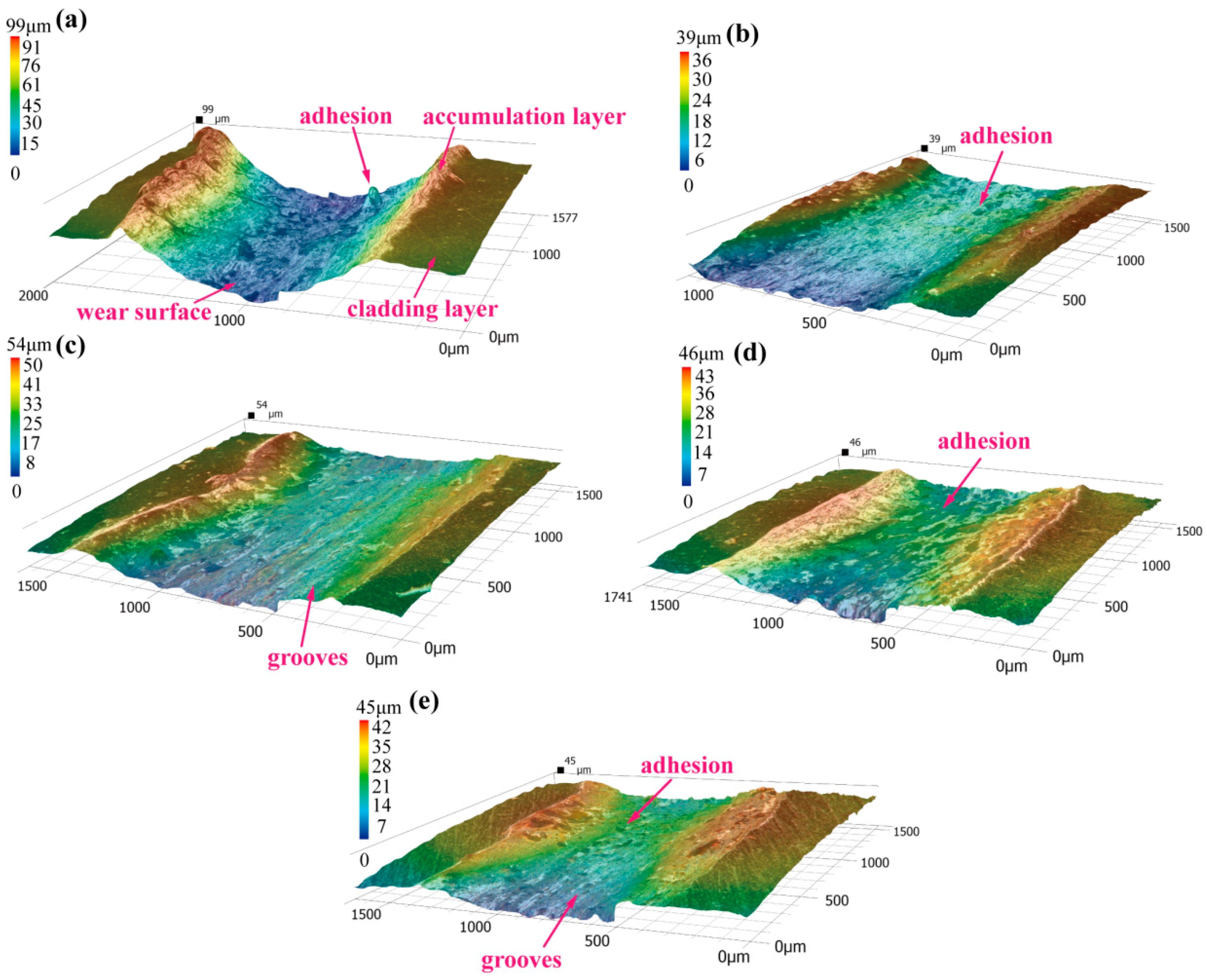
The three-dimensional (3D) wear morphologies of the LDED-2205 DSS specimens under different heat treatment conditions during room-temperature wear testing are presented in Figure 9. The as-built specimen exhibited significantly greater wear depth and width compared with the heat-treated specimens. Moreover, no distinct grooves were observed on the worn surface of the as-built specimen; instead, substantial wear debris adhered to the surface, indicative of adhesive wear [51]. In contrast, the four heat-treated specimens displayed similar worn surface characteristics, with relatively shallow wear scars, grooves aligned along the sliding direction, and slight attachment of wear debris. This observation suggests that the wear mechanism transitioned from pure adhesive wear to a combination of adhesive and abrasive wear following heat treatment [52].
Figure 9.
Three-dimensional wear morphologies of LDED-2205 DSS under different heat treatment durations: (a) as-built, (b) 5 min, (c) 10 min, (d) 30 min, and (e) 60 min.
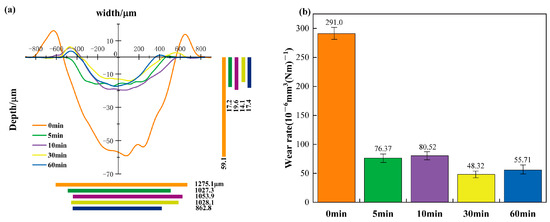
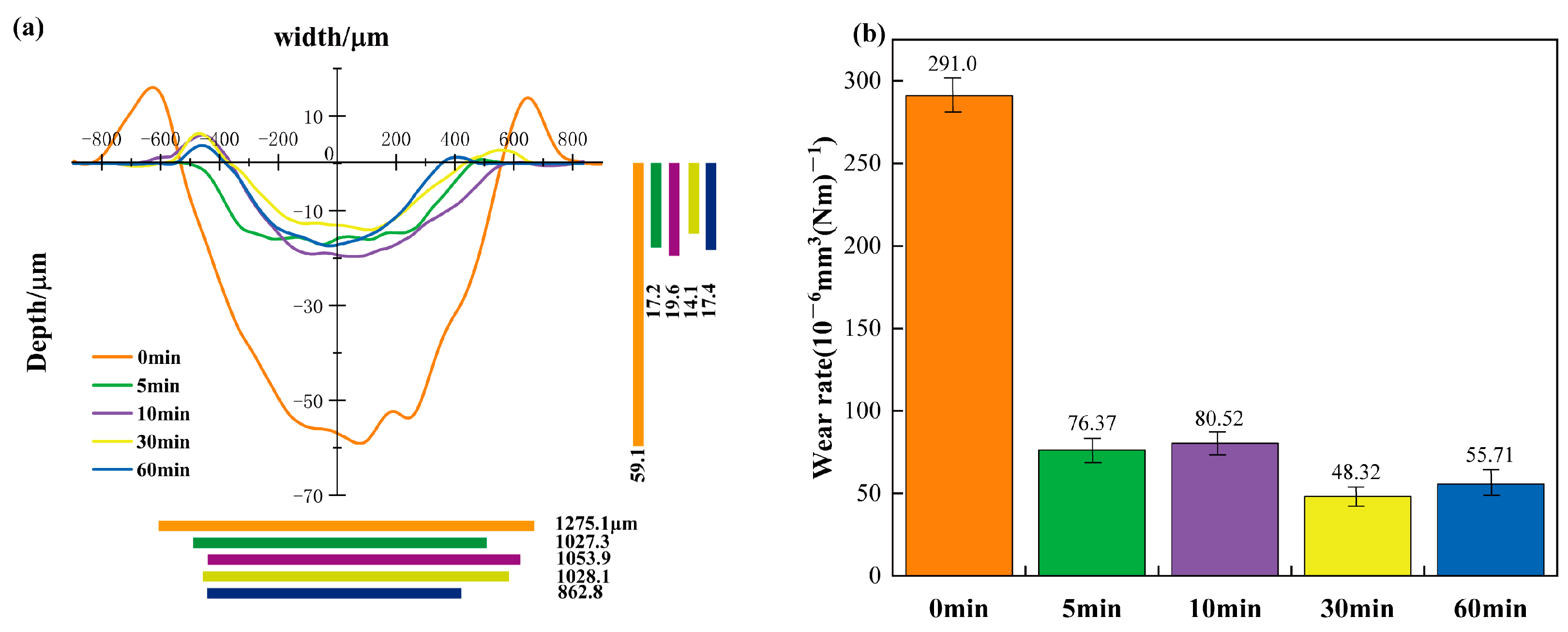
The cross-sectional wear depth, wear width, and wear rates of the LDED-2205 DSS specimens under different heat treatment conditions are presented in Figure 10. The as-built specimen exhibited the maximum wear depth and width, reaching 1275.1 μm and 59.1 μm, respectively, with a wear rate of 291.01 × 10⁻⁶ mm3/(N·m). For the heat-treated specimens, both the wear width and depth decreased substantially, accompanied by a significant reduction in wear rate, demonstrating that heat treatment at this temperature effectively enhanced the room-temperature wear resistance of LDED-2205 DSS. A more detailed examination revealed that the wear rate exhibited an initial decreasing trend followed by an increase with prolonged heat treatment duration, reaching a minimum value of 48.32 × 10⁻⁶ mm3/(N·m) at 30 min. This finding is consistent with the previously discussed minimum average friction coefficient observed for the 30 min specimen.
Figure 10.
(a) Wear scar depth and (b) wear rate of LDED-2205 DSS under different heat treatment durations.
The underlying mechanism for this phenomenon can be elucidated as follows. Appropriate heat treatment duration promoted the growth of fine IGA particles, resulting in an austenite-to-ferrite ratio approaching approximately 1:1, and simultaneously refined the internal grain structure. The enhanced resistance to deformation and spalling consequently improved the wear resistance [53]. However, excessive heat treatment duration led to a continued increase in austenite content, progressive coarsening of the austenite phase, and internal grain growth, ultimately resulting in decreased hardness and strength, and consequently diminished wear resistance.
3.5. Corrosion Resistance
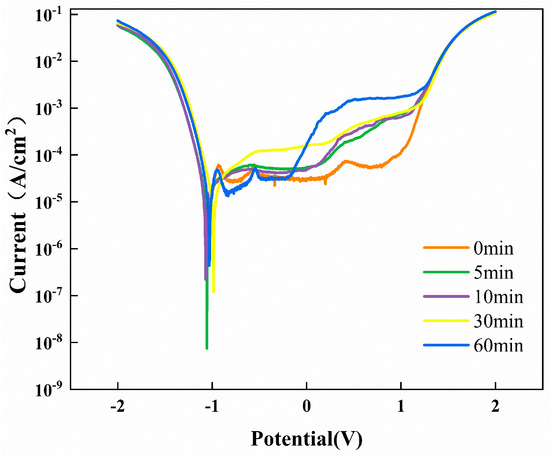
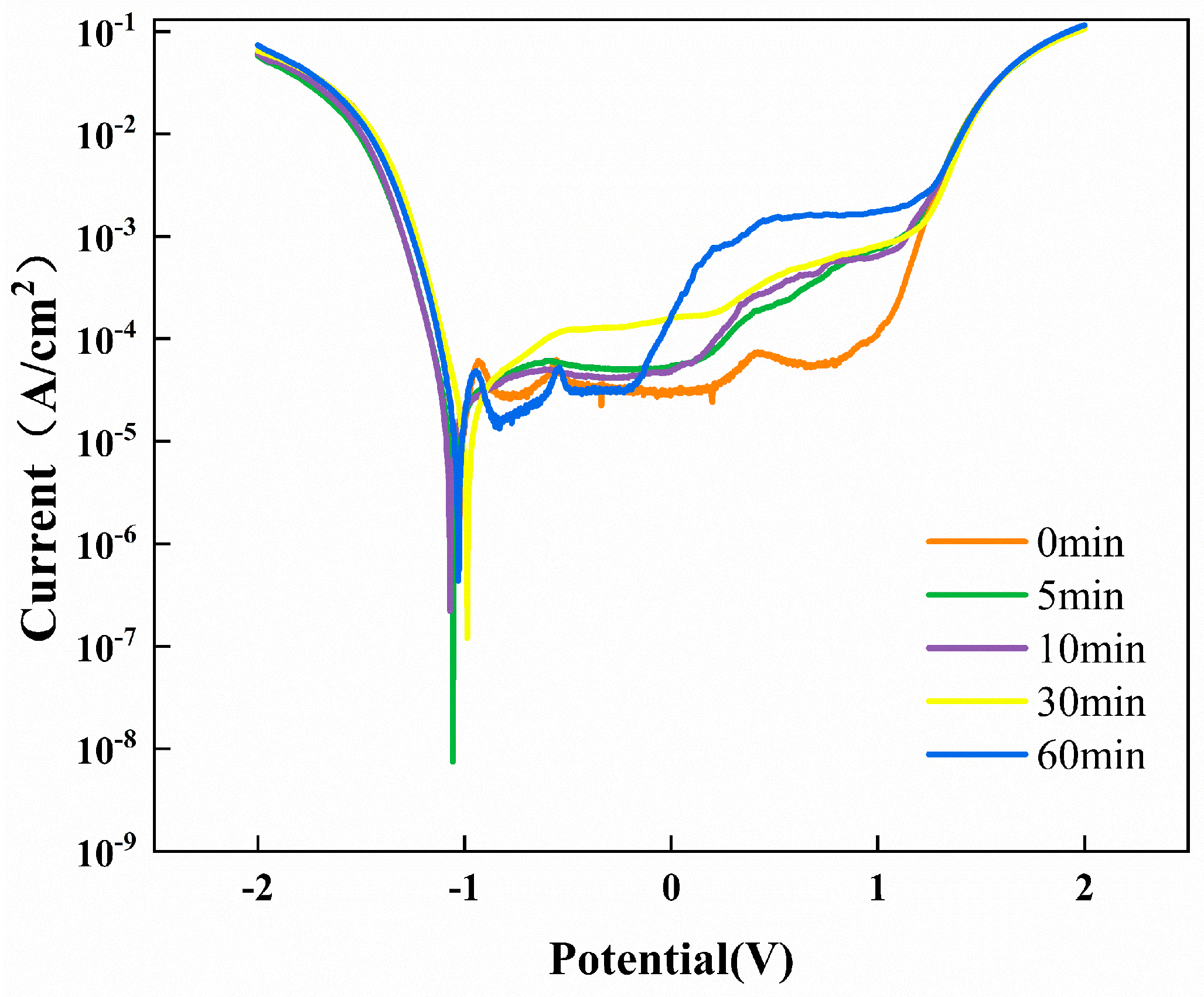
The electrochemical test results of the specimens subjected to different treatments in a 3.5 wt.% NaCl solution are presented in Figure 11. Examination of the Tafel curves reveals that the polarization curves of the five specimen groups were similar in overall morphology, with no pronounced differences observed. All specimens exhibited distinct passivation behavior; however, the 60 min specimen displayed noticeable fluctuations within the passive region, suggesting instability in passive film formation that may significantly compromise its corrosion resistance [54]. The corrosion potential (Ecorr) and corrosion current density (Icorr) were determined through Tafel slope extrapolation, with the specific values summarized in Table 7. The Ecorr reflects the thermodynamic tendency of a material to undergo corrosion, with a higher (more positive) Ecorr indicating superior resistance to corrosion initiation. It was observed that the 30 min specimen exhibited the highest Ecorr of −1.00021 V. The Icorr represents the reaction rate and extent of the corrosion process, with a lower Icorr signifying better corrosion resistance. The 30 min specimen demonstrated the lowest Icorr of merely 0.3935 μA/cm2, indicating that the 30 min heat-treated specimen possessed the optimal corrosion resistance.
Figure 11.
Tafel curves of LDED-2205 DSS under different heat treatment durations.
Table 7.
Fitting results of polarization curves for LDED-2205 DSS under different heat treatment durations.
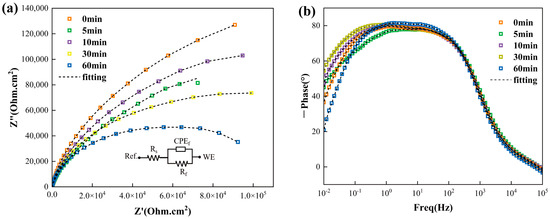
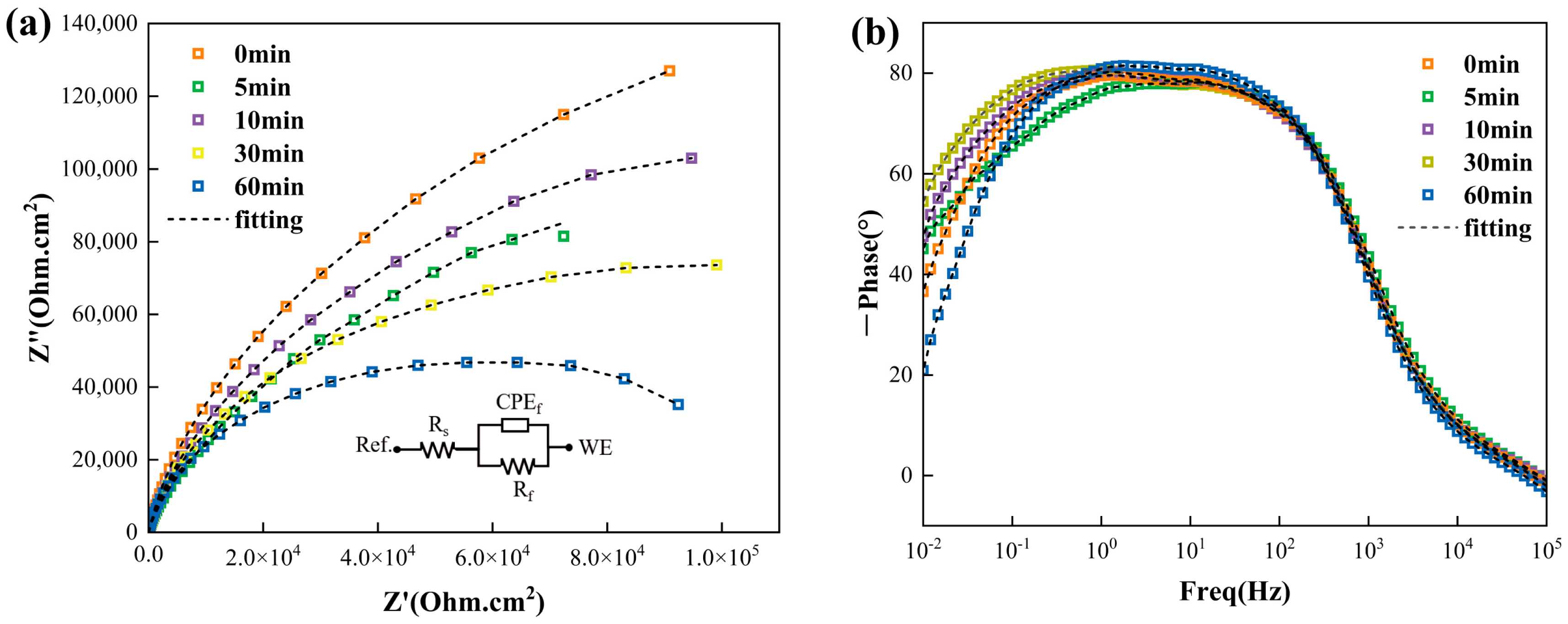
To enhance the reliability and reproducibility of the experimental results, electrochemical impedance spectroscopy (EIS) measurements were additionally conducted, and the corresponding Nyquist and Bode plots are presented in Figure 12. Extensive previous studies on the corrosion characteristics of 2205 DSS in 3.5 wt.% NaCl solution have established that the equivalent circuit should comprise the solution resistance (Rs), charge transfer resistance (Rct), and constant phase element representing the film capacitance (CPEf), where Rf denotes the resistance to electron transfer during the electrochemical reaction, with higher values indicating superior corrosion resistance [55]. The specific equivalent circuit is illustrated in Figure 12a. The simulated Rf values for all specimens are presented in Table 8. Notably, the 30 min sample exhibits an Rf value of 5.287 × 10⁵ Ω·cm2 (or Ω, depending on your unit), which is substantially higher than those of the other samples, indicating superior corrosion resistance.
Figure 12.
EIS experiments of LDED-2205 DSS under different heat treatment durations: (a) Nyquist plots and equivalent circuit, (b) Bode plots.
Table 8.
Rct values derived from EIS fitting.
The Nyquist spectra of all specimens are characterized by a single depressed capacitive semicircle, signifying the presence of a continuous passive film at the metal–solution interface. The diameter of this semicircle is directly correlated with the Rct which reflects the kinetic barrier for electrochemical reactions across the passive film [56,57]. Accordingly, a larger semicircle radius denotes higher Rct and enhanced corrosion resistance. The radii of curvature decrease in the sequence: 30 min > 10 min > 5 min > 0 min > 60 min.
The Bode phase diagrams reveal comparable peak phase angles across all conditions, suggesting similar overall capacitive behavior. Nevertheless, marked divergence is observed in the low-frequency domain (1–0.01 Hz), where the phase angle serves as a sensitive indicator of passive film compactness and protective integrity. A higher phase angle in this region implies a more resistive and defect-free passive film. The ranking of phase angles within this interval—30 min > 10 min > 5 min > 0 min > 60 min—corroborates the Nyquist-derived hierarchy, collectively establishing the 30 min sample as possessing the most robust passive film and, by extension, the optimal corrosion resistance among all conditions.
In summary, heat treatment durations ranging from 5 min to 30 min effectively enhanced the corrosion resistance of LDED-2205 DSS, with the optimal corrosion performance achieved at 30 min. However, when the heat treatment duration was extended to 60 min, the corrosion resistance deteriorated significantly. This phenomenon can be attributed to the following mechanisms. Appropriate heat treatment promoted the precipitation of fine austenite and facilitated elemental diffusion, which not only increased the austenite content but also enhanced the stability of the austenite phase. Given that austenite possesses superior corrosion resistance compared with ferrite, the overall corrosion resistance was improved. Furthermore, the refined grain structure provided shorter and more abundant diffusion channels for Cr, thereby accelerating passive film formation and ultimately enhancing corrosion resistance [58]. Conversely, excessive heat treatment resulted in continued growth and coarsening of both austenite and ferrite grains. Although the austenite content remained higher, the reduced rate of passive film formation and the diminished capacity to sustain corrosion protection led to a degradation in corrosion resistance.
4. Conclusions
In this study, 2205 DSS was fabricated via laser-directed energy deposition, and the effects of isothermal holding time (0–60 min) at 1000 °C on the microstructural evolution and multi-dimensional performance were systematically investigated. The principal findings are summarized as follows, with particular emphasis on the trade-offs and optimal balance governing the heat treatment response:
- The austenite fraction increased monotonically with holding time, from 31% in the as-built condition to 62% at 60 min. Notably, a near-equilibrium dual-phase ratio (~1:1) was achieved at both 10 min and 30 min. However, the morphological evolution of secondary austenite exhibited distinct time-dependent characteristics: IGA nuclei progressively coarsened and increased in number density with prolonged holding, whereas GBA colonies, prevalent in the as-built microstructure, gradually dissolved and lost their crystallographic alignment.
- Post-deposition heat treatment induced a significant reduction in hardness (accentuated with prolonged holding), attributable to the combined effects of ferrite softening, residual stress relief, and phase fraction redistribution. Conversely, tensile ductility exhibited substantial improvement, with the elongation increasing by up to 94% relative to the as-built state. Both yield strength and ultimate tensile strength remained largely uncompromised across all heat treatment conditions. Nevertheless, the monotonic hardness decline warrants consideration for applications requiring high resistance to localized indentation or surface damage.
- The wear resistance exhibited a non-monotonic dependence on holding time, peaking at 30 min with a minimum wear rate of 48.32 × 10⁻⁶ mm3/(N·m) and an average friction coefficient of 0.357 (representing reductions of 83% and 37%, respectively, compared with the as-built condition). This optimal tribological response at 30 min, rather than at 60 min with the highest austenite content, reflects a complex interplay between phase balance, work-hardening capacity, and passive film stability. The dominant wear mechanisms transitioned from severe adhesive wear (as-built) to a milder combination of adhesive and abrasive wear (heat-treated), facilitated by the improved strain accommodation of the balanced dual-phase microstructure.
- The 30 min heat-treated specimen demonstrated superior corrosion resistance in 3.5 wt.% NaCl solution, evidenced by a 45.8% reduction in corrosion current density relative to the as-built state. This enhancement is ascribed to the refined phase balance, reduced residual stress, and more uniform passive film formation.
Collectively, the 30 min holding time represents a multi-objective optimal compromise rather than a single-property maximum. At this condition, the near-equilibrium phase balance (~1:1), refined IGA morphology, and moderated elemental partitioning collectively engender synergistic improvements in ductility, wear resistance, and corrosion resistance, without sacrificing tensile strength. The divergence of optimal conditions for individual properties underscores the necessity of holistic performance evaluation in microstructural design for AM duplex stainless steels. These findings establish a quantitative processing–structure–property framework for tailoring the performance of LDED-2205 DSS via post-deposition heat treatment, with broader implications for the thermal optimization of additively manufactured multi-phase alloys.
Author Contributions
Conceptualization, B.Z.; methodology, B.Z.; validation, B.Z.; formal analysis, B.Z., B.L., J.W., J.L. and J.G.; investigation, J.L.; resources, K.Z.; data curation, B.Z., B.L. and J.W.; writing—original draft preparation, B.Z.; writing—review and editing, B.Z. and J.G.; visualization, K.Z.; project administration, B.Z.; supervision, J.G.; funding acquisition, B.Z. All authors have read and agreed to the published version of the manuscript.
Funding
The authors appreciate the financial support for this work from State Grid Corporation of China Headquarters Technology Project, grant numbers [5100-202499474A-3-6-RW].
Data Availability Statement
The original contributions presented in this study are included in the article. Further inquiries can be directed to the corresponding author.
Conflicts of Interest
All authors were employed by the company State Grid Electric Power Engineering Research Institute Company Limited. All authors declare that the research was conducted in the absence of any commercial or financial relationships that could be construed as a potential conflict of interest. The authors declare that this study received funding from State Grid Corporation of China Headquarters Technology Project. The funder was not involved in the study design, collection, analysis, interpretation of data, the writing of this article or the decision to submit it for publication.
References
- Cao, Y.; Wang, X.; Li, Y.; Tan, Y.; Xing, J.; Fan, R. A Comprehensive Study on Low-Carbon Impact of Distributed Generations on Regional Power Grids: A Case of Jiangxi Provincial Power Grid in China. Renew. Sustain. Energy Rev. 2016, 53, 766–778. [Google Scholar] [CrossRef] [Scilit]
- Majeed Butt, O.; Zulqarnain, M.; Majeed Butt, T. Recent Advancement in Smart Grid Technology: Future Prospects in the Electrical Power Network. Ain Shams Eng. J. 2021, 12, 687–695. [Google Scholar] [CrossRef] [Scilit]
- Alhasnawi, B.N.; Hashim, H.K.; Zanker, M.; Bureš, V. The Rising, Applications, Challenges, and Future Prospects of Energy in Smart Grids and Smart Cities Systems. Energy Convers. Manag. X 2025, 27, 101162. [Google Scholar] [CrossRef] [Scilit]
- Yadav, A.; Nirala, A.K.; Swetapadma, A. Comparative Deep Learning Approaches for Insulator Condition Monitoring in Power Transmission Line. Electr. Power Syst. Res. 2026, 257, 113020. [Google Scholar] [CrossRef] [Scilit]
- Musleh, A.S.; Chen, G.; Liu, B.; Fan, S.; Al-Durra, A.; Muyeen, S.M.; Dong, Z.Y.; Ambia, M.N.; Gjorgiev, B.; Tao, S.; et al. Cybersecurity Challenges in Renewable-Dominated Power Grids Addressing Vulnerabilities and Resilience Strategies. Cell Rep. Phys. Sci. 2026, 7, 103261. [Google Scholar] [CrossRef] [Scilit]
- Rouhani, S.H.; Su, C.-L. Future Cyber-Resilient Renewable and Sustainable Smart Grids: A Critical Review from Power System Researchers’ Perspective on Emerging Threats and Solutions. Renew. Sustain. Energy Rev. 2026, 226, 116299. [Google Scholar] [CrossRef] [Scilit]
- Feng, D.; Zheng, Y.; Cai, Z.; Wang, D.; Zheng, W.; Zhou, Z.; Ma, Y.; Yang, J. Mechanism of Shielding Gas Nitriding Improving Fatigue Performance of 2205 Duplex Stainless Steel Pipe Joint. J. Mater. Res. Technol. 2026, 42, 10485–10496. [Google Scholar] [CrossRef] [Scilit]
- Arniella, V.; Llera, M.; Claeys, L.; Verbeken, K.; Depover, T.; Belzunce, J.; Rodríguez, C. Influence of the Direction of Ferrite-Austenite Banding on Hydrogen Embrittlement of 2205 Duplex Stainless Steel. Mater. Charact. 2024, 215, 114143. [Google Scholar] [CrossRef] [Scilit]
- Zhao, W.; Xiang, H.; Yu, R.; Mou, G. Effects of Laser Scanning Speed on the Microstructure and Mechanical Properties of 2205 Duplex Stainless Steel Fabricated by Selective Laser Melting. J. Manuf. Process. 2023, 94, 1–9. [Google Scholar] [CrossRef] [Scilit]
- García-Hernández, C.; Pérez-González, C.; Martín-Pedrosa, F.; García-Cabezón, C. Effect of Thermal Ageing on Tribocorrosion Degradation Mechanisms in Nitrogen Sintered PM Duplex Stainless Steel. Wear 2026, 602, 206894. [Google Scholar] [CrossRef] [Scilit]
- Hassel, T.A.; Brøtan, V.; Sørby, K. Thermography for Microstructure Control during Additive Manufacturing of Duplex Stainless Steel. Procedia CIRP 2026, 138, 585–590. [Google Scholar] [CrossRef] [Scilit]
- Wang, G.; Zou, Y.; Qiao, C.; Shen, P.; Wu, Z.; Li, H.; Li, Y. Influence of Selective Laser Melting Process Parameters on the Microstructure, Corrosion Resistance, and Mechanical Properties of 2205 Duplex Stainless Steel. J. Mater. Res. Technol. 2025, 38, 1825–1841. [Google Scholar] [CrossRef] [Scilit]
- Wang, K.; Liu, W.; Li, X.; Tong, Y.; Hu, Y.; Hu, H.; Chang, B.; Ju, J. Effect of Hot Isostatic Pressing on Microstructure and Properties of High Chromium K648 Superalloy Manufacturing by Extreme High-Speed Laser Metal Deposition. J. Mater. Res. Technol. 2024, 28, 3951–3959. [Google Scholar] [CrossRef] [Scilit]
- Luo, G.; Shang, Z.; Li, Y.; Li, Y.; Zhao, Z.; Cha, L.; Song, L. Intragranular Austenite Nucleation and Growth of Additive-Manufactured Duplex Stainless Steel. J. Mater. Sci. Technol. 2026, 269, 318–325. [Google Scholar] [CrossRef] [Scilit]
- Farias, F.W.C.; Assias, S.L.G.; de Lira, M.N.S.; Ipiña, J.E.P.; Kotik, H.G.; da Payão Filho, J.C. Super Duplex Stainless Steel (AWS A5.9 ER2594) Fabricated via Arc-Based Directed Energy Deposition: Tensile Behavior and Fracture Toughness at −30 °C. Mater. Sci. Eng. A 2026, 974, 150821. [Google Scholar] [CrossRef] [Scilit]
- Han, Q.; Cui, J.; Fan, M.; Zheng, Y.; Ye, S.; Guo, Y.; Liu, C.; Han, E.-H. Bridging a Cu Layer Enables Decent Metallurgical Bonding for Wire-Arc Directed Energy Deposited Mg-Ti Bimetals. Aerosp. Sci. Technol. 2026, 172, 111707. [Google Scholar] [CrossRef] [Scilit]
- Bao, W.; Qian, B.; Yi, H.; Zou, S.; Mei, Z.; Liu, C.; He, B.; Guo, Y.; Lu, W. Enhancement of Mechanical Properties in AZ91D Magnesium Alloy via Wire Arc Additive Manufacturing: Influence of Rapid Solidification and Solute Segregation on Microstructure and Deformation Behavior. Int. J. Plast. 2025, 190, 104376. [Google Scholar] [CrossRef] [Scilit]
- Wang, K.; Liu, W.; Du, D.; Chang, B.; Liu, G.; Hu, Y.; Tong, Y.; Zhang, M.; Zhang, J.; Ju, J. Microstructure and Properties of K648 Superalloy Additively Manufactured by Extreme High-Speed Laser Metal Deposition. Trans. Nonferrous Met. Soc. China 2024, 34, 2192–2203. [Google Scholar] [CrossRef] [Scilit]
- Wang, K.; Liu, W.; Du, D.; Chang, B.; Pang, X.; Hu, Y.; Tong, Y.; Fu, H.; Ju, J. Microstructure Evolution and Mechanical Properties of High-Chromium Superalloy Manufacturing by Extreme High-Speed Laser Metal Deposition at Different Aging Temperatures. J. Alloys Compd. 2023, 969, 172202. [Google Scholar] [CrossRef] [Scilit]
- Wang, K.; Du, D.; Liu, G.; Pu, Z.; Chang, B.; Ju, J. High-Temperature Oxidation Behaviour of High Chromium Superalloys Additively Manufactured by Conventional or Extreme High-Speed Laser Metal Deposition. Corros. Sci. 2020, 176, 108922. [Google Scholar] [CrossRef] [Scilit]
- Kroeker, P.; Theska, F.; Miskovic, D.; Haghdadi, N.; Primig, S. Microstructure Evolution and Sensitization of Additively Manufactured Duplex Stainless Steel during Aging Heat Treatments. Addit. Manuf. 2026, 118, 105100. [Google Scholar] [CrossRef] [Scilit]
- Chiniforoush, E.A.; Gholizadeh, T.; Jandaghi, M.R.; Moverare, J.; Gür, C.H. Investigation of Travel Speed Effects on Microstructure and Corrosion Behavior of Duplex Stainless Steel in Wire-Based DED Additive Manufacturing. J. Mater. Res. Technol. 2025, 37, 1486–1504. [Google Scholar] [CrossRef] [Scilit]
- Maier, A.; Munk, A.; Kühl, A.; Rühr, M.; Hentschel, O.; Kaufmann, F.; Schrauder, J.; Roth, S.; Schmidt, M. Influence of Process Parameters on Microstructural and Mechanical Properties of Duplex Stainless Steel 2205 (1.4462) Processed by DED-LB\M. Procedia CIRP 2022, 111, 241–246. [Google Scholar] [CrossRef] [Scilit]
- Wang, K.; Wang, Z.; Peng, P.; Wu, X.; Liu, W.; Zhang, H.; Zhang, H.; Li, Z.; Ju, J. Synergistic Enhancement of Strength and Wear Resistance in Nickel-Based Superalloy Fabricated by Oscillating Laser Directed Energy Deposition via Laser Shock Peening. J. Mater. Res. Technol. 2026, 41, 4780–4791. [Google Scholar] [CrossRef] [Scilit]
- Wang, Y.; Xu, L.; Han, Y.; Zhao, L.; Li, H.; Hao, K.; Ren, W. Super Duplex Stainless Steel with Balance Ratio Produced by Laser Directed Energy Deposition (L-DED). J. Manuf. Process. 2023, 105, 213–218. [Google Scholar] [CrossRef] [Scilit]
- Wang, K.; Li, H.; Song, Z.; Pang, X.; Ji, X.; Wu, P.; Fang, J.; Li, Z.; Ju, J.; Gu, J. Process Optimization of Duplex Stainless Steel Fabricated by Multi-Beam Laser Directed Energy Deposition. J. Therm. Spray Technol. 2026, 1–21. [Google Scholar] [CrossRef] [Scilit]
- Baghdadchi, A.; Thuvander, M.; Wessman, S.; Alexandrov, B.T.; Andersson, J. Effect of Ni Content on 475 °C Embrittlement of Directed Energy Deposited Duplex Stainless Steel Using a Laser Beam and Wire Feedstock. Materialia 2024, 36, 102155. [Google Scholar] [CrossRef] [Scilit]
- Salvetr, P.; Školáková, A.; Melzer, D.; Brázda, M.; Duchoň, J.; Drahokoupil, J.; Svora, P.; Msallamová, Š.; Novák, P. Characterization of Super Duplex Stainless Steel SAF2507 Deposited by Directed Energy Deposition. Mater. Sci. Eng. A 2022, 857, 144084. [Google Scholar] [CrossRef] [Scilit]
- Zhang, Z.; Jing, H.; Xu, L.; Han, Y.; Zhao, L.; Zhou, C. Effects of Nitrogen in Shielding Gas on Microstructure Evolution and Localized Corrosion Behavior of Duplex Stainless Steel Welding Joint. Appl. Surf. Sci. 2017, 404, 110–128. [Google Scholar] [CrossRef] [Scilit]
- Salvetr, P.; Hodek, J.; Školáková, A.; Msallamová, Š.; Duchoň, J.; Svora, P.; Uhlík, M.; Brázda, M. Effect of Substrate Preheating on the Microstructure, Mechanical Properties, and Corrosion Resistance of DED-Deposited Super Duplex Stainless Steel. Mater. Today Commun. 2026, 54, 115713. [Google Scholar] [CrossRef] [Scilit]
- Dagnaw, M.; Poudel, S.; Król, M.; Brytan, Z. Post-Process Heat Treatment Design for Tunable Strength and Toughness in L-PBF 2507 Super Duplex Stainless Steel. Materialia 2026, 48, 102799. [Google Scholar] [CrossRef] [Scilit]
- He, X.Y.; Wang, H.; Liao, X.Z.; Ringer, S.P.; Haghdadi, N.; Primig, S. Nano-Twining and Deformation-Induced Martensitic Transformation in a Duplex Stainless Steel 2205 Fabricated by Laser Powder Bed Fusion. Addit. Manuf. 2024, 84, 104110. [Google Scholar] [CrossRef] [Scilit]
- Liu, H.; Jiang, B.; Du, X.; Zheng, X.; Wang, Z.; Yang, H.; Xu, T.; Xiao, A.; Pan, Y.; Yang, W.; et al. The Effect of Sigma Phase of 2507 Duplex Stainless Steel on Hydrogen-Induced Pitting Corrosion. Corros. Sci. 2026, 260, 113594. [Google Scholar] [CrossRef] [Scilit]
- Zhang, Y.; Fang, Y.; Kim, M.-K.; Jin, H.; Duan, Z.; Yuan, Q.; Suhr, J. Achieving Excellent Strength-Ductility Synergy in Low-Cost Duplex Stainless Steels via Laser Powder Bed Fusion and Post-Heat Treatment. Mater. Sci. Eng. A 2025, 921, 147586. [Google Scholar] [CrossRef] [Scilit]
- Ju, J.; Wang, X.; Xiao, B.; Zhu, H.; Tran, N.; Shen, Z.; Zeng, X.; Wang, J.; Sun, B.; Liaw, P.K.; et al. Eliminating Intergranular Oxidation and Microstructural Instability in Chemically Complex Intermetallic Alloys Featuring Nano-Disorder Interfaces. Corros. Sci. 2026, 258, 113422. [Google Scholar] [CrossRef] [Scilit]
- Kingsley, E.B.; Savino, E.; Fishwick, R.; Gasparini, G.; Laghi, V. Calibration of Predictive Formulations and Key Mechanical Properties of Reclaimed Structural Steel. J. Constr. Steel Res. 2026, 245, 110542. [Google Scholar] [CrossRef] [Scilit]
- Karunanithi, S.; Arasappan, R.K.; Nallathambi, S.S. Effect of Heat Treatment Temperature on the Phase Composition, Mechanical Properties and Corrosion Resistance of Wire Arc Additive Manufactured Duplex Stainless Steel. Rapid Prototyp. J. 2025, 32, 162–179. [Google Scholar] [CrossRef] [Scilit]
- Fang, Y.; Kim, M.-K.; Zhang, Y.; Kim, T.; No, J.; Suhr, J. A New Grain Refinement Route for Duplex Stainless Steels: Micro-Duplex Stainless Steel Matrix Composites Processed by Laser Powder Bed Fusion. Mater. Sci. Eng. A 2023, 881, 145351. [Google Scholar] [CrossRef] [Scilit]
- Zhao, W.; Feng, L.; Shao, Y.; Chen, Y.; Li, Y.; Zhan, X.; Zhao, B.; Lu, Y. High Temperature Tensile Properties and Deformation Mechanism of 2205 Duplex Stainless Steel Fabricated by Laser Powder Bed Fusion. Mater. Charact. 2025, 229, 115540. [Google Scholar] [CrossRef] [Scilit]
- Wang, K.; Du, D.; Liu, G.; Pu, Z.; Chang, B.; Ju, J. A Study on the Additive Manufacturing of a High Chromium Nickel-Based Superalloy by Extreme High-Speed Laser Metal Deposition. Opt. Laser Technol. 2021, 133, 106504. [Google Scholar] [CrossRef] [Scilit]
- Zhu, X.; Dong, L.; Li, G.; Li, X. Laser Powder Bed Fusion of 2507 Duplex Stainless Steel: Microstructure, Mechanical Properties, and Corrosion Performance. Mater. Sci. Eng. A 2024, 913, 147084. [Google Scholar] [CrossRef] [Scilit]
- Zhang, Y.; Fang, Y.; Suhr, J. Direct Laser Powder Bed Fusion of Duplex-Austenitic Stainless Steel Bimetallic Structures: Microstructural Evolution and Robust Interfacial Bonding. Mater. Charact. 2026, 233, 116111. [Google Scholar] [CrossRef] [Scilit]
- Thakur, R.K.; Kishore, K.; Shajan, N.; Kumar, D.V.; Kumar, N.B.; Prabhakaran, A.; Paul, S.K.; Tiwari, M.; Arora, K.S. Effect of Number of Deposition Layers on the Microstructure, Corrosion and Fretting Wear of Duplex Stainless-Steel Weld Cladding. Surf. Coat. Technol. 2025, 502, 131924. [Google Scholar] [CrossRef] [Scilit]
- Melad, M.S.; Gebril, M.A.; Shuaeib, F.M.; Irfan, O.M. Investigation of Microstructure, Hardness, and Electrochemical Properties: The Effects of N2 Addition on the Welding of Duplex Stainless Steel (DSS). Sci. Afr. 2026, 33, e03483. [Google Scholar] [CrossRef] [Scilit]
- Shen, T.; Feng, L.; Shao, Y.; Chen, Y.; Xia, X.; Chen, Y.; Zhao, W. Relationship between Phase Transformation and Corrosion Performance of 2205 Duplex Stainless Steel Fabricated by Laser Powder Bed Fusion. Mater. Today Commun. 2025, 44, 111919. [Google Scholar] [CrossRef] [Scilit]
- Huang, X.-H.; Liu, X.-B.; Cheng, W.; Zhong, R.; Ren, X.-P.; Deng, Q.-Y.; Wang, K.-M. Regulating the High-Temperature Tribological Performance and Oxidation Behavior of High-Entropy Composite Coating via Ti3SiC2: Long-Term Service of TC4 Alloy. Tribol. Int. 2027, 225, 112401. [Google Scholar] [CrossRef] [Scilit]
- Davidson, K.P.; Liu, R.; Zhu, C.; Cagiciri, M.; Tan, L.P.; Alagesan, A.; Singamneni, S. Effect of Build Orientation and Heat Treatment on the Microstructure, Mechanical and Corrosion Performance of Super Duplex Stainless Steels Fabricated via Laser Powder Bed Fusion. Mater. Adv. 2024, 5, 8177–8198. [Google Scholar] [CrossRef] [Scilit]
- Tang, J.; Li, Z.-S.; Liu, X.-B.; Chen, G.-D.; Liu, F.; Wang, S.; Meng, F.-G.; Wang, D.-S.; Wang, K.-M. Tribology and Oxidation Properties of Graphite/CuNiTiCrNb HEA Coatings Produced by Laser Cladding. Carbon 2026, 249, 121261. [Google Scholar] [CrossRef] [Scilit]
- Cheng, F.; Xue, M.; Zhang, B.; Yan, S.; Wu, S. Submerged Arc Additive Manufacturing of Duplex Stainless Steel: Effect of Intrinsic Heat Treatment on Microstructure, Mechanical Properties and Pitting Resistance. J. Mater. Process. Technol. 2025, 341, 118885. [Google Scholar] [CrossRef] [Scilit]
- Xiong, D.-Q.; Zhou, Y.; Liu, X.-B.; Cheng, W.; Luo, Z.-C.; Li, X.-G.; Wang, K.-M.; Zhou, G.; Wang, D.-S. Graphene Distribution and Orientation Regulating the Surface Damage Mechanism of FeCoCrNiCu HEA. Tribol. Int. 2026, 214, 111340. [Google Scholar] [CrossRef] [Scilit]
- Wang, K.; Yi, Z.; Song, Z.; Hu, Y.; Pang, X.; Zhang, J.; Ji, X.; Fang, J.; Wu, P.; Zhang, M.; et al. Wear Behaviors of Laser-Directed Energy Deposited Inconel 625 Alloys-Based Composite Coating by Different Oscillating Laser Paths. Opt. Laser Technol. 2025, 192, 113900. [Google Scholar] [CrossRef] [Scilit]
- Zhang, F.-Z.; Liu, X.-B.; Chen, G.-D.; Cheng, W.; Zhou, H.-B.; Meng, Y.; Zhao, H.-L.; Zhu, J.-P.; Wang, K.-M. Tribo-Corrosion Performance of Laser Cladding CuNiTiCrNb(h-BN)x High-Entropy Alloy Coatings. Tribol. Int. 2026, 214, 111190. [Google Scholar] [CrossRef] [Scilit]
- Huang, H.; Lin, C.; Li, F.; Wan, X.; Huang, S.; Fu, H.; Zhang, D.; Jiang, X.; Kong, J.; Liang, P.; et al. Multiscale Study on Phase Transformation and Strengthening-Toughening of Composite Wear-Resistant Coatings of Titanium Alloys: Preparation of Uniform Composite Wear-Resistant Coatings via Gradient Laser Cladding of Ni625-xWC Powder. Surf. Coat. Technol. 2026, 533, 133665. [Google Scholar] [CrossRef] [Scilit]
- Pedanekar, R.S.; Chi, H.N.; Jamadar, A.S.; Dhas, S.D.; Awwad, F.; Kim, S.J. Critical Electrochemical Insights into Pitting Corrosion Initiation and Propagation in Super Stainless Steels in Coastal Environments: Super Duplex vs. Super Austenitic Grades. Electrochim. Acta 2026, 559, 148582. [Google Scholar] [CrossRef] [Scilit]
- Torres Delgado, Á.V.; Rincón Ortiz, M.; Pérez Ceballos, A.M. Comparative Corrosion Performance of Super Duplex and Cast Duplex Stainless Steels in Synthetic Seawater and 3.5 wt% NaCl. Int. J. Electrochem. Sci. 2026, 21, 101365. [Google Scholar] [CrossRef] [Scilit]
- Cao, C. On the Impedance Plane Displays for Irreversible Electrode Reactions Based on the Stability Conditions of the Steady-State—I. One State Variable besides Electrode Potential. Electrochim. Acta 1990, 35, 831–836. [Google Scholar] [CrossRef] [Scilit]
- Huang, Y.; Huang, J.; Zhang, J.; Yu, X.; Li, Q.; Wang, Z.; Fan, D. Microstructure and Corrosion Characterization of Weld Metal in Stainless Steel and Low Carbon Steel Joint under Different Heat Input. Mater. Today Commun. 2021, 29, 102948. [Google Scholar] [CrossRef] [Scilit]
- Maurya, A.K.; Pandey, S.M.; Chhibber, R.; Fydrych, D.; Pandey, C. Corrosion Performance of Super Duplex Stainless Steel and Pipeline Steel Dissimilar Welded Joints: A Comprehensive Investigation for Marine Structures. Int. J. Adv. Manuf. Technol. 2024, 135, 1009–1033. [Google Scholar] [CrossRef] [Scilit]

Disclaimer/Publisher’s Note: The statements, opinions and data contained in all publications are solely those of the individual author(s) and contributor(s) and not of MDPI and/or the editor(s). MDPI and/or the editor(s) disclaim responsibility for any injury to people or property resulting from any ideas, methods, instructions or products referred to in the content. |
© 2026 by the authors. Licensee MDPI, Basel, Switzerland. This article is an open access article distributed under the terms and conditions of the Creative Commons Attribution (CC BY) license.