


Abstract
The development of efficient technologies for processing secondary technogenic raw materials represents a promising approach to replenishing vanadium resources. This study investigates the processes of sulfuric acid reductive leaching of vanadium from spent vanadium catalysts using oxalic acid and metallic iron as reducing agents. It was established that oxalic acid provides vanadium extraction of up to 95.2%, whereas the use of metallic iron (2–3 wt.% of the catalyst mass) enables a vanadium recovery rate of 91–92% at a solid-to-liquid ratio of 1:7 and pH 1.3–1.5, offering a more cost-effective alternative. Thermodynamic modeling of the V–Fe–P–SO4–C2O4–H2O system was performed using the Medusa software package over a pH range of 0–3. The results showed that vanadium(IV) predominantly exists as the VOSO4 complex in sulfuric acid solutions, whereas the formation of oxalate and phosphate complexes is thermodynamically insignificant. Iron(III) was found to exhibit a strong affinity toward phosphate ions, promoting their selective precipitation as an iron phosphate phase while maintaining vanadium in solution. The obtained results provide a scientific basis for the efficient preliminary separation of iron and vanadium and for improving the selectivity of subsequent vanadium sorption.
1. Introduction
The growing global demand for vanadium, including its use as a component of energy storage systems and catalysts in chemical processes, is accompanied by the limited availability of conventional resources and an increase in the price of the metal. Under these conditions, the recovery of vanadium from secondary resources, particularly from spent vanadium-containing catalysts (SVCs), is of particular interest. The reuse of secondary materials not only mitigates the environmental impacts associated with the mining and processing of primary ores but also reduces the capital and operating costs of producing vanadium compounds, especially vanadium pentoxide (V2O5) [1].
Vanadium catalysts generally consist of vanadium(V) oxide supported on a porous carrier. The high efficiency of cyclic transitions between the V(V) and V(IV) oxidation states ensures their high catalytic activity in redox processes, which accounts for the widespread use of these catalysts in sulfuric acid production and in the catalytic oxidation of organic compounds. Spent vanadium catalysts used in sulfuric acid production generally contain 5–10 wt.% vanadium, as well as compounds of other metals in the form of oxides and sulfates [2,3]. The service life of such catalysts usually ranges from 2 to 5 years, although in some cases it may reach 10 years [4]. It is estimated that approximately 40 thousand tonnes of spent catalyst are generated annually worldwide during sulfuric acid production [5], while about 5 thousand tonnes are generated in Kazakhstan.
Their accumulation without subsequent processing represents a serious environmental problem. Vanadium recovery from technogenic raw materials is less costly than the processing of natural ores and simultaneously contributes to reducing the volume of hazardous waste, which is consistent with modern principles of sustainable resource management [6,7,8]. According to the classification of the United States Environmental Protection Agency [9], spent catalysts are classified as hazardous waste, with vanadium being regarded as one of the main contaminating components that adversely affect the environment and human health [10,11,12].
Vanadium in spent vanadium catalysts is present in two oxidation states. A portion of vanadium occurs in the tetravalent state, which readily dissolves in sulfuric acid solutions. The remaining portion is present in the form of sparingly soluble V2O5 compounds and polyvanadate phases. Therefore, complete vanadium recovery from spent vanadium catalysts requires the preliminary reduction of pentavalent vanadium to the tetravalent state.
Technologies for reductive vanadium leaching have been known for a long time. For example, leaching with hydrazine (N2H4) was investigated by Pearcy et al. [13], while oxalic acid (H2C2O4) [14,15], sulfur dioxide (SO2) [16], and sodium sulfite (Na2SO3) [17] have also been studied as reducing agents, including in studies [18,19,20].
More recent studies [21] proposed methods for processing spent vanadium catalysts based on the oxidation of residual sulfur with hydrogen peroxide (H2O2) to form sulfuric acid, which subsequently acts as the vanadium leaching agent. Experimental results showed that the concentration of the oxidizing agent was the key factor affecting vanadium recovery, and an extraction efficiency of 92.2% was achieved at room temperature within only 5 min.
In [22], the kinetics of reductive leaching of vanadium from spent catalysts with sulfur dioxide in weakly acidic environments were studied, where the process mechanism directly depends on the purity of the feedstock. It was found that in the absence of impurities, V2O5 reduction proceeds under kinetic control according to the contracting sphere model, while the presence of iron impurities (1.5%) shifts the process to the diffusion region. The limiting stage in this case is the diffusion of reagents through a layer of insoluble product with an activation energy of 49.24 kJ/mol, which allows for effective control of extraction selectivity by varying temperature and pH.
Study [23] examined a technology for recovering vanadium from spent vanadium catalysts by two-stage ultrasound-assisted sulfuric acid leaching with the addition of Na2SO3 as a reducing agent, followed by oxidation of the leach solutions.
A two-stage method for processing spent vanadium catalysts involving two-stage vanadium leaching is also known [24]. At the first stage, soluble tetravalent vanadium is recovered by sulfuric acid leaching under ultrasonic treatment. At the second stage, reductive leaching is performed using sodium sulfite to convert pentavalent vanadium into a soluble form. However, the known methods are complex and require an additional external effect, namely ultrasonic treatment, which is used to obtain a more finely dispersed material.
A method is known [25] in which vanadium is leached from spent catalyst using a 6% oxalic acid solution at a stirring rate of 300 rpm, a temperature of 50 °C, and a leaching time of 3 h. The solid-to-liquid ratio is 1:10. Under these conditions, the concentration of extracted vanadium ions in the solution was 2.525 g/L, while the extraction degree was 80.58%.
Another method for vanadium recovery from spent catalyst involves leaching unground vanadium catalyst with water in a percolator at a temperature not exceeding 30 °C in the presence of sulfur dioxide as a reducing agent. This is followed by extraction with organophosphorus extractants and stripping with alkaline reagents. Vanadium is then precipitated using an alkaline solution [26].
Despite the possibility of achieving high vanadium recovery, these methods are characterized by high consumption of organic reagents, the potential formation of sparingly soluble vanadium oxalate complexes, prolonged leaching times, and limited industrial applicability. The disadvantages of these approaches include insufficient vanadium recovery and the high corrosiveness of sulfur dioxide.
The development of efficient technologies for vanadium recovery from technogenic and mineral raw materials requires a detailed understanding of the behavior of this element in aqueous solutions. Unlike many transition metals, vanadium can exist in several oxidation states (+2, +3, +4, and +5) [27,28], forming a wide range of soluble and sparingly soluble compounds. Therefore, the distribution of vanadium species in solution is governed by the solution pH and redox potential. For this reason, the investigation of vanadium ionic equilibria and speciation is one of the key factors in improving the efficiency of its sorption recovery.
Speciation refers to the distribution of an element among its different chemical forms in solution and in the solid phase. Vanadium is capable of forming both cationic and anionic species [29]. In strongly acidic solutions, vanadium(IV) predominantly exists as the vanadyl ion (VO2+) and its sulfate complexes. Vanadium(V) forms various oxoanions, including H2VO4−, HVO42−, VO3−, as well as polyvanadate species and other polymeric forms. The transformation between these species is controlled by solution acidity and vanadium concentration [30].
Previous studies have shown [31,32] that the efficiency of vanadium sorption strongly depends on its predominant chemical form. For most anion-exchange resins, the anionic species of vanadium(V) are efficiently sorbed, whereas the cationic forms of vanadium(IV) exhibit significantly lower sorption affinity. Therefore, industrial processes commonly employ a preliminary oxidation step to convert vanadium into the pentavalent state before sorption.
The influence of accompanying solution components on vanadium speciation is also of considerable importance. The most significant impurities encountered during the processing of spent vanadium catalysts are iron, phosphorus, and aluminum. Iron(III) readily interacts with phosphate ions to form sparingly soluble iron phosphate compounds. At specific pH values, iron phosphates precipitate, thereby reducing the phosphorus concentration in solution and minimizing its adverse effect on the subsequent sorption of vanadium [33,34].
Phosphorus is one of the major competitors of vanadium during ion-exchange processes. Like vanadates, phosphate ions form stable oxoanions that are readily sorbed by anion-exchange resins. As a result, the presence of phosphorus decreases the dynamic sorption capacity of the resin toward vanadium and reduces process selectivity. Therefore, investigating the equilibria in the V–Fe–P–S system is essential for selecting the optimum conditions for selective vanadium sorption.
Thus, the investigation of ionic equilibria and the speciation of vanadium and accompanying elements provides an important scientific basis for developing efficient technologies for vanadium recovery by sorption. The analysis of chemical species distribution in solution makes it possible to optimize leaching conditions, control the composition of pregnant leach solutions, minimize the influence of competing impurities, and improve the selectivity of sorption processes. Thermodynamic modeling enables prediction of the behavior of complex hydrometallurgical systems and serves as an effective tool for optimizing technological parameters and improving the comprehensive utilization of vanadium-bearing raw materials.
Novelty of the study. Based on comprehensive experimental investigations combined with thermodynamic modeling, the formation patterns of the chemical composition of pregnant leach solutions generated during the reductive sulfuric acid leaching of spent vanadium catalysts with different reducing agents were established for the first time. It was demonstrated that the reducing agent controls the dominant aqueous speciation of vanadium, iron, and phosphorus, thereby providing a scientific basis for regulating ionic equilibria during leaching and enhancing the selectivity of subsequent vanadium recovery by sorption.
2. Materials and Methods
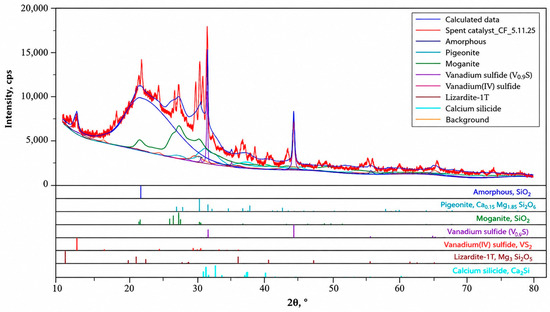
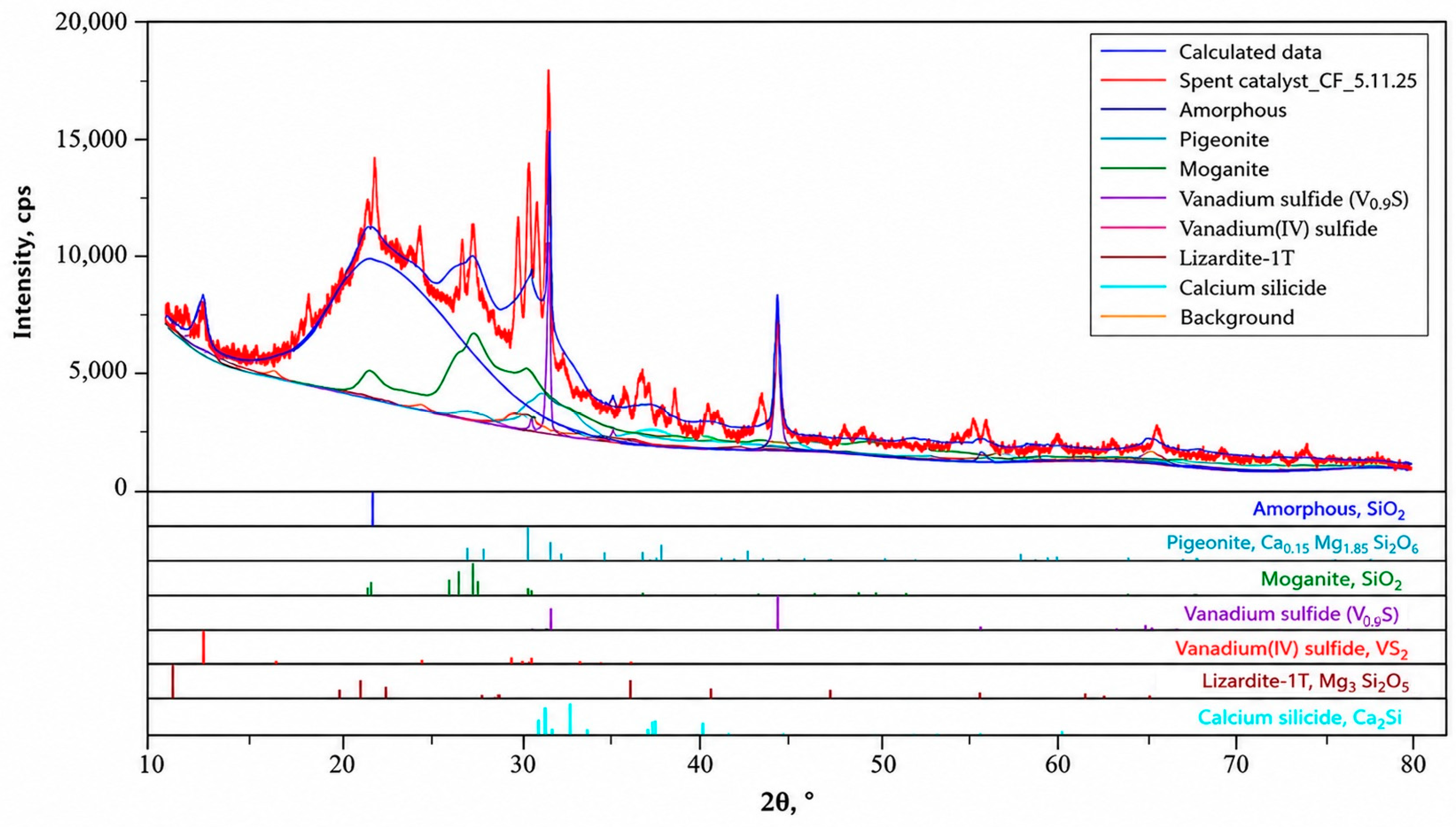
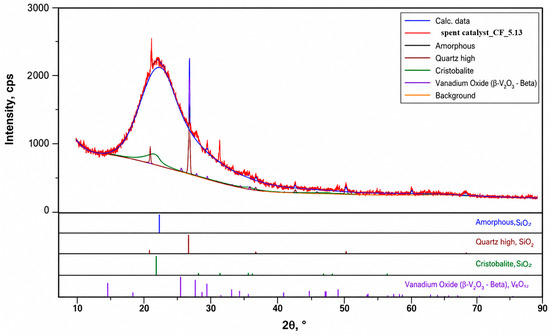
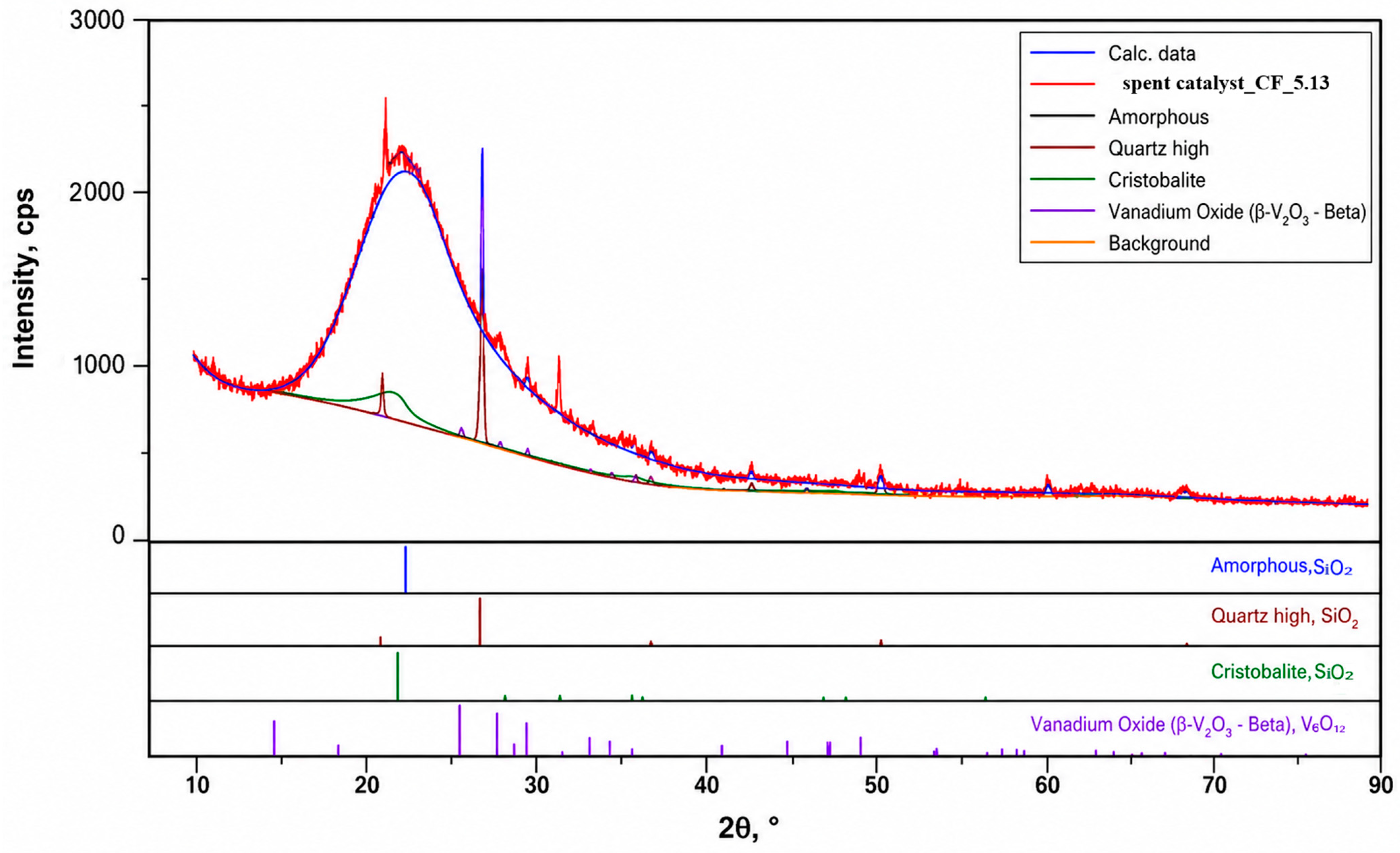
SVC based on vanadium sulfate supported on silica gel was used as the raw material in this study. The initial catalyst samples had a cylindrical shape with an average diameter of 10 mm and a length of 15 mm. The X-ray diffraction pattern and phase composition are presented in Figure 1 and Table 1, while the chemical composition is given in Table 2.
Figure 1.
X-ray diffraction pattern (XRD) of the spent vanadium catalyst.
Table 1.
Phase composition of the sample determined by XRD.
Table 2.
Chemical composition of the initial spent vanadium catalyst (wt.%).
The phase composition of the initial spent vanadium catalyst and the solid residues obtained after reductive leaching was determined by X-ray diffraction (XRD) using a Rigaku MiniFlex 600 diffractometer (Rigaku Corporation, Tokyo, Japan). The measurements were carried out using monochromated Cu Kα radiation with a wavelength of λ = 1.5406 Å, an X-ray tube voltage of 40 kV, and a current of 15 mA. Diffraction patterns were recorded over the 2θ range of 10–80° with a scanning step of 0.01°. Crystalline phases were identified using the ICDD PDF-2+ database, while diffraction data processing and interpretation were performed using SmartLab Studio II software (2024; Rigaku Corporation, Tokyo, Japan).
The following reagents were used in this study: analytical-grade sulfuric acid (H2SO4) supplied by Labkhimprom LLP (Almaty, Kazakhstan), iron shavings supplied by Labkhimprom LLP (Almaty, Kazakhstan), and oxalic acid supplied by SKAT LLP (Almaty, Kazakhstan).
Experimental procedure for reductive leaching using oxalic acid. Leaching experiments were carried out in 600 mL glass reactors under isothermal conditions at temperatures ranging from 25 to 60 °C.
The process was performed at a solid-to-liquid ratio (S/L) of 1:4 (25 wt./vol.%) under intensive mechanical stirring at 250–300 rpm for 90 min.
The solution acidity was maintained within the pH range of 1.3–1.5, monitored using an I-150M pH meter. The dosage of oxalic acid was varied from 5 to 20 wt.% of the initial spent catalyst mass.
Experimental procedure for reductive leaching using metallic iron. Leaching experiments were also performed in 600 mL glass reactors under isothermal conditions at temperatures of 25–60 °C. Sulfuric acid solutions with a controlled pH of 1.3–1.5 were used as the leaching medium. The experiments were conducted at a constant solid-to-liquid ratio of 1:4 under intensive stirring (250–300 rpm). The dosage of metallic iron was varied from 1 to 10 wt.% of the initial catalyst mass to determine the optimum stoichiometric conditions for the reduction process.
Statistical analysis. All experiments were performed in triplicate. The results are presented as the mean value ± standard deviation (SD). Statistical analysis was carried out using OriginPro 2024 (version 10.1.5.132; OriginLab Corporation, Northampton, MA, USA).
The error bars shown in the figures represent the standard deviations obtained from three independent experiments.
The elemental composition of the samples was determined by energy-dispersive X-ray fluorescence spectroscopy (EDXRF) using a portable Olympus Vanta C X-ray fluorescence analyzer (Olympus Scientific Solutions, Waltham, MA, USA). The analyzer was equipped with a 4 W Rh-anode X-ray tube and a silicon drift detector (SDD). The X-ray tube voltage was automatically adjusted within the range of 8–40 kV depending on the analyzed elements, while one of eight primary filters was automatically selected to optimize the excitation conditions. The analysis time for each sample was 80 s. Spectral acquisition, data processing, and quantitative elemental analysis were carried out using the built-in Olympus Vanta software (https://ims.evidentscientific.com/en/products/xrf-analyzers/vanta, accessed on 19 July 2026) and the manufacturer’s factory fundamental calibration.
The vanadium concentration in the pregnant leach solutions was determined by the titrimetric method in accordance with [35,36]. The analytical procedure included preliminary oxidation of vanadium with potassium permanganate, selective reduction of excess oxidant with sodium nitrite, and final titration with Mohr’s salt solution using phenylanthranilic acid as the indicator. The leaching efficiency was evaluated as the percentage of vanadium extracted, calculated as the ratio of the mass of vanadium in the solution to its initial content in the catalyst sample.
The free thermodynamic software Medusa (version 32.0) [37] was primarily employed to study ionic speciation. Thermodynamic modeling was performed to evaluate the ionic equilibria of vanadium, iron, phosphorus, and other accompanying elements in the obtained solutions. The ionic equilibria and chemical speciation in the V–Fe–P–S–H–O system were calculated using the Medusa software package. The calculations were carried out over the pH range of 0–3, assuming thermodynamic equilibrium and using the built-in Hydra/Medusa thermodynamic database, which contains stability constants for dissolved complexes and solubility products of solid phases. Both dissolved and solid species of vanadium, iron, sulfate, phosphate, and oxalate available in the database were included in the calculations. The resulting speciation diagrams were used to determine the predominant chemical species of vanadium and iron and to evaluate the conditions required for their selective separation during reductive sulfuric acid leaching. The pH range of 0–3 was selected because the obtained leach solutions exhibited a pH of 1.3–1.5, whereas the subsequent vanadium sorption process is performed at pH 2–3.
3. Results
3.1. Reductive Leaching of Vanadium Using Oxalic Acid and Metallic Iron
To determine the optimum conditions for reductive vanadium leaching, a one-variable-at-a-time (OVAT) optimization strategy was employed. Each operating parameter was varied individually while all other variables were kept constant. Initially, the effect of temperature was investigated.
Subsequently, the influence of the reducing agent dosage was evaluated at the selected temperature. Finally, using the previously optimized conditions, the effect of leaching time was examined.
The optimum operating conditions were selected based not only on the maximum vanadium recovery but also on reagent consumption, process duration, and the suitability of the resulting pregnant leach solution for subsequent sorption.
Reductive Leaching with Oxalic Acid. The reduction reaction of vanadium(V) with oxalic acid is given in Reaction (1). The corresponding thermodynamic calculations are presented in Table 3:
2VO+2 + H2C2O4 + 4H+ = 2VO2+ + 2CO2 + H2O
Table 3.
Thermodynamic parameters of vanadium reduction by oxalic acid.
The thermodynamic parameters for the reduction of vanadium(V) to vanadium(IV), calculated over the temperature range of 25–120 °C, indicate that the reaction is highly thermodynamically favorable.
The negative Gibbs free energy values (ΔG) throughout the investigated temperature range confirm the spontaneous nature of the reduction process. The extremely high equilibrium constants (K > 1013) indicate that the reaction is practically irreversible and proceeds almost to completion.
Oxalic acid performs two complementary functions during reductive leaching: it acts both as a reducing agent and as a complexing ligand.
This dual role fundamentally distinguishes oxalic acid from most conventional reducing agents and explains its high efficiency in vanadium extraction from spent catalysts.
During the initial stage of the process, oxalic acid dissociates to form oxalate ions (Reactions (2) and (3)):
H2C2O4 ⇌ HC2O4− + H+
HC2O4− ⇌ C2O42− + H+
Under acidic conditions, the oxalate ion acts as an effective reducing agent capable of donating electrons to vanadium(V) compounds, which are predominantly present in the catalyst as vanadium oxides and vanadium-containing phases. During this process, oxalate is oxidized to carbon dioxide, while vanadium(V) is reduced to vanadium(IV) (Reaction (4)):
2VO2+ + H2C2O4 + 2H+ → 2VO2+ + 2CO2 + 2H2O2
The thermodynamic calculations presented in Table 3 confirm that this reaction proceeds spontaneously over the entire investigated temperature range. The negative Gibbs free energy values together with the high equilibrium constants indicate that the reaction equilibrium is almost completely shifted toward the products.
However, the high efficiency of oxalic acid is not solely attributed to its reducing ability. Following the formation of VO2+ ions, oxalate begins to function as a bidentate ligand. Owing to the presence of two carboxyl groups, oxalate coordinates with the central vanadium atom to form stable water-soluble complexes:
VO2+ + 2C2O42− → [VO(C2O4)2]2−
The formation of these complexes significantly decreases the activity of free vanadium(IV) ions in solution. According to Le Chatelier’s principle, this promotes further dissolution of solid vanadium-bearing phases in the catalyst and shifts the leaching equilibrium toward the formation of soluble products.
Furthermore, complex formation substantially suppresses the hydrolysis of vanadium(IV), which, in the absence of complexing ligands, may lead to the precipitation of sparingly soluble hydroxide and oxyhydroxide compounds.
Consequently, oxalate complexes stabilize vanadium in solution and prevent its secondary precipitation.
The experimental results obtained for reductive leaching with oxalic acid are summarized in Table 4 and Table 5.
Table 4.
Experimental results of reductive leaching using oxalic acid.
Table 5.
Chemical composition of the pregnant leach solution after reductive leaching using oxalic acid.
The experimental results presented in Table 4 demonstrate that vanadium recovery from spent vanadium catalysts using oxalic acid reached 87–95% at an oxalic acid dosage of 20 wt.% or higher relative to the initial catalyst mass, even at room temperature. At a leaching temperature of 50 °C, vanadium recovery exceeded 92%.
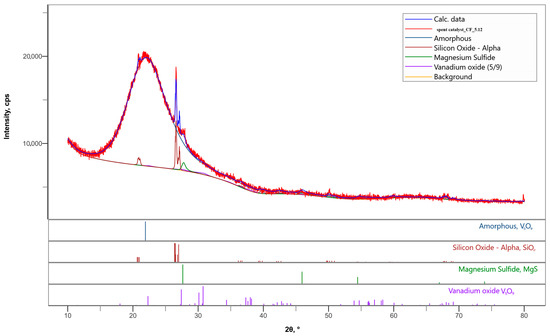
The phase composition of the leaching residues is presented in Figure 2.
Figure 2.
Phase composition of the residues after reductive leaching with oxalic acid.
The residue consists of four major components, with amorphous silica being the predominant phase, accounting for 44.9 wt.%. The crystalline fraction comprises quartz (28.1 wt.%) and a complex calcium-magnesium silicate phase (27.0 wt.%). The residue also contains 1.34 wt.% vanadium oxide. Thus, the residue is characterized by a high degree of amorphization, while the crystalline phases are represented by nearly equal proportions of quartz and calcium-magnesium silicates.
Despite the high vanadium extraction efficiency achieved with oxalic acid (up to 95.2%), its industrial application is limited by the relatively high reagent consumption and its comparatively high market cost.
Results of Reductive Leaching Using Metallic Iron. The reduction of vanadium by metallic iron is described by Reaction (6). The corresponding thermodynamic parameters are summarized in Table 6:
2VO2+ + Fe0 + 4H+ = 2VO2+ + Fe2+ + H2O
Table 6.
Thermodynamic parameters of vanadium reduction by metallic iron.
The thermodynamic analysis confirms that vanadium reduction is highly favorable throughout the investigated temperature range, as evidenced by the strongly negative Gibbs free energy values (ΔG ranging from −278 to −270.9 kJ/mol). The constant enthalpy value (ΔH = −300 kJ/mol) indicates the exothermic nature of the reaction and the formation of stable chemical bonds in solution. The extremely high equilibrium constants (1037–1048) demonstrate that the reaction is essentially irreversible and proceeds almost completely toward product formation.
The negative entropy values (ΔS = −0.074 kJ·mol−1·K−1) indicate a decrease in system disorder, which is characteristic of the formation of stable dissolved species. Although the thermodynamic driving force decreases slightly with increasing temperature, the experimentally observed increase in vanadium recovery indicates that the overall process is controlled by kinetics rather than thermodynamics. These results demonstrate that efficient vanadium reduction can be achieved even at moderate temperatures owing to the strong chemical affinity of metallic iron toward vanadium(V).
Unlike oxalic acid, metallic iron is a heterogeneous reducing agent. Therefore, the reduction process occurs directly on the surface of the iron particles and is accompanied by their electrochemical dissolution.
In an acidic sulfuric acid medium, metallic iron undergoes anodic dissolution by Reaction (7):
Fe0 → Fe2+ + 2e−
The released electrons reduce pentavalent vanadium to the tetravalent state:
2VO2+ + Fe0 + 4H+ → 2VO2+ + Fe2+ + 2H2O
Unlike the oxalic acid system, metallic iron does not form stable coordination complexes with vanadium. Consequently, the main driving force of the process is the electrochemical reduction of vanadium, followed by the dissolution of the resulting vanadium(IV) compounds in sulfuric acid solution.
The resulting vanadyl ion (VO2+) exhibits significantly higher solubility than vanadium(V) compounds and predominantly exists in solution as sulfate complexes. This suppresses the formation of sparingly soluble polyvanadate species and promotes the continued dissolution of vanadium-bearing phases from the catalyst.
Simultaneously, the dissolution of metallic iron results in the accumulation of Fe2+ ions in solution. However, owing to the relatively high redox potential of the system and the presence of residual vanadium(V) species as well as dissolved oxygen, Fe2+ is readily oxidized to Fe3+:
Fe2+ → Fe3+ + e−
As a result, Fe3+ ions predominate in the pregnant leach solution, whereas the concentration of Fe2+ remains below the detection limit of the analytical method. The experimental results fully support this mechanism: the concentration of Fe3+ in the solution reached 5.6 g/L, while Fe2+ was not detected.
The experimental results of reductive leaching using metallic iron are summarized in Table 7 and Table 8.
Table 7.
Experimental results of reductive leaching using metallic iron.
Table 8.
Chemical composition of the pregnant leach solution after reductive leaching using metallic iron (wt.%).
The experimental results demonstrate that, at a metallic iron dosage of 2–3 wt.% relative to the initial catalyst mass, vanadium extraction reached approximately 91% under a solid-to-liquid ratio of 1:7. Under these conditions, the pregnant leach solution contained 8.69 g/L of V(IV) and 0.86 g/L of V(V). The concentration of Fe3+ reached 5.6 g/L, whereas Fe2+ was not detected. The residual vanadium content in the leaching residue was approximately 0.7 wt.%. These results indicate that the obtained pregnant leach solution does not require an additional iron oxidation step prior to the sorption process because iron is already predominantly present in the ferric state while maintaining a high vanadium concentration.
The use of metallic iron as the reducing agent suppresses the formation of sparingly soluble polyvanadate phases, promotes the stabilization of vanadium in solution predominantly as the vanadyl ion, and enhances both vanadium recovery and the selectivity of the subsequent sorption process.
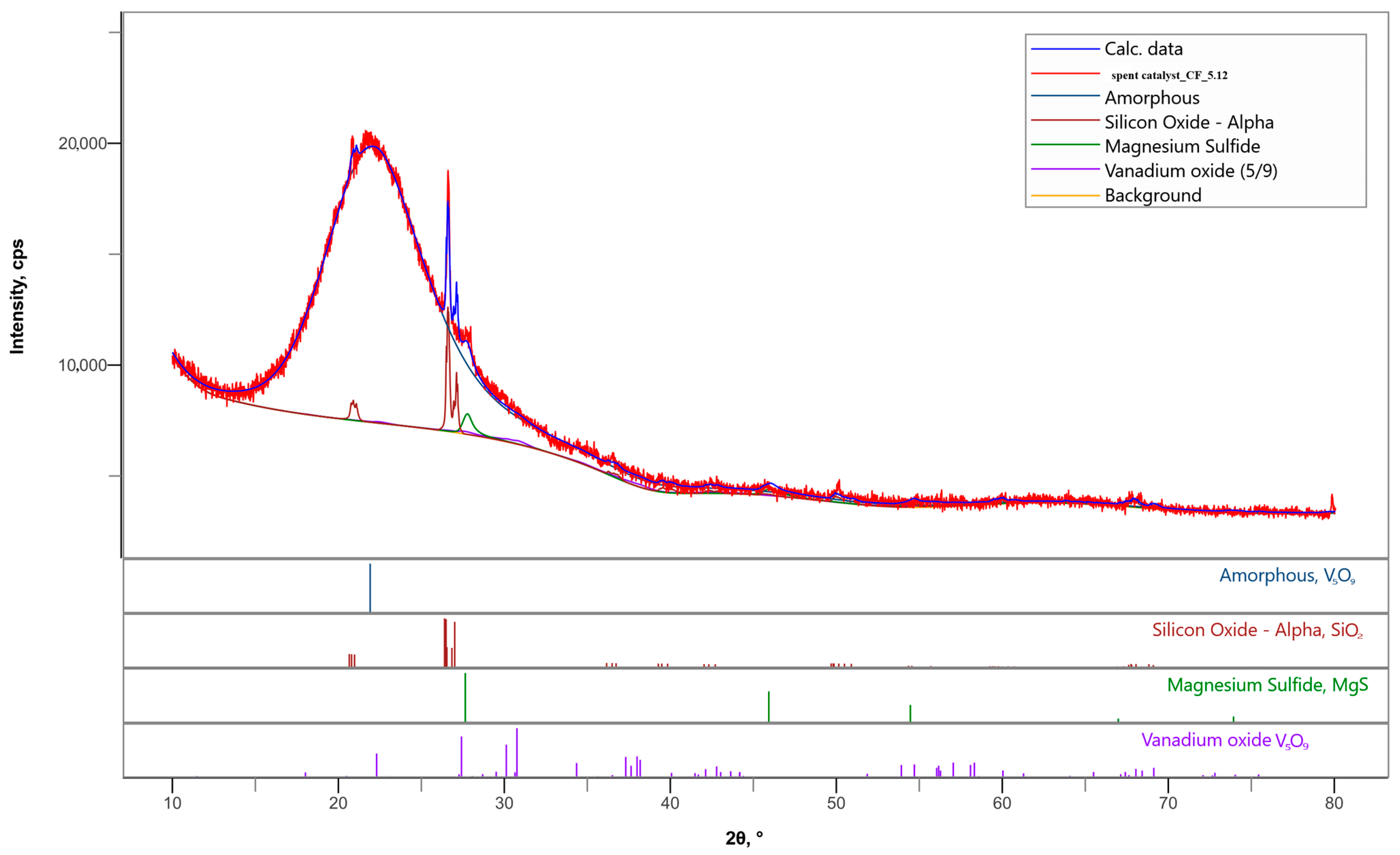
The phase composition of the residues obtained after reductive leaching with metallic iron is presented in Figure 3.
Figure 3.
Phase composition of the residue after reductive leaching of spent vanadium catalyst using metallic iron as the reducing agent.
The residue consists of four major phases. The dominant phase is amorphous silica (38.5 wt.%), followed by quartz (33.7 wt.%) and a complex calcium-magnesium silicate phase (26.72 wt.%). The vanadium oxide content in the residue was 1.08 wt.%.
An additional advantage of metallic iron is its low reagent consumption. Experimental results demonstrated that the addition of only 2–3 wt.% metallic iron, relative to the catalyst mass, provided approximately 91% vanadium recovery, while the vanadium concentration in the pregnant leach solution reached 8.69 g/L, predominantly in the form of V(IV). The resulting solution exhibits a favorable Fe–V speciation and can be directly subjected to sorption without a preliminary iron oxidation step, thereby considerably simplifying the subsequent hydrometallurgical processing.
Thermodynamic modeling further indicates that, in the V–Fe–P–S system, the formation of stable phosphate complexes and sparingly soluble phosphate phases is primarily associated with Fe(III), whereas phosphate complexes of vanadium are thermodynamically insignificant within the investigated pH range. It should be emphasized that this conclusion is based on thermodynamic equilibrium calculations. The experimental leaching results confirm that the use of metallic iron produces pregnant leach solutions with high vanadium concentrations while minimizing the adverse influence of phosphorus, thereby creating favorable conditions for improving the selectivity of subsequent vanadium sorption.
The obtained results demonstrate that the reducing agent serves not only as a reagent for the reduction of vanadium(V), but also as a key factor governing the chemical composition and aqueous speciation of the pregnant leach solution. The predominant species of vanadium, iron, and phosphorus formed during leaching determine the subsequent behavior of the solution during sorption and ultimately affect vanadium recovery selectivity. Therefore, the choice of reducing agent should be regarded as a critical parameter for controlling the overall selectivity of the hydrometallurgical processing flowsheet for spent vanadium catalysts.
3.2. Ionic Equilibria and Chemical Speciation
Vanadium and phosphorus exhibit similar chemical behavior in aqueous solutions owing to their ability to form stable oxoanionic and polymeric species. Under oxidizing conditions, vanadium(V), similarly to phosphorus(V), predominantly exists as oxygen-containing anions that readily undergo polymerization and complex formation.
In aqueous solutions, phosphorus is mainly present as orthophosphate species by Reaction (9):
H3PO4 → H2PO4− → HPO42− → PO43−
Similarly, vanadium(V) exists in acidic and weakly acidic media as vanadate and polyvanadate species by Reaction (10):
VO2+ → HVO42− → V10O286−
In hydrometallurgical solutions obtained during the processing of spent vanadium catalysts, this similarity has important practical implications. Phosphate ions compete with vanadate species during vanadium sorption because many anion-exchange resins exhibit comparable affinity toward phosphorus and vanadium oxoanions. Consequently, the presence of phosphorus decreases the sorption capacity of the resin for vanadium and reduces the overall selectivity of the process. Thermodynamic analysis showed that, in the investigated sulfate system, Fe(III) ions and phosphate species are the principal competitors affecting selective vanadium sorption. Their presence influences both the distribution of aqueous species and their interaction with ion-exchange materials.
Thermodynamic modeling was performed to investigate the ionic equilibria of vanadium together with the accompanying elements, including iron, phosphorus, and aluminum, in the obtained leach solutions.
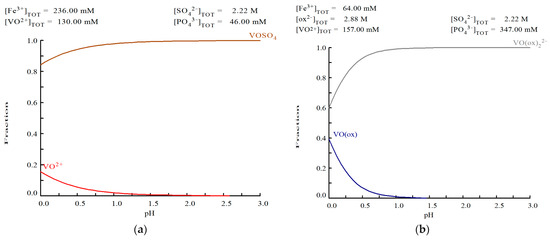
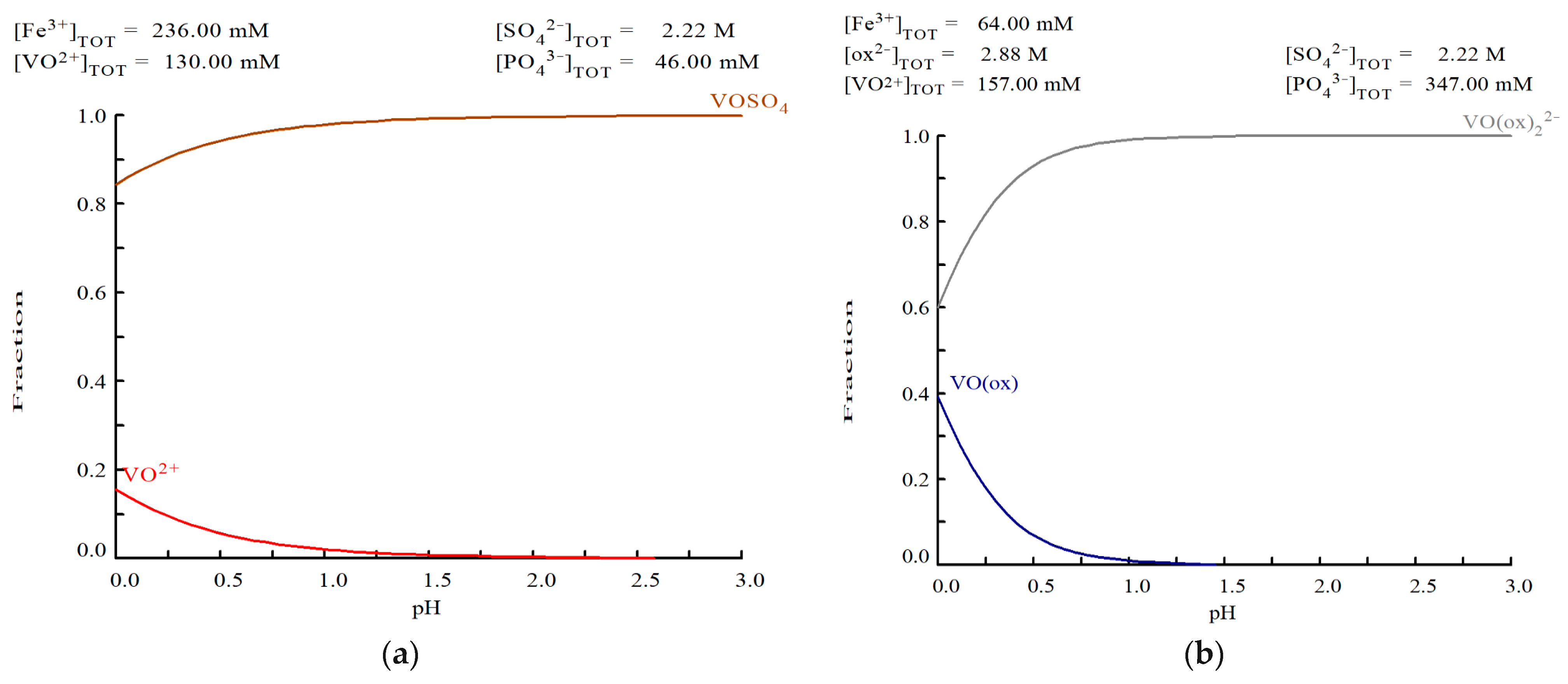
Figure 4a presents the calculated speciation diagram for the pregnant leach solution obtained by reductive leaching with metallic iron. The modeled solution contained 130 mM V(IV), 236 mM Fe(III), 2.22 M SO42−, and 46 mM PO43−. The calculations demonstrated that, over the pH range of 0–3, vanadium(IV) exists predominantly as the sulfate complex VOSO4, whose fraction increases from approximately 85% to nearly 100% with increasing pH. Free vanadyl ions (VO2+) are present in appreciable amounts (up to 15%) only under strongly acidic conditions (pH < 1.0). No phosphate complexes of vanadium(IV) were predicted under these conditions. This behavior can be attributed to the preferential binding of phosphate ions by Fe(III), together with the high sulfate concentration in solution.
Figure 4.
Thermodynamic distribution of vanadium species as a function of pH: (a) presents the calculated speciation diagram for the pregnant leach solution obtained by reductive leaching with metallic iron, (b) presents the calculated speciation diagram for the pregnant leach solution obtained by reductive leaching with oxalic acid.
The addition of oxalate ligands to the pregnant leach solution produced by reductive leaching with oxalic acid (Figure 4b) markedly alters the aqueous speciation of vanadium(IV). The modeled system contained 10 mM oxalate ions in a sulfate-phosphate solution. Under these conditions, vanadium(IV) was distributed mainly between two aqueous species:
- -
- the monoligand oxalate complex VO(C2O4), and
- -
- the bis(oxalato) complex VO(C2O4)22−.
At pH ≈ 0, the monoligand complex accounts for approximately 35–40% of the dissolved vanadium, whereas the bis(oxalato) complex represents 60–65%. As the pH increases to 0.3–0.5, the concentration of the monoligand species rapidly decreases to nearly zero. Simultaneously, the fraction of VO(C2O4)22− increases to 95–99% at approximately pH 0.8–1.0 and remains essentially constant throughout the remainder of the investigated pH range.
These results indicate the exceptionally high stability of the bis(oxalato) vanadyl complex. Even in the presence of relatively high concentrations of sulfate and phosphate ions, these anions contribute negligibly to the coordination environment of vanadium(IV). This behavior is attributed to the substantially higher stability constant of the oxalate complex, resulting from the strong chelating ability of oxalate, which forms two five-membered coordination rings around the vanadyl ion. Consequently, oxalate effectively displaces not only coordinated water molecules but also competing inorganic ligands from the primary coordination sphere of vanadium. Similar behavior has previously been reported for vanadium–oxalate systems, where virtually all dissolved vanadium(IV) exists as VO(C2O4)22− at pH values above 1. It should be noted that this sharp change in vanadium speciation is not associated with hydrolysis but rather with the sequential coordination of a second oxalate ligand by Reaction (11):
VO(C2O4) + C2O42− ⇌ VO(C2O4)22−
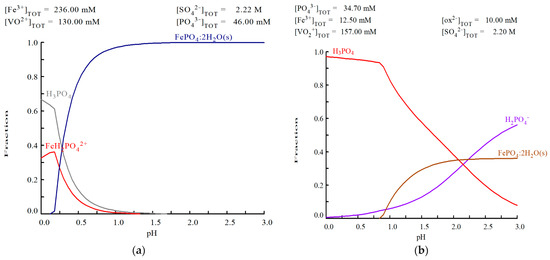
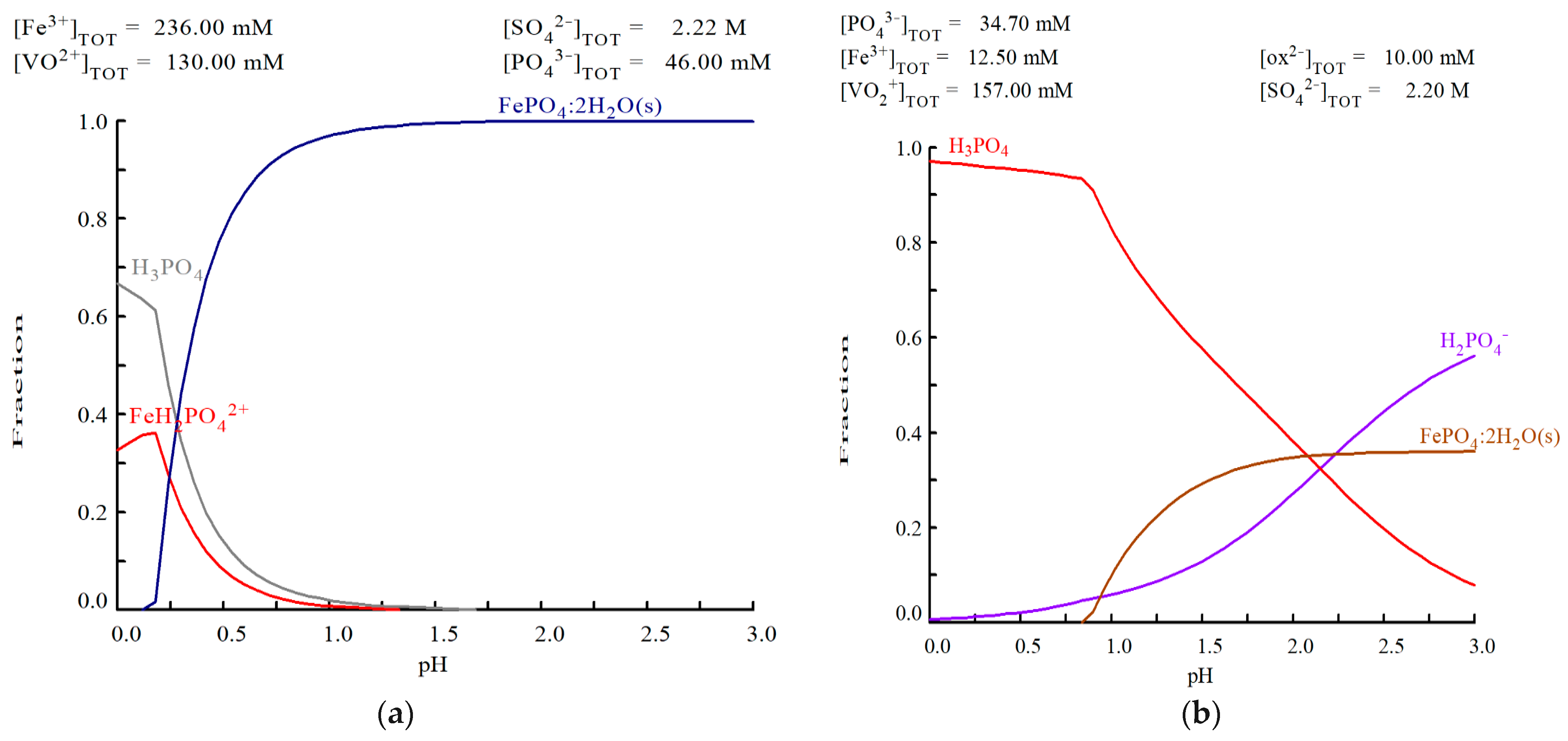
The speciation diagram of phosphate species in the pregnant leach solution obtained by reductive leaching with metallic iron is presented in Figure 5a. The modeled solution contained 130 mM V(IV) and 236 mM Fe(III). The calculations indicate that phosphate distribution is primarily governed by heterogeneous precipitation. Under strongly acidic conditions (pH < 0.15), phosphorus remains in solution predominantly as molecular phosphoric acid (H3PO4, approximately 68%) and the ferric phosphate complex FeH2PO42+ (approximately 32%). At a critical pH of approximately 0.15, intensive precipitation of hydrated ferric phosphate (FePO4·2H2O) is initiated. At pH ≥ 1.0, phosphate ions are almost completely removed from solution through precipitation, with nearly 100% of the phosphorus occurring as solid FePO4·2H2O. These results explain the absence of dissolved phosphate complexes of vanadium(IV) within the investigated acidity range.
Figure 5.
Thermodynamic distribution of phosphorus species as a function of pH: (a) presents the calculated speciation diagram for the pregnant leach solution obtained by reductive leaching with metallic iron; (b) presents the calculated speciation diagram for the pregnant leach solution obtained by reductive leaching with oxalic acid.
The addition of oxalate ligands to the pregnant leach solution obtained by reductive leaching with oxalic acid (Figure 5b), together with a decrease in the Fe3+/PO43− molar ratio to 0.36, substantially alters the phosphate equilibria. The calculations show that within the pH range of 0.0–0.45, phosphorus remains predominantly in solution as H3PO4, accounting for more than 85% of the total phosphorus. The precipitation of FePO4·2H2O begins at approximately pH 0.45. However, the amount of precipitated ferric phosphate is limited by the insufficient concentration of Fe3+ ions and does not exceed 36% of the total phosphorus.
The excess dissolved phosphorus subsequently undergoes stepwise dissociation with increasing pH, leading to the formation of H2PO4− ions. At pH 3.0, dihydrogen phosphate becomes the dominant dissolved phosphorus species, accounting for approximately 56% of the total phosphorus. Unlike the metallic iron system, where nearly all phosphorus is immobilized as ferric phosphate, the oxalic acid system contains an excess of dissolved phosphate species because of the deficiency of ferric ions.
These results indicate that phosphate ions preferentially react with Fe(III), and only after the available ferric ions have been completely consumed do free phosphate species remain in solution as H2PO4−.
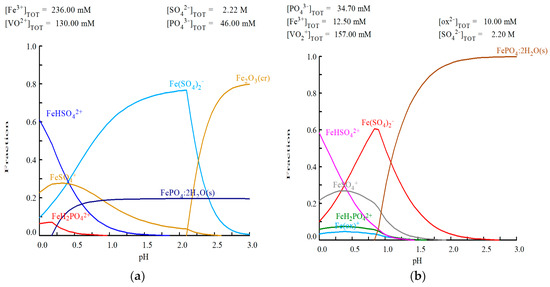
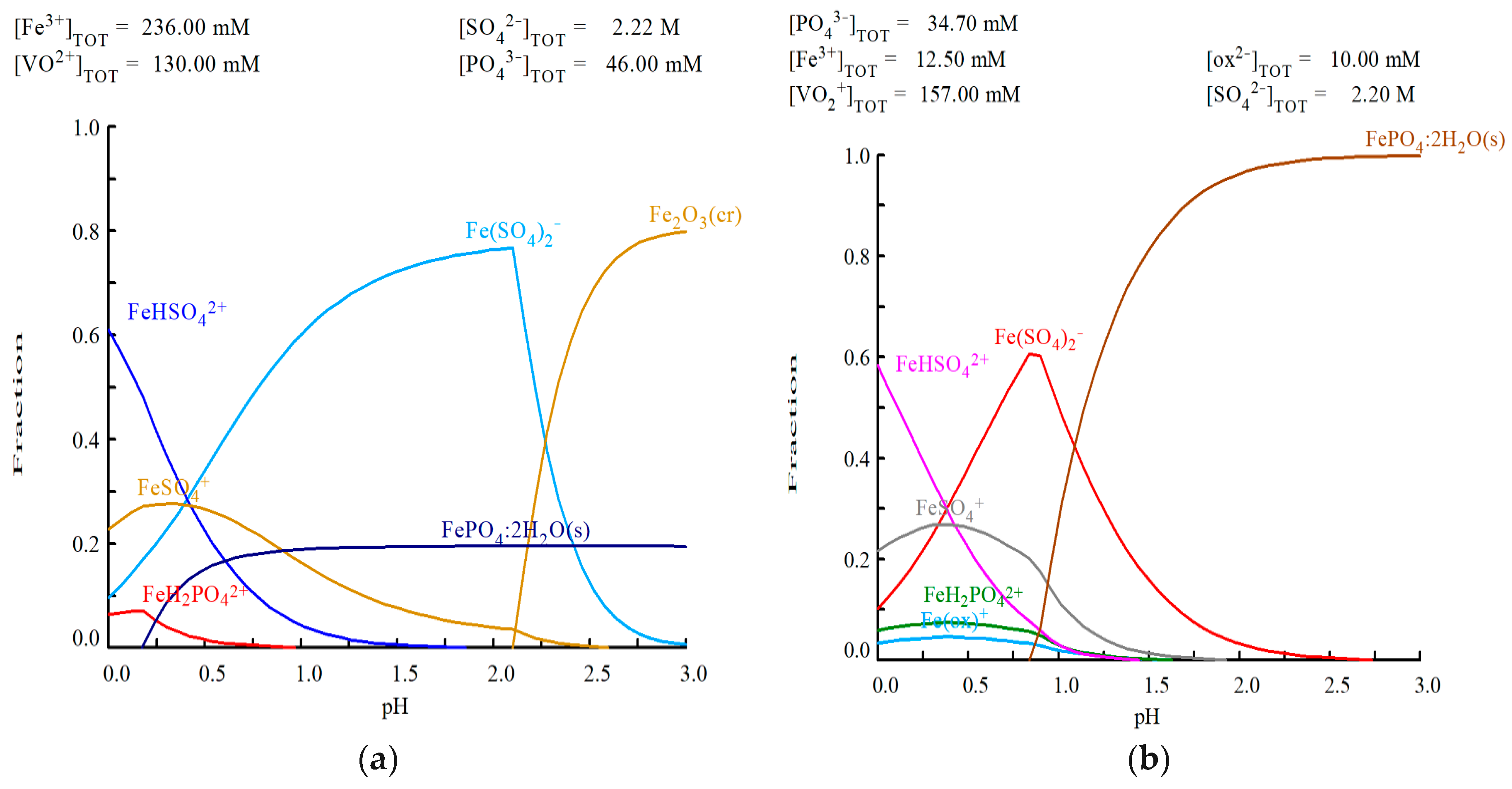
The thermodynamic distribution of iron species in the pregnant leach solution obtained by reductive leaching with metallic iron is presented in Figure 6a. The calculations showed that at pH < 2.1, dissolved iron exists almost exclusively as sulfate complexes, namely FeHSO42+, FeSO4+, and Fe(SO4)2−.
Figure 6.
Thermodynamic distribution of iron species as a function of pH: (a) presents the calculated speciation diagram for the pregnant leach solution obtained by reductive leaching with metallic iron; (b) presents the calculated speciation diagram for the pregnant leach solution obtained by reductive leaching with oxalic acid.
Within the pH range of 0.15–1.0, approximately 19.5% of the total iron is incorporated into the solid ferric phosphate phase, FePO4·2H4O. The amount of precipitated ferric phosphate is limited by the initial phosphate concentration in the solution. These results further confirm the strong affinity of Fe(III) toward phosphate ions. The remaining dissolved iron predominantly exists as sulfate complexes owing to the excess concentration of ferric ions in the solution. At pH values above 2.1, extensive hydrolysis of the sulfate complexes occurs, resulting in the precipitation of crystalline Fe2O3. At pH 3.0, approximately 80.5% of the total iron is present as the solid oxide phase.
The speciation of Fe(III) in the pregnant leach solution produced by reductive leaching with oxalic acid (Figure 6b) was investigated under conditions of iron deficiency relative to phosphate (Fe3+/PO43− = 0.36) in the presence of oxalate ligands. The calculations revealed that at pH < 0.5, dissolved iron is distributed mainly among sulfate complexes (FeHSO42+ and FeSO4+) and the soluble phosphate complex FeH2PO42+. The fraction of the oxalate complex Fe(ox)+ remains below 4% throughout the investigated pH range. As the pH increases above 0.20, rapid heterogeneous precipitation of FePO4·2H2O is initiated. Because phosphate ions are present in stoichiometric excess, complete precipitation of Fe(III) as FePO4·2H2O is achieved at pH ≥ 1.5. Consequently, the formation of ferric hydroxides and iron oxides becomes thermodynamically unfavorable throughout the investigated pH range up to pH 3.0.
Table 9 summarizes the stability constants of the major dissolved complexes and the solubility product of ferric phosphate, providing insight into the behavior of vanadium, iron, and phosphorus during reductive sulfuric acid leaching and the subsequent sorption process.
Table 9.
Stability constants of the major dissolved complexes and the solubility of ferric phosphate.
Comparison of the stability constants indicates that FeH2PO42+ is the most thermodynamically stable dissolved complex among those investigated. At 25 °C, the stability constant of FeH2PO42+ is log K = 5.43, whereas the corresponding values for FeHSO42+ and VOSO4 are 2.48 and 2.45, respectively. These results indicate that Fe(III) forms substantially more stable complexes with dihydrogen phosphate (H2PO4−) than with hydrogen sulfate (HSO4−).
From a practical perspective, these calculations indicate that the presence of phosphate ions promotes the selective removal of iron from solution. Ferric ions preferentially bind with phosphate to form sparingly soluble ferric phosphate, whereas vanadium remains dissolved. The marked difference in complex stability provides the thermodynamic basis for the selective separation of iron and vanadium in sulfuric acid solutions.
Increasing the temperature enhances the stability of dissolved sulfate complexes of both vanadium and iron, as reflected by the increasing log K values for VOSO4 and FeHSO42+.
At the same time, the stability of the soluble FeH2PO42+ complex decreases, while the solubility of FePO4·2H2O is reduced. As a consequence, elevated temperatures favor the precipitation of iron as ferric phosphate while maintaining vanadium in solution.
3.3. Correlation Between Thermodynamic Modeling and Experimental Results
The results of thermodynamic modeling are in good agreement with the experimental data obtained during the reductive leaching of vanadium. For the system employing metallic iron as the reducing agent, the calculations predicted that, at pH 1.3–1.5, vanadium(IV) predominantly exists as the VOSO4 complex. The predominance of this sulfate complex stabilizes vanadium in solution and suppresses the formation of sparingly soluble vanadium compounds. These predictions are fully consistent with the experimental results, which demonstrated vanadium recoveries of 91–95% without any evidence of secondary vanadium precipitation.
For the oxalic acid system, thermodynamic modeling predicted that VO(C2O4)22− becomes the dominant vanadium species at pH values above 1.0. The formation of this highly stable oxalate complex explains the high vanadium recovery (up to 95.2%) by stabilizing vanadium(IV) in solution throughout the leaching process. The calculations further indicate that phosphate ions preferentially interact with Fe(III) to form FePO4·2H2O, thereby minimizing the influence of phosphorus on the subsequent sorption of vanadium. Accordingly, thermodynamic modeling should not be regarded as independent proof of the proposed mechanism but rather as a powerful tool for interpreting the experimental observations and explaining the chemical behavior of the system under the investigated conditions.
A comparative evaluation of the two reducing agents demonstrated that oxalic acid provides the highest vanadium recovery (95.2%); however, this requires a relatively high reagent consumption (20–25 wt.% of the catalyst mass). In addition, stable oxalate complexes remain in the pregnant leach solution after leaching, which may influence the subsequent sorption stage. In contrast, metallic iron achieved a comparable vanadium recovery (91–92%) while requiring only 2–3 wt.% of the catalyst mass. Additional advantages of metallic iron include its wide industrial availability, low cost, and the absence of organic residues in the pregnant leach solution, thereby simplifying downstream hydrometallurgical processing. The obtained results demonstrate that the reducing agent serves not only as a reagent for the reduction of vanadium(V), but also as an effective tool for controlling the chemical composition and aqueous speciation of the pregnant leach solution. The predominant species of vanadium, iron, and phosphorus formed during leaching govern the subsequent behavior of the solution during the sorption process.
Therefore, the choice of reducing agent should be regarded as one of the key factors controlling the selectivity of the entire hydrometallurgical processing flowsheet for spent vanadium catalysts. Overall, although oxalic acid provides slightly higher vanadium recovery, metallic iron appears to be the more promising reducing agent from both the techno-economic and industrial implementation perspectives. More importantly, the present study demonstrates that controlling the reducing agent enables purposeful regulation of solution chemistry at the leaching stage, thereby creating favorable conditions for the selective recovery of vanadium during subsequent hydrometallurgical processing.
4. Conclusions
Based on a combination of comprehensive experimental investigations and thermodynamic modeling, the formation mechanisms of the chemical composition of pregnant leach solutions generated during the reductive sulfuric acid leaching of spent vanadium catalysts using different reducing agents were established for the first time. It was demonstrated that the nature of the reducing agent governs the predominant aqueous speciation of vanadium, iron, and phosphorus, thereby enabling targeted control of the selectivity of subsequent vanadium recovery by sorption through the regulation of ionic equilibria already at the leaching stage.
Experimental results showed that oxalic acid achieved a vanadium recovery of up to 95.2%, whereas metallic iron provided a comparable extraction efficiency (up to 95.1%) while requiring a substantially lower reagent consumption (2–3 wt.% of the catalyst mass) and offering greater technological and economic advantages.
Thermodynamic modeling demonstrated that, in sulfuric acid solutions containing metallic iron as the reducing agent, vanadium(IV) exists predominantly as the VOSO4 complex over the pH range of 0–3, whereas in oxalic acid systems it is mainly present as the VO(C2O4)22− complex. Phosphate ions preferentially interact with Fe(III), thereby suppressing the formation of stable phosphate complexes of vanadium. The calculations further showed that increasing the temperature stabilizes the sulfate complexes of vanadium and iron while simultaneously decreasing the solubility of FePO4·2H2O, thereby promoting the selective precipitation of iron without significant vanadium loss. Comparison of the stability constants revealed that Fe(III) forms substantially more stable complexes with dihydrogen phosphate ions (H2PO4−) than with hydrogen sulfate ions (HSO4−). Among the investigated dissolved species, FeH2PO42+ exhibited the highest stability (log K = 5.43–4.96), whereas the stability of FeHSO42+ and VOSO4 was considerably lower (log K ≈ 2.4–2.8). These thermodynamic relationships provide the basis for the selective separation of iron and vanadium in sulfuric acid media.
The obtained results demonstrate that controlling the chemical composition of the V–Fe–P–S system enables effective separation of vanadium and iron prior to the sorption stage. The precipitation of iron as ferric phosphate decreases the concentration of competing impurities, minimizes the adverse effect of phosphorus on ion-exchange processes, and creates favorable conditions for the selective sorption recovery of vanadium. More importantly, the present study demonstrates that the reducing agent should be considered not only as a reagent for vanadium reduction but also as a key process parameter for controlling solution chemistry and enhancing the overall selectivity of the hydrometallurgical processing of spent vanadium catalysts.
Author Contributions
Conceptualization, A.T. and N.S.; methodology, N.Z., M.S. and R.S.; software, N.S., G.M. and A.T.; validation, N.Z., A.T., F.A.B. and A.Z.; formal analysis, N.S., G.M. and A.T.; investigation, N.Z., M.S., G.M. and R.S.; resources, A.T., A.Z. and F.A.B.; data curation, N.S., N.Z. and A.T.; writing—original draft preparation, N.Z. and N.S.; writing—review and editing, A.T. and F.A.B.; visualization, N.S. and M.S.; supervision, A.T. and A.Z.; project administration, A.T., A.Z. and F.A.B.; funding acquisition, A.T. All authors have read and agreed to the published version of the manuscript.
Funding
This research was funded by the Science Committee of the Ministry of Science and Higher Education of the Republic of Kazakhstan (Grant No. AP26101831) and the APC was funded by Science Committee of the Ministry of Science and Higher Education of the Republic of Kazakhstan.
Data Availability Statement
The original contributions presented in the study are included in the article, further inquiries can be directed to the corresponding author.
Conflicts of Interest
Nazigul Zhumakynbai, Nazira Seidakhmetova and Feruza A. Berdikulova were employed by Republican State Enterprise Under the Right of Economic Management “National Center on Complex Processing of Mineral Raw Materials of the Republic of Kazakhstan”. The remaining authors declare that the research was conducted in the absence of any commercial or financial relationships that could be construed as a potential conflict of interest.
References
- Mohanta, S.; Kumar, A.; Das, S.; Dash, A.; Sahu, K.K.; Mishra, D. Prospects of Vanadium Extraction from Different Secondary Sources: A Review. Miner. Metall. Explor. 2026, 43, 1401–1423. [Google Scholar] [CrossRef] [Scilit]
- Akcil, A.; Vegliò, F.; Ferella, F.; Okudan, M.D.; Tuncuk, A. A Review of Metal Recovery from Spent Petroleum Catalysts and Ash. Waste Manag. 2015, 45, 420–433. [Google Scholar] [CrossRef] [Scilit] [PubMed]
- Erust, C.; Akcil, A.; Bedelova, Z.; Anarbekov, K.; Baikonurova, A.; Tuncuk, A. Recovery of Vanadium from Spent Catalysts of Sulfuric Acid Plant by Using Inorganic and Organic Acids: Laboratory and Semi-Pilot Tests. Waste Manag. 2016, 49, 455–461. [Google Scholar] [CrossRef] [Scilit] [PubMed]
- Gerhartz, W. (Ed.) Ullmann’s Encyclopedia of Industrial Chemistry, 5th ed.; VCH Verlagsgesellschaft: Weinheim, Germany, 1994; Volume A25, pp. 644–647. [Google Scholar]
- Mauskar, J.M. Comprehensive Industry Document on Sulfuric Acid Plants; Central Pollution Control Board: Delhi, India, 2007.
- Toya, T.; Fukuda, K.; Takaya, M.; Arito, H. Lung Lesions Induced by Intratracheal Instillation of Vanadium Pentoxide Powder in Rats. Ind. Health 2001, 39, 8–15. [Google Scholar] [CrossRef] [Scilit] [PubMed]
- Rajendran, N.; Seagrave, J.C.; Plunkett, L.M.; MacGregor, J.A. A Comparative Assessment of the Acute Inhalation Toxicity of Vanadium Compounds. Inhal. Toxicol. 2016, 28, 618–628. [Google Scholar] [CrossRef] [Scilit] [PubMed]
- Liu, L.; Wang, L.; Su, S.; Yang, T.; Dai, Z.; Qing, M.; Xu, K.; Hu, S.; Wang, Y.; Xiang, J. Leaching Behavior of Vanadium from Spent SCR Catalyst and Its Immobilization in Cement-Based Solidification/Stabilization with Sulfurizing Agent. Fuel 2019, 243, 406–412. [Google Scholar] [CrossRef] [Scilit]
- United States Environmental Protection Agency (USEPA). Hazardous Waste Management System; Federal Register: Washington, DC, USA, 2003; Volume 68.
- World Health Organization (WHO). Vanadium Pentoxide and Other Inorganic Vanadium Compounds; Concise International Chemical Assessment Document No. 29; WHO: Geneva, Switzerland, 2011.
- Navarro, R.; Guzman, J.; Saucedo, I.; Revilla, J.; Guibal, E. Vanadium Recovery from Oil Fly Ash by Leaching, Precipitation and Solvent Extraction Processes. Waste Manag. 2007, 27, 425–438. [Google Scholar] [CrossRef] [Scilit] [PubMed]
- Montiel-Davalos, A.; Gonzalez-Villava, A.; Rodriguez-Lara, V.; Montaño, L.F.; Fortoul, T.I.; Lopez-Marure, R. Vanadium Pentoxide Induces Activation and Death of Endothelial Cells. J. Appl. Toxicol. 2012, 32, 26–33. [Google Scholar] [CrossRef] [Scilit] [PubMed]
- Pearcy, A.C.; Matthews, B.L.; Marshall, A.T.; Bumby, C.W. Precipitation of Vanadium from Leachate Solutions by Reduction with Hydrazine. RSC Adv. 2026, 16, 19895–19902. [Google Scholar] [CrossRef] [Scilit] [PubMed]
- Wu, W.; Wang, C.; Bao, W.; Li, H. Selective Reduction Leaching of Vanadium and Iron by Oxalic Acid from Spent V2O5–WO3/TiO2 Catalyst. Hydrometallurgy 2018, 179, 182–191. [Google Scholar] [CrossRef] [Scilit]
- Bruyère, V.I.E.; García Rodenas, L.A.; Morando, P.J.; Blesa, M.A. Reduction of Vanadium(V) by Oxalic Acid in Aqueous Acid Solutions. J. Chem. Soc. Dalton Trans. 2001, 24, 3593–3597. [Google Scholar] [CrossRef] [Scilit]
- Li, C.; Jiang, T.; Wen, J.; Yang, G.; Yu, T.; Zhang, L. A Novel Method for Enhancing Vanadium Extraction from Calcified Vanadium Slag: H2SO4–Na2SO3 Synergistic Reduction Leaching and Short Process Preparation of Vanadium Dioxide. J. Mater. Chem. A 2025, 13, 2997–3009. [Google Scholar] [CrossRef] [Scilit]
- Tran, T.T.; Jing, C.; Jang, I.J.; Lee, M.S. Synthesis of VOSO4 from Alkaline Vanadium(V) Solution by Chemical Reduction and Precipitation. Miner. Process. Extr. Metall. Rev. 2026, 1–10. [Google Scholar] [CrossRef] [Scilit]
- Villarreal, M.S.; Kharisov, B.I.; Torres-Martínez, L.M.; Elizondo, V.N. Recovery of Vanadium and Molybdenum from Spent Petroleum Catalyst of PEMEX. Ind. Eng. Chem. Res. 1999, 38, 4624–4628. [Google Scholar] [CrossRef] [Scilit]
- Du, X.; Xue, J.; Wang, X.; Chen, Y.; Ran, J.; Zhang, L. Oxidation of Sulfur Dioxide over V2O5/TiO2 Catalyst with Low Vanadium Loading: A Theoretical Study. J. Phys. Chem. C 2018, 122, 3970–3979. [Google Scholar] [CrossRef] [Scilit]
- Dunn, J.P.; Koppula, P.R.; Stenger, H.G.; Wachs, I.E. Oxidation of Sulfur Dioxide to Sulfur Trioxide over Supported Vanadia Catalysts. Appl. Catal. A Gen. 1998, 175, 203–224. [Google Scholar] [CrossRef] [Scilit]
- Wu, L.; Dai, C.; Wang, H.; Wang, J.; Dong, Y. Leaching of Vanadium, Potassium, and Iron from Spent Catalyst of the Manufacture of Sulfuric Acid. J. Mater. Res. Technol. 2021, 11, 905–913. [Google Scholar] [CrossRef] [Scilit]
- Nikiforova, A.; Kozhura, O.; Pasenko, O. Leaching of Vanadium by Sulfur Dioxide from Spent Catalysts for Sulfuric Acid Production. Hydrometallurgy 2016, 164, 31–37. [Google Scholar] [CrossRef] [Scilit]
- Romanovskaia, E.; Romanovski, V.; Kwapinski, W.; Kurilo, I. Selective Recovery of Vanadium Pentoxide from Spent Catalysts of Sulfuric Acid Production: Sustainable Approach. Hydrometallurgy 2021, 200, 105568. [Google Scholar] [CrossRef] [Scilit]
- Lukomskaya, G.A. Method for Extraction of Vanadium from Spent Vanadium Catalysts. Russian Patent RU 2838283 C1, 14 April 2025. [Google Scholar]
- Al Amayreh, H.H.; Khalaf, A.; Hawwari, M.I.; Hourani, M.K.; Al Bawab, A. The Recovery of Vanadium Pentoxide (V2O5) from Spent Catalyst Utilized in a Sulfuric Acid Production Plant in Jordan. Materials 2023, 16, 6503. [Google Scholar] [CrossRef] [Scilit] [PubMed]
- Kuzin, E.N.; Azopkov, S.V.; Kruchinina, N.E.; Konkova, T.V.; Nistratov, A.V.; Kolesnikov, A.V.; Gavva, M.A.; Nishukova, M.A. Method for Processing Spent Vanadium Catalyst. Russian Patent RU 2833059 C1, 14 January 2025. [Google Scholar] [CrossRef] [Scilit]
- Komekova, N.M.; Kozlov, V.A.; Smirnov, K.M.; Shayakhmetova, R.A.; Nesterov, K.N. Autoclave Leaching of Vanadium from Black Shales. Metallurgist 2017, 60, 1186–1190. [Google Scholar] [CrossRef] [Scilit]
- Komekova, N.M.; Kozlov, V.A.; Shayakhmetova, R.A. Acid Leaching of Vanadium from Black Shales of Big Karatau. Res. J. Pharm. Biol. Chem. Sci. 2016, 7, 1973–1982. [Google Scholar]
- Luca, V.; MacLachlan, D.J.; Hook, J.M.; Withers, R. Synthesis and Characterization of Mesostructured Vanadium Oxide. Chem. Mater. 1995, 7, 2220–2223. [Google Scholar] [CrossRef] [Scilit]
- Kurbatova, L.D.; Maksimovskaya, R.I. Complexoobrazovanie vanadiya (V) v sisteme HCl–LiCl–H2O System. Ross. J. Prikl. Him. 2000, 73, 344–346. (In Russian) [Google Scholar]
- Moskalyuk, E.V.; Blokhin, A.A.; Murashkin, Y.V.; Mikhailenko, M.A. Adsorption Extraction of Vanadium from Sulfate Solutions of Complex Composition. Tsvetnye Met. 2017, 1, 43–47. [Google Scholar] [CrossRef] [Scilit]
- Zhu, X.; Yang, X.; Ma, C.; Li, W. Extraction of Vanadium(IV) Ions by Metal-Modified Resin Through Multiple Effects: Ionic Substitution and Proton Exchange. J. Water Process Eng. 2023, 56, 104380. [Google Scholar] [CrossRef] [Scilit]
- Luo, Y.; Xue, N.; Zhang, Y.; Hu, P. Source Removal of Iron and Aluminum Impurities over Vanadium in Phosphate–Sulfate Complex Anionic Leaching System of the Black Shale. J. Taiwan Inst. Chem. Eng. 2022, 133, 104270. [Google Scholar] [CrossRef] [Scilit]
- Xiong, Q.; Liu, Z.; Li, Q.; Lin, H.; Tang, X.; Luo, X. Ionic Speciation and Coordination Mechanisms of Vanadium, Iron, and Aluminum in the Oxalic Acid Leachate of Shale. Separations 2025, 12, 235. [Google Scholar] [CrossRef] [Scilit]
- GOST 12351-2003; Iron Ores, Concentrates, Agglomerates and Briquettes—General Requirements for Methods of Chemical Analysis. Interstate Council for Standardization, Metrology and Certification: Moscow, Russia, 2003.
- GOST 14250.8-80; Concentrates of Non-Ferrous Metals—Methods for the Determination of Vanadium. Publishing House of Standards: Moscow, Russia, 1980.
- Puigdomenech, I. Medusa Software, version 32.0; KTH Royal Institute of Technology: Stockholm, Sweden, 2015.

Disclaimer/Publisher’s Note: The statements, opinions and data contained in all publications are solely those of the individual author(s) and contributor(s) and not of MDPI and/or the editor(s). MDPI and/or the editor(s) disclaim responsibility for any injury to people or property resulting from any ideas, methods, instructions or products referred to in the content. |
© 2026 by the authors. Licensee MDPI, Basel, Switzerland. This article is an open access article distributed under the terms and conditions of the Creative Commons Attribution (CC BY) license.