Review

Impact of Fabrication Processes on the Mechanical Performance of AlCoCrFeNi-Based High-Entropy Alloys: A Review

School of Materials Science and Engineering, Shenyang Aerospace University, Shenyang 110136, China
*
Authors to whom correspondence should be addressed.
Metals 2026, 16(8), 864; https://doi.org/10.3390/met16080864
Submission received: 13 July 2026 / Revised: 28 July 2026 / Accepted: 3 August 2026 / Published: 6 August 2026
(This article belongs to the Special Issue Mechanical Properties and Preparation of High-Entropy Alloys)

Abstract

AlCoCrFeNi-based high-entropy alloys have garnered significant attention for high-end applications in aerospace, marine engineering, and the nuclear industry due to their exceptional comprehensive properties, including high strength and good corrosion resistance. However, their widespread application is critically hindered by a fatal disadvantage: poor ductility. Optimizing the ductility of this alloy system has therefore become a key research priority. Optimizing their ductility has emerged as a key research priority in recent literature. This review systematically examined the influences of diverse fabrication techniques on the mechanical properties, particularly ductility, of these alloys. Melting routes (vacuum arc melting and vacuum induction melting), powder consolidation (spark plasma sintering and hot pressing), and additive manufacturing (selective laser melting, laser melting deposition, electron beam melting, and wire arc additive manufacturing) were covered in this review. This review underscores that while each fabrication route offers distinct advantages, future breakthroughs require multi-process hybridization, data-driven optimization, and precise control of precipitation kinetics to overcome the strength–ductility trade-off and enable large-scale applications of AlCoCrFeNi-based HEAs.

1. Introduction

High-entropy alloys (HEAs), as a new class of metallic materials that break through traditional alloy design concepts, are no longer based on a single element or a few elements as the matrix, but on five or more principal elements in equimolar or near-equimolar ratios, forming multi-principal-element solid solutions with high configurational entropy [1]. Owing to their remarkable combination of ultra-high compressive strength, exceptional hardness, outstanding wear and corrosion resistance, and favorable high-temperature oxidation resistance—which are primarily attributed to the nano-scale B2/BCC spinodal decomposition structure, high configurational entropy, and sluggish diffusion effects—AlCoCrFeNi-based HEAs show broad application prospects in key components of high-end equipment for mechanical manufacturing, aerospace, marine engineering, and the nuclear industry, and have become a research hotspot [2]. However, the low ductility of such alloys severely constrains their industrial application, and how to enhance ductility while maintaining high strength has become the focus of current research [3].
Currently, the methods commonly used to fabricate AlCoCrFeNi-based HEAs include melting routes, powder consolidation, and additive manufacturing. Melting routes are the mainstream route for laboratory research and industrial trial production of these alloys. By adjusting the heat treatment conditions, the precipitation of the FCC phase can be induced, thus improving the corrosion resistance and mechanical properties of the alloys [4]; however, dendrite segregation exists in their microstructures, which affects the isotropy of the mechanical properties [5]. To overcome the limitations of melting methods in microstructural control, powder consolidation techniques, such as spark plasma sintering (SPS) and hot press sintering (HP), have been widely adopted. Powder consolidation techniques can effectively refine grains and suppress segregation, but the relationships among composition, processing, and properties are complex [6,7,8,9,10]. On the other hand, additive manufacturing technologies, by virtue of rapid melting and solidification under high-energy beams, show unique advantages in microstructural refinement and forming of complex structures. Selective laser melting (SLM) can maintain good ductility due to its extremely high cooling rate [11,12,13]. Laser melting deposition (LMD), through an alternating powder feeding strategy, has fabricated layered high-entropy alloys with alternating FCC/BCC distributions, and subsequent heat treatment could be employed to control precipitation and dissolution of the σ phase, achieving re-balancing of strength and ductility [14,15]. In terms of wire and arc additive manufacturing (WAAM), twin-wire arc additive manufacturing has successfully produced AlCoCrFeNi-based HEAs with a regular lamellar eutectic microstructure, and their comprehensive mechanical properties are superior to those of conventional castings [16,17,18]. Processes such as electron beam melting (EBM) [19,20,21] have also been applied to the preparation and property control of AlCoCrFeNi-based HEAs and their composites. The fabrication method of AlCoCrFeNi-based HEAs is of great importance to their mechanical properties.
This paper systematically reviewed the research progress on the preparation of AlCoCrFeNi-based HEAs by melting routes, powder consolidation, and additive manufacturing. It focused on analyzing the influencing mechanisms of each process route on microstructural evolution, phase constitution control, and mechanical properties, and summarized the application scenarios and performance characteristics of different processes.

2. Preparation of AlCoCrFeNi-Based HEAs by Melting Routes

The melting route, owing to its mature processing and capability to produce large-sized ingots, is currently the mainstream technology for laboratory and industrial trial production. The core melting techniques primarily include arc melting and induction melting. Different heating conditions lead to distinct solidification modes, which in turn determine the final microstructures of the alloys, particularly the precipitation morphology of the B2 phase, grain size, and the scale of the spinodal decomposition structure. The microstructure ultimately dictates the mechanical properties of the alloys. Table 1 presents the mechanical parameters of AlCoCrFeNi-based HEAs prepared by melting routes.

2.1. Vacuum Arc Melting (VAM)

Arc melting utilizes the arc discharge between an electrode and the raw materials as a heat source, with instantaneous temperatures reaching above 4000 °C, enabling the easy melting of high-melting-point elements, such as Co, Cr, Fe, and Ni. The high cooling rate provided by water-cooled copper crucible induces severe non-equilibrium solidification of the melt during the solidification process. Under such extremely non-equilibrium conditions, the sluggish diffusion effect of HEAs is amplified, and the alloys tend to undergo spinodal decomposition, forming a network structure consisting of nano-scale ordered B2 phase (enriched in Al-Ni) intertwined with disordered BCC phase (enriched in Cr-Fe), rather than coarse brittle intermetallic compounds [24]. This extremely fine B2/BCC coherent structure is critical to the alloy achieving ultra-high hardness.
A. Munitz et al. investigated the effect of heat treatment on the microstructure and properties of equiatomic AlCoCrFeNi HEA [30]. The as-cast alloy exhibits a dendritic structure, with dendrite cores enriched in Al and Ni, and interdendritic regions enriched in Co, Cr, and Fe. Nanoscale spinodal decomposition structures are present in both regions, with higher hardness in the interdendritic regions. During heat treatment at 650–975 °C, the BCC matrix in the interdendritic regions transforms into a brittle σ phase (a hard, Cr-Fe enriched intermetallic compound with a tetragonal crystal structure), rendering the alloy brittle [30]. Treatment at 1200 °C leads to partial dissolution and homogenization of the alloy, and spinodal decomposition reoccurs during quenching, forming finer nano-precipitates than in the as-cast state. Although the σ phase increases hardness, it impairs toughness; after the 1200 °C treatment, the homogeneous matrix combined with fine precipitates gives the alloy optimal overall performance. The authors suggested that avoiding the σ-phase-forming temperature range and utilizing spinodal decomposition induced by quenching after homogenization above 1200 °C can effectively optimize the strength-plasticity matching of this alloy [30].
Achieving a favorable combination of high strength and high plasticity is a research focus in the field of HEAs. This can be realized either by subsequent processing to tailor the microstructure of existing alloys or by initial compositional design to obtain a better as-cast structure.
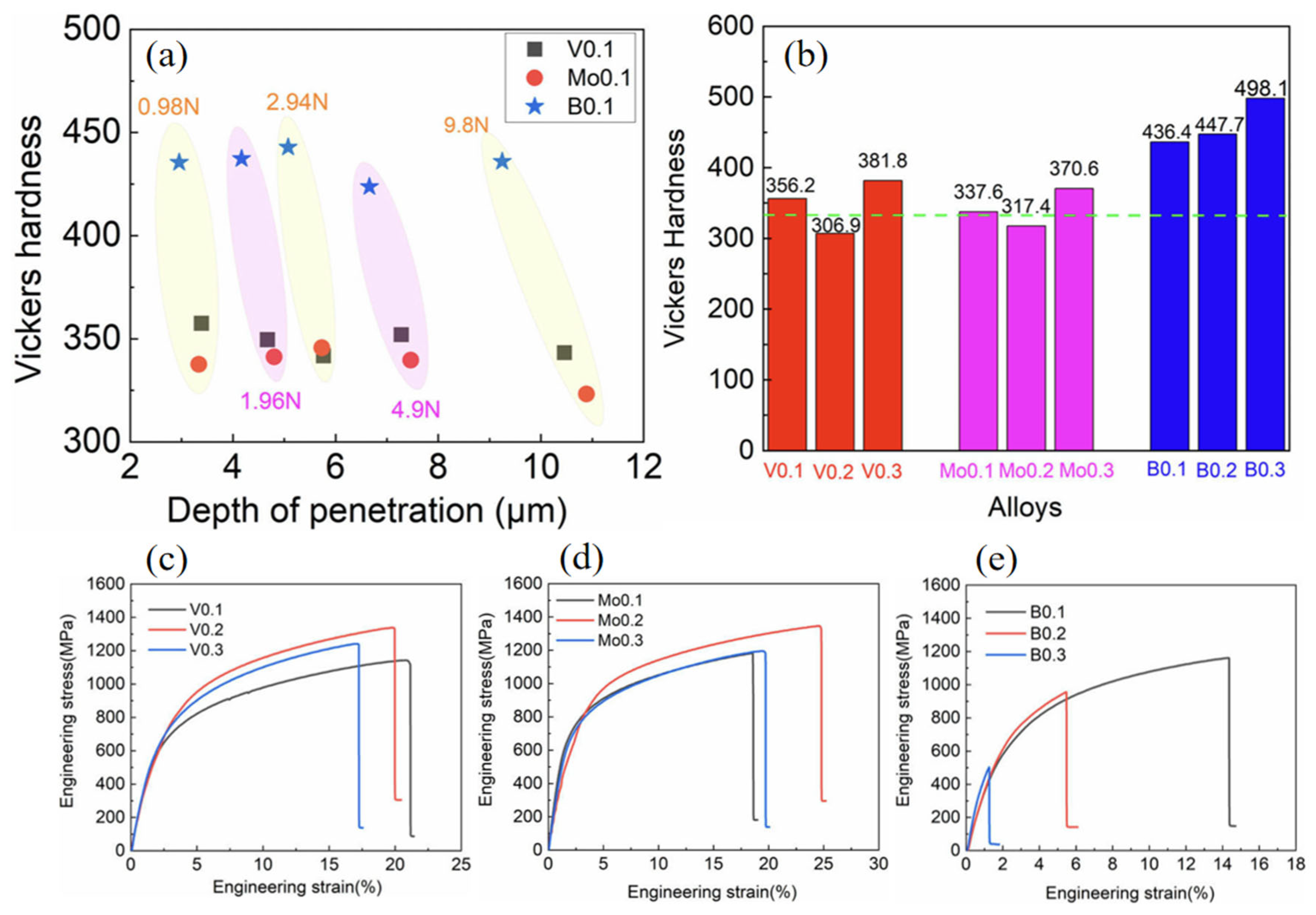
Tian et al. systematically investigated the effects of alloying elements on the microstructure and mechanical properties of HEAs [40]. They prepared as-cast alloy ingots using non-consumable electrode vacuum arc melting. When V and Mo elements are added, the hardness of the alloys first decreases and then increases, reaching a peak at an addition level of 0.3 at.%. The addition of B significantly enhances the alloy hardness, with the hardness of the alloy containing 0.3% B being 48% higher than that of the base alloy, as shown in Figure 1b. Tensile test results show that for the alloys containing V and Mo, the tensile strength first increases and then decreases with increasing V and Mo content, whereas the addition of B leads to a significant decrease in tensile strength, as shown in Figure 1c,d. In contrast, the B-series data in Figure 1e demonstrate that while B addition substantially enhances hardness (Figure 1b), it simultaneously leads to a pronounced loss in tensile strength and ductility, highlighting the classic strength–ductility trade-off associated with certain alloying elements. Among all the alloys studied, the alloy containing 0.2% Mo exhibits the best comprehensive performance, with a tensile strength of 1346.3 MPa and an elongation of 24.6%, achieving good balance between high strength and good ductility.

2.2. Vacuum Induction Melting (VIM)

Compared to arc melting, induction melting utilizes the principle of electromagnetic induction to heat metals. The induced eddy currents generated in the melt within the alternating magnetic field not only provide heat but also produce a stirring effect. Ingots prepared by this process are typically larger and more compositionally uniform, and allow for more precise control of superheat. However, because refractory crucibles are often used or casting is usually performed without forced water cooling, the cooling rate is much lower than that of arc melting, representing near-equilibrium solidification. The combined effects of the lower cooling rate and electromagnetic stirring allow more time for solute redistribution at the solidification front, resulting in a generally coarser as-cast microstructure for induction melting, often exhibiting distinct equiaxed or coarse columnar grain morphologies. Under this process, due to solidification conditions more similar to the phase diagram equilibrium, the alloy may first form a metastable BCC phase, which partially transforms to the equilibrium FCC phase during subsequent cooling. Induction melting, owing to its practicality, has shown value in preparing HEAs that possess enough plasticity.
Zhang et al. also employed arc melting when preparing Ta-alloyed AlCoCrFeNi alloys. But their microstructural analysis of the base AlCoCrFeNi alloy provides a reverse reference for understanding the microstructural evolution in induction melting. In their work, the base alloy without Ta addition exhibits a typical dual-phase BCC structure, consisting of Al-Ni-rich dendrites and Cr-Fe-rich interdendritic regions, with a room-temperature yield strength of approximately 1319 MPa and a fracture strain of 0.285 [37].
Furthermore, alloys prepared by induction melting exhibit unique microstructural evolution patterns when specific elements are added. For example, when excess Al is introduced, the alloy bypasses the FCC phase region and directly enters the BCC/B2 phase region, leading to a sharp increase in hardness but a significant decrease in plasticity. Although such studies primarily explored the strength-plasticity balance, they indirectly demonstrated that induction melting, through slow solidification, more readily leads to the formation of long-range ordered precipitates at grain boundaries, which could cause intergranular brittle fracture. This contrasts with the strengthening mechanism of dispersed intragranular nano-precipitates typical of arc melting.

2.3. Summary

In summary, the two processing routes of arc melting and induction melting have distinctly different effects on the microstructure and mechanical properties of AlCoCrFeNi-based HEAs.
From a microstructural perspective, arc melting is characterized by its exceptionally high cooling rate and strongly non-equilibrium solidification, which promote pronounced microstructural refinement and the widespread formation of a B2/BCC spinodal structure. This nano-scale coherent structure is responsible for the outstanding strength of the alloy [24]. Induction melting, conversely, involves slower cooling rates and electromagnetic stirring, leading to a coarser grain structure and phase compositions that approach equilibrium. Although this results in a moderate loss of strength, it provides favorable conditions for long-range dislocation glide, thereby preserving relatively higher ductility.
In terms of mechanical properties, the differences between the two processing routes are also very significant. Alloys prepared by arc melting typically exhibit high hardness and very high room-temperature compressive yield strength [22]; with the addition of elements such as Hf and Ta, the strength can even exceed 2000 MPa [29]. However, these alloys also exhibit significant room-temperature brittleness, with fracture typically characterized by cleavage or quasi-cleavage features. In comparison, homologous alloys prepared by induction melting generally have somewhat lower strength; under certain compositional ratios, the yield strength may only reach 200–300 MPa, but their plasticity is outstanding, with elongation exceeding 50%, reflecting typical soft and ductile characteristics.
Overall, arc melting is suitable for applications where strength and hardness are pursued, and plasticity can be finely adjusted through subsequent heat treatment. Induction melting, on the other hand, offers greater industrial advantages for preparing billets that require a certain level of plasticity, allowing subsequent cold/hot working deformation, or serving as a premelting method for precursor materials aiming for grain refinement strengthening.

3. Preparation of AlCoCrFeNi-Based HEAs via Powder Consolidation

AlCoCrFeNi-based HEAs prepared by melting routes often exhibit elemental segregation and coarse dendritic microstructures, which limit their mechanical performance. Mechanical alloying or gas atomization combined with powder consolidation techniques, such as SPS and HP, represents another important route for obtaining high-performance, fine-grained bulk materials. Unlike melting routes processes, mechanical alloying employs high-energy ball milling to forcibly achieve alloying of constituent elements in the solid state, while gas atomization directly produces pre-alloyed powders; both are subsequently densified by applying external pressure and a thermal field. This route bypasses the liquid phase, effectively avoiding elemental segregation and coarse dendrites present in cast structures, and allows for convenient introduction of second-phase particles, such as oxides and carbides, for strengthening. Table 2 summarizes the mechanical properties of AlCoCrFeNi-based HEAs prepared by powder consolidation methods. The VAM + HIP + HA route is also included among the powder consolidation methods, as HIP itself is a pressure-assisted densification technique operating through the same fundamental mechanisms as HP and SPS.

3.1. SPS

SPS is the most commonly used rapid densification technology in the powder metallurgy route. It utilizes the Joule heat and plasma effect generated by pulsed current to achieve powder sintering densification in an extremely short time. Its advantages lie in effectively suppressing grain growth and retaining the nanocrystalline or ultrafine-grained structure introduced by mechanical alloying.
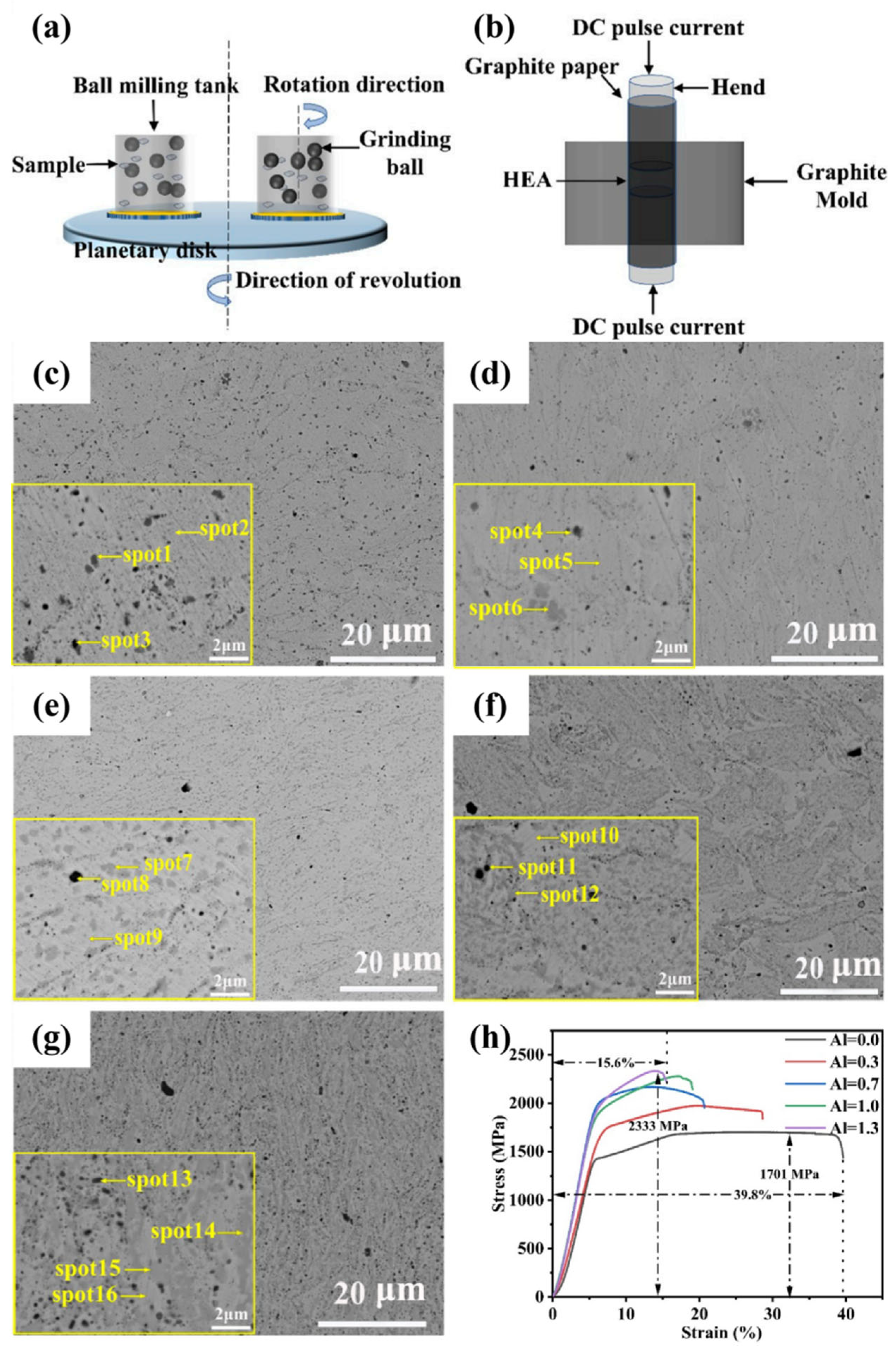
Liu et al. systematically investigates the modulating effect of Al content on the microstructure and properties of AlxCoCrFeNi2.1 HEAs using mechanical alloying combined with SPS. Their study reveals the principle that composition design induces phase transformation and ultimately governs the mechanical properties [61]. The complete process flow diagram is presented in Figure 2a,b, clearly illustrating the powder metallurgy route adopted in their research, which is fundamentally different from melting routes. Figure 2a illustrates the mechanical alloying process, showing the repeated welding, fracturing, and rewelding of powder particles during ball milling, which leads to the formation of compositionally homogeneous alloyed powders. Figure 2b depicts the spark plasma sintering process, in which pulsed current and uniaxial pressure are simultaneously applied to achieve rapid densification while suppressing grain growth. Together, these diagrams help readers visualize the key processing steps and their sequence. The SEM images in Figure 2c–g visually reveal the evolution of the microstructure with Al content: when x = 0 and 0.3, the alloys exhibit a compositionally homogeneous single-phase microstructure; when x ≥ 0.7, a distinct second phase begins to appear in the microstructure, and its volume fraction increases significantly with increasing Al content. Combined with X-ray diffraction and energy-dispersive spectroscopy analyses presented in the paper, this second phase is identified as an Al-Ni-rich ordered BCC phase, while the matrix is an Fe-Co-Cr-rich FCC phase. This Al-content-dominated evolution of phase constitution directly determines the mechanical response of the material. As shown by the compressive stress–strain curves in Figure 2h, with increasing Al content, the compressive yield strength and fracture strength of the alloys increase monotonically, while the fracture strain decreases substantially. Through systematic experiments, this work provides a definitive composition–microstructure–property relationship diagram for balancing the strength and ductility of HEAs by tailoring the Al content.
Xie et al. systematically investigated the effect of the SPS heating rate on the microstructure and properties of AlCoCrFeNi. They find that a high heating rate improves densification but leads to grain coarsening, thereby reducing hardness and wear resistance. The optimal comprehensive mechanical properties could be obtained at a heating rate of 150 °C/min [54].
The study by Zhang et al. also confirms that sintering temperature significantly affects the properties of the AlCoCrFeNi2.1 alloy, with the best combination of strength and hardness achieved under sintering at 1000 °C [58].
Fu et al. prepared an ultrafine-grained AlCoCrFeNi2.1 alloy with an average grain size of less than 1 μm by optimizing the MA + SPS process. The compressive fracture strength and hardness of this alloy far exceed those of conventional cast alloys. The excellent properties are mainly attributed to grain refinement strengthening and the synergistic effect of the BCC/FCC dual-phase structure [59].
Guo et al. used gas-atomized pre-alloyed powders combined with SPS to prepare (AlCoCrFeNi)100−xFex. They find that with increasing Fe content, the volume fraction of the FCC phase increases and the nano-precipitates within the BCC phase are refined, achieving a good match between strength and plasticity [55].

3.2. HP and VHP

Unlike the rapid heating of SPS, HP and VHP are characterized by slow heating rates and long holding times, which are closer to equilibrium sintering. This facilitates full elemental diffusion and phase transformation, but also leads to a greater tendency for grain growth. It is worth noting that HP and VHP differ primarily in their sintering atmosphere—HP is typically performed in an inert gas while VHP is conducted under vacuum—which can influence densification, oxidation, and phase evolution. A detailed discussion of atmosphere effects is beyond the scope of this review.
Bochenek et al. compared AlCoCrFeNi and an alloy with 1% (at%) Re addition. They found that the BCC + FCC dual-phase structure present in the mechanically alloyed powder is retained after hot pressing at 1050 °C, while M23C6-type carbides enriched in Cr and Fe precipitate in the matrix. The addition of Re significantly refines the FCC phase and, through solid solution strengthening and grain boundary pinning, triples the room-temperature flexural strength. Moreover, after long-term annealing at 800 °C, the microstructure and mechanical properties show no significant degradation, demonstrating excellent high-temperature microstructural stability [53].
Rao et al. added 1 wt% Y2O3 to AlCoCrFeNi and performed vacuum hot pressing. They found that the metastable AlFe4O12Y3 phase induced by mechanical alloying thermally decomposes during sintering at 1000 °C, transforming into more thermodynamically stable Y-Al8Cr4-type intermetallic compounds and chromium oxides. This phase transformation leads to a significant increase in the Vickers hardness of the material to 1353 HV [57].

3.3. Summary

Powder consolidation technology provides a highly flexible and effective route for preparing high-performance AlCoCrFeNi-based HEAs. Its core advantage lies in obtaining ultrafine-grained or even nanocrystalline microstructures that are difficult to achieve by conventional processes. It also allows for tailoring mechanical properties of the alloys over a wide range by adjusting phase composition and introducing dispersion strengthening phases. However, this technological route still faces some challenges, such as contamination during the MA process, which may lead to the formation of harmful brittle phases. The batch-to-batch stability of powders and the uniformity of the consolidation process still require further optimization, and the high cost and low efficiency associated with long-duration ball milling are obstacles to its large-scale industrial application. Future research should focus on developing more efficient and low-contamination MA processes, as well as optimizing consolidation and subsequent treatment regimes, to achieve a better balance among strength, plasticity and cost.

4. Preparation of AlCoCrFeNi-Based HEAs via Additive Manufacturing

Additive manufacturing (AM) technology, with its unique characteristics of layer-by-layer deposition, rapid melting and solidification by high-energy beams, has opened new avenues for fabrication of high-performance metallic structural components. Unlike traditional casting methods designed for mass production, AM requires no molds, offers a simplified process flow, and achieves high forming efficiency, demonstrating greater flexibility in material selection and process adaptability. It is particularly suitable for the customized fabrication of complex structural parts.
AM methods are mainly classified into powder bed fusion (PBF) and directed energy deposition (DED). PBF involves spreading metal powder layer by layer, selectively melting the powder using a high-energy beam according to cross-sectional contours, and building up components layer by layer. Its advantages include high forming precision, good surface quality, and the capability to fabricate highly complex internal structures [62]. DED, on the other hand, utilizes a heat source and a material delivery nozzle moving synchronously, feeding material directly into a melt pool for in-situ melting and achieving layer-by-layer deposition. It offers virtually unlimited build size and high deposition efficiency, and is suitable for part repair and gradient material fabrication, but has relatively lower forming precision, often requiring subsequent machining.
The AM methods employed for preparing HEAs mainly include selective laser melting (SLM), laser metal deposition (LMD), electron beam melting (EBM), and wire arc additive manufacturing (WAAM). These processes use high-energy beams such as lasers or electron beams as heat sources to locally melt metal powders or wires through path scanning. Their core characteristics include extremely high cooling rates and complex thermal cycling processes, leading to finer grain structures, higher dislocation densities, and metastable supersaturated solid solutions compared to conventional methods and, thereby, significantly influencing the mechanical properties of the material [63,64]. Table 3 summarizes the mechanical properties of AlCoCrFeNi-based HEAs fabricated by AM.

4.1. PBF

In PBF technology, a doctor blade or roller uniformly spreads metal powder onto the surface of a substrate. A high-energy beam then selectively melts the powder layer according to a preset two-dimensional cross-sectional contour. After the current layer solidifies, the build platform descends by one layer thickness, and the powder spreading and melting processes are repeated until the part is completed. This technology features a small melt pool and an extremely high cooling rate, offering high forming precision, good surface quality, and the ability to fabricate highly complex internal structures.

4.1.1. SLM

SLM uses a high-power fiber laser as the heat source to selectively melt a pre-laid metal powder bed under an inert gas atmosphere. Its typical parameters include laser power, scanning speed, hatch spacing, and powder layer thickness. The extremely high cooling rate induces significant constitutional undercooling and non-equilibrium solidification within the melt pool, resulting in ultrafine grains, high-density dislocation cellular structures, supersaturated solid solutions and a preferred texture along the heat flow direction. These microstructural features impart excellent grain refinement strengthening and dislocation strengthening effects to the as-deposited alloy. However, high residual stresses may also cause a tendency for cracking, which needs to be controlled through process parameter optimization or subsequent heat treatment.
For AlxCoCrFeNi-based HEAs fabricated by the SLM process, the phase composition is closely related to the Al content and the cooling rate. When x is less than 0.3, the alloy tends to form a single-phase FCC solid solution [72]; when x exceeds 0.5, it exhibits an FCC + BCC dual-phase structure, with the proportion of the BCC/B2 phase increasing with higher Al content. The extremely high cooling rate leads to significant grain refinement, with as-deposited samples generally exhibiting ultrafine grains or nano-eutectic lamellae, which are much finer than those in conventional cast microstructures. The strength of SLM as-deposited alloys is generally much higher than that of cast alloys with the same composition, primarily due to the synergistic effects of high dislocation density, fine grain/substructure strengthening, and nano-precipitates. Subsequent heat treatment can further tailor the microstructure and properties of SLM-fabricated HEAs to achieve balance between strength and plasticity. Furthermore, advanced methods, such as machine learning, have been introduced to optimize SLM process parameters and alloy design and to predict and optimize the strength and plasticity of laser-cladded HEA coatings.
Sun et al. fabricated Al0.5CoCrFeNi HEA using SLM [72]. The study indicated that by optimizing process parameters, dense samples with a relative density as high as 99.92% can be obtained, exhibiting an FCC/BCC dual-phase dendritic microstructure and good mechanical properties.
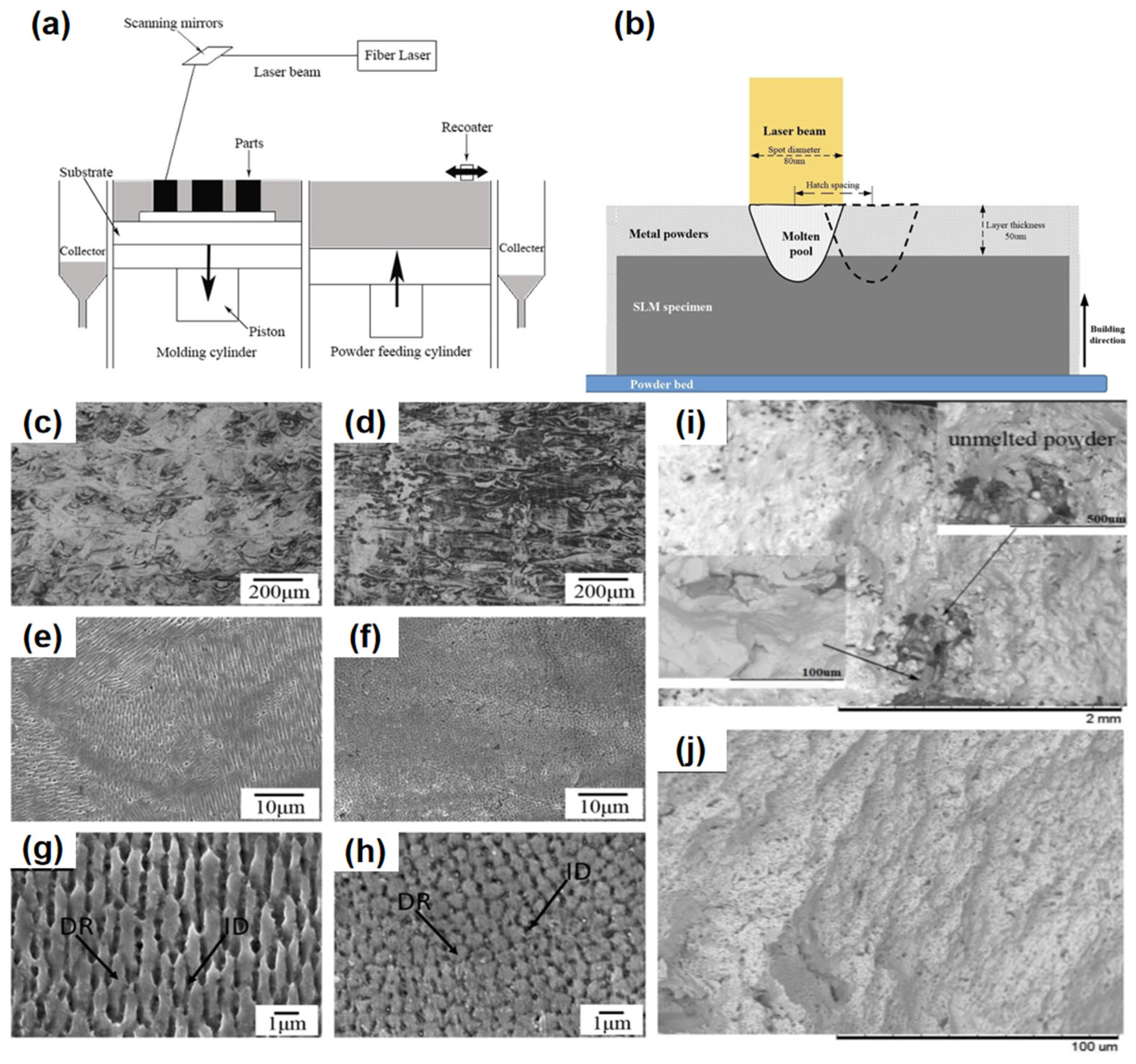
To provide a clear visualization of the SLM process, Figure 3 includes two schematic diagrams. Figure 3a schematically illustrates the SLM apparatus, showing the powder bed, laser scanning system, and build platform; Figure 3b depicts the laser-material interaction and the formation of the melt pool during processing. These schematics help readers understand the key features of the SLM process and its rapid solidification characteristics, which are responsible for the fine microstructures presented in the subsequent experimental observations.
Microstructural analyses of the obtained samples reveal that the vertical cross-sections shown in Figure 3c,e,g display columnar grains grown epitaxially along the heat flow direction, while the horizontal cross-sections shown in Figure 3d,f,h clearly reveal a fine cellular dendritic structure. This fine-grained microstructure, resulting from rapid solidification during SLM, directly confirms and visualizes the core microstructural mechanism responsible for the significant strengthening of the material as reported in the literature.
Fracture surface analyses of the tensile tested specimens show the mixed dimple and quasi-cleavage fracture morphology presented in Figure 3i,j, indicating that the material possesses both high strength and certain ductility.
Ge Yaqiong et al. investigated the microstructure evolution of SLM-fabricated Al0.5CoCrFeNi alloy in the as-deposited state and after annealing at 800–1100 °C [71]. The as-deposited state exhibits an FCC matrix with a BCC/B2 dual-phase structure, with clear melt pool boundaries within the columnar grains. Upon heating to 1100 °C, the melt pool boundaries fade, the columnar grains become equiaxed, and the B2 phase precipitates and grows, forming a multi-scale microstructure characterized by equiaxed grains, annealing twins, and coexisting nano-sized B2 phases. The high strength of the as-deposited state is attributed to high dislocation density and fine grain size. High-temperature annealing leads to stress relief, recrystallization, and precipitate coarsening, resulting in a recovery of plasticity while retaining some strength, achieving a better strength-plasticity match than conventional cast and wrought states.
For the AlCoCrFeNi2.1 eutectic alloy, after aging at 600 °C for 8 h, the yield strength increases from 1388 MPa to 1723 MPa, which is attributed to the significant strengthening effect from the high-density nano-twinned FCC phase precipitates within the B2 matrix. Furthermore, Lan et al. performed heat treatment at 800–1200 °C on an AlCoCrFeNi2.1 eutectic HEA prepared by SLM [65]. They found that with increasing temperature, the BCC phase transforms to the FCC phase, the melt pool features disappear, and the eutectic lamellar structure grows stably. At 1200 °C, a good match of strength and plasticity could be achieved.
Zhu et al. conducted aging treatment at 600 °C on an SLM-fabricated AlCoCrFeNi2.1 eutectic HEA [78]. The as-deposited microstructure consists of a non-equilibrium dual-phase structure of B2 and FCC, exhibiting nano-lamellar and cellular eutectic morphologies. After aging, an FCC acicular phase containing an ultra-high density of nano-twin precipitates within the B2 matrix is formed. The as-deposited alloy has a yield strength of 1388 MPa, a tensile strength of 1731 MPa, and an elongation of approximately 3.9%. The aged state shows a yield strength of 1723 MPa and a tensile strength of 2153 MPa, showing an increase of about 24% in strength. The Orowan mechanism contributes approximately 565 MPa of strengthening increment. The non-equilibrium microstructure and internal stresses in the as-deposited state prompt the transformation from an HCP precursor phase to the nano-twinned FCC phase. The strong obstruction of dislocations by the ultrafine twin lamellae dominates the sharp increase in strength.

4.1.2. EBM

EBM uses a high-energy electron beam instead of a laser as heat source to selectively melt a pre-laid metal powder bed in a vacuum environment. The electron beam scanning speed is extremely high, and a preheating system can maintain the powder bed at an elevated temperature, thereby significantly reducing residual stresses in as-deposited parts and suppressing cracking tendency. Compared with SLM, EBM has a slightly lower cooling rate, resulting in somewhat coarser grains. Its vacuum environment also effectively prevents oxidation contamination of alloying elements at high temperatures.
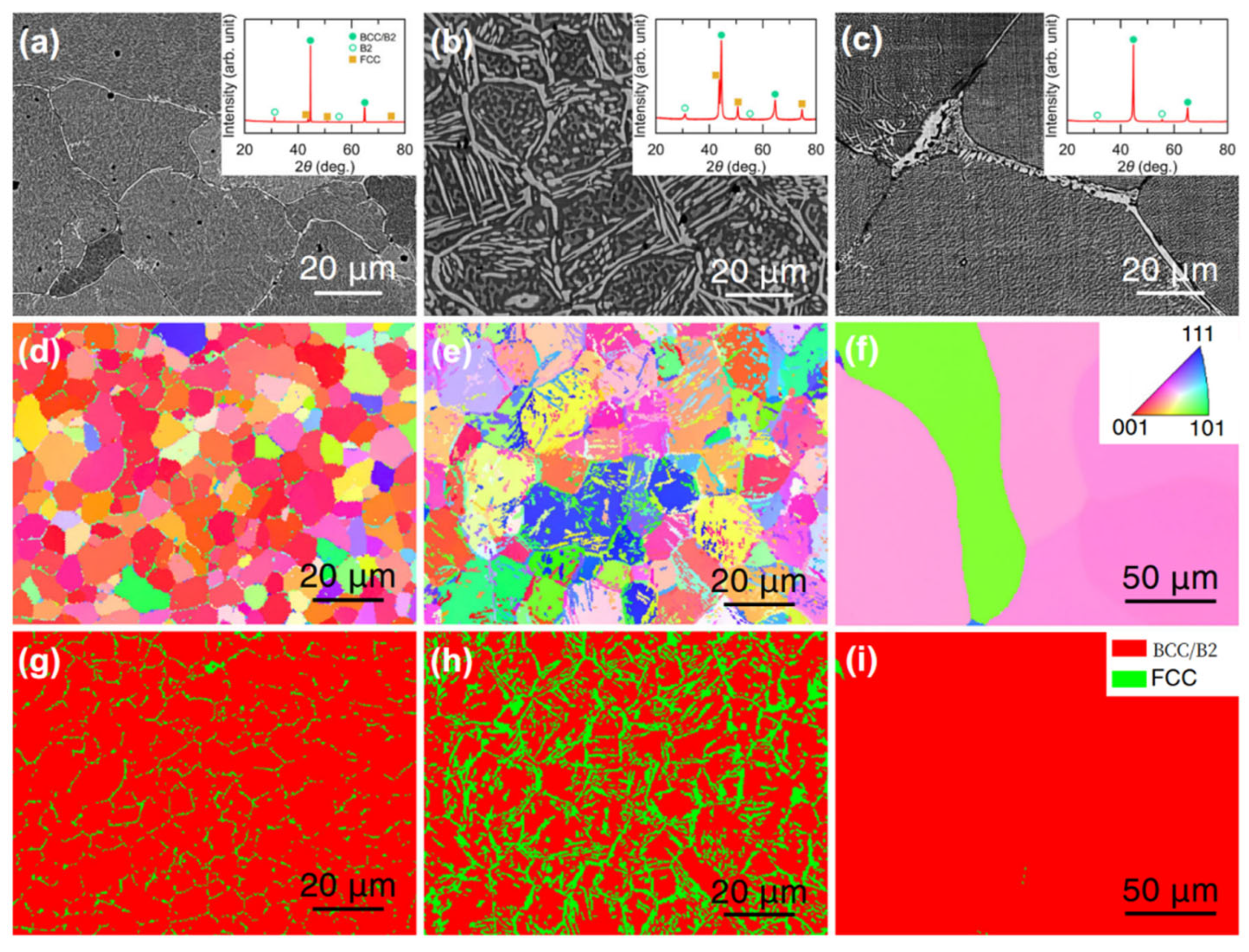
Yamanaka et al. systematically investigated the corrosion behavior and passive film characteristics of an equiatomic AlCoCrFeNi HEA fabricated by EBM [84]. First, they prepared EBM-fabricated specimens and conventionally cast reference specimens, and characterized the microstructures in detail using various methods. The microstructures of the top and bottom parts of the EBM-fabricated specimens, as well as the cast AlCoCrFeNi HEA, were compared. The backscattered electron images in Figure 4a–c show that all specimens exhibit a modulated structure consisting of BCC and B2 phases. The modulated structure in the EBM top specimen is the finest, while that in the EBM bottom specimen is significantly coarser. At the same time, the cast specimen exhibits an intermediate coarseness. The phase maps in Figure 4g–i further reveal differences in the distribution of the FCC phase. The FCC phase is almost absent in the EBM top and cast specimens, whereas a substantial amount of FCC phase (volume fraction of approximately 30%) precipitates at the BCC/B2 grain boundaries in the EBM bottom specimen, appearing as brighter contrast. Overall, the effect of “in-situ annealing” during the EBM process on the microstructure is clearly demonstrated. The bottom region, having experienced prolonged high-temperature exposure, exhibited coarsening of the modulated structure, weakened texture, and promoted FCC phase precipitation. These microstructural differences provide an important basis for subsequently understanding the variations in corrosion performance across different regions.
Hiroshi Shiratori et al. performed in-situ preheating treatment at 950 °C on an equimolar AlCoCrFeNi HEA fabricated by EBM [64]. The as-deposited top region exhibits a non-equilibrium B2/BCC nano-lamellar dual-phase structure, while the bottom region, due to prolonged high-temperature exposure, showed FCC soft phase precipitation at grain boundaries. The hardness of the as-deposited top region is approximately 500 HV, while that of the bottom region decreases to approximately 400 HV. The as-deposited alloy has a compressive yield strength of 1015 MPa, a compressive strength of 1668 MPa, and a fracture strain as high as 0.264, representing an approximately fourfold increase in plasticity compared with the cast state. The precipitation of the FCC phase at grain boundaries plays a dominant role in the plasticity improvement. The synergistic deformation of the ultrafine grains obtained by non-equilibrium solidification in the as-deposited state and the soft FCC phase induced by high-temperature preheating compensates for the brittleness arising from insufficient slip systems in the ordered B2 phase, resulting in optimization of strength and plasticity. Further electrochemical corrosion studies show that the SEBM-fabricated AlCoCrFeNi HEA exhibits pitting corrosion behavior in artificial seawater, different from that of the cast state, with a slightly lower pitting potential than the cast state, which is attributed to the unique phase morphology and elemental distribution resulting from the SEBM process.

4.2. DED

DED technology delivers metal powder or wire directly into a melt pool formed by a high-energy beam (laser, electron beam, or arc) through a nozzle. The melt pool moves with the heat source, and parts are built up layer by layer. This technology has a slightly lower cooling rate than PBF but offers high deposition efficiency, the capability to form large-scale components, and the flexibility to achieve compositional gradients within a single part, making it suitable for gradient material fabrication and part repair.

4.2.1. LMD

LMD uses a high-energy laser beam to form a melt pool on a substrate while simultaneously delivering metal powder directly into the melt pool through coaxial or lateral nozzles for in-situ melting. Layer-by-layer deposition is achieved by moving the stage or the nozzle. Key parameters affecting the forming quality and microstructure include laser power, scanning speed, powder feed rate, and layer thickness. The as-deposited microstructure of this technology typically exhibits epitaxially grown columnar grains, with a columnar-to-equiaxed transition occurring as the heat flow direction changes. In AlCoCrFeNi-based HEAs prepared by LMD, increasing Al content promotes a transition from FCC to FCC + BCC dual-phase and even to single-phase BCC, accompanied by a significant increase in hardness and strength. Additionally, Al plays a critical role in oxidation resistance in laser-clad coatings; a sufficiently high Al content allows the formation of a dense Al2O3 protective film at high temperatures, greatly enhancing high-temperature oxidation resistance [81].
The microstructure exhibits a clear gradient evolution. Along the deposition direction, due to heat accumulation, the temperature gradient decreases while the solidification rate increases, often leading to a transition from columnar grains at the bottom to equiaxed grains at the top. By varying the Al content or process parameters, effective control over the phase composition can be achieved. Similar to SLM, LMD technology can also significantly refine the eutectic microstructure. Subsequent heat treatment is an effective means of optimizing the overall performance of LMD-fabricated alloys. Studies have shown that heat treatment of LMD-fabricated AlCoCrFeNi HEAs at 500–1100 °C can regulate the precipitation and dissolution of σ and L12 phases within the B2 matrix, thereby optimizing their corrosion resistance in different corrosive media.
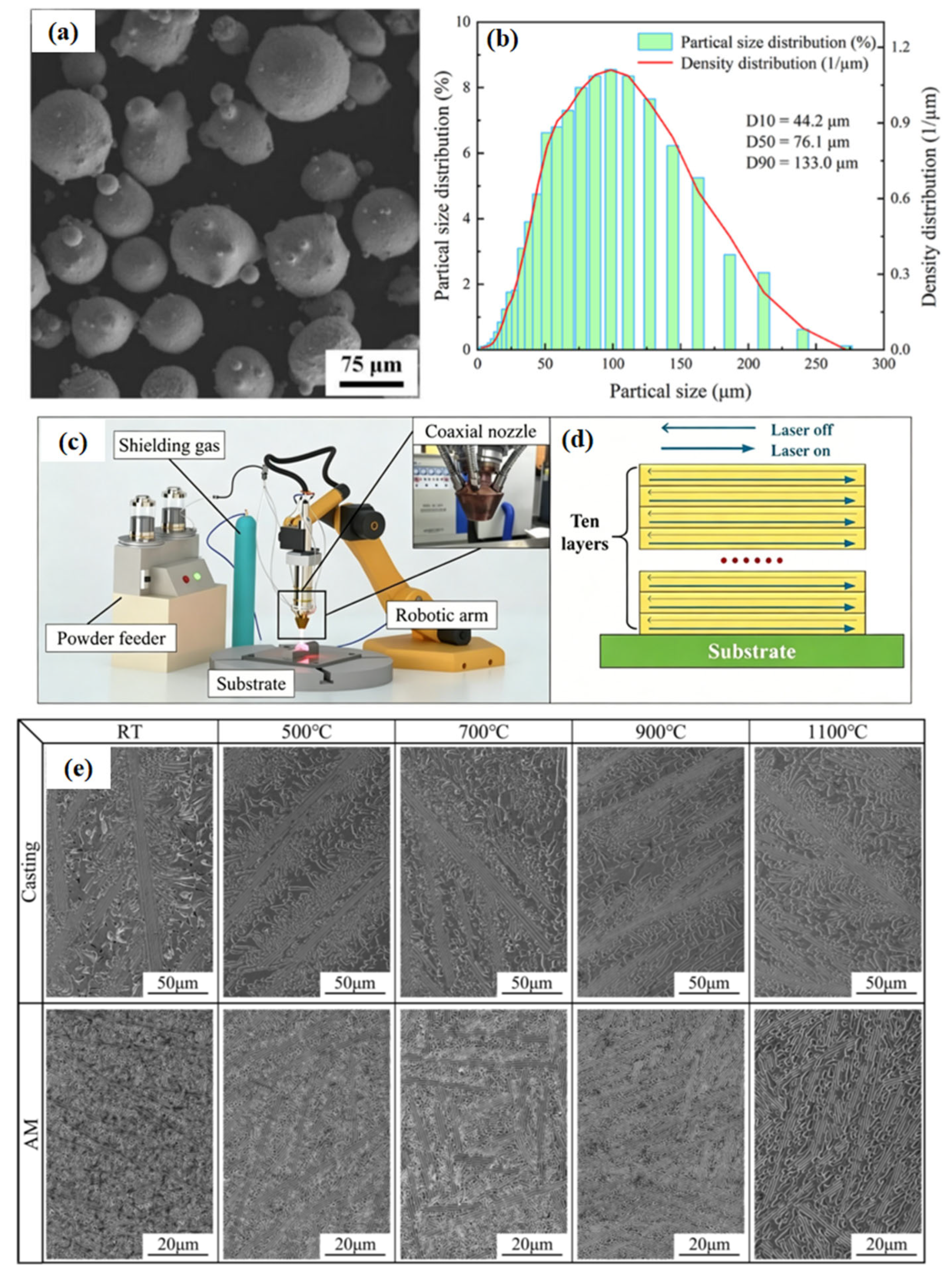
The pre-alloyed Al0.5FeCoCrNi HEA powder is spherical with a particle size distribution of 45–150 μm, as shown in Figure 5a,b. Figure 5c,d illustrate the LMD setup and the unidirectional scanning strategy, where the laser acts perpendicularly on the melt pool, creating the maximum temperature gradient along the deposition direction, thereby inducing preferred growth of columnar grains [85].
Zhang et al. conducted a systematic study on an AlCoCrFeNi2.1 eutectic HEA prepared by LMD. The pre-alloyed Al0.5FeCoCrNi HEA powder is spherical with a particle size distribution of 45–150 μm, as shown in Figure 5a,b. Figure 5c,d illustrate the LMD setup and the unidirectional scanning strategy, where the laser acts perpendicularly on the melt pool, creating the maximum temperature gradient along the deposition direction, thereby inducing preferred growth of columnar grains [85]. The scanning electron microscope image shown in Figure 5e reveals significant metallographic changes. The as-deposited sample exhibits a fine lamellar eutectic microstructure consisting of alternating FCC and BCC phases, with interlamellar spacing much smaller than that of the cast sample (FCC lamellae width approximately 0.62 μm, BCC lamellae width approximately 0.19 μm), attributable to the high nucleation rate and high temperature gradient induced by rapid solidification. As the heat treatment temperature increases, the metallographic morphology evolves systematically. After heat treatment at or below 700 °C, the lamellar eutectic morphology remains intact, accompanied only by stress relief. When the temperature is raised to 900 °C, recrystallized grains increase noticeably in both phases, but the lamellar structure remain unchanged. However, after high-temperature heat treatment at 1100 °C, the lamellar eutectic structure is significantly fragmented, the phase structure coarsens (FCC lamellae increase to 0.74 μm, BCC lamellae increase to 0.36 μm), and the microstructure transforms from regular lamellae to an irregular fragmented mixed structure [86].
Liang et al. fabricated an AlCoCrFeNi2.1 eutectic high-entropy alloy (EHEA) using LMD and compared it with the cast alloy [66]. The as-deposited alloy retains a lamellar eutectic microstructure consisting of L12 and B2 phases, forming a characteristic herringbone structure growing along the deposition direction. Mechanical testing shows that the as-deposited alloy exhibits a tensile strength of approximately 1097 MPa and an elongation of 22% in the direction perpendicular to deposition, and approximately 996 MPa with 14% elongation in the horizontal direction. In contrast, the cast alloy shows a tensile strength of only about 980 MPa with an elongation of about 14%. The improved performance is attributed to the obstruction of crack propagation by the oriented herringbone structure: under perpendicular loading, plastic deformation of the L12 phase suppresses crack initiation in the B2 phase, and cracks need to bypass the lamellae to propagate; under horizontal loading, fracture occurs mainly in the junction regions of the herringbone structure. This confirms that LMD technology can effectively improve the formability of EHEAs and significantly enhance their mechanical properties.
Huang et al. fabricated an AlCoCrFeNi2.1 EHEA. The as-deposited microstructure consists of an FCC/B2 dual-phase lamellar eutectic with an interlamellar spacing of approximately 1 μm, which is significantly finer than the 3.5 μm of the cast structure [67]. Mechanical testing shows that the tensile strength of the as-deposited alloy is approximately 19.7% higher than that of the cast alloy, and the elongation approximately 56.4% higher. The performance improvement is mainly attributed to the enhanced back stress hardening capability due to the fine and uniform eutectic structure, as well as the combined strengthening from the FCC/B2 semi-coherent interfaces and nano-precipitates within the B2 phase. This study revealed that using the rapid solidification characteristics of LMD to refine the eutectic microstructure can significantly increase strength without sacrificing plasticity, providing experimental evidence and theoretical reference for optimizing the overall mechanical properties of EHEAs through additive manufacturing.
Amar et al. successfully obtained an ultrafine lamellar eutectic microstructure oriented along the deposition direction in an AlCoCrFeNi2.1 EHEA by adjusting the LMD process parameters. The FCC lamella width is approximately 0.89 μm and the B2 lamella width approximately 0.76 μm, significantly finer than the cast microstructure [63]. When tensile testing is performed along the deposition direction, the yield strength reaches 1115 MPa, the tensile strength 1417 MPa, and the elongation 23%. The overall mechanical properties are superior to most additively manufactured alloys and comparable to the best properties achieved by thermomechanical processing. The performance improvement is mainly attributed to two factors: the strong heterogeneous deformation-induced strengthening arising from the ultrafine alternating soft/hard lamellar structure, and the high crack buffering effect during deformation due to the oriented lamellar microstructure, which prevents catastrophic crack propagation. This study provides a new pathway for designing oriented eutectic lamellar structures via additive manufacturing to achieve high-strength, high-plasticity metal components with complex shapes.

4.2.2. WAAM

WAAM uses an electric arc as the heat source to melt metal wire, depositing material layer by layer along a predefined path. This technology features high deposition rates, low equipment cost, and high material utilization, making it particularly suitable for the rapid fabrication of large-scale structural components. It has relatively high heat input and a slower cooling rate, with microstructures featured by coarse columnar grains [69]. However, microstructure optimization can be achieved through process parameter control or the design of composite wires.
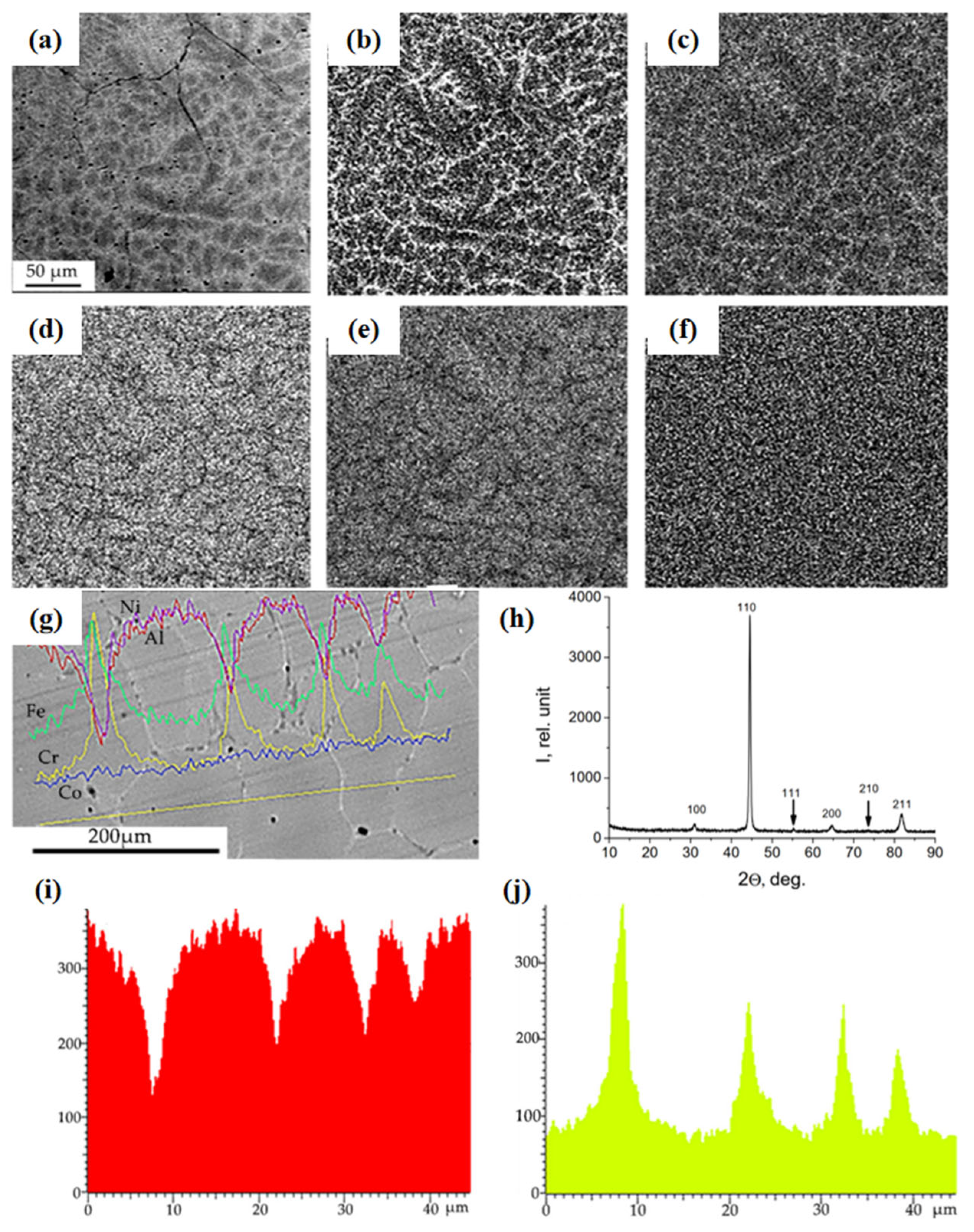
Ivanov et al. [87] investigated a non-equimolar AlCrFeCoNi HEA fabricated by WAAM. Boron and chromium thin films, each of 0.5 μm thick, are sequentially deposited onto the alloy surface to form a “B + Cr/HEA” film-substrate system, followed by pulsed electron beam irradiation in an argon atmosphere. During WAAM, an argon atmosphere is essential to protect the melt pool from oxidation and nitridation, particularly for reactive elements such as Al and Cr, and to stabilize the electric arc for consistent deposition. The WAAM-fabricated HEA exhibits a typical dendritic microstructure, consisting of a polycrystalline aggregate with an average grain size of approximately 12.3 μm, as shown in Figure 6a. Elemental mapping analyses reveal that Cr and Fe atoms are predominantly enriched at grain boundaries and interdendritic regions, while Al, Ni, and Co segregate within the grain interiors, as shown in Figure 6b–f. Line-scanning results further confirm this distribution pattern: along the selected direction, the characteristic X-ray intensity of Al peaks inside the grains, whereas that of Cr reaches a maximum at the grain boundaries, indicating that the intragranular phase is AlNi-based and the grain boundary phase is FeCr-based, as shown in Figure 6g,i,j. Despite the compositional segregation and phase separation, X-ray diffraction analyses show that the overall alloy possesses a simple cubic crystal structure without complex intermetallic compound diffraction peaks, with a lattice constant of 0.28795 nm, as shown in Figure 6h. This indicates that the initial alloy retains crystallographic simplicity, providing a reference baseline for the structural evolution in the subsequent surface modification treatment.
A significant advantage of WAAM technology lies in its flexible material feeding methods. By designing composite cables or using dual-wire feeding, in-situ alloying and composition gradient control can be achieved, allowing a gradual change in microstructure and properties along the deposition direction. However, due to the relatively high heat input of WAAM, the as-deposited grains are relatively coarse, and the tensile ductility is generally lower than that of PBF and DED processes. How to further refine the grains and improve ductility is a key challenge for the future development of this technology.
Furthermore, high-energy electron beam surface treatment of WAAM-fabricated AlCoCrFeNi HEAs can further induce amorphization/nanocrystallization of the surface layer, effectively improving its hardness and wear resistance.
Lu et al. for the first time used dual-wire arc additive manufacturing to prepare compositionally graded Alx-Co-Cr-Fe-Ni HEAs with gradually increasing Al content along the deposition direction in situ [63]. As the Al content increases from the bottom (21.11 at.%) to the top (35.16 at.%), the microstructure gradually transforms from FCC + BCC dual-phase to single-phase BCC, the precipitation temperature of the B2 phase increases significantly, and the temperature window for BCC phase precipitation widens. The mechanical properties show a gradient change: the bottom alloy exhibits a yield strength of 827.4 MPa, a fracture strength of 2720.8 MPa, an elongation of 42.3%, and a hardness of 342 HV; the top alloy exhibits a yield strength of 955.5 MPa, a fracture strength of 1712.0 MPa, an elongation of 17.1%, and a hardness of 397 HV, with significantly better wear resistance than the bottom. The high dislocation density and fine-grain strengthening in the bottom region contribute to a good combination of strength and toughness, while Cr segregation at grain boundaries in the top region leads to grain boundary embrittlement and reduces ductility. This study demonstrates the feasibility and unique advantages of dual-wire arc additive manufacturing for the efficient and low-cost fabrication of compositionally complex graded HEAs.
Ahsan et al. systematically investigated the effect of GTA-based WAAM process parameters on the formability, microstructure, and mechanical properties of an Al0.1CoCrFeNi HEA [69]. Through single-bead weld orthogonal experiments, they found that the energy density is a key factor determining bead continuity, with a threshold of approximately 80 J/mm3; below this value, the bead is discontinuous or exhibits balling. Based on this, thin-wall structures are fabricated under the same energy density but with different heat inputs. Under both process conditions, the as-deposited microstructures exhibit large columnar grains growing along the deposition direction, with a cellular dendritic substructure, homogeneous composition, and no macroscopic segregation. Mechanical tests show a yield strength of approximately 260 MPa, a tensile strength of approximately 420 MPa, and an elongation as high as 45–55%. The overall performance is superior to that of the conventional cast state and most other additive manufacturing processes. Compared to low heat input, high heat input provides not only higher deposition efficiency and better surface quality but also slightly higher ductility, and is identified as the near-optimal process parameter. This study defines the process window for GTA-WAAM of pre-alloyed wire for Al0.1CoCrFeNi, confirming that by adjusting the heat input, strength comparable to casting can be achieved while maintaining excellent ductility, providing experimental evidence for the low-cost, high-efficiency additive manufacturing of HEAs.
Shen et al. used a combined cable wire (CCW) as the feedstock to fabricate a non-equiatomic AlCoCrFeNi HEA by WAAM for the first time [80]. As the travel speed increases, the heat input decreases, the grains are refined, and the BCC phase content increases. The as-deposited microstructure consists of BCC and FCC phases, with the BCC phase enriched in Al-Ni and the FCC phase enriched in Fe-Cr. The best mechanical properties are achieved at a travel speed of 12 mm/s, with a yield strength of approximately 816 MPa, a compressive strength of approximately 2835 MPa, and a compressive plasticity of approximately 41.8%, amounting to increases of 4.1% and 11.7% in compressive strength and plasticity, respectively, compared to the cast sample. This study confirms the feasibility of the CCW-AAM technology for preparing HEAs, and that the fine-grained microstructure resulting from rapid solidification effectively improves the strength-plasticity matching. Subsequent heat treatment can further tailor the microstructure and mechanical properties of this alloy; for example, aging in the range of 600–1000 °C can control the precipitation and dissolution of L12 and σ phases in the B2 matrix, thereby achieving an optimized combination of strength and ductility.

4.3. Summary

Different AM processes impose markedly different heat inputs and cooling rates during fabrication of AlCoCrFeNi-based HEAs. WAAM and its derivatives offer high deposition efficiency and low cost, suitable for large-scale components. Shen et al. and Yao et al. confirmed feasibility, but WAAM heat accumulation leads to gradient changes in phase fraction and hardness along the deposition direction. In contrast, PBF and DED feature extremely high cooling rates, which promote grain refinement and introduce high dislocation densities, thereby significantly enhancing strength [62,72,76]. This strengthening effect has been observed in the work of Sui et al. and Niu et al., but the thermal stresses induced by the high cooling rates also lead to a tendency for cracking, particularly in BCC-phase alloys with high Al content [70,76]. Tu et al. reported that DED-fabricated Al0.5CoCrFeNi exhibits a microstructural gradient along the deposition direction (cellular grains at the bottom, columnar in the middle, equiaxed at the top) due to cooling rate variations [73].
AM-fabricated alloys display much finer grains than conventional cast counterparts. Al content remains the primary phase-structure determinant, but AM parameters can shift the structure away from equilibrium. For example, Niu et al. found that Al0.5CoCrFeNi exhibits a single FCC phase under the extremely high cooling rate of LPBF, whereas Tu et al. observed an FCC + small amount of BCC dual-phase structure in DED [76,83]. In all processes, grains show epitaxial columnar growth along the maximum heat-flow direction, with a columnar-to-equiaxed transition at the melt pool top. Sui et al. clearly reported this phenomenon in the DED process [78]. These grain-morphology and phase differences form the microstructural basis for property control.
AM-fabricated alloys generally show superior strength over cast alloys, mainly from fine-grain strengthening and dislocation strengthening. For instance, the CCW-AAM sample prepared by Shen et al. exhibits a compressive fracture strength of approximately 2835 MPa while maintaining relatively high ductility [80]. Property differences are largely dictated by phase composition and precipitation behavior. The heat treatment study by Shen et al. further reveals that by adjusting the aging temperature, the precipitation and dissolution of L12 and σ phases within the B2 matrix can be controlled, thereby achieving synergistic optimization of strength and ductility [82]. This demonstrates that harnessing AM-specific microstructures with appropriate post-treatment effectively tailors the mechanical properties of AlCoCrFeNi-based HEAs.
In summary, differing AM heat inputs and cooling conditions lead to substantial variations in phase composition, grain morphology, defect characteristics, and mechanical properties. Selecting the right AM technology combined with an optimized post-heat treatment is key to producing high-quality AlCoCrFeNi-based HEAs.

5. Summary and Outlook

5.1. Summary

In summary, the mechanical behavior and practical applicability of AlCoCrFeNi-based HEAs are inextricably linked to the chosen manufacturing paradigm, as each route imposes a distinct thermal and kinetic footprint that shapes the final dual-phase microstructure and defect population. The following four processing categories encapsulate the principal structure–property outcomes and the inherent engineering trade-offs that must be navigated for targeted service conditions.
Arc melting generates a nano-scale B2/BCC spinodal decomposition structure that contributes to exceptionally high hardness [88], rendering this route viable for wear-resistant tooling and cutting applications. However, the rapid non-equilibrium solidification induces significant compositional segregation and thermal residual stresses, which substantially deplete the ductility reserve and compromise impact toughness and fatigue resistance under alternating or cyclic loading conditions [89].
Induction melting, governed by a relatively low cooling rate and enhanced by electromagnetic stirring, approaches near-equilibrium solidification conditions. This regime inherently alleviates elemental segregation and thermal stress accumulation, thereby trading a moderate reduction in strength for a marked improvement in tensile ductility and workability [90]. This balance makes it a preferred choice for preparing large-section billets intended for subsequent cold or hot mechanical forming processes.
Powder consolidation routes, typically involving mechanical alloying followed by sintering or hot pressing, bypass the liquid-phase solidification and rely on solid-state diffusion to achieve full densification. This mechanism effectively suppresses microscopic segregation and enables ultrafine-grained or even nanocrystalline architectures, while also permitting the deliberate introduction of secondary-phase dispersoids—such as oxides and carbides—for precipitation and dispersion strengthening [91,92]. Despite its clear advantages for producing high-hardness, high-strength wear-resistant components like precision cutting tools, this methodology faces persistent challenges from impurity contamination during extended milling cycles and elevated processing costs, both of which remain critical barriers to its large-scale industrial translation [93].
Additive manufacturing technologies, leveraging high-energy-beam rapid melting and solidification coupled with layer-by-layer deposition, offer unparalleled potential for microstructural refinement and integral near-net shaping of geometrically complex hot-section parts [94]. Selective laser melting, characterized by extreme cooling rates, can significantly enhance strength while preserving reasonable ductility; nonetheless, the attendant steep thermal gradients inevitably induce pronounced residual stresses and a marked cracking tendency, particularly in Al-rich BCC-phase alloys where brittle intermetallic formation is exacerbated [95]. Directed energy deposition processes, including laser metal deposition and wire arc additive manufacturing, provide high deposition efficiency and extensive forming freedom [96], with dual-wire feeding strategies enabling in-situ compositional adjustment of Al content and thereby achieving gradient microstructural control across deposited layers. Electron beam melting, conversely, operates under vacuum with active substrate preheating, which effectively reduces thermal residual stresses and suppresses solidification cracking propensities, offering a more defect-tolerant pathway for fabricating large-scale HEA components [64].

5.2. Outlook

The future advancement of AlCoCrFeNi-based HEAs will hinge on integrated strategies that bridge fundamental understanding with scalable manufacturing. Three key directions are anticipated to drive progress over the next decade.
Precision phase control for strength–ductility balance. Tailoring the precipitation and dissolution of L12 and σ phases through optimized thermal treatments offers a direct means to overcome the strength–ductility trade-off [97]. This approach enables targeted microstructural architectures that can sustain both high yield strength and adequate tensile ductility for extreme-service components.
Machine-learning-accelerated alloy screening. Data-driven models, trained on high-throughput experimental and computational data, can efficiently map the vast composition–processing space and identify optimal combinations for superior mechanical performance [98]. This methodology substantially shortens development cycles and facilitates the customized design of alloys tailored to specific aerospace and energy applications.
Hybrid manufacturing routes for scalability. As individual processing techniques approach their performance limits, the combination of additive manufacturing with post-treatment steps (e.g., hot isostatic pressing and controlled annealing) can mitigate defects and residual stresses while preserving geometric flexibility [99,100]. Such integrated workflows are expected to overcome the strength–ductility trade-off—the primary bottleneck hindering the widespread application of AlCoCrFeNi-based HEAs—and accelerate their industrial adoption in advanced manufacturing sectors.

Author Contributions

Conceptualization, X.Z.; methodology, X.Z. and Z.L.; investigation, X.Z. and Z.L.; data curation, X.Z.; formal analysis, X.Z. and H.Z.; writing—original draft preparation X.Z. and Z.L.; writing—review and editing, T.L. and H.Z.; supervision, T.L. and Z.N. All authors have read and agreed to the published version of the manuscript.

Funding

This work was financially supported by the Fundamental Research Funds for the Universities of Liaoning Province (No. LJ232410143034 and No. LJ232410143005) and Liaoning Provincial Natural Science Foundation of China (No. 2024-BS-152).

Data Availability Statement

No new data were created or analyzed in this study. Data sharing is not applicable to this article.

Conflicts of Interest

The authors declare no conflicts of interest.

Abbreviations

The following abbreviations are used in this manuscript:
ACAir Cooling
AIMArc Induction Melting
AMAdditive Manufacturing
BCCBody-Centered Cubic
CCWCombined Cable Wire
CCW-AAMCombined Cable Wire Arc Additive Manufacturing
CETColumnar-to-Equiaxed Transition
DEDDirected Energy Deposition
EBMElectron Beam Melting
EHEAEutectic High-Entropy Alloy
FCFurnace Cooling
FCCFace-Centered Cubic
GAGas Atomization
HAHomogenization Annealing
HCPHexagonal Close-Packed
HEAHigh-Entropy Alloy
HIPHot Isostatic Pressing
HPHot Pressing
HVVickers Hardness
LMDLaser Melting Deposition
LPBFLaser Powder Bed Fusion
MAMechanical Alloying
PBFPowder Bed Fusion
SASolution Annealing
SEBMSelective Electron Beam Melting
SLMSelective Laser Melting
SPSSpark Plasma Sintering
VAMVacuum Arc Melting
VHPVacuum Hot Pressing
VIMVacuum Induction Melting
WAAMWire Arc Additive Manufacturing
WQWater Quenching
XRDX-Ray Diffraction

References

  1. Yan, X.; Li, M.; Liu, H.; Wang, K.; Ju, J.; Yang, Y. A Review on Microstructures, Corrosion Behavior, and Mechanical Properties of Al-Cr-Fe-Co-Ni High-Entropy Alloys. J. Mater. Eng. Perform. 2025, 35, 2045–2064. [Google Scholar] [CrossRef]
  2. Gan, Y.; Duan, S.; Mo, Y.; Dong, Y.; Yi, J.; Hu, Y. Effects of Al addition on the microstructure and mechanical properties of AlxCoCrFeNi2.1 high-entropy alloys. Intermetallics 2024, 166, 108172. [Google Scholar] [CrossRef]
  3. George, E.P.; Curtin, W.A.; Tasan, C.C. High entropy alloys: A focused review of mechanical properties and deformation mechanisms. Acta Mater. 2020, 188, 435–474. [Google Scholar] [CrossRef]
  4. Tabassum, N.; Sistla, Y.S.; Gupta, A.; Burela, R.G. Effect of temperature on microstructural, mechanical and thermodynamic properties of FCC phase-stabilized AlCoCrFeNi high-entropy alloy: Atomistic simulations. J. Therm. Anal. Calorim. 2025, 151, 4183–4208. [Google Scholar] [CrossRef]
  5. Dudala, S.; Krishna, S.C.; Korla, R. Macrostructure, Microstructure, and Mechanical Properties of Al0.2CoCrFeNi High-Entropy Alloy Produced by Vacuum Induction Melting. Trans. Indian Inst. Met. 2024, 77, 1489–1497. [Google Scholar] [CrossRef]
  6. Gao, K.; Wu, Z.; Zhang, Z.; Ren, C.; Sun, D.; Gao, Y.; Dang, L.; Shang, Y.; An, L. Hot oscillating pressing sintered AlCoCrFeNi/nanodiamond high-entropy alloy composites. Intermetallics 2024, 172, 108381. [Google Scholar] [CrossRef]
  7. Rico-Cano, A.D.; Karadeniz, G.; Goller, G.; Mirza-Rosca, J.C. Impact of B4C ceramic doping on the mechanical and electrochemical properties of AlCoCrFeNi equimolar HEA. J. Alloys Compd. 2026, 1056, 186611. [Google Scholar] [CrossRef]
  8. Luo, K.; Lei, G.; Liu, S.; Kong, C.; Yu, H. Mechanical Properties and Microstructure Evolution of Cryorolled AlCoCrFeNi-Reinforced Aluminum Matrix Composites Tensile Tested at Room and Cryogenic Temperatures. Metall. Mater. Trans. A 2023, 54, 2292–2310. [Google Scholar] [CrossRef]
  9. Liu, Y.; Chen, J.; Li, Z.; Wang, X.; Fan, X.; Liu, J. Formation of transition layer and its effect on mechanical properties of AlCoCrFeNi high-entropy alloy/Al composites. J. Alloys Compd. 2019, 780, 558–564. [Google Scholar] [CrossRef]
  10. Zhou, B.; Zhang, Z.; Mu, H.; Zhang, L.; Leng, Z.; Zhang, H.; Li, J. Process parameters on the microstructure and mechanical properties of diffusion bonding SiC ceramic with AlCoCrFeNi high-entropy alloy powder interlayer. Vacuum 2026, 249, 115274. [Google Scholar] [CrossRef]
  11. Huang, L.; Sun, Y.; Zhao, X.; Wu, C.; Dong, P.; Yang, Q.; Meng, A.; Li, J. Preparation of ultrahigh-strength and ductile nano-lamellar eutectic high-entropy alloy via laser powder bed fusion. Intermetallics 2024, 165, 108165. [Google Scholar] [CrossRef]
  12. Du, L.; Ding, H.; Xie, Y.; Ji, L.; Chen, W.; Xu, Y. Effect of Laser Energy Density on Microstructures and Properties of Additively Manufactured AlCoCrFeNi2.1 Eutectic High-Entropy Alloy. Acta Metall. Sin. (Engl. Lett.) 2024, 38, 233–244. [Google Scholar] [CrossRef]
  13. Guo, Y.; Su, H.; Gao, H.; Shen, Z.; Yang, P.; Liu, Y.; Zhao, D.; Zhang, Z.; Guo, M.; Tan, X. Microstructural origins of enhanced work hardening and ductility in laser powder-bed fusion 3D-printed AlCoCrFeNi2.1 eutectic high-entropy alloys. Int. J. Plast. 2024, 179, 104050. [Google Scholar] [CrossRef]
  14. Wu, W.; Wan, C.; Chen, D.; Wang, Y.; Fang, T. Research on the Mechanical Properties of AlCoCrFeNi + CoCrNi Fabricated by Laser Melting Deposition. J. Mater. Eng. Perform. 2024, 34, 16084–16090. [Google Scholar] [CrossRef]
  15. Wang, G.; Xu, X.; Yuan, R.; Lv, X. Effect of laser spot diameter on the processing and microstructural properties of AlCoCrFeNi2.1 eutectic high-entropy alloy formed by selective laser melting. J. Mater. Res. Technol. 2025, 38, 1070–1082. [Google Scholar] [CrossRef]
  16. Huang, Y.; Chen, X.; Ma, S.; Wen, M.; Wang, Y.; Wang, Y. Double-wire arc additive manufacturing of AlCoFeNi eutectic high entropy alloy with balanced strength and plasticity. Mater. Lett. 2024, 363, 136312. [Google Scholar] [CrossRef]
  17. Shen, Q.; Xue, J.; Zheng, Z.; Yu, X.; Ou, N. Effect of thermal cycling on the microstructure and mechanical properties of AlCoCrFeNi2.1 high-entropy alloy fabricated using powder plasma arc additive manufacturing. Mater. Lett. 2022, 325, 132902. [Google Scholar] [CrossRef]
  18. Dong, B.; Wang, Z.; Pan, Z.; Muránsky, O.; Shen, C.; Reid, M.; Wu, B.; Chen, X.; Li, H. On the development of pseudo-eutectic AlCoCrFeNi2.1 high entropy alloy using Powder-bed Arc Additive Manufacturing (PAAM) process. Mater. Sci. Eng. A 2021, 802, 140639. [Google Scholar] [CrossRef]
  19. Lan, L.; Yang, Z.; Wang, W.; Cui, Z.; Hao, X. Effect of initial powder particle size on densification behavior and mechanical properties of laser additive manufacturing of AlCoCrFeNi2.1 eutectic high-entropy alloy. Powder Technol. 2023, 420, 118379. [Google Scholar] [CrossRef]
  20. Silvello, A.; Torres Diaz, E.; Rúa Ramirez, E.; Garcia Cano, I. Microstructural, Mechanical and Wear Properties of Atmospheric Plasma-Sprayed and High-Velocity Oxy-Fuel AlCoCrFeNi Equiatomic High-Entropy Alloys (HEAs) Coatings. J. Therm. Spray Technol. 2023, 32, 425–442. [Google Scholar] [CrossRef]
  21. Zhang, B.; Huang, Y.; Dou, Z.; Wang, J.; Huang, Z. Refractory high-entropy alloys fabricated by powder metallurgy: Progress, challenges and opportunities. J. Sci. Adv. Mater. Devices 2024, 9, 100688. [Google Scholar] [CrossRef]
  22. Ren, H.; Chen, R.R.; Gao, X.F.; Liu, T.; Qin, G.; Wu, S.P.; Guo, J.J. High-performance AlCoCrFeNi high entropy alloy with marine application perspective. J. Mater. Res. Technol. 2023, 25, 6751–6763. [Google Scholar] [CrossRef]
  23. Kurdi, A.; Zaman, A.; Alsolami, A.; Alshabouna, F.; Degnah, A.; Alfihed, S.; Alnaser, H.; Tabbakh, T. Effect of manufacturing route on microstructure and micromechanical properties of AlCoCrFeNi high entropy alloy. J. Alloys Compd. 2025, 1010, 177477. [Google Scholar] [CrossRef]
  24. Tian, Q.; Zhang, G.; Yin, K.; Wang, W.; Cheng, W.; Wang, Y. The strengthening effects of relatively lightweight AlCoCrFeNi high entropy alloy. Mater. Charact. 2019, 151, 302–309. [Google Scholar] [CrossRef]
  25. Bahceci, E.; Gul, A.O.; Basgoz Orhan, O.; Kumruoglu, L.C.; Guler, O. Effect of Tungsten Content on the Microstructure, Mechanical and Tribological Properties of AlCoCrFeNi High-Entropy Alloys. Crystals 2025, 15, 972. [Google Scholar] [CrossRef]
  26. Chen, J.; Niu, P.; Liu, Y.; Lu, Y.; Wang, X.; Peng, Y.; Liu, J. Effect of Zr content on microstructure and mechanical properties of AlCoCrFeNi high entropy alloy. Mater. Des. 2016, 94, 39–44. [Google Scholar] [CrossRef]
  27. Walczak, M.; Nowak, W.J.; Szala, M.; Grądzka-Dahlke, M.; Maciaszek, N.; Vališ, D.; Pasierbiewicz, K. Effect of molybdenum addition on microstructure and behavior of AlCoCrFeNi high-entropy alloys in wet environments. Arch. Civ. Mech. Eng. 2025, 25, 205. [Google Scholar] [CrossRef]
  28. Qin, G.; Xue, W.; Fan, C.; Chen, R.; Wang, L.; Su, Y.; Ding, H.; Guo, J. Effect of Co content on phase formation and mechanical properties of (AlCoCrFeNi)100−xCox high-entropy alloys. Mater. Sci. Eng. A 2018, 710, 200–205. [Google Scholar] [CrossRef]
  29. Ren, H.; Chen, R.R.; Gao, X.F.; Liu, T.; Qin, G.; Wu, S.P.; Guo, J.J. Phase formation and mechanical features in (AlCoCrFeNi)100−xHfx high-entropy alloys: The role of Hf. Mater. Sci. Eng. A 2022, 858, 144156. [Google Scholar] [CrossRef]
  30. Munitz, A.; Salhov, S.; Hayun, S.; Frage, N. Heat treatment impacts the micro-structure and mechanical properties of AlCoCrFeNi high entropy alloy. J. Alloys Compd. 2016, 683, 221–230. [Google Scholar] [CrossRef]
  31. Zhang, X.; Liu, L.; Yao, K.; Duan, K.; Wu, F.; Zhao, R.; Zhang, Y.; Shang, J.; Chen, M. The phase composition characteristics of AlCoCrFeNi high entropy alloy heat-treated by simple normalizing treatment and its effects on mechanical properties. J. Alloys Compd. 2022, 926, 166896. [Google Scholar] [CrossRef]
  32. Kuwabara, K.; Shiratori, H.; Fujieda, T.; Yamanaka, K.; Koizumi, Y.; Chiba, A. Mechanical and corrosion properties of AlCoCrFeNi high-entropy alloy fabricated with selective electron beam melting. Addit. Manuf. 2018, 23, 264–271. [Google Scholar] [CrossRef]
  33. Zhao, C.; Li, J.; Liu, Y.; Wang, W.Y.; Kou, H.; Beaugnon, E.; Wang, J. Tailoring mechanical and magnetic properties of AlCoCrFeNi high-entropy alloy via phase transformation. J. Mater. Sci. Technol. 2021, 73, 83–90. [Google Scholar] [CrossRef]
  34. Zhao, C.; Li, J.; Liu, Y.; Ma, X.; Jin, Y.; Wang, W.Y.; Kou, H.; Wang, J. Optimizing mechanical and magnetic properties of AlCoCrFeNi high-entropy alloy via FCC to BCC phase transformation. J. Mater. Sci. Technol. 2021, 86, 117–126. [Google Scholar] [CrossRef]
  35. Kratochvíl, P.; Průša, F.; Thürlová, H.; Strakošová, A.; Karlík, M.; Čech, J.; Haušild, P.; Čapek, J.; Ekrt, O.; Jarošová, M.; et al. The role of the preparation route on microstructure and mechanical properties of AlCoCrFeNi high entropy alloy. J. Mater. Res. Technol. 2024, 30, 4248–4260. [Google Scholar] [CrossRef]
  36. Shiratori, H.; Fujieda, T.; Yamanaka, K.; Koizumi, Y.; Kuwabara, K.; Kato, T.; Chiba, A. Relationship between the microstructure and mechanical properties of an equiatomic AlCoCrFeNi high-entropy alloy fabricated by selective electron beam melting. Mater. Sci. Eng. A 2016, 656, 39–46. [Google Scholar] [CrossRef]
  37. Ren, H.; Chen, R.R.; Gao, X.F.; Liu, T.; Qin, G.; Wu, S.P.; Guo, J.J. Tailoring the Microstructure and Mechanical Properties of Ta-Alloyed AlCoCrFeNi High-Entropy Alloys. Metall. Mater. Trans. A 2024, 55, 2922–2931. [Google Scholar] [CrossRef]
  38. Jiang, H.; Li, L.; Ni, Z.; Qiao, D.; Zhang, Q.; Sui, H. Effect of Nb on microstructure and properties of AlCoCrFeNi2.1 high entropy alloy. Mater. Chem. Phys. 2022, 290, 126631. [Google Scholar] [CrossRef]
  39. Chen, J.; Zhang, J.; Li, K.; Zhuang, D.; Zang, Q.; Chen, H.; Lu, Y.; Xu, B.; Zhang, Y. Microstructure and Properties of Laser Surface Remelting AlCoCrFeNi2.1 High-Entropy Alloy. Metals 2022, 12, 1590. [Google Scholar] [CrossRef]
  40. Tian, X.-Y.; Zhang, H.-L.; Nong, Z.-S.; Cui, X.; Gu, Z.-H.; Liu, T.; Li, H.-M.; Arzikulov, E. Effect of alloying on microstructure and mechanical properties of AlCoCrFeNi2.1 eutectic high-entropy alloy. Materials 2024, 17, 4471. [Google Scholar] [CrossRef] [PubMed]
  41. Zhang, X.; Li, B.; Zeng, L.; Yi, J.; Wang, B.; Hu, C.; Xia, M. Effect of Re addition on the microstructure and mechanical properties of AlCoCrFeNi2.1 eutectic high-entropy alloy. Intermetallics 2023, 154, 107808. [Google Scholar] [CrossRef]
  42. Lin, G.; Cai, Z.; Dong, Y.; Wang, C.; Hu, J.; Zhang, P.; Gu, L. High-temperature oxidation behavior of AlCoCrFeNi2.1 eutectic high-entropy alloy: Microstructure evolution and microhardness. Mater. Charact. 2024, 210, 113830. [Google Scholar] [CrossRef]
  43. Gu, X.; Zhuang, Y.; Jia, P. Evolution of phase, microstructure and mechanical properties of as-cast Al0.3CoCrFeNiTix high entropy alloys. Mater. Today Commun. 2022, 31, 103328. [Google Scholar] [CrossRef]
  44. Wang, E.; Li, J.; Kang, F.; Jiang, F.; Lv, L.; Dai, B.; Cao, Y.; Jiang, W. Balancing the mechanical properties of Al0.45CoCrFeNiTix high-entropy alloys by tailoring titanium content. J. Mater. Res. Technol. 2024, 28, 967–979. [Google Scholar] [CrossRef]
  45. Wang, S.; Zhao, Y.; Xu, X.; Cheng, P.; Hou, H. Evolution of mechanical properties and corrosion resistance of Al0.6CoFeNiCr0.4 high-entropy alloys at different heat treatment temperature. Mater. Chem. Phys. 2020, 244, 122700. [Google Scholar] [CrossRef]
  46. Asabre, A.; Kostka, A.; Stryzhyboroda, O.; Pfetzing-Micklich, J.; Hecht, U.; Laplanche, G. Effect of Al, Ti and C additions on Widmanstätten microstructures and mechanical properties of cast Al0.6CoCrFeNi compositionally complex alloys. Mater. Des. 2019, 184, 108201. [Google Scholar] [CrossRef]
  47. Hong, Y.; Wang, C.; Lei, J.; Yang, T.; Ji, V.; Song, P.; Huang, T.; Zhang, X. Combined effect of B2 phase transformation and FCC/BCC lamellar structure on the mechanical property of heat treated dual-phase Al0.7CoCrFeNi high entropy alloy. J. Alloys Compd. 2025, 1020, 179456. [Google Scholar] [CrossRef]
  48. Wang, H.; Zhang, L.; Deng, J.; Li, L.; Rong, Y.; Tan, C.; Wang, F. Microstructure and mechanical properties of ZrB2 ceramic particle reinforced AlCoCrFeNi high entropy alloy composite materials prepared by spark plasma sintering. Ceram. Int. 2024, 50, 45311–45319. [Google Scholar] [CrossRef]
  49. Chen, Y.; Shi, Z.; Li, G.; Xiong, K.; Zhou, Q. Tailoring the mechanical and tribological properties by regulating the heterogeneous microstructure of the Nb-doped AlCoCrFeNi high-entropy alloys. J. Mater. Sci. 2026, 61, 12742–12763. [Google Scholar] [CrossRef]
  50. Ghanbariha, M.; Ketabchi, M.; Farvizi, M. Investigation of alumina reinforcement effects on microstructure, hardness, and tribological behavior of AlCoCrFeNi high entropy alloy. Intermetallics 2025, 185, 108915. [Google Scholar] [CrossRef]
  51. Bhattacharya, R.; Annasamy, M.; Cizek, P.; Kamaraj, M.; Muralikrishna, G.M.; Hodgson, P.; Fabijanic, D.; Murty, B.S. Evolution of phase constitution with mechanical alloying and spark plasma sintering of nanocrystalline AlxCoCrFeNi (x = 0, 0.3, 0.6, 1 mol) high-entropy alloys. J. Mater. Res. 2022, 37, 959–975. [Google Scholar] [CrossRef]
  52. Zhang, A.; Han, J.; Meng, J.; Su, B.; Li, P. Rapid preparation of AlCoCrFeNi high entropy alloy by spark plasma sintering from elemental powder mixture. Mater. Lett. 2016, 181, 82–85. [Google Scholar] [CrossRef]
  53. Bochenek, K.; Rogal, Ł.; Jarząbek, D.; Włoczewski, M.; Rygier, T.; Jenczyk, P.; Seweryn, A.; Basista, M. Rhenium-induced strengthening and microstructural stability in hot-pressed AlCoCrFeNi dual-phase high-entropy alloy. Arch. Civ. Mech. Eng. 2026, 26, 115. [Google Scholar] [CrossRef]
  54. Xie, S.; Li, R.; Yuan, T.; Zhou, L.; Zhang, M.; Wang, M.; Niu, P.; Cao, P.; Chen, C. Effect of heating rate on microstructure and mechanical properties of AlCoCrFeNi high entropy alloy produced by spark plasma sintering. Mater. Charact. 2019, 154, 169–180. [Google Scholar] [CrossRef]
  55. Guo, L.; Xiao, D.; Wu, W.; Ni, S.; Song, M. Effect of Fe on microstructure, phase evolution and mechanical properties of (AlCoCrFeNi)100−xFex high entropy alloys processed by spark plasma sintering. Intermetallics 2018, 103, 1–11. [Google Scholar] [CrossRef]
  56. Tang, Z.; Senkov, O.N.; Parish, C.M.; Zhang, C.; Zhang, F.; Santodonato, L.J.; Wang, G.; Zhao, G.; Yang, F.; Liaw, P.K. Tensile ductility of an AlCoCrFeNi multi-phase high-entropy alloy through hot isostatic pressing (HIP) and homogenization. Mater. Sci. Eng. A 2015, 647, 229–240. [Google Scholar] [CrossRef]
  57. Rao, K.R.; Dewangan, S.K.; Seikh, A.H.; Sinha, S.K.; Ahn, B. Microstructure and Mechanical Characteristics of AlCoCrFeNi-Based ODS High-Entropy Alloys Consolidated by Vacuum Hot Pressing. Met. Mater. Int. 2023, 30, 726–734. [Google Scholar] [CrossRef]
  58. Zhang, T.; Li, L. Influence of Sintering Temperature on Microstructure and Properties of AlCoCrFeNi2.1 High-Entropy Alloy. J. Mater. Eng. Perform. 2025, 34, 25896–25903. [Google Scholar] [CrossRef]
  59. Fu, B.; Ke, Y.-j.; Peng, C.; Li, C.-j.; Qiao, Z.; Liu, E.-s.; Liu, H.-r.; Xu, Z.-f.; Matsugi, K. Microstructure and properties of ultrafine-grained AlCoCrFeNi2.1 high-entropy alloy fabricated by mechanical alloying and spark plasma sintering. Mater. Today Commun. 2025, 43, 111695. [Google Scholar] [CrossRef]
  60. Zhang, Z.; Wang, Q.; Mu, D.; Shen, G.; Liu, M.; Zhang, M.; Chan, S.L.I.; Liang, J.; Wang, J. Microstructure evolution and mechanical properties of CoCrFeNiAl0.3 high entropy alloy produced by ball milling in combination with thermomechanical consolidation. Mater. Charact. 2022, 187, 111833. [Google Scholar] [CrossRef]
  61. Liu, G.; Lu, Z.; Zhang, X. Nano-structure evolution and mechanical properties of AlxCoCrFeNi2.1 (x = 0, 0.3, 0.7, 1.0, 1.3) high-entropy alloy prepared by mechanical alloying and spark plasma sintering. Nanomaterials 2024, 14, 641. [Google Scholar] [CrossRef] [PubMed]
  62. Hu, Z.; Chen, M.; Wu, Z.; Luo, S.; Wang, X.; Xu, J.; Zhang, H. Effect of Interlayer Cooling on Microstructure and Microhardness of FeCoNiCrAl High-Entropy Alloy Fabricated by Laser Additive Manufacturing. J. Mater. Eng. Perform. 2025, 34, 18426–18433. [Google Scholar] [CrossRef]
  63. Sui, Q.; Wang, Z.; Wang, J.; Xu, S.; Zhao, F.; Gong, L.; Liu, B.; Liu, J.; Liu, G. The microstructure and mechanical properties of the additive manufactured AlCoCrFeNi high entropy alloy. Mater. Sci. Eng. A 2022, 833, 142507. [Google Scholar] [CrossRef]
  64. Fujieda, T.; Shiratori, H.; Kuwabara, K.; Kato, T.; Yamanaka, K.; Koizumi, Y.; Chiba, A. First demonstration of promising selective electron beam melting method for utilizing high-entropy alloys as engineering materials. Mater. Lett. 2015, 159, 12–15. [Google Scholar] [CrossRef]
  65. Lan, L.; Zhang, H.; Yang, Z.; Li, C.; Hao, X.; Wang, W.; Cui, Z. Significant transitions of microstructure and mechanical properties in laser additive manufacturing AlCoCrFeNi2.1 eutectic high-entropy alloy under heat treatment. J. Mater. Res. Technol. 2023, 25, 6250–6262. [Google Scholar] [CrossRef]
  66. Zhou, L.; Duan, F.; Zhou, Y.; Bai, X.; Jiang, Z.; Zhou, T.; Li, Q.; Luan, H.; Li, G.; Luan, J.; et al. Nanotwinned precipitates induced ultra-strong AlCoCrFeNi2.1 eutectic high-entropy alloy through additive manufacturing. Mater. Today 2025, 88, 99–108. [Google Scholar] [CrossRef]
  67. Chen, X.; Kong, J.; Li, J.; Feng, S.; Li, H.; Wang, Q.; Liang, Y.; Dong, K.; Yang, Y. High-strength AlCoCrFeNi2.1 eutectic high entropy alloy with ultrafine lamella structure via additive manufacturing. Mater. Sci. Eng. A 2022, 854, 143816. [Google Scholar] [CrossRef]
  68. Huang, L.; Sun, Y.; Chen, N.; Luan, H.; Le, G.; Liu, X.; Ji, Y.; Lu, Y.; Liaw, P.K.; Yang, X.; et al. Simultaneously enhanced strength-ductility of AlCoCrFeNi2.1 eutectic high-entropy alloy via additive manufacturing. Mater. Sci. Eng. A 2022, 830, 142327. [Google Scholar] [CrossRef]
  69. Liang, Z.; Zhang, Y.; Liu, Y.; Zhu, Z.; Zhang, H. Microstructure and properties of AlCoCrFeNi2.1 eutectic high-entropy alloy formed by laser melting deposition (LMD). Mater. Lett. 2022, 317, 132092. [Google Scholar] [CrossRef]
  70. Niu, P.; Li, R.; Fan, Z.; Cao, P.; Zheng, D.; Wang, M.; Deng, C.; Yuan, T. Inhibiting cracking and improving strength for additive manufactured AlCoCrFeNi high entropy alloy via changing crystal structure from BCC-to-FCC. Addit. Manuf. 2023, 71, 103584. [Google Scholar] [CrossRef]
  71. Ge, Y.; Song, Y.; Chang, Z.; Gong, Y.; Yin, Y. Selective laser melting of Al0.5CoCrFeNi high entropy alloy: Effect of heat treatment. Mater. Today Commun. 2025, 46, 112737. [Google Scholar] [CrossRef]
  72. Sun, K.; Peng, W.; Yang, L.; Fang, L. Effect of SLM Processing Parameters on Microstructures and Mechanical Properties of Al0.5CoCrFeNi High Entropy Alloys. Metals 2020, 10, 292. [Google Scholar] [CrossRef]
  73. Tu, J.; Liu, G.; Chen, Y.; Zhang, T.; Xie, J.; Zheng, M.; Wang, S.; Yin, L.; Xu, M. Microstructure evolution and mechanical properties of Al0.5CoCrFeNi high-entropy alloy fabricated by direct energy deposition. J. Alloys Compd. 2025, 1036, 181620. [Google Scholar] [CrossRef]
  74. Liang, L.; Hu, H.; Wang, X.; Tian, J.; Fu, S.; Peng, L. Investigation of strengthening and deformation mechanisms in an additively manufactured Al0.5CoCrFeNi FCC/B2 dual-phase high entropy alloy. Mater. Charact. 2026, 231, 115889. [Google Scholar] [CrossRef]
  75. Yao, X.; Peng, K.; Chen, X.; Jiang, F.; Wang, K.; Wang, Q. Microstructure and mechanical properties of dual wire-arc additive manufactured Al-Co-Cr-Fe-Ni high entropy alloy. Mater. Lett. 2022, 326, 132928. [Google Scholar] [CrossRef]
  76. Sui, Q.; Wang, Z.; Wang, J.; Xu, S.; Yuan, Q.; Wen, H.; Xiao, T.; Liu, J. Phase evolution and mechanical properties of AlxCoCrFeNi high-entropy alloys by directed energy deposition. Mater. Charact. 2023, 204, 113217. [Google Scholar] [CrossRef]
  77. Yi, M.L.; Xia, H.L.; Zhang, L.; Li, W.J.; Tu, J.; Zheng, S.K.; Wang, L.Z.; Du, Y.B. Comparison of microstructures, mechanical and tribological properties of Al0.3CoCrFeNi high-entropy alloy prepared by induction melting and selective laser melting. Mater. Today Commun. 2023, 37, 106942. [Google Scholar] [CrossRef]
  78. Zhu, X.; Wang, G.; Wang, X.; Zhao, G. Microstructure and mechanical properties of Al0.3FeCoCrNi high entropy alloy processed by laser powder bed fusion using FeCoCrNi and Al powder mixture. Mater. Sci. Eng. A 2022, 848, 143468. [Google Scholar] [CrossRef]
  79. Peyrouzet, F.; Hachet, D.; Soulas, R.; Navone, C.; Godet, S.; Gorsse, S. Selective Laser Melting of Al0.3CoCrFeNi High-Entropy Alloy: Printability, Microstructure, and Mechanical Properties. JOM 2019, 71, 3443–3451. [Google Scholar] [CrossRef]
  80. Shen, Q.; Kong, X.; Chen, X. Fabrication of bulk Al-Co-Cr-Fe-Ni high-entropy alloy using combined cable wire arc additive manufacturing (CCW-AAM): Microstructure and mechanical properties. J. Mater. Sci. Technol. 2021, 74, 136–142. [Google Scholar] [CrossRef]
  81. Liu, H.; Wu, D.; Ding, F.; Wang, W.; Pan, S.; Chen, P.; Liu, H. Machine learning-enhanced laser cladding process for high-entropy alloy coatings with concurrent strength and ductility optimization. Mater. Sci. Eng. A 2025, 943, 148788. [Google Scholar] [CrossRef]
  82. Shen, Q.; Kong, X.; Chen, X. Significant transitions of microstructure and mechanical properties in additively manufactured Al–Co–Cr–Fe–Ni high-entropy alloy under heat treatment. Mater. Sci. Eng. A 2021, 815, 141257. [Google Scholar] [CrossRef]
  83. Gromov, V.; Ivanov, Y.; Konovalov, S.; Osintsev, K.; Semin, A.; Rubannikova, Y. Modification of high-entropy alloy AlCoCrFeNi by electron beam treatment. J. Mater. Res. Technol. 2021, 13, 787–797. [Google Scholar] [CrossRef]
  84. Yamanaka, K.; Shiratori, H.; Mori, M.; Omura, K.; Fujieda, T.; Kuwabara, K.; Chiba, A. Corrosion mechanism of an equimolar AlCoCrFeNi high-entropy alloy additively manufactured by electron beam melting. npj Mater. Degrad. 2020, 4, 24. [Google Scholar] [CrossRef]
  85. Yan, Y.; Tian, Y.; Cai, Y.; Han, J.; Zhang, X. Effect of Heat Dissipation Rate on Microstructure and Mechanical Properties of Al0.5FeCoCrNi High-Entropy Alloy Wall Fabricated by Laser Melting Deposition. Metals 2022, 12, 1789. [Google Scholar] [CrossRef]
  86. Zhang, X.; Feng, W.; Jia, F.; Liu, W.; Wang, J.; Zhu, L.; Cai, Y. Investigation of the Microstructural Evolution and Mechanical Properties of the AlCoCrFeNi2.1 EHEA Fabricated by Additive Manufacturing Assisted by Heat Treatment. Materials 2025, 18, 2330. [Google Scholar] [CrossRef] [PubMed]
  87. Ivanov, Y.; Gromov, V.; Konovalov, S.; Shugurov, V.; Efimov, M.; Teresov, A.; Petrikova, E.; Panchenko, I.; Shliarova, Y. Structure and Properties of Al-Co-Cr-Fe-Ni High-Entropy Alloy Subjected to Electron–Ion Plasma Treatment. Metals 2022, 12, 1987. [Google Scholar] [CrossRef]
  88. Butler, T.M.; Weaver, M.L. Oxidation behavior of arc melted AlCoCrFeNi multi-component high-entropy alloys. J. Alloys Compd. 2016, 674, 229–244. [Google Scholar] [CrossRef]
  89. Chen, R.; Qin, G.; Zheng, H.; Wang, L.; Su, Y.; Chiu, Y.; Ding, H.; Guo, J.; Fu, H. Composition design of high entropy alloys using the valence electron concentration to balance strength and ductility. Acta Mater. 2018, 144, 129–137. [Google Scholar] [CrossRef]
  90. Zhang, D.; Li, Q.; Sun, R.; Chang, C.; Liu, B.; Ma, X. Effect of Mn addition on microstructure and corrosion behavior of AlCoCrFeNi high-entropy alloy. Intermetallics 2024, 167, 108236. [Google Scholar] [CrossRef]
  91. Chen, R.R.; Ren, H.; Chen, D.Z.; Gao, X.F.; Liu, T.; Yang, X.; Feng, L.; Chen, Y.; Qin, G.; Wu, S.P.; et al. Considerable Improvement in the Oxidation Resistance of a Y/Sc Co-doped AlCoCrFeNi High-Entropy Alloy Without Loss of Mechanical Properties at 1100 °C. Metall. Mater. Trans. A 2025, 56, 2151–2165. [Google Scholar] [CrossRef]
  92. Wang, L.; Zhang, F.; He, S.; Jin, H.; Wang, F.; Yin, F. Facile in-situ synthesis and high-temperature oxidation resistance of ODS AlCoCrFeNi high-entropy alloy powders via plasma spraying-quenching. J. Manuf. Processes 2025, 150, 478–484. [Google Scholar] [CrossRef]
  93. Zhao, W.; Ma, Q.; Du, B.; Zhang, H.; Lv, Y.; Liu, S.; Rao, W. Effect of in-situ formed multi-carbides on the microstructure and wear resistance of AlCoCrFeNi-based high entropy alloy laser cladded coatings. Mater. Charact. 2025, 223, 114918. [Google Scholar] [CrossRef]
  94. Wu, D.; Ma, S.; Wang, H.; Di, T.; Niu, F.; Ma, G. Molten pool behavior and compressive property improvement mechanism of AlCoCrFeNi prepared by LDED with different energy input modes. Mater. Charact. 2025, 223, 114857. [Google Scholar] [CrossRef]
  95. Li, X.; Feng, Y.; Liu, B.; Yi, D.; Yang, X.; Zhang, W.; Chen, G.; Liu, Y.; Bai, P. Influence of NbC particles on microstructure and mechanical properties of AlCoCrFeNi high-entropy alloy coatings prepared by laser cladding. J. Alloys Compd. 2019, 788, 485–494. [Google Scholar] [CrossRef]
  96. Vashistha, S.; Mahanta, B.K.; Rawat, P.; Reddy, K.V.; Singh, V.K.; Singh, S.K. Deformation mechanisms and predictive modeling of AlCoCrFeNi HEA under hot working conditions. J. Alloys Compd. 2025, 1035, 181636. [Google Scholar] [CrossRef]
  97. Nguyen, D.-K.; Fang, T.-H.; Bui, T.-X.; Huang, C.-C. Shock-induced phase transition in bicrystal AlCoCrFeNi high-entropy alloy. Int. J. Mech. Sci. 2025, 304, 110694. [Google Scholar] [CrossRef]
  98. Zhang, H.; Mohan Muralikrishna, G.; Akbari, A.; Rösner, H.; Tyler, B.J.; Divinski, S.V.; Wilde, G. Grain- and interphase boundary diffusion in eutectic AlCoCrFeNi2.1 compositionally complex alloy. Acta Mater. 2025, 294, 121082. [Google Scholar] [CrossRef]
  99. Shang, X.; Zhu, G.; Zhang, H.; Gu, L.; Wang, J.; Zhong, S.; Letzig, D.; Zeng, X. Fabrication and deformation mechanism analysis of an AlCoCrFeNi/magnesium composite. Int. J. Mech. Sci. 2025, 293, 110205. [Google Scholar] [CrossRef]
  100. Lei, Y.; Paidar, M.; Kumar, T.S.; Muhsen, S.; Alamri, S. Synergistic improvement in tribological and mechanical properties by using a dual-pin tool during friction stir processing of AlCoCrFeNi high entropy particle reinforced AA5083 Al alloy. Mater. Chem. Phys. 2025, 346, 131295. [Google Scholar] [CrossRef]
Figure 1. Mechanical properties of AlCoCrFeNi2.1Xy (X = V, Mo, B; y = 0.1, 0.2, 0.3) alloys. (a) Vickers hardness versus depth of penetration for AlCoCrFeNi2.1Xy (X = V, Mo, B; y = 0.1, 0.2, 0.3) alloys under different indentation loads; (b) Vickers hardness of the as-prepared alloys; (ce) engineering stress–strain curves of (c) V-series, (d) Mo-series, and (e) B-series alloys [40].
Metals 16 00864 g001
Figure 2. (a) Diagram of mechanical alloying process; (b) SPS diagram; microstructure of AlxCoCrFeNi2.1: (c) Al = 0.0, (d) Al = 0.3, (e) Al = 0.7, (f) Al = 1.0, (g) Al = 1.3; (h) compressive stress–strain curves of AlxCoCrFeNi2.1 HEA samples at room temperature. Adapted from Ref. [61].
Metals 16 00864 g002
Figure 3. (a) Schematic illustration of the XJRP SLM molding machine; (b) schematic illustration of the laser-material interaction and molten pool formation during SLM processing; (ch) micrographs of SLM-fabricated specimens with optimized parameters: (c,e,g) vertical cross-section (VC) and (d,f,h) horizontal cross-section (HC); (i,j) SEM images of the room-temperature fracture surface of the SLM specimen: (i) low magnification, (j) high magnification. Adapted from Ref. [72].
Metals 16 00864 g003
Figure 4. Microstructures of the EBM and conventional cast AlCoCrFeNi HEA specimens. (ac) SEM-BSE images, (df) IPF maps and (gi) phase maps obtained from the cross-section perpendicular to the build direction at the (a,d,g) top and (b,e,h) bottom sections of the EBM specimen and (c,f,i) cast specimen. The corresponding XRD patterns are also indicated in (ac). Adapted from Ref. [84].
Metals 16 00864 g004
Figure 5. (a) SEM image of microscopic morphology; (b) particle size distribution and density distribution; (c) schematic diagram of the LMD-experimental device; (d) schematic diagram of single scanning strategy. Adapted from Ref. [85]; (e) microstructures of the AlFeCoCrNi2.1 EHEAs before and after heat treatment. Adapted from Ref. [86].
Metals 16 00864 g005
Figure 6. (a) Electron micrograph of the HEA microstructure; (bf) elemental distribution maps of Cr (b), Fe (c), Ni (d), Al (e), and Co (f) obtained via characteristic X-ray imaging; (g) results of the line-scan X-ray microanalysis along the marked path in the sample section (blue line: Co; yellow line: Cr; green line: Fe; red line: Al; purple line: Ni); (h) fragment of the HEA X-ray diffraction pattern (arrows mark the indexed peaks); (i,j) intensity profiles of characteristic X-ray emission for Al (i) and Cr (j) atoms along the line indicated in (g)Adapted from Ref. [87].
Metals 16 00864 g006
Table 1. Mechanical properties of AlCoCrFeNi-based HEAs prepared by melting routes.
Alloy TypeProcessLattice TypeHardness
(HV)
Rp0.2
(MPa)
Rm
(MPa)
εf
(%)
Ref.
AlCoCrFeNiVAMBCC + B2517.61306.43533.435.4[22]
VAMFCC-963.141005.58-[23]
VAMA2 + B249312092003-[24]
VAMBCC + B2507.11---[25]
VAMBCC-1320267022.5[26]
VAMBCC495---[27]
VAMBCC-1319274226.7[28]
VAMBCC-1273-31.2[29]
VAMBCC + B2-1380206510[30]
VAM + 850 °C/3 h + WQBCC + B2-143014651.6
VAM + 975 °C/3 h + WQBCC + B2-169020202.7
VAM + 1100 °C/3 h + WQBCC + B2-1220205013.1
VAM + 1200 °C/3 h + WQBCC + B2-1450250020.1
VAMBCC + B2-1321310324[31]
VAM + 700 °C/2 h + ACBCC + FCC + B2 + σ-1350321027
VAM + 900 °C/2 h + ACBCC + FCC + B2 + σ-1321291622.7
VAM + 1100 °C/2 h + ACBCC + FCC + B2-1277342933.6
VAM + 1300 °C/2 h + ACBCC + B2-1225319634
VIMBCC + B2-130814255.6[32]
VIMBCC + FCC + B2 + σ-1348225512[33]
VIM + 650 °C/10 h + WQBCC + FCC + B2 + σ-139619659
VIM + 1000 °C/10 h + WQBCC + FCC + B2-910301538
VIM + 1200 °C/10 h + WQBCC + FCC + B2-1148260628
VIM + 1250 °C/10 h + WQBCC + B2-1247253125
VIM + 1000 °C/10 h + WQ--910301538[34]
VIM + 1100 °C/10 h + WQ--931294037
VIM + 1100 °C/50 h + WQ--977298236
VIM + 1200 °C/10 h + WQ--1148260628
VIM + 1200 °C/50 h + WQ--1203240022
AIMBCC + B2-13663072-[35]
Induction meltingBCC + B2-130814255.6[36]
Arc MeltingBCC-1319-28.5[37]
AlCoCrFeNi2.1VAMFCC + B2294.8626211342.6[38]
VAMFCC + BCC293---[39]
VAMFCC + BCC330944(T)-25.6(T)[40]
VAMBCC + FCC-647.91036.313.4[41]
VIMFCC + BCC498.87---[42]
Al0.3CoCrFeNiVAMFCC12416750088[43]
Al0.45CoCrFeNiVAMBCC + FCC-305.96--[44]
Al0.6CoCr0.4FeNiVAMBCC + FCC249668-39[45]
VAM + 550 °C/24 h + ACBCC + FCC355801-31.4
VAM + 650 °C/24 h + ACBCC + FCC + B24321324-24.2
VAM + 750 °C/24 h + ACBCC + FCC + B23901205-34.5
VAM + 850 °C/24 h + ACFCC + B2294793-25.5
Al0.6CoCrFeNiVAMFCC + B2/BCC38841293221[46]
Al0.7CoCrFeNiVacuum Levitation MeltingFCC + B2/BCC-74511157[47]
Vacuum Levitation Melting + 1000 °C/1 h + WQFCC + B2/BCC-610142126
Vacuum Levitation Melting + 1000 °C/2 h + WQFCC + B2/BCC-664141928
Vacuum Levitation Melting + 1000 °C/3 h + WQFCC + B2/BCC-670142627
Table 2. Mechanical properties of AlCoCrFeNi-based HEAs prepared by powder consolidation methods.
Alloy TypeProcessLattice TypeHardness
(HV)
Rp0.2
(MPa)
Rm
(MPa)
εf
(%)
Ref.
AlCoCrFeNiMA + SPSFCC + BCC + B210401177176724.6[48]
MA + SPSFCC + BCC + σ470.2-955(T)-[49]
MA + SPSFCC + BCC696---[50]
MA + SPSBCC + B2730---[51]
MA + SPSFCC + BCC5181262322829.1[52]
MA + HPFCC + BCC612.69---[53]
GA + SPSFCC + BCC + B2 + σ5501221.12672.723.2[54]
GA + SPSFCC + BCC-1702.81961.214.9[55]
VAM + HIP + HAA2 + B2-295(T)393(T)11.7(T)[56]
AlCoCrFeNi (1 wt% Y2O3)MA + VHP (800 °C)FCC + BCC858---[57]
MA + VHP (900 °C)FCC + BCC944---
MA + VHP (1000 °C)FCC + BCC1353---
AlCoCrFeNi2.1MA + SPS (900 °C)FCC + BCC732-13996.2[58]
MA + SPS (1000 °C)FCC + BCC620-17966.4
MA + SPS (1100 °C)FCC + BCC593-16886.9
MA + SPSFCC + BCC646-2256-[59]
Al0.3CoCrFeNiMA + SPSFCC-1008(T)1122(T)12.9(T)[60]
MA + SPS + HTFCC-950(T)1135(T)17.3(T)
Al0.3CoCrFeNi2.1MA + SPSFCC4721778197428.6[61]
Al0.7CoCrFeNi2.1MA + SPSFCC + BCC5642075216920.6
Al1.0CoCrFeNi2.1MA + SPSFCC + BCC5381998227919.0
Al1.3CoCrFeNi2.1MA + SPSFCC + BCC5632099233315.6
Table 3. Mechanical properties of AlCoCrFeNi-based HEAs prepared by AM.
Alloy TypeProcessLattice TypeHardness
(HV)
Rp0.2
(MPa)
Rm
(MPa)
εf
(%)
Ref.
AlCoCrFeNiLMDBCC525.1---[62]
LMDBCC5381297(T)2976(T)45.9(T)[63]
EBM
(Build orientation = 0°)
BCC + FCC-7691073.51.2[64]
EBM
(Build orientation = 90°)
BCC + FCC--312.6-
AlCoCrFeNi2.1SLMBCC + FCC588.5597511756.42[65]
SLMBCC + FCC-138817313.9[66]
SLMBCC + FCC-1329162111.7[67]
SLM + 600 °C/8 h/WQBCC + FCC + L12 + σ-172321533.9
LMDBCC + FCC-702117110.25[68]
LMDBCC + FCC--109722[69]
Al0.5CoCrFeNiSLMFCC-71289935.6[70]
SLM + 700 °C/1 h/WQBCC + FCC + L12 + σ-136515527.1
Al0.5CoCrFeNiSLM + 800 °C/1 h/WQBCC + FCC-1013137513.2[70]
SLM + 900 °C/1 h/WQBCC + FCC-783120019.8
SLM + 1000 °C/1 h/WQBCC + FCC-668105630
SLMBCC + FCC-683.4936.419.7[71]
SLM + 800 °C/3 h/FCBCC + FCC-688.71260.16.25
SLM + 900 °C/3 h/FCBCC + FCC-770.31016.314.0
SLM + 1000 °C/3 h/FCBCC + FCC-648.1938.820.0
SLM + 1100 °C/3 h/FCBCC + FCC-6001098.725.1
SLMBCC + FCC-60987818[72]
LMDBCC + FCC264.23424.68810.9715.17[73]
LMD + 900 °C/2 h/SABCC + FCC-42377243[74]
WAAMBCC + FCC310.3865610877.68[75]
Al0.2CoCrFeNiLMDFCC149.3626749166.87[76]
Al0.6CoCrFeNiLMDBCC + FCC328.7639869446.87
Al1.0CoCrFeNiLMDBCC537.96---
Al0.3CoCrFeNiSLMBCC + FCC-47260414.7[77]
SLMBCC + FCC-50368532[78]
SLM + 650 °C/4 h/WQBCC + FCC + L12 + σ-64489122
SLM + 650 °C/30 h/WQBCC + FCC + L12 + σ-70994119
SLM + 650 °C/70 h/WQBCC + FCC + L12 + σ-845108414
SLM + 650 °C/150 h/WQBCC + FCC + L12 + σ-63690415
SLMFCC-73089629[79]
Al20Co17Cr3Fe27Ni32WAAMBCC + FCC337.1816(T)2835(T)41.8(T)[80]
Al18Co9Cr9Fe30Ni34LMDBCC + FCC-56572514.6[81]
Al22Co16Cr3Fe25Ni34WAAMBCC + FCC337.6654.26975.533.11[82]
WAAM + 600 °C/8 h/WQBCC + FCC + L12 + σ420.2810.251114.912.46
WAAM + 800 °C/8 h/WQBCC + FCC + σ341.1659.341129.328.59
WAAM + 1000 °C/8 h/WQBCC + FCC308541.701093.8114.19
Al37Co5Cr9Fe16Ni33WAAMBCC469517(T)1630(T)14(T)[83]
Al37Co5Cr9Fe16Ni33WAAM + EBTBCC368–403522(T)2179(T)25(T)
Disclaimer/Publisher’s Note: The statements, opinions and data contained in all publications are solely those of the individual author(s) and contributor(s) and not of MDPI and/or the editor(s). MDPI and/or the editor(s) disclaim responsibility for any injury to people or property resulting from any ideas, methods, instructions or products referred to in the content.