


Abstract
The anisotropic permeability tensor governs interdendritic fluid flow and solute transport during the directional solidification of metallic alloys, fundamentally influencing crystal growth kinetics and microstructural evolution. Traditional scalar models, notably the Kozeny–Carman equation, are fundamentally limited by isotropic assumptions that contradict the inherent anisotropy of dendritic microstructures and preclude description of microstructure–transport coupling. Recent advances in multiscale computational crystal growth modeling, integrating phase-field simulations of dendritic morphology, lattice Boltzmann calculations of interdendritic flow, and synchrotron X-ray tomography for in situ microstructural characterization, have enabled tensor-resolved quantification of permeability evolution, yet the dynamic feedback between solid skeleton deformation and permeability remains poorly understood. This work establishes a critically assessed mechanistic framework coupling dendritic microstructure evolution, anisotropic permeability tensor dynamics, and solidification transport phenomena. By explicitly addressing the hitherto unresolved dynamic feedback between solid skeleton deformation and permeability, this review provides a theoretical foundation and a conceptual framework for future predictive modeling for solidification microstructure control, offering fundamental insights into the physics of crystal growth and interdendritic transport in metallic systems.
1. Introduction
During the directional solidification of metallic alloys, the mushy zone, characterized by the coexistence of solid and liquid phases, plays a decisive role in determining crystal growth kinetics and final microstructural architecture [1]. Within this zone, the intricate network of interdendritic channels governs liquid flow, which in turn directly influences solute transport, shrinkage feeding, and the development of thermal stresses [2]. Consequently, accurate characterization of mushy zone permeability constitutes a fundamental requirement for predictive solidification modeling, governing solute redistribution, thermal stress development, and the formation of solidification defects [3].
Permeability is the key physical property that quantifies the resistance to liquid flow in the porous mushy structure. Traditionally, scalar models based on porous media theory, such as the Kozeny–Carman (KC) equation, have been widely adopted to describe permeability [4,5]. However, these models inherently assume isotropic media and exhibit fundamental contradictions when applied to the highly directional microstructure of columnar dendritic alloys. Experimental and simulation studies have consistently demonstrated that the permeability along the primary dendrite growth direction can be one to two orders of magnitude greater than in the transverse direction [6]. This profound anisotropy stems from the preferential alignment of dendrites, which creates straightway channels parallel to the growth direction but tortuous paths perpendicular to it. Neglecting such directional dependence results in significant errors in predicting flow patterns and defect formation, such as channel segregation.
Recent advances in computational crystal growth science have enabled unprecedented resolution of dendritic anisotropy. The phase-field method (PFM), originally developed for solidification microstructure evolution, now permits precise three-dimensional simulation of complex dendritic architectures [1], while the lattice Boltzmann method (LBM) allows for direct numerical calculation of the permeability tensor by solving fluid flow through the simulated pore networks [7]. Experimentally, synchrotron-based in situ X-ray tomography provides dynamic, three-dimensional visualization of solidification microstructures, offering unprecedented access to the temporal evolution of the permeability tensor [8].
Despite these advancements, a critical challenge remains unresolved: the dynamic two-way coupling between solid skeleton deformation and permeability. In the late stages of solidification, at high solid fractions, the dendritic network forms a continuous mechanical skeleton capable of undergoing elastoplastic deformation under thermal stress and liquid pressure [9,10,11,12]. This deformation alters the geometry of the interdendritic channels, thereby affecting the permeability tensor in real time. Conversely, changes in permeability influence the pressure distribution and fluid flow, which further affect mechanical loading on the solid skeleton. This feedback mechanism fundamentally alters interdendritic pressure distribution and solute transport pathways in late-stage solidification yet remains poorly understood and is rarely incorporated into predictive crystal growth models [13].
In light of this, the present review aims to provide a critical review and perspective piece on recent progress in understanding anisotropic permeability in solidifying mushy zones. We systematically analyze the limitations of traditional scalar models, highlight the pivotal role of multiscale methods in quantifying the permeability tensor, and identify the coupling between skeleton deformation and permeability as the current research frontier. Moreover, we propose a novel quantitative framework integrating “microstructure—permeability tensor—macroscopic defects” to bridge microscale evolution and macroscale defect prediction. Ultimately, this framework is designed to establish a predictive foundation for the rational design of solidification processes and the development of high-integrity casting alloys, moving towards a goal of reliable prediction and control of solidification-related mechanical performance.
To substantiate this thesis, this paper first deconstructs the limitations of traditional scalar models and evaluates current multiscale quantification methods. This critical review reveals a fundamental impasse: the persistent neglect of dynamic two-way coupling between solid skeleton deformation and permeability evolution, which severely restricts the predictive accuracy for defects like hot tearing. Addressing this gap, we propose the Deformation–Permeability Feedback (DPF) Framework. It is pertinent to note that while this work establishes a comprehensive quantitative framework, it is primarily conceptual and methodological in nature. Consequently, full experimental validation, although planned as a critical next step, lies beyond the scope of this current study. The paper concludes by detailing the mechanistic underpinnings of this integrated approach and charting future research directions for cross-scale predictive modeling.
2. Advances in Anisotropic Permeability of Mushy Zones
2.1. Tensor Description of Anisotropic Permeability in Directional Solidification
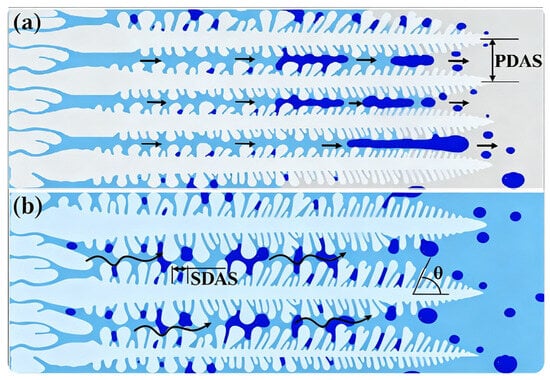
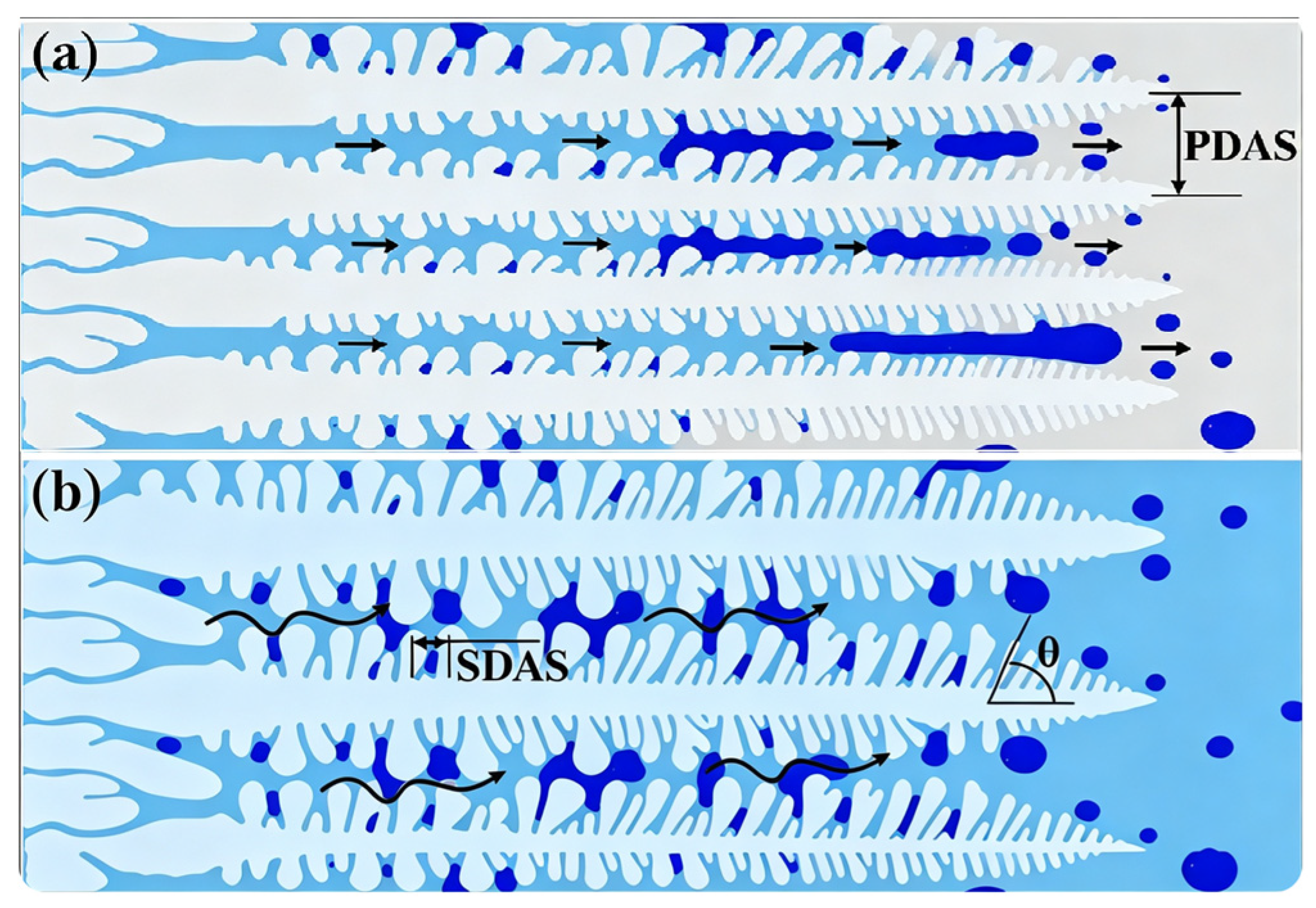
The physical origin of permeability anisotropy in the solidifying mushy zone lies in the geometric directionality of the dendritic microstructure [14]. Under directional solidification conditions, dendrites grow preferentially along the maximum heat flux direction, forming an aligned array of columnar grains. This results in an interdendritic channel network with distinct channeling characteristics [15]. As illustrated in Figure 1, flow parallel to the primary dendrite arms encounters low resistance, yielding high permeability (K∥), whereas flow perpendicular to the primary arms must navigate around secondary dendrite arms, resulting in a tortuous path and significantly higher flow resistance (K⊥). Mitsuyama et al. [16] experimentally confirmed that the permeability tensor parallel to the dendrite growth direction can be 1–2 orders of magnitude greater than in the perpendicular direction.
Figure 1.
Schematic of permeability anisotropy in the mushy zone. (a) At low solid fractions, where secondary dendrites are underdeveloped, the melt flows almost parallel to the primary dendrite arms. The arrows indicate the melt flow paths, which experience relatively low resistance. PDAS denotes the primary dendrite arm spacing. (b) At high solid fractions, where secondary dendrites are well-developed, the melt flow must navigate around the secondary dendrite arms, resulting in higher flow resistance. SDAS denotes the secondary dendrite arm spacing, and θ represents the dendrite orientation of the secondary dendrites.
To accurately capture this directional dependence, a second-order permeability tensor K must replace the scalar permeability. According to the tensor form of Darcy’s law:
where μ is the dynamic viscosity, and P is pressure. For a columnar structure growing along the z-axis, the permeability tensor simplifies to a diagonal form:
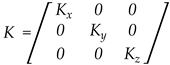 where is typically much larger than and , reflecting the strong anisotropy of the dendritic network [17,18,19]. The anisotropy ratio (Kz/Kx) is a critical parameter influencing solute transport and defect formation, such as channel segregation [20]. This anisotropy not only governs solute redistribution but also creates localized mechanical weaknesses by directing flow and stress concentrations, thereby predisposing the material to certain defect modes.
2.2. In Situ Characterization of Permeability Evolution During Crystal Growth
Direct experimental measurement of the permeability tensor remains challenging, particularly in high-temperature alloys. However, synchrotron-based X-ray tomography has enabled 4D (3D + time) quantification of dendritic structures during solidification. Feng et al. [21] reconstructed 3D pore networks in an Al–Cu alloy and numerically computed the permeability tensor, reporting anisotropy ratios up to 15, which increased with solid fraction. Similar techniques have been extended to Ni-based superalloys, capturing dynamic relationships between dendrite morphology and permeability [8]. Beyond imaging, Abdelhakem et al. [22] designed directional permeability experiments in Sn–Pb alloys, establishing empirical relationships between the permeability tensor and SDAS. Their work revealed that reduced SDAS intensifies anisotropy by increasing transverse flow resistance [23].
2.3. Theoretical Models for Anisotropic Transport in Dendritic Microstructures
Early models simplified dendrites as parallel cylinders [24], providing analytical solutions but lacking geometric fidelity. Modern approaches leverage volume-averaging theory [25], where the permeability tensor is embedded in macroscopic transport models. For instance, Jia et al. [26] investigated the freckle formation mechanism during directional solidification of large single-crystal blades for heavy-duty gas turbines, revealing the constitutional supercooling-induced freckle nucleation mechanism under low temperature gradient conditions. Sistaninia et al. [27] developed a multiscale model that couples macroscopic feeding behavior with intergranular channel flow through three-dimensional representative volume elements, demonstrating the necessity of describing the local pressure field based on microstructural geometry for predicting hot tearing susceptibility.
2.4. Influence of Microstructural Parameters on the Permeability Tensor
The magnitude and anisotropy of the permeability tensor are governed by key microstructural features of the dendritic network. Understanding these dependencies is essential for establishing predictive structure–property relationships.
Dendrite orientation defines the principal directions of the permeability tensor. Zhang et al. [28] related the anisotropy ratio K∥/K⊥ to the orientation angle θ via
where A and B depend on morphology [29]. This relationship underscores that even small deviations in grain orientation can significantly alter flow anisotropy.
Secondary Dendrite Arm Spacing (SDAS) controls pore fineness and permeability magnitude. A power-law relation exists between SDAS and cooling rate R [30]:
Zuo et al. [31] derived a semi-empirical law for permeability tensor components:
where is a morphology-dependent coefficient, SDAS is the secondary dendrite arm spacing, and m is the power-law exponent, highlighting direction-dependent effects. Recent experimental calibrations by Sari et al. [3] have refined the exponent m for Al-based alloys under directional solidification conditions, suggesting a stronger dependency on cooling rate (R) than previously thought (m ≈ −2.5 to −3.0 for transverse flow). Furthermore, the solid fraction (fs) dependency is not merely exponential; Choudhary and Ghosh [32] demonstrated that the percolation threshold (fs ≈ 0.7 − 0.8) marks a phase transition where the dendritic network shifts from fluid-dominated to solid-dominated mechanical behavior, drastically altering the exponent in Equation (6).
Dendrite morphology, including arm coarsening, branching complexity, and arm roundness, also affects flow efficiency. Coarser, less-branched arms increase permeability [33], while higher arm roundness (area/perimeter ratio) enhances flow efficiency by reducing tortuosity [34].
Solid fraction exerts the most dominant control, with permeability decreasing exponentially as solidification proceeds [32]:
Anisotropy intensifies at high solid fractions ( > 0.7), as shown by in situ X-ray studies [32,35], due to the progressive closure of transverse flow paths, while longitudinal channels remain partially open.
Collectively, these parametric dependencies form the basis for microstructure-informed permeability prediction, which is essential for integrating into the multiscale framework proposed in Section 5.
3. Limitations of Traditional Scalar Models
3.1. Inherent Deficiencies of the Kozeny–Carman Equation
The Kozeny–Carman (KC) equation, though widely used, is fundamentally flawed for dendritic systems due to its inherent assumption of isotropic, uniform capillary bundles—a condition starkly contrary to the highly anisotropic and interconnected nature of dendritic networks. The KC equation
fails to capture directional flow, as it reduces permeability to a scalar quantity. Eshraghi [36] demonstrated errors exceeding 200% in columnar structures compared to direct numerical simulations. The Kozeny constant k, often arbitrarily set to 5, lacks a physical basis in dendritic media and varies empirically with pore geometry [37].
3.2. Deviation in Macroscopic Defect Prediction
Scalar models mispredict defect formation by neglecting flow directionality. Wang et al. [38] showed that anisotropic permeability tensor models accurately locate channel segregates by resolving preferential flow paths, whereas KC-based models produce diffuse flow fields. For hot tearing, scalar models overestimate transverse feeding, underestimating susceptibility [39]. They also fail to explain how grain orientation (e.g., columnar vs. equiaxed) affects defect distributions [38].
3.3. Challenges in Multi-Component Alloy Systems
In multi-component alloys (e.g., Ni-based superalloys), solute redistribution alters dendritic morphology and permeability tensor. Scalar models ignore composition-dependent effects, leading to inaccuracies in microsegregation prediction [40,41,42,43]. For instance, Schneider et al. [42] reported permeability variations by several times at fixed liquid fraction in Al–Si–Cu alloys due to solute-induced morphological changes.
3.4. A Paradigmatic Critique and the Necessity for a Shift
Collectively, these limitations transcend mere quantitative inaccuracy and reveal a deeper, conceptual shortcoming. The continued, often uncritical, application of scalar models like Kozeny–Carman represents a paradigmatic misalignment with the physically anisotropic nature of dendritic solidification. These models offer a conceptual framework that is fundamentally at odds with reality, thereby obscuring the true mechanisms of defect formation and hindering the development of predictive capabilities. A foundational shift from scalar, isotropic thinking to a tensor-based, anisotropic paradigm is not merely beneficial but essential for meaningful progress in solidification science.
3.5. The Persistent Blind Spot: Deformation–Permeability Coupling
A critical synthesis of the methods discussed above reveals a consistent and significant blind spot: their intrinsic inability to simultaneously capture the stress state, the resulting skeleton deformation, and the consequent permeability evolution.
The most advanced PFM–LBM coupling, while capable of computing the permeability tensor with high accuracy, fundamentally assumes a rigid, non-deformable dendritic skeleton. This assumption is invalid at solid fractions above 0.7, where the network becomes a load-bearing solid frame that undergoes elastoplastic deformation under thermal stress and liquid pressure. In fact, the same limitation persists even in the experimental counterparts: in situ synchrotron X-ray tomography can beautifully image the morphological evolution of the skeleton, but it cannot quantify the stress field that drives the deformation, making it impossible to distinguish a permeability change caused by solidification alone from one caused by deformation alone.
Recent works have begun to probe this coupling indirectly. For instance, experiments combining tomography with digital volume correlation can track solid skeleton deformation and permeability changes, yet the local stress remains unknown. The absence of a simultaneous measurement or simulation of stress, strain, and permeability constitutes the deepest paradox in the current state-of-the-art. The DPF framework proposed in Section 5 is designed exactly to bridge this gap by establishing a mechanistic loop that closes the missing link.
To systematically summarize the limitations discussed above, Table 1 presents a comparative overview of existing permeability modeling approaches. While methods like Kozeny–Carman and PFM-LBM have established foundations for calculating permeability, they predominantly rely on the assumption of a rigid skeleton, thereby neglecting the critical influence of stress-induced deformation. Conversely, thermo-mechanical models (e.g., PFM-FEM) capture deformation but often oversimplify the fluid flow feedback. This comparison highlights a distinct gap in the current state-of-the-art: the absence of a unified framework capable of simultaneously resolving anisotropic permeability and bidirectional deformation coupling. The DPF framework proposed in this work aims to bridge this specific gap.
Table 1.
Comparative analysis of permeability modeling approaches regarding anisotropy and deformation coupling capabilities.
4. Multiscale Approaches for Quantifying the Permeability Tensor
4.1. Coupling Phase-Field and Lattice Boltzmann Methods
The phase-field method (PFM) generates realistic 3D dendritic microstructures [44,45,46], while the lattice Boltzmann method (LBM) solves flow through these networks to compute the permeability tensor [47,48,49]. Integrated PFM-LBM enables dynamic calculation of K versus and morphology [50,51,52]. This approach has been successfully applied to quantify anisotropy ratios in columnar dendritic structures [16].
4.2. In Situ Synchrotron X-Ray Tomography
This technique provides real-time, 3D visualization of solidification, enabling permeability tensor measurement from reconstructed pore spaces [53,54,55]. Feng et al. [55] observed anisotropy evolution in Al–Cu alloys, and Zhang et al. [54] combined tomography with digital volume correlation to track solid skeleton deformation and permeability changes.
4.3. Integration and Challenges of Multiscale Methods
While powerful, these methods face significant challenges:
- (a)
- PFM requires substantial computational resources for 3D simulations of dendritic growth.
- (b)
- LBM convergence deteriorates markedly at high solid fractions (> 0.7) due to pore closure and complex boundaries.
- (c)
- In situ X-ray tomography depends on scarce and expensive synchrotron beamtime, involves complex sample preparation, and demands advanced data processing.
- (d)
- A critical and often overlooked challenge is the quantification of error propagation and uncertainty across these coupled multiscale simulations. Uncertainties originating from microscopic models (e.g., PFM interface parameters) or experimental data (e.g., tomographic reconstruction artifacts) can be amplified when passed to the mesoscale (LBM flow solution) and ultimately to the macroscopic defect prediction, compromising the reliability of the predictions.
Integrated frameworks (e.g., PFM-LBM-FEM) improve predictive accuracy but are computationally intensive [56]. Future efforts must focus on optimizing efficiency, cost, and robust uncertainty quantification.
5. Bridging the Gap: A Quantitative Deformation–Permeability Feedback Framework
5.1. Research Gap: Critical Comparison with Existing Multiphysics Models
To rigorously establish the necessity of the DPF framework, a critical comparison with existing state-of-the-art multiphysics models is warranted. Current approaches, such as the PFM-LBM-FEM couplings and volume-averaged solidification models, exhibit fundamental limitations in capturing the late-stage solidification behavior.
- (1)
- The Rigid Skeleton Assumption: Most advanced PFM-LBM couplings assume a non-deformable (rigid) dendritic skeleton [32]. While valid at low solid fractions, this assumption fails catastrophically at > 0.7, where the solid network bears significant thermal and mechanical loads. Models ignoring this elastoplastic deformation cannot predict the closure of interdendritic channels under stress.
- (2)
- Unidirectional Coupling: Existing micro–macro couplings are often one-way (micro-to-macro) [57]. They fail to capture the feedback where permeability changes alter the pressure field, which in turn induces further deformation (a positive feedback loop).
- (3)
- Validation Gap: There is a lack of systematic validation against in situ experimental data that simultaneously measures strain and permeability [33].
The DPF framework addresses these gaps by introducing a two-way coupling mechanism, moving beyond the rigid-body assumption prevalent in the current literature.
5.2. Mechanism Analysis: How Solid Skeleton Deformation Alters Permeability
At high solid fractions (> 0.7), the dendritic network forms a mechanical skeleton susceptible to elastoplastic deformation under thermal stress and fluid pressure [21,58]. This solid skeleton deformation, governed by the constitutive behavior of the dendritic solid, alters pore geometry, thereby affecting the permeability tensor. Yasuda et al. [58] observed significant deformation under hydrostatic pressure, impacting permeability anisotropy [59].
Under thermal stress and solidification shrinkage, the dendrite arms undergo bending and stretching. This modifies the hydraulic diameter (Dh) of the interdendritic channels. Based on the Hagen–Poiseuille analogy for porous media, the permeability tensor component Kij is proportional to Dh2. Consequently, a strain ϵ induced in the solid skeleton directly reduces Dh, leading to a quadratic reduction in K. We propose a phenomenological relationship, , where β is a microstructure-dependent coefficient, bridging the mesoscale deformation to the macroscale property change.
Permeability reduction impedes flow, increasing local pressure and further deforming the skeleton, a positive feedback loop exacerbating defects like channel segregation [60]. Zhang et al. [61] demonstrated that models incorporating this feedback improve prediction accuracy.
5.3. Multiscale Framework for Coupled Microstructure–Transport Evolution
Addressing the limitations of existing research, this review innovatively proposes a quantitative “Microstructure—Permeability Tensor—Macroscopic Defect” coupling framework aimed at establishing a complete predictive chain from microstructural evolution to macroscopic defect formation [62]. The framework consists of three core components, a microstructural evolution model, a permeability tensor prediction model, and a macroscopic defect prediction model, connected organically through multiscale coupling methods. By quantitatively linking process conditions and alloy composition to final defect formation, this integrated framework serves as a powerful in silico design tool for optimizing both material and process parameters.
The microstructural evolution model primarily describes the dynamic evolution of dendritic morphology during solidification, including processes such as dendritic growth, coarsening, and coalescence [33]. This model, based on the phase-field method or cellular automata, can predict microstructural parameters like dendrite orientation, SDAS, and dendrite morphology under different solidification conditions [3].
The permeability tensor prediction model, based on the output from the microstructural evolution model, predicts the permeability tensor and its evolution during solidification [63]. This model considers the influence of factors such as dendrite orientation, SDAS, dendrite morphology, and solid fraction on the permeability tensor and incorporates the dynamic coupling mechanism between skeleton deformation and permeability.
The macroscopic defect prediction model, based on the output from the permeability tensor prediction model, simulates heat transfer, fluid flow, and solute transport at the casting scale, predicting the formation of defects like macrosegregation and shrinkage porosity. This model is typically based on the finite element or finite volume method and can account for factors such as casting geometry, process conditions, and material properties.
5.4. Quantitative Demonstration of the DPF Coupling in a Representative Volume Element (RVE)
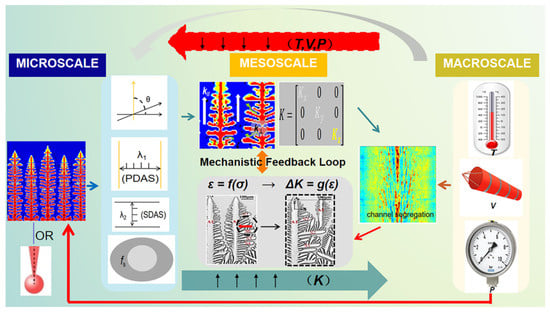
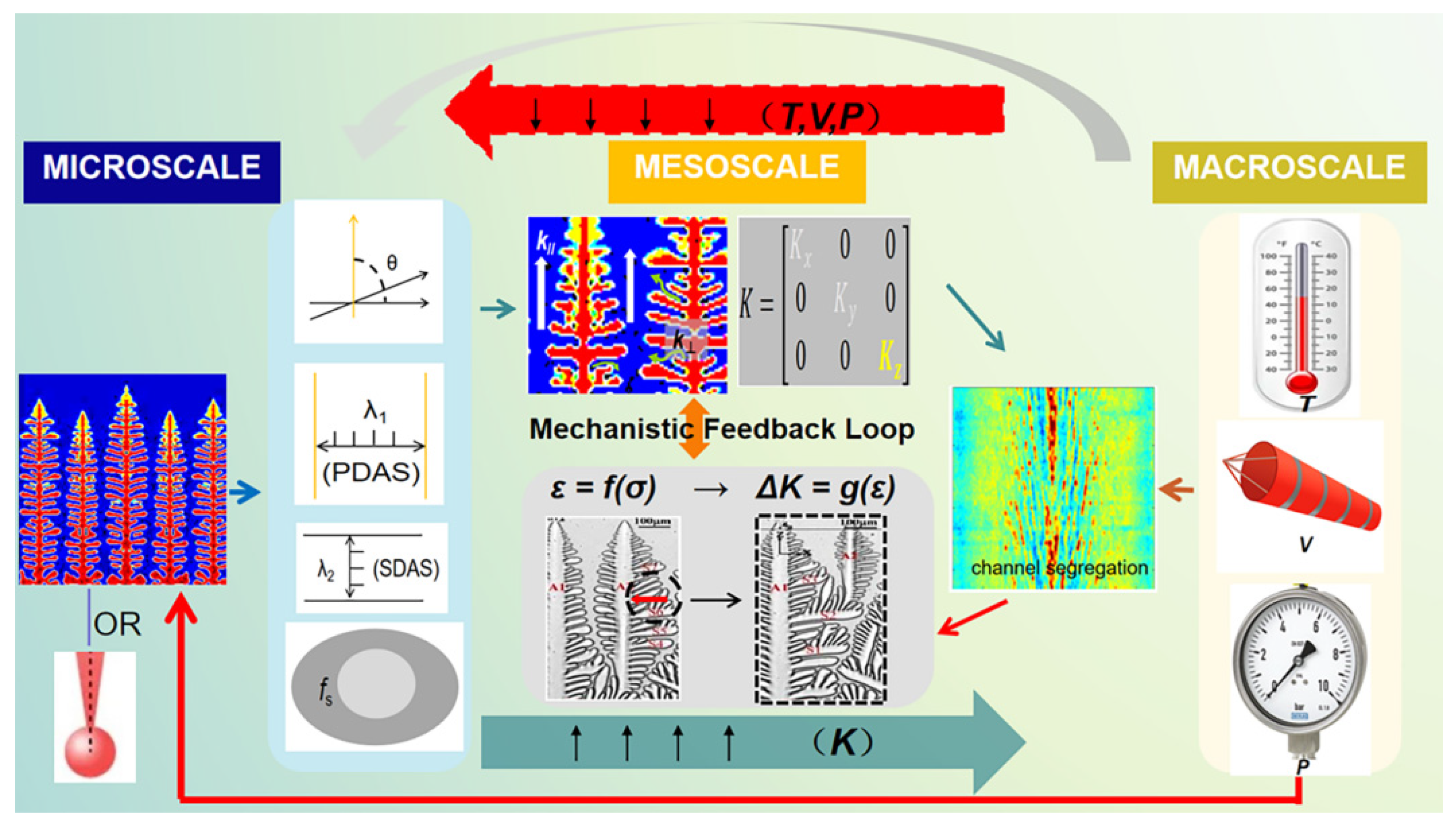
The key to realizing the quantitative “Microstructure—Permeability Tensor—Macroscopic Defect” linkage lies in developing effective multiscale coupling methods [64]. As shown in Figure 2, the proposed multiscale coupling methodology includes both top-down and bottom-up information transfer paths, achieving two-way coupling between models at different scales.
Figure 2.
Schematic of the integrated multiscale coupling framework for predicting solidification defects. The framework bridges the microscale (dendritic evolution), mesoscale (permeability tensor computation coupled with solid skeleton deformation), and macroscale (transport phenomena and defect prediction) through bidirectional (bottom-up and top-down) information exchange.
To illustrate the critical importance of the deformation–permeability feedback, a quantitative RVE example was constructed based on a simplified but physically consistent geometry.
- (1)
- Microstructure generation. Using a phase-field simulation of directional solidification, we generate a two-dimensional columnar dendritic array with typical PDAS and SDAS values at a solid fraction fs = 0.85. Sensitivity analysis indicates that K⊥ varies approximately with the cube of SDAS; thus, a small change in microstructure induces a significant change in permeability. The initial permeability tensor for this rigid skeleton is calculated by the lattice Boltzmann method, yielding Kx,0 < Kz,0 with an anisotropy ratio Kz/Kx ≈ 15.
- (2)
- Skeleton deformation. A macroscopic thermal strain = 0.5% is imposed. The dendrite arms are modeled as an elastic-perfectly plastic material with yield strength = 10 MPa. The resulting lateral plastic strain = / reduces the interdendritic channel width from to − .
- (3)
- Permeability update. The lateral permeability Kx depends strongly on channel width. For a simplified slit-pore geometry, Kx ∝ d 3. Therefore, a 2% lateral contraction gives
- (4)
- Feedback to macroscale. The reduced Kx is fed into a Darcy-law solver. The pressure drop across the RVE increases by approximately 40%, which is consistent with hot-tearing susceptibility criteria.
5.5. Implications for Multiscale Solidification Modeling
The RVE analysis presented in Section 5.4 quantitatively demonstrates the non-linear relationship between solid skeleton deformation and permeability reduction. This observation has profound implications for the architecture of multiscale solidification models.
Traditionally, macroscopic casting simulations have relied on static permeability models (e.g., Kozeny–Carman) that neglect the dynamic mechanical state of the solidifying mush. However, the DPF framework suggests that a robust predictive model must account for the two-way coupling: not only does the microstructure dictate the initial permeability tensor, but the evolving thermo-mechanical stresses continuously reshape the interdendritic flow paths.
This implies that future high-fidelity simulations should integrate elasto-plastic constitutive laws for the solid skeleton within the mushy zone module, moving beyond the rigid-body assumption. By embedding this mechanistic understanding into the multiscale framework, we can bridge the gap between microstructural evolution and macroscopic defect formation, particularly in the late stages of solidification where deformation-induced channel closure is critical.
5.6. Validation Strategy and Transferability
Validation Strategy. To ensure the predictive reliability of the DPF framework, a rigorous validation strategy leveraging in situ characterization is proposed:
- (1)
- Benchmarking with 4D Tomography: The framework will be validated against in situ synchrotron X-ray tomography datasets (e.g., from ESRF or APS facilities) of Al-Cu or Ni-superalloy solidification. By comparing the simulated dendritic morphology and solid fraction evolution with experimental reconstructions, we can validate the microstructural input.
- (2)
- Digital Volume Correlation (DVC): To validate the deformation component, we will employ DVC on tomographic image sequences to quantify the 3D strain field (ϵij) in the solid skeleton. This experimental strain data will be directly compared with the FEM-predicted strains in the DPF model.
- (3)
- Permeability Comparison: The predicted permeability tensor components (Kx, Ky, Kz) from the DPF framework will be benchmarked against lattice Boltzmann simulations performed on the experimentally reconstructed (deformed) microstructures at equivalent solid fractions.
Transferability. The DPF framework is designed to be transferable across different alloy systems and solidification conditions:
Alloy systems: The framework can accommodate different alloy systems by incorporating composition-dependent phase-field parameters (e.g., solidification interval, solute partitioning) and mechanical constitutive models (e.g., elastoplastic behavior of the dendritic solid). Applicability extends to Ni-based superalloys, Al-based alloys, and advanced high-strength steels.
Solidification conditions: The framework supports directional solidification (with defined thermal gradients) and equiaxed solidification (with nucleation and growth models), enabling its use across a range of casting processes.
FAIR principles: While the current work is a conceptual review, future implementation of the framework as a computational tool will adhere to FAIR data principles (Findable, Accessible, Interoperable, Reusable). Source code, input datasets, and validation data will be made publicly available to ensure reproducibility and community-driven development.
Furthermore, we propose the adoption of Physics-Informed Neural Networks (PINNs) as a future step to reduce computational cost, allowing the framework to be implemented in industrial software (e.g., ProCAST, MAGMASOFT) as a user-defined subroutine.
5.7. Implications for Solidification Science and Future Directions
The “Microstructure—Permeability Tensor—Macroscopic Defect” quantitative coupling framework has broad application prospects, mainly in the following areas:
First, the framework enables predictive control of solidification microstructures by establishing quantitative relationships between processing conditions, dendritic architecture, and interdendritic transport. By simulating microstructural evolution and permeability tensor variation under different thermal conditions, the influence of growth parameters on crystal morphology can be predicted, providing theoretical guidance for microstructure optimization.
Second, the framework advances fundamental understanding of alloy design by establishing relationships between composition-dependent dendritic characteristics and permeability evolution. This enables prediction of how alloying elements influence interdendritic flow resistance and solute redistribution, providing a scientific basis for composition optimization in directional solidification.
Finally, the framework establishes foundations for intelligent solidification modeling. Combined with machine learning-based surrogate models, rapid predictive capabilities linking process parameters to microstructural outcomes can be developed, enabling real-time adaptation of solidification conditions based on microstructure evolution trends.
In fact, A full PFM-LBM-FEM coupling for the DPF framework is computationally intensive. A typical 3D RVE simulation requires 106–107 lattice nodes and can take several hours to days on high-performance computing (HPC) clusters, depending on the convergence criteria. To mitigate this, the DPF framework incorporates a hybrid approach:
- (1)
- Top-down: Macroscopic FEM provides boundary conditions (stress/strain) to the mesoscale.
- (2)
- Bottom-up: Mesoscale LBM provides updated permeability tensors to the macro scale.
By decoupling the timescales (quasi-static macro vs. dynamic micro) and utilizing parallel computing, the framework aims to achieve a balance between accuracy and efficiency. Future work will focus on developing reduced-order models (ROMs) to enable real-time simulation in industrial casting scenarios.
6. Conclusions and Outlook
6.1. Main Conclusions
This review has critically synthesized recent advances in the study of anisotropic permeability in solidifying mushy zones. The principal conclusions are as follows:
- (1)
- Traditional scalar models (e.g., the Kozeny–Carman equation) cannot accurately describe the anisotropic nature of mushy zone permeability and exhibit significant limitations in predicting macroscopic defects. The anisotropic permeability tensor is essential for accurately describing interdendritic liquid flow and solute transport and is a fundamental parameter for modeling the mechanical defect (e.g., hot tearing) formation.
- (2)
- Microstructural parameters such as dendrite orientation, secondary dendrite arm spacing (SDAS), dendrite morphology, and solid fraction significantly influence the permeability tensor. Dendrite orientation determines the principal directions of the tensor; SDAS and dendrite morphology affect the magnitude of permeability; solid fraction influences the evolution of permeability during solidification.
- (3)
- Multiscale methods like the phase-field method (PFM), the lattice Boltzmann method (LBM), and in situ X-ray characterization provide powerful tools for quantifying the permeability tensor. The organic combination of these methods enables the study of the dynamic evolution of the permeability tensor.
- (4)
- The dynamic coupling between skeleton deformation and permeability is a current research gap. In high solid fraction regions, the dendritic skeleton deforms under thermal stress, solidification shrinkage, and hydrostatic pressure, affecting the permeability tensor. Simultaneously, permeability changes affect liquid flow and pressure distribution, which in turn influence skeleton deformation. This two-way coupling mechanism is crucial for accurately predicting defect formation in the late stages of solidification.
- (5)
- This review has innovatively proposed the quantitative Deformation–Permeability Feedback (DPF) Framework (the “Microstructure—Permeability Tensor—Macroscopic Defect” coupling framework). Through multiscale coupling methods, this framework aims to integrate the microstructural evolution model, permeability tensor prediction model, and macroscopic defect prediction model, proposing a complete predictive chain from micro to macro. The key innovations lie in systematically considering the dynamic coupling between skeleton deformation and permeability, establishing a physics-based link between process-induced microstructure and the risk of mechanical failure during solidification.
6.2. A Challenge-Driven Research Roadmap: From Concept to Tool
In practical terms, the proposed DPF framework could enhance the optimization of casting and directional solidification parameters. It may help reduce issues like hot tearing, macrosegregation, and shrinkage-related defects. Additionally, it could improve alloy design and decrease the need for trial-and-error experimentation in the development of high-integrity metallic components.
Transforming the DPF framework from a conceptual model into a practical engineering tool requires confronting the following ambitious frontiers:
- (1)
- Next-generation in situ experiments. There is an urgent need for experiments that simultaneously measure the 3D strain field (via digital volume correlation) and compute the evolving permeability tensor under controlled mechanical loading at high solid fractions (fs > 0.8). Only combined stress–strain–permeability datasets can provide the ground-truth validation data that are currently missing.
- (2)
- Overcoming the computational barrier. Developing a fully coupled multiphysics simulator integrating Crystal Plasticity Finite Element Methods for the dendritic skeleton with LBM for the fluid is the grand challenge. A parallel critical thrust is the development of machine-learning surrogate models, particularly Physics-Informed Neural Networks, to emulate the DPF loop at a fraction of the cost.
- (3)
- Community-driven benchmarking. A public set of standard benchmark problems, including digitized dendritic arrays, material properties, and boundary conditions, would allow fair comparison of different coupling algorithms and accelerate the transition from feasible to reliable.
Author Contributions
Conceptualization, Methodology, Writing—Original Draft, and Writing—Review and Editing: B.Y., X.T. and H.Z.; Formal Analysis, Investigation, and Data Curation: W.X. and M.W.; Validation, Visualization, and Writing—Review and Editing: Z.L. All authors have read and agreed to the published version of the manuscript.
Funding
This research received no external funding.
Data Availability Statement
No new data were created or analyzed in this study.
Acknowledgments
This research received no specific grant from any funding agency in the public, commercial, or not-for-profit sectors. The authors thank the anonymous reviewers for their constructive comments.
Conflicts of Interest
Authors Minglin Wang and Hui Zhang were employed by the Central Iron and Steel Research Institute. The remaining authors declare that the research was conducted in the absence of any commercial or financial relationships that could be construed as a potential conflict of interest.
References
- Ghosh, S.; Ofori-Opoku, N.; Guyer, J.E. Simulation and analysis of γ-Ni cellular growth during laser powder deposition of Ni-based superalloys. Comput. Mater. Sci. 2018, 144, 256–264. [Google Scholar] [CrossRef] [Scilit]
- Wang, S.W.; Zhang, Y.L.; Wu, C.; Xiao, L.; Lin, G.M.; Hu, Y.B.; Hao, G.Z.; Guo, H.; Zhang, G.P.; Jiang, W. Equal-material manufacturing of a thermoplastic melt-cast explosive using thermal-pressure coupling solidification treatment technology. ACS Omega 2023, 8, 16251–16262. [Google Scholar] [CrossRef] [Scilit] [PubMed]
- Sari, I.; Ahmadein, M.; Ataya, S.; Hachani, L.; Zaidat, K.; Alrasheedi, N.; Wu, M.H.; Kharicha, A. Prediction of the secondary arms spacing based on dendrite tip kinetics and cooling rate. Materials 2024, 17, 865. [Google Scholar] [CrossRef] [Scilit] [PubMed]
- Liu, Q.; Li, H.; Cao, Q.L.; Ke, D.; Yin, S.Y.; Li, Q.P. Microscopic Factors Affecting the Performance of Pervious Concrete. Materials 2024, 17, 1479. [Google Scholar] [CrossRef] [Scilit] [PubMed]
- Liu, G.L.; Lu, H.B.; Li, B.; Ji, C.X.; Zhang, J.S.; Liu, Q.; Lei, Z.S. Influence of M-EMS on fluid flow and initial solidification in slab continuous casting. Materials 2021, 14, 3681. [Google Scholar] [CrossRef] [Scilit] [PubMed]
- Yu, L.J.; Tan, Y.L.; Fan, M.; Xu, E.S.; Cui, G.L.; Pan, Z.J. Estimating lost gas content for shales considering real boundary conditions during the core recovery process. ACS Omega 2022, 7, 21246–21254. [Google Scholar] [CrossRef] [Scilit] [PubMed]
- Mitsuyama, Y.; Takaki, T.; Sakane, S.; Shibuta, Y.; Ohno, M. Permeability tensor for various columnar dendrite structures. In IOP Conference Series: Materials Science and Engineering; IOP Publishing: Bristol, UK, 2020; Volume 861, p. 012029. [Google Scholar] [CrossRef] [Scilit]
- Puncreobutr, C.; Phillion, A.B.; Fife, J.L.; Lee, P.D. Coupling in situ synchrotron X-ray tomographic microscopy and numerical simulation to quantify the influence of intermetallic formation on permeability in aluminium–silicon–copper alloys. Acta Mater. 2014, 64, 316–325. [Google Scholar] [CrossRef] [Scilit]
- Zhou, L.; Luo, Y.J.; Zhang, Z.L.; He, M.; Xu, Y.N.; Zhao, Y.L.; Liu, S.; Dong, L.J.; Zhang, Z.F. Microstructures and macrosegregation of Al–Zn–Mg–Cu alloy billet prepared by uniform direct chill casting. Materials 2021, 14, 708. [Google Scholar] [CrossRef] [Scilit] [PubMed]
- Zhang, K.; Sang, S.X.; Ma, M.Y.; Zhou, X.Z.; Liu, C.J.; Shen, G.D. Permeability response characteristics of primary undeformed coal and tectonically deformed coal under loading–unloading conditions in Huainan Coalfield, China. ACS Omega 2022, 7, 37485–37498. [Google Scholar] [CrossRef] [Scilit] [PubMed]
- Qiao, J.W.; Zhang, T.; Yang, F.Q.; Liaw, P.K.; Pauly, S.; Xu, B.S. A tensile deformation model for in-situ dendrite/metallic glass matrix composites. Sci. Rep. 2013, 3, 2816. [Google Scholar] [CrossRef] [Scilit] [PubMed]
- Sun, X.H.; Qiao, J.W.; Jiao, Z.M.; Wang, Z.H.; Yang, H.J.; Xu, B.S. An improved tensile deformation model for in-situ dendrite/metallic glass matrix composites. Sci. Rep. 2015, 5, 13964. [Google Scholar] [CrossRef] [Scilit] [PubMed]
- Cao, N.F.; Jing, P.F.; Huo, Z.G.; Liang, Y.T.; Zhang, L. Simulation Study of Coal Seam Gas Extraction Characteristics Based on Coal Permeability Evolution Model under Thermal Effect. ACS Omega 2024, 9, 22871–22891. [Google Scholar] [CrossRef] [Scilit] [PubMed]
- Liu, T.; Tao, J.; Cai, X.Y.; Chenc, D.Y.; Li, J.S.; Luo, L.S.; Chen, Z.H.; Su, Y.Q. Effect of growth rate on microstructure evolution in directionally solidified Ti–47Al alloy. Heliyon 2022, 8, e08704. [Google Scholar] [CrossRef] [Scilit] [PubMed]
- Furmanski, P.; Banaszek, J. Modelling of the mushy zone permeability for solidification of binary alloys. In Materials Science Forum; Trans Tech Publications Ltd.: Bäch, Switzerland, 2006; Volume 508, pp. 411–418. [Google Scholar] [CrossRef] [Scilit]
- Mitsuyama, Y.; Takaki, T.; Sakane, S.; Shibuta, Y.; Ohno, M. Permeability tensor for columnar dendritic structures: Phase-field and lattice Boltzmann study. Acta Mater. 2020, 188, 282–287. [Google Scholar] [CrossRef] [Scilit]
- Wu, M.H.; Ludwig, A.; Kharicha, A. Volume-averaged modeling of multiphase flow phenomena during alloy solidification. Metals 2019, 9, 229. [Google Scholar] [CrossRef] [Scilit]
- Li, L.F.; Zhang, R.J.; Hu, S.J.; Zhang, D.; Jiang, H.T. Prediction of mushy zone permeability of Al-4.5 wt% Cu alloy during solidification by phase field model and CFD simulation. China Foundry 2019, 16, 313–318. [Google Scholar] [CrossRef] [Scilit]
- Beckermann, C. Modelling of macrosegregation: Applications and future needs. Int. Mater. Rev. 2002, 47, 243–261. [Google Scholar] [CrossRef] [Scilit]
- Zhang, Y.Y.; Dou, R.F.; Wang, J.S.; Liu, X.L.; Wen, Z. Numerical simulation of the effect of hypergravity on the dendritic growth characteristics of aluminum alloys. Heliyon 2024, 10, e27008. [Google Scholar] [CrossRef] [Scilit] [PubMed]
- Feng, S.K.; Liotti, E.; Grant, P.S. X-ray imaging of alloy solidification: Crystal formation, growth, instability and defects. Materials 2022, 15, 1319. [Google Scholar] [CrossRef] [Scilit] [PubMed]
- Abdelhakem, A.; Nouri, A.; Hachani, L.; Fautrelle, Y.; Zaidat, K. Three-dimensional numerical simulation and experimental investigations of benchmark experiment of Sn-10 wt.% Pb alloy solidification under thermosolutal convection. J. Heat Transf. 2022, 144, 04240. [Google Scholar] [CrossRef] [Scilit]
- Du, Q.; Eskin, D.G.; Katgerman, L. Modeling macrosegregation during direct-chill casting of multicomponent aluminum alloys. Metall. Mater. Trans. A 2007, 38, 180–189. [Google Scholar] [CrossRef] [Scilit]
- Cao, J.H.; Hou, Z.B.; Liu, Q.; Guo, Z.G.; Guo, D.W. Quantitative characterization of solidification structure in different sections for calculating the permeability in actual high-carbon steel billet. Metall. Mater. Trans. B 2021, 52, 1132–1141. [Google Scholar] [CrossRef] [Scilit]
- Ni, J.; Beckermann, C. A volume-averaged two-phase model for transport phenomena during solidification. Metall. Trans. B 1991, 22, 349–361. [Google Scholar] [CrossRef] [Scilit]
- Jia, Y.L.; Zhang, Y.J.; Wang, S.; Cheng, F.; Shi, C.K.; Shi, Z.K.; Du, Y.L.; Zhang, Y.C.; Hu, K.H.; Duan, F.M.; et al. Constitutional Supercooling-induced Freckle Nucleation Mechanism of Nickel-based Superalloy During Directional Solidification. Metall. Mater. Trans. A 2025, 56, 2202–2214. [Google Scholar] [CrossRef] [Scilit]
- Sistaninia, M.; Phillion, A.B.; Drezet, J.M.; Rappaz, M. Three-dimensional granular model of semi-solid metallic alloys undergoing solidification: Fluid flow and localization of feeding. Acta Mater. 2012, 60, 3902–3911. [Google Scholar] [CrossRef] [Scilit]
- Zhang, H.J. Flow-Solidification Interaction Under Controlled Convective Conditions During Unidirectional Solidification Process. Doctoral Dissertation, Technical University of Leoben, Leoben, Austria, 2021. Available online: https://pure.unileoben.ac.at/en/publications/flow-solidification-interaction-under-controlled-convective-condi (accessed on 24 September 2025).
- Zhou, J.J.; Shao, J.F. Modelling of coupling between induced anisotropic damage and permeability in rocks. In Proceedings of the XXI International Conference of Theoretical and Applied Mechanics, Warsaw, Poland, 15–21 August 2004; Available online: http://fluid.ippt.pan.pl/ictam04/CD_ICTAM04/SM20/10702/abstract.htm (accessed on 25 September 2025).
- Dewhurst, D.N.; Aplin, A.C.; Sarda, J.P.; Yang, Y.L. Compaction-driven evolution of porosity and permeability in natural mudstones: An experimental study. J. Geophys. Res. Solid Earth 1998, 103, 651–661. [Google Scholar] [CrossRef] [Scilit]
- Xu, Z.; Qiao, H.B.; Qiu, Z.; Xia, L.S.; Liu, S.J.; Zhu, Z.H. Fatigue Life Prediction of Counter Pressure Casting A356 Aluminum Alloy Based on Secondary Dendrite Arm Spacing. Spec. Cast. Nonferrous Alloys 2024, 44, 281–285. [Google Scholar] [CrossRef]
- Choudhary, S.K.; Ghosh, A. Mathematical model for prediction of composition of inclusions formed during solidification of liquid steel. ISIJ Int. 2009, 49, 1819–1827. [Google Scholar] [CrossRef] [Scilit]
- Natsume, Y.; Takahashi, D.; Kawashima, K.; Tanigawa, E.; Ohsasa, K. Quantitative model to determine permeability for columnar dendritic structures. ISIJ Int. 2013, 53, 838–847. [Google Scholar] [CrossRef] [Scilit]
- Salges, C.; Alejandra, S. Processing and Characterization of Metallic Glasses Prepared by Centrifugal Atomization. Doctoral Dissertation, Universitat Politècnica de Catalunya, Barcelona, Spain, 2024. Available online: https://doi.org/10.5821/dissertation-2117-422060 (accessed on 25 September 2025).
- Patel, M.G.C.; Krishna, P.; Parappagoudar, M.B. Prediction of secondary dendrite arm spacing in squeeze casting using fuzzy logic based approaches. Arch. Foundry Eng. 2015, 15, 51–68. [Google Scholar] [CrossRef] [Scilit]
- Eshraghi, M. Numerical Simulation of Solidification Processes. Metals 2023, 13, 1303. [Google Scholar] [CrossRef] [Scilit]
- Xu, W.; Qu, X.; Yan, L.; Ning, Y. Experimental study on mechanical properties and permeability characteristics of calcareous mudstone under different confining pressures. Materials 2024, 17, 2731. [Google Scholar] [CrossRef] [Scilit] [PubMed]
- Wang, C.J.; Liu, Z.Q.; Li, B.K.; Xu, J.X. An improved columnar solidification model coupled with anisotropic mush permeability. Metall. Mater. Trans. B 2023, 54, 1275–1289. [Google Scholar] [CrossRef] [Scilit]
- Khajeh, E.; Maijer, D.M. Permeability evolution during equiaxed dendritic solidification of Al–4.5 wt% Cu. Model. Simul. Mater. Sci. Eng. 2012, 20, 035004. [Google Scholar] [CrossRef] [Scilit]
- Cao, J.H.; Hou, Z.B.; Guo, Z.A.; Guo, D.W.; Tang, P. Effect of Superheat on Integral Morphology Characteristics of Solidification Structure and Permeability in Bearing Steel Billet. Acta Metall. Sin. 2020, 57, 586–594. [Google Scholar] [CrossRef]
- Zhang, D.Y.; Strangwood, M. Interdendritic microsegregation development of high-strength low-alloy steels during continuous casting process. Mater. Sci. Technol. 2019, 35, 1337–1346. [Google Scholar] [CrossRef] [Scilit]
- Schneider, M.C.; Beckermann, C. A numerical study of the combined effects of microsegregation, mushy zone permeability and fllow, caused by volume contraction and thermosolutal convection, on macrosegregation and eutectic formation in binary alloy solidification. Int. J. Heat Mass Transf. 1995, 38, 3455–3473. [Google Scholar] [CrossRef] [Scilit]
- Chen, M.; Bai, M.; Roegiers, J.C. Permeability tensors of anisotropic fracture networks. Math. Geol. 1999, 31, 335–373. [Google Scholar] [CrossRef] [Scilit]
- Zhan, C.J.; Chai, Z.H.; Shi, B.C.; Jiang, P.; Geng, S.N.; Sun, D.K. A diffuse-interface lattice Boltzmann method for dendritic growth with thermosolutal convection and melt flow. Phys. Rev. Fluids 2022, 5, 063301. [Google Scholar] [CrossRef] [Scilit]
- Trainer, A.J.; Newman, C.K.; Francois, M.M. Overview of the Tusas Code for Simulation of Dendritic Solidification; Los Alamos National Laboratory (LANL): Los Alamos, NM, USA, 2016. [Google Scholar] [CrossRef] [Scilit]
- Karma, A.; Rappel, W.J. Quantitative phase-field modeling of dendritic growth in two and three dimensions. Phys. Rev. E 1998, 57, 4323. [Google Scholar] [CrossRef] [Scilit]
- Shan, X.W.; Chen, H.D. Lattice Boltzmann model for simulating flows with multiple phases and components. Phys. Rev. E 1993, 47, 1815. [Google Scholar] [CrossRef] [Scilit] [PubMed]
- Chen, S.Y.; Doolen, G.D. Lattice Boltzmann method for fluid flows. Annu. Rev. Fluid Mech. 1998, 30, 329–364. [Google Scholar] [CrossRef] [Scilit]
- Böttger, B.; Haberstroh, C.; Giesselmann, N. Cross-permeability of the semisolid region in directional solidification: A combined phase-field and lattice-Boltzmann simulation approach. JOM 2016, 68, 27–36. [Google Scholar] [CrossRef] [Scilit]
- Fakhari, A.; Mitchel, T.; Leonardi, C.; Bolster, D. Improved locality of the phase-field lattice-Boltzmann model for immiscible fluids at high density ratios. Phys. Rev. E 2017, 96, 053301. [Google Scholar] [CrossRef] [Scilit] [PubMed]
- Takaki, T.; Mitsuyama, Y.; Sakane, S.; Ohno, M.; Shibuta, Y.; Aoki, T. Computing the permeability of tilted columnar dendrites with phase-field and lattice Boltzmann methods. Int. J. Thermofluids 2024, 22, 100649. [Google Scholar] [CrossRef] [Scilit]
- Li, C.L.; Wen, J.; Li, K.; Wang, S.M. Modeling coupled growth and motion of solid-air dendrite induced by convection in liquid hydrogen using phase-field lattice Boltzmann method. Int. Commun. Heat Mass Transf. 2024, 153, 107380. [Google Scholar] [CrossRef] [Scilit]
- Tourret, D.; Mertens, J.C.E.; Lieberman, E.; Imhoff, S.D.; Gibbs, J.W.; Henderson, K.; Fezzaa, K.; Deriy, A.L.; Sun, T.; Lebensohn, R.A.; et al. From solidification processing to microstructure to mechanical properties: A multi-scale X-ray study of an Al-Cu alloy sample. Metall. Mater. Trans. A 2017, 48, 5529–5546. [Google Scholar] [CrossRef] [Scilit]
- Zhang, Z.G.; Wang, C.N.; Koe, B.; Schlepütz, C.M.; Irvine, S.; Mi, J.W. Synchrotron X-ray imaging and ultrafast tomography in situ study of the fragmentation and growth dynamics of dendritic microstructures in solidification under ultrasound. Acta Mater. 2021, 209, 116796. [Google Scholar] [CrossRef] [Scilit]
- Feng, Z.Y.; Fan, Y.P.; Dong, X.S.; Ma, X.M.; Chen, R.X. Permeability estimation in filter cake based on X-ray microtomography and Lattice Boltzmann method. Sep. Purif. Technol. 2021, 275, 119114. [Google Scholar] [CrossRef] [Scilit]
- Cusato1, N.; Nabavizadeh, S.A.; Eshraghi, M. A review of large-scale simulations of microstructural evolution during alloy solidification. Metals 2023, 13, 1169. [Google Scholar] [CrossRef] [Scilit]
- Li, M.N.; Liang, W.M.; Yue, G.W.; Yue, J.W.; Zheng, X.J. Experiment and modeling of permeability under different impact loads in a structural anisotropic coal body. ACS Omega 2020, 5, 9957–9968. [Google Scholar] [CrossRef] [Scilit] [PubMed]
- Yasuda, H.; Morishita, K.; Nakatsuka, N.; Nishimura, T.; Yoshiya, M.; Sugiyama, A.; Uesugi, K.; Takeuchi, A. Dendrite fragmentation induced by massive-like δ–γ transformation in Fe–C alloys. Nat. Commun. 2019, 10, 3183. [Google Scholar] [CrossRef] [Scilit] [PubMed]
- Zhang, F.Q.; Ding, X.F.; Xu, L.M.; Feng, X.; Nan, H.; He, J.P.; Liang, Y.F.; Lin, J.P. Microstructure evolution and phase transformation of the mushy zone in a quenched β-solidifying TiAl alloy. J. Mater. Sci. Technol. 2024, 169, 28–41. [Google Scholar] [CrossRef] [Scilit]
- Duan, M.K.; Jiang, C.B.; Gan, Q.; Zhao, H.B.; Yang, Y.; Li, Z.K. Study on permeability anisotropy of bedded coal under true triaxial stress and its application. Transp. Porous Media 2020, 131, 1007–1035. [Google Scholar] [CrossRef] [Scilit]
- Zhang, H.J.; Wu, M.H.; Zheng, Y.J.; Ludwig, A.; Kharicha, A. Numerical study of the role of mush permeability in the solidifying mushy zone under forced convection. Mater. Today Commun. 2020, 22, 100842. [Google Scholar] [CrossRef] [Scilit]
- Sames, W.J.; List, F.A.; Pannala, S.; Dehoff, R.R.; Babu, S.S. The metallurgy and processing science of metal additive manufacturing. Int. Mater. Rev. 2016, 61, 315–360. [Google Scholar] [CrossRef] [Scilit]
- Ferreira, A.F.; Castro, J.A.; Ferreira, L.O. Predicting secondary-dendrite arm spacing of the Al-4.5 wt% Cu alloy during unidirectional solidification. Mater. Res. 2016, 20, 68–75. [Google Scholar] [CrossRef] [Scilit]
- Cicutti, C.; Boeri, R. On the relationship between primary and secondary dendrite arm spacing in continuous casting products. Scr. Mater. 2001, 45, 1455–1460. [Google Scholar] [CrossRef] [Scilit]

Disclaimer/Publisher’s Note: The statements, opinions and data contained in all publications are solely those of the individual author(s) and contributor(s) and not of MDPI and/or the editor(s). MDPI and/or the editor(s) disclaim responsibility for any injury to people or property resulting from any ideas, methods, instructions or products referred to in the content. |
© 2026 by the authors. Licensee MDPI, Basel, Switzerland. This article is an open access article distributed under the terms and conditions of the Creative Commons Attribution (CC BY) license.