


Abstract
This article presents the results of experimental studies on the production of chromium–nickel ferroalloy from the nickel ore of the Batamshinskoye deposit by the metallothermic method. Boron-containing ferrosilicochromium was used as a complex reducing agent and alloying material, and lime was applied as a fluxing component to control the composition and basicity of the slag. Laboratory smeltings were carried out in a Tammann furnace and an induction furnace at a temperature of 1630–1650 °C, producing slags with different basicities—0.4, 0.5, and 0.6. It was established that the use of boron-containing ferrosilicochromium provides the effective reduction of nickel, chromium, and iron oxides with the formation of a complex ferroalloy containing Fe, Cr, Ni, Si, and B. It is shown that an increase in slag basicity contributes to a decrease in its viscosity, a reduction in the content of chromium oxides in the slag, and an improvement in the conditions for the separation of the metal and slag phases. The crystallization temperatures of the slags, which decrease from 1410 to 1335 °C with an increase in basicity from 0.4 to 0.6, were determined by the method of semi-logarithmic processing of viscosity polytherms. The slag basicity range of 0.5–0.6 is recognized as optimal for the process.
1. Introduction
Metallothermic processes are based on the reduction of metals from their oxides using more active reducing agents, such as aluminum, calcium, silicon, and magnesium. These reducing agents possess high chemical activity, enabling them to displace less active metals from their compounds. Such reactions are accompanied by significant heat evolution, which allows them to be conducted without additional heat input, or with a minimal amount of it. This makes metallothermy particularly effective in the production of high-quality ferroalloys.
The main advantages of metallothermic methods include:
- -
- High purity of the resulting product, which is especially important in the production of alloyed and special steels;
- -
- The possibility of precise control over the chemical composition of the alloy by selecting reducing agents and additives;
- -
- The relative simplicity of the equipment used and the availability of reagents;
- -
- The comparatively low-energy consumption of the process.
In recent years, interest has been growing in the use of multicomponent reducing agents containing not only reducing but also alloying elements (e.g., boron, chromium, titanium, and nickel). This allows for simultaneous reduction and alloying, which simplifies the technological process and improves the properties of the final product. Furthermore, research is being conducted to develop new composite reducing agents capable of increasing the thermodynamic efficiency of the process and reducing waste levels [1,2].
Thus, metallothermic methods remain in demand and promising in metallurgy, especially in the production of special and alloyed ferroalloys, where purity, homogeneity, and precise composition control are essential.
The Batamshinskoye deposit is located in the Kempirsay massif within the Aktobe region and is characterized by a predominant content of oxidized nickel ores with impurities of iron, chromium, magnesium, and aluminum. The mineral composition mainly includes garnierite, serpentine, limonite, as well as secondary iron oxides and clay minerals. Such ores belong to the category of low- and medium-nickel ores with a Ni content ranging from 0.8 to 1.5%, which makes them less attractive for traditional pyrometallurgical processing but quite promising for alternative approaches.
One of the features of the Batamshinskoye deposit ores is their high iron content, as well as the presence of chromium, which opens up the possibility of integrated utilization of the raw material to produce chromium–nickel ferroalloys [3,4,5]. Such alloys are in demand in the production of stainless and heat-resistant steels used in mechanical engineering, energy, and the chemical industry.
The complex mineral composition and finely dispersed structure of the ores require the selection of an effective processing method that ensures the maximum recovery of valuable components. Traditional methods involving a beneficiation stage are ineffective and economically unviable in this case. In this regard, metallothermic reduction appears to be an attractive alternative: it allows the ore to be processed without prior beneficiation, thereby reducing overall costs and simplifying the flowsheet.
The core process of the metallothermic (specifically, silicothermic) production of the chromium–nickel ferroalloy involves the reduction of target metal oxides (nickel, iron, and chromium) from the ore by silicon, which is provided by the boron-containing ferrosilicochromium acting as a complex reducing agent. The fundamental thermodynamic reactions of this process can be expressed as follows:
2NiO + Si → 2Ni + SiO2
2Fe2O3 + 3Si → 4Fe + 3SiO2
2Cr2O3 + 3Si → 4Cr + 3SiO2
During smelting, the complex reducing agent also acts as an alloying material, allowing for the direct transfer of chromium and boron into the final multiphase Fe-Cr-Ni-Si-B alloy, while the resulting SiO2 binds with the CaO flux to form the basic slag system.
The most promising direction is the application of silicothermic or aluminothermic reduction using ferrosilicon or aluminum powder as a reducing agent. This allows not only for the extraction of nickel but also for the utilization of iron and chromium within the alloy composition, increasing the overall yield of commercial products [6,7]. Additionally, metallothermic processing can be adapted to produce specific grades of ferroalloys with a predetermined content of alloying elements.
An additional research direction could be the use of multicomponent reducing agents containing alloying additives, as well as studying the possibility of preliminary thermochemical activation of the ore to increase the degree of nickel reduction. Thus, the Batamshinskoye deposit represents an interesting object for implementing innovative technologies for the integrated processing of lean nickel ores.
Silicochromium is a ferroalloy consisting of a silicon and chromium alloy, which is traditionally used as an alloying component in the production of various grades of alloyed and stainless steels. It provides not only the saturation of steel with chromium and silicon but also improves its corrosion resistance, thermal stability, and mechanical properties [8,9,10].
Due to the high reducing potential of silicon, silicochromium is also applied in metallothermic reactions as an efficient reductant. Its use allows for the partial or complete replacement of more expensive reducing agents, such as aluminum, which significantly reduces the cost of the process. An additional advantage is that chromium from the silicochromium composition is simultaneously introduced into the resulting alloy, performing both a reducing and an alloying function.
Of particular interest recently are boron-containing modifications of silicochromium, into which various boron-containing compounds are introduced—ferroboron, boron carbides (e.g., B4C), or boron-containing slags. These additives are aimed at improving the quality of the final ferroalloys and enhancing their performance characteristics.
Boron within the alloy structure exerts a complex influence:
- -
- It promotes the formation of a fine-grained structure during solidification, which positively affects mechanical properties;
- -
- It increases the heat resistance and wear resistance of the metal;
- -
- It improves strength characteristics at high temperatures;
- -
- It reduces the susceptibility to crack formation during crystallization.
The use of boron-containing silicochromium is particularly promising in the production of special ferroalloys for heat-resistant and corrosion-resistant steels, as well as in the field of powder metallurgy. Such materials find application in the aviation and energy industries, as well as in the production of reactors and turbine components.
From a technological [11,12,13] standpoint, the use of boron-containing reducing agents opens up new opportunities for the integrated processing of multicomponent raw materials. Their implementation in metallothermic processes can be realized in both batch and continuous furnaces, with the capability for fine-tuning the alloy composition and reducing waste volume.
Boron is a unique [14,15,16] alloying element capable of significantly increasing the strength and thermal characteristics of steels and alloys even when introduced in minor quantities (tenths of a percent). It promotes the formation of refractory intermetallic compounds, such as FeB, CrB, and NiB, which improve the wear resistance and thermal stability of the resulting ferroalloys. These borides possess high hardness and resistance to aggressive media, which is especially important for materials operating under extreme conditions [17,18].
From a metallurgical perspective, boron influences not only the structure of the final product but also the metallothermic reduction process itself. The introduction of boron into the reducing agent composition is capable of modifying the reduction kinetics: the reaction onset temperature decreases, the reaction rate increases, and the composition and viscosity of the slag change. Boron-containing compounds can also act as fluxes, facilitating slag separation and contributing to more complete metal reduction from complex oxidized ores.
The use of boron-containing [19,20] reducing agents is particularly relevant when processing difficult-to-beneficiate and lean ores containing iron, nickel, chromium, titanium, and other refractory elements. Under such conditions, boron helps to stabilize the microstructure and minimize the formation of undesirable phases during alloy crystallization.
Modern studies confirm the effectiveness of using boron-containing reducing agents; however, comprehensive works covering thermodynamic analysis, phase transformations, microstructural modeling, and performance characteristics of the resulting ferroalloys simultaneously remain limited. This creates prerequisites for further scientific research aimed at unlocking the potential of boron as a functional element in metallothermic technology.
Thus, the use of boron-containing reducing agents in metallothermic reduction represents not only a technically justified but also a scientifically promising direction, especially given the growing demands for high-quality alloyed steels in mechanical engineering, energy, and the aerospace industry [21].
Metallothermic reduction is based on the use of chemically active metals to displace less active metals from their compounds, predominantly oxides. In metallurgy, this technology is utilized to extract metals from difficult-to-beneficiate and low-grade ores, as well as to obtain ferroalloys with a specified composition [18]. The peculiarity of the process lies in its high thermodynamic efficiency and the possibility of reactions occurring with minimal external heat input due to the exothermic nature of most reduction reactions [22,23].
2. Materials and Methods
The nickel ore of the Batamshinskoye deposit, boron-containing ferrosilicochromium, and lime were used as raw materials. Boron-containing ferrosilicochromium was used as a reducing agent and alloying material, and lime was applied as a fluxing component to control slag basicity.
Laboratory smeltings were carried out in a Tammann furnace (manufactured in Yekaterinburg, Russia) and an induction furnace at a temperature of 1630–1650 °C. The charge was loaded into a graphite crucible; the process was conducted in a neutral atmosphere with argon purging. The holding time at the maximum temperature was 30 min. Three variants of slags with CaO/SiO2 basicity were investigated: 0.4, 0.5, and 0.6.
After cooling, the smelting products were separated into metal and slag phases, followed by their chemical analysis. Additionally, the viscosity and crystallization temperature of the resulting slags were studied using an electrovibrational viscometer (manufactured in Yekaterinburg, Russia). The crystallization temperature was determined by the method of semi-logarithmic processing of viscosity polytherms Microsoft Excel software.
3. Research Results
To conduct experimental studies on the development of a smelting technology for a nickel–chromium-containing alloy, three main components were used: nickel ore from the Batamshinskoye deposit, boron-containing ferrosilicochromium as a reducing agent and alloying material, and lime performing the function of a fluxing component. The selection of materials was carried out taking into account their chemical composition and expected activity under conditions of metallothermic smelting.
Nickel ore represents a complex natural raw material with a high content of iron and silica, as well as significant amounts of nickel, chromium, and magnesium oxides. Such a combination makes it a promising object for obtaining chromium–nickel alloys without prior beneficiation. The high content of SiO2 and MgO indicates the need to adjust the slag composition to achieve optimal melting conditions.
Boron-containing ferrosilicochromium is a modified reducing agent that simultaneously contains an active reducing component (silicon), an alloying element (chromium), and a structure modifier (boron). Due to the high Si content (up to 41%), it effectively reduces metal oxides, and the presence of boron (0.6%) contributes to the improvement of the structural and mechanical properties of the resulting alloy.
Lime, presented in the form of calcined CaO, plays the role of a slag-forming component. The high CaO content (more than 74%) ensures a decrease in the melting temperature of the slag, improves its fluidity, and promotes better separation of the metal phase. Furthermore, lime binds acidic oxides such as SiO2 and P2O5, forming stable compounds in the slag.
For the successful execution of metallothermic smelting and the production of a high-quality chromium–nickel ferroalloy, it is necessary to correctly calculate the composition of the charge to be used in the melting process. The charge is a mixture of raw components prepared for introduction into a high-temperature furnace. The composition of the charge depends on many factors, including the chemical composition of the raw materials, requirements for the final product, and specific features of the smelting process.
An important aspect is also the optimization of the slag composition, which affects the efficiency of metal reduction and the process of metal phase separation. In the course of metallothermic smelting, boron-containing ferrosilicochromium (FeSiCrB) is used as a reducing agent. This material possesses a high content of silicon (Si), which effectively reduces metal oxides, including nickel and chromium oxides. It is important that the slag formed during the smelting process has sufficient basicity to sustain the reduction of metals, but is not overly alkaline to avoid causing excessive activation of the reduction (which could lead to redundant metal losses).
A slag basicity of 0.5 creates a balanced interaction between the reducing agent and the slag, which promotes sufficient activity for the reduction of oxides while not creating overly aggressive conditions for excess reduction. This is particularly important when working with nickel-containing ores, which may be prone to the formation of undesirable oxides at excessively high temperatures and redundant activity. The chemical composition of the charge materials is given in Table 1.
Table 1.
Chemical composition of charge materials.
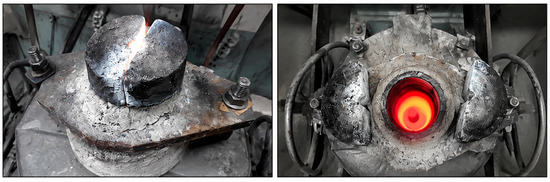
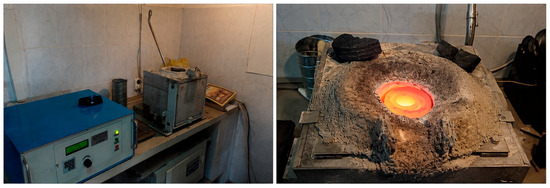
To establish the fundamental possibility of using complex boron-containing ferrosilicochromium, laboratory tests on the smelting of a nickel–chromium-containing alloy were carried out in a Tammann furnace (Figure 1) and in an induction furnace (Figure 2), designed for a temperature regime of up to 1700 °C. The charge calculation was performed taking into account the production of slags with various basicities. The series of experiments conducted consisted of three variants differing in the slag basicity value (CaO/SiO2): 0.4, 0.5, and 0.6. The composition of the crucible sample weight is presented in Table 2.
Figure 1.
Tammann furnace during the smelting of a nickel–chromium-containing ferroalloy.
Figure 2.
Induction furnace during the smelting of a nickel–chromium-containing ferroalloy.
Table 2.
Composition of the crucible sample weight.
The charge was loaded into a graphite crucible and placed into the furnace; the crucible was purged from above with argon to prevent metal oxidation, and the temperature was raised to the set point. Temperature control was carried out using a tungsten–rhenium thermocouple WR-5/20 with an accuracy of ±20 °C.
Experimental conditions are as follows:
- -
- Smelting temperature: 1630–1650 °C;
- -
- Holding time at the maximum temperature: 30 min;
- -
- Atmosphere: neutral (argon purging);
- -
- Charge amount per smelting: 74–82.5 g;
- -
- Number of smeltings: 6 (in 3 modes, with 2 replicates each).
After the completion of the smelting process, the crucible was removed and cooled for 2 h. The metal phase was separated from the slag phase mechanically. The resulting smelting products were subjected to chemical analysis, the data of which are presented in Table 3 and Table 4.
Table 3.
Chemical analysis of the metal obtained in the induction furnace and Tammann resistance furnace.
Table 4.
Chemical analysis of the slag obtained in the induction furnace and Tammann resistance furnace.
The laboratory smeltings conducted in the Tammann furnace and the induction furnace confirmed the possibility of efficiently producing a chromium–nickel ferroalloy using boron-containing ferrosilicochromium as a complex reducing agent and alloying material.
The obtained metal phases are characterized by a high content of chromium (up to 35%) and iron (more than 55%), as well as a stable concentration of boron (about 0.9%), which indicates its successful incorporation into the alloy composition and partial distribution between the slag and the metal. It was established that increasing the slag basicity from 0.4 to 0.6 promotes a decrease in the content of silica and chromium oxides in the slag, thereby improving the recovery of valuable components and facilitating the separation of the slag phase.
At the same time, the best indicators for reducing residual silicon in the metal and recovering chromium and iron were achieved in the induction furnace, which is associated with a more stable temperature regime and uniform heating of the charge. Thus, optimizing the slag basicity and choosing a suitable smelting unit are key factors for increasing the process efficiency and the quality of the resulting ferroalloy.
One of the critically important aspects determining the efficiency and economy of smelting is the properties of the slag, in particular, its viscosity and crystallization (melting) temperature.
Optimal slag viscosity ensures good kinetics of reduction reactions, promotes the coalescence (clumping) of metal droplets and their settling, and ensures high-quality separation of the metal and slag phases. High viscosity hinders these processes, leading to metal losses in the slag and the formation of slag inclusions in the alloy. The crystallization temperature must be lower than the metal smelting temperature so that the slag remains liquid and can be removed from the furnace without solidification.
The viscosity of molten oxide systems is influenced by:
- -
- Temperature—with increasing temperature, viscosity decreases exponentially.
- -
- Chemical composition—basic, acidic, and neutral oxides form the structure of the slag.
Basic oxides (CaO, MgO): At moderate concentrations, they decrease viscosity by breaking silicate bonds. Acidic oxides (SiO2, Al2O3): They increase viscosity by forming complex polymeric anionic structures. Neutral oxides (FeO, Cr2O3): They can behave as basic or acidic depending on the slag composition. Basicity (B) is a key parameter describing the ratio of basic to acidic oxides. In this case, a simple ratio is used: B = CaO/SiO2. The optimal basicity (typically in the range of 0.5–0.8 for these processes) allows a slag to be obtained with an acceptable melting temperature and low viscosity.
Experimental determination of the viscosity of slag melts was carried out on an electric vibration viscometer in a Tammann resistance furnace. To ensure high-temperature measurements in an oxidizing atmosphere, molybdenum equipment (a crucible and measuring elements) resistant to the aggressive action of the melt was used.
Temperature control during the experiments was carried out with high accuracy using a tungsten–rhenium thermocouple of the WR-5/20 type. The sensitive element of the thermocouple was installed in the immediate vicinity of the test sample, in the lower part of the crucible, which ensured reliable recording of the slag temperature.
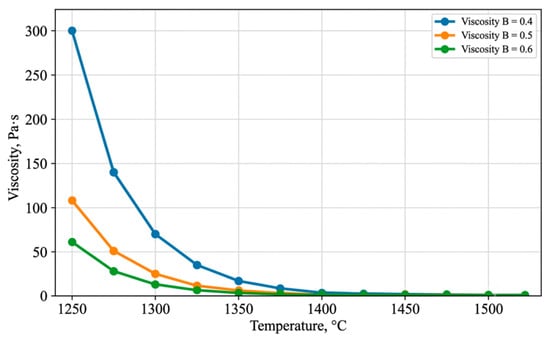
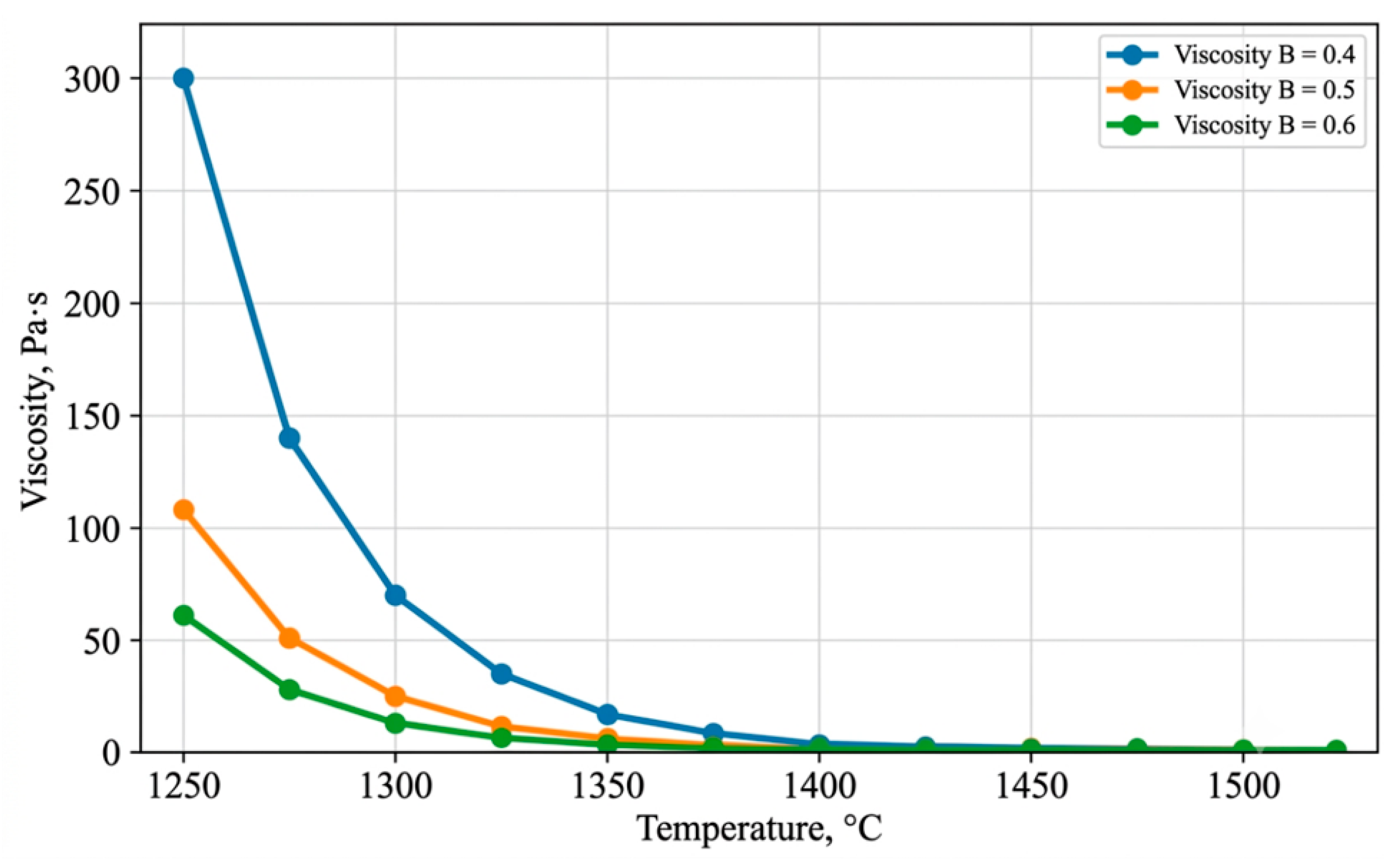
The obtained experimental data (Figure 3) indicate the influence of the slag composition on its viscosity. With a temperature increase from 1400 to 1450 °C, the viscosity of the slag with a basicity of 0.6 is 2–2.5 times lower than the viscosity of the slag with a basicity of 0.4 and is at the level of 0.8–1.4 Pa·s. Due to the boron addition, the temperature range of crystallization expands.
Figure 3.
Temperature dependence of the obtained slags with various basicity values (0.4–0.6).
With an increase in basicity from 0.4 to 0.6, the content of the basic oxide CaO naturally increases in the slag (from 23–25% to 29–31%) and the content of the acidic oxide SiO2 decreases (from 56–59% to 51–53%). Such a slag composition with a basicity of 0.5–0.6 is preferable from the standpoint of viscosity. CaO acts as a modifier, breaking the long chains of silicon–oxygen tetrahedra (SiO44−), which reduces the viscosity of the slag melt.
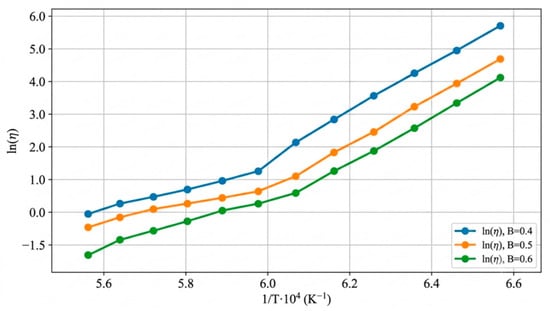
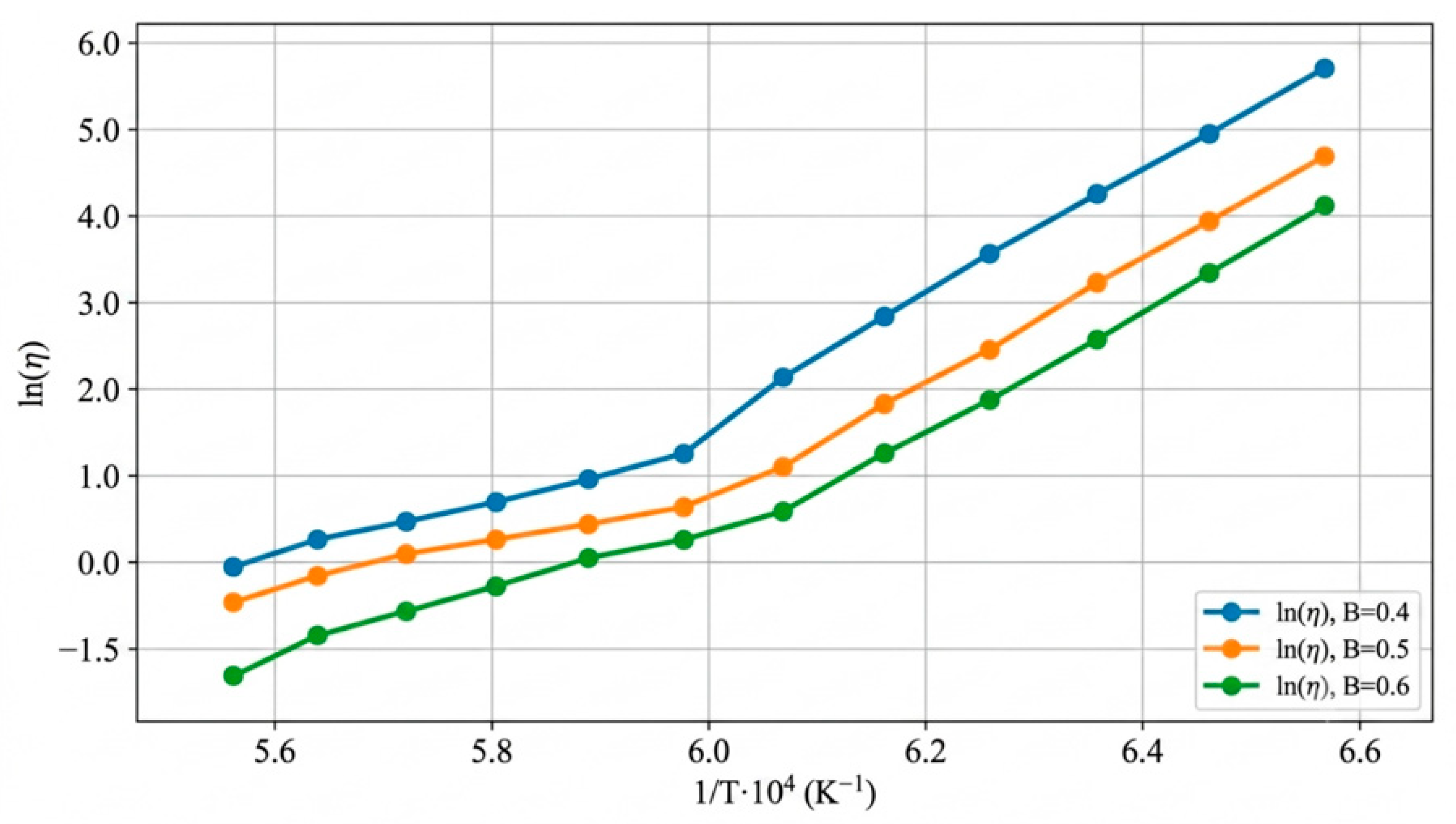
To establish the temperature range of slag crystallization (solidification), a method of semi-logarithmic processing of viscosity polytherms was applied (Figure 3). This analytical approach is based on plotting the dependence of the logarithm of viscosity on the inverse temperature (1/T, K−1). This method is based on the fact that the crystallization process disrupts the smooth, predictable change in the melt viscosity, causing an anomaly (inflection) on the graph. The goal is to detect this anomaly mathematically.
For a liquid melt in the temperature range above the liquidus, the temperature dependence of viscosity is typically described by an equation of the type:
where
η = A × exp (Ea/(R × T))
η—dynamic viscosity;
A—pre-exponential factor;
Ea—activation energy of viscous flow;
R—universal gas constant;
T—absolute temperature.
Taking the natural logarithm of both sides of the equation yields a linear relationship:
ln(η) = ln(A) + (Ea/R) × (1/T)
Thus, in the coordinates ln(η)versus (1/T), the behavior of a purely liquid melt is approximated by a straight line. The appearance of a crystalline phase in the melt sharply increases its structural viscosity, causing a deviation from this linear dependence. The point of deviation (inflection) corresponds to the onset of crystallization. The data obtained are presented in Table 5 and Figure 4.
Table 5.
Calculated data of the dependence of the logarithm of viscosity on the inverse temperature.
Figure 4.
Dependence of the logarithm of slag viscosity on the inverse absolute temperature (the activation energy was calculated for the temperature interval of 1667–1798 K).
For the slag with a basicity of B = 0.4, the crystallization temperature is 1410 °C (1683 K). The most pronounced inflection occurs between 1400 °C and 1425 °C.
For the slag with a basicity of B = 0.5, the crystallization temperature is 1370 °C (1643 K). A clear inflection is observed between 1350 °C and 1400 °C. The drop in ln(η) from 1.87 to 0.69 is significantly larger than in the adjacent sections.
For the slag with a basicity of B = 0.6, the crystallization temperature is 1335 °C (1608 K). The inflection is less pronounced but can be traced between 1300 °C and 1350 °C. The increase in viscosity slows down, which may indicate the onset of crystallization.
Influence of crystallization temperature: Slag with a high SiO2 content (acidic) typically has a high crystallization temperature. The introduction of CaO shifts the composition toward lower-melting compounds (e.g., calcium silicates). Therefore, increasing the basicity from 0.4 to 0.6 lowers the crystallization temperature of the slag, promoting its better fluidity and facilitating its removal from the furnace.
The experimental data obtained for different slag basicities are presented in Table 5. The activation energy of the viscous flow of the slag was calculated based on the linear segment of the Arrhenius plot in the temperature interval of 1667–1798 K (which corresponds to 1/T * 104 values from 5.6 to 6.0)
Low slag viscosity promotes the diffusion of the reducing agent (silicon) to the oxide particles and the outflow of the formed metal droplets. This is confirmed by the data: with increasing basicity (and, consequently, decreasing viscosity), the content of chromium oxide (Cr2O3) in the slag decreases (from 1.12% to 1.05% in the Tammann furnace and from 0.87% to 0.74% in the induction furnace). This indicates a more complete reduction of chromium and its transition into the metal phase due to improved kinetic conditions in the less viscous slag.
It has been experimentally established that the viscosity of the slag melt decreases exponentially with increasing temperature and decreases with increasing basicity in the range of B = 0.4–0.6. Using the method of semi-logarithmic processing of viscosity polytherms, the crystallization temperatures of the slags were determined: 1410 °C (B = 0.4), 1370 °C (B = 0.5) and 1335 °C (B = 0.6).
It is shown that increasing the slag basicity to the level of 0.5–0.6 is technologically expedient, as it leads to the formation of a low-melting and low-viscosity melt.
The improvement in the rheological properties of the slag with increasing basicity directly correlates with an increase in the degree of chromium reduction and a decrease in its content in the final slag, which confirms the critical role of mass transfer in the course of metallurgical reactions.
Thus, to ensure high technical and economic indicators of the smelting, it is recommended to conduct the process with a slag that has a basicity level of 0.5–0.6.
4. Conclusions
- The aim of the work was an experimental study of the process of obtaining a chromium–nickel ferroalloy from the nickel ores of the Batamshinskoye deposit by a metallothermic method using boron-containing ferrosilicochromium as a reducing agent and alloying material, as well as the determination of the optimal parameters of slag formation.
- A theoretical and experimental analysis of the metallothermic process was carried out. It was established that the use of boron-containing ferrosilicochromium allows for the efficient reduction of nickel, chromium, and iron oxides, ensuring the formation of a complex ferroalloy with simultaneous boron alloying.
- The obtained alloys contain, as a %: 54.8–56.9 Fe; 3.3–3.6 Ni; 3.2–6.0 Si; 34.8–35.6 Cr; 0.89–0.92 B. The most stable and high-quality results were obtained during smelting in an induction furnace, which ensures uniform heating and stability of the temperature regime.
- Investigations into the viscosity and crystallization temperature of the furnace slags were performed. It was experimentally established that the viscosity of the slag melt decreases exponentially with increasing temperature and decreases with increasing basicity in the range of B = 0.4{−}0.6. Using the method of semi-logarithmic processing of viscosity polytherms, the crystallization temperatures of the slags were determined: 1410 °C (B = 0.4), 1370 °C (B = 0.5), and 1335 °C (B = 0.6). It is shown that increasing the slag basicity to the level of 0.5–0.6 is technologically expedient, as it leads to the formation of a low-melting and low-viscosity melt.
- Thus, the performed theoretical and experimental studies confirmed the technological feasibility and efficiency of the metallothermic production of a boron-containing chromium–nickel ferroalloy. The results can be used for further laboratory and industrial development of the technology and its commercial implementation.
These studies were carried out within the framework of the grant BR23991563: «Creation of Innovative Resource-Saving Technologies for Mining and Integrated Processing of Mineral and Technogenic Raw Materials.
Author Contributions
Conceptualization, R.S. and K.T.; Methodology, A.O., R.S. and K.T.; Software, R.S. and K.T.; Validation, A.O., R.S. and K.T.; Formal analysis, R.S. and K.T.; Investigation, A.O., R.S. and K.T.; Resources, R.S. and K.T.; Data curation, R.S.; Writing—original draft, A.O., A.M. and R.S.; Writing—review and editing, A.O., R.S., K.T. and A.M.; Supervision, K.T. and R.S.; Project administration, K.T.; Funding acquisition, A.O. All authors have read and agreed to the published version of the manuscript.
Funding
This research is funded by the Committee of Industry of the Ministry of Industry and Construction of the Republic of Kazakhstan under program-targeted funding for scientific research for 2024–2026, BR23991563: «Creation of Innovative Resourch-Saving Technologies for Mining and Integrated Processing of Mineral and Technogenic Raw Materials.
Data Availability Statement
Data are available from the corresponding author upon reasonable request.
Conflicts of Interest
The authors declare no conflicts of interest.
References
- Isabekov, K.N.; Sadykov, Z.S. Nickel Ores of Kazakhstan and Possibilities of Their Processing. Min. J. Metall. 2020, 3, 22–29. [Google Scholar]
- Geological Survey of Kazakhstan. Information on the Batamshinskoye Deposit: Geological Report; Geological Survey of Kazakhstan: Almaty, Kazakhstan, 2018. (In Russian)
- Lazarev, Y.F. Metallurgy of Chromium; Nauka: Moscow, Russia, 2007. (In Russian) [Google Scholar]
- Novikov, I.M.; Frolov, K.V. Influence of Boron on the Structure and Properties of Alloy Steels. Met. Sci. Heat Treat. 2019, 61, 18–25. [Google Scholar]
- Vlasov, A.A. Boron in Metallurgy: Properties, Behavior, Application; Tekhnosfera: Moscow, Russia, 2016. (In Russian) [Google Scholar]
- GOST 4756–91; Ferroboron. Specifications. Interstate Council for Standardization, Metrology and Certification: Moscow, Russian, 1991.
- Ershov, V.G. Complex Reduction Processes in the Ferroalloy Industry. Steel Transl. 2021, 51, 41–45. [Google Scholar]
- METSO Official Website. Available online: https://www.metso.com (accessed on 20 January 2025).
- Akberdin, A.A.; Kim, A.S.; Sultangaziev, R.B.; Orlov, A.S. The method of mathematical description of the phase composition diagrams. CIS Iron Steel Rev. 2023, 25, 79–83. [Google Scholar] [CrossRef] [Scilit]
- Kozhakhmetov, S.M.; Kvyatkovsky, S.A.; Sultanov, M.K.; Tulegenova, Z.K.; Semenova, A.S. Processing of oxidized copper ores and sulfide copper concentrates of the Actogay deposit by pyrometallurgical methods. Complex Use Miner. Resour. 2018, 306, 54–62. [Google Scholar] [CrossRef] [Scilit]
- Salikhov, V.A. Theoretical and experimental study of the processes of aluminothermic and silicothermic reduction of chromium from oxide raw materials. Metallurgist 2021, 65, 284–291. [Google Scholar]
- Zhang, H.; Wang, L.; Park, T. Effect of basicity and B2O3 content on the viscosity and structure of CaO-SiO2-Al2O3-based metallurgical slags. J. Non-Cryst. Solids 2022, 582, 121451. [Google Scholar]
- Ryabchikov, I.V.; Belikov, S.V.; Gasik, M.I. Thermodynamic modeling of silico-thermic reduction of nickel and chromium from complex oxide systems. Steel Transl. 2020, 50, 541–547. [Google Scholar] [CrossRef] [Scilit]
- Sasaki, Y.; Kirschen, M.; Sukenaga, S. Viscosity measurements of SiO2-CaO-Cr2O3 slag melts using high-temperature rotational viscometry. ISIJ Int. 2021, 61, 1045–1052. [Google Scholar]
- Sabyrniyazov, A.K.; Nusupbekov, B.R.; Zhusupov, K.T. Viscosity polytherms and crystallization temperatures of silicate-oxide melts under varying CaO/SiO2 ratios. Russ. Metall. 2023, 2023, 612–619. [Google Scholar]
- Liu, X.; Zhang, J.; Harrison, R. Mechanism of boron distribution between molten iron-based alloys and silicate slags during ferroalloy production. Metall. Mater. Trans. B 2023, 54, 789–801. [Google Scholar]
- Ershov, V.G.; Zhdanov, A.V. Kinetics of mass transfer and silicon diffusion in high-temperature reduction processes of chromium and iron oxides. J. Min. Metall. Sect. B Metall. 2022, 58, 45–56. [Google Scholar]
- Coetsee, T. The behavior of boron and chromium during ladle refining and alloying processes: A review of slag-metal interactions. Minerals 2022, 12, 1104. [Google Scholar] [CrossRef] [Scilit]
- Zhang, M.; Wang, X.; Li, H. Viscosity and Structure of CaO–MgO–Al2O3–SiO2 Slags: A Review of Recent Advances. Metall. Mater. Trans. B 2024, 55, 112–128. [Google Scholar] [CrossRef] [Scilit]
- Liu, Y.; Chen, Z.; Zhang, J. Effect of Basicity on the Viscosity and Crystallization of High-Chromium Slags in Ferroalloy Smelting. ISIJ Int. 2023, 63, 452–465. [Google Scholar]
- Wang, C.; Zhao, Y.; Liu, X. Recent Progress in the Metallothermic Reduction of Chromite Ores: A Critical Review. J. Sustain. Metall. 2025, 11, 89–104. [Google Scholar]
- Chen, H.; Li, S.; Wang, Y. Thermodynamics and Kinetics of Boron Recovery from Ferroboron Smelting Processes. Metall. Mater. Trans. B 2026, 57, 301–315. [Google Scholar]
- Petrov, A.V.; Sidorov, V.P. Modern Approaches to the Processing of Low-Grade Nickel–Chromium Ores: Challenges and Opportunities. Metals 2024, 14, 550–565. [Google Scholar]

Disclaimer/Publisher’s Note: The statements, opinions and data contained in all publications are solely those of the individual author(s) and contributor(s) and not of MDPI and/or the editor(s). MDPI and/or the editor(s) disclaim responsibility for any injury to people or property resulting from any ideas, methods, instructions or products referred to in the content. |
© 2026 by the authors. Licensee MDPI, Basel, Switzerland. This article is an open access article distributed under the terms and conditions of the Creative Commons Attribution (CC BY) license.