


Abstract
The Ni-Al system contains five intermetallic compounds, out of which NiAl and Ni3Al have received the vast majority of scientific and industrial interest over the past few decades. Ni3Al is of major interest due to its unique properties, including a yield strength that increases with temperature. The combustion synthesis (CS) process for producing Ni3Al from elemental powders of nickel and aluminum offers a low thermal budget and rapid processing, as well as purer products. This paper reviews the fundamentals of CS as applied to Ni3Al and its composites, and focuses on research over the past 25 years, including mechanically and electrically activated combustion synthesis and combined combustion synthesis and bulk deformation processes to produce high-density products. Several new directions are suggested for future research in the field.
1. Introduction
Interest in intermetallics has been substantial over the past few decades [1]. This is motivated by the unique properties that such materials can offer, which prompt serious consideration for a myriad of applications. One method used in the fabrication of intermetallics is combustion synthesis (CS), which involves the exothermic reaction between elemental powder constituents to produce intermetallic products in short processing times. The approach offers several advantages beyond short processing times, including a lower thermal budget and purer products [2]. Historical disadvantages include product porosity and microstructural inhomogeneity, which can be detrimental to mechanical properties [3]. A comprehensive review of the processing of a myriad of high-temperature materials was published in 1989 by Munir and Anselmi-Tamburini [4]. Over time, the approach has been combined with other processes and effects to alleviate many of its disadvantages, including extrusion [5], forging [6], mechanical activation of powders [7], and electric fields [8]. A comprehensive review outlining the diversity of such approaches has been published by the author [9], and in another review, the effect of electric field in Combustion Synthesis was discussed [10].
The Ni-Al system contains five intermetallics: NiAl, Ni3Al, NiAl3, Ni2Al3, and Ni5Al3. Of these, NiAl and Ni3Al have attracted the vast majority of scientific and industrial attention due to their unique properties, including high-temperature strength, wear resistance, oxidation resistance, and corrosion resistance. In its basic form, the combustion synthesis of Ni-Al bulk materials involves mixing elemental powders of nickel and aluminum in the intended stoichiometric composition, compacting, and igniting the powder compact to promote the combustion synthesis reaction. Some recent research has examined the production of intermetallic powders via combustion synthesis. For example, recently, rounded Ni-Al powders were produced through combustion synthesis processing with the aid of CaCO3 and Ca(OH)2 additives [11]. The objective was to produce spherical intermetallic powders suitable for additive manufacturing. As far as the production of bulk Ni3Al and its composites via combustion synthesis processes, significant research was initially conducted to determine the effects of fundamental processing parameters on the reaction products and the process, including nickel and aluminum particle size and their relative size ratios, green density of the reacting powder compact, reaction atmosphere, reaction temperature, ceramic reinforcement loading, and Ni3Al-composite functionally graded materials [12,13,14]. Recently, the processing, properties, and applications of nickel aluminides were reviewed; however, there was very limited mention of combustion synthesis research [15]. It has been more than 25 years since the author’s last comprehensive review of the combustion synthesis of Ni-Al intermetallic materials [2]. Since then, significant research has been published on the subject. Hence, it was felt appropriate to review the research in the area, focusing on select research over the past 25 years. Recent combustion synthesis research on the NiAl intermetallic compound has targeted coatings [16,17], composites [18,19], spark plasma sintering and mechanical activation [20], and multilayer foils [21]. The Ni3Al compound is, however, another important intermetallic with unique properties, including a yield strength that increases with an increase in temperature [22], prompting its use as a high-temperature tool material. As such, it is prudent to review recent research on its production via combustion synthesis. This review, therefore, discusses the fundamentals of combustion synthesis as they relate to the Ni3Al intermetallic and its composites, as well as recent research in the field. Mechanical and electrical activation, combined with combustion synthesis, are discussed, as is the combination of combustion synthesis with bulk deformation processes, along with other research.
2. Background
2.1. Fundamentals of Combustion Synthesis of Ni3Al Intermetallic
2.1.1. Thermal Explosion vs. SHS
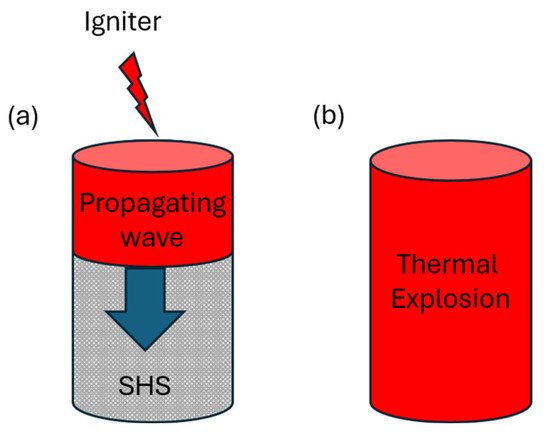
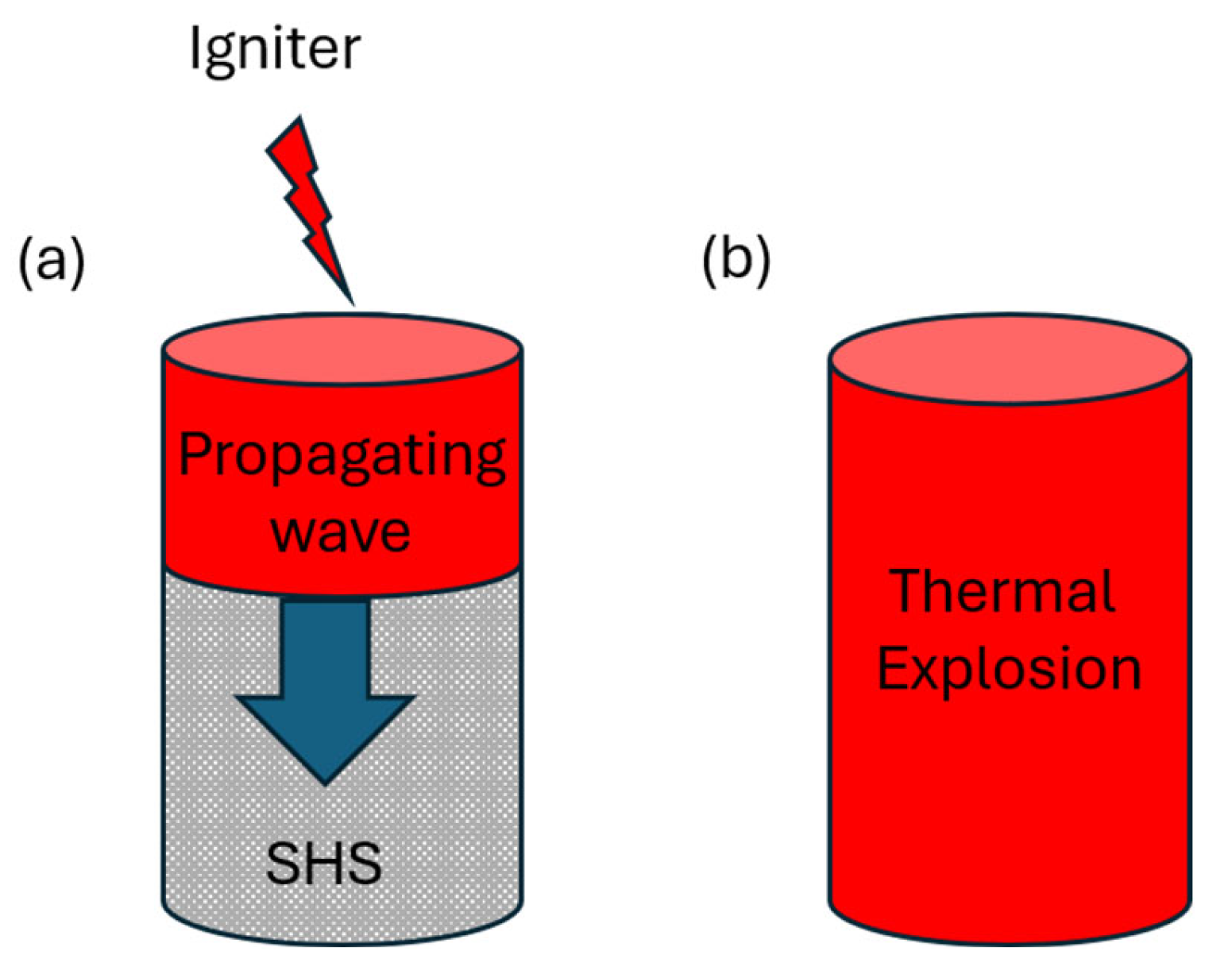
Before we consider recent research in the area, it is important to lay down the fundamentals of the CS process as they relate to Ni3Al and its composites. Under the banner of combustion synthesis, two modes of ignition can be described. The first is where the 3Ni+Al powder compact is locally ignited to promote an exothermic reaction between the Ni and Al powders, converting them into the intended intermetallic compound at that location. This ignition could be carried out using a heated coil, an electric discharge, a chemical oven, a laser, or other means. Since the reaction between Ni and Al powder to form the product is exothermic, the released heat locally heats the next layer in the compact to its ignition temperature, and the process continues in a self-propagating manner. In other words, giving the process the name Self-propagating high-temperature synthesis (SHS). In another ignition mode, the entire 3Ni+Al powder compact is uniformly heated to the ignition temperature. Typically, heating the 3Ni+Al compact to the aluminum melting point (660 °C), or more precisely, to the eutectic temperature of 640 °C, triggers the reaction. This mode of ignition has previously been referred to as volume combustion [23], simultaneous combustion [24], or thermal explosion (TE) [5]. Some of the main parameters or features measured in combustion synthesis research include combustion temperature (for TE and SHS), wave velocity (for SHS reactions), ignition temperature (TE), and product porosity and homogeneity (TE and SHS). Some limited research was also conducted on recording acoustic emissions during SHS processing, which were related to crack formation and self-oscillations of the reaction wave, in addition to chemical and phase transformations [25]. Figure 1 is a schematic describing both the SHS and thermal explosion modes of ignition.
Figure 1.
Combustion synthesis: (a) SHS mode; (b) Thermal explosion mode.
Advantages of thermal explosion over SHS include higher combustion temperatures, more uniform heating, and a lower possibility of obtaining inhomogeneous microstructures. SHS would have the advantage of a low thermal budget, as the reaction occurs at lower temperatures and is therefore more energy-efficient than TE.
2.1.2. Adiabatic and Combustion Temperatures
As mentioned, two of the fundamental parameters in this process are the adiabatic temperature (Tad) and the combustion temperature (Tc). The adiabatic temperature can be calculated theoretically using thermodynamic principles and represents the maximum temperature achievable when the compact is fully reacted, assuming no heat loss to the surroundings. The combustion temperature, on the other hand, is simply the experimentally determined maximum temperature reached during the reaction. Here, heat can be lost to the surroundings, or, if the reaction is incomplete, the amount of heat produced will be reduced. Hence, in reality, Tc is typically less than Tad; however, there are cases where Tc exceeds the theoretically predicted Tad. This can occur when the compact undergoes oxidation during the process, which is intrinsically exothermic, thereby increasing heat generation. This was demonstrated for the Ni+Al reaction in the thermal explosion mode [26]. In the SHS of Ni-Al materials, the initial temperature of the compact (the preheat temperature) plays an important role in determining the final adiabatic or combustion temperature. Obviously, both Tad and Tc increase with the compact’s preheat temperature, due to its higher heat content prior to the reaction.
If a 3Ni+Al compact is theoretically assumed to react without preheating, the calculated adiabatic temperature would lie below the melting point of Ni3Al. This means the Ni3Al should be produced in solid form. Adiabatic temperatures have been calculated for the Ni-Al system by several researchers [27,28], and there are some discrepancies between the reported findings, which could be due to the use of different thermochemical data or to the failure to account for the percent molten aluminum or molten nickel at high preheat temperatures. The melting point of Ni3Al is 1668 K, and if an SHS reaction were to take place without preheating and at atmospheric pressure (with a heat of formation of −153.1 kJ/mol [29]), the resulting adiabatic temperature would be about 1510 K [30], i.e., lower than the melting point of Ni3Al, and hence the product is expected to be in the solid state. Obviously, if the green compact is initially heated to temperatures above room temperature before the SHS reaction begins, the adiabatic temperature should increase due to the higher heat content of the compact. Zhu et al. [30] performed adiabatic calculations and conducted accurate experimental procedures, and determined that when the Ni+Al reaction occurs at temperatures greater than 835 K, the NiAl product temperature exceeds its melting point and thus becomes fully molten. On the other hand, a compact preheat temperature above 1019 K for 3Ni+Al is needed for the resulting adiabatic temperature to exceed the melting point of Ni3Al. Achieving adiabatic temperatures exceeding the melting point of the intermetallic product can be advantageous for coating or joining applications [30]. Normally, an increase in the compact preheat temperature results in higher combustion temperatures and wave-front velocities. This is indeed true up to a compact preheat temperature at which the formation of aluminum-rich parasitic phases can occur via solid-state interdiffusion between Ni and Al powder. Hence, beyond this point, a reduction in combustion temperature and wave velocity can occur [31].
Whether a reaction can proceed via SHS or not depends on thermodynamic and kinetic considerations; some systems may require preheating the compact to achieve stable wave propagation. 3Ni+Al is typically one such system, in which a preheat temperature of at least 200 °C is required [32]; however, in another study by Yokota et al. [33], even 200 °C did not promote an SHS reaction, requiring electrical activation to initiate it at that temperature. It should be noted that other factors, including powder characteristics, can influence the compact preheat temperature and the ability to produce a stable SHS reaction. However, mechanical activation [7], and electric activation [33] may help reduce such compact preheat requirements (discussed later).
Early research on the combustion synthesis of Ni-Al intermetallics identified several fundamental effects of process parameters on reaction characteristics. For example, a fundamental mechanism for the combustion synthesis of Ni3Al was determined to ultimately involve the melting of aluminum powder, its spreading throughout the green compact, and wetting Ni powder [12]. The aluminum finally reacts exothermically with the nickel powder, generating heat that sustains the reaction. In essence, it is a liquid-phase sintering process [34], specifically a reactive transient liquid-phase sintering process, since the aluminum is consumed during the reaction with the nickel powder. This means many of the principles of liquid phase sintering can be applied. The effects of various synthesis parameters are summarized next.
2.1.3. Effect of Ni and Al Particle Size
When considering the particle size of the elemental constituents, we need to discuss both the particle sizes and the particle-size ratio between the Ni and Al powders. Noting that the reaction involves the diffusion of atoms from molten aluminum into nickel powder, this requires maintaining high reaction temperatures for a sufficient duration to facilitate complete diffusion. The time at high temperatures is not prolonged because heat is lost to the surroundings. This would, understandably, mean that large nickel powder would not be ideal, as it would lead to incomplete reactions and leave residual nickel at the core of nickel particles/regions. One may then logically suggest using smaller and smaller elemental powders. This is true, but also within limits. At some point, we encounter powder agglomeration of fine particles, which can pose processing challenges. Even at very small particle sizes, excessive surface oxides on the powders can pose processing and compositional challenges. For example, at the nanoscale, the surface oxide on Al powder can be 50% of its volume [35], not to mention the pyrophoricity issues that need to be considered. Nanoscale constituents can not only reduce preheat temperatures in SHS reactions but also lower ignition temperatures during thermal explosion. Although not directly comparable to powder-based combustion synthesis, nanoscale multilayer foils with a 1:1 atomic ratio of Ni(V) and Al and ignition temperatures as low as ~245 °C were reported using high heating rates (via electric resistive heating) [36]. Yeh and Sung [32] studied the effect of elemental powder, relative density, and compact preheat temperature in the SHS processing of Ni3Al. The SHS reaction of 3Ni+Al with a nickel particle size of 3–7 µm involved a flame-front stage, in which the wave traveled rapidly from the top to the bottom of a 12 mm-high compact in only 0.37 s. After a slight delay, this was followed by a very intense glow across the entire compact between 0.8 and 1.2 s, after which the sample remained bright for an extended period. Notably, in these experiments, the 3Ni and Al powders were ball-milled for 10 h without forming any interfacial products. An increase in nickel particle size to −325 mesh not only reduced wavefront velocity but also altered flame propagation characteristics. An increase in preheat temperature, however, resulted in a higher combustion temperature and the formation of a Ni3Al product.
Another important point is that the lower-melting-point phase, namely aluminum, must be continuous (percolate) through the green compact microstructure. This is achieved by ensuring the nickel-to-aluminum particle size ratio is ~2.4:1 for the Ni3Al composition [12]. Typically, a nickel particle size of ~45 µm and an aluminum particle size of ~18 µm can yield good results.
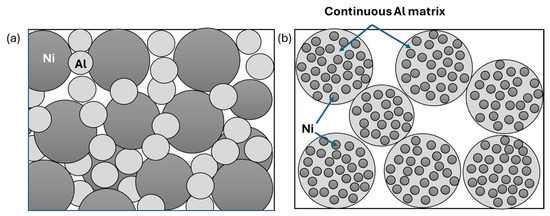
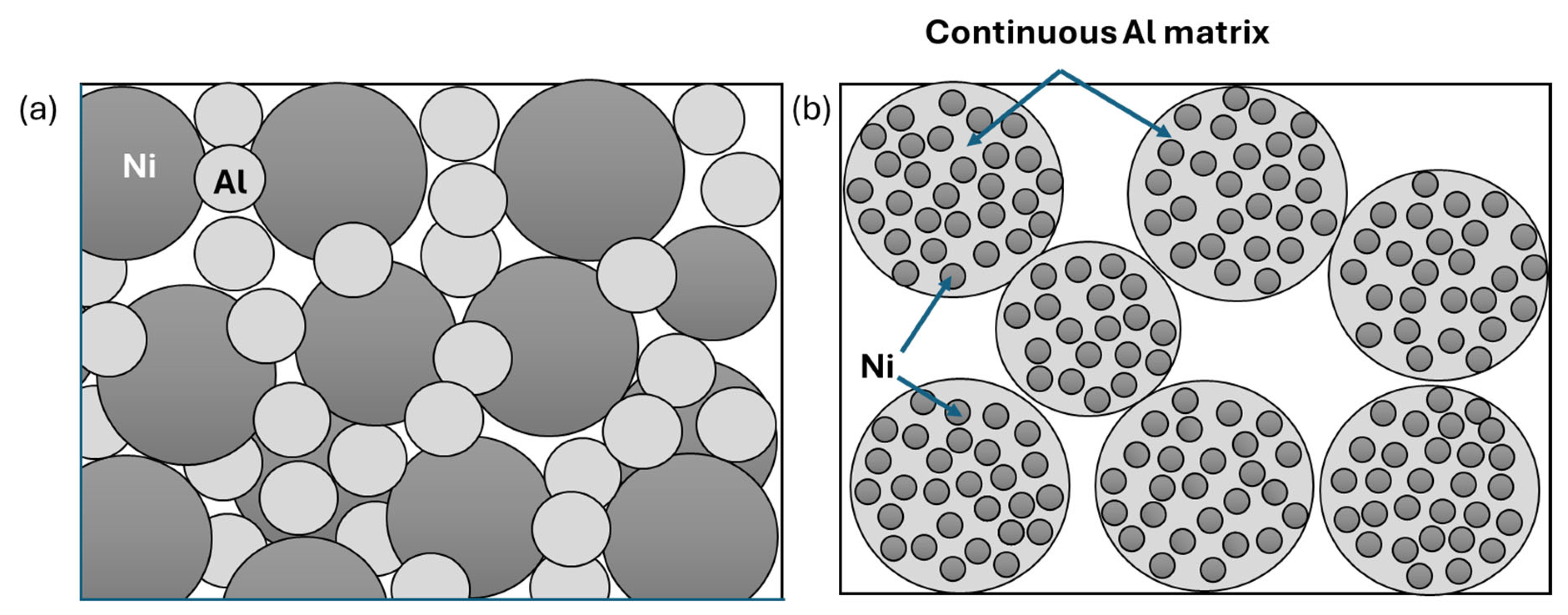
As mentioned, this requirement still imposes a limitation on nickel particle size; particles that are too large or too small will result in other issues. Another approach to enable the use of nanoscale nickel without resorting to 2.4-times-smaller nanoscale aluminum (with its problems of excessive oxide content and pyrophoricity) is to disperse nanoscale nickel within microscale aluminum powders. This approach can overcome agglomeration at small nickel particle sizes while maintaining a continuous aluminum phase within the microstructure. Figure 2a is a simplified schematic showing the elemental powder mixture obtained via a conventional mixing approach of 3Ni and Al powders, and a microstructural powder design for nanoscale Ni powder that achieves Ni dispersion while maintaining a continuous aluminum phase (Figure 2b).
Figure 2.
(a) Conventional powder mixing of micro-scale powder, (b) design for ensuring dispersion on nano-scale Ni and a continuous aluminum matrix.
Mechanically milling of the constituent powders has been reported to successfully produce single-phase Ni3Al after combustion synthesis [37]. This is probably due to the coating of nickel powder with softer aluminum, thus maintaining the interconnectivity of aluminum within the compact microstructure. To the best of our knowledge, the possible residual stresses arising from the SHS reaction in Ni3Al have not received adequate attention. Such stresses can affect the mechanical properties of SHS products and need to be evaluated. Rivero et al. [38] observed that residual stresses following SHS of NiAl were tensile when either both Ni and Al were on the microscale, or one of them was on the nanoscale. When both Ni and Al were on the nanoscale (50 nm Al and 100 nm Ni), compressive residual stress (~416 MPa) dominated, which may favor applications involving fatigue. The nano-scale aluminum powder contained 20 vol.% alumina.
2.1.4. Effect of Heating Rate
In thermal explosion ignition mode, heating the green compact to the ignition temperature can be achieved at different heating rates. Very rapid heating in a furnace can lead to nonuniform heating of the compact, with the surface heating faster than the interior, resulting in an SHS-type reaction that initiates at the compact surface. This represents loss of process control and is generally observed at high heating rates [12]. On the other hand, too-slow heating rates can allow aluminum-rich parasitic phases (such as Al3Ni and Al3Ni2) to form at contact points between aluminum and nickel powder. Since these phases are rich in aluminum, they will deprive the reactive mixture (nominally 25% at. % Al) of aluminum. This leads to a stoichiometric imbalance in the reaction, resulting in a multiphase microstructure rather than the intended single-phase Ni3Al compound. Hence, it is critical to avoid slow heating rates; it has even been reported for the Ni+Al reaction that combustion synthesis was not possible at heating rates lower than 5 °C/min [26]. Since the formation of these aluminum-rich intermetallics is also exothermic, it is possible that if the compact is heated to a temperature below the 640 °C ignition temperature, the heat emanating from the formation of these phases raises the temperature of the compact (self-heating) to the ignition temperature [26]. Hence, intermediate heating rates are typically used when reactions are conducted in a conventional furnace. However, if other heating approaches are used to rapidly heat the compact volumetrically, other possibilities emerge. It should be noted that in SHS reactions, local heating rates can be substantially higher than those observed in thermal explosion reactions.
In recent work on the thermal explosion of 3Ni+Al mechanically activated powder, combustion synthesis was not possible even at moderate heating rates (e.g., 10 °C/min), attributed to the annealing of crystallographic defects formed during mechanical milling and solid-state reaction products [39].
In situations where a fully molten or partially molten Ni3Al product is expected, pre-alloyed Ni3Al powder is added to the reactive powder mix. This preformed Ni3Al powder does not participate in the reaction and essentially acts as a heat sink, reducing the combustion temperature to below the melting point of Ni3Al. Such an approach was adopted during the simultaneous thermal explosion and extrusion of Ni3Al, thus avoiding the production of molten Ni3Al extrusions [5]. In an interesting study, Lapshin and Boyangin [40] interrupted the heating of the compact (at a heating rate of 3.15 °C/s) at a critical temperature below the conventional ignition temperature of high-temperature synthesis and noted no significant changes in the product, which was mainly single-phase Ni3Al. The authors suggested that the approach offers a lower-energy alternative to a complete heating cycle.
It is also possible to use the formation of these Al3Ni and Al3Ni2 phases in such a way to reduce the heat generation during the subsequent reaction and allow the formation of a solid intermetallic product without the need for pre-alloyed powder. This was demonstrated with the NiAl system [41], where an intermediate heating stage was added to the heating cycle. Here, a dwell at temperatures below 600 °C was used to grow a specified volume fraction of Al-rich phases. This was followed by raising the temperature above aluminum’s melting point, at which point a TE reaction occurred. Solid homogeneous NiAl was formed (in contrast with molten NiAl in the absence of the Al-rich phases). The microstructure was also highly porous, single-phase NiAl.
2.1.5. Effect of Atmosphere
Oxygen-containing atmospheres should be avoided due to reactions with aluminum and nickel powders, which can lead to self-heating, loss of process control, and a stoichiometric imbalance that negatively affects the final product’s properties. Typically, inert gas atmospheres such as argon are used, but better results have been reported when reacting under vacuum [12]. A vacuum can reduce the cooling rate from the combustion temperature, allowing more time at high temperatures to increase homogenization of the microstructure. It also helps to decrease product porosity. Any entrapped gas from the environment that ends up in closed pores can be difficult to eliminate during the combustion synthesis. Hence, a vacuum avoids this issue.
2.1.6. Green Compact Relative Density
The relative green density of the 3Ni+Al powder compact can play a major role; the spreading of molten aluminum can be hindered if large/excessive pores are present in the green compact, leading to multiphase microstructures, for example, during thermal explosion [12]. Lebrat et al. [13] reported an increase in combustion temperature with increasing relative green density during the SHS of Ni3Al. They investigated relative densities ranging from 0.54 to 0.8 of the theoretical value. Relative green densities between 0.65 and 0.75 are typically used in combustion synthesis research. It should be noted that local density distributions (variations) can normally exist within the green compact due to powder/wall friction during uniaxial pressing [34]. This can become significant as the green compact’s aspect ratio (height/diameter) increases. This means that, on the local level, it is possible to observe differences in reaction characteristics across different regions within the green compact. Ideally, isostatic pressing should be used to achieve a homogeneous density distribution within the green compact, resulting in more uniform reaction products and properties. Few studies have done this, for example [12,42]. Alternatively, short disc-like specimens (also referred to as squat specimens [34]) could also be used in thermal explosion experiments. Here, these disc-like specimens can also possess more homogenous density distributions than taller ones.
In an SHS study of mechanically activated 3Ni+Al powder, an increase in green compact relative density was found to increase the Ni3Al product density [32]. A similar trend was also reported for the thermal explosion of 3Ni+Al [42].
2.1.7. Product Porosity
It is well known that product porosity can be a major disadvantage in the combustion synthesis of Ni3Al. This porosity can be a result of porosity already present in the green compact (it has been shown that higher relative green densities result in higher product densities in the thermal explosion [42] and SHS [32] of Ni3Al), or the volatilization of low-boiling-point adsorbed impurities or adsorbed moisture on powder surfaces during the reaction (powder degassing procedures can be used to reduce or eliminate this effect [43]). Additionally, an intrinsic type of porosity arising from the difference in densities between a fully dense 3Ni+Al powder compact and the Ni3Al product could manifest (in the absence of compact shrinkage during the reaction). Another type of porosity is Kirkendall porosity, which results from the solid-state interdiffusion between Ni and Al powder at their contact points during heating, in which nickel diffuses into aluminum at a rate different from that at which aluminum diffuses into nickel. Compact swelling can result from this process, due to the formation of Kirkendall porosity in the green compact from excess vacancies. This issue arises at low green compact heating rates and can result not only in low combustion temperatures but also in multiphase microstructures. Hence, slow heating rates should be avoided.
2.1.8. SHS Wave Characteristics and Apparent Activation Energy
In SHS research, reaction waves can be stable or unstable [10]. It is well known that, under normal conditions, to produce a stable reaction wave in the 3Ni+Al system, the powder compact must be preheated before initiating the SHS reaction. By conducting a series of SHS reactions at different compact preheat temperatures, the apparent activation energy (Ea) of the process can be determined. The average wave velocity and combustion temperatures can indeed be used to obtain the activation energy, using Equation (1) [43]
where Ea is the apparent activation energy, Tc is the combustion temperature, Vav is the average wave velocity, R is the ideal gas constant, K is a constant (based on thermal properties), and f(n) relates to the kinetic order for the reaction.
Typical velocities reported for the SHS of Ni3Al can range from 10 to 40 mm/s depending on relative green density and the degree of loading with composite reinforcements [13]. In another study, for the SHS of Ni3Al-2% CNT (carbon nanotube), wave velocities between ~8 mm/s and a little over 20 mm/s were reported [33]. The higher values were obtained at the higher preheat temperatures investigated.
Equation (1) shows that a plot of generates a straight line whose slope can be used to determine the apparent activation energy, Ea. Such activation energy for the SHS of Ni3Al was reported to be 92–98 kJ/mol [32] while Sohn and Wang [31] reported 176 kJ/mol experimentally and 265 kJ/mol theoretically. In the SHS production of Ni3Al-carbon nanotube (CNT) composites, Yokota et al. [33] reported for (Ni+2%CNT)/Al an activation energy of 231.9 kJ/mol when the powder compact was preheated and ignited without electric current activation during wave propagation, and 131.2 kJ/mol when preheating was conducted under electrical activation. It should be noted that the presence of CNTs within the nickel powders (i.e., composite Ni-CNT powders) may have acted as a diffusion barrier, resulting in a higher apparent activation energy than the experimental values reported by Sohn and Wang. However, SHS occurring during current activation, while maintaining the same preheat temperature, results in a notable ~43% reduction in the apparent activation energy. It is also important to note that processing differences, such as mechanical or electrical activation of powders, powder size, relative green density of the compact, type, size, and volume fraction of reinforcements, mechanical activation, and alloying, can all affect the apparent activation energy. We observe a reduction in activation energy upon electrical or mechanical activation; additionally, Yeh and Sung [43] have shown that the addition of boron reduces the activation energy from 97.8 kJ to 86.4 kJ/mol. Even much lower activation energies (~9.5 kJ/mol) have been reported for the thermal explosion of mechanically milled 3Ni+Al powders [7]. The activation energy, however, was reported to be a function of mechanical milling time. The wide range of activation energies reported can be a result of many factors, including particle sizes of the elemental powders and their relative sizes, the amount and type of crystallographic defects within elemental powders (mechanical activation vs. as-received powder), relative green density, electric activation, and the interfacial area between elemental powders. It is important to note that when preheating the compact, we need to ensure uniform heating; some heating approaches, for example, heating only one side of the compact, may result in a temperature distribution within the compact prior to ignition, which could complicate the findings.
2.2. Mechanical Activation (MA) of Elemental Powders
In the traditional sense, mixing as-received nickel and aluminum powders, followed by compaction and combustion synthesis, can yield low-porosity, homogeneous products when process parameters are optimized. It is possible, however, to modify the condition of the precursor elemental powders. One approach is to mechanically activate the powders. The term refers to the cold working (plastic deformation) of powders using a powder milling process (mechanical milling). SPEX mills and planetary ball mills have been used for such purposes, and in some cases, low-energy ball milling was used [44]. In high-energy powder mechanical milling, the powder is placed inside a vial (container) together with milling media (e.g., hardened steel balls) and filled with argon to protect against oxidation. The container is sealed, placed in a powder milling machine, and shaken at high speed/energy for a period of time. If only one powder component undergoes this process, for example, just nickel powder, then the process would involve the milling balls impacting the nickel powders, which results in their plastic deformation and work hardening, followed by their fracturing and rewelding during the milling process. This can result in significant changes to the powder’s internal structure and energy state. For example, an increase in dislocation density and other crystallographic defects is expected [45], after which the powder is referred to as being mechanically-activated. These crystallographic defects can improve the diffusion and reaction rates of these powders, thereby influencing the combustion synthesis process. In addition to the crystallographic defects, it is also possible to refine the grain size of nickel powder to the nanoscale [46].
Many studies have used mechanical milling to simultaneously mill both elemental powders. Here, care is required. During mechanical milling, increasing the ball-to-powder weight ratio or milling time can lead to the formation of reaction products between elemental powders. In certain cases, increased milling time can result in alloying with several elements to produce nanostructured pre-alloyed Ni3Al-based alloy powder, based on the composition Ni-8.14Al-7.83Cr-1.45Mo-0.01B (wt. %) [47]. However, if the milling time and energy are kept low, it is possible to intermix the two types of elemental powders without forming solid-state reaction products. In fact, recent work [44] has shown that if low-energy milling is applied (using a jar mill arrangement with steel milling balls), even milling in air, without using expensive argon, can be accomplished without significantly oxidizing elemental powders. Not only that, but authors also report no adhesion of powders to the container walls, only slight adhesion to milling balls, and a very limited temperature rise during milling. All these are extremely advantageous from the processing standpoint. Here, the simultaneous deformation of both types of powder, cold working, fracture, and rewelding, can result in composite powders made of both powder constituents. The elemental constituents can be refined in size, thereby increasing the interfacial area between the elements. Recently, Boyangin and Lapshin [48] theoretically and experimentally examined the effect of low-energy mechanical activation on the ignition of 3Ni+Al powder mixtures. The formation of crystallographic defects was found to serve as a primary mechanism that increases the internal energy of the powders and reduces the ignition barrier. Mechanical activation for extended periods resulted in intimate mixing of elemental powders and particle refinement, increasing interfacial area and transitioning the reaction mechanism from diffusion-controlled to interfacial-controlled. The SHS reaction of such mechanically activated powder mixtures gives rise to what has been referred to as mechanically activated SHS, which can generate nanostructured intermetallic products, as shown for niobium aluminides [49]. In another study [40], low-energy mechanical activation reduced the ignition temperature during thermal explosion to 400 °C after 50 h of milling. However, if very short milling times are used, the combustion-synthesized product can be negatively affected. An example comes from work by Osipov et al. [50], in which very low mechanical activation (1 min) followed by reactive spark plasma sintering resulted in a product with an inhomogeneous grain-size distribution, including regions of small and large grain sizes. Product annealing post-SPS processing increased the size difference between the small-grain-size regions and the larger ones. Also, more chemically homogeneous microstructures were produced as the annealing temperature increased. The highly reduced milling time will limit the number of ball-to-powder impact events and, hence, not all powders will have received the same level of mechanical deformation, which may have affected grain size development in the product. For low-duration ball milling, it may be advantageous to first rotator-mix the nickel and aluminum powders to ensure proper mixing, then apply plastic deformation to the powders using mechanical milling [51].
Another important point is the powder degassing sequence, especially when mechanical milling is used. Powders are known to be prone to moisture pickup, which, upon reaction, can produce vapor and result in porosity, in addition to even slowing down the wave propagation during SHS. Hence, it is important to eliminate such moisture or low-boiling-point impurities prior to combustion synthesis (for example, through degassing processes). The sequence in which such a task is accomplished, however, requires careful attention, especially in the context of mechanical activation. If 3Ni+Al green compacts were produced and then vacuum degassed, gas would be allowed to escape predominantly through the open porosity of the green compact, especially if at a density where open porosity is dominant (e.g., 0.74–0.76 of theoretical [34]); this was found to result in significant product porosity [51]. The porosity was attributed to moisture entrapment within the rewelding particles during MA; upon SHS processing, they expand, resulting in higher porosity in the product. Interestingly, when the powders were degassed first prior to MA, mechanically activated, and then compacted and reacted, significantly lower porosity levels were achieved. These results point to the need to standardize powder degassing prior to any mechanically activated SHS or even thermal explosion research.
In recent work [52], only one of the elemental powders, namely the higher-melting-point powder phase (nickel), was mechanically milled and then gently mixed with the aluminum powder using a rotator mixer. The dislocation density of the nickel powder increased approximately 10-fold after only 1.5 h of high-energy SPEX milling; hence, the nickel was mechanically activated. In that study, however, a combustion synthesis reaction yielded a multiphase microstructure with unreacted nickel. This was attributed to the Ni/Al particle size ratio not being optimal to allow percolation of aluminum throughout the green compact microstructure prior to reaction. Hence, during mechanical milling, it is critical to consider the fundamentals of the 3Ni+Al reaction mechanisms during subsequent combustion synthesis. Interestingly, when nickel powder was mechanically milled with carbon nanotubes (CNTs), not only was a worse Ni/Al particle size ratio observed, but the presence of CNTs within the nickel may have negatively affected the combustion synthesis process; no obvious combustion event was observed during the reaction. This was overcome using a two-stage milling process [53], where after the first milling of nickel powder and CNTs for 1.5 h (to produce predominantly composite Ni-CNT powder), and rotator mixed with the Al powder, the whole mixture was then again mechanically milled for a further 1.5 h. Here, the aluminum was able to coat the Ni-CNT composite powders and improve its distribution within the green compact microstructure, resulting in a proper combustion synthesis reaction. Here, again, reactions can initiate at certain locations within the compact and spread quickly. The green compact was found to have a pronounced effect on the propagation of these reactions once initiated. At low relative green densities (0.67), the reaction wave front was continuous, whereas at the highest investigated relative green density (0.78), wave propagation was discontinuous. This was attributed to the formation of cracks, which interfere with heat conduction, which is needed for reaction propagation. Again, unreacted nickel was detected in the product, which decreased upon electro-annealing. Electro-annealing not only showed an increase in the Ni3Al phase, but also the production of the Ni4.22Al0.9 phase, as in the case of the CNT-free 3Ni/Al reaction system [52]. The formation of the high-hardness Ni4.22Al0.9 phase during electro-annealing is very interesting and warrants further research. It should be mentioned that in that study, after milling the CNTs with Ni, some nickel was found to form cakes on the surface of nickel powder; hence, the proper dispersion of CNTs with Ni powder was not fully achieved. Here, an examination of the effect of nickel particle size on the dispersion of CNTs within nickel powder warranted consideration, and in fact, Modi et al. [8] examined the effect of nickel particle size (4–8 μm and 45–90 μm) and milling time (1.5 h–6 h) on reaction characteristics, product microstructure, and properties. Again, an increase in milling time resulted in a reduction in both the ignition temperature and the ignition time. Improved product homogeneity and hardness, and a decline in porosity, were achieved with the smaller nickel particle size at the longest milling time. In fact, the reacted samples displayed the best Ni3Al conversion of all the EARS (Electrically Activated Reaction Synthesis) experiments.
In another study [46], the effect of CNT length on the mechanically milled nickel-CNT composite powder (a precursor to the combustion synthesis of Ni3Al-CNT composites) was investigated. It was determined that short CNTs interacted differently from longer CNTs when milled with nickel. They resulted in a more refined matrix microstructure within the nickel-CNT composite powder, increased strain, and dislocation density.
2.3. Combining Combustion Synthesis with Bulk Deformation Processes
Early work examined the application of uniaxial and isostatic pressures during the 3Ni-Al reaction [54], resulting in a highly dense and inhomogeneous microstructure that requires subsequent annealing. It has also been reported that the application of pressure during the reaction can interfere with the capillary action of the molten aluminum [12]. Although it is possible to first react the powder mixture and then conduct subsequent secondary processes, such as hot pressing or hot extrusion, these approaches would involve additional steps. However, it may be advantageous to avoid such unnecessary processes by combining combustion synthesis and thermomechanical processing in a single step. Recently, Ivanov et al. [55] conducted thermal explosion on a 3Ni+Al powder compact (using induction heating) and applied a pressure 1 s after the reaction was initiated, resulting in a product with predominantly Ni3Al and ~3.9 vol.% NiAl. Following the thermal explosion, irradiation of the surface with a low-energy, high-current pulsed electron beam yielded single-phase Ni3Al. The hot extrusion reaction synthesis (HERS) process represents early work on combining extrusion with combustion synthesis. Here, the 3Ni+Al powder compacts are heated in an extrusion chamber (with a flat die arrangement) to relatively low temperatures, for example, 400 °C [56]. During extrusion, the work of extrusion and friction heat the extruding 3Ni+Al mixture to its ignition temperature, at which point it reacts as it exits the extrusion die. One of the main advantages of the process is that using elemental powders of nickel and aluminum reduces the extrusion pressure requirements. Although successful in forming Ni3Al as the major phase, the process bypasses the deformation zone in the extrusion chamber, thereby avoiding consolidation and pore elimination. Hence, products typically exhibit porosity, and if not properly optimized for extrusion speed and temperature, the extrudates can develop cracks. Although the ignition temperature for the 3Ni+Al powder system is typically 640 °C, if extrusion container temperatures are raised significantly above 400 °C yet remain below the ignition temperature, extrusion may not be possible. This is attributed to the rapid formation of aluminum-rich parasitic phases (Al3Ni and Al3Ni2), which lead to a rapid rise in extrusion pressure requirements, since the advantage of using elemental powders is no longer present [57].
A point that should be noted is the short period during which the reacting compact is at the combustion temperature. This period can be measured in seconds or minutes, depending on the compact’s size and the surrounding environment. It is a period when the Ni3Al product is most suitable for shaping and consolidation. The extrusion process has indeed been applied during this short period to produce a fully consolidated Ni3Al product [5]. Not only that, but dynamic recrystallization was also induced, leading to grain-size refinement. Due to the high stress involved during extrusion, tool selection is critical. Special tooling (ideally WC-Co) should be used due to Ni3Al’s high strength at elevated temperatures. Guo et al. [58] used a conical die extrusion arrangement and induction heating to simultaneously react and extrude 3Ni+Al and 3Ni+Al+B powder mixtures. They also reported very good consolidation and grain refinement with the extruded material microstructure. Two types of Al2O3 particles were also observed in the microstructure, γ-Al2O3 and α-Al2O3. Moreover, the boron-containing mixture resulted in the formation of NiAl and Ni3B particles.
Other intermetallics have also benefited from similar processing; for example, combustion forging was applied to FeAl during the transient high-temperature processing window in combustion synthesis [6,59], and recently, electro-combustion forging was applied to reacting mixtures of nickel and titanium [60].
2.4. Combustion Synthesis of Ni3Al Composites
The addition of ceramic reinforcement particles to Ni3Al is generally carried out to improve properties such as wear resistance and strength. However, great care must be taken when selecting reinforcements, as they must be mechanically and chemically compatible with the matrix. Certain reinforcements can react with the matrix during processing and, in some cases, completely dissociate into their constituent elements. An example is SiCp [61], which, when added to a Ni+Al powder mixture and reacted, dissociates into Si and C, defeating the whole purpose of adding the reinforcement in the first place. Specifically, in the combustion synthesis of Ni3Al from elemental powders of Ni and Al, if the reinforcement is incompatible with the powder constituents (e.g., TiCp), other issues can arise that ultimately impede the reaction mechanism. The presence of ceramic reinforcement particles in the 3Ni+Al powder mix can impede the spreading of the molten aluminum phase during the reaction, leading to poor densification. Moreover, since these reinforcements do not participate in the 3Ni+Al reaction, they act as heat sinks that limit the heat of reaction. This results in lower combustion temperatures. Low combustion temperatures increase the likelihood of producing a multiphase product rather than a single-phase Ni3Al. In another study, Ni3Al-Al2O3 composites were produced by combining mechanical activation with combustion synthesis of nickel oxide/aluminum/nickel powders [62]. Ni3Al-TiC composites (10 and 30 vol.% TiC) were produced by thermal explosion, and the application of pressure 1 s after the reaction was initiated [55]. This resulted in a product consisting of Ni3Al, NiAl, and TiC. Post-thermal-explosion irradiation of the surface with 12 J/cm2 using low-energy, high-current pulsed electron beam produced single-phase Ni3Al and TiC at the surface; however, lower energy densities did not eliminate the NiAl. At the 30 vol.% TiC loading, not only Ni3Al and NiAl were present as intermetallics, but also unreacted nickel. Even irradiation at 18 J/cm2 was insufficient to produce single-phase Ni3Al with TiC.
To address porosity in the product without applying pressure, Morsi and Wang [63,64] adopted a new microstructural design for the Ni/Al/TiCp powder compact. Instead of mixing the powder constituents, they mechanically milled Ni (the high-temperature phase) and TiCp to produce Ni-TiCp composite particles, then mixed them with aluminum powder while maintaining the critical 2.4:1 Ni-TiCp/Al powder size ratio, allowing the aluminum powder to percolate throughout the microstructure. This resulted in a decline in product porosity following combustion synthesis (thermal explosion) from 25% to 1.4% at a 20 vol.% TiCp. The product, however, was inhomogeneous. To overcome the problem of inhomogeneity, a combined electric and mechanical activation was investigated using the same new microstructural design, but with carbon nanotubes as reinforcements [8,33,46,52,53,65]. Here, high-energy ball milling was performed on 3Ni+CNT powder mixtures to produce Ni-CNT composite powders, which were later mixed with aluminum powder and compacted to ultimately produce Ni3Al-CNT nanocomposites following reaction. The compacts were then heated by passing an electric current through them, which produced Joule heating. It is well known that electric current or field can enhance atomic diffusion rates, leading to more homogeneous reaction products [10]. Mechanical activation produces crystallographic defects within the 3Ni-CNT composite powders, including a high dislocation density, excess vacancies, and stacking faults [45], which not only improve atomic diffusion, but also can render the nickel matrix within the Ni-CNT composite particles nanostructured. The fact that the CNTs are embedded within the higher-melting-point nickel particles and are not freely present in the 3Ni+Al powder mixture may protect it from the initial stages of the reaction. Recent work by Syteschev et al. [66] involved mixing multilayers of carbon nanotubes and 3Ni+Al powders; it was reported that some of the carbon nanotubes transformed to graphite. Carbon coating of Ni3Al grains was reported to impart lubricating properties. In an interesting study, mechanical activation of Ni/Al/B powders (in the molar ratio 76.5:23.0:0.5) was followed by exposure to air after removal from the milling vial, causing the powders to become red-hot due to excessive oxidation [67]. This increased the oxygen content to 4 wt.%. The powders were subsequently spark plasma sintered to generate 20 vol.% alumina particle reinforcements of 50–150 nm in size via an in-situ reaction. In a novel setup [65] that allowed in the same sample the simultaneous thermal explosion of (3Ni/CNT)+Al under electric current activation and an electric current-initiated SHS reaction, an increase in CNTs from 0 to 3 vol.% resulted in a decline in both ignition temperature in the thermal explosion side and wave velocity in the SHS side. The addition of CNTs also increased product porosity and inhomogeneity. There has also recently been interesting work on the production of NiAl-WC composites [68]. Here, elemental mixtures of Ni, Al, W, and graphite were mixed, compacted, and thermally exploded, yielding incomplete reaction products, such as Al0.42-Ni0.58 and W2C. However, mechanical activation of the powder for 5 h resulted in the formation of some W2C as an intermediate product alongside the elemental powders. Upon thermal explosion, NiAl-WC/WC1-x composites were produced.
2.5. Field-Activated Combustion Synthesis of Ni3Al and Ni3Al Composites
Studies have used concentrated solar energy to initiate a combustion synthesis reaction, which could take ~2 min to initiate Ni/Al multilayer powder systems of Ni and Al [69]. Other approaches include spark plasma sintering, current-activated tip sintering (CATS) [70], electrically activated reaction synthesis (EARS) [53], and microwave sintering.
The effect of electric field on combustion synthesis has been reviewed by the author in 2017 [10]. However, in relation to 3Ni+Al reaction, a significant amount of new research has been published since, for example, on the Ni3Al compound [8,33,37,46,52,53,65,71,72,73]. Shevtsova et al. [37] investigated the spark plasma sintering of mechanically activated 3Ni+Al powders (3 min) at 1100 °C. The produced Ni3Al had a relative density of 97.2% and a tensile strength of ~ 400 MPa. On the other hand, with increased mechanical milling time of 15 min and greater and a spark plasma sintering at 1150 °C, Meng et al. [71] produced Ni3Al with a relative density greater than 98.2%. Possibly the increased milling time (more intimate mixing) and the higher SPS temperature may have contributed to the increased density.
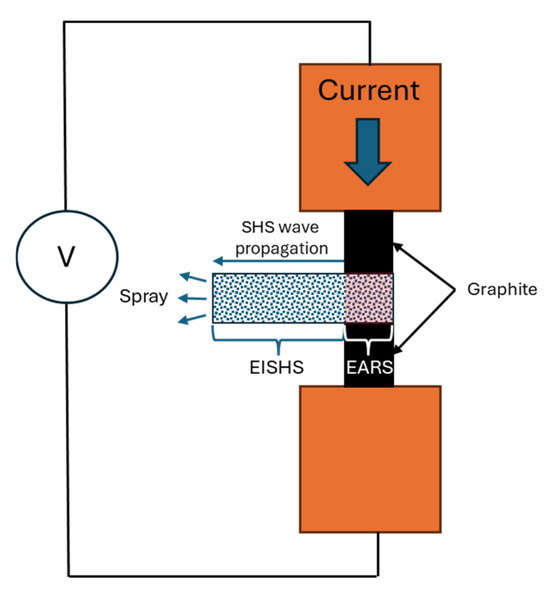
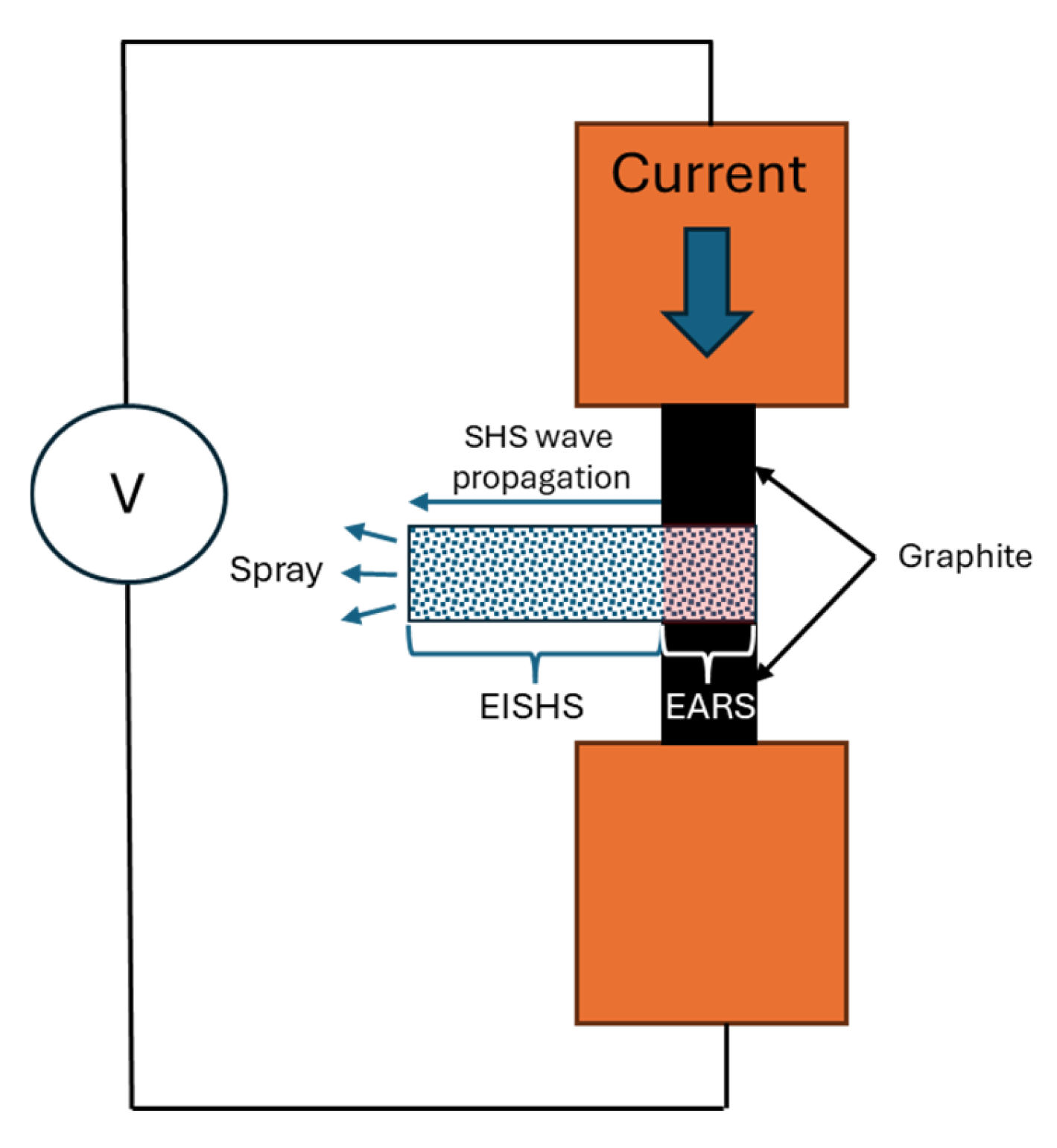
The traditional advantages of using an electric field during SHS reactions include faster wave velocities, higher combustion temperatures, and the ability to stabilize otherwise unstable SHS reactions. Recent work on 3Ni+Al powder mixtures [52], in which only the nickel powder had been previously mechanically milled, was reacted under an applied electric current using the EARS process. In the EARS process, the specimen is placed between two graphite plates and heated by direct electric current.
Here, ignition can occur either at a hole in the specimen, placed there to allow the insertion of a thermocouple, or at other parts of the specimen, engulfing the specimen. Interestingly, multiphase microstructures were generated under these conditions, with the major phase (more than 70%) being Ni3Al, along with unreacted Ni and very small amounts of 3R martensite. It was determined that the green density had little effect on the combustion temperature and porosity content. Interestingly, post-reaction, smaller samples were electro-annealed (under a little more than double the current density used in the initial reaction). After 15 min of electro-annealing, the amount of unreacted Ni decreased, and Ni3Al was reduced to a little over 50%, with a new phase, Ni4.22Al0.9, emerging. Extended electro-annealing (60 min total time) eliminated residual nickel and produced a material with over 95% Ni4.22Al0.9 and about 27–28% porosity. Despite the material’s porosity, it exhibited the highest hardness (slightly below 400 HV). Interestingly, some residual aluminum was reported to reappear after 60 min of electro-annealing. In another study, the EARS process was used both to directly react (3Ni/CNT)+Al powder compacts and to act as an ignition source to initiate an SHS reaction in the same compact. Hence, the compact would now have a part processed by EARS and another by EISHS (electrically activated SHS) simultaneously [65] (Figure 3). An increase in CNT content from 0 to 3 vol.% led to increased product porosity and inhomogeneity, with the effect more pronounced on the EISHS side. Pore formation at CNT locations was evident, attributed either to the release of adsorbed nitrogen in CNTs. Higher combustion temperatures, reduced homogeneity, and greater product porosity were observed in the EARS portion of the samples. An interesting observation across all samples was that as soon as the reaction wave reaches the end of the compact, a spray emerges (Figure 3). This spray was captured using graphite tape and analyzed by SEM, which revealed the presence of Ni, Ni solid solution with trace aluminum (Ni*), NiAl, and Ni3Al. The notable feature is the absence of pure aluminum, indicating that the spreading and reaction of aluminum with nickel had already occurred. It was proposed that degassing events may have contributed to the generation of such spray, which, in turn, can contribute to the observed inhomogeneity of the microstructures.
Figure 3.
EARS/EISHS setup.
2.6. SHS/Thermal Explosion Joining and Coating
SHS/thermal explosion joining or coating can provide a low-thermal-budget approach to joining and coating. This is primarily due to the significant heat emanating from the exothermic reaction between the elemental powders. Most research on joining and coating has understandably focused on the NiAl compound, due to the favorable thermodynamics of this reaction and the ability to produce a molten product [16,17,74,75,76,77]. Explosive welding (shock-wave loading) was also recently used to bond steel with NiAl, either by simultaneous shock-wave loading and SHS of Ni-Al powders with steel or by shock-wave loading followed by SHS. Post-processing heat treatments were also investigated [78]. However, limited research has been conducted on the Ni3Al compound. Qin et al. [79] examined different molar mixtures of Ni and Al powder on bonding with AISI 316 steel using laser ignition of an SHS reaction. The combustion temperature depended on the molar composition of the mixture. To obtain good joining either the exothermic reaction generates temperatures that exceed the melting point of AISI 316 steel (even if the intermetallic does not exceed its own melting point) or the intermetallic can be partially melted in the case of molar ratio 2:1 (Ni:Al), when Ni3Al is formed and melted under the combustion temperature generated. At a 3:1 molar ratio, the combustion temperature was lower than the melting points of Ni3Al and AISI 316 steel, and hence, bonding was compromised. In another interesting study, Ni3Al was joined to AZ91D Mg Alloy by pouring molten alloy onto a 3Ni+Al powder mixture, triggering the combustion synthesis reaction [80].
3. Summary
Early SHS and thermal explosion research on the Ni3Al compound and its composites have provided fundamental insights into reaction mechanisms, and the effects of process parameters on reaction and product characteristics. A significant amount of recent research has focused on mechanically and electrically field-activated combustion synthesis. Such approaches can result in faster reaction rates, lower compact preheat temperatures, lower ignition temperatures, microstructures with increased product homogeneity, and the formation of a unique high-hardness phase, through new processes such as electro-annealing. This warrants further investigation. The addition of carbon nanotubes to the Ni3Al system shows promise for increased strength. Processing challenges remain, as CNTs can also generate unwanted porosity under certain conditions. SHS/thermal explosion joining and coating applications for Ni3Al require further research, as does a more thorough examination of combining additive manufacturing approaches with combustion synthesis for Ni3Al and its composites. Combining combustion synthesis with foaming approaches to produce Ni3Al foams can also be beneficial for producing lightweight, high-temperature materials. Given the unique properties of Ni3Al and the advantages of combustion synthesis, more research is needed in this area to realize potential opportunities.
Funding
This research received no external funding.
Data Availability Statement
No new data was generated in this article. All supporting data is already cited in the reference list.
Conflicts of Interest
The author declares no conflict of interest.
References
- Paul, A.R.; Mukherijee, M.; Singh, D. A Critical Review on the Properties of Intermetallic Compounds and Their Application in the Modern Manufacturing. Cryst. Res. Technol. 2022, 57, 2100159. [Google Scholar]
- Morsi, K. Review: Reaction Synthesis Processing of Ni-Al Intermetallic Materials. Mater. Sci. Eng. A 2001, 299, 1–15. [Google Scholar] [CrossRef] [Scilit]
- Morsi, K. An Engaging Approach to the Science and Engineering of Materials: The Sphere; Springer: Cham, Switzerland, 2026; pp. 1–552. [Google Scholar]
- Munir, Z.A.; Anselmi-Tamburini, U. Self-Propagating Exothermic Reactions: The Synthesis of High-Temperature Materials by Combustion. Mater. Sci. Rep. 1989, 3, 277–365. [Google Scholar]
- Morsi, K.; Moussa, S.O.; Wall, J.J. Simultaneous Combustion Synthesis (Thermal Explosion Mode) and Extrusion of Nickel Aluminides. J. Mater. Sci. 2005, 40, 1027–1030. [Google Scholar] [CrossRef] [Scilit]
- Morsi, K.; Rodriguez, J. Combustion Forging of FeAl (40 at.% Al). J. Mater. Sci. 2004, 39, 4849–4854. [Google Scholar] [CrossRef] [Scilit]
- Filimonov, V.Y.; Korchagin, M.A.; Smirnov, E.V.; Sytnikov, A.A.; Yakovlev, V.I.; Lyakhov, N.Z. Kinetics of Mechanically Activated High Temperature Synthesis of Ni3Al in the Thermal Explosion Mode. Intermetallics 2011, 19, 833–840. [Google Scholar] [CrossRef] [Scilit]
- Modi, P.; Chauhan, M.; Bundy, V.; Morsi, K. Electrically Activated Reaction Synthesis of Ni-CNT/Al Hierarchical Composite Powders. J. Eng. Mater. Technol. Trans. ASME 2021, 143, 031005–031013. [Google Scholar] [CrossRef] [Scilit]
- Morsi, K. The Diversity of Combustion Synthesis Processing: A Review. J. Mater. Sci. 2012, 47, 68–92. [Google Scholar] [CrossRef] [Scilit]
- Morsi, K. Combustion Synthesis and the Electric Field: A Review. Int. J. Self-Propagating High-Temp. Synth. 2017, 26, 199–209. [Google Scholar] [CrossRef] [Scilit]
- Kirdyashkin, A.I.; Kitler, V.D.; Gabbasov, R.M.; Krinitsyn, M.G. Combustion Synthesis of Rounded Ni-Al Intermetallic Powders. J. Alloys Compd. 2025, 1031, 181031. [Google Scholar] [CrossRef] [Scilit]
- Misiolek, W.; German, R.M. Reactive Sintering and Reactive Hot Isostatic Compaction of Aluminide Matrix Composites. Mater. Sci. Eng. A 1991, 144, 1–10. [Google Scholar] [CrossRef] [Scilit]
- Lebrat, J.P.; Varma, A.; Miller, A.E. Combustion Synthesis of Ni3Al and Ni3Al-Matrix Composites. Metall. Trans. A 1992, 26, 69–76. [Google Scholar] [CrossRef] [Scilit]
- Niedzialek, S.E.; Stangle, G.C.; Kaieda, Y. Combustion-Synthesized Functionally Gradient Refractory Materials. J. Mater. Res. 1993, 8, 2026–2034. [Google Scholar] [CrossRef] [Scilit]
- Sampath, S.; Ravi, V.P.; Sundararajan, S. An Overview on Synthesis, Processing and Applications of Nickel Aluminides: From Fundamentals to Current Prospects. Crystals 2023, 13, 435. [Google Scholar] [CrossRef] [Scilit]
- Riyadi, T.W.B.; Zhang, T.; Marchant, D.; Zhu, X. Synthesis and Fabrication of NiAl Coatings with Ti Underlayer Using Induction Heating. Surf. Coat. Technol. 2014, 258, 154–159. [Google Scholar] [CrossRef] [Scilit]
- Riyadi, T.W.B.; Mujiyono, M.; Nurhudiyanto, D.; Mukhammad, A.F.H.; Hassan, S.B.A.; Wulandari, A.P.; Murni, M. Fabrication of NiAl and TiC Intermetallic Coatings. Compos. Interfaces 2022, 29, 328–343. [Google Scholar]
- Yuan, J.; Zhang, X.; Li, B.; Wang, X.; Sun, K. Microstructure and Tribological Behavior of NiAl/WC Composites Fabricated by Thermal Explosion Reaction at 800 °C. J. Alloys Compd. 2017, 693, 70–75. [Google Scholar] [CrossRef] [Scilit]
- Yeh, C.L.; Ke, C.Y.; Chen, Y.C. In Situ Formation of TiB2/TiC and TiB2/TiN Reinforced NiAl by Self-Propagating Combustion Synthesis. Vacuum 2018, 151, 185–188. [Google Scholar] [CrossRef] [Scilit]
- Beyhaghi, M.; Kashefi, M.; Kiani-Rashid, A.R.; Khaki, J.V.; Jonsson, S. In-Situ Synthesis of Nanostructured Ni-Al Composite Coatings on Cast Iron Substrates by Spark Plasma Sintering of Mechanically Activated Powders. Surf. Coat. Technol. 2015, 272, 254–267. [Google Scholar] [CrossRef] [Scilit]
- Ivanisenko, Y.; Mazilkin, A.; Gallino, I.; Reigler, S.S.; Doyle, S.; Kilmametov, A.; Fabricjnaya, O.; Heilmaier, M. On the Formation of Nanocrystalline Aluminides during High Pressure Torsion of Al/Ni Alternating Foils and Post Multilayer Reaction. J. Alloys Compd. 2022, 905, 164201. [Google Scholar] [CrossRef] [Scilit]
- Lu, B.L.; Chen, G.Q.; Qu, S.; Su, H.; Zhou, W.L. First-Principle Calculation of Yield Stress Anomaly of Ni3Al-Based Alloys. Mater. Sci. Eng. A 2013, 565, 317–320. [Google Scholar]
- Varma, A.; Rogachev, A.S.; Mukasyan, A.S.; Hwang, S. Combustion Synthesis of Advanced Materials: Principles and Applications. Adv. Chem. Eng. 1998, 24, 79–226. [Google Scholar] [CrossRef] [Scilit]
- Jiao, X.; Cai, X.; Niu, G.; Ren, X.; Kang, X.; Feng, P. Rapid Reactive Synthesis of TiAl3 Intermetallics by Thermal Explosion and Its Oxidation Resistance at High Temperature. Prog. Nat. Sci. Mater. Int. 2019, 29, 447–452. [Google Scholar] [CrossRef] [Scilit]
- Kirdyashkin, A.I.; Gabbasov, R.M.; Maksimov, Y.M.; Salamatov, V.G. Acoustic Emission during Self-Propagating High-Temperature Synthesis. Combust. Explos. Shock Waves 2013, 49, 676–681. [Google Scholar] [CrossRef] [Scilit]
- Plazanet, L.; Nardou, F. Reaction Process during Relative Sintering of NiAl. J. Mater. Sci. 1998, 33, 2129–2136. [Google Scholar] [CrossRef] [Scilit]
- Naiborodenko, Y.S.; Lavrenchuk, G.V.; Filatov, V.M. Self-Propagating High-Temperature Synthesis of Aluminides. I. Thermodynamic Analysis. Sov. Powder Metall. Met. Ceram. 1982, 21, 909–912. [Google Scholar] [CrossRef] [Scilit]
- Dunand, D.C. Reactive Synthesis of Aluminide Intermetallics. Mater. Manuf. Process. 1995, 10, 373. [Google Scholar] [CrossRef] [Scilit]
- Barin, I.; Knacke, O.; Kubaschewski, O. Thermochemical Properties of Inorganic Substances: Supplement; Springer: New York, NY, USA, 1977. [Google Scholar]
- Zhu, P.; Li, J.C.M.; Liu, C.T. Adiabatic Temperature of Combustion Synthesis of Al-Ni Systems. Intermetallics 2003, A357, 248–257. [Google Scholar] [CrossRef] [Scilit]
- Sohn, H.Y.; Wang, X. Mathematical and Experimental Investigation of the Self-Propagating High-Temperature Synthesis (SHS) of TiAl3 and Ni3Al Intermetallic Compounds. J. Mater. Sci. 1996, 31, 3281–3288. [Google Scholar] [CrossRef] [Scilit]
- Yeh, C.L.; Sung, W.Y. Combustion Synthesis of Ni3Al Intermetallic Compound in Self-Propagating Mode. J. Alloys Compd. 2004, 384, 181–191. [Google Scholar] [CrossRef] [Scilit]
- Yokota, K.; Gama, C.; Morsi, K. Effects of Preheating by Direct Electric Current on the Self-Propagating High-Temperature Synthesis of Ni3Al-CNT Intermetallic Nanocomposites. Metall. Mater. Trans. A 2022, 53, 2823–2831. [Google Scholar] [CrossRef] [Scilit]
- German, R.M. Powder Metallurgy & Particulate Materials Processing; Metal Powder Industry Federation: Princeton, NJ, USA, 2005. [Google Scholar]
- Hunt, E.M.; Plantier, K.B.; Pantoya, M.L. Nano-Scale Reactants in the Self-Propagating High-Temperature Synthesis of Nickel Aluminide. Acta Mater. 2004, 52, 3183–3191. [Google Scholar] [CrossRef] [Scilit]
- Fritz, G.M.; Grzyb, J.A.; Knio, O.M.; Grapes, M.D.; Weihs, T. Characterizing Solid-State Ignition of Runaway Chemical Reactions in Ni-Al Nanoscale Multilayers under Uniform Heating. J. Appl. Phys. 2015, 118, 135101. [Google Scholar] [CrossRef] [Scilit]
- Shevtsova, L.I.; Korchagin, M.A.; Thommes, A.; Mali, V.I.; Anisimov, A.G.; Nagavkin, S.Y. Spark Plasma Sintering of Mechanically Activated Ni and Al Powders. Adv. Mater. Res. 2014, 1040, 772–777. [Google Scholar] [CrossRef] [Scilit]
- Rivero, I.V.; Pantoya, M.L.; Rajamani, K.; Hsiang, S.M. Correlation of Reactant Particle Size on Residual Stresses of Nanostructured NiAl Generated by Self-Propagating High-Temperature Synthesis. J. Mater. Res. 2009, 24, 2079–2088. [Google Scholar] [CrossRef] [Scilit]
- Korchagin, M.A.; Filimonov, V.Y.; Smirnov, E.V.; Lyakhov, N.Z. Thermal Explosion of Mechanically Activated 3Ni-Al Mixture. Combust. Explos. Shock Waves 2010, 46, 41–46. [Google Scholar] [CrossRef] [Scilit]
- Lapshin, O.V.; Boyangin, E.N. Impact of Low-Energy Mechanical Activation of Powder Mixture and Subsequent Heating Mode on the Physical and Mechanical Properties of Intermetallic Compound Ni3Al. Mater. Chem. Phys. 2025, 340, 130804. [Google Scholar] [CrossRef] [Scilit]
- Morsi, K.; Fujii, T.; McShane, H.; McLean, M. Control of Heat Generation during Reaction Synthesis. Scr. Mater. 1999, 40, 359–364. [Google Scholar] [CrossRef] [Scilit]
- Hibino, A.; Matsuoka, S.; Kiuchi, M. Synthesis and Sintering of Ni3Al Intermetallic Compound by Combustion Synthesis Process. J. Mater. Process. Technol. 2001, 112, 127–135. [Google Scholar] [CrossRef] [Scilit]
- Yeh, C.L.; Sung, W.Y. Combustion Synthesis of Ni3Al by SHS with Boron Additions. J. Alloys Compd. 2005, 390, 74–81. [Google Scholar] [CrossRef] [Scilit]
- Lapshin, O.V.; Boyangin, E.N. Macrokinetics of Thermal Explosion in a 3Ni-Al System Mechanically Activated in a Low-Energy Mill. J. Alloys Compd. 2023, 948, 169790. [Google Scholar] [CrossRef] [Scilit]
- Suryanarayana, C. Mechanical Alloying and Milling; CRC Press: Boca Raton, FL, USA, 2004. [Google Scholar]
- Bundy, V.; Chauhan, M.; Fitch, C.; Modi, P.; Morsi, K. Effect of Carbon Nanotube (CNT) Length on the Mechanical Milling of Ni-CNT Powders and Ni-CNT/Al Reactive Synthesis. Metall. Mater. Trans. A Phys. Metall. Mater. Sci. 2018, 49, 6351–6358. [Google Scholar] [CrossRef] [Scilit]
- Samani, M.N.; Shokufar, A.; Kamali, A.R.; Hadi, M. Production of Nanocrystalline Ni3Al-Based Alloy Using Mechanical Alloying. J. Alloys Compd. 2010, 500, 30–33. [Google Scholar] [CrossRef] [Scilit]
- Boyangin, E.N.; Lapshin, O.V. Low-Energy Mechanical Activation Impact on the Ignition Temperature of 3Ni + Al Powder Mixture. Int. J. Self-Propagating High-Temp. Synth. 2026, 35, 39–46. [Google Scholar] [CrossRef] [Scilit]
- Gauthier, V.; Josse, C.; Bernard, F.; Gaffet, E.; Larpin, J.P. Synthesis of Niobium Aluminides Using Mechanically Activated Self-Propagating High-Temperature Synthesis and Mechanically Activated Annealing Process. Mater. Sci. Eng. A 1999, 265, 117–128. [Google Scholar] [CrossRef] [Scilit]
- Osipov, D.A.; Smirnov, L.V.; Grinyaev, K.V.; Ditenberg, I.A. The Influence of High-temperature Annealing on the Structural-Phase State Homogeneity of Ni3Al Synthesized After a Short-Term Mechanoactivation. Russ. Phys. J. 2022, 65, 1383–1385. [Google Scholar] [CrossRef] [Scilit]
- Morsi, K.; Shinde, S.; Olevsky, E.A. Self-Propagating High-Temperature Synthesis (SHS) of Rotator Mixed and Mechanically Alloyed Ni/Al Powder Compacts. J. Mater. Sci. 2006, 41, 5699–5703. [Google Scholar] [CrossRef] [Scilit]
- Chauhan, M.; Bundy, V.; Modi, P.; Morsi, K. Electrically Activated Reactive Synthesis (EARS) and Electro-Annealing of 3Ni–Al Powder Compacts. J. Mater. Sci. 2018, 53, 12512–12522. [Google Scholar] [CrossRef] [Scilit]
- Chauhan, M.; Modi, P.; Bundy, V.; Morsi, K. Electrically-Activated Reactive Synthesis (EARS) and Electro-Annealing of Ni/CNT-Al Nanocomposite Powders. J. Alloys Compd. 2019, 789, 792–799. [Google Scholar] [CrossRef] [Scilit]
- Nishimura, C.; Liu, C.T. Reaction Sintering of Ni3Al to Near Full Density. Scr. Metall. Mater. 1992, 26, 381–385. [Google Scholar] [CrossRef] [Scilit]
- Ivanov, K.V.; Akimov, K.O.; Figurko, M.G. The Effect of Low-Energy High-Current Pulsed Electron Beam Irradiation on the Structure, Phase Composition and Mechanical Properties of Ni3Al and Ni3Al-TiC Composites. J. Alloys Compd. 2024, 973, 172950. [Google Scholar] [CrossRef] [Scilit]
- Morsi, K.; McShane, H.; McLean, M. Formation of Ni3Al and NiAl by Hot Extrusion Reaction Synthesis (HERS). Scr. Mater. 1997, 37, 1839–1842. [Google Scholar] [CrossRef] [Scilit]
- Morsi, K.; McShane, H.B.; McLean, M. Processing Defects in Hot Extrusion Reaction Synthesis. Mater. Sci. Eng. A 2000, 290, 39–45. [Google Scholar] [CrossRef] [Scilit]
- Guo, J.T.; Sheng, L.Y.; Xie, Y.; Zhang, Z.X.; Ovcharenko, V.E.; Ye, H.Q. Microstructure and Mechanical Properties of Ni3Al and Ni3Al-1B fabricated by SHS/HE. Intermetallics 2011, 19, 137–142. [Google Scholar] [CrossRef] [Scilit]
- Rodriguez, J.; Moussa, S.O.; Wall, J.; Morsi, K. Low-Energy Forging of Aluminide Intermetallics. Scr. Mater. 2003, 48, 707–712. [Google Scholar] [CrossRef] [Scilit]
- Walker, J.; Morsi, K. Novel Electro-Combustion Forging of Ni-Ti Intermetallic Nanocomposites. Metall. Mater. Trans. B Process Metall. Mater. Process. Sci. 2020, 51, 1344–1349. [Google Scholar] [CrossRef] [Scilit]
- Morsi, K.; McShane, H.B.; McLean, M. Effect of Particle Size and Volume Fraction on Hot Extrusion Reaction Synthesis of SiC Particle Reinforced NiAl. Metall. Mater. Trans. A Phys. Metall. Mater. Sci. 2000, 31, 1663–1670. [Google Scholar] [CrossRef] [Scilit]
- Talako, T.L.; Sharafutdinov, M.R.; Grigor’eva, T.F.; Vorsina, I.A.; Barinova, A.P. Lyakhov Production of NixAly/Al2O3 Composites Using a Combination of Mechanical Activation and Self-Propagating High-Temperature Synthesis. Combust. Explos. Shock Waves 2009, 45, 662–665. [Google Scholar] [CrossRef] [Scilit]
- Morsi, K.; Wang, N. Pressure Un-Assisted Reactive Powder Processing of High-Density Aluminide Composites. J. Alloys Compd. 2008, 452, 371–376. [Google Scholar] [CrossRef] [Scilit]
- Morsi, K.; Wang, N. Combustion Synthesis of Microstructurally Designed Green Powder Compacts. Mater. Sci. Eng. A 2008, 478, 208–213. [Google Scholar] [CrossRef] [Scilit]
- Kehl, K.; Morsi, K. Reactive Processing and Properties of Nickel Aluminide-Carbon Nanotube Composites. J. Mater. Sci. 2021, 56, 19501–19511. [Google Scholar] [CrossRef] [Scilit]
- Sytschev, A.E.; Vadchenko, S.G.; Boyarchenko, O.D.; Shchukin, A.S. Ni3Al/C Composites by Thermal Explosion. Int. J. Self-Propagating High-Temp. Synth. 2018, 27, 64–65. [Google Scholar] [CrossRef] [Scilit]
- Akhtar, F. Synthesis, Microstructure and Mechanical Properties of Al2O3 Reinforced Ni3Al. Mater. Sci. Eng. A 2009, 499, 415–420. [Google Scholar] [CrossRef] [Scilit]
- Yan, S.-R.; Mehrizi, M.Z.; Foong, L.K. Synthesis of NiAl-WC Composite by the Thermal Explosion of Elemental Powders. Ceram. Int. 2020, 46, 15146–15151. [Google Scholar] [CrossRef] [Scilit]
- Romero, A.; Rodriguez, G.P.; Aghion, E. Processing of Intermetallic Laminates by Self-Propagating High Temperature Synthesis Initiated with Concentrated Solar Energy. J. Alloys Compd. 2021, 891, 161876. [Google Scholar]
- El-Desouky, A.; Moon, K.; Kassegne, S.; Morsi, K. Green Compact Temperature Evolution during Current-Activated Tip-Based Sintering (CATS) of Nickel. Metals 2013, 3, 178–187. [Google Scholar] [CrossRef] [Scilit]
- Meng, J.; Jia, C.C.; He, Q. Effect of Mechanical Alloying on the Structure and Properties of Ni3Al by Spark Plasma Sintering. Powder Metall. 2008, 51, 227–230. [Google Scholar] [CrossRef] [Scilit]
- Shevtsova, L.I.; Korchagin, M.A.; Esikov, M.A.; Lozhkina, E.A.; Lozhskin, V.S.; Samoylenko, V.V.; Nemolochnov, D.A.; Malicov, V.N. Ni3Al+B Material Obtained by Mechanical Activation Followed by Spark Plasma Sintering. Mater. Today Proc. 2019, 12, 120–123. [Google Scholar] [CrossRef] [Scilit]
- Shevtsova, L.I.; Esikov, M.A.; Gavrilov, A.I.; Lojkina, E.A.; Shevtsov, D.E.; Merzlikina, Y.A. Studying the Effect of Period of Mechanical Activation on the Formation of Ni3Al -Based High-Legered Alloys Obtained via Spark Plasma Sintering. Bull. Russ. Acad. Sci. Phys. 2024, 88, 1465–1471. [Google Scholar] [CrossRef] [Scilit]
- Boromei, I.; Casagrande, A.; Tarterini, F.; Poli, G.; Veronesi, P.; Rosa, R. Ni-Al-Ti Coatings by Microwave Assisted SHS: Oxidation Behavior in the 750–900 °C Range. Surf. Coat. Technol. 2010, 204, 1793–1799. [Google Scholar] [CrossRef] [Scilit]
- Sytschev, A.E.; Vadchenko, S.G.; Boyarchenko, O.D.; Vrel, D.; Sachkova, N.V. SHS Welding by Thermal Explosion: Ti-Ti and Ti-NiAl. Int. J. Self-Propagating High-Temp. Synth. 2013, 22, 99–102. [Google Scholar] [CrossRef] [Scilit]
- Fan, X.; Zhu, L.; Huang, W. Investigation of NiAl Compound as Bond Coat for Thermal Barrier Coatings on Mg Alloy. J. Alloys Compd. 2017, 729, 617–626. [Google Scholar] [CrossRef] [Scilit]
- Shchukin, A.S.; Vrel, D.; Systschev, E. Interaction of NiAl Intermetallic during SHS Synthesis with Ta Substrate. Adv. Eng. Mater. 2018, 20, 1701077. [Google Scholar] [CrossRef] [Scilit]
- Malakhov, A.Y.; Seropyan, S.A.; Denisov, I.V.; Saikov, I.V.; Shakhray, D.V. Study of Microstructural Evolution in NiAl-Steel Laminate Composite after Shock Wave Loading and Heat Treatment. Intermetallics 2026, 189, 109097. [Google Scholar] [CrossRef] [Scilit]
- Qin, L.; Hu, J.; Cui, C.; Wang, H.; Guo, Z. Interface Characteristics in Bonding of Nickel Aluminide with AISI 316 Stainless Steel by LISHS. Lasers Eng. 2010, 19, 195–204. [Google Scholar]
- Cho, G.S.; Lee, K.R.; Choe, K.; Lee, K.W. In-Situ Joining of Combustion Synthesized Ni3Al Intermetallic Compounds with AZ91D Mg Alloy. Mater. Sci. Forum 2007, 544–545, 383–386. [Google Scholar] [CrossRef]
Disclaimer/Publisher’s Note: The statements, opinions and data contained in all publications are solely those of the individual author(s) and contributor(s) and not of MDPI and/or the editor(s). MDPI and/or the editor(s) disclaim responsibility for any injury to people or property resulting from any ideas, methods, instructions or products referred to in the content. |
© 2026 by the author. Licensee MDPI, Basel, Switzerland. This article is an open access article distributed under the terms and conditions of the Creative Commons Attribution (CC BY) license.