


Abstract
Predicting the evolution of microstructure and field quantities under varying processing and loading conditions is a central challenge in computational materials science and metal additive manufacturing (AM). While deep learning (DL) methods offer ultra-fast prediction capabilities post-training, existing models often struggle with poor spatial and temporal extrapolation, high parameter burdens, and an inability to effectively integrate diverse conditioning parameters alongside high-dimensional input fields. To address these bottlenecks, we propose a novel conditional generative adversarial network (CPGAN), which is designed to seamlessly ingest both initial fields and governing condition parameters. The CPGAN framework offers three distinct advantages: (1) it accurately maps the combined effects of initial states and process conditions onto evolved fields; (2) it demonstrates robust extrapolation capabilities across diverse spatial and temporal scales, including the unique ability to natively generate high-resolution rectangular domains; and (3) it achieves superior predictive accuracy and training stability compared to standard convolutional baselines by effectively suppressing spurious artifacts. We validate CPGAN’s performance against rigorous physics-based ground truths across three representative engineering applications: porosity evolution in selective laser sintering (SLS), spatial distribution of 2D von Mises stress fields in solid structures, and the spatiotemporal evolution of grain growth. The results confirm that CPGAN is a highly adaptable and efficient surrogate model, capable of simulating continuous structural and morphological evolutions even when driven by highly non-uniform spatial or temporal kinetics.
1. Introduction
Field-to-field mapping with multiple inputs (e.g., an initial field together with process conditions) is central to computational materials science and metal AM and arises broadly across engineering. For instance, in selective laser sintering (SLS), given an initial powder bed and certain process conditions such as laser speed and power, the capability to predict the sintered microstructure is strongly desired for process optimization. Moreover, in the microstructure design of piezoelectric materials, given an initial microstructure, and other conditions such as material properties, boundary conditions and applied electrical load, the spatial distribution of piezoelectric constants are needed to guide the design of microstructures to achieve the desirable piezoelectric properties [1]. Likewise, in the structure design, fast and accurate prediction of stress distribution when subjected to applied load and boundary conditions is highly required. Physics-based models such as the phase field model (PFM) [2], finite element method (FEM) [3,4], and FFT-based methods [1] are usually employed to predict the spatial distribution of desired properties. Although these physics-based models can accurately predict the evolved fields (e.g., stress fields), the high computation cost is a bottleneck during solving governing partial differential equations.
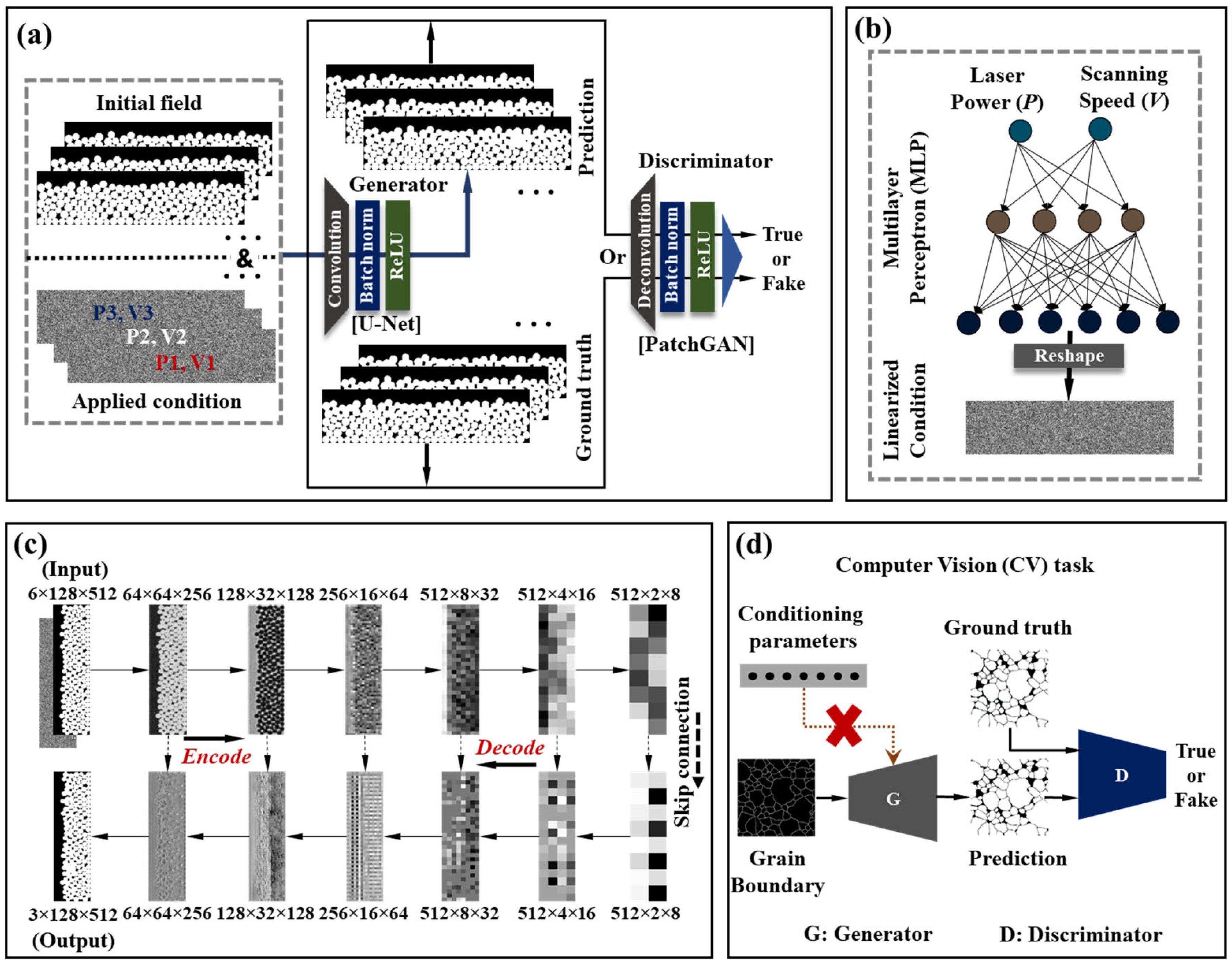
DL-based methods, particularly the deep convolutional neural networks (CNNs), could be a promising alternative to tackle the shortcomings of conventional approaches, i.e., physics-based models. Reinvigorated from near pseudoscience situations, deep CNNs have evoked a surplus application in many disciplines in the last decade. Some of these applications may include microstructure characterization and reconstruction (MCR) [5], structure–property linkage modeling [6], smart manufacturing [7], and image processing [8]. In recent years, DL-based approaches have been used to predict the stress field for the cantilever structure stress analysis [9], aortic wall to accelerate the patient-specific finite element analysis (FEA) [10], and the slices of printed parts to monitor a stereolithography (SLA) printing process online [11]. Although they can predict the stress field accurately, the inputs for their model are purely images and did not generalize to more common scenarios where inputs consist of mixed input of parameters and initial fields; see Figure 1a,d. In our previous study [12], a multi-input deep convolutional neural network was developed to simulate the porosity development in SLS. This neural network (yNet) is conceptually simple but powerful and can predict the porosity evolvement of SLS accurately. Nevertheless, because the shape of the field is limited to a square, a sliding inference window was necessitated to combine these square images into a single rectangular one to simulate the porosity evolution during the sintering of the powder beds of long track. More broadly, artificial intelligence has also been employed to augment the design and optimization of additively manufactured architected materials, for example to align the hatching of amorphous-inspired Co–Cr–Mo lattices fabricated by laser powder-bed fusion [13].
Figure 1.
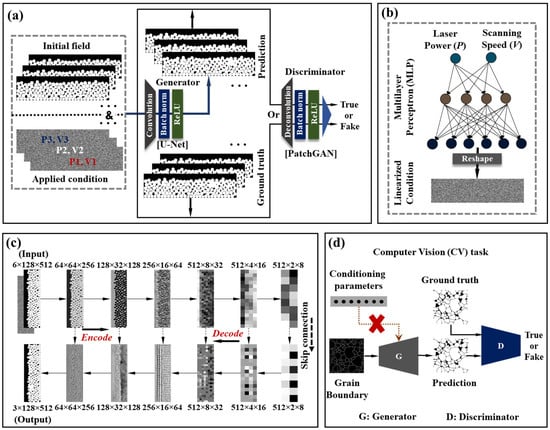
(a) Illustrates the architectures of proposed CPGAN using the scenarios of porosity evolution of SLS process. (b) Depicts the MLP to convert conditioning parameters to linearized parameters that have the same shape as the initial field. (c) Shows the encoding and decoding process with skip connection in the U-Net of the generator. Particularly notice the capability of predicting rectangular fields in an end-to-end fashion. (d) Exemplify only image input in computer vision (CV) tasks as compared with multiple mixed inputs in CPGAN.
There are many other DL models that have been developed based on conditional generative adversarial networks (cGAN) [14]. These GAN-based models in the computation vision (CV) society either condition on low dimensional information, e.g., texts [15,16] to generate photo-realistic images or on high dimensional information (images) for image-to-image translation [17,18,19,20,21,22]. Farimani et al. [23] proposed using conditional GAN to predict the fields of heat transfer and fluid flow. Jiang et al. [24] proposed a StressGAN, which was also developed based on conditional GAN, for stress prediction in structures. Although their prediction results are attractive, both of their models were designed specifically for the inputs containing only images. This highly restricts the model from generalizing more common scenarios, where both low dimensional (e.g., process conditions in SLS) and high dimensional information are required as inputs. The application of cGAN in engineering areas, which are conditioned on both parameters and images, are rarely seen to the best of our knowledge. More recently, operator-learning surrogates such as Fourier neural operators [25] and DeepONet [26] have been proposed to learn solution operators of parametric partial differential equations; however, these models typically act on functions defined over a fixed domain and do not jointly ingest low-dimensional process parameters together with a high-dimensional initial field. Against this backdrop, the proposed CPGAN is distinguished by three features that conventional CNN- and GAN-based surrogates lack: it accepts mixed low- and high-dimensional inputs within a single framework, it natively predicts rectangular and larger-than-training domains without patch-wise post-processing, and its least-squares adversarial training delivers higher accuracy and greater training stability while suppressing spurious artifacts.
Therefore, we propose a CPGAN to deal with multi-input field-to-field regression tasks in engineering areas. Here, the great advantages of the proposed CPGAN are demonstrated through several representative applications. Specifically, these applications include the simulation of porosity evolution in selective lasering sintering (SLS), predicting 2D von Mises stress distribution in solid structures and simulation of grain growth evolvement in large time step. The prediction accuracies are appealing by utilizing both qualitative and quantitative comparisons through various metrics between predicted fields and the ground truth. For instance, both statistical functions (e.g., lineal-path functions) and physical descriptors (e.g., Area fraction (AF) of porosity) are utilized for the evaluation of the prediction accuracy in SLS application. It is found that the statistical function and AF of porosity closely match with each other between the predicted results and ground truth. In addition, the CPGAN can simulate rectangular fields in comparison with that of common square shape predicted by existing DL models. This capability is enabled through adoption of the novel combination of U-Net of generator and PatchGAN in the proposed CPGAN and has significant benefits to the scenarios where rectangular shape of fields is strongly required, for instance, the powder bed in SLS is usually rectangular with large aspect ratio. Once being trained, the porosity evolution of sufficiently long track (e.g., 128 × 1024) of powder bed in SLS process can be easily predicted by CPGAN in millisecond; see Figure 1a,c. The CPGAN is generally applicable to simulating various structural/morphological evolutions and other conditions concerned, continuous field evolvements even with spatially and/or temporally non-uniform evolving kinetics.
2. Methods
2.1. Network Architecture
Inspired by our previous work [12], the work of Isola et al. [17], and Zhang et al. [16] the designed architectures are illustrated in Figure 1. Specifically, the inputs consist of initial fields and applied condition parameters, for instance initial geometry and loading force as indicted in the dashed rectangular. For the generator, an architecture of “U-Net” [27] is employed followed by skip connections; see Figure 1c. This arrangement of networks would alleviate the difficulties of low-level information sharing between input and output through net and can generate more realistic images as compared with a common encoder–decoder network. PatchGAN is adopted for the architecture of discriminator, which tries to discriminate if each patch M × N in an image is from prediction or ground truth. PatchGAN has advantages with fewer parameters and faster running and can be classified into texture or style loss. A combo of convolution-BatchNorm-Relu are utilized in both generator and discriminator as did in our previous work [12].
Noticeably, due to the unique combination of U-Net in generator and PatchGAN in discriminator, CPGAN can handle the rectangle geometry as illustrated in Figure 1c. This is attributed to the fully convolutional network of the U-Net and the rectangular shape of patch size (i.e., M ≠ N) in the PatchGAN. The capability to handle rectangular geometry is rarely seen in the existing field-to-field regression models. This capability is significant for the applications (e.g., porosity evolution in SLS process) whose fields are required to be rectangular. To tackle this issue, our previous work [12] has to use a specifically designed cropping strategy that is tedious and time-consuming compared with the end-to-end fashion in the proposed CPGAN. It is worth pointing out that the CPGAN has the capability to handle high-resolution (e.g., 256 × 2048) rectangular images as well. This is enabled by training with the inputs of the square shape (e.g., 256 × 256) that has the same length as the short side of the rectangles, while during inference, the original rectangular shape (256 × 2048) can be readily predicted due to the fully convolutional network of the generator. This capability can significantly reduce the large memory requirement to handle extreme-scale rectangular fields without any special post processing techniques as in our previous work [12].
Multiple mixed inputs are not uncommon in various machine learning (ML) tasks. Yuan et al. [28] merged images with vectorial input by flattening images to a high-dimensional vector that are compatible and hence concatenable to the input in their reservoir production predictor (not image-to-image). A similar strategy as is utilized in the image captioning model [29] is to merge the flattened images with the input by adding them together instead of concatenating. However, this strategy requires the shape of two vectors to be the same. These flattening-based strategies might be effective for developing a simple label or continuous predictor. Nevertheless, high-dimensional vectors yield a large fully connected layer, which are notoriously parameter-intensive and can degrade the network performance (e.g., DeconvNet [30] versus SegNet [31]). Another strategy as used in the image-to-image translation [24] is to merge with images by converting the conditioning parameters into images of the same shape as that of the initial fields. However, this converting process is time-consuming and requires many efforts. Our previous work yNet [12] merges the inputs using a one-to-one connection via multiplication inspired by the gating mechanism [32]. This strategy utilizes multilayer perception (MLP) to expand the condition parameters into numbers of neurons that generate a high-dimensional embedding vector. Here, in the current work, we adopt a similar strategy by using MLP to linearly transform conditioning parameters to vectors that have same element with images, which is followed by reshaping. However, because a multiplication strategy yields the opposite evolved field to the ground truth in current work, the reshaped conditioning parameters are merged with images through concatenating in the end.
The image-to-image regression tasks in computer vision need the inputs and outputs to be in the form of images. However, in the current work of field-to-field prediction, the matrixes of fields (e.g., 128 × 128) are not necessary to convert to actual images but they only need to repeat three times in the direction of the number of channels to make them possess the same shape (e.g., 3 × 128 × 128) as typical RGB images. This operation can save a lot of effort from converting the matrixes of fields to images usually time consuming and disk-space occupying. More importantly, the mathematics that govern the transformation between images and matrixes of fields is complicated; theoretically, an image could be converted back to infinite sets of matrixes. Therefore, restoring the original matrix from one image becomes extremely cumbersome, leading to uninterpretable prediction results from the physical viewpoint.
2.2. Network Training
The network was optimized using Adam solver [33] with initial learning rate = 0.0002 and β1 and β2 set as 0.5 and 0.999, respectively, to minimize the following loss functions.
Equation (1) defines the L1 loss, representing the distance between ground truths and predictions. Specifically, x, c, and y are initial fields, conditioning parameters, and final fields of ground truth, respectively. L1 loss function can incentivize more sharping results as compared with more conventional loss, for instance L2 loss function [34]. It is worth pointing out that although L1 loss function only penalizes the distance between ground truths and predictions, it also explicitly accounts for the effects from conditioning information (i.e., x and c) since ground truths closely match the conditioning information. Another loss function is the least squares loss function from LSGAN proposed by [35] and can be defined as
where r and f denote real and fake labels, respectively. LSGAN loss can mitigate the notorious problems of vanishing gradients of vanilla GAN and can stabilize the learning process during training. Please see the comparison of the learning curves using LSGAN and vanilla GAN loss function (i.e., sigmoid cross entropy loss function). It is to be noted we feed both input (x and c) and output (y) to the discriminator, which can also strengthen the effects on the evolved fields from the conditioning information. Therefore, LSGAN loss function together with L1 loss function can fully consider the effects from conditioning information and possess great benefits for highly conditioning-parameter dependent engineering problems.
The total loss function can be defined as
where λ is used to balance between these two functions and is set as 100 in this work.
We trained the CPGAN for 200 epochs with a mini-batch size of 1 and a patch size of 9. After evaluating the outputs periodically using the evaluation metrics discussed in Section 3.2, we adopted the weights with the highest prediction accuracy in the remaining parts for each experiment, respectively.
3. Experiments
3.1. Datasets Generation
3.1.1. SLS Datasets
A total of 100 groups of printing conditions P (laser power) and V (scanning speed) were randomly generated using the Latin Hypercube sampling method [36]. For each group of conditions, physics-based SLS simulations were performed on 30 1400 mm-long track of powder beds. Therefore, in total 3000 input pairs (initial powder beds and corresponding conditions) were generated, of which 75% and 25% were used for training and testing, respectively. Moreover, to make sure of zero replica between each pair of data in terms of both printing conditions and structure, these powder beds were also randomly generated. The final input size of the powder beds into CPGAN was set as (128 × 512) to accommodate the maximum potential sintering depth. Two representative powder beds before and after sintering were illustrated in the first two rows of Figure 2.
Figure 2.
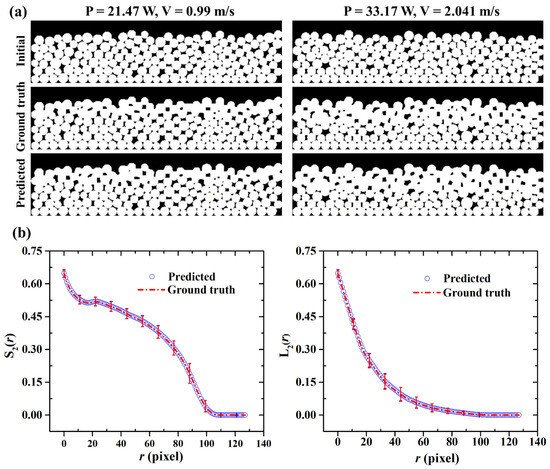
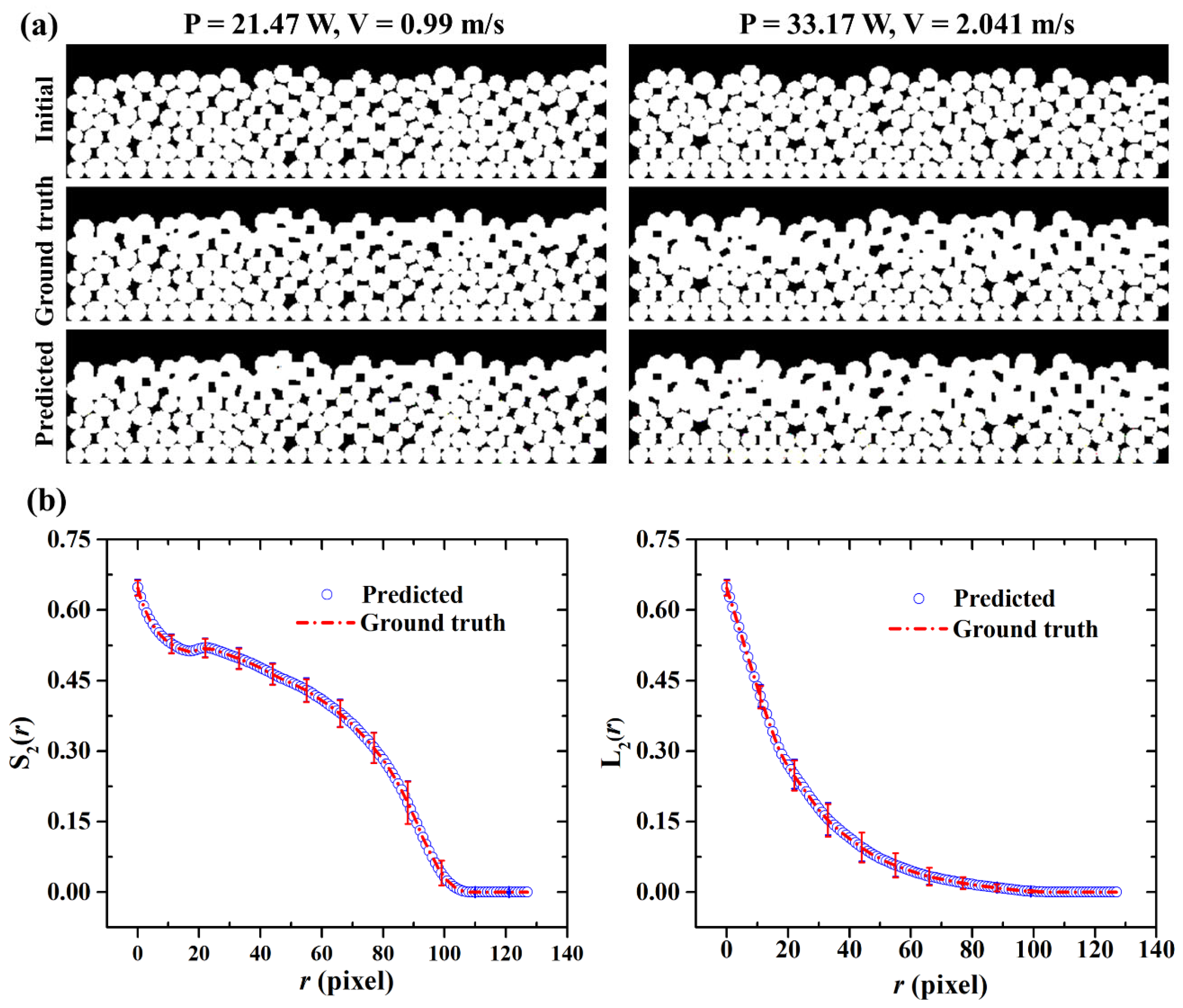
(a) Depicts the comparison between prediction and ground truth, which were randomly selected from 750 testing results. (b) High prediction accuracy is demonstrated through the comparison of statistical functions between ground truth and predictions. The statistical functions were obtained by averaging the statistical functions of 750 testing results. The error bars illustrate their corresponding standard deviations at a specific r value. The comparison results clearly show that the statistical functions between ground truth and predictions closely match each other not only on average but also in terms of deviations.
3.1.2. Stress Datasets
A total of 6000 stress fields were simulated using the finite element method (FEM) via commercial software COMSOL 5.4. These were split into training and testing datasets by the ratio of three. Specifically, each stress field was obtained by applying a force on the top of a square of linear elastic material (Ti-6Al-4V) with an elliptical void within its center. A fixed boundary condition was adopted at the bottom side of the square. In particular, forces and ellipticities of the voids were sampled using Latin Hypercube sampling methods as well to prevent zero replica of both conditions and initial fields.
3.1.3. Grain Growth Datasets
A total of 133 groups of grain microstructures were generated randomly from the phase field growth model. Each neighbor grain microstructure is 10-time steps apart, ranging from #1000-time steps to #5000-time steps. Therefore, in each group, there are a total of 401 grain microstructures, i.e., 53,333 grain microstructures in total in all groups. These structures were split into training and test datasets with the same ratio as that of SLS and stress datasets. During training, initial, and final grain microstructures were selected randomly, but with the constraint that they must be from same group to make sure they have basic structure connections between them. The conditioning information (time steps in this case) can be determined by the time step difference between the initial and final microstructures. Through this strategy of obtaining the input pairs, we can make sure each time step has the same chance to get trained and saved a lot of time and effort in preparing the input pairs before the training.
3.2. Evaluation Metrics
Statistical functions such as correlation and lineal-path functions are remarkably useful in microstructure characterization and the verification of predicted microstructures [37]. They can be used to obtain systematic and rigorous descriptions of hierarchically internal microstructures. In the present study, a two-point correlation function S2(r) and a lineal-path function L2(r) are used to characterize the morphology of heterogeneous microstructures. Therefore, they will be employed to assess the capability of predicting a porous powder bed and grain evolvement in the experiment of SLS and grain growth, respectively. S2(r) aims at finding the probability V that the end points belong to the same phase qi of interest (e.g., the micropore phase) when randomly tossing a line of distance r on the microstructures [38,39]; it is thus defined as:
L2(r) is similar to S2(r) except that its goal is to find the probability that all the points on the line are from the same phase qi when throwing a line of distance r. Jointly, these two functions can capture spatial distribution of each phase.
Three metrics will be used to evaluate the performance of the proposed DL model in predicting the stress field. They include the normalized mean absolute error (NMAE), normalized hot-spot absolute error (NHAE), and normalized peak stress absolute error (NPAE). Specifically, normalized mean absolute error (NMAE) will be used to assess the overall quality of a predicted stress field and is defined as:
where pi is the stress value of pixel i in a ground truth sample, while is the corresponding predicted value at the same pixel i. n denotes the total number of the pixels of samples, which equals to the product of number of samples and grid size (i.e., 128 × 128 in this work). P indicates a set of all ground truth stress values in samples, and max(P) and min(P) are the maximum and minimum value in P. NHAE is conceived to evaluate the capability in predicting the stress hotspot, thus the pixels in a sample are only from the area of stress hotspot, while the others is same as the definition of NMAE. NPAE is designed to assess the performance in estimating peak stress values and defined as:
where is a set of all predicted stress values in a sample, while is the maximum stress values in a predicted sample. m denotes the number of samples used in the evaluation.
Physical descriptors such as the grain size and number of neighboring grains are main characteristics of grain microstructures. Therefore, in addition to statistical functions, normalized mean absolute area error (NMAAE), normalized mean absolute radius error (NMARE), normalized mean absolute error of neighboring grains (NMAENN), and normalized mean absolute error of number of grains (NMAENG) will be used to assess the prediction accuracy of grain evolvement in the experiment of grain growth. NMAAE is defined as:
where ai is the average grain area of ith ground truth sample, while is the corresponding average grain area of the predicted sample. s denotes the total number of samples. Aave indicates the average grain area of all ground truth samples. The other three metrics are defined similarly, except that the average grain areas will be substituted by corresponding physical descriptors (e.g., number of neighboring grains), respectively.
4. Results and Discussion
Three typical application scenarios in the engineering fields are illustrated to demonstrate the superb prediction accuracy of CPGAN. These include the porosity evolution of the SLS process with spatially non-uniform evolving kinetics, full stress field prediction of static mechanics, and the phase field grain growth model.
4.1. Porosity Evolution of SLS
Figure 2 illustrates two randomly selected testing results. With complicated geometry as shown in the surface, the prediction results still closely resemble physics-based simulations and can be hardly distinguished by merely visual inspection. In addition to the visual resemblance, the AF of porosities of all the 750 prediction results are analyzed, and their average and standard deviation are calculated (16.93% and ± 0.0121, respectively). By comparing with those (17.10% and ± 0.0121) of the ground truth, a prediction accuracy as high as 99% by CPGAN is successfully achieved. It is to be noted that above the highest layers of powders are not considered as porosity during calculation. In addition, pixel-to-pixel similarity (i.e., percentage of correct pixels) between prediction and ground truth reaches 99.33% on average with standard deviation of only 0.01, which outperforms the accuracy (99.13%) of our previous work [12]. This tiny improvement in accuracy is significant considering the prediction accuracy is already very appealing and the training datasets (2275 images) in the current work are much less than that (174,000 images) of our previous work.
To further quantitatively analyze the prediction accuracy in terms of overall phase distribution of evolved fields, both the average of two-point correlation and lineal-path statistical functions of powder phase for all the testing result and their standard deviation are compared with those of ground truth; see Figure 2b. It can be observed that the averages and standard deviation of both the statistical functions between prediction and ground truth are fully overlapped at each pixel distance (r). In particular, both curves exhibit one transitional point roughly at the pixel distance r = 20 from the bottoms of images. This point indicates the transition from powders without being sintered to powders that have been sintered. As can be seen from Figure 2b, before the transitional point, with the increasing of r, the probability of finding the two endpoints of segment line belonging to the powder phase is decreasing. However, after this transitional point, the probability becomes higher due to the powder-resolved densification effect of the sintering process. These comparison results indicate that the CPGAN has successfully captured the phase probability distributions despite their sophisticated geometry. Therefore, from both visual inspection and quantitative comparison including physical descriptor (AF of micro-pores), global accuracy, and statistical functions, the proposed CPGAN demonstrates its superb prediction accuracy in multi-input field-to-field regression tasks in engineering fields.
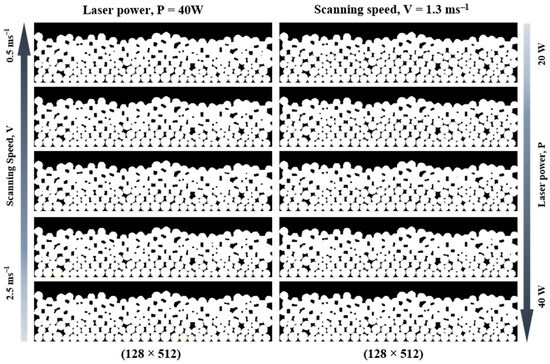
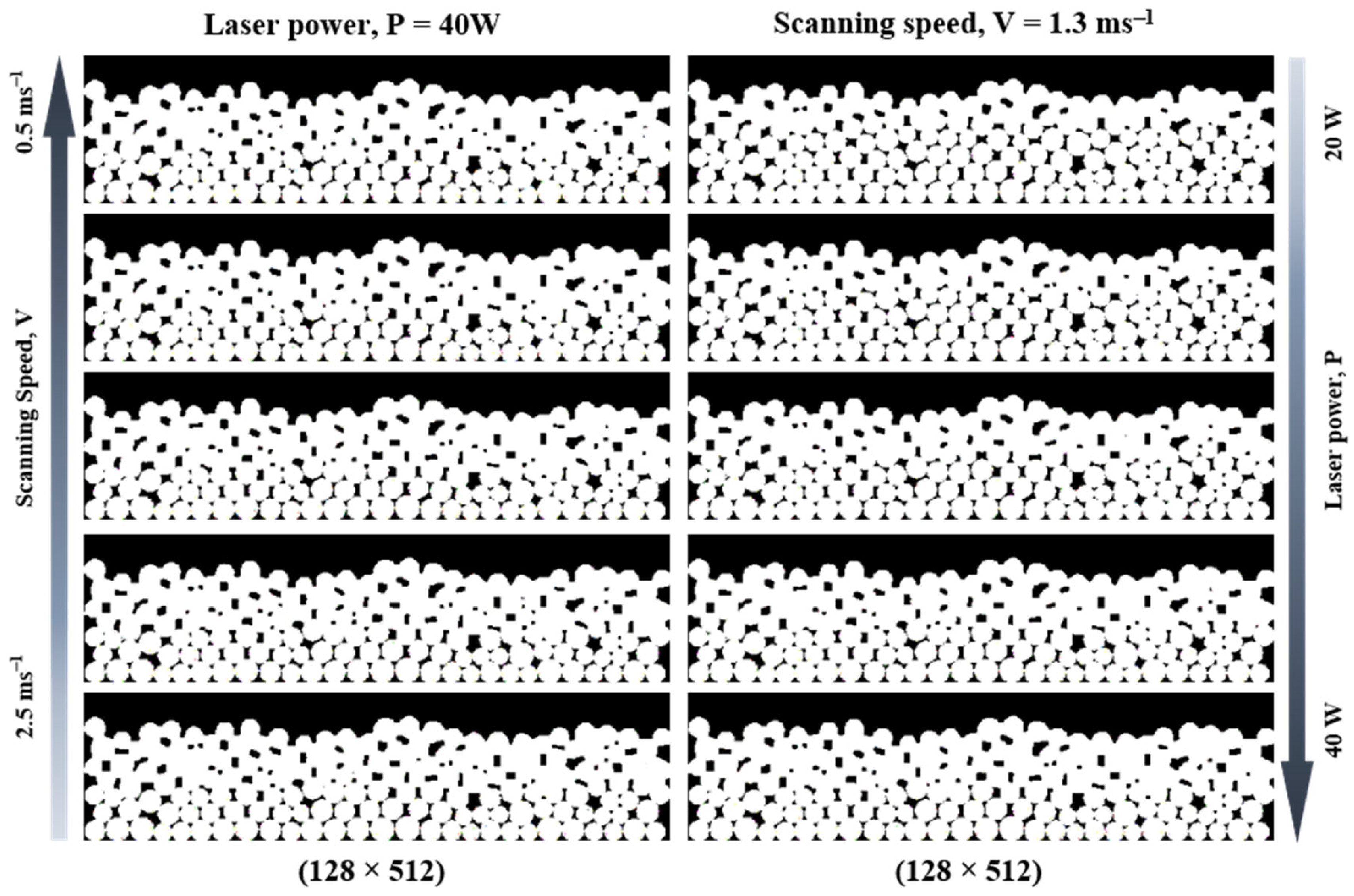
To further test the learning capability of CPGAN, we systematically study the effects of each condition parameter on the porosity evolution. As depicted in Figure 3, CPGAN has successfully learned the empirical knowledge that increasing sintering strength with higher laser power and lower scanning speed. This demonstrates its superiority as compared with existing field-to-field regression models. It has to be admitted that this knowledge can be perceived by humans through observing the dataset without much difficulty. But it is still surprising that CPGAN has learned it through end-to-end training and realized the incorporation effects on the sintering strength for any given conditions without turning to any human-coded rule.
Figure 3.
Illustrates the capability of CPGAN in predicting the effects of scanning speed and laser power on the sintering depth and strength that increases with the decreasing or increasing or laser power.
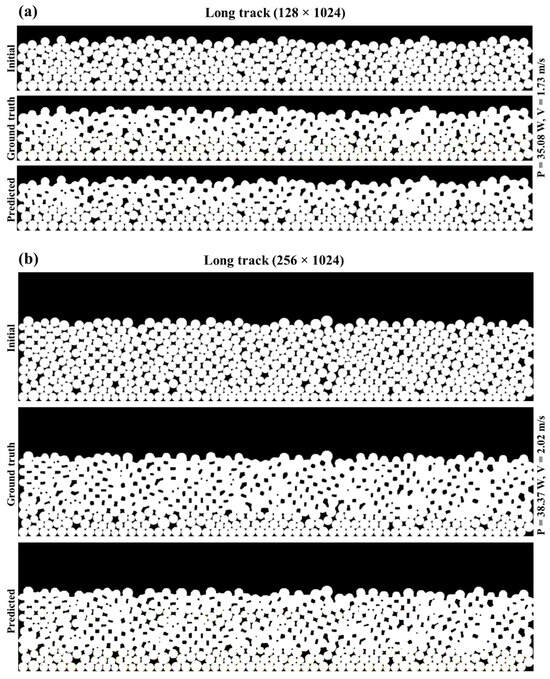
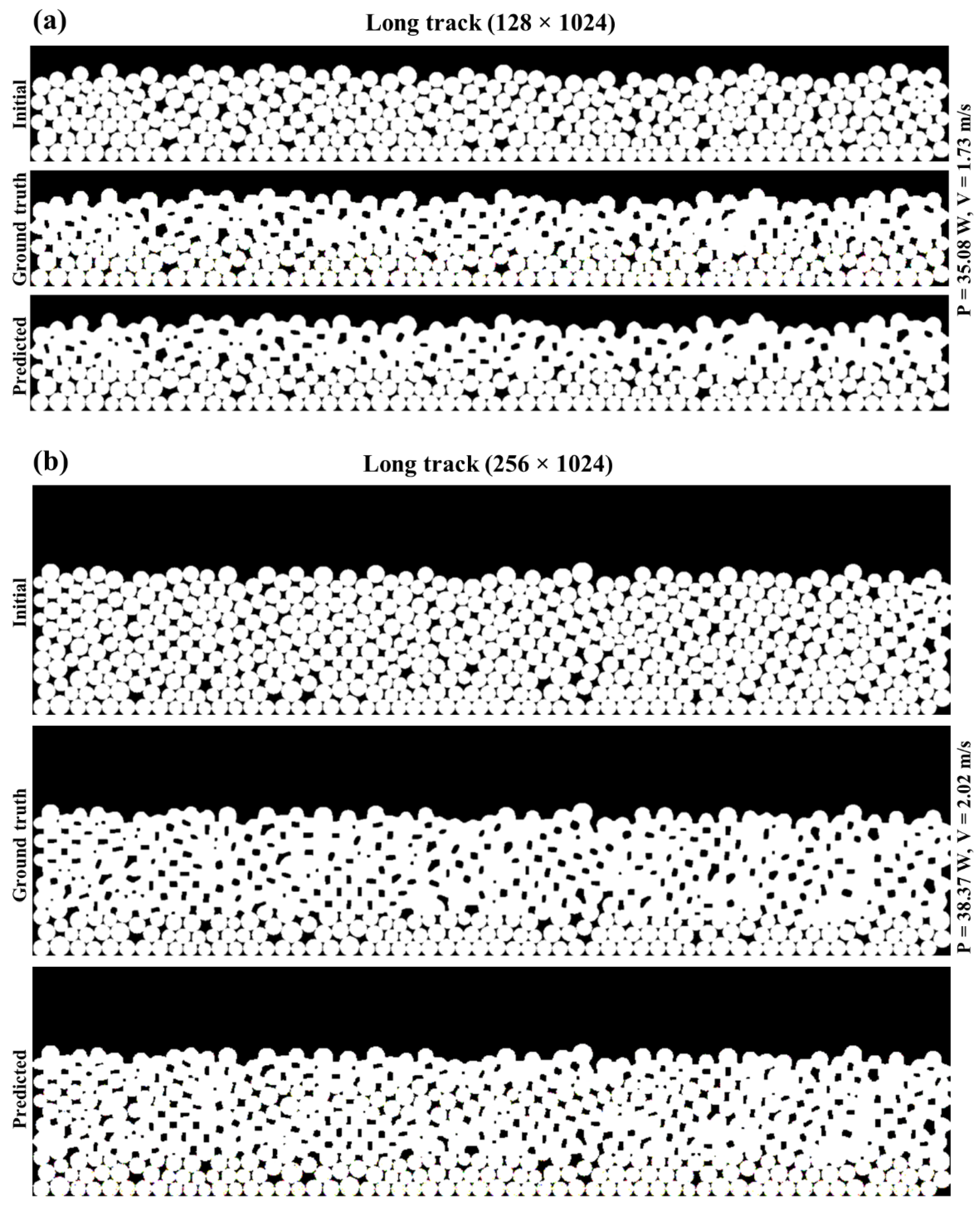
Another superb strength of CPGAN is the capability of simulating rectangular field evolvement with sufficiently larger ratio between width and length (e.g., 128 × 1024) than that of the images (128 × 512) used for training. Figure 4a illustrates the capability of CPGAN to predict longer fields (1024) and the same width (128). Similar to the situation of original length, the prediction results can be barely distinguished from the ground truth by merely visual inspection. In fact, the prediction accuracy in terms of AF of micro-pores is 97.5% with an average AF of porosity as 16.78% and 17.19% for ground truth and prediction, respectively. Although the accuracy is a little bit lower than that (99%) in predicting porosity evolution of the original domain size, considering the doubled length of simulating domain, the prediction results are still attractive.
Figure 4.
The porosity evolution of extremely long track in SLS process can be conveniently simulated in a millisecond, where (a) and (b) correspond domain size 128 × 1024 and 256 × 1024, respectively, as compared with original training domain size (128 × 512).
Moreover, the CPGAN can also simulate the porosity evolution of SLS of the domains of both larger length (e.g., 1024) and higher width (256) than the original size as illustrated in Figure 4b. Notice that the ratio (0.671) between depth of powder layers and depth of whole simulation domain in this extreme case is significantly different with that (0.857) of training images. Nevertheless, the prediction accuracy is still as high as 97.27% with average AF of porosity as 14.64% and 15.04% for ground truth and prediction, respectively. More importantly, for such an extremely large domain, the physics-based model may take more than one hour to simulate, while it only takes a fraction of second for CPGAN to predict. Therefore, the proposed CPGAN has fully demonstrated its superiority in terms of high prediction accuracy and the superb capability in simulating porosity evolution of SLS of various domains.
To the author’s best knowledge, this is the first achievement of such capability to date in engineering areas using DL methods. In fact, the domain shapes of the field evolvements are still limited to square and/or predefined domain size (e.g., 128 × 128) in the existing methods. This is contradicted by the reality in real-world applications; for instance, the powder bed in SLS process and solid structure design. This superb capability will open an enormous opportunity in product design and process planning in each discipline. With this capability, it will not be necessary to rely on the usage of representative volume element (RVE) or patch-wise strategy [12] in the simulation, which is not realistic by simply ignoring the nonuniformity in the evolving kinetics of many disciplines. All this is enabled because of the novel architecture design of CPGAN. Specifically, the combination of fully convolutional “U-Net” in the generator and PatchGAN in the discriminator. On the other hand, the existing methods [9,12] either merge the applied conditions or downsample/upsample through fully connected layers (FC) in the middle of their neural networks. These kinds of architecture designs would simply lose the full advantage of convolutional nature of networks.
4.2. Stress-Field Prediction
While the porosity evolution experiment in SLS process demonstrate its excellent capability in predicting structural and morphological evolutions featuring an evolving field of high contrast or textural simplicity, the experiment in stress-field prediction will exhibit its superb strength in simulating field evolvement of morphological and textural complexity or variability.
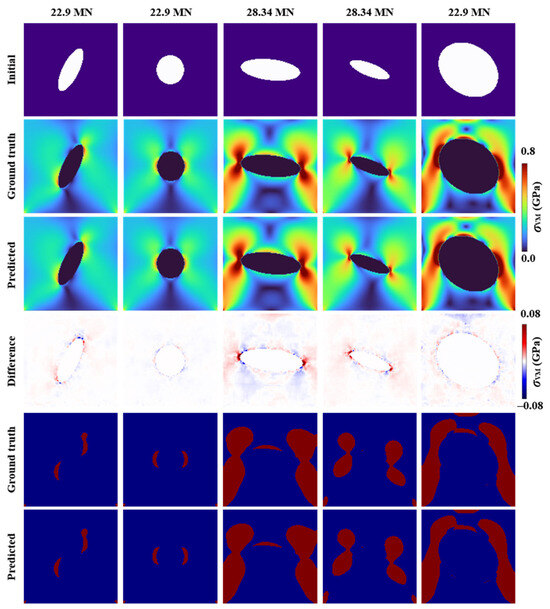
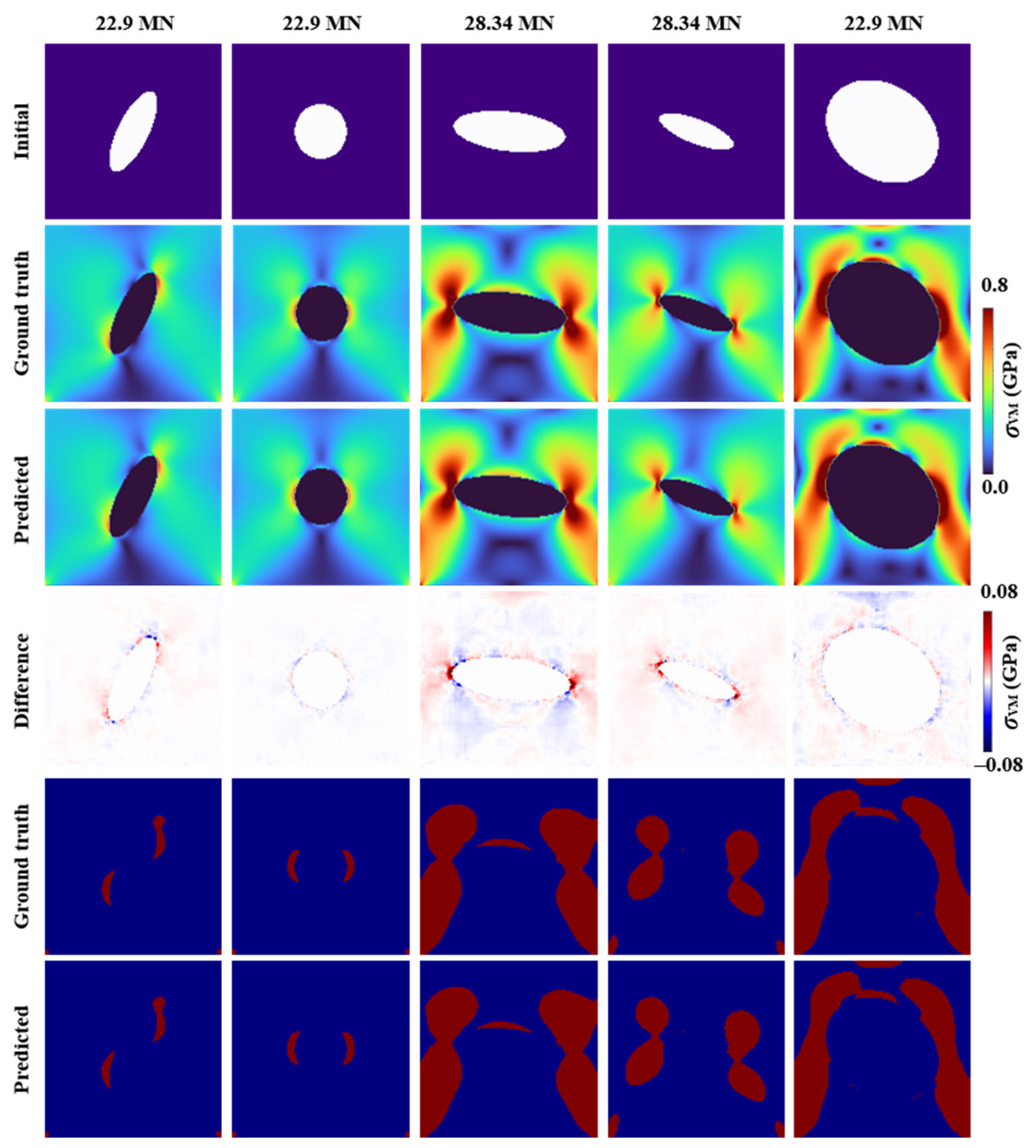
A total of 1200 samples of predicted stress fields are inferenced with the trained models by inputting the test datasets. Some representatives of the predicted stress fields are illustrated in the third row of Figure 5 with corresponding force listed on the top. These predicted stress fields are barely distinguishable by visually comparing with the ground truths (second row). The CPGAN successfully learned the null stress for the pore domains (white color of first row). In particular, the trained model successfully predicted stress concentrations near the edges of voids due to high contrast in elastic constants of the two phases. Moreover, as can be seen in the third and fourth column of Figure 5, high stress at the two ends of fixed bottom sides have been successfully predicted. Since it is hard to distinguish the prediction and ground truth with the naked eye, their differences are further visualized in the fourth row. As can be seen, localized regions of higher error are located at phase boundaries where material properties of interfacing phases are significantly different. This is understandable since these regions usually require most efforts for physics-based method to solve as well.
Figure 5.
Comparison of the stress fields between predictions and ground truth as illustrated in the second and third row. Their corresponding stress hotspots are obtained by thresholding as presented in fourth and last row. The images at the first row and the forces on them depict their corresponding initial fields and applied forces.
When designing solid structures, the regions (i.e., stress hotspots) where failures such as fractures are likely are desired to be anticipated in advance. Therefore, it would be highly favorable if a method can accurately predict the locations of these stress hotspots. To test whether CPGAN has this capability, both the fields of prediction and ground truth are processed by thresholding and shown in last two rows. As illustrated, the stress hotspots (σvM ≥ 0.375 GPa) with a red color of predictions are identical to those of ground truth. It is noted that during training, we did not provide any specific information about the hotspots. In fact, the average difference between the area of the contours of stress spots of all the test results are as low as 0.6% by counting the number of pixels with them. With such a small error, it is comprehensible why it is hard to distinguish between ground truth and prediction.
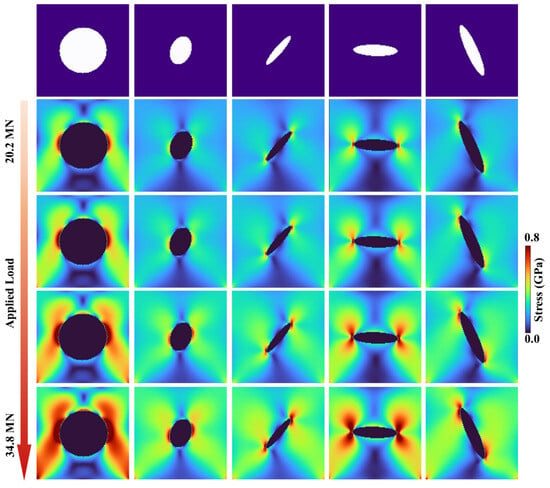
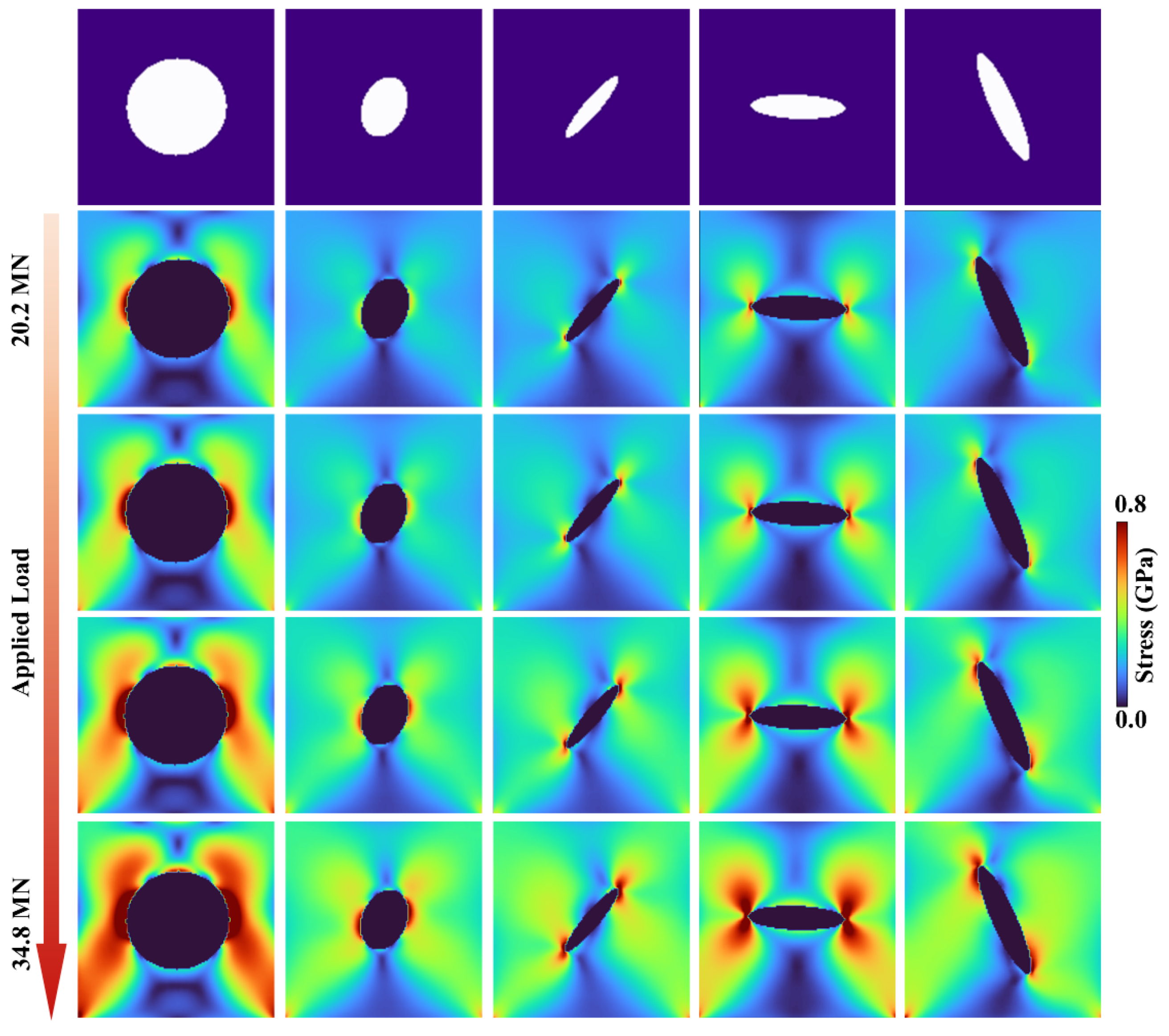
To further test whether the trained model has learned the underlying constitutive relations, a set of forces ranging from 20.2 to 34.8 MN were applied on some randomly chosen initial fields from test datasets. As illustrated in Figure 6, the intensities of stress fields are enhanced with the increase in applied forces. In particular, the intensity and areas of stress hotpot regions for all tested cases strengthen with the increasing forces as well. This analysis sufficiently demonstrates that the trained model has successfully incorporated the effect of forces on the evolved stress fields. The strengthening of stress fields with higher forces is straightforward for human beings, but it is still surprising for CPGAN to acquire this capability without any human coded rules. It is worthwhile pointing out that the training datasets do not include any scenarios where different forces are applied in the same initial field. Nevertheless, the proposed DL model can still successfully predict these unseen cases and demonstrate its outstanding learning capability.
Figure 6.
Depicts the strengthening of stress field intensity by applying increasing forces on some randomly selected initial fields (first row) from test datasets.
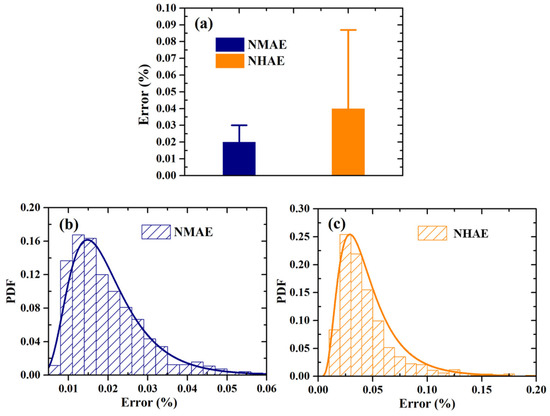
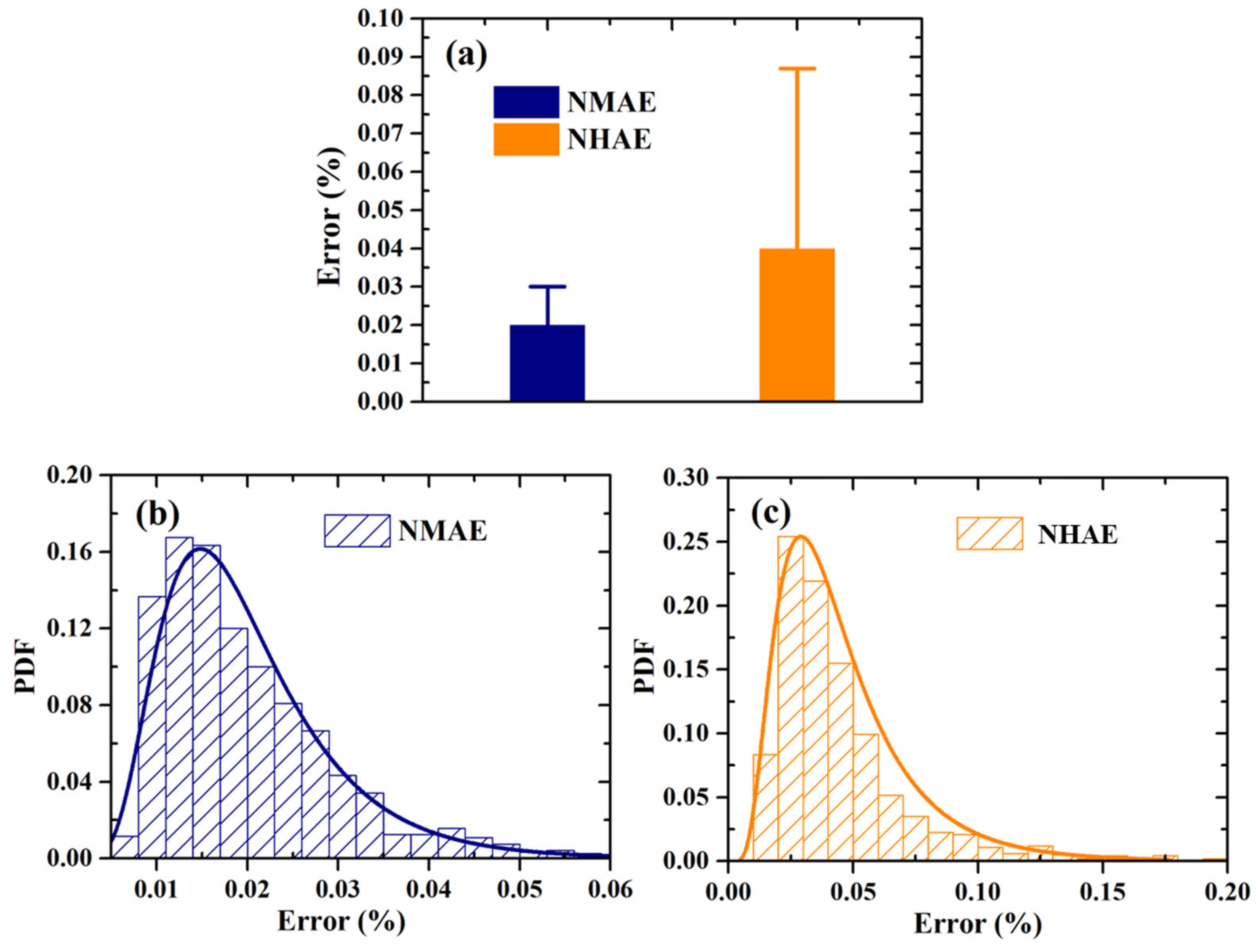
In addition to qualitative analysis, the prediction accuracy is quantitively analyzed through the equation metrics (NMAE and NHAE) using all the test datasets (1200 samples). Specifically, as can be depicted in Figure 7a, the global prediction accuracy (NMAE) achieves as high as 99.8% similarity to the ground truth. When in terms of more important stress hotspots, the CPGAN can still predict with excellent accuracy (99.6%). These analysis results agree with the conclusion in qualitative analysis that higher error regions are located near the interphase boundaries with higher stress. Nevertheless, the prediction accuracy for stress hotspot regions is still satisfying considering both the initial fields and conditioning parameter (i.e., forces) are unseen in the training datasets. In particular, the probability density functions (PDF) of both evaluation metrics are both best fitted by lognormal distributions with most errors leaning toward the left as depicted in Figure 7b,c. This indicates errors clustered in regions of smaller value. Specifically, the standard deviations of NMAE and NHME are 0.01% and 0.047%, respectively, as illustrated in the error bars Figure 7a.
Figure 7.
(a) Quantitative analysis by comparing 1200 samples of ground truth and prediction using the comparison metrics (NMAE and NHAE). (b,c) Illustrate the PDF of NMAE and NHAE, respectively.
Therefore, from all the above qualitative and quantitative analysis the proposed CPGAN has demonstrated its superb capability in the calculation of mechanical problems of large internal phase contrast and non-linearity. In addition to the highly competitive accuracy as compared with both existing DL methods and conventional physics-based solver, CPGAN also proves its superiority in computational efficiency. In fact, large quantities of such simulations may only require a fraction of seconds. The boosted simulation capability in high resolution structure with no obvious time-increment makes it even more appealing.
4.3. Grain Growth Results
While the experiments demonstrate its capability in simulating field evolvement with spatially united or non-uniform evolving manner. This experiment will show its excellence at spatiotemporal evolving kinetics of phase field grain growth model by simply incorporating time as a condition parameter. Previous machine-learning-based surrogate models of the phase field grain growth model mainly rely on methods of dimensionality reduction. Even though they succeeded in obtaining solutions, but they either cannot guarantee the accuracy for complex and multi-variable phase-field models [40] or have a high computational cost [41]. Zapiain et al. [42] proposed ML methods to accelerate phase-field-based microstructure evolution predictions, but turned out can only predict short-term local dynamics, i.e., within 10 time-steps from initial fields. This incapability in predicting long-term statistical characteristics inhibits its practical applications.
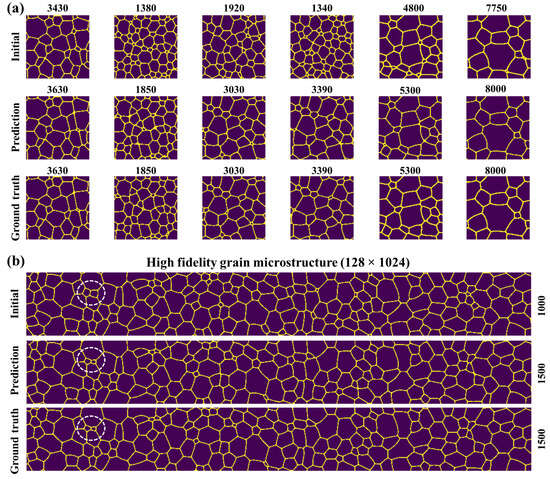
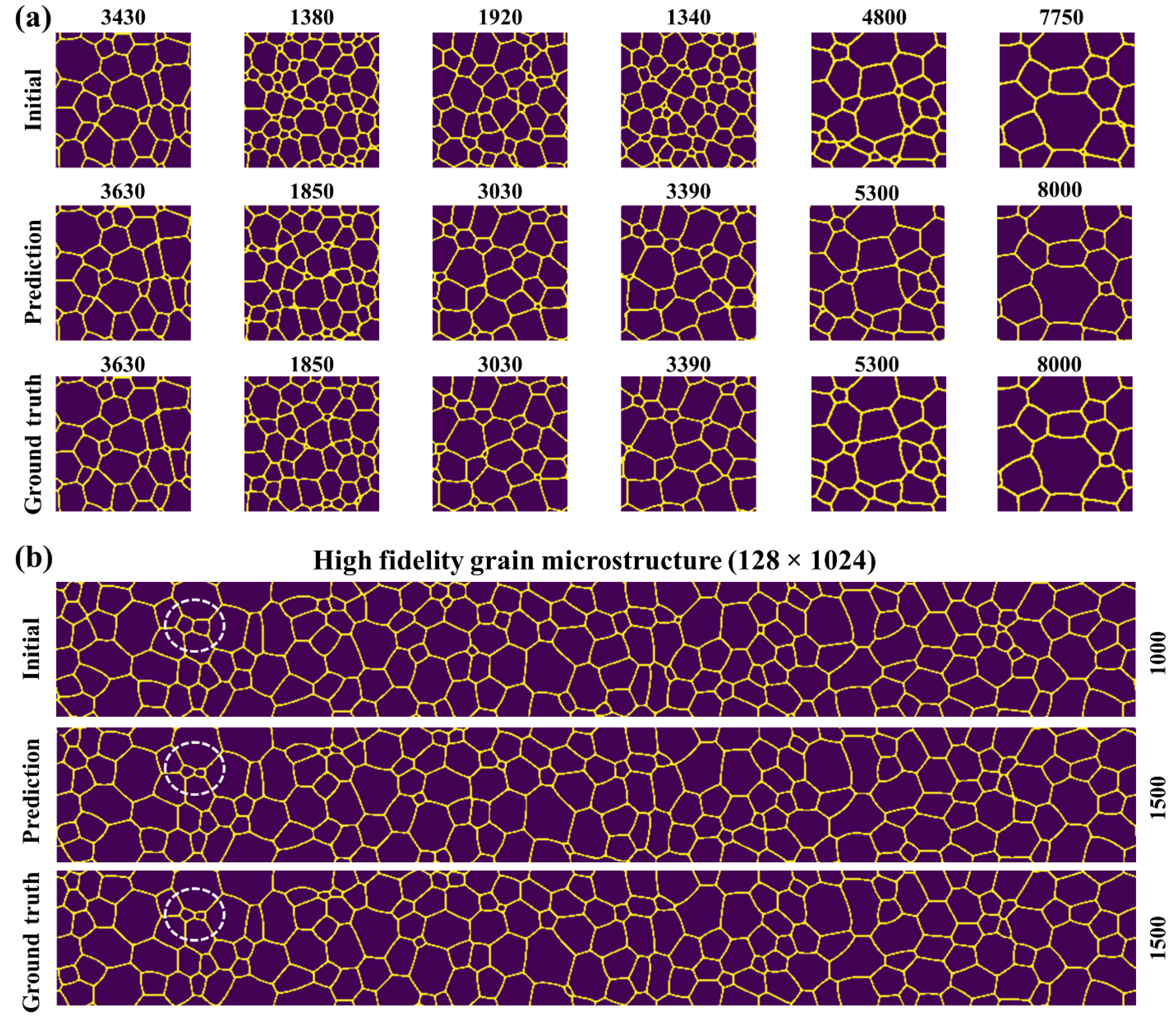
On the other hand, the CPGAN can accurately predict evolved microstructures with more than 2000 time-step differences from the initial microstructures. Figure 8a illustrates some representatives of the predicted microstructures from testing results with corresponding time-step difference shown on the top of images. As seen, with time-step difference as large as 2000 steps, the predicted microstructures are still barely distinguishable by only visual inspections. It is worth noting that when time-step differences are larger than 500 (second to fourth column), the structure differences between the initial and final ones are almost morphologically intractable to each other. Nevertheless, the CPGAN can still manage to simulate the evolved microstructures with high visual resemblance. Moreover, CPGAN can even successfully simulate the grain microstructures beyond the timesteps of training datasets as depicted in the last two columns. Grain growth describes dissipative dynamics, in which grain growth rate reduces with time as can be seen from first and last column. This phenomenon is common in microstructure evolution due to the continuous diminishing thermodynamic driving force during evolving process. Despite this fact, CPGAN can successfully incorporate this non-linear temporal effect of timesteps into the evolving kinetics of grain growth. Because the time-step difference is supplied to the network as an explicit conditioning parameter, a single CPGAN learns to map an initial microstructure to its evolved state across a wide range of elapsed steps. The non-linear input–output relationship is itself within the general approximation capacity of deep neural networks; what is notable here is that this conditioning enables accurate long-range temporal prediction (up to and beyond 2000 steps) in a single forward pass, in contrast to earlier surrogates restricted to short-term local dynamics. In addition, as seen in Figure 8b, once the time-dependent spatial evolution kinetics during training have been learned, CPGAN can easily predict evolved grain microstructures with higher resolutions (e.g., 128 × 1024) during inference. The grain growth can be easily observed with some smaller grains devoured by neighboring large grains; see grains in dashed circle in Figure 7b. This boosted simulating capability to simulate high resolution microstructure has significant advantages over the physics-based approach in terms of computational cost. With the increasing of the resolutions of evolved microstructures, the computation cost for the physics-based method will increase several orders of magnitude as compared with the almost-no-change for CPGAN.
Figure 8.
(a) Illustrates some typical prediction results with certain representative time steps from small to large. The comparison results show that despite large basic structure differences between initial and final fields (i.e., large time step), CPGAN can still predict evolved grain growth with relatively high accuracy. Notice that CPGAN can even simulate grain growth beyond that of training datasets as depicted in last two columns. (b) Shows high fidelity grain microstructure (128 × 1024) with ΔT = 500 can be successfully predicted in a fraction of a second.
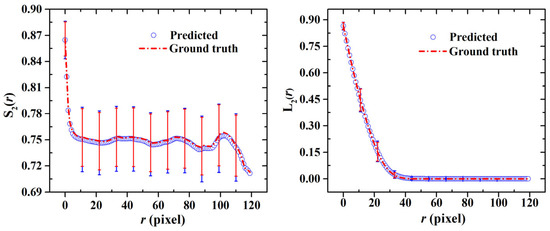
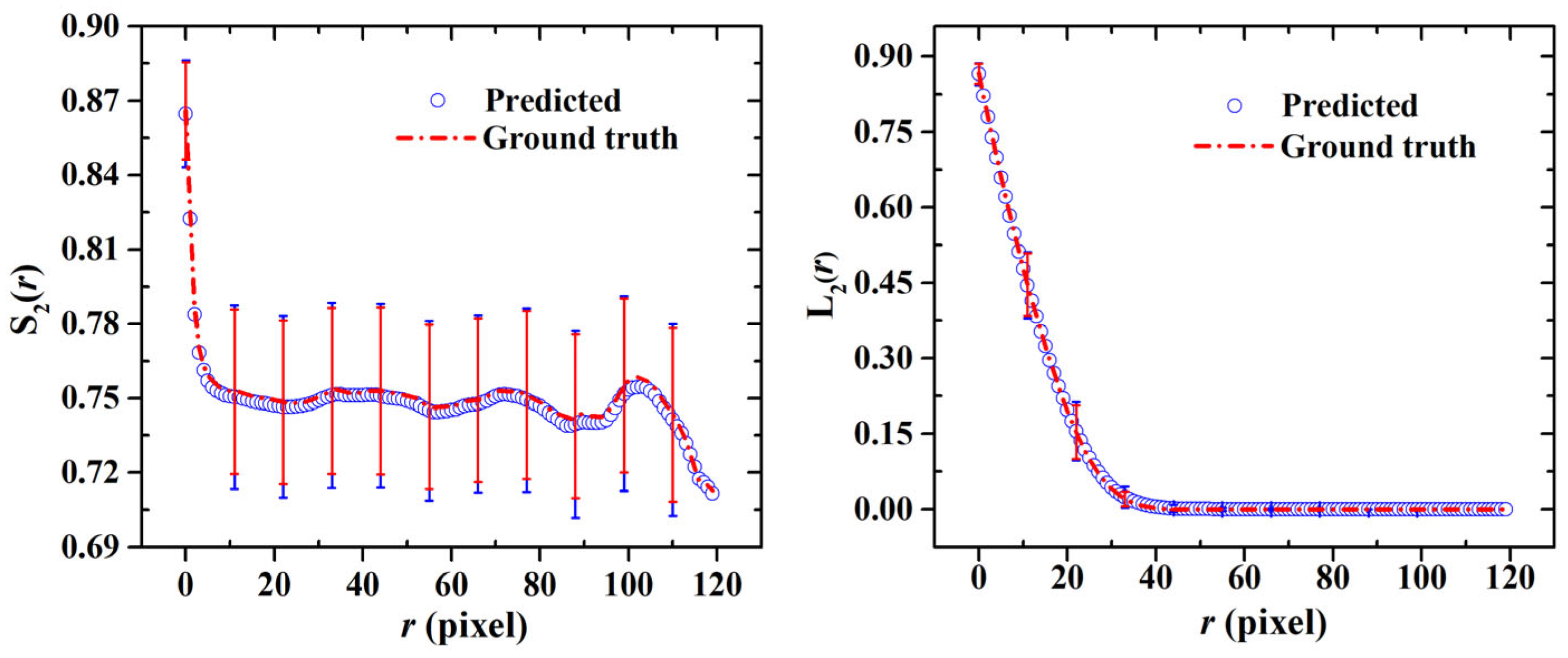
In addition to their visual resemblance, Figure 9 illustrates the statistical evaluation of the similarity using widely adopted two-point correlation and lineal-path statistical functions of all the testing results (11,000 grain microstructures). The curves are the average of the statistical functions of all the grain microstructures in the testing result, while the error bars are their standard deviations corresponding to certain pixel distance r. As depicted, the curves and error bars match each other closely with the increasing of r. The comparison result in terms of the statistical functions indicates the statistical properties of polycrystals have been faithfully predicted by the CPGAN.
Figure 9.
High prediction accuracy is demonstrated through the comparison of statistical functions between ground truth and predictions. The statistical functions were obtained by averaging the statistical functions of all the testing results. The error bars depict their corresponding standard deviations at specific r value. The comparison results clearly show that the statistical functions between ground truth and predictions match each other well on average but also in terms of deviations.
Quantitative comparisons are also analyzed through some key physical descriptors of polycrystals in addition to the similarity in their statistical properties. Specifically, as illustrated in Table 1, with a time-step difference less than 1000, the average prediction errors of all the physical descriptors are less than 2.6% with low variations (see rows of standard deviations). On the other hand, the prediction accuracy in [42] is 5% by using absolute relative error of the average feature size between predicted and ground truth, which may be attributed to the usage of low-dimensional representation algorithms such as principal component analysis (PCA) in their framework. Information loss will be induced when using PCA to remove insignificant dimensions when conducting a transformation of microstructure representation. On the other hand, CPGAN is trained in an end-to-end fashion without any other on-the-fly protocols. Therefore, for both a qualitative and quantitative comparison, the CPGAN exhibits outstanding capability in predicting spatiotemporal evolving kinetics with large structure differences.
Table 1.
Demonstrates the prediction error in terms of some typical physical descriptors of grain microstructures.
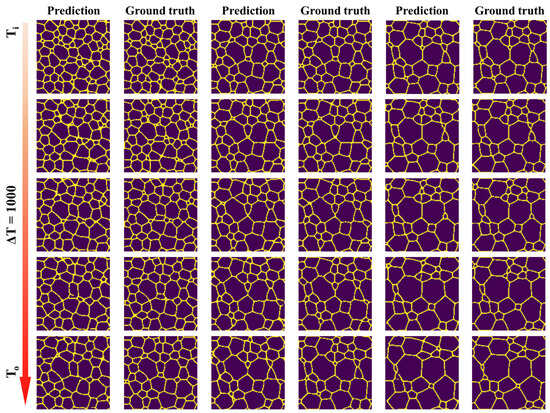
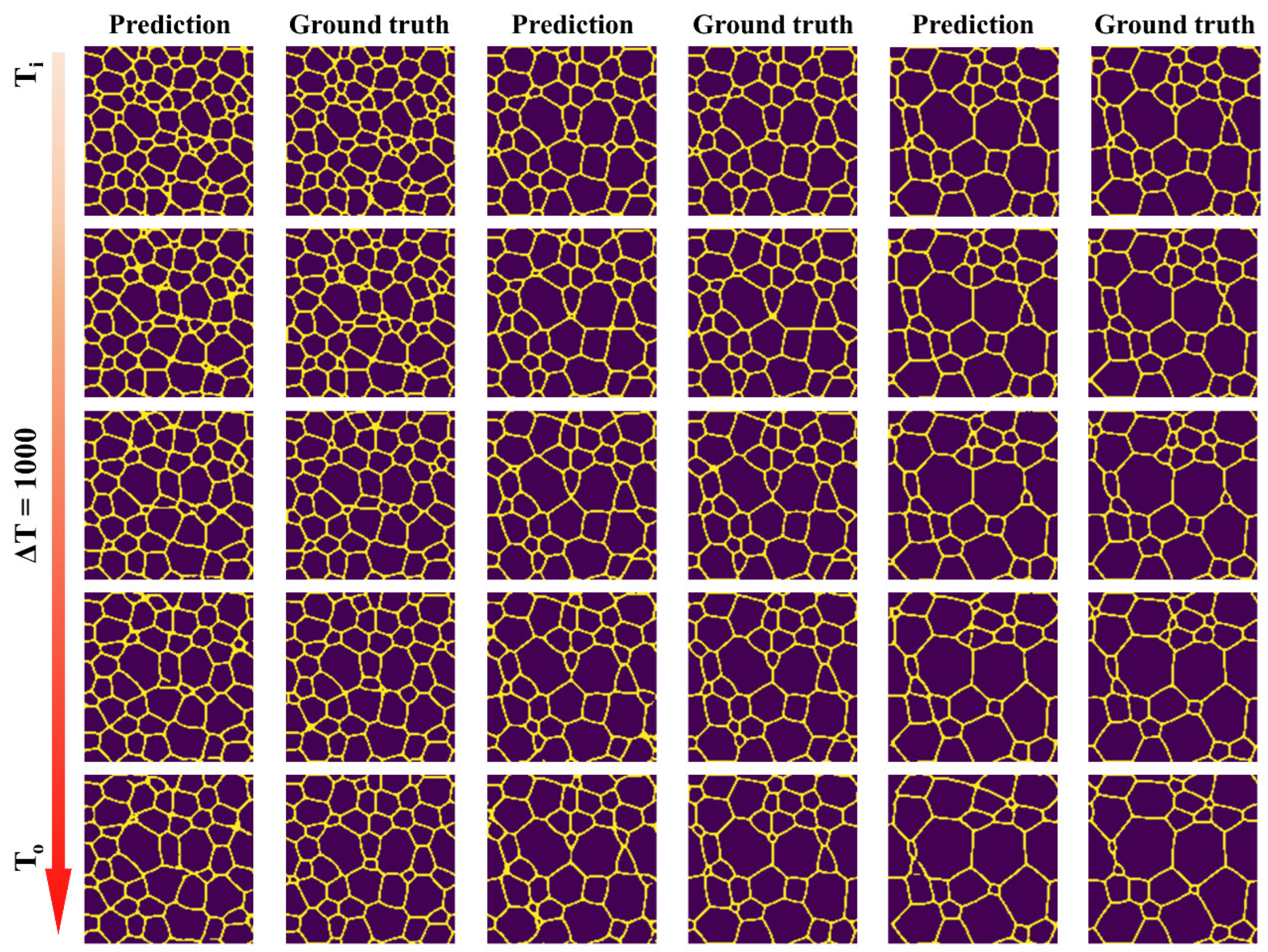
Figure 10 illustrates how the CPGAN can be used as a fully surrogate model of phase grain growth model. With the ensured high accuracy within 1000 time step difference, the CPGAN can predict microstructures from one step to another, for instance from 1000 time-step to 5000 time step. Especially, the microstructures of 1000 time step can be used to predict microstructures within 2000 time-step which can be used as the inputs to predict microstructures within 3000 time steps. The microstructure within 4000 or 5000 time steps can predicted in a similar fashion. Therefore, with this superb capability, CPGAN can enable grains to “time jump” to any desired time steps in the simulation with minimal computation cost and maximal accuracy.
Figure 10.
Illustrate that CPGAN can be used as a surrogate grain growth model due to its ensured high prediction accuracy as large as a 1000 time step difference between initial and final grain microstructures.
4.4. Ablation Study and Computational Efficiency
To isolate the contribution of each design choice, we compare CPGAN against three baselines on the stress-field prediction task using a common training and test split: a plain convolutional encoder–decoder without adversarial training; our previous yNet [12]; and an otherwise identical CPGAN trained with the vanilla-GAN (sigmoid cross-entropy) loss in place of the LSGAN loss. Table 2 reports NMAE, NHAE, and NPAE, and the model size. The proposed LSGAN-based CPGAN attains the highest accuracy and the adversarial term yields sharper, more accurate fields than the non-adversarial encoder–decoder; replacing the LSGAN loss with the vanilla-GAN loss degrades both accuracy and training stability (the corresponding learning curves are given in the Supplementary Materials). To verify that these gains are not an artifact of a particular initialization, each configuration was trained with five random seeds; the reported values are the means, and the run-to-run standard deviations are given in Table 2. It is worth noting that the vanilla-GAN variant underperforms even our previous yNet, which we attribute to the unstable adversarial training of the sigmoid cross-entropy objective, reflected in its larger run-to-run variance; the least-squares (LSGAN) objective remedies this instability and is therefore adopted in CPGAN. The plain convolutional encoder–decoder yields the largest errors because, without the adversarial term, it tends to fill the interior of the void with spurious stress rather than leaving it unloaded; the discriminator-based variants suppress this artifact, which is the primary reason the adversarial loss is essential for accurate stress-field prediction. The monotonic improvement from the encoder–decoder, through the vanilla-GAN variant, to the LSGAN-based CPGAN thus isolates the contribution of the adversarial loss to the final accuracy.
Table 2.
Ablation and baseline comparison on the Stress prediction task (128 × 128). Values means over five random seeds.
Beyond accuracy, the practical value of CPGAN lies in its inference speed. Table 3 compares, for representative domain sizes in each application, the wall-clock time of the physics-based solver against a single forward pass of the trained CPGAN on the same hardware. Whereas the cost of the physics-based model grows by orders of magnitude with domain size, CPGAN inference is essentially independent of it, so that fields requiring minutes to several hours of simulation are produced in a fraction of a second. This combination of competitive accuracy and order-of-magnitude speed-up is what makes CPGAN attractive as a surrogate for whole-field process planning and design exploration. To present the computational cost in a balanced way, Table 3 also reports, for each application, the network-training time and the one-time dataset-generation time in addition to the per-field inference time. The dataset-generation time is obtained by multiplying the number of physics-based simulations by the time required for one such simulation, as shown in the last two columns of Table 3. For grain growth, where a single simulation evolves one microstructure through all-time steps and yields 401 training snapshots, 133 simulations generate the full training set; the per-simulation time used here (2.18 × 10⁶ ms) corresponds to the grain-growth training resolution (128 × 256) and therefore differs from the 128 × 1024 demonstration field listed in the physics-based column. Because data generation and training are incurred only once and are then amortized over an essentially unlimited number of inferences, CPGAN serves as an efficient surrogate model for SLS process design, solid-structure design, and grain-microstructure investigation. All reported timings were obtained on a single laptop (Intel Core i7-7500U CPU, NVIDIA GeForce GTX 950 M GPU, 16 G RAM).
Table 3.
Computation cost of CPGAN versus the physics-based solver, measured on the same workstation.
5. Discussion
Taken together, the three applications show that CPGAN behaves as a single surrogate architecture that maps an initial field, together with a set of conditioning parameters, to an evolved field, across physics as different as solid-state sintering, static elasticity, and grain-boundary kinetics. The results substantiate the three advantages claimed at the outset. The network ingests mixed inputs, including low-dimensional process or loading parameters and a high-dimensional initial field, within one framework, and the controlled studies of laser power and scanning speed for porosity, and of applied force for stress, confirm that the learned mapping responds to the conditioning information in the physically expected direction. It also predicts rectangular and larger-than-training domains in a single forward pass, retaining about 97% accuracy in the area fraction of porosity even when the domain length is doubled or the depth-to-domain ratio is altered. Finally, it attains high accuracy with stable training, reaching a normalized mean absolute error of 0.02% on the stress task while suppressing the spurious artifacts produced by non-adversarial baselines.
These behaviors follow directly from the architectural choices. Because the generator is a fully convolutional U-Net, its learned kernels are applied locally and independently of input size, which is what permits inference on rectangular and extreme-aspect-ratio domains without the sliding-window reconstruction required by our earlier yNet. The PatchGAN discriminator, operating on local patches, supplies a texture critic that the ablation in Table 2 shows to be decisive: removing the adversarial term lets a plain encoder–decoder fill unloaded voids with spurious stress, whereas replacing the least-squares objective with the vanilla-GAN loss destabilizes training and inflates the run-to-run variance. Relative to operator-learning surrogates such as Fourier neural operators and DeepONet, which learn solution operators on a fixed domain, CPGAN is distinguished by its joint conditioning on parameters and fields; relative to image-only stress or transport GANs it removes the restriction to pure-image inputs; and relative to dimensionality-reduction surrogates of grain growth, which were limited to short-horizon local dynamics, conditioning on the time-step difference allows a single model to advance across thousands of steps.
The generality of the conditioning mechanism points to a clear path toward broader metal additive-manufacturing problems. Thermal-history descriptors such as scan strategy, inter-layer dwell time, preheat temperature, or summarized local thermal cycles can be supplied as additional conditioning parameters, while the predicted field can be residual stress, distortion, or evolved microstructure. The three cases reported here already provide the corresponding building blocks, namely a laser powder-bed-fusion process field, a full-field stress predictor, and a time-conditioned microstructure model; coupling them into a thermal-history-conditioned residual-stress or grain-structure predictor for laser powder-bed fusion or wire-arc additive manufacturing is a natural next step.
A few limitations nonetheless bound the present approach and should be weighed in application. Extrapolation is reliable only within the trained range: the grain-growth error in Table 1 rises sharply once the time-step difference exceeds roughly 2000 to 3000 steps, and a comparable degradation is expected when domain ratios depart strongly from training, with the largest pixel-wise errors concentrated at sharp phase boundaries and high property-contrast interfaces. More fundamentally, CPGAN is a purely data-driven surrogate, so its predictions are not guaranteed to satisfy the governing equations or conservation laws, it returns no intrinsic uncertainty estimate, and a separate model must be trained for each new material, process, or boundary-condition regime; all demonstrations here are two-dimensional and incur a one-time cost of data generation and training. These observations motivate the main directions for future work: physics-informed loss terms or hard constraints to enforce governing-equation consistency, neural-operator and diffusion-based formulations for better out-of-distribution behavior and calibrated uncertainty, extension to three dimensions, and transfer learning across materials and processes to reduce the per-task data requirement.
6. Conclusions
We have proposed a physics-free surrogate model CPGAN to simulate multi-input field-to-field evolutions of various disciplines. The CPGAN possess the capabilities to ultra-fast predict evolved fields with high accuracy (e.g., 99% in porosity evolution of SLS) and with no effort. Moreover, it can further boost its capability by predicting rectangular fields of high-resolution (e.g., 256 × 1024), which has significant benefits to those applications whose fields exhibit high aspect ratio such as the porosity evolution in SLS process of long track. The CPGAN has demonstrated its superb capability in simulating some typical engineering problems with (1) spatially non-uniform evolving kinetics (porosity evolution of SLS), (2) morphological and textural complexity or variability (stress-field prediction), and (3) spatiotemporal evolving kinetics (PFM). CPGAN should be able to simulate any other engineering problems of multi-input field-to-field regression. Therefore, it can successfully break through the longstanding computational curse of those simulations and can tackle related engineering problems conveniently.
7. Related Work
7.1. Physical SLS Model
A physical SLS model was developed by coupling primitive phase-field-based sintering model [43], heat transfer model and a Gaussian heat source model [44]. The operating range of laser power is from 25 to 40 W, while scanning speed is from 0.5 to 2.5 m s−1. These two conditioning parameters will be normalized before the input. The alloy used in this study is stainless steel 316L. The spatial and temporal simulation resolutions are Δx = Δy = 2 μm and Δt = 1μs, respectively. More details of our physical SLS model can be found in previous work [45].
In addition to the sintering model for simulating porosity evolution, generation of powder bed (i.e., initial porous structure) is simulated using a “rain” model [46] in a layer-by-layer manner based on a global minimum gravity energy algorithm. The mean and standard deviation of the diameters of deposited powders are set as 25 and 0.5 μm, respectively. Notice that this powder bed generation model can provide initial structures for both the physical sintering simulation and CPGAN sintering simulation.
7.2. Stress Computation via Finite Element Method (FEM)
Calculating the stress of linear elastic body using FEM involves:
where K, D, and P denotes the stiffness matrix of the whole body, global displacment and applied load, respectively. In particular, K can be obtained by adding all the local stifness matrix, in which displacment boundary condtions can be intergated. Once the glabal displacment has been obtained, the stress tensor of each element can be obtained by:
where Θ, Ω, and η are the stress–strain matrix, strain-displacement matrix and nodal displacment of each element. Following that, the von Mises stress of each element can easily calculated.
Each stress field was computed with the finite-element method in COMSOL Multiphysics 5.5 under a two-dimensional linear-elastic assumption. The solid is Ti–6Al–4V, modeled as isotropic with elastic modulus E = 110 GPa and Poisson’s ratio ν = 0.4 evaluated at room temperature; the square domain contains a central elliptical void whose applied force and ellipticity were sampled by Latin hypercube. The bottom edge is fully fixed and a uniform traction is applied to the top edge, with the remaining edges left traction-free. The domain was discretized with free triangular elements.
7.3. Phase Field Grain Growth Model
The total free energy F of the polycrystalline microstructure is constructed as:
where the first term is the local free energy density of the grain structures and the second term is the gradient energy density which corresponds to the part of grain boundary energy originated from the inhomogeneous distribution of order parameters near the grain boundaries, and τ is the gradient coefficient. Starting from the randomly distributed grain nuclei, the microstructure evolution is obtained by solving the governing Allen-Cahn equation:
where L is a positive kinetic coefficient and is related to grain-boundary mobility during microstructure evolution.
The polycrystalline evolution is governed by the Allen–Cahn equation (Equation (11)), derived from the free-energy functional in Equation (10), with gradient coefficient τ and kinetic coefficient L controlling the grain-boundary energy and mobility, respectively. Simulations start from randomly distributed grain nuclei on a 128 × 128 grid with grid spacing (dx = 2) and time step (dt = 0.1) and are advanced from step #1000 to step #5000; the neighboring microstructures stored for training are separated by ten steps. The numerical parameters were verified to reproduce the expected parabolic grain-growth kinetics before the dataset was generated. More details of our Phase field grain growth model can be found in previous work [47,48,49].
Supplementary Materials
The following supporting information can be downloaded at: https://www.mdpi.com/article/10.3390/met16070691/s1, Figure S1: Learning curve comparison for the case of stress field prediction between CPGAN and Vanila GAN.
Author Contributions
Conceptualization, W.Y.; methodology, W.Y.; software, Z.W.; validation, X.W.; formal analysis, W.Y. and Z.W.; investigation, W.Y. and Z.W.; resources, L.C.; data curation, W.Y. and Z.W.; writing—original draft preparation, W.Y.; writing—review and editing, Z.W.; visualization, W.Y.; supervision, W.Y.; project administration, W.Y.; funding acquisition, L.C., C.D. and R.K.; All authors have read and agreed to the published version of the manuscript.
Funding
This work is financially supported by Faculty Enhancement Program (FEP) of Prairie View A&M University and Partial support for this work is received from the NSF CREST center for Energy & Environmental Sustainability-Phase II (Award #1914692).
Data Availability Statement
All datasets reported in this study have been deposited at Mendeley Data: http://doi.org/10.17632/gg8f2hwkxd.1.
Acknowledgments
The extensive simulations were supported through computational resources and services provided by the Center for Advanced Vehicular Systems (CAVS) at Mississippi State University.
Conflicts of Interest
The authors declare no competing interests. The funders had no role in the design of the study; in the collection, analyses, or interpretation of data; in the writing of the manuscript; or in the decision to publish the results.
References
- Song, X.; He, L.; Yang, W.; Wang, Z.; Chen, Z.; Guo, J.; Wang, H.; Chen, L. Additive Manufacturing of Bi-Continuous Piezocomposites with Triply Periodic Phase Interfaces for Combined Flexibility and Piezoelectricity. J. Manuf. Sci. Eng. 2019, 141, 111004. [Google Scholar] [CrossRef] [Scilit]
- Song, X.; He, L.; Yang, W.; Wang, Z.; Chen, L. Co-continuous piezocomposites with triply periodic phase interfaces for enhanced mechanical flexibility and piezoelectricity. In International Manufacturing Science and Engineering Conference; American Society of Mechanical Engineers: New York, NY, USA, 2018; Volume 51357, p. V001T01A020. [Google Scholar]
- Yang, W.; Wang, Z.; Yenusah, C.; Liu, Y. An Integrated Model for Prediction of Process-Structure-Property Relationship for Additively Manufactured Al-10Si-Mg Alloy; SAE Technical Paper 0148-7191; SAE International: Warrendale, PA, USA, 2020. [Google Scholar]
- Perkins, A.; Yang, W.; Liu, Y.; Chen, L.; Yenusah, C. Finite Element Analysis of the Effect of Porosity on the Plasticity and Damage Behavior of Mg AZ31 and Al 6061 T651 Alloys. In ASME International Mechanical Engineering Congress and Exposition; American Society of Mechanical Engineers: New York, NY, USA, 2019; Volume 59469, p. V009T11A055. [Google Scholar]
- Cang, R.; Xu, Y.; Chen, S.; Liu, Y.; Jiao, Y.; Ren, M.Y. Microstructure Representation and Reconstruction of Heterogeneous Materials via Deep Belief Network for Computational Material Design. J. Mech. Des. 2017, 139, 071404. [Google Scholar] [CrossRef] [Scilit]
- Yang, Z.; Yabansu, Y.C.; Al-Bahrani, R.; Liao, W.-K.; Choudhary, A.N.; Kalidindi, S.R.; Agrawal, A. Deep learning approaches for mining structure-property linkages in high contrast composites from simulation datasets. Comput. Mater. Sci. 2018, 151, 278–287. [Google Scholar] [CrossRef] [Scilit]
- Wang, J.; Ma, Y.; Zhang, L.; Gao, R.X.; Wu, D. Deep learning for smart manufacturing: Methods and applications. J. Manuf. Syst. 2018, 48, 144–156. [Google Scholar] [CrossRef] [Scilit]
- Razzak, M.I.; Naz, S.; Zaib, A. Deep learning for medical image processing: Overview, challenges and the future. In Classification in BioApps; Springer: Cham, Switzerland, 2018; pp. 323–350. [Google Scholar]
- Nie, Z.; Jiang, H.; Kara, L.B. Stress Field Prediction in Cantilevered Structures Using Convolutional Neural Networks. J. Comput. Inf. Sci. Eng. 2019, 20, 011002. [Google Scholar] [CrossRef] [Scilit]
- Liang, L.; Liu, M.; Martin, C.; Sun, W. A deep learning approach to estimate stress distribution: A fast and accurate surrogate of finite-element analysis. J. R. Soc. Interface 2018, 15, 20170844. [Google Scholar] [CrossRef] [Scilit] [PubMed]
- Khadilkar, A.; Wang, J.; Rai, R. Deep learning–based stress prediction for bottom-up SLA 3D printing process. Int. J. Adv. Manuf. Technol. 2019, 102, 2555–2569. [Google Scholar]
- Wang, Z.; Wang, X.; Yang, W.; Xiao, Y.; Liu, Y.; Chen, L. yNet: A multi-input convolutional network for ultra-fast simulation of field evolvement. arXiv 2020, arXiv:2012.10575. [Google Scholar]
- Park, S.J.; Heogh, W.; Yang, J.; Kang, S.; Jeong, W.; Lee, H.; Jang, T.-S.; Jung, H.-D.; Jahazi, M.; Han, S.C.; et al. Meta-structure of amorphous-inspired 65.1Co28.2Cr5.3Mo lattices augmented by artificial intelligence. Adv. Compos. Hybrid. Mater. 2024, 7, 224. [Google Scholar] [PubMed]
- Mirza, M.; Osindero, S. Conditional generative adversarial nets. arXiv 2014, arXiv:1411.1784. [Google Scholar]
- Reed, S.; Akata, Z.; Yan, X.; Logeswaran, L.; Schiele, B.; Lee, H. Generative adversarial text to image synthesis. arXiv 2016, arXiv:1605.05396. [Google Scholar]
- Zhang, H.; Xu, T.; Li, H.; Zhang, S.; Wang, X.; Huang, X.; Metaxas, D.N. StackGAN++: Realistic Image Synthesis with Stacked Generative Adversarial Networks. IEEE Trans. Pattern Anal. Mach. Intell. 2019, 41, 1947–1962. [Google Scholar] [CrossRef] [Scilit] [PubMed]
- Isola, P.; Zhu, J.-Y.; Zhou, T.; Efros, A.A. Image-to-image translation with conditional adversarial networks. In Proceedings of the IEEE Conference on Computer Vision and Pattern Recognition; IEEE: New York, NY, USA, 2017; pp. 1125–1134. [Google Scholar]
- Zhu, J.-Y.; Park, T.; Isola, P.; Efros, A.A. Unpaired image-to-image translation using cycle-consistent adversarial networks. In Proceedings of the IEEE International Conference on Computer Vision; IEEE: New York, NY, USA, 2017; pp. 2223–2232. [Google Scholar]
- Shaham, T.R.; Dekel, T.; Michaeli, T. SinGAN: Learning a generative model from a single natural image. In Proceedings of the IEEE International Conference on Computer Vision; IEEE: New York, NY, USA, 2019; pp. 4570–4580. [Google Scholar]
- Choi, Y.; Choi, M.; Kim, M.; Ha, J.-W.; Kim, S.; Choo, J. StarGAN: Unified generative adversarial networks for multi-domain image-to-image translation. In Proceedings of the IEEE Conference on Computer Vision and Pattern Recognition; IEEE: New York, NY, USA, 2018; pp. 8789–8797. [Google Scholar]
- Yi, Z.; Zhang, H.; Tan, P.; Gong, M. DualGAN: Unsupervised dual learning for image-to-image translation. In Proceedings of the IEEE International Conference on Computer Vision; IEEE: New York, NY, USA, 2017; pp. 2849–2857. [Google Scholar]
- Wang, X.; Gupta, A. Generative image modeling using style and structure adversarial networks. In European Conference on Computer Vision; Springer: Cham, Switzerland, 2016; pp. 318–335. [Google Scholar]
- Farimani, A.B.; Gomes, J.; Pande, V.S. Deep learning the physics of transport phenomena. arXiv 2017, arXiv:1709.02432. [Google Scholar]
- Jiang, H.; Nie, Z.; Yeo, R.; Farimani, A.B.; Kara, L.B. StressGAN: A Generative Deep Learning Model for 2D Stress Distribution Prediction. In ASME 2020 International Design Engineering Technical Conferences and Computers and Information in Engineering Conference; American Society of Mechanical Engineers Digital Collection: New York, NY, USA, 2020. [Google Scholar]
- Li, Z.; Kovachki, N.; Azizzadenesheli, K.; Liu, B.; Bhattacharya, K.; Stuart, A.; Anandkumar, A. Fourier neural operator for parametric partial differential equations. arXiv 2020, arXiv:2010.08895. [Google Scholar]
- Lu, L.; Jin, P.; Pang, G.; Zhang, Z.; Karniadakis, G.E. Learning nonlinear operators via DeepONet based on the universal approximation theorem of operators. Nat. Mach. Intell. 2021, 3, 218–229. [Google Scholar] [CrossRef] [Scilit]
- Ronneberger, O.; Fischer, P.; Brox, T. U-Net: Convolutional networks for biomedical image segmentation. In International Conference on Medical Image Computing and Computer-Assisted Intervention; Springer: Cham, Switzerland, 2015; pp. 234–241. [Google Scholar]
- Yuan, Z.; Jiang, Y.; Li, J.; Huang, H. Hybrid-DNNs: Hybrid Deep Neural Networks for Mixed Inputs. arXiv 2020, arXiv:2005.08419. [Google Scholar]
- Hendricks, L.A.; Venugopalan, S.; Rohrbach, M.; Mooney, R.; Saenko, K.; Darrell, T. Deep compositional captioning: Describing novel object categories without paired training data. In Proceedings of the IEEE Conference on Computer Vision and Pattern Recognition; IEEE: New York, NY, USA, 2016; pp. 1–10. [Google Scholar]
- Noh, H.; Hong, S.; Han, B. Learning deconvolution network for semantic segmentation. In Proceedings of the IEEE International Conference on Computer Vision; IEEE: New York, NY, USA, 2015; pp. 1520–1528. [Google Scholar]
- Badrinarayanan, V.; Kendall, A.; Cipolla, R. Segnet: A deep convolutional encoder-decoder architecture for image segmentation. IEEE Trans. Pattern Anal. Mach. Intell. 2017, 39, 2481–2495. [Google Scholar] [CrossRef] [Scilit] [PubMed]
- Hu, J.; Shen, L.; Sun, G. Squeeze-and-excitation networks. In Proceedings of the IEEE Conference on Computer Vision and Pattern Recognition; IEEE: New York, NY, USA, 2018; pp. 7132–7141. [Google Scholar]
- Kingma, D.P.; Ba, J. Adam: A method for stochastic optimization. arXiv 2014, arXiv:1412.6980. [Google Scholar]
- Pathak, D.; Krahenbuhl, P.; Donahue, J.; Darrell, T.; Efros, A.A. Context encoders: Feature learning by inpainting. In Proceedings of the IEEE Conference on Computer Vision and Pattern Recognition; IEEE: New York, NY, USA, 2016; pp. 2536–2544. [Google Scholar]
- Mao, X.; Li, Q.; Xie, H.; Lau, R.Y.; Wang, Z.; Smolley, S.P. Least squares generative adversarial networks. In Proceedings of the IEEE International Conference on Computer Vision; IEEE: New York, NY, USA, 2017; pp. 2794–2802. [Google Scholar]
- Helton, J.C.; Davis, F.J. Latin hypercube sampling and the propagation of uncertainty in analyses of complex systems. Reliab. Eng. Syst. Saf. 2003, 81, 23–69. [Google Scholar] [CrossRef] [Scilit]
- Niezgoda, S.R.; Yabansu, Y.C.; Kalidindi, S.R. Understanding and visualizing microstructure and microstructure variance as a stochastic process. Acta Mater. 2011, 59, 6387–6400. [Google Scholar] [CrossRef] [Scilit]
- Gayon-Lombardo, A.; Mosser, L.; Brandon, N.P.; Cooper, S.J. Stochastic reconstruction of periodic, three-dimensional multi-phase electrode microstructures using generative adversarial networks. arXiv 2020, arXiv:2003.11632. [Google Scholar]
- Bostanabad, R.; Bui, A.T.; Xie, W.; Apley, D.W.; Chen, W. Stochastic microstructure characterization and reconstruction via supervised learning. Acta Mater. 2016, 103, 89–102. [Google Scholar] [CrossRef] [Scilit]
- Brough, D.B.; Kannan, A.; Haaland, B.; Bucknall, D.G.; Kalidindi, S.R. Extraction of Process-Structure Evolution Linkages from X-ray Scattering Measurements Using Dimensionality Reduction and Time Series Analysis. Integr. Mater. Manuf. Innov. 2017, 6, 147–159. [Google Scholar] [PubMed]
- Pfeifer, S.; Wodo, O.; Ganapathysubramanian, B. An optimization approach to identify processing pathways for achieving tailored thin film morphologies. Comput. Mater. Sci. 2018, 143, 486–496. [Google Scholar] [CrossRef] [Scilit]
- Zapiain, D.M.d.O.; Stewart, J.A.; Dingreville, R. Accelerating phase-field-based microstructure evolution predictions via surrogate models trained by machine learning methods. npj Comput. Mater. 2021, 7, 3. [Google Scholar] [CrossRef] [Scilit]
- Wang, Y.U. Computer modeling and simulation of solid-state sintering: A phase field approach. Acta Mater. 2006, 54, 953–961. [Google Scholar] [CrossRef] [Scilit]
- Yang, Y.; Kühn, P.; Yi, M.; Egger, H.; Xu, B.-X. Non-isothermal Phase-Field Modeling of Heat–Melt–Microstructure-Coupled Processes During Powder Bed Fusion. JOM 2020, 72, 1719–1733. [Google Scholar]
- Wang, X.; Liu, Y.; Li, L.; Yenusah, C.; Xiao, Y.; Chen, L. Multi-scale phase-field modeling of layer-by-layer powder compact densification during solid-state direct metal laser sintering. Mater. Des. 2021, 203, 109615. [Google Scholar]
- Lu, L.-X.; Sridhar, N.; Zhang, Y.-W. Phase field simulation of powder bed-based additive manufacturing. Acta Mater. 2018, 144, 801–809. [Google Scholar] [CrossRef] [Scilit]
- Yang, W.; Wang, Z.; Yang, T.; He, L.; Song, X.; Liu, Y.; Chen, L. Exploration of the Underlying Space in Microscopic Images via Deep Learning for Additively Manufactured Piezoceramics. ACS Appl. Mater. Interfaces 2021, 13, 53439–53453. [Google Scholar] [CrossRef] [Scilit] [PubMed]
- Wang, Z.; Jiang, C.; Liu, P.; Yang, W.; Zhao, Y.; Horstemeyer, M.F.; Chen, L.-Q.; Hu, Z.; Chen, L. Uncertainty quantification and reduction in metal additive manufacturing. npj Comput. Mater. 2020, 6, 175. [Google Scholar] [CrossRef] [Scilit]
- Yang, W.; Wang, R.; Yao, X.; Yan, H.; Su, J.; Liu, P.; Xiao, Y.; Wang, Q.; Wang, A.; Chen, L. DendriX: A flexible, maintainable, and extendable platform to simulate 3D Li-dendrite growth in Li-ion batteries. SoftwareX 2026, 35, 102768. [Google Scholar]

Disclaimer/Publisher’s Note: The statements, opinions and data contained in all publications are solely those of the individual author(s) and contributor(s) and not of MDPI and/or the editor(s). MDPI and/or the editor(s) disclaim responsibility for any injury to people or property resulting from any ideas, methods, instructions or products referred to in the content. |
© 2026 by the authors. Licensee MDPI, Basel, Switzerland. This article is an open access article distributed under the terms and conditions of the Creative Commons Attribution (CC BY) license.