


Abstract
This study presents an upper bound energy-based offline digital twin framework developed for rapid forging load prediction during early-stage spur gear forging die design. The proposed framework integrates an analytically driven prediction model based on Upper Bound Energy Analysis (UBEA) with validated knowledge obtained from experimentally supported reference studies reported in the literature. Unlike sensor-based real-time digital twin systems, the proposed approach operates in an offline configuration and does not require continuous real-time data acquisition. The analytical framework was implemented within a computational environment to systematically estimate forging loads under different gear geometries and process conditions. The predicted forging loads were validated using representative experimental reference data reported for spur gear forging applications under comparable geometrical and processing conditions. The generated analytical dataset forms a structured knowledge base that enables virtual representation of forging load behavior within the proposed offline digital twin environment. The validation results demonstrated that the proposed framework successfully captures the overall magnitude and trend of forging loads, with an average relative deviation of approximately 6.5% across the investigated cases. Compared with conventional finite element simulations and experimental trials, the proposed framework provides a computationally efficient alternative for preliminary forging load estimation and iterative design evaluation while maintaining acceptable prediction accuracy. The developed offline digital twin framework provides a practical and scalable analytical decision-support tool for rapid gear forging die design and process planning.
1. Introduction
Metal forming processes, particularly forging, play a vital role in the manufacturing of high-strength and high-precision mechanical components used in automotive, aerospace, and heavy industry applications. Due to their ability to improve mechanical properties while maintaining near-net-shape geometries, forging operations remain one of the most preferred manufacturing routes for load-bearing components such as gears. However, the presence of complex die cavities, non-uniform material flow, and severe forming conditions makes forging die design a highly critical and knowledge-intensive stage of the manufacturing process [1,2,3].
Among forging applications, gear forging represents a particularly challenging case due to the complex geometry of the tooth profile and the high sensitivity of the process to design parameters. Small variations in die geometry, friction conditions, or material properties may result in significant changes in forging load, die behavior, and final product filling quality. Consequently, accurate prediction of forging load and process response has long been a central research topic in metal forming science [2,3,4,5].
Finite element method (FEM) simulations and experimental investigations are widely accepted as reliable tools for analyzing forging processes and validating die designs. FEM-based approaches enable detailed evaluation of material flow, stress–strain evolution, and load–stroke characteristics throughout the forming process, while experimental studies provide indispensable information under real manufacturing conditions [2,3,4,5,6]. Owing to their high accuracy, these methods are generally employed during the final stages of process validation and optimization.
Despite their proven accuracy, both FEM simulations and experimental studies are inherently time-consuming and resource-intensive. The preparation of detailed numerical models, meshing procedures, material characterization, and iterative simulation cycles significantly increase the overall design time. Similarly, experimental trials require dedicated tooling, extensive preparation, and repeated testing, which may not be feasible during early-stage or iterative die design phases. Therefore, although FEM and experimental methods provide reliable predictions, their direct applicability is often limited when rapid design iterations and early decision-making are required [4,5,6,7].
To overcome these limitations, analytical modeling approaches have traditionally been employed as efficient alternatives during the early stages of forging die design. Among these approaches, upper bound energy analysis (UBEA) enables rapid estimation of forming loads based on kinematically admissible velocity fields and simplified material behavior assumptions [2,7,8]. Due to its low computational cost and physically interpretable formulation, UBEA has been widely utilized to support preliminary die design and process feasibility assessments. Nevertheless, the predictive capability of analytical models strongly depends on the selection of appropriate formulations and requires validation against numerical and experimental results, particularly for complex geometries such as gears.
In recent years, the concept of digital twins has attracted increasing attention in manufacturing research as a means of improving process understanding, prediction accuracy, and design efficiency [9,10,11]. Most reported digital twin applications in metal forming rely on real-time data acquisition and sensor-based monitoring systems to maintain continuous synchronization between physical and virtual systems. Although these approaches provide high accuracy, they generally require extensive infrastructure and may not be economically feasible for many industrial forging environments. Furthermore, their direct applicability to early-stage die design remains limited.
In this context, offline digital twin approaches integrating analytically generated knowledge with validated numerical and experimental data offer a promising alternative. By utilizing fast analytical models for rapid prediction while ensuring reliability through systematic validation, such frameworks have the potential to significantly shorten the forging die design cycle without compromising accuracy. However, for gear forging applications, the integration of UBEA-based analytical formulations into a validated offline digital twin framework remains limited in the existing literature.
In the proposed framework, the digital twin concept is represented by a virtual process model capable of reproducing the behavior of the forging system through analytical prediction, structured knowledge generation, and validation against trusted reference sources. Unlike conventional analytical load prediction approaches that operate as standalone calculation tools, the proposed framework integrates analytical modeling, knowledge representation, validation, and decision-support functions within a unified virtual environment. Therefore, the contribution of this study lies not in the development of a new upper bound formulation, but in the implementation and validation of an analytical prediction engine as a building block of an offline digital twin architecture for forging die design.
This study addresses this gap by proposing an analytically driven offline digital twin framework that integrates upper bound energy analysis, structured knowledge generation, and validation-based decision support for rapid gear forging die design. By systematically validating the analytical results against experimentally reported data available in the literature, it is demonstrated that high prediction accuracy can be achieved while significantly reducing the overall design time. The proposed approach aims to provide rapid and reliable solutions. The computational methodology employed in this study is based on a simple analytical calculation procedure capable of rapidly estimating forging loads for different gear geometries and process parameters. The analytical calculations were implemented within a Python 3.11-based scripting environment to obtain forging load predictions for various parameter combinations.
In recent years, studies investigating the application of digital twin technology in metal forming and forging processes have shown a significant increase. In particular, the development of digital twin models for forging equipment offers important opportunities for monitoring and optimizing manufacturing processes. In a study conducted by Khalaj et al., it was demonstrated that production efficiency could be improved through a digital twin model developed for a magnetic forging holder [12]. According to widely accepted digital twin taxonomies, a digital twin does not necessarily require continuous real-time synchronization throughout its entire lifecycle. Depending on the intended application, digital twins may operate as real-time, semi-synchronized, or offline knowledge-driven virtual representations. In the context of forging die design, where rapid design evaluation is often required before physical manufacturing begins, offline digital twin approaches can provide a practical and computationally efficient alternative to sensor-based implementations.
In addition, recent review studies on the implementation of digital twin technologies in manufacturing systems have revealed that this approach possesses significant potential in terms of smart manufacturing, process monitoring, and production optimization [13]. Other studies focusing on forging processes have also shown that digital twin-based systems can be effectively utilized for condition monitoring and process optimization of manufacturing equipment [14].
Furthermore, hybrid modeling approaches combining analytical and numerical methods are increasingly being employed in studies related to the modeling and analysis of metal forming processes. These approaches contribute to more accurate prediction of complex deformation behavior [15,16].
Recent studies have further expanded the application scope of digital twin technologies in manufacturing systems. Wang et al. [17] reviewed recent developments in digital twin-enabled prediction and control methodologies for intelligent manufacturing applications. Gunaratne et al. [18] presented a digital twin platform for manufacturing environments and discussed the integration of virtual and physical systems for process management and optimization. Furthermore, Masar et al. [19] investigated the use of digital twin models for performance analysis and optimization in engineering systems. These recent contributions demonstrate the continuing evolution of digital twin technologies toward predictive, knowledge-driven, and decision-support-oriented manufacturing applications, which is consistent with the offline digital twin perspective adopted in the present study.
The main contributions of this study can be summarized as follows:
- (1)
- Development of an analytically driven offline digital twin framework for rapid spur gear forging die design.
- (2)
- Computational implementation of an Upper Bound Energy Analysis (UBEA)-based prediction engine capable of systematically estimating forging loads under different geometric and process conditions.
- (3)
- Integration of analytically generated knowledge with experimentally and numerically validated reference information reported in the literature.
- (4)
- Demonstration of a computationally efficient decision-support environment that can reduce design iteration time during the early stages of forging die design.
- (5)
- Establishment of a structured framework that may serve as a foundation for future integration of machine learning and data-driven forging process optimization approaches.
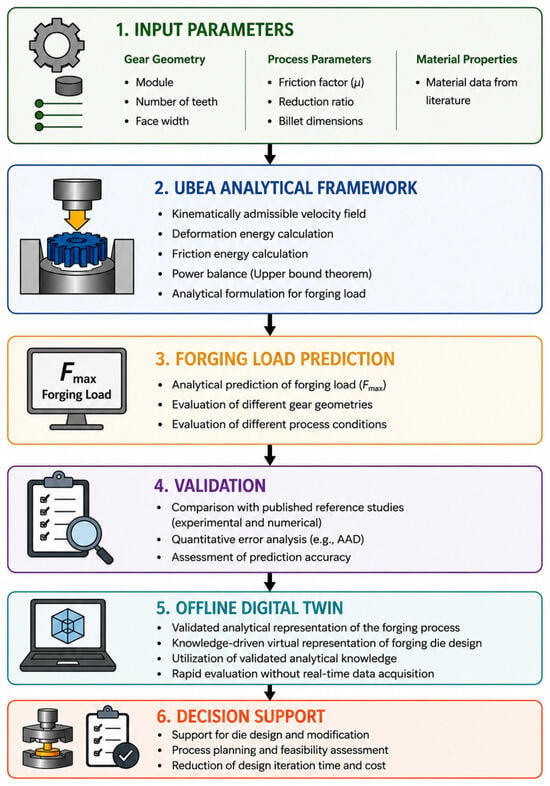
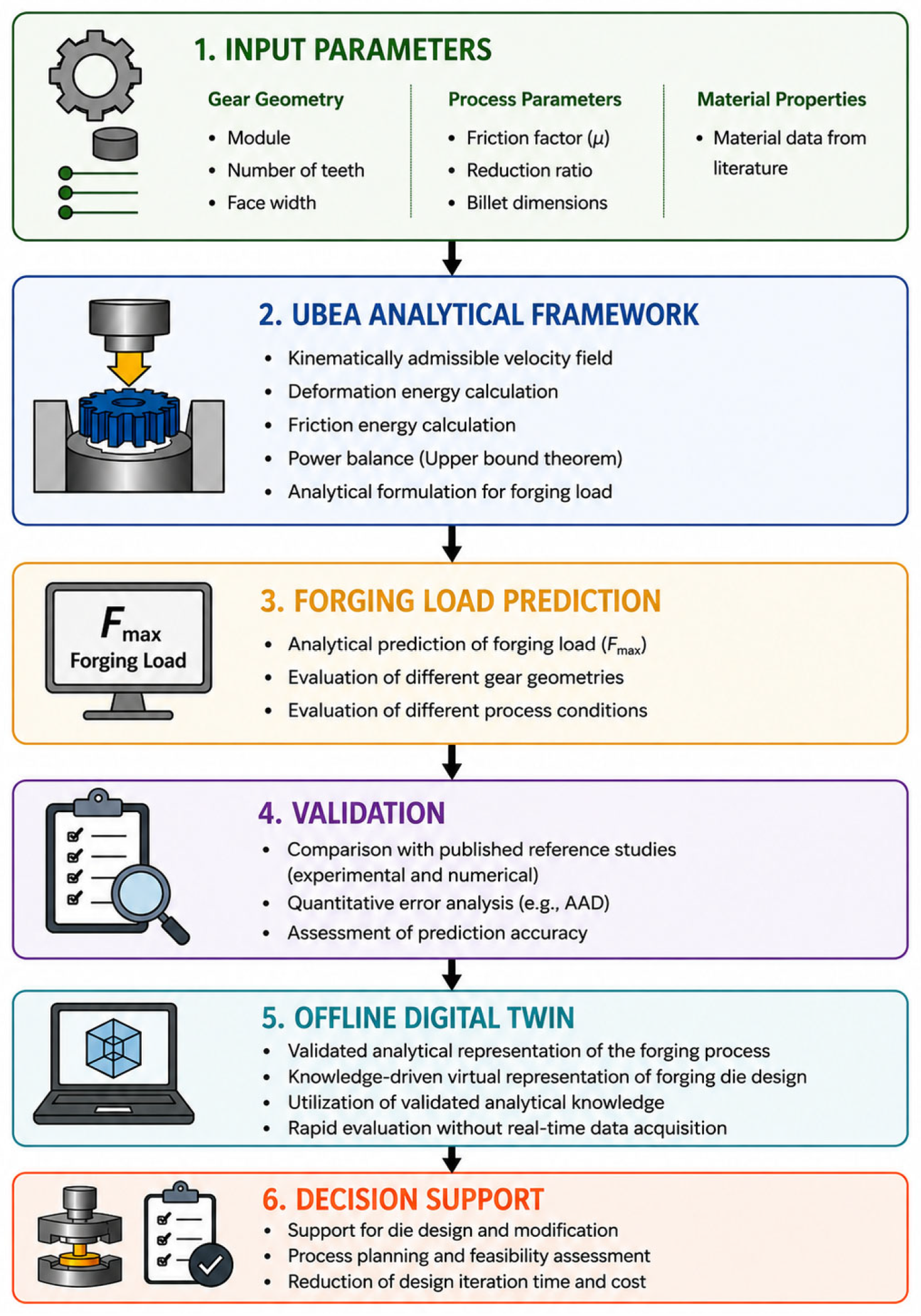
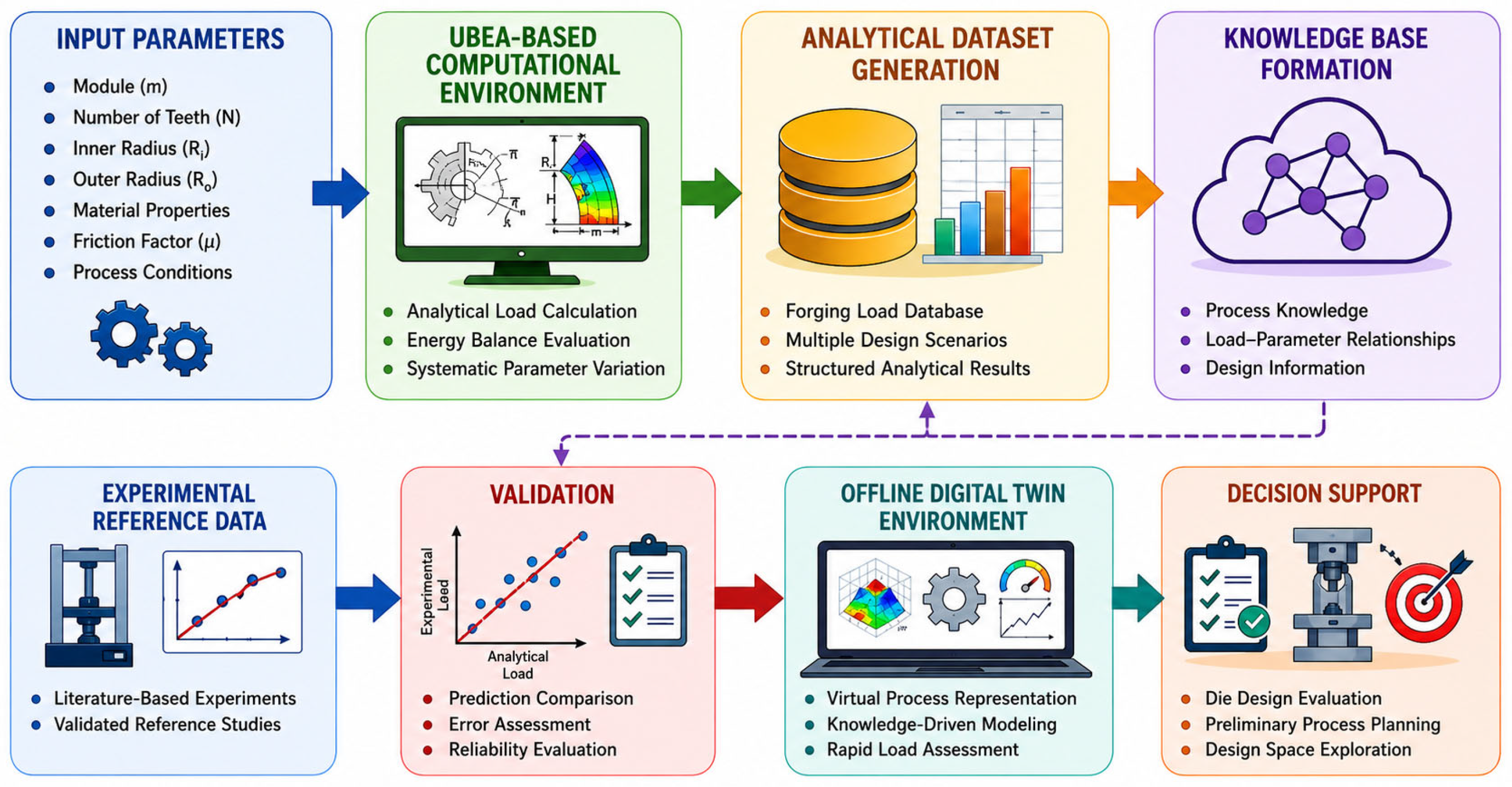
The overall architecture of the proposed analytically driven offline digital twin framework is illustrated in Figure 1. The framework integrates input parameter definition, UBEA-based forging load prediction, validation using published reference studies, and a knowledge-driven offline digital twin environment for rapid die design and process planning.
Figure 1.
Architecture of the proposed analytically driven offline digital twin framework for spur gear forging die design.
The remainder of this paper is organized as follows. Section 2 presents the analytical formulation and the developed computational framework. Section 3 describes the validation methodology and reference data. Section 4 discusses the results and prediction accuracy. Finally, Section 5 summarizes the main conclusions and provides directions for future work.
2. Analytical Framework and Computational Methodology
2.1. Architecture of the Proposed Offline Digital Twin Framework
The overall architecture of the proposed analytically driven offline digital twin framework is illustrated in Figure 1. The framework was developed to support rapid spur gear forging die design by integrating analytical load prediction, validation-based knowledge generation, and decision-support functionalities within a unified virtual environment.
Unlike conventional digital twin implementations that rely on continuous real-time data acquisition and synchronization between physical and virtual systems, the proposed framework operates in an offline configuration. Recent studies have shown that manufacturing digital twins can be implemented through different architectural configurations depending on the intended application, available data sources, and operational objectives [20,21]. While many industrial digital twins employ continuous synchronization between physical and virtual entities, knowledge-driven and prediction-oriented digital twin approaches have also been reported for process planning, virtual process evaluation, and design support applications [20,21,22]. In the proposed framework, the virtual representation of the forging process is established through analytically generated knowledge and validated reference information reported in the literature rather than through sensor-based real-time data streams. Such an approach is particularly suitable for early-stage forging die design, where rapid evaluation of alternative geometries and process conditions is required before physical manufacturing begins [12,13,14].
The framework consists of six principal components: input parameter definition, UBEA-based analytical modeling, forging load prediction, validation, offline digital twin representation, and decision support. First, the geometric, material, and process parameters defining the forging operation are introduced into the system. These parameters constitute the primary inputs of the analytical model and describe the characteristics of the gear geometry and forging conditions.
Subsequently, the Upper Bound Energy Analysis (UBEA) engine is employed as the core prediction mechanism. Based on established upper bound formulations reported in gear forging literature [4,23,24,25,26], the analytical model estimates forging loads under different geometric and process conditions with low computational cost. The resulting predictions are then evaluated against experimentally and numerically validated reference studies reported in the literature in order to assess prediction reliability and consistency.
The validated analytical predictions form the basis of the offline digital twin environment. Within this environment, the forging process is represented through a knowledge-driven virtual model capable of reproducing the overall forging load behavior without requiring real-time process monitoring. Furthermore, the analytical data generated through the implemented framework constitute a structured knowledge base that supports virtual process representation, rapid design-space exploration, and preliminary forging load assessment. Therefore, the proposed framework extends beyond a standalone analytical calculation tool by incorporating analytical modeling, knowledge generation, validation, and decision-support functionalities into a unified structure.
Finally, the generated analytical knowledge is utilized to support rapid die design evaluation and process planning activities. By reducing the dependence on repeated finite element simulations and experimental trials during preliminary design stages, the framework provides a computationally efficient decision-support tool for forging engineers.
It should be emphasized that the objective of the proposed framework is not to replace detailed finite element simulations or experimental investigations. Instead, it is intended to complement these approaches by providing rapid first-order load estimations suitable for iterative design exploration and preliminary feasibility assessment. In this respect, the proposed framework represents an analytically driven offline digital twin architecture specifically developed for spur gear forging die design applications.
2.2. Fundamental Principles and Assumptions of UBEA
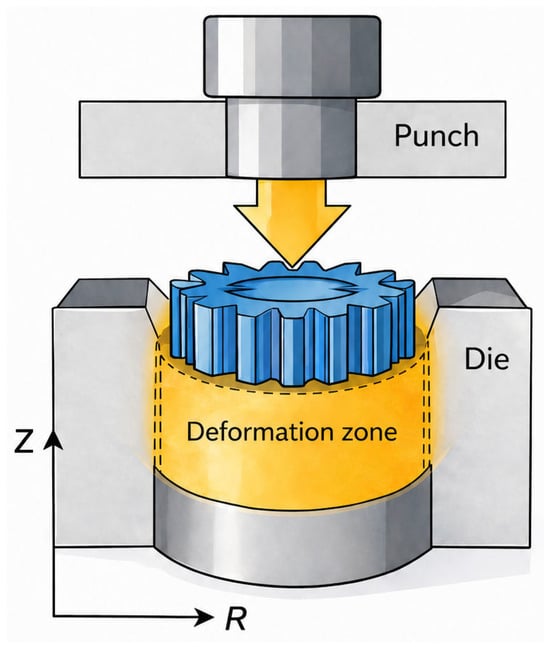
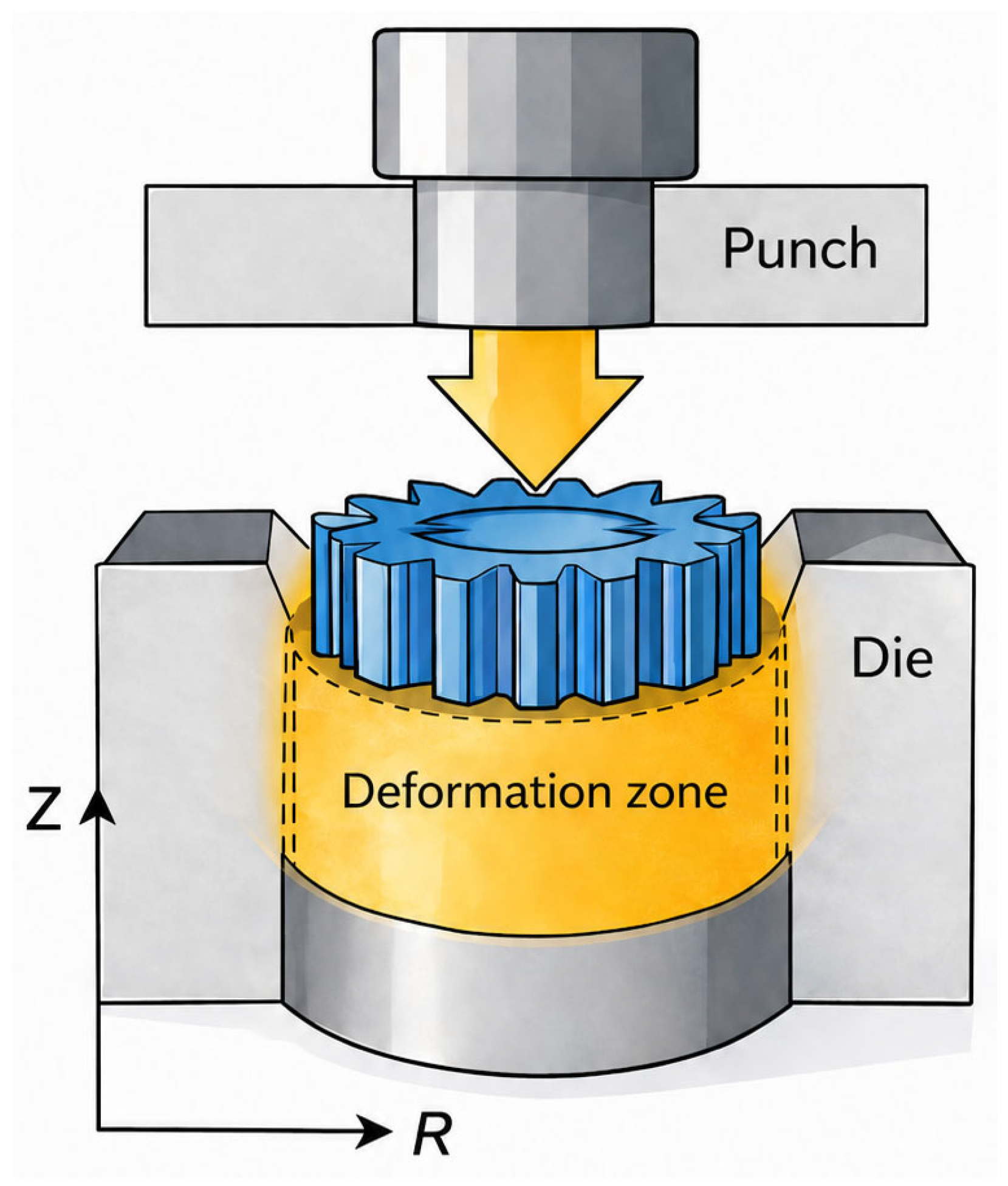
The deformation domain considered in the analytical formulation, together with the characteristic geometric parameters employed in the Upper Bound Energy Analysis (UBEA), is illustrated in Figure 2. The adopted deformation model represents the material flow occurring during spur gear forging and provides the basis for the analytical prediction framework utilized in the present study.
Figure 2.
Schematic representation of the deformation domain and geometric parameters considered in the upper bound energy analysis for gear forging.
UBEA is based on the classical upper bound theorem of plasticity, which states that the actual forming power required during deformation does not exceed the power calculated using a kinematically admissible velocity field satisfying the prescribed boundary conditions and incompressibility requirements. Owing to its relatively simple formulation and low computational cost, UBEA has been widely employed for load estimation in bulk metal forming processes. Previous studies conducted by Eyercioglu et al [23], Choi and Cho [24], Alves et al. [25], and Eyercioglu and Yılmaz [4] demonstrated that upper bound formulations can provide reliable first-order forging load estimations for spur gear forging applications when appropriate geometric and frictional assumptions are adopted.
The analytical formulation employed in the present study follows the fundamental assumptions commonly adopted in upper bound analyses of metal forming processes. The workpiece material is assumed to behave as a rigid-perfectly plastic body, while elastic deformation effects are neglected. Material flow is considered incompressible throughout the deformation process, and complete die filling is assumed within the deformation domain shown in Figure 2. Furthermore, the deformation behavior is represented by a kinematically admissible velocity field satisfying continuity and boundary conditions. These assumptions allow the complex forging process to be represented using a simplified but physically meaningful analytical model suitable for rapid engineering evaluations.
Friction effects are incorporated into the formulation through the frictional power component associated with the tool–workpiece interfaces. In accordance with conventional UBEA approaches employed in gear forging studies, friction is represented using a constant friction factor. Since friction contributes directly to energy dissipation during deformation, variations in friction conditions influence the predicted forging load. Nevertheless, the adopted friction representation provides a practical balance between analytical simplicity and prediction capability for preliminary die design applications.
According to the upper bound energy approach, the forging load is determined by equating the external power supplied by the punch to the internal power dissipated through plastic deformation and frictional losses. The total power consumption during forging is therefore represented as the sum of deformation power and friction power contributions. The forging load can subsequently be obtained from the corresponding power balance relationship. This approach enables rapid load estimation while maintaining substantially lower computational requirements than finite element simulations.
It should be emphasized that the objective of the present study is not to derive a new upper bound formulation. Rather, established and experimentally validated formulations reported in the literature were systematically implemented within a computational environment and integrated into the proposed offline digital twin framework. In this respect, the contribution of the present work lies in the development, implementation, validation, and integration of an analytical prediction engine within a knowledge-driven offline digital twin architecture for spur gear forging die design.
According to the Upper Bound Energy Analysis (UBEA), the total forging load is determined by evaluating the energy dissipation associated with plastic deformation, velocity discontinuities, and frictional effects. The corresponding energy components can be expressed as follows.
where represents the plastic deformation energy dissipation rate within deformation region is the flow stress, is the effective strain rate, and denotes the deformation volume.
where is the shear energy dissipation rate along velocity discontinuity surfaces, represents the velocity jump across the discontinuity, and denotes the discontinuity surface area.
where is the frictional energy dissipation rate, is the friction factor, and represents the contact area subjected to friction.
where denotes the total energy dissipation rate obtained by summing the plastic deformation, shear, and friction energy contributions.
where is the average punch pressure, is the punch–workpiece contact area, is the punch velocity, and is the total energy dissipation rate.
In the present study, these fundamental UBEA relationships constitute the basis of the analytical calculations used to generate forging load data under different geometric and process conditions. The numerical implementation was performed using the Python 3.11-based calculation environment developed according to the analytical formulations reported in the literature [23,24,25,26]. The resulting analytical predictions were subsequently employed for knowledge generation and validation within the proposed offline digital twin framework.
The geometric, material, and process parameters employed in the analytical formulation are summarized in Table 1. These parameters define the deformation domain, material behavior, and processing conditions considered in the UBEA calculations. The selected variables constitute the primary inputs of the developed computational framework and enable systematic forging load prediction under different gear geometries and process conditions.
Table 1.
Geometric, material, and process parameters adopted in the analytical formulation.
2.3. UBEA-Based Forging Load Prediction Methodology
The forging load prediction methodology adopted in the proposed offline digital twin framework is based on established Upper Bound Energy Analysis (UBEA) formulations previously reported for spur gear forging applications. Analytical load estimation using upper bound approaches has been successfully applied by Eyercioglu et al. [23], Choi and Cho [24], Alves et al. [25], and Eyercioglu and Yılmaz [4]. Rather than developing a new analytical formulation, the present study systematically utilizes these validated analytical principles to generate forging load information under different geometric and process conditions relevant to spur gear forging applications.
The computational procedure begins with the definition of the geometric, material, and process parameters listed in Table 1. These parameters are introduced into the UBEA-based computational environment, where the corresponding forging load values are calculated according to the analytical formulation described in Section 2.2. By systematically varying the input parameters within predefined ranges, analytical forging load data are generated for a wide range of design and processing conditions.
The resulting analytical dataset constitutes the knowledge base of the proposed offline digital twin framework. Since the generated data represent the relationship between process parameters and forging load behavior, they provide a virtual representation of the forging process within the digital environment. Consequently, the framework enables rapid evaluation of alternative design scenarios and process conditions without the need for repeated experimental investigations during preliminary design stages.
The generated forging load predictions are subsequently evaluated using experimentally validated reference studies reported in the literature. Representative validation cases reported by Choi and Cho [24] and Alves et al. [25] are employed to assess the consistency of the analytical predictions and to establish confidence in the applicability of the generated knowledge base. The comparison between analytical predictions and experimentally validated reference results provides an indication of the capability of the proposed framework to reproduce the overall forging load behavior observed in practical spur gear forging applications.
One of the principal advantages of the adopted methodology is its computational efficiency. Conventional finite element simulations and experimental investigations often require considerable computational resources, engineering effort, and manufacturing costs. In contrast, analytical approaches based on upper bound formulations provide significantly faster forging load estimation while maintaining engineering-level prediction capability [4,23]. The analytical framework enables rapid evaluation of alternative design scenarios without requiring mesh generation, iterative numerical solution procedures, or extensive post-processing operations. This characteristic makes the proposed framework particularly suitable for preliminary die design and early-stage process planning activities. Therefore, the proposed methodology provides an efficient foundation for offline digital twin implementation, design-space exploration, and preliminary process planning activities.
It should be emphasized that the generated analytical data are not intended to replace detailed finite element simulations or experimental investigations. Instead, they constitute a structured engineering knowledge base that supports rapid forging load assessment and decision-making within the proposed offline digital twin environment.
The overall workflow adopted for analytical dataset generation, validation, and knowledge-based formation within the proposed offline digital twin framework is schematically illustrated in Figure 3.
Figure 3.
Workflow of analytical dataset generation, validation, and knowledge-based formation within the proposed offline digital twin framework.
2.4. Offline Digital Twin Implementation and Knowledge Base Formation
In the proposed framework, the digital twin concept is implemented in an offline configuration through the integration of analytical modeling, knowledge-based formation, and validation-based virtual process representation. Unlike conventional real-time digital twins that continuously synchronize physical and virtual systems through sensor data acquisition, the proposed framework utilizes analytically generated knowledge and experimentally validated reference information to represent the forging process within a virtual environment. Similar classifications of manufacturing digital twin architectures have been discussed by Soori et al. [20] and Aurich et al. [21].
The analytical dataset generated through the UBEA-based computational methodology constitutes the foundation of the digital twin environment. By systematically evaluating a wide range of geometric and process conditions, the generated dataset captures the relationship between input parameters and forging load behavior. Consequently, the resulting analytical knowledge base enables virtual representation of the forging process without requiring continuous real-time monitoring or physical process synchronization.
Within the proposed framework, the digital twin environment is established through the combination of three principal elements: analytical process modeling, structured knowledge-based formation, and validation using experimentally supported reference studies. The interaction between these components allows the virtual environment to reproduce the overall forging load behavior associated with different gear geometries and process conditions. In this respect, the framework extends beyond a standalone analytical calculation procedure by incorporating knowledge generation, validation, and decision-support functionalities into a unified virtual representation structure. Such knowledge-driven digital twin approaches have been discussed by Veeramakali et al. [22].
The primary objective of the proposed offline digital twin is to support early-stage die design and process planning activities. During preliminary design phases, multiple design alternatives often need to be evaluated before detailed finite element simulations or experimental investigations are conducted. Under such circumstances, the proposed framework provides rapid forging load estimations and enables efficient exploration of alternative design scenarios while maintaining consistency with experimentally validated reference data.
To further clarify the distinction between conventional real-time digital twins and the proposed approach, a comparative summary is presented in Table 2. As shown in the table, the proposed framework differs from real-time digital twin implementations in terms of data acquisition strategy, synchronization requirements, computational cost, and intended application stage. While real-time digital twins primarily focus on process monitoring and operational optimization, the proposed offline digital twin is specifically designed to support rapid prediction, virtual process representation, and engineering decision-making during the preliminary stages of spur gear forging die design.
Table 2.
Comparison of real-time digital twin approaches with the proposed offline digital twin framework.
Therefore, the proposed framework should be viewed as a knowledge-driven offline digital twin architecture in which analytically generated and experimentally validated knowledge is utilized to establish a virtual representation of the forging process. The framework is intended to complement, rather than replace, detailed finite element simulations and experimental investigations by providing computationally efficient decision-support capability during the early design stages.
2.5. Influence of Key Geometric and Process Parameters in Spur Gear Forging
The forging behavior of spur gears is influenced by a combination of geometric and process-related parameters that govern material flow, cavity filling, and load requirements. Previous analytical, numerical, and experimental investigations have demonstrated that parameters such as friction factor, gear module, number of teeth, face width, bore diameter, and tooth geometry significantly affect the forging response of spur gear components. Understanding the influence of these variables is important for interpreting forging load predictions and supporting die design decisions during the preliminary stages of process development.
Among the process-related parameters, friction factor has a significant influence on forging behavior because it directly affects the energy dissipation occurring at the die–workpiece interface. Increased friction restricts material flow and consequently increases the pressure required for complete die filling. Eyercioglu and Yılmaz [4] investigated the effects of friction factor together with several geometric variables and demonstrated that friction conditions substantially affect the relative forging pressure of spur gears. Therefore, accurate representation of friction conditions is important for reliable forging load prediction and process evaluation.
Geometric characteristics of the gear also play an important role in determining forging loads and material flow patterns. According to Eyercioglu and Yılmaz [4], variations in module, number of teeth, face width, and bore diameter influence the relative forging pressure required for complete cavity filling. These parameters modify the deformation path of the material and alter the flow conditions during tooth formation. Consequently, changes in gear geometry may result in different load requirements even under similar material and process conditions.
Tooth geometry represents another important factor affecting forging behavior. In asymmetric spur gears, the driving and coast-side tooth profiles differ from conventional symmetric gear geometries, leading to changes in deformation characteristics and material flow patterns during forging. Aladağ et al. [23] presented an upper bound energy analysis of asymmetric spur gear forging and demonstrated that tooth profile geometry affects both material flow behavior and forging load development. Their results showed that analytical predictions and experimental observations exhibit similar deformation trends, confirming the importance of tooth geometry in forging analyses.
In addition to forging load requirements, die behavior and dimensional accuracy are strongly influenced by shrink-fit design parameters. Eyercioglu et al. [27] investigated the shrink-fit design of precision gear forging dies and demonstrated that die dimensions, ring dimensions, and radial interference values significantly affect stress distributions within the die assembly.
The influence of shrink fitting is not limited to stress distribution. Dimensional changes occurring on the tooth profile of the die insert may directly affect the dimensional accuracy of forged gears. Eyercioglu et al. [28] analyzed tooth profile changes in both symmetric and asymmetric spur gear forging dies and reported that radial displacements vary along the tooth profile and are generally higher in asymmetric dies. These findings indicate that die geometry and shrink-fit conditions should be considered together when evaluating dimensional accuracy requirements.
Similarly, Eyercioglu [29] investigated dimensional variations of precision gear forging dies caused by shrink fitting and demonstrated that finite element predictions provide significantly more realistic estimates of profile deformation than conventional cylindrical approaches. The study emphasized that dimensional changes occurring on the gear tooth profile cannot be accurately represented when the die cavity is simplified as a cylindrical geometry. Therefore, geometric details of the gear profile should be considered when evaluating die behavior and dimensional accuracy.
Collectively, the available literature demonstrates that friction conditions, geometric characteristics, tooth profile design, and shrink-fit parameters constitute the primary factors governing forging behavior and die performance in spur gear forging applications. Although the present study does not perform a dedicated parametric analysis, the findings reported in previous investigations provide useful insight into the factors affecting forging behavior and support the interpretation of the analytical predictions generated by the proposed framework.
2.6. Scope and Limitations of the Proposed Framework
The proposed framework was developed specifically for spur gear forging applications and is primarily intended to support early-stage die design, process evaluation, and preliminary feasibility assessment. The analytical methodology is based on Upper Bound Energy Analysis (UBEA), which enables rapid forging load estimation with relatively low computational effort. Consequently, the framework is particularly suitable for iterative design environments where multiple design alternatives must be evaluated before conducting detailed finite element simulations or experimental investigations.
As with all upper bound formulations, the proposed framework inherits several simplifying assumptions associated with the adopted analytical approach. The deformation behavior is represented through kinematically admissible velocity fields, and the resulting forging loads correspond to upper bound estimations of the required deformation energy. Therefore, localized deformation phenomena and complex material flow characteristics occurring in specific tooth regions may not be fully represented.
The analytical formulation also assumes simplified friction conditions at the tool–workpiece interfaces. In practical forging operations, friction conditions may vary spatially and temporally depending on lubrication, temperature, contact pressure, and material behavior. Although such simplifications are commonly adopted in analytical forging studies, they may contribute to deviations between analytical predictions and experimentally observed forging loads.
Material behavior is represented through idealized constitutive descriptions consistent with the adopted analytical formulation. Consequently, the framework is primarily intended for global forging load estimation rather than detailed characterization of local stress, strain, or temperature distributions. Such local field quantities are more appropriately evaluated using finite element simulations.
The applicability of the present framework is currently limited to spur gear forging configurations that are consistent with the assumptions adopted in the analytical model and the validation studies considered in this work. Although the general methodology may be extended to other gear geometries, including helical or bevel gears, additional analytical developments and validation studies would be required before reliable implementation can be achieved.
Despite these limitations, the proposed framework provides a practical balance between computational efficiency and prediction capability. By combining analytical modeling, knowledge-based formation, and experimental validation within a unified offline digital twin environment, the framework offers an efficient decision-support tool for preliminary forging die design and process planning activities.
3. Validation Methodology
3.1. Validation Strategy
The primary objective of the validation procedure is to assess the capability of the proposed offline digital twin framework to reproduce forging load behavior reported for practical spur gear forging applications. Since the framework is intended to support early-stage die design through rapid analytical prediction, validation against experimentally supported reference data is essential to establish confidence in the generated knowledge base and the resulting virtual process representation.
The validation methodology adopted in this study is based on the comparison of analytically predicted forging loads with reference values reported in previous spur gear forging investigations. Experimental studies remain one of the most reliable sources for evaluating the accuracy of analytical load prediction methods because they directly reflect the physical forging response under controlled process conditions. For this reason, experimentally validated studies reported by Choi and Cho [24] and Alves et al. [25] constitute the primary validation basis considered in the present work.
It should be emphasized that the objective of the validation procedure is not to reproduce individual experimental investigations or finite element studies. Instead, the selected reference studies are utilized as independent benchmarks for evaluating the consistency of the analytically generated forging load predictions. Consequently, the proposed framework is assessed against experimentally supported forging load data obtained under representative gear forging conditions.
The adopted validation strategy follows a knowledge-generation and verification approach. First, analytical forging load data are generated using the UBEA-based computational methodology described in Section 2. Subsequently, experimentally validated reference studies are employed to evaluate the reliability of the generated predictions. Through this procedure, the analytical knowledge base underlying the proposed offline digital twin framework is systematically verified using independent reference information available in the literature.
Such a validation methodology is particularly appropriate for analytical frameworks developed for preliminary design applications, where the primary objective is to achieve rapid and reasonably accurate prediction rather than detailed reproduction of local deformation fields. Therefore, the validation process focuses on the agreement between predicted and reference forging loads, which constitute the principal engineering parameter required during early-stage forging die design and process planning activities.
3.2. Selection of Reference Studies
The reference studies employed for validation were selected according to several technical criteria intended to ensure meaningful comparison between the analytically predicted forging loads and experimentally supported results reported in the literature. Since the objective of the present work is to evaluate the reliability of the proposed offline digital twin framework for spur gear forging applications, only studies providing sufficiently detailed geometric, material, and process information were considered.
The first selection criterion was the availability of representative spur gear forging configurations. Studies focusing on spur gear geometries were prioritized because the analytical formulation adopted in the present work was developed specifically for spur gear forging applications. In this respect, the experimental investigations reported by Choi and Cho [24] and the gear forging studies presented by Alves et al. [25] provide suitable validation cases involving practical gear forging conditions.
The second criterion was the availability of sufficient process information required for analytical evaluation. Only studies reporting key geometric and process parameters, such as gear dimensions, material characteristics, friction conditions, and forging configurations, were considered appropriate for comparison. Studies lacking the information necessary to reproduce equivalent analytical calculations were excluded from the validation dataset.
The third criterion was the availability of experimentally supported or experimentally validated forging load results. Since the objective of the validation procedure is to assess the predictive capability of the proposed analytical framework, studies providing direct forging load measurements or experimentally validated reference results were preferred. Experimental investigations reported by Choi and Cho [24] and experimentally supported analyses presented by Alves et al. [25] satisfy this requirement and therefore constitute the principal validation sources employed in this study.
In addition, studies based on established Upper Bound Energy Analysis formulations were considered during the development of the analytical framework. The analytical investigations reported by Eyercioglu et al. [23] and the relative pressure formulation proposed by Eyercioglu and Yılmaz [4] were utilized as important technical references for understanding the applicability and limitations of analytical load prediction approaches in gear forging. However, these studies were primarily used to support the analytical methodology rather than as direct validation datasets.
The analytical formulation adopted in the present study is based on previously validated upper bound analyses reported in the literature. Eyercioglu and Yılmaz [4] performed comprehensive analytical, numerical, and experimental investigations to evaluate the influence of key geometric and process parameters on forging pressure. Their study examined the effects of friction factor, number of teeth, gear module, face width, and bore diameter, demonstrating how these parameters influence the required forging pressure under different deformation conditions. Therefore, the objective of the present study was not to repeat previously reported parametric investigations, but rather to integrate the validated analytical knowledge into an offline digital twin framework and evaluate its applicability for rapid forging die design and process planning.
Consequently, the selected reference studies collectively provide representative experimental and analytical information suitable for evaluating the consistency of the proposed framework under realistic spur gear forging conditions. The adopted selection strategy ensures that the validation process is based on technically compatible and experimentally supported reference data while maintaining consistency with the assumptions and applicability range of the analytical model.
3.3. Validation Dataset
The validation dataset employed in this study consists of representative spur gear forging cases extracted from experimentally supported investigations reported in the literature. The dataset was established exclusively for validation purposes and was not utilized during the analytical data generation process described in Section 2. Consequently, the validation procedure provides an independent assessment of the predictive capability of the proposed offline digital twin framework.
The selected validation cases were derived from the experimental investigations reported by Choi and Cho [24] and the experimentally supported gear forging studies presented by Alves et al. [25]. These studies provide sufficiently detailed information regarding gear geometry, material characteristics, and forging conditions, thereby enabling meaningful comparison between the analytically predicted forging loads and the corresponding reference values.
Table 3 summarizes the validation cases considered in the present work. The selected cases cover different gear geometries and processing conditions within the applicability range of the adopted analytical formulation. Although the number of available experimental studies reporting complete gear forging datasets remains limited, the selected validation cases represent some of the most widely cited and technically documented investigations available in the literature for spur gear forging applications.
Table 3.
Relative deviations between analytically estimated forging loads and experimental reference values.
The purpose of the validation dataset is not to provide statistical coverage of all possible gear forging configurations. Instead, the selected cases serve as representative benchmark problems for evaluating the consistency of the proposed analytical framework under realistic forging conditions. By comparing the analytically predicted forging loads with experimentally supported reference results, the capability of the framework to reproduce practical forging load behavior can be systematically assessed.
The selected validation dataset also maintains consistency with the assumptions adopted in the analytical model. In particular, the considered cases correspond to spur gear forging configurations and process conditions that are compatible with the geometric idealizations and deformation assumptions inherent in the adopted Upper Bound Energy Analysis formulation. This compatibility is essential for ensuring that the validation results reflect the predictive capability of the framework rather than discrepancies arising from fundamentally different modeling assumptions.
3.4. Accuracy Criteria
The predictive capability of the proposed offline digital twin framework was evaluated by comparing the analytically predicted forging loads with the corresponding experimentally supported reference values reported in the literature. The comparison was performed using relative deviation values calculated between the predicted and reference forging loads in order to quantify the agreement between analytical predictions and validation data.
The use of relative deviation is particularly suitable for forging load validation because the investigated cases involve different gear geometries and process conditions, resulting in substantially different load magnitudes. By normalizing the prediction error with respect to the reference load, meaningful comparison can be performed across all validation cases. Similar evaluation approaches have been employed in analytical and numerical forging studies for assessing the agreement between predicted and reference results [24,25].
In addition to individual case comparisons, the overall prediction performance was assessed by examining the distribution and magnitude of the calculated deviations throughout the validation dataset. Rather than focusing solely on isolated maximum deviations, the analysis emphasizes the general agreement between predicted and reference forging loads, which is more representative of the intended application of the proposed framework as a decision-support tool for preliminary die design and process planning activities.
The validation results are interpreted in terms of engineering applicability rather than strict statistical fitting. Since the primary objective of the framework is to support rapid load estimation during the early stages of forging die design, the ability to reproduce the overall forging load behavior and load trends reported in experimentally supported studies is considered a more relevant performance indicator than achieving exact agreement for individual validation cases.
3.5. Discussion of Validation Scope
The validation procedure adopted in the present study was designed to evaluate the capability of the proposed offline digital twin framework to reproduce forging load behavior under representative spur gear forging conditions. The selected validation cases provide experimentally supported reference data that enable independent assessment of the analytical predictions generated by the framework.
It should be recognized that the available validation dataset represents only a subset of the wide range of possible gear forging configurations encountered in industrial practice. The number of experimental investigations reporting sufficiently detailed geometric, material, and process information suitable for analytical comparison remains limited. Consequently, the validation cases considered in this study should be interpreted as representative benchmark problems rather than exhaustive coverage of all possible forging conditions.
The validation results therefore demonstrate the applicability of the proposed framework within the range of geometries, materials, and process conditions represented by the selected reference studies. Extrapolation beyond these conditions should be performed with caution until additional validation data become available. In particular, the present validation scope is restricted to spur gear forging applications consistent with the assumptions adopted in the analytical formulation.
Furthermore, the current validation procedure focuses on forging load prediction, which constitutes the primary engineering parameter targeted by the proposed framework. Other process characteristics, such as local strain distributions, stress fields, temperature evolution, and material flow details, were not considered within the validation scope and would require more comprehensive numerical or experimental investigations.
Despite these limitations, the selected validation cases provide a meaningful basis for evaluating the engineering applicability of the proposed framework. The agreement obtained between analytically predicted and experimentally supported forging loads indicates that the framework can provide reliable first-order load estimations suitable for preliminary die design, process evaluation, and decision-support activities within the proposed offline digital twin environment.
Future studies may expand the validation database through additional experimental investigations, finite element simulations, and alternative gear geometries. Such developments would further improve the generality of the framework and facilitate extension of the proposed methodology to a broader range of metal forming applications.
4. Results and Discussion
4.1. Comparison of Analytical and Reference Results
The forging loads predicted by the proposed offline digital twin framework were systematically compared with experimentally supported reference values obtained from the validation studies described in Section 3. The comparison was performed using identical geometric and process parameters in order to ensure consistency between the analytical calculations and the corresponding reference cases.
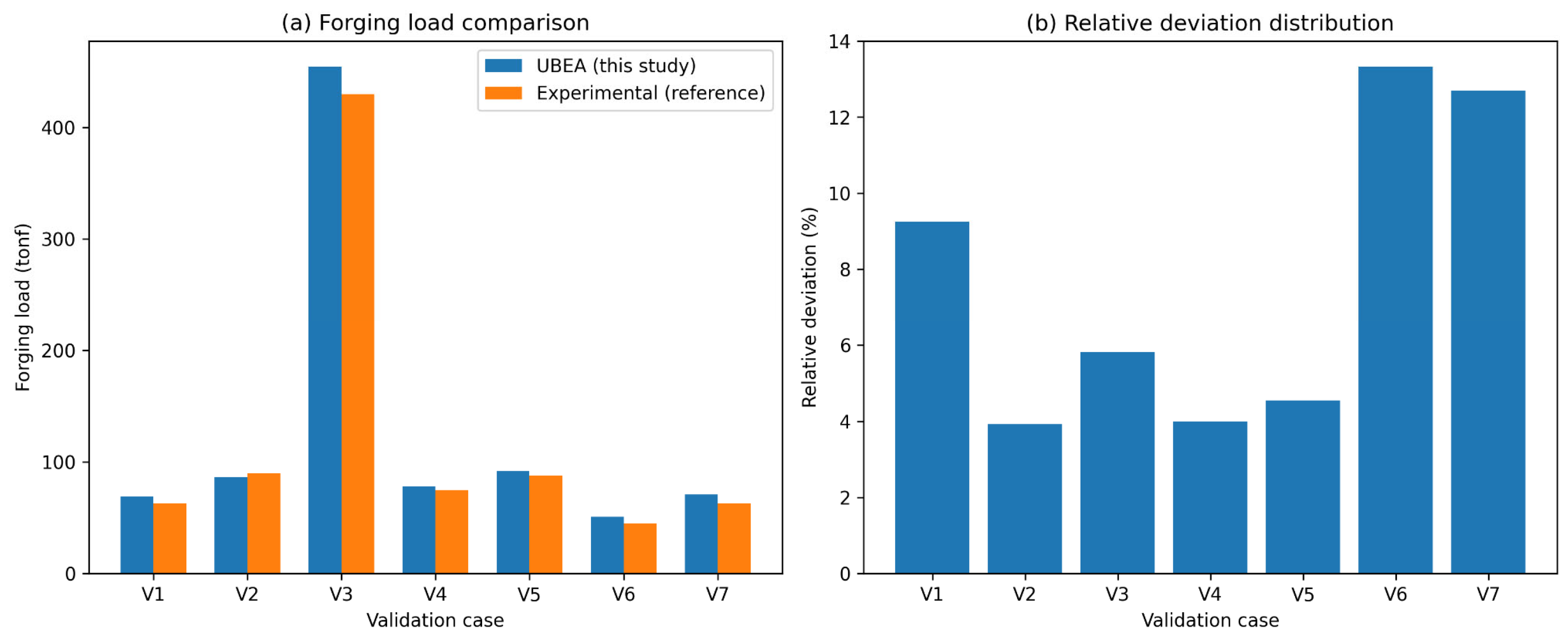
The comparison results are presented in Figure 4a. As observed, the analytically predicted forging loads closely follow the overall trend of the reference values throughout the validation dataset. Despite the variations in gear geometry and processing conditions represented by the selected validation cases, the analytical predictions successfully reproduced the general magnitude and behavior of the forging loads.
Figure 4.
(a) Comparison of analytically predicted forging loads with experimental reference values for the selected validation cases, and (b) corresponding relative deviation distribution.
The corresponding relative deviation distribution is illustrated in Figure 4b. The results indicate that the deviations remain within a limited range across all validation cases, demonstrating consistent predictive performance throughout the investigated parameter space. No significant divergence between the analytical predictions and the reference values was observed, indicating that the framework maintains stable behavior under different forging conditions.
The validation cases summarized in Table 3 were further used to evaluate the agreement between the analytically predicted forging loads and the corresponding reference values. The combined assessment of Figure 4 and Table 3 provides both qualitative and quantitative insight into the predictive capability of the proposed framework. While Figure 4 illustrates the overall agreement in forging load trends, Table 3 enables direct examination of the deviations associated with individual validation cases.
Overall, the obtained results demonstrate that the proposed framework is capable of providing reliable first-order forging load estimations suitable for preliminary die design and process evaluation. Although the analytical model does not aim to reproduce all local deformation phenomena occurring during gear forging, the results indicate that the global forging load behavior can be represented with sufficient accuracy for engineering decision-support applications within the proposed offline digital twin environment.
4.2. Prediction Accuracy and Error Distribution
The prediction accuracy of the proposed framework was evaluated using the relative deviations calculated between the analytically predicted forging loads and the corresponding experimentally supported reference values summarized in Table 3. The obtained results indicate that the proposed framework provides a consistent level of agreement throughout the validation dataset.
As shown in Table 3, the average relative deviation between the analytical predictions and the reference values is approximately 6.5%. The minimum and maximum deviation values were determined as 3.9% and 13.3%, respectively. These results demonstrate that the proposed framework is capable of reproducing the overall forging load behavior with a level of accuracy suitable for preliminary die design and process evaluation applications.
The distribution of the deviations presented in Figure 4b indicates that the prediction errors remain relatively stable across the investigated validation cases. Rather than exhibiting highly scattered behavior, the deviations remain concentrated within a limited range, suggesting that the analytical framework maintains consistent predictive capability under different geometric and process conditions.
The obtained deviation range is consistent with the level of agreement commonly reported in analytical gear forging studies. Previous investigations have demonstrated that analytical approaches based on simplified deformation descriptions can provide reliable forging load estimations despite the inevitable differences between analytical predictions and experimentally observed behavior. In this respect, the average deviation obtained in the present study remains within a range considered acceptable for preliminary engineering assessment and early-stage die design applications [24,25].
From an engineering perspective, the observed deviation levels indicate that the proposed framework can successfully capture the dominant factors governing forging load behavior while maintaining low computational requirements. Although the adopted Upper Bound Energy Analysis formulation relies on simplified deformation assumptions, the resulting predictions preserve both the magnitude and trend characteristics of the reference forging loads throughout the validation dataset.
Overall, the accuracy assessment confirms that the proposed framework provides reliable first-order forging load predictions while maintaining the computational efficiency required for practical implementation within the proposed offline digital twin environment.
4.3. Parametric Interpretation of Deviations Between Analytical and Experimental Results
In order to better understand the origin of the deviations observed between the analytical predictions and the experimentally supported reference values, the validation results were examined from a parametric perspective. Although the overall agreement between the predicted and reference forging loads was satisfactory, the magnitude of the deviations varied among the validation cases, indicating the influence of specific geometric and process-related factors.
One of the primary factors affecting prediction accuracy is geometric complexity. The results indicate that larger deviations tend to occur in configurations involving increased tooth numbers and more complex tooth geometries. Such behavior is expected because the kinematically admissible velocity fields employed in Upper Bound Energy Analysis represent idealized deformation patterns and cannot fully reproduce localized material flow phenomena occurring within the tooth root and tooth flank regions. As geometric complexity increases, the discrepancy between the idealized analytical representation and the actual deformation behavior becomes more pronounced.
Friction conditions also contribute to the observed differences between the analytical predictions and the reference values. In the adopted formulation, friction is represented using a simplified and uniform friction factor throughout the deformation process. However, actual forging operations involve continuously changing contact conditions influenced by local pressure distributions, lubrication effectiveness, temperature variations, and material flow characteristics. These effects may introduce deviations that cannot be fully captured by the simplified analytical description.
Material behavior constitutes another source of deviation. The analytical formulation relies on idealized material representations consistent with the assumptions adopted in Upper Bound Energy Analysis. In contrast, actual forging materials may exhibit complex strain hardening behavior, localized deformation mechanisms, and process-dependent flow characteristics. Consequently, some differences between the analytical predictions and experimentally observed forging loads are unavoidable, particularly under conditions involving non-uniform deformation.
Despite these limitations, the deviation patterns observed in the validation dataset exhibit systematic rather than random behavior. This observation suggests that the analytical framework successfully captures the dominant mechanisms governing forging load evolution. The deviations primarily originate from known simplifications inherent in the analytical methodology rather than from instability or inconsistency in the prediction procedure itself.
Therefore, the obtained results support the suitability of the proposed framework for preliminary die design and engineering decision-support applications. While detailed local deformation analysis remains the domain of finite element simulations and experimental investigations, the analytical framework provides a computationally efficient means of estimating forging loads with a level of accuracy appropriate for early-stage design activities.
4.4. Engineering Applicability of the Proposed Framework
One of the primary motivations for developing the proposed framework is the need for rapid forging load estimation during the early stages of die design. In practical forging applications, multiple geometric configurations and process parameters are often evaluated before a final design is selected. Under such circumstances, repeated finite element simulations or experimental investigations may become time-consuming and economically demanding.
The proposed framework addresses this requirement by providing a computationally efficient alternative for preliminary evaluation of forging load behavior. Because the methodology is based on analytical calculations implemented within a structured computational environment, forging load predictions can be obtained rapidly for different combinations of geometric and process parameters. This capability enables efficient exploration of alternative design scenarios during the initial stages of process development.
The objective of the framework is not to replace finite element simulations or experimental investigations. Instead, it serves as a complementary engineering tool capable of reducing the number of detailed analyses required during iterative design activities. By identifying feasible parameter ranges and realistic forging load levels at an early stage, the framework allows computationally intensive validation procedures to be focused on the most promising design alternatives.
The validation results presented in Section 4 demonstrate that the framework is capable of providing reliable first-order load estimations while maintaining a simplified computational structure. This balance between prediction capability and computational efficiency is particularly valuable in applications where rapid engineering decisions are required before detailed process verification is undertaken.
From an industrial perspective, the proposed framework may contribute to shortening the preliminary design cycle by reducing dependence on repeated trial-and-error evaluations. Consequently, the framework can support process engineers during die design, process planning, and feasibility assessment activities, where rapid access to reasonably accurate forging load predictions is often more important than detailed representation of local deformation phenomena.
4.5. Implications for Offline Digital Twin Implementation
The results obtained in the present study demonstrate that analytically generated knowledge can be effectively utilized to establish a virtual representation of forging load behavior for spur gear forging applications. Through the integration of analytical modeling, validation procedures, and structured knowledge-based formation, the proposed framework provides functionality that extends beyond conventional standalone analytical calculations.
The validation results indicate that the generated analytical knowledge is capable of reproducing the overall forging load trends observed in experimentally supported reference studies. This capability is essential for the implementation of the proposed offline digital twin concept, since the reliability of any virtual representation depends on its ability to reflect the behavior of the corresponding physical process with an acceptable level of accuracy.
Unlike conventional real-time digital twins, which rely on continuous sensor-based synchronization between physical and virtual systems, the proposed framework adopts a knowledge-driven offline approach. In this configuration, the digital representation is established through analytically generated and experimentally validated knowledge rather than through real-time process monitoring. The obtained results demonstrate that such an approach can provide meaningful engineering support during stages where physical process data are unavailable or have not yet been generated.
The ability to rapidly evaluate alternative forging conditions within a validated virtual environment represents one of the principal advantages of the proposed framework. By combining analytical prediction capability with a structured knowledge base, the framework enables systematic exploration of design alternatives while maintaining consistency with experimentally supported forging behavior.
Therefore, the results support the feasibility of implementing an analytically driven offline digital twin architecture for forging die design applications. Although future developments may incorporate additional validation data, numerical simulations, or extended process representations, the present study demonstrates that a knowledge-driven offline digital twin can provide practical engineering value for preliminary design, process planning, and decision-support activities in spur gear forging.
5. Conclusions
This study presented an analytically driven offline digital twin framework developed for spur gear forging die design applications. The proposed framework integrates Upper Bound Energy Analysis (UBEA), knowledge-based formation, validation procedures, and decision-support functionality within a unified virtual environment intended for early-stage forging process evaluation.
The analytical methodology was employed to systematically generate forging load data for different geometric and process conditions. The resulting analytical knowledge was subsequently evaluated using experimentally supported reference studies reported in the literature. The validation results demonstrated that the proposed framework is capable of reproducing the overall forging load behavior with an average deviation of approximately 6.5%, indicating satisfactory agreement between analytical predictions and reference values.
The obtained results show that the proposed framework can provide reliable first-order forging load estimations while maintaining a computationally efficient structure suitable for iterative design activities. Although the analytical model relies on simplified assumptions inherent to Upper Bound Energy Analysis, the framework successfully captures the dominant mechanisms governing forging load evolution and preserves the overall trends observed in experimentally supported studies.
A key contribution of the present work is the implementation of a knowledge-driven offline digital twin architecture that does not rely on continuous sensor-based synchronization. Instead, the virtual representation is established through analytically generated and experimentally validated knowledge, enabling rapid evaluation of alternative forging conditions during the preliminary stages of die design and process planning.
The proposed framework is not intended to replace detailed finite element simulations or experimental investigations. Rather, it serves as a complementary engineering tool that can reduce the dependence on repeated trial-and-error evaluations during the early stages of forging process development. The results demonstrate the feasibility of utilizing analytically generated knowledge as the foundation of an offline digital twin environment for forging die design applications.
Overall, the study confirms that the integration of analytical modeling, validation-based knowledge generation, and virtual process representation provides a practical and effective approach for supporting engineering decision-making in spur gear forging applications.
6. Future Work
Although the proposed framework demonstrated satisfactory performance for spur gear forging applications, several opportunities exist for further development and expansion. Future studies may incorporate additional experimental datasets covering a wider range of gear geometries, materials, and processing conditions in order to further improve the robustness and generality of the analytical knowledge base.
The present study focused exclusively on spur gear forging configurations. Therefore, future research may investigate the extension of the proposed methodology to more complex gear geometries, including helical gears, bevel gears, and other near-net-shape forging applications. Such extensions would require additional analytical developments as well as comprehensive validation studies.
Another potential research direction involves the integration of finite element simulation results into the knowledge-generation process. The combination of analytical models, experimentally validated data, and numerical simulations may further enhance the predictive capability of the offline digital twin framework while preserving its computational efficiency.
Future developments may also explore advanced data-driven approaches for knowledge representation and prediction. Machine learning techniques trained using analytically generated and experimentally validated datasets could provide additional capabilities for rapid process evaluation and design optimization within the digital twin environment.
Finally, the proposed framework may be expanded toward more comprehensive digital twin architectures incorporating process monitoring, adaptive knowledge updating, and hybrid analytical–data-driven modeling strategies. Such developments would contribute to bridging the gap between knowledge-driven offline digital twins and fully connected real-time digital twin systems for metal forming applications.
Author Contributions
Software, A.A.; validation, O.E.; formal analysis, A.A.; investigation, A.A.; data curation, A.A. and O.E.; writing—original draft preparation, A.A.; supervision, O.E. All authors have read and agreed to the published version of the manuscript.
Funding
This research received no external funding.
Data Availability Statement
The original contributions presented in this study are included in the article. Further inquiries can be directed to the corresponding author.
Acknowledgments
The authors acknowledge the contributions of the BAPYB of the Gaziantep University.
Conflicts of Interest
The authors declare no conflict of interest.
Abbreviations
The following abbreviations are used in this manuscript:
| UBEA | Upper Bound Energy Analysis |
| FEM | Finite Element Method |
| DT | Digital Twin |
References
- Altan, T.; Ngaile, G.; Shen, G. Cold and Hot Forging: Fundamentals and Applications; ASM International: Materials Park, OH, USA, 2004; Volume 1. [Google Scholar]
- Kobayashi, S.; Oh, S.-I.; Altan, T. Metal Forming and the Finite-Element Method; Oxford University Press: New York, NY, USA, 1989. [Google Scholar]
- Semiatin, S.L. (Ed.) Forging Handbook; ASM International: Materials Park, OH, USA, 1985. [Google Scholar]
- Eyercioglu, O.; Yılmaz, N.F. A simplified formula for determination of relative pressure in the precision forging of spur gears. J. Eng. Res. 2021, 9, 234–248. [Google Scholar] [CrossRef] [Scilit]
- Lange, K. Handbook of Metal Forming; McGraw-Hill: New York, NY, USA, 1985. [Google Scholar]
- Hartley, P.; Pillinger, I.; Sturgess, C.E.N. Numerical modelling of material deformation processes. In Numerical Modelling of Material Deformation Processes: Research, Development and Applications; Springer: London, UK, 1992; pp. 252–273. [Google Scholar]
- Avitzur, B. Metal Forming: Processes and Analysis; McGraw-Hill: New York, NY, USA, 1983. [Google Scholar]
- Hosford, W.F.; Caddell, R.M. Metal Forming: Mechanics and Metallurgy, 4th ed.; Cambridge University Press: Cambridge, UK, 2011. [Google Scholar]
- Grieves, M.; Vickers, J. Digital twin: Mitigating unpredictable, undesirable emergent behavior in complex systems. In Trans-Disciplinary Perspectives on Complex Systems: New Findings and Approaches; Springer: Cham, Switzerland, 2016; pp. 85–113. [Google Scholar]
- Tao, F.; Qi, Q.; Wang, L.; Nee, A.Y.C. Digital twins and cyber–physical systems toward smart manufacturing and Industry 4.0: Correlation and comparison. Engineering 2019, 5, 653–661. [Google Scholar] [CrossRef] [Scilit]
- Negri, E.; Fumagalli, L.; Macchi, M. A review of the roles of digital twin in CPS-based production systems. Procedia Manuf. 2017, 11, 939–948. [Google Scholar] [CrossRef] [Scilit]
- Khalaj, O.; Jamshidi, M.; Hassas, P.; Mašek, B.; Štadler, C.; Svoboda, J. Digital twinning of a magnetic forging holder to enhance productivity for Industry 4.0 and metaverse. Processes 2023, 11, 1703. [Google Scholar] [CrossRef] [Scilit]
- da Silva, L.R.R.; Pimenov, D.Y.; da Silva, R.B.; Ercetin, A.; Giasin, K. Review of applications of digital twins and Industry 4.0 for machining. J. Manuf. Mater. Process. 2025, 9, 211. [Google Scholar] [CrossRef] [Scilit]
- Tang, P.; Guo, D.; Liu, Z.; Tan, J. Design of digital twin system for forging hydraulic press. J. Graph. 2023, 44, 609. [Google Scholar]
- Hu, Y.; Han, X.; Hua, L.; Zhuang, W. Modeling for warping prediction and control in cold rotary forging of round plate. J. Mater. Process. Technol. 2023, 313, 117865. [Google Scholar] [CrossRef] [Scilit]
- Cao, M.; Hu, C.; Li, S.; Zhao, Z.; Zhu, C. Process redesign of complex forged parts with the strongly process-correlated index. Manuf. Rev. 2025, 12, 21. [Google Scholar] [CrossRef] [Scilit] [PubMed]
- Wang, Y.; Zhao, Z.; Qian, N.; Ding, W.; Su, H. The Digital Twin-Enabled Deformation Prediction and Control Methodologies for Thin-Walled Parts in Intelligent Manufacturing: A Review. Digit. Twin 2026, 3, 2614885. [Google Scholar] [CrossRef] [Scilit]
- Gunaratne, M.; Georgakopoulos, D.; Banerjee, A. A Digital Twins Platform for Digital Manufacturing. Electronics 2026, 15, 583. [Google Scholar] [CrossRef] [Scilit]
- Masar, A.; Mahmood, A. Digital Twin Model for Performance Analysis and Manufacturing Process Optimization. Pollack Period. 2026, 606–2025. [Google Scholar] [CrossRef] [Scilit]
- Soori, M.; Arezoo, B.; Dastres, R. Digital Twin for Smart Manufacturing: A Review. Sustain. Manuf. Serv. Econ. 2023, 2, 100017. [Google Scholar] [CrossRef] [Scilit]
- Aurich, J.C.; Mertes, J.; Wagner, M.; Schmitz, M.; Klar, M.; Ravani, B. Digital Twins in Manufacturing: A Taxonomy for Manufacturing Applications. Digit. Twin 2025, 2, 2496645. [Google Scholar] [CrossRef] [Scilit]
- Veeramakali, T.; Shobanadevi, A.; Prabu, S. Knowledge-Driven Digital Twin Manufacturing. In Digital Twin for Smart Manufacturing; Academic Press: Cambridge, MA, USA, 2023; pp. 21–34. [Google Scholar]
- Eyercioğlu, Ö.; Taş, G.; Aladağ, M. An analysis of asymmetric spur gear forging by upper bound energy method. J. Fac. Eng. Archit. Gazi Univ. 2021, 36, 1547–1560. [Google Scholar]
- Choi, J.; Cho, H.-Y.; Jo, C.-Y. An upper-bound analysis for the forging of spur gears. J. Mater. Process. Technol. 2000, 104, 67–73. [Google Scholar] [CrossRef] [Scilit]
- Alves, M.L.; Rodrigues, J.M.C.; Martins, P.A.F. Cold forging of gears: Experimental and theoretical investigation. Finite Elem. Anal. Des. 2001, 37, 549–558. [Google Scholar] [CrossRef] [Scilit]
- Zadshakoyan, M.; Abdi Sobbouhi, E.; Jafarzadeh, H. Investigation of precision forging process of spur gears: Numerical analysis and experiments. Adv. Mater. Res. 2012, 341–342, 265–270. [Google Scholar] [CrossRef] [Scilit]
- Eyercioglu, O.; Kutuk, M.A.; Yilmaz, N.F. Shrink fit design for precision gear forging dies. J. Mater. Process. Technol. 2009, 209, 2186–2194. [Google Scholar] [CrossRef] [Scilit]
- Eyercioglu, O.; Tas, G.; Aladag, M. Evaluation of tooth profile changes of symmetric and asymmetric spur gear forging dies due to shrink fit. Sigma J. Eng. Nat. Sci. 2020, 38, 71–81. [Google Scholar]
- Eyercioglu, O. Analysis of dimensional variations of precision gear forging die geometry due to shrink fit. Eur. J. Eng. Form. Sci. 2018, 2, 87–95. [Google Scholar] [CrossRef] [Scilit]

Disclaimer/Publisher’s Note: The statements, opinions and data contained in all publications are solely those of the individual author(s) and contributor(s) and not of MDPI and/or the editor(s). MDPI and/or the editor(s) disclaim responsibility for any injury to people or property resulting from any ideas, methods, instructions or products referred to in the content. |
© 2026 by the authors. Licensee MDPI, Basel, Switzerland. This article is an open access article distributed under the terms and conditions of the Creative Commons Attribution (CC BY) license.