Article

High-Cycle Fatigue Behavior and Deformation Mechanism of [111]-Oriented Thin-Wall Ni3Al-Based Single-Crystal Alloys at 1000 °C

1
School of Material Science & Engineering, Beihang University, Beijing 102206, China
2
Suzhou Laboratory, Suzhou 215123, China
3
Research Institute of Aero-Engine, Beijing 102206, China
4
Tianmushan Laboratory, Hangzhou 311100, China
*
Author to whom correspondence should be addressed.
Metals 2026, 16(6), 649; https://doi.org/10.3390/met16060649 (registering DOI)
Submission received: 21 May 2026 / Revised: 4 June 2026 / Accepted: 8 June 2026 / Published: 12 June 2026

Abstract

To meet the increasing demands of aircraft engines for high thrust-to-weight ratios and elevated turbine inlet temperatures, turbine blades have been progressively designed with thin-walled structures. It has been demonstrated that the mechanical properties of Ni3Al-based single-crystal alloys (SXs) are highly sensitive to specimen thickness. In this study, the high-cycle fatigue behavior of [111]-oriented Ni3Al-based SXs with wall thicknesses of 0.3, 0.5, and 0.8 mm was systematically investigated under tensile–tensile loading conditions at 1000 °C. The results revealed that, as the wall thickness decreased, the fatigue life of the alloy significantly deteriorated, while the crack initiation site gradually shifted from the specimen interior toward the surface and near-surface regions. Furthermore, the fatigue failure mode transitioned from being dominated by internal defects to being controlled primarily by near-surface damage. Near-surface damage induced by high-temperature oxidation and geometric constraints was identified as the primary factor responsible for the degradation of the high-cycle fatigue performance of the SXs. In addition, the cyclic deformation behavior at 1000 °C was governed by the synergistic effects of dislocation climb, cross-slip, and γ′-phase shearing. This study provides both theoretical guidance and experimental evidence for the structural optimization of next-generation single-crystal turbine blades for advanced aircraft engines.

1. Introduction

With the continuous advancement of aero-engines toward higher thrust-to-weight ratios, improved thermal efficiency, and elevated turbine inlet temperatures, turbine blade designs have progressively evolved toward more complex internal cooling architectures and lightweight structures [1,2,3,4]. To enhance cooling efficiency and meet service requirements under extreme thermal conditions, next-generation turbine blades are widely designed with double-wall structures containing intricate internal cooling channels, where the local wall thickness is reduced to 0.4–0.5 mm [5,6,7]. In addition, materials used in hot sections are required not only to exhibit excellent high-temperature strength, creep resistance, and microstructural stability, but also to possess lower density to meet the increasing demand for structural efficiency. Nickel-based SXs have long been regarded as one of the most critical candidate materials for advanced turbine blades due to their superior high-temperature load-bearing capability and outstanding microstructural stability [8,9]. Among them, Ni3Al-based SX is considered a promising direction for lightweight hot-section materials due to its combination of excellent high-temperature mechanical properties and relatively low density [10]. However, their applicability in double-wall turbine blades is largely determined by their service response and damage behavior under thin-walled conditions. The reduction in wall thickness significantly alters heat transfer conditions, surface oxidation behavior, and internal stress constraints, leading to pronounced differences in mechanical performance and failure mechanisms compared to bulk counterparts. This degradation in performance associated with reduced thickness is commonly referred to as the thin-wall effect [11,12,13,14,15,16]. Therefore, a systematic investigation of the high-temperature mechanical response and damage mechanisms of thin-walled Ni3Al-based SX is essential for enabling their application in advanced double-wall turbine blades.
For advanced double-wall turbine blades, High cycle fatigue (HCF) behavior is not solely governed by cyclic stress amplitude but is strongly coupled with service temperature. At 1000 °C, the fatigue damage mechanisms of SX differ significantly from those at intermediate and low temperatures. High-temperature environmental effects, including surface oxidation, elemental diffusion, and γ′-phase degradation, are markedly intensified, leading to deterioration of near-surface mechanical properties. Meanwhile, dislocation motion modes and plastic deformation compatibility at elevated temperatures further influence crack initiation and early-stage propagation processes [17,18,19,20,21]. Therefore, 1000 °C represents not only a representative service temperature but also a critical regime in which mechanical fatigue and environmental damage are strongly coupled. For thin-walled components, such coupling effects are further amplified. As wall thickness decreases, the specific surface area increases, surface-dominated effects become more pronounced, and internal constraint is weakened [22,23]. Consequently, crack initiation sites, crack propagation paths, and life-controlling mechanisms may deviate substantially from those established for bulk materials [24,25]. Previous studies have made significant progress in understanding high-temperature fatigue behavior and thin-wall effects in SX, particularly in bulk or thick-walled specimens under low-cycle fatigue, creep, and creep–fatigue conditions. Hu [26] reported that thin-walled specimens exhibit shorter creep rupture lives, primarily due to oxidation-induced internal oxides that promote the nucleation of creep voids and crack propagation. Consequently, failure in thin specimens is predominantly controlled by crack growth, whereas in thick specimens it is more strongly governed by creep damage. Yu [27] demonstrated that oxidation effects in air, together with void formation and a “stop–go” crack propagation mode, synergistically contribute to damage evolution, while the increased relative thickness of the oxide layer accelerates plastic strain accumulation in thin specimens. The reduction in effective load-bearing area, along with the evolution of stress constraint conditions, further influences the damage evolution process. Wang [28] indicated that the transition in stress state from thick- to thin-walled conditions alters the number of activated slip systems, with this effect being most pronounced during the primary and steady-state creep stages. Zhang [29] found that the degradation of high-temperature low-cycle fatigue performance in thin-walled specimens can be attributed to two main factors: the increased specific surface area, which intensifies surface oxidation, and the reduction in wall thickness, which modifies the stress state and constraint conditions.
Despite these advances, most existing studies are based on bulk or thick-walled specimens, low-cycle fatigue-dominated deformation, or conventional creep responses, and their applicability remains limited. Compared with low-cycle fatigue, HCF is more sensitive to localized slip behavior, near-surface damage, and early crack initiation. Furthermore, compared with bulk or thick-walled specimens, thin-walled structures are more susceptible to surface-controlled deformation and size-dependent effects. Consequently, the thickness-dependent crack initiation mechanisms and fatigue damage evolution of [111]-oriented Ni3Al-based SX under HCF conditions at 1000 °C remain poorly understood, particularly with regard to crack initiation sites, crack propagation behavior, and dislocation activity.
To address these gaps, it is necessary to conduct systematic investigations of the damage behavior of Ni3Al-based SX under high-temperature HCF conditions using thin-walled structures that are more representative of service environments. Particular attention should be paid to the coupling effects among the thin-wall effect, environmental interactions, and crystallographic characteristics. In addition, crystallographic orientation plays a critical role in governing deformation and fatigue behavior in SX. For [111]-oriented alloys, the elastic response, slip characteristics, and deformation compatibility differ significantly from the extensively studied [001]-oriented systems, and current understanding remains insufficient to fully elucidate their fatigue damage mechanisms under thin-walled conditions [30]. Especially under HCF conditions at 1000 °C, crack initiation and early propagation are highly sensitive to localized slip, stress concentration, and surface damage, all of which are strongly influenced by crystallographic orientation. Therefore, investigating the HCF behavior of [111]-oriented Ni3Al-based SX at 1000 °C is of both scientific and engineering significance. Such studies will not only advance the fundamental understanding of the coupled evolution of size effects, oxidation damage, and dislocation activity in thin-walled single-crystal components, but also provide valuable experimental and mechanistic support for material evaluation, structural design, and life prediction of lightweight double-wall turbine blades.
Based on the above considerations, [111]-oriented Ni3Al-based SX was selected in this study. A series of thin-walled specimens with thicknesses ranging from 0.3 to 0.8 mm were designed and fabricated. HCF tests at 1000 °C were conducted, in combination with fracture analysis and microstructural characterization. The effects of wall thickness on fatigue life, crack initiation location, crack propagation behavior, surface oxidation damage, and dislocation evolution were systematically investigated. The objective of this study is to elucidate the HCF damage mechanisms of [111]-oriented Ni3Al-based SX under the coupled influence of high-temperature environment, thin-wall effect, and crystallographic orientation, to clarify the role of thickness reduction in governing deformation and failure mechanisms, and to provide a theoretical basis for the reliability design and performance evaluation of thin-walled single-crystal superalloy components.

2. Materials and Methods

2.1. Materials

A high-temperature-resistant, low-density, and cost-effective Ni3Al-based SX was employed, and its chemical composition is listed in Table 1. The alloy was fabricated into single-crystal cylindrical bars with a primary orientation of [111] using a high-gradient directional solidification technique. Specifically, the alloy was first refined at high temperature in a high-rate directional solidification furnace, then poured into a preheated mold, followed by withdrawal from the isothermal zone, and controlled cooling at a constant rate. After cooling, the ceramic mold was removed to obtain the single-crystal bars. The single-crystal bars were etched using a hydrochloric acid–hydrogen peroxide solution to verify their single-crystal integrity. The crystallographic orientation, including both primary and secondary orientations, was determined using the X-ray back-reflection Laue method. Only bars with a deviation of less than 5° from the [111] orientation were selected for subsequent heat treatment and HCF specimen preparation. A standard heat treatment was conducted on the alloy bars in a GSL-1600X resistance tube furnace (Hefei Kejing Materials Technology, Hefei, China). The bars were first solution-treated at 1300–1335 °C, followed by air cooling to room temperature, and subsequently subjected to high-temperature aging at 1040 °C for 2 h and low-temperature aging at 870 °C for 32 h.

2.2. Mechanical Tests

To investigate the thickness dependence of fatigue behavior under conditions representative of advanced double-wall turbine blades, plate-type specimens with wall thicknesses of 0.3, 0.5, and 0.8 mm were designed and fabricated. This thickness range covers the typical wall thicknesses encountered in modern double-wall cooling structures and enables systematic evaluation of thin-wall effects.
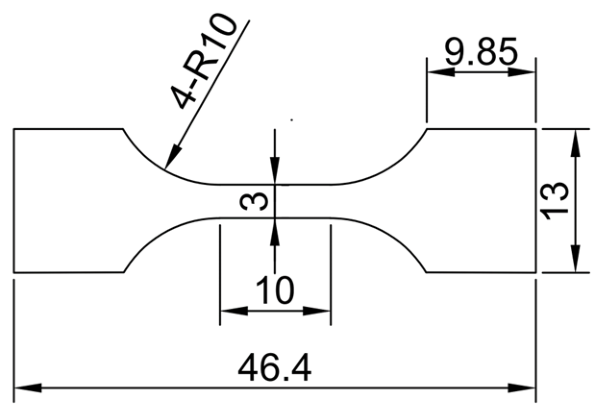
Plate-type specimens were used for HCF tests, with a total length of 46.4 mm and a gauge length of 10 mm, as illustrated in Figure 1. The specimens were sectioned from the single-crystal bars such that the primary orientation was [111] and the secondary orientation was [112]. To eliminate the influence of surface machining quality and the recast layer induced by electrical discharge machining (EDM), all specimen surfaces and edges were carefully polished. The specimens were degreased in acetone, ultrasonically cleaned in 75% ethanol solution, and then air-dried prior to testing.
During preparation, the specimens were ground stepwise using abrasive papers and mechanically polished to final thicknesses of 0.3, 0.5, and 0.8 mm. After polishing to a mirror-like finish, the specimens were inspected to ensure the absence of visible scratches before HCF testing.
In this study, HCF tests were conducted at a representative temperature of 1000 °C to evaluate the fatigue performance of thin-walled structures under high-temperature service conditions. The tests were performed on a QBG-10 computer-controlled high-frequency fatigue testing machine(Changchun Qianbang Test Equipment, Changchun, China) at a frequency of 90 Hz, a temperature of 1000 °C, and a stress ratio of R = 0.1. The tests were terminated when the fatigue life reached 107 cycles. A stepwise heating procedure was employed, with a holding time of 20–30 min at 1000 °C, and the temperature fluctuation was controlled within ±2 °C.
The fatigue limit corresponding to 107 cycles was determined using the staircase method. The initial stress level was estimated from available fatigue data for similar alloys, and stress increments of 5–10 MPa were adopted. The stress sequence used in this method was shown in Table 2. Depending on the outcome of the preceding test, the stress level was either increased or decreased following the staircase procedure. Additional repeat tests were conducted when unexpected run-out or failure events occurred to ensure the reliability of the statistical results. The fatigue limit was subsequently calculated using the validated staircase data.

2.3. Microscopic Characterization

The specimens were etched for 3–5 s using a solution of 20 g CuSO4, 100 mL HCl, and 100 mL H2O, followed by drying with alcohol. The microstructures were examined using a Leica DM4 optical microscope (Leica Microsystems, Wetzlar, Germany) and an Apreo S LoVac scanning electron microscope(SEM; Thermo Fisher Scientific, Brno, Czech Republic). The γ′ phase fraction and γ′-free layer thickness were quantified using ImageJ software (version 1.53k). For each condition, measurements were performed on 10 independent SEM fields of view.
A FEI Titan Cube 80–300 transmission electron microscope (TEM; FEI Company, Eindhoven, The Netherlands) was used to characterize the fatigue microstructures, with an accelerating voltage of 80–300 kV and a maximum resolution of 0.1 nm. TEM specimens were prepared as follows: thin slices (~0.5 mm) were cut from regions far from the fracture surface, either parallel or perpendicular to the loading axis. The slices were mechanically ground to a thickness of 50–60 μm, and discs with a diameter of 3 mm were punched from the thinned samples. Final thinning was carried out using a twin-jet electropolishing technique.

3. Results

3.1. Macroscopic Fatigue Behavior

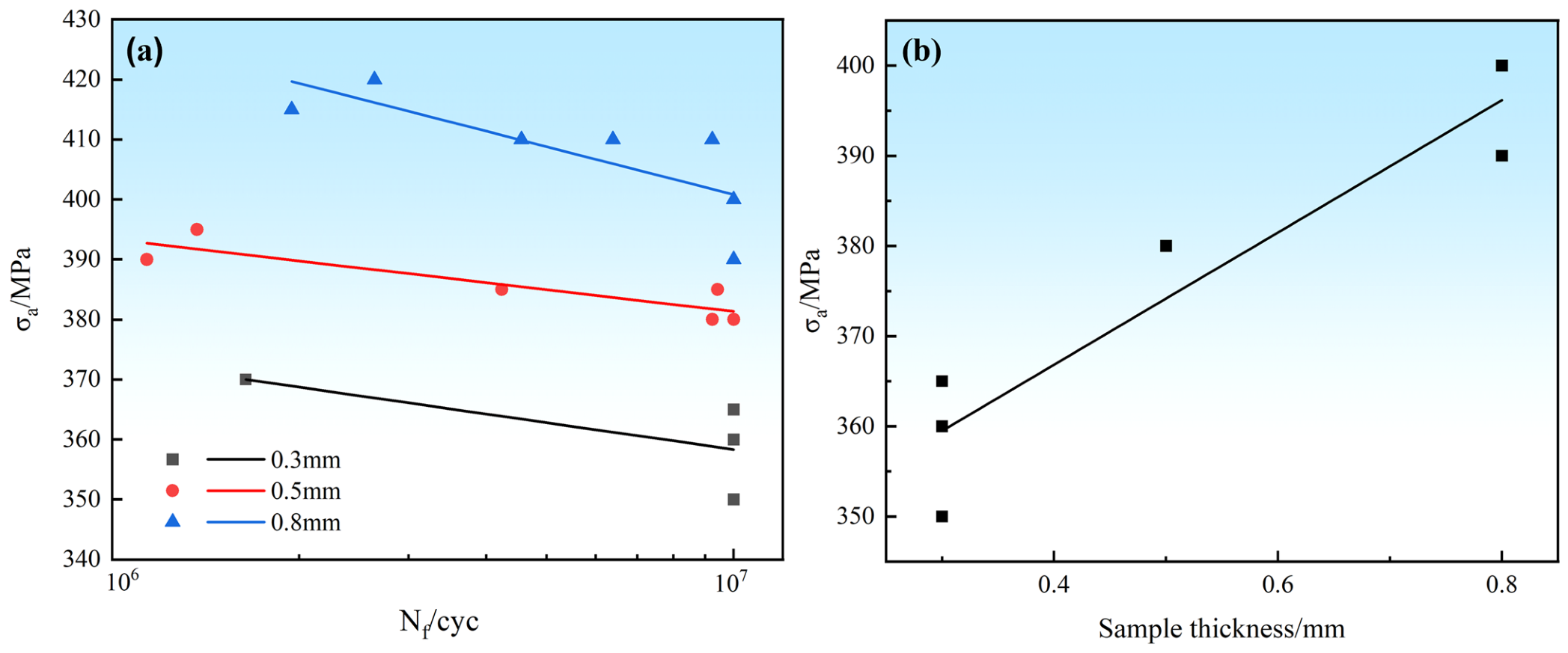
The results obtained from axial tension–tension HCF tests conducted at 1000 °C on single-crystal specimens with wall thicknesses of 0.3, 0.5, and 0.8 mm are presented in Figure 2.
Conditional fatigue strength is one of the key parameters for evaluating fatigue performance, and it directly determines the fatigue strength level in the HCF regime. In this study, the staircase method was used to quantitatively determine the conditional fatigue strength, and abnormal data points deviating from expected trends were excluded during data processing [31]. According to the Basquin equation, the S–N relationship in the HCF regime is expressed as:
Δ σ 2 =   σ a   =   σ f ( 2 N f ) b ,
where σ a is the stress amplitude, σ f is the fatigue strength coefficient, and its value reflects the resistance to cyclic damage accumulation. Nf is the number of cycles to failure, and b is the Basquin exponent representing the rate of decrease in stress amplitude with increasing fatigue life.
The fitted fatigue parameters are summarized in Table 3. The results show that lg σ f decreases with decreasing wall thickness, indicating a significant reduction in fatigue strength as the wall becomes thinner. The experimental results indicate that the fatigue life of SX with different wall thicknesses increases as the maximum applied stress decreases, and the overall trend is consistent across all conditions. Fitting results indicate that at 1000 °C, the fatigue limits are 400–410 MPa for 0.8 mm, 380–385 MPa for 0.5 mm, and 365–370 MPa for 0.3 mm specimens, respectively.
As shown in Figure 2b, the relationship between fatigue strength at 107 cycles and wall thickness is further illustrated. Fatigue strength exhibits a clear decreasing trend with decreasing wall thickness. Quantitative analysis indicates that the fatigue strength decreases by approximately 7.33 MPa for every 0.1 mm reduction in wall thickness. Within the thickness range of 0.3–0.8 mm, the total reduction reaches approximately 9.3%. This confirms the pronounced thin-wall effect in SX.

3.2. Fatigue Fracture Morphology

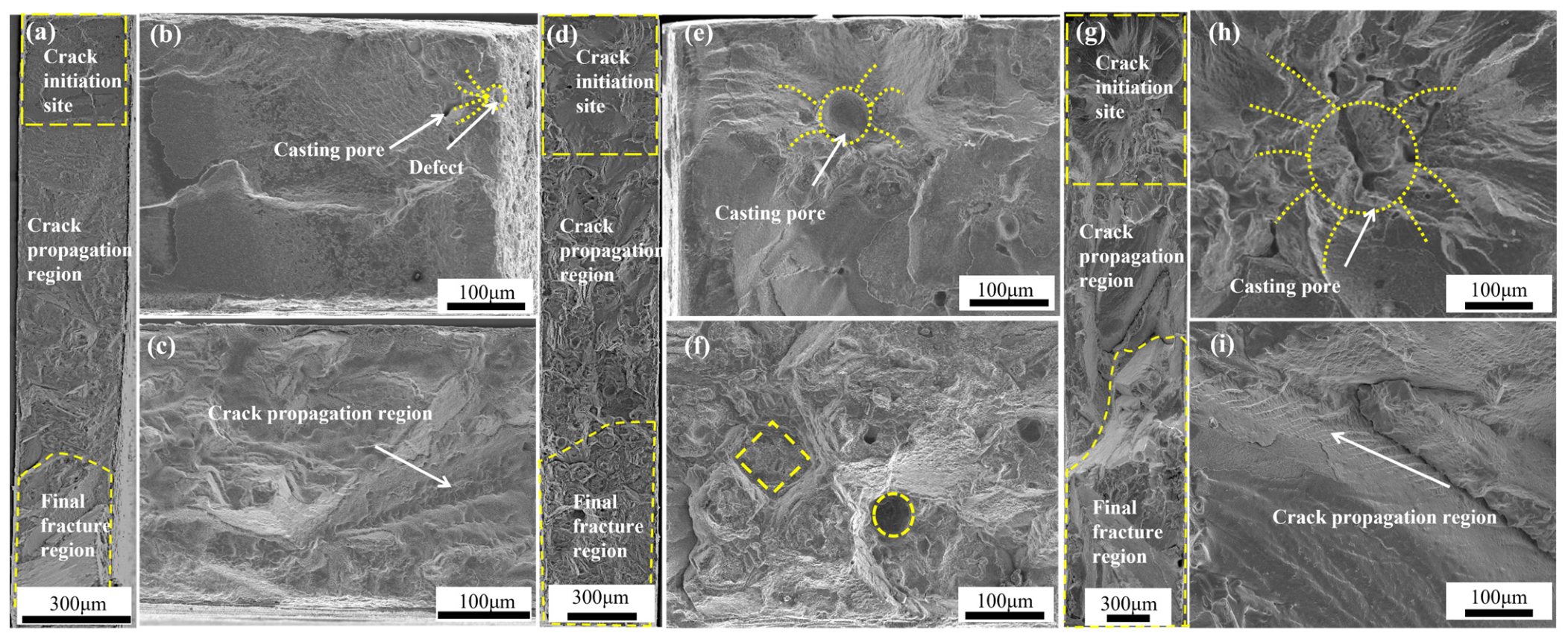
Specimens with fatigue lives of 6.459 × 10⁶ cycles (0.3 mm), 1.370 × 10⁶ cycles (0.5 mm), and 1.945 × 10⁶ cycles (0.8 mm) were selected for analysis under the same testing conditions. The fatigue fracture surfaces were examined using SEM, as shown in Figure 3. All fracture surfaces exhibited macroscopically rough morphologies with evident oxidation features, and the crack initiation, propagation, and final fracture regions could be clearly identified. The crack propagation region consisted of fatigue striations and cleavage steps, whereas the final fracture region was characterized by large cleavage facets. The dominant fracture mode was quasi-cleavage fracture, which is consistent with octahedral slip-controlled deformation in nickel-based SX, where cracks preferentially propagate along {111} planes.
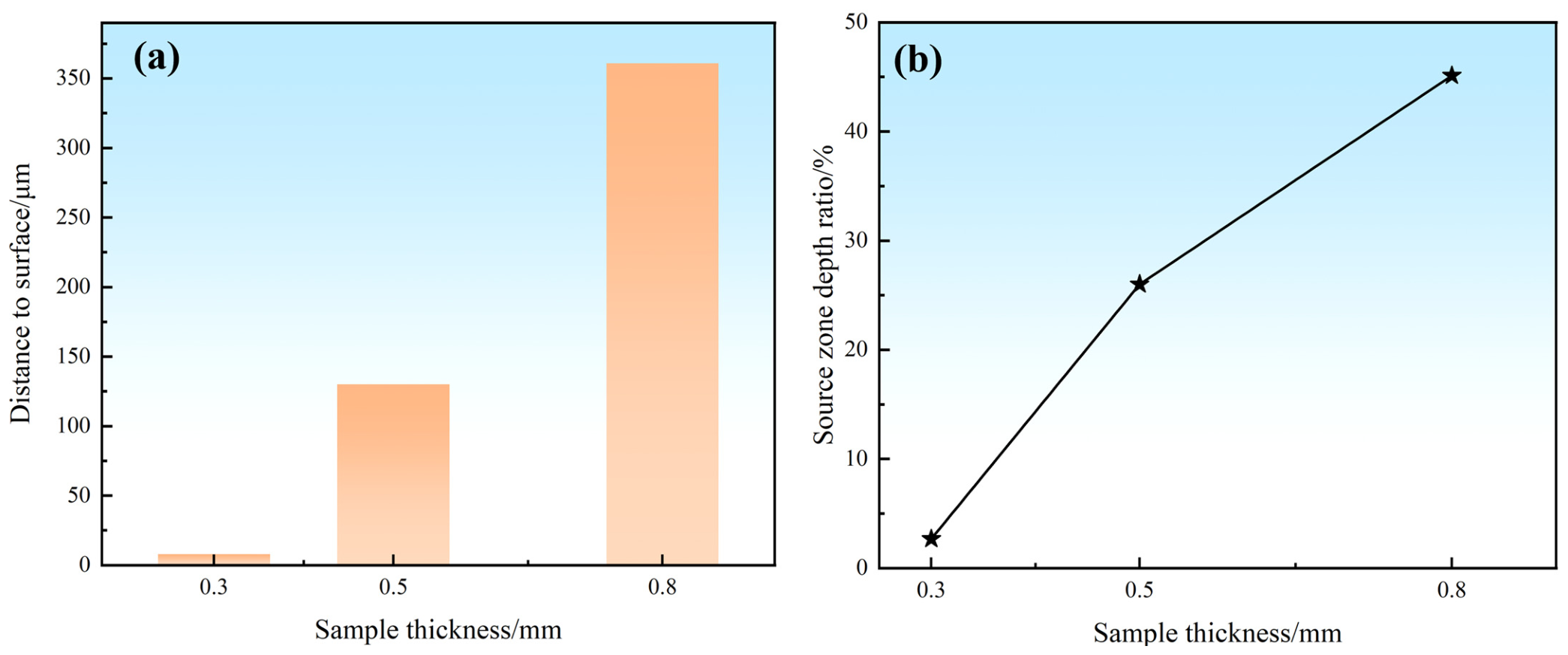
By tracing river-like patterns, a statistically significant variation in crack initiation locations with wall thickness was identified through quantitative analysis of fracture origins. As shown in Figure 4, both the absolute distance and relative position of crack initiation sites from the free surface increase significantly with increasing wall thickness. For the 0.3 mm specimen, crack initiation occurred in a near-surface region approximately 8 μm beneath the surface, where a distinct radial crack pattern emanating from the initiation site was observed. A magnified view of the crack initiation region revealed micro-surface defects with sharp notches as well as oxidation-induced microcracks.
When the wall thickness increased to 0.5 mm, the crack initiation depth increased to approximately 121 μm. For the 0.8 mm specimen, the crack origin was located 361 μm beneath the surface, within the interior of the material. A casting pore was observed in the magnified view of the crack initiation region. This casting pore acted as a stress concentrator, thereby promoting fatigue crack initiation. It should be noted that casting pores may exist at arbitrary locations within the material; however, those located near the surface are more likely to initiate fatigue cracks due to the higher local stress level [32].

3.3. Surface Oxidation

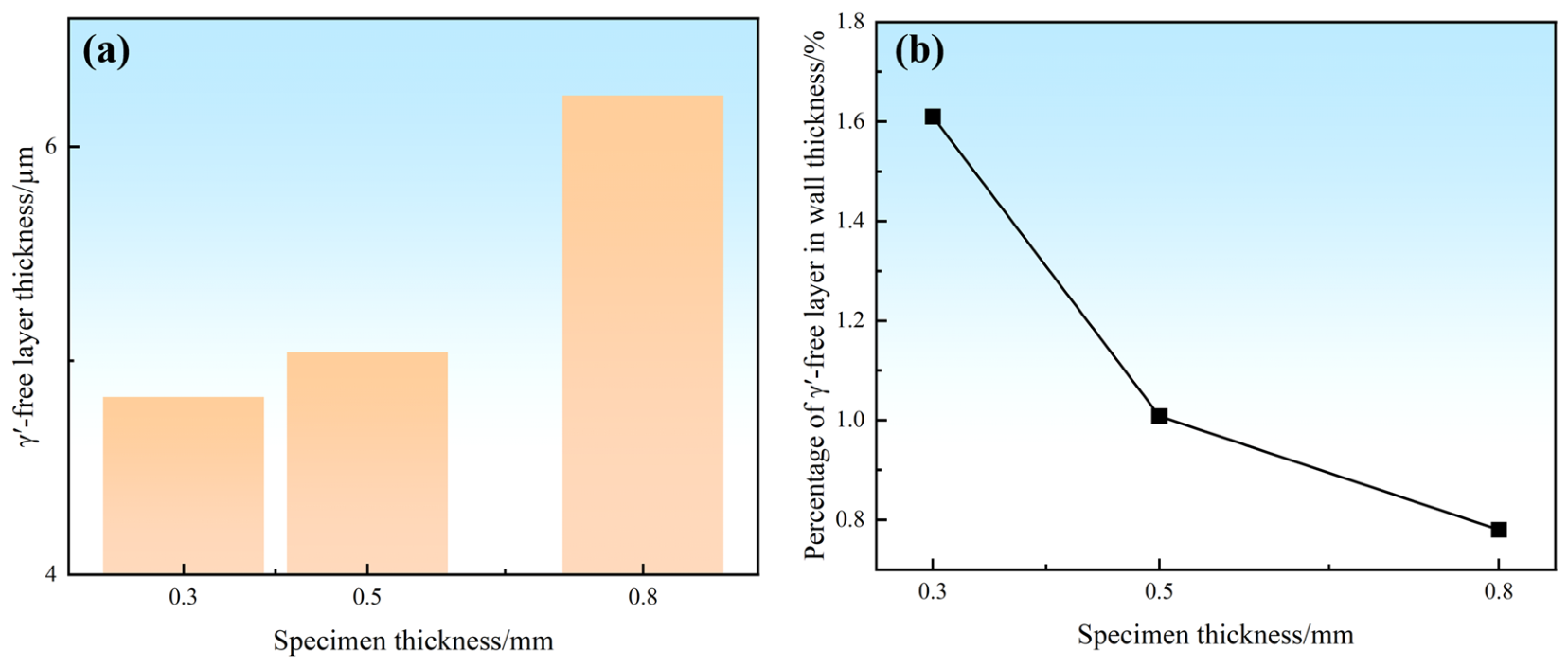
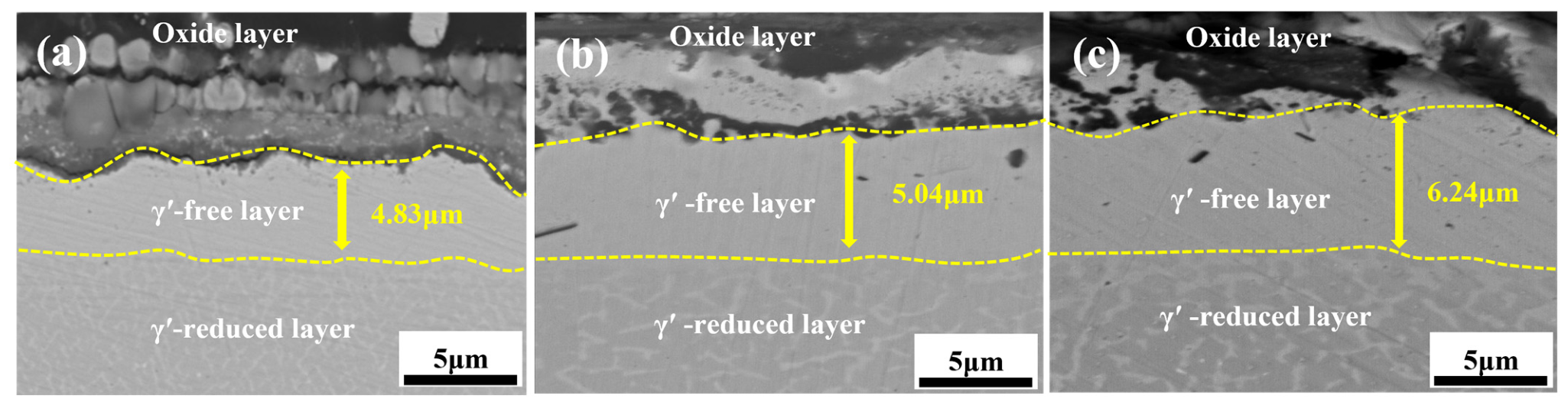
Figure 5 shows the microstructures on the cross-sections near the fracture surface of specimens with different wall thicknesses after failure. For all specimens, the outermost layer of the fracture region consists of an oxide layer, followed inward by a γ′-free layer, and further inward by a γ′-reduced layer, where the precipitates are partially dissolved. For the 0.8 mm specimen, the γ′-free layer thickness is approximately 6–7 μm (Figure 5c). The γ′-free layer thickness is approximately 5–6 μm for the 0.5 mm specimen and about 4.8 μm for the 0.3 mm specimen (Figure 5a,b). The reduction in the absolute depth of the γ′-free layer in thinner specimens is primarily attributed to their significantly shortened fatigue life.

3.4. Microstructural Evolution

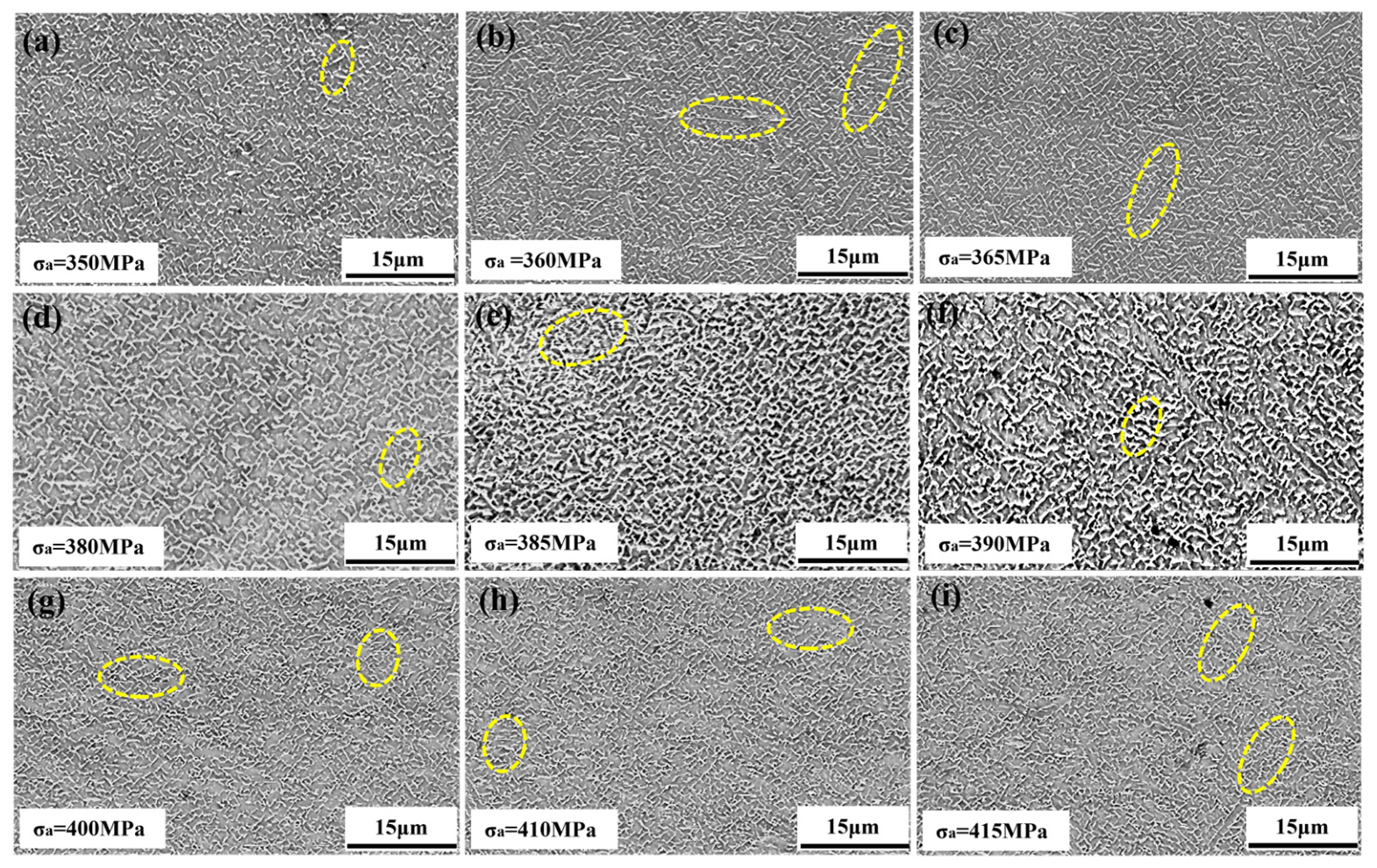
After standard heat treatment, the microstructure exhibits an ordered γ/γ′ morphology. Specimens with different wall thicknesses were compared, and distinct γ/γ′ microstructural evolutions were observed under the combined effects of cyclic plastic deformation and high temperature, as shown in Figure 6. Under the equivalent stress in multiple γ channels, the microstructure partially retains the cuboidal morphology of the heat-treated state. Directional coarsening of γ′ precipitates occurs, and adjacent γ′ phases coalesce, gradually enveloping the γ channels during coarsening, resulting in a topological inversion tendency. In addition, TCP phases precipitate in the microstructure.

4. Discussion

Based on the above experimental results, it can be inferred that pronounced thin-wall effects in HCF are exhibited by [111]-oriented specimens with different wall thicknesses at 1000 °C under identical conditions. The fatigue damage process under high-temperature cyclic loading can generally be divided into three stages: crack initiation, crack propagation, and final rapid fracture. Crack initiation is primarily associated with cyclic slip activity and local plastic strain accumulation, and is strongly influenced by slip system activation and the local stress state. With increasing cyclic loading, dislocations accumulate and rearrange at the γ/γ′ interfaces, forming dense interfacial dislocation networks that hinder subsequent slip and modify the local stress distribution. Meanwhile, surface oxidation damage and microstructural degradation continuously accumulate, and are more pronounced in thin-walled specimens, thereby promoting earlier near-surface crack initiation and accelerated propagation. The final failure stage is dominated by rapid crack coalescence and unstable propagation. The nearly parallel S–N curves suggest that wall thickness primarily affects the damage accumulation rate rather than altering the intrinsic fatigue failure mechanism. Therefore, the dominant mechanisms governing the thickness effect are further analyzed.

4.1. Effect of Wall Thickness on HCF Behavior

During high-temperature HCF, internal damage continuously accumulates within the specimens, which is primarily governed by crack initiation and propagation. Crack initiation and growth dominate the damage evolution during the propagation stage, whereas rapid crack coalescence and unstable propagation control the final fracture stage.

4.1.1. Effect of Specimen Thickness on Crack Initiation Behavior

The HCF results indicate a pronounced dependence of fatigue life on wall thickness at 1000 °C. As the wall thickness decreases from 0.8 mm to 0.3 mm, the fatigue life decreases by approximately 9.3%, confirming the presence of a significant thin-wall effect in this alloy system, which originates from a transition in crack initiation mechanisms. A key manifestation of this effect is the strong thickness dependence of crack initiation behavior. Experimental observations show that crack initiation sites shift from the interior to the surface or subsurface regions as wall thickness decreases.
Fatigue cracks in thick-walled specimens are predominantly initiated from internal defects such as casting pores and inclusions. This is attributed to the increased stress triaxiality and enhanced geometrical constraint in thick sections, leading the material interior to approach a plane-strain stress state. Under cyclic loading, plastic deformation tends to distribute within the bulk region; however, the constrained plastic deformation in the core promotes accommodation via internal void damage, which progressively evolves and ultimately triggers crack initiation. In contrast, damage in thin-walled specimens is primarily localized at the surface and is driven by oxidation, resulting in surface-dominated crack initiation. With decreasing wall thickness, stress triaxiality decreases and geometrical constraint is weakened, causing the stress state to transition toward plane-stress conditions. Deformation tends to be shape-dominated, and insufficient plastic accommodation leads to strain localization within a limited number of favorably oriented slip bands, where stress concentration is relieved through localized damage mechanisms. Consequently, cyclic plastic deformation accumulates near the free surface, forming localized high-strain regions that are highly susceptible to damage accumulation. Under high-temperature cyclic loading, oxygen diffusion is further accelerated in these localized deformation regions. Meanwhile, the increased surface-to-volume ratio of thinner specimens accelerates oxidation kinetics, and the combined effects promote the formation of a thicker brittle oxide scale and a more pronounced γ′-free surface layer. These mechanically degraded surface layers consequently become the preferential sites for crack nucleation. Thus, the shift of crack initiation toward the surface is a hallmark of the thin-wall effect [33], reflecting a fundamental transition from defect-controlled internal initiation to environmentally assisted surface initiation driven by stress-state evolution and oxidation.
This transition fundamentally modifies the high-cycle fatigue behavior by shortening or even eliminating the stable crack growth period typically associated with internal defect-controlled initiation. In thin-walled specimens, once surface or subsurface cracks nucleate, they rapidly penetrate the limited thickness and transition quickly into unstable propagation. Consequently, the fatigue life is reduced and the fracture process becomes more abrupt compared with thick-walled specimens, where crack growth is governed by internal defects and a longer stable propagation stage is sustained.

4.1.2. Effect of Specimen Thickness on Crack Propagation Behavior and Fracture Morphology

Fatigue crack propagation behavior is governed by both the applied stress level and the specimen thickness. In the present study, the fracture stress levels of the 0.3 mm, 0.5 mm, and 0.8 mm specimens increase progressively, which influences the fracture surface morphology. Higher stress levels provide a greater driving force for crack propagation, thereby accelerating crack growth and enlarging the fracture-related regions on the fracture surface. However, specimen thickness plays a more fundamental role in controlling the crack propagation path and the resulting fracture surface morphology.
For thin-walled specimens, owing to the extremely limited thickness, once a crack initiates from the surface, subsurface, or internal defects, it can rapidly penetrate the entire thickness within a very small number of loading cycles [34,35]. As a result, a clear layered evolution of crack initiation, stable propagation, and final fracture is not observed along the thickness direction. Instead, the dominant crack propagation path is approximately perpendicular to the loading direction, i.e., along the specimen length within the fracture plane [36]. Consequently, the fracture surface typically exhibits distinct spatial partitioning along the length direction. For the 0.3 mm specimens, crack initiation is primarily associated with oxidation-assisted surface or subsurface microcracks, whereas for the 0.5 mm and 0.8 mm specimens, internal casting pores serve as the dominant crack initiation sites. After initiation, cracks propagate directly along the length direction without undergoing significant inward growth from the surface toward the interior.
Compared with thin-walled specimens, thick-walled specimens are generally characterized by a longer stable crack propagation stage. Within the stable propagation region, well-defined fatigue striations and secondary microcracks are more frequently observed, indicating a more gradual crack propagation process. The presence of secondary cracks and local crack deflection further suggests that crack propagation may be influenced by the microstructural inhomogeneity of the γ/γ′ framework, which increases the tortuosity of the crack path and locally reduces the crack propagation efficiency. In contrast, the transition from stable crack propagation to final fracture in thin-walled specimens is more abrupt. This behavior is primarily attributed to the smaller remaining effective load-bearing cross-sectional area and the lower resistance to crack propagation in thin-walled specimens. Once the crack reaches a critical size, unstable propagation accelerates rapidly, leading to premature final fracture.
Specimen thickness primarily affects the crack initiation location, the stability of crack propagation, and the transition to final fracture, but does not fundamentally alter the primary crack propagation direction.

4.2. Effect of Oxidation Behavior on the Thin-Wall Effect

During high-temperature HCF, surface oxidation occurs, resulting in the formation of a brittle oxide scale together with an underlying γ′-depleted region and γ′-free layer. Unlike instantaneous mechanical damage, oxidation is a time-dependent and environmentally assisted degradation mechanism that accumulates continuously during cyclic loading, particularly in the long-life regime, thereby significantly accelerating fatigue failure. The detrimental effect of oxidation on HCF performance is mainly manifested in two aspects: facilitating surface crack initiation and increasing local effective stress. First, the oxide scale is highly brittle and possesses very limited plastic deformability, making it susceptible to cracking and promoting the preferential initiation of surface microcracks [37]. Meanwhile, the depletion of the γ′ phase in the subsurface region weakens the local strengthening effect and provides a favorable path for crack propagation into the substrate. Consequently, the oxide scale and its adjacent degraded region become preferential sites for fatigue crack initiation [38,39]. Second, surface oxidation reduces the effective load-bearing cross-sectional area, thereby increasing the local effective stress.
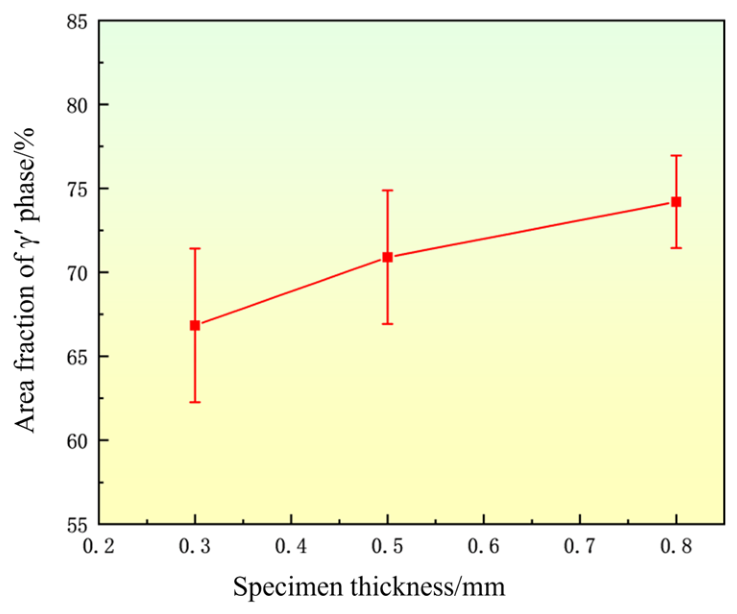
As shown in Figure 7, the volume fraction of the γ′ phase decreases markedly with decreasing wall thickness. Consequently, the oxidation-induced γ′-depleted and γ′-free regions occupy a larger proportion of the cross-section, allowing surface microcracks to penetrate the degraded layer and propagate more readily into the substrate. Therefore, the detrimental influence of oxidation damage on fatigue life becomes more pronounced in thin-walled specimens. Once initiated, these cracks rapidly propagate into the substrate under cyclic stress, leading to a substantial reduction in fatigue life. In contrast, fatigue crack initiation in thick-walled specimens remains predominantly governed by internal defects. This is attributed to the larger effective load-bearing volume and stronger plane-strain-like geometric constraint, which promote crack initiation at stress-concentrated internal defects. Furthermore, the oxidation-affected surface layer occupies only a small fraction of the cross-section, while the subsurface region retains a relatively intact γ′-strengthened microstructure. As a result, the tendency for surface crack initiation is significantly reduced.
Oxidation-induced cross-sectional loss leads to an increase in effective stress [40]. As shown in Figure 8, the fractional thickness of the γ′-free layer in the 0.3 mm specimen is approximately twice that of the 0.8 mm specimen. This indicates that a more pronounced reduction in the effective load-bearing cross-sectional area occurs in thinner specimens, thereby inducing higher local stress concentrations near the surface. The effect of oxidation-induced local stress amplification can be quantitatively described using an effective stress relationship:
  σ = σ · s s = σ · ab ( a 2 e ) ( b 2 e ) ,
where a and b denote the length and width of the specimen cross-section, e is the thickness of the oxide layer, and s represents the cross-sectional area [41]. For thin-walled specimens, the relative reduction in cross-sectional area is more pronounced, resulting in a higher effective stress under the same nominal loading conditions. The oxidation-induced reduction in load-bearing area leads to an increase in the effective stress amplitude. Combining Equation (2) with the Basquin relationship allows a first-order estimation of fatigue life sensitivity:
σ a = σ f ( 2 N f ) b ,
in the HCF regime, fatigue life exhibits a high sensitivity to stress amplitude [42]. Based on the fitted parameters listed in Table 4, the fatigue life relationships for the 0.8 mm, 0.5 mm, and 0.3 mm specimens can be approximately expressed as:
N f σ a 50 , N f σ a 76.9 , N f σ a 166.7 .
This clearly indicates that the stress sensitivity increases significantly with decreasing wall thickness. For example, for the 0.8 mm specimen, a 2% increase in effective stress amplitude due to oxidation results in a reduction of fatigue life to approximately 37.2% of the original value. Even a slight stress amplification induced by oxidation can lead to a substantial reduction in fatigue life, especially in thin-walled specimens. Furthermore, when combined with crack source transition and γ′ phase degradation, this effect becomes one of the dominant mechanisms of the thin-wall effect at 1000 °C.
Therefore, the pronounced thickness dependence of fatigue performance arises not only from crack initiation behavior but also from the exponential amplification of fatigue damage sensitivity under oxidation-induced effective stress elevation.

4.3. Effect of Dislocation Movement on the Thin-Wall Effect

At 1000 °C, the cyclic deformation behavior is no longer dominated by the formation of persistent slip bands (PSBs), which are substantially suppressed above 850 °C [43]. Instead, it is controlled by thermally activated processes, including dislocation climb, cross-slip, and shearing of the γ′ phase. These deformation mechanisms act synergistically to accommodate the cyclic strain.
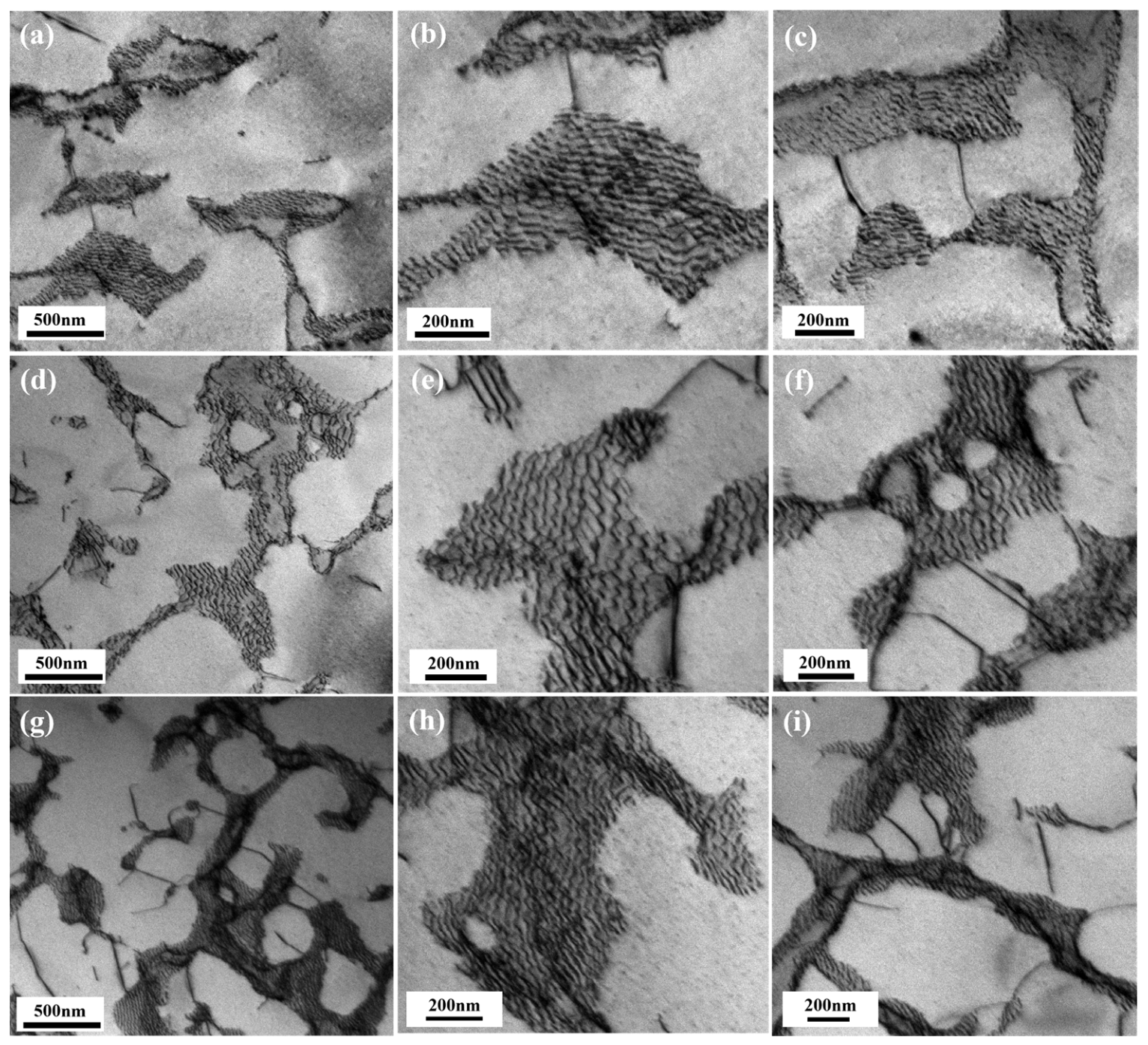
As shown in Figure 9, the γ′ precipitates have lost their initially regular morphology. Dislocations are primarily distributed within the γ matrix channels, with a pronounced spatial heterogeneity observed among different channels. The enhanced atomic diffusivity at elevated temperatures facilitates dislocation climb, enabling dislocations to bypass local obstacles and migrate toward the γ/γ′ interfaces. Simultaneously, cross-slip allows screw dislocations to transfer between equivalent slip planes, thereby promoting their redistribution and interaction within the γ channels. Consequently, the cooperative operation of dislocation climb and cross-slip accelerates dislocation accumulation and rearrangement at the γ/γ′ interfaces, resulting in the formation of interconnected interfacial dislocation networks.
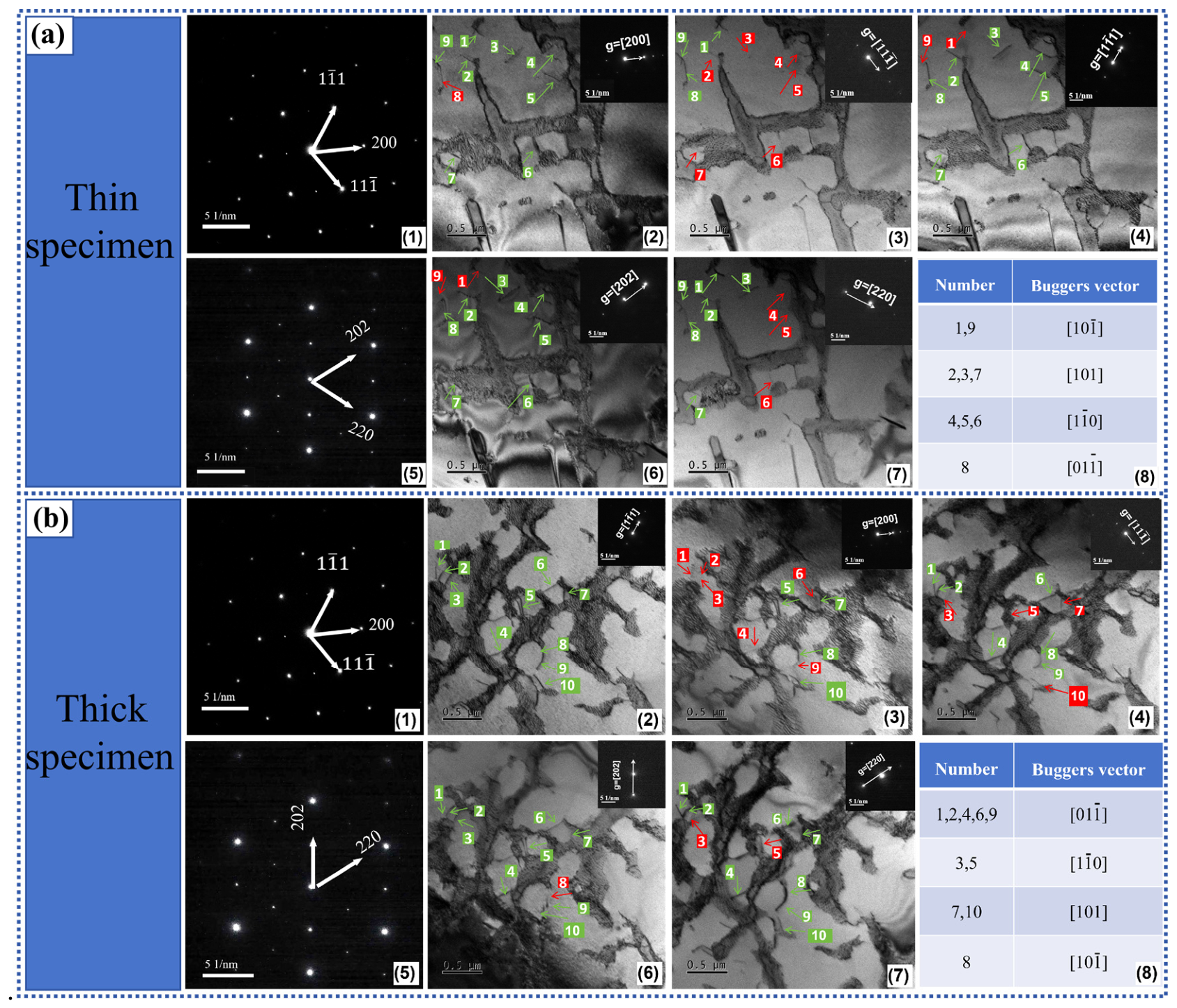
These interfacial dislocation networks generate localized stress concentrations, which are sufficient to activate superdislocations that can shear the γ′ precipitates. Table 4 and Table 5 present the dislocation extinction conditions and the corresponding Burgers vectors. It can be seen that the dislocations cutting into the strengthening phase are mainly a/2⟨110⟩ type superdislocations. As cyclic loading proceeds, the continuous interaction between superdislocations and γ′ precipitates progressively increases the γ/γ′ lattice misfit, thereby promoting γ′ morphological distortion and the generation of additional defect structures. Consequently, cyclic plastic strain is accommodated through the synergistic action of climb-assisted recovery, cross-slip-mediated dislocation redistribution, and γ′-phase shearing. Together, these mechanisms constitute the dominant high-temperature deformation mode at 1000 °C.
Variations in wall thickness do not alter the crystallographic slip mode of the alloy but instead influence fatigue life by modifying the dislocation configurations. Statistical analysis near the fracture surface reveals that the number and types of activated slip systems remain consistent across all specimens, namely ( 1 1 ¯ 1 ) [ 110 ] , ( 1 ¯ 11 ) [ 110 ] , ( 11 1 ¯ ) [ 011 ] and ( 11 1 ¯ ) [ 101 ] (Figure 10). However, as wall thickness increased, the dislocation density within the γ matrix channels increased markedly, the γ/γ′ interfacial dislocation networks became progressively denser, and a greater number of dislocations penetrated the γ′ phase and participated in shearing deformation, thereby increasing the density of shearing dislocations within the γ′ precipitates. Although thick-walled specimens exhibit a higher overall dislocation density, plastic deformation in thin-walled specimens is more spatially localized due to reduced geometric constraint, resulting in more severe local strain accumulation and accelerated damage evolution.
Table 4. Dislocation contrast and Bergman vector b of the cut-in γ′ phase in thin specimens.
123456789
[011][200]×
[ 11 1 ¯ ]××××××
[ 1 1 ¯ 1]××
[ 1 ¯ 11][202]××
[220]×××
a / 2 [ 10 1 ¯ ]a/2[101]a/2[101] a / 2 [ 1 1 ¯ 0] a / 2 [ 1 1 ¯ 0] a / 2 [ 1 1 ¯ 0]a/2[101] a / 2 [ 01 1 ¯ ] a / 2 [ 10 1 ¯ ]
Note: √: No extinction; ×: Extinction.
Table 5. Dislocation contrast and Bergman vector b of the cut-in γ′ phase in thick specimens.
12345678910
[011] [ 1 1 ¯ 1]
[200]××××××
[ 11 1 ¯ ]××××
[ 1 ¯ 11][202]×
[220]××
a / 2 [ 01 1 ¯ ] a / 2 [ 01 1 ¯ ] a / 2 [ 1 1 ¯ 0] a / 2 [ 01 1 ¯ ] a / 2 [ 1 1 ¯ 0] a / 2 [ 01 1 ¯ ]a/2[101] a / 2 [ 10 1 ¯ ] a / 2 [ 01 1 ¯ ]a/2[101]
Note: √: No extinction; ×: Extinction.

4.4. Thickness-Dependent Micro-Deformation Mechanisms in HCF

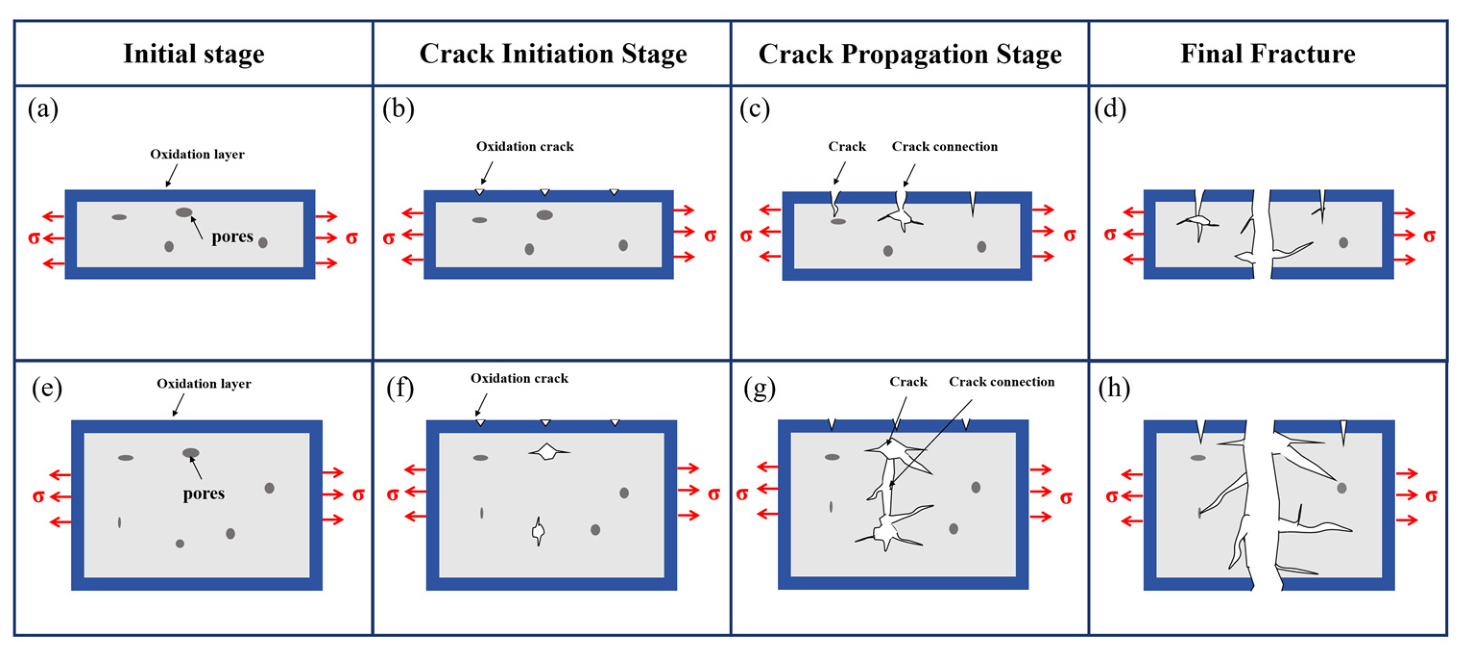
The thin-wall effect in the [111]-oriented Ni3Al-based SX at 1000 °C is not governed by a single factor, but rather by the strong coupling of multiple mechanisms, including the plane stress state, localized plastic deformation, oxidation-induced near-surface damage, and accelerated γ′ phase degradation, as illustrated in Figure 11. These mechanisms interact synergistically rather than operating independently. Specifically, the transition in stress state promotes localized cyclic deformation, which in turn accelerates oxidation damage; subsequently, the resulting microstructural degradation further impairs the local resistance to crack propagation. Their synergistic interplay ultimately dictates the thickness dependence of the fatigue performance.
For thin-walled specimens, fatigue failure is dominated by near-surface crack initiation. With decreasing thickness, the stress state gradually transitions from plane strain to plane stress, leading to a significant reduction in geometric constraint along the thickness direction. This promotes pronounced out-of-plane plastic flow near the free surface. Under this low-constraint stress state, the number of dislocation sources is limited and their distribution is non-uniform. Consequently, cyclic deformation is confined to a few favorably oriented slip bands, promoting the accumulation of local plastic strain near the free surface. These regions of localized deformation serve as preferential pathways for oxygen ingress and oxide penetration during high-temperature cyclic loading. Driven by the large specific surface area combined with local plastic deformation, an oxidation layer, as well as γ′-depleted and γ′-free zones, are rapidly formed near the specimen surface. The resulting material embrittlement drastically reduces the local cracking resistance, causing cracks to nucleate preferentially in the near-surface region and undergo premature unstable propagation.
In contrast, thick-walled specimens maintain a typical plane-strain state with higher stress triaxiality due to stronger geometric constraints. Under these conditions, cyclic plastic deformation is distributed more uniformly throughout the specimen. The larger effective volume provides abundant mobile dislocation sources, allowing matrix dislocations to continuously accumulate and rearrange at the γ/γ′ interfaces, forming dense and relatively stable interfacial dislocation networks. Meanwhile, owing to the lower surface-to-volume ratio, oxidation effects are largely confined to the surface layer, while the subsurface γ′-strengthened structure remains relatively stable. As a result, crack initiation remains dominated by internal casting defects such as pores. Cracks initiate internally and undergo a prolonged stable propagation stage, resulting in a longer HCF life.
In summary, as the wall thickness decreases, the synergistic interplay of these mechanisms drives a fundamental transition in the fatigue failure mode from internal-defect-controlled to surface-dominated, environment-assisted cracking, ultimately culminating in accelerated fatigue damage accumulation and a severe degradation of the alloy’s fatigue resistance.

5. Conclusions

This study systematically investigated the tensile–tensile HCF behavior and deformation mechanisms of [111]-oriented Ni3Al-based SX with different wall thicknesses at 1000 °C. The main conclusions are as follows:
(1)
A pronounced thin-wall effect is observed in [111]-oriented Ni3Al-based SX under HCF conditions at 1000 °C. A significant reduction in HCF performance is observed with decreasing wall thickness, and the S–N curves for specimens with different thicknesses exhibit a clear monotonic relationship with nearly parallel slopes, indicating that variations in wall thickness primarily affect the fatigue damage accumulation rate without altering the dominant HCF failure mechanism.
(2)
The crack initiation behavior under HCF in [111]-oriented Ni3Al-based SX exhibits a strong dependence on wall thickness. The crack initiation sites gradually shift toward the surface or subsurface regions with decreasing wall thickness, and the fatigue failure mode transitions from internal defect-controlled to near-surface damage-controlled behavior. In thick specimens, fatigue cracks are typically initiated from internal casting pores acting as stress concentrators, whereas in thin specimens, crack initiation is primarily associated with oxidation-induced surface microcracks and near-surface damage within the γ′-free and γ′-depleted regions formed during high-temperature exposure.
(3)
Near-surface damage induced by high-temperature oxidation is identified as a key factor contributing to the degradation of HCF performance in [111]-oriented Ni3Al-based SX. During cyclic loading, oxide layers, γ′-free layers, and γ′-reduced regions are formed on the surface of thin-walled specimens, significantly reducing the effective load-bearing area and consequently increasing the effective stress; meanwhile, the strengthening effect associated with the γ′ volume fraction is diminished, leading to a further reduction in fatigue resistance.
(4)
Cyclic deformation at 1000 °C is primarily governed by the synergistic effects of dislocation climb, cross-slip, and shearing of the γ′ phase by superdislocations. The types of activated slip systems remain essentially consistent across specimens with different wall thicknesses, indicating that variations in wall thickness do not significantly alter the Schmid factors or the deformation modes. Thin-walled specimens exhibit localized and heterogeneous plastic deformation, whereas thick specimens achieve more uniform plastic deformation due to a higher density of mobile dislocations.
(5)
The thin-wall effect observed in [111]-oriented Ni3Al-based SX under HCF conditions at 1000 °C fundamentally arises from the coupled effects of multiple factors, including plane stress conditions, localized plastic deformation, oxidation-induced near-surface damage, and accelerated γ′ degradation. Among these, the geometrically constrained transition of crack initiation sites from internal to near-surface regions is identified as the dominant factor responsible for the premature fatigue failure of thin-walled specimens.

Author Contributions

Conceptualization, Y.P., S.L. and S.G.; methodology, L.N.; validation, L.N., Z.W., H.W. and S.Z.; formal analysis, L.N., S.L. and S.G.; investigation, L.N., Z.W., H.W. and S.Z.; resources, Y.P., S.L. and S.G.; data curation, L.N.; writing—original draft preparation, L.N.; writing—review and editing, Y.P.; supervision, Y.P., S.L. and S.G.; project administration, Y.P., S.L. and S.G.; funding acquisition, Y.P. All authors have read and agreed to the published version of the manuscript.

Funding

This research was sponsored by the National Natural Science Foundations of China (No. 52371090), AdvancedMaterials-National Science and Technology Major Project (2025ZD0609000).

Data Availability Statement

The original contributions presented in this study are included in the article. Further inquiries can be directed to the corresponding author.

Conflicts of Interest

The authors declare no conflicts of interest. The funders had no role in the design of the study; in the collection, analyses, or interpretation of data; in the writing of the manuscript; or in the decision to publish the results.

References

  1. Perepezko, J.H. The Hotter the Engine, the Better. Science 2009, 326, 1068–1069. [Google Scholar] [CrossRef]
  2. Pollock, T.M.; Tin, S. Nickel-based superalloys for advanced turbine engines. Prog. Mater. Sci. 2006, 51, 505–610. [Google Scholar]
  3. Zhu, S.; Li, Y.; Yan, J.; Zhang, C. Recent Advances in Cooling Technology for the Leading Edge of Gas Turbine Blades. Energies 2025, 18, 540. [Google Scholar] [CrossRef]
  4. Karge, L.; Gilles, R.; Mukherji, D.; Strunz, P.; Beran, P.; Hofmann, M.; Gavilano, J.; Keiderling, U.; Dolotko, O.; Kriele, A.; et al. The Influence of C/Ta Ratio on TaC Precipitates in Co-Re Base Alloys Investigated by Small-Angle Neutron Scattering. Acta Mater. 2017, 132, 354–366. [Google Scholar] [CrossRef]
  5. Zhang, D.; Li, H.; Guo, X.; Yang, Y.; Yang, X.; Feng, Z. An Insight into Size Effect on Fracture Behavior of Inconel 718 Cross-Scaled Foils. Int. J. Plast. 2022, 153, 103274. [Google Scholar] [CrossRef]
  6. Zeng, S.; Lu, C.; Hu, K.; Zhong, S.; Yang, L. Heat Transfer Characteristics of Double-Wall Cooling Configurations with Self-Organizing Topology. Propul. Energy 2026, 2, 1. [Google Scholar] [CrossRef]
  7. Li, H.; Zhang, Z.; Li, L.; Chen, H.; Han, C. Theoretical Method for Thermal and Mechanical Load Matching Design of Double Wall Turbine Blade. Appl. Therm. Eng. 2025, 281, 128672. [Google Scholar] [CrossRef]
  8. Xia, W.; Zhao, X.; Yue, L.; Zhang, Z. A Review of Composition Evolution in Ni-Based Single Crystal Superalloys. J. Mater. Sci. Technol. 2020, 44, 76–95. [Google Scholar] [CrossRef]
  9. Jeong, W.; Yang, J.; Choi, J.P.; Hwang, J.Y.; Kim, Y.W.; Park, S.J.; Choi, J.W.; Heogh, W.; Lee, H.; Park, J.; et al. Al-based functionally graded super-intermetallic compounds for the turbine blade of a high-performance jet engine. Adv. Compos. Hybrid Mater. 2025, 8, 420. [Google Scholar] [CrossRef]
  10. Sciubba, E. Air-Cooled Gas Turbine Cycles—Part 1: An Analytical Method for the Preliminary Assessment of Blade Cooling Flow Rates. Energy 2015, 83, 104–114. [Google Scholar] [CrossRef]
  11. Zhang, S.; Ma, G.; Wang, H.; Guo, W.; Zhao, H.; Shang, Y.; Pei, Y.; Li, S.; Gong, S. Thickness Debit Effect in Creep Performance of a Ni3Al-Based Single-Crystal Superalloy with [001] Orientation. Crystals 2023, 13, 200. [Google Scholar] [CrossRef]
  12. Seetharaman, V.; Cetel, A.D. Thickness debit in creep properties of PWA 1484. In Proceedings of the International Symposium on Superalloys, Minerals, Metals and Materials Society; The Minerals, Metals & Materials Society: Warrendale, PA, USA, 2004; pp. 207–214. [Google Scholar]
  13. Kraft, O.; Gruber, P.A.; Mönig, R.; Weygand, D. The ‘Size Effect’ on the Stress–Strain, Fatigue and Fracture Properties of Thin Metallic Foils. Mater. Sci. Eng. A 2001, 319–321, 919–923. [Google Scholar] [CrossRef]
  14. Ding, Z.; Wang, S.; Wang, X.; Sun, S.; Li, L. Thin-Wall Effect on Low-Cycle Fatigue Behavior of a Ni-Based Single-Crystal Superalloy Turbine Blade Material. Eng. Fract. Mech. 2026, 332, 111802. [Google Scholar] [CrossRef]
  15. Srivastava, A.; Gopagoni, S.; Needleman, A.; Seetharaman, V.; Staroselsky, A.; Banerjee, R. Effect of Specimen Thickness on the Creep Response of a Ni-Based Single-Crystal Superalloy. Acta Mater. 2012, 60, 5697–5711. [Google Scholar] [CrossRef]
  16. Baldan, A. On the Thin-Section Size Dependent Creep Strength of a Single Crystal Nickel-Base Superalloy. J. Mater. Sci. 1995, 30, 6288–6298. [Google Scholar] [CrossRef]
  17. Zhao, Z.; Li, Q.; Zhang, F.; Xu, W.; Chen, B. Transition from Internal to Surface Crack Initiation of a Single-Crystal Superalloy in the Very-High-Cycle Fatigue Regime at 1100 °C. Int. J. Fatigue 2021, 150, 106343. [Google Scholar] [CrossRef]
  18. Vicente Morales, A.; Mauget, F.; Larrouy, B.; Villechaise, P.; Cormier, J. Very High Cycle Fatigue of a Notched Ni-Based Single Crystal Superalloy at High Temperature. Int. J. Fatigue 2024, 186, 108379. [Google Scholar] [CrossRef]
  19. Hüttner, R.; Völkl, R.; Gabel, J.; Glatzel, U. Creep behavior of thick and thin walled structures of a single crystal nickel-base superalloy at high temperatures—Experimental method and results. In Proceedings of the International Symposium on Superalloys; TMS: Warrendale, PA, USA, 2008; pp. 719–724. [Google Scholar]
  20. Zhao, G.; Tian, S.; Zhang, S.; Tian, N.; Liu, L. Deformation and damage features of a Re/Ru-containing single crystal nickel base superalloy during creep at elevated temperature. Prog. Nat. Sci. Mater. Int. 2019, 29, 210–216. [Google Scholar] [CrossRef]
  21. Ma, H.; Wang, J.; Hua, W.; Jiang, M.; Chen, R.; Xue, H.; He, Y. Transition in Crack Initiation Mechanism of Nickel-Based Superalloys under Very High Cycle Fatigue at Elevated Temperatures. J. Alloys Compd. 2025, 1044, 184445. [Google Scholar] [CrossRef]
  22. Liu, J.; Yu, M.; Min, S.; Zhang, G.; Xu, Z.; Liu, X.; Wang, L.; Dong, J.; Lou, L. The Effect of Secondary Dendrite Orientation on Thickness Debit Effect of Nickel-Based Single-Crystal Superalloy with Tubular Samples. J. Mater. Sci. Technol. 2025, 217, 80–92. [Google Scholar] [CrossRef]
  23. An, J.; Li, Z.; He, W.; Bai, J.; Wang, Z.; Yang, G.; Li, X. Tensile Thickness Debit Effect in Ni-Based Single-Crystal Superalloy at Elevated Temperatures. Int. J. Mech. Sci. 2026, 310, 111111. [Google Scholar] [CrossRef]
  24. Li, Z.; Wen, Z.; Liu, Y.; He, P.; Dai, Y.; Chen, R.; Yue, Z. Low Cycle Fatigue Behavior and Crack Initiation Mechanism of Ni-Based Single Crystal Curved Thin-Walled Blade Simulator Specimen with Film Cooling Holes. Int. J. Fatigue 2024, 179, 108069. [Google Scholar] [CrossRef]
  25. Chen, J.; Cao, T.; Xu, W.; Wu, J.; Hu, Y.; Cao, L.; Zhang, Y.; Cheng, C.; Zhao, J. Analysis of Thin-Wall Effect Mechanism Based on Stress Rupture Properties and Fracture Characteristics of DD10 Ni-Based Single-Crystal Alloy. Mater. Charact. 2024, 218, 114494. [Google Scholar] [CrossRef]
  26. Hu, Y.; Zhang, L.; Cao, T.; Cheng, C.; Zhao, P.; Guo, G.; Zhao, J. The Effect of Thickness on the Creep Properties of a Single-Crystal Nickel-Based Superalloy. Mater. Sci. Eng. A 2018, 728, 124–132. [Google Scholar] [CrossRef]
  27. Yu, Z.Y.; Wang, X.M.; Cao, G.W.; Chen, R.Q.; Lian, Y.D. Environmental Effects on the Creep Response of Thin-Walled Ni-Based Single Crystal Superalloys. J. Mater. Eng. Perform. 2022, 31, 7263–7276. [Google Scholar] [CrossRef]
  28. Wang, H.; Zhang, S.; Hu, B.; Ru, Y.; Shang, Y.; Zhao, H.; Su, H.; Zhang, T.; Pei, Y.; Li, S.; et al. Creep Failure Mechanism of <111>-Oriented Thin-Wall Ni3Al-Based Single Crystal Superalloys. Mater. Sci. Eng. A 2024, 899, 146415. [Google Scholar] [CrossRef]
  29. Zhang, B.; Wang, R.; Liu, H.; Hu, D.; Jiang, K.; Jing, F.; Mi, D. Low Cycle Fatigue Lifetime and Deformation Behaviour Prediction of Nickel-Based Single Crystal Superalloy Considering Thickness Debit Effect. Eng. Fract. Mech. 2023, 281, 109076. [Google Scholar] [CrossRef]
  30. Elliott, A.J.; Tin, S.; King, W.T.; Huang, S.-C.; Gigliotti, M.F.X.; Pollock, T.M. Directional Solidification of Large Superalloys Castings with Radiation and Liquid-Metal Cooling: A Comparative Assessment. Metall. Mater. Trans. A 2004, 35, 3221–3231. [Google Scholar] [CrossRef]
  31. Lu, Y.; Lu, Y.; Dang, H.; Li, X.; Zhang, S.; He, M.; Ran, G.; Yi, X.; Hu, R.; Wang, H. Damage Mechanism Study of TC17 Titanium Alloy during High-Cycle Fatigue Crack Initiation and Propagation. J. Alloys Compd. 2025, 1020, 179549. [Google Scholar] [CrossRef]
  32. Murakami, Y. Metal Fatigue: Effects of Small Defects and Nonmetallic Inclusions, 2nd ed.; Elsevier: Amsterdam, The Netherlands, 2019. [Google Scholar]
  33. Mayer, H. Recent Developments in Ultrasonic Fatigue. Fatigue Fract. Eng. Mater. Struct. 2016, 39, 3–29. [Google Scholar] [CrossRef]
  34. Ouarabi, M.; Perez Mora, R.; Bathias, C.; Palin-Luc, T. Very High Cycle Fatigue Strength and Crack Growth of Thin Steel Sheets. Fract. Struct. Integr. 2016, 10, 112–118. [Google Scholar] [CrossRef]
  35. Pippan, R.; Hohenwarter, A. Fatigue Crack Closure: A Review of the Physical Phenomena. Fatigue Fract. Eng. Mater. Struct. 2017, 40, 471–495. [Google Scholar] [CrossRef]
  36. Sangid, M.D. The Physics of Fatigue Crack Propagation. Int. J. Fatigue 2025, 197, 108928. [Google Scholar] [CrossRef]
  37. Karabela, A.; Zhao, L.G.; Tong, J.; Simms, N.J.; Nicholls, J.R.; Hardy, M.C. Effects of Cyclic Stress and Temperature on Oxidation Damage of a Nickel-Based Superalloy. Mater. Sci. Eng. A 2011, 528, 6194–6202. [Google Scholar] [CrossRef]
  38. Sirrenberg, M.; Babinský, T.; Bürger, D.; Guth, S.; Parsa, A.B.; Thome, P.; Dlouhý, A.; Mills, M.J.; Eggeler, G. The High Temperature Strength of Single Crystal Ni-base Superalloys—Re-visiting Constant Strain Rate, Creep, and Thermomechanical Fatigue Testing. Adv. Eng. Mater. 2024, 26, 2400368. [Google Scholar] [CrossRef]
  39. Kontis, P.; Collins, D.M.; Wilkinson, A.J.; Reed, R.C.; Raabe, D.; Gault, B. Microstructural Degradation of Polycrystalline Superalloys from Oxidized Carbides and Implications on Crack Initiation. Scr. Mater. 2018, 147, 59–63. [Google Scholar] [CrossRef]
  40. Wu, R.; Yue, Z.; Wang, M. Effect of Initial γ/γ ′ Microstructure on Creep of Single Crystal Nickel-Based Superalloys: A Phase-Field Simulation Incorporating Dislocation Dynamics. J. Alloys Compd. 2019, 779, 326–334. [Google Scholar] [CrossRef]
  41. le Graverend, J.-B.; Lee, S. Phenomenological Modeling of the Effect of Oxidation on the Creep Response of Ni-Based Single-Crystal Superalloys. Extrem. Mech. Lett. 2020, 39, 100791. [Google Scholar] [CrossRef]
  42. Liu, Y.; Yu, J.J.; Xu, Y.; Sun, X.F.; Guan, H.R.; Hu, Z.Q. High Cycle Fatigue Behavior of a Single Crystal Superalloy at Elevated Temperatures. Mater. Sci. Eng. A 2007, 454–455, 357–366. [Google Scholar] [CrossRef]
  43. Lukáš, P.; Kunz, L.; Svoboda, M. High Cycle Fatigue of Superalloy Single Crystals at High Mean Stress. Mater. Sci. Eng. A 2004, 387–389, 505–510. [Google Scholar] [CrossRef]
Figure 1. Dimensions (in mm) of the SX specimen for HCF testing.
Metals 16 00649 g001
Figure 2. (a) HCF S–N curves of SX with different wall thicknesses at 1000 °C. (b) Fatigue strength as a function of wall thickness at a life of 107 cycles.
Metals 16 00649 g002
Figure 3. Fracture morphologies of specimens with different wall thicknesses under various stress amplitudes: (ac) 0.3 mm (σa = 370 MPa, Nf = 6.459 × 10⁶ cycles); (df) 0.5 mm (σa = 395 MPa, Nf = 1.370 × 10⁶ cycles); (gi) 0.8 mm (σa = 415 MPa, Nf = 1.945 × 10⁶ cycles). Yellow dashed box—crack initiation site and final fracture region; yellow dashed circle and yellow dashed square—casting pore; white solid arrow—crack propagation direction; radial marks—indicate crack initiation site.
Metals 16 00649 g003
Figure 4. (a) Distance from the free surface to the fatigue crack initiation site for specimens with different wall thicknesses. (b) Comparison of sample thickness and distance to the surface as a function of condition. “*” indicates the mean measured source zone depth ratio for various sample thicknesses.
Metals 16 00649 g004
Figure 5. SEM images showing the cross-sectional morphologies near the fatigue fracture at different wall thicknesses: (a) 0.3 mm (σa = 350 MPa, Nf > 107 cycles); (b) 0.5 mm (σa = 395 MPa, Nf = 1.370 ×10⁶ cycles); (c) 0.8 mm (σa = 410 MPa, Nf = 6.392 ×10⁶ cycles). The dotted line represents the boundaries among the oxide layer, the γ′-free layer, and the γ′-reduced layer.
Metals 16 00649 g005
Figure 6. Longitudinal sectional microstructures near the HCF fracture surfaces of the alloy specimens with various wall thicknesses: (ac) 0.3 mm; (df) 0.5 mm; (gi) 0.8 mm. The TCP phases are highlighted by yellow circles.
Metals 16 00649 g006
Figure 7. Area fraction of γ′-phase in the longitudinal sections near the fracture surfaces for the SX specimens with various wall thicknesses.
Metals 16 00649 g007
Figure 8. (a) Thickness of the γ′-free layer near the HCF fracture surfaces for specimens with different wall thicknesses. (b) Percentage of γ-free layer in wall thickness as a function of specimen thickness.
Metals 16 00649 g008
Figure 9. Dislocation configurations in the SX specimens with various wall thicknesses: (ac) 0.3 mm (σa = 350 MPa, Nf > 107 cycles); (df) 0.5 mm (σa = 395 MPa, Nf = 1.370 ×10⁶ cycles); (gi) 0.8 mm (σa = 410 MPa, Nf = 6.392 ×10⁶ cycles).
Metals 16 00649 g009
Figure 10. Dislocation configurations of specimens with different thicknesses after fatigue fracture: (a) Dislocation distribution in the thin-walled specimen: (14) observed along the [011] zone axis, and (57) along the [ 1 ¯ 11] zone axis, with (8) summarizing the dislocation characteristics for the 0.3 mm specimen; (b) Dislocation distribution in the thick-walled specimen: (14) observed along the [011] zone axis, and (57) along the [ 1 ¯ 11] zone axis, with (8) summarizing the dislocation characteristics for the 0.8 mm specimen. Arrows indicate dislocation positions; green marks visible dislocations, red marks invisible dislocations; numbers correspond to the dislocation indices in Table 4 and Table 5.
Metals 16 00649 g010
Figure 11. Schematic illustration of thickness-dependent fatigue damage mechanisms in the HCF regime at 1000 °C. Thin specimen: (a) initial state, (b) crack initiation stage, (c) crack propagation stage, (d) final fracture. Thick specimen: (e) initial state, (f) crack initiation stage, (g) crack propagation stage, (h) final fracture. Arrows indicate the direction of applied stress.
Metals 16 00649 g011
Table 1. Chemical composition of the Ni3Al-based SX.
ElementsNiAlMoReCrTaBC
wt.%Bal.7~89~120~30~40~4.50.02~0.10.015~0.3
Table 2. Stress sequence for the staircase method (0.8 mm thickness).
Stress
σ/MPa
Specimen ID
123456789
420 ×
415 ×
410 × ×
405
400
390
380
Note: ○ indicates “pass”, and × indicates “fail”.
Table 3. Fatigue performance parameters of SX with different wall thicknesses at 1000 °C.
Performance Parameter0.8 mm0.5 mm0.3 mm
lgσf2.7522.6792.606
b−0.020−0.013−0.006
Disclaimer/Publisher’s Note: The statements, opinions and data contained in all publications are solely those of the individual author(s) and contributor(s) and not of MDPI and/or the editor(s). MDPI and/or the editor(s) disclaim responsibility for any injury to people or property resulting from any ideas, methods, instructions or products referred to in the content.