


Abstract
Aiming at the urgent heat dissipation demands of high-power, high-integration electronic devices, Cu/Al composite heat sinks combine the high thermal conductivity of copper and the lightweight advantage of aluminum, becoming a mainstream solution for advanced thermal management systems. The significant physicochemical differences between Cu and Al, however, make high-quality joining a technical bottleneck. In this study, flux-free ultrasonic brazing with a Zn-based filler metal was used to join 6061 aluminum alloy and industrial pure copper. Gradient heat treatment (55–300 °C) was subsequently applied to systematically investigate its effect on the microstructure, microhardness, and thermal properties of the joints. The results show that the as-brazed joint exhibited excellent bonding (97.3% bonding rate) and shear strength (95.24 MPa). The weld seam consisted of Zn solid solution, Cu solid solution, and Al-Cu-Zn ternary compounds. Heat treatment did not induce new phases but led to the coarsening of Zn-Al-Cu compounds and aggregation of the eutectic structure, reducing grain boundaries. Consequently, the microhardness at the weld center varied non-monotonically, and the thermal conductivity of the joint showed an overall increasing trend with rising heat treatment temperature. This enhancement is attributed to reduced phonon scattering at diminished grain boundaries. This study clarifies the heat treatment–microstructure–thermal properties relationship, providing important guidance for the thermal performance optimization of Cu/Al composite heat sinks.
1. Introduction
With the rapid development of electronic devices toward high-power, high-frequency, and high-integration trends, the heat flux density of chips and core components has increased sharply, and efficient thermal management has become a key technical bottleneck restricting the performance improvement and service life of devices [1,2]. Copper (Cu) possesses ultra-high thermal conductivity (~400 W·m−1·K−1), making it an ideal heat-conducting material; however, its high density and cost limit large-scale applications. Aluminum (Al) features low density, good processability, and low cost, but its thermal conductivity is lower than that of Cu [3,4]. Cu/Al composite heat sinks integrate the high thermal conductivity of Cu and the lightweight advantage of Al, and are widely used in electronic radiators, heat spreaders, and power battery cooling plates, representing a mainstream development direction for advanced thermal management materials [5,6]. However, Cu and Al are typical dissimilar metals with significant differences in melting point, thermal expansion coefficient, electrochemical potential, and other physical and chemical properties, posing severe challenges to the joining process [7,8]. During traditional fusion welding and brazing, excessive interfacial reactions easily generate brittle intermetallic compounds (IMCs), mainly including Cu-Al and Cu-Zn intermetallic compounds, which seriously degrade the bonding strength and service reliability of joints [9,10]. These IMCs are thermodynamically stable in the range of 380–460 °C (ultrasonic brazing temperature) and remain stable without decomposition or phase transition during subsequent heat treatment at 55–300 °C. Common solid-state welding methods including cold pressure welding, friction welding, and diffusion welding have inherent limitations: cold pressure welding requires a large upsetting force and causes severe workpiece deformation, unsuitable for precision joining of complex components; friction welding and diffusion welding are restricted by part shape, making it difficult to realize large-area and complex-structure joining [11,12].
Brazing is a common method for Cu/Al dissimilar metal joining. Conventional brazing requires flux to remove surface oxide films, but residual flux causes interface contamination and degrades joint performance; meanwhile, interfacial reactions are difficult to control, and the formation of coarse brittle phases reduces joint toughness [13,14]. As an emerging solid–liquid hybrid joining technology, ultrasonic brazing achieves in situ removal of Al surface oxide films at lower temperatures via ultrasonic cavitation and mechanical vibration effects, enabling flux-free brazing of Cu/Al dissimilar metals, effectively avoiding flux residue, and suppressing excessive growth of interfacial brittle IMCs by adjusting the welding temperature and ultrasonic parameters [15,16]. Zn-based fillers exhibit good wettability on both Cu and Al surfaces and can reduce the formation of brittle IMCs at the Cu/Al interface, making them the preferred filler for Cu/Al ultrasonic brazing [17,18].
At present, scholars worldwide have conducted extensive research on Cu/Al ultrasonic brazing, mainly focusing on the optimization of brazing parameters and characterization of as-brazed joint microstructure and mechanical properties [19,20]. Nevertheless, Cu/Al composite heat sinks undergo temperature fluctuations during actual service, and the microstructure of brazed joints evolves under thermal action, further affecting the thermal–mechanical properties and long-term service stability of components [21,22]. Studies on the influence mechanisms of heat treatment on microstructure evolution, thermal conductivity, and microhardness of ultrasonic brazed Cu/Al joints remain insufficient, and the intrinsic correlation between the heat treatment process, joint microstructure, and thermal properties has not been clearly established [23,24]. In recent years, some progress has been made in the study of post-brazing heat treatment for Cu/Al joints. For instance, Gu et al. [23] investigated the effect of post-weld heat treatment on the microstructure and mechanical properties of Cu/Al joints produced by high-power ultrasonic spot welding. Wang et al. [24] explored the microstructural evolution of Cu/Al composites under thermal cycling. However, most existing studies focus on conventional brazing or welding processes, and few systematically combine ultrasonic brazing with gradient low-temperature heat treatment to reveal the evolution mechanism of microstructure, thermal conductivity, and microhardness of Cu/Al composite heat sinks. The quantitative relationship between microstructure evolution and thermal conductivity enhancement still lacks systematic clarification [25,26]. Therefore, relevant research is still insufficient, which constitutes the key research gap of this work.
In addition, the thermal conductivity of Al alloys is closely related to solid solution content, grain boundaries, secondary phases, and defects. Alloying elements dissolved in the Al matrix and fine precipitated phases significantly enhance electron and phonon scattering, reducing thermal conductivity [25,26]. Heat treatment can promote the precipitation of solute atoms from the Al solid solution, coarsen secondary phases, reduce grain boundary density, and homogenize composition, thereby weakening electron scattering and improving thermal conductivity [27,28]. For Cu/Al brazed joints, gradient heat treatment can further regulate interfacial element diffusion, inhibit the thickening of brittle IMCs, optimize the interface bonding state, and balance mechanical properties and thermal conductivity [29,30]. However, systematic studies on the regulation mechanism of gradient heat treatment on ultrasonic brazed Cu/Al joints are still lacking, especially on the quantitative relationship between microstructure evolution and thermal performance enhancement. Most published studies only focus on mechanical properties, while ignoring the coupling effect of gradient heat treatment on thermal conductivity and microhardness [27,28,30]. This further confirms that the research on the heat treatment–microstructure–thermal property correlation of ultrasonic brazed Cu/Al joints is seriously insufficient and urgently needs to be supplemented.
To fill the above gaps, this study takes 6061 aluminum alloy and industrial pure Cu as base materials, adopts Zn-Al15 filler to realize flux-free ultrasonic brazing of Cu/Al dissimilar metals, and carries out gradient heat treatment at 55–300 °C. Combined with OM, SEM, EDS, a laser thermal conductivity tester, and a microhardness tester, the effects of heat treatment on joint microstructure, phase composition, microhardness, and thermal properties (thermal conductivity, thermal diffusivity, specific heat capacity) are systematically studied. The intrinsic correlation of heat treatment–microstructure–thermal properties is established, aiming to provide theoretical basis and technical support for the manufacturing, performance optimization, and engineering application of Cu/Al composite heat sinks.
2. Experiment
2.1. Experimental Materials and Equipment
The base materials used in the experiment were 6061-T6 aluminum alloy (supplied by Aluminum Corporation of China Limited (Chinalco), Beijing, China) and industrial pure copper (supplied by Jiangxi Copper Corporation, Guixi, China), and their chemical compositions are shown in Table 1 and Table 2, respectively. The brazing filler metal used was Zn-15Al (ZnAl15) alloy, with a chemical composition of 85 wt.% Zn and 15 wt.% Al. Its solidus temperature is 380 °C and liquidus temperature is 410 °C. The filler metal was supplied by Zhongye Kunyuan Metal Materials Research Institute Co., Ltd. (Chongqing, China). This filler exhibits excellent wettability on both Cu and Al surfaces and can effectively suppress the formation of coarse brittle intermetallic compounds at the Cu/Al interface. The dimensions of the Cu and 6061-T6 Al base material coupons were 20 mm × 10 mm × 2 mm (length × width × thickness). The joint gap width was controlled at 0.10 mm and the thickness of the Zn-15Al filler metal foil was 0.15 mm.
Table 1.
Chemical composition of the 6061-T6 aluminum alloy (wt.%).
Table 2.
Chemical composition of the industrial pure copper (wt.%).
The ultrasonic brazing experiment was carried out on a self-made precision ultrasonic brazing system (Guilin University of Electronic Technology, Guilin, China), which can realize precise control of heating temperature, ultrasonic amplitude and action time. The heating temperature range of the system is room temperature to 800 °C, the ultrasonic frequency is 20 kHz, the amplitude adjustment range is 0–20 μm, and the action time can be set with an accuracy of 1 s.
Microstructural observation and phase analysis were performed using a Leica DMi8 optical microscope (OM) (Leica Microsystems, Wetzlar, Germany) and a ZEISS SUPRA55 field emission scanning electron microscope (SEM) (Carl Zeiss AG, Oberkochen, Germany) equipped with an energy dispersive X-ray spectrometer (EDS) (Bruker, Billerica, MA, USA). Microhardness testing was conducted with an FM-700 microhardness tester (Future-Tech Corp., Kawasaki, Japan), and thermal properties (thermal diffusivity, thermal conductivity, specific heat capacity) were measured using an LFA 467 HyperFlash laser thermal conductivity analyzer (NETZSCH-Gerätebau GmbH, Selb, Germany). Shear strength tests were carried out on an Instron-5569 universal testing machine (Illinois Tool Works Inc., Norwood, MA, USA).
Before brazing, the surface roughness of the faying surfaces was measured using a surface profilometer (Taylor Hobson Ltd., Leicester, UK). The surface roughness Ra of both 6061 Al and Cu was controlled at approximately 0.8 μm to ensure consistent surface conditions for joining. The mechanical properties of the 6061 aluminum alloy and commercially pure copper are listed in Table 3.
Table 3.
Mechanical properties of 6061 aluminum alloy and commercially pure copper.
2.2. Ultrasonic Brazing Process
Before brazing, the surface of the 6061 aluminum alloy and industrial pure copper base materials was treated by sanding with 400#–2000# waterproof abrasive paper, then cleaned with absolute ethanol in an ultrasonic cleaner for 15 min to remove surface oil and oxide debris, and finally dried in hot air for standby. The ultrasonic brazing process parameters were optimized by a single-factor experiment with variables including heating temperature (400–500 °C), ultrasonic amplitude (5–18 μm), and ultrasonic action time (10–30 s). Based on comprehensive evaluation of bonding rate, microstructure integrity, and shear stability, the final optimized process parameters for all subsequent specimens were determined as follows: brazing temperature of 430 °C, ultrasonic amplitude of 12 μm, and ultrasonic action time of 20 s. Under these parameters, the joint exhibits a high bonding rate of 97.3%, no macroscopic defects such as pores or incomplete fusion, and an excellent average shear strength of 95.24 MPa, ensuring stable and reliable joint quality for subsequent heat treatment experiments. Under the above process conditions, the Zn-based filler metal was melted and spread on the surface of the base material under the action of ultrasonic vibration, and the oxide film on the metal surface was removed by the cavitation and mechanical scouring effect of ultrasonic waves, so as to realize the flux-free metallurgical bonding of Cu/Al dissimilar metals.
The welded specimens were designed with an interlocking structure to improve the bonding strength of the joint, which is a concave–convex mechanical engagement structure at the faying interface of Cu and Al base materials. The key geometric dimensions are as follows: the engagement depth is 0.5 mm, the single tooth width is 1.0 mm, the matching clearance is 0.1 mm, and the transition fillet is R = 0.2 mm. This interlocking design effectively increases the actual bonding area and provides mechanical interlocking constraint, thereby significantly improving the shear strength and bonding reliability of the joint. After ultrasonic brazing, the power supply was turned off immediately, and the specimens were cooled to room temperature by furnace cooling (natural cooling in the insulation chamber). The average cooling rate was about 8–10 °C/s from 430 °C to 300 °C and about 2–3 °C/s below 300 °C.
During ultrasonic brazing, the joining pressure (contact force) was controlled at 0.2 MPa. The overlapping contact area was 10 mm × 15 mm, and the joint gap was fixed at 0.1 mm. The specimens were firmly clamped to ensure stable contact during ultrasonic vibration. The specimen size was 50 mm × 20 mm × 2 mm for all samples.
2.3. Heat Treatment Process
In order to study the effect of heat treatment on the microstructure and properties of Cu/Al brazed joints, the as-brazed joints were subjected to gradient heat treatment in a box-type resistance furnace. All heat treatment processes were carried out in a box-type resistance furnace under a high-purity argon (Ar) protective atmosphere to prevent surface oxidation of Cu and Zn elements at 200–300 °C. Before heating, the furnace chamber was purged with Ar gas for 10 min to eliminate residual air and ensure an oxygen-free environment during the entire holding period. The heat treatment process was as follows: the joints were heated from room temperature to the target temperature (55 °C, 70 °C, 100 °C, 150 °C, 200 °C, 250 °C, 300 °C) at a heating rate of 10 °C/min, held for 10 min at the target temperature to ensure the uniform thermal action of the joint, and then air-cooled to room temperature in the furnace. The heat treatment temperature range was set according to the actual service temperature of electronic heat dissipation components, which was close to the working condition and had important engineering application value.
The holding time of 10 min was determined based on the actual short-term service condition of electronic heat dissipation components, aiming to simulate the rapid temperature response and thermal stabilization process during operation. Even at relatively low temperatures (55–100 °C), this holding time is sufficient to cause obvious microstructure relaxation, elemental redistribution at grain boundaries, and slight phase coarsening in the ultrasonic brazed joint, which are consistent with the diffusion kinetic characteristics of the Zn-Al-Cu system at medium–low temperatures and have been verified by the microstructure evolution and thermal conductivity enhancement results.
2.4. Joint Characterization and Performance Testing
For all experimental conditions, including as-brazed and each gradient heat treatment temperature, at least 3 parallel specimens were prepared and tested to ensure repeatability and statistical reliability. For shear strength tests, 6 parallel specimens were tested under each condition. All data for microhardness and thermal properties are presented as average values with standard deviations, and all microstructure observations are verified on at least 3 independent specimens to ensure representative results.
2.4.1. Microstructural Observation and Phase Analysis
The brazed joint specimens after heat treatment were cut along the cross-section by wire electrical discharge machining (WEDM), and the standard metallographic specimens were prepared by mounting, grinding, polishing and corrosion. The grinding process was carried out with 800#, 1000#, 1500#, 2000#, 3000# and 4000# waterproof abrasive papers in turn, and the mechanical polishing was carried out with diamond polishing paste with a particle size of 1.0 μm and 0.5 μm until the surface was scratch-free and mirror-like. The corrodent was a mixed solution of 10 vol.% nitric acid and absolute ethanol, and the corrosion time was 5–10 s.
OM and SEM were used to observe the macroscopic and microscopic morphology of joints. EDS was used for elemental composition analysis of weld seams and interfaces, and the phase composition and evolution law of joints under different heat treatment temperatures were determined combined with the Al-Cu-Zn ternary phase diagram.
The bonding rate of the joint was quantitatively calculated by image analysis using SEM and OM cross-sectional images. The bonding rate is defined as the percentage ratio of the effective metallurgical bonding length to the total nominal interface length of the Cu/Al joint. At least 5 different regions of each specimen were measured, and the average value was adopted. The high bonding rate of 97.3% indicates that the ultrasonic brazing process achieves sufficient wetting, spreading, and defect-free joining at the interface.
Due to the consumption of all original specimens in previous tests, supplementary XRD analysis was not available. Phase identification in this study is based on SEM morphology, EDS elemental analysis, and the Al-Cu-Zn ternary phase diagram, following conservative identification principles.
Due to the complete consumption of original specimens, EDS area mapping (elemental mapping) was not available. Elemental distribution and composition gradients across the Al-side and Cu-side interfaces were characterized and analyzed by EDS point scans and line scan intensity profiles, combined with SEM morphological observation and Al-Cu-Zn ternary phase diagram analysis.
2.4.2. Mechanical Property Testing
The microhardness distribution of the joint cross-section (Al matrix, Al-side interface, weld seam center, Cu-side interface, Cu matrix) under different heat treatment conditions was measured by an FM-700 microhardness tester (Future-Tech Corp., Kawasaki, Japan). The test load was 25 gf (HV 0.025), the holding time was 15 s, and the test points were arranged at an interval of 50 μm to ensure the accuracy of the test results. For each heat treatment condition, 5 parallel test points were set at each position, and the average value was taken as the final microhardness value. The detailed microhardness data at different positions are summarized with average values from five parallel measurements.
The shear strength tests of both as-brazed and all heat-treated joints were carried out on an Instron-5569 universal testing machine (Instron, Norwood, MA, USA), strictly following the national standard GB/T 11361-2022 [31] (Metallic materials-Shear test method for brazed joints).
- ➀
- Base material size: 50 mm (L) × 20 mm (W) × 2 mm (T);
- ➁
- Brazed overlapping area: 10 mm × 15 mm;
- ➂
- Total lap length: 15 mm;
- ➃
- Loading direction: parallel to the overlapping interface.
The crosshead speed was set at 1 mm/min. For each condition, 6 parallel specimens were tested, and the average value was taken as the final shear strength to ensure statistical reliability.
2.4.3. Thermal Property Testing
The thermal diffusivity (α), thermal conductivity (λ) and specific heat capacity (cp) of the Cu/Al brazed joints under different heat treatment temperatures were measured by an LFA 467 HyperFlash laser thermal conductivity analyzer (NETZSCH, Selb, Germany) at room temperature. The test specimens were processed into circular sheets with a diameter of 12.7 mm and a thickness of 2 mm, and the two sides of the specimens were polished to ensure the flatness and parallelism, so as to reduce the test error. Each group of specimens was tested 3 times, and the average value was taken as the test result. The thermal conductivity was calculated according to the formula λ = αρcp, where ρ is the bulk density of the joint specimen. A single measured density value (3.82 g/cm3, obtained by the Archimedes method on as-brazed samples) was uniformly used for all heat treatment conditions, since re-measurement for each condition was not possible due to specimen consumption.
2.4.4. Characterization and Testing
All experimental procedures and test methods in this study were conducted in compliance with national and international standards. Shear strength tests were performed according to GB/T 11361-2022 [31]. Vickers microhardness tests were carried out in accordance with ASTM E384-23 [32]. Thermal diffusivity and thermal conductivity were measured following ASTM E1461-22 [33].
3. Results and Discussion
3.1. Microstructure and Mechanical Properties of As-Brazed Cu/Al Joint
3.1.1. Macroscopic and Low-Magnification Metallographic Structure
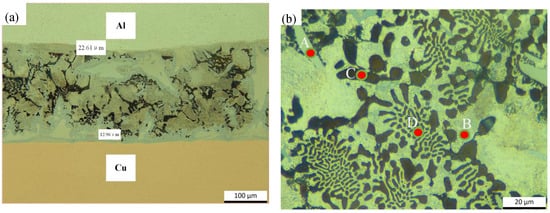
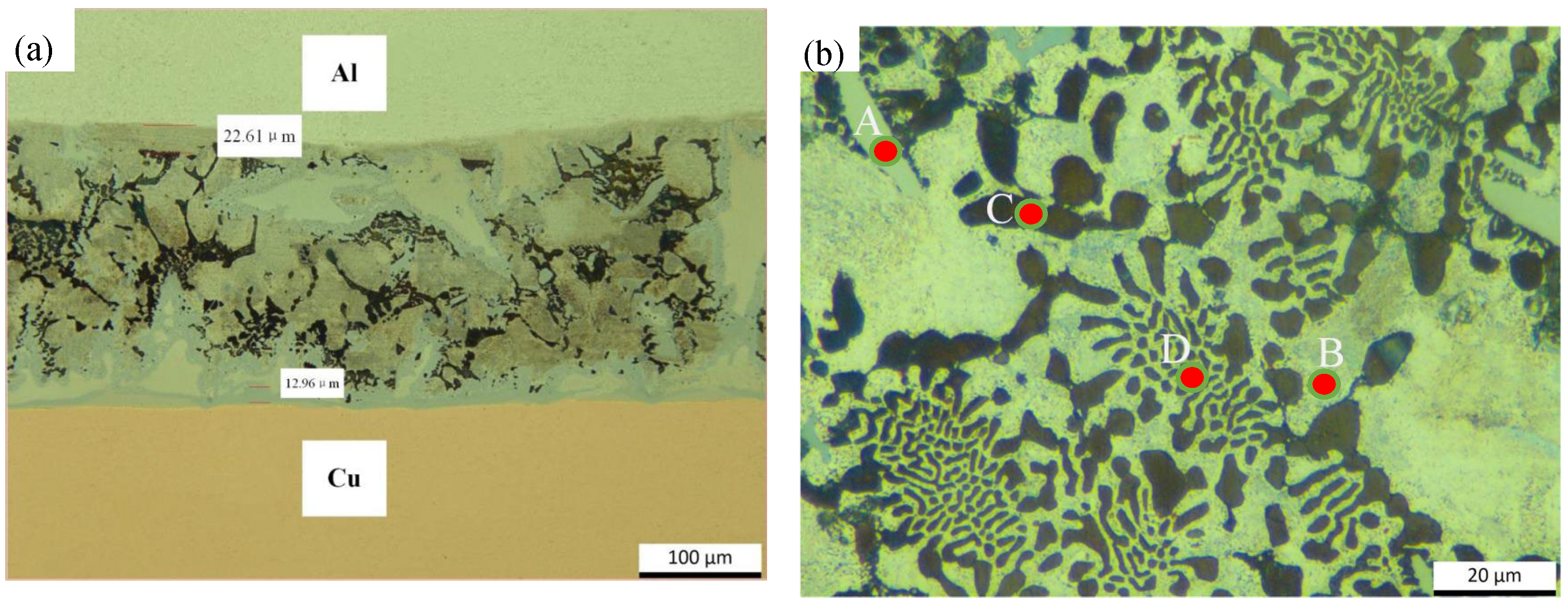
The metallographic structure of the Cu/Al ultrasonic brazed joint is presented in Figure 1. Figure 1a shows the low-magnification metallographic structure of the joint cross-section, where the Al-side interface is composed of a relatively uniform dark thin layer (approximately 22.61 μm thick) and sawtooth-shaped phases growing toward the weld seam, while the Cu-side interface has a thin layer adjacent to the Cu base and irregularly distributed light-colored phases extending into the weld seam. No obvious macroscopic defects such as porosity, slag inclusion or incomplete fusion are observed, indicating that the filler metal fully fills the joint gap and forms a good metallurgical bond.
Figure 1.
Metallographic structure of Cu/Al ultrasonic brazed joint: (a) low-magnification metallographic structure of the cross-section; (b) local magnified metallographic structure of the weld seam.
Figure 1b is a local magnified metallographic image of Figure 1a, showing the detailed structure of the weld seam. It can be seen that the weld seam is well-bonded, and the interface transition between Cu and Al is clear, which lays a structural foundation for the excellent mechanical properties and thermal conductivity of the joint.
3.1.2. Weld Seam Microstructure and Phase Composition
Further magnification of the defect-free area in the weld seam (Figure 1) reveals a well-defined joint microstructure, which is consistent across the entire weld zone (Figure 2a). Four distinct microstructural constituents are observed: light-colored lamellar structure A, matrix structure B, black irregular blocky structure C, and eutectic structure D. Based on morphological characteristics and corrosion resistance, structure A is identified as Cu-Al compounds, B as a Zn-rich phase, C as an Al-rich phase, and D as a eutectic structure. Based on SEM morphology and EDS analysis, structure A is identified as Cu-Al intermetallic compounds.
Figure 2.
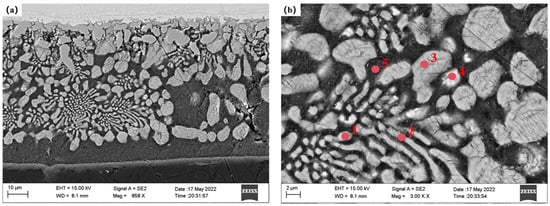
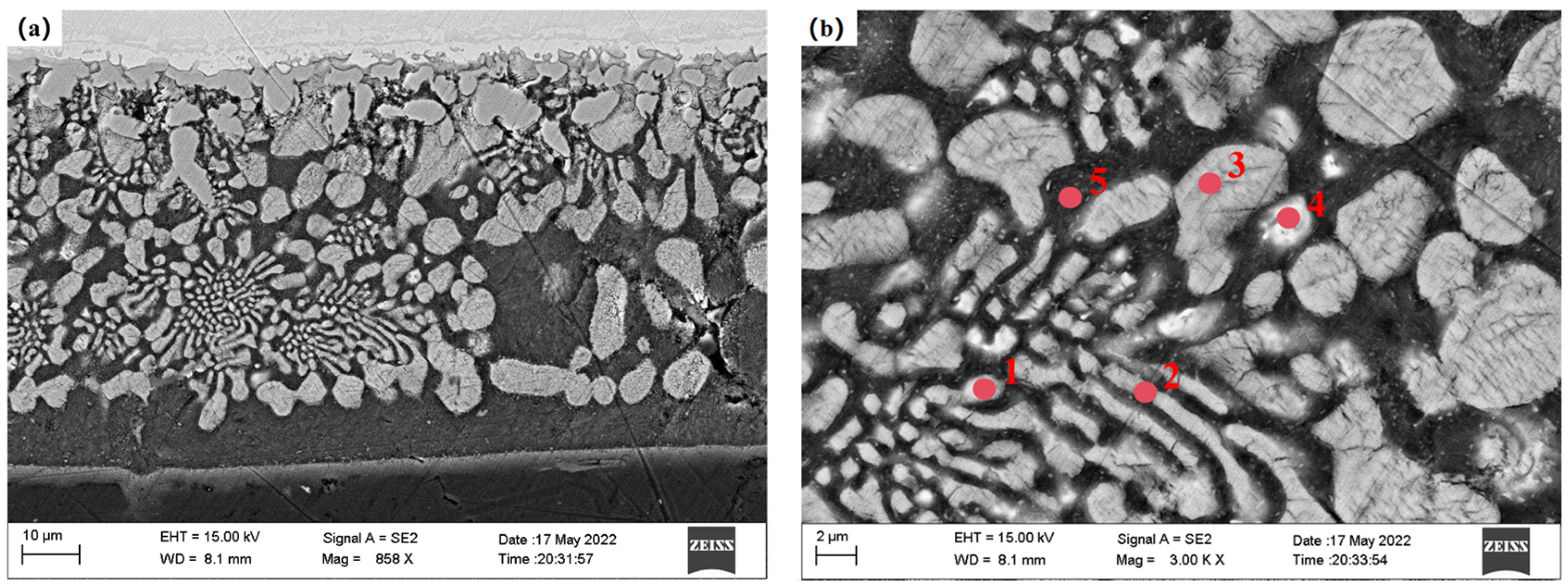
Weld seam microstructure of Cu/Al ultrasonic brazed joint: (a) OM image of weld seam; (b) SEM image of weld seam (3.00 K× magnification).
Figure 2b shows the spatial distribution of the five EDS point scans. Point 1 and Point 2 were located in the Zn-rich solid solution matrix (constituent B). Point 3 and Point 4 were located in the Al-rich blocky phase (constituent C). Point 5 was located in the light-colored Cu-Al intermetallic compound (constituent A). This spatial arrangement covers all four typical microstructural constituents in the weld seam, ensuring the EDS results are representative of the overall weld heterogeneity.
SEM observation was performed to further analyze the weld seam microstructure (Figure 2b). The weld seam is homogeneous without obvious cracks or pores, and the interface is well-bonded. EDS point scan analysis was conducted on the weld seam (Table 4). It should be noted that small amounts of Mg (up to 0.53 at.%) and Si (up to 0.41 at.%) are detected in the weld zone, which are derived from the 6061-T6 aluminum alloy base material (0.76 wt.% Mg and 0.49 wt.% Si). During ultrasonic brazing at 430 °C, Mg and Si atoms diffuse from the Al alloy substrate into the molten Zn-based filler under ultrasonic vibration and thermal driving forces. Although their atomic fractions are relatively low, the presence of Mg and Si is a typical metallurgical phenomenon in ultrasonic brazing of 6061 Al alloy. Mg tends to segregate at grain boundaries and phase interfaces, which can refine the microstructure and inhibit excessive coarsening of intermetallic compounds. Si mainly exists as a solid solution in the Al-rich phase or forms fine Si-rich precipitates, which may slightly affect the microhardness and thermal conductivity of the joint. Therefore, Mg and Si are important trace elements that cannot be ignored and are involved in the interfacial diffusion and microstructure evolution of the Cu/Al ultrasonic brazed joint. Combined with the Al-Cu-Zn ternary phase diagram, the weld seam is determined to consist of Zn solid solution, Cu solid solution and Al-Cu-Zn ternary compounds (Zn-Al-Cu ternary intermetallic compounds). During ultrasonic brazing with Zn-based filler, the main interfacial phases are Cu-Al intermetallic compounds at the Al-side interface and Cu-Zn intermetallic compounds at the Cu-side interface.
Table 4.
EDS point scan results of Al-Cu joint weld seam (at.%).
3.1.3. Interface Microstructure
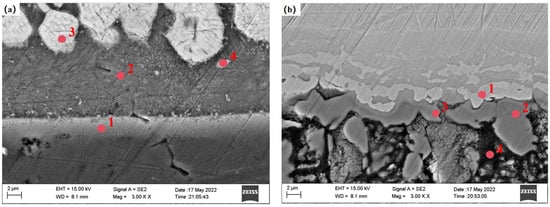
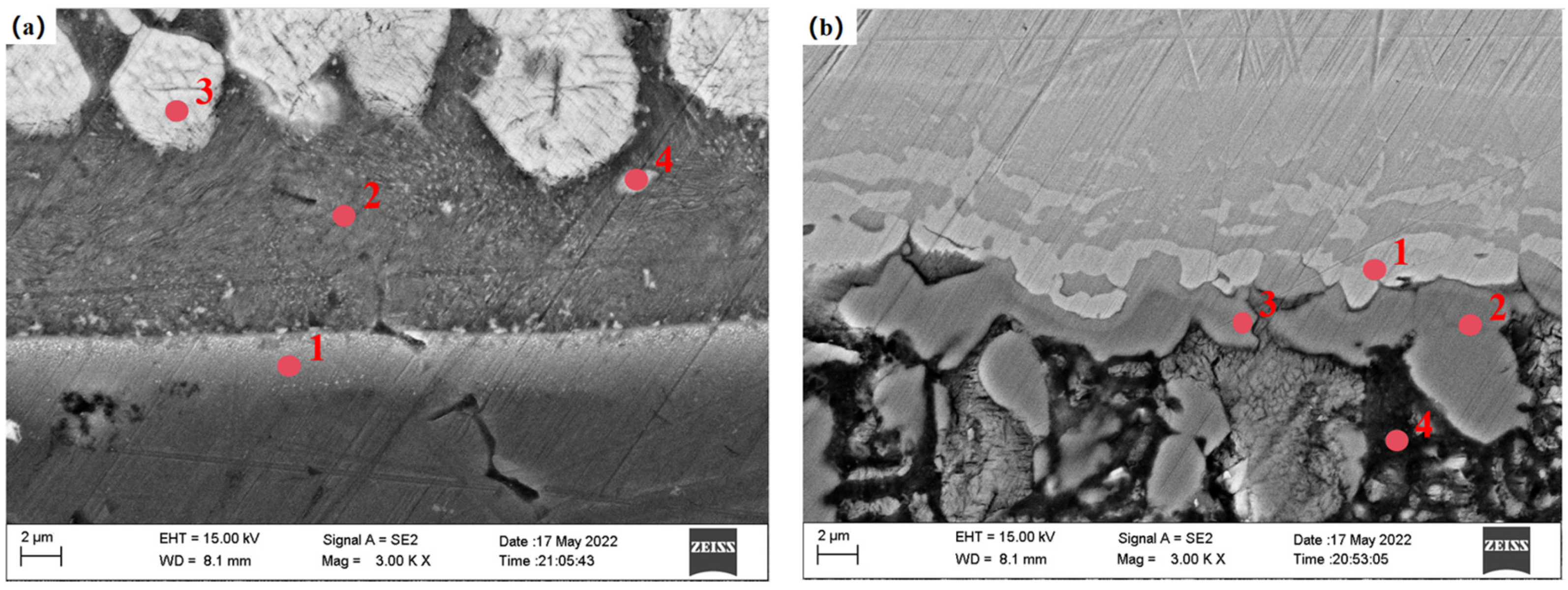
The interface is a critical region of the joint, so the Al-side and Cu-side interfaces were observed separately by SEM (Figure 3). At the Al-side interface (Figure 3a), the oxide film on the aluminum alloy surface is completely removed, and the liquid filler metal partially dissolves into the Al matrix, forming a good metallurgical transition layer. At the Cu-side interface (Figure 3b), the microstructure is similar to structure A in Figure 2a, with structures C and D distributed inside the A-like structure. The filler metal forms a tight bond with both Cu and Al matrices. Additionally, a thin layer of structure is observed near the Cu matrix.
Figure 3.
SEM images of joint interfaces: (a) Al-side interface; (b) Cu-side interface.
To accurately analyze the composition of the interface structures, EDS point scan was performed on the positions marked in Figure 3, and the results are shown in Table 5 and Table 6.
Table 5.
EDS point scan results of Al-side interface (at.%).
Table 6.
EDS point scan results of Cu-side interface (at.%).
For the Al-side interface (Table 5), the contents of Mg and Si are negligible. At positions 1, 2 and 4, the Al content is around 50 at.%, Cu around 23 at.%, and Zn around 22 at.%, indicating the presence of Cu solid solution, Zn solid solution and Al-Cu-Zn ternary compounds. At position 3, the Al content reaches 83.44 at.% with other minor elements, identified as α-Al.
Based on EDS point analysis, a smooth and continuous composition gradient is formed across the Al-side interface. The Al content decreases gradually while Cu and Zn contents increase steadily from the Al substrate to the weld zone, without obvious elemental segregation, abrupt concentration changes, or abnormal diffusion regions.
For the Cu-side interface (Table 6), Mg and Si contents are also negligible. At position 1, the contents of Zn and Cu are relatively high, indicating that the thin layer near the Cu-side interface is a Cu-Zn compound rather than a Cu-Al compound. At positions 2 and 3, the contents of Cu, Al and Zn are all relatively high, suggesting an inhomogeneous Al-Cu-Zn ternary compound. It should be emphasized that the extremely high Cu content (97.07 at.%) detected at position 4 is not a Cu solid solution or Cu particle inside the weld. Instead, it is a common EDS measurement artifact caused by the ultra-thin Cu-side interfacial layer (≈1.8–2.1 μm) formed during ultrasonic brazing. Because the interfacial reaction layer is thinner than the effective detection volume of EDS, the electron beam penetrates the thin layer and excites the characteristic X-ray signal of the adjacent pure Cu substrate, leading to an abnormally high Cu atomic percentage. This does not represent an actual phase or inclusion in the weld zone.
EDS point results confirm the existence of a clear composition gradient across the Cu-side interface. A Cu-Zn interfacial layer with high Cu and Zn contents is formed adjacent to the Cu substrate, and Al, Cu, and Zn elements interdiffuse moderately without significant enrichment or depletion regions, indicating good interfacial elemental diffusion compatibility.
3.1.4. Mechanical Properties
The shear strength test results of the as-brazed Cu/Al ultrasonic brazed joint are shown in Table 7. The shear strengths of the six parallel specimens are relatively stable, with a maximum value of 99.32 MPa, a minimum value of 89.46 MPa and an average shear strength of 95.24 MPa, which is significantly higher than that of traditional brazed Cu/Al joints. The average shear strength of the six parallel specimens is 95.24 MPa, with a minimum value of 89.46 MPa, a maximum value of 99.32 MPa, and a standard deviation (SD) of 3.83 MPa. The coefficient of variation (CV) is calculated as 4.02%, and the 95% confidence interval (CI) is 91.70–98.78 MPa. The low coefficient of variation and narrow confidence interval confirm that the shear strength data exhibit excellent stability, high repeatability, and good statistical reliability.
Table 7.
Shear strength of as-brazed Cu-Al joints.
The excellent shear strength is attributed to the following factors: (1) the flux-free ultrasonic brazing process avoids interface contamination caused by flux residue and improves interfacial bonding quality; (2) the Zn-based filler metal suppresses the formation of coarse brittle intermetallic compounds at the Cu/Al interface, and the thin and uniform reaction layer ensures joint toughness; (3) the interlocking structure design increases the bonding area of the joint and improves the mechanical interlocking effect.
The microhardness distribution of the as-brazed joint cross-section is the initial state for studying the effect of heat treatment, and the microhardness values of each position are: Al matrix: 69.7 HV 0.025; Al-side interface: 210.6 HV 0.025; weld seam center: 130.5 HV 0.025; Cu-side interface: 111.4 HV 0.025; and Cu matrix: 50.7 HV 0.025. The Al-side interface has the highest microhardness, which is due to the formation of fine Cu-Al intermetallic compounds at the interface; the microhardness of the weld seam center is between the matrix and the interface, which is the result of the comprehensive action of the Zn-rich phase, Al-rich phase and eutectic structure.
Note: Shear strength tests were only conducted on the as-brazed joint due to the complete consumption of heat-treated specimens in other characterizations. Fracture surfaces of shear-tested specimens were not preserved after testing; therefore, fractographic analysis and failure mode identification were not performed. Only quantitative shear strength data are provided in this study.
3.2. Effect of Heat Treatment on the Microstructure of the Cu/Al Brazed Joint
3.2.1. Weld Seam Microstructure Evolution
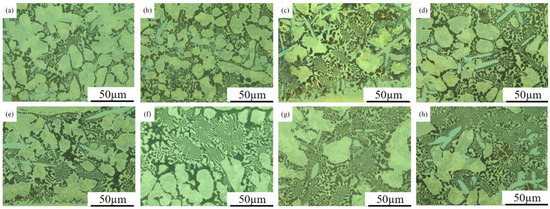
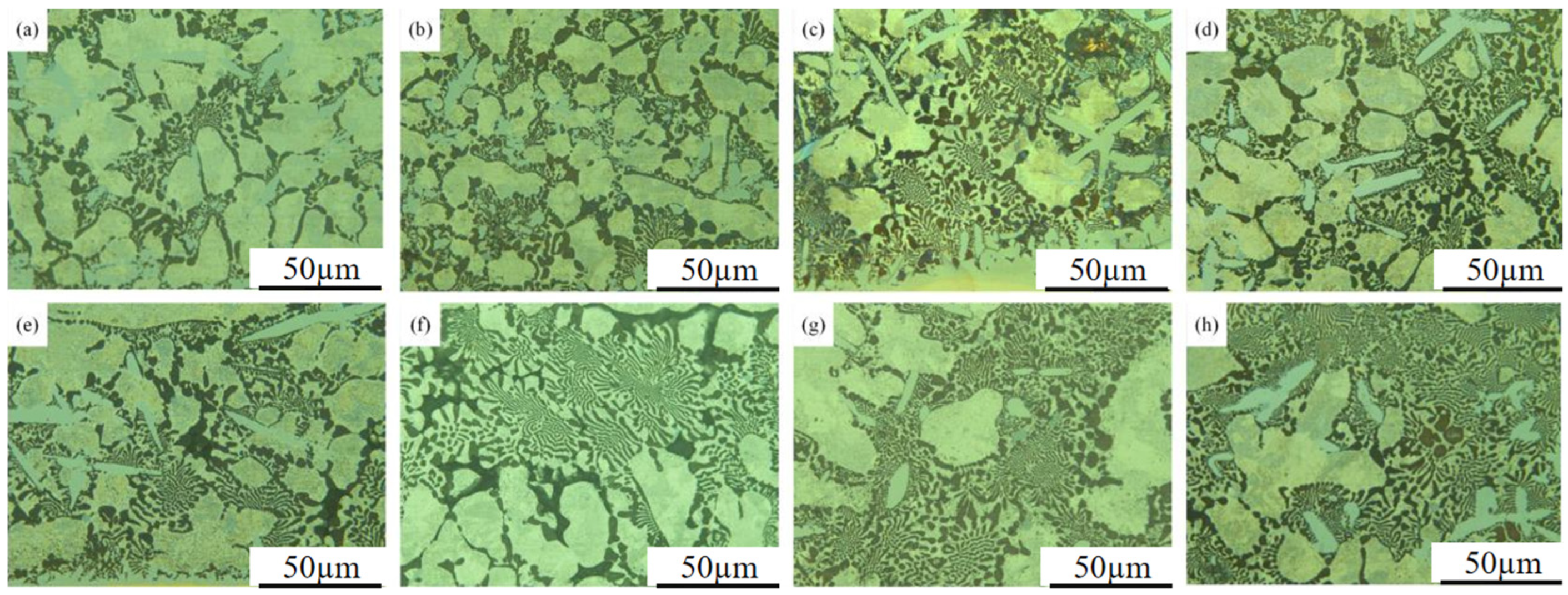
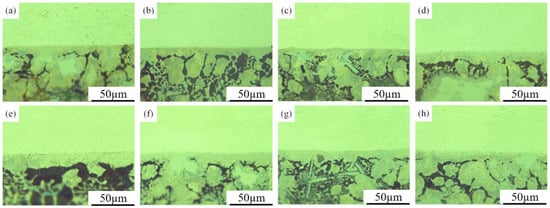
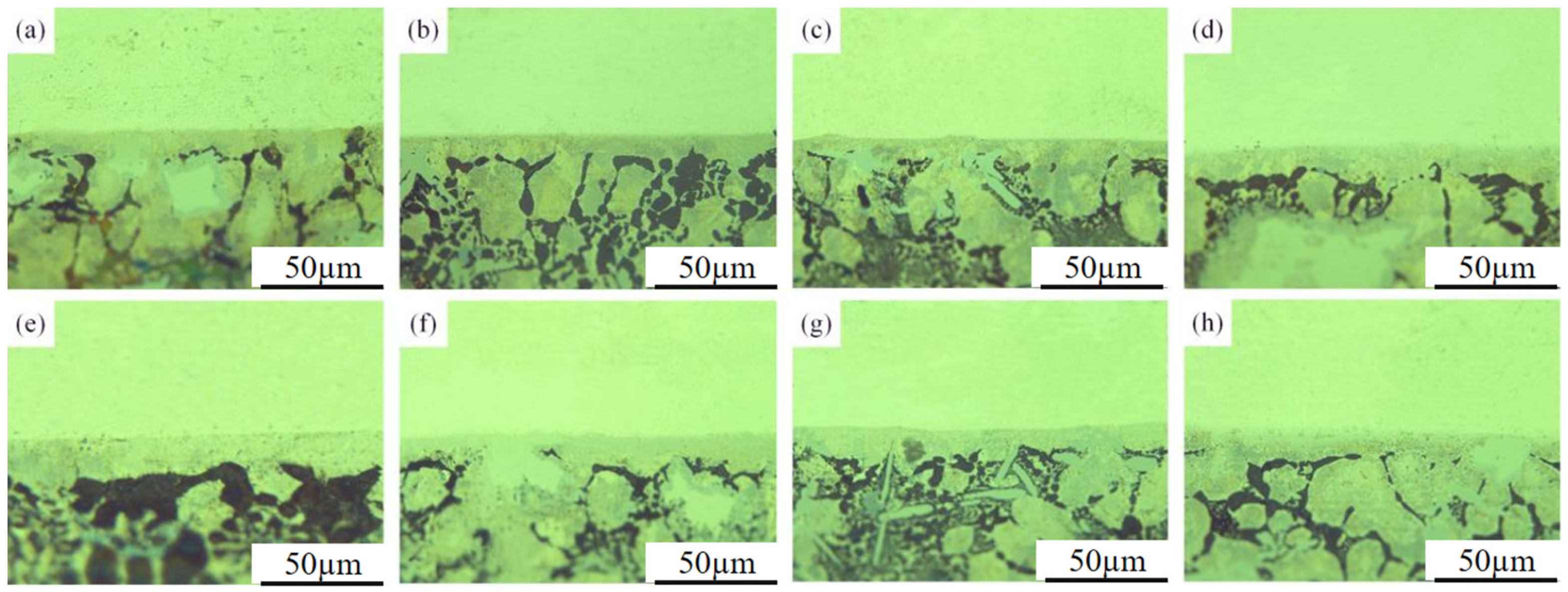
The microstructure of the Cu/Al brazed joint weld seam under different heat treatment temperatures (room temperature, 55 °C, 70 °C, 100 °C, 150 °C, 200 °C, 250 °C, 300 °C) is shown in Figure 4. To improve clarity, the scale bars in Figure 4 have been enlarged and enhanced for better legibility. The results show that no new bulk phases or obvious phase transformations are observed by OM and SEM with increasing heat treatment temperature. Trace minority phases below the detection limit of microscopic characterization cannot be completely excluded. This is because the heat treatment temperature (≤300 °C) is much lower than the melting point of the Zn-based filler metal and the eutectic reaction temperature of the Al-Cu-Zn system; thus, no new phase is generated by the metallurgical reaction.
Figure 4.
Microstructure of Cu/Al brazed joint weld seam at different heat treatment temperatures: (a) Microstructure of the joint without heat treatment at room temperature; (b–h) microstructures of the weld in the joint after heat treatment at 55 °C, 70 °C, 100 °C, 150 °C, 200 °C, 250 °C, and 300 °C, respectively.
Semi-quantitative visual comparison reveals noticeable microstructural evolution with increasing temperature:
- At low temperatures (55–100 °C), the originally fine lamellar eutectic structure gradually aggregates, and dispersed eutectic colonies merge into larger blocky structures.
- At medium and high temperatures (150–300 °C), the Zn-Al-Cu ternary intermetallic compounds and eutectic structures show evident coarsening. The number of grain boundaries and phase boundaries is visibly reduced, and the microstructure becomes more uniform and compact.
Thermally activated atomic diffusion promotes grain coalescence, structural homogenization, and reduction in interface density. These microstructural changes reduce electron and phonon scattering, which supports the improved thermal conductivity of the joint. Quantitative characterization of grain size and phase fraction is not available due to the unavailability of original specimens.
The essential reason for such structural changes is that thermal energy promotes atomic diffusion and grain growth. With rising temperature, Al, Cu, and Zn atoms migrate sufficiently, leading to grain coalescence, reduced grain boundary density, and compositional homogenization in the weld region. These microstructural modifications directly reduce electron and phonon scattering, providing a structural basis for the improvement of thermal conductivity.
3.2.2. Al-Side Interface Microstructure Stability
The microstructure of the Al-side interface at different heat treatment temperatures is displayed in Figure 5. The scale bars have been enlarged digitally to ensure readability. It can be clearly observed that the Al-side interface maintains excellent structural stability within the entire heat treatment range (55–300 °C). No obvious morphological changes, phase coarsening, or interfacial defects appear.
Figure 5.
Microstructure of Al-side interface of Cu/Al brazed joint at different heat treatment temperatures:(a) Microstructure of the joint without heat treatment at room temperature; (b–h) microstructures of the weld in the joint after heat treatment at 55 °C, 70 °C, 100 °C, 150 °C, 200 °C, 250 °C, and 300 °C, respectively.
Specifically, the thickness of the interface layer remains stable at approximately 22.6 μm. The phase composition, grain morphology, and bonding state at the Al-side interface do not change with increasing temperature. The uniform transition layer formed during ultrasonic brazing remains dense and continuous. According to the Al-Cu and Al-Zn phase diagrams, the heat treatment temperature is far below the solid solution temperature and phase transformation temperature of the Al matrix. Therefore, Cu atoms exhibit an extremely low diffusion rate in Al, and no element segregation, grain coarsening, or new phase precipitation occurs at the interface.
This high stability indicates that the Al-side interface structure is thermodynamically stable under service-related heating conditions, which guarantees the long-term structural integrity and reliable heat transfer capability of the joint.
The high stability of the Al-side interface is further supported by the consistent microhardness values (206–211 HV 0.025) from 25 °C to 250 °C, as listed in Table 8. No significant fluctuations in thickness, morphology, or mechanical response are detected across the entire heat treatment range, confirming excellent structural and compositional stability. Due to the unavailability of original specimens, EDS line scan profiles at different temperatures were not performed.
Table 8.
Microhardness (HV 0.025) at different locations of the joint under various heat treatment conditions (values are means ± standard deviation (SD) of five parallel measurements).
3.2.3. Cu-Side Interface Microstructure Morphology Change
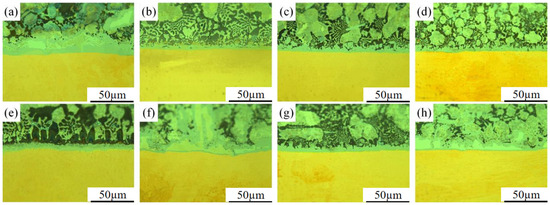
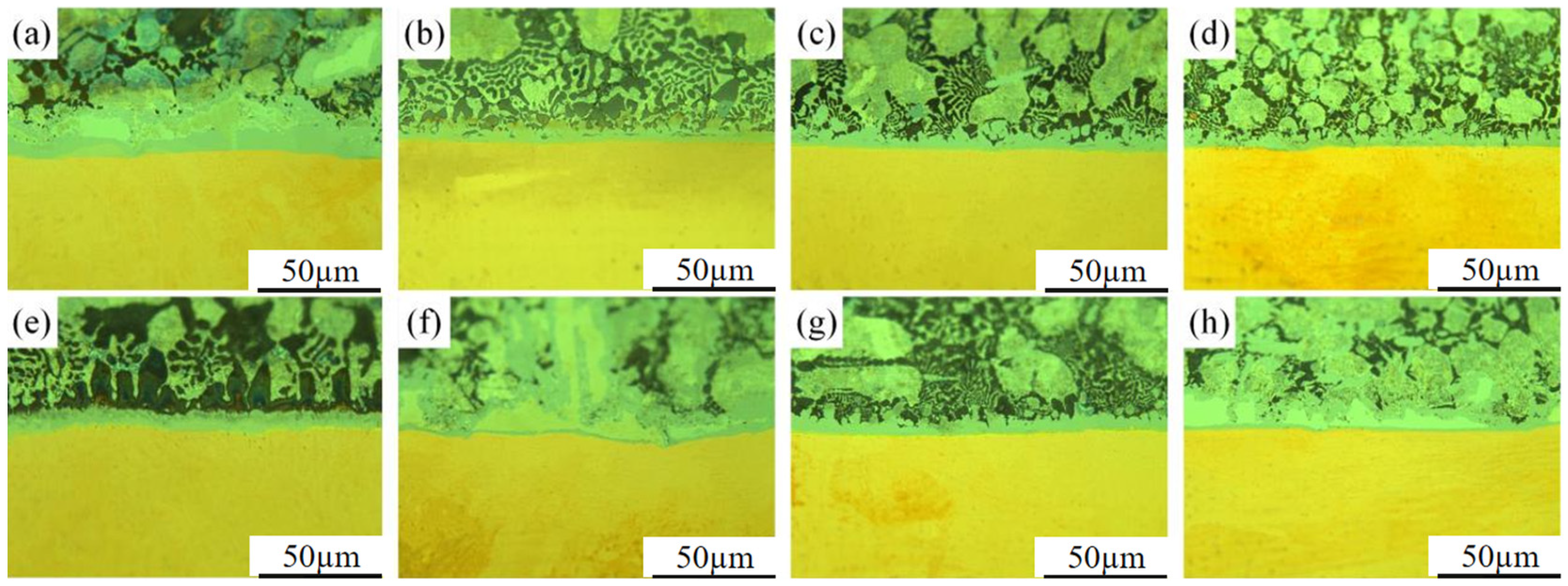
The microstructure of the Cu-side interface under gradient heat treatment is presented in Figure 6. The scale bars have been enlarged and highlighted for clear observation. The Cu-side interface consists of a bamboo-shoot-like gradient reaction layer (mainly Al-rich phase) and a thin Cu-Zn intermetallic compound layer adjacent to the Cu substrate.
Figure 6.
Microstructure of Cu-side interface of Cu/Al brazed joint at different heat treatment temperatures: (a) Microstructure of the joint without heat treatment at room temperature; (b–h) microstructures of the weld in the joint after heat treatment at 55 °C, 70 °C, 100 °C, 150 °C, 200 °C, 250 °C, and 300 °C, respectively.
The Cu-side interfacial structure exhibits mild and controllable morphological evolution with increasing heat treatment temperature. The bamboo-shoot-like interfacial features show slight rounding, and no brittle phase coarsening, cavity formation, or interfacial delamination is observed across all temperatures. The interfacial structure remains dense and continuous, which is further supported by the non-monotonic but recoverable microhardness evolution at the Cu-side interface (Table 8). Quantitative thickness measurement of the interfacial layer is not available due to the unavailability of original specimens.
These limited and mild morphological changes confirm that heat treatment within 55–300 °C causes no harmful structural deterioration or brittle phase coarsening at the Cu-side interface. The interfacial region remains dense and tightly bonded, which is consistent with the stable and recoverable microhardness evolution shown in Table 8. Quantitative thickness measurement of the CuZn interfacial layer is not available due to the unavailability of original specimens.
3.3. Effect of Heat Treatment on the Microhardness of the Cu/Al Brazed Joint
The microhardness values at each location of the Cu/Al brazed joint under different heat treatment temperatures are shown in Table 8. All data are presented as mean values ± standard deviation (SD) from five parallel measurements to ensure statistical reliability and repeatability. The results show that the microhardness of the Al matrix (70–75 HV 0.025) and Cu matrix (45–53 HV 0.025) remains stable with small standard deviations (1.8–2.3 HV), indicating high measurement repeatability. The small standard deviations confirm the high reliability of the microhardness results.
The microhardness of the Al-side interface (180–210 HV 0.025) and Cu-side interface (99–112 HV 0.025) only has slight fluctuations with the increase in heat treatment temperature, which is consistent with the interface microstructure evolution law: the Al-side interface is structurally stable, and the Cu-side interface only has slight morphological changes, so the interfacial hardness does not change significantly.
The microhardness of the weld seam center shows a non-monotonic variation with increasing heat treatment temperature. From 25 °C to 100 °C, the hardness increases from 130.5 HV to 156.3 HV due to precipitation of fine Zn-Al-Cu ternary compounds and elemental homogenization. From 100 °C to 250 °C, the hardness slightly decreases to 143.2 HV due to mild grain coarsening that reduces grain boundary strengthening. From 250 °C to 300 °C, the hardness increases sharply to 176.5 HV due to significant growth and coarsening of high-hardness Cu-Al intermetallic compounds and Zn-Al-Cu ternary compounds. This non-monotonic trend arises from the competition between precipitation hardening and grain coarsening during heat treatment.
Meanwhile, the microhardness at the Cu-side interface also presents a noticeable non-monotonic tendency. The hardness decreases from 111.4 HV in the as-brazed state to approximately 99.8–100.2 HV at 70–200 °C, and then rebounds to 112.2 HV at 300 °C. This behavior can be interpreted by interfacial microstructure evolution: First, the initial decrease is attributed to the release of residual stress introduced during ultrasonic brazing and mild coarsening of the thin CuZn interfacial layer, which reduces the dispersion strengthening effect. Second, the hardness recovery at 300 °C results from elemental homogenization, moderate re-precipitation of Zn-rich and Cu-rich fine phases, and structural maturation of the interfacial layer. No excessive or brittle thickening of the intermetallic layer occurs, so the hardness returns to a level comparable to the as-brazed state.
The microhardness at the Al-side interface remains stable at 206–211 HV from 25 °C to 250 °C. However, it decreases significantly to 186.5 HV at 300 °C, representing a reduction of approximately 11.5% compared with the as-brazed condition. This notable drop is supported by quantitative microstructural evolution:
- (1)
- The Al-side interfacial layer thickness remains constant at ~22.6 μm, indicating no excessive growth of brittle intermetallic compounds.
- (2)
- Prolonged heating at 300 °C leads to obvious grain coarsening in the interfacial region, reducing grain boundary strengthening.
- (3)
- Residual stress relaxation introduced during ultrasonic brazing further softens the interface zone. These quantitative microstructural changes are responsible for the significant decrease in Al-side interface microhardness at 300 °C.
In addition, the hardness of the Cu matrix remains stable at 50.2–52.8 HV from 25 °C to 250 °C, but decreases significantly to 46.2 HV at 300 °C. This obvious softening is attributed to thermal recovery and slight recrystallization in the pure copper substrate. Ultrasonic brazing introduces residual stress and high dislocation density in the Cu base metal, and heating at 300 °C promotes stress relief, dislocation annihilation, and microstructure relaxation, thereby lowering the hardness. This indicates a measurable microstructural relaxation in the Cu matrix, rather than complete retention of the initial microstructure.
3.4. Effect of Heat Treatment on the Thermal Properties of Cu/Al Brazed Joint
The thermophysical properties of the Cu/Al brazed joint under different heat treatment temperatures were analyzed. The overall variation laws are: the thermal diffusivity of the joint decreases continuously with increasing heat treatment temperature, while the thermal conductivity shows an overall increasing trend. The improvement in thermal conductivity is attributed to microstructural coarsening, compositional homogenization, and reduced grain boundary scattering.
Thermal diffusivity and thermal conductivity were measured using the laser flash method according to ASTM E1461-22 [33]. Specimens were processed into Φ12.7 mm × 2 mm discs with polished parallel surfaces. Thermal conductivity (λ) was calculated by the formula λ = αρcp, where α = thermal diffusivity, ρ = density, and cp = specific heat capacity. Each value was averaged from three independent tests.
The thermal conductivity of metal materials is mainly determined by electron and phonon scattering, and grain boundaries, phase boundaries, element segregation and other defects in the material are the main factors causing electron and phonon scattering, which reduce thermal conductivity. The improvement in the thermal conductivity of the Cu/Al brazed joint after heat treatment is essentially attributed to the microstructure optimization and defect reduction in the weld seam under thermal action:
- (1)
- With the increase in heat treatment temperature, elemental diffusion in the weld seam is intensified, the composition of each phase tends to be homogeneous, and element segregation at grain boundaries is reduced, which weakens electron scattering caused by composition inhomogeneity;
- (2)
- The coalescence and coarsening of the weld seam microstructure lead to a decrease in the number of grain boundaries and phase boundaries, which reduces the scattering of electrons and phonons at interfaces, effectively reducing heat transfer resistance;
- (3)
- The slight morphological change in the Cu-side interface and the stable Al-side interface ensure the smooth transfer of heat at the interface, and avoid the increase in interfacial thermal resistance caused by phase coarsening or separation.
The thermal diffusivity decreases with increasing heat treatment temperature. This trend arises from the combined evolution of thermal conductivity, microstructure, and phase composition in the joint.
3.5. Intrinsic Relationship of Heat Treatment–Microstructure–Thermal Properties
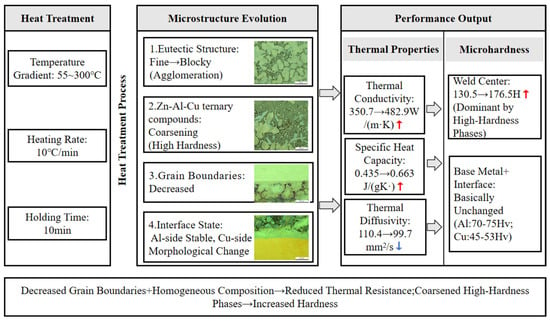
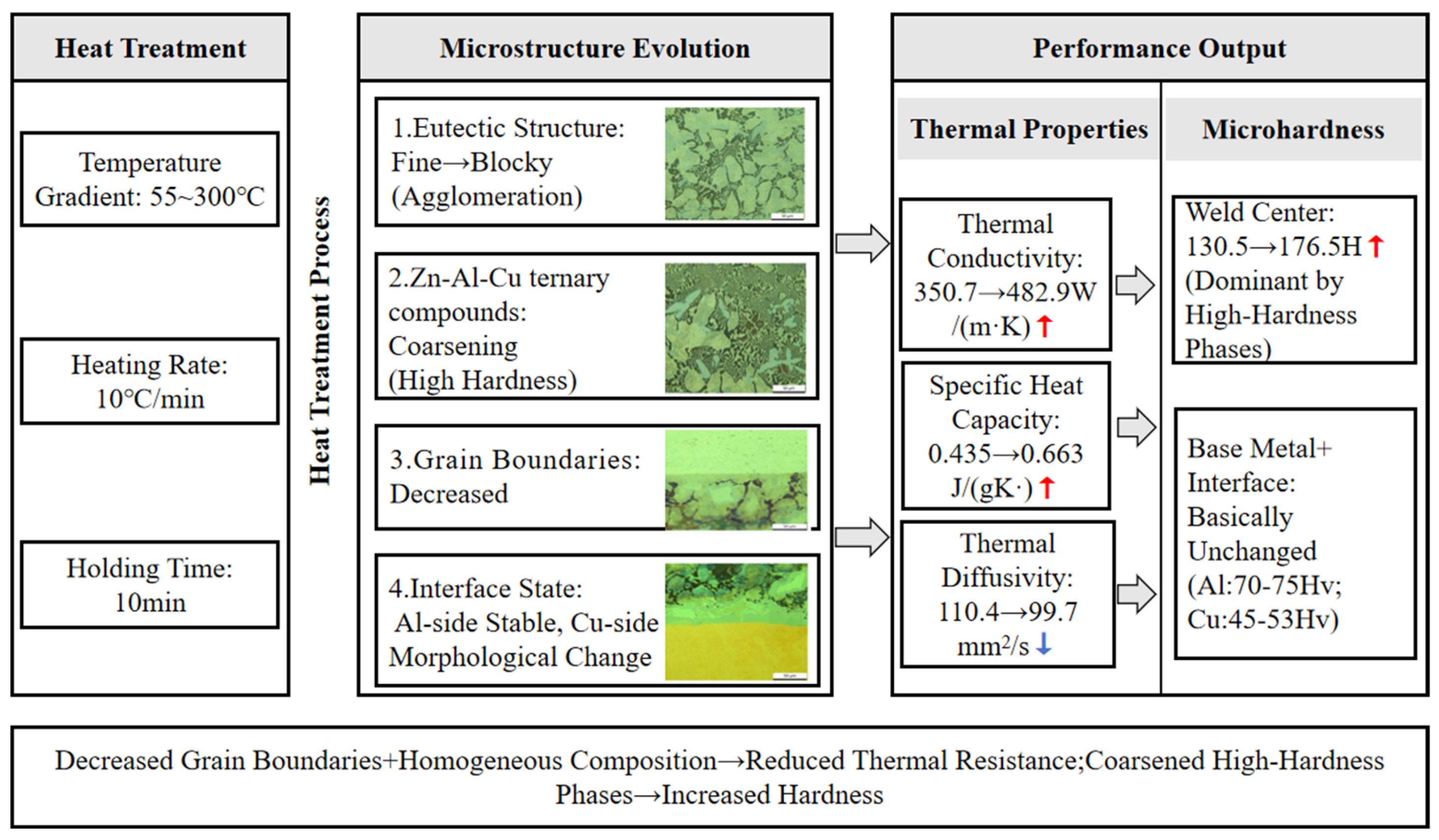
Based on the above research results, the intrinsic relationship of heat treatment–microstructure–thermal properties of the ultrasonically brazed Cu/Al joint is established, as shown in Figure 7. The heat treatment temperature is the core driving factor, which controls the microstructure evolution of the joint by regulating atomic diffusion and grain growth behavior, and then determines the thermal properties and microhardness of the joint:
Figure 7.
Schematic diagram of the intrinsic relationship among heat treatment, microstructure and thermal properties of ultrasonically brazed Cu/Al joint.
- ➀
- Heat treatment → Microstructure evolution: Thermal energy at 55–300 °C promotes the diffusion of Al, Cu and Zn atoms in the weld seam, leading to the aggregation of the eutectic structure, coarsening of Zn-Al-Cu ternary intermetallic compounds (Zn-Al-Cu ternary intermetallic compounds), a decrease in grain boundaries and homogenization of composition; the Al-side interface is structurally stable, and the Cu-side interface has slight morphological changes.
- ➁
- Microstructure evolution → Microhardness change: The competitive effects of precipitation hardening and grain coarsening of high-hardness Zn-Al-Cu ternary intermetallic compounds lead to a non-monotonic variation in the microhardness of the weld seam center; the stable matrix and interface microstructure make the hardness of the base metal and interface basically unchanged.
- ➂
- Microstructure evolution → Thermal properties change: The decrease in grain boundaries/phase boundaries and the homogenization of composition reduce the heat transfer resistance of the weld seam, and the stable interface ensures smooth heat transfer, so the thermal conductivity of the joint is significantly improved.
This intrinsic relationship clarifies the regulation mechanism of heat treatment on the performance of Cu/Al brazed joints and provides a theoretical basis for the performance optimization of Cu/Al composite heat dissipation components by the heat treatment process. In actual engineering application, the heat treatment temperature can be adjusted according to the service requirements of heat dissipation components: if high thermal conductivity is required, heat treatment can be carried out at a higher temperature (250–300 °C); if a balance between thermal conductivity and thermal diffusivity is required, medium-temperature heat treatment (100–200 °C) is optional.
4. Conclusions
In this study, flux-free ultrasonic brazing of 6061 aluminum alloy and industrial pure copper was realized with Zn-based filler metal, and the effect of gradient heat treatment (55–300 °C) on the microstructure, microhardness and thermal properties of Cu/Al brazed joints was systematically investigated. The key conclusions are as follows:
- ➀
- Under optimized ultrasonic brazing conditions (brazing temperature of 430 °C, ultrasonic amplitude of 12 μm, ultrasonic action time of 20 s), high-quality as-brazed Cu/Al joints are prepared with a 100% filling rate and 97.3% bonding rate. The weld microstructure is homogeneous, mainly composed of Zn solid solution, Cu solid solution, and Al-Cu-Zn ternary intermetallic compounds, with no coarse brittle compounds formed at the interface; the average shear strength of the joint reaches 95.24 MPa, showing excellent mechanical bonding performance. Fractographic analysis is not performed because fractured shear specimens are not retained.
- ➁
- No new bulk phases or obvious phase transformations are observed by OM and SEM after heat treatment at 55–300 °C, while atomic diffusion and grain growth are promoted, leading to the coalescence and coarsening of the weld microstructure, a decrease in grain boundaries and homogenization of composition.
- ➂
- The microhardness of the Al matrix and Cu matrix shows no significant changes with increasing heat treatment temperature; the microhardness of the Al-side and Cu-side interfaces exhibits only slight fluctuations; the microhardness of the weld seam center presents a non-monotonic variation, which is governed by the competitive effects of precipitation hardening and grain coarsening of high-hardness Zn-Al-Cu ternary intermetallic compounds during heat treatment.
- ➃
- With rising heat treatment temperature, the joint exhibits an overall increasing trend (non-monotonic) in thermal conductivity and a continuous decreasing trend in thermal diffusivity. The improvement is attributed to reduced grain boundaries and compositional homogenization, which lower electron and phonon scattering.
- ➄
- The intrinsic relationship of heat treatment–microstructure–thermal properties of the ultrasonically brazed Cu/Al joint is established: heat treatment regulates atomic diffusion and grain growth to realize the microstructure evolution of the joint, and the optimized microstructure further improves the microhardness and thermal conductivity of the joint. Shear strength and mechanical performance evolution are only characterized for the as-brazed state; no mechanical testing is performed on heat-treated specimens due to complete consumption of samples during other characterizations.
This study clarifies the process–microstructure–performance correlation of Cu/Al ultrasonic brazing, and the research results have important engineering application value for the manufacturing, performance optimization and long-term service reliability of Cu/Al composite heat dissipation components in high-power electronic devices. In follow-up research, long-term heat treatment aging tests, cyclic thermal shock tests, and post-heat-treatment mechanical performance tests can be carried out to further study the service performance evolution of Cu/Al brazed joints under actual thermal management working conditions, and provide more comprehensive technical support for the engineering application of the joints.
Author Contributions
Conceptualization, M.-J.X., P.-F.W., L.G., Y.-F.B. and Z.C.; Methodology, M.-J.X., P.-F.W., L.G., Y.-F.B. and Z.C.; Validation, M.-J.X.; Formal analysis, M.-J.X. and Y.-F.B.; Investigation, M.-J.X., P.-F.W., L.G. and Y.-F.B.; Data curation, M.-J.X., L.G., Y.-F.B. and Z.C.; Writing—original draft, M.-J.X., Y.-F.B. and Z.C.; Writing—review and editing, P.-F.W., L.G. and Y.-F.B.; Visualization, L.G. and Z.C.; Supervision, P.-F.W. and Y.-F.B.; Project administration, M.-J.X., Y.-F.B. and Z.C.; Funding acquisition, P.-F.W. All authors have read and agreed to the published version of the manuscript.
Funding
This research received no external funding.
Data Availability Statement
The original contributions presented in this study are included in the article. Further inquiries can be directed to the corresponding author.
Conflicts of Interest
Authors Ming-Jun Xie, Peng-Fei Wang and Lin Gao were employed by the company The 54th Research Institute of China Electronics Technology Group Corporation. The remaining authors declare that the research was conducted in the absence of any commercial or financial relationships that could be construed as a potential conflict of interest.
References
- He, Y.H.; Su, X.C.; Zhao, L. Research progress on active thermal management of power battery. J. Tsinghua Univ. (Sci. Technol.) 2025, 65, 1805–1820. [Google Scholar]
- Ma, H.; Fang, F.; Chen, Q.; Li, F.; Li, Y.; Fei, Q. Analysis and prospect on thermal protection and thermal management technologies of aerospace vehicles. Aerosp. Technol. 2023, 1, 98–106. [Google Scholar]
- Hu, S.; Xie, Y.; Wang, S.; Meng, X.; Huang, Y. Hybrid channeling of Cu–Al cold plates for thermal management devices. China Weld. (Engl. Ed.) 2024, 33, 1–6. [Google Scholar]
- Lunn, K.F.; Apelian, D. Thermal and Electrical Conductivity of Aluminum Alloys: Fundamentals, structure-property relationships, and pathways to enhance conductivity. Mater. Sci. Eng. A 2025, 924, 147766. [Google Scholar] [CrossRef] [Scilit]
- Ding, F.; Huan, Z.; Huang, J.; Li, Y.; Xie, Y. Ultrasonic assisted SiO2 nanoparticles strengthened Al/Cu plasma arc fusion brazing welding process. J. Mater. Eng. 2025, 53, 133–141. [Google Scholar]
- Bhadra, R.; Banerjee, S.; Mondal, A.K.; Kirtania, S.; Kashyap, S.; Gogoi, S.; Mushahary, S. Numerical modeling of dynamic heat flow behaviour during friction stir welding of Al-Cu alloy. Int. J. Interact. Des. Manuf. 2025, 19, 4025–4040. [Google Scholar] [CrossRef] [Scilit]
- Dai, J.; Yu, B.; Yang, L.; Zhang, Y. Microstructure and Mechanical Properties of Ultrasonically Assisted Brazing of Dissimilar Cu–Al Alloys. Sci. Adv. Mater. 2020, 12, 733–739. [Google Scholar] [CrossRef] [Scilit]
- Liang, Y.; Pan, J.; Zhang, H.; Huang, P.; Wang, J.; Shi, Y.; Chen, L. Ultrasonic-assisted semi-solid forming method and microstructure evolution of aluminum/copper brazed joints. Metals 2020, 10, 223. [Google Scholar] [CrossRef] [Scilit]
- Yang, J.W.; Xie, C.H.; Zhang, J.; Ding, Z.Y. An atomic insight into effect of grain boundary on diffusion behavior of Cu/Al dissimilar materials undergoing ultrasonic welding. J. Iron Steel Res. Int. 2024, 31, 2555–2567. [Google Scholar] [CrossRef] [Scilit]
- Dong, Y.X.; Chen, H.; Zhang, R.P.; Fu, Q.S.; Qiao, Y.D.; Zhao, J.Q.; Chen, J.G.; Liu, C.; Zhou, Y.F. Overwhelming oxide films fragmentation and interfacial reaction mechanisms in ultrasonic-assisted brazing of Al-foam/Cu using semi-molten Zn–14Al filler. J. Mater. Res. Technol. 2025, 38, 3990–4004. [Google Scholar] [CrossRef] [Scilit]
- Xiao, Y.; Ji, H.; Li, M.; Kim, J.; Kim, H. Microstructure and joint properties of ultrasonically brazed Al alloy joints using a Zn-Al hypereutectic filler metal. Mater. Des. 2013, 47, 717–724. [Google Scholar] [CrossRef] [Scilit]
- Zhao, D.; Li, D.; Xiao, Y.; Li, M.; Chen, W. Acoustic cavitation-induced microstructure evolution in ultrasonically brazed Al/Cu joints using Zn-Al alloy fillers. Ultrason. Sonochem. 2024, 109, 107001. [Google Scholar] [CrossRef] [Scilit]
- Huang, S.; Long, W.; Lu, Q.; Jiu, Y.; Zhong, S.; Bao, L.; Zhao, Y. Research on the corrosion resistance of Cu-Al joints brazed with flux-cored Zn-2Al filler metal. Mater. Res. Express 2019, 5, 056560. [Google Scholar] [CrossRef] [Scilit]
- Nishikawa, S.; Arayashiki, T.; Takahashi, M.; Chiba, J.; Nogami, M. Effect of Interfacial Microstructure on Mechanical Properties of Cold Pressure-Welded Al-Cu Joints Subjected to Annealing. J. Mater. Eng. Perform. 2021, 30, 7386–7396. [Google Scholar] [CrossRef] [Scilit]
- Zhao, Y.Q.; You, J.; Qin, J.C.; Dong, C.L.; Liu, L.; Liu, Z.; Miao, S. Stationary shoulder friction stir welding of Al–Cu dissimilar materials and its mechanism for improving the microstructures and mechanical properties of joint. Mater. Sci. Eng. A 2022, 837, 142754. [Google Scholar] [CrossRef] [Scilit]
- Tsakiris, V.; Kappel, W.; Alecu, G. Solid state diffusion welding of Cu-Fe/Al/Ag and Al-Ni dissimilar metals. J. Optoelectron. Adv. Mater. 2011, 13, 1176–1180. [Google Scholar]
- Chen, S.Y.; Wu, Z.W.; Liu, K.X.; Li, X.J.; Luo, N.; Lu, G.X. Atomic diffusion behavior in Cu-Al explosive welding process. J. Appl. Phys. 2013, 113, 044901. [Google Scholar] [CrossRef] [Scilit]
- Zhang, M.; Xue, S.; Ji, F.; Lou, Y.; Wang, S. Effect of CuAl2 phase on properties and microstructure of Cu/Al brazed joint. Trans. China Weld. Inst. 2011, 32, 93–96. [Google Scholar]
- Xiao, Y.; Ji, H.J.; Li, M.Y.; Kim, J. Ultrasound-Assisted Brazing of Cu/Al Dissimilar Metals Using a Zn-3Al Filler Metal. Mater. Des. 2013, 52, 704–747. [Google Scholar] [CrossRef] [Scilit]
- Mathivanan, K.; Plapper, P. Correlation of optical signal during laser fusion welding of copper to aluminum. J. Laser Appl. 2021, 33, 012037. [Google Scholar] [CrossRef] [Scilit]
- Zhao, P.; Li, Z.; Xia, Y.; Xu, Z.; Leng, X.; Yan, J. Ultrasonic-assisted liquid phase diffusion bonding of Al alloys under low temperature and pressure for high-temperature resistance applications. Mater. Des. 2023, 225, 111544. [Google Scholar] [CrossRef] [Scilit]
- Ramlow, H.; Ghasemi-Tabasi, H.; Burn, A.; Bayer, M.H.; Blugan, G. Joining alumina to metals: Technologies, challenges, and future prospects for high-performance structures. J. Eur. Ceram. Soc. 2025, 45, 117464. [Google Scholar] [CrossRef] [Scilit]
- Gu, X.; Liu, D.; Liu, J. Effect of Post-weld Heat Treatment on the Dissimilar Cu/Al Joints Produced by High Power Ultrasonic Spot Welding. Weld. Join. 2018, 58, 1721–1726. [Google Scholar]
- Wang, B.; Liu, P.; Liu, X.-K.; Wang, Z.-Y.; Wang, Y.-Y.; Chen, X.-H. Microstructures and mechanical properties of Cu/Al compound materials during thermal cycle. Rare Met. 2022, 41, 3911–3918. [Google Scholar] [CrossRef] [Scilit]
- Zhang, A.; Li, Y. Thermal conductivity of aluminum alloys—A review. Materials 2023, 16, 2972. [Google Scholar] [CrossRef] [Scilit] [PubMed]
- Zhang, J.; Peng, J. A review on aluminum alloy conductors influenced by alloying elements and thermomechanical treatments: Microstructure and properties. J. Mater. Res. 2023, 38, 1488–1509. [Google Scholar] [CrossRef] [Scilit]
- Zhang, A.; Li, Y. Effect of alloying elements on thermal conductivity of aluminium. J. Mater. Res. 2023, 38, 2049–2058. [Google Scholar] [CrossRef] [Scilit]
- Kumar, N.M.S.; Dhruthi; Pramod, G.K.; Samrat, P.; Sadashiva, M. A Critical Review on Heat Treatment of Aluminium Alloys. Mater. Proc. 2022, 58, 71–79. [Google Scholar]
- Zhang, L.; Long, W.; Du, D.; Fan, Z.; Jiang, C.; Jin, X. A Novel Diamond/AlSi Composite Coating on Ti-6Al-4V SubStrate Made by Ultrasonic-Assisted Brazing. Coatings 2023, 13, 1596. [Google Scholar] [CrossRef] [Scilit]
- Shawon, A.R.; Ghosh, R.; Islam, M.A. Analysis of thermal conductivity of aluminum alloys by compositions and tempering process using machine learning. Sci. Rep. 2025, 15, 33352. [Google Scholar] [CrossRef] [Scilit] [PubMed]
- GB/T 11361-2022; Metallic Materials—Shear Test Method for Brazed Joints. Standards Press of China: Beijing, China, 2022.
- E384-23; Standard Test Method for Microhardness of Materials. ASTM International: West Conshohocken, PA, USA, 2023.
- ASTM E1461-22; Standard Test Method for Thermal Diffusivity by Laser Flash Method. ASTM International: West Conshohocken, PA, USA, 2022.

Disclaimer/Publisher’s Note: The statements, opinions and data contained in all publications are solely those of the individual author(s) and contributor(s) and not of MDPI and/or the editor(s). MDPI and/or the editor(s) disclaim responsibility for any injury to people or property resulting from any ideas, methods, instructions or products referred to in the content. |
© 2026 by the authors. Licensee MDPI, Basel, Switzerland. This article is an open access article distributed under the terms and conditions of the Creative Commons Attribution (CC BY) license.