Hybrid Thermo-Vibrational Welding with Active Cooling for Preheat-Free Joining of Martensitic 15Kh5M Steel: Microstructural Refinement and Heat-Affected Zone Control


 and
and
Abstract
1. Introduction
2. Materials and Methods
2.1. Material Preparation
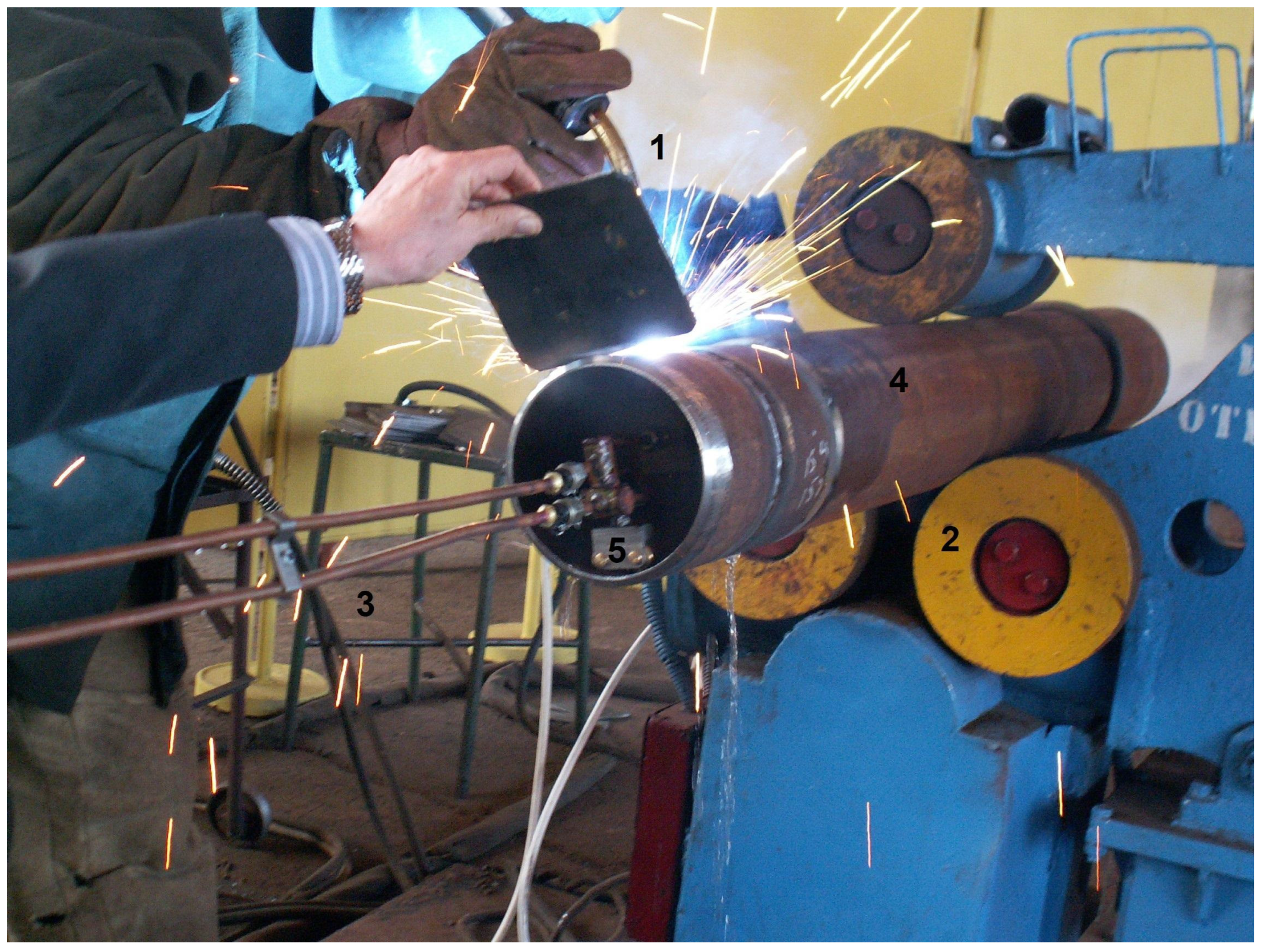
2.2. Welding Procedures and Parameters
2.3. Vibro-Treatment Setup
2.4. Forced Cooling Technique
- Nozzle slit length: 8–10 mm
- Air pressure: 0.25–0.30 MPa
- Water flow rate: 6–10 L/min
- Cooling zone width: 10–12 mm
2.5. Post-Weld Evaluation
2.6. Residual Stress Measurement
3. Results and Discussion
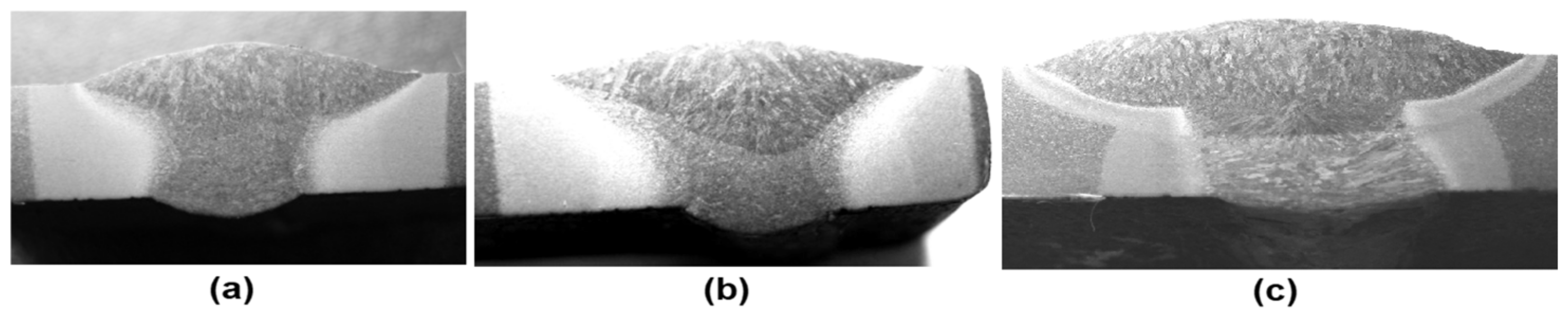
3.1. Macrostructural Observations
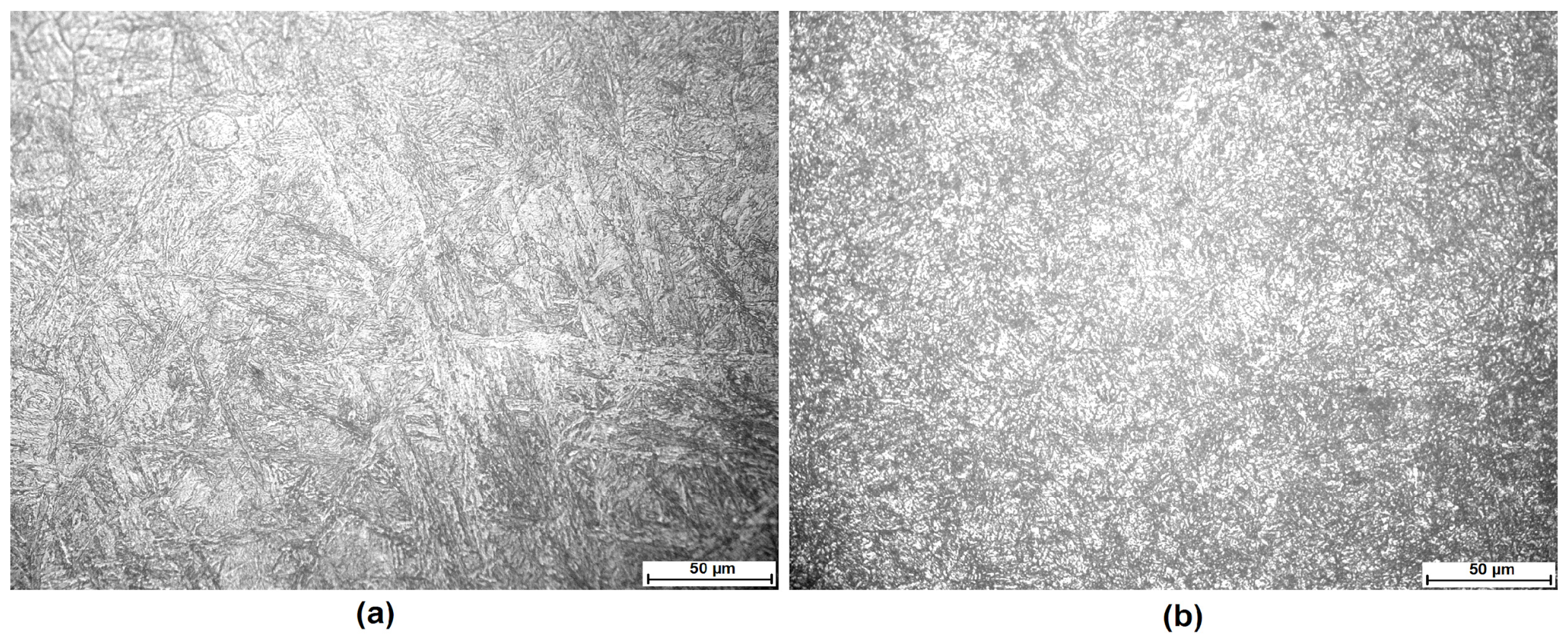
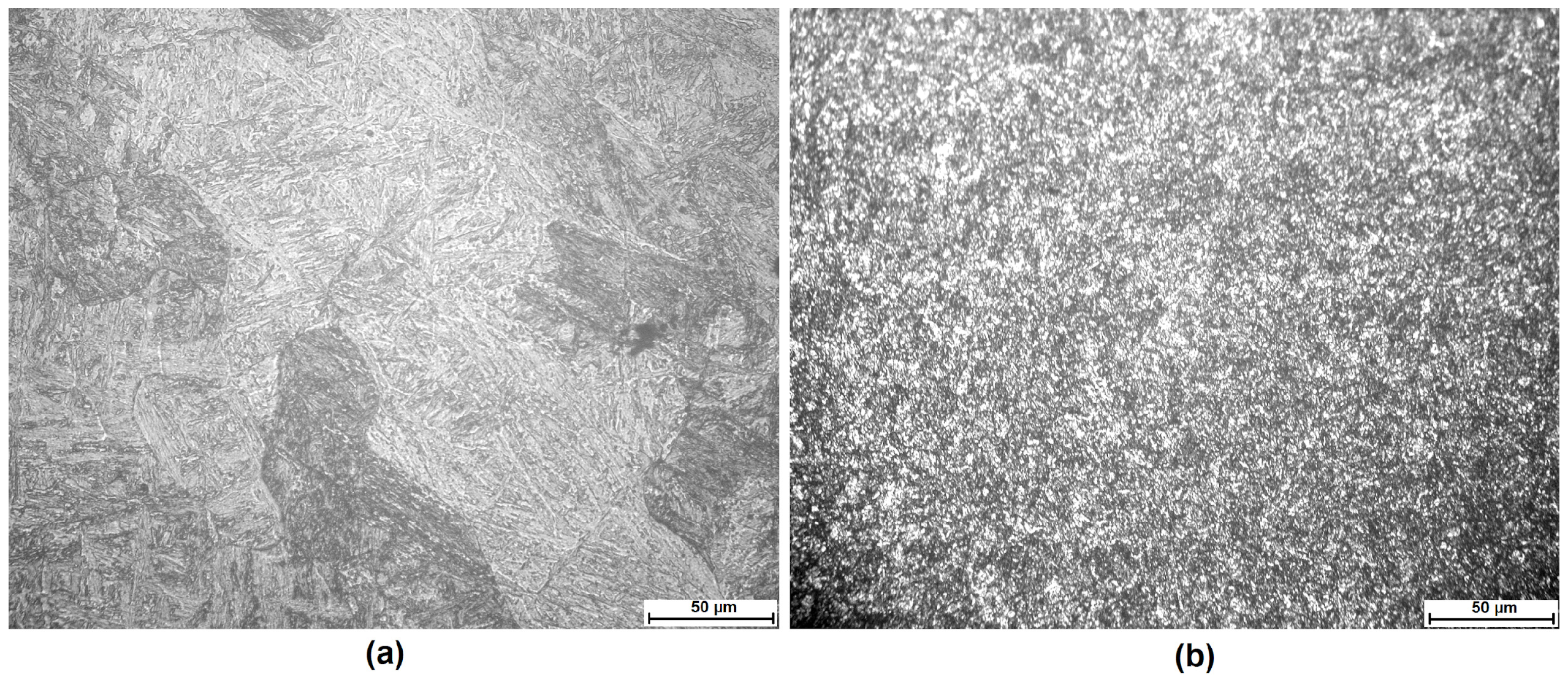
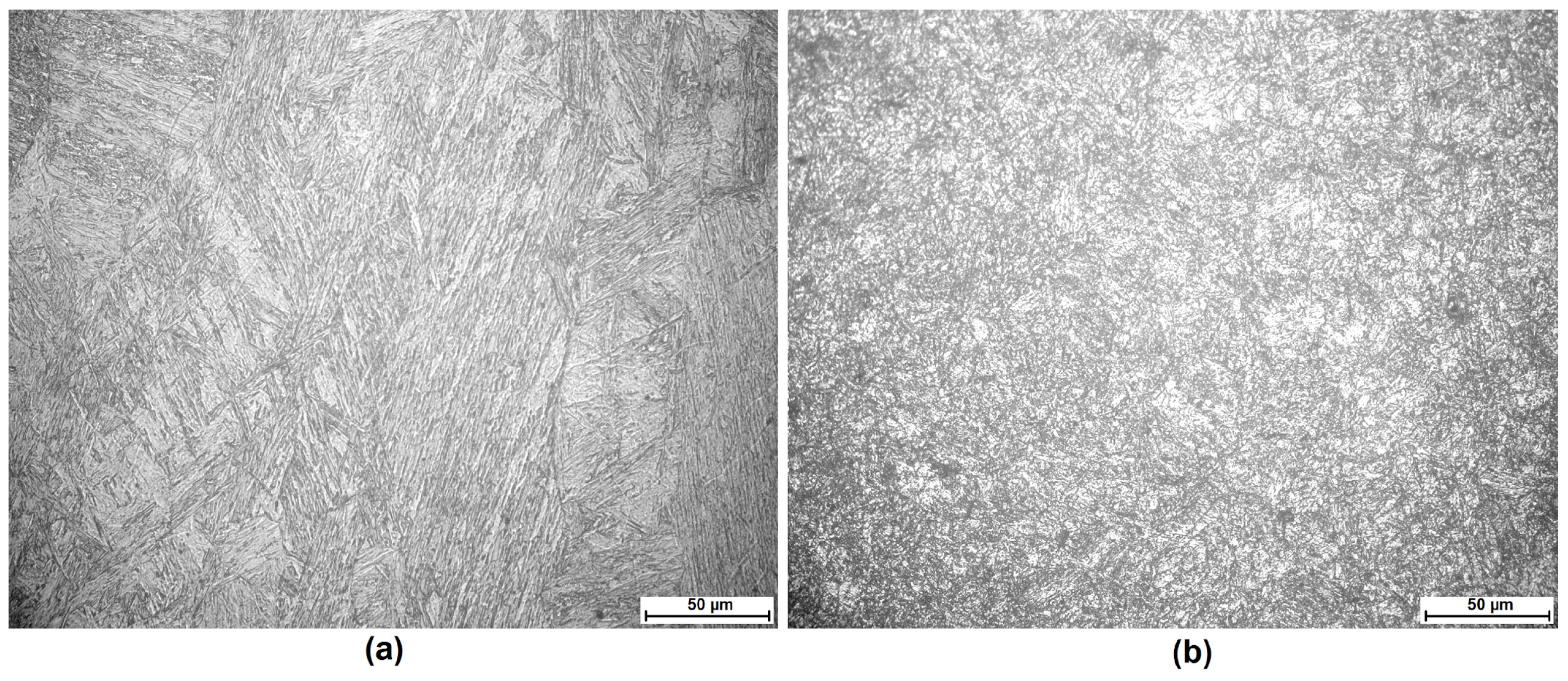
3.2. Microstructural Evolution
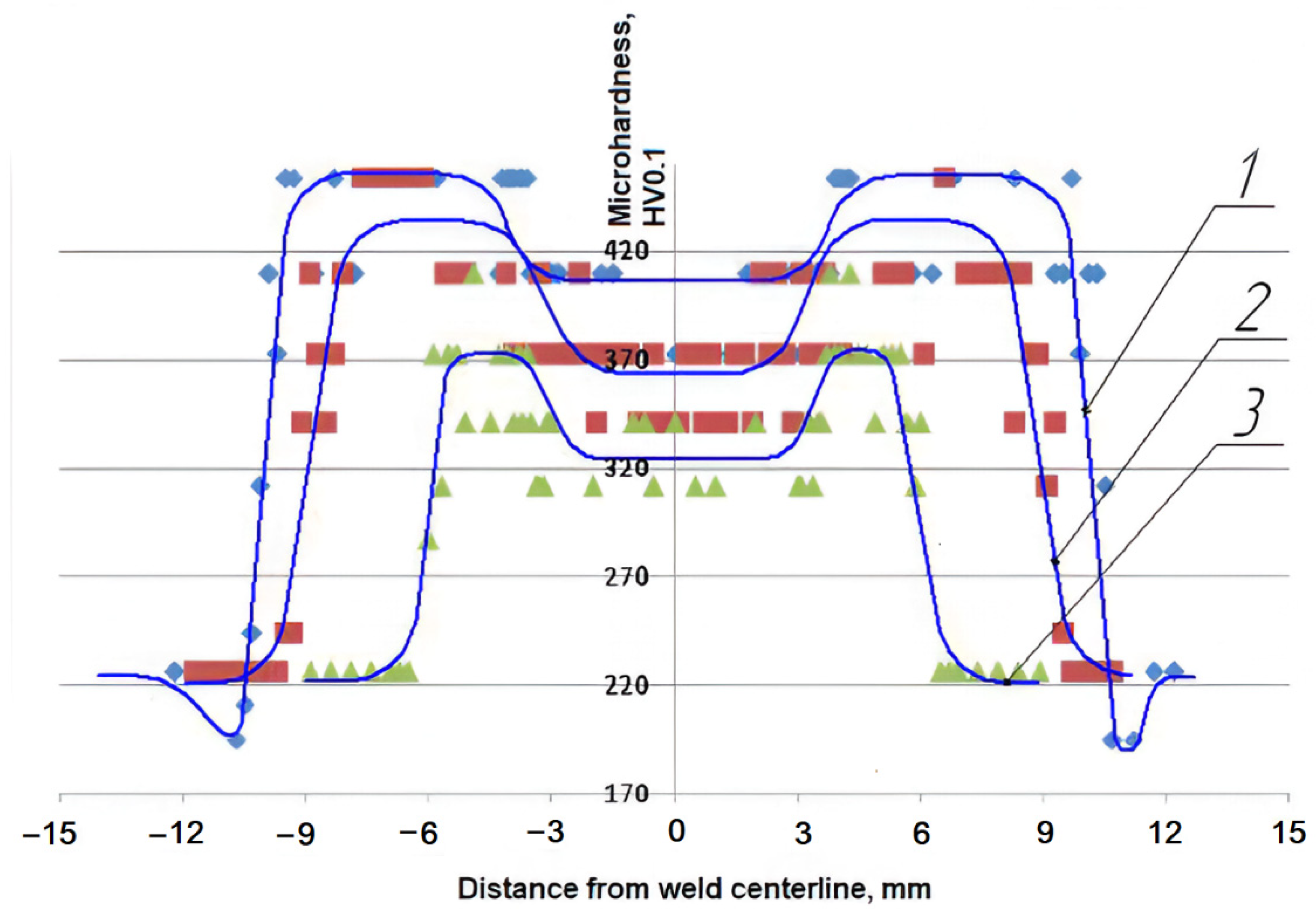
3.3. Microhardness Distribution
3.4. Residual Stress Distribution
3.5. Synergistic Effects and Industrial Implications
4. Conclusions
Author Contributions
Funding
Data Availability Statement
Conflicts of Interest
References
- Ranjan, R.; Cep, R.; Kumar, A.; Srivastava, M.; Altarazi, F.; Dogra, N.; Kumar, A.; Chand, S.; Samal, S.P. Comprehensive Review of Vibration-Assisted Welding Processes: Mechanisms, Applications, and Future Directions. Front. Mech. Eng. 2025, 11, 1550928. [Google Scholar] [CrossRef] [Scilit]
- Jose, M.J.; Kumar, S.S.; Sharma, A. Vibration Assisted Welding Processes and Their Influence on Quality of Welds. Sci. Technol. Weld. Join. 2016, 21, 243–258. [Google Scholar] [CrossRef] [Scilit]
- Lan, H.X.; Gong, X.F.; Zhang, S.F.; Wang, L.; Wang, B.; Nie, L.P. Ultrasonic Vibration Assisted Tungsten Inert Gas Welding of Dissimilar Metals 316L and L415. Int. J. Miner. Metall. Mater. 2020, 27, 943–953. [Google Scholar] [CrossRef] [Scilit]
- Rao, M.V.; Srinivasa, P.; Battula, S.; Potnuru, G. Effect of Vibratory Weld Conditioning on Residual Stresses and Weld Joint Properties: A Review. J. Manuf. Technol. Res. 2016, 8, 21–29. [Google Scholar]
- Radel, T. Thermal Impacts in Vibration-Assisted Laser Deep Penetration Welding of Aluminum. Phys. Procedia 2017, 89, 131–138. [Google Scholar] [CrossRef] [Scilit]
- Bhadeshia, H.K.D.H. Developments in Martensitic and Bainitic Steels: Role of the Shape Deformation. Mater. Sci. Eng. A 2004, 378, 34–39. [Google Scholar] [CrossRef] [Scilit]
- Łomozik, M.; Zeman, M.; Brózda, J. Modern Martensitic Steels for Power Industry. Arch. Civ. Mech. Eng. 2012, 12, 49–59. [Google Scholar] [CrossRef] [Scilit]
- Ennis, P.J.; Zielinska-Lipiec, A.; Wachter, O.; Czyrska-Filemonowicz, A. Microstructural Stability and Creep Rupture Strength of the Martensitic Steel P92 for Advanced Power Plant. Acta Mater. 1997, 45, 4901–4907. [Google Scholar] [CrossRef] [Scilit]
- Abe, F.; Tabuchi, M. Microstructure and Creep Strength of Welds in Advanced Ferritic Power Plant Steels. Sci. Technol. Weld. Join. 2004, 9, 22–30. [Google Scholar] [CrossRef] [Scilit]
- Bayoumi, M.R. Towards a prediction of the hardness of the heat-affected zone of steel weldments. J. Mater. Sci. 1991, 26, 2716–2724. [Google Scholar] [CrossRef] [Scilit]
- Seo, W.-C.; Bang, K.-S. Effects of Diffusible Hydrogen Content and Hardness on Cold Cracking in High Strength Weld Metal. J. Ocean Eng. Technol. 2012, 26, 33–38. [Google Scholar] [CrossRef] [Scilit]
- Yi, H.-J.; Lee, J.-Y.; Kim, J.-Y.; Kang, S.-S. Effect of Microstructure and Chemical Composition on Cold Crack Susceptibility of High-Strength Weld Metal. J. Mech. Sci. Technol. 2011, 25, 2185–2193. [Google Scholar] [CrossRef] [Scilit]
- Dong, C.; Li, X.; Liu, Z.-Y.; Zhang, Y.R. Hydrogen-Induced Cracking and Healing Behaviour of X70 Steel. J. Alloys Compd. 2009, 484, 966–972. [Google Scholar] [CrossRef] [Scilit]
- Tamaki, K.; Kawakami, H.; Suzuki, J.; Kondoh, T.; Morisawa, S. Influence of Conditions of SR Treatment on Low-Ductility Creep-Fracture in HAZ of Cr-Mo Steels—Study of Low-Ductility Creep-Fracture in HAZ of Cr-Mo Steels (Report 2). Q. J. Jpn. Weld. Soc. 1999, 17, 466–473. [Google Scholar] [CrossRef] [Scilit]
- Lancaster, J.F. Metallurgy of Welding, 6th ed.; Woodhead: Cambridge, UK, 1999. [Google Scholar]
- Kou, S. Welding Metallurgy, 2nd ed.; Wiley: Hoboken, NJ, USA, 2003. [Google Scholar]
- Ledermueller, C.; Pratiwi, H.I.; Webster, R.F.; Eizadjou, M.; Ringer, S.P.; Primig, S. Microalloying Effects of Mo versus Cr in HSLA Steels with Ultrafine-Grained Ferrite Microstructures. Mater. Des. 2020, 185, 108278. [Google Scholar] [CrossRef] [Scilit]
- Javidan, F.; Heidarpour, A.; Zhao, X.-L.; Hutchinson, C.R.; Minkkinen, J. Effect of Weld on the Mechanical Properties of High Strength and Ultra-High Strength Steel Tubes in Fabricated Hybrid Sections. Eng. Struct. 2016, 118, 16–27. [Google Scholar] [CrossRef] [Scilit]
- Tavares, S.S.M.; Rodrigues, C.R.; de Oliveira, C.A.S.; Woyames, C.B.; Dille, J. Influence of Heat Treatments on Microstructure and Toughness of 9%Ni Steel. J. Mater. Eng. Perform. 2018, 27, 1530–1536. [Google Scholar] [CrossRef] [Scilit]
- Li, X.L.; Jin, C.; Li, H.Z.; Hao, X.X.; He, Y.; Deng, X.T.; Wang, Z.D. Influence of Cooling Rate on Phase Transformation and Precipitation Behavior of Ti-Bearing Steel in Continuous Cooling Process. J. Iron Steel Res. Int. 2022, 29, 165–174. [Google Scholar] [CrossRef] [Scilit]
- Ji, G.; Fu, D.; Wang, G.; Guo, K.; Luo, X.; Chai, F.; Pan, T. Controlling M-A Constituents and Bainite Morphology for Enhanced Toughness in Isothermally Transformed Low-Carbon Ni-Cr-Mo Steel. Materials 2025, 18, 1945. [Google Scholar] [CrossRef] [Scilit]
- Tupaj, M.; Orłowicz, A.W.; Trytek, A.; Mróz, M.; Wnuk, G.; Dolata, A.J. The Effect of Cooling Conditions on Martensite Transformation Temperature and Hardness of 15% Cr Chromium Cast Iron. Materials 2020, 13, 2760. [Google Scholar] [CrossRef] [Scilit]
- Maisuradze, M.V.; Kuklina, A.A.; Ryzhkov, M.A.; Lebedev, D.I.; Antakov, E.V. Effect of Cooling Rate during Heat Treatment on Martensitic-Bainitic Class Alloy Steel Microstructure and Properties. Metallurgist 2022, 66, 895–908. [Google Scholar] [CrossRef] [Scilit]
- Duan, Y.; Hui, Y.; Lu, X.; Sheng, J.; Tang, X. Microstructure and Property of the Weld Heat-Affected Zone of T4003 Ferritic Stainless Steel with Different Mo Contents. Metals 2026, 16, 90. [Google Scholar] [CrossRef] [Scilit]
- GOST 20072–74; Heat-Resistant Steel. Specifications. The USSR Council of Ministers: Moscow, Russia, 1976.
- Ranjan, R.; Jha, S.K. Optimization of Welding Parameters and Microstructure Analysis of Low Frequency Vibration Assisted SMAW Butt Welded Joints. Int. J. Interact. Des. Manuf. 2024, 18, 1687–1707. [Google Scholar] [CrossRef] [Scilit]
- Fischer, S.; Harangozó, D.; Németh, D.; Kocsis, B.; Sysyn, M.; Kurhan, D.; Brautigam, A. Investigation of Heat-Affected Zones of Thermite Rail Weldings. Facta Univ. Ser. Mech. Eng. 2024, 22, 689–710. [Google Scholar] [CrossRef] [Scilit]
- Gu, Y.; Chen, X.-W.; Kang, H.-H.; Zhang, C.-G.; Wang, Z.-X.; Xiao, F.-R. Effects of Chemical Composition on Welding HAZ Softening of High-Strength Pipeline Steels. Metals 2025, 15, 1314. [Google Scholar] [CrossRef] [Scilit]
- Rhode, M.; Steger, J.; Boellinghaus, T.; Kannengiesser, T. Hydrogen Degradation Effects on Mechanical Properties in T24 Weld Microstructures. Weld. World 2016, 60, 201–216. [Google Scholar] [CrossRef] [Scilit]
- Cao, W.; Guo, B.; Wu, X. Research on the Influence of Welding Heat Source and Welding Speed on Welding Residual Stress and Temperature Field of H-Shaped Steel: A Numerical Simulation Study. Symmetry 2026, 18, 616. [Google Scholar] [CrossRef] [Scilit]
- Mostapha, H.; Benhorma, H.; Benchatti, A.; Souici, M.; Belkacm, B. The Characterization and Measurement of Residual Stress in Butt-Welded X70 Steel by DRX Diffraction Analyses. Tec. Ital.-Ital. J. Eng. Sci. 2018, 61+1, 162–165. [Google Scholar]
- Jurčius, A.; Valiulis, A.; Černašejus, O.; Kurzydłowski, K.J.; Jaskiewicz, A.; Lech-Grega, M. Influence of Vibratory Stress Relief on Residual Stresses in Weldments and Mechanical Properties of Structural Steel Joint. J. Vibroeng. 2010, 12, 133–141. [Google Scholar]
- Bin, Z.; Mohamed, O.; Koko, A.; Zhang, H.; Dluhoš, J.; Wang, Y.; Gorley, M.; Whiting, M.J.; Sui, T. Assessing Residual Stress and High-Temperature Mechanical Performance of Laser-Welded P91 Steel for Fusion Power Plant Components. J. Mater. Res. Technol. 2025, 35, 6341–6347. [Google Scholar] [CrossRef] [Scilit]
- Tkacheva, A.V.; Abashkin, E.E. Impact of Forced Cooling of the Joint Zone and Thermal Effect on the Distribution Values of Residual Stress Generated by Arc Welding. Mater. Phys. Mech. 2022, 50, 509–517. [Google Scholar] [CrossRef]
- Aoki, S.; Kurita, K.; Koshimizu, S.; Nishimura, T.; Hiroi, T.; Hirai, S. Probabilistic Evaluation of a Method for Reduction of Residual Stress in Welded Structure Using Vibration. Chem. Eng. Trans. 2013, 33, 1087–1092. [Google Scholar] [CrossRef] [Scilit]
- Paddea, S.; Francis, J.A.; Paradowska, A.M.; Bouchard, P.J.; Shibli, I.A. Residual Stress Distributions in a P91 Steel-Pipe Girth Weld before and after Post Weld Heat Treatment. Mater. Sci. Eng. A 2012, 534, 663–672. [Google Scholar] [CrossRef] [Scilit]
- Suo, L.; Ren, S.; Zhang, Y.; Deng, D.; Murakawa, H. Numerical Investigation of Formation Mechanism of Welding Residual Stress in P92 Steel Multi-Pass Joints. J. Mater. Process. Technol. 2017, 244, 240–252. [Google Scholar] [CrossRef] [Scilit]
- Kuo, C.-W.; Lin, C.-M.; Lai, G.-H.; Chen, Y.-C.; Chang, Y.-T.; Wu, W. Characterization and Mechanism of 304 Stainless Steel Vibration Welding. Mater. Trans. 2007, 48, 2319–2323. [Google Scholar] [CrossRef] [Scilit]
- Dmitriev, S.V.; Morkina, A.Y.; Tarov, D.V.; Khalikova, G.R.; Abdullina, D.U.; Tatarinov, P.S.; Tatarinov, V.P.; Semenov, A.S.; Naimark, O.B.; Khokhlov, A.V.; et al. Effect of repetitive high-density current pulses on plastic deformation of copper wires under stepwise loading. Spectr. Mech. Eng. Oper. Res. 2024, 1, 27–43. [Google Scholar] [CrossRef] [Scilit]



| Element | C | Si | Mn | Cr | Mo | Ni | S | P |
|---|---|---|---|---|---|---|---|---|
| Content | ≤0.15 | ≤0.50 | ≤0.60 | 4.5–6.0 | 0.45–0.60 | ≤0.30 | ≤0.025 | ≤0.030 |
| Bevel Prep and Layer Sequence | Tube D × s, mm | Welding Condition (Sample No.) | Layer | Current, A | Voltage, V |
|---|---|---|---|---|---|
 | Ø152 × 8 | Preheat 300–350 °C | 1 | 205–210 | 23–24 |
| 2–3 | 215–220 | 25–26 | |||
| Ø152 × 8 | No preheat, with vibro-treatment | 1 | 200–205 | 24–25 | |
| 2–3 | 220–240 | 25–26 | |||
| Ø152 × 8 | No preheat, vibro + cooling | 1 | 205–210 | 20–22 | |
| 2–3 | 220–230 | 24–26 |
| Treatment | Material/Steel Grade | Residual Stress, MPa (Fusion Line/HAZ) | Method | Source |
|---|---|---|---|---|
| Conventional GMAW with preheating (300–350 °C) | 15Kh5M martensitic Cr-Mo steel | +240 ± 20 (tensile, fusion line) | XRD (sin2ψ), Uran-100 | This work |
| Vibration-assisted GMAW, no preheating (50 Hz, 1 mm) | 15Kh5M martensitic Cr-Mo steel | +175 ± 22 (tensile, fusion line; ≈27% reduction) | XRD (sin2ψ), Uran-100 | This work |
| Hybrid thermo-vibrational GMAW with active water-air cooling | 15Kh5M martensitic Cr-Mo steel | –38 ± 15 (compressive, fusion line) | XRD (sin2ψ), Uran-100 | This work |
| Conventional arc welding (as-welded, no PWHT) | P91 (9Cr-1Mo) steel pipe girth weld | +320 to +450 (tensile peak at HAZ/BM boundary); compressive in weld metal (final pass) | Neutron diffraction | Ref. [36] |
| Arc welding, as-welded state (TIG/SMAW) | P92 (9Cr-2W) steel weldment | +380 to +600 (longitudinal tensile in fusion zone/HAZ); near-zero or compressive in weld metal | Neutron diffraction/hole-drilling | Ref. [37] |
| Arc welding, as-welded (GMAW/MIG) | X70 pipeline steel (high-strength ferritic) | +241 ± 17 (transverse tensile, HAZ); +260–300 (fusion line) | XRD (sin2ψ) | Ref. [31] |
| Subresonant vibratory weld conditioning (VSR, 39.4 Hz) applied post-weld | 304 stainless steel plate weld | 262 → 206 MPa (reduction ≈ 21%) | XRD | Ref. [38] |
| Local forced cooling of joint zone (water cooling behind arc) | Structural steel plate (arc welding) | 28–30% reduction in tensile RS in weld zone | XRD/strain gauges | Ref. [34] |
Disclaimer/Publisher’s Note: The statements, opinions and data contained in all publications are solely those of the individual author(s) and contributor(s) and not of MDPI and/or the editor(s). MDPI and/or the editor(s) disclaim responsibility for any injury to people or property resulting from any ideas, methods, instructions or products referred to in the content. |
© 2026 by the authors. Licensee MDPI, Basel, Switzerland. This article is an open access article distributed under the terms and conditions of the Creative Commons Attribution (CC BY) license.
Share and Cite
Fairushin, A.M.; Tumanova, E.Y.; Tokarev, A.S.; Mulyashova, N.B.; Ilalov, A.S.; Kanaeva, A.R.; Kazakov, A.M.; Korznikova, G.F. Hybrid Thermo-Vibrational Welding with Active Cooling for Preheat-Free Joining of Martensitic 15Kh5M Steel: Microstructural Refinement and Heat-Affected Zone Control. Metals 2026, 16, 499. https://doi.org/10.3390/met16050499
Fairushin AM, Tumanova EY, Tokarev AS, Mulyashova NB, Ilalov AS, Kanaeva AR, Kazakov AM, Korznikova GF. Hybrid Thermo-Vibrational Welding with Active Cooling for Preheat-Free Joining of Martensitic 15Kh5M Steel: Microstructural Refinement and Heat-Affected Zone Control. Metals. 2026; 16(5):499. https://doi.org/10.3390/met16050499
Chicago/Turabian StyleFairushin, Airat M., Elena Yu. Tumanova, Andrey S. Tokarev, Natalya B. Mulyashova, Azamat S. Ilalov, Alsu R. Kanaeva, Arseny M. Kazakov, and Galiia F. Korznikova. 2026. "Hybrid Thermo-Vibrational Welding with Active Cooling for Preheat-Free Joining of Martensitic 15Kh5M Steel: Microstructural Refinement and Heat-Affected Zone Control" Metals 16, no. 5: 499. https://doi.org/10.3390/met16050499
APA StyleFairushin, A. M., Tumanova, E. Y., Tokarev, A. S., Mulyashova, N. B., Ilalov, A. S., Kanaeva, A. R., Kazakov, A. M., & Korznikova, G. F. (2026). Hybrid Thermo-Vibrational Welding with Active Cooling for Preheat-Free Joining of Martensitic 15Kh5M Steel: Microstructural Refinement and Heat-Affected Zone Control. Metals, 16(5), 499. https://doi.org/10.3390/met16050499