


Abstract
The effects of mass fractions of ferric chloride (FeCl3) and oxalic acid (H2C2O4) in polishing slurry on the polishing of 304 stainless steel were studied. The stainless steel polishing experiments with different compositions of polishing liquids were designed, the material removal rate was calculated, the surface roughness value was measured, and the Fe2+ content in the polishing waste liquid was determined by spectrophotometry. The mechanism of FeCl3 on stainless steel polishing was investigated. The results indicated the existence of the reaction 2Fe3+ + Fe → 3Fe2+ during the polishing process; Fe3+ in the polishing slurry promoted the reaction and significantly increased the material removal rate; and the composition ratio of the FeCl3-H2C2O4 slurry for polishing 304 stainless steel was optimized. After optimization, the material removal rate achieved more than 200 nm/min, and the surface roughness after polishing was reduced to less than 10 nm. Qualitative analysis of the surface material of the polished 304 stainless steel with FeCl3 polishing slurry by XRD proved that the phase of the matter was basically unchanged. This experiment provides reference value for the preparation of polishing slurry for 304 stainless steel.
1. Introduction
Flexible displays, as a foreseeable disruptive technology leading a new revolution in technological innovation, have expanded into multiple fields such as smart terminals (foldable phones, rollable laptops), wearable devices, automobiles and transportation, healthcare, and public services, and are reshaping the boundaries of human–computer interaction [1,2,3]. Flexible displays do not simply “bend” the glass screen; instead, each layer needs to be flexible, including core electronic components such as flexible substrate materials, thin-film transistors (TFT), and organic light-emitting diodes (OLED), as well as key flexible packaging technologies [4,5,6]. Metallic materials, as substrates for flexible displays, possess unique advantages. When metallic materials are thinned to below 0.1 mm, they still maintain excellent flexibility and tear resistance. In addition, stainless steel substrates have high heat resistance (above 1000 °C, far superior to polymer materials such as PI, PET), excellent water vapor and oxygen barrier properties, low cost and accessibility, low electrostatic effect, and great prospects [7,8,9,10]. However, the rough surface of the foil cannot be used directly as a flexible substrate, otherwise it will affect the performance of the flexible display and reduce its lifespan. Therefore, solving the problem of surface roughness of stainless steel is a key factor for stainless steel foil to replace polymer or glass substrates for future flexible display substrates.
Chemical mechanical polishing (CMP) technology, which utilizes a combination of chemical and mechanical effects to achieve ultra-smooth and damage-free surface processing, is considered the best process method that can simultaneously meet the requirements of surface roughness and surface flatness. It has become one of the most practical technologies for achieving ultra-smooth and damage-free surface processing of metallic materials, brittle crystalline materials, and other materials [11,12,13,14,15,16]. Gunnerek et al. used CMP technology to polish 316L stainless steel. At a target removal of 110 µm, CMP could make the surface roughness (Sa) as low as 0.7 µm and no grain refinement was found, but the formation of a thin plastic deformation layer was observed [17]. Song et al. developed a novel polishing slurry containing silicon dioxide, samarium oxide, hydrogen peroxide, malic acid, and alanine. After polishing, the surface roughness Sa of 12Cr12Mo stainless steel reached 0.238 nm in the 50 × 50 μm2 scanning area, and the material removal rate was 75.26 nm/min [18]. Yin et al. used the chemical magnetic field-assisted batch polishing (CMABP) method to polish 316L stainless steel with oxalic acid–hydrogen peroxide polishing slurry. And they found that the chemical slurry was conducive to the formation of a weak bond layer on the stainless steel surface, which was easily mechanically removed, and the addition of the chemical components improved the polishing efficiency to a certain extent [19]. Hu et al. used colloidal silica as an abrasive during CMP and evaluated the material removal rates of different polishing slurrys. The polishing slurry containing oxidants with a pH value below 2.0 produced the highest removal rate of 150 nm/min, and the surface roughness was reduced from 13.6 nm before polishing to 0.7 nm after polishing. However, the study found that there were always microscopic defects of 1–2 μm in size on the polished surface [20]. Guo et al. used the active pressure correction polishing method to polish 316L stainless steel. By real-time monitoring and feedback control of the polishing pressure, the pressure was kept relatively stable during the polishing process. The wear of the polishing head was greater than that of the traditional polishing method. The diameter of the polishing head was only 10 mm, which limited the size of the workpiece and restricted mass production [21]. Liao et al. proposed a novel CMP process for FV520B steel and developed an environmentally friendly slurry that does not contain strong acids, strong bases, and harmful chemicals. The polishing slurry consisted of hydrogen peroxide, niacin, nonylphenol ethoxylate, and deionized water. With 15 g/L nicotinic acid crystal polishing slurry, the optimized process parameters were polishing pressure of 15 kPa, rotational speed of 70 rpm, abrasive size of 0.5 μm, abrasive concentration of 20 g/L, and a polishing duration of 30 min, achieving a smooth surface of FV520B steel with a surface roughness Ra of 5.7 nm [22]. Wurz et al. qualitatively described the investigations on the nano-hardness of NiFe affected by hydrochloric acid (HCl) and nitric acid (HNO3) used as liquid additives during a polishing process. It was found that the NiFe layer surface hardness substantially reduced by 2 GPa by exposure to a 10−3 molar solution of HCl or HNO3. Optimizing polishing fluids for the surface finishing process depended on the change in hardness [23].
Although considerable progress has been made in the aforementioned research, there is still a scarcity of studies focusing on stainless steel suitable for flexible displays. The surface planarization of stainless steel remains an urgent scientific challenge to be addressed. Previous studies on stainless steel CMP have primarily focused on improving surface quality and MRR using different polishing slurries and process parameters. However, these studies often involve complex slurry formulations or process conditions that may not be readily adaptable to large-scale industrial applications. Moreover, the underlying mechanisms governing the CMP process, particularly the role of specific chemical reagents in enhancing polishing efficiency, remain incompletely understood. The goal of this study is to obtain a 304 stainless steel processing technology with high processing efficiency and low surface roughness. In this study, the 304 stainless steel sheets were polished by chemical mechanical polishing method. The effects of ferric chloride (FeCl3) and oxalic acid (H2C2O4) on the material removal rate (MRR), surface roughness (Ra) value and surface quality of 304 stainless steel chemical mechanical polishing were investigated. Spectrophotometry was employed to analyze the chemical reactions and mechanisms of action during the polishing process. MRR and Ra values were adopted as evaluation indicators to obtain the optimized composition of the polishing slurry, and X-ray diffraction (XRD) diffraction analysis was used to explore the effect of the composition of the polishing slurry on the surface phase of stainless steel.
2. Materials and Methods
2.1. Experimental Samples
A number of 304 stainless steel sheets (0Cr18Ni9) with a diameter of 60 mm, a thickness of 2 mm and a mean hardness value 201.8 HV were used as test samples. Polishing slurry abrasive grains were W3.5 white corundum, polishing pads were polyurethane pads, and the polishing slurry was prepared with deionized water.
2.2. Polishing Test Design
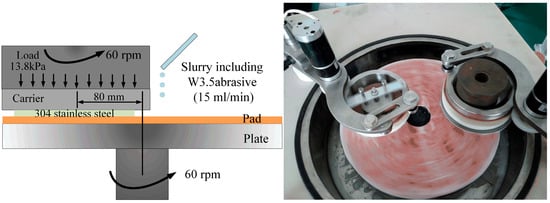
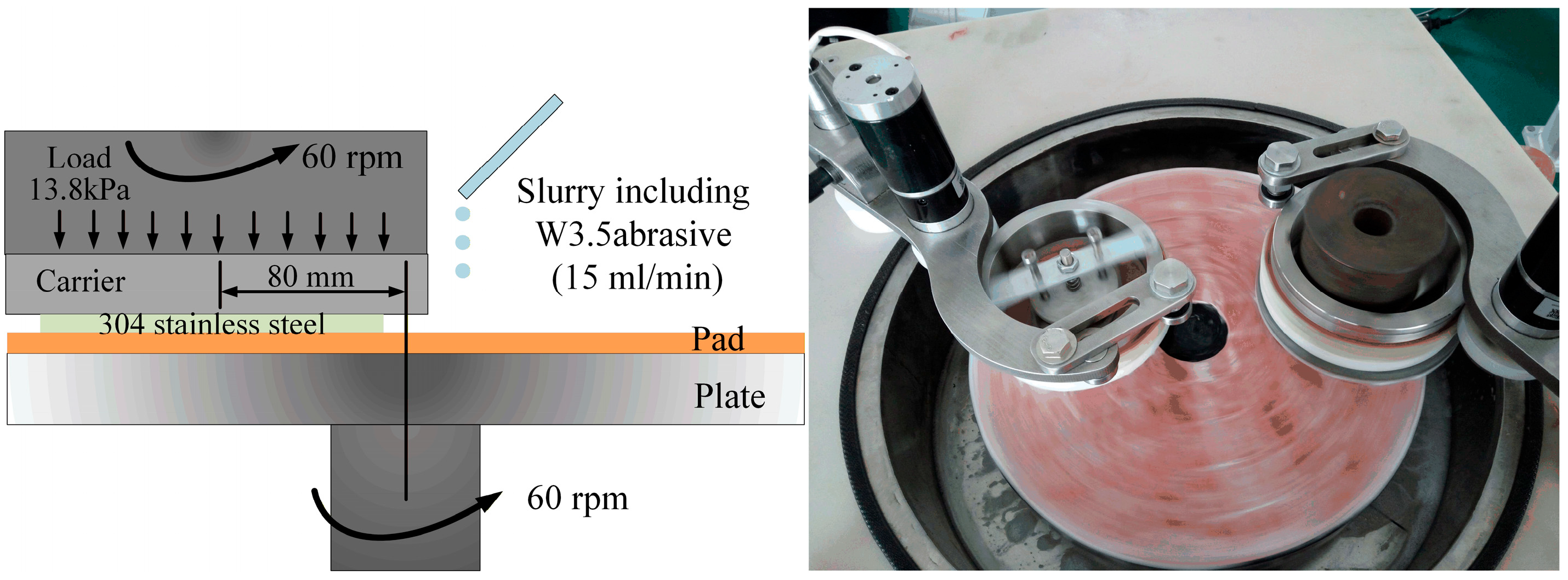
All polishing and testing experiments were conducted in a constant-temperature ultra-clean laboratory at 20 °C. The polishing experiments were conducted on the ZYP230 polishing machine (Shenyang Maike Material Processing Equipment Co., Ltd., Shenyang, China). Before each group of experiments, the polyurethane polishing pad was conditioned with a diamond dresser for 5 min to unify the surface morphology of the polishing pad. The process parameters of the polishing test were set as shown in Table 1, and the polishing slurry was prepared as a base liquid with deionized water according to Table 2. When preparing the polishing slurry, each reagent was fully dissolved in the deionized water under the stirring action of the magnetic stirrer, and the pH was adjusted to 2.0 using 1 M HCl solution. The polishing principle is shown in Figure 1. Polishing slurries with different compositions were prepared for stainless steel sheet polishing experiments. The compositions of each group of slurry are shown in Table 3.
Table 1.
Process parameter settings for polishing experiments.
Table 2.
Composition of base slurry.
Figure 1.
Polishing schematic diagram.
Table 3.
Slurry compositions for various experimental groups.
Before the experiments, the samples were lapped with w28 white corundum for 5 min, ensuring a uniform surface roughness within the range of 40–50 nm. During the experiments, the center-to-center distance between the table and the sample was set at 80 mm, and the carrier was oscillated back and forth at a frequency of 10 s with an amplitude of 20 mm. Each group of experiments was repeated three times, and the average of the test results was taken. After the experiments, each group of samples was ultrasonically cleaned and dried for subsequent inspections.
2.3. MRR Values and Ra Values
The mass of each set of samples before and after the experiment was weighed using a Sartorius CP225D precision electronic balance with an accuracy of 0.01 mg (Sartorius Lab Instruments GmbH & Co. KG, Göttingen, Germany), and the average value was obtained by weighing three times consecutively. The material removal rate (MRR) (nm/min) was calculated according to Equation (1):
where
- m1: Mass of the workpiece before polishing (g);
- m2: The mass of the workpiece after polishing (g);
- ρ: Density of the workpiece (g/cm3);
- S: Surface area of the workpiece (cm2);
- t: Time last for each experiment (min).
After each experiment, the Ra values of the polished sample were measured at three points by a scanning white light interferometer and the average value was taken, with a sampling length of 86 μm. The surface morphology of the sample was observed by a German Leica upright metallographic microscope (Leica Microsystems, Wetzlar, Germany).
2.4. Determination of Fe2+ Content in Polishing Waste Liquid by Spectrophotometry
Ferrous ions react with phenanthroline under the condition of pH 3–9, forming an orange-red complex ion [(C12H8N2)3Fe]2+, and the maximum absorption peak of the orange-red coordination compound is at 510 nm. The phenanthroline solution (0.15%) was prepared. The Lambda 35 UV/visible spectrophotometer (PerkinElmer, Inc., Waltham, MA, USA) was adapted to measure the Fe2+ content in the polishing waste liquid of Groups 11th–14th.
3. Results and Discussion
3.1. Effects of Ferric Chloride Content on Polishing Efficiency and Surface Quality
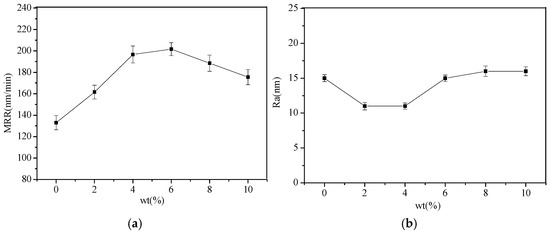
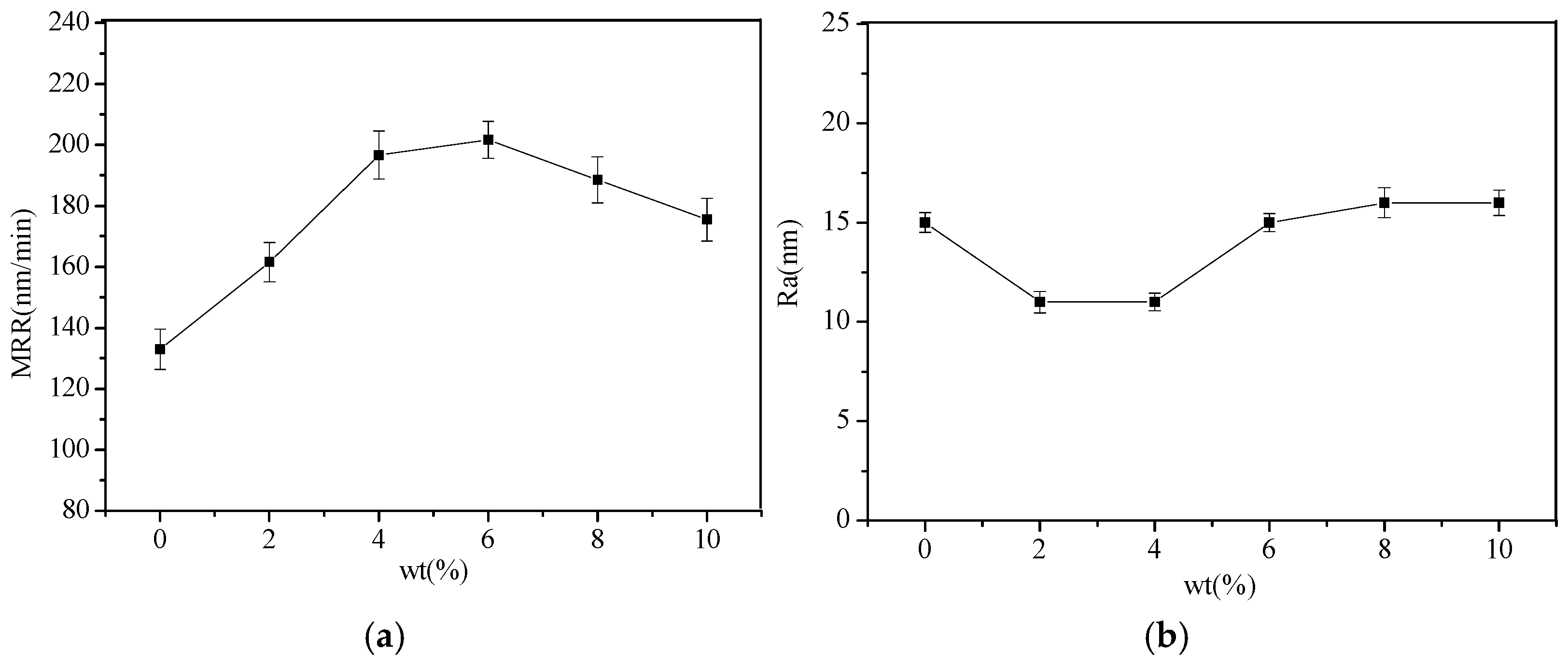
The 1st to 5th and 10th sets of experiments were conducted by varying the content of FeCl3 in the polishing slurry. The MRR and Ra values are shown in Figure 2, where the Ra value has been reduced to below 20 nm. Figure 2 shows that the MRR first gradually increases and then decreases with the increase in FeCl3 content. When the FeCl3 content increases to between 4 and 6 wt.%, the MRR remains basically unchanged and reaches a maximum of 201.7 nm/min at around 6 wt.% content. When the FeCl3 content is higher than 6 wt.%, the MRR decreases with the increases in FeCl3 content.
Figure 2.
Effects of ferric chloride content on polishing. (a) MRR values, (b) Ra values.
When polishing stainless steel with FeCl3 slurry, the main redox reactions are [24,25] as follows:
Fe + 2FeCl3 → 3FeCl2
Cr + 3FeCl3 → CrCl3 + 3FeCl2
Ni + 2FeCl3 → NiCl2 + 2FeCl2
The FeCl3 slurry with a concentration of less than 2 wt.% contains a smaller amount of FeCl3, leading to a lower redox potential of only 133.0 nm/min. The ratio of Fe3+ to Fe2+ decreases rapidly during the reaction, resulting in a lower removal rate. When FeCl3 concentration exceeds 6 wt.%, the MRR decreases. This non-monotonic behavior arises from the interplay of multiple kinetic factors inherent to Fe3+-mediated stainless steel dissolution. The dissolution reaction Fe + 2Fe3+ → 3Fe2+ is cathodic diffusion-controlled, meaning the reduction of Fe3+ at the metal surface is the rate-determining step [26]. According to the mass transport equation d[M]/dt = A·D·C/S, the dissolution rate depends on the product of Fe3+ concentration C and its diffusion coefficient D. As FeCl3 concentration increases beyond the optimum, solution viscosity rises significantly, reducing the diffusion coefficient D of Fe3+ ions and limiting their transport to the metal surface [27]. Concurrently, the accumulation of reaction product Fe2+ near the interface shifts the local redox potential toward more negative values via the Nernst equation, diminishing the thermodynamic driving force for Fe3+ reduction [28]. The competition between increased Fe3+ concentration and reduced mass transport efficiency—encompassing both viscosity-induced decreases in D and Fe2+ back-inhibition—determines the shape of the MRR vs. FeCl3 concentration curve, leading to a peak MRR followed by a decline when transport limitations outweigh the concentration increase. When the concentration of FeCl3 increases to 10 wt.%, the MRR decreases by 12.5% compared to that of 6 wt.%.
3.2. Effects of Oxalic Acid Content on Polishing Efficiency and Surface Quality
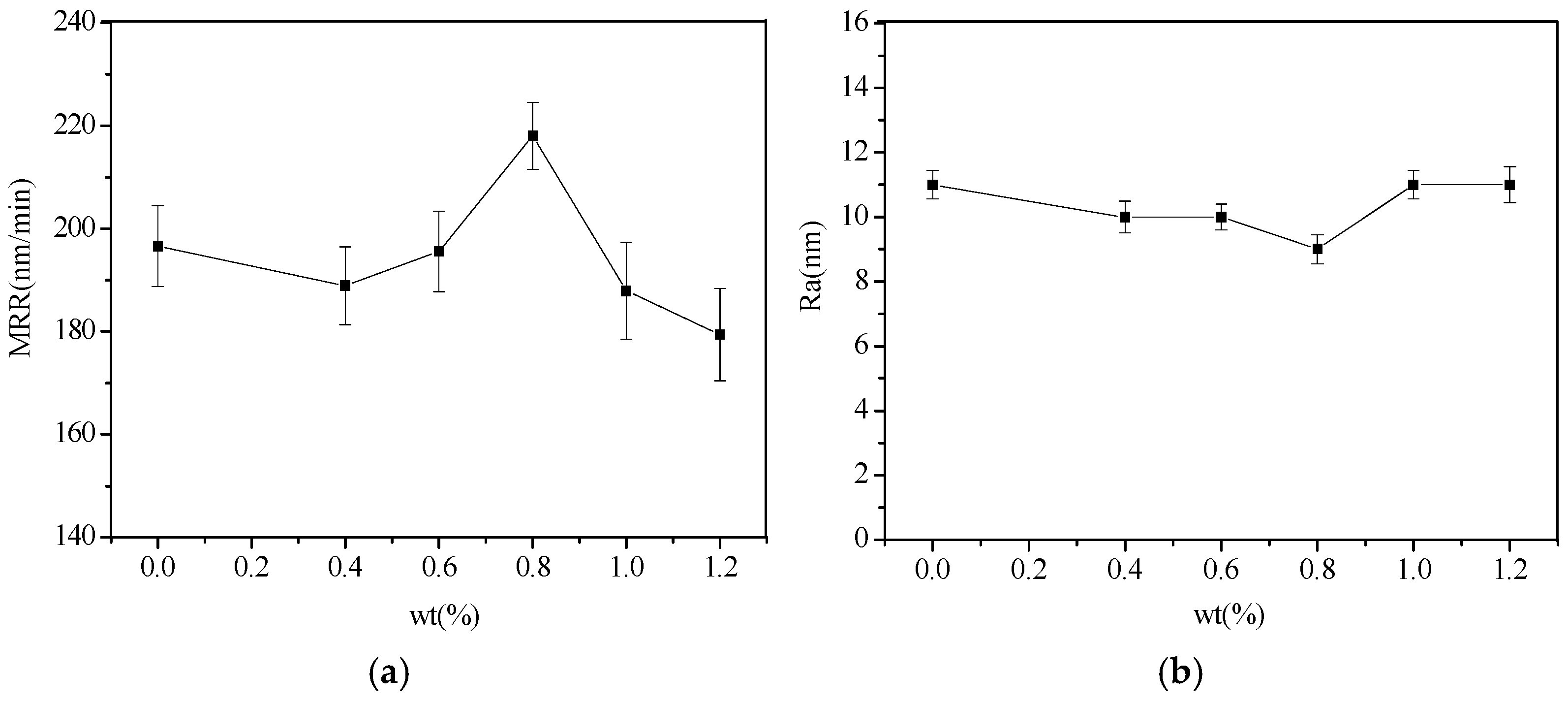
The six sets of experiments, including the 2nd and 6th to 10th, involved adding H2C2O4 with different mass fractions to a slurry containing 4 wt.% FeCl3. The MRR and Ra values are shown in Figure 3, with the Ra value reduced to below 15 nm. When the H2C2O4 was initially added, the MRR decreased. As the H2C2O4 mass fraction increased, the maximum MRR of 218.0 nm/min was achieved at 0.8 wt.% of H2C2O4. When the H2C2O4 content continuously increased, the MRR decreased instead. When the H2C2O4 content reaches 1.2 wt.%, the MRR decreases to 179.4 nm/min.
Figure 3.
Effects of oxalic acid content on polishing. (a) MRR values, (b) Ra values.
The ionic equation for the reaction between FeCl3 and H2C2O4 to produce carbon dioxide (CO2) is as follows:
2Fe3+ + H2C2O4 → 2Fe2+ + 2CO2 ↑+ 2H+
H2C2O4 in the slurry reacts with Fe3+ to generate Fe2+, leading to a decrease in Fe3+ and an increase in Fe2+. This reaction shifts the oxygen reduction potential of the system towards a more negative direction, reducing the reaction rate and subsequently the MRR. The H+ ionized by H2C2O4 combined with Cl− to form HCl. The initial reaction rate increased with the increase in H2C2O4 mass concentration. However, once the H2C2O4 mass concentration reached a certain value, the etching rate decreased as the mass concentration increases. This may be attributed to the fact that Cl− can form soluble complex ions with metal ions such as Fe2+, Fe3+ and Ni2+, forming tetrahedral structures, such as tetrahedral FeCl42−, FeCl4−, NiCl42−, etc. [24]. These complex ions quickly complex with the corroded metal ions and dissolve them, preventing the formation of a layer of insoluble oxide film on the metals surface, thereby reducing the hindrance of the oxide film to polishing. Therefore, in the initial part of the curve, the MRR increases with the increase in HCl concentration. However, if the H2C2O4 content is too high, FeCl3 will hydrolysate into ferric hydroxide precipitate and lose its etching effect. When the H2C2O4 content exceeds 0.8 wt.%, the concentration of H+ in the slurry reaches the hydrogen evolution potential, leading to a hydrogen evolution reaction that competes with the reduction reaction of Fe3+, thereby resulting in a decrease in the reaction rate and thus a decrease in MRR [25,29].
3.3. Determination of Fe2+ Content in Polishing Waste Liquid
The Fe2+ content in the polishing waste liquids from Groups 11–14 was determined by spectrophotometry as shown in Table 4.
Table 4.
Determination results of phenanthroline spectrophotometric.
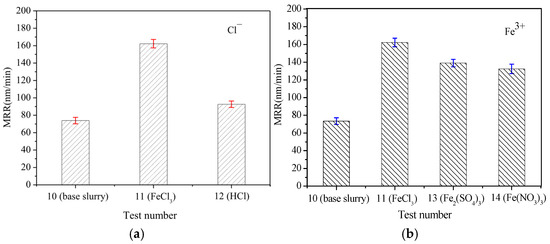
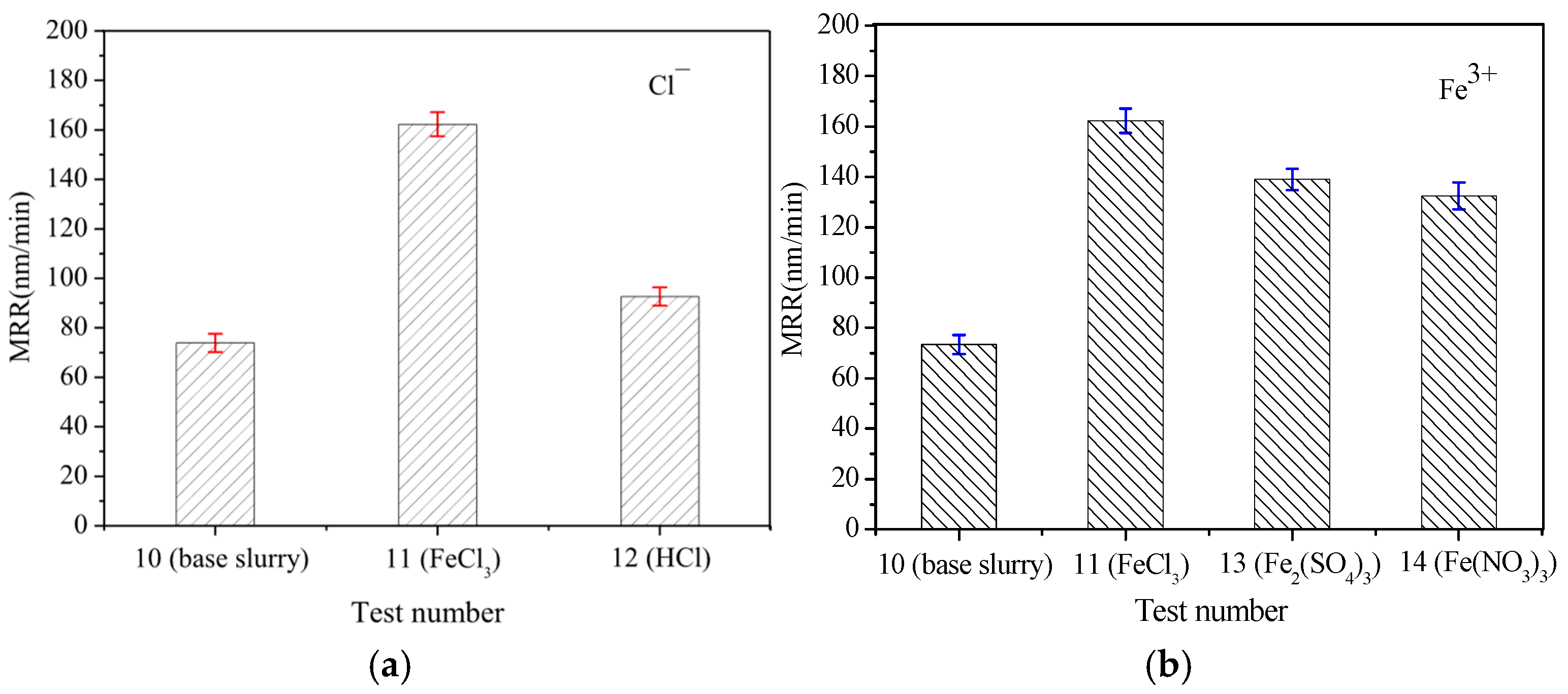
The MRR values of the polishing experiments in 10th, 11th, and 12th Groups are shown in Figure 4a, where the polishing slurries in the 11th and 12th Groups contained an equal molar mass of Cl−. The MRR values of the 10th, 11th, 13th, and 14th polishing experiments are shown in Figure 4b, where the 11th, 13th, and 14th polishing slurries contained an equal molar mass of Fe3+.
Figure 4.
Effects of Cl− and Fe3+ in the slurries on MRR in the stainless steel polishing. (a) equal molar mass Cl−, (b) equal molar mass Fe3+.
Combining the results from Table 4 and Figure 4, it can be found that the data in Group 12 indicates that Cl− plays a certain role in polishing stainless steel sheets, with a more pronounced corrosive effect on Fe. The MRR values in Figure 4a also confirmed that Cl− in the polishing slurry plays a certain role in increasing the MRR during the polishing process. When the FeCl3 concentration reaches 2 wt.%, the MRR increases to approximately 1.2 times that of the base slurry polishing. Although an increase in Fe3+ concentration can enhance the corrosion rate and reduce surface hardness, which is conducive to mechanical removal, when the concentration exceeds the threshold, the overly rapid corrosion rate instead makes it difficult for the surface passivation film to form stably. At the same time, the accumulation of corrosion products hinders the exposure of fresh metal surfaces and reduces the chemomechanical synergy required for the CMP process, thereby leading to a decrease in MRR [23,30,31]. Figure 4b shows that the MRR of Groups 13th and 14th are approximately 17–22% lower than that of Group 11th.
High Fe2+ concentrations were detected in Groups 11 and 13, confirming the presence of the 2Fe3+ + Fe → 3Fe2+ reaction during the polishing process. This is further supported by Figure 4b, which shows that Fe3+ plays an important role in increasing the MRR. At the same time, the hydrolysis product HCl of FeCl3 corrodes the passivation layer of the stainless steel sheet, promoting the progress of the reaction 2Fe3+ + Fe → 3Fe2+. The low Fe2+ concentration in Group 14 is due to the hydrolysis of Fe(NO3)3 to obtain HNO3, which has a certain oxidizing property and oxidizes the Fe2+ generated in the reaction to Fe3+. Although the same molar mass of Fe3+ is present in the polishing slurries of Groups 11, 13, and 14, the oxidation of the SO42− and NO3− have a certain oxidizing effect, and they also passivate the stainless steel surface, reducing the corrosive effect. The MRR values of Groups 13 and 14 are both less than that of Group 11.
4. Experimental Verification
Based on the MRR and Ra values obtained from the above experiments, it was found that 0.8 wt.% H2C2O4 and 4 wt.% FeCl3 had a significant promoting effect on MRR, and the surface quality was the best in the same group of experiments. To further analyze the polishing effect of the polishing slurry, four types of polishing slurries were tested, as shown in Table 5. The base slurry remained the same: deionized water + 1.8 wt.% W3.5 white corundum + 1.2 wt.% sodium hexametaphosphate. After the experiments, the MRR values were calculated, the Ra values were measured, and the surface morphology of the stainless steel samples was observed.
Table 5.
Design and results of polishing verification tests.
The MRR and Ra values of each group of 304 stainless steel sheets polishing with different slurry are shown in Table 5, and Figure 5 shows the surface morphology of each group of stainless steel sheets after polishing.
Figure 5.
Surface morphology of 304 stainless steel sheets after polishing. (a) control group, using only the base slurry, (b) base slurry + 0.8 wt.% H2C2O4, (c) base slurry + 4 wt.% FeCl3, (d) base slurry + 0.8 wt.% H2C2O4 +4 wt.% FeCl3.
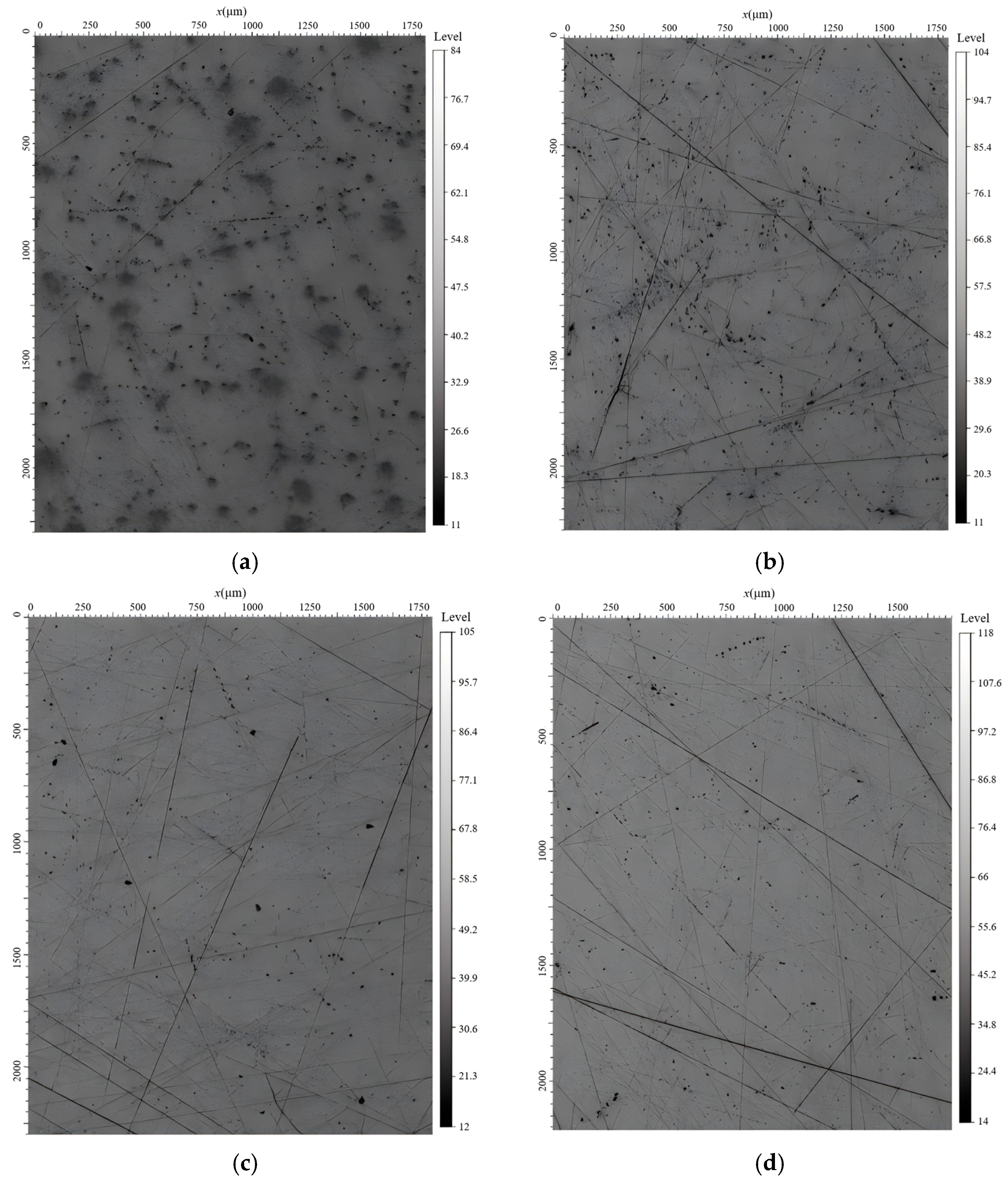
The corrosive effect of the polishing liquid on the material surface is not obvious, resulting in the removal of the material mainly relying on mechanical action. The large number of black spots of mechanical removal defects in Figure 5a are pit-like defects with residual ferrochromium oxide in the pits. In Figure 5b, H2C2O4 acts as a weak acid to corrode the surface of 304 stainless steel to some extent, forming a softened layer on the stainless steel surface, reducing the surface hardness, increasing the surface MRR and significantly reducing the pitting defects. In Figure 5c, due to the dissolution of into Fe3+ and Cl− during polishing, which both react with the surface of 304 stainless steel, the degree of corrosion further intensifies, resulting in a substantial increase in MRR and further improvement in surface quality [32]. Figure 5d shows that the mixed polishing slurry of FeCl3 and H2C2O4 is significantly better than that of single-component polishing slurry. The corrosive effect of the mixed polishing liquid is the most intense. The reduction in surface hardness leads to a smooth surface of the 18th Group of stainless steel with few defects, the highest MRR reaching over 200 nm/min, and a Ra value below 10 nm, which is superior to the other three groups. Therefore, the composition of the optimized polishing slurry was determined as follows: 1.8 wt.% W3.5 white corundum, 1.2 wt.% sodium hexametaphosphate, 0.8 wt.% H2C2O4, 4 wt.% FeCl3.
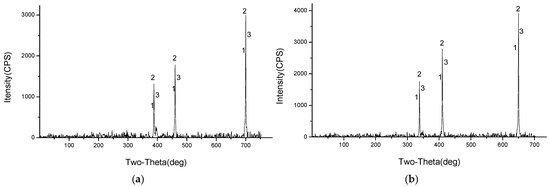
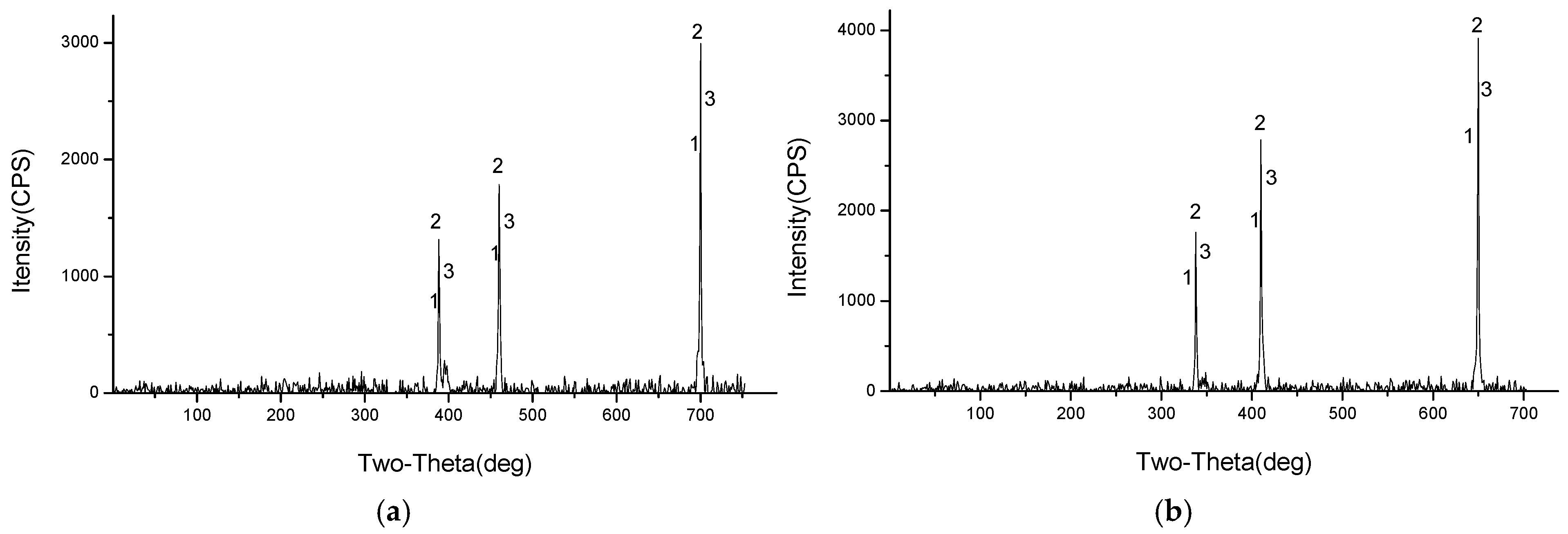
Qualitative analysis of the 304 stainless steel sheets surface was conducted using XRD analysis after the experiments on Group 15 and 17. XRD analysis was performed using a D8 Advance diffractometer (Bruker AXS GmbH, Karlsruhe, Germany). The analysis conditions were CuKa radiation, a test voltage of 40 kV, a current of 40 mA, a wide-range diffraction angle, an angle range of 0.5–120°, a step size of 0.1°, and a scanning speed of 6°/min. The results of the stainless steel surface after polishing with base slurry and FeCl3 slurry are shown in Figure 6.
Figure 6.
XRD pattern of stainless steel sheets after polishing. 1—Iron-nickel compounds, 2—iron–nickel–chromium compounds, 3—chromium. (a) control group, using only the base slurry, (b) FeCl3 polishing slurry.
Figure 6 demonstrates that the phase composition of the 304 stainless steel surface remains essentially unchanged after polishing with the FeCl3 slurry.
5. Conclusions
A mixed polishing solution of FeCl3 and H2C2O4 was optimized to enhance the CMP MRR of 304 stainless steel, and improve the surface quality, which was superior to existing studies. The reaction of 2Fe3+ + Fe → 3Fe2+ during the polishing process was confirmed for the first time by spectrophotometry, revealing the mechanism by which Fe3+ promotes removal. The optimized slurry composition achieved an MRR exceeding 200 nm/min and a surface roughness below 10 nm, representing a substantial advancement in the planarization of stainless steel substrates for flexible display applications. This method takes into account both high efficiency and high quality, providing a practical solution for the planarization of stainless steel substrates. The results can be summarized as follows:
- (1)
- The MRR of 304 stainless steel polishing achieved above 200 nm/min with 4 wt.% FeCl3 + 0.8 wt.% H2C2O4 which added in the base slurry: deionized water + 1.8 wt.% W3.5 white corundum + 1.2 wt.% sodium hexametaphosphate slurry. The Ra values of 304 stainless steel surface dropped below 10 nm after polishing, and the surface was flat with few scratches.
- (2)
- The action mechanism of Fe3+ in the FeCl3 slurry, represented by the reaction 2Fe3+ + Fe → 3Fe2+, was confirmed through spectrophotometry.
- (3)
- XRD analysis of 304 stainless steel surface revealed that the material phases remained substantially unchanged after polishing with the FeCl3.
Author Contributions
Conceptualization, K.W. and J.L.; methodology, J.S. and Y.Z.; software, B.L. and K.W.; validation, N.Z. and Y.Z.; investigation, J.L. and B.L.; data curation, J.C. and J.S.; writing—original draft preparation, N.Z.; writing—review and editing, N.Z., Y.Z., J.S. and J.C. All authors have read and agreed to the published version of the manuscript.
Funding
This research was funded by the National Natural Science Foundation of China, grant number 52405502; the Natural Science Foundation of Shanghai, grant number 24ZR1426300; the Key Science and Technology Plan Project of Jinhua City, grant number 2024-1-006; the Henan Provincial Science and Technology R&D Plan Joint Fund, grant number 245200810011; and the Henan Provincial Science and Technology Research Project, grant numbers 262102220027 and 262102220062.
Data Availability Statement
The original contributions presented in this study are included in the article. Further inquiries can be directed to the corresponding authors.
Conflicts of Interest
The authors declare no conflicts of interest.
Abbreviations
The following abbreviations are used in this manuscript:
| CMP | Chemical mechanical polishing |
| CMABP | Chemical magnetic field-assisted batch polishing |
| MRR | Material removal rate |
| Ra | Surface roughness |
| OLED | Organic light-emitting diodes |
| XRD | X-ray diffraction |
| TFT | Thin-film transistors |
| PI | Polyimide |
| PET | Polyethylene Terephthalate |
References
- Sun, Y.; Zhao, X.; Wu, P.; Ren, X.; Ma, Q.; Yu, W.; Liu, G.; Dong, X. Stretchable nanofiber films with tunable fluorescence based on the principle of concentration quenching for wearable motion sensors and flexible display devices. Mater. Today Chem. 2026, 51, 103311. [Google Scholar] [CrossRef] [Scilit]
- Zhou, J.; Zhang, Q.; Zhang, M.; Aikebaier, S.; Zhu, X.; Zhou, X. Flexible wearable medical devices: From material innovations and data processing to intelligent healthcare applications. J. Adv. Res. 2025. online ahead of print. [Google Scholar] [CrossRef] [Scilit] [PubMed]
- Kim, H.J.; Park, S.Y.; Park, J.; Ko, Y.; Park, S.E.; Kim, Y.; Kim, J. Improved adhesion of printed Ag electrodes for flexible transparent display applications. Mater. Adv. 2025, 6, 547–551. [Google Scholar] [CrossRef] [Scilit]
- Chen, Z.; Xu, H.; Pan, C.; Bao, R. Electrochemiluminescent devices: Structural composition, preparation process and applications for flexible/stretchable displays. Wearable Electron. 2025, 2, 149–170. [Google Scholar] [CrossRef] [Scilit]
- Huang, L.; Liao, D.; Peng, W.; Zhou, Y.; Chen, K. Study on interface fatigue failure of flexible OLED display modules based on cyclic cohesive zone model. Displays 2025, 87, 102949. [Google Scholar] [CrossRef] [Scilit]
- Lin, C.Q.; Du, S.J.; Liu, M.L.; Yang, Z.; Yu, Y.Y.; Pan, C.Y. Superior flexible display based on Zn2+ doped CsPbI3 QDs with high quantum yield and stability. Surf. Interfaces 2024, 53, 105038. [Google Scholar] [CrossRef] [Scilit]
- Chen, J.; Sun, T.; Su, J.; Li, J.; Zhou, P.; Peng, Y.; Zhu, Y. A novel agglomerated diamond abrasive with excellent micro-cutting and self-sharpening capabilities in fixed abrasive lapping processes. Wear 2021, 464, 203531. [Google Scholar] [CrossRef] [Scilit]
- Chen, J.; Zhu, Y.; Chen, X.; Ma, X.; Chen, B. Interfacial Microstructure and Cladding Corrosion Resistance of Stainless Steel/Carbon Steel Clad Plates at Different Rolling Reduction Ratios. Metals 2024, 15, 16. [Google Scholar] [CrossRef] [Scilit]
- Silva, P.M.; Filho, M.C.; Cruz, J.A.; Sales, A.J.; Sombra, A.S.; Tavares, J.M. Influence on pitting corrosion resistance of AISI 301LN and 316 L stainless steels subjected to cold-induced deformation. Metals 2023, 13, 443. [Google Scholar] [CrossRef] [Scilit]
- Järvenpää, A.; Jaskari, M.; Kisko, A.; Karjalainen, P. Processing and properties of reversion-treated austenitic stainless steels. Metals 2020, 10, 281. [Google Scholar] [CrossRef] [Scilit]
- Xie, W.; Zhang, Z.; Yu, S.; Li, L.; Cui, X.; Gu, Q.; Wang, Z. High efficiency chemical mechanical polishing for silicon wafers using a developed slurry. Surf. Interfaces 2023, 38, 102833. [Google Scholar] [CrossRef] [Scilit]
- Chen, J.; Peng, Y.; Wang, Z.; Lv, F. Influence of Fenton-like reactions between hydrogen peroxide and ferric chloride on chemical mechanical polishing 304 stainless steel. Int. J. Adv. Manuf. Technol. 2024, 131, 2667–2675. [Google Scholar] [CrossRef] [Scilit]
- Huang, W.; Li, H.; Lu, J.; Hu, D.; Lin, C.; Yan, Q. Experimental study on UV photocatalytic assisted chemical mechanical polishing process for single-crystal diamond. Diam. Relat. Mater. 2025, 159, 112771. [Google Scholar] [CrossRef] [Scilit]
- Park, Y.; Jung, H.; Cho, H.; Kim, D.; Lee, T.; Jeong, H.; Kim, H. Correlation between structured surface pad design and material removal rate in Chemical Mechanical Polishing. J. Manuf. Process. 2025, 156, 980–990. [Google Scholar] [CrossRef] [Scilit]
- Wu, J.; Ye, L.; Zhu, X.; Liu, Y.; Li, T.; Zhang, W.; Lv, B. Simulation and experimental study of ultrasound-chemical synergistic mechanism for ultrasound-assisted chemical-mechanical polishing of single-crystal silicon carbide. Surf. Interfaces 2025, 72, 107448. [Google Scholar] [CrossRef] [Scilit]
- Xia, Z.; Lyu, P.; Liu, Z.; Pan, J.; Fang, F. Study on the eco-friendly chemical mechanical polishing of nickel–phosphorus alloy. Precis. Eng. 2025, 95, 423–435. [Google Scholar] [CrossRef] [Scilit]
- Gunnerek, R.; Soundarapandiyan, G.; Mishurova, T.; Schröder, J.; Bruno, G.; Boykin, J.; Diaz, A.; Klement, U.; Hryha, E. Chemical mechanical polishing of powder bed fusion–laser beam processed 316 L stainless steel. J. Mater. Process. Technol. 2025, 345, 119055. [Google Scholar] [CrossRef] [Scilit]
- Song, Z.; Wang, D.; Zhang, Z.; Zhao, F.; Zhou, H.; Chen, L.; Liang, M.; Liu, W.; Yang, X. Close atomic surface of stainless steel produced by developed novel green chemical mechanical polishing using silica and Samaria composite abrasives. Surf. Interfaces 2025, 64, 106474. [Google Scholar] [CrossRef] [Scilit]
- Yin, F.; Shi, C.; Huang, Z.; Wu, K.; Li, J.; Wang, C. Chemical magnetic field-assisted batch polishing method of 316 L stainless steel. J. Mater. Res. Technol. 2024, 33, 7017–7028. [Google Scholar] [CrossRef] [Scilit]
- Hu, X.; Song, Z.; Liu, W.; Qin, F.; Zhang, Z.; Wang, H. Chemical mechanical polishing of stainless steel foil as flexible substrate. Appl. Surf. Sci. 2012, 258, 5798–5802. [Google Scholar] [CrossRef] [Scilit]
- Guo, Z.; Zhong, X.; Li, J.; Zhang, C.; Song, K.; Cheng, J. Experimental study on mechanical polishing of 316 L stainless steel with a novel active pressure correction method. Mater. Today Commun. 2025, 42, 111299. [Google Scholar] [CrossRef] [Scilit]
- Liao, L.; Zhang, Z.; Liu, J.; Li, Y.; Cui, X.; Liu, L. A novel process of chemical mechanical polishing for FV520B steel. J. Manuf. Process. 2020, 59, 51–57. [Google Scholar] [CrossRef] [Scilit]
- Wurz, M.; Pape, F.; Wark, M.; Gatzen, H. Investigation of liquid additives on the nano-hardness of NiFe during polishing. Tribol. Online 2011, 6, 113–116. [Google Scholar] [CrossRef] [Scilit]
- Nurrahmajanti, A. Pelindian Fe2O3 dari Limbah Karat Besi Menggunakan HCl dan H2C2O4. INSOLOGI J. Sains Dan Teknol. 2025, 4, 58–64. [Google Scholar] [CrossRef] [Scilit]
- Zamanizadeh, H.R.; Sunde, S.; Pollet, B.G.; Seland, F. Tailoring the oxide surface composition of stainless steel for improved OER performance in alkaline water electrolysis. Electrochim. Acta 2022, 424, 140561. [Google Scholar] [CrossRef] [Scilit]
- Ueda, R.; Asakura, S.; Toki, S.; Sugiura, T. Polarization Behavior of Metal Etching in Ferric Chloride Etchants. J. Surf. Finish. Soc. Jpn. 1992, 43, 121–125. [Google Scholar] [CrossRef] [Scilit]
- Allen, D.M. The Chemistry and Control of Etching Ferrous Metals with Ferric Chloride Solutions: The Concept of a Constant Etchant Pool. PCMI Summer J. 2021, 22. [Google Scholar]
- Scheiner, S.; Hellmich, C. Stable pitting corrosion of stainless steel as diffusion-controlled dissolution process with a sharp moving electrode boundary. Corros. Sci. 2007, 49, 319–346. [Google Scholar] [CrossRef] [Scilit]
- Ferreira, E.A.; Noce, R.D.; Fugivara, C.S.; Benedetti, A.V. Evaluation of 316 L stainless steel corrosion resistance in solution simulating the acid hydrolysis of biomass. J. Electrochem. Soc. 2011, 158, C95–C103. [Google Scholar] [CrossRef] [Scilit]
- Saefuloh, I.; Kanani, N.; Ramadhan, F.; Rukmayadi, Y.; Yusuf, Y.; Abdullah, S.; Susilo, S. The study of corrosion behavior and hardness of AISI stainless steel 304 in concentration of chloride acid solution and temperature variations. J. Phys. Conf. Ser. 2020, 1477, 052058. [Google Scholar] [CrossRef] [Scilit]
- Wei, Y.; Zhu, L.; Jia, L.; Chen, Y.; Li, Y. Study on the influence of etchant composition and etching process on the precision of stainless-steel microchannel and etching mechanism. Adv. Eng. Mater. 2024, 26, 2301731. [Google Scholar] [CrossRef] [Scilit]
- Wang, K.; Liu, H.; Liu, N.; Chen, X.; Chen, J. Effect of oxidant concentration on the oxide layer thickness of 304 stainless steel. Materials 2024, 17, 2816. [Google Scholar] [CrossRef] [Scilit]

Disclaimer/Publisher’s Note: The statements, opinions and data contained in all publications are solely those of the individual author(s) and contributor(s) and not of MDPI and/or the editor(s). MDPI and/or the editor(s) disclaim responsibility for any injury to people or property resulting from any ideas, methods, instructions or products referred to in the content. |
© 2026 by the authors. Licensee MDPI, Basel, Switzerland. This article is an open access article distributed under the terms and conditions of the Creative Commons Attribution (CC BY) license.