


Abstract
Periodic lattice materials exhibit tunable mechanical properties, yet the impact of non-cylindrical, non-circular strut cross-sections on crashworthiness remains largely unexplored. This study extends the concept of shape transformers—dimensionless ratios representing the area and second moment of area of a strut cross-section relative to its enclosing envelope—to two canonical lattice topologies: the octet and rhombic dodecahedron topologies (stretching-dominated and bending-dominated, respectively). Eleven distinct cross-sectional shapes (solid and hollow circular, diamond, and square) were systematically varied under constant area and constant envelope conditions to isolate microscale geometric effects on macroscopic impact response. Results demonstrate that adjusting Ψi alone can enhance specific energy absorption by up to 62% in bending-dominated lattices (compared to 18% in stretching-dominated lattices). Furthermore, the influence of geometric efficiency (λ = Ψi/Ψa) on plateau stress and energy absorption trends across topologies has been quantified. These findings establish shape transformers as significant design parameters for crashworthy lattice materials, and design charts are presented to facilitate the development of additive-manufactured cellular structures aimed at optimized energy absorption performance.
1. Introduction
Cellular solids are increasingly important across various industries for their ability to optimize strength, stiffness, and weight [1,2], addressing gaps that fully dense materials cannot. Their customizable geometric parameters, such as topology and relative density, facilitate targeted applications in sectors including biomedical, aerospace, automotive, and defense [3,4,5,6,7,8,9,10,11]. Periodic strut-based lattices are preferred for consistency over stochastic foams [12,13,14], particularly in energy absorption (EA) applications. Recent advancements, especially in additive manufacturing, have also spurred interest in these materials [9,13,15]. Historically, research has focused on struts with circular cross-sections (C-S) [16,17,18,19,20,21,22,23,24,25,26,27,28,29]; however, emerging studies are exploring non-circular geometries [30,31,32,33,34,35,36,37,38]. Notably, Tancogne-Dejean et al. [30] investigated varying circular cross-sectional areas along struts in octet topologies, revealing that optimal specific energy absorption (SEA) occurs at a specific mid-length to node radius ratio, with improvements over cylindrical struts limited to approximately 10%. Ratios greater than one may diminish strength and energy absorption due to concentrated deformation in nodal areas.
Tancogne-Dejean and Mohr [31] investigated the impact of variable circular C-S in body-centered cubic (BCC) struts, finding that tapering reduces elastic anisotropy, increases elasticity modulus, and enhances SEA compared to non-tapered cylindrical struts. They proposed a methodology to achieve elastically isotropic lattices by optimizing the inner-to-outer diameter ratio of hollow tubes in simple cubic (SC), BCC, and octet structures. Their numerical model, applying periodic boundary conditions, identified optimal ratios for elastic isotropy at relative densities ranging from 1% to 50% [32]. Cao et al. [33,34,35] further explored variable circular C-S in rhombic dodecahedron topologies. In [33], they aligned numerical simulations with experimental results of additively manufactured 316L stainless steel lattices, showing enhanced EA and mechanical properties. Dynamic tests in [34], conducted using an SHPB, confirmed improvements in compressive strength and EA. Different strain rates and relative densities were examined by the subsequent research in [35].
Zeroth-order topologies, such as an octet with circular cross-sections, serve as the foundation, while higher-order designs incorporate enhanced patterns along the struts [39,40,41,42,43,44,45,46]. For example, an octahedral topology can tessellate the struts of an octet, resulting in distinct macro and meso-scale structures. Lv et al. [45] explored first-order lattices (tubular re-entrant structures replacing octet struts) and second-order lattices (re-entrant hexagons replacing first-order ribs). Their results indicated that the second-order octet produced lower peak stress and shorter plateau stress regions compared to first and zeroth orders, yet displayed reduced SEA compared to the first-order, while still exceeding the zeroth-order performance.
A study [46] investigated a hierarchical design that combines the advantages of periodic lattice structures and stochastic foams, deriving a macrostructure lattice from a microstructure foam. Their results showed a significant enhancement in post-yielding flow stress compared to each structure individually. However, they noted that the hierarchical method’s effectiveness in improving SEA remains uncertain. Additionally, while circular C-S for struts are standard, alternative shapes have not been thoroughly examined in the literature [47,48,49,50,51]. Hence, further research is essential to explore the effects of varying cross-sectional shapes in strut-based lattices.
The concept of shape transformers, introduced by Pasini et al. [52] evaluating the structural efficiency of C-S under bending conditions has spurred significant research [53,54,55,56,57,58,59,60,61,62,63,64]. In 2006, Pasini [58] emphasized their utility for optimizing lightweight beam selection by providing indices for C-Sal shape and material to minimize mass while maintaining stiffness. He further developed effectiveness plots detailing bending features of two materials C-S, considering parameters like shape, arrangement, symmetry, and volume fraction [59]. El Sayed and Pasini [61] derived the effective properties of an octet-truss lattice material with non-circular, double-symmetrical C-S. They argued that elastic buckling before plastic yielding indicates suboptimal material usage, prompting the development of multiscale design charts for selecting column C-S and cell geometries. Their work demonstrated that optimal failure resistance is achieved when global and local buckling and yielding coincide. In 2021, Gasparetto et al. [62,63,64] examined the integration of shape transformers with periodic cellular solids to assess mechanical band gaps and wave propagation in lattice materials for vibration filtering. Their results revealed that modifications to microscopic beam parameters via shape transformers can significantly influence the macroscopic mechanical properties, leading to new design charts for optimizing both static and dynamic performance.
The studies into the effects of non-circular and non-cylindrical C-S in lattice materials on macroscopic performance have begun, yet critical gaps remain, particularly concerning their influence on EA and crashworthiness. This paper seeks to fill these gaps by utilizing shape transformers to analyze the performance of rhombic dodecahedra and octet lattices with struts that have non-circular C-S, focusing on crashworthiness through comparative assessments of EA, densification strain and plateau stress.
There are three main sections following the introduction. One of these sections, Methodology, provides an overview of shape transformers in beam C-S. Section 3, Numerical Model, details the numerical setup used to evaluate the effect of shape transformers on the characteristics of lattice materials, encompassing lattice topology design and finite element modeling. Finally, the Section 4 presents and analyzes results for two topologies defined by C-S from distinct methodologies: constant area and constant limiting reference envelope. The paper concludes with acknowledgments and a list of references.
2. Methodology
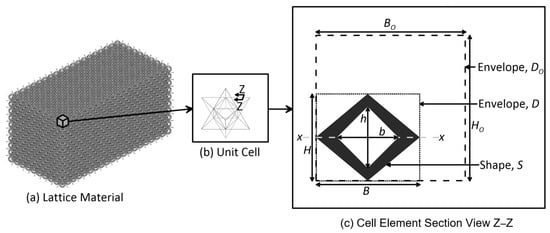
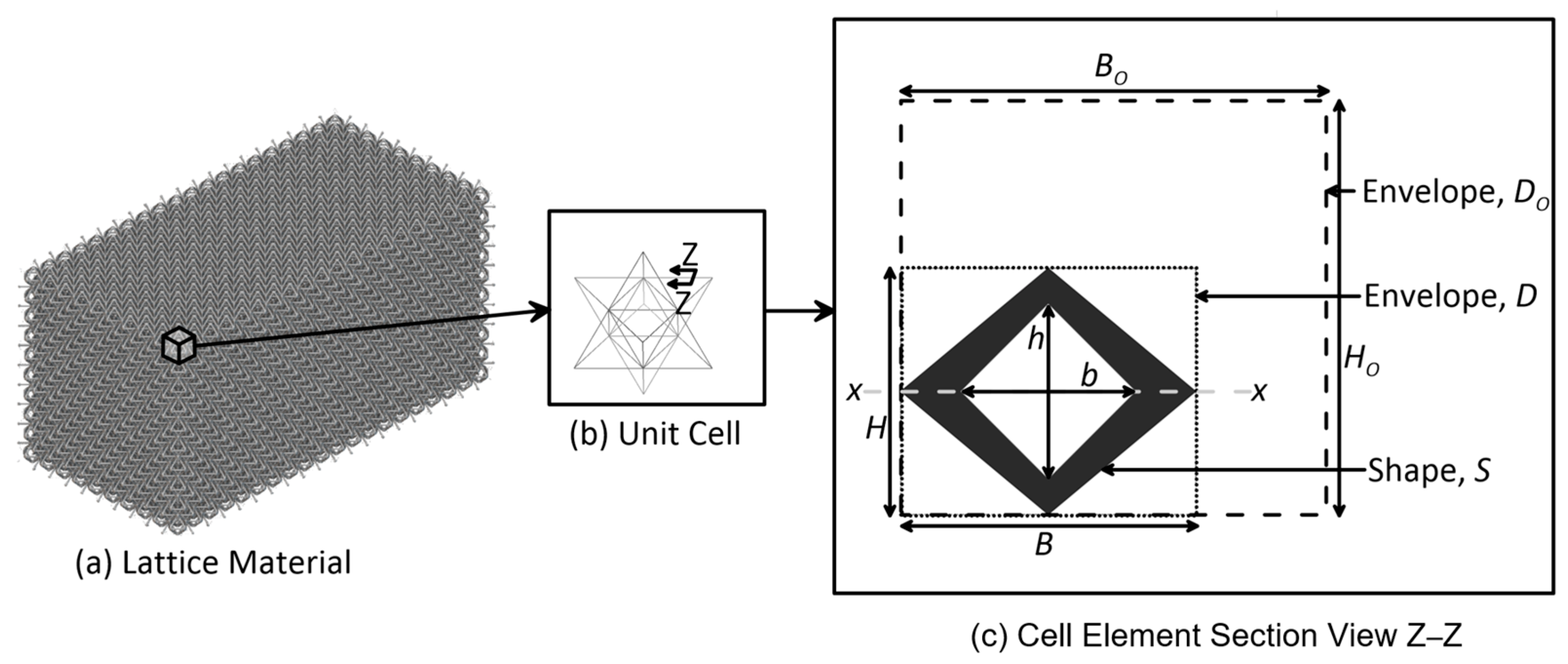
The motivation for this research is illustrated in Figure 1, which represents the multiscale structure of lattice materials. At the mesoscale, as shown in Figure 1a, these materials comprise a tessellated arrangement of unit cells (Figure 1b). The macroscale encompasses the wider application context of lattice materials, while the microscale focuses on the specific characteristics of the C-S geometry of strut-based cells, as depicted in Figure 1c.
Figure 1.
Schematic depiction of the lattice structure’s multiscale hierarchy, comprising (a) the mesoscale lattice architecture, (b) the representative repeating unit cell, and (c) the Z–Z cross-section of a constituent strut. Adapted from [61].
2.1. Cross-Section Basics
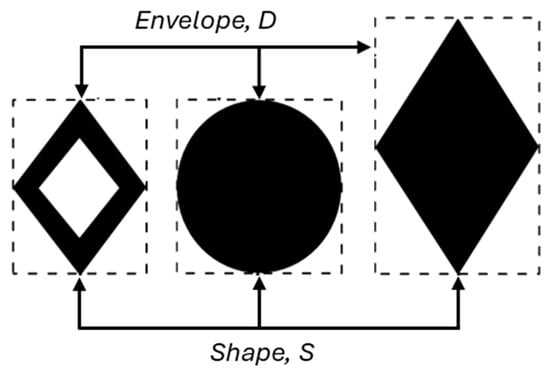
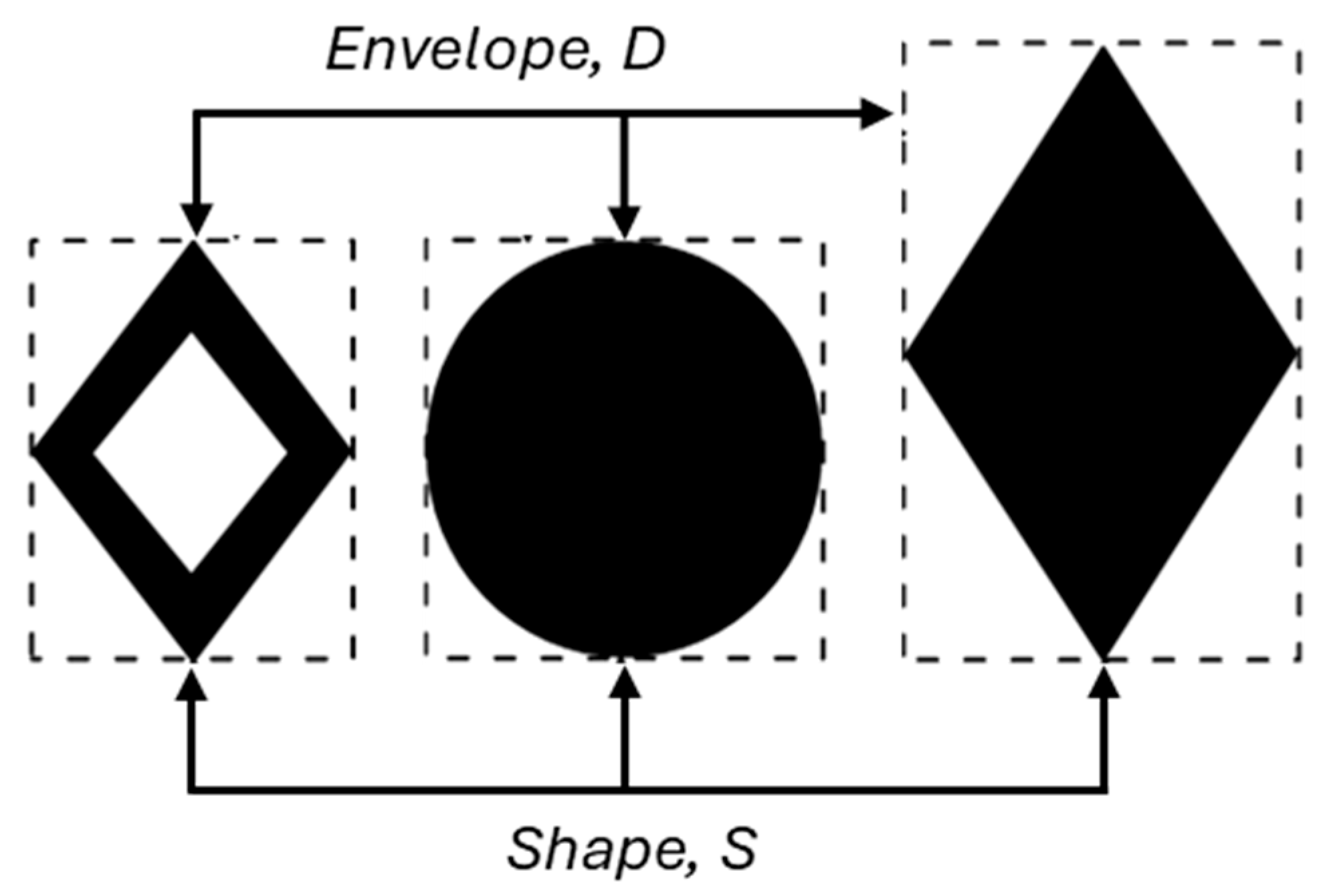
Beam cross-sections can be classified based on their geometric shape, S, which fits within a rectangular envelope, D, determined by S’s dimensions (see references [52,55,58]). Figure 2 illustrates various C-S examples, indicating that the left and center sections share the same envelope size, while the right section, although larger, resembles the central diamond-shaped section. Figure 1c further exemplifies this concept in lattice materials. For an arbitrary C-S, its rectangular envelope is characterized by width (B), height (H), area (AD = BH), and the second moment of area () about the x-x axis, as outlined in Figure 1.
Figure 2.
Schematic illustrating the envelope (D) and shape (S) of representative hollow and solid C-S. Adapted from [57,58].
Table 1 presents the area and second moment of area relative to the x-x axis for six C-S shapes from three symmetrically double family types: ellipses, rectangles, and diamonds.
Table 1.
Geometric properties—area and second moment of area—of hollow and solid C-S belonging to elliptical, diamond, and rectangular groups. Adapted from [57,58].
2.2. Shape Transformers
Shape transformers are described as proportions of geometric magnitudes that differentiate the envelope from the shape, while preserving the integrity of the shape itself, irrespective of the envelope. When a random geometric quantity of the shape is denoted as G and that of the envelope as GD, the dimensionless shape transformer S can be represented as:
The formulas for the area and second moment of area shape transformers are provided.
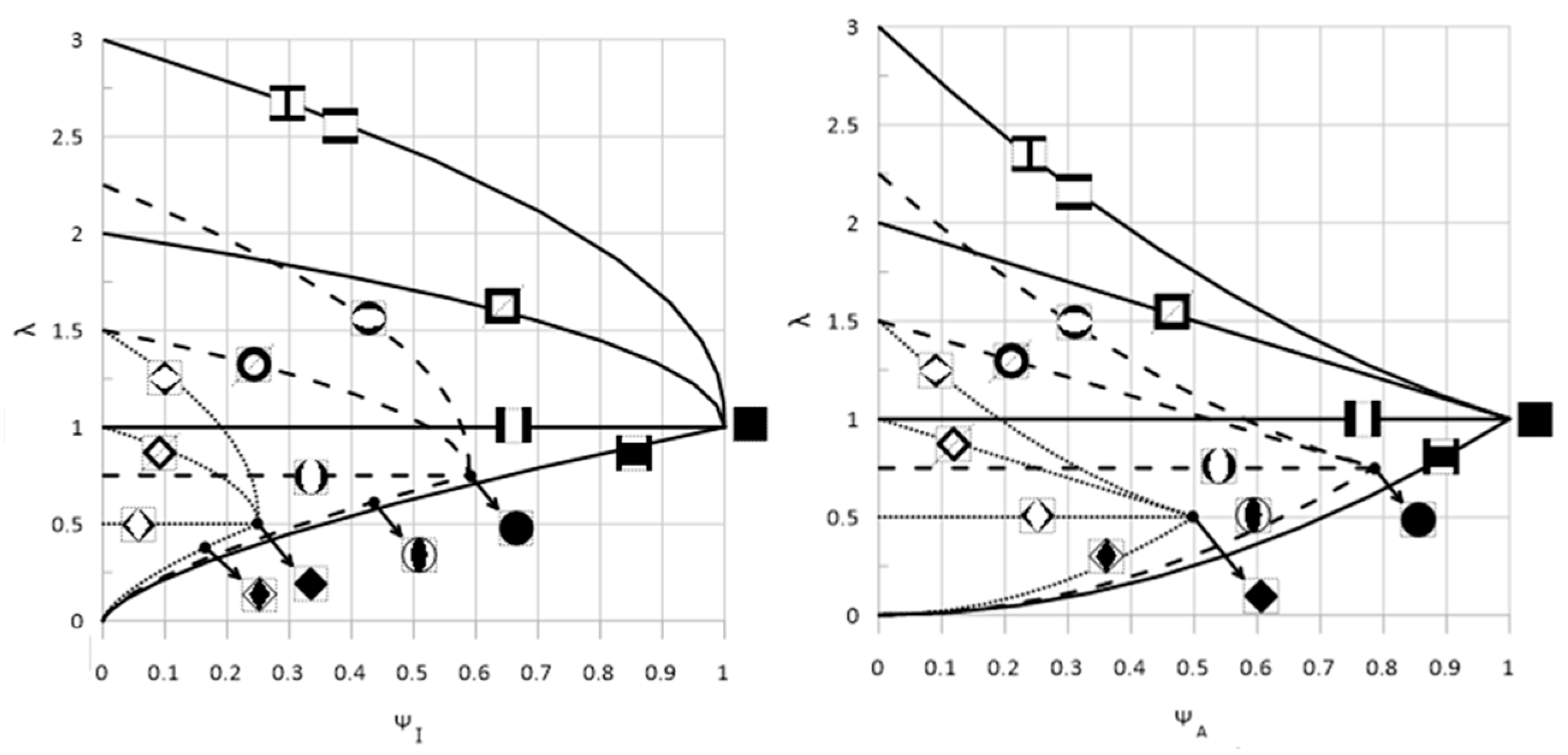
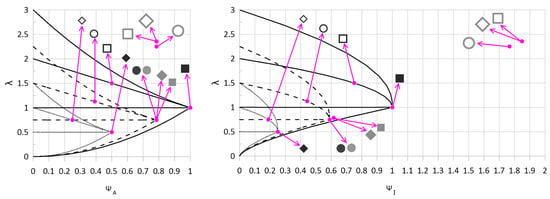
According to the description of shape and its enclosing envelope, the value of G is always equal to or less than GD. The range of values for the shape transformer spans from 0, representing an empty shape, to 1, which corresponds to a fully solid rectangle. In the case of other shapes, such as diamonds and ellipses, the values generally fall below one. A summary of transformer values for rectangular, elliptical, and diamond C-S, including both solid and hollow variants, is provided in Table 2. These findings can also be illustrated graphically in Figure 3.
Figure 3.
Comparison of the area- and inertia-based shape transformers and their geometric efficiency variations for different C-S families: elliptical, rectangular, and diamond.
A relationship can also be established between the area and the second moment of area of shape transformers, known as the geometric or envelope efficiency, defined as follows:
Geometric efficiency, , quantifies a shape’s ability to fill its envelope, with values ranging from 0 to 3 based on cross-sectional form. Table 2 provides geometric efficiencies for rectangular, elliptical, and diamond C-S families, all of which demonstrate double symmetry around their principal axes.
2.3. Envelope Multiplicators
Considering the reference shape of a solid rectangular characterized by variables: width (B0), height (H0), area (A0), second moment of area (), and shape transformer (). For a generic C-S with dimensions B and H, size variations due to horizontal and vertical scaling can be represented by the envelope multipliers u and v.
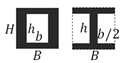
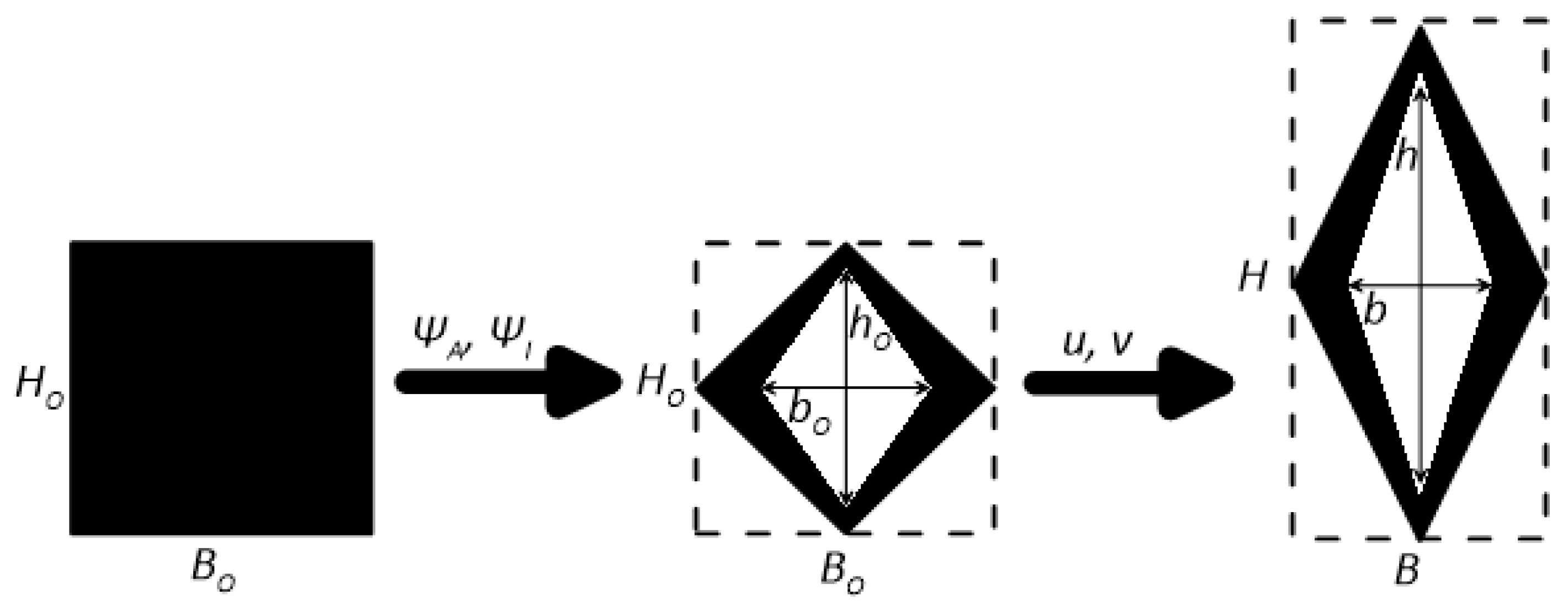
An example illustrating the use of shape transformers and envelope multiplicators to define the relationship between a rectangular reference shape and an arbitrary hollow diamond C-S is provided in Figure 4. Initially, shape transformers and facilitate the transformation of the rectangular C-S with dimensions B0 and H0 (left image) into a hollow diamond C-S characterized by dimensions B0, H0, b0, and h0 (center image). Subsequently, scaling the hollow diamond C-S using multiplicators u and v generates a new C-S with dimensions B, H, b, and h (right image). The area, A, and the second moment of area, I, for the transformed and scaled C-S can be determined based on the area, A0, and the second moment of area, I0, of the original rectangular reference shape, utilizing previously defined Equations (2), (3), (5) and (6):
where and are the area and second moment of area shape transformers for the scaled C-S [52].
Figure 4.
Shape transformation and envelope scaling of a C-S. Adapted from [57].
Table 2.
Shape transformers for solid and hollow derivatives belonging to rectangular, elliptical, and diamond families. Note that and and the ranges for and are both .



2.4. Crashworthiness Parameters
Data from the finite element solver was used to analyze the crashworthiness of lattice topologies and C-S by calculating various crashworthiness indexes:
Energy Absorption Efficiency (also “efficiency”), this index, , can be calculated from the stress–strain () curve as [65]:
Stress is defined as the force exerted by the impactor on the lattice, normalized by the envelope (bounding-box) surface area of the uppermost lattice unit cell—that is, the full planar area of the unit cell’s bounding square face (B × H), not the net cross-sectional area of the struts intersecting that face. Strain is determined by the displacement of the upper surface of the lattice relative to the original height of the cell. This approach is frequently cited in scholarly literature [19,20,65,66].
Densification Strain (), can be calculated using the EA efficiency method as:
which is merely the strain at the point of maximum efficiency [65,67,68].
Plateau Stress () is one of the two most important values relating to the EA of lattice materials (with densification strain being the other) [69]. The plateau stress can be calculated as [65]:
Energy Absorption (or internal energy, IE) can be calculated as [65]:
Equation (17) uses the densification strain as the endpoint for integrating the stress–strain curve, defining it as the EA at this strain. However, the literature shows that this endpoint can vary for calculating EA [23,30,65,70].
Specific Energy Absorption can be calculated with respect to volume——or mass—. Equations for each of these are as follows [65,71]:
where V is the total envelope (bounding-box) lattice volume—i.e., the outer dimensions of the unit cell (10 × 10 × 10 mm3)—and m is its mass, both calculated using EA up to the densification strain. The actual solid (strut) volume, which governs mass and relative density, corresponds to the CAD geometry of the struts and nodal spheres, as described in Section 3.1.
3. Numerical Model
3.1. Lattice Geometry and Design
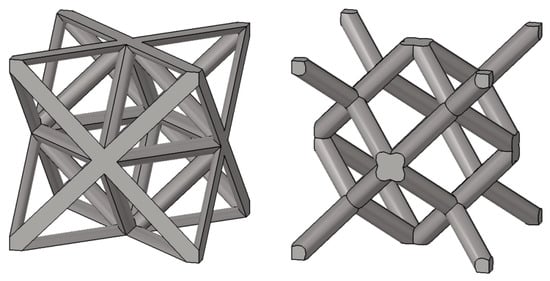
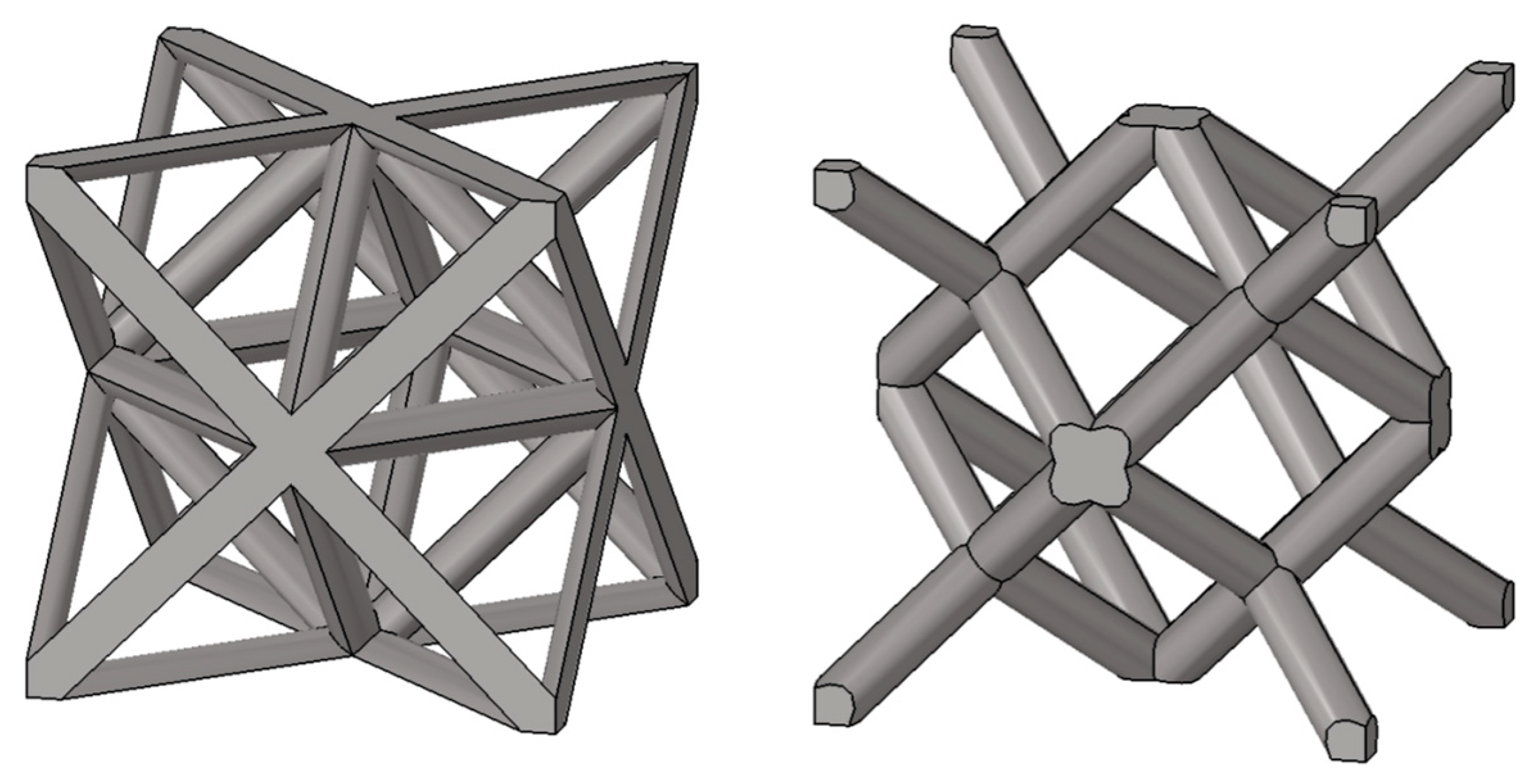
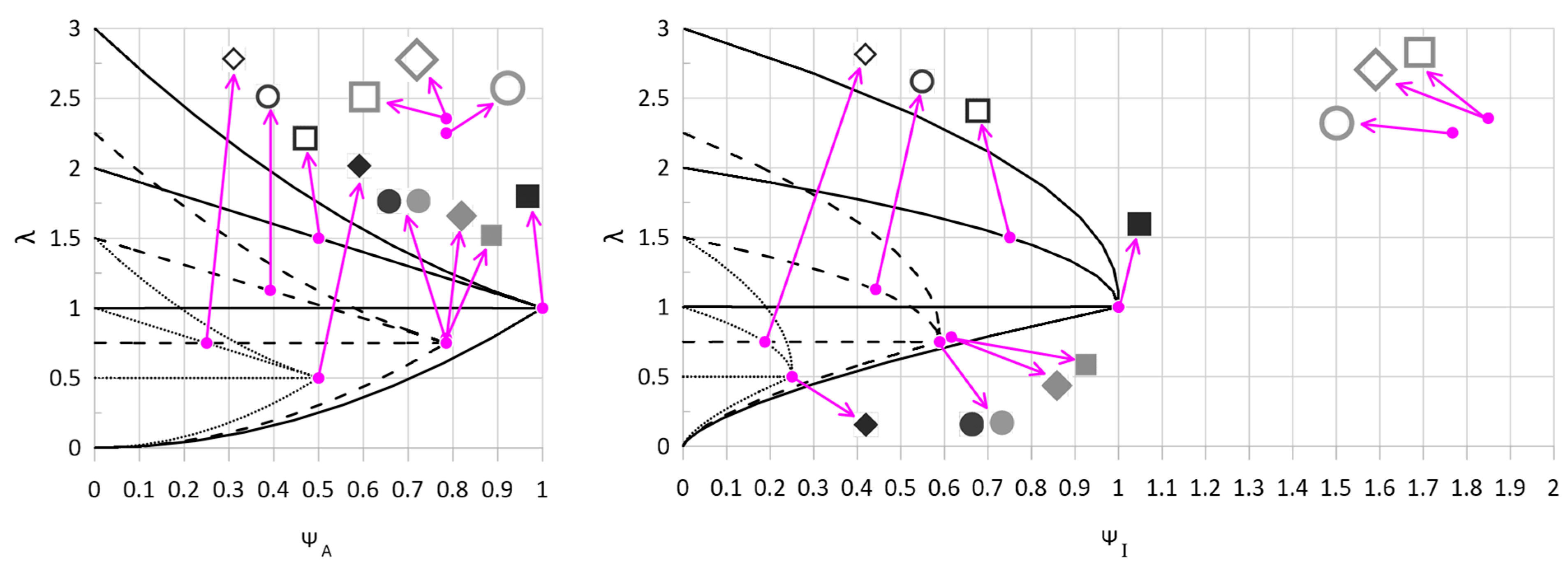
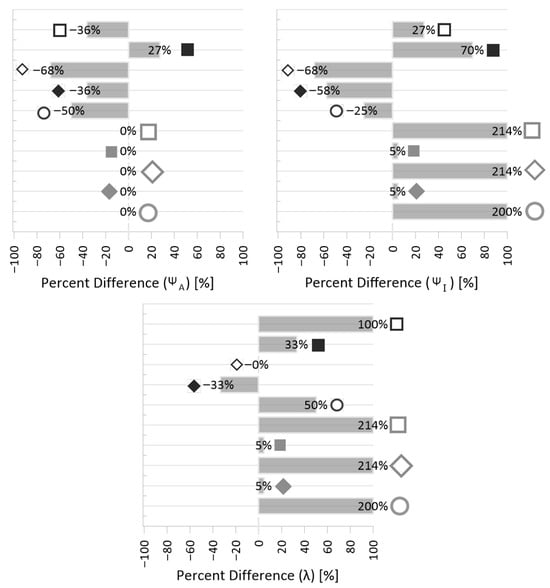
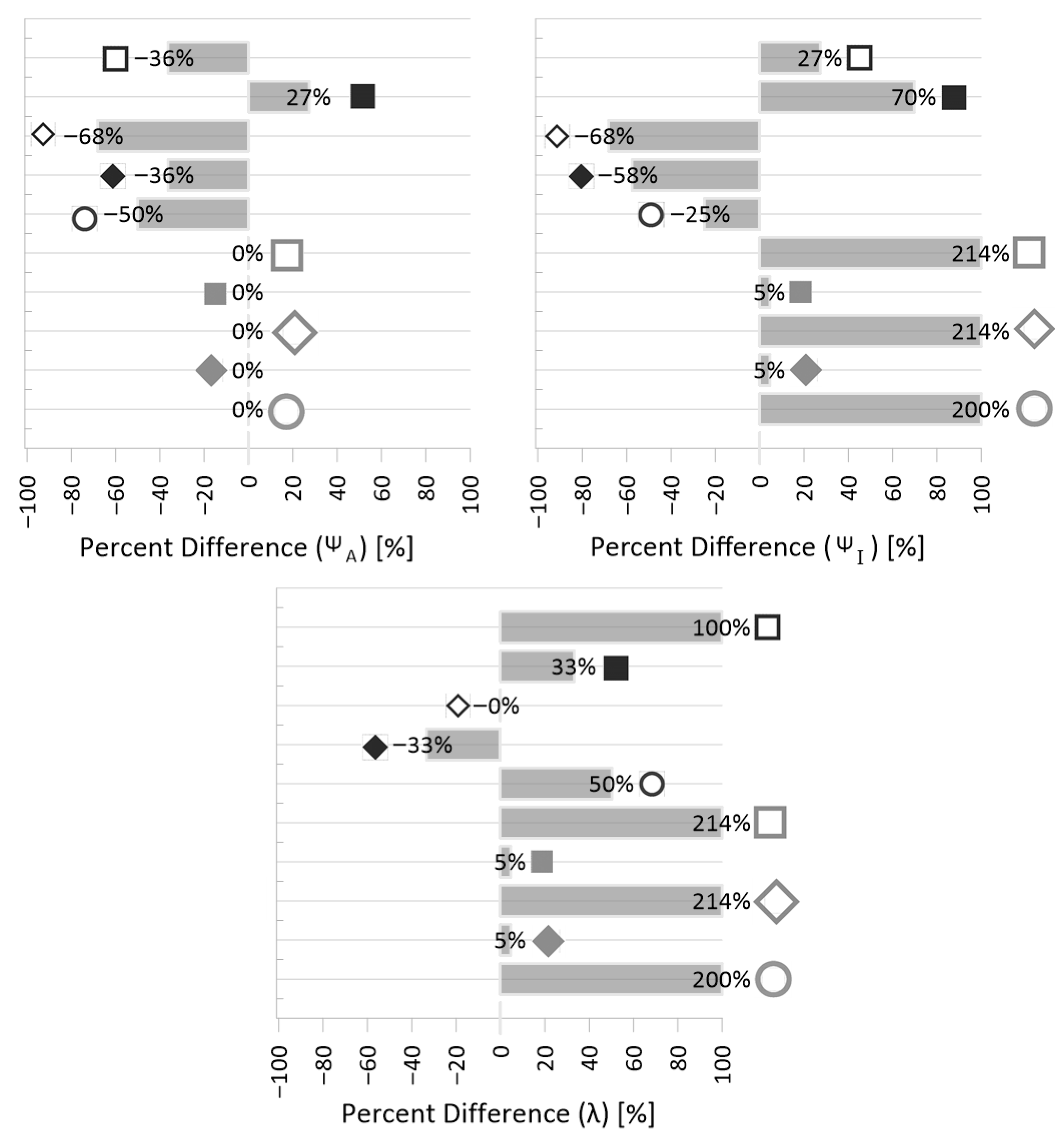
The unit cells of the stretching-dominated octet and the bending-dominated rhombic dodecahedron topologies [23,33,34] are illustrated in Figure 5. These two topologies were deliberately chosen because they represent the two canonical, mechanically distinct extremes of strut-based lattice behavior, as defined by Maxwell’s criterion for static determinacy (M = b − 3j + 6, where b is the number of struts and j the number of joints per unit cell). The octet topology satisfies M = 0 (b = 36, j = 14), placing it on the boundary of static determinacy and conferring stretching-dominated behavior, with both stiffness and strength scaling linearly with relative density [65,71]. The rhombic dodecahedron, by contrast, has M < 0, and its struts deform primarily by bending around the nodes, producing the characteristic flat, long plateau region that makes it well-suited to energy absorption applications [23,33]. Selecting these two topologies ensures that any effect of the cross-sectional shape on crashworthiness is evaluated across the full mechanistic spectrum of lattice behavior, providing the broadest possible basis for generalization. Furthermore, both topologies have been extensively validated in prior numerical and experimental studies of 316L stainless steel under dynamic loading [23,33], making them natural reference points for the shape-transformer investigation conducted here. The octet–rhombic dodecahedron pairing has also been employed in recent comparative crashworthiness studies using identical modeling frameworks and parent materials [19,20], further supporting their suitability as the representative topology pair for this work. It is noted that both topologies exhibit strut orientations that are not aligned with the direction of the applied load, which influences the deformation behavior in lattice structures [27,28]. Regarding the stretching-dominated classification of the octet topology in the context of this numerical study: the present model uses ideal, defect-free CAD geometries with solid tetrahedral elements, consistent with the modeling approach of Cao et al. [33,35] and the prior work of Bernard et al. [19,20] from which this model is directly derived. It is acknowledged that in physically fabricated SLM specimens, process-induced geometric imperfections—including strut waviness, thickness variation, and node oversizing—can reduce the effective stiffness and, in some relative density regimes, cause a transition toward more bending-like behavior, as demonstrated by Liu et al. [72] for SLM octet lattices and by Lozanovski et al. [28] for strut defect modeling. However, as a purely numerical study, the objective of this work is to isolate and quantify the effect of cross-sectional geometry (via shape transformers) on macroscopic crashworthiness, independently of manufacturing variability. The use of ideal geometry therefore represents an intentional modeling choice, not a limitation, and ensures that differences in crashworthiness metrics between configurations are attributable solely to the shape transformer parameters rather than to stochastic defect distributions. The influence of as-manufactured imperfections on the shape-transformer effect identified here is an important direction for future experimental work, as noted in the conclusion. A modeling approach was undertaken for both topologies, with a unit cell size set at 10 × 10 × 10 mm. Various cross-sectional shapes were evaluated for their impact on crashworthiness and energy absorption (EA). Two distinct modeling strategies were implemented: one maintained a constant cross-sectional area, while the other varied the cross-sectional area but kept the envelope dimensions fixed. The dimensions of the unit cells are provided in Table 3, and Figure 6 illustrates the area, second moment of area, and geometric efficiency. Additionally, the percentage differences in geometric efficiencies between the solid circular cross-section and the alternative shapes are presented in Figure 7. The geometries were modeled using modified Python 3.12.0 code [38] and ANSYS SpaceClaim (2020 R2) [73].
Figure 5.
Illustration of octet (left) and rhombic dodecahedron (right) unit cell configurations with circular C-S struts.
Figure 6.
Shape transformers for area and second moment of area, along with geometric efficiencies, for six cross-sectional profiles following Approach A (grey) and Approach B (black).
Figure 7.
Percentage variation in shape transformer and geometric efficiency, referenced to the solid circular C-S, for the cross-sectional configurations analyzed under Approach A (grey) and Approach B (black).
3.2. Finite Element (FE) Model
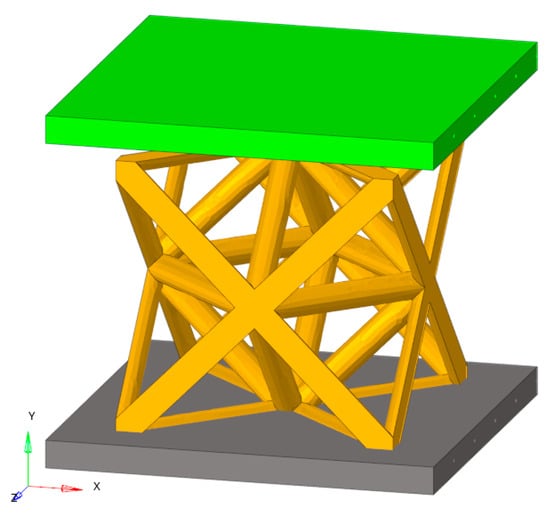
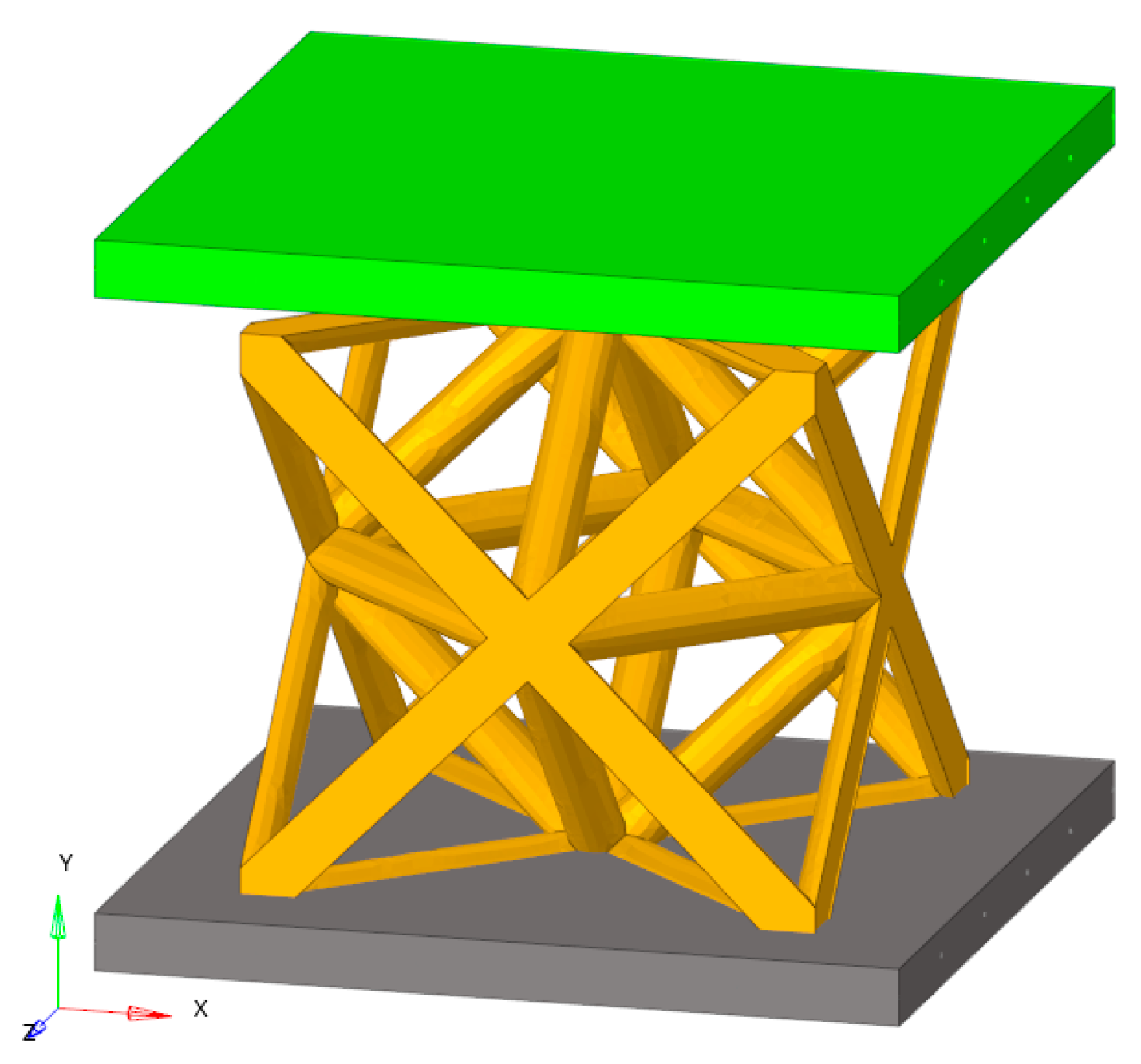
A FE model was developed using Altair’s HyperMesh and Radioss (v2020) [74,75] (Figure 8). It comprised a unit cell composed of solid tetrahedron elements, with a downward impact from a plate at an initial velocity of 10 m/s, and a stationary flat plate positioned beneath the unit cell.
Figure 8.
A FE model is developed using an octet unit cell with a solid circular C-S. The fixed base plate restricts movement, while a downward-moving top impactor introduces initial velocity. Boundary conditions on the outer surfaces simulate the periodicity of a larger lattice structure.
The impactor and base were modeled using 4-node shell elements with 14 mm sides and 1 mm thickness, treated as rigid bodies with a total weight of 2000 g. An initial kinetic energy of 0.1 kJ was given to the impactor, and a downward velocity was applied to its master node for unit cell compression. The model comprises three interfaces: impactor–lattice cell interaction, self-contact of the lattice during crushing, and base–lattice cell interaction. A solid contact interface was used for the impactor–base interactions, while self-contact was managed via a single-surface interface. The simulations employ an explicit time-integration scheme, which is standard for crash and impact analyses involving large deformations and contact events. The unit cell models were discretized using 4-node linear solid tetrahedral elements (Radioss TYPE 24) with a characteristic element size of approximately 0.3 mm. Based on the unit cell volume (10 × 10 × 10 mm3) and the relative densities, the resulting mesh size varies depending on the cross-sectional configuration. The estimated number of elements ranges from approximately 12,800 elements for the lowest relative density case (octet topology with hollow diamond cross-section, Approach B) to about 44,300 elements for the highest relative density case (octet topology with solid square cross-section, Approach B). For most configurations, the mesh density falls within the range of approximately 20,000 to 40,000 elements.
3.3. Material and Failure Model
The lattice unit cell was based on a parent material of 316L stainless steel alloy with properties similar to those produced by the SLM method. In Radioss, the material utilized a Johnson–Cook (J-C) strength and failure model [76].
The J-C strength model characterizes plastic stress as a function of strain hardening, strain rate hardening, and temperature softening. This relationship is expressed in Equation (15), in which A, B, C, m, and n are material constants that can be identified through experimental testing. Additionally, , , and denote the equivalent plastic strain, the normalized equivalent plastic strain rate, and the dimensionless homologous temperature, respectively.
Equations (16) and (17) define the normalized equivalent plastic strain rate and the dimensionless homologous temperature, respectively, where , , , and are the plastic strain rate, reference strain rate, room temperature, and melting temperature, respectively.
Temperature effects were not considered in this study. Relevant material constants for the J-C strength model of 316L stainless steel are presented in Table 4, sourced from Cao et al. [34,35], who applied J-C strength and failure models in numerical investigations of lattice structures, validating their findings through experimental testing.
Table 4.
Mechanical properties and material constants of SLM-manufactured 316L stainless steel alloy for use in J-C material model.
The material constants in Table 4 were determined specifically for 316L stainless steel manufactured by SLM and therefore reflect the as-built microstructure rather than wrought material properties. In [34], Cao et al. validated the J–C model against dynamic Split Hopkinson Pressure Bar (SHPB) compression experiments on SLM-fabricated rhombic dodecahedron lattices over a relative density range of 5–15%, achieving good quantitative agreement in plateau stress (error < 10%) and EA efficiency. The yield strength constant A = 310 MPa reflects the elevated yield stress of SLM 316L (compared to approximately 170–200 MPa for wrought material) arising from the fine cellular dislocation substructure produced by rapid solidification. The strain-hardening coefficient B = 622 MPa and exponent n = 0.8 capture the strong work-hardening response characteristic of austenitic SLM steels. The strain-rate coefficient C = 0.1 captures the moderate rate sensitivity of 316L, which is relevant at strain rates of approximately 10–100/s encountered at an impact velocity of 10 m/s. Temperature effects are excluded (T* = 0), consistent with [34,35], as the low-to-moderate velocity regime studied here does not produce significant adiabatic heating.
The material card for the lattice cell in this work employs the J-C failure model, which distinguishes between the initiation an evolution of damage in the plastic stress–strain behavior, as noted in [34,35]. Damage initiation is defined as in Equation (18) and when , damage is initiated ( can vary between 0 and 1).
In Equation (18), is the increment of the equivalent plastic strain and is the equivalent plastic strain at failure. This equivalent plastic strain at failure can be defined as in Equation (19), where through are material constants and is the ratio of the mean stress, , to the Mises equivalent stress, . The through material constants for this work are presented in Table 4. As with the constants for the J-C strength model, these values come from the work of Cao et al. in [34,35] and temperature effects were not a consideration.
4. Results and Discussion
4.1. The Octet Topology: Cross-Section Shape Effect
It should be noted that although the octet topology is theoretically classified as a stretching-dominated structure, this classification is strictly valid for idealized systems consisting of pin-jointed members subjected to purely axial loading. In the present study, the lattice is modeled using solid elements with finite joint regions, where struts are connected through volumetric nodes rather than ideal hinges. This modeling approach introduces local bending effects and stress concentrations at the joints, leading to deviations from purely stretching-dominated behavior. Furthermore, the use of non-circular cross-sectional geometries modifies the second moment of area of the struts, thereby influencing the relative contributions of axial and bending deformation mechanisms. In addition, the applied dynamic loading conditions may further smooth the stress–strain response by suppressing sharp peak stresses typically associated with ideal stretching-dominated lattices. Also, Tancogne-Dejean et al. [30] demonstrated that the meso-structural response of metallic octet lattices transitions from an unstable twist mode (oscillating response, no plateau) to a stable buckling-free mode as relative density increases above approximately 0.3. Below this threshold, at the relative densities used here (9–14%), the macroscopic stress response is a smoothly rising plateau without a pronounced peak, which can superficially resemble bending-dominated behavior. This is a known characteristic of stretching-dominated lattices at low-to-moderate relative densities and is not a modeling artifact. Consequently, the observed response of the octet topology in this study may exhibit characteristics resembling bending-dominated behavior, not due to misclassification of the topology but rather to realistic modeling assumptions and loading conditions.
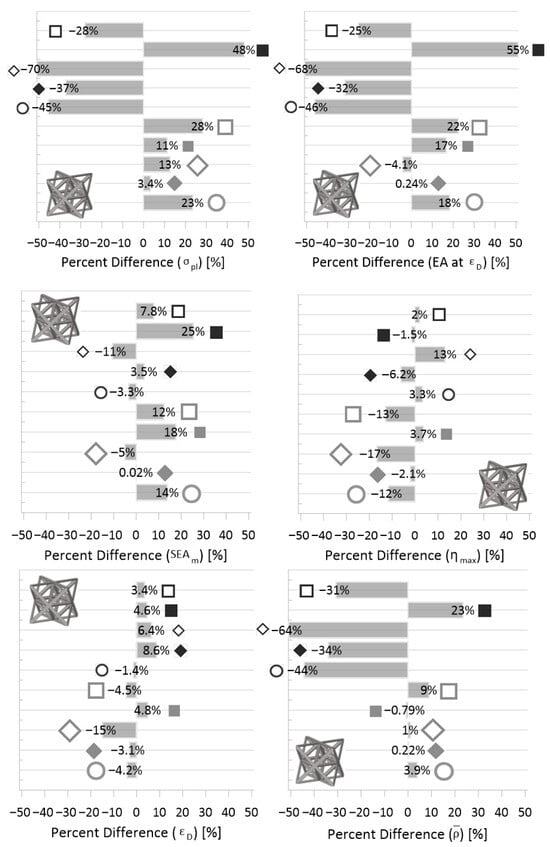
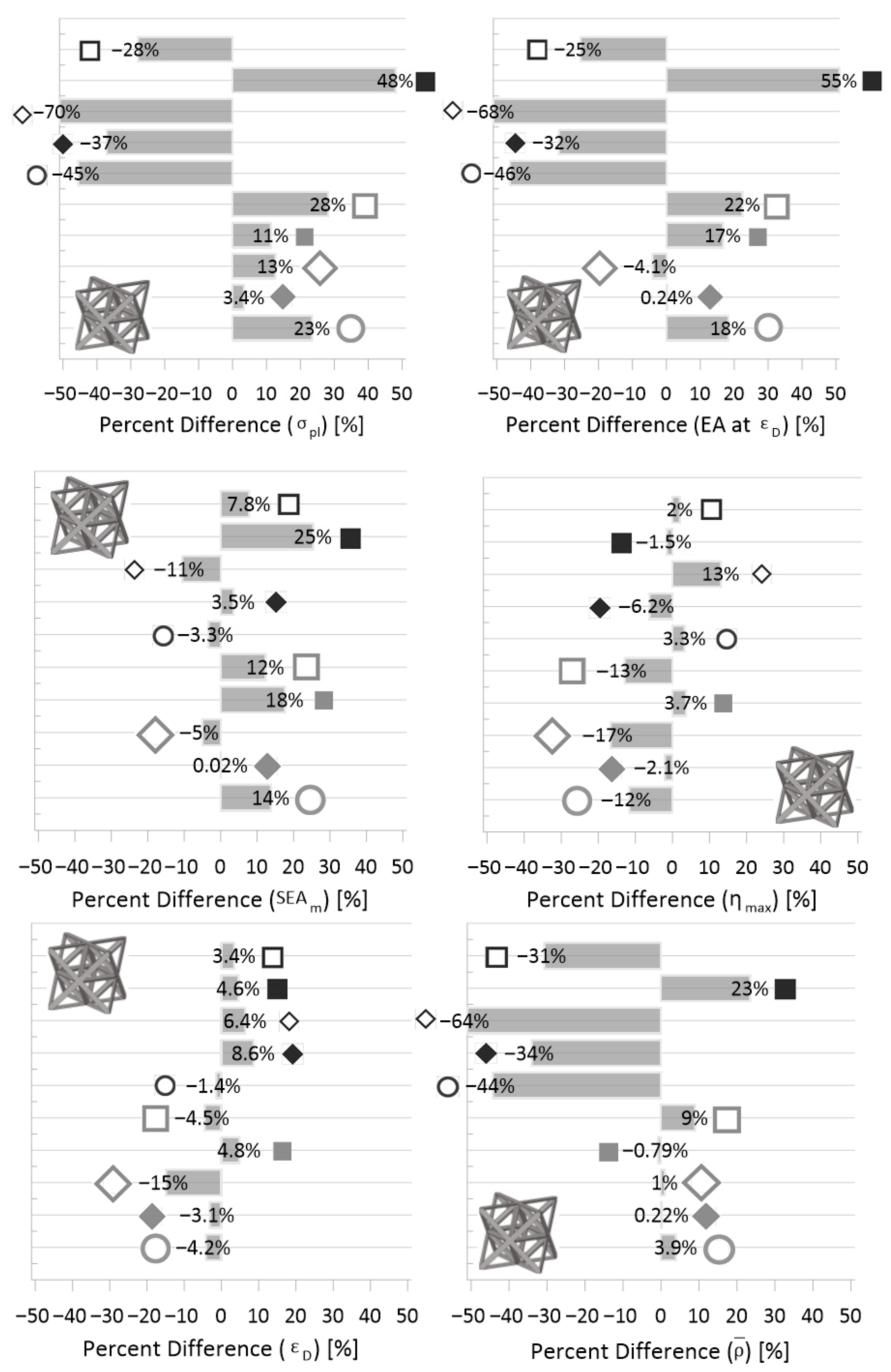
Figure 9 illustrates the relationships between stress and energy absorption efficiency as functions of strain, while Figure 10 presents the percentage differences between the solid circular configuration and other configurations of the cellular structures from both approaches. Notably, Figure 9 highlights the significant impact of relative density on thestresses, particularly the plateau stress, of the lattice structures, irrespective of the configuration type (C-S shape). In Approach B, the solid square configuration (S-B) achieves the highest relative density, resulting in a plateau stress of 63.4 MPa, which surpasses the plateau stresses observed in all other simulations, which remain below 55 MPa. In contrast, the hollow diamond configuration in Approach B (DH-B), characterized by the lowest relative density, displays a more gradual plateau region. The arrangement of plateau stresses from highest to lowest is: hollow square (SH-A), hollow circle (CH-A), hollow diamond (DH-A), solid square (S-A), solid diamond (D-A), and solid circle (C-A). This hierarchy closely corresponds with the increasing geometric efficiency, Ψ1, depicted in Figure 6, suggesting that while relative density significantly influences the outcomes, geometric efficiency also contributes to the results. Discrepancies in plateau stress between S-A and the slightly denser configurations C-A and D-A indicate that relative density is a crucial factor, particularly in the context of nodal topology design. For instance, although geometric efficiencies suggest a higher plateau stress for DH-A compared to CH-A, the actual findings reveal a contrary result (48.2 MPa versus 52.9 MPa), attributable to their respective relative densities of 11.5% and 11.8%.
Figure 9.
Stress and EA efficiency curves of octet topology with varying C-S shapes for Approaches A (grey) and B (black). The relative density percentages are indicated in the legend.
Figure 10.
Percentage differences between the noted and solid circular C-S for six parameters (EA at densification, densification strain, plateau stress, EA efficiency, SEAm, relative density) are presented for octet topology using approaches A (grey) and B (black).
While the highest efficiency of EA is demonstrated by DH-B, it is noted that it does not exhibit extreme values in geometric efficiency, neither at the upper nor lower extremes. Analyzing the efficiencies of other C-S reveals no significant trends unless focusing solely on the Approach A C-S, which shares similar designed relative densities with only minor CAD variations. Figure 6 indicates that hollow C-S demonstrates greater geometric efficiencies than solid ones despite identical values. In evaluating the energy absorption (EA) efficiencies for Approach A, solid cellular structures (C-S) demonstrating values between 0.53 and 0.56 outperformed their hollow counterparts, which exhibited values ranging from 0.45 to 0.48. This finding indicates an inverse relationship when controlling for relative density. In the context of Approach B, the solid honeycomb structure (SH-B) recorded the highest geometric efficiency at 1.5; however, it also had the lowest EA efficiency at 0.51, which was linked to the solid diamond cellular structure (D-B). It is noteworthy that despite D-B and SH-B sharing equal relative density, their results diverge from those observed in Approach A. Specifically, SH-B demonstrated superior geometric efficiency (1.5) and EA efficiency (0.55) when compared to D-B. Trends related to plateau stress, densification strain, maximum EA efficiency, relative density, EA, SEAm are presented in Figure 10. These can be identified.
While the highest efficiency of EA is attributed to the solid honeycomb structure (DH-B), it is important to note that it does not display extreme values in geometric efficiency, neither at the upper nor lower ends of the spectrum. A closer examination of the efficiencies associated with other cellular structures (C-S) reveals no significant trends, unless attention is directed solely toward the Approach A C-S, which exhibits similar designed relative densities with only minor variations in computer-aided design (CAD). Figure 6 illustrates that hollow C-S typically demonstrates greater geometric efficiencies than solid counterparts, even when the absolute values are the same. When evaluating the energy absorption efficiencies for Approach A, solid cellular structures (C-S) achieve values ranging from 0.53 to 0.56, outperforming hollow structures, which show values between 0.45 and 0.48. This observation suggests an inverse relationship when controlling for relative density. In the context of Approach B, the solid honeycomb structure (SH-B) reports the highest geometric efficiency at 1.5; however, it simultaneously records the lowest EA efficiency at 0.51, a value closely linked to the solid diamond cellular structure (D-B). It is noteworthy that despite D-B and SH-B sharing the same relative density, their performance diverges from the findings observed in Approach A. Specifically, SH-B demonstrates greater geometric efficiency (1.5) and EA efficiency (0.55) when compared to D-B. Trends concerning plateau stress, densification strain, maximum EA efficiency, relative density, and specific energy absorption (SEAm) are delineated in Figure 10, providing a comprehensive overview of these relationships.
- The stress curve analysis indicates that all C-S samples derived from Approach A demonstrate significantly higher plateau stresses, with increases ranging from 3.4% to 28%, when compared to the reference solid circular C-S. This observation appears to correlate with the geometrical efficiency present in these C-S structures, which have effectively minimized the influence of relative density. In contrast, for Approach B, all models, with the exception of the solid square C-S, exhibit lower relative densities compared to the solid circular model, a difference that is reflected in the variations observed in plateau stress percentages.
- An examination of densification strain reveals a general trend where higher relative densities correspond to lower densification strain, as this transition marks the shift to solid behavior. This pattern remains consistent across comparisons of similar C-S shapes as well as among different shapes. For instance, DH-A, which possesses a higher relative density, demonstrates lower densification strain in comparison to DH-B. Similar trends are evident between CH-A and CH-B, D-A and D-B, SH-A and SH-B, and S-B and S-A. However, within Approach A, variations in densification strain are observed despite similar relative densities across the C-S samples. Specifically, the densification strain ranges from 15% lower to 4.8% higher than that of CH-A. This suggests the influence of factors beyond the mere physical material in the lattice on densification strain, as highlighted by Equation (15), which emphasizes EA efficiency rather than material quantity.
- The relationship among EA, densification strain, and plateau stress becomes apparent through the percent difference in outcomes. Increases or decreases in both plateau stress and densification strain typically align with corresponding changes in EA. Conversely, when these parameters do not exhibit synchronous movement, the overall change in EA is determined by the magnitudes of their shifts. For example, CH-A shows a 23% increase in plateau stress accompanied by a 4.2% reduction in densification strain, resulting in an 18% increase in EA. Comparatively, DH-A reveals a 13% increase in plateau stress coupled with a 15% reduction in densification strain, resulting in a 4.1% decrease in EA.
The influence of cross-sectional shape on specific energy absorption per unit mass (SEAm) has been evaluated, with the findings illustrated in Figure 10. Modifications to the strut shapes within the octet topology have been observed to result in both increases and decreases in SEAm values. Notably, geometries derived from approaches A and B reveal comparable trends: a 5% reduction in SEAm for DH-A and an 11% reduction for DH-B; conversely, S-A and S-B demonstrate increases of 18% and 25%, respectively. CH C-S serves as an exception to these trends. Furthermore, it is important to note that both the effective area (EA) at densification and the relative density are significant factors influencing SEAm. A lower EA could correspond to a higher SEAm, particularly when accompanied by a lower relative density, and the opposite scenario may also hold true.
4.2. The Rhombic Dodecahedron Topology: Cross-Section Shape Effect
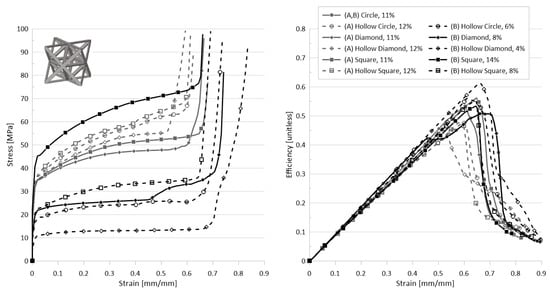
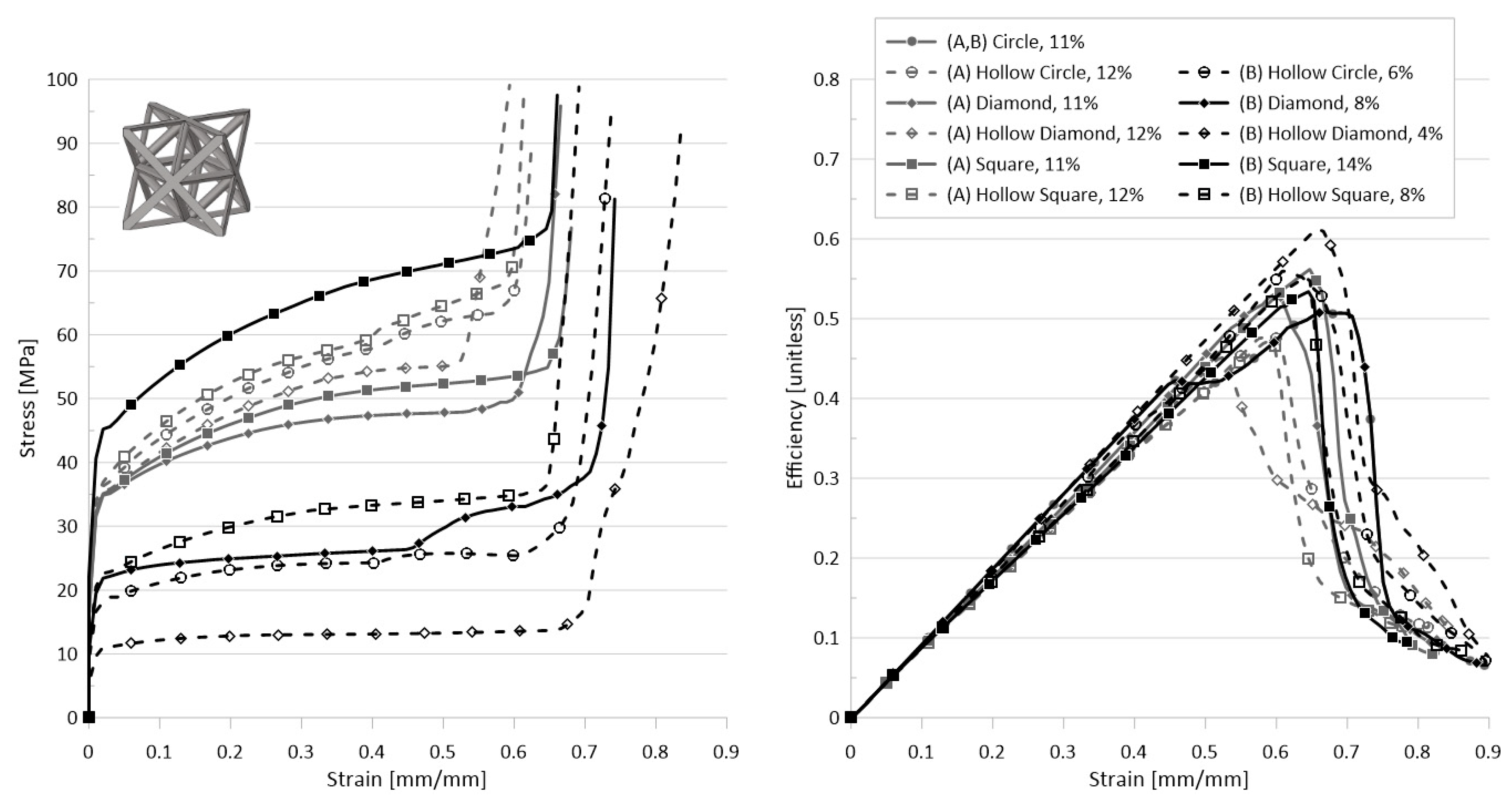
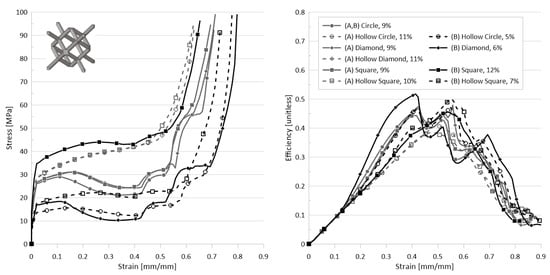
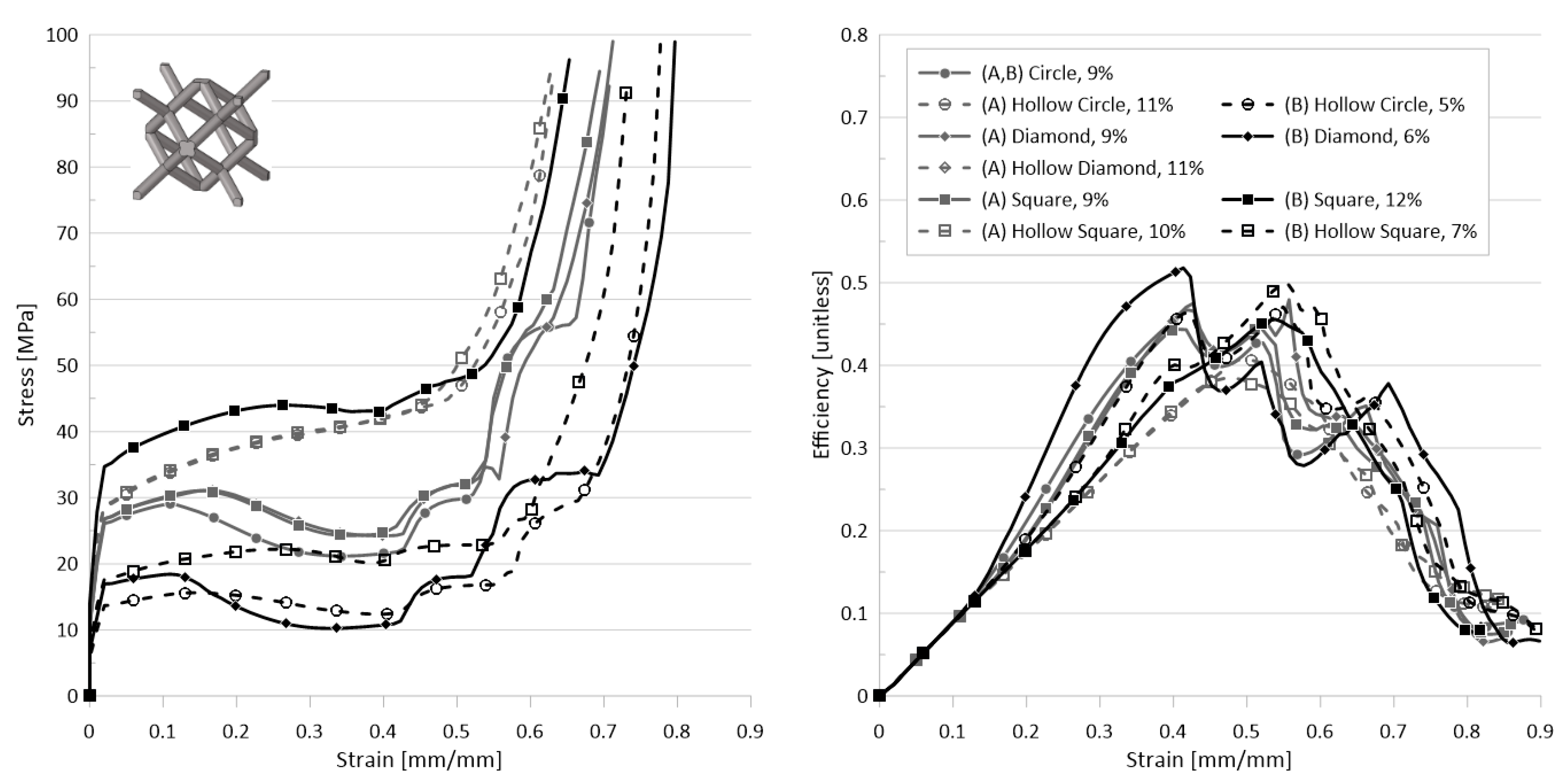
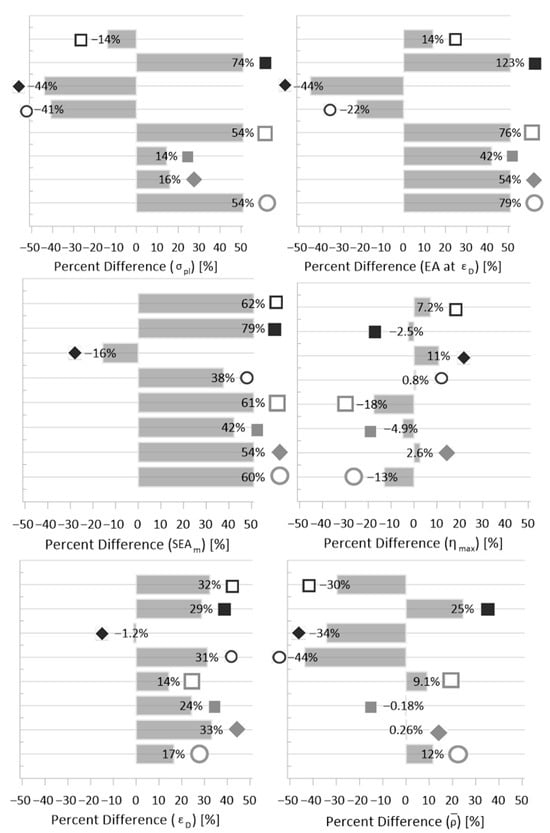
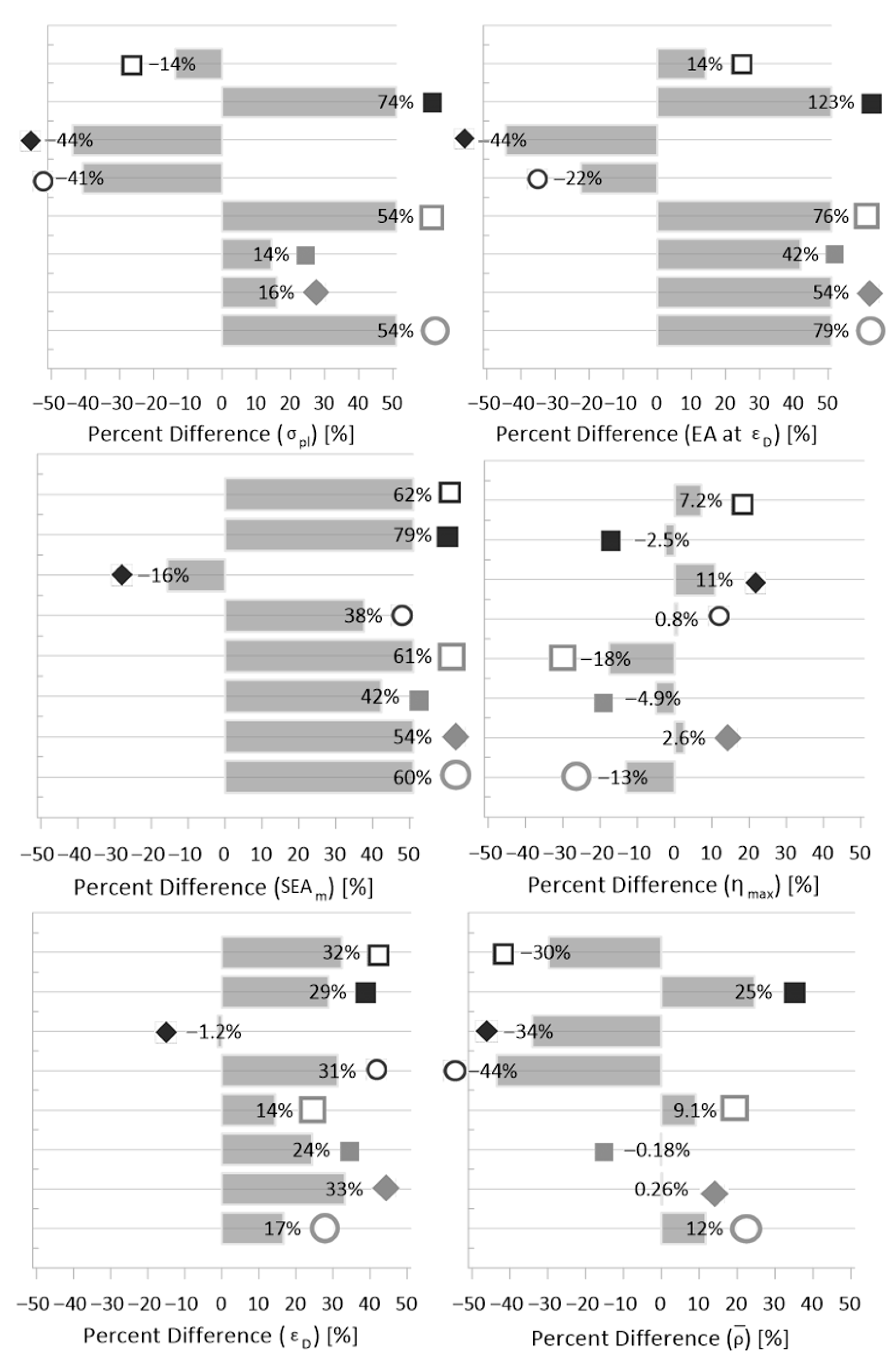
Crashworthiness parameters for the various C-S shapes of the rhombic dodecahedron unit cell are presented in Table 5. Stress and efficiency curves are illustrated in Figure 11, while Figure 12 showcases the percentage differences in crashworthiness parameters between solid circular shapes and other C-S configurations. The findings suggest that relative density plays a significant role in influencing both stresses and plateau stress within the lattice structures. Among the models examined, the solid square C-S (S-B) from Approach B, characterized by a relative density of 11.7%, attains the highest plateau stress of 42.4 MPa, surpassing the plateau stresses of other designs, which do not exceed 38 MPa. Conversely, models developed under Approach A, which were intended to maintain uniform relative densities, exhibit greater variability in plateau stresses. The hollow circle (CH-A) and hollow square (SH-A) shapes display comparable stress values of 37.4 and 37.5 MPa, respectively, while the solid circular, diamond, and square configurations yield lower plateau stresses ranging from 24.3 to 28.2 MPa. It is noteworthy that solid C-S shapes demonstrate lower geometric efficiency and Y1 values compared to their hollow counterparts. This observation is further corroborated by the lower plateau stresses observed in the hollow square (SH-B) at 21.0 MPa and the solid diamond (D-B) at 13.7 MPa, despite SH-B exhibiting a higher geometric efficiency of 1.5. The results pertaining to maximum EA efficiency underscore the influence of geometric efficiency on C-S design outcomes. In Approach A, a sequence reflecting maximum EA efficiency (from lowest to highest) aligns with a decline in geometric efficiency: SH-A, CH-A, S-A, C-A, and D-A. In Approach B, the effect of relative density on maximum EA efficiency is also evident. For instance, SH-B, while possessing the highest geometric efficiency, attains a maximum EA efficiency of 0.50, which is higher than that of most other models, whereas D-B achieves an efficiency of 0.52. This pattern is consistent with those observed in Approach A, indicating that higher geometric efficiencies are generally associated with lower maximum EA efficiencies at equivalent relative densities. Figure 12 further illustrates the percentage differences across various metrics, including maximum EA efficiency, plateau stress, densification strain, EA, SEA per unit mass, and relative density.
Table 5.
The results of the crashworthiness parameters obtained from numerical simulations of octet and rhombic dodecahedron topologies and A and B approaches.
Figure 11.
Stress and EA efficiency curves of rhombic dodecahedron topology with different C-S shapes for Approaches A (grey) and B (black). The relative density percentages are indicated in the legend.
Figure 12.
Percentage differences between noted C-S and solid circular C-S for six parameters (EA at densification, densification strain, plateau stress, EA efficiency, SEAm, relative density) are presented. Data pertains to C-S from approaches A (grey) and B (black) for the rhombic dodecahedron lattice geometry.
- The stress–strain curve analysis demonstrates that the composite structure (C-S) assessed through Approach A possesses plateau stresses that are notably higher—by 14% to 54%—compared to the solid circular reference C-S. In contrast, Approach B reveals a different trend, with the exception of the solid square C-S, which exhibits a remarkable increase of 74%, the plateau stresses in this approach are diminished by 14% to 44%. This variation is attributed to the comparative relative density of the model in relation to the Ψ1 Y1 values associated with Approach B.
- In both approaches, all C-S types displayed greater densification strains than the solid circular C-S, with the exception of D-B, which was found to be 1.2% lower. Notably, this trend does not seem to correlate with the parameters ΨA or Ψ1, nor does it align with the geometric efficiency of the C-S. The values for C-A, for instance, fall within the average range for all C-S, indicating a diverse mix of both increases and decreases in densification strains.
- The observed variations in plateau stress and densification strain can elucidate the differences in energy absorption (EA). In scenarios where both plateau stress and densification strain increase (or decrease), a corresponding increase (or decrease) in EA is also observed. This pattern is illustrated in the cases of S-B and D-B, which experienced concordant changes in both parameters. Conversely, when these two factors moved in opposite directions, the resulting changes in EA depended on the relative magnitudes of these shifts. For example, within Approach B, a 31% rise in densification strain coupled with a 41% reduction in plateau stress resulted in a comparatively modest 22% decrease in EA.
To address the impact of relative density on results, the change in SEA per unit mass is illustrated in Figure 12. The graph shows that altering the cross-sectional shape of the rhombic dodecahedron struts generally increases SEAm, except when transitioning to a solid diamond C-S within the same reference envelope (like D-B), which decreases SEAm.
In contrast to octet topology, the rhombic dodecahedron topology exhibits a bending-dominated deformation mechanism, where struts primarily undergo flexural deformation rather than axial loading. In such systems, energy absorption is governed by progressive bending, plastic hinge formation, and localized buckling, which significantly enhance energy dissipation capacity. This behavior aligns with previous studies indicating that bending-dominated cellular structures generally exhibit lower stiffness but higher energy absorption potential [2].
The influence of cross-sectional shape is therefore more pronounced in this topology, as the second moment of area plays a dominant role in controlling bending stiffness. Modifications in cross-sectional geometry alter the distribution of material from the neutral axis, thereby directly affecting flexural rigidity and collapse mechanisms. Consequently, variations in shape transformers lead to substantial changes in plateau stress, densification behavior, and overall energy absorption. This explains the significantly higher improvements in specific energy absorption observed for this topology compared to the stretching-dominated octet lattice.
The results of the crashworthiness parameters obtained from numerical simulations of both topologies and approach methods are presented in Table 5. Throughout this study, areas and volumes are reported consistently with respect to two distinct reference frames: (i) the actual (solid) strut cross-sectional area and strut volume, used to compute relative density and mass; and (ii) the envelope (bounding-box) area and volume of the unit cell, used to normalize stress (force divided by the 10 × 10 mm2 top face of the bounding box) and SEAC (energy divided by the 10 × 10 × 10 mm3 envelope volume). This distinction ensures that the reported crashworthiness metrics are independent of cross-sectional shape and are therefore directly comparable across all C-S configurations. The designed relative density, based on C-S area, slightly changes from the actual CAD relative density, which takes into account solid spheres at all nodes. Figure 6 and Figure 7 illustrate shape transformers and the percentage difference in shape transformers across changing C-S.
4.3. Effect of Topology
The differences observed between the two topologies can be fundamentally attributed to their distinct deformation mechanisms. While stretching-dominated lattices efficiently carry loads through axial forces, bending-dominated lattices dissipate energy through progressive flexural deformation and instability mechanisms. As a result, geometric modifications at the strut level—such as cross-sectional shape variations—have a limited effect on stretching-dominated systems but a significantly amplified impact on bending-dominated structures. This highlights the critical role of topology–geometry interaction in the design of lattice materials for crashworthiness applications.
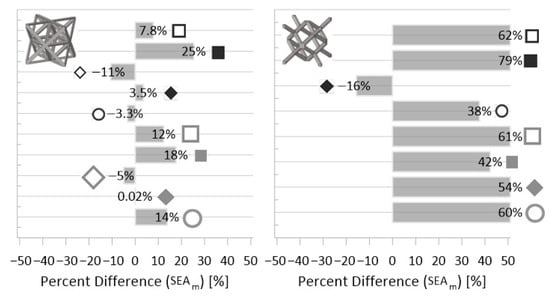
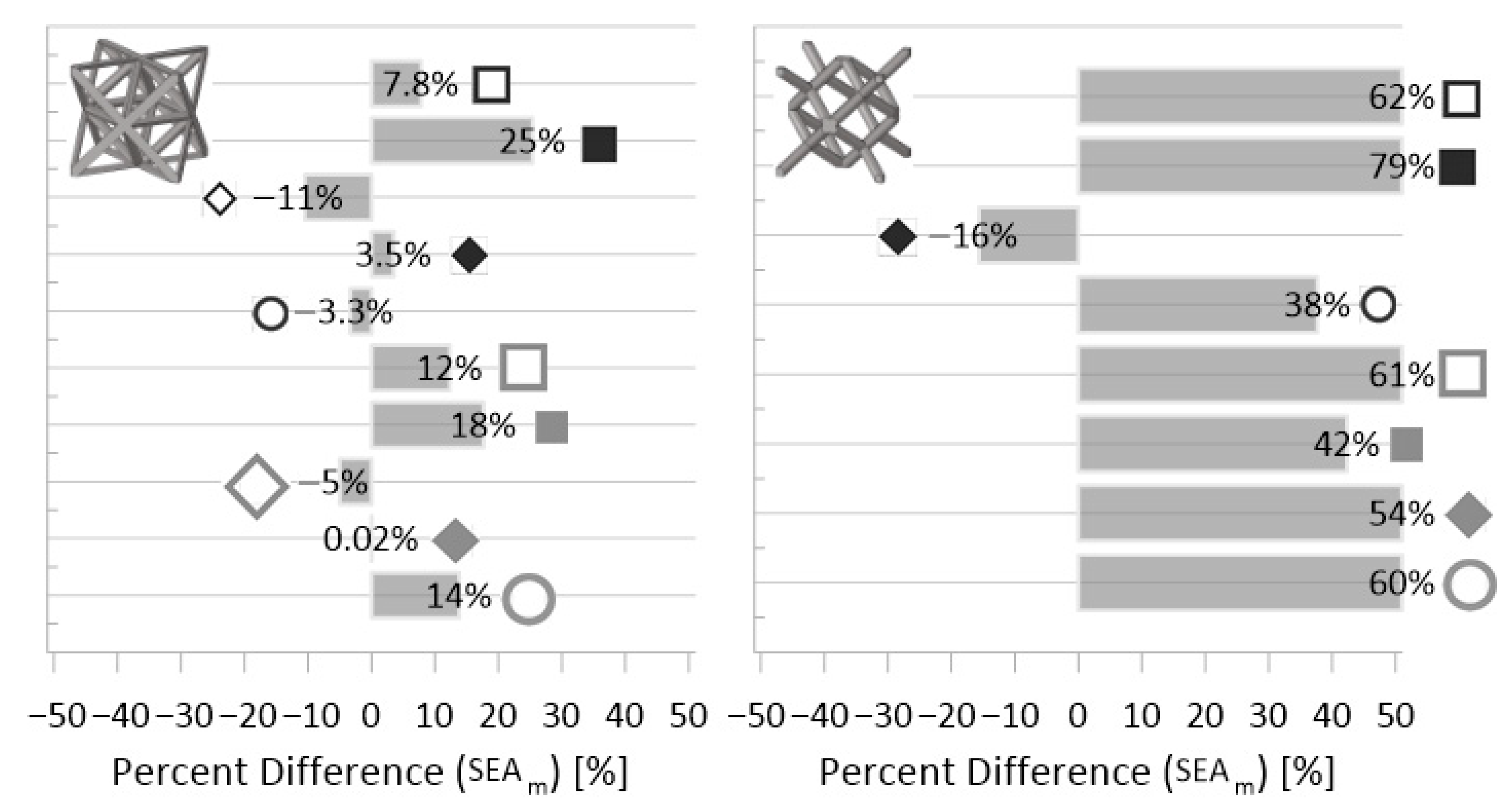
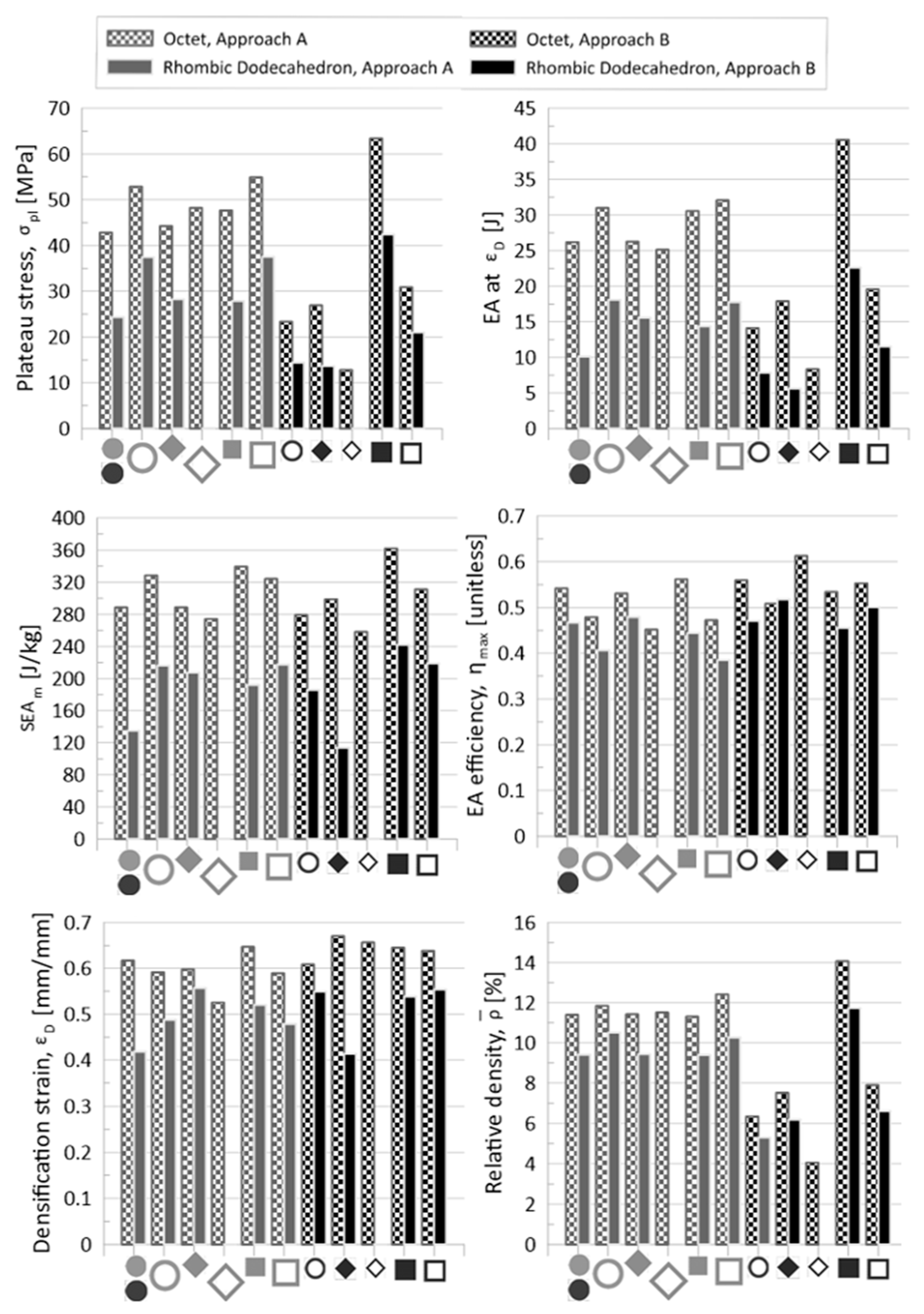
It is stated that the octet and the rhombic dodecahedron topologies are stretching-dominated and bending-dominated, respectively (in Section 3.1). This study intentionally selected these topologies to compare the impact of their C-S on performance, with similar relative densities: 9–11% for Approach A and 4–14% for Approach B. This allows for a minimized influence of relative density, enabling a clearer analysis of how strut C-S affect performance across the two topologies. Figure 13 presents a significant enhancement in the energy absorption capacity of the bending-dominated lattice when utilizing a non-solid, non-circular C-S configuration. This innovative approach yields an impressive increase in SEAm of up to 79%. In contrast, the octet lattice demonstrates a comparatively modest enhancement of only 25%. These findings underscore the superiority of the C-S geometry in optimizing energy absorption mechanisms within lattice structures.
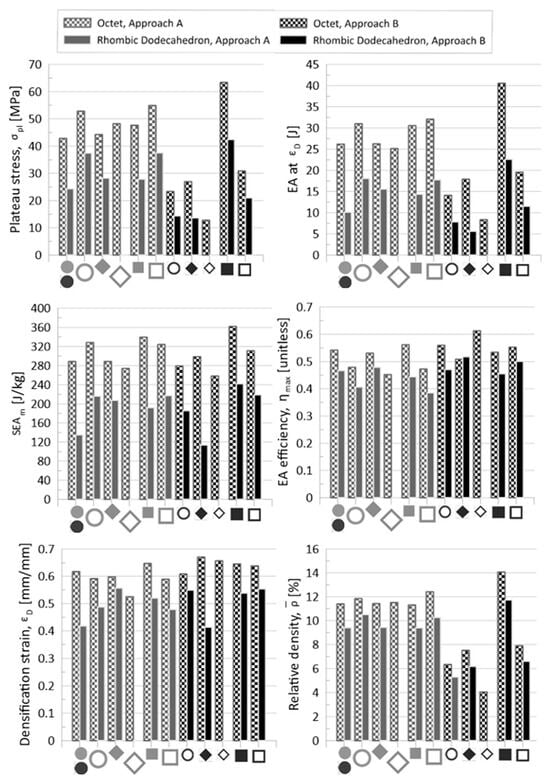
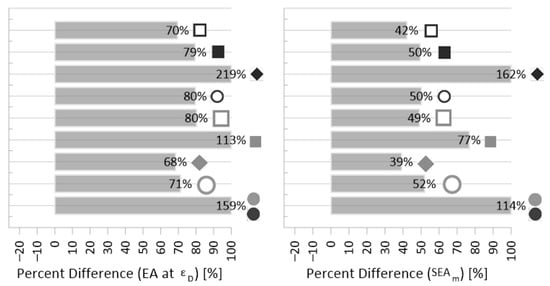
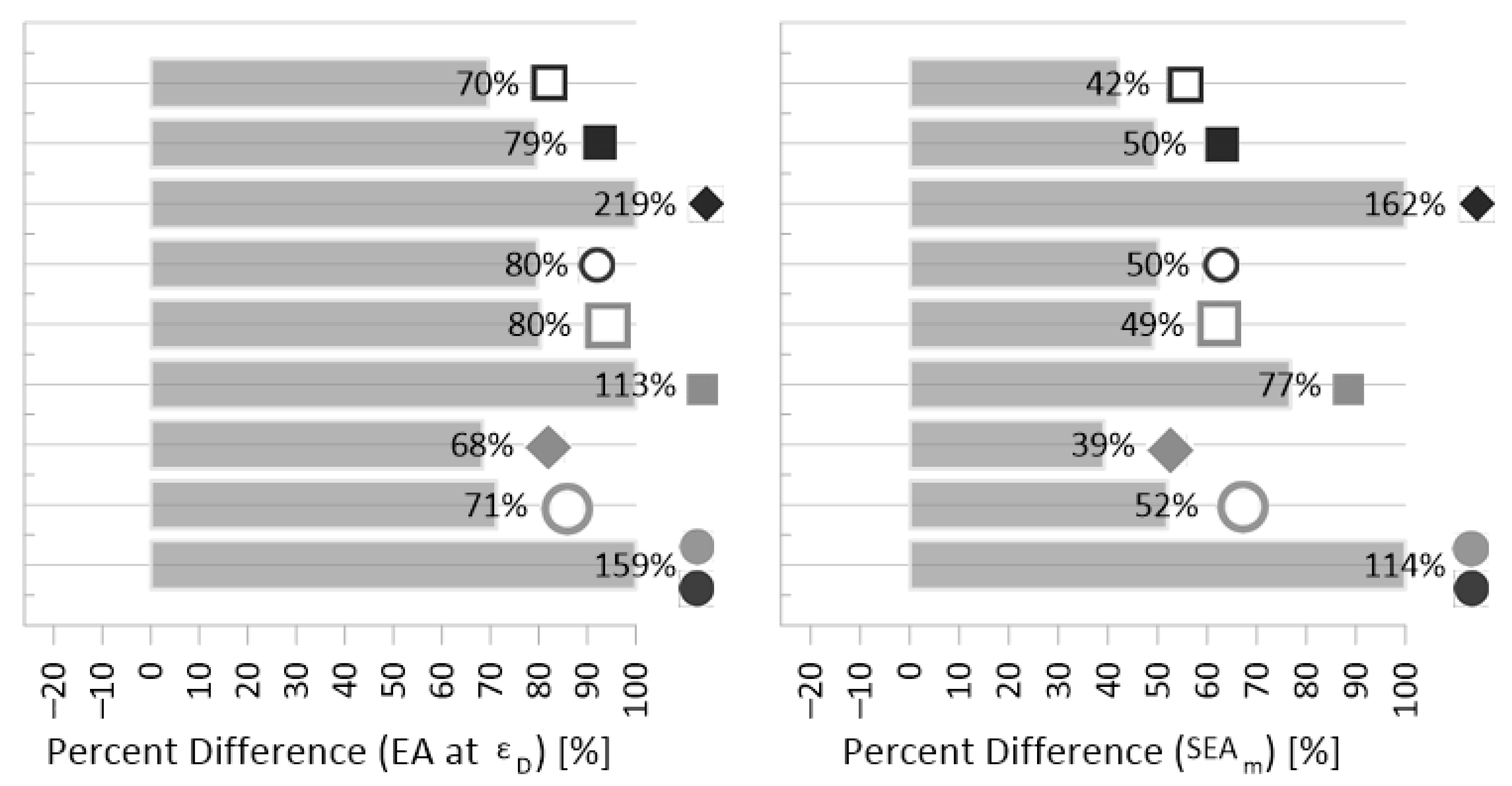
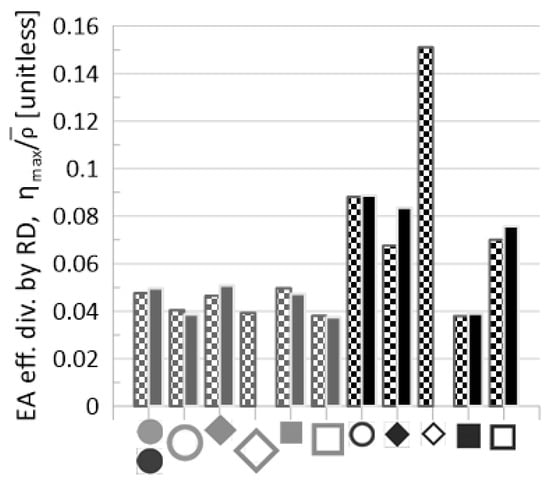
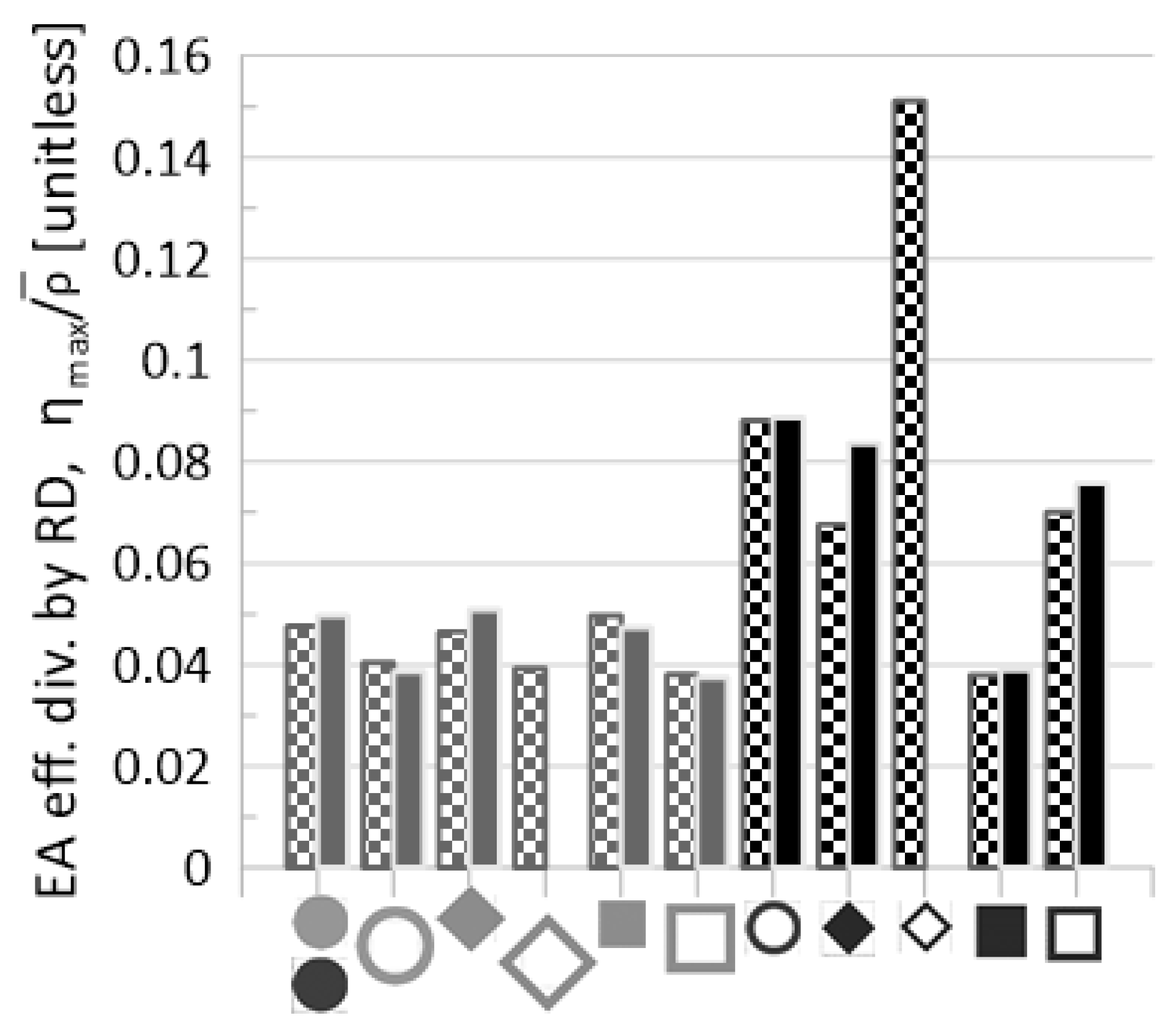
An analysis of numerical values for selected crashworthiness parameters is presented in Figure 14. The behavioral results signify that the plateau stress of the octet lattice is generally higher compared to the rhombic dodecahedron, particularly with a constant C-S. While bending-dominated topologies typically exhibit better energy absorption (EA), the rhombic dodecahedron has similar densification strain and lower plateau stress compared to the octet lattice, leading to reduced EA prior to densification for a given C-S. However, when considering specific energy absorption metrics, the difference between the topologies diminishes, suggesting the rhombic dodecahedron may be more mass efficient. Although the octet usually shows a higher maximum number of cycles, adjustments for mass differences indicate that the rhombic dodecahedron can achieve comparable or higher values for the same C-S. The maximum energy absorption efficiency for cellular structures of octet and rhombic dodecahedron lattices incorporating solid circular C-S configurations has been determined to be 0.54 and 0.47, respectively. These values indicate the potential effectiveness of these geometric configurations in energy absorption applications. Modifying the C-S to a hollow square (Approach A, SH-A) and a solid diamond (Approach B, D-B) retains topology while achieving similar maximum efficiencies: octet SH-A reaches 0.47, and rhombic dodecahedron D-B achieves 0.52. The plateau stress for equivalent C-S is greater for the octet, but varying the C-S can modulate the plateau stress. For instance, the rhombic dodecahedron designated as S-B exhibits a plateau stress of 42.4 MPa, whereas the octet configuration labeled C-A demonstrates a plateau stress of 42.8 MPa. Notably, these structures possess similar relative densities of 11.7% and 11.4%, respectively. Additionally, the percentage differences between octet, rhombic dodecahedron, and topologies for SEAm and EA at densification, and the normalized EA efficiency (calculated by dividing the EA by the relative density) are shown in Figure 15 and Figure 16, respectively. Both figures show the two different approaches: A (represented in black) and B (represented in grey). Also, in Figure 16, the octet and rhombic dodecahedron topologies were visualized as checkerboard and solid patterns, respectively.
Figure 14.
A comparison of crashworthiness metrics between the octet and rhombic dodecahedron topologies under Approaches A (grey) and B (black). The octet and rhombic dodecahedron topologies were visualized as checkerboard and solid patterns, respectively. Parameters evaluated include relative density, plateau stress, EA efficiency, densification strain, EA at densification, and SEAm.
Figure 15.
Percentage difference between octet and rhombic dodecahedron and topologies for SEAm and EA at densification. Approach A and Approach B are indicated by grey and black, respectively.
Figure 16.
The normalized EA efficiency (calculated by dividing the EA to the relative density) is analyzed for octet and rhombic dodecahedron topologies under both Approach A (grey) and Approach B (black). The octet and rhombic dodecahedron topologies were visualized as checkerboard and solid patterns, respectively.
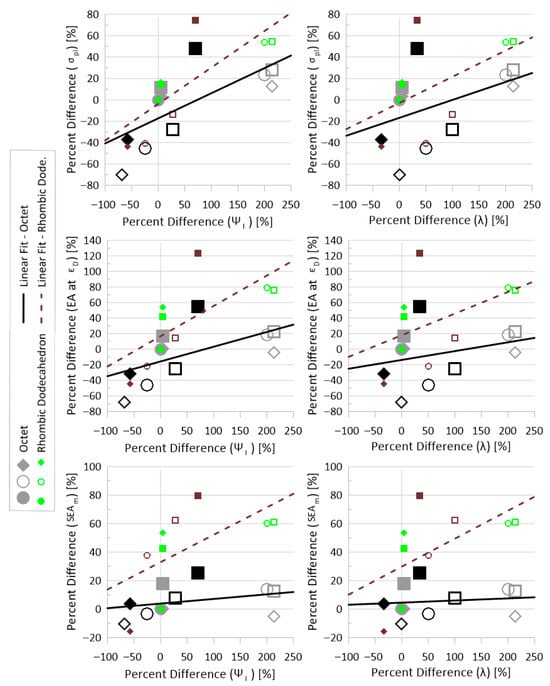
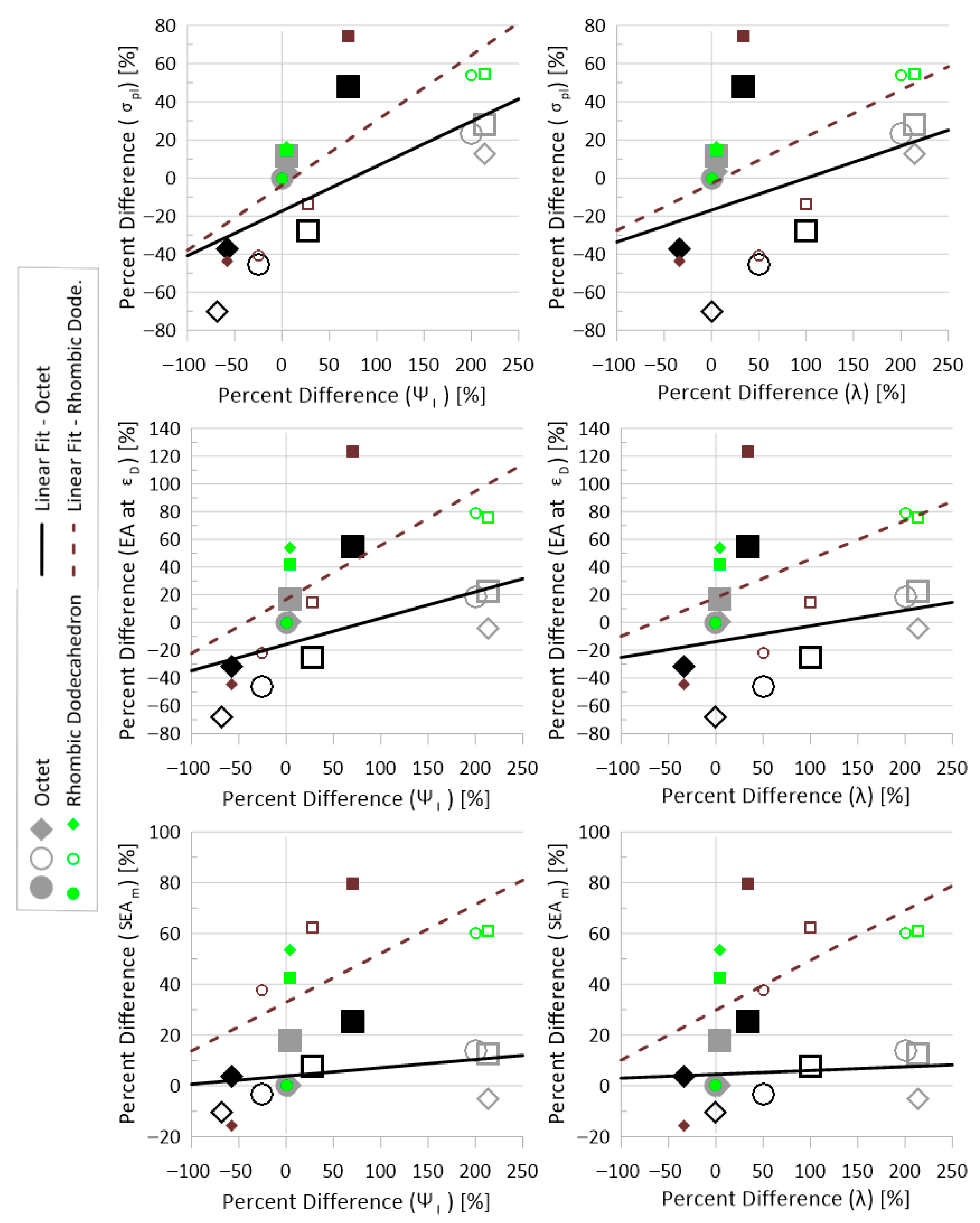
From the comparison of the octet and rhombic dodecahedron topologies, a key observation was that geometric efficiency, particularly the second moment of area shape transformer, significantly affects lattice performance after accounting for relative density. As increases, plateau stress rises while EA efficiency declines. Modifying C-S shapes generally enhances SEA for both lattice topologies. The increase in SEA for the rhombic dodecahedron topology was greater compared to the octet topology. Figure 17 illustrates this fact by plotting the percentage differences in crashworthiness metrics (EA at densification, plateau stress, and SEAm) for different C-S compared to a solid circular reference. The data confirms that the rhombic dodecahedron exhibits a stronger response to C-S changes. Furthermore, while variations in or correlate positively with plateau stress and EA, they do not show a direct proportionality. Changes in these values can be overshadowed by alterations in relative density, complicating the relationship between geometric efficiency and crashworthiness.
Figure 17.
The percentage differences in plateau stress, EA, and SEAm are examined for the octet structure (represented by larger symbols) and the rhombic dodecahedron (represented by smaller symbols) across various C-S. Trends are illustrated with linear fits, with solid lines denoting the octet and dashed lines for the rhombic dodecahedron. The symbols in grey and green indicate Approach A, and the symbols black and brown represent Approach B.
5. Conclusions
This research investigates the low-velocity impact characteristics of octet (stretching-dominated) and rhombic dodecahedron (bending-dominated) lattice topologies, both manufactured from a steel alloy (316L) through the SLM 3D printing method. Six configurations of strut cross-sections—hollow and solid circular, diamond, and square—were assessed. Methodologies of Approach A, which ensured uniform cross-sectional areas, and Approach B, which upheld consistent overall envelope dimensions were employed for evaluating their performance. Comparisons between the octet and rhombic dodecahedron topologies led to the following conclusions:
- The crashworthiness characteristics can be optimized by engineering struts with solid and hollow profiles in diamond, square, and circular cross-sections. Although relative density plays a significant role in the performance of lattice structures based on struts, the second moment of area of the cross-sectional geometry also considerably influences their behavior at comparable densities. Enhancing this geometric factor leads to increased plateau stress, a decrease in energy absorption efficiency, and an overall enhancement in energy absorption capacity. Additionally, variations in densification strain, which are not connected to geometric factors or shape transformers, also play a crucial role in influencing performance outcomes.
- The octet topology demonstrated superior energy absorption (EA) at the densification strain when compared to the rhombic dodecahedron topology. However, the specific energy absorption (SEA) per unit mass showed that the bending-dominated topology had a higher efficiency in energy absorption. Alterations to the cross-sectional shape, especially in terms of the second moment of area and geometric efficiency, resulted in performance differences between the two topologies, with the rhombic dodecahedron topology exhibiting more pronounced changes than its octet counterpart.
The findings of this study can be interpreted as a design-oriented framework rather than solely a set of comparative results. By employing shape transformers to parameterize strut cross-sectional geometry, the relationship between geometric properties—such as area and second moment of area—and crashworthiness metrics has been systematically established. The results indicate that increasing the second moment of area generally enhances plateau stress, while variations in geometric efficiency govern the trade-off between strength and energy absorption efficiency. Furthermore, the use of non-circular, hollow cross-sections provides additional flexibility to improve specific energy absorption, particularly for bending-dominated topologies. These trends can be utilized as practical design guidelines, enabling the selection of appropriate cross-sectional configurations based on performance priorities such as load-carrying capacity, energy absorption, or mass efficiency. It should be noted, however, that the present work provides a parametric design basis; future studies will focus on experimental testing of additively manufactured samples at varying velocities and multiple unit cell counts to evaluate lattice performance and to examine how SLM-induced geometric imperfections interact with the cross-sectional shape effects identified here.
Author Contributions
Conceptualization, M.M.Y. and M.S.A.E.; methodology, M.M.Y. and A.R.B.; validation, M.M.Y. and A.R.B.; formal analysis, A.R.B., M.M.Y. and M.S.A.E.; investigation, A.R.B.; writing—original draft preparation, A.R.B.; writing—review and editing, M.M.Y. and M.S.A.E.; supervision, M.S.A.E.; project administration, M.S.A.E.; funding acquisition, M.S.A.E. All authors have read and agreed to the published version of the manuscript.
Funding
The authors would like to thank the financial support from BOMBARDIER INC. Montreal, in collaboration with MITACS Canada, grant number IT29280. Muhammet Muaz Yalçın would like to thank TÜBİTAK for the postdoctoral research grant provided under the 2219 Program with application number 1059B192000600.
Data Availability Statement
The original contributions presented in this study are included in the article. Further inquiries can be directed to the corresponding author.
Acknowledgments
During the preparation of this manuscript, the authors used ChatGPT 5.4 and Grammarly 14.1275.0 for the purposes of assisting in improving the clarity, grammar, and coherence of the manuscript text. The authors have reviewed and edited the output and take full responsibility for the content of this publication.
Conflicts of Interest
The authors declare no conflicts of interest.
References
- Ashby, M.F. The Mechanical Properties of Cellular Solids. Metall. Trans. A 1983, 14, 1755–1769. [Google Scholar] [CrossRef] [Scilit]
- Fleck, N.A.; Deshpande, V.S.; Ashby, M.F. Micro-Architectured Materials: Past, Present and Future. Proc. R. Soc. A Math. Phys. Eng. Sci. 2010, 466, 2495–2516. [Google Scholar] [CrossRef] [Scilit]
- Bari, K.; Bollenbach, L. Spiderweb Cellular Structures Manufactured via Additive Layer Manufacturing for Aerospace Application. J. Compos. Sci. 2022, 6, 133. [Google Scholar] [CrossRef] [Scilit]
- Najmon, J.C.; DeHart, J.; Wood, Z.; Tovar, A. Cellular Helmet Liner Design through Bio-Inspired Structures and Topology Optimization of Compliant Mechanism Lattices. SAE Int. J. Transp. Saf. 2018, 6, 217–235. [Google Scholar] [CrossRef] [Scilit]
- Fuganti, A.; Lorenzi, L.; Grønsund, A.; Langseth, M. Aluminum Foam for Automotive Applications. Adv. Eng. Mater. 2000, 2, 200–204. [Google Scholar] [CrossRef]
- Murr, L.E.; Gaytan, S.M.; Medina, F.; Lopez, H.; Martinez, E.; Machado, B.I.; Hernandez, D.H.; Martinez, L.; Lopez, M.I.; Wicker, R.B.; et al. Next-Generation Biomedical Implants Using Additive Manufacturing of Complex, Cellular and Functional Mesh Arrays. Philos. Trans. R. Soc. A Math. Phys. Eng. Sci. 2010, 368, 1999–2032. [Google Scholar] [CrossRef] [Scilit]
- Borsellino, C.; Bella, G. Di Paper-Reinforced Biomimetic Cellular Structures for Automotive Applications. Mater. Des. 2009, 30, 4054–4059. [Google Scholar] [CrossRef] [Scilit]
- Grunenfelder, L.K.; Suksangpanya, N.; Salinas, C.; Milliron, G.; Yaraghi, N.; Herrera, S.; Evans-Lutterodt, K.; Nutt, S.R.; Zavattieri, P.; Kisailus, D. Bio-Inspired Impact-Resistant Composites. Acta Biomater. 2014, 10, 3997–4008. [Google Scholar] [CrossRef] [Scilit] [PubMed]
- du Plessis, A.; Razavi, N.; Benedetti, M.; Murchio, S.; Leary, M.; Watson, M.; Bhate, D.; Berto, F. Properties and Applications of Additively Manufactured Metallic Cellular Materials: A Review. Prog. Mater. Sci. 2022, 125, 100918. [Google Scholar] [CrossRef] [Scilit]
- Ashby, M.F. The Properties of Foams and Lattices. Philos. Trans. R. Soc. A Math. Phys. Eng. Sci. 2006, 364, 15–30. [Google Scholar] [CrossRef] [Scilit]
- Abd El-baky, M.A.; Abd El-Halim, M.F.; Awd Allah, M.M. Experimental Investigation of Material Synergy: Influence of 3D Printing Parameters on the Lateral Crash Performance of Cellular Structures Stuffed in Aluminum Tubes. Compos. B Eng. 2025, 307, 112902. [Google Scholar] [CrossRef] [Scilit]
- Somera, A.; Poncelet, M.; Auffray, N.; Réthoré, J. Quasi-Periodic Lattices: Pattern Matters Too. Scr. Mater. 2022, 209, 114378. [Google Scholar] [CrossRef] [Scilit]
- Ngo, T.D.; Kashani, A.; Imbalzano, G.; Nguyen, K.T.Q.; Hui, D. Additive Manufacturing (3D Printing): A Review of Materials, Methods, Applications and Challenges. Compos. B Eng. 2018, 143, 172–196. [Google Scholar] [CrossRef] [Scilit]
- Lehmhus, D.; Vesenjak, M.; Schampheleire, S.; Fiedler, T. From Stochastic Foam to Designed Structure: Balancing Cost and Performance of Cellular Metals. Materials 2017, 10, 922. [Google Scholar] [CrossRef] [Scilit]
- Deng, J.; Wang, X.; Zhao, R.; Li, Z.; Liu, K.; Yuan, K.; An, J.; Li, X.; Chua, C.K.; Wang, Z. Golden-Ratio–Guided Aperiodic Architected Metamaterials with Simultaneously Enhanced Strength and Toughness. Adv. Funct. Mater. 2026, 36, e16315. [Google Scholar] [CrossRef] [Scilit]
- Lei, H.; Li, C.; Meng, J.; Zhou, H.; Liu, Y.; Zhang, X.; Wang, P.; Fang, D. Evaluation of Compressive Properties of SLM-Fabricated Multi-Layer Lattice Structures by Experimental Test and μ-CT-Based Finite Element Analysis. Mater. Des. 2019, 169, 107685. [Google Scholar] [CrossRef] [Scilit]
- Ling, C.; Cernicchi, A.; Gilchrist, M.D.; Cardiff, P. Mechanical Behaviour of Additively-Manufactured Polymeric Octet-Truss Lattice Structures under Quasi-Static and Dynamic Compressive Loading. Mater. Des. 2019, 162, 106–118. [Google Scholar] [CrossRef] [Scilit]
- Yin, H.; Zhang, W.; Zhu, L.; Meng, F.; Liu, J.; Wen, G. Review on Lattice Structures for Energy Absorption Properties. Compos. Struct. 2023, 304, 116397. [Google Scholar] [CrossRef] [Scilit]
- Bernard, A.R.; ElSayed, M.S. Impact Resistance and Specific Energy Absorption Efficiency Limits of Periodic Cellular Solids. In Proceedings of the AIAA SCITECH 2022 Forum, San Diego, CA, USA, 3–7 January 2022; American Institute of Aeronautics and Astronautics: Reston, VA, USA, 2021. [Google Scholar]
- Bernard, A.R.; Yalcin, M.M.; ElSayed, M.S. Development of Numerical Model for the Crashworthiness of Additively Manufactured Sandwich Lattices. In Proceedings of the AIAA SCITECH 2023 Forum, National Harbor, MD, USA, 23–27 January 2023; American Institute of Aeronautics and Astronautics: Reston, VA, USA, 2023. [Google Scholar]
- Song, J.; Zhou, W.; Wang, Y.; Fan, R.; Wang, Y.; Chen, J.; Lu, Y.; Li, L. Octet-Truss Cellular Materials for Improved Mechanical Properties and Specific Energy Absorption. Mater. Des. 2019, 173, 107773. [Google Scholar] [CrossRef] [Scilit]
- Hammetter, C.I.; Rinaldi, R.G.; Zok, F.W. Pyramidal Lattice Structures for High Strength and Energy Absorption. J. Appl. Mech. 2013, 80, 041015. [Google Scholar] [CrossRef] [Scilit]
- Mueller, J.; Matlack, K.H.; Shea, K.; Daraio, C. Energy Absorption Properties of Periodic and Stochastic 3D Lattice Materials. Adv. Theory Simul. 2019, 2, 1900081. [Google Scholar] [CrossRef] [Scilit]
- Jin, N.; Wang, F.; Wang, Y.; Zhang, B.; Cheng, H.; Zhang, H. Failure and Energy Absorption Characteristics of Four Lattice Structures under Dynamic Loading. Mater. Des. 2019, 169, 107655. [Google Scholar] [CrossRef] [Scilit]
- Habib, F.; Iovenitti, P.; Masood, S.; Nikzad, M.; Ruan, D. Design and Evaluation of 3D Printed Polymeric Cellular Materials for Dynamic Energy Absorption. Int. J. Adv. Manuf. Technol. 2019, 103, 2347–2361. [Google Scholar] [CrossRef] [Scilit]
- Habib, F.N.; Iovenitti, P.; Masood, S.H.; Nikzad, M. Fabrication of Polymeric Lattice Structures for Optimum Energy Absorption Using Multi Jet Fusion Technology. Mater. Des. 2018, 155, 86–98. [Google Scholar] [CrossRef] [Scilit]
- Leary, M.; Mazur, M.; Elambasseril, J.; McMillan, M.; Chirent, T.; Sun, Y.; Qian, M.; Easton, M.; Brandt, M. Selective Laser Melting (SLM) of AlSi12Mg Lattice Structures. Mater. Des. 2016, 98, 344–357. [Google Scholar] [CrossRef] [Scilit]
- Leary, M.; Mazur, M.; Williams, H.; Yang, E.; Alghamdi, A.; Lozanovski, B.; Zhang, X.; Shidid, D.; Farahbod-Sternahl, L.; Witt, G.; et al. Inconel 625 Lattice Structures Manufactured by Selective Laser Melting (SLM): Mechanical Properties, Deformation and Failure Modes. Mater. Des. 2018, 157, 179–199. [Google Scholar] [CrossRef] [Scilit]
- Smith, M.; Guan, Z.; Cantwell, W.J. Finite Element Modelling of the Compressive Response of Lattice Structures Manufactured Using the Selective Laser Melting Technique. Int. J. Mech. Sci. 2013, 67, 28–41. [Google Scholar] [CrossRef] [Scilit]
- Tancogne-Dejean, T.; Spierings, A.B.; Mohr, D. Additively-Manufactured Metallic Micro-Lattice Materials for High Specific Energy Absorption under Static and Dynamic Loading. Acta Mater. 2016, 116, 14–28. [Google Scholar] [CrossRef] [Scilit]
- Tancogne-Dejean, T.; Mohr, D. Stiffness and Specific Energy Absorption of Additively-Manufactured Metallic BCC Metamaterials Composed of Tapered Beams. Int. J. Mech. Sci. 2018, 141, 101–116. [Google Scholar] [CrossRef] [Scilit]
- Tancogne-Dejean, T.; Mohr, D. Elastically-Isotropic Elementary Cubic Lattices Composed of Tailored Hollow Beams. Extrem. Mech. Lett. 2018, 22, 13–18. [Google Scholar] [CrossRef] [Scilit]
- Cao, X.; Duan, S.; Liang, J.; Wen, W.; Fang, D. Mechanical Properties of an Improved 3D-Printed Rhombic Dodecahedron Stainless Steel Lattice Structure of Variable Cross Section. Int. J. Mech. Sci. 2018, 145, 53–63. [Google Scholar] [CrossRef] [Scilit]
- Cao, X.; Xiao, D.; Li, Y.; Wen, W.; Zhao, T.; Chen, Z.; Jiang, Y.; Fang, D. Dynamic Compressive Behavior of a Modified Additively Manufactured Rhombic Dodecahedron 316L Stainless Steel Lattice Structure. Thin-Walled Struct. 2020, 148, 106586. [Google Scholar] [CrossRef] [Scilit]
- Cao, X.; Ren, X.; Zhao, T.; Li, Y.; Xiao, D.; Fang, D. Numerical and Theoretical Analysis of the Dynamic Mechanical Behaviour of a Modified Rhombic Dodecahedron Lattice Structure. Int. J. Mech. Mater. Des. 2021, 17, 271–283. [Google Scholar] [CrossRef] [Scilit]
- Wu, Q.; Vaziri, A.; Asl, M.E.; Ghosh, R.; Gao, Y.; Wei, X.; Ma, L.; Xiong, J.; Wu, L. Lattice Materials with Pyramidal Hierarchy: Systematic Analysis and Three Dimensional Failure Mechanism Maps. J. Mech. Phys. Solids 2019, 125, 112–144. [Google Scholar] [CrossRef] [Scilit]
- Jia, Y.; Guan, Z.; Chen, X. Compressive Property of Aluminum Pyramidal Lattice Material. In Proceedings of the 2015 International Conference on Materials, Environmental and Biological Engineering; Atlantis Press: Paris, France, 2015. [Google Scholar]
- Parisien, A. Characterization and Design Optimization of Periodic Cellular Solids for Optimal Bone Ingrowth in Osseointegration Implants. Master’s Thesis, Carleton University, Ottawa, ON, Canada, 2021. [Google Scholar]
- Yin, S.; Chen, H.; Li, J.; Yu, T.X.; Xu, J. Effects of Architecture Level on Mechanical Properties of Hierarchical Lattice Materials. Int. J. Mech. Sci. 2019, 157, 282–292. [Google Scholar] [CrossRef] [Scilit]
- Meza, L.R.; Zelhofer, A.J.; Clarke, N.; Mateos, A.J.; Kochmann, D.M.; Greer, J.R. Resilient 3D Hierarchical Architected Metamaterials. Proc. Natl. Acad. Sci. USA 2015, 112, 11502–11507. [Google Scholar] [CrossRef] [Scilit]
- Zhang, L.; Hu, Z.; Wang, M.Y.; Feih, S. Hierarchical Sheet Triply Periodic Minimal Surface Lattices: Design, Geometric and Mechanical Performance. Mater. Des. 2021, 209, 109931. [Google Scholar] [CrossRef] [Scilit]
- Banerjee, S. On the Mechanical Properties of Hierarchical Lattices. Mech. Mater. 2014, 72, 19–32. [Google Scholar] [CrossRef] [Scilit]
- Fan, H.L.; Jin, F.N.; Fang, D.N. Mechanical Properties of Hierarchical Cellular Materials. Part I: Analysis. Compos. Sci. Technol. 2008, 68, 3380–3387. [Google Scholar] [CrossRef] [Scilit]
- Zheng, X.; Smith, W.; Jackson, J.; Moran, B.; Cui, H.; Chen, D.; Ye, J.; Fang, N.; Rodriguez, N.; Weisgraber, T.; et al. Multiscale Metallic Metamaterials. Nat. Mater. 2016, 15, 1100–1106. [Google Scholar] [CrossRef] [Scilit]
- Lv, W.; Li, D.; Dong, L. Study on Mechanical Properties of a Hierarchical Octet-Truss Structure. Compos. Struct. 2020, 249, 112640. [Google Scholar] [CrossRef] [Scilit]
- Bernal Ostos, J.; Rinaldi, R.G.; m Hammetter, C.; Stucky, G.D.; Zok, F.W.; Jacobsen, A.J. Deformation Stabilization of Lattice Structures via Foam Addition. Acta Mater. 2012, 60, 6476–6485. [Google Scholar] [CrossRef] [Scilit]
- Kaur, M.; Yun, T.G.; Han, S.M.; Thomas, E.L.; Kim, W.S. 3D Printed Stretching-Dominated Micro-Trusses. Mater. Des. 2017, 134, 272–280. [Google Scholar] [CrossRef] [Scilit]
- Ozdemir, Z.; Tyas, A.; Goodall, R.; Askes, H. Energy Absorption in Lattice Structures in Dynamics: Nonlinear FE Simulations. Int. J. Impact Eng. 2017, 102, 1–15. [Google Scholar] [CrossRef] [Scilit]
- Ren, X.; Shen, J.; Tran, P.; Ngo, T.D.; Xie, Y.M. Design and Characterisation of a Tuneable 3D Buckling-Induced Auxetic Metamaterial. Mater. Des. 2018, 139, 336–342. [Google Scholar] [CrossRef] [Scilit]
- Wang, Q.; Yang, Z.; Lu, Z.; Li, X. Mechanical Responses of 3D Cross-Chiral Auxetic Materials under Uniaxial Compression. Mater. Des. 2020, 186, 108226. [Google Scholar] [CrossRef] [Scilit]
- Cui, S.; Gong, B.; Ding, Q.; Sun, Y.; Ren, F.; Liu, X.; Yan, Q.; Yang, H.; Wang, X.; Song, B. Mechanical Metamaterials Foams with Tunable Negative Poisson’s Ratio for Enhanced Energy Absorption and Damage Resistance. Materials 2018, 11, 1869. [Google Scholar] [CrossRef] [Scilit]
- Pasini, D.; Smith, D.J.; Burgess, S.C. Structural Efficiency Maps for Beams Subjected to Bending. Proc. Inst. Mech. Eng. Part L J. Mater. Des. Appl. 2003, 217, 207–220. [Google Scholar] [CrossRef]
- Burgess, S.C.; Pasini, D.; Smith, D.J.; Alemzadeh, K. A General Solution to the Material Performance Index for Bending Strength Design. Mater. Des. 2006, 27, 1046–1054. [Google Scholar] [CrossRef] [Scilit]
- Faisal, T.R.; Abad, E.M.K.; Hristozov, N.; Pasini, D. The Impact of Tissue Morphology, Cross-Section and Turgor Pressure on the Mechanical Properties of the Leaf Petiole in Plants. J. Bionic Eng. 2010, 7, S11–S23. [Google Scholar] [CrossRef] [Scilit]
- Pasini, D. Shape Transformers for Material and Shape Selection. In ASME 2005 International Design Engineering Technical Conferences and Computers and Information in Engineering Conference, Volume 5a: 17th International Conference on Design Theory and Methodology; ASME: New York, NY, USA, 2008; pp. 83–92. [Google Scholar]
- Singh, J.; Mirjalili, V.; Pasini, D. Integrated Shape and Material Selection for Single and Multi-Performance Criteria. Mater. Des. 2011, 32, 2909–2922. [Google Scholar] [CrossRef] [Scilit]
- Pasini, D.; Burgess, S.C.; Smith, D.J. A Method for Selecting Macro-Scale Structures with Axially Loaded Members. Int. J. Mech. Mater. Des. 2007, 3, 185–199. [Google Scholar] [CrossRef] [Scilit]
- Pasini, D. Shape Transformers for Material and Shape Selection of Lightweight Beams. Mater. Des. 2007, 28, 2071–2079. [Google Scholar] [CrossRef] [Scilit]
- Pasini, D. Shape and Material Selection for Optimizing Flexural Vibrations in Multilayered Resonators. J. Microelectromech. Syst. 2006, 15, 1745–1758. [Google Scholar] [CrossRef] [Scilit]
- Pasini, D. Bend Stiffness of Laminate Microstructures Containing Three Dissimilar Materials. Int. J. Mech. Mater. Des. 2009, 5, 175–193. [Google Scholar] [CrossRef] [Scilit]
- Elsayed, M.S.A.; Pasini, D. Multiscale Structural Design of Columns Made of Regular Octet-Truss Lattice Material. Int. J. Solids Struct. 2010, 47, 1764–1774. [Google Scholar] [CrossRef] [Scilit]
- Liete Gasparetto, V.E.; ElSayed, M.S.; Saad, M.; Shield, S. Shape Transformers for Band Gaps Customization of Bloch-Periodic Triangular Lattice Structures. In Proceedings of the AIAA Scitech 2021 Forum, Virtual, 11–21 January 2021; American Institute of Aeronautics and Astronautics: Reston, VA, USA, 2021. [Google Scholar]
- Gasparetto, V.E.L.; ElSayed, M.S.A. Multiscale Optimization of Specific Elastic Properties and Microscopic Frequency Band-Gaps of Architectured Microtruss Lattice Materials. Int. J. Mech. Sci. 2021, 197, 106320. [Google Scholar] [CrossRef] [Scilit]
- Gasparetto, V.E.L.; ElSayed, M.S.A. Shape Transformers for Phononic Band Gaps Tuning in Two-Dimensional Bloch-Periodic Lattice Structures. Eur. J. Mech. A/Solids 2021, 89, 104278. [Google Scholar] [CrossRef] [Scilit]
- Yang, C.; Li, Q.M. Advanced Lattice Material with High Energy Absorption Based on Topology Optimisation. Mech. Mater. 2020, 148, 103536. [Google Scholar] [CrossRef] [Scilit]
- Labeas, G.N.; Sunaric, M.M. Investigation on the Static Response and Failure Process of Metallic Open Lattice Cellular Structures. Strain 2010, 46, 195–204. [Google Scholar] [CrossRef] [Scilit]
- Li, Q.M.; Magkiriadis, I.; Harrigan, J.J. Compressive Strain at the Onset of Densification of Cellular Solids. J. Cell. Plast. 2006, 42, 371–392. [Google Scholar] [CrossRef] [Scilit]
- Chen, Z.; Wang, Z.; Zhou, S.; Shao, J.; Wu, X. Novel Negative Poisson’s Ratio Lattice Structures with Enhanced Stiffness and Energy Absorption Capacity. Materials 2018, 11, 1095. [Google Scholar] [CrossRef] [Scilit] [PubMed]
- Wierzbicki, T. Energy Absorption of Structures and Materials. Int. J. Impact Eng. 2004, 30, 881–882. [Google Scholar] [CrossRef] [Scilit]
- Nasrullah, A.I.H.; Santosa, S.P.; Dirgantara, T. Design and Optimization of Crashworthy Components Based on Lattice Structure Configuration. Structures 2020, 26, 969–981. [Google Scholar] [CrossRef] [Scilit]
- Ha, N.S.; Lu, G. Thin-Walled Corrugated Structures: A Review of Crashworthiness Designs and Energy Absorption Characteristics. Thin-Walled Struct. 2020, 157, 106995. [Google Scholar] [CrossRef] [Scilit]
- Liu, L.; Kamm, P.; García-Moreno, F.; Banhart, J.; Pasini, D. Elastic and Failure Response of Imperfect Three-Dimensional Metallic Lattices: The Role of Geometric Defects Induced by Selective Laser Melting. J. Mech. Phys. Solids 2017, 107, 160–184. [Google Scholar] [CrossRef] [Scilit]
- Ansys SpaceClaim. Ansys 2023. Available online: https://www.ansys.com/Products/3d-Design/Ansys-Spaceclaim (accessed on 8 January 2023).
- Altair Engineering Inc. Altair Radioss 2022: Theory Manual; Altair Engineering Inc.: Troy, MI, USA, 2022. [Google Scholar]
- Altair Engineering Inc. Altair Radioss 2022: Reference Guide; Altair Engineering Inc.: Troy, MI, USA, 2022. [Google Scholar]
- Kumar Reddy Sirigiri, V.; Yadav Gudiga, V.; Shankar Gattu, U.; Suneesh, G.; Mohan Buddaraju, K. A Review on Johnson Cook Material Model. Mater. Today Proc. 2022, 62, 3450–3456. [Google Scholar] [CrossRef] [Scilit]



Disclaimer/Publisher’s Note: The statements, opinions and data contained in all publications are solely those of the individual author(s) and contributor(s) and not of MDPI and/or the editor(s). MDPI and/or the editor(s) disclaim responsibility for any injury to people or property resulting from any ideas, methods, instructions or products referred to in the content. |
© 2026 by the authors. Licensee MDPI, Basel, Switzerland. This article is an open access article distributed under the terms and conditions of the Creative Commons Attribution (CC BY) license.