


Abstract
Lead cake forms from dust as a result of the gas cleaning process during copper smelting. The objective of this study was to develop equipment and technology for a continuous hydrometallurgical method for extracting osmium from the lead cake. In this method, leaching is carried out using an aqueous solution of hydrogen peroxide and sulfuric acid. During the leaching, rhenium is converted into an acidic solution from which rhenium can be easily extracted into a marketable product. Osmium is predominantly converted into a solution, the processing of which, including the extraction of osmium into a marketable product, will be published later. A unit for leaching osmium–rhenium-containing cake with continuous loading for leaching, continuous feeding of leaching solutions, and continuous discharge of the leaching slurry was created. Using the simplex experimental design method, the dependence of osmium recovery on the consumption rates of hydrogen peroxide and sulfuric acid and the leaching duration was studied. Near-optimal leaching conditions were as follows: 68–70 mL of 30% hydrogen peroxide and 7 mL of concentrated sulfuric acid per 100 g of cake, 55 min of leaching, and a specific column throughput of 100 g of cake per 55 min. Nine experiments achieved 96.5% osmium recovery.
1. Introduction
This study is a continuation of previous research on the leaching of osmium and rhenium from lead cakes [1], in which we provided a detailed literature review on osmium extraction from copper production middlings. Therefore, the selection of publications on the topic in this article is presented in an abbreviated form.
In industry in the Republic of Kazakhstan, osmium and rhenium are primarily extracted from copper production middlings: dust, sulfuric acid wash, sludge, cakes, and some other byproducts. Lead precipitates are cakes obtained during the pyrometallurgical processing of concentrates containing copper, Pb, Re, Os, and other elements. The off-gases are then cleaned of dust using wet scrubbers irrigated with concentrated H2SO4. This results in acidic sludges containing compounds of lead, osmium, rhenium, and other elements. For transportation, the sludges are neutralized with soda. The resulting osmium- and rhenium-containing cakes serve as a source material for extracting the valuable elements osmium and rhenium.
Reviews of rhenium and osmium extraction from copper production middlings, particularly from sulfuric acid wash, are provided, for example, in early works by K.B. Lebedev [2] and in later publications by A.A. Palant and others [3,4,5,6,7,8]. These same publications also highlight the advantages and disadvantages of various methods. It should be noted that the processing of rhenium-containing solutions has been well studied, with commercial ammonium perrhenate obtained by means of sorption–desorption [9,10], recrystallization [11,12], and membrane electrodialysis [13,14]. However, publications on osmium extraction from copper production middlings are very limited [15,16,17]. Most technologies for processing solid industrial products (sludge and cakes) utilize pyrometallurgical processes, discussed, for example, in [15]. The disadvantages of these methods include high batch smelting temperatures (up to 1200 °C), the release of sulfur dioxide, and the complex extraction of osmium from lead.
A hydrometallurgical method for separating rhenium from cake into solution and osmium into the gas phase using hydrogen peroxide and sulfuric or nitric acid has been studied [16]. In the presence of hydrogen peroxide, osmium oxidizes and partially distills from the solution into the gas phase, from which it is captured with a 20% alkali solution. Osmium is then extracted from the alkali solution with sodium or ammonium sulfide to produce commercial osmium sulfide. Re compounds are oxidized to higher oxides and pass into solution. However, different cake batches vary significantly in their number of elements, phase composition, and contents of osmium, rhenium, and carbon [17], which can affect the technological parameters of the extraction processes.
A prior publication [16] presented data on leaching in a two-liter stirred flask with 100 g of material from ten different cakes loaded with a mixture of 33% hydrogen peroxide and concentrated sulfuric acid at consumption rates of 100 and 20 mL per 100 g of cake, respectively. The leaching temperature was 80–90 °C, the leaching rate was 3.5–4 h for 100 g of cake, and the liquid/solid ratio was 2.2. The specific productivity of the unit was 100 g of cake in 3.5–4 h. The rhenium extraction rate into solution was 81–99%, and the osmium extraction rate into the gas phase was ~60%. The setup used in [16] is described in [1].
The advantages of hydrometallurgical methods include low process temperatures and simple instrumentation. The disadvantages of the same methods include the periodicity of the processes, the laboratory scale, and significant reagent consumption.
The objective of this research is to develop technology and an apparatus for the continuous leaching of osmium from lead cakes formed during copper production.
This is the first continuous column leaching process developed and optimized for the extraction of osmium from lead sediment using a hydrogen peroxide–sulfuric acid system, using a simplex experimental design.
2. Materials and Methods
The calculations were carried out per 100 g of cake containing 34 g/t osmium, up to 1450 g/t rhenium, and the following, given in percentages: Pb 59.51; S 11.98; Si 0.19; Fe, Cu each ~0.68; Se, Al, Ca up to 0.25; Na, Mn 0.39; K, Zn, As, Bi, Mg up to 0.18; P up to 0.025; Ni up to 0.004; and organic compounds 3.95. The main element of the cakes was lead, present in the form of compounds in the following percentages: PbSO4 77.64; PbO 2.71; PbCO3 5.80; metallic lead up to 0.84; PbS traces; others up to 13.01. The fine particle content (0.074 mm) in the cakes was 93–96%.
Experiments were conducted using H2SO4 «chemically pure» (Shchekinoazot JSC, Shchekino, Tula Region, Russia) with a concentration of 17.91 mol/L and hydrogen peroxide H2O2 with a concentration of 33% (Khimprom PJSC, Novocheboksarsk, Chuvash Republic, Russia).
In laboratory and later larger-scale laboratory studies to develop a technology for leaching rhenium and osmium in a column-type apparatus from lead cakes formed during copper production, a ball condenser, similar to that used in many distillation apparatuses, or a larger equivalent, was used. A Bunsen flask, a Buchner funnel, a water-jet pump or a ROAIRVAC R321.5 medium-vacuum pump (ROAIRVAC, Kelkheim, Germany), and an LOIP LT-300 series circulation thermostat (LOIP, Saint Petersburg, Russia) were used. Analysis of the initial cakes and solid leaching products was performed using atomic absorption on a PerkinElmer 240 FSSA (PerkinElmer, Waltham, MA, USA) instrument and spectral analysis on a DFS-8 spectrometer (LECO, Saint Joseph, MI, USA). The osmium and rhenium concentrations in solution were determined using photocolorimetric methods on a KFK-3 instrument (ZOMZ 2016, open joint-stock company, ZOMZ BS 2.853.021-02 PS, (Zagorsk, Sergiev Posad), Russia).
Scanning electron microscopy and microanalysis were performed on a JEOL JXA-8230 electron probe (JEOL, Tokyo, Japan) microanalyzer with an accelerating voltage of 20 kV, an electron beam current of up to 5 nA, and a dead time of up to 20%. These imaging and microanalysis conditions ensured reliable observation and recording of structural features from fractions of a micron to hundreds of microns at magnifications from a minimum of 40× to several thousand times.
Backscattered electron mode (BSE) was used for all sample areas selected for scanning electron microscopy (SEM) examination. This mode produces more informative images of objects compared to secondary electron imaging (SEI). The main feature of SEM contrast in BSE mode is the well-known fact that particles with higher atomic numbers are more intensely contrasted than particles making up the general background [18,19].
Micrographs were obtained in SSE and BSE modes at magnifications ranging from 40× to 3000×. A total of 13 micrographs were taken to document the microstructure and structural features. A total of 10 microanalyses were performed via energy-dispersive spectroscopy (EDS) of characteristic X-ray radiation (CXR), as well as two EDS mappings of elements. In addition to wave-dispersive microanalysis (WDS), several dozen undocumented microanalyses were conducted to ensure that the microstructural features were consistent with the documented structural–analytical patterns. The calculated results of the semiquantitative microanalysis were obtained using the built-in EPMA program with automatic ZAF corrections.
The key data in all SEM images is the magnification, marker, value in microns, date and time, and observation mode (COMPO or SEI).
3. Results and Discussion
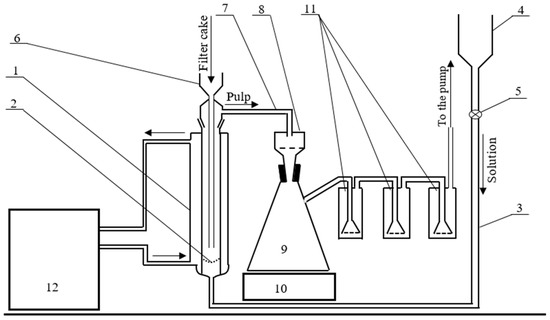
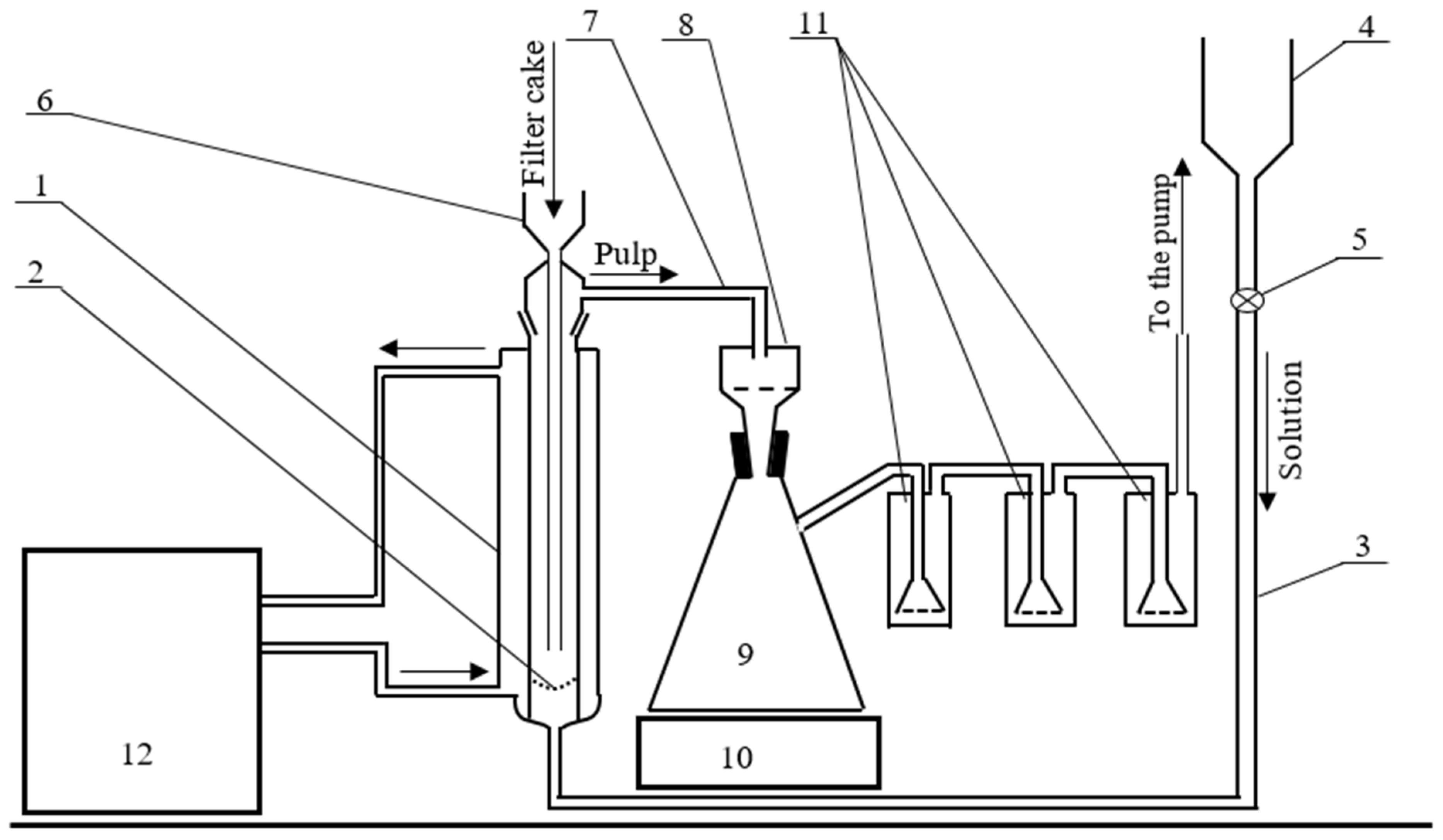
A column-type apparatus (Figure 1) was used in this work, which allowed for continuous loading of the leached material and reagents and semi-continuous unloading of the leaching products.
Figure 1.
Cake leaching unit schematic. 1—column body; 2—mesh; 3—solution feed tube; 4—oxidizer solution container; 5—adjustable solution feed tap; 6—cake loading container; 7—pulp drain pipe; 8—Buchner funnel; 9—Bunsen flask; 10—hotplate; 11—absorber traps; 12—thermostat.
The unit operates as follows. Mesh 2, made of belting fabric, is placed at the bottom of column 1 to prevent leached cake from entering oxidizer solution line 3. An oxidizer solution (in this case, hydrogen peroxide) is prepared in tank 4, located significantly above the column. The flow of oxidizer solution from tank 4 to the column is regulated by valve 5. A water–sulfuric acid cake slurry is loaded into tank 6, which enters the bottom of the column through a corresponding tube. As the oxidizer solution and cake slurry mix at the bottom of the column, osmium and rhenium leaching begins, producing a pulp. The leaching process continues as the pulp moves up the column. The resulting pulp, containing dissolved osmium and rhenium, flows through tube 7 into funnel 8 and is filtered into flask 9. Flask 9 is heated by hotplate 10, causing the osmium to transition from the solution to the gas phase and be captured in adsorbers 11 containing a sodium hydroxide solution. The column is heated by thermostat 12, which supplies hot water to the jacket of column 1. The column’s throughput and the degree of osmium and rhenium recovery from the leached material depend primarily on the hydrogen peroxide consumption, sulfuric acid consumption, and leaching duration. In a prior publication [16], the recommended leaching temperature was 85 ± 3 °C; however, a large amount of foam formed in this case. Air was not required for bubbling, and the L/S ratio was maintained below 2.0. The variable values taken were the H2O2 consumption, H2SO4 consumption, and leaching duration.
Calculating Simplex Design of Experiment Parameters
Mathematical methods are often used in scientific research to optimize technology. The earliest of these were published by Box, Wilson, V.V. Nalimov, and N.A. Chernova [20,21,22]. The most popular methods include regression analysis, the method of planning extreme experiments using a full factorial experiment or fractional replicas thereof [20], the “steepest ascent along the response surface” method [21], and second-order orthogonal and rotatable design [20,22]. Using the obtained regression equations, it is possible to a priori determine the response function, i.e., the value of the output parameter. Using the above-mentioned mathematical methods requires conducting a large number of experiments; however, good results can be achieved using adaptive optimization of evolutionary planning [23] or simplex planning [24].
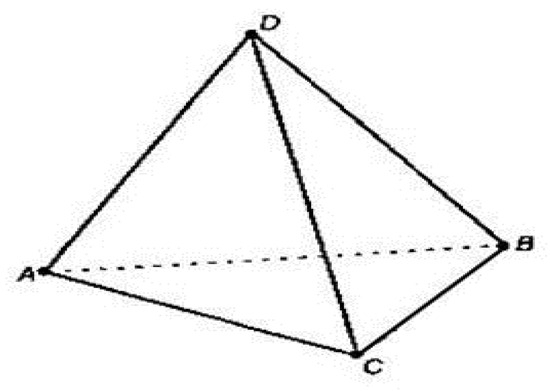
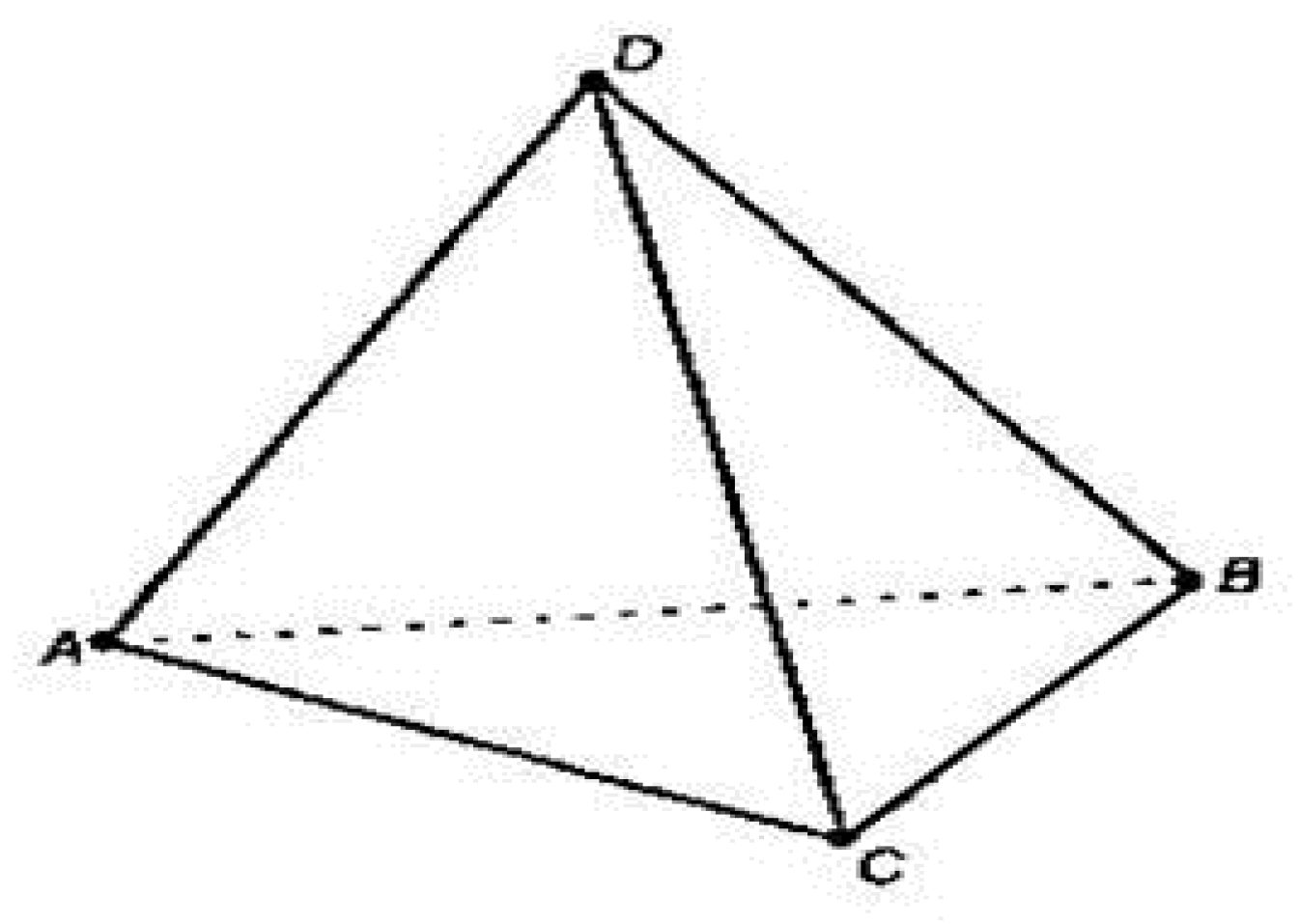
Simplex planning is well represented in the literature [25,26,27,28] and is characterized by good convergence and a small number of experiments. A simplex is a regular polyhedron with n + 1 vertices, where n is the number of factors influencing the process. If there are three factors (in our case, H2O2 consumption, H2SO4 consumption, and leaching time), then the simplex is a tetrahedron (Figure 2).
Figure 2.
Simplex for experiments with three variables.
The initial experiments correspond to parameters that are presumably optimal for the process under study; they correspond to the vertices of the tetrahedron. After the experiments are performed, output parameters are obtained, called the response function. From the obtained results, the experiment with the smallest output parameter is determined. This is excluded from the calculations, and in its place, an experiment at a point is introduced into the simplex, the calculation of which is determined by the following formula:
where
n + 1
X*= 2/n|ƩXi − [2/n + 1]Xj
i = 1
X*= 2/n|ƩXi − [2/n + 1]Xj
i = 1
X* is the coordinate of the new point;
n is the number of factors;
j is the number associated with the vertex in the original simplex with the minimum response value (the vertex numbers in the original simplex correspond to the factor numbers in the planning matrix);
i is the vertex number of the resulting simplices.
The results of the experiments performed in the new simplex are then compared, the experiment with the minimum response function is excluded, and the corresponding simplex vertex is moved to a new point. The experiments and calculations are repeated until a nearly stationary region is reached, at which point movement along the simplex ceases. The following are the results of a simplex design for the leaching of osmium–rhenium-containing lead cake with hydrogen peroxide consumption, sulfuric acid consumption, and leaching duration as the considered variables. The vertices of the original simplex are based on the data obtained during cake leaching in a previous study [16]. The response function is the percentage of osmium recovery into the gas phase plus the percentage of osmium recovery into an acidic solution, from which osmium can easily be transferred to the gas phase according to the recommendations in [29].
The experimental design matrix of the original simplex in coded variables for three factors is shown in Table 1.
Table 1.
Matrix of the original simplex.
Here,
where j is the factor number in the planning matrix (X1, X2, or X3). The symbol “0” denotes the coordinates of the planning center, i.e., the basic level.
The experiments presented in Table 1 correspond to the vertices of a simplex (Figure 2) for which the side length is equal to one and the center coincides with the origin (in coded variables). The distance from a simplex vertex to the opposite face hj is
To use the simplex design of experiments, the authors of [8,9] calculated the numerical values of its elements (Table 2), which we present for three factors: the consumption of 30% hydrogen peroxide in milliliters (X1), the consumption of concentrated sulfuric acid in milliliters (X2), and the duration of leaching in minutes (X3). The main levels and steps of factor variation that we selected are presented in Table 2.
Table 2.
Conditions of the initial series of experiments.
Based on the data from [16] and assuming that the leaching process in the column will proceed twice as fast as that in the flask, we adopted the following values for the factor levels and variation steps for the first simplex, consisting of experiments 1, 2, 3, and 4 (Table 3).
Table 3.
Values of factor levels and variation steps.
Based on Table 2 and using the data in Table 3, we calculated the conditions for conducting the first experiment.
H2O2 consumption for the first experiment (X1.1):
X1.1 = base level + variation step × base level of the 1st experiment 0.5, i.e., X1.1 = 60 + 6 × 0.5 = 63
Similarly, we calculated the H2SO4 consumption for the first experiment,
X1.2 = 5 + 4 × 0.289 = 6.156
- and the leaching duration for the first experiment,
X1.3 = 60 + 5 × 0.204 = 61.02
We carried out similar calculations for the second experiment X2.1–2.3, for the third experiment X3.1–3.3, and for the fourth experiment X4.1–4.3. We rounded the obtained initial data to the nearest tenth and entered them into Table 4. Using this data, we conducted the first four experiments, which yielded response functions describing the extraction of osmium into the gas phase (in alkaline solution) plus the extraction of osmium into an acidic leaching solution, ƐOs/g.f + ƐOs/acid. sol.. The obtained data is summarized in Table 4.
Table 4.
Optimization of the osmium leaching process.
From the first four experiments in Table 4, it is clear that the minimum response function value was obtained in the second experiment, where the osmium recovery rate was 74.62%. The response function values in each experiment in Table 4 were obtained as a result of experiments performed using the calculated parameters X1, X2, and X3 given in this table. Therefore, the second experiment should be excluded and replaced with the fifth one. The new simplex consisted of experiments 1, 3, 4, and 5. The conditions for the fifth experiment were calculated according to the recommendations in [8]. In Table 4, the response function is the percentage of osmium recovery from lead cake into the gas phase, obtained as a result of the experiments.
All experiments were performed at a temperature of 70 °C.
Hydrogen peroxide consumption for the fifth experiment:
X5.1 = 2/3 × (X1.1 + X1.3 + X1.4) − X1.2
X5.1 = 2/3 × (63.0 + 60.0 + 60.0) − 57.0 = 65.0 mL.
We similarly calculated the sulfuric acid consumption X5.2 and the leaching duration X5.3.
X5.2 = 2/3 × (5.2 + 2.7 + 5.0) − 5.2 = 3.4 mL
X5.3 = 2/3 × (61.0 + 61.0 + 56.9) − 61.0 = 58.3 min
The fifth experiment, conducted using this data, showed a leaching rate of osmium from the cake (response function) of 83.4%.
Thus, in the new simplex formed by experiments 1, 3, 4, and 5, the third experiment, with a response function of 75.3%, became the “worst” experiment. We replaced it with the sixth experiment, and the new simplex consisted of experiments 1, 4, 5, and 6. We calculated the initial data for the sixth experiment of the new simplex similarly to that for the fifth experiment and obtained the following: hydrogen peroxide consumption of 65.3 mL, sulfuric acid consumption of 6.4 mL, and leaching time of 58.3 min. The response function value obtained after running the sixth experiment was 85.9%.
Next, in the simplex comprising 1, 4, 5, and 6, the weakest experiment was the first one, with a response function of 76.1%. We excluded this experiment and replaced it with the seventh. We calculated the initial data for the new simplex comprising 4, 5, 6, and 7 similarly to that for the sixth and found that the hydrogen peroxide consumption in the seventh experiment should be 63.9 mL, the sulfuric acid consumption should be 4.7 mL, and the leaching time should be 53.5 min. The osmium recovery rate obtained in this experiment was 86.2%.
In the simplex of experiments 4, 5, 6, and 7, the fourth experiment had the lowest response function, with a response function of 76.1%. We excluded the fourth experiment and replaced it with the eighth. We calculated the initial data for the new simplex of experiments 5, 6, 7, and 8 similarly to that for the seventh. We found that the hydrogen peroxide consumption in the eighth experiment should be 69.5 mL, the sulfuric acid consumption should be 4.7 mL, and the leaching duration should be 55.3 min. The osmium recovery rate obtained in this experiment was 96.4%.
In the next simplex of experiments 5, 6, 7, and 8, the fifth experiment was the weakest, with an osmium extraction rate into the gas phase and acidic solution of 83.42%. This experiment was replaced by the ninth experiment (simplex 6, 7, 8, 9). The initial data for the new simplex 6, 7, 8, 9 was found similarly to that from the calculations above, and we obtained H2O2 consumption in the ninth experiment of 67.5 mL, H2SO4 consumption of 4.7 mL, and a leaching duration of 55.3 min. The osmium extraction rate obtained in this experiment was equal to 96.48%.
According to Table 4, the optimality extremum was reached in runs 8 and 9. The H2O2 flow rate, for example, in run #8 of Table 4 was 69.5 mL H2O2 over 55.3 min, or 69.5/55.3 = 1.26 mL/min. For run #9, the H2O2 flow rate was 67.5/51.9 = 1.30 mL/min. Further movement along the response surface did not improve the response function. This concluded the simplex planning of the osmium leaching process from lead cakes in copper production.
From an analysis of Table 4, it follows that hydrogen peroxide consumption has the greatest impact on osmium recovery from the cake, while sulfuric acid consumption has a lesser impact. A slight reduction in leaching duration positively impacts osmium recovery, which can be explained by the more complete utilization of hydrogen peroxide and sulfuric acid. The osmium recovery rates in experiments 8 and 9 are similar (96.41–96.48%), indicating that the study reached a near-steady-state region and that further increases in osmium recovery from the cake would have unreasonably high costs and not be economically viable. Osmium is released into the gas phase as OsO4 due to its high volatility. According to Table 4, the leaching experiment was conducted for up to 61 min.
Thus, using the simplex planning method and just nine experiments, the following (rounded) near-optimal conditions for osmium leaching were determined: a 30% hydrogen peroxide flow rate of 68–70 mL per 100 g of cake, a concentrated sulfuric acid flow rate of 7 mL per 100 g of cake, a leaching duration of approximately 52–55 min, and a column throughput of 100 g of cake in 55 min. The leaching rate of rhenium into an acidic solution, as in [16], was in the range of 95–97%.
4. Implementation Example
The leaching of osmium in the H2SO4–H2O2 system results in the formation of volatile osmium tetroxide (OsO4), a process which can be described by the following reaction in Equation (4):
Na2OsO4 + 2H2O2 + H2SO4 → OsO4↑ + Na2SO4 + 3H2O + O2↑.
Hydrogen peroxide acts as an oxidizing agent and promotes the formation of reactive osmium peroxo complexes, facilitating the conversion of osmium to the volatile form OsO4. Increasing the H2O2 concentration leads to an increase in osmium recovery, but increasing it to excess results in ineffective consumption due to decomposition. This explains the presence of an optimum in the dependence of osmium recovery on the hydrogen peroxide concentration. Carbon dioxide and water vapor serve as carrier gases for OsO4. Sulfuric acid provides the acidic environment necessary for the reaction and stabilization of osmium species in solution and also promotes the conversion of sodium to the soluble form Na2SO4. However, increasing the concentration of H2SO4 can accelerate the decomposition of hydrogen peroxide, leading to a decrease in the efficiency of the leaching process.
The column had an internal diameter of 50 mm and a working length of 920 mm. The working volume of the column was πR2H = 3.14 × 2.5 × 2.5 × 92 = 1805.5 cm3 ≈ 1.8 L. According to our research, the optimal leaching conditions are as follows: 100 g of cake requires approximately 70 mL of 30% H2O2 plus 7 mL of concentrated H2SO4, while the L/S ratio during leaching should be equal to 2.0. To obtain L/S = 2.0, 100 g of cake requires 200 mL of liquid, or 70 mL of 30% H2O2 + 7 mL of concentrated H2SO4 + 123 mL of H2O. A suspension consisting of 100 g of cake + 123 mL of H2O + 7 mL of concentrated H2SO4 was loaded into the column from the top. The liquid/solid ratio was 1.3. Seventy milliliters of 30% H2O2 was fed into the column from the bottom. Thus, a liquid/solid ratio of 2.0 was maintained during leaching. The specific column throughput was 100 g of cake in 55 min.
During the cake leaching experiments, strong foaming was observed. To determine the conditions for foam formation, experiments were conducted to examine the effects of temperature and certain liquid/solid ratios on the leaching of osmium into both the solution and the gas phase (Table 5).
Table 5.
Effect of temperature on osmium recovery at L/S = 2.0.
When 100 g of cake containing 34 g/t osmium (34 mg) and 1450 g/t rhenium (145 mg), as well as 5.80 g PbCO3, was loaded, up to 3.4 mg × 96.48% = 3.28 mg Os was extracted into the gas phase, and 145 mg × 97% = 140.65 mg Re passed into solution. We assume that all PbCO3 was converted into PbO + CO2 according to the reaction PbCO3 = PbO + CO2. From 5.8 g of PbCO3, 0.96 g CO2 was obtained. Thus, the dry weight loss of solids during leaching was 3.28 mg + 140.65 mg + 960 = 1.104 g.
The effect of the L/S ratio on osmium recovery was studied at a temperature of 70 °C and L/S ratios of 2.0, 2.5, and 3.0. In all cases, the osmium recovery rate was close to 96.4%. It should be emphasized that at 80 °C, leaching was accompanied by severe foaming. Foaming interferes with pulp filtration and osmium recovery. Therefore, when conducting cake leaching in column-type apparatuses, a leaching temperature of 60–70 °C is recommended to reduce foaming. Additionally, from an economic perspective, it is more advantageous to keep the liquid-to-solid (L/S) ratio close to 2.0.
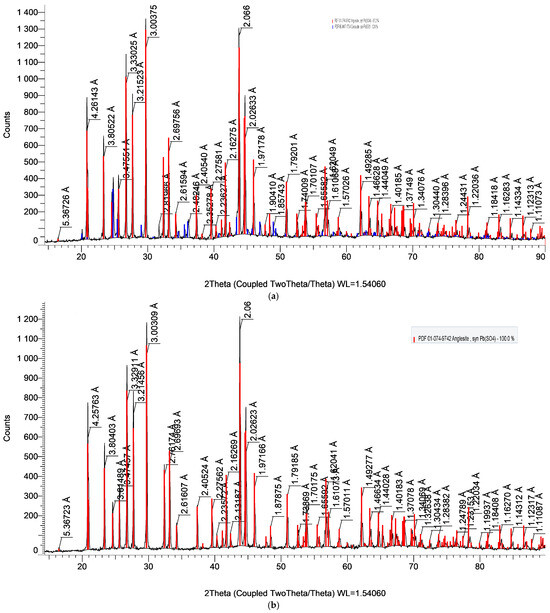
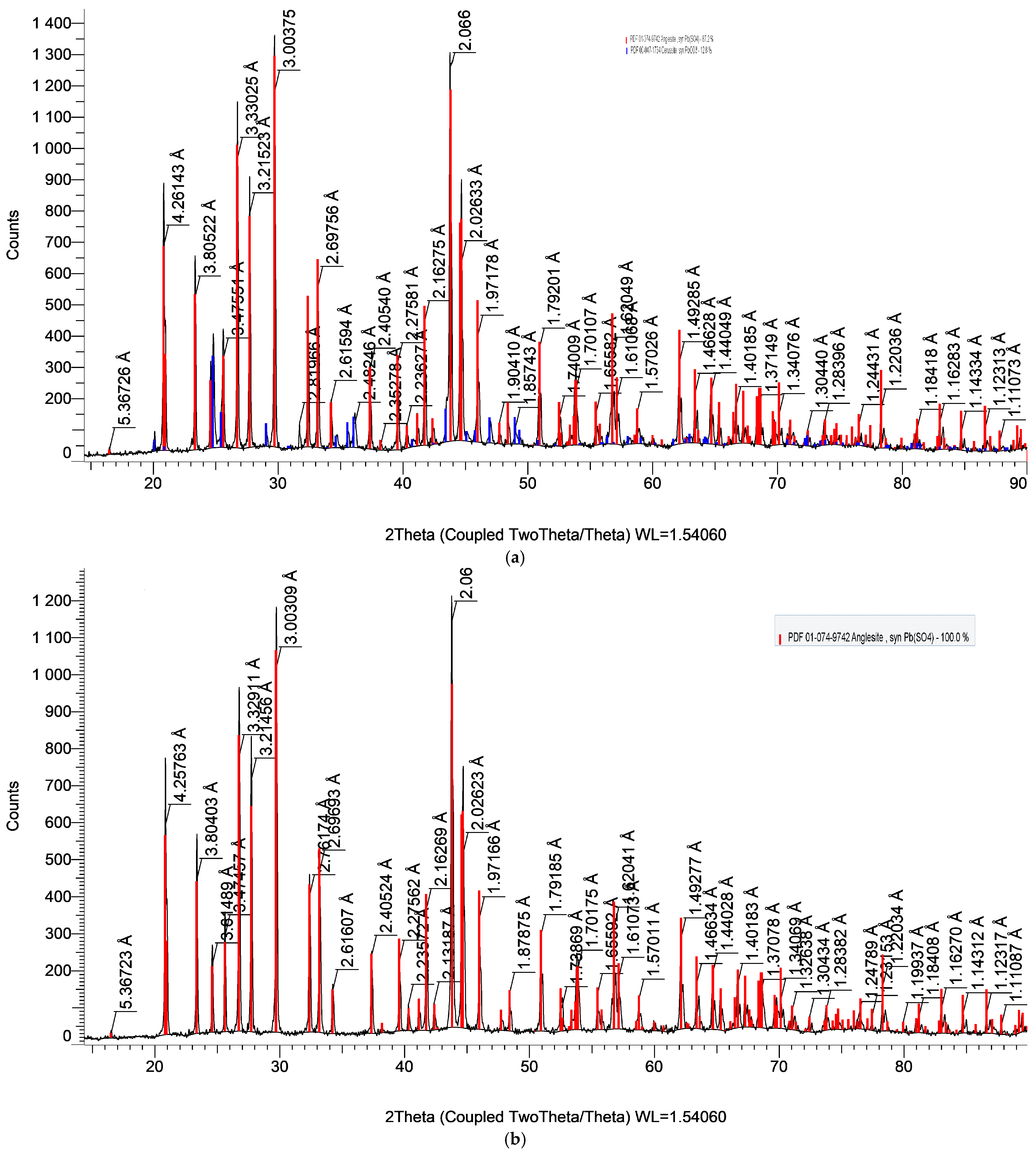
X-ray phase analysis of the initial and post-leaching residue was performed (Figure 3).
Figure 3.
XRD analysis of the initial lead cake and leaching residue. (a) XRD analysis of the initial lead cake; (b) XRD analysis of the leaching residue.
The study results show that the phase composition of the initial precipitate consisted of lead sulfate and carbonate (Figure 3a). After leaching, only lead sulfate remained (Figure 3a), which explains the increased foaming.
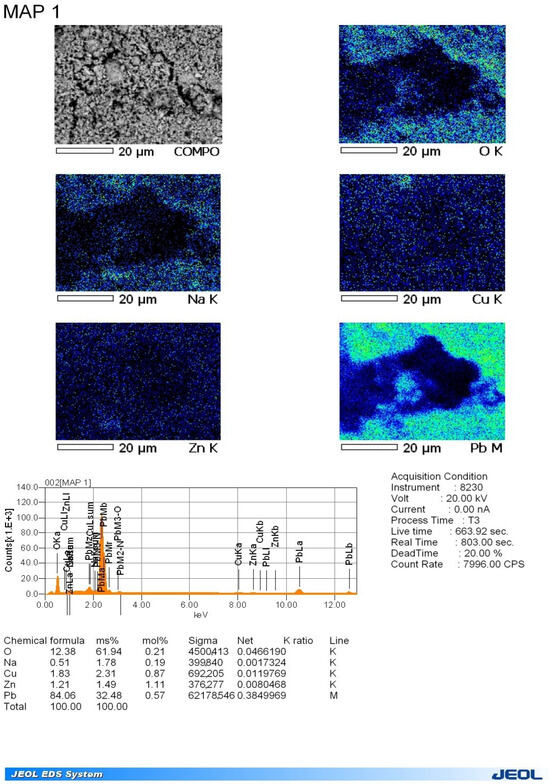
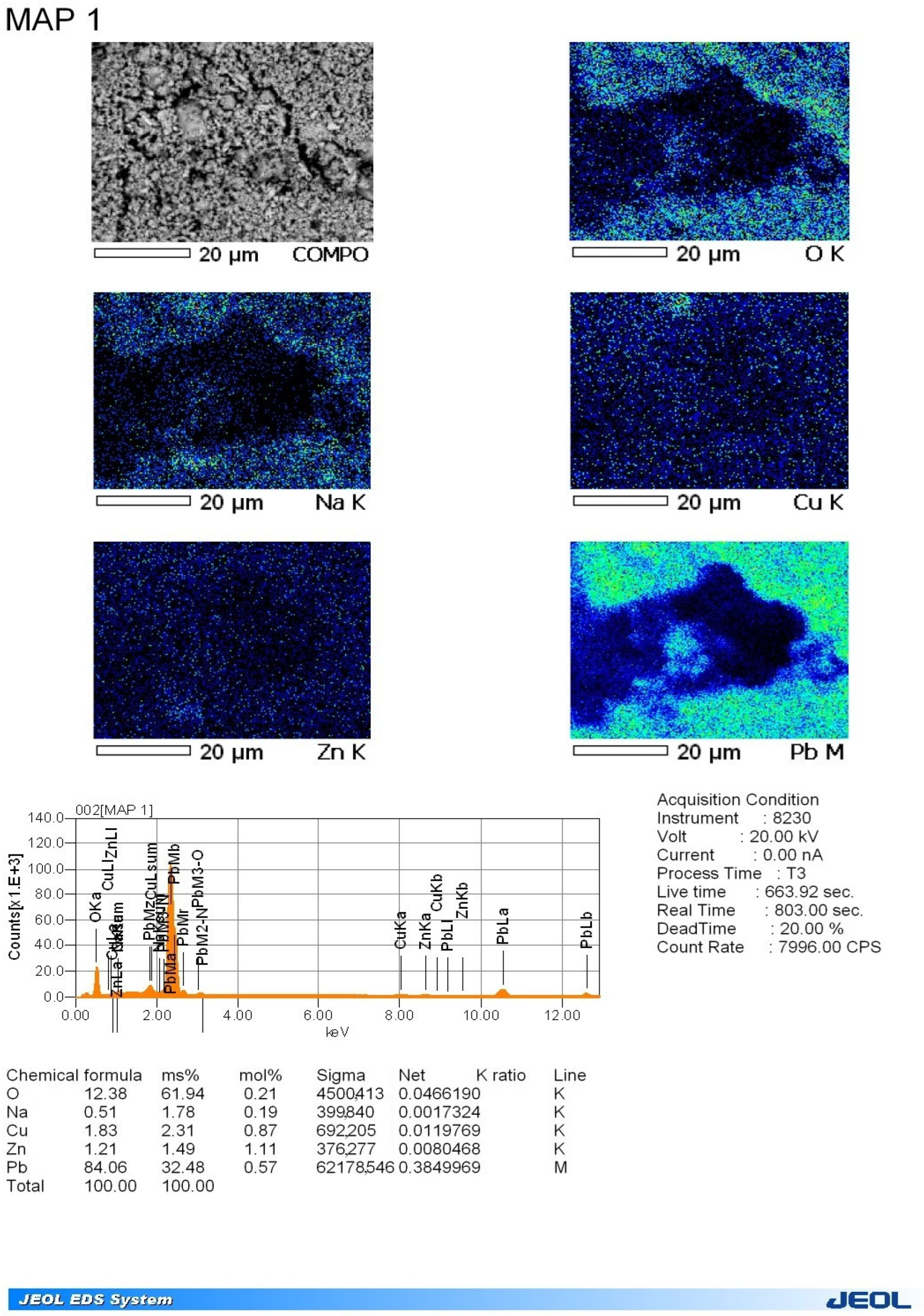
To establish the morphological and phase-chemical properties of the lead cake, which determine its reactivity during hydrometallurgical processing, a comprehensive analysis was conducted using scanning electron microscopy combined with energy-dispersive X-ray microanalysis (SEM-EDS). EDS images (Figure 4) in compositional contrast mode revealed a distinctly heterogeneous and multiphase structure, represented by irregularly shaped agglomerates ranging in size from several to tens of micrometers. The presence of contrasting areas with an elevated average atomic number indicates the formation of isolated lead-containing phases, while the darker matrix represents finely dispersed oxide components. Developed porosity and interphase boundaries indicate a high degree of structural defectiveness, which contributes to an increase in the specific reaction surface.
Figure 4.
SEM images of the original cake.
According to the energy dispersive analysis (EDS), the sample was an oxidized matrix consisting predominantly of lead (84.06 wt%) and oxygen (12.38 wt%). Mapping data confirmed a highly correlated distribution of these elements, which, combined with the molar ratio (Pb:O ≈ 1:2), indicated the predominance of the lead dioxide phase (PbO2). The structure also contained minor impurities of copper (1.83%), zinc (1.21%), and sodium (0.51%), uniformly distributed throughout the material.
From the perspective of hydrometallurgical processing, the established morphological and phase properties are of fundamental importance, as lead oxide phases can act both as independent dissolution targets and as a matrix phase accumulating platinum-group metals, including osmium. The localization of lead in the form of isolated oxide phases and their structural imperfections contributes to the increased reactivity of the material, which creates the prerequisites for the selective decomposition of the matrix and the subsequent extraction of osmium into solution. Thus, the obtained results demonstrate for the first time the relationship between the microstructural heterogeneity of lead cake, the phase localization of lead, and the potential efficiency of its hydrometallurgical decomposition. This is an important prerequisite for the development of scientifically sound modes for the selective extraction of valuable components, including osmium.
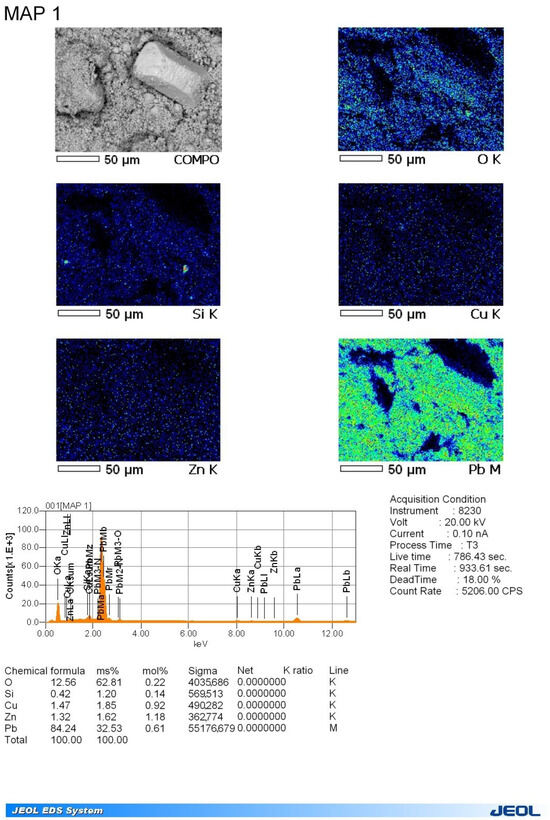
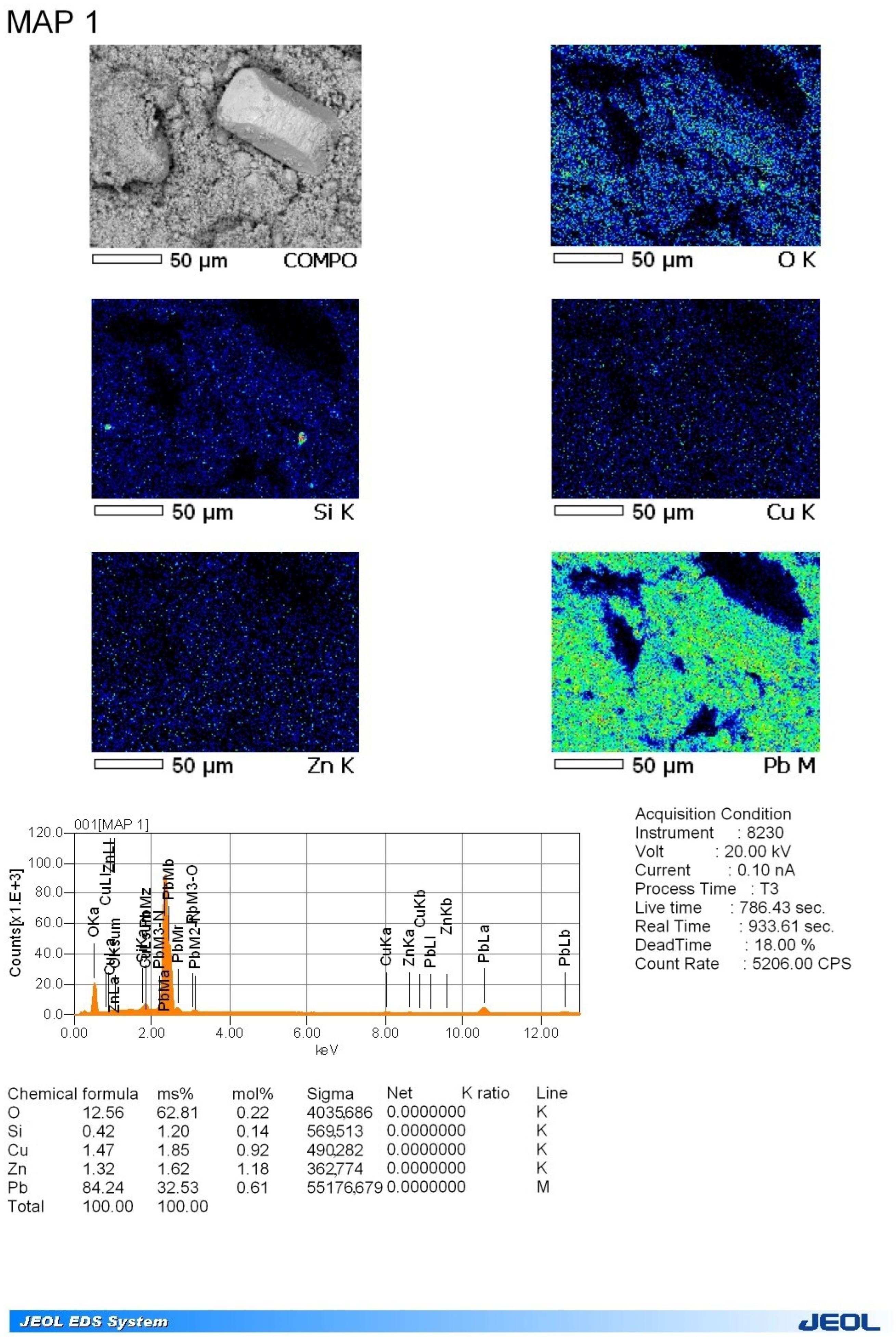
The SEM images of the post-leaching residue (Figure 5) in compositional contrast mode revealed a distinctly heterogeneous multiphase structure, represented by irregularly shaped agglomerates 5–50 μm in size with developed porosity and clearly defined interphase boundaries. The lighter areas correspond to phases with an increased average atomic number and are associated with the localization of lead-containing compounds, while the darker matrix represents finely dispersed oxide and silicate phases.
Figure 5.
SEM images of the post-leaching residue.
Elemental analysis using energy-dispersive X-ray spectroscopy (EDS) revealed that the main phase of the sample was lead (84.24 wt%) in an oxidized state (12.56 wt% oxygen). Element distribution maps demonstrated a strong spatial correlation between Pb and O, which, at an atomic ratio of approximately 1:2, corresponds to a predominant content of lead dioxide (PbO2). Trace amounts of copper (1.85 wt%), zinc (1.62 wt%), and silicon (1.20 wt%), uniformly distributed throughout the material structure, were also detected.
Thus, the SEM-EDS analysis results confirm for the first time that the post-leaching residue consists of lead oxide phases with a silicate matrix and impurity elements, and its microstructural features determine the high potential efficiency of hydrometallurgical treatment and selective extraction of valuable components, including osmium.
5. Conclusions
- An analysis of the literature showed that a hydrometallurgical method, involving the transfer of rhenium to an acidic solution and the transfer of osmium to a sodium hydroxide solution, is highly promising for extracting osmium and rhenium from lead cakes formed during copper production. The process is straightforward, allowing for the production of osmium and rhenium as marketable products.
- A plant was developed using a heated column as a leaching apparatus, with the cake being fed from above and the oxidizing solution fed from below. The plant operates in a semi-continuous mode.
- Using the simplex planning mathematical method, nine experiments were conducted to find near-optimal conditions for the leaching of osmium and rhenium from lead cake formed during copper production: 68–70 mL of 30% hydrogen peroxide and 7 mL of concentrated sulfuric acid per 100 g of cake, a leaching duration of 52–55 min, and a specific column productivity of 100 g of cake in 55 min.
- The influence of the leaching temperature and liquid-to-solid ratio (L/S) was studied. It was shown that when cake is leached in column-type apparatuses, a leaching temperature of 60–70 °C is recommended to reduce foaming, while from an economic standpoint, a liquid-to-solid ratio (L/S) close to 2.0 is more advantageous.
Author Contributions
Conceptualization, E.M. and N.S.; methodology, T.K.; software, B.O.; validation, T.K. and E.M.; formal analysis, N.S.; investigation, E.M.; resources, N.S.; data curation, B.O.; writing—original draft preparation, E.M.; writing—review and editing, N.S.; visualization, B.O.; supervision, B.O.; project administration, E.M.; funding acquisition, E.M. All authors have read and agreed to the published version of the manuscript.
Funding
This research was funded by Science Committee of the Ministry of Science and Higher Education of the Republic of Kazakhstan (Grant No. AP23487029) and the APC was funded by Science Committee of the Ministry of Science and Higher Education of the Republic of Kazakhstan.
Data Availability Statement
The data that support the findings of this study are available from the authors upon reasonable request due to privacy/ethical restrictions.
Conflicts of Interest
The authors declare no conflict of interest.
References
- Mazulevsky, E.A.; Kovzalenko, T.V.; Seidakhmetova, N.M. Study of osmium leaching conditions from copper production lead cakes. Metallurgist 2022, 66, 45–52. [Google Scholar] [CrossRef] [Scilit]
- Lebedev, K.B. Rhenium; Scientific and Technical Publishing House of Ferrous and Nonferrous Metallurgy: Moscow, Russia, 1963; 208p. [Google Scholar]
- Palant, A.A.; Troshkina, I.D.; Chekmarev, A.M. Metallurgy of Rhenium; Nauka: Moscow, Russia, 2007; 298p. [Google Scholar]
- Zagorodnyaya, A.N.; Abisheva, Z.S.; Agapova, L.Y. Technology for production of ammonium perrhenate, rhenium acid and osmium-187 isotope from technogenic formations of nonferrous metallurgy. In Proceedings of the International Scientific and Practical Conference “Effective Technologies for Production of Nonferrous, Rare and Noble Metals”; Institute of Metallurgy and Ore Beneficiation JSC, Kazakh National Research Technical University Named After K.I. Satpayev, Ministry of Education and Science of the Republic of Kazakhstan: Almaty, Kazakhstan, 2018; pp. 263–271. [Google Scholar]
- Berdikulova, F.A.; Ishkenov, E.R.; Mazulevsky, E.A.; Kovzalenko, T.V. Extraction of rhenium from intermediate products of copper production. Promyshlennost Kazakhstana 2020, 2, 25–26. (In Russian) [Google Scholar]
- Berdikulova, F.A.; Sydykov, A.O.; Zharmenov, A.A.; Terlikbayeva, A.Z.; Seidakhmetova, N.M. Thermogravimetric study of oxidation firing of rhenium- and osmium-containing lead sludge. Metallurgist 2021, 64, 1096–1102. [Google Scholar] [CrossRef] [Scilit]
- Serikbayeva, A.K.; Berdikulova, F.A.; Mamyrbayeva, K.K.; Akilbekova, S.K. Processing of rare metal-containing waste of copper production. Metalurgija 2018, 57, 345–348. [Google Scholar]
- Berdikulova, F.; Zharmenov, A.; Serikbayeva, A. Review of technology for rhenium extraction from lead sludges and dusts of copper production. J. Eng. 2025, 2025, 9667313. [Google Scholar] [CrossRef] [Scilit]
- Gedgagov, E.I.; Vernigora, S.I.; Grishaev, S.I. Application of sorption methods for ammonium perrhenate production from rhenium-containing wastes. In Proceedings of the International Scientific and Practical Conference “Rhenium: Research, Development and Industrial Applications”, Moscow, Russia, 21–22 March 2013; p. 56. (In Russian) [Google Scholar]
- Zagorodnyaya, A.N.; Linnik, K.A.; Sharipova, A.S.; Abisheva, Z.S.; Zhumabekov, Z.Z. Sorption purification of ammonium perrhenate solutions from impurities. Kompleksnoye Ispolzovanie Mineralnogo Syr’ya 2015, 3, 17–26. (In Russian) [Google Scholar]
- Zagorodnyaya, A.N.; Sharipova, A.S.; Linnik, K.A.; Abisheva, Z.S. Multistage recrystallization of crude ammonium perrhenate. Khimicheskaya Tekhnologiya 2017, 18, 224–232. (In Russian) [Google Scholar]
- Zagorodnyaya, A.N.; Sharipova, A.S.; Linnik, K.A.; Abisheva, Z.S. Multi-stage recrystallization of crude ammonium perrhenate. Theor. Found. Chem. Eng. 2018, 52, 717–724. [Google Scholar] [CrossRef] [Scilit]
- Istrashkina, M.V.; Pochtarev, A.N.; Kalimuldin, V.S.; Gorbacheva, N.S. Production of high-purity rhenium compounds using membrane technologies. In Proceedings of the International Scientific and Practical Conference “Rhenium: Research, Development and Industrial Applications”, Moscow, Russia, 21–22 March 2013; p. 59. (In Russian) [Google Scholar]
- Agapova, L.Y.; Zagorodnyaya, A.N.; Abisheva, Z.S.; Kilibaeva, S.K.; Altenova, A.N. Application of electrodialysis for obtaining pure ammonium perrhenate from technical salts. Kompleksnoye Ispolzovanie Mineralnogo Syr’ya 2014, 3, 71–77. (In Russian) [Google Scholar]
- Zharmenov, A.A.; Sydykov, A.O.; Idrisova, K.S.; Berdikulova, F.A.; Sydykov, S.T.; Serikbayeva, A.K. Method for Processing Lead-Containing Materials with Extraction of Rhenium and Osmium. KZ Patent 13820, 16 July 2007. [Google Scholar]
- Sydykov, A.O.; Mazulevsky, E.A.; Dagirov, T.; Kovzalenko, T.V.; Tulenkova, T.V. Hydrometallurgical method for extraction of osmium and rhenium from lead cakes. Promyshlennost Kazakhstana 2009, 12, 66–67. (In Russian) [Google Scholar]
- Sydykov, A.O.; Mazulevsky, E.A.; Berdikulova, F.A.; Kovzalenko, T.B.; Dobryakova, O.P. Influence of chemical composition of lead cake on technological parameters of reductive smelting. Promyshlennost Kazakhstana 2011, 8, 73–75. (In Russian) [Google Scholar]
- Reed, S.J.B. Electron Microprobe Analysis and Scanning Electron Microscopy in Geology; Tekhnosfera: Moscow, Russia, 2008; 232p. [Google Scholar]
- Goldstein, J.; Newbury, D.; Echlin, P.; Joy, D.; Fiori, C.; Lifshin, E. Scanning Electron Microscopy and X-Ray Microanalysis; Mir: Moscow, Russia, 1984. [Google Scholar]
- Nalimov, V.V.; Chernova, N.A. Statistical Methods for Experimental Design; Nauka: Moscow, Russia, 1965; 340p. [Google Scholar]
- Box, G.E.P.; Wilson, K.B. On the experimental attainment of optimum conditions. J. R. Stat. Soc. Ser. B 1951, 13, 1–38. [Google Scholar] [CrossRef] [Scilit]
- Box, G.E.P.; Hunter, J.S. Multifactor experimental designs for exploring response surfaces. Ann. Math. Stat. 1957, 28, 195–241. [Google Scholar] [CrossRef] [Scilit]
- Box, G.E.P. Evolutionary operation: A method for increasing industrial productivity. Appl. Stat. 1957, 6, 81–101. [Google Scholar] [CrossRef] [Scilit]
- Spendley, W.; Hext, G.R.; Himsworth, F.R. Sequential application of simplex designs in optimization and evolutionary operation. Technometrics 1962, 4, 441–461. [Google Scholar] [CrossRef]
- Gaidadin, A.N.; Efremova, S.A.; Nistratov, A.V. Optimization Methods in Technological Practice; Volgograd State Technical University Press: Volgograd, Russia, 2008; p. 16. [Google Scholar]
- Kononyuk, A.E. Fundamentals of Scientific Research; Book 3; Kyiv National University Press: Kyiv, Ukraine, 2012; pp. 52–58. [Google Scholar]
- Bochkarev, V.V.; Troyan, A.A. Optimization of Chemical-Technological Processes; TPU Publishing: Tomsk, Russia, 2014; pp. 8–12. [Google Scholar]
- Ponomarev, V.B.; Loshkarev, A.B. Mathematical Modeling of Technological Processes; UGTU-UPI: Ekaterinburg, Russia, 2006; pp. 82–89. [Google Scholar]
- Ginzburg, S.I.; Gladyshevskaya, K.A.; Ezerskaya, N.A.; Ivonina, O.M.; Prokofieva, I.V.; Fedorenko, N.V.; Belskiy, N.K. Guide to Chemical Analysis of Platinum Group Metals; Nauka: Moscow, Russia, 1965; 314p. [Google Scholar]

Disclaimer/Publisher’s Note: The statements, opinions and data contained in all publications are solely those of the individual author(s) and contributor(s) and not of MDPI and/or the editor(s). MDPI and/or the editor(s) disclaim responsibility for any injury to people or property resulting from any ideas, methods, instructions or products referred to in the content. |
© 2026 by the authors. Licensee MDPI, Basel, Switzerland. This article is an open access article distributed under the terms and conditions of the Creative Commons Attribution (CC BY) license.