


Abstract
The Compact Strip Production (CSP) process is the latest version of thin-slab continuous casting, combining both casting and rolling, thus improving the CSP process’s energy efficiency and the strip quality. Modeling the combined phenomena of fluid flow, heat transfer and solidification in CSP casting remains an unresolved multiphysics problem, particularly when boron and other alloying elements enter the system and modify the thermal properties and solidification behavior. In this study, we propose a more integrated approach by executing a computational fluid dynamics (CFD) model at different scales, blending macroscale fluid flow and heat transfer with meso-solidification that is molten in a CSP casting model. For the macroscale model, we solve the Reynolds-Averaged Navier–Stokes (RANS) equations with one of the energy equations, while the mesoscale model uses the solid fraction evolution algorithm to model the multiphase latent heat of solidification and the motion of solid and liquid phases of a non-equilibrium system. Mold heat flux, free surface cooling and secondary spray zones were used to set the boundary conditions. The model simulates temperature distributions at different times, the solid fraction below the liquidus and the trends in shell growth for different process parameters and the time profile of the solidification. The improved prediction capability of the model, demonstrated by the results, opens the opportunity to reduce the process parameters of casting speed and cooling to defect-free results. Comparisons with the most recent studies on continuous casting processes (including CSP and thin slabs) demonstrate alignment with the thermal gradient and solidification behavior characteristics. The thermal gradients and solidification behavior characteristics were obtained. The research yields the basis for developing microstructure and segregation models with boron-alloyed steels.
1. Introduction
Continuous casting remains the most widely used way of converting liquid steel into semifinished products. It has a number of advantages over traditional ingot casting such as higher productivity, lower energy consumption, better quality control, and higher material yield [1,2]. The process consists of pouring molten steel into a mold that is cooled by water. Steel starts to solidify and a shell is formed. The solidified part goes to secondary cooling zones where it is supported by rollers and water sprays. The whole system works to ensure that the casting is done at high speeds and the solidification is gradual and uniform at the same time, which reduces the chances of surface or internal defects [3,4]. With the introduction of Compact Strip Production (CSP) technology, the continuous casting process has been improved significantly. The CSP technology integrates casting and hot rolling, thus reducing the number of overall process steps and allowing production of thin slabs (~50–55 mm) directly from molten steel [5,6].
The CSP process has become especially important in the production of advanced high-strength steels (AHSS) where the control of thermal gradients, shell growth, and solidification is decisive to attaining the required mechanical properties [7,8]. The thin slab size and fast casting speed common to CSP (usually between 4 and 6 m/min) make heat extraction more vigorous and thus, necessitate better thermal management to avoid the problems of breakout, cracking, and segregation [9]. Besides, the rolling mills that receive the slabs are very much integrated, thus the temperature of the cast product needs to be tailored to achieve consistent hot rolling and grain refinement [10].
In CSP, the intricate interaction among fluid flow, heat transfer, and solidification is determined by a group of highly nonlinear and interrelated physical phenomena. The moment molten steel enters the mold cavity, and it instantly exhibits turbulent flow characteristics and creates recirculation loops that not only carry heat but also solute. The resulting flow patterns bring about the considerable area and character of the solidification front, the thickness of the shell, and the possibility of prevailing macrosegregation or centerline cracking [11,12]. The transfer of heat takes place mainly in three ways: by conduction through the solidifying shell and mold, by convection within the molten pool, and by forced convective cooling from water sprays in the secondary zone [13]. These mechanisms are working together and are very much influenced by changing casting speed, steel grade, and mold design [14].
The development of the Computation Fluid Dynamics (CFD) has been the backbone of numerous couplings, which are now permitted by the computers to be simulated in great detail allowing the prediction of the phases from temperature fields, flow, and solidification profiles in continuous casting [15,16]. The utilization of the multi-scale modeling techniques that integrate the transport equations of macroscale with the models of the meso-or microscale, concerning the phase transformation, solid fraction growth and dendritic growth have become more and more important [13,17,18]. Nevertheless, the inferior-carbon steels have been the primary focus of the existing models and their simplifications relating to the metallurgical impacts of the alloying elements, particularly those with substantial effects on the solidification behavior, are usually applied.
Boron is among the most important alloying elements used in steelmaking industry because of the exceptional enhancements it provides in hardenability, mechanical strength, and grain growth [19]. In fact, even mere additions of boron (usually <0.005 wt%) can modify the solidification process to a great extent by diminishing the liquidus-solidus interval and affecting the distribution of carbon and other solutes [20,21]. The presence of boron in the steel and during the cooling process together with nitrogen and titanium forms a cycle that determines the formation of inclusions and precipitates, which consequently influence the steel properties like toughness and ductility [22]. The mentioned effects are even more vivid in CSP casting where the rapid thermal gradients very often do not allow for any significant time for homogenization or solute redistribution [20].
Existing multi-scale CFD studies of continuous casting have predominantly focused on plain carbon and stainless steel grades, which treat thermophysical properties as either composition-invariant or weakly alloy-dependent. The research has not included minor alloying effects that impact liquidus and solidus temperature and partitioning behavior and mushy-zone development. The existing CSP simulation frameworks do not contain any of the metallurgical effects that boron has on solidification kinetics and segregation behavior.
The current research creates a solution for this research gap by incorporating boron-sensitive thermodynamic and transport modifications into its multi-scale CFD model, which simulates Compact Strip Production (CSP) casting. The proposed framework establishes explicit control for boron-induced temperature changes between liquidus and solidus points along with variations in partition coefficients that affect solid fraction progression through non-equilibrium conditions. The model combines macroscale turbulent flow and heat transfer with mesoscale solidification kinetics that depend on specific alloy characteristics to produce accurate predictions of shell growth and mushy-zone development during high-speed CSP casting.
Unlike existing CSP and thin-slab casting models that predominantly assume alloy-neutral thermophysical properties or focus exclusively on either macroscale transport or mesoscale solidification, the present work introduces an explicitly alloy-sensitive multi-scale CFD framework for boron-alloyed steels. The novelty of the proposed model lies in three principal aspects: (i) full three-dimensional coupling of turbulent flow, heat transfer, and enthalpy-based solidification under industrial CSP boundary conditions; (ii) explicit incorporation of boron-dependent shifts in liquidus/solidus temperatures and partition coefficients within a non-equilibrium Scheil-based formulation; and (iii) dynamic feedback between mushy-zone permeability and macroscopic momentum transport through a temperature- and solid-fraction-dependent resistance term.
In contrast to representative CSP modeling approaches that assume composition-invariant thermophysical properties or incorporate alloy effects only implicitly, the present framework embeds boron-sensitive thermodynamic parameters directly into the solid fraction evolution and the enthalpy-based energy equation. This explicit alloy-aware formulation enables quantitative evaluation of how minor boron additions influence mushy zone thickness, shell growth kinetics, and overall solidification time under high-speed casting conditions. Therefore, the methodological contribution of this work is not merely the application of CFD to a new alloy system, but the development of an alloy-aware multi-scale coupling strategy tailored to CSP casting of boron-containing steels.
2. Literature Review
Several researchers have used Computational Fluid Dynamics (CFD) to study how fluid flow interacts with heat transfer and solidification during continuous casting operations. The interacting mechanisms of this system depend on three operational parameters which include casting speed and cooling intensity and alloy composition. The numerical prediction needs reliable modeling systems that can handle multiple processes including turbulence and phase changes and mushy-zone behavior inside closed mold shapes [11,12].
Amaratav et al. [10] conducted a complete evaluation of the difficulties that researchers face when they try to simulate turbulence and heat transfer and solidification processes through complete system coupling because they demonstrated that all interacting mechanisms must be considered to achieve accurate predictions. The researchers established a new turbulence-solidification modeling system for thin-slab casting, which demonstrated how flow-induced turbulence affects shell asymmetry and defect development according to their research results. Their model designed to study macroscopic transport processes lacked the capability to include thermodynamic changes that depend on specific alloys.
Wang and Zhang conducted their research on shell formation and mold flow behavior by examining the behavior of meniscus dynamics together with their recirculation zones. The research showed that persistent recirculation patterns determine the efficiency of local heat extraction and the process of shell development. The research conducted by Xu et al. [4] advanced CSP mold simulations through their implementation of electromagnetic braking (EMBr), which demonstrated that vertical and transverse magnetic fields work together to stabilize turbulent flow while creating thermal patterns that decrease cracking and segregation risks. The studies maintain material properties equal across different compositions yet they fail to investigate how small additions of boron and other alloys affect metallurgical properties.
The use of multiscale modeling techniques has also become increasingly popular in the last few years. The case of AISI 304 stainless steel twin-roll strip casting is perhaps the most recognized one, where a team of scientists invented a quarter-symmetry three-dimensional macroscopic CFD model combined with a two-dimensional slice model for microscale solidification structure prediction [16]. This composite technique of modeling applied the enthalpy-based phase change modeling together with the Scheil–Gulliver relations to calculate the dendritic microstructure and solute distribution. The research has successfully proven that the merge of the macro and microscale models not only led to better thermal transport and metallurgical evolution but also came up with clearer insights. Nevertheless, a great number of similar experiments restrict their investigation either to the macroscopic area (e.g., fluid and heat transport) or to the mesoscale area (e.g., solidification front tracking), and they frequently do not incorporate both under industrially realistic boundary conditions and geometries [16,18].
One of the biggest breakthroughs in the area is the integration of machine learning algorithms with Computational Fluid Dynamics (CFD) simulation. To give an example, the integration of Bayesian Optimization with Long Short-Term Memory (BO-LSTM) networks has been suggested for forecasting dendritic microstructure growth driven by temperature histories taken from CFD runs. These combined models produce shorter prediction cycles without compromising the accuracy of the conventional CFD methods [1,13]. Moreover, data-driven techniques are specifically attractive for research of parameters or even live control of the CSP system at a very early stage of development; nevertheless, they need large volumes of training data and thorough testing each time.
At the same time, some other researchers have tackled the problem of uncertainty related to boundary conditions. Mold heat flux, for example, is a boundary condition that is one of the most difficult to directly measure in the casting process. The use of the CON1D model has made it possible for inverse modeling of mold heat flux with measured thermocouple data, which afterwards can be fed into either 2D or 3D CFD domains to yield more accurate simulation results [4]. This particular method boosts the credibility of the numerical predictions but at the same time increases the computational burden and intricacy, especially in simulations that are dependent on time.
Although the progress made is remarkable, there is still a large gap that could be filled with a comprehensive and fully coupled multi-scale CFD model, which will connect all three key areas fluid dynamics, heat transfer, and solidification precisely for CSP casting of boron-alloyed steels. The majority of the existing studies either concentrate on plain carbon steels or stainless grades and completely ignore the metallurgical complexities brought about by the addition of boron, which can affect both the thermal and solutal traits of solidification [19,20]. Adding boron alters the temperatures of liquidus and solidus, increases the solidification range, and forms complex inclusions with other elements like nitrogen and titanium, all of which are factors that govern shell growth and crack susceptibility [21,22]. In addition, the influence of boron on the microstructure and segregation is always greater in the case of CSP casting because of the associated high-gradient and high-speed thermal conditions, but these aspects are seldom represented in the simulation [20,23].
A few studies conducted recently have recognized the importance of combining approaches. For example, the work of Li et al. highlighted the necessity of alloy-wise modeling in CSP simulation and laid down the first steps for integrating solute influences, however, those were not tested on boron-containing systems [2]. Likewise, Cheng et al. performed CFD–DEM simulations to investigate the behavior of inclusions during continuous casting but left out boron-containing compounds [15]. The mentioned progress is an indication of the increasing importance of alloy-sensitive modeling being acknowledged in steel casting research.
Consequently, the current research intends to bridge this gap in literature by creating a multi-scale CFD model that is specially designed for CSP casting of boron-alloyed steels, including macroscale flow and heat transfer, mesoscale solidification, and alloy-specific thermophysical properties. It will be possible to develop a more precise and reliable modeling approach for upcoming steelmaking systems by disentangling the interplay of turbulent flow, enthalpy-driven phase change, and boron-induced thermal effects with this framework [23].
3. Modeling Framework
3.1. Multi-Scale Approach
The intricate and closely interrelated aspect of the Compact Strip Production (CSP) casting process, which includes heat transfer, fluid flow, and phase transformation, calls for a modeling approach capable of depicting both global and local phenomena. In order to do this, a multi-scale computational framework has been created that combines macroscopic and mesoscopic models in one simulation environment. At the macroscale, the model uses CFD methods to resolve three-dimensional fluid flow and convective–conductive heat transfer within the molten pool and the adjacent steel domain. Doing so allows for the prediction of the global distribution of temperature, flow velocities, and thermal gradients, which are all factors that have a considerable influence on the shape and growth of the solidifying shell [1,2].
On the mesoscale, the model considers the local solidification kinetics, the release of latent heat, and the dynamics of the mushy zone. The temperature history, alloy composition, and local thermal gradients have great impact on these effects, so they are very important in predicting accurately shell thickness, dendrite morphology, and microsegregation [3]. The combination of these two scales ensures that the macro-level fluid flow phenomena like the recirculation loops and the nozzle jet impingement can impact the phase change process at the meso-level, whereas the solidification feedback (e.g., resistance of the mushy zone) will alter the local flow patterns, particularly in the solid-liquid interface area [4,5].
The same casting techniques, like twin-roll casting [6], have successfully utilized the aforementioned multi-scale modeling tactics, wherein the capturing of localized phase transformation behavior was a must and at the same time the overall domain size and computational tractability were not compromised. The model brings the properties dependent on solid fraction into the picture and accordingly alters the viscosity, thermal conductivity, and flow resistance in real-time, depending on the solidification state of each cell, thus permitting an authentic transition from liquid to solid [7].
This coupling is especially critical in CSP casting of boron-alloyed steels, where the inclusion of boron alters the solidification range and consequently the thermal response because of its affinity with other solutes like nitrogen and titanium [8]. One of the effects of boron is that it lowers the solid phase solubility of nitrogen, which, in turn, can push the mushy zone and cause inclusions to form near the solidification front such effects can be satisfactorily described only by a model that simulates phase change with the required spatial and temporal resolution [9].
3.2. Governing Equations
The modeling framework is based on the resolution of a number of primary governing equations, among which are the continuity, momentum, and energy equations, together with some additional relations to deal with phase change and solute mixing. The continuity equation guarantees that the mass in the casting domain is conserved:
is denotes the molten steel’s density and u reflects the velocity vector. The turbulent flow in the mold cavity is portrayed by means of the Reynolds-Averaged Navier–Stokes (RANS) equations. The momentum equation is articulated as:
where is pressure, is the effective viscosity (including turbulent eddy viscosity), is gravitational acceleration, and accounts for phase-change-induced damping in the mushy zone [10,11]. To accurately capture heat transfer and phase change, the energy equation is expressed in an enthalpy-based form, which inherently incorporates both sensible and latent heat components:
Here, represents total enthalpy, which includes:
where is specific heat, is the solid fraction, and is the latent heat of fusion. The solid fraction evolves depending on the local temperature and composition and is determined through a non-equilibrium solidification model. The Scheil equation is employed to determine the variation of the solid fraction during phase change:
where and are the liquidus and solidus temperatures, respectively, and is the partition coefficient for the solute (e.g., boron). This method presumes that there is no diffusion in the solid and that complete mixing occurs in the liquid, which is suitable for high-speed casting since equilibrium conditions are not kept. The addition of boron leads to a change in the values of , , and , consequently affecting the mushy zone’s dimensions and profile. Therefore, it is essential to include these modifications in the simulation of the thermal–metallurgical response of boron-alloyed steel during CSP casting.
In summary, the governing framework tightly links flow, heat transfer, and solidification in a solid and scalable manner that mirrors the physical realities of CSP casting. It allows for the accurate prediction of shell growth, thermal gradients, and process sensitivity, thus setting the stage for defect prediction and process optimization [15,16].
4. Numerical Implementation and Simulation Setup
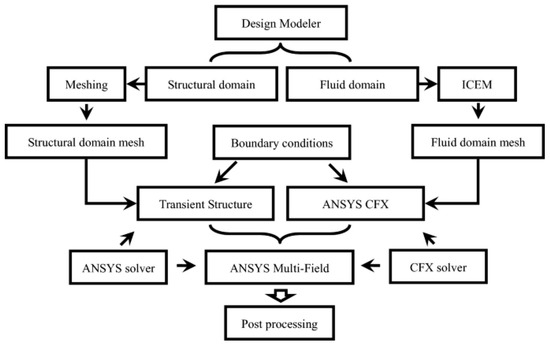
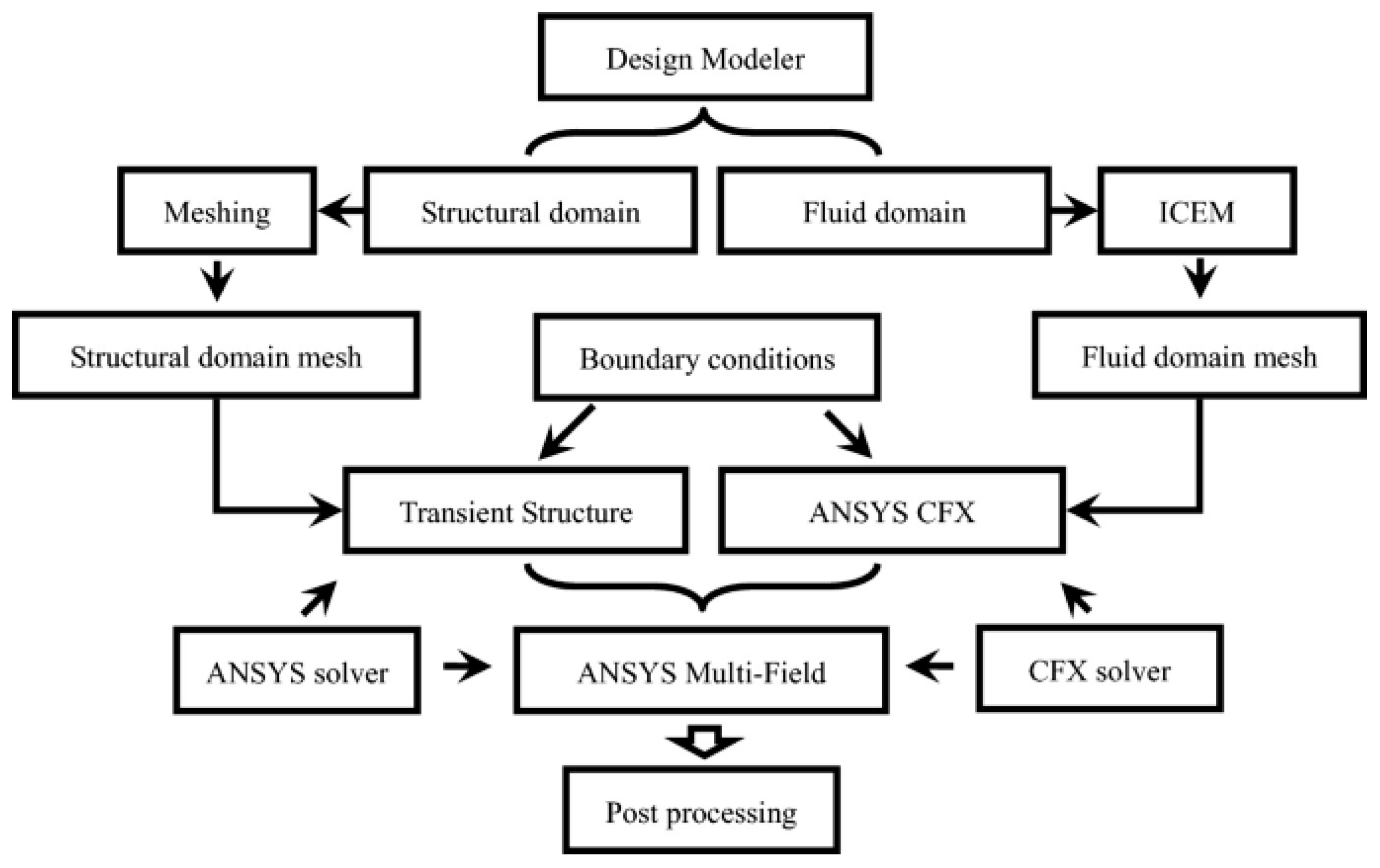
In order to model and analyze the thermal–fluid–solidification behavior of steel containing boron during the Compact Strip Production (CSP) process, a 3D computer model has been created. The model is based on a typical part of the CSP mold and the area of first solidification. The area considered comprises the molten steel pool, real mold walls, and the secondary cooling zone, from the meniscus level downward to a depth sufficient for the capturing of shell growth and mushiness zone movements. This first study eliminates the geometrical details of features such as the submerged entry nozzle (SEN) and mold tapering to make the flow structure simpler while thermal fidelity is still preserved. The overall computational domain and boundary condition configuration are illustrated in Figure 1.
Figure 1.
Schematic representation of the numerical implementation and simulation domain.
A structured hexahedral mesh gives rise to the domain, which is then refined locally in areas with steep thermal and velocity gradients. The mushy zone, free surface, and mold–steel interface are the areas of main concern, where solidification starts and cooling rates vary significantly. Mesh independence is confirmed by grid sensitivity tests performed to ensure that changes in cell size do not have a massive impact on the results. In the finely refined zones, the element size is typically 0.5 mm, while in the bulk regions it is 2 mm, leading to total mesh counts of over one million cells for a complete 3D case [1].
The governing equations presented in Section 3 were implemented and solved by using a finite volume CFD solver, namely ANSYS Fluent 2023 R1 and OpenFOAM v10, which are both capable of multiphase heat transfer with solidification. Applying the enthalpy–porosity formulation required to simulate the phase change process, these solvers permit the use of temperature-dependent material properties and source terms to account for latent heat release In addition, the SIMPLE approach (Semi-Implicit Method for Pressure-Linked Equations) is applied for pressure–velocity coupling. Moreover, second-order upwind schemes are used for the spatial discretization of momentum and energy equations to ensure the accuracy and stability of the numerical methods [2].
The material properties of steel alloyed with boron are reported based on recent studies in the field of metallurgy, particularly the ones dealing with grades of boron concentration between 0.001 and 0.005 wt%. The properties that vary with temperature such as density, specific heat capacity, thermal conductivity, and dynamic viscosity are represented by polynomial fits that are based on empirical data. The liquidus and solidus temperatures are shifted to a particular degree to indicate the effect of boron on phase transformation temperatures, usually by 5–10 °C depending on the composition [3,4]. The partition coefficient (k), which is employed in the Scheil equation is changed accordingly, in order to consider boron’s impact on the distribution of solute during the cooling process.
The boundary conditions are set according to the normal operating parameters of CSP. A velocity profile is set at the inlet, which is uniform in nature so as to imitate the entry of molten steel from the tundish. The pressure outlet or the free surface is assigned to the top surface according to the formulation being either steady-state or transient. The heat flux boundary conditions applied to the mold walls are based on data from thermocouples located in the mold, which are measured, and also from the inverse heat transfer models. The initial solidification range is usually between 1–2 MW/m2 for such conditions [5]. The cooling region is applying the convective heat transfer coefficients that are representing water spray impingement. The values are usually in between 500–1000 W/m2·K depending on the type of spray and the location.
The model sets off with a consistent temperature distribution that represents the heating temperature of the melted steel (around 1550–1570 °C) and the calculations are continued until a thermal state that is stable or close to stable is reached. After the processing is done, the results are displayed in the form of temperature contour maps, solid fraction curves and shell thickness profiles, which makes it possible to compare with the industrial standards and published CSP casting data [6]. The numerical method that has been developed serves as the ground for the variation of parameters like casting speed, cooling intensity and alloy composition which, on the other hand, sheds light on the process sensitivity of boron-alloyed steel in CSP operations.
The CSP mold domain diagram shows three main areas that include the molten steel pool and the mold walls and the secondary cooling zone. The boundary conditions for the system include three elements, which are inlet flow, mold heat flux, and secondary spray cooling. The computational mesh uses refined areas for the mold–steel interface and mushy zone with minimum element size of 0.5 mm while the bulk liquid areas use coarser elements of approximately 2 mm to maintain computational efficiency. The ANSYS Fluent/OpenFOAM v10 solver architecture uses enthalpy–porosity formulation to connect macroscale fluid flow and heat transfer with mesoscale solid fraction evolution through temperature and phase-dependent source terms.
5. Results
5.1. Temperature Field and Heat Transfer
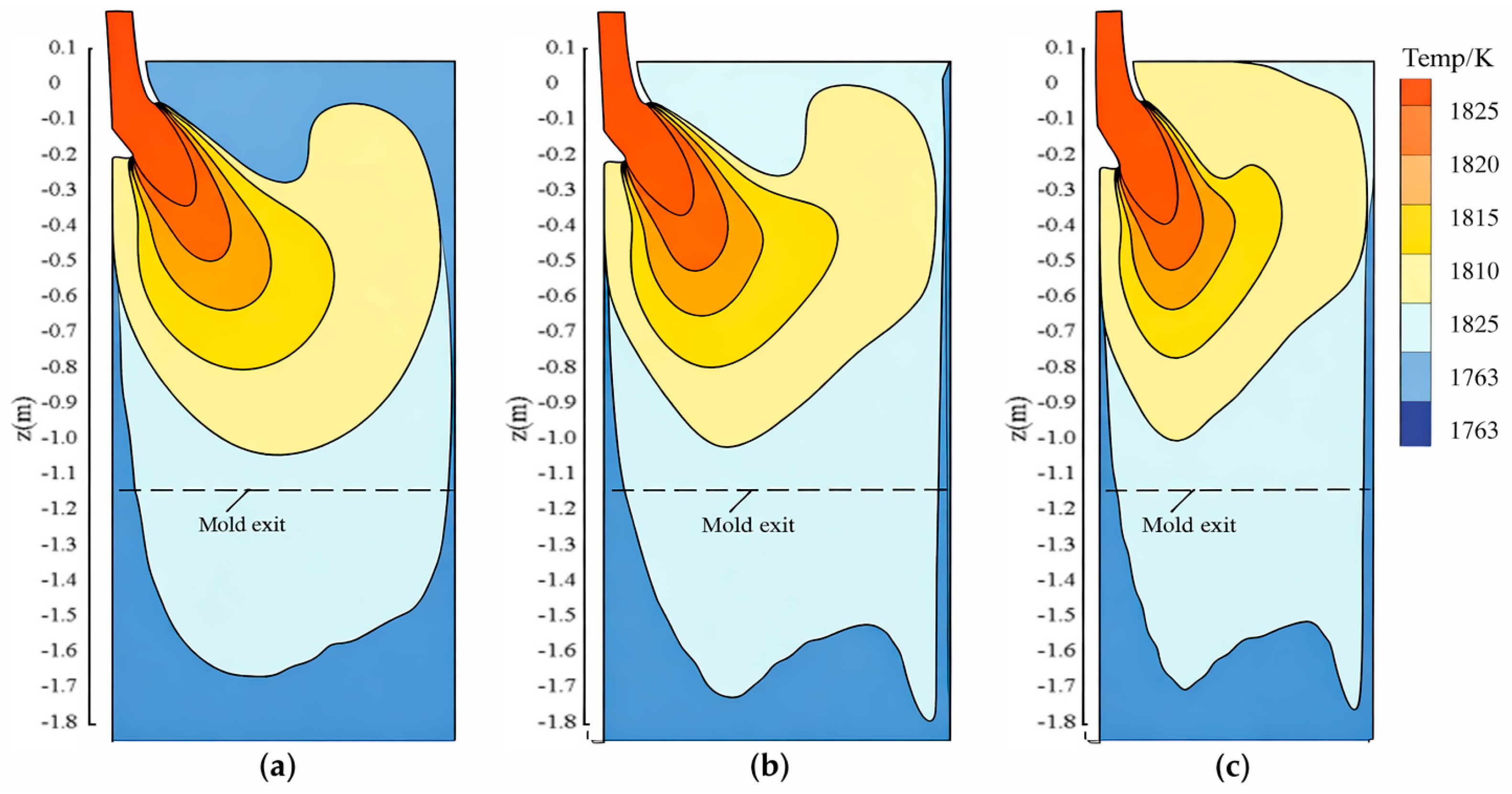
The CFD simulations grant a thorough understanding of the temperature distribution that occurred in the CSP mold during the casting of boron-alloyed steel. The strong thermal gradients that develop are indicated to occur very quickly when the molten steel gets into the mold cavity, especially in the area where the submerged entry nozzle (SEN) is placed. The jet that is generated by the SEN creates hot recirculation zones at both sides of the inlet, which carry the superheated steel towards the mold walls and, thus, considerably influence the local heat extraction rates. The non-uniform temperature fields and the spatial variations in the mold heat flux are a consequence of these zones and this has been commonly noted in thin-slab and CSP casting studies [1,2,3].
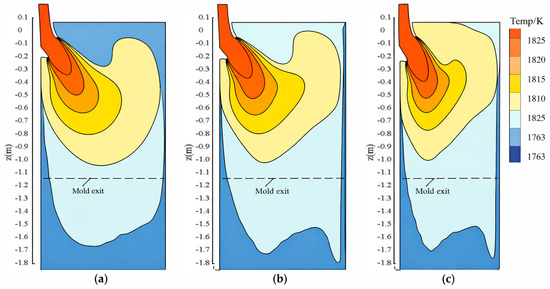
Figure 2 demonstrates a typical steady-state temperature distribution inside the CSP mold. The hottest areas are located in the lower center part of the mold, whereas the temperature drops sharply next to the mold walls where melting begins. It is expected that temperature differences of more than 250 °C will occur within a few millimeters of the meniscus and narrow side regions. Such drastic gradients are necessary for fast shell forming and at the same time they raise thermal stress that can lead to surface cracking if proper measures are not taken [4,5]. The findings indicate that the fluid flow intensity and turbulence have a very strong influence on the heat transfer efficiency, thus emphasizing the necessity of accurate control of the flow patterns in CSP operations.
Figure 2.
Temperature field in the CSP mold showing thermal gradients and recirculation regions at different positions along the casting direction: (a) temperature distribution near the meniscus where the jet from the submerged entry nozzle impinges; (b) intermediate mold region showing development of thermal gradients and recirculation zones; (c) lower mold region approaching the mold exit where heat extraction and shell growth become dominant.
5.2. Solidification and Shell Growth
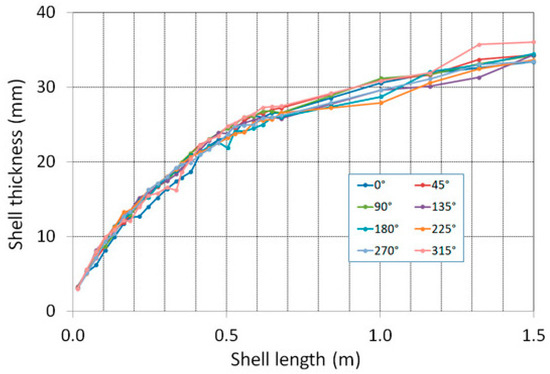
The solid fraction evolution prediction indicates that the solid shell will be formed first and then it will get thicker as molten steel moves down through the mold. The process of solidification starts at the mold and moves to the center, where a mushy zone is formed consisting of both solid and liquid. The thickness of the shell is steadily increasing with the length of casting, which is a clear indication that the cooling conditions applied are more than enough to keep the shell intact during the simulated operation period.
The solid fraction distribution in the direction of the casting is shown in Figure 3. The data indicate that the shell formation is quick in the upper mold area where the heat flux is very high, and then the rate of growth slows down as one moves downstream where the thermal gradients are smaller. The projected thickness of the shell at the exit of the mold is between 18 and 26 mm corresponding to different speeds of casting and this agrees with CSP industrial data reported [6,7]. There is a small difference in the thickness of the shell between the two opposite sides of the mold and this difference is due to the heat transfer being different at the locations that are affected by the flow, a case frequently seen in the turbulent casting systems [8].
Figure 3.
Solid fraction distribution illustrating shell growth along the casting direction.
The predicted shell thickness at the mold exit for various casting speeds is presented in Table 1, which serves to quantify shell growth behavior. The data unambiguously indicate that the increase in casting speed results in a decrease in the available solidification time, which in turn leads to thinner shells and a narrower safety margin against breakout.
Table 1.
Predicted shell thickness at mold exit for different casting speeds.
5.3. Impact of Casting Parameters
A parametric analysis was performed to assess the effect of cast speed and cooling intensity on temperature profiles, as well as on the solidification process. The findings indicate that cast speed is the most important factor influencing temperature gradient and shell formation. Fast casting decreases the time of the metal being in the mold, leading to the increase of the temperature inside and the prolongation of the solidification process. More intense cooling, however, will only partially reduce this effect because it is done only by the improving the convective heat transfer in the cooling zone.
The critical simulation scenarios examined are presented in Table 2. Case A depicts a cautious operating situation where strong shell formation takes place, while the condition of Case C is on the verge of the industrial limit with high productivity. The outcomes demonstrate that there are always two sides to a coin, and these are process safety versus productivity; hence, it is still necessary to look for advanced cooling methods at faster casting speeds [9,10].
Table 2.
Simulation cases and key operating conditions.
5.4. Influence of Boron Alloying
The simulation results indicate that the addition of boron (<0.005 wt%) produces measurable thermodynamic modifications to the solidification process. Specifically, boron shifts both liquidus and solidus temperatures and slightly increases the effective solidification interval, as summarized in Table 3. Although the absolute temperature shift (5–8 °C) appears modest, its effect on phase transformation kinetics becomes significant under high-speed casting conditions.
Table 3.
Quantitative comparison of solidification characteristics for low-alloyed and boron-alloyed steels under identical CSP casting conditions.
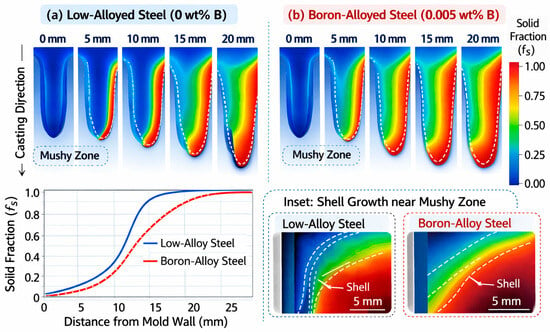
From a solidification kinetics perspective, the widened solidification interval results in an increase in mushy zone thickness (from 6.8 mm to 8.1 mm, approximately 19%) and prolongs the time required for complete solidification (an increase of ~25%). The solid fraction evolution curves (Figure 4a,b) demonstrate a smoother transition from liquid to solid in boron-alloyed steel. Figure 4a shows the solid fraction evolution for low-alloyed steel with a relatively sharp solidification front, whereas Figure 4b illustrates the boron-alloyed case where the mushy zone becomes wider and the solidification process occurs more gradually.
Figure 4.
Solid fraction evolution during CSP casting with and without boron alloying. (a) Solid fraction distribution for low-alloyed steel, showing a sharper transition from liquid to solid and a relatively narrow mushy zone. (b) Solid fraction distribution for boron-alloyed steel (<0.005 wt% B), illustrating a more gradual phase transition and an expanded mushy zone. The enhanced spatial resolution highlights the delayed dendritic coalescence and thicker mushy region caused by boron-induced shifts in liquidus and solidus temperatures. Thermal contours were evaluated at 5 mm casting intervals along the casting direction.
In the context of CSP casting, these effects are particularly critical. Unlike conventional slab casting, CSP operates with thin slabs (~50 mm thickness) and high casting speeds (4–6 m/min), which significantly limit the available solidification residence time. An expanded mushy zone reduces shell rigidity and increases permeability, thereby lowering resistance to ferrostatic pressure. Under high productivity conditions, this may elevate susceptibility to centerline segregation, internal porosity, and localized shell thinning. Therefore, even minor boron additions must be explicitly considered in CSP process optimization and stability analysis.
In order to provide a clearer picture of the metallurgical effect of boron, Table 3 presents a comparison of important solidification parameters for the two steel grades. The data points out that not only large boron additions but also small ones can modify solidification take place and so, must be considered in the design of the CSP process.
6. Discussion
Recent simulation studies, including those by [13,20], have demonstrated the critical role of turbulent flow structures and shell asymmetry in thin-slab casting processes. The current study shows that its predicted recirculation zones and shell growth patterns match previously reported findings that demonstrate the model’s physical reliability. A comparative evaluation of the present framework with representative CSP and thin-slab casting models is summarized in Table 4.
Table 4.
Comparative analysis of the present multi-scale CFD framework and selected CSP/thin-slab casting models.
The present framework improves upon the enthalpy-based two-dimensional formulation that [22] developed for plain carbon steel through its use of complete three-dimensional multi-scale coupling systems. This method allows for the concurrent simulation of turbulent fluid movement along with thermal energy distribution and the solidification process that varies according to different alloys. The model achieves better accuracy in metallurgical effects through boron-dependent thermodynamic changes that adjust liquidus and solidus temperatures together with partition coefficients when applied to alloy simulations that were not considered in previous research.
Cheng et al. [15] studied inclusion transport and multiphase interactions in continuous casting, but their research did not consider how boron solutes affected phase transformation behavior. The current research uses governing equations to model boron-induced changes that affect thermal range and solid fraction development. The simulation gains higher technical reliability and accurate metallurgical performance because the explicit alloy sensitivity improves both aspects of the system.
The multi-scale CFD model that was developed was quite successful in revealing very important physical phenomena that take place during Compact Strip Production (CSP) casting, among them turbulent fluid flow, heat transfer, and phase change. One of the major contributions of the simulation framework is being able to demonstrate the macroscopic transport processes and mesoscopic solidification models simultaneously, thus providing a strong representation of shell growth and thermal evolution in high-speed continuous casting. The predicted liquid flow structures, including the recirculation zones close to the submerged entry nozzle (SEN), and the uneven velocity profiles, are in agreement with experimental results as well as with previous CFD studies of thin-slab casting systems [1,2,4]. The heat flux that is locally intensified near the mold walls as a result of jet impingement and flow instability has a direct effect on the movement of the solidification front, which is in line with findings by [5,6].
The predictions regarding solidification are closely matched with the studies published regarding thin-slab casting, especially with respect to the trends in shell thickness, the behavior of the mushy zone, and the sensitivities of the parameters. For instance, the opposite correlation between casting speed and shell thickness in the simulation is in sync with the industrial findings and with the empirical correlations that are applied in mold design and in breakout protection systems [7,8]. Moreover, the model reflects the slower final solidification and the wider solidification range that boron addition produces, reinforcing the fact that even tiny concentrations of alloying are significant metallurgically. Such behavior is consistent with thermodynamic and microsegregation analyses performed by Amratav et al. and others investigating the impact of boron in the production of high-strength steel [9,10].
Although full plant-scale validation data were not directly accessible, quantitative comparison was performed against published CSP industrial benchmarks and empirical shell growth correlations. The predicted shell thickness at mold exit (18.9–25.8 mm for casting speeds of 4–5 m/min) falls within the industrially reported CSP range of 18–27 mm for comparable mold lengths and cooling conditions [6,7]. The inverse square root dependence of shell thickness on casting speed is consistent with classical breakout prevention correlations used in industrial practice.
Additionally, the predicted mold heat flux levels (1–2 MW/m2 in the upper mold region) are consistent with values commonly reported in thermocouple-based inverse heat transfer analyses for CSP casting operations. However, direct plant thermocouple or breakout detection system data were not available for the present alloy grade. Therefore, validation remains partially indirect, and future work will incorporate plant-scale measurements to further strengthen predictive confidence.
In spite of the strong predictive capability, the present model still has a number of weaknesses that need to be remedied in the future research. The steady-state flow condition, which is assumed to be the case all the time in the model, does not take into account transient phenomena like the nozzle swirl, meniscus fluctuations, or flow instabilities that are caused by the variations in pouring temperature and tundish level. These transient movements can greatly affect not only the initial shell formation but also the surface defects [11]. The Reynolds-Averaged Navier–Stokes (RANS) turbulence model was adopted due to its computational efficiency and established industrial applicability for full-scale CSP simulations. Large Eddy Simulation (LES), while capable of resolving transient anisotropic turbulence structures and meniscus fluctuations more accurately, would increase computational cost by approximately one order of magnitude for a full three-dimensional multi-scale domain.
Under steady casting conditions, RANS provides sufficiently accurate predictions of mean flow patterns and heat extraction trends. However, it may under-predict transient asymmetries, nozzle swirl instabilities, and oscillatory flow structures that can influence initial shell formation and surface defect development. Future work will explore hybrid RANS–LES strategies or scale-resolving simulations in localized mold regions to better capture transient flow effects while maintaining industrial computational feasibility.
It should be emphasized that the present study does not explicitly model dendritic grain growth, microsegregation profiles, or inclusion evolution. Any discussion of micro-structural implications is therefore interpretative and limited to thermodynamic trends derived from solidification kinetics. Grain structure prediction using phase-field, cellular automata, or CA–FE coupling approaches lies outside the scope of this work and constitutes a primary direction for future research.
7. Conclusions
The research establishes a complete CFD framework that simulates CSP casting process for boron-alloyed steel materials. The model combines macroscale turbulent fluid movement with enthalpy-based heat transfer and mesoscale solidification kinetics to predict temperature distribution and mushy-zone development and shell formation during different casting speed and cooling rate conditions.
The framework achieves defect formation simulation in CSP casting through its complete multiphysics solution, which connects momentum transport with thermal diffusion and phase transformation phenomena. The model’s main improvement originates from its direct implementation of boron-related thermodynamic changes, which control liquidus and solidus temperature variations and subsequent solidification time modifications. The alloy-specific changes improve metallurgical accuracy while enabling better simulation of boron-alloyed steel behavior during rapid solidification.
Moreover, the framework supports process and alloy optimization by offering a reliable tool for exploring how casting conditions and alloy composition influence thermal gradients, shell growth, and internal quality. The model lays the foundation for future integration with microstructure and segregation models aimed at enhancing product performance and reducing casting defects.
Author Contributions
Methodology, K.M.A.; Software, M.K.C.; Validation, K.M.A. and M.N.N.; Formal analysis, M.K.C.; Writing—original draft, K.M.A.; Writing—review & editing, M.N.N. All authors have read and agreed to the published version of the manuscript.
Funding
The authors thank the support from key Research and Development Program of China (No. 2021YFB3702401) and the Chinese Council for their support.
Data Availability Statement
The data presented in this study are available on request from the corresponding author due to confidentiality agreements and institutional restrictions.
Conflicts of Interest
The authors declare no conflicts of interest.
References
- Amratav, N.; Kumar, K.; Pillai, M. Heat Transfer and Solidification Methodology Involved in the Simulation of Steelmaking. Int. J. Mater. Sci. Appl. 2021, 10, 108–116. [Google Scholar] [CrossRef] [Scilit]
- Li, Z.; Lu, Y.; Wang, R.; Li, G.; Cui, H. Numerical Simulation of Effects of Mold Cavity and Submerged Entry Nozzle on Flow, Heat Transfer and Solidification in Funnel-Type Molds for Thin Slab Casting. Metals 2025, 15, 183. [Google Scholar] [CrossRef] [Scilit]
- Lu, J.; Wang, W.; Dou, K. Numerical Simulation of Fluid Flow, Heat Transfer, and Solidification in AISI 304 Stainless Steel Twin-Roll Strip Casting. Metals 2025, 15, 749. [Google Scholar] [CrossRef] [Scilit]
- Wells, S. Uncertainty Quantification in Modeling Mold Heat Transfer in Continuous Casting. Steel Res. Int. 2024, 95, 2400188. [Google Scholar] [CrossRef] [Scilit]
- Li, G.; Li, T.; Zhang, S.; Lin, W.; Du, F. Investigation on the Flow and Solidification Characteristic of Steel During Continuous Casting. Processes 2025, 13, 3550. [Google Scholar] [CrossRef] [Scilit]
- Xu, L.; Karcher, C.; Wang, E. Numerical Simulation of Melt Flow, Heat Transfer and Solidification in CSP Continuous Casting Mold with Vertical-Combined Electromagnetic Braking. Met. Mater. Trans. B 2023, 54, 1646–1664. [Google Scholar] [CrossRef] [Scilit]
- Cui, H.; Sun, J.; Zhang, J.; Xu, H.; Wang, G.; Liu, Q. Large eddy simulation of various EMBr effects on the fluid flow, heat transfer and solidification process in an ultra-high speed thin slab casting mould with multi-port SEN. Ironmak. Steelmak. Process. Prod. Appl. 2024, 52, 645–659. [Google Scholar] [CrossRef] [Scilit]
- Continuous Casting—Special Issue. Metals MDPI (Overview of Recent Casting Research). Available online: https://www.mdpi.com/journal/metals/special_issues/continuous_casting (accessed on 24 February 2026).
- Vakhrushev, A.; Ludwig, A.; Wu, M.; Tang, Y.; Nitzl, G.; Hackl, G. Complex Numerical Model for Solidification in Thin Slab Caster. In Proceedings of the European Continuous Casting Conference (ECCC 2011), Düsseldorf, Germany, 27 June–1 July 2011; Available online: https://smmp.unileoben.ac.at/fileadmin/shares/unileoben/smmp/docs/C95._Vakhrushev_A.__Ludwig_A.__Wu_M.__Tang_Y.__Nitzl_G.__Hackl_G._European_Continuous_Casting_Conference__ECCC_2011___D%C3%BCsseldorf__Germany___2011__S18.1-10..pdf (accessed on 24 February 2026).
- Isac, M.M.; Guthrie, R.I. Chapter 3.13—The Design of a New Casting Process: From Fundamentals to Practice. In Treatise on Process Metallurgy, 2nd ed.; Seetharaman, S., McLean, A., Guthrie, R., Seetharaman, S., Sohn, H.Y., Eds.; Elsevier: Amsterdam, The Netherlands, 2025; Volume 2A, pp. 571–613. [Google Scholar] [CrossRef] [Scilit]
- Liu, D.; Zhang, G.; Zeng, J.; Wu, C. Investigation of Solidification Heat Transfer in Slab Continuous Casting Process Based on Different Roll Contact Calculation Methods. Materials 2024, 17, 482. [Google Scholar] [CrossRef] [Scilit] [PubMed]
- Blazek, K.-E.; Lanzi, O.; Yin, H. Boron Effects on the Solidification of Steel During Continuous Casting. Rev. Métallurgie 2008, 105, 609–625. [Google Scholar] [CrossRef] [Scilit]
- Gandin, C.-A.; Rappaz, M. A coupled finite element–cellular automaton model for the prediction of dendritic grain structures in solidification processes. Acta Mater. 1994, 42, 2233–2246. [Google Scholar] [CrossRef] [Scilit]
- Morelli, U.E. A numerical approach for heat flux estimation in thin slabs continuous casting molds using data assimilation. arXiv 2021. [Google Scholar] [CrossRef] [Scilit]
- Cheng, J.; Li, J. Numerical simulation study on the motion and distribution of inclusions in continuous casting process. Comput. Part. Mech. 2025, 12, 5171–5182. [Google Scholar] [CrossRef] [Scilit]
- Gowrachari, H.; Barra, M.G.; Stabile, G.; Bazzaro, G.; Rozza, G. Reservoir computing based predictive reduced order model for steel grade intermixing in an industrial continuous casting tundish. arXiv 2025. [Google Scholar] [CrossRef] [Scilit]
- Bellet, M.; Gandin, C.-A.; Bobadilla, M. Three-dimensional finite element modeling of solidification in continuous casting. Metall. Mater. Trans. B 1996, 27, 797–810. [Google Scholar] [CrossRef] [Scilit]
- Thomas, B.G.; Yuan, Q.; Mahmood, S.; Liu, R.; Chaudhary, R. Transport and entrapment of particles in continuous casting of steel. Metall. Mater. Trans. B 2014, 45, 22–35. [Google Scholar] [CrossRef] [Scilit]
- Voller, V.R.; Prakash, C. A fixed grid numerical modelling methodology for convection–diffusion mushy region phase-change problems. Int. J. Heat Mass Transf. 1987, 30, 1709–1719. [Google Scholar] [CrossRef] [Scilit]
- Kurz, W.; Fisher, D.J. Fundamentals of Solidification, 4th ed.; Trans Tech Publications: Aedermannsdorf, Switzerland, 1998. [Google Scholar]
- Yang, B.; Deng, A.; Li, Y.; Xu, X.; Wang, E. Numerical simulation of flow and solidification in continuous casting process with mold electromagnetic stirring. J. Iron Steel Res. Int. 2019, 26, 219–229. [Google Scholar] [CrossRef] [Scilit]
- Zhu, G.; Zhao, Y.; Wang, Z.; Khalid, M.; Liu, M. Semi-resolved CFD–DEM simulation of fine particle migration with heat transfer in heterogeneous porous media. Int. J. Heat Mass Transf. 2022, 197, 123349. [Google Scholar] [CrossRef] [Scilit]
- Zhang, A.; Guo, Z.; Jiang, B.; Xiong, S.; Pan, F. Numerical solution to phase-field model of solidification: A review. Comput. Mater. Sci. 2023, 228, 112366. [Google Scholar] [CrossRef] [Scilit]

Disclaimer/Publisher’s Note: The statements, opinions and data contained in all publications are solely those of the individual author(s) and contributor(s) and not of MDPI and/or the editor(s). MDPI and/or the editor(s) disclaim responsibility for any injury to people or property resulting from any ideas, methods, instructions or products referred to in the content. |
© 2026 by the authors. Licensee MDPI, Basel, Switzerland. This article is an open access article distributed under the terms and conditions of the Creative Commons Attribution (CC BY) license.