Article

Microstructure, Mechanical Properties, and Gamma-Ray Shielding of a High-Density W-Ni-Fe Alloy: Effects of Liquid-Phase Sintering Parameters

1
Xi’an Nuclear Equipment Co., Ltd., Xi’an 421001, China
2
School of Mechanical Engineering, University of South China, Hengyang 421001, China
*
Author to whom correspondence should be addressed.
Metals 2026, 16(3), 336; https://doi.org/10.3390/met16030336
Submission received: 8 February 2026 / Revised: 5 March 2026 / Accepted: 8 March 2026 / Published: 17 March 2026

Abstract

This study investigates the development of a high-density W-Ni-Fe alloy using liquid-phase sintering and examines its microstructure and mechanical properties. Critical parameters, including sintering time and heating rate, were optimized to achieve enhanced density, microhardness, tensile strength, and γ-ray shielding properties. The results show that optimal sintering conditions (45 min at a heating rate of 30 K/min and a sintering temperature of 1753 K) lead to a uniform dispersion of tungsten particles, with a high-volume fraction of tungsten in the matrix and enhanced bonding within the γ(Ni-Fe) matrix. The alloy achieved a density of 16.99 g/cm3 and exhibited superior mechanical performance, with a tensile strength of 846.66 MPa and an elongation of 10.5%, as well as excellent γ-ray attenuation capabilities. These results demonstrate its suitability for nuclear applications.

1. Introduction

Tungsten-heavy alloys, particularly W-Ni-Fe systems, have attracted significant attention for nuclear applications due to their unique combination of high density (17–19 g/cm3), excellent mechanical strength, superior gamma/X-ray attenuation, and exceptional thermal stability [1,2,3,4]. Tungsten provides high density and radiation shielding, while nickel and iron enhance ductility, machinability, and microstructural uniformity [5]. The selection of Ni and Fe is based on their synergistic effects: Ni improves wettability and increases W solubility in the γ-phase, while Fe enhances matrix fluidity and reduces the liquid phase formation temperature by approximately 50 K compared to binary W-Ni systems [6]. These properties make W-Ni-Fe alloys promising candidates for nuclear reactor components, radiation shielding, and radioactive waste containers [7,8,9].
Liquid-phase sintering (LPS) has emerged as a widely studied technique for optimizing the microstructure and mechanical properties of W-Ni-Fe alloys [10,11]. During LPS, critical processes such as the dissolution of tungsten into the γ-(Ni,Fe) matrix, particle rearrangement, and densification play key roles in achieving a homogeneous microstructure and improved mechanical performance [12]. The ternary W-Ni-Fe system achieves superior densification through enhanced capillary forces during LPS, with precise control of sintering parameters—including sintering time, temperature, and heating rates—proving essential for balancing densification and grain growth while avoiding issues such as phase segregation and porosity [13,14,15]. Studies have demonstrated that mechanical properties, including tensile strength and elongation, can be significantly improved by optimizing these parameters [16,17]. Research indicates that precise control of sintering conditions, such as a heating rate of 30 K/min and a sintering time of 45 min, significantly enhances the density, tensile strength, and microhardness of these alloys, making them suitable for extreme environments [18,19].
While previous studies have demonstrated that precise control of sintering parameters can enhance individual properties of W-Ni-Fe alloys [18,19], these investigations have primarily focused on isolated improvements without establishing comprehensive correlations between processing conditions, microstructural evolution, and multiple performance metrics. Specifically, the simultaneous effects of sintering parameters on grain refinement, phase distribution, porosity elimination, and their combined influence on both mechanical properties and gamma-ray shielding performance remain insufficiently explored. Furthermore, quantitative relationships linking sintering kinetics to microstructural features and final material performance have yet to be systematically established for this alloy system.
Recent research has emphasized the importance of refining microstructure, reducing porosity, and optimizing the sintering process to further improve the density, mechanical strength, and radiation shielding properties of W-Ni-Fe alloys [20,21,22]. However, challenges such as excessive grain coarsening and pore formation due to prolonged sintering remain prevalent. The complex multi-phase structure of W-Ni-Fe alloys—primarily consisting of a W phase and a γ-(Ni,Fe) matrix—can result in uneven particle distribution and weak interfacial bonding, ultimately reducing the overall density and structural integrity of the material [23,24,25]. Incomplete densification during sintering can also leave residual pores, which serve as stress concentrators, significantly degrading the alloy’s mechanical properties. These limitations hinder the broader application of W-Ni-Fe alloys in demanding environments, necessitating optimized processing techniques to address these deficiencies.
While lead offers high attenuation at lower energies due to its higher atomic number (Z = 82), tungsten-based materials can be more efficient at higher energies, especially when combined with structural stability and reduced toxicity. Compared to other commercial W-Ni-Fe or W-Ni-Cu alloys with similar compositions, the half-value layer (HVL) of 4.11 cm achieved in this work is comparable to or better than the reported range of 4.2–4.6 cm for 90–93 wt.% W alloys at 662 keV.
This study addresses the identified gaps by systematically investigating the microstructural evolution, mechanical properties, and gamma-ray shielding performance of 90W-7Ni-3Fe alloy under controlled liquid-phase sintering conditions. Unlike prior work, we establish quantitative process–structure–property correlations by (1) analyzing the effects of sintering time (30–90 min) and heating rate (10–50 K/min) on densification, grain growth, and phase distribution using SEM and XRD; (2) evaluating mechanical properties (density, tensile strength, elongation, microhardness) through standardized testing; and (3) assessing gamma-ray shielding performance via HVL measurements at 662 keV. This integrated approach provides practical guidelines for optimizing tungsten heavy alloys for structural and radiation shielding applications, where simultaneous improvements in density, mechanical integrity, and shielding effectiveness are essential.

2. Materials and Methods

2.1. Materials and Sample Preparation

The elemental powders of tungsten (W), nickel (Ni), and iron (Fe) used for preparing W-Ni-Fe alloys exhibit distinct physical characteristics and high purity, ensuring optimal performance during LPS. Their physical and chemical properties, volume percentage content, and impurity levels are summarized in Table 1. Tungsten powder, with its exceptionally high density, serves as the primary phase, providing superior radiation shielding, high mechanical strength, and corrosion resistance. Nickel powder functions as a binder phase, offering excellent ductility, oxidation resistance, and good wettability, which enhances bonding between W particles. Iron powder, in combination with nickel, forms the γ-(Ni,Fe) matrix at temperatures above 1500 K, improving alloy uniformity and toughness while optimizing liquid-phase behavior during sintering.
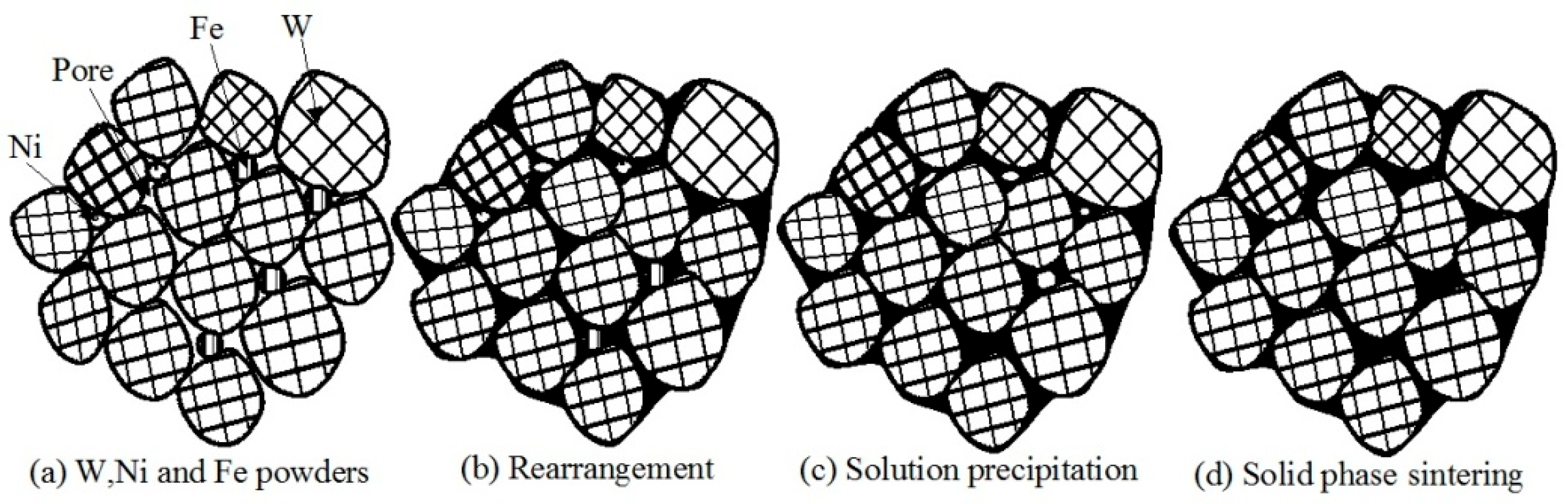
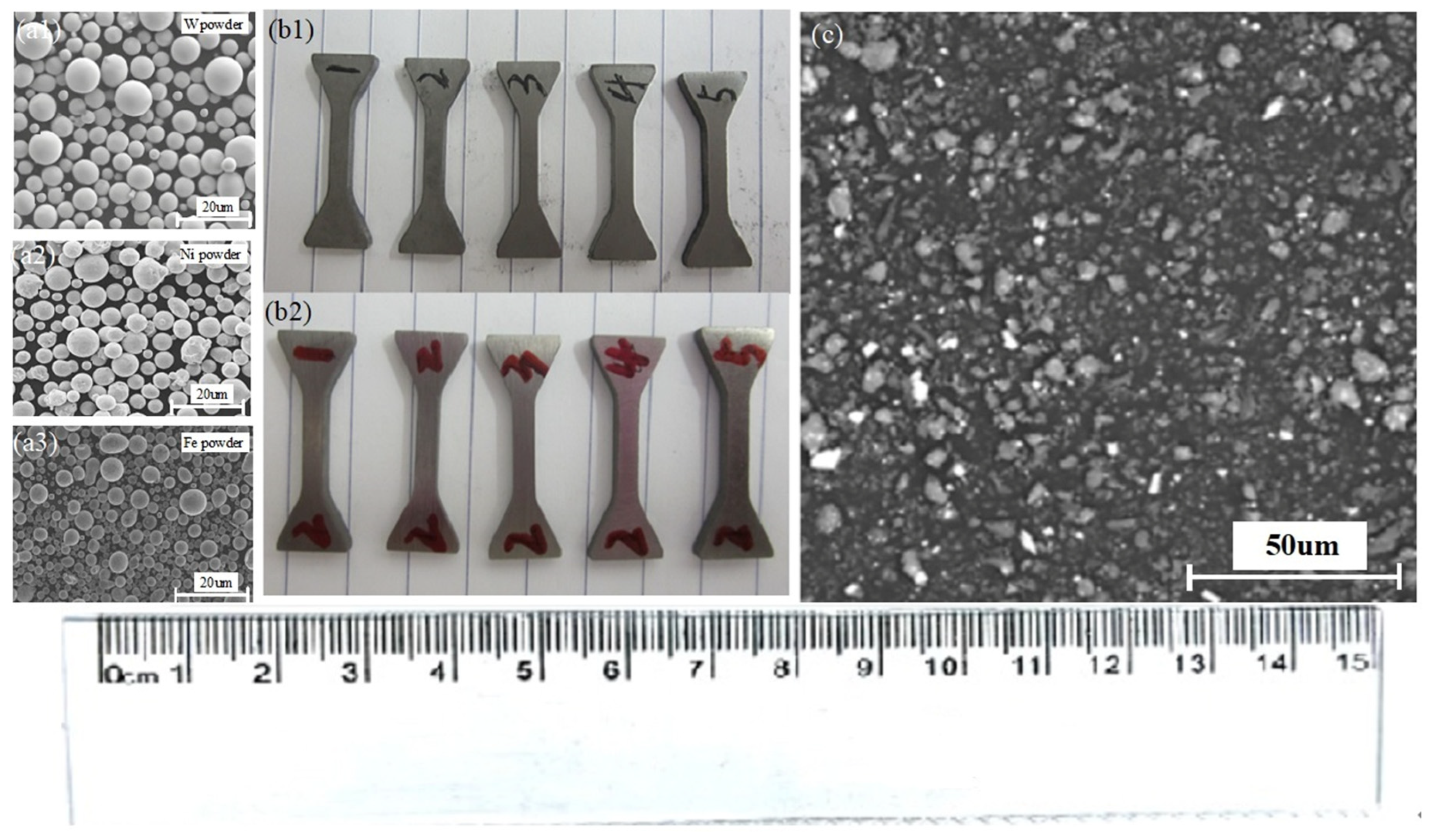
The preparation of W-Ni-Fe alloy samples involves three main steps: ball milling, press forming, and vacuum LPS. First, W, Ni, and Fe powders are weighed according to the target composition (90W-7Ni-3Fe) and mixed using a planetary ball mill under controlled parameters (milling time: 1 h, ball-to-powder ratio: 2:1, milling speed: 100 rpm). These mild milling conditions are intentionally selected to achieve homogeneous spatial distribution of the three elemental powders without inducing mechanical alloying or significant particle refinement. This process ensures that Ni and Fe particles are evenly dispersed around W particles (Figure 1), which is sufficient for subsequent LPS where complete homogenization occurs via dissolution and reprecipitation. The milling also moderately activates particle surfaces, thereby improving sintering behavior.
The mixed powder is then dried and compacted into cylindrical or rectangular green bodies using a hydraulic single-column press at 300 MPa for 5 min. High-pressure compaction increases particle packing density and minimizes initial porosity. Finally, the compacted samples undergo vacuum LPS in a ZG-0.01L medium-frequency induction furnace at a vacuum level of 5 Pa and a sintering temperature of 1753 K. The heating rates are controlled within 10–50 K/min, while the sintering times vary from 15 to 90 min.
In the iron (Fe)–nickel (Ni) alloy system, when the sintering temperature is below the eutectic temperature of approximately 1425 °C, the γ(Ni-Fe) liquid phase forms, promoting the rearrangement and densification of W particles. This dissolution–reprecipitation process, governed by the Gibbs free energy change, facilitates the formation of a high-density alloy with a refined microstructure. Thermodynamically, the formation of the γ(Ni-Fe) phase is favored by the reduction in system energy, driving the rearrangement of atoms and improving interfacial bonding between the W particles and the matrix. As the sintering progresses, the liquid phase aids in densification, reducing porosity and enhancing the mechanical properties of the alloy. The phase diagram of the Fe-Ni system provides insight into the equilibrium conditions for the γ(Ni-Fe) phase formation, supporting the alloy’s structural development. This systematic preparation method ensures uniform composition, reduced porosity, and enhanced mechanical properties in the final W-Ni-Fe alloy, as illustrated in Figure 1.

2.2. Experimental Design

The experimental design systematically evaluates the effects of various sintering times and heating rates on the microstructure and mechanical properties of the W-Ni-Fe alloy. Ten experimental groups were established, with sintering times ranging from 15 min to 90 min and heating rates ranging from 10 K/min to 50 K/min. Short sintering times, such as 15 min at a heating rate of 10 K/min, focus on studying the initial stages of microstructural evolution and phase formation. Moderate sintering times, such as 30 min at 20 K/min, aim to investigate the influence of sintering parameters on the densification process and microstructural evolution. Based on the systematic experimental investigation conducted in this study, the sintering condition of 45 min and 30 K/min was identified as the optimal parameter combination, achieving maximum densification, grain refinement, and a balanced improvement in mechanical properties. Longer sintering times, such as 60 and 90 min, are included to assess the long-term effects on microstructure and properties under extended heating conditions. Extended sintering times of 60 and 90 min at higher heating rates (40 K/min and 50 K/min, respectively) are included to investigate the effects of excessive sintering, such as pore formation, grain coarsening, and performance degradation. This systematic approach provides a comprehensive evaluation of the relationship between sintering parameters and the alloy’s densification, phase distribution, and mechanical properties. The specific liquid-phase sintering parameters for each sample group are listed in Table 2. Figure 2 shows the macroscopic appearance of the powder compacts after ball milling (green bodies) and the corresponding sintered samples after liquid-phase sintering under different conditions. As illustrated in Figure 2, the sintered samples exhibit progressive densification and surface shrinkage with increasing sintering time from 15 to 90 min, consistent with the density measurements presented in Section 3.1. The sample sintered at 45 min (optimal condition) displays the most uniform surface morphology and minimal dimensional distortion, correlating with its highest density and mechanical properties reported in Table 2.

2.3. Characterization Methods

The microstructural evolution of W-Ni-Fe alloys during LPS was characterized using advanced analytical techniques. Phase constitution, γ-(Ni,Fe) formation, and grain refinement were analyzed by X-ray diffraction (XRD; XD-3, Cu Kα radiation) over a 2θ range of 10–90°. Surface morphology, grain distribution, and phase boundaries were examined using scanning electron microscopy (SEM; JEOL-JSM-6490LA, Tokyo, Japan) equipped with energy-dispersive X-ray spectroscopy (EDS) for elemental analysis.
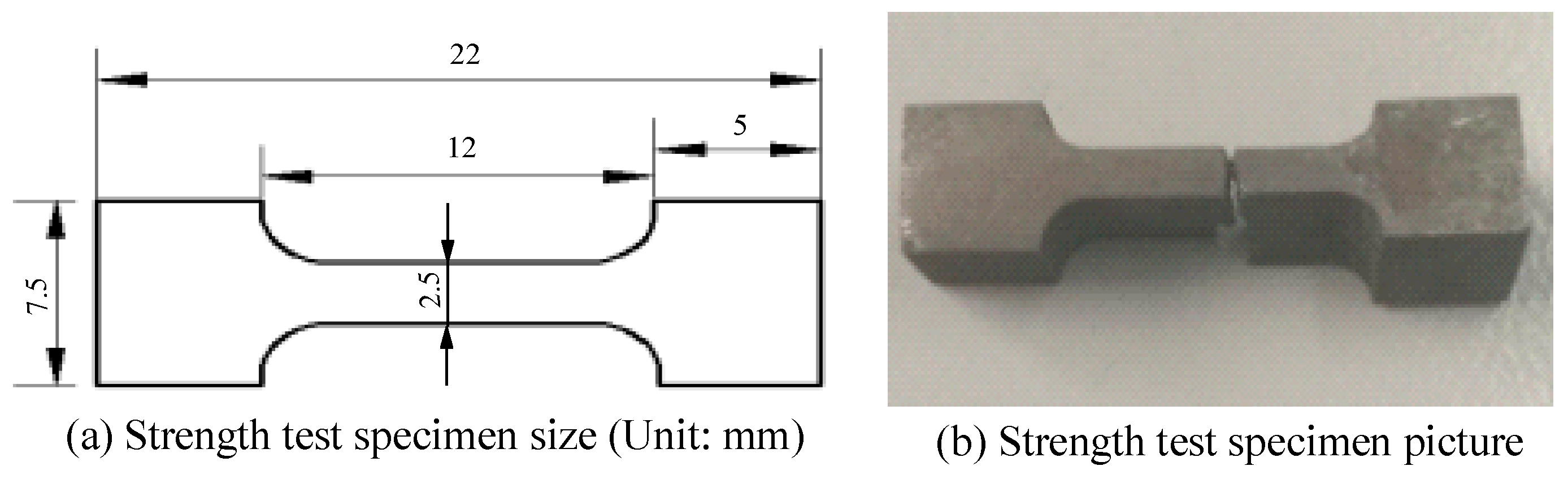
Mechanical properties were evaluated through microhardness and tensile testing. Microhardness measurements were performed using an HXD-1000B microhardness tester (Shanghai Jiapeng Technology Co., Ltd., Shanghai, China) with a diamond pyramid indenter under a 300 g load and a dwell time of 20 s. Tensile tests were conducted on a PWS-E100 electro-hydraulic servo universal testing machine (Shanghai Benang Scientific Instrument Co., Ltd., Shanghai, China) at a constant loading rate of 0.1 mm/min in accordance with ASTM E8/E8M-16a standard. Strain was precisely monitored using an extensometer to assess deformation behavior. Specimen dimensions and photographs are shown in Figure 3.
The density of sintered samples was measured using Archimedes’ principle. These characterization methods provide a comprehensive understanding of the relationships between sintering parameters, microstructure, and mechanical performance, offering valuable insights for optimizing the alloy’s properties.
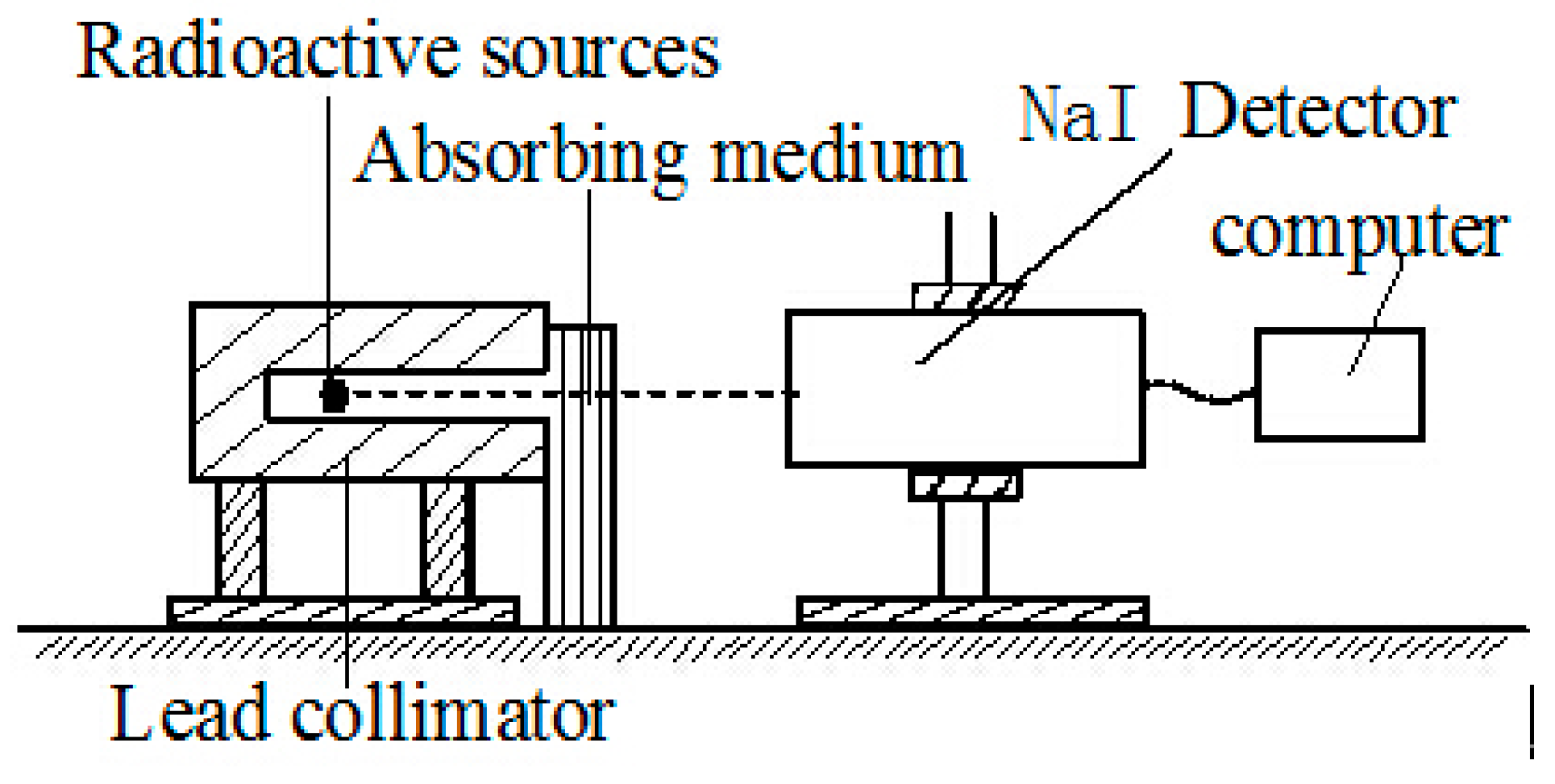
The gamma-ray shielding performance of the W-Ni-Fe alloy was evaluated to assess its radiation attenuation capability for nuclear engineering and radiation protection applications. Measurements were conducted using a BH1326 γ-ray shielding tester under the following conditions: 137Cs radioactive source (662 keV), 200 μm AL window NaI scintillation probe, source-to-probe distance of 72.5 mm, and high voltage of −676 V. The measurement principle is illustrated in Figure 4 [23,24]. Gamma rays, as photon streams, lose most or all of their energy upon interaction with materials. Materials with higher atomic numbers exhibit stronger γ-ray absorption, resulting in greater radiation intensity reduction. In this study, alloy samples of varying thicknesses were exposed to the γ-ray source, and the transmitted radiation intensity was measured using the scintillation detector. The narrow-beam γ-ray intensity decreased significantly after passing through the samples, confirming effective radiation absorption. Background counts (N1) and source counts (N2) are listed in Table 3.
The attenuation of γ-ray intensity follows an exponential law when passing through materials. The relationship for the linear attenuation coefficient is expressed as [24,25] N = N 0 e μ R ρ , where N0 and N represent the number of γ-rays before and after passing through the sample, respectively; R is the mass density of the sample in g/mm3; and μ is the linear absorption coefficient of γ-rays in mm−1. Taking the natural logarithm of both sides of this equation yields l n ( N 0 N ) = μ R ρ . This allows for the calculation of the linear absorption coefficient μ given the density of the material. The mass density R (in g/mm3) is related to the density ρ by R ρ = d . where d is the specific mass density. This relationship can be used to determine the material’s shielding effectiveness, including the half-thickness for absorption, which is a key parameter for evaluating the material’s ability to attenuate γ-ray intensity. In other words, the half-thickness for absorption is d 1 2 = l n 2 μ = 0.693 μ , which is an important parameter for evaluating the material’s shielding effectiveness.

3. Results and Discussion

3.1. SEM Morphology

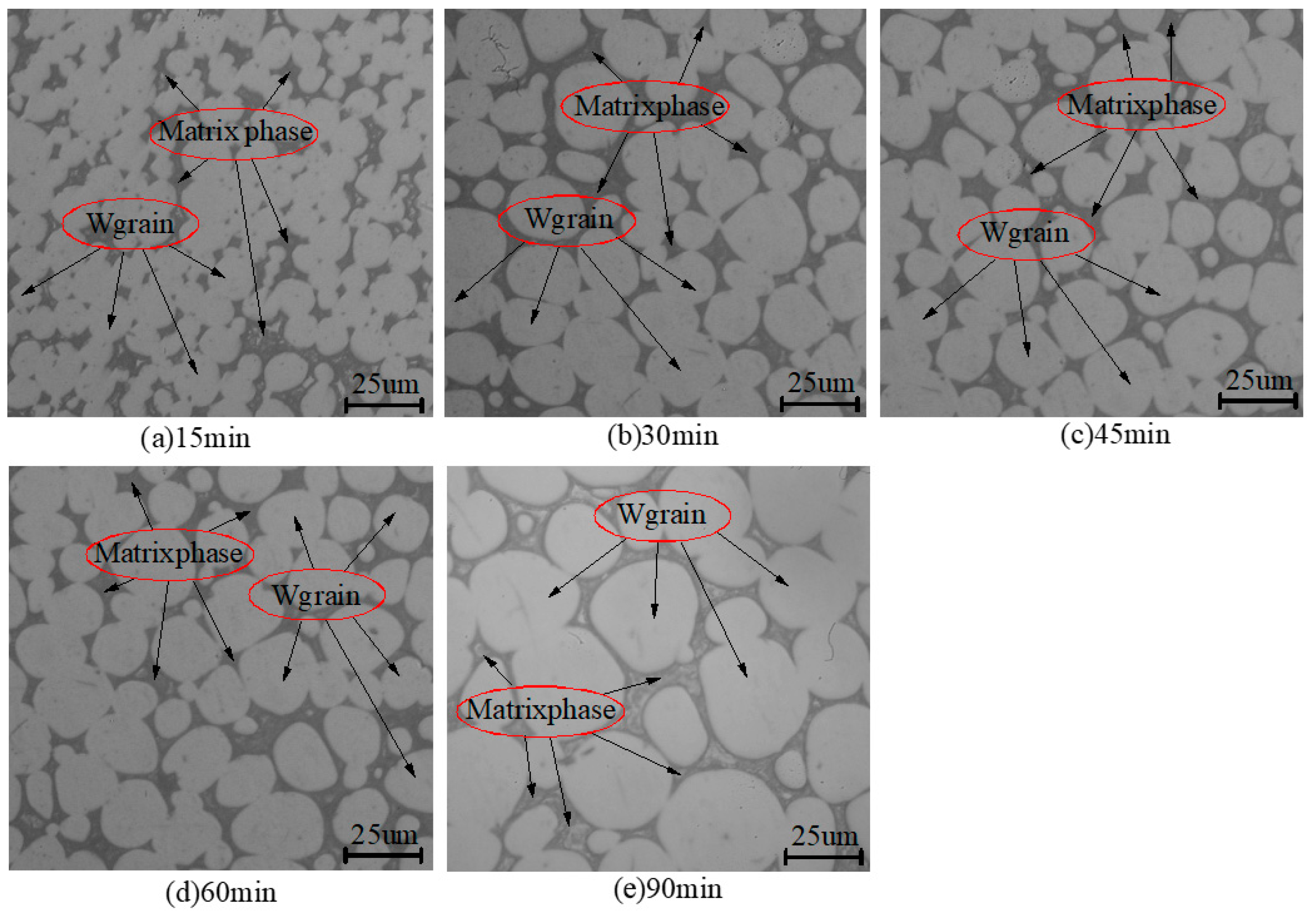
The microstructural development of the W-Ni-Fe alloy exhibits a strong dependence on sintering time, as quantified in Figure 5. During the initial stage Figure 5a, discontinuous W-W contacts and heterogeneous Ni-Fe binder distribution dominate, consistent with incomplete particle rearrangement in solid-state sintering. Therefore, it can be seen from the SEM morphology of 1# specimen that small, irregularly shaped particles with a disordered arrangement were observed. Tungsten (W) crystals formed extensive intergranular contact areas, while the nickel (Ni) binding phase was unevenly distributed. After 30 min of liquid-phase sintering, the W grains transition to ellipsoidal geometries with partial matrix wetting, while residual porosity reflects kinetic limitations in liquid redistribution. Figure 5b shows the surface morphology of the 2# sample with round W crystals embedded in the nickel-iron (Ni-Fe) substrate phase. Due to the short sintering duration, the substrate phase distribution was uneven, resulting in incomplete precipitation and scattered W crystals within the Ni liquid phase. Progressive sintering to 45 min enhances binder phase continuity, though W grain growth remains limited, suggesting solution-reprecipitation is rate-limited by interfacial diffusion. Figure 5c shows the W crystals exhibited clear boundaries and were well-covered by the substrate phase. However, minimal growth of the W crystals was observed. Extended sintering to 60 and 90 min leads to pronounced coarsening of W grains, which adopt a spherical morphology with smooth surfaces. This reflects the dominance of Ostwald ripening, where smaller grains dissolve into the liquid phase, and larger grains grow to minimize interfacial energy. Figure 5d and Figure 5e depict the surface morphologies of the 4# and 5# samples after 60 and 90 min of sintering, respectively. The W crystals grew larger, increasing the spacing on the alloy surface and taking on a spherical appearance. During liquid-phase sintering, the Ni-Fe substrate phase dissolved smaller crystals, particularly at sharp crystal angles.
These observations align with the three-stage liquid-phase sintering model: (i) particle rearrangement (0–30 min), (ii) solution-reprecipitation-controlled growth (30–60 min), and (iii) coalescence-dominated densification (>60 min). The temporal separation of these stages underscores the critical role of sintering duration in optimizing density (maximized at 90 min) versus grain size control (compromised beyond 60 min). It can be seen that its sintering process of W-Ni-Fe Alloy is similar to that in Figure 1.
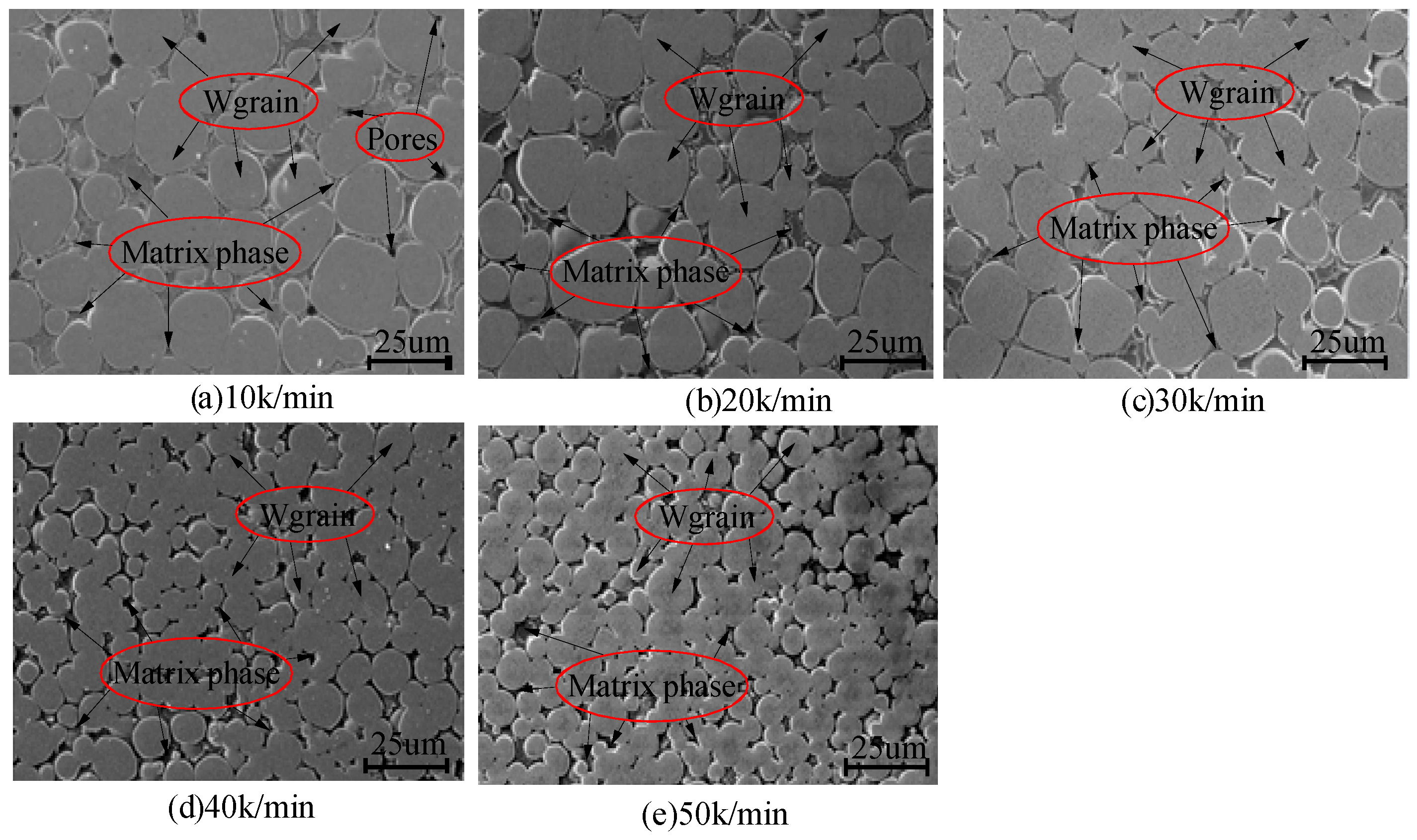
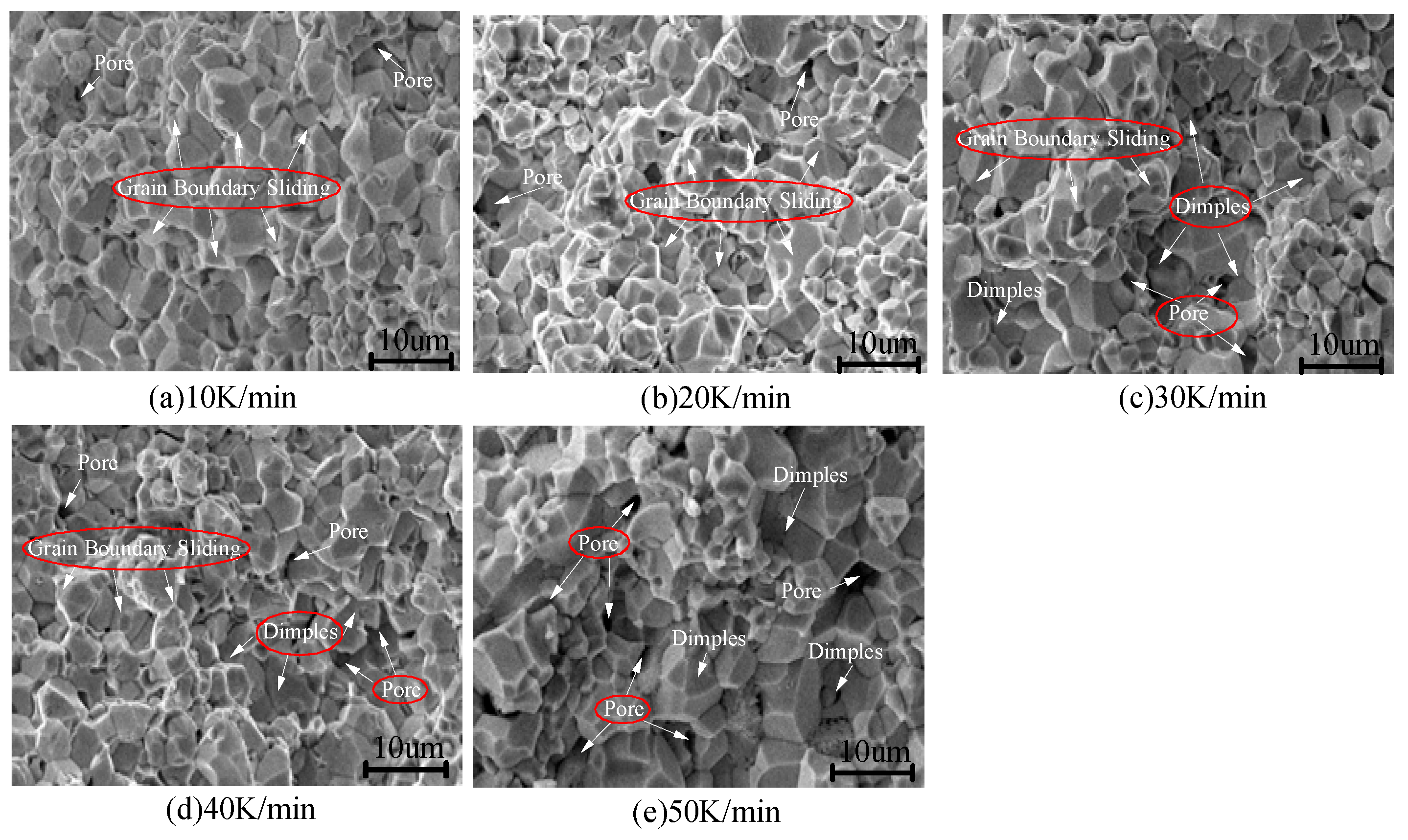
Figure 6 illustrates the surface morphology of the W-Ni-Fe alloy, which evolves significantly with varying heating rates. The heating rate during sintering plays a critical role in grain refinement and the formation of the γ(Ni, Fe) matrix phase. In the 6# sample, the average grain size is 23.6 μm, with relatively large spacing between the grains, leading to a less dense structure. A small amount of voids is observed at the interface between the W grains and the substrate phase, likely caused by phase boundary contamination and precipitation due to an excessively slow temperature rise and prolonged sintering times. As the heating rate increases, the surface particles in the 8# sample become more elliptical and smaller compared to those in the 6# sample. At a heating rate of 50 °C/min (10# sample), the surface particles are significantly refined, with an average size of approximately 9.6 μm (Figure 6e). This refinement in particle size is attributed to the continuous densification and coarsening of W crystals as the sintering temperature increases. When the sintering temperature is below the eutectic temperature of the substrate phase, W crystals appear irregular and grow rapidly due to the lack of sufficient thermal energy for proper phase formation and solid-phase diffusion, leading to non-uniform crystal growth. A faster heating rate accelerates the formation of the γ(Ni, Fe) phase, which helps to prevent the excessive growth of tungsten (W) crystals. In general, faster heating rates limit grain coarsening, leading to finer tungsten grains. Conversely, slower heating rates allow more time for diffusion, promoting a more uniform distribution of Ni and Fe within the γ(Ni, Fe) phase. By optimizing the heating rate and sintering duration, the microstructure can be fine-tuned to achieve improved grain refinement and better development of the matrix phase, ultimately enhancing the alloy’s mechanical properties and structural integrity.

3.2. X-Ray Diffraction (XRD) Analysis

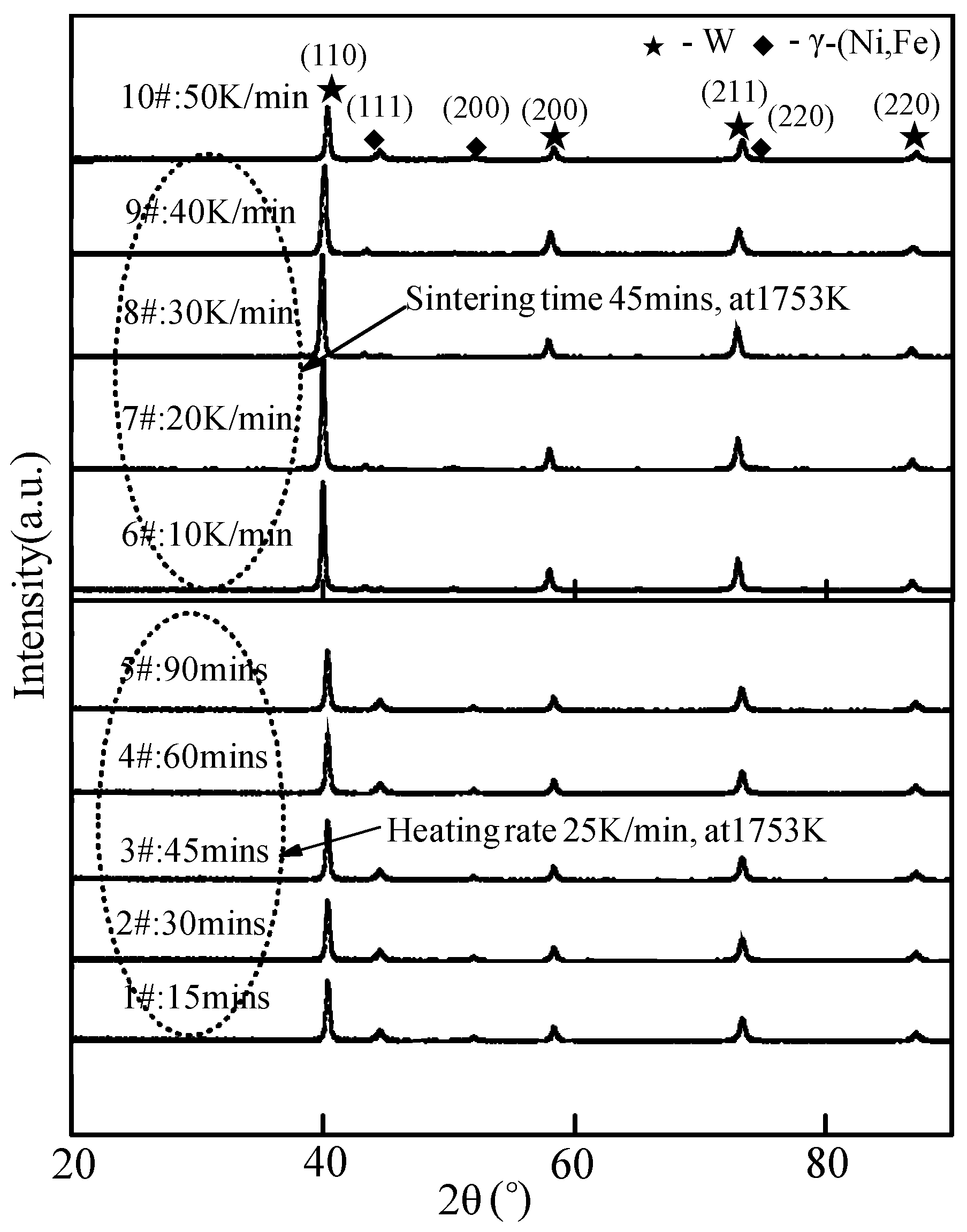
Figure 7 presents the XRD patterns of the W-Ni-Fe alloy under varying sintering times and heating rates. The analysis of these patterns reveals that the alloy consists of the body-centered cubic tungsten phase and the γ(Ni, Fe) matrix phase. As the sintering time increases, prolonged liquid-phase sintering promotes the dissolution of solid nickel (Ni) and iron (Fe) into the tungsten (W) matrix, leading to the formation of the γ(Ni, Fe) solid solution phase. Notably, when the sintering time reaches 90 min, the W grain size becomes the largest, and the diffraction peaks shift to the left, indicating changes in the microstructure.
It can also be observed from Figure 7 that as the heating rate increases, the diffraction peaks of W crystals on the alloy surface gradually broaden, while the diffraction peak of the γ(Ni, Fe) matrix phase shifts. This shift suggests refinement of the W crystals. At a liquid-phase sintering rate of 50 K/min, the average grain size of W is 9.6 µm, as shown in Figure 7. This refinement occurs because higher heating rates limit the dissolution of W into the substrate phase, inhibiting excessive W crystal growth. The main phases observed on the alloy surface include W phases with a body-centered cubic (bcc) structure and a γ-(Ni,Fe) solid-solution phase with a face-centered cubic (fcc) structure, where Fe acts as the solvent and Ni as the solute. XRD analysis further reveals the sensitivity of the alloy’s phase composition to variations in sintering parameters. With longer sintering times and slower heating rates, the γ(Ni, Fe) matrix phase becomes more prominent due to increased dissolution of Ni and Fe into the tungsten structure. This is accompanied by a slight decrease in the intensity of the tungsten (W) diffraction peaks, suggesting better integration of the matrix phase.

3.3. Composition of W-Ni-Fe Alloy Analysis

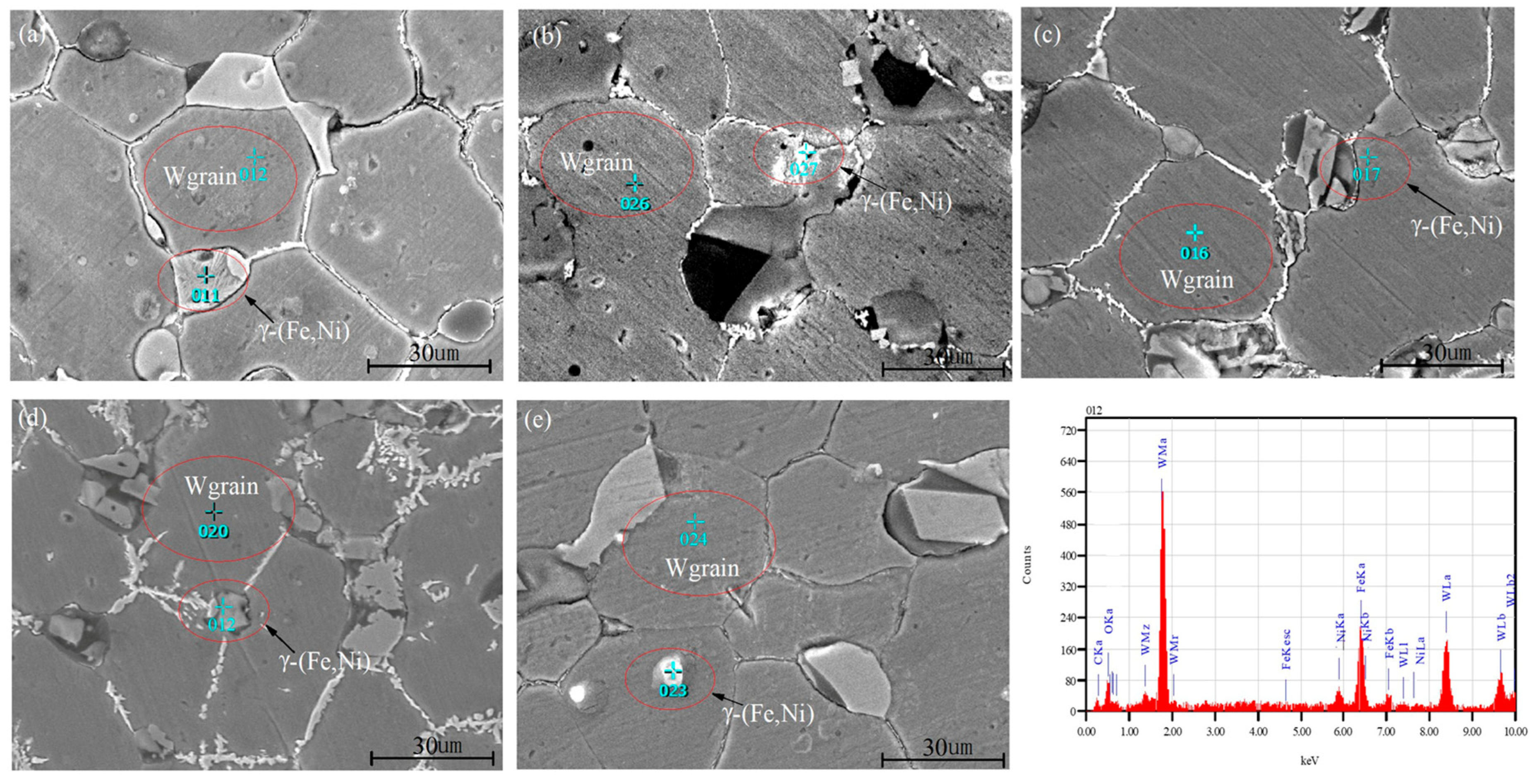
Figure 8 is a photomicrograph of the metallographic structure of W-Ni-Fe alloy with different sintering times. It can be seen from Figure 8 that the microstructure of W-Ni-Fe alloys shows typical “two-phase” granular. The alloy with a sintering time of 15 min has less structure, with the increase in sintering time, the gray banded structure between the grain boundaries and the grain boundaries becomes wider and irregular massive morphology appears. Based on the XRD pattern shown in Figure 7, the phase structure was identified as γ(Ni, Fe). As the sintering time increased, the massive structure decomposed into smaller, irregularly shaped regions distributed at the intersections of polycrystalline boundaries. The bonding phase, characterized by a white band structure, exhibited a significant number of dendritic crystals embedded within the grain interiors, thereby enhancing the bonding strength between particles. This phase was identified as γ(Ni, Fe). The observed changes can be attributed to the aggregation of particles, which increased the number of nuclei per unit area. Consequently, more Fe-W-Ni alloy phases were formed. However, excessive W content caused W particles to accumulate at the grain boundaries, promoting the growth of W grains. Simultaneously, the strain energy influence inhibited the growth of neighboring grains, resulting in a higher shape factor and the formation of irregular grain structures.
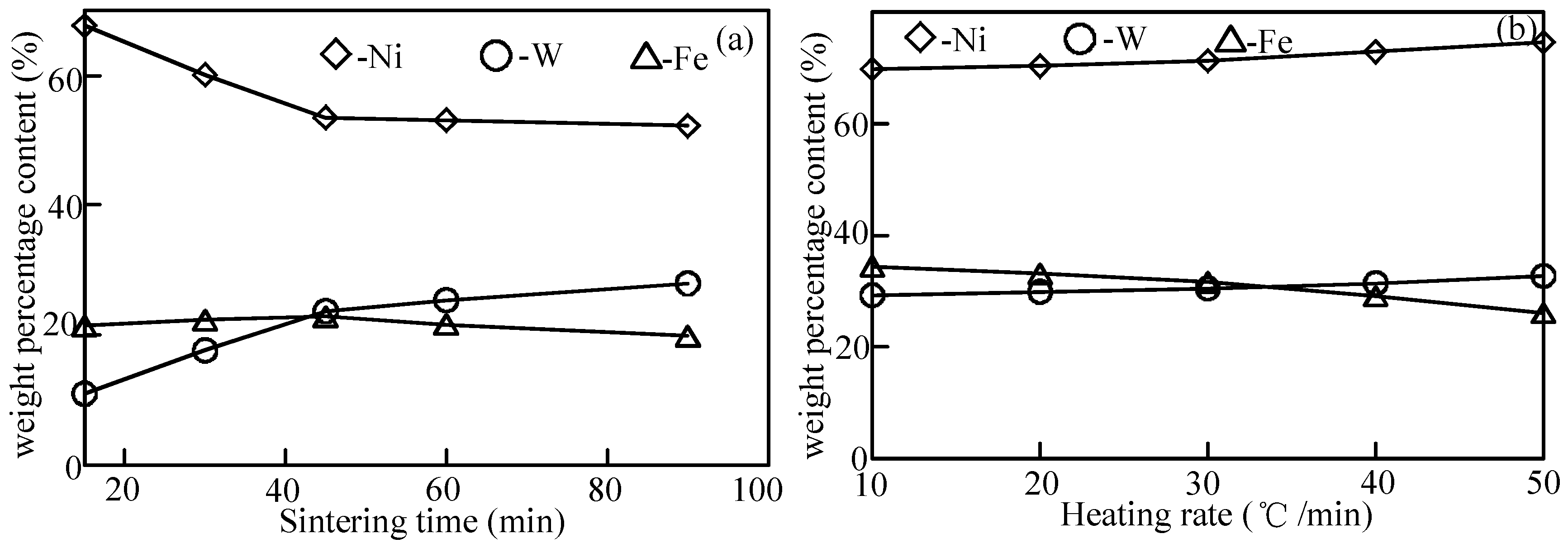
Figure 9 shows the variation in the W, Ni, and Fe contents in the γ(Ni, Fe) phase of the W-Ni-Fe alloy, based on EDS analysis. As the sintering time increases, the W content in the substrate phase continuously rises, while the Ni and Fe contents decrease. This behavior can be attributed to the ongoing diffusion and redistribution of elements during sintering. Higher temperatures facilitate the migration of W atoms into the substrate phase, driven by temperature gradients and phase boundary dynamics. Specifically, the W content increases from 10.94% at 15 min to 27.92% at 90 min, while Ni and Fe contents decrease from 67.68% and 21.38% to 52.23% and 19.85%, respectively. This phenomenon is a result of solid-state diffusion and phase equilibrium changes during sintering. Additionally, phase composition analysis reveals that the Ni-Fe liquid phase and W phase exhibit excellent wettability at high temperatures. The solubility of W in the Ni-Fe liquid phase reaches approximately 40%, while the solubility of Ni and Fe in the W liquid phase is less than 2%. This difference in solubility contributes to the redistribution of elements, further explaining the observed changes in W, Ni, and Fe contents. As the sintering time reaches 90 min, the average W grain size also reaches its maximum, as shown in Figure 5.
Figure 9b further illustrates that the W content in the substrate phase decreases gradually as the heating rate increases. When the heating rate increases from 10 K/min to 50 K/min, the Fe content decreases from 25.79% to 19.52%, while the Ni and W contents increase from 62.32% and 31.89% to 65.97% and 34.51%, respectively. This trend is also due to the increased diffusion of W and Ni at higher heating rates, which accelerates the redistribution of elements in the substrate phase. This trend can be attributed to the fact that a higher heating rate inhibits W crystal growth and suppresses the dissolution and precipitation of the W phase. Notably, between 30 K/min and 50 K/min, the crystals become significantly refined, resulting in a sharper decrease in the Fe content within the substrate phase, as shown in Figure 6.

3.4. Mechanical Properties

The optimization of sintering parameters plays a crucial role in determining the mechanical properties of alloys. In particular, both sintering time and heating rate significantly influence these properties through mechanisms that govern densification, grain growth, phase transformation, and interfacial bonding. The mechanical properties of the W-Ni-Fe alloy, including density, tensile strength, elongation, and microhardness, are significantly influenced by both sintering time and heating rate, with complex interactions between these two parameters.
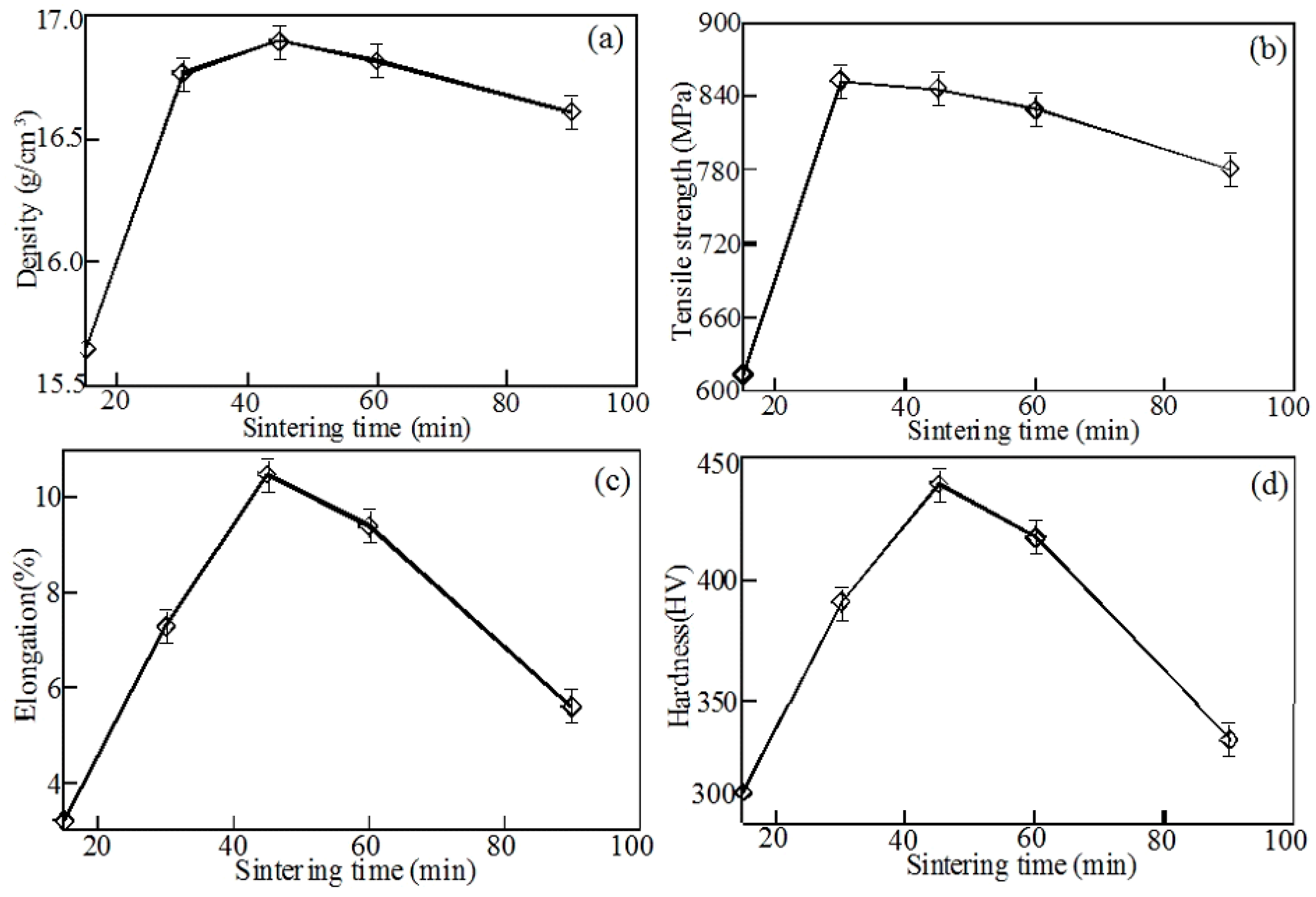
Figure 10 presents the variation in density, tensile strength, elongation, and microhardness of the W-Ni-Fe alloy with different liquid-phase sintering durations. The results indicate an initial increase in these properties with sintering time, followed by a decline at longer durations. Density increases with sintering time, reaching a peak of 16.99 ± 0.6 g/cm3 at 45 min, before slightly decreasing at longer times due to grain coarsening and pore entrapment, as shown in Figure 10a. The reduction in density and hardness at extended sintering times can be attributed to the onset of grain coarsening, which leads to a decrease in the number of grain boundaries that act as barriers to dislocation movement, thus weakening the alloy. This is consistent with the findings in previous studies that have shown that prolonged sintering can promote Ostwald ripening, where larger grains grow at the expense of smaller grains, reducing the overall material strength [26]. Microhardness also peaks at 435 ± 6 HV at 45 min, corresponding to optimal densification, grain bonding, and phase uniformity, as the powder particles have sufficient time to bond and form a more homogeneous microstructure. Tensile strength and elongation are maximized at approximately 45 min, with tensile strength reaching 840 ± 12 MPa and elongation peaking at 10.2 ± 0.8%, attributed to enhanced interfacial bonding and uniform γ(Ni-Fe) matrix phase distribution. The uniformity of phase distribution is a critical factor in improving mechanical properties, as the homogeneous phase ensures better load transfer between the W phase and the γ(Ni-Fe) matrix. Extended sintering times, however, lead to grain coarsening, weakening the grain boundaries and reducing ductility. This phenomenon can be explained by the increased inter-grain distance, which reduces the overall interfacial strength, leading to a decrease in ductility [27].
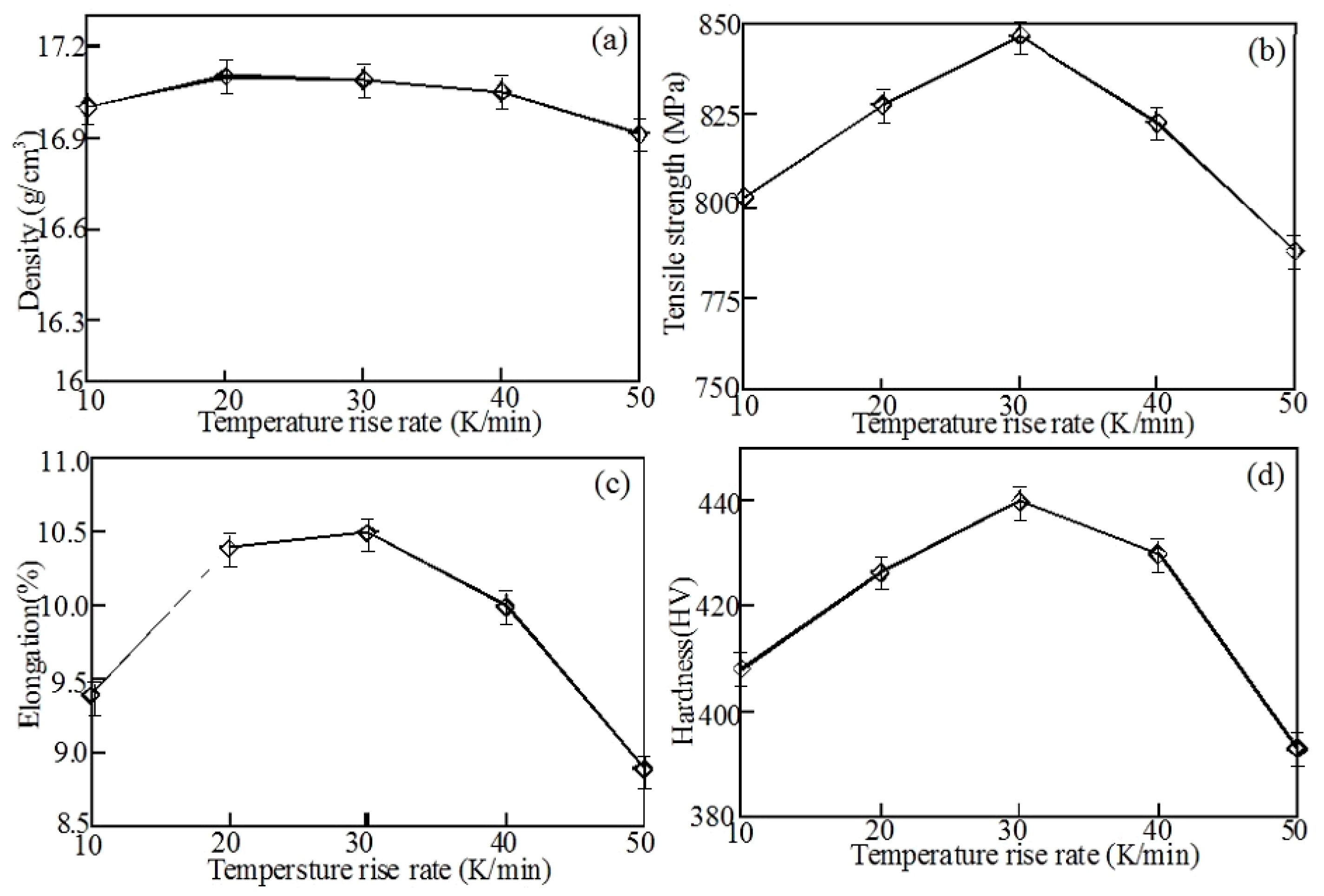
Figure 11 shows the variations in density, tensile strength, elongation, and microhardness of the W-Ni-Fe alloy as a function of different heating rates during sintering. The data indicate that, as the heating rate increases, the mechanical properties initially improve but later decrease. The alloy achieves optimal density and overall mechanical properties at heating rates between 20 and 40 K/min. The highest density of 17.0 ± 0.5 g/cm3 is attained at a heating rate of 20 K/min, while the peak tensile strength of 846.66 ± 14 MPa, elongation of 10.5 ± 0.7%, and microhardness of 439.91 ± 8 HV occur at a heating rate of 30 K/min. The effect of heating rate on the mechanical properties can be attributed to its influence on the rate of liquid-phase formation and densification. A moderate heating rate allows for a more controlled liquid-phase formation, preventing excessive porosity and promoting better particle packing [28]. However, at a heating rate of 50 K/min, a significant deterioration in mechanical properties is observed. This decline is attributed to increased porosity and a more porous microstructure due to the excessively rapid heating rate, which does not allow adequate time for effective densification of the powder particles. As a result, the alloy experiences incomplete densification, leading to reduced structural integrity and mechanical strength.
Based on the findings, a sintering time of 45 min coupled with a heating rate of 30 K/min is identified as the optimal condition for achieving the best balance of density, strength, and ductility in the W-Ni-Fe alloy. This combination of sintering time and heating rate allows for sufficient time to ensure effective densification of the powder particles, leading to a high density of 16.99 g/cm3. The moderate heating rate of 30 K/min promotes uniform temperature distribution, which facilitates the formation of a homogeneous γ(Ni, Fe) matrix and the optimization of phase formation. Additionally, the 45 min sintering time ensures adequate time for the elements to diffuse and redistribute, improving the bonding between the W, Ni, and Fe phases. As a result, this condition achieves a peak tensile strength of 846.66 MPa, an elongation of 10.5%, and a microhardness of 439.91 HV, demonstrating a well-rounded combination of strength and ductility. These results highlight the importance of controlling both sintering time and heating rate to optimize the mechanical properties of the alloy.

3.5. Tensile Fracture Appearance

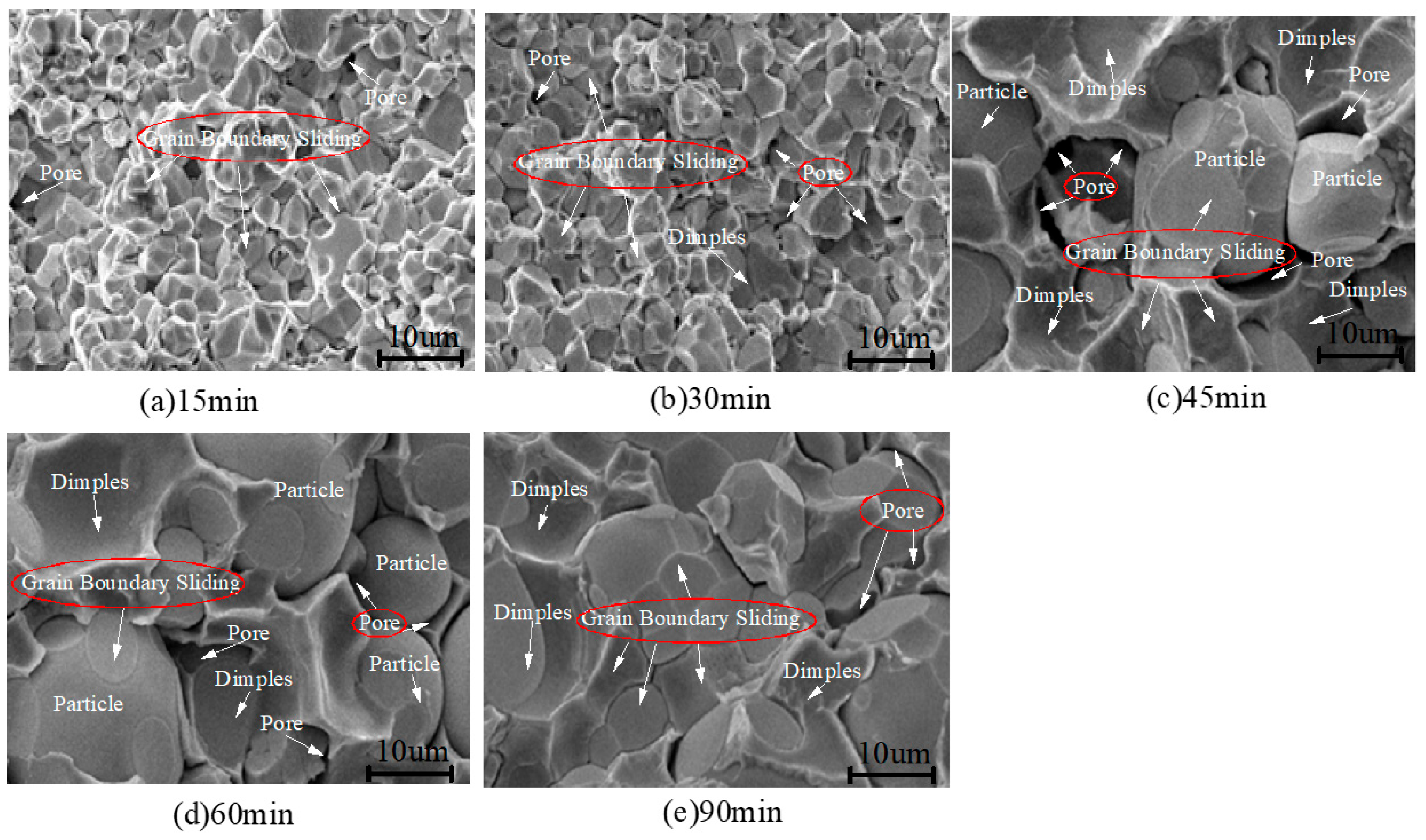
The tensile test of the W-Ni-Fe alloy was performed using a PWS-E100 electro-hydraulic servo dynamic/static universal testing machine. After the test, the fracture surfaces of the alloy under different liquid-phase sintering times and heating rates were analyzed using a JEOL-JSM-6490LA scanning electron microscope, as shown in Figure 12 and Figure 13. The fracture surfaces of the alloy exhibit distinct differences depending on the sintering time and heating rate.
In the 1# sample (15 min of sintering), the W crystals are multi-angular and irregularly distributed, while the substrate phase exhibits uneven dispersion throughout the matrix. This results in intergranular fractures, suggesting weak bonding between the W crystals and the substrate phase. The poor bonding at this stage can be attributed to insufficient time for the formation of an optimal Ni-Fe liquid phase that could reinforce the intergranular bonding. This suggests that a short sintering time does not allow for the complete diffusion of Ni and Fe components, hindering the formation of a strong bond between the phases [29]. In contrast, for the 2# sample (30 min of sintering), Figure 12b shows a ductile fracture, characterized by plastic deformation and the pull-out of W crystals, rather than cleavage fracture. The fracture surface exhibits evidence of localized deformation, which is typical of ductile fracture behavior. During this stage, the Ni and Fe components in the alloy are more evenly heated, leading to the formation of Ni-Fe liquid phases in the spaces between the W crystals. These liquid phases generate capillary forces, which promote a more compact arrangement of W crystals, thereby improving the overall strength of the alloy by enhancing the bonding between particles and reducing porosity. The increased cohesion between the phases results in a more uniform microstructure, leading to improved ductility and strength. This process can be attributed to the enhanced liquid-phase sintering process that facilitates the densification and grain bonding [30].
At 45 min of sintering, as seen in Figure 12c, the alloy exhibits cleavage fracture of the W crystals, with the substrate phase torn into flocculent structures. This structure corresponds to optimized mechanical properties, where tighter packing of the W crystals and better distribution of the substrate phase contribute to both enhanced strength and ductility. The uniform distribution of the Ni-Fe liquid phase at this sintering time plays a significant role in reinforcing intergranular bonding and improving the overall mechanical properties of the alloy. The homogeneous phase distribution also minimizes the formation of weak interfacial boundaries, which would otherwise facilitate crack propagation.
However, when the sintering time exceeds 60 min (Figure 12d,e), the fracture surfaces display more pronounced intergranular fractures. In these samples, larger W crystals form, and the boundaries between the W crystals and the Ni-Fe liquid phases become increasingly ambiguous. This structural shift results in a deterioration of mechanical properties, with a noticeable decrease in tensile strength. The weaker interfacial bonding between the phases, caused by the loss of phase continuity and the formation of larger, poorly integrated W crystals, leads to a reduction in overall alloy performance. Additionally, prolonged sintering times promote the growth of W crystals, which diminishes the alloy’s ability to maintain uniform strength across the microstructure. Larger W crystals create areas of weak bonding, which promote crack initiation and propagation. These findings highlight the critical importance of controlling sintering time and heating rate to ensure the optimal balance between grain refinement and phase distribution, which is essential for maintaining strong mechanical properties.
Figure 13 presents the tensile fracture surfaces of the W-Ni-Fe alloy subjected to varying heating rates during sintering. As the heating rate increases, the energy input during sintering elevates, inhibiting W crystal growth and resulting in a microstructure characterized by finer grains. This grain refinement leads to fracture surfaces dominated by transgranular fractures of W crystals, contributing to enhanced tensile strength in the alloy. The finer grain structure promotes stronger intergranular bonds, thus improving tensile strength. This phenomenon is consistent with the theory that finer grains increase the number of grain boundaries, which act as barriers to dislocation movement, thereby strengthening the material [31]. At slower heating rates, the extended sintering duration promotes the precipitation of impurities, which can obscure phase boundaries and weaken interfacial bonding. In the 6# sample, which underwent a slower temperature rise, the fracture surface exhibits fewer transgranular fractures, with more intergranular fractures, as shown in Figure 13a. This suggests that prolonged sintering, particularly at slower heating rates, allows impurities to accumulate at the grain boundaries, leading to the formation of weak points that negatively affect the mechanical properties of the alloy. The accumulation of impurities at the grain boundaries can lead to phase segregation, weakening the intergranular bonding and reducing the alloy’s strength.
Conversely, higher heating rates accelerate the nucleation process, resulting in more distinct and well-defined crystal boundaries. However, in the 10# sample subjected to a rapid heating rate of 50 K/min, the fracture surface reveals numerous pores and uneven crystal structures, as shown in Figure 13e. These features, including porosity and structural inhomogeneity, indicate that excessive heating rates lead to inadequate densification during sintering. Poor densification is a key factor that compromises mechanical properties, as it creates voids and reduces the continuity of the material’s structure, weakening its overall strength and ductility. The high heating rate reduces the time available for the powder particles to bond effectively, which limits densification and increases porosity [32].
The observed fracture morphologies highlight the importance of optimizing the heating rate during sintering. A balanced heating rate is crucial to provide sufficient energy for proper densification and grain refinement while avoiding the precipitation of impurities and excessive porosity, which can deteriorate the alloy’s mechanical performance.

3.6. Shielding Properties

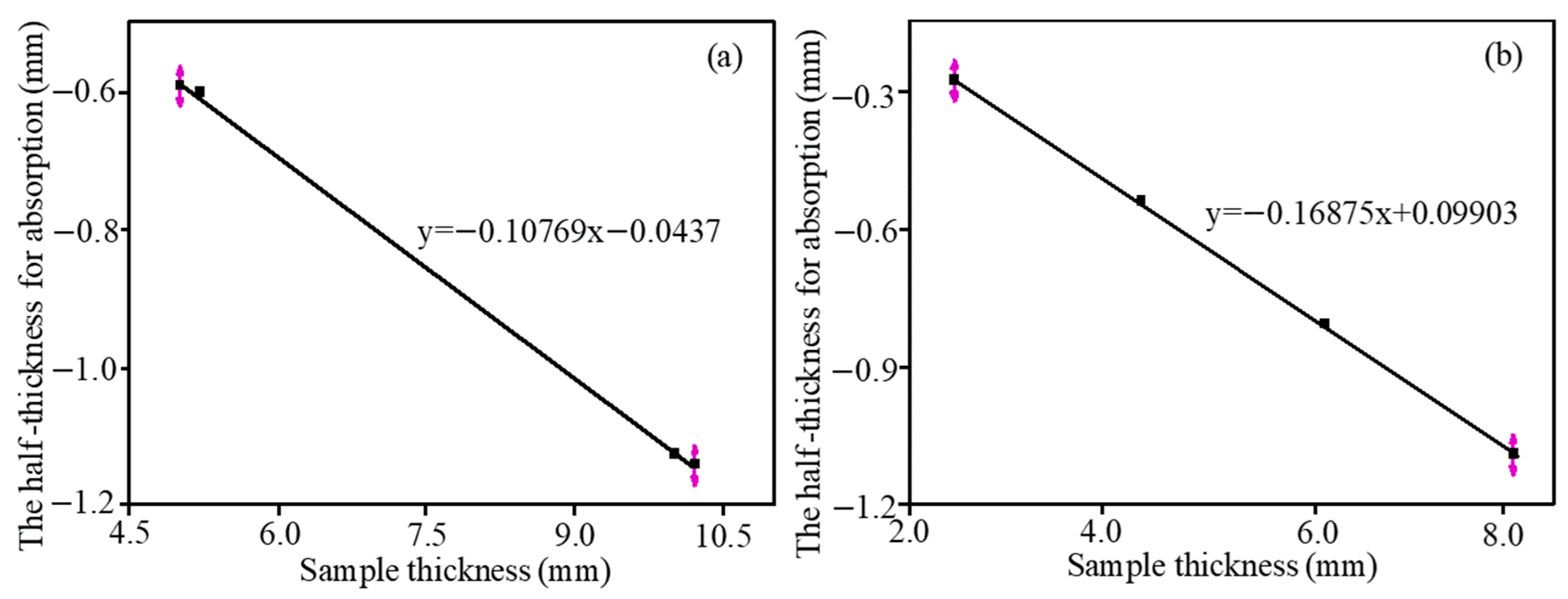
Figure 14 illustrates the transmission intensity of the W-Ni-Fe alloy, with standard lead used as the calibration sample. Table 4 presents the experimental results for the absorption coefficient of the alloy, calculated using equation: N = N 0 e μ R ρ . As shown in Figure 14, the linear attenuation coefficients of the W-Ni-Fe alloy are notably lower than those of lead. The half-thickness for γ-ray absorption of the alloy is calculated using equation d1/2 = 0.693/μ. The half-thickness for γ-ray absorption of the W-Ni-Fe alloy is 4.11 cm, which is superior to lead’s 6.44 cm. This result indicates that the W-Ni-Fe alloy exhibits enhanced γ-ray shielding properties, which can be attributed to its high tungsten content. Tungsten’s high density (19.3 g/cm3) and atomic number (Z = 74) are key factors contributing to its superior γ-ray attenuation capabilities. The high atomic number allows for a greater probability of photon interaction, particularly through the photoelectric effect and Compton scattering, which are effective mechanisms for attenuating γ-rays. Furthermore, tungsten’s high density increases the likelihood of interactions between γ-rays and the material, significantly enhancing its shielding performance. The alloy’s overall shielding efficiency is strongly correlated with its density because a higher density increases the material’s ability to attenuate radiation. This is due to the fact that higher-density materials contain more atoms per unit volume, which enhances the probability of radiation interactions, such as scattering and absorption. As a result, the alloy’s increased density significantly boosts its effectiveness as a radiation shielding material, making it more efficient in reducing the penetration of harmful radiation. Given these properties, the W-Ni-Fe alloy demonstrates exceptional γ-ray attenuation, making it an ideal candidate for applications that require effective radiation protection, such as in nuclear engineering and medical radiation shielding.
For further validation, this result was compared with W-Ni-Fe alloys reported in the literature. As summarized in Table 5, the HVL of 4.11 cm obtained in this work is comparable to or better than previously reported values for similar alloy systems, such as 90.5W-6.4Ni-3.1Fe alloys (4.2–4.4 cm) and 93W-4.9Ni-2.1Fe alloys (4.3–4.6 cm). The improved shielding performance of our alloy is attributed to its high relative density (98.2%) and homogeneous microstructure achieved through optimized liquid-phase sintering parameters.
Therefore, under optimized sintering conditions, such as 45 min at a heating rate of 30 K/min, the density of the W-Ni-Fe alloy reaches 16.99 g/cm3, which contributes to enhanced shielding performance by increasing the material’s atomic packing. A higher density means more atoms are present per unit volume, which improves the alloy’s ability to attenuate radiation through increased interaction probabilities, such as scattering and absorption. This higher atomic density leads to better radiation shielding efficiency, particularly for high-energy radiation. The improved density is linked to better densification during sintering, which may enhance the overall structural integrity of the alloy. While the dispersion of tungsten particles within the γ(Ni-Fe) matrix plays a role in maintaining the alloy’s structural stability, its direct influence on γ-ray attenuation requires further investigation.

4. Conclusions

A high-density W-Ni-Fe alloy was successfully fabricated via liquid-phase sintering (LPS) using elemental W, Ni, and Fe powders. The key findings and novel contributions of this study are summarized as follows:
(1)
Sintering at 30 K/min for 45 min was identified as the optimal condition, yielding maximum density (16.99 g/cm3), tensile strength (846.7 MPa), and elongation (10.5%). While previous studies [21,22] suggested these parameters improve individual properties, this work systematically confirms their combined effectiveness for the 90W-7Ni-3Fe system.
(2)
The alloy exhibits superior γ-ray shielding with a half-value layer of 4.11 cm for 137Cs, outperforming lead (6.44 cm) and comparable or better than previously reported W-Ni-Fe alloys (4.2–4.6 cm) [18,19]. This improvement results from high relative density and homogeneous W grain distribution achieved through optimized sintering.
(3)
Quantitative correlations between sintering parameters and microstructure reveal the following: optimal sintering (45 min, 30 K/min) balances grain refinement and densification; insufficient sintering (<30 min) leaves residual porosity; excessive sintering (>60 min) causes grain coarsening (>5.8 μm) and mechanical degradation.
These findings provide practical guidelines for fabricating high-performance W-Ni-Fe alloys for nuclear shielding applications.

Author Contributions

Conceptualization, C.L. and W.M.; methodology, C.L. and J.W.; software, C.L. and C.F.; validation, D.T., C.L. and J.W.; formal analysis, D.T.; investigation, D.T. and C.L.; resources, C.L.; data curation, C.F.; writing—original draft preparation, C.L. and W.M.; writing—review and editing, W.M. and C.L.; visualization, C.F.; supervision, C.L.; project administration, D.T.; funding acquisition, D.T. All authors have read and agreed to the published version of the manuscript.

Funding

The authors gratefully acknowledge the funding support from the National Key Research and Development Project of China (Project No. 2023YFC3010904), the Hunan Provincial and Municipal Joint Fund (Project No. 2023JJ50130), the Key Projects of Teaching Reform Research in Ordinary Colleges and Universities in Hunan Province (Project No. HNJG-2021-0086), the Hunan Provincial Postgraduate Education Teaching Reform Research Project (Project No. JG2018B088), and the Hunan Provincial Energy and Power Engineering Innovation Entrepreneurship Education Center Project (Project No. Xiangjiaotong [2022] No. 354).

Data Availability Statement

The original contributions presented in this study are included in the article. Further inquiries can be directed to the corresponding author.

Conflicts of Interest

Authors Liu Chen, Jiaying Wu, and Chunming Fu were employed by the company Xi’an Nuclear Equipment Co., Ltd. The remaining authors declare that the research was conducted in the absence of any commercial or financial relationships that could be construed as a potential conflict of interest.

References

  1. Liu, T.; Fang, J. Development on strain strengthening and dynamic mechanics of tungsten heavy alloy (WHA). China Tungsten Ind. 2005, 20, 18–23. [Google Scholar]
  2. Li, C.; Zhang, W.; Zhou, Y.Z.; Yang, X.S.; Li, J.F.; Liu, X.; Le, G.M. Research progress of additive manufacturing of W-Ni-Fe heavy alloys. Rare Met. Mater. Eng. 2021, 50, 3011–3019. [Google Scholar]
  3. Zhou, C.; Yi, J.; Luo, S.; Peng, Y.; Wang, H. Distortion and microstructure of microwave sintered W-Ni-Fe heavy alloys. Mater. Sci. Eng. Powder Metall. 2010, 15, 300–304. [Google Scholar]
  4. Zeng, Y.; Fan, J.; Gong, X.; Ding, F. Densification and microstructure evolution of nanocrystalline W-Ni-Fe composite powders during sintering. J. Cent. South Univ. (Sci. Technol.) 2011, 42, 1906–1911. [Google Scholar]
  5. Wang, E.; Yu, Y.; Hu, L.; Sun, H. Research progress in W-Ni-Fe tungsten heavy alloys by deformation strengthening processing. Powder Metall. Technol. 2004, 22, 303–307. [Google Scholar]
  6. Sharma, P.; Tucker, W.C.; Balasubramanian, G. Optimal interplay of charge localization, lattice dynamics and slip systems drives structural softening in dilute W alloys with Re additives. Int. J. Refract. Met. Hard Mater. 2025, 128, 107086. [Google Scholar] [CrossRef]
  7. Zhang, Z.; Zhou, J.; Xi, S.; Li, P.; Zhang, W.; Rang, G. Studies on thermodynamic and kinetic phase evolution of W-Ni-Fe powder during mechanical alloying. Rare Met. Mater. Eng. 2004, 33, 1045–1048. [Google Scholar]
  8. Chen, B.; Li, Z.B.; Liu, J.R.; Zhang, G.H. Effect of molybdenum addition on microstructure and mechanical properties of 90% tungsten heavy alloys. Int. J. Refract. Met. Hard Mater. 2022, 106, 105868. [Google Scholar] [CrossRef]
  9. Chen, P.; Guo, L.; Wang, C.T.; Jin, S.Y.; Gao, H.Y.; Wang, G.; Ma, Y.; He, Y.; He, Y. Preparation and penetration behavior of the reactive fine-grained tungsten heavy alloy. Int. J. Refract. Met. Hard Mater. 2023, 115, 106306. [Google Scholar] [CrossRef]
  10. Xiang, D.; Ding, L. Research progress of alloying elements or oxides strengthened W-Ni-Fe heavy alloys. Chin. J. Nonferrous Met. 2013, 23, 1549–1559. [Google Scholar]
  11. Liu, W.; Ma, Y.; Zhang, J. Properties and microstructural evolution of W-Ni-Fe alloy via microwave sintering. Int. J. Refract. Met. Hard Mater. 2012, 35, 138–142. [Google Scholar] [CrossRef]
  12. Wang, G.; Guo, R.; Feng, B.; Zhao, H.; Liu, J. W-Ni-Fe Fracture Behavior and Surface Topograph Analysis. Chin. J. Rare Met. 2005, 29, 115–118. [Google Scholar]
  13. Feng, F. Study of Mechanical Properties and Microstructure of High-density W-Ni-Fe Alloy. Rare Met. Cem. Carbides 2006, 34, 25–27. [Google Scholar]
  14. Dinçer, O.; Pehlivanoglu, M.K.; Çaliskan, N.K.; Karakaya, I.; Kalkanli, A. Processing and microstructural characterization of liquid phase sintered tungsten-nickel-cobalt heavy alloys. Int. J. Refract. Met. Hard Mater. 2015, 50, 106–112. [Google Scholar] [CrossRef]
  15. Ma, Y.; Zhang, J.; Liu, W.; Zhao, Y. Transient Liquid-Phase Sintering Characteristic of W-Ni-Fe Alloy via Microwave-Assisted Heating. Rare Met. Mater. Eng. 2014, 43, 2108–2111. [Google Scholar]
  16. Singh, I.; Dabhade, V.V. Tungsten heavy alloys for kinetic energy penetrators: A review. Mater. Sci. Technol. 2024, 41, 235–256. [Google Scholar] [CrossRef]
  17. Bollina, R.; German, R.M. Heating rate effects on microstructural properties of liquid phase sintered tungsten heavy alloys. Int. J. Refract. Met. Hard Mater. 2004, 22, 117–127. [Google Scholar] [CrossRef]
  18. Zhou, C.; Yi, J.; Luo, S. Sintering high tungsten content W-Ni-Fe heavy alloys by microwave radiation. Metall. Mater. Trans. A 2014, 45, 455–463. [Google Scholar] [CrossRef]
  19. Zhou, C.; Yi, J.; Luo, S.; Peng, Y.; Chen, G. Microwave sintering of W-Ni-Fe heavy alloys. Chin. J. Nonferrous Met. 2009, 19, 1601–1607. [Google Scholar]
  20. Islam, S.H.; Qu, X.; Askari, S.J.; Tufail, M.; He, X. Effect of microstructural parameters on the properties of W-Ni-Fe alloys. Rare Met. 2007, 26, 200–204. [Google Scholar] [CrossRef]
  21. Hu, K.; Li, X.; Yang, C.; Li, Y. Densification and microstructure evolution during SPS consolidation process in W-Ni-Fe system. Trans. Nonferrous Met. Soc. China 2011, 21, 493–501. [Google Scholar] [CrossRef]
  22. Peng, Y.; Yi, J.; Wu, B.; Ye, T.; Li, L.; Luo, S. Microwave sintering on W-Ni-Fe heavy-density alloy and its analysis on mechanism. Rare Met. Mater. Eng. 2008, 37, 125–129. [Google Scholar]
  23. Das, J.; Kiran, U.R.; Chakraborty, A.; Prasad, N.E. Hardness and tensile properties of tungsten based heavy alloys prepared by liquid phase sintering technique. Int. J. Refract. Met. Hard Mater. 2008, 27, 577–583. [Google Scholar] [CrossRef]
  24. Tang, D.; Zou, S.; Yan, L. Influence of microelement Hf on microstructure, mechanical properties and shielding effect of W-Ni-Fe alloy. J. Alloys Compd. 2017, 724, 1176–1183. [Google Scholar]
  25. Tang, D.; Zou, S.; Yan, L. Research on the preparation and shielding properties of W-Ni-Fe alloy material by liquid phase sintering. Powder Metall. 2018, 61, 28–35. [Google Scholar]
  26. Baig, Z.; Mamat, O.; Mustapha, M.; Mumtaz, A.; Ali, S.; Sarfraz, M. Surfactant-decorated graphite nanoplatelets (GNPs) reinforced aluminum nanocomposites: Sintering effects on hardness and wear. Mater. Sci. Eng. A 2018, 25, 704–715. [Google Scholar] [CrossRef]
  27. Zhou, X.L.; Zhang, C.; Pu, S.; Yang, K.; Shi, Z. Sintering properties of magnetic separation nonferrous metallurgical tailings. Nanosci. Nanotechnol. Lett. 2020, 12, 885–889. [Google Scholar] [CrossRef]
  28. Liu, B.L.; Huang, S.G.; Van Humbeeck, J.; Vleugels, J. Influence of Mo addition on the microstructure and mechanical properties of TiC-NiTi cermets. J. Alloys Compd. 2017, 712, 579–587. [Google Scholar] [CrossRef]
  29. Hao, S.M.; Xie, J.P.; Wang, A.Q.; Wang, W.Y.; Li, J.W. Effect of consolidation parameters and heat treatment on microstructures and mechanical properties of SiCp/2024 Al composites. Sci. Eng. Compos. Mater. 2015, 22, 673–684. [Google Scholar] [CrossRef]
  30. Zhang, G.T.; Zheng, Y.; Zhou, W.; Ke, Z.; Ding, W.M.; Yu, L.X.; Yan, Y.L. Microstructure evolution and characteristic of Ti(C,N)-based cermets prepared by in situ carbothermal reduction in TiO2. J. Am. Ceram. Soc. 2019, 102, 3009–3018. [Google Scholar] [CrossRef]
  31. Zhang, C.; Lu, B.X.; Wang, H.Y.; Guo, Z.M.; Paley, V.; Volinsky, A.A. Vacuum pressureless sintering of Ti-6Al-4V alloy with full densification and forged-like mechanical properties. J. Mater. Eng. Perform. 2018, 27, 282–292. [Google Scholar] [CrossRef]
  32. Huang, K.L.; Chen, W.; Wu, M.X.; Wang, J.; Jiang, K.; Liu, J. Microstructure and densification of the Ti6Al4V-70%TiB2 metal-ceramic by coupled multi-physical fields-activated sintering. J. Alloys Compd. 2020, 820, 153091. [Google Scholar] [CrossRef]
Figure 1. Formation process of LPS in W-Ni-Fe Alloy: (a) bonding, (b) aggregation and rearrangement, (c) precipitation and growth, and (d) alloy solidification and forming.
Metals 16 00336 g001
Figure 2. Photographs of samples: (a1) W powder, (a2) Ni powder, and (a3) Fe powder; (b1) before liquid-phase sintering and (b2) after liquid-phase sintering; and (c) morphology of the powders after milling.
Metals 16 00336 g002
Figure 3. Strength test specimen of W-Ni-Fe Alloy.
Metals 16 00336 g003
Figure 4. Schematic diagram of shielding performance test for W-Ni-Fe Alloy.
Metals 16 00336 g004
Figure 5. Effect of sintering time on the morphology of W-Ni-Fe alloy: (a) 15 min, (b) 30 min, (c) 45 min, (d) 60 min, and (e) 90 min.
Metals 16 00336 g005
Figure 6. Effect of heating rate on the morphology of W-Ni-Fe alloy: (a) 10 K/min, (b) 20 K/min, (c) 30 K/min, (d) 40 K/min, and (e) 50 K/min.
Metals 16 00336 g006
Figure 7. XRD patterns of W-Ni-Fe alloy with varying sintering times and heating rates.
Metals 16 00336 g007
Figure 8. Photomicrograph of the metallographic structure of W-Ni-Fe Alloy at different sintering times: (a) 15 min, (b) 30 min, (c) 45 min, (d) 60 min, and (e) 90 min.
Metals 16 00336 g008
Figure 9. Elemental composition of W, Ni, and Fe in the γ(Ni, Fe) phase of W-Ni-Fe Alloy: (a) sintering time; (b) heating rate.
Metals 16 00336 g009
Figure 10. Effect of sintering time on mechanical properties of 90W-7Ni-3Fe alloy (heating rate: 30 K/min): (a) Density, (b) Tensile strength, (c) Elongation, (d) Hardness.. Data are presented as mean ± standard deviation (n = 3).
Metals 16 00336 g010
Figure 11. Variation in mechanical properties of W-Ni-Fe alloy with heating rate: (a) density, (b) tensile strength, (c) elongation, and (d) hardness. Data are presented as mean ± standard deviation (n = 3).
Metals 16 00336 g011
Figure 12. Tensile fracture morphology of W-Ni-Fe alloy sintered at 1753 K with different holding times: (a) 15 min, (b) 30 min, (c) 45 min, (d) 60 min, and (e) 90 min.
Metals 16 00336 g012
Figure 13. Tensile fracture morphology of 90W-7Ni-3Fe alloy sintered at 1753 K with different heating rates: (a) 10 K/min, (b) 20 K/min, (c) 30 K/min, (d) 40 K/min, and (e) 50 K/min.
Metals 16 00336 g013
Figure 14. Comparison of shielding capacity between W-Ni-Fe alloy and lead: (a) lead; (b) W-Ni-Fe alloy. The purple line are presented as mean ± standard deviation (n = 3).
Metals 16 00336 g014
Table 1. Characteristics of elemental powders: W, Ni, and Fe.
Powder CharacteristicsWNiFe
Percentage content (%)9073
Mean particle size (um)3.02.25.5
MorphologySphericalSphericalSpherical
True density (g·cm−3)19.38.97.87
preparation methodsReduction methodCarbonyl methodCarbonyl method
Purity (wt.%)≥99.8≥99.5≥99.5
Main impurities (wt.%)
Carbon (C)0.010.20.02
Oxygen (O)0.040.150.01
Silicon (Si)--0.05
Manganese (Mn)--0.04
Phosphorus (P)--0.01
Table 2. Sintering process parameters of high-density W-Ni-Fe alloy.
Sample No.Heating Rate (K/min)Sintering Time (min)Sintering Temperature (K)
1#25151753
2#25301753
3#25451753
4#25601753
5#25901753
6#10451753
7#20451753
8#30451753
9#40451753
10#50451753
Table 3. Shielding experiment data: background counts (Nb) and γ-ray source counts (Nγ).
Sample No.N1N2N3N4N5NVN0 = Nγ − Nb
Nb288928602839291028932878.224,541.4
27,19327,50327,41327,40727,58227,419.6
Table 4. Radiation absorption intensity data for lead and W-Ni-Fe alloy.
ThicknessN1N2N3N4N5NVN = Nv − NbLn(N/N0)
lead516,56916,41116,57116,43716,49116,495.813,617.6−0.588998
5.216,38416,39616,37816,40116,41416,394.613,516.4−0.596457
1010,77510,82810,88110,86910,91010,852.67974.4−1.124125
10.210,68010,75410,71910,77910,73910,734.27856−1.139083
W-Ni-Fe222,15122,21222,17221,81221,97322,06419,185.8−0.246191
416,85316,89716,78016,64916,58516,752.813,874.6−0.570301
613,04412,74013,08313,00313,18813,011.610,133.4−0.884524
89953989010,026995599729959.27081−1.242946
Table 5. Comparison of density and HVL at 662 keV for different shielding materials.
MaterialDensity (g/cm3)HVL at 662 keV (cm)Reference
90W-7Ni-3Fe (This work)16.994.11Experimental
Pure Lead11.346.44Experimental
90.5W-6.4Ni-3.1Fe17.14.2–4.4[18,19]
93W-4.9Ni-2.1Fe17.54.3–4.6[18,19]
Disclaimer/Publisher’s Note: The statements, opinions and data contained in all publications are solely those of the individual author(s) and contributor(s) and not of MDPI and/or the editor(s). MDPI and/or the editor(s) disclaim responsibility for any injury to people or property resulting from any ideas, methods, instructions or products referred to in the content.