


Abstract
Hybrid nanocomposites based on Aluminum 6061 (Al 6061) reinforced with carbon nanotubes (CNTs) and aluminum oxide (Al2O3) emerge as promising materials due to their ability to achieve simultaneous improvements in strength, thermal stability, and tribological performance. This study examines the structure–property relationships of CNT–Al2O3 nano-reinforced hybrid Al 6061, with particular emphasis on microstructural evolution and mechanical properties. The nanocomposites are fabricated via a powder metallurgy route, which enables optimized dispersion and homogeneous distribution of CNTs and Al2O3 within the aluminum matrix. Microstructural characteristics, interfacial bonding, and grain refinement are systematically analyzed using scanning electron microscopy (SEM) and electron backscatter diffraction (EBSD). Mechanical characterization demonstrates a marked enhancement in mechanical properties compared to Al 6061. The observed property improvements are attributed to synergistic strengthening mechanisms, including effective load transfer from the matrix to Al2O3 particles, CNT-induced grain refinement, and increased resistance to dislocation motion. These results establish a direct correlation between microstructural features and mechanical performance, highlighting the potential of CNT–Al2O3 reinforced Al 6061 hybrid nanocomposites for lightweight, high-strength applications in aerospace, automotive, and structural engineering industries.
1. Introduction
Lightweight aluminum matrix composites (AMMCs) are increasingly pursued to push the strength–ductility–wear “triangle” beyond what is achievable with monolithic alloys, especially for transportation and energy systems where every gram matters. Among AMMC concepts, nano-reinforcements such as carbon nanotubes (CNTs) and Al2O3 nanoparticles are especially attractive because they can enhance strength and stiffness at low volume fractions while preserving formability—if dispersion and interfacial characteristics are carefully controlled. Recent reviews have emphasized that nanoscale reinforcements enable multi-mechanism strengthening but also introduce processing sensitivities related to clustering and interface reactivity [1,2,3,4]. Consequently, understanding how processing routes shape microstructure—specifically dispersion state, grain refinement, porosity, and interface quality—and how these features govern mechanical and tribological performance remains a central scientific challenge [2,5].
AA6061 is a particularly relevant matrix for such studies. As one of the most widely used heat-treatable Al–Mg–Si alloys in structural and transportation applications, it offers an excellent balance of specific strength, corrosion resistance, weldability, and manufacturability [6]. Nevertheless, its performance is often limited by tribological wear, elevated-temperature softening, and the inherent strength–ductility trade-off associated with conventional precipitation strengthening treatments. Due to this combination of industrial relevance and clearly defined performance bottlenecks, AA6061 has become one of the most frequently adopted baseline alloys in nano-reinforced composite research, enabling direct benchmarking of reinforcement-induced improvements against a well-established engineering standard [7,8,9].
Over the past decade, numerous studies have examined CNT-reinforced Al–Mg–Si alloys (including AA6061) fabricated via powder metallurgy routes involving mechanical alloying, hot pressing, hot extrusion, and spark plasma sintering (SPS), as well as friction stir processing (FSP) approaches aimed at improving CNT distribution [8,9,10,11,12]. Reported tensile strength improvements typically range from 10% to 35% at CNT contents below 2 wt.%, with corresponding hardness increases of 15–40%. These enhancements are generally attributed to load transfer strengthening, grain refinement induced by severe plastic deformation, thermal mismatch strengthening, and increased dislocation density [7,13,14]. However, ductility reductions of 10–50% are frequently reported, particularly in systems subjected to high-energy ball milling. Raman spectroscopy analyses in several works indicate partial CNT structural damage (increased ID/IG ratio), while transmission electron microscopy (TEM) observations reveal the formation of Al4C3 at the CNT/Al interface in some processing conditions [13,14]. More recent interface-focused studies highlight that mechanical response strongly depends on bonding character and reaction layer control rather than CNT content alone [5,14]. Furthermore, although dispersion is widely recognized as critical, only a limited number of works incorporate quantitative image analysis or EBSD-based grain refinement assessment to correlate microstructure with properties [15,16].
Beyond AA6061, similar trends have been observed in CNT-reinforced AA7075 and AA2024 systems, where improved strength is often accompanied by interfacial instability or reduced elongation [7,17]. These cross-alloy observations reinforce the importance of interface engineering and dispersion control as governing factors rather than alloy chemistry alone. Nevertheless, many studies rely primarily on qualitative SEM observations to describe CNT distribution, and only a limited number incorporate quantitative image analysis, EBSD-based grain refinement assessment, or systematic interfacial characterization using high-resolution TEM or XPS [9,10,11,12].
In parallel, Al2O3 nanoparticle-reinforced AA6061 composites have been extensively investigated using stir casting, ultrasonic-assisted casting, friction stir processing, accumulative roll bonding, and solid-state powder metallurgy routes [18,19,20,21]. Hardness improvements of 20–60% and wear resistance enhancements of up to twofold are commonly reported, largely attributed to Orowan strengthening and grain boundary pinning mechanisms [16,18,20]. While liquid-based methods offer scalability, they frequently suffer from nanoparticle agglomeration and residual porosity. Solid-state consolidation techniques such as SPS provide improved densification and finer grain structures, yet tensile ductility remains sensitive to nanoparticle clustering and interfacial decohesion [9,20,21,22]. Recent studies have begun to apply quantitative dispersion analysis and microstructural mapping to better understand strengthening efficiency in nano-Al2O3 systems [16].
More recently, hybrid reinforcement strategies combining CNTs with ceramic nanoparticles (e.g., Al2O3, SiC, TiC), as well as multi-ceramic hybrid concepts (e.g., SiC/Al2O3), have gained considerable attention for pursuing synergistic improvements in strength and wear behavior [23,24,25,26]. In AA6061-based CNT–ceramic hybrid systems fabricated via SPS or extrusion-assisted powder metallurgy, simultaneous improvements in strength and wear resistance have been reported compared to single-reinforcement composites [23,27,28,29]. CNT–Al2O3 systems show enhanced hardness and tribofilm stability under sliding conditions [28,29]. These gains are generally attributed to synergistic strengthening mechanisms, where ceramic particles provide stiffness and Orowan strengthening, and CNTs contribute to load transfer, crack bridging, and dislocation interaction [23,30]. However, reported improvements vary significantly across studies, and in certain cases hybridization results in diminished ductility due to excessive reinforcement clustering or interfacial incompatibility [25,26,31].
Despite the expanding body of literature, several critical limitations remain. First, dispersion quality of both CNTs and ceramic nanoparticles is often described qualitatively, with limited quantitative metrics for clustering or spatial distribution [16]. Second, the coupled interaction between CNT networks and Al2O3 nanoparticles—particularly their combined influence on grain refinement, dislocation density evolution, and thermal stability—has not been systematically resolved [26,30]. Third, interfacial phenomena such as carbide formation, reaction layer development, and bonding character are frequently inferred rather than directly correlated with mechanical and tribological outcomes [5,14,32,33,34]. Consequently, many reported improvements remain processing-specific and difficult to generalize into predictive structure–property relationships.
In this context, the present study on CNT–Al2O3 nano-reinforced AA6061 moves beyond incremental reinforcement studies by establishing a quantitative and mechanistically grounded structure–property correlation. Rather than attributing performance improvements solely to reinforcement presence or content, this work systematically evaluates dispersion quality, grain refinement, porosity evolution, and interfacial integrity as coupled variables governing mechanical and tribological response. By directly linking nanoscale structural features to strengthening mechanisms—including load transfer, Orowan looping, dislocation accumulation, and interface-mediated effects—this study clarifies the synergistic role of CNT–ceramic hybridization in AA6061. Such an integrated approach addresses critical inconsistencies in the literature and provides a framework for developing predictive and transferable design guidelines for hybrid nano-reinforced aluminum composites.
2. Materials and Methods
2.1. Materials
The matrix material employed in this study was Aluminum 6061 alloy powder with a nominal composition of Al97.5/Mg1.0/Si0.6/Fe0.5/Cu0.4 (wt.%) an average particle size of approximately 45 µm, and a purity of 99.5%, from Goodfellow Cambridge Ltd. (Huntingdon, UK). Multiwalled carbon nanotubes (MWCNTs), with diameters ranging from 10 to 20 nm and lengths between 10 and 30 µm, from Fibermax Ltd. (London, UK) were selected as the primary nano-reinforcement due to their high aspect ratio and mechanical strength. Aluminum oxide (Al2O3) nanoparticles, with an average particle size of 50 nm, from Merck Life Science S.L.U. (Algés, Lisbon, Portugal), were used as the secondary reinforcement to enhance hardness and wear resistance.
2.2. Nanocomposites Production
To ensure homogeneous dispersion of the reinforcements within the Al6061 matrix, an ultrasonication-assisted mixing technique was employed. Predetermined amounts of MWCNTs and Al2O3 nanoparticles (1 wt.%) were first dispersed in isopropanol using an ultrasonic processor IKA (IKA Werke GmbH & Co. KG, Staufen, Germany) operating at 20.4 kHz for 15 min. This step was critical for deagglomerating the nanoparticles and promoting uniform distribution. All powders are weighed using an analytical balance (readability ± 0.0001 g).
After ultrasonication and solvent evaporation, the resulting composite powders were collected and subjected to a preliminary morphological and shape evaluation by optical microscopy (OM) DM 4000 M, (Leica Microsystems, Wetzlar, Germany), scanning electron microscopy (SEM) with a Phenom XL G2 Desktop SEM (Thermo Fisher Scientific, Hillsboro, OR, USA). The powders were analyzed in terms of particle morphology, particle size distribution, and surface roughness to assess the effectiveness of the dispersion process and to verify that no severe agglomeration or structural damage occurred during mixing. This characterization provided additional confirmation of the uniform distribution of reinforcements prior to compaction. Surface roughness of the powders was evaluated through digital microscopy (DM) using a Leica DMV6 digital microscope (Leica Microsystems, Wetzlar, Germany), equipped with Leica LAS X and Leica Map Premium 8.2 software was used in the characterization of the surface roughness of powder particles, examining 20 different powder particles per powder mixture.
Following ultrasonication, the suspension was dried to obtain composite powders, which were then uniaxially cold-compacted into cylindrical pellets (20 mm diameter × ≈10 mm height) under a pressure of 550 MPa (±12 MPa). The green compacts were subsequently sintered in a tubular furnace at 540, 560, 580, 600 and 620 °C (±40 °C) for 2 h under vacuum conditions. Both heating and cooling rates were maintained at 5 °C/min to minimize thermal stresses and promote uniform microstructural development.
2.3. Nanocomposites Characterization
The density of the sintered samples was determined using Archimedes’ principle. Additionally, the relative density was calculated by comparing the experimental values with theoretical densities obtained via the rule of mixtures. Microstructural characterization was carried out using optical microscopy (OM) DM 4000 M, (Leica Microsystems, Wetzlar, Germany), scanning electron microscopy (SEM) with a Phenom XL G2 Desktop SEM (Thermo Fisher Scientific, Hillsboro, OR, USA), and electron backscatter diffraction (EBSD) performed on a FEI Quanta 400 FEG-ESEM with TSL-EDAX detector (EDAX Inc. (Ametek), Mahwah, NJ, USA) to assess grain structure, phase distribution, and reinforcement dispersion. The phase analysis and the porosity was performed by Image J (version 1.51, Wayne Rasband, National Institutes of Health, Bethesda, MD, USA) in an area of 4.2 mm2. The powder specimens prepared for EBSD analysis were mounted in epoxy resin and subjected to a standard metallographic preparation sequence. To obtain a deformation-free surface suitable for high-quality EBSD indexing, the samples were finished using colloidal silica for approximately 2 h, applying minimal pressure during the final polishing stage. EBSD measurements were performed using the TSL OIM Analysis 5.2 software package (EDAX Inc., Ametek, Mahwah, NJ, USA). Grain size and crystallographic orientation were assessed through unique color maps and inverse pole figure (IPF) representations, while intragranular misorientations were quantified using Kernel Average Misorientation (KAM) maps.
Vickers microhardness measurements were performed on polished cross-sections of the sintered samples using a FALCON 400 micro/macro-Vickers hardness tester (INNOVATEST Europe BV, Maastricht, The Netherlands). A load of 1.96 N ± 0.020 N and a dwell time of 10 s were applied, with 30 indentations taken per sample to ensure statistical reliability.
3. Results and Discussion
3.1. Powders Characterization
The morphology of the as-received powders, together with the resulting composite microstructure, plays a decisive role in determining the mechanical, thermal, and physical properties of aluminum-based hybrid composites. In powder metallurgy processing—particularly for nanocomposites reinforced with carbon nanotubes (CNTs) and aluminum oxide (Al2O3)—the uniformity, particle shape, and surface characteristics of the as received powders critically influence reinforcement dispersion, densification behavior, and, ultimately, the functional performance of the consolidated material [35].
These characteristics control powder packing efficiency, compaction behavior, and sintering kinetics, while simultaneously affecting the effectiveness of nanoscale reinforcement dispersion and the integrity of interfacial bonding in hybrid nanocomposite systems.
In general, spherical particles with smooth surfaces enhance powder flowability and packing density, leading to more homogeneous green compacts and improved densification during sintering. By contrast, particles with irregular morphologies or rough surfaces may promote mechanical interlocking but frequently hinder densification and give rise to heterogeneous porosity. Moreover, an optimized particle size distribution enables efficient filling of interparticle voids, thereby increasing relative density and minimizing residual porosity in the consolidated material.
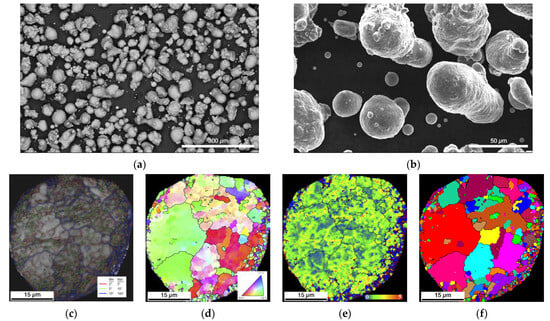
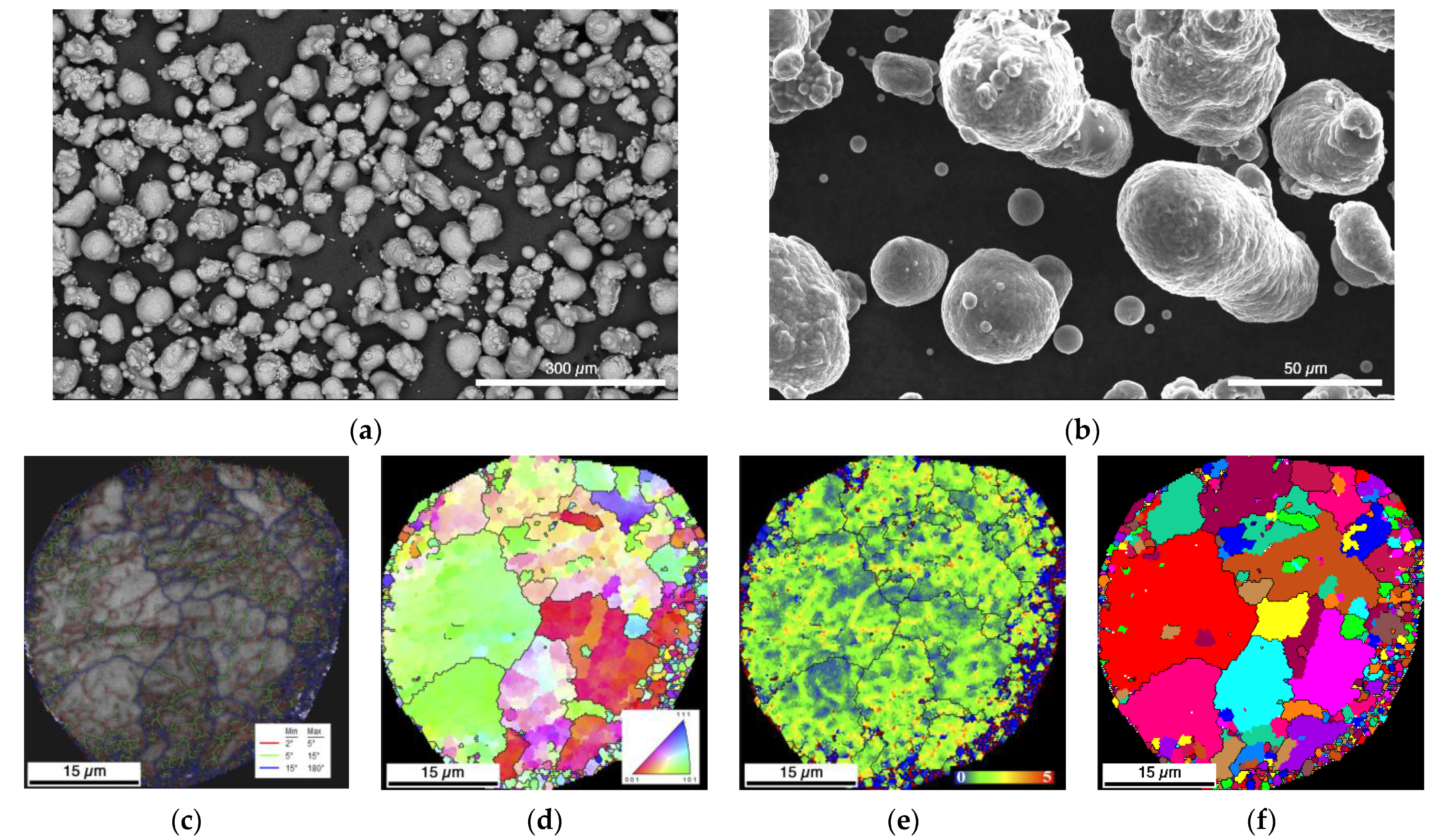
Within this context, the morphology of the Al6061 powders employed in the present study was systematically examined. Representative micrographs illustrating these features are presented in Figure 1a–f.
Figure 1.
(a) SEM-BSE and (b) SEM-SE images of Al6061 powders at different magnifications and (c–f) EBSD results of the polished cross-section of an Al6061 powder particle; (c) grain boundaries maps, (d) Inverse Pole Figure (IPF) map, (e) Kernel average misorientation (KAM) maps and (f) grain unique color map.
Figure 1a presents a SEM image at lower magnification, highlighting a wide distribution of particle sizes. The powders display a predominantly spherical morphology, though some agglomerated and irregularly shaped particles are also observed. Such variability can promote mechanical interlocking and enhance green body stability, although it may compromise overall uniformity.
At higher magnification (Figure 1b), the presence of surface roughness and satellite particles adhered to larger Al6061 particles is evident. These surface features are commonly associated with rapid solidification during atomization and have been reported to promote enhanced interparticle contact and metallurgical bonding during sintering. However, such roughness may also act as preferential sites for reinforcement agglomeration, particularly for CNTs, indicating the need for optimized mixing strategies.
The EBSD band contrast image, with superimposed grain boundaries and misorientation lines, provides insight into the internal structure of the sintered composite. The grain boundaries appear well-defined, and the image indicates a refined microstructure with complex grain boundary networks. The Inverse Pole Figure (IPF) map shown in Figure 1d illustrates a relatively uniform distribution of grain orientations, with regions containing both elongated and equiaxed grains. This pattern reflects the influence of powder morphology and sintering conditions on grain evolution and recrystallization behavior. The Kernel average misorientation (KAM) map further illustrates local misorientation and strain distribution. Areas with higher KAM values suggest residual strain or localized deformation, likely resulting from particle rearrangement or non-uniform densification.
Overall, the results confirm that the Al6061 powders employed possess favorable characteristics—namely, a predominantly spherical morphology, broad size distribution, and rough surfaces with satellite features—which collectively contribute to both the densification process and the microstructural development of the hybrid composite.
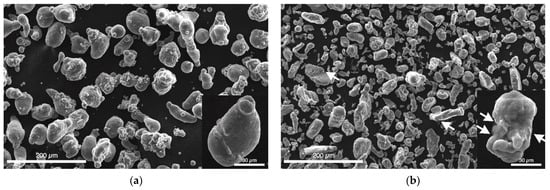
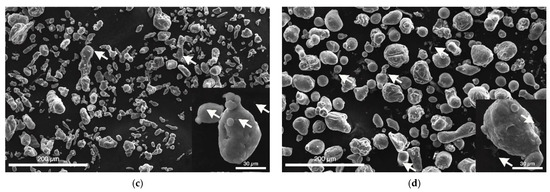
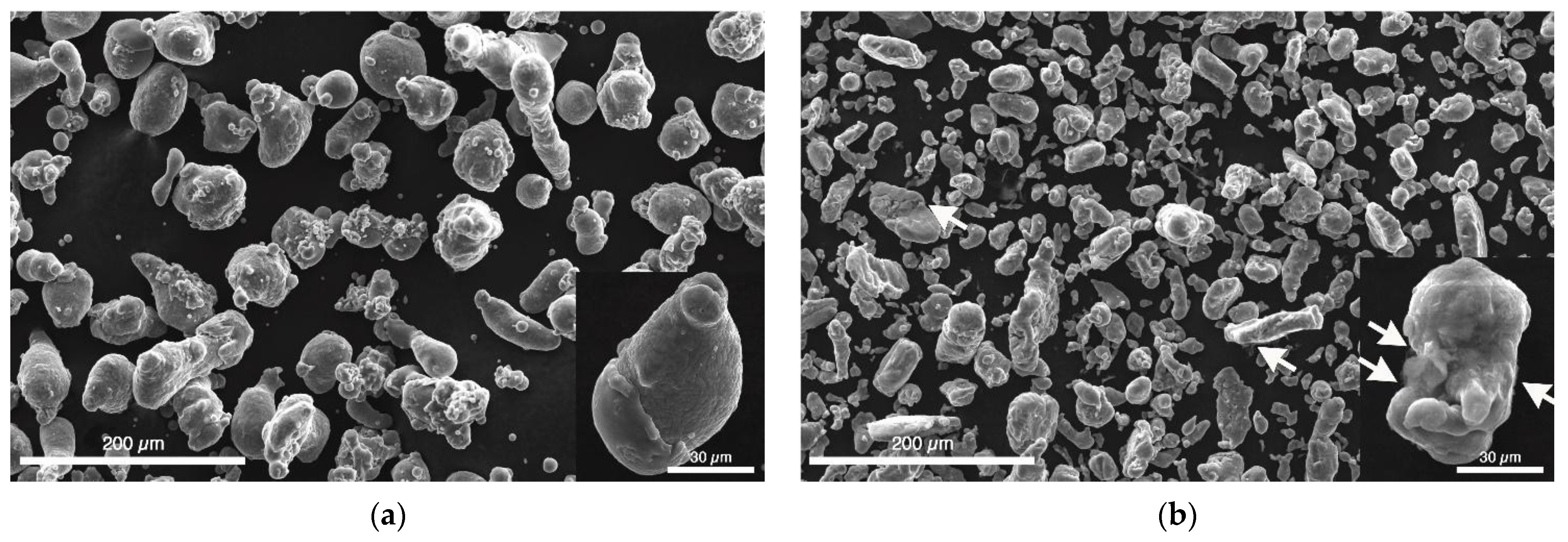
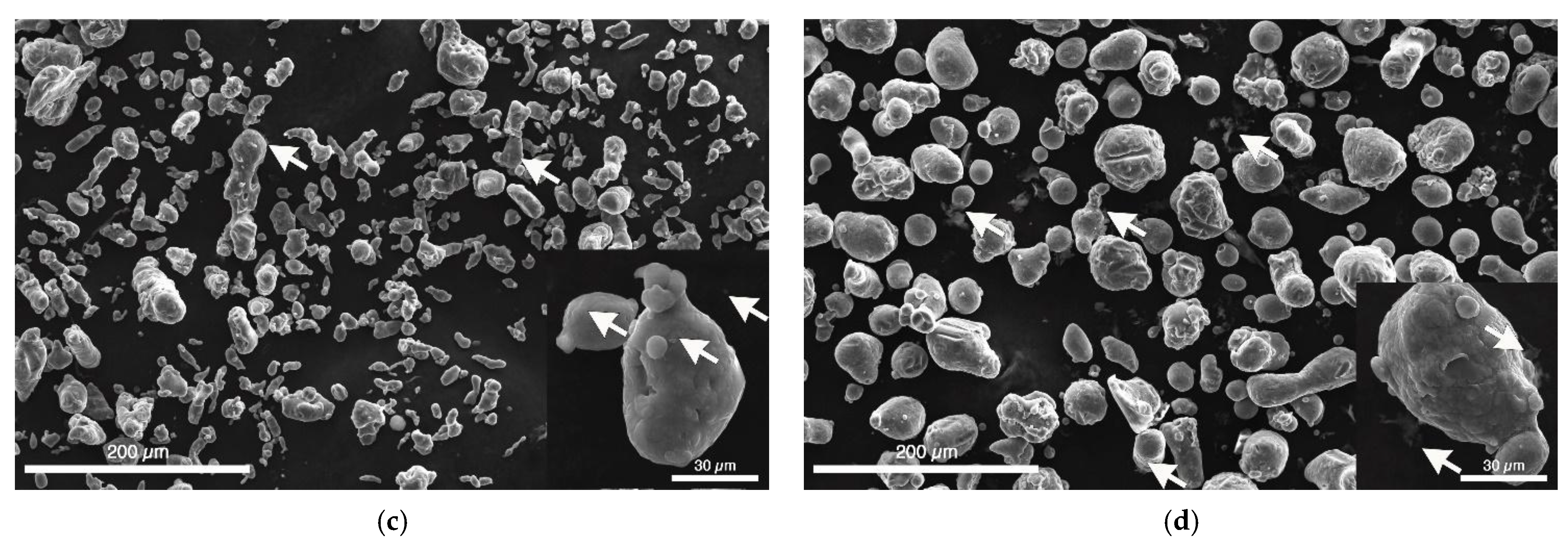
Figure 2 presents SEM images of Al6061 powder dispersion particles both with and without reinforcements. From the images, clear morphological changes can be observed in the Al6061 powders following the addition of different reinforcements (CNTs and Al2O3). The arrows shown in the figures indicate the reinforcements dispersed in the powder particles.
Figure 2.
SEM-SE images of the: (a) Al6061; (b) Al6061/CNTs; (c) Al6061/Al2O3 and (d) Al6061/CNTs/Al2O3 powder mixtures, after ultrasonication with a detail of a particle at higher magnification. The arrows represent the reinforcements.
The unreinforced powders exhibit irregular morphology and rough surfaces, typical of gas-atomized particles. A significant size variation is evident, including partially deformed spherical particles. The surface texture suggests rapid solidification, a characteristic feature of the atomization process. This baseline image serves as a reference for comparison with the reinforced systems.
With the incorporation of carbon nanotubes (CNTs), particle fragmentation appears more pronounced, leading to a greater fraction of smaller particles with angular morphology. This effect may be related to the role of CNTs in reducing interparticle cohesion during mechanical mixing, thereby facilitating cracking.
The simultaneous addition of ceramic reinforcements (Al2O3) and CNTs produced a mixed morphology. The powders display both spherical particles and highly irregular ones, suggesting competition between fragmentation mechanisms induced by Al2O3 and agglomeration tendencies associated with CNTs. The detailed image highlights a larger particle with pronounced roughness and signs of localized sintering or surface fusion, potentially resulting from local thermal interactions during processing.
Overall, CNTs promote fragmentation and sharp particle formation, acting as nanoscale grinding agents, whereas Al2O3 increases brittleness, enhancing particle breakdown and favoring the generation of finer particles. Their combined addition leads to a complex powder morphology that reflects the interplay between these mechanisms. While such morphological modifications may improve compaction and sintering behavior, they also introduce challenges for achieving homogeneous reinforcement dispersion. Ultimately, tailoring powder morphology through reinforcement addition is critical to controlling composite processing and directly impacts key properties such as densification and mechanical strength.
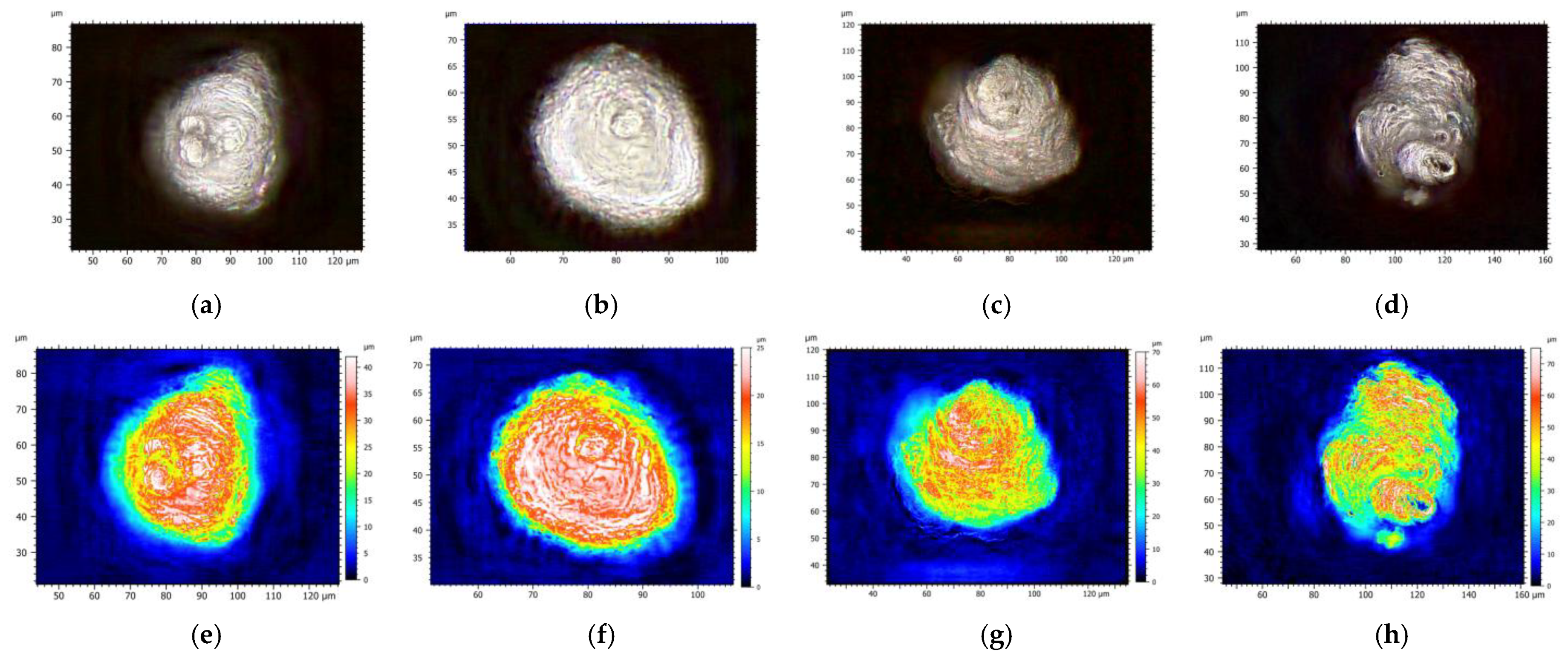
The digital microscopy images in Figure 3, combined with the surface roughness data presented in Table 1, reveal distinct morphological features of the Al6061 powders with and without reinforcements. The unreinforced Al6061 particles exhibit relatively irregular morphologies and rough surfaces, with intermediate roughness parameters (Sq = 10.1 ± 2.4 μm, Sa = 5.9 ± 1.5 μm) and moderate peak-to-valley values (Sp = 45.1 ± 9.8 μm, Sz = 52.6 ± 12.7 μm). This heterogeneous topography is typical of gas-atomized powders and can promote mechanical interlocking, although it may also contribute to increased porosity during compaction.
Figure 3.
Digital microscopy images of the: (a) Al6061; (b) Al6061/CNTs; (c) Al6061/Al2O3 and (d) Al6061/CNTs/Al2O3 powder particles; (e–h) correspond to EDF (Extended Depth of Field) converted to luminance–3D visualization of surface results.
Table 1.
Surface roughness parameters (Sq, Sp, Sv, Sz, Sa) of Al6061 powders with and without reinforcements (CNTs and Al2O3), obtained from digital microscopy analysis present in Figure 3.
The addition of carbon nanotubes (CNTs) significantly reduces surface roughness, with Sq decreasing to 4.2 ± 0.3 μm and Sa to 1.7 ± 0.1 μm, accompanied by lower peak and valley values (Sp = 27.5 ± 4.9 μm, Sv = 2.2 ± 0.4 μm, Sz = 29.7 ± 5.1 μm). The corresponding images show smoother and more homogeneous surfaces, suggesting that CNTs reduce interparticle cohesion and act as fragmentation agents during mixing. This effect facilitates packing and dispersion but may reduce the extent of mechanical anchoring between particles.
In contrast, the incorporation of Al2O3 leads to increased surface irregularity, although the roughness parameters show an overall reduction in mean roughness (Sq = 3.0 ± 1.1 μm, Sa = 1.3 ± 0.6 μm) and lower peak-to-valley values compared to the unreinforced powder (Sp = 24.2 ± 4.3 μm, Sz = 26.4 ± 4.9 μm). The images indicate a more abrasive effect from Al2O3, which enhances particle brittleness and fragmentation, potentially improving interfacial bonding during sintering but also compromising homogeneous distribution. When both reinforcements are combined, the Al6061/CNTs/Al2O3 powders exhibit a complex morphology characterized by relatively high mean roughness (Sq = 9.1 ± 3.9 μm, Sa = 4.7 ± 2.6 μm) and the highest peak-to-valley values among all samples (Sp = 56.3 ± 16.0 μm, Sz = 61.9 ± 18.5 μm). The images show heterogeneous surfaces reflecting the competitive interaction between CNT-induced fragmentation and Al2O3-driven brittleness. This hybrid morphology may enhance densification and interparticle bonding during sintering, although it also introduces challenges for achieving uniform reinforcement dispersion. Overall, the results demonstrate that reinforcement additions significantly change powder surface morphology: CNTs smooth and fragment the particles, Al2O3 increases irregularity and brittleness, and their combination produces a synergistic yet complex topography that directly influences compaction behavior, sintering mechanisms, and the final properties of the hybrid composites.
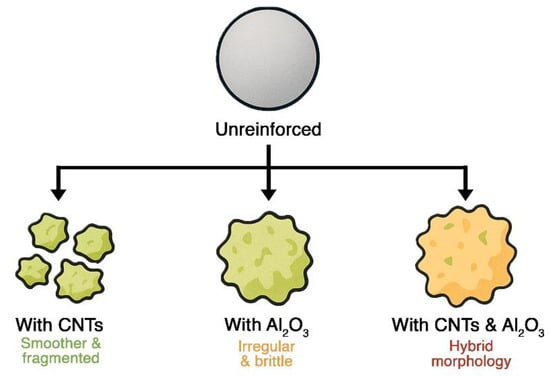
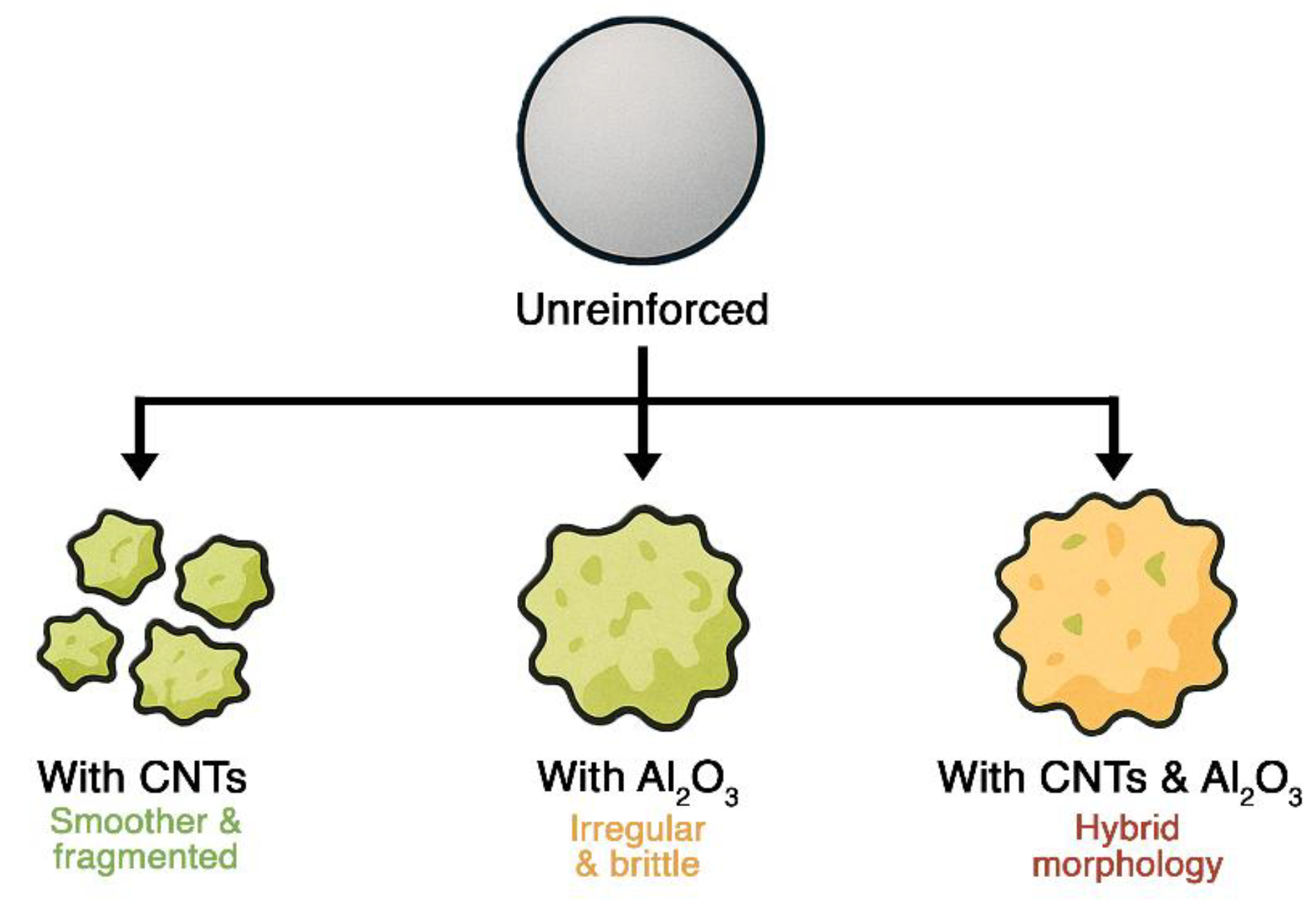
The schematic representation in Figure 4 illustrates the progressive morphological evolution of Al6061 powders induced by the addition of carbon nanotubes (CNTs), alumina (Al2O3), and their combined incorporation. Unreinforced Al6061 powders exhibit a relatively irregular morphology with rough surfaces typical of gas-atomized alloys, which promotes mechanical interlocking during compaction but may also hinder efficient packing and increase residual porosity. The addition of CNTs leads to smoother and more fragmented particles, as CNTs reduce interparticle cohesion and act as nanoscale fragmentation agents during mixing, thereby lowering surface roughness and facilitating improved powder packing and dispersion, albeit with a potential reduction in mechanical anchoring. In contrast, Al2O3 addition promotes increased particle irregularity and brittleness due to its abrasive action, enhancing particle fracture and angularity; this morphology can improve interfacial contact and mechanical interlocking during sintering but may also compromise homogeneous reinforcement distribution. When CNTs and Al2O3 are simultaneously introduced, a hybrid morphology emerges from the competitive interaction between CNT-induced fragmentation and Al2O3-driven brittleness, resulting in highly heterogeneous particle surfaces with pronounced peak-to-valley features. This complex topography can enhance densification and interparticle bonding during sintering, while also introducing challenges related to reinforcement dispersion and process control. Overall, the schematic highlights that reinforcement additions fundamentally alter Al6061 powder morphology, directly influencing compaction behavior, sintering mechanisms, and the final properties of hybrid nanocomposites. These observations are consistent with literature reports on hybrid matrix composites, where an optimal balance between particle fragmentation, surface roughness, and reinforcement dispersion is required to maximize mechanical performance [36,37].
Figure 4.
Schematic illustration of the Al6061 powders morphology with the addition of different reinforcements.
The initial morphology of Al6061 powders and the changes produced by the addition of CNTs and Al2O3 play a decisive role in the behavior during compaction, sintering, and reinforcement of nanocomposites. The results obtained in this work show that the morphological changes observed—fragmentation induced by CNTs, increased irregularity due to Al2O3, and complex hybrid topography in the simultaneous presence of both—are consistent with several recent studies on Al6061-based nanocomposites. For example, Yoo et al. [35] show that the incorporation of nanotubular reinforcements in Al6061, such as CNTs or SiC@CNT hybrid nanotubes, often leads to greater particle fragmentation and increased surface contact area, favoring metallurgical bonding but also the formation of areas of high local deformation during consolidation. Similarly, Monteiro and Simões [36,37] observed that Al6061 hybrid nanocomposites reinforced with CNTs and SiC have more refined and heterogeneous microstructures due to the combined effect of ceramic abrasion and CNT-assisted fragmentation, leading to not only significant improvements in mechanical strength but also dispersion challenges and the occurrence of irregular porosity, especially for contents above 1 wt.%.
The results of this study also corroborate trends described in Al–CNT and Al–Al2O3 systems prepared by powder metallurgy. Toozandehjani et al. [38] demonstrated that the addition of Al2O3 increases particle fragility and favors the formation of more angular and fractured powders, while CNTs tend to reduce interparticle cohesion and promote the formation of finer and more fragmented particles—precisely the effects observed in Figure 2 and Figure 3 of this work. These authors also point out that increased morphological irregularity can improve mechanical bonding but carries an increased risk of agglomeration, which is consistent with the greater roughness and heterogeneity observed in the Al6061/CNTs/Al2O3 hybrid mixture.
3.2. Nanocomposites Characterization
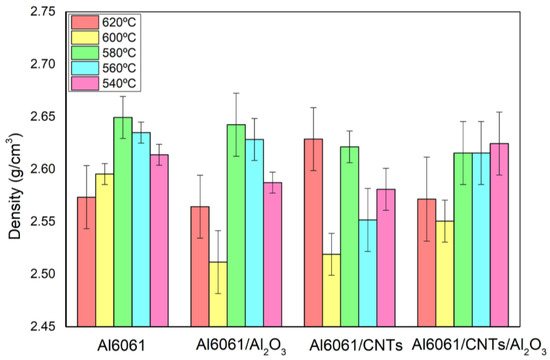
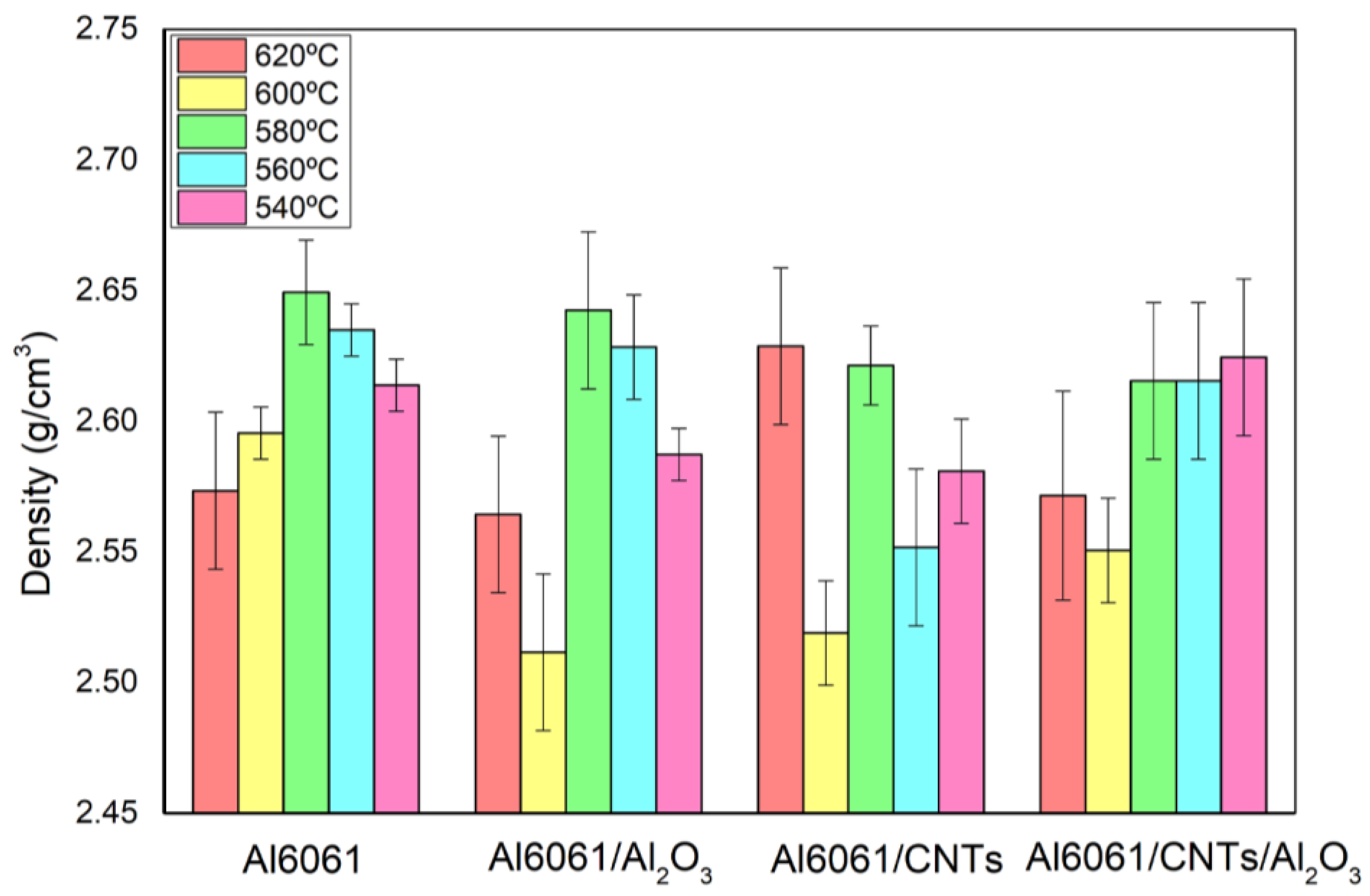
Figure 5 shows the evolution of density (g/cm3) for the Al6061 matrix and its composites (Al6061, Al6061/Al2O3, Al6061/CNTs, and Al6061/CNTs/Al2O3) at different sintering temperatures ranging from 540 to 620 °C. An overall increase in densification is observed with increasing temperature up to 580 °C, primarily attributed to enhanced atomic diffusion and a reduction in residual porosity, which together promote the formation of a denser microstructure. However, for temperatures above 580 °C (600 °C and 620 °C), a slight decrease in density is observed for some compositions. This reduction may be associated with competing mechanisms at higher temperatures, including grain growth, pore coalescence or possible interfacial reactions between the aluminum matrix and the reinforcements, which can locally hinder further densification. The highest density values are generally observed around 580 °C, particularly for the Al6061 alloy and the Al6061/Al2O3 composite. However, when comparing the Al6061/CNTs and Al6061/CNTs/Al2O3 samples, higher density values are observed for hybrid nanocomposites, suggesting that the combined reinforcement and optimal sintering conditions significantly enhance consolidation. The combined effect of Al2O3 and CNTs contributes to densification, particularly at higher temperatures, likely due to their reinforcing effects, which not only support improved compaction but may also enhance mechanical performance. These results emphasize the importance of optimizing sintering parameters to achieve the target density in aluminum-based composites. The non-monotonic density response is attributed to oxide-controlled sintering in Al powders combined with gas entrapment and reinforcement-assisted pore stabilization at higher temperatures. In addition, Archimedes measurements may be affected by temperature-dependent changes in open porosity and wetting/infiltration into fine pores.
Figure 5.
Density of the matrix and the nanocomposites for different sintered temperatures.
This density evolution observed in Figure 5 follows widely documented trends in Al6061 composites reinforced with ceramic nanoparticles and carbon nanotubes. The increasing densification up to 580 °C reflects the typical sintering behavior in aluminum alloys, where increased atomic diffusion and reduced porosity allow the formation of a more compact microstructure. Similar trends have been reported in Al6061 nanocomposites reinforced with SiC@CNT, where increasing temperature promoted simultaneous improvements in diffusion and consolidation of the material before competitive phenomena occurred at higher temperatures. The abrupt drop in density at 600 °C found in this study is consistent with work on AA6061 hybrid composites with SiC and CNTs, which show that intermediate temperatures can give rise to a transitional regime where diffusion is enhanced. The results found in this study is consistent with work on AA6061 hybrid composites with SiC and CNTs, which show that intermediate temperatures can give rise to a transitional regime where diffusion is insufficient to collapse pores but is already high enough to promote rearrangements, reinforcement agglomeration, and porosity stabilization, leading to reduced densification. This behavior reinforces the interpretation that the absence or incomplete formation of densifying phases—such as stable CNT/Al interfacial layers, dispersed Mg2Si, or pseudo-liquid regions—has a negative effect at this temperature [35,36].
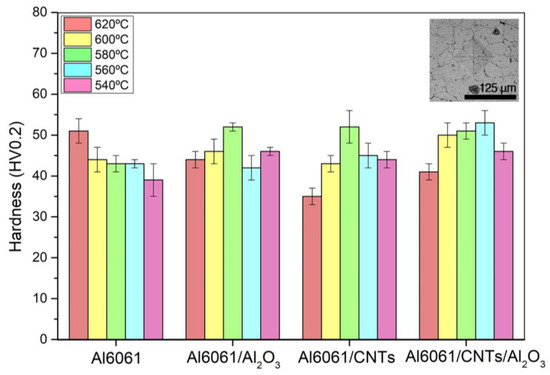
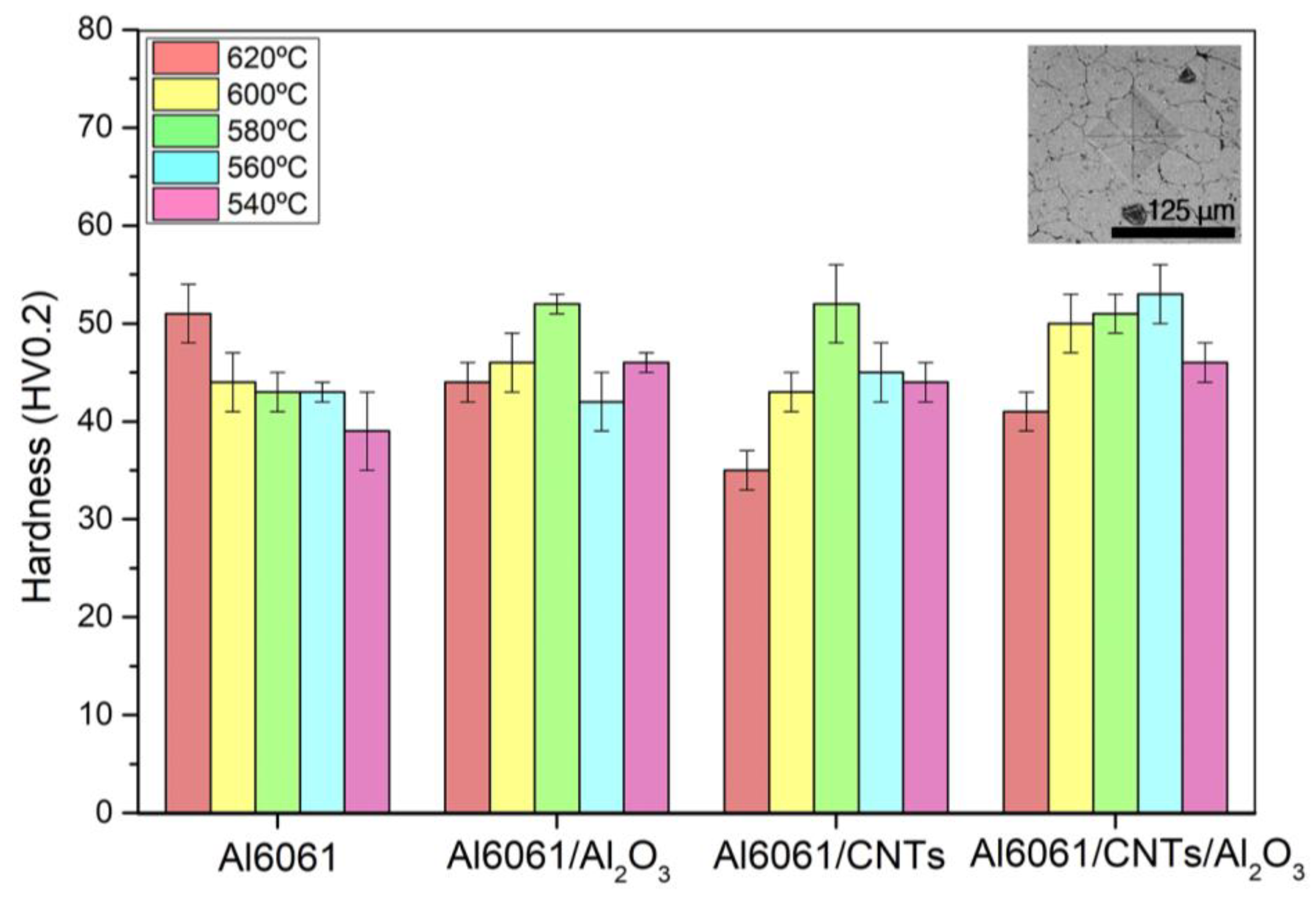
The hardness values of Al6061 and its reinforced composites (Al6061/Al2O3, Al6061/CNTs, and Al6061/CNTs/Al2O3) as a function of sintering temperature (540–620 °C) are presented in Figure 6. Overall, the results demonstrate that hardness is strongly influenced by both the reinforcement type and the sintering temperature. The relatively large dispersion is attributed to the intrinsic heterogeneity of conventionally sintered nano-reinforced hybrid composites. In these systems, local variations in: (1) reinforcement dispersion (distribution of CNT and Al2O3), (2) porosity, (3) grain size, and (4) interfacial bonding quality can produce localized variations in hardness. Given the small indentation volume in microhardness tests, individual measurements are sensitive to reinforcement agglomerates or local pores, which increases the standard deviation.
Figure 6.
Evolution of the Vickers hardness of the matrix and the nanocomposites for different sintered temperatures; SEM micrograph of an indentation performed on Al6061/Al2O3 sample sintered at 580 °C.
For the unreinforced Al6061 matrix, hardness increases progressively with sintering temperature, reaching its highest value at 620 °C (≈55 HV0.2). This trend is associated with enhanced densification and the presence of the precipitates that promote the higher hardness as observed in previous works [36,37]. In contrast, the Al6061/Al2O3 composite exhibits relatively stable hardness across the temperature range, with only moderate improvements at 600 and 620 °C, indicating that the effect of ceramic reinforcement is less sensitive to temperature variations.
The Al6061/CNTs composite displays a distinct behavior, with a significant increase in hardness at intermediate temperatures (560 °C and 580 °C), achieving values comparable to or higher than those of Al6061/Al2O3. However, hardness decreases slightly at 620 °C, possibly due to CNT agglomeration or degradation at elevated temperatures, which may compromise their reinforcing efficiency.
The hybrid composite Al6061/CNTs/Al2O3 exhibits the highest and most consistent hardness values across the investigated range, with peak hardness above 55 HV0.2 at 580 and 600 °C. This performance suggests a synergistic effect of CNTs and Al2O3, where CNTs contribute to load transfer and crack deflection, while Al2O3 provides dispersion strengthening and enhances particle–matrix bonding. The combined reinforcement leads to improved hardness stability, even at higher temperatures. The results for the Al6061/CNT/Al2O3 hybrid composite show the highest values and greatest hardness stability, which is directly in line with recent studies documenting the synergy between ceramic and carbon-based reinforcements [39].
High sintering temperature is not a suitable option for hybrid nanocomposites. As already reported for other systems [36,37], sintering at elevated temperatures, although promoting higher densification, also leads to grain growth and, in some cases, reinforcement degradation or interfacial reactions with the matrix. These effects result in a reduction of hardness and overall mechanical properties.
The sintering temperature plays a critical role in defining hardness, with the optimal results observed for the hybrid Al6061/CNTs/Al2O3 system. These results highlight the potential of combined reinforcement strategies to maximize mechanical performance in aluminum-based nanocomposites, while also emphasizing the importance of carefully controlling sintering conditions to prevent reinforcement degradation.
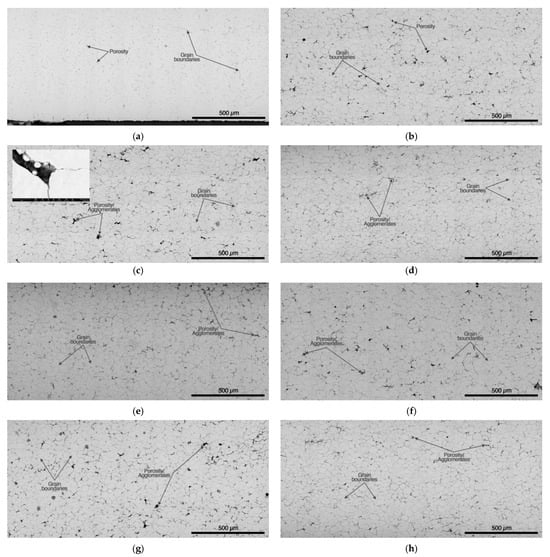
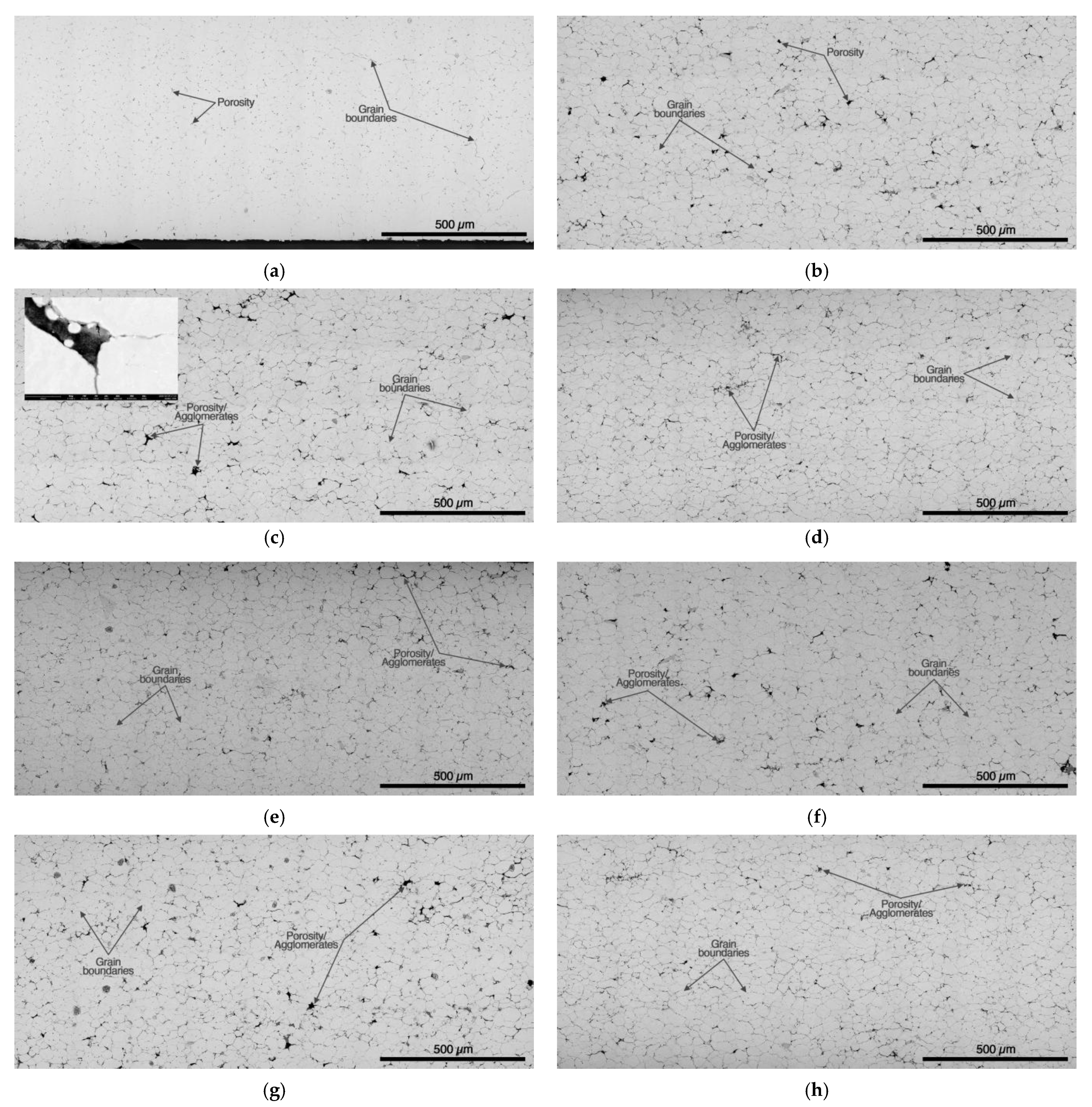
To better understand the effect of processing temperature on the properties of the nanocomposites, a microstructural investigation was carried out for the nanocomposites sintered at 580 and 560 °C. Figure 7 presents SEM images at lower magnification of the Al6061 matrix and nanocomposites reinforced with CNTs, Al2O3, and Al2O3/CNTs, sintered at 580 and 560 °C. Clear differences in microstructural features can be observed depending on both the reinforcement type and the sintering temperature. Microstructure characterization observations are according to the results present in Figure 6.
Figure 7.
SEM-BSE images at lower magnification of the (a,b) Al6061; (c,d) Al6061/CNTs; (e,f) Al6061/Al2O3 and (g,h) Al6061/CNTs/Al2O3 nanocomposites produced at (a,c,e,g) 580 °C and (b,d,f,h) 560 °C.
For the unreinforced Al6061 (Figure 7a,b), the microstructure at 580 °C shows a relatively dense matrix with limited porosity and well-defined grain boundaries, indicating efficient diffusion and particle bonding at this temperature. However, at 560 °C the structure appears less compact, with more visible porosity and incomplete interparticle bonding, reflecting insufficient thermal activation for full densification.
The Al6061/CNTs composite (Figure 7c,d) exhibits a finer and more homogeneous grain distribution at 580 °C, suggesting that CNTs promote particle rearrangement and inhibit grain growth during sintering. The presence of CNTs likely enhances densification by reducing interparticle cohesion and facilitating diffusion pathways. At 560 °C, however, the composite shows increased porosity and less uniform bonding, indicating that the lower temperature is less effective for achieving strong CNT–matrix interactions. A higher magnification on Figure 7c can be observed to show a CNT agglomerate in a pore. Despite the high temperature and the fact that some CNTs undergo reaction or even degradation, it can be observed that part of these CNTs can still be preserved within the structure of the nanocomposites.
For the Al6061/Al2O3 composite (Figure 7e,f), the images reveal more irregular grain boundaries and higher porosity compared to CNT-reinforced powders. The ceramic particles appear to act as barriers to diffusion, hindering complete densification, especially at 560 °C. Nevertheless, at 580 °C the microstructure becomes more refined, with Al2O3 particles contributing to grain boundary pinning and stabilization, although localized porosity remains evident.
The hybrid Al6061/CNTs/Al2O3 composite (Figure 7g,h) shows the most compact and uniform microstructure at 580 °C, with reduced porosity and refined grains. This suggests a synergistic effect of CNTs and Al2O3, where CNTs improve densification and dispersion while Al2O3 contributes to grain boundary stabilization. At 560 °C, although the microstructure is less dense than at 580 °C, the hybrid still outperforms the single-reinforced composites in terms of uniformity and compactness.
The SEM observations emphasize the critical role of sintering temperature in microstructural development. At 580 °C, diffusion and interparticle bonding are enhanced, resulting in denser microstructures across all systems, with the hybrid Al6061/CNTs/Al2O3 composite exhibiting the most favorable morphology. At 560 °C, insufficient densification leads to higher porosity and reduced uniformity, particularly in the Al6061/Al2O3 system. These findings indicate that optimizing sintering conditions, in combination with the hybrid reinforcement approach, is essential to achieving microstructural refinement and improved performance in aluminum-based nanocomposites. These results are consistent with the hardness evolution observed in the composites: the higher densification at 580 °C explains the superior hardness values obtained for samples processed at this temperature. For the hybrid nanocomposites, however, the microstructural changes observed at 560 °C may contribute to a more pronounced hardness increase at this lower sintering temperature.
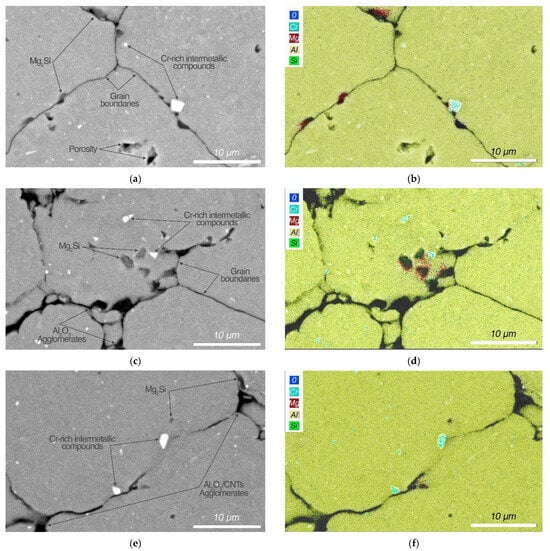
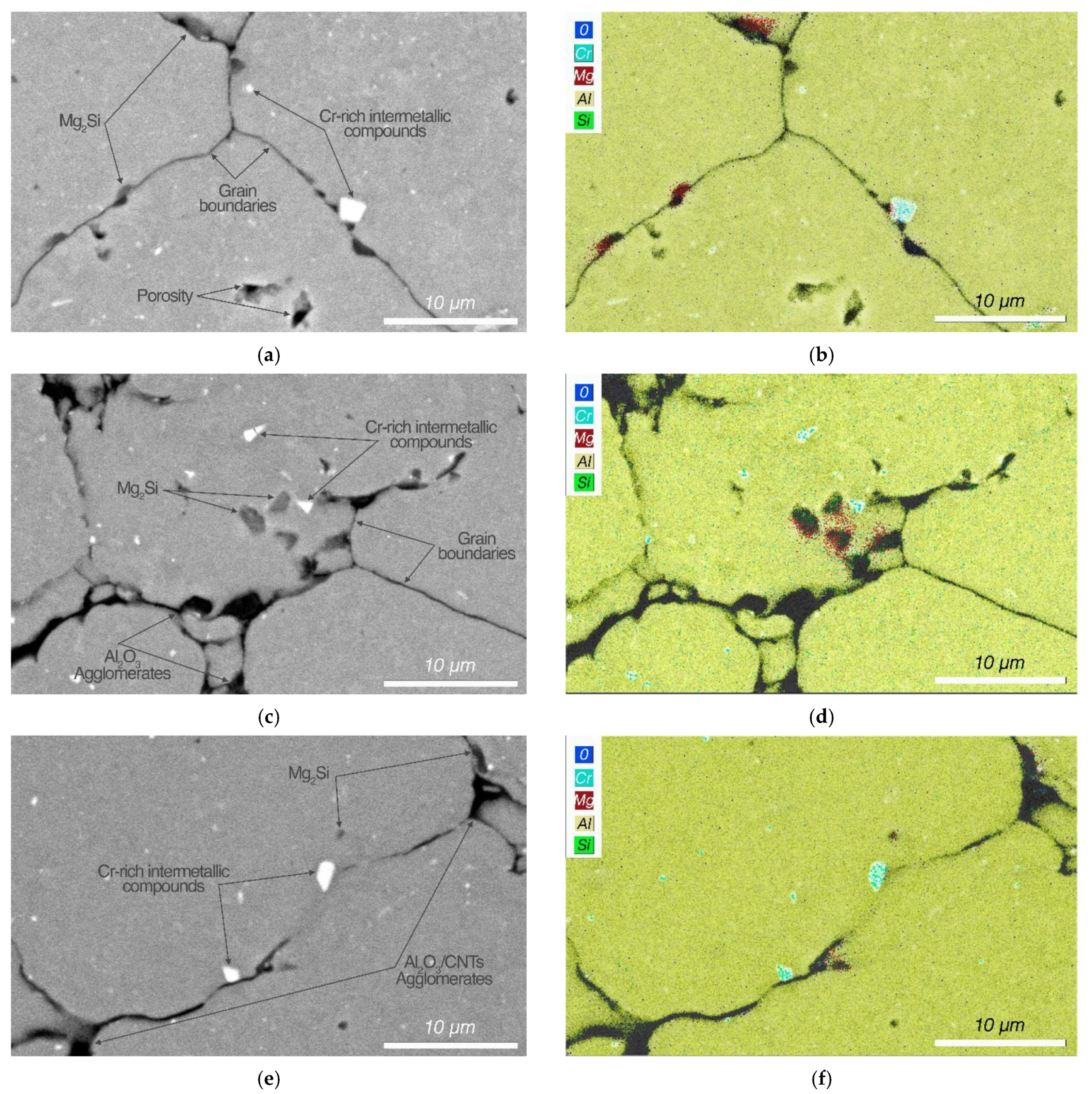
Figure 8 presents SEM micrographs and the corresponding EDS elemental maps of the Al6061 matrix alloy and the Al6061/Al2O3 and Al6061/CNTs/Al2O3 nanocomposite. The SEM image of the Al6061 matrix (Figure 8a) reveals a microstructure composed of equiaxed aluminum grains, whose boundaries are clearly delineated. Dispersed bright particles are observed within the matrix, together with some dark regions that may be associated with porosity or particle pull-out during metallographic preparation. These bright features are typically indicative of intermetallic phases with higher average atomic number compared to the aluminum matrix.
Figure 8.
(a,c,e) SEM-BSE images of the Al6061 matrix, Al6061/Al2O3 nanocomposite and Al6061/CNTs/Al2O3 nanocomposite and (b,d,f) EDS elemental maps of the Al, O, Mg, Si, Fe and Cr.
The EDS elemental maps of the Al6061 matrix (Figure 8b) show a homogeneous distribution of aluminum across the microstructure, confirming its role as the continuous matrix. Localized enrichments of magnesium and silicon are detected, with a clear spatial correlation between both elements. This analysis combined with punctual EDS analysis suggests the presence of Mg2Si precipitates, which are characteristic of Al–Mg–Si alloys and are responsible for precipitation hardening. Iron is also detected in discrete particles, often associated with silicon, indicating the formation of Fe-rich intermetallic phases such as Al–Fe–Si, commonly reported in 6xxx series aluminum alloys. Chromium is present in very small amounts and is likely associated with fine dispersoids that contribute to grain structure stability.
The SEM images of the Al6061/Al2O3 and Al6061/CNTs/Al2O3 nanocomposites (Figure 8c,e) reveal similar microstructures, but the number density of second-phase particles is higher.
The corresponding EDS elemental maps of the nanocomposite (Figure 8d,f) confirm the presence of oxygen-rich regions distributed throughout the aluminum matrix, which are not associated with iron, magnesium or silicon. These regions are attributed to the Al2O3 reinforcement particles, clearly distinguishing the nanocomposite from the unreinforced Al6061 alloy. As in the matrix alloy, Mg and Si remain co-located, indicating that Mg2Si phases are still present after the incorporation of the ceramic reinforcement. Fe-rich intermetallics are also observed, with similar morphology to those in the base alloy, suggesting that the reinforcement does not significantly alter the formation of these phases.
A key difference between the two nanocomposites lies in the size and distribution of secondary phases. The Al6061/Al2O3 nanocomposite exhibits a finer grain structure and a higher amount of small particles. However, the SEM images also reveal localized dark regions in the nanocomposite, which may correspond to porosity or to the detachment of hard ceramic particles during polishing. Such features could have implications for mechanical performance, particularly in terms of ductility and fatigue resistance, despite the expected increase in strength and hardness.
Overall, the SEM and EDS analyses demonstrate that both materials contain similar intrinsic phases typical of Al6061 alloys, namely Mg2Si precipitates and Fe,Cr-rich intermetallic compounds. The addition of Al2O3 leads to the formation of a distinct reinforcement phase, promotes significant grain refinement, and increases the density of dispersed particles. These microstructural changes are expected to enhance the strength of the nanocomposite through precipitation strengthening, and particle reinforcement mechanisms, although careful control of porosity and particle dispersion is necessary to avoid detrimental effects on fracture-related properties.
For hybrid composites, Figure 7g–h and Figure 8d–f show denser, more compact microstructures with a greater amount of fine particles. This behavior coincides with Al6061/GO/CNT hybrid studies, in which a uniform distribution of reinforcements simultaneously promotes effective pinning, accelerated grain nucleation, and wear resistance far superior to that of simple composites [40].
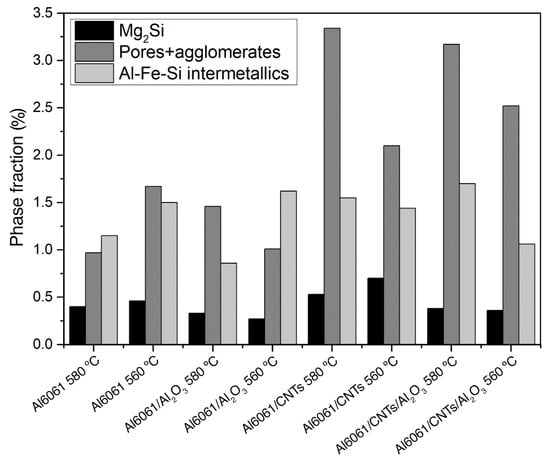
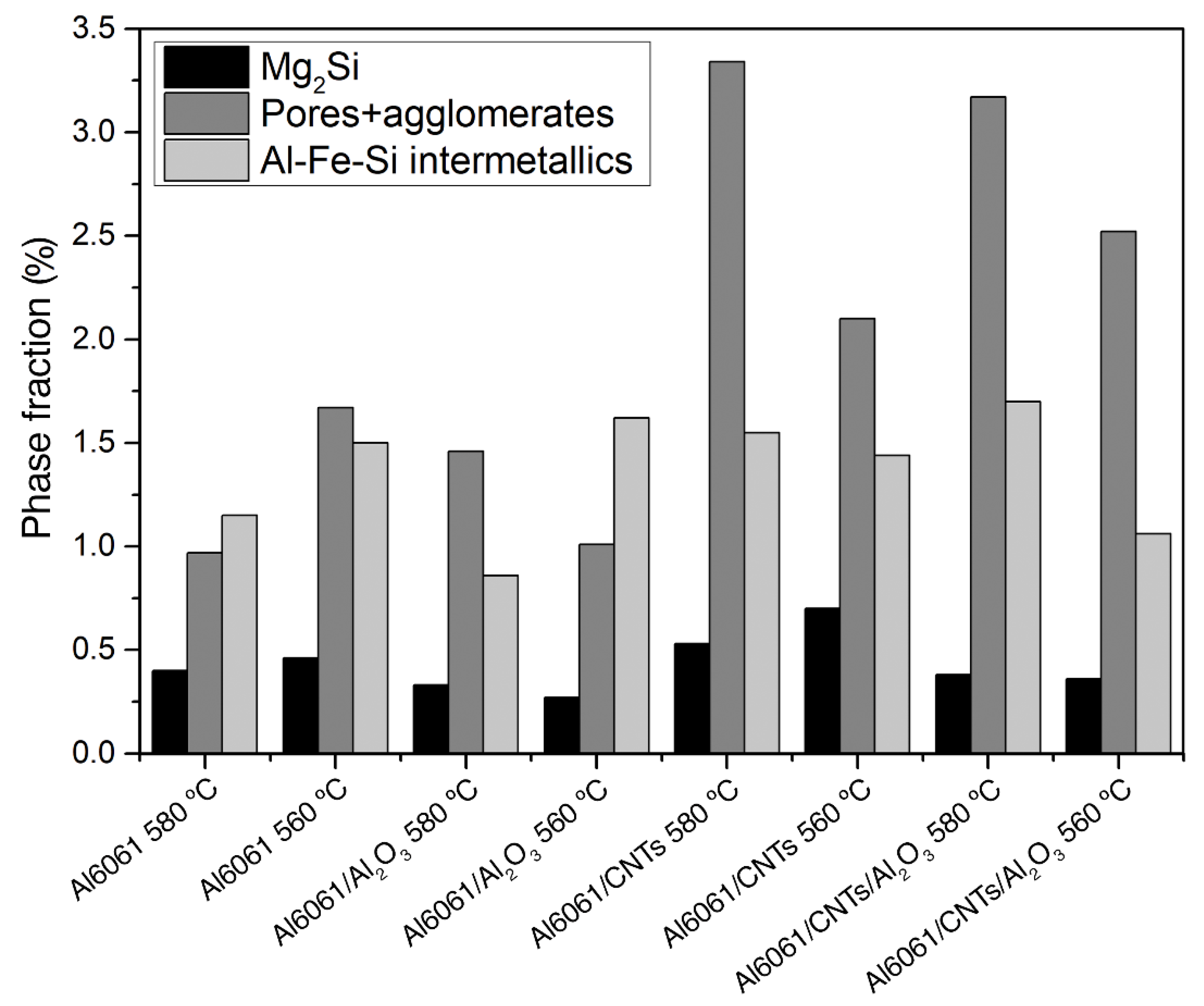
Figure 9 quantitatively confirms the microstructural trends previously identified in the SEM and EDS analyses (Figure 8) for the Al6061 matrix and its nanocomposites processed at 560 and 580 °C.
Figure 9.
Evolution of the phase distribution for the Al6061 matrix and nanocomposites produced at 560 and 580 °C.
In the unreinforced alloy, the relatively low and stable fraction of Mg2Si is consistent with the localized Mg–Si enrichments observed in the EDS elemental maps, while a modest increase in Mg2Si with temperature correlates with enhanced diffusion and precipitate growth. The fraction of Al–Fe–Si intermetallics remains within a narrow range for all conditions, in agreement with the presence of discrete Fe-rich particles with bright contrast in the SEM images, indicating that their formation is primarily governed by the base alloy composition rather than by processing temperature or reinforcement addition. In contrast, the most pronounced effect revealed by Figure 9 is the significant increase in porosity and agglomerates in the nanocomposites, particularly those containing CNTs and processed at 580 °C, which directly corroborates the SEM observations of dark regions, particle pull-out and heterogeneous contrast. The EDS maps showing widespread oxygen-rich regions in the Al6061/Al2O3 nanocomposites further support the interpretation that reinforcement agglomeration and limited wettability contribute to defect formation. Moreover, despite the higher defect fraction, the refined grain size observed in the SEM images of the nanocomposites is consistent with the increased presence of finely dispersed phases, which promote grain boundary pinning. Overall, the combined SEM/EDS and quantitative phase analysis demonstrate that while reinforcement addition and higher processing temperature enhance microstructural refinement, they simultaneously intensify porosity and agglomeration, effects that are expected to outweigh the benefits of precipitation and phase strengthening if not carefully controlled.
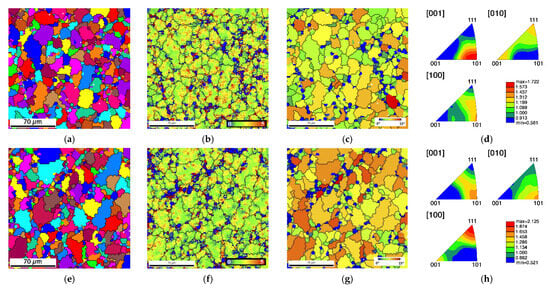
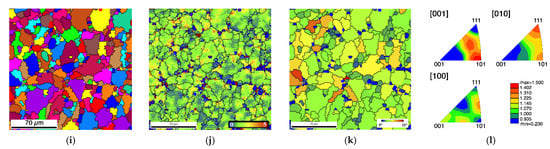
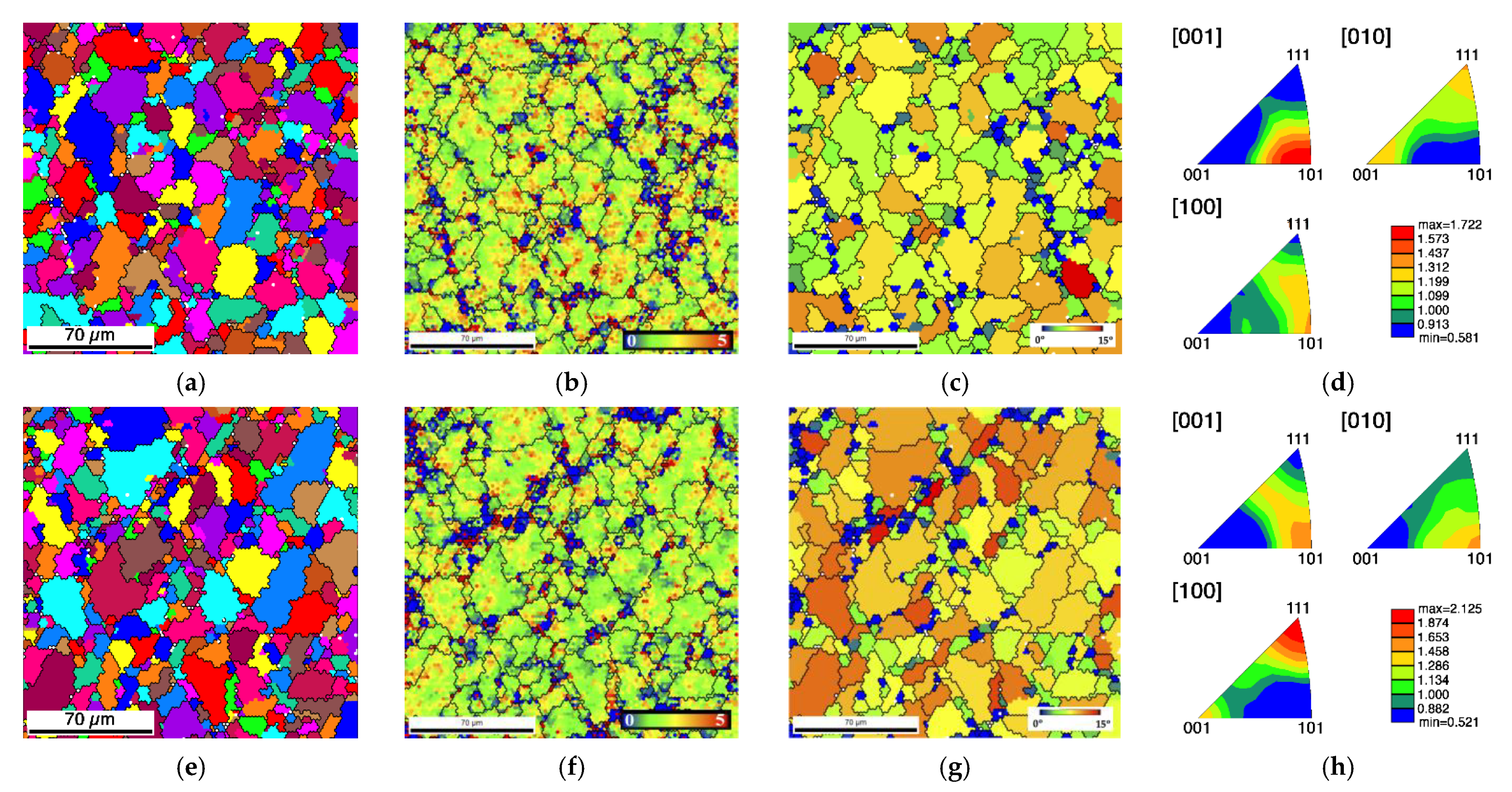
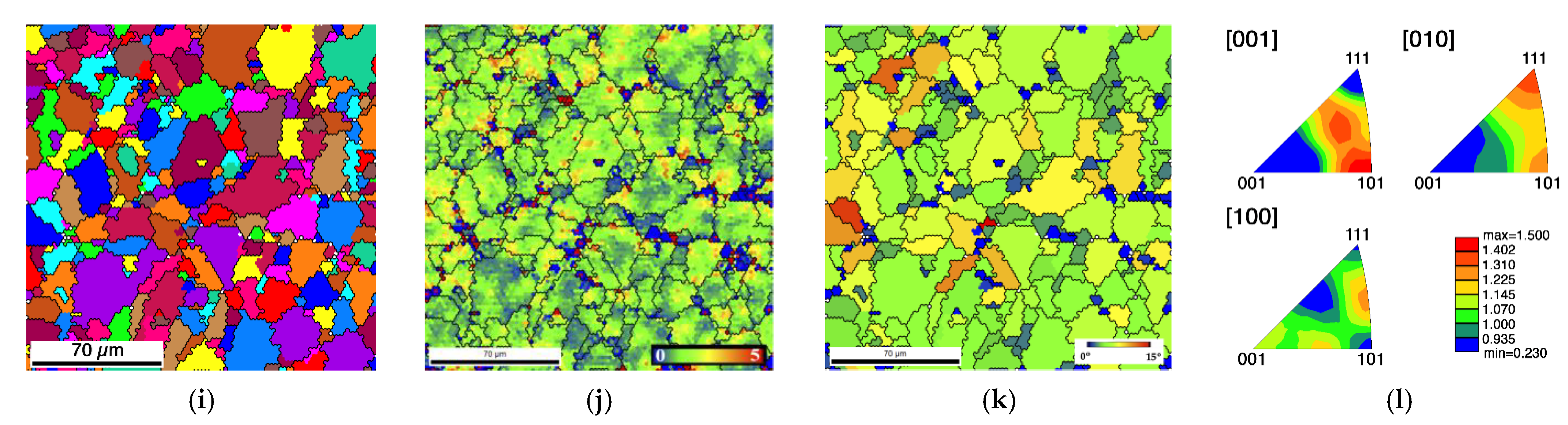
Figure 10 illustrates the influence of reinforcement on the crystallographic and microstructural characteristics of the Al6061 matrix and nanocomposites through EBSD analysis. The unique color maps reveal a progressive refinement of the aluminum alloy matrix grain structure from the unreinforced alloy to the Al2O3-reinforced and hybrid Al2O3/CNT composites, with the latter exhibiting the finest yet most heterogeneous grain size distribution.
Figure 10.
Unique color maps, KAM and Grain Orientation Spread (GOS) maps obtained by EBSD of: (a–d) Al6061; (e–h) Al6061/Al2O3; and (i–l) Al6061/CNTs/Al2O3 samples, respectively.
Kernel average misorientation (KAM) maps show a marked increase in local misorientation in the reinforced materials, particularly in the hybrid composite, indicating a higher density of geometrically necessary dislocations and enhanced intragranular lattice distortion. This trend is further supported by the grain orientation spread (GOS) maps, which display a gradual rise in orientation spreading within grains, signifying increased substructure development and a lower fraction of fully recrystallized grains as reinforcement complexity increases. The texture analysis suggests that while the base Al6061 alloy retains a relatively well-defined FCC texture, reinforcement addition modifies the preferred orientations, with the hybrid composite showing a more diffuse texture distribution, consistent with particle-stimulated nucleation and heterogeneous recrystallization. Overall, the EBSD results demonstrate that the introduction of ceramic and hybrid reinforcements significantly modifies grain morphology, dislocation structure and crystallographic texture, promoting grain refinement at the expense of increased internal misorientation and microstructural heterogeneity. Overall, the combined density, hardness, SEM/EDS, phase analysis, and EBSD results demonstrate that hybrid reinforcement significantly enhances microstructural refinement and hardness in Al6061 nanocomposites. However, these benefits are maximized only within a narrow sintering temperature window, beyond which porosity, agglomeration, and reinforcement degradation outweigh strengthening mechanisms. This highlights the critical importance of simultaneously optimizing the reinforcement strategy and sintering parameters to achieve superior performance in aluminum-based hybrid nanocomposites.
The EBSD analyses in Figure 9 and Figure 10 experimentally confirm these trends already described in the literature. The progressive reduction in grain size from the Al matrix to the hybrid composite, together with the increase in local disorientation (KAM) and orientation scattering (GOS), is in excellent agreement with studies that show high densities of dislocations induced by hybrid reinforcements through the combined effects of thermal mismatch, ceramic pinning, and dislocation–CNT interaction. These effects were clearly reported by Yoo et al. [35] for SPS-produced SiC@CNT hybrids, where the synergy between reinforcements simultaneously improved modulus, mechanical strength, and wear resistance due to the strongly refined and highly distorted microstructure.
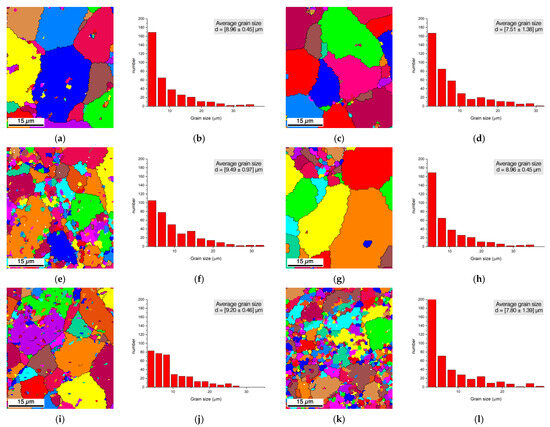
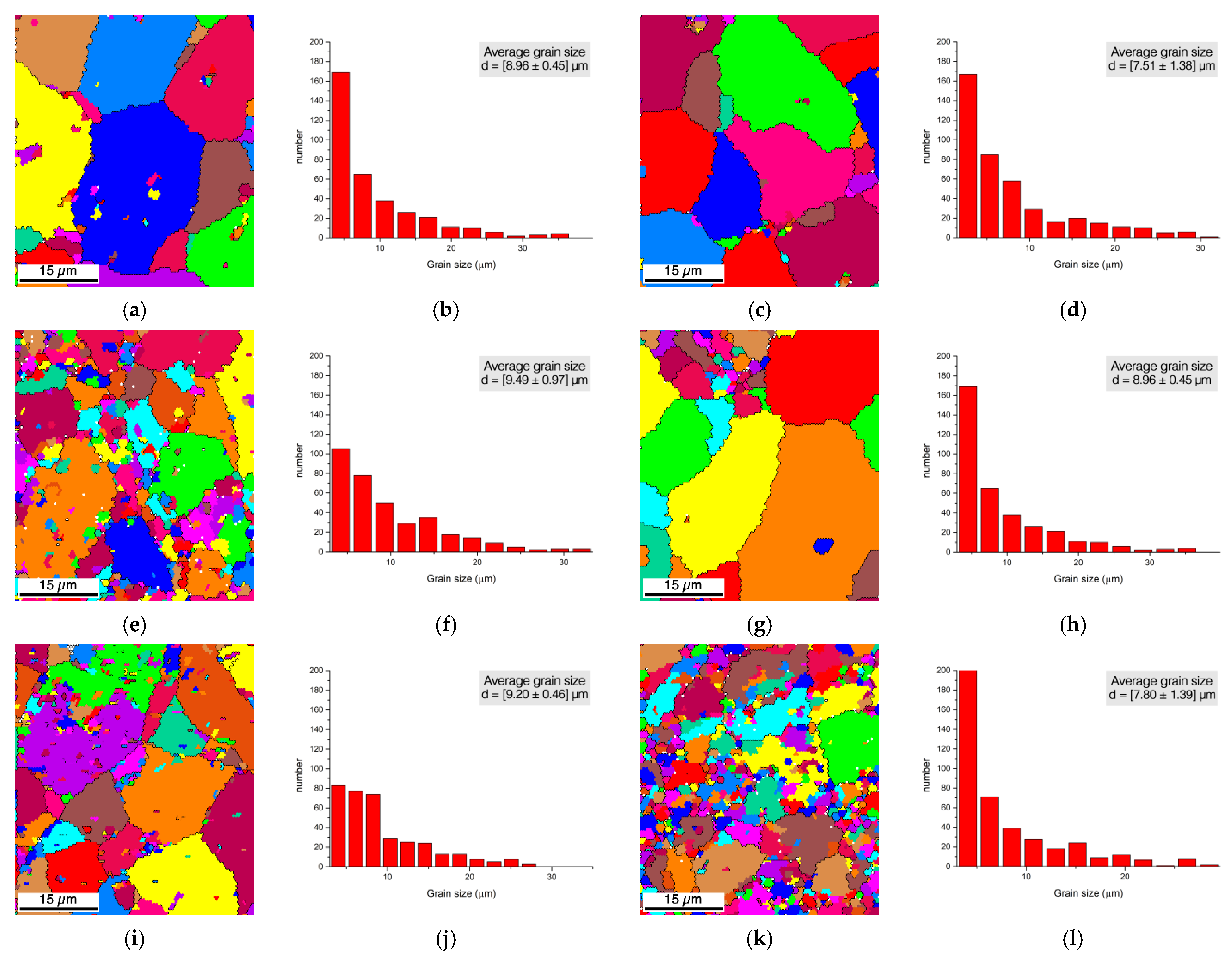
Figure 11 shows high magnification unique color maps and grain size distribution for the Al6061 matrix and nanocomposites sintered at 580 and 560 °C. The Al6061 matrix exhibits coarse, equiaxed grains with a broad distribution typical of fully recrystallized alloys. The Al6061/CNT composite shows only partial refinement, with heterogeneous grain structures reflecting the limited grain-boundary pinning ability of CNTs and the presence of regions retaining large grains. In contrast, the Al6061/Al2O3 composite displays a marked shift toward smaller and more uniformly distributed grains, confirming the strong Zener pinning effect of ceramic nanoparticles and the activation of particle-stimulated nucleation. The hybrid CNT + Al2O3 composite exhibits the finest and most complex microstructure, with a region with sub-20 µm grains and areas containing ultrafine grains, demonstrating a synergistic interaction between CNT-induced dislocation accumulation and Al2O3-driven boundary pinning. Although hybrid reinforcement produces the most substantial refinement, the maps also reveal microstructural heterogeneity linked to reinforcement clustering and localized porosity. Overall, the EBSD results confirm that grain refinement strengthening is minimal in Al6061/Al2O3 composites, moderate in CNTs reinforced ones, and most significant in hybrid systems. The decrease of the sintered temperature induced the grain size decrease for the Al matrix and for the nanocomposites.
Figure 11.
(a,c,e,g,j) Unique color maps and (b,d,f,h,i,l) grain size distribution (a,b) of Al6061; sintered at 580 °C (c,d) Al6061/CNTs sintered at 580 °C; (e,f) Al6061/Al2O3 sintered at 580 °C; and (g,h) Al6061/CNTs/Al2O3 sintered at 580 °C, (i,j) of Al6061 sintered at 560 °C and (k,l) Al6061/CNTs/Al2O3 sintered at 560 °C.
These results reinforces that hybrid composites have the greatest microstructural refinement, consistent with the literature that points to CNT/ceramic hybridization as particularly effective in producing ultrafine microstructures with excellent thermal and mechanical stability. The combination of these effects explains why hybrid composites demonstrate the best balance between hardness, density, and microstructural uniformity.
3.3. Strengthening Mechanisms
The enhancement of mechanical properties in Al6061-based nanocomposites results from the combined action of multiple strengthening mechanisms activated by the incorporation of ceramic and hybrid reinforcements. The relative contribution of each mechanism strongly depends on the reinforcement morphology, dispersion state, and interaction with the aluminum matrix.
In the present work, the strengthening behavior of the unreinforced Al6061 alloy, the Al6061/Al2O3, Al6061/CNTs and the hybrid Al6061/CNTs/Al2O3 nanocomposite is analyzed by quantitatively estimating the individual contributions arising from grain refinement, dislocation strengthening due to thermal and elastic mismatch, Orowan strengthening, and load transfer [41,42,43,44]. The relative importance of each mechanism depends strongly on the reinforcement and the resulting microstructural state.
Grain refinement strengthening follows the Hall–Petch relationship [41], whereby a reduction in grain size increases the yield strength according to:
where k is the Hall–Petch constant for aluminum (∼0.07 MPam1/2), d0 is the average grain size of the unreinforced alloy, and d is the grain size of the composite. EBSD analysis indicates an average grain size of 11.3 µm for the unreinforced Al6061 alloy. The Al6061/CNTs composite, as observed in the unique grain color map, exhibits a heterogeneous grain structure with only modest refinement, with an average grain size of 7.5 µm, reflecting the limited grain-boundary pinning ability of CNTs. In contrast, the Al6061/Al2O3 and the hybrid Al6061/CNTs/Al2O3 nanocomposites show grain sizes of 9.5 µm and 8.9 µm, respectively, resulting from the combined effects of Zener pinning and particle-stimulated nucleation. Based on these grain sizes, the corresponding Hall–Petch strengthening contributions are now estimated to be 4.4 MPa for Al6061/CNTs, 1.8 MPa for Al6061/Al2O3, and 2.5 MPa for the hybrid composite. These updated values confirm that grain refinement plays only a minor role in all materials, with strengthening being governed predominantly by dislocation-based mechanisms, Orowan looping, and load transfer.
A major strengthening contribution arises from the mismatch in coefficient of thermal expansion (CTE) and elastic modulus between the aluminum matrix and the reinforcements. During cooling from the processing temperature, thermal stresses generate a high density of geometrically necessary dislocations around the reinforcement particles. The resulting dislocation density can be estimated as [45]:
where Δα is the CTE mismatch, ΔT the temperature change, Vr the reinforcement volume fraction, b the Burgers vector of aluminum (0.286 nm), and dr the reinforcement diameter. The associated strengthening can be expressed as [46]:
with G being the shear modulus of aluminum (26 GPa) and α ≈ 0.2. Due to the very low CTE and high elastic modulus of CNTs, the Al6061/CNTs composite exhibits a marked increase in local lattice distortion, as commonly observed by elevated KAM values, even in the absence of significant grain refinement. This leads to an estimated dislocation strengthening contribution of approximately 45 MPa for Al6061/CNTs. For the Al6061/Al2O3 and hybrid nanocomposites, ΔσCTE increases to approximately 35 MPa and 55 MPa, respectively, reflecting the cumulative effect of multiple reinforcement types.
Orowan strengthening occurs when dislocations bypass non-shearable particles through a bowing mechanism. This contribution is particularly important for nanometric Al2O3 particles and is described by [45,46]:
where λ is the interparticle spacing and r is the particle radius. In the Al6061/CNTs composite, classical Orowan strengthening is negligible, as CNTs do not act as effective Orowan obstacles in the same way as rigid ceramic nanoparticles. Consequently, ΔσOrowan is assumed to be 5 MPa at most, associated with local CNT–dislocation interactions. In contrast, finely dispersed Al2O3 nanoparticles provide a substantial Orowan contribution of approximately 22 MPa in Al6061/Al2O3 and 28 MPa in the hybrid composite.
Load transfer strengthening arises from the ability of stiff reinforcements to carry a fraction of the applied load. This mechanism is commonly expressed as [42]:
where η is the load transfer efficiency, Vr the reinforcement volume fraction, and σr the effective reinforcement strength. Due to their extremely high elastic modulus and aspect ratio, CNTs are particularly effective in promoting load transfer, provided adequate interfacial bonding exists. Accordingly, the Al6061/CNTs composite exhibits a relatively high load transfer contribution of approximately 12 MPa, exceeding that of the Al6061/Al2O3 nanocomposite (7 MPa). The hybrid Al6061/CNTs/Al2O3 system shows a moderate increase (9 MPa), as CNT agglomeration and interaction with ceramic particles limit the effective load transfer efficiency.
The overall strengthening effect are summarized in Table 2. These strengthening contributions arise from the combined action of the positive reinforcement mechanisms and the negative influence of porosity and agglomeration. Based on microstructural observations, defect-related strength penalties of approximately 10 MPa for Al6061/CNTs, 8 MPa for Al6061/Al2O3 and 15 MPa for the hybrid composite were considered. As a result, the updated net strengthening contributions are approximately 56 MPa for Al6061/CNTs, 58 MPa for Al6061/Al2O3, and 79 MPa for the hybrid Al6061/CNTs/Al2O3 nanocomposite. These values reflect the relatively small Hall–Petch contribution associated with the similar grain sizes observed for all reinforced samples sintered at 580 °C (Figure 11)—[7.51 ± 1.38] µm, [9.49 ± 0.97] µm and [8.96 ± 0.45] µm for the Al6061/CNTs, Al6061/Al2O3 and hybrid Al6061/CNTs/Al2O3 composites, respectively. Additionally, this also confirms that CNT-only reinforcement is governed predominantly by dislocation strengthening and load transfer, whereas Al2O3 reinforcement benefits mainly from Orowan strengthening. The hybrid system exhibits the highest overall strengthening due to the concurrent activation of multiple mechanisms—particularly CTE-induced dislocation hardening and Orowan looping—although partially offset by higher defect levels associated with reinforcement clustering.
Table 2.
Quantitative contributions of different strengthening mechanisms to the overall yield strength of Al6061-based composites reinforced with Al2O3, CNTs, and their hybrid combination.
4. Conclusions
This study demonstrated that the addition of CNTs, Al2O3, and their combination significantly influences the powder morphology, densification behavior, and mechanical performance of Al6061-based nanocomposites processed by powder metallurgy. CNTs promoted particle fragmentation and improved rearrangement during compaction, while Al2O3 increased particle brittleness and angularity. Their combined addition resulted in a hybrid powder morphology that strongly affected sintering efficiency and microstructural evolution.
Densification increased with sintering temperature for all materials; however, reinforced systems exhibited an optimal processing window. While Al2O3-containing composites achieved higher densities, excessive sintering temperatures promoted porosity and reinforcement-related defects. Hardness was governed by both densification and reinforcement mechanisms, with the hybrid Al6061/CNTs/Al2O3 composite exhibiting the highest and most stable hardness values due to synergistic load transfer, dispersion strengthening, and grain boundary pinning.
Microstructural and EBSD analyses confirmed that reinforcement addition promotes grain refinement and increases intragranular misorientation, particularly in hybrid composites. An intermediate sintering temperature of approximately 580 °C was identified as optimal, providing the best balance between densification, microstructural stability, and mechanical performance. These results highlight the effectiveness of hybrid reinforcement strategies for enhancing the properties of aluminum-based nanocomposites when processing conditions are carefully optimized.
Author Contributions
Conceptualization, S.S.; methodology, S.S.; validation, S.S.; formal analysis, B.M. and A.B.M.; investigation, B.M.; writing—original draft preparation, B.M. and A.B.M.; writing—review and editing, S.S.; visualization, B.M. and A.B.M.; supervision, S.S. All authors have read and agreed to the published version of the manuscript.
Funding
This research received no external funding.
Data Availability Statement
The data presented in this study are available on request from the corresponding author. The data are not publicly available due to privacy.
Acknowledgments
The authors are grateful to CEMUP—Centro de Materiais da Universidade do Porto—for the expert assistance with SEM.
Conflicts of Interest
The authors declare no conflicts of interest.
References
- Nurguzhin, M.; Janikeyev, M.; Omarbayev, M.; Yermakhanova, A.; Meiirbekov, M.; Zhumakhanov, M.; Keneshbekova, A.; Atamanov, M.; Akylbayeva, A.; Lesbayev, A.; et al. Structure and Properties of Al–CNT-Based Composites Manufactured by Different Methods: A Brief Review. Materials 2025, 18, 214. [Google Scholar] [CrossRef] [Scilit] [PubMed]
- Nie, X.; Bahrami, A. Effect of carbon nanotubes on mechanical properties of aluminum matrix composites: A review. Sci. Eng. Compos. Mater. 2024, 31, 20240009. [Google Scholar] [CrossRef] [Scilit]
- Tjong, S.C. Novel Nanoparticle-Reinforced Metal Matrix Composites with Enhanced Mechanical Properties. Adv. Eng. Mater. 2007, 9, 639–652. [Google Scholar] [CrossRef] [Scilit]
- Md Ali, A.; Omar, M.; Hashim, H.; Salleh, M.; Mohamed, I. Recent development in graphene-reinforced aluminium matrix composite: A review. Rev. Adv. Mater. Sci. 2021, 60, 801–817. [Google Scholar] [CrossRef] [Scilit]
- Yang, C.M.Y.; Li, X.; Li, C.J.; Peng, Y.Z.; Xing, Y.; Feng, Z.X.; Tan, J.; Tao, J.M.; Li, Z.L.; Wang, Y.R.; et al. Interface and strengthening mechanisms of Al matrix composites reinforced with in-situ CNTs grown on Ti particles. Mater. Des. 2023, 229, 111923. [Google Scholar] [CrossRef] [Scilit]
- Davis, J.R. (Ed.) Aluminum and Aluminum Alloys; ASM International: Materials Park, OH, USA, 1993. [Google Scholar]
- Esawi, A.M.K.; Farag, M.M. Carbon nanotube reinforced composites: Potential and current challenges. Mater. Des. 2007, 28, 2394–2401. [Google Scholar] [CrossRef] [Scilit]
- George, R.; Kashyap, K.T.; Rahul, R.; Yamdagni, S. Strengthening in carbon nanotube/aluminum (CNT/Al) composites. Scr. Mater. 2005, 53, 1159–1163. [Google Scholar] [CrossRef] [Scilit]
- Najimi, A.A.; Shahverdi, H.R. Microstructure and mechanical characterization of Al6061-CNT nanocomposites fabricated by spark plasma sintering. Mater. Charact. 2017, 133, 44–53. [Google Scholar] [CrossRef] [Scilit]
- Choi, H.J.; Kwon, J.H.; Bae, D.H. Reinforcement with carbon nanotubes in aluminum matrix composites. Scr. Mater. 2011, 64, 409–412. [Google Scholar] [CrossRef] [Scilit]
- Lim, D.K.; Shibayanagi, T.; Gerlich, A.P. Synthesis of multi-walled CNT reinforced aluminum alloy composite via friction stir processing. Mater. Sci. Eng. A 2009, 507, 194–199. [Google Scholar] [CrossRef] [Scilit]
- Pérez-Bustamante, R.; Bolaños-Morales, D.; Estrada-Guel, I.; Miki-Yoshida, M.; Licea-Jiménez, L.; Pérez-García, S.A.; Martínez-Sánchez, R. Microstructural and mechanical characterization of CNT-reinforced aluminum alloy composites. Mater. Sci. Eng. A 2014, 607, 92–99. [Google Scholar] [CrossRef] [Scilit]
- Ci, L.; Ryu, Z.; Jin-Phillipp, N.Y.; Rühle, M. Investigation of the interfacial reaction between multi-walled carbon nanotubes and aluminum. Acta Mater. 2006, 54, 5367–5375. [Google Scholar] [CrossRef] [Scilit]
- Zhou, W.; Zhou, Z.; Dong, M.; Fan, Y.; Shirasu, K.; Yamamoto, G.; Nomura, N. Enhanced interfacial strength in carbon-nanotubes-reinforced Al matrix composites via an interface substitution strategy. Compos. Part A Appl. Sci. Manuf. 2025, 195, 108955. [Google Scholar] [CrossRef] [Scilit]
- Bakshi, S.R.; Batista, R.G.; Agarwal, A. Quantification of carbon nanotube distribution and property correlation in nanocomposites. Compos. Part A Appl. Sci. Manuf. 2009, 40, 1311–1318. [Google Scholar] [CrossRef] [Scilit]
- He, H.; Fan, G.; Saba, F.; Tan, Z.; Su, Z.; Xiong, D.; Li, Z. Enhanced distribution and mechanical properties of high content nanoparticles reinforced metal matrix composite prepared by flake dispersion. Compos. Part B Eng. 2023, 252, 110514. [Google Scholar] [CrossRef] [Scilit]
- Hashim, J.; Looney, L.; Hashmi, M.S.J. Metal matrix composites: Production by the stir casting method. J. Mater. Process. Technol. 1999, 92–93, 1–7. [Google Scholar] [CrossRef] [Scilit]
- Mercado-Lemus, V.H.; Gomez-Esparza, C.D.; Díaz-Guillén, J.C.; Mayén-Chaires, J.; Gallegos-Melgar, A.; Arcos-Gutierrez, H.; Hernández-Hernández, M.; Garduño, I.E.; Betancourt-Cantera, J.A.; Perez-Bustamante, R. Wear dry behavior of the Al-6061-Al2O3 composite synthesized by mechanical alloying. Metals 2021, 11, 1652. [Google Scholar] [CrossRef] [Scilit]
- Umanath, K.; Palanikumar, K.; Selvamani, S.T. Analysis of dry sliding wear behaviour of Al6061/SiC/Al2O3 hybrid metal matrix composites. Compos. Part B Eng. 2013, 53, 159–168. [Google Scholar] [CrossRef] [Scilit]
- Torralba, J.M.; da Costa, C.E.; Velasco, F. P/M aluminum matrix composites: An overview. J. Mater. Process. Technol. 2003, 133, 203–206. [Google Scholar] [CrossRef] [Scilit]
- Chen, S.; Ma, K.; Liu, Z.; Wang, D.; Xiao, B.; Ma, Z. Different mechanical behaviors of nano-Al2O3/Al composites at room and elevated temperature induced by different phase type. J. Alloys Compd. 2025, 1045, 184653. [Google Scholar] [CrossRef] [Scilit]
- Samal, P.; Raj, H.; Meher, A.; Surekha, B.; Vundavilli, P.R.; Sharma, P. Synergistic Effect of B4C and Multi-Walled CNT on Enhancing the Tribological Performance of Aluminum A383 Hybrid Composites. Lubricants 2024, 12, 213. [Google Scholar] [CrossRef] [Scilit]
- Kok, M. Production and mechanical properties of Al2O3 particle-reinforced 2024 aluminium alloy composites. J. Mater. Process. Technol. 2005, 161, 381–387. [Google Scholar] [CrossRef] [Scilit]
- Wang, C.; Zhu, X.; Zhang, K.; Liu, J.; Xiao, X.; Jiang, C.; Zhang, J.; Lv, C.; Sun, Z. Microstructures and Mechanical Properties of Al Matrix Composites Reinforced with TiO2 and Graphitic Carbon Nitride. Metals 2025, 15, 60. [Google Scholar] [CrossRef] [Scilit]
- Salman, K.D.; Al-Maliki, W.A.K.; Alobaid, F.; Epple, B. Microstructural Analysis and Mechanical Properties of a Hybrid Al/Fe2O3/Ag Nano-Composite. Appl. Sci. 2022, 12, 4730. [Google Scholar] [CrossRef] [Scilit]
- Toptan, F.; Kilicarslan, A.; Karaaslan, A.; Cigdem, A.; Kerti, I. Processing and microstructural characterization of AA6063 matrix CNT reinforced composites. Mater. Des. 2010, 31, 87–91. [Google Scholar] [CrossRef] [Scilit]
- Kumar, A.; Moeed, K.M. Hybrid composites materials of reinforced aluminium alloy and its tribological analysis: A review. Discov. Appl. Sci. 2025, 7, 1159. [Google Scholar] [CrossRef] [Scilit]
- Barah, O.O.; Onyelowe, K.C.; Nnamchi, S.N.; Selvam, M.D. Microstructure and toughness characterization of AA6061 hybrid composite reinforced with eucalyptus ash, periwinkle shell, and plantain fiber. Discov. Appl. Sci. 2025, 7, 202. [Google Scholar] [CrossRef] [Scilit]
- Zhang, X.; Li, S.; Pan, D.; Pan, B.; Kondoh, K. Microstructure and synergistic-strengthening efficiency of CNTs-SiCp dual-nano reinforcements in aluminum matrix composites. Compos. Part A Appl. Sci. Manuf. 2018, 105, 87–96. [Google Scholar] [CrossRef] [Scilit]
- Nateq, B.; Haddad-Sabzevar, M.; Abdolkarim Sajjadi, S.; Pellizzari, M. Interfacial structure-property relationship in a carbon nanotube-reinforced aluminum alloy matrix composite fabricated by an advanced method. Mater. Charact. 2023, 203, 113159. [Google Scholar] [CrossRef] [Scilit]
- Trinh, P.V.; Lee, J.; Kang, B.; Minh, P.N.; Phuong, D.D.; Hong, S.H. Mechanical and wear properties of SiCp/CNT/Al6061 hybrid metal matrix composites. Diam. Relat. Mater. 2022, 124, 108952. [Google Scholar] [CrossRef] [Scilit]
- Iyengar, A.S.; Suresh, R. Spark Plasma Sintering of Al2O3 Reinforced Aluminum Alloy Metal Matrix Composites (Review). Powder Metall. Met. Ceram. 2024, 62, 536–554. [Google Scholar] [CrossRef] [Scilit]
- Saxena, P.; Bongale, A.; Kumar, S.; Suresh, R. Tribological and Hardness Analyses of Friction-Stir-Processed Composites Using the Taguchi Approach. Materials 2023, 16, 420. [Google Scholar] [CrossRef] [Scilit] [PubMed]
- Peng, K.; Pan, H.; Zheng, Z.; Yu, J. Compaction behavior and densification mechanisms of CuW composite powders. Powder Technol. 2021, 382, 478–490. [Google Scholar] [CrossRef] [Scilit]
- Yoo, S.C.; Kang, B.; Van Trinh, P.; Phuong, D.D.; Hong, S.H. Enhanced mechanical and wear properties of Al6061 alloy nanocomposite reinforced by CNT-template-grown core–shell CNT/SiC nanotubes. Sci. Rep. 2020, 10, 12896. [Google Scholar] [CrossRef] [Scilit] [PubMed]
- Monteiro, B.; Simões, S. Optimization of Al6061 Nanocomposites Production Reinforced with Multiwalled Carbon Nanotubes. J. Compos. Sci. 2024, 8, 381. [Google Scholar] [CrossRef] [Scilit]
- Monteiro, B.; Simões, S. Production and Characterization of Hybrid Al6061 Nanocomposites. Metals 2024, 14, 1206. [Google Scholar] [CrossRef] [Scilit]
- Toozandehjani, M.; Ostovan, F. Microstructural and Mechanical Characterization of CNT- and Al2O3-Reinforced Aluminum Matrix Nanocomposites Prepared by Powder Metallurgy Route. Metallogr. Microstruct. Anal. 2017, 6, 541–552. [Google Scholar] [CrossRef] [Scilit]
- Haridass, R.; Subramani, N.; Viknesh, S.; Mathan Kumar, M.; Mownitharan, M.S. Tribological Behavior and Mechanical Characteristics of AL6061 Alloy with Al2O3 and Multi-Walled Carbon Nanotubes Reinforcement Nanoparticles (Hybrid Nano Carbon Tube); SAE Technical Paper; SAE: Warrendale, PA, USA, 2025. [Google Scholar]
- Somayajula, V.; Krishna Kumar, T.; Morampudi, P.; Srilatha, N.; Siddhardha, S. Mechanical and tribological analyses of Al6061-GO/CNT hybrid nanocomposites by combined vacuum-assisted and ultrasonicated stir casting method. J. Mech. Behav. Mater. 2025, 34, 20250049. [Google Scholar] [CrossRef] [Scilit]
- Petch, N.J. The cleavage strength of polycrystals. J. Iron Steel Inst. 1953, 174, 25–31. [Google Scholar]
- Zhao, K.; Duan, Z.; Liu, J.; Kang, G.; An, L. Strengthening Mechanisms of 15 Vol.% Al2O3 Nanoparticles Reinforced Aluminum Matrix Nanocomposite Fabricated by High Energy Ball Milling and Vacuum Hot Pressing. Acta Metall. Sin. 2022, 35, 915–921. [Google Scholar] [CrossRef] [Scilit]
- Nardone, V.C.; Prewo, K.M. On the strength of discontinuous silicon carbide reinforced aluminum composites. Scr. Metall. 1986, 20, 43–48. [Google Scholar] [CrossRef] [Scilit]
- Arsenault, R.J.; Shi, N. Dislocation generation due to differences between the coefficients of thermal expansion. Mater. Sci. Eng. 1986, 81, 175–187. [Google Scholar] [CrossRef] [Scilit]
- Wen, H.; Topping, T.D.; Isheim, D.; Seidman, D.N.; Lavernia, E.J. Strengthening mechanisms in a high-strength bulk nanostructured Cu–Zn–Al alloy processed via cryomilling and spark plasma sintering. Acta Mater. 2013, 61, 2769–2782. [Google Scholar] [CrossRef] [Scilit]
- Queyreau, S.; Monnet, G.; Devincre, B. Orowan strengthening and forest hardening superposition examined by dislocation dynamics simulations. Acta Mater. 2010, 58, 5586–5595. [Google Scholar] [CrossRef] [Scilit]

Disclaimer/Publisher’s Note: The statements, opinions and data contained in all publications are solely those of the individual author(s) and contributor(s) and not of MDPI and/or the editor(s). MDPI and/or the editor(s) disclaim responsibility for any injury to people or property resulting from any ideas, methods, instructions or products referred to in the content. |
© 2026 by the authors. Licensee MDPI, Basel, Switzerland. This article is an open access article distributed under the terms and conditions of the Creative Commons Attribution (CC BY) license.